

Submitted:
01 April 2026
Posted:
03 April 2026
You are already at the latest version
Abstract
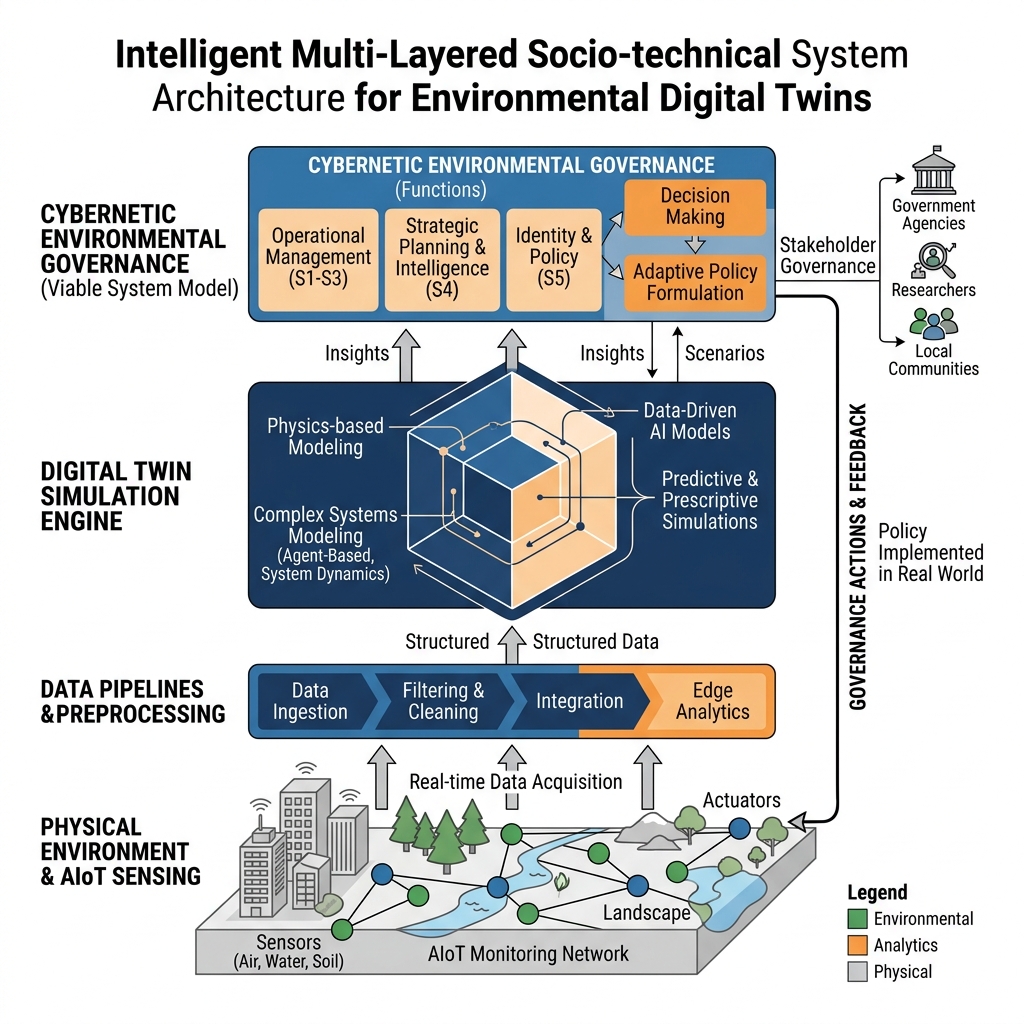
Environmental governance in the Global South increasingly unfolds within complex socio-technical systems characterized by fragmented institutional capacities, distributed sensing infrastructures, and high socio-ecological uncertainty. In this context, Digital Twins have emerged as a promising paradigm for integrating cyber-physical systems with decision intelligence, yet most implementations remain limited to industrial optimization or urban infrastructure management. This article proposes an architectural framework for Digital Twins oriented toward environmental governance by integrating Artificial Intelligence of Things (AIoT) monitoring networks with complex systems modeling and cybernetic governance principles. Methodologically, the study combines conceptual development grounded in systems science and the Viable System Model (VSM) with an illustrative empirical case study from the Caribbean Mining Corridor in Colombia, where a distributed AIoT environmental monitoring network operates within the Hub Ambiental del Caribe initiative. The proposed architecture links real-time environmental sensing, predictive analytics, and recursive governance structures to enable anticipatory environmental decision-making. The results demonstrate how Digital Twin infrastructures can function as cybernetic platforms that transform fragmented environmental data into actionable decision intelligence across institutional levels. By embedding feedback mechanisms, open environmental data governance, and participatory monitoring capacities, the framework supports adaptive management in highly dynamic socio-ecological contexts. The study concludes that Digital Twins designed as governance infrastructures—rather than purely technical replicas—can significantly enhance environmental decision support systems and foster climate justice-oriented transitions in vulnerable territories of the Global South.
Keywords:
digital twins
; environmental governance
; aiot environmental monitoring
; decision support systems
; viable system model
; complex adaptive systems
; environmental data governance
; climate justice
Copyright: This open access article is published under a Creative Commons CC BY 4.0 license, which permit the free download, distribution, and reuse, provided that the author and preprint are cited in any reuse.


