

Submitted:
01 April 2026
Posted:
02 April 2026
You are already at the latest version
Abstract
The concepts of anthromes and human appropriation of net primary production (HANPP) are both valuable in understanding our human-dominated planet, yet they have never been integrated theoretically or empirically. Here we utilize an extensive county-level dataset on HANPP and its product-level components to derive, through cluster analysis, ten contemporary US anthromes. From highest to lowest density of harvested HANPP, the anthromes are: Rainfed Corn-Soy, Dairy Fodder, Spring Wheat-Small Grain, Winter Wheat-Sorghum and Corn-Soy Dry Margin, Subtropical Soy-Cotton, Commercial Timber, Mixed Hardwood and Pasture, Recovered Eastern Forest, Prairie-Sagebrush Rangeland, and Arid and Alpine Sparse Grazing. Expanding to thirteen anthromes maintains these, while bifurcating the commercial timber (softwood, hardwood), rainfed corn-soy (core, fringe) and mixed hardwood and pasture anthromes. Cluster analysis was more successful than hierarchical modeling at producing empirically meaningful anthromes.
Keywords:
anthromes
; cluster analysis
; human appropriation of net primary production
; United States
1. Introduction
Ample evidence points to Earth, a cultivated planet [1], having entered the Anthropocene at some point in the last two centuries [2]. Humans emerged as a powerful ecological force at least 12,000 years ago [3] through the use of fire, wood harvesting, animal husbandry, and crop cultivation—and the manipulation of water resources and landscapes to facilitate those activities. The current ecological domination of Earth by humans is well captured by Bar-On et al. [4] who found that humans constitute 38 percent of biomass among mammals, and their domesticated livestock constitute 58 percent. Among birds, 70 percent of biomass is contained in domesticated animals. The argument is therefore strong for developing a second delineation of earth’s ecological regions, complementary to biomes, that usefully categorizes human-dominated ecosystems based on contemporary agro-ecological realities and extant land use patterns. The concept of “anthromes” [5,6,7] is thus an essential one. As a concept that is only in its second decade, however, there is a need to further explore methodological approaches for defining and delineating anthromes, and how they change, in contemporary landscapes.
This paper explores the concept of human appropriation of net primary production (HANPP) [8,9] as a means to define 21st century anthromes. HANPP is a concept that is directly applicable to the definition and delineation of anthromes. While previous work has utilized population density, land use patterns and relative areas of land cover, the HANPP concept is grounded in ecological energy flows and the degree to which they are allocated to human consumption. Humans appropriate net primary production (NPP) by (a) controlling land uses in a manner that decreases, or occasionally increases, NPP, and by (b) harvesting biomass in the form of timber, crops and livestock grazing (Figure 1). It further measures NPP that remains in ecosystems to support non-domesticated food chains. Thus, as a measure of human land use intensity relative to ecological capacity, HANPP and its components provide an excellent means to quantify the degree to, and manner in which, humans are utilizing or colonizing ecosystems, especially through agro-ecological interventions.
1.1. The Relationship Between the Anthromes and HANPP Concepts
Anthromes and HANPP are related concepts founded in human transformations of terrestrial ecosystems to meet their needs, yet the concepts have evolved separately, only occasionally referencing each other in passing, without building on one another. The anthromes concept can be traced directly to Ellis and Ramankutty [5] and has developed a literature centered on the innovative work of Erle Ellis. Integrated with the literature establishing the dawn of the Anthropocene geological epoch [6,7], anthromes have been defined by ranges of population density and percentages of land cover devoted to settlements, crops, pasture, forest, and less affected wildlands. They have been characterized by human-induced changes in plant communities, fire regimes, organic carbon accumulation, and nitrogen and phosphorus cycling. Potential vegetation cover has also been employed in the delineation of historic anthromes [6]. Archeo-ecological investigations and land use reconstructions indicate that human land use has long had substantial ecological consequences even when human populations were limited. Per capita ecological impacts have actually declined as agricultural efficiency and productivity have improved and become more intensive, even leading to widespread reforestation and other forms of ecological recovery [7]. Smil [10] argues that the replacement of plant-based forms of energy, such as wood, with fossil fuels and electricity also reduced ecological impacts per capita and facilitated urbanization. The global mapping of current and historical anthromes has made a unique contribution to our understanding of human ecology and human-environmental geography and has opened an ongoing conversation on human-dominated, and even novel, ecosystems [11]. This has enriched our capacity to conceptualize a “good Anthropocene” where environmental sustainability is pursued on a human-dominated planet [12].
With the fixation of 1g of carbon representing 32,800 joules of solar energy transformed into chemical energy, NPP, and therefore HANPP, is derived from the tradition of ecological energetics established by the Odum brothers [13] and advanced by Smil’s [14] analysis of the energetic dependence of humans on biomass. Originally titled “human appropriation of the products of photosynthesis” [15], the HANPP concept has a longer history than anthromes. Its current definition (Figure 1) took shape in a seminal paper by Haberl et al. [8] that measures HANPP across the planet. Since then, several dozen papers have utilized the concept to measure the intensity of human utilization of terrestrial ecosystems. Case studies span many corners of the globe and tie HANPP to human consumption of food, fiber and fuel (embodied HANPP) [16]. HANPP is thus a refined form of the ecological footprint [17] that forms part of the nexus of social metabolism [18], where the environmental load of human consumption is displaced through trade and waste emissions [16,19].
Net primary production (NPP) is gross primary production (GPP; total photosynthesis) minus plant respiration and is measured as the rate of carbon fixation in biomass accumulation, usually in gCm-2yr-1. Global NPP increased slowly over the 20th century due to carbon dioxide fertilization of photosynthesis and expanded growing seasons in higher latitudes but this expansion has been reversed by increasing drought in the 21st century [20]. Averaging about half of GPP [21], NPP varies from 0 to approach 2000 gCm-3yr-1. NPP. It is “appropriated” by humans when use of terrestrial ecosystems either (a) diminishes NPP, referred to as HANPPlanduse, or (b) harvests NPP as crops, timber or grazing by domesticated livestock, referred to as HANPPharvest. It can be further subdivided into above and below-ground HANPP and into the portion used directly as the yield of crops or timber or the portion not directly used, such as forest slash and crop residues. Human-induced fire can be defined as HANPPlanduse but is difficult to differentiate from the effect on NPP of natural fire regimes. The absence of HANPP nearly defines protected areas, while it can approach, but not exceed, the entirety of NPP on the most intensively harvested croplands. For example, HANPP of 1300 gCm-3yr-1 has been recorded in Bangladesh [22]. NPPeco thus varies inversely from 0 to 100 percent of NPP and from 0-2000 gCm-3yr-1. As the energetic basis supporting non-domesticated species, NPPeco has a positive but complex relationship with biodiversity and ecosystem services [23,24].
Haberl et al. [8] found a global HANPP of 15.6 PgCyr-1 to be 23.8 percent of global terrestrial NPP circa 2000, with an average global density of 111 gCm-3yr-1. Following Figure 1, this is disaggregated into 63 gCm-3yr-1 HANPPharvest and 48 gCm-3yr-1 HANPPlanduse. During the 20th century, global HANPP doubled [25] as terrestrial carbon stocks were diminished by half [26], indicating that humans have created a more throughput-oriented terrestrial biosphere. Regionally, HANPP varies from 11 percent of NPP in Australia to 63 percent in South Asia. Trends in HANPP indicate land use intensification; for example, from 2001 to 2010, HANPP increased from 49.5 to 57.8 percent of NPP in China [27]. In contrast, in the conterminous U.S., HANPPharvest was a steady 15–17 percent of NPP from 1997 to 2012 [17], and our analysis here shows this range is consistent through 2017.
Kastner et al. [19] found that increasing intensification of agricultural production rather than land use change per se was the dominant process through which humans met increasing demands for food, fiber and fuel throughout the last century (1910–2010), driven by increases in population and affluence. Unlike land use change analysis, through measures of ecological energetics, HANPP captures land use intensification driven by local and distal demand for food, feed, fiber and fuel. HANPP is thus a uniquely insightful measuring stick of the intensity of human utilization of terrestrial ecosystems. In this sense, we can define discrete HANPP regimes, which vary over both time and space, and that characterize human-dominated ecosystems or anthromes. We can then use HANPP regimes to build a taxonomy of anthromes at the county level and compare this to other systems, such as USDA land resource regions [28].
2. Materials and Methods
To derive the anthromes regions for the contiguous US, we utilize county-level total HANPP and its product-level regimes derived by Paudel et al. [17]. These data record HANPPharvest in the form of grazing, timber (hardwood and softwood), major crops (corn grain and silage, soybeans, spring and winter wheat, alfalfa and hay, cotton) and aggregated minor crops. HANPPharvest is disaggregated into above- and below-ground portions and into used products and unused stover and slash. The HANPP regimes are available from 1997 to 2022 at 5-year intervals. Annual NPP estimates (gCm⁻²yr⁻¹) were obtained from the MODIS Net Primary Production CONUS dataset [29] for 2002 and 2017. Estimates for recent years (e.g., 2022) could not be calculated as the MODIS NPP CONUS dataset extends only through 2019.
HANPP regimes and NPP estimates were used as primary inputs for the cluster analysis for the years 2002 and 2017 (Figure 2). HANPPharvest was divided into HANPPcrop, HANPPtimber, HANPPgrazing. HANPPcrop was compiled from seven crop-level variables: Corn Grain, Soybeans, Winter Wheat, Spring Wheat, Cattle Fodder, Cotton, and Other Crops. HANPPtimber comprised hardwood and softwood harvests. HANPPgrazing was derived from three land management categories: US Forest Service (USFS), Private, and Bureau of Land Management (BLM) lands. These layers were combined into HANPPharvest along with NPP density into a unified feature set for subsequent K-means and hierarchical clustering.
K-means clustering was applied to identify statistically coherent groupings of counties by minimizing within-cluster variance across different HANPP product level components (HANPPcrop, HANPPtimber, HANPPgrazing). This means that the counties assigned to a particular cluster exhibited similar HANPP profiles. The cluster number was determined iteratively with 10 and 13 clusters selected as the final groupings. These clusters were spatially coherent and aligned strongly with established agricultural regions, forest zones and rangeland systems in the contiguous US. The clustering outputs were then used to manually define anthromes, yielding three final classifications of 10 Anthromes, 13 Anthromes, and 9 divisions. These clusters represent distinct HANPP across the contiguous United States. Anthrome names were derived through manual interpretation of each cluster’s distribution across individual HANPP regimes. Anthrome names, while subjective, were designed to reflect the HANPP regime most strongly associated with the cluster profile. This ensures that the classification is both empirically grounded in the HANPP data structure and interpretable within the context of US agricultural and land use geography.
3. Results
We first present each of the ten anthromes from the cluster analysis and the changes among them from 2002–2017. We follow with the results from a hierarchical categorization of the anthromes based on NPP and HANPP.
3.1. Delineating HANPP Anthromes through Cluster Analysis
There is no objectively correct number of anthromes to be determined through cluster analysis. Categorizing and mapping U.S. counties into ten anthromes based on HANPP regimes using the K-means method described above, however, generated meaningful anthomes. These encompass from 33 to 1004 counties each and from 110 to 2315 thousand km2 (Figure 3). We describe these ten county-scale anthromes below, focusing on their geographic distribution and HANPP regime. We also provide a brief review of the manner in which modern American society has transformed them from their pre-colonized ecological condition. The broad sweep of North American environmental history includes several thousand years of intensive Indigenous occupation with distinct and changing anthromes, followed by tragic plagues brought about by European colonialization that reduced the Indigenous population by some 90 percent [30]. It was this dramatic reduction in population that brought about an ecological recovery that European-American settlers characterized as a wilderness frontier. We here focus on the transformation of frontier ecosystems into contemporary rural anthromes within the conterminous 48 states. While Ellis and Ramankutty [5] also categorized settlements (e.g., urban areas) as anthromes, we here focus only on rural ecosystems where HANPP provides a more insightful lens.
In the subsections below, each anthrome is accompanied by a figure mapping the counties clustered into that anthrome in the upper left, along with their HANPP regime. The box and whisker plot in the upper right indicates the range of NPP, HANPPharvest and NPPeco among counties categorized into that anthrome. The larger box and whisker plot at the bottom disaggregates HANPPharvest into its most important components: first, timber, grazing and crop-based HANPP; then, disaggregated by major crops (in terms of biomass harvested), including corn grain, soybeans, winter and spring wheat, cattle fodder (alfala, hay, corn silage), cotton and remaining crops. The anthromes are presented from highest to lowest mean HANPPharvest density in 2017 in gCm-2yr-1.
3.1.1. Rainfed Corn-Soy Anthrome
The rainfed corn-soy anthrome corresponds to the “Cornbelt.” It is nearly geographically contiguous, centered on Illinois and Iowa (Figure 4) and extending to southeastern North Dakota and parts of the Lower Mississippi Valley. It has a high mean NPP of 1132 gCm-2yr-1 and by far the highest mean HANPPharvest of 423 gCm-2yr-1, dominated by corn grain and soybean crops. The rainfed corn-soy anthrome epitomizes the anthromes concept. It is the most thoroughly transformed from its former ecological state of a biodiverse tallgrass prairie matrix, dotted with archipelagoes of wetlands and corridors of riparian forest. Transformation occurred largely in the century 1850–1950 through wetland tile drainage, tillage, chemical fertilization and the construction of straight East-West, North-South roads in nearly every square mile section. These transformations have facilitated intensive harvesting of high yield corn grain and its leguminous complement soybeans for livestock feed, vehicle fuel and exports.
3.1.2. Dairy Fodder Anthrome
The dairy fodder anthrome (Figure 5) is geographically non-contiguous. The largest cluster to the northeast of the rainfed corn-soy anthrome is centered in Wisconsin, with additional clusters in fertile valleys in the Northeast, where predominantly hardwood forests were cleared for pasture and to crow fodder crops like alfalfa, hay and sileage corn to feed diary and, to a lesser extent, beef cattle. This anthrome is also prominent in irrigated valleys of the West (e.g., San Joaquin Valley, Snake Valley) where irrigation increases NPP beyond that of the prairie-sagebrush ecosystem from which it was developed. The extent of this anthrome in the semi-arid West is limited by available water resources, most of which were claimed in the late 19th and early 20th centuries as appropriative rights.
This anthrome has a high mean NPP of 965 gCm-2yr-1 and a moderately high mean HANPP of 234 gCm-2yr-1, with crops being the primary type of HANPPharvest. In addition to alfalfa, grass hay and silage corn, grain corn is also evident in selected fertile areas. The dairy fodder anthrome illustrates how capturing NPP for ruminant livestock transforms ecosystems beyond grazed pastures and rangelands.
3.1.3. Spring Wheat-Small Grain Anthrome
The less expansive and nearly contiguous spring wheat-small grain anthrome stretches along and beyond the Canadian border, centered in North Dakota (Figure 6). It has a moderate mean NPP of 755 gCm-2yr-1 and a high mean HANPPharvest of 192 gCm-2yr-1 almost entirely consisting of rainfed crops led by spring wheat and other field grains. This intensively cultivated anthrome lies climatically between the warmer and more humid rainfed corn-soy anthrome to the southeast, and the more arid lands that support only grazing to the southwest. Like the rainfed corn-soy anthrome, an ecosystem of wetlands (e.g., prairie potholes) and prairie was transformed through tile drainage and tillage. While the HANPP density is less than for the rainfed corn-soy anthrome, this is due to smaller yields from wheat than corn; the landscape is nearly as dominated by crop production.
3.1.4. Winter Wheat-Sorghum and Corn-Soy Dry Margin Anthrome
The winter wheat-sorghum and corn-soy dry margin anthrome is centered on Kansas, with a large cluster in the Palouse of eastern Washington and smaller clusters elsewhere (Figure 7). It has a moderate mean NPP of 779 gCm-2yr-1 and a high mean HANPPharvest of 197 gCm-2yr-1 with crops dominating. The leading crops in this sub-humid anthrome are drought-tolerant sorghum (milo) and winter wheat, which lies fallow in the hot dry summer. Many farmers extend rainfed corn-soy rotations into its dry margin, despite the increasing threat of drought, or even double-crop winter wheat with soybeans. Like the anthromes above, tillage transformed a flat landscape of prairie and corridors of riparian forest into large rectangular cultivated fields crosshatched by service roads to harvest grains for livestock, biofuel and exports.
3.1.5. Subtropical Soy-Cotton Anthrome
The subtropical soy-cotton anthrome is an archipelago of fertile, mostly irrigated lands separated by less fertile or less irrigable lands extending from Texas to the Carolinas (Figure 8). With a warm humid climate, it has a high mean NPP of 1076 gCm-2yr-1, and a high HANPPharvest of 172 gCm-2yr-1. Prominent clusters include lands overlying the Ogallala aquifer in the high plains of North Texas, portions of the Lower Mississippi Valley, and southwestern Georgia. Human development of fossil groundwater resources and tillage has raised the NPP of the shortgrass prairie in the high plains. In the Lower Mississippi Valley, the construction of massive levees facilitated drainage and timbering of forested wetlands to produce cropland that relies upon supplemental irrigation from the unconfined aquifers along the river valley. Elsewhere, soybeans, cotton and fruit and vegetable crops thrive in remnants of resilient soils in what was once the cotton belt of the pre-Civil War South. Yet soil degradation has driven a 20th century transformation of much of this recent historic anthrome to become the commercial timber anthrome.
3.1.6. Commercial Timber Anthrome
The geographically extensive commercial timber anthrome has a large non-contiguous cluster extending across the southern piedmont and coastal plain. There is also a second cluster along the northern Pacific coast, and smaller clusters in Maine and elsewhere (Figure 9). This less intensively transformed anthrome has been modified from both diverse forest and soils exhausted by the production of cotton and other crops to foster tree species that are commercially valuable for wood production, grown in economically optimal rotations with numerous access roads. It has a high NPP of 886 gCm-2yr-1 and a moderate mean HANPPharvest of 129 gCm-2yr-1. It is the only anthrome where timbering is the majority of HANPPharvest.
3.1.7. Mixed Hardwood and Pasture Anthrome.
The mixed hardwood and pasture anthrome is geographically dispersed across populated rural landscapes from Maryland to Texas, with outliers to the northwest (Figure 10). Pre-Euro-American settlement, this anthrome was largely forested and then cleared for agricultural production by pioneer farmers. With the general failure of intensive crop production, it maintains a mixed trees-grass landscape under a light agricultural regime of pasture interspersed with second growth forest. While seeming to be miscellaneous, it is a prototypical and distinctly rural anthrome of the humid, moderately sloped US with a mean NPP 936 gCm-2yr-1 and a low mean HANPP of 107 gCm-2yr-1. Grazing, timbering and crops are all evident but there is no dominant harvested product.
3.1.8. Recovered Eastern Forest Anthrome
The recovered eastern forest anthrome (Figure 11) extends throughout the eastern US with large contiguous clusters in the Northeast, Appalachians, upper South and Midwestern northwoods. It also has outliers in the Pacific coast and a semi-tropical variant along the Gulf coast. With a high NPP of 1026 gCm-2yr-1 and a very low mean HANPPharvest of only 74 gCm-2yr-1, this anthrome has the highest NPPeco of 952 gCm-2yr-1. It is a biodiverse landscape where forests dominate since pioneer attempts at agricultural production were unsuccessful and abandoned, allowing for ecological succession. The characteristics of this anthrome have intensified as forests continuously accumulate biomass and generate abundant ecosystem services.
3.1.9. Prairie-Sagebrush Rangland Anthrome
The geographically most-extensive prairie-sagebrush rangeland anthrome (Figure 12) is largely contiguous throughout the semi-arid shortgrass prairies, grading into the sagebrush shrub-scrub expanses of the semi-arid Western US. This anthrome has a low mean NPP of only 444 gCm-2yr-1 and a low mean HANPPharvest of only 39 gCm-2yr-1, with grazing widespread. It also has a representation of fodder crops, grown as winter feed to complement grazing in select areas where appropriative rights to scarce water supplies have been acquired to irrigate alfalfa or hay.
This anthrome underwent a sudden transformation in the 1870s when the vast bison herds hunted by Native Americans were decimated. This opened an ecological niche for cattle husbanded by white settlers, initially in an open range, where overstocking generated a classic tragedy of the commons. Subsequently, grazing carrying capacities were better managed by ranchers on enclosed private lands or by grazing permit specifications on federal lands following the 1934 Taylor Grazing Act. On federal lands, cattle permitted by animal unit months mingle with wildlife in this stereotypically Western anthrome.
3.1.10. Arid and Alpine Sparse Grazing Anthrome
Finally, the extensive arid and alpine sparse grazing anthrome (Figure 13) is characterized by a very low mean NPP of only 230 gCm-2yr-1. HANPPharvest in this marginally transformed landscape is correspondingly very low, with a mean of density of only 27 gCm-2yr-1. Centered in the Inter-Mountain West, with large outliers in southern New Mexico and western Montana, it has a land use history akin to the prairie-sagebrush grazing anthrome, but with lower levels of grazing and little cropping.
3.1.11. Expanding from 10 to 13 Anthromes.
Statistically increasing the number of clusters from ten to thirteen maintains essentially the same anthrome groupings, while introducing some distinctions. K-means generated thirteen anthrome clusters of 32 to 880 counties that range in area from 80 to 2325 thousand km2 (Figure 14). The commercial timber anthrome bifurcates into commercial softwood and commercial hardwood anthromes. The rainfed corn-soy anthrome bifurcates into corn-soy core and core-soy fringe anthromes. Finally, mixed hardwood and pasture bifurcates into more lightly (mixed hardwood and pasture) and more heavily grazed (mixed pasture and hardwood) anthromes.
The relative stability of the categorized anthromes between ten and thirteen clusters illustrates that, while there is no one objectively correct categorization of anthromes, the anthrome clusters are statistically robust and descriptively useful. As the number of clusters is increased, finer distinctions are drawn (e.g., hardwood vs. softwood), while the statistical boundaries (NPP, HANPP) of identified anthromes shift marginally to make room for new groupings. All ten of the anthromes identified above remain evident when thirteen groupings are generated. This indicates that HANPP regimes are a valid approach to delineating anthromes, even though the number of groupings specified controls the statistical outcome of cluster analysis.
3.2. Dynamics Among the Ten Anthromes
While biomes evolve over millenia, anthromes are more dynamic because they respond to historical human forces operating at decadal to century-long timescales. Westward expansion in 19th Century America was perhaps the most rapid period of anthrome transformation known to environmental history and played a central role in establishing all of the anthromes presented here. While the 21st century is less singular than the 19th, anthromes continue to evolve and this can be traced through changing HANPP regimes. Figure 15 graphs the number of counties that changed from one anthrome to another in this fifteen year period and thereby provides a valuable analysis of the contemporary trajectory of change. We briefly describe these trends for each of the ten cluster anthromes below.
Driven by demand for ever higher yields of corn for uses such as biofuel, and responding to climate change with a northwestward shift, the rainfed corn-soy anthrome is expanding rapidly. It is drawing counties from a number of other anthromes including dairy fodder, spring wheat-small grain, winter wheat sorghum and even recovered eastern forest. The dairy fodder anthrome is shrinking, intensifying into rainfed corn-soy but also successioning to recovered eastern forest. The spring wheat-small grain, winter wheat sorghum, and sub-tropical soy-cotton anthromes are all marginally intensifying to rainfed corn-soy. Singularly devoted to the appropriation of net primary production, as corn yields and demands continue to climb, agricultural economic forces drive the expansion of this anthrome into any other anthrome where soil and climatic conditions are suitable.
The commercial timber anthrome is exchanging counties with the recovered eastern forest anthrome based on shifting locations of timber production. Due to forest succession on abandoned pasturelands, the mixed hardwood and pasture anthrome is contracting in favor of the growing recovered eastern forest anthrome. The prairie-sagebrush rangeland anthrome is losing counties to the recovered eastern forest anthrome, while the arid and alpine sparse grazing anthrome is stable.
Altogether, 1103 counties changed anthromes from 2002 to 2017, with a net loss of anthromes with moderate levels of HANPPharvest in favor of both ends of the spectrum: uniquely high levels of HANPP on growing areas of high-yielding corn and soybeans on the one hand and very low levels of HANPP in the recovered eastern forest, on the other. These trends indicate that the U.S. landscape is increasingly bifurcating into intensively cropped and increasingly naturalized post-agricultural ecosystems. This bifurcation has implications for biodiversity and the distribution of ecosystem services to human populations.
3.3. Anthromes Produced through Hierarchical Clustering
3.3.1. NPP-HANPP Distribution
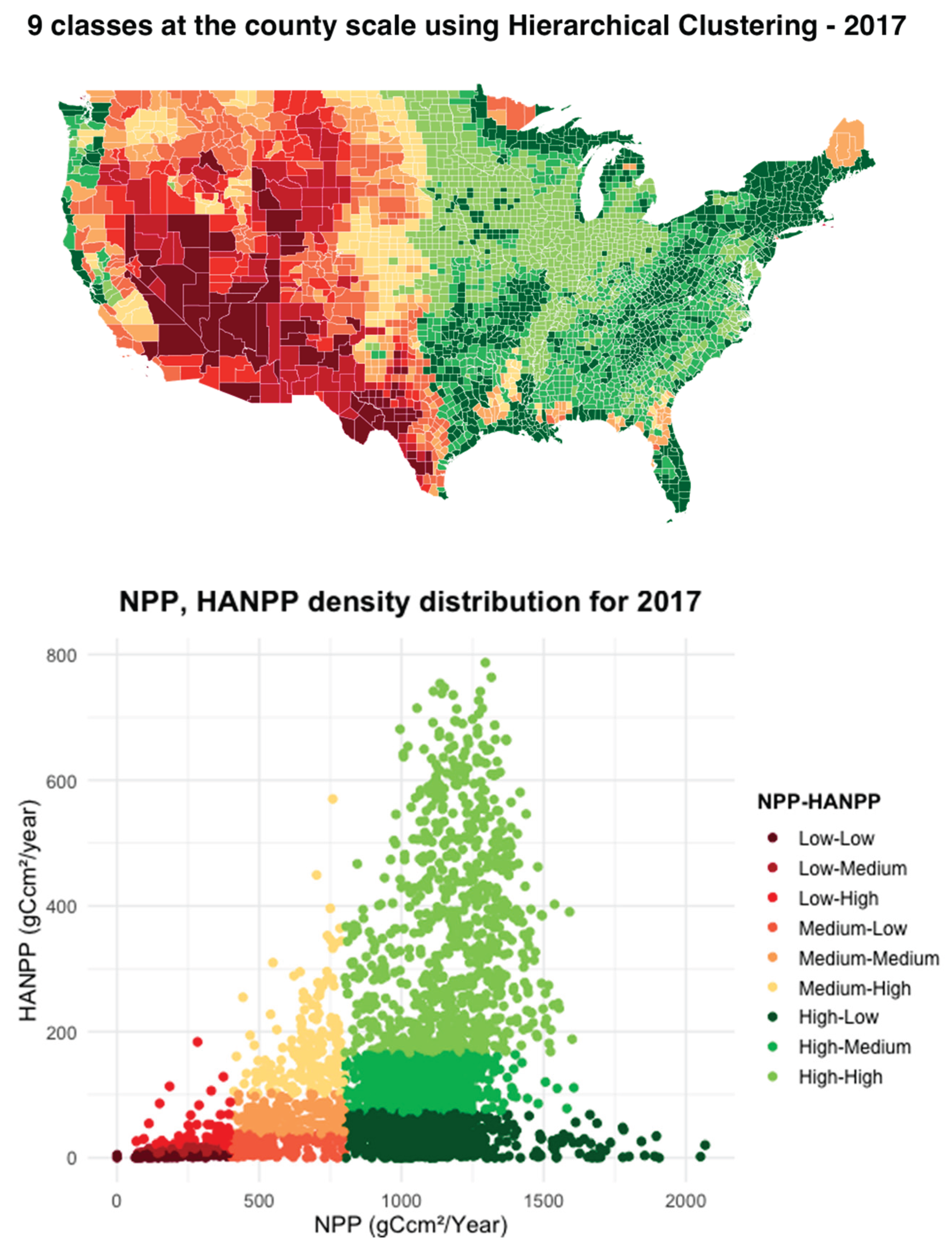
The second, more top-down approach is to designate anthromes in ranges of NPP and HANPPharvest. Figure 16 maps U.S. counties in 2017 into high (>800 gCm-2yr-1), medium (400–800 gCm-2yr-1) and low (< 400 gCm-2yr-1) NPP, as well as high (>156 gCm-2yr-1), medium (74–156 gCm-2yr-1) and low (< 74 gCm-2yr-1) levels of HANPPharvest. These are then combined into nine classes in Figure 17.
This approach produces nine anthromes that carry a well-defined statistical meaning and yields identifiable regional groupings. Because the designation of three levels (high, medium and low) and the dividing lines between them are pre-set and fundamentally arbitrary, however, the resulting anthromes do not coalesce into empirical clusters where variance within the cluster is less than variance between the clusters. It is thus a less suitable approach to generating an anthome taxonomy and this shortcoming plays out empirically in failing to identify extant human ecological types. It is also important to note that the hierarchical clustering relied on two variables —HANPPharvest and NPP —to categorize the full spectrum of human appropriation of NPP. By collapsing the rich multivariate structure of the HANPP dataset into a simple 3×3 matrix (low, medium, high) of productivity tiers, this approach did not utilize the complerte HANPP regime. We thus find the hierarchical approach to identifying anthromes through HANPP regimes to be less useful than the K-means cluster analysis approach.
4. Discussion
The study here demonstrates the potential for a first constructive interaction between the related concepts of anthromes and HANPP by employing K-means cluster analysis to identify anthromes using data on HANPP regimes. The ten anthromes presented above are consistent with narratives in the ecological geography and environmental history of North America. By definition, anthromes are continuously being reinforced or transformed, geographically expanding or contracting. Periodically updating HANPP regimes by combining the methods described in [17] and our work here is capable of tracking changes in anthrome characteristics and trends among them, using data sources that are continually updated in the U.S. such as the USDA-NASS Cropland Data Layer and agricultural yields. In other countries, different data sources would need to be employed, following the lead of researchers at the Institute of Social Ecology.
The anthromes we have generated here are not inconsistent with other similar exercises such as USDA Agricultural Resource Regions [28]. We do not suggest that anthromes replace these useful and carefully developed landscape categorizations but rather offer an additional approach based on ecological energetics (HANPP) and the anthromes concept.
Because of the reliance on county-based crop, grazing and timber harvesting data, the spatial resolution of the analysis presented above is rather course. Certainly many, if not most, counties contain landscape elements from multiple anthromes. While HANPP can be estimated at the 30m pixel level [31], to the best of our knowledge this has only been accomplished for one US county to date. Fine tuning of the spatial extent of anthromes is therefore possible, if arduous.
No one taxonomy of anthromes can be the objectively correct one any more than one taxonomy of soil or climate types is definitive. Nonetheless, we offer that the generation of anthromes through cluster analysis of HANPP regimes, as done herein for the contemporary U.S., aids in the understanding and appreciation of our cultivated and human-dominated planet in the Anthropocene.
Author Contributions
Conceptualization, K.F., C.L.; methodology, A.C., K.F.; validation, A.C., C.L.; writing—original draft preparation, A.C., C.L.; writing—review and editing, K.F., A.C., C.L.; visualization, A.C.; supervision, C.L. All authors have read and agreed to the published version of the manuscript.
Funding
This research was partially funded by U.S. National Science Foundation CBET-2115169.
Data Availability Statement
The original data presented in the study are openly available in the Mendeley Data Repository 10.17632/ksyd2cr9cr.5 available at https://data.mendeley.com/datasets/ksyd2cr9cr/5
Conflicts of Interest
The authors declare no conflicts of interest. The funders had no role in the design of the study; in the collection, analyses, or interpretation of data; in the writing of the manuscript; or in the decision to publish the results.
Abbreviations
The following abbreviations are used in this manuscript:
| BLM | U.S. Bureau of Land Management |
| CONUS | Contiguous United States |
| GPP | Gross primary production |
| U.S. | United States |
| USFS | U.S. Forest Service |
| USDA | U.S. Department of Agriculture |
References
- Foley, J.; Ramankutty, N.; Brauman, K.; et al. Solutions for a cultivated planet. Nature 2011, 478, 337–342. [Google Scholar] [CrossRef]
- Steffen, W.; Persson, Å.; Deutsch, L.; et al. The Anthropocene: From Global Change to Planetary Stewardship. AMBIO 2011, 40, 739–761. [Google Scholar] [CrossRef]
- Ellis, E.C.; Beusen, A.H.W; Goldewijk, K.K. Anthropogenic Biomes: 10,000 BCE to 2015 CE. Land 2020, 9, 129. [Google Scholar] [CrossRef]
- Bar-On, Y.M.; Phillips, R.; Milo, R. The biomass distribution on Earth. Proceedings of the National Academy of Science 2018, 115(25), 6506–6511. Available online: www.pnaswww.pnas.org/cgi/doi/10.1073/pnas.1711842115. [CrossRef]
- Ellis, E.C.; Ramankutty, N. Putting people in the map: anthropogenic biomes of the world. Front Ecol Environ 2008, 6(8), 439–447. [Google Scholar] [CrossRef]
- Ellis, E.C. Anthropogenic transformation of the terrestrial biosphere Phil. Trans. R. Soc. A 2011, 369, 1010–1035. [Google Scholar] [CrossRef]
- Ellis, E.C.; Kaplan, J.O.; Fuller, D.Q.; Vavrus, S.; Goldewijk, K.K; Verburg, P.H. Used planet: A global history. Proceedings of the National Academy of Science 2013, 10(20), 7978–7985. [Google Scholar] [CrossRef]
- Haberl, H.; Erb, K.-H.; Krausmann, F.; Gaube, V.; Bondeau, A; Plutzar, C.; Gingrich, S.; Lucht, W.; Fischer-Kowalski, M. Quantifying and mapping the human appropriation of net primary production in earth’s terrestrial ecosystems. Proceedings of the National Academy of Sciences 2007, 104, 12942–12947. [Google Scholar] [CrossRef] [PubMed]
- Haberl, H.; Erb, K-H; Krausmann, F. Human Appropriation of Net Primary Production: Patterns, Trends, and Planetary Boundaries. Annual Review of Environment and Resources 2014, 39, 363–391. [Google Scholar] [CrossRef]
- Smil, V. Energy and Civilization: A History; The MIT Press: Massachusetts, United States, 2016. [Google Scholar]
- Hobbs, RJ; Higgs, E.; Harris, J.A. Novel ecosystems: Implications for conservation and restoration. Trends in Ecology & Evolution 2009, 24, 559–605. [Google Scholar] [CrossRef]
- Bennett, E.M.; Solan, M.; Biggs, R.; McPhearson, T.; Norstrom, A.V.; et al. Brights spots: seeds of a good Anthropocene. Frontiers in Ecology and the Environment 2016, 14(8), 441–448. [Google Scholar] [CrossRef]
- Odum, E.P. Energy flow in ecosystems: A historical review. American Zoologist 1968, 8, 11–18. [Google Scholar] [CrossRef]
- Smil, V. Harvesting the Biosphere: What We Have Taken From Nature; The MIT Press: Massachusetts, United States, 2012. [Google Scholar]
- Vitousek, P.M.; Ehrlich, P.R.; Ehrlich, A.H.; Matson, P.A. Human appropriation of the products of photosynthesis. Bioscience 1986, 36(6), 368–373. [Google Scholar] [CrossRef]
- Kastner, T.; Kastner, M.; Nonhebel, S. Tracing distant environmental impacts of agricultural products from a consumer perspective. Ecological Economics 2011, 70, 1032–1040. [Google Scholar] [CrossRef]
- Paudel, S.; Mueller, K.; Ovando-Montejo, G.; Rushforth, R.; Tango, L.; Lant, C. Product-specific human appropriation of net primary production in U.S. counties. Ecological Indicators 2023, 150, 110241. [Google Scholar] [CrossRef]
- Haberl, H.; Wiedenhofer, D.; Pauliuk, S.; Krausmann, F.; Muller, D.B.; Fischer-Kowalski, M. Contributions of sociometabolic research to sustainability science. Nature Sustainability 2019, 2, 173–184. [Google Scholar] [CrossRef]
- Kastner, T.; Matej, S.; Forrest, M.; Gingrich, S.; Haberl, H.; Hickler, T.; Krausmann, F.; Lasslop, G.; Niedertscheider, M.; Plutzar, C.; Schwarzmuller, F.; Steinkamp, J.; Erb, K.-H. Land use intensification increasingly drives the spatiotemporal patterns of the global human appropriation of net primary production in the last century. Global Change Biology 2022, 28, 307–322. [Google Scholar] [CrossRef]
- Zhao, M.; Running, S. Drought-induced reduction in global terrestrial net primary production from 2000 through 2009. Science 2010, 329, 940–943. [Google Scholar] [CrossRef]
- Zhang, Y.; Xu, M; Chen, H.; Adams, J. Global pattern of NPP to GPP ratio derived from MODIS data: effects of ecosystem type, geographical location and climate. Global Ecology and Biogeography 2009, 18, 280–290. [Google Scholar] [CrossRef]
- Mahbub, B.; Ahmed, N.; Rahman, S.; Hossain, M.; Sujauddin, M. Human appropriation of net primary production in Bangladesh, 1700-2100. Land Use Policy 2019, 87, 104067. [Google Scholar] [CrossRef]
- Cusens, J.; Wright, S. D.; McBride, P. D.; Gillman, L. N. What is the form of the productivity-animal-species-richness relationship? a critical review and meta-analysis. Ecology 2012, 93(10), 2241–2252. [Google Scholar] [CrossRef]
- Haberl, H.; Gaube, V.; Díaz-Delgado, R.; Krauze, K.; Neuner, A.; Peterseil, J.; Plutzar, C.; Singh, S. J.; Vadineanu, A. Towards an integrated model of socioeconomic biodiversity drivers, pressures and impacts. A feasibility study based on three European long-term socio-ecological research platforms. Ecological Economics 2009, 68(6), 1797–1812. [Google Scholar] [CrossRef]
- Krausmann, F.; Erb, K.-H.; Ginfrich, S.; Haberl, H.; Bondeau, A.; Gaube, V.; Lauk, C.; Plutzar, C.; Searchinger, T.D. Global human appropriation of net primary production doubled in the 20th century. Proceedings of the National Academy of Sciences 2013, 110, 10324–10329. [Google Scholar] [CrossRef] [PubMed]
- Erb, K.-H.; Fetzel, T.; Plutzar, C.; Kastner, T.; Lauk, C.; Mayer, A.; Niedertscheider, M.; Korner, C.; Haberl, H. Biomass turnover time in terrestrial ecosystems halved by land use. Nature Geoscience 2016, 9, 674–678. [Google Scholar] [CrossRef]
- Chen, A.; Li, R.; Wang, H.; He, B. Quantitative assessment of aboveground net primary production in China. Ecological Modelling 2015, 312, 54–60. [Google Scholar] [CrossRef]
- USDA Natural Resources Conservation Service (NRCS). Land Resource Regions and Major Land Resource Areas of the United States, the Caribbean, and the Pacific Basin. USDA Agriculture Handbook 296. National Soil Survey Center, Lincoln, NE. Available online: https://www.nrcs.usda.gov/resources/data-and-reports/major-land-resource-area-mlra.
- Robinson, N.P.; Allred, B.W.; Smith, W.K.; Jones, M.O.; Moreno, A.; Erickson, T.A.; Naugle, D.E.; Running, S.W. Terrestrial primary production for the conterminous United States derived from Landsat 30 m and MODIS 250 m. Remote Sensing in Ecology and Conservation 2018. [Google Scholar] [CrossRef]
- Mann, C.C. 1491: New Revelations of the Americas Before Columbus; Knopf Doubleday: New York, United States, 2005. [Google Scholar]
- Paudel, S.; Ovando-Montejo, G.A.; Lant, C.L. Human appropriation of net primary production: From a planet to a pixel. Sustainability 2021, 13, 8606. [Google Scholar] [CrossRef]
Figure 1.
Definition of HANPP and its components.
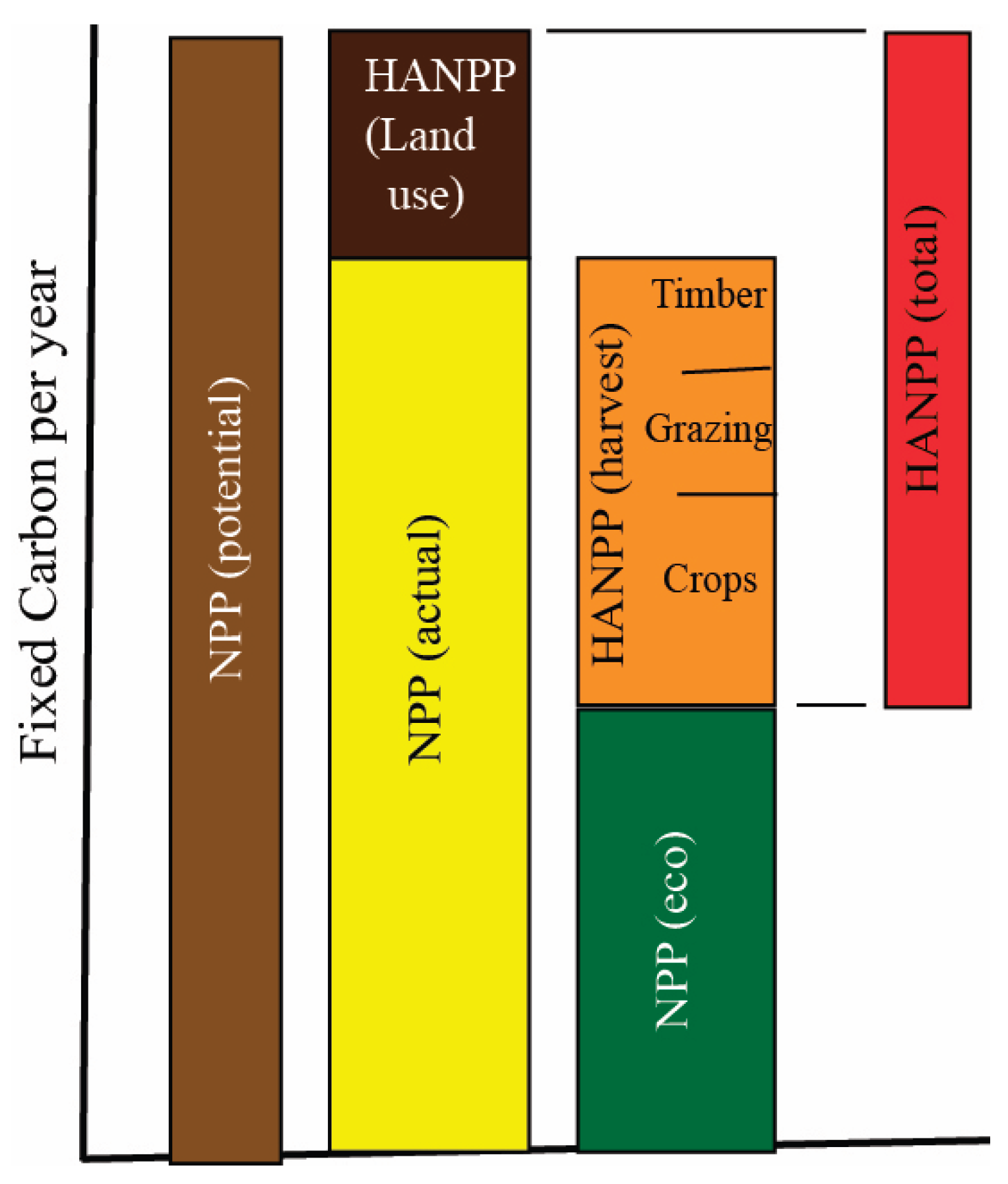
Figure 2.
Overall methodology for deriving HANPP-based U.S. Anthromes.
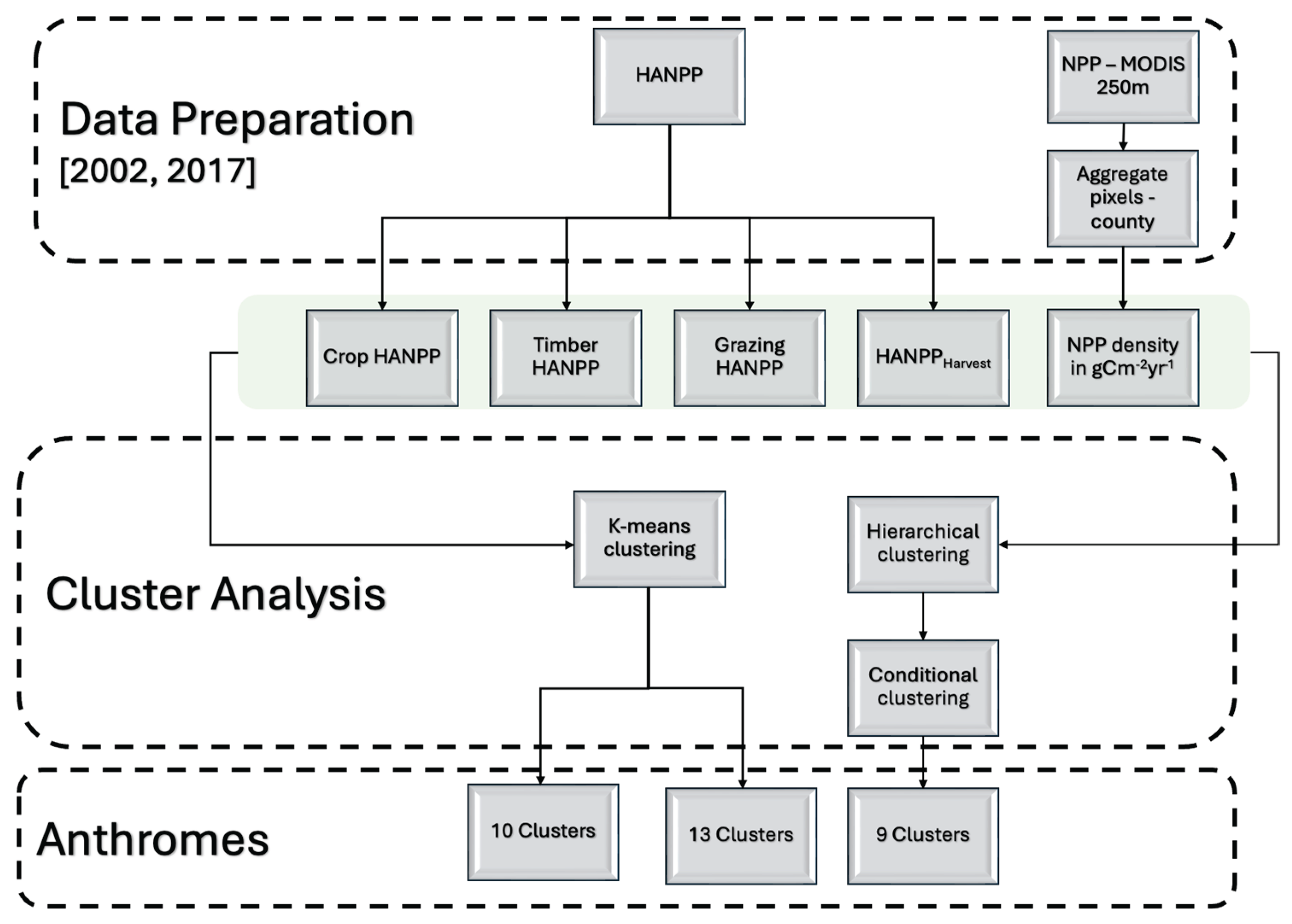
Figure 3.
Map of 10 anthromes in 2017 in the conterminous US (top). The name, area and number of counties in each anthrome (bottom).
Figure 3.
Map of 10 anthromes in 2017 in the conterminous US (top). The name, area and number of counties in each anthrome (bottom).
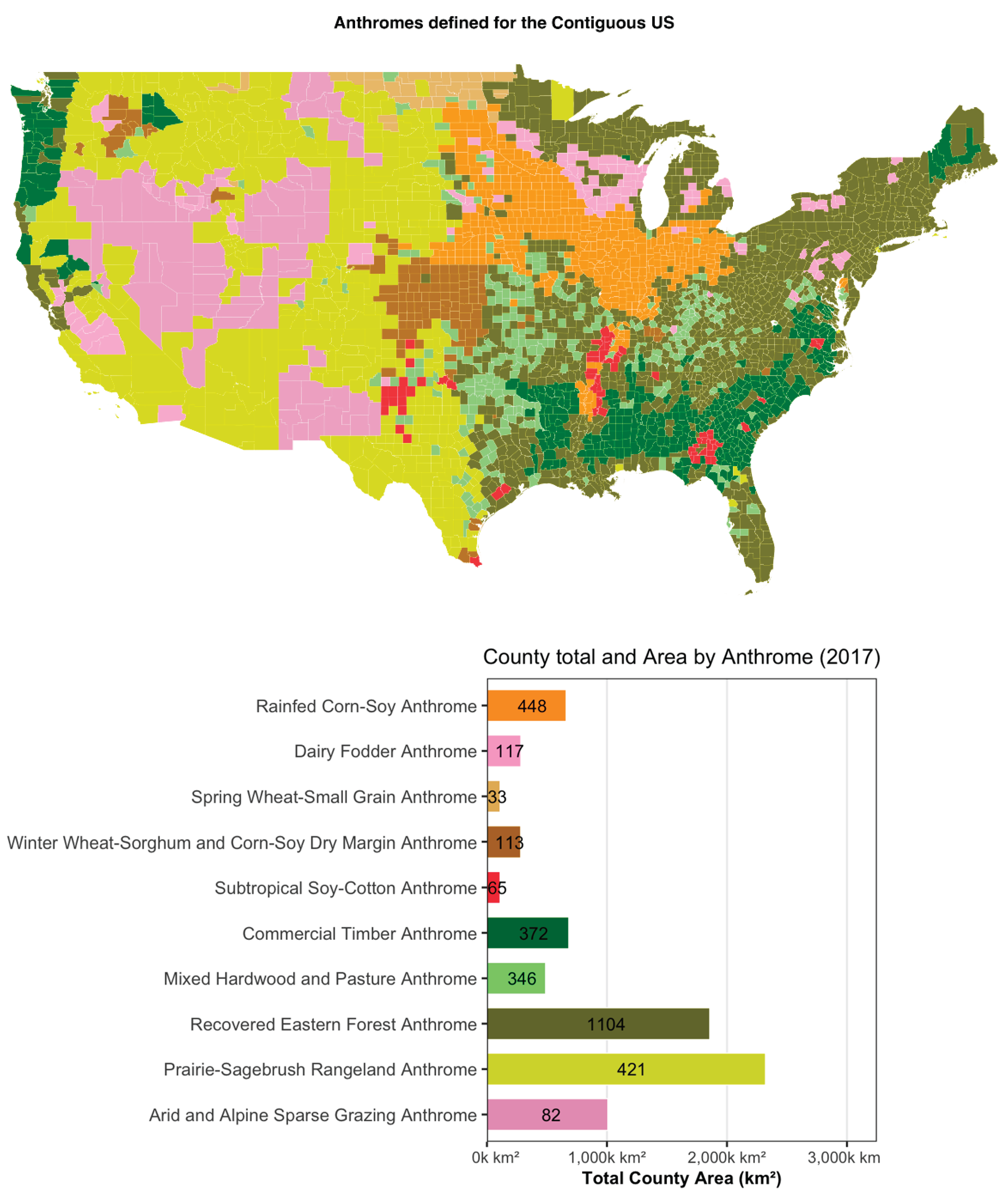
Figure 4.
The rainfed corn-soy anthrome and its HANPP regime. Geographic distribution (upper left). Box and whisker plot of NPP, NPPeco and HANPPharvest (upper right) in gCm-2yr-1. HANPPharvest components (bottom).
Figure 4.
The rainfed corn-soy anthrome and its HANPP regime. Geographic distribution (upper left). Box and whisker plot of NPP, NPPeco and HANPPharvest (upper right) in gCm-2yr-1. HANPPharvest components (bottom).
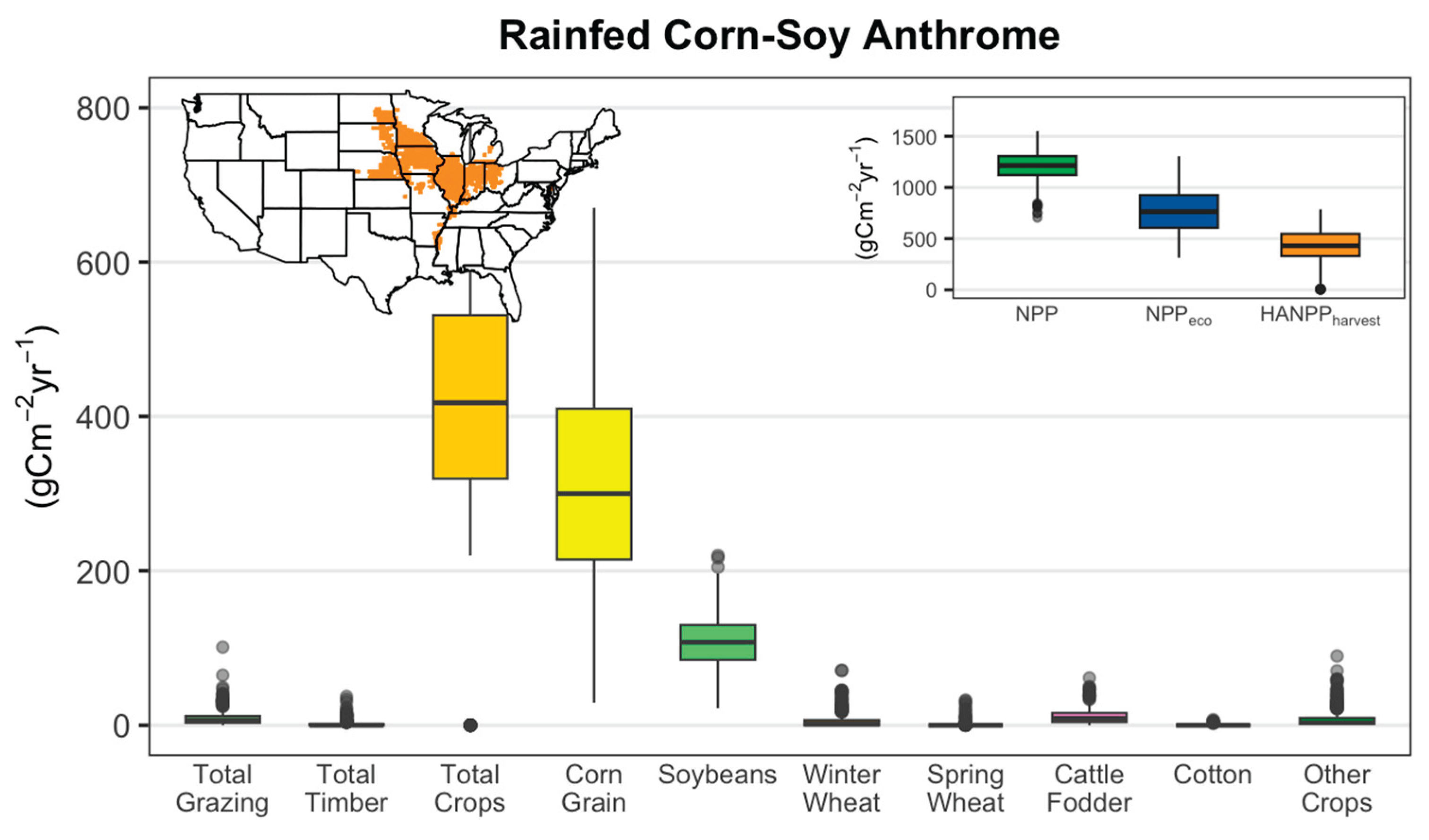
Figure 5.
The dairy fodder anthrome and its HANPP regime. Geographic distribution (upper left). Box and whisker plot of NPP, NPPeco and HANPPharvest (upper right) in gCm-2yr-1. HANPPharvest components (bottom).
Figure 5.
The dairy fodder anthrome and its HANPP regime. Geographic distribution (upper left). Box and whisker plot of NPP, NPPeco and HANPPharvest (upper right) in gCm-2yr-1. HANPPharvest components (bottom).
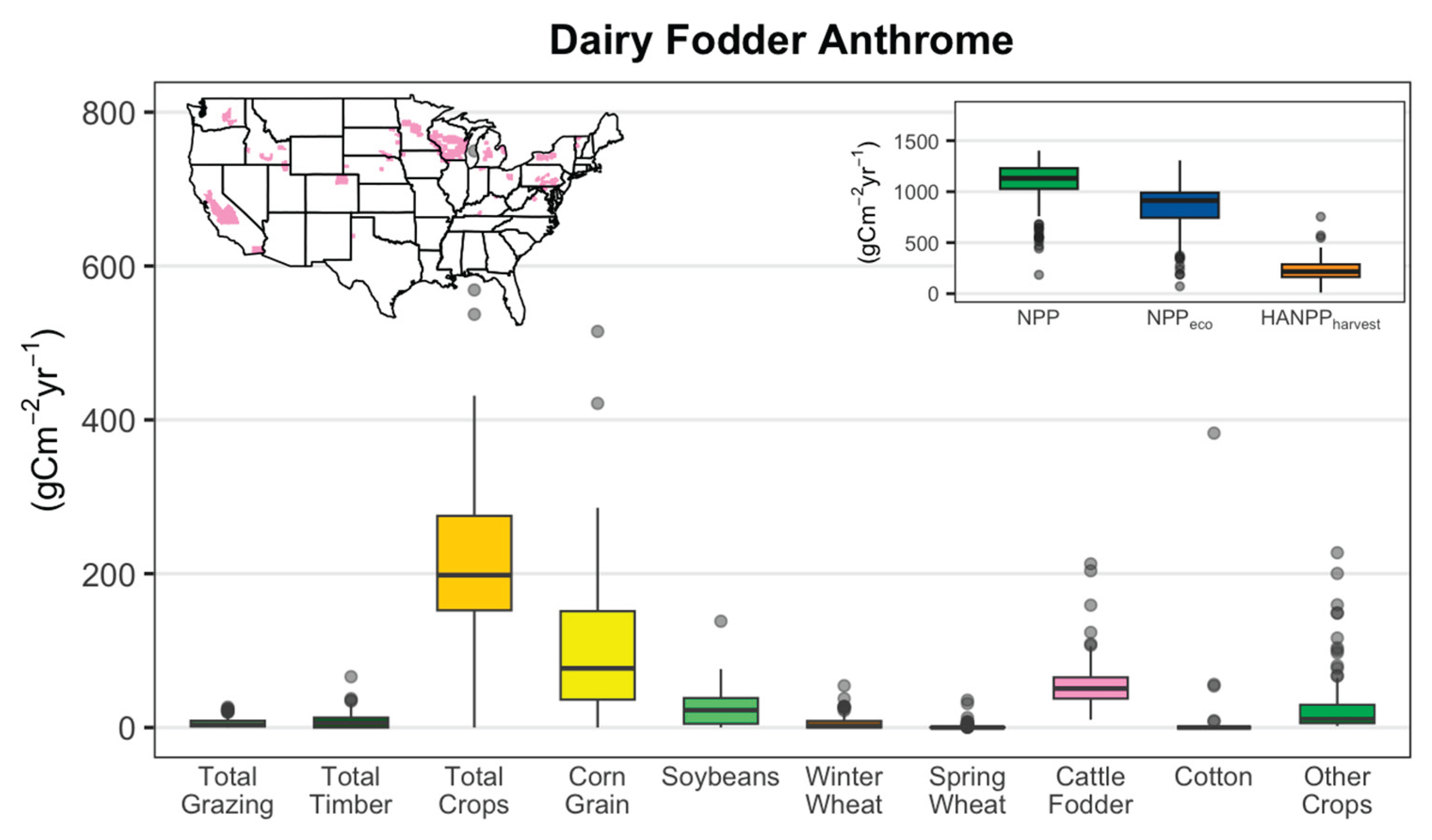
Figure 6.
The spring wheat-small grain anthrome and its HANPP regime. Geographic distribution (upper left). Box and whisker plot of NPP, NPPeco and HANPPharvest (upper right) in gCm-2yr-1. HANPPharvest components (bottom).
Figure 6.
The spring wheat-small grain anthrome and its HANPP regime. Geographic distribution (upper left). Box and whisker plot of NPP, NPPeco and HANPPharvest (upper right) in gCm-2yr-1. HANPPharvest components (bottom).
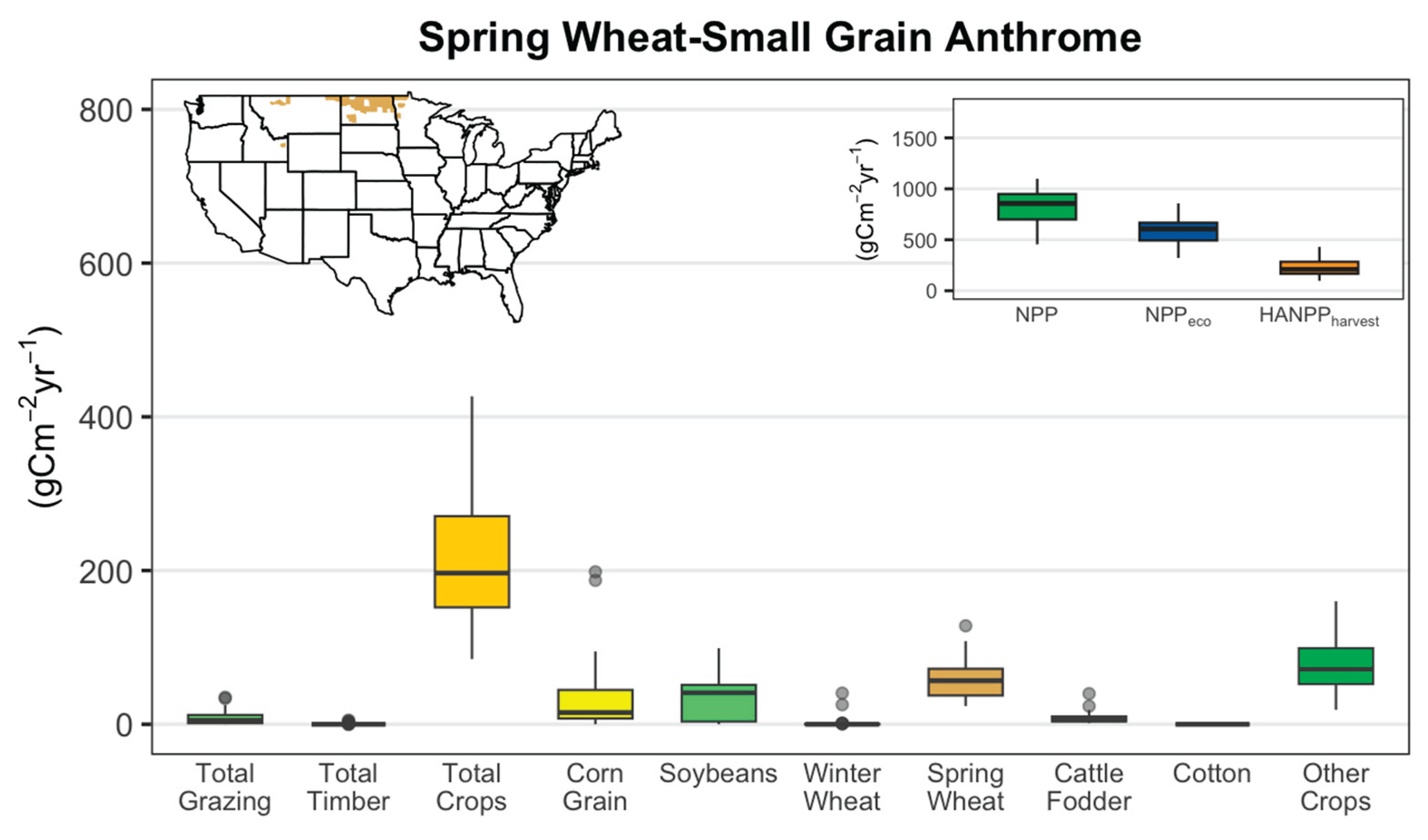
Figure 7.
The winter wheat-sorghum and corn-soy dry margin anthrome and its HANPP regime. Geographic distribution (upper left). Box and whisker plot of NPP, NPPeco and HANPPharvest (upper right) in gCm-2yr-1. HANPPharvest components (bottom).
Figure 7.
The winter wheat-sorghum and corn-soy dry margin anthrome and its HANPP regime. Geographic distribution (upper left). Box and whisker plot of NPP, NPPeco and HANPPharvest (upper right) in gCm-2yr-1. HANPPharvest components (bottom).
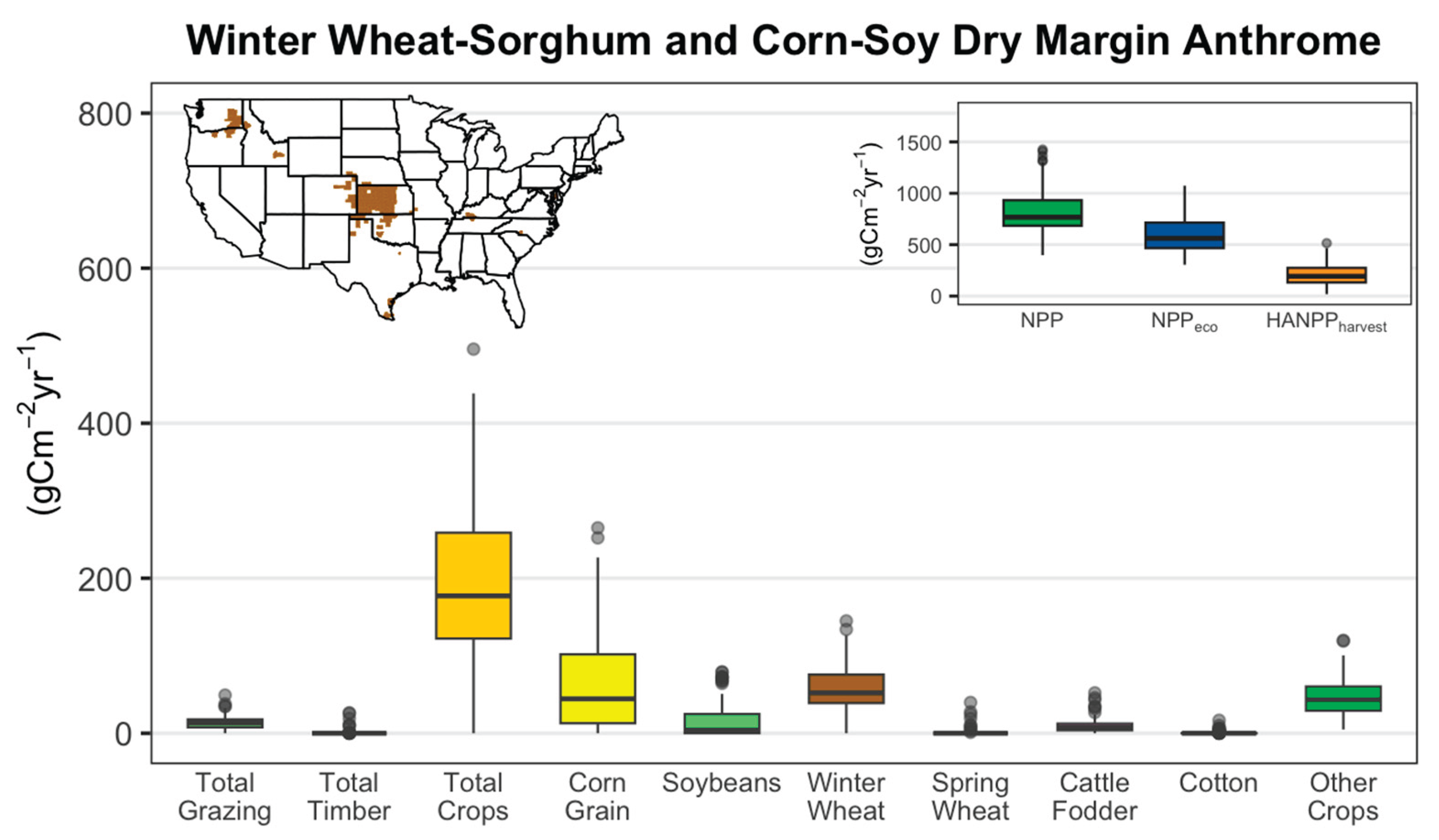
Figure 8.
The southern soy-cotton anthrome and its HANPP regime. Geographic distribution (upper left). Box and whisker plot of NPP, NPPeco and HANPPharvest (upper right) in gCm-2yr-1. HANPPharvest components (bottom).
Figure 8.
The southern soy-cotton anthrome and its HANPP regime. Geographic distribution (upper left). Box and whisker plot of NPP, NPPeco and HANPPharvest (upper right) in gCm-2yr-1. HANPPharvest components (bottom).
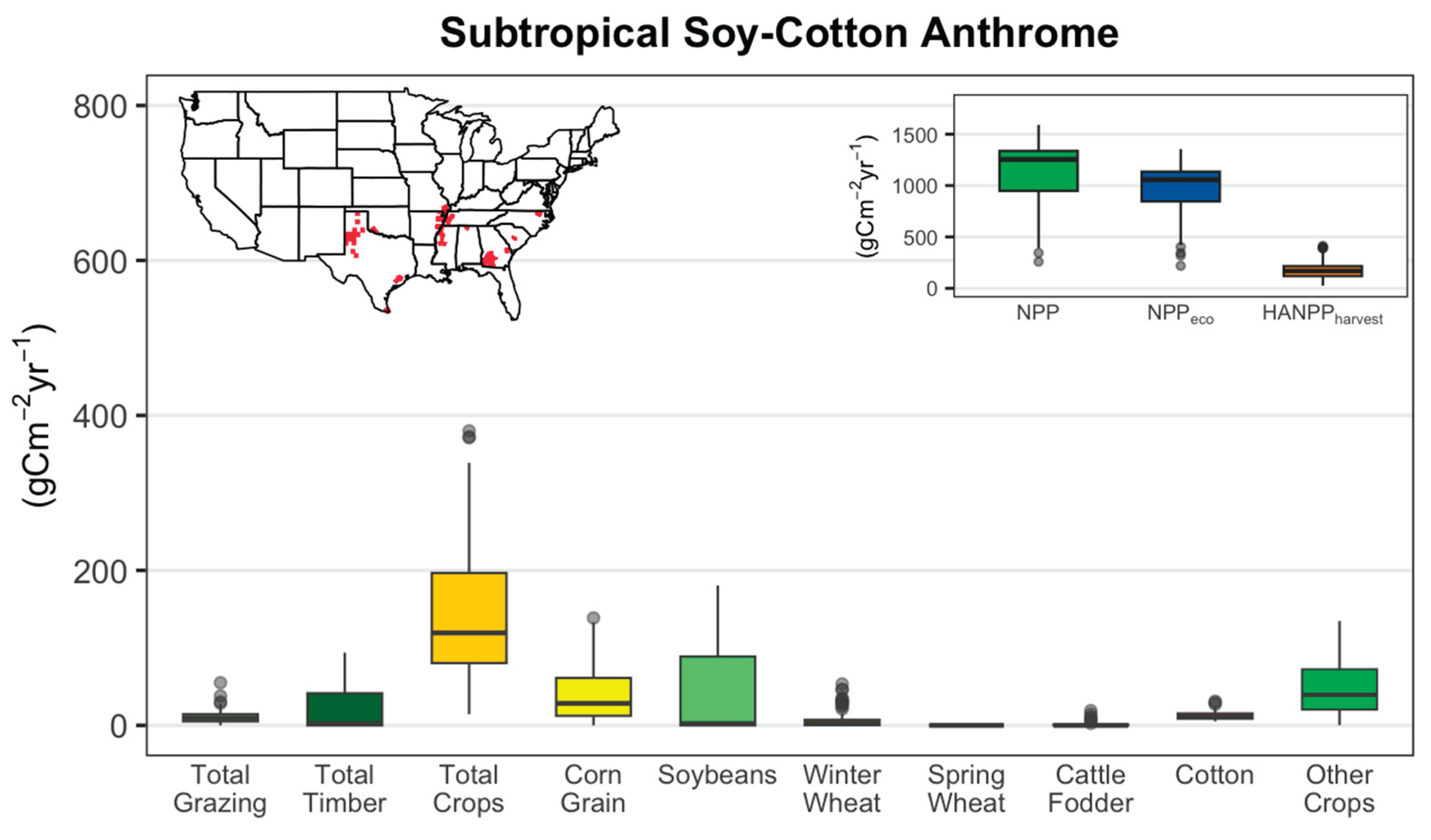
Figure 9.
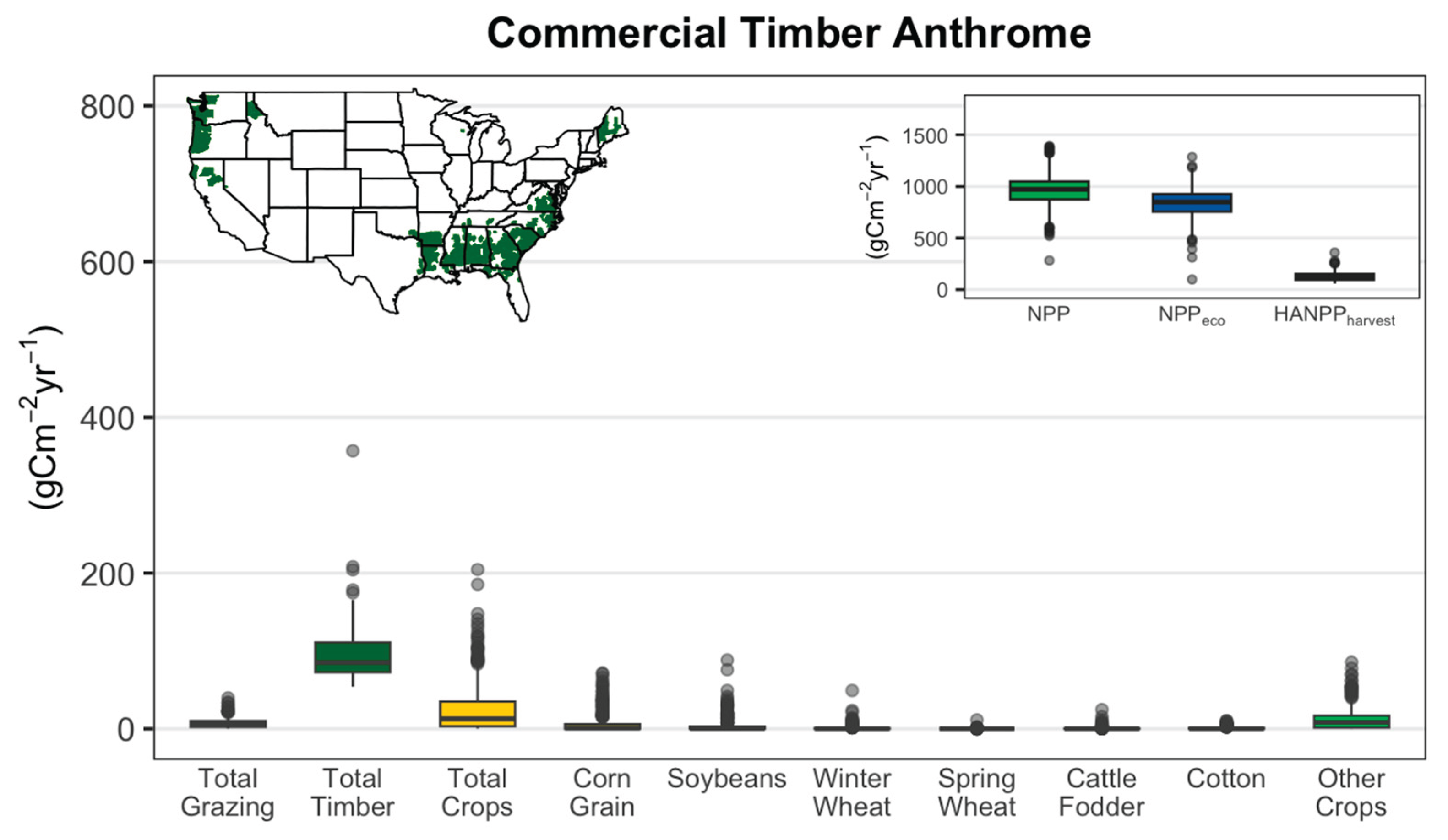
Figure 10.
The mixed forest and pasture anthrome and its HANPP regime. Geographic distribution (upper left). Box and whisker plot of NPP, NPPeco and HANPPharvest (upper right) in gCm-2yr-1. HANPPharvest components (bottom).
Figure 10.
The mixed forest and pasture anthrome and its HANPP regime. Geographic distribution (upper left). Box and whisker plot of NPP, NPPeco and HANPPharvest (upper right) in gCm-2yr-1. HANPPharvest components (bottom).
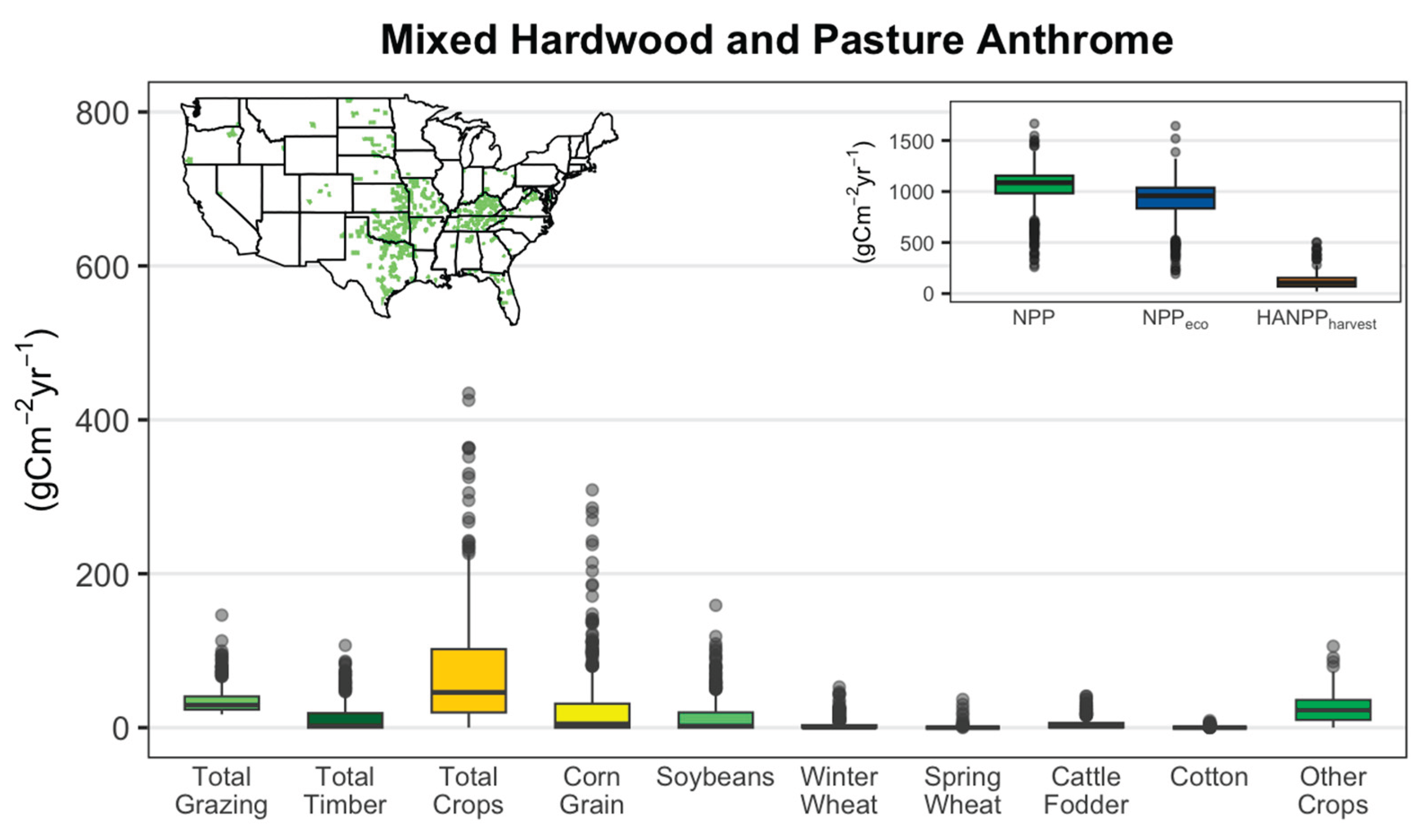
Figure 11.
The recovered eastern forest anthrome and its HANPP regime. Geographic distribution (upper left). Box and whisker plot of NPP, NPPeco and HANPPharvest (upper-right) in gCm-2yr-1. HANPPharvest components (bottom).
Figure 11.
The recovered eastern forest anthrome and its HANPP regime. Geographic distribution (upper left). Box and whisker plot of NPP, NPPeco and HANPPharvest (upper-right) in gCm-2yr-1. HANPPharvest components (bottom).
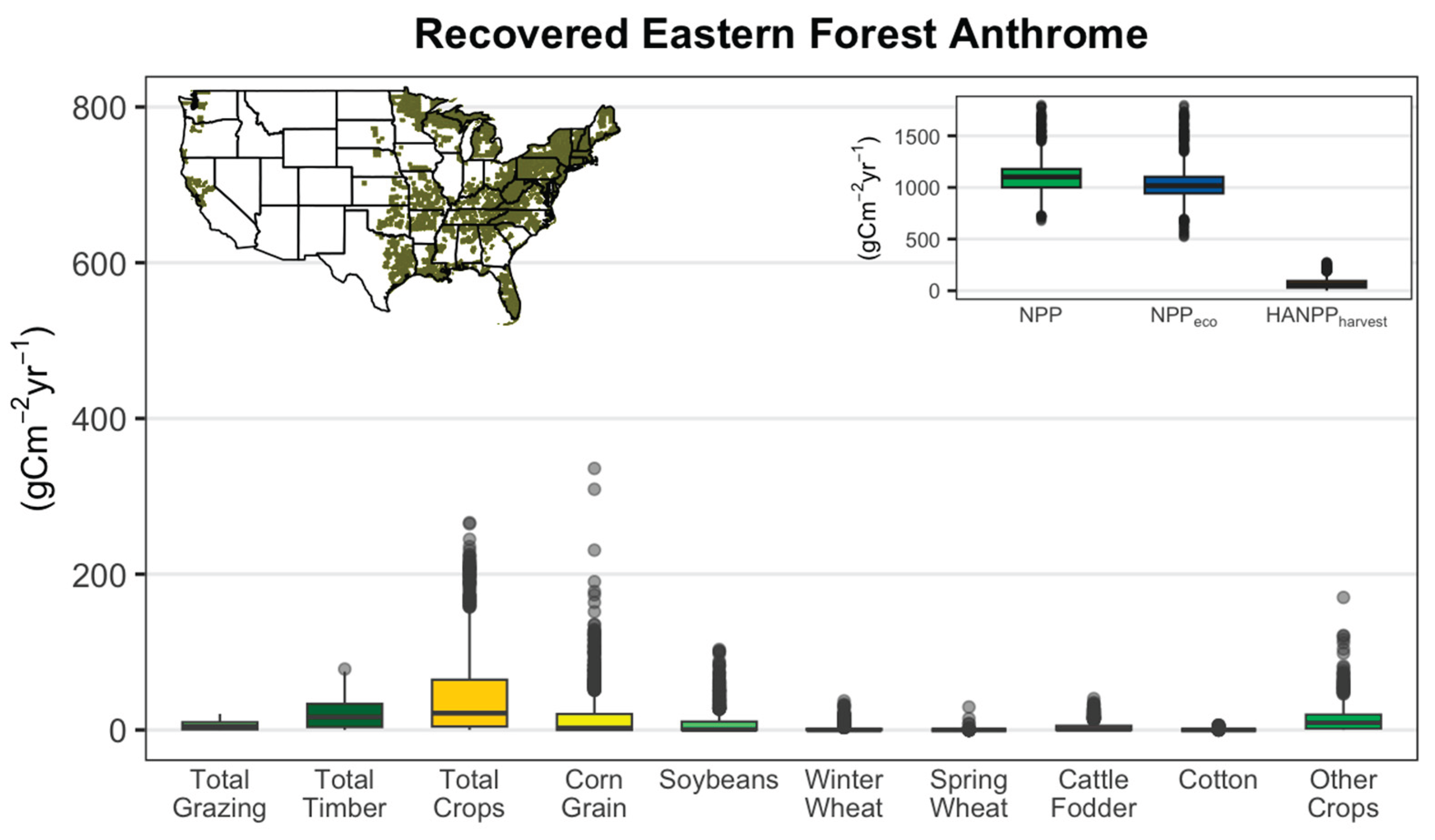
Figure 12.
The prairie sagebrush ranching anthrome and its HANPP regime. Geographic distribution (upper left). Box and whisker plot of NPP, NPPeco and HANPPharvest (upper-right) in gCm-2yr-1. HANPPharvest components (bottom).
Figure 12.
The prairie sagebrush ranching anthrome and its HANPP regime. Geographic distribution (upper left). Box and whisker plot of NPP, NPPeco and HANPPharvest (upper-right) in gCm-2yr-1. HANPPharvest components (bottom).
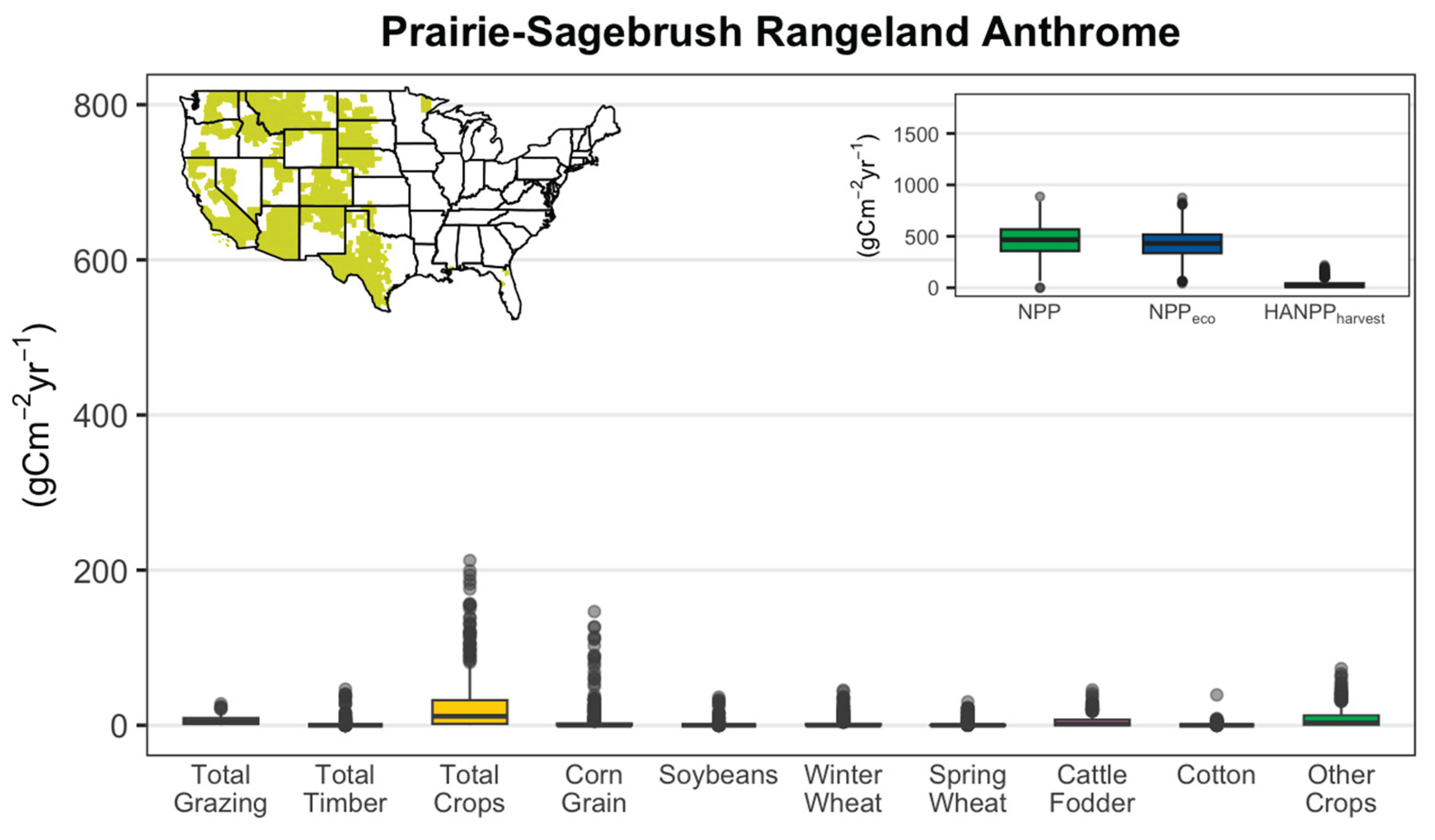
Figure 13.
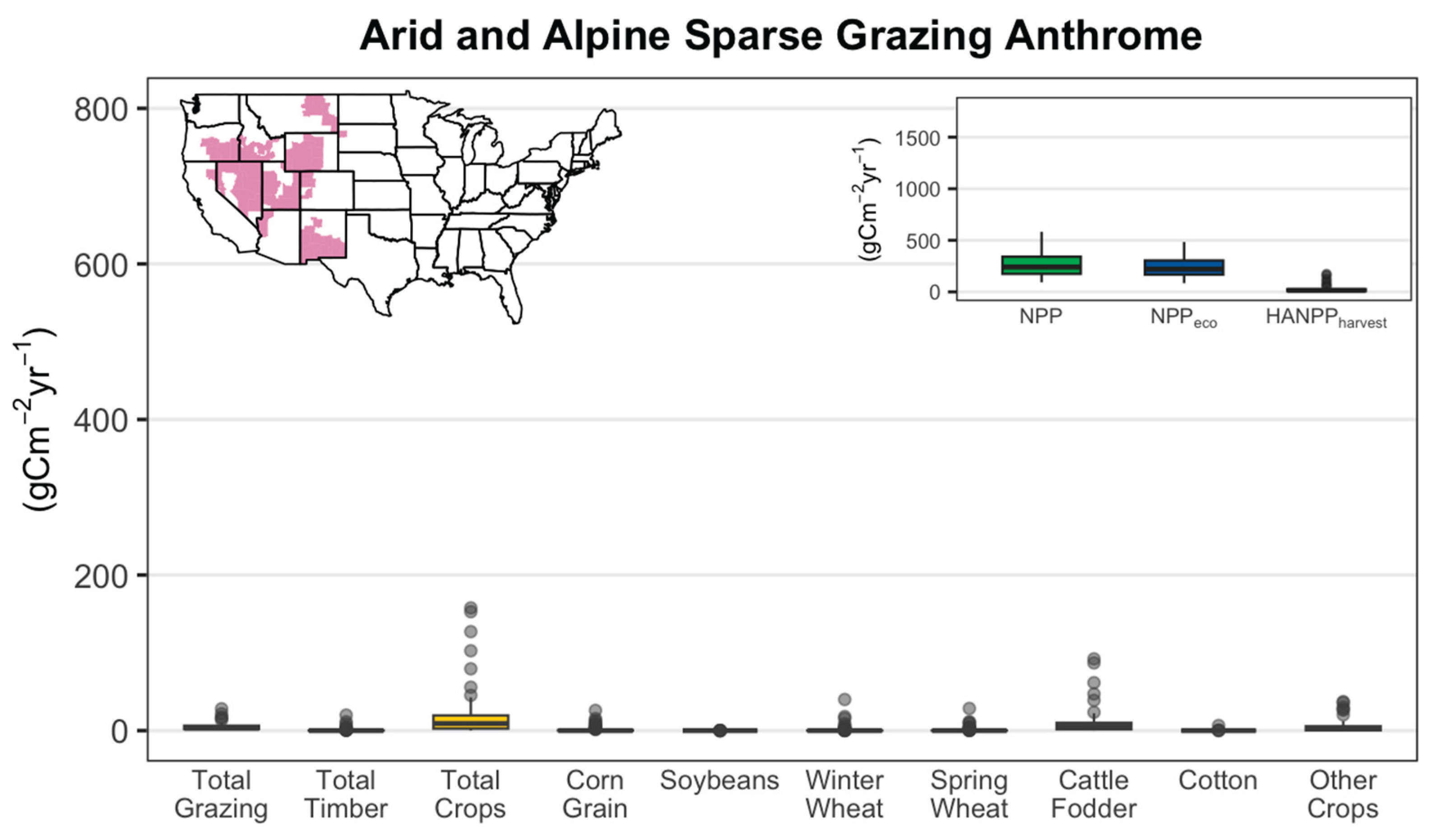
Figure 14.
Map of 13 anthromes in 2017 (top). Area and number of counties in each anthrome cluster (bottom).
Figure 14.
Map of 13 anthromes in 2017 (top). Area and number of counties in each anthrome cluster (bottom).
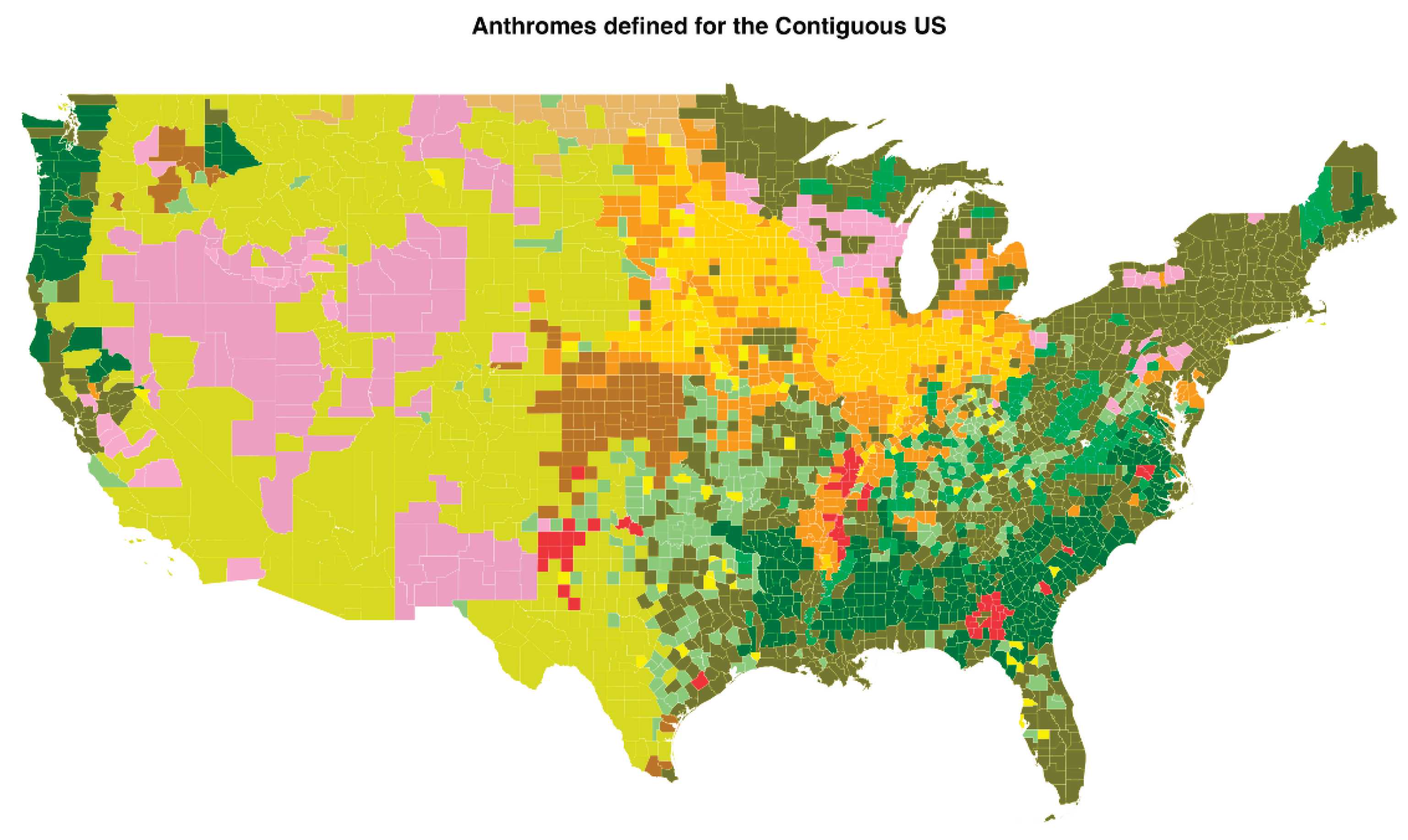
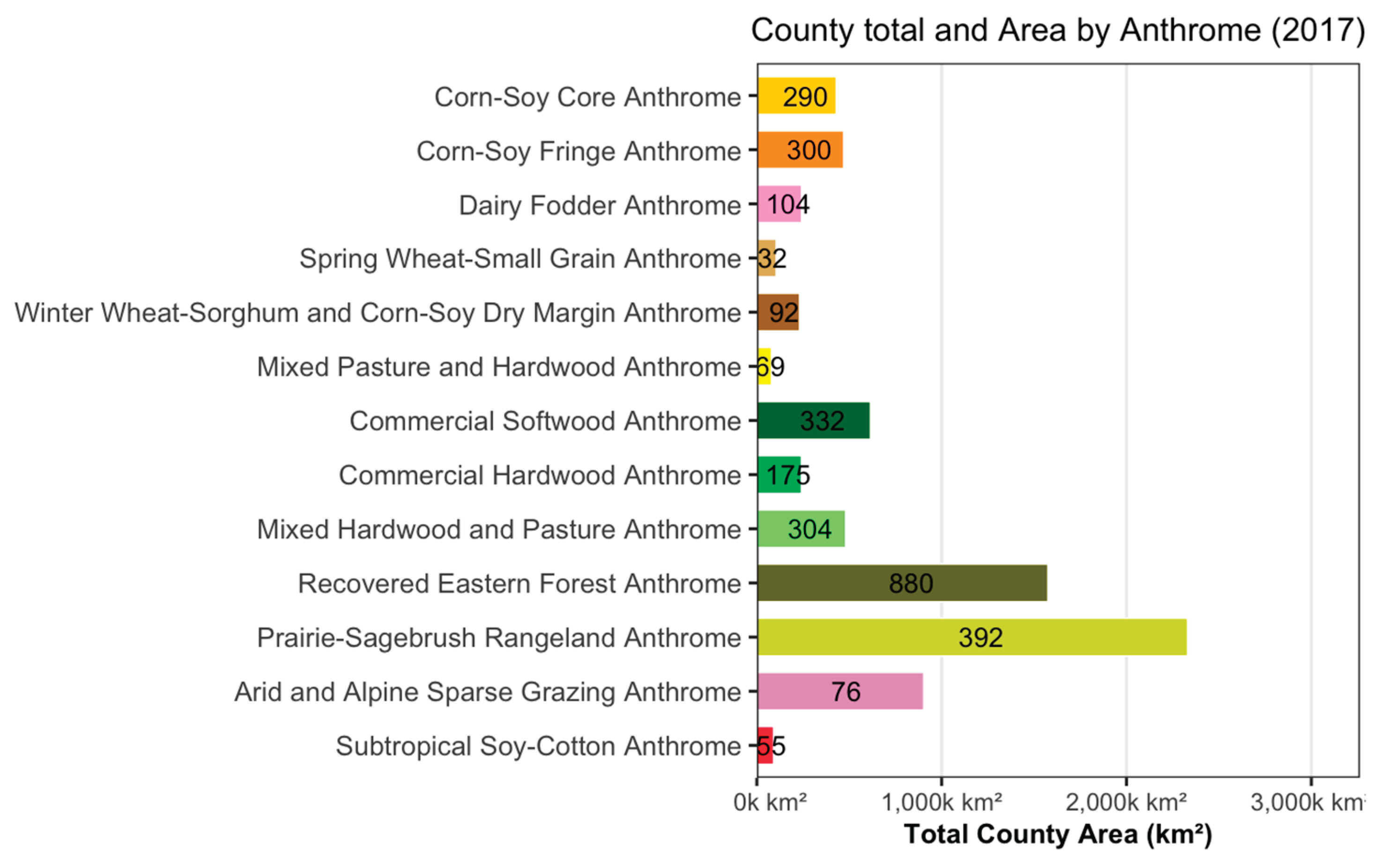
Figure 15.
County-based change between 2002 and 2017 for the 10 anthromes derived in this study.
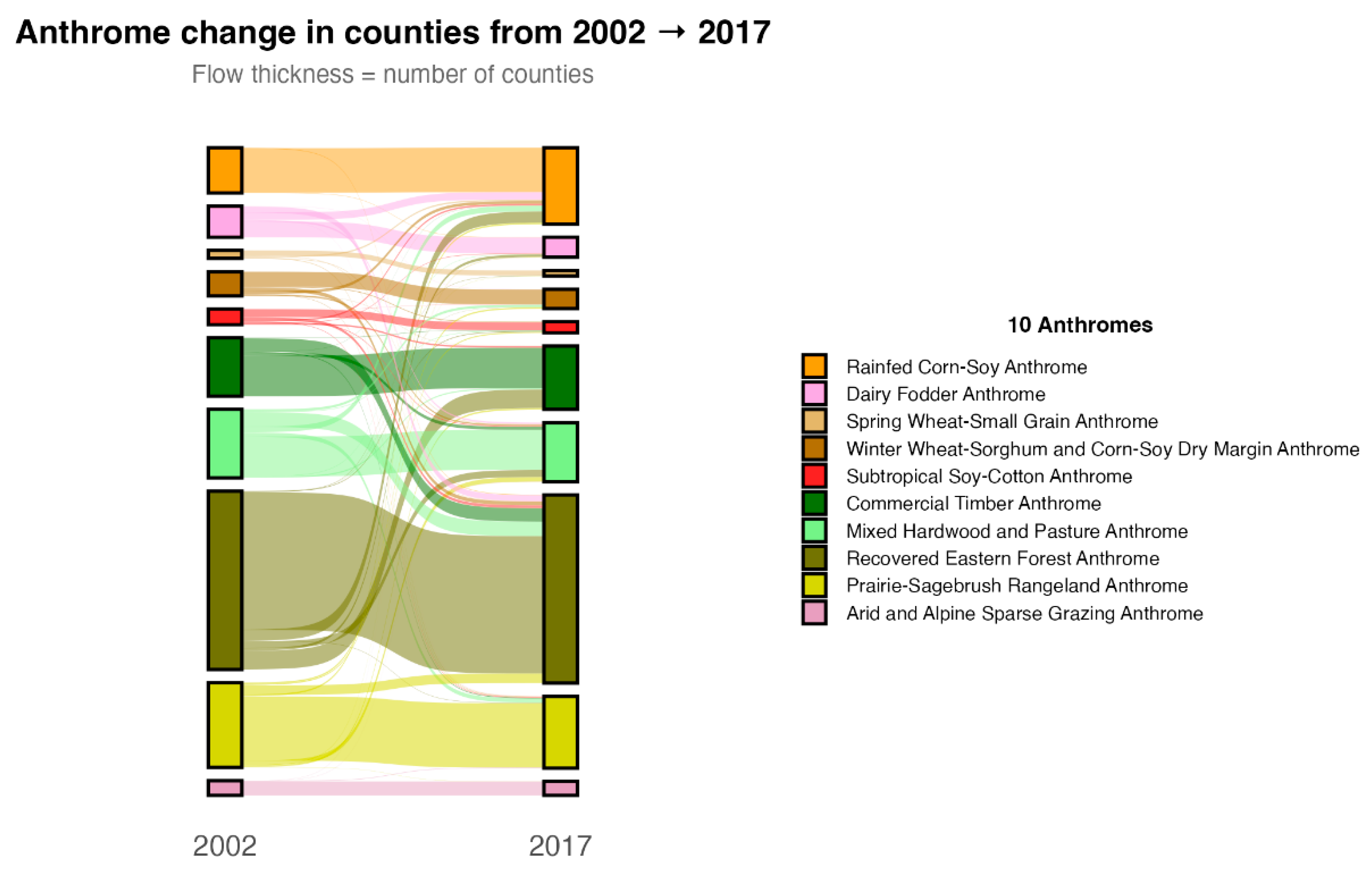
Figure 16.
Map of US counties categorized into high, medium and low NPP and HANPPharvest in 2017.
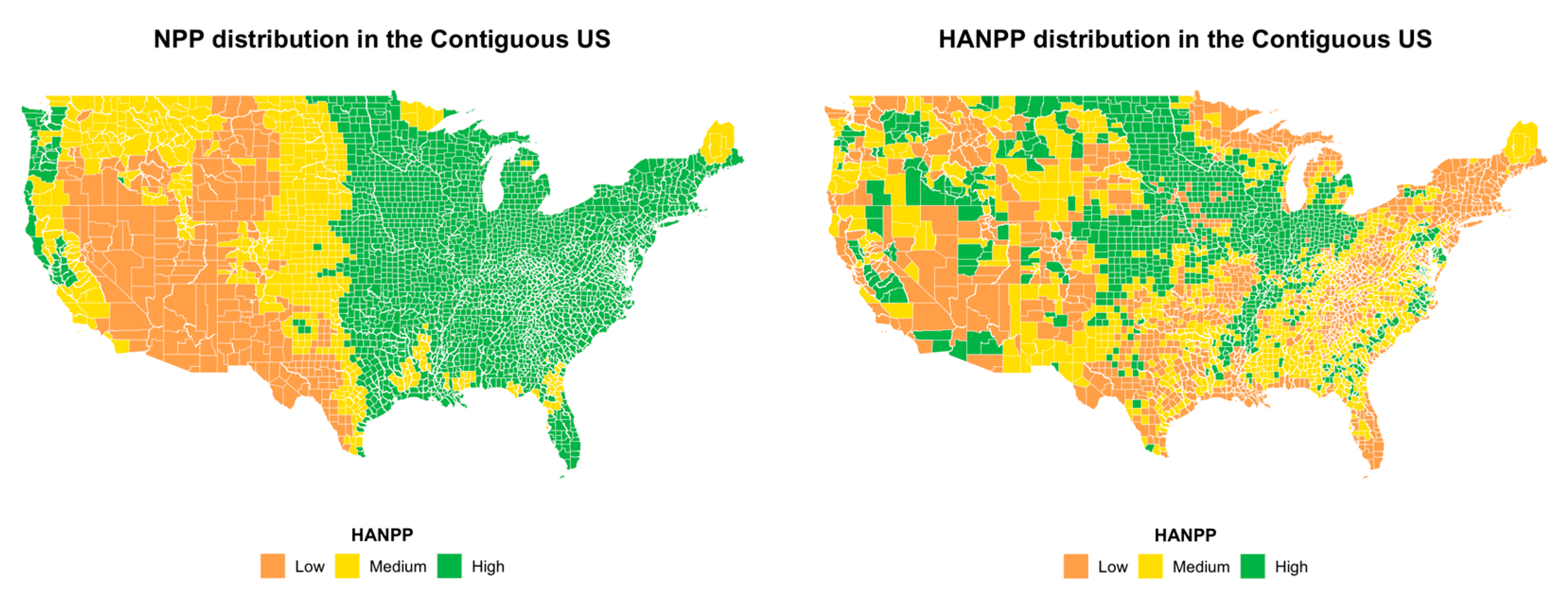
Figure 17.
Map (top) and graph (bottom) of nine hierarchical classes of anthromes based on combinations of high, medium and low deansities of NPP and HANPPharvest.
Figure 17.
Map (top) and graph (bottom) of nine hierarchical classes of anthromes based on combinations of high, medium and low deansities of NPP and HANPPharvest.
Disclaimer/Publisher’s Note: The statements, opinions and data contained in all publications are solely those of the individual author(s) and contributor(s) and not of MDPI and/or the editor(s). MDPI and/or the editor(s) disclaim responsibility for any injury to people or property resulting from any ideas, methods, instructions or products referred to in the content. |
© 2026 by the authors. Licensee MDPI, Basel, Switzerland. This article is an open access article distributed under the terms and conditions of the Creative Commons Attribution (CC BY) license (http://creativecommons.org/licenses/by/4.0/).
Copyright: This open access article is published under a Creative Commons CC BY 4.0 license, which permit the free download, distribution, and reuse, provided that the author and preprint are cited in any reuse.


