

Submitted:
31 March 2026
Posted:
02 April 2026
You are already at the latest version
Abstract
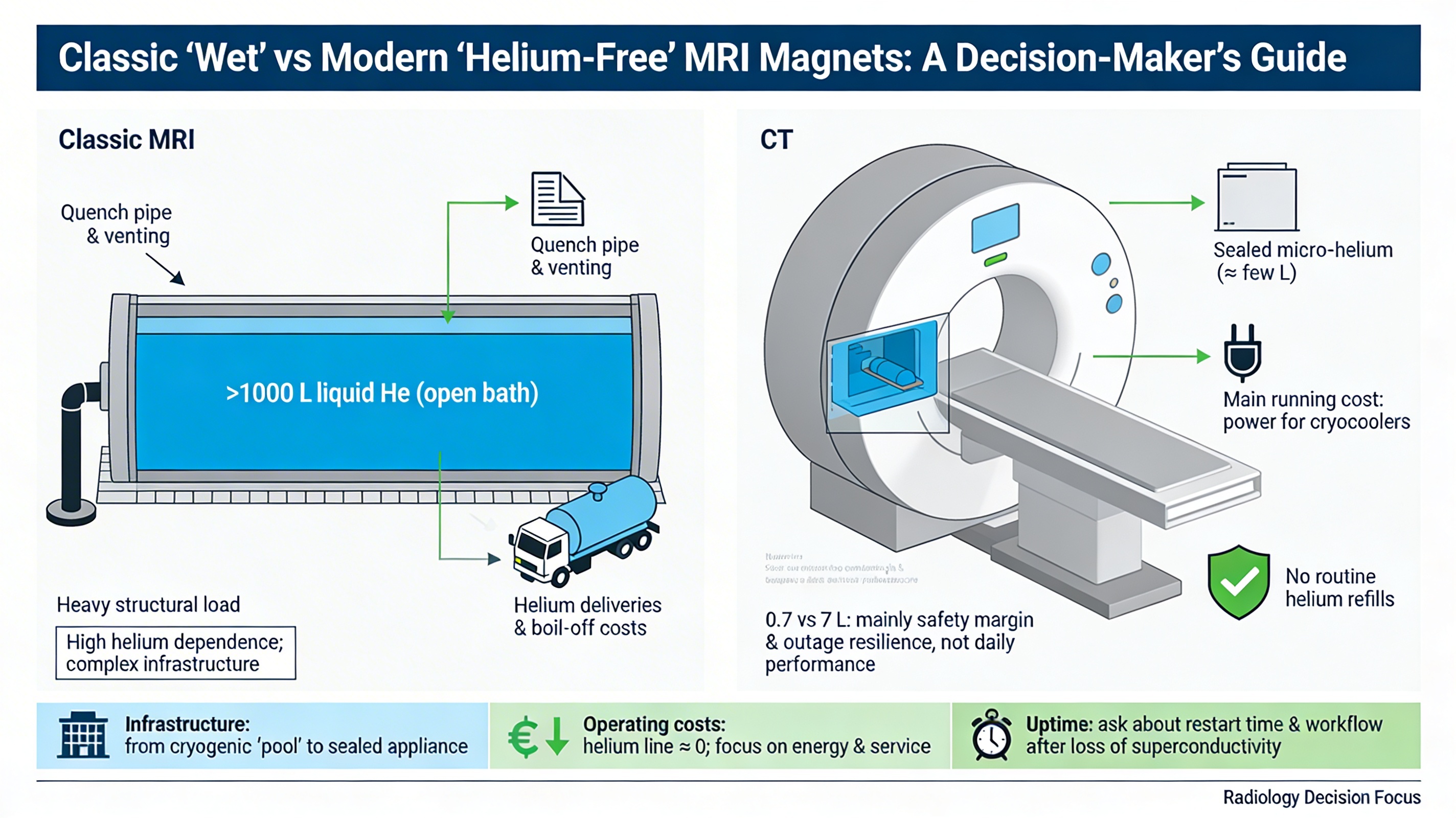
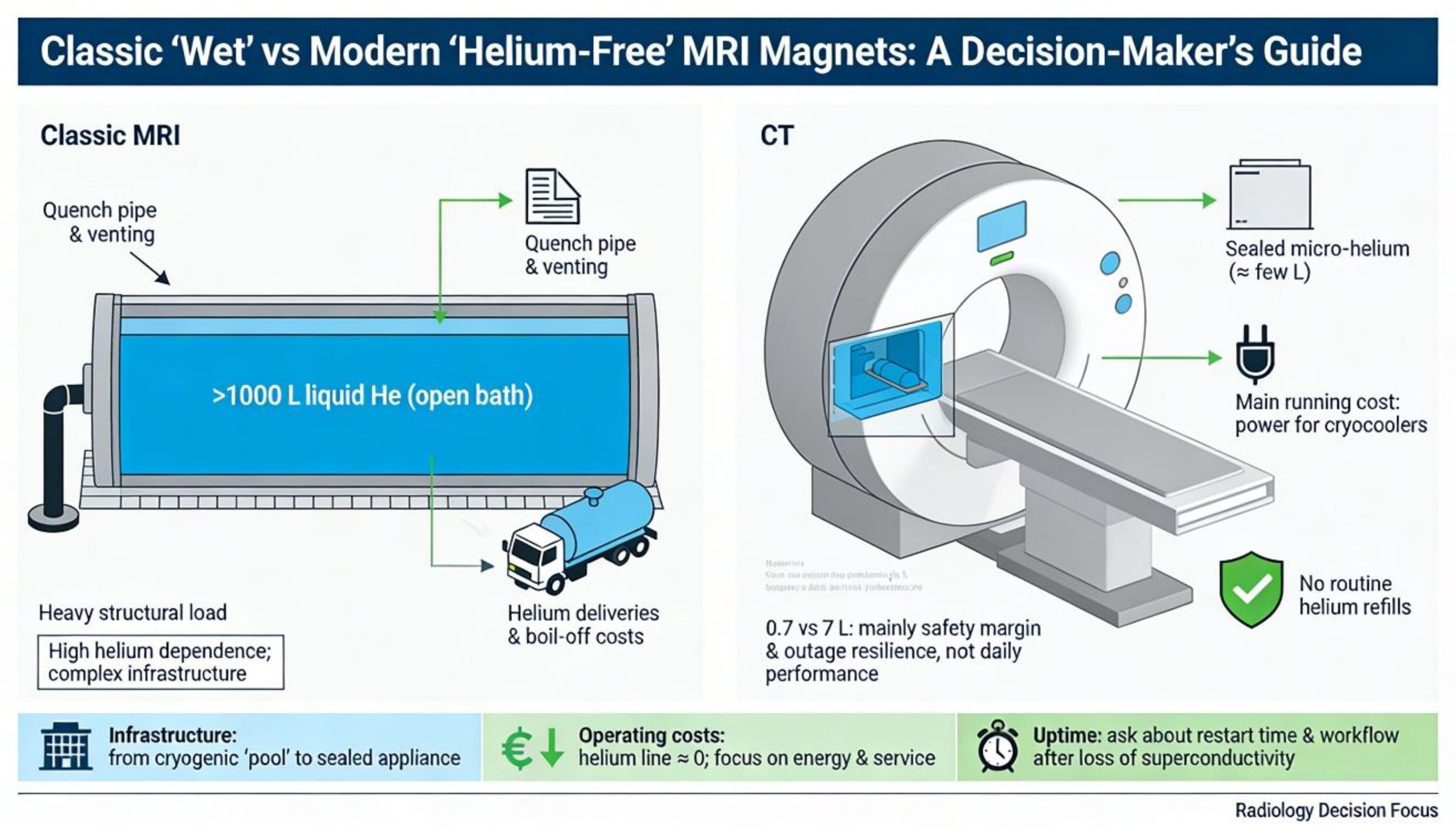
Traditional MRI systems rely on large liquid-helium baths to maintain superconductivity, requiring complex infrastructure, quench pipes, and ongoing helium supply management. Modern “dry” or micro-helium MRI magnets replace this approach with conduction cooling and sealed helium volumes of only a few liters or less. These systems drastically reduce helium dependence, eliminate routine refilling, simplify installation, and lower lifetime operating costs. The major practical advance comes from moving from open helium baths to sealed systems rather than from differences between small helium volumes (e.g., 0.7 vs. 7 liters). Smaller volumes mainly influence safety margins and resilience during power interruptions rather than routine clinical operation.
Keywords:
MRI magnet technology
; helium-free MRI
; conduction-cooled superconducting magnets
; cryogen-free imaging systems
; MRI infrastructure and operational costs
Introduction to Helium Free MRI Magnets
Walking the industry exhibition of the 2025 RSNA in Chicago and most recently the 2026 ECR in Vienna, Helium-Free superconducting magnets were presented as an important part of new MRI system offerings. And Yes, they do have advantages, but as always you often buy advantages in one area with disadvantages somewhere else, most likely higher investment versus higher operational costs, as well as building and installation related issues. The goal of this short paper is to explain the technical advancement, highlight the differences and at the same time clarify and dimistify some of the claims.
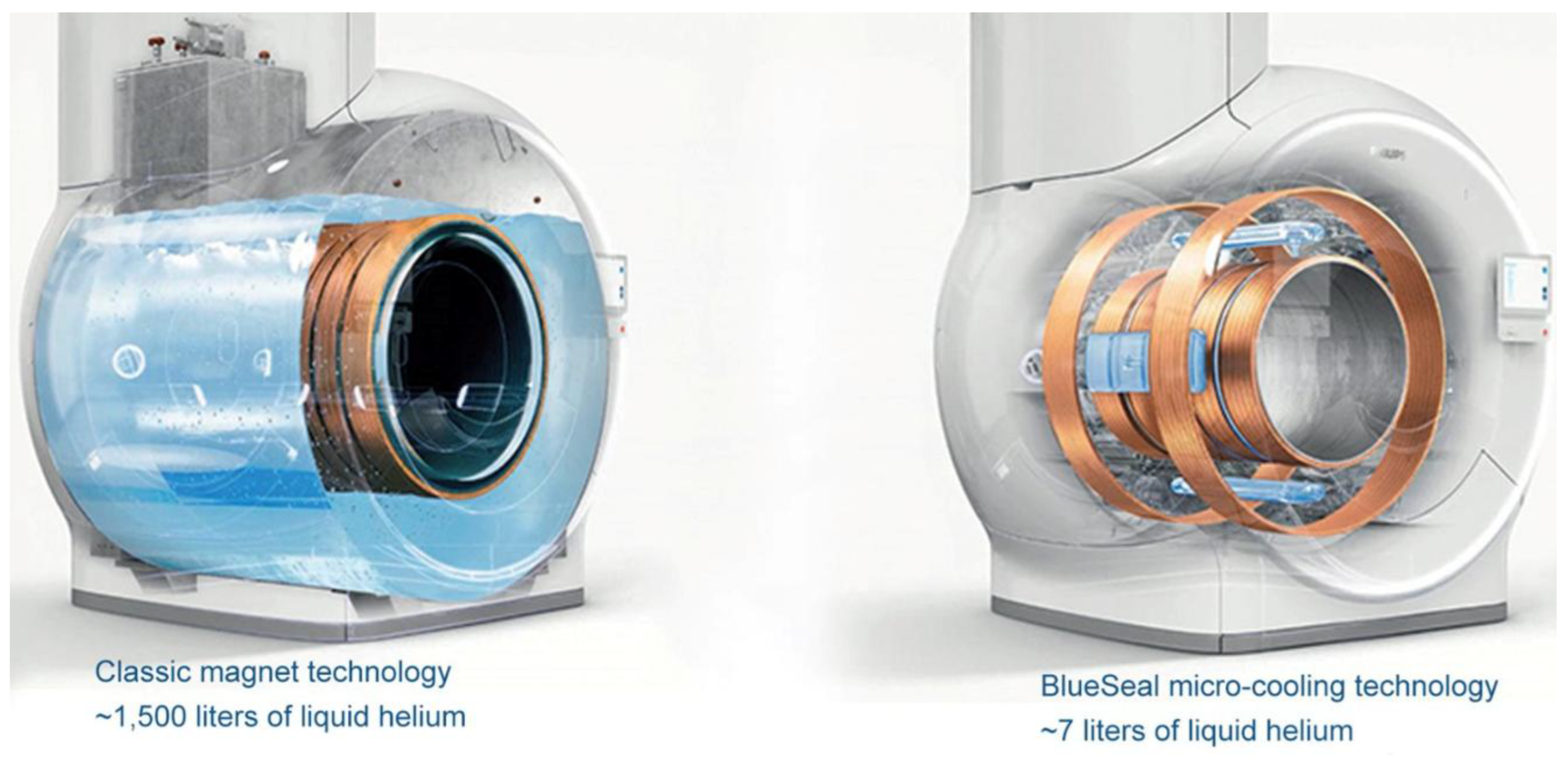
In the traditional MRI world, the imaging magnet (typically 1.5 Tesla or 3 Tesla equivalent to approx. 30.000 to 60.000 times the earths magnet field) is basically a huge metal donut taking an ice bath in a swimming pool of liquid helium (the cryostat, with a temperature of around 4 K or -269 degrees C- the most often used material for the MRI coils, niobium-titanium [NbTi] becomes superconductive below 9.4K), typically well over a thousand liters, just to keep the superconducting coils cold enough to behave (see Figure 1 left). Behavior here is meant being in a zero electrical resistance superconductive state that allows to apply a current to a coil and by that creating a magnetic field inside that coil without any electrical power consumption maintaining the magnetic field. Continuous electrical energy is still needed however for cooling the cryostat to maintain the liquid state at 4 K.
This “wet” design is wonderfully stable but commits you to a lifelong relationship with helium suppliers, boil-off management (loss of liquid helium volume over time—typically in the order of 1-2 liters per day despite cooling- and an infrastructure that assumes, at some point, all that helium might decide to escape at once in a dramatic quench. This can happen when the temperature of the cryostat gets high enough causing a transition from liquid to gas that comes with an expansion of 750 times its original liquid volume at standard conditions (room temperature and normal atmospheric pressure), which comes with a huge pressure increase inside the magnet vessel. Without a pressure relief this could leave to very dangerous explosion.
That’s why older systems need a quench pipe to vent the gas safely out of the building, heavy structural support for several tons of magnet and cryostat, and a fair amount of safety engineering just so you can get nice brain pictures while nobody suffocates in the scan room [1,2,3,4].
The so-called helium-free or dry magnets flip this model by using conduction cooling with cryocoolers attached directly to the superconducting coils, and by shrinking the helium inventory down to a sealed, tiny charge—more like a shot glass rather than a swimming pool (see Figure 1 right).
Technically they’re not “helium free” so much as “helium hoarders”: the helium is trapped inside the magnet for life and never meant to see daylight.
Operationally, this means no routine helium deliveries, no boil-off losses, and no panicked calls when helium prices spike again; your main running costs are electricity and normal maintenance, not slowly boiling money into the atmosphere.
Figure 1.
A MRI magnet consists of several coils, each serving a different purpose. The coil that generate the main magnetic field (Bo - Principal magnet windings plus superconducting shim and shield coils) is in the center, surrounded by shim coils that help improve the magnetic field homogeneity, not shown are the gradient coils (from here on not in a Helium bath and not superconductive) that are used for imaging (including their active shields), the Radiofrequency (RF) Body Coil (transmits the so called B1 field), and finally the Patient coils that are used to detect the MR signal (could also be transmit and receive coils). Image courtesy PHILIPS Healthcare (Blue Seal magnet with 7L Helium on the right).
Figure 1.
A MRI magnet consists of several coils, each serving a different purpose. The coil that generate the main magnetic field (Bo - Principal magnet windings plus superconducting shim and shield coils) is in the center, surrounded by shim coils that help improve the magnetic field homogeneity, not shown are the gradient coils (from here on not in a Helium bath and not superconductive) that are used for imaging (including their active shields), the Radiofrequency (RF) Body Coil (transmits the so called B1 field), and finally the Patient coils that are used to detect the MR signal (could also be transmit and receive coils). Image courtesy PHILIPS Healthcare (Blue Seal magnet with 7L Helium on the right).
The magnets also get lighter and more compact, which suddenly makes the architect your friend instead of your adversary: fewer structural reinforcements, simpler siting, and no need for a big quench pipe carving through the building like a stainless-steel chimney of doom [1,2,3,5,6,7,11].
From a hospital-economics perspective, the move from large liquid-helium baths to sealed, micro-helium systems removes a whole cost category rather than just trimming it. Older systems could burn through significant budgets over their lifetime on helium alone, especially if boil-off rates or logistics were suboptimal, whereas sealed designs decouple the scanner’s viability from helium market drama and supply interruptions.
Energy consumption can also be optimized because the cold mass is smaller and there’s no massive bath to keep at around 4 K, although you still have to pay for the cryocoolers’ power draw. Put differently: you used to be running a cryogenic spa; now you’re running an efficient scientific fridge that happens to be large enough for a human [6,8].
MRI Helium „Free” Volume Relevance
The helium volume question — less than 1 liter versus 7 or 10 liters — is where the physics and the practicalities quietly diverge from intuition.
In a sealed, conduction-cooled magnet, that helium is part of the internal thermodynamic plumbing; under normal conditions, none of it escapes, and you’re not shelling out money for refills whether you have one liter or ten.
So from the radiology department’s daily viewpoint, those numbers barely matter: the budget line for helium is still effectively zero, the service workflow is the same, and nobody is scheduling a “helium day” anymore. The real earthquake happened when we dropped from many hundred liters in an open bath to single-digit liters in a sealed can; going from 7 to 0.7 liter is more like arguing over the size of the cherry on top of a sundae you already paid for [1,6,9].
Where volume still has a subtle impact is in worst-case safety scenarios and engineering margins. If a catastrophic fault ever did release all the helium, less than 1 liter expanding to gas is slightly less of an asphyxiation and overpressure concern than 7 liters, but both are two orders of magnitude gentler than the old “entire swimming pool flashes to gas” scenario that justified massive quench pipes and detailed vent-routing studies.
Likewise, a smaller helium inventory can make manufacturing, shipping, and regulatory classification a bit easier, and can shave a bit off total system mass, but again the big win is the step down from hundreds of liters to a few — after that, we are in the realm of engineering finesse rather than night-and-day clinical impact.
From a physics-and-operations standpoint, you could say that the magnet doesn’t particularly care whether it’s sipping or double-sipping helium, as long as it’s not bathing in the stuff [2,4,7].
Yes, the 7 L may uphold super conductivity longer in case of electrical or cooling issues … that could be buy you some time. For geographies with regular and long outages this might make a difference, if there is no sufficiently powerful power backup available.
Figure 2.
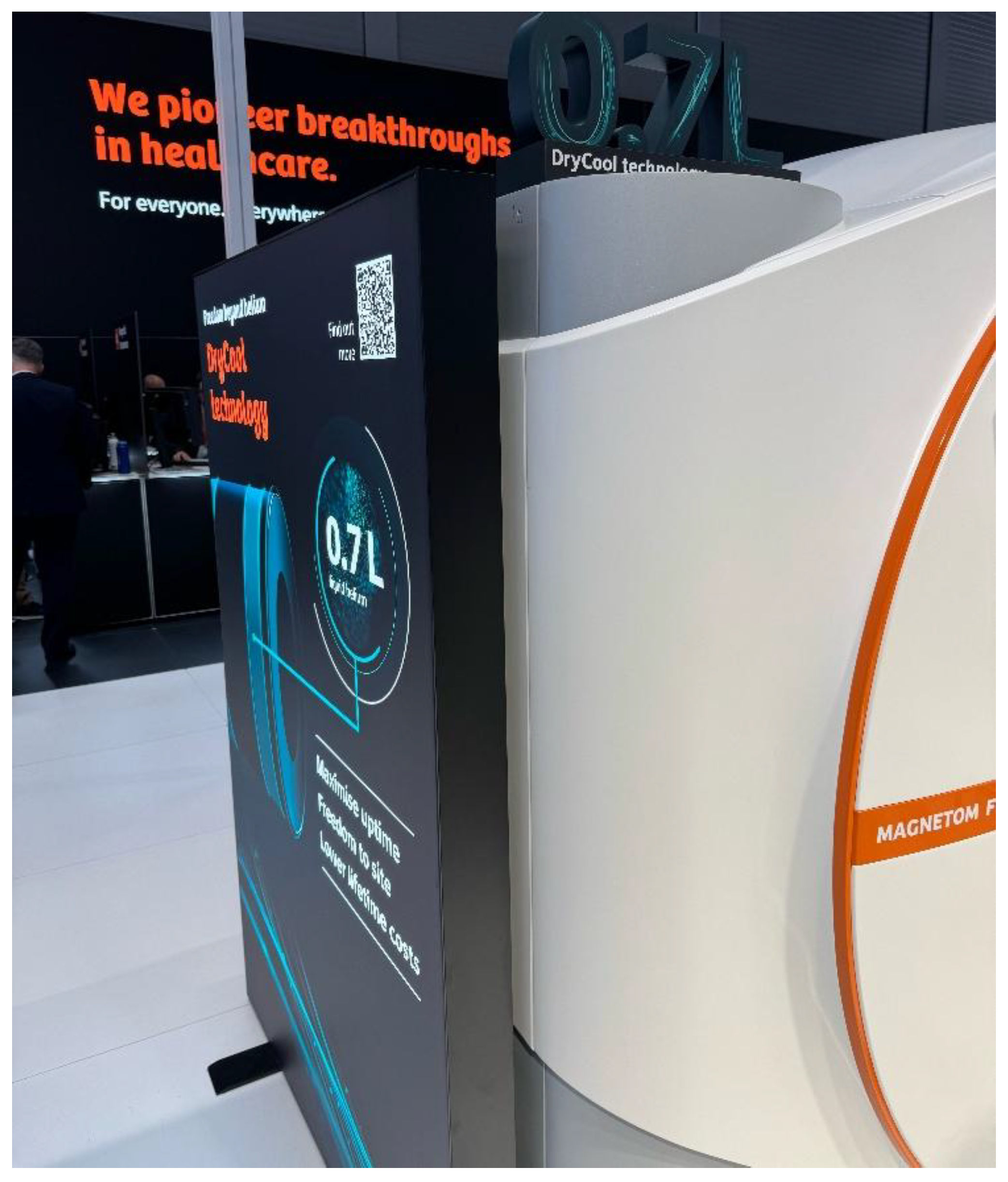
The Helium volume of a superconductive MRI magnet. Is it an important technical feature (YES) and how important is it on whether it is 0.7 L or 7 L (NOT REALLY). Picture taken at the ECR 2026 conference in Vienna by the author.
Figure 2.
The Helium volume of a superconductive MRI magnet. Is it an important technical feature (YES) and how important is it on whether it is 0.7 L or 7 L (NOT REALLY). Picture taken at the ECR 2026 conference in Vienna by the author.
What You Should Ask?
The question to ask then is how often does a power outage happen? Can I protect myself for that (battery or generator backup) and is it worth it, as I typically cannot scan in times of real power outage anyway?
What I protect with a backup is that the magnet looses its magnetic field and subsequently might require quite a bit of effort and time to get it back up to start scanning patients again.
Relevant is therefore what happens after such a loss of superconductivity and magnetic field? How long will it take to get the system back and does it require special equipment like a power supply? How long will it take to be fully operational again?
These are the questions that have a significant economic effect, which you need to ask your preferred MRI supplier and your facility manager.
Summary
A classic high-field MRI is a giant superconducting donut living in an ultra cold helium tub that dominates both building design and part of the running costs, while modern dry or micro-helium systems are more like self-contained cryogenic appliances that just happen to weigh a couple of metric tons and are able to see inside you.
The huge leap in practicality and economics comes from eliminating the large, open helium bath and its associated logistics and quench infrastructure, not from fine-tuning the last few liters inside a sealed cryostat. By the time you’re arguing about this 0.7 versus 7 liters, you’ve already joined the post-helium era; you’re just choosing between different sizes of safety margin in a system that, to first order, has stopped bleeding helium and started behaving like the slightly eccentric but much cheaper roommate your hospital or practice always wanted [1,6,8,9,10,11].
Readers interested in the physics, more construction details, discussion of the thermal issues, a good presentation of the different coils involved in a shielded and Helium-Free MRI magnet, find good papers in [3,11,12].
Disclosure/Conflicts of Interest
The author declares no conflict of interest and states that this work has not received any funding. Ethics approval and consent to participate is not applicable.
References
- Philips, USA. Welcome to the era of helium-free MRI operations. Available online: https://www.usa.philips.com/healthcare/technology/blueseal-helium-free-mri (accessed on 6 January 2026).
- Taylor, D. CRYOGEN-FREE MRI FOR PRECLINICAL RESEARCH. Available online: https://www.radiologytoday.net/archive/WebEx1017.shtml (accessed on 6 March 2026).
- Wang, Y; Wu, P; Wang, W; Wang, H; Chen, S; Sun, J; Liu, F. Cryogen-free superconducting magnetic resonance imaging system: A review. Fundamental Research 2025. [Google Scholar] [CrossRef]
- Annesley, C. Helium-free MRI scanners: all change? Viewed. Available online: https://www.gasworld.com/feature/helium-free-mri-scanners-all-change/2120985.article/ (accessed on 4 January 2026).
- Siemens Healthineers. DryCool technology—Freedom beyond helium. Available online: https://www.siemens-healthineers.com/magnetic-resonance-imaging/technologies-and-innovations/zdrycool-technology (accessed on 7 January 2026).
- GE Healthcare. Freelium—creating a more sustainable future in MRI. Available online: https://www.gehealthcare.com/products/magnetic-resonance-imaging/freelium-helium-free-mri (accessed on 20 February 2026).
- Anon. MRS Dry Mag Preclinical MRI Systems. Available online: https://www.axt.com.au/products/cryogen-free-high-field-preclinical-mri-systems/ (accessed on 10 January 2026).
- Anon. Liquid Helium in MRI Machines—Price, Use, and More. Available online: https://directmedimaging.com/liquid-helium-in-mri-machine/ (accessed on 8 January 2026).
- Foo, TKF; er. Lightweight, compact, and high-performance 3T MR system for imaging the brain and extremities. Magn Reson Med. 2018, 80(5), 2232–2245. [Google Scholar] [CrossRef] [PubMed]
- Wald, LL; McDaniel, PC; Witzel, T; Stockmann, JP; Cooley, CZ. Low-cost and portable MRI. J Magn Reson Imaging 2020, 52(3), 686–696. [Google Scholar] [CrossRef] [PubMed]
- Calvert, S. MAGNETOM Free.Max: from Concept to Product, a Brief History of the DryCool Magnet Development. Available online: https://marketing.webassets.siemens-healthineers.com/36a7abdaf894726e/298eb8ad09ef/siemens-healthineers_DI_MR_DryCool-technology_paper_history-manget-d (accessed on 7 January 2026).
- Luo, C; Liu, G; Deng, Y; Long, Z; Lin, M. Design and optimization of liquid helium-free cooling systems for magnetic resonance imaging device using multi-physical modeling. Case Studies in Thermal Engineering 2025, 66, 105761. [Google Scholar] [CrossRef]
Disclaimer/Publisher’s Note: The statements, opinions and data contained in all publications are solely those of the individual author(s) and contributor(s) and not of MDPI and/or the editor(s). MDPI and/or the editor(s) disclaim responsibility for any injury to people or property resulting from any ideas, methods, instructions or products referred to in the content. |
© 2026 by the author. Licensee MDPI, Basel, Switzerland. This article is an open access article distributed under the terms and conditions of the Creative Commons Attribution (CC BY) license (http://creativecommons.org/licenses/by/4.0/).
Copyright: This open access article is published under a Creative Commons CC BY 4.0 license, which permit the free download, distribution, and reuse, provided that the author and preprint are cited in any reuse.