
Submitted:
01 April 2026
Posted:
02 April 2026
You are already at the latest version
Abstract
Servo motors typically utilize Field-Oriented Control (FOC). However, the conventional cascaded PI control framework is inherently constrained by its fixed-parameter design, making it highly susceptible to parameter variations and unmodeled disturbances. While intelligent control strategies—such as model predictive control (MPC)—provide a robust, multi-objective alternative, their intensive stepwise computational demand often degrades transient response. Motivated by the stochastic dynamics of motor operation, we propose a novel physics-informed control paradigm. Specifically, we formulate the FOC-based motor control as an online stochastic optimization problem, wherein the objective function is updated iteratively using stochastic gradient estimates, and the resulting time-varying subproblems are solved efficiently by the MSALM algorithm. Our approach significantly outperforms conventional PI controllers in environmental adaptability and disturbance rejection. Experimental results demonstrate that the proposed method achieves comparable high-precision tracking performance while significantly reducing computational time per iteration, ensuring rapid dynamic response and strict enforcement of physical constraints.
Keywords:
servo motor control
; stochastic online optimization
; field-oriented control
; machine learning
; augmented Lagrangian method
1. Introduction
Servo motors are widely used in industrial automation, robotics, and high-precision motion control because they offer accurate regulation of position, speed, and torque. In these applications, the controller is usually expected to respond quickly, maintain high steady-state accuracy, reject disturbances effectively, and use energy efficiently within strict physical limits [1].
For AC servo motors, Field-Oriented Control (FOC) has become the standard choice. Through coordinate transformation, FOC separates the originally nonlinear and strongly coupled motor dynamics into flux and torque components that can be regulated independently, which gives the drive a control behavior close to that of a DC motor [2]. In industrial implementations, FOC is commonly paired with cascaded proportional–integral (PI) controllers because this structure is simple, familiar, and easy to implement in practice [1,3].
The performance of cascaded PI control is closely tied to its nominal tuning. In real servo systems, operating conditions rarely remain fixed. Temperature changes alter parameters, nonlinear effects are never modeled perfectly, and external load disturbances are difficult to avoid [4]. Once these factors become significant, a fixed-parameter PI controller often loses part of its effectiveness, and the resulting performance may deviate substantially from what is expected under nominal conditions.
This is one reason why model predictive control (MPC) has attracted so much attention in motor drives. MPC makes it possible to treat control objectives and system constraints in a unified predictive optimization framework [5,12]. The drawback is the online computation. A conventional MPC controller must solve a new optimization problem at every sampling instant, and that repeated computation can become a serious burden. In high-speed servo applications, even modest delay may reduce control bandwidth and weaken transient response [6].
Recent work on stochastic online optimization suggests a different direction. Since motor operation is inherently time-varying and uncertain, a control scheme that updates decisions from streaming measurements and stochastic gradient information is not only mathematically appealing but also practically relevant [21]. Such methods avoid heavy online optimization at every step and instead rely on lightweight iterative updates.
This feature is particularly attractive for servo motor control. Stochastic gradient-based updates are computationally cheap, which helps when the controller runs at a high sampling rate and fast response is required [7]. At the same time, continual feedback allows the control law to adjust to parameter drift, disturbances, and modeling mismatch as they appear. This tends to improve robustness as well as steady-state behavior. There is also a theoretical side to the appeal: under mild assumptions, stochastic optimization methods admit convergence guarantees, so the controller can be expected to move toward a near-optimal policy over time [8]. For servo systems, this combination of computational efficiency and adaptability is especially important.
Motivated by this perspective, we develop a physics-informed control framework that casts FOC-based servo motor control as an online stochastic optimization problem. The control objective is updated iteratively using stochastic gradient estimates extracted from real-time measurements. The resulting time-varying optimization subproblems are efficiently solved by our proposed algorithm MSALM ([28], submitted), which enables effective constraint handling while maintaining low computational complexity.
2. Related Work
2.1. Field-Oriented Control with PI Regulation
Field-Oriented Control (FOC) is the standard framework for high-performance AC servo drives [2]. By expressing the machine dynamics in a synchronously rotating reference frame, FOC decouples flux and torque and thereby enables a control mode similar to that of a separately excited DC motor [1,2]. From a control viewpoint, the resulting drive structure is naturally hierarchical and involves several objectives at once.
In a typical cascaded architecture, the outer loop receives a position or trajectory command and generates a speed reference. The intermediate loop tracks that speed reference and produces the corresponding electromagnetic torque reference. The inner loop finally regulates the d–q axis currents so that the torque demand is realized. Because torque control sits at the innermost layer, its dynamic quality has a direct influence on the overall servo performance. As a result, the problem is not simply one of position tracking or speed regulation alone; it also involves torque response and operating efficiency.
Industrial drives usually address this hierarchy with localized PI controllers distributed across the inner and outer loops [1,3]. The appeal of PI regulation is obvious: it is simple, mature, and relatively easy to tune with standard linear-control tools [3]. Its weakness is just as well known. Fixed controller gains do not adapt well when the motor is affected by temperature-dependent resistance drift, magnetic saturation, abrupt load changes, or measurement noise [4]. Under those conditions, the performance of decoupled PI control can deteriorate quite noticeably [4].
Various improvements have been proposed over time, including gain scheduling [9], adaptive PI control [10], and disturbance-observer-based compensation [11]. These methods can help in specific settings, but they largely remain within the same linear-control framework. They also do not provide a direct and unified way to manage coupled control objectives together with hard physical limits such as inverter voltage constraints and current bounds [12]. This limitation becomes increasingly important as servo systems are pushed toward higher precision and more demanding operating conditions.
2.2. Model Predictive Control for Motor Drives
To move beyond the limitations of PI-based cascaded regulation, many studies have introduced Model Predictive Control (MPC) into the Field-Oriented Control (FOC) framework [13]. The basic idea is to preserve the intuitive flux-torque decoupling offered by FOC while replacing the conventional inner-loop regulation with an optimization-based control law. In this way, multiple objectives and explicit constraints can be handled more systematically. Early work focused heavily on Finite Control Set MPC (FCS-MPC) [14]. Later, because variable switching frequency became a practical concern, more attention shifted to Continuous Control Set MPC (CCS-MPC), or Modulated MPC (M2PC). These methods optimize a continuous voltage vector in the d-q frame and then combine it with standard SVPWM, which gives fixed switching frequency and good steady-state behavior [15,16].
The main practical difficulty is that conventional MPC depends strongly on the plant model. In real servo drives, the model is never exact. Temperature-dependent parameter changes, measurement noise, and sudden load variations all introduce uncertainty. From that standpoint, Stochastic MPC (SMPC) is an attractive extension [17]. Instead of preparing for the worst case, as in robust MPC, SMPC models uncertainty probabilistically and optimizes an expected performance index while enforcing constraints in a stochastic sense.
Even with these advantages, implementation remains difficult in high-speed servo systems [18]. At microsecond-level sampling times, repeatedly evaluating expectations and solving constrained quadratic programming (QP) problems can exceed the computational capability of standard digital signal processors (DSPs). Fast first-order solvers such as the Alternating Direction Method of Multipliers (ADMM) have been introduced to reduce this burden [19]. Still, if a new stochastic optimization problem must be solved from scratch at every control instant, the remaining delay can be large enough to limit bandwidth and weaken transient performance.
2.3. Online Stochastic Optimization Models and Algorithms Related to Servo Motor Control
Real-time servo control shares several structural properties with online stochastic optimization. At each sampling instant, the controller has to choose an action using only the information available at that moment, while operating conditions, disturbances, and measurements continue to evolve. This is close in spirit to online convex optimization (OCO), where decisions are made sequentially before the exact loss is fully known [20,21,22]. In the motor-drive setting, the control input plays the role of the online decision variable, while tracking performance and energy-related penalties define a time-varying objective.
For practical servo systems, online stochastic optimization with time-varying distributions is even closer to the actual control problem. In that model, uncertain parameters are drawn from an underlying distribution that changes over time, and after each decision only one sample from the current distribution is observed [8]. This description matches the reality of motor drives quite well, since load perturbations, parameter drift, and measurement noise make the environment both uncertain and non-stationary. The associated notions of dynamic benchmark and distribution drift are also consistent with the fact that the optimal operating point of a high-performance servo system is rarely fixed.
Physical constraints are another central issue. Voltage saturation and current limits cannot be ignored in practical drives, so constrained online optimization becomes highly relevant. In such formulations, one is concerned not only with dynamic regret but also with the extent to which constraints are violated over time. Representative examples include online convex optimization with time-varying constraints and with stochastic constraints [23,24]. These models are close to servo control in a very direct sense: the controller must keep updating its action online while still maintaining safe operation.
From the algorithmic side, several classes of methods are especially relevant. Gradient-based online algorithms are attractive because the updates are simple and inexpensive, even when only noisy or partial information is available [20,22]. For constrained problems, primal–dual and splitting-based methods are particularly useful. One representative example is online proximal-ADMM, which updates primal and dual variables recursively so that a time-varying constrained convex problem can be tracked without re-solving the full optimization problem at every step [25]. This is precisely the kind of property that becomes valuable in high-speed servo applications.
Among constrained online methods, augmented-Lagrangian-based approaches are especially relevant to the control design considered in this paper. Classical augmented Lagrangian methods already provide a principled way to handle constraints [26]. Building on that foundation, Liu et al. proposed model-based augmented Lagrangian methods (MALM) for time-varying constrained OCO and established sublinear regret together with sublinear constraint violation [27]. Their main contribution was not only theoretical; by introducing suitable models into the augmented-Lagrangian subproblem, they also reduced the difficulty of the per-step computation. Our team proposed a Model-based Stochastic Augmented Lagrangian method (MSALM) for Online Stochastic Optimization [28]. This idea is closely aligned with the needs of servo motor control, where exact online optimization is often too expensive, but purely heuristic updates are not sufficient.
Taken together, the most relevant online stochastic optimization models for servo motor control are those that combine sequential decision-making, time-varying uncertainty, and explicit constraints. The corresponding algorithmic tools include online gradient methods, primal–dual or ADMM-type recursions, and model-based augmented Lagrangian approaches. These lines of work form the main theoretical background for recasting constrained servo motor control as an online stochastic optimization problem with real-time implementable updates.
3. Methods
3.1. Physical Principles of Servo Motor Control
Under the FOC framework, the motor dynamics in the synchronous rotating reference frame can be described in a general state-space form as
where is the current vector in the synchronous rotating frame, is the control input vector, denotes the motor parameter set, represents electrical-side uncertainties and disturbances, is the electromagnetic torque, is the load torque, J is the inertia, B is the viscous friction coefficient, is the mechanical angular speed, and is the rotor position.
This formulation captures the essential input–state relationship of FOC-based motor drives without restricting to a specific motor type, and thus serves as a general dynamic model for a broad class of servo systems.
In servo motor systems, control performance is typically evaluated from multiple perspectives, including speed regulation, torque response, position tracking, and operating efficiency. Since these performance requirements are often coupled through the motor dynamics, it is convenient to describe them within a unified optimization framework. To this end, several objective functionals are introduced over a finite time interval, each corresponding to a specific control requirement. By tuning the associated weighting coefficients, the proposed formulation can accommodate different application demands and operating priorities.
After discretization, the servo motor control objectives are described directly in stage-wise form. At each sampling instant t, define the tracking errors
where , , and denote the speed, torque, and position tracking errors, respectively.
For compactness, the speed-, torque-, and position-related stage-wise losses are written in the unified form
where is the sampling interval. In this expression, the first term penalizes the tracking error itself, while the second term penalizes the variation rate of the tracking error, thereby improving transient smoothness and suppressing oscillatory behavior.
The weighting parameters in (3) are specified as
so that the corresponding losses can be written explicitly as
Here, , , and weight the tracking accuracies of speed, torque, and position, respectively, whereas , , and weight the variation rates of the corresponding tracking errors and are used to improve dynamic smoothness.
The efficiency-related stage-wise loss is defined separately as
where, for simplicity, the efficiency term is described by a surrogate loss model intended for optimization rather than an exact physical loss decomposition. The copper-loss-related term is approximated by
the iron-loss-related term is approximated by
and the total loss is written as
where are weighting coefficients used to balance the relative importance of the two simplified loss components. In low-speed operation, the copper-loss-related term is usually dominant, whereas in high-speed operation, the iron-loss-related term becomes more significant. Accordingly, larger is preferable in low-speed conditions, while larger is more suitable in high-speed conditions.
Therefore, the overall stage-wise loss is given by
where are top-level weighting coefficients that determine the relative importance of the speed, torque, position, and efficiency objectives, respectively.
Importantly, the above performance objectives are functions of the motor state variables, while the control inputs influence these objectives indirectly through the system dynamics. Therefore, servo motor control can be interpreted as a process of shaping the state evolution via control inputs in order to optimize the overall performance.
However, in practical applications, servo drives are affected by magnetic saturation, temperature drift, unknown load torque, and sensor noise. These factors introduce stochasticity into both system dynamics and performance evaluation. To account for such uncertainties, the deterministic model is further reformulated into a stochastic nonlinear state-space model, which provides the foundation for the subsequent online stochastic optimization framework.
3.2. Online Stochastic Optimization Problem
To handle uncertainty and time variation in a principled manner, we formulate the sequential control process as an online stochastic optimization (OSO) problem. At each time slot , the real environment has disturbances and other stochastic factors. Therefore, the motor operation process involves stochastic parameters. Considering that the random factors in the actual environment may exhibit different distributions at different time instants, we set the distributions of the stochastic parameters to vary continuously over time.
Let and denote the stochastic parameters associated with the objective and constraint functions, respectively, where and are the current distributions of the objective-related and constraint-related uncertainties at time slot t. Under this setting, the stage-wise objective and constraint functions take the forms
We define the expected objective and expected constraint functions as
Since the distributions of the stochastic factors determine the objective and constraint at each time slot, both and explicitly carry the time index t.
At time slot t, we sample the stochastic parameters and from the current distributions and , respectively. After sampling, the stochastic objective and constraint become the realized functions
which correspond to one realization among all possible outcomes induced by the current distributions.
Therefore, the constrained optimization problem to be solved at the current time step is
From the expectation viewpoint, the OSO problem is written as
The following assumptions are standard:
- Assumption 1 (Bounded feasible set): The decision set is bounded with diameter .
- Assumption 2 (Convexity): The loss and constraint functions are convex and differentiable with respect to .
- Assumption 3 (Slater condition): There exists a strictly feasible point and a constant such that for all .
The performance of an online algorithm is evaluated by cumulative regret
and cumulative constraint violation
The goal is to design an online policy with sublinear regret and bounded or sublinear constraint violation.
3.3. Online Stochastic Optimization Model and Algorithm for Servo Motor Control
The general FOC dynamic model in (1) provides the physical basis for reformulating servo motor control as an online stochastic optimization problem. In particular, the control objectives introduced in Section 3.1 are functions of the motor electrical and mechanical states, while the control action enters the system through the -axis voltage vector. Moreover, the motor dynamics are affected by time-varying parameters, electrical-side disturbances, and load torque variations, which introduce stochasticity into both the system response and the resulting performance evaluation. Therefore, to construct the online stochastic optimization model, we define the state variables, control variables, and stochastic variables in a manner consistent with (1).
State variables
Since the performance objectives in (2)–(12) depend directly on the current, speed, and position states, we define the state vector as
This definition is fully consistent with the dynamic model in (1), where the current vector is
The choice of (21) is physically justified. The variables and directly determine the copper loss and influence the iron loss through the flux linkage. In addition, is the main torque-producing component, while regulates excitation and flux-weakening behavior, making both indispensable for the torque objective. The variable is the core state for the speed objective and also explicitly appears in the efficiency model. The variable is the direct target of the position-control objective. Therefore, the state vector in (21) is the minimal and sufficient set for characterizing the multi-objective control performance.
Control variables
According to (1), the motor is actuated through the -axis voltage input. Hence the control vector is defined as
These inputs are constrained by the inverter voltage capability, and thus the feasible control set is written as
This definition is directly aligned with the control channel in (1). Therefore, in the online stochastic optimization problem, the decision variable is exactly the voltage vector applied by the FOC controller.
Stochastic and uncertain variables
The stochasticity of the servo system originates from the uncertain terms already appearing in (1), namely the time-varying motor parameter set , the electrical-side disturbance , and the load torque . To make these uncertainties explicit in the optimization model, we define the stochastic variable as
Here, denotes the time-varying motor parameter set, which may include parameter perturbations induced by temperature drift, magnetic saturation, and other operating-condition changes; represents electrical-side uncertainties and disturbances; and is the unknown time-varying load torque. Since the true system state is not directly available, the observation model is written as
where
denotes the measurement noise.
Accordingly, the motor can be represented as a stochastic nonlinear state-space system:
which is the compact stochastic counterpart of the deterministic FOC model in (1). After discretizing the FOC loop, let denote the sampling index. At each step, the controller observes , infers the current operating condition, and selects the control action
Because the uncertainty vector includes time-varying parameters, electrical disturbances, and load torque variations that are not known ahead of time, the mapping from to the future motor response is stochastic. Hence the control process is naturally cast as an online stochastic decision problem.
In the online stochastic optimization setting, the random parameters in the stage-wise objective and constraint functions are induced by the stochastic operating condition . Therefore, at each time slot t, sampling and corresponds to selecting one realized operating condition from the current stochastic environment, and the resulting realized objective and constraint functions are
To align the optimization model with the four physical objectives introduced in Section 3.1, we first define a stage-wise loss function under the realized operating condition . This loss is constructed as a weighted combination of the tracking error, torque deviation, position-related regulation error, and efficiency loss, all of which are induced by the underlying motor dynamics in (27). In this way, the physical control requirements are translated into a per-step optimization criterion. Based on this instantaneous loss, the expected stage-wise objective at time t is then obtained by taking expectation with respect to the stochastic environment.
Accordingly, the expected stage-wise objective is defined as
In (30), represents the expected stage-wise loss at time step t corresponding to the control input , namely, the d-q axis voltage commands. The expectation operator is used because the future motor response is stochastic due to uncertain parameters and load disturbances.
The overall cost is expressed as a weighted sum of four physical sub-objectives, i.e., the speed, torque, position, and efficiency objectives, which have already been introduced in the preceding physical background. This formulation provides a compact multi-objective description of servo motor control.
The non-negative parameters , , , and are weighting coefficients that balance these objectives. By tuning them appropriately, different control priorities can be emphasized for different industrial application scenarios.
This construction is consistent with the physical interpretation of the FOC system: the voltage input affects the state trajectory through (27), and the resulting state trajectory determines the speed, torque, position, and efficiency objectives.
The physical limits of the motor are then expressed as stochastic inequality constraints:
where summarizes the uncertainties affecting constraint evaluation. Taking expectation yields
Therefore, the stochastic motor control problem can be written in the standard online stochastic optimization form:
This formulation establishes a direct correspondence between the general FOC dynamic model and the online stochastic optimization framework. Specifically, the control objectives determine the choice of state variables, the voltage-driven motor dynamics determine the control variables, and the time-varying parameters and disturbances determine the stochastic variables. As a result, the voltage vector becomes the online decision variable, the physical objectives form the stage-wise loss, and the voltage/current limits form the stochastic safety constraints.The above model satisfies the formulation of a stochastic online optimization problem, which can be solved and optimized using the following algorithm.
| Algorithm 1 MSALM |
|
4. Results
In this section, we present simulation experiments on FOC-based motor control utilizing online stochastic optimization. The experimental results demonstrate that this novel control paradigm achieves rapid dynamic response and strictly enforces physical constraints, while offering environmental adaptability and robustness against disturbances.
In addition, we conducted the model training in Python 3.14.3 and all the numerical experiments were conducted on Matlab 2025b on a laptop with Windows 11 installed for fairness. The CPU of this laptop is AMD Ryzen AI 9 H 465 w/ Radeon 880M with a base frequency of 2.00 GHz and 32 GB of RAM.
4.1. FOC-Based Motor Control Using Online Stochastic Optimization
Based on real data from the motor control process, we considered three factors. These are the speed error, the ratio of speed error to running time, and the current amplitude. These factors can reflect motor performance to some extent. We derived the weights of these three factors from relevant theories. Then a quantitative measure of motor performance through weighted summation was formulated. We used parameter regression to train a polynomial that characterizes the relationship between d-axis voltage, q-axis voltage, current amplitude, and motor performance. A requirement for the goodness of fit was set. Under the requirement that the goodness of fit is no less than 95%, we examined the ratio of the increase in goodness of fit to the increase in parameters. The results are shown in Table 1.
We selected a third-order polynomial as the relationship governing how d-axis voltage, q-axis voltage, and current amplitude affect motor performance. Then we used the best motor performance as the optimization objective for the online stochastic optimization problem. Several constraints that arise during motor operation were simulated. These constraints reflect the requirements for voltage, current, speed, and other quantities to ensure safe motor operation. They help recreate the actual motor working process. The constraints are as follows:
For the random variables in the real environment, we selected a conventional Gaussian distribution with periodic drift in the mean:
We used the MSALM algorithm to solve the problem, yielding a series of d-axis and q-axis voltages that gradually brought the motor performance closer to the theoretical optimum. The number of online optimization iterations T was set to 5000. We then plotted the dynamic regret image of the actual motor performance versus the theoretical optimum, along with the cumulative sum image of constraint violations.
In Figure 1 and Figure 2, the results show that, in terms of online optimization theory, our new control paradigm achieves sublinear regret and constraint violation. The control variables converge progressively to the theoretical optimum while satisfying the constraints. During motor control, this method offers environmental adaptability and disturbance rejection, enabling optimal control decisions while adhering to motor constraints. In practical settings, by setting a large number of online update rounds T, the decision is updated T times over a short period, thereby achieving high-precision tracking performance and ensuring fast dynamic response.
5. Conclusions
We proposed a novel physics-informed online stochastic optimization control framework for high-performance AC servo motor drives. By reformulating the Field-Oriented Control (FOC) process as a constrained online stochastic optimization problem, we integrated multiple coupled control objectives—speed, torque, position, and efficiency—into a unified time-varying objective function. The application of the MSALM algorithm allowed for the iterative updating of control variables using stochastic gradient estimates, fundamentally shifting the control paradigm away from heavy stepwise optimization.
Our experimental results validate the theoretical feasibility and practical efficacy of the proposed paradigm. By simulating motor operation under a stochastically drifting environment with strict physical constraints, the results demonstrate that the algorithm achieves sublinear dynamic regret and sublinear constraint violation. The control variables successfully converge toward the theoretical optimum, ensuring that the system adapts to environmental uncertainties while strictly enforcing voltage and current boundaries.
These findings verify that online stochastic optimization provides a viable and robust mathematical framework for handling the dynamic and uncertain nature of servo motor control. Future research directions may include extending this framework to multi-motor cooperative control systems and establishing comprehensive empirical comparisons with traditional control strategies under physical testbench environments.
References
- Leonhard, W. Control of Electrical Drives; Springer: Berlin, Germany, 2001. [Google Scholar]
- Blaschke, F. The principle of field orientation as applied to the new transvector closed-loop control system for rotating-field machines. Siemens Rev. 1972, 34, 217–220. [Google Scholar]
- Ellis, G. Control System Design Guide, 4th ed.; Butterworth-Heinemann: Oxford, UK, 2012. [Google Scholar]
- Oztok, M.F.; Dursun, E.H. Application of fuzzy logic control for enhanced speed control and efficiency in PMSM drives using FOC and SVPWM. Phys. Scr. 2025, 100, 075272. [Google Scholar] [CrossRef]
- Mohapatra, B.K.; Sharma, V.; Bhowmik, P.; Mishra, R. An optimal multi-objective control architecture of PMSM drives. Sci. Rep. 2026, 16, 1–15. [Google Scholar] [CrossRef]
- Riccio, J.; Karamanakos, P.; Tarisciotti, L.; Degano, M.; Zanchetta, P.; Gerada, C. Improved modulated model predictive control: Reducing total harmonic distortion, computational burden, and parameter sensitivity. IEEE Access 2025, 13, 90795–90808. [Google Scholar] [CrossRef]
- Yu, H.; Neely, M.J. A low complexity algorithm with O(T) regret and O(1) constraint violations for online convex optimization with long term constraints. J. Mach. Learn. Res. 2020, 21, 1–24. [Google Scholar]
- Cao, X.; Zhang, J.; Poor, H.V. Online stochastic optimization with time-varying distributions. IEEE Trans. Autom. Control 2020, 66, 1840–1847. [Google Scholar] [CrossRef]
- Nair, R.R.; Behera, L.; Kumar, S. Gain scheduled PI control of PMSM for electric vehicle applications. IEEE Trans. Veh. Technol. 2020, 69, 14810–14820. [Google Scholar]
- Yao, J.; Jiao, Z.; Ma, D. Adaptive robust control of DC motors with unknown dead-zone nonlinearity. IEEE Trans. Ind. Electron. 2015, 62, 1633–1642. [Google Scholar]
- Pham, N.T.; Le, D.T.; Pham, T.T. Improved disturbance rejection of induction motor drives using PI–VGSTASM control and torque disturbance estimation. TELKOMNIKA 2026, 24, 1–10. [Google Scholar]
- Rodríguez, J.; Cortes, P. Predictive Control of Power Converters and Electrical Drives; Wiley: Chichester, UK, 2012. [Google Scholar]
- Fuentes, E.; Silva, C.A.; Kennel, R.M. MPC implementation of a quasi-time-optimal speed control for a PMSM drive, with inner modulated-FS-MPC torque control. IEEE Trans. Ind. Electron. 2016, 63, 3897–3905. [Google Scholar] [CrossRef]
- Wang, F.; Mei, X.; Rodriguez, J.; Kennel, R. Model predictive control for electrical drive systems—An overview. CES Trans. Electr. Mach. Syst. 2017, 1, 219–230. [Google Scholar] [CrossRef]
- Ahmed, A.A.; Koh, B.K.; Lee, Y.I. A comparison of finite control set and continuous control set model predictive control schemes for speed control of induction motors. IEEE Trans. Ind. Inform. 2018, 14, 1334–1346. [Google Scholar] [CrossRef]
- Sun, T.; Jia, C.; Liang, J.; Li, K.; Peng, L.; Wang, Z.; Huang, H. Improved modulated model-predictive control for PMSM drives with reduced computational burden. IET Power Electron. 2020, 13, 3163–3170. [Google Scholar] [CrossRef]
- Mesbah, A. Stochastic model predictive control: An overview and perspectives for future research. IEEE Control Syst. Mag. 2016, 36, 30–44. [Google Scholar]
- Li, T.; Sun, X.D.; Lei, G.; Yang, Z.B.; Guo, Y.G.; Zhu, J.G. Finite-control-set model predictive control of permanent magnet synchronous motor drive systems—An overview. IEEE/CAA J. Autom. Sin. 2022, 9, 2087–2105. [Google Scholar] [CrossRef]
- Krupa, P.; Alvarado, I.; Limon, D.; Alamo, T. Implementation of model predictive control for tracking in embedded systems using a sparse extended ADMM algorithm. IEEE Trans. Control Syst. Technol. 2022, 30, 1798–1805. [Google Scholar] [CrossRef]
- Zinkevich, M. Online convex programming and generalized infinitesimal gradient ascent. In Proceedings of the 20th International Conference on Machine Learning, Washington, DC, USA, 21–24 August 2003; pp. 928–935. [Google Scholar]
- Shalev-Shwartz, S. Online learning and online convex optimization. Found. Trends Mach. Learn. 2012, 4, 107–194. [Google Scholar] [CrossRef]
- Hazan, E. Introduction to online convex optimization. Found. Trends Optim. 2016, 2, 157–325. [Google Scholar] [CrossRef]
- Neely, M.J.; Yu, H. Online convex optimization with time-varying constraints. arXiv 2017, arXiv:1702.04783. [Google Scholar] [CrossRef]
- Yu, H.; Neely, M.J.; Wei, X. Online convex optimization with stochastic constraints. In Proceedings of the 31st Conference on Neural Information Processing Systems (NeurIPS 2017), Long Beach, CA, USA, 4–9 December 2017; pp. 1428–1438. [Google Scholar]
- Zhang, Y.; Dall’Anese, E.; Hong, M. Online proximal-ADMM for time-varying constrained convex optimization. IEEE Trans. Signal Inf. Process. Netw. 2021, 7, 144–155. [Google Scholar] [CrossRef]
- Rockafellar, R.T. Augmented Lagrangians and applications of the proximal point algorithm in convex programming. Math. Oper. Res. 1976, 1, 97–116. [Google Scholar] [CrossRef]
- Liu, H.Y.; Xiao, X.T.; Zhang, L.W. Augmented Lagrangian methods for time-varying constrained online convex optimization. J. Oper. Res. Soc. China 2023, 13, 364–392. [Google Scholar] [CrossRef]
- Wang, Z.W.; Xue, D.; Zhai, Y.J.; Li, C. A model-based stochastic augmented Lagrangian method for online stochastic optimization, Computational Mathematics and Mathematical Physics, Under Review, Article ID: ComMat2660048Wang.
Figure 1.
Regret of FOC-based motor control.
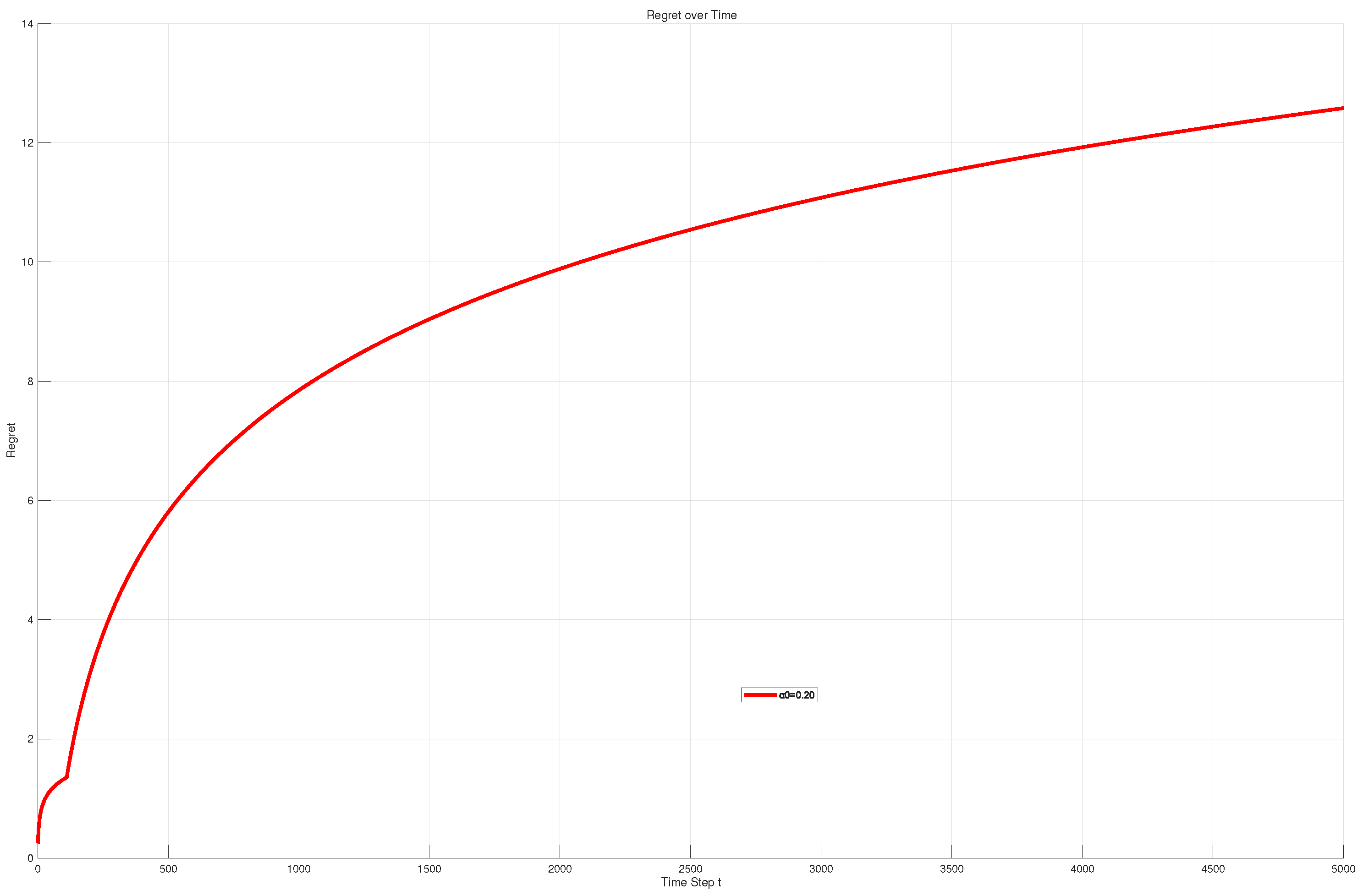
Figure 2.
Violation of FOC-based motor control.
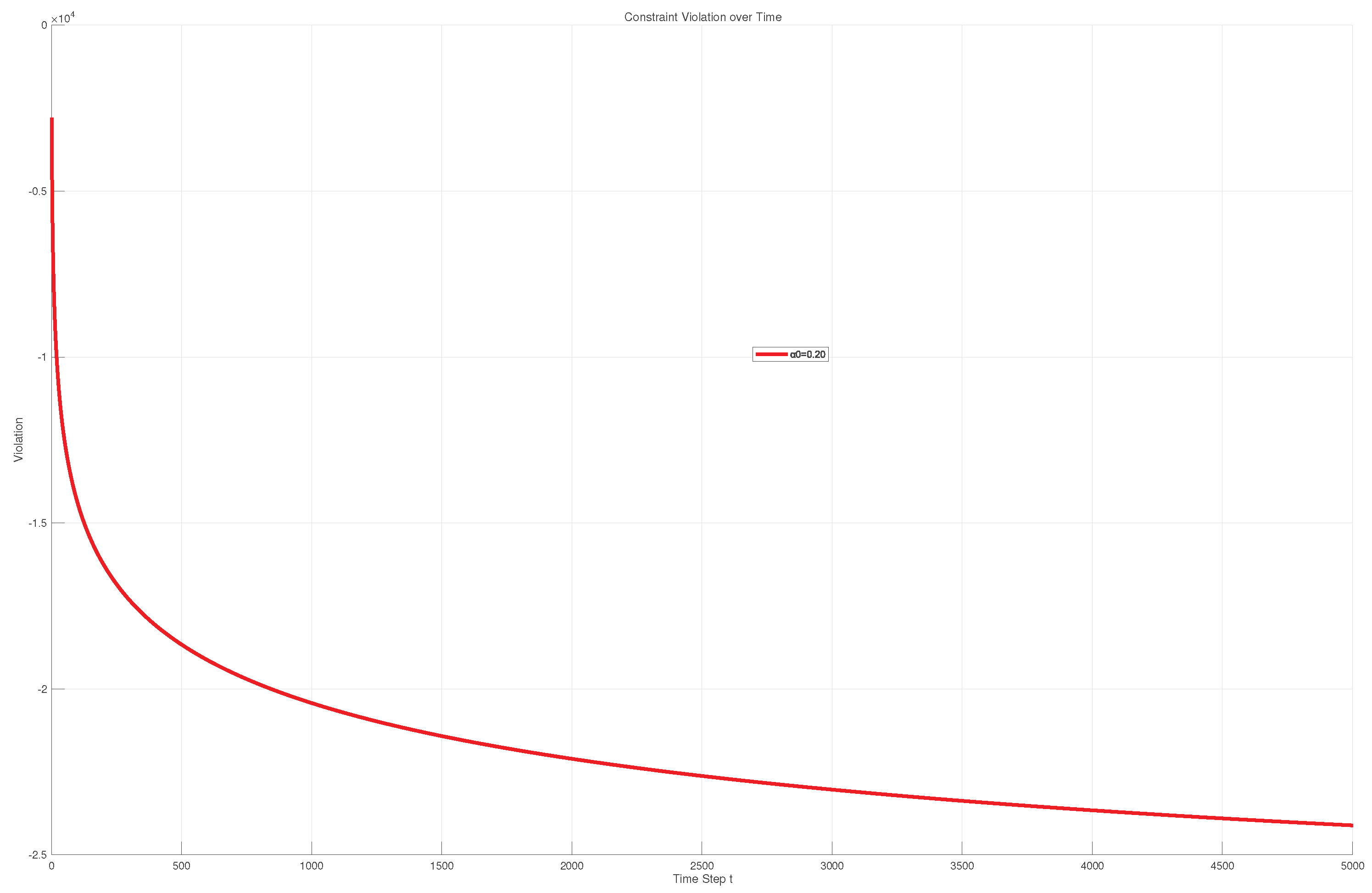

Table 1.
Polynomial Regression Performance Summary.
| Polynomial Degree | Mean Test | Improvement | Number of Parameters |
|---|---|---|---|
| 1st Degree | 88.32% | — | 4 |
| 2nd Degree | 92.08% | 3.76% | 10 |
| 3rd Degree | 94.70% | 2.61% | 20 |
| 4th Degree | 95.17% | 0.47% | 35 |
| 5th Degree | 95.36% | 0.19% | 56 |
Disclaimer/Publisher’s Note: The statements, opinions and data contained in all publications are solely those of the individual author(s) and contributor(s) and not of MDPI and/or the editor(s). MDPI and/or the editor(s) disclaim responsibility for any injury to people or property resulting from any ideas, methods, instructions or products referred to in the content. |
© 2026 by the authors. Licensee MDPI, Basel, Switzerland. This article is an open access article distributed under the terms and conditions of the Creative Commons Attribution (CC BY) license (http://creativecommons.org/licenses/by/4.0/).
Copyright: This open access article is published under a Creative Commons CC BY 4.0 license, which permit the free download, distribution, and reuse, provided that the author and preprint are cited in any reuse.


