

Submitted:
01 April 2026
Posted:
02 April 2026
You are already at the latest version
Abstract
This article addresses the “Hard Problem” of consciousness not as an immutable ontological barrier of nature, but as an iatrogenic separation—a methodological artifact induced by the reductive third-person perspective (3P). By systematically and intentionally removing the subject from the world-description to achieve a veneer of objectivity, modern physicalism creates a restrictive “substance grammar” that subsequently struggles to locate the qualitative dimension of experience within its own datasets. Using Hans Holbein the Younger’s painting The Ambassadors (1533) as a primary epistemic model, we analyze the anamorphic “blot” as a representation of the Real that eludes frontal, mathematical domestication. We argue that the resolution of this parallax requires more than a simple shift in focus; it demands a “step to the side”—a transition from static representation to the processual performance of enactive inference. Integrating Karl Friston’s Free Energy Principle (FEP) and the Neurophenomenological Enactive System Schema (NESS), we define meaning not as an intrinsic property of objects, but as a temporal alignment and an energetic achievement of a system striving for coherence under the constant pressure of existential concern (Sorge). The paper concludes by proposing a “processual perspectivism” and the figure of the Sovereign Witness, suggesting that the Hard Problem is dissolved when subjectivity is understood as the active, embodied performance of the world-relation.
Keywords:
hard problem of consciousness
; enactive inference
; free energy principle
; anamorphosis
; second-person perspective
; intersubjectivity
; Hans Holbein
; Markov blankets
Public Significance Statement
This study addresses a fundamental challenge in modern society: the growing gap between scientific objectivity and the personal search for meaning. By analyzing a 16th-century masterpiece through the lens of contemporary neuroscience and philosophy, the authors demonstrate that the “crisis of meaning” is not an inevitable fact of nature, but a result of how we choose to observe the world. The research presents a new framework where consciousness is understood as an active, shared performance rather than a passive data process. For the broader public, this work suggests that our sense of purpose is deeply rooted in our ability to resonate with the world and each other, providing a theoretical basis for overcoming existential isolation in an increasingly data-driven world.
Introduction: The Crack in the Tableau of Reason
Iatrogenic Separation: Consciousness as a Methodological Artifact
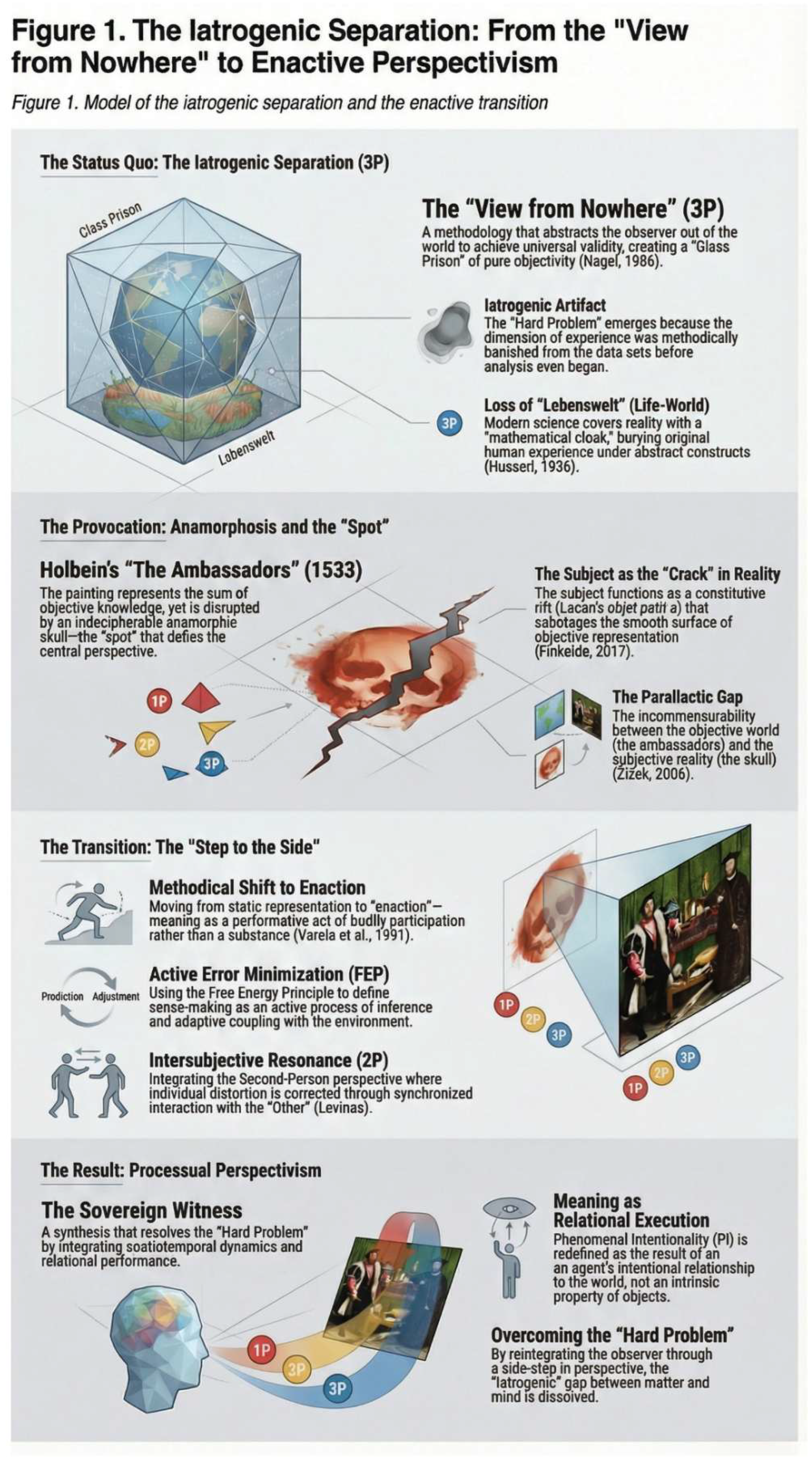
In contemporary philosophy of mind, the “Hard Problem” of consciousness is often treated as an insurmountable constant of nature—a fundamental, unbridgeable rift between the material world-description and the qualitative depth of inner experience (Chalmers, 1995; Nagel, 2012). In this paper, however, we propose to understand this problem not as an objective boundary of the universe, but as an iatrogenic separation: a malady induced by the very method of treatment chosen to explain it—namely, reductive physicalism. Modern science operates largely within a third-person perspective (3P), which we analyze in sharp contrast to the subjective first-person (1P) and the relational second-person perspective (2P). This 3P methodology employs a rigid “substance grammar” that consistently strikes the subject from the equation in a strategic attempt to gain objectivity. This abstraction is not a mere error; it is a fundamental methodological necessity for the physicalist program, which can only claim universal validity by excising the observer. Consequently, the “Hard Problem” reveals itself as a form of retrospective bewilderment: an astonishment that the dimension of experience remains undiscoverable in data sets from which it was methodically and violently banished in the first place.
Philosophically, this loss of the 1P perspective is inextricably linked to the waning of “meaning” in our modern world-description. We position our inquiry within a non-reductionism that views Phenomenal Intentionality (PI) not as an “innate” substance derivable from intrinsic properties—a view often called PI-Primitivism—but as the emerging result of a relational performance. Since meaning is not an immanent feature of objects themselves but only comes into being through the intentional relation of an agent to the world, methodical objectification inevitably leads to a hollowed-out, “de-souled” worldview. This meaning constitutes itself primarily through what Varela, Thompson, and Rosch (1991) term enaction. Meaning is not a static object to be discovered; it is the result of a processual enactment—a performative act of bodily participation in the world (Merleau-Ponty, 1945/1966). In the rigid geometric order of the 3P model—an architectural isolation we term the “glass prison” of cognition—affective resonance is relegated to the status of an anachronistic disturbance: a troublesome, irrational noise in an otherwise smooth and efficient mechanistic gear.
Argumentative Roadmap
To overcome this iatrogenic separation and reintegrate the subject into the world-description, this paper follows a four-part argumentative strategy:
- Chapter II develops an Ontology of the Slant. Drawing on art-historical and psychoanalytic models (Lacan, Žižek) and contemporary theories of “excessive subjectivity” (Finkelde), we demonstrate that the subject functions as a constitutive “crack” in the objective worldview. We address how this slant allows for a new understanding of multiple realizability at the intersubjective level.
- Chapter III transitions from static optics to the dynamic practice of enactment. Utilizing the Free Energy Principle (FEP) and the Neurophenomenological Enactive System Schema (NESS), we establish meaning as a form of active error minimization (inference). Here, we critically distinguish between mere physical persistence and the adaptive active inference that characterizes a meaningful existence.
- Chapter IV expands the perspective to the intersubjective resonance field (2P). We argue that individual distortion (anamorphosis) finds its correction only in synchronized interaction with the Other. By integrating the ethical moment (Levinas), we position responsibility as a corrective to purely technical inference.
- Chapter V synthesizes these strands into a philosophy of processual perspectivism. We introduce the “Sovereign Witness” as a response to Nagel’s aporia, showing how the integration of spatio-temporal dynamics (Northoff) finally dissolves the problem of causal exclusion.
The Hubris of Linear Perspective: The Price of the “View from Nowhere”
The roots of this epistemic isolation lie deep in the European Renaissance, specifically in the mathematical establishment of linear perspective. Through this innovation, the observer was elevated to a sovereign but radically distanced point outside the world. Erwin Panofsky (1927/1991) described this development as “perspective as symbolic form,” borrowing the concept from Ernst Cassirer. Panofsky argues that perspective is not a neutral optical tool or a simple window into reality, but a mental category through which an entire era constitutes its reality. It marks the historical moment when the infinite, homogeneous space of modernity replaces the psychophysiological, value-laden space of the Middle Ages. Linear perspective is thus the geometric solidification of a worldview that understands reality primarily as an object to be measured and dominated by an isolated, punctual subject.
Thomas Nagel (1986) characterized this abstraction as the View from Nowhere. His starting point is the insight that we strive for objectivity by gradually detaching ourselves from our particular, embodied standpoint in the world. However, Nagel demonstrates that this movement creates a fundamental aporia: the further we distance ourselves from the first-person perspective to adopt a universal, impersonal view, the more the essence of the mental itself eludes our grasp. Subjective experience—the “what it is like” to be a certain being—cannot be translated into the language of a purely physical external description without destroying its very essence. A standpoint that enables universal world-measurability thus pays the price of a total existential alienation, burying the concrete experience of living beneath a layer of cold, mathematical abstractions.
By forcing all being into an ordered tableau of representation, the resulting 3P model executes that fundamental loss of the “lifeworld” (Lebenswelt) lamented by Edmund Husserl (1936/1970). He diagnosed that modern natural science covers the world with a “garment of ideas” (Ideenkleid) made of mathematical constructions—a methodical substruction that buries original, vibrant reality beneath a layer of formalisms. In this mathematized version of nature, there is no room left for the intentional performance of consciousness. We are left with a world of facts that is utterly silent on the question of value.
The Anamorphic Provocation: Holbein’s “Blot” as the Entry of the Real
Nothing illustrates this crisis and the potential for its resolution more incisively than Hans Holbein the Younger’s painting The Ambassadors (1533). While the tableau presents a magnificent sum of contemporary knowledge—filled with instruments of navigation, music, and science—an incomprehensible, diagonal beam thrusts itself into the lower third of the image. This anamorphic “blot” represents a fundamental epistemic provocation (Finkelde, 2017). It disturbs the easy sovereignty of the viewer by introducing an element that eludes linear domestication and frontal understanding.
Jacques Lacan (1964/1977) utilized this painting to demonstrate the radical split between the “eye” (biology and linear vision) and the “gaze” (the dimension of desire and being seen). For Lacan, the skull is the objet petit a—that intangible remnant of reality that reminds the viewer they are themselves part of the tableau, not merely its detached observer. Slavoj Žižek (2006) radicalized this into the “parallactic gap,” arguing that the skull and the ambassadors represent two incommensurable levels of reality that cannot be unified in a single, frontal gaze. Dominik Finkelde (2017) ultimately conceives this structure as the “law of diffraction” (Beugungsgesetz) of reality itself: the subject is that excessive moment that bends the order of knowledge. The blot represents the “crack in everything” (Cohen, 1992) through which the realization of finitude seeps into the otherwise smooth surface of representation. It serves as a constant reminder that no model can be complete as long as it ignores its own point of observation and the inherent blind spots of the observer.
Research Question: The Step to the Side as Enactive Performance
The decisive question of our contribution is: How do we resolve this anamorphic distortion without falling back into a naive, uncritical subjectivism? Our thesis posits that the solution lies not in an even more precise frontal analysis, but in the “step to the side”—a methodological shift toward a processual perspectivism. We argue that the resolution of the parallax between the objective worldview (3P) and subjective experience (1P) is achieved through the mechanics of enactive inference (Friston et al., 2017). Meaning emerges here not as a static property of an object to be found, but as a dynamic, temporal enactment within a neuro-existential architecture. In the chapters that follow, we will demonstrate how this step to the side transforms the anamorphosis of the skull into the clarity of a new generation of meaning—one that operates beyond the constraints of iatrogenic separation.
Figure 1.
The Philosophy of the Slant: Lacan, Žižek, and Finkelde
Jacques Lacan: The Gaze from the Void and the Multiple Realizability of Meaning
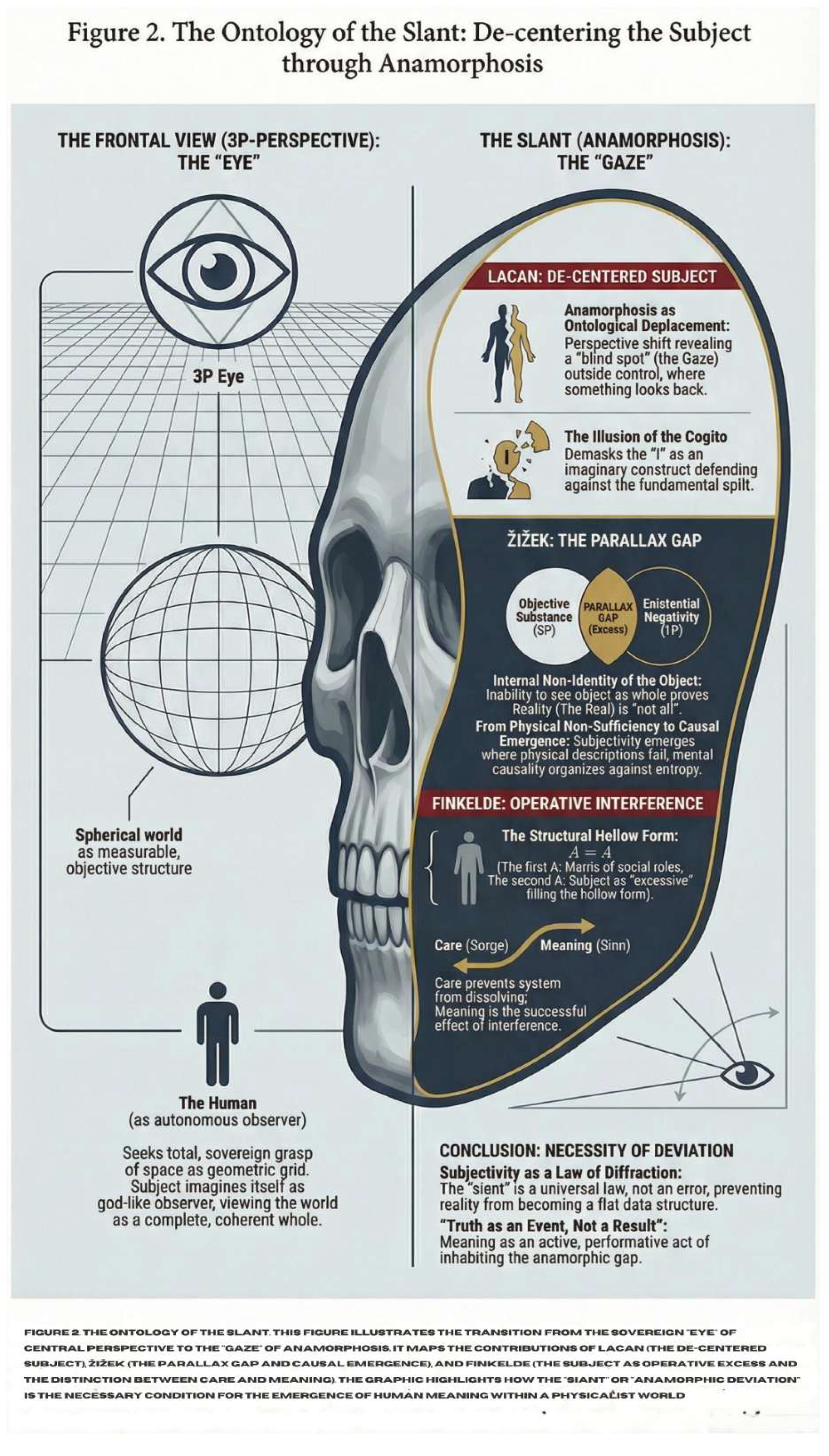
The transition from linear perspective to anamorphosis marks, for Jacques Lacan (1964/1977), nothing less than the radical de-centering of the Cartesian subject. In his Seminar XI, Lacan utilizes Holbein’s The Ambassadors to explicate the fundamental split between the “eye” and the “gaze.” While the viewer’s eye scans the harmonious tableau of representation—the ordered, measurable knowledge of the 3P perspective—with sovereign ease, it is the “gaze” that fixes the viewer from within the anamorphic blot as an alien agent. The 3P eye strives for a total, quasi-divine apprehension of space, where everything occupies its fixed place within a geometric grid. Yet the anamorphic blot shatters this presumed sovereignty; it is the point where mathematical reason meets its limit and the subject realizes they are no longer the detached director of seeing.
To grasp this “gaze” as an “alien agent,” one must follow Lacan’s metaphorical radicality: the gaze is not what I do with my eyes when I look at an object; rather, it is the fact that I, as a subject, am always already part of a world that already “sees” me before I direct my eye toward it. This position bears a distinct proximity to Heidegger’s concept of “being-in-the-world,” in which Dasein is always already thrown into a context of meaning it did not create. The subject here is not an autonomous actor standing over against the world, but a being entangled in the structures of the visible and the sayable. Lacan employs the image of being photographed: in the field of the visible, we are not only the camera but always also the motif. The anamorphic blot in Holbein serves as the site where this truth erupts. As long as we look frontally at the ambassadors, we believe ourselves safe in the 3P perspective as detached observers (the eye). But the incomprehensible blot in the foreground “looks at us” by tearing a hole in our knowledge. It signals: “There is something you do not control, but which concerns you.” It is a moment of ontological displacement, reminding us that our view can never encompass the whole without carrying the blind spot of our own existence.
This reversal initiates the assault on the illusion of the Cogito—the notion of a self-transparent, autonomous consciousness. While classical phenomenology (Husserl, 1936/1970; Zahavi, 2005) defends the 1P perspective as “pre-reflective givenness” (ipseity) and sees in it the core of subjectivity, the gaze of the Other unmasks the subject’s sovereignty as a mere effect within the field of the visible. For Lacan, what we experience as a stable “I” is merely an imaginary construct, a defense against the fundamental split of our being. The anamorphic skull is thus the objet petit a—the intangible remnant of reality that is lost when our experience is translated into language. It is the stumbling block that keeps the engine of our desire running, because it painfully demonstrates that the symbolic order (3P) can never be fully closed.
In a strategic extension of Lacanian analysis, this “remnant” can be interpreted within the functionalist debate as a moment of multiple realizability: the existential meaning of the slant—the insight into finitude and one’s own limitation—is not tied to the intrinsic physical properties of the pigment or the skull. Rather, meaning is realized relationally through the active shift in perspective. Different biographical backgrounds, cultural imprints, or emotional states can realize the same existential meaning, highlighting that meaning is not a static attribute of an object but an emergent property of intersubjective coupling (2P). Meaning “happens” as a processual event in the interaction between the subject and the “excessive” object. It is the product of active error minimization in the sense of enactive inference, which attempts to integrate the anamorphic disturbance into a coherent world model without denying the radical alterity of the Other or of death.
Slavoj Žižek: Parallax and the Problem of Causal Exclusion
Slavoj Žižek (2006) radicalizes Lacan’s insights by elevating anamorphosis from an aesthetic curiosity to a fundamental ontological necessity. In his concept of the “parallactic gap,” he argues that the incompatibility between the frontal view and the slanted view is not a deficit of our perception, but points to a constitutive crack in being itself. For Žižek, parallax does not simply shift the observer’s standpoint; the object itself reveals an internal non-identity. There exists a fundamental non-coincidence of reality with itself; being is, as it were, “out of joint,” and this inconsistency becomes spatially tangible in the anamorphic image.
Žižek justifies this internal non-identity by tracing the epistemic barrier back to the object itself: the failure of our representation to grasp the object (the skull) as a coherent whole is, for him, not a purely subjective failure, but reflects the fact that the Real itself is “incomplete” or “not-all.” Drawing on Hegel, he argues that the object gains its identity only through the mediation of its opposing appearances. Parallax is thus not a mere optical illusion, but the ontological mode in which being manifests itself at all. The object is the gap between perspectives; it does not exist beyond the distortion but as its structural center. This “internal non-identity” forces the subject to write themselves into the world-description as an active element, since the world without the perspectival “bending” by the subject would remain a mute, lifeless abstraction.
This gap can be interpreted as the fundamental incompatibility between detached objectification (3P) and existential immediacy (1P). While the 3P perspective suggests a world of substances and measurable relations—a “substance grammar” promising constancy and objective determinability—the radical negativity of the 1P experience erupts in the skull. This negativity is not a mere “nothing,” but the active impossibility of fully integrating the subject into a closed system of facts. The subject is that “blind spot” which, while being the condition of possibility for the world’s appearance, can never find itself as an object in a physical external description. This non-identity generates a tension that forces the subject to actively create meaning to bridge the chasm between the world’s richness and the void of their own observer-center.
Against the problem of causal exclusion (Kim, 2005), the parallactic gap offers a decisive way out: the “crack” is the site of a genuine causal emergence. In analytic philosophy, it is often argued that mental states cannot possess their own causality because the physical level is already sufficient. However, Žižek points out that the subject emerges precisely where the physical description reaches its limit—it is the manifestation of the physical non-sufficiency of the isolated system. Mental causality becomes graspable here as the ordering force that leads the system out of the impending entropy of unstructured noise. It is not an additional physical force, but an organizational meta-level that establishes a new, perspectival order, which cannot be derived from purely physical sub-states alone. The truth of human existence thus lies in the painful but productive oscillation between the material abundance of objects and the inescapable negativity of the acting subject.
Dominik Finkelde: Operative Interference as Causal Emergence
Dominik Finkelde (2017) conceives anamorphosis as a fundamental “law of diffraction” of reality. The subject acts here like an edge that interferes with the path of objective explainability, thereby actually structuring the space of representation. This “diffraction” describes the operative interference of the subject in the structure of the world: the subject is not a passive element merely receiving stimuli, but an active instance that deforms the field of objectivity by its very presence. Finkelde employs the term “structural hollow form” (Hohlform) to visualize Hegel’s postulate that substance must essentially be understood as subject as well. In the formal identity A=A, the first “A” is the predicative matrix—the totality of social roles, biological norms, and linguistic categories—in which the second “A,” the living, excessive subject, first comes to itself. This hollow form is not a finished vessel, but a space of expectation that is first filled with meaning through the “excess” of the subject.
Concretely, Finkelde means by “excess” that radical non-congruence of the subject with its prescribed structures. He derives this thought from a critique of purely functionalist “normality,” which understands the individual merely as the sum of its predicates—such as “citizen,” “consumer,” or “biological organism.” In this reduced view, a human being would be perfectly flush with its hollow form. Yet “excess” marks precisely that point where the subject spills over the edge of this form. It is the qualitative difference that is not exhausted in functional descriptions, and which consciously distinguishes itself from the static normality of a “dead” substance. This excess is the actual engine of freedom: the subject recognizes itself not in what it already is (the norm), but in what it is not yet or beyond.
In this context, there is a clear rejection of that purely spatial understanding of subjectivity that Martin Heidegger (1927/2006) criticized in his analysis of “being-in” as a fundamental error of metaphysics. For Heidegger, Dasein is not in the world like water in a glass or an object in a box—not in the sense of a categorical content-container relation of mere presence-at-hand. Finkelde’s hollow form marks instead the site of an existential participation that first gains its actual form through the “veto” of the living—that temporal dynamic of Care (Sorge). In this determination, it becomes clear: the subject does not have time like an object that it could pour into a vessel; it is time itself. “Excess” is thus not a quantitative surplus within a stable form, but the qualitative leap from mere presence to active, temporal enactment. Only this refusal of the subject to be understood as a static thing within a matrix transforms the cold structural matrix into a pulsating space of significance.
This interference provides the therapeutic answer to Kim’s problem of causal exclusion: the subject is that “excess” that fills the causal gap that a purely physical 3P model necessarily leaves open. Hegel interprets substance not as a rigid substrate, but as the dynamic process of its own self-alienation and subsequent mediation. Finkelde utilizes this bridge for self-preservation: substance (the world order) is the “big Other,” that Lacanian instance of the symbolic order, which is only vitalized and maintained through the productive negativity and operative interference of the subject. Without this interference, the world would remain a mechanistic skeleton without pulsating life.
In doing so, Finkelde escapes the “naturalistic fallacy” by conceiving biological persistence not as a mere empirical datum, but as the material expression of an ontological primal act. Finkelde himself introduces the term “Care” (Sorge) for this, describing it as the driving force and the actual “glue” of identity. While he explicitly draws on Heidegger’s existential of Care, he refines this term for his philosophy of the subject: Care is the inescapable non-indifference of the subject toward its own persistence. It prevents the system from disappearing without a trace into the entropy of the outside world.
Finkelde sharply distinguishes “Care” from the concept of “Meaning” (Sinn): Care is the motivational and structural condition of possibility for identity itself—it is the engine that draws a boundary between inside and outside. “Meaning,” on the other hand, is the processual effect of this Care. Meaning only arises when the subject’s operative interference is successful and the excessive remnant of the subject transforms the rigid “hollow form” of the world into a resonant, inhabitable space of experience. While Care thus marks the drive for preservation, Meaning is the event of a successful world-relation. Freedom arises precisely where the subject no longer merely suffers the structure of the world (substance) as a given fate, but actively transforms it and charges it with significance through the act of perspectival shifting.
Summary: The Necessity of Deviation
The synthesis of the positions of Lacan, Žižek, and Finkelde makes it clear that the frontal view of linear perspective (3P) promises a clarity that can only be bought through the systematic excision of the observer. In this cleansed, sterile geometry, the world gains mathematical calculability and logical consistency, but simultaneously loses its living relevance and existential depth. The 3P model resembles a tableau that is perfectly illuminated, but in which no one lives anymore. Only in a conscious slant—in the courageous recognition of parallax, of the excessive crack in the fabric of representation, and of the inescapable nature of lack—does the subject, and with it living meaning, return to the world-description.
This deviation from the “right angle” of objectivity is thus not an epistemic error to be eliminated, nor a mere optical illusion, but the discovery of subjectivity as that universal “law of diffraction” that makes reality inhabitable, interpretable, and responsive in the first place. It is the necessary resistance of the living against being flattened into a one-dimensional data structure. We do not look at a finished universe external to us, as one might study a dead map; rather, we look through a crack that is first torn into being by our own paradoxical existence.
This ontological slant is not a deficit, but the driving force of all knowledge. It forms the unavoidable prerequisite for that dynamic mechanics of meaning that we will specify in the next chapter through the theory of enactive inference. We will demonstrate that the creation of meaning is not a passive mapping, but an active, performative enactment that does not simply close the anamorphic gap, but creatively inhabits it through the ongoing process of self-modeling and environment-coupling. In the movement of the “step to the side,” truth proves to be not a result, but an event.
Figure 2.
From Image to Enactment: Enactive Inference as a Generator of Meaning
Epistemic Noise: When the Eye Stumbles
Traditional cognitive science long treated the mind as an internal mirror, whose primary task was to represent the external world as faithfully as possible. In this representationalist model—often ridiculed as the “Cartesian Theater” (Dennett, 1991)—knowledge is conceived as a passive accumulation of data projected onto an internal screen for an observing homunculus-subject. The mind is degraded to a mere consumer, receiving a pre-processed and pre-interpreted image of the world. This approach cements the iatrogenic separation between the observing subject and the observed world, as discussed in the introduction: it creates an artificial distance where experience appears only as a pale shadow of an external reality. Enactive theory, founded by Francisco Varela and developed by Evan Thompson (2007), radically breaks with this notion of passivity. It postulates that cognition is not the mapping of a pre-defined world, but the active “bringing forth” (enaction) of a world of meaning through the sensorimotor interaction of the living body.
Before cognition can occur as an ordered representation, however, Holbein’s work presents us with what we might call epistemic noise. Viewed frontally, we see a wealth of objects of the highest precision—celestial globes, quadrants, sundials, and open books. These props are not mere accessories; they represent the sovereign ambition of the humanist spirit to make the entire visible and invisible world fully controllable through measurement, calculation, and categorization (Panofsky, 1991). The mathematical clarity of linear perspective suggests a world that dissolves completely into the light of reason. Yet, amidst this absolute order, the distorted, amorphous skull at the bottom of the frame acts as an unreadable disturbance, a blot of maximum entropy sabotaging the smooth surface of the tableau. For our brain, which is evolutionarily programmed for the lightning-fast recognition of patterns and the establishment of stable coherence, this anamorphosis represents a massive irritation. The mind’s predictive machinery recognizes a physical presence but cannot reconcile this object with any available schema of the sovereign 3P perspective (Hohwy, 2013).
This noise functions as a persistent cognitive pressure point or “itch.” The visual order, which supports the rest of the image so majestically, collapses at the center of the foreground precisely where the assumed safety of the detached observer should be greatest. A profound epistemic crisis ensues: conventional knowledge fails because the familiar vantage point provides no coherent answer to what this “blot” actually signifies. Yet this stumbling of the eye is no mere system error; it is a necessary, salvific provocation. The unease over the unreadability of the blot creates an energetic tension that forces the subject to abandon the comfortable, static standpoint of the View from Nowhere. It is the pain of the model’s inconsistency that rouses the agent from inertia. Only through this visual irritation is the energetic effort initiated that is required for a true shift in perspective—the physical and mental “step to the side.” Noise is thus the birth of inference; it marks the transition from mere observation to the transformation of the world through processual enactment (Noë, 2004; Clark, 2016).
The Thermodynamics of Concern: FEP as a Transcendental Postulate
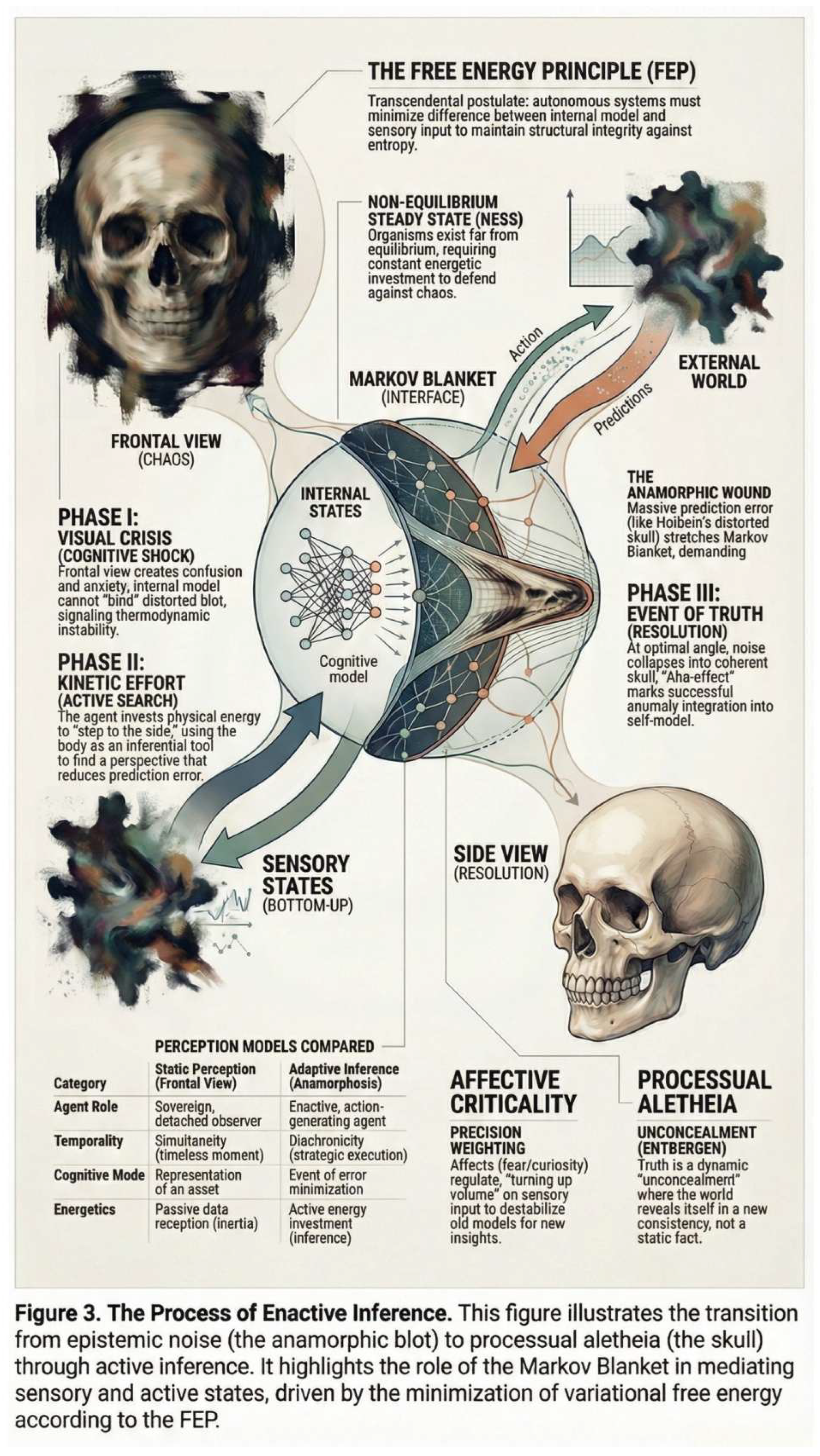
To understand the biological urgency of this search for meaning, we must examine the foundations of mathematical biophysics. Karl Friston’s Free Energy Principle (FEP) provides the decisive framework for this (Friston, 2010). We conceive the FEP not merely as one empirical hypothesis among many, but—in the sense of a transcendental postulate—as a necessary condition for the existence of any autonomous system. It is the logical consequence of the fact that living systems must maintain their physical boundaries against a decaying environment over time. A system that did not embody this principle would instantly diffuse into its surroundings and lose its identity. Every living system thus faces the existential challenge of defending its structural integrity against the relentless increase of entropy—thermal death (Schrödinger, 1944). Biologically, an organism exists in a state far from equilibrium, a so-called Non-Equilibrium Steady State (NESS). This state is not a static point, but a highly dynamic process of self-preservation that demands continuous energetic investments to maintain the “protective wall” against chaos.
This state implies that the brain is not a passive processor of input data, but a primary generator of actions that must be constantly active to keep its own organization stable. It does not wait for stimuli to react; it actively “projects” hypotheses and expectations into the world to confirm or correct them through sensory feedback. This mathematical necessity to actively defend one’s own structural order against decay is the physical equivalent of what we previously termed “Care” (Sorge) in a phenomenological sense. A system “cares” for its persistence by minimizing the difference between its internal models of the world and actual sensory inputs—mathematically expressed as minimizing its Variational Free Energy (Friston et al., 2006). In this context, we use information theory as an idealized instrument to bridge the gap between physical entropy (the decay of matter) and phenomenal surprise (the cognitive shock) without categorically conflating the two levels. Information becomes the existential currency that ensures survival.
Here, the operative circle closes back to the anamorphosis: Holbein’s blot generates a massive prediction error, an information-theoretic dissonance that forces the system into action to avert the impending instability of the world model. We must distinguish here between purely reflexive inference and adaptive active inference. While a reflex merely reacts immediately and unconsciously to a local disturbance, the “step to the side” represents a strategic, meta-cognitive choice by the agent. We specifically invest kinetic and cognitive energy to transform the visual disturbance into the coherent information of the skull through a physical realignment. At this moment of resolution, the thermodynamic effort is rewarded with cognitive relief; the system returns to a state of lower free energy. Meaning is therefore the successful integration of anomalies into a coherent self-model—the vital achievement of “bending” the world and shifting one’s own standpoint such that the subject’s survival remains possible in a fundamentally contingent and decaying environment (Friston, 2013).

Table 1.
Contrast between static representation and adaptive active inference in the epistemic process.
Table 1.
Contrast between static representation and adaptive active inference in the epistemic process.
| Category | Static Perception (Linear Perspective) | Adaptive Inference (Anamorphosis) |
| Agent Role | Sovereign, detached observer | Enactive, action-generating agent |
| Temporality | Simultaneity (timeless moment) | Diachronicity (strategic enactment) |
| Mode of Knowledge | Representation of an established state | Event of error minimization (Aletheia) |
| Energetics | Passive data reception (Inertia) | Active energy investment (Inference) |
Note. This table summarizes the shift from a passive representationalist view to the active, process-oriented framework of enactive inference as demonstrated by the perspectival shift required to resolve Holbein’s anamorphosis.
Markov Blankets: The Membranous Autonomy of the Self
The concept of the Markov Blanket provides a mathematical solution to the fundamental problem of the boundary between self and world (Pearl, 1988; Kirchhoff et al., 2018). In the world of statistical probabilities, it defines a boundary that separates one set of states—the “inside” of a system—from another set—the “outside world.” However, this separation is not an absolute isolation but a conditional independence: the interior can never “see” the outside world directly but can only interpret it through the mediation of the blanket. This consists of two functional layers: sensory states (perceptions), through which the world acts on the system, and active states (actions), through which the system changes the world according to its internal models.
Crucial to our understanding is that the Markov Blanket is not an impenetrable wall but a highly interactive membrane. It is the site where the “diffraction” of reality operatively occurs and where meaning is generated as statistical coherence. The subject constitutes itself precisely at this dynamic boundary through the constant, circular exchange of prediction (top-down) and correction (bottom-up) (Palacios et al., 2020). The phenomenal “sense of self” is thus not a substantial core, but a predictive hypothesis of the system regarding its own stability and endurance in exchange with other agentic structures. Drawing on the concept of Participatory Sense-Making (De Jaegher & Di Paolo, 2007), we argue that the 1P internal view only gains a firm contour through intersubjective resonance—the operative coupling of two Markov Blankets into a temporary, dyadic blanket. We recognize ourselves as a “center” by validating the world through the slant of the Other.
In the anamorphosis, this blanket is stretched to its statistical breaking point: the unreadable blot represents information so far outside the horizon of expectation that the internal model cannot immediately “wrap” or bind it. This information-theoretic stretching creates the energetic tension we term the anamorphic wound. It marks the point where the sovereign authority of the 3P subject structurally fails, as it can no longer ignore the radical nature of the disturbance—the presence of death amidst knowledge. The system faces an existential choice: either it rejects the disturbance as meaningless, traumatic noise, leading to a freezing of the model, or it undergoes a radical reorganization of its internal states to integrate the truth of the skull. The creation of meaning thus proves to be a heroic act of membranous autonomy: we define our identity in the execution of the crisis by actively determining which distortions we accept into our model and how we redraw our boundaries to remain coherent despite the wound (Thompson, 2007).
Processual Aletheia: Affective Criticality as a Regulator
Meaning is not a purely cognitive result but is deeply rooted in our affectivity. In research on Affective Criticality, this connection is described as the organism’s ability to affectively control the “precision weighting” of its predictions (Tucker, Luu & Friston, 2025). Affects, in this sense, are not mere byproducts but functional regulators: they signal to the system when current world models (the priors) must be destabilized in favor of new, transformative insights. When uncertainty increases, affects such as fear or curiosity increase attention to sensory details—they “turn up the volume” on input to force a recalibration of the world model.
When the skull suddenly emerges from the distortion at the correct angle, we experience a Processual Aletheia. In the sense of Heidegger (1927/2006), truth here is not a static fact that can be “possessed” like an object, but a dynamic “unconcealment”—an event in which the world reveals itself in a new coherence. This process unfolds in three phenomenal phases governed by a specific affective dynamic:
- The Visual Crisis (Cognitive Shock): In the frontal view, the subject experiences a state of anxiety or deep confusion as the internal model cannot bind the anamorphic blot. This anxiety is highly functional: it signals thermodynamic instability and increases sensitivity to deviations. The system is placed in a state of criticality where old beliefs lose weight, making room for radical reorganizations.
- The Kinetic Engagement (Affective Search): To overcome the crisis, the subject invests physical energy. It leaves the comfortable, static observation post and executes adaptive active inference. At this moment, the system is in a state of active search; the body acts as an inferential tool, scanning the space to find a perspective that minimizes the massive prediction error.
- The Event of Truth (Resolution): At the moment of the optimal slanted view, the shift occurs. Death reveals itself as a fundamental reality, and the noise suddenly collapses into a coherent form. This breakthrough is neurobiologically accompanied by elation—that intense “aha effect” that occurs when free energy drops sharply. The new, now integrated model of the mortal is weighted and anchored with the highest precision. Truth occurs here as a cathartic event that permanently recalibrates the subject’s identity and expands the world model by the dimension of finitude (Hesp et al., 2021).
Our affects thus serve as finely tuned tools of self-preservation: they tell us, through discomfort or relief, when our perspective is corrupted and when “Care” forces us to reinvent ourselves through a movement in space. The creation of meaning is thus the artful balance at the threshold of criticality—a dynamic stability that we must actively work for in every second of life through the enactment of inference (Tucker, Luu & Friston, 2025).
Figure 3.
The Geometry of the “Between”: The 2nd Person as Corrective
The Aporia of Isolation: When Markov Blankets Fall Silent
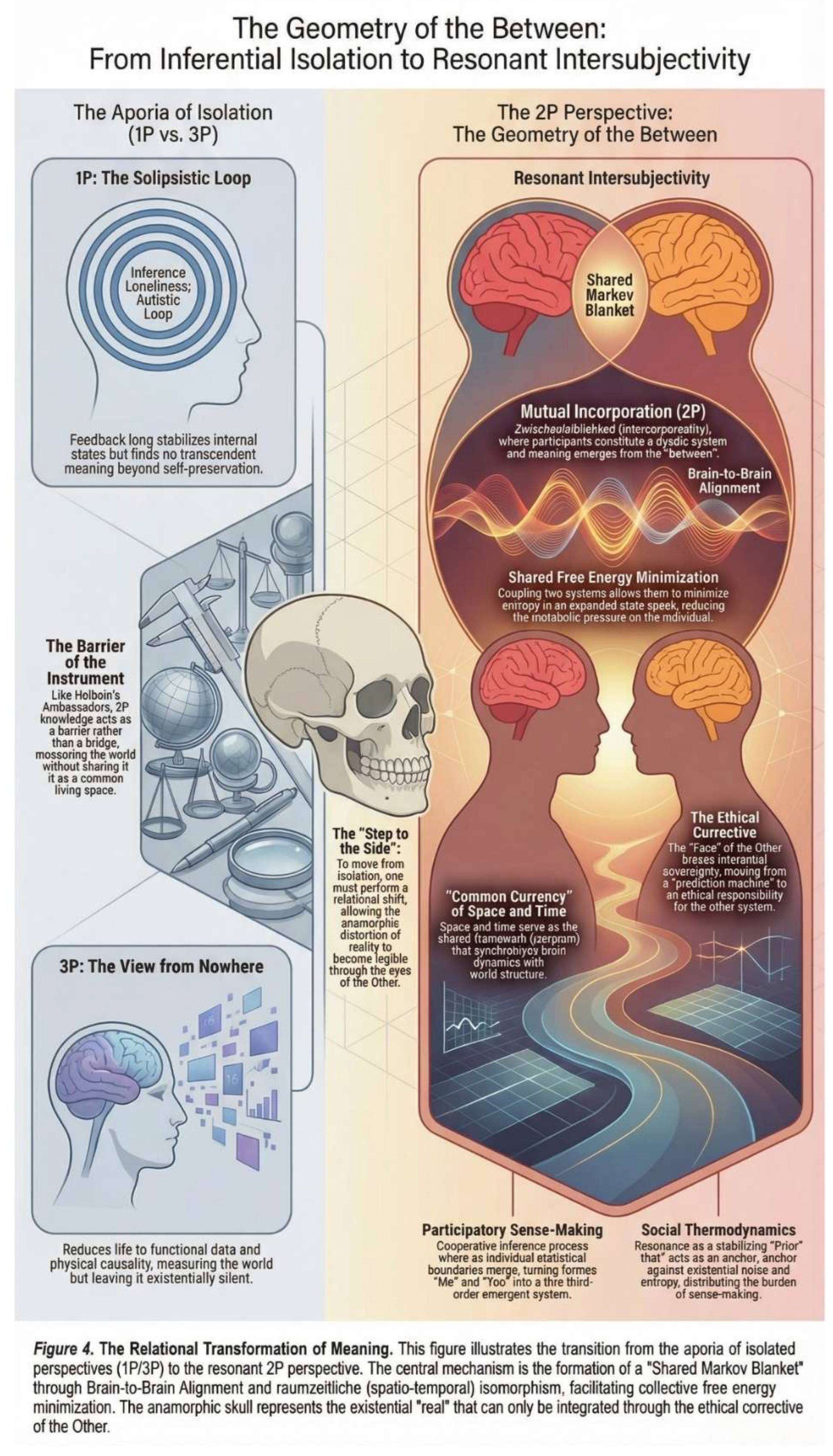
The analysis thus far has demonstrated that meaning is not a static feature of the world, but the result of an active performance. However, this performance is threatened with a fundamental aporia as long as it is viewed solely within the boundaries of an isolated system. The first-person perspective (1P) risks ending in a radical solipsism, where the world appears merely as a private construct—an “inference-loneliness” in which the subject minimizes its own entropy and stabilizes its internal states, yet fails to find a transcendent meaning pointing beyond mere self-preservation. In this state, the world becomes an autistic feedback loop: the system remains trapped in its own predictive cycle, without the world truly being able to answer. It resembles a navigation system that calculates without internal contradiction, but whose map data no longer finds a point of reference in the actual topography. Inference here becomes mere self-reference, which may secure survival but leaves the existential hunger for resonance and truth unquenched.
In contrast, there is the coldness of the third-person perspective (3P), which claims universal validity but reduces the living to functional datasets and physical causalities. This View from Nowhere (Nagel, 1986) erases the observer so thoroughly from the equation that the world freezes into a silent machinery of facts, in which there is simply no longer any room for meaning as a qualitative event of participation. It is a geometric abstraction that cuts away the qualitative flesh of experience to obtain a skeleton of measured values. Meaning is literally annihilated in the act of this purely objective measurement; it evaporates into the abstraction of the data point, leaving behind a disenchanted universe that may be calculable but is existentially mute.
In Holbein’s The Ambassadors, this aporia is masterfully staged in space: we see two men, Jean de Dinteville and Georges de Selve, who stand physically side-by-side, yet whose gaze is directed not at each other but at an invisible point outside the frame. They fixate on the viewer with an almost demanding intensity but remain curiously blind to one another. Their existence is a juxtaposition, not a fellowship. Between them gapes the shelf with the instruments—that meticulously painted apparatus of knowledge which, in its 3P rigidity, forms not a bridge but a barrier. The celestial globes, quadrants, and sundials are dead mediators here; they measure the world with mathematical relentlessness, but they do not share it as a common lifeworld. They represent a knowledge that can order the paths of the stars but completely misses the existential distress and bodily presence of the neighbor. Each instrument stands as a monument to the separation between the figures. The anamorphic distortion on the floor—that floating crack in reality—remains unreadable to both isolated figures because neither of them performs the necessary “step to the side” in harmony with the other. Each Markov Blanket remains trapped in the frontal view of its own role—the diplomat and the bishop as isolated nodes in a network that transmits information and status, but no living resonance. They are prisoners of their own model-security, perceiving the intrusion of the Real—the skull—only as disturbing noise.
Only when we introduce the relational dimension of the second-person perspective (2P) does the geometry of meaning shift fundamentally. Intersubjectivity is not to be understood here as a mere exchange of data between two autonomous, closed entities bouncing off each other like billiard balls. Rather, Thomas Fuchs (2013) describes this field as an “intercorporeality” in which the participants are in a process of “mutual incorporation.” In this phenomenological resonance space, the subjects form an overarching system, a dyadic structure in which the experience of one immediately co-constitutes the action space of the other. Meaning emerges here as an emergent property of the “Between,” which is as undiscoverable in the solipsistic 1P view as it is in the mechanistic 3P view. It is the fruit of a shared inference that jointly inhabits the crack in the world.
The Interference Field of Encounter: Synchronization and Spatio-Temporal Isomorphism
Modern neuroscience provides a fascinating empirical basis for this “Between” through the concept of Brain-to-Brain Alignment (Hasson et al., 2012). When two people enter into a deep, resonant interaction, their neural oscillations begin to synchronize across distances. A dynamic interference field arises, in which the predictive models of one system immediately influence, dampen, or amplify the inference processes of the other. This alignment is not a passive resonance but an active form of dyadic co-construction. Mathematically, this can be described as the coupling of two NESS (Non-Equilibrium Steady State) systems, which minimize their respective free energy no longer just in isolation, but in a shared, expanded state space (Friston & Frith, 2015). The “Care” for self-preservation becomes a collective task here; the thermodynamic effort to ward off entropy is distributed across both partners, massively reducing individual energetic pressure and creating space for complex meaning-making beyond mere survival logic.
This alignment, however, only becomes fully understandable through the deeper principle of Brain-World Alignment (Northoff, 2014). Georg Northoff argues that the brain does not merely process information but is directly aligned with the dynamics of the world in its spatio-temporal structure. He postulates a “Common Currency”—namely time and space—that structures both the world and neural activity. A profound spatio-temporal isomorphism exists between brain dynamics and world structure: the brain embodies the temporal and spatial rhythms of the environment in its own spontaneous activity. In this light, meaning is not a purely cognitive construct or an artificial mental superstructure, but the organic result of a spatio-temporal fit. In the encounter between two people (2P), this means a doubling of this resonance: not only are two isolated inference machines being compared, but their respective spatio-temporal rhythms enter into a shared, stabilizing oscillation. The statistical uncertainty of the world is managed together by sharing their “Common Currency,” creating an expanded spatio-temporal continuum that supports and validates individual perception.
This spatio-temporal bridge makes meaning “real” in the physical sense—it is the vibration that occurs when two complex spatio-temporal patterns reinforce each other. Meaning thus proves to be a resonance phenomenon based on this basal brain dynamic, operatively overcoming the iatrogenic separation of subject and object. In the encounter with the Other, one’s own Markov Blanket becomes permeable in a productive way; it no longer functions merely as an autistic shield against entropy, but as a vibratory sounding board for the “interference of the subject” (Finkelde, 2017) of the counterpart. Through synchronous inference, the individual’s anamorphic distortion is dissolved in the corrective mirror of the Other. The Other acts as that “Sovereign Witness” whose differing spatio-temporal beat helps us identify and integrate the blind spots of our own world model. In this resonance, we find that “Golden Angle” of intersubjectivity that makes death comprehensible not just as a cold fact (3P) or traumatic noise (1P), but as a shared, spatio-temporally anchored truth of being human. In synchronization, existential slant becomes a shared dance movement.
The Ethical Corrective: From Statistical Models to the Face
The most radical expansion of this biophysical view lies in the introduction of an ethical corrective, as demanded by Emmanuel Levinas (1961/2012) in his philosophy of the Other. Against a purely technocratic reading of inference, we must emphasize that the encounter with the Other is no mere statistical comparison. The Other is not a “prediction machine” whose behavior I merely wish to bind and control to lower my own free energy. For Levinas, the encounter with the “Face” (visage) of the Other is that moment that radically breaks my inferential sovereignty. The Face eludes all 3P categorization and all 1P appropriation; it is an ethical provocation calling me to responsibility. The statistical model of the self, which was previously oriented toward eliminating uncertainty, here encounters an Infinity that cannot be “wrapped up.” The Other does not confront me as an object within my Markov Blanket, but as a Beyond that transcends my membranous boundary.
In the 2P perspective, “Care” transforms from a purely self-preserving urge to a responsibility for the other system. I now “care” for the integrity of the counterpart because I realize that my own horizon of meaning is inseparably dependent on their resonant response. This responsibility is not a moral superstructure that one can put on or take off at will, but the fundamental condition for the success of cooperative inference. Anyone who views the Other merely as a data point in their own model destroys the necessary openness of the system and returns to sterile inference-loneliness. Intersubjectivity is thus an ethical act of recognition: I must not only tolerate but respect the radical foreignness and unpredictability of the Other as a condition of my own meaning-making. The “We” is thus the Clearing (Lichtung) in Heidegger’s sense—a space of unconcealment in which truth happens not as static correspondence, but as a synchronized enactment of recognition. In this light, the anamorphic wound no longer appears as a defect to be healed, but as that very crack through which the Other can first enter.
Truth, in this sense, is an “event of unconcealment” (Aletheia) that can only shine forth in the dynamic interference field of the 2P encounter. When we look at Holbein’s The Ambassadors today, we ourselves actively enter into this relationship. The painting is not a dead object (3P), but a partner in an interactive process. The “step to the side” is not a lonely maneuver for cognitive relief, but an invitation to the system “Image” to reveal its hidden truth in exchange with our gaze. Meaning-making thus proves to be a form of ars vivendi, consisting of keeping one’s own Markov Blankets open and membranous for resonance. We do not resolve the anamorphic trap by mastering it intellectually, but by realizing that we first take on a coherent, meaningful shape in the mirror of the ethical encounter. Truth is therefore what appears when we find the courage to abandon our statistical isolation and enter into the vibrating, ethically responsible interference field of the Other. In this act of “exposing oneself to the Other,” we find the only answer to the Hard Problem of consciousness that lies not in reduction, but in the expansion of being.
Figure 4.
Synthesis: The Sovereign Witness—A Response to Thomas Nagel
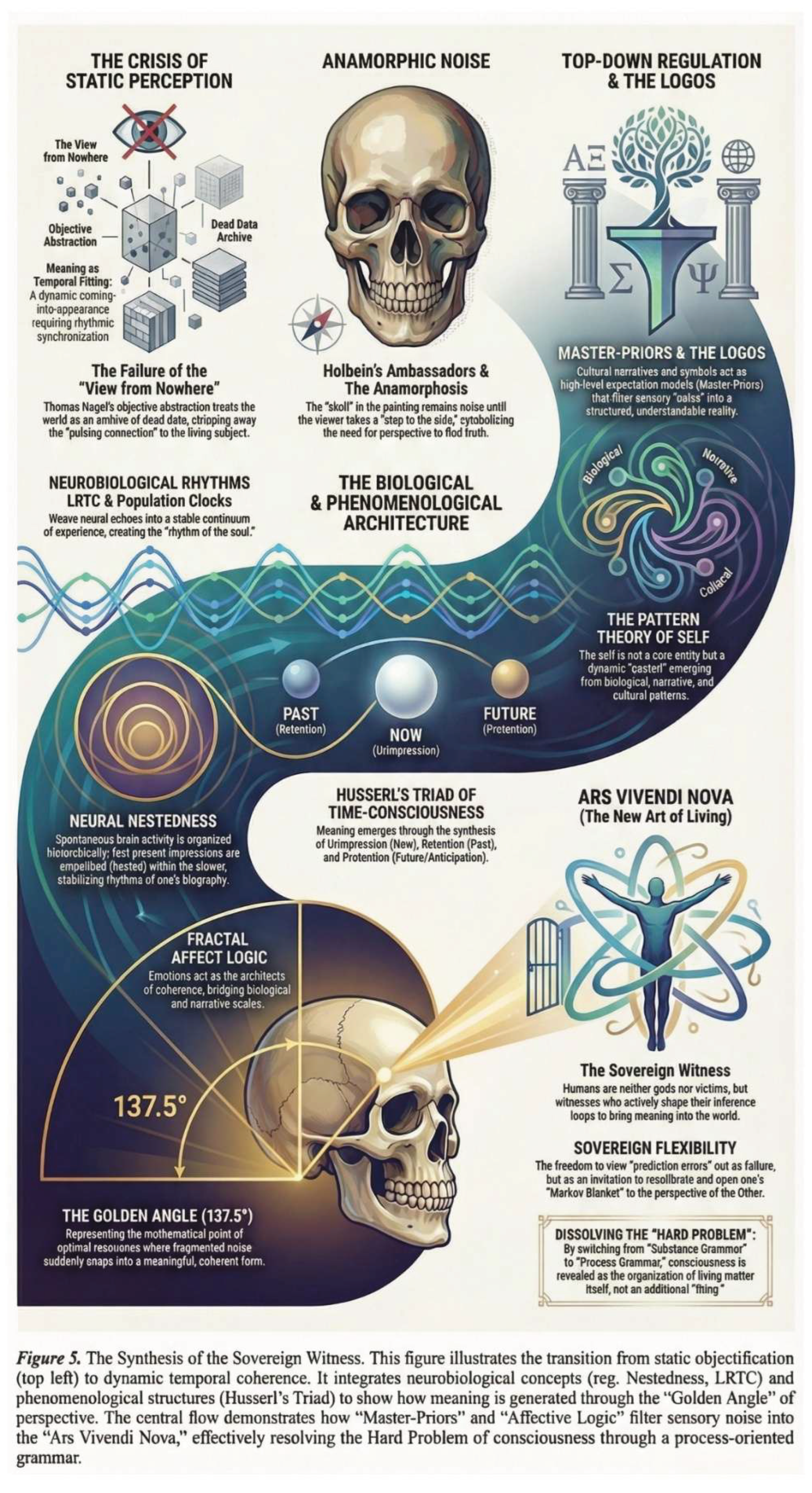
Meaning as Temporal Fit: The Dynamics of Coherence
The preceding investigation has shown that the crisis of meaning is inextricably linked to a static, punctual conception of knowledge. Thomas Nagel’s View from Nowhere (1986) ultimately fails because it attempts to freeze truth in a timeless moment of objectification—an undertaking that dissects the world into isolated snapshots and thus misses the processual flow of lived experience. Such a “view from nowhere” is, at its core, a “view from no time,” a radical abstraction that sacrifices Becoming in favor of a frozen, factual Being. In this artificial stasis, the world becomes an archive of dead data, lacking the pulsating connection to the subject. We oppose this with a philosophy of enactive inference that understands meaning not as a result or static image, but as a temporal fit—as a dynamic emergence that presupposes duration and rhythmic synchronization.
Neurobiologically, this is reflected in Long-Range Temporal Correlations (LRTC)—those spatio-temporal patterns in the brain that generate coherence across different timescales (Linkenkaer-Hansen et al., 2001; Northoff, 2014). These correlations are, so to speak, the “rhythm of the soul”: they ensure that neuronal events do not stand isolated next to each other but inform one another across time, forming a stable continuum of experience. This architecture finds its functional correspondence in Dean Buonomano’s concept of “Population-Clocks” (2017). Time in the brain is not measured by an external, mechanical ticker but is inseparably inscribed in the dynamic development of neuronal networks. Every sensory stimulus triggers a cascade of activity patterns whose temporal course itself carries information about duration and context (Buonomano, 2017). In this light, meaning is the system’s ability to weave these neuronal “echoes” into a stable identity—a rhythmic alignment between the organism’s internal dynamics and the world’s spatio-temporal melody.
This identity gains a radical process-ontological dimension through Georg Northoff’s concept of “Nestedness” (Northoff, 2014; 2018). Northoff demonstrates that the brain’s spontaneous activity is organized in a hierarchical nesting, where faster neuronal frequencies (fleeting impressions) are embedded in slower ones (stable backgrounds). This spatio-temporal structure means that a human being does not possess their biography like a dead bundle of files, but actively is this biography in the execution of their brain dynamics. The subject is the “nested” duration of its own history; the past is not simply “gone” but forms the slow, carrying rhythm in which the fast impulses of the present are embedded (Northoff, 2016). The present is thus never an empty point but always “heavy” with its own past and simultaneously “open” to the coming future. Biography is not an archive here, but a living resonance chamber.
Phenomenologically, this process can be specified through Edmund Husserl’s (1928) analysis of internal time-consciousness. Meaning arises only in the synthesis of primal impression (the now-moment), retention (the past held in consciousness), and protention (the expectant anticipation of what is to come). An isolated, punctual “now” would be completely meaningless to the mind—it would be an isolated tone without the context of a melody. Only the temporal horizon, which allows the past to resonate and already anticipates the future, enables the appearance of a coherent world (Husserl, 1928). Meaning is thus the successful integration of one’s own biography—as a spatio-temporally nested structure—into a resonant present.
When we perform the “step to the side” in Holbein, we end the statistical isolation of the moment. The skull becomes visible not through stronger optical magnification, but through processual embedding: it is the spatio-temporal answer to the previously unresolved noise. The observer’s “population-clocks” must first tune into the unfamiliar geometry—a temporal maturation process of perception—until retention and protention coincide. The truth of death is revealed here not as a flash of isolated information, but as a gradual “tuning in” to a new, deeper order. Meaning emerges where the subject’s inference loops find a rhythmic coincidence with the world’s dynamics. This temporal alignment is the actual healing of the iatrogenic separation, as it leads the mind back into the living flow of reality.
Top-Down Regulation through Master-Priors: The Logos as Order
A purely biological model of inference would risk ending in a new, reductionist naturalism if we did not consider the ordering power of cultural and philosophical structures. We refer to these as Master-Priors: high-level expectation models that regulate our basal perceptual processes “top-down” and translate the raw data of the senses into an understandable reality (Clark, 2016; Friston, 2010). These priors form the invisible cognitive framework within which the brain decides which stimuli are to be considered significant. The human mind thus inhabits a historically grown Logos that pre-structures the world’s statistical uncertainty through narratives, symbols, and collective values, allowing the subject orientation in the ocean of sensory stimuli.
According to Lucia Melloni, these master-priors function as the highest ordering instances of hierarchical predictive processing (Melloni et al., 2011). They are the “strong hypotheses” or statistical attractors that determine which sensory data are discarded as meaningless “noise” and which are weighted as “signals” of a deeper truth. These cultural structures, however, are not metaphysical “ghosts in the machine” but high-level statistical regularities inscribed over generations into the material and symbolic environment—and thus indirectly into our collective Markov blankets. In Holbein’s painting, the scientific instruments represent the physical embodiment of such master-priors: they function as epistemic anchors, mathematically fixing the infinity of space and suggesting to the viewer the deceptive security of a sovereign world-mastery.
Yet these cultural structures are constitutive parts of what Shaun Gallagher calls the “Pattern Theory of Self” (Gallagher, 2013). The self here is not a singular, closed core but a dynamic, processual gestalt that emerges only from the complex interaction of biological, narrative, and cultural pattern components. The anamorphic intrusion of the skull acts in this framework like a systemic shock, forcing a radical recalibration of the entire pattern architecture. When the immediate visual data can no longer be aligned with the stabilizing master-priors of human sovereignty, the self-pattern enters a phase of productive instability. Sense-making in this crisis proves to be an adaptive hierarchy in which the conscious shift of perspective provides the necessary “Golden Angle” of coherence.
This term—standing in direct mathematical kinship to the Golden Ratio (phi ≈ 1.618)—denotes that specific angle of a circle (≈ 137.5°) that nature utilizes, for example in phyllotaxis (the arrangement of leaves or seeds), to enable a maximum, non-redundant packing without mutual obstruction. In this perfect geometry, space is utilized optimally without individual elements obscuring one another. In our model, the “Golden Angle” marks that critical point of insight where the fragmented noise of the anamorphosis suddenly flips into a meaningful gestalt. It is the ratio in which the information of the skull and the representation of the ambassadors no longer obscure each other but complement one another into a higher unity of meaning.
However, for this realignment to succeed, there must be an instance that mediates the cognitive architecture with the energetic reality of the living body. Here, affects move into the center of ontological consideration: they are no longer mere accompaniments of reason but the actual architects of coherence that first enable the leap from information to meaning. In fractal affect logic (Ciompi, 1982; 1997), affects act as energetic operators that bundle the spatio-temporal oscillations of the brain. The “Golden Angle” thus corresponds to that state of self-organization (Schiepek, 2003; Tschacher & Kupper, 2007) in which the fractal self-similarity between the biological micro-scales (Friston’s NESS) and the narrative macro-scales (Gallagher’s patterns) finds optimal resonance. Only through this act of affective criticality is the “anamorphic wound” no longer understood as a traumatic defect, but as that necessary opening through which the subject can recognize its own finitude as an integrated component of its world-project.
Ars Vivendi Nova: Sovereign Flexibility in the Slant
From this synthesis grows a new understanding of human existence, which we call Ars Vivendi Nova. We are neither the god-like rulers over a mathematical universe (the hubris of the 3P view), nor are we trapped in the subjective arbitrariness of our experience (the isolation of the 1P view). Rather, man is the sovereign witness of a universe that only comes to itself through its perspectival enactment. Sovereignty here does not mean the violent mastery of matter, but the conscious, reflexive shaping of one’s own inference loops. It is the freedom not to suffer one’s own perceptions as static facts but to lead them as hypotheses that must be constantly tested in the light of encounter. In this alertness, the world is no longer experienced as a rigid backdrop but as a dynamic event that demands our active response and liberates us from the role of the passive victim of circumstances.
This sovereignty manifests in a “sovereign flexibility”: the freedom to understand one’s own prediction errors not as painful failure, but as a healing invitation to recalibration. It is the ability to consciously open one’s own Markov blanket to the slant of the Other—an ethical-inferential training that frees us from paralyzing inference-loneliness. This flexibility allows us to no longer ward off the world as hostile noise but to inhabit it as a field of resonance possibilities in which even dissonance finds a productive place. This new art of living understands life as a permanent anamorphic act—an existential form that acknowledges that truth often appears only in the slant, in the conscious departure from the supposedly safe center. Existential freedom lies in the decision of which resonance spaces we actively enter, which oscillations we allow, and to whom we open the membranous pores of our boundaries.
We find meaning not through flight from distortion into a supposedly objective space, but through the courageous interference of the subject in the vibrating interference field of the world. Only where our private distortions are clarified in the mirror of common Care does man become a witness to a truth that only unfolds its full brilliance in the execution of the encounter. We do not resolve distortions by technically “straightening” them—which would ultimately only lead back to the sterile stasis of objectification—but by learning to find a new, dynamic balance in the slant. In the dance with the unpredictable, the steadfastness of the mind proves itself not in rigidity, but through the ability to use breaks in the model as opportunities for a deeper, intersubjective harmony. Those who sovereignly lean to the side do not lose their balance; they discover the true depth of space.
Final Reflections: Resolving the Hard Problem
Returning to the “primal scene” in Holbein allows for a final judgment: the anamorphic blot is not a defect of the image, but its actual core and ontological anchor point. It functions as the ultimate proof that without the active participation of the observer, the world remains incomplete and unreadable. We do not look at a static universe that exists in arrogant indifference independent of us; rather, we are the spatio-temporal organ through which the universe looks at itself “slantwise from the side” to become aware of its own existence and contingency. In this paradoxical perspective, Being first recognizes its own fragile form. The skull is thus not a memento mori that degrades us from the outside, but the site where the mathematical rigor of the world flips into the soft flesh of human Care.
The answer to Thomas Nagel and David Chalmers (1995) is therefore: the “Hard Problem” of consciousness research is not an insurmountable natural barrier, but the symptom of a philosophical malady first produced by the static substanz grammar of physicalism. If one thinks of the mind as a “thing” (substance) added to a “dead” matter, one must necessarily despair at the chasm, as no causal bridge can ever be built between two isolated substances. However, as soon as we transition to a process grammar, in which consciousness is understood as the active enactment of the world-relation, the problem does not just “solve”—it disappears as a categorical error. Consciousness is not an epiphenomenon dancing like a ghost on matter; it is the organization of living matter itself in its tireless striving for coherence and persistence. It is the “how” of life, not an additional “what.”
The painful parallax between the lonely 1P internal view and the alienated 3P external view is healed by the lived resonance of the 2P perspective. In the “We” of the encounter, in the mutual synchronization of our Markov blankets, and in the processual Aletheia of seeing, the hollow eye of the skull finds its peace. We no longer need to hold our heads compulsively askew to force a hidden meaning—we merely need to understand that we ourselves are that creative movement that brings the light of meaning into the darkness of epistemic noise. Truth is not a property to be possessed, gathering dust on the shelf of instruments, but the vibrating event of our encounter with the Real. In the Golden Angle of participation, where subject and world no longer stand opposite each other as strangers, life becomes witness to its own infinite significance. Here, in the slant of the In-Between, we finally arrive at ourselves.
Figure 5.
Conclusion: The Golden Angle of Participation
We began this investigation with the diagnosis of an iatrogenic separation: the “Hard Problem” of consciousness and the accompanying crisis of meaning proved to be not unhintergehbare natural facts, but artifacts of a third-person perspective (3P) that methodically erases the subject from the world-description. Hans Holbein’s The Ambassadors served as our epistemic model: the anamorphic blot in the tableau is the symbol for that remnant of the Real—death, experience, contingency—that eludes frontal, mathematized grasp.
Our argument followed the “step to the side” as a methodical necessity. In the Ontology of the Slant (Chapter II), we conceived the subject not as a substance, but as a “law of diffraction” (Finkelde) that actually structures the space of representation. In the Mechanics of Enactment (Chapter III), we were able to show that meaning is not a static attribute, but the result of energetic work—an active inference that strives for coherence under the pressure of existential concern (Sorge/NESS).
The decisive turning point lay in the Geometry of the Between (Chapter IV): here it became clear that the isolation of the individual (1P) leads to an aporia just as much as the coldness of objectification (3P). Only in the interference field of the second-person perspective (2P), in the synchronized beat of shared Markov blankets and in the ethical recognition of the Other (Levinas), is the anamorphic distortion transformed into a shared truth. Meaning is thus a resonance phenomenon that only gains its full stability in the “We.”
In the final Synthesis (Chapter V), we replaced static substance grammar with a dynamic process grammar. Man is neither an isolated mind nor a trivial data machine; he is the sovereign witness of a universe that only comes to itself through his perspectival enactment. “Sovereign flexibility” proves to be the new Ars Vivendi: the freedom to no longer fear the blind spot of one’s own world model, but to inhabit it as that necessary “Golden Angle” where information flips into meaning.
The resolution of the parallax lies thus not in a final, objective formula, but in the courage for permanent recalibration. When we understand that we ourselves are the movement of seeing, the Hard Problem disappears not through a theoretical explanation, but through the lived practice of participation. In the Golden Angle of encounter, truth finds not its end, but its event. We no longer need to hold our heads askew—it is rather a matter of processually inhabiting the world as a space of participation and actively co-shaping it.
AI Ethics and Disclosure
In alignment with COPE guidelines and the editorial policies of major philosophical publishers (e.g., Oxford University Press, Wiley), the author(s) declare that Google Gemini (Version 2.5 Flash-Preview) was utilized for structural refinement, stylistic polishing, and the generation of visual models. All original philosophical arguments and interdisciplinary syntheses are the sole product of the human author(s), who maintain full accountability for the integrity and accuracy of the research. All AI-assisted content has been verified by the author(s).
Conflicts of Interest
There are no known conflicts of interest associated with this article.
References
- Buber, M. Ich und Du; Reclam, 1923. [Google Scholar]
- Buonomano, D. Your brain is a time machine: The neuroscience and physics of time; W. W. Norton & Company, 2017. [Google Scholar]
- Chalmers, D. J. Facing up to the problem of consciousness. J. Conscious. Stud. 1995, 2, 200–219. [Google Scholar] [CrossRef]
- Ciompi, L. Affektlogik: Über die Struktur der Psyche und ihre Entwicklung; ein Beitrag zur Schizophrenieforschung; Klett-Cotta, 1982. [Google Scholar]
- Ciompi, L. The concept of affect-logic: An integrative model of the psyche and its relation to schizophrenia; Harvard University Press, 1997. [Google Scholar]
- Clark, A. Surfing uncertainty: Prediction, action, and the embodied mind; Oxford University Press, 2016. [Google Scholar] [CrossRef]
- Cohen, L. Anthem [Song]. On The Future [Album]; Columbia Records, 1992. [Google Scholar]
- De Jaegher, H.; Di Paolo, E. Participatory sense-making: An enactive approach to social cognition. Phenomenol. Cogn. Sci. 2007, 6(4), 485–507. [Google Scholar] [CrossRef]
- Dennett, D. C. Consciousness explained; Little, Brown and Company, 1991. [Google Scholar]
- Finkelde, D. Excessive subjectivity: Kant, Hegel, Lacan, and the foundations of ethics; Columbia University Press, 2017. [Google Scholar]
- Friston, K. The free-energy principle: A rough guide to the brain? Nat. Rev. Neurosci. 2010, 11(2), 127–138. [Google Scholar] [CrossRef] [PubMed]
- Friston, K. Life as we know it. J. R. Soc. Interface 2013, 10(86), 20130475. [Google Scholar] [CrossRef] [PubMed]
- Friston, K. J.; Frith, C. D. A duet for one. Conscious. Cogn. 2015, 36, 390–405. [Google Scholar] [CrossRef] [PubMed]
- Friston, K. J.; Kilner, J.; Harrison, L. A free energy principle for the brain. J. Physiol.-Paris 2006, 100(1-3), 70–87. [Google Scholar] [CrossRef] [PubMed]
- Friston, K. J.; Parr, T.; de Vries, B. The graphical brain: Belief propagation and active inference. Netw. Neurosci. 2017, 1(4), 381–414. [Google Scholar] [CrossRef] [PubMed]
- Fuchs, T. The phenomenology and psychopathology of the lived body. In The Oxford handbook of contemporary phenomenology; Zahavi, D., Ed.; Oxford University Press, 2013; pp. 612–631. [Google Scholar]
- Gallagher, S. How the body shapes the mind; Oxford University Press, 2005. [Google Scholar]
- Gallagher, S. A pattern theory of self. Front. Hum. Neurosci. 2013, 7, 443. [Google Scholar] [CrossRef] [PubMed]
- Gallagher, S. Action and suffering: My own and other people’s; Oxford University Press, 2020. [Google Scholar]
- Gallese, V. The manifold nature of interpersonal relations: The quest for a common mechanism. Philos. Trans. R. Soc. London. Ser. B Biol. Sci. 2003, 358(1431), 517–528. [Google Scholar] [CrossRef] [PubMed]
- Hasson, U.; Ghazanfar, A. A.; Galantucci, B.; Garrod, S.; Keysers, C. Brain-to-brain coupling: A mechanism for creating and sharing a social world. Trends Cogn. Sci. 2012, 16(2), 114–121. [Google Scholar] [CrossRef] [PubMed]
- Heidegger, M. Being and time; (J. Macquarrie & E. Robinson, Trans.). (Original work published 1927); Macquarrie, J.; Robinson, E., Translators; Blackwell, 2006. [Google Scholar]
- Hesp, C.; Smith, R.; Parr, T.; Allen, M.; Friston, K. J.; Ramstead, M. J. D. Deeply felt affect: The emergence of valence in deep active inference. Neural Comput. 2021, 33(2), 398–446. [Google Scholar] [CrossRef] [PubMed]
- Hohwy, J. The predictive mind; Oxford University Press, 2013. [Google Scholar]
- Husserl, E. The phenomenology of internal time-consciousness; (Original work published 1928); Churchill, J. S., Translator; Indiana University Press, 1964. [Google Scholar]
- Husserl, E. The crisis of European sciences and transcendental phenomenology: An introduction to phenomenological philosophy; (Original work published 1936); Carr, D., Translator; Northwestern University Press, 1970. [Google Scholar]
- Kim, J. Physicalism, or something near enough; Princeton University Press, 2005. [Google Scholar]
- Kirchhoff, M. D.; Parr, T.; Palacios, E.; Friston, K.; Kiverstein, J. The Markov blankets of life: Autonomy, active inference and the free energy principle. J. R. Soc. Interface 2018, 15(138), 20170792. [Google Scholar] [CrossRef] [PubMed]
- Lacan, J. The four fundamental concepts of psycho-analysis; (Original work published 1964); Sheridan, A., Translator; W. W. Norton & Company, 1977. [Google Scholar]
- Levinas, E. Totality and infinity: An essay on exteriority; (Original work published 1961); Lingis, A., Translator; Duquesne University Press, 2012. [Google Scholar]
- Linkenkaer-Hansen, K.; Nikouline, V. V.; Palva, J. M.; Ilmoniemi, R. J. Long-range temporal correlations and scaling behavior in human brain oscillations. J. Neurosci. 2001, 21(4), 1370–1377. [Google Scholar] [CrossRef] [PubMed]
- Melloni, L.; Schwiedrzik, C. M.; Müller, N.; Rodriguez, E.; Singer, W. Expectations change the signatures and timing of electrophysiological correlates of perceptual awareness. J. Neurosci. 2011, 31(4), 1386–1396. [Google Scholar] [CrossRef] [PubMed]
- Merleau-Ponty, M. Phänomenologie der Wahrnehmung; (Original work published 1945); De Gruyter, 1966. [Google Scholar]
- Nagel, T. The view from nowhere; Oxford University Press, 1986. [Google Scholar]
- Nagel, T. Mind and cosmos: Why the materialist neo-Darwinian conception of nature is almost certainly false; Oxford University Press, 2012. [Google Scholar]
- Noë, A. Action in perception; MIT Press, 2004. [Google Scholar]
- Northoff, G. Minding the brain: A guide to philosophy and neuroscience; Palgrave Macmillan, 2014. [Google Scholar]
- Northoff, G. Is the self a higher-order or fundamental function of the brain? The “basis model of self-specificity” and its encoding by the brain’s spontaneous activity. Cogn. Neurosci. 2016, 7(1-4), 203–222. [Google Scholar] [CrossRef] [PubMed]
- Northoff, G. The spontaneous brain: From the mind-body to the world-brain problem; MIT Press, 2018. [Google Scholar]
- Palacios, E. R.; Razi, A.; Parr, T.; Kirchhoff, M.; Friston, K. J. On Markov blankets and hierarchical self-organisation. J. Theor. Biol. 2020, 486, 110089. [Google Scholar] [CrossRef] [PubMed]
- Panofsky, E. Perspective as symbolic form; (Original work published 1927); Wood, C. S., Translator; Zone Books, 1991. [Google Scholar]
- Pearl, J. Probabilistic reasoning in intelligent systems: Networks of plausible inference; Morgan Kaufmann, 1988. [Google Scholar]
- Schiepek, G. A dynamic systems approach to clinical case formulation. Eur. J. Psychol. Assess. 2003, 19(3), 175–184. [Google Scholar] [CrossRef]
- Schrödinger, E. What is life? The physical aspect of the living cell; Cambridge University Press, 1944. [Google Scholar]
- Seth, A. K. Interoceptive inference, emotion, and the embodied self. Trends Cogn. Sci. 2013, 17(11), 565–573. [Google Scholar] [CrossRef] [PubMed]
- Thompson, E. Mind in life: Biology, phenomenology, and the sciences of mind; Harvard University Press, 2007. [Google Scholar]
- Tschacher, W.; Kupper, Z. A dynamics-oriented approach to psychopathology. In Modeling complex systems; Shuart, B., Spaulding, W., Poland, J., Eds.; University of Nebraska Press, 2007; pp. 85–122. [Google Scholar]
- Tucker, D. M.; Luu, P.; Friston, K. J. The criticality of consciousness: Excitatory–inhibitory balance and dual memory systems in active inference. Entropy 2025, 27(8), 829. [Google Scholar] [CrossRef] [PubMed]
- Varela, F. J.; Thompson, E.; Rosch, E. The embodied mind: Cognitive science and human experience; MIT Press, 1991. [Google Scholar]
- Zahavi, D. Subjectivity and selfhood: Investigating the first-person perspective; MIT Press, 2005. [Google Scholar]
- Žižek, S. The parallax view; MIT Press, 2006. [Google Scholar]
Disclaimer/Publisher’s Note: The statements, opinions and data contained in all publications are solely those of the individual author(s) and contributor(s) and not of MDPI and/or the editor(s). MDPI and/or the editor(s) disclaim responsibility for any injury to people or property resulting from any ideas, methods, instructions or products referred to in the content. |
© 2026 by the authors. Licensee MDPI, Basel, Switzerland. This article is an open access article distributed under the terms and conditions of the Creative Commons Attribution (CC BY) license (http://creativecommons.org/licenses/by/4.0/).
Copyright: This open access article is published under a Creative Commons CC BY 4.0 license, which permit the free download, distribution, and reuse, provided that the author and preprint are cited in any reuse.


