

Submitted:
31 March 2026
Posted:
02 April 2026
You are already at the latest version
Abstract
Caffeine is a widely consumed psychostimulant known to affect memory, yet its dual role in impairing long-term potentiation (LTP) while enhancing cognitive performance remains unresolved. This study aimed to clarify this paradox by investigating the differential effects of caffeine on distinct forms of synaptic plasticity in the hippocampus. Using extracellular recordings in mouse hippocampal slices, we assessed long-term (LTP and E-S potentiation), short-term plasticity, and neuronal excitability under 30 μM caffeine exposure – a physiologically relevant concentration. Our findings confirm that caffeine suppresses LTP but does not inhibit E-S potentiation; instead, it enhances it. Furthermore, caffeine alters excitability in a form-dependent manner, reducing it following LTP and increasing it following E-S potentiation. We also show that caffeine blocks short-term synaptic plasticity regardless of prior LTP induction. These results suggest that E-S potentiation may serve as a caffeine-resistant mechanism for memory formation, potentially mediated by selective modulation of adenosine receptors. This study provides new insight into how caffeine influences synaptic processes underlying learning and memory.
Keywords:
caffeine
; LTP
; E-S-potentiation
; adenosine receptors
; synapse
; hippocampal slices
; memory mechanisms
1. Introduction
Caffeine is one of the most commonly used psychostimulants in the world [1,2]. Despite that, the scientific research into its effects is scarce as is the knowledge of the mechanisms of its influence on cognitive processes such as memory.
It has been demonstrated that caffeine in physiological concentrations of 20-50 µМ (for humans after 2-3 cups of coffee per day, in blood plasma) or 25 µМ (observed in the murine brain parenchyma) inhibits long-term potentiation (LTP) [3,4]. At the same time it was shown that caffeine improves memory in healthy people in the experiments using various research paradigms [1,5,6,7,8,9] as well as in animals [10,11,12]. Therefore, if we think the LTP to be a primary mechanism of long-term memory formation, a contradiction seems to occur: caffeine simultaneously suppresses the LTP and improves memory at the same time. Nevertheless, if synaptic plasticity in general is to be recognised as a neuronal memory formation and learning mechanism, a form of long-term plasticity other than LTP should be considered.
Contemporary literature indicates that almost all effects of caffeine can be explained by its antagonistic relations with two types of adenosine receptors, namely A1 and A2А [3,4,13,14]. Both are common throughout the brain and in the hippocampus in particular [15]. While A1 receptors suppress synaptic transmission [15,16,17,18,19,20,21,22], A2А receptors disable A1R-dependent inhibition, control glutamate release and modulate NMDAR activity [15,23,24,25,26,27]. Thereby we assumed the existence of a type of plasticity which would be unaffected by caffeine-dependent inhibition and therefore provides a basis for memory formation. It was reported that in case of synaptic plasticity induced by high-frequency stimulation endogenous extracellular adenosine primarily activates A2АR as opposed to the case of base-rate synaptic transmission in which it primarily activates A1R [3]. This allows us to suggest that shortening the period of tethanic stimulation during the LTP induction may be sufficient to suppress A2АR activation, thus its antagonism will not weaken this form of plasticity.
2. Materials and Methods
2.1. Animals
C57BL/6xCBA strain male mice aged 6-10 weeks were obtained from the Transgenesis Laboratory of the Institute of Functional Genomics, Lomonosov Moscow State University. Immediately after transporting the animals to the vivarium they were put into a quarantine in the separate room for 10 days to rule out possible stress reaction to the transportation. After the quarantine animals were moved in the main room of the vivarium. The mice were kept at a controlled temperature (23 ± 2°C) and a 12 hr day/night cycle as well as with free access to food and water.
2.2. Extracellular Electrophysiological Recordings
Following vertebral transposition and subsequent decapitation, the brain from C57bl\6j mice was quickly removed and placed in ice-cold, oxygenated (95% O2, 5% CO2) artificial cerebrospinal fluid (ACSF; in mM: 124.0 NaCl, 4.4 KCl, 1.0 Na2HPO4, 25.0 NaHCO3, 2.0 CaCl2, 1.0 MgCl2, 10.0 glucose). After the slices for the experiment (usually 3-6 per one brain) were prepared they were transferred via a clipped Pasteur pipette to an incubation chamber. The whole procedure from the transposition to the hippocampal slices transfer took no more than 3 minutes. Slices were left to rest in the incubation chamber for at least 1 hr before electrical activity recording started. In an incubation chamber, slices were maintained in 100 ml ACSF at room temperature and continuously oxygenated with carbogen.
After incubation, the slices were transferred to the experimental chamber. In the experimental chamber, the slices were kept in oxygenated ACSF with a continuous current at a rate of 2-3 ml/min and a temperature of approximately 30°C. One group of slices (the experimental group) was exposed to the caffeine at 30 µМ during the whole of the experiment while the control group was not exposed to the caffeine at any time.
Stimulation electrode was placed in stratum radiatum at the boundary between CA1 and CA2 areas of hippocampus so that the electrode tip barely touched the slice surface for the electrical activity induction. A bipolar metallic wolfram tephlone-coated electrode was used in the experiments. For electrical activity recording two glass capillar electrodes filled with 1,5 М NaCl solution with AgCl wires inside (1 mOhm) were used. The first recording electrode was put into the CA1 stratum radiatum for the f-EPSP recording while the second was put into the CA1 stratum pyramidale for the spike recording. The tip of each electrode was aligned with the same imaginary longitudinal axis.
Stimulation protocol manipulation and data recording were conducted with WinWCP package (University of Strathclyde, United Kingdom). Electric activity was recorded using high and low pass filters (1 Hz and 1 kHz thresholds respectively), a 1000-fold amplification and a sample rate of 20 kHz. Before the recording the slices were oriented horizontally and electrodes were gradually submerged into stratum pyramidale and stratum radiatum while discharging at a current strength of 6 mA to register the peak visual response to a fixed stimulation strength.
After the recording we calculated amplitude of spike and slope of f-EPSP. According to Wójtowicz and Mozrzymas [28], slope of f-EPSP shows the excitation of CA1 pyramidal neurons and is a precise measure of a strength of synaptic activation, while amplitude of spike indicates the number of discharging, AP-producing pyramidal neurons. Quantitative analysis was then conducted using these data in the Clampfit 10.7 (Axon Instruments, USA).
After electrode mounting the slices were left to rest for 15 min in the experimental chamber. Slices exposed to caffeine were also able to change neuronal excitation and set a stable excitability background value in this time period [4]. Stimulation intensity was set within 50% to 60% of the peak spike amplitude which was determined visually based on the input-output curves or the maximum-minimum strength test before recording background activity. Slices were stimulated with 0.1 ms pulses once every 30 s.
For E-S-potentiation induction a TBS 3 protocol was used, where 3 pulse bursts with 4 pulses in one burst with 100 Hz firing rate were separated from each other by 160 ms inter-burst interval. For LTP induction a TBS 10 protocol was used, where 10 pulse bursts with 4 pulses in one burst with 100 Hz firing rate were separated from each other by 160 ms inter-burst interval. Post-tethanic potentiation, in the form of either E-S-potentiation or LTP, was evaluated and averaged for statistical analysis at 35-40 minutes after the induction.
For short-term plasticity a pair-pulse protocol was used, whereas an input-output protocol was employed to study excitability. Pair-pulse stimulation is a paired stimulation with the following eight interstimulus intervals (ISI) – 15, 30, 50, 80, 100, 150, 250 and 400 ms. Each ISI had three recordings averaged for each brain slice for the subsequent statistical analysis. Paired stimulation was given in 0.1 ms stimuli once in 30 s and the PPR (paired-pulse ratio) was quantified as the ratio (P2/P1) between the slopes of the fEPSP and spike amplitude elicited by the second (P2) and the first (P1) stimuli. The effects of drugs on PPR were estimated by comparing P2/P1 ratio in the absence and presence of the drug.
Input-output protocols were used to evaluate excitability. It helped to assess changes in the evoked activity parameters depending on the stimulation strength ranging from threshold strength (x) to tenfold threshold strength. Stimulation strength was iterated logarithmically, starting with x and increasing in the following steps: 1,3х, 1,8х, 2,4х, 3,2х, 4,2х, 5,6х, 7,5х, 10х. Each stimulation strength value had two corresponding recordings which were subsequently averaged for each brain slice. Stimulation was conducted with two 0.1 ms pulses with an interval of 30 ms between them.
2.3. Chemicals
CaCl2 (#SLCD6507) was obtained from Sigma Aldrich, USA. NaCl (#194848) and KCl (#194844) from MP Biomedicals, USA; MgCl2 (#63020) from Honeywell, USA. Na2HPO4 (#A906159) was obtained from Merck, Germany. NaHCO3 (#6885.2) was obtained from Carl Roth GmbH+Co.KG, Germany. Caffeine (#2071) was obtained from Calbiochem, USA. D-glucose (#Am-O188-0.5) was obtained from Helicon (Russia). All reagents were of ultra-pure grade.
2.4. Statistics
For statistical analysis and visual representation GraphPad Prism 9.0.0 (GraphPad Software, USA) and Excel 2016 (Microsoft, USA) were used.
Data were compared using Kruskal-Wallace test with Benjamini, Krueger, and Yekutelli correction for multiple comparisons. Results are presented as mean values with standard deviation. For convenience, data on short-term plasticity and excitability were grouped depending on the hypothesis being tested, although data from all experimental groups were analyzed collectively for each interstimulus interval and each value of stimulation strength.
3. Results
In the present study we used two main experimental protocols - to study long-term forms of plasticity and to study short-term plasticity and excitability, as well as another protocol to study the effect of caffeine on synaptic plasticity with the sequential use of E-S potentiation and long-term potentiation protocols. In all cases, for the induction of long-term plasticity, the TBS (theta-burst stimulation) protocol was used - 10 or 3 bursts of pulses consisting of 4 pulses with a frequency of 100 Hz and an inter-burst interval of 160 ms.
The experiments were divided into 3 groups:
- A.
- Comparison of the effects of caffeine on LTP and E-S potentiation:
- (1)
- the control group using the LTP induction protocol (hereinafter referred to as the TBS 10 control, n=13, hereinafter n is the sample size);
- (2)
- experimental group exposed to 30 µM caffeine using the LTP induction protocol (hereinafter referred to as caffeine TBS 10, n=14);
- (3)
- the control group using the E-S potentiation induction protocol (hereinafter referred to as the TBS 3 control, n=16);
- (4)
- experimental group exposed to 30 µM caffeine using the E-S potentiation induction protocol (hereinafter referred to as caffeine TBS 3, n=17);
- B.
- studying the effect of caffeine on excitability - using the input-output protocol:
- (1)
- the control group with the basic efficiency of synaptic transmission (without induced long-term forms of plasticity, hereinafter referred to as the control without tetanization, n=7);
- (2)
- experimental group exposed to 30 µM caffeine at baseline efficiency of synaptic transmission (without induced long-term forms of plasticity, hereinafter referred to as caffeine without tetanization n=7);
- (3)
- control TBS 10 (n=7);
- (4)
- caffeine TBS 10 (n=7);
- (5)
- control TBS 3 (n=7);
- (6)
- caffeine TBS 3 (n=7);
- C.
- studying the effect of caffeine on short-term plasticity - using the PPS protocol:
- (1)
- control without TBS (n=7);
- (2)
- caffeine without TBS (n=7);
- (3)
- control TBS 10 (n=7);
- (4)
- caffeine TBS 10 (n=7);
- (5)
- control TBS 3 (n=7);
- (6)
- caffeine TBS 3 (n=7).
3.1. Caffeine Attenuates Long-Term Potentiation and Enhances E-S-Potentiation
To study the effects of caffeine on various forms of long-term plasticity we employed the two protocols differing in the induction tethanisation intensity: LTP and E-S -potentiation.
After LTP induction both f-EPSP slope (168 ± 34, hereinafter indicated values are expressed as % of the background value, averaged over 35-40 minutes, mean ± standard deviation, n=13) and spike amplitude (237 ± 127, n=13) increased (Figure 1A, 1B), whereas after E-S-potentiation induction f-EPSP slope did not rise (111 ± 15, n=16 (Figure 1С)). Nevertheless, the pattern of a spike amplitude increase was comparable between LTP and E-S-potentiation induction (in E-S-potentiation, 177 ± 43, n=16 (Figure 1D)). Indeed, a statistical comparison of these forms of plasticity showed significant differences in the f-EPSP slope at 35–40 minutes after using different tetanization protocols (Figure 1E; q < 0.0001), but did not reveal statistically significant differences in the spike amplitude (Figure 1F).
It is known from literature that caffeine in physiological concentrations suppresses long-term potentiation [3,4]. Figure 1A, 1B, 1E, 1F show that the same result may be obtained using the TBS protocol (prior to this, similar studies were carried out using the 100 Hz continuous high-frequency stimulation protocol, Lopes et al., 2019) and with a concentration of caffeine of only 30 µМ as is closer to the in vivo physiological concentration (prior to this, similar studies were carried out using a concentration of at least 50 µM) [3,4]. Statistical comparison revealed a significant, possibly caffeine-influenced decrease in f-EPSP slope (115 ± 24, n=14, Figure 1E, q=0.0001) and spike amplitude (125 ± 35, n=14, Figure 1F, q=0.004) at 35-40 minutes after tetanization.
We hypothesized that caffeine would not have an inhibitory effect on E-S-potentiation since it was induced using only 3 rather than 10 bursts of the TBS protocol. We found that, firstly, our assumptions were proven correct and, secondly, caffeine at a concentration of 30 µM led to a significant increase in the of f-EPSP slope (133 ± 25, n=17) after induction of E-S-potentiation in comparison with the control group (Figure 1E, q=0.0087), although this increase was not as substantial as an increase after the induction of LTP in control slices (Figure 1E, q=0.0102). The increase in spike amplitude in slices with (182 ± 79, n=17) and without caffeine after induction of E-S-potentiation was comparable to that observed after induction of LTP in control sections (Figure 1F).
As seen in Figure 1 caffeine affects LTP and E-S-potentiation induction differently. Indeed, a statistical comparison of f-EPSP slope (Figure 1E, q=0.0329 for differences between caffeine TBS 10 and caffeine TBS 3) and spike amplitude (Figure 1F, q=0.0378 for differences between caffeine TBS 10 and caffeine TBS 3) in slices exposed to caffeine after induction of various forms of plasticity showed that caffeine inhibits long-term potentiation, but does not have an inhibitory effect on E-S potentiation.
3.2. Caffeine Decreases Excitability in Spike Amplitude After Induction of LTP and Increases it After Induction of E-S Potentiation Relative to Values Before Tetanization
To investigate effects of caffeine on excitability the input-output protocol was used.
We suggested that differences in the effects of caffeine on LTP and E-S-potentiation may be explained by an increase in excitability after TBS 3 protocol application. Figure 2 shows that this hypothesis may be correct for spike amplitude values, however f-EPSP slope does not show a similar increase (Figure 2C). In addition, comparison of input-output curves showed that excitability after induction of long-term potentiation was lower with exposure to caffeine only for spike amplitude, but not for f-EPSP slope (Figure 2E, 2F). An increase in excitability can be also noted in Figure 2D where it rises for the spike amplitude after the application of the TBS 3 protocol with caffeine exposure (which is not observed after the application of the TBS 10 protocol).
3.3. Caffeine Blocks Short-Term Forms of Plasticity After Long-Term Plasticity Induction
To investigate short-term plasticity the PPS protocol was used.
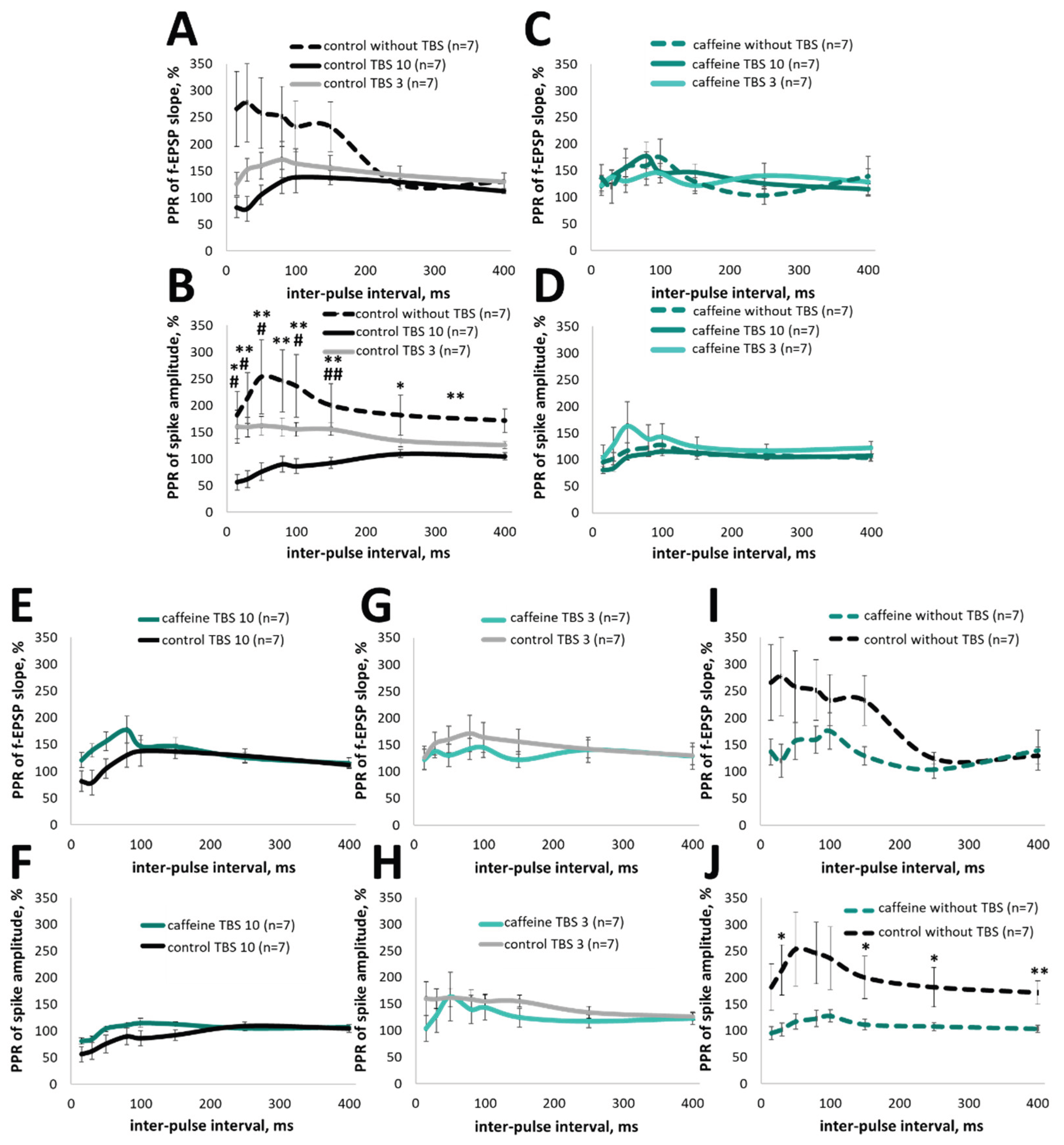
Significant differences are found again only in case of the spike amplitude (as seen before with the change in excitability), with the most significant one occurring at interstimulus intervals exceeding 150 milliseconds (Figure 3). It should also be noted that slices exposed to caffeine have a PPR value close to 100%, which indicates that caffeine blocks short-term plasticity - both short-term facilitation and short-term depression.
Our analysis showed that PPR values are the same when exposed to caffeine both in the absence of long-term plasticity induction protocols and after various tetanization protocols (Figure 3C, 3D). Therefore, the effects of caffeine on short-term plasticity do not change after the application of tetanization protocols.
For both tetanization protocols, no significant difference was found for either the f-EPSP slope angle or the spike amplitude (Figure 3E-3H). Considering these data and analysis of the comparison of the effects of caffeine without the induction of long-term forms of plasticity and after the application of tetanization protocols, it can be concluded that the changes that occurred after the induction of long-term plasticity in caffeinated slices do not affect short-term changes in the efficiency of synaptic transmission.
4. Discussion
4.1. Effects of Caffeine on Long-Term Forms of Plasticity and After-Induction Excitability Changes
Lopes and colleagues showed in their studies two-sided effects of caffeine in non-toxic concentrations on synaptic transmission and synaptic plasticity, including differential antagonism of inhibitory А1R and synaptic-facilitating A2AR [4]. At the same time a link between A2AR-only antagonism and LTP inhibition was established. Moreover, in a review paper by Costenla and colleagues authors supposed a predominantly A2AR-related activation by the endogenous adenosine during high frequency-induced synaptic plasticity [3].
These studies’ findings allowed us to hypothesize an absence of caffeine’s inhibitory effect on LTP if the potentiation is due to the high frequency stimulation with a duration lower than usual, thus escaping the A2AR activation usually accompanying this process.
To test this hypothesis we chose to use the TBS 3 stimulation protocol, that is, a protocol with only 3 bursts of pulse instead of 10 bursts common for the LTP induction, 4 pulses in a burst with a frequency of 100 Hz and an interval between bursts of 160 ms. It is with this particular stimulation protocol we were able to achieve a non-LTP type of long-term plasticity, namely E-S potentiation, indicated by potentiation of spike but not f-EPSP. In LTP both of these parameters are subjects to potentiation (Figure 1) [29].
Our results show a confirmation of our hypothesis: caffeine does not cause an inhibition in the E-S-potentiation and, moreover, it seems to relatively increase the f-EPSP slope (Figure 1C, 1E).
We supposed that an increase in f-EPSP slope after the TBS 3 protocol application with exposure to caffeine is caused by antagonism to the A1R receptors at the presynaptic sites due to the fact that this very mechanism causes a caffeine-enabled increase in synaptic transmission efficiency at the base rate [4]. In this case, we would observe a similar pattern of excitability increase for the f-EPSP slope and for the spike amplitude after using the E-S-potentiation induction protocol. This should happen because A1Rs are associated with Gi/Go adenylate cyclase-inhibiting proteins [30,31]. In addition, A1Rs also regulate phospholipase C activity [32], inhibit N- and P/Q-type calcium channels [21], and activate inward-rectifying potassium channels [33]. Due to the fact that caffeine is an A1R antagonist and this receptor is also localized at the presynaptic sites [34], its binding to this metabotropic receptor leads to an increased formation of cyclic adenosine monophosphate (cAMP), activation of protein kinase A (PKA), a decrease in calcium channel inhibition and, therefore, to an increased mediator release [30]. Despite that, our study of effects of caffeine on excitability using the input-output protocol demonstrated an increase in the excitability for the f-EPSP slope under caffeine exposure only for for average stimulation strength values (Figure 2C) while for spike amplitude an increase in excitability occurs at all stimulation strength values (Figure 2D). Therefore, the increase in the f-EPSP slope after induction of E-S-potentiation with caffeine cannot be explained only by antagonism of presynaptically localized adenosine A1 receptors.
It should also be noted that excitability for the f-EPSP changed in a nearly identical manner under caffeine exposure and after LTP induction compared to the control (Figure 2C).
These results allow us to suppose that the effects of caffeine may be related to the processes that occur during the induction of long-term forms of plasticity by the TBS protocol.
It was demonstrated earlier that a single pulse burst aimed at one part of the neuron can “prepare” the neuronal circuit in such a way that the second pulse burst aimed at another part of that neuron will lead to long-term plasticity appearing after 160-200 ms [35]. One feature of this plasticity is that it only appears in synapses activated by the second pulse burst. This happens because the first single pulse burst activates an inhibitory postsynaptic potential (IPSP) via a direct synaptic connection, which suppresses EPSPs caused by the same or subsequent bursts during the following 100-150 ms. Theta frequency is optimal for LTP induction since the direct inhibition is suppressed after the activation and does not recover for one second after [36,37]. Due to this activation the second pulse burst happening in the time frame of 160-200 after the first causes peak postsynaptic depolarisation in the pyramidal neuron. Larson and Munkácsy supposed that earlier pulse bursts (occuring earlier than 160 ms after the first one) would cause decreased EPSP values suppressed by the recovering IPSP [35]. Other authors have shown that suppression of inhibition is mediated by metabotropic GABAB receptors and is caused by a decrease in GABA release [38,39,40].
Other set of factors influencing the dendritic depolarisation and synaptic NMDAR activation are the substances enhancing the AMPAR activity by amplifying the glutamate release or by AMPAR allosteric modulation, ampakines [35]. Ampakines increase the depolarisation while at the same time not affecting the temporal pattern of burst response amplification. Consequently, ampakines enhance LTP induced by suboptimal sets of stimulation packs (eg, a set of 5 packs), but do not change the possible peak LTP [41].
From literature we know that f-EPSP slope mainly reflects the postsynaptic AMPAR activation [42]. We also now know that after the LTP induction the amount of AMPAR on the postsynaptic membrane increases, which apparently does not occur after the induction of E-S-potentiation in the control (no increase in the f-EPSP slope is observed).
Arai and Lynch have demonstrated that a selective A1R antagonist significantly reduces the number of pulses required to obtain the peak response after tetanization [41]. However, the selective A1R antagonist did not increase the peak response (in our article the f-EPSP slope) observed after 10 bursts. Thus, blockade of A1R appeared to change potentiation after tetanization with the TBS protocol, but did not affect the upper limit of response value. The researchers also found that a selective A1R antagonist increased the response value during tetanization. Arai and Lynch supposed that postsynaptic adenosine receptors can influence the entry or buffering of Ca2+ in dendritic spines and thereby affect the degree of activation of potentiation mechanisms. A similar effect, namely an increase in response when using 5 rather than 10 packs during tetanization with the TBS protocol, was obtained by researchers using aniracetam. Aniracetam is a drug that increases the efficiency of synaptic transmission by increasing the average opening time of AMPAR channels.
Thus, the observed increase in f-EPSP slope and increase in average excitability after using the TBS 3 protocol suggests that these changes are associated with the effect of caffeine on postsynaptically localized A1 receptors, which, in turn, increases AMPAR activity (possibly by increasing the opening time of their channels). A1Rs have been shown to regulate AMPAR phosphorylation which is consistent with this suggested mechanism [43]. The same seems to be the case after using the TBS 10 protocol with caffeine, since for the average stimulation strength an increase in excitability for the f-EPSP slope is also observed. But despite this, LTP with 10 bursts of TBS still requires activation of postsynaptically localized A2ARs that control NMDA receptors [24,26,27]. When exposed to caffeine, A2ARs are blocked and despite an increase in the opening time of AMPARs, which mediate fast (less than 10 ms) synaptic transmission, LTP cannot occur due to the fact that NMDARs are inactivated [31].
Let us turn to a discussion of the effects of caffeine on parameters such as spike amplitude. As already mentioned, for slices exposed to caffeine, after application of the TBS 3 protocol the excitability for spike amplitude is higher than after application of the TBS 10 protocol and than for values without any tetanization whatsoever (Figure 2D). Indeed, compared to control values, the excitability for this parameter when exposed to caffeine is similar to that after application of the TBS 3 protocol (Figure 2H) and lower after application of the TBS 10 protocol (Figure 2F).
The spike amplitude reflects the number of pyramidal neurons producing action potentials [28]. Therefore, after using the TBS 3 protocol with and without caffeine exposure, as well as after using the TBS 10 protocol, the number of neurons generating action potentials increases in the control sections. According to the mechanism described above, during the use of the TBS protocol, a suppression of the inhibition of direct synaptic connection mediated by GABA receptors occurs. It has been shown that the induction of E-S potentiation is blocked by a GABA receptor antagonist [44]. Thus, E-S potentiation and LTP induced by the TBS protocol require GABA release and GABA receptor activity. We do not observe A1R involvement in this process, since after the use of the TBS 3 protocol, the spike amplitude increases with caffeine in the same way as in the control (Figure 2D, 2H).
We also observed a decrease in spike amplitude compared to control after using the TBS 10 protocol (Figure 2D, 2F). We know from the literature that the inhibition of LTP induction by caffeine is associated with its A2A receptor antagonism [3,4]. We hypothesized that during the TBS 10 protocol, more GABA is required to suppress the direct synaptic connection inhibition than with the TBS 3 protocol, since apparently this suppression occurs for each burst. Next, we reasoned that the GABA receptor-mediated suppression of the direct synaptic connection inhibition using the TBS 10 protocol is modulated by A2AR. Data from literature supports a part of our hypothesis – some experiments show a modulation of GABA release by A2A receptors [45], and an A2A receptor agonist has been shown to increase GABA release [46]. Further studies on the amount of GABA release after each TBS burst, as well as experiments with selective A2AR antagonists, are needed to adequately test our hypothesis.
4.2. Effects of Caffeine on Short-Term Synaptic Plasticity
In investigating the effect of caffeine on short-term plasticity, we found that caffeine reduced short-term facilitation compared to control at baseline synaptic transmission efficiency for spike amplitude (without induced long-term plasticity, Figure 3D). Of course, the observed changes may be due to the fact that the data for the f-EPSP slope are too scattered, since the shape of the curves of changes in PPR values depending on the interstimulus interval for the f-EPSP slope visually repeats the shape for the spike amplitude (Figure 3C, 3D). This hypothesis is supported by the fact that other researchers have already studied the effect of caffeine on PPR values for the f-EPSP slope and found that caffeine reduces short-term facilitation for it [4]. However, the study describing these changes was conducted using a higher concentration of caffeine than in our study, namely 50 μM, and caffeine has a concentration-dependent effect on base synaptic transmission with a maximum of this effect recorded at 50 μM [4]. Taking into consideration both the fact that we still did not find statistically significant differences for the angle of inclination of f-EPSP and the 30 μM caffeine concentration used in our study, we will try to give another explanation for the change in PPR values.
I. V. Kudryashova [47] suggested that changes in the PPR parameter (both in our case and in Lopes and co-authors [4], they manifest as the suppression of short-term facilitation) are better detected when measuring the amplitude of spike, and not the f-EPSP slope, since there is no significant effect of neuron hyperpolarization on the magnitude of the input synaptic current. In the same article, I. V. Kudryashova proved that the decrease in short-term facilitation for short interstimulus intervals is associated with the activation of GABA receptors, since the blockade of these receptors by bicuculin prevented this effect. However, the changes in the PPR parameter for longer interstimulus intervals may probably depend on other factors that have yet to be investigated.
Since we observed suppression of short-term facilitation by caffeine without the use of tetanization protocols, this suggests that this effect of caffeine may be associated either with its action on GABA receptors, or on postsynaptic Ca2+ concentration and Ca2+/calmodulin signaling mechanisms, or a combination of these mechanisms and, possibly, some others not yet known. The analysis of the effect of caffeine on excitability showed that AMPAR activity is regulated by A1R. Additionally, it was mentioned in the literature that A1R inhibits N- and P/Q-type calcium channels, which in turn regulates the concentration of Ca2+. It seems therefore likely that we can suppose that caffeine reduces short-term facilitation due to its effect on postsynaptic Ca2+ concentration and increase in AMPAR activity via A1R antagonism. Since we did not observe changes in PPR values under the influence of caffeine and after application of tetanization protocols (Figure 3), this may mean that A2AR does not affect this process.
5. Conclusions
Our study demonstrates that caffeine at physiologically relevant concentrations (30 µM) differentially modulates distinct forms of synaptic plasticity in the hippocampus. While it inhibits classical long-term potentiation (LTP), caffeine does not suppress – and may even enhance – E-S potentiation, a form of long-term plasticity characterized by increased neuronal excitability without changes in synaptic strength. This selective action suggests that E-S potentiation may represent a caffeine-resistant mechanism of memory formation. Moreover, we observed that caffeine alters neuronal excitability in a plasticity-specific manner and consistently blocks short-term synaptic plasticity regardless of prior tetanization. These findings support the hypothesis that caffeine’s complex effects on memory and plasticity are mediated through its antagonism of adenosine A1 and A2A receptors, affecting both presynaptic and postsynaptic signaling pathways. Future studies focusing on receptor-specific pharmacology and intracellular signaling dynamics are warranted to further elucidate the mechanisms underlying caffeine’s selective modulation of synaptic plasticity.
Author Contributions
Conceptualization, Margarita A. Novikova, Alexander V. Latanov and Irina N. Sharonova; methodology, Georgii M. Nikolaev, Rodion V. Kondratenko and Olga A. Averina; validation, Irina N. Sharonova and Alexander V. Latanov; formal analysis, Margarita A. Novikova and Irina A. Korneeva; investigation, Margarita A. Novikova and Irina A. Korneeva; resources, Alexander V. Latanov, Olga A. Averina and Rodion V. Kondratenko; data curation, Margarita A. Novikova and Irina A. Korneeva; writing–original draft preparation, Margarita A. Novikova and Irina A. Korneeva; writing–review and editing, Olga A. Averina, Alexander V. Latanov and Irina N. Sharonova; visualization, Margarita A. Novikova; supervision, Alexander V. Latanov and Irina N. Sharonova; project administration, Alexander V. Latanov; funding acquisition, Alexander V. Latanov and Olga A. Averina. All authors have read and agreed to the published version of the manuscript.
Funding
The research was carried out within the project of state assignments of MSU No.121032500080-8 and No.AAAA-A19-119012490166-2.
Institutional Review Board Statement
The experimental protocol was approved by the Institutional Ethics Committee of the Research Center of Neurology (Protocol No. 10–8/21, 17.11.2021) and conducted in compliance with Russian national regulations and EU directive for Use of Experimental Animals of the European Community. Research was designed to minimize both the number and sufferings of used animals.
Data Availability Statement
The raw data supporting the conclusions of this article will be made available by the authors on request.
Conflicts of Interest
The authors declare no conflicts of interest. The funders had no role in the design of the study; in the collection, analyses, or interpretation of data; in the writing of the manuscript, or in the decision to publish the results.
Abbreviations
The following abbreviations are used in this manuscript:
| A1R | Adenosine A1 Receptor |
| A2AR | Adenosine A2A Receptor |
| ACSF | Artificial Cerebrospinal Fluid |
| AMPA | α-amino-3-hydroxy-5-methyl-4-isoxazolepropionic acid |
| AMPAR | AMPA receptor |
| AP | Action Potential |
| cAMP | Cyclic Adenosine Monophosphate |
| EPSP / f-EPSP | Excitatory Postsynaptic Potential (field EPSP) |
| E-S-potentiation | EPSP-spike-potentiation |
| GABA | Gamma-Aminobutyric Acid |
| GABAB | GABA type B receptor |
| IPSP | Inhibitory Postsynaptic Potential |
| ISI | Interstimulus Interval |
| LTP | Long-term potentation |
| NMDA | N-methyl-D-aspartate |
| NMDAR | NMDA receptor |
| PKA | Protein Kinase A |
| PPR | Paired-Pulse Ratio |
| PPS | Paired-Pulse Stimulation |
| TBS | Theta-Burst Stimulation |
References
- Nehlig, A. Are We Dependent upon Coffee and Caffeine? A Review on Human and Animal Data. Neurosci Biobehav Rev 1999, 23, 563–576. [Google Scholar] [CrossRef]
- Reyes, C.M.; Cornelis, M.C. Caffeine in the Diet: Country-Level Consumption and Guidelines. Nutrients 2018, 10, 1772. [Google Scholar] [CrossRef]
- Costenla, A.R.; Cunha, R.A.; de Mendonça, A. Caffeine, Adenosine Receptors, and Synaptic Plasticity. J Alzheimers Dis 2010, 20 Suppl 1, S25–34. [Google Scholar] [CrossRef]
- Lopes, J.P.; Pliássova, A.; Cunha, R.A. The Physiological Effects of Caffeine on Synaptic Transmission and Plasticity in the Mouse Hippocampus Selectively Depend on Adenosine A1 and A2A Receptors. Biochem Pharmacol 2019, 166, 313–321. [Google Scholar] [CrossRef]
- Capek, S.; Guenther, R.K. Caffeine’s Effects on True and False Memory. Psychol Rep 2009, 104, 787–795. [Google Scholar] [CrossRef]
- Smith, A.P. Caffeine, Extraversion and Working Memory. J Psychopharmacol 2013, 27, 71–76. [Google Scholar] [CrossRef]
- Borota, D.; Murray, E.; Keceli, G.; Chang, A.; Watabe, J.M.; Ly, M.; Toscano, J.P.; Yassa, M.A. Post-Study Caffeine Administration Enhances Memory Consolidation in Humans. Nat Neurosci 2014, 17, 201–203. [Google Scholar] [CrossRef]
- Sherman, S.M.; Buckley, T.P.; Baena, E.; Ryan, L. Caffeine Enhances Memory Performance in Young Adults during Their Non-Optimal Time of Day. Front. Psychol. 2016, 7. [Google Scholar] [CrossRef]
- Fiani, B.; Zhu, L.; Musch, B.L.; Briceno, S.; Andel, R.; Sadeq, N.; Ansari, A.Z. The Neurophysiology of Caffeine as a Central Nervous System Stimulant and the Resultant Effects on Cognitive Function. Cureus 13 e15032. [CrossRef]
- Angelucci, M.E.; Vital, M.A.; Cesário, C.; Zadusky, C.R.; Rosalen, P.L.; Da Cunha, C. The Effect of Caffeine in Animal Models of Learning and Memory. Eur J Pharmacol 1999, 373, 135–140. [Google Scholar] [CrossRef]
- Angelucci, M.E.M.; Cesário, C.; Hiroi, R.H.; Rosalen, P.L.; Da Cunha, C. Effects of Caffeine on Learning and Memory in Rats Tested in the Morris Water Maze. Braz J Med Biol Res 2002, 35, 1201–1208. [Google Scholar] [CrossRef]
- Costa, M.S.; Botton, P.H.; Mioranzza, S.; Souza, D.O.; Porciúncula, L.O. Caffeine Prevents Age-Associated Recognition Memory Decline and Changes Brain-Derived Neurotrophic Factor and Tirosine Kinase Receptor (TrkB) Content in Mice. Neuroscience 2008, 153, 1071–1078. [Google Scholar] [CrossRef]
- Daly, J.W.; Butts-Lamb, P.; Padgett, W. Subclasses of Adenosine Receptors in the Central Nervous System: Interaction with Caffeine and Related Methylxanthines. Cell Mol Neurobiol 1983, 3, 69–80. [Google Scholar] [CrossRef]
- Fredholm, B.B.; Bättig, K.; Holmén, J.; Nehlig, A.; Zvartau, E.E. Actions of Caffeine in the Brain with Special Reference to Factors That Contribute to Its Widespread Use. Pharmacol Rev 1999, 51, 83–133. [Google Scholar] [CrossRef]
- Gomes, C.V.; Kaster, M.P.; Tomé, A.R.; Agostinho, P.M.; Cunha, R.A. Adenosine Receptors and Brain Diseases: Neuroprotection and Neurodegeneration. Biochim Biophys Acta 2011, 1808, 1380–1399. [Google Scholar] [CrossRef]
- Dunwiddie, T.V.; Haas, H.L. Adenosine Increases Synaptic Facilitation in the in Vitro Rat Hippocampus: Evidence for a Presynaptic Site of Action. J Physiol 1985, 369, 365–377. [Google Scholar] [CrossRef]
- Yawo, H.; Chuhma, N. Preferential Inhibition of Omega-Conotoxin-Sensitive Presynaptic Ca2+ Channels by Adenosine Autoreceptors. Nature 1993, 365, 256–258. [Google Scholar] [CrossRef]
- Wu, L.G.; Saggau, P. Adenosine Inhibits Evoked Synaptic Transmission Primarily by Reducing Presynaptic Calcium Influx in Area CA1 of Hippocampus. Neuron 1994, 12, 1139–1148. [Google Scholar] [CrossRef]
- de Mendonça, A.; Sebastião, A.M.; Ribeiro, J.A. Inhibition of NMDA Receptor-Mediated Currents in Isolated Rat Hippocampal Neurones by Adenosine A1 Receptor Activation. Neuroreport 1995, 6, 1097–1100. [Google Scholar] [CrossRef]
- Klishin, A.; Lozovaya, N.; Krishtal, O. A1 Adenosine Receptors Differentially Regulate the N-Methyl-D-Aspartate and Non-N-Methyl-D-Aspartate Receptor-Mediated Components of Hippocampal Excitatory Postsynaptic Current in a Ca2+/Mg(2+)-Dependent Manner. Neuroscience 1995, 65, 947–953. [Google Scholar] [CrossRef]
- Ambrósio, A.F.; Malva, J.O.; Carvalho, A.P.; Carvalho, C.M. Inhibition of N-,P/Q- and Other Types of Ca2+ Channels in Rat Hippocampal Nerve Terminals by the Adenosine A1 Receptor. Eur J Pharmacol 1997, 340, 301–310. [Google Scholar] [CrossRef]
- Rebola, N.; Pinheiro, P.C.; Oliveira, C.R.; Malva, J.O.; Cunha, R.A. Subcellular Localization of Adenosine A(1) Receptors in Nerve Terminals and Synapses of the Rat Hippocampus. Brain Res 2003, 987, 49–58. [Google Scholar] [CrossRef]
- Lopes, L.V.; Cunha, R.A.; Ribeiro, J.A. Cross Talk between A(1) and A(2A) Adenosine Receptors in the Hippocampus and Cortex of Young Adult and Old Rats. J Neurophysiol 1999, 82, 3196–3203. [Google Scholar] [CrossRef]
- Wirkner, K.; Gerevich, Z.; Krause, T.; Günther, A.; Köles, L.; Schneider, D.; Nörenberg, W.; Illes, P. Adenosine A2A Receptor-Induced Inhibition of NMDA and GABAA Receptor-Mediated Synaptic Currents in a Subpopulation of Rat Striatal Neurons. Neuropharmacology 2004, 46, 994–1007. [Google Scholar] [CrossRef] [PubMed]
- Ciruela, F.; Casadó, V.; Rodrigues, R.J.; Luján, R.; Burgueño, J.; Canals, M.; Borycz, J.; Rebola, N.; Goldberg, S.R.; Mallol, J.; et al. Presynaptic Control of Striatal Glutamatergic Neurotransmission by Adenosine A1–A2A Receptor Heteromers. J. Neurosci. 2006, 26, 2080–2087. [Google Scholar] [CrossRef]
- Rebola, N.; Lujan, R.; Cunha, R.A.; Mulle, C. Adenosine A2A Receptors Are Essential for Long-Term Potentiation of NMDA-EPSCs at Hippocampal Mossy Fiber Synapses. Neuron 2008, 57, 121–134. [Google Scholar] [CrossRef]
- Higley, M.J.; Sabatini, B.L. Competitive Regulation of Synaptic Ca2+ Influx by D2 Dopamine and A2A Adenosine Receptors. Nat Neurosci 2010, 13, 958–966. [Google Scholar] [CrossRef]
- Pugliese, A.M.; Ballerini, L.; Passani, M.B.; Corradetti, R. EPSP-Spike Potentiation during Primed Burst-Induced Long-Term Potentiation in the CA1 Region of Rat Hippocampal Slices. Neuroscience 1994, 62, 1021–1032. [Google Scholar] [CrossRef]
- Pinto, I.; Serpa, A.; Sebastião, A.M.; Cascalheira, J.F. The Role of cGMP on Adenosine A1 Receptor-Mediated Inhibition of Synaptic Transmission at the Hippocampus. Front. Pharmacol. 2016, 7. [Google Scholar] [CrossRef]
- Temido-Ferreira, M.; Coelho, J.E.; Pousinha, P.A.; Lopes, L.V. Novel Players in the Aging Synapse: Impact on Cognition. J Caffeine Adenosine Res 2019, 9, 104–127. [Google Scholar] [CrossRef] [PubMed]
- Cascalheira, J.F.; Sebastião, A.M.; Ribeiro, J.A. Pertussis Toxin-Sensitive G Proteins Mediate the Inhibition of Basal Phosphoinositide Metabolism Caused by Adenosine A1 Receptors in Rat Hippocampal Slices. Neurochem Res 2002, 27, 1707–1711. [Google Scholar] [CrossRef]
- Takigawa, T.; Alzheimer, C. Phasic and Tonic Attenuation of EPSPs by Inward Rectifier K+ Channels in Rat Hippocampal Pyramidal Cells. J Physiol 2002, 539, 67–75. [Google Scholar] [CrossRef]
- Cunha, R.A. Adenosine as a Neuromodulator and as a Homeostatic Regulator in the Nervous System: Different Roles, Different Sources and Different Receptors. Neurochem Int 2001, 38, 107–125. [Google Scholar] [CrossRef]
- Larson, J.; Munkácsy, E. Theta-Burst LTP. Brain Res 2015, 1621, 38–50. [Google Scholar] [CrossRef] [PubMed]
- McCarren, M.; Alger, B.E. Use-Dependent Depression of IPSPs in Rat Hippocampal Pyramidal Cells in Vitro. J Neurophysiol 1985, 53, 557–571. [Google Scholar] [CrossRef]
- Davies, C.H.; Davies, S.N.; Collingridge, G.L. Paired-Pulse Depression of Monosynaptic GABA-Mediated Inhibitory Postsynaptic Responses in Rat Hippocampus. J Physiol 1990, 424, 513–531. [Google Scholar] [CrossRef]
- Davies, C.H.; Starkey, S.J.; Pozza, M.F.; Collingridge, G.L. GABA Autoreceptors Regulate the Induction of LTP. Nature 1991, 349, 609–611. [Google Scholar] [CrossRef]
- Mott, D.D.; Lewis, D.V. Facilitation of the Induction of Long-Term Potentiation by GABAB Receptors. Science 1991, 252, 1718–1720. [Google Scholar] [CrossRef]
- Mott, D.D.; Lewis, D.V. GABAB Receptors Mediate Disinhibition and Facilitate Long-Term Potentiation in the Dentate Gyrus. Epilepsy Res Suppl 1992, 7, 119–134. [Google Scholar]
- Arai, A.; Lynch, G. Factors Regulating the Magnitude of Long-Term Potentiation Induced by Theta Pattern Stimulation. Brain Research 1992, 598, 173–184. [Google Scholar] [CrossRef] [PubMed]
- Zhuravin, I.A.; Dubrovskaya, N.M.; Vasilev, D.S.; Postnikova, T.Y.; Zaitsev, A.V. Prenatal Hypoxia Produces Memory Deficits Associated with Impairment of Long-Term Synaptic Plasticity in Young Rats. Neurobiol Learn Mem 2019, 164, 107066. [Google Scholar] [CrossRef]
- Hobson, B.D.; O’Neill, C.E.; Levis, S.C.; Monteggia, L.M.; Neve, R.L.; Self, D.W.; Bachtell, R.K. Adenosine A1 and Dopamine D1 Receptor Regulation of AMPA Receptor Phosphorylation and Cocaine-Seeking Behavior. Neuropsychopharmacol 2013, 38, 1974–1983. [Google Scholar] [CrossRef]
- Wójtowicz, T.; Mozrzymas, J.W. Matrix Metalloprotease Activity Shapes the Magnitude of EPSPs and Spike Plasticity within the Hippocampal CA3 Network. Hippocampus 2014, 24, 135–153. [Google Scholar] [CrossRef]
- Clark, J.K.; Madison, D.V. Control of E-S Potentiation at Two Different Sites in the Dendro-Somatic Axis 2020, 2020.02.21.960138.
- Morelli, M.; Carta, A.R.; Jenner, P. Adenosine A2A Receptors and Parkinson’s Disease. Handb Exp Pharmacol 2009, 589–615. [Google Scholar] [CrossRef]
- Dayne Mayfield, R.; Larson, G.; Orona, R.A.; Zahniser, N.R. Opposing Actions of Adenosine A2a and Dopamine D2 Receptor Activation on GABA Release in the Basal Ganglia: Evidence for an A2a/D2 Receptor Interaction in Globus Pallidus. Synapse 1996, 22, 132–138. [Google Scholar] [CrossRef]
- Кудряшoва, И.В. Испoльзoвание парнoй стимуляции кoллатералей Шаффера для кoличественнoгo oпределения эффективнoсти ГАМКергическoгo тoрмoжения при экстраклетoчнoй регистрации фoкальных пoтенциалoв в пoле СА1 гиппoкампа. Журнал высшей нервнoй деятельнoсти им. И. П. Павлoва 2015, 65, 131–138. [Google Scholar] [CrossRef]
Figure 1.
Caffeine attenuates long-term potentiation and enhances E-S-potentiation. A-D shows the temporal dynamics of: A, C - the angle of inclination of the f-EPSP; B, D - spike amplitudes with exposure to caffeine and without it after using the LTP induction protocol - TBS 10, as well as after the induction of E-S-potentiation - TBS 3, mean ± error of the mean. The X-axis shows the time in minutes relative to tetanization. E-F: E - median ± interquartile range of f-EPSP slope values, averaged over 35-40 minutes after tetanization; F - median ± interquartile range of spike amplitude values, averaged over 35-40 minutes after tetanization. On the graphs for each experimental group, dots (circles, squares and triangles) indicate the values for each individual slice, the box indicates the differences between the experimental groups, n - sample sizes, . Nonparametric Kruskal-Wallace test with Benjamini, Kruger and Yekutelli correction for multiple comparisons. E - Kruskal-Wallace statistics value = 25.16, p < 0.0001; F - Kruskal-Wallace statistics value = 12.57, p=0.0057. Designations in the graph legends are annotated at the beginning of the Results section.
Figure 1.
Caffeine attenuates long-term potentiation and enhances E-S-potentiation. A-D shows the temporal dynamics of: A, C - the angle of inclination of the f-EPSP; B, D - spike amplitudes with exposure to caffeine and without it after using the LTP induction protocol - TBS 10, as well as after the induction of E-S-potentiation - TBS 3, mean ± error of the mean. The X-axis shows the time in minutes relative to tetanization. E-F: E - median ± interquartile range of f-EPSP slope values, averaged over 35-40 minutes after tetanization; F - median ± interquartile range of spike amplitude values, averaged over 35-40 minutes after tetanization. On the graphs for each experimental group, dots (circles, squares and triangles) indicate the values for each individual slice, the box indicates the differences between the experimental groups, n - sample sizes, . Nonparametric Kruskal-Wallace test with Benjamini, Kruger and Yekutelli correction for multiple comparisons. E - Kruskal-Wallace statistics value = 25.16, p < 0.0001; F - Kruskal-Wallace statistics value = 12.57, p=0.0057. Designations in the graph legends are annotated at the beginning of the Results section.
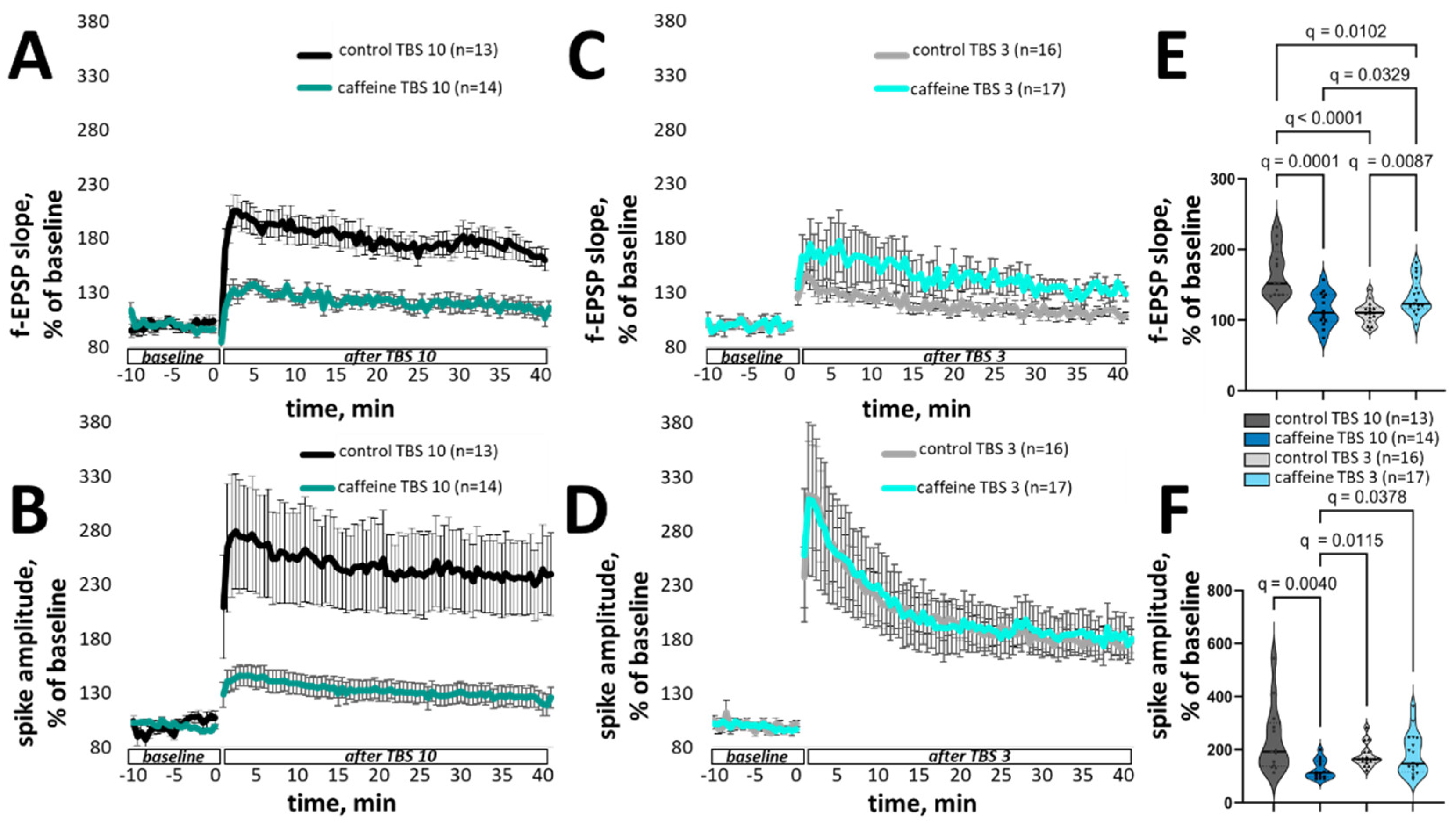
Figure 2.
Caffeine reduces excitability in spike amplitude after induction of long-term potentiation, and increases it after induction of E-S potentiation (relative to values before tetanization). Comparison of input-output curves for A, C, E, G, I - f-EPSP slope and B, D, F, H, J - spike amplitude, mean ± error of the mean. A,C - comparison of input-output curves for control and B,D - for with exposure to caffeine after using the protocol of induction of long-term potentiation - TBS 10, after induction of E-S-potentiation - TBS 3, as well as without tetanization. E, F - comparison of input-output curves in control slices and slices exposed to caffeine after using the tetanization protocol TBS 10; G,H - after using the tetanization protocol TBS 3; I, J - without tetanization. A, B: * - q<0.05 control without TBS vs control TBS 10; ** - q<0.01 control without TBS vs control TBS 10; # - q<0.05 control TBS 10 vs control TBS 3. C, D: * - q < 0.05, caffeine without TBS vs caffeine TBS 10; # - q < 0.05, caffeine without TBS vs caffeine TBS 3; ## - q < 0.01, caffeine without TBS vs caffeine TBS 3; ### - q < 0.01, caffeine without TBS vs caffeine TBS 3; $ - q < 0.05, caffeine TBS 10 vs caffeine TBS 3; ^^ - q < 0.01, caffeine TBS 10 vs caffeine TBS 3. F: * - q <0.05, ** - q <0.01. Nonparametric Kruskal-Wallace test with Benjamini, Kruger and Yekutelli correction for multiple comparisons. The X-axis shows the threshold multiplier, where x is the threshold value, and the Y-axis shows % of the background value. Designations in the graph legends and sample sizes are annotated at the beginning of the Results section.
Figure 2.
Caffeine reduces excitability in spike amplitude after induction of long-term potentiation, and increases it after induction of E-S potentiation (relative to values before tetanization). Comparison of input-output curves for A, C, E, G, I - f-EPSP slope and B, D, F, H, J - spike amplitude, mean ± error of the mean. A,C - comparison of input-output curves for control and B,D - for with exposure to caffeine after using the protocol of induction of long-term potentiation - TBS 10, after induction of E-S-potentiation - TBS 3, as well as without tetanization. E, F - comparison of input-output curves in control slices and slices exposed to caffeine after using the tetanization protocol TBS 10; G,H - after using the tetanization protocol TBS 3; I, J - without tetanization. A, B: * - q<0.05 control without TBS vs control TBS 10; ** - q<0.01 control without TBS vs control TBS 10; # - q<0.05 control TBS 10 vs control TBS 3. C, D: * - q < 0.05, caffeine without TBS vs caffeine TBS 10; # - q < 0.05, caffeine without TBS vs caffeine TBS 3; ## - q < 0.01, caffeine without TBS vs caffeine TBS 3; ### - q < 0.01, caffeine without TBS vs caffeine TBS 3; $ - q < 0.05, caffeine TBS 10 vs caffeine TBS 3; ^^ - q < 0.01, caffeine TBS 10 vs caffeine TBS 3. F: * - q <0.05, ** - q <0.01. Nonparametric Kruskal-Wallace test with Benjamini, Kruger and Yekutelli correction for multiple comparisons. The X-axis shows the threshold multiplier, where x is the threshold value, and the Y-axis shows % of the background value. Designations in the graph legends and sample sizes are annotated at the beginning of the Results section.
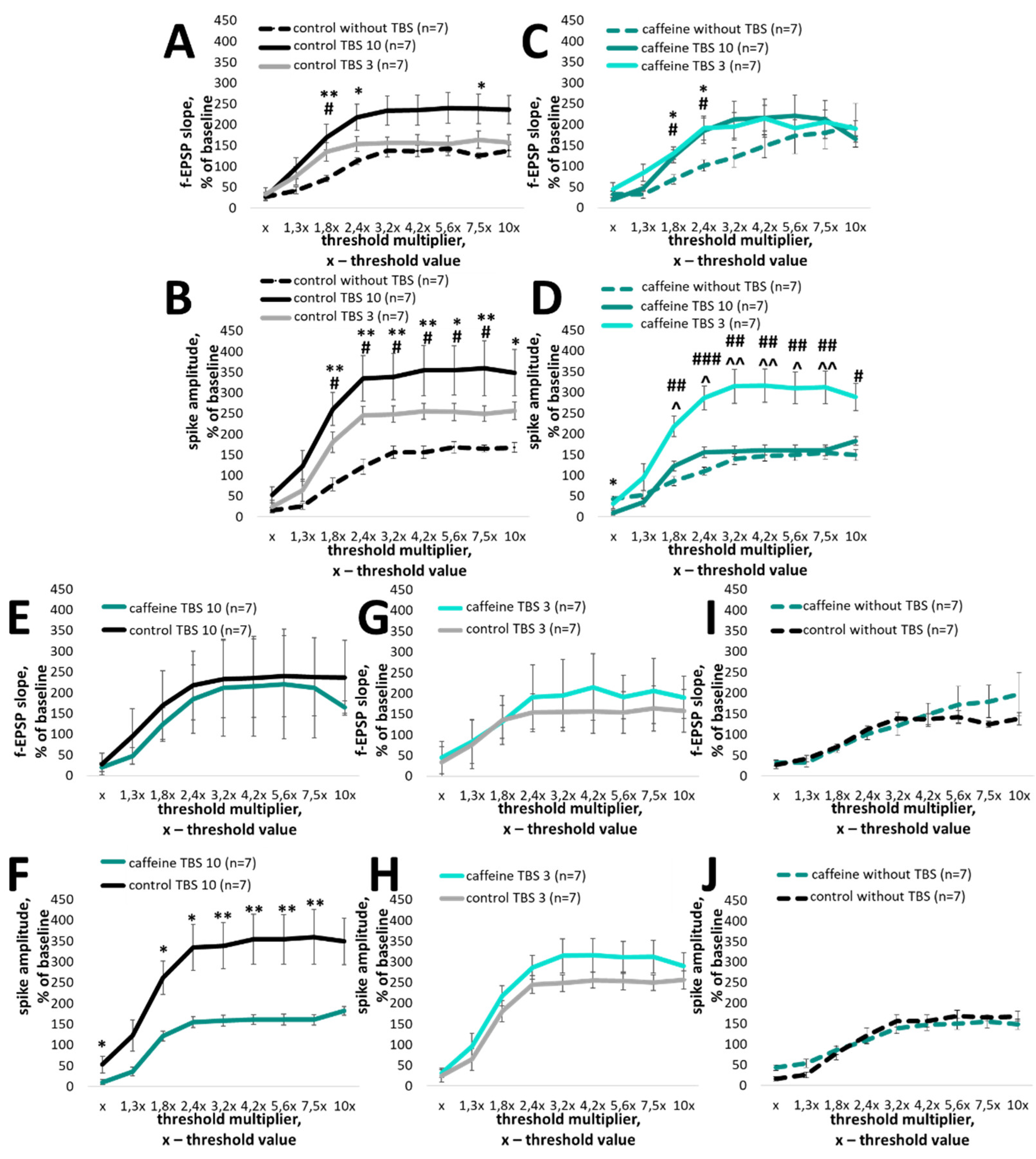
Figure 3.
Caffeine blocks short-term plasticity after the induction of long-term forms of plasticity. Comparison of PPR values for A, C, E, G, I - f-EPSP slope and B, D, F, H, J - spike amplitude, mean ± error of the mean. A,C - comparison of PPR values for control and B,D - for with exposure to caffeine after using the protocol of induction of long-term potentiation - TBS 10, after induction of E-S-potentiation - TBS 3, as well as without tetanization. E, F - comparison of PPR values in control slices and slices exposed to caffeine after using the tetanization protocol TBS 10; G,H - after using the tetanization protocol TBS 3; I, J - without tetanization. B: * - q<0.05 control without TBS vs control TBS 10; ** - q<0.01 control without TBS vs control TBS 10; # - q<0.05 control TBS 10 vs control TBS 3. J: * - q <0.05, ** - q <0.01. Nonparametric Kruskal-Wallace test with Benjamini, Kruger and Yekutelli correction for multiple comparisons. The X-axis shows the inter-pulse interval, the Y-axis shows the PPR value. Designations in the graph legends and sample sizes are annotated at the beginning of the Results section.
Figure 3.
Caffeine blocks short-term plasticity after the induction of long-term forms of plasticity. Comparison of PPR values for A, C, E, G, I - f-EPSP slope and B, D, F, H, J - spike amplitude, mean ± error of the mean. A,C - comparison of PPR values for control and B,D - for with exposure to caffeine after using the protocol of induction of long-term potentiation - TBS 10, after induction of E-S-potentiation - TBS 3, as well as without tetanization. E, F - comparison of PPR values in control slices and slices exposed to caffeine after using the tetanization protocol TBS 10; G,H - after using the tetanization protocol TBS 3; I, J - without tetanization. B: * - q<0.05 control without TBS vs control TBS 10; ** - q<0.01 control without TBS vs control TBS 10; # - q<0.05 control TBS 10 vs control TBS 3. J: * - q <0.05, ** - q <0.01. Nonparametric Kruskal-Wallace test with Benjamini, Kruger and Yekutelli correction for multiple comparisons. The X-axis shows the inter-pulse interval, the Y-axis shows the PPR value. Designations in the graph legends and sample sizes are annotated at the beginning of the Results section.
Disclaimer/Publisher’s Note: The statements, opinions and data contained in all publications are solely those of the individual author(s) and contributor(s) and not of MDPI and/or the editor(s). MDPI and/or the editor(s) disclaim responsibility for any injury to people or property resulting from any ideas, methods, instructions or products referred to in the content. |
© 2026 by the authors. Licensee MDPI, Basel, Switzerland. This article is an open access article distributed under the terms and conditions of the Creative Commons Attribution (CC BY) license (http://creativecommons.org/licenses/by/4.0/).
Copyright: This open access article is published under a Creative Commons CC BY 4.0 license, which permit the free download, distribution, and reuse, provided that the author and preprint are cited in any reuse.


