

Submitted:
01 April 2026
Posted:
02 April 2026
You are already at the latest version
Abstract
Oxidative stress (OS) is elevated in patients with end-stage kidney disease undergoing maintenance dialysis and contributes to increased cardiovascular risk. While kidney dysfunction and dialysis can generate OS, the acute effects of a single dialysis session remain unclear due to variability in study design and biomarkers used. In this observational study, blood samples from 68 hemodialysis patients were collected before and after a single session. Plasma levels of the reactive oxygen species marker superoxide (O2•−) and OS-damage markers lipid hydroperoxides (LOOH), protein-bound malondialdehyde (PrMDA), protein-bound thiobarbituric acid reactive substances (PrTBARS), and protein carbonyls (PrCO) were measured. LOOH increased significantly by 50% post-dialysis, whereas PrMDA and PrTBARS decreased modestly by ~10%. No significant changes were observed in O2•− or PrCO. Dialysis vintage correlated positively with LOOH, PrMDA, and PrTBARS, but not with O2•− or PrCO. Patients undergoing low-flux hemodialysis exhibited a greater post-dialysis increase in LOOH than those treated with high-flux hemodialysis. No significant associations were found between OS markers and comorbidities or medication. The post-dialysis rise in LOOH, an early-formed and least accumulating lipid peroxidation marker, highlights its sensitivity to acute dialysis-related oxidative changes. The rising tendency of PrMDA and PrTBARS with dialysis vintage suggests cumulative OS over time.
Keywords:
chronic kidney disease
; hemodialysis
; lipid peroxidation
; oxidative stress
; reactive oxygen species
1. Introduction
Oxidative stress (OS) has emerged as an important risk factor for chronic kidney disease (CKD) and especially for patients on maintenance hemodialysis (HD). Reactive oxygen species (ROS) are generated under physiological conditions due to aerobic metabolism. However, occurs when their production exceeds their neutralization by endogenous antioxidant defenses[1]. Consequently, DNA, lipids and proteins undergo oxidative damage, impairing cellular and organismal function [2].
The major free radicals (FR) are superoxide (O2•−) and hydroxyl radical (•OH). Hydroxyl radical is highly reactive and directly attacks and damages biomolecules, whereas O2•− contributes indirectly through secondary reactions generating more toxic species such as •OH and peroxynitrite (ONOO-) [3,4]. Lipids, especially polyunsaturated fatty acids, are susceptible to peroxidation, forming lipid hydroperoxides (LOOH, an early lipid peroxidation marker), which are degraded to aldehydic byproducts such as malondialdehyde (MDA), considered among the most biotoxic late markers of lipid peroxidation. Malondialdehyde is extremely reactive and readily binds to proteins covalently, thereby altering their structure and functionality [3]. Proteins are also prone to oxidative modifications, one of them being carbonylation, which is almost irreversible modification. Accumulation of carbonylated proteins can lead to cellular dysfunction [5].
Patients with end-stage kidney disease exhibit reduced life expectancy, mainly due to cardiovascular disease (CVD), in which OS has a critical role [6,7,8,9,10,11,12]. Extracorporeal circulation during hemodialysis can further increase OS, as determined thus far, through factors such as filter membrane bio-incompatibility, antioxidant loss and anticoagulation[13,14,15].
The heterogeneity in methodology and design of previous studies as well as the non-specificity of the evaluated OS markers, have produced contradictory findings across studies. Specifically, blood O2•- levels have been assessed by chemiluminescence (CL) of the non-specific probe lucigenin [16], which can also lead to overestimation due to redox cycling [17,18]. Many other studies have focused on the damage ROS cause on biomolecules such as lipids (using as markers of their peroxidation free MDA and thiobarbituric acid reactive substances (TBARS) [19,20,21,22,23,24,25,26,27,28,29,30], and glutathione (GSH) (measuring also its oxidized form, GSSG) [19,21,22,24,26,29]. Moreover, other studies have measured the activity of ROS key antioxidant enzymes (superoxide dismutase, catalase, glutathione peroxidase, xanthine oxidase) [19,22,23,24,26,31], as well as natural antioxidants’ cumulative levels by the total antioxidant capacity (TAC) [25,27,31,32]. Even disease non-specific oxidized LDLs have been evaluated in patients on dialysis (by ELISA [31,32]).
The present study aims to provide more reliable conclusions regarding the relationship between dialysis and OS by employing specific methodologies and clinical markers that demonstrate its presence, directly through the identification of specific FR and indirectly by detecting oxidative modifications in blood plasma lipids and proteins. O2•− levels are specifically measured before and after a single dialysis session, along with LOOH, MDA, TBARS in their protein-bound form (PrMDA, PrTBARS) and protein carbonyls (PrCO). Evaluation of OS markers is also conducted in relation to dialysis vintage, modality (low-flux conventional HD, high-flux conventional HD and pre-dilution HDF), comorbidities and medication.
2. Materials and Methods
2.1. Study Design and Patients
An observational pre-post dialysis study was conducted in 68 patients aged 25 to 86 years from the Hemodialysis Unit of the University Hospital of Patras, Greece, to assess changes in the levels of oxidative stress markers before and after a dialysis session. Demographic and clinical characteristics are shown in Table 1. Eligible participants were ESKD patients (> 18 years) receiving regular hemodialysis (three times a week, 3-4 h/session) for at least 3 months. Exclusion criteria included systemic infection within 30 days prior to participation and active malignancy or malignancy within the previous 5 years. Patients were separated in three groups according to dialysis modality, i.e., those that received hemodialysis with low flux dialyzer (Fresenius-FX-10 polysulfone membrane, effective surface area of 1.8 m2, ultrafiltration coefficient of 14 ml/h x mmHg), hemodialysis with high flux dialyzer (Fresenius-FX-80 polysulfone membrane, effective surface area of 1.8 m2, ultrafiltration coefficient of 59 ml/h x mmHg) and pre-dilution hemodialfiltration (Fresenius-FX-80). All patients received an adequate dialysis dose as confirmed with a single-pool Kt/V of over 1.2 confirmed in a maximum of two weeks interval before the collection of blood samples for the analyses used in this study. Dialysate flow was set to a standard of 500 ml/min and replacement fluid volume for pre-dilution HDF was set to 20 L. All patients received anti-coagulation with a standard dose of 4000 IU of enoxaparine. All participants provided written consent. The study was conducted in accordance with the Declaration of Helsinki and approved by the Ethics Committee of the University Hospital of Patras (No.316/04.09.2025).
2.2. Methods
Blood was collected into heparinized tubes immediately before the initiation and after the end of the second weekly dialysis session, as a more representative patient’s state-condition and to avoid long interdialytic interval.
2.2.1. O2•− Quantification
O2•− was measured using hydroethidine (HE) as a probe at 25 μM final concentration, added in heparinized tubes before blood collection. Samples were incubated 15 min at room temperature (RT) and centrifuged to isolate plasma. 0.1 ml blood plasma was used for O2•− quantification via measurement of 2-hydroxyethidium (2-OН-Е+) by High-Performance Thin Layer Chromatography [33].
2.2.2. OS Markers Quantification
For the quantification of the OS markers LOOH, PrMDA, PrTBARS and PrCO, blood was centrifuged and plasma was protected from artificial oxidation by addition of the antioxidants BHA/BHT at final 1/1 mM (using stock solution 200/200 mM in 100% EtOH). 0.25 ml plasma was subjected to a fractionation protocol to isolate proteins and total lipids [34]. Protein fraction was analyzed for the determination of PrMDA, PrTBARS and PrCO, while lipid fraction was analyzed for the measurement of LOOH [34,35].
For all assays, samples were measured in triplicate using three different dilutions, and the mean was calculated.
2.3. Statistical Analysis
Statistical analysis was performed using the IBM SPSS Statistics 26 with the significance level set at 0.05. Paired T-tests or Wilcoxon Signed-Rank tests were used to evaluate OS markers levels pre-post hemodialysis.
Differences in OS markers among three dialysis modalities were evaluated using one-way ANOVA or the Kruskal-Wallis test, depending on data distribution and homogeneity of variances (assessed by Levene’s test). Post-hoc Tukey analysis was performed to identify differences between groups. Analyses were based on both the pre-dialysis values of OS markers and their intradialytic changes (Δ = Pre – Post dialysis).
Spearman’s rank correlation was used for associations between dialysis vintage or patient’s age and each OS marker.
Robust linear regression (MM-estimation; R v.4.5.1, lmrob() function) was performed to assess whether the relationship between dialysis vintage and OS markers differs by dialysis modality.
Associations of OS markers with gender, comorbidities and medication were assessed with Mann-Whitney U test.
3. Results
3.1. OS Biomarkers Levels Before and After a Single Dialysis Session
Direct and indirect OS markers were assessed (Figure 1) in 68 hemodialysis patients (48 males, 20 females) with a mean age 62.4 ± 14.6 years. The duration of hemodialysis ranged from 0.4 to 24.6 with a mean 6.9 ± 5.5 years. Among participants, 47 were undergoing conventional hemodialysis (HD) and 21 were receiving pre-dilution hemodiafiltration (HDF).
O2•− was used for direct OS assessment and the OS indirect markers LOOH, PrMDA, PrTBARS and PrCO were measured in blood plasma obtained before and after the dialysis session. O2•− levels were slightly elevated post-dialysis (22.86 ± 8.34 vs. 24.79 ± 10.2 pmoles O2•−/mg protein), indicating a statistically non-significant change. However, the LOOH OS marker significantly increased (by 1.5-fold, or 50%) after the dialysis session (0.054 ± 0.025 vs. 0.081 ± 0.042 nmoles Cum-OOH equivalent/mg protein), while the PrMDA and PrTBARS OS markers exhibited a modest but significant decrease (by 1.1-fold, or ~10%) post dialysis (PrMDA: 4.7 ± 1.98 vs. 4.21 ± 1.87 pmoles MDA/mg protein; PrTBARS: 8.97 ± 2.74 vs. 8.12 ± 2.59 pmoles MDA/mg protein). Finally, the OS marker PrCO remained unchanged during dialysis (1.31 ± 0.43 and 1.33 ± 0.51 nmoles carbonyls/mg protein).
3.2. Impact of Dialysis Modalities on OS Biomarkers
To investigate the potential impact of dialysis modalities on OS burden, OS biomarkers’ levels were compared among patients undergoing low-flux conventional HD (N=30), high-flux conventional HD (N=17) and pre-dilution HDF (N=21). Comparisons were performed both on pre-dialysis values and on intradialytic changes (Δ = value before dialysis – value after dialysis), to account for both baseline oxidative stress status and the effect of the dialysis itself. Detailed data are presented in Table 2 and Table 3. No significant differences were observed among the three modalities for O2•−, PrMDA, PrTBARS or PrCO, either at baseline or in Δ values. However, LOOH levels differed significantly among modalities, but only when comparisons were performed on Δ values. Post-hoc Tukey analysis revealed a significant difference between low-flux and high-flux HD (mean difference= -0.038, P = 0.021), with low-flux HD inducing a greater increase in LOOH post-dialysis than high-flux HD.
3.3. Associations Between OS Biomarkers and Dialysis Vintage
In order to assess whether dialysis vintage correlates with the pre-dialysis levels of OS markers, Spearman’s rank correlation analyses were performed (Figure 2). A significant positive correlation was between dialysis vintage and LOOH (r=0.458, P = 0.005; panel B), PrMDA (r= 0.298, P = 0.018; panel C) and PrTBARS (r=0.272, P = 0.025; panel D). However, no significant correlation was observed between dialysis vintage and O2•− (r= -0.126, P = 0.47; panel A) or PrCO (r= -0.112, P = 0.356; panel E).
The same correlation analysis was applied to assess the relationship between patients’ age and OS markers, where none of the measured OS markers showed a significant correlation with age. Detailed correlation coefficients are presented in Table 4.
Furthermore, Robust Linear Regression analyses showed that the pre-dialysis levels of each OS marker in relation to dialysis vintage, did not differ significantly among patients undergoing low-flux HD, high-flux HD or pre-dilution HDF (Supplemental Table S1).
3.4. Additional Analyses
Finally, analyses were conducted to search for possible associations between the OS markers and patient’s clinical characteristics, specifically underlying conditions and medication. However, no significant differences were observed between OS markers and comorbidities such as Hypertension, CVD, CHD, PAD and Diabetes (Supplemental Table S2). Similarly, no significant associations were found between OS parameters and the use of medications including statins, alfacalcidol, paricalcitol, ACEis, ARBs, CaChBl, B blockers, Levocarnitine and Cholecalciferol (Supplemental Table S3). In addition, demographic characteristics such as gender were examined for potential associations with the oxidation markers but revealed no significant differences between males and females for any of the investigated OS markers (Supplemental Table S4).
4. Discussion
In the present study, we evaluated five specific OS markers, including free radicals (O2•−) and oxidative modifications (LOOH, PrMDA, PrTBARS and PrCO) in blood plasma from patients on maintenance dialysis before and after a single session. Our findings indicate that dialysis affects lipid and protein oxidation markers differently. O2•- levels were slightly but not significantly increased following dialysis.
The most pronounced change among indirect OS markers was observed with LOOH levels, which increased by 1.5-fold or 50% after dialysis (Figure 1). Ιn plasma LOOH are present in oxidized lipoproteins, oxidized phospholipids and oxidized free fatty acids bounded to albumin. The marked accumulation of LOOH post-dialysis may reflect not only increased OS but also a relative deficiency in plasma antioxidant defense, particularly of glutathione peroxidase 3 (GPx3). GPx3 is primarily expressed in the kidney and secreted into plasma, catalyzing the reduction of soluble lipid peroxides, and low levels of GPx3 have been reported in CKD patients[36]. This is in agreement with the suggested RO• and ROO• increased production after one dialysis session due to impaired scavenging activity for these radicals[37]. Other contributing factors may include the low concentration of GSH in plasma or its partial loss during dialysis [21,22,23,38].
Furthermore, PrMDA and PrTBARS levels showed a slight but significant decrease after dialysis by 1.1-fold, or ~10% (Figure 1). These markers reflect the total aldehydic content bound to proteins that result from lipid peroxidation, and provide a more accurate indication of the protein-related oxidative damage [39]. In contrast, free ΜDA and TBARS levels (i) do not represent the total levels produced by OS nor (ii) the fraction causing oxidative damage. Also, we could suggest that the dialysis session duration may be too short for the generation of the late products of lipid peroxidation MDA and TBARS and their reaction with proteins, let alone considering their possible diffusion through the dialyzer.
PrCO levels remained unchanged during one dialysis session and this aligns with previous studies [22,23,31], and with the fact that the PrCO represent long term and mostly cumulative oxidative modifications [5].
Additionally, we compared low-flux HD, high-flux HD and pre-dilution HDF to assess potential differences in their impact on OS markers. No significant differences were observed among the dialysis modalities for O2•-, PrMDA, PrTBARS, or PrCO, regarding pre-dialysis levels of OS markers (Table 2) or intradialytic changes (Δ) during a single session (Table 3). However, significant differences in LOOH levels were detected among the three dialysis modalities, but only when analyzing the Δ values, indicating that the dialysis modality influenced the extent of LOOH change rather than baseline levels. According to Post-hoc Tukey analysis low-flux HD induced a greater increase in LOOH levels after dialysis compared to high-flux HD, suggesting that the improved clearance of pro-oxidant molecules by high-flux membranes may be account for the milder change in LOOH levels [40]. Although HDF has been associated with lower OS, inflammation and greater antioxidant retention [31,41,42] versus conventional HD, no significant differences were observed in our study. Longitudinal measurements across multiple dialysis sessions may provide a more appropriate approach to reveal modality-related differences.
Next, we investigated whether dialysis vintage correlates with OS markers (Figure 2). Spearman’s rank analysis showed significant positive correlation between dialysis vintage and LOOH, PrMDA, PrTBARS, whereas no correlations were observed with O2•- or PrCO. Although these associations do not imply causal relationship, the increase of several OS markers with dialysis vintage highlights the necessity of OS management, given its contribution to complications like CVDs, amyloidosis, inflammation and immune dysfunction [43]. Using the same analysis, no correlations were found between patient age and any OS marker (Table 4). Our findings suggest that OS markers are primarily influenced by CKD and dialysis-related factors, rather than age. Therefore, OS management strategies should be considered equally important across all age groups of HD patients.
Using robust linear regression with an interaction term, we tested whether the effect of dialysis vintage on OS markers differed by dialysis modality. No significant differences were found among patients receiving low-flux HD, high-flux HD or pre-dilution HDF, suggesting that the increase in OS markers with dialysis vintage is a long-term cumulative phenomenon driven mainly by CKD-related factors and chronic exposure to dialysis treatment (Supplemental Table S1).
Moreover, OS markers were analyzed for potential associations with patients’ comorbidities, medication and gender (Supplemental Tables S2-S4). Τhe comorbidities examined included hypertension, CAD, CVD, PAD and diabetes, which are common in HD patients and closely related to OS. Τhe medication included statin, alfacalcidol, paricalcitol, ACEi, ARBs, CaChBl, B-blocker, Levocarnitine, Vit B supplement. No statistically significant associations were observed. However, limited statistical power from small subgroups and adherence to medication may have influenced the lack of significant findings.
Concluding, the findings of our study show that during hemodialysis LOOH increased by 50%, as well as vs dialysis vintage (Figure 2). This suggests that LOOH represent a sensitive marker for the evaluation of OS during the short time frame of an HD session, as they are formed early during lipid peroxidation. In contrast, O2•- levels were unchanged during the short period of hemodialysis. This FR is predominantly generated intracellularly, in mitochondria, and is efficiently scavenged via its dismutation by H2O co-assisted by SOD [44]. Its presence does not necessarily reflect acute oxidative damage during an HD session. Rather, its indirect impact is mostly mediated through oxidative modifications on serum lipids and proteins. Furthermore, and in accordance with an increased LOOH-associated OS tendency are the levels of the also lipid peroxidation markers PrMDA and PrTBARS vs dialysis vintage (Figure 2), although they slightly decreased (by ~10%) during one hemodialysis session. On the other hand, the effect of hemodialysis on OS-associated protein damage is unchanged both after dialysis session as well as vintage. However, as we only measured the changes of oxidative stress markers before and after a single dialysis session, we cannot assess individual variability or long-term trends.
This study investigates the effect of a single dialysis session on OS, complementing previous research on OS during maintenance dialysis. Although limited by the sample size (68 subjects) and the absence of longitudinal measurements, our findings highlight the importance of monitoring OS in dialysis patients. Future studies with larger cohorts and repeated measurements over time, potentially including supplementation with dietary antioxidants are needed to better elucidate the long-term effects of dialysis and to evaluate targeted therapeutic interventions.
Supplementary Materials
The following supporting information can be downloaded at: Preprints.org, Table S1: Associations between dialysis parameters (modality, vintage) and OS markers using robust linear regression, Table S2: Underlying medical conditions and OS markers in dialysis patients, Table S3: Medication and OS markers in dialysis patients, Table S4: Gender and OS markers in dialysis patients.
Author Contributions
AV: formal analysis, investigation, data visualization, statistical analysis, original draft writing, review, editing. EM: formal analysis, review, editing. EK: formal analysis, review, editing. PP: formal analysis, review, editing. MS: formal analysis, review, editing. MP, EP, DG: Design of clinical study, methodology, review, editing. CG: conceptualization, data curation, formal analysis, original draft writing, review, editing.
Funding
This work was financially supported by the “Andreas Mentzelopoulos Foundation” by University of Patras, Greece (PhD Personal Fellowship, Grand number 33720000).
Institutional Review Board Statement
The study was conducted in accordance with the Declaration of Helsinki and approved by the Ethics Committee of the University Hospital of Patras (No.316/04.09.2025).
Informed Consent Statement
Informed consent was obtained from all subjects involved in the study.
Data Availability Statement
The data underlying this article will be shared on reasonable request to the corresponding author.
Acknowledgments
Τhe study was institutionally supported by the Biology Department of the University of Patras, Greece (Section of Genetics, Cell and Developmental Biology). The authors thank the staff of the Hemodialysis Unit of the University Hospital of Patras for their assistance with patient recruitment and sample collection.
Conflicts of Interest
The authors declare no financial or personal relationships that could be considered as a potential conflict of interest.
References
- Sies, H.; Jones, D. Oxidative Stress. In Encyclopedia of Stress; Elsevier, 2007; pp. 45–48. ISBN 978-0-12-373947-6. [Google Scholar]
- Birben, E.; Sahiner, U.M.; Sackesen, C.; Erzurum, S.; Kalayci, O. Oxidative Stress and Antioxidant Defense. World Allergy Organization Journal 2012, 5, 9–19. [Google Scholar] [CrossRef]
- Ayala, A.; Muñoz, M.F.; Argüelles, S. Lipid Peroxidation: Production, Metabolism, and Signaling Mechanisms of Malondialdehyde and 4-Hydroxy-2-Nonenal. Oxidative Medicine and Cellular Longevity 2014, 2014, 1–31. [Google Scholar] [CrossRef] [PubMed]
- Indo, H.P.; Yen, H.-C.; Nakanishi, I.; Matsumoto, K.; Tamura, M.; Nagano, Y.; Matsui, H.; Gusev, O.; Cornette, R.; Okuda, T.; et al. A Mitochondrial Superoxide Theory for Oxidative Stress Diseases and Aging. J. Clin. Biochem. Nutr. 2015, 56, 1–7. [Google Scholar] [CrossRef] [PubMed]
- Dalle-Donne, I.; Giustarini, D.; Colombo, R.; Rossi, R.; Milzani, A. Protein Carbonylation in Human Diseases. Trends in Molecular Medicine 2003, 9, 169–176. [Google Scholar] [CrossRef]
- Papadea, P.; Skipitari, M.; Kalaitzopoulou, E.; Varemmenou, A.; Spiliopoulou, M.; Papasotiriou, M.; Papachristou, E.; Goumenos, D.; Onoufriou, A.; Rosmaraki, E.; et al. Methods on LDL Particle Isolation, Characterization, and Component Fractionation for the Development of Novel Specific Oxidized LDL Status Markers for Atherosclerotic Disease Risk Assessment. Front Med (Lausanne) 2022, 9, 1078492. [Google Scholar] [CrossRef]
- Valaitienė, J.; Laučytė-Cibulskienė, A. Oxidative Stress and Its Biomarkers in Cardiovascular Diseases. Artery Res 2024, 30, 18. [Google Scholar] [CrossRef]
- Shaito, A.; Aramouni, K.; Assaf, R.; Parenti, A.; Orekhov, A.; Yazbi, A.E.; Pintus, G.; Eid, A.H. Oxidative Stress-Induced Endothelial Dysfunction in Cardiovascular Diseases. Front Biosci (Landmark Ed) 2022, 27, 105. [Google Scholar] [CrossRef]
- Poulianiti, K.P.; Kaltsatou, A.; Mitrou, G.I.; Jamurtas, A.Z.; Koutedakis, Y.; Maridaki, M.; Stefanidis, I.; Sakkas, G.K.; Karatzaferi, C. Systemic Redox Imbalance in Chronic Kidney Disease: A Systematic Review. Oxidative Medicine and Cellular Longevity 2016, 2016, 8598253. [Google Scholar] [CrossRef]
- Antic, S.; Draginic, N.; Nikolic, T.; Jeremic, N.; Petrovic, D. Oxidative Stress in Hemodialysis Patients: Pathophysiological Mechanisms, Clinical Consequences and Basic Principles of Treatment. Experimental and Applied Biomedical Research (EABR) 2024, 25, 199–206. [Google Scholar] [CrossRef]
- Rysz, J.; Franczyk, B.; Ławiński, J.; Gluba-Brzózka, A. Oxidative Stress in ESRD Patients on Dialysis and the Risk of Cardiovascular Diseases. Antioxidants (Basel) 2020, 9, 1079. [Google Scholar] [CrossRef]
- Roumeliotis, S.; Liakopoulos, V.; Dounousi, E.; Mark, P.B. Oxidative Stress in End-Stage Renal Disease: Pathophysiology and Potential Interventions. Oxidative Medicine and Cellular Longevity 2023, 2023, 1–4. [Google Scholar] [CrossRef]
- Liakopoulos, V.; Roumeliotis, S.; Zarogiannis, S.; Eleftheriadis, T.; Mertens, P.R. Oxidative Stress in Hemodialysis: Causative Mechanisms, Clinical Implications, and Possible Therapeutic Interventions. Seminars in Dialysis 2019, 32, 58–71. [Google Scholar] [CrossRef]
- Ling, X.C.; Kuo, K.-L. Oxidative Stress in Chronic Kidney Disease. Ren Replace Ther 2018, 4, 53. [Google Scholar] [CrossRef]
- Canaud, B.; Cristol, J.-P.; Morena, M.; Leray-Moragues, H.; Bosc, J.-Y.; Vaussenat, F. Imbalance of Oxidants and Antioxidants in Haemodialysis Patients. Blood Purif 1999, 17, 99–106. [Google Scholar] [CrossRef] [PubMed]
- Chen, M.-F.; Chang, C.-L.; Liou, S.-Y. Increase in Resting Levels of Superoxide Anion in the Whole Blood of Uremic Patients on Chronic Hemodialysis. Blood Purif 1998, 16, 290–300. [Google Scholar] [CrossRef]
- Liochev, S.I.; Fridovich, I. Lucigenin as Mediator of Superoxide Production: Revisited. Free Radical Biology and Medicine 1998, 25, 926–928. [Google Scholar] [CrossRef]
- Tarpey, M.M.; White, C.R.; Suarez, E.; Richardson, G.; Radi, R.; Freeman, B.A. Chemiluminescent Detection of Oxidants in Vascular Tissue. Lucigenin but Not Coelenterazine Enhances Superoxide Formation. Circ Res 1999, 84, 1203–1211. [Google Scholar] [CrossRef]
- González Rico, M.; Puchades, M.J.; García Ramón, R.; Saez, G.; Tormos, M.C.; Miguel, A. [Effect of oxidative stress in patients with chronic renal failure]. Nefrologia 2006, 26, 218–225. [Google Scholar] [PubMed]
- Usberti, M.; Gerardi, G.M.; Gazzotti, R.M.; Benedini, S.; Archetti, S.; Sugherini, L.; Valentini, M.; Tira, P.; Bufano, G.; Albertini, A.; et al. Oxidative Stress and Cardiovascular Disease in Dialyzed Patients. Nephron 2002, 91, 25–33. [Google Scholar] [CrossRef]
- Yeh, E.-L.; Chen, C.-H.; Huang, S.-C.; Huang, Y.-C. Higher Glutathione Demand May Be Necessary for Assisting Haemodialysis Patients to Cope with Increased Oxidative Stress. Nephrology (Carlton) 2020, 25, 90–95. [Google Scholar] [CrossRef]
- Marques, M.B.; Lima, T.F.O.; Guaratti, M.; Costa, M.C.; Saheb, J.L.; Brunetti, I.L.; Assis, R.P.; Baviera, A.M. Assessment of the Antioxidant Status and Markers of Oxidative Stress in Patients with Kidney Failure: Effects of a Hemodialysis Session. An Acad Bras Cienc 2024, 96, e20240297. [Google Scholar] [CrossRef]
- Varan, H.I.; Dursun, B.; Dursun, E.; Ozben, T.; Suleymanlar, G. Acute Effects of Hemodialysis on Oxidative Stress Parameters in Chronic Uremic Patients: Comparison of Two Dialysis Membranes. Int J Nephrol Renovasc Dis 2010, 3, 39–45. [Google Scholar] [CrossRef]
- Agarwal, R.; Vasavada, N.; Sachs, N.G.; Chase, S. Oxidative Stress and Renal Injury with Intravenous Iron in Patients with Chronic Kidney Disease. Kidney International 2004, 65, 2279–2289. [Google Scholar] [CrossRef]
- Garcia-Fernandez, N.; Echeverria, A.; Sanchez-Ibarrola, A.; Páramo, J.A.; Coma-Canella, I. Randomized Clinical Trial on Acute Effects of i.v. Iron Sucrose during Haemodialysis. Nephrology 2010, 15, 178–183. [Google Scholar] [CrossRef]
- Nguyen-Khoa, T.; Massy, Z.A.; De Bandt, J.P.; Kebede, M.; Salama, L.; Lambrey, G.; Witko-Sarsat, V.; Drüeke, T.B.; Lacour, B.; Thévenin, M. Oxidative Stress and Haemodialysis: Role of Inflammation and Duration of Dialysis Treatment. Nephrology Dialysis Transplantation 2001, 16, 335–340. [Google Scholar] [CrossRef] [PubMed]
- Swarnalatha, G.; Ram, R.; Neela, P.; Naidu, M.U.R.; Dakshina Murty, K.V. Oxidative Stress in Hemodialysis Patients Receiving Intravenous Iron Therapy and the Role of N-Acetylcysteine in Preventing Oxidative Stress. Saudi J Kidney Dis Transpl 2010, 21, 852–858. [Google Scholar]
- Trimarchi, H.; Mongitore, M.R.; Baglioni, P.; Forrester, M.; Freixas, E. a. R.; Schropp, M.; Pereyra, H.; Alonso, M. N-Acetylcysteine Reduces Malondialdehyde Levels in Chronic Hemodialysis Patients--a Pilot Study. Clin Nephrol 2003, 59, 441–446. [Google Scholar] [CrossRef] [PubMed]
- Dursun, E.; Ozben, T.; Süleymanlar, G.; Dursun, B.; Yakupoglu, G. Effect of Hemodialysis on the Oxidative Stress and Antioxidants. Clin Chem Lab Med 2002, 40, 1009–1013. [Google Scholar] [CrossRef]
- Sangeetha Lakshmi, B.; Harini Devi, N.; Suchitra, M.M.; Srinivasa Rao, P.V.L.N.; Siva Kumar, V. Changes in the Inflammatory and Oxidative Stress Markers during a Single Hemodialysis Session in Patients with Chronic Kidney Disease. Ren Fail 2018, 40, 534–540. [Google Scholar] [CrossRef] [PubMed]
- Navarro-García, J.A.; Rodríguez-Sánchez, E.; Aceves-Ripoll, J.; Abarca-Zabalía, J.; Susmozas-Sánchez, A.; González Lafuente, L.; Bada-Bosch, T.; Hernández, E.; Mérida-Herrero, E.; Praga, M.; et al. Oxidative Status before and after Renal Replacement Therapy: Differences between Conventional High Flux Hemodialysis and on-Line Hemodiafiltration. Nutrients 2019, 11, 2809. [Google Scholar] [CrossRef]
- Hsu, S.-P.; Chiang, C.-K.; Yang, S.-Y.; Chien, C.-T. N-Acetylcysteine for the Management of Anemia and Oxidative Stress in Hemodialysis Patients. Nephron Clin Pract 2010, 116, c207–c216. [Google Scholar] [CrossRef]
- Zisimopoulos, D.N.; Kalaitzopoulou, E.; Skipitari, M.; Papadea, P.; Panagopoulos, N.T.; Salahas, G.; Georgiou, C.D. Detection of Superoxide Radical in All Biological Systems by Thin Layer Chromatography. Arch Biochem Biophys 2022, 716, 109110. [Google Scholar] [CrossRef]
- Grintzalis, K.; Zisimopoulos, D.; Grune, T.; Weber, D.; Georgiou, C.D. Method for the Simultaneous Determination of Free/Protein Malondialdehyde and Lipid/Protein Hydroperoxides. Free Radical Biology and Medicine 2013, 59, 27–35. [Google Scholar] [CrossRef]
- Georgiou, C.D.; Zisimopoulos, D.; Argyropoulou, V.; Kalaitzopoulou, E.; Salachas, G.; Grune, T. Protein and Cell Wall Polysaccharide Carbonyl Determination by a Neutral pH 2,4-Dinitrophenylhydrazine-Based Photometric Assay. Redox Biology 2018, 17, 128–142. [Google Scholar] [CrossRef]
- Zhang, N.; Liao, H.; Lin, Z.; Tang, Q. Insights into the Role of Glutathione Peroxidase 3 in Non-Neoplastic Diseases. Biomolecules 2024, 14, 689. [Google Scholar] [CrossRef] [PubMed]
- Hirayama, A.; Akazaki, S.; Nagano, Y.; Ueda, A.; Chang-il Lee, M.; Aoyagi, K.; Oowada, S.; Sato, K. Hemodialysis Raises Oxidative Stress through Carbon-Centered Radicals despite Improved Biocompatibility. J. Clin. Biochem. Nutr. 2021, 69, 44–51. [Google Scholar] [CrossRef] [PubMed]
- Schettler, V. Oxidative Stress during Dialysis: Effect on Free Radical Scavenging Enzyme (FRSE) Activities and Glutathione (GSH) Concentration in Granulocytes. Nephrology Dialysis Transplantation 1998, 13, 2588–2593. [Google Scholar] [CrossRef]
- Esterbauer, H.; Schaur, R.J.; Zollner, H. Chemistry and Biochemistry of 4-Hydroxynonenal, Malonaldehyde and Related Aldehydes. Free Radical Biology and Medicine 1991, 11, 81–128. [Google Scholar] [CrossRef]
- Ward, R.A.; Ouseph, R.; Mcleish, K.R. Effects of High-Flux Hemodialysis on Oxidant Stress. Kidney International 2003, 63, 353–359. [Google Scholar] [CrossRef]
- Calo, L.A.; Naso, A.; Carraro, G.; Wratten, M.L.; Pagnin, E.; Bertipaglia, L.; Rebeschini, M.; Davis, P.A.; Piccoli, A.; Cascone, C. Effect of Haemodiafiltration with Online Regeneration of Ultrafiltrate on Oxidative Stress in Dialysis Patients. Nephrology Dialysis Transplantation 2007, 22, 1413–1419. [Google Scholar] [CrossRef] [PubMed]
- González-Diez, B.; Cavia, M.; Torres, G.; Abaigar, P.; Muñiz, P. Effect of a Hemodiafiltration Session with On-Line Regeneration of the Ultrafiltrate on Oxidative Stress. Blood Purif 2008, 26, 505–510. [Google Scholar] [CrossRef] [PubMed]
- Liakopoulos, V.; Roumeliotis, S.; Gorny, X.; Eleftheriadis, T.; Mertens, P.R. Oxidative Stress in Patients Undergoing Peritoneal Dialysis: A Current Review of the Literature. Oxidative Medicine and Cellular Longevity 2017, 2017, 3494867. [Google Scholar] [CrossRef] [PubMed]
- Fujii, J.; Homma, T.; Osaki, T. Superoxide Radicals in the Execution of Cell Death. Antioxidants 2022, 11, 501. [Google Scholar] [CrossRef] [PubMed]
Figure 1.
Effect of a single session of hemodialysis on ROS and OS markers in 68 patients. Data are presented as mean ± standard deviation (SD). Statistical analysis showed a significant increase for LOOH levels (by 1.5-fold, or 50%), while a significant decrease was observed for PrMDA (by 1.1-fold, or ~10%) and PrTBARS (by 1.1-fold, or ~10%) levels. O2•− and PrCO levels showed no significant difference.
Figure 1.
Effect of a single session of hemodialysis on ROS and OS markers in 68 patients. Data are presented as mean ± standard deviation (SD). Statistical analysis showed a significant increase for LOOH levels (by 1.5-fold, or 50%), while a significant decrease was observed for PrMDA (by 1.1-fold, or ~10%) and PrTBARS (by 1.1-fold, or ~10%) levels. O2•− and PrCO levels showed no significant difference.
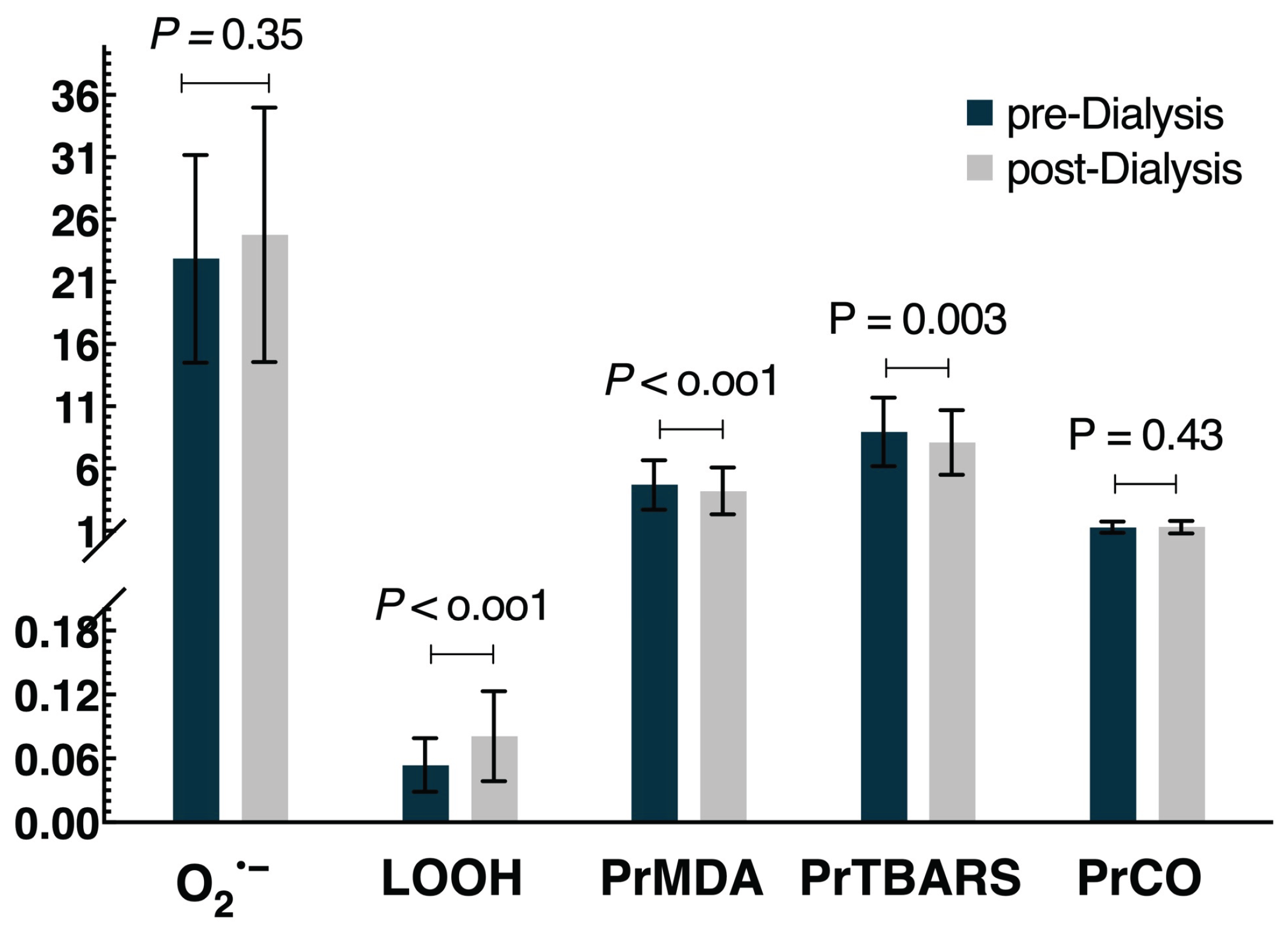
Figure 2.
Spearman’s rank correlation tests between OS markers and dialysis vintage. Significant positive correlations were observed for markers such as LOOH (r= 0.458, P = 0.005; panel B), PrMDA (r=0.298, P = 0.018; panel C) and PrTBARS (r=0.272, P = 0.025; panel D). No significant correlations were found for O2•− (r=-0.126, P = 0.47; panel A) and PrCO (r=-0.112, P = 0.356; panel E).
Figure 2.
Spearman’s rank correlation tests between OS markers and dialysis vintage. Significant positive correlations were observed for markers such as LOOH (r= 0.458, P = 0.005; panel B), PrMDA (r=0.298, P = 0.018; panel C) and PrTBARS (r=0.272, P = 0.025; panel D). No significant correlations were found for O2•− (r=-0.126, P = 0.47; panel A) and PrCO (r=-0.112, P = 0.356; panel E).
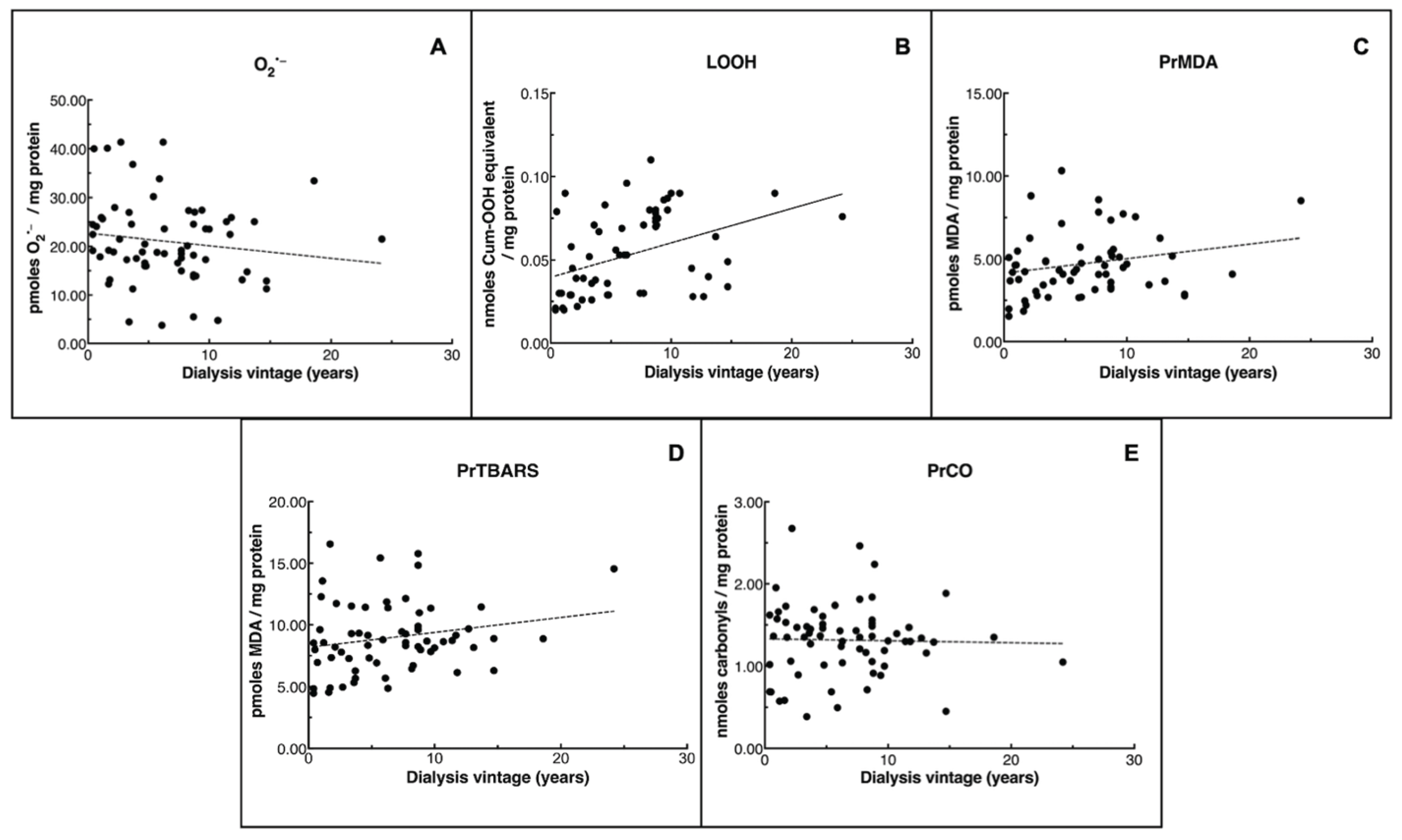

Table 1.
Demographic and clinical characteristics of study population.
| HD patients | ||
|---|---|---|
| Age (years) Mean (± SD) | 25 to 86 62.4 (± 14.6) |
|
| Dialysis vintage (years) Mean (± SD) | 0.1 to 24.6 6.9 (± 5.5) |
|
| N | ||
| Gender | ||
| Male | 48 | |
| Female | 20 | |
| Medical status | ||
| Type of dialysis | Low-flux HD | 30 |
| High-flux HD | 17 | |
| Pre-dilution HDF | 21 | |
| Medical conditions | ||
| Hypertension | 32 | |
| Coronary artery disease (CAD) |
14 | |
| Cardiovascular disease (CVD) |
31 | |
| Peripheral artery disease (PAD) |
21 | |
| Diabetes | 24 | |
| Medication | ||
| Statin | 22 | |
| Alfacalcidol | 8 | |
| Paricalcitol | 9 | |
| Angiotensin-converting enzyme inhibitors (ACEi) |
3 | |
| Angiotensin receptor blockers (ARBs) |
9 | |
| Calcium channel blockers (CaChBl) |
19 | |
| B blockers | 38 | |
| Levocarnitine | 12 | |
| Cholecalciferol | 17 | |
Table 2.
Comparison of three dialysis modalities based on pre-dialysis value of each OS marker a table.
Table 2.
Comparison of three dialysis modalities based on pre-dialysis value of each OS marker a table.
| Oxidative stress markers | Modality of dialysis |
Pre-dialysis values | P value |
|---|---|---|---|
| O2•− | Low-flux HD | 22.03 (±9.16) | 0.929 |
| High-flux HD | 23.456 (±6.8) | ||
| Pre-dilution HDF | 23.09 (±11.22) | ||
| LOOH | Low-flux HD | 0.045 (±0.027) | 0.067 |
| High-flux HD | 0.067 (±0.023) | ||
| Pre-dilution HDF | 0.059 (±0.022) | ||
| PrMDA | Low-flux HD | 3.474 (±1.21) | 0.458 |
| High-flux HD | 4.04 (±0.99) | ||
| Pre-dilution HDF | 3.6 (±0.88) | ||
| PrTBARS | Low-flux HD | 7.643 (±2.41) | 0.725 |
| High-flux HD | 8.144 (±1.33) | ||
| Pre-dilution HDF | 7.547 (±2.48) | ||
| PrCO | Low-flux HD | 1.134 (±0.52) | 0.850 |
| High-flux HD | 1.143 (±0.26) | ||
| Pre-dilution HDF | 1.07 (±0.33) |
Νotes: values are presented as mean ± standard deviation (SD). Abbreviations: HD, hemodialysis; HDF, hemodiafiltration; O2•−, superoxide radical; LOOH, lipid peroxides; PrMDA, protein bound-malondialdehyde; PrTBARS, protein bound-thiobarbituric acid reactive substances; PrCO, protein carbonyls.
Table 3.
Comparison of three dialysis modalities based on dialysis-induced difference (Δ-value = pre-post dialysis) of each OS marker.
Table 3.
Comparison of three dialysis modalities based on dialysis-induced difference (Δ-value = pre-post dialysis) of each OS marker.
| Oxidative stress markers | Modality of dialysis |
Δ-value (pre – post dialysis) |
P value |
|---|---|---|---|
| O2•− | Low-flux HD | -4.59 (±2.2) | 0.185 |
| High-flux HD | -2.98(±3.3) | ||
| Pre-dilution HDF | -4.06 (±2.7) | ||
| LOOH | Low-flux HD | -0.045 (±0.031) | 0.016 |
| High-flux HD | -0.008 (±0.035) | ||
| Pre-dilution HDF | -0.018 (±0.029) | ||
| PrMDA | Low-flux HD | 0.53 (±0.66) | 0.910 |
| High-flux HD | 0.68 (±0.73) | ||
| Pre-dilution HDF | 0.59 (±0.99) | ||
| PrTBARS | Low-flux HD | 0.95 (±1.54) | 0.570 |
| High-flux HD | 1.71 (±1.92) | ||
| Pre-dilution HDF | 1.06 (±1.9) | ||
| PrCO | Low-flux HD | 0.027 (±0.29) | 0.701 |
| High-flux HD | 0.054 (±0.17) | ||
| Pre-dilution HDF | 0.024 (±0.27) |
Notes: values are presented as mean ± standard deviation (SD). Abbreviations: HD, hemodialysis; HDF, hemodiafiltration; O2•−, superoxide radical; LOOH, lipid peroxides; PrMDA, protein bound-malondialdehyde; PrTBARS, protein bound-thiobarbituric acid reactive substances; PrCO, protein carbonyls.
Table 4.
Correlation of OS markers and patients age using Spearman’s rho coefficient (r).
| OS markers vs Age | Spearman’s rho coefficient (r) | P value |
|---|---|---|
| O2•− | -0.006 | 0.973 |
| LOOH | -0.121 | 0.483 |
| PrMDA | 0.303 | 0.16 |
| PrTBARS | 0.187 | 0.127 |
| PrCO | 0.204 | 0.09 |
Disclaimer/Publisher’s Note: The statements, opinions and data contained in all publications are solely those of the individual author(s) and contributor(s) and not of MDPI and/or the editor(s). MDPI and/or the editor(s) disclaim responsibility for any injury to people or property resulting from any ideas, methods, instructions or products referred to in the content. |
© 2026 by the authors. Licensee MDPI, Basel, Switzerland. This article is an open access article distributed under the terms and conditions of the Creative Commons Attribution (CC BY) license (http://creativecommons.org/licenses/by/4.0/).
Copyright: This open access article is published under a Creative Commons CC BY 4.0 license, which permit the free download, distribution, and reuse, provided that the author and preprint are cited in any reuse.


