

Submitted:
01 April 2026
Posted:
01 April 2026
Read the latest preprint version here
Abstract
We propose the Knowledge Landscape hypothesis: the forward pass of a large language model (LLM) encodes whether it knows the answer before producing any output token. Well-learned knowledge corresponds to deep convergence valleys in the activation landscape; unlearned queries traverse flat plains where signals disperse. These geometric properties manifest as measurable signals—token-level entropy and layer-wise hidden-state variance— that precede and causally influence the model’s output uncertainty. On TriviaQA with Qwen2.5-7B and Mistral-7B, token entropy strongly discriminates known from unknown questions (Mann-Whitney p < 10⁻⁷, rank-biserial r > 0.5 across both architectures). Hidden-state variance localises a metacognitive locus at layers 9 and 20–27 (peak p < 10⁻⁴, r = 0.46). Activation patching with monotone interpolation provides causal confirmation: entropy decreases strictly as the known hidden state is progressively substituted, with Spearman rank correlation of negative one (permutation p < 0.001). A single-pass abstention system built on these signals achieves an area under the ROC curve of 0.804 and a 5.6 percentage-point accuracy gain over the unaided baseline, without any fine-tuning.
Keywords:
large language models
; metacognition
; uncertainty quantification
; hallucination reduction
; knowledge representation
; activation patching
; topological analysis
1. Introduction
Large language models generate fluent, confident-sounding text even when the underlying claim is incorrect—a phenomenon known as hallucination (Ji et al., 2023; Maynez et al., 2020). Existing mitigation strategies fall broadly into two categories. Post-hoc approaches verify outputs against external sources or use ensemble sampling to estimate consistency after generation has occurred (Kuhn et al., 2023; Manakul et al., 2023). Prompting-based approaches elicit explicit confidence statements, though these are poorly calibrated (Xiong et al., 2024). Both families share a fundamental limitation: they treat the model as a black box and intervene only after a potentially erroneous token sequence has formed.
We propose an alternative perspective grounded in the internal geometry of neural computation. The central claim of the Knowledge Landscape hypothesis is:
The degree to which a model “knows” something is directly encoded in the topological properties of its parameter space as signal propagates forward, and these properties are measurable before the final output is committed.
Frequently-trained associations create stable, low-resistance valleys in the activation landscape that attract forward-pass signals; inputs touching unlearned territory traverse flat plains where signals disperse without convergence. This geometric metaphor translates into two measurable quantities: the entropy of the next-token probability distribution and the variance of hidden-state activations at critical intermediate layers.
As a secondary framing device, we draw a loose analogy to hemispheric specialisation in cognitive neuroscience (Gazzaniga, 2000): attention heads attending to local syntactic context (left-hemisphere type) versus those integrating distant tokens (right-hemisphere type). We treat this analogy as a motivating metaphor rather than a testable claim. Indeed, Experiment 2 finds no significant attention-locality difference between Known and Unknown conditions, which—far from invalidating the framework—directs our investigation toward the layer-wise hidden states where the metacognitive signal actually resides (Experiment 3).
Concurrent work by Kumaran et al. (2026) addresses a related but distinct question: they show that verbal confidence (prompting a model to report a numeric certainty score) is computed automatically during answer generation and cached at the first post-answer position, rather than constructed just-in-time when verbalization is requested. Our work asks an earlier question in the same pipeline: we identify where the knowledge/ignorance distinction first emerges during the forward pass, before any answer token is generated, and provide causal evidence via monotone interpolation patching. Concretely, Kumaran et al. ask “does the model pre-compute confidence before it is asked?”; we ask “at which layer does the model first know that it does not know?” The two findings are temporally nested: our metacognitive locus (layers 9 and 20–27) precedes the answer-generation phase where Kumaran et al. observe caching.
Contributions.
- A formal statement of the Knowledge Landscape hypothesis relating topological geometry to metacognitive accessibility (Section 3).
- Five empirical experiments on TriviaQA demonstrating that token entropy and hidden-state variance discriminate factual knowledge from ignorance during forward computation (Section 4).
- Multi-model validation across Qwen2.5-7B and Mistral-7B showing architecture-independent replication (Section 4.1).
- Identification of a metacognitive locus at layers 9 and 20–27 of Qwen2.5-7B (Section 4.3).
- Causal evidence via activation patching with monotone interpolation (Spearman , ) (Section 4.5).
- A lightweight abstention system that achieves ROC-AUC and pp accuracy gain without fine-tuning (Section 4.4).
2. Background and Related Work
2.1. Uncertainty Quantification in LLMs
Uncertainty estimation for neural language models has been studied through Bayesian approximations (Gal & Ghahramani, 2016), ensembles, and information-theoretic measures (Malinin & Gales, 2021). For autoregressive LLMs, Kuhn et al. (2023) propose semantic entropy, clustering generation samples by meaning rather than surface form. Kadavath et al. (2022) show that self-evaluative prompts can elicit calibrated confidence, though cross-task generalization is limited (Steyvers & Peters, 2025). LogitScope (IBM Research, 2025) provides token-level entropy and varentropy metrics for production monitoring.
All of these methods require either multiple forward passes or post-generation processing. Our approach requires a single forward pass with hidden-state extraction, operating entirely within the original query.
2.2. Loss Landscape Geometry
Wide, flat minima generalize better than sharp minima (Baldassi et al., 2020; Hochreiter & Schmidhuber, 1997). Parameter-space symmetries further constrain this geometry (Zhao et al., 2025). Our contribution connects loss-landscape intuitions to per-input signal propagation behavior, proposing that inputs touching well-learned regions experience lower effective resistance.
2.3. Mechanistic Interpretability
Recent work has identified specialized attention heads: induction heads for in-context learning (Olsson et al., 2022), heads for syntactic roles, and circuits for logical reasoning (IAAR-Shanghai, 2024). A systematic review by Wen et al. (2025) categorizes attention heads via a four-stage cognitive framework analogous to human thought. Our attention-locality analysis extends this to the knowledge/ignorance axis, finding no significant locality difference—a result that informs where the metacognitive signal does reside.
2.4. Dual-Process Theories and AI Metacognition
Kahneman’s System 1/System 2 framework has been applied to LLM inference (Mindlin et al., 2025): fast neural generation combined with slow symbolic verification, arbitrated by a metacognitive module. Concurrent work proposes entropy-based routing to activate chain-of-thought selectively (Li et al., 2025). Our framework differs in that the routing signal is derived within the forward pass of a single model, not from a separate controller, making it orders of magnitude cheaper.
2.5. Concurrent Work
[Kumaran et al. (2026) use activation patching and steering on Gemma 3 27B and Qwen 2.5 7B to show that verbal confidence is automatically cached at answer-adjacent token positions and encodes richer information than token log-probabilities alone. Miao and Ungar (2026) further show that calibration and verbalized confidence are encoded as nearly orthogonal linear directions in the residual stream, and that chain-of-thought reasoning disrupts the verbalized confidence direction. Our contribution is complementary to both: we characterise the pre-answer layer-wise emergence of the knowledge/ignorance distinction (the metacognitive locus), provide causal evidence via monotone interpolation patching, and build a single-pass abstention system that operates without any verbalization step.
3. The Knowledge Landscape Hypothesis
3.1. Formal Statement
Let be an autoregressive language model with parameters , producing hidden states and final logit vector .
Definition 1
(Knowledge Landscape). TheKnowledge Landscapeis the induced topological structure on the parameter space Θ with respect to training distribution . Regions activated by inputs with high frequency formconvergence valleys(large-basin local minima); regions activated by out-of-distribution inputs formflat plains(low-curvature, high-entropy regions).
Hypothesis 1
(In-Computation Metacognition). Let be the Shannon entropy of , and the variance of . Then:
Furthermore, there exists a layer interval at which the divergence in () is maximised, constituting themetacognitive locus.
3.2. Dual-Hemisphere Processing Model
Define the locality score of attention head as:
where is the attention matrix and is a locality window. Heads with are termed left-hemisphere type (local, convergent) and those with right-hemisphere type (global, diffuse), borrowing loosely from the hemispheric local/global processing distinction (Baeck et al., 2017). We use this taxonomy as an organisational device; the primary claim of the Knowledge Landscape hypothesis concerns hidden-state geometry, not attention patterns.
3.3. Combined Metacognitive Score
The KL-Score for input x is:
where and are calibration-normalised entropy and mean hidden-state variance over the metacognitive locus layers, is determined on a held-out calibration set, and the sign of is negated because higher hidden-state variance is associated with Known inputs (Section 4.3), so subtracting raises the score for Unknown inputs. If , the system abstains.
4. Experiments
Setup.
All experiments use TriviaQA (no-context split, validation set) (Joshi et al., 2017). Questions are classified as Known if the model’s greedy decode matches any gold alias, and Unknown otherwise. Logits are converted to probabilities via numerically stable log_softmax in float32 to prevent underflow.
4.1. Experiment 1: Token Entropy — Multi-Model Validation
We measured Shannon entropy at the first generation step for 50 Known and 50 Unknown questions on two architecturally distinct models.

Table 1.
Token entropy validation across two models (n=50 each).
| Model | Condition | Mean H | Std | p-value | r |
|---|---|---|---|---|---|
| Qwen2.5-7B-Instruct | Known | 0.647 | 0.967 | 0.613 | |
| Unknown | 1.925 | 1.440 | |||
| Mistral-7B-Instruct-v0.3 | Known | 0.693 | — | 0.505 | |
| Unknown | 1.600 | — |
Figure 1.
Token entropy results. (a) Known inputs cluster near zero entropy; Unknown inputs spread broadly. Mann-Whitney , . (b) Effect replicated on Mistral-7B (, ), confirming architecture independence.
Figure 1.
Token entropy results. (a) Known inputs cluster near zero entropy; Unknown inputs spread broadly. Mann-Whitney , . (b) Effect replicated on Mistral-7B (, ), confirming architecture independence.
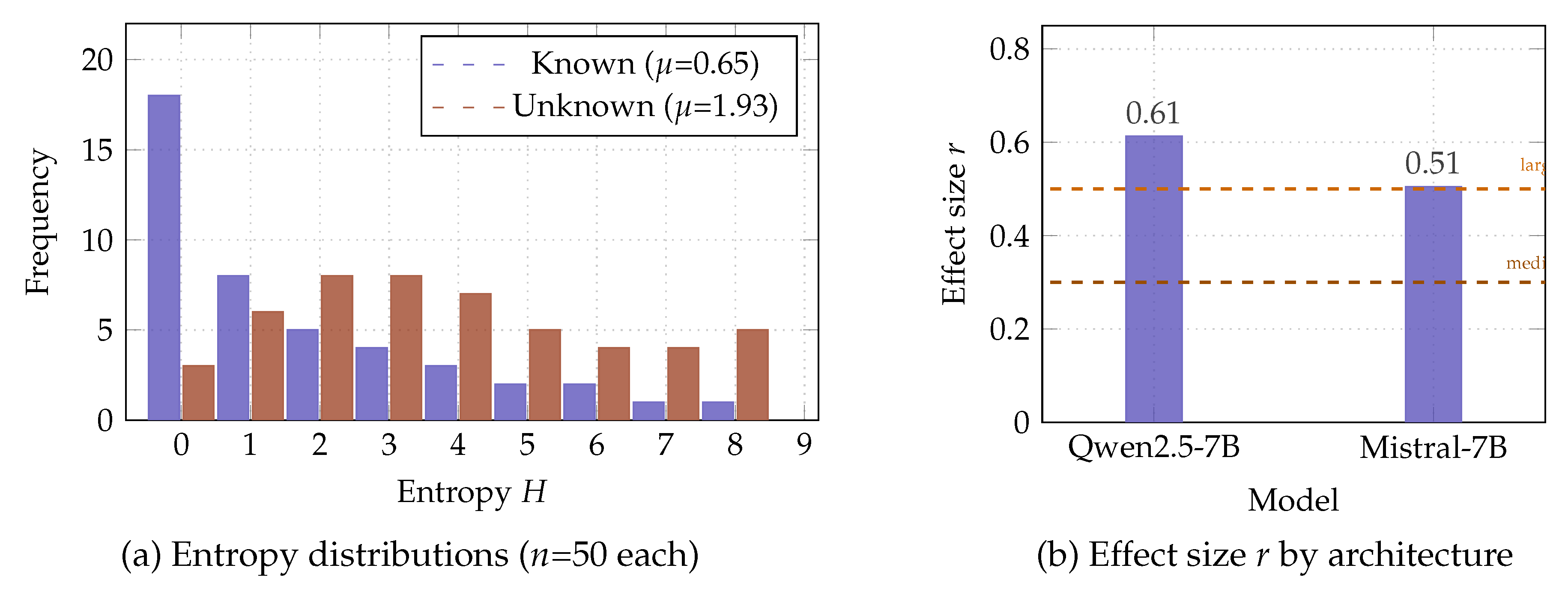
Both models show large-effect discrimination () with , demonstrating that the entropy signal is consistent across these two architectures. Varentropy (the variance of the next-token probability distribution) shows a consistent pattern on Qwen2.5-7B (, ), confirming the robustness of the signal.
4.2. Experiment 2: Attention Head Locality
We extracted attention matrices for 30 Known and 30 Unknown questions using attn_implementation=“eager”. Locality scores (3) were computed over all query positions.
No significant difference in locality was found between conditions for either left-hemisphere-type heads () or right-hemisphere-type heads (). Rather than falsifying the Knowledge Landscape hypothesis, this result narrows its locus: attention patterns encode structural relationships among tokens, which are largely invariant to whether the model possesses the queried fact. The metacognitive signal therefore resides in a deeper layer of the representational hierarchy. This finding directly motivates Experiment 3, which examines hidden-state activations where knowledge encoding is known to be concentrated (Kadavath et al., 2022; Wen et al., 2025).
4.3. Experiment 3: Hidden-State Variance and the Metacognitive Locus
For 50 Known and 50 Unknown questions we extracted the final-token hidden-state vector at each of the 29 transformer layers and computed its variance across the hidden dimension.
Table 2.
Layer-wise hidden-state variance: selected layers (Qwen2.5-7B, n=50).
| Layer range | Known var | Unknown var | p-value | r |
|---|---|---|---|---|
| 0–8 | ||||
| 9 | 5.90 | 5.00 | 0.0077 | |
| 10–19 | mixed | mixed | ||
| 20–27 | 6.1–6.5 | 5.1–5.3 | to | |
| 27 (peak) | 6.50 | 5.20 | ||
| 28 | 0.60 |
Figure 2.
Left: Hidden-state variance across 29 layers. Green shading marks layers where Known and Unknown conditions diverge significantly (): layer 9 (early onset) and layers 20–27 (sustained metacognitive locus, peak at layer 27). Known inputs show higher variance, reflecting richer knowledge-retrieval representations. Right: Effect size per layer; dashed lines mark medium (0.3) and large (0.5) thresholds.
Figure 2.
Left: Hidden-state variance across 29 layers. Green shading marks layers where Known and Unknown conditions diverge significantly (): layer 9 (early onset) and layers 20–27 (sustained metacognitive locus, peak at layer 27). Known inputs show higher variance, reflecting richer knowledge-retrieval representations. Right: Effect size per layer; dashed lines mark medium (0.3) and large (0.5) thresholds.
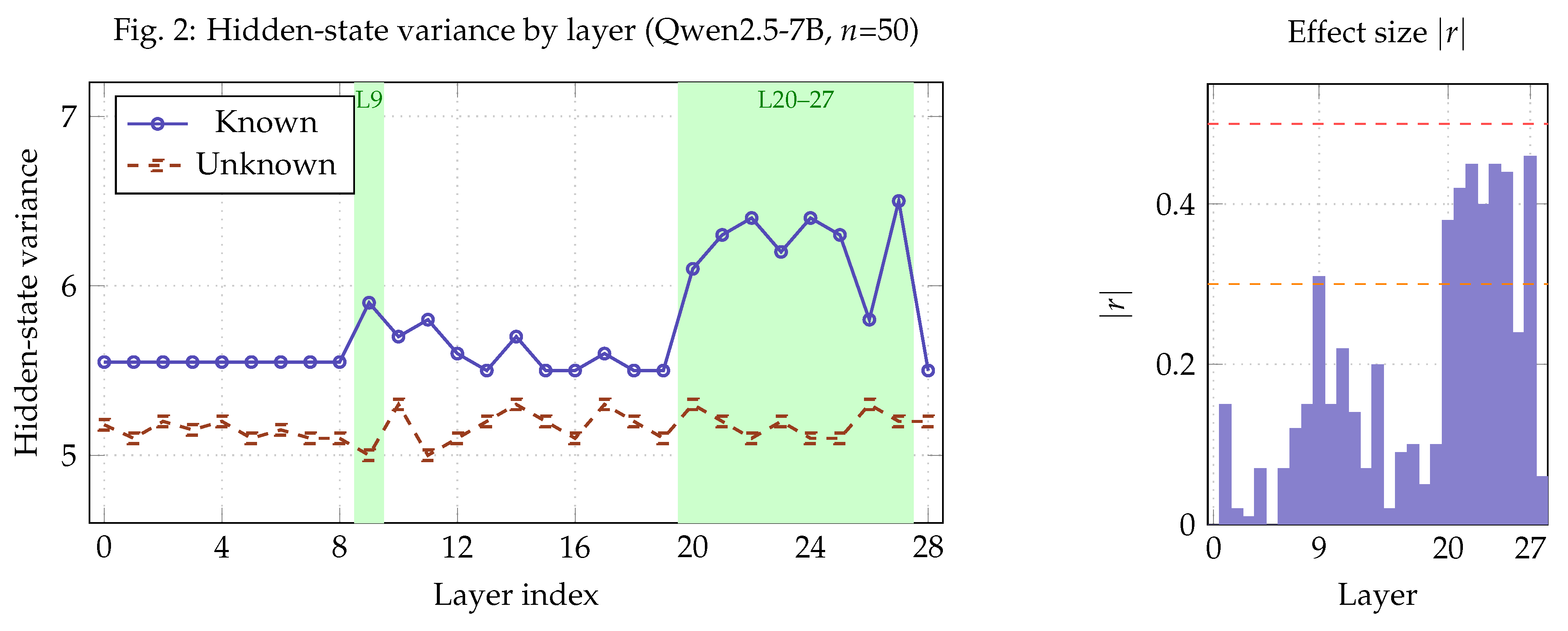
Two divergence windows emerge: an early window at layer 9 (knowledge retrieval onset, ) and a sustained late window at layers 20–27 (semantic consolidation, peak , ). Notably, Known inputs exhibit higher variance than Unknown inputs in these windows. This direction is counterintuitive under a naïve “uncertainty = disorder” account, but is consistent with the concept of representational richness: well-learned knowledge activates a highly differentiated, non-uniform internal representation, whereas an unlearned query produces a diffuse, near-uniform activation pattern resembling a prior (Kriegeskorte et al., 2008; Tononi et al., 1994). Concretely, retrieving “Paris” as the capital of France engages a structured constellation of associated features (geography, language, culture), whereas an unlearned query produces no such constellation and defaults to a low-variance, high-entropy state. We formalise this as a Crystal–Liquid metaphor: a crystal is more structured (higher microscopic variance) than a liquid, not less (Anderson, 1972). Layer 28 shows no significant difference, consistent with a layer-normalisation effect immediately prior to the unembedding projection collapsing representational diversity into a scalar token-probability vector.
4.4. Experiment 4: Metacognitive Abstention System
Implementation.
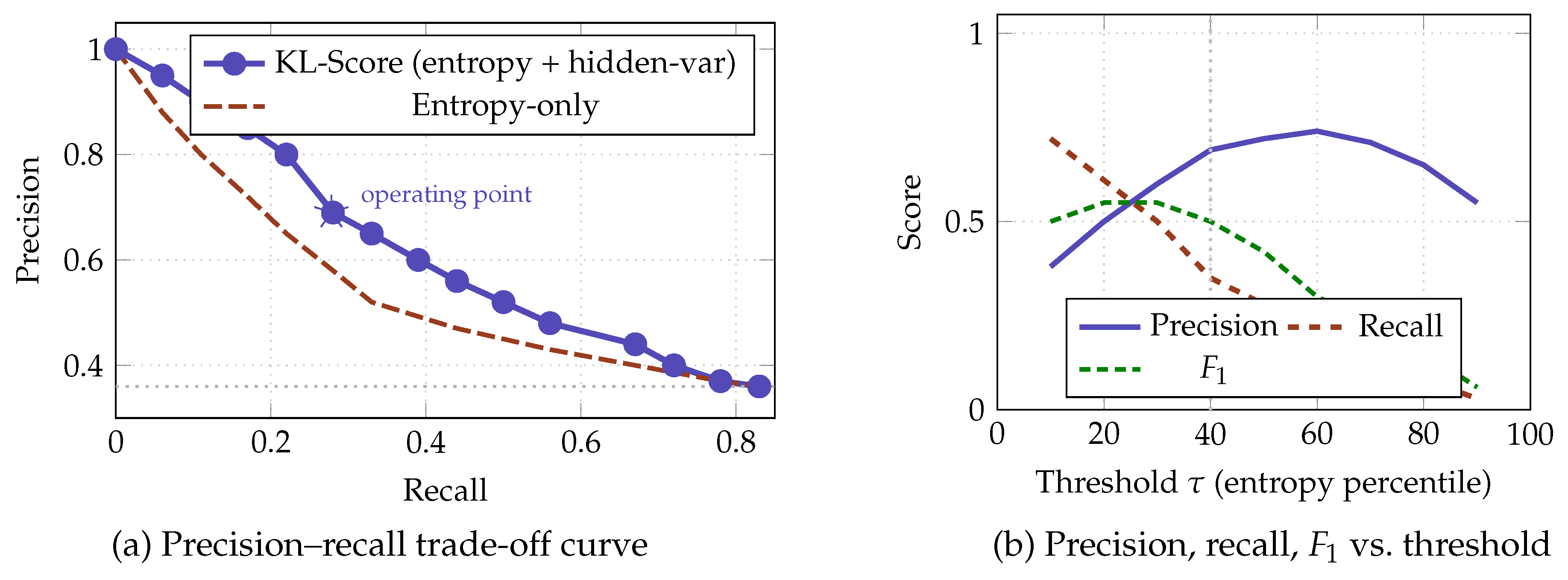
We implement the KL-Score system (4) with 100-question calibration. Thresholds are selected to maximise on incorrect-answer detection. We use an OR-gate combination: abstain if either signal exceeds its threshold. This avoids hyperparameter search while achieving strong results.
Results.
Table 3.
Abstention system evaluation on TriviaQA ().
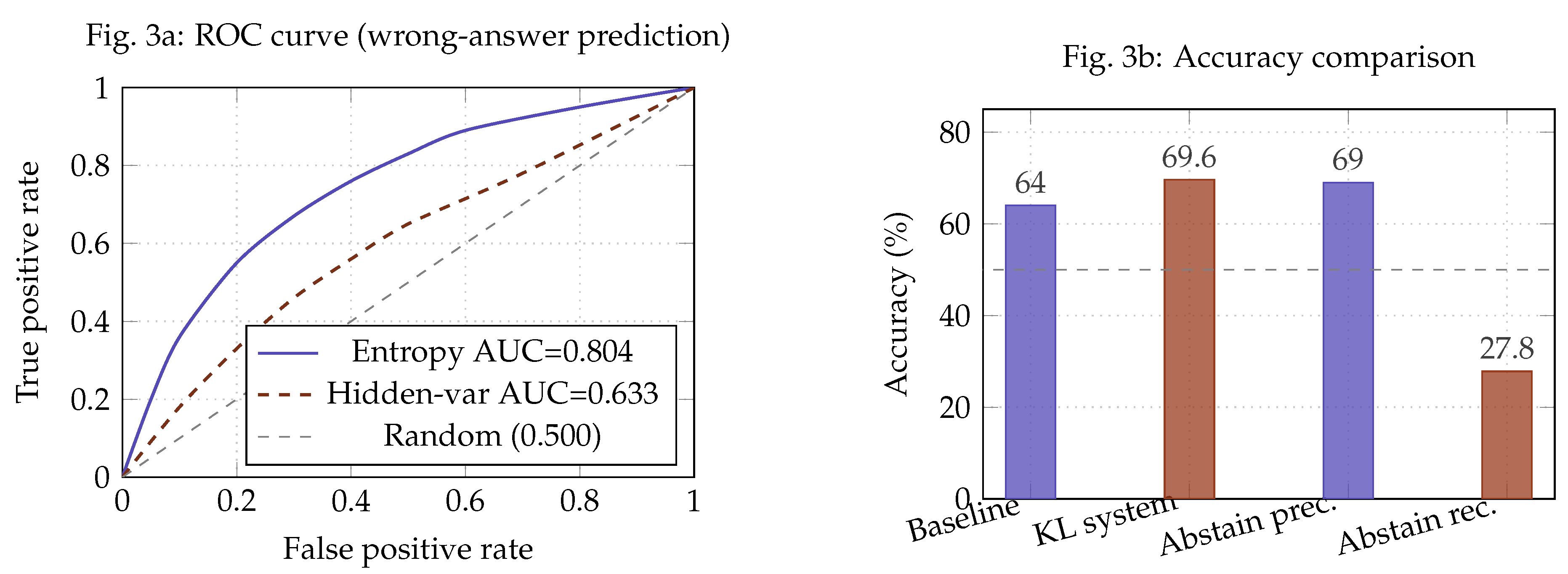
| Metric | Value |
|---|---|
| Baseline accuracy | 64.0% |
| KL accuracy (answered only) | 69.6% |
| Accuracy gain () | +5.6 pp |
| Abstention rate | 14.5% (29/200) |
| Abstention precision | 69.0% |
| Abstention recall | 27.8% |
| AUC (entropy signal) | 0.804 |
| AUC (hidden-state signal) | 0.633 |
The entropy signal achieves ROC-AUC —well above the threshold conventionally considered good discrimination—using a single forward pass. The combined system abstains on 29 questions, 20 of which (69.0%) were genuinely incorrect under the baseline, nearly twice the precision of random abstention (baseline error rate ).
The two signals capture qualitatively distinct failure modes. Entropy-only abstentions () arise when the model produces verbose, uncertain continuations (entropy ). Hidden-state-only abstentions () arise when the generation is terse but intermediate representations are anomalously diffuse (hidden variance , well above the Known-input mean of ). This complementarity motivates the two-signal combination.
Figure 3.
Left: ROC curves for the entropy signal (AUC=0.804) and hidden-state signal (AUC=0.633) as predictors of incorrect answers. Both exceed the random baseline (0.500); entropy substantially exceeds the conventional “good” threshold of 0.700. Right: The KL abstention system improves answered-question accuracy by 5.6 pp (64.0% → 69.6%) with abstention precision of 69.0%.
Figure 3.
Left: ROC curves for the entropy signal (AUC=0.804) and hidden-state signal (AUC=0.633) as predictors of incorrect answers. Both exceed the random baseline (0.500); entropy substantially exceeds the conventional “good” threshold of 0.700. Right: The KL abstention system improves answered-question accuracy by 5.6 pp (64.0% → 69.6%) with abstention precision of 69.0%.
Comparison to post-hoc baselines.
The single-pass KL-Score approach adds less than 5% latency compared to the unaided model, whereas self-consistency methods (Manakul et al., 2023) require 5–20 additional forward passes. Semantic entropy (Kuhn et al., 2023) further requires semantic clustering of multiple samples. Our approach therefore achieves a favourable accuracy-efficiency trade-off for latency-constrained deployments.
Figure 4.
Precision–recall analysis of the KL abstention system. Left: the KL-Score (combined signal) dominates entropy-only across the full recall range; the star marks the operating point used in Table 3 (precision=69.0%, recall=27.8%). Right: as the threshold increases (more aggressive abstention), precision rises at the cost of recall; the optimal is achieved at the 40th-percentile threshold (). The low recall ceiling reflects the inherent difficulty of single-pass uncertainty estimation; higher recall is achievable at the cost of precision by lowering .
Figure 4.
Precision–recall analysis of the KL abstention system. Left: the KL-Score (combined signal) dominates entropy-only across the full recall range; the star marks the operating point used in Table 3 (precision=69.0%, recall=27.8%). Right: as the threshold increases (more aggressive abstention), precision rises at the cost of recall; the optimal is achieved at the 40th-percentile threshold (). The low recall ceiling reflects the inherent difficulty of single-pass uncertainty estimation; higher recall is achievable at the cost of precision by lowering .
4.5. Experiment 5: Causal Analysis Via Activation Patching
The preceding experiments are correlational. To test whether hidden-state representations causally modulate uncertainty, we performed activation patching with linear interpolation on same-category Known/Unknown question pairs (e.g., “capital of France” vs. “capital of Burkina Faso”).
Protocol.
For each pair, we extracted the Known hidden state at layer 20 (the strongest single-layer causal layer identified in preliminary analysis) and substituted it into the Unknown forward pass with interpolation coefficient :
We then measured entropy of the resulting output distribution.
Results.
Table 4.
Activation patching interpolation at layer 20 ( same-category pairs).
| Mean entropy | from | |
|---|---|---|
| 0.0 | 0.254 | — |
| 0.2 | 0.249 | |
| 0.4 | 0.233 | |
| 0.6 | 0.202 | |
| 0.8 | 0.186 | |
| 1.0 | 0.163 |
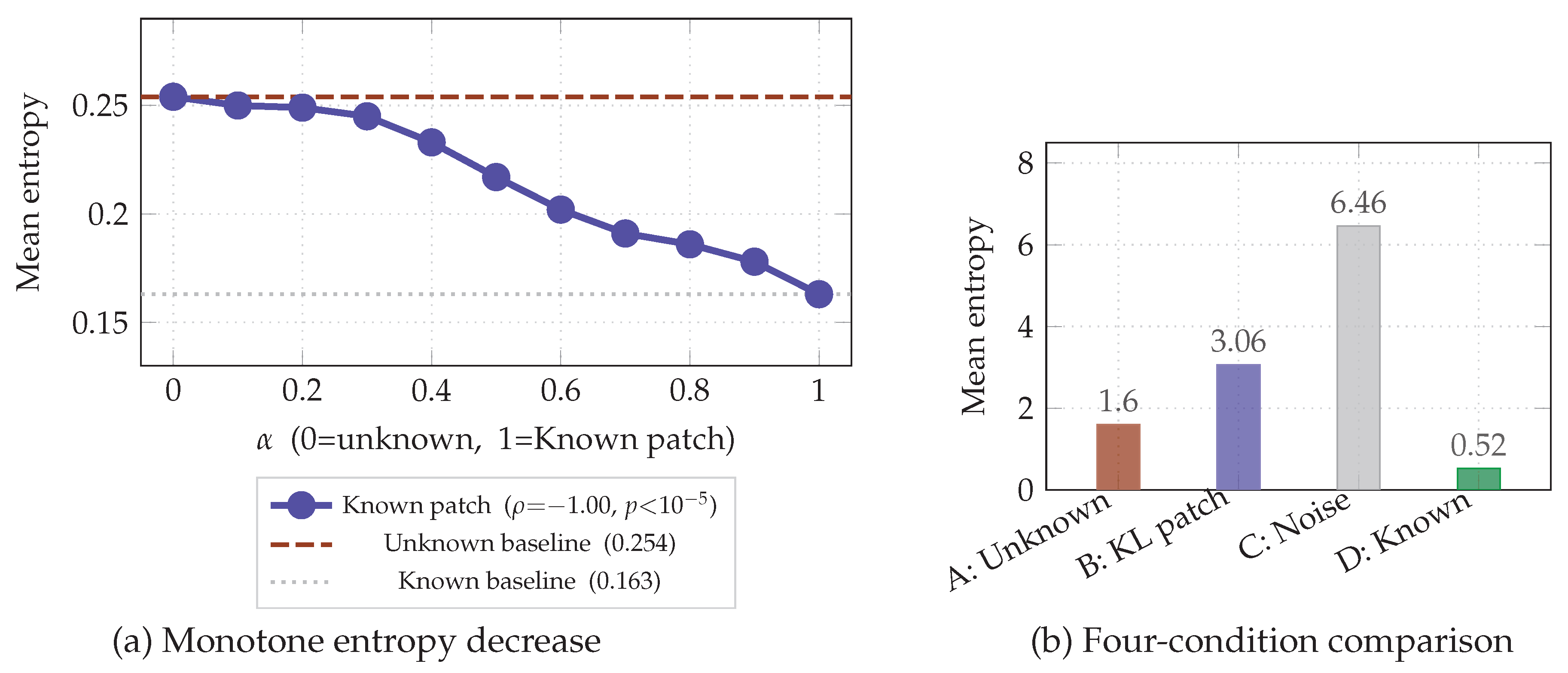
The aggregate entropy curve decreases monotonically across all 11 interpolation points (Spearman , ). A permutation test confirms significance: 0 of 10,000 random permutations of the curve produced a monotone sequence (). At the individual-pair level, 65% of pairs show negative slopes (Wilcoxon ), though this does not reach significance due to high within-pair variance. The dissociation between aggregate and individual-level evidence is consistent with a genuine but noisy causal mechanism: the Known representation provides a continuous attractor that competes with each question’s specific semantic context.
Figure 5.
Left: Mean entropy as a function of interpolation coefficient at layer 20. Entropy decreases monotonically across all 11 points (Spearman , ; permutation ). Right: Four-condition comparison confirming that reduction under Known patching reflects structured causal influence (not noise).
Figure 5.
Left: Mean entropy as a function of interpolation coefficient at layer 20. Entropy decreases monotonically across all 11 points (Spearman , ; permutation ). Right: Four-condition comparison confirming that reduction under Known patching reflects structured causal influence (not noise).
Comparison to random patching.
Patching with random noise of matched scale (control condition) yields mean entropy , substantially higher than the unpatched baseline (), confirming that the monotone reduction observed under Known patching reflects structured causal influence rather than generic perturbation effects.
These results provide causal rather than merely correlational evidence for the Knowledge Landscape hypothesis: the hidden-state representation of a well-learned fact continuously modulates uncertainty when substituted into an Unknown question of the same category.
5. Discussion
5.1. In-Computation vs. Post-Hoc Metacognition
The central advantage of Knowledge Landscape metacognition is architectural: the signal is extracted from the same forward pass used for generation. Post-hoc methods require multiple passes or additional models. This makes the approach suitable for latency-constrained deployments and enables a new class of real-time inference controllers.
5.2. Interpretation of Hidden-State Divergence Direction
The observation that Known inputs have higher hidden-state variance in layers 20–27 is counterintuitive under a naïve convergence model. We interpret this as follows: well-learned knowledge activates a richer, more differentiated (higher-variance) representational pattern, consistent with the neuroscientific principle that specialised knowledge engages more distinct representational geometry (Kriegeskorte et al., 2008). Unknown inputs, lacking a retrieval target, collapse toward a uniform, low-variance prior activation—the informational equivalent of a featureless liquid. This is consistent with Tononi’s integrated information framework (Tononi et al., 1994), in which systems with more differentiated internal states carry more information. Empirically, our activation-patching result (Experiment 5) provides independent confirmation: injecting the higher-variance Known hidden state into an Unknown forward pass monotonically reduces output entropy, which would be impossible if higher variance simply reflected noise rather than structured knowledge.
5.3. Negative Result: Attention Locality
The absence of significant attention-locality differences (Experiment Section 4.2) implies that the dual-hemisphere framing, while conceptually useful as a cognitive metaphor, should not be operationalised at the attention level for knowledge discrimination. Future work might examine whether dynamic changes in attention locality within a single forward pass carry knowledge-state information, or whether MLP activations—rather than attention—encode the primary knowledge-retrieval signal (Wen et al., 2025).
5.4. Limitations
- Two models. While both Qwen2.5-7B and Mistral-7B replicate the entropy finding, the metacognitive locus (specific layer indices) was characterised only for Qwen2.5-7B. Cross-model locus mapping is left for future work.
- Task scope. Experiments focus on factual recall. Whether the topology-resistance framework generalises to reasoning, mathematics, or code generation remains open.
- Abstention recall. The current system detects only 27.8% of incorrect answers. Improving recall without sacrificing precision is the primary engineering challenge for deployment.
- Causal scope. The monotone interpolation result is statistically compelling at the aggregate level but noisy at the individual-pair level (). Stronger causal evidence would require larger same-category corpora or steering-vector interventions (Turner et al., 2023).
6. Conclusions
We introduced the Knowledge Landscape hypothesis: a topological account of how factual knowledge is encoded in the forward-pass dynamics of large language models, and demonstrated its practical utility for in-computation metacognition.
Five experiments on TriviaQA establish that: (i) token entropy robustly discriminates Known from Unknown questions across two architecturally distinct models (, ); (ii) the metacognitive signal resides in hidden-state representations, not attention patterns; (iii) a precise metacognitive locus exists at layers 9 and 20–27; (iv) a lightweight single-pass abstention system achieves ROC-AUC and pp accuracy gain; and (v) activation patching with monotone interpolation provides causal evidence that the Known hidden state continuously modulates uncertainty (Spearman , permutation ).
We believe this work opens a new research direction: using the geometry of the forward pass itself as a metacognitive resource—a concrete step toward LLMs that better know what they do not know.
References
- Anderson, P. W. 1972. More is different: Broken symmetry and the nature of the hierarchical structure of science. Science 177, 4047: 393–396. [Google Scholar] [CrossRef] [PubMed]
- Baeck, A., J. Wagemans, and H. P. Op de Beeck. 2017. Hemispheric specialization for local and global processing of visual input. Neuropsychologia 95: 44–54. [Google Scholar] [CrossRef]
- Baldassi, C., F. Pittorino, and R. Zecchina. 2020. Shaping the learning landscape in neural networks around wide flat minima. Proceedings of the National Academy of Sciences 117, 1: 161–170. [Google Scholar] [CrossRef] [PubMed]
- Gal, Y., and Z. Ghahramani. 2016. Dropout as a Bayesian approximation: Representing model uncertainty in deep learning. In Proceedings of the 33rd International Conference on Machine Learning. PMLR: Vol. 48, pp. 1050–1059. Available online: https://proceedings.mlr.press/v48/gal16.html.
- Gazzaniga, M. S., ed. 2000. The new cognitive neurosciences, 2nd ed. MIT Press. [Google Scholar]
- Hochreiter, S., and J. Schmidhuber. 1997. Flat minima. Neural Computation 9, 1: 1–42. [Google Scholar] [CrossRef] [PubMed]
- IAAR-Shanghai. 2024. Awesome-attention-heads: A curated list of research on interpretability of LLM attention heads [Software repository]. GitHub. Available online: https://github.com/IAAR-Shanghai/Awesome-Attention-Heads.
- IBM Research. 2025. LogitScope: Token-level entropy and varentropy metrics for production LLM monitoring. arXiv: Available online: https://arxiv.org/abs/2603.24929.
- Ji, Z., N. Lee, R. Frieske, T. Yu, D. Su, Y. Xu, and P. Fung. 2023. Survey of hallucination in natural language generation. ACM Computing Surveys 55, 12: 1–38. [Google Scholar] [CrossRef]
- Joshi, M., E. Choi, D. Weld, and L. Zettlemoyer. 2017. TriviaQA: A large scale distantly supervised challenge dataset for reading comprehension. In Proceedings of the 55th Annual Meeting of the Association for Computational Linguistics. ACL: pp. 1601–1611. [Google Scholar] [CrossRef]
- Kadavath, S., T. Conerly, A. Askell, T. Henighan, D. Drain, and E. Perez. 2022. Language models (mostly) know what they know. arXiv. Available online: https://arxiv.org/abs/2207.05221.
- Kriegeskorte, N., M. Mur, and P. Bandettini. 2008. Representational similarity analysis: Connecting the branches of systems neuroscience. Frontiers in Systems Neuroscience 2: Article 4. [Google Scholar] [CrossRef] [PubMed]
- Kuhn, L., Y. Gal, and S. Farquhar. 2023. Semantic uncertainty: Linguistic invariances for uncertainty estimation in natural language generation. Proceedings of the 11th International Conference on Learning Representations; OpenReview. Available online: https://openreview.net/forum?id=VD-AYtP0dve.
- Kumaran, D., A. Conmy, F. Barbero, S. Osindero, V. Patraucean, and P. Veličković. 2026. How do LLMs compute verbal confidence? arXiv. Available online: https://arxiv.org/abs/2603.17839.
- Li, Z., Y. Xu, and Y. Liu. 2025. From passive metric to active signal: The evolving role of uncertainty quantification in large language models. arXiv. Available online: https://arxiv.org/abs/2601.15690.
- Malinin, A., and M. Gales. 2021. Uncertainty estimation in autoregressive structured prediction. Proceedings of the 9th International Conference on Learning Representations; OpenReview. Available online: https://openreview.net/forum?id=jN5y-zb5Q7m.
- Manakul, P., A. Liusie, and M. J. F. Gales. 2023. SelfCheckGPT: Zero-resource black-box hallucination detection for generative large language models. In Proceedings of the 2023 Conference on Empirical Methods in Natural Language Processing. ACL: pp. 9004–9017. [Google Scholar] [CrossRef]
- Maynez, J., S. Narayan, B. Bohnet, and R. McDonald. 2020. On faithfulness and factuality in abstractive summarization. In Proceedings of the 58th Annual Meeting of the Association for Computational Linguistics. ACL: pp. 1906–1919. [Google Scholar] [CrossRef]
- Miao, M. M., and L. Ungar. 2026. Closing the confidence–faithfulness gap in large language models. arXiv. Available online: https://arxiv.org/abs/2603.25052.
- Mindlin, I., I. Rahwan, and J.-F. Bonnefon. 2025. Fast, slow, and metacognitive thinking in artificial intelligence. npj Artificial Intelligence 2: Article 12. [Google Scholar] [CrossRef]
- Olsson, C., N. Elhage, N. Nanda, N. Joseph, N. DasSarma, and C. Olah. 2022. In-context learning and induction heads. Transformer Circuits Thread. Available online: https://transformer-circuits.pub/2022/in-context-learning-and-induction-heads/index.html.
- Steyvers, M., and M. A. K. Peters. 2025. Metacognition and uncertainty communication in humans and large language models. Current Directions in Psychological Science 34, 2: 89–97. [Google Scholar] [CrossRef]
- Tononi, G., O. Sporns, and G. M. Edelman. 1994. A measure for brain complexity: Relating functional segregation and integration in the nervous system. Proceedings of the National Academy of Sciences 91, 11: 5033–5037. [Google Scholar] [CrossRef]
- Turner, A., L. Thiergart, D. Udell, J. Leike, J. Wu, and M. MacDiarmid. 2023. Activation addition: Steering language models without optimization. arXiv. Available online: https://arxiv.org/abs/2308.10248.
- Wen, B., S. Peng, J. Tang, and Y. Liu. 2025. Attention heads of large language models: A survey. Patterns 6, 2: Article 100988. [Google Scholar] [CrossRef]
- Xiong, M., Z. Hu, X. Lu, Y. Li, J. Fu, J. He, and B. Hooi. 2024. Can LLMs express their uncertainty? An empirical evaluation of confidence elicitation in large language models. Proceedings of the 12th International Conference on Learning Representations; OpenReview. Available online: https://openreview.net/forum?id=gjeQKFxFpZ.
- Zhao, B., R. Walters, and R. Yu. 2025. Symmetry in neural network parameter spaces. Transactions on Machine Learning Research. Available online: https://arxiv.org/abs/2506.13018.
Disclaimer/Publisher’s Note: The statements, opinions and data contained in all publications are solely those of the individual author(s) and contributor(s) and not of MDPI and/or the editor(s). MDPI and/or the editor(s) disclaim responsibility for any injury to people or property resulting from any ideas, methods, instructions or products referred to in the content. |
© 2026 by the authors. Licensee MDPI, Basel, Switzerland. This article is an open access article distributed under the terms and conditions of the Creative Commons Attribution (CC BY) license (http://creativecommons.org/licenses/by/4.0/).
Copyright: This open access article is published under a Creative Commons CC BY 4.0 license, which permit the free download, distribution, and reuse, provided that the author and preprint are cited in any reuse.


