

Submitted:
31 March 2026
Posted:
01 April 2026
Read the latest preprint version here
Preprints on COVID-19 and SARS-CoV-2
Abstract
Chlorine Dioxide (ClO2) is a neutral oxidant molecule having a short life-span once in contact with electron donors (organic matter). ClO2 solutions have antiviral, antibiotic, anti-inflammatory, anticancer and wound healing activity and it was used at safe concentrations with patients of different countries during the COVID-19 pandemic. In Mexico 1067 COVID-19 patients received compassionate treatments with ClO2 during the 2020/2021 pandemic years. We describe the treatments and clinical report of these patients, as it concerns the Oxygen saturation (SpO2) recovery and we give a biochemical explanation. The number of healed patients was 1057, >99% of the total and SpO2 showed a hyperbolic fast increase. This happens because ClO2 attracts one electron from the organic matter and produces a Chlorite anion (ClO2-). This new molecule has a known metabolic activity in the blood stream. On the one side, it will have the mentioned anti-viral, antibiotic and the other behaviors but it will also allow producing Oxygen (O2) to be transported by the hemoglobin. This reaction is mediated by an intermediate state of a Ferryl molecule (Fe=O) in the allosteric site of methemoglobin, which behaves as a reductase enzyme. This reaction explains the rapid and steady increase of O2-saturation in healed patients.
Keywords:
cancer
; CDS
; oxygen uptake
; chlorite anion
; chlorite dismutase
; ClO2 metabolism
; RedOx metabolism
; wound healing
1. Introduction
Chlorine dioxide (ClO2) is a water-soluble mineral gas, discovered in 1811, that is used as antiviral and antibiotic agent [1], allowing also its use for obtaining drinkable water. Thus, the US Environmental Protection Agency recommends 0.8 mg/L of ClO2 to obtain drinkable water [2]. In an analysis of its toxicity, it has been shown that a human being of 70 K can take until 210 mg of ClO2/day without risk [3]. Below this dose, it has been hypothesized that the obtained ClO2- would act as an antioxidant and above that threshold it becomes an oxidant agent [4], a biochemical property called hormesis, evoked in some molecules having anticancer activity [5,6]. Thus, medical use of this gas has started in different clinical cases. For instance the dermic use of ClO2 has allowed wound healing in complicated cases of comorbidity (including diabetics) and/or patients risking feet amputation [7,8]. The pharmacokinetics and pharmacodynamics analysis of ClO2 [9] reveals some properties that support anti-inflammatory and even anticarcinogenic activity [10,11,12].
Besides fighting covid-19 testing ClO2 in hospitals spaces [1] it was also used on patients that accepted to be treated by this molecule during the world pandemics, particularly in Ecuador [13]. and Mexico [14]. In the Mexican case, patients were monitored by medical doctors and nurses to track their daily Oxygen saturation (SpO2). In this short report of such study cases, we transcribe some of their methodology, the results concerning SpO2 and we discuss a revised biochemical explanation about the way this fast blood Oxygen increase was obtained for the COVID-19 patients, all treated with ClO2 during 2020/2021 pandemic years, in the city of Querétaro, in Mexico [14].
2. Materials and Methods Section Transcribed from Part of the Protocol Used with COVID-19 Patients in the Mexican Case [Reference [14]]
From May 30, 2020 to January 15, 2021 the clinical records of 1,136 positive/suspected COVID-19 patients (treated by the same physician) who voluntarily requested therapeutic management at home in Mexico were reviewed. The inclusion criteria for the clinical records were as follows: 1) Patients that were diagnosed by molecular tests (Real-Time Reverse Transcriptase (RT)-PCR to SARSCoV- 2, antigen detection, specific Immunoglobulin M (IgM) and Immunoglobulin G (IgG) antibodies against SARS-CoV-2, computed assisted tomography of the lungs, chest radiographies, or a combination of clinical manifestations such as headache, fever, cough, throat pain, dyspnea, malaise, and fatigue; 2) patients that were informed of the benefits and possible side effects of ClO2 consumption before starting treatment and that they had signed un informed consent form. The collected medical records were: sex, age, comorbidities, previous medications, date of onset, date of discharge or date of death, secondary effects posterior to a CDS consumption, milliliters of ClO2 consumed per day , partial Oxygen saturation (SpO2), Oxygen supplementation (O2 L/min) and COVID- 19-like symptoms. These parameters allowed classifying the patients among three groups according to COVID severity and partial Oxygen saturation: Mild (>95% SpO2), Moderate (90-95% SpO2) and Severe (<90% SpO2), Table 1. Thus, we report here the results of previous case studies where ClO2 was given to the Mexican patients [14], but we focus mainly on the Oxygen saturation of patients. Afterwards we give the biochemical bases of the observed results.
According to severity, the patients were given different protocols of ClO2 intake. Two groups of patients were analyzed: 1) Multidrug patients: persons consuming drugs usually used for treating COVID-19 (Azytromicine, Dexamethasone, Ivermectin and Hydroxychloroquine) plus ClO2, and 2) Exclusively ClO2 patients: people treated only with a the gas solution. All patients were treated at home by their relatives or nurses following the indications of the treating physician. Two types of oral aqueous solutions made with ClO2 at 3000 ppm (3 mg/ml) were used for treating COVID-19: Protocol C (ClO2 in 1000 ml of water, divided in ten intakes of 100 ml that were administered orally every hour, per day) and Protocol F (ClO2 in 500 ml of water, divided in ten intakes of 50 ml that were administered orally every 15 minutes, 1 to 5 times a day). For intravenous use, Protocol Y (ClO2 in 500 ml of 0.9% sterile saline solution plus 5 ml of 10% calcium gluconate and 10 ml of 7.5% sodium bicarbonate, administered at a mean rate of 70 ml per hour). All patients started treatment with Protocol F and, depending on the severity of the disease, were placed on Protocols C, F or Y until the symptoms were resolved. After the disappearance of symptoms, they continued with Protocol C as maintenance until the treatment ended (14-21 days depending on the severity of the disease).
The ClO2 used by patients for oral use was made by oxidation of 28% sodium chlorite (NaClO2) and 4% Hydrochloric Acid (HCl) as an activator [14]. For intravenous use, ClO2 was produced with the membrane electrolysis method [14]. As per the instructions given to each patient, the ClO2 solution was kept in a closed bottle, protected from direct sunlight and maintained below 11°C [14].
3. Results Transcription, Concerning the Observed Oxygen Saturation in Patients of the Mexican Case [Reference [14]]
Patients receiving ClO2 treatments were healed by 99.07 % of cases (1,057 of 1,067 patients survived). 59 (5.19%) abandoned the treatment after 11.43 days (95% CI: 7.98-14.88 days), and 10 (0.93%) were hospitalized after 8.6 days (95% CI: 2.08-15.11 days) of treatment, where they died. Of the total of patients, 77 (6.78%) reported mild-sporadic secondary effects posterior to ClO2 intake: headache (2.20%), diarrhea (1.58%), gastritis (1.32%), dizziness (1.14%), nausea (1.05%), vomit (0.44%), rash (0.44%), throat pain (0.26%), myalgia (0.18%), colitis (0.18%), tachycardia (0.09%), and chills (0.09%). Six hundred sixty-six patients (58.63%) were treated exclusively with a CDS, and 470 patients (41.37%) were treated against COVID-19 with five or more drugs in addition to the CDS (Details in Ref. 4). The duration of symptoms in those patients treated solely with a CDS was less compared with those treated with various drugs (95% CI: 2.77- 3.75 days vs. 7.33-8.97 days, respectively; Wilcoxon Rank Sum Test, P<0.001).
Respect to the response on Oxygen saturation rate, patients began the treatment with a mean SpO2 of 86.05% (95% CI: 85.12-87.17%), increasing the blood oxygen each day of treatment. In total, 126 patients (of which 101/251 [40.24%] with severe symptoms, 21/109 [19.27%] with moderate symptoms and 4/776 [0.51%] with mild symptoms) used supplementary oxygen (mean: 5.77 Liters per minute [95% CI: 5.18-6.36 L/min] for 4.32 days [95% CI: 3.37-5.27 days]). Between days 7-8 after the start of treatment, 90% of the patients reported an hyperbolic increase in SpO2 above 90% and a week later above 95%, at a rate of SpO2=3.58*ln(duration of treatment) (Figure 1, modified from Ref. 14)
4. Discussion Aimed to Give Better Understanding of the Oxygen Saturation Observed in Patients of the Mexican Case
The review of the literature allow us to interpret the surprising results of the observed patients’ increased Oxygen saturation as it follows: Chlorine dioxide (ClO2), as an oxidant agent, once in contact with electron donors (i.e. organic matter) is transformed in chlorite anion (ClO2-) a quite different molecule. The Chlorite anion has known properties allowing interesting biochemical functions in living systems, including the human body. This anion passes through intestinal or other tissues and reaches the blood stream. (or directly by intravenous administration). In the blood stream the anion is metabolized by a reductase activity of blood methemoglobin; which is 1% of total blood Hemoglobin [15]. The final step of this reduction is the production of the Chlorure anion (Cl-) and Oxygen (O2). This reductase activity of the methemoglobin is similar to the bacterial enzyme Chlorite Dismutase (CD), which has a Heme (Fe+++) core or allosteric site, just like methemoglobin. In fact, in some bacteria, it is this CD enzyme that dissociates ClO2 into Cl- and O2 [4,16,17]. More precisely, once in contact with ClO2-, the methemoglobin, containing a Ferric cation (Fe+++) and having a higher affinity for the Oxygen then the hemoglobin, takes one atom of Oxygen of the Chlorite anion (ClO2-)and releases an intermediary anion (OCl-). Then, thanks to this Oxygen atom capture, the methemoglobin allosteric site passes by an intermediary reactive Heme molecule, Ferryl (Fe=O). This highly reactive molecule, in turn, attracts again the just released anion OCl-, releasing the Chlorure anion (Cl-) and diatomic Oxygen (O2) [4,15]. This reductase activity could at least partially explain the increase in Oxygen saturation in medically surveyed COVID 19 patients healed after consumption of chlorine dioxide during the compassionate treatments applied in Mexico in 2020/21 [14] and also in Equator [13]. The antiviral effect of ClO2- anion helps to reduce the viral reproduction, reducing lung inflammation and thus restoring Oxygen absorption by its normal lung CO2/O2 gas exchange, which also contributes to the increased Oxygen saturation.
This Chlorite anion-mediated blood Oxygen-increase, may explain other physiological observations in patients using Chlorine Dioxide. For instance, the anti-tumor activity through the ability of pro-oxidants to capture excess electrons around mitochondria, as it is the case also for other molecules such as Methylene Blue [18], thus restoring other RedOx disorders (i.e. ferroptosis) that characterizes cancer cells [19]. Oxygen is also important in Hyperbaric Oxygen treatments (HBOT) for cancer [20] and also for healing difficult wounds, by using Chlorite anion [7,8,21] or HBOT [22].
5. Conclusions
We conclude that Oxygen can be obtained in blood stream by means of an appropriate use of Chlorine Dioxide (ClO2) in solution, thanks to its rapid conversion to Chlorite anion (ClO2-) and the reductase activity of the heme group (Fe+++) of the methempoglobin, by the intermediay Ferryl (Fe=O) molecule. The only caution is to keep a concentration of Chlorine Dioxide equal or below to 3 mg/K/day, so that methemoglobin will not increase over 1-2% in the blood stream and thus be efficient to increase Oxygen saturation.
Informed Consent Statement
Informed consent was obtained from all subjects involved in the study.
Data Availability Statement
The datasets used and analyzed during the current study are available from the corresponding author upon reasonable request.
Acknowledgments
We acknowledge all patients, that trusted the MD and nurses, allowing treatments that are still quite unknown among the nowadays’ medical practices. We acknowledge also time and space available for co-working by Marius and Marie-Laure Preschey. The conversations with the ARC Foundation in Mexico were an important step for the biochemical interpretation of the observed results.
Conflicts of Interest
The authors declare no conflicts of interest.
Abbreviations
The following abbreviations are used in this manuscript:
| CDS | Chlorine Dioxide in Solution |
| HBOT | Hyper Baric Oxygen Treatment |
References
- Helou, M.; Mahdi, A.; Abou Fayad, A.; Sleiman A.; Matar, G. M.; Zoghbi S.; Madani T.; Rola Husni. Antimicrobial effects of chlorine dioxide in a hospital setting. Sci Rep. 2013, 13, 22866. [CrossRef]
- US-EPA. U.S. Environmental Protection Agency. Toxicological review of chlorine dioxide and chlorite 2000. https://cfpub.epa.gov/ncea/iris/iris_documents/documents/toxreviews/0496tr.pdf.
- ATSDR-Agency for Toxic Substances and Disease Registry. 2004, Evaluation of the toxicology of chemical mixtures commonly found at hazardous waste sites. Draft. Atlanta, GA.
- Pichert A, Arnhold J. Interaction of the chlorite-based drug WF10 and chlorite with hemoglobin, methemoglobin and ferryl hemoglobin. Arch. of Bioch. and Biophys. 2015, 585: 82-89.
- Condori Macuri, R.M.; Alzamora-Gonzales, L.; Colona-Vallejos, E.H.; Cruz Riquelme, R.T.; Pecho Chávez, L.I.; Cisneros Gutierrez, J.O.; Montejo Anlas, V.A. Synergistic Anticancer Activity of Fucoidan from Lessonia trabeculata Combined with Chemotherapeutic Agents in 4T1 Breast Spheroids. Mar. Drugs 2025; 23: 451. [CrossRef]
- Rattan, S.I.S. Hormesis in aging. Ageing Res. Rev. 2008; 7(1): 63-78. [CrossRef]
- Callisperis, P.; Franco-Paredes, C.; Liester, M.B. Necrotizing Fasciitis treatment with chlorine dioxide: A case report in patient. Cureus 2025, 17(7): e88800. [CrossRef]
- Callisperis, P.; Pineda Aquino, R.; Raj Kota, S.; Vargas, M.; Rodriguez, N.; Liester, M. Chlorine dioxide treatment for diabetic foot ulcers: Three case studies. Int. J Medicine and Medical Sci. 2024, Vol. 16(2), pp. 44-49 Article Number: 407DA8672766. [CrossRef]
- Rubio-Casillas, A.; Campras-Madrid, P. Farmacocinética y farmacodinamia del dióxido de cloro e-CUCBA 2021; 8(16):21-35. [CrossRef]
- Schwartz, L. Chlorine dioxide as a possible adjunct to metabolic treatment. J Cancer Treat. and Diag. 2017, 1:6–10. [CrossRef]
- Yildiz, S.; Bilir, C.; Eskiler, G.; Bilir, F. The Anticancer Potential of Chlorine Dioxide in Small-Cell Lung Cancer Cells. Cureus 2022, 14(10): e29989. [CrossRef]
- Aparicio-Alonso, M.; Torres-Solórzano, V. Case Report: Compassionate application of chlorine dioxide-based solution in a patient with metastatic prostate cancer. Salud, Ciencia y Tecnología 2024, 4:699. [CrossRef]
- Martinez, E.A. . A New Perspective for Prevention and to Cure COVID-19 Patients: Encouraging Medical Teams to Contact Healed People Treated with Chlorine Dioxide in Solution (CDS). Integr. J. of Med. Sci. 2020, 7,229. [CrossRef]
- Aparicio-Alonso M.; Domínguez-Sánchez C.A.; Banuet-Martínez M. Chlorine Dioxide as an Alternative Treatment for COVID-19. J. Infect Dis Ther. 2021, 9,5:477. https://www.omicsonline.org/open-access/chlorine-dioxide-as-an-alternative-treatment-for-covid19.pdf. ISSN: 2332-0877.
- David, S.R.; Sawal, N.S.; Bin Hamzah, M.N.; Rajabalaya, R. The blood blues: A review on methemoglobinemia. J Pharmacol Pharmacother. 2018;9:1-5.
- Schaffner, I.; Hofbauer, S.; Krutzler, M.; Pirker, K.F.; Furtmüller, P.G.; Obinger, C. Mechanism of chlorite degradation to chloride and dioxygen by the enzyme chlorite dismutase,. Arch. of Bioch. and Biophy. 2015; 574:18-26, ISSN 0003-9861. [CrossRef]
- Elstner EF. Heme activated oxydations using the chlorine-oxygen complex “TCDO” (Oxyferin)-an overview. J. of Biosc. 1988; 43 (11-12): 893-902.
- da Veiga Moreira, J.; Nleme, N.; Schwartz, L.; Leclerc-Desaulniers, K.; Carmona, E.; Mes-Masson, A-M.; Jolicoeur, M. Methylene Blue Metabolic Therapy Restrains In Vivo Ovarian Tumor Growth. Cancers 2024, 16: 355. [CrossRef]
- Cañeque, T.; Baron, L.; Müller, S.; Baron, L.; Müller, S.; Carmona, A.; Colombeau, L.; Versini, A.; Solier, S.; Gaillet, C.; Sindikubwabo, F.; Sampaio, J.L.; Sabatier, M.; Mishima, E.; Picard-Bernes, A.; Syx, L.; Servant ,N.; Lombard, B.; Loew ,D.; Zheng, J.; Proneth, B.; Thoidingjam, L.K.; Grimaud8, L.; Fraser, C.S.; Szylo, K.J.; Der Kazarian, E.; Bonnet, C.; Charafe-Jauffret, E.; Ginestier, C.; Santofimia-Castaño, P.; Estaras, M.; Dusetti, N.; Iovanna, J.L.; Sa Cunha, A.; Pittau, G.; Hammel, P.; Tzanis, D.; Bonvalot, S.; Watson, S.; Gandon, V; Upadhyay, A.; Pratt, D.A.; Porto Freitas, F.; Friedmann Angeli, J.P.; Stockwell, B.R.; Conrad, M.; Ubellacker, J.M.; Rodriguez, R. Activation of lysosomal iron triggers ferroptosis in cancer. Nature 2025; 642: 492–500. [CrossRef]
- Cai, T. Hyperbaric oxygen therapy as an adjunt treatment for glioma and brain metastasis: a literature review. Med Gas Res. 2025;15(3):420-426.
- Hinz, J.; Kuhne, F.W.; Stahl, K.W. Local Tetrachlorodecaoxide treatment to improve oxygen supply to non-healing wounds. The Lancet 1984, 324 (8403) 630.
- Dang, S. Efficacy of Hyperbaric Oxygen Therapy on Diabetic Foot Ulcer Healing. The PA Department J. of Med. Sci. 2025. https://digitalcommons.gardner-webb.edu/pa-department-journal-of-medical-science/14.
Figure 1.
Oxygen saturation (%SpO2) along the treatment course of patients. Oxygen saturation is indicated for all patients levels (Mild, moderate and severe).
Figure 1.
Oxygen saturation (%SpO2) along the treatment course of patients. Oxygen saturation is indicated for all patients levels (Mild, moderate and severe).
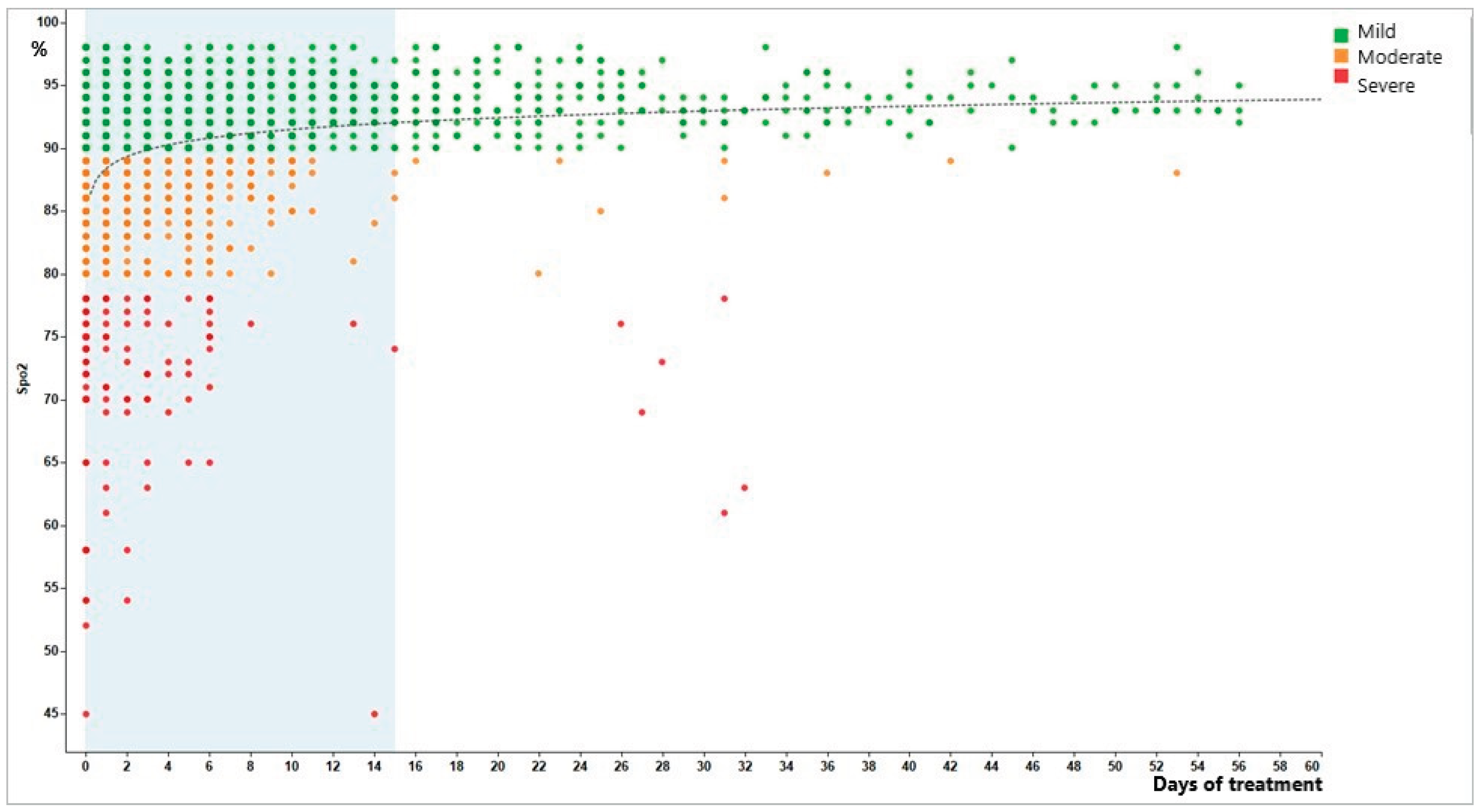

Table 1.
Data of patients included in the study [from Ref. [14]].
Table 1.
Data of patients included in the study [from Ref. [14]].
| COVID-19 Severity | ||||||
|---|---|---|---|---|---|---|
| Mild | Moderate | Severe | ||||
| SpO2 (%) | ≥ 95 | 90-94 | <90 | |||
| n | % | n | % | n | % | |
| Patients | 776 | 68.31 | 109 | 9.59 | 251 | 22.09% |
| Sex | ||||||
| Male | 351 | 45.23 | 49 | 44.95 | 151 | 60.16 |
| Female | 375 | 48.32 | 60 | 55.05 | 90 | 35.86 |
| Other | 50 | 6.44 | 0 | 0.00 | 10 | 3.98 |
| Age | ||||||
| 0-9 | 29 | 3.74 | 0 | 0.00 | 1 | 0.40 |
| 10-19 | 48 | 6.18 | 5 | 4.59 | 0 | 0.00 |
| 20-29 | 38 | 4.90 | 6 | 5.50 | 6 | 2.39 |
| 30-39 | 49 | 6.31 | 7 | 6.42 | 9 | 3.58 |
| 40-49 | 80 | 10.31 | 18 | 16.51 | 13 | 5.18 |
| 50-59 | 64 | 8.25 | 19 | 17.43 | 42 | 16.73 |
| 60-69 | 41 | 5.28 | 10 | 9.17 | 23 | 9.16 |
| >70 | 31 | 3.99 | 12 | 11.01 | 33 | 13.15 |
| No info | 396 | 51.03 | 32 | 29.36 | 124 | 42.63 |
| Days of symptoms Duration of treatment ClO2 dose (mg/kg) ClO2 per day (ml) Total ClO2 (ml) |
2.52-3.33a | 7.89-12.21bc | 6.73-9.95bc | |||
| 14.86-15.69a | 17.19-21.95b | 14.41-17.73c | ||||
| 0.87-0.94a | 1.16-1.33b | 1.98-2.18c | ||||
| 20.43-21.93a | 27.17-30.97b | 46.33-50.89c | ||||
| 309.83-337.38a | 518.77-619.19b | 733.67-828.79b | ||||
a,b,c: Statistical significant differences among columns (ANOVA on disease severity); Values in the table for each variable are presented as 95% Confidence Intervals.
Disclaimer/Publisher’s Note: The statements, opinions and data contained in all publications are solely those of the individual author(s) and contributor(s) and not of MDPI and/or the editor(s). MDPI and/or the editor(s) disclaim responsibility for any injury to people or property resulting from any ideas, methods, instructions or products referred to in the content. |
© 2026 by the authors. Licensee MDPI, Basel, Switzerland. This article is an open access article distributed under the terms and conditions of the Creative Commons Attribution (CC BY) license (http://creativecommons.org/licenses/by/4.0/).
Copyright: This open access article is published under a Creative Commons CC BY 4.0 license, which permit the free download, distribution, and reuse, provided that the author and preprint are cited in any reuse.


