

Submitted:
31 March 2026
Posted:
01 April 2026
You are already at the latest version
Abstract
Congenital heart defects (CHDs) are the most common congenital anomalies, with identifiable genetic etiologies in approximately 5–30% of affected infants, depending on the clinical presentation and comorbidities. This study included 216 children with CHD, predominantly syndromic, to explore the role of genetic variants in their morphological phenotypes. Chromosomal microarray (CMA) and whole-exome sequencing (WES) were performed, revealing clinically significant copy number variations (csCNVs) in 27.3% of patients, with the most common deletions at 22q11.21 (11.9%) and 7q11.23 (8.5%). WES was conducted in 28.0% of cases, achieving a detection rate of 29.5%, primarily identifying variants related to Noonan syndrome. Genetic diagnoses were confirmed in 33.3% of patients, with clinically significant CNVs and SNV/INDELs found exclusively in those with syndromic CHD, leading to a 36.5% diagnosis rate in those patients. The identified variants most frequently affected genes encoding transcription factors (40.4%), followed by genes involved in the RAS signaling pathway and structural proteins (17.0%), and chromatin remodeling proteins (12.8%).
Keywords:
congenital heart defects (CHD)
; syndromic CHD
; chromosomal microarray (CMA)
; whole exome sequencing (WES)
; genetic variation
1. Introduction
Congenital heart defects (CHD) are structural malformations of the heart and great vessels, with a wide spectrum of clinical manifestations. CHD is the most common congenital anomaly and the leading cause of death in the childhood period [1,2]. These defects can occur in sporadic, familial, or syndromic forms. The causes of CHD are multifactorial, involving a combination of genetic and environmental factors [3]. Genetic causes can be identified in approximately 20–30% of affected children [3], encompassing aneuploidies, copy number variations (CNVs), and single-nucleotide variants (SNVs). Microarray analysis is a first-tier diagnostic tool for the copy number variations (CNVs) [4]. Its diagnostic yield ranges from approximately 5% to 20% in patients with developmental delay/intellectual disability (DD/ID), autism spectrum disorder, and multiple congenital anomalies. In children with the syndromic form of CHD, the diagnostic yield of microarray analysis has been reported to be as high as 25%, while in the sporadic form, it ranges from 3 to 10% [5]. Whole-exome sequencing (WES) is a powerful tool for the detection of causative single-nucleotide variants (SNVs) and small insertions/deletions (INDELs). The diagnostic yield of trio-based WES in children with syndromic and familial forms of CHD ranges from 25% to 46%, and 2-10% in sporadic form, according to Wilde et al. [5].
CHDs comprise a broad spectrum of cardiac abnormalities, from single defects, such as atrial septal defect (ASD) or ventricular septal defect (VSD), which are typically acyanotic, to more complex malformations, such as tetralogy of Fallot (ToF), which are usually cyanotic [6]. During embryogenesis, cardiogenic mesodermal cells arise bilaterally from the first heart field (FHF) and the second heart field (SHF), forming the cardiac crescent [7]. Cells derived from the FHF give rise to the primitive beating heart tube, which subsequently develops into the atria and the left ventricle. In contrast, SHF cells contribute to the formation of the right ventricle, the outflow tract, and parts of both atria [7,8,9]. The morphological type of CHD is associated with the timing of developmental disruption during cardiogenesis and is closely linked to genes that play critical roles in normal cardiac development [6].
Genes widely recognized as essential for heart development encode various transcription factors, components of the RAS signaling pathway, structural proteins, and key regulators of chromatin remodeling. Additionally, genes that regulate the cell cycle, such as those encoding growth factor receptors and tumor suppressors, as well as other critical regulatory proteins, play significant roles in normal cardiac morphogenesis. These essential genes are highly sensitive to alterations in gene dosage, which may result from CNVs. In contrast, SNVs and INDELS may preserve physiological gene dosage while impairing gene function [5]. Such genetic alterations can lead to developmental abnormalities and contribute to the pathogenesis of CHD [10].
Therefore, the present study investigated the diagnostic utility of genomic analyses, including molecular karyotyping and whole-exome sequencing (WES), in children with CHD. Additionally, we analyzed the contribution of the detected gene variants to the morphological phenotypes of congenital heart defects.
2. Materials and Methods
2.1. Participants
Between January 2018 and December 2025, 2650 children with congenital anomalies and neurodevelopmental disorders underwent chromosomal microarray (CMA) at the Institute of Human Genetics, Faculty of Medicine, University of Belgrade, as a part of diagnostic testing. Patients were referred from various clinics across Serbia. From this cohort, we selected 216 children with isolated or syndromic CHD, collected detailed phenotypic information and results of exome sequencing (ES). Clinical data were obtained from patients’ medical records and a structured internal questionnaire specifically designed for comprehensive phenotypic characterization. Phenotypic assessment was performed by a multidisciplinary team comprising clinical geneticists, paediatric cardiologists and neurologists
CHD in newborns was primarily diagnosed by foetal or neonatal echocardiography including Doppler and three-dimensional imaging techniques. For older children, a comprehensive cardiological evaluation is conducted, and the morphological classification of heart defects is determined using transthoracic echocardiography along with Doppler and three-dimensional imaging.
Types of CHD are specified according to the morphological classification. of congenital heart defects [11]. Septal defects are characterized by abnormal communications between cardiac chambers, typically resulting in left-to-right shunting and, less commonly, right-to-left shunting. This category includes ASD, VSD, and atrioventricular septal defect (AVSD). Conotruncal defects are characterized by abnormalities of the great arteries and are often associated with cyanosis. This group included ToF, dextro-transposition of the great arteries (TGA), double outlet right ventricle (DORV), and truncus arteriosus communis (TAC). Valve anomalies included aortic stenosis (AS), pulmonary stenosis (PS), and Ebstein anomaly. Obstructive lesions were classified into two categories: left ventricular outflow tract obstructions (LVO) and right ventricular outflow tract obstructions (RVO). LVO conditions included coarctation of the aorta (CoA), hypoplastic left heart syndrome (HLHS), aortic stenosis (AS), and interrupted aortic arch (IAA). RVO conditions included pulmonary stenosis (PS) and pulmonary atresia with ventricular septal defect (PAVSD). The classification also covered other complex congenital heart defects (OCHD) and patent ductus arteriosus (PDA).
2.2. Molecular Karyotyping
After DNA was extracted from 3-5 ml of peripheral blood using the standard salting-out method [12], aCGH was conducted for all children included in our study. We used Agilent microarray oligonucleotide slides, specifically the SurePrint G3 Human CGH Microarray 8 × 60K and the SNP+CGH Microarray 4 × 180K (Agilent Technologies, Santa Clara, CA, USA), according to the manufacturer’s protocol. Genomic positions were referenced based on the human genome sequence GRCh37/hg19. All identified CNVs were analyzed and classified according to the latest guidelines from the American College of Medical Genetics and Genomics (ACMG) [13]. Pathogenic and likely pathogenic variants are regarded as clinically significant (csCNV).
2.3. Whole Exome Sequencing (WES)
WES results for children without csCNVs detected by CMA were collected by reviewing the Heliant database and the internal database of the University Children’s Hospital, Belgrade. WES was commercially performed by Centogene (Rostock, Germany) and the Institute of Molecular Genetics and Genetic Engineering (IMGGI), Belgrade, Serbia, upon request of the Genetic Counselling Department at the University Children’s Hospital. Full exome capture and sequencing were carried out using an Illumina platform.
2.4. Association of Genes with CHD and Its Dosage Sensitivity
All csCNVs that encompass multiple genes were analyzed to identify potential candidate genes involved in the development of CHD. A thorough literature review (PubMed) and database search (DECIPHER, ClinVar) aimed at establishing a connection or providing experimental evidence for the role of one or more genes in the embryonic development of the heart supported this analysis. Dosage sensitivity of the genes was established by prediction parameters (pLi, pHaplo, pTriplo) in DECIPHER and ClinGen database.
Statistical analysis was performed using SPSS software (version 20.0; SPSS Inc., Chicago, IL, USA). Informed consent was obtained from the legal guardians of all patients. The study protocol was approved by the Ethics Committee of the Faculty of Medicine at the University of Belgrade (Approval No. 1322/VII-4), and the use of next-generation sequencing (NGS) data was authorized by the Ethics Committee of the University Children’s Hospital, Tirsova, Belgrade (Approval No. 017:16/47).
3. Results
3.1. Patients’ Demographic and Clinical Data
Among the 216 children examined, there was an equal distribution of boys and girls. Phenotypic analysis indicated that 91.2% of the children had a syndromic form of CHD. A diagnosis of DD/ID was established in 108 (50%) cases, while this diagnosis could not be determined for 60 newborns and infants, representing 27.8% of the population. The gender, age, and clinical data for the children are presented in Table 1.
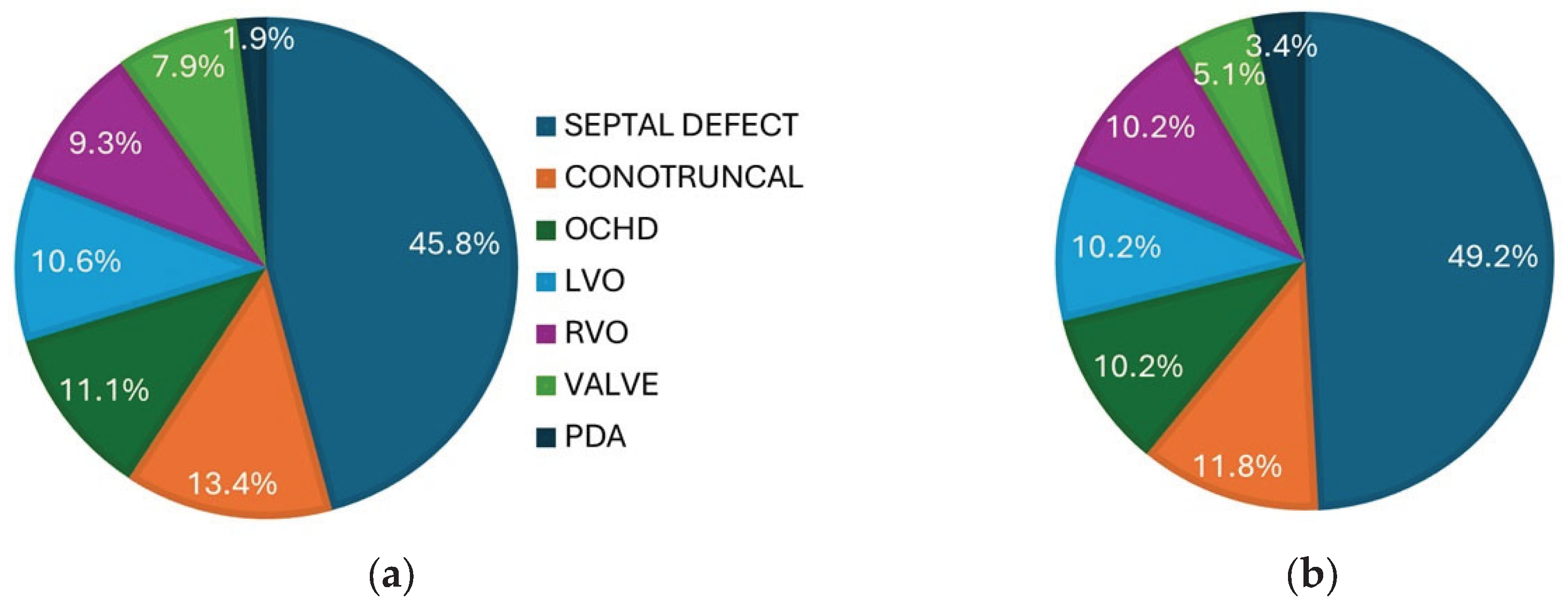
Using a morphological classification of CHD, we assessed the prevalence of specific types of heart defects within the study population. Septal defects were the most prevalent, occurring in 45.8% of the children, and distribution of all morphological types is presented in Figure 1a.
3.2. Chromosomal Microarray Analysis Results
Clinically significant CNVs were identified in 27.3% of the infants, and they were found only in children with the syndromic form of CHD. Deletions accounted for 50.6%, duplications for 33.8%, and 15.6% of the children had two or more concurrent variants (either deletions and/or duplications). The size of these CNVs ranged from 0.33 to 64.28 Mb. Notably, 49.2% of all detected csCNVs were identified in children with septal defects. The csCNV distribution according to morphological types of CHD is presented in Figure 1b. The detection rates of csCNVs across different morphological types of CHD were as follows: 29.3% (29/99) in septal defects, 30.0% (6/20) in RVO, 26.1% (6/23) in LVO, 24.1% (7/29) in conotruncal defects, 17.6% (3/17) in valve anomalies, 50.0% (2/4) in PDA, and 25.0% (6/24) in other complex heart defects (OCHD). No statistically significant differences were observed in the distribution of morphological CHD types between children with and those without detected csCNVs (p = 0.812).
Figure 2.
(a) Distribution of morphological types of congenital heart defects; (b) Distribution of csCNV by morphological type of CHD.
Figure 2.
(a) Distribution of morphological types of congenital heart defects; (b) Distribution of csCNV by morphological type of CHD.
Consistent with expectations, the highest frequency of csCNVs was found in the 22q11.2 (18.6%; 11/59) and 7q11.23 (8.5%; 5/59) regions. Two patients were diagnosed with Noonan syndrome: one had a duplication in the 2p22.1 region, and the other had a deletion in the 11p15.2 region. This diagnosis was based on clinical findings and confirmed dosage sensitivity of the genes within the CNVs.
Overall, we diagnosed common syndromes linked to CHD in 30.5% of the cases (18 out of 59 patients), as shown in Table 2. The remaining 41 patients in our cohort were individual cases, as presented in Table 3.
In our analysis of the gene content within the CNVs from 9 of those patients, we were unable to identify a specific gene linked to the development of CHD. In an additional group of 9 patients, we identified pathogenic and likely pathogenic CNVs that included genes associated with CHD, such as MRAS, KMT2C, RAD21, GATA4, and NSD1. However, these variations were either too large (primarily duplications), encompassing many genes, or too complex, involving two or more chromosomes, making it impractical to pinpoint a single gene responsible for the heart defects.
All deletions involving genes associated with CHD or embryonic heart development that also had high haploinsufficiency scores were included in further candidate gene analysis. However, certain genes, such as RBM8A, HOXA1, SPAG1, MPDZ, DPH1, and NXN, although linked to CHD, follow an autosomal recessive pattern of inheritance, so they were not considered causative genes in this group.
Finally, of all the patients shown in Table 3, we found a candidate gene for the manifestation of CHD in 16 of them. In addition to the previous 18 described in Table 2 in which the causative gene was already known or suspected, this accounted for a total of 57.6% (34/59) of patients who had a genetic diagnosis by CMA.
3.3. WES Analysis Results
For the remaining cohort, which had negative or non-diagnostic CMA findings (157 patients), we collected results of WES analysis. At that time, only 28.0% (44 out of 157) of these children had WES results. The detection rate of clinically significant variants in this group was 29.5% (13/44), with the following distribution according to CHD morphology: 30.8% (4/13) in septal defects, 23.1% (3/13) in valve anomalies, 15.4% (2/13) in OCHD, and 7.6% (1/13) in conotruncal defects, LVO, RVO, and PDA. No statistically significant differences were observed in the distribution of morphological CHD types between children with and those without detected clinically significant SNV and INDEL variant (p = 0.315).
Table 4 presents all detected clinically relevant SNVs and INDEL variants in genes potentially associated with CHD. Almost all identified mutations were inherited in an autosomal dominant pattern and occurred de novo. Notably, two boys had X-linked mutations; one had a recessive mutation in the FGD1 gene, and the other had a dominant mutation in the AMER1 gene. In Patient 4, who has Coffin–Siris syndrome type 1, and Patient 9, who has Aarskog–Scott syndrome, de novo variants of uncertain significance (VUS) were detected. However, based on a thorough clinical evaluation and phenotypic correlation, these variants were deemed possibly pathogenic.
3.4. Analysis of the Diagnostic Yield and Candidate Genes for CHD
In this study, a genetic diagnosis was established, either by CMA or WES, for 72 out of 216 cases, representing 33.3% of the total. For syndromic CHD, this percentage is higher- 36.5% (72/197), while no genetic cause was found in patients with isolated heart defects (0/19). We analyzed all genes with sequence variants identified through WES (see Table 4) as well as those genes considered critical for CHD within the csCNVs (Table 2 and Table 3). Overall, we identified a causative or potentially causative gene for CHD in 65.3% (47 out of 72) of the cases. We subsequently classified these genes into six distinct functional groups (Table 5).
Variants in genes encoding transcription factors (TF) represent the most frequent cause of CHD (40.4%; 19/47). Among children with TF variants, 42.1% had septal defects and 21.0% had conotruncal defects. RAS signaling variants primarily caused valve anomalies and outflow tract obstructions. Other gene variants were mostly associated with septal defects.
4. Discussion
We analyzed children with CHD who predominantly exhibited a complex phenotype, and less than 10% of our cases were non-syndromic. As expected, none of the children with isolated heart defects had a clinically significant CNV or sequence variants. Conversely, among children with DD/ID, dysmorphic features, or other major congenital anomalies, the diagnostic yield of CMA and WES was substantial. The highest diagnostic yield of CMA—up to 28%—occurs in cases associated with extracardiac malformations or DD/ID, which aligns with our study [14]. The absence of csCNVs in patients with non-syndromic CHD in our cohort may be due, in part, to the small number of such patients and the strict phenotypic categorization used. For example, a 22q11.2 deletion, characteristic of DiGeorge syndrome, was identified in two infants who did not yet exhibit additional phenotypic traits. Nonetheless, they were classified as syndromic because other typical symptoms are expected to evolve. Besides, early diagnosis had predictive value, allowing for more cautious planning of the operative intervention for the heart defect, immunological, developmental, and other early interventions that were anticipated.
WES diagnostic yield was slightly higher than that of CMA (29.5% vs. 27.3%). However, only 44 patients had WES results available at the time of this retrospective analysis. It should be emphasized that over a quarter of these children were under the age of one, and, in our country, CMA is typically the first-tier genetic test for children with congenital anomalies. Published data consistently show that the diagnostic yield is higher in syndromic forms of CHD than in sporadic cases, with reported rates ranging from 39.0% to 43.0% across different populations [15,16,17]. We established genetic diagnosis in 33.3% patients, but we can speculate that this percentage is likely to be higher if all patients underwent WES analysis.
Septal defects were the most prevalent type of CHD in our cohort, followed by conotruncal anomalies. The Pediatric Cardiac Genomics Consortium reports higher rates for septal defects (53%) and conotruncal anomalies (36%) compared to our study [6]. These discrepancies may be due to differences in classification, as valvular anomalies and other complex heart defects were not analyzed as separate subgroups in the Consortium reports. Nevertheless, septal defects remained the most common type of CHD across all populations, with VSD being the most frequent subtype [18]. Also, the largest number of children with csCNV had a septal defect (49,2%) as well as patients with pathogenic sequence variants (30.8%), which corresponds to literature data [19]. However, no statistically significant differences were observed in the distribution of morphological CHD types between children with detected csCNVs and those without a molecular diagnosis.
Further analysis of both CNV and sequence variants revealed likely causative gene(s) for CHD in 65.3% of children. The observed variants affected different groups of genes with specific functions. The most common were among genes encoding transcription factors, which aligns with their crucial role in early embryonic and cardiac development. Among those genes, the most common were variants in TBX1, with a well-known association with cardiac defects in DiGeorge or 22q11.2 duplication syndrome [20]. ToF is a typical heart defect associated with TBX1 [1,11,21], which was also found in our 4 out of the 11 patients with variants in this gene.
Similarly, the PBX1 gene is a critical regulator of heart morphogenesis. Disruption of its function or dosage-sensitive interactions with PBX2 and PBX3 can lead to severe cardiac defects, including ToF, PDA, and septal defects, often as part of CAKUTHED syndrome (Congenital Anomalies of the Kidney and Urinary Tract, Hearing loss, Ear abnormalities, and Developmental delay) [22]. Patient 4 in Table 3 presented with developmental delay, facial dysmorphia, renal ectopia, congenital glaucoma, cerebral palsy, and ASD. Interestingly, PBX1 interacts with another TF gene important for embryonic development—ZNF462, which is deleted in our patient with VSD, facial dysmorphia, and bilateral vesicoureteral reflux. Pathogenic variants of ZNF462, primarily loss-of-function, are associated with Weiss-Kruszka syndrome, which is characterized by distinctive craniofacial dysmorphism, developmental delay, and, less frequently, CHD or growth hormone deficiency. ZNF462 prevents the heterodimerization of PBX1 and its binding to DNA, suggesting that its deletion may be crucial for the expression of CHD [23]. Mutations in the CNOT3 gene are also associated with DD/ID and cardiac defects [24], and our patient with a mutation in this gene has developmental delay and an interrupted aortic arch. This gene is part of the CCR4-NOT transcription complex, which regulates gene expression and is involved in processes such as mRNA degradation, miRNA-mediated repression, and general transcription regulation [25]. The CCR4-NOT complex is crucial for heart development, as it promotes cardiomyocyte proliferation by regulating the degradation of cell cycle inhibitor mRNAs.
A patient with Mowat–Wilson syndrome had CoA, along with other typical features. Critical gene in this microdeletion syndrome is ZEB2, which encodes a zinc-finger transcription factor that binds E-box sequences to regulate organ development, nervous system maturation, and immune function. About 60% of patients have CHD [1,26]. Another patient with PDA had mutations in two different genes: HIVEP2 and ZMYM2. First encodes a zinc-finger transcription factor that is primarily active in the brain, regulating genes essential for neuronal growth, maturation, and synaptic function. While there are no published studies linking mutations in HIVEP2 to cardiac defects, ZMYM2 serves as a nuclear transcriptional corepressor and chromatin regulator. Mutations in this gene have been associated with a rare neurodevelopmental and craniofacial syndrome that can also include renal and cardiac abnormalities [27]. The NR2F2 gene encodes a ligand-inducible transcription factor that is crucial for embryonic development, angiogenesis, and determining cell fate. Pathogenic variants in the NR2F2 gene are linked to various complex cardiovascular anomalies, including AVSD, which our patient with 15q26.2-q26.3 deletion has [1,28]. The MSX1 gene encodes a transcription factor vital for cardiac development, particularly in the formation of the outflow tract and atrioventricular cushions. The combined loss of function of both MSX1 and MSX2 in animal models leads to severe cardiac defects, such as DORV, septal defects, and ventricular hypoplasia [29]. Based on this, in our patient with Wolf-Hirschhorn syndrome, who had PS and ASD, this gene was considered a candidate for the CHD phenotype. Finally, the NFATC1 gene encodes a transcription factor crucial for immune response, bone remodeling, and embryonic development. Mutations in NFATC1 are linked to CHD, particularly septal and valve anomalies [30]. Three patients in our cohort with an 18q23 deletion encompassing NFATC1 were identified, but two of them had large deletions including dozens of morbid genes; it was only counted as a critical gene for CHD in the patient with the smallest deletion of 2,2 Mb, which did not contain any other monogenic dosage sensitive gene. This patient presented with an ASD.
The second most common were variants affecting genes within the RAS signaling pathway. Five patients had Noonan syndrome, and four of them presented with pulmonary stenosis. Two had mutations in the PTPN11 gene, while individual cases had mutations in BRAF, RRAS2, and SOS1. Mutations in PTPN11 were associated with valvular pulmonary stenosis (LVO), and the SOS1 mutation was linked to septal defect, particularly VSD [1,26,28,31]. One patient has a 1p36 microdeletion affecting the CDC42 and ECE1 genes. ECE1 is important for the development of neural crest-derived cells, especially in cardiac and craniofacial structures [32]. Variants in ECE1 are associated with conditions like Hirschsprung disease and cardiac defects, including ASD. Our patient, besides ASD, also had hypotonia, clubfoot, and right-sided hydronephrosis. Additionally, a patient with a variant in the FGD1 gene—classified as VUS, possibly pathogenic, based on clinical phenotype—was diagnosed with OCHD.
We also identified gene variants affecting structural proteins, specifically in the ELN, FBN1, MYH11, and COL6A1 genes. Five patients were diagnosed with Williams-Beuren syndrome due to deletions in the ELN gene, and all had typical heart defects [28,33]: two patients had supravalvular AS, and three had PS. One patient with mitral valve prolapse had deletion of the first exon of the FBN1 gene, well-known for its connection to the structural integrity of connective tissues. Mutations in this gene lead to Marfan syndrome, with deletions accounting for less than 10% [31,34]. The MYH11 gene encodes smooth muscle myosin heavy chain 11, a crucial protein involved in muscle contraction in tissues such as blood vessels. Mutations in MYH11 are associated with thoracic aortic aneurysms and isolated PDA [1,26,28]. Our patient with a deletion in the 16q13.11 region, which includes the MYH11 gene, has PDA. Ultimately, the COL6A1 gene provides instructions for producing the alpha-1 chain of type VI collagen, an essential structural component of microfibrils within the extracellular matrix. Mutations in the COL6A1 gene primarily lead to collagen VI-related myopathies, mainly affecting skeletal muscle rather than the heart [35]. While COL6A1 variants have been investigated as potential genetic modifiers or contributors to CHD in individuals with Down syndrome, specific cases, such as Patient 39 in Table 3, have presented with right aortic arch, pulmonary artery atresia, ASD, and VSD.
Chromatin-regulating proteins have a major role in gene transcription and DNA replication, repair, and recombination. They regulate chromatin conformation by modulating DNA-histone interaction and binding of functional DNA-regulating protein complexes [36].
The ARID1B and SMARCB1 genes encode distinct subunits of the SWI/SNF chromatin remodeling complex, which regulates gene expression by modifying chromatin structure and DNA accessibility with energy gained from ATP hydrolysis [1,37]. Dominant mutations in ARID1B and SMARCB1 are primarily associated with Coffin–Siris syndrome type 1 and type 3, respectively. CHDs are frequently reported in Coffin–Siris syndrome and include AVSD, PDA, and ToF [38]. In our cohort, the patient carrying a VUS, possibly pathogenic, in the ARID1B gene, presented with hemitruncus arteriosus, while the patient with a SMARCB1 duplication was diagnosed with a VSD, craniofacial dysmorphia, and epilepsy. Another chromatin regulator, ANKRD11, interacts with histone deacetylases in cardiac neural crest cells, and pathogenic variants in this gene are associated with outflow tract septation defects, persistent truncus arteriosus, and ventricular dysfunction [26]. Haploinsufficiency of ANKRD11 is known to cause KBG syndrome (MIM148050), where CHD are reported in approximately 10–26% of cases, most commonly septal defects. In our cohort, one patient with 16q24.2-q24.3 duplication that interrupts the ANKRD11 gene presented with a mitral valve anomaly, patent foramen ovale, and PDA. The KMT2D and NSD1 genes encode distinct histone methyltransferases that are crucial for gene expression during development and cellular growth [26,39]. Variants in KMT2D are linked to Kabuki syndrome, where CHDs occur in up to 70% of patients, commonly involving LVO issues and septal defects. In our cohort, one patient with Kabuki syndrome type 1 had an ASD. Mutations in NSD1 cause Sotos syndrome, with about 60% of patients experiencing CHDs, including septal defects in 44.4% of cases [40,41]. A patient in our cohort with Sotos syndrome was diagnosed with a VSD. The KANSL1 gene encodes an essential component of the NSL histone acetyltransferase complex. Deletions involving KANSL1 are associated with Koolen–de Vries syndrome, which leads to CHD in 25–50% of cases, AVSD, ventricular anomalies, and PDA [42]. In our cohort, a patient with a KANSL1 deletion was diagnosed with PDA and other characteristics of the syndrome.
The ACVR1 gene encodes a bone morphogenetic protein type I receptor within the TGFβ receptor superfamily. It is involved in a wide variety of biological processes, including the development of the heart, bone, cartilage, brain, and reproductive system. Loss-of-function mutations in ACVR1 are linked to CHD, particularly VSD and valve malformations [43]. For example, our patient with deletion of 2q23.3-q24 encompassing this gene presented with VSD, PDA, facial dysmorphia, and microcephaly.
The AMER1 gene functions as a tumor suppressor and a key negative regulator of the Wnt signaling pathway. Mutations in AMER1 are associated with osteopathia striata with cranial sclerosis, a rare X-linked disorder that may include CHD. Li Chang et al. described a three-generation family with CHD caused by mutations in the AMER1 and KCNE1 genes [44]. Our patient presented with a VSD. Another tumor suppressor important for cardiac development is APC, which negatively regulates the Wnt/β-catenin signaling pathway. Loss of APC function leads to abnormal accumulation of β-catenin, which can cause severe cardiac defects, such as VSD and persistent truncus arteriosus, by inducing apoptosis in cardiac neural crest cells during embryonic development [45]. We detected a 5q21.3-q23.1 deletion including APC in a patient presented with ToF, facial dysmorphia, and imperforate anus.
Finally, we identified CHD-related genes that code for ungrouped proteins, such as PACS2, JAG1, and PSMD12. The PACS2 gene encodes a protein that regulates membrane trafficking between the endoplasmic reticulum, mitochondria, Golgi apparatus, and lysosomes [46]. Approximately 21% of patients with PACS2 mutations experience CHD, often associated with the VACTERL association (vertebral defects, anal atresia, cardiac defects, tracheoesophageal fistula, renal anomalies, and limb abnormalities) [47]. Our patient had DD/ID, facial dysmorphism, and ASD.
The JAG1 gene encodes Jagged-1, a key ligand in the Notch signaling pathway that mediates cell-to-cell communication. Mutations in JAG1 lead to Alagille syndrome, which affects over 95% of patients with cardiac defects, such as pulmonary stenosis, VSD, overriding aorta, and right ventricular hypertrophy [1,26,28]. Our patient exhibited pulmonary atresia with VSD. The PSMD12 gene encodes a non-ATPase regulatory subunit of the 26S proteasome, which is essential for proteasome assembly, scaffolding, and protein degradation. Mutations or deletions of PSMD12 cause Stankiewicz–Isidor syndrome, a neurodevelopmental disorder associated with variable CHD. Experimental models of cardiac defects further support the role of PSMD12 mutations in CHD [48]. Our patient with mutation in this gene presented with OCHD.
In this paper, we present genetic findings in a cohort of children with syndromic CHD, along with an extensive description of candidate genes. However, this study has several important limitations. Its retrospective nature resulted in missing some data regarding the patients’ phenotype, since most of the patients were neonates and infants at the time of genetic analysis. Only a small proportion of patients in our cohort underwent WES diagnostics, limiting the ability to identify additional genetic variants that may contribute to the CHD. Some parents declined further genetic testing after negative CMA results, and some patients passed away before additional procedures could be completed.
5. Conclusions
In our study, we identified a genetic diagnosis in 36.5% of patients with syndromic CHD, while no genetic cause was found in patients with isolated heart defects. Morphological type of CHD did not influence the diagnostic yield of CNVs or sequence variants. In 40.4% of cases, confirmed or candidate genes for CHD encoded transcription factors. The most common phenotype observed in patients with these gene variants was septal defects. The second most prevalent group consisted of variants in genes associated with the RAS signaling pathway and those encoding structural proteins, primarily linked to obstructions in the valves and outflow tracts.
Author Contributions
Conceptualization: N.M. and T.D.; methodology: D.P., T.D., and N.M.; writing—original draft preparation: T.D.; writing—review and editing: N.M., I.N. and D.P.; data collection and database formatting: A.D.U., B.B., B.J., G.C. and M.D.P.; laboratory analysis: A.D.U., M.R., M.P., and N.S.; statistical analysis: M.G.; funding acquisition: I.N. and T.D. All authors have read and agreed to the published version of the manuscript.
Funding
This research was supported by the Ministry of Science, Technological Development, and Innovation of the Republic of Serbia [Grant No. 451-03-66/2024-03/200110].
Institutional Review Board Statement
The study was conducted in accordance with the Declaration Of Helsinki and approved by the Ethical Committee of the University Children’s Hospital, Tirsova, Belgrade (Approval Code: 017:16/47;), as well as the Ethical Commission of the Faculty of Medicine at the University of Belgrade (Approval Code: 1322/VII-4;).
Informed Consent Statement
Informed consent was obtained from all subjects involved in the study.
Data Availability Statement
The data presented in this study are available on request from the corresponding author due to ethical reasons.
Acknowledgments
We would like to thank all patients included in the study and their parents or guardians. Our appreciation further goes to colleagues from University Children’s Hospital “Tiršova” for collaboration and valuable clinical reports.
Conflicts of Interest
The authors declare no conflicts of interest.
Abbreviations
The following abbreviations are used in this manuscript:
| CHD | congenital heart defect |
| CNV | copy number variation |
| SNV | single-nucleotide variants |
| DD/ID | developmental delay/intellectual disability |
| WES | whole-exome sequencing |
| INDELs | insertions/deletions |
| ASD | atrial septal defect |
| VSD | ventricular septal defect |
| ToF | tetralogy of Fallot |
| CMA | chromosomal microarray |
| ES | exome sequencing |
| AVSD | atrioventricular septal defect |
| TGA | dextro-transposition of the great arteries |
| DORV | double outlet right ventricle |
| TAC | truncus arteriosus communis |
| AS | aortic stenosis |
| PS | pulmonary stenosis |
| LVO | left ventricular outflow tract obstructions |
| RVO | right ventricular outflow tract obstructions |
| HLHS | hypoplastic left heart syndrome |
| CoA | coarctation of the aorta |
| PAVSD | pulmonary atresia with ventricular septal defect |
| OCHD | other complex congenital heart defects |
| PDA | patent ductus arteriosus |
| PAToA | pulmonary atresia with D-transposition of aorta and atrial septal defect |
| IUGR | intrauterine growth retardation |
| MVP | mitral valve prolapses |
| NEC | necrotizing enterocolitis |
| PFO | patent foramen ovale |
| TAPVR | total anomalous pulmonary venous return |
| VUR | vesicoureteral reflux |
| AAC | amino acid change |
| CCA | coronary cameral fistulas |
| IAA | interrupted aortic arch |
References
- Pierpont, M.E; Brueckner, M.; Chung, W.K.; Garg, V.; Lacro, R.V.; McGuire, A.L.; Mital, S.; Priest, J.R.; Pu, W.T.; Roberts, A.; et al. Genetic Basis for Congenital Heart Disease: Revisited: A Scientific Statement from the American Heart Association. Circulation 2018, 138, e653–e711. [Google Scholar] [CrossRef] [PubMed]
- Xu, J.; Li, Q.; Deng, L.; Xiong, J.; Cheng, Z.; Ye, C. Global, regional, and national epidemiology of congenital heart disease in children from 1990 to 2021. Front. Cardiovasc. Med. 2025, 12, 1522644. Available online: https://pubmed.ncbi.nlm.nih.gov/40454242/. [CrossRef]
- Cowan, JR; Ware, SM. Genetics and genetic testing in congenital heart disease. Clin Perinatol 2015, 42, 373–393, ix. [Google Scholar] [CrossRef] [PubMed]
- Manning, M.; Hudgins, L. Array-based technology and recommendations for utilization in medical genetics practice for detection of chromosomal abnormalities. Gen. Med. 2010, 12(11), 742–745. [Google Scholar] [CrossRef]
- Wilde, A.A.M.; Semsarian, C.; Márquez, M.F.; Shamloo, A.S.; Ackerman, M.J.; Ashley, E.A.; Sternick, E.B.; Barajas-Martinez, H.; Behr, E.R.; Bezzina, C.R.; et al. European Heart Rhythm Association (EHRA)/Heart Rhythm Society (HRS)/Asia Pacific Heart Rhythm Society (APHRS)/Latin American Heart Rhythm Society (LAHRS) Expert Consensus Statement on the state of genetic testing for cardiac diseases. Heart Rhythm 2022. [Google Scholar] [CrossRef]
- Nappi, F. In-Depth Genomic Analysis: The New Challenge in Congenital Heart Disease. Int. J. Mol. Sci. 2024, 25, 1734. [Google Scholar] [CrossRef]
- Christoffels, V.M.; Habets, P.E.; Franco, D.; Campione, M.; de Jong, F.; Lamers, W.H.; Bao, Z.Z.; Palmer, S.; Biben, C.; Harvey, R.P.; et al. Chamber formation and morphogenesis in the developing mammalian heart. Dev. Biol. 2000, 223, 266–278. [Google Scholar] [CrossRef]
- Astrof, S.; Arriagada, C.; Saijoh, Y.; Francou, A.; Kelly, R.G.; Moon, A. Aberrant differentiation of second heart field mesoderm prefigures cellular defects in the outflow tract in response to loss of FGF8. Dev. Biol. 2023, 499, 10–21. [Google Scholar] [CrossRef]
- Ivanovitch, K.; Soro-Barrio, P.; Chakravarty, P.; Jones, R.A.; Bell, D.M.; Mousavy Gharavy, S.N.; Stamataki, D.; Delile, J.; Smith, J.C.; Briscoe, J. Ventricular, atrial, and outflow tract heart progenitors arise from spatially and molecularly distinct regions of the primitive streak. PLoS Biol. 2021, 19, e3001200. [Google Scholar] [CrossRef]
- Simmons, M. A.; Brueckner, M. The Genetics of Congenital Heart diseaseUnderstanding and Improving Long Term Outcomes in Congenital Heart Disease: A Review for the General Cardiologist and Primary Care Physician. Curr. Opin. Pediatr. 2017, 29(5), 520–528. [Google Scholar] [CrossRef] [PubMed]
- Vey, C.; Melnik, N.; Dombrowsky, G.; Hitz, M.P. Current and future diagnostics of congenital heart disease. Medizinische Genetik 2025, 37(2), 95–102. [Google Scholar] [CrossRef]
- Miller, S.A.; Dykes, D.D.; Polesky, H.F. A simple salting out procedure for extracting DNA from human nucleated cells. Nucleic Acids Res. 1988, 11(16(3)), 1215. [Google Scholar] [CrossRef]
- Riggs, E.R.; Andersen, E.F.; Cherry, A.M.; Riggs, E.R.; Andersen, E.F.; Cherry, A.M.; Kantarci, S.; Kearney, H.; Patel, A.; Raca, G.; et al. Correction: Technical standards for the interpretation and reporting of constitutional copy-number variants: a joint consensus recommendation of the American College of Medical Genetics and Genomics (ACMG) and the Clinical Genome Resource (ClinGen). Genet. Med. 2020, 22(2), 245–257. [Google Scholar] [CrossRef]
- Bachman, K.K.; DeWard, S.J.; Chrysostomou, C.; Munoz, R.; Madan-Khetarpal, S. Array CGH as a first-tier test for neonates with congenital heart disease. Cardiology in the Young (2015) 25, 115–122. [CrossRef]
- Alankarage, D.; Ip, E.; Szot, J.O.; Munro, J.; Blue, G.M.; Harrison, K.; Cuny, H.; Enriquez, A.; Troup, M.; Humphreys, D.T.; et al. Identification of clinically actionable variants from genome sequencing of families with congenital heart disease. Genet. Med. 2019, 21, 1111–1120. [Google Scholar] [CrossRef] [PubMed]
- Shikany, A.R.; Landis, B.J.; Parrott, A.; Miller, E.M.; Coyan, A.; Walters, L.; Hinton, R.B.; Goldenberg, P.; Ware, S. M. A Comprehensive Clinical Genetics Approach to Critical Congenital Heart Disease in Infancy. J. Pediatr. 2020, 227, 231–238.e14. [Google Scholar] [CrossRef] [PubMed]
- Mone, F.; Eberhardt, R.Y.; Morris, R.K.; Hurles, M.E.; McMullan, D.J.; Maher, E.R.; Lord, J.; Chitty, L.S.; Giordano, J.L.; Wapner, R.J.; et al. Congenital heart disease and the Diagnostic yield with Exome sequencing (CODE) study: prospective cohort study and systematic review. Ultrasound Ob stet. Gynecol. 2021, 57, 43–51. [Google Scholar] [CrossRef] [PubMed]
- Shan, W.; Yuanqing, X.; Jing, Z.; Xi, W.; Huifeng, G.; Yi, W. Risk factor analysis for adverse prognosis of the fetal ventricular septal defect (VSD). BMC Pregnancy Childbirth 2023, 23, 683. [Google Scholar] [CrossRef]
- Slavotinek, A.M.; Thompson, M.L.; Martin, L. J.; Gelb, B.D. Diagnostic yield after next-generation sequencing in pediatric cardiovascular disease. Human Genetics and Genomics Advances 2024, 5, 100286. [Google Scholar] [CrossRef]
- Simrick, S.; Szumska, D.; Gardiner; Jones, J.R.; Sagar, K.; Morrow, B.; Bhattacharya, S.; Basson, M.A. Biallelic Expression of Tbx1 Protects the Embryo From Developmental Defects Caused by Increased Receptor Tyrosine Kinase. Signaling Developmental Dynamics 2012, 241, 1310–1324. [Google Scholar] [CrossRef]
- Cillo, F.; Coppola, E.; Habetswallner, F.; Cecere, F.; Pignata, L.; Toriello, E.; De Rosa, A.; Grilli, L.; Ammendola, A.; Salerno, P.; et al. Understanding the Variability of 22q11.2 Deletion Syndrome: The Role of Epigenetic Factors. Genes (Basel) 2024, 29(15(3)). [Google Scholar] [CrossRef]
- Mary, L.; Leclerc, D.; Gilot, D.; Belaud-Rotureau, M.A.; Jaillard, S. The TALE never ends: A comprehensive overview of the role of PBX1, a TALE transcription factor, in human developmental defects. Human Mutation 2022, 43(9), 1125–1148. [Google Scholar] [CrossRef]
- Huai, W.; Li, J.; Li, X.; Ding, Y.; Yu, T.; Zhang, H.; Wang, X.; Yao, R. Novel variants in. ZNF462 and phenotype update in patients with Weiss-Kruszka syndrome: a case series Transl Pediatr 2025, 14(8), 1991–2000. [Google Scholar] [CrossRef]
- Martin, R.; Splitt, M.; Genevieve, D.; Aten, E.; Collins, A.; de Bie, C. I.; Faivre, L.; Foulds, N.; Giltay, J.; Ibitoye, R. De novo variants in CNOT3 cause a variable neurodevelopmental disorder. Eur J Hum Genet 2019, 27(11), 1677–1682. [Google Scholar] [CrossRef]
- Jin, L.; Ming, W.J.; Ding, M.P. A novel pathogenic variant in CNOT3 causing neurodevelopmental delay and epilepsy. Seizure: European Journal of Epilepsy 2023, 107, 104–106. [Google Scholar] [CrossRef] [PubMed]
- Mustafa, H.J.; Najjariasl, P.; Faezeh, A.; Sambatur, E.V.; Rodenbarger, A.; Guseh, S.; Roberts, E.A.; Shamshirsaz, A.A. Yield of Whole Genome Sequencing for Pathogenic Single Nucleotide Variants in Congenital Heart Disease: A Systematic Review and Meta-Analysis. Prenatal Diagnosis 2025, 00, 1–39. [Google Scholar] [CrossRef]
- Li, Y.; Zhou, Z.; Xu, Y.; Wang, Z.R. Novel mutation c.2090_2091del in neurodevelopmental-craniofacial syndrome with variable renal and cardiac abnormalities in an 18.5-mo-old boy: A case report. World J Clin Cases 2023, 11(16), 3891–3898. [Google Scholar] [CrossRef] [PubMed]
- Yasuhara, J.; Garg, V. Genetics of congenital heart disease: a narrative review of recent advances and clinical implications. Transl. Pediatr. 2021, 10(9), 2366–2386. [Google Scholar] [CrossRef]
- Khasawneh, R.R.; Kist, R.; Queen, R.; Hussain, R.; Coxhead, J.; Schneider, J.E.; Mohun, T.J.; Zaffran, S.; Peters, H.; Phillips, H.M.; et al. Msx1 haploinsufficiency modifies the Pax9-deficient cardiovascular phenotype. BMC Dev Biol 2021, 21, 14. [Google Scholar] [CrossRef]
- Ferese, R.; Bonetti, M.; Consoli, F.; Guida, V.; Sarkozy, A.; Lepri, F.R.; Versacci, P.; Gambardella, S.; Calcagni, G.; Margiotti, K.; et al. Heterozygous missense mutations in NFATC1 are associated with atrioventricular septal defect. Human Mutation 2018, 39, 1428–1441. [Google Scholar] [CrossRef]
- Gutmann, J.L.; Spister, A.; Baticic, L. From Genetics to Phenotype: Understandingthe Diverse Manifestations of Cardiovascular Genetic Diseases in Pediatric Populations. Cardiogenetics 2025, 15, 29. [Google Scholar] [CrossRef]
- Jordan, V.K.; Zaveri, H.P.; Scott, D. A 1p36 deletion syndrome: an update. Appl Clin Genet. 2015, 27(8), 189–200. [Google Scholar] [CrossRef]
- Morris, C.A.; Mervis, C.B. Williams syndrome and related disorders. Annu Rev Genomics Hum Genet. 2000, 1, 461–84. [Google Scholar] [CrossRef]
- Muiño Mosquera, L.; Steijns, F.; Audenaert, T.; Meerschaut, I.; de Paepe, A.; Steyaert, W.; Symoens, S.; Coucke, P.; Callewaert, B.; Renard, M.; et al. Tailoring the American College of Medical Genetics and Genomics and the Association for Molecular Pathology Guidelines for the interpretation of sequenced variants in the FBN1 gene for Marfan syndrome: proposal for a disease- and gene-specific guideline. Circ Genom Precis Med. 2018, 11, e002039. [Google Scholar] [CrossRef] [PubMed]
- Davies, G.E.; Howard, C.M.; Farrer, M.J.; Coleman, M.M.; Bennett, L.B.; Cullen, L. M.; Wyse, R.K.H.; Burn, J.; Williamson, R.; Kessling, A.M. Genetic variation in the COL6A1 region is associated with congenital heart defects in trisomy 21 (Down’s syndrome). Ann. Hum. Genet. 1995, 59, 253–269. [Google Scholar] [CrossRef] [PubMed]
- Zhang, P.; Torres, K.; Liu, X.; Liu, CG.; Pollock, RE. An Overview of Chromatin-Regulating Proteins in Cells. Curr Protein Pept Sci 2016, 17(5), 401–410. [Google Scholar] [CrossRef] [PubMed]
- Wallace, R.; Raghu, S.; Hota, S.K. Chromatin remodelers in heart development and congenital heart defects The Nucleus 2026. [CrossRef]
- Diab, N.S.; Barish, S.; Dong, W.; Zhao, S.; Allington, G.; Yu, X.; Kahle, K.T.; Brueckner, M.; Jin, S.C. Molecular Genetics and Complex Inheritance of Congenital Heart Disease. Genes 2021, 12, 1020. [Google Scholar] [CrossRef]
- Petty, E.; Pillus, L. Balancing chromatin remodeling and histone modifications in transcription Trends Genet. 2013, 29(11), 621–629. [Google Scholar] [CrossRef]
- Faravelli, F. NSD1 mutations in Sotos syndrome. American Journal of Medical Genetics -C 2005, 137(1), 24–31. [Google Scholar] [CrossRef]
- Calcagni, G.; Ferrigno, F.; Sinibaldi, L.; Minotti, C.; Parlapiano, G.; Franceschini, A.; Dentici, M.L.; Micalizzi, A.; Alesi, V.; Capolino, R. Congenital Heart Defects in Patients with Molecularly Confirmed Sotos Syndrome Diagnostics. 2024, 14, 594. [Google Scholar] [CrossRef]
- Koolen, D.A.; Pfundt, R.; Linda, K.; Beunders, G.; Veenstra-Knol, H.E.; Conta, J.H.; Fortuna, A.M.; Gillessen-Kaesbach, G.; Dugan, S.; Halbach, S.; et al. The Koolen de Vries syndrome: a phenotypic comparison of patients with a 17q21.31 microdeletion versus a KANSL1 sequence variant. Eur J Hum Genet 2016, 24(5), 652–9. [Google Scholar] [CrossRef] [PubMed]
- Valer, J. A.; Sánchez-de-Diego, C.; Pimenta-Lopes, C.; Rosa, J.L.; Ventura, F. ACVR1 Function in Health and Disease. Cells 2019, 8(11), 1366. [Google Scholar] [CrossRef]
- Chang, L.; Ji, R.; Sa, R.; Huge, J.; An, C. Whole-exome sequencing of pathogenic genes in a family with congenital heart disease A case report. AMER1 gene. 2024, 10322. [Google Scholar] [CrossRef] [PubMed]
- Sumitaka, H.; Sato, T.; Akazawa, H.; Okada, H.; Maeno, A.; Ito, M.; Sugitani, Y.; Shibata, H.; Miyazaki, J.; Katsuki, M. Apoptosis in neural crest cells by functional loss of APC tumor suppressor gene. PNAS 2002, 99, 297–302. [Google Scholar] [CrossRef]
- Massey, H.; Tennant, S.; Dean, J. PACS2, PACS1, and VACTERL: A Clinical Overlap Mol. Syndromol. 2025, 16, 29–32. [Google Scholar] [CrossRef]
- Sánchez- Soler, M.J.; Serrano-Antón, A.T.; López-González, V.; Guillén-Navarro, E. New case with the recurrent c. Neurología 657–742. [CrossRef]
- Kury, S.; Besnard, T.; Ebstein, F.; Khan, T.N.; Gambin, T.; Douglas, J.; Bacino, C.A.; Craigen, W.J.; Sanders, S.J.; Lehmann, A.; et al. De Novo Disruption of the Proteasome Regulatory Subunit PSMD12 Causes a Syndromic Neurodevelopmental Disorder. Am J Hum Genet 2017, 100(4), 689. [Google Scholar] [CrossRef]

Table 1.
Characteristics of children with CHD.
| Children with congenital heart defects | N (%) | |
|---|---|---|
| Gender | Boys | 108 (50.0) |
| Girls | 108 (50.0) | |
| Age | Mean (+SD) | 3.19 (5.18) |
| Median (min-max) | 0.9 (0.1-18) | |
| DD/ID | Unknown | 60 (27.8) |
| Yes | 108 (50.0) | |
| No | 48 (22.2) | |
| Facial dysmorphia | 150 (69.4) | |
| Head and CNS anomalies | 52 (24.1) | |
| Urogenital tract anomalies | 29 (13.4) | |
| Skeletal and joint system anomalies | 21 (9.8) | |
| Autism spectrum disorders | 9 (4.2) | |
| Epilepsy | 14 (6.5) | |
| Isolated CHD | 19 (8.8) | |
Table 2.
Common syndromes associated with CHD diagnosed in more than one patient by CMA.
| Syndrome | Region | CNV Type | Size (Mb) | Gene (OMIM) | N (%) | CHD type (n) |
|---|---|---|---|---|---|---|
| DiGeorge | 22q11.2 | Deletion | 2.50 | TBX1 (602054) | 8 (13.6) | ToF (4), AVSD (2), VSD (2) PAToA (2), OCHD (1) |
| 22q11.2 duplication | 22q11.2 | Duplication | 2.80 | 3 (5.1) | ||
| Williams-Beuren | 7q11.23 | Deletion | 1.40 | ELN (130169) | 5 (8.5) | *PS (3), *AS (2) |
| Noonan | 2p22.1 | Duplication | 2.73 | SOS1 (182530) | 2 (3.4) | VSD (1) |
| 11p15.2 | Deletion | 4.20 | RRAS2 (600098) | PS (1) |
Legend: *supravalvular; AS: aortic stenosis, pulmonary stenosis; ; AVSD- atrioventricular septal defect; OCHD- Other complex heart defect; PAToA-pulmonary atresia with D-transposition of aorta and atrial septal defect; VSD- ventricular septal defect;.
Table 3.
Clinically significant CNVs observed in individual cases within our cohort of children with CHD.
Table 3.
Clinically significant CNVs observed in individual cases within our cohort of children with CHD.
| CMA findings (GRCh37) | Size Mb | Syndromes (OMIM) | Gene(s) (OMIM) | Phenotype | |
|---|---|---|---|---|---|
| 1 | 1p31.3(61782914_62322790) x1 | 0.54 | NA | NA | OCHD, corpus callosum agenesia, congenital inguinal hernia |
| 2 | 1p36.13-p36.11(18900374_23966858)x1 | 5.1 | 1p36 microdeletion (#607872) |
CDC42 (16952) ECE1 (600423) |
ASD, facial dysmorphia, hypotonia, clubfoot, right sided hydronephrosis, |
| 3 | 1q21.1(145413388_145747269)x1 | 0.33 | Thrombocytopenia Absent Radius-TAR (#274000) |
RBM8A (605313) |
AVSD, TAR |
| 4 | 1q23.2-q23.3(160465291_165429037)x1 | 4.9 | NA |
PBX1 (176310) |
ASD, facial dysmorphia, ectopic kidney, glaucoma, cerebral palsy |
| 5 | 2q11.1-q11.2(96779631_98021592)x1 | 1.2 | NA | NA | PDA, preterm birth, microcephaly, craniosynostosis, metatarsus varus |
| 7 | 2q22.2-q22.3(143986161_146890297)x1 | 2.9 | Mowat-Wilson (#235730) |
ZEB2 (605802) |
CoA, aortic bicuspid valve, facial dysmorphia, microcephaly, corpus callosum agenesia |
| 8 | 2q23.3-q24.1(151373825_158622730)x1 | 7.3 | NA |
ACVR1 (102576) |
PDA, VSD, facial dysmorphia, microcephaly |
| 9 | 3q22.1-q29(133562250_197840339)x3 | 64.3 | Noonan type 11 (#618499) |
MRAS (608435) |
OCHD, facial dysmorphia, cleft soft palate, IUGR |
| 10 | 3q28-q29 (191861311_197840339)x3 5p15.33-p15.31 (151737_7144623)x1 |
6.0 7.0 |
3q29 microduplication (#611936) Cri du chat (#123450) |
PAK2 (605022) |
AV block I, PS, PFO, facial dysmorphia, hypospadias, hypopituitarism, hip dysplasia, scoliosis, myopia |
| 11 | 4p16.3-p16.1(71552_7760991)x1 17q25.3(76890486_81029941)x3 |
7.7 4.1 |
Wolf-Hirschhorn (#194190) |
MSX1 (142983) |
ASD, PS, facial dysmorphia, complete cleft palate, microcephaly, hypotonia |
| 12 | 4q21.21(81561965_82010110)x3 | 0.45 | NA | NA |
AVSD, facial dysmorphia, rhizomelia, hypotonia |
| 13 | 5q21.3-q23.1(105623245_116004172)x1 | 10.4 | Familial Adenomatous Polyposis (#175100) |
APC (175100) |
ToF, facial dysmorphia, imperforate anus |
| 14 | 7p15.3-p14.3(20993642_30739239)x1 | 9.7 | NA |
HOXA1 (142955) |
ASD, facial dysmorphia, IUGR, kidney hypoplasia, skeletal anomalies |
| 15 | 7q33-q36.3(133749674_158909738)x3 | 25.2 | NA |
KMT2C (606833) |
PDA, facial dysmorphia, cleft palate, brain anomalies |
| 16 | 8p23.3-p23.1(221611_9261350)x1 8q21.2-q24.3(86842195_146280020)x3 |
9.0 59.4 |
Cornelia de Lange Syndrome 4 (#614701) |
RAD21 (606462) |
AVSD, PDA, ptosis, Pierre Robin sequence |
| 17 | 8p23.3-p22 (524066_17541888)x3 9p24.3-p24.2 (271257_42776209x1 |
17.0 4.0 |
8p23.1 microduplication |
GATA4 (600576) |
OCHD, omphalocele, scoliosis, arachnodactyly |
| 18 | 8q23.3-q24.23(113589865_136427632)x4 | 22.8 | Cornelia de Lange Syndrome 4 (#614701) |
RAD21 (606462) |
VSD, facial dysmorphia, cryptorchidism |
| 19 | 8q22.2-q22.23(100973253_103335730)x1 | 2.4 | NA |
SPAG1 (603395) |
AVSD, facial dysmorphia, complete palate cleft |
| 20 | 9p23-p22.3(12772471_14680180)x1 | 1.9 | NA |
MPDZ (603785) |
AVSD, craniofacial dysmorphia, macrocephaly |
| 21 | 9q31.1-q31.3(106828041_112710753)x1 | 5.9 | 9q31.1-q31.3 microdeletion (#618619) |
ZNF462 (617371) |
VSD, facial dysmorphia, bilateral VUR |
| 22 | 12p13.3-p11(511504_34189943)x4 | 35 p arm |
Pallister- Killian (# 601803) |
NA | VSD, bicuspid aortic valve, facial dysmorphia, acromelia, brain anomalies, anal atresia, cryptorchidism |
| 23 | 14q32.3(105717621_106327993)x1 | 0.60 | NA |
PACS2 (610423) |
ASD, hypertelorism, micrognathia |
| 24 | 15q11.2-q13.1(23699701_28525460)x1 | 4.8 | Angelman type II (#105830) |
NA | mitral valve dysplasia, DD/ID, facial dysmorphia, strabismus |
| 25 | 15q13.2-q13.3(31014508_32510863)x1 | 1.5 | 15q13.3 microdeletion (#612001) |
KLF13 (605328) |
MVP, left ventricular hypertrophy facial dysmorphia |
| 26 | 15q21.1(48905243_49084691)x1 | 0.29 | Marfan (#154700) |
FBN1 (134797) |
MVP, voluminous left ventricle, Marfan-like phenotype |
| 27 | 15q26.2-q26.3(94447479_102383473)x1 | 7.9 | NA |
NR2F2 (107773) |
AVSD, facial dysmorphia, short stature, VUR bilateral |
| 28 | 16p11.2(29673954_30198600)x1 | 0.52 | 16p11.2 proximal microdeletion (#611913) |
TBX6 (602427) |
ToF, polycystic kidney disease |
| 29 | 16q13.11(15048751_16249607)x1 | 1.2 | NA |
MYH11 (160745) |
PDA, preterm birth, craniofacial dysmorphia, bilateral inguinal hernias, hyperbilirubinemia |
| 30 | 16q11.2-q12.1(46564557_49053314)x3 16q12.2-q22.2(55361181_71354431)x3 |
2.5 16.0 |
NA | NA | ASD, micrognathia, short neck, torticollis, umbilical hernia, pes varus |
| 31 | 16q11.2-q22.2(46564557_71127772)x3 | 24.6 | NA | NA | OCHD, facial dysmorphia, hypotonia |
| 32 | 16q24.2-q24.3(88653937_89429735)x3 | 0.78 | NA |
ANKRD11 (611192) |
PDA, PFO, mitral valve anomaly, hydrops fetalis, |
| 33 | 17q12(34817422_36168104)x1 |
1.4 | 17q12 microdeletion (#614527) |
NA | VSD, facial dysmorphia, polycystic kidney disease |
| 34 | 17p13.3-p13.2 (51885_3882130)x1 |
3.8 | Miller-Dieker (#247200) |
DPH1(60352) NXN (612895) |
VSD, IUGR, hypotrophy, brain anomalies, toe anomalies |
| 35 | 17q21.31(43717703_44159862)x1 | 0.44 | Koolen-De Vries (#610443) |
KANSL1 (612452) |
ASD, facial dysmorphia, kidney agenesis, unilateral cleft lip |
| 36 | 5q35.2-q35.3(176033642_177013961)x3 [0.412] 18p11.32-p11.21(142096_14748636)x1[0.412] 18q21.2-q23(49545872_77901872)x1[0.412] |
0.98 14.6 28.4 |
NA Chromosome 18 ring |
NSD1 (606681) NFACT1 (600488) |
OCHD, facial dysmorphia, microcephaly, cleft lip and palate |
| 37 | 18q21.33-q23(59653070_78621175)x1 | 17.2 | 18q microdeletion (#601808) |
NFACT1 (600488) |
mitral and tricuspid valve dysplasia, facial dysmorphia |
| 38 | 18q23(75814123_78014123)x1 | 2.2 | 18q microdeletion (#601808) |
NFACT1 (600488) |
ASD, facial dysmorphia, microphthalmia, hypertrichosis, microcephaly, brain atrophy |
| 39 | 21q22. (46411778_48067924)x1 | 1.7 | NA |
COL6A1 (120220) |
ASD, VSD, right aortic arch, pulmonary artery atresia, facial dysmorphia, NEC |
| 40 | 22q11.1-q11.21(17096855_18953065)x3 | 1.9 | Cat-eye (#115470) | NA | TAPVR, facial dysmorphia, congenital hypothyroidism |
| 41 | 22q11.23(23739437_24988455)x3 | 1.2 | NA |
SMARCB1 (601607) |
VSD, facial dysmorphia, epilepsy, dolichocephaly |
Legend: ASD- atrial septal defect; AVSD- atrioventricular septal defect; CoA- coarctation of aorta; DD/ID—developmental delay/ intellectual disabilities; IUGR- intrauterine growth retardation; MVP-mitral valve prolapses; NEC- necrotizing enterocolitis; OCHD- Other complex heart defect; PDA- patent ductus arteriosus; PFO- patent foramen ovale; PS- pulmonary stenosis; TAPVR-total anomalous pulmonary venous return; ToF—Tetralogy of Fallot; VSD- ventricular septal defect ; VUR- vesicoureteral reflux.
Table 4.
Clinically significant SNV/INDEL detected in genes responsible for CHD.
| Syndrome | Gene (OMIM) | Transcript | SNV/INDEL | AAC | Zyg | Class | CHD type | |||
|---|---|---|---|---|---|---|---|---|---|---|
|
1 2 |
Noonan type 1 | PTPN11 (176876) | NM_002834.5 NM_002834.5 |
c.767A>G c.228G>T |
p.Gln256Arg p.Glu76Asp | Het Het |
P P |
PS PS |
||
| 3 | Noonan type 7 | BRAF (164757) | NM_004333.6 | c.1785T>G | p.Phe595Leu | Het | P | PS | ||
| 4 | Coffin-Siris 1 | ARID1B (614556) | NM_001374828.1 | c.1520C>T | p.Pro507Leu | Het | VUS PP# | HA | ||
| 5 | Sotos | NSD1 (606681) | NM_022455.5 | c.6206_6209del TTTG | p.Val2069fs | Het | P | VSD | ||
| 6 | Alagille type 1 | JAG1 (601920) | NM_000214.3 | c.2113+1G>A | splice site variant |
Het | LP | PAVSD PDA | ||
| 7 | Kabuki type 1 | KMT2D (602113) | NM_003482.4 | c.12598C>T | p.Gln4200Ter | Het | P | ASD | ||
| 8 | Stankiewicz- Isidor |
PSMD12 (604450) | NM_002816.5 | c.47_56del | p.Met12Thrfs Ter16 |
Het | P | CCA | ||
| 9 | Aarskog-Scott | FGD1 (300546) | NM_004463.3 | c.2046G>T | p.Gln682His | Hem | VUS PP# | OCHD | ||
| 10 | MIM 300373 |
AMER1 (300647) |
NM_152424.4 | c.1275C>A | p.Tyr425Ter | Hem | P | VSD | ||
| 11 | MIM 618672 | CNOT3 (604910) | NM_014516.4 | c.1438dupG | p.Ala480fs | Het | LP | IAA | ||
| 12 | MIM 616977 MIM 619522 |
HIVEP2 (143054) ZMYM2 (602221) |
NM_006734.4 NM_197968.4 |
c.3566T>C c.2320C>T |
p.Leu1189Ter p.Gln774Ter |
het het |
P LP |
PDA | ||
| 13 | MIM 612621 | SYNGAP1 (603384) | NM_006772.3 | c.3361del | p.Ser1121Ala fs*9 |
Het | LP | ASD | ||
Legend: AAC- amino acid change; ASD- atrial septal defect; CCA- Coronary cameral fistulas; HA-hemitruncus arteriosus; IAA-interrupted aortic arch; LP-likely pathogenic MIM300373- Osteopathia striata with cranial sclerosis; MIM618672- Intellectual developmental disorder with speech delay, autism, and dysmorphic facies; MIM616977- Intellectual developmental disorder, autosomal dominant 43; MIM619522 Neurodevelopmental-craniofacial syndrome with variable renal and cardiac abnormalities; MIM 612621- Intellectual developmental disorder, autosomal dominant 5; OCHD- Other complex heart defect; PAVSD-pulmonary atresia with ventricular septal defect; P- pathogenic; PS -pulmonary stenosis; PDA- patent ductus arteriosus; #PP- possible pathogenic; VUS- variant of uncertain significance, VSD- ventricular septal defect; Zyg—Zygosity.
Table 5.
CHD type according to candidate genes and their specific function.
| Function | Genes | Type CHD (n) | Patients n (%) |
|---|---|---|---|
| Transcription Factors | TBX1, PBX1, CNOT3, ZEB2, HIVEP2, ZMYM2, NR2F2, MSX1, NFATC1, ZNF462 | ToF (4), PAToA (2), ASD (2), AVSD (3), VSD (3), CoA (1), IAA (1), PDA (1), OCHD (1), PS (1) | 19 (40.4) |
|
RAS signaling pathway |
RRAS2, PTN11, BRAF, SOS1, FGD1, CDC42, SYNGAP1 | PS (4), ASD (2), VSD (1), OCHD (1) | 8 (17.0) |
| Structural proteins | ELN, FBN1, MYH11, COL6A1 | PS* (3), AS* (2), MVP (1), PDA (1), OCHD (1) | 8 (17.0) |
| Chromatin regulating | ARID1B, SMARCB1 ANKRD11, NSD1, KMT2D, KANSL1 | HA (1), PDA (1), ASD (2), VSD (2) | 6 (12.8) |
| GFR and tumor suppressors | ACVR1, AMER1, APC | VSD (2), ToF (1) | 3 (6.4) |
| Ungrouped protein | PACS2, JAG1, PSMD12, | CCA (1), ASD (1), PAVSD (1) | 3 (6.4) |
Legend: PS-pulmonary stenosis; ASD- atrial septal defect; AS-aortic stenosis; AVSD- atrioventricular septal defect; CCA- Coronary cameral fistulas; CoA- coarctation of the aorta; GFR- growth factor receptors; IAA- interrupted aortic arch; MVP- Mitral valve prolapse; OCHD- Other complex heart defect; PAToA-pulmonary atresia with D-transposition of aorta and atrial septal defect; PAVSD-pulmonary atresia with ventricular septal defect; PDA- patent ductus arteriosus; ToF—Tetralogy of Fallot; VSD- ventricular septal defect; *supravalvular stenosis.
Disclaimer/Publisher’s Note: The statements, opinions and data contained in all publications are solely those of the individual author(s) and contributor(s) and not of MDPI and/or the editor(s). MDPI and/or the editor(s) disclaim responsibility for any injury to people or property resulting from any ideas, methods, instructions or products referred to in the content. |
© 2026 by the authors. Licensee MDPI, Basel, Switzerland. This article is an open access article distributed under the terms and conditions of the Creative Commons Attribution (CC BY) license (http://creativecommons.org/licenses/by/4.0/).
Copyright: This open access article is published under a Creative Commons CC BY 4.0 license, which permit the free download, distribution, and reuse, provided that the author and preprint are cited in any reuse.


