
Submitted:
31 March 2026
Posted:
01 April 2026
You are already at the latest version
Abstract
The present study investigates the statistical distribution of slopes in radar reflectivity [S-Ze]
in the lower troposphere at the west coast of India using the C-band radar during pre-
monsoon months to monsoon months, which spans the different meteorological conditions,
including from a drier atmosphere to moist atmosphere. To investigate the S-Ze, we calculated
the difference in Ze between 4 to 2 km altitudes in the lower troposphere. For positive
[negative] S-Ze, the Ze decreases [increases] towards the surface. The differences in S-Ze in the
lower troposphere during pre-monsoon, monsoon onset and monsoon months reveals the
precipitation variability. Among all the months, a higher fraction of +ve S-Ze are observed
during March and April months compared to other months, and showed that in drier
atmosphere the for most of the time Ze tends to decrease towards the surface. However, the
average S-Ze shows the highest -ve average -ve S-Ze, during March and April months near the
coastal boundaries and associates with the lesser number of profiles. May and June months
have a higher fraction of -ve S-Ze [>60%] is observed over the northern latitudes of the study
periods, whereas southern AS has a higher fraction of +ve S-Ze. August has the highest
fraction of -ve S-Ze, over land and topographic features. September has the highest fraction of
+ve S-Ze at the southern latitudes, and at the same time, the study regions are characterized
by the drier atmosphere with less updraft. During the pre-monsoon months thermodynamic
conditions are more important, where in the drier atmosphere Ze tends to decrease towards
the surface. During the monsoon months the dynamics of convective and stratiform
precipitation, and either evaporation during the stratiform precipitation along with the
convective outburst may increase the lower level RH. Monsoonal months have the less
increase or decrease in the hydrometeors size compared to pre-monsoon months, whereas
precipitation is more of a convective nature. The results presented here would be an extension
of the study from the satellite based observations, and reveals the extension climatology of
inclusion of stratiform precipitation.
Keywords:
C‐band radar
; radar reflectivity slopes
; monsoon
; relative humidity
; vertical velocity
1. Introduction
Estimating the near-surface rainfall rate [RR] is one of the most difficult challenges [1,2] because of variations in raindrops’ mass led by variation in the microphysical processes such as evaporation, fragmentation, accumulation, and collision-coalescence in the lower troposphere [2,3,4,5,6,7,8]. This also alters the total rainwater arriving at the surface from several kilometers above the ground [2,9]. When a low cloud base exists and raindrops descend through the clouds, the RR rises because of the aggregation of cloud droplets [10]. In this context, changes in RR are seen as either a loss or an increase in the masses of raindrops from evaporation, breakup, or collision-coalescence influenced by varying meteorological conditions [11]. The differences in raindrops are influenced by different types of precipitation [convective/stratiform], their intensity, geographical locations [land, ocean, and terrain], as well as meteorological conditions [11,12,13]. For example, vertical wind shear and vertically tilted clouds also increase the differences in the precipitation reaching to the surface and several kilometers above it [14,15]. The change in radar reflectivity in the lower troposphere is also affected by the various stages in the life cycles of cloud systems [16,17,18,19]. Terrestrial and marine regions also exhibit different trends in RR below the freezing height [FZH; [20]]. Therefore, grasping the vertical changes of RR in the lower troposphere is crucial for examining surface rainfall.
Using the attenuated corrected radar reflectivity factor [Ze] measured from the Tropical Rainfall Measuring Mission [TRMM] based precipitation radar [PR, [21,22]] observed the vertical gradient in RR below 4 km altitude [taking the difference between the RR at 3.5 and 2 km altitude] and showed the different characteristics over different tropical weather regimes [12]. Both the studies showed the monthly and regional variation in the changes in the Ze below the FZH, and were associated with the meteorological condition and top height of the precipitation. Liu and Zipser [2] used the linear regression approach to calculate the Ze variation below the 4 km for the nadir profile obtained from the TRMM PR and showed that Ze increases [decreases] towards the surface over ocean [land] [Kumar 2023;2024]. Kumar [2024] shows that convective precipitation has a higher fraction of negative slopes over the ocean, whereas over land has a similar fraction of positive and negative slopes. Stratiform precipitation has a nearly equal fraction of positive and negative slopes over the ocean, whereas land has a slightly higher fraction of positive slopes. TRMM based observations revealed that stratiform precipitation has less land-ocean contrast compared to convective precipitation [13] especially near the coastal boundaries.
During the shift from the pre-monsoon to monsoon months, the variations in the thermal and mechanical properties in the atmosphere are more vividly expressed in the boundary layer [23]. The convective atmosphere across the Indian subcontinent differs significantly during hot and dry pre-monsoon conditions in contrast to the monsoon season. Liu and Zipser [2] demonstrated that deep profiles with echo tops exceeding the freezing level exhibit both positive and negative slopes beneath 4 km. They also showed that during the monsoonal months, the majority of convective areas with echo tops exceeding 4.5 km show a reduction in maximum reflectivity in Southeast Asia, and, nearly ~50% profiles with bright-band [BB] tend to increase towards the surface. During the pre-monsoon months, deep convection is intermittent and moistens the middle troposphere. Hirose and Nakamura [21] showed that Ze slopes variations depend on the seasons and monsoon progression over the Indian land and ocean. A northward propagation from negative reflectivity slopes to positive slopes are observed during the monsoon progression. The continuous observations [day and night] of the precipitation will provide the variability in lower troposphere from all the phases of the cloud systems compared to TRMM and GPM, which only provides the snap shots and corresponds to mostly mature phase [17,24]. Ground-based radar can measure the Ze very close to the surface and provide the vertical gradient of the Ze factor in the same weather regions. The main aim of the present study is to investigate the differences in the radar reflectivity slopes in the lower troposphere, which is important for the pre-monsoon and monsoonal variability in the precipitation in lower troposphere. The location of our radar consists of land, ocean and topographic features and the study regions consist of mostly shallow and intense precipitation during the monsoon seasons [Kumar and Bhat 2017].
2. Data and Methods
The current research utilizes the 3D volumetric gridded Ze data provided by the C-band polarimetric Doppler weather radar [DWR, wavelength: 5.33 cm; frequency: 5.625 GHz; antenna gain of 45 dB] set up at THUMBA, Trivandrum, India, positioned along the Arabian Sea coast and bordered by the Western Ghats to the east [Figure 1aa]. The radar is positioned in Kerala, a state in India recognized as the entrance to the Indian Summer Monsoon [ISM], and is depicted in Figure 1 along with the surrounding topographical features. The Ze information is adjusted for clutter by employing a blend of spatial continuity filtering and a fuzzy-logic derived echo classification algorithm [25]. The data is organized in a grid format of [81x481x481] featuring a horizontal resolution of [1 km x 1 km] and a vertical resolution of [250 m]. The highest altitude taken into account during gridding is 20.0 km. In this study, a total of 273 days of continuous DWR-based observations are analyzed from March to September 2024 [each file has a size of 400 MB]. Comprehensive details regarding the C-band DWR can be found in [26,27]. We also utilized the low-level humidity [RH], u and v components and Omega [Pa-s−1] data from the NCEP [28] throughout the study periods.
Previously ground based radar Ze information was used to estimate the Ze variations over the land areas [1,29,30]. Cifelli et al. [20], Johnson et al. [31], and Yuter et al. [32] demonstrated an increase in Ze near the sea surface during convective precipitation. Conversely, Zipser and Lutz [33] showed that reflectivity profiles diminished towards the surface for continental storms, whereas they continued to rise towards the surface for oceanic storms from a land-based radar in Darwin, Australia. However, numerous other terrestrial areas exhibit profiles where reflectivity rises as one approaches the surface. Kumar and Bhat [17] used the Ze variation in the lower troposphere to distinguish the life cycle properties of cloud systems over the different tropical oceanic areas. They showed that in convective precipitation Ze [higher stratiform precipitation] tends to decrease towards the surface. whereas for lesser stratiform precipitation, Ze tends to increase towards the surface. Li et al. [34] observed the Ze slopes below the FZH for the precipitation having the BB using the C/Ka band radar, and showed that RH and strong updrafts affect the Ze at the lower altitudes. Utilizing the previous methods in the lower troposphere, slopes in Ze [S-Ze] for distinct vertical profiles are observed by utilizing the Ze variations at altitudes of 4 and 2 km. To estimate the S-Ze we estimated the differences between the Ze at 4 and 2 km altitude [S-Ze=Ze4km-Ze2km] [21,22]. S-Ze exceeding zero [positive] suggests that Ze decreases towards the surface, while S-Ze below zero [negative] implies that Ze increases towards the surface. Only vertical profiles that extend to an altitude of 1 km are utilized to eliminate shallow clouds. Additionally, the Ze must exceed 5 dBZ between altitudes of 1 to 5 km. The vertical gradient is the influence of time-averaged length of raindrops held in the atmosphere [35].
3. Results
3.1. Number Distribution of Ze Profiles Used in the Present Study
Figure-1 shows the numbers of vertical profiles of Ze used in the present study, and it is observed that March and April months have the least number of profiles followed by the September months. During March the land and topographic areas have a lesser number of profiles with +ve and -ve S-Ze, whereas the oceanic areas have higher numbers of -ve and +ve S-Ze. At the same time, southern latitudes have less number of profiles compared to northern latitudes of the study areas [2,12,13,21,22]. Importantly, the number of profiles are very less near the coastal boundaries. April month has the different characteristics, and, now land dominated areas have higher fraction so +ve and -ve S-Ze, and, there is an increase in the number of profiles at the southern latitudes, and coastal boundaries. In May month, the northern latitudes have a much higher number of profiles having both +ve and -ve S-Ze compared to southern latitudes. Also, the number of profiles with -ve and +ve S-Ze are highest over land and topographic areas are comparable in oceanic areas. It is observed that pre-monsoon months have higher north-south gradients compared to land-ocean, and there is an increase observed in the number of Ze profiles.
June month is showing different features compared the pre-monsoon months, and a higher numbers of Ze profiles are observed both at northern and southern latitudes, coastal boundaries, topographic regimes and both land and oceanic areas. The oceanic areas have higher numbers of Ze profiles with +ve S-Ze. During July month the higher numbers of +ve and -ve S-Ze are observed only over the land dominated areas, and, that too at the northern latitudes. Also, the coastal boundaries have a higher number of Ze profiles with with +ve S-Ze. The north-south gradient is higher during the withdrawal of the monsoon month e.g., in August and September months. Again during both the months northern latitudes as well as land dominated areas have higher fraction of -ve and +ve S-Ze. During the monsoon months except, June months, all the months have higher number of Ze profiles observed over northern and topographic regimes. The tendency of the -ve S-Ze increases towards the southern latitudes from May to July months. Spatially the ocean and coastal boundary has a higher fraction on negative S-Ze since May to July months, and Ze increases towards the surface. These monthly variations are somewhat similar to TRMM based observations, which also showed that topographic regions [Figure 1a] consist of a higher fraction of positive S-Ze [2,12,13,21,22]. The regional differences in the number of profiles having +ve and -ve S-Ze are associated with the background meteorological conditions and dynamics behaviour during convective and stratiform precipitation and discussed later [2,21,22].
3.2. Characteristics of Radar Reflectivity Slopes
Figure 2b and Figure 2c show the boxplot and frequency distribution of monthly S-Ze and monthly variations are observed in S-Ze [2,13,21,22]. Among all the months, a higher fraction of +ve S-Ze are observed during March and April months compared to other months. May, and June months have the least S-Ze range compared to other months. Only June and July months have a higher fraction of -ve S-Ze compared to other months. Figure 2d-2j [middle row] shows the normalized [relative] spatial distribution of +ve S-Ze in each 0.10 x 0.10 grid box over the study areas whereas Figure 2d1-j1 [bottom row] shows the normalized [relative] spatial distribution of -ve S-Ze. The normalization is done based on the total number of profiles in each 0.10 x 0.10 grid box. The normalized variations show some different features compared to Figure-1. The monthly variations are observed in the spatial distributions of S-Ze from the pre-monsoon to monsoon month below the FZH [21,22]. The location of maxima and minima changes and majority of the differences are observed near the coastal boundaries, which may be associated with the meteorological conditions.
In March month a higher fraction of -ve S-Ze [>65%] are observed over both over land and oceanic dominated areas, and at the edge of observations but near the coastal boundary, a higher fraction of -ve S-Ze [>60%] are observed, and Ze increases towards the surface [12,13]. The land-ocean contrast is not that visible, but the north-south gradient is observed and northern WGs have higher fraction of +ve S-Ze, whereas oceanic areas have also a higher fraction of +ve S-Ze and opposite to TRMM based observations [12,13]. April month has a different spatial distribution compared to March month. For example, at the coastal boundaries, both over land and ocean, a higher fraction of -ve S-Ze [>70%] are observed. Importantly, the land-ocean contrast is not observable during the April months, and the north-south gradient is higher in -ve S-Ze compared to +ve S-Ze. The relative occurrences of S-Ze shows that March and April months have a higher fraction of -ve S-Ze spatial areas all over land, oceanic and , coastal boundary during both the months.
In May month, S-Ze are showing somewhat different geographical distributions compared to earlier months. For example, the whole of the study areas consist of a nearly similar fraction of -ve and +ve S-Ze. However, near the coastal inland areas a little higher fraction [>60%] of -ve S-Ze are observed. The oceanic areas consist of a higher fraction of +ve S-Ze and opposite characteristics are observed compared to satellite-based observations. Both +ve and -ve S-Ze have strong land-ocean contrast, and land has less fraction of +ve S-Ze compared to oceanic areas. This is monsoon onset month and a lot of moisture being transported from the ocean towards the land and one of the possible reasons behind it [Figure 3; 36]. At the same the RH is higher at high pressure levels [550 hPa], and, nearly comparable with the monsoon months at low pressure levels [850 hPa].
As the monsoon season starts, the spatial distribution of S-Ze alters, and contrast is not significant near the coastal boundary, and north-south gradient is observed in the -ve S-Ze. It is observed that a higher fraction of -ve S-Ze [>60%] is observed over the northern latitudes of the study periods, whereas southern AS has a higher fraction of +ve S-Ze. This could be related with the change in the wind reversal as well as the updraft changes during the monsoon seasons [37]. During the July months, similar S-Ze spatial distributions are observed as June month has and most of the time all the spatial areas have higher fraction of +ve S-Ze, both over land and oceanic dominated areas. The land-ocean contrast as well as the north-south gradient contrast are not observable compared to the previous months. June and July months have less fraction of -ve S-Ze compared to pre-monsoon months.
The August month has completely different spatial geographical distributions compared to previous months, and land-ocean contrast is more visible both at the northern and southern latitudes over ocean and land respectively. For example, higher spatial regions of the southern latitudes ocean have +ve S-Ze [>90%] whereas a higher fraction of -ve S-Ze [>70%] near the topographic regimes and northern latitudes of study areas. The S-Ze variations near the coastal boundary have distinct characteristics over land and ocean similar to TRMM based observations [2,12,13]. August months show a sharp increase in -ve S-Ze [increasing Ze at lower altitudes] over the land and oceanic areas and may be associated with the higher Ze at the lower altitude, which was previously observed by Subhramanyam and Kishore [38] in the deep convective cores [36,38]. The monsoon withdrawal month e.g., September month is showing completely different geographical distributions compared to previous months, and strongest north-south gradient and land-ocean contrast are observed. For example, oceanic areas and southern land latitudes have the highest fraction of +ve S-Ze [>80%] compared to earlier months. Hirose and Nakamura [21] showed that S-Ze variations depends on the seasons and monsoon progression over the Indian land and ocean which is also observed here.
3.2. Characteristics of Average Radar Reflectivity Slopes
Figure 3 shows the spatial average of the S-Ze in each 0.1o x 0.1o grid box for each month. The top row shows the spatial average of the S-Ze>0, whereas the bottom row shows the spatial average for S-Ze<0 in each 0.10 x 0.10 grid box. March and April months have the higher spatial average of S-Ze [>3 dBZ-Km-1] compared to other months, and for the profiles having S-Ze the reduction in the hydrometeors size is highest [higher Ze differences] compared to other months. However near the coastal boundaries, a higher average -ve S-Ze [<-4 dBZ-Km-1] are observed, which shows that near the coastal boundary the hydrometeor sizes increases irrespective of drier atmosphere for the profile having the -ve S-Ze. During the monsoon onset month e.g., May has less average +ve and -ve S-Ze magnitude and shows that the increase and decrease in the hydrometeors are less compared to previous months. The major differences are again observed near the coastal boundary [>2 dBZ-Km-1 and <-2 dBZ-Km-1]. June has the similar spatial average as May has. In July month, the areas of less +ve S-Ze increases [spatial area of >2 dBZ-Km-1] near the coastal boundary increase compared to June month, and nearly similar +ve and -ve average S-Ze [~2 dBZ-Km-1], and the hydrometeors increases and decreases in same order of magnitude. August month has different spatial average characteristics, and just near the coastal boundary the decrease in the hydrometeors size is least <0.5 dBZ-Km-1, whereas near the east of the topographic map, a highest increase in the hydrometeors are observed with Ze <4 dBZ-Km-1. The areal areas of spatial average of +ve S-Ze increase and showed the hydrometeors sized reduces near the coastal boundary. During the study periods, early pre-monsoon months [March & April], then monsoon onset months [May and June], and then July to September months have nearly similar slope characteristics. Also for all the months, the observations at the edge have different observed characteristics compared to nearby distance from the radar site.
4. Discussions
Romatschke and Houze [37] demonstrated that In the monsoon seasons, increased moisture is advected from the Arabian Sea near and towards the coastal regions, which can lead to severe storms as they move inland, causing strong orographic convection over the study areas [36]. Trenberth [39] also explored the connections between the wind, atmospheric water vapor and rainfall and found that during the monsoon onset period, precipitation is linked to transported water vapor, whereas in the late or postmonsoon season, precipitation is related to evaporated and recycled water vapor prevails. The precipitation variations are also associated with wet and dry environments, and for that knowledge of moisture content would be helpful. We hypothesize that these regional variations are primarily attributed to varying low-level RH and vertical velocity [Figure 4]. The Ze variations are the result of the moisture content and vertical velocity [2,40]. For example, the moist atmosphere and less updraught at lower levels can lead to accretion or collision of raindrops and increase the size, especially over the ocean [41] in shallow cumulus regions. However, in a dry atmosphere, raindrops either evaporate or break into small raindrops [2,41,42] and lead a decrease in Ze towards the surface. Over the land and topographic areas, higher updraught speed and strong evaporation play a vital role in deciding the Ze near the surface [18,43]. The coastal boundary has both moisture and arid areas that affect the Ze variation [2,21,22]. Whenever the land is dry near the coastal boundary Ze decreases towards the surface. A key element causing reduction in Ze might be evaporation in arid, unsaturated areas beneath cloud cover. At the monsoon withdrawal the Ze increases and is associated with the decreased altitudes of maximum echoes and observed in the C-band observations [38].
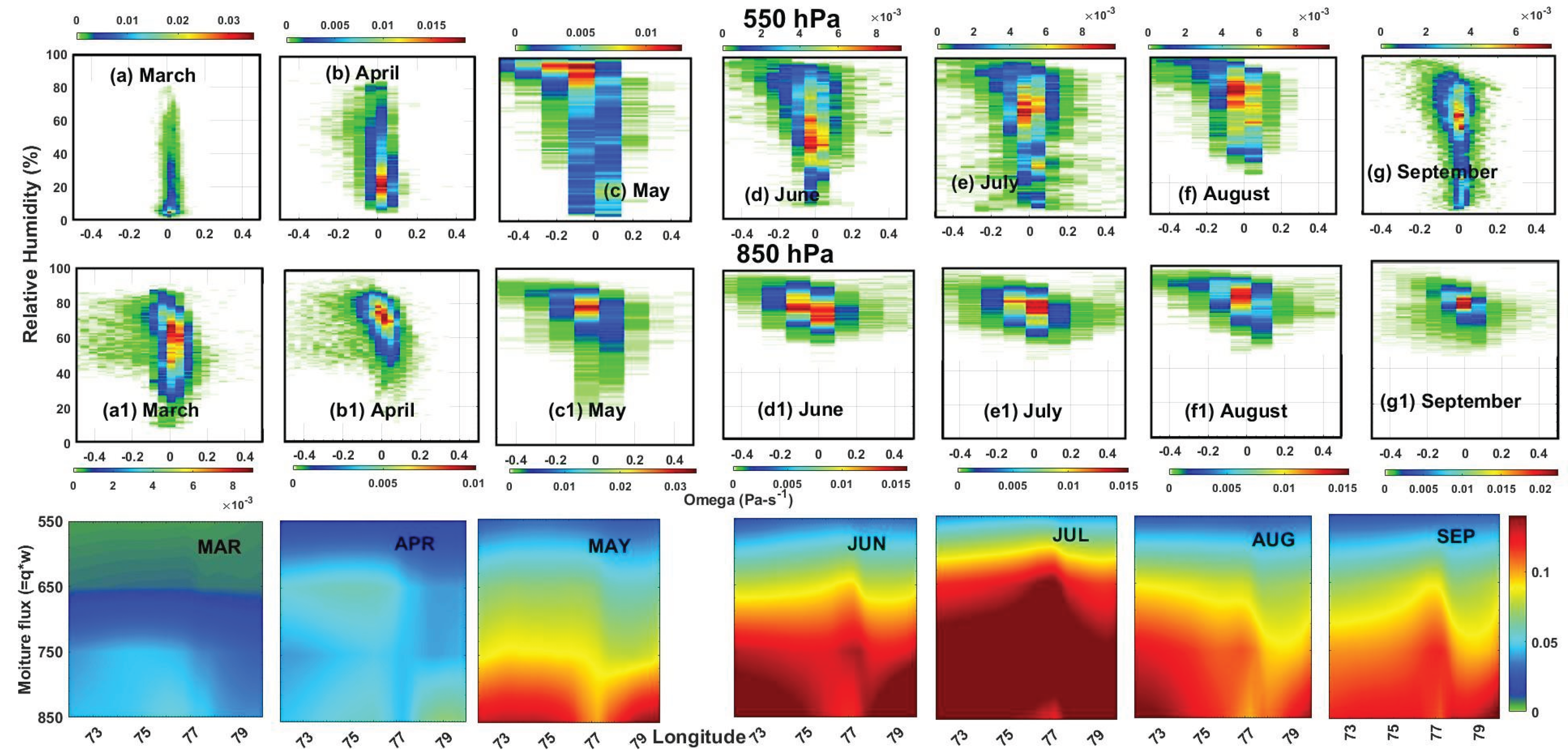
Figure 4 shows the joint histogram between the vertical velocity [w] and RH at 550 hPa [upper panel] and 850 hPa [middle panel] in different months. The histogram reveals the combined effect of dynamics and microphysics of the atmosphere. Histogram also shows the similar behaviour around positive and negative ‘w’ and is responsible for the less differences. This could be the possible region where spatial differences are observed over land and ocean, and only orographic features are showing some differences. From the histogram it is clear that March and April months are drier compared to the remaining months, with less updraft and downdraft. March and April months have the least RH, both at lower and middle atmosphere, and that could be the possible regions for the highest fraction of +ve S-Ze, and Ze decreases towards the surface and breakup may reduce the hydrometeors size [2,12,13,21,22]. The higher -ve average S-Ze [<2.5 dBZ-Km-1] near the coastal boundaries are associated with the lesser number of profiles. It also shows that the local advected moisture plays a vital role compared to large scale weather conditions. During the monsoon onset months [May month], the build up of low-level RH with both higher updraft and downdraft reduces the probability of evaporation and breakup and higher probability of -ve S-Ze where Ze increases towards the surface compared to previous months. Importantly, pre-monsoon months [April and May] a dip is observed in RH at the windward side of the WGs, whereas we observe an upslope increase of RH in June and July months.
During the monsoon months, a higher RH is observed at the lower levels [850 hPa; middle row], but at the higher pressure level [850 hPa] the contour of maximum RH is less compared to pre-monsoon months. The differences are also higher at higher altitudes [850 hPa], with strong updraft and downdraft probability. Vertically, June and July months have the highest RH and the main differences are observed in June and July months where a higher RH with downdraft. This could be related with the two effects, one a convective outburst produces the higher RH at low level, and cognitive for the future convection. A second possibility also exists, where the evaporation of stratiform precipitation with less rain rate could evaporate during their downward journey and contribute to low level RH [44,45]. After the July month, the reduction in RH again affects the slopes and an increase in the +ve S-Ze are observed in the drier atmosphere. During the withdrawal of the monsoon seasons e.g., August and September months, again we see a dip in RH near the topographic altitudes. August and September months have less RH compared to previous months. The effect of drier atmosphere is more visible and possibility of breakup is high. However under the higher RH condition still we have a higher fraction of positive slopes and may be related with the evaporation of smaller sized hydrometeors in stratiform or convective outburst and during the monsoon seasons. As the monsoon widthdrawn the September months become drier and there is an increase of +ve S-Ze are observed.
The observed differences in the present and earlier study are based on the TRMM and GPM data because of the temporal and spatial differences in measurement. First, C-band provides the continuous observations of precipitation and thus it captures the observations during initial, mature and dissipating phases compared to TRMM/GPM based observations, which most of time provides the observations mostly during mature phases [17,24,46]. The present study is dominated by the stratiform precipitation and thus showing the more +ve S-Ze compared to TRMM based observations [12,13]. Since the mature and dissipating phases are dominated by the stratiform precipitation [greater than ~70-80%] and thus present study basically provides the variation of Ze in stratiform precipitation [12,13]. The highest Ze are observed at ~4km altitude during the stratiform precipitation and may affect the results presented in the study [2,12,13,21,22,47,48]. The second regions behind the contrasting feature between the current and previous satellite based observations are because of the sensitivity [minimum detectable dBZ] of the both the radar. TRMM has much higher sensitivity [~17 dBZ] compared to C-band [~5 dBZ]. Uma and Sama [36] showed that 60% of storms are congested over THUMBA during the monsoon seasons.
4. Conclusions
The main conclusions from the present study are listed below:
1. The differences in S-Ze during the pre-monsoon and monsoon months are observed and land-ocean contrasts are higher during the pre-monsoon months. The north-south differences in the S-Ze are higher compared to land-ocean contrast, and higher in monsoon months.
2. Changes in the S-Ze near the coastal boundaries are significant during the monsoon months compared to pre-monsoon months. It reflected the role of the advected moisture from the Arabian Sea to the study periods.
3. The average S-Ze shows the highest -ve S-Ze, during March and April months near the coastal boundaries and associates with the lesser number of profiles.
4. Monsoonal months have the less increase or decrease in the hydrometeors size compared to pre-monsoon months, whereas precipitation is more of a convective nature.
5. During the earlier pre-monsoon months thermodynamic conditions are more important, where in the drier atmosphere Ze tends to decrease towards the surface. Whereas during the monsoon months the dynamics of convective and stratiform precipitation, and either evaporation during the stratiform precipitation along with the convective outburst may increase the lower level RH.
The differences in S-Ze allow for a deeper comprehension of precipitation microphysics and offer practical guidance for enhancing radar rainfall estimation in operational meteorology. Moreover, heavy rainfall can lead to attenuation in the C-band radar, influencing the calculation of S-Ze. This research indicates that exploring the mechanisms behind the occurrence of S-Ze patterns in the pre-monsoon and monsoon months could enhance the understanding of monsoon variability. The slopes presented here provide the combined effect of monsoon onset wind and moisture characteristics. However a detailed analysis is required with more ground based observations to understand the pre-monsoon to monsoon variability in the lower atmosphere. The results presented here would be an extension of the study from the satellite based observations, and reveals the extension climatology of inclusion of stratiform precipitation.
Author Contributions
Supervision, conceptualization, analysis, writing, editing.
Conflicts of Interest
No potential conflict of interest was reported by the author.
References
- Bellon, A., G. W. Lee, and I. Zawadzki. 2005. Error Statistics of VPR Corrections in Stratiform Precipitation. Journal of Applied Meteorology 44 [7]: 998–1015.
- Liu, C., and E. J. Zipser. 2013. Why Does Radar Reflectivity Tend to Increase Downward Toward the Ocean Surface, but Decrease Downward Toward the Land Surface? Journal of Geophysical Research Atmospheres 118 [1]: 135–148.
- Li, X., and R. C. Srivastava. 2001. An Analytical Solution for Raindrop Evaporation and Its Application to Radar Rainfall Measurements. Journal of Applied Meteorology 40 [9]: 1607–1616.
- Adler, R. F., G. J. Huffman, A. Chang, R. Ferraro, P.-P. Xie, J. Janowiak, B. Rudolf, et al. 2003. “The Version-2 Global Precipitation Climatology Project (GPCP) Monthly Precipitation Analysis (1979– Present). J Hydrometeor 4 (6): 1147–1167.
- Kumjian, M.R.; Prat, O.P. The impact of raindrop collisional processes on the polarimetric radar variables. J. Atmos. Sci. 2014, 71, 3052–3067.
- Huang, H.; Chen, F. Precipitation Microphysics of Tropical Cyclones Over the Western North Pacific Based on GPM DPR Observations: A Preliminary Analysis. J. Geophys. Res. Atmos. 2019, 124, 3124–3142.
- Del Castillo-Velarde C, Kumar S, Valdivia-Prado JM, Moya-Álvarez AS, Flores-Rojas JL, Villalobos-Puma E, Martínez-Castro D, Silva-Vidal Y (2021) Evaluation of GPM dual-frequency precipitation radar algorithms to estimate drop size distribution parameters, using ground-based measurement over the central Andes of Peru. Earth Syst Environment 5:597–619.
- Li, Q.; Sun, X.; Liu, X.; Li, H. Linkage Between Radar Reflectivity Slope and Raindrop Size Distribution in Precipitation with Bright Bands. Remote Sens. 2025, 17, 2393. https:// doi.org/10.3390/rs17142393.
- Fu, Y., Y. Lin, G. Liu, and Q. Wang. 2003. “Seasonal Characteristics of Precipitation in 1998 Over East Asia as Derived from TRMM PR. Advances in Atmospheric Sciences 20:511–529.
- Liu G, Fu Y (2001) The characteristics of tropical precipitation profles as inferred from satellite radar measurements. J Meteor Soc Japan 79:131–143.
- Das, S., A. K. Shukla, and A. Maitra. 2016. “Investigation of Vertical Profile of Rain Microstructure at Ahmedabad in Indian Tropical Region. Advances in Space Research 45 [10]: 1235–1243.
- Kumar, S. 2024. “Regional and Seasonal Differences of Radar Reflectivity Slopes in Lower Troposphere in Convective and Stratiform Precipitation Using TRMM PR Data. Theoretical and Applied Climatology 155 [4]: 2719–2728.
- Shailendra Kumar (2024) Investigation of radar reflectivity profiles below the freezing level over South East South Asia using TRMM and Megha-Tropiques satellites, Remote Sensing Letters, 15:12, 1250-1258.
- Parker, M. D., and R. H. Johnson. 2000. “Organizational Modes of Midlatitude Mesoscale Convective Systems. Monthly Weather Review 128 [10]: 3413–3436.
- Rutledge, S. A., and R. A. Houze Jr. 1987. “A Diagnostic Modelling Study of the Trailing Stratiform Region of a Midlatitude Squall Line. Journal of the Atmospheric Sciences 44 [18]: 2640–2656.
- Leary, C. A., and R. A. Houze. 1979. “The Structure and Evolution of Convection in a Tropical Cloud Cluster. Journal of the Atmospheric Sciences 36 [3]: 437–457.
- Kumar, S., and G. S. Bhat. 2019. “Frequency of a State of Cloud Systems Over Tropical Warm Ocean. Environmental Research Communications 1 [6]: 061003.
- Kumar, S., C. D. Castillo-Velarde, J. L. Flores Rojas, A. Moya-Álvarez, D. Martínez Castro, S. Srivastava, and Y. Silva. 2020. “Precipitation Structure During Various Phases the Life Cycle of Precipitating Cloud Systems Using Geostationary Satellite and Space-Based Precipitation Radar Over Peru. GIScience & Remote Sensing 57 [8]: 1057–1082.
- Kumar, S. and Srivastava, S. (2022). Vertical characteristics of precipitating cloud systems during different phases of life cycle of cloud systems using satellite-based radar over tropical oceanic areas. Journal of Applied and Natural Science, 14(4), 1272–1285. https://doi.org/10.31018/jans.v14i4.3691.
- Cifelli, R., S. W. Nesbitt, S. A. Rutledge, W. A. Petersen, and S. Yuter. 2007. “Radar Characteristics of Precipitation Features in the EPIC and TEPPS Regions of the East Pacific. Monthly Weather Review 135 [4]: 1576–1595.
- Hirose, M., K. Nakamura. 2002. “Spatial and Seasonal Variation of Rain Profiles Over Asia Observed by Space Borne Precipitation Radar. Journal of Climate 15 [23]: 3443–3458.
- Hirose, M., and K. Nakamura. 2004. “Spatiotemporal Variation of the Vertical Gradient of Rainfall Rate Observed by the TRMM Precipitation Radar. Journal of Climate 17 [17]: 3378–3397.
- Gray, W.M, and R.W. Jr. Jacobson, 1977: Diurnal variation of deep cumulus convection. Mon. Wea. Rev., 105,1171-1188.
- Imaoka, K., and K. Nakamura. 2012. “Statistical Analysis of the Life Cycle of Isolated Tropical Cold Cloud Systems Using MTSAT-1R and TRMM Data. Monthly Weather Review 140 [11]: 3552–3572.
- Sambit Kumar Panda, Bipasha Paul Shukla, and Prashant Kumar, Clutter Mitigation and 3D volumetric gridding of TERLS DWR Reflectivity Data (V1.0), SAC Report,.
- Kumar KK, Subrahmanyam KV, Kumar CP, Shanmugasundari J, Koushik N, Ajith RP, Girija Devi L (2020) C-band dual-polarization Doppler weather radar at Thumba (8.537° N, 76.865° E): initial results and validation. J Appl Remote Sens 14(4):044509– 044509.
- Subrahmanyam KV, Kumar KK (2022a) C-band polarimetric doppler weather radar observations during an extreme precipitation event and associated dynamics over Peninsular India. Nat Hazards 114(2):1307–1322.
- Kalnay, E., M. Kanamitsu, R. Kistler, W. Collins, D. Deaven, L. Gandin, M. Iredell, et al. 1996. “The NCEP/ NCAR 40-Year Reanalysis Project. Bulletin of the American Meteorological Society 77 [3]: 437–471.
- Fabry, F., and I. Zawadzki. 1995. “Long-Term Radar Observations of the Melting Layer of Precipitation and Their Interpretation. Journal of the Atmospheric Sciences 52 [7]: 838–851.
- Vignal B, Galli G, Joss J, Germann U (2000) Three methods to determine profles of refectivity from volumetric radar data to correct precipitation estimates. J Appl Meteor 39:1715–1726.
- Johnson RH, Aves SL, Ciesielski PE, Keenan TD (2005) Organization of oceanic convection during the onset of the 1998 East Asian summer monsoon. Mon Wea Rev 133:131–148.
- Yuter SE, Houze RA Jr, Smith EA, Wilheit TT, Zipser EJ (2005) Physical characterization of tropical oceanic convection observed in KWAJEX. J Appl Meteor 44:385–415.
- Zipser EJ, Lutz K (1994) The vertical profle of radar refectivity of convective cells a strong indicator of storm intensity and lightning probability. Mon Weather Rev 122:1751–1759.
- Li, Q.; Sun, X.; Liu, X.; Li, H. Linkage Between Radar Reflectivity Slope and Raindrop Size Distribution in Precipitation with Bright Bands. Remote Sens. 2025, 17, 2393. [CrossRef]
- Szoke EJ, Zipser EJ (1986) A radar study of convective cells in mesoscale systems inGATE Part II: Life cycles of convective cells. J Atmos Sci 43:199–218.
- Uma, K.N. and Sama, B., 2025. Characteristics of monsoon convection and its interaction with the large-scale environment over the gateway of the Indian summer monsoon: insights from radar observations and reanalysis. Climate Dynamics, 63(10), p.379.
- Romatschke U, Houze RA Jr (2011) Characteristics of precipitating convective systems in the South Asian monsoon. J Hydrometeorol 12:3–26.
- Subrahmanyam KV, Kumar KK (2023) Characterization of deep convective cells during the Indian summer monsoon using C-band polarimetric Doppler Weather Radar observations over Thumba (8.5 o N, 77o E). Remote Sens Appl Soc Environ 30:100956.
- Trenberth, K. E., 1999: Atmospheric moisture recycling: Role of ad- vection and local evaporation. J. Climate, 12, 1368–1381.
- Kumjian, M.R.; Prat, O.P. The impact of raindrop collisional processes on the polarimetric radar variables. J. Atmos. Sci. 2014, 71, 3052–3067.
- Schumacher, C., and R. A. Houze Jr. 2003. “The TRMM Precipitation Radar’s View of Shallow, Isolated Rain. Journal of Applied Meteorology 42 [10]: 1519–1524.
- Lucas, C., E. J. Zipser, and M. A. LeMone. 1994. “Vertical Velocity in Oceanic Convection off Tropical Australia. Journal of the Atmospheric Sciences 51 [21]: 3183–3193.
- Houze, R. A. 2012. “Orographic Effects on Precipitating Clouds. Reviews of Geophysics 50.
- Kumar S (2025) Precipitation structure and convective intensity Over South-East South Asia during active and break spells of the Indian summer monsoon using TRMM, GPM, megha-tropiques satellites and reanalysis data. Int J Climato 45(5):e8758.
- Kumar S [2025] Diferences in the convective variability during active and break spells over South Asian region using 25 years of satellite observations and reanalysis data; Theoretical and Applied Climatology, 156:415.
- Kondo, Y., Higuchi, A. & Nakamura, K. (2006). Smallscale cloud activity over the Maritime Continent and the Western Pacific as revealed by satellite data. Monthly Weather Review, 134, 1581–1599.
- Houze RA Jr, Wilton DC, Smull FB (2007) Monsoon convection in the Himalayan region as seen by the TRMM precipitation radar. Q J Roy Meteorol Soc 133:1389–1411.
- Kumar S (2018) Vertical structure of precipitating shallow echoes observed from TRMM during Indian summer monsoon. Theor App Climatol 133(3–4):1051–1059.
Figure 1.
[aa] Study regions used in the present study. Violet color shows the location of C-band radar. The colorbar shows the topographic altitude of Western Ghats included in the present study. Top row and bottom row [a-n]: number of c-band based radar reflectivity profiles used in the present study for pre-monsoon and monsoon months. Top row [a-g] corresponds to positive slopes [Ze decreases towards the surface], whereas bottom row [h-n] corresponds to negative slopes [Ze increases towards the surface] for pre-monsoon and monsoon months.
Figure 1.
[aa] Study regions used in the present study. Violet color shows the location of C-band radar. The colorbar shows the topographic altitude of Western Ghats included in the present study. Top row and bottom row [a-n]: number of c-band based radar reflectivity profiles used in the present study for pre-monsoon and monsoon months. Top row [a-g] corresponds to positive slopes [Ze decreases towards the surface], whereas bottom row [h-n] corresponds to negative slopes [Ze increases towards the surface] for pre-monsoon and monsoon months.
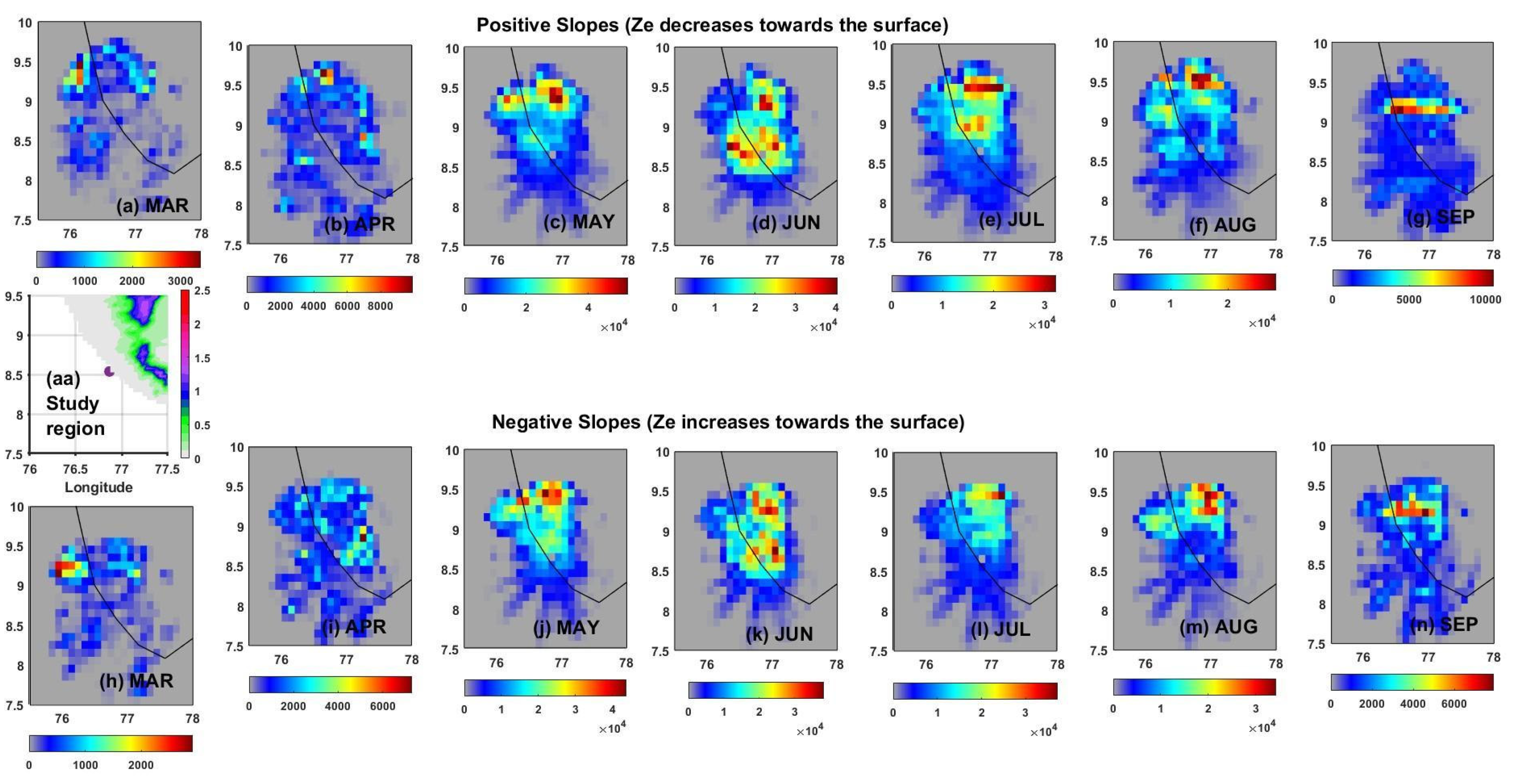
Figure 2.
[a] Study regions used in the present study. Violet color shows the location of C-band radar. The colorbar shows the topographic altitude of Western Ghats included in the present study. [b] Boxplot of the monthly radar reflectivity slopes used in the present study. [c] Cumulative frequency distribution of radar reflectivity slopes for pre-monsoon and monsoon months. [d-j] Spatial distribution of positive radar reflectivity slopes [Ze is decreasing towards the surface] in each 0.1o x 0.1o grid boxes for pre-monsoon and monsoon months. [d1-j1] Spatial distribution of negative radar reflectivity slopes [Ze is increasing towards the surface] in each 0.1o x 0.1o grid boxes for pre-monsoon and monsoon months.
Figure 2.
[a] Study regions used in the present study. Violet color shows the location of C-band radar. The colorbar shows the topographic altitude of Western Ghats included in the present study. [b] Boxplot of the monthly radar reflectivity slopes used in the present study. [c] Cumulative frequency distribution of radar reflectivity slopes for pre-monsoon and monsoon months. [d-j] Spatial distribution of positive radar reflectivity slopes [Ze is decreasing towards the surface] in each 0.1o x 0.1o grid boxes for pre-monsoon and monsoon months. [d1-j1] Spatial distribution of negative radar reflectivity slopes [Ze is increasing towards the surface] in each 0.1o x 0.1o grid boxes for pre-monsoon and monsoon months.
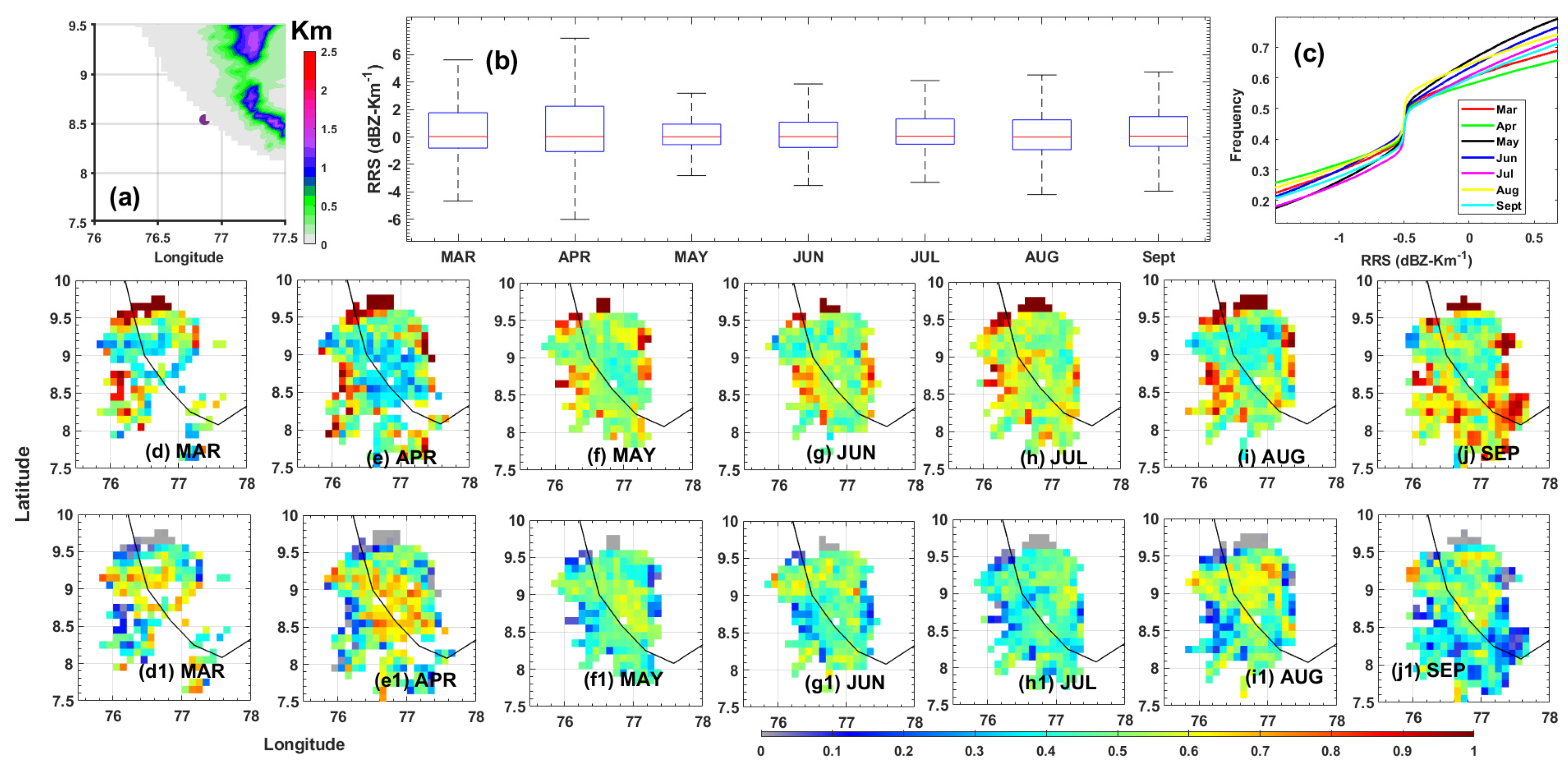
Figure 3.
[Top row] Spatial distribution of average of positive radar reflectivity slopes [Ze is decreasing towards the surface] in each 0.1o x 0.1o grid box for pre-monsoon and monsoon months. [Bottom row] Spatial distribution of negative radar reflectivity slopes [Ze is increasing towards the surface] in each 0.1o x 0.1o grid box for pre-monsoon and monsoon months.
Figure 3.
[Top row] Spatial distribution of average of positive radar reflectivity slopes [Ze is decreasing towards the surface] in each 0.1o x 0.1o grid box for pre-monsoon and monsoon months. [Bottom row] Spatial distribution of negative radar reflectivity slopes [Ze is increasing towards the surface] in each 0.1o x 0.1o grid box for pre-monsoon and monsoon months.
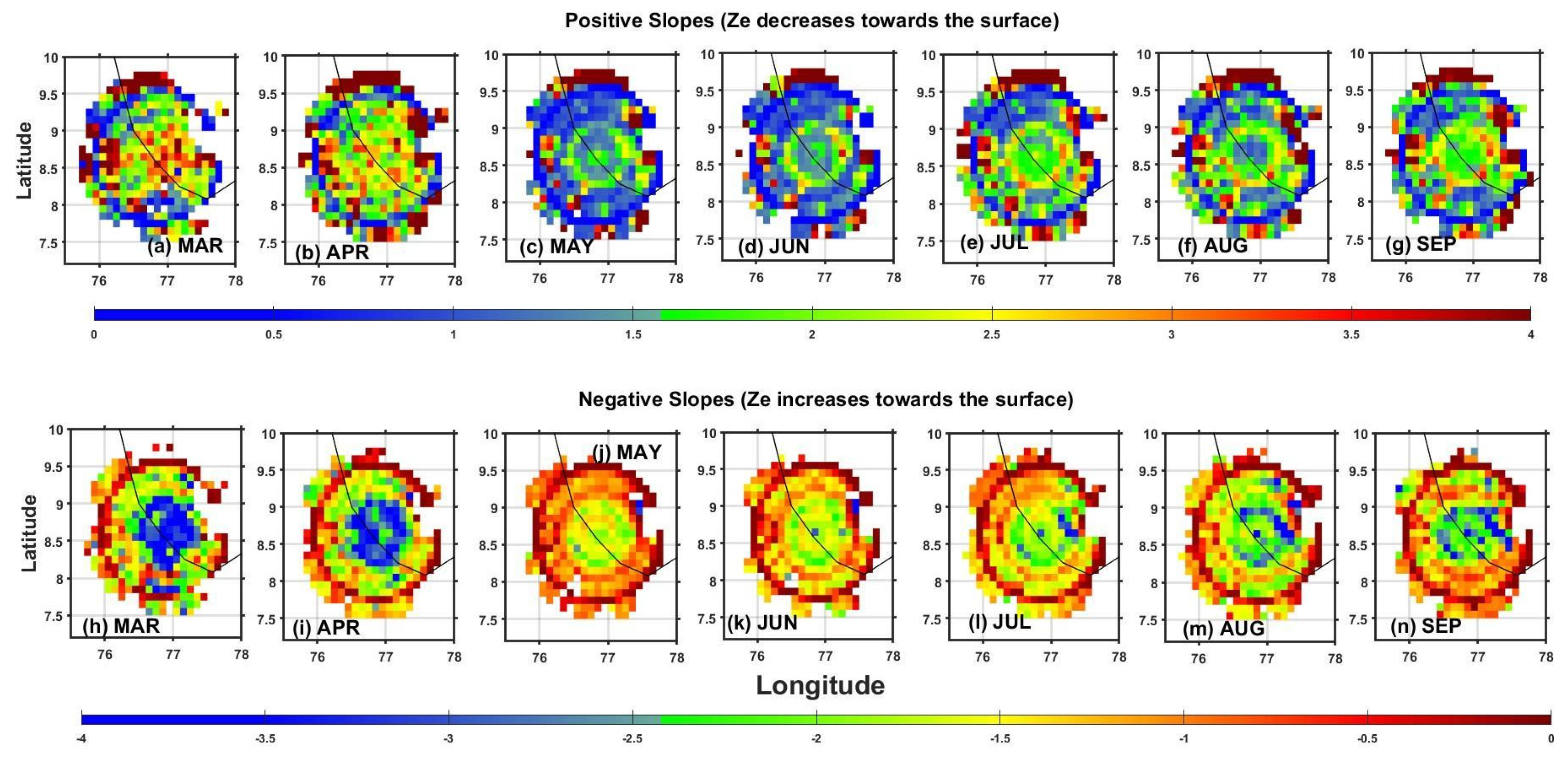
Figure 4.
Top row: A joint histogram between the relative humidity and vertical velocity [‘w’<0 [updraft] and ‘w’>0 [downdraft]] at 550 hPa for pre-monsoon and monsoon months. Middle row: A joint histogram between the relative humidity and vertical velocity [‘w’<0 [updraft] and ‘w’>0 [downdraft]] at at 850 hP for pre-monsoon and monsoon months. [c] Bottom row: vertical zonal variations of transported moisture [=q.v] during pre-monsoon to monsoon months for pre-monsoon and monsoon months.
Figure 4.
Top row: A joint histogram between the relative humidity and vertical velocity [‘w’<0 [updraft] and ‘w’>0 [downdraft]] at 550 hPa for pre-monsoon and monsoon months. Middle row: A joint histogram between the relative humidity and vertical velocity [‘w’<0 [updraft] and ‘w’>0 [downdraft]] at at 850 hP for pre-monsoon and monsoon months. [c] Bottom row: vertical zonal variations of transported moisture [=q.v] during pre-monsoon to monsoon months for pre-monsoon and monsoon months.
Disclaimer/Publisher’s Note: The statements, opinions and data contained in all publications are solely those of the individual author(s) and contributor(s) and not of MDPI and/or the editor(s). MDPI and/or the editor(s) disclaim responsibility for any injury to people or property resulting from any ideas, methods, instructions or products referred to in the content. |
© 2026 by the authors. Licensee MDPI, Basel, Switzerland. This article is an open access article distributed under the terms and conditions of the Creative Commons Attribution (CC BY) license (http://creativecommons.org/licenses/by/4.0/).
Copyright: This open access article is published under a Creative Commons CC BY 4.0 license, which permit the free download, distribution, and reuse, provided that the author and preprint are cited in any reuse.


