

Submitted:
31 March 2026
Posted:
01 April 2026
You are already at the latest version
Abstract
The aerodynamic behaviour of buildings equipped with porous outer envelopes is governed by the interaction between millimetre-scale geometric features and building-scale flow structures. Explicitly resolving these scales in numerical simulations is computationally prohibitive, making homogenised porous-medium formulations a practical alternative. Among them, the Darcy–Forchheimer (D–F) model is widely adopted; however, the reliability of building-scale predictions critically depends on how its resistance coefficients are identified and validated. This study proposes and assesses a consistent procedure for the determination and application of D–F coefficients for porous screens used in double-skin façade systems. Porous elements are first characterised at element scale through an analytical derivation based on aerodynamic force coefficients, from fully resolved CFD simulations of representative periodic modules. The resulting D–F coefficients are cross-compared and validated against available wind tunnel data. Secondly, the calibrated homogenised model is applied to a building-scale double-skin façade configuration. The porous layer is represented as a finite-thickness porous region governed by the identified D–F parameters and analysed through unsteady Reynolds-averaged Navier–Stokes simulations. The model’s capability to reproduce global aerodynamic loads, local pressure distributions, and wake characteristics is evaluated against experimental data. The results demonstrate that a properly calibrated D–F formulation provides an accurate and computationally efficient representation of porous façade systems, bridging element-scale characterisation and structural-scale aerodynamic performance.
Keywords:
permeable double skin façades
; porous screens
; porosity
; CFD
; darcy-forchheimer
1. Introduction
Porous envelopes such as perforated panels, expanded meshes, and louvers are increasingly adopted in civil engineering as passive devices to mitigate wind effects. In buildings, these elements are frequently integrated as outer skins, leading to permeable double-skin façade (PDSF) systems. By allowing partial airflow through the external layer, these systems modify the pressure distribution around the structure and alter wake development, influencing both global wind loads and local aerodynamic phenomena [1,2,3,4].
From a fluid-mechanics perspective, the aerodynamic behavior of structures equipped with porous envelopes constitutes a multi-scale problem. The characteristic dimensions of the porous elements are typically of the order of millimeters, whereas the building scale is measured in meters. Directly resolving the porous geometry in Computational Fluid Dynamics (CFD) requires capturing a wide range of spatial and turbulence scales, leading to prohibitive computational costs and severe mesh constraints [5,6,7].
A viable alternative consists in adopting homogenized porous-medium models, in which the detailed geometry is not explicitly resolved and its macroscopic aerodynamic effect is represented through additional momentum sink terms. Among the available formulations, the pressure-jump approach models the porous layer as a discontinuity with a prescribed resistance [8,9]. While computationally efficient, this formulation may suffer from numerical instability for low-porosity media and is limited in representing tangential stresses [10,11]. To mitigate those problems, and to improve the performance of the pressure-jump approach, Xu et al. [11,12] proposed the so-called pressure-velocity jump approach to account for the exchange of both normal and shear stresses between the porous cladding and the fluid, even at highly skewed orientations. Another explored solution is the Darcy–Forchheimer (D–F) model, which distributes viscous and inertial pressure losses across a finite porous thickness [13,14]. In high-Reynolds-number flows typical of wind engineering applications, the inertial (Forchheimer) contribution dominates, allowing simplified parameterizations [15,16]. The porous medium is commonly represented through diagonal components of a resistance tensor [17], although more complex geometries such as louvers or expanded meshes may require a full matrix representation to capture anisotropic effects [18,19].
The primary advantage of homogenized methods lies in their ability to reproduce the global aerodynamic effect of complex porous geometries using a limited set of coefficients. These coefficients can be derived experimentally [20], through semi-empirical correlations [21], or via fully resolved numerical simulations [16]. Despite the use of porous-media models has gained significant attention in wind engineering and wind energy applications [4,11,22,23], two critical aspects remain insufficiently addressed in a systematic manner:
- 1.
- How to consistently determine the input coefficients of the homogenized model starting from the geometrical properties of the porous screen;
- 2.
- How to verify the accuracy of the homogenized representation when the porous layer is coupled with a solid façade in a realistic building-scale configuration.
Existing studies typically focus either on coefficient derivation at element scale or on large-scale applications assuming pre-calibrated parameters. A comprehensive framework that links geometrical characterization, coefficient identification, and structural-scale validation is still lacking.
The main contribution of this work is twofold: (i) the definition of a practical and validated procedure to determine Darcy–Forchheimer coefficients directly from porous-screen geometry, and (ii) the verification of the accuracy and transferability of the homogenised model when applied to a building-scale double-skin façade configuration.
By addressing coefficient identification and large-scale validation within a unified framework, the study contributes toward establishing a consistent predictive methodology for porous envelopes in wind engineering applications.
2. Methodology
The methodological framework adopted in this study is structured in two consecutive parts. The first part addresses the aerodynamic characterisation of porous screens and the identification of the corresponding D-F coefficients. The second part evaluates the validity and transferability of the identified coefficients when applied to a building-scale double-skin façade configuration. The overall workflow moves from element-scale characterisation to building-scale application.
2.1. Porosity Characterisation and Identification of D–F Coefficients
The objective of the first part is to establish a consistent procedure for deriving homogenised D–F coefficients starting from the geometrical description of a porous screen. In this stage, a planar porous configuration is considered, as shown in Figure 1. The selected geometry consists of a perforated panel with a thickness of 2 mm and square openings with hydraulic diameter (with P the perimeter of an individual hole and its area), resulting in a porosity (ratio of open to total area) equal to 65.8%. This pattern is adopted as a representative case of planar permeable screens, as highlighted by [26], who demonstrated similar aerodynamic behaviour across planar configurations with different geometries.
The identification process follows a three-step workflow:
- 1.
-
Fully resolved CFD simulations are performed on representative periodic modules of the porous geometry to provide reference data. In this “modulus approach”, the actual perforation pattern is explicitly modelled within a computational domain designed to reproduce uniform inflow conditions. To capture the screen’s directional sensitivity, the inflow angle is systematically varied from to in the x-y plane by imposing an inlet velocity vector . A dataset of integrated aerodynamic forces is thus generated.Given the double symmetry of the perforated mesh under investigation, the resistance tensor is diagonal, and no variation in the x-z plane is necessary as the aerodynamic behaviour in that plane is assumed to be identical to the x-y plane.
- 2.
- The forces–velocity relationship obtained from the simulations is then mapped into the analytical model developed by Marykovskiy et al. [16] that links the Darcy–Forchheimer tensorial formulation with the measured physical quantities. The analytical formulation is briefly described in Appendix A.
- 3.
- A least-squares algorithm than is employed to minimize the residuals between the forces obtained from the resolved CFD simulations and the predictions derived from the analytical solution. The process identifies the optimal tensor components that provide the best fit across the tested angles. The obtained results are than validated against wind tunnel experimental data.
2.2. Application to Building Aerodynamics
In the second part of the study, the calibrated D-F model is applied to a building-scale configuration in which a porous screen acts as an outer layer of a double-skin façade system. In this context, the porous geometry is no longer resolved explicitly; instead, it is represented as a finite-thickness porous region governed by the homogenised D–F formulation derived in the first part.
A computational model of the building is developed to reproduce the relevant aerodynamic features of the installation context. The governing Navier–Stokes equations are modified to include momentum sink terms according to the D-F model within the porous region. Unsteady Reynolds-Averaged Navier–Stokes (URANS) simulations are performed to capture both mean and unsteady flow characteristics while maintaining computational efficiency at the structural scale.
Given that the primary objective is to assess the capability of the D–F model to reproduce the aerodynamic behaviour of porous double-skin façades, a sectional two-dimensional (2D) configuration is adopted. This modelling choice allows isolation of the fundamental flow–structure interaction mechanisms by excluding end effects and focusing on the coupling between the porous layer and the solid building core.
The assessment focuses on multiple levels of aerodynamic response. At the global level, overall force coefficients and related integral quantities are evaluated to determine the effect of the porous layer on the building’s wind loading. At the local level, pressure coefficient distributions on both the porous screen and the underlying solid façade are analysed to quantify pressure redistribution within the cavity and across the envelope. Finally, wake properties are investigated through analysis of velocity fields, vortex shedding behaviour, and characteristic frequencies, allowing verification of the model’s capability to reproduce unsteady aerodynamic phenomena.
The results obtained with the homogenised porous model are compared with experimental data from wind tunnel tests, where the building model is equipped with the permeable façade. This comparison enables assessment of the transferability of the identified D-F coefficients from simplified element-scale conditions to complex building-scale flow environments. Particular emphasis is placed on evaluating whether the homogenised approach can simultaneously reproduce global loads, local pressure effects, and wake dynamics without explicit resolution of the porous geometry.
The paper is structured as follows: in the Section 3, the experimental tests used for validation purposes are introduced. Afterwards, Section 4 describes the numerical setup employed for porosity characterization, the "modulus configuration" (subSection 4.1), and the application to building aerodynamics, the "sectional simulation " (subSection 4.2). Results are presented and discussed in order in Section 5 and conclusions are drawn in Section 6.
3. Experimental Setup
As previously anticipated, results of the building-scale simulations are validated against experimental data; therefore, this section briefly describes the wind tunnel setup and test conditions adopted as reference.
The experimental benchmark for this study is derived from a wind tunnel campaign aimed at characterizing the aerodynamic response of a square prism under different envelope conditions. The physical model consists of a rigid square prism with a side length m and an aspect ratio , representative of a typical high-rise building configuration (Figure 2). To capture the spatial and temporal variations of the surface pressure field, the model is equipped with 128 pressure taps distributed across four different levels.
For the validation of the 2D CFD sectional model, pressure data from the middle floor (Level 2, located at ) is selected. This choice is intended to minimize the influence of three-dimensional end-effects, such as the downwash from the free end and the upwash from the floor, which are known to alter wake coherence and the vortex-shedding mechanism [24,25].
Two distinct façade configurations are implemented on the same model:
- Naked configuration: Simulating a standard single-glazed cladding system (Figure 2a).
- Porous configuration: Replicating a permeable double-skin façade (PDSF) by integrating a perforated mesh (Figure 2b). The shroud, described in Section 2.1 is positioned at a distance from the primary solid façade.
All tests are conducted in the atmospheric boundary layer section of the Politecnico di Milano Wind Tunnel (GVPM) under smooth flow conditions (turbulence intensity , integral length scale m). Measurements are repeated at multiple flow velocities ( m/s) to ensure Reynolds independence and verify the repeatability of the results. The reference velocity is monitored using a Pitot tube positioned upstream of the model at a height of from the wind tunnel floor.
The aerodynamic quantities extracted from the experimental data and subsequently used for CFD validation include:
- Global force coefficients: the instantaneous drag and lift coefficients are calculated as:where is the aerodynamic force obtained by integrating the surface pressures on Level 2, is the characteristic dimension, and is the tributary height of the considered level.
- Strouhal number: the non-dimensional vortex-shedding frequency is defined as:where is identified as the dominant peak in the power spectral density (PSD) of the cross-wind force.
- Local pressure coefficient: the surface pressure distribution is evaluated as:where is the instantaneous pressure at the tap location and is the static reference pressure.
4. Numerical Setup
All the numerical simulations are performed using the open-source CFD software OpenFOAM v2112, which utilizes a finite-volume method for the spatial discretization of the governing equations [27]. The flow is treated as incompressible, and the turbulence closure is achieved through the URANS equations. The k- SST (Shear Stress Transport) model is selected to describe the turbulent viscosity.
This modelling approach is chosen to balance predictive accuracy with computational efficiency, representing a well-established standard for the aerodynamic characterization of porous media [9,26,28] and for investigating fluid–structure interaction (FSI) in sectional models [6,7,29,30]. In the following sections, the specific numerical setups for both the modulus-scale and the building-slice simulations are detailed, alongside the experimental wind tunnel benchmarks used for validation.
4.1. Modulus Simulations
For the aerodynamic characterization of the porous medium, steady-state RANS simulations are employed. Since the study focuses on the estimation of time-averaged aerodynamic loads, the RANS approach represents the standard and most practical choice in accordance with established porous media literature [9,26,28].
The solver employed is simpleFoam, utilizing the standard SIMPLE pressure–velocity coupling algorithm. Convective terms are discretised using second-order upwind schemes, while diffusive terms adopt central differencing. Gradients are linearly interpolated, and turbulence quantities rely on wall functions for k, , and turbulent viscosity . Adaptive low-Re wall functions available in OpenFOAM (e.g., kqRWallFunction and omegaWallFunction) are selected to ensure physical consistency at all values [33], allowing the model to correctly resolve the boundary layer regardless of local mesh refinement. Convergence is enforced by monitoring both residual decay, required to fall below for momentum and for turbulence variables, and the stability of the integral forces monitored on the plate.
The modulus domain represents the elementary periodic unit cell of the perforated element. By defining all lateral faces as cyclic boundary conditions, the model simulates an infinitely periodic plate, effectively isolating the intrinsic aerodynamic properties of the medium from edge- or frame-induced disturbances (see Figure 3). The objective is to characterize the drag and lift action on the plate at different angles of attack (); thus, the inlet velocity vector has been defined via its projected components. For the analysis of skew inflow, angles of attack from to with a step have been tested. The inlet velocity components are prescribed as:
where the secondary direction corresponds to the in-plane periodic direction of the modulus. The imposed boundary conditions are detailed in Table 1. To summarize, a fixed static pressure is prescribed at the outlet, lateral faces are defined as cyclic, and the plate surfaces are treated as no-slip walls with appropriate wall functions. Simulations are repeated at three streamwise velocities (4,5 and 10 m/s) to verify the -independency of the results. The modulus has a constant thickness mm and a gross area , consistent with the experimental samples.
In the implicit simulation, the explicit plate geometry (Figure 3b) is substituted with a homogeneous set of cells of the same dimensions (Figure 3c). Within this zone, the Darcy–Forchheimer porosity treatment is active, utilizing coefficients derived from the explicit simulations. Further details are reported in Section 4.4. To ensure a consistent comparison, the mesh properties are kept constant between the two modelling approaches.
For all simulations, the integrated forces on the perforated surface or the porous slab are extracted to calculate the drag and lift coefficients. In the following sections, results are discussed using as the primary aerodynamic load descriptor.
4.1.1. Mesh Generation and Independence Study
The mesh is generated with blockMesh and snappyHexMesh, following a consistent refinement strategy. Coarser background regions are combined with progressively refined boxes around the plate. The final mesh is characterized by a total of cells, with a minimum cell size of approximately mm near the perforation edges (Figure Table 1b). This small element size grants an adequate resolution of the geometry (see Table 2, metric) and a maximum lower than 10.
A mesh-independence analysis is performed by repeating selected simulations on systematically refined grids to ensure numerical convergence. Table 2 presents the drag coefficients at zero attach angle . Three mesh resolutions, coarse, standard, and fine, are compared. The aerodynamic loads showed negligible variations (below 1%) between the standard and fine refinements, indicating that the adopted resolution is sufficient to provide mesh-independent results for all investigated geometries.
4.2. Sectional Simulations
The second phase of the investigation analyzes the aerodynamic behavior of a square cylinder () equipped with a porous envelope through 2D URANS simulations. The study focuses on both global and local aerodynamics, evaluating the total lift and drag coefficients, vortex-shedding characteristics, and the pressure distribution on the façades once a statistically steady-state regime is reached.
In this study, a 2D approach is adopted, implying that an infinite sectional model of the prism is considered. Under this condition, the flow is assumed to be fully correlated along the spanwise direction. This simplification offers two primary advantages: (i) it significantly reduces the computational cost by reducing the cell count, thereby enabling an extensive parametric investigation across multiple configurations; and (ii) it allows for the isolation of porosity-induced effects by eliminating the influence of end-effects and other complex finite-geometry phenomena.
Admittedly, validating a 2D numerical model against 3D experimental data from wind tunnel (WT) tests presents challenges, as end-effects, such as tip-vortices and downwash, can significantly modify both local and global aerodynamic quantities [24,25]. However, this approach is justified by the current scarcity of literature data on porous-shrouded structures suitable for validation and the necessity of establishing a fundamental, reproducible numerical benchmark. To mitigate the discrepancies between the 2D and 3D setups, experimental data from Floor 2 (middle level) of the model are selected as the reference for validation. This section is located sufficiently far from the free-end and the floor to approximate the two-dimensional flow behavior characterized by higher spanwise coherence.
The computational domain extends in the streamwise direction and in the cross-wind direction, as illustrated in Figure 4a. This expansive domain ensures a negligible blockage ratio and prevents boundary interference with the wake development, regardless of the angle of attack. At the inlet, a constant velocity U is prescribed with a zero-gradient pressure condition, while a fixed atmospheric pressure is set at the outlet. The upper and lower boundaries utilize symmetry conditions to simulate undisturbed free-stream flow, consistent with established practices for vortex-shedding studies on fixed prisms [7,31,32].
To reproduce skewed wind conditions, the inlet velocity components are defined as Equation 4.
The cylinder walls are modeled with no-slip conditions, utilizing adaptive low-Reynolds wall functions to maintain boundary layer consistency across the range. The boundary conditions are summarized in Table 4.
To simulate the porous envelope a special set of cells of thickness is placed at around the prism (see detail in Figure 4b), mimicking the experimental setup. Within this zone, the Darcy–Forchheimer porosity treatment is active, employing the coefficients derived from the modulus simulations. Further details are reported in Section 4.4.
High-fidelity spatial and temporal discretization is ensured via second-order numerical schemes. Time integration employs the Crank–Nicolson scheme. For cell-to-face interpolations, linear schemes are used, while gradient terms are discretized using a cell-limited Gauss scheme to ensure boundedness. Divergence terms are handled via Gauss linear schemes, and Laplacian terms utilize Gauss linear interpolation with a limited surface-normal gradient for non-orthogonal corrections. An adaptive time step is used to maintain a maximum Courant number of . Aerodynamic metrics are calculated over at least 10 vortex-shedding cycles after the initial transient phase has been discarded.

Table 4.
Boundary conditions for 2D slice domain.
| Field | Inlet | Outlet | Up/Down | Front/Back | Prism |
|---|---|---|---|---|---|
| p | zeroGradient | fixedValue | freestreamPressure | empty | zeroGradient |
| U | fixedValue (U) | inletOutlet | freestream | empty | noSlip |
| calculated | calculated | calculated | empty | nutkWallFunction | |
| k | fixedValue | inletOutlet | freestream | empty | kqRWallFunction |
| inletOutlet | inletOutlet | freestream | empty | omegaWallFunction |
4.3. Mesh Generation and Independence Study
The computational mesh, illustrated in Figure 4, consists of approximately 154,000 predominantly hexahedral cells, designed to provide high-resolution mapping of the velocity field within the domain. The grid is generated using the open-source utility Gmsh. Given the 2D nature of the simulation, the domain is defined with a single cell thickness in the spanwise (z) direction.
A progressive refinement strategy is implemented, transitioning from a background cell size of D in the far-field to a minimum resolution of at the prism walls. This refinement ensures a maximum dimensionless wall distance for the considered Reynolds numbers. Since shear layer separation and the resulting vortex dynamics are critically sensitive to edge sharpness and local gradients [34,35,36], specific care is devoted to the mesh topology near the trailing and leading edges, as highlighted in the detail view in Figure 4b.
To ensure the numerical solution is independent of the spatial discretization, a mesh independence study is conducted by systematically varying both the background cell dimensions and the refinement levels near the prism. The performance of the selected mesh is benchmarked against a finer grid configuration. The comparative results, summarized in Table 5, focus on the primary aerodynamic metrics: the Strouhal number (), the mean drag coefficient (), and the standard deviation of the lift coefficient (). The study indicates that the variations in these integral quantities are lower than , confirming that the adopted mesh provides a sufficient balance between computational economy and numerical accuracy.
4.4. Porous Medium Modelling
In both the implicit modulus configurations (Figure 3c) and the 2D building-scale simulations (Figure 4b), the porous envelope is modeled as a homogenized medium using the D-F approach. The porous layer is represented as a region of finite thickness t, where a momentum sink term is added to the Navier–Stokes equations to account for the flow resistance. According to the Darcy–Forchheimer law, this sink term is defined as:
where is the local velocity vector, is its magnitude, and are the fluid dynamic viscosity and density, respectively, and and are the Darcy (viscous) and Forchheimer (inertial) resistance tensors.
In wind engineering applications involving high-Reynolds-number flows through perforated screens or louvers, pressure-driven inertial losses significantly outweigh viscous stresses [16,23,26]. Consequently, the Darcy term () can be neglected. The modified momentum equation for incompressible flow thus becomes:
where represents the components of the Forchheimer resistance tensor :
The coefficients quantify the resistance force generated in direction i due to a velocity component in direction j. The tensor structure is dictated by the geometry of the porous medium. For the perforated mesh investigated in this study, the behavior is inherently orthotropic and aligned with the principal axes. Thus, the tensor is dominated by its diagonal terms (), which couple each velocity component to its respective resistance force. Off-diagonal terms are neglected as the present geometry does not induce significant "aerodynamic lift" (i.e., a force perpendicular to the local velocity vector), unlike tilted louver systems which would require a full matrix representation to capture directional steering.
Due to the axial symmetry of the perforations, the transverse components are assumed equal (), while their magnitude relative to the streamwise component () depends on the mesh thickness and openings’ geometry [16].
From a numerical perspective, the D-F model prescribes a distributed momentum loss. To ensure a physically consistent pressure drop across the thickness t, the computational mesh must provide sufficient resolution within the porous volume; consistent with literature findings, a minimum of 3–5 cells across the thickness is maintained to prevent numerical instabilities and ensure grid independence of the pressure jump [4,37].
5. Results and Discussion
This section presents the results following a multi-scale validation framework, moving from the porous element scale to the building scale.
5.1. Modulus Configuration - Aerodynamic Characterization of Porous Medium and Derivation of D–F Coefficients
This section presents the results of the identification procedure used to determine the Forchheimer resistance coefficients. The optimization procedure, taken from [16] and briefly described in Appendix A, performed for a reference thickness , yielded:
The high ratio between and reflects the strong directionality of the resistance, primarily concentrated in the direction normal to the screen plane.
To assess the fidelity of the homogenized model, a comparative analysis is presented in Figure 5. The force coefficients from the fully resolved simulations (explicit geometry, circle markers) are plotted against the results of the implicit simulations (Darcy–Forchheimer model, diamond markers).
The agreement between analytical and numerical approaches is excellent, with a maximum deviation below across the full range of attack angles. This confirms that the identified coefficients perfectly capture the directional aerodynamic resistance within the CFD environment. Furthermore, results are cross-validated against experimental drag data from Catania et al. [26] (black crosses). The procedure accurately reproduces the variation of the drag coefficient with the attack angle, with an absolute discrepancy of approximately , likely due to inherent differences between idealized periodic boundary conditions and experimental installation effects.
Figure 6 compares the pressure field () and velocity streamlines between explicit (top) and implicit (bottom) simulations for on the middle plane. The homogenized model accurately reproduces the upstream conditions and macroscopic pressure recovery downstream. However, localized discrepancies exist in the immediate near-wake (), where the explicit geometry shows complex recirculation bubbles and streamline deviations from individual perforations.
While the implicit model cannot capture these microscopic features, previous studies show that these effects vanish as distance increases, with negligible impact on the global pressure field [26,47]. In the building-scale setup, the gap is . Although this is within the near-wake region, the homogenized approach’s goal is to capture the overall momentum sink and pressure redistribution rather than small-scale local phenomena. This aspect is further clarified in the second part of the study, where the porous region is coupled with the solid façade and the resulting flow behaviour within the cavity between the two layers is analysed.
5.2. Preliminary Validation of the Building Sectional Model
To ensure the reliability of the numerical framework, the 2D sectional simulations are first validated against established literature data for a naked square cylinder. The configuration with an incidence angle of is selected as the benchmark, given the extensive availability of experimental and numerical studies for this case.
Table 6 summarizes the aerodynamic parameters obtained in the current study alongside reference values from different sources. The comparison includes Strouhal number, mean drag coefficient, and standard deviation of the lift coefficient. Overall, the metrics fall well within the range of established experimental and numerical studies for sectional models, confirming the effectiveness of the current URANS setup in capturing the global aerodynamic features of the square cylinder.
This correspondence is further confirmed by the local mean pressure coefficient distribution (), as shown in Figure 8. The numerical results (grey lines) exhibit a high degree of agreement with experimental data (red line, from [44]), with only a minor deviation observed near the trailing edges, a result consistent with the variations in drag coefficients reported in the cited literature.
However, a comparison between the 2D CFD results and the 3D experimental data (black dots, conducted on the tower configuration described in Section 3) reveals some discrepancies that can be ascribed to the different setups. As extensively discussed in the literature [24,25], the aerodynamic properties of a square cylinder shift when three-dimensional end-effects are present. In 3D configurations, tip vortices and the downwash from the free end reduce the wake size, leading to lower total drag, a decrease in vortex-shedding frequency (), and a mitigation of suction peaks on the lateral façades. These macroscopic differences are consistent with the expected flow behaviour: 2D simulations do not account for the vertical flow components and pressure equalization typical of finite-length cylinders.
Such differences can be qualitatively appreciated from Figure 7 where a snapshot of the 2D naked simulation is compared with a smoke visualization from the experimental tests. Despite the vortex generation follows the same pattern - further confirming that the comparison is still consistent, it seems that the experimental wave length is slightly shorter than the CFD one, likely due to the interaction with the downwash effect not explicitly reproduced in the numerical simulations.
While acknowledging these discrepancies, it should be noted that the scope of this study is not the high-fidelity replication of a specific 3D experimental setup, but rather the validation of the homogenized methodology in predicting the relative aerodynamic modifications induced by a porous envelope.
Consequently, to isolate the effect of the porous screen from the intrinsic 2D/3D modelling differences, the results are presented as a comparative study. By analyzing the relative variations between the "porous" and "naked" configurations within each respective setup (2D sectional CFD and Experimental), we can evaluate the transferability and predictive capability of the D-F model independently of the absolute values.
5.3. Building Sectional Model - Porous Layer Effect on Local and Global Aerodynamics
Table 7 reports the primary aerodynamic properties for both the simulated and tested configurations, with wind at . The presence of the porous envelope is observed to drastically reduce the intensity of the fluid–structure interaction.
The mean drag coefficient () is reduced by approximately switching from naked to porous configuration. This variation is consistent with previous studies on different geometries [23,32] and confirms the significant shielding effect provided by the porous envelope. Even more pronounced is the impact on the fluctuating aerodynamic forces: a reduction of in the standard deviation of the lift coefficient () is consistently observed in both experimental and CFD results. This sharp decrease, also documented in other experimental works such as [46], suggests the potential of employing permeable covers to mitigate periodic vortex-shedding excitation and, as demonstrated in [3], to suppress aeroelastic phenomena such as vortex-induced vibrations.
Regarding the vortex-shedding frequency, no significant variations are observed in the configurations equipped with the porous envelope. The Strouhal number remains within of the naked case, which is within the typical variability range for prisms of this aspect ratio. While [32] observed a shift in for a rectangular cylinder with an aspect ratio of due to the effective change in geometry induced by the shroud, such a modification is not observed in the present study. This is likely because the unit aspect ratio of the square cylinder remains unchanged by the addition of the concentric porous cover.
The local pressure peaks are also effectively damped. A reduction of in the absolute value of the suction peaks on the cross-wind faces () is measured in the 2D-CFD simulations, showing excellent agreement with the experimental counterpart. Figure 8 and Figure 9 compare the mean obtained from the simulations (bars) against experimental results (circles). Despite the fact that 2D sectional CFD simulations inherently estimate higher suction levels compared to the 3D experimental setup, the overall trends and distributions remain highly consistent.
5.4. Building Sectional Model - Flow Physics and Wake Topology
To identify the modifications induced by the presence of the porous layer, mean pressure and velocity fields, for naked and porous configurations, are presented in Figure 10a and Figure 10b respectively.
It results that the porous envelope acts as a filter, significantly modifying the pressure field, reducing both the lift fluctuations (as already shown in Table 7) on the solid façades and the suction intensity downstream of the leading edges. A new separation point at the edges of the porous envelope is created, leading to a new low-pressure region that effectively elongates and stretches the wake, shifting its recirculation center further downstream. This wake elongation is a primary factor in the observed reduction of the total drag coefficient.
Furthermore, the flow within the cavity (gap-flow between the solid and porous layer) contributes to a homogenization of the pressure distribution on the cross-wind faces. The normalized along-wind velocity field () in the porous configuration reveals a more coherent and slower recirculation zone compared to the naked case. This phenomenon is driven by the interaction between the flow separating from the envelope edges and the air circulating in the cavity between the two skins.
5.5. Sensitivity to Angle of Attack
To extend the analysis, the aerodynamic response is evaluated for additional wind angles of attack (). Figure 11 illustrates the ratios of the Strouhal number, mean drag coefficient, and standard deviation of the lift coefficient, between the porous and naked configurations. These plots compare numerical (2D sectional CFD) and experimental (WTT) results to quantify the contribution of the porous envelope across different orientations.
The consistency between experimental and CFD results observed for case is largely confirmed at higher angles of attack. The vortex-shedding frequency in the porous configuration remains close to that of the naked case, with a maximum reduction of approximately observed at (Figure 11a). The CFD simulations accurately capture this experimental trend.
The mean drag coefficient reduction remains consistent, ranging between and for all tested angles (Figure 11b). For the square-cylinder geometry, this confirms the omnidirectional mitigation effect provided by the porous envelope. Again, numerical results show high consistency with the experimental counterparts.
Regarding the lift coefficient fluctuations (Figure 11c), the CFD simulations predict a reduction oscillating between (for ) and (for ). Conversely, the wind tunnel tests show negligible variations at higher attack angles. To understand this difference, it is to note that, when , for the naked case, fluctuations of the lift coefficient drop to (compared to 0.15 at , as reported in Table 7), mainly due to the loss of spanwise coherence and the influence of the tip vortices, as already observed by [24]. When adding the porous layer, the entity of the lift fluctuations remains unchanged (leading to equal to 1), since the 3D effects keep dominating the fluid-structure interaction. Conversely, the CFD sectional model assumes perfect spatial coherence along the span, allowing for a more pronounced, albeit idealized, representation of the porous layer’s damping effect.
The mean pressure coefficient distributions for all tested angles and configurations are compared in Figure 12. The numerical results (bars) are superimposed on the experimental data (circles) to highlight both similarities and discrepancies. As observed at , the primary differences occur in the separated flow regions, specifically on the leeward and cross-wind faces. In the 2D CFD setup, the fully coherent flow separation results in higher pressure deficits compared to the 3D experimental case.
As shown in Figure 12a,b (), the simulations correctly describe the overall shape of the pressure distribution and the general aerodynamic behavior. However, the 2D model inherently predicts higher suction levels, leading to a consistent bias in both naked and porous configurations [24,25]. Furthermore, for , the experimental distributions appear flatter with reduced variations along the leeward edges, possibly due to interaction with the downwash vortex from the structure’s free end. These 3D effects account for the differences in absolute values between the two methods.
Nevertheless, it is noteworthy that the pressure distribution on the windward faces is captured with high accuracy in both configurations, even at high angles of attack. This is because the upwind regions are less sensitive to end-effects and experimental setup variations. Even in yawed conditions involving local separation and reattachment, the model correctly describes the underlying phenomenology. This is evident at (Figure 12c,d), where CFD and experimental distributions align, highlighting the capability of the D-F model to capture the filtering effect of the porous layer. Similar accuracy is observed at (Figure 12e,f), where the symmetric distributions are faithfully reproduced, capturing well the windward faces features.
In conclusion, despite the inherent limitations of 2D modeling, the results demonstrate that the overall aerodynamics and the variations induced by the porous envelope can be effectively described using the proposed homogenized approach. The Darcy–Forchheimer model, parametrized with coefficients derived from the introduced methodology, proves to be a robust and efficient tool for simulating complex façade configurations relevant for wind engineering applications.
6. Conclusions
This study presented a comprehensive multi-scale framework for the aerodynamic characterization and modelling of porous envelopes in building applications. By linking high-fidelity explicit simulations at the modulus scale with homogenized D–F representations at the building scale, this work provides a validated CFD-based workflow to investigate fluid–structure interaction in permeable double-skin façades.
The main findings and conclusions of this work are summarized as follows:
- The identification procedure for the Forchheimer resistance tensor proved highly accurate. The homogenized representation reproduced the aerodynamic forces of the explicit geometry with a deviation of less than at the modulus level and showed a robust agreement ( error) with experimental data.
- The application of the validated D–F model to a square cylinder demonstrated its applicability to the case of permeable double-skin configurations, by providing fair comparison with experimental and literature data. Despite the inherent differences in absolute suction levels between 2D URANS and 3D experimental setups due to end-effects, the model successfully captured the modifications induced by the porous layer and sensitivity to the angle of attack, confirming its validity as a comparative predictive tool.
- Following validation, the D-F model is used to characterize the aerodynamic influence of a porous envelope on a square cylinder, representative of a simplified building model. At , a reduction of approximately in the mean drag coefficient and a drastic reduction in lift fluctuations are observed; these trends remain consistent across higher angles of attack. The simulations also revealed a clear modification of the wake topology, where the porous medium elongates the recirculation region and displaces the wake center downstream, leading to a mitigation of suction on the structure.
Beyond the specific application presented in this study, the developed workflow provides a computationally efficient and reliable engineering tool for the design of PDSF systems. The viability demonstrated here lays the groundwork for more complex investigations. Future research can expand toward more intricate porous layer geometries, such as louvers or non-planar surfaces, which would necessitate a full-tensorial formulation of the D–F model. Additionally, future studies should address full-building cases to explicitly account for the 3D effects that were disregarded in the current sectional approach.
Author Contributions
Conceptualization, M.C. and G.P.; methodology, M.C. and G.P.; software, M.C.; validation, M.C. and G.P.; formal analysis, M.C. and G.P.; investigation, M.C. and G.P.; resources, P.S. and A.Z.; data curation, M.C.; writing—original draft preparation, M.C.; writing—review and editing, M.C. and G.P.; visualization, M.C. ; supervision, G.P. and A.Z.; project administration, P.S.; funding acquisition, P.S. and A.Z. All authors have read and agreed to the published version of the manuscript.
Funding
This research received no external funding.
Data Availability Statement
Dataset available on request from the authors.
Acknowledgments
This work was supported by the Italian Ministry of University and Research (MUR) within the framework of the PRIN 2022 project "SaFEx" (Prot. 2022F5M4HF, CUP D53C24004030006), which provided the experimental data used for the validation of the proposed methodology.
Conflicts of Interest
The authors declare no conflicts of interest.
Abbreviations
The following abbreviations are used in this manuscript:
| WTT | Wind Tunnel Tests |
| CFD | Computational Fluid Dynamic |
| URANS | Unsteady Reynolds Navier-Stokes Equations |
| D–F | Darcy-Forchheimer |
Appendix A. Analytical Computation of the D-F Coefficients
In this section, the analytical formulation of the fluid-structure forces derived by [16] and used in this study to identify the D-F coefficients is briefly reported. The control volume (CV) considered is the one described in Section 4.1.
In the case of a 2D flow through the porous screen in x-y plane, the wind speed vertical component can be considered null (), thus the momentum equation can be simplified as:
The analytical solution for , decoupled from the rest of the system allows to derive an explicit solution for p.
defining:
- ,
- ,
- , integration constants obtained by imposing proper boundary conditions
The analytical solutions of the pressure and flow fields derived above are exact, given the inviscid, incompressible, and steady-state assumption. Thus, a CFD finite-volume solver employing a porous medium though a Forchheimer sink term is expected to provide the same results. Therefore, these solutions create a link between the Forchheimer coefficients and the macroscopic behaviour of the porous model.
Total porous forces (equivalently the forces experienced by a portion of a permeable screen) can be obtained using a control volume:
where:
- is computed integrating forces acting throughout CV such as gravity
- is computed integrating the viscous stresses on the Control Surface (CS)
Disregarding gravitational and viscous forces in an incompressible steady flow, total porous resistance can be computed:
In the specific case of a cyclic domain:
where , , and t are the control volume dimensions for the permeable screen / equivalent porous media considered. For more information of the model derivation, please refer to [16].
References
- Zasso, A.; Perotti, F.; Rosa, L.; Schito, P.; Pomaranzi, G.; Daniotti, N. Wind pressure distribution on a porous double skin facade system. In Proc. XV Conf. Italian Assoc. Wind Eng.; Springer: Cham, 2019; pp. 730–741. [Google Scholar] [CrossRef]
- Teimourian, A.; Teimourian, H. Vortex Shedding Suppression: A Review on Modified Bluff Bodies. Eng. 2021, 2, 325–339. [Google Scholar] [CrossRef]
- Catania, M.; Pomaranzi, G.; Zasso, A. The role of Permeable Double Skin Façades on the onset of VIV on high-rise buildings. J. Wind Eng. Ind. Aerodyn. 2024, 253, 105831. [Google Scholar] [CrossRef]
- Catania, M.; Pomaranzi, G.; Fontanella, A.; Zasso, A. Modelling of Wind Turbines as Porous Disks for Wind Farm Flow Studies. J. Phys. Conf. Ser. 2024, 2767, 052049. [Google Scholar] [CrossRef]
- Alvarez, A.J.; Nieto, F.; Nguyen, D.T.; Owen, J.S.; Hernandez, S. 3D LES simulations of a static and vertically free-to-oscillate 4:1 rectangular cylinder: Effects of the grid resolution. J. Wind Eng. Ind. Aerodyn. 2019, 192, 31–44. [Google Scholar] [CrossRef]
- Bruno, L.; Fransos, D.; Coste, N.; Bosco, A. 3D flow around a rectangular cylinder: A computational study. J. Wind Eng. Ind. Aerodyn. 2010, 98, 263–276. [Google Scholar] [CrossRef]
- Bruno, L.; Salvetti, M.V.; Ricciardelli, F. Benchmark on the Aerodynamics of a Rectangular 5:1 Cylinder: An overview after the first four years of activity. J. Wind Eng. Ind. Aerodyn. 2014, 126, 87–106. [Google Scholar] [CrossRef]
- Azizi, F. On the pressure drop of fluids through woven screen meshes. Chem. Eng. Sci. 2019, 207, 464–478. [Google Scholar] [CrossRef]
- Tominaga, Y.; Shirzadi, M. RANS CFD modeling of the flow around a thin windbreak fence with various porosities: Validation using wind tunnel measurements. J. Wind Eng. Ind. Aerodyn. 2022, 230, 105176. [Google Scholar] [CrossRef]
- Feichtner, A.; Mackay, E.; Tabor, G.; Thies, P.R.; Johanning, L. Comparison of Macro-Scale Porosity Implementations for CFD Modelling of Wave Interaction with Thin Porous Structures. J. Mar. Sci. Eng. 2021, 9, 150. [Google Scholar] [CrossRef]
- Xu, M.; Patruno, L.; de Miranda, S. A pressure–velocity jump approach for the CFD modelling of permeable surfaces. J. Wind Eng. Ind. Aerodyn. 2023, 233, 105317. [Google Scholar] [CrossRef]
- Xu, M.; Patruno, L.; Lo, Y.L.; de Miranda, S. Simulation strategies for wind shields and porous barriers for bridge deck optimization. Structures 2022, 40, 824–839. [Google Scholar] [CrossRef]
- Darcy, H. Les fontaines pubbliche de la ville de Dijon; Victor Dalmont: Paris, France, 1856. [Google Scholar]
- Forchheimer, P. Wasserbewegung durch Boden. Z. Ver. Dtsch. Ing. 1901, 45, 1781–1788. [Google Scholar]
- Chen, H.; Christensen, E.D. Investigations on the porous resistance coefficients for fishing net structures. J. Fluids Struct. 2016, 65, 76–107. [Google Scholar] [CrossRef]
- Marykovskiy, Y.; Pomaranzi, G.; Schito, P.; Zasso, A. A Method to Evaluate Forchheimer Resistance Coefficients for Permeable Screens and Air Louvers Modelled as a Porous Medium. Fluids 2024, 9, 147. [Google Scholar] [CrossRef]
- Cao, J.; Gao, H.; Dou, L.; Zhang, M.; Li, T. Modeling flow in anisotropic porous medium with full permeability tensor. J. Phys. Conf. Ser. 2019, 1324, 012054. [Google Scholar] [CrossRef]
- Pomaranzi, G.; Bistoni, O.; Schito, P.; Rosa, L.; Zasso, A. Wind Effects on a Permeable Double Skin Façade, the ENI Head Office Case Study. Fluids 2021, 6, 415. [Google Scholar] [CrossRef]
- Ooi, C.; Chiu, P.H.; Raghavan, V.; Wan, S.; Poh, H.J. Porous media representation of louvers in building simulations for natural ventilation. J. Build. Perform. Simul. 2019, 12, 494–503. [Google Scholar] [CrossRef]
- Shen, G.; Bao, X.; Yao, J.; Yu, S. Experimental investigation on wind loads of planar porous façades. J. Build. Eng. 2025, 103, 112199. [Google Scholar] [CrossRef]
- Marchand, O.C.; Ramananarivo, S.; Duprat, C.; Josserand, C. Three-dimensional flow around and through a porous screen. J. Fluid Mech. 2024, 987, A20. [Google Scholar] [CrossRef]
- Xu, M.; Patruno, L.; Lo, Y.L.; de Miranda, S. On the use of the pressure jump approach for the simulation of separated external flows around porous structures: A forward facing step. J. Wind Eng. Ind. Aerodyn. 2020, 207, 104377. [Google Scholar] [CrossRef]
- Pomaranzi, G.; Bistoni, O.; Schito, P.; Zasso, A. Numerical modelling of three-dimensional screens, treated as porous media. Wind Struct. 2021, 33, 409–422. [Google Scholar]
- Sakamoto, H.; Arie, M. Vortex shedding from a rectangular prism and a circular cylinder placed vertically in a turbulent boundary layer. J. Fluid Mech. 1983, 126, 147–165. [Google Scholar] [CrossRef]
- Rastan, M.R.; Shahbazi, H.; Sohankar, A.; Alam, M.M.; Zhou, Y. The wake of a wall-mounted rectangular cylinder: Cross-sectional aspect ratio effect. J. Wind Eng. Ind. Aerodyn. 2021, 213, 104615. [Google Scholar] [CrossRef]
- Catania, M.; Giacomoni, F.; Pomaranzi, G.; Schito, P.; Zasso, A.; Somaschini, C.; Patruno, L. A Novel Combined Experimental and Numerical Methodology for Aerodynamic Characterisation of Porous Media. Preprints 2026, 2026031073. [Google Scholar] [CrossRef]
- Versteeg, H.K.; Malalasekera, W. An Introduction to Computational Fluid Dynamics: The Finite Volume Method; Pearson Education Limited: Harlow, UK, 2007. [Google Scholar]
- Raffaele, L.; Coste, N. CWE study of the aerodynamic interaction between a porous fence and a ground-mounted solid obstacle via pressure jump approach. J. Wind Eng. Ind. Aerodyn. 2025, 266, 106198. [Google Scholar] [CrossRef]
- Shimada, K.; Ishihara, T. APPLICATION OF A MODIFIED k–ϵ MODEL TO THE PREDICTION OF AERODYNAMIC CHARACTERISTICS OF RECTANGULAR CROSS-SECTION CYLINDERS. J. Fluids Struct. 2002, 16, 465–485. [Google Scholar] [CrossRef]
- Kang, Z.; Zhang, C.; Chang, R.; Ma, G. A numerical investigation of the effects of Reynolds number on vortex-induced vibration of the cylinders with different mass ratios and frequency ratios. Int. J. Nav. Archit. Ocean Eng. 2019, 11, 835–850. [Google Scholar] [CrossRef]
- Tian, X.; Ong, M.C.; Yang, J.; Myrhaug, D. Unsteady RANS simulations of flow around rectangular cylinders with different aspect ratios. Ocean Eng. 2013, 58, 208–216. [Google Scholar] [CrossRef]
- Catania, M.; Pomaranzi, G.; Zasso, A. From vortex shedding to Vortex-Induced Vibrations: The role of porous façades. J. Fluids Struct. 2026, 143, 104538. [Google Scholar] [CrossRef]
- Liu, F. A Thorough Description Of How Wall Functions Are Implemented In OpenFOAM. In Proceedings of CFD with OpenSource Software; Nilsson, H., Ed.; Chalmers University of Technology: Gothenburg, Sweden, 2016. [Google Scholar]
- Leontini, J.S.; Thompson, M.C. Vortex-induced vibrations of a diamond cross-section: Sensitivity to corner sharpness. J. Fluids Struct. 2013, 39, 371–390. [Google Scholar] [CrossRef]
- Rocchio, B.; Mariotti, A.; Salvetti, M.V. Flow around a 5:1 rectangular cylinder: Effects of upstream-edge rounding. J. Wind Eng. Ind. Aerodyn. 2020, 204, 104237. [Google Scholar] [CrossRef]
- Yang, Q.; Zheng, C.; Ruan, G.; Liu, X. Aerodynamic characteristics of rounded-corner rectangular cylinders based on wind tunnel model test. Exp. Therm. Fluid Sci. 2025, 111566. [Google Scholar] [CrossRef]
- Pomaranzi, G.; Bistoni, O.; Schito, P.; Rosa, L.; Zasso, A. Wind Effects on a Permeable Double Skin Façade, the ENI Head Office Case Study. Fluids 2021, 6, 415. [Google Scholar] [CrossRef]
- Vickery, B.J. Fluctuating lift and drag on a long cylinder of square cross-section in a smooth and in a turbulent stream. J. Fluid Mech. 1966, 25, 481–494. [Google Scholar] [CrossRef]
- Noda, H.; Nakayama, A. Free-stream turbulence effects on the instantaneous pressure and forces on cylinders of rectangular cross section. Exp. Fluids 2003, 34, 332–344. [Google Scholar] [CrossRef]
- Lee, B.E. The effect of turbulence on the surface pressure field of a square prism. J. Fluid Mech. 1975, 69, 263–282. [Google Scholar] [CrossRef]
- Liu, M.; Xiao, L.; Yang, L. Experimental investigation of flow characteristics around four square-cylinder arrays at subcritical Reynolds numbers. Int. J. Nav. Archit. Ocean Eng. 2015, 7, 906–919. [Google Scholar] [CrossRef]
- Alam, M.M.; Zhou, Y.; Wang, X.W. The wake of two side-by-side square cylinders. J. Fluid Mech. 2011, 669, 432–471. [Google Scholar] [CrossRef]
- Ke, J. RANS and hybrid LES/RANS simulations of flow over a square cylinder. Adv. Aerodyn. 2019, 1, 10. [Google Scholar] [CrossRef]
- Yang, Q.; Yu, C.; Liu, X.; Yu, W.; Jiang, H. Study on the aerodynamic characteristics and flow mechanism of square cylinders with rounded corners. Structures 2024, 62, 106298. [Google Scholar] [CrossRef]
- Minguez, M.; Brun, C.; Pasquetti, R.; Serre, E. Experimental and high-order LES analysis of the flow in near-wall region of a square cylinder. Int. J. Heat Fluid Flow 2011, 32, 558–566. [Google Scholar] [CrossRef]
- Pomaranzi, G.; Daniotti, N.; Schito, P.; Rosa, L.; Zasso, A. Experimental assessment of the effects of a porous double skin facade system on cladding loads. J. Wind Eng. Ind. Aerodyn. 2020, 196, 104019. [Google Scholar] [CrossRef]
- Allori, D.; Bartoli, G.; Mannini, C. Wind tunnel tests on macro-porous structural elements: A scaling procedure. J. Wind Eng. Ind. Aerodyn. 2013, 123, 291–299. [Google Scholar] [CrossRef]
Figure 1.
From left to right: I) Experimental grid, II) Explicit representation of a periodic unit cell for the modulus simulation, III) Equivalent homogenized porous medium for the modulus simulation.
Figure 1.
From left to right: I) Experimental grid, II) Explicit representation of a periodic unit cell for the modulus simulation, III) Equivalent homogenized porous medium for the modulus simulation.
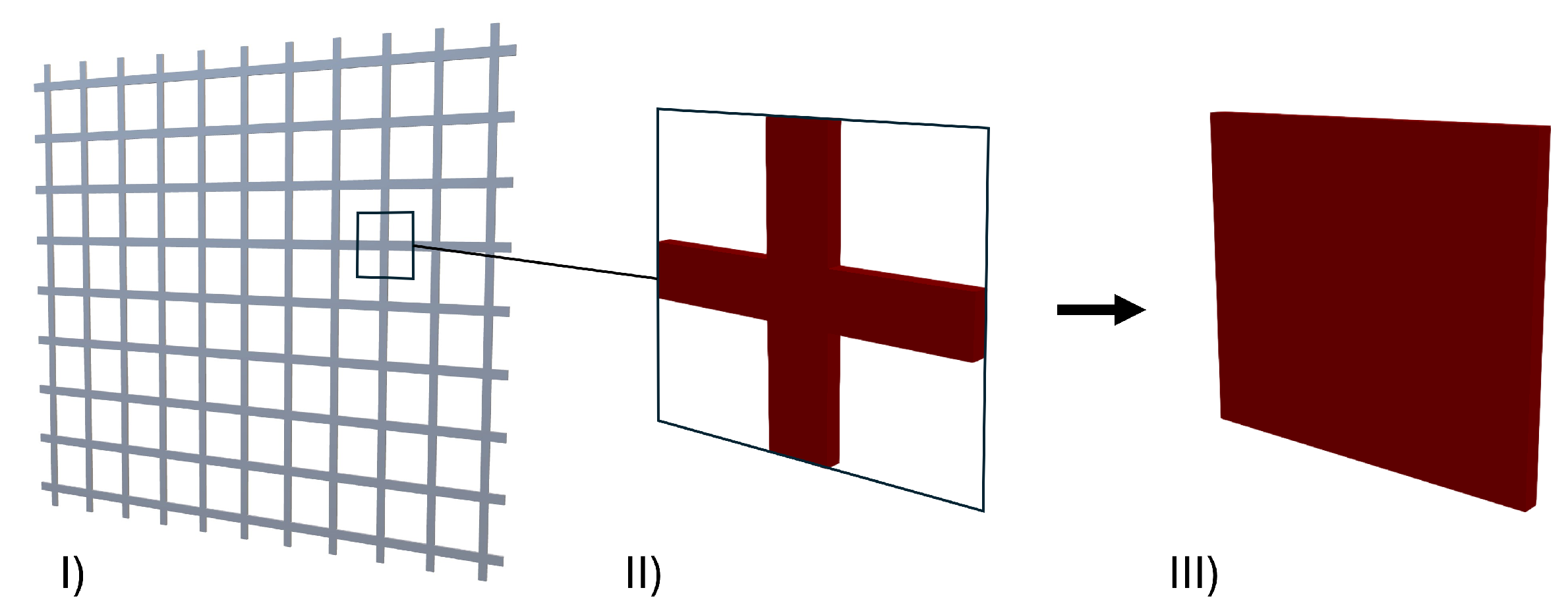
Figure 2.
Experimental wind tunnel setup.
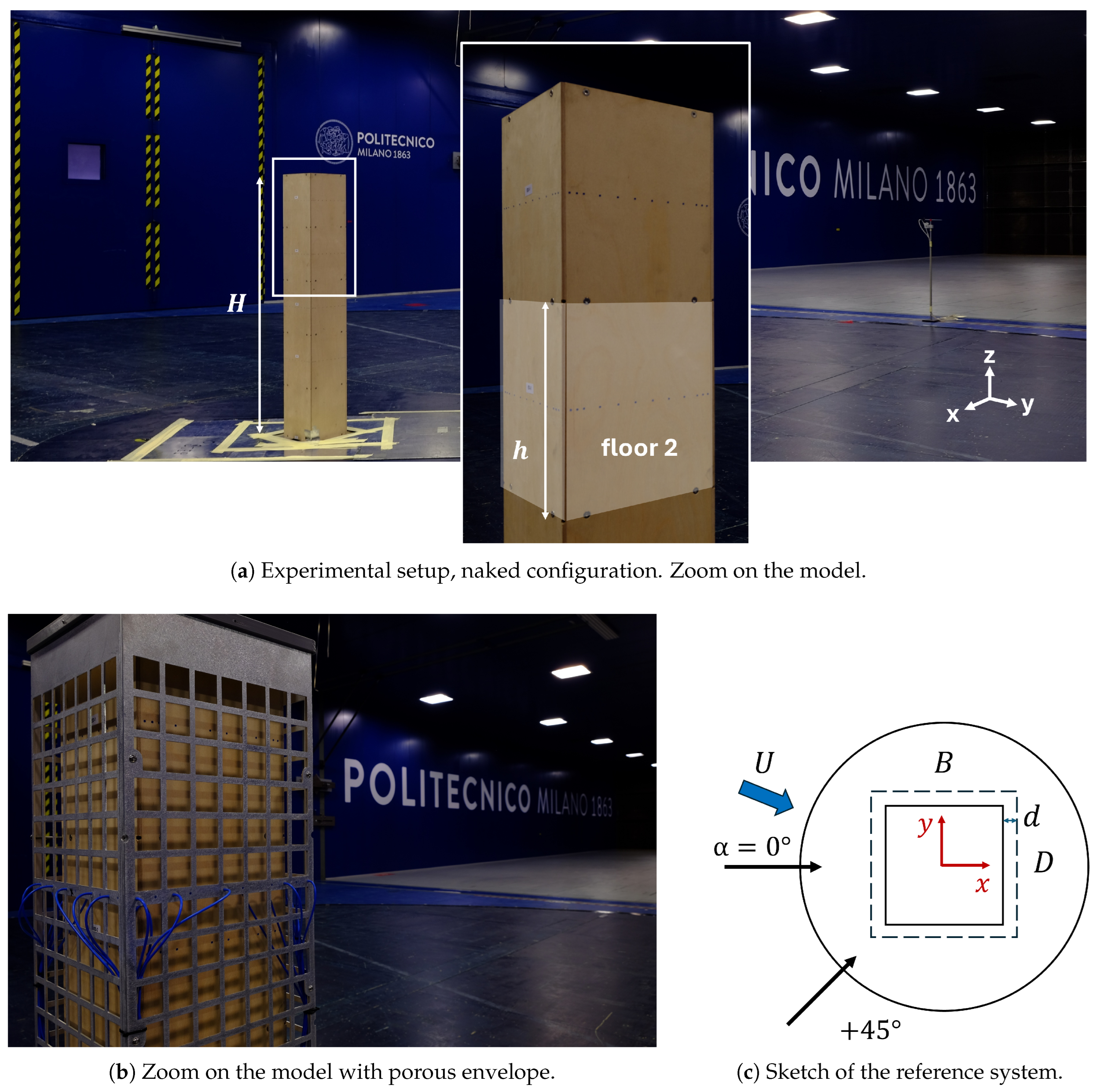
Figure 3.
Modulus configuration, numerical domain overview with geometric dimensions.
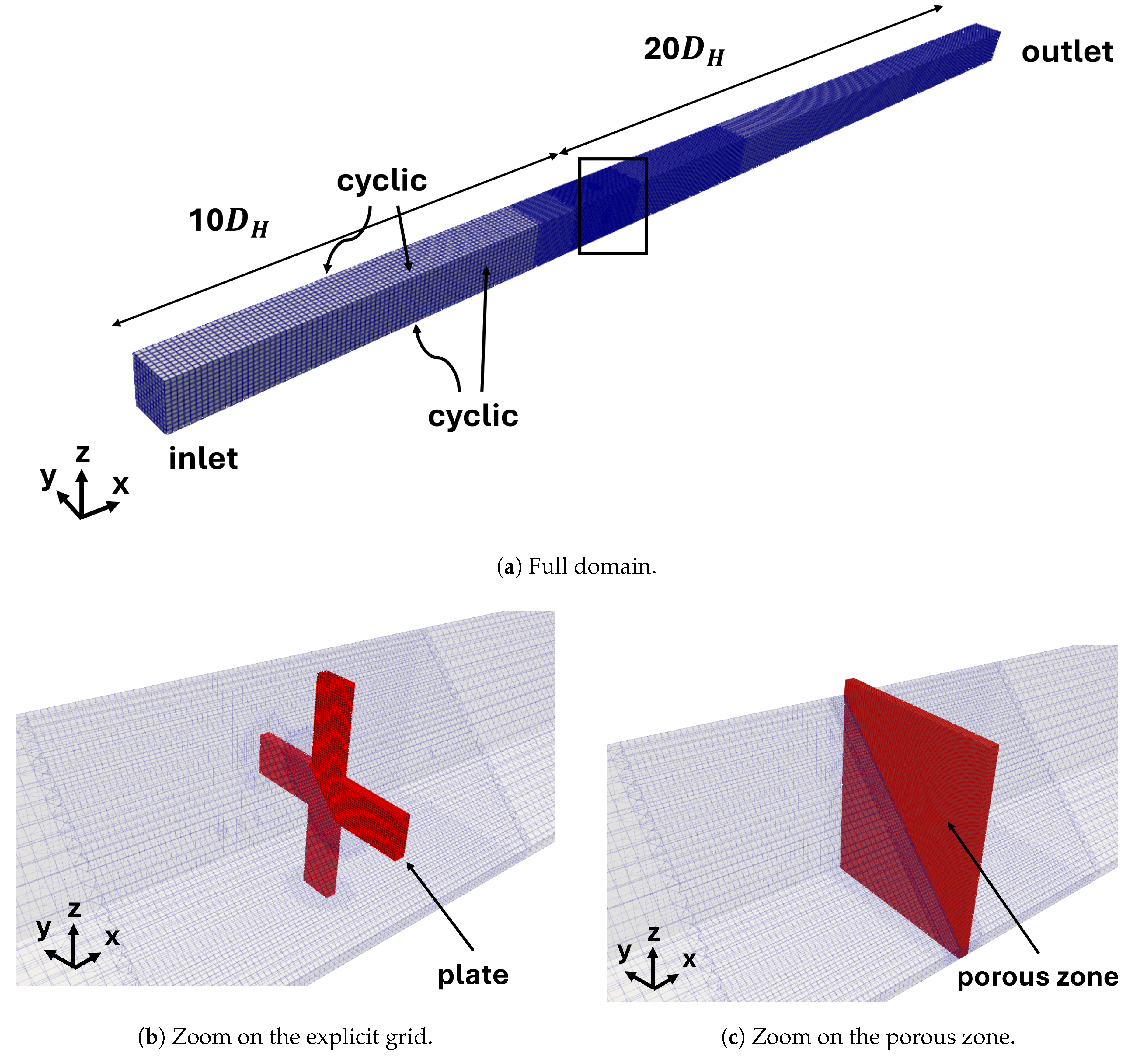
Figure 4.
2D slice configuration, numerical domain overview with geometric dimensions.
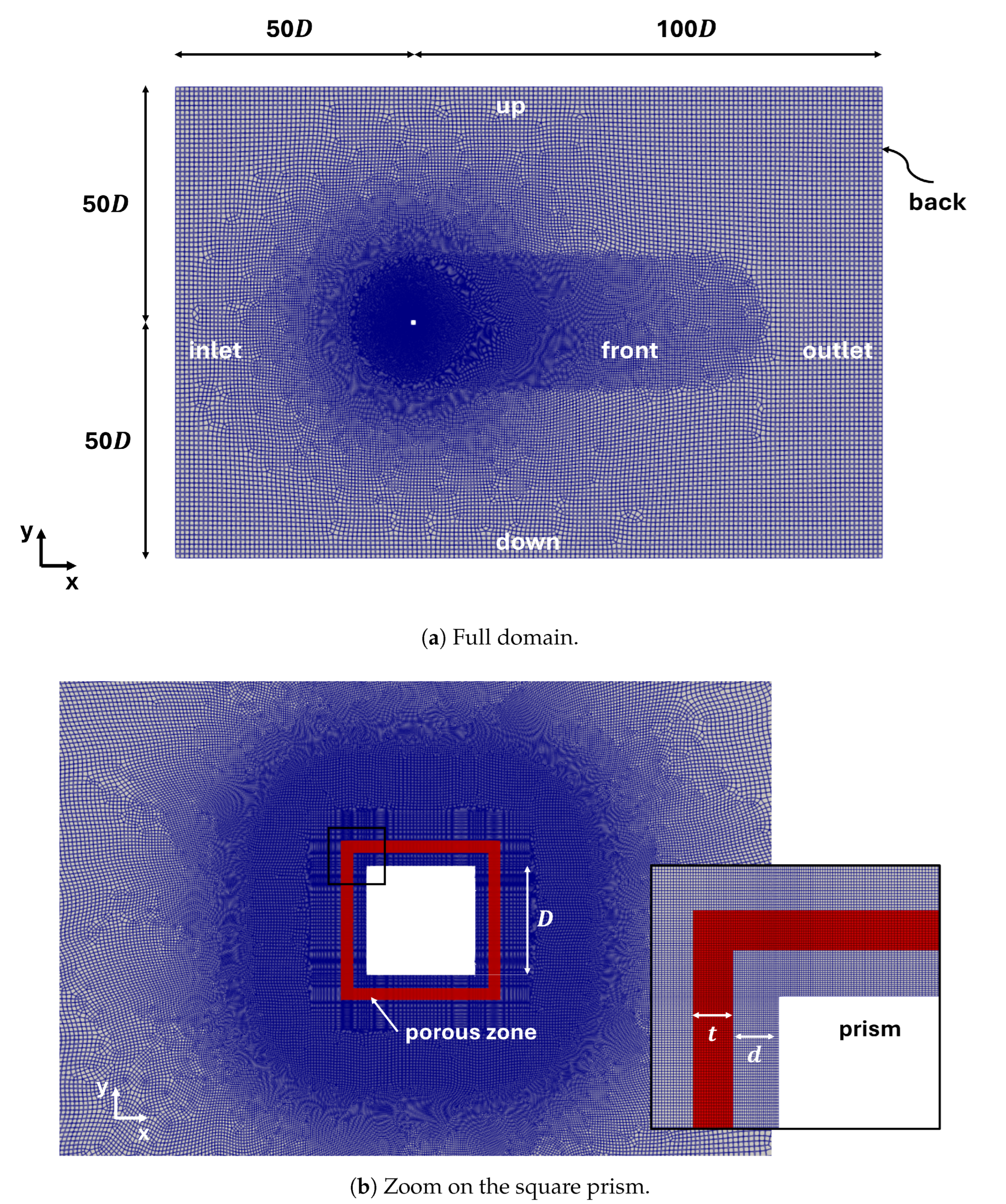
Figure 5.
Porous medium characterization. Drag (orange) and lift (blue) coefficients derived from explicit modulus simulations (circle markers), analytical model from [16] (dashed lines), implicit modulus simulations (diamond markers), and experimental characterization (black crossed markers, from [26]).
Figure 5.
Porous medium characterization. Drag (orange) and lift (blue) coefficients derived from explicit modulus simulations (circle markers), analytical model from [16] (dashed lines), implicit modulus simulations (diamond markers), and experimental characterization (black crossed markers, from [26]).
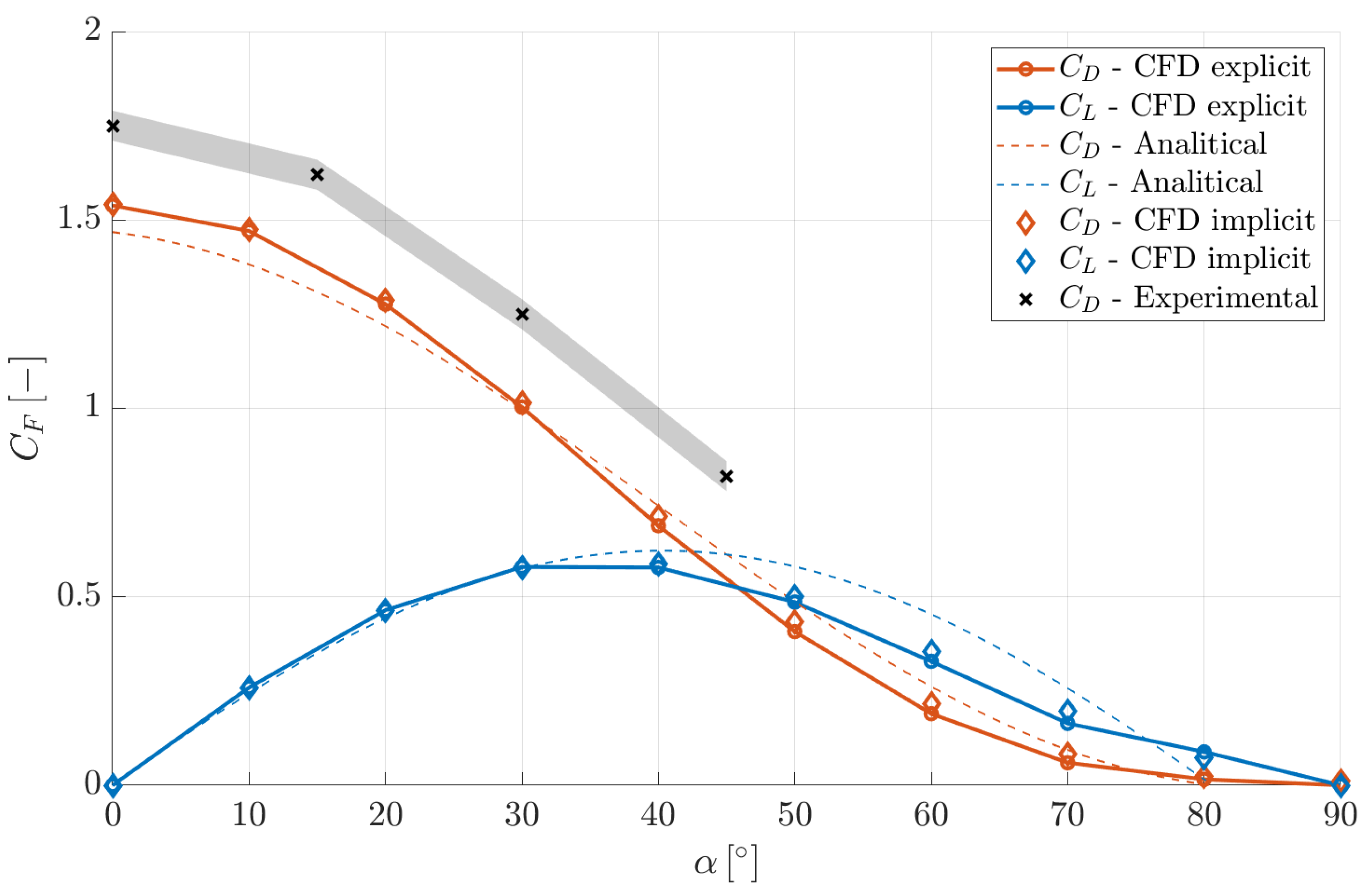
Figure 6.
Modulus simulations, explicit geometry (up) and implicit porous slab (down), Mean pressure coefficient () and streamlines from mean velocity field on the middle-plane, .
Figure 6.
Modulus simulations, explicit geometry (up) and implicit porous slab (down), Mean pressure coefficient () and streamlines from mean velocity field on the middle-plane, .
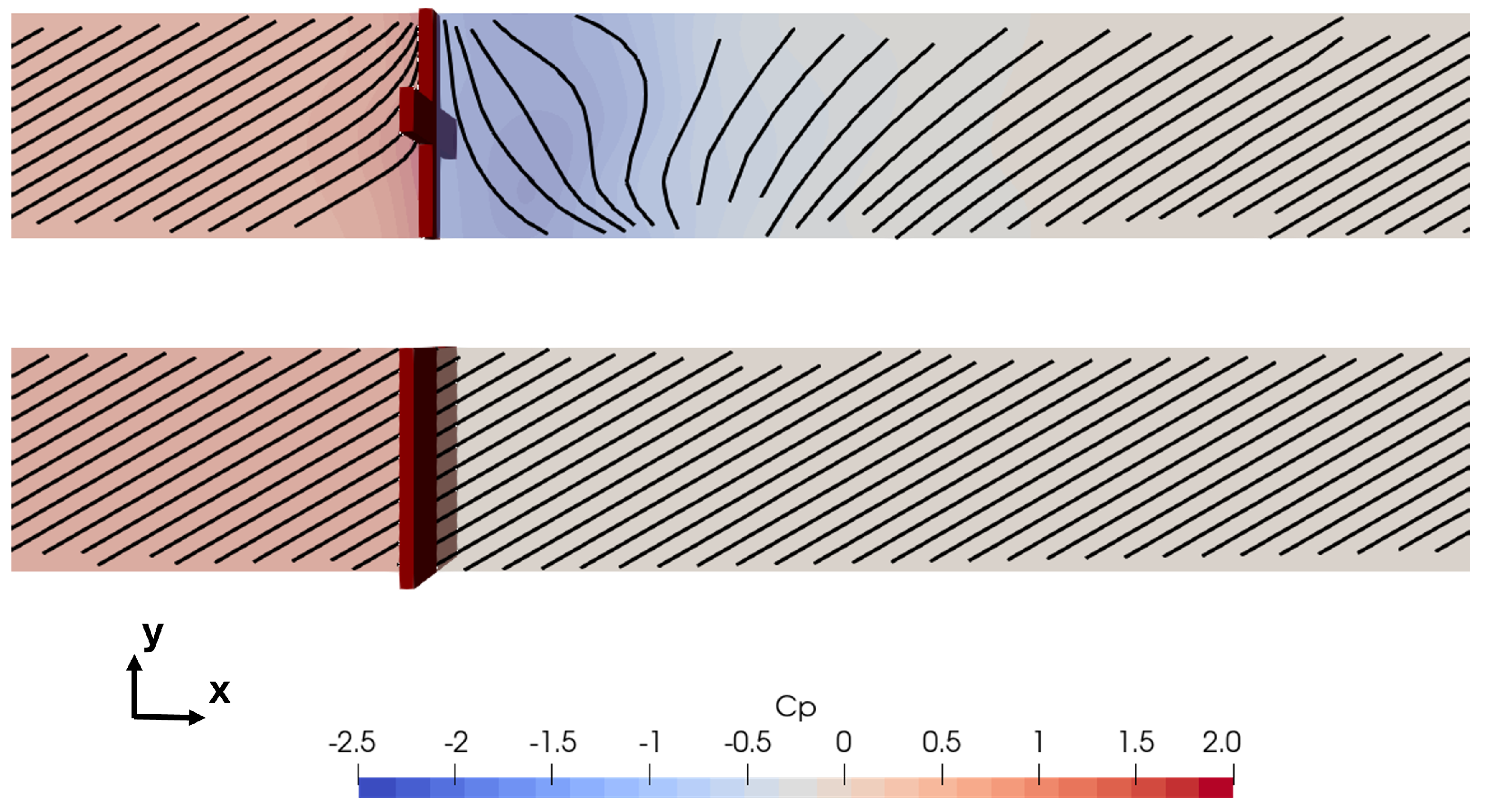
Figure 7.
Comparison between the a snapshot of the 2D naked simulation (non dimensional vorticity field ) and a smoke visualization of the vortices formed in the experimental tests.
Figure 7.
Comparison between the a snapshot of the 2D naked simulation (non dimensional vorticity field ) and a smoke visualization of the vortices formed in the experimental tests.
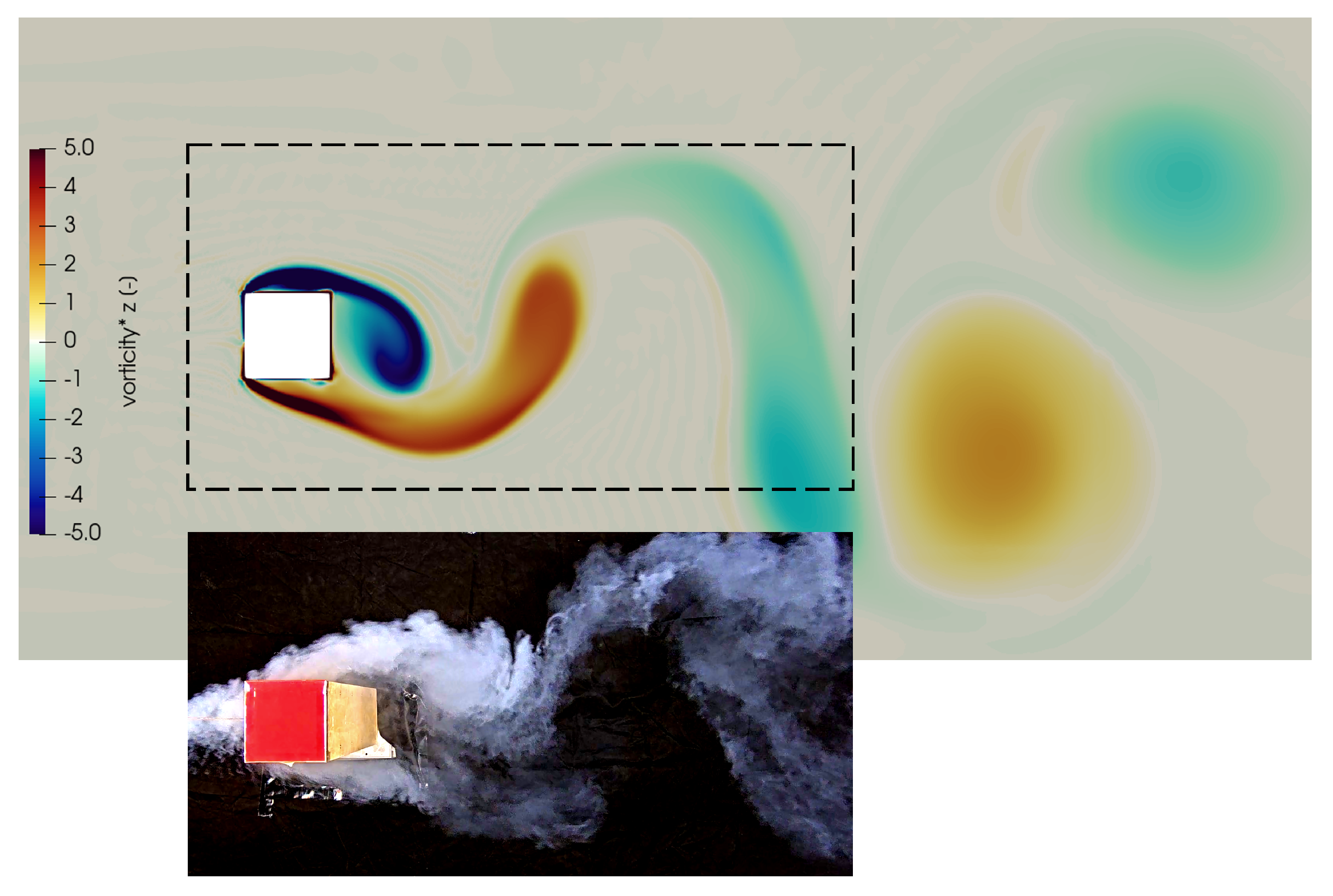
Figure 8.
Wind from , mean pressure coefficient () from 2D sectional CFD simulations (grey bars) against experimental data (black dots) and literature experimental data from [44] (red points).
Figure 8.
Wind from , mean pressure coefficient () from 2D sectional CFD simulations (grey bars) against experimental data (black dots) and literature experimental data from [44] (red points).
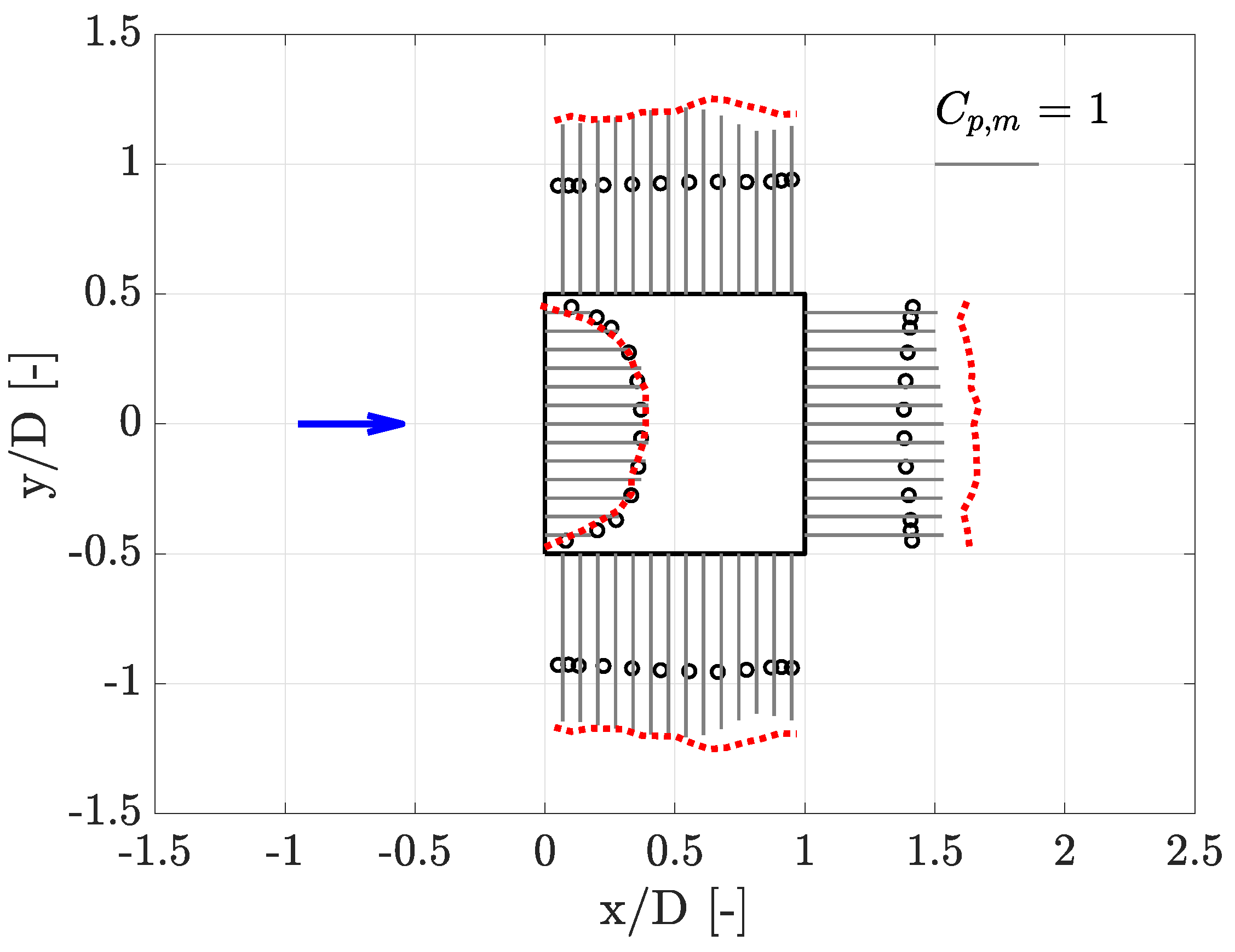
Figure 9.
Wind from , mean pressure coefficient () from 2D sectional CFD simulations (blue bars) against experimental data (blue dots).
Figure 9.
Wind from , mean pressure coefficient () from 2D sectional CFD simulations (blue bars) against experimental data (blue dots).
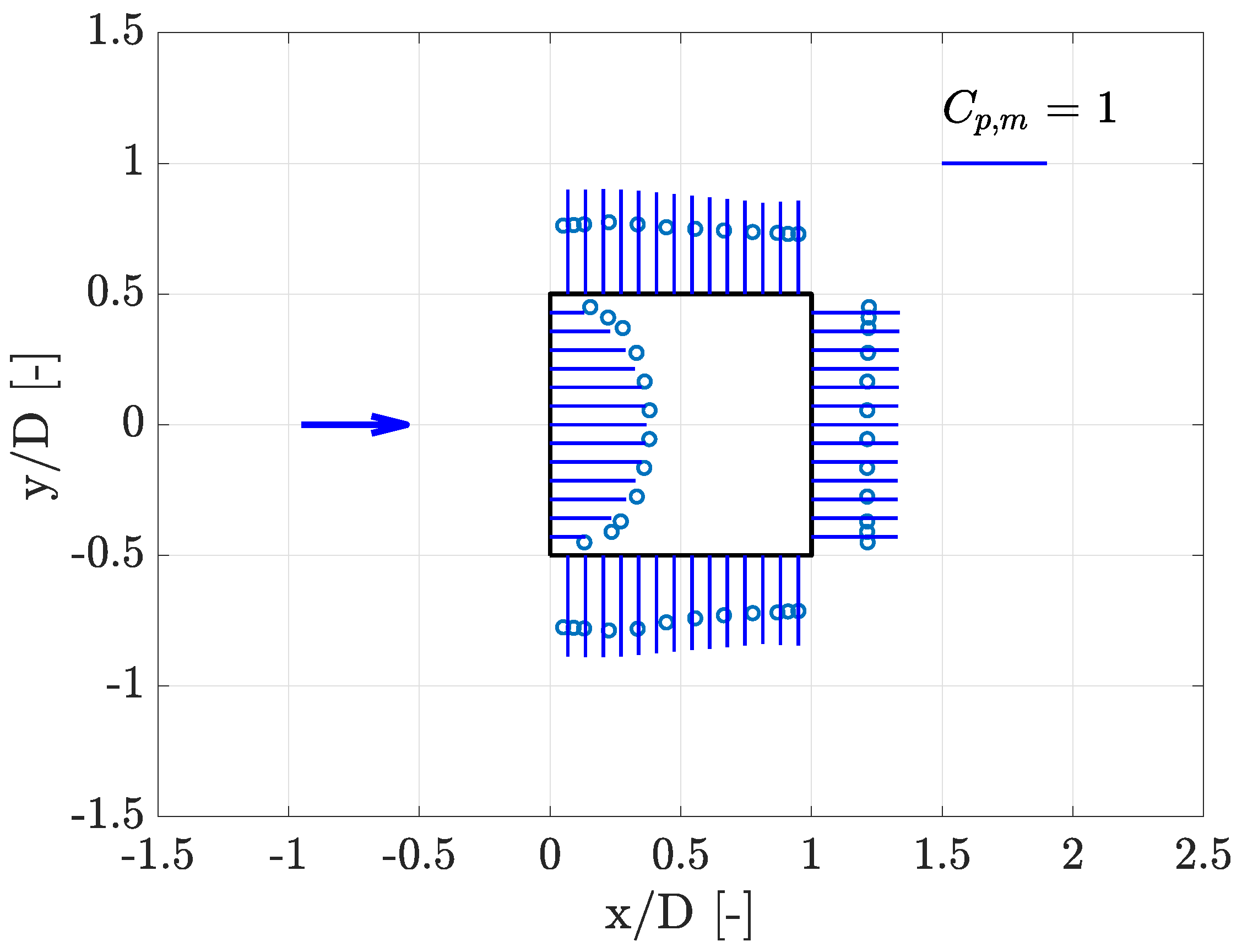
Figure 10.
Sectional simulations: comparison between naked and porous simulations at .
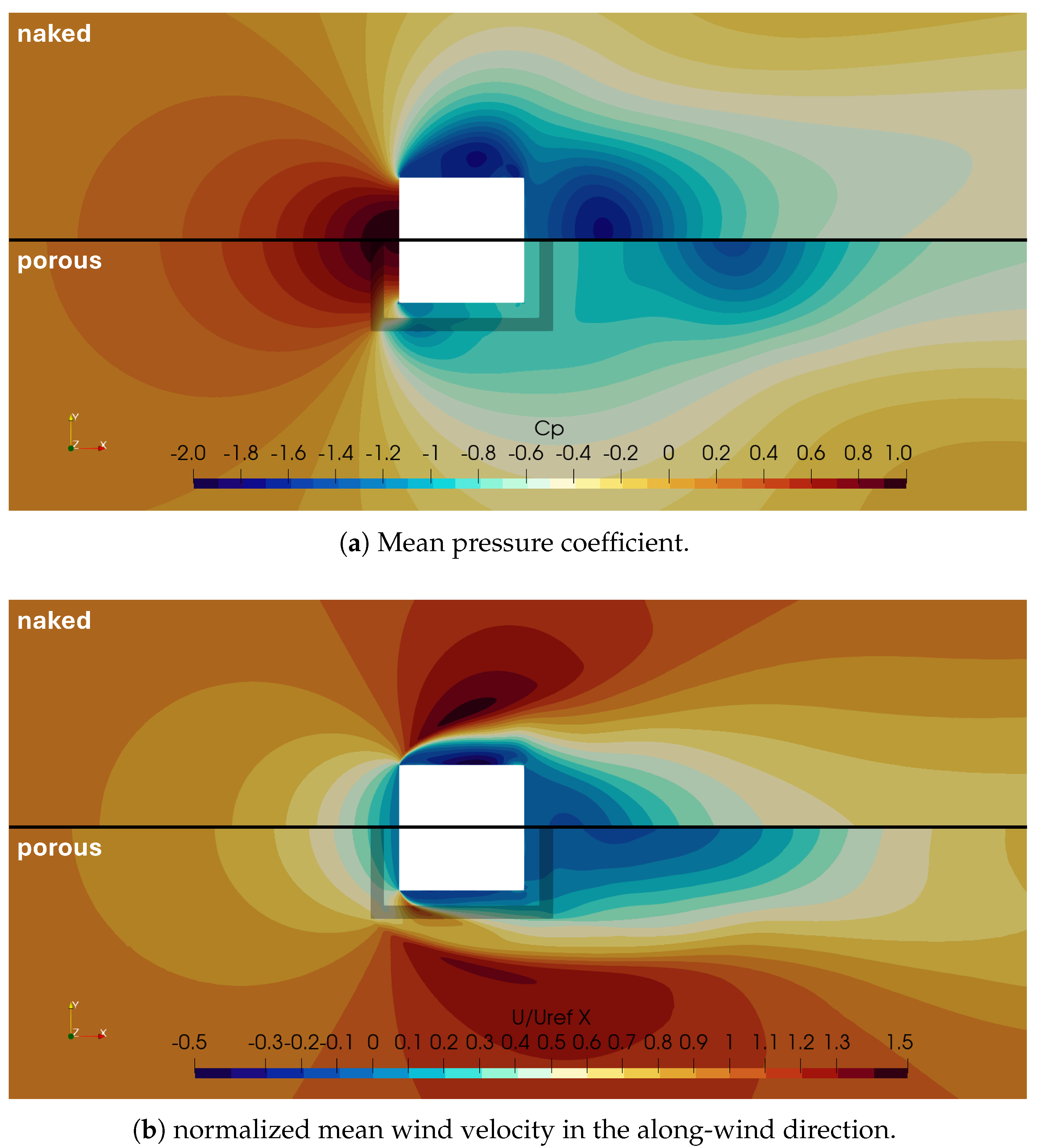
Figure 11.
Aerodynamic properties ratios (porous configuration against naked configuration) against wind attach angles (). Results from the 2D-CFD simulations (blue crosses) and experimental results (orange circles).
Figure 11.
Aerodynamic properties ratios (porous configuration against naked configuration) against wind attach angles (). Results from the 2D-CFD simulations (blue crosses) and experimental results (orange circles).
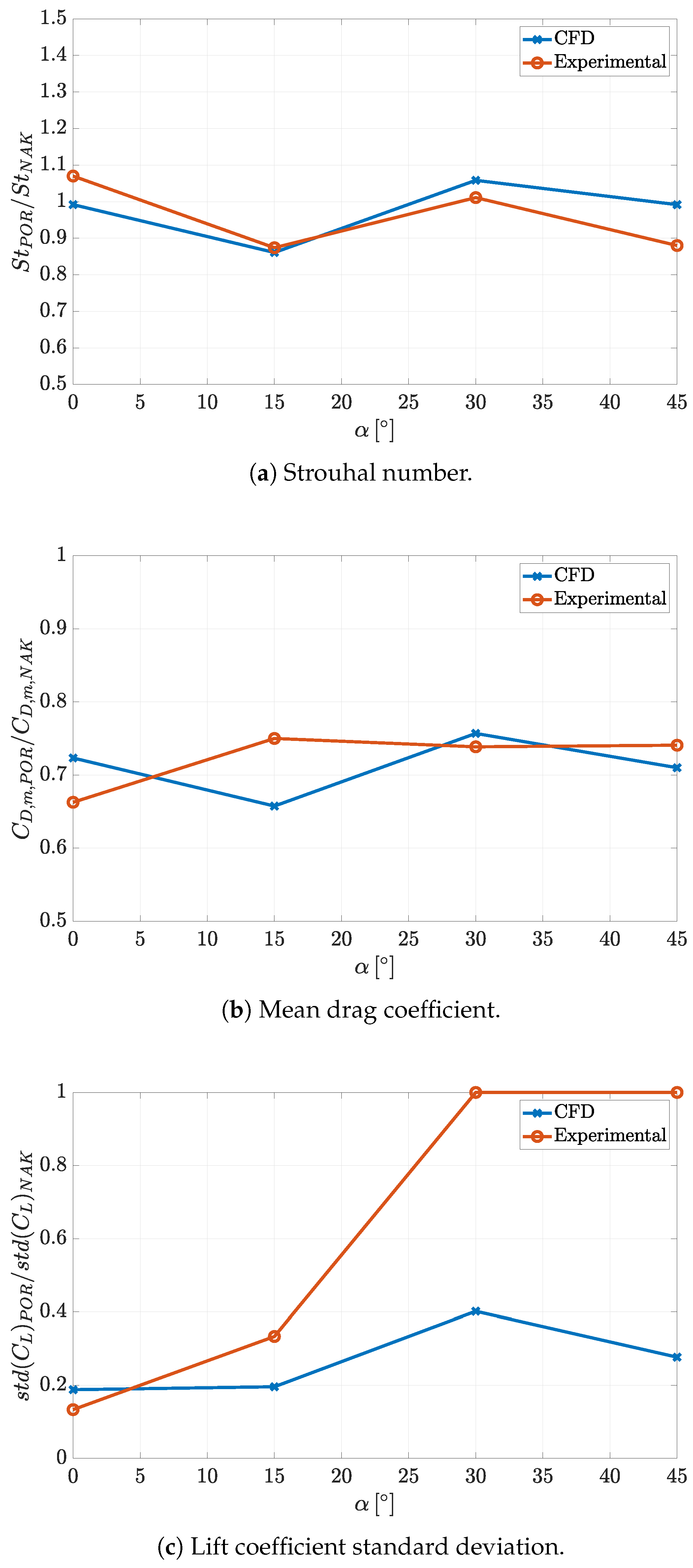
Figure 12.
Mean pressure coefficient for different angles of attack : (a,c,e) naked configuration; (b,d,f) porous configuration.
Figure 12.
Mean pressure coefficient for different angles of attack : (a,c,e) naked configuration; (b,d,f) porous configuration.
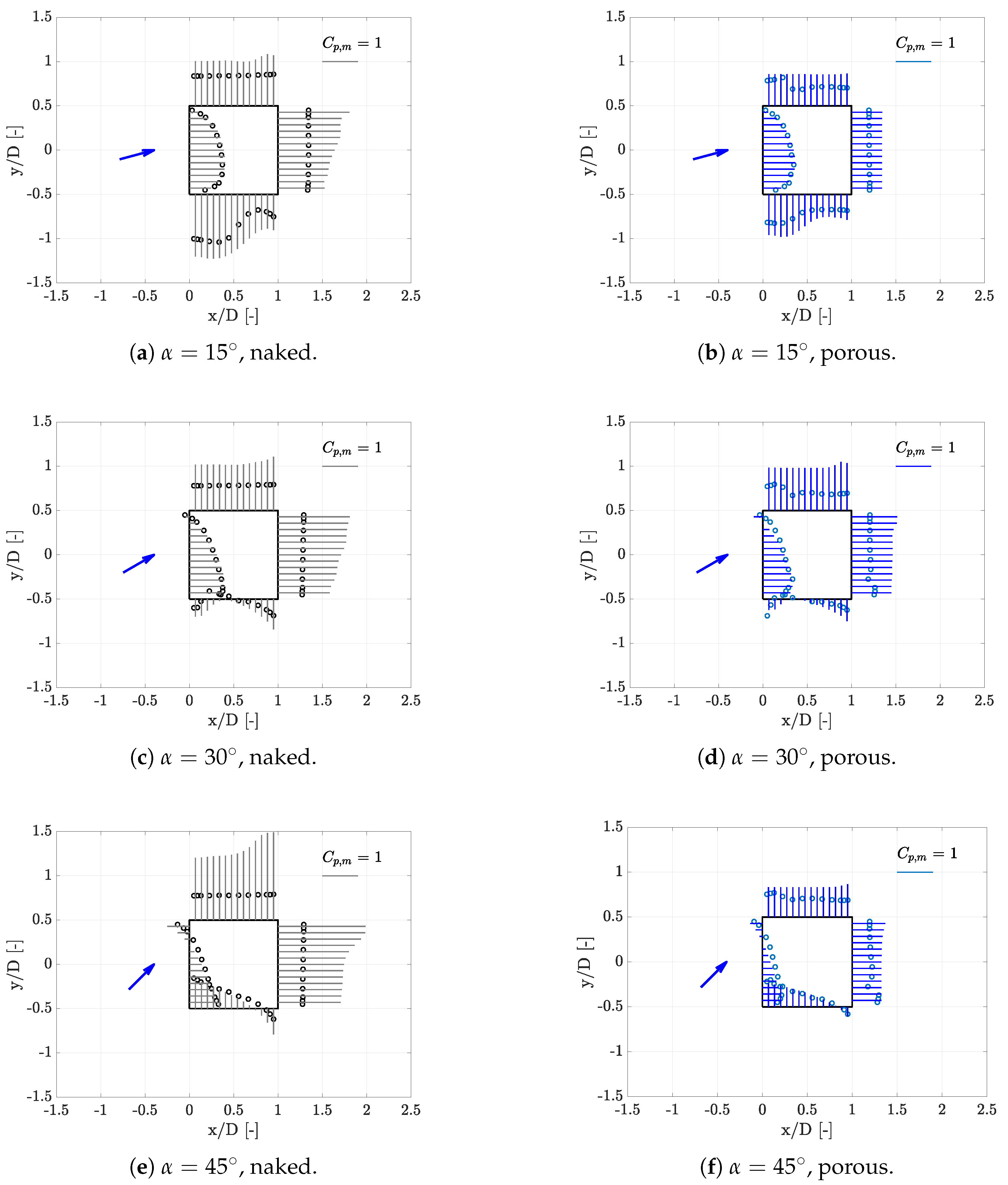
Table 1.
Boundary conditions for cyclic domains.
| Field | Inlet | Outlet | Cyclic | Plate |
|---|---|---|---|---|
| p | zeroGradient | fixedValue | cyclic | zeroGradient |
| U | fixedValue (U) | inletOutlet | cyclic | noSlip |
| calculated | calculated | cyclic | nutkWallFunction | |
| k | fixedValue | inletOutlet | cyclic | kqRWallFunction |
| inletOutlet | inletOutlet | cyclic | omegaWallFunction |
Table 2.
Comparison of the drag coefficient at zero attach angle for the adopted mesh, a coarser and a finer version, modulus configuration. .
Table 2.
Comparison of the drag coefficient at zero attach angle for the adopted mesh, a coarser and a finer version, modulus configuration. .
| Mesh | ||||
|---|---|---|---|---|
| Coarse | 100 | 27 | 29 | 1.60 |
| Adopted | 290 | 80 | 9.4 | 1.54 |
| Fine | 350 | 96 | 7.8 | 1.55 |
Table 3.
Boundary conditions for the sectional simulation s.
| Field | Inlet | Outlet | Top/Bottom | Cylinder Walls |
|---|---|---|---|---|
| p | zeroGradient | fixedValue | symmetry | zeroGradient |
| U | fixedValue (U) | inletOutlet | symmetry | noSlip |
| fixedValue | inletOutlet | symmetry | Wall Functions |
Table 5.
Comparison of the mean drag coefficient , standard deviation of the lift coefficient and Strouhal number for the adopted mesh, a coarser and a finer version, 2D slice configuration, , .
Table 5.
Comparison of the mean drag coefficient , standard deviation of the lift coefficient and Strouhal number for the adopted mesh, a coarser and a finer version, 2D slice configuration, , .
| Mesh | ||||||
|---|---|---|---|---|---|---|
| Coarse | 80 | 67 | 50 | 0.114 | 1.99 | 1.31 |
| Adopted | 154 | 67 | 50 | 0.123 | 2.05 | 1.48 |
| Fine | 240 | 134 | 15 | 0.120 | 2.03 | 1.41 |
| Very fine | 500 | 134 | 15 | 0.121 | 2.05 | 1.40 |
Table 6.
Aerodynamic characteristics of flow over a square cylinder obtained by experiments.
| Reference | TI (%) | Re/ | St | |||
|---|---|---|---|---|---|---|
| [38] (2D-exp) | smooth | 100 | 0.118 | – | – | 1.33 |
| [39] (2D-exp) | 0.2 | 68.9 | 0.131 | 2.164 | 0.207 | 1.18 |
| [40] (2D-exp) | 0.5 | 176 | 0.122 | 2.06 | – | – |
| [41] (2D-exp) | 0.7 | 45.8 | 0.135 | 2.084 | – | 1.1 |
| [42] (2D-exp) | 0.5 | 47 | 0.128 | 2.15 | 0.27 | 1.18 |
| [43] (2D-URANS) | smooth | 21.4 | 0.137 | 2.07 | 1.37 | 0.06 |
| [43] (2D-IDDES) | smooth | 21.4 | 0.128 | 2.02 | 1.18 | 0.189 |
| [44] (2D-exp) | 0.5 | 120 | 0.125 | 2.25 | – | 1.40 |
| [45] (2D-LES) | smooth | 21.4 | 0.141 | 2.10 | – | – |
| [25] (3D-LES) | smooth | 12 | 0.104 | 1.62 | 0.07 | 0.15 |
| [25] (3D-exp) | smooth | 12 | 0.104 | 1.54 | – | – |
| current study (3D-exp) | 2 | 100 | 0.100 | 1.73 | 0.07 | 0.15 |
| current study (2D-CFD) | smooth | 67 | 0.123 | 2.05 | 0.02 | 1.48 |
Table 7.
Aerodynamic characteristics of flow over a square cylinder at , comparison between experimental and CFD results.
Table 7.
Aerodynamic characteristics of flow over a square cylinder at , comparison between experimental and CFD results.
| Reference | St | |||
|---|---|---|---|---|
| Naked 3D-exp | 0.100 | 1.13 | 1.73 | 0.15 |
| Porous 3D-exp | 0.107 | 0.68 | 1.14 | 0.02 |
| Naked 2D-exp [44] | 0.125 | 1.80 | 2.25 | 1.40 |
| Naked 2D-CFD | 0.123 | 1.78 | 2.05 | 1.48 |
| Porous 2D-CFD | 0.122 | 1.00 | 1.50 | 0.29 |
Disclaimer/Publisher’s Note: The statements, opinions and data contained in all publications are solely those of the individual author(s) and contributor(s) and not of MDPI and/or the editor(s). MDPI and/or the editor(s) disclaim responsibility for any injury to people or property resulting from any ideas, methods, instructions or products referred to in the content. |
© 2026 by the authors. Licensee MDPI, Basel, Switzerland. This article is an open access article distributed under the terms and conditions of the Creative Commons Attribution (CC BY) license (http://creativecommons.org/licenses/by/4.0/).
Copyright: This open access article is published under a Creative Commons CC BY 4.0 license, which permit the free download, distribution, and reuse, provided that the author and preprint are cited in any reuse.


