

Submitted:
31 March 2026
Posted:
01 April 2026
You are already at the latest version
Abstract
The application of computational technologies in veterinary biochemistry and toxicology is revolutionizing translational science and making it more compatible with the One Health approach. With the distinction between animal, human, and environmental health diminishing in importance, technologies like molecular modelling, systems toxicology, vetinformatics, and artificial intelligence (AI) help in making integrated and predictive decisions. This brief review aims to highlight advancements in computational veterinary biochemistry and toxicology with special emphasis on its importance for One Health, food safety, and antimicrobial resistance (AMR). Advances in predictive toxicology, multi-omics, and AI offer new and innovative solutions for the early detection of biochemical disorders, simulation of toxicant exposure, and prediction of AMR in different species. These advancements highlight the importance of making connections between laboratory science and policy-making for animal health with the help of a multidisciplinary computational approach for global food security and AMR in a data-driven world.
Keywords:
computational toxicology
; vetinformatics
; one health
; food safety
; antimicrobial resistance
; translational veterinary biochemistry
; systems modelling
; predictive analytics
1. Introduction
Significant transformation in the field of translational veterinary biochemistry and toxicology has been witnessed over the past two decades, primarily owing to the digital revolution in biomedical, environmental, and life sciences. Traditionally, veterinary biochemistry and toxicology were primarily descriptive in nature, with a focus on the identification of biochemical abnormalities and toxicity in animals, primarily based on empirical observations and in vivo studies. Although the traditional approach has provided a foundation for veterinary toxicology, it was always limited in its scope. However, veterinary biochemistry and toxicology are currently influenced by a variety of computational strategies, primarily based on the integration of molecular mechanisms and population outcomes, thus promoting the concept of One Health, which emphasizes the intrinsic interrelatedness of human, animal, and environmental health. [1,2].
This paradigm shift has become more imperative in the wake of emerging issues like antimicrobial resistance (AMR), food contamination, agricultural intensification, and environmental degradation. The aforementioned issues are not independent of one another; rather, they are the culmination of intricate biochemical and microbial interactions that share common ecosystems [3]. Therefore, veterinary science needs to be advanced beyond species-specific evaluations and embrace integrative tools that bridge the link between biochemical events and public health outcomes.
The One Health concept has been established as an important guiding philosophy to address these crises. The globalisation of food production systems, the intensification of animal production systems, and environmental changes due to climate change have resulted in an increased risk of chemical exposure, pathogen transmission, and the emergence of resistance. These events occur through the action of common biochemical mechanisms that involve the use of similar targets and routes of exposure among species [4]. Veterinary biochemistry and toxicology play an important role as they offer mechanistic explanations that have direct implications for food safety, occupational health and safety, environmental toxicology, and human health risk assessment.
At the heart of the change in the disciplinary approach is the concept of computational toxicology. With the aid of in silico tools that can forecast the hazards of chemicals, their toxicokinetics, and their biological effects in various species, it is now possible to move away from the identification of hazards and towards the prediction of risk. Techniques that allow for the use of physiologically based pharmacokinetic modeling, quantitative structure-activity relationships, network toxicology, and adverse outcome pathways offer mechanistic continuity between the molecular initiating events and adverse outcomes [5]. Most importantly, they minimize the use of animal testing and thus meet the ethical and economic needs of veterinary toxicology.
Parallel to these advancements, vetinformatics, bioinformatics, systems biology, and computational veterinary science have revolutionized the field of biochemical regulation in livestock and companion animals. These techniques include transcriptomics, proteomics, metabolomics, and microbiomics data integration to identify relevant information on biomarkers and risk factors for various applications in toxicology, nutrition, and infectious diseases [6]. These computational techniques enable scientists to simulate how xenobiotics, antibiotics, and environmental pressures affect metabolic networks, immune systems, and gene expression profiles, providing predictive information from individual to population levels [7].
Significantly, computational methods in veterinary biochemistry and toxicology are no longer confined to conducting research in laboratories. These methods are increasingly being used to shape regulatory science, surveillance systems, and global health governance under the One Health approach. For instance, AI-based analytics enable the timely recognition of AMR determinants, forecasts of drug-toxin interactions, and tracking of chemical contaminants along food chains [8,9]. In this regard, computational toxicology is not only a scientific approach but a “translating bridge” between molecular science and health and well-being on a planetary scale (Figure 1).
2. Computational Strategies in Veterinary Biochemistry and Toxicology
Computational methodologies have become indispensable to modern veterinary biochemistry and toxicology, enabling high-throughput analysis, multidimensional data integration, and predictive modelling. These tools address long-standing challenges in the field, including experimental variability, species extrapolation, and the ethical limitations of extensive in vivo testing (Table 1).
2.1. Vetinformatics and Systems Integration
Vetinformatics represents the convergence of veterinary science, systems biology, and computational modelling to decode complex molecular interactions underlying animal health, disease progression, and toxicant exposure. According to Pathak and Kim (2023), vetinformatics integrates comparative genomics, transcriptomic profiling, proteomic mapping, and metabolic network reconstruction, tailored to the physiological and biochemical diversity of animal species. The integration of multi-omics datasets has been particularly transformative. Combining genomic, proteomic, metabolomic, and microbiome data, researchers can reconstruct toxicity pathways and identify regulatory nodes affected by chemical exposure. Systems-based analyses can, for example, elucidate how environmental contaminants disrupt hepatic xenobiotic metabolism or interfere with endocrine signalling in food-producing animals, with downstream consequences for productivity, reproduction, and food safety [10,11]. These insights support the development of molecular biomarkers for exposure assessment, early disease detection, and risk stratification.
Computational annotation tools further facilitate cross-species translation of biochemical pathways. This capability is especially important in veterinary toxicology, where data availability varies widely across species. Model organisms such as rodents or zebrafish are frequently used to infer toxicological effects in livestock species. Comparative systems biology approaches enable informed extrapolation by accounting for species-specific differences in metabolism, enzyme expression, and physiological parameters [12].
2.2. Predictive and Computational Toxicology
Predictive toxicology employs computational techniques to anticipate biological effects of chemicals prior to in vivo testing. Central to this approach are QSAR models, machine learning classifiers, and PBPK simulations that collectively describe absorption, distribution, metabolism, and excretion. As highlighted by Thomas et al. (2019), predictive toxicology is increasingly integral to translational risk assessment, enabling efficient hazard prioritisation for veterinary medicines, feed additives, and environmental contaminants.
PBPK modelling is particularly valuable in veterinary contexts, as it incorporates species-specific physiological parameters such as organ size, blood flow, and enzyme activity. These models simulate time-dependent xenobiotic concentrations in target tissues, facilitating cross-species extrapolation where experimental data are limited [13,14]. Integration of PBPK models with AOP frameworks establishes mechanistic continuity between molecular interactions, such as receptor binding or enzyme inhibition, and adverse outcomes, including hepatotoxicity, endocrine disruption, or neurotoxicity.
Recent advances in artificial intelligence have further accelerated predictive toxicology. Deep learning architectures trained on large chemical and biological datasets can predict toxicity endpoints, metabolic liabilities, and genotoxic potential with increasing accuracy. In antimicrobial development, these models are particularly valuable for forecasting off-target effects, environmental persistence, and selective pressures that contribute to AMR emergence [15,16,17].
2.3. Computational Pharmacology and Drug–Toxin Interaction Modelling
Computational pharmacology has reshaped toxicological risk assessment in veterinary medicine by enabling atomic-level analysis of drug–target and toxin–target interactions. Techniques such as molecular docking, pharmacophore modelling, and molecular dynamics simulations provide detailed insights into how small molecules interact with detoxification enzymes, transporters, and nuclear receptors, including cytochrome P450 isoforms and ABC transport proteins [18,19,20].
With these interactions between veterinary drugs and metabolic enzymes, researchers can predict potential drug–toxin synergies, metabolic inhibition, or altered clearance pathways that may lead to adverse effects. For example, in silico docking studies can assess whether antibiotic residues interact with hepatic receptors or transporters, potentially affecting detoxification capacity in food-producing animals. Those insights are critical for maintaining residue levels within regulatory limits and safeguarding consumer health [21].
2.4. Data-Driven Toxicogenomics
Toxicogenomics has become a cornerstone of mechanistic toxicology, enabling systematic characterisation of gene expression responses to chemical exposure. Computational analysis of toxicogenomic datasets allows comparison of transcriptomic signatures across compounds, doses, and exposure scenarios, revealing conserved pathways associated with stress responses, inflammation, or organ-specific injury [22].
Machine learning algorithms increasingly support biomarker discovery within these datasets. Methods such as random forests and neural networks can identify gene expression patterns predictive of hepatotoxicity, nephrotoxicity, or endocrine disruption. These computational biomarkers can subsequently be validated experimentally, enhancing translational confidence while reducing animal use [23].
Comparative toxicogenomics further strengthens the One Health framework by identifying conserved molecular responses across species. Shared transcriptional signatures enable extrapolation of veterinary or environmental exposure data to human health risk assessment, embodying the translational ethos of modern toxicology [24].
2.5. Environmental and Food Chain Modelling
Veterinary toxicology increasingly encompasses environmental and food system dimensions. Computational models describing environmental fate, exposure dynamics, and bioaccumulation are essential for assessing the broader impact of veterinary medicines, pesticides, and feed additives. These models evaluate not only animal safety but also ecological and human health risks associated with chemical residues in soil, water, and food products [25].
Integration of geographic information systems (GIS) and spatial modelling enhances detection of exposure hotspots and prediction of contaminant migration. When combined with toxicokinetic and toxicodynamic models, these tools provide a comprehensive view of risk across the One Health continuum, linking biochemical mechanisms to population-level outcomes [26,27].
3. Translational Applications within the One Health Framework
The One Health framework emphasises the interconnectedness of biological systems across species and environments. Translational computational approaches are central to operationalising this concept, transforming molecular toxicological data into actionable insights for surveillance, regulation, and public health intervention [28,29].
Veterinary toxicology serves as a critical interface between animal exposure and human health outcomes. Traditionally, toxicological data derived from animals were often isolated from human risk assessment processes [30]. Computational approaches now enable bidirectional translation, allowing animal-derived molecular data to inform human toxicology and vice versa. Integrated surveillance systems combining veterinary diagnostics, food safety monitoring, and public health databases represent a major achievement in this regard. Machine learning–based pattern recognition enables early detection of AMR emergence, chemical contamination, and zoonotic spillover, facilitating timely intervention [31].
Computational toxicology also underpins predictive epidemiology by enabling simulation of disease emergence driven by chemical, microbial, or ecological factors. Models integrating exposure data, toxic effects, and microbial evolution can identify AMR hotspots in animal production systems. Probabilistic risk models, supported by Bayesian inference and Monte Carlo simulations, quantify uncertainty and enable transparent decision-making within One Health policy frameworks [32].
AMR represents a paradigmatic One Health challenge. Computational biochemistry and toxicology elucidate resistance mechanisms at both the molecular and systems levels. AI-driven models integrate genomic, biochemical, and environmental data to predict resistance emergence and assess the co-selective effects of non-antibiotic stressors such as heavy metals and biocides [33,34]. PBPK and environmental exposure models further support risk-based prioritisation of compounds likely to promote resistance [35].
4. Computational Toxicology and Food Contaminant Assessment
Computational toxicology provides a predictive framework for evaluating feed additives, veterinary medicines, and food contaminants. QSAR, PBPK, and molecular docking approaches enable early hazard identification, residue prediction, and regulatory compliance assessment, particularly in food-producing animals [40,41,42,43,44]. PBPK models are especially valuable for predicting tissue-residue depletion and for establishing withdrawal periods in accordance with regulatory frameworks, such as maximum residue limits. Computational models also intersect with food microbiology by simulating microbial growth, toxin production, and contamination dynamics across the farm-to-fork continuum [45,46,47].
Network-based models trace AMR gene flow across livestock, processing environments, and ecosystems. When integrated with ecotoxicological data, these models quantify the role of chemical stressors in co-selection for resistance [48,49,50]. Machine learning models further support AMR risk prioritisation by integrating molecular, environmental, and epidemiological data to rank threats by public health impact [51].
5. Conclusion
Translational computational strategies have fundamentally redefined veterinary biochemistry and toxicology. Once primarily descriptive, these disciplines are now predictive, integrative, and central to the One Health agenda. Computational tools bridge molecular mechanisms with food safety, environmental protection, and global AMR surveillance. Future progress will depend on ethical governance, open science, and equitable access to computational infrastructure. In this evolving landscape, computational toxicology functions not merely as a methodological advance but as a translational conduit linking scientific knowledge to planetary health stewardship.
References
- Lammie, S. L.; Hughes, J. M. Antimicrobial Resistance, Food Safety, and One Health: The Need for Convergence. Annual Review of Food Science and Technology 2016, 7, 287–312. [Google Scholar] [CrossRef]
- Bagaria, A. AMR-MoEGA: Antimicrobial Resistance Prediction using Mixture of Experts and Genetic Algorithms. 2025. Available online: http://arxiv.org/abs/2511.12223.
- Rhouma, M.; Archambault, M.; Butaye, P. Antimicrobial Use and Resistance in Animals from a One Health Perspective. Veterinary Sciences 2023, 10(5), 10–12. [Google Scholar] [CrossRef]
- Scarpa, F.; Casu, M. Genomics and Bioinformatics in One Health: Transdisciplinary Approaches for Health Promotion and Disease Prevention. International Journal of Environmental Research and Public Health 2024, 21(10). [Google Scholar] [CrossRef] [PubMed]
- Iqbal, S.; Begum, F.; Alfaifi, M. Y.; Elbehairi, S. E. I.; Siddique, A.; Shaw, P. Exploring Antimicrobial Potency, ADMET, and Optimal Drug Target of a Non-ribosomal Peptide Sevadicin from Bacillus pumilus, through In Vitro Assay and Molecular Dynamics Simulation. Probiotics and Antimicrobial Proteins 2025, 17(6), 4237–4253. [Google Scholar] [CrossRef] [PubMed]
- Kim, J. M.; Pathak, R. K. Editorial: Vetinformatics: an insight for decoding livestock systems through in silico biology. Frontiers in Veterinary Science 2023, 10(11), 4–6. [Google Scholar] [CrossRef] [PubMed]
- Vlasiou, M. C. Vet informatics and the future of drug discovery in veterinary medicine. Frontiers in Veterinary Science 2024, 11(4). [Google Scholar] [CrossRef]
- Anahtar, M. N.; Yang, J. H.; Kanjilal, S. Applications of Machine Learning to the Problem of Antimicrobial Resistance: an Emerging Model for Translational Research. Journal of Clinical Microbiology 2021, 59(7). [Google Scholar] [CrossRef]
- Su, M.; Satola, S. W.; Read, T. D. Genome-based prediction of bacterial antibiotic resistance. Journal of Clinical Microbiology 2019, 57(3). [Google Scholar] [CrossRef]
- Raies, A. B.; Bajic, V. B. In silico toxicology: computational methods for the prediction of chemical toxicity. Wiley Interdisciplinary Reviews: Computational Molecular Science 2016, 6(April), 147–172. [Google Scholar] [CrossRef]
- de Sousa, D. S.; Gomes, A. O. C. V.; Roberto, C. H. A.; Belarmino, A. B.; da Silva Mendes, F. R.; Marinho, M. M.; de Lima-Neto, P.; Marinho, G. S. Ligand and structure-based toxicological assessment of (thio)semicarbazones on cholinesterases. Journal of Computer-Aided Molecular Design 2026, 40(1). [Google Scholar] [CrossRef]
- Toropova, A. P.; Toropov, A. A.; Colombo, E.; Viganò, E. L.; Lombardo, A.; Roncaglioni, A.; Benfenati, E. Simulation of Fish Acute Toxicity of Pharmaceuticals Using Simplified Molecular Input Line Entry System (SMILES) Notation as a Representation of Molecular Structure. International Journal of Molecular Sciences 2025, 26(19). [Google Scholar] [CrossRef]
- Thomas, R. S.; Bahadori, T.; Buckley, T. J.; Cowden, J.; Deisenroth, C.; Dionisio, K. L.; Frithsen, J. B.; Grulke, C. M.; Gwinn, M. R.; Harrill, J. A.; Higuchi, M.; Houck, K. A.; Hughes, M. F.; Sidney Hunter, E.; Isaacs, K. K.; Judson, R. S.; Knudsen, T. B.; Lambert, J. C.; Linnenbrink, M.; Williams, A. J. The next generation blueprint of computational toxicology at the U.S. Environmental protection agency. Toxicological Sciences 2019, 169(2), 317–332. [Google Scholar] [CrossRef] [PubMed]
- Rusyn, I.; Greene, N. The impact of novel assessment methodologies in toxicology on green chemistry and chemical alternatives. Toxicological Sciences 2018, 161(2), 276–284. [Google Scholar] [CrossRef] [PubMed]
- Omiecinski, C. J.; Vanden Heuvel, J. P.; Perdew, G. H.; Peters, J. M. Xenobiotic metabolism, disposition, and regulation by receptors: From biochemical phenomenon to predictors of major toxicities. Toxicological Sciences 2011, 120. [Google Scholar] [CrossRef]
- Su, Z.; Zhang, L.; Chen, K.; Zhi, L.; Huan, X.; Chen, F.; Wang, X.; Wang, J. Artificial intelligence-driven environmental toxicology: Emerging strategies for microplastics risk assessment. Gondwana Research 2026, 153, 170–183. [Google Scholar] [CrossRef]
- Parekh, V. A.; Amina, M.; Islam, M. L.; Patil, P. C.; Ali, M. A.; Wabaidur, S. M.; Islam, M. A. Identification of phosphodiesterase 10 A modulators for neurodegenerative and psychiatric disorders: Combination of physics-based virtual screening and machine learning approaches. Computational Biology and Chemistry 2026, 121, 108875. [Google Scholar] [CrossRef]
- Roveri, V.; Correia, A. T.; dos Santos, P. G.; Ferreira Povoas, M. N.; Toma, W.; Seabra Pereira, C. D.; Guimarães, L. L. AI-assisted QSAR framework for ecological risk assessment of pharmaceuticals: integrating experimental, mechanistic, and deep learning evidence. Computational Toxicology 2026, 37. [Google Scholar] [CrossRef]
- Fahim, A. M. Structure-based drug design; Computational strategies in drug discovery; Antihypertensive agents; Antiviral drugs; Molecular docking; QSAR; Pharmacological insights. Computational Biology and Chemistry 2026, 120(P1), 108663. [Google Scholar] [CrossRef]
- Tompkins, L. A. R.; Khoei, A.; Kapeljushnik, O.; Dumond, J.; Kashuba, A. D. M.; Tropsha, A.; Hubal, R.; Cottrell, M. L. HIV Pharmacology Data Repository: Setting the New Information-Sharing Standard for Clinical and Preclinical Pharmacokinetic Studies. Clinical Pharmacology and Therapeutics 2025, 118(6), 1340–1349. [Google Scholar] [CrossRef]
- Chen, J.; Lin, A.; Jiang, A.; Qi, C.; Liu, Z.; Cheng, Q.; Yuan, S.; Luo, P. Computational frameworks transform antagonism to synergy in optimizing combination therapies. Npj Digital Medicine 2025, 8(1). [Google Scholar] [CrossRef]
- Wang, L.; Yu, X. Research hotspots and evolution trends of food safety risk assessment techniques and methods. EFood 2024, 5(6), 1–13. [Google Scholar] [CrossRef]
- Wang, J.; Li, J. The digital evolution in toxicology: pioneering computational education for emerging challenges. BMC Medical Education 2024, 24(1). [Google Scholar] [CrossRef]
- Deng, X.; Liu, Y.; Zhu, X.; Zhu, H.; Huang, C.; Hong, Y.; Wu, D.; Han, Y. Momordicae Semen: A Review of Phytochemistry, Pharmacology, Toxicology, Herbal Processing, Clinical Applications, and Q-Markers Prediction. Drug Design, Development and Therapy 2025, 19(November), 10303–10341. [Google Scholar] [CrossRef] [PubMed]
- Salian-Mehta, S.; Poling, J.; Birkebak, J.; Rensing, S.; Carosino, C.; Santos, R.; West, W.; Adams, K.; Orsted, K.; Fillman-Holliday, D.; Burns, M. Non-Human Primate Husbandry and Impact on Non-Human Primates Health: Outcomes From an IQ DruSafe/3RS Industrial Benchmark Survey. International Journal of Toxicology 2023, 42(2), 111–121. [Google Scholar] [CrossRef]
- Gao, H.; Chen, M. Dynamics of integrated multi-trophic aquaculture ( IMTA): A modeling approach incorporating zooplankton and scavenger. 620 2026. [Google Scholar] [CrossRef] [PubMed]
- Sachan, R. S. K.; Kauts, S.; Dholaria, M.; Sengupta, A.; Praneeth, Y.; Devgon, I.; Rana, A.; Kaur, M.; Karnwal, A.; Mahmoud, A. E. D. Recent Advances on Impact, Hazard, and Microbial Bioremediation of Microplastics in Marine Ecosystems: Challenges and Artificial Intelligence Way Forward. Water, Air, and Soil Pollution 2026, 237(5), 1–26. [Google Scholar] [CrossRef]
- Meng, X.; Nag, R. Human health risk assessment of nanoparticles through food consumption — occurrence, exposure, and toxicological implications. Science of the Total Environment 2026, 1013, 181340. [Google Scholar] [CrossRef]
- Ioachimescu, O. C.; Shaker, R. Translational science and related disciplines. Journal of Investigative Medicine 2025, 73(1), 3–26. [Google Scholar] [CrossRef]
- Khalid, M. H.; Farooq, F.; Aslam, B.; Saria, M. Probiotic-Derived Bacteriocins for Veterinary Biofilm Control: Mechanisms, Evidence, and One Health Translation. In Probiotics and Antimicrobial Proteins; 2025. [Google Scholar] [CrossRef]
- Aguirre, A. A.; Beasley, V. R.; Augspurger, T.; Benson, W. H.; Whaley, J.; Basu, N. One health—Transdisciplinary opportunities for SETAC leadership in integrating and improving the health of people, animals, and the environment. Environmental Toxicology and Chemistry 2016, 35(10), 2383–2391. [Google Scholar] [CrossRef]
- Anadón, A. Perspectives in veterinary pharmacology and toxicology. Frontiers in Veterinary Science 2016, 3(SEP), 1–12. [Google Scholar] [CrossRef]
- Choffnes, E. R.; Relman, D. A.; Olsen, L.; Hutton, R. Improving Food Safety Through a One Health Approach. In Improving Food Safety Through a One Health Approach; 2012. [Google Scholar] [CrossRef]
- Deblais, L.; Kathayat, D.; Helmy, Y. A.; Closs, G.; Rajashekara, G. Translating “big data”: Better understanding of host-pathogen interactions to control bacterial foodborne pathogens in poultry. Animal Health Research Reviews 2020, 21(1), 15–35. [Google Scholar] [CrossRef]
- Wu, D. D.; Olson, D. L. Computational simulation and risk analysis: An introduction of state of the art research. Mathematical and Computer Modelling 2013, 58(9–10), 1581–1587. [Google Scholar] [CrossRef]
- Kim, E. S. Antimicrobial stewardship programs in sepsis treatment: principles, impact, and future directions. Korean Journal of Internal Medicine 2026, 41(1), 60–73. [Google Scholar] [CrossRef] [PubMed]
- Almuzaini, A. M.; Aljohani, A. S. M.; Alajaji, A. I.; Elbehiry, A.; Abalkhail, A.; Almujaidel, A.; Aljarallah, S. N.; Sherif, H. R.; Marzouk, E.; Draz, A. A. Seroprevalence of brucellosis in camels and humans in the Al-Qassim region of Saudi Arabia and its implications for public health. AMB Express 2025, 15(1). [Google Scholar] [CrossRef] [PubMed]
- Dadar, M.; Foster, J. T. Camel brucellosis: a narrative review of epidemiology and control strategies. Veterinary Research Communications 2026, 50(1). [Google Scholar] [CrossRef]
- Leist, M.; Hartung, T.; Nicotera, P. Visions on Toxicity Testing in the 21st Century : Reflections on a Strategy Document of the US National Research Council; 2009. [Google Scholar]
- Gabrielsson, J.; Andersson, K.; Tobin, G.; Ingvast-Larsson, C.; Jirstrand, M. Maxsim2-Real-time interactive simulations for computer-assisted teaching of pharmacokinetics and pharmacodynamics. Computer Methods and Programs in Biomedicine 2014, 113(3), 815–829. [Google Scholar] [CrossRef]
- Wang, X.; Zheng, Y.; Ma, Y.; Du, L.; Chu, F.; Gu, H.; Dahlgren, R. A.; Li, Y.; Wang, H. Lipid metabolism disorder induced by up-regulation of miR-125b and miR-144 following β-diketone antibiotic exposure to F0-zebrafish (Danio rerio). Ecotoxicology and Environmental Safety 2018, 164(August), 243–252. [Google Scholar] [CrossRef]
- Fairman, K.; Li, M.; Kabadi, S. V.; Lumen, A. Physiologically based pharmacokinetic modeling: A promising tool for translational research and regulatory toxicology. Current Opinion in Toxicology 2020, 17–22. [Google Scholar] [CrossRef]
- Khan, R.; Khan, S. Integrative computational modeling framework linking mycotoxin contamination, microbial hazards, and antimicrobial resistance risk in dairy systems. BMC Microbiology 2026, Volume 26, 30. [Google Scholar] [CrossRef]
- Novakovic, J.; Milosavljevic, I.; Stepanova, M.; Ramenskaya, G.; Jeremic, N. Safe Meat, Smart Science : Biotechnology ’ s Role in Antibiotic Residue Removal 2025, 1–24.
- Obinwanne, C.; Ebhohimhen, S.; Chidi, B.; Chen, X.; Jiang, H.; Wu, Y. Machine learning-based predictive modeling of foodborne pathogens and antimicrobial resistance in food microbiomes using omics techniques: A systematic review. Food Research International 2025, 221(P1), 117255. [Google Scholar] [CrossRef] [PubMed]
- Huang, X.; Xu, Z.; Lei, H. Investigation of an Immunoassay with Broad Speci fi city to Quinolone Drugs by Genetic Algorithm with Linear Assignment of Hypermolecular Alignment of Data Sets and Advanced Quantitative Structure − Activity Relationship Analysis 2016. [CrossRef]
- Rüdel, H.; Böhmer, W.; Müller, M.; Fliedner, A.; Ricking, M.; Teubner, D.; Schröter-kermani, C. Chemo sphere Retrospective study of triclosan and methyl-triclosan residues in fish and suspended particulate matter: Results from the German Environmental Specimen Bank. Chemosphere 2013, 91(11), 1517–1524. [Google Scholar] [CrossRef] [PubMed]
- Goh, L.; Kao, T.; Pan, Y.; Chang, C.; Lu, K. International Journal of Food Microbiology Growth modeling of uropathogenic Escherichia coli in raw and cooked beef as a function of storage temperature for shelf-life predictions. International Journal of Food Microbiology 2025, 442(June), 111359. [Google Scholar] [CrossRef]
- Silva, B. S.; Pia, A. K. R.; Furtado, M. M.; Freire, L.; Lemos, W. J. F.; Sant, A. S. International Journal of Food Microbiology Growth kinetics modeling of Pseudomonas aeruginosa in natural mineral water. International Journal of Food Microbiology 2026, 445, 111495. [Google Scholar] [CrossRef]
- Bhattacharya, R.; Bose, D.; Siddique, K. R.; Rodriguez, R. V.; Ray, A. Artificial intelligence for sustainable solutions in combating antimicrobial resistance through data driven health innovations. Discover Public Health 2026, Volume 23(10), 1–17. [Google Scholar] [CrossRef]
- Umeshkumar, K. U.; Karwasra, R. Zoonoticus: A machine learning model for genomic prediction of zoonotic bacterial strains using virulence, resistance, and mobile genetic elements. Computational Biology and Chemistry 2026, 120(P1), 108760. [Google Scholar] [CrossRef]
Figure 1.
Computational framework for translational veterinary toxicology within the One Health Paradigm.
Figure 1.
Computational framework for translational veterinary toxicology within the One Health Paradigm.
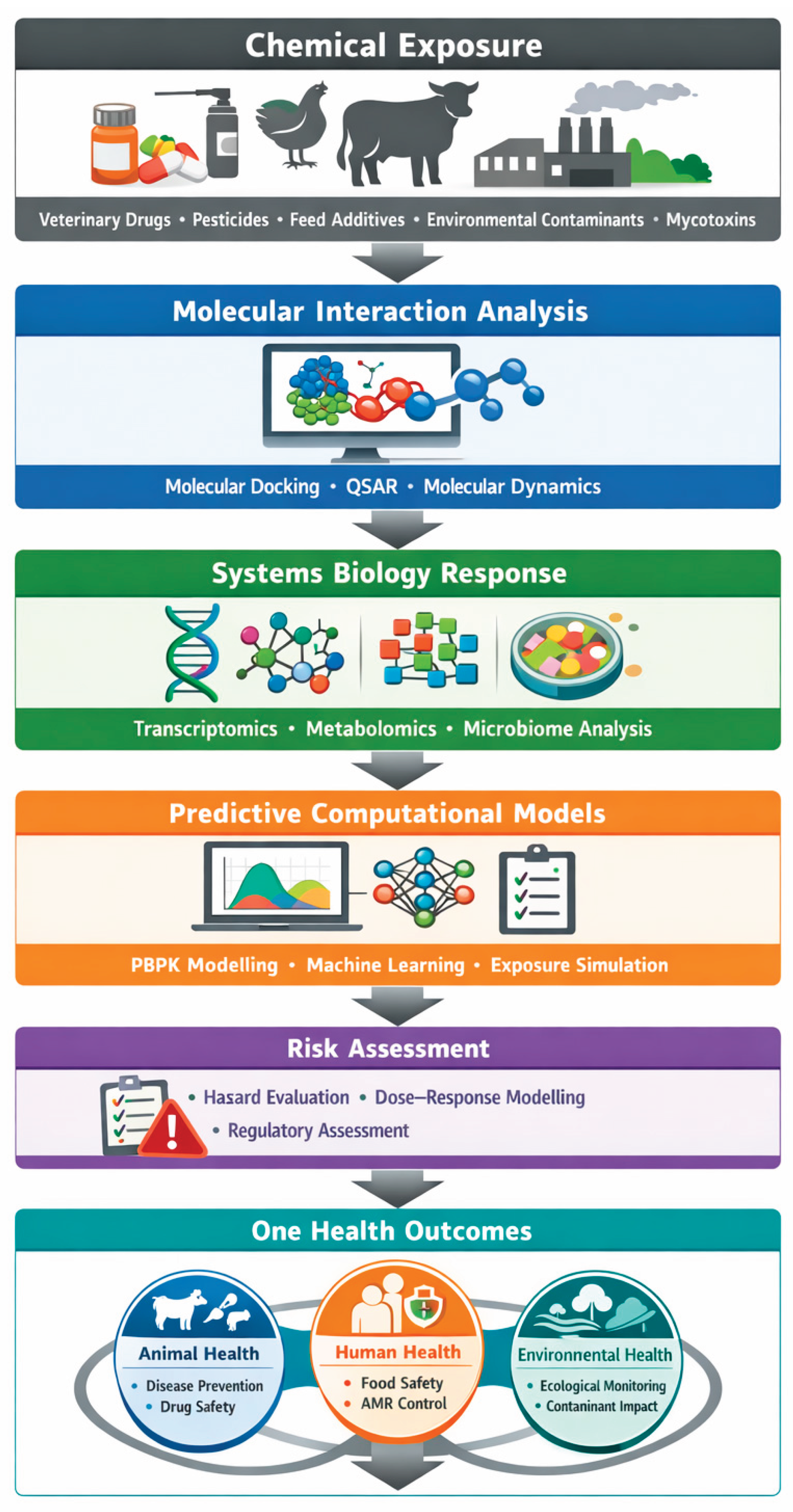

Table 1.
Key Computational Approaches in Veterinary Toxicology.
| Method | Application | Example |
|---|---|---|
| QSAR | Predict chemical toxicity | Feed additives |
| PBPK | Tissue residue modelling | Veterinary drugs |
| Molecular docking | Drug–target interactions | Transporter inhibition |
| Toxicogenomics | Biomarker discovery | Hepatotoxicity |
| AI / ML | AMR prediction | Antibiotic resistance |
Disclaimer/Publisher’s Note: The statements, opinions and data contained in all publications are solely those of the individual author(s) and contributor(s) and not of MDPI and/or the editor(s). MDPI and/or the editor(s) disclaim responsibility for any injury to people or property resulting from any ideas, methods, instructions or products referred to in the content. |
© 2026 by the authors. Licensee MDPI, Basel, Switzerland. This article is an open access article distributed under the terms and conditions of the Creative Commons Attribution (CC BY) license (http://creativecommons.org/licenses/by/4.0/).
Copyright: This open access article is published under a Creative Commons CC BY 4.0 license, which permit the free download, distribution, and reuse, provided that the author and preprint are cited in any reuse.


