
Submitted:
31 March 2026
Posted:
01 April 2026
You are already at the latest version
Abstract
There is continuation of concern over exponential growth in (dis) abled youth unemployment; while it remains vague if creative-content film tourism can be a strategic pathway to entrepreneurial venture within mainstream African Tourism. The aim of the present study is to position the narrative of economic value of creative-content FT using South Africa as a case study, interrogating the current discourse for deeper insights which can inform policy making, by-laws, investment attitudes as well as understanding the tourism geography of creative-content FT and mainstream FT, accessibility and inclusion of youth across the tourism economy. Critical Discourse Analysis was triangulated with thematic-content analysis using PRISMA-ScR data selection and screening process. The findings found five non-academic literature that was focusing on creative-content film tourism from a business and economic perspective that underscored reduction of youth with and with disabilities unemployment. Therefore, the study concludes with practical recommendations and direction for future research, nonetheless there is limited generalisability of the finding to the rest of Africa.
Keywords:
economic value
; livelihoods
; business
; entrepreneur
; creative-content film tourism
; disability
; disability-inclusion
; film tourism
; youth unemployment
; digitising era
; digital divide
1. Introduction
Globally, Film Tourism (FT) contribute to the economy’s Gross Domestic Product (GDP). However, the value it contributes to the tourism grassroots communities, while rooted in community planning has been documented as profound (Kim & Park, 2024). According to the AFTIA report, 12,5% of film production contributes to the GDP which is traced to the tourism sector. Furthermore, scholars unpacked FT as crucial in destination image development (Ahmed & Ünüvar, 2022; Farayi & Bolivia, 2018). While others show the developmental and management knowledge trail (Encyclopaedia included Hao, 2025), perceptions of tourists and practices and how it tapes into cultural context while embedding meaning-making processes (Kim, Klarin, Reijnders, Xiao & van Es, 2026). Majority of literature focus more on FT influence on destination product promotion like Korean (Kim, Kim & King, 2019; Kim, & Park, 2023), Tanzania (Mkenda, 2025), just to mention a few. It implies that FT has influence on portraying destination’s attributes for positive and negative local residence and tourists’ experiences, satisfaction and behavioural intentions.
While it is plausible that there is an academic debate on FT and impacts which goes beyond having a multiplier effect on the economic dimension. A contrast emerges from tourism sector’s stakeholders’ reluctance to mainstream creative-content filming of touristic areas in from legislative framework that influence and guide the mainstream media (FT) (Mandić, Petrić & Pivčević, 2017; Sawińska & Smalec, 2023) in Africa. Despite the tourism industries acknowledging value of creative FT to the point of designating job-roles; the existing scholarly work hardly unpacks the economic/financial and/or business value that is embedded in creative-content FT. It is exacerbated by the limited research on economic value that upholds an Afrocentric narrative on creative-content FT, making the area to remain a potential and under-researched, especially from the content-creative filming-FT policy discourse. Furthermore, there is limited research that reveals the tourism ecosystem of services that are translatable to revenue generation into an African-FT economy, while tracing the effects from industry to household-based levels as employment creation to reduce youth unemployment.
While, FT has various dimensions which are embedded in digitisation and technology, for example social media-based content creation, and mainstream media. The questions that emerge from the contemporary trends such as creative-content co-creation FT are: What is the knowledge distribution (mapping) on the creative-content FT? How is the creative-content FT ecosystem contributing to GDP in South Africa? How can the youth tap creative-content FT into making entrepreneurial ventures? How can the tourism business mainstream creative-content co-creation FT throughout the value chain? How can the role of creative-content FT be sychronise economic empowerment of unemployed youths? The questions are research questions developed from the backdrop that South Africa has youth unemployment (age range from 15-34 years) rate of approximately, 46,1% (4,8million) in the first quarter of 2025 (STATS SA, 2025). In South Africa, approximately 82% disadvantaged versus 18% disabled youths equates to 3.8million disadvantaged, and 1 million disabled youths (AFTIA, n.d.). The intersectionality of disability, poverty, unemployment and digital divide exacerbate the situation (AFTIA n.d). Though, globally, trends are skewed towards translating sales from markets generated by creative-content FT with an estimated value of approximately 32.28 billion Usd in 2024 and has been projected to have compounded annual growth of 13.9% from 2025 to 2030 (International Tourism Film Festival Africa (AFTIA, n.d.). Consequently, making smartphones, apps, digital cameras and other creative digital tools, hold the largest share of the market, contributing 73.1% of the revenue generated (AFTIA, 2025). This results in one asking a question; if this is translated in South African Rands (growth in revenue) per annum, this equates to how many jobs currently available and becoming available? Consequently, pointing to the need to have the tourism ecosystem to rethink and reconsider creative-content filming tourism.
However, a contrast remains in Africa and South Africa where only grey literature presents value of FT beyond multiplier approach that has dominated the academic narrative. The academic literature lacks clear financial perspective to who benefits and approximately how much, within the ecosystem of tourism sector-services as aligned to the overall GDP, industry and household. It implies that there is a need to bring scientific research that aims to position the narrative of economic value of creative-content FT using South Africa as a case study. At the same time repositioning the perspective to interrogate the current discourse for deeper insights which can inform policy making, by-laws, investment attitudes as well as understanding the tourism geography of creative-content FT and mainstream FT, accessibility and inclusion of youth across the tourism economy. Therefore, the article presents theoretical underpinnings, research methodology, findings and conclusions.
2. Theoretical Underpinning
Though the Human Capital Theory (Wuttaphan, 2017), Capability Approach (Robeyns, 2021) has not been directly applied in creative-content FT and mainstream FT, especially from the dimension of co-creation of youth employment and monetisation of the concepts. The Human Capital Theory underscores that skills influence productivity, therefore, there is need to invest in human capital for economic returns (monetising) within a knowledge-driven economy. While Capability Approach articulates that everyone with or without disabilities, have capabilities and there is need for internal and external conversion factors to making one to ‘be and become’ in terms of functionings that fosters pursuit of achievements, while given opportunities to exercise choice, freedom and agency. In this context, creative-content filming is aligned with self-creativity (internal/intra-personal conversion factor), and the entrepreneurial skills can be external conversion factor to catalyse youth employment dream, and monetising, while adding value to the tourism business in South African destinations.
The two theories, together can provide perspectives and a clear picture on complementary role of developing and fostering entrepreneurial skills (investing in human resource-in this case youth with and without disabilities) as an enabler for full participation rooted in internal and external interactive conversion factors for effective economic capability embodied among youth (females and males) to birth employment outcomes within the digital era. Therefore, the theories are speaking opportunities co-created in the FT economic value chain as creative-content FT. Creative-content FT is one of the emerging bedrocks for industry’s growth and youth with and without disabilities employment as entrepreneurs within the experience and digitisation of tourism, that needs to be backed up by business management/operation skills. Therefore, the study presents research methodology to explain how it was rolled out from the human capital theory and capability approach perspective.
3. Materials and Methods
The article employed a qualitative (Mogashoa, (2014), Interpretivist Critical Discourse Analysis approach (Gölbaşı, 2017; Heracleous, 2004). Discourse analysis as a qualitative methodology (Zajda, 2020). The first phase involved the selection of research questions as presented in the introduction for a progressive focus on the language used in expressing the texts in the policy documents (grey) and academic literature. The data was electronically searched and extract academic literature from Google Scholar and Google search engine for non-academic information from print and online media, and legislative frameworks. Only Afrocentric (South African) information from 2000-2025 was selected for the study, the rest were excluded to manage the scope. 2000 marked the digital technological revolution that implicated FT through the formulation of National Film and Video Foundation in 1999 in South Africa. The researchers second phase involved the researcher individually reading the policy documents, they identified texts and analysed the pre-existing discourses in the policy, non-academic and academic literature as aligning to power-relations within the processes of developing the policies. Screening and thematic-content analysis was done concurrently as the researchers identified appropriate texts, a meeting was conveyed to have a group analysis of the identified texts from a FT’s economic or business perspective based on PRISMA-ScR presented in Figure 1 (Veroniki et al., 2025).
While following the PRISMA-ScR, the researchers extracted codes as they emerged from the data interrogation process as illustrated in Table 1.
Just as indicated in Table 1, the third phase took account of how the text (codes were clustered) has been developed, ideological position and how the process and text related to the institutions that wrote the policies and literature associated with the identified discourses. The fourth phase underscored the identification of possible ways past the obstacles or problems/gaps and blanks (reveal the implicit assumptions of youth (with or without disabilities) unemployment while creative-content FT can influence economic growth levels, alleviation in skill mismatch and structural barriers in tourism value chain to co-create business markets, innovation and opportunities) identified by the use of discourses, narratives, and arguments. Thus, the researchers used words in texts and speeches to identify socio-economic questions which later were considered as how the words in texts and speech could be used to contest identified discourses. The finding are presented in the next section as guided by the main themes: The knowledge distribution (mapping) on the creative-content FT; The creative-content FT ecosystem contributing to GDP in South Africa; The youth tape creative-content FT into making entrepreneurial ventures; The tourism business mainstream creative-content FT throughout the value chain; The role of creative-content FT be sychronise economic empowerment of unemployed youths. The themes are presented and discussed in the next section.
4. Results and Discussion
The present findings that emerged from the manual thematic-content analysis rooted in Critical Discourse Analysis (CDA) has the outcomes that shows no legal framework (discourse) and scholarly work has explicitly articulate, incorporate and support creative-content FT as an enabler for reduction of youth (with and without disabilities) unemployment. Therefore, only five organisational reports have arguments to bringing creative-content FT as business opportunity that can reduce youth unemployment in Africa, especially South Africa. The findings from the reports are presented using the research questions as guiding themes as follows:
4.1. Afro-Centric Knowledge Map on the Creative-Content FT
The findings reveal a skeletal knowledge distribution (mapping) on the creative-content FT as limited across the African scholarship. The codes associated with the theme are as follows: ‘Traits’, ‘Skills empowerment on digital tech’, ‘No knowledge creative-content FT’, ‘Silence on creative-content youth employment in legislative frameworks’. All codes show a pattern that implies there is both limited academics and non-academic research on creative-content FT to co-create entrepreneurial ventures among youths. While non-academic literature like five organisational reports (from news and filming organisations) acknowledges the economic and business-value from creative-content FT as a pathway to reduce youth unemployment. It implies that there is limited youth empowerment through external conversion for creative-content FT rooted in skills matching that enhances agency among youth with and without disabilities to engaging the tourism business policy makers to support their initiatives in business within the value chain.
Therefore, the blank in African creative-content FT knowledge perpetuates ignorance as there is limited scientific evidence to inform policy makers and decision makers in the value chain to have alternative pathways to reducing youth unemployment. Though current research discourse is profound on influencers’ role to destination image and marketing by scholars like Mohamed, Mberia and Bosire (2025) and in the mainstream filming, creative economy, fashion, culture and entrepreneurial fields as presented by scholars like Boateng, Boateng, Anning-Dorson & Penu, (2025). It implies that the findings point to creative-content FT as under-researched, especially from an employment creation for youth with and without disabilities for economic emancipation. Therefore, there is need for a more research that presents factual figure, for measuring impact as well as magnitude that gives clue to policy, planning and decision making.
4.2. Creative-Content FT Ecosystem and GDP
The finding reveals the following codes ‘Unclear supply and demand’, ‘Inequalities and digital divide’ and ‘Ableism’ to point to limited investment in human capital, either in a formal or informal skills development. Consequently, making creative-content FT skills to be relying more on initiative and personality-based capabilities and capacity (Wuttaphan, 2017). Though, there is need for plan that alleviates the gap. Nonetheless, AFTIA (n.d.) projects that 71% of this content being captured on DSLR’s and smartphones, it goes to prove that we can mitigate the barriers to entry by being intentional with what we have. Separately, the digitisation of content is valued at $32,38bn per annum, with a compounded growth of 13,9% forecast year on year till 2030 (AFTIA, app, n.d). Youth unemployment sitting at 46,1% equalling 4,8 million unemployed youth, both abled and disabled. Film grossed R8,8bn to the GDP and Direct downstream benefit to tourism equals R500mil. It can be concluded that the actual figure is more likely to be 12,5% of what film grossed but there are no measurable impact studies available. This equates to a growth of $400mil P/A. If each person is earning $1mil P/A then how many jobs are currently available and how many more are being created annually? Therefore, there is unclear public and private sector policy nor academic knowledge that speaks to the creative-content FT ecosystem that contribute to GDP in Africa and South Africa besides estimate-based speculations from non-academic literature. Therefore, it implies that there have not been studies to establish specific role players and quantify the business and economic value that is contributed by the creative-content FT as well as the creator’s revenue (Mayekiso, Ogujiuba, & Maponya, 2025).
Other than estimates on indirect and/or multiplier effect of film cast’s spending on when using accommodation, flights among other facilities in filming; the economic and business value has hardly been quantified throughout the tourism supply chain as well. It implies that influencers’ business and economic value in the creative-content FT is vaguely understood in academic space but is estimated by the news and organisational reports, which lacks scientific robustness. Therefore, the findings point creative-content FT as potential entrepreneurial venture, that need a scientific study that unpacks the whole ecosystem for better policy and realistic youth employment strategic pathway.
4.3. Youth Entrepreneurial Venture Using Creative-Content FT
The findings reveal the themes as associated with the following codes: ‘Accessibility awareness’, ‘structures to participate in the project, and project implementation approach’ and ‘costing and limited funding’. Despite, the findings point to potential of creative-content FT to enhance productivity, while enabling freedoms and choices to participate in creative-content FT. There is no African academic literature that has aligned creative-tourism with how the youth with and without disabilities can tape creative-content FT as entrepreneurial ventures that fosters direct industry-household revenue flow and growth. However, among the organisational reports, AFTIA has a project that fosters initiatives to harness the potential through strategic engagements, making it necessary to have a baseline study that maps the business-ecosystem. Within the same line of thought, learning can be taken from the Gengan’s (2022) entrepreneurial conceptual framework. Making the baseline research to embed the connection of Afrocentric tourism business and stakeholders towards creative-content FT as a tool to contribute to reducing unemployment, while having business growth, while establishing a computable costing and funding constructs.
4.4. Tourism Business Mainstream Value Chain and Creative-Content FT
The findings reflect tourism business as having potential to mainstream creative-content FT throughout the value chain as associated with the codes ‘Limited clear business-pathway’, ‘Ignorance on performance measure and translation to revenue’, Unclear creative-content FT economic returns frameworks’. However, it remains a potential that fails to make clear on direct and indirect economic returns among the role players within the creative-content FT. Consequently, posing limited opportunities for choices to perceive employment pathway for youths. Nonetheless, the grey literature led to illustration of the perceived value chain implicated by creative-content FT as presented in Figure 2.
4.5. Relationship Between Creative-Content FT and Economic Empowerment of Youths
The findings reveals the theme as associated with the following codes: ‘Norms and standards limit the involvement of policy upgrade to uphold youth creativity and innovative processes', ‘Tourism value chain stakeholder-attitude’, ‘Fragmented voice for youth with and without disabilities’, ‘Unclear attributes’, ‘Unclear disability-inclusive creative-content FT characteristics’ and ‘Unclear creative-content FT youth employment creation’. The codes points to the role of creative-content FT be sychronise economic empowerment of unemployed youths with and without disabilities. However, neither framework nor model has yet existed to uphold the knowledge-driven tourism economy, which compromise the agency among youth to choosing employment opportunities. Nonetheless, grey literature, shared clues that postulated the following Figure 3.
Source: non-academic literature.
5. Conclusions
The study (re)conceptualised the economic value of creative-content Film Tourism through positioning (dis) abled-youth unemployment into the current discourse and digitising era. The research findings established scarcity of the knowledge distribution (mapping) on the creative-content FT. Furthermore, it is still vague on how the creative-content FT ecosystem is contributing to GDP in South Africa. Based on the findings, the study there is need to set-up community-based filming hubs/Creative Digital Labs at TVETs colleges or community centres. so as to co-create value that enables the youth to tape creative-content FT into making entrepreneurial ventures. Such provisions can enable teaching and learning editing (CapCut, Adobe Premiere Pro), scripting, lighting, and mobile filmmaking.
The grey literature gave clues on the value to make it easier for the present study to propose the identified areas for research aligned to mechanism to reduce youth unemployment within the tourism business to mainstream creative-content co-creation FT throughout the value chain. Within the same perspective, youth can start with mobile filmmaking, as they engage business content drive, using youth teams to create videos for local businesses like restaurants, events, promos and adverts at low cost. Lastly the findings gave clues on framework to enable the researchers to propose dimensions to develop mechanism to enable a clear role of creative-content FT as sychronised with business and economic empowerment of unemployed youths. This includes making use of platform monetarisation like Ads, channel monetarisation, brand deals, influencer marketing and selling digital products after training youth on how to pitch brands and price services and basic skills operational skills like invoicing and pricing.
Therefore, the scoping review concludes that there is need to address the revealed gap in specific business and economic value aligned with reducing unemployment of disabled and non-disabled youth in African and South Africa using emerging creative-content FT, like Youth Tourism Content Squads on inclusive media production e.g. Disability-inclusive story-telling and accessible tourism videos, Youth Media Agency (to bid for government tenders, NGO documentation projects). Therefore, the study proposes a need to expand the entrepreneurial conceptual framework by Gengan (2022) with disability inclusion (accessibility) within the creative-content FT (C-CFT) that embeds opinion leaders and followers, while creating demand that can be converted into sales within the supply chain.
The Creative-Content FT characteristics is informed by the triangulation of HCT and CA and current findings which points to novelty, usefulness, freedom, agency, choice, external and internal conversion factors (investment in skills that fosters cognitive practices) and support of diverge thinking. This can be done using a content strategy that builds on niche channels like Accessible Travel SA. The C-CFT should be combined with potential Tourism Revenues (TR) earned by the creative youth(s) and the tourism supplier(s) in the value chain which should have a equal value (balance) with the function of A representing Accessibility/Disability Inclusive approaches fostered in creative learning to produce new ideas; V-Vision guiding the opinion leader (youth-creator(s)); A-Adaptive to deviance in trends in market behaviours and environments, instructions, processes and policies for innovative commercialisation output performance; C-Collaboration between C-CFT throughout the tourism business value chain and EI-Emotional Intelligence. It is presented as a formular: C-CFT characteristics + TR= ƒ (A, V, C, A, EI). The formula speaks to the variables which constitute the proposed (re)-conceptualising the economic value of creative-content Film Tourism, while positioning (dis) abled-youth unemployment in the current discourse and digitising era (Figure 4).
Based on Figure 4, this can also engineer a way that South African Revenue Authorities can capitalise on earnings that is not being generated through digitisation of content. Furthermore, the expansion of Gengan (2022) formular that speaks to the framework in Figure 4 points to a future research direction which can lay a foundational baseline area which can be focused on to establish pathways for sustainable economic value of C-CFT positioning (dis)abled-youth unemployment in the current discourse and digitising era. For instance, launching an Accessible Tourism Film challenge and the winners gets funding or contracts. In the same line of thought of establishing knowledge, there is need to establish direct and indirect business and economic areas in the tourism value chain. Thereafter, unpack the C-CFT as an emerging entrepreneurial venture to reduce youth unemployment and supplier revenue generation within the African socio-economic context. This points to the relevance of the AFTIA app, which aims to complement effort to pursue the proposed framework. Nonetheless, the study has limited generalisability as a scoping review on African C-CFT.
The study proposed a conceptual economic framework to reconceptualise the role of creative-content film tourism (C-CFT) as a mechanism for inclusive economic involvement and participation, especially youth with and without disabilities, while embedded on the digitising tourism economy. In this framework, a triangulation of insights from HCT and CA articulates business and/or economic value can be co-created through an intersection of skills development, digital innovation and inclusive tourism business ecosystem.
5.1. Theoretical Integration
The HCT underscores investing in knowledge and skills (competencies) enhance productivity and economic returns both to the business and holder of the qualification. In this case, C-CFT fosters the transfer and acquisition of digital, business operations and creative production skills, including video editing. Consequently, the competencies empowers and act as one of the enablers in stimulating travel, while marketing and branding a destination within the evolving digital tourism economy.
CA complements HCT by broadening the focus to include individuals’ freedoms, agency and choices to opportunities to achieve valued functioning. In this context, participation of youth with and without disabilities is not solely determined by acquisition of competencies, but also by internal (like motivations) and external (such as access to technologies) conversion factors. Therefore, integration of CA and HCT brings a multi-dimensional lens towards understanding economic participation as both a function of capability and opportunity.
The core of the framework is rooted in CA and HCT theoretical foundation that proposes that Economic Value of Creative-Content Film Tourism (EV-CFT) is a function of dynamic interaction of five constructs: EV-CFT = f(HC+CA=DE+IVC+DI), where Human Capital (HC) refers to technical (including digital, creative abilities) and entrepreneurial (business) competencies for creative content and monetisation within the tourism ecosystem. Capability Approach (CA) encompasses youth with and without disabilities’ agency, freedom and choices to opportunities to convert competencies into revenue from economic participation. Digital Economy (DE) implies for the enabling environments which are created by digital platforms like social media as channels to engage potential markets, for revenue generation. Inclusive Value Chain (IVC) refers to the tourism business ecosystem and markets. Disability Inclusion (DI) refers to the accessibility, equity and inclusive design embedded in the demand and supply within the tourism business ecosystem.
The essence of the framework is that knowledge and skills development alone is insufficient unless enabled by capabilities that allows youth to exercise agency within the tourism economy. At the same time, digital economy offers platforms for youth participation, but unless tourism value chain is inclusive while embedded in disability-inclusive practices, it remains an opportunity unevenly distributed. Disability inclusion implies foregrounding accessibility as central in innovation and economic growth, and not as add-on, especially in Africa where there are high levels of youth unemployment and structural inequality e.g. in South Africa alone its approximately above 46%.Inclusive value chains translates individual capabilities into tangible economic outcomes; hence C-CFT can be a viable pathway for entrepreneurial development and income generation.
5.2. Implications of the Framework
The reconceptualisation has contributed to the literature in three ways. First, it expansion and application of HCT and CA into an integrated model that explains economic value of the creative-tourism economy scholarship within a disability-inclusive context. Second, it provides a basis for developing policies integrates previously marginalised youth populations from a skills development, digital access and inclusive tourism practices perspectives. Third, it offers structured interventions where stakeholders can tap value within the creative labs, youth media enterprises and accessible tourism initiative to uphold social value, while generating economic value.
Therefore, concludes that, based on the findings from the scoping review that employed critical discourse analysis, the proposed framework responds directly to identified knowledge, policy and practice gaps. It, therefore, presents systemic and measurable pathways for understanding how C-CFT can transition from largely conceptual discourse to practical mechanism for reducing youth unemployment and fostering inclusive economic growth in South Africa and similar Global South contexts.
The current study is a scoping review that has a limited generalisability, therefore future research can test the hypothesis suggested by the model that economic value is positively correlated with increase in competencies (HC), opportunities (CA), digital access and market integration, while disability inclusion as multiplier that enhances participation and moderator to ensure equitable distribution of benefits. Hence, as an analytic model, it can be expressed as: EV-CFT= αHC+βCA+ γDE+ δIVC+θDI+ ε
Where: α, β, γ, δ, θ=contribution weights, ε=external factors (policy, funding, infrastructure).
Author Contributions
Conceptualization, James Bryne; Writing – review & editing, Tawanda Makuyana; Project administration, Nicola Wakelin-Theron. All authors have read and agreed to the published version of the manuscript.
Funding
This research received no external funding.
Institutional Review Board Statement
Not applicable.
Informed Consent Statement
Not applicable.
Data Availability Statement
The original contributions presented in this study are included in the article. Further inquiries can be directed to the corresponding author(s).
Conflicts of Interest
The authors declare no conflicts of interest.
Abbreviations
The following abbreviations are used in this manuscript:
| CA | Capability Approach |
| CDA | Critical Discourse Analysis |
| DE | Digital Economy |
| DI | Disability Inclusive |
| EV-CFT | Economic Value of Creative-Content Film Tourism |
| FT | Film Tourism |
| GDP | Gross Domestic Product |
| HC | Human Capital |
| IVC | Inclusive Value Chain |
| TR | Tourism Revenue |
References
- Ahmed, Y.; Ünüvar, Ş. Film tourism and its impact on tourism destination image. Çatalhöyük Uluslararası Turizm ve Sosyal Araştırmalar Dergisi 2022, (13), 90–113. [Google Scholar]
- Boateng, R.; Boateng, S.L.; Anning-Dorson, T.; Penu, O.K.A. AI and the creative economy: Transforming content creation and influencer entrepreneurship; CRC Press, 2025. [Google Scholar]
- Farayi, K.P.; Bolivia, M. The potential contribution of film tourism to destination image recovery in Zimbabwe. African Journal of Hospitality, Tourism and Leisure 2018, 7(3), 1–14. [Google Scholar]
- Gengans, R. Innovative Entrepreneurship through Creative Outputs for Emerging Filmakers in South Africa: A Conceptual Framework. African Journal of Multidisciplinary Studies 2023, 5(1), 1–13. [Google Scholar]
- Gengan, R. Creative leadership and management in the KwaZulu-Natal film industry. Doctor of Philosophy Thesis, Durban University of Technology, 2022. [Google Scholar]
- Gölbaşı, Ş. Critical approach in social research: Fairclough’s critical discourse analysis. The Online Journal of Communication and Media 2017, 3(4), 5–18. [Google Scholar]
- Hao, X. Film tourism. In Encyclopedia of Tourism; Springer Nature Switzerland: Cham, 2025; pp. 397–398. [Google Scholar]
- Heracleous, L. Interpretivist approaches to organizational discourse. In The Sage handbook of organizational discourse; 2004; pp. 175–192. [Google Scholar]
- International Tourism Filming Festive Africa (AFTIA) report nd.
- Kim, S.; Park, E. An integrated model of social impacts and resident’s perceptions: From a film tourism destination. Journal of Hospitality & Tourism Research 2023, 47(2), 395–421. [Google Scholar]
- Kim, S.; Park, E. Identifying film tourism impacts on grassroots communities: implications for film tourism development and community planning. Tourism Recreation Research 2024, 49(5), 1160–1164. [Google Scholar] [CrossRef]
- Kim, S.; Kim, S.; King, B. Nostalgia film tourism and its potential for destination development. Journal of Travel & Tourism Marketing 2019, 36(2), 236–252. [Google Scholar]
- Kim, S.; Klarin, A.; Reijnders, S.; Xiao, Q.; van Es, N. Chronicles of film tourism: an integrative review and future research directions. Journal of Hospitality & Tourism Research 2026, 50(2), 188–205. [Google Scholar]
- Mandić, A.; Petrić, L.; Pivčević, S. Film as a creative industry constituent and its impacts on tourism development: Evidence from Croatia. Tourism in Southern and Eastern Europe 2017, 4, 335–348. [Google Scholar] [CrossRef]
- Mayekiso, T.; Ogujiuba, K.; Maponya, L. Funding and Innovation Pathways for Creative Entrepreneurship: Evidence from South Africa’s Creative Economy. World 2025, 6(4), 159. [Google Scholar] [CrossRef]
- Mkenda, B.P. The Influence of Films in Promoting Tourism in Tanzania: A Case of Dar es Salaam. Doctor of Philosophy Thesis, The Open University of Tanzania, 2025. [Google Scholar]
- Mogashoa, T. Understanding critical discourse analysis in qualitative research. International Journal of Humanities Social Sciences and Education 2014, 1(7), 104–113. [Google Scholar]
- Mohamed, A.Z.; Mberia, H.K.; Bosire, J.T. The Effect of Social Media Influencers’ attractiveness on the Travel Decision Making of Domestic Tourists in Kenya. ISAR Journal of Arts, Humanities and Social Sciences 2025, 3(9), 22–29. [Google Scholar]
- Robeyns, I. The capability approach. In The Routledge handbook of feminist economics; Routledge, 2021; pp. 72–80. [Google Scholar]
- Sawińska, A.; Smalec, A. Film tourism in the promotion of a touristic area. European Research Studies Journal 2023, XXVI(4), 513–522. [Google Scholar] [CrossRef]
- STatsSA. Hildren and Youth Still bear the Burden of Poverty. 2025. Available online: https://www.statssa.gov.za/?p=19061 (accessed on 16 March 2026).
- StattsSA. Who is more likely to transition into employment – Herew what the numbers say. 2025. Available online: https://www.statssa.gov.za/?p=19061 (accessed on 16 March 2026).
- Veroniki, A.A.; Hutton, B.; Stevens, A.; McKenzie, J.E.; Page, M.J.; Moher, D.; McGowan, J.; Straus, S.E.; Li, T.; Munn, Z.; Pollock, D. Update to the PRISMA guidelines for network meta-analyses and scoping reviews and development of guidelines for rapid reviews: a scoping review protocol. JBI evidence synthesis 2025, 23(3), 517–526. [Google Scholar] [CrossRef] [PubMed]
- Wuttaphan, N. Human capital theory: The theory of human resource development, implications, and future. Life Sciences and Environment Journal 2017, 18(2), 240–253. [Google Scholar]
- Zajda, J. Discourse analysis as a qualitative methodology. Educational Practice and Theory 2020, 42(2), 5–21. [Google Scholar] [CrossRef]
Figure 1.
(Re)-conceptualising the economic value of Film Tourism: Positioning (dis) abled-youth unemployment in the current discourse and digitalizing era. Source: Adopted in part from Page MJ. et al. 2021 (cited by Veroniki et al., 2025)
Figure 1.
(Re)-conceptualising the economic value of Film Tourism: Positioning (dis) abled-youth unemployment in the current discourse and digitalizing era. Source: Adopted in part from Page MJ. et al. 2021 (cited by Veroniki et al., 2025)
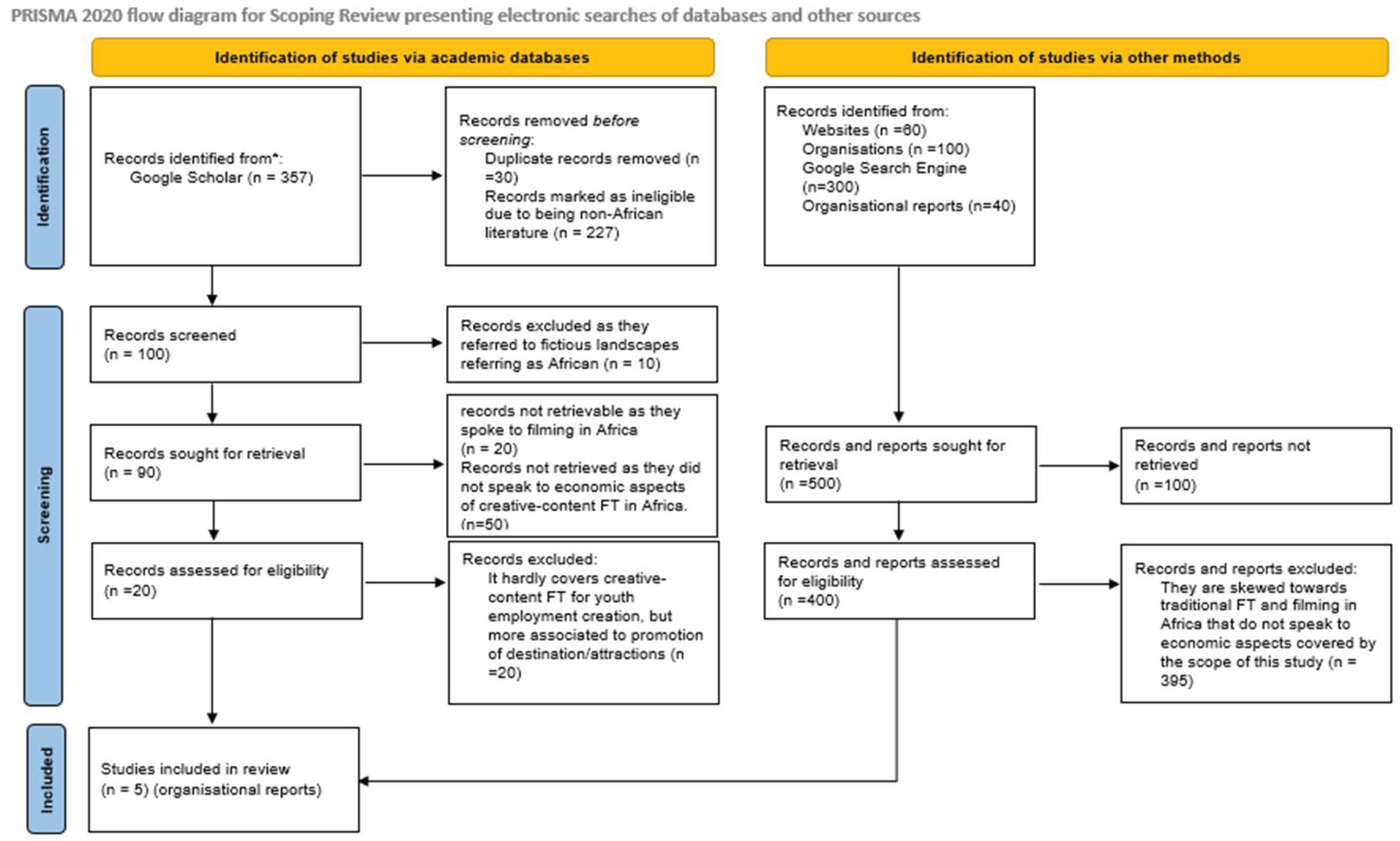
Figure 2.
Creative-content FT value chain.
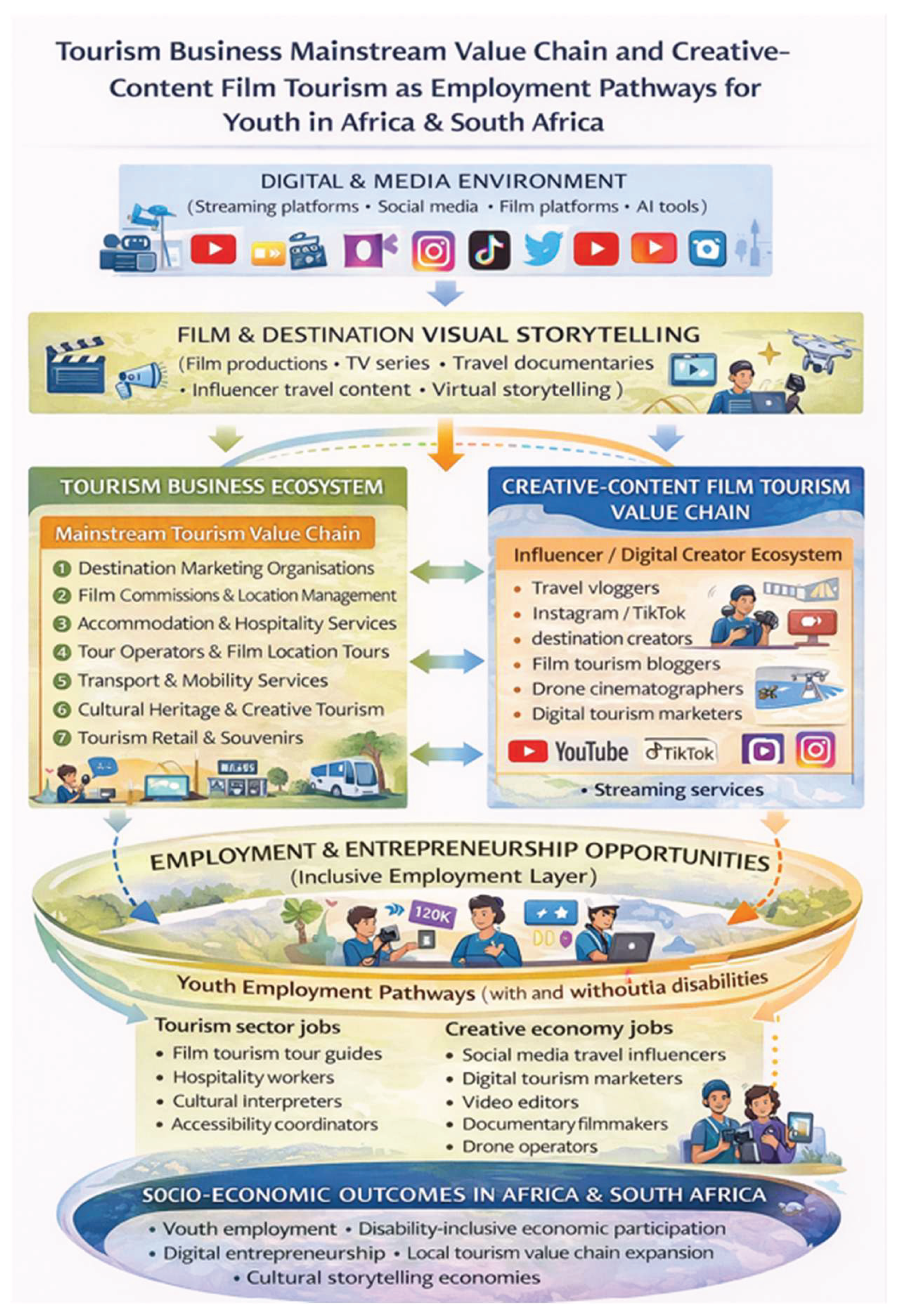
Figure 3.
Disability-inclusive youth empowerment using creative-content FT.
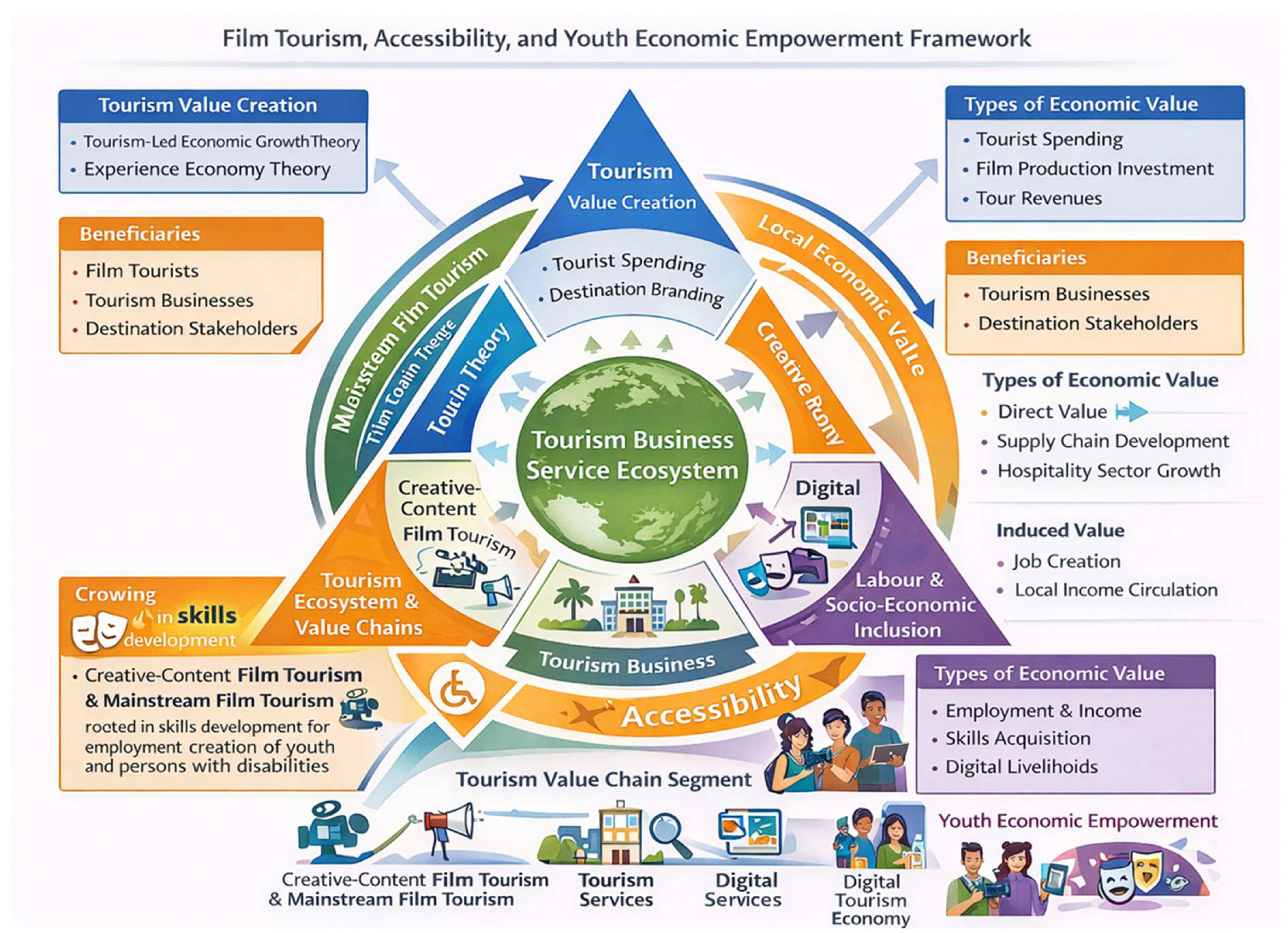
Figure 4.
Summarised Proposed Conceptual Framework for disability inclusive.Source: Adapted in part from Gengan (2022).
Figure 4.
Summarised Proposed Conceptual Framework for disability inclusive.Source: Adapted in part from Gengan (2022).
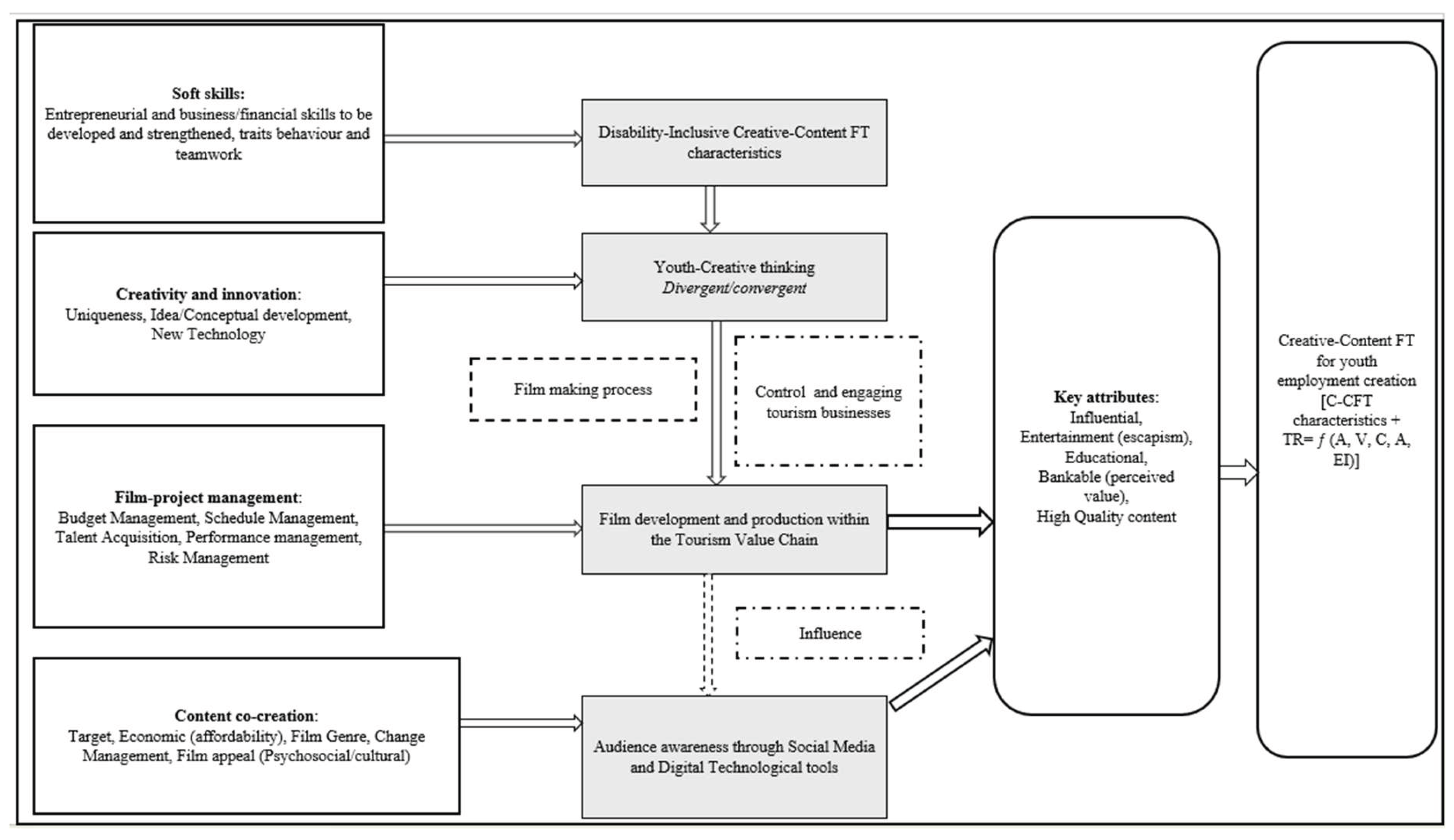

Table 1.
The organisation of codes and connection to the research questions.
| Initially assigned labels/Codes | Construct of HCT | Constructs of CA | Research Question |
|---|---|---|---|
|
‘Traits’, ‘Skills empowerment on digital tech’, ‘Noknowledge creative-content FT’, ‘Silence on creative-content youth employment in legislative frameworks’ ‘Unclear supply and demand’ ‘Inequalities and digital divide’ ‘Ableism’. |
Skills match Investing in human capital |
Individuals' abilities to functionings (achieve the life they value). | What is the knowledge distribution (mapping) on the creative-content FT? How is the creative-content FT ecosystem contributing to GDP in Africa and South Africa? |
|
‘Accessibility awareness’ ‘Structures to participate in the project, and project implementation approach’ ‘Costing and limited funding’ |
Productivity | Freedoms to make choices that lead to fulfilling lives | How can the youth tape creative-content FT into making entrepreneurial ventures? How can the tourism business mainstream creative-content FT throughout the value chain? |
|
‘Limited clear business-pathway’ ‘Ignorance on performance measure and translation to revenue’ Unclear creative-content FT economic returns frameworks’ |
Economic Returns | Opportunities to make choices associated with employment that lead to fulfilling lives | |
|
‘Norms and standards that limit the involvement of policy upgrade to uphold youth creativity and innovative processes' ‘Tourism value chain stakeholder-attitude’ ‘Fragmented voice for youth with and without disabilities’ ‘Unclear attributes’ ‘Unclear disability-inclusive creative-content FT characteristics’ ‘Unclear creative-content FT youth employment creation’ |
Knowledge-driven economy | Agency to make choices that lead to fulfilling lives | How can the role of creative-content FT be sychronise economic empowerment of unemployed youths? |
Source: Authors.
Disclaimer/Publisher’s Note: The statements, opinions and data contained in all publications are solely those of the individual author(s) and contributor(s) and not of MDPI and/or the editor(s). MDPI and/or the editor(s) disclaim responsibility for any injury to people or property resulting from any ideas, methods, instructions or products referred to in the content. |
© 2026 by the authors. Licensee MDPI, Basel, Switzerland. This article is an open access article distributed under the terms and conditions of the Creative Commons Attribution (CC BY) license (http://creativecommons.org/licenses/by/4.0/).
Copyright: This open access article is published under a Creative Commons CC BY 4.0 license, which permit the free download, distribution, and reuse, provided that the author and preprint are cited in any reuse.


