

Submitted:
29 March 2026
Posted:
08 April 2026
You are already at the latest version
Abstract
This article aims to situate itself within religious anthropological scholarship through a comparative study of Indigenous religious transformation in Malaysia and Bangladesh. Methodologically, the research combines phenomenological interpretation with a decolonial perspective rooted in a relational ontology that sees human beings as embedded in networks of land, ancestry, and community. Drawing on ethnographic engagement, narrative accounts, and interpretive analysis, the study examines two Indigenous communities—the Orang Asli of Peninsular Malaysia, where conversion to Islam occurs, and the Santal of northern Bangladesh, where conversion to Christianity has been significant. The findings suggest that religious conversion in these contexts rarely results in a straightforward doctrinal change. Instead, it unfolds as a negotiated transformation of moral life, kinship relations, and social belonging within existing cultural worlds. Indigenous actors often reinterpret new religious teachings through their own cosmological frameworks, creating hybrid moral landscapes where elements of Indigenous relational knowledge coexist with new religious practices. To understand these dynamics, the article develops the Nas–Tadabbur–Ihsan model, connecting relational ontology (Nas), reflective epistemology (Tadabbur), and ethical practice (Ihsan). While these concepts originate from Islamic ethical vocabulary, the framework functions as a universal analytical tool, emphasizing shared human capacities for reflection, relationality, and ethical responsibility. Therefore, the study suggests that Indigenous conversion is best understood as an ongoing process of ethical negotiation and relational reconfiguration rather than a mere cultural rupture or assimilation.
Keywords:
Islamic anthropology
; indigenous communities
; conversion to Islam
; Orang Asli
; Santal
; Nas–Tadabbur–Ihsan
; anthropology of Islam
; Bangladesh
; Malaysia
Introduction
Religious conversion has long been a central topic within anthropology (Comaroff & Comaroff. 1991) and the study of religion (Rambo, 1993; Snow & Machalek, 1984; Stark & Bainbridge, 1980). Scholars have explored how encounters between global religious traditions and local communities generate complex transformations in belief, identity, and social organization when we see that early anthropological approaches often interpreted conversion as a process of cultural rupture or ideological change (Hefner, 1993), and later studies (Robbins, 2004; Meyer, 1999; Önnudóttir et al., 2013) emphasized the agency of individuals and communities in reinterpreting religious traditions within their own social worlds. These debates have been particularly prominent in research on Christianity and missionary encounters; in contrast, the dynamics of Indigenous conversion to Islam have received comparatively less sustained attention within contemporary anthropological literature.
Existing anthropological studies of Islam, mainly initiated by Clifford Geertz, have developed several important conceptual frameworks for understanding Muslim societies. Interpretive approaches, for instance, initially examined Islam as a cultural system expressed through symbols and social practices (Geertz, 1968). Talal Asad challenged this perspective by emphasizing Islam as a historically embedded discursive tradition, shaped by reasoning, authority, and ethical practice (Asad, 1986, 1993). Subsequent ethnographic work has further explored how Islamic practices cultivate particular forms of moral subjectivity and ethical sensibility within everyday life (Mahmood, 2005; Hirschkind, 2006; Deeb, 2006). More recently, scholars have called for a renewed anthropology of Islam that attends to the diversity of Muslim practices and institutional contexts across societies (Bowen, 2012). However, a small area that is the interaction of Islam, Christianity, and Indigenous conversion is almost an ignored area as a topic and within the traditions of changing political and cultural contexts (McDougall, 2009; Stephenson, 2013; Belloufa & Nebbou, 2025). Studies (Onagun & Raheem, 2026; Aziz & Ahmad, 2026) from Africa, Australia, and Southeast Asia demonstrate that conversion often reflects negotiations of identity, morality, and power rather than simple doctrinal change.
Despite these advances, an important conceptual question remains unanswered: should anthropology approach Islam solely as a body/entity of ethnographic analysis, or can Islamic intellectual traditions also serve as a source of anthropological reasoning? Scholars have noted the distinction between an anthropology of Islam, which studies Muslim societies, and the possibility of an Islamic anthropology, which draws on Islamic ethical and epistemological traditions as analytical resources (Tapper, 1995; el-Zein, 1977). This debate intersects with broader discussions within anthropology about the role of normativity, reflexivity, and epistemological plurality in the production of knowledge (Clifford & Marcus, 1986; Abu-Lughod, 1991). As anthropological scholarship increasingly engages with decolonial and Indigenous perspectives that challenge Euro-modern assumptions about knowledge and the human (Wynter, 2003), the question of alternative epistemological foundations has become more prominent.
In Southeast and South Asia, Islam has interacted with Indigenous societies through trade, migration, political integration, and social interaction (Debnath, 2012; Ullha, 2025; Feener & Sevea, 2009; Ricci, 2011), producing diverse religious landscapes where Islamic teachings intersect with local cosmologies, rituals, and communal belonging. For communities like the Bangladeshi Santal and the Malaysian Orang Asli (Chowdhury et al., 2024), Manipuri (Zakaria & Chowdhury, 2006), and Rakhains (Chowdhury, 2026), spiritual life intertwines with land, ancestry, and collective memory (Junoh et al., 2024; Tan, 2019). Religion thus forms a relational system organizing social life and moral responsibility. Islamic conversion here involves negotiating new ethical frameworks, relationships, and identities (Junoh et al., 2024). Building on this, we explore these dynamics in post-colonial Malaysia and Bangladesh.
As former colonial territories—Malaysia and Bangladesh—remain entangled in complex patterns of religious transformation among Indigenous communities. In Peninsular Malaysia, conversion to Islam among the Orang Asli has become a contentious issue, as Fani et al. (2026) stated, influenced by both historical paths and current social and institutional processes. Historically, Islam spread throughout the Malay world via maritime trade networks connecting Gujarat and Malacca, laying early foundations of Islamic influence in the region (Ullah, 2025; Rasip et al., 2025; Fani et al., 2026). In modern Malaysia, Orang Asli conversion to Islam is often linked to factors such as intermarriage, daʿwah (Islamic preaching) efforts, and broader processes of social and political integration within the Malay-Muslim national identity (Kamaruddin & Mokhtar, 2024; Seo, 2023). Meanwhile, studies on Christian conversion among Bidayuh communities reveal tensions between maintaining cultural traditions and embracing religious change, reflecting wider regional patterns also seen in Indonesia (Chua, 2012; Suryani, 2024).
In Bangladesh, religious change among Indigenous peoples—particularly among the Santal community—has attracted increasing scholarly attention over few decades, due to its links to language loss, cultural transformation, and minority vulnerability (Debnath, 2020, 2012; Karmaker, 2025; Hasan, 2024). Conversion through both Christian missions (Zene, 1993) and Islamic outreach intersects with debates on land rights, customary law, and Indigenous identity in regions such as the Baring plains and the Chittagong Hill Tracts (Roy, 2004; Karim & Karim, 2006; Jhala, 2019). So, within anthropological enterprise, these dynamics highlight conversion as a negotiated social process in which religion, power, and cultural identity interact rather than simply replacing one belief system with another, whether Christianity or Islam.
To address these questions, the article engages the emerging framework of Islamic Anthropology, which seeks to move beyond studying Islam solely as an ethnographic object and instead considers Islamic ethical and epistemological traditions as potential analytical resources. The following section develops this perspective by outlining the study’s conceptual foundations.
Conceptual Framework Beyond the Existing Debates
Anthropologically, religious conversion is a rupture in which individuals abandon one cosmological system for another, treating religions as bounded belief systems as studied by (Hefner, 1993; Comaroff and others, however, also ethnographic works like (Robbins, 2004; Meyer, 1999) challenged this “replacement model,” emphasizing converts’ agency in integrating new commitments into existing lifeworlds—e.g., Robbins showed how Pentecostal reinterpretations preserve social relations in Papua New Guinea, while Meyer illustrated how Ewe Christians translate indigenous spirits into Christian idioms. Reflexive critiques, such as the “writing culture” debate, exposed how ethnographic narratives construct cultures as coherent entities, thereby obscuring diversity, power, and change (Clifford & Marcus, 1986; Abu-Lughod, 1991). This shifted analysis toward conversion as a lived, historically situated renegotiation of moral traditions and belonging, beyond missionary or economic reductions. In Indigenous contexts, religion intertwines with relational cosmologies that link humans, ancestors, land, and More-than-Human beings, embedded in ecological practices rather than doctrines (Karmaker, 2025), even in their historical existence (Debnath, 2012). Decolonial thought (Wynter, 2003; Debnath, 2020; Junoh et al., 2024, among many) critiques Euro-modern individualism, which marginalizes these ontologies; thus, conversions to Islam or Christianity involve reconfiguring rituals, kinship, and morals while preserving relational continuity.
Beyond these decolonial debates, the anthropology of Islam evolved from Geertz’s as we indicated (Geertz, 1968) to Asad’s discursive tradition of ethical negotiation (Asad, 1986, 1993), then to studies of moral subjectivities via embodied practices (Mahmood, 2005; Hirschkind, 2006; Deeb, 2006; Bowen, 2012). Islamic anthropology debates push supplementary scholarship, such as el-Zein (1977) rejecting reductionism, Ahmed (1986) proposing Qur’anic ethics as a corrective to colonial anthropology, Tapper (1995) distinguishing “anthropology of” from “Islamic” approaches, and Ahmad (2013, 2017) highlighting immanent critique. So, these reveal gaps: categorical (anthropology of vs. Islamic), epistemic (Islamic concepts as theory), normative (ethics in interpretation), and reconstructive (integrating ontology-epistemology-ethics post-decolonial critique) (Tapper, 1995; el-Zein, 1977; Bowen, 2012; Clifford & Marcus, 1986; Abu-Lughod, 1991; Wynter, 2003). This study is thus endeavors these via the Nas–Tadabbur–Ihsan model, linking relational ontology (Nas), reflective epistemology (Tadabbur), and ethical practice (Ihsan), framing Indigenous conversion as moral-social reconfiguration, not mere doctrinal shift by integrating these dimensions, the framework treats religious transformation not merely as doctrinal change but as a lived process of moral and social reconfiguration within Indigenous lifeworlds.
The Nas–Tadabbur–Ihsan Model
Understandably, Indigenous conversion to Islam and Christianity requires an interpretive framework capable of addressing not only religious change but also deeper transformations in moral orientation, relational identity, and social belonging where a vast of the anthropological literature on conversion has explained religious change through sociological mechanisms such as modernization, social mobility, missionary expansion, or institutional religious authority as Ahmed said, Anthropology is ‘the field attracted two types of people: missionaries and colonial administrators (Ahmed, 1984, p.1)’ as we depicted above.
To address the conceptual gaps identified in the literature—particularly the limited engagement with the ontological, epistemological, and ethical dimensions of religious transformation—this study adopts the Nas–Tadabbur–Ihsan model1 as its conceptual framework within Islamic Anthropology. This framework responds to this gap by integrating Islamic ethical concepts that link human existence, knowledge, and moral practice into a unified analytical paradigm (Auda, 2020; Hashi & Musa, 2020; Khan, 2020). The concept of Nas provides the ontological foundation by conceptualizing human beings (al-nās) as relational to the community, the environment, and divine guidance (Rahman, 1982; Izutsu, 2002). Tadabbur represents the epistemological dimension, referring to reflective contemplation and interpretive reasoning encouraged in Qur’anic thought as a means of understanding both revelation and social reality (Rahman, 1982). By integrating relational ontology, reflective epistemology, and ethical responsibility, the framework provides a structured analytical tool for examining how Indigenous communities engage with Islam in ways that transform both moral practice and social identity.
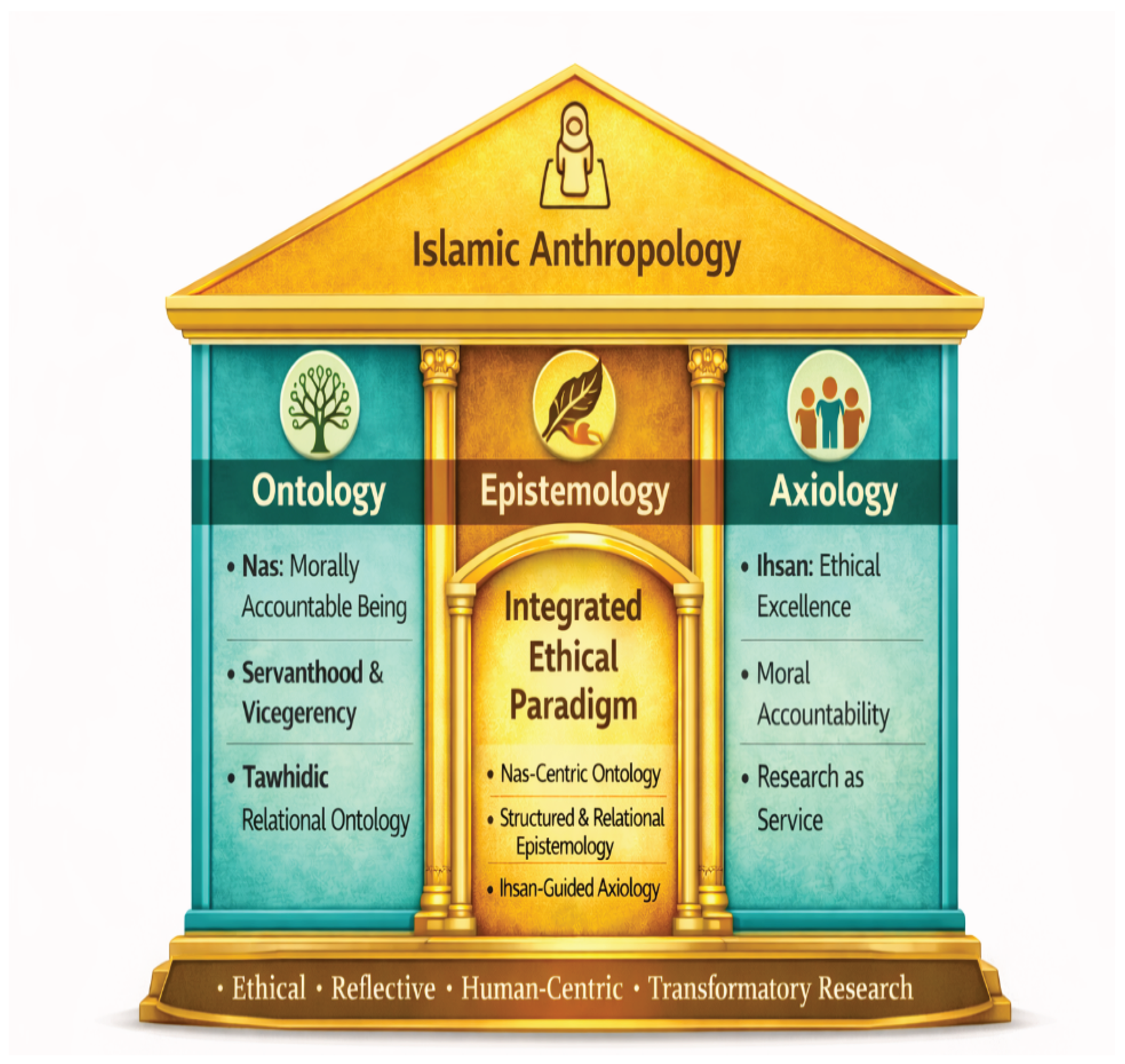
Figure 1 illustrates Islamic Anthropology as an integrated ethical paradigm built on three interdependent pillars—Ontology (Nas), Epistemology (Tadabbur), and Axiology (Ihsan)—crowned by Tawhidic unity. Nas roots humanity in relational accountability to community, land, and the Divine. Tadabbur advances contemplative praxis, interpreting ethically charged reality. Ihsan directs moral excellence through compassion and reciprocity. Together, they unify knowing, being, and ethical practice beyond disciplinary silos.
Research Paradigm and Methodology
Informing a qualitative, phenomenological research design, combined with ethnographic fieldwork. This study leans with phenomenology, which focuses on understanding human experiences as they are lived and interpreted by individuals themselves (van Manen, 1990; Desjarlais & Throop, 2011). This study is grounded in a decolonial paradigm that challenges epistemic hierarchies that privilege Western traditions and treat non-Western societies as data rather than theory, thereby marginalizing Indigenous cosmologies and Islamic intellectual traditions as serious knowledge sources (Wynter, 2003; Sehlikoglu, 2024). Ontologically, it understands social reality as relational and historically situated, so conversion among Orang Asli and Santals is read as a negotiated reconfiguration of moral relationships, of social and state belonging as imagined community (Anderson, 1983), and of cultural continuity, rather than a simple doctrinal shift. Epistemologically, the study combines ethnographic engagement with cultural memory, religious discourse, and transmitted tradition, drawing on Saadia Gaon’s account of reason, observation, and tradition to treat oral histories and ritual as knowledge theory (Goldberg, 1993; Efros, 1942)2. Axiologically, it emphasizes respect, reciprocity, and “outsider-within” reflexivity, approaching participants as knowledge holders and stressing voluntary, trust-based involvement (Collins, 1986). ;. Within this frame, a key theoretical move is to reject modernization narratives that equate Islamization with cultural rupture and instead, through Nas, Tadabbur, and Ihsan, interpret Islamic conversion as ethical reorientation and relational restructuring in dialogue with Indigenous cosmologies (Hefner, 1993; Comaroff & Comaroff, 1991; Robbins, 2004). In this research, we had the opportunity to follow Marcus’s seminal methodological work, Multi-sited ethnography, by adding a ‘comparative’ lens alongside Marcus’s (1995) call to “follow the plot” and “follow the history” across connected contexts (pp. 100–101). At the same time, it draws on Saadia Gaon’s epistemological insight (see note 2) that knowledge emerges through the interpretation of history, culture, and religious tradition. This alignment strengthens the study’s decolonial orientation to orient the Nas-Tadabbur-Ihsanic model, allowing Indigenous religious transformation among the Orang Asli and Santal to be understood through historically embedded moral worlds rather than purely Western theoretical frames. By integrating phenomenological interpretation with ethnographic observation, the study captures both personal narratives of conversion and broader social dynamics shaping Indigenous communities.
We conducted fieldwork in two primary locations representing distinct Indigenous contexts in Southeast and South Asia. The first research site involved Orang Asli communities located around Banding Lake in the state of Perak, Malaysia. The region contains several Orang Asli settlements where multiple religious traditions coexist, including Islam, Christianity, and Indigenous spiritual practices. Approximately half of the villages in the area identify as Muslim communities. Field engagement focused particularly on Kerak village, a predominantly Muslim Orang Asli settlement situated near the lake. Entry into the community was facilitated through discussions with local leaders and elders, who helped explain the research’s purpose to villagers. Initial visits were devoted primarily to establishing rapport and building trust with community members through informal conversations and participation in everyday activities. These interactions gradually created an environment in which participants felt comfortable sharing personal narratives about religious identity and community life.
The second field site was conducted among Santal communities in the Rajshahi region of northern Bangladesh, one of the country’s largest Indigenous groups. Bangladesh hosts more than fifty Indigenous communities (Bangladesh Bureau of Statistics, 2011). Research focused on villages such as Mahisbathan and Tallypara, where recent decades have seen notable religious transformations shaped by Christian missions and Islamic outreach (Debnath, 2020). Data were collected through repeated field visits conducted between 2019 and 2022. The extended time frame allowed the researcher to observe longer-term patterns of community interaction, religious discourse, and social change.
Participants were purposively sampled—a qualitative strategy employing focused group discussions (two per site) and case studies—to identify individuals with direct experience of religious conversion. These included community elders, household heads, and those with personal or intimate knowledge of such processes. In the Santal case, 23 participants underwent in-depth interviews; in the Orang Asli case, 19 did likewise. Informal discussions supplemented these with broader community members during field visits. Sampling aimed not for statistical representation but for contextually rich insights into lived religious transformations in Indigenous settings.
Data collection employed complementary qualitative methods: oral histories, case studies, and participant observation documented community memories of religious transformation, cultural change, ancestral traditions, migration, and influences from missionary activities or Islamic institutions. Semi-structured interviews enabled participants to narrate personal experiences of religious identity and conversion, guided by thematic probes. Observations of rituals, social gatherings, and daily interactions contextualized narratives within lived community practices. Detailed field notes captured emerging observations, reflections, and contextual details throughout fieldwork.
Analysis followed a phenomenological thematic approach (Giorgi, 2009), involving repeated readings of transcripts and field notes for familiarity, identification and coding of significant statements on religious change, identity, and belonging, and clustering into broader themes via iterative comparison. Bracketing suspended prior assumptions to prioritize participants’ lived interpretations.
Trustworthiness was ensured through data triangulation (interviews, oral histories, observations, field notes); prolonged engagement in Orang Asli and Santal communities to build rapport and depth; and researcher reflexivity on positionality and bias (Lincoln & Guba, 1985).
Ethical considerations guided the study. Participation was voluntary, informed consent was obtained, and identifying details were removed to protect participants’ privacy. Although the findings are context-specific, the comparative design provides insight into how Indigenous communities interpret religious transformation within their social and moral worlds. These yielded rich narratives on how Indigenous individuals experience, negotiate, and narrate Islamic conversion in their social-moral worlds. The next section presents these empirical findings.
Findings and Analysis
The findings are presented through a thematic comparative analysis. Each theme integrates narratives from Orang Asli communities in Malaysia and Santal communities in Bangladesh, allowing for examination.
Conversion as Moral Transformation
Field observations and interview narratives from both Orang Asli communities in Peninsular Malaysia and Santal communities in northern Bangladesh suggest that conversion to Islam is rarely experienced simply as a doctrinal change. Instead, participants frequently described conversion as a gradual transformation of everyday moral practice, social discipline, and relational responsibility. Rather than emphasizing theological belief alone, individuals often narrated their religious transition through changes in daily conduct—such as adopting regular prayer, abstaining from alcohol, and greater attentiveness to family obligations. These practices gradually reshaped participants’ understanding of moral responsibility and social belonging within their communities.
Among Orang Asli participants in the Banding Lake region of Perak, several interviewees explained that learning daily prayers introduced a new rhythm into their lives. Prayer structured the day into moments of reflection and accountability, encouraging individuals to reconsider their behavior toward family members and neighbors. Field observations indicated that religious practices were integrated into everyday routines rather than confined to formal religious spaces. Participants often framed these practices as tools for cultivating emotional discipline, patience, and ethical awareness in social relationships. In terms of the conceptual framework proposed in this study, these experiences can be understood through the relational dimension of Nas, in which the human being is perceived not as an isolated individual but as a morally accountable participant in a network of social and ethical relations.
At the same time, the narratives of Orang Asli participants revealed broader structural tensions shaping religious transformation. During a group discussion, one participant remarked,
“We are invisible to the authorities. They speak about national unity, but we are never included in that discourse” (M-OS-11).
An elderly participant recalled the loss of ancestral land to development projects, noting that promised compensation had never materialized: “They took our land and promised compensation, but we are still waiting. It feels as if we do not deserve the same rights as others” (M-OS-9).
FDS with the Orang Asli stood out with the difficulty of navigating identity within Malaysian society: “We are taught to be proud of our culture, yet when we leave our communities, we are treated as inferior. It becomes confusing whether we should embrace or hide who we are” (FGD-OS 1,2).
These reflections suggest that religious change occurs within wider contexts of political marginalization, land dispossession, and social exclusion, shaping how conversion is interpreted within Indigenous communities. Comparable dynamics emerged within Santal communities in northern Bangladesh, though they were framed by different historical experiences. Many participants linked religious transformation to pressures associated with development, missionary activities, and changing economic conditions. One interviewee described development initiatives as threatening Indigenous livelihoods, stating: “They called development the destruction of our forests and the displacement of our people” (F-SC-2). Another participant reflected on the historical influence of missionary activity:
“Our spiritual beliefs and cultural practices were always respected by our ancestors. But colonial missions presented conversion as civilization and progress, even though many of us felt it threatened our autonomy” (M-SC-9).
These accounts reveal how religious transformation is often interpreted through broader struggles over cultural continuity and social survival. Ethnographic observations also highlighted ambivalence toward conversion processes. Some Santal participants described conversion as a pragmatic response to socioeconomic pressures rather than a purely spiritual decision. As one participant explained,
“Promises of better living conditions and access to resources were used to persuade us to convert. For many of us, it became a survival strategy” (M-SC-18).
Others expressed concern that development narratives masked deeper processes of cultural erosion. One interviewee observed,
“Development was used as a justification for conversion. It was said that Christianity would bring progress, but it also marginalized our traditions and weakened our community” (Fieldnote).
In both contexts, conversion therefore appears less as a singular moment of religious change and more as an ongoing process of reflection and ethical negotiation. This dynamic corresponds to the epistemological dimension of Tadabbur, where individuals interpret new religious teachings through reflection on their existing moral worlds. Participants often described reassessing earlier habits, relationships, and responsibilities through such reflective processes. Over time, these reflections fostered aspirations for improved ethical conduct in family and community life. Finally, the moral aspirations associated with conversion were frequently expressed through the pursuit of ethical excellence and social responsibility, corresponding to the axiological dimension of Ihsan. Participants described efforts to cultivate patience, honesty, and responsibility toward others, suggesting that religious practice reshaped expectations of moral conduct within everyday social interactions. However, conversion also produced complex emotional consequences. One woman who had converted described feeling caught between two social worlds:
“After converting, I hoped to find acceptance among Muslims, but I realized I was neither fully accepted there nor fully part of my former community” (FGD-OS-1,2).
Community leaders are worried that religious conversions could divide families and communities. These data suggest that Indigenous conversion is more than cultural rupture or assimilation. Conversion is relational and ethical, formed by marginalization, development demands, and social transformation. According to Nas, Tadabbur, and Ihsan, conversion is a slow reconfiguration of moral ties in which people negotiate new ethical commitments while remaining engaged in complicated Indigenous social environments.
Thus, field accounts imply that conversion is more about moral discipline than theological agreement.
Reconfiguring Community Belonging
These findings coalesced with four unique cases along with observations. Findings from four illustrative cases indicate that religious conversion among Orang Asli communities in Malaysia and Santal communities in northern Bangladesh reshapes community belonging through overlapping experiences of exclusion, kinship fragmentation, emerging religious solidarities, and deliberate cultural continuity.
Case 1: Converted Orang Asli facing double exclusion
“After embracing Islam, I thought we would finally be accepted,” explained Farid (pseudonym), an Orang Asli man from Perak. “Instead, some people in our village see us as traitors, while many Malays still treat us as backward.” Farid described instances of discrimination in public offices, difficulties accessing state services, and a persistent sense of invisibility within national political discourse. As he remarked during one discussion, “We hear leaders talk about national unity, but people like us are rarely included in that vision.” Despite these experiences, Farid emphasized that some converts have begun organizing collectively to challenge discrimination and demand recognition. “We cannot stay silent forever,” he noted. “If we want dignity, we must speak for ourselves.” His narrative illustrates a pattern of “double exclusion,” in which conversion produces new Islamic affiliations without resolving structural marginalization associated with Indigenous citizenship (M-OS-4).
Within the conceptual framework of this study, Farid’s experience highlights tensions surrounding Nas, the relational conception of human identity. Although Islamic teachings emphasize moral equality and shared belonging within the Muslim community, Indigenous converts remain socially positioned as racialized outsiders. Through Tadabbur, Farid and others interpret these contradictions as ethical dilemmas that require reflection and a collective response. Their pursuit of Ihsan appears in efforts to confront injustice through advocacy, dialogue, and the search for more dignified forms of belonging.
Case 2: Family fragmentation after conversion
The relational consequences of conversion also appear within the intimate sphere of family life. Lina (pseudonym), from a close-knit Orang Asli household, described how the conversion of several relatives to Islam introduced tension into family relationships. “Our house used to be full of laughter during rituals,” she recalled. “Now gatherings feel uncomfortable because everyone is careful not to bring up religion” (F-OS-2).
While some relatives adopted Islamic practices such as daily prayer and new dietary habits, others continued to maintain Indigenous ritual traditions. Lina described the emotional impact of this shift, and echoed with FGD in the village, “It feels like our family has split into two worlds. Some follow Islam, while others still hold our ancestral ways (FGD-SC 1,2).” Yet she continues to attend family gatherings across both groups, explaining that maintaining relationships remains essential. “Even if we believe differently, they are still my family,” she said. Lina’s experience illustrates how conversion introduces competing moral frameworks within the same kinship network. However, these differences rarely produce complete separation. Instead, they are negotiated through everyday practices of accommodation and restraint. Within the Nas–Tadabbur–Ihsan framework, Lina’s actions constitute ethical mediation. Through Tadabbur, she reflects on how religious commitments can coexist with kinship obligations, while her continued participation in family life reflects Ihsan expressed through patience, respect, and the preservation of familial bonds.
Case 3: Santal Christian belonging and tension
A comparable pattern of relational negotiation emerges within the Santal context. Arun (pseudonym), a Santal man from northern Bangladesh, described his conversion to Christianity as a turning point that reshaped his everyday life through prayer, fellowship, and service. Church networks offered spiritual encouragement and social support. “When I joined the church,” he explained, “I felt that I had found a community that cared for me.” (M-SC-2).
However, his decision also generated tension within his extended family. Some relatives interpreted conversion as a rejection of ancestral traditions connected to land, spirits, and ritual life. As Arun explained, “They told me that by accepting Christianity I had abandoned our ancestors.” Despite these tensions, he continues to maintain relationships with relatives who do not share his faith. “I try to show them respect,” he said. “Faith should not make us enemies.”
Arun’s narrative demonstrates how conversion generates new moral communities without fully replacing ethnic identity. Within the framework of this study, his understanding of Nas—as a Christian subject accountable before God—exists alongside continuing attachments to Santal kinship and territory. Through Tadabbur, he interprets Christian teachings about compassion and forgiveness as guidance for maintaining family relationships. His pursuit of Ihsan is expressed through efforts to remain patient and caring toward relatives who question his religious choices.
Case 4: Santal dress as resistant continuity
While religious conversion alters many aspects of everyday life, cultural markers of identity often persist. Among Santal converts, traditional clothing remains an important symbol of collective belonging. “When I meet people from outside, I still wear a Santal dress so they know who I am,” explained Nirmal (pseudonym, male, 45). Similarly, Mira (pseudonym, female, 32) emphasized that traditional attire represents respect for ancestors. “Our clothes remind us where we come from,” she noted. “Even if religion changes, we should not forget our roots” (F-SC-2).
Field observations at markets and festivals confirmed that Santal garments are often deliberately worn in multi-religious social environments. Participants explained that such practices help preserve cultural identity while interacting with wider religious and national communities.
This case illustrates how material culture becomes a site of negotiated belonging. Religious practices such as prayer routines or dietary rules may change after conversion, yet clothing remains a visible marker of collective continuity. Within the Nas–Tadabbur–Ihsan framework, traditional dress functions as an embodied expression of relational identity (Nas). The conscious decision to maintain it in multi-religious settings reflects reflective interpretation (Tadabbur) about how to balance religious commitments with cultural heritage. In this sense, Ihsan extends beyond personal piety to include ethical responsibility toward ancestral traditions and cultural continuity.
Our observation further illuminates these layered forms of belonging. During a communal gathering in a Muslim Orang Asli village near Banding Lake, formal speeches and prayers were delivered in Malay, yet informal conversations among elders frequently shifted into an Indigenous language when discussing land, hunting practices, and ancestral knowledge. This subtle code-switching suggested that Islamic religious affiliation and Orang Asli cultural identity coexist within the same social setting. A second observation emerged from a Santal settlement near Rajshahi, where Friday Mosque prayers were followed later in the week by a Santal cultural festival. Some Muslim and Christian Santals joined drumming and dancing while quietly abstaining from specific ritual offerings. As one participant commented, “We may pray differently now, but we still celebrate together as Santals.” (F-SC-13). Taken together, these cases and observations show that conversion reorganizes community belonging without simply dissolving existing ties. Individuals navigate multiple identities simultaneously, balancing Indigenous heritage with new religious affiliations. Through the lens of Nas, Tadabbur, and Ihsan, conversion therefore appears not as cultural rupture but as an ongoing process of ethical reflection and relational transformation within evolving Indigenous social worlds.
Negotiating Indigenous Cosmology and Islamic Practice
Field observations and field data from Orang Asli communities in Malaysia and Santal communities in northern Bangladesh indicate that conversion to Islam seldom entails a complete abandonment of earlier cosmological orientations. Instead, participants described religious change as a gradual incorporation of Islamic practices into existing understandings of land, ancestry, and community. In this sense, conversion appeared less as the replacement of one belief system with another than as a reinterpretation of inherited relationships within a new ethical vocabulary. Across both contexts, Islamic teachings were frequently framed as providing moral guidance that reshaped everyday behavior while leaving key elements of cultural identity—such as attachment to ancestral landscapes, respect for elders, and collective memories of place—intact and meaningful.
Among Orang Asli communities in Perak, interviewees emphasized that adopting Islamic practices such as daily prayer, fasting during Ramadan, and mosque participation did not sever their longstanding relationship with the forest environment. During field visits, elders repeatedly described the forest as a living repository of ancestral presence and community history. One elder remarked while standing near a forest clearing that
“The forest is part of who we are; it still holds the stories of our ancestors (M-OS-9).”
Such statements suggest that Islamic ritual practices did not erase earlier environmental cosmologies but instead reframed them through ideas of stewardship and moral responsibility toward creation. An ethnographic walk along a nearby riverbank further illustrated this layered understanding. Villagers paused briefly at a site previously associated with seasonal ceremonies connected to hunting and forest protection. Although such rituals were no longer performed, participants explained their historical significance. A recent convert reflected quietly,
“We do not practice the rituals anymore, but we still remember why our elders respected this place (M-OS-14).”
This observation demonstrates how memory and landscape continue to shape identity, with earlier ritual knowledge increasingly interpreted as cultural heritage compatible with Islamic ethics rather than as a competing religious system. Comparable dynamics appeared among Santal communities in northern Bangladesh, whose cosmological traditions have historically centered on relationships with ancestral spirits, sacred groves, and the moral significance of land. Participants who had embraced Islam often distinguished between changes in ritual practice and the persistence of cultural belonging. As one Santal Muslim explained during an interview,
“We may pray differently now, but our history and our ancestors remain part of who we are (M-SC-21,22,23).”
Such reflections highlight how participants themselves conceptualize religious change not as cultural abandonment but as ethical transformation within ongoing communal identities.
Field observations during a village gathering further illustrated this pattern. Santal Muslims participated in communal meals, music, and storytelling rooted in long-standing cultural traditions, though certain ritual offerings had been modified or omitted. Participants described these gatherings as important expressions of Santal solidarity. A group,
“These traditions bring us together. They remind us that we are Santals, even if some of us follow different religions (M-OS-13-19).”
Such scenes suggest that religious transformation unfolds through interpretive negotiation rather than abrupt cosmological rupture, echoing anthropological studies showing how communities often integrate new religious ideas into existing cultural frameworks rather than abandoning earlier worldviews entirely (Bowen, 2012). Viewed through the Nas–Tadabbur–Ihsan framework, conversion appears as a layered ethical reinterpretation of cosmology rather than a simple rupture. Nas highlights the human as a relational being embedded in responsibilities toward community, land, and the divine, resonating with Orang Asli and Santal understandings of personhood rooted in forests, ancestors, and collective memory. Tadabbur reflects the interpretive work through which individuals relate Islamic teachings to inherited cultural practices, selectively reinterpreting earlier traditions within an Islamic ethical horizon. Ihsan emerges in efforts to maintain communal harmony and respect for ancestral heritage while embracing Islamic commitments, thereby producing a moral ecology in which Islamic practice and Indigenous cultural memory coexist.
Local Interpretations of Islam and Christianity within Indigenous Contexts
Findings reveal that Islam and Christianity in Indigenous communities (Orang Asli in Malaysia, Santal in Bangladesh) are non-uniform, filtered through local languages, kinship, landscape, and social experience. Conversion involves gradual reinterpretation and alignment with existing moral values—e.g., Orang Asli blend Islamic teachings on respect and balance with Malay neighbors’ traditions. During a discussion in a village mosque compound, the Focus Group Discussion explained:
“When we first learned about Islam, we understood it through the idea of living properly with others. Respecting people, caring for the forest, and keeping peace in the village—these were already part of our values (FGD-OS 1,2).”
Such reflections suggest that Islamic principles were not perceived as entirely foreign but were interpreted as reinforcing certain moral expectations already embedded within local cultural life.
An ethnographic observation during a small religious class illustrated this interpretive process. The local religious teacher explained Qur’anic teachings about stewardship of the earth, linking them to the Orang Asli practice of protecting forest areas from over-harvesting. After the lesson, one elder commented quietly,
“Islam reminds us to take care of the world, and our elders always told us the same thing (FGD-OS 1,2).”
In this context, Islamic teachings were not presented as replacing earlier knowledge but as confirming values that already structured relations between people and their environment.
A comparable interpretive process was evident within Santal communities in northern Bangladesh, where both Islam and Christianity have shaped local religious landscapes. Santals have historically maintained cosmological traditions centered on ancestral spirits and sacred relationships with the land, and participants frequently described how new religious teachings were interpreted within these existing moral frameworks. Several Santal Muslims explained that their understanding of Islam was shaped through everyday conversations with neighbors and family members rather than through formal theological instruction. One participant reflected:
“When we learned about Islam, we did not think it meant leaving everything behind. We understood it as learning a different way to pray while still remembering where we come from (F-OS-16).”
Similarly, Santal Christians often interpreted Christian teachings in ways that connected with existing community values, such as collective solidarity and care for others. A Christian participant explained during an interview:
“The message of helping the poor and forgiving others felt familiar to us. Our elders also taught that the community must support one another (FGD-OS 1,2).”
These interpretations suggest that Christianity, like Islam, was often translated into moral language that resonated with Indigenous expectations of communal responsibility.
Field observations show how local interpretations shape everyday practice. In a Santal village meeting, both Muslim and Christian participants discussed community welfare and development. Despite religious differences, they emphasized shared values such as respect for elders, cooperation, and care for vulnerable members. Headman elder explained, “Different prayers exist, but the way we should live together does not change (Headman, OS).” This reflects how Indigenous moral frameworks continue to guide religious life. As anthropological studies note, religious traditions are rarely adopted in purely doctrinal form but are interpreted through local contexts (Bowen, 2012). In both Orang Asli and Santal settings, Islam and Christianity are integrated into Indigenous ethical worlds rather than replacing them.
Discussion
When placed within the literature reviewed in the introduction and conceptual framework, Orang Asli communities in Malaysia and Santal communities in northern Bangladesh contribute to anthropological debates on religious conversion, Islam, and Islamic anthropology. Results indicate convergence with previous scholarship and some significant departures. Classical sociological conceptions of conversion depict religious transformation as ideological realignment or institutional recruitment. Influential models view conversion as a cognitive transformation or decision-making process within social networks and institutions. However, anthropological evidence from the two Indigenous communities indicates that conversion is primarily an ethical reordering of daily life rather than an ideological shift. Participants viewed religious change as involving moral discipline, changing domestic routines, and changing interpersonal obligations. Anthropologists who view Islam as a tradition of ethical self-formation agree with these findings. Islamic practice develops embodied morality through discipline, introspection, and social interaction, according to Asad (1986, 1993) and Mahmood (2005). Orang Asli and Santal converts demonstrate that ethical reform is inextricably linked to land, kinship, and ancestral memory in Indigenous contexts. In these situations, conversion is part of reorganizing social life and moral responsibility, not only embracing new doctrines. Comparatively, Orang Asli and Santal experiences match global ethnographic research that views conversion as a negotiated transition rather than a cultural rupture. Converts generally integrate new religious teachings into existing moral and cosmological frameworks, according to studies of Christian missionization in Africa and Melanesia. McDougall (2009) and Stephenson (2013) found that religious transformation often creates a hybrid morality rather than replacing worldviews. The Orang Asli and Santal communities’ findings demonstrate that Islamic traditions, such as prayer, fasting, and ethical discipline, coexist with moral ecologies. Participants saw conversion as a way to address societal issues like alcoholism, conflict, and insecurity while preserving cultural memory and Indigenous identity.
The study emphasizes understudied regional dynamics despite these similarities. Christian missionary contacts have dominated the anthropology of Indigenous religious transformation (Hefner, 1993; Meyer, 1999; Robbins, 2004). Indigenous conversion to Islam is less well-known in South and Southeast Asia. Many studies on Malay Islamization focus on trade networks, state development, and political authority. Marriage, missionary, and policy-driven integration are common themes in Orang Asli conversion studies (Junoh et al., 2024; Kamaruddin & Mokhtar, 2024; Seo, 2023). Christian missionization, language loss, land dispossession, and legal marginalization have dominated Santal studies in Bangladesh (Debnath, 2012, 2020; Karim & Karim, 2006; Roy, 2004; Hasan, 2024; Jhala, 2019; Karmaker, 2025).
Indigenous conversions reorganize home routines, kinship, and community morals in lived experience, complementing macro-level narratives. Phenomenology reveals these moral worlds as transformative processes rather than institutional impositions. Malaysia’s Orang Asli navigate Islam as state identity for benefits while facing racial exclusion (Rasip et al., 2025; Suryani, 2024). Bangladeshi Santals pragmatically convert amid land loss to sustain mobility, survival, and ethnic identity (Debnath, 2012, 2020; Karim & Karim, 2006; Roy, 2004; Hasan, 2024). These findings extend Islamic anthropology beyond Geertz’s (1968) symbolism and Asad’s (1986, 1993) discursivity. The Nas–Tadabbur–Ihsan paradigm analyzes moral transitions through Islamic ethics: relational humanity (Nas), reflective interpretation (Tadabbur), and ethical perfection (Ihsan). Rejecting Eurocentrism, it portrays converts as active interpreters blending Islamic teachings with Indigenous cosmologies (Clifford & Marcus, 1986; Abu-Lughod, 1991; Wynter, 2003). Communities thus co-produce plural moral worlds through conversion. In postcolonial Asian contexts, Indigenous shifts to Islam represent negotiated moral world-making—not cultural loss or absorption—but ethical-cosmological reinterpretation that reshapes conversion theory.
Methodological Implications and Conceptual Contribution
Implication of a Decolonial Comparative Multi-sited Ethnography
The study employs a Decolonial Comparative Multi-sited Ethnographic framework (Marcus, 1995) alongside a decolonial epistemological approach (Goldberg, 1993; Efros, 1942) employed a decolonial research methodology, phenomenological interpretation, and multi-site fieldwork within Orang Asli communities in Malaysia and Santal communities in Bangladesh. This enhances comparative ethnography through decolonial frameworks, phenomenological analysis (Giorgi, 2009; van Manen, 1990), and multi-sited fieldwork with the Orang Asli (Malaysia) and Santal (Bangladesh). Understanding conversion as a lived moral reconfiguration rather than a doctrinal leap, oral histories, interviews, and observations document changes in prayer, kinship, habits, and landscapes. Epistemologically plural, it amalgamates empirical evidence, rational thought, and tradition (Saadia Gaon, 1948) to regard Indigenous memory and Islamic thinking as interpretive resources. A reflexive “outsider-within” posture highlights ethical positionality (Collins, 1986; Narayan, 1993), thereby enhancing cross-contextual analysis. In this regard, the methodological design illustrates how integrating decolonial theory, phenomenological analysis, and comparative ethnography can yield a deeper understanding of religious transformation across diverse cultural and political contexts.
Islamic anthropology and the Nas–Tadabbur–Ihsan model
The study also offers a conceptual contribution by operationalizing the ‘Nas–Tadabbur–Ihsan model’ within and beyond the emerging field of Islamic anthropology, adopting the existing debates, it moved from Geertz’s symbolic interpretation of Islam to Asad’s conception of Islam as a discursive tradition and Bowen’s “new anthropology of Islam” (Geertz, 1968; Asad, 1986, 1993; Bowen, 2012). Despite its Islamic metaphysics, the model extends to Christian domains, creating an inclusive framework centered on human relationality, deep reflection, and good deeds. Building on Geertz (1968), Asad (1986, 1993), and Bowen (2012), it deploys Nas (relational ontology; Rahman, 1982; Izutsu, 2002), Tadabbur (Qur’anic reflection), and Ihsan (ethical solidarity) as analytical tools. Bridging Islamic ethics with Indigenous ontologies, it decolonizes conversion studies, framing transformation as a layered moral process beyond Euro-modern limits. In doing so, the Nas–Tadabbur–Ihsan model bridges Islamic ethical philosophy with Indigenous relational ontologies and contributes to broader decolonial critiques that seek to expand anthropology’s theoretical resources beyond Euro-modern epistemological frameworks.
Internal Islamization Regime (IIR): Conceptualizing Indigenous–Islam Encounters
This study proposes the concept of Internal Islamization Regime (IIR) to examine how Islamization intersects with state power, development policy, and minority governance in Muslim-majority societies. Existing scholarship has widely analyzed the relationship between Christian missions, colonial governance, and Indigenous assimilation in settler-colonial contexts (Rahemtulla, 2023). However, comparable frameworks for understanding Islamization within postcolonial Muslim-majority states remain limited. The IIR concept addresses this gap by describing situations where Islam becomes embedded in state institutions, legal norms, and development programs, shaping how Indigenous and minoritized communities are incorporated into dominant national identities. The Malaysian Orang Asli case provides the primary empirical grounding. Research shows that Islamization policies, legal assimilation, and welfare-based incentives—such as mosque-centred programmes, marriage facilitation, and development assistance—can structurally encourage conversion while producing new distinctions between Muslim converts and non-Muslim Orang Asli communities (Kamaruddin & Mokhtar, 2024; Muhammad & Ahmad, 2024). In this configuration, Islam operates not only as personal faith but also as a marker of Malay national identity and moral citizenship.
In furtherance of this, comparative studies indicate related dynamics elsewhere. In Nigeria, Islamization has been described as a form of ethnic conversion integrating minority groups into Hausa–Fulani networks (Harnischfeger, 2006). In Côte d’Ivoire, Indigenous conversion often entails incorporation into Dioula commercial and religious networks, producing complex “double identities” (Miran-Guyon, 2012). Similar pressures appear among the Kalash of Pakistan and Indigenous groups in Indonesia, where social, educational, and institutional factors influence religious transformation (AsiaNews, 2019; Halim et al., 2021; van Dijk, 1998). Importantly, the IIR framework does not treat Islam as inherently colonial. Rather, it highlights how religion, law, and development policies can function as mechanisms of internal governance and identity formation within postcolonial states.
Conclusion
This study examined Indigenous religious transformation among Orang Asli communities in Malaysia and Santal communities in northern Bangladesh through a comparative anthropological framework informed by the Nas–Tadabbur–Ihsan model. The findings suggest that conversion in both contexts cannot be adequately explained through classical sociological/anthropological theories that treat religious change primarily as doctrinal adoption or institutional recruitment (Rambo, 1993; Snow & Machalek, 1984). Instead, participants described conversion as a gradual ethical transformation that reshapes everyday conduct, kinship relations, and a sense of belonging to the community. These experiences align with anthropological perspectives that understand Islam as a lived moral tradition cultivated through embodied practice, ethical discipline, and reflective self-formation (Asad, 1986, 1993; Mahmood, 2005; Bowen, 2012). Comparative analysis also demonstrates that Indigenous religious change rarely produces a complete cultural rupture. Rather, both Orang Asli and Santal participants reinterpret Islamic or Christian teachings within pre-existing moral worlds structured by land, ancestry, and collective memory. Conversion, therefore, emerges as a negotiated reconfiguration of moral life, generating layered identities in which Indigenous cosmologies and new religious commitments coexist.
Conceptually, the study offers three main contributions. First, it develops a comparative Indigenous ethnography of conversion across two Asian contexts where different major religions interact with Indigenous societies, thereby extending debates on conversion beyond the better-studied Christian–colonial settings. Second, it operationalizes the Nas–Tadabbur–Ihsan model as an analytical framework for understanding conversion as an ethical and relational transformation rather than merely doctrinal change, linking relational ontology, reflective epistemology, and lived ethical practice (Rahman, 1982; Izutsu, 2002; Auda, 2020). Third, it advances INIC as a structural concept for interpreting the Malaysian case within wider discussions of religion, coloniality, and postcolonial governance, while analytically distinguishing this structural regime from the experiential level at which Indigenous actors appropriate Islamic concepts to stabilize life, negotiate dignity, and selectively protect cosmology and kinship. The study’s ethnographic scope is limited to particular Orang Asli and Santal communities, and further research is needed on other Indigenous groups, gendered experiences of conversion, implications for land rights and legal status, and the role of emerging religious networks and digital media in shaping contemporary Islamization and Christianization processes. Such comparative work would deepen understanding of how Indigenous communities negotiate religious transformation within evolving postcolonial societies and further test the reach of both the Nas–Tadabbur–Ihsan model and the IIR concept.
Funding
This research was supported by Thesis Publisher Malaysia through the Field Trip Research Program (Fund ID: TPRP2020-137-19), covering fieldwork travel and data collection expenses.
Data Availability
Field data are not publicly available due to ethical sensitivity concerns regarding Indigenous community narratives and participant privacy.
Acknowledgments
Deep gratitude to Orang Asli and Santal community elders, Kerak village leaders (Perak), Mahisbathan and Tallypara household heads (Rajshahi), and local authorities for their trust and hospitality. Institutional Review Board (IRB) approval was gratefully acknowledged from the Department of Anthropology of Shahjalal University of Science and Technology, Sylhet, Bangladesh.
Grant
Thesis Publisher Malaysia, 2026-201-07/RF/11.
Conflicts of Interest
The authors declare no conflicts of interest.
| 1. | The Nas–Tadabbur–Ihsan model provides a useful framework for analyzing dual conversion processes among Malaysia’s Orang Asli and Bangladesh’s Santal communities because its concepts carry a universal and inclusive scope beyond religious, racial, or regional boundaries. Nas refers to humanity as a whole, Tadabbur denotes reflective contemplation as a shared human capacity, and Ihsan expresses ethical reciprocity—doing good in response to good—extending across human and ecological relations. Grounded in the Qur’anic principle “Can the reward of good be anything but good?” (Qur’an 55:60), the model is not religiously prescriptive, nor racially aligned, or regionally regimented, but rather offers an inclusive, universal, and decolonial analytical lens for understanding ethical transformation across cultures. |
| 2. | Saadia offers a distinct lens on knowledge, diverging from Western theories, by drawing on sources like Efros, Wolfson, and Heschel, who trace his threefold classification's roots. Efros links the first ("observation" or "sense perception") to Aristotelian/Stoic "sensation"; the second (aql, or "intuition of the intellect"/"reason") to Greek nous for immediate cognition; the third ("logical necessity"/"inferential knowledge") to "Necessity"; and retains "Tradition" as borrowed from the Mutakallimūn (Goldberg, 1993, p. 144; Efros, 1942), in Goldberg, S. A. (1993). Sociology of knowledge and Jewish studies. Gen, 87-116. Also see Efros, I. (1942). Saadia's theory of knowledge. The Jewish Quarterly Review, 33(2), 133-170. |
References
- Abu-Lughod, L. (1991). Writing against culture. In R. G. Fox (Ed.), Recapturing anthropology: Working in the present (pp. 137–162). School of American Research Press.
- Ahmad, I. (2013). Anthropology of Islam: History, culture and power. The Indian Economic and Social History Review, 50(4), 495–510.
- Ahmad, I. (2017). Religion as critique: Islamic critical thinking from Mecca to the marketplace. University of North Carolina Press.
- Ahmed, A. S. (1984). Defining Islamic Anthropology. Rain, (65), 1-4.
- Ahmed, A. S. (1986). Toward Islamic Anthropology: Definition, Dogma, and Direction. International Institute of Islamic Thought (IIIT).
- Ahmed, S. (2016). What is Islam? The importance of being Islamic. Princeton University Press.
- Al-Ghazali. (2013). The alchemy of happiness (C. Field, Trans.). Islamic Texts Society. (Original work published in the 11th century).
- Anderson, B. (1983). Imagined communities: Reflections on the origin and spread of nationalism. Verso.
- Asad, T. (1986). The idea of an anthropology of Islam. Qui Parle, 17(2), 1–30.
- Asad, T. (1993). Genealogies of religion: Discipline and reasons of power in Christianity and Islam. Johns Hopkins University Press.
- AsiaNews. (2019, December 16). Pakistan’s Kalash complain that their youth are forcibly converted to Islam. https://www.asianews.it.
- Auda, J. (2020). Paradigmatic foundation and moral axioms of ihsan ethics in Islamic economics and finance. Journal of Islamic Accounting and Business Research, 11(2), 288–304.
- Aziz, S., & Ahmad, B. (2026). Religion: Colonizers and others. Journal of Religion and Society, 5(1), 276–286.
- Bangladesh Bureau of Statistics. (2011). Population and housing census 2011: National report (Vol. 1). Bangladesh Bureau of Statistics, Statistics and Informatics Division, Ministry of Planning, Government of the People’s Republic of Bangladesh.
- Belloufa, L., & Nebbou, A. (2025). Religious transformations in Nigeria (1914–1980): Islam, Christianity, and Indigenous responses. Dirasat, 14(2), 951–963.
- Bowen, J. R. (2012). A new anthropology of Islam. Cambridge University Press.
- Chua, L. (2012). Conversion, continuity, and moral dilemmas among Christian Bidayuhs in Malaysian Borneo. American Ethnologist, 39(3), 511–526.
- Clifford, J., & Marcus, G. E. (Eds.). (1986). Writing culture: The poetics and politics of ethnography. University of California Press.
- Chowdhury, J. S. (2026). What is Oral is Moral and Legal: Navigating the Rakhain Healing Cosmos from Sacred Chants to State Law. In Global Perspectives on Indigenous Oral Traditions (pp. 25-46). IGI Global Scientific Publishing.
- Chowdhury, J., Vadevelu, K., Singh, P. S. J., Saad, M. R. M., & Hatta, Z. A. (2024). The intersection of faith, culture, and Indigenous community in Malaysia and Bangladesh. Springer.
- Collins, P. H. (1986). Learning from the outsider within: The sociological significance of Black feminist thought. Social problems, 33(6), s14-s32.
- Comaroff, J., & Comaroff, J. L. (1991). Of revelation and revolution: Christianity, colonialism, and consciousness in South Africa (Vol. 1). University of Chicago Press.
- Debnath, M. (2012). The invisible agenda: Civilising mission or missionising civilisation. The International Journal of Human Rights, 16(3), 461–473.
- Debnath, M. (2020). A community under siege: Exclusionary education policies and indigenous Santals in the Bangladeshi context. Third World Quarterly, 41(3), 453–469.
- Deeb, L. (2006). An enchanted modern: Gender and public piety in Shi‘i Lebanon. Princeton University Press.
- Desjarlais, R., & Throop, C. J. (2011). Phenomenological approaches in anthropology. Annual Review of Anthropology, 40, 87–102.
- el-Zein, A. H. (1977). Beyond ideology and theology: The search for the anthropology of Islam. Annual Review of Anthropology, 6, 227–254.
- Fani, A. A., Soraya, N., & Anggara, B. (2026). Gujarat to Malacca: Trade routes and the process of Islamization in the Malay Archipelago. Journal of Educational Sciences, 10(1), 1536–1546.
- Feener, R. M., & Sevea, T. (Eds.). (2009). Islamic connections: Muslim societies in South and Southeast Asia. Institute of Southeast Asian Studies.
- Geertz, C. (1968). Islam observed: Religious development in Morocco and Indonesia. University of Chicago Press.
- Giorgi, A. (2009). The descriptive phenomenological method in psychology. Duquesne University Press.
- Halim, A., Basyid, A., & Prihananto, P. (2021). Religious identity transformation: Cultural interbreeding between Dayak indigenous culture and Islam. Journal of Indonesian Islam, 15(2), 287–310.
- Hallaq, W. B. (2013). The impossible state: Islam, politics, and modernity’s moral predicament. Columbia University Press.
- Harnischfeger, J. (2006). Islamisation and ethnic conversion in Nigeria. Anthropos, 101(1), 37–54.
- Hasan, M. (2024). Politics of recognition and Indigenous peoples in Bangladesh. Southwestern Journal of International Law, 30, 126.
- Hashi, A. A., & Musa, M. (2020). Islamic ethics: The attributes of al-ihsan in the Qur’an and its effects on Muslim morality.
- Hefner, R. W. (Ed.). (1993). Conversion to Christianity: Historical and anthropological perspectives on a great transformation. University of California Press.
- Hirschkind, C. (2006). The ethical soundscape: Cassette sermons and Islamic counterpublics. Columbia University Press.
- Izutsu, T. (2002). Ethico-religious concepts in the Qur’an. McGill-Queen’s University Press.
- Jhala, A. D. (2019). An endangered history: Indigeneity, religion, and politics on the borders of India, Burma, and Bangladesh. Oxford University Press.
- Junoh, M. Z., Mohd, N., & Abdullah, N. H. (2024). A review of factors influencing conversion to Islam among Orang Asli in Malaysia. Ulum Islamiyyah, 32(1), 1–20.
- Kamaruddin, A., & Mokhtar, A. E. (2024). A review of factors influencing conversion to Islam among Orang Asli in Malaysia. Ulum Islamiyyah, 36(2), 83–88.
- Karim, M. S., & Karim, A. H. M. Z. (2006). Impact of Christianization on the Santals of Barind regions of Bangladesh: A study on culture change. South Asian Anthropologist, 6(2), 121.
- Karmaker, R. (2025). Indigenous religion, language loss, and cultural identity among ethnic communities in Bangladesh. ASEAN Journal of Religion, Education, and Society, 5(1), 37–42.
- Khan, M. M. (2020). Ihsan ethics and political revitalization. International Institute of Islamic Thought.
- Lincoln, Y. S., & Guba, E. G. (1985). Naturalistic inquiry. Sage Publications.
- Mahmood, S. (2005). Politics of piety: The Islamic revival and the feminist subject. Princeton University Press.
- Mallampalli, C. (2025). Christian conversion, democracy and minority vulnerability in India and neighboring countries. In Christianity and democracy today (pp. 64–82). Routledge.
- Marcus, G. E. (1995). Ethnography in/of the world system: The emergence of multi-sited ethnography. Annual review of anthropology, 24(1), 95-117.
- McDougall, D. (2009). Becoming sinless: Converting to Islam in the Christian Solomon Islands. American Anthropologist, 111(4), 480–491. [CrossRef]
- Meyer, B. (1999). Translating the devil: Religion and modernity among the Ewe in Ghana*. Edinburgh University Press for the International African Institute.
- Miran-Guyon, M. (2012). Native conversion to Islam in southern Côte d’Ivoire: The perils of double identity. Journal of Religion in Africa, 42(2), 95–117.
- Muhammad, I. A., & Ahmad, A. R. (2024). Islamization in Nigeria and Malaysia: Processes and impacts on state and society. Open Journal of Social Sciences, 12(5), 123–140. [CrossRef]
- Onagun, R., & Raheem, O. W. (2026). Indigenous religious practice versus Islamic dominance: A history of Osun deity’s trado-medical and ritual rites in Ilorin Emirate, Nigeria. African Identities, 1–22. [CrossRef]
- Önnudóttir, H., Possamai, A., & Turner, B. S. (2013). Religious change and indigenous peoples: The making of religious identities. Ashgate.
- Rahemtulla, S. (2023). Decolonising Islam: Indigenous peoples, Muslim communities, and the Canadian context. Religions, 14(9), 1078. [CrossRef]
- Rahman, F. (1982). Islam and modernity: Transformation of an intellectual tradition. University of Chicago Press.
- Rambo, L. R. (1993). Understanding religious conversion. Yale University Press.
- Rasip, Z. M., Hamzah, A. H., Nur, M., Hajimin, H. H., Ab Razak, M. S., Adol, S., & Marinsah, S. A. (2025). The historical development of Islam and converts in Sabah, Malaysia: From the 14th century to the official designation of Islam as the state religion. International Journal of Academic Research in Business and Social Sciences, 15(3), 1556–1572.
- Ricci, R. (2011). Islam translated: Literature, conversion, and the Arabic cosmopolis of South and Southeast Asia. University of Chicago Press.
- Robbins, J. (2004). The globalization of Pentecostal and charismatic Christianity. Annual Review of Anthropology, 33, 117–143.
- Roy, R. D. (2004). Challenges for juridical pluralism and customary laws of indigenous peoples: The case of the Chittagong Hill Tracts, Bangladesh. Arizona Journal of International & Comparative Law, 21, 113.
- Seo, M. (2023). Religious conversion and citizenship: The rise of limbo between secular and Islamic citizenship in Malaysia. Journal of Church and State, 65(3), 307–317.
- Snow, D. A., & Machalek, R. (1984). The sociology of conversion. Annual Review of Sociology, 10, 167–190. [CrossRef]
- Stark, R., & Bainbridge, W. S. (1980). Networks of faith: Interpersonal bonds and recruitment to cults and sects. American Journal of Sociology, 85(6), 1376–1395. [CrossRef]
- Stephenson, P. (2013). Syncretic spirituality: Islam in Indigenous Australia. Islam and Christian–Muslim Relations, 24(4), 427–444. [CrossRef]
- Suryani, A. J. (2024). Indigenous peoples, religious conversion, and the politics of religion in Indonesia. Jurnal Penelitian, 21(2), 195–205.
- Tan, C. B. (2019). After migration and religious affiliation: Religions, Chinese identities, and transnational journeys. Amsterdam University Press. (Adapted for Indigenous/Chinese contexts in SEA.
- Tapper, R. (1995). Islamic anthropology and the anthropology of Islam. Anthropological Quarterly, 68(3), 185–193.
- Ullah, A. A. (2025). Empire, colonialism, and religious mobility in transnational history. Religions, 16(4), 403.
- van Dijk, K. (1998). Dakwah and indigenous culture: The dissemination of Islam. Bijdragen tot de Taal-, Land- en Volkenkunde, 154(2), 218–235.
- van Manen, M. (1990). Researching lived experience: Human science for an action sensitive pedagogy. State University of New York Press.
- Wynter, S. (2003). Unsettling the coloniality of being/power/truth/freedom. CR: The New Centennial Review, 3(3), 257–337.
- Zakaria, A.F.M. and Chowdhury, Z, S, (2006). The Muslim Monipuri: The Making and Meaning of Contested Identities in Anthropology on the Move: Contextualizing Culture Studies in Bangladesh, (107-117). Department of Anthropology, University of Dhaka, Bangladesh.
- Zene, C. (1993). The authority of the face: Missionary representations in south-west Bangladesh. History and Anthropology, 6(2-3), 199–234.
Figure 1.
The Nas–Tadabbur–Ihsan Model in Islamic Anthropology. Source: Authors’ compilation.
Disclaimer/Publisher’s Note: The statements, opinions and data contained in all publications are solely those of the individual author(s) and contributor(s) and not of MDPI and/or the editor(s). MDPI and/or the editor(s) disclaim responsibility for any injury to people or property resulting from any ideas, methods, instructions or products referred to in the content. |
© 2026 by the authors. Licensee MDPI, Basel, Switzerland. This article is an open access article distributed under the terms and conditions of the Creative Commons Attribution (CC BY) license (http://creativecommons.org/licenses/by/4.0/).
Copyright: This open access article is published under a Creative Commons CC BY 4.0 license, which permit the free download, distribution, and reuse, provided that the author and preprint are cited in any reuse.