Preprint
Review

This version is not peer-reviewed.

A Comprehensive Review of Quantitative Preclinical Imaging: Methods, Validation, and Translational Integration

Submitted:

30 March 2026

Posted:

31 March 2026

You are already at the latest version

Abstract

Quantitative preclinical imaging enables non-invasive characterization of physiological, molecular, and functional processes across a variety of experimental models, providing metrics that inform longitudinal studies and translational research. This review synthesizes current strategies for quantitative imaging across modalities including Positron emission tomography (PET), Single Photon Emission Computed Tomography (SPECT), Magnetic resonance imaging (MRI), Computed Tomography (CT), optical imaging, and hybrid systems. We examine methodological frameworks for parameter extraction, reproducibility, and validation against biological reference standards, evaluating each modality through a cross-cutting analytical framework that distinguishes technical, biological, and computational sources of quantitative variance and identifies the current metrological maturity of harmonization infrastructure across platforms. Key challenges, such as protocol harmonization, cross-platform comparability, and integration across species, are analyzed, alongside computational advances including parametric mapping, and artificial intelligence–assisted pipelines. Emerging approaches that combine multimodal acquisition with standardized reconstruction and calibration strategies are also discussed, emphasizing their potential to enhance precision, reduce bias, and support biologically meaningful interpretation. Collectively, this review provides a comprehensive perspective on the design, implementation, and validation of quantitative preclinical imaging studies, offering practical guidance for generating reproducible, interpretable, and translationally relevant imaging biomarkers. By integrating methodological insights with advances in technology and analytics, it underscores the role of quantitative frameworks in bridging preclinical discovery with translational applications.

Keywords: 
;  ;  ;  ;  ;  

1. Introduction

The transition from qualitative to quantitative imaging in preclinical research represents one of the most consequential methodological shifts in biomedical science over the past two decades. Where qualitative interpretation relies on visual assessment of image contrast, quantitative frameworks extract standardized numerical parameters that are biologically interpretable, reproducible, and scalable across experimental platforms — a distinction with profound implications for translational research. When imaging-derived metrics inform therapeutic response assessment, biomarker validation, or cross-species extrapolation, their metrological properties — reproducibility, systematic bias, and parameter identifiability — become as scientifically decisive as the physical sensitivity of the acquisition system itself [1,2]. Preclinical imaging encompasses a broad and technically heterogeneous spectrum of modalities, each offering distinct quantitative capabilities and inherent limitations. Positron Emission Tomography (PET) and Single Photon Emission Computed Tomography (SPECT) provide highly sensitive molecular and functional information through radiotracer concentration estimates, yet their quantitative reliability is critically dependent on acquisition settings, reconstruction algorithms, attenuation and scatter correction strategies, and system calibration [3,4]. Magnetic Resonance Imaging (MRI), by contrast, offers unmatched multiparametric tissue characterization — spanning diffusion, perfusion, relaxometry, and metabolic profiling — but its reproducibility across platforms and vendors is highly sensitive to protocol heterogeneity and implementation variability [5,6,7]. Computed Tomography (CT) and micro-CT, in turn, deliver attenuation-based structural metrics traceable to physical units, enabling reproducible assessment of skeletal microarchitecture, lung morphology, and tumour volumes, if acquisition and reconstruction workflows are sufficiently harmonized [8,9]. Optical and photoacoustic modalities, while affording high-throughput molecular sensitivity and compatibility with longitudinal experimental designs, particularly in zebrafish and small-animal models, remain fundamentally challenged by photon scattering, depth-dependent fluence attenuation, and the intrinsically ill-posed nature of optical inverse problems [10,11,12,13]. Notwithstanding these technological advances, a persistent and structurally underappreciated challenge constrains the translational value of preclinical quantitative imaging: the absence of shared metrological frameworks that permit quantitative parameters to be reliably compared across platforms, laboratories, and biological models. Inter-laboratory variability, hardware-dependent systematic biases, heterogeneous analytical pipelines, and inconsistent biological validation practices collectively undermine quantitative comparability and reproducibility [3,4,5,14]. In this regard, multicentre investigations have demonstrated that harmonized acquisition protocols, standardized reconstruction pipelines, and rigorous quality control programmes significantly improve quantitative consistency in small-animal PET/CT and PET/MRI systems [1,2,4]. International guidelines issued by the European Association of Nuclear Medicine (EANM) and the European Society for Molecular Imaging (ESMI) formalize these principles within structured quality assurance frameworks [5]. Nevertheless, equivalent infrastructure remains substantially underdeveloped for MRI, CT, and optical modalities, and cross-modality harmonization strategies are largely absent from current preclinical practice. Emerging computational approaches — encompassing parametric mapping, AI-assisted reconstruction, and standardized post-processing pipelines — offer promising tools to mitigate these limitations; however, they simultaneously introduce additional layers of algorithmic dependency that themselves require transparent validation before quantitative outputs can be considered biologically interpretable [3,4,13,15]. The diversity of available biological models introduces a further dimension of complexity: zebrafish provide optical transparency, rapid development, and suitability for high-throughput quantitative phenotyping [10,11,12], whereas murine models offer mammalian physiology and genetic tractability, supporting longitudinal molecular and structural imaging with direct correlation to histological endpoints [3,4,7]. Critically, quantitative strategies validated within one biological system cannot be assumed to retain their metrological performance when transferred to another without explicit re-validation. Against this backdrop, the present review provides not merely a modality-by-modality catalogue of quantitative preclinical imaging strategies, but an analytically integrated framework for evaluating and comparing their quantitative performance across dimensions of parameter extraction, reproducibility, bias control, and biological validation. Emphasis is placed on identifying where harmonization infrastructure is sufficiently mature to support robust biomarker generation, and where methodological gaps persist that limit cross-platform comparability and translational applicability. By synthesizing methodological insights with advances in computational analytics and multimodal integration, this review aims to offer practical guidance for the design and implementation of quantitative preclinical imaging studies capable of generating reproducible, interpretable, and translationally relevant imaging biomarkers [7,16,17,18,19].

2. Materials and Methods

2.1. Literature Searching Strategy

This review was conducted using a structured literature analysis designed to provide a comprehensive and methodologically informed overview of quantitative imaging in preclinical research. The search strategy was designed to capture studies addressing quantitative imaging methodologies, reproducibility, validation, and translational applicability across multiple preclinical imaging modalities. Bibliographic research was performed in the main scientific databases: PubMed, Scopus, and Web of Science, including studies published between 2015 and 2026. Search strings were constructed by combining terms describing quantitative imaging and parameter extraction with descriptors of experimental models and imaging modalities, by combining terms related to quantitative imaging (““quantitative imaging”, “parametric mapping”, “functional imaging”, “reproducibility”, “validation”, “parameter extraction”) with keywords referring to the preclinical context (“preclinical”, “small animal”, “murine model”, “zebrafish”) and different imaging modalities (“MRI”, “diffusion MRI”, “DCE-MRI”, “relaxometry”, “IVIM”, “diffusion kurtosis”, “PET”, ‘’micro-CT/CT’’, “micro-PET”, “functional PET”, “dynamic PET”, “SPECT”, “micro-SPECT”, “functional SPECT”, “optical imaging”, “fluorescence imaging”, “bioluminescence imaging”, “photoacoustic imaging”, “optoacoustic imaging”). Relevant studies were also identified through manual screening of references from selected articles, ensuring broad coverage of methodological, reproducibility, and translational aspects. In addition, search terms were iteratively refined to capture modality-specific terminology and variations in the definition of quantitative imaging across disciplines.

2.2. Inclusion and Exclusion Criteria

To ensure consistency and relevance, strict inclusion and exclusion criteria were defined. Studies that met the following criteria were considered eligible:
  • Implementation of quantitative imaging approaches with explicitly defined measurable endpoints, including model-based parameters (e.g., kinetic, diffusion, or perfusion models), calibrated physical measurements (e.g., attenuation coefficients or activity concentration), or imaging biomarkers supported by biological or histological validation.
  • Application within preclinical experimental models, including small animal studies or ex vivo imaging frameworks relevant to translational research.
  • Explicit consideration of methodological aspects related to quantification, such as reproducibility, standardization, calibration, or validation of imaging-derived parameters.
The following were excluded:
  • Absence of clearly defined quantitative endpoints, including studies limited to qualitative image interpretation or descriptive analysis without measurable parameters.
  • Lack of methodological description regarding the derivation, validation, or reproducibility of imaging-derived metrics.
  • Studies focused exclusively on clinical imaging without a preclinical component.
This selection allowed us to focus our analysis on studies that provide concrete evidence of quantitative preclinical imaging applications, while ensuring the possibility of comparing methods and results between different studies. For the purposes of this review, quantitative imaging was defined as the extraction of measurable parameters from imaging data that are either physically calibrated, mathematically modeled, or biologically validated, enabling reproducible and comparable assessment across experimental conditions.

2.3. Classification of Studies

Selected studies were grouped according to three dimensions:
  • Biological model: mouse, zebrafish, rabbit.
  • Imaging modality: CT/micro- CT, MRI, PET, SPECT, optical imaging, photoacoustic imaging.
  • Type of quantitative approach: diffusion-based metrics, perfusion modelling, relaxometry, spectroscopy, AI-assisted mapping, or multimodal integration.

Table 1. Classification of studies.
Database PubMed Scopus Web of
Science
Period 2015-2026
Model Mouse Rabbit Zebrafish Small
Animals
Modality CT MRI PET/SPECT Optical Photoacoustic
Purpose Prediction Bio-
correlation
Toxicology
Study Type Original Reviews
This framework allows organization of the Results section into coherent thematic categories, enabling comparison across imaging modalities, experimental models, and methodological strategies, while highlighting reproducibility challenges and emerging trends.

3. Results

3.1. Search Strategy

The results are organized according to imaging modality and quantitative framework, enabling a structured comparison across nuclear, magnetic resonance, optical, and hybrid techniques in preclinical research. Within each category, studies are further stratified by biological model and application domain to facilitate cross-modality evaluation of quantitative performance and translational relevance. The selected articles are summarized in structured tables and critically discussed with respect to study objectives, acquisition and reconstruction protocols, modeling strategies, and primary quantitative endpoints. Emphasis is placed on harmonization procedures, reproducibility metrics, bias–variance considerations, and methodological constraints affecting parameter robustness and inter-study comparability. The study selection process is outlined in Figure 1. An initial total of 80 records was identified through structured database searches (PubMed, Scopus, and Web of Science) and complementary cross-reference screening. After removal of duplicates, 74 unique records remained. At this stage for not meeting predefined inclusion criteria and following title and abstract screening, 14 studies were excluded, resulting in 60 articles included in the final synthesis. This final dataset provides a balanced and methodologically diverse representation of quantitative preclinical imaging approaches across modalities and biological models.

3.2. Overview of Biological Models and Imaging Modalities

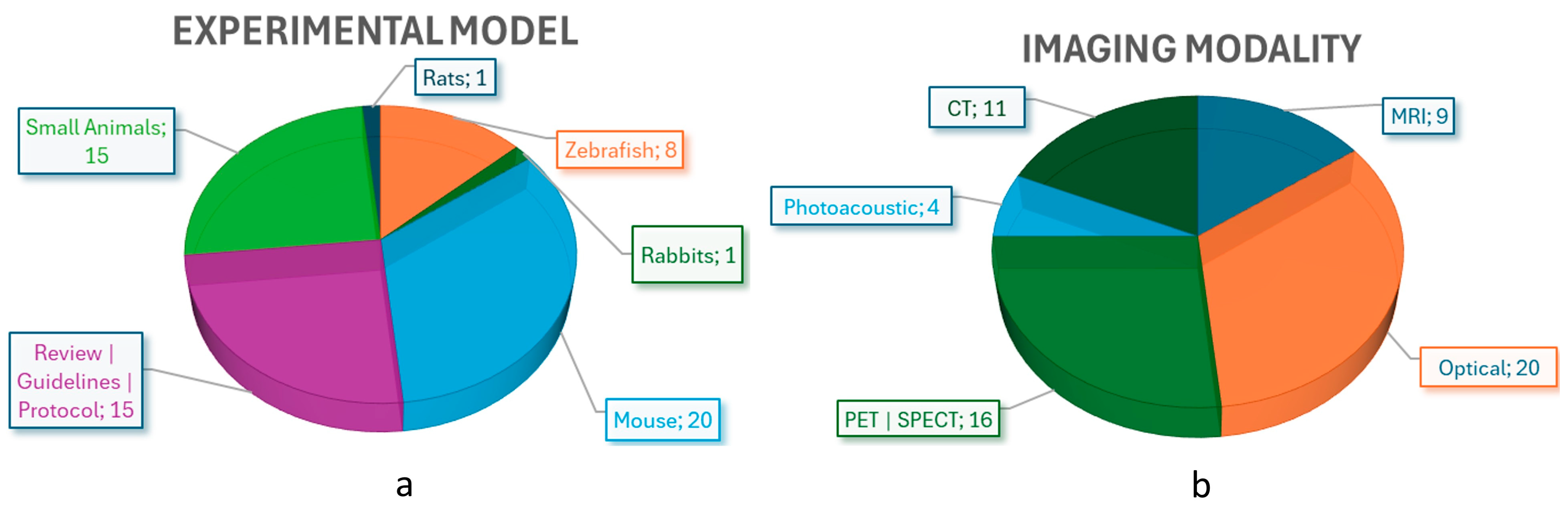
The included studies were categorized according to imaging modality—CT, MRI, PET, SPECT, photoacoustic imaging, optical imaging, and explicitly multimodal approaches—and by experimental model (e.g., mouse, rabbit, and zebrafish). The term “small animal” generally refers to rodent models (primarily mice and rats), although other species, such as rabbits or zebrafish, may also be encompassed depending on the imaging modality and application. This distribution is illustrated in Figure 2, with panel a showing the distribution by experimental model and panel b showing the proportion of studies by imaging modality. The charts highlight the methodological diversity of contemporary preclinical imaging research.

3.3. Variance, Bias, and Cross-Modality Harmonization in Preclinical Imaging

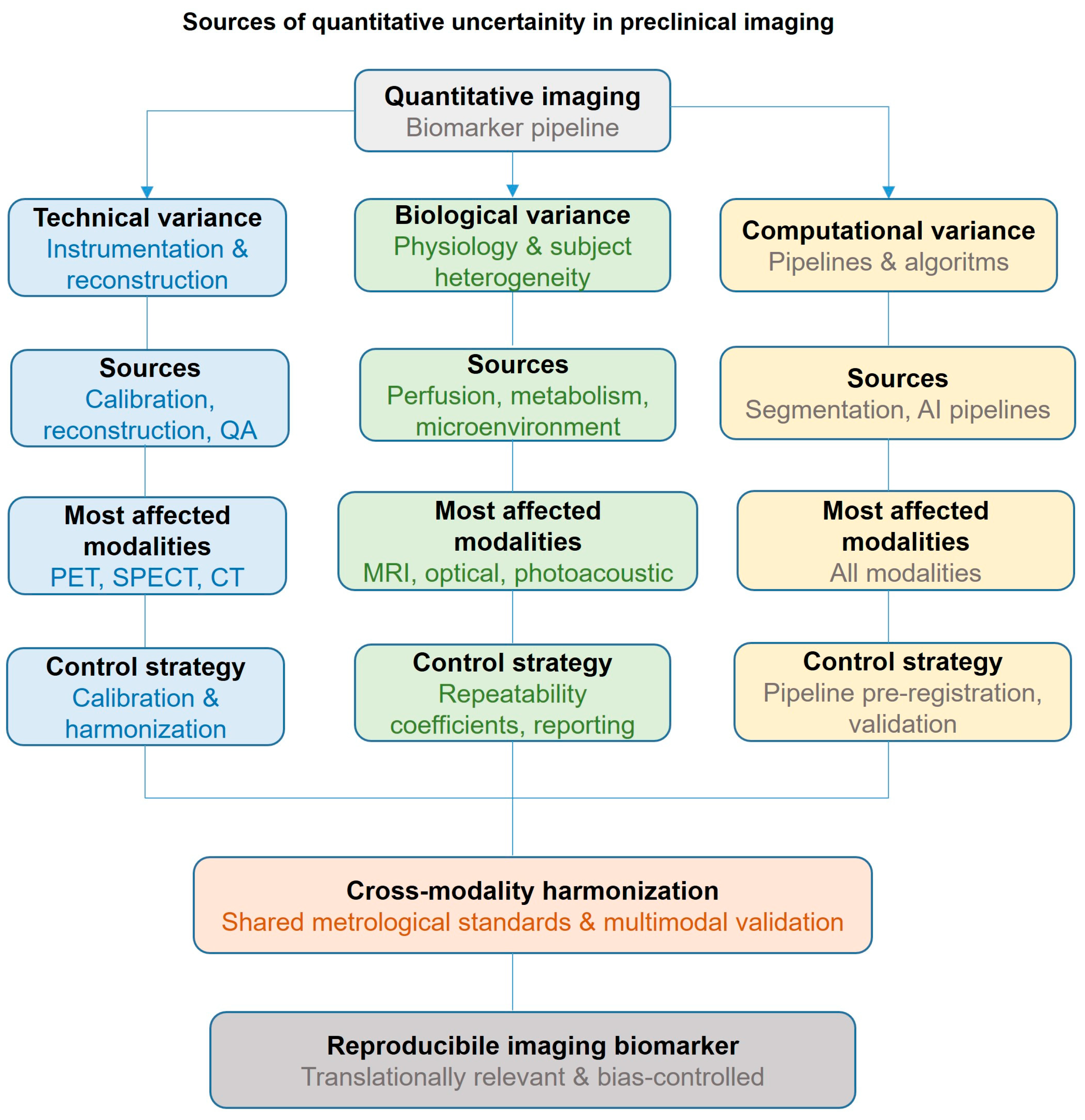
Quantitative robustness in preclinical imaging does not derive from instrumental sensitivity alone, but from the controlled management of error sources distributed across the entire imaging pipeline. A conceptually useful framework distinguishes three principal categories of variability, as seen in Figure 3: technical variance, arising from instrumentation, calibration, and reconstruction; biological variance, reflecting genuine physiological heterogeneity across subjects and timepoints; and computational variance, introduced by post-processing algorithms, segmentation strategies, and analytical pipelines. Disentangling these components is a prerequisite for meaningful cross-study and cross-platform comparison, and failure to do so systematically undermines the metrological credibility of derived imaging biomarkers. Formal metrological tools — including repeatability coefficients, reproducibility coefficients, and intraclass correlation analysis — provide the statistical infrastructure necessary to quantify and transparently report these variance components, enabling objective cross-platform comparison of quantitative biomarker performance [20,21]. The modality-specific manifestations of each variance category are discussed in detail in the sections that follow; the present framework is intended to provide the interpretive lens through which those sections should be read. The metrological maturity of harmonization infrastructure varies substantially across modalities, and this asymmetry has direct consequences for translational applicability. Nuclear imaging — particularly PET — currently benefits from the most developed accreditation ecosystem, supported by multicentre standardization initiatives and international guidelines from the EANM and ESMI [5,15]. MRI harmonization is progressing through consensus recommendations from the International Society for Magnetic Resonance in Medicine (ISMRM), but remains constrained by vendor heterogeneity and the absence of universally adopted phantom standards [22,23]. For CT, optical, and photoacoustic modalities, cross-platform accreditation frameworks are either nascent or absent — a critical gap that limits the reproducibility and translational scalability of derived quantitative metrics [8,24]. Multimodal integration strategies — such as constraining optical reconstructions with anatomical MRI priors, or cross-validating optical readouts against nuclear biodistribution data — can partially mitigate modality-specific bias and stabilize ill-posed inverse problems, but require explicit co-validation against shared biological reference standards to be metrologically credible [7,19]. These considerations define a practical framework for the design of quantitative preclinical imaging studies. Controlling technical variance requires prospective protocol harmonization, phantom-based calibration, and reconstruction standardization before data acquisition begins. Characterizing biological variance requires adequate cohort sizing, longitudinal within-subject designs where feasible, and explicit reporting of repeatability and reproducibility coefficients alongside primary quantitative endpoints. Mitigating computational variance requires pipeline pre-registration, version control of analytical software, and independent validation of AI-assisted components. Achieving cross-modality comparability, finally, requires not only technical alignment but biological co-validation — ensuring that parameters derived from different modalities are anchored to shared ground-truth reference standards. When these principles are systematically implemented, quantitative preclinical imaging can fulfil its promise as a reproducible, biologically interpretable, and translationally relevant measurement science [20,21,25].
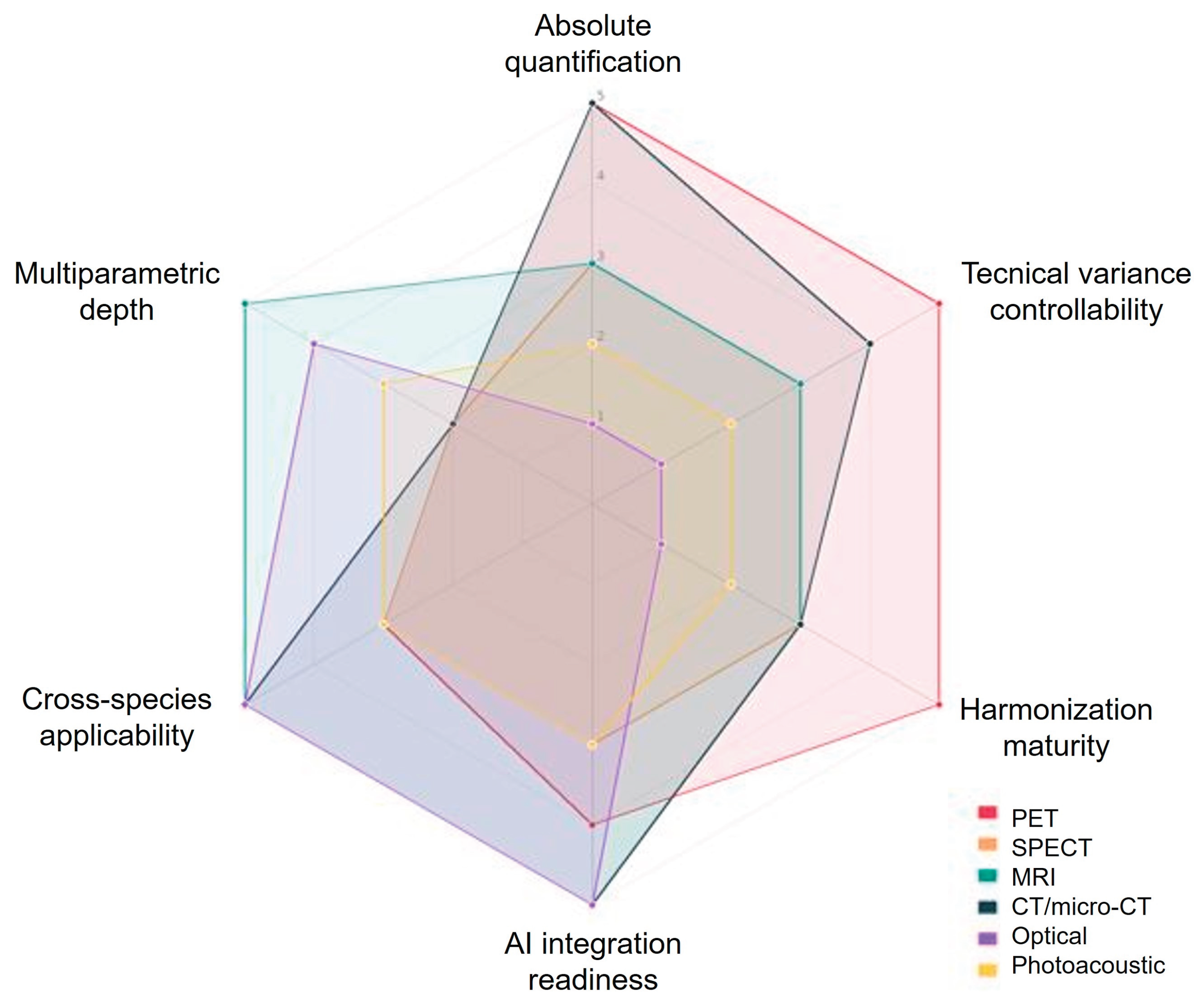
Table 2 summarizes the comparative quantitative assessment across all six metrological dimensions, with scores assigned according to predefined criteria detailed in Supplementary Table S1; the modality-specific strategies, reproducibility data, and validation approaches underlying each assessment are discussed in the sections that follow.

3.4. Quantitative CT in Preclinical Imaging

The studies included in this section are summarized in Table 3, which provides a structured overview of quantitative CT and micro-CT applications in preclinical models, detailing the primary quantitative focus, biological model, key quantitative outcome, and level of validated quantitative performance for each included study.
Among the available preclinical imaging modalities, CT and micro-CT occupy a methodologically distinct position: their quantitative output is grounded in physical attenuation measurements traceable to Hounsfield Units, conferring an inherent metrological advantage over modalities that depend on kinetic modelling or optical inverse problems. This physical traceability, however, does not eliminate the need for rigorous protocol harmonization — reproducibility of CT-derived metrics remains critically dependent on acquisition settings, reconstruction algorithms, and segmentation strategies, as reviewed comprehensively by [8]. Quantitative robustness is most rigorously established for skeletal applications. Protocol-dependent sensitivity of these metrics to voxel size and segmentation method represents a recognized source of systematic variance that must be prospectively controlled [26]. Reproducibility of densitometric and biomechanical descriptors — including bone mineral density, cortical thickness, and trabecular architecture metrics such as BV/TV and Tb.Th — has been formally validated with repeatability and reproducibility coefficients reported across longitudinal in vivo protocols [27]. Extending beyond skeletal assessment, micro-CT has demonstrated comparable quantitative utility in pulmonary research. Standardized longitudinal workflows enable reproducible extraction of total lung volume, aerated lung fraction, and mean lung density across disease progression models [28]. Fully automated deep learning pipelines have further advanced quantitative consistency in this domain, delivering high-accuracy densitometric assessment of pulmonary fibrosis with reduced operator dependency and validated correlation to histopathological endpoints [29,30,31]. Reproducibility benchmarking has been further supported by the availability of annotated whole-body micro-CT databases in tumour-bearing mouse models, enabling systematic evaluation of segmentation consistency and inter-observer variability across automated and manual pipelines [32]. Quantitative radiomics analyses extending structural assessment into texture-based descriptors have also been validated, although cross-platform reproducibility of radiomic features remains dependent on harmonized acquisition and reconstruction workflows — a limitation that persists across cone-beam and micro-CT systems [9]. Non-invasive skeletal muscle quantification represents a further emerging application, with morphometric descriptors including muscle volume and cross-sectional area demonstrating methodological feasibility, pending formal reproducibility validation [33]. Beyond structural and densitometric applications, contrast-enhanced micro-CT with nanoparticle agents extends quantitative capability toward vascular architecture and perfusion mapping, enabling semi-quantitative assessment of vascular volume fraction and contrast distribution in vivo [34]. Collectively, these findings position quantitative CT and micro-CT as a modality with high absolute quantification capability and increasingly mature AI-assisted analysis pipelines, but with harmonization infrastructure that remains less developed than nuclear imaging — particularly for cross-platform radiomics and vascular applications. Controlling beam hardening, scatter, and partial volume effects through standardized reconstruction, combined with prospective dose optimization in longitudinal survival studies, represents the critical prerequisite for extracting reproducible, biologically interpretable structural biomarkers within integrated preclinical imaging frameworks, consistent with the variance control principles outlined in Section 3.3.

3.5. Quantitative MRI in Preclinical Models

The studies included in this section are summarized in Table 4, which provides a structured overview of quantitative MRI applications in preclinical models, detailing the primary quantitative focus, biological model, key quantitative outcome, and level of validated quantitative performance for each included study.
Among quantitative MRI techniques, reproducibility is most rigorously established for diffusion-based metrics, whereas perfusion and relaxometry parameters remain more vulnerable to protocol heterogeneity and vendor-dependent implementation variability. Diffusion Weighted Imaging (DWI) and its primary derived parameter — the Apparent Diffusion Coefficient (ADC) — represent the most extensively validated quantitative MRI biomarkers in preclinical research. Structured ISMRM recommendations further provide guidance on acquisition parameters, gradient calibration, motion management, and modelling strategies to ensure quantitative robustness across preclinical systems [22]. DWI has additionally been validated on preclinical PET/MRI hybrid platforms, confirming compatibility with multiparametric workflows [35]. Beyond conventional ADC, advanced diffusion approaches — including Intravoxel Incoherent Motion (IVIM) and Diffusion Kurtosis Imaging (DKI) — further separate perfusion and diffusion contributions while capturing non-Gaussian diffusion behaviour, enhancing microstructural characterization and enabling correlation with histological endpoints such as hypoxia biomarkers [36,37]. Building on diffusion analysis, Dynamic Contrast-Enhanced MRI (DCE-MRI) enables quantitative assessment of tissue perfusion and vascular permeability through pharmacokinetic modelling. Accurate estimation of the arterial input function (AIF) is central to parameter extraction, and optimised automated detection strategies reduce operator dependency while improving reproducibility of parameters such as Volume transfer constant (K^trans^) and Extravascular extracellular volume fraction (v_e) [38]. Emerging multiparametric approaches further advance this landscape: 3D MR Fingerprinting integrates simultaneous T₁/T₂ mapping with dynamic contrast acquisition in a single scan, providing comprehensive tissue characterization while reducing acquisition time [19]. Quantitative relaxometry provides direct measurement of tissue T₁ and T₂/T₂* relaxation times, sensitive to microenvironmental changes including oedema, fibrosis, and tumour progression. These approaches are increasingly applied for therapy monitoring and longitudinal studies, with between-session variability formally quantified even under controlled experimental conditions — underscoring the necessity of explicitly separating biological fluctuation from instrumental noise [39]. Complementary techniques further expand the quantitative MRI toolkit: Quantitative Susceptibility Mapping (QSM) enables assessment of tissue magnetic susceptibility for investigations of iron deposition, haemorrhage, and calcification [40], while Proton Magnetic Resonance Spectroscopy (¹H-MRS) provides metabolic profiling through quantification of absolute or relative metabolite concentrations, increasingly combined with relaxometry in multiparametric protocols [41]. Collectively, these findings position quantitative MRI as the modality with the highest multiparametric depth among those reviewed, capable of simultaneously characterizing diffusion, perfusion, relaxation, susceptibility, and metabolic properties within integrated preclinical workflows. This richness, however, is counterbalanced by pronounced sensitivity to protocol heterogeneity and the current absence of universally adopted phantom standards — a gap that constrains harmonization maturity relative to nuclear imaging and represents the primary target for methodological development, consistent with the framework outlined in Section 3.3.

3.6. Quantitative Preclinical Nuclear Imaging: PET and SPECT

The studies included in this section are summarized in Table 5, which provides a structured overview of quantitative nuclear medicine applications in preclinical models, detailing the primary quantitative focus, biological model, key quantitative outcome, and level of validated quantitative performance for each included study.
Among the modalities reviewed, nuclear imaging — and particularly PET — occupies the highest tier of metrological readiness, owing to its capacity for traceable absolute quantification and its comparatively mature harmonization infrastructure. Quantitative PET readouts most commonly begin with the Standardized Uptake Value (SUV), which normalizes tissue radioactivity to injected dose and body metrics. SUV reproducibility, however, is critically dependent on harmonized acquisition and analysis protocols: multicentric preclinical studies demonstrate that standardized workflows substantially reduce inter-system SUV variability, establishing the importance of protocol harmonization as a non-negotiable prerequisite for cross-platform comparability [16]. In addition, independent radiopharmaceutical and biochemical assays remain necessary to validate that imaging-derived quantitative parameters accurately reflect underlying biological processes [42]. Dynamic PET extends quantitative capability beyond static SUV by enabling extraction of Time-Activity Curves (TACs) and estimation of kinetic rate constants through compartmental and graphical modelling frameworks, providing deeper physiological insight into tracer distribution and metabolism [43]. Moreover, AI-assisted arterial input function estimation has further demonstrated the potential to enhance kinetic parameter precision and reduce operator dependency in small-animal PET models [44]. Translational evaluations comparing dedicated preclinical PET with clinical total-body PET/CT systems have shown encouraging quantitative concordance, reinforcing the translational scalability of rigorous preclinical PET methodologies — while simultaneously highlighting scale-dependent challenges including partial volume effects at near-organism spatial resolution [3]. Quantitative PET imaging has further demonstrated the capacity to capture therapy-induced biological alterations in experimental tumour models, reinforcing its role as a mechanistic indicator of treatment response and translational biomarker discovery [45]. Beyond oncological applications, PET has been applied for quantitative molecular imaging of neuroinflammation in rodent models, enabling assessment of microglial activation and inflammatory biomarkers with histological validation [46], as well as for biodistribution analysis of novel radiotracers [47]. Cross-species feasibility has additionally been demonstrated in adult zebrafish, where measurable radiotracer uptake and longitudinal imaging capability extend quantitative PET methodologies to small non-mammalian vertebrate models — a development that requires explicit metrological re-validation at each new biological scale [48]. Turning to SPECT, advances in multi-pinhole collimation, attenuation and scatter correction, and system-response modelling have substantially narrowed the quantitative gap with PET. Absolute activity quantification becomes achievable when datasets are corrected for physical degrading factors through CT-based attenuation correction and calibrated iterative reconstruction [49]. Contemporary multi-isotope small-animal SPECT systems have been validated for simultaneous radionuclide imaging with preserved quantitative integrity, expanding SPECT utility in multiplexed biological investigations [50,51]. Methodological reviews contextualize these advances, underscoring the impact of instrumentation design and reconstruction strategy on achieving robust quantitative SPECT performance [52]. The link between radiopharmaceutical quality control and quantitative imaging output represents a further critical dimension: tracer radiochemistry and QC procedures directly influence the reliability of imaging-derived metrics and must be integrated within quantitative workflows [53]. Quality control and harmonization remain the central pillars sustaining quantitative nuclear imaging. Joint guidelines from EANM and ESMI formalize structured calibration procedures, rigorous acquisition standards, and transparent analysis workflows for both PET and SPECT, providing the most comprehensive harmonization framework currently available across all preclinical imaging modalities [5]. Ongoing advances in reconstruction algorithms, AI integration, and hybrid imaging architectures continue to enhance both accuracy and interpretability of preclinical nuclear imaging data [1]. Collectively, these developments position quantitative nuclear imaging as the modality with the most mature harmonization ecosystem and the most traceable absolute quantification capability — a metrological maturity that other modalities are progressively working toward, as discussed in Section 3.3.

3.7. Multimodal and Emerging Optical Imaging

The studies included in this section are summarized in Table 6, which provides a structured overview of quantitative optical and photoacoustic imaging applications in preclinical models, detailing the primary quantitative focus, biological model, key quantitative outcome, and level of validated quantitative performance for each included study.
Optical imaging modalities offer high molecular sensitivity and compatibility with longitudinal and high-throughput experimental designs, particularly in zebrafish and small-animal models. Their primary metrological challenge, however, is structural: detected photon emissions are heavily influenced by tissue scattering, absorption, and depth-dependent attenuation, rendering quantification intrinsically dependent on explicit photon transport modelling, inverse reconstruction algorithms, and harmonized calibration protocols. Fluorescence signal standardization frameworks address this challenge by defining calibration standards and normalization strategies to reduce system sensitivity biases across instruments [54,55]. Fluorescence Molecular Tomography (FMT) extends planar fluorescence toward volumetric quantification by using diffusion-based models to relate surface measurements to fluorophore distributions, solving an ill-posed inverse problem through regularization and reconstruction constraints [57,58]. Hybrid FMT/Cone Beam CT systems further enhance quantitative accuracy by providing anatomical priors that stabilize inverse solutions [59], while early-photon and compressed sensing approaches improve sensitivity and spatial resolution in preclinical phantom and mouse models [60]. Bioluminescence imaging (BLI) provides an alternative quantitative optical approach based on endogenous light emission from enzymatic reactions, with photon emission intensity generally proportional to viable cell density. Automated 3D BLI reconstruction methods mitigate geometric biases by providing volumetric emission estimates [61], while commercial and mobile Bioluminescence Tomography platforms have demonstrated high-precision source localization and robust quantitative performance across murine tumour models [62,63,64]. In addition, in vivo quantitative FRET imaging complements these approaches by enabling dynamic molecular-level readouts, with intensity-based and lifetime-based metrics compared for precision in functional quantification [65]. Standardized injection protocols and consistent imaging conditions are critical prerequisites for maintaining reproducibility across experimental cohorts [66]. Moreover, High-frequency ultrasound (HFUS) represents a complementary quantitative modality, as demonstrated by computer-aided assessment of hepatic steatosis progression in mouse models — providing reproducible measurement of liver echogenicity and morphology with potential for non-invasive longitudinal monitoring [67]. Zebrafish models extend quantitative optical imaging into a complementary biological scale characterized by optical transparency, rapid development, and suitability for high-throughput phenotyping. Polarization-sensitive Optical Coherence Tomography (PS-OCT) has been applied in zebrafish tumour xenografts to quantify microstructural birefringence and characterize tumour microenvironmental changes longitudinally [68]. Furthermore, quantitative feature extraction from brightfield and fluorescence imaging supports high-dimensional phenotypic assessment of zebrafish embryos [69], while Mueller matrix OCT combined with deep learning enables structural-functional mapping across developmental stages [70]. High-content automated optical screening platforms further allow multiplexed, volumetric assessment of drug responses and tumour burden at scale [71], and optical microscopy with video-based analysis supports dynamic cardiac functional quantification in zebrafish embryos [72]. In addition, systematic reviews confirm that optical and fluorescence xenograft workflows provide quantitative endpoints suitable for translational tumour research [73], and broader frameworks highlight zebrafish as a versatile model for functional imaging across neurological and developmental applications [74]. On the other hand, photoacoustic imaging bridges the optical and acoustic domains by converting pulsed optical absorption into acoustic signals via thermoelastic expansion, partially mitigating the impact of photon scattering on spatial localization. Multispectral optoacoustic tomography (MSOT) frameworks employ spectral unmixing and model-based inversion to estimate physiologically relevant metrics including oxygen saturation (sO₂) and total haemoglobin concentration (HbT), with depth-dependent fluence correction representing the primary technical challenge [75]. Dual-modality systems combining photoacoustic and fluorescence imaging enable simultaneous structural and molecular quantification in vivo [76,77]. Collectively, optical and photoacoustic modalities occupy a quantitatively distinct domain characterized by high AI integration readiness and cross-species applicability — particularly in zebrafish platforms — but limited harmonization maturity and inherently challenging absolute quantification. Three overarching principles govern quantitative performance in this domain: model fidelity and reconstruction stability, which determine how reliably raw signals map to interpretable biological metrics; bias and variance control, which underpin repeatability and cross-study comparability; and integration with complementary modalities, where optical data anchored by anatomical or functional priors from MRI or nuclear imaging substantially improves quantitative confidence. These principles align directly with the variance control framework outlined in Section 3.3, and their systematic implementation represents the critical pathway toward elevating optical and photoacoustic imaging to the metrological standards achieved by more mature modalities.

4. Discussion

Quantitative preclinical imaging has evolved from a visualization-driven discipline into a measurement-centred biomarker science in which reproducibility, bias control, and parameter identifiability are as decisive as biological sensitivity. Viewed through the metrological framework established in Section 3.3, differences among imaging modalities reflect not simply contrasts in resolution or molecular sensitivity, but fundamentally distinct balances between model conditioning, acquisition stability, and harmonization maturity. This interpretive lens reveals a clear hierarchy of quantitative readiness across modalities — one with direct practical implications for study design, biomarker selection, and translational applicability [20,25].
Nuclear imaging — particularly PET — occupies the highest tier of this hierarchy, owing to its capacity for traceable absolute quantification and its relatively mature harmonization infrastructure. Multicentre standardization initiatives within the EANM framework have demonstrated that controlled reconstruction settings and cross-system calibration significantly reduce SUV variability and improve inter-platform concordance [1,15,78]. Nevertheless, static SUV remains a simplified surrogate of tracer kinetics, and dynamic PET — while enabling compartmental modelling and estimation of physiologically meaningful rate constants — amplifies sensitivity to arterial input function errors, statistical noise, and parameter identifiability limitations [16,18]. Independent radiopharmaceutical assays remain necessary to validate that quantitative imaging metrics accurately reflect underlying biological processes [79]. SPECT has similarly progressed through advances in attenuation and scatter correction and multi-pinhole collimation [80], yet remains comparatively constrained by count statistics and calibration sensitivity relative to PET. The application of PET beyond murine systems — illustrated by its implementation in adult zebrafish [3] — further demonstrates both scalability and methodological fragility: metrological validation must be explicitly re-established whenever biological scale or acquisition geometry changes, a principle that applies equally across all modalities.
Shifting from nuclear to structural imaging, CT and micro-CT occupy a complementary structural domain, grounded in attenuation-based quantification traceable to physical units. This physical traceability confers an inherent metrological advantage over kinetic modalities: Hounsfield Unit-based metrics are less dependent on modelling assumptions and more directly interpretable in geometric and material terms [8]. Reproducible extraction of volumetric and densitometric descriptors has been demonstrated across skeletal, pulmonary, and vascular applications when acquisition and reconstruction workflows are harmonized [27,28]. However, cross-platform accreditation frameworks for quantitative CT remain less developed than those for PET, and longitudinal applications require careful dose optimization to avoid biological confounding — a constraint that limits protocol flexibility in survival studies [9].
Where CT provides structural specificity, MRI offers unmatched multiparametric depth without ionizing radiation, enabling integrated assessment of diffusion, perfusion, relaxometry, and microstructure within a single experimental session. This richness, however, is counterbalanced by pronounced susceptibility to protocol heterogeneity and vendor-dependent implementation variability — a tension that constitutes MRI's primary metrological challenge. MR Fingerprinting exemplifies efficient multiparametric estimation through dictionary-based acquisition [19], yet parameter accuracy depends critically on acquisition timing precision and dictionary completeness. Moreover, quantitative MRI frameworks for deriving T1 maps from conventional acquisitions provide proof-of-concept strategies for multiparametric biomarker extraction [81]. Compared with PET, MRI's harmonization infrastructure — while advancing through ISMRM consensus recommendations [22,23] — remains constrained by the absence of universally adopted phantom standards and vendor-independent acquisition protocols.
Beyond the electromagnetic spectrum, optical and photoacoustic imaging occupy a quantitatively distinct domain characterized by high molecular sensitivity and compatibility with high-throughput and longitudinal experimental designs, particularly in zebrafish and small-animal models. Their primary metrological limitation, however, is structural rather than technical: diffuse optical tomography is intrinsically governed by ill-posed inverse problems, and inversion of photon transport equations is mathematically unstable and highly sensitive to modelling mismatch [82]. Photoacoustic imaging partially mitigates this by converting optical absorption into acoustic signals, improving spatial localization; yet quantitative accuracy remains strongly dependent on depth-varying optical fluence, spectral colouring, and acoustic heterogeneity [75,83]. Compared with PET and MRI, standardized cross-platform calibration and accreditation infrastructures for photoacoustic systems are still limited, and consensus protocols for quantitative validation are emerging rather than established [24].
Taken together, these modality-specific considerations converge on three structural challenges that cut across all quantitative preclinical imaging frameworks and remain incompletely resolved. The first is the absence of shared biological reference standards for cross-modality validation. While technical harmonization has advanced substantially — particularly in nuclear imaging — biological validation frameworks that anchor imaging-derived parameters to independent molecular or histological endpoints remain inconsistently implemented across modalities and laboratories. This gap is particularly consequential for translational research, where the biological interpretability of imaging biomarkers is as important as their technical reproducibility [20,25]. The second challenge is cross-species parameter transferability. Quantitative strategies validated in murine models cannot be assumed to retain metrological performance in zebrafish, rabbit, or larger animal systems without explicit re-validation — a requirement that is frequently overlooked in translational study designs [3,7]. The third challenge is the validation of AI-assisted components within quantitative pipelines. AI-driven approaches are increasingly integrated into preclinical imaging workflows, enabling automated segmentation, feature extraction, and parameter estimation across modalities, with the potential to reduce operator-dependent variability and enhance sensitivity in complex datasets [80,84]. However, the incorporation of artificial intelligence introduces an additional layer of methodological complexity. Quantitative outputs become dependent not only on acquisition parameters but also on model architecture, training strategies, and preprocessing pipelines, resulting in an inherent algorithmic dependency that must be explicitly addressed. A critical limitation lies in the sensitivity of AI models to domain shift, whereby performance may degrade when applied to data acquired under different experimental conditions, imaging systems, or biological models. This issue is closely linked to training bias, as model performance is strongly influenced by the representativeness of the training dataset. Consequently, the generalizability of AI-derived quantitative metrics across laboratories and study designs remains uncertain.
Furthermore, a substantial proportion of studies rely on internal validation frameworks, with limited use of independent external datasets. This lack of external validation constrains the assessment of robustness and may lead to overestimation of model performance. As a result, while AI-based methods show considerable promise for improving quantitative imaging pipelines, their metrological credibility depends on rigorous validation, transparency in model development, and systematic evaluation across heterogeneous experimental conditions.
Despite the structured approach adopted in this review, several limitations and potential sources of bias should be acknowledged. First, the literature selection was restricted to major scientific databases, which may have led to the exclusion of relevant studies indexed in alternative repositories or present in the grey literature, introducing a degree of selection bias.
Second, the distribution of included studies across imaging modalities was not uniform, with nuclear and magnetic resonance techniques being more extensively represented compared to optical or emerging hybrid approaches. This imbalance may influence the comparative interpretation of quantitative capabilities across modalities.
Third, the definition of quantitative imaging is inherently heterogeneous across disciplines, encompassing physically calibrated measurements, model-based parameters, and biologically validated biomarkers. Although a consistent conceptual framework was adopted, variability in methodological implementations and validation strategies across studies may limit direct comparability.
In addition, a proportion of the included studies lacked comprehensive validation against independent reference standards, reflecting a broader limitation in the field related to the availability of robust ground truth data in preclinical settings.
Finally, the increasing integration of artificial intelligence-based methods introduces an additional layer of variability, as model performance is often dependent on training data characteristics and may not generalize across experimental conditions, potentially contributing to technological bias.
These factors should be considered when interpreting the findings of this review and highlight the need for further standardization and validation in quantitative preclinical imaging.
Addressing these challenges collectively requires moving beyond modality-specific optimization toward a convergence of complementary strengths within shared metrological standards and multimodal validation architectures. The quantitative performance profile of each modality — as illustrated in Figure 4 makes this complementarity explicit.
PET's strength in absolute quantification and harmonization maturity, MRI's depth in multiparametric tissue characterization, and optical imaging's scalability and molecular sensitivity are not competing attributes but potentially synergistic ones, if integration is anchored in biological co-validation rather than mere technical co-registration. Hybrid platforms such as PET/MRI already demonstrate this principle in practice, enabling simultaneous acquisition of complementary quantitative readouts while introducing additional layers of technical complexity that themselves require structured quality assurance [4,7]; standardized computational pipelines for automated feature extraction and image quantification have been proposed to improve reproducibility and reduce operator-dependent variability [85]. Conversely, readers specifically interested in radiomics-based quantification approaches in preclinical imaging may refer to [86] for a dedicated and in-depth treatment of methodological advances and emerging applications in that domain. On balance, the future of preclinical imaging lies in multimodal integration anchored in shared metrological standards, AI frameworks constrained by interpretability and validation safeguards, and cross-scale validation strategies aligning molecular, microstructural, and organism-level readouts within a coherent quantitative architecture. Translational impact will depend less on incremental gains in resolution and more on the stability, transparency, and biological validity of quantitative pipelines maintained across platforms, laboratories, and experimental models.

5. Conclusions

Quantitative preclinical imaging is no longer defined solely by technological innovation but by its capacity to generate reproducible, bias-controlled, and biologically validated metrics across experimental systems and biological models. The framework developed in this review — distinguishing technical, biological, and computational sources of variance as analytically separable dimensions of quantitative uncertainty — reveals that the modalities considered here do not occupy a uniform level of metrological readiness. Nuclear imaging, particularly PET, currently offers the most mature harmonization infrastructure and the most traceable absolute quantification capability; MRI provides unparalleled multiparametric depth and cross-species flexibility; CT and micro-CT deliver physically traceable structural metrics with increasingly mature AI-assisted pipelines; optical and photoacoustic modalities afford high-throughput molecular sensitivity and scalability, at the cost of inherently ill-posed quantification problems and underdeveloped harmonization frameworks. These distinct profiles carry direct implications for study design and translational strategy. Selecting a quantitative imaging modality should be guided not only by biological sensitivity but by the metrological maturity of the available validation infrastructure, the controllability of variance sources within the experimental context, and the availability of harmonized protocols that permit cross-platform and cross-species comparability. Where single modalities are insufficient, multimodal integration anchored in biological co-validation — rather than mere technical co-registration — offers the most promising pathway toward robust and translationally relevant biomarker generation. The next phase of progress will depend on three converging developments: the extension of harmonization infrastructure to MRI, CT, and optical modalities through internationally adopted standards; the prospective validation of AI-assisted components as metrologically credible elements of quantitative pipelines; and the systematic implementation of cross-species re-validation strategies whenever biological scale or acquisition geometry changes. Ultimately, the translational value of preclinical imaging will be determined not by signal intensity or spatial resolution alone, but by the robustness, comparability, and physiological interpretability of the quantitative biomarkers it produces — and by the transparency of the metrological frameworks that underpin them.

Author Contributions

Conceptualization, A.S.; methodology, N.L.; formal analysis, N.L.; investigation, N.L.; resources, N.L.; data curation, N.L.; writing—original draft preparation, N.L. and A.S.; writing—review and editing, N.L., G.R. and A.S..; visualization, N.L.; supervision, G.R. and A.S.; project administration, G.R. and A.S; funding acquisition, G.R. All authors have read and agreed to the published version of the manuscript.

Funding

GIOCONDA (Understanding the radiobiological effects of BNCT and FLASH therapy) project, from an Anthem (AdvaNced Technologies for Human-centrEd Medicine) project’s BAC - PNC0000003.

Institutional Review Board Statement

Not applicable.

Data Availability Statement

Not applicable.

Acknowledgments

Not applicable.

Conflicts of Interest

The authors declare no conflicts of interest.

References

  1. Bruzgo-Grzybko, M.; Kalita, I.S.; Olichwier, A.J.; Bielicka, N.; Chabielska, E.; Gromotowicz-Poplawska, A. Preclinical PET and SPECT Imaging in Small Animals: Technologies, Challenges and Translational Impact. Cells 2025, 15, 73. [Google Scholar] [CrossRef]
  2. Miyaoka, R.S.; Lehnert, A.L. Small Animal PET: A Review of What We Have Done and Where We Are Going. Phys. Med. Biol. 2020, 65, 24TR04. [Google Scholar] [CrossRef]
  3. Mannheim, J.G.; Lan, W.; Conti, M.; Siedler, F.; Krueger, M.A.; Herfert, K.; la Fougère, C.; Schmidt, F.P. Feasibility of in Vivo Small Animal Imaging Using a Clinical Total-Body PET/CT System. EJNMMI Phys. 2025, 12, 71. [Google Scholar] [CrossRef] [PubMed]
  4. Chomet, M.; Schreurs, M.; Vos, R.; Verlaan, M.; Kooijman, E.J.; Poot, A.J.; Boellaard, R.; Windhorst, A.D.; van Dongen, G.A.; Vugts, D.J.; et al. Performance of NanoScan PET/CT and PET/MR for Quantitative Imaging of 18F and 89Zr as Compared with Ex Vivo Biodistribution in Tumor-Bearing Mice. EJNMMI Res. 2021, 11, 57. [Google Scholar] [CrossRef] [PubMed]
  5. Vanhove, C.; Koole, M.; Fragoso Costa, P.; Schottelius, M.; Mannheim, J.; Kuntner, C.; Warnock, G.; McDougald, W.; Tavares, A.; Bernsen, M. Preclinical SPECT and PET: Joint EANM and ESMI Procedure Guideline for Implementing an Efficient Quality Control Programme. Eur. J. Nucl. Med. Mol. Imaging 2024, 51, 3822–3839. [Google Scholar] [CrossRef]
  6. Iommelli, F.; De Rosa, V.; Terlizzi, C.; Fonti, R.; Del Vecchio, S. Preclinical Imaging in Targeted Cancer Therapies. Semin. Nucl. Med. 2019, 49, 369–381. [Google Scholar] [CrossRef]
  7. Balber, T.; Benčurová, K.; Mayrhofer, M.; Friske, J.; Haas, M.; Kuntner, C.; Helbich, T.H.; Hacker, M.; Mitterhauser, M.; Rausch, I. Quantitative Accuracy of Preclinical in Ovo PET/MRI: Influence of Attenuation and Quantification Methods. EJNMMI Phys. 2025, 12, 5. [Google Scholar] [CrossRef] [PubMed]
  8. Clark, D.P.; Badea, C.T. Advances in Micro-CT Imaging of Small Animals. Physica Medica 2021, 88, 175–192. [Google Scholar] [CrossRef]
  9. Brown, K.H.; Kerr, B.N.; Pettigrew, M.; Connor, K.; Miller, I.S.; Shiels, L.; Connolly, C.; McGarry, C.K.; Byrne, A.T.; Butterworth, K.T. A Comparative Analysis of Preclinical Computed Tomography Radiomics Using Cone-Beam and Micro-Computed Tomography Scanners. Phys. Imaging Radiat. Oncol. 2024, 31, 100615. [Google Scholar] [CrossRef]
  10. Kugler, E.C.; Frost, J.; Silva, V.; Plant, K.; Chhabria, K.; Chico, T.J.A.; Armitage, P.A. Zebrafish Vascular Quantification: A Tool for Quantification of Three-Dimensional Zebrafish Cerebrovascular Architecture by Automated Image Analysis. Development 2022, 149. [Google Scholar] [CrossRef]
  11. Sim, Y.; Lee, E.; Jeong, J. ZEMs: Zebrafish Embedding Molds for High-Throughput Imaging of Zebrafish Embryos and Larvae. Methods 2025, 244, 157–167. [Google Scholar] [CrossRef]
  12. K S, S.; Vithalkar, M.P.; Vishnusai, B.; Gupta, H.; Medishetti, R.; Mohamed, R.; Nayak, Y. Reimagining Preclinical Research: Zebrafish Models Driving Advances in Pharmacology and Toxicology. F1000Res. 2025, 14, 1342. [Google Scholar] [CrossRef]
  13. Omar, M.; Rebling, J.; Wicker, K.; Schmitt-Manderbach, T.; Schwarz, M.; Gateau, J.; López-Schier, H.; Mappes, T.; Ntziachristos, V. Optical Imaging of Post-Embryonic Zebrafish Using Multi Orientation Raster Scan Optoacoustic Mesoscopy. Light Sci. Appl. 2016, 6, e16186. [Google Scholar] [CrossRef]
  14. Mannheim, J.G.; Kara, F.; Doorduin, J.; Fuchs, K.; Reischl, G.; Liang, S.; Verhoye, M.; Gremse, F.; Mezzanotte, L.; Huisman, M.C. Standardization of Small Animal Imaging—Current Status and Future Prospects. Mol. Imaging Biol. 2018, 20, 716–731. [Google Scholar] [CrossRef] [PubMed]
  15. Mannheim, J.G.; Mamach, M.; Reder, S.; Traxl, A.; Mucha, N.; Disselhorst, J.A.; Mittelhäuser, M.; Kuntner, C.; Thackeray, J.T.; Ziegler, S.; et al. Reproducibility and Comparability of Preclinical PET Imaging Data: A Multicenter Small-Animal PET Study. Journal of Nuclear Medicine 2019, 60, 1483–1491. [Google Scholar] [CrossRef] [PubMed]
  16. Kuntner, C.; Alcaide, C.; Anestis, D.; Bankstahl, J.P.; Boutin, H.; Brasse, D.; Elvas, F.; Forster, D.; Rouchota, M.G.; Tavares, A.; et al. Optimizing SUV Analysis: A Multicenter Study on Preclinical FDG-PET/CT Highlights the Impact of Standardization. Mol. Imaging Biol. 2024, 26, 668–679. [Google Scholar] [CrossRef]
  17. Kuntner, C.; Friske, J.; Stessl, A.; Haas, M.; Breyer, L.L.; Wanek, T.; Hacker, M.; Helbich, T.; Rausch, I. Assessing PET Performance, Image Quality, and Attenuation Correction in the Presence of RF Coils within a 9.4 T MRI for Preclinical Simultaneous Imaging. EJNMMI Phys. 2025, 12, 63. [Google Scholar] [CrossRef]
  18. McDougald, W.; Vanhove, C.; Lehnert, A.; Lewellen, B.; Wright, J.; Mingarelli, M.; Corral, C.A.; Schneider, J.E.; Plein, S.; Newby, D.E.; et al. Standardization of Preclinical PET/CT Imaging to Improve Quantitative Accuracy, Precision, and Reproducibility: A Multicenter Study. Journal of Nuclear Medicine 2020, 61, 461–468. [Google Scholar] [CrossRef]
  19. Zhu, Y.; Wang, G.; Gu, Y.; Zhao, W.; Lu, J.; Zhu, J.; MacAskill, C.J.; Dupuis, A.; Griswold, M.A.; Ma, D.; et al. 3D MR Fingerprinting for Dynamic Contrast-enhanced Imaging of Whole Mouse Brain. Magn. Reson. Med. 2025, 93, 67–79. [Google Scholar] [CrossRef]
  20. Sullivan, D.C.; Obuchowski, N.A.; Kessler, L.G.; Raunig, D.L.; Gatsonis, C.; Huang, E.P.; Kondratovich, M.; McShane, L.M.; Reeves, A.P.; Barboriak, D.P.; et al. Metrology Standards for Quantitative Imaging Biomarkers. Radiology 2015, 277, 813–825. [Google Scholar] [CrossRef]
  21. Pierce, T.T.; Sirlin, C.B.; Fowler, K.J.; Buckler, A.J.; Hall, T.J.; Obuchowski, N.A. Understanding Repeatability and Reproducibility Coefficients for Quantitative Imaging Biomarkers. Radiology 2025, 316. [Google Scholar] [CrossRef] [PubMed]
  22. Jelescu, I.O.; Grussu, F.; Ianus, A.; Hansen, B.; Barrett, R.L.C.; Aggarwal, M.; Michielse, S.; Nasrallah, F.; Syeda, W.; Wang, N.; et al. Considerations and Recommendations from the ISMRM Diffusion Study Group for Preclinical Diffusion MRI: Part 1: In Vivo Small-animal Imaging. Magn. Reson. Med. 2025, 93, 2507–2534. [Google Scholar] [CrossRef]
  23. Malyarenko, D.; Amouzandeh, G.; Pickup, S.; Zhou, R.; Manning, H.C.; Gammon, S.T.; Shoghi, K.I.; Quirk, J.D.; Sriram, R.; Larson, P.; et al. Evaluation of Apparent Diffusion Coefficient Repeatability and Reproducibility for Preclinical MRIs Using Standardized Procedures and a Diffusion-Weighted Imaging Phantom. Tomography 2023, 9, 375–386. [Google Scholar] [CrossRef]
  24. Gargiulo, S.; Albanese, S.; Mancini, M. State-of-the-Art Preclinical Photoacoustic Imaging in Oncology: Recent Advances in Cancer Theranostics. Contrast Media Mol. Imaging 2019, 2019, 1–24. [Google Scholar] [CrossRef]
  25. O’Connor, J.P.B.; Aboagye, E.O.; Adams, J.E.; Aerts, H.J.W.L.; Barrington, S.F.; Beer, A.J.; Boellaard, R.; Bohndiek, S.E.; Brady, M.; Brown, G.; et al. Imaging Biomarker Roadmap for Cancer Studies. Nat. Rev. Clin. Oncol. 2017, 14, 169–186. [Google Scholar] [CrossRef]
  26. Christiansen, B.A. Effect of Micro-Computed Tomography Voxel Size and Segmentation Method on Trabecular Bone Microstructure Measures in Mice. Bone Rep. 2016, 5, 136–140. [Google Scholar] [CrossRef] [PubMed]
  27. Oliviero, S.; Cheong, V.S.; Roberts, B.C.; Orozco Diaz, C.A.; Griffiths, W.; Bellantuono, I.; Dall’Ara, E. Reproducibility of Densitometric and Biomechanical Assessment of the Mouse Tibia From In Vivo Micro-CT Images. Front. Endocrinol. (Lausanne). 2022, 13. [Google Scholar] [CrossRef] [PubMed]
  28. Ferrini, E.; Buccardi, M.; Stellari, F.F. Vivo Micro-CT Imaging for Quantitative Longitudinal Assessment of Pulmonary Diseases in Small Animals; 2025; pp. 207–232. [Google Scholar]
  29. Vincenzi, E.; Fantazzini, A.; Basso, C.; Barla, A.; Odone, F.; Leo, L.; Mecozzi, L.; Mambrini, M.; Ferrini, E.; Sverzellati, N.; et al. A Fully Automated Deep Learning Pipeline for Micro-CT-Imaging-Based Densitometry of Lung Fibrosis Murine Models. Respir. Res. 2022, 23, 308. [Google Scholar] [CrossRef]
  30. Buccardi, M.; Ferrini, E.; Pennati, F.; Vincenzi, E.; Ledda, R.E.; Grandi, A.; Buseghin, D.; Villetti, G.; Sverzellati, N.; Aliverti, A.; et al. A Fully Automated Micro-CT Deep Learning Approach for Precision Preclinical Investigation of Lung Fibrosis Progression and Response to Therapy. Respir. Res. 2023, 24, 126. [Google Scholar] [CrossRef]
  31. Cheng, H.; Gao, T.; Sun, Y.; Huang, F.; Gu, X.; Shan, C.; Luo, S.; Wang, B. AI-Assisted Semiquantitative Measurement of Murine Bleomycin-Induced Lung Fibrosis Using in Vivo Micro-CT: An End-to-End Approach. American Journal of Physiology-Cell Physiology 2025, 329, C659–C674. [Google Scholar] [CrossRef] [PubMed]
  32. Jensen, M.; Clemmensen, A.; Hansen, J.G.; van Krimpen Mortensen, J.; Christensen, E.N.; Kjaer, A.; Ripa, R.S. 3D Whole Body Preclinical Micro-CT Database of Subcutaneous Tumors in Mice with Annotations from 3 Annotators. Sci. Data 2024, 11, 1021. [Google Scholar] [CrossRef] [PubMed]
  33. Pereira-Rosa, A.; Oliveira, T.S.; Ferreira, M.S.; Vianna-Barbosa, R.J.; Wilmart-Gonçalves, T.C.; Ortiga, T.M.; Bloise, F.F. Non-Invasive Skeletal Muscle Quantification in Small Animals Using Micro-Computed Tomography. Journal of Visualized Experiments 2024. [Google Scholar] [CrossRef]
  34. Ashton, J.R.; West, J.L.; Badea, C.T. In Vivo Small Animal Micro-CT Using Nanoparticle Contrast Agents. Front. Pharmacol. 2015, 6. [Google Scholar] [CrossRef]
  35. Albrecht, J.; Polenz, D.; Kühl, A.A.; Rogasch, J.M.M.; Leder, A.; Sauer, I.M.; Babos, M.; Mócsai, G.; Beindorff, N.; Steffen, I.G.; et al. Diffusion-Weighted Magnetic Resonance Imaging Using a Preclinical 1 T PET/MRI in Healthy and Tumor-Bearing Rats. EJNMMI Res. 2019, 9, 21. [Google Scholar] [CrossRef]
  36. Duan, Z.; Tao, J.; Liu, W.; Liu, Y.; Fang, S.; Yang, Y.; Liu, X.; Deng, X.; Song, Y.; Wang, S. Correlation of IVIM/DKI Parameters with Hypoxia Biomarkers in Fibrosarcoma Murine Models: Direct Control of MRI and Pathological Sections. Acad. Radiol. 2024, 31, 1014–1023. [Google Scholar] [CrossRef]
  37. Guo, J.; Sun, W.; Dong, C.; Wu, Z.; Li, X.; Zhou, R.; Xu, W. Intravoxel Incoherent Motion Imaging Combined with Diffusion Kurtosis Imaging to Assess the Response to Radiotherapy in a Rabbit VX2 Malignant Bone Tumor Model. Cancer Imaging 2022, 22, 47. [Google Scholar] [CrossRef]
  38. Pickup, S.; Romanello, M.; Gupta, M.; Song, H.; Zhou, R. Dynamic Contrast-Enhanced MRI in the Abdomen of Mice with High Temporal and Spatial Resolution Using Stack-of-Stars Sampling and KWIC Reconstruction. Tomography 2022, 8, 2113–2128. [Google Scholar] [CrossRef]
  39. Roudi, R.; Pisani, L.J.; Pisani, F.; Liang, T.; Daldrup-Link, H.E. Reproducibility and Repeatability of Quantitative T2 and T2* Mapping of Osteosarcomas in a Mouse Model. Eur. Radiol. Exp. 2024, 8, 74. [Google Scholar] [CrossRef] [PubMed]
  40. Wei, H.; Xie, L.; Dibb, R.; Li, W.; Decker, K.; Zhang, Y.; Johnson, G.A.; Liu, C. Imaging Whole-Brain Cytoarchitecture of Mouse with MRI-Based Quantitative Susceptibility Mapping. Neuroimage 2016, 137, 107–115. [Google Scholar] [CrossRef] [PubMed]
  41. Herrmann, K.; Erokwu, B.O.; Johansen, M.L.; Basilion, J.P.; Gulani, V.; Griswold, M.A.; Flask, C.A.; Brady-Kalnay, S.M. Dynamic Quantitative T1 Mapping in Orthotopic Brain Tumor Xenografts. Transl. Oncol. 2016, 9, 147–154. [Google Scholar] [CrossRef]
  42. Pavone, A.M.; Benfante, V.; Giaccone, P.; Stefano, A.; Torrisi, F.; Russo, V.; Serafini, D.; Richiusa, S.; Pometti, M.; Scopelliti, F.; et al. Biodistribution Assessment of a Novel 68Ga-Labeled Radiopharmaceutical in a Cancer Overexpressing CCK2R Mouse Model: Conventional and Radiomics Methods for Analysis. 2024, 14, 409. [Google Scholar] [CrossRef]
  43. Knyzeliene, A.; Shaw, R.; Balogh, V.; Tavares, A.A.S. Kinetic Modeling Methods in Preclinical Positron Emission Tomography Imaging; 2024; pp. 441–455. [Google Scholar]
  44. Kuttner, S.; Luppino, L.T.; Convert, L.; Sarrhini, O.; Lecomte, R.; Kampffmeyer, M.C.; Sundset, R.; Jenssen, R. Deep-Learning-Derived Input Function in Dynamic [18F]FDG PET Imaging of Mice. Frontiers in Nuclear Medicine 2024, 4. [Google Scholar] [CrossRef]
  45. Raccagni, I.; Belloli, S.; Valtorta, S.; Stefano, A.; Presotto, L.; Pascali, C.; Bogni, A.; Tortoreto, M.; Zaffaroni, N.; Daidone, M.G.; et al. [18F]FDG and [18F]FLT PET for the Evaluation of Response to Neo-Adjuvant Chemotherapy in a Model of Triple Negative Breast Cancer. PLoS One 2018, 13, e0197754. [Google Scholar] [CrossRef]
  46. Gargiulo, S.; Coda, A.R.; Panico, M.; Gramanzini, M.; Moresco, R.M.; Chalon, S.; Pappatà, S. Molecular Imaging of Neuroinflammation in Preclinical Rodent Models Using Positron Emission Tomography. The Quarterly Journal of Nuclear Medicine and Molecular Imaging 2017, 61. [Google Scholar] [CrossRef]
  47. Benfante, V.; Stefano, A.; Comelli, A.; Giaccone, P.; Cammarata, F.P.; Richiusa, S.; Scopelliti, F.; Pometti, M.; Ficarra, M.; Cosentino, S.; et al. A New Preclinical Decision Support System Based on PET Radiomics: A Preliminary Study on the Evaluation of an Innovative 64Cu-Labeled Chelator in Mouse Models. J. Imaging 2022, 8, 92. [Google Scholar] [CrossRef]
  48. Tucker, C.; Collins, R.; Denvir, M.A.; McDougald, W.A. PET/CT Technology in Adult Zebrafish: A Pilot Study Toward Live Longitudinal Imaging. Front. Med. (Lausanne). 2021, 8. [Google Scholar] [CrossRef]
  49. Gerdekoohi, S.K.; Vosoughi, N.; Tanha, K.; Assadi, M.; Ghafarian, P.; Rahmim, A.; Ay, M.R. Implementation of Absolute Quantification in Small-animal SPECT Imaging: Phantom and Animal Studies. J. Appl. Clin. Med. Phys. 2017, 18, 215–223. [Google Scholar] [CrossRef]
  50. Lukas, M.; Kluge, A.; Beindorff, N.; Brenner, W. Multi-Isotope Capabilities of a Small-Animal Multi-Pinhole SPECT System. Journal of Nuclear Medicine 2020, 61, 152–161. [Google Scholar] [CrossRef] [PubMed]
  51. Prieto, E.; Irazola, L.; Collantes, M.; Ecay, M.; Cuenca, T.; Martí-Climent, J.M.; Peñuelas, I. Performance Evaluation of a Preclinical SPECT/CT System for Multi-Animal and Multi-Isotope Quantitative Experiments. Sci. Rep. 2022, 12, 18161. [Google Scholar] [CrossRef] [PubMed]
  52. Enninful, K.; Ahmed, F.; Girod, B.; Laforest, R.; Thorek, D.L.J.; Prasad, V.; Jha, A.K. Advances in SPECT and PET Reconstruction for Theranostics. PET Clin. 2026, 21, 55–71. [Google Scholar] [CrossRef] [PubMed]
  53. Altunay, B.; Bauwens, M.; Schäfer, L.; Heesch, A.; Morgenroth, A.; Mottaghy, F.M.; Florea, A. Radiosynthesis, Quality Control, and Small Animal Positron Emission Tomography Imaging of <Sup>68</Sup>Ga-Labelled Nano Molecules. Journal of Visualized Experiments 2024. [Google Scholar] [CrossRef]
  54. Refaat, A.; Yap, M.L.; Pietersz, G.; Walsh, A.P.G.; Zeller, J.; del Rosal, B.; Wang, X.; Peter, K. In Vivo Fluorescence Imaging: Success in Preclinical Imaging Paves the Way for Clinical Applications. J. Nanobiotechnology 2022, 20, 450. [Google Scholar] [CrossRef] [PubMed]
  55. Chu, T.; Zheng, X.; Manshian, B.B.; Soenen, S.J. Optical Imaging in Biomedical Research: Guidelines and Practical Insights. Health Nanotechnology 2025, 1, 4. [Google Scholar] [CrossRef]
  56. Lo, P.-A.; Su, S.-P.; Chiang, H.K. Small-Animal 360-Deg Fluorescence Diffuse Optical Tomography Using Structural Prior Information from Ultrasound Imaging. J. Biomed. Opt. 2020, 25, 1. [Google Scholar] [CrossRef]
  57. An, Y.; Wang, K.; Tian, J. Recent Methodology Advances in Fluorescence Molecular Tomography. Vis. Comput. Ind. Biomed. Art 2018, 1, 1. [Google Scholar] [CrossRef]
  58. Zhang, P.; Ma, C.; Song, F.; Fan, G.; Sun, Y.; Feng, Y.; Ma, X.; Liu, F.; Zhang, G. A Review of Advances in Imaging Methodology in Fluorescence Molecular Tomography. Phys. Med. Biol. 2022, 67, 10TR01. [Google Scholar] [CrossRef]
  59. Nouizi, F.; Brooks, J.; Zuro, D.M.; Hui, S.K.; Gulsen, G. Development of a Theranostic Preclinical Fluorescence Molecular Tomography/Cone Beam CT-Guided Irradiator Platform. Biomed. Opt. Express 2022, 13, 6100. [Google Scholar] [CrossRef]
  60. Konovalov, A.B.; Vlasov, V. V.; Uglov, A.S. Early-photon Reflectance Fluorescence Molecular Tomography for Small Animal Imaging: Mathematical Model and Numerical Experiment. Int. J. Numer. Method. Biomed. Eng. 2021, 37. [Google Scholar] [CrossRef]
  61. Klose, A.D.; Paragas, N. Automated Quantification of Bioluminescence Images. Nat. Commun. 2018, 9, 4262. [Google Scholar] [CrossRef]
  62. Thompson, W.R.; Brecht, H.-P.F.; Ivanov, V.; Yu, A.M.; Dumani, D.S.; Lawrence, D.J.; Emelianov, S.Y.; Ermilov, S.A. Characterizing a Photoacoustic and Fluorescence Imaging Platform for Preclinical Murine Longitudinal Studies. J. Biomed. Opt. 2023, 28. [Google Scholar] [CrossRef]
  63. Deng, Z.; Xu, X.; Iordachita, I.; Dehghani, H.; Zhang, B.; Wong, J.W.; Wang, K.K.-H. Mobile Bioluminescence Tomography-Guided System for Pre-Clinical Radiotherapy Research. Biomed. Opt. Express 2022, 13, 4970. [Google Scholar] [CrossRef]
  64. Xu, X.; Deng, Z.; Sforza, D.; Tong, Z.; Tseng, Y.; Newman, C.; Reinhart, M.; Tsouchlos, P.; Devling, T.; Dehghani, H.; et al. Characterization of a Commercial Bioluminescence Tomography-guided System for Pre-clinical Radiation Research. Med. Phys. 2023, 50, 6433–6453. [Google Scholar] [CrossRef]
  65. Smith, J.T.; Sinsuebphon, N.; Rudkouskaya, A.; Michalet, X.; Intes, X.; Barroso, M. In Vivo Quantitative FRET Small Animal Imaging: Intensity versus Lifetime-Based FRET. Biophysical Reports 2023, 3, 100110. [Google Scholar] [CrossRef]
  66. Kim, S.J.; Lee, H.-Y. In Vivo Molecular Imaging in Preclinical Research. Lab. Anim. Res. 2022, 38, 31. [Google Scholar] [CrossRef] [PubMed]
  67. Gargiulo, S.; Gramanzini, M.; Bonente, D.; Tamborrino, T.; Inzalaco, G.; Gherardini, L.; Franci, L.; Bertelli, E.; Barone, V.; Chiariello, M. Preclinical Application of Computer-Aided High-Frequency Ultrasound (HFUS) Imaging: A Preliminary Report on the In Vivo Characterization of Hepatic Steatosis Progression in Mouse Models. J. Imaging 2025, 11, 369. [Google Scholar] [CrossRef] [PubMed]
  68. Lichtenegger, A.; Tamaoki, J.; Licandro, R.; Mori, T.; Mukherjee, P.; Bian, L.; Greutter, L.; Makita, S.; Wöhrer, A.; Matsusaka, S.; et al. Longitudinal Investigation of a Xenograft Tumor Zebrafish Model Using Polarization-Sensitive Optical Coherence Tomography. Sci. Rep. 2022, 12, 15381. [Google Scholar] [CrossRef] [PubMed]
  69. Bini, F.; Missori, E.; Pucci, G.; Pasini, G.; Marinozzi, F.; Forte, G.I.; Russo, G.; Stefano, A. Preclinical Implementation of MatRadiomics: A Case Study for Early Malformation Prediction in Zebrafish Model. J. Imaging 2024, 10, 290. [Google Scholar] [CrossRef]
  70. Li, K.; Liu, B.; Wang, Z.; Li, Y.; Li, H.; Wu, S.; Li, Z. Quantitative Characterization of Zebrafish Development Based on Multiple Classifications Using Mueller Matrix OCT. Biomed. Opt. Express 2023, 14, 2889. [Google Scholar] [CrossRef]
  71. Sturtzel, C.; Grissenberger, S.; Wenninger-Weinzierl, A.; Distel, M. High-Content Imaging-Based Screening for Anticancer Compounds in Zebrafish Xenografts; 2025; pp. 153–162. [Google Scholar]
  72. Mitovic, N.; Kovacevic, S.; Nesovic Ostojic, J.; Puflovic, D.; Stankovic, S.M. Functional Cardiac Imaging in Zebrafish Embryos Using Standard Microscopy and Video Analysis: Applications in Environmental and Biomedical Research. Journal of Visualized Experiments 2025. [Google Scholar] [CrossRef]
  73. Cani, O.; Zannotti, L.; De Vita, A.; Liverani, C.; Vanni, S.; Miserocchi, G. Zebrafish Tumor Xenograft Models for Drug-Screening: A Systematic Review of Methods for Treatment Assessment. J. Transl. Med. 2026. [Google Scholar] [CrossRef]
  74. Turrini, L.; Roschi, L.; de Vito, G.; Pavone, F.S.; Vanzi, F. Imaging Approaches to Investigate Pathophysiological Mechanisms of Brain Disease in Zebrafish. Int. J. Mol. Sci. 2023, 24, 9833. [Google Scholar] [CrossRef]
  75. Upputuri, P.K.; Pramanik, M. Recent Advances toward Preclinical and Clinical Translation of Photoacoustic Tomography: A Review. J. Biomed. Opt. 2016, 22, 041006. [Google Scholar] [CrossRef]
  76. Humbert, J.; Will, O.; Peñate-Medina, T.; Peñate-Medina, O.; Jansen, O.; Both, M.; Glüer, C.-C. Comparison of Photoacoustic and Fluorescence Tomography for the in Vivo Imaging of ICG-Labelled Liposomes in the Medullary Cavity in Mice. Photoacoustics 2020, 20, 100210. [Google Scholar] [CrossRef] [PubMed]
  77. Sun, Y.; Wang, Y.; Li, W.; Li, C. Real-Time Dual-Modal Photoacoustic and Fluorescence Small Animal Imaging. Photoacoustics 2024, 36, 100593. [Google Scholar] [CrossRef]
  78. van der Heijden, W.R.P.; Groothuizen, S.; Zwezerijnen, G.J.C.; Schuit, R.C.; Hemke, R.; Boellaard, R.; van der Laken, C.J.; Yaqub, M. Na [18F]F PET/CT Quantification in Spondyloarthritis: Comparative Evaluation of SUV Normalization Approaches. EJNMMI Res. 2025, 15, 143. [Google Scholar] [CrossRef] [PubMed]
  79. Benfante, V.; Stefano, A.; Ali, M.; Laudicella, R.; Arancio, W.; Cucchiara, A.; Caruso, F.; Cammarata, F.P.; Coronnello, C.; Russo, G.; et al. An Overview of In Vitro Assays of 64Cu-, 68Ga-, 125I-, and 99mTc-Labelled Radiopharmaceuticals Using Radiometric Counters in the Era of Radiotheranostics. Diagnostics 2023, 13, 1210. [Google Scholar] [CrossRef] [PubMed]
  80. Willowson, K.P.; Bailey, D.L. Evolving SPECT-CT Technology. British Journal of Radiology 2024. [Google Scholar] [CrossRef]
  81. Lavielle, A.; Pinaud, N.; Zhang, B.; Crémillieux, Y. Quantitative Brain T1 Maps Derived from T1-Weighted MRI Acquisitions: A Proof-of-Concept Study. Eur. Radiol. Exp. 2024, 8, 109. [Google Scholar] [CrossRef]
  82. Arridge, S.; Hauptmann, A. Networks for Nonlinear Diffusion Problems in Imaging. J. Math. Imaging Vis. 2020, 62, 471–487. [Google Scholar] [CrossRef]
  83. Di Giacinto, F.; Riente, A.; Mignini, I.; Ainora, M.E.; Esposto, G.; Borriello, R.; Zocco, M.A.; Minordi, L.M.; Sala, E.; Scaldaferri, F.; et al. Advancing Multispectral Optoacoustic Tomography (MSOT): Phasor Analysis for Real-Time Spectral Unmixing. Comput. Biol. Med. 2025, 195, 110586. [Google Scholar] [CrossRef]
  84. Reader, A.J.; Pan, B. AI for PET Image Reconstruction. Br. J. Radiol. 2023, 96. [Google Scholar] [CrossRef]
  85. Stefano, A. Challenges and Limitations in Applying Radiomics to PET Imaging: Possible Opportunities and Avenues for Research. Comput. Biol. Med. 2024, 179, 108827. [Google Scholar] [CrossRef] [PubMed]
  86. Lauciello, N.; Russo, G.; Stefano, A. Radiomics in Preclinical Imaging: Current Trends and Future Directions. Clin. Transl. Imaging 2026. [Google Scholar] [CrossRef]
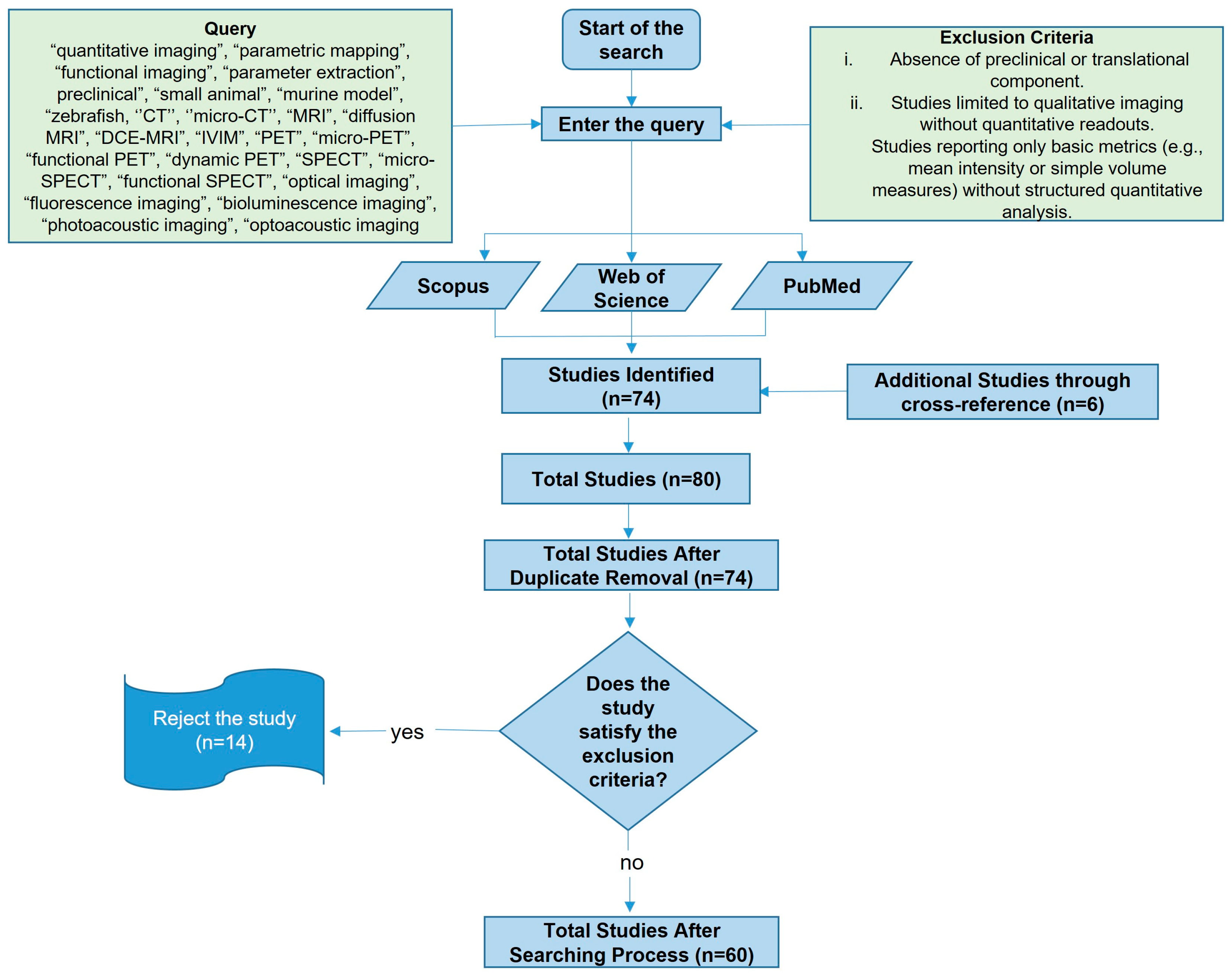
Figure 1. Search strategy flow chart.
Preprints 205797 g001
Figure 2. Overview Pie chart: (a) Experimental Model; (b) Imaging Modality.
Preprints 205797 g002
Figure 3. Conceptual framework of variance sources in quantitative preclinical imaging pipelines.
Preprints 205797 g003
Figure 4. Quantitative performance profiles of preclinical imaging modalities across six metrological dimensions. Each modality is scored on a qualitative scale from 1 (absent or very limited) to 5 (consolidated and internationally validated), based on systematic evaluation of the evidence reviewed herein according to predefined scoring criteria (see Supplementary Table S1).
Preprints 205797 g004
Table 2. Comparative quantitative performance of preclinical imaging modalities across key metrological dimensions. Scores reflect a qualitative assessment based on systematic evaluation of the reviewed literature (see Supplementary Table S1). High: well-established performance; Medium: partially established; Low: limited or technically challenging.
Modality Absolute quantification Technical variance controllability Harmonization maturity AI integration readiness Cross-species applicability Multiparametric depth
PET High High High High Medium Low
SPECT Medium Medium Medium Medium Medium Low
MRI Medium Medium Medium High High High
CT / micro-CT High High Medium High High Low
Optical Low Low Low High High High
Photoacoustic Low Low Low Medium Medium Medium
Table 3. Overview of quantitative CT studies.
Study Year Focus Model Key quantitative outcome Quantitative performance
Clark
et al.
[8]
2021 Advanced micro-CT technologies: attenuation calibration, material decomposition, and automated segmentation -Review -Small Animal Multi-parameter structural metrics — Hounsfield Unit-based quantification, material-specific attenuation coefficients High — comprehensive methodological framework; calibration and reconstruction standards reviewed
Christiansen et al.
[26]
2016 Effect of voxel size and segmentation method on trabecular bone microstructure metrics Mouse BV/TV, Tb.Th, Tb.Sp — trabecular architecture descriptors sensitive to acquisition and segmentation parameters Medium — systematic parameter sensitivity analysis; reproducibility dependent on protocol consistency
Oliviero
et al.
[27]
2022 Reproducibility of densitometric and biomechanical metrics from in vivo micro-CT tibia images Mouse BMD, cortical thickness, stiffness estimates — longitudinal skeletal biomarkers High — repeatability and reproducibility coefficients formally reported; in vivo validation
Ferrini
et al.
[28]
2025 Longitudinal micro-CT for quantitative assessment of pulmonary disease in small animals Small Animal Total lung volume, aerated lung fraction, mean lung density — structural pulmonary biomarkers High — standardized longitudinal workflow validated; quantitative descriptors reproducible across timepoints
Vincenzi
et al.
[29]
2022 Fully automated deep learning pipeline for micro-CT densitometry in pulmonary fibrosis models Mouse Lung density distribution — AI-derived densitometric descriptors with histopathological correlation High — automated pipeline validated against manual annotations; deep learning segmentation accuracy reported
Buccardi
et al.
[30]
2023 Fully automated micro-CT deep learning approach for lung fibrosis progression and therapy response Mouse Lung fibrosis extent, density metrics — longitudinal therapy response indicators High — prospective validation; automated quantification compared to expert assessment
Cheng
et al.
[31]
2025 AI-assisted semiquantitative measurement of bleomycin-induced lung fibrosis using in vivo micro-CT Mouse Fibrosis score, lung density — end-to-end AI-assisted quantification pipeline Medium — AI-assisted approach validated; semiquantitative rather than fully quantitative output
Jensen
et al.
[32]
2024 Annotated whole-body micro-CT database of subcutaneous tumours with multi-annotator segmentation Mouse Tumour volume, segmentation consistency metrics — inter-observer reproducibility benchmarks High — multi-annotator dataset enables reproducibility benchmarking; publicly available reference standard
Brown
et al.
[9]
2024 Comparative analysis of preclinical CT radiomics using cone-beam and micro-CT scanners Mouse Radiomic features, reproducibility metrics — cross-platform feature stability assessment Medium — cross-platform reproducibility demonstrated; feature stability highly dependent on acquisition and reconstruction harmonization
Pereira-Rosa
et al.
[33]
2024 Non-invasive skeletal muscle quantification in small animals using micro-CT Protocol (JoVE)
- Small
Animals
Muscle volume, cross-sectional area — morphometric descriptors for musculoskeletal assessment Medium — methodology demonstrated; formal reproducibility metrics not fully reported
Ashton
et al.
[34]
2015 In vivo micro-CT with nanoparticle contrast agents for vascular and perfusion imaging -Review
-Small Animals
Vascular volume fraction, contrast distribution — semi-quantitative vascular architecture metrics Medium — contrast-enhanced vascular quantification demonstrated; absolute quantification limited by agent pharmacokinetics
Table 4. Overview of quantitative MRI studies.
Study Year Focus Model Key quantitative outcome Quantitative performance
Jelescu
et al.
[22]
2025 DWI — ADC quantification; ISMRM acquisition and modelling guidelines for quantitative robustness Guidelines
Small
Animals
ADC — structured recommendations for gradient calibration, motion management, and b-value selection High — consensus-based framework; reproducibility benchmarks defined
Albrecht
et al.
[35]
2019 DWI — ADC quantification in healthy and tumour tissues on preclinical PET/MRI platform Rats ADC — compatibility with hybrid PET/MRI acquisition confirmed Medium — single-centre validation; cross-platform reproducibility not assessed
Duan
et al.
[36]
2024 IVIM/DKI — separation of molecular diffusion and microvascular perfusion components Mouse D, D*, f (IVIM); K, D (DKI) — hypoxia biomarker correlation with histological endpoints Medium — biological validation available; inter-session reproducibility not reported
Guo
et al.
[37]
2022 IVIM/DKI — monitoring radiotherapy response through perfusion-sensitive and microstructural parameters Rabbit D, D*, f, K — therapy response indicators with histopathological correlation Medium — longitudinal design; single-centre; limited reproducibility metrics
Pickup
et al.
[38]
2022 DCE-MRI — optimized quantitative protocol for preclinical cancer models; AIF estimation Mouse Ktrans, ve — vascular permeability and extravascular volume fraction High — optimised AIF strategy; protocol reproducibility validated in vivo
Zhu
et al.
[19]
2025 MR Fingerprinting — simultaneous T1/T2 mapping with dynamic contrast acquisition in single scan Mouse T1, T2, DCE parameters — simultaneous multiparametric estimation High — dictionary-based validation; simultaneous parameter estimation confirmed in vivo
Roudi
et al.
[39]
2024 Relaxometry — T2/T2* mapping; edema, fibrosis, and tumour microenvironment assessment Mouse T2, T2* — between-session variability quantified under controlled conditions Medium — repeatability coefficients reported; biological and technical variance partially separated
Wei
et al.
[40]
2016 QSM — tissue magnetic susceptibility for iron deposition, haemorrhage, and calcification Mouse chi (susceptibility) — iron deposition and haemorrhage quantification Medium — methodology validated; preclinical-specific reproducibility data limited
Herrman
et al.
[41]
2016 1H-MRS with T1 mapping — metabolic quantification combined with longitudinal relaxation assessment Mouse Metabolite concentrations, T1 — combined metabolic and structural characterization Medium — multiparametric combination demonstrated; reproducibility metrics not fully reported
Table 5. Overview of quantitative nuclear medicine studies.
Study Year Focus Model Key quantitative outcome Quantitative performance
Pavone
et al.
[42]
2024 PET as a tool to identify quantitative biomarkers in preclinical imaging Mouse SUV, metabolic rate — imaging biomarker identification and biological validation Medium — biomarker framework proposed; multicentric validation not reported
Kuntner
et al.
[16]
2024 Harmonization of SUV acquisition and analysis to reduce variability and improve reproducibility Small
Animals
SUV — multicentric variability reduction through standardized acquisition and analysis High — multicentric study; SUV variability formally quantified and reduced through harmonized protocols
Knyzeliene et al.
[43]
2024 Dynamic PET quantification using compartmental and graphical kinetic modelling Small
Animals
Ki, k1-k4, DVR — kinetic rate constants from compartmental and graphical modelling Medium — kinetic modelling framework validated; AIF sensitivity acknowledged
Kuttner
et al.
[44]
2024 AI-assisted arterial input function estimation to improve kinetic parameter accuracy Mouse AIF-derived kinetic parameters — AI-assisted estimation reduces operator dependency Medium — AI-AIF approach validated in vivo; generalizability across tracers not fully established
Mannheim et al.
[3]
2025 Cross-platform quantitative comparison between preclinical and clinical total-body PET/CT Small
Animals
SUV, partial volume effects — cross-platform and cross-scale quantitative concordance Medium — translational concordance demonstrated; scale-dependent challenges explicitly reported
Raccagni
et al.
[45]
2018 Evaluation of response to neo-adjuvant chemotherapy in a triple negative breast cancer (TNBC) mouse model Mouse PET, SUV, standard uptake metrics, tumor metabolic activity quantification Medium — biological validation with histological endpoints; single-centre study
Gargiulo
et al.
[46]
2017 PET molecular imaging of neuroinflammation; quantitative microglial activation assessment -Review
-Rodents
BPND, SUV — neuroinflammatory biomarker quantification Medium — biological validation with histological correlation; single-centre
Benfante
et al.
[47]
2022 PET biodistribution analysis of 64Cu-chelator radiotracer in mouse models Mouse SUV, organ-specific uptake — radiotracer biodistribution and biological validation Medium — biological validation available; quantitative reproducibility not formally reported
Tucker
et al.
[48]
2021 Radiotracer uptake quantification and longitudinal biodistribution in zebrafish Zebrafish SUV, whole-body biodistribution — cross-species feasibility of quantitative nuclear imaging Limited — proof-of-concept; pronounced partial volume effects; metrological re-validation required
Gerdekoohi et al.
[49]
2017 Absolute activity quantification with attenuation correction and iterative reconstruction in SPECT Small
Animals
Absolute activity concentration — attenuation-corrected quantification with calibration factors Medium — absolute quantification demonstrated; calibration stability not longitudinally assessed
Lukas
et al.
[50]
2020 Quantitative validation of simultaneous multi-radionuclide small-animal SPECT imaging Small
Animals
Activity concentration per radionuclide — simultaneous multi-isotope quantitative validation High — simultaneous multi-radionuclide validation; quantitative integrity formally assessed
Prieto
et al.
[51]
2022 Multi-isotope quantitative
validation in preclinical SPECT/CT
Small
Animals
Activity concentration, recovery coefficients — multi-isotope SPECT/CT quantitative accuracy High — multi-isotope validation with recovery coefficient analysis; cross-calibration reported
Enninful
et al.
[52]
2026 Review of SPECT instrumentation and reconstruction strategies impacting quantitation Review Quantitative accuracy metrics — instrumentation and reconstruction impact on SPECT quantification High — comprehensive methodological review; reconstruction and collimator impact systematically analysed
Altunay
et al.
[53]
2024 PET tracer radiochemistry and QC linked to quantitative imaging workflows -Protocol (JoVE)
-Small Animals
Radiochemical purity, specific activity — radiopharmaceutical QC impact on quantitative PET Medium — radiochemical QC framework described; direct link to imaging reproducibility partially established
Vanhove
et al.
[5]
2024 Quality control and harmonization standards for quantitative PET and SPECT -Guidelines
-Small
Animals
QA framework — structured calibration, acquisition standards, and analysis workflows for PET/SPECT High — international guideline; EANM/ESMI endorsed; formally adopted quality assurance framework
Bruzgo-Grzybko
et al.
[1]
2025 Comprehensive review on quantitative performance and translational relevance of PET/SPECT -Review
-Small
Animals
Translational performance metrics — synthesis of quantitative PET/SPECT capabilities and limitations High — comprehensive evidence synthesis; multicentric and translational perspective
Table 6. Overview of Preclinical Multimodal and Emerging Optical Imaging.
Study Year Focus Model Key quantitative outcome Quantitative performance
Refaat
et al.
[54]
2022 Fluorescence imaging standardization, calibration, and reproducibility frameworks Review Signal calibration standards — reproducibility requirements for quantitative fluorescence imaging Medium — standardization framework proposed; formal validation across platforms limited
Chu
et al.
[55]
2025 Optical imaging harmonization, workflow standardization, cross-lab reproducibility Review Cross-lab reproducibility metrics — harmonization strategies for quantitative optical imaging Medium — harmonization framework outlined; multicentric adoption not yet established
Lo
et al.
[56]
2020 Fluorescence Diffuse Optical Tomography with ultrasound priors; reconstruction accuracy Small
Animals
Fluorophore concentration maps — depth-corrected volumetric fluorescence quantification Medium — reconstruction accuracy improved with anatomical priors; absolute quantification partially validated
An
et al.
[57]
2018 Fluorescence Molecular Tomography (FMT); inverse problem regularization Review Volumetric fluorophore distribution — regularized inverse solution for FMT quantification Medium — reconstruction methodology validated in phantoms; in vivo reproducibility limited
Zhang
et al.
[58]
2022 FMT reconstruction; diffusion-based modelling, volumetric quantification Review Volumetric fluorophore concentration — diffusion model-based FMT reconstruction Medium — modelling framework validated; sensitivity to optical property assumptions acknowledged
Nouizi
et al.
[59]
2022 Hybrid FMT/CBCT; anatomical priors to improve inverse solution stability Small
Animals
Fluorophore concentration — anatomically constrained FMT reconstruction with improved stability Medium — hybrid approach improves quantitative stability; cross-platform validation not reported
Konovalov et al.
[60]
2021 Early-photon and compressed sensing; sensitivity and spatial resolution improvement Small
Animals
Spatial resolution, sensitivity metrics — early-photon approach for improved optical quantification Limited — proof-of-concept in phantoms; in vivo quantitative validation limited
Klose
et al.
[61]
2018 3D Bioluminescence imaging (BLI); volumetric reconstruction, geometric bias correction Small
Animals
Volumetric bioluminescence emission — 3D BLI reconstruction with geometric bias reduction Medium — volumetric reconstruction validated; substrate delivery variability acknowledged
Thompson
et al.
[62]
2023 Dual-modality photoacoustic and fluorescence imaging; dynamic perfusion quantification Mouse sO2, HbT, fluorescence signal — simultaneous structural and molecular dynamic quantification Medium — dual-modality quantification demonstrated; reconstruction stability partially validated
Deng
et al.
[63]
2022 Mobile Bioluminescence Tomography (BLT); source localization and reconstruction accuracy Small
Animals
Source position, bioluminescence intensity — volumetric source localization accuracy Medium — high-precision source localization demonstrated; cross-system reproducibility not reported
Xu
et al.
[64]
2023 Commercial BLT platform; quantitative accuracy and performance assessment Small
Animals
Bioluminescence flux, source reconstruction accuracy — commercial BLT quantitative performance Medium — commercial platform performance assessed; biological variability sources acknowledged
Smith
et al.
[65]
2023 In vivo quantitative FRET; intensity vs lifetime analysis for molecular interactions Small
Animals
FRET efficiency, donor lifetime — dynamic molecular interaction quantification Medium — intensity vs lifetime comparison validated; depth-dependent limitations acknowledged
Kim
et al.
[66]
2022 Standardized injection protocols; reproducibility in optical imaging experiments Review Signal reproducibility metrics — injection protocol standardization impact on optical quantification Medium — standardization recommendations provided; formal multicentric validation absent
Gargiulo
et al
[67]
2025 Quantitative HFUS assessment of hepatic steatosis in mice using computer-aided analysis Mouse Liver echogenicity, morphology metrics — reproducible longitudinal HFUS quantification Medium — computer-aided analysis validated; cross-scanner reproducibility not assessed
Lichtenegger et al.
[68]
2022 PS-OCT in zebrafish tumour xenografts; microstructural birefringence quantification Zebrafish Birefringence, retardation maps — polarimetric microstructural metrics for tumour characterization Medium — quantitative polarimetric metrics validated in zebrafish; longitudinal reproducibility limited
Bini
et al.
[69]
2024 Brightfield imaging; high-dimensional feature extraction and texture quantification in zebrafish Zebrafish Morphometric and texture features — radiomics-based quantitative phenotyping Medium — feature extraction pipeline validated; test-retest reproducibility not formally reported
Li et al.
[70]
2023 Mueller matrix OCT with deep learning; structural-functional mapping in zebrafish Zebrafish Polarimetric tissue properties — deep learning-assisted structural-functional quantification Medium — deep learning integration demonstrated; generalizability across developmental stages limited
Sturtzel
et al.
[71]
2025 High-content automated optical microscopy; multiplexed phenotypic quantification Zebrafish Volumetric tumour burden, phenotypic metrics — automated multiplexed quantification High — high-content automated platform; multiplexed quantification validated across cohorts
Mitovic
et al.
[72]
2025 Optical microscopy for dynamic cardiac functional quantification in zebrafish Zebrafish Heart rate, contractility metrics — motion-tracking-based cardiac functional quantification Medium — functional quantification validated; inter-session reproducibility not reported
Cani
et al.
[73]
2026 Optical/fluorescence xenograft workflows; tumour burden quantification in zebrafish Zebrafish Tumour burden, fluorescence intensity — reproducible endpoint harmonization in xenograft models Medium — systematic review; endpoint harmonization strategies outlined; reproducibility data variable across included studies
Turrini
et al.
[74]
2023 Functional fluorescence imaging; dynamic neural activity quantification in zebrafish Zebrafish Neural activity maps, spatiotemporal signal metrics — functional fluorescence quantification Medium — functional imaging framework validated; quantitative reproducibility across preparations limited
Upputuri
et al.
[75]
2016 Multispectral photoacoustic imaging (MSOT); spectral unmixing and fluence correction Review sO2, HbT — oxygen saturation and total haemoglobin quantification Limited — methodology reviewed; depth-dependent fluence correction remains a key unresolved limitation
Humbert
et al.
[76]
2020 Photoacoustic vs fluorescence tomography; physiologically relevant metric comparison Mouse Fluorophore concentration, photoacoustic signal — cross-modality quantitative comparison Medium — comparative validation available; absolute quantification limited by fluence heterogeneity
Sun
et al.
[77]
2024 Dual-modality photoacoustic and fluorescence imaging; structural and molecular quantification Small
Animals
sO2, HbT, fluorescence signal — simultaneous dual-modality dynamic quantification Medium — dual-modality approach validated; cross-session reproducibility not formally assessed
Disclaimer/Publisher’s Note: The statements, opinions and data contained in all publications are solely those of the individual author(s) and contributor(s) and not of MDPI and/or the editor(s). MDPI and/or the editor(s) disclaim responsibility for any injury to people or property resulting from any ideas, methods, instructions or products referred to in the content.
Copyright: This open access article is published under a Creative Commons CC BY 4.0 license, which permit the free download, distribution, and reuse, provided that the author and preprint are cited in any reuse.
Prerpints.org logo

Preprints.org is a free preprint server supported by MDPI in Basel, Switzerland.

Subscribe

Disclaimer

Terms of Use

Privacy Policy

Privacy Settings

© 2026 MDPI (Basel, Switzerland) unless otherwise stated