

Submitted:
30 March 2026
Posted:
31 March 2026
You are already at the latest version
Abstract
Bacteriophage-based bioproducts are increasingly recognized as targeted tools to reduce foodborne pathogens and antimicrobial resistance (AMR) pressures across the farm-to-fork continuum. However, their adoption in South America remains limited due to fragmented regulatory pathways and inconsistent evidence requirements. This review aims to (i) analyze the current scientific and technological landscape of bac-teriophage applications in South American food systems, (ii) identify key regulatory challenges affecting their classification, authorization, and implementation, and (iii) discuss the need for harmonized international guidance, particularly through Codex Alimentarius, to support the safe and effective integration of phage-based bioprod-ucts across the farm-to-fork continuum.
The results indicate a growing but uneven body of applied research, together with an expanding yet geographically concentrated patent and biotechnology landscape. Despite this progress, regulatory frameworks remain inconsistent, particularly in relation to classification, labeling, safety requirements, monitoring, and mechanisms for updating phage formulations. Addressing these gaps requires harmonized, risk-proportionate guidance that clearly defines product categories and claims, es-tablishes genomic safety standards and performance endpoints, and includes re-quirements for traceability and post-market surveillance. In this context, a Codex Alimentarius “New Work” on phage-based bioproducts could provide an interna-tional framework to support safe implementation, reduce regulatory uncertainty, and facilitate trade across global food systems.
Keywords:
bacteriophages
; antimicrobial resistance
; farm-to-fork
; South America
; food safety
; codex alimentarius
1. Introduction
Food is a major vehicle for the transmission of pathogenic bacteria, which can cause severe diseases affecting both humans and animals. Key foodborne bacterial pathogens include Salmonella, Campylobacter, Escherichia coli, and Listeria monocytogenes [1]. Foodborne diseases therefore constitute a major global public health threat and contribute substantially to economic losses, increased healthcare expenditures, adverse impacts on child development, reduced productivity, and disruptions to international trade [2]. They affect an estimated 600 million people and cause 420,000 deaths each year [3]. The burden of foodborne disease is disproportionately concentrated in low- and middle-income regions, where weak food safety systems contribute up to 1,200 disability-adjusted life years (DALYs) per 100,000 person-years, compared with 30–50 DALYs in high-income settings [1].
In addition, recent evidence indicates that foods can act not only as vehicles for pathogenic bacteria but also as a route for the dissemination of antimicrobial resistance (AMR) [4]. In 2021, AMR was associated with approximately 4.71 million human deaths worldwide, and projections suggest that by 2050 it could directly cause nearly 1.91 million deaths and contribute to a total of 8.22 million deaths globally [5]. In Latin America, AMR has reached critical levels, with a marked increase in carbapenem resistance among Gram-negative bacteria over time (from 0.3% in 2002 to 21% in 2016) [6], and several countries reporting prevalence rates between 20% and 50% [7]. Notably, the region bears one of the highest mortality burdens attributable to AMR relative to its population, with approximately 322,000 deaths in 2021, projected to rise to 650,000 annually by 2050 [8].
AMR is also increasingly framed as a macroeconomic threat. World Bank analyses estimate that, if uncontrolled, AMR could substantially reduce global GDP by 2050 and push tens of millions of people into poverty, disproportionately affecting low- and middle-income regions [9]. This situation reflects not only a public health crisis but also a systemic risk for food production and safety, intensifying regulatory pressures across global food systems.
The presence of antimicrobial-resistant bacteria in food is a multifactorial phenomenon, strongly influenced by the excessive and inappropriate use of antibiotics in agriculture and animal production. These practices promote the selection and persistence of resistant bacteria in food-producing animals, which can subsequently enter the food chain, increasing the risk of cross-contamination of animal-derived products and facilitating the spread of resistant infections at the community level [10].
In Latin America, the food production chain represents a critical reservoir for antimicrobial-resistant pathogens [4], including extended-spectrum β-lactamase-producing Escherichia coli in meat and dairy products [4,11], quinolone-resistant E. coli in poultry systems and antimicrobial-resistant non-typhoidal Salmonella spp. resistant to cephalosporins, quinolones, and tetracyclines in poultry and eggs [4,12]. Additionally, antimicrobial-resistant Campylobacter spp. has been documented in poultry production [4,13], while methicillin-resistant Staphylococcus aureus (MRSA) remains a major concern among Gram-positive bacteria due to its strong association with livestock systems [4,14].
These findings highlight the need to adopt effective prevention and control strategies across the entire food production chain [1,15]. Applying a farm-to-fork approach is essential to ensure that foods reaching consumers are safe and do not serve as vehicles for the dissemination of AMR bacteria [1,4,15]. So, rising resistance, antibiotic-reduction policies, and increasingly stringent food safety requirements are driving the development of targeted biocontrol strategies capable of reducing bacterial loads without the collateral effects associated with broad-spectrum antibiotics [10,15]. These converging pressures highlight the need for innovative, targeted, and scalable strategies capable of reducing bacterial loads while preserving microbial balance and minimizing unintended ecological consequences [16,17]. In this context, bacteriophage-based approaches have emerged as a promising alternative to conventional antimicrobial interventions. Strictly lytic bacteriophages are well aligned with the farm-to-fork paradigm because their potential applications extend across the entire food continuum: primary production (e.g., on-farm biocontrol), environmental interfaces (water, effluents, manure/slurry management), and food-processing environments (surfaces, equipment, and the cold chain), as well as direct application on foods under certain regulatory frameworks [17]. In principle, phage-based bioproducts (including phages and endolysins) can be applied at multiple stages of food production, including treatment of the final product within its packaging [18]. A distinction is commonly made between applications in crop cultivation and animal production, referred to as pre-harvest in the food safety context [16], and applications within the value chain, referred to as post-harvest [18]. Depending on their intended purpose, phage applications may be classified as biocontrol, biopreservation, or biosanitation strategies, and can be implemented either pre- or post-harvest [19]. Given this versatility, and the substantial potential for antimicrobial-resistant bacteria to disseminate along the food production chain [7,20], phage interventions can be positioned within a One Health framework, as they enable action across interconnected ecological compartments and shared infrastructure.
Latin America and the Caribbean is the world’s largest net food-exporting region (IFPRI) [21], and its exports contribute to global food supply stability and price regulation; therefore, maintaining food safety across the farm-to-fork continuum is essential [7,20]. In this context, bacteriophage interventions are strategically relevant because they provide targeted tools to reduce priority pathogens and antimicrobial pressure without disrupting production and trade flows, thereby strengthening the resilience of export-oriented economies [18,19]. At the same time, the regulatory nature of trade and the potential impact of disruptions highlight the need for scalable, market-compatible solutions [19]. This underscores the importance of harmonized global guidelines to prevent fragmented national adoption and to ensure that major importing markets provide clear regulatory frameworks, thereby reducing uncertainty and avoiding technical barriers to trade for South American exporters.
At the global level, the principal destination markets for the region’s food exports include the United States and the European Union; therefore, understanding the regulatory status of phage-based products in these regions is essential. These products are generally not regulated through dedicated phage-specific legislation but through pre-existing regulatory categories that differ across jurisdictions. In the United States, phage-based bioproducts can be authorized by the FDA, including via the GRAS pathway [23,24]. (Table S1). Canada, Australia, and New Zealand provide comparable routes through processing aid frameworks [19]. In contrast, in the European Union, phage-based bioproducts are evaluated on a case-by-case basis by EFSA, without a general authorization category such as Qualified Presumption of Safety (QPS). Emerging initiatives, particularly within the European Medicines Agency [25], emphasize the need for flexible regulatory frameworks capable of addressing the specific and potentially updatable nature of phage-based products (Table S1).
In South America, there is currently no broad regulatory approval for phage use in foods, and only limited commercialization pathways have been achieved. While some countries have developed specific approvals or conducted pilot applications, there is no harmonized regional framework governing their use [19]. This regulatory fragmentation creates uncertainty for developers, limits investment and technology transfer, and constrains the scalability of phage-based interventions across production systems. In addition, the absence of clear and consistent health authorization pathways reduces confidence among food producers and consumers and complicates the integration of these technologies into export-oriented supply chains, particularly when destination markets apply stricter or more defined regulatory criteria. For example, Chile has obtained a specific approval for sale, while Brazil has approved a phage preparation for use in animal feed, in a manner broadly comparable to EFSA’s approach in the EU (e.g., Bafasal®) [26]. Argentina has established regulatory groundwork for phage approval but has not yet approved any products. In Colombia, Peru, Ecuador, Uruguay, Paraguay, and Venezuela, pilot trials have been conducted for certain applications (e.g., aquaculture), but no nationally documented approvals currently exist [19]. These considerations underscore the need to examine the challenges and strategic importance for the region of advancing toward a more general authorization framework for phage production and use, capable of facilitating the commercialization of phage-based products across South America (Table S1).
Within this context, the present review examines the current scientific and technological landscape of bacteriophage applications in South American food systems, identifies the key regulatory challenges affecting their classification and authorization, and discusses the need for harmonized international guidance, particularly through Codex Alimentarius, to enable their safe and scalable integration across the farm-to-fork continuum.
2. Regulatory Difficulty in Classifying Phage-Based Bioproducts and Labeling
Two main aspects determine the classification of phage-based products. First, classification depends on their intended use (e.g., processing aids, food additives/preservatives, decontamination agents (biocides) for foods of animal origin, or phage-based products for work and production surfaces in food facilities) (Figure 1). Second, classification depends on how health authorities authorize their use, including pathways such as Generally Recognized as Safe (GRAS) [24], processing aids, or authorization upon request, which is more common in South America compared with the more standardized European Food Safety Authority (EFSA) framework [25,26,27]. This lack of alignment represents one of the main obstacles when submitting new proposals to regulatory authorities. Accordingly, the key definitions used to classify phage-based bioproducts across the farm-to-fork continuum are summarized below.
2.1. Processing aids
Processing aids are substances used during food processing for technological purposes and without nutritional value. Phages may therefore be present in the final product as unavoidable residues, provided they are harmless to health, have no technological effect on the final product (e.g., changes in color, odor, or taste), and are inactive. However, absolute absence is difficult to demonstrate because phages may persist within bacterial cells [19]. This classification is used in some countries (outside the EU) and does not require labeling (Figure 1; Table S1). In contrast, food additives are substances added to foods for technological purposes at any stage from manufacture to packaging or transport. They may or may not have nutritional value but are generally not consumed as food nor used as food ingredients [19].
2.2. Food additives/preservatives
Food additives are categorized into functional classes. Phages would fall under preservatives, defined as substances that extend shelf life by protecting food from microorganisms or inhibiting pathogenic microorganisms. However, due to their high specificity, phage cocktails cannot be directly equated with conventional preservatives [17].Under this pathway, an important requirement in the EU is that each phage or phage cocktail undergo individual authorization, including evidence of specificity, efficacy, duration of action, and clearly defined applications based on host range [25,26,27]. Unlike processing aids, food additives must be approved and are subject to mandatory labeling. Phages would therefore become components of the final food product, as their removal is not envisaged. In the United States, phage products may be authorized under a Food Additive Petition (FAP), with GRAS submissions occurring prior to classification under food additive regulations. In some cases, regulatory adaptations may allow updating phage cocktails without submitting a new FAP [23,28].
2.3. Decontamination agents (biocides) for foods of animal origin
Agents used to remove microbial surface contamination from foods of animal origin are subject to specific rules under Regulation (EC) No 853/2004 [29]. Currently, only potable water is permitted for carcasses, while lactic acid is additionally permitted for beef carcasses. To date, the European Commission has not approved phage products as a means of reducing bacteria in ready-to-eat (RTE) foods and has restricted their use as processing aids intended to inactivate pathogens on carcasses. This is partly due to concerns that phages could replace, rather than complement, hygiene measures. In contrast, several countries (e.g., United States, Brazil, the Netherlands, Israel, Canada, Switzerland, Australia, and New Zealand) have authorized phage preparations as auxiliary tools for controlling foodborne pathogens. Commercial products are available from companies such as PhageGuard (Micreos Food Safety), Intralytix, and Phagelux, targeting pathogens including Salmonella spp., Listeria monocytogenes, Escherichia coli, and Shigella spp. (Table S1).
2.4. Phage bioproducts for work and production surfaces (food facilities)
Substances used to remove microbial contamination from work surfaces, equipment, vessels, and supply lines fall under biocidal product regulations, including provisions for market placement [28]. Phage applications targeting biofilms on food-contact surfaces are considered promising but have not yet been approved in the EU [30]. In contrast, the FDA may authorize the use of phages on food-contact surfaces under the Food Contact Substance (FCS) designation, which may not require labeling [31]. Notably, the same phage preparation may be classified as a processing aid or as a food additive depending on whether phages remain in the food and on the intended purpose of application. A tiered, risk-based regulatory framework could therefore link dossier requirements, labeling, and public health relevance [19].
2.5. Classification of endolysins/lysins
Endolysins (lysins) are enzymes synthesized by bacteriophages during late infection stages that kill bacteria by degrading peptidoglycan in the cell wall. Compared with whole bacteriophages, they may display broader activity against multiple bacterial strains or species, and resistance has not yet been widely reported [32]. However, their application in foods presents limitations. Food matrices may reduce bactericidal activity and restrict host range, and they are generally ineffective against Gram-negative bacteria. Therefore, their application requires validation under relevant conditions of pH, temperature, and food composition. Thermostability is a key determinant of efficacy, and engineered endolysins have been developed to improve stability [32]. To date, Nomad Bioscience GmbH has submitted a GRAS notice (GRN 000802) to the FDA for an endolysin preparation, including safety data and demonstrated activity against Clostridium perfringens in laboratory and cooked meat models. Criteria for activity, stability, and exposure levels were defined, with an estimated dietary exposure of 2.6 mg/person/day at an application rate of 10 mg/kg [33]. Taken together, Figure 1 highlights the absence of a harmonized global framework for the classification and authorization of bacteriophage-based products, with regulatory pathways varying substantially across jurisdictions. While some countries rely on clearly defined categories such as GRAS or processing aids, others operate under case-by-case authorization schemes. This heterogeneity complicates classification and labeling and creates uncertainty for developers seeking market approval across regions. Consequently, the lack of regulatory alignment represents a key bottleneck for the scalable implementation of phage technologies. This underscores the need for internationally coordinated approaches.
3. Challenges for Phage Use in Farm-to-Fork Food Production: Implications for South America
Phages are biological agents whose efficacy and safety depend on host ecology, the food matrix, and application conditions across the farm-to-fork chain. Their successful implementation therefore requires addressing several interrelated scientific, technological, and regulatory challenges.
3.1. Verifying specificity and persistence in target bacterial populations
Phage specificity is a defining property that must be evaluated in relation to the target bacterial species, the food matrix, and the point of application along the production chain (e.g., Salmonella and Campylobacter in raw poultry products) [34]. This specificity is influenced by receptor availability, bacterial physiological state, and environmental conditions, all of which may vary substantially between production systems.
Several phage-based bioproducts currently on the market (Table S1) were developed and validated in regions where circulating bacterial populations and lineages differ from those present in local production systems. As a result, their efficacy under local conditions may be reduced, particularly when host range does not adequately cover the diversity of circulating strains. This highlights the need to develop and validate phage cocktails tailored to specific host populations and production environments (host–matrix–application context), supported by data from local isolates and real-world conditions [34].
Current regulatory frameworks have largely relied on the authorization of individual products based on laboratory assays and limited field trials. However, these approaches may not capture the variability encountered under industrial conditions, including differences in temperature, pH, organic load, and microbial community structure. Consequently, such evidence is often insufficient to ensure sustained effectiveness over time [19,28,35,36]. In contrast, human phage therapy has moved toward adaptive and personalized strategies, including magistral preparations, which allow continuous adjustment to evolving bacterial populations [37]. Translating similar adaptive principles into food systems remains a key challenge. Therefore, regulatory frameworks should require efficacy validation against locally circulating bacterial populations to ensure the sustained effectiveness of phage-based interventions.
3.2. Addressing the emergence of phage-resistant bacteria
The emergence of phage-resistant bacteria is an inherent risk in phage-based interventions. Resistance may arise when phages coexist with metabolically active bacterial populations over time, including during amplification steps in large-scale production or during application in complex matrices [35,38,39]. Mechanisms of resistance include receptor modification or loss, restriction–modification systems, CRISPR-Cas immunity, and abortive infection systems.
The use of phage cocktails (typically ≥3 phages) is a common strategy to reduce the probability of resistance emergence by targeting multiple bacterial receptors simultaneously [19,28]. However, even under these conditions, resistant or partially susceptible subpopulations may persist and compromise efficacy, particularly when application parameters such as multiplicity of infection (MOI), contact time, and distribution within the food matrix are suboptimal [28,35,36].
Maintaining effectiveness therefore requires continuous monitoring of phage performance and periodic updating of phage cocktails in response to shifts in bacterial populations. This dynamic approach challenges conventional regulatory models, which are typically designed for static products. Regulatory frameworks must therefore define mechanisms for approving modifications to phage formulations while ensuring consistency, safety, and performance comparability [19]. In this context, the EMA [40] concept paper proposes phage-bank-based approaches, allowing controlled updates of authorized products and providing guidance on how such changes should be documented and evaluated.
In this regard, the CVMP/EMA “Concept paper on quality, safety and efficacy of bacteriophages as veterinary medicines” [40], is particularly relevant, as it argues for phage-bank-based approvals that enable controlled changes/updates to authorized cocktails (introduction of new phages), and for how such changes should be reflected in the SPC (Summary of Product Characteristics), together with a formal glossary to avoid ambiguity. EMA also explicitly recognizes veterinary phages as novel therapies aligned with Regulation (EU) 2019/6 [40], and notes regulatory complexity because: (i) host range is narrow and resistance can emerge rapidly; (ii) “pharmacology” is dynamic (amplification depends on susceptible bacteria and immune responses); and (iii) many products will require cocktails with a variable qualitative–quantitative composition that must be updated over time. The document anticipates quality requirements based on a master seed/seed stock system, confirmation of strictly lytic phages (phage banks), and genomic screening for absence of antimicrobial resistance genes and virulence factors; it also calls for a proportional risk-based approach (companion animals vs. production animals; prophylaxis vs. therapy; first-line vs. last resort). In addition, EMA indicates the need for target-animal studies, definition of minimum effective dose, posology/duration, and assessment of resistance development, and crucially includes guidance on how updates will be evaluated [40].
3.3. Demonstrating long-term residual effects and monitoring
Evaluation of phage-based bioproducts should extend beyond initial authorization to include post-market monitoring and long-term assessment. This requires robust quality systems incorporating traceability, genomic characterization to exclude undesirable genes (e.g., virulence or antimicrobial resistance determinants), periodic verification of host range, and validation of performance under real production conditions.
Environmental considerations remain an area of uncertainty. Although doses used in food applications (≈10⁸ PFU/g) are small relative to naturally occurring phage populations (≈4.5 × 10²² PFU) [19,41], repeated or large-scale applications, especially in biosanitation contexts, may influence microbial ecosystems. Additional factors include phage persistence in processing environments, interactions with disinfectants, and potential effects on non-target microbial communities. Some phages may exhibit reduced susceptibility to commonly used sanitizers, necessitating integrated control strategies. Together, these considerations support the need for structured monitoring frameworks and adaptive management approaches, including periodic updating of phage cocktails to sustain effectiveness.
3.4. Regulatory implications of phage ingestion through treated foods (farm-to-fork)
One of the main regulatory barriers to the adoption of phage-based bioproducts in food systems lies in the difficulty of assigning these biological agents to existing regulatory categories. Accordingly, the key regulatory definitions relevant to farm-to-fork phage bioproducts are summarized below. Human exposure to phages through treated foods represents an additional regulatory consideration. Available evidence indicates that oral administration of phages is generally well tolerated, although most studies are short-term and involve limited sample sizes. Experimental studies have reported potential effects on intestinal permeability and inflammatory responses; however, these findings are based on limited evidence and should be interpreted cautiously [19,28].The potential impact of phage ingestion depends strongly on target specificity. For example, pathogens such as Listeria and Campylobacter are not part of the normal microbiota, and their lysis is expected to be beneficial. In contrast, Escherichia coli includes commensal strains, making precise targeting essential to minimize unintended microbiome disruption [42,43]. In this sense, evidence suggests that phage administration does not significantly alter commensal populations under typical conditions. However, the lack of longitudinal studies remains a critical gap for translating these findings into robust regulatory criteria for phage-treated foods [44].3.5. Regulatory particularities for phage bioproducts for plant use. Phage applications in crop production introduce additional complexity, as they frequently involve release into open environments (e.g., foliar sprays, seed treatments, or irrigation systems) [45]. These applications raise specific considerations related to environmental persistence, UV and desiccation stability, off-target exposure (e.g., phyllosphere microbiomes), and variability in efficacy under field conditions [46].
The regulatory precedents exist in jurisdictions such as the United States and Canada, where phages are evaluated as biopesticides under frameworks that include efficacy trials, environmental risk assessment, and residue considerations [47,48]. In South America, however, plant applications are typically regulated under agricultural or phytosanitary legislation rather than food safety frameworks, resulting in fragmentation across the farm-to-fork continuum. So, a harmonized approach should therefore incorporate crop-specific endpoints (e.g., reductions in disease incidence and severity), quality attributes (identity, potency, purity, stability, and genomic safety), and governance mechanisms to manage reduced susceptibility and enable controlled updates of phage formulations. This is particularly relevant given that bacterial crop diseases have historically driven the use of antibiotics and copper-based antimicrobials, contributing to environmental accumulation and resistance selection [46].
In summary, phage biocontrol represents a targeted alternative with existing regulatory precedents outside South America. However, its broader implementation will depend on the development of coherent regulatory pathways that integrate plant protection and food safety perspectives within a One Health framework.
4. Scientific and Technological Development in the Region Provides an Incentive for Phage Development in South America
4.1. Scientific development
Within the curated set of farm-to-fork–focused articles, the analysis showed that bacteriophage research in South America is not only growing but also exhibits a clear orientation toward practical applications across the entire production continuum, from environmental reservoirs and primary production to food matrices, animal health, and postharvest control. Thematically, the most frequent studies cluster around phage isolation, genomic and biological characterization, and the evaluation of lytic activity against priority bacterial pathogens, particularly Salmonella enterica, Escherichia coli, Pseudomonas spp., Staphylococcus aureus, Xanthomonas spp., Ralstonia solanacearum, and aquatic pathogens such as Flavobacterium psychrophilum and Vibrio spp. (Supplemental material 1). A second relevant group corresponds to applied biocontrol studies, especially in poultry, dairy, aquaculture, horticultural, and agricultural systems, including the use of phage cocktails for Salmonella in chicken meat and poultry litter, biofilm control, applications against mastitis-associated staphylococci, control of phytopathogens in crops such as coffee, tomato, walnut, and kiwifruit, as well as efficacy evaluations in fish larvae or live feed. In parallel, a substantial number of studies address environmental surveillance and One Health interfaces, including wastewater, rivers, drinking water, water treatment systems, and marine and freshwater environments, as well as the use of phages or phage indicators (e.g., MS2 or crAssphage) as proxies for microbial contamination, viral persistence, antimicrobial resistance dissemination, or sanitation performance. Another recurring theme is the development of phage-derived or phage-enabled technologies, such as endolysins, edible coatings, encapsulation systems, films and food packaging, qPCR- and TaqMan-based detection tools, phage-based diagnostics, and formulation strategies aimed at improving stability, delivery, and applicability under real-world conditions. Overall, these results suggest that the dominant scientific emphasis is no longer limited to the description of new phages but is increasingly shifting toward more translational research, particularly along three main axes: (i) biocontrol of relevant pathogens in production systems and foods, (ii) environmental and food system surveillance, and (iii) development of technological platforms capable of supporting future regulatory dossiers and commercialization processes. At the country level, the dataset is clearly dominated by Brazil, which accounts for the largest number and thematic diversity of farm-to-fork studies, spanning animal production, plant protection, food packaging, environmental monitoring, and biotechnology development; Chile also shows a strong and distinctive profile, particularly in Salmonella, aquaculture pathogens, phage formulation, agricultural applications, and the use of endolysins; Argentina contributes relevant research in dairy systems, cattle-associated pathogens, phage ecology, and food safety; while Colombia, Ecuador, Uruguay, Bolivia, and Paraguay appear less frequently but provide relevant contributions in swine and poultry production, wastewater, environmental persistence, and broad host-range phages. The Figure 2 panel a illustrates the distribution of scientific publications across South America, revealing a markedly uneven pattern. Brazil clearly dominates the regional output, exhibiting the highest number of publications, while Argentina and Chile show moderate contributions. In contrast, countries such as Peru, Colombia, and Ecuador display comparatively lower levels of scientific production. Overall, the gradient highlights a strong concentration of research activity in Brazil, with the remaining countries contributing more modestly to the regional landscape. In summary, the farm-to-fork data indicate that the most frequent themes in South American phage research include pathogen biocontrol, genomic characterization, biofilm reduction, environmental monitoring, and the development of formulation and application technologies, supporting the existence of a relevant applied scientific base in the region, albeit still unevenly distributed across countries and production sectors.

Table 1.
Articles developed in South America and selected for further analysis.
| Search algorithm | Result number | Useful | Farm-to-fork selected | |
| Query label | Farm-to-fork selected articles (n) | |||
| (bacteriophage) AND (South America) | 60 | 11 | bacteriophage_South America | 5 |
| (phage) AND (South America) | 80 | |||
| ((bacteriophage) AND (food)) AND (South America) | 11 | bacteriophage_Food_South America | 1 | |
| ((phage) AND (food)) AND (South America) | 15 | bacteriophage_Argentina | 12 | |
| (phage) AND (Brazil) | 332 | 145 | phage_Argentina | 3 |
| (bacteriophage) AND (Brazil) | 245 | bacteriophage_Brazil | 61 | |
| (phage) AND (Colombia) | 68 | 18 | phage_Brazil | 9 |
| (bacteriophage) AND (Colombia) | 53 | bacteriophage_Brazil (and Ecuador)* | 1 | |
| (phage) AND (Chile) | 81 | 33 | phage_Bolivia | 1 |
| (bacteriophage) AND (Chile) | 55 | bacteriophage_Bolivia (and Argentina)* | 1 | |
| (phage) AND (Argentina) | 55 | 30 | bacteriophage-Chile | 16 |
| (bacteriophage) AND (Argentina) | 41 | phage_Chile | 5 | |
| (phage) AND (Ecuador) | 16 | 5 | bacteriophage-Colombia | 7 |
| (bacteriophage) AND (Ecuador) | 16 | phage_Colombia | 0 | |
| (phage) AND (Bolivia) | 6 | 1 | bacteriophage-Ecuador | 2 |
| (bacteriophage) AND (Bolivia) | 3 | phage_Ecuador | 0 | |
| (phage) AND (Uruguay) | 15 | 5 | phage_Paraguay | 0 |
| (bacteriophage) AND (Uruguay) | 8 | phage_Paraguay (and Argentina)* | 1 | |
| (phage) AND (Peru) | 12 | 2 | bacteriophage_Peru | 0 |
| (bacteriophage) AND (Peru) | 5 | phage_ Peru | 0 | |
| (phage) AND (Venezuela) | 12 | 0 | bacteriophage_Uruguay | 1 |
| (bacteriophage) AND (Venezuela) | 8 | phage_Uruguay | 0 | |
| (phage) AND (Paraguay) | 5 | 1 | bacteriophage_Venezuela (and Peru)* | 0 |
| (bacteriophage) AND (paraguay) | 3 | Phage_ Venezuela | 0 | |
| Total papers found | 1205 | 251 | 126 | |
(*) Selected scientific articles that were written in more than one country.
4.2. Innovation ecosystems and intellectual property
In South America, the innovation “pulse” of phage applications in food systems can be assessed through both the presence of biotechnology initiatives and the regional patent landscape. To enable a comprehensive and reproducible assessment, the patent landscape was explored using WIPO Patentscope, Espacenet (EPO), and Google Patents. The search strategy combined a free-text phage block (FP: (phage OR bacteriophage)) with a document country code filter (PCN), using ISO-3166 alpha-2 codes for South America: BR, CL, CO, AR, EC, UY, PE, VE, BO, and PY (e.g., FP AND PCN: (BR) for Brazil; applied analogously to the other countries). Results from each platform were consolidated and cleaned to remove duplicates, and the full strategy—focused on patents related to phage isolation and/or characterization processes, is reported in Supplementary Material 2.
Based on the retrieved data, protection of phage-based products and associated processes has expanded across South American countries, with Argentina, Chile, Colombia, and Brazil emerging as key hubs for intellectual property activity. These include Patent Cooperation Treaty (PCT) filings, as well as national and international applications (Figure 2). This pattern suggests increasing efforts by both global and regional actors to secure freedom to operate, strengthen competitive positioning, and facilitate early market access within the region.
At the country level, mapping of biotechnology initiatives indicates that Chile and Brazil exhibit the highest density of phage-related companies, particularly startup-type ventures, whereas other countries show a more limited or incipient private-sector presence (Figure 2, panel b). This distribution reflects an emerging but uneven innovation ecosystem across South America.
Latin America is currently witnessing the consolidation of dedicated phage-driven initiatives, including companies with a strong translational focus on agri-food systems. For example, the Chilean company PhageLab (https://phage-lab.com/) has reported significant funding and regional expansion, illustrating the scale and maturity of capital investment entering the sector [49]. The increasing participation of investors and intellectual property actors highlights the need for regulatory frameworks to evolve from optional guidance into enabling infrastructure capable of supporting innovation and commercialization.
In Brazil, industrial participation is reflected in the availability of commercial products such as BAFASAL-PRO (https://proteonpharma.com/es/proteon-pharmaceuticals-enhances-portfolio-with-bafasal-pro-registration-in-brazil/), targeting Salmonella control in poultry. This indicates the existence of a more advanced market environment, already shaping expectations regarding registration pathways, quality attributes, and efficacy standards. In parallel, local ventures focused on phage-based solutions for livestock production, such as Karaja Biosciences (https://pesquisaparainovacao.fapesp.br/empresa_brasileira_desenvolve_alternativa_sustentavel_a_antibioticos_para_a_pecuaria/3699), further support the expansion and diversification of the private sector.
In Colombia and Uruguay, initiatives such as SciPhage (https://biointropic.com/sciphage-y-bacteriofagos/) and Kinzbio (https://www.kinzbio.com/), respectively, illustrate complementary development models, spanning agri-food/One Health applications and human clinical applications. Although Kinzbio is not strictly focused on food systems, its inclusion reflects the broader regional technical capacity and knowledge base relevant to phage development (Figure 2, panel c).
Overall, these findings indicate that South America is developing a relevant scientific and innovation base in bacteriophage applications. However, this progress contrasts with persistent regulatory uncertainty at both national and regional levels. Such uncertainty not only delays innovation but also limits the adoption of targeted interventions capable of reducing pathogen burdens without compromising food quality or consumer safety.
4.3. Challenges for deploying phage-based bioproducts
As highlighted above, South America exhibits substantial scientific and biotechnological development in bacteriophages, together with a clear need to advance the application and commercialization of phage-based products. The current commercial landscape in the region reflects an incipient but tangible uptake of bacteriophage-based bioproducts, concentrated in a limited number of countries and primarily oriented toward animal production systems.
Identified products are largely focused on livestock applications targeting high-impact pathogens relevant to both health and productivity, particularly Salmonella and avian pathogenic Escherichia coli. This distribution reflects a pragmatic prioritization of challenges with immediate demand and comparatively clearer regulatory pathways. Within this context, Chile emerges as a regional hub for development and technology transfer, not only because solutions are marketed domestically, but also because Chilean technologies and products are deployed in other countries, particularly Brazil. This positions companies such as PhageLab as reference actors in the region and effective bridges between research and development (R&D) and industrial adoption.
Brazil, in turn, represents a key market for scaling, where products have achieved registration and distribution through more consolidated commercial channels. Overall, the evidence summarized in Table S1 indicates that commercialization remains uneven across the region. The presence of actors with implementation capacity, combining validated phage cocktails, technical support, and field pilots, appears to be a decisive factor for successful deployment. These observations reinforce the need to harmonize regulatory categories, product claims, and evidence requirements in order to enable reproducible and comparable commercialization pathways across the farm-to-fork continuum in South America (Table S1).
However, authorization for the commercial sale of phage-based products is not necessarily aligned with health authorizations that ensure safety and efficacy for food producers and consumers. In addition, progress remains limited in defining labeling requirements for these products. For example, although some products have obtained authorization for sale at the national or multi-country level (Table S1), health authorities remain cautious in granting broader or generalized approvals. In practice, this creates uncertainty for both food-producing companies and end users. This uncertainty is further amplified under high-stringency regulatory environments such as the European Union, where systems like TRACES require full traceability [50], validated sanitary certification, and strict regulatory alignment across the supply chain; in the absence of explicit authorization frameworks for phage use, this may expose producers to shipment rejection, restricted market access, or increased liability associated with non-compliant consignments.
Furthermore, in the absence of harmonized national or regional regulatory frameworks, companies exporting food products to international markets, particularly the European Union, where the general use of phages has not been authorized [25,26,27], may adopt a precautionary approach toward the continuous, large-scale application of phage-based interventions within production systems .
5. Current Landscape of Phage Bioproducts in South America and the Need to Develop General Health Approval Standards
Health authority approvals for phage applications in agricultural systems issued by international regulators (Table S1) provide a valuable precedent for South American countries, as they offer established models that can inform local regulatory development. At present, the increasing burden of antimicrobial resistance [7,15,20,51], together with the strategic importance of agri-food exports in the region, helps explain the rapid growth of biotechnology companies and phage-based bioproducts in South America (Table S1). However, regulatory development has not kept pace with this expansion. Despite the existence of several products with marketing authorization, there are still no comprehensive health authorization frameworks that enable the broad regulation, monitoring, and surveillance of their use. This gap limits the feasibility of widespread implementation in local agricultural systems and constrains market adoption, largely due to the perceived risks associated with their use [44,52]. These perceptions are further reinforced when phage-based products are not explicitly integrated into food production regulations, generating uncertainty among both producers and consumers.
In addition, this regulatory gap complicates implementation for agri-food companies engaged in export markets [50]. For example, poultry meat exports to the European Union face restrictions on the use of decontamination agents during processing, and the generalized use of phages has not been authorized. As a result, producers lack sufficient regulatory support to pursue case-by-case approvals within the EU framework, effectively limiting the incorporation of phage-based interventions in production systems supplying these markets [50].
From a regional perspective, the expected outcome would be the development of a harmonized framework capable of defining product categories according to stage (pre- and post-harvest), matrix (animal, food, surfaces, water, and effluents), and intended claims. In addition, such a framework would establish cross-cutting requirements for genomic safety, product quality (purity, potency, stability), and proportionate evidence pathways with appropriate monitoring. Together, these elements would reduce uncertainty for innovators, enhance consumer protection, and support the long-term sustainability of regional biotechnology initiatives.
Regulatory gaps for phage-based bioproducts in South America are characterized by a misalignment between growing scientific and technological capacity and the absence of coherent health approval frameworks, standardized quality criteria, and regional harmonization.
6. Future Perspectives
Given the heterogeneity in the production and development of phage bioproducts across South America, uncertainty persists regarding their long-term adoption and sustainability in the region. This uncertainty is influenced not only by technological factors but also by perceptions among producers and consumers. In turn, this limits the feasibility of multicenter studies capable of generating comparable cross-country data, which are essential to support the scalability and exportability of phage-based bioproducts in both local and international markets. As a consequence, these constraints may reduce both public health impact and the potential contribution of phage technologies to agricultural development.
Regional alignment is therefore particularly important. South American countries share production models, exposure to similar hazards, and strong commercial interdependence in agri-food systems. In this context, the development of clear governance frameworks for phage applications should be understood as enabling infrastructure. Such frameworks would strengthen food safety by anchoring product claims to validated endpoints, support international trade by reducing discrepancies and increasing transparency, and promote innovation by lowering uncertainty for investors and producers.
A key pathway to advance this agenda is the submission of a proposal for new work within the Codex Alimentarius framework, so that phage bioproducts are formally addressed by an appropriate Codex committee [53]. The Codex Alimentarius Commission, established under the FAO/WHO Joint Programme, is the international body responsible for developing food standards, guidelines, and codes of practice to protect consumer health and ensure fair practices in the food trade [53]. The Codex Alimentarius currently includes 189 members (188 countries and the European Union), with active participation from South American countries [53].
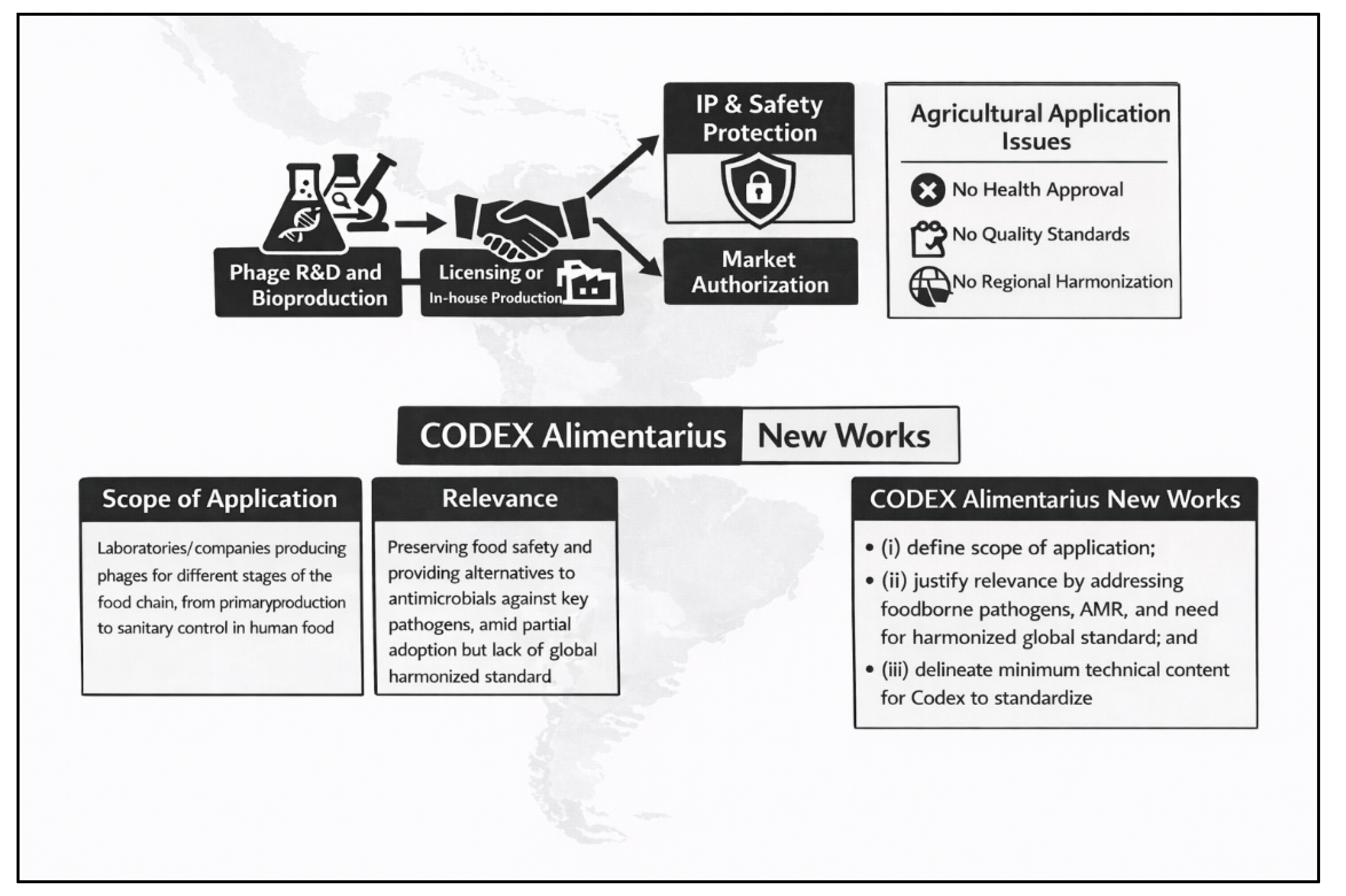
As illustrated in Figure 3, the upper panel depicts a fragmented development-to-market pathway, from research and development to commercialization, where key bottlenecks, particularly the lack of health approvals and harmonized standards, constrain large-scale agricultural deployment. In contrast, the lower panel outlines a proposed Codex “New Work” framework [54], defining the minimum technical elements required to support consistent evaluation and implementation across the farm-to-fork continuum. Together, the figure highlights the need for coordinated international guidance to bridge this gap and enable safe and scalable adoption.
In the absence of clear and harmonized rules, products may either remain fixed in outdated formulations or be updated without transparent criteria to ensure comparability in terms of safety and efficacy. A similar challenge applies to the broader phage innovation ecosystem: while some countries may be capable of generating multicenter validation data, others may first require minimum regulatory definitions, standardized methodologies, and baseline datasets before scaling farm-to-fork solutions [19,41,52]. Moreover, the lack of national regulatory frameworks prevents competent authorities from consistently assessing and comparing product quality. At the regional level, the absence of harmonized guidelines further limits the possibility of establishing equivalent product classifications (e.g., food additive, biocide, or processing aid) across countries. This has direct implications in a context where raw materials and food products circulate extensively within South America, highlighting the need for coordinated regulatory approaches that support both internal market integration and international competitiveness.
Although there are currently no Codex standards specifically addressing phage bioproducts, their inclusion would complement existing guidance on food safety and the safe reuse of inputs. For example, during the 48th session of the Codex Committee on Food Hygiene (CCFH) in 2016, the need to further investigate bacteriophages as a control strategy for Salmonella in poultry was highlighted [55]. This interest has continued in recent scientific literature, suggesting that future revisions of Codex guidelines should formally consider this technology. Additional relevant precedents include the review of CXG 100-2023 (water in foods) and ongoing initiatives related to biocontrol and microbiological risk reduction [56]. Within the CCFH, particularly in the context of revising the Guidelines for the Control of Campylobacter and Salmonella in chicken meat (CXG 78-2011) [57], alternative interventions to reduce bacterial loads have been evaluated, with phages identified as potential tools contingent upon demonstrated safety, efficacy, and regulatory acceptance.
In this context, a Codex-New work proposal focused on phage bioproducts could address a critical gap by establishing guidelines for the production and application of bacteriophages along the food chain [19,41,44]. Such a proposal would define a clear scope for laboratories and companies operating at different stages of the food system (e.g., primary production and sanitary control), provide a justification based on the burden of foodborne pathogens and the need for alternatives under antimicrobial resistance (AMR) pressure, and outline minimum technical elements requiring standardization [19,41,44]. These elements would include definitions and classification criteria, characterization requirements (including genomic assessment), critical quality attributes (e.g., purity, concentration, shelf life, and storage conditions), production and formulation standards, labeling considerations, and intended uses [19].
The establishment of such guidelines would support the safe and effective deployment of phage-based bioproducts while facilitating regulatory alignment across countries. In the absence of international standards, adoption remains fragmented, creating uncertainty, limiting comparability of regulatory dossiers, and potentially generating technical barriers to trade [50]. Conversely, harmonized guidance would improve regulatory predictability, support market access, and strengthen the integration of phage technologies into existing food safety systems.
Ultimately, advancing toward coordinated governance of phage bioproducts represents a necessary step to transition from fragmented adoption to structured implementation. By aligning scientific evidence, regulatory frameworks, and market needs, South America has the opportunity to position bacteriophage-based solutions as a scalable, farm-to-fork strategy contributing to food safety, antimicrobial resistance mitigation, and sustainable agri-food systems.
7. Conclusions
Phage-based bioproducts have strong potential to improve food safety and reduce antimicrobial pressure across the farm-to-fork continuum in South America. However, their sustainable and large-scale adoption will depend on addressing critical regulatory gaps. This requires moving beyond fragmented, case-by-case authorizations toward a harmonized, risk-based framework that incorporates demonstrated specificity against locally relevant bacterial populations, monitoring systems, transparent mechanisms for updating phage cocktails, and consistent criteria for product classification and labeling.
Although the region is showing growing scientific, technological, and innovation capacity, commercialization remains uneven and broader health authorization frameworks are still lacking. This continues to limit confidence among producers, consumers, and export-oriented sectors. Advancing harmonized guidance should therefore be considered a regional priority. Such guidance should define minimum requirements for product quality, genomic safety, performance endpoints, traceability, and post-use surveillance. Ideally, these efforts should converge in a Codex-New work capable of supporting the safe, scalable, and internationally consistent implementation of phage-based bioproducts at both regional and global levels.
Supplementary Materials
The following supporting information can be downloaded at the website of this paper posted on Preprints.org, supplemental material 1 and supplemental material 2.
Author Contributions
Conceptualization and original draft preparation were carried out by D.R., B.P., R.B., M.V, I.M.R., and All authors contributed to the review and editing of the manuscript. All authors have read and agreed to the published version of the manuscript.
Funding
This research was funded by the Universidad de las Américas, through the Internal Regular Project “Characterization of bovine mastitis in dairy systems of central and southern Chile under a One Health approach”, grant number PIR2026_10. Additional support was provided by the Universidad de las Américas through the Competitive Fund for Prototype Validation and Technological Development (VPDT), project “Formulation of a bacteriophage cocktail against Listeria monocytogenes for surface sanitization and as a preservative adjunct in ready-to-eat foods”, grant number VPDT 03/2025. This work was also supported by the Agencia Nacional de Investigación y Desarrollo (ANID), FONDECYT project number 1240615.
Institutional Review Board Statement
Not applicable.
Informed Consent Statement
Not applicable.
Data Availability Statement
No new data were created or analyzed in this study. Data sharing is not applicable to this article.
Acknowledgments
During the preparation of this manuscript, the author used ChatGPT 5.2 for the purposes of language polishing. The authors have reviewed and edited the output and take full responsibility for the content of this publication.
Conflicts of Interest
The authors declare no conflicts of interest.
References
- Pires, S.M.; Desta, B.N.; Mughini-Gras, L.; et al. Burden of foodborne diseases: Think global, act local. Curr. Opin. Food Sci. 2021, 39, 152–159. [Google Scholar] [CrossRef]
- Wang, A.T.; Tang, L.; Gao, A.; Zhang, E.; Huang, G.; Shen, J.; Jia, Q.; Huang, Z. Investigation of the antimicrobial resistance of important pathogens isolated from poultry from 2015 to 2023 in the United States. Pathogens 2024, 13, 919. [Google Scholar] [CrossRef]
- World Health Organization. WHO Estimates of the Global Burden of Foodborne Diseases; WHO: Geneva, Switzerland, 2016; Available online: https://iris.who.int/server/api/core/bitstreams/2cd58abf-fa80-40ef-b98a-9d663f0a9c79/content (accessed on 10 January 2026).
- Viana, G.G.F.; Cardozo, M.V.; Pereira, J.G.; Rossi, G.A.M. Antimicrobial resistant Staphylococcus spp., Escherichia coli, and Salmonella spp. in food handlers: A global review. Pathogens 2025, 14, 496. [Google Scholar] [CrossRef]
- Antimicrobial Resistance Collaborators. Global burden of bacterial antimicrobial resistance 1990–2021: A systematic analysis with forecasts to 2050. Lancet 2024, 404, 1199–1226. [Google Scholar] [CrossRef]
- WOAH; World Health Organization; FAO; UNEP. Strategic Framework for Collaboration on Antimicrobial Resistance; WHO: Geneva, Switzerland, 2022; Available online: https://www.who.int/publications/i/item/9789240045408 (accessed on 10 January 2026).
- Fabre, V.; Cosgrove, S.E.; Secaira, C.; Tapia Torrez, J.C.; Lessa, F.C.; Patel, T.S.; Quiros, R. Antimicrobial stewardship in Latin America. Antimicrob. Stewardsh. Healthc. Epidemiol. 2022, 2, e68. [Google Scholar] [CrossRef]
- Gozzer, E.; et al. Antimicrobial resistance interventions in Latin America and the Caribbean. Antimicrob. Resist. Infect. Control 2025. [Google Scholar] [CrossRef]
- World Bank Group. Stopping the Grand Pandemic; World Bank: Washington, DC, USA, 2026; Available online: https://openknowledge.worldbank.org/entities/publication/04662aa3-3162-4458-b0f1-27b38fa0a670 (accessed on 10 January 2026).
- Okaiyeto, S.A.; et al. Antibiotic resistant bacteria in food systems. Agric. Commun. 2024. [Google Scholar] [CrossRef]
- Bastidas-Caldes, C.; Romero-Alvarez, D.; Valdez-Vélez, V.; Morales, R.D.; Montalvo-Hernández, A.; Gomes-Dias, C.; Calvopiña, M. ESBL-producing E. coli in South America. Infect. Drug Resist. 2022, 15, 5759–5779. [Google Scholar] [CrossRef] [PubMed]
- Medina-Pizzali, M.L.; Hartinger, S.M.; Salmon-Mulanovich, G.; Larson, A.; Riveros, M.; Mäusezahl, D. AMR in rural Latin America. Int. J. Environ. Res. Public Health 2021, 18, 9837. [Google Scholar] [CrossRef]
- Portes, A.B.; Panzenhagen, P.; Pereira dos Santos, A.M.; Junior, C.A.C. Antibiotic resistance in Campylobacter. Antibiotics 2023, 12, 548. [Google Scholar] [CrossRef] [PubMed]
- Barberato-Filho, S.; Bergamaschi, C.C.; Del Fiol, F.S.; et al. MRSA in the Americas. Rev. Panam. Salud Publica 2020, 44, e48. [Google Scholar] [CrossRef] [PubMed]
- Rossi, G.A.M.; Ribeiro, L.F.; Cardozo, M.V. Foodborne pathogens and AMR. Pathogens 2025, 14, 632. [Google Scholar] [CrossRef]
- Torrence, M.E. Introduction to preharvest food safety. Microbiol. Spectr. 2016, 4. [Google Scholar] [CrossRef] [PubMed]
- Ranveer, S.A.; et al. Bacteriophages in the food chain. NPJ Sci. Food 2024, 8, 1. [Google Scholar] [CrossRef]
- Gildea, L.; Ayariga, J.A.; Robertson, B.K. Phages as biocontrol agents. Microorganisms 2022, 10, 2126. [Google Scholar] [CrossRef]
- Roth, A.; Franz, C.M.A.P.; Hertwig, S.; et al. Limitations and safety of phages. FEMS Microbiol. Rev. 2026, 50, fuag002. [Google Scholar] [CrossRef]
- World Health Organization. Global Antibiotic Resistance Surveillance Report 2025 . Available online: https://www.who.int/publications/i/item/9789240116337 (accessed on 20 January 2026).
- IFPRI. Latin America and the Caribbean. Available online: https://www.ifpri.org/unit/latin-america-and-caribbeanlac/ (accessed on 20 January 2026).
- Food and Agriculture Organization of the United Nations (FAO). Latin American food systems network. Available online: https://www.fao.org/americas/news/news-detail/latin-american-countries-formed-the-network-of-states-for-transforming-food-systems-and-better-nutrition/es (accessed on 20 January 2026).
- Frestedt, J.L. Foods and GRAS assessments. In Handbook of Food Bioengineering; Academic Press: Cambridge, MA, USA, 2018; pp. 543–565. [Google Scholar] [CrossRef]
- Food and Drug Administration. GRAS. Available online: https://www.fda.gov/food/food-ingredients-packaging/generally-recognized-safe-gras (accessed on 15 February 2026).
- EFSA. Scientific opinion on QPS. EFSA J. 2009, 7, 1431. [Google Scholar]
- EFSA. Bafasal safety and efficacy. EFSA J. 2023, 21, e07861. [Google Scholar] [CrossRef]
- EFSA. Update of QPS list. EFSA J. 2017, 15, 4664. [Google Scholar]
- Dhulipalla, H.; et al. Phage biocontrol in food production. Discover Appl. Sci. 2025, 7, 314. [Google Scholar] [CrossRef]
- European Parliament. Regulation (EC) No 853/2004. Available online: https://eur-lex.europa.eu/eli/reg/2004/853/oj/eng (accessed on 15 February 2026).
- Bhandare, S.; Goodridge, L.D. Bacteriophages as biosanitizers. In Bacteriophages; Springer: Cham, Switzerland, 2021. [Google Scholar] [CrossRef]
- Sulakvelidze, A. Lytic bacteriophages in food safety. J. Sci. Food Agric. 2013, 93, 3137–3146. [Google Scholar] [CrossRef]
- Nazir, A.; Xu, X.; Liu, Y.; Chen, Y. Phage endolysins in food safety. Cells 2023, 12, 2169. [Google Scholar] [CrossRef]
- FDA. Guidance document. Available online: https://www.fda.gov/media/129972/download (accessed on 15 February 2026).
- Cristobal-Cueto, P.; García-Quintanilla, A.; Esteban, J.; et al. Phages in food industry. Antibiotics 2021, 10, 786. [Google Scholar] [CrossRef]
- López-Pérez, J.; Otero, J.; Sánchez-Osuna, M.; et al. Phage susceptibility and evolution. Front. Cell. Infect. Microbiol. 2023, 13, 1266685. [Google Scholar] [CrossRef]
- Efenberger-Szmechtyk, M.; Nowak, A. Phage biocontrol strategies. Molecules 2025, 30, 3641. [Google Scholar] [CrossRef]
- Pirnay, J.P.; Verbeken, G.; Ceyssens, P.J.; et al. The magistral phage. Viruses 2018, 10, 64. [Google Scholar] [CrossRef] [PubMed]
- Rivera, D.; Hudson, L.K.; Denes, T.G.; et al. Phage evolution in Salmonella. Viruses 2019, 11, 586. [Google Scholar] [CrossRef]
- Rivera, D.; Moreno-Switt, A.I.; Denes, T.G.; et al. Novel Salmonella phage. Microorganisms 2022, 10, 606. [Google Scholar] [CrossRef]
- EMA. Bacteriophage veterinary guideline. Available online: https://www.ema.europa.eu/en/quality-safety-and-efficacy-bacteriophages-veterinary-medicines-scientific-guideline (accessed on 15 February 2026).
- Vikram, A.; Woolston, J.; Sulakvelidze, A. Phage applications. Curr. Issues Mol. Biol. 2021, 40, 267–302. [Google Scholar] [CrossRef]
- Von Strempel, A.; Weiss, A.S.; Wittmann, J.; et al. Phages and microbiota. bioRxiv 2022. [Google Scholar] [CrossRef]
- Pinto, G.; Almeida, C.; Azeredo, J. Phages and STEC control. Crit. Rev. Biotechnol. 2020, 40, 1081–1097. [Google Scholar] [CrossRef]
- Fokas, R.; Kalatzis, P.G.; Vantarakis, A. Phages as food biocontrol agents. Viruses 2026, 18, 368. [Google Scholar] [CrossRef]
- Farooq, T.; Hussain, M.D.; Shakeel, M.T.; et al. Phage cocktails in plants. Viruses 2022, 14, 171. [Google Scholar] [CrossRef]
- Gai, Y.; Wang, H. Plant disease and food security. Agronomy 2024, 14, 1615. [Google Scholar] [CrossRef]
- U.S. EPA. Pesticide product registration approvals. Available online: https://www.federalregister.gov/documents/2012/03/21/2012-6583/pesticide-product-registration-approvals (accessed on 15 February 2026).
- Batuman, O.; Britt-Ugartemendia, K.; Kunwar, S.; et al. Antibiotics in plant agriculture. Phytopathology 2024, 114, 885–909. [Google Scholar] [CrossRef]
- Sadarangani, A. Innovadores científicos chilenos; Editorial Catalonia: Santiago, Chile, 2025. [Google Scholar]
- European Commission. TRACES (Trade Control and Expert System). Available online: https://food.ec.europa.eu/horizontal-topics/traces_en (accessed on 15 February 2026).
- Murray, C.J.L.; et al. Global burden of AMR. Lancet 2021, 397, 1315–1328. [Google Scholar] [CrossRef]
- Hoffmann, A.; Sadowska, K.; Zenelt, W.; Krawczyk, K. Post-harvest phage control. Agriculture 2025, 15, 2261. [Google Scholar] [CrossRef]
- FAO. Codex Alimentarius and SPS agreements. Food Quality, Safety and International Trade: Codex Alimentarius and the SPS and TBT Agreements. 2001. Available online: https://www.fao.org/4/aa001e/aa001e05.htm (accessed on 15 February 2026).
- FAO. Codex new work proposals. Available online: https://www.fao.org/fao-who-codexalimentarius/committees/cac/new-work-proposals/en/ (accessed on 15 February 2026).
- FAO. Codex Committee on Food Hygiene (48th Session). Available online: https://www.fao.org/fao-who-codexalimentarius/sh-proxy/de/?lnk=1&url=https%253A%252F%252Fworkspace.fao.org%252Fsites%252Fcodex%252FMeetings%252FCX-712-48%252FWorking%252520Document%252Ffh48_01s.pdf (accessed on 15 February 2026).
- FAO. Guidelines for water reuse (CXG 100-2023). Available online: https://www.fao.org/fao-who-codexalimentarius/sh-proxy/ro/?lnk=1&url=https%253A%252F%252Fworkspace.fao.org%252Fsites%252Fcodex%252FStandards%252FCXG%2B100-2023%252FCXG_100s.pdf (accessed on 15 February 2026).
- FAO. Codex guidelines. Available online: https://www.fao.org/fao-who-codexalimentarius/codex-texts/guidelines/en/ (accessed on 15 February 2026).
Figure 1.
Global overview of regulatory pathways for bacteriophage-based products. Countries and regions are colored according to the dominant regulatory route under which bacteriophage applications may be considered. Red indicates jurisdictions where phages can be evaluated through pathways such as GRAS and/or processing aid (e.g., United States); blue indicates jurisdictions with recognized processing aid frameworks (e.g., Canada, Australia, and New Zealand); and green indicates jurisdictions where authorization may proceed upon request under existing regulatory mechanisms (e.g., European Union, India, and South America, as represented in this schematic).
Figure 1.
Global overview of regulatory pathways for bacteriophage-based products. Countries and regions are colored according to the dominant regulatory route under which bacteriophage applications may be considered. Red indicates jurisdictions where phages can be evaluated through pathways such as GRAS and/or processing aid (e.g., United States); blue indicates jurisdictions with recognized processing aid frameworks (e.g., Canada, Australia, and New Zealand); and green indicates jurisdictions where authorization may proceed upon request under existing regulatory mechanisms (e.g., European Union, India, and South America, as represented in this schematic).
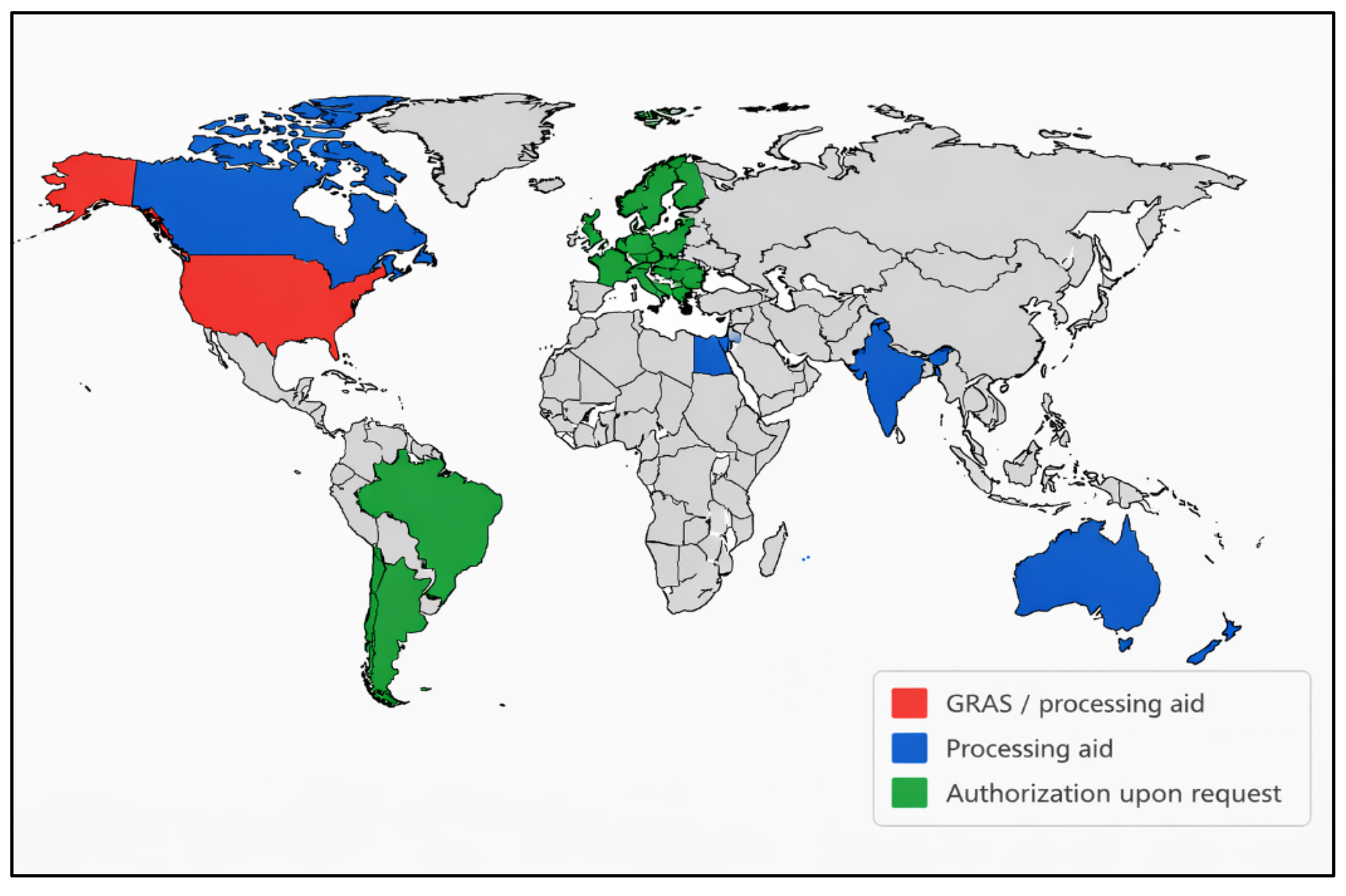
Figure 2.
The figure presents three South America maps (panels a–c) summarizing complementary phage-related indicators across the region. (a) shows a choropleth of the number of farm-to-fork papers per country (color intensity increases with higher counts). (b) displays the number of patent inventions by country using lightbulb icons (shown only for countries with values >0), while the numbered circles correspond to the country index in the accompanying list. (c) summarizes the presence of relevant biotechnology companies using a building icon with the company count (shown only for countries with values >0), maintaining the same country numbering to enable cross-panel comparison.
Figure 2.
The figure presents three South America maps (panels a–c) summarizing complementary phage-related indicators across the region. (a) shows a choropleth of the number of farm-to-fork papers per country (color intensity increases with higher counts). (b) displays the number of patent inventions by country using lightbulb icons (shown only for countries with values >0), while the numbered circles correspond to the country index in the accompanying list. (c) summarizes the presence of relevant biotechnology companies using a building icon with the company count (shown only for countries with values >0), maintaining the same country numbering to enable cross-panel comparison.
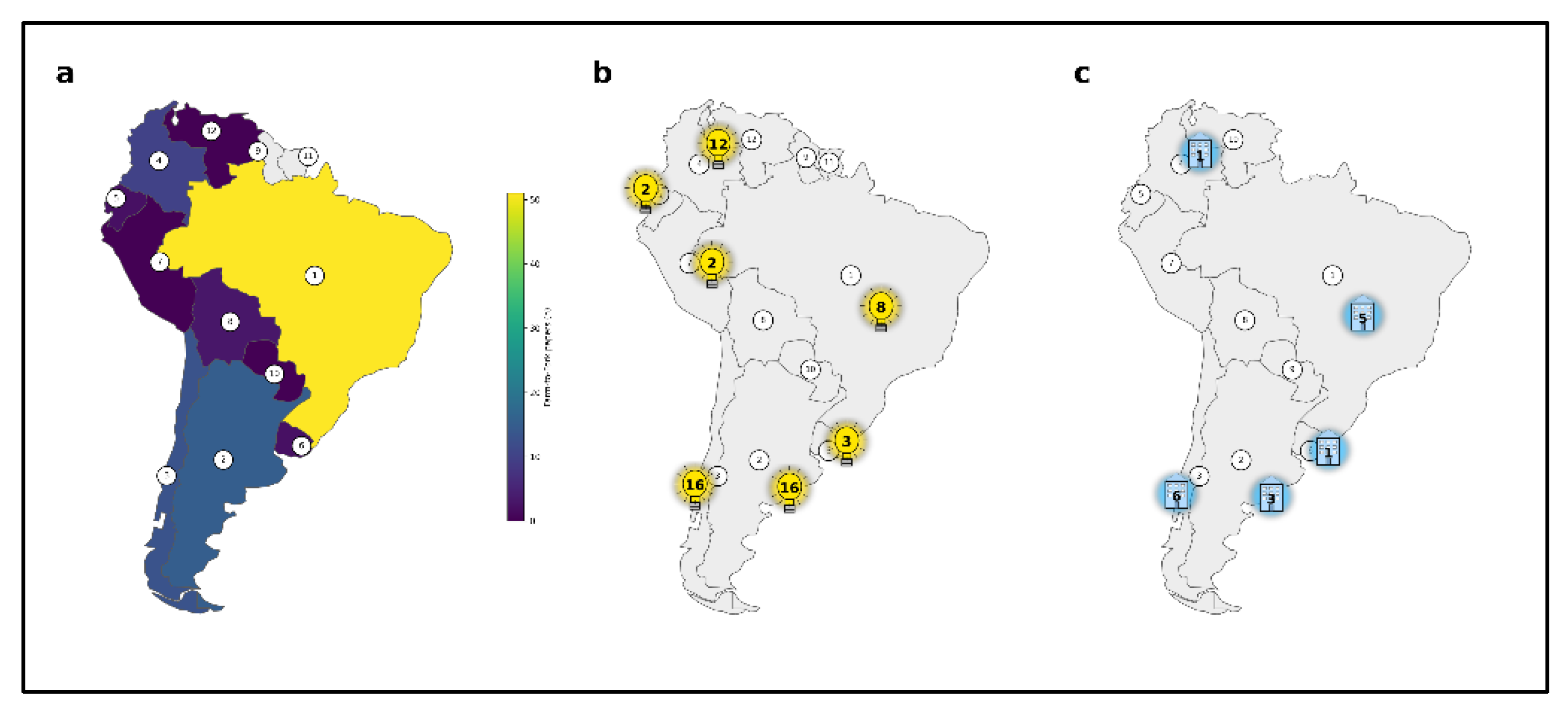
Figure 3.
Regulatory gaps for phage-based bioproducts in South America and the rationale for a Codex “New Work”. The upper panel illustrates the typical development-to-market pathway for phage bioproducts in the region, phage research and development (R&D), licensing or in-house manufacturing, intellectual property (IP) and safety protection, and market authorization, and summarizes the main barriers currently limiting agricultural deployment, including the lack of health approvals, the absence of country-level quality standards, and limited regional harmonization. The lower panel presents the proposed Codex Alimentarius-New Work, highlighting its scope and relevance and the minimum technical elements recommended for standardization to enable safe, effective, and internationally consistent farm-to-fork applications.
Figure 3.
Regulatory gaps for phage-based bioproducts in South America and the rationale for a Codex “New Work”. The upper panel illustrates the typical development-to-market pathway for phage bioproducts in the region, phage research and development (R&D), licensing or in-house manufacturing, intellectual property (IP) and safety protection, and market authorization, and summarizes the main barriers currently limiting agricultural deployment, including the lack of health approvals, the absence of country-level quality standards, and limited regional harmonization. The lower panel presents the proposed Codex Alimentarius-New Work, highlighting its scope and relevance and the minimum technical elements recommended for standardization to enable safe, effective, and internationally consistent farm-to-fork applications.
Disclaimer/Publisher’s Note: The statements, opinions and data contained in all publications are solely those of the individual author(s) and contributor(s) and not of MDPI and/or the editor(s). MDPI and/or the editor(s) disclaim responsibility for any injury to people or property resulting from any ideas, methods, instructions or products referred to in the content. |
© 2026 by the authors. Licensee MDPI, Basel, Switzerland. This article is an open access article distributed under the terms and conditions of the Creative Commons Attribution (CC BY) license.
Copyright: This open access article is published under a Creative Commons CC BY 4.0 license, which permit the free download, distribution, and reuse, provided that the author and preprint are cited in any reuse.


