

Submitted:
27 March 2026
Posted:
31 March 2026
You are already at the latest version
Abstract
The present study describes the reproductive cycle of the razor clam (Solen marginatus) from the Ria Formosa lagoon in the Algarve region (southern Portugal), using histological preparations of gonads from samples collected monthly over 18-month period, more precisely from January 2023 to June 2024. Simultaneously, the mean gonadal index (GI) was estimated and its relationship with fluctuations in seawater temperature and chlorophyll concentration was examined. The reproductive cycle of S. marginatus showed a seasonal pattern, with a resting period between August and October, followed by the onset of gametogenesis in November, which lasted until March. Ripe individuals were observed between February – March and May, with the spawning period occurring primarily between May and July. The mean GI reflected the temporal variation of the gonadal cycle, and it was observed that reproduction in this species is strongly influenced by fluctuations in seawater temperature, but is not significantly correlated with chlorophyll concentration. The information gathered in this study is of utmost importance, as it enables the proposal of evidence-based management measures, aimed at promoting the sustainable exploitation of this resource. According to these new findings, a closed season prohibiting the razor clam harvesting in Ria Formosa lagoon between May and July is proposed.
Keywords:
gametogenesis
; gonad histology
; spawning season
; mean gonadal index
; shellfish harvesting
; management measures
; closed season
1. Introduction
The exploitation of bivalves is a traditional activity of great socioeconomic importance; however, scientific knowledge about the biology of many exploited and commercially valuable species is often scarce (Anderson et al. 2011) [1]. Furthermore, despite the vast ecological and economic importance of marine invertebrates, fisheries targeting these animals are often unregulated, poorly monitored and lack robust scientific assessment (Berkes et al. 2006, Anderson et al. 2008, FAO 2009) [2,3,4]. In particular, commercial and recreational bivalve fishing constitutes a cultural, social and economic resource for several coastal communities worldwide (Gaspar et al. 2013) [5].
The razor clam Solen marginatus Pulteney, 1799 is an infralittoral species that lives buried at shallow depths in sandy or muddy bottoms (Tebble 1966, Nordsieck 1969) [6,7], with a wide distribution throughout the Atlantic Ocean, Black Sea, Mediterranean Sea, North Sea, Baltic Sea and Norwegian Sea (Tebble 1966, Nordsieck 1969, Parezan 1976) [6,7,8]. With respect to its harvesting, the species’ abundance in intertidal areas, easy capture and increasing commercial value collectively render it an important economic resource for coastal communities (Maia et al. 2006) [9]. In addition to commercial harvesting, there is also recreational harvesting targeting this species, especially during the summer, when hundreds of tourists capture it (Maia et al. 2006) [9]. For this reason, the development of fishing and shellfish harvesting activities has raised the need for further research on the reproductive cycle of commercially exploited species, in order to implement management measures aimed at promoting the sustainable exploitation of resources (Tirado et al. 2002, Moura et al. 2008) [10,11].
Only two studies on the reproductive cycle of S. marginatus have been carried out in Portugal. Santos et al. (1986) [12] analysed populations from the Tavira channel in Ria Formosa lagoon, and Maia et al. (2006) [9] investigated populations from Ria de Aveiro. These are the two major lagoon systems in Portugal: Ria de Aveiro in the northwest coast and Ria Formosa on the south coast, in the Algarve (Newton and Mudge 2003) [13]. Ria Formosa is a large (55 km), mesotidal, coastal lagoon with a surface area of approximately 16,300 ha (Newton and Mudge 2003, Gamito and Erzini 2005) [13,14]. It is a barrier island system comprising the mainland margin, barrier islands, inlet deltas and the shoreface (Pilkey et al. 1989) [15]. A high nutrient availability, intense solar radiation, and a good water exchange driven by tides make this lagoon highly productive (Águas 1985, Falcão and Vale 1988) [16,17]. Ria Formosa represents a valuable socio-economic resource for the country, due to tourism, fisheries, salt extraction and aquaculture, namely shellfish production, being the largest national producer of bivalve molluscs (accounting for about 80% of the shellfish consumed in Portugal) (Duarte et al. 2019, Cravo et al. 2022) [18,19].
In the Ria Formosa lagoon, the razor clam S. marginatus has been traditionally harvested using salt as a capture method, both in intertidal and shallow-subtidal areas. In subtidal habitats, the harvesting process is carried out by divers (Constantino et al. 2009) [20]. The use of salt to harvest razor clams is also practised in other European countries, such as Spain (Martínez-Patiño 2002) [21], Ireland (Fahy and Gaffney 2001) [22] and the UK (Pyke 2002) [23] and can be considered an environmentally ‘friendly’ method (Constantino et al. 2009) [20]. In 2023, there were 109 licenses for the harvesting and commercialisation of razor clams in the area of Ria Formosa, and 26 professional harvesters officially reported 16,183 kg of catches corresponding to a declared commercial value of €103,810 (Gaspar et al. 2025) [24].
The first study on razor clam reproduction carried out in Portugal (Santos et al. 1986) [12] was based only on macroscopic observation of the gonads. Therefore, there remains a need to conduct a more rigorous analysis of the reproductive dynamics of S. marginatus in the Ria Formosa lagoon, where this species constitutes an important economic resource, in order to implement appropriate management measures to ensure the sustainability of the population.
This study aimed to describe the reproductive cycle of S. marginatus in the Ria Formosa lagoon and evaluate the influence of environmental parameters on its reproductive dynamics, based on the fluctuation of the mean gonadal index (GI) throughout the study period. Based on histological analysis of the gonads, the gametogenic development of the target population was compared with that of other populations across its geographical range.
2. Materials and Methods
Approximately 30 adult individuals (≥75 mm) of S. marginatus were collected monthly by professional harvesters between January 2023 and June 2024 in the Ria Formosa lagoon, off Hangares village of Culatra Island, in the municipality of Faro (Figure 1). The razor clam samples were hand-harvested by divers in apnea using a hypersaline solution as a harvesting procedure. The salt was deposited on the sediment surface above the species’ burrowing holes, which induces the emergence of the razor clams to the surface.
In the laboratory, all specimens from each sample were measured for total length and fixed in Davidson’s solution for 24 hours. After the fixation period, the samples were washed in running water and preserved in 70% alcohol, for further processing. After shell removal, the samples were dehydrated using an automatic tissue processor and subsequently embedded in paraffin. The paraffin embedded blocks were sectioned using a microtome, obtaining histological sections of 7 μm thick. The sections were subsequently stained with hematoxylin-eosin, and the slides were mounted using DPX. Following standard procedures, the histological preparations were subsequently observed under a microscope in order to assign a gonadal maturation stage to each individual. Six stages of the sexual cycle were classified based on the maturation scale proposed by Martínez-Patiño (2002) [21] which are briefly illustrated in Figure 2: sexual rest (0), start of gametogenesis (I), advanced gametogenesis (II), ripe (III), spawning (IV) and post-spawning (V).
Data on surface seawater temperature (SST) was recorded during the study period at the Faro oceanographic buoy (36°54.3ʹN, 07°53.9ʹW) of the Portuguese Hydrographic Institute, which is the closest buoy to the sampling area (Figure 1). Data on average chlorophyll concentration in seawater were obtained from the E.U. Copernicus Marine Service Information website, with a resolution of 1 km, for the waters surrounding the Faro area.
Subsequently, in order to estimate the GI, a numerical ranking was assigned to each maturation stage (sexual rest = 0, start of gametogenesis = 3, advanced gametogenesis = 4, ripe = 5, spawning = 2, post-spawning = 1), according to the equation proposed by Seed (1976) [25]:
GI = ∑ (numbers of individuals at each stage x stage ranking) / total number of individuals in each month
The proportion between the number of males and females in each monthly sample and in the pooled dataset (18 months) was calculated using the chi-square test (χ2-test) to verify whether the sex-ratio differed significantly from the expected 1:1 ratio. The normality of the seawater temperature, chlorophyll, and GI data was assessed using the Shapiro-Wilk test, and the correlation between these variables was subsequently evaluated using Pearson’s (r) or Spearman’s (ρ) coefficients, depending on whether the data followed a normal or non-normal distribution, respectively. Data processing and statistical procedures were performed using Microsoft Excel 2016 and Statistica (5.1) software packages, and a statistical significance level of p < 0.05 was adopted.
3. Results
3.1. Samples Size and Sex Ratio
S. marginatus is a gonochoric species and no hermaphrodites or evidence of sex reversal were observed during the present study. A total of 529 razor clams were sampled, of which 201 were males (38.0%), 235 were females (44.4%), and 93 were sexually indeterminate individuals (17.6%). The proportions of males, females and indeterminate individuals obtained from monthly gonad samples are shown in Table 1. During the sampling period, the sex ratio, both in monthly and pooled samples, was statistically balanced between sexes (1.2F:1M, χ2 = 2.500; p > 0.05).
3.2. Gonad Histology and Reproductive Cycle
During the present study, a high degree of synchrony was observed in gonadal development, maturation and spawning between males (Figure 3A) and females (Figure 3B), with both sexes displaying analogous temporal patterns in reproductive dynamics throughout the study period. For this reason, it was decided to analyse the reproductive cycle of all specimens independently of sex (Figure 3C).
In general, the highest percentage of indeterminate individuals, i.e., those in sexual rest, occurred between August and October, with gametogenesis beginning in November and continuing until March. Individuals of S. marginatus reached gonadal maturity (stage III) between March and May 2023 and slightly earlier in 2024, with onset in February. Subsequently spawning occurred mainly between May and July, with approximately half of the individuals spawning in April 2024.
3.3. Environmental Parameters and Mean Gonadal Index
The highest values of GI, corresponding to larger number of individuals in stage III (ripe), were observed at the beginning of spring, more precisely in April 2023 (4.75) and March 2024 (4.37). Indeed, the GI fluctuation observed in Figure 4 corroborated the main trends of the reproductive cycle (Figure 3) with the highest percentage of individuals in stage III occurred in April – May 2023 and in March – April 2024. The lowest GI values (0.17 – 0.33), corresponding to a higher percentage of indeterminate individuals, occurred between August and October 2023 (Figure 4), coinciding with the resting period observed in Figure 3.
The lowest seawater temperature values were reached in March 2023 (mean = 16.4ºC) and March 2024 (mean = 15.8ºC), matching with high GI values (Figure 4). The maximum seawater temperature peak was reached in August 2023 (mean = 21.4ºC), corresponding to lower GI values, i.e., with the sexual rest period of the studied population (Figure 3).
Indeed, a highly significant negative correlation was obtained between the GI monthly variation and fluctuations in seawater temperature (ρ = -0.903; p < 0.05). Gonads of S. marginatus reached maturity at lower seawater temperatures and subsequently spawned in response to the gradual increase in temperature. Once maximum seawater temperatures were reached, following complete gamete emission, the lowest GI values were recorded, consistent with the resting period.
Figure 5 represents the variation of chlorophyll concentration in seawater, which exhibited several fluctuations over 18 months study period, reaching a maximum of 1.676 mg/m3 in May 2024 and a minimum of 0.509 mg/m3 in January 2024. However, no significant correlation with mean GI was observed in the present study (ρ = 0.153, p > 0.05).
4. Discussion
The population of S. marginatus from the Ria Formosa lagoon (southern Portugal) presented a balanced sex ratio, both in monthly and pooled samples. These results are consistent with findings reported by Tirado et al. (2002), Maia et al. (2006), Ayache et al. (2016) and Doukilo et al. (2022) [9,10,26,27], for razor clam populations in San Pedro River in Andalusia (Spain), Ria de Aveiro (Portugal), Gulf of Gabès (Tunisia) and Oualidia Lagoon (Morocco), respectively.
The gametogenic development of the studied population was evaluated and compared with other populations, as summarised in Table 2. In the present study, the razor clam population exhibited a sexual resting period lasting approximately three months (August – October) with gametogenic development occurring from November to March. These results are comparable to those observed for the population in Ria de Aveiro, which remained in sexual resting or in early stages of development during autumn and winter (Maia et al. 2006) [9]. Similarly, the population of Ría de Ortigueira in Galicia displayed a resting period during August and September, extending into October for some individuals, while others were already undergoing gametogenesis, which lasted until April (Martínez-Patiño 2002) [21]. On the Atlantic coast of the southern Iberian Peninsula, the study by Tirado et al. (2002) [10] in the San Pedro River (Andalusia), reported a slightly later resting period, occurring from the end of September until December, with gametogenesis proceeding from December to February.
The studied population reached gonadal maturity between March and May 2023, while in 2024, maturation occurred slightly earlier, from February to May. Spawning occurred mainly between May and July 2023, starting a month earlier in 2024 (April). The spawning peak of Ria Formosa population occurred in May and June. Similarly, S. marginatus from Ria de Aveiro (Maia et al. 2006) [9] reached gonadal maturity in May. The razor clams from Aveiro, like the studied population, displayed a spawning period with interannual variations, occurring between May and September in 2003, while in the following year spawning ended in July. Santos et al. (1986) [12] observed gonads full of gametes in the population from Tavira channel in Ria Formosa, during a limited period, between April and July, indicating probable gamete emission during these four months. Some individuals of razor clam in Galicia (Martínez-Patiño 2002) [21] presented ripe gonads in April, but by May the entire population reached maximum maturity, with some individuals already spawning. Still, the spawning peak occurred at the end of May and during June (Martínez-Patiño 2002) [21], similar to the Ria Formosa population. The Andalusian population of S. marginatus spawned between March and June, with a peak in April and May (Tirado et al. 2002) [10], slightly earlier than in the studied population. Lopez et al. (2005) [27] examined the gametogenic development of two populations from Asturias (NW Spain) and found a delayed in spawning in Ría del Eo (July – August) compared to Ría de Villaviciosa (May – June). Thus, the spawning season of the Ría de Villaviciosa razor clam population is similar to that of the Ria Formosa population. Remacha-Triviño and Anadón (2006) [29] conducted a comparative study of the S. marginatus reproductive cycle across three locations in Spain and observed that reproduction phase (including ripeness, early spawning, restoration and late spawning) occurred at different periods depending on the site. The populations from Eo Estuary (NW Spain) and Terrón Estuary (SW Spain) presented reproductive periods similar to the studied population, specifically, May – June and May – July, respectively. In the Santander Bay population, according to the same authors [29], observed reproduction occurred from June to August, showing a delay relative to the other sites.
However, outside the Iberian Peninsula, some populations of S. marginatus exhibited different gametogenic patterns. In southern Tunisia, in Oued Maltine in Gulf of Gabès (Ayache et al. 2016) [26] gametogenesis started in September and continued until December-January. Similarly, the Moroccan population from Oualidia Lagoon (Doukilo et al. 2022) [27] initiated gametogenesis in autumn (September) and extended until spring (March). These results contrast with the studies conducted in Portugal (including the present study) and Spain, which reported gametogenesis during the winter-spring seasons (Martínez-Patiño 2002, López et al. 2005, Maia et al. 2006, Remacha-Triviño and Anadón 2006) [9,21,28,29]. Additionally, S. marginatus populations in the Iberian Peninsula exhibited shorter spawning seasons compared to those in Morocco (March – July) (Doukilo et al. 2022) [27] and Tunisia, where spawning occurred in May with additional partial events between September and December (Ayache et al. 2016) [26].
In the present study, a highly significant negative correlation was found between seawater temperature and the GI of the population of S. marginatus from the Ria Formosa lagoon. Maximum GI values corresponding to mature individuals with ripe gonads, were recorded at minimum seawater temperatures, with gamete release occurring subsequently with the gradual increase of temperature. Minimum GI values indicative of sexual rest, occurred during the period of maximum seawater temperatures. These results suggest that the razor clam population from Ria Formosa lagoon experiences optimal spawning conditions during the rise in seawater temperature, likely anticipating favourable conditions for subsequent larval settlement. Ayache et al. (2016) [26] proposed that an increase in seawater temperature and phytoplankton concentration triggered a spawning event of S. marginatus in the Gulf of Gabès (Tunisia) before optimal food and temperature conditions were reached. Furthermore, the same authors suggested that the species has adopted two reproductive strategies: a conservative strategy during the cold season (when food is scarce) and an opportunistic strategy in summer and autumn, when food is abundant and temperatures are higher. The population from Oualidia Lagoon in Morocco also spawned in response to increased seawater temperatures (Doukilo et al. 2022) [27].
According to Pérez-Camacho and Román (1987) [30], annual reproductive cycles can be influenced by interannual seawater temperature oscillations, which may advance or delay the cycle. In the present study, interannual differences were observed, with gonad maturity and spawning occurring one month earlier in 2024. In most populations of S. marginatus, a single spawning event has been reported, occurring primarily during late spring and summer, followed by a resting period. Differences in the duration of the gametogenic development stages are expected due to both exogenous and endogenous parameters (Martinez-Patiño 2002, Tirado et al. 2002, López et al. 2005, Remacha-Triviño and Anadón 2006, Maia et al. 2006) [9,10,21,28,29].
Environmental variables with the greatest influence on the reproductive cycle of shellfish resources, are seawater temperature and food availability (Darriba 2001) [31]. However, in the present study no significant relationship was found between chlorophyll concentration and variation in mean GI. Tirado et al. (2002) [10] also reported that neither seawater temperature nor chlorophyll significantly affected the reproductive cycle. Yet, multiple environmental and endogenous factors appear to regulate the timing and pattern of the reproductive cycle, as well as energy allocation in bivalves (Doukilo et al. 2022) [27]. Seawater temperature and chlorophyll remain the most important environmental drivers (Ojea et al. 2004, Joaquim et al. 2011) [32,33]. Interactions between temperature, food availability, salinity and light influence the onset of gametogenesis, maturation and the overall timing of the spawning season (Himmelman 1999) [34]. These factors act directly by affecting metabolic rates, or indirectly by promoting the transfer of energy reserves from other organs to the gonad (Lubet 1980) [35].
5. Conclusions
Currently, there is an increasing need to implement fisheries management measures that are knowledgeable about local realities and connected to their ecosystem, which re-quires robust scientific support. Studying the reproductive cycle of commercially exploited marine species can therefore support the establishment of key management strategies such as a biological closed season which conducts to a temporary ban on harvesting. In the present study, gamete release of S. marginatus in the Ria Formosa lagoon was observed between May and July, leading us to propose this period as the closed season for the harvesting and commercialisation of razor clams in this ecosystem.
Author Contributions
Conceptualization, P.M.; methodology, P.M.; software, P.M.; validation, P.M., F.P. and A.N.C.; formal analysis, P.M., F.P. and A.N.C.; investigation, P.M.; resources, P.M and M.B.G.; data curation, P.M., F.P. and A.N.C.; writing—original draft preparation, P.M.; writing—review and editing, P.M., F.P., A.N.C. and M.B.G.; visualization, P.M.; supervision, P.M.; project administration, M.B.G.; funding acquisition, M.B.G. All authors have read and agreed to the published version of the manuscript.
Funding
This research was funded by “Programa de Monitorização da Pequena Pesca e Apanha (MOPPA)” (MAR-014.7.2-FEAMPA-00005) (field surveys, biological sampling, laboratory analyses, data treatment, statistical analyses and manuscript writing), funded by the Fisheries Operational Programme (MAR 2030) and co-financed by the European Maritime, Fisheries and Aquaculture Fund (EMFAF 2021–2027).
Institutional Review Board Statement
Ethical review and approval were not required for this study as it involved only invertebrate animals.
Informed Consent Statement
Not applicable.
Data Availability Statement
Data will be made available upon reasonable request to the corresponding author.
Acknowledgments
The authors are grateful to the Portuguese Hydrographic Institute (IH) for kindly providing data on seawater temperature and the US website Copernicus Marine Service Information for the freely available chlorophyll data. The authors also thank Diana Almeida for processing the chlorophyll data and “Formosa - Cooperativa de Viveiristas da Ria Formosa” for providing the monthly samples.
Conflicts of Interest
The authors declare no conflicts of interest. The funders had no role in the design of the study; in the collection, analyses or interpretation of data; in the writing of the manuscript; or in the decision to publish the results.
References
- Anderson, S.C.; Mills Flemming, J.; Watson, R.; Lotze, H.K. Rapid global expansion of invertebrate fisheries: trends, drivers, and ecosystem effects. PLoS ONE 2011, 6, e14735. [Google Scholar] [CrossRef] [PubMed]
- Berkes, F.; Hughes, T.P.; Steneck, R.S.; Wilson, J.A.; Bellwood, D.R.; Crona, B.; Folke, C.; Gunderson, L.H.; Leslie, H.M.; Norberg, J.; Nyström, M.; Olsson, P.; Österblom, H.; Scheffer, M.; Worm, B. Globalization, roving bandits, and marine resources. Science 2006, 311, 1557–1558. [Google Scholar] [CrossRef]
- Anderson, S.C.; Lotze, H.K.; Shackell, N.L. Evaluating the knowledge base for expanding low-trophic-level fisheries in Atlantic Canada. Can. J. Fish. Aquat. Sci. 2008, 65, 2553–2571. [Google Scholar] [CrossRef]
- FAO The State of Food and Agriculture. Technical report; Food and Agriculture Organization of the United Nations: Rome, Italy, 2009; 166p, Available online: https://www.fao.org/4/i0680e/i0680e.pdf (accessed on 6 January 2026).
- Gaspar, M.B.; Barracha, I.; Carvalho, S.; Vasconcelos, P. Clam fisheries worldwide: main species, harvesting methods and fishing impacts. In Clam Fisheries and Aquaculture; Costa, F., Ed.; Nova Science Publishers: New York, NY, USA, 2013; pp. 291–327. [Google Scholar]
- Tebble, N. British Bivalve Seashells; British Museum (Natural History): London, UK, 1966; 212. [Google Scholar]
- Nordsieck, F. Die europäischen Meeresmuscheln (Bivalvia) Von Eismer bis Kapverden, Mittelmeer und Schwarzes Meer; Gustav Fischer Verlag: Stuttgart, Germany, 1969; 256p. [Google Scholar]
- Parenzan, P. Carta d’identità delle conchiglie del Mediterraneo; Vol. 2 Part. 2 of Bivalvi. Bios. Taras Editrice: Taranto, Italy, 1976; 263p. [Google Scholar]
- Maia, F.; Sobral, M.P.; Gaspar, M. Ciclo reprodutivo e primeira maturação de Solen marginatus e Venerupis pullastra na Ria de Aveiro. Bases científicas para a gestão destes recursos. Relatório Científico Técnico IPIMAR 2006. [Google Scholar] [CrossRef]
- Tirado, C.; Rodríguez, F.A.; Bruzón, M.A.; López, J.I.; Salas, C.; Márquez, I. La reproducción de bivalvos y gasterópodos de interés pesquero en Andalucía; Junta de Andalucía, Consejería de Agricultura y Pesca.: Huelva, Spain, 2002; 129p. [Google Scholar]
- Moura, P.; Gaspar, M.B.; Monteiro, C.C. Gametogenic cycle of the smooth clam Callista chione on the south-western coast of Portugal. J. Mar. Biol. Assoc. UK 2008, 88, 161–167. [Google Scholar] [CrossRef]
- Santos, A.; Castro, J.; Raimundo, L. O canal de Tavira (“Ria” formosa – Algarve): Caracterização geral do meio e análise da estrutura, dinâmica e produção das populações de Cerastoderma edule (L.), Solen marginatus Montagu e Spisula solida (L.). Relatório de estágio científico. Universidade de Lisboa, Faculdade de Ciências, Departamento de Zoologia e Antropologia. Laboratório Marítimo da Guia, 1986.
- Newton, A.; Mudge, S.M. Temperature and salinity regimes in a shallow, mesotidal lagoon, the Ria Formosa, Portugal. Estuar. Coast. Shelf Sci. 2003, 57, 73–85. [Google Scholar] [CrossRef]
- Gamito, S.; Erzini, K. Trophic food web and ecosystem attributes of a water reservoir of the Ria Formosa (south Portugal). Ecol. Model. 2005, 181, 509–520. [Google Scholar] [CrossRef]
- Pilkey, O.H.; Neal, W.J.; Monteiro, J.H.; Dias, J.M.A. Algarve barrier islands: a noncoastal-plain system in Portugal. J. Coast. Res. 1989, 5, 239–261. [Google Scholar]
- Águas, M.P.N. Simulação da circulação hidrodinâmica na Ria Formosa. In Proceedings of the Seminário comemorativo do dia mundial do ambiente: Os Sistemas Lagunares do Algarve (pp. 78–90). Universidade do Algarve, Faro, Portugal, 5–7 June 1985; pp. 78–90. [Google Scholar]
- Falcão, M.; Vale, C. Fluxos de nutrientes em viveiros de amêijoa na Ria Formosa. In Proceedings of the VI Simposio Ibérico de Estudio del Bentos Marino, Palma de Mallorca, Spain, 18–22 September 1988. [Google Scholar]
- Duarte, D.N.R.; Permata, D.; Moreira da Silva, M.; Dores, T.M.P.; Alves, M.C.N.; Fernandes, F.A.B.; dos Santos, M.P.; Chícharo, L. Ria Formosa Hydrodynamics and the Best Location for Shellfish Beds. In Proceedings of the 2nd International Congress on Engineering and Sustainability in the XXI Century - INCREaSE, 9–11 October 2019. [Google Scholar] [CrossRef]
- Cravo, A.; Barbosa, A.; Correia, C.; Matos, A.; Caetano, S.; Lima, M.; Jacob, J. Unravelling the effects of treated wastewater discharges on the water quality in a coastal lagoon system (Ria Formosa, South Portugal): Relevance of hydrodynamic conditions. Mar. Pollut. Bull. 2022, 174, 113296. [Google Scholar] [CrossRef]
- Constantino, R.; Gaspar, M.B.; Pereira, F.; Carvalho, S.; Cúrdia, J.; Matias, D.; Monteiro, C.C. Environmental impact of razor clam harvesting using salt in Ria Formosa lagoon (Southern Portugal) and subsequent recovery of associated benthic communities. Aquatic Conserv: Mar. Freshw. Ecosyst. 2009, 19, 542–553. [Google Scholar] [CrossRef]
- Martínez-Patiño, D. Estudio de los solénidos, Solen marginatus (Pennant, 1777) y Ensis siliqua (Linné, 1758), de los bancos naturales de la Ria Ortigueira y la Ria del Barquero: Ciclo gametogénico, composición bioquímica y cultivo larvario. Ph.D. Thesis, Departamento de Bioquímica y Biologia Molecular, Universidad de Santiago de Compostela, Santiago de Compostela, Spain, 2002. [Google Scholar]
- Fahy, E.; Gaffney, J. Growth statistic of an exploited razor clam (Ensis siliqua) bed at Gormanstown, Co Meath, Ireland. Hydrobiologia 2001, 465, 139–151. [Google Scholar] [CrossRef]
- Pyke, M. Evaluation of good handling practice for razor clam. Seafish Report No. SR548. Seafish Industry Authorithy - Seafish Technology, 2002; 33p. Available online: https://www.seafish.org/media/q2md1dya/sr548.pdf (accessed on 15 January 2026).
- Gaspar, M.B.; Carvalho, A.N.; Pereira, F.; Martins, R.; Carneiro, M.; Moura, P.; Rufino, M.M.; Piló, D.; Moreno, A. Apanha e pesca apeada em Portugal continental: análise do número de licenças e das capturas registadas em lota; Gaspar, M.B., Carvalho, A.N., Eds.; Instituto Português do Mar e da Atmosfera, I.P., Programa MOPPA, 2025; 181p. [Google Scholar]
- Seed, R. Ecology. In Marine Mussels: Their Ecology and Physiology; Bayne, B.L., Ed.; Cambridge University Press: Cambridge, UK, 1976; pp. 13–65. [Google Scholar]
- Ayache, N.; Hmida, L.; Cardoso, J.F.M.F.; Haouas, Z.; Da Costa, F.; Romdhane, M.S. Reproductive cycle of the razor clam Solen marginatus (Pulteney 1799) in the Southern Mediterranean Sea (Gulf of Gabes, South Tunisia). J. Shellfish Res. 2016, 35, 389–397. [Google Scholar] [CrossRef]
- Doukilo, I.; Belhsen, O.K.; Hmimid, F.; Idhalla, M.; Manchih, K.; Mouttaki, B.; Errhif, A. Seasonal changes in reproductive biology and biochemical composition of the grooved razor shell Solen marginatus (Bivalvia: Solenidae) from Oualidia Lagoon, Morocco. Reg. Stud. Mar. Sci. 2022, 54, 102474. [Google Scholar] [CrossRef]
- López, J.; Rodríguez, C.; Carrasco, J.F. Comparación del ciclo reproductor de Solen marginatus (Pulteney, 1799) (Mollusca: Bivalvia) en las rías del Eo y Villaviciosa (Asturias, noroeste de España): relación con las variables ambientales. Bol. Inst. Esp. Oceanogr. 2005, 21, 317–327. [Google Scholar]
- Remacha-Triviño, A.; Anadón, N. Reproductive cycle of the razor clam Solen marginatus (Pulteney, 1799) in Spain: a comparative study in three different locations. J. Shellfish Res. 2006, 25, 869–876. [Google Scholar] [CrossRef]
- Pérez-Camacho, A.; Román, G. La reproducción en los moluscos bivalvos. In Reproducción en Acuicultura; Espinosa, J., Labarta, U., Eds.; Plan de Formación de Técnicos Superiores en Acuicultura (FEUGA): Madrid, Spain, 1987; pp. 133–175. [Google Scholar]
- Darriba, S. Biología de la navaja (Ensis arcuatus Jeffreys, 1865) de la Ría de Vigo (NO de España): Crecimiento y Reproducción. Ph.D. Thesis, Universidad de Vigo, Vigo (Pontevedra), Spain, 2001. [Google Scholar]
- Ojea, J.; Pazos, A.J.; Martinez, D.; Novoa, S.; Sanchez, J.L.; Abad, M. Seasonal variation in weight and biochemical composition of the tissues of Ruditapes decussatus in relation to the gametogenic cycle. Aquaculture 2004, 238, 451–468. [Google Scholar] [CrossRef]
- Joaquim, S.; Matias, D.; Matias, A.M.; Moura, P.; Arnold, W.S.; Chícharo, L.; Gaspar, M.B. Reproductive activity and biochemical composition of the pullet carpet shell Venerupis senegalensis (Gmelin, 1791) (Mollusca: Bivalvia) from Ria de Aveiro (northwestern coast of Portugal). Sci. Mar. 2011, 75, 217–226. [Google Scholar] [CrossRef]
- Himmelman, J.H. Spawning, marine invertebrates. In Encyclopedia of Reproduction; Knobil, E., Neill, J.D., Eds.; Academic Press: NY, USA, 1999; vol. 4, pp. 524–533. [Google Scholar]
- Lubet, P.E. Influence des facteurs externes sur la reproduction des lamellibranches. Oceanis 1980, 6, 469–489. [Google Scholar]
Figure 1.
Map showing the location of collecting site for the razor clam Solen marginatus off Hangares (H) village of Ilha da Culatra, under the bivalve production area (delimited by the dashed line) in Ria Formosa lagoon (Algarve coast, southern Portugal).
Figure 1.
Map showing the location of collecting site for the razor clam Solen marginatus off Hangares (H) village of Ilha da Culatra, under the bivalve production area (delimited by the dashed line) in Ria Formosa lagoon (Algarve coast, southern Portugal).
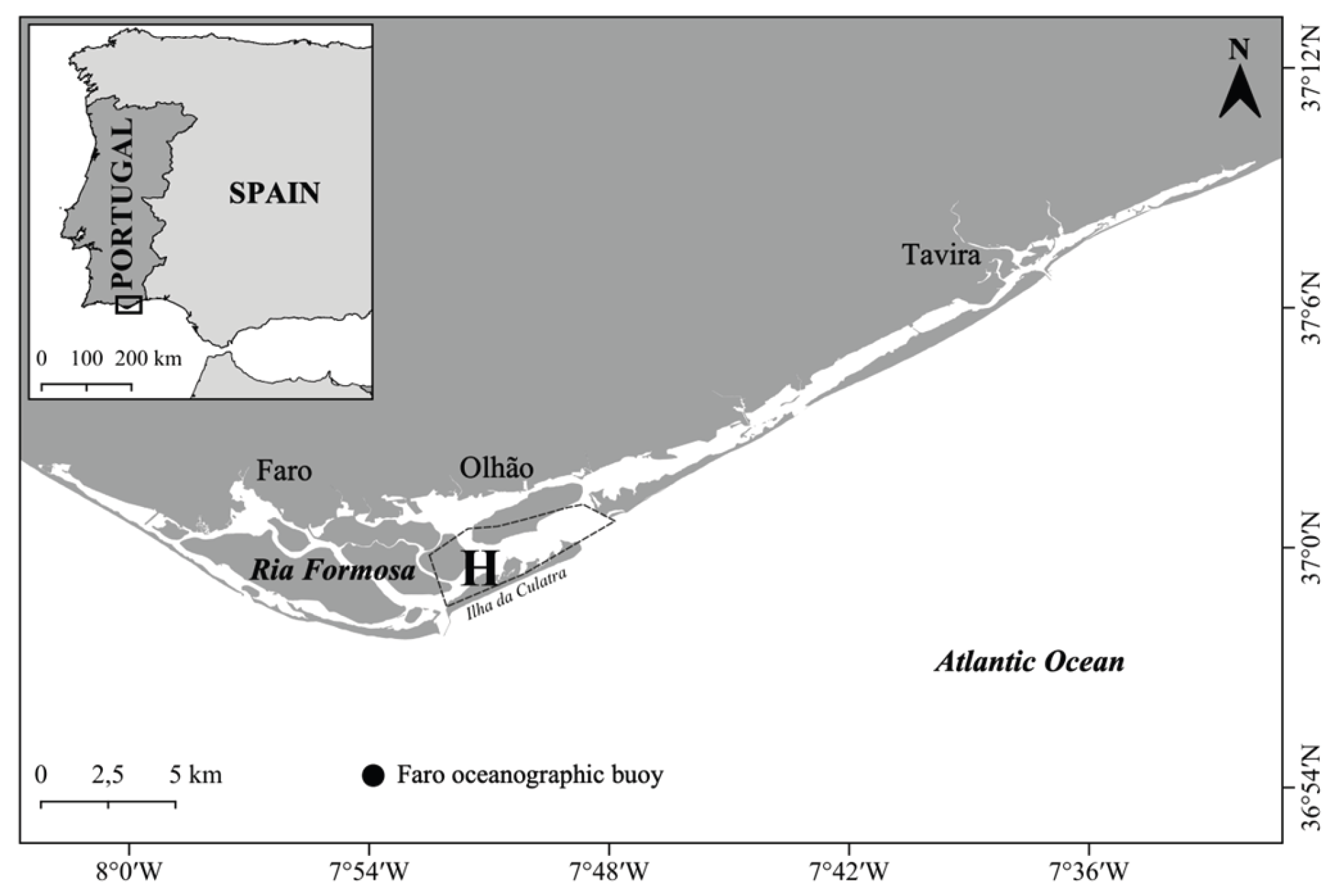
Figure 2.
Histological sections displaying the stages of gonad development in males (left) and females (right) of razor clam (Solen marginatus) in Ria Formosa lagoon: stage I – start of gametogenesis; stage II – advanced gametogenesis; stage III – ripe; stage IV – spawning and stage V – post-spawning.
Figure 2.
Histological sections displaying the stages of gonad development in males (left) and females (right) of razor clam (Solen marginatus) in Ria Formosa lagoon: stage I – start of gametogenesis; stage II – advanced gametogenesis; stage III – ripe; stage IV – spawning and stage V – post-spawning.
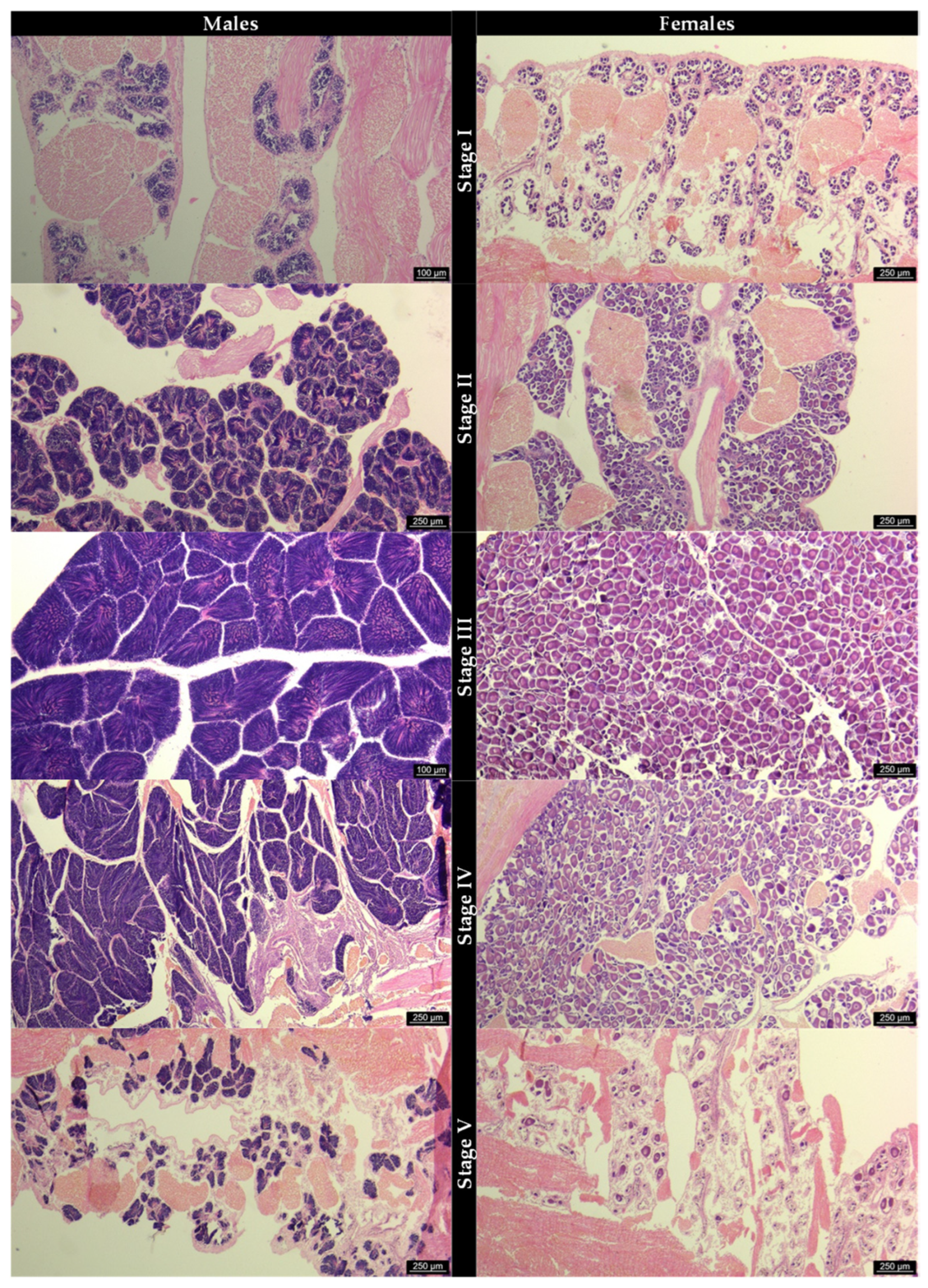
Figure 3.
Monthly variation in the percentage in each stage of maturation of razor clam (Solen marginatus) in Ria Formosa lagoon, during the study period (stage I – start of gametogenesis; stage II – advanced gametogenesis; stage III – ripe; stage IV – spawning and stage V – post-spawning).
Figure 3.
Monthly variation in the percentage in each stage of maturation of razor clam (Solen marginatus) in Ria Formosa lagoon, during the study period (stage I – start of gametogenesis; stage II – advanced gametogenesis; stage III – ripe; stage IV – spawning and stage V – post-spawning).
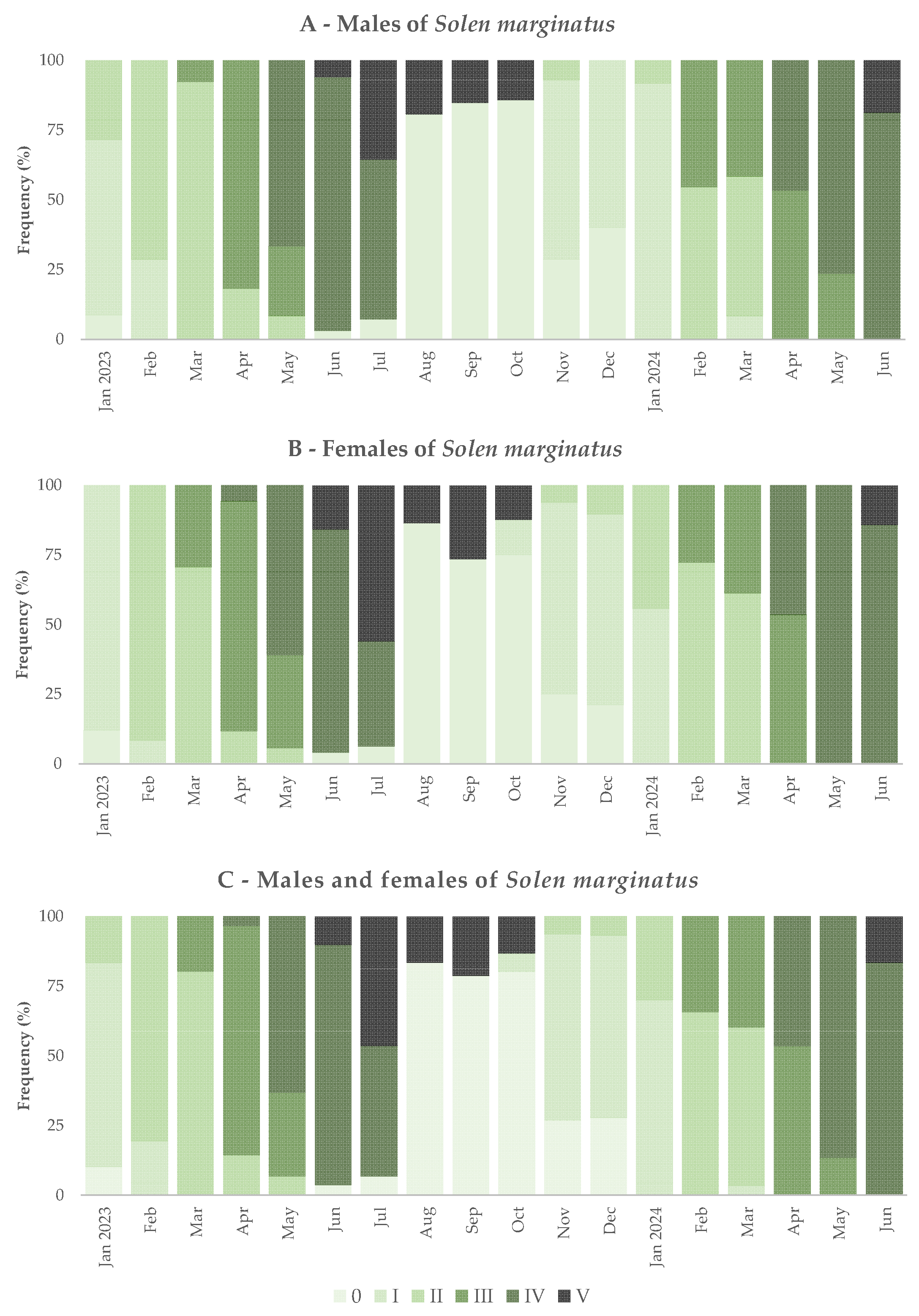
Figure 4.
Temporal variation in seawater temperature and mean gonadal index of razor clam (Solen marginatus) in Ria Formosa lagoon during the study period. Seawater temperature presented as mean and range (filled and dotted lines, respectively).
Figure 4.
Temporal variation in seawater temperature and mean gonadal index of razor clam (Solen marginatus) in Ria Formosa lagoon during the study period. Seawater temperature presented as mean and range (filled and dotted lines, respectively).
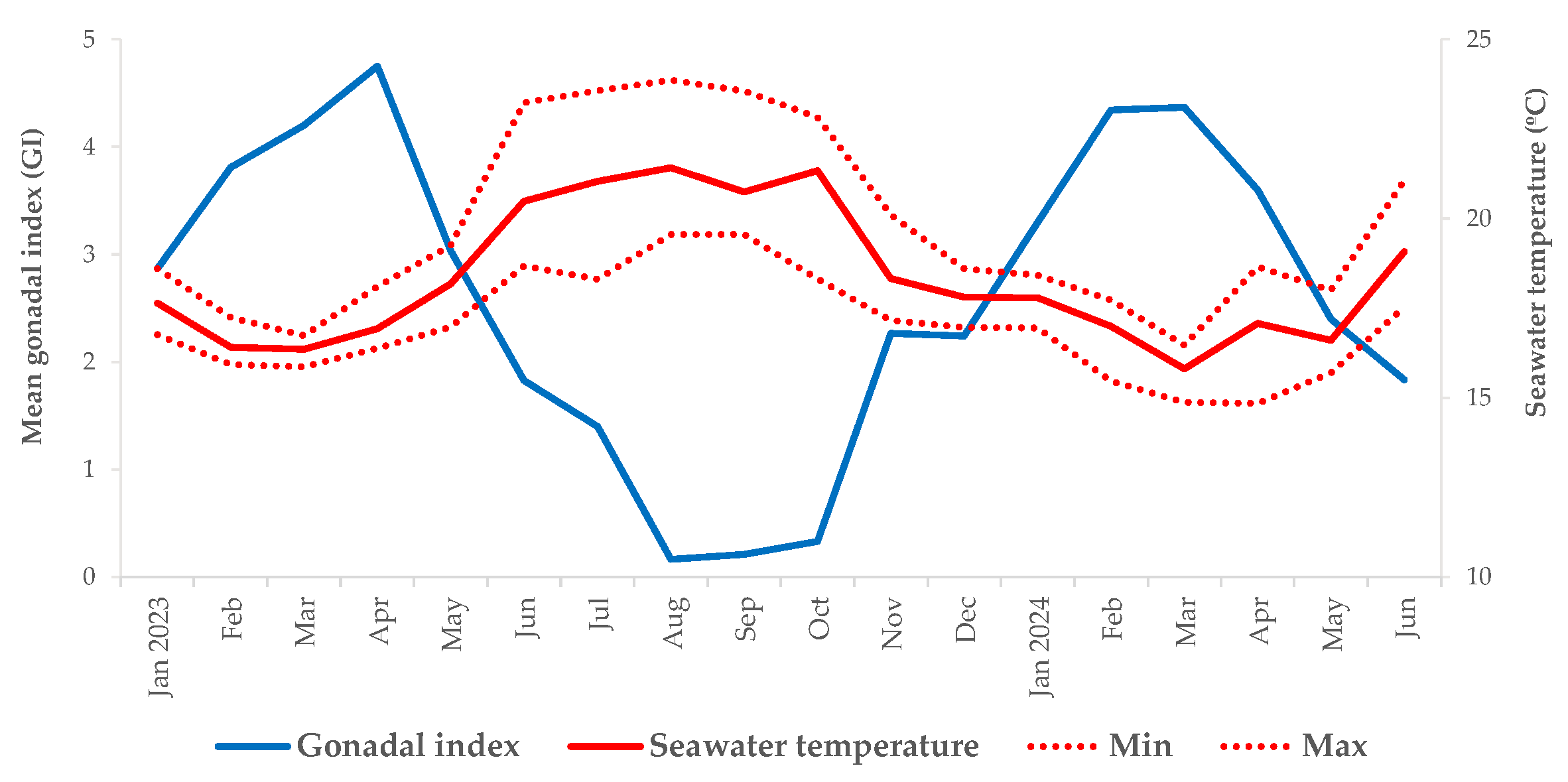
Figure 5.
Temporal variation in chlorophyll concentration and mean gonadal index of razor clam (Solen marginatus) in Ria Formosa lagoon during the study period.
Figure 5.
Temporal variation in chlorophyll concentration and mean gonadal index of razor clam (Solen marginatus) in Ria Formosa lagoon during the study period.
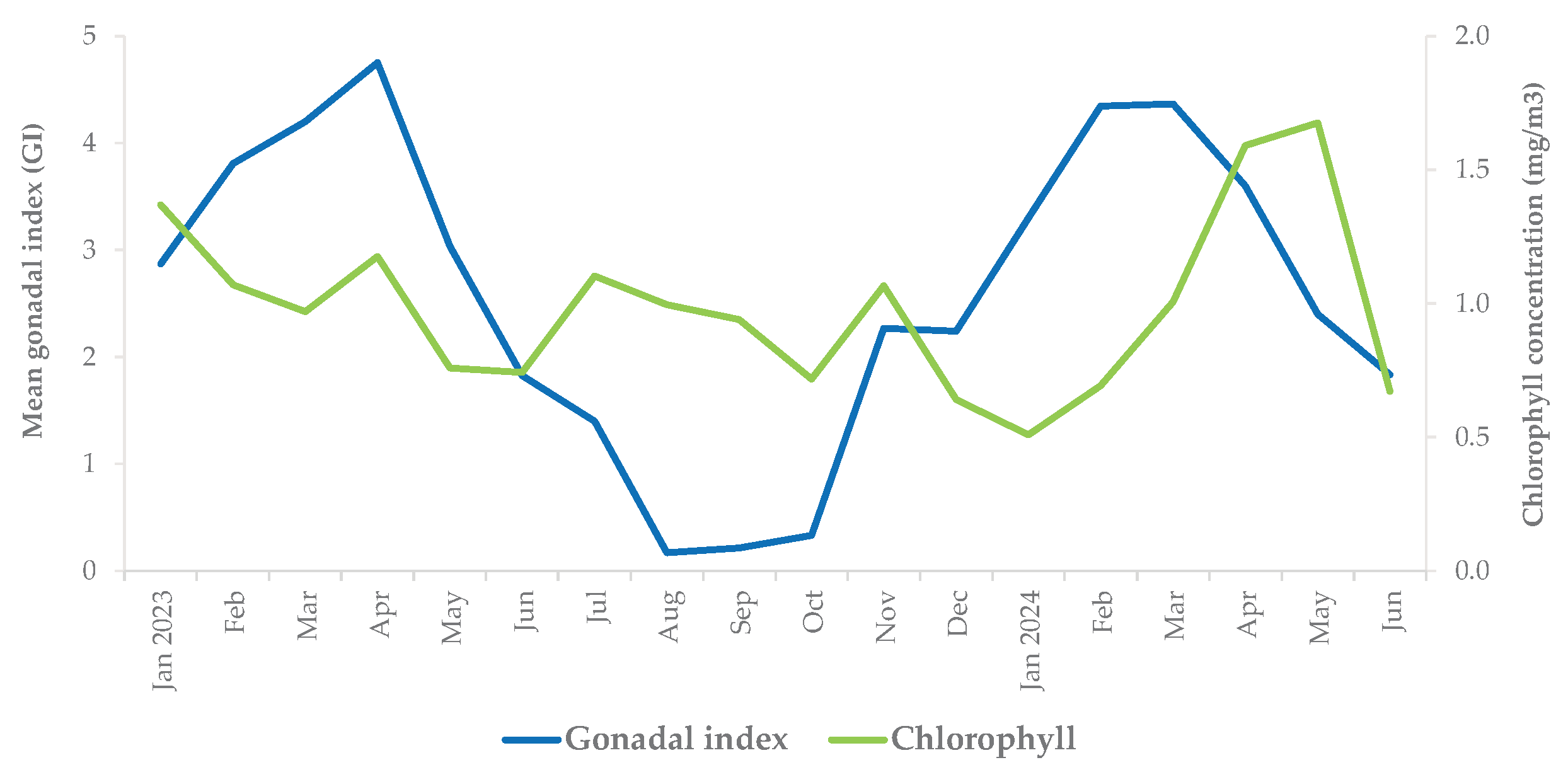

Table 1.
Sex ratio of the Solen marginatus individuals collected in the Ria Formosa lagoon.
| Year | Month | M | F | I | % M | % F | % I |
|---|---|---|---|---|---|---|---|
| 2023 | January | 16 | 11 | 3 | 53.3 | 36.7 | 10.0 |
| February | 14 | 12 | 0 | 53.8 | 46.2 | 0.0 | |
| March | 13 | 17 | 0 | 43.3 | 56.7 | 0.0 | |
| April | 11 | 17 | 0 | 39.3 | 60.7 | 0.0 | |
| May | 12 | 18 | 0 | 40.0 | 60.0 | 0.0 | |
| June | 16 | 12 | 1 | 55.2 | 41.4 | 3.4 | |
| July | 13 | 15 | 2 | 43.3 | 50.0 | 6.7 | |
| August | 3 | 2 | 25 | 10.0 | 6.7 | 83.3 | |
| September | 2 | 4 | 22 | 7.1 | 14.3 | 78.6 | |
| October | 2 | 4 | 24 | 6.7 | 13.3 | 80.0 | |
| November | 10 | 12 | 8 | 33.3 | 40.0 | 26.7 | |
| December | 6 | 15 | 8 | 20.7 | 51.7 | 27.6 | |
| 2024 | January | 12 | 18 | 0 | 40.0 | 60.0 | 0.0 |
| February | 11 | 18 | 0 | 37.9 | 62.1 | 0.0 | |
| March | 12 | 18 | 0 | 40.0 | 60.0 | 0.0 | |
| April | 15 | 15 | 0 | 50.0 | 50.0 | 0.0 | |
| May | 17 | 13 | 0 | 56.7 | 43.3 | 0.0 | |
| June | 16 | 14 | 0 | 53.3 | 46.7 | 0.0 | |
| Total | 201 | 235 | 93 | 38.0 | 44.4 | 17.6 |
M = male; F = female; I = indeterminate.
Table 2.
Gametogenic development (■ resting period; ■ gametogenesis; ■ ripe/maturation; ■ spawning) and related environmental parameters (■ seawater temperature; ■ chlorophyll concentration) described for several Solen marginatus populations. * The authors considered ripe and spawning stages as a single season; **partial spawning events.
Table 2.
Gametogenic development (■ resting period; ■ gametogenesis; ■ ripe/maturation; ■ spawning) and related environmental parameters (■ seawater temperature; ■ chlorophyll concentration) described for several Solen marginatus populations. * The authors considered ripe and spawning stages as a single season; **partial spawning events.
| Location Country |
Jan | Feb | Mar | Apr | May | Jun | Jul | Aug | Sep | Oct | Nov | Dec | Related parameters |
Reference | |
|---|---|---|---|---|---|---|---|---|---|---|---|---|---|---|---|
| Ria Formosa Portugal |
Present study | ||||||||||||||
| Ria Formosa Portugal |
[12] | ||||||||||||||
| Ria de Aveiro Portugal |
[9] | ||||||||||||||
| Ria of Ortigueira Spain |
[21] | ||||||||||||||
| San Pedro River Spain |
[10] | ||||||||||||||
| Ria de Villaviciosa Spain |
[27] | ||||||||||||||
| Eo Estuary Spain |
[27] | ||||||||||||||
| Eo Estuary Spain |
*[28] | ||||||||||||||
| Santander Bay Spain |
*[28] | ||||||||||||||
| Terrón Estuary Spain |
*[28] | ||||||||||||||
| Gulf of Gabès Tunisia |
**[25] | ||||||||||||||
| Oualidia Lagoon Morocco |
[26] | ||||||||||||||
Disclaimer/Publisher’s Note: The statements, opinions and data contained in all publications are solely those of the individual author(s) and contributor(s) and not of MDPI and/or the editor(s). MDPI and/or the editor(s) disclaim responsibility for any injury to people or property resulting from any ideas, methods, instructions or products referred to in the content. |
© 2026 by the authors. Licensee MDPI, Basel, Switzerland. This article is an open access article distributed under the terms and conditions of the Creative Commons Attribution (CC BY) license.
Copyright: This open access article is published under a Creative Commons CC BY 4.0 license, which permit the free download, distribution, and reuse, provided that the author and preprint are cited in any reuse.


