
Submitted:
30 March 2026
Posted:
31 March 2026
You are already at the latest version
Abstract
The paper explores the barriers preventing engineering SMEs in Nigeria from adopting e-commerce. Using the TOE framework, the study employed a qualitative design and semi-structured interviews with ten SME owners and managers across major engineering sectors. Technological barriers comprise poor ICT infrastructure, unreliable internet connectivity, cybersecurity threats, and logistics inefficiencies. Organizational barriers include lack of technical skills, financial constraints, lack of leadership support, and change resistance. Environmental barriers include regulatory uncertainty, a preference for traditional transactions, economic instability, and low market readiness. The study extends the TOE framework by contextualizing the barriers to e-commerce in perspective within a project-based industry in a developing economy and recommends that Nigerian engineering SMEs, policymakers, and technology providers collaborate to enhance digital infrastructure, strengthen cybersecurity, promote digital literacy, offer financial and policy support, and develop affordable, innovative e-commerce and logistics solutions to accelerate e-commerce adoption
Keywords:
e-commerce adoption
; barriers
; SMEs
; engineering sector
; Nigeria
; TOE framework
1. Introduction
The adoption of electronic commerce (e-commerce) has revolutionized the business environment through improving market penetration, business efficiency, and customer service. SMEs, which contribute 40–60 percent of GDP and millions of jobs around the world, are particularly suited to take advantage due to their flexibility and customer orientation [1,2]. In Nigeria, SMEs make up 96% of the total number of businesses, 48% of the GDP, and 84% of total employment [3,4]. The ICT sector alone contributed 16.36% to the GDP growth in Q2 2024 [5], which is a sure indication of the potentiality of digital commerce to transform an economy. In this context, engineering SMEs, such as civil, electrical, industrial, and mechanical companies, are critical. The construction sector, as an example, increased the GDP by 3.17% in Q2 2024 [5]. By adopting e-commerce, SMEs in the engineering sector will be able to manage clients better, coordinate projects more efficiently, and extend their access to local and global markets, which will increase competitiveness and development [6,7,8].
Nigerian SMEs are confronted with a range of challenges in e-commerce adoption. Digital infrastructure is also a major obstacle, with companies seeing intermittent internet connectivity, limited access to broadband, and regular power outages [9,10,11]. The expense of implementing e-commerce solutions discourages the adoption of e-commerce technologies by SMEs because their operations require secure digital environments and the establishment of necessary ICT infrastructure [12,13]. The management of e-commerce platforms is also hampered by digital illiteracy and a lack of ICT knowledge, which results in inefficiencies in operations and cybersecurity threats [14,15,16]. Organizational and environmental conditions are also important factors that limit the adoption of e-commerce. Lack of top management support, employee training, and regulatory complexity are some of the factors that inhibit SMEs in their move to digital commerce [12,17]. Moreover, the volatile economic environment and the lack of access to funding do not allow many businesses to invest in digital transformation [18]. In prior research [19,20,21], these barriers are classified as technological, organizational, and environmental (TOE) factors that cumulatively affect the potential of Nigerian SMEs to adopt and gain value in e-commerce.
Although various studies have explored e-commerce adoption among Nigerian SMEs [12,16,17,22,23], their approach has been sector-agnostic and relatively broad. The study takes a different approach by focusing specifically on engineering SMEs in Nigeria, which encounter unique technological, organizational, and environmental challenges that are not adequately addressed in broader SME research. The sector-specific barriers of e-commerce adoption require an in-depth exploration given the critical role engineering enterprises play in Nigeria’s economic growth. There remains a significant gap in sector-specific studies, particularly within engineering-focused enterprises in Nigeria and their adoption of e-commerce. This study utilizes the TOE framework to explore the barriers of e-commerce adoption in engineering SMEs, utilizing qualitative data to provide a deeper understanding beyond the quantitative approaches commonly found in prior research.
2. Technology, Organization, Environment (TOE) Framework
Tornatzky and Fleischer [24] developed the TOE framework, which incorporates the technological, organizational, and environmental aspects to describe the way firms embrace innovations. It has been broadly applied in e-commerce [17,25], social commerce [26], blockchain [27], and cloud computing [28] studies. TOE forms the basis of empirical studies that investigate the effects of internal capabilities and external pressures on digital adoption among the SMEs in Nigeria. Ekong et al. [22] and Awa et al. [19] integrated Diffusion of Innovation (DIT), Task-Technology Fit (TTF), and the Unified Theory of Acceptance and Use of Technology (UTAUT) with TOE to investigate determinants of e-commerce, whereas Usman et al. [29] applied TOE to evaluate the adoption of cloud-based ERP in manufacturing SMEs. In the TOE, the technological factor highlights the importance of ICT infrastructure, internet reliability, and compatibility of the system as the facilitators of adoption [30]. The organizational aspect is concerned with leadership commitment, the innovative culture, and workforce capability, which enhance preparedness to the digital transformation [31], whereas a lack of management support and poor skills of the employees obstructs it [32]. The environmental dimension has regulatory policies, competition, and customer expectations that can affect adoption. In Nigeria, regulations, economic turmoil, and competition are three crucial factors that influence the adoption of technology among SMEs [33,34]. In contrast to other models like TAM [35] and UTAUT [36], which focus on individual user behavior, TOE deals with firm level determinants, including both structural and contextual realities. This renders the TOE framework especially suitable in this study to comprehend adoption of e-commerce by Nigerian engineering SMEs that experience the interplay of infrastructural, managerial, and regulatory contexts to influence digital transformation.
3. Literature Review
3.1. E-Commerce Adoption Among SMEs in Nigeria
E-commerce is the exchange of goods and services over the Internet, facilitated by digital platforms. It involves business to consumer (B2C), business to business (B2B), and consumer to consumer (C2C). E-commerce enables companies to reach wider markets, increase efficiency, and improve customer satisfaction through websites and mobile platforms [37]. The use of e-commerce in Nigeria is gaining momentum among SMEs in an effort to improve their competitiveness and operational efficiency [38].
3.2. Barriers to E-Commerce Adoption
Adoption of e-commerce by Nigerian SMEs is hindered by technological, organizational, and environmental factors. Such technological constraints are poor ICT infrastructure, unstable broadband, and frequent power interruptions [39,40,41]. Agwaniru [15] and Amaobi [42] observed that high costs of internet connectivity and low access often interfere with online transactions. Moreover, cybersecurity threats including phishing, malware, and data breaches often deter online engagement [43]. The lack of strong data protection legislation and weak encryption contributes even more to the worry of SMEs about digital payment [44,45]. Also, the absence of platforms that are SME-friendly makes integration of e-commerce difficult [19,23]. The barriers in the organization are based on financial limitations, lack of skills, and managerial opposition. High setup and maintenance costs do not attract investment in websites, marketing, or cybersecurity [15,21]. The access to credit and funding is also limited, which is another impediment to adoption [46]. Having a shortage of IT professionals impacts the capacity of SMEs to handle their digital operations including inventory management and data analysis [14]. Business owners and employees are still poorly digitally literate and opposed to change [47,48,49], and traditional business practices are still dominant [14]. Policy uncertainty, lack of proper regulation, and inadequate governmental support are some of the environmental barriers. Unclear taxation, insufficient consumer protection, and unfavorable or inadequate laws on data privacy deter digital transition [50,51]. A lack of incentives or government funding might further decrease the intention to adopt e-commerce. Major players like Jumia and Konga also pose stiff competition to SMEs, thus making it hard to enter the market. Furthermore, low e-commerce adoption is caused by consumer distrust due to incidents of fraud and negative online experiences [52,53]. The presence of wider socio-economic inequalities, lack of digital literacy, and poverty limit access to the internet and the use of e-commerce [54,55,56].
4. Materials and Methods
The study used an interpretivist research philosophy and a qualitative research design to investigate barriers and enablers to e-commerce adoption among the engineering SMEs in Nigeria. Participants were selected through purposive sampling to comprise ten owners and managers of SMEs in Nigeria operating within the construction, manufacturing, automotive, and technical services sectors of engineering businesses (Table 1). The sample size used by the researcher was based on data saturation since no new data would emerge by conducting extra interviews [57]. The 10 interviews were conducted via Zoom with a semi-structured approach; each one was completed in the timeframe of 45 minutes. Studies already carried out prove that to conduct qualitative research, it is suitable to have 10–12 participants with the data saturation reached [58]. The interview guidelines incorporated the TOE framework, with an emphasis on technological barriers, organizational barriers, and environmental barriers. Thematic analysis was performed in adherence to the following six steps identified by Braun and Clarke [59]: (1) familiarization with the data, (2) generating initial codes, (3) searching for themes, (4) reviewing themes, (5) defining and naming themes, and (6) producing the report. Audio interview files were transcribed using TurboScribe software, and quotes were reported verbatim in the findings. NVivo software was used to support systematic coding, and a cross-validation methodology between two analysts helped augment the reliability of theme development. Ethical considerations were ensured by observance of the principles of informed consent, the implementation of effective data protection procedures, and participant confidentiality protection.
5. Results
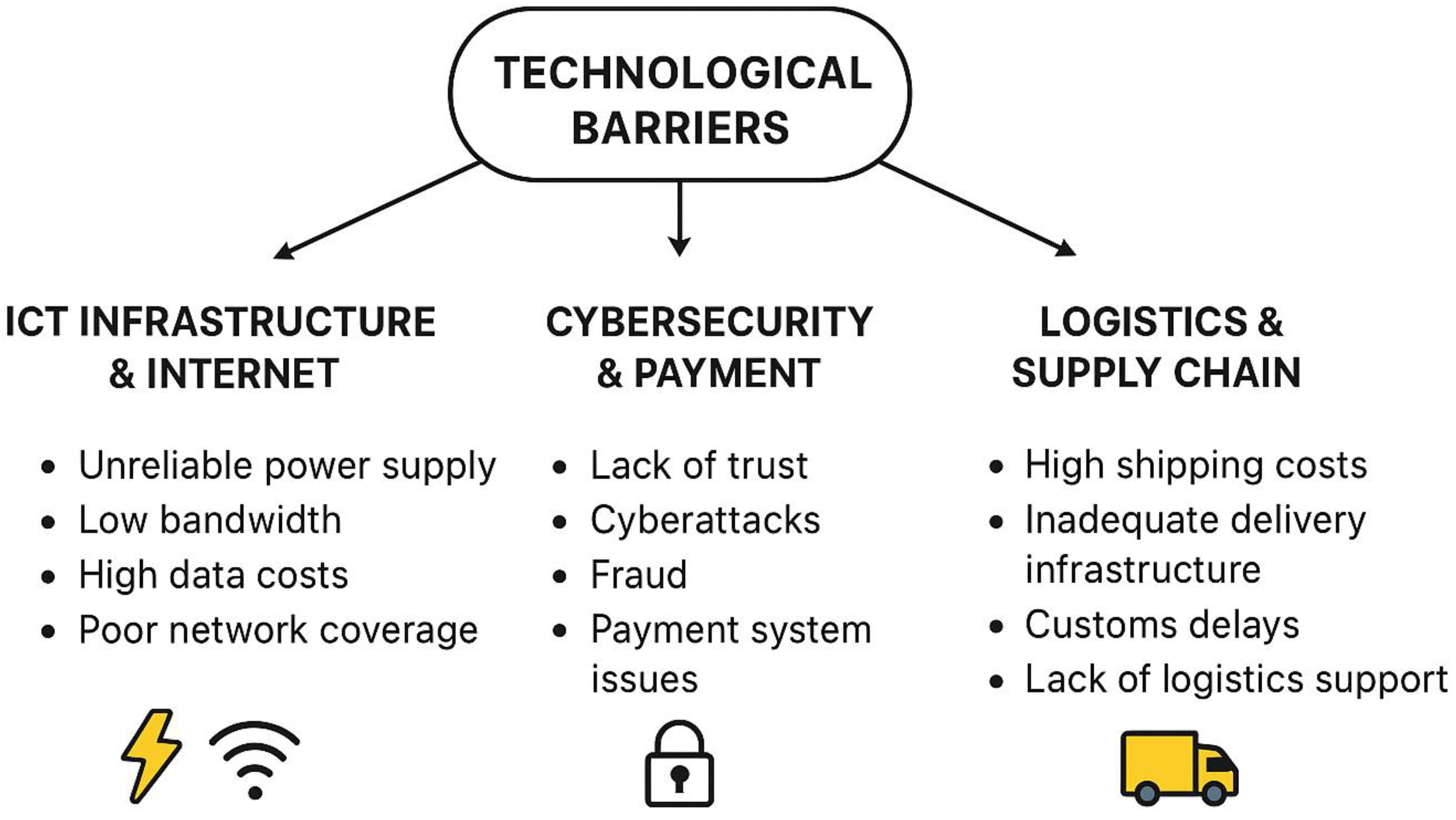
5.1. Technological Barriers
5.1.1. ICT Infrastructure and Internet Connectivity Issues
Participants indicated that they experience major challenges to e-commerce adoption since they lack adequate ICT infrastructure. They are usually faced with various obstacles, such as power instability, old technologies, and the inability to access high-level computing services. Participants reported that they often lose connection and experience slow connections and poor coverage, particularly in semi-urban and rural areas. P10 stated, “We have some ICT infrastructure; however, it is not as reliable as we would like it to be.” P08 also noted the internet is not always accessible, particularly in some regions like the rural areas. Participants noted that unstable internet connections cause delays in transactions, glitches in payment systems, and consumer discontent, which results in the loss of revenue. P05 complained, “Slow speeds and interruptions lead to delays in transactions, and this makes our customers very angry, leading to loss of sales.”
5.1.2. Cybersecurity and Payment Issues
Participants stressed that they experience a significant barrier in the form of cybersecurity costs and digital security-related issues. They often experience challenges in financing the required security measures such as encryption, firewalls, and multi-factor authentication, therefore exposing them to cyber threats. Participants also expressed fear of data breaches, fraud, and unauthorized access as inhibitors of the full-scale adoption of e-commerce. P08 said, “We are concerned about data breaches. We are delaying or not considering going fully into e-commerce because of recent cyberattacks.” P07 mentioned, “Poor payment systems are also a key impediment to the use of e-commerce.” P05 stressed that it is costly to maintain good security systems.
5.1.3. Logistics and Supply Chain Constraints
Participants observed that logistics inefficiencies limit the uptake of e-commerce. They mentioned facing delays and high costs in transport infrastructure, last-mile delivery, and supply-chain coordination, which hinder their full adoption of e-commerce. P04 added that “there is the last-mile delivery concern.” Likewise, P07 said, “Traffic jams in big cities such as Lagos may lead to delays.” The lack of clarity in delivery schedules, which is usually due to insufficient live tracking and logistics integration, makes matters difficult. P01 expressed, “When orders are not delivered on time or when they are damaged on the way, it causes a lot of problems, refunds, complaints, and negative reviews.” Therefore, the risks involved are high when adopting e-commerce without a stable logistics system.
Figure 1.
Technological barriers to e-commerce adoption among Nigerian engineering SMEs. Source: Created by the author.
Figure 1.
Technological barriers to e-commerce adoption among Nigerian engineering SMEs. Source: Created by the author.
5.2. Organizational Barriers
5.2.1. Technical Knowledge and Skills Gaps
Participants stressed that technical expertise is a major barrier to adoption of e-commerce. Some mentioned having basic digital literacy, while others lacked more advanced e-commerce capabilities like automatic inventory control, cybersecurity, and platform connectivity. P03 stated, “There is still a gap in terms of higher-level e-commerce skills.” Likewise, P10 stated, “It requires adequate training and clear integration with the processes that we currently use.” Although participants mentioned that they are oriented toward digital solutions, they struggle with the evaluation and procurement of the expertise needed to enhance their operations. P02 added, “The issue is how to manage it in terms of capacity, be it technical expertise or resources.”
5.2.2. Financial Constraints
Participants noted that high costs of adopting e-commerce solutions cut across payment systems, inventory management, and cybersecurity. As P04 explained, “Integrating new e-commerce technologies, such as the advanced payment systems or automated inventory management, is a process that needs investment.” P05 pointed out, “Setting up the necessary infrastructure and training employees can be a barrier due to the cost incurred.” Many of these businesses are operating on tight budgets and struggle to allocate funds for digital infrastructure and staff training. In addition, economic instability, inflation, and currency fluctuations hinder full adoption. Access to credit and affordable financing options is limited to some of these SMEs, inhibiting their ability to upgrade e-commerce capabilities. P10 reflected, “Inflation, currency fluctuations, and lack of credit access have made it harder for us.”
Figure 2.
Organizational barriers to e-commerce adoption among Nigerian engineering SMEs. Source: Created by the author.
Figure 2.
Organizational barriers to e-commerce adoption among Nigerian engineering SMEs. Source: Created by the author.
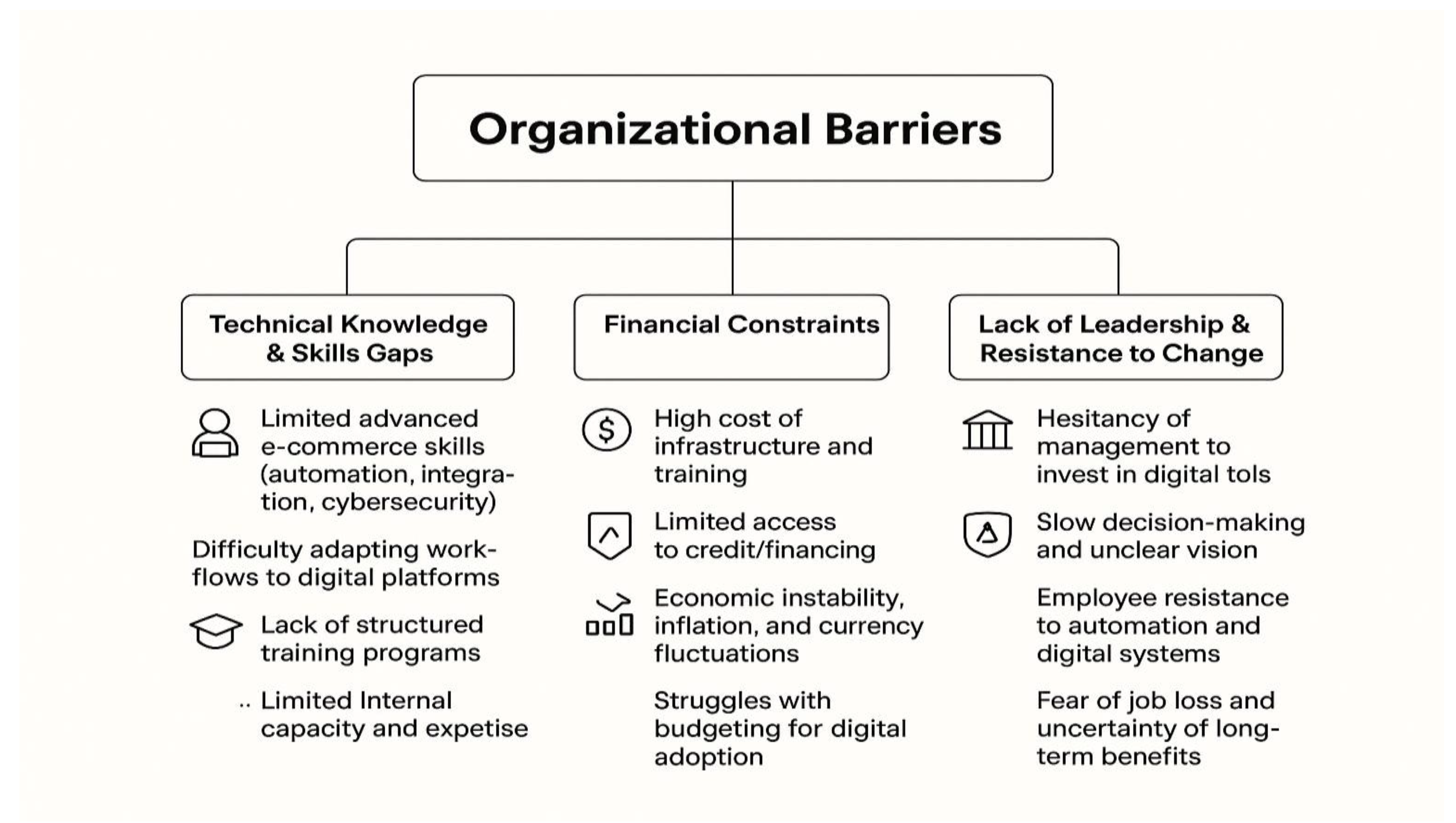
5.2.3. Lack of Leadership and Resistance to Change
Participants stated that one of the constraints to the adoption of e-commerce is the lack of leadership commitment. Regarding digital investments, the top management is sometimes indecisive because of a lack of a clear view of e-commerce, limited budgets, a slow decision-making process, and reluctance to change. P03 expressed, “Our top management has been somewhat resistant to investing in automated inventory systems or advanced data analytics to understand customers much better.” Participants noted that the issue of resistance to adoption of e-commerce is prevalent and is especially common among individuals who are still used to manual systems. P10 stated, “Some members of the team are resistant to change, particularly those who have been accustomed to doing things the traditional way of doing business.” This unwillingness is mostly caused by a fear of replacing jobs, a lack of confidence in future rewards, and an inability to understand digital tools. At the management level, reluctance to invest in such advanced technologies as automated inventory systems and data analytics slows down digital transformation. P09 shared, “There is a certain apprehension to risk new technology, especially when it involves a high-stakes project or high-budget project.”
5.3. Environmental Barriers
5.3.1. Regulatory Uncertainty
Participants observed that regulatory challenges represent a major hump to the uptake of e-commerce. They mentioned that VAT on digital goods and services is one of the major issues plaguing the business, while tax policies are rather unclear, causing uncertainties and difficulties in compliance. According to P06, “Lack of uniformity in the e-commerce tax laws, such as VAT on digital goods and services, causes confusion and makes it difficult to prepare financially.” Likewise, P02 noted, “Tax compliance is one of the primary concerns we have.” There are no uniform e-commerce laws, and thus SMEs are more exposed to legal grey areas and punitive action. The lack of clarity on what data protection compliance entails, with cybersecurity laws being applied inconsistently, has left many businesses with little guidance. P09 shared, “The regulatory framework for online business operations, particularly around cross-border trade and customs duties, can sometimes be unclear or cumbersome.” Complex regulations and unclear policies that define international trade also restrict global opportunities with cross-border transactions.
5.3.2. Cultural and Behavioral Barriers
Participants highlighted cultural preferences as another challenge to the adoption of e-commerce. There are still many businesses and customers who prefer real-world interactions, particularly in engineering industries. According to P03, “Face-to-face interactions continue to be the preferred method of communication with many of our clients when it comes to making major purchases and services.” Similarly, P10 mentioned, “There is still some skepticism about online transactions, particularly in this sector.” This is due to fear that online transactions could be fraudulent and a lack of trust in digital platforms. P05 added, “Some customers are accustomed to the old ways of conducting business, and they may not be willing to trust online platforms.” The shift from means of payment such as cash-on-delivery and direct bank transfer to prepaid digital payment systems is complicated in rural areas due to reliance on cash-on-delivery and direct bank transfer of funds.
5.3.3. Economic Instability
Participants expressed that economic instability is one of the main factors that makes the adoption of e-commerce very hard and challenging. Financial uncertainty that is caused by fluctuations in the exchange rates, inflation, and an unpredictable banking sector makes these SMEs reluctant to invest in e-commerce. P10 reflected, “Fluctuations in exchange rate and the unpredictable nature of the banking sector have also made us hesitant to fully dive into e-commerce.” The increasing costs of investing in digital tools and payment systems also affected participants, and the financial costs of maintaining an e-commerce platform in the long run is also a factor that discourages the full adoption of such. P09 added, “Inflation, fluctuating exchange rates and economic uncertainty cause concerns in the minds of businesses when it comes to investing in e-commerce infrastructure.”
5.3.4. Competitive Landscape and Market Readiness
Participants observed that the unwillingness of Nigerian engineering SMEs to embrace e-commerce is partly influenced by the low adoption rate of their competitors. According to P01, “Many rivals are not quick to embrace e-commerce, thus leading to a conservative attitude towards investing in digitalization.” P05 stated, “The reluctance to transition to e-commerce by other business players is creating a hunch of moving to complete online business strategies.” Specifically, engineering is a sector that is yet to embrace e-commerce fully because of the persistence of a face-to-face interaction and contractual nature of transactions. P04 shared, “In sectors where the conventional business model is still the norm, businesses tend to wait until the rest of the market adopts a new technology before they do so.” Similarly, P08 mentioned, “The engineering industry in Nigeria has been largely depending on in-person communication and traditional business practices to the detriment of e-commerce adoption.”
Figure 3.
Environmental barriers to e-commerce adoption among Nigerian engineering SMEs. Source: Created by the author.
Figure 3.
Environmental barriers to e-commerce adoption among Nigerian engineering SMEs. Source: Created by the author.
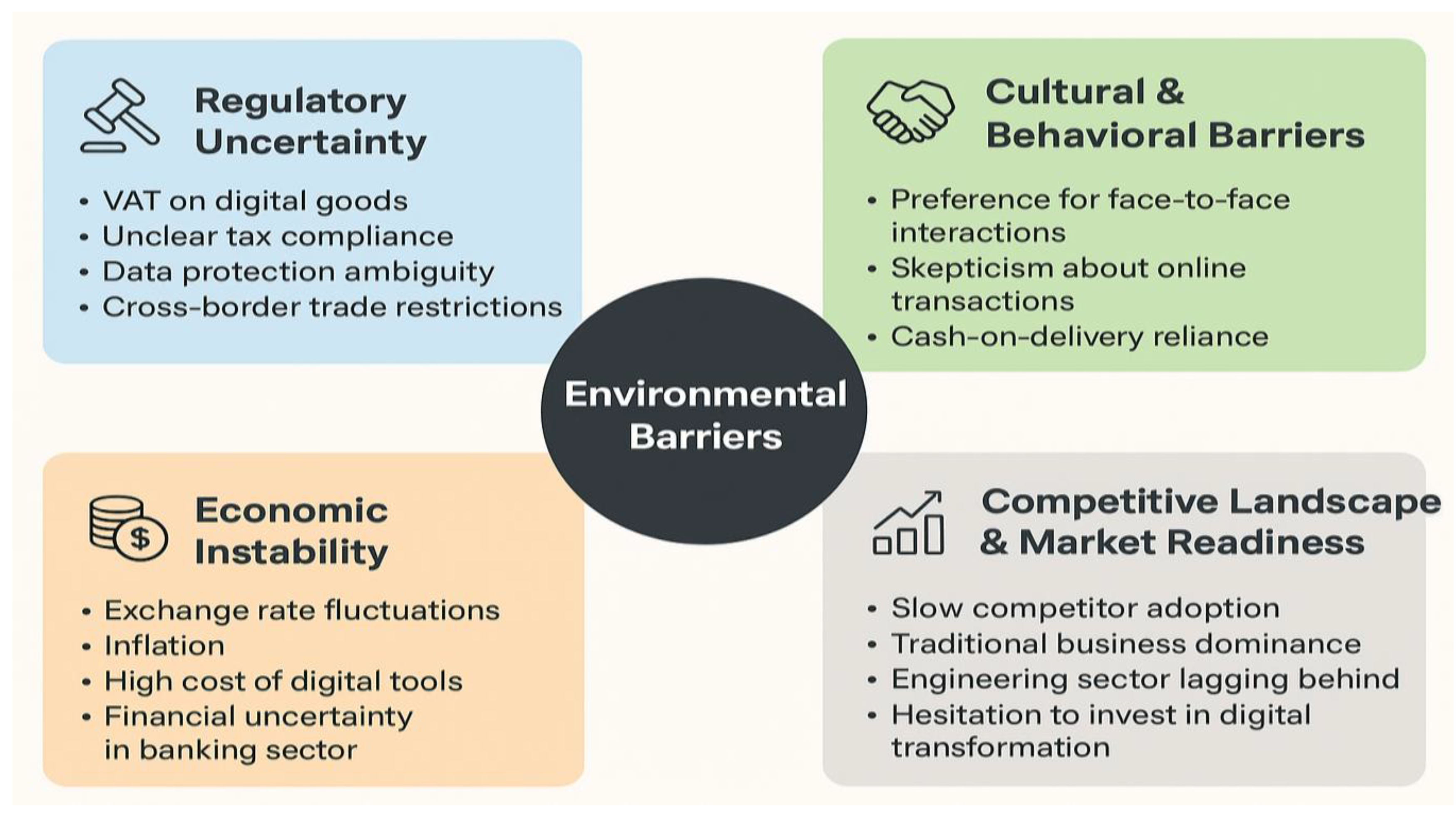
Table 2 summarizes the technological, organizational, and environmental barriers hindering e-commerce adoption among Nigerian engineering SMEs.
6. Discussion
The findings of this study reveal that e-commerce adoption among engineering SMEs in Nigeria is constrained by technological, organizational, and environmental factors. Key technological barriers to adoption of e-commerce, which include internet connectivity problems, ICT infrastructure problems, cybersecurity issues, poor payment systems, and logistics constraints, are highlighted in this study. These findings align with previous studies [40,41]. Unreliable internet causes disruption that impedes transactions and severely limits sales, which is in line with what Udegbunam et al. [61] highlighted concerning low internet penetration in Nigeria. Inconsistent power supply and outdated technology make it difficult for SMEs to integrate the secure payment gateways and therefore rely on costly generators [23]. However, critical barriers such as infrastructure challenges are still the main challenge [19]. SMEs are discouraged from digital adoptions due to the high costs of their cybersecurity and data breach risks, as many do not possess the resources for encryption and authentication systems [43,44]. This also makes people fear financial loss and fraud as they do not use digital payments [45]. Factors such as transaction failures, high processing fees, and complex authentication add to the limitation of adoption [40,42]. Also, poor transportation infrastructure and last-mile delivery inconveniences lead to the supply interruption, which increases costs and customer dissatisfaction [19,23].
Under the organizational component, the findings reveal that engineering SMEs in Nigeria are limiting e-commerce adoption due to a lack of technical knowledge, financial constraints, resistance to change, and lack of leadership support. This research aligns with other studies and indicates the continued presence of organizational challenges. The lack of systematic training limits many SMEs from utilizing advanced e-commerce functionalities, especially cybersecurity and platform integration [14], creating inefficiencies and resistance to digitalization [48]. Likewise, Ibrahim [47] reports that companies have limited capabilities to maximize e-commerce initiatives without experienced human resources in web design, search engine optimization, and statistics. Moreover, digital transformation is fraught with huge costs, including security and payment systems [21]. Access to credit is limited, and the economy is unstable, thus adding additional constraints on SMEs to upgrade their digital capabilities [46]. Technology is evolving very fast, and this pressure adds to the financial burden, making it hard to sustain investment [15]. Another factor that hinders adoption for traditional business owners is the perception that e-commerce is a risky and nonessential venture [49]. This issue of hesitancy among top management to invest in automated systems is exacerbated by organizational culture and limited awareness [14].
Under the environmental component, the findings reveal that Nigeria’s inconsistent and ambiguous regulatory environment, cultural and behavioral factors, economic instability, competitive landscape, and market readiness present major constraints to Nigerian engineering SMEs’ online transactions. Tax policies are ambiguous, particularly VAT on online goods and services, which causes taxation issues and financial uncertainties [50]. The lack of standardized e-commerce regulations places SMEs in a legal grey zone, with an increased risk of penalties. The absence of enforcement of cybersecurity laws leaves businesses with no clear guidelines on how to comply with data protection. The lack of government incentives or subsidies continues to discourage digital adoption among SMEs in Nigeria [62,63]. Furthermore, the findings reveal that cultural attitudes and trust-based business traditions in Nigeria remain significant obstacles, especially in engineering, where clients prefer physical verification and face-to-face contracting. One major reason is that many businesses and customers still have significant suspicions concerning online transactions due to fraud and poor customer service, according to Chimezie et al. [52]. Several barriers exist to the e-commerce adoption of rural consumers. Rural consumers preferred cash-on-delivery over digital payments [53]. An element that disincentivizes SMEs from investing in digital transformation is fluctuations and unpredictability in exchange rates, inflation, and conditions in the banking sector [56].
Collectively, the findings highlighted the interconnectedness of technological, organizational, and environmental barriers, which confirms the claim by the TOE framework that the adoption of innovation in developing environments is influenced by multidimensional and context-specific barriers. Technological inadequacies exacerbate the financial burdens of the Nigerian engineering SMEs, whereas policy uncertainty strengthens managerial risk aversion, which further feeds into managerial risk aversion, further hindering digital transformation. The paper, thus, builds on the preceding TOE-based studies [19,34] because it contextualizes the interplay of infrastructural, managerial, and institutional weaknesses in a sector that has been overlooked in prior e-commerce research.
7. Theoretical and Practical Implications
This study builds on the TOE model by offering industry-specific information in relation to a little-researched context- engineering SMEs in developing economy. It indicates that obstacles to e-commerce adoption are not exclusive to a single dimension of TOE but are interdependent and mutually reinforcing. The findings refine the TOE model by focusing on the dynamic interplay of infrastructural constraints, managerial willingness and environmental uncertainty in influencing innovation decisions. This highlights the need for future studies to incorporate contextual and behavioral elements in TOE-based studies of digital adoption, especially in project-based sectors.
For policymakers, the findings of the study show a sense of urgency to enhance ICT infrastructure, consistent power supply, and simplification of digital taxation and cybersecurity policies to create a more predictable online commerce, environment. Specific digital literacy and financial assistance towards SMEs in technical industries should be created through government agencies. To SME owners and managers, the results indicate the necessity to nurture a culture of technological learning and to deliver ongoing digital training and leadership support of innovation. Technology suppliers and financial institutions also have a major role to play in that they could make available cost-effective cybersecurity solutions and flexible financing options to promote step-by-step digital transformation. By focusing on these interdependent issues as a whole, e-commerce integration efforts can be expedited, and the competitiveness of engineering SMEs can be increased in Nigeria with the development of the digital economy.
8. Conclusions
This paper explored the barriers to adoption of e-commerce among the engineering SMEs in Nigeria through the framework of TOE. The results indicate that technological, organizational, and environmental aspects are interconnected in limiting digital transformation in this industry. The most urgent are technological issues: the lack of proper ICT infrastructure, unstable internet connectivity, cybersecurity threats, and inefficient logistics. Organizational barriers, such as technical knowledge and skills gaps, insufficient financial resources, lack of leadership and resistance to change in the organization, and change resistance further undermine the willingness of firms to embrace e-commerce. These limitations are compounded by environmental issues like regulatory uncertainty, cultural preference of face-to-face transactions, instability of macroeconomic conditions and low market readiness. These barriers together form a compound ecosystem that prevents the use of e-commerce by SMEs to improve their competitiveness and growth. The research is relevant to a better understanding of the dynamics between infrastructural, managerial, and institutional weaknesses to determine the speed of e-commerce penetration in the engineering sector in Nigeria.
9. Recommendations
9.1. For Nigerian Engineering SMEs
- Collaborate with the Internet Service Provider (ISP) to obtain cheap and high-speed internet packages that will facilitate digital transactions.
- Allot 10-15% of annual budget to security precautions including encryption, fraud detection, and secure payment gateways in order to reduce risks and establish customer trust.
- Employees should be subjected to mandatory quarterly digital training programs that deal with e-commerce platforms, data analytics, and cybersecurity.
- Establish strategic alliances with FinTech firms like Paystack and Flutterwave to reduce the costs incurred by merchants on transactions, improve the effectiveness of payment, simplify the procedure and also guarantee secure payments.
- Use social media marketing and influencer programs to increase the reach and customer engagement and allocate at least 20% of the marketing budget to those programs.
9.2. For Policymakers
- A flat VAT rate for digital transactions should be introduced as a simple tax policy for e-commerce SMEs to decrease their compliance challenges.
- The government should initiate a national grant scheme that offers the maximum of N5,000,000 ($5,000) to every SME to aid them in their digital transformation.
- The government should ensure that SMEs adhere to strict cybersecurity rules, such as setting up two-factor authentication and conducting regular security checks to make sure that online operations are secured.
- The government should provide funding to reduce broadband costs for SMEs that are located in rural areas or low-service areas in order to increase digital access and decrease operational costs.
- A nationwide digital literacy initiative should be developed, and policymakers should consider partnering with universities and tech hubs to train at least 100,000 SMEs and consumers annually on secure online transactions and e-commerce benefits.
9.3. For Technology and Logistics Providers
- Encourage adoption rate by reducing electronic payment transaction fees by 10 to 20% for SMEs.
- Develop AI-based fraud detection tools for SMEs that include real-time alerts and an automated risk assessment functionality.
- Invest in competitive last-mile delivery systems, such as shared delivery centers and drone logistics, to lower logistics costs and last-mile delivery speed, especially in remote regions.
- Offer personalized and cost-effective e-commerce services to SMEs. Provide e-commerce solutions at low costs including automated inventory management, CRM functionalities and chatbots
- Develop AI-enabled customer analytics to build SME’s personalization in marketing, to help SMEs predict consumer behavior, manage customer relationships, and make data-driven decisions.
10. Limitations and Future Research Directions
This study has several limitations. As a qualitative study, it offers a wealth of information on the barriers of e-commerce among Nigerian engineering SMEs, but the results cannot be generalized to all SMEs or industries. Future research could employ mixed methods, i.e., survey-based quantitative and qualitative, to validate and extend the findings. Future research could examine the challenges and best practices of e-commerce implementation within the context of other sectors like retail and agriculture. Moreover, the role of digital financial inclusion, mobile commerce and blockchain technology in aiding e-commerce adoption among SMEs could be explored in future studies. Studies on how government policies, regulatory systems and tax incentives influence e-commerce adoption and perceived risks of e-commerce and security measures would be valuable as well. Meanwhile, longitudinal investigations into the effects of shifting consumer behavior on adoption of e-commerce and the effects of e-commerce adoption on financial performance and operational efficiency of SMEs would also prove valuable.
Funding
This research received no external funding.
Institutional Review Board Statement
Ethical approval was obtained in accordance with the guidelines and approval from the Ethics Committee of Universiti Teknologi Malaysia.
Informed Consent Statement
Informed consent was obtained from all subjects involved in the study.
Data Availability Statement
The data presented in this study are available on request from the corresponding author due to privacy and ethical concerns regarding participant confidentiality.
Conflicts of Interest
The authors declare no conflicts of interest.
References
- Algan, N. The importance of SMEs on world economies. Proceedings of the International Conference on Eurasian Economies, Turkish Republic of Northern Cyprus 2019, Vol. 12, 1–10. [Google Scholar]
- Mugano, G. Role of SMEs in economic development in Africa. In SMEs and Economic Development in Africa, 1st ed.; Routledge: London, UK, 2023; pp. 1–16. [Google Scholar] [CrossRef]
- Mugano, G.; Dorasamy, N. SMEs Perspective in Africa: Creating Sustainable and Resilient Economies; Palgrave Macmillan: Cham, Switzerland, 2024. [Google Scholar] [CrossRef]
- Umar, M.; Mukhtar, D.; Aziz, M.I. SME-led growth: Harnessing innovation and frontier technologies for Nigeria’s 2025 development. Int. J. Entrep. Manag. Pract. 2024, 7, 136–145. Available online: https://gaexcellence.com/ijemp/article/view/3946. [CrossRef]
- National Bureau of Statistics (NBS). Nigeria Gross Domestic Product Q2 2024. Available online: https://www.nigerianstat.gov.ng/elibrary/read/1241549 (accessed on 1 January 2025).
- Agwu, E.; Carter, A. Mobile phone banking in Nigeria: Benefits, problems and prospects. Int. J. Bus. Commer. 2018, 3, 50–70. [Google Scholar]
- Sharma, S. Revving up growth: A study of the positive impact of e-commerce adoption by SMEs. Scholedge Int. J. Bus. Policy Gov. 2023, 10, 1–7. [Google Scholar] [CrossRef]
- Celestin, M.; Vasuki, M.; Kumar, A.D. How digital platforms empower SMEs: A comparative analysis of e-commerce strategies in developed and emerging markets. World 2024, 14, 1–15. [Google Scholar] [CrossRef]
- Yousef, A.B.; El-Ebiary, Y.; Al Moaiad, A.H.; Hassan, M.; Al-Kofahi, O.M.A.; Alqudah, A.L.; Liban, Z.M.; Al-hodiany; Hilles, S.M.S. E-commerce adoption: Problems facing SMEs in Nigeria. Int. J. Spec. Educ. 2022, 37, 6580–6591. Available online: https://www.researchgate.net/publication/365888758.
- Adewale, S.A. Exploring the potential of digitalization and e-commerce in economic diversification: Case studies from Nigerian startups and digital entrepreneurs. J. Bus. Dev. Manag. Res. 2024, 5, 45–60. [Google Scholar]
- Nwosu, K.C.; Nwokoye, I.E.; Okoro, S.N.A.; Ugbodaga, C.O. Drivers of information and communication technology adoption for enhanced small and medium enterprise performance in Anambra State, Nigeria. Eur. J. Bus. Startups Open Soc. 2024, 4, 11–26. Available online: https://inovatus.es/index.php/ejbsos/article/view/4385.
- Agwu, E.M.; Murray, P.J. Empirical study of barriers to electronic commerce adoption by small and medium scale businesses in Nigeria. Int. J. Innov. Digit. Econ. 2015, 6, 1–19. [Google Scholar] [CrossRef]
- Boßerhoff, T.A.; von der Decken, J.A. E-commerce in Nigeria: A Qualitative Study on Challenges in the Nigerian E-commerce Landscape and Solution Approaches. Master’s Thesis, Jönköping International Business School, Jönköping University, Jönköping, Sweden, 2022. [Google Scholar]
- Olayinka, O. The Adoption of E-business Technologies and Processes in Nigerian Small Business Enterprises. Doctoral Thesis, University of Gloucestershire, Cheltenham, UK, 2020. [Google Scholar] [CrossRef]
- Agwaniru, A. ICT as a Strategy for Sustainable Small and Medium Enterprises in Nigeria. Doctoral Dissertation, California Baptist University, Riverside, CA, USA, 2023. [Google Scholar]
- Ezennia, C.S.; Marimuthu, M. Factors that positively influence e-commerce adoption among professionals in Surulere, Lagos, Nigeria. Afr. J. Sci. Technol. Innov. Dev. 2022, 14, 405–417. [Google Scholar] [CrossRef]
- Awa, H.O.; Ojiabo, O.U.; Emecheta, B.C. Integrating TAM, TPB, and TOE frameworks and expanding their characteristic constructs for e-commerce adoption by SMEs. J. Sci. Technol. Policy Manag. 2015, 6, 76–94. [Google Scholar] [CrossRef]
- PwC. Africa Business Agenda 2020; PricewaterhouseCoopers: Lagos, Nigeria, 2020. [Google Scholar]
- Awa, H.O.; Ojiabo, O.U.; Orokor, L.E. Integrated technology–organization–environment (TOE) taxonomies for technology adoption. J. Enterp. Inf. Manag. 2017, 30, 893–921. [Google Scholar] [CrossRef]
- Nwosu, A.O. E-commerce Adoption by Small and Medium Enterprises in Nigeria. Doctoral Dissertation, Walden University, Minneapolis, MN, USA, 2017. [Google Scholar]
- Okolie, U.C.; Ojomo, A.H. E-commerce in Nigeria: Benefits and challenges. Humanit. Soc. Sci. Latv. 2020, 28, 69–90. [Google Scholar] [CrossRef]
- Ekong, U.; Ifinedo, P.; Ayo, C.; Ifinedo, A. E-commerce adoption in Nigerian businesses: An analysis using the technology–organization–environmental framework. In E-Commerce Adoption and Small Business in the Global Marketplace; IGI Global: Hershey, PA, USA, 2012; pp. 147–170. [Google Scholar] [CrossRef]
- Edokobi, T.D.; Okoli, I.M.; Ugochukwu, M.N. Effect of e-commerce utilisation on SMEs’ performance in Anambra State. J. Manag. Sci. 2024, 61, 20–36. [Google Scholar]
- Tornatzky, L.G.; Fleischer, M. The Processes of Technological Innovation; Lexington Books: Lexington, MA, USA, 1990. [Google Scholar]
- Rahayu, R.; Day, J. E-commerce adoption by SMEs in developing countries: Evidence from Indonesia. Eurasian Bus. Rev. 2017, 7, 25–41. [Google Scholar] [CrossRef]
- Abed, S.S. Social commerce adoption using the TOE framework: An empirical investigation of Saudi Arabian SMEs. Int. J. Inf. Manag. 2020, 53, 102118. [Google Scholar] [CrossRef]
- Malik, S.; Chadhar, M.; Vatanasakdakul, S.; Chetty, M. Factors affecting the organizational adoption of blockchain technology: Extending the technology–organization–environment (TOE) framework in the Australian context. Sustainability 2021, 13, 9404. [Google Scholar] [CrossRef]
- Ahmed, I. Technology–organization–environment framework in cloud computing. Telkomnika 2020, 18, 716–725. [Google Scholar] [CrossRef]
- Usman, U.M.; Ahmad, M.N.; Zakaria, N.H. The determinants of adoption of cloud-based ERP of Nigerian SMEs manufacturing sector using TOE framework and DOI theory. Int. J. Enterp. Inf. Syst. 2019, 15, 27–43. [Google Scholar] [CrossRef]
- Nazir, M.A.; Roomi, M.A. Barriers to adopting electronic commerce for small and medium-sized enterprises in emerging economies. Emerg. Mark. J. 2020, 10, 43–55. [Google Scholar] [CrossRef]
- Veeraya, S.; Raman, M.; Gopinathan, S.; Singh, J. Digital business transformation of Malaysian small and medium-sized enterprises: A review on digital leadership and digital culture. Int. J. Organ. Leadersh. 2024, 13, 703–721. [Google Scholar] [CrossRef]
- Nguyen, N.; Dang-Van, T.; Vo-Thanh, T.; Do, H.N.; Pervan, S. Digitalization strategy adoption: The roles of key stakeholders, big data organizational culture, and leader commitment. Int. J. Hosp. Manag. 2024, 117, 103643. [Google Scholar] [CrossRef]
- Ufua, D.E.; Olujobi, O.J.; Al-Faryan, M.A.S. Impact of commercial law on e-commerce practices and business sustainability in Nigeria. Int. J. Manag. Econ. Soc. Sci. 2023, 12, 162–183. [Google Scholar] [CrossRef]
- Omowole, B.M.; Olufemi-Philips, A.Q.; Ofadile, O.C.; Eyo-Udo, N.L.; Ewim, S.E. Barriers and drivers of digital transformation in SMEs: A conceptual analysis. Int. J. Front. Res. Multidiscip. Stud. 2024, 5, 19–36. [Google Scholar] [CrossRef]
- Davis, F.D. Perceived usefulness, perceived ease of use, and user acceptance of information technology. MIS Q. 1989, 13, 319–340. [Google Scholar] [CrossRef]
- Venkatesh, V.; Morris, M.G.; Davis, G.B.; Davis, F.D. User acceptance of information technology: Toward a unified view. MIS Q. 2003, 27, 425–478. [Google Scholar] [CrossRef]
- Taher, G. E-commerce: Advantages and limitations. Int. J. Acad. Res. Account. Financ. Manag. Sci. 2021, 11, 153–165. [Google Scholar] [CrossRef] [PubMed]
- Okoye, C.C.; Nwankwo, D.O.; Okeke, N.M.; Nwankwo, E.E.; Eze, S.U. Electronic commerce and sustainability of SMEs in Anambra State. Malays. E-Commer. J. 2023, 7, 32–41. [Google Scholar] [CrossRef]
- Ifeoluwa, A.O.; Uwitonze, A.P.; Rusu, L. Barriers in digital transformation in small and medium enterprises in Nigeria. Int. J. Innov. Digit. Econ. 2022, 13, 1–17. [Google Scholar] [CrossRef]
- Odufuwa, F.; Mariti, R.; Deen-Swarray, M.; Ahmed, A.A.; Partridge, A. Digital Technology Adoption by Microenterprises: Nigeria Report; Research ICT Africa: Cape Town, South Africa, 2024; Available online: https://researchictafrica.net/research/digital-technology-adoption-in-microenterprises-nigeria-report/ (accessed on 1 January 2025).
- Olatunji, F.; Sajuyigbe, A.S.; Tella, R.A.; Oke, O.D.; Babalola, O.A.; Adebayo, W. Assessing the impact of financial service digitalization on SME businesses in Lagos, Nigeria. J. Entrep. Bus. 2025, 6, 94–118. [Google Scholar] [CrossRef]
- Amaobi, U.S. Exploring Nigeria Internet Service Providers’ Preparedness for a Major Business Disruption: A Qualitative Case Study. Doctoral Dissertation, University of Phoenix, Phoenix, AZ, USA, 2024. [Google Scholar]
- Onatuyeh, E.A.; Oghorodi, D.; Okpako, E.A.; Ojei, E.; Osakwe, G.; Chinedu, N.B.; Okoh, S.K.; Odu, V.C.; Chinedu, P.U.; Nwankwo, W. Cybersecurity and business survival in Nigeria: Building customer trust. Afr. J. Appl. Res. 2025, 11, 786–813. [Google Scholar] [CrossRef]
- Eze, M.C. Analysis of the Legal Framework on Consumer Protection in E-Commerce. Undergraduate Thesis, Alex Ekwueme Federal University, Ebonyi, Nigeria, 2024. [Google Scholar]
- Ogunola, A.A.; Sonubi, T.; Toromade, R.O.; Ajayi, O.O.; Maduakor, A.H. The intersection of digital safety and financial literacy: Mitigating financial risks in the digital economy. Int. J. Sci. Res. Arch. 2024, 13, 673–691. [Google Scholar] [CrossRef]
- Gumel, B.I.; Bardai, B.B. Barriers to accessing financial institutions funding for Nigerian SMEs. Int. J. Bus. Econ. Res. 2021, 10, 219–226. [Google Scholar] [CrossRef]
- Ibrahim, M.S. The Information Behaviour of Nigerian Digital Entrepreneurs: Idea Generation in Start-up Businesses. Doctoral Dissertation, Robert Gordon University, Aberdeen, UK, 2023. [Google Scholar] [CrossRef]
- Unegbu, H.C.; Yawas, D.S.; Dan-Asabe, B. The impact of digital transformation on Nigerian small and medium-sized enterprises (SMEs) in the global business landscape. J. Mek. 2024, 47, 66–85. [Google Scholar] [CrossRef]
- Nwachukwu, P.S.; Onuoha, B.C. Digital transformation strategy and business performance of SMEs in Rivers State. Int. J. Bus. Econ. Entrep. Dev. Afr. 2023, 13, 18–34. [Google Scholar]
- Oti, J. An Integrated Framework for Consumer Adoption of E-Commerce in Nigeria: Legal Insights from the Technology Acceptance Model. Doctoral Dissertation, University of Warwick, Coventry, UK, 2021. [Google Scholar]
- Arinze, U.C.; Eneh, A.H.; Ezema, M.E.; Wisdom, D.D. Framework for electronic taxation of e-commerce and digital economy business segment in Nigeria: Policy implications challenges and opportunities. Afr. J. Online (AJOL) 2021, 1–18. [Google Scholar]
- Chimezie, M.E.; Benyeogor, A.; Nkamnebe, A.; Liu, Y. Trust as a mediator in Nigerian e-commerce: Impacts on consumer behaviour, product quality, and convenience. Open J. Bus. Manag. 2024, 13, 258–277. [Google Scholar] [CrossRef]
- Ifemade, A.M. Low Rates of eCommerce Patronage in Nigeria: An Exploratory Quantitative Analysis. Doctoral Dissertation, Northcentral University, San Diego, CA, USA, 2021. [Google Scholar]
- Okocha, D.O.; Edafewotu, E. Bridging the digital divide in Nigeria. J. Dev. Commun. 2022, 33, 45–54. Available online: https://jdc.journals.unisel.edu.my/index.php/jdc/article/view/224.
- Ifeanyi, T.T.; Nwaosu, O.P.; Ezeanokwasa, F.N. Digital knowledge and market positioning of micro, small, and medium-scale enterprises (MSMEs) in Asaba, Delta State, Nigeria. J. Glob. Account. 2024, 10, 85–106. Available online: https://journals.unizik.edu.ng/joga/article/view/5177.
- Okegbemi, A.C. Economic environment factors and how they suppress growth and development in Nigeria; 2024; pp. 1–21. Available online: https://www.academia.edu/122486898.
- Guest, G.; Bunce, A.; Johnson, L. How many interviews are enough? An experiment with data saturation and variability. Field Methods 2006, 18, 59–82. [Google Scholar] [CrossRef]
- Fusch, P.I.; Ness, L.R. Are we there yet? Data saturation in qualitative research. Qual. Rep. 2015, 20, 1408–1416. Available online: https://nsuworks.nova.edu/tqr/vol20/iss9/3. [CrossRef]
- Braun, V.; Clarke, V. Using thematic analysis in psychology. Qual. Res. Psychol. 2006, 3, 77–101. [Google Scholar] [CrossRef]
- Udegbunam, I.P.; Igbokwe-Ibeto, C.J.; Nwafor, C.C. Challenges and opportunities in implementing digital transformation in Nigerian public service. J. Manag. Sci. 2023, 60, 296–308. Available online: https://journals.unizik.edu.ng/jfms/article/view/3731.
- Nwaimo, C.S. Digital transformation and e-commerce in Nigerian SMEs; Unpublished/forthcoming; 2024. [Google Scholar]
- Okoye, C.F.; Mensah, K.E. Challenges and prospects of technology adoption by small and medium enterprises in Rivers State, Nigeria. Ayden Energ. J. 2025, 13, 1–15. [Google Scholar] [CrossRef]

Table 1.
Profile of Participants.
| Participants | Occupation/Area of Specialty | Years of Experience |
|---|---|---|
| P01 | Managing Director, CKC Manufacturing Ltd. | 15+ years |
| P02 | Managing Director, ABD Mechanical Engineering Ltd. | 25+ years |
| P03 | Operations Manager, OKA Structures Ltd. (Civil Engineering) | 20+ years |
| P04 | IT Director, NKK Power Solutions (Electrical Engineering) | 15 years |
| P05 | CEO, IBB Builders Nigeria Ltd. (Construction Engineering) | 20 years |
| P06 | Business Development Manager, ADC Automotive Technology Ltd. | 10+ years |
| P07 | CEO, MOK Industrial Ltd. (Industrial Engineering) | 20+ years |
| P08 | Chief Technical Officer, OJ Chem Engineering Ltd. (Chemical Engineering) | 18 years |
| P09 | Supply Chain Manager, BYO Civil Works Nigeria Ltd. (Structural Engineering) | 15+ years |
| P10 | Customer Relations Manager, BAL. Telecom Services Nig. Ltd. | 15+ years |
Source: Created by the author.
Table 2.
Barriers to E-commerce Adoption among Nigerian Engineering SMEs.
| Barrier Category | Findings |
|---|---|
| Technological Barriers | ICT Infrastructure & Internet Connectivity Issues; Cybersecurity & Payment Issues; Logistics & Supply Chain Constraints |
| Organizational Barriers | Technical Knowledge & Skills Gaps; Financial Constraints; Lack of Leadership & Resistance to Change |
| Environmental Barriers | Regulatory Uncertainty; Cultural & Behavioral Barriers; Economic Instability; Competitive Landscape & Market Readiness |
Source: Created by the author.
Disclaimer/Publisher’s Note: The statements, opinions and data contained in all publications are solely those of the individual author(s) and contributor(s) and not of MDPI and/or the editor(s). MDPI and/or the editor(s) disclaim responsibility for any injury to people or property resulting from any ideas, methods, instructions or products referred to in the content. |
© 2026 by the authors. Licensee MDPI, Basel, Switzerland. This article is an open access article distributed under the terms and conditions of the Creative Commons Attribution (CC BY) license (http://creativecommons.org/licenses/by/4.0/).
Copyright: This open access article is published under a Creative Commons CC BY 4.0 license, which permit the free download, distribution, and reuse, provided that the author and preprint are cited in any reuse.


