

Submitted:
30 March 2026
Posted:
31 March 2026
You are already at the latest version
Abstract
This study presents a structured analysis of 343 publications on artificial intelligence-based methods for robot manipulator control published between 2015 and 2025. The review examines how AI has been incorporated into the control pipeline by organizing prior work according to functional roles, including perception and estimation, planning, learning based control, interaction and safety, and learning and adaptation. In addition to this functional taxonomy, the study analyzes publication growth, application do-mains, robot types, evaluation settings, and methodological patterns to characterize the evolution of the field over the past decade. The results show that research activity has been concentrated primarily in learning control, while other functional roles have received comparatively less attention. The literature also reveals an uneven distribution across ap-plication areas and robot platforms, with a strong reliance on simulation and limited evidence of integrated real-world deployment. These patterns indicate that, despite rapid growth and methodological diversity, the field remains imbalanced in both research focus and validation maturity. Rather than summarizing individual studies in isolation, this review provides a high-level perspective on where effort has been concentrated, where major gaps persist, and which directions are most critical for advancing AI-based robot manipulator control toward reliable and scalable real-world use.
Keywords:
artificial intelligent
; control
; robot manipulator
; robot control
; planning
; learning control
1. Introduction
Over six decades of development, robotic manipulators (RMs) have expanded far beyond structured manufacturing environments into military, aerospace, construction, agriculture, healthcare, and other industries with complex operations [1,2,3,4,5,6,7]. This progression represents not merely an expansion of application, but a substantial increase in control complexity, introducing control requirements that classical strategies were not designed to meet. Controllers such as PID replied heavily on linearized system models and predictable disturbances [8]. These conditions are rarely satisfied in modern applications, where manipulators must handle nonlinearities, high uncertainty, high speed, and direct human-robot interaction in unstructured environments [9]. As a result, the gap between what classical control can reliably guarantee and what modern robotic applications require has become increasingly apparent. This has motivated substantial research into AI-based control strategies capable of handling model uncertainty, continuously adapting to changing conditions, learning autonomously from interaction with their surroundings, and updating toward optimal solutions without relying on predefined models or manual retuning.
Interest in AI-based approaches to manipulator control dates to the early 1990s, when data-driven adaptation and learning approaches began complementing classical control and gave rise to adaptive and intelligent control frameworks [10,11]. Subsequent developments in reinforcement learning (RL), deep learning (DL), and hybrid architectures have considerably expanded the scope of these applications. Hierarchical RL has been applied to learn joint-specific motor dynamics without manual tuning, achieving robust trajectory tracking under variable loads [12]. Neural network-based methods have been used to tune PID gains online in dual-arm systems, improving tracking accuracy under parametric uncertainty [13]. More recently, language-vision models have been applied to decompose manipulation demonstrations into executable action primitives and estimate latent task properties, such as contact forces and load distribution, that are not directly measurable from sensor data [14]. These developments have been accelerated by advanced literature research of AI and supporting infrastructure, including specialized accelerators, sensors, large-scale data centers, and expansive training data [15,16].
Many existing reviews addressed parts of this landscape, either by focusing on specific techniques [17,18] or by specific application areas [19,20]. A comparative summary of these reviews with ours is given d in Table 1.
Although these reviews provide valuable depth, they do not provide cross-domain statistical analysis of the current literature. Without this high-level overview, it is difficult to identify which roles have received disproportionate research attention, which technique families are associated with which application contexts, and where the most persistent methodological gaps exist. This paper addresses that gap by presenting key statistics to highlight the trends about AI-based control techniques in robot manipulator control from 2015 to present.
This paper is organized into five sections. Section 1 introduces the topic and summarizes the existing review literature. Section 2 describes the data collection process and study selection methodology. Section 3 presents the included studies and their quantitative analysis. Section 4 and Section 5 provide the discussion and conclusion, respectively.
2. Materials and Methods
This study provides a retrospective mapping of 343 studies on AI-based control for RMs published between 2015 and 2025. The selection process included identifying potentially relevant studies across major online databases, deduplication, title and abstract screening for eligibility assessments, and full-text screening for categorization and statistical analysis.
2.1. Search Strategy
The literature search for this review followed the modified PRISMA (Preferred Reporting Items for Systematic Reviews and Meta-Analysis) framework to ensure the transparency, reproducibility, and comprehensiveness in reporting search strategy and findings [23]. Explicated Boolean search strings were performed across multiple online databases, including IEEEXplore, PubMed, Scopus, and Google Scholar, to identify potentially relevant studies. Only for IEEEXplore that the search was conducted twice with the same query: first without content-type restrictions, then excluding conference proceedings. The search period was from 2015 to present, including early-access and online-first. The relevant Boolean strings applied are presented in Table 2.
2.2. Search Execution and Screening Process
The final search was completed on December 31, 2025, yielding a combined total of 800 records across all databases. Records were exported and de-duplicated in Zotero using its automatic duplicate-detection function, resulting in 672 unique records. Title and abstract screening were then conducted against the predefined inclusion and exclusion criteria. To maximize efficiency and consistency, Anara AI, an AI-powered research assistant, was used as a decision-support tool during this stage. All AI-assisted decisions were manually verified prior to inclusion or exclusion. After this screening stage, 343 studies were subjected for full-text assessment. Full texts were reviewed in detail to confirm eligibility, further analysis, and categorized according to the five functional modules in RM control: perception/estimation, planning, learning control, interaction/safety, and learning/adaptation.
2.2.1. Inclusion Criteria
- Published 2025 or later
- Written in English
- Proposed or applied AI-based techniques explicitly for control of RMs
2.2.2. Exclusion Criteria
- Soft robots, hydraulic robot, continuum systems, or quadrotor
- Simulation platforms evaluations using robot learning methods
- General/high-level control discussions without AI approaches
- Book chapters, reviews, editorials, patents, letters, abstracts, or other scientific journal formats
The selection process from 800 identified records to the final set of 343 selected studies was documented using the PRISMA-2020 flow diagram and presented in Figure 1.
2.3. Data Extraction
An additional systematic extraction was conducted on 343 selected studies to capture the following data:
- Authors and year of publication
-
The functional role of implemented strategy within the robot manipulator control system, categorized as one of the following:
- o
- Perception and Estimation: outputs state estimates such as pose, velocity, maps, or object identity for downstream use
- o
- Planning: outputs a plan/trajectory/waypoints/goals or select actions at a symbolic/task level that are then tracked by a controller.
- o
- Learning Control: outputs low-level commands or a control policy that directly drives the robot’s motion (joint velocities/torques/actions each timestep).
- o
- Interaction and Safety: outputs safety constraints or regulates contact/force/compliance, including human-aware limits and safe-set filtering
- o
- Learning and Adaptation: updates models or policies online/continually across conditions, improving with new deployment data
- Robot type
- Application area
- Control techniques
- AI/ML methods
- Learning paradigm (supervised, unsupervised, reinforcement learning, hybrid)
- Evaluation method (simulation, experiments, both)
2.4. Research Question
This review is guided by the following four research questions:
RQ1: How has the volume and distribution of AI/ML-based robot manipulator control research evolved over the last decade in terms of publication trends and temporal shifts in method adoption?
RQ2: Which functional control roles, spanning perception and estimation, planning, learning-based control, interaction and safety, and online adaptation, have attracted the greatest research concentration, and are those concentrations proportionate to the demands of the application domains they serve?
RQ3: Across which application domains has AI/ML-based robot manipulator control been most actively studied, measured by publication volume and methodological diversity, and which domains remain comparatively underserved relative to their real-world significance?
RQ4: Based on observed publication trends, shifts in method adoption, and gaps between research concentration and application demand, what emerging directions are most likely to define the next stage of AI/ML-enabled robot manipulator control?
3. Review of Publications
Table 3, Table 4, Table 5, Table 6 and Table 7 list the selected studies on AI-based control techniques in robot manipulator control from 2015 to 2025, organized by functional category and summarizing their key aspects
3.1. Publications
Figure 2 demonstrates a clear increase in publication output on AI-based robot manipulator control from 2015 to 2025. This indicates a progressive expansion of the field over the review period. The annual number of publications remained relatively low and variable during 2015–2019, suggesting that research activity was still limited and not yet consolidated. Beginning in 2020, publication output increased sharply, marking a clear inflection point in the development of the literature. This growth continued through 2023, where the annual count reached its maximum, followed by a slight decline in 2024–2025. Despite this modest reduction, the number of publications in the final years remained substantially higher than that observed in the earlier period. Overall, the trend indicates that AI-based robot manipulator control has emerged as a rapidly expanding research area over the past decade.
3.2. Research Interest
Figure 3 shows that the included studies were unevenly distributed across functional roles. learning control accounted for 75.5% of the literature, far exceeding planning (11.4%), perception and estimation (6.1%), learning and adaptation (5.8%), and interaction and safety (1.2%). These results indicate that AI-based robot manipulator control research was concentrated predominantly in learning control, whereas the other functional roles were represented at much lower levels. The year-by-year distribution of publications across these roles is presented in Figure 4.
Figure 4 shows that the five functional-role categories followed different patterns over the review period. Learning control remained the dominant category in nearly every year and accounted for the largest share of publications throughout the dataset. Planning, perception and estimation, and learning and adaptation were represented at lower but recurring levels, although their annual counts remained comparatively small. Interaction and safety was the least represented category across the full period. Overall, the increase in annual publication output was associated primarily with continued growth in learning control, whereas the other functional roles remained limited in frequency.
3.3. Robot Types
Table 4 summarizes the distribution of studies by robot type. The literature was strongly dominated by serial manipulators, which accounted for 74% of the included studies. Robotic hands (9.3%) and flexible-joint robots (4.4%) formed the next largest categories, while all remaining robot types each represented only a small share of the dataset. This distribution indicates that the field has been centered primarily on conventional serial robotic platforms, with comparatively limited representation of more specialized configurations such as parallel manipulators, exoskeletons, humanoids, magnetic systems, and mobile manipulators.
3.4. Applications
Table 5 summarizes the distribution of studies by application domain. The largest share of the literature fell under Not Specified, indicating that more than half of the included studies were not linked to a clearly defined end-use setting. Among the explicitly reported domains, Manufacturing accounted for the largest proportion with 18.7% of the total studies, while all other application areas were represented less frequently. This distribution indicates that AI-based robot manipulator control has been investigated across multiple sectors, but that explicit domain-specific application has been concentrated primarily in Manufacturing.
3.5. Control Techniques
Table 6 presents the grouping of 44 distinct control techniques into higher-order control families. The resulting distribution was strongly concentrated in learning-based control, which accounted for 90.7% of all publications, while the remaining families each represented only a small proportion of the dataset. Within this dominant family, deep reinforcement learning (DRL) based control comprised 150 studies, corresponding to approximately 48% of learning-based studies and 43.7% of the full dataset. Other learning-based subgroups, including hybrid RL–neutral networks (NN), adaptive dynamic programming (ADP) based, and deep NN-based visual servoing, were represented at lower frequencies. This pattern indicates that the methodological concentration of the literature occurred not only at the family level, but also within the learning-based family itself, where reinforcement-learning-oriented approaches formed the principal subgroup.
3.4. AI-based Methods
A total of 278 distinct AI methods were identified across the dataset. The complete list is provided in supplementary material, while the present figure reports only the 20 most frequently used methods for clarity in Figure 5. The distribution shows that the literature has been dominated by reinforcement-learning-based approaches, particularly soft actor-critic (SAC), proximal policy optimization (PPO), deep deterministic policy gradient (DDPG), and related variants, whereas other methods occurred less frequently. Because individual studies could employ multiple methods, these frequencies do not correspond directly to the number of studies. Overall, the results indicate both methodological diversity across the dataset and concentration around a small core of recurrent RL-based techniques.
3.5. Learning Paradigm
The distribution of the learning paradigm across studies is presented in Table 7 by frequency and percentage. The learning-paradigm distribution shows that RL was the dominant paradigm, accounting for 58.9% of the included studies. Supervised learning represented 12.2%, whereas self-supervised and unsupervised learning were only rarely reported. Combined learning formulations were also common with hybrid approaches (14.0%) using two paradigms and multi-paradigm approaches (8.5%). The most common hybrid combinations involved RL and imitation learning (IL), followed by RL with supervised learning and RL with self-supervised learning. These results indicate that the literature was centered primarily on RL, either as a standalone paradigm or as the core element of integrated learning frameworks.
3.6. Trends in Evaluation Method
Figure 6 shows that the evaluation-method distribution is tied between both simulation and experiment (42.3%) and simulation-only (42.0%), whereas experiment-only studies represented 15.7% of the dataset. This indicates that the current literature still relies heavily on simulation for development and validation, while experimental testing is growing as an important step toward practical deployment. The fact that simulation-only studies greatly outnumber experiment-only studies also suggests that much of the literature remains closer to the proof-of-concept or pre-deployment stage than to full real-world implementation.
4. Discussion
4.1. Limitations in AI-Based Robot Manipulator Control
A recurring pattern across the analyzed literature is that the reported limitations were not confined to individual studies, but reflected broader weaknesses in how AI-based control strategies are currently developed and validated for robot manipulators. Although many studies reported favorable control performance, the supporting evidence was often constrained by simplified validation settings, narrowly defined tasks, and limited demonstration of deployment readiness. These limitations were observed across reinforcement learning, supervised learning, imitation learning, adaptive learning, and hybrid AI-control approaches.
The most common limitations can be grouped into several recurring categories. First, validation maturity remained limited, as many studies relied on simulation-only evaluation, while experimental studies were often restricted to controlled laboratory settings, simplified workspaces, small datasets, or narrowly scoped tasks. Second, sim-to-real transfer remained a persistent challenge, with many studies reporting degraded performance during hardware deployment or not evaluating transfer at all. Third, low sample efficiency and high training burden were especially common in DRL-based studies, where training often required extensive exploration, large numbers of episodes, and repeated retraining under modified conditions. Fourth, generalizability remained limited, as many controllers were validated on a single robot, task, object set, or workspace and were not assessed under broader environmental or task variation. Fifth, performance was often sensitive to reward design, hyperparameter tuning, dataset quality, and other task-specific configuration choices, which reduced reproducibility and complicated cross-study comparison. Finally, in perception-dependent pipelines, control performance was frequently constrained by upstream sensing limitations, including occlusion, clutter, calibration drift, noisy signals, and limited data diversity.
Additional limitations were reported less consistently but remained important, including the lack of formal stability or safety guarantees, simplified physical assumptions, computational and real-time constraints, and system-integration issues such as communication delay, hardware limitations, and execution jitter. Collectively, these limitations restrict confidence in whether reported performance can be reproduced outside the original test conditions or maintained under more realistic manipulator operating environments. Overall, the literature demonstrates substantial algorithmic potential, but the evidence for robust, transferable, and deployment-ready manipulator control remains limited.
4.2. General Challenges in AI-Based Robot Manipulator Control
A recurrent pattern across the analyzed literature is that the main challenges of AI-based robot manipulator control are not confined to individual methods, but reflect broader barriers to achieving robust, generalizable, and practically deployable systems. Across reinforcement learning, supervised learning, imitation learning, adaptive learning, and hybrid approaches, authors repeatedly identified difficulties that extend beyond algorithmic performance under bounded test conditions.
The reported challenges can be grouped into several recurring categories. First, generalization beyond narrow training conditions remained a major challenge, as many studies reported difficulty extending learned controllers across new tasks, objects, robot platforms, workspaces, or environmental conditions. Second, data efficiency and scalable learning remained problematic, particularly in DRL-based methods, where sparse rewards, large exploration spaces, expensive demonstration collection, long training times, and unstable optimization limited scalability. Third, sim-to-real transfer and domain mismatch continued to constrain deployment, with visual domain gaps, physics mismatch, calibration error, sensing differences, and hardware variability repeatedly identified as barriers to reliable transfer from simulation to physical systems. Fourth, robustness under uncertainty and nonlinear dynamics remained a central challenge, especially in the presence of external disturbances, friction, payload variation, delays, partial observability, and time-varying operating conditions. Fifth, perception reliability in unstructured environments was frequently identified as a limiting factor, particularly under occlusion, clutter, illumination variation, noisy sensing, or dynamic scenes. Finally, many studies highlighted the joint challenge of safety, stability, and real-time deployment, emphasizing the need for safe exploration, collision-aware operation, computational efficiency, and compatibility with control-theoretic requirements.
Additional field-level challenges were reported less consistently but remained important, including scalability to high- degree of freedom (DOF), redundant, bimanual, or closed-chain systems, integration of perception, planning, and control within unified architectures, reduced dependence on structured environments and handcrafted assumptions, interpretability and verification of learned policies, and adaptation to contact-rich, long-horizon, and multi-stage manipulation tasks. Collectively, these challenges indicate that the field has advanced beyond demonstrating isolated algorithmic success, but continues to face substantial barriers to building manipulator controllers that are simultaneously generalizable, data-efficient, robust, safe, and deployment-ready.
4.3. Future Directions
A notable pattern identified across the analyzed literature is that proposed future work did not diverge into isolated directions, but instead converged around a relatively consistent set of developmental priorities. Across different AI methodologies, authors repeatedly pointed to similar next-step needs, indicating a shared maturation trajectory for AI-based robot manipulator control.
The reported future directions can be grouped into several recurring categories. First, many studies proposed expansion from constrained evaluation toward real-world and real-robot validation, including testing on physical platforms, broader industrial settings, and more realistic manipulation scenarios. Second, improving sim-to-real transfer and deployment readiness remained a frequent priority, with recommendations including domain randomization, real-world fine-tuning, calibration improvement, synthetic data generation, and more rigorous transfer protocols. Third, many studies emphasized extension to more complex tasks, richer environments, and broader generalization, including cluttered scenes, deformable objects, dynamic settings, long-horizon tasks, dexterous manipulation, and broader cross-robot evaluation. Fourth, authors frequently identified the need to improve data efficiency, training stability, and learning scalability, particularly through better reward design, curriculum learning, hierarchical learning, imitation learning integration, and more efficient training strategies. Fifth, many future-work statements emphasized stronger perception and multimodal sensing integration, including improved visual backbones, larger datasets, tactile and force sensing, RGB-D systems, and multimodal sensor fusion. Finally, a consistent direction was the development of safer, more adaptive, and more unified control architectures that integrate perception, planning, adaptation, and control more tightly while incorporating online adaptation, uncertainty handling, and safety-aware behavior.
Additional future directions were reported less consistently but remained important, including extension to high-DOF, redundant, flexible, soft, underactuated, or multi-robot systems, greater use of advanced computational infrastructure, increased methodological hybridization, and stronger attention to interpretability, verification, and practical usability. Collectively, these trends indicate that the field is moving beyond isolated algorithmic improvement toward broader goals of real-world validation, transferability, efficiency, robustness, multimodal integration, and deployment-oriented system design. Overall, the future-work statements suggest that the next stage of progress in AI-based robot manipulator control will depend less on achieving higher benchmark performance alone and more on building systems that are generalizable, efficient, safety-aware, and practically deployable.
5. Conclusions
This systematic review, conducted in accordance with the PRISMA framework, identified 343 studies published between 2015 and 2025 on AI based control for RMs. By synthesizing evidence across functional roles, control techniques, robot types, application settings, learning paradigms, and evaluation methods, the review provided a high-level view of how this research area has developed in the literature. Overall, AI based RM control has expanded rapidly over the past decade, particularly since 2020, confirming its emergence as a rapid growing area of research. However, this growth has been markedly uneven, with research activity concentrated in a limited set of functional and methodological directions.
The main trends identified are as follows:
- Uneven functional development: The literature was concentrated predominantly in learning control, with substantially lower representation of planning, perception and estimation, learning and adaptation, and especially interaction and safety.
- Methodological concentration: Learning-based control overwhelmingly dominates the field, particularly RL and DRL. Although many distinct AI methods were identified overall, recurrent use remained centered on a relatively small core of RL oriented techniques.
- Narrow robot and application coverage: The reviewed studies focused primarily on serial manipulators, while many specialized robotic configurations remained sparsely represented. A large proportion of studies also lacked a clearly specified application setting. Among the explicitly reported domains, manufacturing was the most represented.
- Strong reliance on simulation-based evaluation: Most studies relied simulation only or combined simulation and experiment for validation, whereas fully experimental evaluation remained comparatively limited.
Taken together, these findings indicated that AI based control for RMs has achieved substantial methodological growth, but its development remained uneven in scope, validation maturity, and deployment readiness. Building on this descriptive trend analysis, future work can perform more advanced relational analyses to further assess the impact of AI on RM control. Key potential areas for investigation include method evolution and co-occurrence, cross-variable patterns, limitation clustering, hybrid versus single-paradigm performance, technique-outcome alignment, and future direction mapping.
Supplementary Materials
The following supporting information can be downloaded at the website of this paper posted on Preprints.org. The complete list of all AI methods was identified across the dataset can be found here.
Author Contributions
Conceptualization, C.C.N., L.S. and H.T.T.N.; methodology, C.C.N.; software, T.T.N.; validation, T.T.C.D, T.T.N and T.M.N; formal analysis, C.C.N and H.T.T.N.; investigation, T.T.C.D; resources, T.T.C.D; data curation, T.M.N.; writing—original draft preparation, H.T.T.N; writing—review and editing, C.C.N., H.T.T.N. and L.S.; visualization, H.T.T.N; supervision, C.C.N. and L.S; project administration, C.C.N. All authors have read and agreed to the published version of the manuscript.
Funding
This research received no external funding.
Data Availability Statement
No new data were created or analyzed in this study. All data supporting the findings of this study are available within the cited literature.
Acknowledgments
During the preparation of this manuscript/study, Anara AI for the purposes of summarize and categorize the studies during the data extraction and screening process. The models used were GPT OSS and Grok 4.1. The authors have reviewed and edited the output and take full responsibility for the content of this publication.
Conflicts of Interest
The authors declare no conflicts of interest.
References
- Hockstein, N.G.; Gourin, C.G.; Faust, R.A.; Terris, D.J. A History of Robots: From Science Fiction to Surgical Robotics. J. Robot. Surg. 2007, 1, 113–118. [Google Scholar] [CrossRef]
- Lin, P.; Bekey, G.; Abney, K. Autonomous Military Robotics: Risk, Ethics, and Design; Defense Technical Information Center: Fort Belvoir, VA, 2008. [Google Scholar]
- Nguyen, C.C.; Ngo, H.T.T.; Duong, T.T.C.; Nabili, A. Mechanical Design and Kinematic Analysis of an Autonomous Wrist with DC Motor Actuators for Space Assembly. Actuators 2025, 14, 542. [Google Scholar] [CrossRef]
- Halder, S.; Afsari, K. Robots in Inspection and Monitoring of Buildings and Infrastructure: A Systematic Review. Appl. Sci. 2023, 13, 2304. [Google Scholar] [CrossRef]
- Jin, T.; Han, X. Robotic Arms in Precision Agriculture: A Comprehensive Review of the Technologies, Applications, Challenges, and Future Prospects. Comput. Electron. Agric. 2024, 221, 108938. [Google Scholar] [CrossRef]
- Aggarwal, S.; Gupta, D.; Saini, S. A Literature Survey on Robotics in Healthcare. In Proceedings of the 2019 4th International Conference on Information Systems and Computer Networks (ISCON), November 2019; IEEE: Mathura, India; pp. 55–58. [Google Scholar]
- Ngo, H.T.T.; Nguyen, C.C.; Duong, T.T.C.; Nguyen, T.T. Trends in Control Strategies of Parallel Robot Manipulators for Robot-Assisted Rehabilitation. Eng 2026, 7, 44. [Google Scholar] [CrossRef]
- Slotine, J.-J.E.; Li, W. Applied Nonlinear Control; Prentice Hall: Englewood Cliffs, NJ, 1991; ISBN 978-0-13-040890-7. [Google Scholar]
- Kroemer, O.; Niekum, S.; Konidaris, G. A Review of Robot Learning for Manipulation: Challenges, Representations, and Algorithms. [CrossRef]
- Zomaya, A.Y.; Suddaby, M.E.; Morris, A.S. Direct Neuro-Adaptive Control of Robot Manipulators. In Proceedings of the Proceedings 1992 IEEE International Conference on Robotics and Automation; IEEE Comput. Soc. Press: Nice, France, 1992; pp. 1902–1907. [Google Scholar]
- Harib, M.; Chaoui, H.; Miah, S. Evolution of Adaptive Learning for Nonlinear Dynamic Systems: A Systematic Survey. Intell. Robot. 2022. [Google Scholar] [CrossRef]
- Yagi, S.; Morimoto, J. Learning-Based Joint Control With Hierarchical Reinforcement Learning and On-Device Execution. IEEE Robot. Autom. Lett. 2025, 10, 12493–12500. [Google Scholar] [CrossRef]
- Elsisi, M.; Mahmoud, K.; Lehtonen, M.; Darwish, M.M.F. An Improved Neural Network Algorithm to Efficiently Track Various Trajectories of Robot Manipulator Arms. IEEE Access 2021, 9, 11911–11920. [Google Scholar] [CrossRef]
- Lu, Y.; Wu, C.; Yao, W.; Sun, G.; Liu, J.; Wu, L. Deep Reinforcement Learning Control of Fully-Constrained Cable-Driven Parallel Robots. IEEE Trans. Ind. Electron. 2023, 70, 7194–7204. [Google Scholar] [CrossRef]
- Reuther, A.; Michaleas, P.; Jones, M.; Gadepally, V.; Samsi, S.; Kepner, J. AI and ML Accelerator Survey and Trends. In Proceedings of the 2022 IEEE High Performance Extreme Computing Conference (HPEC), Waltham, MA, USA, September 19 2022; IEEE; pp. 1–10. [Google Scholar]
- Zhu, S.; Yu, T.; Xu, T.; Chen, H.; Dustdar, S.; Gigan, S.; Gunduz, D.; Hossain, E.; Jin, Y.; Lin, F.; et al. Intelligent Computing: The Latest Advances, Challenges, and Future. Intell. Comput. 2023, 2, 0006. [Google Scholar] [CrossRef]
- Waseem, S.; Adnan, M.; Iqbal, M.S.; Amin, A.A.; Shah, A.; Tariq, M. From Classical to Intelligent Control: Evolving Trends in Robotic Manipulator Technology. Comput. Electr. Eng. 2025, 127, 110559. [Google Scholar] [CrossRef]
- Swetha Danthala Et Al., S.D.E.Al.; TJPRC Robotic Manipulator Control by Using Machine Learning Algorithms, A Review. Int. J. Mech. Prod. Eng. Res. Dev. 2018, 8, 305–310. [CrossRef]
- Benotsmane, R.; Dudás, L.; Kovács, G. Survey on Artificial Intelligence Algorithms Used in Industrial Robotics. Multidiszcip. Tudományok 2020, 10, 194–205. [Google Scholar] [CrossRef]
- Cho, J.; Jung, S. Reinforcement Learning-Based Motion Planning for Robotic Manipulators in Smart Industry. In Proceedings of the 2024 15th International Conference on Information and Communication Technology Convergence (ICTC), October 16 2024; IEEE: Jeju Island, Korea, Republic of; pp. 1166–1168. [Google Scholar]
- Fernández Mareco, E.R.; Pinto-Roa, D. Application of Artificial Intelligence in Control Systems: Trends, Challenges, and Opportunities. AI 2025, 6, 326. [Google Scholar] [CrossRef]
- Nahavandi, S.; Alizadehsani, R.; Nahavandi, D.; Lim, C.P.; Kelly, K.; Bello, F. Machine Learning Meets Advanced Robotic Manipulation. Inf. Fusion 2024, 105, 102221. [Google Scholar] [CrossRef]
- Page, M.J.; Moher, D.; Bossuyt, P.M.; Boutron, I.; Hoffmann, T.C.; Mulrow, C.D.; Shamseer, L.; Tetzlaff, J.M.; Akl, E.A.; Brennan, S.E.; et al. PRISMA 2020 Explanation and Elaboration: Updated Guidance and Exemplars for Reporting Systematic Reviews. BMJ 2021, n160. [Google Scholar] [CrossRef] [PubMed]
- Bertino, A.; Bagheri, M.; Krstić, M.; Naseradinmousavi, P. Experimental Autonomous Deep Learning-Based 3D Path Planning for a 7-DOF Robot Manipulator. In Proceedings of the Volume 2: Modeling and Control of Engine and Aftertreatment Systems; Modeling and Control of IC Engines and Aftertreatment Systems; Modeling and Validation; Motion Planning and Tracking Control; Multi-Agent and Networked Systems; Renewable and Smart Energy Systems; Thermal Energy Systems; Uncertain Systems and Robustness; Unmanned Ground and Aerial Vehicles; Vehicle Dynamics and Stability; Vibrations: Modeling, Analysis, and Control; American Society of Mechanical Engineers: Park City, Utah, USA, 8 October 2019; Volume 2, p. V002T14A002. [Google Scholar]
- Catalán, J.M.; Trigili, E.; Nann, M.; Blanco-Ivorra, A.; Lauretti, C.; Cordella, F.; Ivorra, E.; Armstrong, E.; Crea, S.; Alcañiz, M.; et al. Hybrid Brain/Neural Interface and Autonomous Vision-Guided Whole-Arm Exoskeleton Control to Perform Activities of Daily Living (ADLs). J. NeuroEngineering Rehabil. 2023, 20, 61. [Google Scholar] [CrossRef]
- Chen, C.-S.; Hu, N.-T. Eye-in-Hand Robotic Arm Gripping System Based on Machine Learning and State Delay Optimization. Sensors 2023, 23, 1076. [Google Scholar] [CrossRef]
- Chen, X.; Guhl, J. Industrial Robot Control with Object Recognition Based on Deep Learning. Procedia CIRP 2018, 76, 149–154. [Google Scholar] [CrossRef]
- Ghiasvand, S.; Xie, W.-F.; Mohebbi, A. Deep Neural Network-Based Robotic Visual Servoing for Satellite Target Tracking. Front. Robot. AI 2024, 11, 1469315. [Google Scholar] [CrossRef] [PubMed]
- Gul, A.N.A.; Sahin, M.; Kandis, T.; Kavrak, K.; Oner, Z. Robotic Arm Control Using Machine Learning-Based EOG Signal Classifier. In Proceedings of the 2023 Medical Technologies Congress (TIPTEKNO), November 10 2023; IEEE: Famagusta, Cyprus; pp. 1–4. [Google Scholar]
- Kazemzadeh Heris, P.; Khamesee, M. Design and Fabrication of a Magnetic Actuator for Torque and Force Control Estimated by the ANN/SA Algorithm. Micromachines 2022, 13, 327. [Google Scholar] [CrossRef]
- Kirda, A.W.; Majewski, P.; Bursy, G.; Bartoszuk, M.; Yassin, H.; Królczyk, G.; Akbar, N.A.; Caesarendra, W. Integrating YOLOv5, Jetson Nano Microprocessor, and Mitsubishi Robot Manipulator for Real-Time Machine Vision Application in Manufacturing: A Lab Experimental Study. Adv. Sci. Technol. Res. J. 2025, 19, 248–270. [Google Scholar] [CrossRef]
- Kondratenko, Y.; Atamanyuk, I.; Sidenko, I.; Kondratenko, G.; Sichevskyi, S. Machine Learning Techniques for Increasing Efficiency of the Robot’s Sensor and Control Information Processing. Sensors 2022, 22, 1062. [Google Scholar] [CrossRef]
- Kruzic, S.; Music, J.; Kamnik, R.; Papic, V. Estimating Robot Manipulator End-Effector Forces Using Deep Learning. In Proceedings of the 2020 43rd International Convention on Information, Communication and Electronic Technology (MIPRO), September 28 2020; IEEE: Opatija, Croatia; pp. 1163–1168. [Google Scholar]
- Liu, J.; Balatti, P.; Ellis, K.; Hadjivelichkov, D.; Stoyanov, D.; Ajoudani, A.; Kanoulas, D. Garbage Collection and Sorting with a Mobile Manipulator Using Deep Learning and Whole-Body Control. In Proceedings of the 2020 IEEE-RAS 20th International Conference on Humanoid Robots (Humanoids), July 19 2021; IEEE: Munich, Germany; pp. 408–414. [Google Scholar]
- Liu, Y.; Xu, H.; Liu, D.; Wang, L. A Digital Twin-Based Sim-to-Real Transfer for Deep Reinforcement Learning-Enabled Industrial Robot Grasping. Robot. Comput.-Integr. Manuf. 2022, 78, 102365. [Google Scholar] [CrossRef]
- Luo, Y.; Li, S.; Li, D. Intelligent Perception System of Robot Visual Servo for Complex Industrial Environment. Sensors 2020, 20, 7121. [Google Scholar] [CrossRef]
- Marchionna, L.; Pugliese, G.; Martini, M.; Angarano, S.; Salvetti, F.; Chiaberge, M. Deep Instance Segmentation and Visual Servoing to Play Jenga with a Cost-Effective Robotic System. Sensors 2023, 23, 752. [Google Scholar] [CrossRef]
- Martin, J.B.; Moutarde, F. Real-Time Gestural Control of Robot Manipulator Through Deep Learning Human-Pose Inference. In Computer Vision Systems; Lecture Notes in Computer Science; Tzovaras, D., Giakoumis, D., Vincze, M., Argyros, A., Eds.; Springer International Publishing: Cham, 2019; Vol. 11754, pp. 565–572. ISBN 978-3-030-34994-3. [Google Scholar]
- Panasiuk, J. Controlling an Industrial Robot Using Stereo 3D Vision Systems with AI Elements. Sensors 2025, 25, 6402. [Google Scholar] [CrossRef]
- Piltan, F.; Prosvirin, A.E.; Sohaib, M.; Saldivar, B.; Kim, J.-M. An SVM-Based Neural Adaptive Variable Structure Observer for Fault Diagnosis and Fault-Tolerant Control of a Robot Manipulator. Appl. Sci. 2020, 10, 1344. [Google Scholar] [CrossRef]
- Piltan, F.; Prosvirin, A.E.; Kim, J.-M. Robot Manipulator Active Fault-Tolerant Control Using a Machine Learning-Based Automated Robust Hybrid Observer. J. Intell. Fuzzy Syst. 2020, 39, 6443–6463. [Google Scholar] [CrossRef]
- Sacchi, N.; Incremona, G.P.; Ferrara, A. Sliding Mode Based Fault Diagnosis with Deep Reinforcement Learning Add-ons for Intrinsically Redundant Manipulators. Int. J. Robust Nonlinear Control 2023, 33, 9109–9127. [Google Scholar] [CrossRef]
- Shukla, P.; Kumar, H.; Nandi, G.C. Robotic Grasp Manipulation Using Evolutionary Computing and Deep Reinforcement Learning. Intell. Serv. Robot. 2021, 14, 61–77. [Google Scholar] [CrossRef]
- Wang, Z.; Huang, W.; Qi, Z.; Yin, S. MS-CLSTM: Myoelectric Manipulator Gesture Recognition Based on Multi-Scale Feature Fusion CNN-LSTM Network. Biomimetics 2024, 9, 784. [Google Scholar] [CrossRef] [PubMed]
- Ahn, W.-J.; Choi, K.; Kang, S.-W.; Rho, C.-K.; Pae, D.-S.; Lim, M.-T. Practical Mixed Palletizing Manipulator System: Incorporating Practical Reinforcement Learning and Configuration-Space Motion Planning. IEEE Trans. Autom. Sci. Eng. 2026, 23, 455–469. [Google Scholar] [CrossRef]
- Ak, A.; Topuz, V.; Midi, I. Motor Imagery EEG Signal Classification Using Image Processing Technique over GoogLeNet Deep Learning Algorithm for Controlling the Robot Manipulator. Biomed. Signal Process. Control 2022, 72, 103295. [Google Scholar] [CrossRef]
- Andersen, T.T.; Amor, H.B.; Andersen, N.A.; Ravn, O. Measuring and Modelling Delays in Robot Manipulators for Temporally Precise Control Using Machine Learning. In Proceedings of the 2015 IEEE 14th International Conference on Machine Learning and Applications (ICMLA), Miami, FL, USA, December 2015; IEEE; pp. 168–175. [Google Scholar]
- Andriyanov, N. Development of Apple Detection System and Reinforcement Learning for Apple Manipulator. Electronics 2023, 12, 727. [Google Scholar] [CrossRef]
- Azizi, A. Applications of Artificial Intelligence Techniques to Enhance Sustainability of Industry 4.0: Design of an Artificial Neural Network Model as Dynamic Behavior Optimizer of Robotic Arms. Complexity 2020, 2020, 1–10. [Google Scholar] [CrossRef]
- Batzianoulis, I.; Iwane, F.; Wei, S.; Correia, C.G.P.R.; Chavarriaga, R.; Millán, J.D.R.; Billard, A. Customizing Skills for Assistive Robotic Manipulators, an Inverse Reinforcement Learning Approach with Error-Related Potentials. Commun. Biol. 2021, 4, 1406. [Google Scholar] [CrossRef]
- Bucinskas, V.; Dzedzickis, A.; Sumanas, M.; Sutinys, E.; Petkevicius, S.; Butkiene, J.; Virzonis, D.; Morkvenaite-Vilkonciene, I. Improving Industrial Robot Positioning Accuracy to the Microscale Using Machine Learning Method. Machines 2022, 10, 940. [Google Scholar] [CrossRef]
- Cheng, S.; Jin, Y.; Wang, H. Deep Learning-Based Control Framework for Dynamic Contact Processes in Humanoid Grasping. Front. Neurorobotics 2024, 18, 1349752. [Google Scholar] [CrossRef]
- Chen, Y.-H.; Yang, W.-T.; Chen, B.-H.; Lin, P.-C. Manipulator Trajectory Optimization Using Reinforcement Learning on a Reduced-Order Dynamic Model with Deep Neural Network Compensation. Machines 2023, 11, 350. [Google Scholar] [CrossRef]
- Chi, W.; Liu, J.; Abdelaziz, M.E.M.K.; Dagnino, G.; Riga, C.; Bicknell, C.; Yang, G.-Z. Trajectory Optimization of Robot-Assisted Endovascular Catheterization with Reinforcement Learning. In Proceedings of the 2018 IEEE/RSJ International Conference on Intelligent Robots and Systems (IROS), October 2018; IEEE: Madrid; pp. 3875–3881. [Google Scholar]
- Ebert, F.; Finn, C.; Dasari, S.; Xie, A.; Lee, A.; Levine, S. Visual Foresight: Model-Based Deep Reinforcement Learning for Vision-Based Robotic Control 2018.
- Emamzadeh, M.M.; Sadati, N. A Fuzzy Based Model Coordination for Two-Level Optimal Control of Robot Manipulators. In Proceedings of the 2015 IEEE 27th International Conference on Tools with Artificial Intelligence (ICTAI), November 2015; IEEE: Vietri sul Mare, Italy; pp. 1122–1128. [Google Scholar]
- Jaquier, N.; Rozo, L.; Caldwell, D.G.; Calinon, S. Geometry-Aware Manipulability Learning, Tracking, and Transfer. Int. J. Robot. Res. 2021, 40, 624–650. [Google Scholar] [CrossRef] [PubMed]
- Karimi, M.; Ahmadi, M. A Reinforcement Learning Approach in Assignment of Task Priorities in Kinematic Control of Redundant Robots. IEEE Robot. Autom. Lett. 2022, 7, 850–857. [Google Scholar] [CrossRef]
- Kim, M.; Han, D.-K.; Park, J.-H.; Kim, J.-S. Motion Planning of Robot Manipulators for a Smoother Path Using a Twin Delayed Deep Deterministic Policy Gradient with Hindsight Experience Replay. Appl. Sci. 2020, 10, 575. [Google Scholar] [CrossRef]
- Kwon, Y.-T.; Kim, H.; Mahmood, M.; Kim, Y.-S.; Demolder, C.; Yeo, W.-H. Printed, Wireless, Soft Bioelectronics and Deep Learning Algorithm for Smart Human–Machine Interfaces. ACS Appl. Mater. Interfaces 2020, 12, 49398–49406. [Google Scholar] [CrossRef] [PubMed]
- Lee, J.Y.; Lee, S.; Mishra, A.; Yan, X.; McMahan, B.; Gaisford, B.; Kobashigawa, C.; Qu, M.; Xie, C.; Kao, J.C. Brain–Computer Interface Control with Artificial Intelligence Copilots. Nat. Mach. Intell. 2025, 7, 1510–1523. [Google Scholar] [CrossRef] [PubMed]
- Liu, H.; Li, X.; Dong, M.; Gu, Y.; Shen, B. Robotic Motion Planning Based on Deep Reinforcement Learning and Artificial Neural Networks. IEEE Trans. Autom. Sci. Eng. 2025, 22, 8465–8479. [Google Scholar] [CrossRef]
- Liu, W.; Niu, H.; Pan, W.; Herrmann, G.; Carrasco, J. Sim-and-Real Reinforcement Learning for Manipulation: A Consensus-Based Approach. In Proceedings of the 2023 IEEE International Conference on Robotics and Automation (ICRA), May 29 2023; pp. 3911–3917. [Google Scholar]
- Liu, W.; Niu, H.; Skilton, R.; Carrasco, J. Sim-to-Real Deep Reinforcement Learning with Manipulators for Pick-and-Place; 2023; Vol. 14136, pp. 240–252. [Google Scholar]
- Li, X.; Liu, H.; Dong, M. A General Framework of Motion Planning for Redundant Robot Manipulator Based on Deep Reinforcement Learning. IEEE Trans. Ind. Inform. 2022, 18, 5253–5263. [Google Scholar] [CrossRef]
- Li, Q.; Nie, J.; Wang, H.; Lu, X.; Song, S. Manipulator Motion Planning Based on Actor-Critic Reinforcement Learning. In Proceedings of the 2021 40th Chinese Control Conference (CCC), July 26 2021; IEEE: Shanghai, China; pp. 4248–4254. [Google Scholar]
- Li, H.; Gong, D.; Yu, J. An Obstacles Avoidance Method for Serial Manipulator Based on Reinforcement Learning and Artificial Potential Field. Int. J. Intell. Robot. Appl. 2021, 5, 186–202. [Google Scholar] [CrossRef]
- Parag, A.; Mansard, N.; Misimi, E. Optimizing Complex Control Systems with Differentiable Simulators: A Hybrid Approach to Reinforcement Learning and Trajectory Planning. In Proceedings of the 2025 IEEE International Conference on Robotics and Automation (ICRA), Atlanta, GA, USA, May 19 2025; IEEE; pp. 9214–9220. [Google Scholar]
- Parák, R.; Kůdela, J.; Matoušek, R.; Juříček, M. Deep-Reinforcement-Learning-Based Motion Planning for a Wide Range of Robotic Structures. Computation 2024, 12, 116. [Google Scholar] [CrossRef]
- Prianto, E.; Park, J.-H.; Bae, J.-H.; Kim, J.-S. Deep Reinforcement Learning-Based Path Planning for Multi-Arm Manipulators with Periodically Moving Obstacles. Appl. Sci. 2021, 11, 2587. [Google Scholar] [CrossRef]
- Sacchi, N.; Sangiovanni, B.; Incremona, G.P.; Ferrara, A. Scenario-Based Collision Avoidance Control with Deep Q-Networks for Industrial Robot Manipulators. In Proceedings of the 2021 60th IEEE Conference on Decision and Control (CDC), December 14 2021; IEEE: Austin, TX, USA; pp. 4388–4393. [Google Scholar]
- Solowjow, E.; Ugalde, I.; Shahapurkar, Y.; Aparicio, J.; Mahler, J.; Satish, V.; Goldberg, K.; Claussen, H. Industrial Robot Grasping with Deep Learning Using a Programmable Logic Controller (PLC). In Proceedings of the 2020 IEEE 16th International Conference on Automation Science and Engineering (CASE), August 2020; IEEE: Hong Kong, Hong Kong; pp. 97–103. [Google Scholar]
- Sunwoo, Y.; Lee, W.C. Optimal Path Search for Robot Manipulator Using Deep Reinforcement Learning. In Smart Process. Comput.; IEIE, Translator; 2021; Volume 10, pp. 424–430. [Google Scholar] [CrossRef]
- Wang, Y.; Beltran-Hernandez, C.C.; Wan, W.; Harada, K. An Adaptive Imitation Learning Framework for Robotic Complex Contact-Rich Insertion Tasks. Front. Robot. AI 2022, 8, 777363. [Google Scholar] [CrossRef]
- Wang, X.; Cao, J.; Cao, Y.; Zou, F. Energy-Efficient Trajectory Planning for a Class of Industrial Robots Using Parallel Deep Reinforcement Learning. Nonlinear Dyn. 2025, 113, 8491–8511. [Google Scholar] [CrossRef]
- Wang, H.; Zhu, H.; Cao, F. Trajectory Planning Algorithm of Manipulator in Small Space Based on Reinforcement Learning. In Proceedings of the 2023 China Automation Congress (CAC), November 17 2023; IEEE: Chongqing, China; pp. 5780–5785. [Google Scholar]
- Sara Wilson, K.; Saravanan, K.K. Artificial Intelligent Based Control Strategy for Reach and Grasp of Multi-Objects Using Brain-Controlled Robotic Arm System. Netw. Comput. Neural Syst. 2025, 36, 1253–1281. [Google Scholar] [CrossRef]
- Wong, C.-C.; Feng, H.-M.; Lai, Y.-C.; Yu, C.-J. Ant Colony Optimization and Image Model-Based Robot Manipulator System for Pick-and-Place Tasks. J. Intell. Fuzzy Syst. 2019, 36, 1083–1098. [Google Scholar] [CrossRef]
- Yang, C.; Chen, C.; He, W.; Cui, R.; Li, Z. Robot Learning System Based on Adaptive Neural Control and Dynamic Movement Primitives. IEEE Trans. Neural Netw. Learn. Syst. 2019, 30, 777–787. [Google Scholar] [CrossRef]
- Zhang, B. Research on Trajectory Optimization and Adaptive Control of Manipulator Based on Deep Reinforcement Learning. 2025, 14. [Google Scholar] [CrossRef]
- Zhao, B.; Wu, Y.; Wu, C.; Sun, R. Deep Reinforcement Learning Trajectory Planning for Robotic Manipulator Based on Simulation-Efficient Training. Sci. Rep. 2025, 15, 8286. [Google Scholar] [CrossRef] [PubMed]
- Zhong, J.; Wang, T.; Cheng, L. Collision-Free Path Planning for Welding Manipulator via Hybrid Algorithm of Deep Reinforcement Learning and Inverse Kinematics. Complex Intell. Syst. 2022, 8, 1899–1912. [Google Scholar] [CrossRef]
- Ahmed, S.; Azar, A.T.; Tounsi, M. Design of Adaptive Fractional-Order Fixed-Time Sliding Mode Control for Robotic Manipulators. Entropy 2022, 24, 1838. [Google Scholar] [CrossRef] [PubMed]
- Robotic Arm Pick-and-Place Tasks.
- Al-Shanoon, A.; Lang, H.; Wang, Y.; Zhang, Y.; Hong, W. Learn to Grasp Unknown Objects in Robotic Manipulation. Intell. Serv. Robot. 2021, 14, 571–582. [Google Scholar] [CrossRef]
- Alhousani, N.; Saveriano, M.; Sevinc, I.; Abdulkuddus, T.; Kose, H.; Abu-Dakka, F.J. Geometric Reinforcement Learning for Robotic Manipulation. IEEE Access 2023, 11, 111492–111505. [Google Scholar] [CrossRef]
- Aljalbout, E.; Frank, F.; Karl, M.; Van Der Smagt, P. On the Role of the Action Space in Robot Manipulation Learning and Sim-to-Real Transfer. IEEE Robot. Autom. Lett. 2024, 9, 5895–5902. [Google Scholar] [CrossRef]
- Alles, M.; Aljalbout, E. Learning to Centralize Dual-Arm Assembly. Front. Robot. AI 2022, 9, 830007. [Google Scholar] [CrossRef]
- Amaya, L.; Von Arnim, A. Neurorobotic Reinforcement Learning for Domains with Parametrical Uncertainty. Front. Neurorobotics 2023, 17, 1239581. [Google Scholar] [CrossRef] [PubMed]
- An, T.; Zhu, X.; Ma, B.; Jiang, H.; Dong, B. Hierarchical Approximate Optimal Interaction Control of Human-Centered Modular Robot Manipulator Systems: A Stackelberg Differential Game-Based Approach. Neurocomputing 2024, 585, 127573. [Google Scholar] [CrossRef]
- Avhad, P.; Kumar, G.P.; Sunil, A.T.; Rallapalli, M.; Kumar, B.H.; Kumar, V. Adaptive Deep Reinforcement Learning for Robotic Manipulation in Dynamic Environments. In Proceedings of the 2024 International Conference on Data Science and Network Security (ICDSNS), July 26 2024; IEEE: Tiptur, India; pp. 1–5. [Google Scholar]
- Azimirad, V.; Khodkam, S.Y.; Bolouri, A. A New Hybrid Learning Control System for Robots Based on Spiking Neural Networks. Neural Netw. 2024, 180, 106656. [Google Scholar] [CrossRef]
- Valarezo Añazco, E.; Rivera Lopez, P.; Park, N.; Oh, J.; Ryu, G.; Al-antari, M.A.; Kim, T.-S. Natural Object Manipulation Using Anthropomorphic Robotic Hand through Deep Reinforcement Learning and Deep Grasping Probability Network. Appl. Intell. 2021, 51, 1041–1055. [Google Scholar] [CrossRef]
- Baek, S.; Baek, J.; Choi, J.; Han, S. A Reinforcement Learning-Based Adaptive Time-Delay Control and Its Application to Robot Manipulators. In Proceedings of the 2022 American Control Conference (ACC), Atlanta, GA, USA, June 8 2022; IEEE; pp. 2722–2729. [Google Scholar]
- Barnoy, Y.; Erin, O.; Raval, S.; Pryor, W.; Mair, L.O.; Weinberg, I.N.; Diaz-Mercado, Y.; Krieger, A.; Hager, G.D. Control of Magnetic Surgical Robots With Model-Based Simulators and Reinforcement Learning. IEEE Trans. Med. Robot. Bionics 2022, 4, 945–956. [Google Scholar] [CrossRef]
- Bashabsheh, M. Reinforcement Learning for Multi-Task Manipulation in Robotic Arm Systems Operating in Dynamic Environments.
- Bejar, E.; Moran, A. Predictive Control of a Robot Manipulator with Deep Reinforcement Learning. In Proceedings of the 2021 7th International Conference on Control, Automation and Robotics (ICCAR), April 23 2021; IEEE: Singapore; pp. 127–130. [Google Scholar]
- Blaise, J.; Bazzocchi, M.C.F. Space Manipulator Collision Avoidance Using a Deep Reinforcement Learning Control. Aerospace 2023, 10, 778. [Google Scholar] [CrossRef]
- Brito, T.; Queiroz, J.; Piardi, L.; Fernandes, L.A.; Lima, J.; Leitão, P. A Machine Learning Approach for Collaborative Robot Smart Manufacturing Inspection for Quality Control Systems. Procedia Manuf. 2020, 51, 11–18. [Google Scholar] [CrossRef]
- Calderón-Cordova, C.; Sarango, R.; Castillo, D.; Lakshminarayanan, V. A Deep Reinforcement Learning Framework for Control of Robotic Manipulators in Simulated Environments. IEEE Access 2024, 12, 103133–103161. [Google Scholar] [CrossRef]
- Cao, S.; Sun, L.; Jiang, J.; Zuo, Z. Reinforcement Learning-Based Fixed-Time Trajectory Tracking Control for Uncertain Robotic Manipulators With Input Saturation. IEEE Trans. Neural Netw. Learn. Syst. 2023, 34, 4584–4595. [Google Scholar] [CrossRef]
- Carron, A.; Arcari, E.; Wermelinger, M.; Hewing, L.; Hutter, M.; Zeilinger, M.N. Data-Driven Model Predictive Control for Trajectory Tracking With a Robotic Arm. IEEE Robot. Autom. Lett. 2019, 4, 3758–3765. [Google Scholar] [CrossRef]
- Castelli, F.; Michieletto, S.; Ghidoni, S.; Pagello, E. A Machine Learning-Based Visual Servoing Approach for Fast Robot Control in Industrial Setting. Int. J. Adv. Robot. Syst. 2017, 14, 1729881417738884. [Google Scholar] [CrossRef]
- Chen, D.; Zhang, Y.; Li, S. Zeroing Neural-Dynamics Approach and Its Robust and Rapid Solution for Parallel Robot Manipulators against Superposition of Multiple Disturbances. Neurocomputing 2018, 275, 845–858. [Google Scholar] [CrossRef]
- Chen, H. Robotic Manipulation with Reinforcement Learning, State Representation Learning, and Imitation Learning (Student Abstract). Proc. AAAI Conf. Artif. Intell. 2021, 35, 15769–15770. [Google Scholar] [CrossRef]
- Chen, L.; Jiang, Z.; Cheng, L.; Knoll, A.C.; Zhou, M. Deep Reinforcement Learning Based Trajectory Planning Under Uncertain Constraints. Front. Neurorobotics 2022, 16, 883562. [Google Scholar] [CrossRef] [PubMed]
- Chen, Y.; Ma, G.; Lin, S.; Ning, S.; Gao, J. Computed-Torque plus Robust Adaptive Compensation Control for Robot Manipulator with Structured and Unstructured Uncertainties. IMA J. Math. Control Inf. 2016, 33, 37–52. [Google Scholar] [CrossRef]
- Chen, P.; Pei, J.; Lu, W.; Li, M. A Deep Reinforcement Learning Based Method for Real-Time Path Planning and Dynamic Obstacle Avoidance. Neurocomputing 2022, 497, 64–75. [Google Scholar] [CrossRef]
- Chen, P.; Lu, W. Deep Reinforcement Learning Based Moving Object Grasping. Inf. Sci. 2021, 565, 62–76. [Google Scholar] [CrossRef]
- Chen, S.; Wen, J.T. Industrial Robot Trajectory Tracking Control Using Multi-Layer Neural Networks Trained by Iterative Learning Control. Robotics 2021, 10, 50. [Google Scholar] [CrossRef]
- Chen, X. Robotic Arm Control Method Based on Reinforcement Learning Optimization. In Proceedings of the 2025 IEEE 5th International Conference on Electronic Technology, Communication and Information (ICETCI), Changchun, China, May 23 2025; IEEE; pp. 221–225. [Google Scholar]
- Chen, Y.-L.; Cai, Y.-R.; Cheng, M.-Y. Vision-Based Robotic Object Grasping—A Deep Reinforcement Learning Approach. Machines 2023, 11, 275. [Google Scholar] [CrossRef]
- Chen, Y.; Wu, T.; Wang, S.; Feng, X.; Jiang, J.; McAleer, S.M.; Dong, H.; Lu, Z.; Zhu, S.-C.; Yang, Y. Towards Human-Level Bimanual Dexterous Manipulation with Reinforcement Learning.
- Chen, Y.; Geng, Y.; Zhong, F.; Ji, J.; Jiang, J.; Lu, Z.; Dong, H.; Yang, Y. Bi-DexHands: Towards Human-Level Bimanual Dexterous Manipulation. IEEE Trans. Pattern Anal. Mach. Intell. 2024, 46, 2804–2818. [Google Scholar] [CrossRef]
- Chen, Y.; Zeng, C.; Wang, Z.; Lu, P.; Yang, C. Zero-Shot Sim-to-Real Transfer of Reinforcement Learning Framework for Robotics Manipulation with Demonstration and Force Feedback. Robotica 2023, 41, 1015–1024. [Google Scholar] [CrossRef]
- Chen, Y.; Su, S.; Ni, K.; Li, C. Integrated Intelligent Control of Redundant Degrees-of-Freedom Manipulators via the Fusion of Deep Reinforcement Learning and Forward Kinematics Models. Machines 2024, 12, 667. [Google Scholar] [CrossRef]
- Christen, S.; Stevsic, S.; Hilliges, O. Demonstration-Guided Deep Reinforcement Learning of Control Policies for Dexterous Human-Robot Interaction. In Proceedings of the 2019 International Conference on Robotics and Automation (ICRA), May 2019; IEEE: Montreal, QC, Canada; pp. 2161–2167. [Google Scholar]
- Chu, C.; Takahashi, K.; Hashimoto, M. Comparison of Deep Reinforcement Learning Algorithms in a Robot Manipulator Control Application. In Proceedings of the 2020 International Symposium on Computer, Consumer and Control (IS3C), November 2020; IEEE: Taichung City, Taiwan; pp. 284–287. [Google Scholar]
- Cotrim, L.P.; José, M.M.; Cabral, E.L.L. Reinforcement Learning Control of Robot Manipulator. Rev. Bras. Comput. Apl. 2021, 13, 42–53. [Google Scholar] [CrossRef]
- Cui, Y.; Xu, Z.; Zhong, L.; Xu, P.; Shen, Y.; Tang, Q. A Task-Adaptive Deep Reinforcement Learning Framework for Dual-Arm Robot Manipulation. IEEE Trans. Autom. Sci. Eng. 2025, 22, 466–479. [Google Scholar] [CrossRef]
- Cutler, E.; Xing, Y.; Cui, T.; Zhou, B.; van Rijnsoever, K.; Hart, B.; Valencia, D.; Ong, L.V.C.; Gee, T.; Liarokapis, M.; et al. Benchmarking Reinforcement Learning Methods for Dexterous Robotic Manipulation with a Three-Fingered Gripper 2024.
- Ding, Z.; Tsai, Y.-Y.; Lee, W.W.; Huang, B. Sim-to-Real Transfer for Robotic Manipulation with Tactile Sensory. In Proceedings of the 2021 IEEE/RSJ International Conference on Intelligent Robots and Systems (IROS), September 27 2021; IEEE: Prague, Czech Republic; pp. 6778–6785. [Google Scholar]
- Dong, H. Intelligent Adaptive Control Algorithm Based on Reinforcement Learning in the Field of Robotics. In Proceedings of Fifth Doctoral Symposium on Computational Intelligence; Lecture Notes in Networks and Systems; Swaroop, A., Kansal, V., Fortino, G., Hassanien, A.E., Eds.; Springer Nature Singapore: Singapore, 2024; Vol. 1085, pp. 143–152. ISBN 978-981-97-6725-0. [Google Scholar]
- Dong, R.; Du, J.; Liu, Y.; Heidari, A.A.; Chen, H. An Enhanced Deep Deterministic Policy Gradient Algorithm for Intelligent Control of Robotic Arms. Front. Neuroinformatics 2023, 17, 1096053. [Google Scholar] [CrossRef]
- Salt Ducaju, J.M.; Olofsson, B.; Johansson, R. Iterative Reference Learning for Cartesian Impedance Control of Robot Manipulators. In Proceedings of the 2024 IEEE/RSJ International Conference on Intelligent Robots and Systems (IROS), October 14 2024; IEEE: Abu Dhabi, United Arab Emirates; pp. 11171–11178. [Google Scholar]
- Du, Z.; Wang, W.; Yan, Z.; Dong, W.; Wang, W. Variable Admittance Control Based on Fuzzy Reinforcement Learning for Minimally Invasive Surgery Manipulator. Sensors 2017, 17, 844. [Google Scholar] [CrossRef] [PubMed]
- Ehrlich, M.; Zaidel, Y.; Weiss, P.L.; Melamed Yekel, A.; Gefen, N.; Supic, L.; Ezra Tsur, E. Adaptive Control of a Wheelchair Mounted Robotic Arm with Neuromorphically Integrated Velocity Readings and Online-Learning. Front. Neurosci. 2022, 16, 1007736. [Google Scholar] [CrossRef] [PubMed]
- Enayati, A.M.S.; Dershan, R.; Zhang, Z.; Richert, D.; Najjaran, H. Facilitating Sim-to-Real by Intrinsic Stochasticity of Real-Time Simulation in Reinforcement Learning for Robot Manipulation. IEEE Trans. Artif. Intell. 2024, 5, 1791–1804. [Google Scholar] [CrossRef]
- Fareh, R.; Siddique, T.; Choutri, K.; Dylov, D.V. Physics-Informed Reward Shaped Reinforcement Learning Control of a Robot Manipulator. Ain Shams Eng. J. 2025, 16, 103595. [Google Scholar] [CrossRef]
- Filho, E.; Campos, M.F.M.; Neto, A.A. Kinematic Control of Manipulators Using Multi Deep Q-Learning. In Proceedings of the 2025 Brazilian Conference on Robotics (CROS), Belo Horizonte, Brazil, April 28 2025; IEEE; pp. 1–6. [Google Scholar]
- Franceschetti, A.; Tosello, E.; Castaman, N.; Ghidoni, S. Robotic Arm Control and Task Training through Deep Reinforcement Learning 2020.
- Fu, Z.; Cheng, X.; Pathak, D. Deep Whole-Body Control: Learning a Unified Policy for Manipulation and Locomotion 2022.
- Ganie, I.; Sarangapani, J. Lifelong Deep Learning-based Control of Robot Manipulators. Int. J. Adapt. Control Signal Process. 2023, 37, 3169–3192. [Google Scholar] [CrossRef]
- Gao, X. Design of Intelligent Control System of Manipulator Based on Deep Learning. In Proceedings of the 2022 2nd International Conference on Computers and Automation (CompAuto), Paris, France, August 2022; IEEE; pp. 99–102. [Google Scholar]
- Garcia-Hernando, G.; Johns, E.; Kim, T.-K. Physics-Based Dexterous Manipulations with Estimated Hand Poses and Residual Reinforcement Learning. In Proceedings of the 2020 IEEE/RSJ International Conference on Intelligent Robots and Systems (IROS), October 24 2020; IEEE: Las Vegas, NV, USA; pp. 9561–9568. [Google Scholar]
- Gawali, M.B.; Gawali, S.S.; Patil, M.; Khandare, A. A Novel Human-to-Robot Interaction Model Based on Transfer Expert Reinforcement Learning with Recurrent Neural Network. J. Auton. Intell. 2023, 7. [Google Scholar] [CrossRef]
- Ghediri, A.; Lamamra, K. Adaptive PID Computed-Torque Control of Robot Manipulators Based on DDPG Reinforcement Learning. [CrossRef]
- Grandesso, G. Reinforcement Learning and Trajectory Optimization for the Concurrent Design of High-Performance Robotic Systems.
- Gupta, R.K.; Chauhan, S. Comparision of PID Controller & Adaptive Neuro Fuzzy Controller for Robot Manipulator. In Proceedings of the 2015 IEEE International Conference on Computational Intelligence and Computing Research (ICCIC), December 2015; IEEE: Madurai, India; pp. 1–4. [Google Scholar]
- Gu, S.; Holly, E.; Lillicrap, T.; Levine, S. Deep Reinforcement Learning for Robotic Manipulation with Asynchronous Off-Policy Updates. In Proceedings of the 2017 IEEE International Conference on Robotics and Automation (ICRA), May 2017; IEEE: Singapore, Singapore; pp. 3389–3396. [Google Scholar]
- Haiderbhai, M.; Gondokaryono, R.; Wu, A.; Kahrs, L.A. Sim2Real Rope Cutting With a Surgical Robot Using Vision-Based Reinforcement Learning. IEEE Trans. Autom. Sci. Eng. 2025, 22, 4354–4365. [Google Scholar] [CrossRef]
- Hardman, D.; George Thuruthel, T.; Iida, F. Manipulation of Free-Floating Objects Using Faraday Flows and Deep Reinforcement Learning. Sci. Rep. 2022, 12, 335. [Google Scholar] [CrossRef]
- Hazem, Z.B.; Saidi, F.; Guler, N.; Altaif, A.H. Reinforcement Learning-Based Intelligent Trajectory Tracking for a 5-DOF Mitsubishi Robotic Arm: Comparative Evaluation of DDPG, LC-DDPG, and TD3-ADX. Int. J. Intell. Robot. Appl. 2025, 9, 1982–2002. [Google Scholar] [CrossRef]
- Heaton, J.; Givigi, S. A Deep Reinforcement Learning Solution for the Low Level Motion Control of a Robot Manipulator System. In Proceedings of the 2023 IEEE International Systems Conference (SysCon), Vancouver, BC, Canada, April 17 2023; IEEE; pp. 1–7. [Google Scholar]
- He, W.; Huang, H.; Ge, S.S. Adaptive Neural Network Control of a Robotic Manipulator With Time-Varying Output Constraints. IEEE Trans. Cybern. 2017, 47, 3136–3147. [Google Scholar] [CrossRef] [PubMed]
- He, W.; Gao, H.; Zhou, C.; Yang, C.; Li, Z. Reinforcement Learning Control of a Flexible Two-Link Manipulator: An Experimental Investigation. IEEE Trans. Syst. Man Cybern. Syst. 2021, 51, 7326–7336. [Google Scholar] [CrossRef]
- He, W.; Yan, Z.; Sun, Y.; Ou, Y.; Sun, C. Neural-Learning-Based Control for a Constrained Robotic Manipulator With Flexible Joints. IEEE Trans. Neural Netw. Learn. Syst. 2018, 29, 5993–6003. [Google Scholar] [CrossRef]
- Al Homsi, M.; Trumić, M.; Fagiolini, A.; Cirrincione, G. Comparative Analysis of Deep Q-Learning Algorithms for Object Throwing Using a Robot Manipulator. Front. Robot. AI 2025, 12, 1567211. [Google Scholar] [CrossRef]
- Hosny, Z.; Nassar, A.; AboElyazeed, A.; Mohamed, M.; Abouheaf, M.; Gueaieb, W. An Online Model-Free Reinforcement Learning Approach for 6-DOF Robot Manipulators. In Proceedings of the 2023 IEEE International Symposium on Robotic and Sensors Environments (ROSE), November 6 2023; IEEE: Tokyo, Japan; pp. 1–7. [Google Scholar]
- Huang, Y.; Liu, D.; Liu, Z.; Wang, K.; Wang, Q.; Tan, J. A Novel Robotic Grasping Method for Moving Objects Based on Multi-Agent Deep Reinforcement Learning. Robot. Comput.-Integr. Manuf. 2024, 86, 102644. [Google Scholar] [CrossRef]
- Hu, J.; Wang, F.; Yi, J.; Li, X.; Xie, Z. Trajectory Tracking Control Based on Deep Reinforcement Learning and Ensemble Random Network Distillation for Robotic Manipulator. J. Phys. Conf. Ser. 2024, 2850, 012007. [Google Scholar] [CrossRef]
- Hu, J.; Mao, J.; Zhou, X.; Zhang, C. Real-Time Obstacle Avoidance and Pathfinding for Robot Manipulators Based on Deep Reinforcement Learning. In Intelligent Robotics and Applications; Lecture Notes in Computer Science; Lan, X., Mei, X., Jiang, C., Zhao, F., Tian, Z., Eds.; Springer Nature Singapore: Singapore, 2025; Vol. 15203, pp. 154–166. ISBN 978-981-96-0794-5. [Google Scholar]
- Hu, Y.; Si, B. A Reinforcement Learning Neural Network for Robotic Manipulator Control. Neural Comput. 2018, 30, 1983–2004. [Google Scholar] [CrossRef]
- Hu, Y.; Wang, W.; Liu, H.; Liu, L. Reinforcement Learning Tracking Control for Robotic Manipulator With Kernel-Based Dynamic Model. IEEE Trans. Neural Netw. Learn. Syst. 2020, 31, 3570–3578. [Google Scholar] [CrossRef]
- Hu, Z.; Zheng, Y.; Pan, J. Grasping Living Objects With Adversarial Behaviors Using Inverse Reinforcement Learning. IEEE Trans. Robot. 2023, 39, 1151–1163. [Google Scholar] [CrossRef]
- Hwang, J.-H.; Kang, Y.-C.; Park, J.-W.; Kim, D.W. Advanced Interval Type-2 Fuzzy Sliding Mode Control for Robot Manipulator. Comput. Intell. Neurosci. 2017, 2017, 1–11. [Google Scholar] [CrossRef]
- Incremona, G.P.; Sacchi, N.; Sangiovanni, B.; Ferrara, A. Experimental Assessment of Deep Reinforcement Learning for Robot Obstacle Avoidance: A LPV Control Perspective. IFAC-Pap. 2021, 54, 89–94. [Google Scholar] [CrossRef]
- Iqdymat, A.; Stamatescu, G. Reinforcement Learning of a Six-DOF Industrial Manipulator for Pick-and-Place Application Using Efficient Control in Warehouse Management. Sustainability 2025, 17, 432. [Google Scholar] [CrossRef]
- Iriondo, A.; Lazkano, E.; Susperregi, L.; Urain, J.; Fernandez, A.; Molina, J. Pick and Place Operations in Logistics Using a Mobile Manipulator Controlled with Deep Reinforcement Learning. Appl. Sci. 2019, 9, 348. [Google Scholar] [CrossRef]
- Iwasaki, H.; Okuyama, A. Development of a Reference Signal Self-Organizing Control System Based on Deep Reinforcement Learning. In Proceedings of the 2021 IEEE International Conference on Mechatronics (ICM), March 7 2021; IEEE: Kashiwa, Japan; pp. 1–5. [Google Scholar]
- James, S.; Johns, E. 3D Simulation for Robot Arm Control with Deep Q-Learning 2016.
- Jeong, J.-H.; Shim, K.-H.; Kim, D.-J.; Lee, S.-W. Brain-Controlled Robotic Arm System Based on Multi-Directional CNN-BiLSTM Network Using EEG Signals. IEEE Trans. Neural Syst. Rehabil. Eng. 2020, 28, 1226–1238. [Google Scholar] [CrossRef]
- Jiang, D.; Wang, H.; Lu, Y. Mastering the Complex Assembly Task With a Dual-Arm Robot: A Novel Reinforcement Learning Method. IEEE Robot. Autom. Mag. 2023, 30, 57–66. [Google Scholar] [CrossRef]
- Jiang, H.; An, T.; Zhang, Z.; Zhu, M.; Li, Y.; Dong, B. Adaptive Fuzzy Optimal Control of Modular Robot Manipulators Systems via Integral Reinforcement Learning-Based Value Iteration Algorithm. In Proceedings of the 2024 IEEE 14th International Conference on CYBER Technology in Automation, Control, and Intelligent Systems (CYBER), July 16 2024; IEEE: Copenhagen, Denmark; pp. 388–393. [Google Scholar]
- Jiang, R.; He, B.; Wang, Z.; Zhou, Y.; Xu, S.; Li, X. A Novel Simulation-Reality Closed-Loop Learning Framework for Autonomous Robot Skill Learning. IEEE Trans. Cogn. Dev. Syst. 2022, 14, 1520–1531. [Google Scholar] [CrossRef]
- Jin, L.; Huang, R.; Liu, M.; Ma, X. Cerebellum-Inspired Learning and Control Scheme for Redundant Manipulators at Joint Velocity Level. IEEE Trans. Cybern. 2024, 54, 6297–6306. [Google Scholar] [CrossRef]
- Joshi, S.; Kumra, S.; Sahin, F. Robotic Grasping Using Deep Reinforcement Learning. In Proceedings of the 2020 IEEE 16th International Conference on Automation Science and Engineering (CASE), August 2020; IEEE: Hong Kong, Hong Kong; pp. 1461–1466. [Google Scholar]
- Josifovski, J.; Malmir, M.; Klarmann, N.; Žagar, B.L.; Navarro-Guerrero, N.; Knoll, A. Analysis of Randomization Effects on Sim2Real Transfer in Reinforcement Learning for Robotic Manipulation Tasks. In Proceedings of the 2022 IEEE/RSJ International Conference on Intelligent Robots and Systems (IROS), October 23 2022; IEEE: Kyoto, Japan; pp. 10193–10200. [Google Scholar]
- Kalashnikov, D.; Irpan, A.; Pastor, P.; Ibarz, J.; Herzog, A.; Jang, E.; Quillen, D.; Holly, E.; Kalakrishnan, M.; Vanhoucke, V.; et al. Scalable Deep Reinforcement Learning for Vision-Based Robotic Manipulation. 2018. [Google Scholar] [CrossRef]
- Kamali, K.; Bonev, I.A.; Desrosiers, C. Real-Time Motion Planning for Robotic Teleoperation Using Dynamic-Goal Deep Reinforcement Learning. In Proceedings of the 2020 17th Conference on Computer and Robot Vision (CRV), Ottawa, ON, Canada, May 2020; IEEE; pp. 182–189. [Google Scholar]
- Kang, E.; Qiao, H.; Gao, J.; Yang, W. Neural Network-Based Model Predictive Tracking Control of an Uncertain Robotic Manipulator with Input Constraints. ISA Trans. 2021, 109, 89–101. [Google Scholar] [CrossRef] [PubMed]
- Kankashvar, M.R.; Kharrati, H.; Asl, R.M.; Sadeghiani, A.B. Designing PID Controllers for a Five-Bar Linkage Robot Manipulator Using BBO Algorithm. In Proceedings of the 2015 6th International Conference on Modeling, Simulation, and Applied Optimization (ICMSAO), May 2015; IEEE: Istanbul, Turkey; pp. 1–6. [Google Scholar]
- Kataoka, S.; Ghasemipour, S.K.S.; Freeman, D.; Mordatch, I. Bi-Manual Manipulation and Attachment via Sim-to-Real Reinforcement Learning 2022.
- Katyal, K.; Wang, I.-J.; Burlina, P. Leveraging Deep Reinforcement Learning for Reaching Robotic Tasks. In Proceedings of the 2017 IEEE Conference on Computer Vision and Pattern Recognition Workshops (CVPRW), July 2017; IEEE: Honolulu, HI, USA; pp. 490–491. [Google Scholar]
- Kaur, C.; Balobaid, A. Artificial Intelligence in Robotics: Revolutionizing Industrial Automation and Beyond. In Proceedings of the 2025 International Conference on Frontier Technologies and Solutions (ICFTS), Chennai, India, March 27 2025; IEEE; pp. 1–7. [Google Scholar]
- Khan, A.H.; Li, S.; Luo, X. Obstacle Avoidance and Tracking Control of Redundant Robotic Manipulator: An RNN-Based Metaheuristic Approach. IEEE Trans. Ind. Inform. 2020, 16, 4670–4680. [Google Scholar] [CrossRef]
- Khodamipour, G.; Khorashadizadeh, S.; Farshad, M. Observer-Based Adaptive Control of Robot Manipulators Using Reinforcement Learning and the Fourier Series Expansion. Trans. Inst. Meas. Control 2021, 43, 2307–2320. [Google Scholar] [CrossRef]
- Kilinc, O.; Montana, G. Reinforcement Learning for Robotic Manipulation Using Simulated Locomotion Demonstrations. Mach. Learn. 2022, 111, 465–486. [Google Scholar] [CrossRef]
- Kim, M.; Yang, S.; Kim, B.; Kim, J.; Kim, D. Human-to-Robot Handover Based on Reinforcement Learning. Sensors 2024, 24, 6275. [Google Scholar] [CrossRef]
- Kuang, Y. Deep Reinforcement Learning and Transfer Learning of Robot In-Hand Dexterous Manipulation; 2023. [Google Scholar]
- Kumar, S.; Rani, K.; Banga, K.V. Robotic Arm Movement Optimization Using Soft Computing. IAES Int. J. Robot. Autom. IJRA 2017, 6, 1. [Google Scholar] [CrossRef]
- Kumar, V.; Hoeller, D.; Sundaralingam, B.; Tremblay, J.; Birchfield, S. Joint Space Control via Deep Reinforcement Learning. In Proceedings of the 2021 IEEE/RSJ International Conference on Intelligent Robots and Systems (IROS), September 27 2021; IEEE: Prague, Czech Republic; pp. 3619–3626. [Google Scholar]
- Kunal, K.; Kathiravan, M.; Madeshwaren, V.; Chandrakala, T.; Ganesan, V.; Gupta, S. AI-Driven Intelligent Control Strategies for Industrial Robotics: A Reinforcement Learning Approach. Int. J. Basic Appl. Sci. 2025, 14, 429–440. [Google Scholar] [CrossRef]
- Kurrek, P.; Zoghlami, F.; Jocas, M.; Stoelen, M.; Salehi, V. Q-Model: An Artificial Intelligence Based Methodology for the Development of Autonomous Robots. J. Comput. Inf. Sci. Eng. 2020, 20, 061006. [Google Scholar] [CrossRef]
- Lahmann, J.; Erwin, A. Series Elastic Actuation Improves Dynamic Performance after Reinforcement Learning. IFAC-Pap. 2025, 59, 479–484. [Google Scholar] [CrossRef]
- Lee, C.; An, D. AI-Based Posture Control Algorithm for a 7-DOF Robot Manipulator. Machines 2022, 10, 651. [Google Scholar] [CrossRef]
- Lee, D.; Kim, H.; Kim, S.; Park, C.-W.; Park, J.H. Learning Control Policy with Previous Experiences from Robot Simulator. In Proceedings of the 2020 International Conference on Information and Communication Technology Convergence (ICTC), October 21 2020; IEEE: Jeju, Korea (South); pp. 863–865. [Google Scholar]
- Lee, J.Y.; Lee, S.; Mishra, A.; Yan, X.; McMahan, B.; Gaisford, B.; Kobashigawa, C.; Qu, M.; Xie, C.; Kao, J.C. Non-Invasive Brain-Machine Interface Control with Artificial Intelligence Copilots 2024.
- Liang, X.; Yao, Z.; Ge, Y.; Yao, J. Reinforcement Learning Based Adaptive Control for Uncertain Mechanical Systems with Asymptotic Tracking. Def. Technol. 2024, 34, 19–28. [Google Scholar] [CrossRef]
- Lin, T.; Sachdev, K.; Fan, L.; Malik, J.; Zhu, Y. Sim-to-Real Reinforcement Learning for Vision-Based Dexterous Manipulation on Humanoids 2025.
- Lin, X.; Liu, R. A Distributed Cerebellar-Inspired Learning Model for Robotic Arm Control. In Proceedings of the 2017 39th Annual International Conference of the IEEE Engineering in Medicine and Biology Society (EMBC), July 2017; IEEE: Seogwipo; pp. 929–932. [Google Scholar]
- Lin, Y.; Church, A.; Yang, M.; Li, H.; Lloyd, J.; Zhang, D.; Lepora, N.F. Bi-Touch: Bimanual Tactile Manipulation With Sim-to-Real Deep Reinforcement Learning. IEEE Robot. Autom. Lett. 2023, 8, 5472–5479. [Google Scholar] [CrossRef]
- Lin, Y.; Lloyd, J.; Church, A.; Lepora, N.F. Tactile Gym 2.0: Sim-to-Real Deep Reinforcement Learning for Comparing Low-Cost High-Resolution Robot Touch. IEEE Robot. Autom. Lett. 2022, 7, 10754–10761. [Google Scholar] [CrossRef]
- Liu, A.; Zhao, H.; Song, T.; Liu, Z.; Wang, H.; Sun, D. Adaptive Control of Manipulator Based on Neural Network. Neural Comput. Appl. 2021, 33, 4077–4085. [Google Scholar] [CrossRef]
- Liu, D.; Wang, Z.; Lu, B.; Cong, M.; Yu, H.; Zou, Q. A Reinforcement Learning-Based Framework for Robot Manipulation Skill Acquisition. IEEE Access 2020, 8, 108429–108437. [Google Scholar] [CrossRef]
- Liu, J.; Yap, H.J.; Khairuddin, A.S.M. Path Planning for the Robotic Manipulator in Dynamic Environments Based on a Deep Reinforcement Learning Method. J. Intell. Robot. Syst. 2024, 111, 3. [Google Scholar] [CrossRef]
- Liu, N.; Lu, T.; Cai, Y.; Wang, R.; Wang, S. Real-World Robot Reaching Skill Learning Based on Deep Reinforcement Learning. In Proceedings of the 2020 Chinese Control And Decision Conference (CCDC), August 2020; IEEE: Hefei, China; pp. 4780–4784. [Google Scholar]
- Liu, N.; Li, L.; Hao, B.; Yang, L.; Hu, T.; Xue, T.; Wang, S. Modeling and Simulation of Robot Inverse Dynamics Using LSTM-Based Deep Learning Algorithm for Smart Cities and Factories. IEEE Access 2019, 7, 173989–173998. [Google Scholar] [CrossRef]
- Liu, W.; Niu, H.; Mahyuddin, M.N.; Herrmann, G.; Carrasco, J. A Model-Free Deep Reinforcement Learning Approach for Robotic Manipulators Path Planning. In Proceedings of the 2021 21st International Conference on Control, Automation and Systems (ICCAS), October 12 2021; IEEE: Jeju, Korea, Republic of; pp. 512–517. [Google Scholar]
- Liu, X.; Wang, G.; Liu, Z.; Liu, Y.; Liu, Z.; Huang, P. Hierarchical Reinforcement Learning Integrating With Human Knowledge for Practical Robot Skill Learning in Complex Multi-Stage Manipulation. IEEE Trans. Autom. Sci. Eng. 2024, 21, 3852–3862. [Google Scholar] [CrossRef]
- Li, C.; Liu, Z.; Li, L.; Ji, Z.; Li, C.; Liang, J.; Li, Y. Improved PPO Optimization for Robotic Arm Grasping Trajectory Planning and Real-Robot Migration. Sensors 2025, 25, 5253. [Google Scholar] [CrossRef]
- Li, Q.; Pang, Y.; Wang, Y.; Han, X.; Li, Q.; Zhao, M. CBMC: A Biomimetic Approach for Control of a 7-Degree of Freedom Robotic Arm. Biomimetics 2023, 8, 389. [Google Scholar] [CrossRef] [PubMed]
- Li, R. Image Features for Vision-Based Robot Manipulation Based on Deep Reinforcement Learning. In Proceedings of the 2021 IEEE 17th International Conference on Intelligent Computer Communication and Processing (ICCP), October 28 2021; IEEE: Cluj-Napoca, Romania; pp. 359–364. [Google Scholar]
- Li, X.; Serlin, Z.; Yang, G.; Belta, C. A Formal Methods Approach to Interpretable Reinforcement Learning for Robotic Planning. Sci. Robot. 2019, 4, eaay6276. [Google Scholar] [CrossRef]
- Li, X.; Zhong, J.; Kamruzzaman, M.M. Complicated Robot Activity Recognition by Quality-Aware Deep Reinforcement Learning. Future Gener. Comput. Syst. 2021, 117, 480–485. [Google Scholar] [CrossRef]
- Li, X.; Zhao, J.; Wang, A.; Huang, Y. Sliding Mode Control for Uncertain Robot Manipulators Based on Reinforcement Learning. In Proceedings of the 2024 6th International Conference on Robotics, Intelligent Control and Artificial Intelligence (RICAI), December 6 2024; IEEE: Nanjing, China; pp. 74–79. [Google Scholar]
- Li, Y.; Chen, L.; Tee, K.P.; Li, Q. Reinforcement Learning Control for Coordinated Manipulation of Multi-Robots. Neurocomputing 2015, 170, 168–175. [Google Scholar] [CrossRef]
- Li, Y.; Hao, X.; She, Y.; Li, S.; Yu, M. Constrained Motion Planning of Free-Float Dual-Arm Space Manipulator via Deep Reinforcement Learning. Aerosp. Sci. Technol. 2021, 109, 106446. [Google Scholar] [CrossRef]
- Li, Z.; Li, S. Neural Network Model-Based Control for Manipulator: An Autoencoder Perspective. IEEE Trans. Neural Netw. Learn. Syst. 2023, 34, 2854–2868. [Google Scholar] [CrossRef] [PubMed]
- Li, Z.; Zhao, T.; Chen, F.; Hu, Y.; Su, C.-Y.; Fukuda, T. Reinforcement Learning of Manipulation and Grasping Using Dynamical Movement Primitives for a Humanoidlike Mobile Manipulator. IEEEASME Trans. Mechatron. 2018, 23, 121–131. [Google Scholar] [CrossRef]
- Lobbezoo, A.; Kwon, H.-J. Simulated and Real Robotic Reach, Grasp, and Pick-and-Place Using Combined Reinforcement Learning and Traditional Controls. Robotics 2023, 12, 12. [Google Scholar] [CrossRef]
- Luo, J.; Solowjow, E.; Wen, C.; Ojea, J.A.; Agogino, A.M. Deep Reinforcement Learning for Robotic Assembly of Mixed Deformable and Rigid Objects. In Proceedings of the 2018 IEEE/RSJ International Conference on Intelligent Robots and Systems (IROS), October 2018; IEEE: Madrid; pp. 2062–2069. [Google Scholar]
- Luo, J.; Xu, C.; Wu, J.; Levine, S. Precise and Dexterous Robotic Manipulation via Human-in-the-Loop Reinforcement Learning 2025.
- Luo, Y.; Cong, Y.; Du, H.; Zhu, W.; Shen, Z. Finite-Time Active Disturbance Rejection Trajectory Tracking Control of Robot Manipulators via PPO Algorithm. In Proceedings of the 2025 44th Chinese Control Conference (CCC), Chongqing, China, July 28 2025; IEEE; pp. 552–557. [Google Scholar]
- Majumder, S.; Sahoo, S.R. Enhancing 3D Trajectory Tracking of Robotic Manipulator Using Sequential Deep Reinforcement Learning with Disturbance Rejection. In Proceedings of the 2024 European Control Conference (ECC), Stockholm, Sweden, June 25 2024; IEEE; pp. 2512–2517. [Google Scholar]
- Majumder, S.; Sahoo, S.R. A Reinforcement-Learning Approach to Control Robotic Manipulator Based on Improved DDPG. In Proceedings of the 2023 Ninth Indian Control Conference (ICC), December 18 2023; IEEE: Visakhapatnam, India; pp. 281–286. [Google Scholar]
- Maldonado-Ramirez, A.; Rios-Cabrera, R.; Lopez-Juarez, I. A Visual Path-Following Learning Approach for Industrial Robots Using DRL. Robot. Comput.-Integr. Manuf. 2021, 71, 102130. [Google Scholar] [CrossRef]
- Malik, A.; Lischuk, Y.; Henderson, T.; Prazenica, R. A Deep Reinforcement-Learning Approach for Inverse Kinematics Solution of a High Degree of Freedom Robotic Manipulator. Robotics 2022, 11, 44. [Google Scholar] [CrossRef]
- Mannaa, A.S.; Zarubin, A.O. Manipulators with Machine Learning-Based Control with Reinforcement. In Proceedings of the 2023 V International Conference on Control in Technical Systems (CTS), September 21 2023; IEEE: Saint Petersburg, Russian Federation; pp. 232–234. [Google Scholar]
- Mao, J.; Hu, J.; Zhou, X.; Zhang, C.; Yang, J.; Wang, H. Real-Time Safe and Smooth Visual Servoing for Robot Manipulators via Reinforcement Learning. IEEE Trans. Ind. Electron. 2025, 1–12. [Google Scholar] [CrossRef]
- Matas, J.; James, S.; Davison, A.J. Sim-to-Real Reinforcement Learning for Deformable Object Manipulation.
- Mazzaglia, P.; Backshall, N.; Ma, X.; James, S. Redundancy-Aware Action Spaces for Robot Learning. IEEE Robot. Autom. Lett. 2024, 9, 6912–6919. [Google Scholar] [CrossRef]
- Ma, X.; Wen, Z.; Hu, T.; Zheng, X. Bridging Embodiment and Learning: A Machine Learning Framework for Next-Generation Embodied Intelligence. In Proceedings of the 2025 7th International Conference on Machine Learning, Big Data and Business Intelligence (MLBDBI), October 24 2025; IEEE: Hangzhou, China; pp. 68–71. [Google Scholar]
- Mellatshahi, N.; Mozaffari, S.; Saif, M.; Alirezaee, S. Inverted Pendulum Control with a Robotic Arm Using Deep Reinforcement Learning. In Proceedings of the 2021 International Symposium on Signals, Circuits and Systems (ISSCS), Iasi, Romania, July 15 2021; IEEE; pp. 1–6. [Google Scholar]
- Meyes, R.; Tercan, H.; Roggendorf, S.; Thiele, T.; Büscher, C.; Obdenbusch, M.; Brecher, C.; Jeschke, S.; Meisen, T. Motion Planning for Industrial Robots Using Reinforcement Learning. Procedia CIRP 2017, 63, 107–112. [Google Scholar] [CrossRef]
- Molina, A.M. Learning Robotic Manipulation Tasks Using Relational Reinforcement Learning and Human Demonstrations.
- Moon, J.; Bae, S.-H.; Cashmore, M. Meta Reinforcement Learning Based Underwater Manipulator Control. In Proceedings of the 2021 21st International Conference on Control, Automation and Systems (ICCAS), October 12 2021; IEEE: Jeju, Korea, Republic of; pp. 1473–1476. [Google Scholar]
- Mueangprasert, M.; Chermprayong, P.; Boonlong, K. Robot Arm Movement Control by Model-Based Reinforcement Learning Using Machine Learning Regression Techniques and Particle Swarm Optimization. In Proceedings of the 2023 Third International Symposium on Instrumentation, Control, Artificial Intelligence, and Robotics (ICA-SYMP), January 18 2023; IEEE: Bangkok, Thailand; pp. 83–86. [Google Scholar]
- Naranjo-Campos, F.J.; Victores, J.G.; Balaguer, C. Method for Bottle Opening with a Dual-Arm Robot. Biomimetics 2024, 9, 577. [Google Scholar] [CrossRef] [PubMed]
- Nguyen Nguyen, L.H.; Dao, M.K.; Hua, H.Q.B.; Pham, P.-T.; Ngo, X.-K.; Nguyen, Q.C. Motion Navigation Algorithm Based on Deep Reinforcement Learning for Manipulators. In Proceedings of the 2023 IEEE 3rd International Conference on Electronic Communications, Internet of Things and Big Data (ICEIB), April 14 2023; IEEE: Taichung, Taiwan; pp. 537–541. [Google Scholar]
- Rahimi Nohooji, H.; Zaraki, A.; Voos, H. Actor–Critic Learning Based PID Control for Robotic Manipulators. Appl. Soft Comput. 2024, 151, 111153. [Google Scholar] [CrossRef]
- Ouyang, Y.; He, W.; Li, X. Reinforcement Learning Control of a Single-link Flexible Robotic Manipulator. IET Control Theory Appl. 2017, 11, 1426–1433. [Google Scholar] [CrossRef]
- Pane, Y.P.; Nageshrao, S.P.; Babuska, R. Actor-Critic Reinforcement Learning for Tracking Control in Robotics. In Proceedings of the 2016 IEEE 55th Conference on Decision and Control (CDC), December 2016; IEEE: Las Vegas, NV, USA; pp. 5819–5826. [Google Scholar]
- Pane, Y.P.; Nageshrao, S.P.; Kober, J.; Babuška, R. Reinforcement Learning Based Compensation Methods for Robot Manipulators. Eng. Appl. Artif. Intell. 2019, 78, 236–247. [Google Scholar] [CrossRef]
- Pantoja-Garcia, L.; Garcia-Rodriguez, R.; Parra-Vega, V. A Novel Adaptive Actor-Critic Reinforcement Learning Controller for Constrained Robots. In Proceedings of the 2022 IEEE International Conference on Automation/XXV Congress of the Chilean Association of Automatic Control (ICA-ACCA), October 24 2022; IEEE: Curicó, Chile; pp. 1–6. [Google Scholar]
- Pan, S.; Cao, F. Deep Reinforcement Learning-Based Control Strategy for Underwater Manipulator Systems. IFAC-Pap. 2025, 59, 430–435. [Google Scholar] [CrossRef]
- Pan, Z.; Zhou, J.; Fan, Q.; Feng, Z.; Gao, X.; Su, M. Robotic Control Mechanism Based on Deep Reinforcement Learning. In Proceedings of the 2023 2nd International Symposium on Control Engineering and Robotics (ISCER), February 2023; IEEE: Hangzhou, China; pp. 70–74. [Google Scholar]
- Park, S.-Y.; Lee, C.; Kim, H.; Ahn, S.-H. Enhancement of Control Performance for Degraded Robot Manipulators Using Digital Twin and Proximal Policy Optimization. IEEE Access 2024, 12, 19569–19583. [Google Scholar] [CrossRef]
- Pavlichenko, D.; Behnke, S. Real-Robot Deep Reinforcement Learning: Improving Trajectory Tracking of Flexible-Joint Manipulator with Reference Correction. In Proceedings of the 2022 International Conference on Robotics and Automation (ICRA), Philadelphia, PA, USA, May 23 2022; IEEE; pp. 2671–2677. [Google Scholar]
- Pedersen, O.-M.; Misimi, E.; Chaumette, F. Grasping Unknown Objects by Coupling Deep Reinforcement Learning, Generative Adversarial Networks, and Visual Servoing. In Proceedings of the 2020 IEEE International Conference on Robotics and Automation (ICRA), Paris, France, May 2020; IEEE; pp. 5655–5662. [Google Scholar]
- Perrusquia, A.; Yu, W. Human-Behavior Learning for Infinite-Horizon Optimal Tracking Problems of Robot Manipulators. In Proceedings of the 2021 60th IEEE Conference on Decision and Control (CDC), Austin, TX, USA, December 14 2021; IEEE; pp. 57–62. [Google Scholar]
- Perrusquia, A.; Yu, W.; Soria, A. Large Space Dimension Reinforcement Learning for Robot Position/Force Discrete Control. In Proceedings of the 2019 6th International Conference on Control, Decision and Information Technologies (CoDIT), April 2019; IEEE: Paris, France; pp. 91–96. [Google Scholar]
- Pham, P.-C.; Kuo, Y.-L. Online Reinforcement Learning Based Real-Time Robust Adaptive Control Design for Robot Manipulators. Int. J. Control Autom. Syst. 2025, 23, 3048–3059. [Google Scholar] [CrossRef]
- Polydoros, A.S.; Nalpantidis, L.; Kruger, V. Real-Time Deep Learning of Robotic Manipulator Inverse Dynamics. In Proceedings of the 2015 IEEE/RSJ International Conference on Intelligent Robots and Systems (IROS), September 2015; IEEE: Hamburg, Germany; pp. 3442–3448. [Google Scholar]
- Popov, I.; Heess, N.; Lillicrap, T.; Hafner, R.; Barth-Maron, G.; Vecerik, M.; Lampe, T.; Tassa, Y.; Erez, T.; Riedmiller, M. Data-Efficient Deep Reinforcement Learning for Dexterous Manipulation. [CrossRef]
- Qiao, D.; Zhong, Z.; Zhang, H.; Zhao, Y. Trajectory Planning of Manipulator Based on DQN Algorithm Guided by MPC Sampling. In Proceedings of the 2021 3rd International Symposium on Robotics & Intelligent Manufacturing Technology (ISRIMT), September 24 2021; IEEE: Changzhou, China; pp. 319–323. [Google Scholar]
- Qin, Y.; Huang, B.; Yin, Z.-H.; Su, H.; Wang, X. DexPoint: Generalizable Point Cloud Reinforcement Learning for Sim-to-Real Dexterous Manipulation.
- Qi, G.; Li, Y. Reinforcement Learning Control for Robot Arm Grasping Based on Improved DDPG. In Proceedings of the 2021 40th Chinese Control Conference (CCC), July 26 2021; IEEE: Shanghai, China; pp. 4132–4137. [Google Scholar]
- Quillen, D.; Jang, E.; Nachum, O.; Finn, C.; Ibarz, J.; Levine, S. Deep Reinforcement Learning for Vision-Based Robotic Grasping: A Simulated Comparative Evaluation of Off-Policy Methods. In Proceedings of the 2018 IEEE International Conference on Robotics and Automation (ICRA), Brisbane, QLD, May 2018; IEEE; pp. 6284–6291. [Google Scholar]
- Rajeswaran, A.; Kumar, V.; Gupta, A.; Vezzani, G.; Schulman, J.; Todorov, E.; Levine, S. Learning Complex Dexterous Manipulation with Deep Reinforcement Learning and Demonstrations 2018.
- Ramirez, J.; Yu, W. Redundant Robot Control with Learning from Expert Demonstrations. In Proceedings of the 2022 IEEE Symposium Series on Computational Intelligence (SSCI), December 4 2022; IEEE: Singapore, Singapore; pp. 715–720. [Google Scholar]
- Ramirez, J.; Yu, W. Reinforcement Learning from Expert Demonstrations with Application to Redundant Robot Control. Eng. Appl. Artif. Intell. 2023, 119, 105753. [Google Scholar] [CrossRef]
- Ren, B.; Wang, Y.; Chen, J. Trajectory-Tracking-Based Adaptive Neural Network Sliding Mode Controller for Robot Manipulators. J. Comput. Inf. Sci. Eng. 2020, 20, 031009. [Google Scholar] [CrossRef]
- Ren, H.; Ben-Tzvi, P. Learning Inverse Kinematics and Dynamics of a Robotic Manipulator Using Generative Adversarial Networks. Robot. Auton. Syst. 2020, 124, 103386. [Google Scholar] [CrossRef]
- Rizzardo, C.; Chen, F.; Caldwell, D. Sim-to-Real via Latent Prediction: Transferring Visual Non-Prehensile Manipulation Policies. Front. Robot. AI 2023, 9, 1067502. [Google Scholar] [CrossRef]
- Rubagotti, M.; Sangiovanni, B.; Nurbayeva, A.; Incremona, G.P.; Ferrara, A.; Shintemirov, A. Shared Control of Robot Manipulators With Obstacle Avoidance: A Deep Reinforcement Learning Approach. IEEE Control Syst. 2023, 43, 44–63. [Google Scholar] [CrossRef]
- Saeed, M.; Nagdi, M.; Rosman, B.; Ali, H.H.S.M. Deep Reinforcement Learning for Robotic Hand Manipulation. In Proceedings of the 2020 International Conference on Computer, Control, Electrical, and Electronics Engineering (ICCCEEE), February 26 2021; IEEE: Khartoum, Sudan; pp. 1–5. [Google Scholar]
- Sahu, U.K.; Patra, D.; Subudhi, B. Deep Reinforcement Learning Controller for Vision-Based Serial Flexible Link Manipulator. In Proceedings of the 2021 International Symposium of Asian Control Association on Intelligent Robotics and Industrial Automation (IRIA), September 20 2021; IEEE: Goa, India; pp. 331–336. [Google Scholar]
- Saidi, K.; Boumediene, A.; Boubekeur, D. An Optimal GA-Based Backstepping Control Scheme for a MIMO Nonlinear System. J. Eur. Systèmes Autom. 2023, 56, 89–96. [Google Scholar] [CrossRef]
- Said, A.; Khalil, A.; Petra, R.; Yunus, S.; Peng, A.S.; Khan, S. PID Controller Optimization of Teleoperated 2DOF Robot Manipulator Using Artificial Bee Colony Algorithm. In Proceedings of the 2019 IEEE 6th International Conference on Engineering Technologies and Applied Sciences (ICETAS), December 2019; IEEE: Kuala Lumpur, Malaysia; pp. 1–6. [Google Scholar]
- Sajadi, S.M.; Karbasi, S.M.; Brun, H.; Tørresen, J.; Elle, O.J.; Mathiassen, K. Towards Autonomous Robotic Biopsy—Design, Modeling and Control of a Robot for Needle Insertion of a Commercial Full Core Biopsy Instrument. Front. Robot. AI 2022, 9, 896267. [Google Scholar] [CrossRef]
- Sangiovanni, B.; Incremona, G.P.; Piastra, M.; Ferrara, A. Self-Configuring Robot Path Planning With Obstacle Avoidance via Deep Reinforcement Learning. IEEE Control Syst. Lett. 2021, 5, 397–402. [Google Scholar] [CrossRef]
- Sangiovanni, B.; Rendiniello, A.; Incremona, G.P.; Ferrara, A.; Piastra, M. Deep Reinforcement Learning for Collision Avoidance of Robotic Manipulators. In Proceedings of the 2018 European Control Conference (ECC), June 2018; IEEE: Limassol; pp. 2063–2068. [Google Scholar]
- Sangiovanni, B.; Incremona, G.P.; Ferrara, A.; Piastra, M. Deep Reinforcement Learning Based Self-Configuring Integral Sliding Mode Control Scheme for Robot Manipulators. In Proceedings of the 2018 IEEE Conference on Decision and Control (CDC), December 2018; IEEE: Miami Beach, FL; pp. 5969–5974. [Google Scholar]
- Scheikl, P.M.; Tagliabue, E.; Gyenes, B.; Wagner, M.; Dall’Alba, D.; Fiorini, P.; Mathis-Ullrich, F. Sim-to-Real Transfer for Visual Reinforcement Learning of Deformable Object Manipulation for Robot-Assisted Surgery. IEEE Robot. Autom. Lett. 2023, 8, 560–567. [Google Scholar] [CrossRef]
- Sekkat, H.; Tigani, S.; Saadane, R.; Chehri, A. Vision-Based Robotic Arm Control Algorithm Using Deep Reinforcement Learning for Autonomous Objects Grasping. Appl. Sci. 2021, 11, 7917. [Google Scholar] [CrossRef]
- Shahid, A.A.; Piga, D.; Braghin, F.; Roveda, L. Continuous Control Actions Learning and Adaptation for Robotic Manipulation through Reinforcement Learning. Auton. Robots 2022, 46, 483–498. [Google Scholar] [CrossRef]
- Shahna, M.H.; Adel Alizadeh Kolagar, S.; Mattila, J. Integrating DeepRL with Robust Low-Level Control in Robotic Manipulators for Non-Repetitive Reaching Tasks. In Proceedings of the 2024 IEEE International Conference on Mechatronics and Automation (ICMA), August 4 2024; IEEE: Tianjin, China; pp. 329–336. [Google Scholar]
- Shao, H.; Hu, W.; Yang, L.; Wang, W.; Suzuki, S.; Gao, Z. Intelligent Impedance Strategy for Force–Motion Control of Robotic Manipulators in Unknown Environments via Expert-Guided Deep Reinforcement Learning. Processes 2025, 13, 2526. [Google Scholar] [CrossRef]
- Shetty, M.; Vishishta, B.; Choragi, S.; Subramanian, K.; George, K. Continuous Control of a Robot Manipulator Using Deep Deterministic Policy Gradient. In Proceedings of the 2021 Seventh Indian Control Conference (ICC), December 20 2021; IEEE: Mumbai, India; pp. 213–218. [Google Scholar]
- Shiferaw, B.A.; Agidew, T.F.; Alzahrani, A.S.; Srinivasagan, R. Synergistic Pushing and Grasping for Enhanced Robotic Manipulation Using Deep Reinforcement Learning. Actuators 2024, 13, 316. [Google Scholar] [CrossRef]
- Shin, C.; Ferguson, P.W.; Pedram, S.A.; Ma, J.; Dutson, E.P.; Rosen, J. Autonomous Tissue Manipulation via Surgical Robot Using Learning Based Model Predictive Control. In Proceedings of the 2019 International Conference on Robotics and Automation (ICRA), Montreal, QC, Canada, May 2019; IEEE; pp. 3875–3881. [Google Scholar]
- Siddique, T.; Choutri, K.; Fareh, R.; Dylov, D.; Bettayeb, M. Tracking Control Using Standalone Reinforcement Learning for a Robot Manipulator. In Proceedings of the 2024 Advances in Science and Engineering Technology International Conferences (ASET), June 3 2024; IEEE: Abu Dhabi, United Arab Emirates; pp. 1–6. [Google Scholar]
- Simon, J.; Gogolák, L.; Sárosi, J. Deep Reinforcement Learning-Assisted Teaching Strategy for Industrial Robot Manipulator. Appl. Sci. 2024, 14, 10929. [Google Scholar] [CrossRef]
- Sivertsvik, M.; Sumskiy, K.; Misimi, E. Learning Active Manipulation to Target Shapes with Model-Free, Long-Horizon Deep Reinforcement Learning. In Proceedings of the 2024 IEEE International Conference on Robotics and Automation (ICRA), May 13 2024; IEEE: Yokohama, Japan; pp. 5411–5418. [Google Scholar]
- Song, X.; Xu, P.; Xu, W.; Li, B. Skill Acquisition Framework in Multi-Robot Precision Assembly Based on Cooperative Compliant Control. ISA Trans. 2024, 155, 319–336. [Google Scholar] [CrossRef]
- Song, Y.; Li, Z.; Li, B.; Wen, G. Optimized Leader-follower Consensus Control Using Combination of Reinforcement Learning and Sliding Mode Mechanism for Multiple Robot Manipulator System. Int. J. Robust Nonlinear Control 2024, 34, 5212–5228. [Google Scholar] [CrossRef]
- Staley, E.W.; Katyal, K.D.; Burlina, P. DRL Based Intelligent Joint Manipulator and Viewing Camera Control for Reaching Tasks and Environments with Obstacles and Occluders. In Proceedings of the 2018 International Joint Conference on Neural Networks (IJCNN), July 2018; IEEE: Rio de Janeiro; pp. 1–7. [Google Scholar]
- Sun, C.; Ovtcharova, J. AI-Based Regression Analysis for Optimizing the Performance of Robot Manipulator Trajectory Tracking. In Proceedings of the 2021 21st International Conference on Control, Automation and Systems (ICCAS), Jeju, Korea, Republic of, October 12 2021; IEEE; pp. 489–495. [Google Scholar]
- Sun, X.; Li, J.; Kovalenko, A.V.; Feng, W.; Ou, Y. Integrating Reinforcement Learning and Learning From Demonstrations to Learn Nonprehensile Manipulation. IEEE Trans. Autom. Sci. Eng. 2023, 20, 1735–1744. [Google Scholar] [CrossRef]
- Sun, Z.; Yuan, K.; Hu, W.; Yang, C.; Li, Z. Learning Pregrasp Manipulation of Objects from Ungraspable Poses. In Proceedings of the 2020 IEEE International Conference on Robotics and Automation (ICRA), May 2020; IEEE: Paris, France; pp. 9917–9923. [Google Scholar]
- Su, E.; Jia, C.; Qin, Y.; Zhou, W.; Macaluso, A.; Huang, B.; Wang, X. Sim2Real Manipulation on Unknown Objects with Tactile-Based Reinforcement Learning. In Proceedings of the 2024 IEEE International Conference on Robotics and Automation (ICRA), Yokohama, Japan, May 13 2024; IEEE; pp. 9234–9241. [Google Scholar]
- Su, H.; Zhang, Z.; Zhang, W. Adaptive Backstepping Optimal Tracking Control of Interconnected Robotic Manipulator System Based on Reinforcement Learning. IEEE Trans. Autom. Sci. Eng. 2025, 22, 19555–19567. [Google Scholar] [CrossRef]
- Su, H.; Qi, W.; Gao, H.; Hu, Y.; Shi, Y.; Ferrigno, G.; Momi, E.D. Machine Learning Driven Human Skill Transferring for Control of Anthropomorphic Manipulators. In Robot. Mechatron.; 2020. [Google Scholar]
- Tajdari, F.; Kabganian, M.; Khodabakhshi, E.; Golgouneh, A. Design, Implementation and Control of a Two-Link Fully-Actuated Robot Capable of Online Identification of Unknown Dynamical Parameters Using Adaptive Sliding Mode Controller. In Proceedings of the 2017 Artificial Intelligence and Robotics (IRANOPEN), April 2017; IEEE: Qazvin, Iran; pp. 91–96. [Google Scholar]
- Takeda, S.; Yamamori, S.; Yagi, S.; Morimoto, J. Hierarchically Connecting Modularly-Learned Policies to Generate a Controller for a Combined Robot System. In Proceedings of the 2025 IEEE 21st International Conference on Automation Science and Engineering (CASE), Los Angeles, CA, USA, August 17 2025; IEEE; pp. 1722–1727. [Google Scholar]
- Tang, W.; Cheng, C.; Ai, H.; Chen, L. Dual-Arm Robot Trajectory Planning Based on Deep Reinforcement Learning under Complex Environment. Micromachines 2022, 13, 564. [Google Scholar] [CrossRef] [PubMed]
- Uchibe, E.; Doya, K. Forward and Inverse Reinforcement Learning Sharing Network Weights and Hyperparameters. Neural Netw. 2021, 144, 138–153. [Google Scholar] [CrossRef] [PubMed]
- Valencia, D.; Jia, J.; Li, R.; Hayashi, A.; Lecchi, M.; Terezakis, R.; Gee, T.; Liarokapis, M.; MacDonald, B.A.; Williams, H. Comparison of Model-Based and Model-Free Reinforcement Learning for Real-World Dexterous Robotic Manipulation Tasks. In Proceedings of the 2023 IEEE International Conference on Robotics and Automation (ICRA), May 29 2023; IEEE: London, United Kingdom; pp. 871–878. [Google Scholar]
- Vijay, M.; Jena, D. Backstepping Terminal Sliding Mode Control of Robot Manipulator Using Radial Basis Functional Neural Networks. Comput. Electr. Eng. 2018, 67, 690–707. [Google Scholar] [CrossRef]
- Vu, V.T.; Dao, P.N.; Loc, P.T.; Huy, T.Q. Sliding Variable-Based Online Adaptive Reinforcement Learning of Uncertain/Disturbed Nonlinear Mechanical Systems. J. Control Autom. Electr. Syst. 2021, 32, 281–290. [Google Scholar] [CrossRef]
- J.K., V; Elumalai, V.K. A Proximal Policy Optimization Based Deep Reinforcement Learning Framework for Tracking Control of a Flexible Robotic Manipulator. Results Eng. 2025, 25, 104178. [Google Scholar] [CrossRef]
- Wang, C.; Zhang, Q.; Tian, Q.; Li, S.; Wang, X.; Lane, D.; Petillot, Y.; Wang, S. Learning Mobile Manipulation through Deep Reinforcement Learning. Sensors 2020, 20, 939. [Google Scholar] [CrossRef]
- Wang, F.; Hu, J.; Qin, Y.; Guo, F.; Jiang, M. Trajectory Tracking Control Based on Deep Reinforcement Learning for a Robotic Manipulator with an Input Deadzone. Symmetry 2025, 17, 149. [Google Scholar] [CrossRef]
- Wang, G.; Xin, M.; Wu, W.; Liu, Z.; Wang, H. Learning of Long-Horizon Sparse-Reward Robotic Manipulator Tasks With Base Controllers. IEEE Trans. Neural Netw. Learn. Syst. 2024, 35, 4072–4081. [Google Scholar] [CrossRef] [PubMed]
- Wang, H.; Dong, Z.; Zhu, T.; Lei, H.; Shi, W.; Zhang, Z.; Luo, W.; Wan, W.; Chen, X.; Huang, J. Robot Deformable Object Manipulation via NMPC-Generated Demonstrations in Deep Reinforcement Learning. IEEE Trans. Autom. Sci. Eng. 2025, 22, 23566–23578. [Google Scholar] [CrossRef]
- Wang, J.; Zhao, W.; Cao, J.; Park, J.H.; Shen, H. Reinforcement Learning-Based Predefined-Time Tracking Control for Nonlinear Systems Under Identifier-Critic–Actor Structure. IEEE Trans. Cybern. 2024, 54, 6345–6357. [Google Scholar] [CrossRef] [PubMed]
- Wang, M.; Yang, A. Dynamic Learning From Adaptive Neural Control of Robot Manipulators With Prescribed Performance. IEEE Trans. Syst. Man Cybern. Syst. 2017, 47, 2244–2255. [Google Scholar] [CrossRef]
- Wang, Q.; Sanchez, F.R.; McCarthy, R.; Bulens, D.C.; McGuinness, K.; O’Connor, N.; Wüthrich, M.; Widmaier, F.; Bauer, S.; Redmond, S.J. Dexterous Robotic Manipulation Using Deep Reinforcement Learning and Knowledge Transfer for Complex Sparse Reward-based Tasks. Expert Syst. 2023, 40, e13205. [Google Scholar] [CrossRef]
- Wang, S.; Shao, X.; Yang, L.; Liu, N. Deep Learning Aided Dynamic Parameter Identification of 6-DOF Robot Manipulators. IEEE Access 2020, 8, 138102–138116. [Google Scholar] [CrossRef]
- Wang, T.; Wang, F.; Xie, Z.; Qin, F. Curiosity Model Policy Optimization for Robotic Manipulator Tracking Control with Input Saturation in Uncertain Environment. Front. Neurorobotics 2024, 18, 1376215. [Google Scholar] [CrossRef]
- Wang, Y.; An, T.; Dong, B.; Zhu, M.; Li, Y. A-C-I Fuzzy Logic System Structure-Based Reconfigurable Robot Manipulators Finite-Time Optimal Backstepping Force/Position Control. IEEE Robot. Autom. Lett. 2025, 10, 8730–8737. [Google Scholar] [CrossRef]
- Wang, Y.; Wu, Z. Machine Learning Model-based Optimal Tracking Control of Nonlinear Affine Systems with Safety Constraints. Int. J. Robust Nonlinear Control 2025, 35, 511–535. [Google Scholar] [CrossRef]
- Wang, Y.; Sagawa, R.; Yoshiyasu, Y. A Hierarchical Robot Learning Framework for Manipulator Reactive Motion Generation via Multi-Agent Reinforcement Learning and Riemannian Motion Policies. IEEE Access 2023, 11, 126979–126994. [Google Scholar] [CrossRef]
- Weber, J.; Schmidt, M. An Improved Approach for Inverse Kinematics and Motion Planning of an Industrial Robot Manipulator with Reinforcement Learning. In Proceedings of the 2021 Fifth IEEE International Conference on Robotic Computing (IRC), Taichung, Taiwan, November 2021; IEEE; pp. 10–17. [Google Scholar]
- Wu, P.; Su, H.; Dong, H.; Liu, T.; Li, M.; Chen, Z. An Obstacle Avoidance Method for Robotic Arm Based on Reinforcement Learning. Ind. Robot Int. J. Robot. Res. Appl. 2025, 52, 9–17. [Google Scholar] [CrossRef]
- Wu, T.; Zhong, F.; Geng, Y.; Wang, H.; Zhu, Y.; Wang, Y.; Dong, H. GraspARL: Dynamic Grasping via Adversarial Reinforcement Learning 2022.
- Wu, Y.; Niu, W.; Kong, L.; Yu, X.; He, W. Fixed-Time Neural Network Control of a Robotic Manipulator with Input Deadzone. ISA Trans. 2023, 135, 449–461. [Google Scholar] [CrossRef]
- Wu, Y.; Zhang, L.; Wang, Z.; Feng, Y. Output Feedback Control for Uncertain Robot Manipulators Based on Reinforcement Learning. In Proceedings of the Proceedings of the 2024 7th International Conference on Artificial Intelligence and Pattern Recognition, September 20 2024; ACM: Xiamen China; pp. 1136–1140. [Google Scholar]
- Wu, Y.; Pan, L.; Wu, W.; Wang, G.; Miao, Y.; Xu, F.; Wang, H. RL-GSBridge: 3D Gaussian Splatting Based Real2Sim2Real Method for Robotic Manipulation Learning. In Proceedings of the 2025 IEEE International Conference on Robotics and Automation (ICRA), Atlanta, GA, USA, May 19 2025; IEEE; pp. 192–198. [Google Scholar]
- Xhin, O.Y.; Jo, H.S. Self-Learning Robot Manipulator Controller Using Reinforcement Learning. In Proceedings of the TENCON 2024 - 2024 IEEE Region 10 Conference (TENCON), December 1 2024; IEEE: Singapore, Singapore; pp. 707–710. [Google Scholar]
- Xiao, R.; Yang, C.; Jiang, Y.; Zhang, H. One-Shot Sim-to-Real Transfer Policy for Robotic Assembly via Reinforcement Learning with Visual Demonstration. Robotica 2024, 42, 1074–1093. [Google Scholar] [CrossRef]
- Xie, J.; Shao, Z.; Li, Y.; Guan, Y.; Tan, J. Deep Reinforcement Learning With Optimized Reward Functions for Robotic Trajectory Planning. IEEE Access 2019, 7, 105669–105679. [Google Scholar] [CrossRef]
- Xu, B.; Hassan, T.; Hussain, I. Seg-CURL: Segmented Contrastive Unsupervised Reinforcement Learning for Sim-to-Real in Visual Robotic Manipulation. IEEE Access 2023, 11, 50195–50204. [Google Scholar] [CrossRef]
- Xu, S.; Wu, Z. Adaptive Learning Control of Robot Manipulators via Incremental Hybrid Neural Network. Neurocomputing 2024, 568, 127045. [Google Scholar] [CrossRef]
- Yang, D.; Miao, C.; Liu, Y.; Du, X.; Zheng, Y. Improved DQN-Based Intelligent Trajectory Control for Coal Gangue Sorting Robotic Manipulators. IEEE Sens. J. 2025, 25, 40632–40650. [Google Scholar] [CrossRef]
- Yang, M.; Lin, Y.; Church, A.; Lloyd, J.; Zhang, D.; Barton, D.A.W.; Lepora, N.F. Sim-to-Real Model-Based and Model-Free Deep Reinforcement Learning for Tactile Pushing. IEEE Robot. Autom. Lett. 2023, 8, 5480–5487. [Google Scholar] [CrossRef]
- Yang, P.; Zhang, S.; Yu, X.; He, W. Reinforcement-Learning-Based Finite Time Fault Tolerant Control for a Manipulator With Actuator Faults. IEEE Trans. Cybern. 2025, 55, 2621–2632. [Google Scholar] [CrossRef]
- Yang, Q.; Zhang, F.; He, W.; Wang, C. Deterministic Learning-Based Knowledge Fusion Neural Control for Robot Manipulators with Predefined Performance. In Intelligent Robotics and Applications; Lecture Notes in Computer Science; Lan, X., Mei, X., Jiang, C., Zhao, F., Tian, Z., Eds.; Springer Nature Singapore: Singapore, 2025; Vol. 15208, pp. 174–188. ISBN 978-981-96-0782-2. [Google Scholar]
- Yang, Y.; Ding, Z.; Wang, R.; Modares, H.; Wunsch, D.C. Data-Driven Human-Robot Interaction Without Velocity Measurement Using Off-Policy Reinforcement Learning. IEEECAA J. Autom. Sin. 2022, 9, 47–63. [Google Scholar] [CrossRef]
- Yuan, Z.; Wei, T.; Gu, L.; Hua, P.; Liang, T.; Chen, Y.; Xu, H. HERMES: Human-to-Robot Embodied Learning from Multi-Source Motion Data for Mobile Dexterous Manipulation 2025.
- Zhang, F.; Leitner, J.; Milford, M.; Upcroft, B.; Corke, P. Towards Vision-Based Deep Reinforcement Learning for Robotic Motion Control 2015.
- Zhang, J.; Zhou, X.; Zhou, J.; Qiu, S.; Liang, G.; Cai, S.; Bao, G. A High-Efficient Reinforcement Learning Approach for Dexterous Manipulation. Biomimetics 2023, 8, 264. [Google Scholar] [CrossRef]
- Zhang, J. Research on Precise Control and Optimization of Intelligent Robotic Arm Based on Artificial Intelligence. In Proceedings of the 2025 IEEE 7th International Conference on Power, Intelligent Computing and Systems (ICPICS), Shenyang, China, August 29 2025; IEEE; pp. 197–203. [Google Scholar]
- Zhang, P.; Zhang, J.; Kan, J. A Research on Manipulator-Path Tracking Based on Deep Reinforcement Learning. Appl. Sci. 2023, 13, 7867. [Google Scholar] [CrossRef]
- Zhang, S.; Xia, Q.; Chen, M.; Cheng, S. Multi-Objective Optimal Trajectory Planning for Robotic Arms Using Deep Reinforcement Learning. Sensors 2023, 23, 5974. [Google Scholar] [CrossRef] [PubMed]
- Zhang, T.; Zhang, K.; Lin, J.; Louie, W.-Y.G.; Huang, H. Sim2real Learning of Obstacle Avoidance for Robotic Manipulators in Uncertain Environments. IEEE Robot. Autom. Lett. 2022, 7, 65–72. [Google Scholar] [CrossRef]
- Zhang, Z.; Chen, Z. Modeling and Control of Robotic Manipulators Based on Symbolic Regression. IEEE Trans. Neural Netw. Learn. Syst. 2023, 34, 2440–2450. [Google Scholar] [CrossRef]
- Zhang, Z.; Zheng, C. Simulation of Robotic Arm Grasping Control Based on Proximal Policy Optimization Algorithm. J. Phys. Conf. Ser. 2022, 2203, 012065. [Google Scholar] [CrossRef]
- Zhan, A.; Zhao, R.; Pinto, L.; Abbeel, P.; Laskin, M. A Framework for Efficient Robotic Manipulation 2022.
- Zhao, C.; Wei, Y.; Xiao, J.; Sun, Y.; Zhang, D.; Guo, Q.; Yang, J. Inverse Kinematics Solution and Control Method of 6-Degree-of-Freedom Manipulator Based on Deep Reinforcement Learning. Sci. Rep. 2024, 14, 12467. [Google Scholar] [CrossRef]
- Zhao, W.; Queralta, J.P.; Qingqing, L.; Westerlund, T. Towards Closing the Sim-to-Real Gap in Collaborative Multi-Robot Deep Reinforcement Learning. In Proceedings of the 2020 5th International Conference on Robotics and Automation Engineering (ICRAE), November 20 2020; IEEE: Singapore, Singapore; pp. 7–12. [Google Scholar]
- Zheng, L.; Wang, Y.; Yang, R.; Wu, S.; Guo, R.; Dong, E. An Efficiently Convergent Deep Reinforcement Learning-Based Trajectory Planning Method for Manipulators in Dynamic Environments. J. Intell. Robot. Syst. 2023, 107, 50. [Google Scholar] [CrossRef]
- Zhou, J.; Zheng, H.; Zhao, D.; Chen, Y. Intelligent Control of Manipulator Based on Deep Reinforcement Learning. In Proceedings of the 2021 12th International Conference on Mechanical and Aerospace Engineering (ICMAE), Athens, Greece, July 16 2021; IEEE; pp. 275–279. [Google Scholar]
- Zhu, A.; Ai, H.; Chen, L. A Fuzzy Logic Reinforcement Learning Control with Spring-Damper Device for Space Robot Capturing Satellite. Appl. Sci. 2022, 12, 2662. [Google Scholar] [CrossRef]
- Zhu, H.; Gupta, A.; Rajeswaran, A.; Levine, S.; Kumar, V. Dexterous Manipulation with Deep Reinforcement Learning: Efficient, General, and Low-Cost. In Proceedings of the 2019 International Conference on Robotics and Automation (ICRA), Montreal, QC, Canada, May 2019; IEEE; pp. 3651–3657. [Google Scholar]
- Zhu, Q.; Bian, J. Reinforcement Learning-Based Optimized Tracking Control for Uncertain Robot Manipulators with Composite Constraints. In Proceedings of the 2025 6th International Conference on Artificial Intelligence and Electromechanical Automation (AIEA), Hefei, China, August 1 2025; IEEE; pp. 432–439. [Google Scholar]
- Zong, X.; Tan, S. Deep Reinforcement Learning-Based Multi-Task Optimization Algorithm for Industrial Robots. In Proceedings of the 2025 IEEE 2nd International Conference on Electronics, Communications and Intelligent Science (ECIS), Yueyang, China, May 23 2025; IEEE; pp. 1–5. [Google Scholar]
- Modares, H.; Ranatunga, I.; Lewis, F.L.; Popa, D.O. Optimized Assistive Human–Robot Interaction Using Reinforcement Learning. IEEE Trans. Cybern. 2016, 46, 655–667. [Google Scholar] [CrossRef]
- Perrusquía, A.; Yu, W.; Soria, A. Position/Force Control of Robot Manipulators Using Reinforcement Learning. Ind. Robot Int. J. Robot. Res. Appl. 2019, 46, 267–280. [Google Scholar] [CrossRef]
- Sasaki, M.; Muguro, J.; Kitano, F.; Njeri, W.; Matsushita, K. Sim–Real Mapping of an Image-Based Robot Arm Controller Using Deep Reinforcement Learning. Appl. Sci. 2022, 12, 10277. [Google Scholar] [CrossRef]
- Wang, X.; Guo, S.; Xu, Z.; Zhang, Z.; Sun, Z.; Xu, Y. A Robotic Teleoperation System Enhanced by Augmented Reality for Natural Human–Robot Interaction. Cyborg Bionic Syst. 2024, 5, 0098. [Google Scholar] [CrossRef] [PubMed]
- AlAttar, A.; Chappell, D.; Kormushev, P. Kinematic-Model-Free Predictive Control for Robotic Manipulator Target Reaching With Obstacle Avoidance. Front. Robot. AI 2022, 9, 809114. [Google Scholar] [CrossRef] [PubMed]
- Baselizadeh, A.; Khaksar, W.; Torresen, J. Motion Planning and Obstacle Avoidance for Robot Manipulators Using Model Predictive Control-Based Reinforcement Learning. In Proceedings of the 2022 IEEE International Conference on Systems, Man, and Cybernetics (SMC), October 9 2022; IEEE: Prague, Czech Republic; pp. 1584–1591. [Google Scholar]
- Ding, Z.; Song, C.; Xu, J.; Dou, Y. Human-Robot Interaction System Design for Manipulator Control Using Reinforcement Learning. In Proceedings of the 2021 36th Youth Academic Annual Conference of Chinese Association of Automation (YAC), May 28 2021; IEEE: Nanchang, China; pp. 660–665. [Google Scholar]
- Haddad, G.S.Q.; Akkar, R.H.A. Intelligent Swarm Algorithms for Optimizing Nonlinear Sliding Mode Controller for Robot Manipulator. Int. J. Electr. Comput. Eng. IJECE 2021, 11, 3943. [Google Scholar] [CrossRef]
- Jeong, R.; Aytar, Y.; Khosid, D.; Zhou, Y.; Kay, J.; Lampe, T.; Bousmalis, K.; Nori, F. Self-Supervised Sim-to-Real Adaptation for Visual Robotic Manipulation. In Proceedings of the 2020 IEEE International Conference on Robotics and Automation (ICRA), Paris, France, May 2020; IEEE; pp. 2718–2724. [Google Scholar]
- Jhan, Z.-Y.; Lee, C.-H.; Lin, C.-M. A New Adaptive Fuzzy Neural Force Controller for Robots Manipulator Interacting with Environments. In Proceedings of the 2015 International Conference on Machine Learning and Cybernetics (ICMLC), July 2015; IEEE: Guangzhou, China; pp. 572–577. [Google Scholar]
- Kallel, H.; Iqbal, K. Online Estimation of Manipulator Dynamics for Computed Torque Control of Robotic Systems. Sensors 2025, 25, 6831. [Google Scholar] [CrossRef]
- Kuang, C.; Han, L.; Liang, K.; Mao, J.; Zhang, C. Self-Optimization Composite Dynamic Control for Trajectory Tracking of Robot Manipulators via Deep Reinforcement Learning. J. Control Decis. 2025, 1–18. [Google Scholar] [CrossRef]
- Li, C.; Liu, F.; Wang, Y.; Buss, M. Concurrent Learning-Based Adaptive Control of an Uncertain Robot Manipulator With Guaranteed Safety and Performance. IEEE Trans. Syst. Man Cybern. Syst. 2022, 52, 3299–3313. [Google Scholar] [CrossRef]
- Li, J.; Peng, X.; Li, B.; Sreeram, V.; Wu, J.; Chen, Z.; Li, M. Model Predictive Control for Constrained Robot Manipulator Visual Servoing Tuned by Reinforcement Learning. Math. Biosci. Eng. 2023, 20, 10495–10513. [Google Scholar] [CrossRef] [PubMed]
- Li, Z.; Liu, J.; Huang, Z.; Peng, Y.; Pu, H.; Ding, L. Adaptive Impedance Control of Human–Robot Cooperation Using Reinforcement Learning. IEEE Trans. Ind. Electron. 2017, 64, 8013–8022. [Google Scholar] [CrossRef]
- Lu, T.; Zhang, K.; Shi, Y. Robust Data-Driven Model Predictive Control via On-Policy Reinforcement Learning for Robot Manipulators. In Proceedings of the 2024 IEEE 7th International Conference on Industrial Cyber-Physical Systems (ICPS), St. Louis, MO, USA, May 12 2024; IEEE; pp. 1–6. [Google Scholar]
- Pradhan, S.K.; Subudhi, B. Position Control of a Flexible Manipulator Using a New Nonlinear Self-Tuning PID Controller. IEEECAA J. Autom. Sin. 2020, 7, 136–149. [Google Scholar] [CrossRef]
- Sacchi, N.; Incremona, G.P.; Ferrara, A. Integral Sliding Modes Generation via DRL-Assisted Lyapunov-Based Control for Robot Manipulators. In Proceedings of the 2023 European Control Conference (ECC), Bucharest, Romania, June 13 2023; IEEE; pp. 1–6. [Google Scholar]
- Shcherbakov, V.; Bragina, A.; Shiryaev, V. Robot Manipulator Control Using Predictive Model under Conditions of Incomplete Information. In Proceedings of the 2020 Global Smart Industry Conference (GloSIC), November 17 2020; IEEE: Chelyabinsk, Russia; pp. 281–286. [Google Scholar]
- Wu, H.; Yang, J.; Huang, S.; Li, J. Adaptive Optimal Admittance Control for Robotic Precision Grinding Based on Improved Normalized Advantage Function. IEEEASME Trans. Mechatron. 2025, 30, 5166–5178. [Google Scholar] [CrossRef]
- Xie, Z.; Sun, T.; Kwan, T.; Wu, X. Motion Control of a Space Manipulator Using Fuzzy Sliding Mode Control with Reinforcement Learning. Acta Astronaut. 2020, 176, 156–172. [Google Scholar] [CrossRef]
- Yousef, H.; Siddique, T.; Fareh, R.; Choutri, K.; Dylov, D.; Khadraoui, S. Reinforcement Learning-Tuned Active Disturbance Rejection Controller for Tracking Control of a 4-DoF Robot Manipulator. In Proceedings of the 2024 12th International Conference on Control, Mechatronics and Automation (ICCMA), November 11 2024; IEEE: London, United Kingdom; pp. 125–130. [Google Scholar]
- Zhang, Y.; Mo, K.; Shen, F.; Xu, X.; Zhang, X.; Yu, J.; Yu, C. Self-Adaptive Robust Motion Planning for High DoF Robot Manipulator Using Deep MPC. In Proceedings of the 2024 3rd International Conference on Robotics, Artificial Intelligence and Intelligent Control (RAIIC), July 5 2024; IEEE: Mianyang, China; pp. 139–143. [Google Scholar]
Figure 1.
PRISMA flow diagram of the search and selection process.
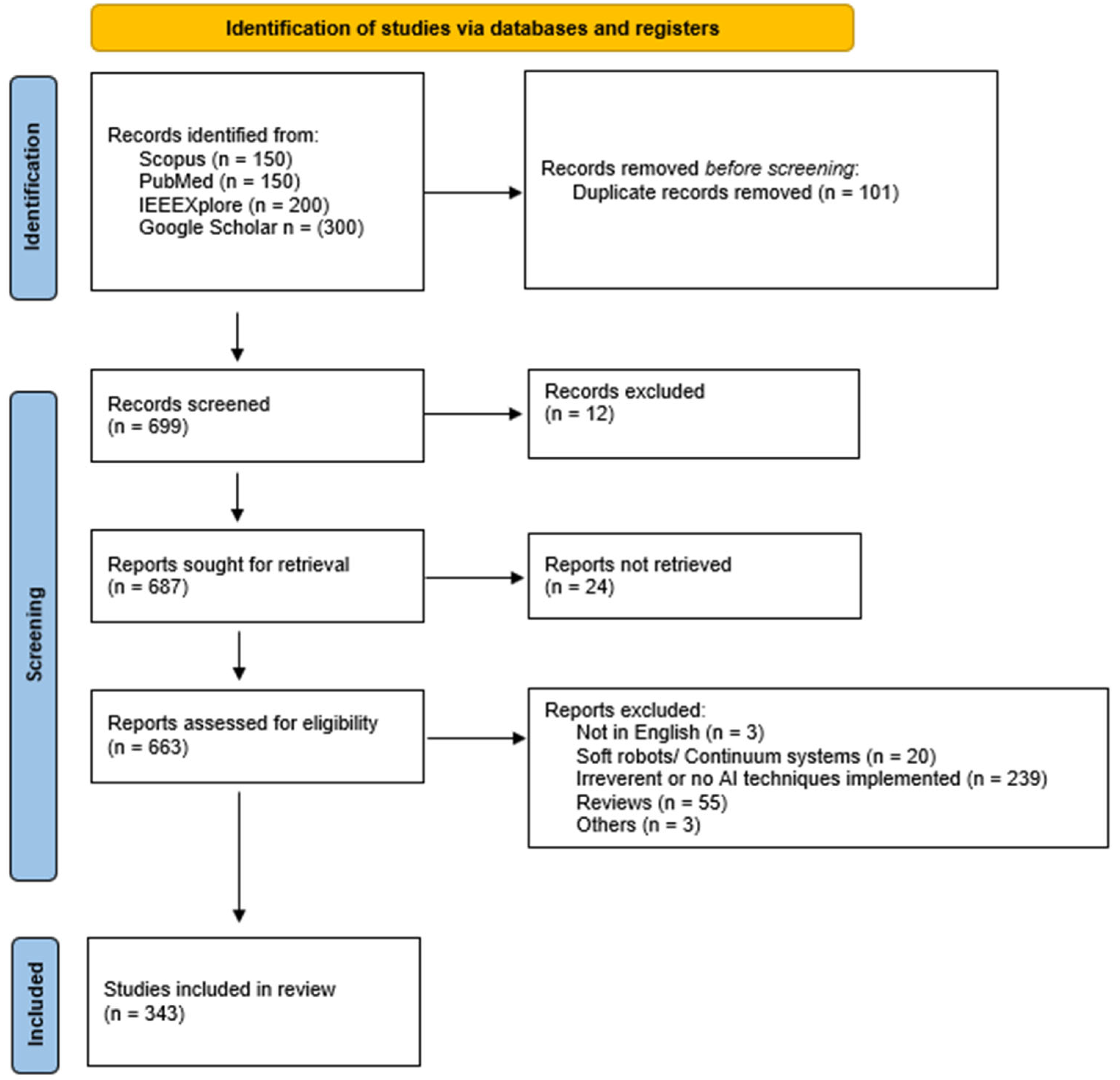
Figure 2.
The distribution of publications in AI-based robot manipulator control from 2015 to 2015.
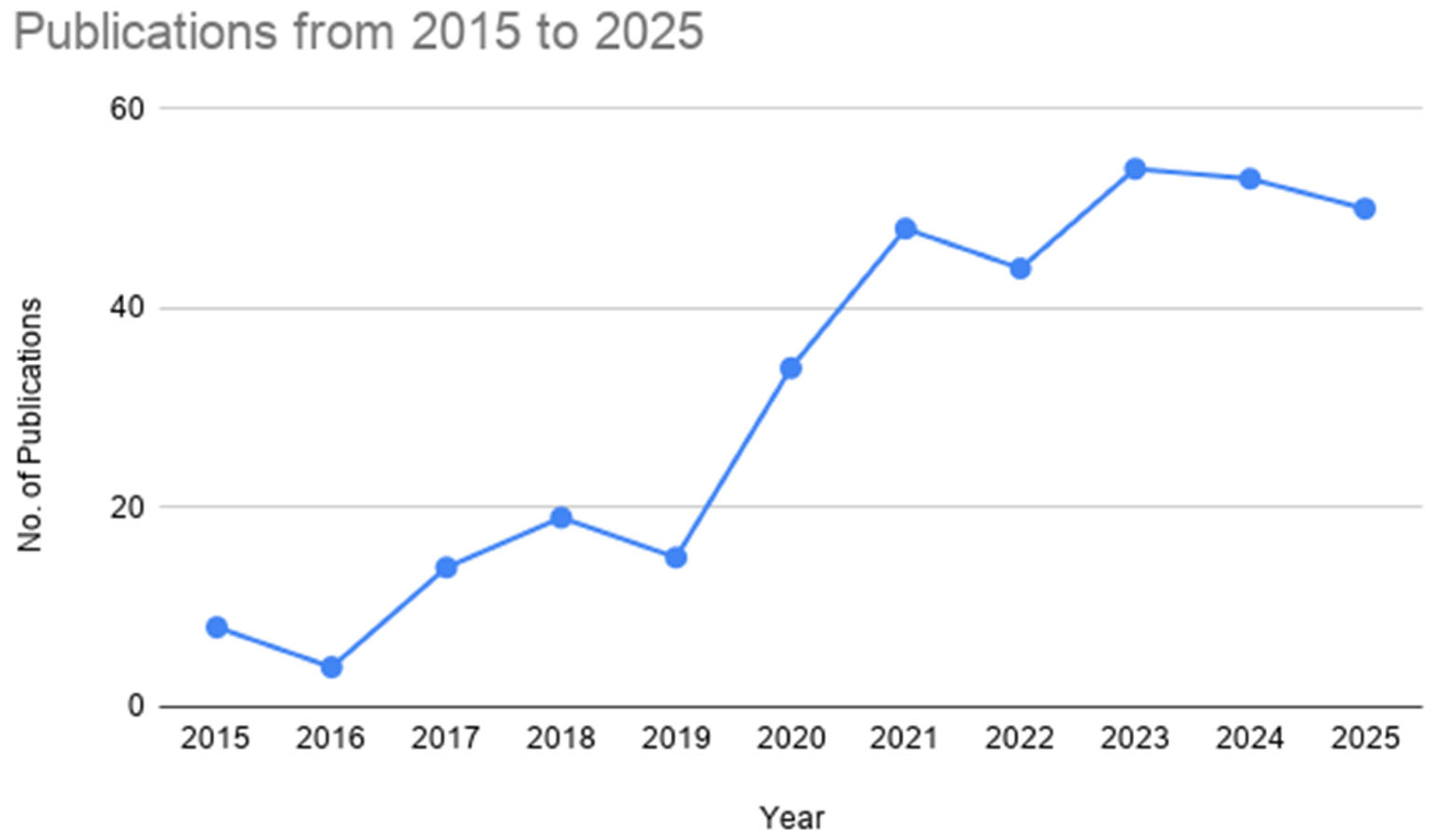
Figure 3.
The distribution of publications in AI-based robot manipulator control by functional roles.
Figure 3.
The distribution of publications in AI-based robot manipulator control by functional roles.
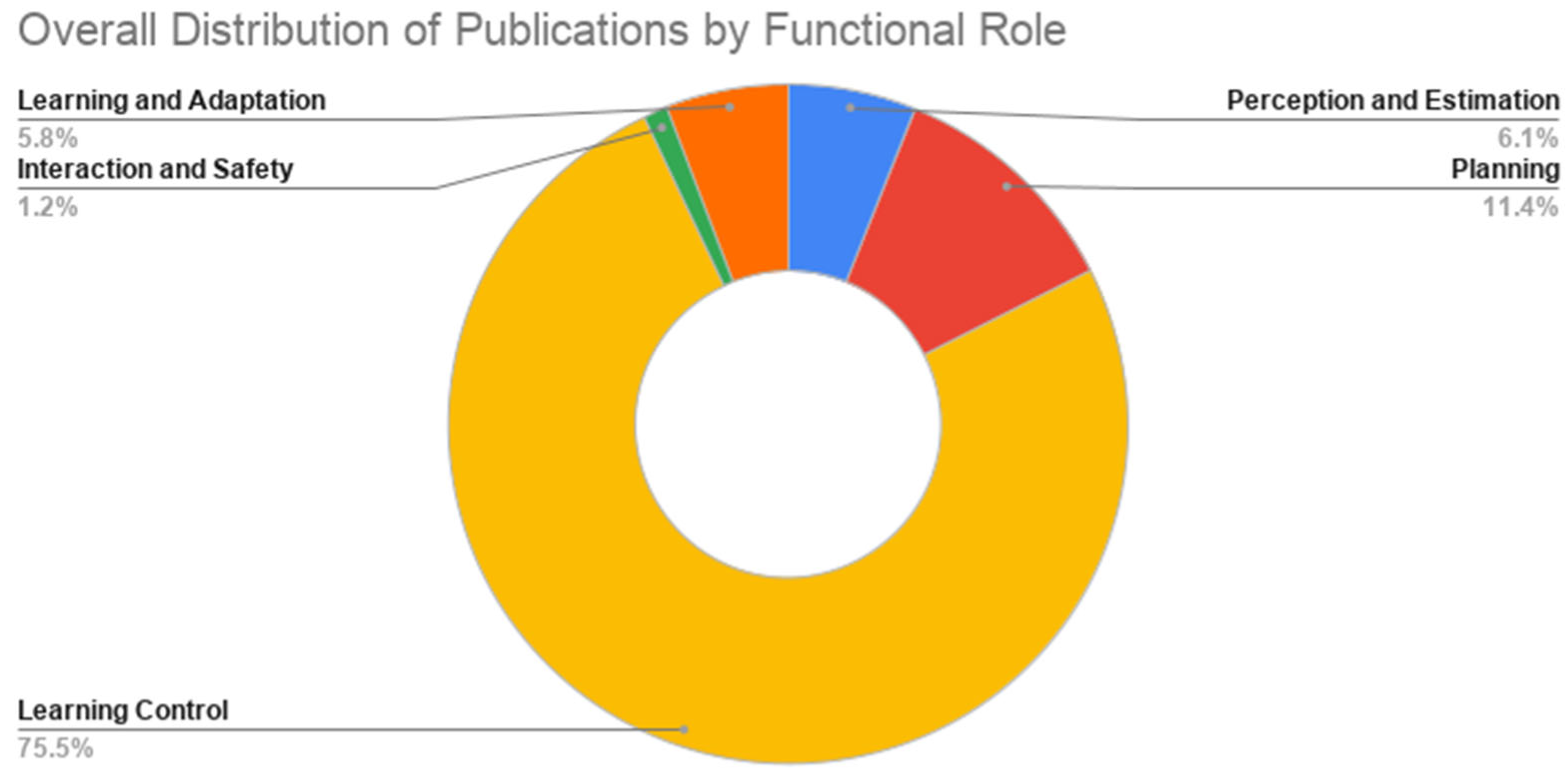
Figure 4.
The distribution of publications across five categories from 2015 to 2015.
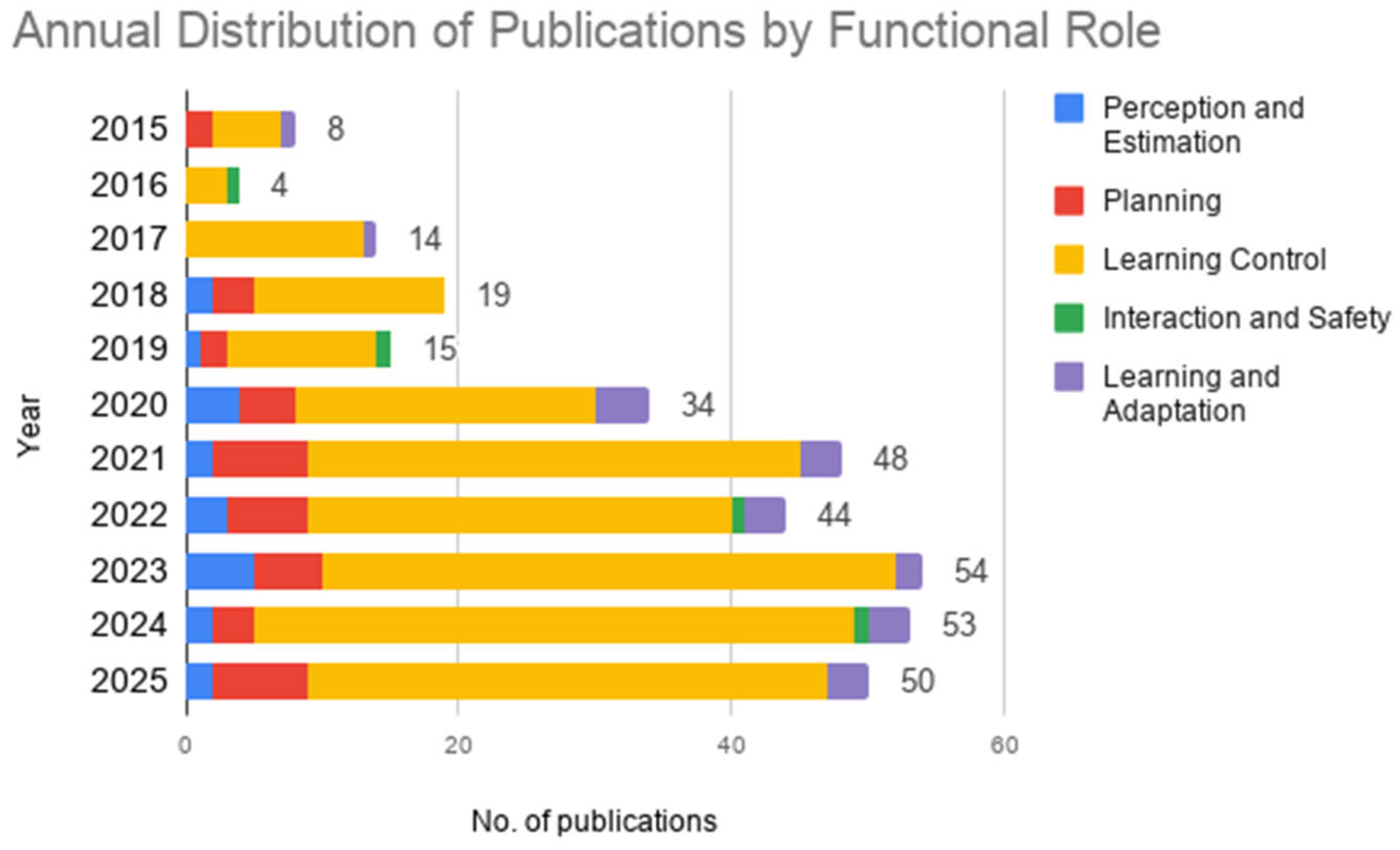
Figure 5.
Distribution of the top 20 most employed AI methods. (SAC: Soft Actor-Critic; PPO: Proximal Policy Optimization; DDPG: Deep Deterministic Policy Gradient; RL: Reinforcement Learning; DQN: Deep Q-Network; NN: Neural Networks).
Figure 5.
Distribution of the top 20 most employed AI methods. (SAC: Soft Actor-Critic; PPO: Proximal Policy Optimization; DDPG: Deep Deterministic Policy Gradient; RL: Reinforcement Learning; DQN: Deep Q-Network; NN: Neural Networks).
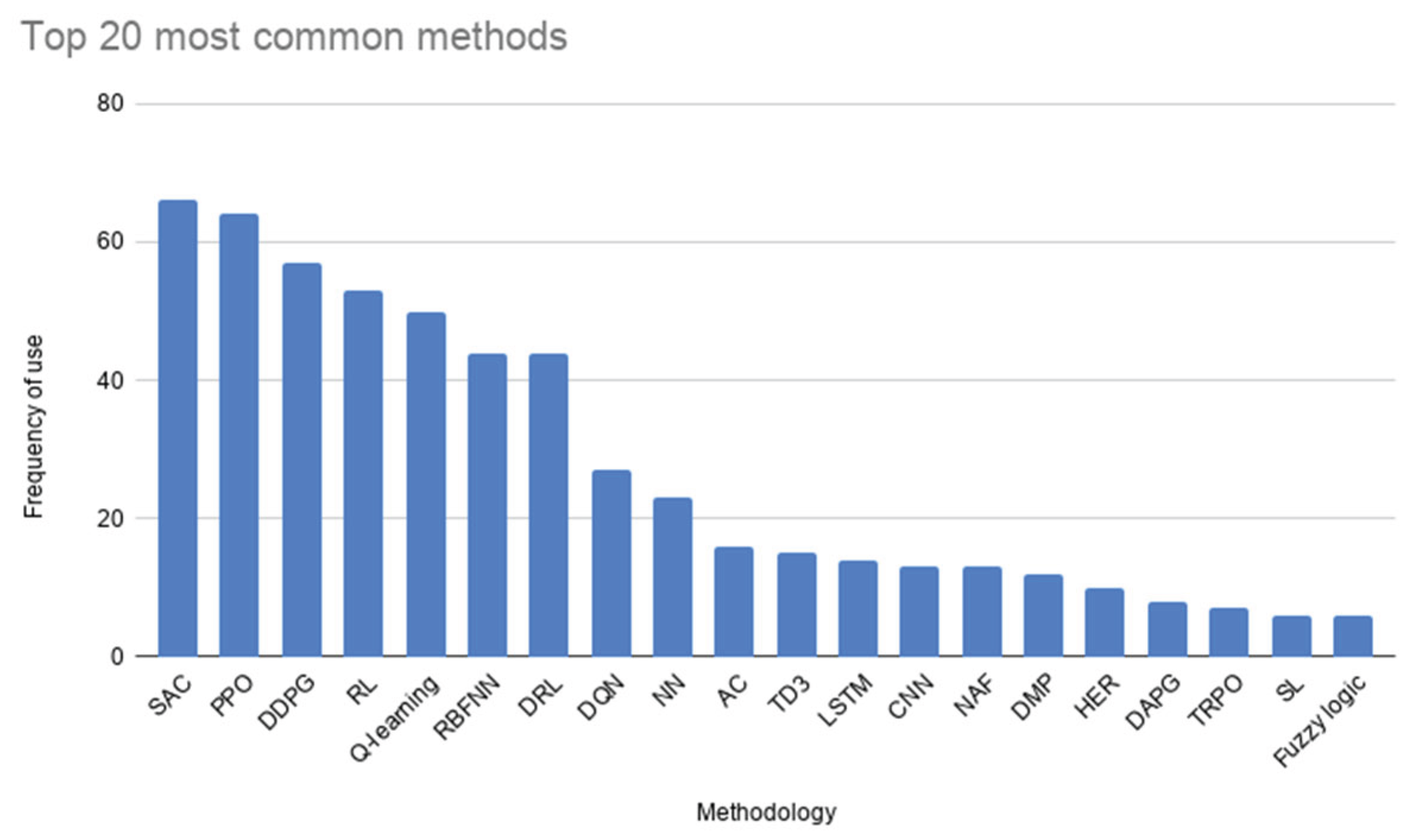
Figure 7.
The distribution of evaluation methods among publications.
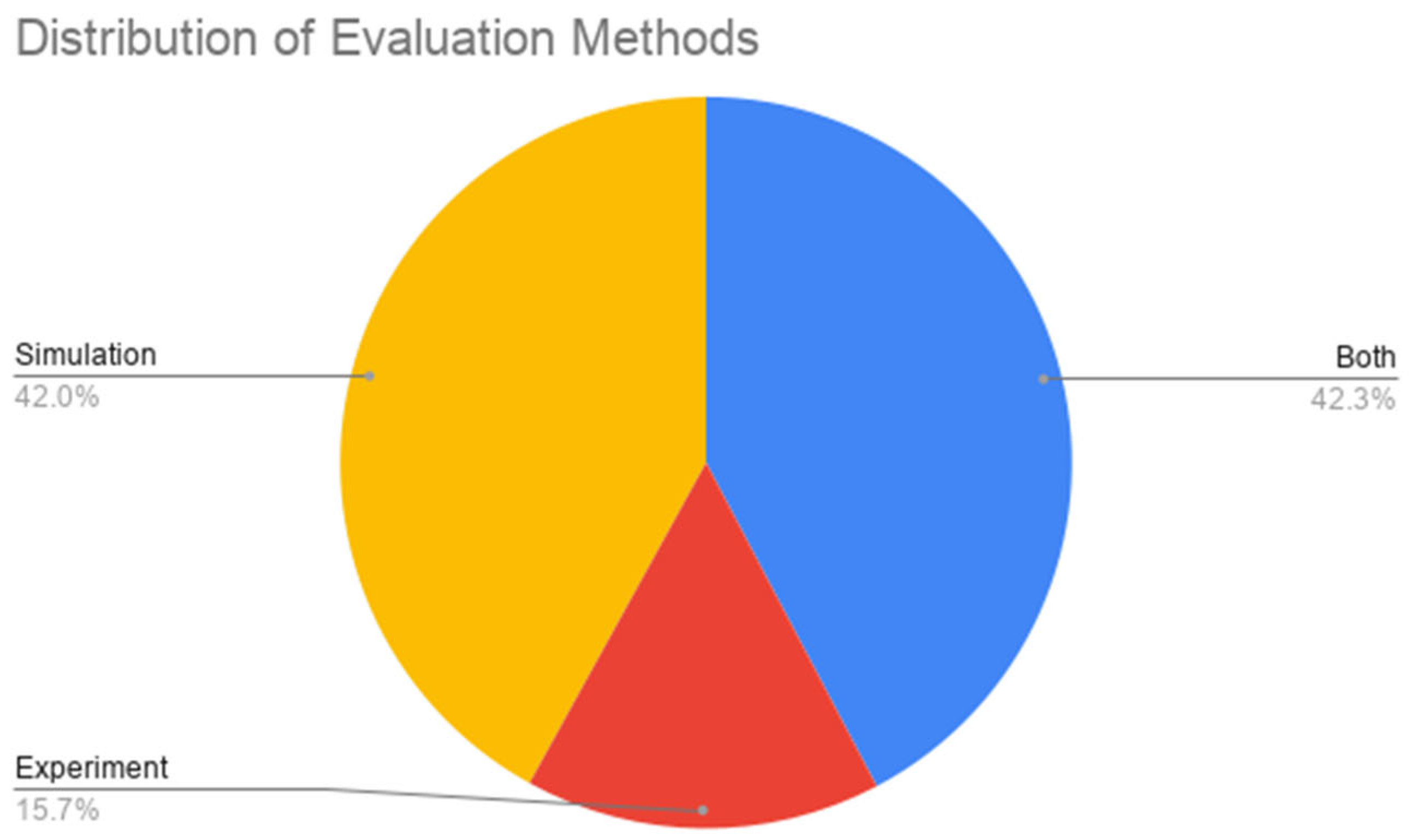

Table 1.
Overview of existing reviews and the scope of this present review.
| Review ID | Summary | Contribution |
|---|---|---|
| Mareco et al. [21] | This review analyzes the use of AI enabled methods in control systems, focusing on control-oriented techniques such as fuzzy logic, neuro fuzzy control, neural networks, and swarm or evolutionary optimization. The analysis is mainly qualitative and centered on methodological characteristics within specific application settings. | Provides a structured mapping of 188 studies across renewable energy, robotics, agriculture, and industrial processes, highlighting how AI has been adopted in application specific control problems. Its value lies in identifying major methodological trends, limitations, and research gaps in intelligent control design. |
| Nahavandi et al. [22] | This review evaluates machine learning for robotic manipulators, covering deep learning, RL, and imitation learning. It analyzes sim-to-real transfer and practical deployment across industrial, medical, and space sectors. | Provides a qualitative synthesis of machine learning strategies in robotic manipulation, utilizing algorithmic complexity estimates and tabulated comparisons instead of formal statistical analysis. It offers researchers a structured framework for evaluating the computational trade-offs and practical requirements of various control architectures across diverse operational domains. |
| Waseem et al. [17] | This qualitative review surveys the evolution of robotic manipulator control technologies from 2016 to 2024, spanning methods from classical PID and linear models to intelligent AI, hybrid, and quantum-inspired frameworks. No statistical analysis was performed; the study taxonomizes these strategies by their underlying architecture and optimization logic to highlight current operational trend | Provides a foundational mapping of control theories against emerging paradigms such as digital twins, federated learning, and blockchain to address persistent challenges in non-linear dynamics and real-time performance. It informs future research directions by identifying critical gaps in multi-agent system integration and scalable control for unstructured environments. |
| Our review | This review analyzes 343 studies on AI-based robot manipulator control published between 2015 and 2025, focusing on research trends across functional roles, application domains, robot types, and evaluation approaches. It highlights major patterns in the distribution and development of AI methods within the manipulator control pipeline. | Provides the first structured quantitative mapping of AI based robot manipulator control over the past decade, together with a unified taxonomy of functional AI roles in the control pipeline. The review identifies major research concentrations and persistent gaps, providing a data driven reference for future development in underrepresented control functions. |
Table 2.
Databases and boolean search strings.
| Databases | Search Strings |
|---|---|
| IEEEXplore, PubMed, Scopus | ("robot manipulator" OR "robotic arm" OR "industrial robot" OR manipulator) AND (AI OR "artificial intelligence" OR "machine learning" OR "deep learning" OR "reinforcement learning") AND ("control" OR "adaptive control" OR "intelligent control" OR "learning-based control") |
| Google Scholar | ("robot manipulator" OR "robotic arm" OR "industrial robot" OR manipulator) AND (AI OR "artificial intelligence" OR "machine learning" OR "deep learning" OR "reinforcement learning") AND ("control" OR "adaptive control" OR "intelligent control" OR "learning-based control") "robot manipulator" AND ("reinforcement learning" OR DRL) AND ("trajectory optimization" OR "motion planning" OR control) "robot manipulator" OR "robotic arm" OR "robotic manipulation" AND ("reinforcement learning" OR DRL OR "deep reinforcement learning") AND (grasping OR "dexterous manipulation" OR "sim-to-real" OR sim2real) |
Table 3.
AI-based control techniques in robot manipulator control from 2015–2025.
| Functional Role | Authors | Year | Robot Types | Application Area | Control Technique | Methods | Learning Paradigm | Evaluation Method | |||||||
|---|---|---|---|---|---|---|---|---|---|---|---|---|---|---|---|
| Perception and Estimation | Bertono et al. [24] | 2019 | Serial | NS | Learning-based pose estimation | CNN | Supervised | Experiment | |||||||
| Catalán et al. [25] | 2023 | Exoskeleton | Rehabilitation | Vision-guided learning-based | EEG/EOG classification, RGB-D object pose estimation, DMP | Supervised | Experiment | ||||||||
| Chen et al. [26] | 2023 | Serial | Manufacturing | Learning-based grasp planning | Min-Pnet, 1D CNN | Supervised | Both | ||||||||
| Chen et al. [27] | 2018 | Serial | Manufacturing | Vision-guided learning-based | Faster R-CNN | Supervised | Experiment | ||||||||
| Ghiasvand et al. [28] | 2024 | Serial | Aerospace | DNN-based visual servoing | DNN | Supervised | Both | ||||||||
| Gul et al.[29] | 2023 | Serial | Rehabilitation | Learning-based | KNN, LSTM, SVM, DT | Supervised | Experiment | ||||||||
| Heris et al. [30] | 2022 | Magnetic | Healthcare | Learning-based magnetic field estimation | ANN, Simulated Annealing | Supervised | Both | ||||||||
| Kirda et al. [31] | 2025 | Serial | Manufacturing | Vision-guided | YOLOv5 | Supervised | Experiment | ||||||||
| Kondratenko et al. [32] | 2022 | Mobile | NS | ML-based sensor processing | Fuzzy logic, neuro-fuzzy, YOLOv2, ResNet34 | Supervised | Experiment | ||||||||
| Kružić et al. [33] | 2020 | Serial | NS | Sensorless force estimation for interaction control | MLP, 1D CNN, LSTM | Supervised | Experiment | ||||||||
| Liu et al. [34] | 2021 | Mobile | Garbage Management | Learning-based | YOLACT, GPD | Supervised | Experiment | ||||||||
| Liu et al. [35] | 2022 | Serial | Manufacturing | Vision-guided DRL-based | DQN, FCN (DenseNet-121) | RL | Both | ||||||||
| Luo et al. [36] | 2020 | Industrial | Manufacturing | Vision-guided learning-based | YOLO-v2-ROI | Supervised | Experiment | ||||||||
| Marchionna et al. [37] | 2023 | Serial | Dexterity Game | Vision-guided visual servoing | YOLACT++ | Supervised | Experiment | ||||||||
| Martin et al. [38] | 2018 | Serial | Manufacturing | Pose estimation-based | OpenPose, HMR | Supervised | Experiment | ||||||||
| Panasiuk [39] | 2025 | NS | Manufacturing | Vision-guided positioning | YOLOv8 | Supervised | Experiment | ||||||||
| Piltan [40] | 2020 | Serial | Multiple | Neuro-fuzzy-based fault-tolerant | SVM, NN, Fuzzy logic | Supervised | Experiment | ||||||||
| Pitan et al. [41] | 2020 | Serial | Multiple | Adaptive fuzzy fault-tolerant | DT, TSK fuzzy | Supervised | Experiment | ||||||||
| Sacchi et al. [42] | 2023 | Serial | NS | DRL-based fault estimation | TD3 | RL | Simulation | ||||||||
| Shukla et al. [43] | 2021 | Serial | Multiple | Learning-based grasp pose estimation | GA, DQN | RL, Supervised, Evolutionary | Experiment | ||||||||
| Wang et al. [44] | 2024 | Myoelectric | Rehabilitation | sEMG gesture recognition | MS-CLSTM, CNN-LSTM | Supervised | Experiment | ||||||||
| Planning | Ahn et al. [45] | 2025 | Serial | Logistics | Learning-based planning | PPO, CMPNet | RL, IL | Both | |||||||
| Ak et al. [46] | 2022 | Serial | Rehabilitation | Learning-based | GoogLeNet | Supervised | Experiment | ||||||||
| Andersen et al. [47] | 2015 | Serial | Manufacturing | Learning-based predictive | NN, RT, GP | Supervised | Experiment | ||||||||
| Andriyanov [48] | 2023 | Serial | Agriculture | RL-based planning | Q-learning, YOLOv5 | RL, Supervised | Both | ||||||||
| Azizi [49] | 2020 | Serial | Manufacturing | Learning-based optimization | ANN, GA | Supervised | Simulation | ||||||||
| Batzianouis et al. [50] | 2021 | Serial | Rehabilitation | IRL-based planning | GP IRL, LDA | RL, Supervised | Experiment | ||||||||
| Bucinskas et al. [51] | 2022 | Serial | Manufacturing | DRL-based | DQN | RL | Experiment | ||||||||
| Chen et al. [52] | 2023 | Serial | Heatlhcare | DRL-based planning | PPO, DNN | RL, Supervised | Both | ||||||||
| Cheng et al. [53] | 2024 | Humanoid | NS | Learning-based planning | CNN | Supervised | Both | ||||||||
| Chi et al. [54] | 2018 | Platform | Healthcare | RL-based | PI2, DMP | RL, IL | Both | ||||||||
| Ebert et al. [55] | 2018 | Serial | NS | Learning-based | Video prediction model, Registration network, Meta-learned classifier | Self-supervised | Both | ||||||||
| Emamzadeh et al. [56] | 2015 | Serial | NS | Fuzzy-based hierarchical | TSK fuzzy predictor | Supervised | Simulation | ||||||||
| Jaquier et al. [57] | 2021 | Humanoid | NS | Learning-based | Tensor-based GMM, GMR | IL, Unsupervised | Both | ||||||||
| Karimi et al. [58] | 2022 | Redundant Serial | NS | DRL-based | DQN | RL | Simulation | ||||||||
| Kim et al. [59] | 2020 | Serial | Manufacturing | DRL-based planning | TD3, HER | RL | Both | ||||||||
| Kwon et al. [60] | 2020 | Robotic Hand | Rehabilitation | Learning-based | CNN | Supervised | Experiment | ||||||||
| Lee et al. [61] | 2025 | serial | Rehabilitation | Copilot-assisted | EEGNet, PPO, Grounding DINO | RL | Experiment | ||||||||
| Liu et al. [62] | 2022 | Serial | Manufacturing | Learning-based | TAC-CA, ANN | RL, Hybrid | Both | ||||||||
| Liu et al. [63] | 2021 | Serial | Manufacturing | RL-based | AC, Double Q-Learning | RL | Both | ||||||||
| Liu et al. [64] | 2021 | Serial | NS | RL-based | RL, Q-learning | RL, Hybrid | Both | ||||||||
| Li et al. [65] | 2024 | Redundant Serial | Manufacturing | DRL-based planning | AC DRL, ANN | RL, Hybrid | Both | ||||||||
| Li et al. [66] | 2023 | Serial | Manufacturing | DRL-based | DQN, Consensus-based training | RL | Both | ||||||||
| Li et al. [67] | 2023 | Serial | NS | DRL-based | DRL, ResNet-50 | RL, Self-supervised | Both | ||||||||
| Parag et al. [68] | 2025 | Serial | NS | Learning-based | Sobolev regression, NN | Hybrid | Simulation | ||||||||
| Parák et al. [69] | 2024 | Serial | Manufacturing | DRL-based | DDPG, TD3, Soft AC | RL | Simulation | ||||||||
| Prianto et al. [70] | 2021 | Serial | Manufacturing | Learning-based planning | Soft AC, HER | RL, Hybrid | Both | ||||||||
| Sacchi et al. [71] | 2021 | Serial | Manufacturing | DRL-based | DQN, Q-learning | RL | Simulation | ||||||||
| Solowjow et al. [72] | 2020 | Serial | Multiple | Learning-based grasping planning | MobileNet-SSD, FC-GQ-CNN | Supervised | Both | ||||||||
| Sunwoo et al. [73] | 2021 | Serial | Manufacturing | DRL-based | D3QN, PER | RL | Simulation | ||||||||
| Wang et al. [74] | 2022 | Serial | Manufacturing | Hybrid imitation-RL | HGCIL, DMP, Soft AC | RL, IL, Hybrid | Both | ||||||||
| Wang et al. [75] | 2025 | Serial | Manufacturing | DRL-based trajectory planning | DDPG, Autoencoder | RL, Unsupervised | Both | ||||||||
| Wang et al. [76] | 2023 | Serial | Manufacturing | DRL-based planning | DDQN, Q-learning | RL | Simulation | ||||||||
| Wilson et al. [77] | 2025 | NS | Rehabilitation | DRL-based | DRL-ANN, Improved ResNet, MSBO | RL, Supervised | Both | ||||||||
| Wong et al. [78] | 2019 | Serial | Manufacturing | ACO-based planning | ACO, k-means clusterin | Unsupervised | Both | ||||||||
| Yang et al. [79] | 2019 | Serial | NS | Learning-based | DMP, GMM, GMR, RBFNN | IL, Supervised, Hybrid | Experiment | ||||||||
| Zeng et al. [79] | 2018 | Serial | NS | DRL-based with MP | Q-learning, FCN, DenseNet | RL, Self-supervised | Both | ||||||||
| Zhang [80] | 2025 | Serial | NS | Hierarchical DRL-based | TCN-attention, dDRL, RL parameter adaptatio | RL | Both | ||||||||
| Zhao et al. [81] | 2025 | serial | Multiple | DRL-based planning | M2ACD | Supervised | Both | ||||||||
| Zhong et al. [82] | 2022 | serial | Manufacturing | DRL-based | DDPG | RL, Hybrid | Simulation | ||||||||
| Learning Control | Ahmed et al. [83] | 2022 | Serial | NS | Adaptive sliding mode | Adaptive Law | - | Simulation | |||||||
| Aiello [84] | 2020 | Serial | Service | DRL-based | DDPG, HER | RL | Simulation | ||||||||
| Al-Shanoon et al. [85] | 2021 | Serial | NS | DRL-based | DRL, Q-learning, Fully convolutional network | RL, Self-supervised | Both | ||||||||
| Alhousani et al. [86] | 2023 | Serial | NS | Geometric RL-based | Geometric RL, Soft AC, PPO, PoWER, CMA-ES | RL | Both | ||||||||
| Aljalbout et al. [87] | 2024 | Serial | NS | RL-based | PPO, RL | RL | Both | ||||||||
| Alles et al. [88] | 2022 | Serial | Manufacturing | DRL-based | Soft AC, HER | RL | Both | ||||||||
| Amaya et al. [89] | 2023 | Redundant Serial | Manufacturing | Neuromorphic RL-based | Soft AC, SNN | RL | Simulation | ||||||||
| An et al. [90] | 2024 | Serial | Rahabilitation | ADP-based optima | ADP, Critic NN, RBFNN | RL | Experiment | ||||||||
| Avhad et al. [91] | 2024 | Serial | NS | Adaptive DRL-based | DRL, Model ensembles, Q-networks | RL | Both | ||||||||
| Azimirad et al. [92] | 2024 | Mobile Serial | NS | Learning-based | SNN, RL, STDP | RL | Simulation | ||||||||
| Añazco et al. [93] | 2021 | Anthropomorphic Hand | Service | DRL-based | DRL, 3D CNN | RL, Supervised | Simulation | ||||||||
| Baek et al. [94] | 2022 | Serial | NS | DRL-based | Soft AC | RL | Simulation | ||||||||
| Barnoy et al. [95] | 2022 | Mobile magnetic needle | Healthcare | Learning-based | TD3, NN dynamics model | RL, Supervised | Both | ||||||||
| Bashabsheh [96] | 2025 | Serial | NS | RL-based | Policy-gradient RL | RL | Simulation | ||||||||
| Bejar et al. [97] | 2021 | Serial | NS | DRL-based | DDPG | RL | Simulation | ||||||||
| Blaise et al. [98] | 2023 | Serial | Aerospace | DRL-based | DDPG | RL | Simulation | ||||||||
| Brito et al. [99]3/28/2026 4:13:00 AM | 2020 | Serial | Manufacturing | RL-based | AC, LSTM | RL, Supervised | Experiment | ||||||||
| Calderón-Cordova et al. [100] | 2024 | Serial | Industrial | DRL-based | DDPG, DRL | RL | Simulation | ||||||||
| Cao et al. [101] | 2023 | Serial | NS | Learning-based | RL, AC, RBFNN | RL | Both | ||||||||
| Carron et al. [102] | 2019 | Compliant Serial | NS | Learning-based model predictiv | GP | Supervised | Experiment | ||||||||
| Castelli et al. [103] | 2017 | Serial | Manufacturing | Learning-based visual servoing | GMM, GMR | Supervised | Experiment | ||||||||
| Chen et al. [104] | 2018 | Parallel | NS | Neural-dynamics-based | Zeroing neural-dynamics, ZND model | - | Simulation | ||||||||
| Chen [105] | 2021 | Dexterous Hand | Multiple | Learning-based | DQN, PPO, Soft AC, DAPG | RL, IL, Self-supervised | Simulation | ||||||||
| Chen et al. [106] | 2022 | Redundant Serial | NS | DRL-based | Soft AC, DDPG | RL | Simulation | ||||||||
| Chen et al. [107] | 2016 | Serial | NS | Robust adaptive compensation | Adaptive fuzzy | Hybrid | Both | ||||||||
| Chen et al. [108] | 2022 | Redundant Serial | NS | DRL-based | Soft AC, Prioritized Experience Replay | RL | Simulation | ||||||||
| Chen et al. [109] | 2021 | Redundant Serial | Manufacturing | DRL-based | Soft AC | RL | Both | ||||||||
| Chen et al. [110] | 2021 | Serial | Manufacturing | Learning-based | multi-layer NN | Supervised | Both | ||||||||
| Chen [111] | 2025 | Serial | NS | DRL-based | DDPG | RL | Simulation | ||||||||
| Chen et al. [112] | 2023 | Serial | NS | Vision-guided DRL-based | YOLOv3, Soft AC | RL | Both | ||||||||
| Chen et al. [113] | 2021 | Dexterous Hand | NS | RL-based | PPO, TRPO, Soft AC, MAPPO, HAPPO | RL | Simulation | ||||||||
| Chen et al. [114] | 2024 | Dexterous Hand | NS | Learning-based | PPO, Soft AC, TRPO, DAPG, HAPPO, HATRPO, MAPPO, BCQ, TD3+BC, IQL, ProMP | RL, IL | Simulation | ||||||||
| Chen et al. [115] | 2023 | Serial | NS | DRL-based | Soft AC, MLP | RL, IL | Both | ||||||||
| Chen et al. [116] | 2024 | Redundant Serial | NS | DRL-based | DDPG, TD3, Soft AC | RL | Both | ||||||||
| Christen et al. [117] | 2019 | Dexterous Hand | NS | DRL-based | DDPG, DRL | RL, IL | Simulation | ||||||||
| Chu et al. [118] | 2020 | Redundant Serial | NS | DRL-based | DDPG, D4PG | RL | Simulation | ||||||||
| Cotrim et al. [119] | 2021 | Serial | Manufacturing | RL-based | REINFORCE, DQN | RL | Simulation | ||||||||
| Cui et al. [120] | 2025 | Serial | Multiple | DRL-based | Soft AC | RL | Both | ||||||||
| Cutler et al. [121] | 2024 | Serial | NS | DRL-based | TD3, Soft AC, DDPG | RL | Experiment | ||||||||
| Ding et al. [122] | 2021 | Serial | NS | DRL-based | TD3 | RL | Both | ||||||||
| Dong [123] | 2024 | NS | NS | RL-based adaptive | RL, PG | RL | Both | ||||||||
| Dong et al. [124] | 2023 | Redundant Serial | NS | DRL-based | DDPG | RL | Simulation | ||||||||
| Ducaju et al. [125] | 2024 | Redundant Serial | Manufacturing | Iterative learning-based | Iterative Learning Control | - | Experiment | ||||||||
| Du et al. [126] | 2017 | Serial with RCM | Healthcare | Fuzzy RL-based admittance | Fuzzy Sarsa(λ), RL | RL | Experiment | ||||||||
| Ehrlich et al. [127] | 2022 | Serial | Rehabilitation | Neuromorphic learning-based | NEF, SNN, PES | Supervised | Both | ||||||||
| Enayati et al. [128] | 2024 | Serial | NS | Learning-based | PPO, RL | RL | Both | ||||||||
| Fareh et al. [129] | 2025 | Serial | NS | DRL-based | DDPG, PINNs | RL | Both | ||||||||
| Filho et al. [130] | 2025 | Serial | NS | Multi-agent DRL-based | Multi DQN, DQN | RL | Both | ||||||||
| Franceschetti et al. [131] | 2020 | Serial | NS | DRL-based | TRPO, DQN-NAF | RL | Both | ||||||||
| Fu et al. [132] | 2022 | Quadruped | NS | RL-based whole-body | PPO, RL | RL | Both | ||||||||
| Ganie et al. [133] | 2023 | Serial | NS | Learning-based | DNN, Elastic weight consolidation | Hybrid | Simulation | ||||||||
| Gao [134] | 2022 | Serial | NS | DRL-based | DDPG | RL | Both | ||||||||
| Garcia-Hernando et al. [135] | 2020 | Dexterous Hand | NS | Residual RL-based | PPO, Adversarial IL | RL, IL, Hybrid | Simulation | ||||||||
| Gawali et al. [136] | 2023 | NS | NS | Learning-based | TERL, RNN, RL | RL | Simulation | ||||||||
| Ghediri et al. [137] | 2022 | Serial | NS | DRL-based | DDPG, DRL | RL | Simulation | ||||||||
| Grandesso [138] | 2023 | Redundant Serial | NS | RL-based | AC RL, DDPG variant | RL | Simulation | ||||||||
| Gupta et al. [139] | 2015 | Serial | Manufacturing | Neuro-fuzzy-based | ANFIS | Hybrid | Simulation | ||||||||
| Gu et al. [140] | 2017 | Serial | NS | DRL-based | NAF, DDPG | RL | Both | ||||||||
| Haiderbhai et al. [141] | 2025 | Serial | Healthcare | Vision-guided learning-based | PPO, RL | RL | Both | ||||||||
| Hardman et al. [142] | 2022 | Serial | NS | DRL-based | DDPG | RL | Experiment | ||||||||
| Hazem et al. [143] | 2025 | Serial | NS | DRL-based | DDPG, LC-DDPG, TD3-ADX | RL | Simulation | ||||||||
| Heaton et al. [144] | 2023 | Redundant Serial | NS | DRL-based | Soft AC | RL | Simulation | ||||||||
| He et al. [145] | 2017 | Serial | NS | Learning-based | RBFNN | - | Simulation | ||||||||
| He et al. [146] | 2021 | Serial | NS | RL-based | AC, RBFNN | RL | Both | ||||||||
| He et al. [147] | 2018 | Flexible-joint Serial | Manufacturing | Learning-based | NN | Hybrid | Both | ||||||||
| Homsi et al. [148] | 2025 | Serial | Logistics | DRL-based | DQN, DQN variants, Self-attention | RL | Simulation | ||||||||
| Hosny et al. [149] | 2023 | Serial | Manufacturing | Learning-based | RL, AC, Value iteration | RL | Simulation | ||||||||
| Huang et al. [150] | 2024 | Serial | Manufacturing | DRL-based | Multi-agent TD3, H-memory | RL | Both | ||||||||
| Hu et al. [150] | 2024 | Serial | NS | DRL-based | Soft AC, GAIL, LSTM | RL, IL | Simulation | ||||||||
| Hu et al. [151] | 2024 | Serial | NS | DRL-based | Soft AC, ERND | RL | Simulation | ||||||||
| Hu et al. [152] | 2024 | Serial | NS | DRL-based | Soft AC, HER | RL | Simulation | ||||||||
| Hu et al. [153] | 2018 | Serial | NS | RL NN | RL, AC NN | RL | Simulation | ||||||||
| Hu et al. [154] | 2020 | Serial | NS | MBRL-based | RL, kernel methods | RL | Simulation | ||||||||
| Hu et al. [155] | 2023 | Dexterous Hand | NS | Learning-based | IRL, RL, Graph convolutional network | RL | Both | ||||||||
| Hwang et al. [156] | 2017 | Serial | NS | Neuro-fuzzy-based | Interval type-2 fuzzy logic | - | Simulation | ||||||||
| Incremona et al. [157] | 2021 | Serial | Manufacturing | DRL-based | DQN, NAF | RL | Both | ||||||||
| Iqdymat et al. [158] | 2025 | Serial | Logistics | DRL-based | DDPG, AC | RL | Both | ||||||||
| Iriondo et al. [159] | 2019 | Mobile | Logistics | DRL-based | DDPG, PPO | RL | Simulation | ||||||||
| Iwasaki et al. [160] | 2021 | Inverted Pendulum | NS | DRL-based | DDPG | RL | Simulation | ||||||||
| James et al. [161] | 2016 | Serial | NS | DRL-based | DQN | RL | Both | ||||||||
| Jeong et al. [162] | 2020 | Serial | Rehabilitation | Learning-based | MDCBN, CNN-BiLSTM | Supervised | Experiment | ||||||||
| Jiang et al. [163] | 2023 | Serial | Manufacturing | DRL-based | PPO, GAIL, Transformer | RL, IL | Both | ||||||||
| Jiang et al. [164] | 2024 | Serial | NS | Fuzzy RL-based optimal | fuzzy logic system, Integral RL, Value iteration | RL | Experiment | ||||||||
| Jiang et al. [165] | 2022 | Serial | Service | Vision-guided DRL-based | Asym-DDPG, Position-CycleGAN, Supervised learning | RL, Supervised, Hybrid | Both | ||||||||
| Jin et al. [166] | 2024 | Redundant Serial | NS | Learning-based | Echo State Network, Kalman Filter | Supervised | Both | ||||||||
| Joshi et al. [167] | 2020 | Hybrid | NS | DRL-based | DDQN, Grasp-Q-Network | RL, Off-policy | Both | ||||||||
| Josifovski et al. [168] | 2022 | Serial | NS | Learning-based | PPO | RL | Both | ||||||||
| Kalashnikov et al. [169] | 2018 | Serial | NS | Vision-guided DRL-based | QT-Opt, DQN, CEM | RL, Self-supervised | Both | ||||||||
| Kamali et al. [170] | 2020 | Serial | Industrial | DRL-based | PPO, DRL | RL | Both | ||||||||
| Kang et al. [171] | 2021 | Serial | NS | NN-based MPC | RBFNN, AC NN | RL, Hybrid | Simulation | ||||||||
| Kankashvar et al. [172] | 2015 | Parallel | NS | BBO-based PID | modified BBO | - | Simulation | ||||||||
| Kataoka et al. [173] | 2022 | Serial | NS | Learning-based | PPO, MLP | RL | Both | ||||||||
| Katyal et al. [174] | 2017 | Serial | NS | DRL-based | DRL, DQN | RL | Simulation | ||||||||
| Kaur et al. [175] | 2025 | Serial | Industrial | DRL-based | DRL, DQN | RL | Simulation | ||||||||
| Khan et al. [176] | 2020 | Redundant Serial | NS | Metaheuristic-based | BAORNN, RNN, Beetle antennae olfactory | - | Simulation | ||||||||
| Khodamipour et al. [177] | 2021 | Serial | NS | RL-based adaptive | RL, Fourier series expansion | RL | Simulation | ||||||||
| Kilinc et al. [178] | 2022 | Dexterous Hand | NS | RL-based | DDPG, HER | RL | Simulation | ||||||||
| Kim et al. [179] | 2024 | Anthropomorphic Gripper | NS | Learning-based | PPO | RL | Both | ||||||||
| Kuang [180] | 2023 | Anthropomorphic Gripper | NS | Learning-based | DDPG+HER, GAIL, GDP, PL-CGS, Goal-SGAIL | RL, IL | Simulation | ||||||||
| Kumar et al. [181] | 2017 | Serial | Multiple | GA-optimized fuzzy | GA, Fuzzy logic, Neuro-fuzzy | Unsupervised, Hybrid | Simulation | ||||||||
| Kumar et al. [182] | 2021 | Redundant Serial | NS | DRL-based | PPO, Deep neural policy | RL | Both | ||||||||
| Kunal et al. [183] | 2025 | Serial | Manufacturing | DRL-based | PPO, DNN | RL | Both | ||||||||
| Kurrek et al. [184] | 2020 | Serial | Manufacturing | DRL-based | Q-learning, DQN, PPO | RL | Simulation | ||||||||
| Lahmann et al. [185] | 2025 | Serial | NS | DRL-based | PPO | RL | Simulation | ||||||||
| Lee et al. [186] | 2022 | Redundant Serial | NS | Learning-based | RL, ANN | RL, Supervised | Simulation | ||||||||
| Lee et al. [187] | 2020 | Serial | NS | DRL-based | HER, DDPG | RL | Simulation | ||||||||
| Lee et al. [188] | 2024 | Serial | Rehabilitation | Learning-based | CNN-KF, PPO, Grounding DINO | RL, Supervised | Experiment | ||||||||
| Liang et al. [189] | 2024 | Serial | NS | RL-based adaptive | AC, NN | RL | Both | ||||||||
| Lin et al. [190] | 2025 | Humanoid | Service | Vision-guided learning-based | RL, PPO, Diffusion policy, Policy distillation | RL, IL | Both | ||||||||
| Lin et al. [191] | 2017 | Serial | NS | Cerebellar-inspired learning-based | Distributed cerebellar model, Spike-timing-dependent plasticity | RL | Both | ||||||||
| Lin et al. [192] | 2023 | Serial | NS | DRL-based | PPO, DRL, Pix2Pix GAN | RL | Both | ||||||||
| Lin et al. [193] | 2022 | Serial | NS | DRL-based | PPO, GAN | RL | Both | ||||||||
| Liu et al. [194] | 2021 | Serial | Multiple | Learning-based | RBFNN | Supervised, Hybrid | Simulation | ||||||||
| Liu et al. [195] | 2020 | Serial | NS | RL-based | MAPPO | RL | Both | ||||||||
| Liu et al. [196] | 2024 | Serial | NS | DRL-based | TD3 | RL | Simulation | ||||||||
| Liu et al. [197] | 2020 | Serial | NS | DRL-based | DQN | RL | Both | ||||||||
| Liu et al. [198] | 2019 | Redundant Serial | Multiple | Learning-based | LSTM | Supervised | Simulation | ||||||||
| Liu et al. [199] | 2021 | Serial | NS | DRL-based | Off-policy AC, DRL | RL | Simulation | ||||||||
| Liu et al. [200] | 2024 | Serial | NS | HRL-based | Hierarchical RL, PGPE | RL | Both | ||||||||
| Li et al. [201] | 2025 | Serial | Manufacturing | DRL-based | PPO, Simulated Annealing | RL | Both | ||||||||
| Li et al. [202] | 2023 | Redundant Serial | NS | Biomimetic learning-based | SNN, DDPG, STDP | RL, Unsupervised | Both | ||||||||
| Li [203] | 2021 | Serial | Manufacturing | DRL-based | DQN | RL | Simulation | ||||||||
| Li et al. [204] | 2019 | Serial | NS | Automaton-guided RL | RL, PPO | RL | Both | ||||||||
| Li et al. [205] | 2021 | Serial | Service | DRL-based | DRL, CNN, Policy search | RL | Experiment | ||||||||
| Li et al. [206] | 2024 | Serial | NS | RL-based sliding mode | RL, AC NN, RBFNN | RL | Simulation | ||||||||
| Li et al. [207] | 2015 | Serial | NS | Learning-based | AC, RBFNN | RL | Simulation | ||||||||
| Li et al. [208] | 2021 | Serial | Aerospace | DRL-based | DDPG | RL | Simulation | ||||||||
| Li et al. [209] | 2023 | Redundant Serial | NS | Autoencoder-based kinematic | sparse autoencoder, RNN | - | Simulation | ||||||||
| Li et al. [210] | 2018 | Humanoid | NS | RL-based | RL, DMP | RL | Experiment | ||||||||
| Lobbezoo et al. [211] | 2023 | Serial | Manufacturing | Learning-based | PPO, Soft AC | RL | Both | ||||||||
| Luo et al. [212] | 2018 | Serial | Manufacturing | DRL-based | MDGPS, DNN | RL | Experiment | ||||||||
| Luo et al. [213] | 2025 | Serial | Manufacturing | Vision-guided learning-based | Off-policy RL, RLPD, Soft AC | RL, IL, Hybrid | Experiment | ||||||||
| Luo et al. [214] | 2025 | Serial | NS | RL-based | PPO | RL | Simulation | ||||||||
| Lu et al. [14] | 2023 | Parallel | NS | DRL-based | DRL, Soft AC | RL | Both | ||||||||
| Majumder et al. [215] | 2024 | Serial | NS | DRL-based | DDPG, AC | RL | Simulation | ||||||||
| Majumder et al. [216] | 2023 | Serial | NS | DRL-based | Improved DDPG | RL | Simulation | ||||||||
| Maldonado-Ramirez et al. [217] | 2021 | Serial | Manufacturing | Vision-guided DRL-based | PPO, A2C, TRPO | RL | Both | ||||||||
| Malik et al. [218] | 2022 | Redundant Serial | NS | DRL-based | DQN | RL | Both | ||||||||
| Mannaa et al. [219] | 2023 | Serial | Manufacturing | DRL-based | DDPG, HER | RL | Both | ||||||||
| Mao et al. [220] | 2025 | Serial | NS | Vision-guided learning-based | Soft AC | RL | Both | ||||||||
| Matas et al. [221] | 2018 | Serial | Service | DRL-based | DDPG | RL, IL | Both | ||||||||
| Mazzaglia et al. [222] | 2024 | Redundant Serial | NS | Learning-based | RL, IL | RL, IL | Both | ||||||||
| Ma et al. [223] | 2025 | Serial | Multiple | Learning-based | Multimodal contrastive learning, Diffusion models | RL, Self-supervised | Simulation | ||||||||
| Mellatshahi et al. [224] | 2021 | Serial | NS | DRL-based | DQN | RL | Simulation | ||||||||
| Meyes et al. [225] | 2017 | Serial | Manufacturing | RL-based | Q-learning | RL | Both | ||||||||
| Molina [226] | 2018 | Serial | Service | RL-based | Relational RL, Q-Learning | RL, IL | Both | ||||||||
| Moon et al. [227] | 2021 | Redundant Serial | Underwater Construction | Meta-RL-based control | meta-RL, Model-based RL | RL | Simulation | ||||||||
| Mueangprasert et al. [228] | 2023 | Serial | NS | MBRL-based | GPR, ANN, SVR, PSO | RL | Simulation | ||||||||
| Naranjo-Campos et al. [229] | 2024 | Mobile | Rehabilitation | DRL-based | PPO, DRL | RL | Both | ||||||||
| Nguyen et al. [230] | 2023 | Serial | NS | DRL-based | DDPG, HER | RL | Both | ||||||||
| Nohooji et al. [231] | 2024 | Serial | Multiple | RL-based PID | AC, RBFNN | RL | Simulation | ||||||||
| Ouyang et al. [232] | 2017 | Serial | NS | RL-based | RBFNN, AC | RL | Both | ||||||||
| Pane et al. [233] | 2016 | Serial | Manufacturing | RL-based | AC | RL | Experiment | ||||||||
| Pane et al. [234] | 2019 | Serial | Manufacturing | RL-based compensation | AC, RBFNN | RL | Experiment | ||||||||
| Pantoja-Garcia et al. [235] | 2022 | Serial | NS | AC-based | AC, NN | RL | Simulation | ||||||||
| Pan et al. [236] | 2025 | Serial | Multiple | DRL-based | TD3 | RL | Simulation | ||||||||
| Pan et al. [237] | 2023 | Serial | NS | DRL-based | DRL | RL | Simulation | ||||||||
| Park et al. [238] | 2024 | Serial | NS | DRL-based | PPO | RL | Both | ||||||||
| Pavlichenko et al. [239] | 2022 | Redundant Serial | NS | DRL-based | Soft AC, Beta policy | RL | Both | ||||||||
| Pedersen et al. [240] | 2020 | Serial | NS | DRL-based | PPO, CycleGAN | RL, Unsupervised | Experiment | ||||||||
| Perrusquia et al. [241] | 2021 | Serial | NS | RL-based optimal tracking | NN, RL, Experience replay | RL | Simulation | ||||||||
| Perrusquía et al. [242] | 2019 | Pan and tilt | NS | RL-based impedance | RL, Q-learning, TD-learning, NRBF, K-means | RL | Experiment | ||||||||
| Pham et al. [243] | 2025 | Parallel | NS | RL-based adaptive | AC RL, NN | RL | Experiment | ||||||||
| Polydoros et al. [244] | 2015 | Serial | Manufacturing | Learning-based | PC-ESN, Echo State Network, Generalized Hebbian Learning, Bayesian linear regression | Supervised | Experiment | ||||||||
| Popov et al. [245] | 2017 | Serial | NS | DRL-based | DDPG | RL | Both | ||||||||
| Qiao et al. [246] | 2021 | Serial | NS | MPC-guided DRL-based | DQN | RL | Simulation | ||||||||
| Qin et al. [247] | 2022 | Dexterous Hand | NS | DRL-based | PPO, PointNet | RL | Both | ||||||||
| Qi et al. [248] | 2021 | Serial | NS | DRL-based | improved DDPG | RL | Simulation | ||||||||
| Quillen et al. [249] | 2018 | Hybrid | NS | Vision-guided DRL-based | DQN, DDPG, Path consistency learning, Monte Carlo policy evaluation, Corrected Monte Carlo | RL, Supervised | Simulation | ||||||||
| Rajeswaran et al. [250] | 2018 | Anthropomorphic Gripper | NS | DRL-based | DRL, DAPG, Behavior cloning, NPG | RL, IL, Hybrid | Simulation | ||||||||
| Ramirez et al. [251] | 2022 | Redundant Serial | NS | DRL-based | TD3, Supervised learning | RL, IL, Supervised | Simulation | ||||||||
| Ramirez et al. [252] | 2023 | Redundant Serial | NS | RLED-based | TD3, Supervised learning | RL, IL, Hybrid | Simulation | ||||||||
| Ren et al. [253] | 2020 | Serial | NS | Learning-based | RBFNN | Supervised | Simulation | ||||||||
| Ren et al. [254] | 2020 | Serial | NS | GAN-based inverse modeling | CGAN, LSGAN, BiGAN, DualGAN | Supervised | Experiment | ||||||||
| Rizzardo et al. [255] | 2023 | Serial | NS | DRL-based | Soft AC, Variational Autoencoder | RL, Unsupervised | Both | ||||||||
| Rubagotti et al. [256] | 2023 | Serial | NS | DRL-based | DRL, Q-learning, NAF | RL | Both | ||||||||
| Saeed et al. [257] | 2021 | Dexterous Hand | NS | DRL-based | DDPG, DDPG+HER, PPO | RL | Simulation | ||||||||
| Sahu et al. [258] | 2021 | Serial | NS | DRL-based | DDPG, AC | RL | Simulation | ||||||||
| Saidi et al. [259] | 2023 | Serial | NS | GA-optimized backstepping | GA | - | Simulation | ||||||||
| Said et al. [260] | 2019 | Serial | NS | ABC-optimized PID | ABC, PSO | - | Simulation | ||||||||
| Sajadi et al. [261] | 2022 | Serial | Healthcare | DRL-based | DDPG | RL | Both | ||||||||
| Sangiovanni et al. [262] | 2021 | Redundant Serial | Manufacturing | DRL-based | DRL, NAF | RL | Simulation | ||||||||
| Sangiovanni et al. [263] | 2018 | Anthropomorphic | Manufacturing | DRL-based | DRL, NAF | RL | Simulation | ||||||||
| Sangiovanni et al. [264] | 2018 | Serial | Manufacturing | DRL-based | DRL, NAF | RL | Simulation | ||||||||
| Scheikl et al. [265] | 2023 | Serial | Healthcare | Vision-guided learning-based | PPO, Contrastive GAN, DCL | RL | Both | ||||||||
| Sekkat et al. [266] | 2021 | Serial | NS | DRL-based | DDPG, YOLOv5 | RL | Simulation | ||||||||
| Shahid et al. [267] | 2022 | Redundant Serial | Manufacturing | RL-based | PPO, Soft AC | RL | Both | ||||||||
| Shahna et al. [268] | 2024 | Serial | NS | DRL-based | Soft AC | RL | Simulation | ||||||||
| Shao et al. [269] | 2025 | Serial | NS | DRL-based impedance | DDPG, Behavior cloning | RL, IL, Hybrid | Simulation | ||||||||
| Shetty et al. [270] | 2021 | Serial | NS | DRL-based | DDPG | RL | Simulation | ||||||||
| Shiferaw et al. [271] | 2024 | Serial | Multiple | DRL-based | DQN, DenseNet-121 | RL, Self-supervised | Simulation | ||||||||
| Shin et al. [272] | 2019 | Cable-driven | Healthcare | Learning-based model predictiv | RL, Learning from demonstration, NN | RL, IL | Both | ||||||||
| Siddique et al. [273] | 2024 | Serial | Rehabilitation | DRL-based | DDPG | RL | Simulation | ||||||||
| Simon et al. [274] | 2024 | Serial | Multiple | DRL-based | DQN, DMP | RL, IL | Both | ||||||||
| Sivertsvik et al. [275] | 2024 | Hybrid | Multiple | DRL-based | PPO, PPG | RL | Both | ||||||||
| Song et al. [276] | 2024 | Serial | Manufacturing | RL-based | Q-learning | RL | Both | ||||||||
| Song et al. [277] | 2024 | Serial | NS | RL-based consensus | RL, AC, NN | RL | Simulation | ||||||||
| Staley et al. [278] | 2018 | Serial | NS | DRL-based | DQN, DRL | RL | Simulation | ||||||||
| Sun et al. [279] | 2021 | Redundant Serial | Manufacturing | Learning-based | Fully connected NN | Supervised | Simulation | ||||||||
| Sun et al. [280] | 2023 | Redundant Serial | NS | Hybrid LfD-RL | DMP, RL, Policy network, Q-network | RL, IL, Hybrid | Experiment | ||||||||
| Sun et al. [281] | 2020 | Serial | NS | DRL-based | DRL, Soft AC | RL | Both | ||||||||
| Su et al. [282] | 2024 | Serial | NS | RL-based | PPO | RL | Both | ||||||||
| Su et al. [283] | 2025 | Serial | NS | RL-based backstepping | AC NN, RL | RL | Simulation | ||||||||
| Su et al. [284] | 2020 | Anthropomorphic | Healthcare | Learning-based | DCNN | Supervised | Both | ||||||||
| Tajdari et al. [285] | 2017 | Serial | Manufacturing | Adaptive sliding-mode | Model reference adaptive control, Adaptive sliding mode | - | Experiment | ||||||||
| Takeda et al. [286] | 2025 | Serial | NS | Hierarchical RL-based | Soft AC, Goal-conditioned RL | RL | Simulation | ||||||||
| Tang et al. [287] | 2022 | Serial | Rehabilitation | DRL-based | PPO, DRL | RL | Simulation | ||||||||
| Uchibe et al. [288] | 2021 | Humanoid | NS | IL-based | ERIL, Soft AC, IRL | RL, IL | Both | ||||||||
| Valencia et al. [289] | 2023 | Serial | NS | RL-based | TD3, Probabilistic NN, Gaussian mixture | RL | Simulation | ||||||||
| Vijay et al. [290] | 2018 | Serial | Power Transmission | Learning-based | RBFNN | Supervised, Hybrid | Simulation | ||||||||
| Vu et al. [291] | 2021 | Serial | NS | ARL-based | AC NN, ADP | RL | Simulation | ||||||||
| V et al. [292] | 2025 | Flexible Joint | NS | DRL-based | CPPO, PPO, CNN | RL | Experiment | ||||||||
| Wang et al. [293] | 2020 | Mobile | NS | DRL-based | PPO, DRL | RL | Both | ||||||||
| Wang et al. [294] | 2025 | Serial | NS | DRL-based | Soft AC, LSTM, Random Network Distillation, attention mechanism | RL | Simulation | ||||||||
| Wang, et al. [295] | 2024 | Serial | NS | DRL-based | DDPG | RL | Both | ||||||||
| Wang et al. [296] | 2025 | Serial | Multiple | DRL-based | HTSK Fuzzy system, GABC, Rainbow-DDPG, CPL | RL, IL, Hybrid | Both | ||||||||
| Wang et al. [297] | 2024 | Serial | NS | RL-based | RL, NN | RL | Simulation | ||||||||
| Wang, et al. [298] | 2017 | Serial | NS | Learning-based | RBFNN | - | Simulation | ||||||||
| Wang et al. [299] | 2023 | Dexterous | NS | DRL-based | DDPG, HER, Knowledge Transfer | RL | Both | ||||||||
| Wang et al. [300] | 2020 | Serial | NS | Learning-based | LSTM, Attention mechanism | Supervised | Experiment | ||||||||
| Wang et al. [301] | 2024 | Serial | NS | MBRL-based | Model-based RL, Curiosity-driven RL, Soft AC | RL, Self-supervised | Simulation | ||||||||
| Wang et al. [302] | 2025 | Redundant Serial | NS | Neuro-fuzzy-based | Fuzzy Logic System, AC-Identify, ADP | RL, Hybrid | Experiment | ||||||||
| Wang et al. [303] | 2025 | Serial | Multiple | Learning-based optimal | Multilayer FNN, RL | RL | Simulation | ||||||||
| Wang et al. [304] | 2023 | Redundant Serial | NS | Hierarchical multi-agent RL-based | Multi-agent PPO, hierarchical RL, PPO | RL | Simulation | ||||||||
| Weber et al. [305] | 2021 | Serial | NS | DRL-based | DDPG | RL | Both | ||||||||
| Wu et al. [306] | 2025 | Serial | Manufacturing | RL-based | Soft AC, DDPG, gated feature extractor | RL | Both | ||||||||
| Wu et al. [307] | 2022 | Serial | NS | Adversarial RL-based | Adversarial RL | RL | Both | ||||||||
| Wu et al. [308] | 2023 | Serial | NS | Learning-based | RBFNN | - | Both | ||||||||
| Wu et al. [309] | 2024 | Serial | NS | RL-based output feedback | RL, RBFNN | RL | Simulation | ||||||||
| Wu et al. [310] | 2025 | Serial | NS | DRL-based | Soft AC, Soft ACwB | RL | Both | ||||||||
| Xhin et al. [311] | 2024 | Serial | NS | DRL-based | DDPG | RL | Both | ||||||||
| Xiao et al. [312] | 2024 | Serial | Manufacturing | Learning-based | PPO, IL | RL, IL | Both | ||||||||
| Xie et al. [313] | 2019 | Serial | NS | DRL-based | DDPG, A3C, DPPO | RL | Simulation | ||||||||
| Xu et al. [314] | 2023 | Serial | NS | Learning-based | CURL, Soft AC, U-Net | RL, Self-supervised, Unsupervised | Both | ||||||||
| Xu et al. [315] | 2024 | Serial | NS | Learning-based | Hybrid NN, RBFNN, DiffNEA | Supervised | Experiment | ||||||||
| Yagi et al. [12] | 2025 | Serial | NS | Hierarchical RL-based | Hierarchical RL, PPO | RL | Experiment | ||||||||
| Yang et al. [316] | 2025 | Serial | Mining | DRL-based | IM-DQN, Prioritized experience replay, ICM | RL | Both | ||||||||
| Yang et al. [317] | 2023 | Serial | NS | Hybrid model-based model-free RL, broader industrial applications | Soft AC, PETS, CEM | RL | Both | ||||||||
| Yang et al. [318] | 2025 | Serial | NS | Learning-based fault-tolerant | AC RL, RBFNN | RL | Both | ||||||||
| Yang et al. [319] | 2025 | Serial | NS | Learning-based | Deterministic learning, RBFNN, Knowledge fusion | - | Simulation | ||||||||
| Yang et al. [320] | 2022 | Serial | NS | RL-based impedance | Off-policy reinforcement | RL | Both | ||||||||
| Yuan et al. [321] | 2025 | Dexterous Hand | NS | Vision-guided learning-based | PPO, DrM, DAgger | RL, IL | Both | ||||||||
| Zhang et al. [322] | 2015 | Serial | NS | DRL-based | DQN | RL | Both | ||||||||
| Zhang et al. [323] | 2023 | Dexterous Hand | NS | DRL-based | Soft AC, GAN | RL | Both | ||||||||
| Zhang [324] | 2025 | Serial | Manufacturing | Learning-based | MLP, CNN, LSTM, Q-learning, AC | RL, Supervised, Hybrid | Both | ||||||||
| Zhang et al. [325] | 2023 | Redundant Serial | NS | DRL-based | DQN, Soft AC | RL | Simulation | ||||||||
| Zhang et al. [326] | 2023 | Serial | NS | DRL-based trajectory | PPO, DRL | RL | Both | ||||||||
| Zhang et al. [327] | 2022 | Serial | NS | DRL-based | Mask R-CNN, Soft AC | RL | Both | ||||||||
| Zhang et al. [328] | 2023 | Serial | NS | symbolic regression-based | Symbolic regression, Genetic programming | Supervised | Simulation | ||||||||
| Zhang et al. [329] | 2022 | Serial | NS | DRL-based | PPO, CNN | RL | Simulation | ||||||||
| Zhan et al. [330] | 2022 | Serial | NS | Vision-guided learning-based | Soft AC, Contrastive learning, Data augmentation | RL, IL, Self-supervised | Both | ||||||||
| Zhao et al. [331] | 2024 | Serial | Manufacturing | DRL-based | MAPPO, PPO | RL | Both | ||||||||
| Zhao et al. [332] | 2020 | Serial | NS | DRL-based | PPO, DRL | RL | Simulation | ||||||||
| Zheng et al. [333] | 2023 | Serial | NS | DRL-based trajectory | DDPG, TD3, Soft AC | RL | Simulation | ||||||||
| Zhou et al. [334] | 2021 | Serial | NS | DRL-based | DDPG | RL | Simulation | ||||||||
| Zhu et al. [335] | 2022 | Serial | Aerospace | Fuzzy RL-based | Fuzzy wavelet network, RL | RL | Simulation | ||||||||
| Zhu et al. [336] | 2019 | Dexterous Hand | NS | DRL-based | DRL, DAPG, natural policy gradient | RL, IL, Hybrid | Both | ||||||||
| Zhu et al. [337] | 2025 | Serial | Multiple | RL-based optimal tracking | AC-identifier NN, RL | RL | Simulation | ||||||||
| Zong et al. [338] | 2025 | Dexterous Hand | Manufacturing | DRL-based | TD3, D2SR, pruning | RL | Simulation | ||||||||
| Modares et al. [339] | 2016 | Serial | NS | Learning-based | Integral RL, NN | RL | Both | ||||||||
| Interaction and Safety | Perrusquía et al. [340] | 2019 | Serial | NS | Learning-based position/force | Q-learning, Sarsa | RL | Both | |||||||
| Sasaki et al. [341] | 2022 | Serial | NS | DRL-based | DDQN, CNN | RL, Supervised | Both | ||||||||
| Wang et al. [342] | 2024 | Serial | Multiple | Learning-based teleoperation | 1D CNN, Multiview multitask | Supervised | Experiment | ||||||||
| AlAttar et al. [343] | 2022 | Serial | NS | Learning-based predictive | Local linear models, Least squares regression | Self-supervised | Both | ||||||||
| Learning and Adaptation | Baselizadeh, et al. [344] | 2022 | Serial | NS | Learning-based | Q-Learning, RL | RL | Simulation | |||||||
| Ding et al. [345] | 2021 | Serial | NS | NS | Model-based off-policy RL | RL | Simulation | ||||||||
| Elsisi et al. [13] | 2021 | Serial | NS | NS | Modified NN Algorithm, polynomial mutation | - | Simulation | ||||||||
| Haddad et al. [346] | 2021 | Serial | NS | Swarm-optimized | PSO, SSO | - | Simulation | ||||||||
| Jeong et al. [347] | 2020 | Serial | NS | Vision-guided learning-based | MPO, behavioral cloning, Contrastive Forward Dynamics | RL, IL, Self-supervised | Both | ||||||||
| Jhan et al. [348] | 2015 | Serial | NS | Fuzzy neural-based adaptive impedance force | fuzzy NN, FNS | Hybrid | Simulation | ||||||||
| Kallel et al. [349] | 2025 | Serial | NS | Learning-based | MLP Regressor, Random Forest Regressor, PINNs | Hybrid, Supervised | Simulation | ||||||||
| Kuang et al. [350] | 2025 | Serial | NS | DRL-based | DRL, Soft AC | RL | Both | ||||||||
| Li et al. [351] | 2022 | Serial | NS | Learning-based adaptive | Concurrent learning | - | Both | ||||||||
| Li et al. [352] | 2023 | Serial | NS | RL-tuned MPC visual servoing | DDPG | RL | Simulation | ||||||||
| Li et al. [353] | 2017 | Exoskeleton | Rehabilitation | RL-based adaptive impedance | Integral RL | RL | Experiment | ||||||||
| Lu et al. [354] | 2024 | Serial | NS | Learning-based | SARSA, RL | RL | Simulation | ||||||||
| Pradhan et al. [355] | 2020 | Serial | NS | Nonlinear self-tuning PID | NARMAX, RLS | - | Both | ||||||||
| Sacchi et al. [356] | 2023 | Serial | NS | DRL-assisted ISM | DNN, TD3, DRL | RL | Simulation | ||||||||
| Shcherbakov et al. [357] | 2020 | Serial | Manufacturing | Digital-twin based adaptive | Kalman filtering, System identification, Predictive modeling | - | Simulation | ||||||||
| Wu et al. [358] | 2025 | Serial | Multiple | DRL-based admittance | DRL, NAF | RL | Both | ||||||||
| Xie et al. [359] | 2020 | Serial | Aerospace | RL-based fuzzy sliding mode | Fuzzy logic, RL, Q-learning | RL | Simulation | ||||||||
| Yousef et al. [360] | 2024 | Serial | NS | DRL-based | DDPG | RL | Simulation | ||||||||
| Zhang et al. [361] | 2024 | Serial | NS | Deep MPC-based | Deep MPC, NN | RL, Adaptive Learning | Simulation | ||||||||
* ACO: Ant Colony Optimization; ADP: Adaptive Dynamic Programming; ANN: Artificial Neural Network; ARL: Adoption Readiness Levels; BBO: Biogeography-based Optimization; BCI: Brain-Computer Interface; Both: Simulation and Experiment; CNN: Convolutional Neural Network; CNN-LSTM: Convolutional Neural Network-Long Short-Term Memory; DDPG: Deep Deterministic Policy Gradient; DDQN: Double Deep Q-Network; DMP: Dynamic movement primitives; DNN: Deep Neural Network; DQN: Deep Q-Network; DRL: Deep Reinforcement Learning; dDRL: Distributed Deep Reinforcement Learning; DT: Decision Tree; FL: Fuzzy Logic; GA: Genetic Algorithm; GAN: Generative Adversarial Networks; GP: Gaussian Process; GPR: Gaussian Process Regression; HER: Hindsight Experience Replay; HGCIL: Hierarchical goal-conditioned imitation learning.; ID: Inverse Dynamics; IK: Inverse Kinematics; IL: Imitation Learning; IRL: Inverse Reinforcement Learning; ISM: Interpretive Structural Modeling; KNN: k-Nearest Neighbor; LSTM: Long Short-Term Memory network; MBRL: Model-based Reinforcement Learning; MDGPS: Mirror-descent Guided Policy Search; MLP: Multilayer Perceptron; MP: Movement primitives; MPC: Model Predictive Control; MS-CLSTM: Multi-Scale CNN-LSTM (MS Block-ResCBAM-Bi-LSTM hybrid); MSBO: Modified Smell Bee Optimizatio (for EMG); NAF: Normalized Advantage Function; NN: Neural Network; NS: Not Specified; PG: Policy Gradient; PPG: Phasic Policy Gradient; PPO: Proximal Policy Optimization; PSO: Particle Swarm Optimization; R-CNN: Region-based CNN; RBFNN: Radial Basis Function Neural Network; RL: Reinforcement Learning; RLED: Reinforcement Learning from Expert Demonstration; RNN: Recurrent Neural Network; RT: Regression tree; SNN: Spiking Neural Network; SVM: Suport Vector Machine; SVR: Support Vector Regression; sEMG: Surface Electromyography; TAC-CA: Tsallis Actor-Critic with Clipped Automatic; TD3: Twin Delayed Deep Deterministic Policy Gradien; TSK: Takagi–Sugeno–Kang.
Table 4.
Frequency and percentage of use in robot types.
| Robot Type | Frequency of Use | Percentage |
|---|---|---|
| Serial | 255 | 74.3% |
| Robotic Hand | 32 | 9.3% |
| Others | 18 | 5.2% |
| Flexible Joint | 15 | 4.4% |
| Anthropomorphic | 6 | 1.7% |
| Parallel | 5 | 1.5% |
| Magnetic | 5 | 1.5% |
| Mobile | 3 | 0.9% |
| Hybrid | 3 | 0.9% |
| Not Specified | 1 | 0.3% |
Table 5.
Frequency and percentage of use in applications.
| Application | Frequency of Use | Percentage |
|---|---|---|
| Not Specified | 207 | 60.3% |
| Manufacturing | 64 | 18.7% |
| Multiple | 21 | 6.1% |
| Rehabilitation | 16 | 4.7% |
| Healthcare | 10 | 2.9% |
| Service | 7 | 2.0% |
| Aerospace | 5 | 1.5% |
| Logistics | 4 | 1.2% |
| Industrial | 3 | 0.9% |
| Others | 6 | 1.7% |
Table 6.
Frequency and percentage of use in control technique.
| Control Technical Family | Frequency of Use | Percentage |
|---|---|---|
| Learning-based | 311 | 90.7% |
| Fuzzy-based | 8 | 2.3% |
| Optimization-based | 6 | 1.7% |
| Adaptive / Robust classical control | 6 | 1.7% |
| MPC-based / Hybrid MPC | 3 | 0.9% |
| Perception / Estimation-guided | 6 | 1.7% |
| Assistive / Copilot-based | 1 | 0.3% |
| Not Specified | 2 | 0.6% |
*MPC: Model Predictive Control.
Table 7.
Frequency and percentage of use in control technique.
| Learning Paradigm | Frequency of Use | Percentage |
|---|---|---|
| Reinforcement Learning | 202 | 58.9% |
| Supervised | 42 | 12.2% |
| Self-supervised | 2 | 0.6% |
| Unsupervised | 1 | 0.3% |
| Hybrid | 48 | 14.0% |
| Multi-paradigm | 29 | 8.5% |
| Not Specified | 19 | 5.5% |
Disclaimer/Publisher’s Note: The statements, opinions and data contained in all publications are solely those of the individual author(s) and contributor(s) and not of MDPI and/or the editor(s). MDPI and/or the editor(s) disclaim responsibility for any injury to people or property resulting from any ideas, methods, instructions or products referred to in the content. |
© 2026 by the authors. Licensee MDPI, Basel, Switzerland. This article is an open access article distributed under the terms and conditions of the Creative Commons Attribution (CC BY) license (http://creativecommons.org/licenses/by/4.0/).
Copyright: This open access article is published under a Creative Commons CC BY 4.0 license, which permit the free download, distribution, and reuse, provided that the author and preprint are cited in any reuse.


