

Submitted:
28 March 2026
Posted:
31 March 2026
You are already at the latest version
Abstract
Mississippi wetlands provide flood storage, water-quality regulation, habitat, shoreline protection, and climate resilience, yet long-term loss and degradation continue despite an extensive body of federal and state law. This paper examines persistence as an environmental governance problem rather than as a purely doctrinal legal question. It uses a qualitative analysis of legal, policy, and agency documents relevant to Mississippi wetlands, organized around jurisdiction, institutional fragmentation, permitting, enforcement capacity, and monitoring and participation. The analysis centers on 16 core federal and Mississippi laws and policies. It supplements them with agency guidance, public permitting materials, and selected scholarly sources to assess how formal legal protections operate in practice across the state. The findings show that Mississippi has a substantial formal framework for wetland protection, but that framework remains uneven in scope, geography, and implementation. State authority is most visible in coastal wetlands, whereas many inland wetlands depend more heavily on federal jurisdiction, interagency coordination, and administrative follow-through. The review further shows that legal accumulation has not produced consistent conservation outcomes because fragmented authority, variable enforcement, limited monitoring capacity, and land-use pressures weaken implementation. Recent jurisdictional narrowing after Sackett v. Environmental Protection Agency intensifies that asymmetry and increases uncertainty for inland wetland protection. The paper argues that improving outcomes will require governance reform as much as legal reform. More effective protection depends on clearer jurisdictional triggers, stronger interagency coordination, more transparent permit administration, improved monitoring and compliance systems, and closer integration of regulation, restoration, and land-use planning. The study contributes to wetland governance scholarship by showing that legal accumulation alone does not secure conservation outcomes when fragmented authority, uneven implementation, and weak institutional integration persist.
Keywords:
wetlands
; environmental governance
; Mississippi
; land use policy
; permitting
; enforcement
; restoration
1. Introduction
Wetlands sit at the intersection of ecology, land use, and public regulation. International frameworks such as the Ramsar Convention frame wetlands through the principle of wise use, but actual protection depends on how domestic institutions define jurisdiction, review land-use change, monitor impacts, coordinate agencies, and respond to noncompliance (Farrier & Tucker, 2000; Mikhailova et al., 2025). Wetland decline is therefore not only a biophysical problem. It is also a governance problem.
Mississippi provides a strong case for examining that governance problem. The state contains bottomland hardwood forests, freshwater marshes, riverine wetlands, cypress-dominated systems, estuarine wetlands, and tidal marshes that support flood attenuation, water filtration, biodiversity, fisheries, recreation, and coastal protection (Mitsch & Gosselink, 2015; Sharma & Naik, 2024; Environmental Protection Agency [EPA], 2025). At the same time, wetlands in Mississippi have experienced long-term decline associated with drainage, conversion, altered hydrology, pollution, and coastal land loss (Lang et al., 2024; U.S. Fish and Wildlife Service [USFWS], 2024; Morton, 2008). These trends also interact with broader climatic stresses documented across the Gulf region, which heighten the stakes of wetland governance for adaptation and risk reduction (Damoah & Khalo, 2024; Damoah et al., 2024).
The state does not lack legal authority on paper. Wetland governance in Mississippi draws on federal statutes such as the Clean Water Act, the National Environmental Policy Act, the Fish and Wildlife Coordination Act, and the North American Wetlands Conservation Act, alongside Mississippi’s Coastal Wetlands Protection Act, coastal program rules, and agency-specific permitting procedures (Connolly et al., 2005; Reynolds et al., 2017; EPA, 2024). The core question is not whether a legal framework exists. The more important question is how those laws and institutions operate together in practice and why they have delivered uneven conservation outcomes.
That question has become more urgent after Sackett v. Environmental Protection Agency, which narrowed the scope of federal jurisdiction over adjacent wetlands under the Clean Water Act. In a state where inland wetlands often depend more heavily on federal reach than on a parallel statewide permitting regime, changes in federal coverage alter the practical balance between law, administration, and land-use pressure (Gold, 2024; Lazarus, 2023).
This paper, therefore, treats Mississippi wetland protection as an environmental governance problem. I ask three linked questions: Which laws and policies structure wetland governance in Mississippi? How do jurisdiction, institutional fragmentation, permitting, enforcement, and monitoring interact in implementation? Where do those arrangements appear misaligned with conservation practice?
Existing scholarship documents wetland ecological functions, broad patterns of wetland loss, and the doctrinal evolution of federal wetland regulation, including the uncertainty produced by recent jurisdictional shifts (Connolly et al., 2005; Lang et al., 2024; Gold, 2024; Lazarus, 2023). What remains less developed is a state-level explanation of how federal statutes, Mississippi laws, agency procedures, and day-to-day administrative practice combine to shape implementation outcomes within a single land-use governance system. That gap matters in Mississippi because wetland loss persists across a legally dense but institutionally uneven setting in which coastal and inland wetlands do not receive equivalent regulatory coverage (NAWM, 2015; Reynolds et al., 2017).
This study addresses that gap by integrating historical legal-policy analysis with environmental governance analysis. It makes three contributions. First, it reconstructs the legal and policy architecture relevant to Mississippi wetlands across federal and state scales and shows how authority is distributed across institutions, places, and wetland types. Second, it demonstrates that the central policy problem is not a simple absence of law, but a mismatch among jurisdiction, enforcement, monitoring, and interagency coordination. Third, it extends land-use scholarship by showing how wetland decline is mediated by routine land-use decisions, administrative practices, and institutional geography rather than by environmental law in the abstract. The study’s novelty lies in linking historical legal development to contemporary implementation weaknesses within one environmental governance framework.
The paper proceeds as follows. Section 2 summarizes the wetland context and why it matters for governance. Section 3 explains the methodology, data sources, coding procedure, and methodological limitations. Section 4 presents the legal-policy architecture and identifies the main governance weaknesses. Section 5 and Section 6 discuss the implications and limitations. Section 7 concludes, and Section 8 presents governance recommendations derived from the analysis.
2. Mississippi Wetlands and the Governance Problem
Mississippi’s wetland geography is diverse, and that diversity matters for governance. Inland systems include bottomland hardwood wetlands, riverine corridors, forested swamps, cypress domes, and freshwater marshes. Along the Gulf Coast, estuarine and tidal systems intersect with coastal infrastructure, navigation, fisheries, tourism, and disaster risk reduction (EPA, 2025; Fagorite et al., 2019). The ecological variety of these wetlands means that a single regulatory approach rarely covers every site, use, or hydrologic condition.
Wetlands in Mississippi also generate multiple categories of public value. They store floodwaters, improve water quality, stabilize shorelines, support habitat, and provide direct and indirect economic benefits through fisheries, hunting, recreation, and avoided damage costs (Mitsch & Gosselink, 2015; De Felipe et al., 2024). Those values make wetlands a land-use issue as much as an ecological issue because permitting, drainage, infrastructure, development, and restoration decisions outside the wetland boundary often determine what happens within it.
The governance problem arises because these values are distributed across institutions rather than concentrated in a single authority. Coastal permitting, federal dredge-and-fill regulation, wildlife management, watershed planning, restoration funding, and environmental review do not operate through a single decision center. Shared authority can improve expertise, but it can also create overlap, delay, inconsistent enforcement, and gaps in accountability (Gunningham, 2011; Waylen et al., 2010; Fariss et al., 2022).
For that reason, this paper uses ecological context to explain governance variation rather than to build a comprehensive ecological inventory. The argument is narrower: Mississippi’s implementation gap is most visible where authority is fragmented, federal and state coverage are asymmetric, monitoring is incomplete, and restoration programs are not fully integrated with regulation and compliance (National Association of Wetland Managers [NAWM], 2015; Reynolds et al., 2017; USFWS, 2024).
3. Methodology
3.1. Research Design and Source Selection
This study uses a qualitative environmental governance methodology based on a structured review of legal, policy, and agency documents. The design is appropriate because the paper asks how authority, institutions, and implementation mechanisms interact in practice across a mixed coastal and inland landscape. It does not estimate causal effects statistically or conduct a systematic review of empirical intervention studies. Instead, it analyzes the legal architecture of governance and the implementation signals visible in official documents, administrative materials, and selected scholarly sources.
Document collection covered five source categories: federal statutes and case law; Mississippi statutes, code provisions, and regulations; state and federal agency guidance and public program materials; public permitting documents; and scholarly literature used to interpret governance performance. The review centered on 16 core federal and Mississippi laws and policies that structure wetland governance in the state, including the Swamp Land Acts, the Clean Water Act, the National Environmental Policy Act, the Fish and Wildlife Coordination Act, the Coastal Wetlands Protection Act, the Coastal Zone Management Act, the Emergency Wetlands Resources Act, the North American Wetlands Conservation Act, and recent Mississippi code provisions and post-Sackett jurisdictional developments. I included documents that met three conditions: direct relevance to wetland governance, direct application to Mississippi or the Gulf Coast, and substantive content on authority, implementation, or conservation implications.
3.2. Coding Framework and Analytical Procedure
The unit of analysis was the governing instrument or implementation source rather than the individual empirical study. I coded each source across five governance dimensions: jurisdictional scope, institutional fragmentation, permitting, enforcement capacity, and monitoring and participation. I then compared the coded materials to identify where legal authority was concentrated, where responsibilities overlapped, where implementation depended on interagency coordination, and where available evidence pointed to administrative weakness or uneven coverage. Figure 1 summarizes that workflow.
This design has three main strengths. First, it aligns with a research question focused on how land-use regulation operates in practice rather than on whether a single intervention produced a measurable treatment effect. Second, it preserves the legal and institutional detail necessary to explain why coastal and inland wetlands are governed under different regulatory conditions. Third, it allows direct comparison between formal legal authority and the administrative signals visible in permit materials, program documents, and agency guidance.
The workflow clarifies that the paper moves from document review to interpretive governance analysis rather than from data collection to statistical testing.
3.3. Methodological Strengths and Weaknesses
The design relies heavily on publicly available materials; it cannot capture every permit negotiation, compliance review, enforcement action, or interagency disagreement that shapes implementation on the ground. The analysis is therefore stronger at identifying governance asymmetry, implementation risk, and institutional gaps than at quantifying enforcement outcomes or attributing precise causal weights to individual agencies or statutes. It also does not incorporate original geospatial modeling of wetland change. I use the method accordingly: to build a diagnostic governance argument about institutional fit and implementation capacity, not to make a definitive causal claim about the exact contribution of each regulatory actor to wetland loss (Calhoun et al., 2017; Linnenluecke et al., 2020).
4. Results: Legal-Policy Architecture and Governance Weaknesses
Table 1 organizes the major laws and policies that structure wetland governance relevant to Mississippi. The historical sequence matters because it shows a clear shift in public policy. Early law often supported drainage, conversion, navigation, or flood control. Later instruments added functions for environmental review, coastal protection, habitat conservation, restoration, and wetland inventory. Mississippi’s current governance framework is therefore cumulative and layered rather than unitary.
The table also clarifies an important analytical point. Mississippi’s governance problem is not a complete absence of law. The problem is that the legal framework distributes authority unevenly across wetland types, agencies, and implementation stages. Coastal wetlands benefit from a more visible state permitting regime, while many inland wetlands still depend more heavily on federal jurisdiction, project-by-project permitting, and interagency coordination.
Taken together, the instruments in Table 1 show that Mississippi’s framework evolved from conversion-oriented land policy toward a more layered regulatory and conservation regime, but without eliminating major differences between coastal and inland governance.
4.1. Regional Context and Long-Term Wetland Decline
Recent federal reporting confirms that wetland loss remains a national and regional concern, including in the Southeast (Lang et al., 2024; USFWS, 2024). Table 2 and Figure 2 situate Mississippi within that regional pattern. The purpose of the table and figure is contextual rather than inferential. They show that long-term wetland decline remains substantial across the southeastern states and that Mississippi is part of a broader regional land-use and hydrologic problem.
Figure 3 serves a similar function for Mississippi. The exact acreage depends on inventory method, time period, and classification rules, so the figure should be read as an indicative long-run trend rather than as a single definitive measurement. Even with that caution, the directional pattern remains important: when long-term decline persists under a dense legal framework, the relevant question becomes how governance arrangements filter, dilute, or fail to translate formal legal protection into conservation performance (Lang et al., 2024; Morton, 2008; USFWS, 2024).
Table 2 establishes the comparative backdrop for the argument: Mississippi should be read as part of a broader southeastern pattern of wetland decline rather than as an isolated outlier.
Figure 2 reinforces the point that regional wetland loss persists even where multiple legal instruments exist, strengthening the case for examining implementation rather than law on paper alone.
Figure 3 sharpens the state-level diagnosis by showing why Mississippi cannot be understood solely through statutory text; the durability of decline requires attention to how institutions govern land-use change over time.
4.2. Historical Shift from Conversion to Protection
The historical record shows a gradual but incomplete shift from drainage and conversion toward conservation and managed use. The Swamp Land Acts supported reclamation and agricultural conversion. At the same time, later federal measures such as the Watershed Protection and Flood Prevention Act and the Fish and Wildlife Coordination Act began to account for hydrology, habitat, and project impacts. The National Environmental Policy Act widened procedural review, and the Clean Water Act supplied the core federal permitting structure that still anchors wetland regulation in the United States. This sequence also reflects the longer governance history through which drainage, reclamation, and infrastructure investment reshaped land and water management priorities before modern wetland protection became more explicit (Edwards & Thurman, 2022; Watershed Protection and Flood Prevention Act, 1954; Fish and Wildlife Coordination Act, 1958; National Environmental Policy Act, 1969; Clean Water Act, 1972).
Mississippi’s Coastal Wetlands Protection Act marked a more explicit state commitment to the preservation of coastal wetlands. Its public policy language favors preservation of the natural state of coastal wetlands while allowing alteration only under defined public-interest conditions. Mississippi Code Annotated § 49-27-65 also requires the evaluation and charting of coastal wetlands. Together, these provisions give Mississippi a clear coastal instrument, but they do not create an equally comprehensive statewide regime for inland wetlands (Coastal Wetlands Protection Act, 1973; Mississippi Code Annotated § 49-27-65, 2024; MDMR, 2025; NAWM, 2015).
Later laws and programs added functions for restoration, planning, and funding. The Emergency Wetlands Resources Act reinforced inventory and conservation planning. The North American Wetlands Conservation Act expanded partnership-based funding for habitat protection and restoration. The Coastal Barrier Resources Act and the Coastal Zone Management Act further tied wetlands protection to coastal land-use governance, hazard exposure, and public investment decisions (Emergency Wetlands Resources Act, 1986; North American Wetlands Conservation Act, 1989; Coastal Barrier Resources Act, 1982; Coastal Zone Management Act, 1972; Reynolds et al., 2017; USFWS, 2024).
4.3. Federal and State Wetland Governance in Mississippi
Federal law provides the baseline architecture for wetland governance in Mississippi. The Clean Water Act remains the central federal instrument because Section 404 governs dredge-and-fill activity in covered waters and wetlands. In contrast, associated federal review processes can trigger environmental assessment, mitigation requirements, and consultation obligations. The National Environmental Policy Act and the Fish and Wildlife Coordination Act add procedural and interagency review functions, but they do not substitute for direct permitting authority (Clean Water Act, 1972; National Environmental Policy Act, 1969; Fish and Wildlife Coordination Act, 1958; Connolly et al., 2005; EPA, 2024).
At the state level, the strongest direct wetland permitting authority is concentrated in the coastal zone. The Mississippi Department of Marine Resources administers wetland permitting in the Mississippi Coastal Zone and uses public notice procedures, joint application materials, and coastal rules to process regulated activities. Mississippi Code Annotated § 49-27-65 requires charting and evaluation of coastal wetlands, and Mississippi Code Annotated § 49-27-57 authorizes penalties for violations. Those are important tools, but they operate most clearly in coastal wetlands and do not create an equivalent statewide permit system for all inland wetlands (MDMR, 2025; NAWM, 2015).
This asymmetry is central to the governance diagnosis. Mississippi has a visible state wetland framework on the coast, but inland wetland protection remains more dependent on federal jurisdiction, federal-state coordination, and general land and water governance instruments. That division leaves the state’s overall framework uneven across space, wetland type, and implementing authority (NAWM, 2015; Reynolds et al., 2017).
4.4. Governance Weaknesses: Fragmentation, Jurisdiction, Enforcement, and Integration
The first major weakness is jurisdictional fragmentation. Different agencies control different parts of the decision chain: dredge-and-fill regulation, coastal permitting, water-quality oversight, wildlife management, restoration planning, and public trust or coastal program functions. Shared authority can be useful, but it raises transaction costs and makes responsibility harder to locate when implementation fails (Gunningham, 2011; Reynolds et al., 2017).
The second weakness is legal uncertainty after Sackett. By limiting federal jurisdiction over adjacent wetlands to those with the required continuous surface connection, the decision narrows coverage for some wetlands that formerly might have been reviewed under the broader significant-nexus approach. In Mississippi, that shift matters most where inland wetlands do not benefit from a similarly robust state permitting backstop (Gold, 2024; Lazarus, 2023).
The third weakness is the gap between administrative formality and implementation strength. Mississippi has identifiable permit pathways, public notices, statutory charting duties, and sanction provisions. Those features matter because they show that wetland governance is not entirely informal. However, formal process alone does not establish monitoring intensity, deterrence, cumulative-impact control, or follow-through after permits are issued (Gunningham, 2011; MDMR, 2025).
The fourth weakness is limited integration across regulation, restoration, and land-use planning. Restoration initiatives and partnership programs support valuable on-the-ground work, but project-based restoration does not automatically solve jurisdictional gaps, uneven permit coverage, or weak compliance systems. Where restoration and regulation operate on separate tracks, gains in one area may not offset continuing loss in another (North American Wetlands Conservation Act, 1989; Ducks Unlimited, 2022; Nature Conservancy, 2020; Reynolds et al., 2017).
4.5. Monitoring, Participation, and Administrative Practice
Monitoring and information infrastructure represent a fifth weakness. Wetland governance requires timely information about location, status, conversion, mitigation, and compliance. Remote sensing and geospatial inventories can strengthen that capacity, but public decision systems often lag behind technological capability (Adeli et al., 2021; Mathiyalagan et al., 2005; Vanderhoof et al., 2020). In Mississippi, more integrated monitoring would improve not only mapping but also permit review, cumulative-impact analysis, and post-permit accountability.
Figure 4 illustrates a more modest point. Public permit materials show that the state has a visible administrative process in the coastal zone. They do not, by themselves, demonstrate strong enforcement or favorable ecological outcomes. I therefore use those materials as evidence of administrative structure, not as proof that the implementation gap has been solved (MDMR, 2025).
Figure 4 is most useful as evidence of administrative visibility. It shows that a permitting apparatus exists, but it also underscores the distinction between making the procedure visible and ensuring its effective implementation.
The combined evidence supports a governance interpretation of the implementation gap. Mississippi has substantial wetland law, but the framework is spatially uneven, administratively fragmented, and only partially equipped to monitor land-use change and post-permit outcomes. Those weaknesses are most consequential where jurisdiction is uncertain, restoration and regulation are disconnected, and public oversight depends on difficult-to-use administrative records.
5. Discussion
The analysis points to a governance failure rooted less in the absence of law than in the weak fit between legal authority, institutional geography, and implementation capacity. Mississippi’s wetland framework combines federal jurisdiction, state coastal authority, restoration programs, and public permitting procedures, but those elements do not operate with equal force across all wetland types or landscapes. The result is a layered system in which formal authority exists, yet the pathway from legal rule to conservation outcome remains uneven and sometimes fragile.
That interpretation is consistent with broader environmental governance scholarship, which shows that regulatory outcomes depend not only on the presence of legal mandates but also on institutional coordination, administrative capability, monitoring systems, legitimacy, and the fit between ecological problems and governing arrangements (Gunningham, 2011; Waylen et al., 2010; Fariss et al., 2022). Mississippi illustrates this point in a particularly sharp way because inland and coastal wetlands sit under different practical combinations of federal reach, state authority, and administrative visibility.
The paper also contributes to land-use scholarship by showing that wetland loss is mediated through ordinary planning and development decisions rather than through a separate environmental sphere. Drainage, infrastructure placement, shoreline modification, subdivision growth, mitigation siting, and restoration investment all change wetland conditions through institutions that allocate land, water, risk, and public authority. In that sense, wetland governance is a question of legal geography: where jurisdiction attaches, where permitting applies, where monitoring occurs, and where land-use pressure exceeds regulatory reach.
A second implication concerns the limits of formal legal accumulation. Mississippi’s wetland regime has expanded over time through federal statutes, state coastal legislation, restoration programs, and administrative procedures. However, legal accumulation has not produced a unitary system. Instead, it has produced a patchwork in which restoration initiatives may coexist with uncertain inland coverage, public permitting may exist without robust post-permit follow-up, and visible administrative processes may mask uneven enforcement capacity. This distinction matters because it cautions against equating legal density with implementation strength (Farrier & Tucker, 2000; Gunningham, 2011; Reynolds et al., 2017). It also reflects a broader development-governance tension in which economic expansion can proceed alongside formal environmental commitments unless institutions are designed to reconcile growth pressures with ecological safeguards (Damoah & Boglo, 2025).
A third implication concerns the post-Sackett landscape. When federal jurisdiction narrows in a state that lacks an equally comprehensive statewide regime for inland wetlands, the burden of governance shifts to state institutions, interagency coordination, and administrative discretion. That shift does not merely reduce coverage in a technical sense. It also redistributes risk across wetland types and places greater importance on state capacity, public transparency, and monitoring systems that can identify where regulatory protections have become thin (Gold, 2024; Lazarus, 2023; NAWM, 2015).
Taken together, these patterns support a measured but consequential argument. The evidence does not show that any single statute, agency, or court decision alone explains Mississippi’s wetland decline. It shows that uneven jurisdiction, fragmented administration, limited monitoring, and weak integration across regulation, restoration, and land-use planning make it difficult for formal legal protection to translate into durable conservation performance consistently. In that sense, the study contributes a governance-based explanation of wetland loss that moves beyond listing legal instruments or treating implementation failure as a purely administrative afterthought. Its novelty lies in demonstrating how historical legal accumulation, institutional fragmentation, and post-Sackett jurisdictional narrowing interact within one state case to shape land-use outcomes and constrain conservation practice.
6. Limitations
This study relies primarily on legal, policy, and agency materials, supplemented by selected scholarly sources. That design is appropriate for diagnosing governance structure, but it cannot fully capture the internal dynamics of enforcement discretion, interagency negotiation, or local political pressure. The method, therefore, privileges institutional explanation over causal measurement and should be read as a structured governance diagnosis rather than as a permit-level impact evaluation.
The analysis also depends on publicly available information. Public permit notices and program documents reveal the administrative architecture, but they do not always capture the full record of compliance reviews, mitigation performance, or cumulative-impact tracking. A stronger next step would pair this governance analysis with permit-level administrative data and geospatial change detection.
Finally, wetland jurisdiction remains legally dynamic. Federal definitions, agency guidance, and implementation practices can shift after major judicial decisions or administrative revisions. The paper, therefore, offers a policy-relevant diagnosis of the current governance configuration rather than a settled account of wetland jurisdiction in Mississippi (Gold, 2024).
7. Conclusion
Mississippi wetlands remain ecologically and economically important, but their protection cannot be understood solely through legal texts. The analysis developed here shows that the state’s implementation gap is best explained as a governance problem shaped by uneven jurisdiction, fragmented authority, incomplete monitoring, and the weak integration of regulation with restoration and land-use planning.
The paper’s main contribution is diagnostic, but the diagnosis is consequential. Mississippi does not lack wetland law in any simple sense. Rather, the state operates through a layered set of federal statutes, state coastal authorities, code provisions, permitting procedures, and restoration initiatives that distribute power unevenly across landscapes and institutions. A governance lens, therefore, explains the persistence of wetland decline more effectively than a simple claim that the state lacks law altogether.
The broader implication is that effective protection will depend less on legal accumulation alone than on institutional fit. Clearer jurisdictional triggers, stronger coordination across agencies, better permit transparency, more credible compliance tracking, and tighter integration of regulation with restoration and land-use planning are all governance reforms aimed at improving that fit. Mississippi, therefore, illustrates a wider lesson for wetland governance: formal protection matters, but conservation outcomes depend on whether institutions can translate legal authority into consistent administrative practice.
For that reason, the paper does not advocate a single universal instrument. It argues instead for a more coherent governance architecture in which state and federal authorities, administrative procedures, public oversight, and monitoring systems work on the same problem at the same geographic and institutional scales.
8. Governance Recommendations
Clarify residual wetland coverage after Sackett. Mississippi should identify which inland wetlands are least likely to receive reliable federal protection and determine whether state law, rulemaking, or coordinated guidance can close the most consequential gaps.
Strengthen interagency coordination. Coastal, water-quality, wildlife, and federal permitting authorities should use formal coordination protocols for review timing, data sharing, and cumulative-impact assessment.
Improve permit transparency and follow-up. Permit applications, mitigation requirements, status updates, and post-approval compliance information should be easier for the public to access and interpret.
Invest in monitoring infrastructure. Remote sensing, GIS-based change detection, and linked agency databases should be treated as core governance tools rather than as optional technical add-ons.
Align restoration with regulation. Restoration funding and partnership programs should complement, not substitute for, clear jurisdiction, credible permit review, and compliance oversight.
Support watershed-scale planning. Parcel-by-parcel review often misses cumulative impacts, especially in hydrologically connected landscapes.
Build administrative capacity and public oversight. Staffing, technical expertise, and accessible public participation can improve both the legitimacy and the practical effectiveness of wetland governance.
Funding
This research received no external funding.
Acknowledgments
I sincerely thank Dr. Andy Carl Reese, Dr. David Cochran, and Dr. George Raber for their thoughtful reviews and constructive feedback on this project. Their insights improved the clarity and analytical depth of the work, and I deeply appreciate their commitment to scholarly rigor.
Conflicts of Interest
The author declares no conflict of interest.
Declaration of generative AI and AI-assisted technologies in the manuscript preparation process: During the preparation of this work, the author used Grammarly to improve clarity and readability. After using this tool, the author reviewed and edited the manuscript as needed and takes full responsibility for the content of the published article.
References
- Adeli, S.; Salehi, B.; Mahdianpari, M.; Quackenbush, L. J. Toward a multi-source remote sensing wetland inventory of the USA: Preliminary results on wetland inventory of Minnesota. ISPRS Annals of the Photogrammetry, Remote Sensing and Spatial Information Sciences 2021, V-3-2021, 97–104. [Google Scholar] [CrossRef]
- Calhoun, A. J. K.; Mushet, D. M.; Bell, K. P.; Boix, D.; Fitzsimons, J. A.; Isselin-Nondedeu, F. Temporary wetlands: Challenges and solutions to conserving a disappearing ecosystem. Biological Conservation 2017, 211, 3–11. [Google Scholar] [CrossRef]
- Clean Water Act, 33 U.S.C. § 1251 et seq. 1972.
- Coastal Barrier Resources Act, 16 U.S.C. § 3501 et seq. 1982.
- Coastal Wetlands Protection Act, Miss. Code Ann. § 49-27-1 et seq. 1973.
- Coastal Zone Management Act, 16 U.S.C. § 1451 et seq. 1972.
- Connolly, K. D.; Johnson, S. M.; Williams, D. R. Wetlands law and policy: Understanding Section 404; American Bar Association, 2005. [Google Scholar]
- De Felipe, M.; Amat, J.; Arroyo, J.; Rodríguez, R.; Díaz-Paniagua, C. Habitat changes at the local scale have major impacts on waterfowl populations across a migratory flyway. Global Change Biology 2024, 30, e17600. [Google Scholar] [CrossRef] [PubMed]
- Damoah, B.; Adu, E.; Ofori, E.; Apraku, A. Aggravation of climate change crisis in Gulf Regions of United States: A Review of Anthropogenic Factors. Journal of Ecohumanism 2024, 3(4), 438–449. [Google Scholar] [CrossRef]
- Damoah, B.; Boglo, R. Nuances of economic development and environmental sustainability in Sub-Saharan Africa. Discover Sustainability 2025, 6(1), 999. [Google Scholar] [CrossRef]
- Damoah, B.; Khalo, X. Extreme Temperature Variability in the Southeastern United States: Trends in Mississippi State. International Journal of Environmental, Sustainability, and Social Science 2024, 5(6), 1991–2002. [Google Scholar] [CrossRef]
- Ducks Unlimited. Mississippi wetland conservation initiatives. 2022. Available online: https://www.ducks.org.
- Edwards, E. C.; Thurman, W. N. Creating American farmland: Governance institutions and investment in agricultural drainage; (Working Paper No. 30081); National Bureau of Economic Research, 2022. [Google Scholar]
- Emergency Wetlands Resources Act, 16 U.S.C. § 3901 et seq. 1986.
- Environmental Protection Agency. Clean Water Act (CWA) and federal facilities. 24 September 2024. Available online: https://www.epa.gov/enforcement/clean-water-act-cwa-and-federal-facilities.
- Environmental Protection Agency. Classification and types of wetlands. 5 February 2025. Available online: https://www.epa.gov/wetlands/classification-and-types-wetlands.
- Fagorite, V. I.; Odundun, O. A.; Iwueke, L. E.; Nwaigbo, U. N.; Okeke, O. C. Wetlands: A review of their classification, significance, and management for sustainable development. Wetlands 2019, 5(3), 24–38. [Google Scholar]
- Fariss, B.; DeMello, N.; Powlen, K.; Latimer, C.; Masuda, Y.; Kennedy, C. M. Catalyzing success in community-based conservation. Conservation Biology 2022, 37(1), e13973. [Google Scholar] [CrossRef] [PubMed]
- Farrier, D.; Tucker, L. Wise use of wetlands under the Ramsar Convention: A challenge for meaningful implementation of international law. Journal of Environmental Law 2000, 12(1), 21–42. [Google Scholar] [CrossRef]
- Fish and Wildlife Coordination Act, 16 U.S.C. § 661 et seq.; 1958.
- Gold, A. How wet must a wetland be to have federal protections in the post-Sackett US? Science 2024, 385(6720), 1450–1453. [Google Scholar] [CrossRef] [PubMed]
- Gunningham, N. Enforcing environmental regulation. Journal of Environmental Law 2011, 23(2), 169–201. [Google Scholar] [CrossRef]
- Lang, M. W.; Ingebritsen, J. C.; Griffin, R. K. Status and trends of wetlands in the conterminous United States 2009 to 2019; U.S. Fish and Wildlife Service, 2024. [Google Scholar]
- Lazarus, R. J. The making of environmental law; University of Chicago Press, 2023. [Google Scholar]
- Mathiyalagan, V.; Grunwald, S.; Reddy, K. R.; Bloom, S. A. A WebGIS and geodatabase for Florida’s wetlands. Computers and Electronics in Agriculture 2005, 47(1), 69–75. [Google Scholar] [CrossRef]
- Mississippi Code Annotated § 49-27-57; 2024.
- Mississippi Code Annotated § 49-27-65; 2024.
- Mississippi Department of Marine Resources. Wetlands permitting. 2025. Available online: https://dmr.ms.gov/permitting/.
- Mikhailova, E. A.; Zurqani, H. A.; Lin, L.; Hao, Z.; Post, C. J.; Schlautman, M. A.; Post, G. C.; Brown, C. M.; Shepherd, G. B. Monitoring wise use of wetlands during land conversion for the Ramsar Convention on Wetlands: A case study of the contiguous United States. Biosphere 2025, 10(10), Article 1002. [Google Scholar] [CrossRef]
- Mitsch, W. J.; Gosselink, J. G. Wetlands, 5th ed.; Wiley, 2015. [Google Scholar]
- Morton, R. A. Historical changes in the Mississippi-Alabama barrier-island chain and the roles of extreme storms, sea level, and human activities. Journal of Coastal Research 2008, 24(6), 1587–1600. [Google Scholar] [CrossRef]
- National Association of Wetland Managers. Mississippi State Wetland Program Summary. 17 November 2015. Available online: https://www.nawm.org/pdf_lib/state_summaries/mississippi_state_wetland_program_summary_083115.pdf.
- National Environmental Policy Act, 42 U.S.C. § 4321 et seq. 1969.
- Nature Conservancy. Pascagoula River wetland restoration. 2020. Available online: https://www.nature.org.
- North American Wetlands Conservation Act, 16 U.S.C. § 4401 et seq. 1989.
- Reynolds, K. D.; Westerholm, D. A.; Montanio, P. A. Mississippi Trustee Implementation Group: 2016-2017 restoration plan/environmental assessment. 2017. [Google Scholar]
- Sackett, v. Environmental Protection Agency 2023.
- Sharma, L. K.; Naik, R. Wetland ecosystems. In Conservation of saline wetland ecosystems: An initiative towards UN decade of ecological restoration; Springer, 2024; pp. 3–32. [Google Scholar]
- U.S. Fish and Wildlife Service. Continued decline of wetlands documented in new U.S. Fish and Wildlife Service report. 2024. Available online: https://www.fws.gov/press-release/2024-03/continued-decline-wetlands-documented-new-us-fish-and-wildlife-service-report.
- Vanderhoof, M.; Christensen, J. R.; Beal, Y.-J. G.; DeVries, B.; Lang, M. W.; Hwang, N. T.; Mazzarella, C.; Jones, J. W. Isolating anthropogenic wetland loss by concurrently tracking inundation and land cover disturbance across the Mid-Atlantic region. U.S. Remote Sensing 2020, 12(9), 1464. [Google Scholar] [CrossRef] [PubMed]
- Waylen, K. A.; Fischer, A.; McGowan, P. J. K.; Thirgood, S. J.; Milner-Gulland, E. J. Effect of local cultural context on the success of community-based conservation interventions. Conservation Biology 2010, 24(4), 1119–1129. [Google Scholar] [CrossRef] [PubMed]
- Watershed Protection and Flood Prevention Act, 16 U.S.C. § 1001 et seq. 1954.
Figure 1.
Environmental governance analysis workflow. Note. The figure summarizes how the study moved from document identification and screening to coding, interpretation, and governance synthesis.
Figure 1.
Environmental governance analysis workflow. Note. The figure summarizes how the study moved from document identification and screening to coding, interpretation, and governance synthesis.
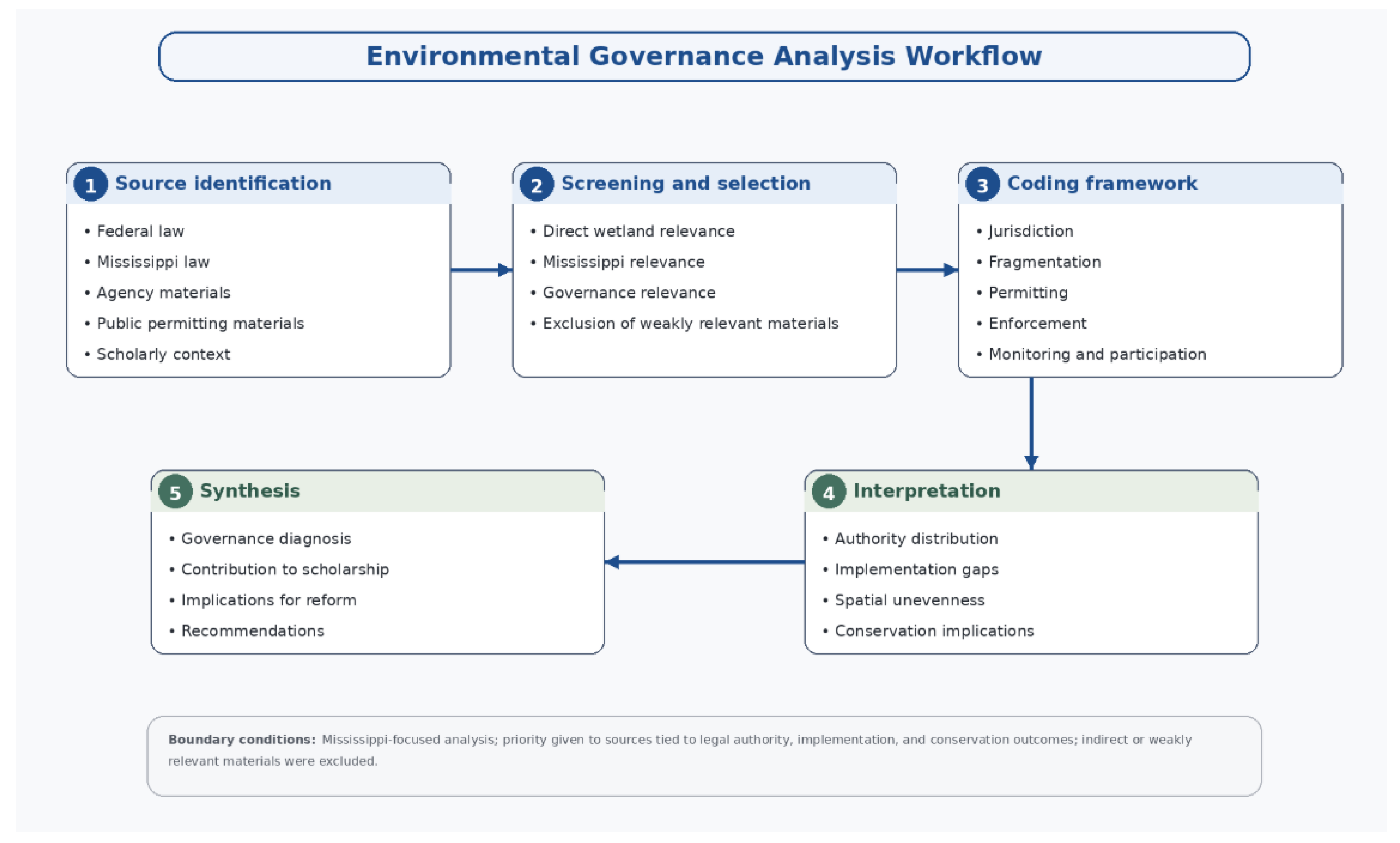
Figure 2.
Contextual regional comparison of wetland loss in selected southeastern states. Note. The figure is retained as an illustrative regional summary and is used for contextual comparison rather than for formal statistical analysis.
Figure 2.
Contextual regional comparison of wetland loss in selected southeastern states. Note. The figure is retained as an illustrative regional summary and is used for contextual comparison rather than for formal statistical analysis.
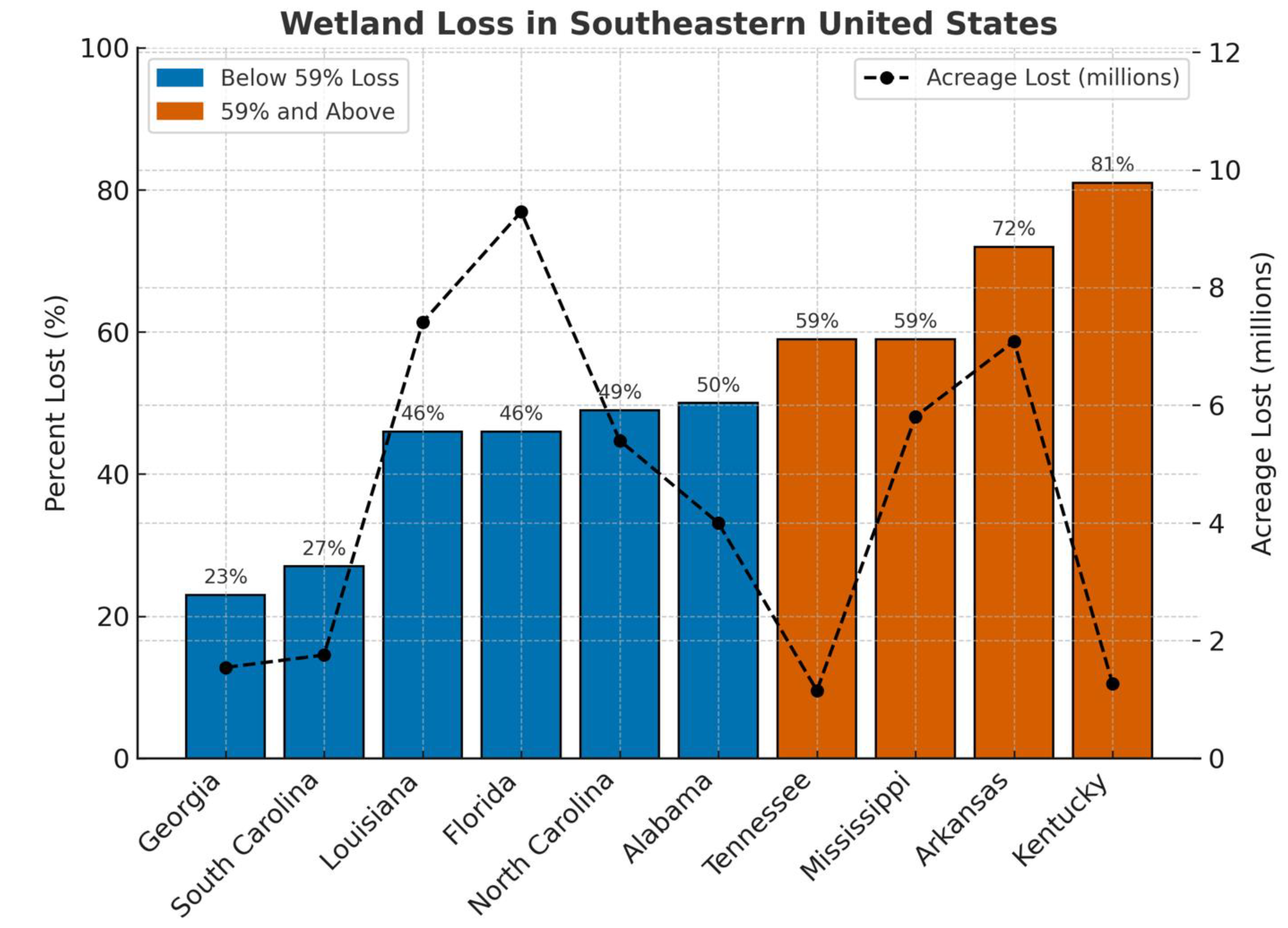
Figure 3.
Indicative long-term decline in the Mississippi wetland area Note. The trend line is retained as an indicative historical summary. Exact acreages vary across inventories and classification methods.
Figure 3.
Indicative long-term decline in the Mississippi wetland area Note. The trend line is retained as an indicative historical summary. Exact acreages vary across inventories and classification methods.
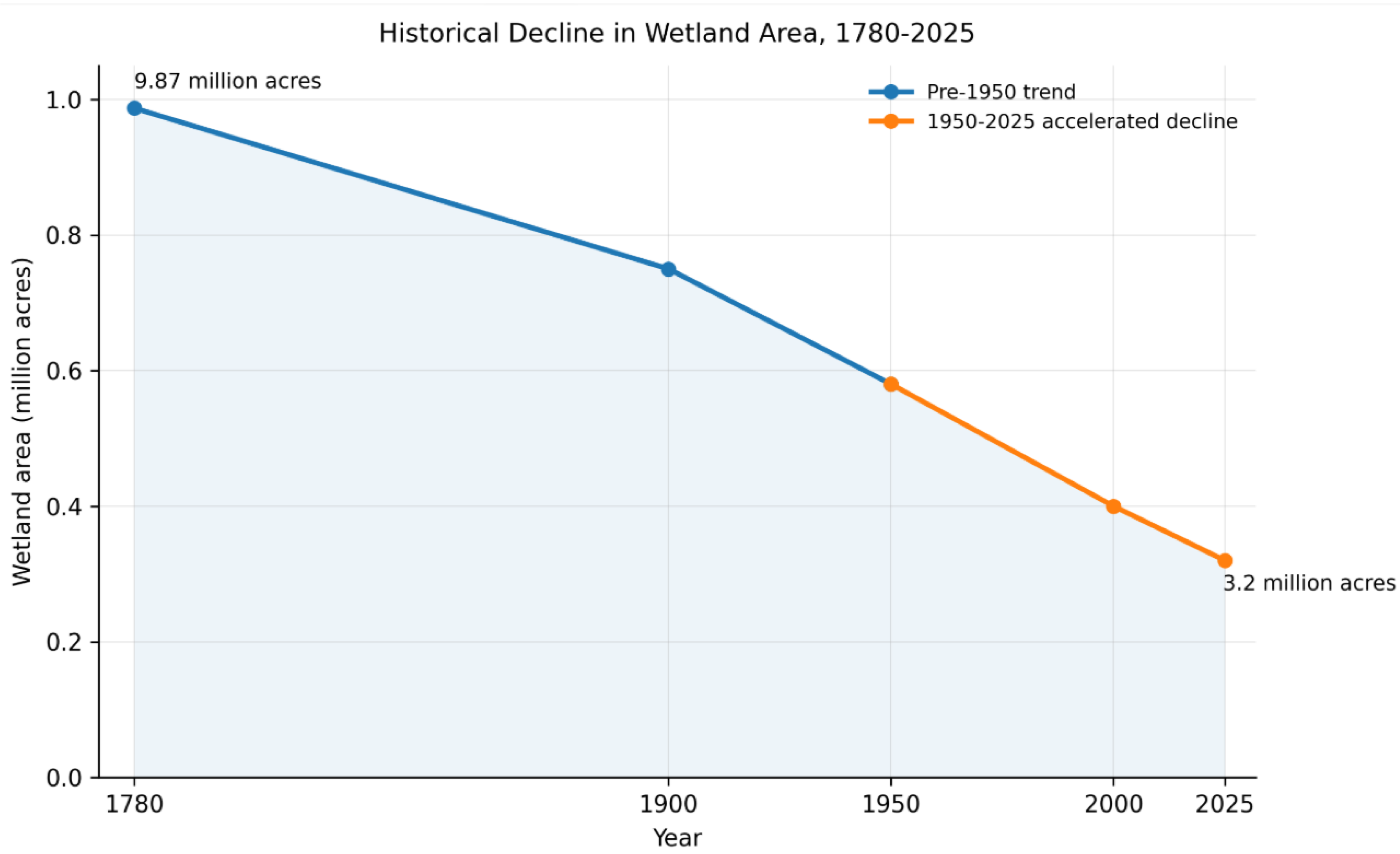
Figure 4.
Illustrative public wetlands permit materials from Mississippi Note. Mississippi Department of Marine Resources public notice materials. The figure demonstrates administrative visibility, not enforcement effectiveness.
Figure 4.
Illustrative public wetlands permit materials from Mississippi Note. Mississippi Department of Marine Resources public notice materials. The figure demonstrates administrative visibility, not enforcement effectiveness.
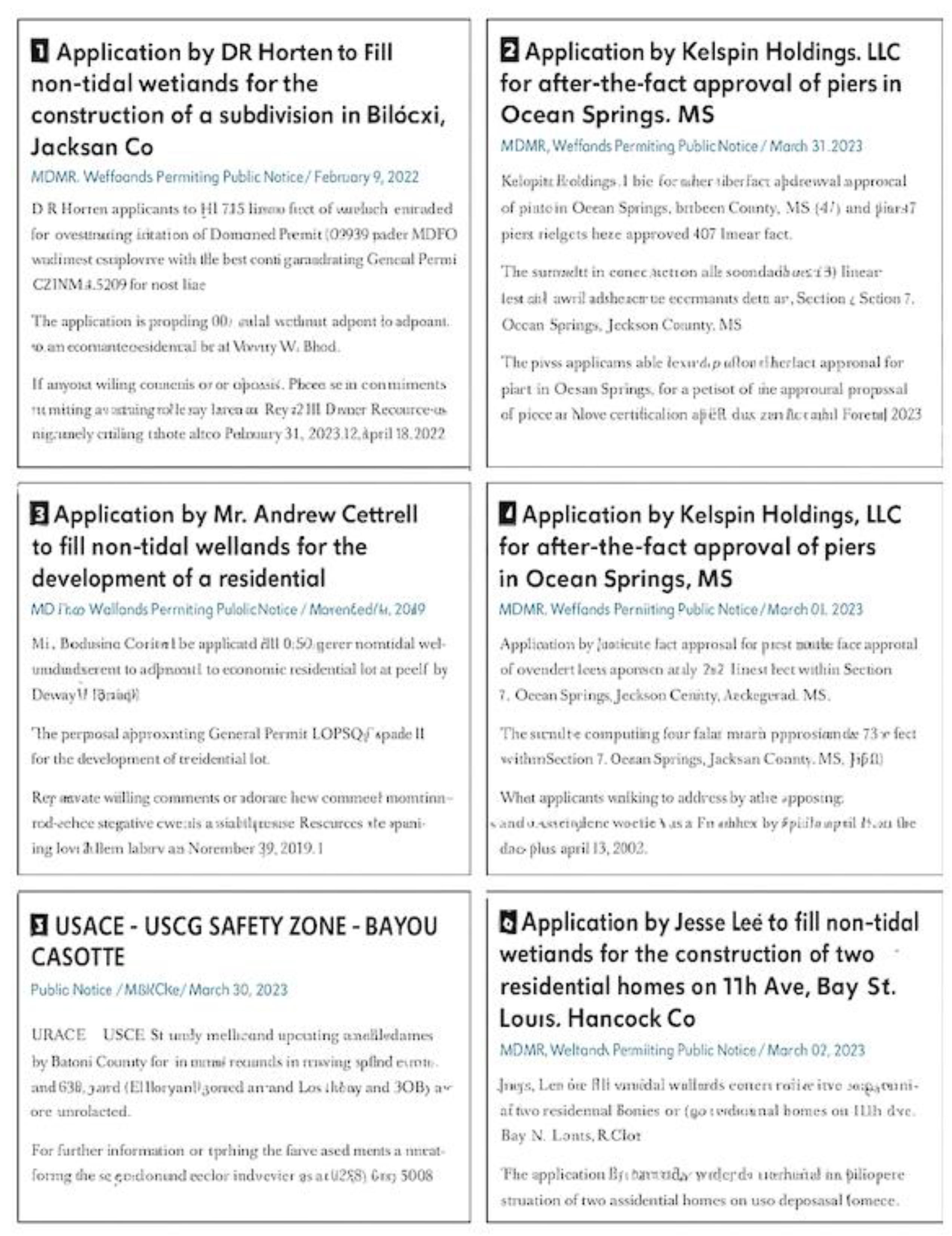

Table 1.
Selected laws and policies structuring wetland governance relevant to Mississippi.
| No. | Year | Law or policy | Level | Primary governance function |
| 1 | 1849-1860 | Swamp Land Acts | Federal | Transferred wetlands for drainage and conversion to agriculture and settlement. |
| 2 | 1918 | Migratory Bird Treaty Act | Federal | Protected migratory birds and reinforced habitat significance. |
| 3 | 1954 | Watershed Protection and Flood Prevention Act | Federal | Linked flood control, watershed management, and land-use intervention. |
| 4 | 1958 | Fish and Wildlife Coordination Act | Federal | Required wildlife review in federal water-resource projects. |
| 5 | 1969 | National Environmental Policy Act | Federal | Required environmental review for major federal actions. |
| 6 | 1972 | Clean Water Act | Federal | Established the core federal framework for water pollution control and Section 404 permitting. |
| 7 | 1972 | Coastal Zone Management Act | Federal | Connected coastal resource management to land-use planning and state coastal programs. |
| 8 | 1973 | Mississippi Coastal Wetlands Protection Act | State | Created Mississippi’s principal coastal wetland preservation and permitting framework. |
| 9 | 1982 | Coastal Barrier Resources Act | Federal | Restricted federal incentives that encourage development on protected coastal barriers. |
| 10 | 1986 | Emergency Wetlands Resources Act | Federal | Strengthened wetland inventory, planning, and conservation priorities. |
| 11 | 1989 | North American Wetlands Conservation Act | Federal | Supported partnership-based wetland conservation and restoration funding. |
| 12 | 2000 | Estuaries and Clean Water Act | Federal | Expanded estuary restoration tools and program support. |
| 13 | 2024 | Miss. Code Ann. § 49-27-57 | State | Provides penalties and enforcement authority for coastal permits. |
| 14 | 2024 | Miss. Code Ann. § 49-27-65 | State | Requires evaluation and charting of coastal wetlands. |
| 15 | 2025 | MDMR wetlands permitting process | State/administrative | Operationalizes application review, public notice, and agency coordination in the coastal zone. |
| 16 | 2023 | Sackett v. EPA | Federal judicial | Narrowed federal jurisdiction over adjacent wetlands and intensified inland governance gaps. |
Note. Compiled from the legal and administrative instruments analyzed in this manuscript, including the federal and Mississippi sources discussed in Section 4.2 and Section 4.3.
Table 2.
Contextual comparison of wetland loss across selected southeastern states.
| State | Original acreage | Remaining acreage | Acreage lost | Percent lost |
| Georgia | 6,843,200 | 5,298,200 | 1,545,000 | 23% |
| South Carolina | 6,414,000 | 4,659,000 | 1,755,000 | 27% |
| Louisiana | 16,194,500 | 8,784,200 | 7,410,300 | 46% |
| Florida | 20,325,013 | 11,038,300 | 9,286,713 | 46% |
| North Carolina | 11,089,500 | 5,689,500 | 5,400,000 | 49% |
| Alabama | 8,000,000 | >4,000,000 | 4,000,000 | 50% |
| Tennessee | 1,937,000 | 787,000 | 1,150,000 | 59% |
| Mississippi | 13,680,000 | 5,580,000 | 8,100,000 | 59% |
| Arkansas | 7,527,200 | 2,092,700 | 5,434,500 | 72% |
| Kentucky | 4,083,000 | 780,000 | 3,303,000 | 81% |
Note. Data presented in Table 2 were compiled from records reported by the U.S. Fish and Wildlife Service (USFWS, 2024), Lang et al. (2024), and the National Association of Wetland Managers (NAWM, 2015).
Disclaimer/Publisher’s Note: The statements, opinions and data contained in all publications are solely those of the individual author(s) and contributor(s) and not of MDPI and/or the editor(s). MDPI and/or the editor(s) disclaim responsibility for any injury to people or property resulting from any ideas, methods, instructions or products referred to in the content. |
© 2026 by the author. Licensee MDPI, Basel, Switzerland. This article is an open access article distributed under the terms and conditions of the Creative Commons Attribution (CC BY) license.
Copyright: This open access article is published under a Creative Commons CC BY 4.0 license, which permit the free download, distribution, and reuse, provided that the author and preprint are cited in any reuse.


