

Submitted:
27 March 2026
Posted:
31 March 2026
You are already at the latest version
Abstract
The development of reproducible and stable plasmon-free substrates for surface-enhanced Raman scattering (SERS) is critical for practical applications in analytical chemistry. Transition metal dichalcogenides (TMDCs) have emerged as promising candidates due to their unique electronic properties, yet their performance is often constrained by the chemical inertness of their pristine basal planes. This work presents a systematic comparison of crystalline flakes and nanoparticles of tungsten diselenide (WSe2) and tungsten ditelluride (WTe2), prepared via liquid-phase ultrasonic exfoliation and non-equilibrium femtosecond pulsed laser ablation in liquid (PLAL), respectively. The results demonstrate that nanoparticle-based substrates consistently outperform their flake-based counterparts, achieving enhancement factors in the range of 104. The superior performance of the nanoparticles is attributed to the synthesis-induced defects and high-curvature regions in the nanoparticles shell which facilitates efficient, defect-mediated charge transfer between the substrate and the analyte. At the same time, the inner polycrystalline volume conserves the important characteristics of the bulk counterparts like excitons in semiconducting WSe2 and broadband absorption in semimetallic WTe2, which unblocks the tunable photothermal colloidal response. The study establishes morphology engineering through non-equilibrium synthesis as a powerful and generalizable strategy for designing high-performance, dual-function colloidal platforms, offering a pathway toward robust and reproducible analytical systems.
Keywords:
van derWaals materials
; tungsten diselenide
; tungsten ditelluride
; laser ablation
; ultrasonic exfoliation
; nanoparticles
; SERS
; photoheating
1. Introduction
Ultrasensitive and reproducible molecular detection is a primary source of innovations across multiple fields from medical diagnostics and environmental monitoring to national security[1,2,3,4,5]. Surface-enhanced Raman scattering (SERS) is a powerful analytical technique, capable of identifying molecules through their unique vibrational fingerprints with sensitivities extending to the single-molecule level[6,7,8,9].
Traditionally, SERS performance was improved through an electromagnetic mechanism, where localized surface plasmon resonances (LSPRs) in noble metals nanostructures generate intense electromagnetic "hot spots"[10,11,12]. These hot spots can amplify Raman signals by factors of to , enabling extraordinary detection limits [1,13,14]. However, the plasmon-based SERS faces fundamental challenges that block its widespread practical implementation. First, the stochastic and often uncontrollable formation of hot spots leads to significant signal variations from sample to sample and complicates the quantitative analysis [2,10,15]. Further drawbacks, including the chemical instability of plasmonic materials (e.g., the oxidation of silver), potential cytotoxicity, and undesirable catalytic activity that can degrade the analyte, have motivated a search for alternative materials [15,16,17].
Plasmon-free SERS substrates represent a family of alternative materials, where signal enhancement is governed predominantly by a chemical mechanism (CM)[9,18,19]. The CM originates from a photoinduced charge transfer (PICT) process between the substrate and an adsorbed analyte molecule[12,14,20]. This charge transfer transiently alters the molecule’s polarizability, thereby increasing its Raman scattering cross-section[21].
Two-dimensional (2D) materials, in particular transition metal dichalcogenides (TMDCs), are a promising platform for exploring CM-SERS [9,20,22,23] due to their tunable electronic properties, exceptional chemical stability, and biocompatibility[5,20,24]. Despite the benefits, a high-performance SERS on the layered TMDCs suffers from chemically inert basal planes [25,26,27] with coordinatively saturated surface atoms, which severely limits the number of active sites available for the strong chemisorption and efficient charge transfer [28]. To unlock the full potential of these materials, a deliberate strategy of structural perturbation, commonly known as defect engineering, is required to activate the passive surface [9,29]. These defect states (i.e. chalcogen vacancies as point defects and TMDC layers edges as line defects) can function as mediators for charge transfer, enabling a resonant PICT process [18,19,21,25,28,30].
In this work, a femtosecond pulsed laser ablation in liquid (PLAL) is used as a one-shot technique for TMDC nanostructuring and defect engineering. In contrast to conventional nanostructuring methods (i.e. liquid-phase ultrasonic exfoliation), which are quasi-equilibrium processes largely preserving the low-defect structure of the parent material [30,31,32,33,34], PLAL is an essentially non-equilibrium technique [35,36,37]. The ultrashort laser pulses generate TMDC plasma plumes with extreme temperatures and pressures; the subsequent ultrafast quenching kinetically traps the material in a high-energy, defect-rich state, promoting the formation of point surface defects even while maintaining overall crystallinity [38].
Within this study, we demonstrate that the non-equilibrium PLAL synthesis realizes the defect engineering in TMDC nanoparticles, which leads to their 10-fold increase in CM-SERS performance in comparison with flake-like analogues produced via exfoliation [39,40,41]. To validate this, a direct and systematic comparison of the SERS activity of crystalline flakes and nanoparticles of WSe2 and WTe2 is conducted. Interestingly, we reveal that the introduced defects do not alter significantly the nanoparticle volumetric optical response, allowing the use of bulk crystal optical constants for optical simulations. Specifically, it was successfully used for validating the experimentally observed photothermal conversion efficiency of WSe2 (above 40%) and WTe2 (above 80%) NPs. This investigation aims to establish morphology engineering as a robust and generalizable strategy for designing the next generation of high-performance sensing and theranostic platforms.
2. Materials and Methods
2.1. Synthesis of TMDC Nanomaterials
Bulk crystals of WSe2 and WTe2 were used as the precursor materials for the synthesis of both nanoparticles and flakes.
2.1.1. Nanoparticle Synthesis via Femtosecond PLAL
Nanoparticles were synthesized using femtosecond pulsed laser ablation in liquid (PLAL) (Figure 1a). A Yb:KGW femtosecond laser system (TETA-10, Avesta, Moscow, Russia) was employed, generating pulses with a wavelength of 1030 nm, a duration of 270 fs, a repetition rate of 1 kHz, and a pulse energy of 100 µJ. The bulk TMDC crystal was placed at the bottom of a glass cuvette filled with 2 mL of deionized water (DI water). The laser beam was focused by a 100 mm focal length lens, creating a spot with a diameter of approximately 50 µm on the target surface, corresponding to an energy density of about 5 J/. To ensure uniform ablation, the cuvette was scanned over a 2 × 2 mm area at a speed of 5 mm/s using motorized translation stages. The total irradiation time for each synthesis was 15 minutes.
2.1.2. Flake Synthesis via Ultrasonic Exfoliation
Flakes of the TMDC materials were prepared by liquid-phase ultrasonic exfoliation (Figure 1b). [42] A probe-tip ultrasonic processor (CL-18, Qsonica L.L.C., USA) delivered 100 W of ultrasonic power for 4 hours to a suspension containing fragments of the bulk crystal. The initial concentration of the TMDC material in the deionized water was 2 mg/mL.
2.2. Structural and Morphological Characterization
The structure and morphology of the resulting colloidal solutions of nanoparticles and flakes were analyzed using transmission electron microscopy (TEM), high-resolution TEM (HRTEM), and selected area electron diffraction (SAED). These investigations were performed on a JEOL JEM 2010 system (Japan) operated at an accelerating voltage of 200 kV. The JEOL JEM-2100 TEM is outfitted with an Aztec X-Max 100 energy-dispersive X-ray spectroscopy (EDX) attachment, allowing for the chemical composition analysis of nanoparticles. Samples for TEM analysis were prepared by depositing a 2 µL droplet of the colloidal solution onto a carbon-coated copper TEM grid, which was then allowed to dry under ambient conditions.
2.3. SERS Substrate Fabrication and Measurements
SERS-active substrates were fabricated by depositing 20 µL of the TMDC colloidal solution onto an aluminum substrate. A thin, uniform film was then formed using a spin-coating method. Subsequently, a 2 µL droplet of a crystal violet (CV) dye solution, with concentrations ranging from M to M, was applied to the surface of the TMDC film and allowed to dry for 1 hour under ambient conditions. Raman scattering spectra were recorded using a Horiba LabRAM HR Evolution spectrometer. Measurements were conducted using laser excitation at wavelengths of 532 nm and 633 nm, a 600 grooves/mm diffraction grating, and a 100× microscope objective with a numerical aperture (NA) of 0.9. High spectral reproducibility was confirmed across multiple measurements on each sample.
2.4. Enhancement Factor (EF) Calculation
To quantitatively evaluate the performance of the SERS substrates, the enhancement factor (EF) was calculated using the standard formula:
where ISERS and IRs represent the intensities of a characteristic analyte peak measured on the SERS substrate and in a bulk solution, respectively. CSERS and CRs are the corresponding molar concentrations of the analyte for each measurement. The characteristic vibrational mode of crystal violet at 1620 was used for all EF calculations.
2.5. Photothermal Studies
Photoheating experiments were performed with a tunable titanium-sapphire laser source at a NIR-I wavelength of 830 nm. The temperature dynamics was monitored in real time using a calibrated HIKMICRO M10 thermal imaging camera. Colloidal extinction was measured using transmission through a cuvette with deionized water as a baseline.
3. Results and Discussion
3.1. Synthesis Dictates Nanomaterial Morphology while Preserving Crystallinity
Structural analysis via TEM, HRTEM, and SAED (see Figure 1) revealed profound differences in the morphology of the materials produced by the two synthesis techniques, yet critically, both methods yielded materials that retained their inherent crystalline structure.
As expected, ultrasonic exfoliation, a process involving the mechanical delamination of layered crystals along weakly bonded van der Waals planes, produced large, thin flakes of WSe2 and WTe2 with irregular shapes. HRTEM analysis and the corresponding SAED patterns confirmed their high degree of crystallinity, showing well-defined atomic planes and sharp, ordered diffraction spots characteristic of the bulk crystal structure. In striking contrast, the femtosecond PLAL method resulted in the formation of quasi-spherical nanoparticles. The most significant finding from this structural characterization is that despite the extreme, non-equilibrium conditions of the PLAL synthesis—involving plasma generation and ultra-rapid quenching—the resulting WSe2 and WTe2 nanoparticles maintained a high degree of crystallinity. This was unequivocally confirmed by HRTEM images showing clear lattice fringes and SAED patterns exhibiting ordered diffraction rings, analogous to those observed for the exfoliated flakes. This preservation of crystallinity as an important result which is effectively eliminates phase transitions and amorphization, as a confounding variable. Complementing the structural analysis, energy-dispersive X-ray spectroscopy (EDX) revealed that while the flakes retained a near-ideal 1:2 stoichiometry, the nanoparticles exhibited chalcogen deficiencies with ratios shifting to approximately 1:1.8 for WSe2 and 1:1.7 for WTe2 (Table 1). This non-stoichiometry is attributed to the partial evaporation of volatile Se and Te atoms during the high-energy laser ablation process. These findings confirm the presence of chalcogen vacancies in the nanoparticles, contrasting with the chemically pristine exfoliated flakes. Consequently, it allows the investigation to focus exclusively on the effects of morphology and nanoscale structure to explain the observed differences in SERS activity. This establishes a clean and controlled experimental framework for isolating the role of morphology-induced defects in chemical enhancement.
3.2. Nanoparticle Morphology Unlocks Superior SERS Performance
Comparative SERS measurements, using crystal violet (CV) as a molecular probe, demonstrated that the substrate morphology is the decisive factor governing its analytical efficacy.
Figure 2 and Figure 3 present a direct comparison of the Raman spectra and calculated enchancement factors obtained on WSe2 and WTe2 substrates, respectively. At an analyte concentration of M, the spectra from NP-based and flake-based substrates exhibit intense and clearly resolved characteristic peaks of CV, including the prominent modes at 440, 916, 1175, 1372, 1620 .
The substrates based on WSe2 and WTe2 nanoparticles exhibited a markedly higher SERS activity compared to their counterparts fabricated from exfoliated flakes. Raman spectra acquired from the nanoparticle-based substrates consistently showed more intense and clearly resolved characteristic peaks of CV, even at low analyte concentrations where signals from the flake-based substrates were weak or undetectable. This observation is fully substantiated by quantitative analysis summarized in Table 2. The calculated enhancement factors for the NP-based substrates of both WSe2 and WTe2 were found to be in the range of .
This represents an enhancement that is consistently an order of magnitude greater than that achieved with substrates made from exfoliated flakes of the same materials, which yielded EFs of approximately . Furthermore, this enhancement translates directly into improved sensitivity. The limit of detection (LOD) for CV on the nanoparticle substrates reached concentrations as low as M, a full one order of magnitude lower than the LOD for the flake-based substrates, which was greater than M. This performance gap provides unambiguous evidence for the decisive role of the nanoparticle morphology in activating the SERS response of these crystalline TMDCs.
The order-of-magnitude increase in SERS performance for the nanoparticle substrates must originate from factors that amplify the PICT process at the substrate-analyte interface. The superiority of the nanoparticles can be understood as a synergistic effect of morphology-related factors that collectively amplify the density of chemically active sites on the material’s surface. First, the quasi-spherical geometry provides an inherently higher ratio of edge-to-basal-plane area compared to extended flakes. These undercoordinated edge sites are known to be the primary loci for molecular chemisorption and charge exchange in TMDCs. Second, the high surface curvature of the nanoparticles induces localized strain within the crystal lattice, which promotes a higher intrinsic concentration of point defects, such as chalcogen vacancies. Third, the non-equilibrium PLAL synthesis itself, defined by extreme thermodynamic conditions and ultra-rapid quenching rates, kinetically traps a higher density of defects within the nanoparticle structure than is accessible via the quasi-equilibrium exfoliation process. Non-equilibrium synthesis is therefore not merely a means of producing small particles, but rather a tool for engineering a defect-rich crystalline state. This state constitutes the direct physical origin of the enhanced SERS activity. To construct a physical model for this enhancement, the electronic band alignment between the TMDC substrates and the CV analyte was considered. An efficient PICT-driven chemical mechanism requires a resonance condition, where the excitation laser energy (Elaser = 2.33 eV for 532 nm) facilitates a charge-transfer transition between the analyte’s frontier orbitals and the electronic states of the substrate. While the laser energy is resonant with the HOMO-LUMO gap of the CV molecule (1.9 eV), the substantial SERS enhancement stems from an additional, highly efficient charge-transfer pathway mediated by defect states. Chalcogen vacancies in TMDCs are known to introduce localized electronic states within the material’s band gap. These states act as critical intermediaries, opening new resonant channels for charge transfer—for example, from a TMDC defect level to the LUMO of the excited CV molecule. The high density of such defect states in the PLAL-synthesized nanoparticles—a direct consequence of their abundant edges, high curvature, and non-equilibrium formation—dramatically increases the probability of this resonant charge transfer compared to the near-pristine surfaces of the exfoliated flakes. This amplified charge-transfer efficiency is the fundamental physical origin of the observed order-of-magnitude increase in the enhancement factor.
3.3. Colloidal Photothermal Response Governed by Bulk Effective Optical Constants
Achieving the bimodal theranostic capability (SERS + photothermal response) requires a nanomaterial with specific crystalline properties. On the one hand, to activate the chemical mechanism of SERS, a highly disrupted, defect-rich surface with chalcogen vacancies and undercoordinated edge sites is needed in order to facilitate a resonant photoinduced charge transfer (PICT) with the adsorbed analyte. On the other hand, to achieve a highly efficient photothermal conversion, especially in case of excitonic TMDCs (WSe2) or topological semimetallic TMDCs (WTe2) the material should preferably conserve a highly ordered lattice structure of the bulk crystal, that supports material-specific electronic band transitions and rapid electron-phonon scattering dynamics. Femtosecond PLAL allows combining the mentioned contradictory properties in a one-step synthesis route. A non-equilibrium PLAL mechanism results in a controlled defect-engineered nanoparticles with a defect-rich surface (Se and Te vacancies), but remarkably crystalline volume [43,44,45] which is confirmed by HRTEM and SAED analyses (Figure 1 d-i).
The retention of internal crystallinity is further illustrated by the photothermal analysis. Taking into account the random orientation of colloidal nanoparticles during the laser-induced heating, their optical response is modeled via an effective isotropic medium with an orientation average of the principal components of the dielectric tensor:=eff=1/3*(x+y+z); optical constants for WSe2 were taken from [46] and WTe2 from [47]. According to the calculated effective refractive indices of WSe2 and WTe2 (Figure 4 a,b), their optical behavior is dramatically different. The most prominent feature of the WSe2 optical spectrum is the pronounced A-exciton transition at approximately 770 nm, which leads to the resonant high optical absorption. However, at the NIR-I photoheating at 830 nm the WSe2 NPs are completely off-resonant and predominantly act as high-refractive (neff) dielectric scatterers.
In contrast, semimetallic WTe2 material is characterized by a continuous density of states across the Fermi level, with no energy threshold (bandgap) required to initiate optical transitions. This results in the broadband, highly featureless and high extinction constants (keff) shown by the orange curve in Figure 4b. The measured colloidal extinction curves shown in Figure 4c confirm the conservation of WSe2 NPs crystallinity via a pronounced A-exciton peak, and a featureless spectrum of WTe2 colloid. As the 830 nm excitation is off-resonant, the WSe2 extinction decays sharply, indicating that the light-matter interaction is dominated by elastic Rayleigh scattering with only a small absorptive contribution. In contrast, semimetallic WTe2 NPs, crystallizing in the distorted orthorhombic Td phase, maintain high extinction values throughout NIR-I region, suggesting its operation in an absorption-dominated regime. In order to experimentally compare the photothermal response of both colloids, their optical extinctions were aligned at 830 nm, see Figure 4c. Preliminary calculations of PCE as a function of NPs size using the effective optical constants from Figure 4a,b for 830 nm heating wavelength reveal much higher PCE values for WTe2 NPs with respect to WSe2 NPs, for a wide range of particle sizes from near-zero to >100 nm, see Figure 4d. The photothermal response generally increases for smaller particles. So, additionally taking into account a slightly smaller mean size of WTe2 colloidal particles ( nm) than WSe2 colloidal particles ( nm), the WTe2 colloid should be much more effective in the photoheating. Macroscopic photoheating experiments, performed by irradiating the quartz cuvettes filled with colloids, approve the theoretical predictions. In both systems, the temperature–time profiles exhibit three characteristic stages (see Figure 4e): (i) a rapid initial rise during the first 15-20 min, where photothermal heat generation by the NPs exceeds heat loss to the surroundings; (ii) a plateau steady-state region (in 20 min after the irradiation start), in which the laser-induced heat input is balanced by dissipation through the cuvette walls; and (iii) an exponential cooling phase upon laser shutdown (in min after the irradiation start), governed solely by the thermal relaxation of the system. The maximum steady state temperature increase (Tmax) is Tmax K for WSe2 and K for WTe2 under identical experimental conditions. Taking into account the experimental colloidal polydispersity, the size-averaged PCE values were theoretically calculated for both colloids, see Figure 4f, by using the method described in [48,49] (see Supporting Information). The small but systematic reduction of the experimental PCEs relative to their theoretical counterparts is attributed to morphological factors not captured by the idealized Mie model, for example, a minor aggregation of nanoparticles resulting in their higher effective size and, consequently, lower effective PCE. Nevertheless, theoretical predictions derived from Mie theory using orientation-averaged bulk optical constants demonstrate strong agreement with the experimental data, yielding a relative error of less than 10%.
Conclusions
This study provides a systematic comparison of the plasmon-free SERS activity and photothermal capabilities of crystalline TMDCs, unequivocally demonstrating that morphology is a critical parameter for governing both chemical enhancement and optical response. The central finding of this work is that crystalline nanoparticles of WSe2 and WTe2, synthesized via non-equilibrium femtosecond laser ablation (PLAL), consistently exhibit superior SERS performance (EF ) compared to their highly ordered, flake-like analogues produced by conventional exfoliation (EF ).
This pronounced SERS enhancement is directly attributed to the significantly higher density of structurally induced active sites—including edge sites, point defects, and high-curvature regions—that are inherent to the nanoparticle morphology. A defect-mediated charge transfer model explains this superiority: the dense landscape of active sites creates a high concentration of electronic states within the TMDC band gap, acting as resonant intermediaries that facilitate efficient photoinduced charge transfer with the analyte molecule.
Crucially, this work demonstrates that the PLAL synthesis successfully resolves the conflicting material requirements for theranostic applications. While the technique induces the necessary surface defects for SERS, it simultaneously preserves the high-quality crystalline lattice of the nanoparticle volume. This structural conservation allows for the accurate prediction of optical behaviors using bulk dielectric constants and enables efficient photothermal performance. Specifically, we confirmed that the semimetallic character of WTe2 is retained in the nanoparticle form, resulting in a broadband absorption-dominated regime and a superior photothermal conversion efficiency (>80%) in the NIR-I window, significantly outperforming the scattering-dominated response of excitonic WSe2 (>40%).
Finally, this research establishes morphology engineering via non-equilibrium synthesis as a robust and generalizable design strategy.
Author Contributions
A.V.A. supervised the project. N.M.B. and A.A.U. designed and performed the experiments and wrote the manuscript. D.V.D. performed the experiments and conducted the characterizations. N.M.B. conducted the characterizations, performed the experiments. A.V.S. conducted the TEM/SAED characterizations. A.I.C. and S.M.N. provided experimental resources. G.I.T., V.G.L. and V.S.V. supervised the project. A.A.V. supervised the project and edited the manuscript. All authors discussed the results. All authors have read and agreed to the published version of the manuscript.
Funding
This research was funded by RSF, grant number 25-79-00214.
Data Availability Statement
All data generated or analyzed during this study are included in this published article.
Conflicts of Interest
The authors declare no conflicts of interest.
Abbreviations
The following abbreviations are used in this manuscript:
| LSPR | Localized surface plasmon resonances |
| CM | Chemical mechanism |
| PICT | Photoinduced charge transfer |
| DI water | Deionized water |
| TMDC | Transition Metal Dichalcogenide |
| NP | Nanoparticle |
| PLAL | Pulsed Laser Ablation in Liquid |
| TEM | Transmission Electron Microscope |
| HRTEM | High Resolution Transmission Electron Microscope |
| SAED | Selected Area Electron Diffraction |
| EDX | Energy Dispersive X-ray Spectroscopy |
| SERS | Surface-Enhanced Raman Scattering |
| CV | Crystal violet |
| LOD | The limit of detection |
| EF | Enhancement Factor |
| NA | Numeric Aperture |
| PCE | Photothermal Conversion Efficiency |
References
- Onyemaobi, I.M.; Xie, Y.; Xu, L.; Zhang, J.; Xiang, L.; Lin, J.; Wu, A. Nanomaterials and clinical SERS technology: broad applications in disease diagnosis. Journal of Materials Chemistry B 2025, pp. 2890–2911.
- Zong, C.; Xu, M.; Xu, L.J.; Wei, T.; Ma, X.; Zheng, X.S.; Hu, R.; Ren, B. Surface-enhanced Raman spectroscopy for bioanalysis: reliability and challenges. Chemical reviews 2018, 118, 4946–4980. [Google Scholar] [CrossRef]
- Liu, Y.; Qin, Z.; Deng, J.; Zhou, J.; Jia, X.; Wang, G.; Luo, F. The advanced applications of 2D materials in SERS. Chemosensors 2022, 10, 455. [Google Scholar] [CrossRef]
- Yu, L.x.; Lv, R.t. Two-dimensional layer materials for highly efficient molecular sensing based on surface-enhanced Raman scattering. New Carbon Materials 2021, 36, 995–1012. [Google Scholar] [CrossRef]
- Tang, X.; Hao, Q.; Hou, X.; Lan, L.; Li, M.; Yao, L.; Zhao, X.; Ni, Z.; Fan, X.; Qiu, T. Exploring and engineering 2D transition metal dichalcogenides toward ultimate SERS performance. Advanced Materials 2024, 36, 2312348. [Google Scholar] [CrossRef] [PubMed]
- Nie, S.; Emory, S.R. Probing single molecules and single nanoparticles by surface-enhanced Raman scattering. science 1997, 275, 1102–1106. [Google Scholar] [CrossRef] [PubMed]
- Kneipp, K.; Wang, Y.; Kneipp, H.; Perelman, L.T.; Itzkan, I.; Dasari, R.R.; Feld, M.S. Single molecule detection using surface-enhanced Raman scattering (SERS). Physical review letters 1997, 78, 1667. [Google Scholar] [CrossRef]
- Sharma, B.; Frontiera, R.R.; Henry, A.I.; Ringe, E.; Van Duyne, R.P. SERS: Materials, applications, and the future. Materials today 2012, 15, 16–25. [Google Scholar]
- Majumdar, D. 2D Material-Based Surface-Enhanced Raman Spectroscopy Platforms (Either Alone or in Nanocomposite Form) - From a Chemical Enhancement Perspective. ACS omega 2024, 9, 40242–40258. [Google Scholar]
- Langer, J.; Jimenez de Aberasturi, D.; Aizpurua, J.; Alvarez-Puebla, R.A.; Auguie, B.; Baumberg, J.J.; Bazan, G.C.; Bell, S.E.; Boisen, A.; Brolo, A.G.; et al. Present and future of surface-enhanced Raman scattering. ACS nano 2019, 14, 28–117. [Google Scholar] [CrossRef]
- Le Ru, E.; Etchegoin, P. Principles of Surface-Enhanced Raman Spectroscopy: and related plasmonic effects; Elsevier, 2008. [Google Scholar]
- Aroca, R. Surface-Enhanced Vibrational Spectroscopy; Wiley, 2006. [Google Scholar]
- Goel, R.; Vij, R.; Chakraborty, S.; Achanta, V.G.; Dubey, S.K. Application of plasmonic quasi crystal (PIQC) in surface enhanced Raman spectroscopy (SERS). In Proceedings of the Optical Sensors 2023. SPIE, 2023, Vol. 12572, pp. 84–88.
- Lombardi, J.R.; Birke, R.L. A unified approach to surface-enhanced Raman spectroscopy. The Journal of Physical Chemistry C 2008, 112, 5605–5617. [Google Scholar] [CrossRef]
- Pilot, R.; Signorini, R.; Durante, C.; Orian, L.; Bhamidipati, M.; Fabris, L. A review on surface-enhanced Raman scattering. Biosensors 2019, 9, 57. [Google Scholar] [CrossRef]
- Karagianni, K.; Leontidou, T.; Constantinou, M.; Andreou, C. Bacterial detection with electrochemical, SERS, and electrochemical SERS sensors. Analyst 2025, 150, 3762–3787. [Google Scholar] [CrossRef]
- Tahir, M.A.; Dina, N.E.; Cheng, H.; Valev, V.K.; Zhang, L. Surface-enhanced Raman spectroscopy for bioanalysis and diagnosis. Nanoscale 2021, 13, 11593–11634. [Google Scholar] [CrossRef]
- Chaudhry, I.; Hu, G.; Ye, H.; Jensen, L. Toward modeling the complexity of the chemical mechanism in SERS. ACS nano 2024, 18, 20835–20850. [Google Scholar] [CrossRef]
- Chen, L.; Liu, H.; Gao, J.; Wang, J.; Jin, Z.; Lv, M.; Yan, S. Development and Biomedical Application of Non-Noble Metal Nanomaterials in SERS. Nanomaterials 2024, 14, 1654. [Google Scholar] [CrossRef]
- Chen, M.; Liu, D.; Du, X.; Lo, K.H.; Wang, S.; Zhou, B.; Pan, H. 2D materials: Excellent substrates for surface-enhanced Raman scattering (SERS) in chemical sensing and biosensing. TrAC Trends in Analytical Chemistry 2020, 130, 115983. [Google Scholar] [CrossRef]
- Ling, X.; Moura, L.; Pimenta, M.A.; Zhang, J. Charge-transfer mechanism in graphene-enhanced Raman scattering. The Journal of Physical Chemistry C 2012, 116, 25112–25118. [Google Scholar] [CrossRef]
- Ling, X.; Xie, L.; Fang, Y.; Xu, H.; Zhang, H.; Kong, J.; Dresselhaus, M.S.; Zhang, J.; Liu, Z. Can graphene be used as a substrate for Raman enhancement? Nano letters 2010, 10, 553–561. [Google Scholar] [CrossRef] [PubMed]
- Zhao, S.; Zhao, Y.; Tao, L. Interface engineering in 2D materials for SERS sensing. Frontiers in Materials 2023, 10, 1272826. [Google Scholar] [CrossRef]
- Wan, J.; Lacey, S.D.; Dai, J.; Bao, W.; Fuhrer, M.S.; Hu, L. Tuning two-dimensional nanomaterials by intercalation: materials, properties and applications. Chemical Society Reviews 2016, 45, 6742–6765. [Google Scholar] [CrossRef]
- Akhound, M.A.; Jacobsen, K.W.; Thygesen, K.S. Activating the Basal Plane of 2D Transition Metal Dichalcogenides via High-Entropy Alloying. Journal of the American Chemical Society 2025, 147, 5743–5754. [Google Scholar] [CrossRef]
- Li, H.; Tsai, C.; Koh, A.L.; Cai, L.; Contryman, A.W.; Fragapane, A.H.; Zhao, J.; Han, H.S.; Manoharan, H.C.; Abild-Pedersen, F.; et al. Activating and optimizing MoS2 basal planes for hydrogen evolution through the formation of strained sulphur vacancies. Nature materials 2016, 15, 48–53. [Google Scholar] [CrossRef]
- Huang, B.; Li, N.; Ong, W.J.; Zhou, N. Single atom-supported MXene: how single-atomic-site catalysts tune the high activity and selectivity of electrochemical nitrogen fixation. Journal of Materials Chemistry A 2019, 7, 27620–27631. [Google Scholar] [CrossRef]
- Sim, Y.; Chae, Y.; Kwon, S.Y. Recent advances in metallic transition metal dichalcogenides as electrocatalysts for hydrogen evolution reaction. Iscience 2022, 25, 105098. [Google Scholar] [CrossRef]
- Song, G.; Cong, S.; Zhao, Z. Defect engineering in semiconductor-based SERS. Chemical Science 2022, 13, 1210–1224. [Google Scholar] [CrossRef] [PubMed]
- Jaramillo, T.F.; Jorgensen, K.P.; Bonde, J.; Nielsen, J.H.; Horch, S.; Chorkendorff, I. Identification of active edge sites for electrochemical H2 evolution from MoS2 nanocatalysts. science 2007, 317, 100–102. [Google Scholar]
- Nicolosi, V.; Chhowalla, M.; Kanatzidis, M.G.; Strano, M.S.; Coleman, J.N. Liquid exfoliation of layered materials. Science 2013, 340, 1226419. [Google Scholar] [CrossRef]
- Hernandez, Y.; Nicolosi, V.; Lotya, M.; Blighe, F.M.; Sun, Z.; De, S.; McGovern, I.T.; Holland, B.; Byrne, M.; Gun’Ko, Y.K.; et al. High-yield production of graphene by liquid-phase exfoliation of graphite. Nature nanotechnology 2008, 3, 563–568. [Google Scholar] [CrossRef] [PubMed]
- Yi, M.; Shen, Z. A review on mechanical exfoliation for the scalable production of graphene. Journal of Materials Chemistry A 2015, 3, 11700–11715. [Google Scholar] [CrossRef]
- Tselikov, G.I.; Ermolaev, G.A.; Popov, A.A.; Tikhonowski, G.V.; Panova, D.A.; Taradin, A.S.; Vyshnevyy, A.A.; Syuy, A.V.; Klimentov, S.M.; Novikov, S.M.; et al. Transition metal dichalcogenide nanospheres for high-refractive-index nanophotonics and biomedical theranostics. Proceedings of the National Academy of Sciences 2022, 119, e2208830119. [Google Scholar]
- Amendola, V.; Meneghetti, M. Laser ablation synthesis in solution and size manipulation of noble metal nanoparticles. Physical chemistry chemical physics 2009, 11, 3805–3821. [Google Scholar]
- Zhang, D.; Gokce, B.; Barcikowski, S. Laser synthesis and processing of colloids: fundamentals and applications. Chemical reviews 2017, 117, 3990–4103. [Google Scholar] [CrossRef]
- Forsythe, R.C.; Cox, C.P.; Wilsey, M.K.; Muller, A.M. Pulsed laser in liquids made nanomaterials for catalysis. Chemical Reviews 2021, 121, 7568–7637. [Google Scholar] [CrossRef]
- Rao, S.V.; Podagatlapalli, G.K.; Hamad, S. Ultrafast laser ablation in liquids for nanomaterials and applications. Journal of nanoscience and nanotechnology 2014, 14, 1364–1388. [Google Scholar] [CrossRef] [PubMed]
- Maiti, R.; Patil, C.; Saadi, M.; Xie, T.; Azadani, J.; Uluutku, B.; Amin, R.; Briggs, A.; Miscuglio, M.; Van Thourhout, D.; et al. Strain-engineered high-responsivity MoTe2 photodetector for silicon photonic integrated circuits. Nature Photonics 2020, 14, 578–584. [Google Scholar] [CrossRef]
- Kosmider, K.; Fernandez-Rossier, J. Electronic properties of the MoS 2-WS 2 heterojunction. Physical Review B—Condensed Matter and Materials Physics 2013, 87, 075451. [Google Scholar]
- Liu, F.; Ming, P.; Li, J. Ab initio calculation of ideal strength and phonon instability of graphene under tension. Physical Review B—Condensed Matter and Materials Physics 2007, 76, 064120. [Google Scholar] [CrossRef]
- Chavalekvirat, P.; Hirunpinyopas, W.; Deshsorn, K.; Jitapunkul, K.; Iamprasertkun, P. Liquid phase exfoliation of 2D materials and its electrochemical applications in the data-driven future. Precision Chemistry 2024, 2, 300–329. [Google Scholar] [CrossRef] [PubMed]
- Balati, A.; Tek, S.; Nash, K.; Shipley, H. Nanoarchitecture of TiO2 microspheres with expanded lattice interlayers and its heterojunction to the laser modified black TiO2 using pulsed laser ablation in liquid with improved photocatalytic performance under visible light irradiation. Journal of colloid and interface science 2019, 541, 234–248. [Google Scholar] [CrossRef]
- Zavidovskiy, I.A.; Martynov, I.V.; Tselikov, D.I.; Syuy, A.V.; Popov, A.A.; Novikov, S.M.; Kabashin, A.V.; Arsenin, A.V.; Tselikov, G.I.; Volkov, V.S.; et al. Leveraging femtosecond laser ablation for tunable near-infrared optical properties in MoS2-Gold nanocomposites. Nanomaterials 2024, 14, 1961. [Google Scholar] [CrossRef]
- Lasemi, N.; Rupprechter, G. Chemical and laser ablation synthesis of monometallic and bimetallic Ni-based nanoparticles. Catalysts 2020, 10, 1453. [Google Scholar] [CrossRef]
- Ushkov, A.; Dyubo, D.; Belozerova, N.; Kazantsev, I.; Yakubovsky, D.; Syuy, A.; Tikhonowski, G.V.; Tselikov, D.; Martynov, I.; Ermolaev, G.; et al. Tungsten diselenide nanoparticles produced via femtosecond ablation for SERS and theranostics applications. Nanomaterials 2024, 15, 4. [Google Scholar] [CrossRef] [PubMed]
- Munkhbat, B.; Wrobel, P.; Antosiewicz, T.J.; Shegai, T.O. Optical constants of several multilayer transition metal dichalcogenides measured by spectroscopic ellipsometry in the 300–1700 nm range: high index, anisotropy, and hyperbolicity. ACS photonics 2022, 9, 2398–2407. [Google Scholar] [CrossRef] [PubMed]
- Abu Serea, E.S.; Orue, I.; Garcia, J.A.; Lanceros-Mendez, S.; Reguera, J. Enhancement and tunability of plasmonic-magnetic hyperthermia through shape and size control of Au: Fe3O4 Janus nanoparticles. ACS Applied Nano Materials 2023, 6, 18466–18479. [Google Scholar] [CrossRef]
- Hohenester, U. Nano and quantum optics: an introduction to basic principles and theory; Springer Nature, 2019. [Google Scholar]
Figure 1.
(a-b) Schematic image of ultrasonic exfoliation (a) and femtosecond PLAL (b); (c) EDX characterization of PLAL-synthesized WSe2 and WTe2 NPs; (d-f) WSe2: TEM photograph of (d) flakes and (e) ablated NPs with zoomed areas in the insets; (f) SAED characterization of flakes and PLAL-synthesized WSe2 NPs; (g-i) WTe2: TEM photograph of (g) flakes and (h) ablated NPs with zoomed areas in the insets; (i) SAED characterization of flakes and PLAL-synthesized WTe2 NPs;
Figure 1.
(a-b) Schematic image of ultrasonic exfoliation (a) and femtosecond PLAL (b); (c) EDX characterization of PLAL-synthesized WSe2 and WTe2 NPs; (d-f) WSe2: TEM photograph of (d) flakes and (e) ablated NPs with zoomed areas in the insets; (f) SAED characterization of flakes and PLAL-synthesized WSe2 NPs; (g-i) WTe2: TEM photograph of (g) flakes and (h) ablated NPs with zoomed areas in the insets; (i) SAED characterization of flakes and PLAL-synthesized WTe2 NPs;
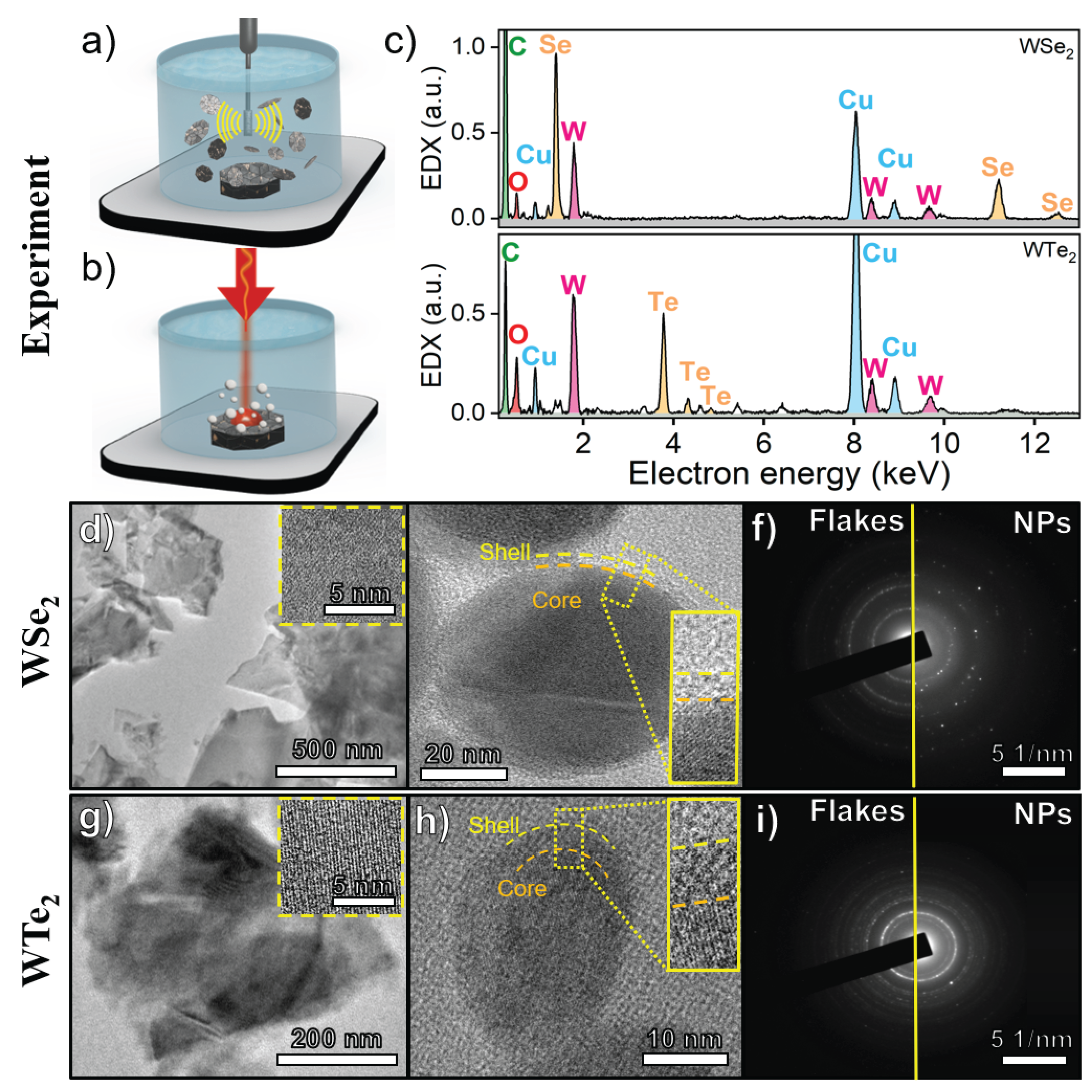
Figure 2.
(a) Comparison of SERS spectra of M CV acquired using WSe2 flake-based and NP-based substrates; (b) Enhancement factors (EF) calculated for WSe2 flake-based and NP-based substrates
Figure 2.
(a) Comparison of SERS spectra of M CV acquired using WSe2 flake-based and NP-based substrates; (b) Enhancement factors (EF) calculated for WSe2 flake-based and NP-based substrates
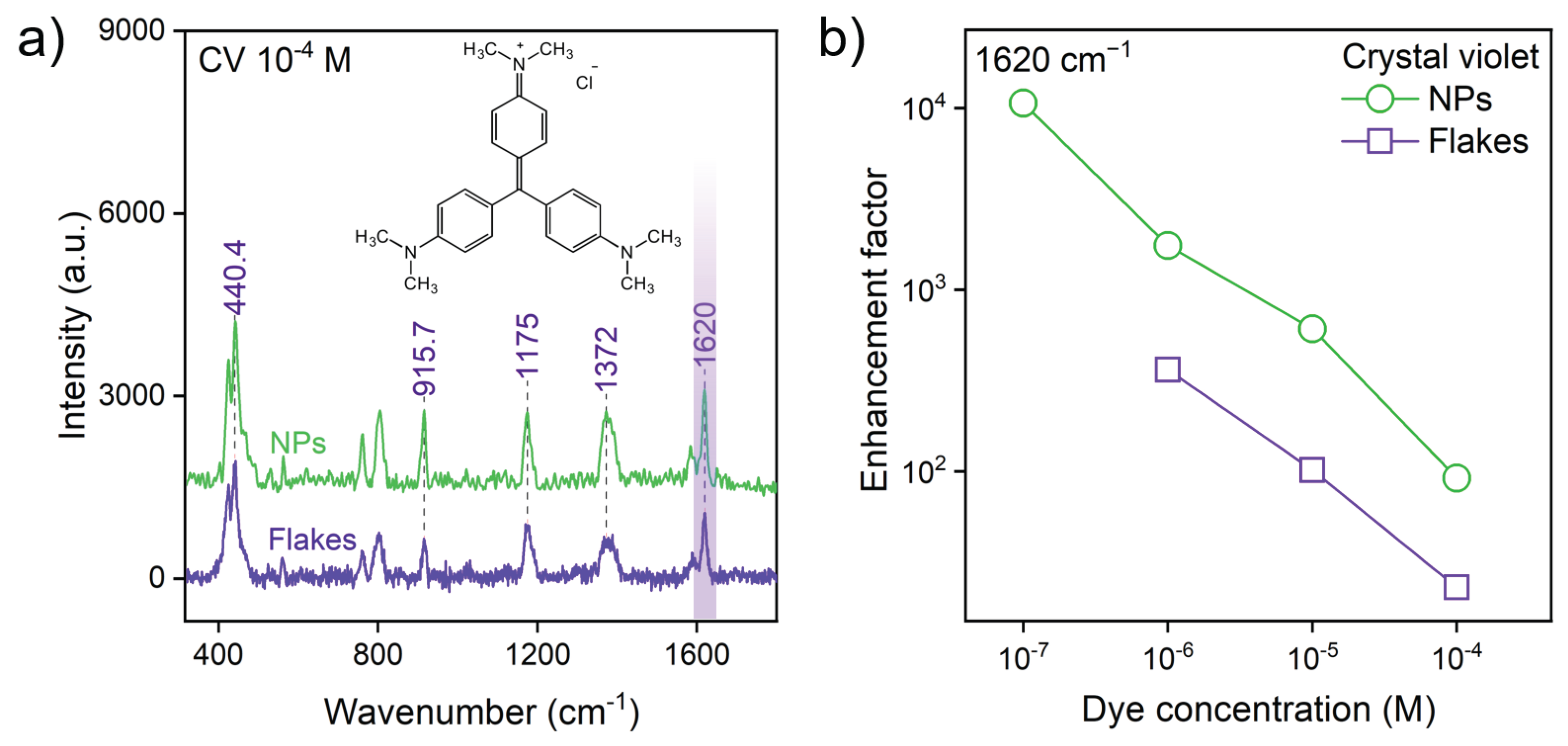
Figure 3.
(a) Comparison of SERS spectra of M CV acquired using WTe2 flake-based and NP-based substrates; (b) Enhancement factors (EF) calculated for WTe2 flake-based and NP-based substrates
Figure 3.
(a) Comparison of SERS spectra of M CV acquired using WTe2 flake-based and NP-based substrates; (b) Enhancement factors (EF) calculated for WTe2 flake-based and NP-based substrates
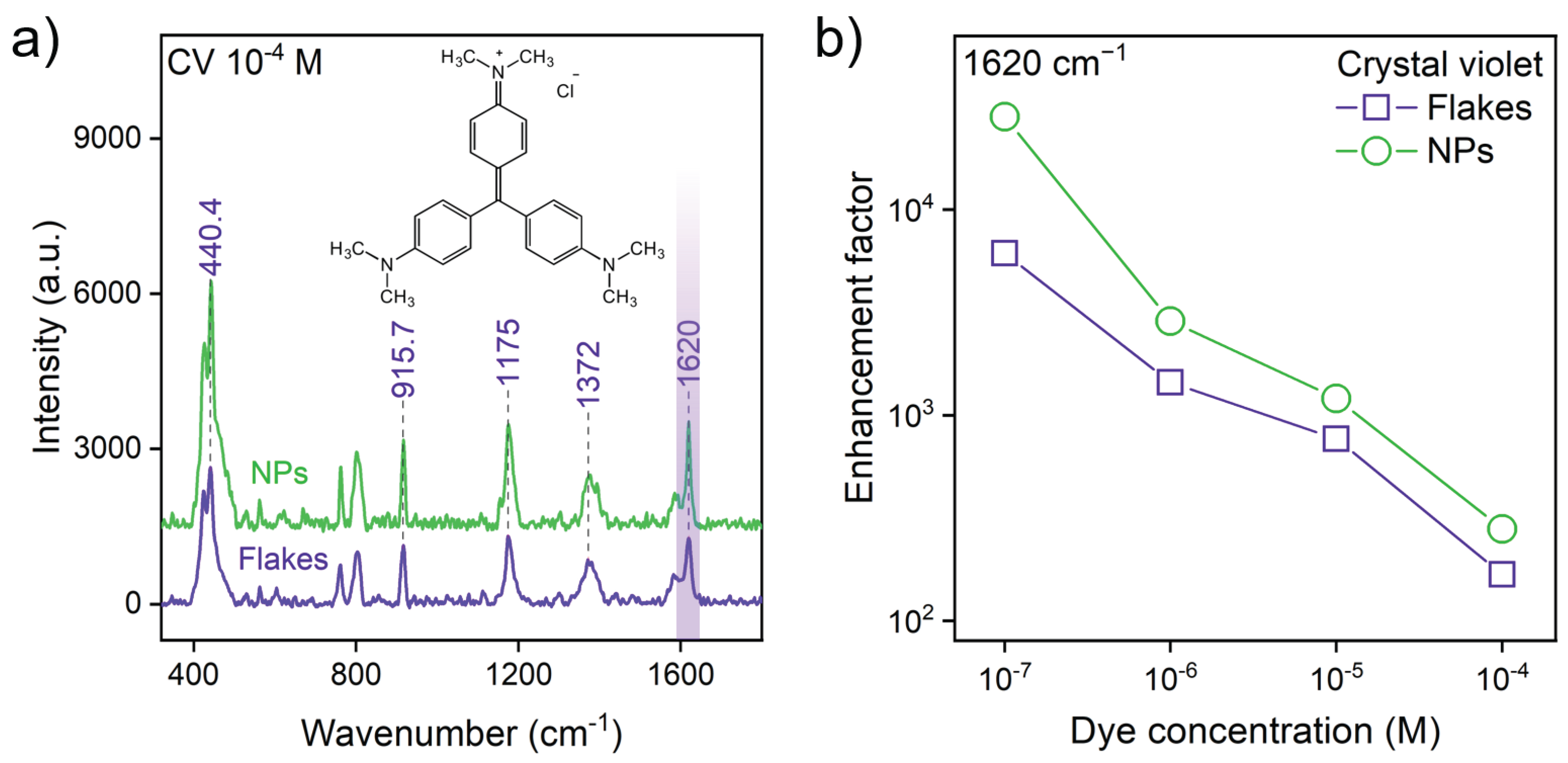
Figure 4.
Orientation-averaged effective optical constants of bulk (a) WSe2 and (b) WTe2, indicating resonant excitonic optical absorption of WSe2 and broadband optical absorption of WTe2 in NIR-I. Experimentally measured anisotropic optical constants, used for the orientation-averaged effective constants, were taken from the published works on WSe2 [46] and WTe2 [47]; (c) Measured optical extinction spectra of WSe2 and WTe2 colloids; (d) Dependence of photothermal conversion efficiency on particle size for spherical WSe2 and WTe2 nanoparticles; (e) Experimental Photothermal Conversion Efficiency (PCE) values for femtosecond-laser-ablated WSe2 and WTe2 nanoparticles at 830 nm heating irradiation; (f) Comparison of theoretical and experimental PCE rates of the WSe2 and WTe2 nanoparticles.
Figure 4.
Orientation-averaged effective optical constants of bulk (a) WSe2 and (b) WTe2, indicating resonant excitonic optical absorption of WSe2 and broadband optical absorption of WTe2 in NIR-I. Experimentally measured anisotropic optical constants, used for the orientation-averaged effective constants, were taken from the published works on WSe2 [46] and WTe2 [47]; (c) Measured optical extinction spectra of WSe2 and WTe2 colloids; (d) Dependence of photothermal conversion efficiency on particle size for spherical WSe2 and WTe2 nanoparticles; (e) Experimental Photothermal Conversion Efficiency (PCE) values for femtosecond-laser-ablated WSe2 and WTe2 nanoparticles at 830 nm heating irradiation; (f) Comparison of theoretical and experimental PCE rates of the WSe2 and WTe2 nanoparticles.
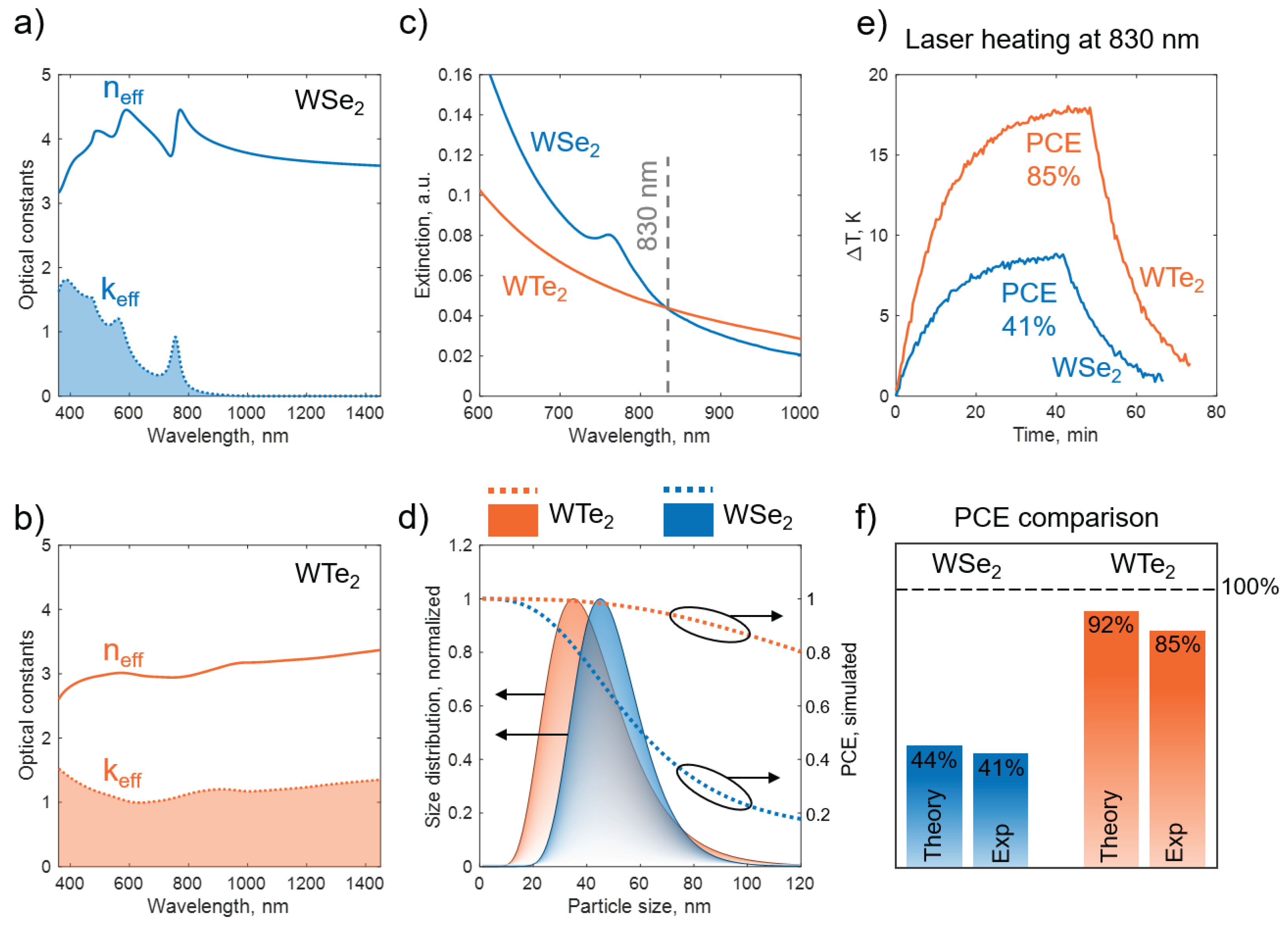

Table 1.
Atomic composition and stoichiometry of WSe2 and WTe2 materials
| Materials | Atomic composition (at.%) | Stoichiometry | ||
| W | Se/Te | |||
| WSe2 | Flakes | 30.51 | 61.77 | ∼ 1:2 |
| NPs | 31.08 | 56.31 | ∼ 1:1.8 | |
| WTe2 | Flakes | 29.54 | 59.15 | ∼ 1:2 |
| NPs | 26.20 | 44.38 | ∼ 1:1.7 | |
Table 2.
Comparative SERS performance of crystalline WSe2 and WTe2 substrates
| Substrate | Synthesis Method | Morphology | Analyte | EF | LOD |
|---|---|---|---|---|---|
| WSe2 | Ultrasonic Exfoliation | Crystalline Flakes | CV | M | |
| WSe2 | Femtosecond PLAL | Crystalline Nanoparticles | CV | ∼ | M |
| WTe2 | Ultrasonic Exfoliation | Crystalline Flakes | CV | M | |
| WTe2 | Femtosecond PLAL | Crystalline Nanoparticles | CV | > | M |
Disclaimer/Publisher’s Note: The statements, opinions and data contained in all publications are solely those of the individual author(s) and contributor(s) and not of MDPI and/or the editor(s). MDPI and/or the editor(s) disclaim responsibility for any injury to people or property resulting from any ideas, methods, instructions or products referred to in the content. |
© 2026 by the authors. Licensee MDPI, Basel, Switzerland. This article is an open access article distributed under the terms and conditions of the Creative Commons Attribution (CC BY) license (http://creativecommons.org/licenses/by/4.0/).
Copyright: This open access article is published under a Creative Commons CC BY 4.0 license, which permit the free download, distribution, and reuse, provided that the author and preprint are cited in any reuse.


