
Submitted:
27 March 2026
Posted:
30 March 2026
You are already at the latest version
Abstract
The Island of Montecristo, part of the Tuscan Archipelago, was subjected to an “invasive species” eradication effort co-financed by the European Union under the Life+ “Montecristo 2010” project in 2012. Biocidal agents were utilized in abundance, with the objective of targeting select species of flora and fauna. This included the aerial broadcast of pellets containing brodifacoum to attempt to eradicate the rat population along with the application of several herbicides to eliminate Ailanthus [Ailanthus altissima (Mill.) Swingle]. The potential risks and concerns associated with the dispersal of brodifacoum include the mortality of non-target and protected species, including the Montecristo goat (Capra aegagrus Erxleben, 1777). Brodifacoum's environmental persistence has led to concerns regarding its potential for secondary, tertiary, and subsequent poisoning of numerous species. Pellets may have reached the sea due to the island's steep terrain, potentially impacting marine life. Rodenticides and herbicides are classified as "chemical biocides", a concept first proposed by the American biologist Rachel Carson over six decades ago. The question of whether this practice constitutes a conservation initiative or could lead to an environmental disaster is a salient one and this study aims to provide multidisciplinary scientific analysis to address this question.
Keywords:
brodifacoum
; anticoagulants
; rat eradication
; Montecristo
; Puffinus yelkouan Acerbi
; 1827
; bioaccumulation
; glyphosate
; biocides
; cetacean strandings
; invasive alien species
1. Introduction
This research article was developed according to the proceedings of the May 23, 2023 conference in Rome entitled “The Management of Italy’s Natural Heritage,” which was promoted by the National Federation of Biologists (FNOB) [1]. The conference was dedicated to the American biologist Rachel Carson, who is primarily recognized for her seminal book Silent Spring, published in 1962 [2]. This book was instrumental in raising awareness among the public and the scientific community regarding the use of chemicals in agriculture and the environment. It played a pivotal role in leading to the eventual ban of chemical insecticides, namely the DDT (Dichloro-Diphenyl-Trichloroethane) due to its role in environment pollution and biodiversity loss, widespread environmental contamination, ecosystem disruption, and human health effects. While Carson’s efforts led to significant advancements in public awareness regarding the perils associated with the use of toxicants, six decades later, history appears to be repeating itself e.g., [3,4,5,6,7,8,9,10,11,12,13,14,15,16,17,18]. Indeed, while scientific and public consensus increasingly emphasizes the necessity of reducing, if not entirely eliminating, the use of such biocides in agricultural and urban environments [19], on the other hand, there has been a substantial increase in the financial resources allocated to “nature conservation programs” aimed at the eradication of animal or plant species e.g., [20,21,22,23,24,25,26,27,28], which involve the use of biocides [29] that have been shown to be a threat to other species and a pollutant [30], as they can bioaccumulate in living organisms, food chains, and are highly persistent in the environment e.g., [31].
In order to comprehend the implementation of such extreme actions, it is necessary to consider the underlying premises of invasion biology, specifically the dichotomous interpretation of nature. According to the precepts associated with invasion biology, the components of an ecosystem are divided into two distinct groups: “native” and “alien” life forms. This binary distinction is inextricably linked with the conceptualization of species as either “safe” or “dangerous.” The subsequent theoretical step in this line of reasoning that justifies eradication actions is predicated on the premise that native species are inherently “safe” while non-native or “alien” species are inherently “dangerous” or that native species are “right” and non-native species are “wrong”. In instances where an “alien” species has not been demonstrated to pose an immediate threat, invasion biology proposes that “these species, designated as ‘sleeper species,’ necessitate identification and prioritization for eradication or control before they spread and become invasive” [32]. The present analysis seeks to determine whether such a dichotomization of reality can be considered a sound scientific concept or if rather it can be identified as an idealization that, from a phenomenological point of view, has restricted relevance in the field from both theoretical and practical viewpoints. For instance, Theodoropoulos [33], Cox [34], Vermeij [35] and Davis [36] provide notable contributions in this area. The notion of “safe” and “harmful” within this scientific context are open to interpretation, as it is important to determine whether these concepts are an accurate representation of reality or if they are idealizations that have been imposed on reality e.g., [36,37,38,39,40,41]. An important question to consider is whether “invasion” is a process that does not exist in nature, or whether it is a natural process of dispersion through which newly arrived organisms have a remarkable ability to adapt to new ecosystems and these, in turn, have a remarkable ability to adapt to new arrivals [42] both ecologically and evolutionarily [34]. A critical examination of the dynamics between natural species dispersal and human-facilitated dispersal is imperative to elucidate the underlying mechanisms and implications of biodiversity conservation. The fundamental question guiding this research is whether ecosystems are static entities or constantly evolving systems. Furthermore, a thorough examination must be conducted to ascertain whether the potential detriment inflicted by an “alien” species on a “native” species would surpass that of a specific human activity that has the capacity to inflict irreparable harm on the entire ecosystem.
Invasion biology is currently one of the trends of contemporary ecology. This phenomenon aligns with the proliferation of eradication initiatives, predominantly executed through the extensive use of biocides (including rodenticides, herbicides, and analogous substances) or the intentional release of pathogens. An investigation into the ramifications of this manner of thinking and acting is imperative.
It is somewhat contradictory that in order to attempt to eliminate some of hypothetical and potential causes of biodiversity loss, methods are employed that unmistakably fall within the purview of human actions that have a direct, immediate, and often irreversible effect on the loss of biological elements (biodiversity) and the impoverishment of habitats, also posing a significant threat to human health [43].
These activities have generated significant contradictions, raising ethical questioning about the foundational principles of such actions [44], along with growing awareness and knowledge about the potential consequences related to environmental pollution and contamination. The use of biocides is commonly recognized as a major cause of biodiversity loss e.g., [43,45,56], along with the destruction of habitats implemented by humans through deforestation, management of forests, intensive agriculture, industrialization and urbanization. Pesticides have been demonstrated to exert toxic effects on organisms that have been exposed to them, whether directly or indirectly. These effects may be immediate or protracted, manifesting over extended periods through alterations in ecological niches and subsequent ramifications along the food chain. The utilization of pesticides has been shown to compromise the quality of water, soil, and air, leading to environmental degradation and, by extension, the endangerment of human health and well-being.
These observations prompt further inquiry into the extent to which efforts to eradicate or regulate “alien” (anthropogenically introduced) species should be pursued. The question of whether humans should decide which species are “worthy” of existence and which should be destroyed, effectively replacing nature, has been raised e.g., [57,58]. This position is arguably equivalent to a willful ignorance of the importance of evolutionary processes, one of whose prerequisites is the mobility of species e.g., [33,34,35,36,42]. However, it is imperative to determine the extent to which the consequences of the presence of an “alien” species surpass those of our own actions against them. A critical question that arises in this context is the ability to delineate the threshold between a successful eradication effort and an environmental disaster.
These concerns and discussions should not only be considered as mere abstract ethical and philosophical questions. Instead, they must be regarded as inquiries into principles and methodology that bear practical and concrete implications.
Information concerning the outcomes of this type of project is frequently restricted to reports or publications produced by authors involved in the actions or by other individuals that have promoted the project. Consequently, this introduces potential biases in the interpretation of the reported data.
The present study endeavors to provide a possible alternative point of view following the precautionary principle, with an analysis of available data in ascertaining the possible environmental contamination that occurred following the dispersion of biocides in a protected area through the use of engineering analysis of body mechanics simulations and literature reviews regarding the adverse effects of biocides used on a wide range of species as well as its persistence in the ecosystem.
2. The Isola di Montecristo
The Isola di (Island of) Montecristo (42° 20′ 00” N, 10° 19′ 00” E) is of significant importance within the “Isole dell’Arcipelago Toscano” islands and the Tyrrhenian Sea (see Figure 1). It is included in the “Parco Nazionale dell’Arcipelago Toscano” National Park, a Biosphere Reserve within the “Islands of Tuscany” under the UNESCO MAB Program, and is located within an environmentally fragile Pelagos Sanctuary for Mediterranean Marine Mammals, a State Nature Reserve established by the Ministerial Decree of March 4, 1971, and a biogenetic nature reserve designated by the Council of Europe in 1988 [59].
The island is a granitic cone (see Figure 2) whose apex reaches 645 meters above sea level, with a surface area of approximately 10.39 square kilometers [60,61,62,63]. It is characterized by numerous perennial freshwater springs and a typical Mediterranean phytocoenosis [61].
Prior to the implementation of the rat eradication project, the island’s fauna was composed of the Montecristo goat (Capra aegagrus Erxleben, 1777 or C. aegagrus pictus Erhard, 1858 [60,61,62,64]), a few species of Passeriformes (Passer italiae Vieillot, 1817, P. hispanioliensis Temminck, 1820, Serinus serinus Linneus, 1766, Carduelis chloris Linneus, 1758), a small population of chukar partridge (Alectoris chukar Gray, 1830), numerous pairs of yellow-legged gulls (Larus michahellis Naumann, 1840), the common raven (Corvus corax Linneus, 1758), barn owls (Tyto alba Scopoli, 1769), diurnal and nocturnal birds of prey present on the island mainly during migration (Falco tinnunculus Linneus, 1758 and Falco peregrinus Tunstall, 1771), and a large population of yelkouan shearwaters (Puffinus yelkouan Acerbi, 1827) whose numbers were estimated in 2009 at 400-750 pairs [63].
In addition to the aforementioned species, the fauna of the region includes various reptiles and amphibians, such as the green whip snake (Hieropis viridiflavus Lacépède, 1789), viper (Vipera aspis hugyi Schinz, 1833), and Tyrrhenian painted frog (Discoglossus sardus Tschudi, 1837). Additionally, numerous species of invertebrates inhabit the area [61,63]. In particular, the Montecristo goat (C. aegagrus Erxleben, 1777 or C. aegagrus pictus Erhard, 1858), regardless of taxonomic position, is a species of great naturalistic interest whose population is found only on the Island of Montecristo (hence the name) and included in Group A of the IUCN Caprine Specialist Group classification of wild goats. The presence of this taxon resulted in the recognition of the “European Diploma for Protected Areas at Montecristo Island” [63]. In addition to its conservation significance, the Montecristo goat population holds historical and cultural heritage importance. It represents an early stage of domestication of the Aegagrus (Capra aegagrus Erxleben, 1777 or C. aegagrus pictus Erhard, 1858) and its subsequent dispersal across the Mediterranean basin by humans [60,65].
Additionally, two animal species were regarded as “alien” on the island: the black rat (Rattus rattus Linneus, 1758) and the wild rabbit (Oryctolagus cuniculus huxley Linneus, 1758), including crosses of the latter with domestic phenotypes. Human presence was limited to two guardians of the island, who resided there until 2018, with a hiatus between 2012 and 2014 [66].
With regard to the flora of Montecristo Island, the most recent inventory counts 582 taxa, of which 515 are spontaneous and 67 cultivated [67]. The main geographical distribution elements are Euro-Siberian-Mediterranean and Mediterranean species, while the predominant life form is therophyte, with the presence of endemic and subendemic taxa characteristic of the island [68,69]. The vegetation cover of Montecristo is extremely fragmented [70,71] and appears to consist mainly of low scrub with a predominance of Erica arborea L., E. scoparia L., Cistus monspeliensis L., Rosmarinus officinalis L., Teucrium marum L. and Euphorbia characias L. [71]. Approximately 49.1% is covered by low scrub, approximately 15% by high scrub, 1.6% is covered by Pteridium aquilinum L., near springs and wet valley bottoms, 0.1% by Quercus ilex L.; approximately 31.1% of the territory is characterized by outcropping rock [72] characterized by the presence of mosses and lichens. Other trees cover is around 3.1%, represented by Mediterranean pines (Pinus pinea L. and P. halepensis Mill.), eucalyptuses [Eucalyptus globulus Labill. and E. lehmannii (Schauer) Benth.], cypresses (Cupressus sempervirens L.), yews (Taxus baccata L.), ailanthus [Ailanthus altissima (Mill.) Swingle] and other occasional species [73].
3. The Project LIFE+ “Montecristo 2010”
The LIFE08 NAT/IT/000353 project, known as Montecristo 2010 [74], with a total eligible budget of € 1,584,856 and an EU contribution of € 792,428, began on January 1, 2010, and ended on June 30, 2014. The project aimed to eradicate the Floro-faunal components considered “alien” and “invasive”, from the Montecristo and Isola di Pianosa islands. Our study will focus on two actions: the eradication of ailanthus [Ailanthus altissima (Mill.) Swingle] and the black rat (Rattus rattus Linneus, 1758) from Montecristo Island.
During the project, extensive eradication of Ailanthus was carried out, covering approximately 183 hectares [75] of the territory, in which five herbicides, namely Triclopyr, Picloram, Fluroxypyr, Imazapyr and Glyphosate [76,77,78,79,80], were applied using various techniques. Following the conclusion of the project, eradication measures were carried out on an additional 67 hectares [81], reaching approximately 250 hectares of the island’s territory contaminated by the use of herbicides. The use of these herbicides may have had a significant and profound impact on the local biocoenosis. This impact has yet to be quantified and examined in depth, especially when considering the repetition of treatments on previously treated areas. It can be assumed that the use of these toxic chemicals may have played a significant role in the rarefaction or loss of local habitats, given the characteristics of the biocides used and the scarcity or absence of soil, which has led to the persistence of active ingredients in significant concentrations in an environment that had never previously been contaminated with such chemicals.
In-depth studies and investigations are needed to better understand how these compounds could adversely affect flora and fauna, both terrestrial, aquatic and marine, within this delicate island ecosystem.
The implementation of interventions using broad-spectrum biocides can potentially cause significant, often irreversible, environmental damage, even in the long term, without being truly effective in eradicating the target species and ultimately leading to a significant increase in anthropogenic environmental destruction.
The primary objective of the Montecristo 2010 project was the eradication effort aimed to eliminate the black rat (Rattus rattus, Linnaeus, 1758), believed to be the main reproductive threat of the yelkouan shearwater (Puffinus yelkouan Acerbi, 1827). The eradication consisted of the aerial dispersal of pellets containing brodifacoum or through the placement of bait stations on the ground in a small portion of the island. Brodifacoum is one of the most potent second-generation anticoagulant toxins, known to be highly persistent in the environment e.g., [31,82,83,84,85,86,87,88,89,90,91,92,93,94].
In January and February 2012, three launching sessions of pellets containing brodifacoum were carried out by helicopter: the first on January 11 (5,600 kg), the second on January 12 (8,000 kg) and the third on February 28 (500 kg) [95]. With the three launches, the entire area of Montecristo (about 1,350 ha) was covered with the dispersal of about 14,100 kilograms (over 14 tons) of brodifacoum-containing pellets (average 10.3 kg/ha) with the exception of a restricted area of about 25 ha, comprising the inhabited area of Cala Maestra, where the pellets were distributed through special containers [95]. Excluded from the aerial distribution of pellets were: an enclosure (25 ha) that housed some goats, the area inhabited by the guardians and surrounding areas, and the area including the island’s main freshwater stream [63] for a total of 33 ha out of 1,350 ha (2.4 percent of the island’s area).
The pellets utilized in the project were 2-gram, paraffin-coated pellets containing 0.1 mg of pure brodifacoum biocide [96]. A total of 705 grams of brodifacoum biocide were dispersed via helicopter.
Brodifacoum poisoning can be fatal to humans if untreated, with the ingestion of 15 mg of the compound causing a potentially fatal outcome [97]. To provide a sense of the potential for harm associated with this amount of biocide, 705 grams of brodifacoum is sufficient to cause the death of approximately 47,000 individuals. This figure is particularly salient when factoring in the more fragile individuals composing an average population such as children and the elderly, as 705 grams of brodifacoum could potentially result in the demise of the entire population of Siena municipality, a population of about 53,156 people [98].
One of the potential risks identified by the project was the possibility that the aerial distribution of brodifacoum could also result in the poisoning of non-target species, including the Montecristo goat population. The high palatability of the pellets to goats was documented during the rat eradication project subsequently conducted on the island of Tavolara, where “results indicated excellent durability of the pellets and a modest rate of disappearance, with the exception of one site constantly frequented by goats, where only one pellet out of thirty was still present after the second night.” [99]. Consequently, in order to ensure the survival of a number of specimens, around 45-50 goats were confined to an enclosure of approximately 25 hectares [63] in close proximity to the sole human settlement on the island. An additional group of five goats was removed from the island and relocated to the Bioparco in Rome, where they constituted a nucleus for ex situ conservation. [100]. The goats within the enclosure predominantly demonstrated markings consistent with the agrimi phenotype, rather than the Montecristo goat phenotype [62].
On December 3 and 4, 2012 [95], eleven months after the first application of brodifacoum pellets, all goats in the pen were released, subject to ear tagging, both for their remote monitoring and to check for any residual mortality [65]. The release of goats occurred in December because numerous pellets were still present until July, 5 months after distribution, and were still largely intact due to lack of rainfall [95]. Thus, brodifacoum-containing baits remained available for several months after distribution, with toxicant exposure for all species.
Project leaders predicted that animals belonging to non-target species would die either from primary poisoning (ingestion of the pellets containing brodifacoum) or from secondary poisoning i.e., ingestion of remains of dead animals or species insensitive to the toxicant (e.g., invertebrates) but contaminated [63]. A representative illustration of potential primary and secondary poisoning as brodifacoum enters the food chain can be seen in the following diagram (see Figure 3).
In particular, according to Sposimo et al. [63], secondary mortalities were predicted to occur in the populations of:
- Chukar partridge (Alectoris chukar Gray, 1830)
- Passerines (Passeriformes Linnaeus, 1758)
- Yellow-legged gull (Larus michahellis Naumann, 1840)
- Common raven (Corvus corax Linnaeus, 1758)
- Barn owl (Tyto alba Scopoli, 1769)
- Diurnal (Accipitriformes and Falconiformes) and nocturnal (Strigiformes) raptors present on the island mainly during migration and occasionally in winter
- Goat of Montecristo (C. aegagrus Erxleben, 1777 or C. aegagrus pictus Erhard, 1858)
- Wild rabbit or crosses of it with the domestic rabbit (Oryctolagus cuniculus huxley Linneus, 1758)
It should be noted that most of these species were and are also protected under national legislation [101]. Risks to the marine ecosystem were also postulated in the project plan, as the Island of Montecristo has high, steep faces, making it impossible to avoid spilling unspecified amounts of brodifacoum-containing pellets into the sea [63].
In drafting the plan for the eradication of the black rat on the Island of Montecristo, the authors of the project stated that they deliberately disregarded the possible legislative constraints related to the aerial distribution of anticoagulants, an action not allowed by existing laws in Italy, nor to the category of anticoagulants that could be used (low environmental persistence allowed, high environmental persistence: not allowed), nor of the possible opposition from animal welfare, environmental associations or citizens concerned about the impact of the poisoned pellets on the island’s ecosystem [63].
During the period of the project’s implementation, the 2010 Ministerial Ordinance on “Regulations on the Prohibition of the Use and Possession of Poisoned Bait or Poisoned Pellets” (G.U. General Series no. 33, Feb. 10, 2010) issued by the Ministry of Health (O.M. Jan. 14, 2010, G.U. General Series no. 33, Feb. 10, 2010 [102]) Article 6 prescribed:
[…] “In protected areas, for reasons of safeguarding wild species subject to protection measures of an international nature, where they are particularly threatened by rats, it is possible to carry out, after notifying the Ministry of Health, rat eradication operations using rodenticides without the use of the appropriate bait containers provided that:
a. the active ingredient used as rodenticide is of low environmental persistence in order to avoid contamination of the food chain and the environment;
b. the maximum duration of persistence of the baits in the environment is established in relation to the objectives to be achieved, based on the most up-to-date scientific literature;
c. at the end of the operation, the unused baits are removed from the environment and an appropriate report is drawn up by the person in charge of the operation, in which the number of baits placed in the environment, the area affected by the operation and the number of baits, unused and removed at the end of the operation, are indicated. The aforementioned report, a copy of which is sent to the Ministry of Health, is available to the competent authorities for possible review” […].
The Italian Ministry of Health’s ban on the use of rodenticides with high environmental persistence was predicated on the understanding that the use of such substances would inevitably result in the comprehensive contamination of the ecosystem with unpredictable, harmful long-term consequences.
The news of the aerial dispersal of pellets on the Island of Montecristo, theoretically aimed at biodiversity protection purposes, sparked numerous protests from animal welfare associations and private individuals concerned about the environmental toxicity of brodifacoum, which resulted in reports to the judiciary and even parliamentary interrogations [103], including recent ones to the Senato della Repubblica [104] and the Consiglio Regionale della Toscana [105].
As a result, in February 2012, the Ministry of Health requested a scientific expert opinion on the environmental persistence of brodifacoum from the Centro di Referenza Nazionale per la Medicina Forense Veterinaria of the Istituto Zooprofilattico Sperimentale del Lazio e della Toscana, a highly specialized facility for countering malicious poisonings of animals.
The Centro di Referenza Nazionale corroborated the hypothesis that brodifacoum exhibits persistent environmental toxicity. In light of the violation of Article 6 of the current M.O., the Ministry of Health petitioned the judiciary for sanctions against the individuals responsible for the project [106].
4. The Use of Brodifacoum to Eradicate the Black Rat (Rattus rattus, Linnaeus, 1758)
4.1. Brodifacoum
Brodifacoum (3-[3-[4-(4-bromophenyl)phenyl]-1,2,3,4-tetrahydronaphthalen-1-yl]-4-hydroxychromen-2-one [107]) is a biocide belonging to Group 3, Type 14 [19] and, like second-generation anticoagulant rodenticides (ARs), is classified as a persistent, bio-accumulative and toxic substance [108,109].
Its toxic action blocks the synthesis of a group of the K vitamins that are essential for the synthesis of prothrombin and other blood clotting factors in vertebrates. The lethal outcome of poisoning by this substance (including death in humans) occurs from hemorrhagic shock due to nose or mouth bleeding, renal or gastric bleeding, as well as internal bleeding. Once ingested, brodifacoum can remain within the body for an extended period of time at a sublethal level. Consequently, symptoms of poisoning may manifest even several weeks after ingestion. It is important to note that the compound remains intact, particularly within the liver of the affected subjects, regardless of whether the affected subjects are deceased or alive. This phenomenon precipitates the initiation of a bioaccumulation mechanism [110].
In birds and mammals brodifacoum causes damage to the myocardium, liver, and skeletal system. Due to its high environmental persistence, it is possible for an animal to be re-exposed to the compound several times, which results in gradual increase in its toxic action with lethal effects that can manifest long after its first ingestion [110].
The persistence of brodifacoum in the ecosystem is attributed to its ability to bind to numerous organic substrates, thereby contaminating them through mechanisms that remain poorly understood [111]. Consequently, the aerial dispersal of pellets containing brodifacoum poses a substantial risk of primary and secondary poisoning of nontarget species e.g., [31,84,85,86,87,88,89,90,91,92,93,94].
The high persistence of this compound in the environment results in numerous cases of primary and secondary poisoning in a wide range of animal species, including non-target species, such as mammals, birds, invertebrates, and reptiles [84,87,90,91,112,113].
Several research studies have demonstrated the persistence and accumulation of this substance in both terrestrial and aquatic environments, where it persists and disseminates throughout the food chains, from microorganisms in the soil [114] and plankton in aquatic environments [115], to the top (e.g., mountain lions [116], bobcats [117,118,119], wolves [94], foxes [120], raptors [121], cormorants [122], cetaceans [93], humans [123], etc.).
The remains of the liver, as well as the gastric contents containing partially digested pellets, as well as the intestinal contents and the feces of animals, may contain varying residues of brodifacoum, even in doses that are not immediately lethal. These residues enter the food chain of a broad array of animal species in the ecosystem when scavenging invertebrates ingest the contaminated remains [89].
This mode of secondary poisoning has been described in insectivorous birds (Charadrius obscurus Gmelin, 1789) from New Zealand [124] where, after aerial dispersal of brodifacoum-containing pellets, 50 percent of the population of these birds disappeared. In this case, secondary mortality of these insectivorous birds by brodifacoum is believed to have been caused by the ingestion of arthropods of the genus Talorchestia spp., a common component of their diet, which in turn had ingested residues of brodifacoum-containing pellets [124].
In contrast, the effects on invertebrate survival of long-term exposure to lower concentrations of the toxicant, such as those of approximately 1 ppm, which are typically found in soil following brodifacoum dispersal, remain unknown. Additionally, the duration of brodifacoum’s presence at a sub-lethal level in the bodies of invertebrates that have ingested it is yet to be determined [91].
A recent study [94] reports the presence of second-generation anticoagulants (ARs), including brodifacoum, in 115 wolves (Canis lupus Linneus 1758) out of 186 specimens found dead from a variety of causes in some areas of North-Central Italy.
Of these, only 19 specimens (16.5 percent) displayed an anatomo-pathological profile consistent with anticoagulant exposure. This apparent positive outcome, however, belies the fact that all the remaining wolves, which died from disparate causes, endured the sub-lethal effects of the toxicant. Furthermore, the authors emphasize the concerning pervasiveness of second-generation anticoagulants across the entirety of Europe’s terrestrial food chains. In light of this, they propose an approach to rodent control that primarily relies on trapping techniques and the use of chemical compounds with low persistence and toxicity for non-target species, in accordance with the Ministry of Health Ordinance. Indeed, this information has been known for over two decades through a substantial body of scientific literature [see, for example, 82-85]. For further details, please see the following references: Howald et al. [86,88], Hoare et al. [87], Fisher et al. [89,90,91], and Harper et al. [92].
4.1.1. Is “Degradation” of the Pellet Synonymous with “Degradation” of the Toxic Compound?
It is frequently asserted that the disintegration of the brodifacoum-containing pellet resulting from weathering is tantamount to the degradation of the toxicant compound e.g., [125]. However, this is incorrect. The disintegration of the pellet does not result in the inactivation of the compound; rather, it results in its increased diffusion. This is due to the pellet dispersing in the form of microparticles, which are more mobile than the original, larger, and heavier pellet. These minute particles are only occasionally discernible to the unaided eye, due to their association with a dye that renders them conspicuous. This process has been observed in non-target species situated up to 8 kilometers from the point of pellet dispersion [84].
Consequently, the use of the term “degradation” of the pellet with the meaning of “inactivation” of the brodifacoum compound is incorrect and misleading.
The sole parameter that can be utilized to ascertain the duration of a compound’s continued activity within the environment is the so-called half-life (DT50), which is the time it takes for a chemical to be reduced by 50 percent from its initial amount.
In December 2007, the Joint Nature Conservation Committee published a study [126] in which it was asserted that brodifacoum may have a considerable impact on biodiversity due to its exceptionally high environmental persistence. The authors provide a comprehensive overview of the existing knowledge regarding the persistence of brodifacoum at the time of publication.
In soil, the half-life (DT50) of brodifacoum is between 77 and 1,332 days depending on the nature of the substrate.
In the organs of animals that have died from the action of the toxicant, particularly in the liver, it can persist for months. In the opossum (Trichosurus vulpecula Kerr, 1792) after an initial half-life (DT50) of 14 days, brodifacoum is detectable in the liver of the dead animal more than 9 months (270 days) after the animal ingested the toxin [127,128]. In the liver of deceased rats, the DT50 was estimated to be 130 days, or more than 4 months after ingestion [85].
Sheep given brodifacoum in a sublethal dose (0.2 to 2.0 mg/kg), then subsequently euthanized after 128 days, still had residues of the toxicant in the liver [127].
In sandy soils and soils rich in clay, brodifacoum has been observed to have a half-life of 156.8 days [91]. For instance, one-third of soil samples (33%) collected at a depth of 5 cm from the surface exhibited evidence of pellet breakdown [129]. On Anacapa Island, the toxicant was detected in 20% of randomly selected invertebrate samples six months (180 days) after its dispersal by aerial means [129].
4.1.2. Is Brodifacoum Toxic to Fish or Other Marine Life? What About Cetaceans?
In relation to the presence of pellets in the marine environment, it is often asserted that these pellets experience rapid dissolution within 15 to 30 minutes of being deposited in coastal areas [130]. The assertion further contends that the concentration of rodenticide in seawater would be undetectable, thereby posing minimal to no risk to fish. However, these considerations appear to be rather superficial, given the substantial quantities of pellets that typically enter the sea in island areas, both during the distribution of bait by helicopter and following the initial heavy rainfall and given that extensively used second-generation anticoagulant rodenticides, such as brodifacoum, are highly persistent, bioaccumulative, and toxic. Furthermore, although the pellets can disintegrate in a matter of minutes [131], once reduced to minute particles, they exhibit increased mobility and dispersal within the marine environment, becoming available to a wide variety of life forms, including zooplankton, other crustaceans, mollusks, as well as predators and scavengers. In addition to the risks associated with primary and secondary exposure, exposure through water contamination must also be considered. For instance, as part of the project to eradicate two species of rats [Rattus norvegicus (Berkenhout, 1769) and R. exulans (Peale, 1848)] implemented in 1996 on Kapiti Island, New Zealand, with the helicopter release of pellets containing brodifacoum at 20 ppm, observations were carried out on various species of fish in aquariums in order to observe the behavior of the fish and detect their mortality. In the course of the investigation, it was determined that in addition to the fish that had ingested the pellets, a significant number of fish that had not ingested any bait had also perished. The authors of the study posited a hypothesis that the active ingredient may have been absorbed through the skin or scales [131]. Consequently, even in the context of pellet dispersal in the sea, their disintegration does not entail a loss of effectiveness; rather, it results in an increase in their mobility and availability.
The toxicity of brodifacoum to fish has been demonstrated to be contingent upon the concentration of the substance in the water and the duration of the fish’s exposure to it. The toxicity of the compound is experimentally expressed by the LC50, or the concentration in water of the compound capable of killing 50 percent of fish. For example, the LC50 for rainbow trout [Oncorhynchus mykiss (Walbaum, 1792)] is 0.04 mg/L/96 hours [96].
Schmieg et al. recently published a study [132] which, for the first time, reports the results of exposing rainbow trout to brodifacoum, according to the concentrations previously detected in another study by Regnery et al. [122] conducted on wild freshwater fish. Trout sampling was conducted every 15 days over a period of 60 days, allowing for monitoring of brodifacoum concentrations in serum, liver, and muscle tissue, as well as the effects on fish health. The minimum hepatic concentration of brodifacoum associated with deleterious effects in rainbow trout was on average 122.6 ng/g wet liver weight, which is within the range of residues previously detected in wild fish [122]. This first study conducted on fish (rainbow trout) clearly reveals that the exposure of fish to lethal or sub-lethal levels of brodifacoum is far from negligible and that, until now, the implications of this have been largely underestimated. The release of bait containing ARs on islands is associated with the dispersion of these toxins into the marine environment, and these first scientifically conducted studies show that such interventions should not be allowed because, given the persistence, toxicity, and bioaccumulation characteristics of second-generation rodenticides such as brodifacoum in the environment, the effects are much more significant than previously thought. These values also fall within the range of brodifacoum residues found in wild fish that died after helicopter bait distribution for rat eradication on an island [132]. These values, corresponding to lethal poisoning, ranged from 58 to 1,160 ng/g wet weight, while in other fish caught alive, brodifacoum residues of up to 315 ng/g wet weight were detected in the entire body [31,132]. Apart from this single study conducted by Schmieg et al., we are not aware of any experimental data that would allow to interpret the effects of ARs residues in wild fish in the context of environmentally relevant concentrations and routes of exposure. Brodifacoum is also toxic to corals, affecting their reproductive success rates [133]. It also affects plankton, which underlie the food chain of many marine life forms [134,135] as well as algae [136]. Pellets containing brodifacoum are found to be extremely attractive to crabs, shrimp and hermit crabs [137,138,139], which form the basis of the diet of many marine and terrestrial predators. Regnery [140,141] recently produced a comprehensive review on the risks to the aquatic environment resulting from the land-based release of anticoagulants, especially second-generation anticoagulants such as brodifacoum. Due to their low solubility in water, these toxic compounds persist and accumulate in aquatic ecosystems, where they are adsorbed to suspended particulate matter, sediment (rich in organics), and contaminate biological tissues of aquatic organisms. Immediate adsorption to sediment was observed for brodifacoum, followed by a slow transformation with low levels of degradation products, representing less than 10 percent of the initial active substance. Although anticoagulants have been in use for decades, relatively little is known about their pharmacokinetics and toxicokinetics in aquatic organisms and the effects of chronic exposure with multiple active ingredients [93]. In some studies, residual concentrations of brodifacoum have been detected in coastal marine species such as sedentary mollusks following rodent eradication efforts from islands [142,143] or accidental discharges [144]. Although it is evident that anticoagulant rodenticides can enter the food chains of aquatic ecosystems, the behavior and fate of these toxicants have had insufficient attention from environmental research groups to date [145,146]. The processes of bioaccumulation can differ significantly among aquatic species due to the complex interactions among various pathways of uptake, including direct absorption of chemicals carried by water, dietary uptake through ingestion of food or contaminated particles, excretion, passive release, and metabolization [147]. It is therefore essential to have an understanding of the biological parameters of the species in question, including its trophic level, age, and lipid content, in order to identify the exposure of aquatic organisms to anticoagulant rodenticides and to link residues of these compounds with the identified sources of release. However, these crucial parameters are frequently excluded from environmental monitoring studies investigating the presence of anticoagulants in aquatic fauna. The ability to detect brodifacoum residues in fish from the coastal strip of an island following the aerial dispersal of this toxicant is significantly influenced by several factors, including the sample size analyzed, the feeding ecology of the selected fish species, and the analytical methods employed [93,145]. For instance, an investigation into the presence of brodifacoum and its potential consequences was conducted on a total of fifteen fish specimens belonging to eight distinct species (sampling range 1 to 4 specimens/species) from the coastal zone of Tavolara Island. This was carried out ten days after the complete dispersion of approximately 18,000 kg of bait containing brodifacoum at a concentration of 50 ppm. The results of this investigation were negative. However, the negative results obtained are likely due to the limited sample size and the species of fish examined, as the authors have acknowledged. These findings cannot be considered indicative of the actual impact of brodifacoum on the marine ecosystem, as they do not account for potential exposure to this anticoagulant. The data obtained do not preclude the possibility that fish and other organisms, such as crustaceans and mollusks, which were not examined in the study, may not have traces of consumed pellets or accumulated brodifacoum residues [148].
Two studies of coastal marine fauna in parts of New Zealand [131] and one case of accidental spillage of brodifacoum-treated grains into the sea [142] demonstrated persistent positive test results of the chemical compound in fish and shellfish under experimental conditions. In the case of the accidental spillage of brodifacoum into the water, following the overturning of a truck due to a traffic accident, the toxicological surveillance plan, which was immediately put in place on fish and shellfish subject to human food consumption, lasted for 2 years and 7 months. In fact, in five specimens of shellfish belonging to various edible species, the mean concentration of brodifacoum exceeded the detection threshold of the analytical method employed (high-performance liquid chromatography, HPLC) for a period of 353 days following the spill. Furthermore, the mean concentration remained above the maximum permissible threshold for human consumption, which in New Zealand is 0.001 ppm. The presence of brodifacoum in mollusk tissues fell below the detectable level only after 31 months (930 days), which is to say, two years and seven months. This very high persistence was attributed to two factors: the prolonged half-life of the compound in these invertebrates and the bioaccumulation caused by their repeated re-exposure to brodifacoum in the intertidal environment of the spill area [142].
No systematic studies have been conducted to determine the LD50 relating to the ingestion of brodifacoum-containing bait by fish or other organisms in the marine environment. In fact, the risk associated with the dispersion of rodenticide-containing bait in the marine environment is greatly underestimated by both academia and the authorities that manage protected areas. The only study that has documented the mortality of fish and crustaceans following direct or indirect ingestion of pellets containing brodifacoum was conducted in 2011 on Palmyra Atoll and published in 2015 [31].
From June 1 to 30, 2011, a total of 38.561 tons of pellets containing brodifacoum at 25 ppm were dispersed from helicopters with the objective of eradicating rats (Rattus rattus) from Palmyra Atoll, which encompasses approximately 232 hectares of emerged land [149]. A preliminary effort to eradicate the rat using the same method in 2001-2002 [149] was unsuccessful due to the substantial consumption of pellets by crabs and hermit crabs inhabiting the island. According to the findings of Pitt [31], approximately 14-19% of the pellets were released into the sea during the distribution process, occurring at a distance of 7 meters from the coastline. Subsequent to the launch of brodifacoum-containing pellets, a total of 84 animal carcasses, encompassing 15 different species of birds, fish, reptiles, and invertebrates, were collected opportunistically. Additionally, live fish, reptiles, and invertebrates were captured for residue analysis. The analyses were executed with an MLOD (defined as the lowest amount of analyte in a sample that can be detected but not necessarily quantified as an exact value) that varied depending on the samples analyzed and the various species (Annex A in [31]). Traces of brodifacoum were detected in freshwater samples (MLOD=0.009 ng/mL), seawater samples (MLOD=0.011 ng/mL), and soil samples (MLOD=0.0030 µg/g) (Appendix B in [31]). Brodifacoum residues were detected in 84.3% of the animal samples that were analyzed, thereby demonstrating the biocide’s capacity to enter into the terrestrial and marine food chain. With regard to samples taken from specimens collected opportunistically between the first and twenty-fifth day after the first launch, brodifacoum residues were detected in 100% of the 25 dead fish specimens collected (MLOD=0.013 µg/g); in 93.5% of the 77 hermit crabs collected, both dead and alive (MLOD=0.018 µg/g); in 73.4% of the 15 dead Cardisoma spp. crabs collected (MLOD=0.018 µg/g); in 87.5% of the 14 samples of cockroaches collected (MLOD=0.020 µg/g); in 100% of the 15 samples of ants collected (MLOD=0.012 µg/g); in 46.7% of the 75 geckos collected (MLOD=0.011 µg/g); in 90% of the 30 black-spot sergeant fish caught still alive (MLOD=0.013 µg/g).
This important and isolated study, in which the carcasses of animals that had died from poisoning were collected opportunistically rather than through active purposeful searching, shows that the fall or washout of baits containing brodifacoum (the same would apply to other biocides used) in the marine environment is associated with the contamination of the entire food chain and the death of a significant, but still undetermined, percentage of individuals belonging to various species. The authors of the study point out that the number of animal carcasses found was not negligible, considering that, although it was estimated that approximately 20,000 rats were killed by poisoning during the eradication [150], only a few dozen carcasses of rats killed by poisoning were found during the project. With regard to the impact of aerial dispersal of second-generation anticoagulants on island ecosystems and the contamination of terrestrial and marine ecosystems, there appears to be a well-founded link with the occurrence of unexpected and concentrated cetacean mortality episodes, which have been designated as Uncommon Stranding Events (USE). Boesch [93] draws attention to the stranding of multiple cetaceans between 2015 and 2021, which occurred concurrently with the aerial dispersal of high-persistence rodenticides utilized in rodent control operations on select Pacific Ocean islands. It is also relevant to note that the author identifies the challenge of detecting secondary poisoning episodes in non-target species when adequate amplitude sampling and standardized analytical methods with high sensitivity are not employed. It may appear to be a daring hypothesis, but the extraordinary stranding of 122 cetaceans on the Italian coast during the initial three months of 2013 [151] may be linked to the rat eradication operation on the Island of Montecristo, which involved the aerial dispersal of 14 tons of pellets containing brodifacoum. The poison application occurred in early 2012, and a significant portion of the pellets may have reached the sea due to the island’s orographic characteristics. An Uncommon Stranding Event (USE) of this magnitude did not occur in subsequent years (see Figure 4 and Figure 5) [152].
The results of histopathological examination of cetaceans [151] involved in this USE indicated evidence of chronic inflammation affecting multiple organs and a compromised immune system, accompanied by a high parasite load. Additionally, septic shock, characterized by an unusually high prevalence of pathogenic organisms, was diagnosed. The authors attributed the impairment of the cetaceans’ immune system to the presence of morbillivirus and organochlorine pesticide residues in the carcasses. However, it would have been beneficial to also search for the presence of brodifacoum, given the sub-lethal and immunosuppressive mechanism of second-generation anticoagulants (see next paragraph). Interestingly, one of the most persistent environmental contaminants is DDT (dichlorodiphenyltrichloroethane), an organochlorine insecticide with deleterious effects on non-target species, such as birds. Consequently, it has been banned in Italy and other parts of the world since 1978. It is notable that DDT has an octanol/water partition coefficient (Kow), which expresses its affinity for fatty tissues, of a similar value to that of brodifacoum [93]. It would have been beneficial to conduct further analysis on the blubber of cetaceans that stranded at the 2013 USE to determine the potential presence of brodifacoum.
4.1.3. Sub-Lethal Chronic Toxicity of Brodifacoum and Its Effects on the Immune System of Mammals
From an ecological standpoint, the sub-lethal chronic toxicity of brodifacoum—that is, toxicity that does not result in acute mortality of animals—is of particular significance. This is because [153]:
- -
- Chronic exposure to contaminants is a more frequent condition in natural environments than acute exposure.
- -
- Moderately contaminated environments are more common than highly contaminated environments.
- -
- The effects of sub-lethal doses may have greater ecological relevance than lethal doses in highlighting possible alterations in organisms subjected to prolonged exposure to contaminants.
The long-term environmental persistence of brodifacoum has prompted concern regarding its potential for adverse effects on animal populations exposed to sublethal doses of the chemical compound. The reproductive effects of exposure to anticoagulants at sub-lethal doses have already been demonstrated in humans, dogs, and sheep. These effects include spontaneous abortions, fetal toxicity, and hypospermia [117]. Brodifacoum poisoning has been documented in newborn puppies from female dogs that had been exposed to the compound four weeks prior to parturition (Munday et al., 2003). Additionally, 50% of ewes that had ingested the toxicant at a sub-lethal level miscarried or gave birth to stillborn lambs [117]. Further research has highlighted the extreme danger of exposure to sub-lethal levels of brodifacoum in impairing the efficiency of the immune system in mammals. In southern California, from 2002 to 2005, an outbreak of notohedral mange associated with other ectoparasitoses was the leading cause of mortality in bobcats (Lynx rufus). The uniqueness of the case is due to the fact that all bobcats tested positive for the presence of low-concentration anticoagulants, including brodifacoum, and exposure to the toxicants was demonstrated as early as the fetal period [117,118,119]. In mammals, a fatal infection with notohedral mange and other parasitosis is frequently accompanied by significant impairment of the immune system. Given that all the tested bobcats were positive for residual anticoagulants, including brodifacoum, some researchers have postulated a potential link between the immune deficiency and chronic exposure to anticoagulants, as proposed by Riley et al. [154] and Irokawa-Otani [117].
This hypothesis was confirmed in 2017 by a molecular genetic study conducted on 52 bobcats captured near Los Angeles, California, of which 26 were positive for the presence of anticoagulants and 26 were negative [155]. The study confirmed that sub-lethal levels of anticoagulants in the blood, in which brodifacoum was included, had dramatic consequences in the expression of some regulatory genes of the circulating white blood cell population that are known to be involved in immune system activity. The authors emphasize the importance of the findings especially with regard to the fact that the effect of anticoagulants can severely affect the survival of a mammalian population without the symptoms of acute poisoning (e.g., hemorrhage from blood hypocoagulability), simply by making the immune system less effective against pathogens or parasites.
4.2. Is It Possible to Estimate the Distribution of Pellets Immediately After They Are Dropped from the Helicopter?
4.2.1. Calculation Method for Determining the Percentage of Pellets That Fell into the Sea as a Result of Aerial Distribution (Probabilistic Method “Montecristo Case Study Simulation”)
The probabilistic calculation of the number of pellets that fell into the sea during distribution from a helicopter was performed using the program AZTEC ROCK Fall of Masses [156]. This software is dedicated to the analysis of the most frequent problems covered by Rock Mechanics and its applications in engineering, geological, and environmental fields. The software was utilized for the analysis of falling pellets in the three-dimensional field. In the three-dimensional model, input was incorporated through both graphical means (orography derived from polyline contour files in DXF format) and numerical methods (implementation of the pellets at the fall position). The input procedure entails an initial step of defining the extent of the slope to be analyzed, characterizing the soil, and entering the free-fall masses under study. Slope geometry and land cover characterization were generated based on data available on the Regione Toscana portal [157].
The program utilizes automatic triangulation (Delaunay Triangulation, see [158,159] for its analysis. The topographic profile is comprised of materials contained in an archive, and the physical-mechanical characteristics, to be provided for each of the defined materials, are the normal and tangential restitution coefficient and the friction angle. These parameters, necessary for the calculation of the mass-versant interaction represent, respectively, the ratio between the velocity before and after the impact of the mass with the ground (in-flight motion) and the dissipation of kinetic energy (rotational and translational motion). The analysis is conducted under the assumption of mass as a material point (considering the motion of its barycenter) moving along a plane or spatial trajectory from a zone (detachment zone). The island was subdivided into a grid with a 100-meter x 100-meter pitch, that is, into pixels of one hectare each. The quantity of pellets discharged in each pixel was determined by extrapolating data from the image depicting the distribution of pellets on the island [65,95]. Based on the information gathered through interviews with Heliwest s.r.l., the company responsible for the pellet distribution, it was determined that the flight height ranged from 20 to approximately 200 meters above ground level (ex verbis, testimony collected by Scarfo’, 2024). This variability was attributed to the presence of precipitous slopes and abrupt changes in elevation, characteristics of the island’s topography.
The probabilistic approach was employed for modeling, a necessity arising from the uncertainty inherent in the choice of quantities to be introduced into the model simulation, such as the coefficient of restitution, the pellet-versus-pellet friction angle, and the shape of the pellets. The probabilistic Monte Carlo method [160,161,162,163], which is based on random number generation, was applied to allow for the entry of a range of values for the initial position and velocity of the mass, the coefficients of restitution, and the angle of friction for the constituent materials of the slope. Upon completion of the analysis, the program renders both summary and detailed numerical results, as well as graphical results. The summary results indicate the number of trajectories analyzed, the minimum and maximum distance traveled by the masses, the maximum speed reached, and the maximum height on the slope. The detailed results display the outcomes concerning each analyzed trajectory, including travel time, distance traveled, coordinates of the rebound points, impact and rebound velocity. The graphical representations offer a visual depiction of the analyzed trajectories, velocity plots, kinetic energy, total energy, stopping points, and maximum height of the mass during its descent down the slope. To construct the map of the distribution of pellets—qualitatively described as the “visual distribution”—the modeling was executed by reducing the number of masses to the square root of 10 in the x- and y-direction (i.e., a total reduction of masses to one-tenth), while maintaining the height constant. To calculate the amount of pellets that likely reached the sea and various altitudes immediately after launch, calculations were made by implementing the actual number of pellets for each individual pixel. The quantities were calculated using a special program function that allows for automatic calculation of masses whose final position, following launch, is less than a given altitude. The use of the deflector on the hopper distributing the pellets does not result in a reduction of the number of pellets that ultimately reach the sea for an island characterized by steeply sloping coastlines, analogous to an inclined plane.
4.2.2. Calculation of the Percentage of Pellets That Fell in the Sea Immediately After Distribution by Helicopter “Montecristo Case Study Simulation”
The percentage of pellets that fell into the sea immediately after distribution by helicopter was calculated using the AZTEC ROCK Fall of Masses program [156], as previously described. The probability of significant pellet deposition was determined by analyzing repeated helicopter passes along the coast and the precipitous rock face slopes (illustrated in Figure 6), particularly those oriented towards the east.
In order to model the free-fall of pellets, the projection of the island on the horizontal plane was placed in a grid of squares of area equal to one hectare (i.e., of sides in the orthogonal x and y directions equal to 100 meters) (see Figure 7). The quantity of pellets launched was then implemented by processing the available data [65], resulting in a grid of which the coordinates in the horizontal plane (x and y) were known. As the height above the ground was entered, to the height of the highest point on the ground, within the one-hectare reference square, 60 meters was added, which can be reasonably considered the average height of the hopper above the ground during the flight.
The terrain classification (see Figure 8), similarly to the slope geometry, was derived from data accessible on the Regione Toscana portal [157].
As stated on the Regione Toscana website [164], each designated zone was characterized by the requisite parameters for model construction (see Table 1).
The modeling results were analyzed both qualitatively and quantitatively. Qualitatively, the trajectories and stopping points of the simulation performed with the implementation of about 705,000 free-falling masses (one-tenth of the pellets actually launched) were visualized. Visual assessments corroborated the anticipated outcomes, namely that the pellets remained at the point of impact within the vegetated regions of the island, while in the barren rock areas, the pellets traversed greater distances, undergoing bounces and rolls downhill, resulting in an accumulation of pellets in the gullies.
To simulate the launch of pellets and to study their individual trajectories, as well as to determine the probabilistic points reached by each individual mass subsequent to launch, 7,051,045 masses distributed over the island were analyzed according to the mapping of the Final Report [95]. The analysis yielded the following results: 2,059,843 ± 47,170 pellets (representing 29.2133% ± 2.29% of the total pellets) were directly deposited in the sea, corresponding to a mass of 4,119.7 ± 94.3 kilograms of pellets (see Table 2 and Figure 9). This equates to approximately 4.12 tons of pellets or a total of 207.2 grams of pure brodifacoum biocide being released into the marine environment, which is sufficient to kill approximately 14,000 people [97].
Independently of this study, it should be noted that, as Regnery’s studies [140,141] have shown, much of the active ingredient contained in rodenticide baits tends to leach out and reach waterways and the sea after rainfall. Consequently, even on islands with minimal inclines, a substantial proportion of the active ingredient contained in baits launched or distributed will reach the sea, the timing of which will depend on rainfall and climatic conditions.
4.3. Contamination of Protected Marine Waters Through Aerial Dispersion of Pellets Containing Brodifacoum
Statistical analysis indicates that a substantial proportion of pellets—approximately 4.12 tons, equivalent to 29.21% of the total quantity—fell into the sea immediately following their aerial distribution. This phenomenon can be attributed to the topography of the island and the tendency of the cylindrical pellets to cascade down steep surfaces into the water below. It is also important to acknowledge the role of wind when pellets are released during aerial dispersion, as it functions as an additional force that displaces pellets remaining in proximity to the coastline, thereby causing them to move toward or into the sea. Part of the pellets are fragmented or reduced to dust during transport or launch, becoming even more mobile depending on the wind [44]. Furthermore, the heavy rains that fell in November 2012 (weather station interrupted data report: temperatures, humidity, winds and rainfall for the year 2012, LAMMA weather data, [165]) may have triggered sudden and vigorous erosive processes, resulting in the displacement of remaining pellets, residues, and carcasses containing the toxic substance from the surfaces of the island into the sea below, resulting in a further abundance of brodifacoum within the marine ecosystem. Notably, no brodifacoum testing was conducted on the carcasses of the cetaceans involved in the Unusual Stranding Event documented in the first quarter of 2013. To date, no monitoring efforts have been undertaken to detect brodifacoum in marine sediments [166,167].
4.4. The Impact of Brodifacoum on Non-Target Species Following Aerial Dispersal of Pellets on the Island of Montecristo
The following table presents a summary of the mortality of non-target species, including some of special conservation interest, recorded following the aerial dispersal of pellets containing brodifacoum on the Island of Montecristo [63,65,168,169].

Table 3.
Documented mortality of non-target species on the Island of Montecristo.
| Species | Estimated pre-intervention population | Expected mortality | Estimated post-intervention population | Estimated actual mortality |
|---|---|---|---|---|
| Yellow-legged gull (Larus michaellis Naumann, 1840) | 800-1,800 couples [63] |
25-50 couples [63] |
300 couples [65] |
500-1,500 Couples [65] |
| Goat of Montecristo (C. aegagrus Erxleben, 1777) |
184 individuals [65] |
N.D. | 107 individuals [65] |
77 individuals (41,8%) [65] |
| Common raven (Corvus corax Linneus 1758) | 1-2 couples [65,168,169] |
Probable | 0 couples [65,168,169] | 100% [65,168,169] |
| Wild rabbit and crossbreeds (Oryctolagus cuniculus huxley Linneus 1758) |
Present, but not surveyed [63] | Probable | 0[168,169] | 100% [168,169] |
| Barn owl (Tyto alba Scopoli, 1769) |
Few couples [169] |
Highly probable | 0[169] | 100% [169] |
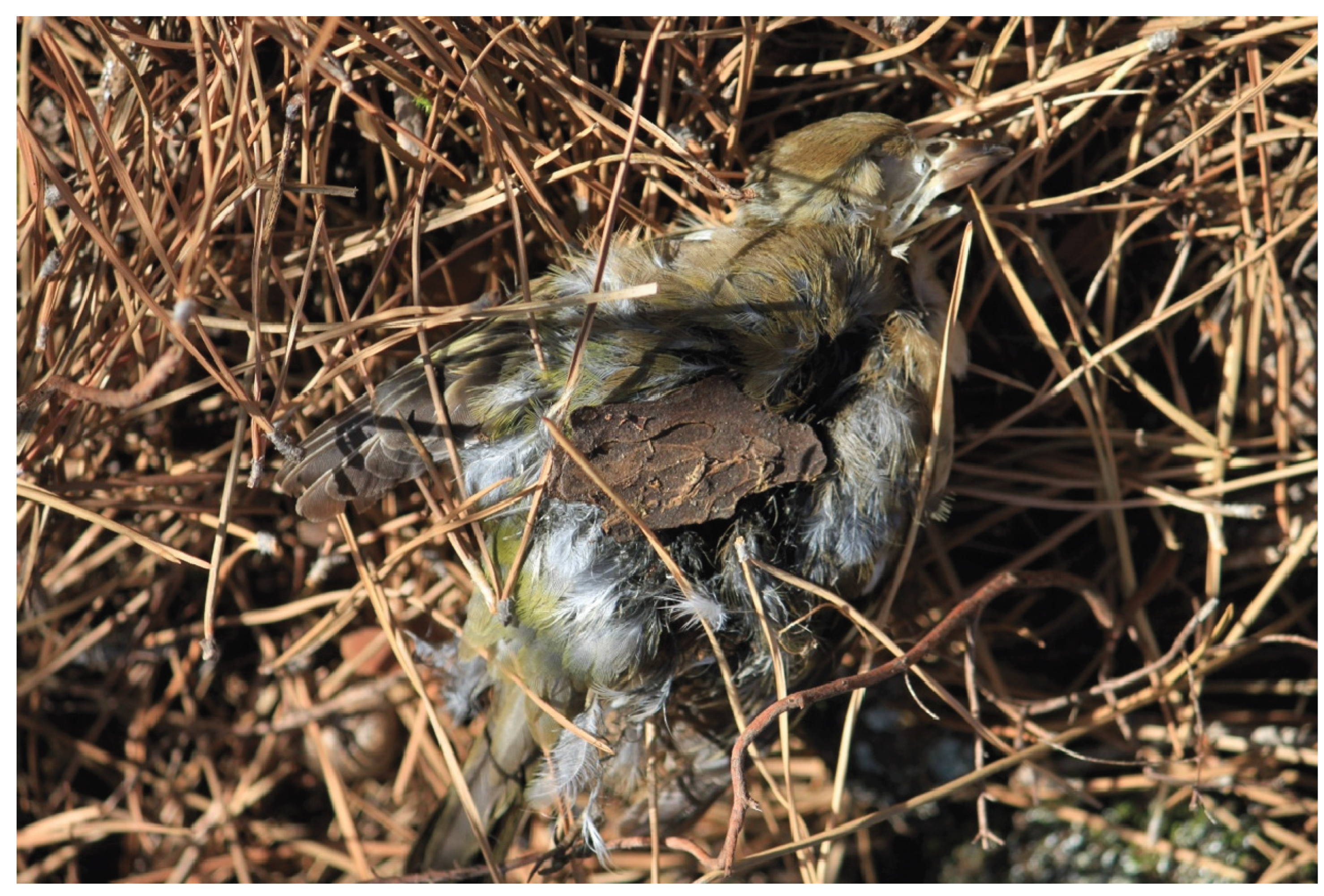
Photographic evidence collected in the months following the aerial dispersion of pellets containing brodifacoum demonstrate the appearance of the characteristic blue-green dye used in the pellets present in bird droppings as well as the carcasses of various bird species (see Figures 10 through 12).
Figure 10.
Carcass of a yellow-legged gull (Larus michahellis Naumann 1840) photographed on Montecristo between April 25th and April 28th, 2012, Località Fosso della Valle dei Lecci. (A) The blue-green dye present in the pellets can be seen in the bird droppings on the rock. (B) A blue-green pellet can also be observed in the water near the dead bird. The pellets had been launched on January 11 and 12 and February 28, 2012. Photo courtesy of Umberto Segnini.
Figure 10.
Carcass of a yellow-legged gull (Larus michahellis Naumann 1840) photographed on Montecristo between April 25th and April 28th, 2012, Località Fosso della Valle dei Lecci. (A) The blue-green dye present in the pellets can be seen in the bird droppings on the rock. (B) A blue-green pellet can also be observed in the water near the dead bird. The pellets had been launched on January 11 and 12 and February 28, 2012. Photo courtesy of Umberto Segnini.
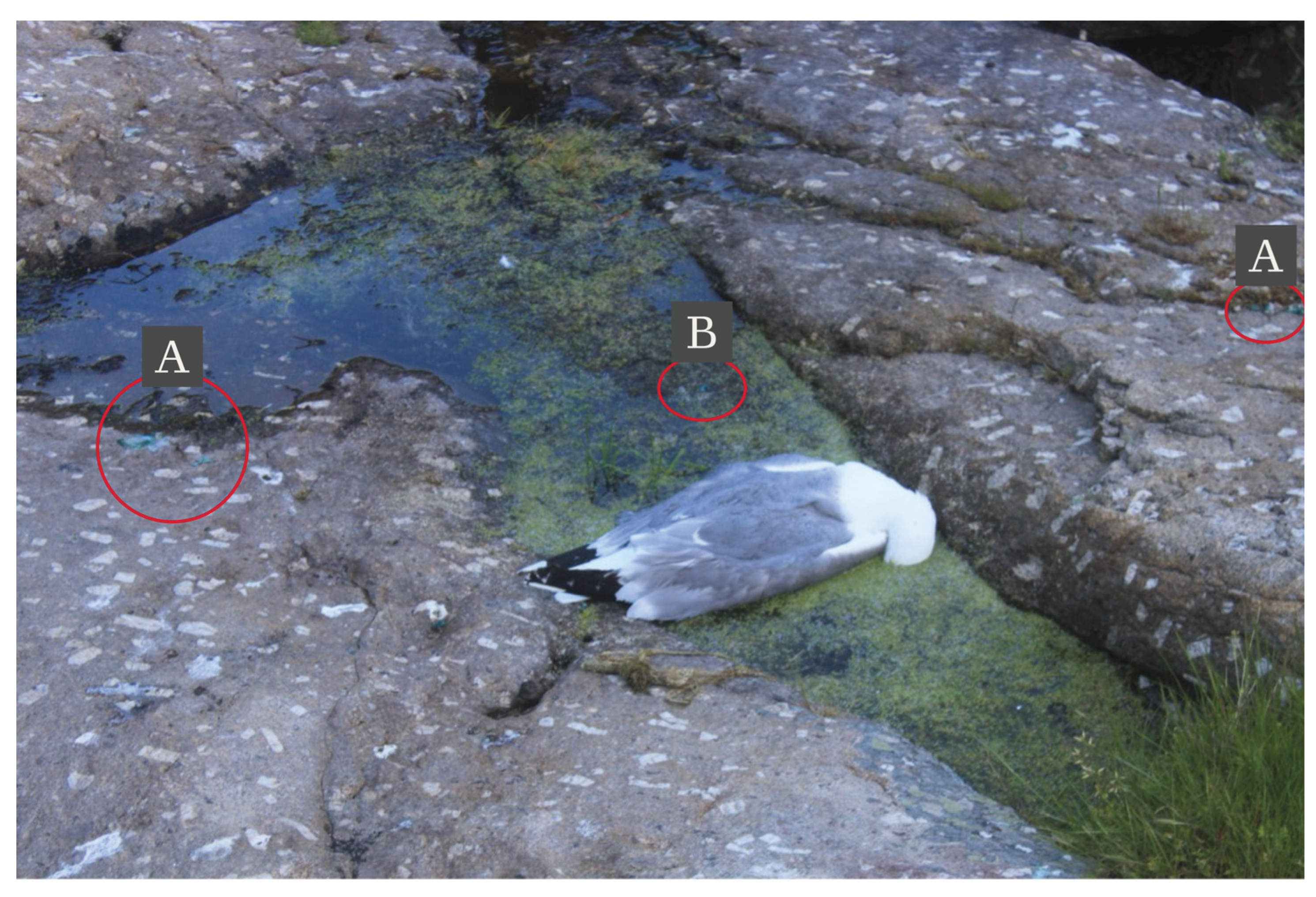
Figure 11.
Photographic documentation of fecal matter from various species collected between April 25th and April 28th, 2012 on Montecristo. The droppings exhibit the characteristic blue-green dye present in the pellets. (A) Goat droppings. (B) through (F) represent droppings from various bird species. Photo courtesy of Umberto Segnini.
Figure 11.
Photographic documentation of fecal matter from various species collected between April 25th and April 28th, 2012 on Montecristo. The droppings exhibit the characteristic blue-green dye present in the pellets. (A) Goat droppings. (B) through (F) represent droppings from various bird species. Photo courtesy of Umberto Segnini.
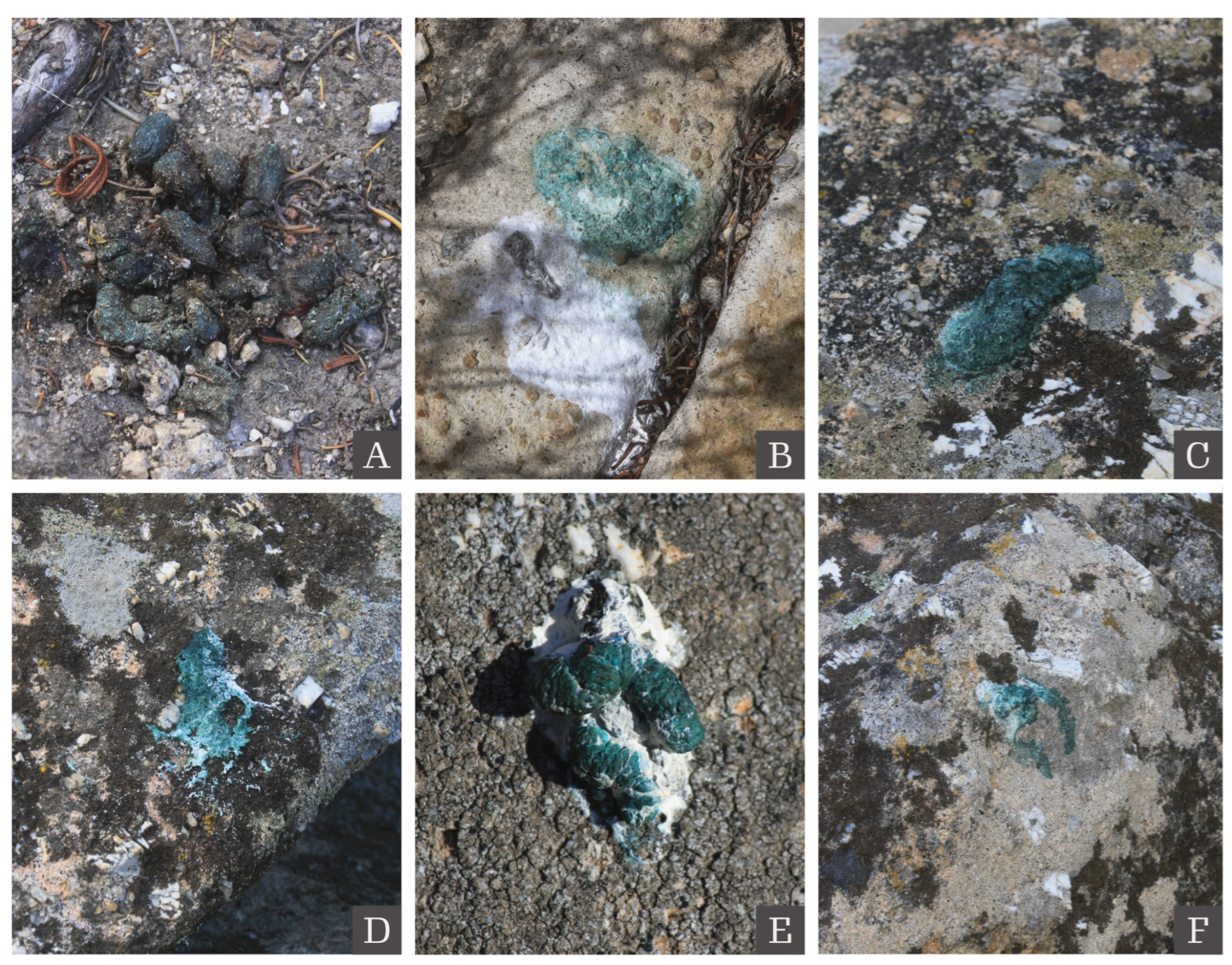
Figure 12.
Photograph of the carcass of a small bird observed on Montecristo between April 25 and 28, 2012, two months after the last helicopter launch of pellets. Photo courtesy of Umberto Segnini.
Figure 12.
Photograph of the carcass of a small bird observed on Montecristo between April 25 and 28, 2012, two months after the last helicopter launch of pellets. Photo courtesy of Umberto Segnini.
The histogram (Figure 13) illustrates the annual number of dead birds found. This data allows for the calculation of peak mortality, as demonstrated in Figure 13. It is relevant to consider that pellets remained available during the migration period and that birds could die from primary and secondary poisoning [124], given that the pellets were grain-based. Studies have recently been published showing that even birds that feed mainly on fish and crustaceans can ingest ARs through secondary poisoning, by preying on fish, mollusks, and crustaceans that have consumed the bait [130]. The initial heavy rains occurred in November 2012, and by July of the same year, well-preserved pellets were still identifiable, even five months after their dispersal [95].
4.5. Calculation of Environmental Disaster Magnitude Using European Industrial Accident Scale (EIAS): The “Montecristo Case Study Simulation”
It is imperative to determine whether the human impact resulting from specific conservation, management, environmental restoration plans, or “alien” species control measures can be interpreted as an environmental disaster.
In order to provide a satisfactory answer to this question, it is essential to suspend all prejudices and ideological inclinations, and to approach the matter in a pragmatic manner.
An environmental disaster [170] is defined as an event caused by human activity that has a widespread impact on the environment and the health of the organisms that inhabit it. The magnitude of an ecological crisis is determined by the number of living organisms affected, the severity of the impacts on those organisms, and the extent of the affected territory. Throughout history, a multitude of anthropogenic environmental disasters have been documented, with their causative agents including, but not limited to, industrial activities [171], intensive agricultural practices [172], deforestation [173], mining [174], and oil extraction [175], as well as military actions [176]. In Italy, a notable example is the environmental disaster that occurred in Seveso on July 10, 1976, following an industrial accident [177,178] that had serious repercussions on public health and the environment. In the aftermath of the incident, the European Community undertook the drafting of the so-called “Seveso II Directive” (Directive 96/82/EC [179,180,181,182]), a regulatory measure aimed at the prevention and control of the risks associated with major industrial accidents. The Committee of the Competent Authorities of the European Union Member States formally established the “European Industrial Accident Scale (EIAS)” to serve as a metric for evaluating the magnitude of industrial accidents and comparing their environmental impact with that of the environmental disaster that occurred in Seveso in 1994.
In this study, an innovative investigation was conducted, using this scale to assess the extent of an environmental disaster resulting from an industrial chemical incident applied to the deliberate dispersal of chemical biocides for conservation projects. In this regard, the test was carried out by applying the “European Industrial Accident Scale (EIAS)” to assess the environmental disaster scale ranking [183] applied in the context of the “Life Montecristo 2010” project. This assessment was used to determine the consequences of the chemical biocides used. To date, the environmental impact of eradications carried out through the extensive use of biocides has never been quantified using these methodologies. The scale is based on 18 technical, measurable parameters that are used to objectively characterize the effects and consequences of industrial accidents or similar events involving dangerous substances, with magnitudes ranging from 0 to 6. The 18 parameters are divided into 4 groups:
1) Dangerous materials released (2 parameters);
2) Human and Social consequences (7 parameters);
3) Environmental consequences (5 parameters);
4) Economic consequences (4 parameters).
The level corresponding to the highest magnitude (1 to 6) of the 4 groups (18 parameters), determines the severity of the environmental disaster.
For the purposes of this case study, the focus was on two of the five parameters in the third group, which were then studied and calculated (see Table 4).
In consideration of the environmental disaster, as measured by the SEVESO European Industrial Accident Scale previously delineated, the calculation of parameters Env11 and Env13 was feasible, given the partial availability of data [63,65,168,169].
Env11 is defined as the proportion P of rare or protected animals or vegetal species destroyed (or eliminated by biotope damage) in the zone of the accident. The calculation of this parameter is based on four species (Larus michaellis Naumann, 1840, C. aegagrus Erxleben, 1777, Corvus corax Linneus 1758, Tyto alba Scopoli, 1769, see Table 3). As outlined in Table 5, the magnitude to be attributed to this parameter is maximum, i.e., 6, given the mortality associated with many protected, particularly protected and strictly protected species [101]. The parameter Env13 concerns the surface area S of soil or underground water surface requiring cleaning or specific decontamination, measured in hectares (ha). In the present case, the poisoned pellets were distributed over approximately 1,039 hectares, resulting in the maximum magnitude of 6.
Consequently, by measuring the effects caused by eradication measures carried out by the introduction of large quantities of biocides into the environment, using an objective scale based on factual data rather than subjective deductions and assumptions, it can be asserted that the LIFE Montecristo 2010 project is comparable to an environmental disaster of magnitude 6, the maximum magnitude according to the SEVESO European Industrial Accident Scale [183].
4.7. Discussion
4.7.1. Rats in the Mediterranean Islands and Seabirds: The Biological Paradox
It has been posited by those adhering to “invasion biology” that one of the most significant threats to the survival of seabird populations and island biota worldwide is the presence of the black rat (Rattus rattus Linneus 1758), which was introduced by humans to 80 percent of the islands. The coexistence of stable seabird populations on Mediterranean islands with what is considered by invasion biologists as their greatest predator, the black rat, can be considered an incredible conservation paradox [184,185]. However, in the Mediterranean basin, despite the presence and spread of rats, there is no evidence that seabird populations have become extinct due to their impact [186]. Some authors posit that this unexpected result in the Mediterranean can be attributed to the fact that over thousands of years of coexistence between different species of seabirds and rats, a balance has been achieved in the various island ecosystems, allowing for their populations to coexist without significant negative interference [169,186,187]. For example, in a somewhat paradoxical situation, the yelkouan shearwater (Puffinus yelkouan Acerbi, 1827), a species that is the subject of the Life + Montecristo 2010 project, does not occur on islands where there are no rats [185]. The oldest evidence for the presence of rats in the Western Mediterranean islands dates back to Roman times (e.g., Corsica 393-151 B.C. [188]). However, it is probable that their presence can also be placed in earlier historical periods [186]. In Sardegna and Isola di Palmaria islands, archaeological evidence from the Neolithic period (10,000-2,200 BC) indicates the presence of rats [188]. In the Mediterranean, among the various species of Procellariiformes, the only species whose abundance seems to be conditioned by the presence of rats is the small storm petrel (Hydrobates pelagicus, Linnaeus, 1758). All other species appear to be influenced more by the ecological characteristics (size, orography, vegetation cover, etc.) of individual islands [186]. In a study conducted in 2008 on 292 Mediterranean islands, an analysis of available data on the presence and abundance of seabird colonies, rats, and other constituents of island ecosystems, including orographic and environmental features, revealed that rats were present in 68.8 percent of cases (n=201). However, in no instance did their presence appear to influence the size of yelkouan shearwater populations. This result was not anticipated by the researchers, but there may be an explanation, particularly in regard to Puffinus yelkouan Acerbi 1827, which prefers deep, winding nesting sites on near-vertical cliffs that are inaccessible to rats [186]. With regard to the Island of Montecristo, a similar hypothesis has been proposed, namely that the yelkouan shearwater population is stably present on the island despite the presence of rats. This is thought to be due to either the location of a substantial number of nests in sites inaccessible to rats or to periodic fluctuations in the rodent population which allow the chicks to hatch [65]. These considerations give rise to concerns regarding the necessity of eradicating the rat from the Island of Montecristo through the aerial dispersal of pellets containing a toxicant with high environmental persistence, as this operation has the potential of producing a substantial detrimental impact on the ecosystem and may result in significant lethal consequences of non-target animal species.
4.7.2. The Predatory Impact of Rats on Yelkouan Shearwater Nests in Mediterranean Islands
A study was conducted in the Parc National des îles de Port-Cros et Porquerolles [184] to ascertain the potential for rats to interfere with the reproductive success of yelkouan shearwaters. The study involved monitoring 60 cavities for a period of one year, which were deemed suitable for use as nesting sites by the birds but also accessible to rats. This resulted in a total of 1,440 observations being made. The findings were unexpectedly different from what had been anticipated. The prolonged monitoring of nesting sites revealed that the interference of rats with the reproductive success of the yelkouan shearwater is, in fact, minimal. The study revealed the following findings:
- ∘
- The yelkouan shearwater utilized only 42% (n=25) of the identified cavities as nesting sites.
- ∘
- In the majority of cases (92%) the cavities utilized by the shearwaters were only visited by the rats after the birds had vacated the nests at the conclusion of the breeding season and consequently these visits had no impact on the birds’ reproductive success.
- ∘
- A single visit by rats was recorded during the period when the cavities housed eggs or nestlings vulnerable to predation. However, no predation occurred.
- ∘
- In 76% of cases (n=19), reproduction was successful, with the chick successfully flying away from the nest. In the cases where reproduction was unsuccessful, there was never evidence of rat visitation within the cavity. Therefore, it can be concluded that the failure to reproduce was not due to rat predation. It can be stated with certainty that there is no evidence to suggest that rats played a part in the failure of reproduction among yelkouan shearwaters.
This study illustrates that a rat population can coexist with established seabird colonies in the same habitat without significantly impacting their population dynamics, contrary to the prevailing belief.
It seems reasonable to posit that the lengthy period of coexistence, spanning thousands of years, has led to the formation of intricate ecological balances on Mediterranean islands. These balances, undoubtedly distinct from one island to another, facilitate the coexistence of rat and procellariiformes bird populations without significant concerns regarding survival [184,187]. The study of island ecosystems is hindered by a lack of research, which may be attributed to their inherent complexity. However, the dearth of knowledge regarding the ecology of the black rat in Mediterranean island ecosystems [169] represents a particularly glaring gap in the scientific landscape. This deficiency precludes an accurate evaluation of the efficacy of eradication or reduction strategies targeting black rat populations, that aim to promote the abundance of seabird populations. The population dynamics of procellariiformes appear to be minimally influenced by the reproductive success of individual years, whereas environmental factors that determine the survival of individuals to sexual maturity exert a considerably greater influence. This would appear to be the underlying reason why populations of seabirds have remained viable for thousands of years, competing with the rat on Mediterranean islands [184]. A similar situation was observed on the Island of Montecristo, where, despite the presence of rats, the number of breeding pairs of yelkouan shearwaters (Puffinus yelkouan Acerbi 1827) had been estimated at 400-750 pairs prior to the dispersal operation of pellets containing brodifacoum. This accounted for 3-10% of the global population of this species [63,65].
One potential limitation in assessing the efficacy of rat eradication efforts on islands is the tendency to define success based on increased reproductive success in a subset of nests over a limited time frame. This approach may not align with the established bibliographic precedent, as evidenced by studies such as Towns [189], which emphasize monitoring the overall bird population size over an extended period before and after the eradication operation. To illustrate, in the case of the LIFE + Montecristo 2010 Project, the reproductive success of the species was assessed before and after the operation. The sample consisted of 15 yelkouan shearwater nests in 2009 (representing 2.0% to 3.75% of the estimated total number of breeding pairs) and 40 in 2010 (representing 5.3% to 10.0% of the estimated total number of breeding pairs). At the end of the project, surveys were carried out in June, before the juveniles flew from the nests, on 19 nests in 2012 (2.5% to 4.75% of the estimated total number of breeding pairs), 28 nests in 2013 (3.7% to 7% of the estimated total number of breeding pairs), 27 in 2014 (3.6% to 6.7%), 26 in 2015 (3.6% to 6.7%), and 35 nests in 2016 (4.6% to 8.7%) [168].
The methodology employed in this study presents two critical issues that may compromise the reliability of the data as a demonstration of the success of the project. Firstly, the sample size of nests examined is relatively small in comparison to the total estimated breeding pairs, raising concerns about the representativeness of the data. Secondly, the nests examined are those accessible to researchers, limiting the generalizability of the findings to the entire population of yelkouan shearwater nests on the island. Additionally, it is important to note that the majority of nests are located in areas with limited accessibility, both for humans and rats, which further complicates the monitoring process [65]. The lack of reproductive success in some nests of yelkouan shearwaters on the Island of Montecristo has been attributed to rats; however, this conclusion is contingent upon the use of a methodology that can unequivocally attribute the loss of eggs or pullus to rat-mediated predation. The discovery of abandoned or broken eggs or the remains of dead nestlings may be attributed to other factors [184] that have not been investigated. The only method that could be considered certain would have been the one used in the Parc National des îles de Port-Cros et Porquerolles study, namely the scattering of fine sand at the entrance of nests to detect rat footprints during the period of egg or nestling presence. This would have enabled the unequivocal establishment that the egg and nestling were preyed upon and did not die due to other causes [184].
The absence of a detailed account of the methodology employed to ascertain with certainty the role of predation in the observed egg or pullus loss prevents the attribution of the reduced reproductive success of the yelkouan shearwater on the Island of Montecristo to rats with the same degree of confidence. It can be reasonably assumed that the population of yelkouan shearwaters on the Isola of Montecristo island was already of considerable size prior to the commencement of the aforementioned operation. This is likely due to the fact that the majority of nests are situated in inaccessible locations [65].
It is worth noting that island seabird populations experience significant annual fluctuations, which can be attributed to a multitude of climatic, ecological, or other factors that are not always fully understood. The complex and intricate interactions among these factors often make them challenging to investigate. It is therefore imperative to exercise caution when ascribing the decline of seabird populations to rats alone, given that other factors can also precipitate significant fluctuations in their numbers from year to year e.g., [184,189]. In fact, although rat eradication operations have now been conducted on nearly 900 islands worldwide [190,191] there are few studies that have provided sufficient evidence that it was the eradication of rats or other predator species that was the sole factor that led to a significant increase in seabird populations. These studies are characterized by multi-year monitoring of the populations of the birds under protection before and after the eradication operation, carried out through the use of standardized transects encompassing the various environmental types in the study area [190]. To illustrate this critical issue, one might consider the analysis of data on the population size of the yellow-legged gull (Larus michaellis Naumann, 1840) on the Isola of Montecristo island [65]. Indeed, since 2010, the year in which no anthropogenic operations were conducted to control the population, the number of breeding pairs decreased from 1,800 to 1,000 in 2011, 600 in 2012, and finally to 300 pairs following the aerial dispersal of pellets containing brodifacoum [65]. Therefore, the yellow-legged gull population on the Island of Montecristo has experienced a notable decline in its size over time, the underlying causes of which remain uncertain and appear to be unrelated to human activity, with the exception of the aerial dispersal of brodifacoum on the island in 2012, which contributed significantly to the further decline of the population. In contrast, no population estimates of yelkouan shearwaters are available for the years following the intervention on the Island of Montecristo. This lack of data makes it impossible to ascertain whether the project was truly successful or not. In the sole available table [192] in which the data pertaining to estimated pairs of yelkouan shearwaters on the islands of Molara and Montecristo are aggregated, the total estimated population of this species is found to be in the range of 500 to 600 pairs. However, prior to the intervention, on the Island of Montecristo alone, an estimated 400-750 pairs were identified [63,65]. It would appear that the project did not result in a notable increase in the population of yelkouan shearwaters on the island. However, it did result in the death by poisoning of a significant number of individuals belonging to non-target species of special naturalistic interest, such as the Montecristo goat.
4.7.3. Eradication of Rats on Islands Through Aerial Dispersion of Second-Generation Anticoagulants: Nature Conservation or Ecological Disaster?
Within the Mediterranean region, a total of 66 rodent eradications were carried out using toxic substances, yielding a reported temporary success rate of 53.03% (35 out of 66 eradications) and a failure rate of 46.97% [193]. Given the inherent uncertainty in the data, the potential for rodent recolonization of the islands, and the rodents’ resistance to rodenticides [194,195,196,197,198,199,200], these data suggest a probability of success and failure, short-term, of approximately 50% each. In the long term, the islands are most likely to be populated again by the eradicated biological elements, drastically reducing this already low percentage.
The issues related to the dispersal of brodifacoum in the environment, especially in protected areas, with the theoretical aim of protecting biodiversity by favoring one species to the detriment of others, are numerous and complex e.g., [83,84,85,87,88,89,90,91,92,93,94,129]. The results of these studies are often conflicting:
- (1)
- The scientific literature indicates that the poisoning of non-target wildlife species by brodifacoum is a common occurrence. This phenomenon is caused by the long-lasting persistence of the compound in the environment, which results in contamination of food chains through mechanisms that are not fully understood. The contamination of the environment by this compound is further evidenced by the presence of residues of unused pellets, feces of animals that have ingested brodifacoum, even at sublethal dosages, and remnants of organs of animals that have died from poisoning. The issue of brodifacoum is well documented. Due to its high toxicity and very high environmental persistence, it is the compound that most effectively kills rats but also poses the greatest risk of mortality to non-target species and the greatest risk of spread in the ecosystem e.g., [31,169].
Despite evidence dating back to the 1990s indicating that the persistence of brodifacoum in the environment results in secondary mortality among a range of non-target animal species, even long after its initial dispersal, long-term monitoring programs designed to assess the broader ecosystem-level impacts of this compound have rarely been implemented.
- (2)
- The reappearance of rats on islands that have undergone an eradication operation resulting in significant mortalities in non-target species and contamination of the ecosystem with highly persistent toxic substances represents a disastrous eventuality that completely undermines the economic, personnel, and time effort associated with the eradication project [201]. This eventuality, which only becomes apparent years after eradication operations, is typically attributed to either the ability of rats to swim from nearby islands where they are still present or the fact that they can be carried by watercraft or voluntarily reintroduced with the intention of “sabotaging” the operation [201]. However, another reason, perhaps the most logical one, is overlooked. This is that not all rats on the “rat-eradicated” island were reached by the toxic baits. Therefore, the surviving specimens gradually reconstitute a population as large as it was before the intervention based on the “carrying capacity” of the territory. To ascertain whether or not the rat eradication has been effective, it is essential to conduct periodic and consecutive monitoring over several years after the intervention. This should employ methods that allow the results to be compared with those obtained in years preceding the intervention [190].
- (3)
- It is challenging to demonstrate the actual long-term benefit of rat eradication operations in favor of species that may be affected in their survival by these rodents. This is due to the fact that the impact of rats can vary greatly by area, season, and year [189]. The evidence presented thus far, in the form of one or two surveys on the increased reproductive success of a small percentage of nests, is insufficient to establish the success of the operation, given the vast and persistent contamination of the island ecosystem and the lack of identification of the full effects of such contamination. Islands characterized by steep cliffs, crags, and sparse vegetation provide seabirds with vast nesting areas that are poorly accessible to rats, thereby limiting the impact of these rodents on the total reproductive capacity of these birds. A study of 26 islands that had previously undergone eradication operations, which involved the use of both bait stations and aerial dispersion of pellets containing brodifacoum, found that 8 of these islands (31%) experienced a subsequent reinvasion by rats, despite the initial success of the attempted eradication efforts [169]. In at least one instance, deliberate reintroduction was suspected. On 12 islands (46%), the eradication was deemed to have been entirely successful. On one island (3.8%), the eradication of the rats was unsuccessful. For the remaining five islands (26%), the results are still inconclusive. Moreover, only 20 of the 26 islands have published data [169], while the results for the remaining six islands are only available in verbal reports. In light of the available data (n=20), it can be concluded that the operation was deemed successful in only 50% (n=10) of the cases. In 45% of the cases (n=9), the eradication was unsuccessful, either due to failure or initial success followed by reinvasion by rats. The outcome for one island (Ventotene, LT) remains undetermined.
- (4)
- The eradication methods involving the use of copious amounts of environmentally-persistent, toxic substances have been documented to cause damage within the ecosystem that has not yet been fully-quantified in terms of environmental pollution and mortality of non-target species. By transitioning from a deductive to an inductive approach to analysis, it becomes possible to quantify the magnitude of the damage caused by the use of biocides on the islands, which can be classified as an environmental disaster through use of a specific range of measurable parameters such as those used by the European Scale of Industrial Accidents, a severity scale developed by EU member states in order to adhere to the EU “SEVESO” Directive [179,183].
It is thus imperative to implement meticulous and sustained monitoring of the animal populations present in areas designated for the implementation of an extremely invasive intervention, such as the aerial dispersal of toxic baits containing a highly environmentally persistent substance, which will inevitably result in the contamination of the entire ecosystem for years to come. This monitoring is necessary to ascertain whether the intervention was truly justified and whether it yielded minimal benefits at the expense of significant biological damage to the island ecosystem, particularly if data relating to the ecosystem prior to the introduction of the rats is lacking. Indeed, the success of a rat eradication project on an island for the purpose of fostering the reproductive success of seabird species believed to be threatened by the presence of the rodent should be measured at least a decade after the operation. This allows for the verification of whether the positive trend is not due to natural population fluctuations due to natural factors, such as annual climate variability and recruitment by immigration from other populations. Some authors [190, for example] argue that medium- to long-term pre- and post-eradication monitoring is necessary to ascertain whether the eventual positive response of the seabird population is sustained enough to confirm the benefits of rat eradication for conservation purposes.
The rationale for restoring the ecosystems of the islands, including those in the Mediterranean, to their original, pre-rat introduction state is also somewhat tenuous and does not justify the use of such toxic, persistent, and bioaccumulative substances for environments whose integrity and preservation were paradoxically to be safeguarded. This is because there is no consensus on what the original, pre-rat introduction state was, rendering the rationale for the use of these substances somewhat questionable. It would be of interest to ascertain how many islands were home to populations of procellariiformes in the absence of rats, and similarly, how many seabird populations have declined or disappeared with the arrival of rats [169,185]. It can be stated with certainty that over the course of thousands of years, rats and procellariiformes have coexisted in the Mediterranean region on a number of different islands. This coexistence has been made possible by a number of factors, including density-dependent dynamics, which have been little studied [169]. For these reasons, although the use of brodifacoum via aerial dispersal for rat eradication on islands remains prevalent, numerous interest groups have, over the past decade, begun to regard this approach as ethically untenable, largely due to the mortality of non-target species caused by the high persistence of this toxicant in the environment and the difficulty of accurately gauging the true efficacy of the intervention [88,89,90,91,129,189].
Furthermore, the full extent of the consequences of anticoagulant exposure in long-term non-target wild populations remains largely unknown [117]. The ethical implications of this approach, particularly the necessity of causing the death of several hundreds of animals belonging to non-target species as a collateral effect of the rat eradication operation, remain a subject of debate. The effectiveness of this operation in terms of a stable increase in the yelkouan shearwater population is also not yet fully understood. Indeed, in the case of the Isola of Montecristo island, the population of yelkouan shearwaters appeared to coexist peacefully with rats, due to the ecological balance achieved over time. This resulted in the shearwaters accounting for as much as 3-10% of the overall population of this species, with a size of 400-750 pairs [63]. Following the rat eradication intervention, there is no published data indicating a significant increase in the shearwater population. It is desirable that studies be conducted on the impact of biocide dispersion on other islands impacted by similar interventions, in order to determine the actual ecological consequences. Regarding this aspect we would like to cite verbatim the following passage from an intriguing article on ethical matrices in biodiversity conservation [202]:
[…Conservation is in good part an endeavor that was born precisely to curb, or at least manage, the ecological crisis caused by humans in their destructive relationship with nature. But conservation, too, can fall into the old habit of trying to impose “human” patterns on nature: as when it adopts what we might call a “museum-like” view of its mission, and forgets that the “nature of nature” is processual, not static. It is true that conservation is above all management of environments, ecosystems, and species, but it should never lose sight of the idea that environments cannot be ‘constructed’ to embody some ideal of biodiversity constructed by human beings, that ecosystems stand on extremely complex processes that can hardly be fully understood and administered, and that species are not Platonic ideas frozen in some remote hyperuranium…]
Re-naturalization, conservation and environmental restoration should not be considered exclusively as the cancellation of every type of trace left by man, including the presence of taxa that arrived with him, but therefore as a much more complex process [203]. It is absolutely essential that a balanced and holistic approach to the conservation of species biodiversity be prioritized, with due consideration of ethical practices, human cultural heritage values, and the well-being and dignity of living organisms. Moreover, extreme solutions and radical concepts should be avoided in conservation initiatives, and instead, a focus on balanced and pragmatic approaches should be emphasized. It is crucial to give precedence to the expansion of environmental awareness and education, while simultaneously challenging the legitimacy of existing policies and practices that may not align with the principles of sustainability and ethical conduct [203,204]. In order to achieve successful outcomes in nature conservation, it is essential to demonstrate a profound dedication to scientific integrity, a comprehensive approach to environmental conservation, and an unwavering respect for the natural world [58]. The video documentary directed by Wischnewski, M. [205], provides a valuable opportunity to consider the pressing need for effective urban rat population management strategies. Wischnewski’s discussion underscores the necessity to adopt a different perspective on rats, their presence, and their management. It has been demonstrated that the systematic use of rodenticides results in the accumulation of toxic substances in the environment, leading to the contamination other organisms, including fish. This phenomenon is often accompanied by significant financial expenditures. It is also important to note that rats develop strong resistance to chemical substances [194,195,196,197,198,199,200], which renders even the most recent biocides increasingly ineffective. This, in turn, causes harm to other living beings, including humans, as well as to the environment. If this is true for urban environments, equal attention should be given to other contexts, including natural environments, agricultural land, and protected areas [18].
5. The Use of Herbicides to Eradicate the Tree-of-Heaven (Ailanthus altissima)
Another notable action carried out within the “LIFE+ Montecristo 2010” project [74] was the planned eradication of Ailanthus altissima (Mill.) Swingle, commonly known as the Tree of Heaven, through the use of chemical treatments, primarily herbicide biocides. In the context of invasion biology, rats and Ailanthus have frequently been utilized as primary examples of invasive alien species. The eradication measures employed, the perceptions within invasion biology, and the concerns about biodiversity are closely intertwined with these two emblematic species.
5.1. Should the Presence of Ailanthus Always Be Seen as a Threat?
A vast body of scientific papers e.g., [206,207,208,209,210,211,212] and specialized web articles e.g., [213] have been published, asserting that this species is an aggressive invasive species that is harmful or with no-value from any perspective. Often deleterious characteristics of the plant are accentuated intended to promote discredit fear, and hatred up to define this species as for example: “green cancer” e.g., [214] or “devilish invader” e.g., [215]. A rising body of eradication initiatives has been observed in the recent past [216]. Some have advocated for the urgent adoption of more effective measures and techniques [206,217] to eradicate this species e.g., [218]. Some of the initiatives call for the development of even more powerful chemical biocides [217] in order to eradicate the Ailanthus species expeditiously, employing any and all means deemed necessary to achieve this outcome.
By distancing ourselves from prejudice and from this Manichean dichotomized view of reality (good/bad, us/them, native/alien, see [32]), it is possible to engage in reasoning that are not based on hatred and discrimination, but rather on a deeper understanding of the issues, contextualizing them with a more objective, nuanced, impartial, and balanced approach to this species and, more generally, to issues related to non-native plants, avoiding exaggerations or decisions dictated, for example, by fear or contempt [204], or by what is referred to as plant or biological “xenophobia” e.g., [33,219,220]. Therefore, it is imperative to transcend simplistic or erroneous distinctions such as “native” versus “non-native.” This binary approach to thinking has the potential to hinder our capacity for objective analysis and often results in hasty or superficial decisions, that are predicated on overly simplistic and ultimately inadequate criteria.
From an objective standpoint, the Tree of Heaven [Ailanthus altissima (Mill.) Swingle] serves as a paradigmatic illustration of how non-native species, often deemed of negligible natural value, can concurrently possess substantial values as components of human heritage, traditional knowledge and local practices. As indicated by Terzopoulou et al. [221], a number of studies have identified this fast-growing tree as a valuable low-cost and versatile resource. This resource has the potential to assist in the restoration of degraded habitats and the reduction of pressure on other native and slower-growing woody species which are currently the most affected by human impact, wood harvesting, forest management, and climate change stresses [210,221,222,223,224,225,226,227,228,229]. Ailanthus has been documented as having a larger variety of uses even in other studies. These uses include pharmaceutical and medicinal applications [224,229,230,231,232,233,234], the production of a healthy seed oil with DNA-protective properties [234,235], and use as an anti-pollution agent [223,228,236,237]. It has also been identified as a multipurpose bio-resource [221,223,225,228,238,239,240,241] that could be beneficial to both Human and the Environment in some ways. In contrast with what several authors have often stated, it has been posited that Ailanthus could serve as a resource for the preservation of the environment, with implications for both biodiversity and nature conservation e.g., [73,228,242,243]. Despite the various publications that portray Ailanthus altissima as a noxious plant, or as a detrimental element to the ecosystems, others studies indicate that this plant provides important resources for other species that coexist within the same habitat. It is found to be palatable to snails and slugs such [i.e., Cepaea hortensis (O.F. Müller, 1774)] [244], as well as to rodents and large herbivores [210]. In addition to goats (Capra aegagrus Erxleben, 1777 or C. hircus complex Linnaeus, 1758) and sheep (Ovis aries Linnaeus, 1758), we have also observed cows (Bos taurus Linnaeus, 1758) roe deer (Capreolus capreolus Linnaeus, 1758) and red deer (Cervus elaphus Linnaeus, 1758) feeding on the leaves and young shoots, particularly in summer, even in areas with a high presence of other herbaceous and woody species that are still green and largely palatable. These observations are confirmed by our own field observations over time, especially in Central Italy. Beyond our personal observations, it has been documented that Ailanthus leaves constitute a substantial and nutritious dietary source for ovines and caprids [224,245]. These herbivores have been observed to consume substantial quantities of Ailanthus species leaves [246] and it could be also useful to other large herbivores such as cattle (Bos taurus Linnaeus, 1758) fodder [238]. Ailanthus altissima can also be useful as a supplement/additive or as a source of compounds beneficial to human and animal diets [235]. Various insects (e.g., Samia cynthia Drury, 1773 and a large number of pollinators [223,239]), and fungi (e.g., Pleurotus sp. pl., Laetiporus sulphureus, Schizophyllum sp.pl., Polyporus sp.pl., etc.) can also commonly benefit greatly from Ailanthus species, as observed in some locations of Italy by the authors.
It is noteworthy that in, general, Ailanthus plants tend to yield to native species potential vegetation, consistent with the typical behavior of pioneer species in vegetation dynamics [247]. From this perspective, the characteristics that are perceived as problematic, such as the species’ rapid growth, sprouting, versatility, adaptability, and vitality, can be interpreted as strengths. These characteristics underscore its remarkable capacity to not only to endure but also to flourish in the most challenging environmental conditions [222]. This suggests that the species possesses a potential resilience against the most significant disruptions caused by climate change and disasters stemming from human activity. In this context, the vegetation soil cover that was stripped away, by the elimination or degradation of forests that once covered the land, can be considered a damaged tissue that Ailanthus specimens have the capacity to repair [73]. The species’ wide-ranging applications, resilience, vigor and biological plasticity, have led to its use in temperate and Mediterranean areas for afforestation and reforestation projects, particularly in challenging environments i.e., [238,248].
Another perspective suggests that the Ailanthus species should be regarded not as an invasive alien species, but rather as a species that undergone a process of “returning” to its ancient geographical distribution [249], supported by the presence of numerous Ailanthus fossils dating back to the post-Lower Eocene period, which have been discovered in Europe and North America e.g., [250,251,252,253], coexisting with the species that are still most widely distributed today. In the actual context, the debate, surrounding non-native plant species give rise to a range of reactions and point of views. These reactions, at times, have the potential to escalate beyond a rational discourse, manifesting in forms of indignation and controversy. At times, these reactions could extend beyond the realm of rational discourse, exerting a significant influence within both the political and the scientific community. This phenomenon is indicative of a systemic issue that plagues certain segments of society, particularly within scientific and conservationist circles [254,255].
This discordance is also associable with a contradictory perception of humans, who are occasionally regarded as integral components and key determinants of biodiversity and ecosystems, yet simultaneously perceived as separate from or even in contrast with them.
It is important to encourage a more balanced approach and a more nuanced and contextualized discussion regarding Ailanthus and the broader issue of alien plants. A perspective characterized by an effort to avoid making superficial judgments that are based solely on possible negative aspects, and on perception bias, rather than empirical evidence [203]. A fundamental problem is also linked to the personification of weeds or alien species as enemies, as if they could deliberately cause harm, with an intent to invade or destroy [256]. Yet the danger comes from the human pressure rather than from the plant itself, which cannot act with bad intent; therefore, efforts should focus on reducing human impact instead of treating plants as the problem.
Climate change can disrupt ecological balances particularly on islands, by facilitating the introduction or spread of pathogenic organisms and non-native species, and by intensifying both past and ongoing anthropogenic impacts [257]. In the specific case of Isola di Montecristo, as with any island, it is understandable that introduced species, may raise concern. Conversely, in the open landscapes of continental environments, this phenomenon can often be considered a much less significant issue. The specific location and case study we have analyzed are therefore fundamental to understanding how the role of this woody species can, in certain ways, be perceived and interpreted through a different lens; with a different point of views, even in island contexts.
Regardless of the perspective, plants are widely recognized as efficient bio-indicators in various respects, and this applies to both native and non-native species. For this reason, it cannot be overlooked that Ailanthus species, like other non-native plants, should not be regarded as an environmental “problem” in themselves but rather as indicators of underlying issues and as marker of broader environmental challenges, which are a consequence of excessive human impact on the territory. These challenges create conditions that potentially lead to ecological problems. It is widely acknowledged that human impact and the resulting degradation of habitats caused by human activities can favor the proliferation of species that are able to survive in the new context, and this ability is interpreted as “invasiveness” [258], which is a characteristic that can be exhibited by both non-native and native species [38,259,260]. Attempting to address the problem by eliminating Ailanthus specimens would be somewhat contradictory, as it would amount to concealing the issue by removing a main effective indicator, without addressing its underlying causes. Eradication efforts could even exacerbate the situation by further increasing human disturbance in these areas, thereby inducing a wide range of effects. In many cases, the presence of low species richness, reduced ecological network complexity, or limited ecosystem functioning observed in neophyte formations—particularly those dominated by Ailanthus altissima, is correlated with, or explained by, allelopathy or other factors related to the presence of these species. However, the cause can often be related to the young age of these formations or to the fact that they are located in soils and environments that have been or are still heavily disturbed and strongly influenced by human pressure. It is imperative to exercise caution when assessing the potential allelopathic effects of plant chemical compounds as they are capable of exhibiting remarkably divergent behaviors in natural environments compared to the controlled conditions of laboratories or in vitro settings. The mechanism of action of the active compounds in Ailanthus altissima does not represent an exception; rather, it remains unclear and their bioactivity within field ecological dynamics requires careful evaluation e.g., [261]. A more thorough examination of both positive and negative characteristics is necessary, given the current research’s limitations due to a paucity of long-term field data and an increasingly dominant influence of preconceived and exaggerated assumptions. These assumptions are further compounded by biases that are embedded in alarmist narratives propagated by “information programs” that are based on or foster fear and disdain to justify the urgency for the eradication of this and similar species.
This matter merits greater attention, discussion, reflection, and study, as it is more complex and open to multiple interpretations. In this regard, Ailanthus altissima serves as a salient example in contemporary studies of these issues.
5.2. The Presence of Ailanthus altissima on the Isola di Montecristo Island
This species, was probably introduced to the Isola di Montecristo in 1852 [262,263]. Since the 1970s, with the establishment of the “Riserva Naturale di Montecristo” has led to the implementation of a campaign aimed at eradicating Ailanthus altissima trees through frequent, repeated tree-cutting interventions. Prior to this, these interventions were limited to a few scattered areas [263]. This practice coincided with a subsequent and accelerated expansion of this very “vital plant” [262], the presence of which was largely determined by the anthropogenic disturbance of plants cutting and coppicing carried out for over forty years before the intervention conducted with the use of herbicides as outlined in the “LIFE + Montecristo 2010” project [262]. It should be noted that, despite all these dynamics, the presence of Ailanthus altissima on the study island can still be considered relatively limited (see Figure 14). A study of the distribution of Ailanthus altissima conducted in 2010 (Figure 14), revealed that this species exhibited a distribution pattern, characterized by sporadic plant populations and small non-contiguous groups. These groups were observed to be integrated into the surrounding vegetation or dispersed across rocky regions [264]. The total area of distribution of Ailanthus was estimated to be of approximately 183 hectares, which corresponds to approximately 17.61% of the island’s total area of 1,039 hectares. The areas with dense clusters of Ailanthus trees forming significant cover totaled approximately 12.5 hectares (corresponding to about 1.20% of the entire island territory) [264].
5.3. Discussion
5.3.1. Should the Presence of Ailanthus Be Considered a Danger Within the Context of Montecristo Island?
The Ailanthus altissima population on the island of Montecristo exhibits considerable variability in size and vegetation cover pattern (Figure 14). This phenomenon can be attributed to the island’s thin and poor soil quality, in conjunction with the prevalent grazing practices of local goats, as documented in the implementation plan by the beneficiaries of the “LIFE+ Montecristo 2010” project [263].
On the Isola di Montecristo Island, the leaves and new shoots of the Ailanthus have been observed to be a substantial source of wild fodder for the local goats [262,266]. This, have contributed to a reduction in grazing pressure on holm oaks and other native species, such as Quercus ilex, which could have benefited from the presence of the Ailanthus, creating a sort of balance between “non-native” species in favor of “native” species as described by Clauser [266]. On the island of Montecristo, a number of clusters and isolated plants of Holm Oak (Quercus ilex) are considered to be of particular conservation value, representing the remaining fragments of primeval holm oak forests covering the island [267]. The survival and renewal of holm oak forests in the island of Montecristo is threatened not only by herbivores grazing on young plants, but also by local soil erosion and landslides [68,69]. In regard to the impact of Ailanthus altissima on vegetation community and succession, Bruno and Sauli [73] have reported that Ailanthus trees, with their canopy, have established microclimatic conditions analogous to those of a closed forest contributing to a substantial quantity of readily degradable organic matter to the soil. The same authors also state that these conditions are similar to those of the holm oak undergrowth, thereby fostering robust and tall trunk growth of holm oak (Quercus ilex) seedlings. Within a few years, these seedlings overlap the Ailanthus canopy, and progressively have the chance to encroach upon and dominate the Tree of Heaven formations. These observations underscore the potential of Ailanthus, given its characteristic pioneer behavior, to potentially provide an emergency, temporary, and transitional woody cover—thereby possibly facilitating the vegetation succession dynamics.
Bruno’s observations can be compared to the findings in the field of agriculture e.g., [268], where the absence of “weeds” would lead to a significant loss of fertile soil layer.
In harsh or degraded environmental conditions, plants labeled as “invasive” or considered “weeds” can play an essential role in ecosystems as these plants are characterized by their rapid ability to establish themselves, which in turn protects and restores soil in the aftermath of natural disturbances or the effects of human activity. Furthermore, these species could facilitate the process of ecological succession, which, if left uninterrupted and in the absence of further anthropogenic disturbances, can facilitate the restoration of the region’s original vegetation head series plant community. Ailanthus altissima serves as a prime example of the aforementioned phenomenon, given its well-documented ability to significantly reduce soil erosion e.g., [223,224,228,242]. In light of the harsh climatic and soil conditions that prevail on the island of Montecristo, the presence of Ailanthus could play a pivotal role in ensuring the maintenance of a minimal forest cover, as well as for facilitating both the return and re-expansion of the island’s natural forests, and for the conservation and restoration of local soil. Soil conservation potential is very important when considering the problems of soil poverty, thinness, and erosion issues in the island. The presence of Ailanthus on the Island can also provide shade, perches, nesting places and habitats for birds, playing a substantial role in maintaining the local habitat functionality and complexity for avian species through its fast and strong ability to regenerate suitable woody systems after degradation caused by human pressure [242]. This point can be particularly important for the conservation of bird species, given that the island of Montecristo is well known as the habitat of numerous resident bird species and serves as a crucial stopover site for many migratory birds e.g., [269]. The observations reported in this study align with the findings documented by Bruno and Sauli [73].
5.3.4. Areas Impacted by Herbicide Dispersal
As part of the LIFE+ “Montecristo 2010” initiative [74], an extensive eradication program targeting Ailanthus was implemented, encompassing an area of 183 hectares during the years 2011, 2012, and 2013 (Figure 15). This project also involved the re-treatment of select areas, resulting in an estimated total coverage of approximately 384 hectares, as reported by Giannini F. et al. [100] and Braccini et al. in 2014 [262]. Following the project’s conclusion, an additional 67 hectares were subjected to Ailanthus altissima eradication, thereby reaching a total area of 250 hectares affected by herbicide applications, excluding subsequent re-treatment [81]. This area corresponds to approximately 24% of the island’s emerging surface area, encompassing approximately 190 dense cores ranging in area from a few square meters to two hectares [262], for a total area of approximately 12.5 hectares [81]. The vast majority of these dense cores has been observed to be in close proximity of streams harboring the endemic Sardinian discoglossum (Discoglossus sardus Tschudi, 1837).
5.3.5. Modality by Which the Eradication of Ailanthus Was Attempted
Eradication efforts were not limited to mechanical methods such as uprooting or cutting down the plants, but involved am intense and widespread use of biocides (chemical herbicides). Given the high viability of Ailanthus, the interventions implemented with the use of biocides were repeated for at least three years [265], until the viability of the stump and root system of Ailanthus were finally diminished and the number of shoots decreased dramatically. Subsequent treatments were still implemented, however, since this plant is very resilient and can regrow not only from the stump but also from the roots. Five commercial herbicide products were employed [271,272]: Evade [273] (containing Triclopyr [76] and Fluroxypyr [78]), Tordon 22 k [274,275] (containing Picloram [77]), E-Z-Ject ® lance [276] with Imazapyr [79] based cartridges, Credit 540 [277] (containing Glyphosate [80]) and Glifosar [278] (containing Glyphosate [80]). The five herbicides were utilized in conjunction with four distinct techniques, namely “cut and strip,” “foliar spraying,” “drill and inject,” and “cartridge insertion into the trunk” [65]. Given their systemic nature, these herbicides are able to penetrate plant tissues from roots to leaves, accumulating in flowers and reproductive parts, roots and apical shoots [241,279]. Consequently, toxic active ingredients could readily infiltrate the food chain of subterranean organisms, which can be readily ingested and bio-accumulated in animal tissues that feed directly on them or on the resulting necromass [280]. A foliar fertilizer, ammonium sulfate, was utilized to facilitate the absorption of the active ingredient [262], this can further amplify the effect of spreading toxic active ingredients in both underground and above ground organisms, and consequently in plant and animal tissues following the trophic net. In many cases, multiple treatments were necessary for the same plants, as evidenced by the mapping that delineated their distribution in the years 2011, 2012, and 2013 [95,264].
In summary, the following techniques were used extensively and repeatedly, over about a quarter of the island’s territory, for Ailanthus eradication:
Cut and Strip Technique
The cut-and-strip operation was executed on plants with a height exceeding 1.5, 2 meters. This operation entailed the severance of the plant at its base, accompanied by the subsequent creation of notches and pocketing in the cut surface, collar, and root outcrops. Immediately following this procedure, the plants were subjected to a brushing with an herbicide mixture comprising 30% picloram, 10% triclopyr, and dye. Subsequent to this treatment, one or more foliar spraying treatments were administered to the shoots [95,264].
Foliar Spraying
This technique was used on plants measuring up to 1.5, 2 meters in height and was also used extensively on the regrowth suckers from the stumps that consistently occurred after the plants had been cut. This technique entailed the complete spraying of the foliar apparatus with a mixture of water containing Glyphosate at concentrations ranging from 10 to 15% [95,264] or 5% [262], with the incorporation of dye and ammonium sulfate at a proportion of 2%. The active ingredient is absorbed through the leaves and translocated systemically within the plant, in all its parts [262].
Drill and Inject Technique
This method was employed on adult plants with stem diameters greater than 8-10 cm by drilling a large pocket with the chainsaw that slopes into the stem, into which was poured a mixture of water and 30 percent picloram with the addition of 10 percent triclopyr and 2 percent ammonium sulfate [262].
Insertion of Cartridges
This technique involves the implantation of a variable number of capsules containing the 80% active ingredient of the herbicide, Imazapyr, into the trunk. This technique was used for plants in locations that were more difficult to reach, where the use of a chainsaw was deemed unfeasible [262]. The utilization of this herbicide is prohibited in the European Union due to its high toxicity to aquatic flora [281].
The area affected by herbicide application encompasses regions characterized by the presence of waterways and ancient clusters of holm oak groves, as previously documented by Crudele [267]. The following table provides a summary of the habitats of community interest present in the treated areas and identification of which of the 4 biocides used are found to have particularly detrimental effects on each of the various specific habitats [282].
Table 6.
Terrestrial Habitat Description and Actives Substances Causing Particularly Negative Impact on Habitat and Related Key Taxa Characterizing Coastal Vegetation.
Table 6.
Terrestrial Habitat Description and Actives Substances Causing Particularly Negative Impact on Habitat and Related Key Taxa Characterizing Coastal Vegetation.
| Habitat Code | Terrestrial Habitat Description (Dir. 92/43/EEC [283]) | Active substances causing particularly negative impact on habitat and related key taxa characterizing coastal vegetation |
|---|---|---|
| 1210 | Annual vegetation of drift lines** | Glyphosate, Imazamox, Triclopyr |
| 1240 | Vegetated sea cliffs of the Mediterranean coasts with endemic Limonium spp.** | Glyphosate, Imazamox, Picloram, Triclopyr, Fluroxypyr |
| 3120 | Oligotrophic waters containing very few minerals generally on sandy soils of the West Mediterranean with Isoetes spp.** | Glyphosate, Imazamox, Picloram |
| 3170* | Mediterranean temporary ponds** | Glyphosate, Imazamox, Picloram, Triclopyr |
| 5210 | Arborescent matorral with Juniperus spp.** | Glyphosate, Picloram |
| 6220* | Pseudo-steppe with grasses and annuals of the Thero-Brachypodietea** | Glyphosate, Imazamox, Picloram |
| 8220 | Siliceous rocky slopes with chasmophytic vegetation** | Glyphosate, Picloram, Triclopyr, Fluroxypyr |
| 8230 | Siliceous rock with pioneer vegetation of the Sedo-Scleranthion or of the Sedo albi-Veronicion dilleniid** | Glyphosate, Triclopyr, Fluroxypyr |
5.3.6. Some of the Critical Issues Associated with the Five Herbicides Used in the Ailanthus Eradication Effort
The herbicides utilized in this project: are characterized by their high toxicity, which extends not only to the target species (Ailanthus altissima) but also to the entire spectrum of species present within these habitats [282]. Glyphosate, Picloram and Triclopyr are considered to be three herbicides that are particularly hazardous to both the terrestrial and aquatic environments as they are non-selective, broad-spectrum biocides [282]. As stated in the 2015 report by the Italian National Institute for Environmental Protection and Research (ISPRA) [282], Glyphosate and Imazapyr are persistent in the environment and have a significant impact on grassland and aquatic vegetation, and Picloram and Triclopyr are considered extremely hazardous for their counteracting action against herbaceous and shrub species [282]. The following is a brief list of the potential hazards associated with the use of the five herbicides utilized by the beneficiaries of the project in their attempts to eradicate Ailanthus:
Triclopyr
Triclopyr (2-[(3,5,6-trichloro-2-pyridinyl)oxy]acetic acid [286]) poses a threat to many vascular plant formations protected by the Habitats Directive [282]. The compound displays an exceptional degree of persistence, remaining in soil for periods exceeding 100 days. The substance undergoes transformation in soil, plants, and mammals, resulting in the production of 3,5,6-trichloro-2-pyridinol, a compound that exhibits a high degree of toxicity to earthworms [287]. This compound has been demonstrated to be harmful if ingested, capable of causing severe eye injury and is harmful aquatic life, with effects that persist over an extended duration [286]. According to the most recent data from the Italian National Institute for Environmental Protection and Research [282], the presence of this substance has been detected in 0.5% of surface water monitoring points and 0.3% of groundwater monitoring points across Italy during 2021 [288].
Picloram
Picloram (4-Amino-3,5,6-trichloropyridine-2-carboxylic acid [289]) exhibits a high degree of toxicity towards aquatic organisms, resulting in prolonged adverse effects and severe ocular irritation. Its persistence in soil has been documented to exceed 160 days, while in aquatic sediments, it has been recorded to endure for more than 190 days. The substance exhibits stability within the aqueous phase. In the presence of water and sediment, the substance undergoes a transformation, resulting in the formation of the herbicide aminopyralid, a compound that exhibits persistence in soil and stability in the aqueous phase [290]. The water compartment has been designated as a high Potential Impact Class (CIP). It is characterized by its ability to persist in water and sediment. According to the findings of ARPAT [291], there is a high leaching potential. Statistics from the Italian National Institute for Environmental Protection and Research [288] indicate that the substance was detected in 15.8% of surface water monitoring points and 1.3% of groundwater monitoring points in Italy during 2021.
Fluroxypyr
Fluroxypyr (4-Amino-3,5-dichloro-6-fluoro-2-pyridyloxyacetic acid [292]) is an herbicide in the class of synthetic auxins and such as Triclopyr and Picloram, belongs to the class of pyridinoxilic acid herbicides and induces auxin-type responses in susceptible broadleaf annuals, perennials and woody vegetation. The active ingredient in the biocide is fluroxypyr methylheptyl ester [293].
Imazapyr
The chemical compound imazapyr (2-(4-Isopropyl-4-methyl-5-oxo-2-imidazolin-2-yl)nicotinic acid [294] has not been approved for use within the European Union [295] due to its high toxicity to aquatic plants, [281].
Glyphosate
Glyphosate (N-(Phosphonomethyl)glycine [296]) is an organic phosphonate compound that was initially patented as a broad-spectrum metal ion chelator by Stauffer Chemical Society in 1964, subsequently it was patented as an herbicide by Monsanto Company in 1974 and finally it was patented as an antibiotic by Monsanto Company in 2000 [297,298]. Glyphosate is a non-selective herbicide capable of killing both monocotyledonous and dicotyledonous plants, whether herbaceous or woody, annual or perennial [299] and can be absorbed by plants mainly through four routes [300]: the leaves, roots, trunk, or shoots sprouting from the root or trunk [301]. Once absorbed, the herbicide is rapidly translocated to the regions of active growth within the plant [302,303], where it prevents the biosynthesis of aromatic amino acids [304], causing the plants to die within 1-3 weeks. Thanks to its uniform distribution throughout the plant, no part of the plant can survive [305]. The effects of sublethal doses of glyphosate on perennial plants sometimes appear one year after exposure and persist for several years [306]. Glyphosate is capable of significantly compromising both the growth and immunity of the plants [300]; indeed, it can also indirectly predispose plants to disease by reducing their growth and vigor, altering the soil microflora that affects the availability of nutrients necessary for disease resistance, and altering the physiological efficiency of plants. Residues of this biocide that remain in the soil can be reabsorbed by the root systems of non-target plants [307], continuing to cause damage through phytotoxicity [308]. Another side effect of this biocide, linked to its persistence in the soil, is its ability to inhibit root elongation, lateral root formation, and root biomass production [309]. Glyphosate can spread into the soil and non-target sites in various ways, including: washing off foliage or direct and indirect spray drift [310], the accumulation and decomposition of plant residues treated with glyphosate, exudation from roots [307], and even through the feces of organisms that have fed on contaminated parts of treated plants. Glyphosate can also be released in the form of exudates from the roots of plants that are more resistant to glyphosate [311] thus directly reaching even the deepest layers of the soil. Glyphosate has the ability to bind to soil particles and shows a remarkable degree of persistence in sediments and soil [300], where it tends to accumulate mainly in the surface layers. However, given its high mobility and capacity for percolation into the lower layers of the soil, it can reach groundwater, surface water, and aquatic sediments through surface runoff, drift, and vertical transport in the soil, [312,313,314]. The compound has been observed to desorb from soil particles in a variety of soil types with ease. It is characterized by its extensive mobility and capacity for percolation within the lower strata of soil. Glyphosate can be transported by soil particles suspended in water. A substantial body of research has been conducted, and its findings have consistently highlighted characteristics that identify it as a significant cause of drastic reductions in biological diversity in the environments where it is released [315]. This toxin has the capacity to interfere with the viability of all terrestrial plant formations by killing seedlings, adult trees, and shrubs. The substance in question has been demonstrated to induce accelerated deterioration in the maturity and intricacy of plant communities, leading to the local extinction of numerous species and the subsequent difficulty in restoring pre-treatment conditions [316,317]. Within a few years, the seed bank is also greatly depleted, and any interruption of treatments favors the prevalence of a few particularly vigorous annual species. This phenomenon can result in the extinction of rare or endangered species, or a general reduction in biological diversity and population sizes.
The potency of this substance, including the reduction of genetic diversity in the environments where it has been released, has been demonstrated across a wide range of plants, animals, and microorganisms, in terrestrial, aquatic, and soil species e.g., [114,115,297,298,315,318,319]. The repeated wide utilization of these herbicides, extending across approximately 250 hectares of Montecristo territory [81], may have had a profound impact on the local biocoenosis, exacerbating the impact of the other biocides used, already measured through the ‘Montecristo case study simulation’.
Recent events prompt reflection, as on December 5, 2025, a prominent scientific journal retracted an article published in 2000 [320,321] that had a substantial impact on regulatory decision-making for decades regarding the utilization of glyphosate.
This section provides a concise overview of the toxicity of the herbicidal compounds and a quantitative analysis of their application within the habitat of Montecristo. However, a comprehensive independent and not ideological study and investigation are necessary to further understand the ways in which these compounds could negatively affect the flora and fauna, both terrestrial, freshwater and marine, within this delicate island ecosystem. The implementation of interventions against alien species highly risk increasing human impact on the environment, creating counterproductive consequences on biodiversity, environmental risks, ecosystem structures, human health and wellness, without being truly effective in achieving the goal of eradicating the targeted species.
Despite concerted efforts to eradicate the Tree of Heaven from Montecristo Island and the release of various toxic chemicals into the environment, Ailanthus continues to be present on the island [322].
6. Conclusions
It is important to acknowledge the significant disparity between the “damage” that a species could potentially inflict upon its environment and the damage caused by humans through the release of substances and agents that have an immediate and often irreversible impact on the entire ecosystem.
In the words of Rachel Carson, “The balance of nature is not a status quo; it is fluid, ever shifting, in a constant state of adjustment”. The implementation of a man-made intervention intended to “restore” nature to a previous state by eliminating a specific species is indicative of a fundamental misunderstanding of the inherently dynamic nature of ecosystems.
Despite the knowledge imparted upon us by Carson, a new paradox has emerged: chemical substances that are ultimately slated for reduced use, or even prohibition, in agricultural, urban, and industrial contexts are, in certain instances, being proposed with increasing intensity in natural areas under the guise of “conservation”. This trend requires further review and scrutiny by the international scientific community and regulatory authorities.
In the case we studied, the aerial dispersal of brodifacoum-containing baits for rat eradication caused environmental contamination and considerable mortality of non-target species, including species protected by law. The environmental impact may have been further exacerbated by the use of herbicides to eradicate plant species considered non-native, introducing an additional layer of toxic chemicals into the habitat with a different range of effects and accumulation in the food webs, aquatic environments, and soil.
As demonstrated in our study, a substantial amount of scientific research has been published in recent decades, providing indisputable and persuasive evidence of the risks to public health and the environment associated with the introduction of toxic chemicals into ecosystems.
In recent years, several studies have also been published documenting how biocides released into the environment can quickly reach waterways and the sea through runoff, contaminating not only the soil and food webs, but also groundwater, surface water, and the marine environment. The calculated results of this study indicate that approximately 4.1 tons of bait containing brodifacoum was released into the sea following the aerial broadcast via helicopter. This could serve a potential contributing factor that can be correlated to the Unusual Stranding Event of cetaceans documented in the subsequent months.
To quantitatively assess the environmental impact of the actions involving the use of biocidal chemical compounds within the “Life Montecristo 2010” project, a scale for evaluating industrial chemical accidents was implemented for the first time within this context. The assessment was conducted through implementing the published data available on mortality and the extent of the contaminated territory in the “European Industrial Accident Scale (EIAS)”. The application of this scale identifies the event in question as an industrial accident of maximum magnitude (6) comparable to the environmental disaster that occurred in Seveso.
Implementing solutions grounded in common sense, characterized by sustainability and a reduced impact on the habitat, would be a more ethical and scientifically sound approach than pursuing eradication of select species at any cost. It is imperative that conservation strategies take into account the intricate ecological balances and long-term impacts of “nature conservation strategies” on the entire ecosystem. This approach is in contrast to extreme measures, which have been shown to have significant risks and detrimental effects on the environment and biocoenosis. The conservation of species should be significantly enhanced by the preservation of habitats, thereby ensuring the viability of ecosystems without the need for drastic and questionable interventions. Nature and protected areas must be safeguarded from the use of biocides and the extensive removal of plant or animal species. The strategic acquisition of additional land is essential for the expansion of existing protected areas and the establishment of new ones, such as national parks.
A comprehensive reassessment of the use and availability of biocidal agents and other toxic chemical compounds is strongly advised, as a ban on these substances may prove to be the most effective, long-term global conservation strategy.
The medical field, as well as other life sciences, is subject to the fundamental principle of “primum, non nocere” (a philosophy attributed to the ancient Greek physician Hippocrates), particularly in contexts that implicate the potential for harm to public health. This principle must be given greater consideration by all individuals and entities that are engaged in endeavors aimed at ensuring human health and well-being, preserving biodiversity and protecting the environment through conservation efforts.
Author Contributions
for the Conservation Medicine section on the effects of biocides on wildlife communities in ecosystems and the design of the study: Rosario Fico. For zoological consulting: Marco Masseti and Giuliano Russini. For the effects of biocides on plant communities: Cesare Scarfo’, Giuliano Russini and Kevin Cianfaglione. For the idea of the Montecristo model using the Seveso scale: Kevin Cianfaglione, design and test of the models of the consequences Cesare Scarfo’. Data implementation, modelling, and analysis of results relating to the launch and fall of pellets and their distribution on the island and the surrounding sea: Cesare Scarfo’. Data curation: all authors. Writing—original draft preparation: Rosario Fico, Cesare Scarfo’. Writing—Review and editing: Rosario Fico, Cesare Scarfo’ and Kevin Cianfaglione. Supervision: Rosario Fico, Cesare Scarfo’, and Kevin Cianfaglione. Authors coordination: Kevin Cianfaglione. All authors have read and agreed to the published version of the manuscript.
Funding
This research received no external funding.
Acknowledgments
We would like to express our gratitude to “Aztec Informatica” for providing a complimentary copy of the “AZTEC ROCK—Caduta Massi software”, which was indispensable for executing the simulations of the fall to the sea of the pellets thrown on the island. Additionally, we would like to acknowledge the contribution of Engineer Emilio Catalano, an Aztec staff member, for his invaluable technical support in establishing the model and for the technical support received in setting up the model. We thank Umberto Segnini for the photos provided. Luca Fibbi of the LAMMA Consortium (Laboratory for Meteorology and Environmental Modelling) for the meteorological data provided. Heliwest S.R.L. for the data provided in reference to the dispersion of pellets from helicopters. Amy Bond for her translation support. Nicolò Fico for the technical support for soil characterization. Pietro Massimiliano Bianco, Istituto Superiore per la Protezione e la Ricerca Ambientale (ISPRA), for providing additional documentation regarding the five biocides used in the attempt to eradicate the Ailanthus, and for his stimulating suggestions and critical observations on the manuscript. Flavio Giannetti, Department of Industrial Engineering/DIIN, University of Salerno, for his advices and supervision in modelling pellet fall. Michela Podestà and Elisabetta Bernuzzi for the Searchable Database on the Monitoring of Cetacean Strandings on Italian Coasts. Rosario Fico is the President of the Società Italiana delle Scienze Forensi Veterinarie.
Conflicts of Interest
The authors declare no conflicts of interest.
References
- Atti Della Conferenza “La Gestione Del Patrimonio Naturalistico Italiano Degli Ultimi Decenni.” Available online: https://www.fnob.it/2023/11/01/atti-della-conferenza-la-gestione-del-patrimonio-naturalistico-italiano-degli-ultimi-decenni/ (accessed on 2025-11-05).
- Carson, R. Silent Spring. Houghton Mifflin: Penguin, London, 1962.
- Sharma, A.; Kumar, V.; Shahzad, B.; Tanveer, M.; Sidhu, G. P.; Handa, N.; Kohli, S. K.; Yadav, P.; Bali, A. S.; Parihar, R. D.; Dar, O. I.; Singh, K.; Jasrotia, S.; Bakshi, P.; Ramakrishnan, M.; Kumar, S.; Bhardwaj, R.; Thukral, A. K. Worldwide Pesticide Usage and Its Impacts on Ecosystem. SN Applied Sciences 2019, 1 (11). [CrossRef]
- de O. Gomes, H.; Menezes, J. M.; da Costa, J. G.; Coutinho, H. D.; Teixeira, R. N.; do Nascimento, R. F. A Socio-Environmental Perspective on Pesticide Use and Food Production. Ecotoxicology and Environmental Safety 2020, 197, 110627. [CrossRef]
- Mokaya, P. Impact of Synthetic Pesticides on the Health of the African People, Animals and Environment. Synthetic Pesticide Use in Africa 2021, 1–5. [CrossRef]
- Huber, D. M. Glyphosate’s Impact on Humans, Animals, and the Environment. Synthetic Pesticide Use in Africa 2021, 7–20. [CrossRef]
- Andersen, A. Health, Nutrition, and Sustainability: Precious Commodities in Jeopardy from Agricultural Pesticides. Synthetic Pesticide Use in Africa 2021, 21–31. [CrossRef]
- Seneff, S. Agricultural Pesticides and the Deterioration of Health. Synthetic Pesticide Use in Africa 2021, 33–42. [CrossRef]
- Seth, P. K.; Khanna, V. K. Synthetic Pesticides and the Brain. Synthetic Pesticide Use in Africa 2021, 43–59. [CrossRef]
- Leu, A. Insufficient Evidence for Pesticide Safety. Synthetic Pesticide Use in Africa 2021, 61–69. [CrossRef]
- Perro, M. Pesticides and the Crisis in Children’s Health. Synthetic Pesticide Use in Africa 2021, 71–81. [CrossRef]
- Dunham, A. Animal Health Issues with Increased Risk from Exposure to Glyphosate-Based Herbicides. Synthetic Pesticide Use in Africa 2021, 83–127. [CrossRef]
- Kremer, R. J. Disruption of the Soil Microbiota by Agricultural Pesticides. Synthetic Pesticide Use in Africa 2021, 147–164. [CrossRef]
- Shattuck, A.; Werner, M.; Mempel, F.; Dunivin, Z.; Galt, R. Global pesticide use and trade database (GloPUT): New estimates show pesticide use trends in low-income countries substantially underestimated. Glob. Environ. Change 2023, 81, 102693.
- Shekhar, C.; Khosya, R.; Thakur, K.; Mahajan, D.; Kumar, R.; Kumar, S.; Sharma, A. K. A Systematic Review of Pesticide Exposure, Associated Risks, and Long-Term Human Health Impacts. Toxicology Reports 2024, 13, 101840. [CrossRef]
- Rodríguez, A.; Castrejón-Godínez, M. L.; Monterrosas-Brisson, N. Pesticides: Environmental Stressors Implicated in the Development of Central Nervous System Disorders and Neurodegeneration. Stresses 2025, 5 (2), 31. [CrossRef]
- Monnet, A.-C.; Cairo, M.; Deguines, N.; Jiguet, F.; Vimont, M.; Fontaine, C.; Porcher, E. Common Birds Have Higher Abundances in Croplands with Lower Pesticide Purchases. Proceedings of the Royal Society B Biological Sciences 2026, 293 (2062). [CrossRef]
- https://www.lemonde.fr/sciences/article/2026/03/04/l-usage-de-pesticides-bouleverserait-en-profondeur-la-biodiversite-microbienne-des-sols_6669455_1650684.html (accessed on 2026-03-14).
- Smith, R. G.; Maxwell, B. D.; Menalled, F. D.; Rew, L. J. Lessons from Agriculture May Improve the Management of Invasive Plants in Wildland Systems. Frontiers in Ecology and the Environment. 2006, 4 (8), 428–434. [CrossRef]
- Larson, B. M. The War of the Roses: Demilitarizing Invasion Biology. Frontiers in Ecology and the Environment 2005, 3 (9), 495. [CrossRef]
- Predator Free 2050. https://www.doc.govt.nz/nature/pests-and-threats/predator-free-2050/ (accessed on 2025-12-08).
- Battler Resource Base: Battler Resource Base. https://brb.sprep.org/ (accessed on 2025-12-08).
- Platform Meeting on Invasive Alien Species (IAS). https://naturachevale.it/en/platform-meeting-on-invasive-alien-species-ias/ (accessed on 2026-01-11).
- Funding Rapid Action to Combat Invasive Alien Species in Europe. https://iucnsos.org/funding-rapid-action-to-combat-invasive-alien-species-in-europe/ (accessed on 2026-01-11).
- National Invasive Species Council. https://www.doi.gov/invasivespecies (accessed on 2026-01-11).
- Invasive Species: U.S. Fish & Wildlife Service. https://www.fws.gov/program/invasive-species (accessed on 2026-01-11).
- Protecting Australia’s Natural Environment from Invasive Species. https://invasives.org.au/ (accessed on 2026-01-11).
- Unit, B. T6: Invasive Alien Species. https://www.cbd.int/financial/t6.shtml (accessed on 2026-01-11).
- Regulation—528/2012—En—EUR-Lex. Available online: https://eur-lex.europa.eu/eli/reg/2012/528/oj/eng (accessed on 2025-11-05).
- Olea, P. P.; Sánchez-Barbudo, I. S.; Viñuela, J.; Barja, I.; Mateo-Tomás, P.; Piñeiro, A.; Mateo, R.; Purroy, F. J. Lack of Scientific Evidence and Precautionary Principle in Massive Release of Rodenticides Threatens Biodiversity: Old Lessons Need New Reflections. Environmental Conservation. 2009, 36 (1), 1–4. Available online: https://www.researchgate.net/publication/230582967_Lack_of_scientific_evidence_and_precautionary_principle_in_massive_release_of_rodenticides_threatens_biodiversity_Old_lessons_need_new_reflections (accessed on 2026-01-28). [CrossRef]
- Pitt, W. C.; Berentsen, A. R.; Shiels, A. B.; Volker, S. F.; Eisemann, J. D.; Wegmann, A. S.; Howald, G. R. Non-Target Species Mortality and the Measurement of Brodifacoum Rodenticide Residues after a Rat (Rattus Rattus) Eradication on Palmyra Atoll, Tropical Pacific. Biological Conservation. 2015, 185, 36–46. [CrossRef]
- Invasive Alien Species and Climate Change. https://iucn.org/resources/issues-brief/invasive-alien-species-and-climate-change (accessed 0n 2025-11-26).
- Theodoropoulos, D. I. Invasion Biology: Critique of a Pseudoscience; Avvar Books, Blythe, California, 2003.
- Cox, G. W. Alien Species and Evolution: The Evolutionary Ecology of Exotic Plants, Animals, Microbes, and Interacting Native Species; Recording for the Blind & Dyslexic, 2005.
- Vermeij; G.J. Invasion as expectation: a historical fact of life. In DF Sax, JJ Stachowicz, and SD Gaines, ed. Species invasions: insights into ecology, evolution and biogeography, pp. 315-339. Sinauer Associates, Inc., Sunderland, MA, 2005.
- Davis, M. A. Invasion Biology; Oxford University Press, 2023.
- Valéry, L.; Fritz, H.; Lefeuvre, J.-C.; Simberloff, D. Ecosystem-Level Consequences of Invasions by Native Species as a Way to Investigate Relationships between Evenness and Ecosystem Function. Biological Invasions 2008, 11 (3), 609–617. [CrossRef]
- Valéry, L.; Fritz, H.; Lefeuvre, J.-C.; Simberloff, D. Invasive Species Can Also Be Native. Trends in Ecology & Evolution 2009, 24 (11), 585–585. [CrossRef]
- Valéry, L.; Fritz, H.; Lefeuvre, J. Another Call for the End of Invasion Biology. Oikos 2013, 122 (8), 1143–1146. [CrossRef]
- Sagoff, M. Fact and Value in Invasion Biology. Conservation Biology 2019, 34 (3), 581–588. [CrossRef]
- Sagoff, M. Fact and Value in Invasion Biology: Reply to Cuthbert et al. 2020. Conservation Biology 2020, 34 (6), 1583–1585. [CrossRef]
- Vermeij, G. J. When Biotas Meet: Understanding Biotic Interchange. Science 1991, 253 (5024), 1099–1104. [CrossRef]
- Ahmad, M. F.; Ahmad, F. A.; Alsayegh, A. A.; Zeyaullah, Md.; AlShahrani, A. M.; Muzammil, K.; Saati, A. A.; Wahab, S.; Elbendary, E. Y.; Kambal, N.; Abdelrahman, M. H.; Hussain, S. Pesticides Impacts on Human Health and the Environment with Their Mechanisms of Action and Possible Countermeasures. Heliyon 2024, 10 (7). [CrossRef]
- Pollard, J. C. Towards Ethical and Effective Conservation of New Zealand’s Natural Heritage. Conservation 2025, 5 (3), 47. [CrossRef]
- Relyea, R. A. The Impact of Insecticides and Herbicides on the Biodiversity and Productivity of Aquatic Communities. Ecological Applications 2005, 15 (2), 618–627. [CrossRef]
- Isenring, R. Pesticides and the loss of biodiversity—How intensive pesticide use affects wildlife populations and species diversity, Pesticide Action Network Europe 2010, 1-28.
- Geiger, F.; Bengtsson, J.; Berendse, F.; Weisser, W. W.; Emmerson, M.; Morales, M. B.; Ceryngier, P.; Liira, J.; Tscharntke, T.; Winqvist, C.; Eggers, S.; Bommarco, R.; Pärt, T.; Bretagnolle, V.; Plantegenest, M.; Clement, L. W.; Dennis, C.; Palmer, C.; Oñate, J. J.; Guerrero, I.; Hawro, V.; Aavik, T.; Thies, C.; Flohre, A.; Hänke, S.; Fischer, C.; Goedhart, P. W.; Inchausti, P. Persistent Negative Effects of Pesticides on Biodiversity and Biological Control Potential on European Farmland. Basic and Applied Ecology 2010, 11 (2), 97–105. [CrossRef]
- Beketov, M. A.; Kefford, B. J.; Schäfer, R. B.; Liess, M. Pesticides Reduce Regional Biodiversity of Stream Invertebrates. Proceedings of the National Academy of Sciences 2013, 110 (27), 11039–11043. Available online: https://pubmed.ncbi.nlm.nih.gov/23776226/ (accessed on 2026-01-28) . [CrossRef]
- Stehle, S.; Schulz, R. Pesticide Authorization in the EU—Environment Unprotected? Environmental Science and Pollution Research 2015, 22 (24), 19632–19647. [CrossRef]
- Dudley, N.; Attwood, S. J.; Goulson, D.; Jarvis, D.; Bharucha, Z. P.; Pretty, J. How Should Conservationists Respond to Pesticides as a Driver of Biodiversity Loss in Agroecosystems? Biological Conservation 2017, 209, 449–453. Available online: https://www.researchgate.net/publication/315641779_How_should_conservationists_respond_to_pesticides_as_a_driver_of_biodiversity_loss_in_agroecosystems (accessed on 2026-01-28) . [CrossRef]
- Sánchez-Bayo, F.; Wyckhuys, K. A. G. Worldwide Decline of the Entomofauna: A Review of Its Drivers. Biological Conservation 2019, 232, 8–27. [CrossRef]
- Brühl, C. A.; Zaller, J. G. Biodiversity Decline as a Consequence of an Inappropriate Environmental Risk Assessment of Pesticides. Frontiers in Environmental Science 2019, 7. Available online: https://www.frontiersin.org/journals/environmental-science/articles/10.3389/fenvs.2019.00177 (accessed on 2026-01-28) . [CrossRef]
- Ito, H. C.; Shiraishi, H.; Nakagawa, M.; Takamura, N. Combined Impact of Pesticides and Other Environmental Stressors on Animal Diversity in Irrigation Ponds. PLOS ONE 2020, 15 (7). [CrossRef]
- Khan, B. A.; Nadeem, M. A.; Nawaz, H.; Amin, M. M.; Abbasi, G. H.; Nadeem, M.; Ali, M.; Ameen, M.; Javaid, M. M.; Maqbool, R.; Ikram, M.; Ayub, M. A. Pesticides: Impacts on Agriculture Productivity, Environment, and Management Strategies. Emerging Contaminants and Associated Treatment Technologies 2023, 109–134. [CrossRef]
- Wan, N.-F.; Fu, L.; Dainese, M.; Kiær, L. P.; Hu, Y.-Q.; Xin, F.; Goulson, D.; Woodcock, B. A.; Vanbergen, A. J.; Spurgeon, D. J.; Shen, S.; Scherber, C. Pesticides Have Negative Effects on Non-Target Organisms. Nature Communications 2025, 16 (1). [CrossRef]
- Albaseer, S. S.; Jaspers, V. L. B.; Orsini, L.; Vlahos, P.; Al-Hazmi, H. E.; Hollert, H. Beyond the Field: How Pesticide Drift Endangers Biodiversity. Environmental Pollution 2025, 366, 125526. Available online: https://doi.org/10.1016/j.envpol.2024.125526 (accessed on 2026-01-28) . [CrossRef]
- Génot, J.-C.; Terrasson, M.-C. La Nature Malade de La Gestion; Éditions Hesse, 2020.
- A Retrospective and Interview with Dr. Kevin Cianfaglione—Editorial Board Member of Conservation. Conservation 2023, 3 (2), 319–333. Available online: https://www.mdpi.com/2673-7159/3/2/22 (accessed on 2026-01-28). [CrossRef]
- Montecristo. https://www.parcoarcipelago.info/montecristo/ (accessed on 2025-12-13).
- Masseti, M. The Wild Goats Capra Aegagrus Erxleben, 1777 of the Mediterranean Sea and the Eastern Atlantic Ocean Islands. Mammal Review. 2009, 39 (2), 141–157. Available online: https://onlinelibrary.wiley.com/doi/10.1111/j.1365-2907.2009.00141.x. (accessed on 2026-01-28) . [CrossRef]
- Masseti, M. The Wild Goat, Capra aegagrus Erxleben, 1777, of the Island of Montecristo (Northern Tyrrhenian Sea, Italy): Does It Still Exist? Mammalia. 2016, 80 (2). Available online: https://www.academia.edu/3259293/The_wild_goats_Capra_aegagrus_Erxleben_1777_of_the_Mediterranean_Sea_and_the_Eastern_Atlantic_Ocean_islands (accessed on 2026-01-28) . [CrossRef]
- Masseti, M. On the Elusive Origin of the Wild Goat, Capra aegagrus Erxleben, 1777, on the Island of Montecristo (Italy). Biodiversity Journal. 2022, 13 (3), 651–662. Available online: https://www.researchgate.net/publication/364397355_On_the_elusive_origin_of_the_wild_goat_Capra_aegagrus_Erxleben_1777_on_the_island_of_Montecristo_Italy (accessed on 2026-01-28). [CrossRef]
- Sposimo, P.; Baccetti, N.; Raganella Pelliccioni, E.; Guberti, V.; Giannini, F.; Capizzi, D. Piano per lʹeradicazione del ratto nero Rattus rattus nellʹlsola di Montecristo (Arcipelago Toscano). Progetto LIFE NAT/IT/000353—Montecristo 2010: eradicazione di componenti floro-faunistiche aliene invasive e tutela di specie e habitat nellʹArcipelago Toscano. Corpo Forestale dello Stato, Parco Nazionale Arcipelago Toscano, ISPRA, NEMO srl., 2011.
- Bar-Gal, G. K.; Smith, P.; Tchernov, E.; Greenblatt, C.; Ducos, P.; Gardeisen, A.; Horwitz, L. K. Genetic Evidence for the Origin of the Agrimi Goat (Capra Aegagrus Cretica). Journal of Zoology 2002, 256 (3), 369–377. [CrossRef]
- Gotti, C.; Cozzo, M.; De Faveri, A.; Zenatello, M.; Baccetti, N.; Lazzaro, L.; Ferretti, G.; Foggi, B. (2014). Il monitoraggio della fauna e della flora a Montecristo. In: Quaderni del Parco, documenti tecnici 2, Progetto Life+ Montecristo 2010, Eradicazione di componenti floro faunistiche aliene invasive e tutela di specie e habitat nell’Arcipelago Toscano. Parco Nazionale Arcipelago Toscano, Portoferraio, pp 54–69.
- Zarrilli, L. V. Montecristo, Tornano I Guardiani e Si Scopre Com’era L’isola Nell’ottocento. https://corrierefiorentino.corriere.it/firenze/notizie/cronaca/2014/9-giugno-2014/montecristo-tornano-guardiani-si-scopre-com-era-l-isola-nell-ottocento-223362455302.shtml (accessed 2025-11-27).
- Siccardi, E.; Ferretti, G.; Foggi, B.; Mugnai, M.; bardaro, M. R.; Landi, M.; Quilghini, G.; Zoccola, A.; Lazzaro, L. An updated inventory of the vascular flora of the island of Montecristo (Tuscan Archipelago, Italy) 2024. [CrossRef]
- Paoli, P. Aspetti Fitogeografici Dell’isola Di Montecristo. Biogeographia—The Journal of Integrative Biogeography 1976, 5. [CrossRef]
- Paoli, P.; Romagnoli, G. La Flora Vascolare Dell’isola Di Montecristo (Arcipelago Toscano). Webbia 1976, 30 (2), 303–456. [CrossRef]
- Filipello S.; Sartori F. (1980) La vegetazione dell’Isola di Montecristo (Arcipelago Toscano) Atti Ist. Bot. Lab. Crittog. Univ. Pavia, Ser. 6(14) (1980-81): 113-202.
- Filipello S., Sartori F., Tomaselli R., Carta fisionomico-strutturale della vegetazione dell’Isola di Montecristo, Pavia, Istituto di Botanica, 1977.
- Raganella Pelliccioni, E.; Lazzaro, L.; Gotti, C.; Baccetti, N. https://www.restoconlife.eu/wp-content/uploads/2015/06/Piano-di-gestione-della-capra-di-Montecristo.pdf (accessed 2025-11-27).
- Bruno S. e Sauli G. Montescristo, Natura e Montagna, a. XXIII, n. 1, 1976, pp. 7-27.
- Montecristo 2010: eradication of invasive plant and animal aliens and conservation of species/habitats in the Tuscan Archipelago, Italy. Available online: https://webgate.ec.europa.eu/life/publicWebsite/project/LIFE08-NAT-IT-000353/montecristo-2010-eradication-of-invasive-plant-and-animal-aliens-and-conservation-of-species-habitats-in-the-tuscan-archipelagoitaly (accessed on 2025-11-25).
- Blasi C., Carli E.; Celesti-Grapow L.; Copiz R.; Frondoni R.; Iberite M.; Tilia A. Linee guida per la gestione delle specie vegetali alloctone, Rapporti 200/2022, Manuali e Linee Guida, n. 200/2022, ISPRA, Settore Editoria, 2022, pp 1-77. Available online: https://www.ibader.gal/ficha/803/1869/Linee-guida-per-la-gestione-delle-specie-vegetali-alloctone.html (accessed on 2026-01-28).
- https://www.isprambiente.gov.it/files/prodotti-fitosanitari/triclopyr.pdf (accessed on 2025/11/20).
- https://www.isprambiente.gov.it/files/prodotti-fitosanitari/picloram.pdf (accessed on 2025/11/20).
- https://www.isprambiente.gov.it/files/prodotti-fitosanitari/fluroxypyr.pdf (accessed on 2025/11/20).
- https://www.isprambiente.gov.it/files/prodotti-fitosanitari/imazapyr.pdf (accessed on 2025/11/20).
- https://www.isprambiente.gov.it/files/prodotti-fitosanitari/glyphosate.pdf (accessed on 2025/11/20).
- La Mura, Mario. “Istanza Di Accesso Civico Generalizzato (ACG) Ai Sensi Dell’art. 5 Co. 2 Del D.LGS. 33/2013 Presentata Dal Sig. Cesare Scarfo’.” Comando Generale Dell’Arma Dei Carabinieri, Roma, 14 Marzo 2024, prot. N. 11/7-5.
- Stone, W. B.; Okoniewski, J. C.; Stedelin, J. R. Poisoning of Wildlife with Anticoagulant Rodenticides in New York. Journal of Wildlife Diseases 1999, 35 (2), 187–193. [CrossRef]
- Dowding, J.E.; Murphy, E.C.; Veitch, C.R. Brodifacoum residues in target and non-target species following an aerial poisoning operation on Motuihe Island, Hauraki Gulf, New Zealand. New Zealand Journal of Ecology. 1999, 23(2): 207-214. Available online: https://www.researchgate.net/publication/228470527_Brodifacoum_residues_in_target_and_non-target_species_following_an_aerial_poisoning_operation_on_Motuihe_Island_Hauraki_Gulf_New_Zealand (accessed on 2026-01-28).
- Booth, L.H.; Eason, C.T.; Spurr, E.B. Literature review of the acute toxicity and persistence of brodifacoum to invertebrates. Science for Conservation. 2001, 177, 1–9. Available online: https://www.researchgate.net/publication/286744597_Literature_review_of_the_acute_toxicity_and_persistence_of_brodifacoum_to_invertebrates (accessed on 2026-01-28).
- Eason, C.T.; Murphy, E.C.; Wright, G. R. G.; Spurr, E. B. Assessment of risks of Brodifacoum to Non-target birds and Mammals in New Zealand. Ecotoxicology. 2002 11(1), 35–48. Available online: https://pubmed.ncbi.nlm.nih.gov/11898799/ (accessed on 2026-01-28) . [CrossRef]
- Howald, G.; Donlan, C. J.; Faulkner, K. R.; Ortega, S.; Gellerman, H.; Croll, D. A.; Tershy, B. R. Eradication of Black Rats Rattus Rattus from Anacapa Island. Oryx 2009, 44 (1), 30–40. Available online: https://www.researchgate.net/publication/267564712_Eradication_of_black_rat_from_Anacapa_Island_biological_and_social_considerations (accessed on 2026-01-28) . [CrossRef]
- Hoare, J.M. & Hare, K.M. (2006). The impact of brodifacoum on non-target wildlife: gaps in knowledge. New Zealand Journal of Ecology. 2006, 30(2): 157-167. Available online: https://www.jstor.org/stable/24056337 (accessed on 2026-01-28).
- Howald, G.; Donlan, C. J.; Galván, J. P.; Russell, J. C.; Parkes, J.; Samaniego, A.; Wang, Y.; Veitch, D.; Genovesi, P.; Pascal, M.; Saunders, A.; & Tershy, B. Invasive Rodent Eradication on Islands. Conservation Biology 2007, 21 (5), 1258–1268. Available online: https://www.researchgate.net/publication/5960658_Invasive_Rodent_Eradication_on_Islands (accessed on 2026-01-28) . [CrossRef]
- Fisher, P. M. Residual concentrations and persistence of the anticoagulant rodenticides brodifacoum and diphacinone in fauna. thesis, 2009. Available online: https://www.researchgate.net/publication/27814988_Residual_concentrations_and_persistence_of_the_anticoagulant_rodenticides_brodifacoum_and_diphacinone_in_fauna (accessed on 2026-01-28).
- Fisher P.M. Environmental fate and residual persistence of Brodifacoum in wildlife. 2010. Envirolink 884-HBRC131 Landcare Research, New Zealand. Available online: https://www.researchgate.net/publication/263011659_Environmental_fate_and_persistence_of_brodifacoum_in_wildlife (accessed on 2026-01-28).
- Fisher P.M. Environmental monitoring for Brodifacoum residues after aerial application of baits for rodents’ eradication. In: Veitch, C.R.; Clout, M.N. and Towns, D.R. (eds.). 2011. Islands invasives: eradication and management. 2011. IUCN, Gland, Switzerland, 300-304.
- Harper G.A.; Zabala-Albizua, J.; Carrion, V. Monitoring of population of Galàpagos land iguanas (Conolophus subcristatus) during rat eradication using Brodifacoum. In: Veitch, C. R.; Clout, M. N. and Towns, D. R. (eds.). 2011. Islands invasives: eradication and management. IUCN, Gland, Switzerland. pg 309-312. Available online: https://www.researchgate.net/publication/229597354_Monitoring_of_a_population_of_Galapagos_land_iguanas (accessed on 2026-01-28).
- Boesch, R. Challenges and Perspectives in Proving Harm of Anticoagulants to Marine Predators and Scavengers. Conservation 2024, 4 (4), 762–777. [CrossRef]
- Musto, C.; Cerri, J.; Capizzi, D.; Fontana, M. C.; Rubini, S.; Merialdi, G.; Berzi, D.; Ciuti, F.; Santi, A.; Rossi, A.; Barsi, F.; Gelmini, L.; Fiorentini, L.; Pupillo, G.; Torreggiani, C.; Bianchi, A.; Gazzola, A.; Prati, P.; Sala, G.; Apollonio, M.; Delogu, M.; Biancardi, A.; Uboldi, L.; Moretti, A.; Garbarino, C. First Evidence of Widespread Positivity to Anticoagulant Rodenticides in Grey Wolves (Canis Lupus). Science of The Total Environment. 2024, 915, 169990. [CrossRef]
- Vagniluca, S.; Quilghini, G.; Giannini, F.; Puppo, F.; Baccetti, N.; Gotti, C.; Raganella Pelliccioni, E. LIFE08 NAT/IT/000353, FINAL Report, Periodo coperto: 01/01/2010–30/09/2014, 2014.
- COLKIM S.r.L. (2018). Scheda dati di Sicurezza Brocum Pellet. Revisione n.8 Data Revisione 30/01/2018. Available online: https://www.colkim.it/site/wp-content/uploads/2018/02/SDS-BROCUM-PELLET.pdf (accessed 2023/07/21).
- Feinstein, D. L.; Brodsky, S.; Weinberg, G.; van Breeman, R.; Rubinstein, I. Brodifacoum Poisoning: A Clear and Present Danger to Public Health in the USA. Toxicology Letters 2017, 268, 71–72. Available online: https://pubmed.ncbi.nlm.nih.gov/28088390/ (accessed on 2026-01-28). [CrossRef]
- Popolazione Residente per Età 31.12.2023. https://www.comune.siena.it/documento-pubblico/popolazione-residente-eta-31122023 (accessed on 2025-11-28).
- https://webgate.ec.europa.eu/life/publicWebsite/project/LIFE12-NAT-IT-000416/protection-of-the-largest-population-of-puffinus-yelkouan-on-earth-and-containment-and-eradication-of-invasive-alien-species (accessed on 2025-11-28).
- Giannini, F.; Sposimo, P.; Baccetti, N.; Vagniluca, S.; Quilghini, S.; Gotti, C.; Zanichelli, F.; Puppo, F. “LIFE08 NAT/IT/000353 ‘Montecristo 2010’—After Life Conservation Plan.” Parco Nazionale Arcipelago Toscano, 17 Nov. 2014. Available online: https://webgate.ec.europa.eu/life/publicWebsite/project/LIFE08-NAT-IT-000353/montecristo-2010-eradication-of-invasive-plant-and-animal-aliens-and-conservation-of-species-habitats-in-the-tuscan-archipelagoitaly# (accessed on 2025/11/20).
- Repertorio Della Fauna Italiana Protetta. https://www.mase.gov.it/portale/repertorio-della-fauna-italiana-protetta (accessed on 2025-12-01).
- Ministero della Salute, Ordinanza 14 gennaio 2010, Proroga e modifica dell’ordinanza 18 dicembre 2008, come modificata dall’ordinanza 19 marzo 2009, recante: «Norme sul divieto di utilizzo e di detenzione di esche o di bocconi avvelenati». (10A01779) (GU Serie Generale n.33 del 10-02-2010). Available online: https://www.gazzettaufficiale.it/atto/serie_generale/caricaDettaglioAtto/originario?atto.dataPubblicazioneGazzetta=2010-02-10&atto.codiceRedazionale=10A01779&elenco30giorni=false (accessed on 2025/11/20).
- Atto Camera, Interrogazione a Risposta Scritta n. 4/14926 presentata da Barani Lucio in data 15 febbraio 2012, 16th Legislature. Available online: http://dati.camera.it/ocd/aic.rdf/aic4_14926_16 (accessed on 2025/11/20).
- Senato della Repubblica, Legislatura 18 Atto di Sindacato Ispettivo n° 3-03062 (in Commissione), Pubblicato l’8 febbraio 2022, nella seduta n. 400. Available online: https://www.senato.it/printable/route/sen_showdoc.show_doc_controller_structure?tipodoc=Sindisp&leg=18&id=1331963&printable_format=print&legislature=19 (accessed on 2025-11-29).
- Regione Toscana, Interrogazione con richiesta di risposta scritta Consiglio Regionale della Toscana, Protocollo n. 0000773 del 23/01/2024, Fascicolo: LEX11_IS_1460. Available online: https://iterlegis.consiglio.regione.toscana.it/#/atto/65afd49ad56f2677d6bec0e9/ (accessed on 2025-11-29).
- Fico, R., verifica corretta applicazione dell’Ordinanza Ministeriale del 18 Dicembre 2008 e ssmm in relazione al Progetto Life + “Montecristo 2010”. Rif. Vs. Nota del 2/2/2012 prot. n. 0001985-P-02/02/2012.
- National Center for Biotechnology Information. PubChem Compound Summary for CID 54680676, Brodifacoum. Available online: https://pubchem.ncbi.nlm.nih.gov/compound/Brodifacoum (accessed on 2025-11-15).
- IPCS INTERNATIONAL PROGRAMME ON CHEMICAL SAFETY, Brodifacoum (HSG 93, 1995), Available online: https://www.inchem.org/documents/hsg/hsg/hsg093.htm (accessed on 2025-11-07).
- European Union, Document 32011R0253, Commission Regulation (EU) No 253/2011 of 15 March 2011 amending Regulation (EC) No 1907/2006 of the European Parliament and of the Council on the Registration, Evaluation, Authorisation and Restriction of Chemicals (REACH) as regards Annex XIII Text with EEA relevance. Available online: https://eur-lex.europa.eu/eli/reg/2011/253/oj/eng (accessed on 2025-11-29).
- Gutierrez, I., Gregory, C. Loarie. 2013 Proposed Regulations Designating Brodifacoum, Bromadiolone, Difenacoum, and Difethialone as Restricted Materials—DPR Regulation No. 13-0002. Available online: https://abcbirds.org/wp-content/uploads/2015/05/Rodenticides_CA_Technical_Comments_on_Proposed_Restricted_Use_Regs_4_Oct_20131.pdf (accessed on 2026-01-28).
- Elliott, J. E.; Hindmarch, S.; Albert, C. A.; Emery, J.; Mineau, P.; Maisonneuve, F. Exposure pathways of anticoagulant rodenticides to Nontarget Wildlife. Environmental Monitoring and Assessment. 2013, 186(2), 895–906. Available online: https://www.researchgate.net/publication/256764469_Exposure_pathways_of_anticoagulant_rodenticides_to_nontarget_wildlife (accessed on 2026-01-28) . [CrossRef]
- Donlan, C. J.; Howald, G. R.; Tershy, B. R.; Croll, D. A. Evaluating Alternative Rodenticides for Island Conservation: Roof Rat Eradication from the San Jorge Islands, Mexico. Biological Conservation. 2003, 114 (1), 29–34. [CrossRef]
- Pascotto, E.; Maset, M.; & Tome, P. (2011) Aspetti tossicologici ed epidemiologici dell’avvelenamento da rodenticidi negli strigiformi e possibili risvolti gestionali. in M. Bon, F. Mezzavilla, F. Scarton (eds.), Atti 6° Convegno Faunisti Veneti. Boll. Mus. St. Nat. Venezia, suppl. al vol. 61, pp. 214-225. Available online: https://www.researchgate.net/publication/221959955_Aspetti_tossicologici_ed_epidemiologici_dell’avvelenamento_da_rodenticidi_negli_Strigiformi_Strigiformes_e_possibili_risvolti_gestionali (accessed on 2025-11-10).
- Araújo, A. S. F.; Monteiro, R. T. R.; Abarkeli, R. B. Effect of Glyphosate on the Microbial Activity of Two Brazilian Soils. Chemosphere 2003, 52 (5), 799–804. [CrossRef]
- Parlapiano, I.; Biandolino, F.; Grattagliano, A.; Ruscito, A.; Libralato, G.; Prato, E. Effects of Commercial Formulations of Glyphosate on Marine Crustaceans and Implications for Risk Assessment under Temperature Changes. Ecotoxicology and Environmental Safety 2021, 213, 112068. [CrossRef]
- Kopanke, J. H.; Horak, K. E.; Musselman, E.; Miller, C. A.; Bennett, K.; Olver, C. S.; Volker, S. F.; VandeWoude, S.; Bevins, S. N. Effects of Low-Level Brodifacoum Exposure on the Feline Immune Response. Scientific Reports 2018, 8 (1). [CrossRef]
- Irokawa Otani L. (2013) Proposed Regulation Designating Brodifacoum, Bromadiolone, Difenacoum and Difethialone as restricted materials- DPR Regulation No 13-0002. http://saferodentcontrol.org/site/wp-content/uploads/2013/11/LaurelSerieys_UCLA_PublicCommentLetter.pdf (accessed on 2023-08-04).
- Serieys, L. E.; Foley, J.; Owens, S.; Woods, L.; Boydston, E. E.; Lyren, L. M.; Poppenga, R. H.; Clifford, D. L.; Stephenson, N.; Rudd, J.; Riley, S. P. Serum Chemistry, Hematologic, and Post-Mortem Findings in Free-Ranging Bobcats (Lynx Rufus) with Notoedric Mange. Journal of Parasitology. 2013, 99 (6), 989–996. [CrossRef]
- Serieys, L. E.; Armenta, T. C.; Moriarty, J. G.; Boydston, E. E.; Lyren, L. M.; Poppenga, R. H.; Crooks, K. R.; Wayne, R. K.; Riley, S. P. Anticoagulant Rodenticides in Urban Bobcats: Exposure, Risk Factors and Potential Effects Based on a 16-Year Study. Ecotoxicology. 2015, 24 (4), 844–862. [CrossRef]
- Rocchi, R.; Castellani, F.; Salini, R.; Salucci, S.; Tieri, E. E.; Scortichini, G.; Tora, S.; Coccaro, A.; Cocco, A.; Colombo, M.; Menozzi, A.; López, M. P.; D’Alterio, N.; Amorena, M.; Merola, C.; Petrini, A. One Health Approach and Tiered Strategy to Assess Anticoagulant Rodenticides Exposure in Red Foxes (Vulpes Vulpes) from Central Italy. Environmental Pollution 2025, 376, 126403. [CrossRef]
- Carromeu-Santos, A.; Martín-Cruz, B.; Neves, T.; Acosta-Dacal, A.; Macías-Montes, A.; Casero, M.; Mathias, M. da; Luzardo, O. P.; Gabriel, S. I. Toxic Legacy: The Hidden Impact of Anticoagulant Rodenticides on Portuguese Raptors. Science of The Total Environment 2025, 1002, 180547. [CrossRef]
- Regnery, J.; Schmieg, H.; Schrader, H.; Zinke, O.; Gethöffer, F.; Dahl, S.-A.; Schaffer, M.; Bachtin, J.; Möhlenkamp, C.; Friesen, A. Rodenticide Contamination of Cormorants and Mergansers Feeding on Wild Fish. Environmental Chemistry Letters 2024, 22 (6), 2611–2617. [CrossRef]
- Mercer, M. A.; Davis, J. L.; Riviere, J. E.; Baynes, R. E.; Tell, L. A.; Jaberi-Douraki, M.; Maunsell, F. P.; Lin, Z. Mechanisms of Toxicity and Residue Considerations of Rodenticide Exposure in Food Animals—a Farad Perspective. Journal of the American Veterinary Medical Association 2022, 260 (5), 514–523. [CrossRef]
- Dowding, J.E.; Lovegrove, T.G.; Ritchie, J.; Kast, S.N.; Puckett, M. Mortality of northern New Zealand dotterels (Charadrius obscurus aquilonius) following an aerial poisoning operation. Notornis. 2006, Vol. 53 (2), 235-239. Available online: https://www.researchgate.net/publication/279765967_Mortality_of_northern_New_Zealand_dotterels_Charadrius_obscurus_aquilonius_following_an_aerial_poisoning_operation (accessed on 2026-01-28).
- Progetto LIFE + Montecristo 2010. https://www.youtube.com/watch?v=ARi74dJCbh8 (accessed on 2025-12-08).
- Way, L.; Baker, H.; Best, J. Determining Which Chemicals May Have Significant Impacts on Biodiversity. Joint Nature Conservation Committee. 2007, 07 (08), 2–6. Available online: https://web.archive.org/web/20101013201830/http://www.jncc.gov.uk/pdf/COMM_07N08.pdf (accessed on 2026-01-28).
- Eason, C. T.; Wright, G. R.; Batcheler, D. Anticoagulant effects and the persistence of Brodifacoum in possums (Trichosurus vulpecula). New Zealand Journal of Agricultural Research. 1996, 39(3), 397–400. Available online: https://www.researchgate.net/publication/233224411_Anticoagulant_effects_and_persistence_of_brodifacoum_in_possums_Trichosurus_vulpecula (accessed on 2026-01-28) . [CrossRef]
- Crowell, M.D.; Broome, K.G.; Eason, C.T.; Fairweather, A.A.C.; Ogilvie, S.; Murphy, E.C. 2013: How long do vertebrate pesticides persist in living mammals? Priorities for research. DOC Research and Development Series 337. Department of Conservation, Wellington. 18 p. Available online: https://www.doc.govt.nz/globalassets/documents/science-and-technical/drds337entire.pdf (accessed on 2026-01-28).
- Howald, G. R.; Faulkner, K. R.; Tershy, B.; Keit, B.; Gellerman, H.; Creel, E. M.; Grinnell, M.; Ortega, S. T.; Croll, D. A. 2005. Eradication of black rat from Anacapa Island: biological and social considerations. Available online: https://www.researchgate.net/publication/267564712_Eradication_of_black_rat_from_Anacapa_Island_biological_and_social_considerations (accessed on 2025-11-29).
- Environmental Assessment (FEA) for the Midway Seabird Protection Project, issued January. 2019.
- Empson, R. A.; Miskelly, C. M.. The risks, costs and benefits of using brodifacoum to eradicate rats from Kapiti Island, New Zealand. New Zealand Journal of Ecology. 1999, 23. 241-254.
- Schmieg, H.; Ferling, H.; Bucher, K. A.; Jacob, S.; Regnery, J.; Schrader, H.; Schwaiger, J.; Friesen, A. Brodifacoum Causes Coagulopathy, Hemorrhages, and Mortality in Rainbow Trout (Oncorhynchus Mykiss) at Environmentally Relevant Hepatic Residue Concentrations. Ecotoxicology and Environmental Safety 2025, 289, 117629. [CrossRef]
- Barkman, A. L.; Richmond, R. H. The Effects of Brodifacoum Cereal Bait Pellets on Early Life Stages of the Rice Coral Montipora Capitata. PeerJ 2022, 10. [CrossRef]
- “Brodifacoum.” Brodifacoum—an Overview | ScienceDirect Topics, Science Direct. From Encyclopedia of Toxicology (Third Edition), 2014. Available online: www.sciencedirect.com/topics/earth-and-planetary-sciences/brodifacoum (accessed on 2025-11-29).
- Sánchez-Bayo, F. Comparative Acute Toxicity of Organic Pollutants and Reference Values for Crustaceans. I. Branchiopoda, Copepoda and Ostracoda. Environmental Pollution 2006, 139 (3), 385–420. Available online: https://www.academia.edu/47568398/Comparative_acute_toxicity_of_organic_pollutants_and_reference_values_for_crustaceans_I_Branchiopoda_Copepoda_and_Ostracoda (accessed on 2026-01-28) . [CrossRef]
- Human Health and Ecological Risk Assessment for the Use of Wildlife Damage Management Methods by APHIS-Wildlife Services; 2025. Available online: https://www.aphis.usda.gov/sites/default/files/28-nonchemical-deterrent.pdf (accessed 2026-01-28).
- Griffiths, R.; Miller, A.; Climo, G. Addressing the Impact of Land Crabs on Rodent Eradications on Islands. Pacific Conservation Biology 2011, 17 (4), 347–353. [CrossRef]
- Samaniego-Herrera, Araceli, et al. “Assessing the Critical Role That Land Crabs Play in Tropical Island Rodent Eradications and Ecological Restoration.” Island Invasives: Scaling up to Meet the Challenge. Occasional Paper SSC , n. 62 ed., IUCN, 2019, pp. 209–222. Available online: https://www.researchgate.net/publication/367208225_Assessing_the_critical_role_that_land_crabs_play_in_tropical_island_rodent_eradications_and_ecological_restoration (accessed on 2024-12-23).
- Samaniego, A.; Kappes, P.; Broome, K.; Cranwell, S.; Griffiths, R.; Harper, G.; McClelland, P.; Palmer, R.; Rocamora, G.; Springer, K.; Will, D.; Siers, S. Factors Leading to Successful Island Rodent Eradications Following Initial Failure. Conservation Science and Practice 2021, 3 (6). [CrossRef]
- Regnery, J.; Friesen, A.; Geduhn, A.; Göckener, B.; Kotthoff, M.; Parrhysius, P.; Petersohn, E.; Reifferscheid, G.; Schmolz, E.; Schulz, R. S.; Schwarzbauer, J.; Brinke, M. Rating the Risks of Anticoagulant Rodenticides in the Aquatic Environment: A Review. Environmental Chemistry Letters. 2018, 17 (1), 215–240. Available online: https://link.springer.com/article/10.1007/s10311-018-0788-6 (accessed on 2026-01-28) . [CrossRef]
- Regnery, J.; Schulz, R. S.; Parrhysius, P.; Bachtin, J.; Brinke, M.; Schäfer, S.; Reifferscheid, G.; Friesen, A. Heavy Rainfall Provokes Anticoagulant Rodenticides’ Release from Baited Sewer Systems and Outdoor Surfaces into Receiving Streams. Science of The Total Environment. 2020, 740, 139905. Available online: https://pubmed.ncbi.nlm.nih.gov/32563868/ (accessed on 2026-01-28) . [CrossRef]
- Siers, S.; Shiels, A.; Goldade, D.; Volker, S.; Mcauliffe, T.; Coad, H.; Pitt, W. (2016). Wake Atoll Fish Tissue Sampling and Analysis Three Years after an Island Wide Rodenticide Application. Report QA 2241, USDA, APHIS, WS, National Wildlife Research Center, Hilo, HI, USA.
- Siers, S.; Shiels, A.; Volker, S.; Rex, K. Brodifacoum Residues in Fish Three Years after an Island-Wide Rat Eradication Attempt in the Tropical Pacific. Management of Biological Invasions 2020, 11 (1), 105–121. [CrossRef]
- Primus, T.; Wright, G.; Fisher, P. Accidental Discharge of Brodifacoum Baits in a Tidal Marine Environment: A Case Study. Bulletin of Environmental Contamination and Toxicology 2005, 74 (5), 913–919. [CrossRef]
- Regnery, J.; Parrhysius, P.; Schulz, R. S.; Möhlenkamp, C.; Buchmeier, G.; Reifferscheid, G.; Brinke, M. Wastewater-Borne Exposure of Limnic Fish to Anticoagulant Rodenticides. Water Research 2019, 167, 115090. [CrossRef]
- Regnery, J.; Snelinski, B.; Bachtin, J.; Möhlenkamp, C.; Schmolz, E.; Friesen, A. Indirect Contamination of Cockroaches by Anticoagulant Rodenticides. Environmental Chemistry Letters 2025, 23 (3), 759–764. [CrossRef]
- Streit, B. Bioaccumulation of Contaminants in Fish. Fish Ecotoxicology 1998, 353–387. [CrossRef]
- Caliani, I.; Di Noi, A.; Amico, C.; Berni, R.; Romi, M.; Cai, G.; Guarnieri, M.; Navone, A.; Spano, G.; Howald, G. R.; Sposimo, P.; Marsili, L. Brodifacoum levels and biomarkers in coastal fish species following a rodent eradication in an Italian marine protected area: Preliminary results. Life. 2023, 13(2), 415. [CrossRef]
- Wegmann, A.; Flint, E.; White, S.; Fox, M.; Howald, G.; McClelland, P.; Alifano, A.; Griffiths, R. Pushing the Envelope in Paradise: A Novel Approach to Rat Eradication at Palmyra Atoll. Proceedings of the Vertebrate Pest Conference 2012, 25. [CrossRef]
- USFWS, 2011. Palmyra Atoll National Wildlife Refuge Rat Eradication Project Final Environmental Impact Statement. Report by the U.S. Fish and Wildlife Service, Portland, Oregon. 210 pp.
- Casalone, C.; Mazzariol, S.; Pautasso, A.; Di Guardo, G.; Di Nocera, F.; Lucifora, G.; Ligios, C.; Franco, A.; Fichi, G.; Cocumelli, C.; Cersini, A.; Guercio, A.; Puleio, R.; Goria, M.; Podestà, M.; Marsili, L.; Pavan, G.; Pintore, A.; De Carlo, E.; Eleni, C.; Caracappa, S. Cetacean Strandings in Italy: An Unusual Mortality Event along the Tyrrhenian Sea Coast in 2013. Diseases of Aquatic Organisms. 2014, 109 (1), 81–86. Available online: https://doi.org/10.3354/dao02726 (accessed on 2026-01-28) . [CrossRef]
- Database of Monitoring of Cetacean Strandings of Italian Coast. Available online http://mammiferimarini.unipv.it/ (accessed on 2024-23-12).
- Renzi M. (BIO/07) Ecotossicologia. https://moodle2.units.it/pluginfile.php/366793/modresource/content/0/4_Saggimonospecifici35slcompressed.pdf (accessed on 2023-08-03).
- Riley, S. P.; Bromley, C.; Poppenga, R. H.; Uzal, F. A.; Whited, L.; Sauvajot, R. M. Anticoagulant Exposure and Notoedric Mange in Bobcats and Mountain Lions in Urban Southern California. The Journal of Wildlife Management 2007, 71 (6), 1874–1884. [CrossRef]
- Fraser, D.; Mouton, A.; Serieys, L. E.; Cole, S.; Carver, S.; Vandewoude, S.; Lappin, M.; Riley, S. P. D.; Wayne, R. Genome-wide Expression Reveals Multiple Systemic Effects Associated with Detection of Anticoagulant Poisons in Bobcats (Lynx Rufus). Molecular Ecology 2018, 27 (5), 1170–1187. [CrossRef]
- Aztec Rock—Caduta Massi. https://www.aztec.it/aztec-rock-caduta-massi/ (accessed on 2025-11-30).
- https://www502.regione.toscana.it/geoscopio/cartoteca.html (accessed on 2025-11-07).
- Delaunay Triangulation. Encyclopedia of GIS 2017, 469–469. [CrossRef]
- https://helios2.mi.parisdescartes.fr/~lomn/Cours/CV/BME/3D/Articles/Engineering/Delaunay.pdf (accessed on 2025-11-30).
- Rubinstein, R. Y. Simulation and the Monte Carlo Method. Wiley Series in Probability and Statistics 1981. [CrossRef]
- Shreĭder, I︠U︡. A. Method of Statistical Testing: Monte Carlo Method. Elsevier Pub. Co, 1964.
- James, F. Monte Carlo Theory and Practice. Vol. 43, Rep. Prog. Physical, 1980.
- Lyons, Louis. Statistics for Nuclear and Particle Physicists Louis Lyons. Cambridge Univ. Press, 2010.
- https://www502.regione.toscana.it/geoscopio/download/tematici/ucs_rt/index.html?catIdx=0%2F6&layIdx=0&tolobbox=602342.47741063%3A611528.54859895%3A4684988.4791636%3A4690532.5332698&tolosrid=EPSG%3A25832&tolozoom=32236.712885463454&tololayerserver=https%3A%2F%2Fwww502.regione.toscana.it%3A443%2Fwmsraster%2Fcom.rt.wms.RTmap%2Fwms%3Fmap%3Dwmssfondo%26version%3D1.1.1%26map_mnt%3Dcartoteca&tololayername=a (accessed on 2025-12-01).
- Il Meteo in Toscana: Consorzio Lamma. https://www.lamma.toscana.it/ (accessed on 2025-12-01).
- Burlando, Maurizio. “Richiesta Di Accesso Agli Atti Ai Sensi e per Gli Effetti Dell’art. 5, c. 2, D. Lgs. n. 33/2013, Disciplinante Il Diritto Di Accesso Generalizzato Ai Dati e Documenti Detenuti Dall’Ente Inerente al Progetto LIFE Montecristo 2010 (LIFE08 NAT/IT/000353)—Nota Del 01.10.2024 Prot. n. 7337.” Parco Nazionale Arcipelago Toscano, 30 Oct. 2024.
- Genovesi, Piero, and Nicola Baccetti. “Oggetto: Istanza Accesso Civico Generalizzato Ai Sensi Degli Artt. 5 e Seguenti Del Decreto Legislativo 14 Marzo 2013 N° 33 Così Come Modificato Dal Decreto Legislativo 25 Maggio 2016 N° 97, in Relazione a: ‘Svolgimento Del Progetto Life Montecristo 2010’.” ISPRA, 30 Oct. 2024.
- Sposimo P., Capizzi D., Cencetti T., De Pietro F., Giannini F., Gotti C., Puppo F., Quilghini G., Raganella Pelliccioni E., Sammuri G., Trocchi V., Vagniluca S., Zanichelli F. & Baccetti N. (2019) Rat and lagomorph eradication on two large islands of central Mediterranean: differences in island morphology and consequences on methods, problems and targets. In Veitch C.R., Clout M.N., Martin A.R., Russell J.C. &. West C.J. (eds.): Island invasives: scaling up to meet the challenge. IUCN, Gland (Switzerland). Occasional Paper SSC no. 62.: 231–235. Available online: https://www.researchgate.net/publication/354144500_Rat_and_lagomorph_eradication_on_two_large_islands_of_central_Mediterranean_differences_in_island_morphology_and_consequences_on_methods_problems_and_targets (accessed on 2026-01-28).
- Gotti C.; Capizzi D.; Petrassi F.; Sposimo P.; dell’Agnello F.; Baccetti N.; Raganella Pelliccioni E. L’ eradicazione del Ratto nero (Rattus rattus) dalle isole del Mediterraneo: linee guida, buone pratiche, casi di studio. Ispra, Manuali e Linee Guida n. 199/2022. 2022. Available online: https://www.isprambiente.gov.it/it/pubblicazioni/manuali-e-linee-guida/l-eradicazione-del-ratto-nero-rattus-rattus-dalle-isole-del-mediterraneo-linee-guida-buone-pratiche-casi-di-studio (accessed on 2026-01-28).
- Disastro Ambientale: Definizione E Situazione in Italia. https://mesotelioma-pleurico.it/disastro-ambientale/ (accessed 2026-02-22).
- Meharg, A. A. Ecological Impact of Major Industrial Chemical Accidents. Reviews of Environmental Contamination and Toxicology 1994, 21–48. [CrossRef]
- Cianfaglione, K.; Bănăduc, D.; Bottacci, A.; Rîșnoveanu, G. Natural and Anthropogenic Stressors in Aquatic Ecosystems. Reference Module in Earth Systems and Environmental Sciences 2025. [CrossRef]
- Carpio-Domínguez, J. L. The Harms and Crimes of Logging and Deforestation. Oxford Research Encyclopedia of Criminology and Criminal Justice 2024. [CrossRef]
- Samosir, A. G.; Sutisna, S.; Prakoso, L. Y. Literature Study: Review of the Negative Impacts of Mining Activities in Various Countries on the Environment, Society, and Local Economies, and Mitigation Strategies. Golden Ratio of Data in Summary 2025, 5 (3), 87–101. [CrossRef]
- Omokaro, G. O. Oil Extraction and the Environment in Nigeria’s Niger Delta: A Political-Industrial Ecology (PIE) Perspective. Asian Journal of Advanced Research and Reports 2024, 18 (11), 161–169. [CrossRef]
- Kotsis, K. T. The Impact of War on the Environment. European Journal of Ecology, Biology and Agriculture 2024, 1 (5), 89–100. [CrossRef]
- Seveso: La Storia. https://www.arpa.piemonte.it/scheda-informativa/seveso-storia (accessed 2026-02-22).
- The Lancet 1976, Seveso. 308 (7980), 297. [CrossRef]
- https://minerva.jrc.ec.europa.eu/EN/content/minerva/4c84b75d-5479-4444-b025-e9b21b7341d9/seveso_ii_general_presentation_and_explanation_of_requirements (accessed 2025-12-01).
- Hakkinen, P. J. Seveso Disaster, and the Seveso and Seveso II Directives. Encyclopedia of Toxicology 2005, 1–4. [CrossRef]
- Nerin, C.; Seco, B.; Tena, A.; Calvo, M. The Seveso Disaster and the European Seveso Directives. Encyclopedia of Toxicology 2024, 477–481. [CrossRef]
- https://eur-lex.europa.eu/legal-content/IT/TXT/?uri=celex%3A31996L0082 (accessed 2026-02-22).
- European Scale of Industrial Accidents. https://www.aria.developpement-durable.gouv.fr/in-case-of-accident/european-scale-of-industrial-accidents/?lang=en (accessed on 2025-11-07).
- Ruffino, L.; Bourgeois, K.; Vidal, E.; Icard, J.; Torre, F.; Legrand, J. Introduced Predators and Cavity-Nesting Seabirds: Unexpected Low Level of Interaction at Breeding Sites. Canadian Journal of Zoology. 2008, 86 (9), 1068–1073. Available online: https://www.researchgate.net/publication/228487993_Introduced_predators_and_cavity-nesting_seabirds_unexpected_low_level_of_interaction_at_breeding_sites (accessed on 2026-01-28). [CrossRef]
- Baccetti N., Capizzi D.; Corbi F.; Massa B.; Nissardi S.; Spano G.; Sposimo P. Breeding shearwaters on italian islands: population size, island selection and co-existence with their main alien predator, the black rat. Rivista Italiana di Ornitologia. Milano 78(2) 83-100, November 15, 2009. Available online: https://www.researchgate.net/publication/258691157_Breeding_shearwaters_on_Italian_islands_population_size_island_selection_and_co-existence_with_their_main_alien_predator (accessed on 2026-01-28).
- Ruffino, L.; Bourgeois, K.; Vidal, E.; Duhem, C.; Paracuellos, M.; Escribano, F.; Sposimo, P.; Baccetti, N.; Pascal, M.; Oro, D. Invasive Rats and Seabirds after 2,000 Years of an Unwanted Coexistence on Mediterranean Islands. Biological Invasions. 2009, 11 (7), 1631–1651. Available online: https://link.springer.com/article/10.1007/s10530-008-9394-z (accessed on 2026-01-28) . [CrossRef]
- Martin, J.; Thibault, J.; Bretagnolle, V. Black Rats, Island Characteristics, and Colonial Nesting Birds in the Mediterranean: Consequences of an Ancient Introduction. Conservation Biology. 2000, 14 (5), 1452–1466. Available online: https://www.researchgate.net/publication/227610624_Black_Rats_Island_Characteristics_and_Colonial_Nesting_Birds_in_the_Mediterranean_Consequences_of_an_Ancient_Introduction (accessed on 2026-01-28). [CrossRef]
- Masseti, M. Current knowledge on the early occurrence of the black rat, Rattus rattus L., 1758 (Muridae, Rodentia), on the Italian mainland and islands. In: Atti del I Convegno Nazionale di Archeozoologia. Quaderni di Padusa. 1995, 1: 348-358. Available online: https://www.aiaz.it/wp-content/uploads/2023/12/1_Convegno_Nazionale_di_Archeozoologia_R.pdf (accessed on 2026-01-28).
- Towns, D. R.; Atkinson, I. A.; Daugherty, C. H. Have the Harmful Effects of Introduced Rats on Islands Been Exaggerated? Biological Invasions. 2006, 8 (4), 863–891. [CrossRef]
- Philippe-Lesaffre, M.; Thibault, M.; Caut, S.; Bourgeois, K.; Berr, T.; Ravache, A.; Vidal, E.; Courchamp, F.; Bonnaud, E. Recovery of Insular Seabird Populations Years after Rodent Eradication. Conservation Biology. 2023, 37 (3). [CrossRef]
- Jones, H. P.; Holmes, N. D.; Butchart, S. H.; Tershy, B. R.; Kappes, P. J.; Corkery, I.; Aguirre-Muñoz, A.; Armstrong, D. P.; Bonnaud, E.; Burbidge, A. A.; Campbell, K.; Courchamp, F.; Cowan, P. E.; Cuthbert, R. J.; Ebbert, S.; Genovesi, P.; Howald, G. R.; Keitt, B. S.; Kress, S. W.; Miskelly, C. M.; Oppel, S.; Poncet, S.; Rauzon, M. J.; Rocamora, G.; Russell, J. C.; Samaniego-Herrera, A.; Seddon, P. J.; Spatz, D. R.; Towns, D. R.; Croll, D. A. Invasive Mammal Eradication on Islands Results in Substantial Conservation Gains. Proceedings of the National Academy of Sciences. 2016, 113 (15), 4033–4038. Available online: https://pubmed.ncbi.nlm.nih.gov/27001852/ (accessed on 2026-01-28) . [CrossRef]
- Capizzi, D.; Baccetti, N.; Sposimo, P. Fifteen Years of Rat Eradication on Italian Islands. Problematic Wildlife 2015, 205–227. [CrossRef]
- DIISE, 2019. The Database of Island Invasive Species Eradications, developed by Island Conservation, Coastal Conservation Action Laboratory UCSC, IUCN SSC Invasive Species Specialist Group, University of Auckland and Landcare Research New Zealand. http://diise.islandconservation.org (accessed on 2024-11-06).
- Brooks, J. E.; Bowerman, A. M. Anticoagulant Resistance in Wild Norway Rats in New York. Journal of Hygiene 1973, 71 (2), 217–222. [CrossRef]
- Pelz, H.-J. Spread of Resistance to Anticoagulant Rodenticides in Germany. International Journal of Pest Management 2007, 53 (4), 299–302. [CrossRef]
- Berny, P.; Fourel, I.; Lattard, V. Anticoagulant Rodenticides: Resistance and Residues in Norway Rats in France. Proceedings of the Vertebrate Pest Conference 2014, 26. [CrossRef]
- Berny, P.; Esther, A.; Jacob, J.; Prescott, C. Development of Resistance to Anticoagulant Rodenticides in Rodents. Emerging Topics in Ecotoxicology 2017, 259–286. [CrossRef]
- Buckle, A.; Jones, C.; Talavera, M.; Prescott, C. Anticoagulant Resistance in Rats and Mice in the UK—Summary Report with new data for 2019-20 Report from the Campaign for Responsible Rodenticide Use (CRRU) UK for the Government Oversight Group. 2020. [CrossRef]
- Buckle, A.; Cawthraw, S.;Neumann, J.; Prescott, C. Confidential Report Series: Anticoagulant Resistance in Rats and Mice in the UK—Summary Report with new data for 2021 and 2022. 2022. [CrossRef]
- Gallozzi, F.; Attili, L.; Colangelo, P.; Giuliani, D.; Capizzi, D.; Sposimo, P.; Dell’Agnello, F.; Lorenzini, R.; Solano, E.; Castiglia, R. A Survey of VKORC1 Missense Mutations in Eleven Italian Islands Reveals Widespread Rodenticide Resistance in House Mice. Science of The Total Environment 2024, 953, 176090. Available online: https://www.sciencedirect.com/science/article/pii/S0048969724062466 (accessed on 2026-01-28) . [CrossRef]
- Capizzi, D.; Sposimo, P; Sozio G.; Petrassi, F.; Gotti, C; Raganella Pelliccioni, E.; Baccetti, N. Black rat eradication on Italian islands: planning forward by looking backward. In: C.R. Veitch, M.N. Clout, A.R. Martin, J.C. Russell and C.J. West (eds.) (2019). Island invasives: scaling 15 up to meet the challenge, pp. 15–20. Occasional Paper SSC no. 62. Gland, Switzerland: IUCN. Available online: https://www.researchgate.net/publication/354144816_Black_rat_eradication_on_Italian_islands_planning_forward_by_looking_backward (accessed on 2026-01-28).
- Biasetti, P.; De Mori, B. Le matrici etiche nella conservazione della Biodiversità. Etica & Politica/Ethics & Politics. 2019, XXI, 1, 233-254. Available online: https://sites.units.it/etica/2019_1/BIASETTI_De%20MORI.pdf (accessed on 2026-01-28).
- Cianfaglione, K. An Editorial to Introduce the New Journal Wild: Issues, Approaches, Ideas and Proposals. Wild 2024, 1 (1), 30–38. Available online: https://www.mdpi.com/3042-4526/1/1/3 (accessed on 2026-01-28). [CrossRef]
- Cianfaglione, K. Editorial from the New Editor in Chief, Open Questions and Outlooks for the Future. Journal of Zoological and Botanical Gardens. 2022, 3 (4), 714–724. Available online: https://www.mdpi.com/2673-5636/3/4/53 (accessed on 2026-01-28) . [CrossRef]
- Wischnewski, M. (Director). (2022). Les rats des villes : Tout un monde ! [Video documentary]. ARTE. https://www.arte.tv/fr/videos/100821-000-A/les-rats-des-villes/ (accessed on 2026-02-08).
- Arduini, I.; Pampana, S.; Alessandrini, V. Resprouting Control of Ailanthus altissima by Means of Cut and Stump Covering: Experimental Evidence for a Promising Technique. Diversity 2024, 16 (8), 471. [CrossRef]
- Soler, J.; Izquierdo, J. The Invasive Ailanthus altissima: A Biology, Ecology, and Control Review. Plants 2024, 13 (7), 931. [CrossRef]
- Sheppard, A.; Shaw, R.; Sforza, R. Top 20 Environmental Weeds for Classical Biological Control in Europe: A Review of Opportunities, Regulations and Other Barriers to Adoption. Weed Research 2006, 46 (2), 93–117. [CrossRef]
- Snape, K. Invasive plant species: Ailanthus (Ailanthus altissima) 2021. [CrossRef]
- Kowarik, I.; Säumel, I. Biological Flora of Central Europe: Ailanthus altissima (Mill.) Swingle. Perspectives in Plant Ecology, Evolution and Systematics 2007, 8 (4), 207–237. [CrossRef]
- Handbook of alien species in Europe 2009. [CrossRef]
- Savić, A. Ailanthus altissima: An Invasive Species in Modern Ecosystems. Zemljiste i biljka 2025, 74 (1), 26–40. [CrossRef]
- Tree-of-Heaven. https://extension.psu.edu/tree-of-heaven#:~:text=Human%20Health%20Concerns,skin%2C%20blisters%2C%20or%20cuts (accessed on 2025-12-01).
- Poison Sumac? https://habitat-talk.com/threads/poison-sumac.9509/ (accessed on 2025-12-13).
- Tree of Heaven. https://www.nature.org/en-us/about-us/where-we-work/united-states/indiana/stories-in-indiana/journey-with-nature--tree-of-heaven/ (accessed on 2025-12-01).
- Pérez, G.; Vilà, M.; Gallardo, B. Potential Impact of Four Invasive Alien Plants on the Provision of Ecosystem Services in Europe under Present and Future Climatic Scenarios. Ecosystem Services 2022, 56, 101459. [CrossRef]
- Soler, J.; Izquierdo, J. Chemical Control of the Invasive Tree Ailanthus altissima. Agriculture 2024, 14 (11), 1992. [CrossRef]
- Burch, P. L.; Zedaker, S. M. Removing the Invasive Tree Ailanthus altissima and Restoring Natural Cover. Arboriculture & Urban Forestry 2003, 29 (1), 18–24.
- Ailanto: L’albero Maudit Che Porta Il Paradiso Fra Il Cemento. https://www.alpinismomolotov.org/2016/06/01/ailanto-albero-maudit-che-porta-il-paradiso-fra-il-cemento/ (accessed on 2025-12-01).
- Nuoce Gravemente Alla Salute Dei Razzisti. Ancora Una Nota Sull’Ailanto. https://www.alpinismomolotov.org/2017/06/13/nuoce-gravemente-salute-razzisti-ailanto/ (accessed on 2025-12-01).
- Terzopoulou, P.; Kamperidou, V.; Barboutis, I. Utilization Potential of Tree-of-Heaven Species Biomass—a Review. Applied Sciences 2023, 13 (16), 9185. [CrossRef]
- Trifilo, P.; Raimondo, F.; Nardini, A.; Lo Gullo, M. A.; Salleo, S. Drought Resistance of Ailanthus altissima: Root Hydraulics and Water Relations. Tree Physiology 2004, 24 (1), 107–114. [CrossRef]
- Fryer, Janet L. 2010. Ailanthus altissima. In: Fire Effects Information System, [Online]. U.S. Department of Agriculture, Forest Service, Rocky Mountain Research Station, Fire Sciences Laboratory (Producer). Available online: https://www.fs.usda.gov/database/feis/plants/tree/ailalt/all.html (accessed on 2026-01-28).
- Kumar, D.; Bhat, Z. A.; Singh, P.; Shah, M. Y.; Bhujbal, S. S. Ailanthus excelsa Roxb. Is Really a Plant of Heaven. International Journal of Pharmacology 2010, 6 (5), 535–550. [CrossRef]
- Panayotov, P., K. Kalmukov, and M. Panayotov. Biological and wood properties of Ailanthus altissima (Mill.) Swingle. Forestry Ideas. 2011, 17(2[42]), 122– 130.
- Kozuharova, E.; Benbassat, N.; Berkov, S.; Ionkova, I. Ailanthus altissima and Amorpha fruticosa—Invasive Arboreal Alien Plants as Cheap Sources of Valuable Essential Oils. Pharmacia. 2020, 67 (2), 71–81. [CrossRef]
- Baptista, P.; Costa, A. P.; Simões, R.; Amaral, M. E. Ailanthus altissima: An Alternative Fiber Source for Papermaking. Industrial Crops and Products 2014, 52, 32–37. [CrossRef]
- Barboutis, I.; Kamperidou, V. In International Forestry & Environment Symposium. At, 07-10 november 2017, Trabzon, Turkey; 2017; pp 102–110.
- Li, X.; Li, Y.; Ma, S.; Zhao, Q.; Wu, J.; Duan, L.; Xie, Y.; Wang, S. Traditional Uses, Phytochemistry, and Pharmacology of Ailanthus altissima (Mill.) Swingle Bark: A Comprehensive Review. Journal of Ethnopharmacology 2021, 275, 114121. [CrossRef]
- Sladonja, B.; Sušek, M.; Guillermic, J. Review on Invasive Tree of Heaven (Ailanthus altissima (Mill.) Swingle) Conflicting Values: Assessment of Its Ecosystem Services and Potential Biological Threat. Environmental Management 2015, 56 (4), 1009–1034. [CrossRef]
- Al-Snafi, A. The pharmacological importance of Ailanthus altissima- A review. International Journal of Pharmacy Review and Research. 2015, 5. 121-129.
- Wang, R.; Xu, Q.; Liu, L.; Liang, X.; Cheng, L.; Zhang, M.; Shi, Q. Antitumour Activity of 2-Dihydroailanthone from the Bark of Ailanthus altissima against U251. Pharmaceutical Biology 2016, 54 (9), 1641–1648. [CrossRef]
- Wang, C.; Li, H.; Wang, X.; Li, W.; Su, Q.; Xiao, X.; Hao, T.; Chen, W.; Zhang, Y.; Zhang, H.; Wu, W.; Hu, Z.; Zhao, G.; Huo, M.; He, Y.; Zhang, C. Ailanthus altissima-Derived Ailanthone Enhances Gastric Cancer Cell Apoptosis by Inducing the Repression of Base Excision Repair by Downregulating P23 Expression. International Journal of Biological Sciences 2021, 17 (11), 2811–2825. [CrossRef]
- Luís, Â.; Gil, N.; Amaral, M. E.; Domingues, F.; Duarte, A. P. Ailanthus Altissima (Miller) Swingle: A Source of Bioactive Compounds with Antioxidant Activity. BioResources 2012, 7 (2). [CrossRef]
- Andonova, T.; Petkova, Z.; Teneva, O.; Antova, G.; Apostolova, E.; Naimov, S.; Mladenova, T.; Slavov, I.; Dimitrova-Dyulgerova, I. Ailanthus Altissima Seed Oil—a Valuable Source of Lipid-Soluble Components with DNA Protective and Antiproliferative Activities. Foods 2024, 13 (8), 1268. [CrossRef]
- Omasa, K.; Tobe, K.; Kondo, T. Absorption of Organic and Inorganic Air Pollutants by Plants. Air Pollution and Plant Biotechnology 2002, 155–178. [CrossRef]
- Xu, Z. The Tree of Heaven—One of the Tree Species with Strong Anti-pollution Capacity. Sci/Tech Information Development & Economy 2006, Issue 20, Page 282-283, N. 20. Available online: https://caod.oriprobe.com/order.htm?id=11744947&ftext=base (accessed on 2025-12-01).
- Feret, P. P. Ailanthus: Variation, Cultivation, and Frustration. Arboriculture & Urban Forestry 1985, 11 (12), 361–368. [CrossRef]
- Aldrich, P. R.; Brusa, A.; Heinz, C. A.; Greer, G. K.; Huebner, C. Floral visitation of the invasive stinking ash in western suburban Chicago. Transactions of the Illinois State Academy of Science received 2008, 101, (1-2), 1-12.
- Elzaki, O.; Khider, T.O. Strength properties of Ailanthus excelsa Roxb (tree of heaven) from western Sudan. Journal of Applied and Industrial Sciences 2013, 1. 38-40.
- Huber, C.; Teischinger, A.; Stingl, R.; Pramreiter, M.; Stadlmann, A.; Brandner, R.; Müller, U. Wood Technological Properties of the Tree of Heaven (Ailanthus Altissima (Mill.) Swingle) and Studies on Possible Applications. Forest Products Journal 2025, 75 (2), 109–119. [CrossRef]
- Enescu, C. The role of Tree-of-Heaven in Forest Land Reclamation: A Brief Review. J Hortic For Biotech. 2014, 18. 66-69.
- Zisenis, M. Alien Plant Species: A Real Fear for Urban Ecosystems in Europe? Urban Ecosystems 2014, 18 (2), 355–370. [CrossRef]
- Dormann, C.F.; King, R. Comparing the palatability of native and non-native Mediterranean plants. Ecol. Mediterr. 2004, 30, 39–46.
- Azim, A.; Ghazanfar, S.; Latif, A.; Nadeem, M. A. Nutritional Evaluation of Some Top Fodder Tree Leaves and Shrubs of District Chakwal, Pakistan in Relation to Ruminants Requirements. Pakistan Journal of Nutrition 2010, 10 (1), 54–59. [CrossRef]
- Bourke, C. Lack of Toxicity of Ailanthus Altissima (Tree-of-heaven) for Goats. Australian Veterinary Journal 1996, 74 (6), 465–465. [CrossRef]
- Mabey, R. Weeds: In Defense of Nature’s Most Unloved Plants, HarperCollins Publishers, New York, 2011.
- Marchetti, M. Metodologie per una cartografia di uso del suolo multilivello e multiscala: analisi e sperimentazione applicative. Documenti del Territorio 2002 49: 33-51.
- Caroppo, O. Ailanto: Un Albero Fossile Vivente per l’italia Dove è Ritornato—Specie Dalle Tante Virtù e Meraviglie! http://naturalizzazioneditalia.altervista.org/ailanto-un-albero-fossile-vivente-per-litalia-dove-e-ritornato-specie-dalle-tante-virtu-e-meraviglie/ (accessed on 2025-12-02).
- He Chao-xing; Tao Jun-rong. A Study on the Eocene Flora in Yilan County, Heilongjiang, China[J]. J Syst Evol 1997, 35(3): 249-256.
- Corbett, S. L.; Manchester, S. R. Phytogeography and Fossil History of Ailanthus (Simaroubaceae). International Journal of Plant Sciences 2004, 165 (4), 671–690. [CrossRef]
- Su, T.; Jacques, F. M. B.; Ma, H.-J.; Zhou, Z.-K. Fossil Fruits of Ailanthus Confucii from the Upper Miocene of Wenshan, Yunnan Province, Southwestern China. Palaeoworld 2013, 22 (3–4), 153–158. [CrossRef]
- Teodoridis, V.; Kvaček, Z.; Sami, M.; Utescher, T.; Martinetto, E. Palaeoenvironmental analysis of the Messinian macrofossil floras of Tossignano and Monte Tondo (Vena del Gesso basin, Romagna Apennines, northern Italy), Acta Musei Natl. Pragae, 2015, 71, pp. 249-292.
- Torreggiani, L. La “Botanicstar” Stefano Mancuso Paragona I Migranti Alle Piante Aliene Scatenando La Protesta Di Tre Importanti Società Scientifiche. Una Riflessione Sul Bisogno Urgente Di Complessità. https://www.ildolomiti.it/altra-montagna/cultura/2024/la-%E2%80%9Cbotanicstar%E2%80%9D-stefano-mancuso-paragona-i-migranti-alle-piante-aliene-scatenando-la-protesta-di-tre-importanti-societ%C3%A0-scientifiche-una-riflessione-sul-bisogno-urgente-di-complessit%C3%A0 (accessed on 2025-12-02).
- In Difesa Di Stefano Mancuso. https://ilmanifesto.it/in-difesa-di-stefano-mancuso (accessed 2025-12-02).
- Meiners, S. J. Native and Exotic Plant Species Exhibit Similar Population Dynamics during Succession. Ecology 2007, 88 (5), 1098–1104. [CrossRef]
- Moustakas, A.; Zemah-Shamir, S.; Tase, M.; Zotos, S.; Demirel, N.; Zoumides, C.; Christoforidi, I.; Dindaroglu, T.; Albayrak, T.; Ayhan, C. K.; Fois, M.; Manolaki, P.; Sandor, A. D.; Sieber, I.; Stamatiadou, V.; Tzirkalli, E.; Vogiatzakis, I. N.; Zemah-Shamir, Z.; Zittis, G. Climate Land Use and Other Drivers’ Impacts on Island Ecosystem Services: A Global Review. Science of The Total Environment 2025, 973, 179147. Available online: https://www.sciencedirect.com/science/article/pii/S004896972500782X (accessed on 2026-01-28) . [CrossRef]
- Lozano, V.; Di Febbraro, M.; Brundu, G.; Carranza, M. L.; Alessandrini, A.; Ardenghi, N. M.; Barni, E.; Bedini, G.; Celesti-Grapow, L.; Cianfaglione, K.; Cogoni, A.; Domina, G.; Fascetti, S.; Ferretti, G.; Foggi, B.; Iberite, M.; Lastrucci, L.; Lazzaro, L.; Mainetti, A.; Marinangeli, F.; Montagnani, C.; Musarella, C. M.; Orsenigo, S.; Peccenini, S.; Peruzzi, L.; Poggio, L.; Proietti, C.; Prosser, F.; Ranfa, A.; Rosati, L.; Santangelo, A.; Selvaggi, A.; Spampinato, G.; Stinca, A.; Vacca, G.; Villani, M.; Siniscalco, C. Plant Invasion Risk inside and Outside Protected Areas: Propagule Pressure, Abiotic and Biotic Factors Definitively Matter. Science of The Total Environment 2023, 877, 162993. [CrossRef]
- Yazlık, A.; Ambarlı, D. Do Non-Native and Dominant Native Species Carry a Similar Risk of Invasiveness? A Case Study for Plants in Turkey. NeoBiota 2022, 76, 53–72. [CrossRef]
- Divíšek, J.; Chytrý, M.; Beckage, B.; Gotelli, N. J.; Lososová, Z.; Pyšek, P.; Richardson, D. M.; Molofsky, J. Similarity of Introduced Plant Species to Native Ones Facilitates Naturalization, but Differences Enhance Invasion Success. Nature Communications 2018, 9 (1). [CrossRef]
- Tsao, R.; Romanchuk, F. E.; Peterson, C. J.; Coats, J. R. Plant Growth Regulatory Effect and Insecticidal Activity of the Extracts of The Tree of Heaven (Ailanthus Altissima L.). BMC Ecology 2002, 2 (1). [CrossRef]
- Braccini S.; Quilghini G.; Vagniluca S.; Giunti M., Sposimo P. Action Plan Progetto LIFE Montecristo 2010, La Tutela degli habitat a Montecristo, Azioni C.2—Eradicazione dell’Ailanto (Ailanthus altissima) a Montecristo, Azione C.5—Ampliamento e recupero di habitat a Montecristo. Aprile 2014. Available online: https://www.mase.gov.it/portale/documents/d/guest/life_progetto_montecristo_action_plan-pdf (accessed on 2026-01-28).
- Giunti M., Quilghini G., Marsiaj G., Sposimo P., Eradicazione dell’Ailanto (Ailanthus Altissima) nell’Isola di Montecristo, Progetto Esecutivo, 2010. Available online: https://www.lifegoprofor-gp.eu:9003/goproforlife/best-practice/24/Eradicazione Ailanto Monte Cristo_progetto esecuitvo.pdf (accessed on 2024-11-11).
- Vagniluca, S.; Quilghini, G.; Giunti, M. The Tree-of-heaven on Montecristo and efforts leading to its eradication. I Quaderni del Parco—Documenti Tecnici. 2014. [CrossRef]
- https://www.lifegoprofor-gp.eu/best-practice/24/ita (accessed on 2024-12-02).
- Clauser, F., 2005; Meditazione sui boschi di origine arificiale /Meditation on artificial forests. L’Italia forestale e montana / Italian Journal of forest and mountain environments, 6: 729-731.
- Crudele, G., Landi, M., Zoccola, A. La popolazione di Quercus ilex L. nella riserva naturale biogenetica Isola di Montecristo: osservazioni, considerazioni e interventi di conservazione. Quaderno di Studi e Notizie di Storia Naturale della Romagna 2005. Available online: https://www.researchgate.net/publication/335161220_ (accessed on 2026-01-28).
- Altieri, M. Agroecology: The science of sustainable agriculture. 2nd ed. Westview Press, Boulder, CO, 1995.
- Spina, F.; Volponi, S. Atlante della Migrazione degli Uccelli in Italia. Vol. 2: Passeriformi. [Italian Bird Migration Atlas. Vol. 2 Passeriformes], ISPRA—MATTM, 2009.
- https://www502.regione.toscana.it/geoscopio/arprot.html# (accessed on 2025-12-02).
- De Nuzzo, Giovanni. “Istanza Di Accesso Civico Generalizzato (ACG) Ai Sensi Dell’art. 5 Co. 2 Del D.LGS. 33/2013 Presentata Dal Sig. Cesare Scarfo’.” Comando Generale Dell’Arma Dei Carabinieri, Roma, 22 Luglio 2025, prot. N. 12/7-12.
- De Nuzzo, Giovanni. “Istanza Di Accesso Civico Generalizzato (ACG) Ai Sensi Dell’art. 5 Co. 2 Del D.LGS. 33/2013 Presentata Dal Sig. Cesare Scarfo’. Richiesta chiarimenti e integrazioni.” Comando Generale Dell’Arma Dei Carabinieri, Roma, 11 Agosto 2025, prot. N. 12/7-15.
- https://www.corteva.it/content/dam/dpagco/corteva/eu/it/it/files/cp/DF_Evade-safety.pdf (accessed on 2025-12-02).
- Toxicity of Herbicides Tordon 22K. http://www.preciousprairieplants.com/blog/toxicity-of-herbicides-tordon-22k#comments (accessed on 2025-12-02).
- https://www.corteva.ca/content/dam/dpagco/corteva/na/ca/en/files/products/label/DF-Tordon-22K-Herbicide-Label-English.pdf (accessed on 2025-12-02).
- EZ-Ject Lance. https://www.arborsystems.com/ez-ject/ez-ject-lance/ (accessed 2025-12-02).
- https://www.trattamentiendoterapici.it/wp-content/uploads/2017/02/CREDIT-540_Scheda-di-Sicurezza.pdf (accessed on 2025-12-02).
- https://www.farmaexport.it/public/allegati_prod/Etichetta-ministeriale_2017-10-24_17-02-48.pdf (accessed on 2025-12-02).
- Johal, G. S.; Huber, D. M. Glyphosate Effects on Diseases of Plants. European Journal of Agronomy 2009, 31 (3), 144–152. [CrossRef]
- Bianco, P. M. Dipartimento per il monitoraggio e la tutela dell’ambiente e per la conservazione della biodiversità, Istituto Superiore per la Protezione e la Ricerca Ambientale, Analisi preventiva del progetto di eradicazione dell’Ailanto dal Parco Nazionale dell’Alta Murgia mediante utilizzo di glifosate, nota, Roma, 26 Aprile 2019; pp 1–5.
- Imazapyr. https://sitem.herts.ac.uk/aeru/ppdb/en/Reports/393.htm (accessed on 2025-12-03).
- Araneo, F.; Baiocco, F.; Bianco, M. P.; Bellucci, V.; Bernabei, S.; Calace, N.; Canali, E.; D’Antoni, S.; De Giacometti, F.; Di Leginio, M.; Esposito, D.; Floccia, F.; Fumanti, F.; Fornasier, M. F.; Jacomini, C.; Lorusso, L. C.; Lucci, S.; Mandrone, S.; Marinosci, I.; Maschio, G.; Nardelli, R.; Natalia, M. C.; Paris, P.; Saccomandi, F.; Sannino, R.; Silvestri, C.; Ursino, S. Valutazione del rischio potenziale dei prodotti fitosanitari nelle Aree Natura 2000, Rapporti 216/2015, ISPRA, Settore Editoria, 2015; pp 1–408. Available online: https://www.isprambiente.gov.it/it/pubblicazioni/rapporti/valutazione-del-rischio-potenziale-dei-prodotti-fitosanitari-nelle-aree-natura-2000 (accessed on 2026-01-28).
- Document 31992L0043, Council Directive 92/43/EEC of 21 May 1992 on the conservation of natural habitats and of wild fauna and flora. Available online: https://eur-lex.europa.eu/eli/dir/1992/43/oj/eng (accessed on 2025-12-03).
- Interpretation Manual of European Union Habitats, Version EUR 28. https://eunis.eea.europa.eu/references/2435 (accessed on 2025-12-03).
- Regione Toscana—Settore Tutela della Natura e del Mare; Universita’ di Firenze—Dipartimento di Biologia. Regione Toscana—Hascitu—Habitat in Sic Della Toscana. https://inspire-geoportal.ec.europa.eu/srv/api/records/r_toscan:698f7bb0-936a-4149-810b-7b87bcb1d140 (accessed on 2025-12-03).
- Triclopyr. https://pubchem.ncbi.nlm.nih.gov/compound/Triclopyr (accessed on 2025-12-05).
- Triclopyr. https://sitem.herts.ac.uk/aeru/ppdb/en/Reports/659.htm (accessed on 2025-12-05).
- DeAndreis, L. Rapporto Nazionale Pesticidi Nelle Acque. Dati 2021—SNPA—Sistema Nazionale Protezione Ambiente. https://www.snpambiente.it/snpa/rapporto-nazionale-pesticidi-nelle-acque-dati-2021/ (accessed on 2025-12-05).
- Picloram. https://pubchem.ncbi.nlm.nih.gov/compound/Picloram (accessed on 2025-12-05).
- Picloram. https://sitem.herts.ac.uk/aeru/ppdb/en/Reports/525.htm (accessed on 2025-12-05).
- https://www.arpat.toscana.it/documentazione/catalogo-pubblicazioni-arpat/fitofarmaci-classe-di-impatto-potenziale-cip (accessed on 2025-12-05).
- Fluroxypyr. https://pubchem.ncbi.nlm.nih.gov/compound/Fluroxypyr (accessed on 2025-12-05).
- Fluroxypyr: Draft Human Health Risk Assessment for Registration Review. https://downloads.regulations.gov/EPA-HQ-OPP-2014-0570-0022/content.pdf (accessed on 2026-01-28).
- Imazapyr. https://pubchem.ncbi.nlm.nih.gov/compound/Imazapyr (accessed 2025-12-05).
- https://ec.europa.eu/food/plant/pesticides/eu-pesticides-database/start/screen/active-substances/details/139 (accessed on 2025-12-13).
- Glyphosate. https://pubchem.ncbi.nlm.nih.gov/compound/Glyphosate (accessed on 2025-12-05).
- Bianco, P.M.; Jacomini, C. (2016). Effetti del Glifosate sulla qualità ambientale e gli organismi viventi. PI®-TECHNOLOGY ITALY, PI® PURE SRL 2016.
- Bianco, P.M.; Aspriello, S. D.; Bellucci V.; Jacomini, C.; Rubini, C.; Tamburro, R. Effects of glyphosate on humans and animals. Il Cesalpino. 2019, 47, 30–36. Available online: https://www.researchgate.net/publication/331980230_Effetti_del_glifosato_sui_mammiferi_e_gli_esseri_umani (accessed on 2025-12-05).
- Rodrigues, B.N.; Almeida, F.S. Guide of Herbicides, 5th ed.; IAPAR: Londrina, Brazil, 2005.
- Kanissery, R.; Gairhe, B.; Kadyampakeni, D.; Batuman, O.; Alferez, F. Glyphosate: Its Environmental Persistence and Impact on Crop Health and Nutrition. Plants 2019, 8 (11), 499. [CrossRef]
- Sharma, S.D.; Singh, M. Environmental factors affecting absorption and bio-efficacy of glyphosate in Florida beggarweed (Desmodium tortuosum). Crop Prot. 2001, 20, 511–516.
- Kataoka, H.; Ryu, S.; Sakiyama, N.; Makita, M. Simple and rapid determination of the herbicides glyphosate and glufosinate in river water, soil and carrot samples by gas chromatography with flame photometric detection. J. Chromatogr. A 1996, 726, 253–258.
- Forlani, G.; Mangiagalli, A.; Nielsen, E.; Suardi, C.M. Degradation of the phosphonate herbicide glyphosate in soil: Evidence for a possible involvement of unculturable microorganisms. Soil Biol. Biochem. 1999, 31, 991–997.
- Gravena, R.; Filho, R.V.; Alves, P.L.C.A.; Mazzafera, P.; Gravena, A.R. Glyphosate has low toxicity to citrus plants growing in the field. Can. J. Plant Sci. 2012, 92, 119–127.
- Chang, S.Y.; Liao, C. Analysis of glyphosate, glufosinate and aminomethylphosphonic acid by capillary electrophoresis with indirect fluorescence detection. J. Chromatogr. A 2002, 959, 309–315.
- Rahe, J.E.; Lévesque, C.A.; Johal, G.S. Synergistic role of soil fungi in the herbicidal efficacy of glyphosate. ACS Symp. Ser. 1990, 439, 260–275.
- Neumann, G.; Kohls, S.; Landesberg, E.; Stoch-Oliveira Souza, K.; Yamda, T.; Römheld, V. Relevance of glyphosate transfer to non-target plants via the rhizosphere. J. Plant Dis. Prot. 2006, 20, 963–969.
- Cornish, P.S.; Burgin, S. Residual effeccts of glyphosate herbicide in ecological restoration. Restor. Ecol. 2005, 13, 695–702.
- Bott, S.; Tesfamariam, T.; Candan, H.; Cakmak, I.; Römheld, V.; Neumann, G. Glyphosate induced impairment of plant growth and micronutrient status in glyphosate-resistant soybean (Glycine max L.). Plant Soil 2008, 312, 185.
- Ellis, J. M.; Griffin, J. L. Soybean (Glycine Max) and Cotton (Gossypium Hirsutum) Response to Simulated Drift of Glyphosate and Glufosinate1. Weed Technology 2002, 16 (3), 580–586. [CrossRef]
- Mamy, L.; Barriuso, E.; Gabrielle, B. Glyphosate fate in soils when arriving in plant residues. Chemosphere 2016, 154, 425–433.
- Lupi, L.; Miglioranza, K.S.; Aparicio, V.C.; Marino, D.; Bedmar, F.; Wunderlin, D.A. Occurrence of glyphosate and AMPA in an agricultural watershed from the southeastern region of Argentina. Sci. Total Environ. 2015, 536, 687–694.
- Newton, M.; Horner, L.M.; Cowell, J.E.; White, D.E.; Cole, E.C. Dissipation of glyphosate and aminomethylphosphonic acid in north American forests. J. Agric. Food Chem. 1994, 42, 1795–1802.
- Shushkova, T.; Ermakova, I.; Leontievsky, A. Glyphosate bioavailability in soil. Biodegradation 2010, 21, 403–410.
- El jaouhari, M.; Damour, G.; Tixier, P.; Coulis, M. Glyphosate Reduces the Biodiversity of Soil Macrofauna and Benefits Exotic over Native Species in a Tropical Agroecosystem. Basic and Applied Ecology 2023, 73, 18–26. [CrossRef]
- Marrs, R. H.; Williams, C. T.; Frost, A. J.; Plant, R. A. Assessment of the Effects of Herbicide Spray Drift on a Range of Plant Species of Conservation Interest. Environmental Pollution 1989, 59 (1), 71–86. [CrossRef]
- Marrs, R. H.; Frost, A. J. A Microcosm Approach to the Detection of the Effects of Herbicide Spray Drift in Plant Communities. Journal of Environmental Management 1997, 50 (4), 369–388. [CrossRef]
- Parochetti, J.; Arsenovic, M.; Getsinger, K.; Stubbs, D.; Haller, W. Addressing the Need for Herbicides for Aquatic Weeds in Irrigation Water in the US. Outlooks on Pest Management 2008, 19 (3), 112–116. [CrossRef]
- Samsel, A.; Seneff, S. Glyphosate, Pathways to Modern Diseases II: Celiac Sprue and Gluten Intolerance. Interdisciplinary Toxicology 2013, 6 (4), 159–184. [CrossRef]
- Williams, G. M.; Kroes, R.; Munro, I. C. Retracted: Safety Evaluation and Risk Assessment of the Herbicide Roundup and Its Active Ingredient, Glyphosate, for Humans. Regulatory Toxicology and Pharmacology 2000, 31 (2), 117–165. [CrossRef]
- Williams, G.M.; Kroes, R.; Munro, I.C. Retraction notice to “Safety evaluation and risk assessment of the herbicide roundup and its active ingredient, glyphosate, for humans” [Regul. Toxicol. Pharm. 31 (2000) 117–165], Regulatory Toxicology and Pharmacology, 2025, 106006, ISSN 0273-2300. Available online: https://www.sciencedirect.com/science/article/pii/S0273230025002387 (accessed on 2025-12-05) .
- La Mura, Mario. “Istanza Di Accesso Civico Generalizzato (ACG) Ai Sensi Dell’art. 5 Co. 2 Del D.LGS. 33/2013 Presentata Dal Sig. Cesare Scarfo’. Richiesta chiarimenti e integrazioni.” Comando Generale Dell’Arma Dei Carabinieri, Roma, 4 Settembre 2025, prot. N. 12/7-19.
Figure 1.
(A) Geographic location of the island of Montecristo. (B) View of southeastern coastline of Montecristo, 2013. Photograph from photo archive of Cesare Scarfo’.
Figure 1.
(A) Geographic location of the island of Montecristo. (B) View of southeastern coastline of Montecristo, 2013. Photograph from photo archive of Cesare Scarfo’.
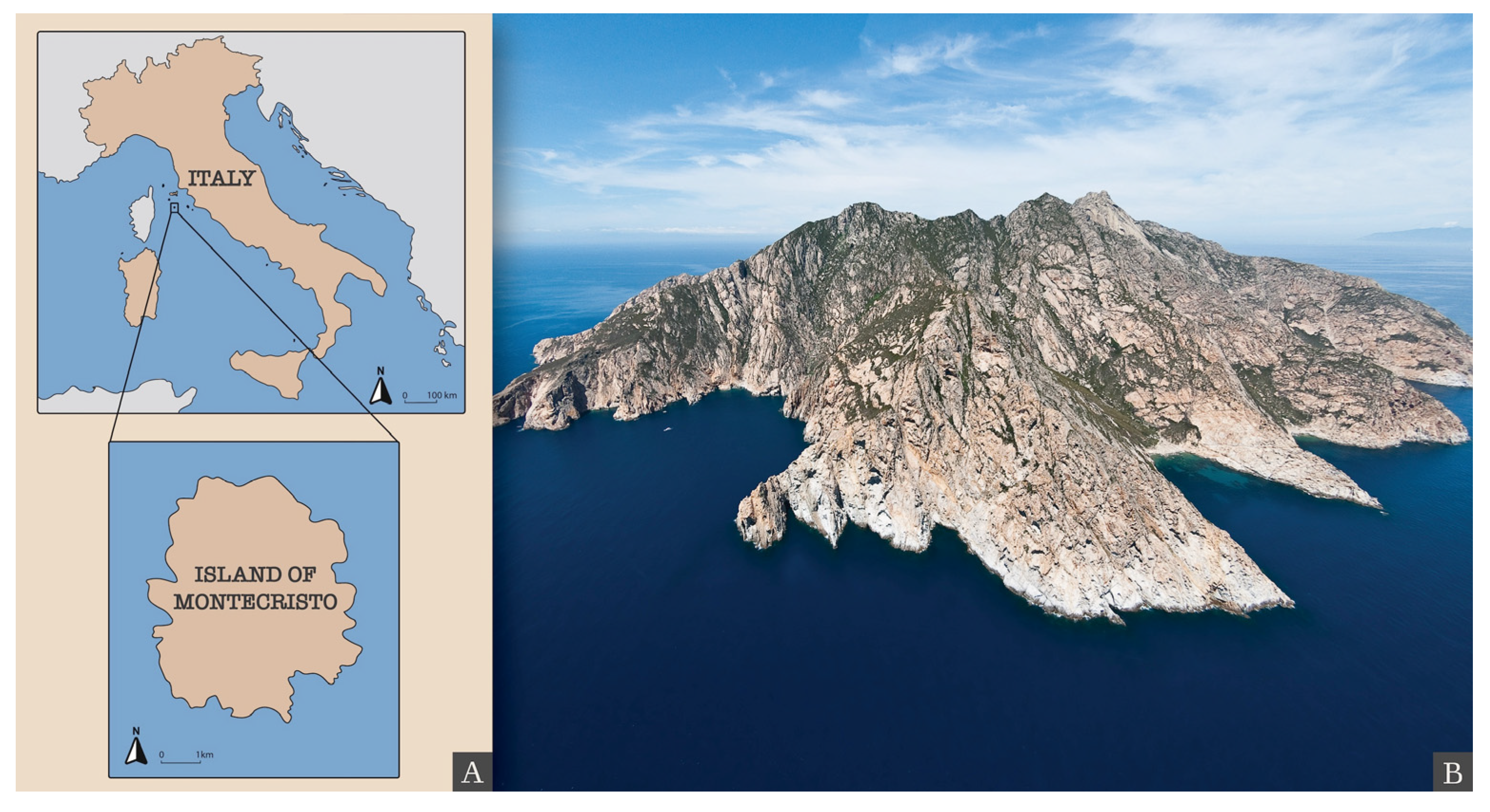
Figure 2.
Aerial photograph of northern coastline of Island of Montecristo, 2013. Photograph from photo archive of Cesare Scarfo’.
Figure 2.
Aerial photograph of northern coastline of Island of Montecristo, 2013. Photograph from photo archive of Cesare Scarfo’.
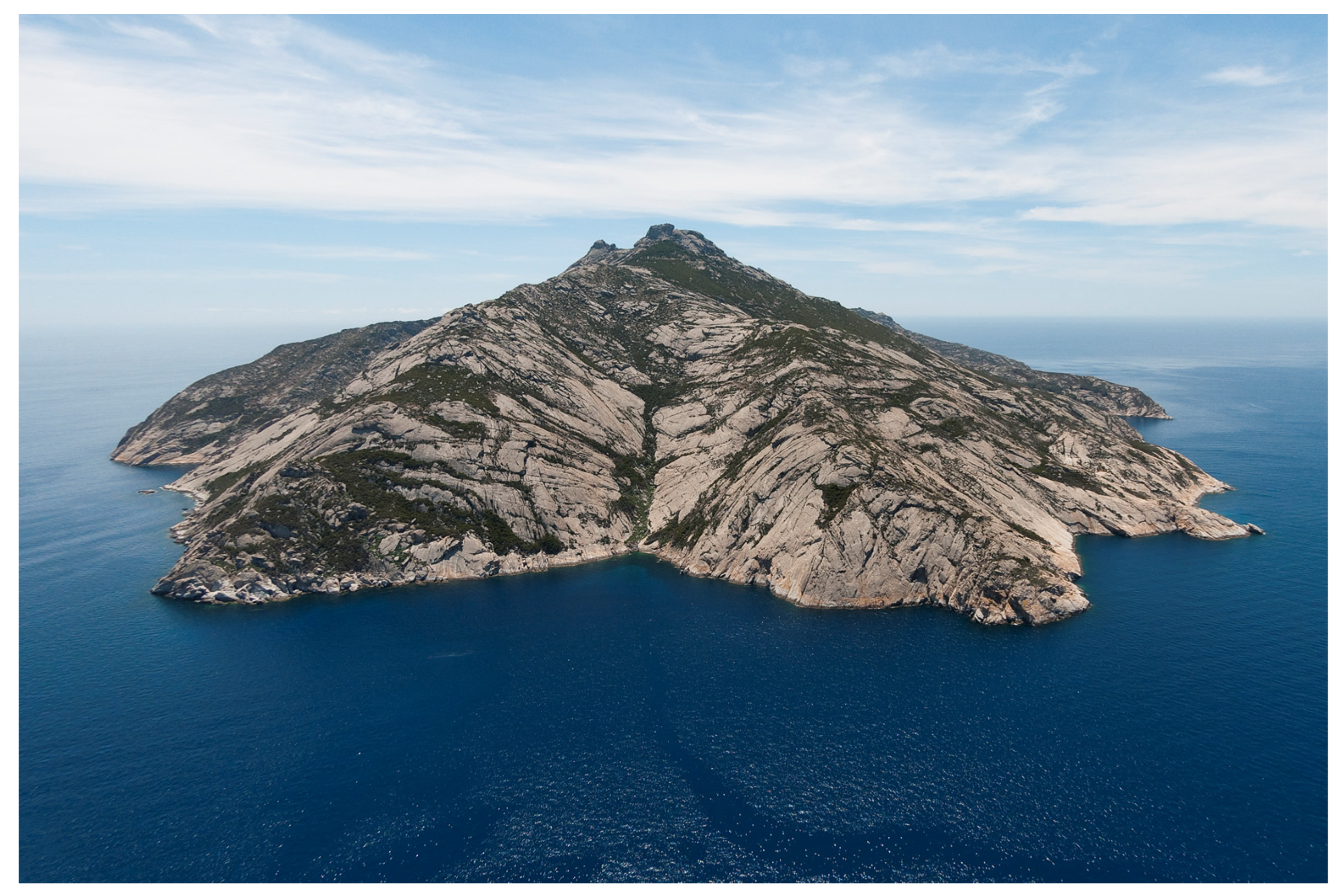
Figure 3.
Visual summary of the potential broad-spectrum ecosystem poisoning after aerial distribution of pellets containing brodifacoum.
Figure 3.
Visual summary of the potential broad-spectrum ecosystem poisoning after aerial distribution of pellets containing brodifacoum.
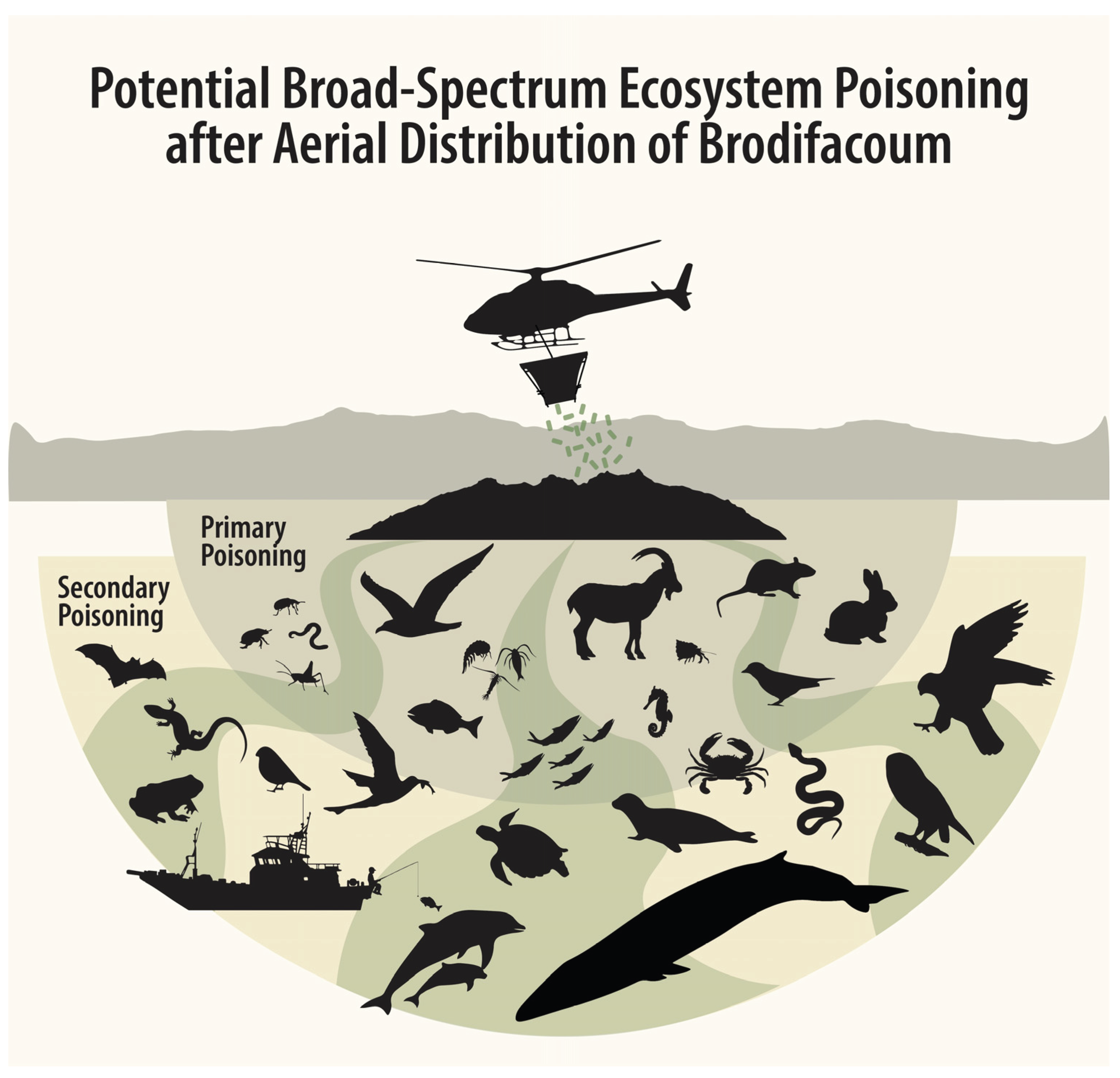
Figure 4.
Cetacean strandings recorded along the Tyrrhenian Sea coast of Italy (January to March quarter, 1987 to 2024 [152]).
Figure 4.
Cetacean strandings recorded along the Tyrrhenian Sea coast of Italy (January to March quarter, 1987 to 2024 [152]).
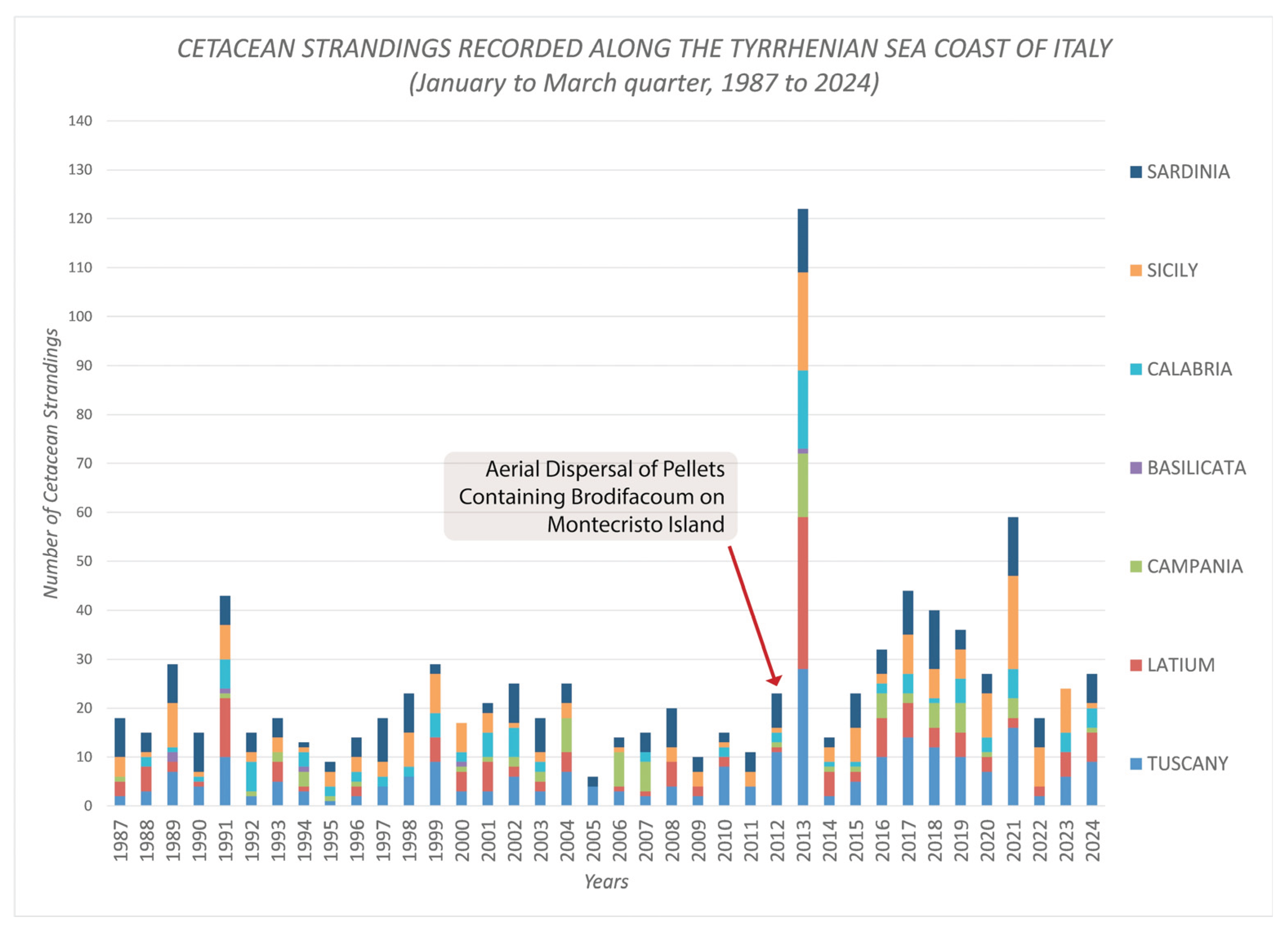
Figure 5.
Geographical distribution of cetacean strandings along the Italian coastline (1 January to 30 March 2013) [151] modified image.
Figure 5.
Geographical distribution of cetacean strandings along the Italian coastline (1 January to 30 March 2013) [151] modified image.
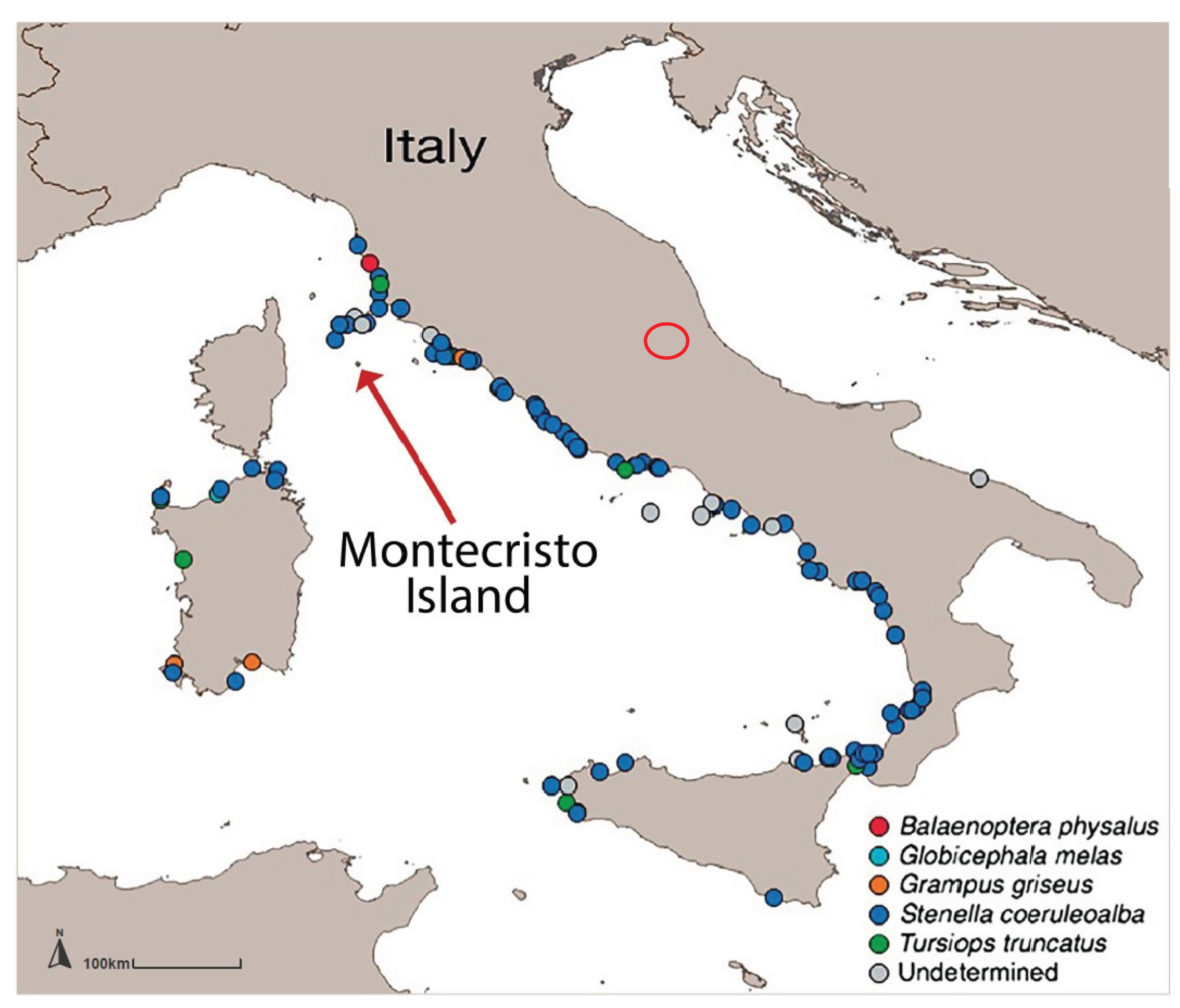
Figure 6.
Slope gradient map of Montecristo Island with description of slope gradient classes as they relate to percent gradation.
Figure 6.
Slope gradient map of Montecristo Island with description of slope gradient classes as they relate to percent gradation.
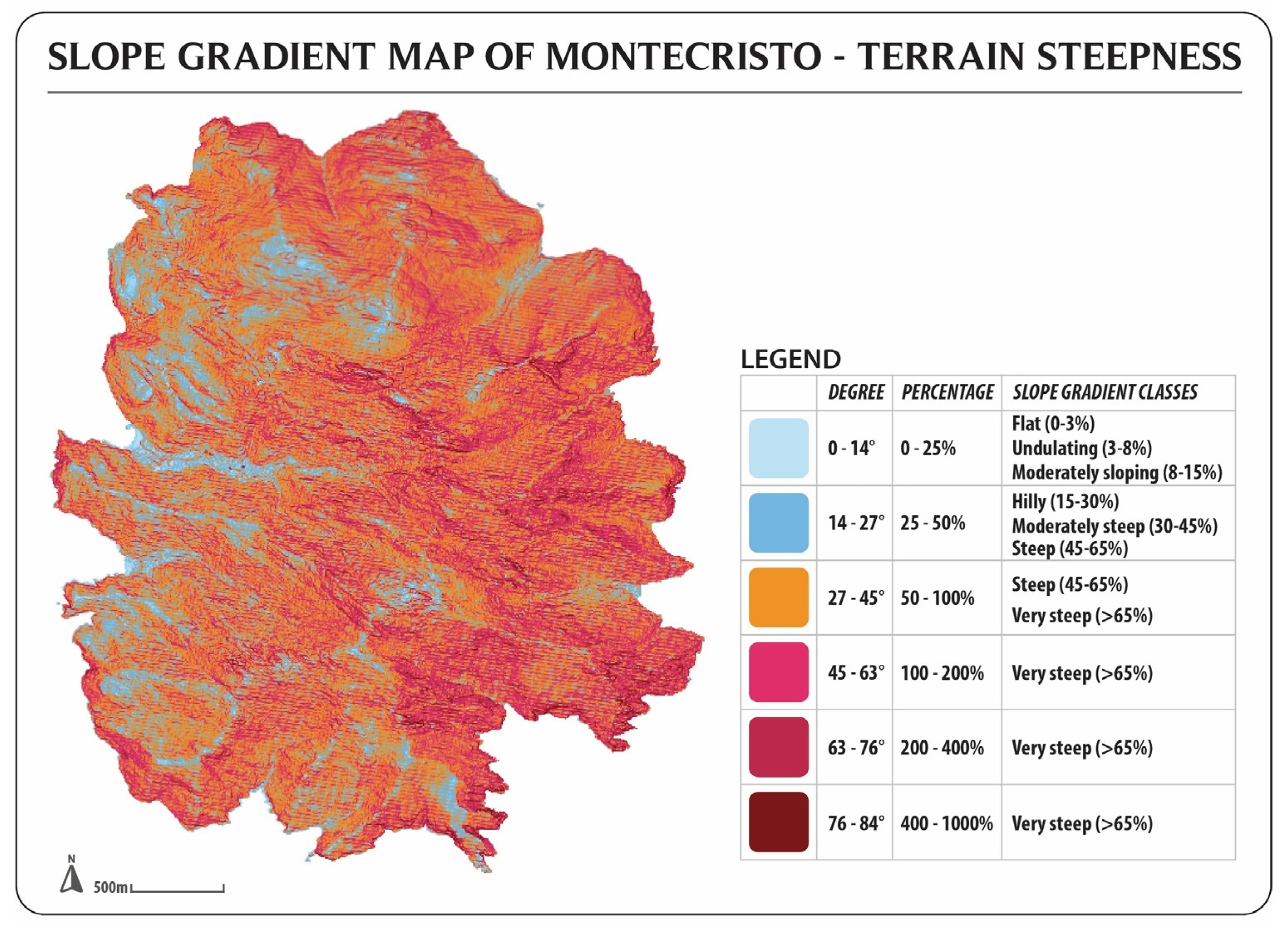
Figure 7.
Quantitative analysis of distribution of pellets indicating the number of pellets per square meter and kilograms of pellets per hectare in relation to the number of helicopter launches.
Figure 7.
Quantitative analysis of distribution of pellets indicating the number of pellets per square meter and kilograms of pellets per hectare in relation to the number of helicopter launches.
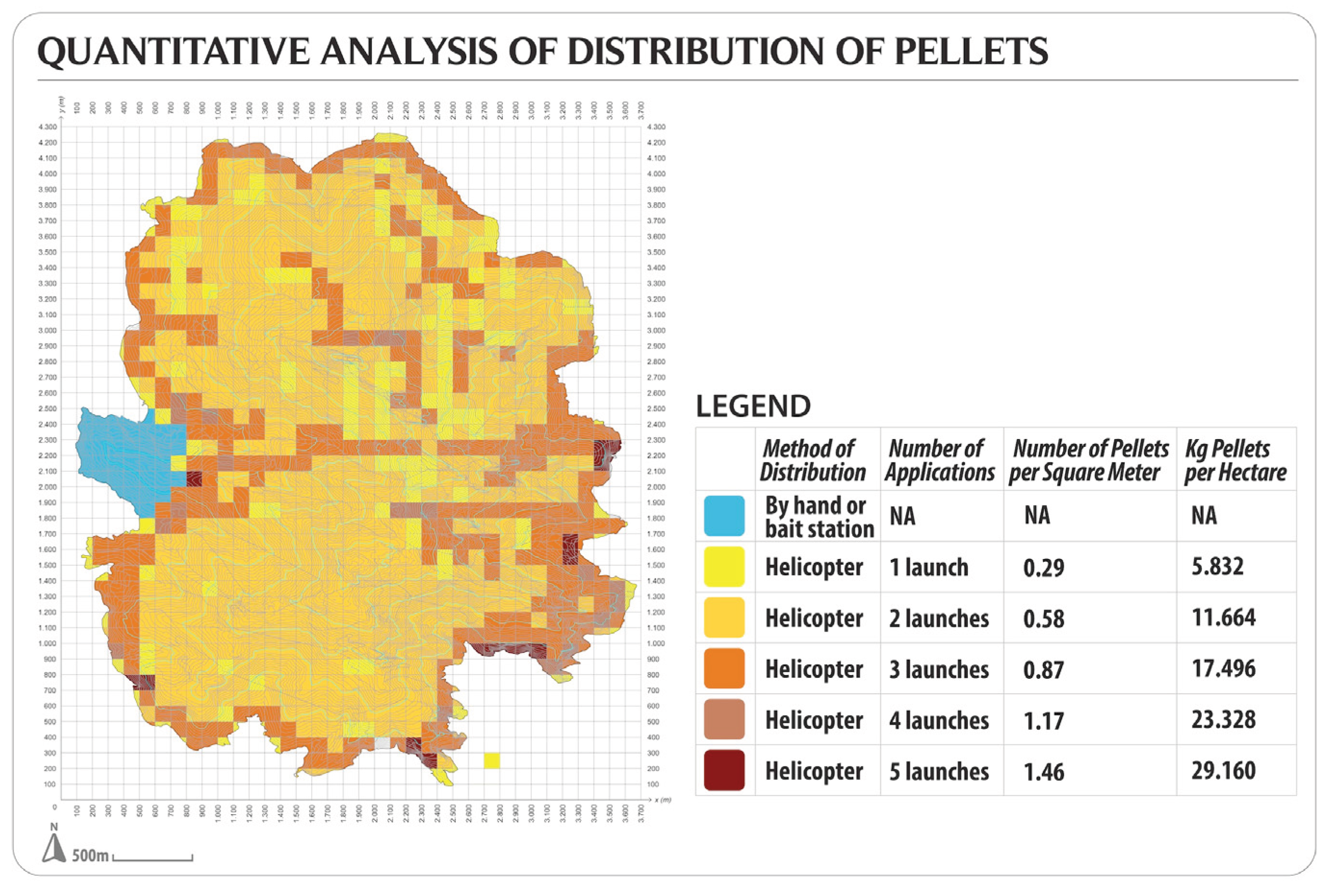
Figure 8.
(A) View of Montecristo from the south; (B) View of Montecristo from the east; (C) Map indicating terrain classifications of Montecristo; images generated using “AZTEC ROCK—Caduta Massi” software [156].
Figure 8.
(A) View of Montecristo from the south; (B) View of Montecristo from the east; (C) Map indicating terrain classifications of Montecristo; images generated using “AZTEC ROCK—Caduta Massi” software [156].
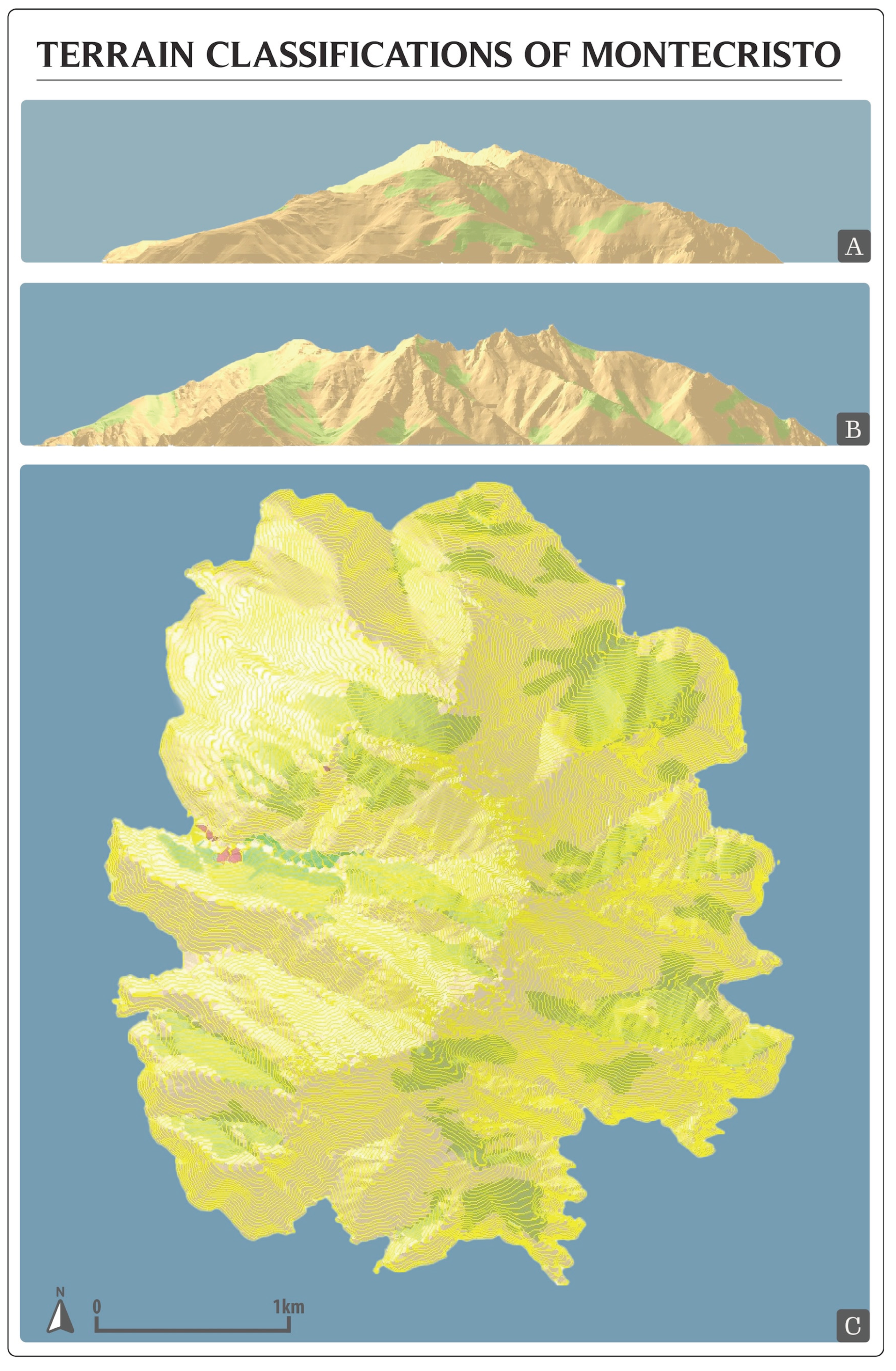
Figure 9.
A: Simulation of the pellet accumulation immediately after launch; B: Histogram of the pellet percentages for each altitude range (see Table 2).
Figure 9.
A: Simulation of the pellet accumulation immediately after launch; B: Histogram of the pellet percentages for each altitude range (see Table 2).
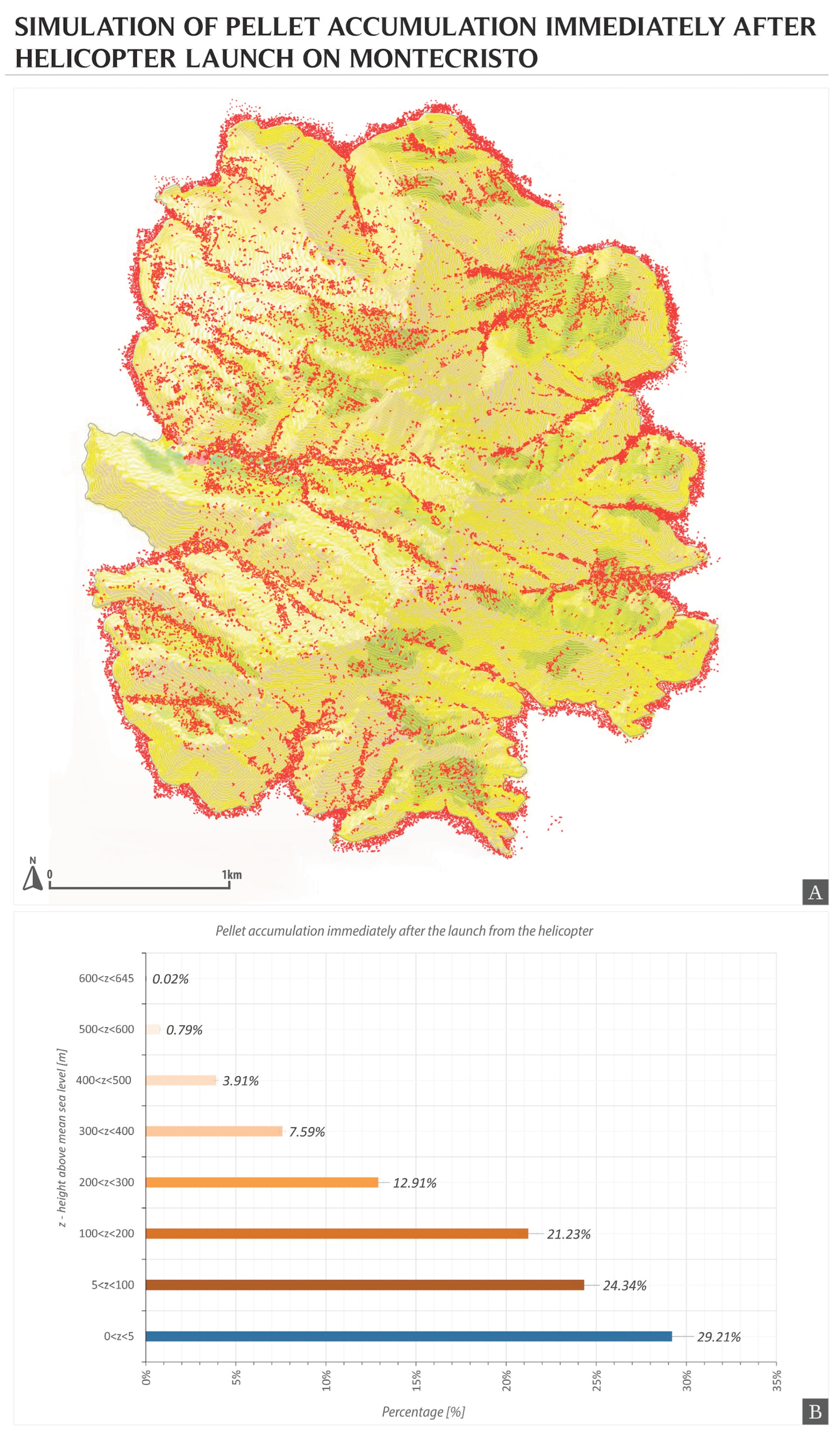
Figure 13.
Annual number of birds found dead on the Island of Montecristo [167].
Figure 13.
Annual number of birds found dead on the Island of Montecristo [167].
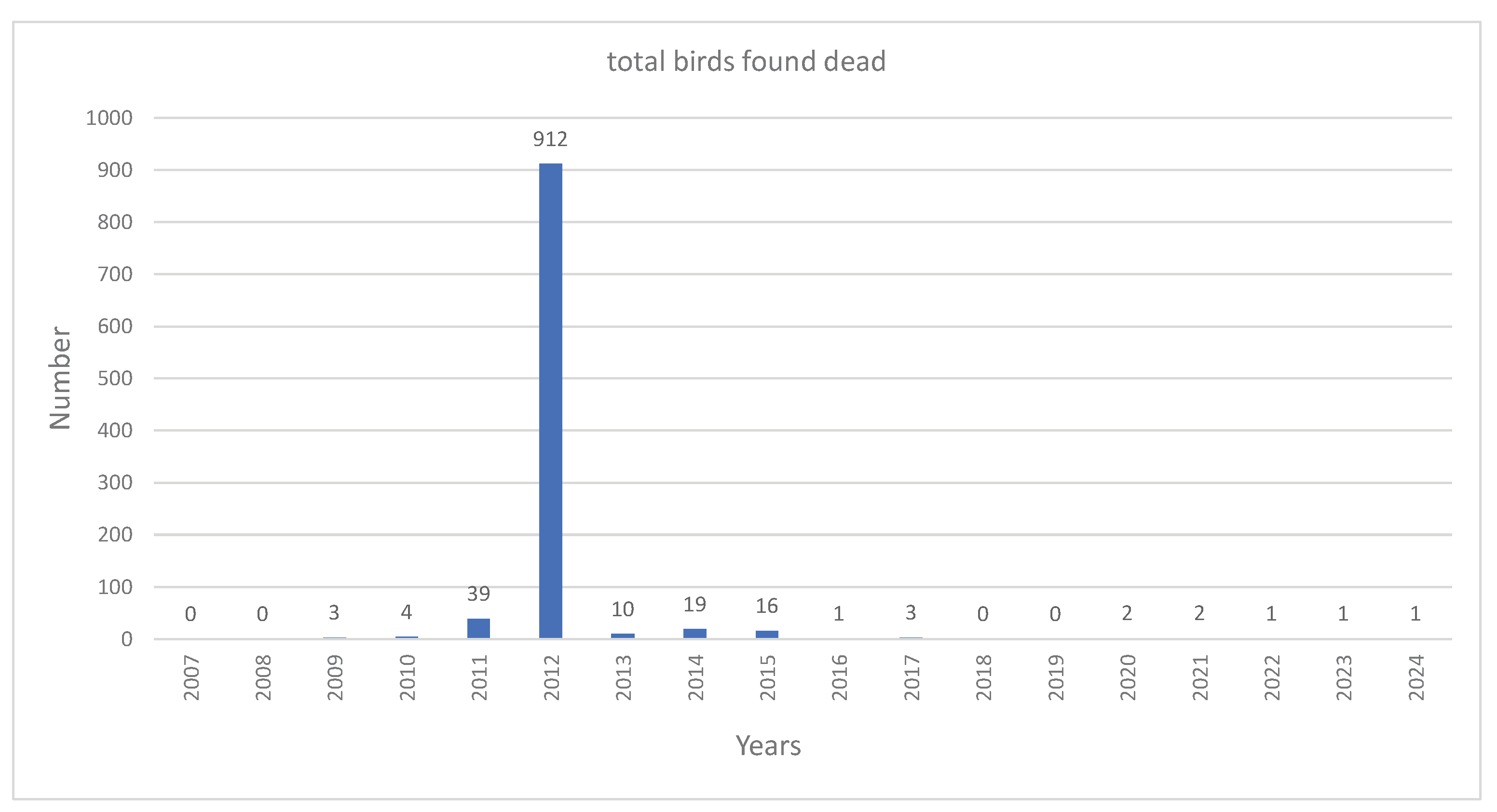
Figure 14.
Map based on the “Carta della distribuzione di Ailanto a Montecristo, anno 2010” [265], representing the distribution of Ailanthus on the island in the year 2010, with distinction of scattered, dense and dense cores with presence of adult individuals.
Figure 14.
Map based on the “Carta della distribuzione di Ailanto a Montecristo, anno 2010” [265], representing the distribution of Ailanthus on the island in the year 2010, with distinction of scattered, dense and dense cores with presence of adult individuals.
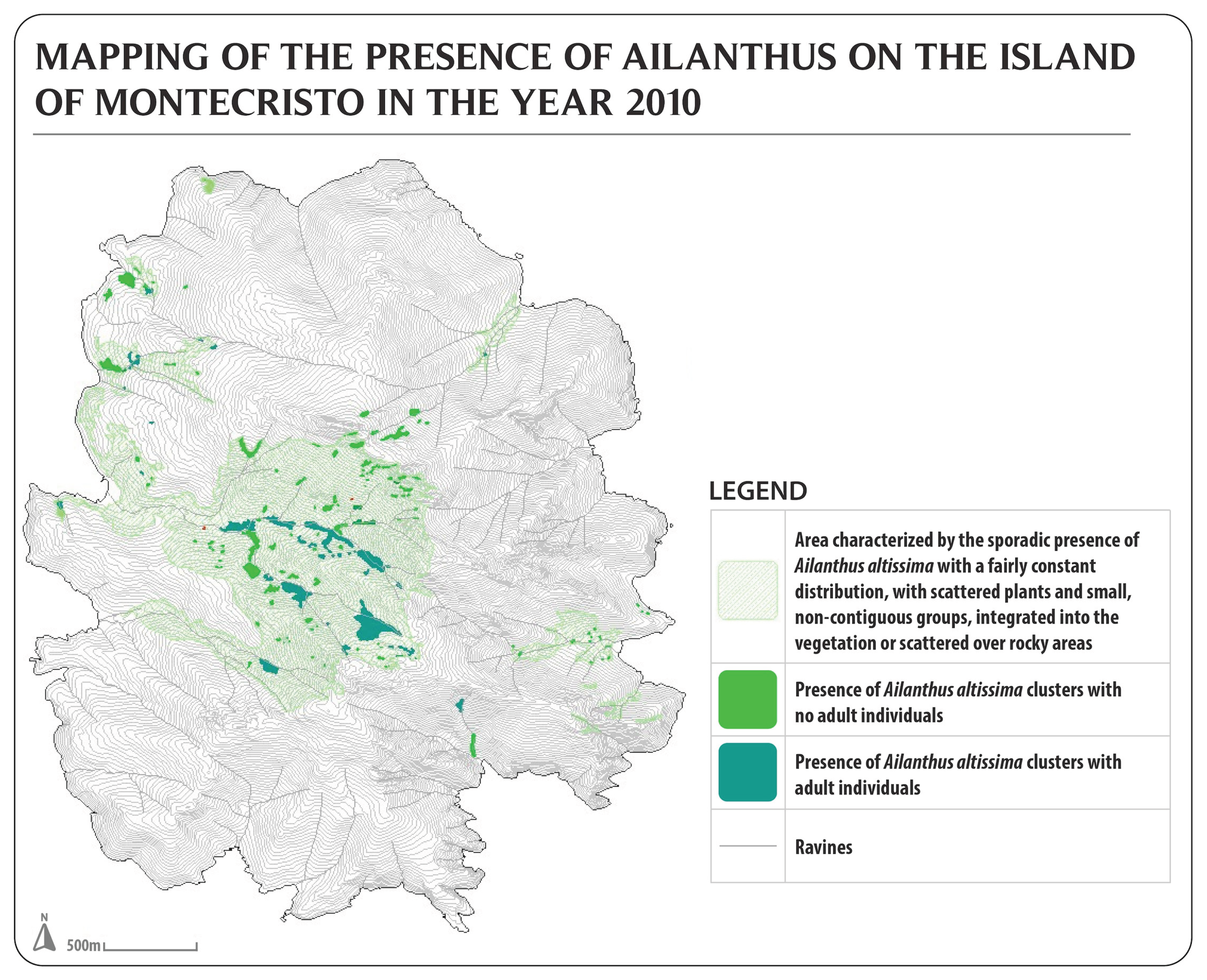
Figure 15.
Map created by overlaying documentary resources relating to the identification of the various habitats [source: Progetto HaSCITu, see [270]], the area affected by herbicide dispersal [95,262] and the distribution of holm oak groves [267].
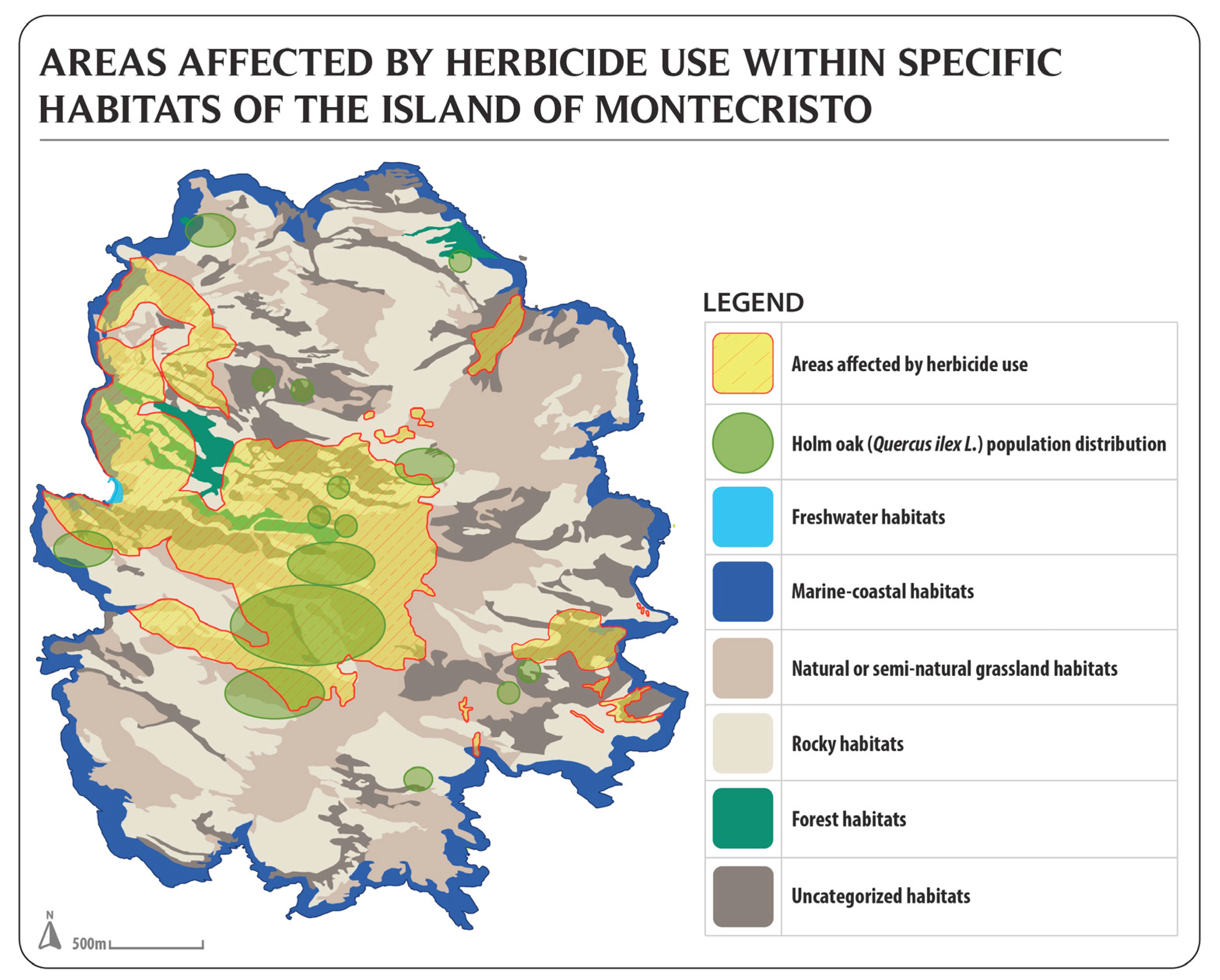
Table 1.
Soil classification and characterization for implementing the following data: Kn min, minimum restitution coefficient normal to the plane; Kn max, maximum restitution coefficient normal to the plane; Kt min, minimum restitution coefficient tangent to the plane; Kt max, maximum coefficient of restitution tangent to the plane; Phi min, minimum material friction angle; Phi max, maximum friction angle of the material.
Table 1.
Soil classification and characterization for implementing the following data: Kn min, minimum restitution coefficient normal to the plane; Kn max, maximum restitution coefficient normal to the plane; Kt min, minimum restitution coefficient tangent to the plane; Kt max, maximum coefficient of restitution tangent to the plane; Phi min, minimum material friction angle; Phi max, maximum friction angle of the material.
| CLASSIFICATION OF THE TERRAIN (Regione Toscana portal [164]) |
“MONTECRISTO SIMULATION” IMPLEMENTATION | Kn min | Kn max | Kt min | Kt max | Phi min [°] | Phi max [°] | color |
| Bare rocks, cliffs, crags and outcrops | Rock in place | 0.300 | 0.400 | 0.700 | 0.870 | 30.00 | 35.00 |  |
| Areas with sclerophyllous vegetation | Vegetated shrub detritus | 0.200 | 0.300 | 0.500 | 0.700 | 30.00 | 35.00 |  |
| Areas with sparse vegetation | Vegetated shrub detritus | 0.200 | 0.300 | 0.500 | 0.700 | 30.00 | 35.00 |  |
| Mixed coniferous and deciduous forests | Vegetated woodland detritus | 0.180 | 0.280 | 0.400 | 0.600 | 30.00 | 35.00 |  |
| Coniferous forests | Vegetated woodland detritus | 0.180 | 0.280 | 0.400 | 0.600 | 30.00 | 35.00 |  |
| Housing structures, scattered buildings | Paved surfaces | 0.300 | 0.400 | 0.800 | 0.900 | 30.00 | 35.00 |  |
| Beaches, dunes and sand | Medium fine non-vegetated detritus | 0.200 | 0.310 | 0.700 | 0.830 | 30.00 | 35.00 |  |
Table 2.
The distribution has been segmented into elevation bands, a result of the probabilistic study of the individual trajectories of each pellet after the helicopter launch; approximately 4.12 tons of pellets would fall directly into the sea immediately after the launch on the island.
Table 2.
The distribution has been segmented into elevation bands, a result of the probabilistic study of the individual trajectories of each pellet after the helicopter launch; approximately 4.12 tons of pellets would fall directly into the sea immediately after the launch on the island.
| Pellets distribution | N pellets | Uncertainty (N. pellets) | % pellets | Uncertainty [%] | Tons | Uncertainty [Tons] |
|---|---|---|---|---|---|---|
| 0<z<5m | 2,059,846 | ±47,170 | 29.2133% | ±2.29% | 4.12 | ±9.43E-02 |
| 5m<z<100m | 1,715,897 | ±39,294 | 24.3354% | ±2.29% | 3.43 | ±7.86E-02 |
| 100m<z<200m | 1,496,932 | ±34,280 | 21.2299% | ±2.29% | 2.99 | ±6.85E-02 |
| 200m<z<300m | 910,204 | ±20,844 | 12.9088% | ±2.29% | 1.82 | ±4.17E-02 |
| 300m<z<400m | 535,143 | ±12,255 | 7.5896% | ±2.29% | 1.07 | ±2.45E-02 |
| 400m<z<500m | 275,740 | ±6,314 | 3.9106% | ±2.29% | 0.55 | ±1.26E-02 |
| 500m<z<600m | 56,000 | ±1,282 | 0.7942% | ±2.29% | 0.11 | ±2.56E-03 |
| 600m<z<645m | 1,283 | ±29 | 0.0182% | ±2.29% | 0.00 | ±5.87E-05 |
Table 4.
Categories of the European Industrial Accident Scale (EIAS/ARIA) relating to environmental consequences and relative parameters for ascertaining environmental disaster magnitude [183].
Table 4.
Categories of the European Industrial Accident Scale (EIAS/ARIA) relating to environmental consequences and relative parameters for ascertaining environmental disaster magnitude [183].
| Environmental consequences | magnitude 1 | magnitude 2 | magnitude 3 | magnitude 4 | magnitude 5 | magnitude 6 |
|---|---|---|---|---|---|---|
| Env10*Q [t] | Q<0.1 | 0.1≤Q<1 | 1≤Q<10 | 10≤Q<50 | 50≤Q<200 | Q≥200 |
| Env11**P [%] | P<0.1% | 0.1%≤P<0.5% | 0.5%≤P<2% | 2%≤P<10% | 10%≤P<50% | P≥50% |
| Env12***V [m3] | V<10^3 | 10^3≤V<10^4 | 10^4≤V<10^5 | 10^5≤V<10^6 | 10^6 ≤V<10^7 | V≥10 Millions |
| Env13****S [ha] | 0.1≤S<0,5 | 0.5≤S<2 | 2≤S<10 | S50 | 50≤S<200 | S≥200 |
| Env14*****L [km] | 0.1≤L<0.5 | 0.5≤L<2 | 2≤L<10 | 10≤L<50 | 50≤L<200 | L≥200 |
*Env10: Quantity Q of wild animals killed, injured or rendered unfit for human consumption (t); **Env11: Proportion P of rare or protected animal or vegetal species destroyed (or eliminated by biotope damage) in the zone of the accident; ***Env12: Volume V of water polluted (in m3). The Volume is determined with the expression Q/Clim, where Q is the quantity of substance released and Clim is the maximal admissible concentration in the milieu concerned established by the European directives in effect; ****Env13: Surface area S of soil or underground water surface requiring cleaning or specific decontamination (in ha); *****Env14: Length L of water channel requiring cleaning or specific decontamination (in km).
Table 5.
Environmental Consequences with Magnitudes Associated with the Event as an Environmental Disaster [179,183].
| Environmental Consequences | ||
|---|---|---|
| Technical Parameters | Parameter Quantification | Magnitude |
| Env10*Q [t] | - | - |
| Env11**P [%] | P≥50% | 6 |
| Env12***V [m3] | - | - |
| Env13****S [ha] | S≥200 | 6 |
| Env14*****L [km] | - | - |
| Magnitude associated with the event as an environmental disaster | 6 | |
Disclaimer/Publisher’s Note: The statements, opinions and data contained in all publications are solely those of the individual author(s) and contributor(s) and not of MDPI and/or the editor(s). MDPI and/or the editor(s) disclaim responsibility for any injury to people or property resulting from any ideas, methods, instructions or products referred to in the content. |
© 2026 by the authors. Licensee MDPI, Basel, Switzerland. This article is an open access article distributed under the terms and conditions of the Creative Commons Attribution (CC BY) license.
Copyright: This open access article is published under a Creative Commons CC BY 4.0 license, which permit the free download, distribution, and reuse, provided that the author and preprint are cited in any reuse.