
Submitted:
26 March 2026
Posted:
27 March 2026
You are already at the latest version
Preprints on COVID-19 and SARS-CoV-2
Abstract
Background/Objectives: Assessment of recent trends in prevalence is important for understanding the biological, medical and social aspects of autism spectrum disorder (ASD). Methods: County-level ASD prevalence was estimated using a 2025 age-resolved snapshot from the California Department of Developmental Services (DDS) covering birth years 1993-2020. Denominators were estimated from public school populations. Results: Prevalence increased among all race/ethnicity groups across this period, with an uptick in the rate of increase starting around birth year 2015-2016 in many low- and middle-income counties. Large differences in ASD prevalence occurred by race/ethnicity as well as county, with prevalence among black children doubling statewide between birth years 2014-2019 and reaching as high as 10% in Los Angeles County among 5-year-olds born in 2020. Comparison of ASD prevalence in San Diego County between DDS and the Autism and Developmental Disabilities Monitoring (ADDM) network (for which part of San Diego is used to represent California) suggests that DDS may only capture half of all ASD cases, on the more severely affected end of the autism spectrum. Within DDS, San Diego prevalence was about 20% higher than California prevalence statewide. DDS ASD prevalence and rate of change in prevalence were positively correlated to county Medicaid (Medi-Cal) fraction and negatively correlated to median household income for the period of sharpest increase after birth year 2014. Conclusions: The changepoint circa birth year 2015-2016, together with the correlations to socioeconomic indicators, may help guide the formulation of hypotheses to explain the accelerated increase in diagnosed ASD prevalence in California.
Keywords:
autism spectrum disorder
; autism
; prevalence
; time trends
; California
; county
; Medicaid
; COVID
; socioeconomic
; race/ethnicity
1. Introduction
Autism is a neurodevelopmental condition characterized by impairments in social interaction, communication and restricted or stereotyped behaviors [1]. The diagnosis of autism spectrum disorder (ASD) encompasses a wide range of presentations, ranging from mildly to profoundly affected [2], often with co-occurring medical and developmental disorders, including anxiety, epilepsy, attention deficit hyperactivity disorder (ADHD) and intellectual disability (ID) [3].
While its etiology has long been the subject of debate, ASD is increasingly understood to result from a complex interaction of genetic factors and early environmental insults that affect the nervous system, immune system, and host microbiome in interdependent ways. These interactions may lead to neuroinflammation, immune dysregulation, oxidative stress and associated mitochondrial dysfunction, culminating in brain injury in young children during critical stages of neurodevelopment [4,5,6]. While risk of ASD was once thought to be restricted to a small subset of children with genetic or other susceptibilities, the pool of susceptible children appears to be ever expanding as ASD prevalence continues to rise in each successive birth cohort of U.S. children [7,8].
The most recent report of the Autism and Developmental Disabilities Monitoring (ADDM) network found a mean ASD prevalence of 1 in 31 (i.e., 3.2 %) of 8 year-olds born in 2014 at 16 U.S. sites including Puerto Rico [8]. The 2014 result reflects an increase by nearly a factor of 5 from the first ADDM report in birth year 1992 [9]. Since California (represented by “part of one county in metropolitan San Diego”) joined the ADDM network in surveillance year 2018, it has stood out as having the highest ASD prevalence among all U.S. sites in the last 3 biannual ADDM reports. ADDM ASD prevalence in California reached 5.31% among children aged 8 born in 2014 and 6.06%, among children aged 4 years born in 2018.
County-level ASD prevalence was investigated previously in California using a 2019 age-resolved snapshot from the California Department of Developmental Services (DDS) for birth years 1993-2013 [10]. Strikingly, that study found that while ASD prevalence had increased among all children across birth years 1993-2000, prevalence after 2000 had plateaued among white and to a lesser extent Asian children from wealthy counties. In contrast, ASD rates increased continuously across 1993-2013 among whites from lower income counties and Hispanics from all counties. Subsequent research corroborated the divergent trends in California by race/ethnicity and socioeconomic status (SES) [11]. The authors noted that, while ASD historically was diagnosed more often in white children of high SES, a demographic reversal had taken place over the 1990-2018 period of their study.
This paper examines a 2025 age-resolved snapshot of ASD data from California DDS that is stratified by county and race/ethnicity. The dataset permits the estimation of race/ethnicity-specific time trends in ASD prevalence among white, Hispanic, black and Asian children across 36 California counties, encompassing wealthy coastal, large metropolitan, and rural/agricultural communities. The motivation for revisiting this topic is twofold: First, to evaluate how ASD rates in California have evolved in the last six years, over the period encompassing the COVID pandemic. Second, to examine whether ASD prevalence in San Diego, the county featured in ADDM, is broadly representative of the state of California.
2. Materials and Methods
2.1. ASD Counts from DDS
The current study used California Department of Developmental Services (DDS) autism counts distinguished by county, by birth year from 1993-2020, and by race/ethnicity for each of these groups: white, Hispanic, black and Asian and all races. The autism counts were obtained on January 13, 2026 through a public records request to DDS. The counts represent an “age-resolved” snapshot of the DDS Code 1 caseload as of late 2025, representing eligible individuals living in California who met the DSM-5 diagnostic criteria [1] for ASD. Statewide ASD data, stratified by the same birth years and race/ethnicity groups, were also obtained. The data did not include identifying information, and the datasets were aggregated by age at the county or statewide level. Since data cells with low counts were not made available as a matter of government policy, this study considered only the 36 most populous California counties, out of 58 total.
2.2. Denominators for Prevalence Calculation: NCES Total School Populations
Autism prevalence was computed by dividing the DDS ASD counts by total public school populations from the National Center for Education Statistics (NCES) (http://nces.ed.gov/ccd/elsi/). The data were downloaded from the NCES website as annual reports, compiled at the beginning of the Fall semester, for school years extending from 1998-99 to 2012-13 biannually and 2013-14 to 2024-25 annually. The initial report, 1998-99, was the first year that data became available stratified by both grade and race/ethnicity. Each dataset was stratified by California county, race/ethnicity, and grade from kindergarten to 12th grade. Statewide data for California stratified by race/ethnicity and grade were also obtained from NCES.
From 2018-2019 onward, NCES no longer directly provided the data aggregated at the county level because missing values in some schools were causing errors [12]. For NCES reports from 2018-19 through 2024-25, it was therefore necessary to download all public-school data with the associated county data included from the Basic Information tab, and to aggregate the counts from all public schools within each county while also stratifying by grade and race/ethnicity. This approach was equivalent to the pre-2018-19 county aggregations provided by NCES, which themselves only included public schools.
Until 2007-08, the NCES data were partitioned into 5 race/ethnicity groups, including American Indian or Alaska Native (AIAN), white, Hispanic, black, and a single group encompassing all Asians. From 2008-09 onward, NCES reported Native Hawaiian or Other Pacific Islanders separately from Asians. However, these were combined into a single group encompassing all Asians for the ASD prevalence calculations.
The ASD numerators provided by California DDS were effectively from the end of 2025, while the most recently available NCES denominators were from Fall 2024. Two different methods were used to estimate appropriate total public school population denominators for late 2025, stratified by age and race/ethnicity.
2.2.1. Method D1
Using a methodology similar to that described in [10], the NCES populations were extrapolated to report year 2025 using linear regressions of population (iry, iby) v. NCES report year, where iby = birth year (1993-2020) and iry = report year (1998-2024). In these calculations, birth year was estimated as a function of school grade (used as a proxy for age) and report year: iby = iry – iage, where iage ranged from 6 years old (1st grade) to 17 years old (12th grade). The kindergarten populations (age 5) were not used in the linear extrapolations because they tended to be slightly higher than the subsequent grades for a given birth cohort in many counties. This was likely because California includes Transitional Kindergarten, which is part of the pre-kindergarten program, in its kindergarten counts [13].
The extrapolation approach yielded county and race-specific populations that were generally stable or smoothly linear for each California county [10], lending confidence that the projected 2025 populations were reasonable estimates of the true populations. However, the approach involved some uncertainty and the most recent birth years (>2016) were covered by only a handful of NCES reports. For example, birth year 2016 was covered by only three NCES reports, reflecting children who were 6, 7 and 8 years old in the 2022-23, 2023-24 and 2024-25 school years, respectively, yielding only 3 data points for the linear extrapolation to 2025. The 2025 populations of the 2016-2020 birth cohorts therefore were assumed to equal the 2015 birth year extrapolation.
2.2.2. Method D2
The denominators were estimated alternatively by using the most recent 2024-25 NCES report for school children aged 6-15 (birth years 2009-2018) and, for older cohorts, the last available NCES report year for which the students were 15 years old, i.e., for birth years 1993-2008, the 10th grade (15-year-old) populations from reports 2008-2023 were used. Age 15 was chosen to avoid losses due to dropouts for older teenagers. However, in the following exceptional circumstances, the 14-year-old or 16-year-old (9th grade and 11th grade) population from the appropriate NCES report was used: Since the 2009 and 2011 NCES reports were not downloaded for this study (see above), 14-year-old populations from the 2008 and 2010 NCES reports, respectively, were used for birth years 1994 and 1996. Since the 2012 report contained many blanks, 16-year-old populations from the 2013 report were used for birth year 1997. Since the 2021 NCES report contained low numbers, particularly in Los Angeles, due to prolonged COVID school closures, 16-year-old populations from the 2022 NCES report were used for birth year 2006. Finally, for birth years 2019 and 2020, the populations of children aged 6 and 5 years, respectively, were assumed to equal the population of children aged 6 years in 2018, due to the unreliability of the kindergarten populations described above.
The denominators from each of Methods D1 and D2 were used to estimate alternative ASD prevalence values. The Method D1 ASD prevalence was used in all results presented below, while the difference between the two methods was used to define the uncertainty bars on the estimated ASD prevalence.
2.3. Estimation of the Changepoint in Prevalence
Visual inspection of the ASD prevalence data revealed a discernible changepoint in the rate of increase in recent years in many counties. Two different methods were used to formally quantify the birth year of the changepoint, stratifying by county and race/ethnicity.
2.3.1. Method C1
This method employed the hockey-stick model approach of [14], in which piecewise linear regressions were fit to two periods of data spanning birth year 2000-2019, varying the midpoint between 2013-2016. The combined residual sum of squares (RSS) for the two regression lines was calculated, and the minimum RSS was used to identify the changepoint. Some important notes for this approach are that 1) the start of period 1 was set at birth year 2000, to coincide with the start of the interval used by [10]. 2) The end of period 2 was set at birth year 2019, because ASD prevalence in many cases decreased from 2019 to 2020, likely due to underascertainment at age 5 compared to age 6 [15]. 3) The end of period 1 was set as the beginning of period 2, where the overlapping year was identified as Yc-1. The actual changepoint Yc was the following year. This approach allowed for growth in ASD prevalence between birth years Yc-1 and Yc in the calculation of the period 2 linear regression slope. 4) Following [14], the changepoint was determined to be statistically significant if the 95% confidence interval, i.e., the maximum slope, of period 1 was less than the 95% confidence interval, i.e., the minimum slope, of period 2. In addition, the difference between the two slopes was evaluated using a t-test.
2.3.2. Method C2
The first derivative of the ASD prevalence curve in 19 counties (selected based on visual inspection as having robust data for one or more race/ethnicities to support the calculation) was plotted against birth year in a scatterplot, stratified by race/ethnicity, to identify the changepoint birth year at which the slopes began increasing. The first derivative was calculated as a central difference of the unsmoothed raw data, with birth year 2020 included. Due to the widely disparate absolute values of ASD prevalence across counties, to reduce the spread in the scatterplot, the first derivatives were normalized by the race/ethnicity and county-specific absolute value of ASD prevalence in birth year 2014. The resulting normalized slopes had units of yr-1.
2.4. Socioeconomic Indices
Since evidence from previous studies has indicated that mean ASD prevalence and rate of change in prevalence may be correlated to both income and private vs. public insurance rates [10,16], two alternative metrics for evaluating socioeconomic status were obtained at the county level. The first was median household income [17]. The second was the percentage of the county population served by Medicaid (which in California is called Medi-Cal) [18].
3. Results
3.1. Autism Prevalence Trends by Race/Ethnicity and County
A sharp transition or changepoint was evident in the ASD prevalence vs. birth year trend for at least one race/ethnicity in the majority of the most populous California counties. For example, a changepoint was evident in 20 out of 36 counties for the Hispanic population (Table 1). Examples are shown in Figure 1 and Figure 2, with all data shown in Supplemental Figure S1. The data generally could be divided into 2 periods, before and after the changepoint. The linear fit to the data in the first period had a modestly increasing slope, while the linear fit to the data in the second period had a more steeply increasing slope. Both the RSS minimization (Method C1) (Figure 1 and Figure 2, Table 1) and the time derivatives of ASD prevalence (Method C2) (Figure 3) suggested that the changepoint occurred in most counties in birth year 2015 or 2016. The increase in the slope from period 1 to 2 was highly significant in many counties, as illustrated in Table 1 for Hispanics.
ASD prevalence in the 2025 DDS dataset has evolved in different ways among wealthy vs. lower-income California counties. Prevalence also has evolved differently between Hispanics and whites, which are the 2 largest race/ethnicity groups among California children, representing 56% and 20%, respectively, of the public-school population. In the wealthiest counties (Figure 1, top row), ASD prevalence has remained flat or increased only relatively slowly since birth year 2000 among whites, with the absolute rate staying at or below 1-2%. In most of these wealthiest counties, white prevalence did not have a significant changepoint. ASD prevalence among Hispanics in these counties has increased more quickly, with a significant changepoint occurring most commonly around birth year 2015-2016 (Figure 1, Table 1). A crossover in which Hispanic ASD prevalence overtook white prevalence occurred shortly after the changepoint, by birth year 2016. (In Santa Clara, the crossover occurred earlier, around birth year 2010).
In contrast, in middle income counties (Figure 1, middle row), including the large metropolitan areas of San Diego and Los Angeles, ASD prevalence was generally higher than in the wealthy counties and continued to increase among whites across birth year 2000-2019, although without a significant changepoint, except for in Solano County. However, ASD rates among Hispanics in these middle-income counties generally increased at a faster rate, with a distinct changepoint around birth year 2015-2016. In San Diego and Los Angeles, the 2 most populous counties in California, Hispanic prevalence overtook white prevalence in birth year 2014 and 2018, respectively. Absolute rates reached as high as 5.5% among Hispanics and 4.8% among whites in Los Angeles by birth year 2019.
In lower income counties, ASD prevalence increased steadily between birth years 2000-2014 and at an accelerating rate after birth year 2014 among both whites and Hispanics, with a changepoint in birth year 2015 or 2016, except for whites in Stanislaus County (Figure 1, bottom row). In contrast to the wealthy and middle-income counties, absolute ASD prevalence in most cases continued to increase after 2019, with rates among 5-year-olds born in 2020 as high as 6.4% among whites in Tulare County and 4.6% among Hispanics in both Fresno and Tulare Counties.
In these same 12 counties, the absolute value and trends in ASD prevalence among Asians, who comprise 13% of California’s public-school population, were similar to those among whites. The main difference was that Asians showed a slightly steeper increase in prevalence with a significant changepoint in birth year 2014-2016 in San Mateo, Alameda, Los Angeles, San Diego, and Sacramento Counties (Supplemental Figure S2).
Blacks comprise less than 5% of the public-school population in California. As a result, their ASD counts were small for many counties and not available due to DDS data release policies. However, in the 9 selected counties with the most complete data, ASD prevalence among blacks was invariably higher than among whites, Asians, and Hispanics (Figure 2). In the heavily populated middle-income counties (Figure 2, middle row) and the lower income counties (bottom row), black prevalence had a significant changepoint in birth year 2016-2017. In the wealthier counties, the recent uptick in the rate of growth among blacks was less pronounced (Figure 2, top row), without a significant changepoint, but was always comparable to or higher than the rate of growth among all races. ASD prevalence among blacks reached 9.5% in Los Angeles in birth year 2019, nearly 8% in Sacramento and Kern counties, and 6-7% in Orange, San Diego, and Fresno Counties. In Los Angeles, prevalence continued to increase after 2019 to a high of 10% among 5-year-olds born in 2020.
3.2. County-Level Correlations to Socioeconomic Indicators
The rate of change in county-level ASD prevalence over birth years 2014-2019 was significantly correlated to the percentage of the county population served by Medicaid for blacks (R= 0.78, p < 0.008), Hispanics (R=0.62, p<0.001), and all races (R= 0.68, p < 0.001) and was marginally correlated for Asians (R=0.48, p=0.07) and whites (R=0.37, p=0.10) (Figure 4). Over the earlier period of the data, birth years 2000-2014, the rate of change in county-level ASD prevalence was weakly correlated to the Medicaid percentage for Hispanics (R=0.41, p=0.05) and all races (R=0.37, p=0.04) but was uncorrelated for Asians, blacks, and whites (Table 2).
In addition to the rate of change, the absolute mean county-level ASD prevalence over birth years 2014-2019 was significantly correlated to the percentage of the county population served by Medicaid (Table 2) for blacks, Hispanics, Asians, and all races, and was marginally correlated for whites (Table 2). Over the earlier period of the data, birth years 2000-2014, mean county-level ASD prevalence was marginally correlated to the Medicaid percentage for whites but was uncorrelated for Asians, Hispanics, blacks, and all races (Table 2).
Similar correlations, but negative in sign, were found over birth years 2014-2019 as a function of median county household income for both mean ASD prevalence and rate of change in ASD prevalence (Table 2). Median household income and percentage served by Medicaid are themselves significantly inversely correlated (R= -0.74 p<0.000001), with Los Angeles a notable outlier that has a relatively high median household income ($88K/year) for its sizeable Medicaid percentage (40%).
3.3. Statewide California ASD Prevalence Trends by Race/Ethnicity
Summing the ASD counts across all 58 California counties tends to blur the sharp changepoint around birth year 2015-2016 that is evident in much of the county level data. The statewide prevalence trend appears as a smooth curve that could be fit better to a continuous quadratic function rather than to 2 piecewise linear fits (Figure 5). Statewide prevalence among 5-year-olds born in 2020 (not shown in Figure 5) was slightly lower than among 6-year-olds born in 2019 for all races.
ASD prevalence statewide reached 3.84% by birth year 2019, more than double the prevalence of 1.5% in birth year 2013 reported by [10]. The curve from [10] is shown in Figure 5 for reference and generally agrees well through 2013 with the new 2025 curve. ASD prevalence in the 2025 DDS data was about 20% lower statewide than in San Diego County, where prevalence reached a high of 4.75% in birth year 2019. Compared to the 2025 DDS San Diego County results, ADDM prevalence for San Diego was about 100% and 50% higher for children surveilled at age 8 years and 4 years, respectively.
ASD prevalence statewide among individual race/ethnicity groups in the 2025 DDS dataset also increased substantially by birth year 2019 from the values reported [10] (Figure 6). Highest prevalence in birth year 2019 occurred among black children (5.9%), followed by Hispanic (3.2%), Asian (2.9%), and white (2.8%) children. These race/ethnicity-specific values had increased by a factor of 3.3, 2.7, 1.7, and 2 for black, Hispanic, Asian, and white children, respectively, compared to birth year 2013 [10]. The curves from [10] again are shown for reference and generally agree well with the new 2025 curves through 2013, although the former tend to underestimate black prevalence throughout the overlapping period.
Within the DDS dataset, statewide ASD prevalence agreed relatively well with San Diego County prevalence for whites and blacks, but the San Diego values were about 25%-30% and 10-15% higher for Asians and Hispanics, respectively, compared to the statewide values. The ADDM surveillance data from San Diego were again substantially higher than San Diego DDS values for all race/ethnicities. Similar to the DDS data, ADDM prevalence in San Diego diverged strongly by race/ethnicity, especially among 4-year-olds, with Hispanic, black, and Asian children more likely to be diagnosed than white children.
4. Discussion
4.1. Accelerated Increase in ASD Growth rate with Changepoint Circa Birth Years 2015-2016
The growth rate in diagnosed ASD prevalence has accelerated in recent years, with a pronounced changepoint around birth years 2015-2016 among Hispanics and blacks in many counties, as well as whites and Asians in many middle- and lower-income counties. The rate of growth reached as high as 0.57%/yr and 1%/year among blacks and Hispanics in Los Angeles County, respectively (Table 1, Figure 4). In comparison, growth rates between birth years 2000-2014 were lower, on the order of 0.05%/yr to 0.15%/yr, similar to the rates found by [10] between birth years 2000-2013 (Table 1).
The changepoint can provide valuable information for formulating hypotheses about causation [14]. As discussed above, the changepoint appears to have occurred around birth year 2015 or 2016 and is most distinct in low and middle income counties. While this paper focuses on identifying the year of the changepoint, rather than specific mechanistic explanations, a few hypotheses are discussed below. However, in general none of them fully or satisfactorily explains the changepoint.
The timing of the recent acceleration in the ASD growth rate coincides with the implementation of SB75, which took effect in summer 2016 and made children under 19 years old eligible for full-scope Medi-Cal benefits regardless of immigration status [19]. This law would have brought many children into the health care system in California, thus increasing their likelihood of receiving an ASD diagnosis and potentially introducing them into the DDS system. However, SB75 seems unlikely to account for the observed changepoint, since (a) undocumented immigrants are most likely to be Hispanic, and (b) the changepoint was equally or even more pronounced in the Asian and black populations. (Figure 1, Figure 2 and Figures 1, 2, and S2).
The high rates of autism diagnoses, which are particularly notable in Los Angeles County, may be financially incentivized by payments to children with an ASD diagnosis. Recent allegations of Medicaid fraud related to ASD services in Minnesota have brought this issue to the public’s attention, amid rumors that fraud in other states may also be widespread [20]. The significant correlation between percentage of the county served by Medi-Cal and the rapid rate of change in ASD rates from birth year 2014-2019, especially for black children (Figure 4), may lend support to the view that high rates of ASD diagnoses are, at least in part, due to fraud. However, until substantial changes in incentives to commit fraud can be identified in the birth year 2015-2016 time frame, fraud is not an obvious or satisfactory explanation for the observed changepoint.
Rather than reflecting fraud, the correlation between socioeconomic status and the prevalence of ASD diagnosis may underscore the demographic reversal that has taken place in ASD, in which children from lower income households, across all race/ethnicities, are increasingly more likely to be diagnosed with ASD than wealthier peers [11]. However, such demographic reversals do not provide an adequate explanation for the dramatic changepoint observed in this analysis. Furthermore, a true growth in ASD prevalence is consistent with first-hand reports from school officials, who have testified to the California State Legislature about the financial burden that the rapidly increasing ASD caseload is creating for their districts [21]. However, the last statewide hearing on this topic took place in 2018, leaving important unanswered questions about current trends from the perspective of the public schools.
When the COVID pandemic started, the last 4 birth cohorts in the current study would have been 0 to 3 years old, with their neurodevelopment potentially adversely affected by lockdowns, masking, and school closures [22,23]. These measures remained in effect in California longer than in most states and disproportionally affected black, Hispanic, and low-income students [24]. In terms of early identification or evaluation for ASD, the most recent ADDM report found no evidence of a sustained impact of COVID [8]. However, it may be too early to evaluate the full impact of COVID on ASD prevalence in DDS. The small downturn in ASD prevalence in many counties between birth year 2019 and 2020 (Figure 1 and Figure 2) more likely reflects underascertainment in children who were only 5 years old in 2025 rather than a true decrease in prevalence [15].
4.2. Divergence in ASD Trends by Race/Ethnicity
The DDS data show a divergence and demographic reversal in ASD prevalence over time along lines of race/ethnicity. White prevalence in DDS historically exceeded Hispanic prevalence, by a factor of 2 as recently as birth year 2002, but the gap has closed since then. A Hispanic/white crossover in ASD prevalence occurred in birth year 2018 at the statewide level in DDS (Figure 5 and Figure 6) and had occurred sometime between 2010 and 2016 in several of the wealthier California counties (Figure 1). This demographic reversal is all the more remarkable in the context of the likely underestimate of Hispanic prevalence by DDS due to hesitancy among recent immigrants to apply for state-level administrative aid [25].
The prevalence in the recent DDS data is higher in black children than other race/ethnicities in California and was more than 50% higher than the statewide average for all races combined by birth year 2019. The black/white crossover in statewide DDS data occurred around birth year 2004 considerably earlier than the Hispanic/white crossover (Figure 5 and Figure 6). In comparison, studies based on ADDM data have noted a black/white catch-up and crossover in ASD prevalence that occurred somewhat later, around birth year 2008-2010 [26,27]. Similarly, [28] noted a black/white crossover around birth year 2010 in U.S. Department of Education Individuals with Disabilities Education Act (IDEA) data, with a Hispanic/white crossover that was projected to occur around birth year 2013. The black/white crossover may have occurred earlier in DDS than in ADDM or IDEA because the fraction of ASD with co-occurring intellectual disability is substantially higher, by as much as a factor of 2 in some ADDM data, among blacks compared to whites [29]. Thus, black children may be disproportionately represented in DDS, which serves more severe ASD cases.
The race/ethnicity disparities in DDS data appear to be widening in the youngest birth cohorts, consistent with recent trends in ADDM data from California. By birth year 2020, DDS prevalence had climbed as high as 10% in Los Angeles County among black children, about twice the level for whites in that county (Figure 1 and Figure 2). Similarly, California ADDM ASD prevalence among 4-year-old black children born in 2018 was 8.1%, a factor of 2.3 higher than the 3.6% prevalence in white children (Figure 6) [8].
The high ASD prevalence in California has particular implications for boys, whose overall prevalence across all races in California ADDM data was 8.9% for birth year 2018 among boys aged 4 years [8]. While sex-stratified DDS data were not obtained for the current study, the 10% DDS prevalence in Los Angeles County among black children born in 2020 (for boys and girls combined), assuming a male:female ASD ratio of about 4:1, suggests a prevalence approaching 15% for black boys. Furthermore, if this DDS rate is doubled to account for milder cases, it could suggest a total ASD prevalence as high as 30% among black boys in Los Angeles. These numbers, if real, have profound implications for society and highlight the urgent need to understand why such a large percentage of children is being diagnosed with ASD.
4.3. Divergence in ASD Trends by County
The divergence in ASD prevalence at the county level in the DDS data was equally if not even more striking than the divergence along lines of race/ethnicity. Prevalence among whites was as low as 1.4-1.5% in birth year 2019 in wealthy counties like Santa Clara and San Mateo, and as high as 5.6% and 7.9% in less wealthy counties like Tulare and Shasta, respectively (Figure 1, Supplemental Figure S1). Similarly, prevalence among Hispanics ranged from as low as 1.6%-2% in Santa Clara and San Mateo Counties to as high as 4.8% in Tulare and 7.6% in Imperial County (Figure 1, Supplemental Figure S1). Similar large disparities were found by [10] by California county, particularly among whites, both in terms of mean ASD prevalence and mean rate of change in prevalence, both of which were negatively correlated to median county household income for the birth year period 2000-2013. One possible explanation for these correlations was that wealthy parents, starting around 2000, may have begun making changes that effectively lowered their children’s risk of ASD. In particular, healthy life choices, associated with affluence may reduce the inflammation and oxidative stress that are involved in the etiology of ASD [6,30].
The large differences in ASD prevalence by county raise the possibility that diagnostic practices also may play a role. One hypothesis is that wealthier parents may be opting out of DDS in favor of private care. Another is that parents and/or school districts from middle and low-income areas have been incentivized to seek an ASD diagnosis for children to secure support services, funding opportunities, and other benefits attendant to the diagnosis. However, again, it remains unknown how such factors could account for the 2015-2016 changepoint observed in the data.
4.4. San Diego vs. Statewide ASD Prevalence
The California DDS data analyzed in this study indicate that ASD prevalence in San Diego County is about 20% higher but otherwise (e.g., in terms of its upward time trend) largely consistent with ASD prevalence statewide in California. This is true for the time trend among all races and individual race/ethnicity groups as well as for the absolute value of ASD prevalence among both white and black children (Figure 5 and Figure 6). The relative consistency between the statewide and San Diego DDS data suggests that the strikingly high values found by ADDM in San Diego are generally representative of California as a whole. In the last ADDM report for surveillance year 2022, California’s ASD prevalence exceeded the estimated U.S. nationwide mean by 65% for children aged 8 years and 110% for children aged 4 years [8].
4.5. California DDS vs. ADDM
A caveat in comparing ASD prevalence for DDS vs. ADDM in San Diego, especially for Hispanics, is that recent immigrants to California may be hesitant to apply to state-funded agencies like DDS for aid. In contrast, they may be more comfortable using services from their local school districts [25,31]. Since ADDM reviews school-based evaluations as well as health care records to determine cases, Hispanic children with ASD may be more likely to be identified by ADDM than by DDS.
Another caveat is that DDS historically has served the more severe end of the autism spectrum [32,33], while ADDM considers the full range of the autism spectrum. Although the ASD subtypes enumerated in DSM-IV (autistic disorder (AD), PDD-NOS and Asperger’s) are no longer distinguished following the adoption of DSM-5 [1], historically over half of the ADDM caseload was diagnosed with PDD-NOS or Asperger’s Disorder, which are milder presentations than AD [34].
Furthermore, since DDS requires a demonstration of functional disability in several key aspects of self-care and daily life [35], the DDS values presented here can be assumed to capture only about half of total ASD cases. This supposition is supported by the comparison of San Diego DDS and ADDM data for 8-year-olds, which suggests that ADDM prevalence is about 2 times higher than DDS prevalence for a given birth cohort (Figure 5 and Figure 6).
4.6. Limitations and Uncertainties
The limitations of the current study include the uncertainty in the denominators of NCES race/ethnicity and county specific prevalence, even though changes in the ASD counts rather than the NCES denominators are the main drivers of the prevalence trends. The latter is true because the NCES populations are generally flat or smoothly varying for most counties and races, such that the denominators provide a stable estimate of the true race and county specific populations [10]. Nevertheless, the denominators are most uncertain after birth year 2015, when Method D1 assumes a constant value, which coincides with the strongest increase in ASD. Method D2 (based on the most recent 2024 NCES report) indicates that the California public school population has generally been decreasing in recent years. This suggests that the Method D1 denominators, which are used in this study as the default, may yield ASD prevalence values that tend to underestimate the increase since birth year 2015, e.g., by as much as 10% in Los Angeles (Supplementary Figure S3). A related limitation is that the NCES denominators include only public-school populations. As a result, NCES may underestimate the total population in counties with large private school populations. To the extent that private schools would be expected primarily in wealthy areas and that small denominators lead to the overestimate of ASD prevalence, the relationships with wealth may be even stronger than shown here.
The RSS minimization algorithm used to determine the changepoint (Method C1) could be sensitive to a single anomalous ASD value around the time of the changepoint. To address this issue, visual inspection was applied as a final check on all changepoints. One case was identified that appeared to be an error: For whites in Los Angeles, an anomalously low ASD prevalence in birth year 2015 caused the algorithm to calculate a significant changepoint in 2016 when none was visually discernible (Figure 1).
Examination of the full set of race/ethnicity trends for all 36 of the most populous California counties revealed aberrant declining patterns in Humboldt, Riverside, and San Bernardino Counties (Supplementary Figure S1). Further examination showed that the sum of Asian, black, Hispanic, and white ASD counts has deviated strongly from the all-races count in recent years in those counties (Supplementary Figure S4). In general, the sum of Asian, black, Hispanic, and white ASD counts underestimated the all-races ASD count by 17% statewide and 15% to 40% in most counties, and by as much as 55% and 60% in Riverside and San Bernardino, respectively. In contrast, the sum of Asian, black, Hispanic, and white ASD total NCES public school populations underestimated the all-races populations by only 7% on average at the state and county level (Supplementary Figure S5). This suggests that 1) the ASD prevalence estimates from Humboldt, Riverside, and San Bernardino Counties in the DDS dataset are not reliable, and 2) more ASD than NCES cases are missed using the race/ethnicity-stratified calculation, since a substantial fraction of the DDS caseload falls into the race/ethnicity category “Other,” which was not included in this study [36]. Thus, the Asian, Hispanic, black, and white ASD prevalences in this study may underestimate the true race/ethnicity-specific values in most counties.
5. Conclusions
California DDS autism prevalence shows a changepoint around birth years 2015-2016, with diagnosed prevalence increasing to astonishing levels of 3.84% statewide and as high as 10% among black children in Los Angeles County by birth year 2020. The changepoint is most striking when the DDS data are stratified by county and race/ethnicity, while aggregating statewide and across all races tends to blur the sharp uptick observed at the county level. The high ASD values must be considered in the context that DDS has historically served the more severe end of the ASD spectrum, such that the DDS values may only represent half of the full rate of ASD in California. That assumption is supported by comparison to California ADDM data, which are collected in San Diego and yield ASD values that are twice as high as DDS for the same birth cohort. Within the DDS dataset, San Diego County ASD prevalence and trends are largely consistent with statewide values, although they tend to be higher among Hispanics and Asians by 15 and 25%, respectively, suggesting that the data collected in San Diego may be ~20% higher than in California as a whole. Strong variations at the county level in DDS prevalence were observed, with wealthier California counties having substantially lower overall rates of ASD, particularly for whites, and lacking an obvious changepoint in their ASD growth rate over birth years 2000-2019. It is imperative to understand the factors driving ASD diagnosis up to the unprecedented levels reported in this study in lower- and middle-income counties.
Supplementary Materials
The following supporting information can be downloaded at the website of this paper posted on Preprints.org, Figures S1-S5: Supplementary Figures; Table S1: Supplementary Table S1 Changepoint Slopes.xslx; Table S2: Supplementary Table S2 ASD Prevalence.xslx.
Author Contributions
Conceptualization, C.N..; methodology, C.N..; software, C.N.; validation, C.N.; formal analysis, C.N.; investigation, C.N..; resources, C.N. and W.Z.; data curation, C.N. and W.Z.; writing—original draft preparation, C.N..; writing—review and editing, W.Z..; visualization, C.N..; supervision, W.Z.; project administration, W.Z. All authors have read and agreed to the published version of the manuscript.
Funding
This research received no external funding.
Institutional Review Board Statement
The information used in this study was from datasets in which all relevant personally identifiable information had been removed prior to acquisition and in which the data were aggregated by age, at the county level. Therefore, this project did not require institutional review and approval for research with human subjects.
Informed Consent Statement
Patient consent was waived because the datasets used in this study did not include identifying information and were aggregated by age at the county or state level.
Data Availability Statement
The datasets generated during the study, including DDS ASD prevalence and the RSS analysis of ASD vs. birth year slopes are available in Supplementary Tables S1 and S2.
Acknowledgments
The authors are grateful to Greg Glaser and the California Department of Developmental Services for their help in requesting and providing the autism counts that were used in this study. They thank the members of Educate. Advocate for their helpful comments and insight into the special education system in California.
Conflicts of Interest
The authors declare no conflicts of interest.
Abbreviations
The following abbreviations are used in this manuscript:
| ASD | Autism Spectrum Disorder |
| DDS | Department of Developmental Services |
| NCES | National Center for Education Statistics |
| PDD-NOS | Pervasive Developmental Disorder – Not Otherwise Specified |
| RSS | Residual Sum of Squares |
References
- American Psychiatric Association. 2013. Diagnostic and statistical manual of mental disorders. 5th ed. Washington: American Psychiatric Association.
- Hughes MM, Shaw KA, DiRienzo M, Durkin MS, Esler A, Hall-Lande J, Wiggins L, Zahorodny W, Singer A, Maenner MJ. The Prevalence and Characteristics of Children with Profound Autism, 15 Sites, United States, 2000-2016. Public Health Reports 2023,138(6): 1-10. doi.org/10.1177/00333549231163551.
- Rubenstein E, Schieve L, Wiggins L, Rice C, Van Naarden Braun K, Christensen D, Durkin M, Daniels J, Lee LC. Trends in documented co-occurring conditions in children with autism spectrum disorder, 2002-2010. Research in Developmental Disabilities 2018, 83:168-178.
- Nishimura Y, Kanda Y, Sone H, Aoyama H. Oxidative Stress as a Common Key Event in Developmental Neurotoxicity. Oxid Med Cell Longev. 2021, 6685204. Epub 2021/08/03. [CrossRef]
- Liu X, Lin J, Zhang H, Khan NU, Zhang J, Tang X, et al. Oxidative Stress in Autism Spectrum Disorder-Current Progress of Mechanisms and Biomarkers. Frontiers in Psychiatry 2022,13:813304. Epub 2022/03/19.
- Usui N, Kobayashi H, Shimada S. Neuroinflammation and oxidative stress in the pathogenesis of autism spectrum disorder. Int. J. Mol. Sci. 2023, 24(6):5487. [CrossRef]
- Hallmayer, J. et al. Genetic heritability and shared environmental factors among twin pairs with autism. Arch Gen Psychiatry 2011, 68:1095-1102.
- Shaw KA, Williams S, Patrick ME, Valencia-Prado M, Durkin MS, Howerton EM, et al. Prevalence and early identification of autism spectrum disorder among children aged 4 and 8 years – Autism and Developmental Disabilities Monitoring Network, 16 sites, United States, Morb Mortal Wkly Rep. 2025, 74(2):1-22.
- Centers for Disease Control and Prevention. Prevalence of Autism Spectrum Disorders --- Autism and Developmental Disabilities Monitoring Network, Six sites, United States, 2000. Morb Mortal Wkly Rep 2007, 56 (SS01): 1–11. http://www.cdc.gov/mmwr/preview/mmwrhtml/ss5810a1.htm.
- Nevison CD, Parker W. California autism prevalence by county and race/ethnicity: Declining trends among wealthy whites. J. Autism and Dev Disord 2020, 50(11): 4011-4021. [CrossRef]
- O’Sharkey K, Mitra S, Paik S, Chow T, Cockburn M, Ritz B. Trends in the Prevalence of Autism Spectrum Disorder in California: Disparities by Sociodemographic Factors and Region Between 1990–2018. J. Autism and Dev Disord. 2024. [CrossRef]
- Keaton, P. (National Center for Education Statistics). Personal communication, 2023.
- Chen, C.-S. (National Center for Education Statistics). Personal communication, 2023.
- McDonald ME, Paul JF. Timing of increased autistic disorder cumulative incidence. Environ Sci Technol. 2010, 44:2112-2118.
- Nevison CD, Blaxill M, Zahorodny W. California autism prevalence trends from 1931-2014 and comparison to national ASD data from IDEA and ADDM. J. Autism and Dev Disord 2018, 48:4103-4117.
- Pearl M, Matias S, Poon V, Windham G. Trends in birth prevalence of autism spectrum disorder (ASD) in California from 1990 to 2010, by race-ethnicity and income, International Society for Autism Research (INSAR), 2019 annual meeting, Poster 31748, Montreal, Canada, May 4, 2019.
- Data Commons. 2026. Ranking by median household income. All counties in California. https://datacommons.org/ranking/Median_Income_Household/County/geoId/06?h=geoId%2F06073&unit=%24. Accessed Jan 25, 2026.
- Georgetown University. 2023. Medicaid coverage in California counties, 2023. https://ccf.georgetown.edu/2025/02/06/medicaid-coverage-in-california-counties-2023/. McCourt School of Public Policy newsletter. Accessed Jan 24, 2026.
- Department of Health Care Services (DHCS). SB 75 – Full scope Medi-Cal for all children. https://www.dhcs.ca.gov/services/medi-cal/eligibility/Pages/SB-75.aspx. Accessed 3/11/2026.
- DOJ (Department of Justice). First defendant charged in autism fraud scheme. September 24, 2025. https://www.justice.gov/usao-mn/pr/first-defendant-charged-autism-fraud-scheme-0.
- Educate.Advocate. 2018. Special education finance hearing California, 2/28/2018. https://www.youtube.com/watch?v=utVER6Jczuk. Accessed 02/20/2026.
- Deoni S, Beauchemin J, Volpe A, D’Sa V. The COVID-19 Pandemic and Early Child Cognitive Development: A Comparison of Development in Children Born During the Pandemic and Historical References. 2021. https://www.medrxiv.org/content/10.1101/2021.08.10.21261846v2.full.pdf.
- Kisielinski K, Wagner S, Hirsch O, Klosterhalfen B, Prescher A. Possible toxicity of chronic carbon dioxide exposure associated with face mask use, particularly in pregnant women, children and adolescents – A scoping review. Heliyon 2023, 9, e14117.
- Walter D. Lengthy pandemic closures weakened already low-achieving California schools. Cal Matters. https://calmatters.org/commentary/2023/07/pandemic-poor-achievement-california-schools/.
- Fountain C, Bearman P. Risk as social context: Immigration policy and autism in California. Sociol Forum 2011, 26(2):215-240.
- Maenner MJ, Shaw KA, Bakian AV, Bilder DA, Durkin MS, Esler A, et al. Prevalence and Characteristics of Autism Spectrum Disorder Among Children Aged 8 Years - Autism and Developmental Disabilities Monitoring Network, 11 Sites, United States, 2018. Morb Mortal Wkly Rep. 2021, 70 (11):1–16.
- Maenner MJ, Warren Z, Williams AR, Amoakohene EA, Bakian AV, Bilder DA, et al. Prevalence and characteristics of autism spectrum disorder among children aged 8 years—Autism and Developmental Disabilities Monitoring Network, 11 sites, United States, 2020. Morb Mortal Wkly Rep. 2023, 72(2): 1–14. [CrossRef]
- Nevison CD, Zahorodny W. Race/Ethnicity-Resolved Time Trends in United States ASD Prevalence Estimates from IDEA and ADDM. J. Autism and Dev Disord 2019, 49(12): 4721-4730.
- Baio J, Wiggins L, Christensen DL, Maenner MJ, Daniels J, Warren Z, Kurzius-Spencer M, Zahorodny W, et al. Prevalence and Characteristics of Autism Spectrum Disorder Among Children Aged 8 Years — Autism and Developmental Disabilities Monitoring Network , 11 Sites , United States , 2014. Morb Mortal Wkly Rep. 2018, 67 (6): 1-23.
- Liu L, Wen W, Shrubsole MJ, Lipworth LE, Mumma MT, Ackerly BA, Shu XO, Blot WJ, Zheng W. 2024. Impacts of poverty and lifestyles on mortality: a cohort study in predominantly low-income Americans. Am J Prev Med. 2024, 67(1):15-23.
- US Department of Education (USDE), Educational Services for Immigrant Children and Those Recently Arrived to the United States, accessed March 10, 2026. https://www.ed.gov/sites/ed/files/policy/rights/guid/unaccompanied-children.pdf.
- California Department of Developmental Services. Changes in the Population of Persons with Autism and Pervasive Developmental Disorders in California’s Developmental Services System: 1987 through 1998., Sacramento, CA. 1999.
- California Department of Developmental Services. Autistic spectrum disorders. Changes in California Caseload. An Update: 1999 through 2002. Sacramento, CA. 2003.
- Centers for Disease Control and Prevention. Prevalence of autism spectrum disorder among children aged 8 years - autism and developmental disabilities monitoring network, 11 sites, United States, 2010. Morb Mortal Wkly Rep 2014, 63 Suppl 2 (2): 1–21. http://www.ncbi.nlm.nih.gov/pubmed/24670961.
- Leigh JP, Grosse SD, Cassady D, Melnikow J, Hertz-Picciotto I. Spending by California’s Department of Developmental Services for persons with autism across demographic and expenditure categories. PloS One 2016, 11(3), e0151970.
- Di Biasi, E. (California DDS). Personal communication, 2026.
Figure 1.
ASD prevalence in % vs. birth year for Hispanics (red circles) and whites (blue diamonds) in 12 selected California counties. Top row counties are higher income; middle row counties are middle income; bottom row counties are lower income. The text labels in the upper left of each panel indicate the changepoint birth year Yc calculated using (Method C1) for Hispanics (red) and whites (blue) for counties with a significant increase in slope starting in Yc. Linear regressions distinguish time trends for 2 separate periods: birth years 2000-2014 (dashed) and 2014-2019 (solid).
Figure 1.
ASD prevalence in % vs. birth year for Hispanics (red circles) and whites (blue diamonds) in 12 selected California counties. Top row counties are higher income; middle row counties are middle income; bottom row counties are lower income. The text labels in the upper left of each panel indicate the changepoint birth year Yc calculated using (Method C1) for Hispanics (red) and whites (blue) for counties with a significant increase in slope starting in Yc. Linear regressions distinguish time trends for 2 separate periods: birth years 2000-2014 (dashed) and 2014-2019 (solid).
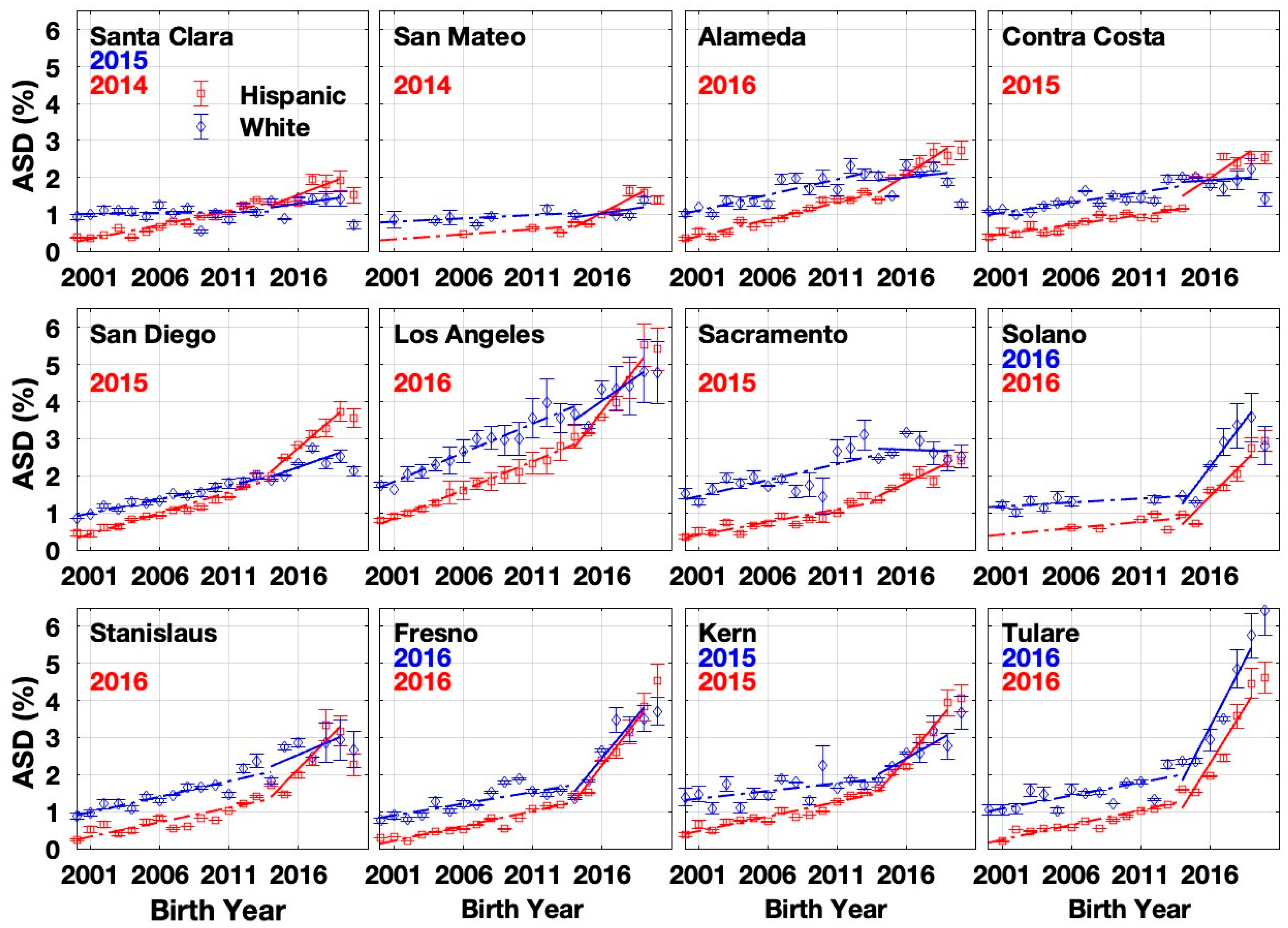
Figure 2.
Same as Figure 1 but for blacks (green squares) compared to all races (gray triangles) in the 9 California counties with the most continuous data coverage for blacks. Note that the y-axis scale is larger than in Figure 1.
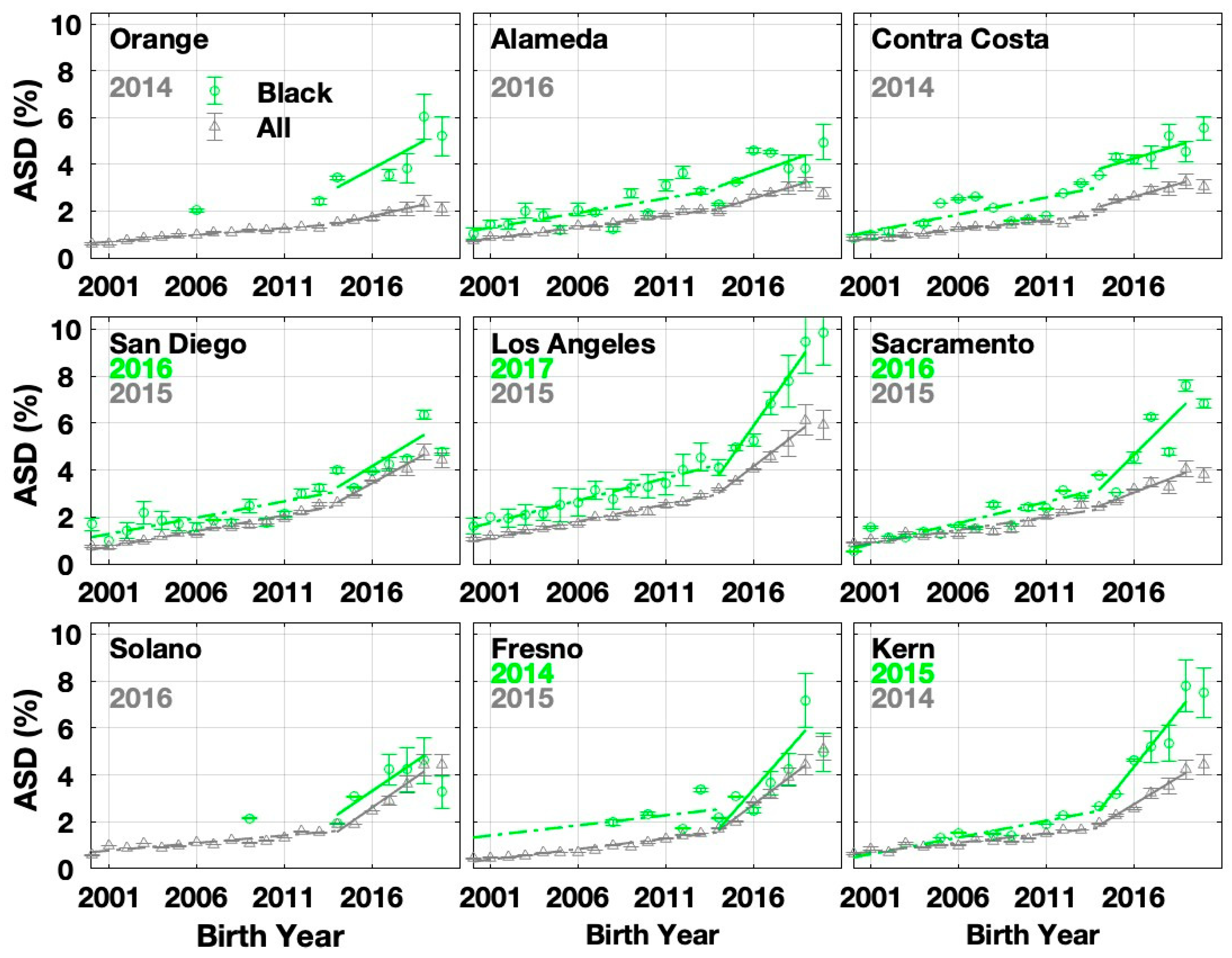
Figure 3.
Time derivative in ASD prevalence for a) Hispanics, b) blacks, c) whites, and d) all races in 19 California counties. The derivatives were calculated using central differencing and were normalized by mean prevalence in 2014 for each county and race (Method C2).
Figure 3.
Time derivative in ASD prevalence for a) Hispanics, b) blacks, c) whites, and d) all races in 19 California counties. The derivatives were calculated using central differencing and were normalized by mean prevalence in 2014 for each county and race (Method C2).
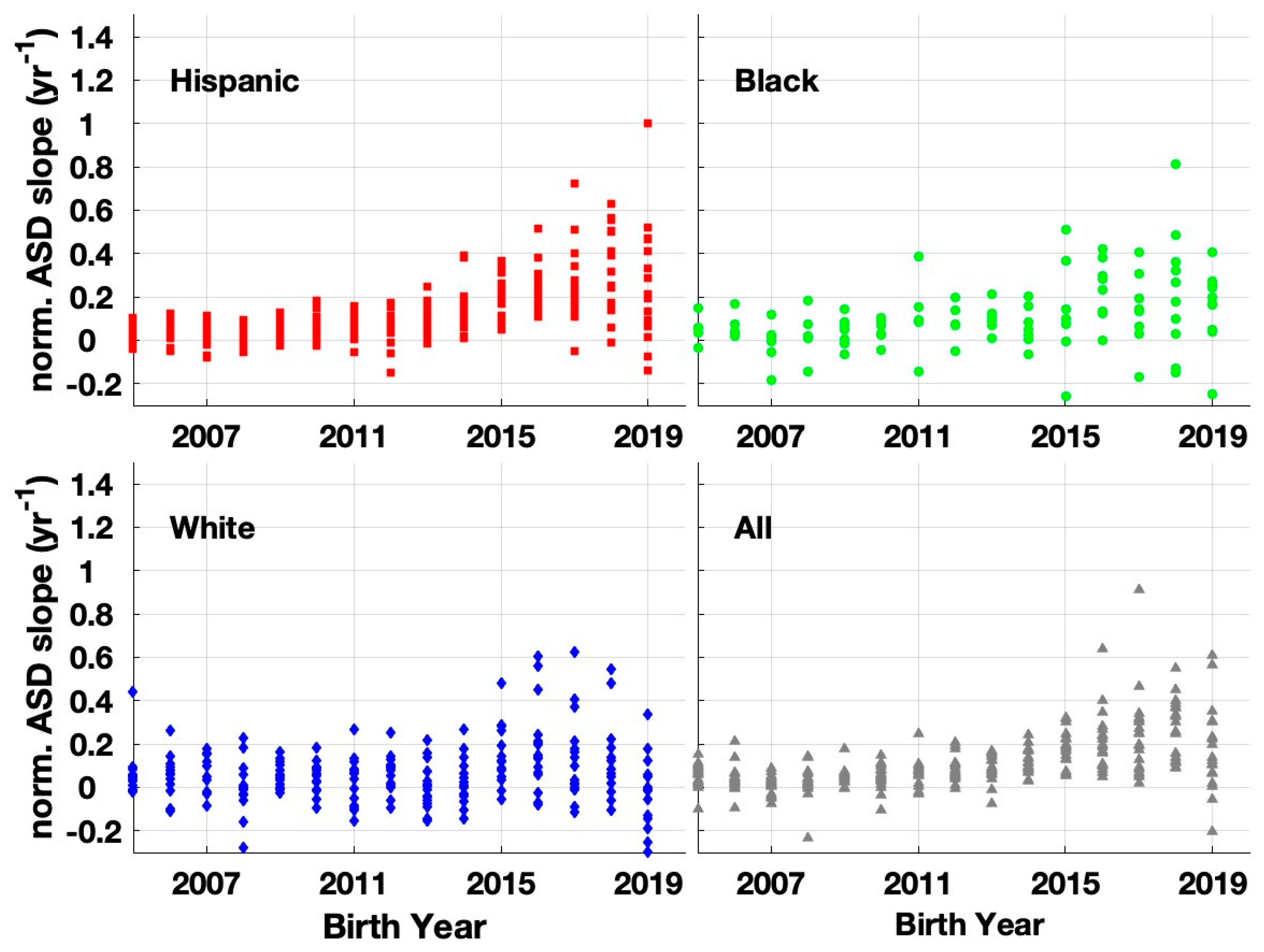
Figure 4.
Rate of change in ASD prevalence over birth years 2014-2019 by California county as a function of the percentage of the county population served by Medicaid, estimated using linear regression. Selected counties are labeled when permitted by legibility. Error bars show the uncertainty in the linear regression slope. Humboldt, Riverside, and San Bernardino Counties are excluded (see Limitations section).
Figure 4.
Rate of change in ASD prevalence over birth years 2014-2019 by California county as a function of the percentage of the county population served by Medicaid, estimated using linear regression. Selected counties are labeled when permitted by legibility. Error bars show the uncertainty in the linear regression slope. Humboldt, Riverside, and San Bernardino Counties are excluded (see Limitations section).
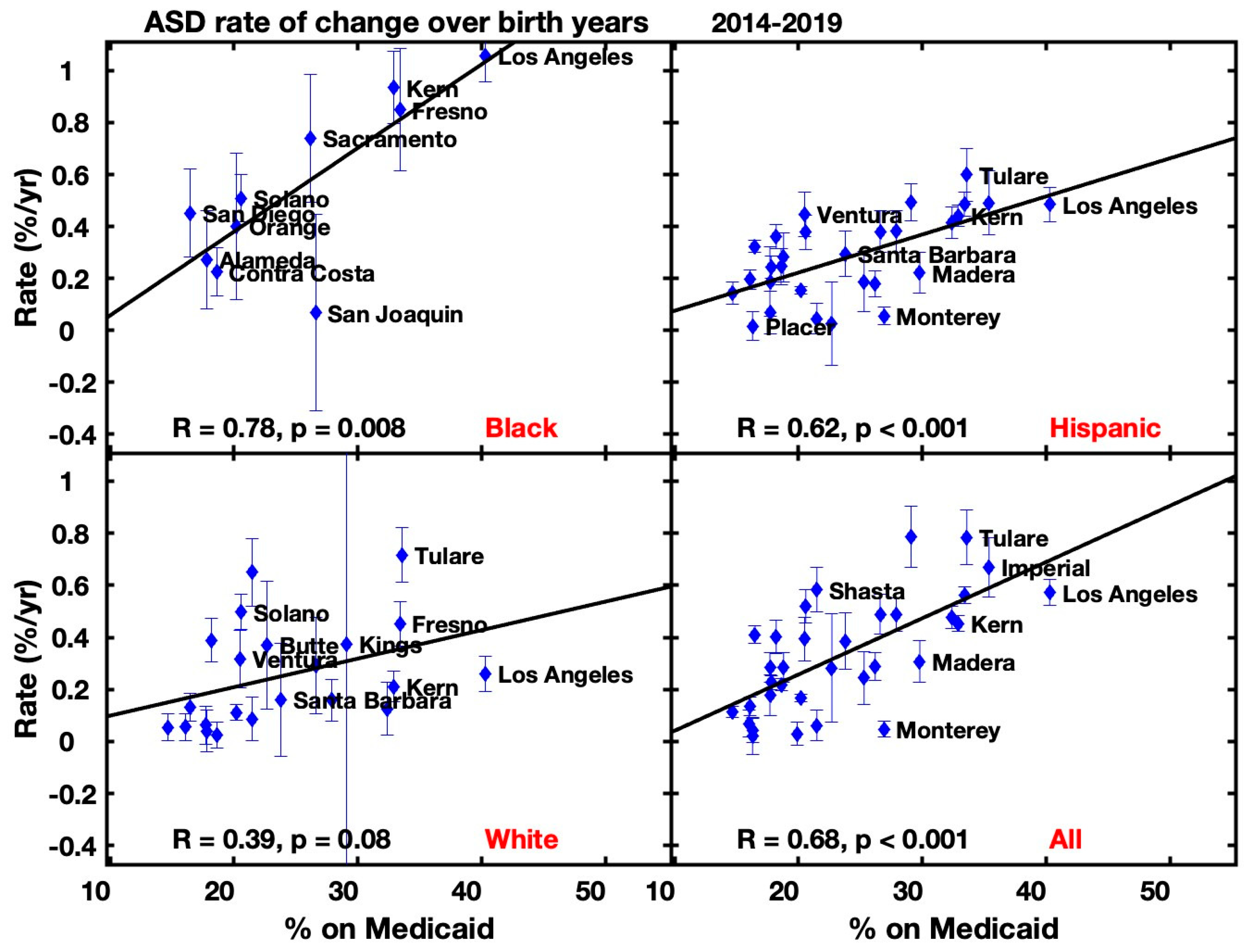
Figure 5.
California DDS age-resolved snapshot of ASD prevalence from late 2025 (in %) statewide (heavy gray line) and for San Diego County (black dashed line). California ASD prevalence from ADDM surveillance years 2018, 2020, and 2022, in which California was represented by part of San Diego County, are juxtaposed for children surveilled at age 4 (large black circles) and age 8 (large black triangles). Also shown is the California DDS statewide age-resolved snapshot from late 2019 (cyan dotted line) as described in [10].
Figure 5.
California DDS age-resolved snapshot of ASD prevalence from late 2025 (in %) statewide (heavy gray line) and for San Diego County (black dashed line). California ASD prevalence from ADDM surveillance years 2018, 2020, and 2022, in which California was represented by part of San Diego County, are juxtaposed for children surveilled at age 4 (large black circles) and age 8 (large black triangles). Also shown is the California DDS statewide age-resolved snapshot from late 2019 (cyan dotted line) as described in [10].
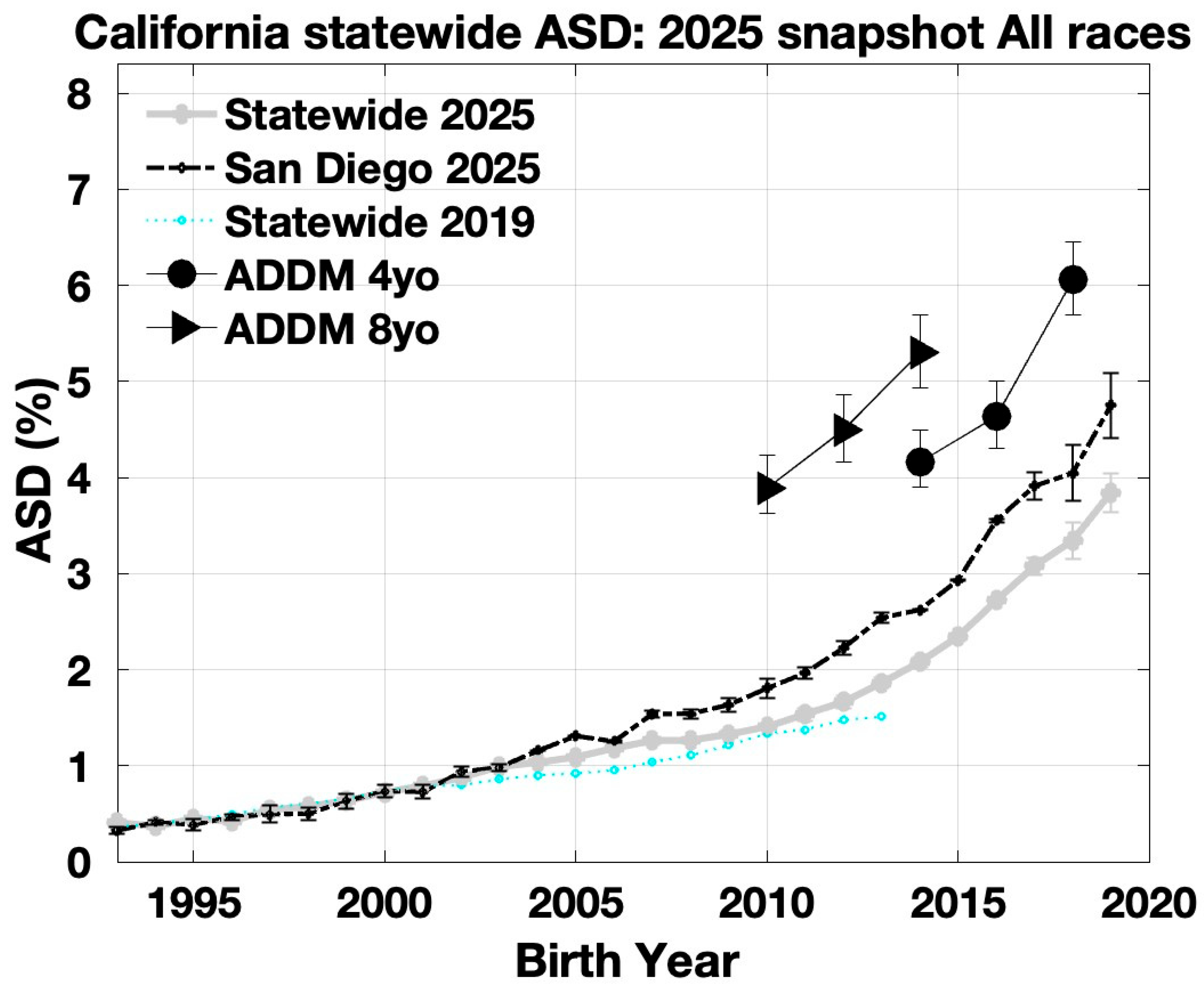
Figure 6.
Same as Figure 5 but for specific race/ethnicity groups: a) Asian, b) Hispanic, c) black, and d) white.
Figure 6.
Same as Figure 5 but for specific race/ethnicity groups: a) Asian, b) Hispanic, c) black, and d) white.
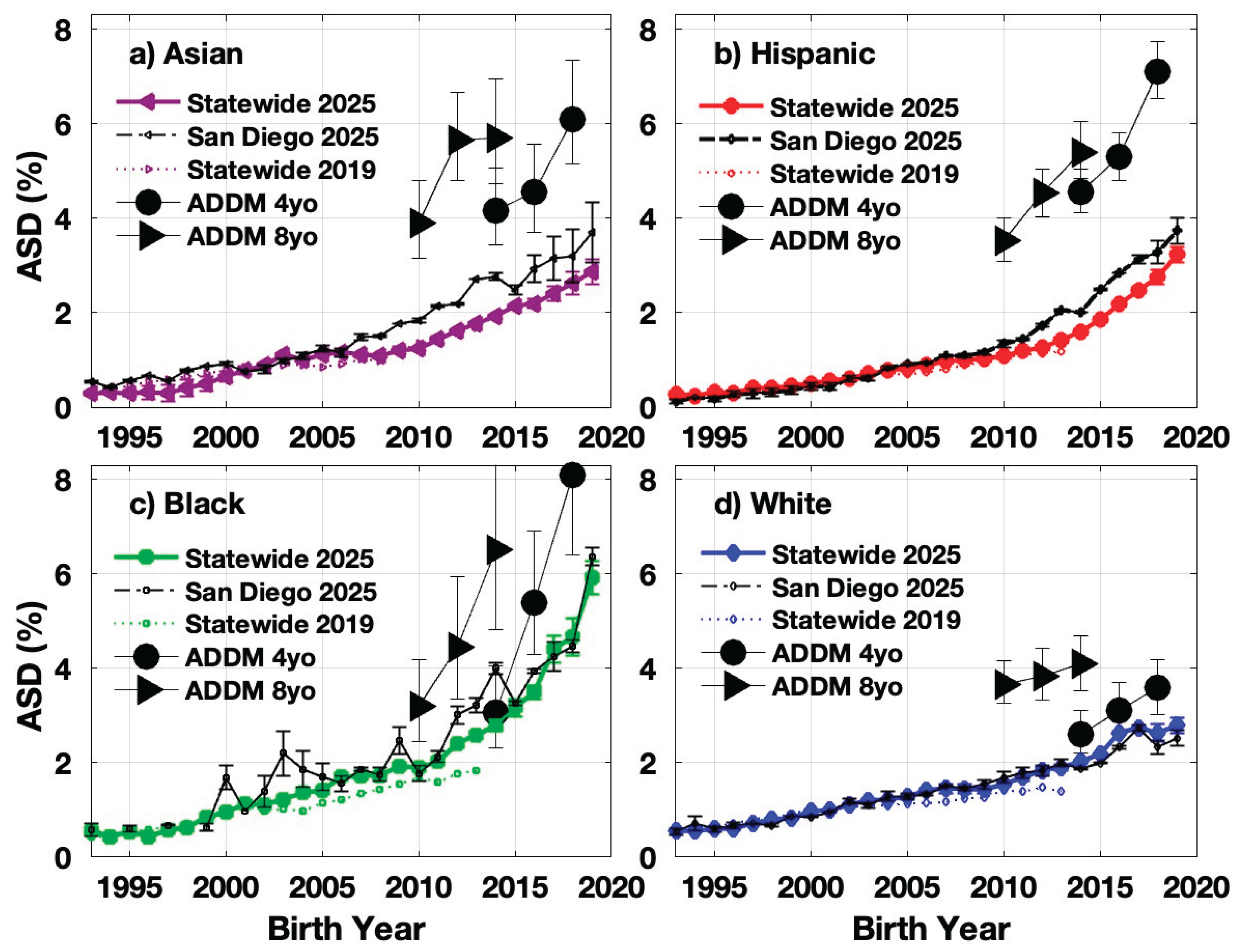

Table 1.
Changepoint and slopes of time trend in Hispanic ASD prevalence from birth year 2000 to Yc-1 (period 1) and Yc-1 to 2019 (period 2).
Table 1.
Changepoint and slopes of time trend in Hispanic ASD prevalence from birth year 2000 to Yc-1 (period 1) and Yc-1 to 2019 (period 2).
| County | Yc | slope period 1 (%/yr) | slope period 2 (%/yr) | p value |
|---|---|---|---|---|
| Alameda | 2016 | 0.097 ± 0.007 | 0.186 ± 0.042 | 0.002 |
| Contra Costa | 2015 | 0.052 ± 0.006 | 0.246 ± 0.069 | 0.0002 |
| Fresno | 2016 | 0.084 ± 0.007 | 0.541 ± 0.050 | < 0.0001 |
| Imperial | 2015 | 0.323 ± 0.024 | 0.491 ± 0.124 | 0.0522 |
| Kern | 2015 | 0.079 ± 0.007 | 0.441 ± 0.041 | < 0.0001 |
| Kings | 2017 | 0.095 ± 0.018 | 0.662 ± 0.126 | < 0.0001 |
| Los Angeles | 2016 | 0.157 ± 0.006 | 0.572 ± 0.066 | < 0.0001 |
| Merced | 2014 | 0.041 ± 0.011 | 0.436 ± 0.044 | < 0.0001 |
| Monterey | 2016 | 0.047 ± 0.007 | 0.096 ± 0.036 | 0.0313 |
| Orange | 2014 | 0.039 ± 0.006 | 0.163 ± 0.012 | < 0.0001 |
| Sacramento | 2015 | 0.070 ± 0.008 | 0.179 ± 0.049 | 0.0028 |
| San Diego | 2015 | 0.113 ± 0.007 | 0.323 ± 0.024 | < 0.0001 |
| San Joaquin | 2016 | 0.117 ± 0.010 | 0.494 ± 0.073 | < 0.0001 |
| San Luis Obispo | 2015 | -0.052 ± 0.077 | 0.188 ± 0.133 | 0.3092 |
| San Mateo | 2016 | 0.029 ± 0.015 | 0.237 ± 0.046 | 0.0049 |
| Santa Barbara | 2016 | 0.074 ± 0.011 | 0.431 ± 0.056 | < 0.0001 |
| Santa Clara | 2016 | 0.074 ± 0.006 | 0.171 ± 0.063 | 0.0072 |
| Solano | 2016 | 0.023 ± 0.022 | 0.458 ± 0.069 | < 0.0001 |
| Sonoma | 2014 | 0.044 ± 0.010 | 0.348 ± 0.034 | < 0.0001 |
| Stanislaus | 2016 | 0.079 ± 0.011 | 0.477 ± 0.088 | < 0.0001 |
| Tulare | 2016 | 0.084 ± 0.008 | 0.749 ± 0.082 | < 0.0001 |
| Ventura | 2014 | 0.059 ± 0.008 | 0.402 ± 0.067 | < 0.0001 |
* Yc identified using Method C1, RSS minimization.
Table 2.
County-level correlations between mean ASD prevalence and rate of change in ASD prevalence with median household income and percentage served by Medicaid.
Table 2.
County-level correlations between mean ASD prevalence and rate of change in ASD prevalence with median household income and percentage served by Medicaid.
| Birth years | Correlation coefficient (p value) | |||||
| % on Medicaid | Asians | Black | Hispanic | White | All Races | |
| 2014-2019 | Mean | 0.64 (.01) | 0.66 (0.04) | 0.57 (0.001) | 0.39 (0.06) | 0.50 (0.01) |
| 2014-2019 | Rate | 0.48 (.07) | 0.78 (0.01) | 0.62 (0.001) | 0.37 (0.1) | 0.67 (0.001) |
| 2000-2014 | Mean | 0.26 (0.38) | 0.55 (0.15) | 0.27 (0.2) | 0.38 (0.06) | 0.18 (0.31) |
| 2000-2014 | Rate | 0.06 (0.84) | 0.12 (0.77) | 0.41 (0.05) | 0.24 (0.22) | 0.37 (0.04) |
| Median Income | ||||||
| 2014-2019 | Mean | -0.79 (.001) | -0.34 (.33) | -0.54 (0.01) | -0.63 (<.01) | -0.60 (<.01) |
| 2014-2019 | Rate | -0.55 (.04) | -0.69 (.03) | -0.47 (0.01) | -0.52 (.01) | -0.65 (.001) |
| 2000-2014 | Mean | -0.39 (.19) | -0.12 (.78) | -0.39 (0.06) | -0.59 (.01) | -0.37 (.03) |
| 2000-2014 | Rate | -0.22 (.46) | -0.07 (.82) | -0.32 (0.13) | -0.49 (.01) | -0.45 (.009) |
* Statistically significant correlations are highlighted with bold font.
Disclaimer/Publisher’s Note: The statements, opinions and data contained in all publications are solely those of the individual author(s) and contributor(s) and not of MDPI and/or the editor(s). MDPI and/or the editor(s) disclaim responsibility for any injury to people or property resulting from any ideas, methods, instructions or products referred to in the content. |
© 2026 by the authors. Licensee MDPI, Basel, Switzerland. This article is an open access article distributed under the terms and conditions of the Creative Commons Attribution (CC BY) license (http://creativecommons.org/licenses/by/4.0/).
Copyright: This open access article is published under a Creative Commons CC BY 4.0 license, which permit the free download, distribution, and reuse, provided that the author and preprint are cited in any reuse.


