

Submitted:
26 March 2026
Posted:
27 March 2026
You are already at the latest version
Abstract
Modified Anderson-Björck’s method [1] is a new robust and efficient bracketing root finding algorithm. It combines bisection with Anderson-Björk’s method to achieve both fast performance and worst-case optimality. It relies on linearity check criteria for switching methods and uses Anderson-Björk corrections to overcome the fixed endpoint issue of false-position. Initial benchmarks of this method have shown certain performance advantages compared to other methods like Ridders, Brent and ITP. In this paper, we propose further improvements of the method and perform some additional analysis and benchmarks of its behavior and performance.
Keywords:
root-finding algorithm
; bracketing method
; nonlinear equation solver
1. Introduction
Iterative algorithms are generally fast but can easily diverge, if improper starting point is selected. Bracketing algorithms are more reliable in this respect. If the function is continuous in the enclosing interval [a, b] and has opposite signs at both ends, according to the Bolzano’s theorem, at least one root exists inside [a, b] and the bracketing method is guaranteed to find it with a certain precision. Bisection is the simplest method, and also worst-case optimal. The required number of iterations is constant for a certain precision and does not depend on the function properties. It can be precomputed by the following equation:
However, for well-behaved functions, other algorithms like false position, Illinois [6] and Ridder’s [10] can provide significantly better performance, but for poor-behaved ones they can downgrade much below bisection. So, stability and performance are contradictory goals and achieving both is a challenging task. Some authors have noticed that this can be done by combining bisection with a faster algorithm, like false-position [13], secant or inverse-quadratic interpolation. Such are the Brent’s [11] and ITP [9] methods. Also, initial bisection steps can boost the performance of false-position and similar methods by bringing the starting point to more favorable conditions [1,5]. Although obtained by combining only linear algorithms, the resulting algorithm shows nonlinear (bilinear) behavior and better convergence than using both separately. In all cases, the selection of proper switching criteria is of key importance for applying each method at the most appropriate place and thus maximizing the overall performance.
2. The Original Modified Anderson-Björck (modAB) Algorithm
On that basis, a new hybrid algorithm was proposed in 2022 [1] that combined bisection with Anderson-Björck’s (AB) method. The switching criteria is based on measuring the linearity of the function. In this way, linear interpolation is applied when the deviation of the curve from a straight line becomes small enough according to the equation:
where y3 is the function value at midpoint, ym is the chord ordinate at the same point and k is the limit deviation factor. After switching, the iterations continue as ordinary AB steps as follows:
- An intermediate point is calculated by linear interpolation:
- 2.
- The ordinate of the end that remained fixed at the previous iteration is reduced by a factor m. For the left end, it is calculated by the expression: y1 = f (x1) · m, where m = 1 − f (x3) / f (x2) if m > 0, otherwise: m = 0.5. For the right end, the equation is obtained by swapping indices 1 and 2, as follows: y2 = f (x2) · m, where m =1 − f (x3) / f (x1) if m > 0, otherwise: m = 0.5
An option to fall back to bisection is provided, if AB fails to converge within a certain number of iterations. The algorithm was included in Calcpad [2] and Root-Fortan [3] libraries. Although the proposed algorithm showed superior performance compared to others in the test suite and later in practice, we identified some drawbacks and opportunities for further improvements.
3. Drawbacks of the Original modAB Method
The previously proposed algorithm has several shortcomings that can be addressed:
- The deviation factor k in eq. (2) has a fixed value of k = 0.25 as a good average estimate that is experimentally tuned on a larger set of functions. However, this is not optimal because it does not account for the properties of each function in the selected interval.
- Although the possibility of redundant switch to AB was discussed in [1], nothing much has been done on the subject. Only a simple bisection fallback is included as a safety mechanism, if the algorithm fails to converge within the expected number of iterations. It is proposed empirically to be half of the required bisection steps. This is a simple and conservative approach, but in some cases, it may result in a “waste” of AB steps before it “realizes” that it is not working as required.
- The original algorithm uses the termination criteria of the false-position method:|xn − xn−1| < ε. Further tests have shown that it fails for certain functions that are flat around the root, but with large ordinates at endpoints ( > 1/ε). This causes the interpolation point to crawl very slowly along the abscissa, so the step can become lower than ε even if we are still too far from the root.
- The benchmarks in the original paper [1] were based on the number of iterations with a factor of two for Ridder’s method. However, the number of function calls is more closely related to the actual execution speed when the algorithm is implemented in software.
- In the original paper, we used 21 functions to benchmark the method performance. This set is very limited, which can bring some distortions to the results. So, one may consider it insufficient to derive reliable conclusions. It may occur that some algorithms are particularly suitable for a larger part of the functions in the set showing a false advantage. That is why additional tests were performed in [5] with a set of 50 functions.
4. Improvements of the modAB Algorithm
In this paper, we propose a new version of the modAB algorithm aiming to be more robust, reliable and efficient than the first one. This is achieved by fixing the above issues and making it more adaptive to the properties of the function.
4.1. Adaptive Value of Deviation Factor k
For highly curved functions, like the one on Figure 1, symmetry plays a great role in the behavior of linear interpolation algorithms. If endpoint ordinates are highly asymmetric like on the left plot, there is a possibility for the root to occur at a greater distance. This will slow down performance since there is not only a longer path to travel, but the step size is also smaller. If the endpoint values are nearly symmetric, the behavior improves significantly, although both cases have the same deviation from the straight line.
That is why it is reasonable to include symmetry into the method switching criterion and the factor k seems to be the right place. For unsymmetric endpoints, we can keep k lower, forcing the algorithm to make more bisection steps. For symmetric endpoints we can keep k larger and allow the algorithm to switch faster to AB since we expect it to be more favorable. However, this is highly dependent on the shape of the function. So, there is no sense in tuning it too much for specific types of functions, because it may not work for other types. Instead, we can just map the value of k against the endpoint ordinates by using a simple relationship that is fast to evaluate and does not bring significant overhead on each iteration.
For that purpose, we will introduce a new factor of symmetry r by using the equation:
where y1 = f (x1), y2 = f (x2) and ym = 0.5 (y1 + y2) is the average value. Thus, we have r = 1 for symmetric and r = 0.5 for unsymmetric endpoint ordinates. Symmetry also ensures that the distance from the interpolation point to the root cannot exceed 0.5 (x2 − x1). Otherwise, it can approach the whole interval length of x2 − x1. But how to account for it in the deviation factor k? If we look closely at the above functions, we can notice that the relationship between symmetry and convergence is not linear. Higher symmetry leads to both shorter path and longer step, which is rather quadratic than linear. The simplest quadratic expression we can use is k = r2. Thus, we map k to the interval [0.25, 1], where 0.25 is our old value for k, but with allowance to grow up to 1 for fully symmetric endpoints.
4.2. Adaptive Bisection Fallback Criterion
In this paper, we propose a new version of the modAB algorithm aiming to be more robust, reliable and efficient than the first one. This is achieved by fixing the above issues and making it more adaptive to the properties of the function. Instead of using a fixed number of expected iterations, we can apply more precise criterion, by measuring the actual performance of AB algorithm after switching. One very simple and direct approach is to check whether AB has shrunk the interval more than bisection would do. Assume that the algorithm switches from bisection to AB at the interval [a0, b0] with initial width:
After performing t more steps, a pure bisection method would reduce the width to . So, we will define a fallback threshold as follows:
where C is a safety factor. Let denotes the actual interval width after t AB steps. Then, the adaptive bisection fallback criterion becomes:
Taking C = 2 n will allow for a delay of n AB steps before switching back to bisection. Numerical experiments have shown that without a safety factor for certain functions the algorithm starts to oscillate rapidly between both methods, causing more “damage” than improvement. The question is how to select a suitable value for C. One or two iterations proved to be insufficient to prevent oscillations. A reasonable value of n appeared to be about 3 to 4. Larger values caused the algorithm to waste too many iterations on AB. So, we can safely pick n = 4 and thence C = 2 4 = 16. For efficiency, we will not apply equation (6) directly but instead will initialize the threshold at the moment of switching as . Then we will update it on each AB iteration t as follows: .
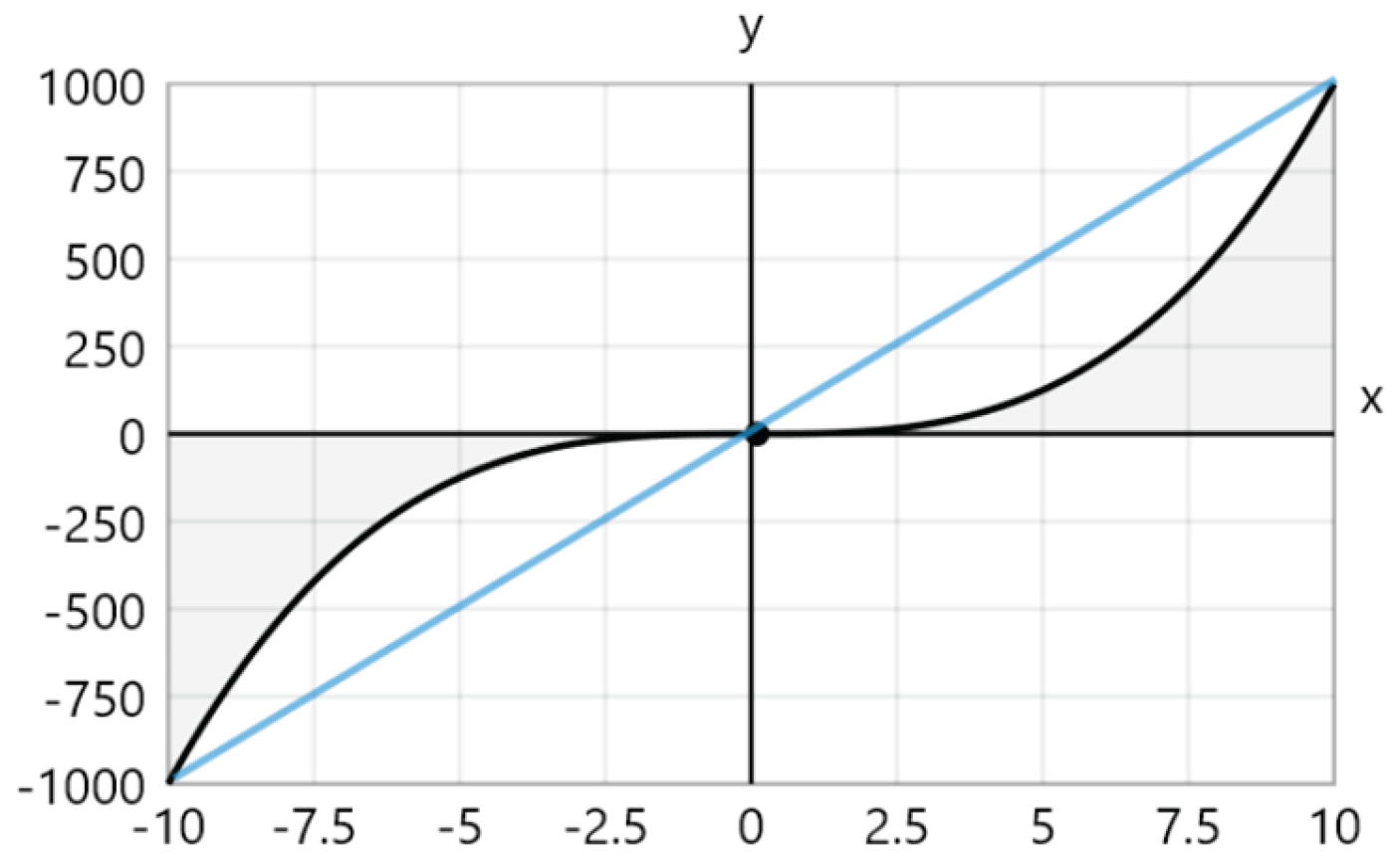
To demonstrate how the new method switching criteria work, we will take a nearly symmetrical function f (x) = x3 – 0.001 and solve the equation f (x) = 0 in the interval [[-10, 10]. The plot is displayed on Figure 2.
Both original and proposed algorithms switch to AB at the first iteration, finding itself in a position to deal with a highly nonlinear and unsymmetric problem. But after that, they show very different behavior as summarized in the following table:
This demonstrates that using fixed switching criteria is not optimal and can possibly slow down the algorithm.

Table 1.
Comparison between the original and the proposed method switching criteria.
| Algorithm | Iteration number when | |||
|---|---|---|---|---|
| switch to AB | fallback to bisection | switch to AB | converge and quit | |
| The original modAB 2022 fixed criteria | 1 | 24 | 34 | 40 |
| The proposed new adaptive criteria | 1 | 7 | 15 | 24 |
4.3. New Termination Check
Instead of the false-position convergence check|xn − xn−1| < ε, we will use the more robust and reliable bisection check bn − an < εabs + εrеl · |xn|, where an and bn are the endpoints of the interval at iteration n, and εabs and εrеl are the absolute and relative tolerances, respectively. This criterion is not applicable for the pure false-position method because of the fixed endpoint issue. But having AB corrections, the interval will eventually shrink from both sides. However, for some functions this may require 1 or 2 extra steps after the solution has actually converged, just to shrink the interval from the other side. But it is a good trade to provide robustness and reliability of the method.
4.4. The Improved Algorithm
After implementing the above improvements and refactoring the structure, we arrive at the following improved version of the modAB algorithm:
| Algorithm 1: The improved modAB algorithm |
| Calculate points p1: y1 = f (x1) and p2: y2 = f (x2) initialize “method” to “bisection” and “side” to “none” for iter = 1 to maxIterations if “method” is “bisection” then: calculate p3 as the midpoint such that x3 = (x1 + x2) / 2 and y3 = f (x3) calculate the average ordinate by the equation: ym = (y1 + y2) / 2 calculate r to equation (4) and k = r2 if the function is close enough to linear, satisfying that |ym - y3| < k (|y3| + |ym|) then: change the method to “Anderson-Björck” end else if method is “Anderson-Björck” then: calculate p3 as the secant point such that x3 = (x1*y2 − y1*x2) / (y2 − y1) and y3 = f (x3) clamp p3 between p1 and p2 in case floating point rounding errors shoots it outside the interval end if the convergence check: y3 = 0 or x2 – x1 ≤ ε_abs + ε_rel *|x3| is satisfied then: stop and return x3 as a result if y1 and y3 have equal signs then: if “method” is “Anderson-Björck” then: (apply AB correction) if “side” is “right” then calculate m = 1 − y3 / y1 if m ≤ 0 then: divide y2 by 2 else: multiply y2 by m else: change “side” to “right” end end for both methods, shrink the interval from left by setting p1 = p3 else if “method” is “Anderson-Björck” then: if “side” is “left” then: calculate m = 1 − y3 / y2 if m ≤ 0 then: divide y1 by 2 else: multiply y1 by m else: change “side” to “left” end end for both methods, shrink the interval from right by setting p2 = p3 end if AB fails to shrink the interval enough, then: reset the method back to “bisection” end return error, if failed to converge for the expected number of iterations |
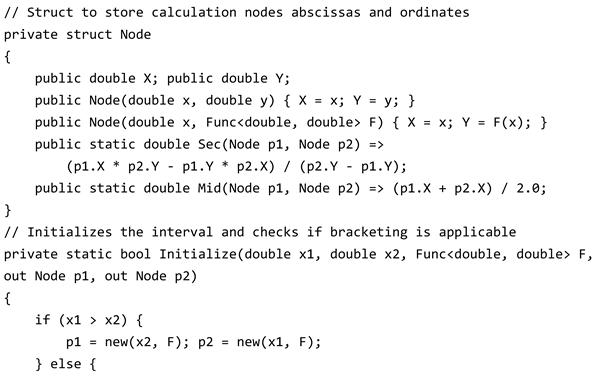
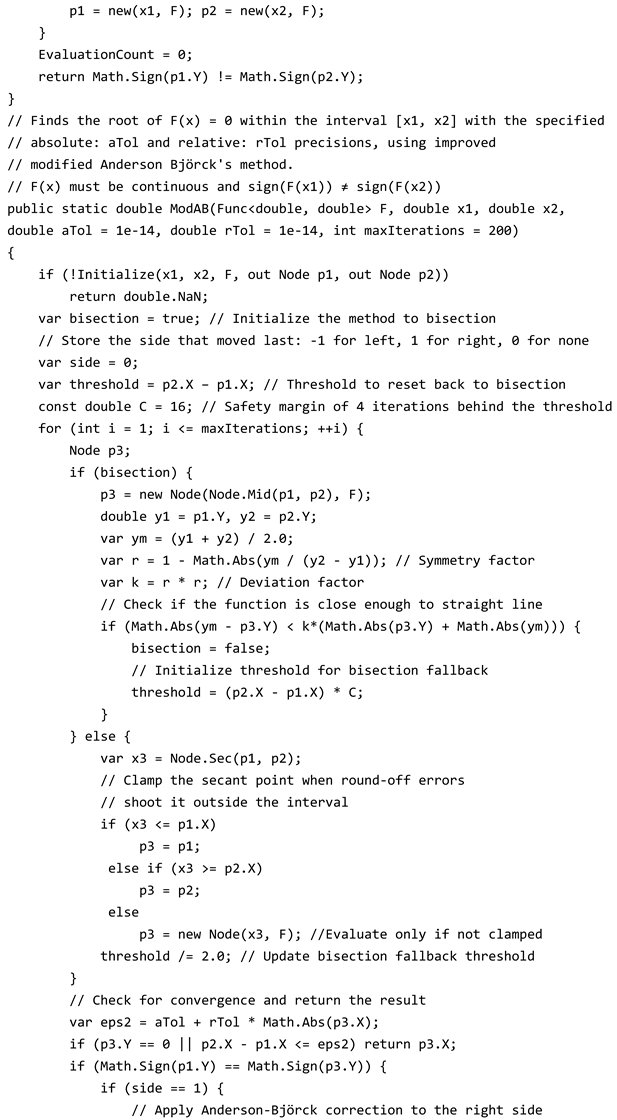
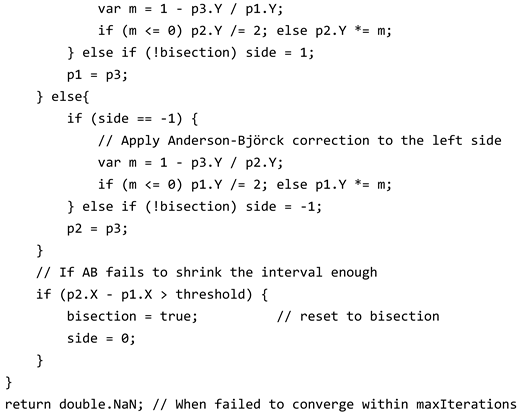
The source code of the algorithm is listed in Appendix A. It was also translated into Julia, C++ and Python/Cython languages and included in Calcpad [2], SciML/NonlinearSolve.jl [4], JuliaMath/Roots.jl [21], and ROOT.CERN [22] libraries for scientific computations.
5. Numerical Experiments
The improved modAB algorithm was benchmarked against the original version and seven classical algorithms: bisection, false-position, Illinois [6], Anderson-Björck [8], ITP [9], Ridders [10] and Brent [11,20]. For that purpose, they were implemented in C# as well.
An extended set of 92 functions is used for benchmarking they were collected almost entirely from papers from the authors of other algorithms and independent benchmarks, as follows:
The benchmarks are based on the number of function evaluations, which are more indicative for the actual performance than the number of iterations, especially for computationally heavy functions. The results are presented in the following table:
Table 2.
Test functions and benchmark results for solving f nn (x) = 0 on the interval [a; b].
| Function | Interval | Method | |||||||||
|---|---|---|---|---|---|---|---|---|---|---|---|
| a | b | bs | fp | ill | AB | ITP | Rid | Bre | modAB1 | modAB2 | |
| f01 (x) = x 3 − 1 | 0.5 | 1.5 | 3 | 35 | 11 | 9 | 10 | 4 | 11 | 3 | 3 |
| f02 (x) = x 2 (x 2/ 3 + sqrt (2) · sin (x)) − sqrt (x) / 18 | 0.1 | 1 | 49 | 88 | 13 | 13 | 39 | 16 | 14 | 12 | 13 |
| f03 (x) = 11 x 11 − 1 | 0.1 | 1 | 49 | 109 | 17 | 24 | 50 | 14 | 13 | 13 | 16 |
| f04 (x) = x 3 + 1 | −1.8 | 0 | 50 | 51 | 13 | 12 | 12 | 12 | 11 | 10 | 10 |
| f05 (x) = x 3 − 2 x − 5 | 2 | 3 | 48 | 33 | 10 | 9 | 48 | 14 | 9 | 10 | 13 |
| f06 (x) = 2 x · exp (−5) + 1 − 2 · exp (−5 x) | 0 | 1 | 50 | 31 | 10 | 11 | 13 | 14 | 11 | 12 | 10 |
| f07 (x) = 2 x · exp (−10) + 1 − 2 · exp (−10 x) | 0 | 1 | 50 | 32 | 13 | 12 | 15 | 14 | 13 | 13 | 11 |
| f08 (x) = 2 x · exp (−20) + 1 − 2 · exp (−20 x) | 0 | 1 | 50 | 32 | 14 | 14 | 17 | 12 | 13 | 13 | 12 |
| f09 (x) = (1 + (1 − 5) 2) · x 2 − (1 − 5 x) 2 | 0 | 1 | 50 | 18 | 13 | 10 | 48 | 16 | 11 | 12 | 12 |
| f10 (x) = (1 + (1 − 10) 2) · x 2 − (1 − 10 x) 2 | 0 | 1 | 50 | 15 | 11 | 9 | 12 | 16 | 11 | 9 | 9 |
| f11 (x) = (1 + (1 − 20) 2) · x 2 − (1 − 20 x) 2 | 0 | 1 | 50 | 13 | 11 | 9 | 10 | 16 | 10 | 9 | 9 |
| f12 (x) = x 2 − (1 − x) 5 | 0 | 1 | 50 | 42 | 11 | 10 | 11 | 14 | 10 | 12 | 12 |
| f13 (x) = x 2 − (1 − x) 10 | 0 | 1 | 50 | 84 | 13 | 11 | 49 | 16 | 11 | 12 | 13 |
| f14 (x) = x 2 − (1 − x) 20 | 0 | 1 | 50 | 172 | 13 | 13 | 50 | 16 | 14 | 13 | 12 |
| f15 (x) = (1 + (1 − 5) 4) · x − (1 − 5 x) 4 | 0 | 1 | 50 | 10 | 10 | 8 | 10 | 12 | 9 | 9 | 9 |
| f16 (x) = (1 + (1 − 10) 4) · x − (1 − 10 x) 4 | 0 | 1 | 50 | 7 | 8 | 7 | 9 | 12 | 8 | 8 | 9 |
| f17 (x) = (1 + (1 − 20) 4) · x − (1 − 20 x) 4 | 0 | 1 | 50 | 7 | 8 | 7 | 10 | 12 | 8 | 8 | 9 |
| f18 (x) = exp (−5 x) · (x − 1) + x 5 | 0 | 1 | 49 | 82 | 11 | 9 | 37 | 14 | 10 | 11 | 12 |
| f19 (x) = exp (−10 x) · (x − 1) + x10 | 0 | 1 | 49 | 202 | 15 | 10 | 11 | 16 | 10 | 13 | 13 |
| f20 (x) = exp (−20 x) · (x − 1) + x 20 | 0 | 1 | 49 | 202 | 23 | 11 | 12 | 16 | 14 | 13 | 15 |
| f21 (x) = x 2 + sin (x / 5) − 1 / 4 | 0 | 1 | 50 | 35 | 11 | 10 | 10 | 12 | 12 | 12 | 9 |
| f22 (x) = x 2 + sin (x / 10) − 1 / 4 | 0 | 1 | 49 | 34 | 12 | 10 | 10 | 12 | 11 | 9 | 9 |
| f23 (x) = x 2 + sin (x / 20) − 1 / 4 | 0 | 1 | 49 | 33 | 13 | 10 | 10 | 12 | 11 | 9 | 9 |
| f24 (x) = (x + 2) · (x + 1) · (x − 3) 3 | 2.6 | 4.6 | 49 | 202 | 92 | 109 | 49 | 80 | 138 | 49 | 49 |
| f25 (x) = (x − 4) 5 · log (x) | 3.6 | 5.6 | 49 | 202 | 175 | 189 | 49 | 62 | 119 | 49 | 49 |
| f26 (x) = (sin (x) − x / 4) 3 | 2 | 4 | 49 | 202 | 92 | 109 | 49 | 78 | 138 | 49 | 49 |
|
f27 (x) = (81 − p (x) · (108 − p (x) · (54 − p (x) · (12 − p (x))))) · sign (p (x) − 3), where p (x) = x + 1.11111 |
1 | 3 | 14 | 202 | 35 | 38 | 22 | 24 | 32 | 14 | 14 |
| f28 (x) = sin (x − 7.143) 3) | 7 | 8 | 47 | 202 | 88 | 103 | 47 | 70 | 132 | 47 | 47 |
| f29 (x) = exp ((x − 3) 5) − 1 | 2.6 | 4.6 | 12 | 202 | 59 | 46 | 3 | 18 | 31 | 12 | 12 |
| f30 (x) = exp ((x − 3) 5) − exp (x − 1) | 4 | 5 | 48 | 202 | 53 | 58 | 48 | 16 | 15 | 14 | 14 |
| f31 (x) = π − 1 / x | 0.05 | 5 | 52 | 193 | 15 | 7 | 53 | 16 | 13 | 13 | 12 |
| f32 (x) = 4 − tan (x) | 0 | 1.5 | 49 | 93 | 15 | 12 | 50 | 16 | 14 | 13 | 15 |
| f33 (x) = cos (x) − x 3 | 0 | 4 | 51 | 201 | 16 | 16 | 11 | 18 | 16 | 13 | 13 |
| f34 (x) = cos (x) − x | −11 | 9 | 54 | 12 | 11 | 9 | 11 | 16 | 11 | 10 | 11 |
| f35 (x) = sqrt (abs (x − 2 / 3)) · if (x ≤ 2 / 3; 1; −1) − 0.1 | −11 | 9 | 54 | 16 | 17 | 14 | 53 | 24 | 12 | 18 | 18 |
| f36 (x) = abs (x − 2 / 3) 0.2 · if (x ≤ 2 / 3; 1; −1) | −11 | 9 | 54 | 45 | 48 | 55 | 46 | 54 | 45 | 54 | 56 |
| f37 (x) = (x − 7/ 9) 3 + (x − 7/ 9) · 10 −3 | −11 | 9 | 53 | 202 | 25 | 27 | 13 | 24 | 32 | 18 | 16 |
| f38 (x) = if (x ≤ 1 / 3; −0.5; 0.5) | −11 | 9 | 54 | 54 | 62 | 62 | 53 | 56 | 54 | 54 | 54 |
| f39 (x) = if (x ≤ 1 / 3; −10 −3; 1 − 10 −3 ) | −11 | 9 | 54 | 202 | 173 | 173 | 54 | 84 | 84 | 54 | 54 |
| f40 (x) = if (x = 0; 0.0; 1 / (x − 2 / 3)) | −11 | 9 | 54 | 9 | 101 | 101 | 54 | 60 | 56 | 54 | 54 |
| f41 (x) = 2 x · exp (−5) − 2 · exp (−5 x) + 1 | 0 | 10 | 53 | 34 | 14 | 13 | 17 | 14 | 14 | 15 | 13 |
| f42 (x) = (x 2 − x − 6) · (x 2 − 3 x + 2) | 0 | π | 51 | 24 | 13 | 10 | 16 | 18 | 11 | 13 | 13 |
| f43 (x) = x 3 | −1 | 1.5 | 51 | 202 | 95 | 114 | 52 | 84 | 125 | 51 | 51 |
| f44 (x) = x 5 | −1 | 1.5 | 51 | 202 | 184 | 202 | 52 | 56 | 128 | 51 | 51 |
| f45 (x) = x 7 | −1 | 1.5 | 51 | 202 | 202 | 202 | 52 | 52 | 136 | 51 | 51 |
| f46 (x) = (exp (−5 x) − x − 0.5) / x 5 | 0.09 | 0.7 | 49 | 202 | 25 | 23 | 50 | 14 | 16 | 14 | 14 |
| f47 (x) = 1/ sqrt (x) − 2 log (5 · 10 3 · sqrt (x)) + 0.8 | 0.0005 | 0.5 | 49 | 156 | 17 | 14 | 49 | 18 | 17 | 16 | 17 |
| f48 (x) = 1/ sqrt (x) − 2 log(5 · 10 7 · sqrt (x)) + 0.8 | 0.0005 | 0.5 | 49 | 45 | 16 | 14 | 20 | 18 | 17 | 19 | 15 |
| f49 (x) = if (x ≤ 0; −x 3 − x − 1; x 1/ 3 − x − 1) | −1 | 1 | 50 | 27 | 13 | 10 | 12 | 12 | 12 | 12 | 13 |
| f50 (x) = x 3 − 2 x − x + 3 | −3 | 2 | 51 | 42 | 15 | 13 | 16 | 14 | 13 | 12 | 11 |
| f51 (x) = log (x) | 0.5 | 5 | 51 | 29 | 12 | 10 | 12 | 12 | 11 | 11 | 10 |
| f52 (x) = (10 − x) · exp (−10 x) − x 10 + 1 | 0.5 | 8 | 52 | 202 | 39 | 21 | 53 | 18 | 18 | 15 | 16 |
| f53 (x) = exp (sin (x)) − x − 1 | 1.0 | 4 | 50 | 33 | 12 | 12 | 12 | 18 | 15 | 13 | 14 |
| f54 (x) = 2 sin (x) − 1 | 0.1 | π/3 | 49 | 17 | 9 | 8 | 12 | 12 | 9 | 10 | 11 |
| f55 (x) = (x − 1) · exp (−x) | 0.0 | 1.5 | 50 | 71 | 13 | 10 | 12 | 4 | 12 | 10 | 10 |
| f56 (x) = (x − 1) 3 − 1 | 1.5 | 3 | 49 | 58 | 13 | 10 | 11 | 14 | 12 | 11 | 11 |
| f57 (x) = exp (x 2 + 7 x − 30) − 1 | 2.6 | 3.5 | 48 | 202 | 21 | 31 | 48 | 14 | 13 | 12 | 11 |
| f58 (x) = atan (x) − 1 | 1.0 | 8 | 51 | 27 | 12 | 9 | 13 | 12 | 11 | 12 | 10 |
| f59 (x) = exp (x) − 2 x − 1 | 0.2 | 3 | 50 | 148 | 16 | 15 | 12 | 14 | 14 | 12 | 13 |
| f60 (x) = exp (−x) − x − sin (x) | 0.0 | 2 | 51 | 16 | 10 | 8 | 11 | 16 | 9 | 9 | 9 |
| f61 (x) = x 2 − sin (x) 2 − 1 | −1 | 2 | 50 | 34 | 14 | 14 | 13 | 18 | 12 | 12 | 14 |
| f62 (x) = sin (x) − x / 2 | π/2 | π | 49 | 33 | 11 | 9 | 10 | 14 | 10 | 10 | 11 |
| f63 (x) = x · exp (x) − 1 | −1 | 1 | 50 | 31 | 12 | 10 | 12 | 10 | 11 | 11 | 11 |
| f64 (x) = tan (x – 1 / 10) | −1 | 1 | 51 | 41 | 9 | 8 | 11 | 12 | 10 | 9 | 8 |
| f65 (x) = sin (x) + 0.5 | −1 | 1 | 50 | 12 | 9 | 9 | 11 | 16 | 9 | 9 | 9 |
| f66 (x) = 4 x 5 + x 2 + 1 | −1 | 1 | 50 | 34 | 14 | 12 | 15 | 16 | 11 | 13 | 14 |
| f67 (x) = x + x 10 − 1 | −1 | 1 | 50 | 51 | 13 | 11 | 50 | 12 | 13 | 14 | 12 |
| f68 (x) = πx − ℯ | −1 | 1 | 50 | 16 | 10 | 8 | 11 | 10 | 9 | 9 | 9 |
| f69 (x) = log (abs (x − 10 / 9)) | −1 | 1 | 51 | 65 | 13 | 10 | 10 | 12 | 11 | 10 | 10 |
| f70 (x) = 1 / 3 + sign (x) · abs (x)1 / 3 + x 3 | −1 | 1 | 51 | 14 | 14 | 12 | 16 | 16 | 12 | 12 | 18 |
| f71 (x) = (x + 2 / 3) / (x + 101 / 100) | −1 | 1 | 50 | 202 | 17 | 7 | 50 | 16 | 14 | 10 | 8 |
| f72 (x) = (x · 10 6 − 1) 3 | −1 | 1 | 51 | 4 | 4 | 4 | 51 | 6 | 140 | 51 | 51 |
| f73 (x) = exp (x) · (x · 10 6 − 1) 3 | −1 | 1 | 51 | 202 | 96 | 115 | 51 | 6 | 142 | 51 | 51 |
| f74 (x) = (x − 1 / 3) 2 · atan (x − 1 / 3) | −1 | 1 | 51 | 202 | 94 | 113 | 51 | 82 | 143 | 51 | 51 |
| f75 (x) = sign (3 x − 1) · (1 - sqrt (1 − (3 x − 1) 2/ 81)) | −1 | 1 | 27 | 202 | 28 | 37 | 23 | 38 | 67 | 27 | 27 |
| f76 (x) = if (x > (1 − 10 6) / 10 6; (1 + 10 6) / 10 6; −1) | −1 | 1 | 50 | 50 | 38 | 38 | 49 | 52 | 50 | 50 | 40 |
| f77 (x) = if (x ≠ 1 / 21; 1 / (21 x − 1); 0) | −1 | 1 | 51 | 15 | 96 | 96 | 51 | 66 | 54 | 51 | 51 |
| f78 (x) = x 2 / 4 + ceiling (x / 2) − 0.5 | −1 | 1 | 51 | 51 | 57 | 56 | 50 | 40 | 52 | 51 | 10 |
| f79 (x) = ceiling (10 x − 1) + 0.5 | −1 | 1 | 51 | 49 | 53 | 53 | 47 | 38 | 48 | 15 | 15 |
| f80 (x) = x + sin (x ·10 6) / 10 + 10 −3 | −1 | 1 | 51 | 25 | 23 | 23 | 27 | 26 | 22 | 25 | 26 |
| f81 (x) = if (x > -1; 1 + sin (1/ (x + 1)); −1) | −1 | 1 | 50 | 53 | 16 | 15 | 50 | 40 | 52 | 20 | 15 |
| f82 (x) = 202 x − 2 · floor ((2x + 10 −2) / (2 ·10 −2)) − 0.1 | −1 | 1 | 51 | 4 | 4 | 4 | 13 | 6 | 5 | 5 | 6 |
| f83 (x) = (202 x − 2 · floor ((2x + 10 −2) / (2 ·10 −2)) − 0.1) 3 | −1 | 1 | 51 | 202 | 74 | 71 | 51 | 70 | 126 | 51 | 51 |
| f84 (x) = (x − 1) · (x − 2) · (x − 3) · (x − 4) · (x − 5) − 0.05 | 0.5 | 5.5 | 50 | 67 | 10 | 8 | 10 | 20 | 9 | 8 | 9 |
| f85 (x) = sin (x) − 0.5 x − 0.3 | −10.0 | 10.0 | 53 | 15 | 14 | 12 | 47 | 20 | 13 | 12 | 12 |
| f86 (x) = exp (x) − 1 − x − x 2/ 2 − 0.005 | −2.0 | 2.0 | 52 | 202 | 20 | 20 | 22 | 20 | 17 | 15 | 16 |
| f87 (x) = 1 / (x − 0.5) − 2 − 0.05 | 0.6 | 2.0 | 49 | 137 | 15 | 6 | 50 | 16 | 13 | 8 | 10 |
| f88 (x) = log (x) − x + 2 − 0.05 | 0.1 | 3.0 | 51 | 30 | 14 | 12 | 17 | 16 | 14 | 14 | 15 |
| f89 (x) = sin (20 x) + 0.1 x − 0.1 | −4.0 | 5.0 | 52 | 18 | 18 | 16 | 17 | 20 | 18 | 16 | 14 |
| f90 (x) = x 3 − 2 x 2 + x − 0.025 | −1.0 | 2.0 | 52 | 176 | 14 | 14 | 52 | 18 | 16 | 13 | 13 |
| f91 (x) = x · sin (1 / x) − 0.1 − 0.01 | 0.01 | 1.0 | 50 | 14 | 14 | 12 | 39 | 14 | 14 | 13 | 14 |
| f92 (x) = x 3 – 0.001 | -10 | 10 | 54 | 202 | 25 | 202 | 55 | 28 | 25 | 42 | 26 |
| Total number of evaluations | 4498 | 8200 | 2975 | 3162 | 2732 | 2256 | 2972 | 1857 | 1797 | ||
| Average number of evaluations | 48.9 | 89.1 | 32.3 | 34.4 | 29.7 | 24.5 | 32.3 | 20.2 | 19.5 | ||
| Relative to modAB2 | 2.50 | 4.56 | 1.66 | 1.76 | 1.52 | 1.26 | 1.65 | 1.03 | 1.00 | ||
| Maximal number of evaluations | 54 | 202 | 202 | 202 | 55 | 84 | 143 | 54 | 56 | ||
| Geometric mean | 47.2 | 53.8 | 20.2 | 18.5 | 23.4 | 19.1 | 19.6 | 15.9 | 15.6 | ||
| Best at (number of functions) | 11 | 7 | 7 | 45 | 15 | 5 | 13 | 31 | 31 | ||
| Worst at (number of functions) | 40 | 44 | 6 | 7 | 1 | 1 | 1 | 0 | 0 | ||
| Function | a | b | bs | fp | ill | AB | ITP | Rid | Bre | modAB1 | modAB2 |
- Legend:
- bs – Bisection Brе – Brent
- fp – False-position Rid – Ridders
- ill – Illinois AB – Anderson-Björck
- ITP – Interpolate, truncate, project
- modAB1 – Modified Anderson-Björck – the original 2022 version
- modAB2 – Modified Anderson-Björck – the proposed version
- Note: The best algorithm for each function is highlighted.
6. Conclusions
The results show about 3% improvement of the new modAB version compared to the old 2022 one, requiring 1797 total evaluations vs 1857. If we keep the same convergence check, the effect from improving the method switching and fallback criteria is about 6% or 1739 total evaluations. So, the new convergence check slows down the algorithm by 3%, but providing robustness is of a greater priority than speed. Compared to the original Anderson-Björck’s algorithm, the improvement is about 1.76 times. The new modAB algorithm also outperforms Ridder’s by 1.26 times, and ITP and Brent by 1.52 and 1.65 times, respectively. For well-behaved functions, the algorithm either shows the best performance (31 functions) or remains 1-2 evaluations behind the winner. For poorly behaved functions, the guarding role of bisection appears to work, providing no more than 56 evaluations in the worst case. This is probably due to spurious switch from bisection to AB and fallback. It can be also noted that after extending the number of test functions, the relationships between the efficiencies of the separate algorithms are preserved. This indicates that the previously derived conclusions in [1] were not distorted by the chosen set of functions.
Supplementary Materials
The following supporting information can be downloaded at the website of this paper posted on Preprints.org.
Author Contributions
Conceptualization, Nedelcho Ganchovski; Software, Nedelcho Ganchovski, Oscar Smith and Christopher Rackauckas; Validation, Oscar Smith, Christopher Rackauckas and Lachezar Tomov; Writing – original draft, Nedelcho Ganchovski; Writing – review & editing, Oscar Smith, Lachezar Tomov and Alexander Traykov. All authors have read and agreed to the published version of the manuscript.
Funding
This research received no external funding.
Data Availability Statement
The original contributions presented in this study are included in the article/supplementary material. Further inquiries can be directed to the corresponding author(s).
Conflicts of Interest
The authors declare no conflict of interest.
Appendix A
Source code of the algorithm in C# programming language.
 |
 |
 |
References
- Ganchovski N.; Traykov A. Modified Anderson-Björck's method for solving non-linear equations in structural mechanics. IOP Conference Series: Materials Science and Engineering 2023, 1276 (1) 012010, IOP Publishing. [CrossRef]
- Ganchovski N. Calcpad – a free and open-source software for engineering calculations. Available online: https://github.com/Proektsoftbg/Calcpad (accessed 25 March 2026).
- Williams J. Roots-Fortran : root solvers for modern Fortran. NASA JSC, Houston, TX, Available online: https://jacobwilliams.github.io/roots-fortran/.
- Pal A.; Holtorf F.; Larsson A.; Loman T.; Utkarsh; Schäfer F.; Qu Q.; Edelman A.; Rackauckas C. NonlinearSolve.jl: High-Performance and Robust Solvers for Systems of Nonlinear Equations in Julia. ACM TOMS 2025, Association for Computing Machinery: NY, USA. [CrossRef]
- Ganchovski N. Structural Analysis by Functional Modelling in the Cloud. PhD Thesis 2025, UACEG, Sofia.
- Dowell M.; Jarratt P. A modified regula falsi method for computing the root of an equation. BIT 1971, Vol 11, pp 168–174. [CrossRef]
- Dowell M.; Jarratt P. The “Pegasus” method for computing the root of an equation. BIT 1972, Vol 12, pp 503–508. [CrossRef]
- Anderson N.; Björck Å. A new high order method of regula falsi type for computing a root of an equation. BIT 1973, Vol 13, pp 253–264. [CrossRef]
- Oliveira I.; Takahashi R. An Enhancement of the Bisection Method Average Performance Preserving Minmax Optimality. ACM TOMS 2021, Vol 47, No 1, Article 5. [CrossRef]
- Ridders C. A new algorithm for computing a single root of a real continuous function. IEEE Transactions on Circuits and Systems, 1979 Vol 26, No 11, pp 979-980. [CrossRef]
- Brent R. An algorithm with guaranteed convergence for finding a zero of a function. The Computer Journal 1971, Vol 14, Issue 4, pp 422–425. [CrossRef]
- Dekker T. Finding a zero by means of successive linear interpolation. Constructive Aspects of the Fundamental Theorem of Algebra 1969, ed B, Dejon and P Henrici (London: Wiley-Interscience) ISBN 978-0-471-20300-1.
- Sabharwal C. Blended Root Finding Algorithm Outperforms Bisection and Regula Falsi Algorithms. MDPI Mathematics 2019, Vol 7, Issue 11, Article 1118. [CrossRef]
- Kumar R.; Vipan. Comparative Analysis of Convergence of Various Numerical Methods. Journal of Computer and Mathematical Sciences 2015, Vol 6, Issue 6, pp 290-297.
- Galdino S. A family of regula falsi root-finding methods. Proceedings of 2011 World Congress on Engineering and Technology, Shanghai, China: IEEE Press, 2011, pp 514-517, ISBN 978-1-61284-365-0.
- Stage S. A. Comments on An Improvement to the Brent’s Method. International Journal of Experimental Algorithms (IJEA) 2013, Vol 4, Issue 1, pp 1-16.
- Swift A.; Lindfield G. R. Comparison of a continuation method with Brent's method for the numerical solution of a single nonlinear equation. The Computer Journal 1978, Vol 21, Issue 4, pp 359–362.
- Suhadolnik A. Combined bracketing methods for solving nonlinear equations. Applied Mathematics Letters 2012, Vol 25, Issue 11, pp 1755-1760, ISSN 0893-9659. [CrossRef]
- Sikorski K. Bisection is optimal. Numerische Mathematik 1982, Vol 40, pp 111–117. [CrossRef]
- Press W.; Teukolsky S.; Vetterling W.; Flannery B. Numerical Recipes: The Art of Scientific Computing, 3rd Edition. Cambridge University Press: USA, 2007.
- Verzani, J. Roots.jl: Root Finding Functions for Julia. 2020. Available online: https://github.com/JuliaMath/Roots.jl (accessed 25 March 2026).
- Brun, R.; Rademakers, F. ROOT - An Object Oriented Data Analysis Framework, Proceedings AIHENP'96 Workshop, Lausanne, Sept. 1996, Nucl. Inst. & Meth. in Phys. Res. A 389 1997, pp 81-86. [CrossRef]
Figure 1.
Plots of function for c = 1 and 5.
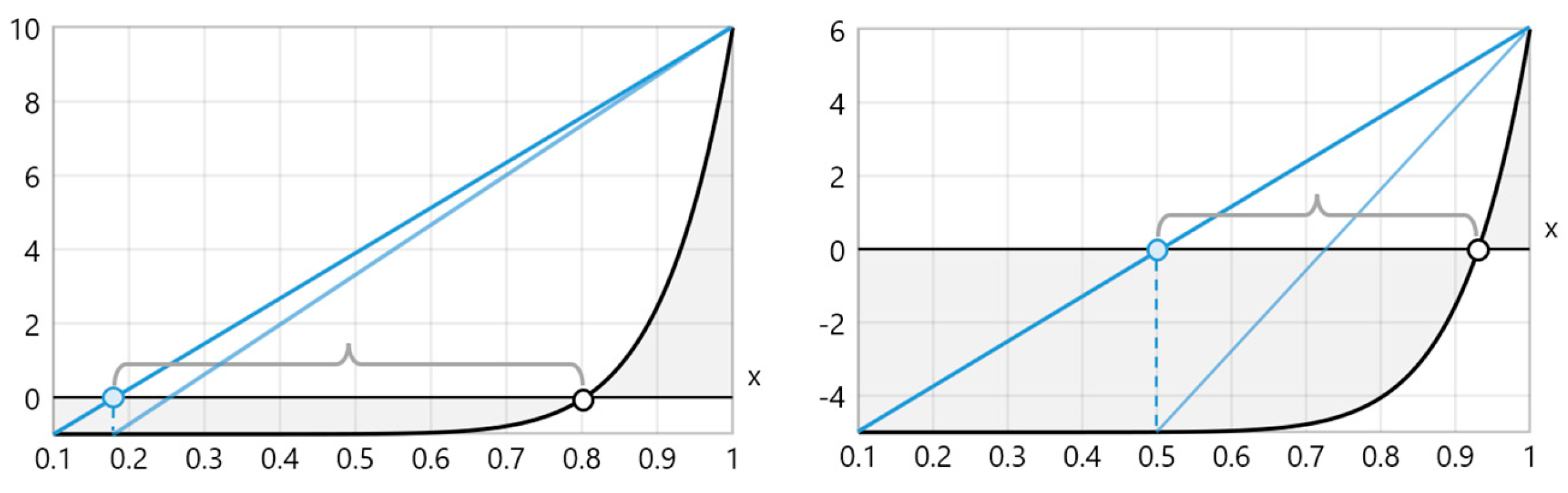
Figure 2.
Plot of function f(x) = x 3 – 0.001 for x ∈ [[-10, 10].
Disclaimer/Publisher’s Note: The statements, opinions and data contained in all publications are solely those of the individual author(s) and contributor(s) and not of MDPI and/or the editor(s). MDPI and/or the editor(s) disclaim responsibility for any injury to people or property resulting from any ideas, methods, instructions or products referred to in the content. |
© 2026 by the authors. Licensee MDPI, Basel, Switzerland. This article is an open access article distributed under the terms and conditions of the Creative Commons Attribution (CC BY) license (http://creativecommons.org/licenses/by/4.0/).
Copyright: This open access article is published under a Creative Commons CC BY 4.0 license, which permit the free download, distribution, and reuse, provided that the author and preprint are cited in any reuse.


