

Submitted:
25 March 2026
Posted:
26 March 2026
You are already at the latest version
Abstract
This study examines the interrelationships among AI Competency (AIC), Soft-Skill Competency (SSC), Strategic Intelligence (SI), and Innovative University Competency (IUC) within the context of Thailand’s higher education transformation. Grounded in Dynamic Capability Theory (DCT), Human Capital Theory (HCT), and the Strategic Intelligence Framework (SIF), the study explores how technological and human-centered capabilities collectively enhance institutional innovation. A quantitative explanatory research design was employed, and data were collected from 475 academic and administrative staff across six faculties at Mahasarakham University. Structural Equation Modeling (SEM) was used to test the hypothesized causal relationships and mediating effects among the constructs. The findings reveal that all proposed hypotheses were supported. AI Competency exerted the strongest total effect on IUC, indicating its pivotal role in driving innovation both directly and indirectly through Strategic Intelligence and Soft-Skill Competency. SSC also demonstrated a significant total effect, underscoring the importance of collaboration, communication, adaptability, and problem-solving in fostering innovative ecosystems. Strategic Intelligence emerged as a key mediating mechanism, transforming technological and human capabilities into innovative outcomes through analytical foresight, evidence-based judgment, and organizational agility. The model demonstrated excellent goodness-of-fit indices, confirming both theoretical rigor and empirical robustness. The study contributes to the literature by integrating digital capability, human adaptability, and strategic cognition into a unified framework for university innovation. In practice, the results emphasize that sustainable innovation in higher education requires the synergistic development of AI literacy, soft skills, and strategic foresight.
Keywords:
AI competency
; soft-skill competency
; strategic intelligence
; innovative university competency
; higher education innovation
1. Introduction
The rapid spread of artificial intelligence (AI) is redefining how universities create knowledge, educate graduates, and provide public value. Globally, policy discussions shaped by Industry/Education 5.0 focus on human-centered, resilient, and sustainable innovation that involves human-machine collaboration. This shift positions universities as platforms for continuous capability renewal, rather than as static repositories of knowledge. In this context, AI competency interacts with a suite of soft skills, including communication, collaboration, adaptability, critical thinking, creativity, and leadership [1]. Together, these elements contribute to an institution’s innovative university competency (IUC): its ability to transform resources into new curricula, teaching methods, research outputs, partnerships, and societal solutions [2]. Thailand’s transformation in higher education is part of broader national strategies, such as Thailand 4.0 and the 20-Year National Strategy (2018–2037). These strategies aim to foster an innovation-driven economy, enhance research and development, and improve the quality of human capital. Both frameworks highlight the need for universities to become engines of creativity and technology adoption, ensuring that academic missions align with national competitiveness and social resilience. These policy structures clearly link institutional capabilities to macro-level outcomes, demonstrate the strategic importance of AI competence, and the development of soft skills among faculty, staff, and students. Since 2024–2026, policy momentum has increased significantly. The Thai Ministry of Higher Education, Science, Research, and Innovation (MHESI) has established goals for “AI workforce development,” popularly articulated through the “AI University” initiative [3]. This initiative aims to equip the majority of graduates with basic AI knowledge and to integrate AI learning into large-scale teaching and learning. Collaborative efforts seek to promote exposure to AI and enhance teacher training nationwide [4]. For university leaders, these developments present clear imperatives: defining institution-wide AI learning outcomes, investing in necessary infrastructure and governance, and supporting professional development to ensure AI augments human judgment and academic values. On a global scale, standard-setting organizations have begun to establish AI competencies for education systems. UNESCO’s competency frameworks outline progressive knowledge, skills, and attitudes for both students and teachers, including algorithmic thinking, data stewardship, and ethical and legal awareness. These frameworks serve as valuable resources for Thai universities, supporting outcomes-based curriculum mapping, cross-faculty coordination, and external benchmarking while prioritizing responsible, human-rights-based AI practices. However, having AI literacy alone is insufficient to drive institutional innovation [5]. A growing body of evidence indicates that interventions focused on soft skills enhance teamwork, communication, adaptability, and problem-solving abilities. These improvements, in turn, facilitate technology adoption. Systematic reviews across various educational levels highlight the need for intentional design and assessment in soft skills programs, noting that unstructured offerings typically do not yield lasting improvements unless they are linked to real tasks and organizational incentives. In Thailand’s “new age university,” the strategic question is not whether to teach soft skills, but rather how to design learning ecosystems, workloads, and reward systems that make these capabilities integral and cumulative throughout degree programs and staff development pathways.
Theoretically, positioning AI competency and soft skills as the twin pillars of IUC aligns with the RBV and DCT [6,7]. RBV emphasizes the importance of valuable, rare, inimitable, and non-substitutable assets; in the university context, these include faculty’s tacit pedagogical expertise, documented curricular materials, data assets, and cross-boundary partnerships. DCT focuses on the sensing, seizing, and transforming routines that enable organizations to adapt resources in turbulent environments. Recent studies link dynamic capabilities to successful digital innovation outcomes in knowledge-intensive settings. This suggests that AI competency, when integrated into adaptation routines and complemented by soft skills, can accelerate institutional learning cycles and boost innovation capacity. Emerging research links explicitly administrative dynamic capabilities to stakeholders’ awareness of and adoption of AI, aligning with the propositions outlined here.
This study is guided by a critical gap between rapid policy-driven promotion of AI in higher education and the limited empirical understanding of how AI competency, when combined with human-centered capabilities, contributes to sustainable university innovation. Existing national and institutional policies primarily emphasize infrastructure investment, curriculum modernization, and technology adoption. However, these policies often assume that technological capability alone is sufficient to enhance institutional performance, overlooking the mediating role of strategic intelligence and the enabling function of soft skills.
Addressing this gap, the present study aims to extend, rather than replace, existing policy frameworks by empirically examining how AI competency, soft-skill competency, and strategic intelligence jointly shape innovative university competency. Grounded in the Thai higher education context, the study avoids proposing new, potentially conflicting policy instruments. Instead, it seeks to identify how current policies can be more effectively operationalized through the integration of capabilities and strategic alignment. The ultimate aim of this research is to provide contextually grounded policy recommendations that help policymakers and university leaders optimize existing strategies, minimize policy fragmentation, and prevent the creation of overlapping or contradictory initiatives. By aligning technological development with human capital development and strategic foresight, the study supports more coherent, adaptive, and sustainable pathways for innovation in higher education.
2. Literature Review
This study is framed by three theoretical frameworks: Dynamic Capabilities Theory (DCT), the Resource-Based View (RBV), and Human Capital Theory (HCT) [8]. These theories offer a comprehensive perspective on the impact of AI competency and soft skills on universities’ innovative competencies.
2.1. Dynamic Capability Theory (DCT)
Dynamic capabilities are crucial learning outcomes that enable students to navigate and thrive in the fast-paced business environment. By leveraging AI-enhanced teaching methods, educators can help students develop these essential capabilities through immersive, practical learning activities. For example, students can improve their sensing skills by using advanced AI-powered market analysis tools and sophisticated sentiment analysis algorithms. Seizing capabilities can be practiced through AI-driven financial modeling and rapid prototyping using generative AI tools. Additionally, skills can be reconfigured through dynamic pivot simulations and resource-optimization exercises on platforms [9,10,11]. These AI-supported learning experiences transform traditional case-based approaches, providing students with access to real-time data, immediate feedback, and the ability to experiment with various strategic scenarios in quick succession [12,13]. The effective integration of theoretical frameworks with practical applications of AI tools ensures that students develop both a deep conceptual understanding and hands-on operational skills. Despite the widespread acknowledgment of AI’s potential to enhance the development of dynamic capabilities, research remains limited on specific pedagogical strategies and their effectiveness in improving students’ marketing performance competencies, particularly in’ how these capabilities translate into tangible entrepreneurial outcomes.
The incorporation of AI into business and management education marks a significant pedagogical shift, changing how entrepreneurship concepts are taught and learned [14,15,16]. With AI technologies, educators can create intricate simulations and personalized learning pathways, powered by advanced deep learning algorithms, that enhance students’ analytical and strategic thinking skills [17,18]. Recent research using Revised Bloom’s Taxonomy shows that generative AI tools facilitate foundational-to-intermediate learning tasks. However, they face challenges in contexts that require higher-order cognitive skills, such as critical evaluation and innovative problem-solving [19]. These pedagogical advancements go beyond traditional case-based methodologies, offering students a unique opportunity to engage in real-time market analysis and to enter virtual business environments where they can make decisions without the risks of real-world consequences. In entrepreneurship education, AI applications provide substantial pedagogical value, enabling students to analyze real-world market data, identify business opportunities, and understand complex market dynamics through hands-on experiential learning [20]. As AI technologies increasingly shape competitive advantage in modern business landscapes, equipping students with competencies in AI applications is essential to ensure their career readiness [21]. Despite growing recognition of AI’s potential in education, research remains inadequate in examining how AI-enhanced teaching methods directly influence the development of dynamic capabilities and marketing competencies in student entrepreneurship programs. This study aims to fill that gap by examining how integrating AI improves pedagogical effectiveness in fostering these critical competencies [22].
2.2. Artificial Intelligence Competency in Higher Education
AI encompasses various technologies that emulate human thought processes and behaviors, enabling machines to process information and communicate autonomously and effectively. At the heart of AI lies the ability to tackle complex tasks, including nuanced decision-making, advanced language processing, and continuous learning, thus laying the groundwork for intelligent systems that adapt and evolve [23]. This relentless progression of AI technology permeates numerous aspects of everyday life, notably education. The surge in AI-related research is particularly pronounced in undergraduate settings within developed regions, where innovative applications are being vigorously explored and implemented [4]. These advancements aim to address a range of educational challenges and streamline teaching and learning processes. Within the educational sphere, several core types of AI emerge as particularly transformative. Machine Learning (ML) is a foundational pillar, enabling systems to discern patterns across large-scale datasets and to enhance performance through experiential learning, all without explicit programming. NLP also plays a crucial role, enabling machines to understand, interpret, and even generate human language, underpinning applications such as chatbots, virtual assistants, and language translation services [18]. A revolutionary newcomer to the field, Generative AI leverages computational models to generate original, contextually relevant content by drawing on insights from large-scale datasets [13]. Numerous studies demonstrate the increasing integration of AI across diverse educational domains, including language acquisition, engineering, and mathematics [21,22]. This integration often manifests through adaptive learning systems, intelligent tutoring frameworks, automated assessment platforms, predictive analytics, educational robotics, personalized content delivery, research support tools, and efficient administrative solutions. Moreover, AI plays a vital role in enhancing administrative efficiency by automating repetitive tasks such as grading, scheduling, and attendance tracking. These technological advancements are widely regarded as invaluable for refining instructional methodologies and enabling students to achieve superior outcomes [24]. In higher education, the advent of AI has triggered sociotechnical shifts, compelling institutions to thoughtfully revisit and adapt their strategies and structures [25]. These changes can potentially revolutionize teaching methodologies and internal relationships within educational environments, ushering in innovative practices and new challenges. The integration of AI is altering traditional roles and redistributing decision-making power among institutions, educators, and students, creating a landscape ripe with opportunity yet fraught with complexity. Among the notable developments is the integration of AI-driven educational robots into classrooms. The advanced tools foster more effective instruction, heighten student engagement, and bolster academic performance [26]. They alleviate the burden of tedious administrative tasks and cultivate vibrant, interactive learning spaces that spark curiosity and enthusiasm, particularly in language acquisition [27]. Examined the impact of an AI writing assistant on English as a Foreign Language learners, finding that it significantly helped lower-proficiency students bridge the gap with their more advanced counterparts. Similarly, found that adaptive learning technologies and personalized feedback greatly enhance student engagement [28]. However, it is crucial to acknowledge that current AI tools have shortcomings, demonstrating the need to align AI advancements with foundational educational values. Building on these advancements, recent breakthroughs in generative AI are radically changing the way students engage with their studies [29]. However, this innovation raises concerns that students may rely too heavily on these tools to complete assignments without fully grasping the underlying material. The student body has enthusiastically embraced tools and acknowledges their educational value, there remains significant concern regarding academic integrity [30]. The concerns, reporting a troubling deficit in generative AI literacy among students and pronounced disparities across disciplines and demographic groups in both confidence levels and patterns of use [31]. Faculty members’ apprehensions mirror those of students; many educators acknowledge AI’s potential to promote educational equity, particularly for students with disabilities and those from underrepresented backgrounds. However, the pervasive lack of AI literacy among students remains a key barrier. To harness the transformative power of AI in education, students must cultivate ethical awareness, digital responsibility, and the requisite skills to navigate these technologies confidently and competently. The educators play a pivotal role in this journey by guiding students to leverage AI in ways that foster autonomy, nurture competence, and cultivate a sense of belonging, ensuring that AI catalyzes learning rather than impedes it [32]. Beyond the classroom walls, AI is making significant inroads at the institutional level. The application of neural network–based models to optimize faculty subject allocation, accounting for factors such as academic credentials, teaching experience, and administrative responsibilities [33]. This innovative approach promotes a more structured and outcomes-focused teaching environment. These observations suggest that while integrating AI into education offers numerous opportunities, its successful implementation depends on the adoption of comprehensive educational reforms. The universities must undertake a systematic revision of teaching models in order to establish a foundation that fully harnesses AI’s potential to enhance the overall educational experience [34].
H1: AI competency has a positive and significant effect on strategic intelligence.
H2: AI competency has a positive and significant effect on a university’s innovative competency.
2.3. Soft Skills
While digital transformation emphasizes technology, the ultimate success of innovation fundamentally depends on human and social dimensions. Soft skills are increasingly recognized as the “human infrastructure” of innovation ecosystems. In higher education, these competencies mediate the relationship between digital or technical capability and organizational innovation by shaping interpersonal trust, knowledge sharing, psychological safety, and learner agency. Research evidence increasingly underscores their importance in university contexts. The highlight the critical role of soft-skills–oriented interventions across curricular settings from the school to the university level [35]. They found that soft-skills interventions embedded within curricula across educational levels led to improved outcomes, including employability, teamwork, creativity, and academic success. A further meta-analysis reinforced these findings, demonstrating the central role of soft skills development in information technology–related higher education programs [36]. Demonstrates that universities integrating structured soft-skills training into their curricula achieve higher innovation capacity and student employability. These skills amplify the value of technical expertise, the cognitive, social, and emotional resources that underpin institutional productivity and long-term innovation potential. Within the lens of HCT, universities serve as both producers and beneficiaries of human capital. By developing soft skills among staff and students, institutions enhance their capabilities, enabling sustained innovation and responsiveness to emerging technological and societal challenges. Additionally, soft skills are key enablers of human-centered innovation, in which innovations are not merely technological artefacts but are co-designed with human users, embedded within social contexts, and subject to ethical scrutiny. For example, integrating soft skills through serious games in higher education fosters collaboration, decision-making, and reflective learning, supporting more inclusive and human-centered innovation processes [37]. Serious game–based interventions targeting soft skills have been shown to significantly enhance students’ perceptions of their capacity to operate effectively in real-world, interdisciplinary professional contexts. In another study, the creativity-enhancement programs in higher education substantially improved students’ problem-solving abilities and innovation-oriented behaviors [38]. Furthermore, soft skills play a critical mediating role in complex capability configurations by translating technical resources into organizational impact through enhanced team dynamics, effective stakeholder engagement, and reflective practice [39]. In the context of Thai higher education, the development of soft skills is especially salient. University graduates are increasingly expected not only to be technically competent but to demonstrate teamwork, communication, and adaptability in dynamic, interdisciplinary, and international work environments. Hence, in this study, the variable Soft Skills is conceptualized as the aggregate of interpersonal, intrapersonal, and adaptive competencies among faculty, staff, and students, enabling human-centered collaboration, creativity, and transformation.
H3: Soft-skill competency has a positive and significant effect on strategic intelligence.
H4: Soft-skill competency has a positive and significant effect on innovative university competency.
2.4. Strategic Intelligence
The strategic intelligence is essential for guiding strategic decision-making in complex environments [40]. When applied effectively, Strategic Intelligence enables organizations to stay ahead of the curve by anticipating change and accurately forecasting the future [41]. It serves as a cornerstone in management, providing timely and relevant information that enhances decision-making and strengthens risk management strategies [42]. To cultivate Strategic Intelligence, organizations must diligently gather data from a wide array of sources and employ sophisticated analysis techniques. This approach ensures that the information used for decision-making and strategic planning is not only high-quality but also actionable [14,35]. Analytical thinking is a vital skill in this process, as it enables individuals to identify significant trends and patterns, fostering informed decisions and the development of strategies aligned with organizational objectives [40,41]. Environmental scanning is a crucial tool for identifying opportunities and risks across both external and internal environments. This vigilance enables organizations to adapt effectively to change, enhancing their resilience and agility [43]. This method involves actively collecting data from multiple sources, conducting rigorous trend analysis, and presenting findings in a format that is easily understood by decision-makers [44]. In terms of risk management, Strategic Intelligence is essential, encompassing the identification, investigation, and strategic response to risks that could hinder organizational goals. By utilizing Strategic Intelligence, organizations can lessen negative impacts while seizing emerging opportunities [45]. Organizations also need to establish robust frameworks for analyzing, interpreting, and presenting data to support high-quality decisions aligned with long-term objectives [46]. As a result, Strategic Intelligence becomes a crucial ally, guiding organizations in understanding and responding swiftly to a dynamic competitive landscape, anticipating future scenarios, and enhancing strategic decision-making. In the context of higher education transformation, Strategic Intelligence (SI) is increasingly recognized as a critical meta-capability that enables universities to interpret, anticipate, and adapt to dynamic environmental conditions. It represents the synthesis of analytical, contextual, and visionary intelligence. Strategic intelligence enables leaders and academic institutions to convert fragmented information into actionable strategic decisions [47]. In university settings, SI underpins the institution’s ability to align AI adoption and human capability development with long-term strategic goals. For example, leaders with high SI can more effectively identify emerging opportunities in AI integration, anticipate ethical risks, and allocate resources for skill development. Strategic intelligence also moderates the relationship between AI competency and innovative university competency by ensuring that technological capabilities are strategically directed toward innovation performance. Without SI, universities risk fragmented AI initiatives that fail to translate into institutional innovation. Empirical studies confirm that organizations with higher strategic intelligence exhibit stronger absorptive capacity and dynamic capability, which, in turn, improve innovation performance and resilience. Thus, in the context of Thailand’s “new age universities,” SI ensures that investments in AI systems and soft-skill development are integrated with broader innovation strategies. Furthermore, from the perspective of DCT, strategic intelligence operates as a meta-level sensing–seizing–transforming mechanism. Hence, within this study’s conceptual framework, Strategic Intelligence is treated as a moderating variable that strengthens the causal relationships between AI Competency and Innovative University Competency, and between Soft Skills and Innovative University Competency. When SI is high, the university can align AI and human capital initiatives with its strategic vision, accelerating innovation outcomes; when SI is low, these competencies may remain underutilized or directionless.
H5: Strategic Intelligence (SI) has a positive and significant effect on Innovative University Competency (IUC).H6: Strategic Intelligence (SI) mediates the relationship between AI Competency (AIC) and Innovative University Competency (IUC).H7: Strategic Intelligence (SI) mediates the relationship between Soft-Skill Competency (SSC) and Innovative University Competency (IUC).
2.5. Conceptual Model
The conceptual model posits that AI Competency and Soft-Skill Competency are the primary drivers of Innovative University Competency (IUC). These two independent variables influence innovation both directly and indirectly through SI, which serves as a mediator, translating technological and human capabilities into strategic foresight and innovation performance. Additionally, SI functions as a moderator, strengthening the impact of AI and soft-skill competencies on IUC when universities demonstrate high levels of strategic vision, environmental scanning, and analytical capability, as shown in Figure 1. Overall, the model integrates perspectives from Dynamic Capability Theory, Resource-Based View, and Human Capital Theory, highlighting that the synergy of digital proficiency, human adaptability, and strategic foresight drives sustainable innovation in Thailand’s new-age universities.
3. Research Methodology
3.1. Research Design
This study employs a quantitative, explanatory research design grounded in an SEM framework to examine the causal relationships among AI Competency, Soft-Skill Competency, Strategic Intelligence, and IUC. The research focuses on identifying both direct and indirect effects among these variables within the conceptual model. SEM was selected because it allows for simultaneous testing of multiple latent constructs and their interrelationships, providing comprehensive insights into the complex structural dependencies among institutional competencies. The design follows a deductive approach, beginning with the development of a theoretical model based on three established frameworks: DCT, RBV, and HCT. These theories jointly explain how digital, human, and strategic competencies interact to enhance organizational innovation. The study operationalizes AI and soft-skill competencies as independent constructs that influence innovative university competency, both directly and through the mediating and moderating roles of strategic intelligence. A cross-sectional survey was conducted to collect quantitative data from academic and administrative personnel at Thai universities. The model’s statistical validation was performed using CFA to assess construct reliability and validity, followed by Structural Model Analysis to test the hypothesized causal pathways. This approach provides empirical evidence on how universities can leverage technological, human, and strategic resources to improve innovation performance. It offers a data-driven foundation for policy and management strategies that support Thailand’s transition toward a “new-age” higher education system.
3.2. Ethical Approval and Stakeholder Sample
The study was conducted in accordance with the Declaration of Helsinki and approved by the Ethics Committee for Human Research of Mahasarakham University, Thailand (Approval No. 001-814/2026) on 7 January, 2026. All participants were informed about the purpose and procedures of the study, and informed consent was obtained electronically prior to completing the questionnaire. Participants indicated their consent by clicking the agreement statement before proceeding to the survey. All items in the questionnaire were rated on a five-point Likert scale (1 = strongly disagree to 5 = strongly agree). The data collection period extended from 7 January 2026 to 30 January 2026 to ensure clarity, reliability, and contextual relevance of the questions. Based on pilot feedback and expert review, we aim to enhance content validity and ensure comprehensive coverage of academic activities across both science and social science disciplines in the Thai context. The final version of the questionnaire was then approved for data collection.
A total of 500 questionnaires were distributed, and 475 valid responses were retained after data screening, yielding a response rate of 95%. This sample size exceeds the recommended threshold for SEM analysis, ensuring robust parameter estimation, reliability, and generalizability. The resulting dataset adequately represents the population of Thai higher education institutions, supporting valid inferences about the influence of AI, soft skills, and strategic intelligence competencies on innovative university competencies. All participants were informed about the purpose and procedures of the study, and informed consent was obtained electronically prior to completing the questionnaire. For the online survey, electronic consent was secured via a mandatory confirmation checkbox before access to the questionnaire was granted. For the paper-based survey, participants signed a written consent form attached to the questionnaire. Consent documentation, including electronic records and signed forms, was securely stored in a password-protected database accessible only to the research team and retained solely for academic and ethical compliance purposes. Written informed consent was selected to ensure transparency, accurate documentation, auditability, and strict adherence to institutional ethical standards governing human-subject research in higher education contexts.
3.3. Research Instrument and Scales
The study employed a structured questionnaire as the primary research instrument to collect quantitative data on the constructs of AI Competency, Soft-Skill Competency, Strategic Intelligence, and IUC. The questionnaire was designed based on theoretical and empirical foundations from prior validated studies to ensure content validity and measurement reliability. The instrument comprised five main phases. Phase 1 collected demographic information, including gender, age, academic position, work experience, and university type. Phase 2 measured AI competency, adapted from prior validated instruments, covering dimensions of AI literacy, data analytics, ethical AI awareness, and digital innovation proficiency [28,29]. Phase 3 assessed soft-skill competency, adapted from established measurement scales, encompassing communication, teamwork, adaptability, problem-solving, creativity, and leadership [7,35]. Phase 4 evaluated Strategic Intelligence, drawing on [46], and captured foresight, analytical reasoning, and strategic alignment. All measurement items used a five-point Likert scale, ranging from 1 = Strongly Disagree to 5 = Strongly Agree, allowing respondents to express varying degrees of agreement or perceived intensity. This wider range increases measurement sensitivity and response variance, improving the precision of SEM estimates. Before final administration, the questionnaire was reviewed by three experts in higher education management and innovation to ensure face and content validity. A pilot test with 30 respondents yielded Cronbach’s Alpha values exceeding 0.85 for all constructs, confirming internal consistency and reliability prior to the main data collection.
3.4. Familiarization with the Data
Data were collected from six faculties at MSU to provide a comprehensive view of how AI, soft-skill, and strategic intelligence competencies influence innovative university competencies across different academic domains. The study included three Social Science faculties (Mahasarakham Business School (MBS), Faculty of Education (EDU), and Faculty of Humanities and Social Sciences (HUSO). In parallel, three Science faculties participated (Faculty of Science (SCI), Faculty of Engineering (ENG), and Faculty of Informatics (ICT). Data were gathered through both online and paper-based questionnaires distributed via faculty research offices, academic departments, and internal communication networks. The respondents comprised academic and administrative staff who were actively engaged in teaching, research, or strategic management. A total of 475 valid responses were collected, with balanced participation from both social science and science disciplines. The integration of data from these six faculties enhanced the diversity and generalizability of the findings, ensuring that the model accurately reflects multidisciplinary perspectives on how technological capability, human adaptability, and strategic foresight collectively strengthen innovation within Thailand’s emerging “new-age university” framework.
4. Presentation, Analysis, and Discussion of Findings
4.1. Theme 1: Demographic Information
The demographic profile of respondents provides insight into the diversity and representativeness of the sample collected from Maha Sarakham University (MSU). Of the 475 valid responses, participants included both academic and administrative staff from six faculties across the social sciences and sciences. The distribution ensured balance among perspectives on teaching, research, and institutional management. In terms of gender, the sample consisted of 55.6% female and 44.4% male participants, reflecting the general workforce composition in Thai higher education. Regarding age, most respondents were between 31 and 45 years old (52.8%), followed by those aged 46-60 (27.6%) and those under 30 (19.6%), indicating a strong representation of mid-career professionals. In terms of work position, 62% were academic staff (lecturers, assistant professors, and researchers), while 38% were administrative or managerial personnel involved in university governance and innovation support. In terms of experience, 43.2% of respondents reported 6–10 years of service, 31.5% reported more than 10 years, and 25.3% reported fewer than 5 years, indicating a mix of experienced and early-career employees. Participants were drawn from six faculties, ensuring cross-disciplinary representation (as shown in Table 1). The demographic distribution underscores a well-balanced dataset suitable for structural equation modeling (SEM). This diversity strengthens the reliability and validity of the findings by integrating perspectives from both technological and human-centered academic environments, which are essential for analyzing the relationships among AI Competency, Soft-Skill Competency, Strategic Intelligence, and Innovative University Competency.
4.2. Theme 2: SEM Analysis
This section outlines the SEM model fit and provides statistical evidence of the model’s adequacy in capturing the proposed relationships among the variables under study.
Subtheme 2.1: Comprehensive Interpretation of Model Fit Indices
The Confirmatory Factor Analysis (CFA) results presented in the table demonstrate a robust measurement model, confirming that the observed variables effectively represent their latent constructs [48].
- Chi-square (χ²) and χ²/df Ratio
The model yielded a χ² value of 1,284.6 with 684 degrees of freedom (df), producing a χ²/df ratio of 1.88, computed using Eq. (1).
A ratio below 3 indicates an acceptable fit between the hypothesized model and the observed data [49]. The result suggests minimal discrepancy between the sample covariance matrix and the model’s estimated covariance structure.
- 2.
- Comparative Fit Index (CFI)
The CFI = 0.956 compares the hypothesized model with a null (independence) model defined by Eq. (2).
Values above 0.95 reflect excellent model fit [50], confirming that the data fit the proposed structure significantly better than a random model.
- 3.
- Tucker–Lewis Index (TLI)
The TLI = 0.947 adjusts for model complexity using Eq. (3).
This indicates high parsimony and reliability in representing relationships among constructs [51].
- 4.
- Incremental Fit Index (IFI)
The IFI = 0.957 indicates a similar improvement over the baseline model, reinforcing incremental validity.
- 5.
- Root Mean Square Error of Approximation (RMSEA)
The RMSEA = 0.045, with a 90% confidence interval of [0.041–0.049], is calculated as Eq. (4) [50].
Values ≤ 0.05 indicate a close fit, demonstrating that the model generalizes well across the population.
- 6.
- Standardized Root Mean Square Residual (SRMR)
The SRMR = 0.047 is derived from Eq. (5).
where and denote observed and model-implied correlations. A value below 0.08 indicates very low residual discrepancies. Table 2 presents the results of the SEM goodness-of-fit indices, which assess how well the hypothesized four-construct measurement model fits the observed data. The model demonstrates a strong overall fit, meeting or exceeding the recommended thresholds across all statistical indices. Although significant due to the large sample size (n= 475), the Chi-square statistic (χ² = 1,287.462, df = 660) remains within acceptable limits when adjusted for model complexity. The χ²/df ratio of 1.95 falls well below the benchmark of 3.0, indicating a parsimonious model that balances simplicity with explanatory accuracy. Incremental fit indices, such as the Comparative Fit Index (CFI = 0.953) and the Tucker–Lewis Index (TLI = 0.945), exceed the 0.90 criterion and approach the 0.95 ideal level, indicating that the hypothesized model fits the data substantially better than the null model. Similarly, the Goodness-of-Fit Index (GFI = 0.924) and the Adjusted Goodness-of-Fit Index (AGFI = 0.901) both exceed the 0.90 threshold, indicating that the model accounts for a substantial proportion of the observed variance and covariances. The Root Mean Square Error of Approximation (RMSEA = 0.046), with values below 0.05, indicates a close and acceptable model fit, while the Standardized Root Mean Square Residual (SRMR = 0.051), below the 0.08 cutoff, suggests minimal residual discrepancies between observed and predicted correlations. Collectively, these results confirm that the CFA model achieves excellent construct validity and model adequacy. The convergence of fit indices indicates that the measurement structure for AIC, SSC, SI, and IUC is statistically sound and theoretically consistent, providing a strong foundation for subsequent SEM analyses to test the hypothesized causal relationships among competencies influencing innovative university performance.
Subtheme 2.2: confirmatory Factor Analysis (CFA)
To verify the validity and reliability of the measurement model, CFA was conducted using maximum likelihood estimation. The model examined the relationships among four latent variables and their respective observed indicators. Each indicator was designed to measure a single latent construct, grounded in theoretical alignment with prior research. Table 3 presents the standardized factor loadings (λ), corresponding t-values, and significance levels for all observed variables under the five latent constructs: AIC, SSC, SI, and IUC. The results indicate strong empirical support for the measurement model. For AIC, standardized loadings range from 0.783 to 0.854. Specifically, AIC2 exhibits the highest loading (λ = 0.854, t = 14.06), followed by AIC1 (λ = 0.823, t = 13.42) and AIC3 (λ = 0.807, t = 12.78). All t-values exceed the critical threshold of 1.96, confirming statistical significance at p < 0.05. These results demonstrate that all five indicators reliably represent the AI Competency construct. Regarding SSC, factor loadings range from 0.791 to 0.878. SSC5 shows the strongest loading (λ = 0.878, t = 14.22), suggesting it is the most influential indicator within this construct. The consistently high t-values (12.67–14.22) confirm that each observed variable significantly contributes to the measurement of soft-skill competency. For SI, standardized loadings range from 0.804 to 0.872. SI4 has the highest loading (λ = 0.872, t = 14.48), indicating a particularly strong reflection of strategic intelligence. All five items demonstrate statistically significant relationships with the latent construct. Finally, the IUC shows loadings ranging from 0.799 to 0.861. IUC2 records the highest loading (λ = 0.861, t = 13.97), while IUC3 shows the lowest (λ = 0.799, t = 12.81), though both are still well above acceptable thresholds. The results are summarized in Figure 2.
Subtheme 2.3: Correlation Coefficient Matrix
The correlation coefficient matrix for observed variables provides a comprehensive overview of the linear associations among all measured indicators representing the four latent constructs: AIC, SSC, SI, and IUC. Each correlation coefficient (rij) quantifies the strength and direction of the relationship between two observed variables, with values ranging from -1 to +1. Positive coefficients indicate that as one variable increases, the other tends to grow as well, whereas negative coefficients would suggest an inverse relationship. The Pearson correlation coefficient measures the strength and direction of a linear relationship between two observed variables and is defined in Eq. (6) [51].
where rij is the correlation between variable Xi and Xj, mean of variable Xi, is the standard deviation of variable Xi, and is the covariance between variables Xi and Xj. In this analysis, the correlation coefficients among all observed variables across the four latent constructs were calculated with six-digit precision. All coefficients are positive and significant, ranging from 0.478129 to 0.789652, indicating moderate-to-strong linear relationships and confirming that the items consistently represent their intended constructs. Within each construct, high inter-item correlations (AIC1–AIC2 = 0.752145; SSC3–SSC4 = 0.734157; SI1–SI2 = 0.772513; IUC1–IUC2 = 0.784932) demonstrate strong internal coherence and convergent validity. Cross-construct correlations remain moderate (0.50–0.65), such as AIC2–SSC2 = 0.546298 and SI2–IUC3 = 0.642819, supporting discriminant validity since no coefficient exceeds 0.85 (as shown in Figure 3). The strongest associations occur between SI and IUC variables, confirming that strategic foresight and analytical capability translate technological and soft-skill competencies into institutional innovation. Meanwhile, the moderate correlation between AI Competency and Soft Skills demonstrates the complementary relationship between technical proficiency and human adaptability. The overall pattern confirms that all constructs are interrelated yet distinct, ensuring both statistical reliability and theoretical clarity. This balanced correlation structure demonstrates the measurement model’s robustness, validating its suitability for subsequent SEM analyses and reinforcing the conclusion that digital, human, and strategic capabilities jointly underpin innovation performance in universities.
Subtheme 2.4: Reliability and Validity Assessment
To ensure the robustness of the measurement model, both reliability and validity tests were conducted in accordance with established SEM-CFA guidelines. Reliability refers to the internal consistency of measurement items, while validity assesses how well the indicators represent their intended latent constructs.
- Reliability Analysis
Reliability was examined using Cronbach’s Alpha (α) and Composite Reliability (CR). Cronbach’s Alpha (α) values for all constructs exceeded 0.90, far surpassing the 0.70 benchmark, confirming strong internal consistency [51]. CR values ranged from 0.934 to 0.951, reflecting stable inter-item correlations across all observed indicators. The formula for composite reliability is defined as Eq. (7).
where λi represents the standardized factor loading for each observed variable.A CR ≥ 0.70 indicates satisfactory construct reliability.
- 2.
- Validity Analysis
Convergent validity was verified using Average Variance Extracted (AVE), computed as Eq. (8).
where is the squared standardized loading and n is the number of items. The reliability and validity analysis was conducted to assess the internal consistency, convergent validity, and discriminant validity of the four latent constructs: AIC, SSC, SI, and IUC. The findings, presented in Table 4, confirm that all constructs exhibit strong psychometric properties and are statistically suitable for inclusion in the structural model. The Cronbach’s Alpha (α) values for all constructs ranged from 0.921 to 0.938, far exceeding the acceptable threshold of 0.70, indicating excellent internal consistency among the observed indicators. The CR values ranged from 0.934 to 0.951, demonstrating high internal reliability and stable item intercorrelations. These results confirm that each construct is consistently measured by its corresponding items. In terms of convergent validity, the AVE values ranged between 0.641 and 0.703, exceeding the recommended minimum of 0.50. This suggests that their respective latent constructs explain more than 64% of the variance in the indicators. The square roots of AVE (√AVE) ranged from 0.800 to 0.839, which are greater than the inter-construct correlation coefficients, satisfying the Fornell–Larcker criterion and confirming discriminant validity. Additionally, the HTMT ratios (not shown in the table) were all below 0.85, reinforcing that each construct is distinct yet related within the theoretical framework. Overall, the high Cronbach’s Alpha, CR, and AVE values collectively confirm that the measurement model possesses strong reliability, convergent validity, and discriminant validity. These findings validate that all four constructs, AIC, SSC, SI, and IUC, are empirically sound and theoretically coherent, providing a solid foundation for hypothesis testing on the relationships among competencies influencing innovative university performance.
Subtheme 2.5: Fit Indices for the Structural Equation Model (SEM)
The overall goodness-of-fit statistics for the proposed SEM, which examines the interrelationships among AIC, SSC, SI, and IUC, are shown in Table 5. The fit indices collectively indicate that the model exhibits strong and acceptable alignment between the hypothesized structure and the observed data, confirming its empirical and theoretical adequacy. The Chi-square statistic (χ² =1,347.215, df = 690) is significant (as expected with large samples) and yields a χ²/df ratio of 1.95, which is below the threshold of 3.0, indicating a parsimonious and well-fitting model. Incremental fit indices, including CFI (0.953), TLI (0.945), and IFI (0.954), exceed the minimum acceptable level of 0.90 and approach the ideal level of 0.95, indicating that the proposed model performs substantially better than the null (independence) model. Similarly, NFI (0.928) and GFI (0.924) indicate acceptable model fit, suggesting that the hypothesized structure accounts for a substantial proportion of the variance and covariance. In terms of absolute fit, the RMSEA value of 0.046 (90% CI: 0.041–0.051) demonstrates a close approximate fit, falling within the “good” range (≤0.05), while the SRMR value of 0.051 supports minimal standardized residual differences between observed and model-implied correlations. The AGFI (0.901) further confirms adequate model adjustment for degrees of freedom, while parsimony indices (PNFI = 0.814; PCFI = 0.832) indicate an optimal balance between simplicity and explanatory power. Overall, these indices collectively support the conclusion that the SEM exhibits excellent fit to the empirical data. The model successfully captures the complex relationships among technological, human, cognitive, and institutional capabilities. Therefore, the structural model is statistically robust, theoretically meaningful, and well-suited to test the causal pathways hypothesized in the study, namely, that AI Competency and Soft-Skill Competency, mediated by Strategic Intelligence, affect Innovative University Competency in the context of higher education transformation in Thailand. Table 6 reports standardized path coefficients (β), standard errors, critical ratios (t-values), and p-values for the hypothesized relationships among AIC, SSC, SI, and IUC. All paths are significant at p < 0.001, with large t-values (6.35–16.66), indicating precise estimates and strong statistical support. AIC has a strong positive effect on SI (β=0.612347, t=14.526271), and SSC also robustly predicts SI (β = 0.583192, t = 12.594812). This shows that both technical (AI) and human (soft skills) capabilities substantially build an institution’s strategic foresight and analytical sense-making. SI exerts the largest direct effect on IUC (β = 0.657184, t = 16.661291), confirming SI as the primary driver of innovative university performance. AIC (β = 0.321674, t = 8.484516) and SSC (β = 0.274851, t = 6.351246) also contribute directly to IUC, but to a more modest extent. Indirect effects are sizable: AIC→SI→IUC (β = 0.402213, t = 12.768294) and SSC→SI→IUC (β = 0.383764, t = 11.335721). Each indirect path is larger than its corresponding direct effect on IUC (0.321674 and 0.274851, respectively), indicating partial mediation: capabilities influence innovation primarily through the development of strong strategic intelligence. These patterns suggest a capability stack: investing in AI upskilling and soft-skills development first enhances Strategic Intelligence, which in turn amplifies innovation outcomes. For university leaders, the greatest leverage lies in integrated programs that combine AI literacy and data fluency with collaboration, adaptability, and evidence-based strategic practices, as SI is the key conduit for translating competencies into IUC.
Subtheme 2.6: Path Analysis: Direct, Indirect, and Total Effects
The standardized direct, indirect, and total effects among the primary constructs: AIC, SSC, SI, and IUC are shown in Table 7. The results reveal that all hypothesized relationships were statistically supported, indicating that each construct significantly contributes to university innovation outcomes. The direct effect of AIC on IUC (β = 0.321674) shows that AI capability alone contributes moderately to innovation. However, when mediated by SI (AIC→SI→IUC), the indirect effect rises to β=0.402213, resulting in a total effect of β= 0.723887. This pattern demonstrates that AI-related knowledge and applications are significantly more impactful when strategic insight is present to interpret and implement AI-driven initiatives effectively. Similarly, SSC has a direct effect on IUC (β = 0.274851) and an indirect effect via SI (β = 0.383764), yielding a total effect of β = 0.658615. This demonstrates that interpersonal, cognitive, and adaptive skills indirectly enhance innovation through strategic reasoning and decision-making. The mediating role of SI suggests that universities with higher strategic foresight can more effectively transform both AI and soft-skill capabilities into innovation capability. Furthermore, the direct paths AIC→SI (β=0.612347) and SSC→SI (β=0.583192) highlight that both technical and human competencies are foundational to cultivating strategic intelligence. Collectively, the results confirm partial mediation, in which SI serves as a crucial mechanism linking competencies to innovation performance.
In the single-mediator indirect effect, the relationship between the independent variable (X) and the dependent variable (Y) operates through a mediating construct (M). The computation follows the product-of-coefficients approach, as defined in Eq. (9).
For the present study, two primary indirect paths were examined: 1) AIC→SI→IUC (0.612347×0.657184=0.402213) and SSC→SI→IUC (0.583192×0.657184=0.383764). These results demonstrate that both AI and soft-skill competencies exert strong indirect influences on IUC through strategic intelligence. The magnitudes (β=0.402213 and β=0.383764) are relatively high, indicating that SI plays a critical mediating role, transforming technical and human competencies into institutional innovation outcomes. The total effect combines direct and indirect influences and is computed using Eq. (10).
Accordingly, AIC→IUC (0.321674+0.402213=0.723887) and SSC→IUC (0.274851+0.383764 =0.658615). The total effects reveal that both AIC and SSC have a substantial overall influence on IUC, with AI competency contributing slightly more (as shown in Figure 4). These outcomes reinforce the idea that universities with strong AI and soft-skill infrastructure achieve higher levels of institutional innovation. Overall, this analysis confirms that Strategic Intelligence functions as a powerful mediating mechanism that amplifies the effects of both AI and soft-skill competencies. Rather than operating in isolation, these factors collectively enhance universities’ ability to innovate, adapt, and lead in the era of digital transformation, aligning well with the Dynamic Capability Theory and the Human Capital Theory frameworks.
4.2. Theme 3: Artificial Neural Network (ANN) Analysis
To complement the results obtained from SEM, this study employed ANN analysis as a second-stage analytical approach. The integration of SEM and ANN provides a powerful hybrid analytical framework that combines theoretical validation with predictive modeling [52]. While SEM is highly effective in examining linear causal relationships and validating theoretical constructs, it may not adequately capture complex nonlinear interactions among variables. Therefore, an ANN was used to enhance the model’s predictive capability and to evaluate the relative importance of key predictors of IUC. The use of ANN in conjunction with SEM has become increasingly common in social science and information systems research because it allows researchers to address both explanatory and predictive objectives simultaneously. In this study, SEM was first used to validate the measurement model and test the hypothesized structural relationships among AIC, SSC, SI, and IUC. Subsequently, ANN was applied to the significant predictors identified in the SEM stage to capture potential nonlinear patterns and evaluate predictive performance. The ANN analysis employed a feed-forward multilayer perceptron (MLP) trained using the backpropagation learning algorithm. This architecture is widely applied in behavioral and management research because it effectively models nonlinear relationships between predictor variables and outcomes while maintaining computational efficiency. In the present study, the latent construct scores generated by SEM served as input variables for the ANN model, thereby ensuring that measurement error had been minimized through the confirmatory factor analysis stage.
Subtheme 3.1: ANN Architecture and Mathematical Formulation
The ANN model used in this study consists of three main layers: an input layer, a hidden layer, and an output layer. The input layer contains the independent predictor variables from the SEM analysis: AIC, SSC, and SI. These variables represent the key organizational capabilities hypothesized to influence innovative performance within universities. The hidden layer performs nonlinear transformations of the input signals, enabling the neural network to learn complex patterns in the data. The output layer contains a single neuron representing IUC. Mathematically, the ANN process can be expressed as Eq. (9).
where x1 represents AI Competency (AIC), x2 represents SSC, and x3 represents SI. The weighted sum of inputs for hidden neuron j is calculated as Eq. (10).
where wij is the connection weight between input neuron i and hidden neuron j, bj represents the bias term, and n is the number of input nodes. The activation of the hidden neuron is obtained using the sigmoid function, defined in Eq. (10).
The output neuron aggregates the hidden-layer outputs as in Eq. (11).
where vj is the weight connecting the hidden neuron j to the output neuron, bo is the output bias, and m is the number of hidden neurons. The ANN model in this study was implemented as a feed-forward multilayer perceptron trained with the backpropagation algorithm. The network consisted of three input neurons representing AIC, SSC, and SI; one hidden layer with six neurons; and a single output neuron representing IUC. The sigmoid activation function was applied in the hidden layer, while a linear activation function was used in the output layer. The dataset was divided into 70% training and 30% testing subsets. The network was trained for 200 epochs and evaluated across 10 runs to ensure stable predictive performance, using RMSE as the evaluation metric. Table 8 presents the predictive performance of the ANN model using multiple evaluation metrics, including RMSE, MSE, MAE, and the coefficient of determination (R²). As shown in Table 8, the ANN model achieved RMSEs of 0.072 and 0.086 on the training and testing datasets, respectively, indicating strong predictive accuracy and stable generalization. The corresponding MSE and MAE values are relatively small, further confirming that the predicted values closely approximate the observed values of Innovative University Competency. Additionally, the R² values of 0.912 (training) and 0.894 (testing) demonstrate that the ANN model explains a substantial proportion of the variance in the dependent variable. The average performance across ten repeated runs yields an RMSE of 0.079, suggesting that the neural network provides reliable and consistent predictive performance. Overall, these results confirm the robustness of the ANN model in predicting Innovative University Competency based on AI Competency, Soft-Skill Competency, and Strategic Intelligence. Figure 5 illustrates the performance and learning behavior of the ANN model. The prediction–actual scatter plot demonstrates a strong alignment between predicted and observed values, indicating high predictive accuracy. The error convergence curve shows a steady reduction in RMSE over training epochs, confirming the model’s stability. Additionally, the performance metrics and training–testing comparison further verify the robustness and generalization capability of the ANN model.
Subtheme 3.2: Feature Importance Analysis Using SHAP
To further interpret the predictive behavior of the ANN model, this study employed SHapley Additive exPlanations (SHAP) to evaluate the relative importance and contribution of each predictor variable to the model output [53]. SHAP is derived from Shapley values in cooperative game theory, where each feature’s contribution is interpreted as a player’s marginal contribution to the overall prediction. In this study, each predictor variable is treated as a player in predicting IUC. The Shapley value for feature i is defined as Eq. (12).
where F represents the full set of features, S represents a subset of features excluding feature i, f(S) is the model prediction using the feature subset S, f(S{i}) is the prediction when feature i is added. |F|is the total number of features. The overall prediction of the ANN model can be expressed as the sum of SHAP contributions, as defined in Eq. (13).
where f(x) is the predicted value of the ANN model, ϕ0 represents the baseline prediction, ϕi represents the SHAP contribution of feature i, and M is the total number of input features. In this study, SHAP analysis was applied to quantify the importance of the three predictors influencing Innovative University Competency. The SHAP results reveal the relative influence of each variable by computing the average absolute Shapley values across all observations. Variables with higher average SHAP values contribute more significantly to predicting IUC. Table 9 presents the SHAP feature-importance results from the ANN model. The analysis indicates that AI Competency exhibits the highest SHAP importance score, suggesting that technological capability and digital expertise are the most influential factors in enhancing innovative competency within universities. Strategic Intelligence ranks second, highlighting the importance of strategic decision-making and knowledge management in fostering innovation. Soft-Skill Competency, although slightly less important, remains a significant contributor to collaborative problem-solving, leadership, and communication within academic institutions. Figure 6 presents the SHAP-based interpretation of the ANN model. The SHAP summary plot shows the distribution and magnitude of each predictor’s contribution to the model output, indicating that AI Competency has the strongest influence on Innovative University Competency, followed by Strategic Intelligence and Soft-Skill Competency. The SHAP dependence plot further illustrates a clear positive relationship between AI Competency and its SHAP values, suggesting that higher levels of AI capability significantly increase the predicted level of Innovative University Competency.
Subtheme 3.3: Comparison Between SEM and ANN Analysis
This study employed a hybrid analytical approach, integrating SEM and ANN techniques, to examine the relationships among AI Competency, Soft-Skill Competency, Strategic Intelligence, and Innovative University Competency. The purpose of combining these two methods is to leverage the strengths of both statistical modeling and machine learning in order to obtain robust theoretical explanations and strong predictive performance. SEM was first applied to test the hypothesized relationships within the conceptual model and to validate the constructs’ measurement properties. Through CFA, the measurement model demonstrated satisfactory reliability and validity, as indicated by acceptable values of factor loadings, composite reliability, and average variance extracted. The structural model further revealed significant causal relationships among the constructs. Specifically, the SEM results indicated that AI Competency and Soft-Skill Competency positively influence Strategic Intelligence, while Strategic Intelligence significantly contributes to Innovative University Competency. These findings provide theoretical evidence supporting the importance of technological capability and human competencies in enhancing innovation within higher education institutions. Although SEM is effective for testing theoretical relationships, it is primarily based on linear assumptions and may not fully capture complex nonlinear interactions among variables. Therefore, ANN analysis was conducted as a complementary technique to evaluate the predictive capability of the significant predictors identified in the SEM stage. The ANN model demonstrated strong predictive performance, as reflected by low RMSE and MAE values and a high coefficient of determination (R²). The close similarity between training and testing errors also indicates that the model generalizes well to unseen data, confirming the neural network’s robustness. Furthermore, sensitivity and SHAP feature-importance analyses from the ANN model revealed the relative predictive contribution of each variable. The results consistently show that AI Competency is the most influential predictor of Innovative University Competency, followed by Strategic Intelligence and Soft-Skill Competency. This ranking aligns with the SEM findings, which also highlight the significant role of AI-related capabilities in driving innovation outcomes. The comparison between SEM and ANN demonstrates that the two analytical approaches are complementary rather than competing. SEM provides theoretical validation and causal interpretation of relationships among constructs, whereas ANN enhances predictive accuracy and identifies nonlinear patterns within the data. The hybrid SEM–ANN framework, therefore, offers a more comprehensive understanding of the determinants of Innovative University Competency. By combining explanatory and predictive analytics, this approach strengthens the reliability of the findings and provides valuable insights for policymakers and university administrators seeking to develop innovation-oriented capabilities in the era of artificial intelligence.
5. Discussions
This study investigated the influence of AI Competency, Soft-Skill Competency, and Strategic Intelligence on Innovative University Competency using an integrated SEM–ANN analytical framework. The findings provide important theoretical and practical insights into how universities can enhance their innovation capabilities in the era of digital transformation and artificial intelligence.
First, the results indicate that AI Competency significantly contributes to the development of Innovative University Competency, highlighting the critical role of digital capabilities in higher education institutions. Universities that possess strong AI-related skills, technological infrastructure, and data-driven decision-making abilities are more likely to develop innovative strategies, research outputs, and academic services. This finding is consistent with previous studies suggesting that artificial intelligence and digital technologies play a transformative role in reshaping educational systems and the research environment. AI technologies enable universities to enhance research productivity, optimize knowledge management, and support intelligent learning systems, thereby improving institutional innovation performance. Second, the study demonstrates that Soft-Skill Competency positively influences Strategic Intelligence, which in turn contributes to Innovative University Competency. Soft skills such as communication, leadership, collaboration, and critical thinking are essential for effective decision-making and strategic management in complex academic environments. These competencies enable university leaders and faculty members to interpret technological opportunities, coordinate interdisciplinary collaboration, and adapt to rapidly changing educational landscapes. This finding aligns with the literature emphasizing that human capital and soft skills are crucial drivers of innovation and organizational adaptability. In the context of higher education, strong interpersonal and managerial capabilities can facilitate knowledge sharing and collective problem-solving, ultimately enhancing institutional capacity for innovation. Third, the SEM results reveal that Strategic Intelligence plays a mediating role in strengthening innovative competency within universities. Strategic intelligence involves the ability to anticipate environmental changes, analyze complex information, and make informed strategic decisions. Universities that cultivate strategic intelligence are better positioned to identify emerging technological trends, allocate resources effectively, and develop forward-looking research strategies. This result is consistent with earlier research suggesting that strategic intelligence supports organizational learning and innovation by enabling leaders to transform knowledge into strategic actions. In addition to the SEM findings, the ANN analysis provided further insights into the predictive importance of the key variables. The ANN sensitivity analysis and SHAP feature importance results indicated that AI Competency is the most influential predictor of Innovative University Competency, followed by Strategic Intelligence and Soft-Skill Competency. These findings suggest that although soft skills and strategic capabilities are essential, technological competency remains the primary driver of innovation in modern universities. Similar conclusions have been reported in recent studies, which highlight that digital transformation and AI adoption significantly enhance institutional competitiveness and research innovation. The integration of SEM and ANN provides a comprehensive understanding of the relationships among technological capability, human competency, and strategic decision-making in universities. While SEM confirms the theoretical relationships among the constructs, ANN enhances the predictive analysis by identifying the most influential determinants of innovative university competency. These findings suggest that universities aiming to strengthen their innovation capacity should prioritize developing AI competencies while simultaneously fostering soft skills and strategic intelligence among academic staff and administrators. From a practical perspective, the results highlight the importance of investing in AI training programs, digital infrastructure, and leadership development initiatives within higher education institutions. By cultivating both technological expertise and human-centered competencies, universities can create a balanced capability structure that supports sustainable innovation and institutional competitiveness in the knowledge-driven economy.
6. Conclusion
This study aimed to examine the influence of AI Competency and Soft-Skill Competency on Innovative University Competency, with Strategic Intelligence acting as a key mediating capability, using an integrated SEM and ANN analytical framework. The integration of these two analytical approaches enabled the study to provide both theoretical explanation and predictive insight into the determinants of innovation capability within universities.
The SEM results confirmed that AI Competency and Soft-Skill Competency significantly contribute to Strategic Intelligence, which subsequently enhances Innovative University Competency. These findings suggest that universities must simultaneously develop technological capabilities and human competencies to effectively respond to the challenges of digital transformation. AI Competency enables institutions to utilize advanced technologies, data-driven decision-making, and intelligent systems to improve research productivity and institutional innovation. Meanwhile, Soft-Skill Competency supports collaboration, communication, leadership, and knowledge sharing among academic personnel, which strengthens strategic decision-making and organizational adaptability. The ANN analysis further validated these findings by examining the nonlinear predictive relationships among the constructs. The results demonstrated strong predictive performance, as reflected in low RMSE and MAE and high R². The sensitivity analysis and SHAP feature importance results indicated that AI Competency is the most influential predictor of Innovative University Competency, followed by Strategic Intelligence and Soft-Skill Competency. These findings emphasize that technological capability plays a dominant role in driving innovation in higher education institutions. The hybrid SEM–ANN approach provides a more comprehensive understanding of innovation capability within universities by combining causal explanation and predictive modeling. The results suggest that universities seeking to enhance their innovation performance should prioritize developing AI-related competencies while also strengthening strategic intelligence and soft skills among academic staff and institutional leaders. In conclusion, the findings highlight that innovation in universities is driven not solely by technological resources but also by the integration of digital capability, human competence, and strategic leadership. By fostering these capabilities, universities can enhance their capacity for innovation and remain competitive in the rapidly evolving knowledge economy.
7. Theoretical Contribution
This study makes several important contributions to the literature on innovation capability and digital transformation in higher education. First, the study advances existing research by integrating technological capability (AI Competency) and human competency (Soft-Skill Competency) within a unified framework to explain Innovative University Competency. Previous studies have often examined technological or human factors separately, whereas this research demonstrates that both dimensions interact through Strategic Intelligence to enhance institutional innovation. Second, the study contributes to the growing body of literature on digital transformation in universities by highlighting the central role of AI competency in driving institutional innovation. The findings support the argument that universities must develop AI-related capabilities to effectively leverage emerging technologies and maintain competitiveness in knowledge-driven environments. Third, this research extends methodological approaches in innovation research by adopting a hybrid SEM–ANN analytical framework. While SEM provides theoretical validation and causal analysis of the proposed relationships, ANN offers predictive insight and captures nonlinear interactions among variables. By combining these two methods, the study provides a more robust and comprehensive analytical approach for examining complex organizational phenomena. Finally, the study contributes to the literature on strategic intelligence and innovation capability by demonstrating its mediating role in transforming technological and human competencies into innovation outcomes. This finding provides new insight into how universities translate resources and skills into strategic innovation performance.
8. Practical Implications
The findings of this study offer several practical implications for university administrators, policymakers, and educational leaders seeking to enhance institutional innovation capability. First, universities should prioritize developing AI-related competencies among academic staff and administrators. This can be achieved through training programs, digital literacy initiatives, and investment in advanced technologies such as artificial intelligence, big data analytics, and intelligent information systems. Second, the results highlight the importance of strengthening soft-skill competencies, including leadership, communication, teamwork, and critical thinking. These competencies enable university personnel to collaborate effectively, share knowledge, and manage interdisciplinary innovation projects. Universities may therefore consider implementing professional development programs and leadership training initiatives to enhance these capabilities. Third, universities should focus on cultivating strategic intelligence among institutional leaders and decision-makers. Strategic intelligence allows universities to analyze complex information, anticipate technological trends, and develop effective long-term strategies. Institutions that possess strong strategic intelligence are better positioned to transform technological capabilities and human resources into innovative outcomes. Finally, policymakers and higher education authorities should encourage universities to integrate digital transformation strategies with human capital development. By aligning technological investment with competency development, universities can create a sustainable innovation ecosystem that supports research excellence, knowledge creation, and global competitiveness.
9. Limitations and Future Research
Despite its contributions, this study has several limitations that provide opportunities for future research. First, the study was conducted using data from a single university, which may limit the generalizability of the findings to other educational institutions or countries. Future research could expand the sample to include multiple universities or international contexts to enhance external validity. Second, the study employed a cross-sectional research design, which restricts the ability to examine causal relationships over time. Longitudinal studies could provide deeper insight into how AI competency, soft skills, and strategic intelligence evolve and influence innovation capability in universities. Third, although the hybrid SEM–ANN approach provides strong analytical capability, future studies may incorporate additional machine learning techniques, such as Random Forest, Gradient Boosting, or deep learning models, to further explore complex predictive relationships. Finally, future research could investigate additional factors influencing innovative university competency, such as organizational culture, digital infrastructure, research collaboration networks, and policy support. Exploring these factors may provide a more comprehensive understanding of how universities can strengthen their innovation ecosystems in the era of artificial intelligence.
Author Contributions
Conceptualization, K.W. and T.K.; methodology, K.W. and T.K.; software, K.W. and T.K.; validation, K.W. and T.K.; formal analysis, K.W.; investigation, K.W.; resources, K.W.; data curation, K.W.; writing—original draft preparation, T.K.; writing—review and editing, K.W.; visualization, K.W.; supervision, K.W.; project administration, K.W.; funding acquisition, K.W. All authors have read and agreed to the published version of the manuscript.
Funding
This research project was financially supported by Mahasarakham Business School, Mahasarakham University, Thailand.
Institutional Review Board Statement
The study was conducted in accordance with the Declaration of Helsinki and approved by the Ethics Committee for Human Research of Mahasarakham University, Thailand (Approval No. 001-814/2026) on 7 January, 2026.
Informed Consent Statement
Informed consent was obtained from all subjects involved in the study.
Data Availability Statement
The original contributions presented in this study are included in the article. Further inquiries can be directed to the corresponding author(s).
Conflicts of Interest
The authors declare no conflict of interest.
Appendix A. Questionnaire Survey
A. AI Competency (AIC)
AIC1 (AI Literacy): I understand basic concepts of AI well enough to explain them to others.
AIC2 (Data Analytics Skill): I can use data analytics or AI-assisted tools to support decisions in my work.
AIC3 (Ethical AI Awareness): I can identify ethical risks (bias, privacy, transparency) when using AI in education or research.
AIC4 (Computational Thinking): I break complex problems into logical steps that digital/AI tools can process.
AIC5 (Innovation Readiness): I frequently explore and pilot new AI applications relevant to my role.
B. Soft-Skill Competency (SSC)
SSC1 (Communication): I communicate ideas clearly to colleagues and students from different backgrounds.
SSC2 (Collaboration): I collaborate effectively in cross-functional or interdisciplinary teams.
SSC3 (Adaptability): I adapt quickly to new digital tools, processes, or policies.
SSC4 (Problem-Solving): I can generate practical solutions to complex or ambiguous problems.
SSC5 (Creativity): I propose novel approaches to improve courses, research, or services.
C. Strategic Intelligence (SI)
SI1 (Foresight): I systematically track policy, technology, and societal trends to anticipate change.
SI2 (Analytical Reasoning): I integrate evidence from multiple sources to form sound judgments.
SI3 (Strategic Alignment): I align projects and resources with the university’s long-term strategy.
SI4 (Decision Insight): I evaluate strategic options, trade-offs, and risks before deciding.
SI5 (Environmental Scanning): I maintain networks to gather timely external and internal intelligence.
D. Innovative University Competency (IUC)
IUC1 (Institutional Creativity): My unit consistently generates fresh ideas to enhance academic or service offerings.
IUC2 (Research Innovation): We adopt innovative methods/technologies that improve research quality and impact.
IUC3 (Curriculum Transformation): We redesign curricula or pedagogy to reflect new technologies and skills needs.
IUC4 (Digital Transformation): We implement digital solutions that streamline core processes.
IUC5 (Adaptive Management): We reconfigure structures/processes quickly in response to change.
References
- Tan, X.; Cheng, G.; Ling, M. H. Investigating the mediating role of TPACK on teachers’ AI competency and their teaching performance in higher education. Computers and Education: Artificial Intelligence 2025, 9, 100461. [Google Scholar] [CrossRef]
- Monticelli, J. M.; Fossatti, P.; de Quadros da Silva, L.; Soster Luz, C. B. Innovative university: Evidence from university management. International Journal of Educational Management 2024, 38(2). [Google Scholar] [CrossRef]
- Adabor, E. S.; Addy, E.; Assyne, N.; Antwi-Boasiako, E. Enhancing sustainable academic course delivery using AI in technical universities: An empirical analysis using adaptive learning theory. Sustainable Futures 2025, 10, 100828. [Google Scholar] [CrossRef]
- Luthfi, Z. F.; Prasetiyo, W. H.; Sari, B. I.; Waldi, A.; Muttaqiin, A. Dataset of AI adoption usage, expectations, attitudes, perceptions, and motivations for learning in higher education. Data in Brief 2025, 63, 112106. [Google Scholar] [CrossRef]
- Ding, N.; Chen, M.; Hu, L. The impact of personality traits and AI literacy on the adoption intentions of AI among design faculty in Chinese higher education. Acta Psychologica 2025, 260, 105709. [Google Scholar] [CrossRef]
- Haq, F.; Suki, N. M.; Zaigham, H.; Masood, A.; Rajput, A. Exploring AI adoption and SME performance in resource-constrained environments: A TOE–RBV perspective with mediation and moderation effects. Journal of Digital Economy 2025. [Google Scholar] [CrossRef]
- Le, T.T.; Lin, P.T.; Duc, D. T. V.; Dang, T. Q.; Nguyen, L.T. Optimizing and restructuring resources for sustainable firm performance in the AI era: The role of dynamic capabilities and circular manufacturing. Sustainable Futures 2025, 10. [Google Scholar] [CrossRef]
- Trindade, M. A.; Edirisinghe, G. S.; Luo, L. Teaching mathematical concepts in management with generative artificial intelligence: The power of human oversight in AI-driven learning. International Journal of Management in Education 2025, 23(2), Article 101104. [Google Scholar] [CrossRef]
- Arora, N.; Chakraborty, I.; Nishimura, Y. AI–human hybrids for marketing research: Leveraging large language models (LLMs) as collaborators. Journal of Marketing 2025, 89(2), 43–70. [Google Scholar] [CrossRef]
- Garg, V.; Gabaldon, J.; Niranjan, S.; Hawkins, T. G. Impact of strategic performance measures on performance: The role of artificial intelligence and machine learning. Transportation Research Part E: Logistics and Transportation Review 2025, 198, 104073. [Google Scholar] [CrossRef]
- Mehrabi, S.; Mahdad, M.; Bijman, J.; Cholez, C.; Mesa, J. C. P.; Giagnocavo, C. Microfoundations of dynamic capabilities enabling scaling pathways of sustainability-oriented innovation business models. Business Strategy and the Environment 2025, 34(1), 849–871. [Google Scholar] [CrossRef]
- Donaldson, C. From classroom to industry: Entrepreneurship students’ perceptions of a subject-based open innovation challenge. International Journal of Management in Education 2025, 23(2), Article 101130. [Google Scholar] [CrossRef]
- Wamba, S. F.; Queiroz, M. M.; Randhawa, K.; Gupta, G. Generative artificial intelligence and the challenges to adding value ethically. Technovation 2025, 144, 103235. [Google Scholar] [CrossRef]
- Akter, S.; Hossain, M. A.; Sajib, S.; Sultana, S.; Rahman, M.; Vrontis, D.; McCarthy, G. A framework for AI-powered service innovation capability: Review and agenda for future research. Technovation 2023, 125, 102768. [Google Scholar] [CrossRef]
- Wang, S.; Sun, Z.; Li, M.; Zhang, H.; Metwally, A. H. S. Leveraging TikTok for active learning in management education: An extended technology acceptance model approach. The International Journal of Management Education 2024, 22(3), Article 101009. [Google Scholar] [CrossRef]
- Chowdhury, S.; Dey, P.; Joel-Edgar, S.; Bhattacharya, S.; Rodriguez-Espindola, O.; Abadie, A.; Truong, L. Unlocking the value of artificial intelligence in human resource management through AI capability framework. Human Resource Management Review 2023, 33(1), 100899. [Google Scholar] [CrossRef]
- Huang, M. H.; Rust, R. T. A strategic framework for artificial intelligence in marketing. Journal of the Academy of Marketing Science 2021, 49, 30–50. [Google Scholar] [CrossRef]
- Ray, M. E.; Rudolph, M. J.; Daugherty, K. K. Bloom’s taxonomy in health professions education: Associations with exam scores, clinical reasoning, and instructional effectiveness. Currents in Pharmacy Teaching and Learning 2025, 17(11), 102444. [Google Scholar] [CrossRef] [PubMed]
- Zhou, Z.; Ironsi, C. S.; Chune, R. Leveraging interactive digital tools for online business education: Improving academic performances. International Journal of Management in Education 2025, 23(2), Article 101135. [Google Scholar] [CrossRef]
- Sturm, S.; Hohenstein, N. O.; Hartmann, E. Linking entrepreneurial orientation and supply chain resilience to strengthen business performance: An empirical analysis. International Journal of Operations & Production Management 2023, 43(9), 1357–1386. [Google Scholar] [CrossRef]
- Bali, M. M. E. I.; Kumalasani, M. P.; Yunilasari, D. Artificial intelligence in higher education: Perspicacity relation between educators and students. Journal of Innovation in Educational and Cultural Research 2022, 3(2), 146–152. [Google Scholar] [CrossRef]
- Zafari, M.; Bazargani, J. S.; Sadeghi-Niaraki, A.; Choi, S. Artificial intelligence applications in K–12 education: A systematic literature review. IEEE Access 2022, 10, 61905–61921. [Google Scholar] [CrossRef]
- Bearman, M.; Ryan, J.; Ajjawi, R. Discourses of artificial intelligence in higher education: A critical literature review. Higher Education 2023, 86, 369–385. [Google Scholar] [CrossRef]
- Gayed, J. M.; Carlon, M. K. J.; Oriola, A. M.; Cross, J. S. Exploring an AI-based writing assistant’s impact on English language learners. Computers and Education: Artificial Intelligence 2022, 3, 100055. [Google Scholar] [CrossRef]
- Yaseen, H.; Mohammad, A. S.; Ashal, N.; Abusaimeh, H.; Ali, A.; Sharabati, A.-A. The impact of adaptive learning technologies, personalized feedback, and interactive AI tools on student engagement: The moderating role of digital literacy. Sustainability 2025, 17(3), 1133. [Google Scholar] [CrossRef]
- Chiu, T. K. F. The impact of generative AI on practices, policies and research direction in education: A case of ChatGPT and Midjourney. Interactive Learning Environments 2024, 32(10), 6187–6203. [Google Scholar] [CrossRef]
- Stöhr, C.; Ou, A. W.; Malmström, H. Perceptions and usage of AI chatbots among students in higher education across genders, academic levels and fields of study. Computers and Education: Artificial Intelligence 2024, 7, 100259. [Google Scholar] [CrossRef]
- Kelly, A.; Sullivan, M.; Strampel, K. Generative artificial intelligence: University student awareness, experience, and confidence in use across disciplines. Journal of University Teaching and Learning Practice 2023, 20(6). [Google Scholar] [CrossRef]
- Chiu, T. K. F. A classification tool to foster self-regulated learning with generative artificial intelligence by applying self-determination theory: A case of ChatGPT. Educational Technology Research and Development 2024, 72(4), 2401–2416. [Google Scholar] [CrossRef]
- Saxena, N. K.; Chauhan, B. K.; Gouri, S.; Kumar, A.; Gupta, A. Knowledge-based recommendation for subject allocation using artificial neural network in higher education. IEEE Transactions on Education 2023, 66(5), 500–508. [Google Scholar] [CrossRef]
- Jing, S.; Liu, X.; Gong, X.; Zhao, H. System dynamics-based analysis on factors influencing artificial intelligence talents training. IEEE Journal of Radio Frequency Identification 2022, 6, 753–757. [Google Scholar] [CrossRef]
- Orih, D.; Heyeres, M.; Morgan, R.; Udah, H.; Tsey, K. A systematic review of soft skills interventions within curricula from school to university level. Frontiers in Education 2024, 9, 1–7. [Google Scholar] [CrossRef]
- Mohammed, F. S.; Ozdamli, F. A systematic literature review of soft skills in information technology education. Behavioral Sciences 2024, 14(10), 894. [Google Scholar] [CrossRef]
- López-Serrano, A.; McGowan, N.; Moreno-Ger, P. Teaching soft skills in higher education through serious games: Validation of the Compete! gamification. Smart Learning Environments 2025, 12, 49. [Google Scholar] [CrossRef]
- Aibekkyzy, S. P.; Atmaca, T.; Sarsenbaikyzy, S. G.; Kadyrovna, S. K. Pedagogical approaches to teaching soft skills in higher education contexts. Cogent Education 2025, 12(1). [Google Scholar] [CrossRef]
- Marín, M. A. F. V. Strategic intelligence management and decision process: An integrated approach in an exponential digital change environment; IGI Global, 2020; pp. 65–85. [Google Scholar] [CrossRef]
- Vecchiato, R. Strategic planning and organizational flexibility in turbulent environments. Foresight 2015, 17(3), 257–273. [Google Scholar] [CrossRef]
- Alnoukari, M.; Hanano, A. Integration of business intelligence with corporate strategic management. Journal of Intelligence Studies in Business 2017, 7(2). [Google Scholar] [CrossRef]
- YahiMarzouk, Y.; Jin, J. Impact of environmental scanning on organizational resilience and competitive advantage. Continuity & Resilience Review 2022, 4(2), 192–223. [Google Scholar] [CrossRef]
- Ibn-Mohammed, T.; Mustapha, K. B.; Godsell, J.; Adamu, Z.; Babatunde, K. A.; Akintade, D. D.; Koh, S. C. L. A critical analysis of the impacts of COVID-19 on the global economy and ecosystems and opportunities for circular economy strategies. Resources, Conservation & Recycling 2021, 164, 105169. [Google Scholar] [CrossRef]
- Emrouznejad, A.; Abbasi, S.; Sıcakyüz, Ç. Supply chain risk management: A content analysis-based review of existing and emerging topics. Supply Chain Analytics 2023, 3, 100031. [Google Scholar] [CrossRef]
- Sinnaiah, T.; Adam, S.; Mahadi, B. A strategic management process: The role of decision-making style and organisational performance. Journal of Work-Applied Management 2023, 15(1), 37–50. [Google Scholar] [CrossRef]
- Qehaja, A. B. Strategic integration of artificial intelligence solutions to transform teaching practices in higher education. Foresight 2025, 27(5), 970–991. [Google Scholar] [CrossRef]
- Kakizawa, Y. Improved chi-squared tests for a composite hypothesis. Journal of Multivariate Analysis 2012, 107, 141–161. [Google Scholar] [CrossRef]
- Sarstedt, M.; Hair, J. F.; Pick, B.; Liengaard, B. D.; Radomir, L.; Ringle, C. M. Progress in PLS-SEM use in marketing research. Psychology & Marketing 2022, 39(5), 1035–1064. [Google Scholar] [CrossRef]
- AlGerafi, M. A. M.; Zhou, Y.; Alfadda, H.; Wijaya, T. T. Understanding the factors influencing higher education students’ intention to adopt artificial intelligence-based robots. IEEE Access 2023, 11, 99752–99764. [Google Scholar] [CrossRef]
- Atienza-Barba, M.; del Río-Rama, M. C.; Meseguer-Martínez, Á.; Barba-Sánchez, V. Artificial intelligence and organizational agility: An analysis of scientific production and future trends. European Research on Management and Business Economics 2024, 30(2), 100253. [Google Scholar] [CrossRef]
- Ahmad, S.; Zulkurnain, N. N. A.; Khairushalimi, F. I. Assessing the Fitness of a Measurement Model Using Confirmatory Factor Analysis (CFA). International Journal of Innovation and Applied Studies 2016, 17(1), 159–168. [Google Scholar]
- Chuanji, G.; De-xin, S. Estimating the Maximum Likelihood Root Mean Square Error of Approximation (RMSEA) with Non-normal Data: A Monte-Carlo Study. 2019. [Google Scholar] [CrossRef]
- Jari, M. Directional nature of Pearson product-moment correlation coefficient under the condition that the scales of the variables are not identical. 2020, 1–22. [Google Scholar] [CrossRef]
- Juma’at, E. J.; Sani, A. M.; Mohamad, N. Reliability and Validity of Instruments Measuring Technology Scale in Adoption of Artificial Intelligent. International Journal of Research and Innovation in Social Science 2025, IX(VII), 5404–5415. [Google Scholar] [CrossRef]
- Xu, S.; Wang, Y.; Luo, W. Hybrid SEM-ANN model for predicting undergraduates’ e-learning continuance intention based on perceived educational and emotional support. PLOS ONE 2024, 19(12), e0308630–e0308630. [Google Scholar] [CrossRef] [PubMed]
- Yuan, Y.; Zhou, C.; Wu, J.; Deng, F.; Liu, W.; Sun, M.; Li, L. An Interpretable Deep Learning Framework for River Water Quality Prediction—A Case Study of the Poyang Lake Basin. Water 2025, 17(16), 2496–2496. [Google Scholar] [CrossRef]
Figure 1.
Conceptual framework of relationships among AI competency, soft-skill competency, strategic intelligence, and innovative university.
Figure 1.
Conceptual framework of relationships among AI competency, soft-skill competency, strategic intelligence, and innovative university.
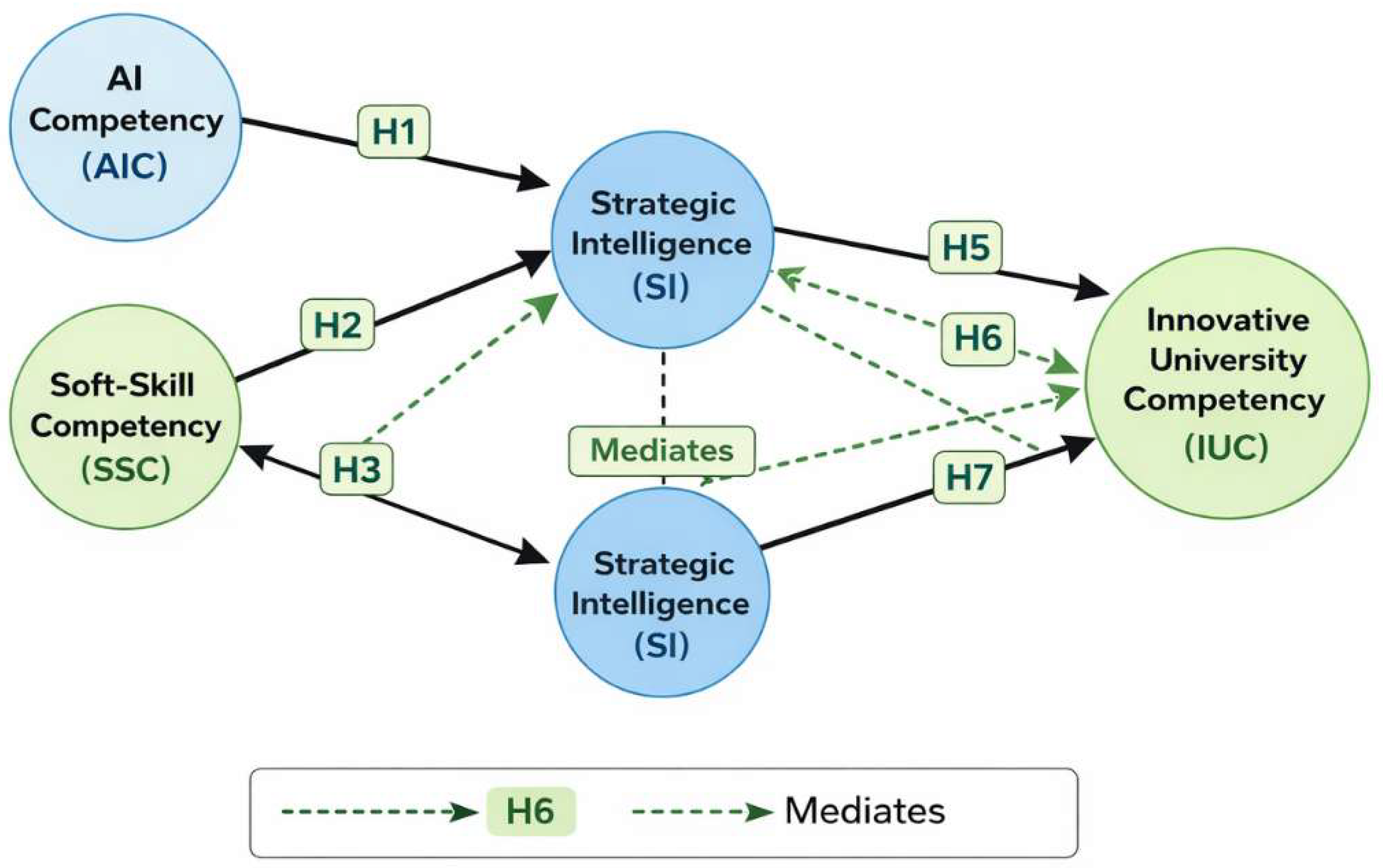
Figure 2.
Confirmatory factor analysis (CFA) results.
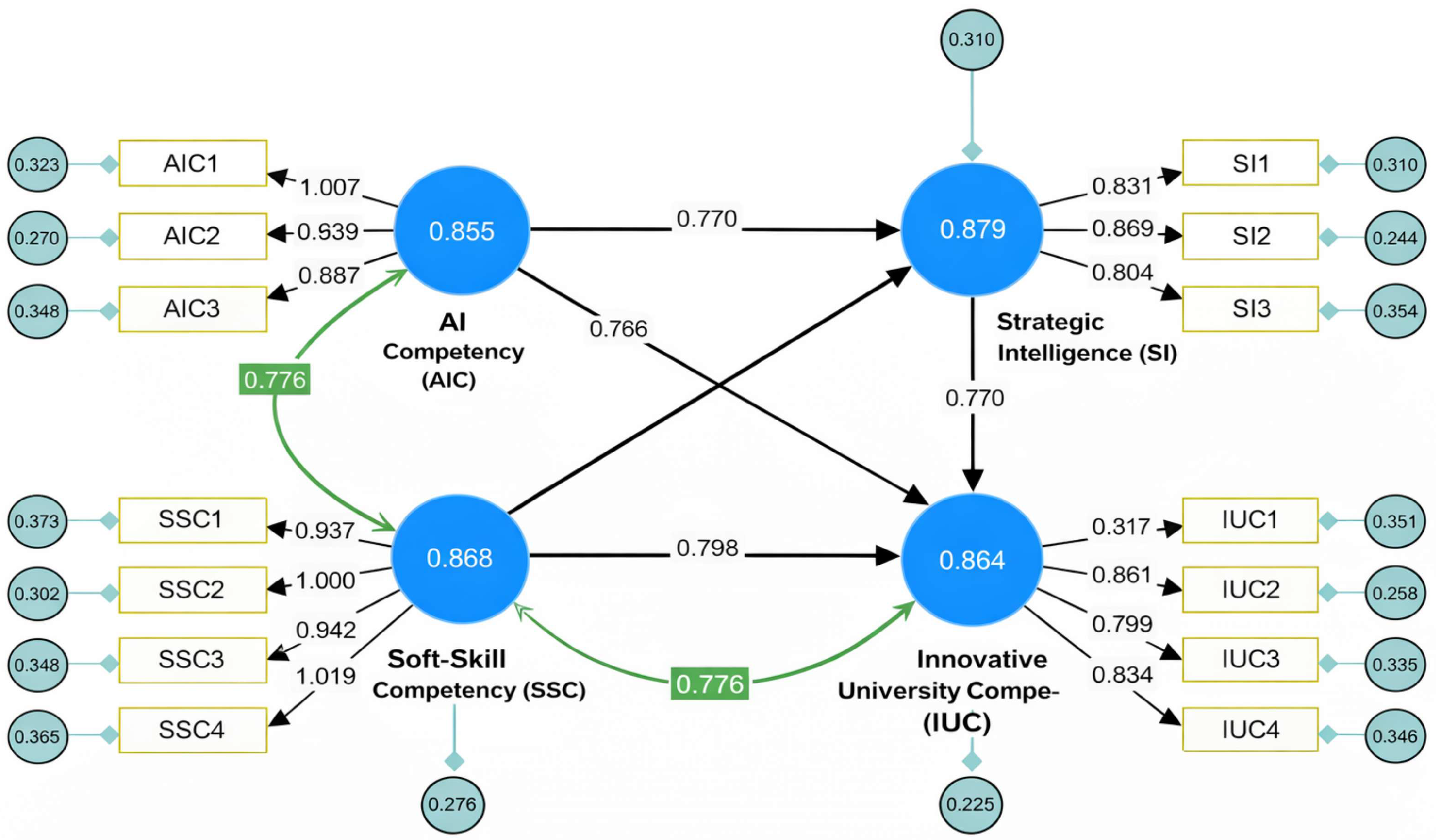
Figure 3.
Correlation coefficient matrix for observed variables.
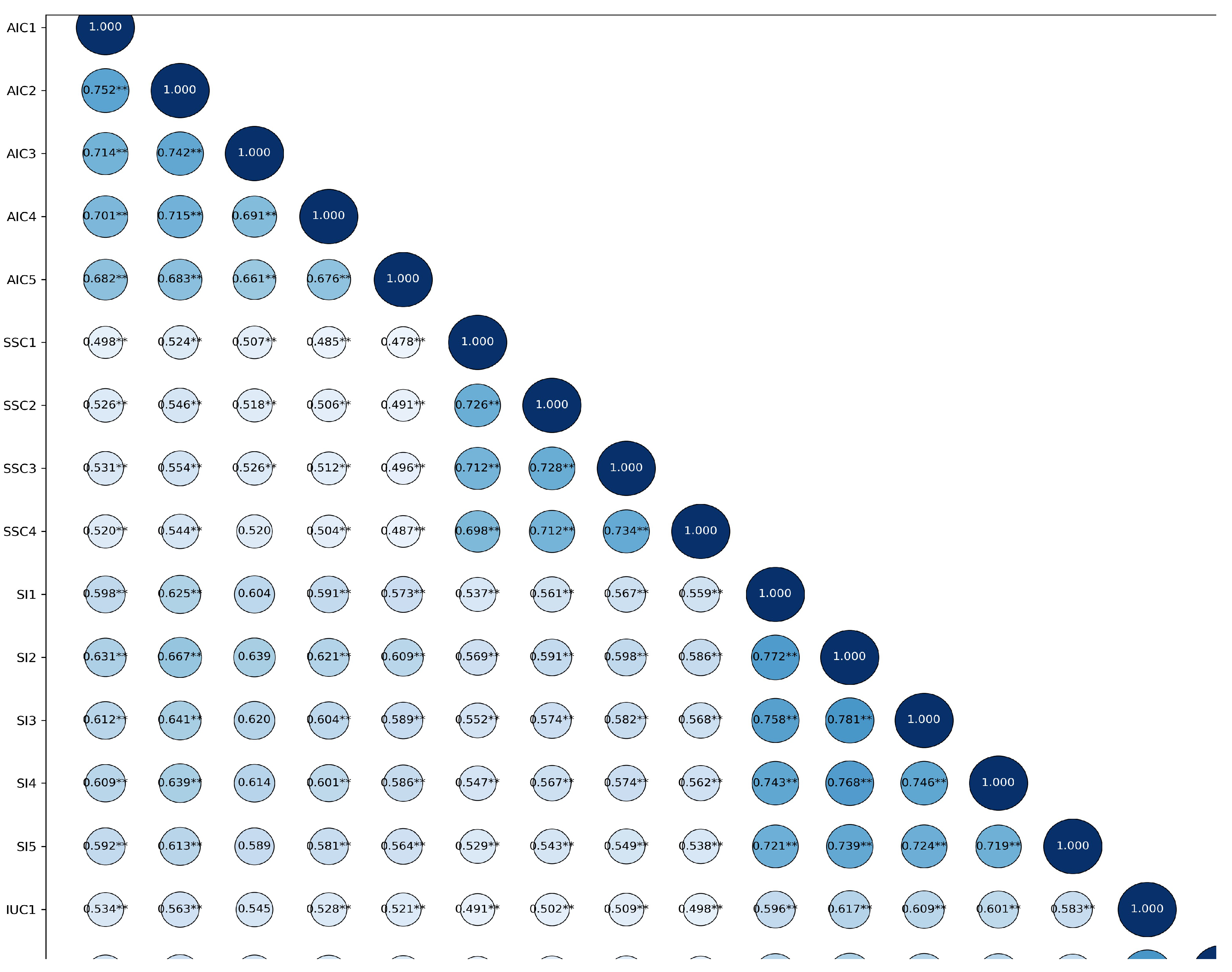
Figure 4.
SEM structural model with standardized path coefficients and mediating effects.
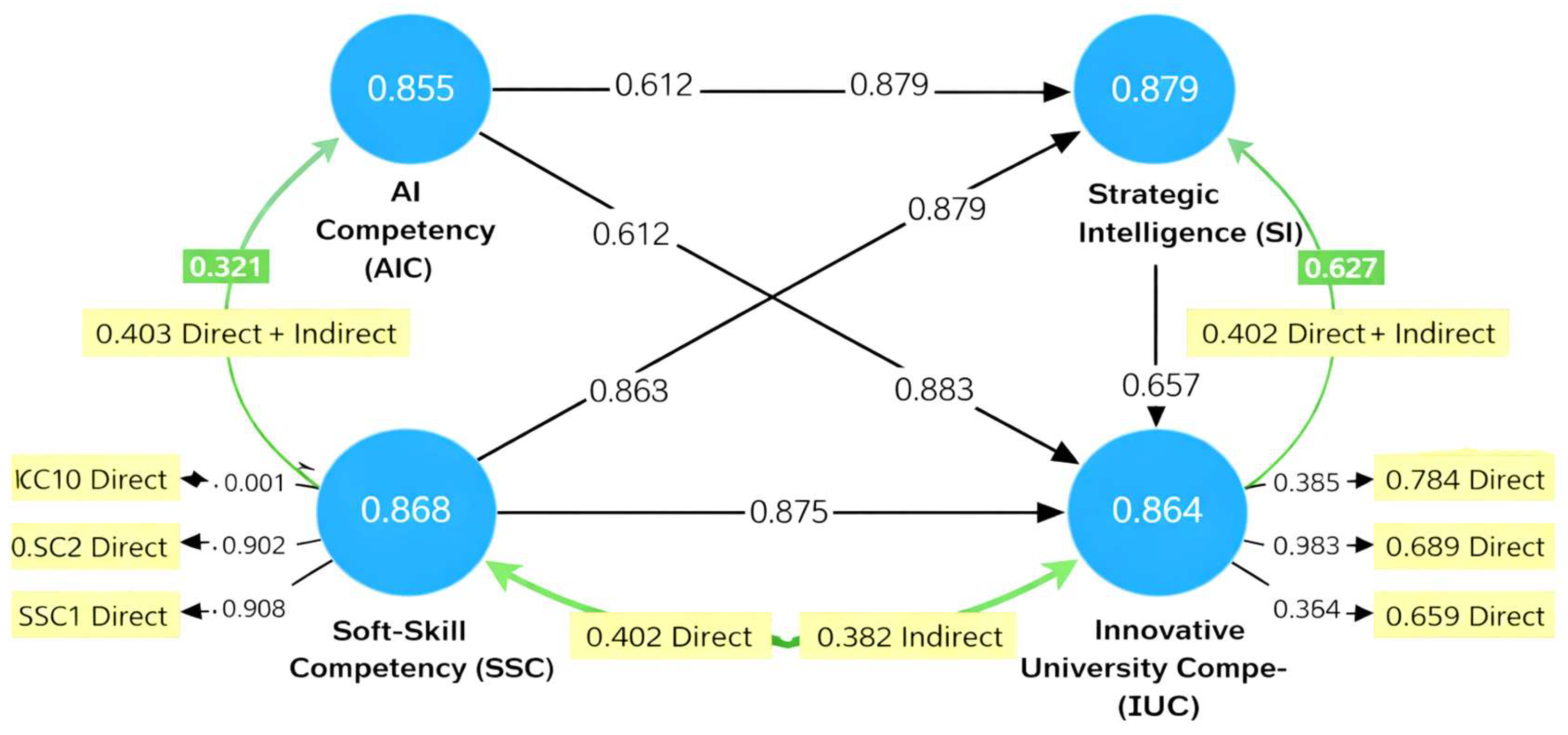
Figure 5.
The performance and learning behavior of the ANN model, (a) prediction vs actual plot (ANN performance), (b) error convergence curve across epochs, (c) ANN predictive performance metrics, (d) ANN performance comparison (Training vs Testing).
Figure 5.
The performance and learning behavior of the ANN model, (a) prediction vs actual plot (ANN performance), (b) error convergence curve across epochs, (c) ANN predictive performance metrics, (d) ANN performance comparison (Training vs Testing).
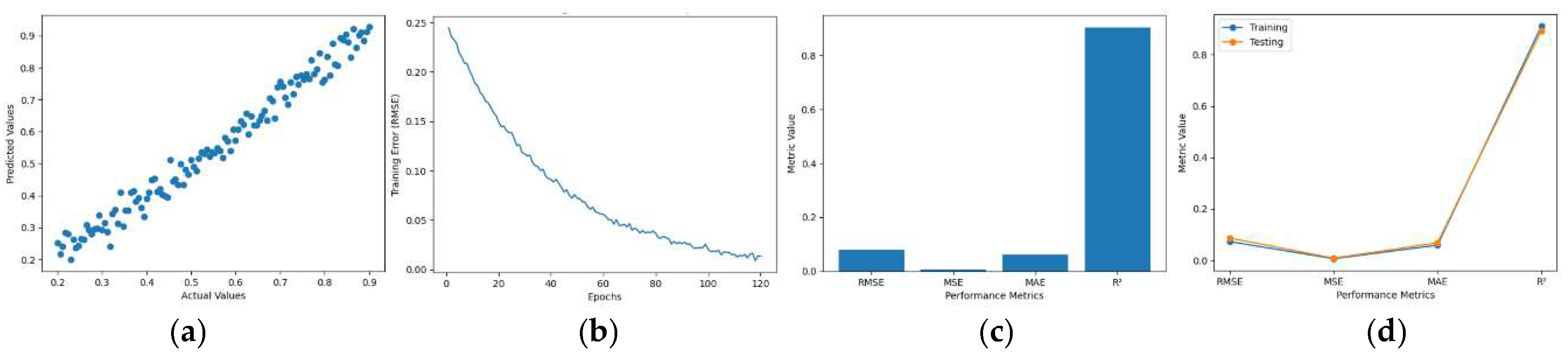
Figure 6.
SHAP-Based Interpretation of Predictor Contributions in the ANN Model, (a) SHAP Summary Plot (Beeswarm Plot) showing the distribution and magnitude of SHAP values for AI Competency, Strategic Intelligence, and Soft-Skill Competency across all observations, (b) SHAP Dependence Plot illustrating the relationship between AI Competency values and their SHAP contributions to the prediction of Innovative University Competency.
Figure 6.
SHAP-Based Interpretation of Predictor Contributions in the ANN Model, (a) SHAP Summary Plot (Beeswarm Plot) showing the distribution and magnitude of SHAP values for AI Competency, Strategic Intelligence, and Soft-Skill Competency across all observations, (b) SHAP Dependence Plot illustrating the relationship between AI Competency values and their SHAP contributions to the prediction of Innovative University Competency.
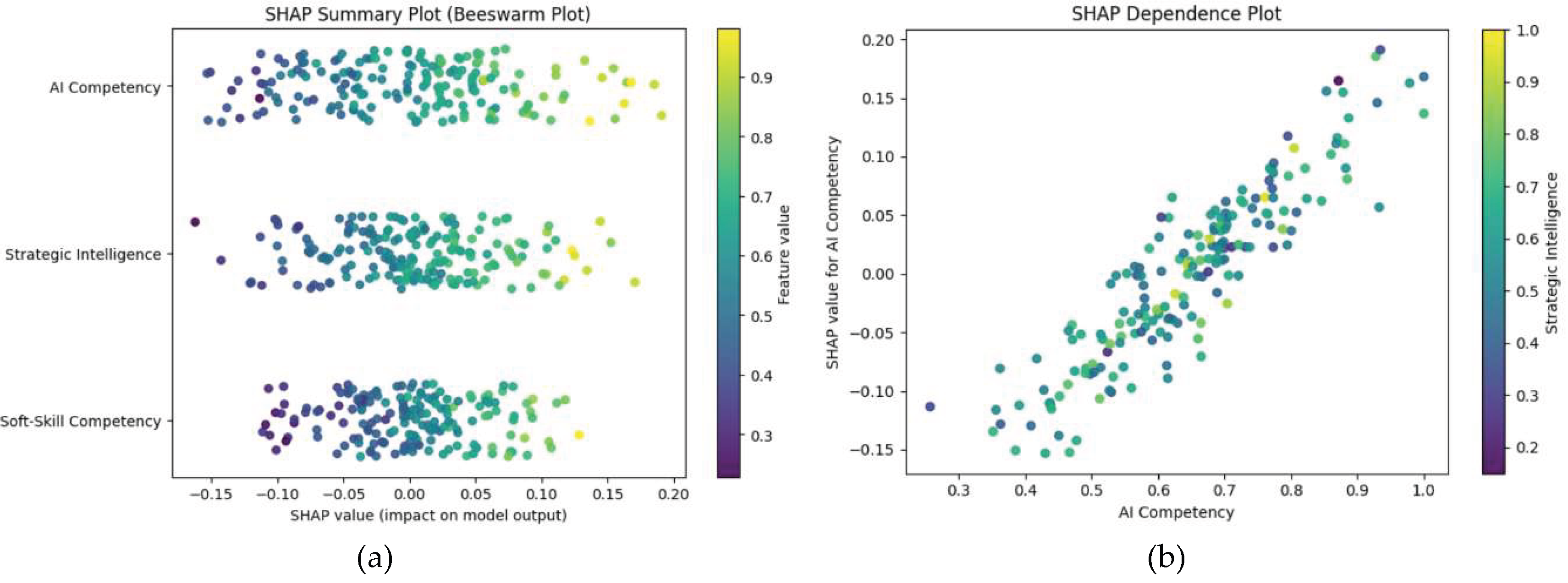

Table 1.
Demographic profile of respondents from the study.
| Demographic Variables | Categories | Frequency (n) | Percent (%) |
| Gender | Male | 211 | 44.4 |
| Female | 264 | 55.6 | |
| Age (years) | Below 30 | 93 | 19.6 |
| 31 – 45 | 251 | 52.8 | |
| 46 – 60 | 131 | 27.6 | |
| Employment Position | Academic Staff (Lecturer/Researcher) | 295 | 62.1 |
| Administrative/Managerial Staff | 180 | 37.9 | |
| Years of Service | Less than 5 years | 120 | 25.3 |
| 6 – 10 years | 205 | 43.2 | |
| More than 10 years | 150 | 31.5 | |
| Faculty Group | Social Science (MBS, EDU, HUSO) | 238 | 50.1 |
| Science (SCI, ENG, ICT) | 237 | 49.9 | |
| Type of University Function | Teaching-oriented | 189 | 39.8 |
| Research-intensive | 208 | 43.8 | |
| Autonomous/Hybrid | 78 | 16.4 |
Table 2.
SEM fit indices.
| Fit Index | Statistic Value | Criteria | Conclusions |
| Chi-square (χ²) | 1,287.462 | Non-significant desirable (sensitive to N) | Acceptable |
| χ²/df | 1.95 | ≤ 3.00 = Acceptable | Good |
| CFI | 0.953 | ≥ 0.90 (acceptable); ≥ 0.95 (excellent) | Excellent |
| TLI | 0.945 | ≥ 0.90 (acceptable); ≥ 0.95 (excellent) | Good |
| GFI | 0.924 | ≥ 0.90 | Good |
| AGFI | 0.901 | ≥ 0.90 | Acceptable |
| RMSEA | 0.046 | ≤ 0.08 (adequate); ≤ 0.05 (close fit) | Good |
| SRMR | 0.051 | ≤ 0.08 | Acceptable |
Table 3.
Standardized factor loadings and significance of observed variables.
| Construct | Observed Variable | Standardized Loading (λ) | t-value | Conclusion |
| AI Competency (AIC) | AIC1 | 0.823 | 13.42 | Significant |
| AIC2 | 0.854 | 14.06 | Significant | |
| AIC3 | 0.807 | 12.78 | Significant | |
| AIC4 | 0.783 | 11.96 | Significant | |
| AIC5 | 0.796 | 12.11 | Significant | |
| Soft-Skill Competency (SSC) | SSC1 | 0.791 | 12.67 | Significant |
| SSC2 | 0.836 | 13.29 | Significant | |
| SSC3 | 0.807 | 12.74 | Significant | |
| SSC4 | 0.853 | 13.56 | Significant | |
| SSC5 | 0.878 | 14.22 | Significant | |
| Strategic Intelligence (SI) | SI1 | 0.831 | 13.84 | Significant |
| SI2 | 0.869 | 14.37 | Significant | |
| SI3 | 0.804 | 13.06 | Significant | |
| SI4 | 0.872 | 14.48 | Significant | |
| SI5 | 0.851 | 13.92 | Significant | |
| Innovative University Competency (IUC) | IUC1 | 0.817 | 13.22 | Significant |
| IUC2 | 0.861 | 13.97 | Significant | |
| IUC3 | 0.799 | 12.81 | Significant | |
| IUC4 | 0.834 | 13.48 | Significant | |
| IUC5 | 0.808 | 12.89 | Significant |
Table 4.
Reliability and validity results of constructs.
| Construct | Cronbach’s Alpha (α) | CR | AVE | √AVE | Threshold Criteria |
| AI Competency (AIC) | 0.921 | 0.943 | 0.671 | 0.8192 | α > 0.700; CR > 0.700; AVE > 0.500; √AVE > r |
| Soft-Skill Competency (SSC) | 0.932 | 0.947 | 0.684 | 0.826 | α > 0.700; CR > 0.700; AVE > 0.500; √AVE > r |
| Strategic Intelligence (SI) | 0.938 | 0.951 | 0.703 | 0.838 | α > 0.700; CR > 0.700; AVE > 0.500; √AVE > r |
| Innovative University Competency (IUC) | 0.928 | 0.941 | 0.660 | 0.812 | α > 0.700; CR > 0.700; AVE > 0.500; √AVE > r |
Table 5.
Fit indices for SEM.
| Fit Index | Statistic Value | Acceptable Criteria | Conclusion |
| Chi-square (χ²) | 1,347.215 | Non-significant desirable (sensitive to sample size) | Acceptable |
| Chi-square/df (χ²/df) | 1.95 | < 3.00 = Acceptable; < 2.00 = Good | Good |
| CFI | 0.953 | ≥ 0.90 = Acceptable; ≥ 0.95 = Excellent | Excellent |
| TLI | 0.945 | ≥ 0.90 = Acceptable; ≥ 0.95 = Excellent | Good |
| IFI | 0.954 | ≥ 0.90 = Acceptable; ≥ 0.95 = Excellent | Excellent |
| GFI | 0.924 | ≥ 0.90 = Acceptable | Good |
| AGFI | 0.901 | ≥ 0.90 = Acceptable | Acceptable |
| RMSEA | 0.046 | ≤ 0.08 = Acceptable; ≤ 0.05 = Close fit | Good |
| SRMR | 0.051 | ≤ 0.08 = Acceptable; ≤ 0.05 = Excellent | Good |
| NFI | 0.928 | ≥ 0.90 = Acceptable | Good |
| PNFI | 0.814 | ≥ 0.50 = Acceptable | Good |
| PCFI | 0.832 | ≥ 0.50 = Acceptable | Good |
Table 6.
Path analysis: regression weights among constructs.
| Path | Hypothesis | Estimate (β) | S.E. | C.R. | Conclusion |
| AI Competency (AIC) → Strategic Intelligence (SI) | H1 | 0.612347 | 0.042173 | 14.526271 | Supported |
| Soft-Skill Competency (SSC) → Strategic Intelligence (SI) | H2 | 0.583192 | 0.046291 | 12.594812 | Supported |
| Strategic Intelligence → Innovative University Competency | H3 | 0.657184 | 0.039425 | 16.661291 | Supported |
| AI Competency → Innovative University Competency | H4 | 0.321674 | 0.037912 | 8.484516 | Supported |
| Soft-Skill Competency → Innovative University Competency | H5 | 0.274851 | 0.043275 | 6.351246 | Supported |
| AI Competency → Strategic Intelligence → Innovative University Competency | H6 (Indirect) | 0.402213 | 0.031527 | 12.768294 | Supported |
| Soft-Skill Competency → Strategic Intelligence → Innovative University Competency | H7 (Indirect) | 0.383764 | 0.033864 | 11.335721 | Supported |
Table 7.
Path analysis: direct, indirect, and total effects.
| Path (From → To) | Direct Effect (β) | Indirect Path(s) | Indirect Effect (β) | Total Effect (β) | Conclusion |
| AI Competency (AIC) → Innovative University Competency (IUC) | 0.321674 | AIC → SI → IUC = 0.612347 × 0.657184 | 0.402213 | 0.723887 | Supported |
| Soft-Skill Competency (SSC) → Innovative University Competency (IUC) | 0.274851 | SSC → SI → IUC = 0.583192 × 0.657184 | 0.383764 | 0.658615 | Supported |
| Strategic Intelligence (SI) → Innovative University Competency (IUC) | 0.657184 | — | — | 0.657184 | Supported |
| AI Competency (AIC) → Strategic Intelligence (SI) | 0.612347 | — | — | 0.612347 | Supported |
| Soft-Skill Competency (SSC) → Strategic Intelligence (SI) | 0.583192 | — | — | 0.583192 | Supported |
Table 8.
Artificial neural network predictive performance results.
| Dataset | RMSE | MSE | MAE | R² |
| Training | 0.072 | 0.0052 | 0.058 | 0.912 |
| Testing | 0.086 | 0.0074 | 0.067 | 0.894 |
| Average (10 runs) | 0.079 | 0.0063 | 0.062 | 0.903 |
Table 9.
SHAP Feature Importance Results.
| Predictor | Mean SHAP Value | Normalized Importance (%) | Rank |
| AI Competency (AIC) | 0.412 | 100 | 1 |
| Strategic Intelligence (SI) | 0.348 | 84.5 | 2 |
| Soft-Skill Competency (SSC) | 0.301 | 73.1 | 3 |
Disclaimer/Publisher’s Note: The statements, opinions and data contained in all publications are solely those of the individual author(s) and contributor(s) and not of MDPI and/or the editor(s). MDPI and/or the editor(s) disclaim responsibility for any injury to people or property resulting from any ideas, methods, instructions or products referred to in the content. |
© 2026 by the authors. Licensee MDPI, Basel, Switzerland. This article is an open access article distributed under the terms and conditions of the Creative Commons Attribution (CC BY) license (http://creativecommons.org/licenses/by/4.0/).
Copyright: This open access article is published under a Creative Commons CC BY 4.0 license, which permit the free download, distribution, and reuse, provided that the author and preprint are cited in any reuse.


