

Submitted:
24 March 2026
Posted:
27 March 2026
You are already at the latest version
Abstract
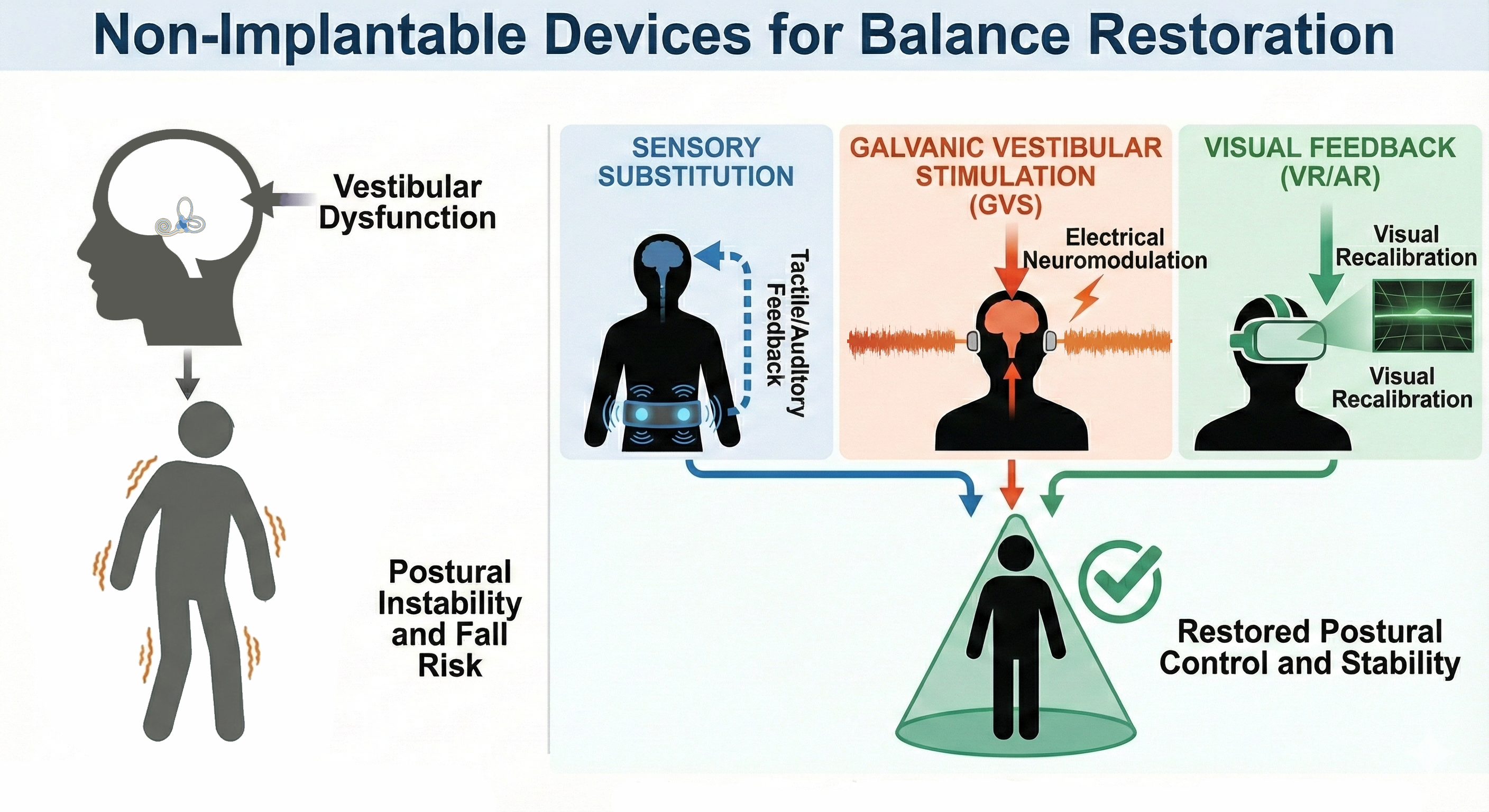
The review explores the development of non-implantable vestibular devices designed to address postural instability, particularly in aging populations and patients with vestibular hypofunction. It establishes that balance relies on complex sensory integration and that the functional decline of this system creates a significant medical need. Three principal technological strategies are examined: sensory substitution devices, galvanic vestibular stimulation (GVS), and immersive visual feedback systems. Sensory substitution devices, which convert balance data into auditory, tactile, or electrotactile cues, demonstrate significant promise. Examples like vibrotactile belts provide feedback that reduces postural sway, enhancing stability and patient confidence. Parallel to this, GVS—using electrical currents applied to the mastoids—emerges as a potent non-invasive method to modulate vestibular pathways, improving balance control and even inducing neuroplastic changes, especially with stochastic “noisy” signals. Most recently develop devices include augmented and virtual reality technologies offer innovative visual feedback, creating enriched rehabilitation environments that accelerate recovery by promoting sensory reweighting and neural adaptation. The review concludes that while implantable prostheses are advancing, non-invasive devices offer versatile, affordable and complementary solutions for balance restoration. Future success of non-invasive alternatives hinges on developing more sophisticated stimulation protocols that account for the complexity of natural movement and individual patient contexts, ultimately expanding therapeutic options for vestibular disorders.
Keywords:
balance prostheses
; non-implantable prosthesis
; vestibular loss
; vestibulopathy
; vibrotactile and auditory biofeedback
; virtual reality
; Galvanic vestibular stimulation: GVS
; BVH
1. Introduction
The control of posture in bipedal animals involves a complex integration of proprioceptive, vestibular, visual and auditory inputs [1,2]. The peripheral vestibular organs act as sensors of linear and angular accelerations of the head. The central nervous system (CNS) uses this input to define the cephalic position relative to gravity and motion dynamics, according to the environment, integrating vestibular input with that from other sensory systems to produce coordinated voluntary and reflex motor responses to maintain balance and stabilize the gaze [3,4].
Vestibular activation elicits reflex responses including vestibulo-spinal, vestibulo-collic, vestibulo-ocular, and vestibulo-autonomic reflex responses. In addition, the vestibular apparatus contributes cognitive processes that modulate movement, stabilize the position, establish a vertical reference to realigning the body and contribute to motion perception. During these processes of body stabilization and navigation, various cortical regions are recruited including the parieto-insular vestibular cortex, the insula, the hippocampus and the entorhinal cortex, as well as cerebellar regions such as the flocculonodular lobe [5].
Vestibular input also contributes to spatial navigation, the generation of an inertial reference map of and cognitive processes related to the body schema [5,6,7].
During locomotion, whether walking or driving a car or an aircraft, humans engage stabilization processes that are shaped by learning and training. Nevertheless, sensory inputs remain essential for detecting perturbations and stabilize body posture, even under extreme or unforeseen conditions. Disruption of these sensory inputs results in motor impairments that compromise normal behavioral function. Patients with bilateral vestibular hypofunction (BVH), for example, often exhibit profound difficulties in stabilizing posture during ambulation. More critically, deficits in gaze stabilization may arise, leading to significant visual degradation during movement [8]. The incidence of balance dysfunction either due to age-related decline in vestibular function (presbyvestibulopathy) or by pathological processes such as Parkinson’s Disease or poststroke conditions, increases markedly with advancing age; indeed, evidence of balance impairment has been documented in 85% of individuals over 80 years old, substantially elevating the risk of falls and associated injuries [9].
To address these clinical challenges, both implantable and non-implantable vestibular devices have been developed (for recent reviews on implantable prostheses, see [10,11,12]). The present review concentrates on non-implantable devices designed as therapeutic alternatives for patients experiencing postural instability. Specifically, we examine the principles and applications of sensory substitution technologies, employing auditory, tactile, and visual feedback, GVS, and emerging virtual reality devices.
Insights derived from the study of these devices may contribute to the development of novel strategies for device innovation and enhance the feasibility of integrating complex combinations of implantable and non-implantable prosthetic technologies. Such advances hold promise for improving therapeutic options available to patients with balance and postural control deficits.
2. Sensory Substitution Devices
Many patients could benefit from medical devices that enhance postural stability. To address this need, various approaches have been developed to improve balance. These include methods based on sensory substitution and sensory enhancement. Sensory substitution involves using sensory signals from an alternative sensory modality. This concept was originally introduced by Paul Bach-y-Rita to assist blind individuals with navigation [13]. In contrast, sensory enhancement amplifies the weakened sensory input of a specific modality. This distinction is useful when selecting the appropriate aid for maintaining balance, depending on the impaired sensory or neural input.
With sensory substitution devices, users must learn to interpret the signals provided. The adaptation period depends on the number of cues programmed and how they relate to the desired postural adjustment [14]. Most sensory substitution devices for balance and postural control utilize vibrotactile, auditory, or electrical stimulation [15]. Non-invasive balance prostheses have shown promising results in various pathologies that affect balance and gait. Patients with the poorest baseline performance tend to experience greater improvements when using these devices. This suggests that prosthetic interventions should be tested on both healthy individuals and those with impairments. It is also important to distinguish the intended purpose of the technology -whether it will be used as a prosthetic device or as a rehabilitation tool [16]. Additionally, the role of repetition and training duration must be studied to establish effectiveness. In general, the more time users spend with the device, the less time they need to decode its signals and regain stable postural control [17].
Overall, current trends in haptic feedback point toward localized and responsive systems. Compact feedback units can be designed to target specific balance axes and integrated into everyday items, such as shoe soles or insoles that vibrate upon detecting improper weight distribution, or smart clothing equipped with integrated tactile interfaces. These innovations represent significant progress, offering more refined and effective forms of sensory substitution for maintaining postural balance [18].
2.1. Auditory Feedback
The use of auditory feedback for balance control was first proposed by Hegeman et al. in 2005 [19]. Their findings showed that individuals with vestibular loss were able to integrate auditory information into their balance strategies, leading to improved performance in a balance task. Since then, a typical auditory feedback system has encoded tilt angle into sound volume and pitch. For example, sway in the mediolateral axis is often represented by proportional changes in volume, while anteroposterior sway is reflected in pitch modulation [20].
One such system uses an accelerometer placed at the L5 vertebra to estimate body sway near the center of mass and generates corresponding changes in sound pitch or volume based on sway direction. Gait performance and balance were evaluated in both healthy subjects and patients with bilateral vestibular loss. Both groups exhibited reduced sway during quiet standing. However, improvements in postural sway were more pronounced in patients with vestibular loss, particularly during trials with eyes closed [20]. A more complex system incorporating different acoustic cues related to movement -mapped through mathematical functions such as sigmoid, exponential, and step functions- was also tested. All auditory biofeedback signal modalities led to improved postural control while standing on a random moving platform [21].
Auditory stimulation not directly correlated with body position also appears to enhance balance. For instance, individuals with auditory implants showed improved balance while listening to music [22]. Similarly, exposure to auditory white noise improved postural balance during walking in both young and older adults [23]. In patients with otolithic disorders secondary to mild traumatic brain injury, acoustic biofeedback was triggered when trunk angular velocity exceeded a preset threshold. Compared to those who did not receive feedback during rehabilitation, these patients showed reduced sway angle and sway velocity [24]. However, the long-term rehabilitative effects of auditory biofeedback in clinical settings remain to be explored [25].
The effect of auditory noise on standing balance was further investigated by measuring how long participants could stand on one leg with eyes closed. Exposure to threshold-level auditory white noise nearly doubled standing time compared to no-noise conditions. The benefit was greater in individuals with lower baseline balance ability, though no control group other than the absence of noise was included [26].
Auditory feedback has also been used to supplement visual and somatosensory inputs to improve balance across various clinical populations. In post-stroke patients, a two-week intervention using an auditory biofeedback prosthesis -which modulated output based on plantar foot pressure- resulted in a 13–29% reduction in frontal whole-body angular momentum range compared to a control group, indicating improved walking balance [27]. Using a different approach, another study examined dynamic balance in chronic stroke patients by measuring center of pressure (CoP) and center of mass (CoM) before and after 20 minutes of white noise exposure. Results showed increased anteroposterior CoP range and velocity, suggesting that white noise may enhance dynamic balance and increase gait speed [28].
2.2. Tactile Feedback
One of the earliest devices proposed for sensory substitution in vestibular disorders was the tongue electrotactile feedback (TEF) system (Figure 1). This device takes advantage of the high spatial resolution and sensitivity of the tongue’s surface to electrical current. It employs an evenly distributed electrode matrix of 10 x 10 electrodes, which delivers a voltage ranging from 5 to 15 V to the tongue [29]. The system can operate in either a vision substitution mode or a vestibular mode [30]. In the vestibular mode, a two-axis accelerometer commands the application of electrical current.
The ability of patients with unilateral vestibular deficits to control their posture was tested using a head-mounted accelerometer with this TEF system. Results showed a reduction in center of pressure displacements in the group using the tongue device compared to the control group, indicating improved upright postural balance [31]. The TEF was also tested using plantar pressure sensors instead of a head accelerometer. This configuration allowed healthy subjects to counteract the destabilizing effects of an extended head posture [32]). Furthermore, the device has been used in patients with gait or balance impairments caused by multiple sclerosis [33].
In another TEF configuration, two-axis accelerometers were attached to a belt around the subject’s torso. GVS was used to induce balance impairments similar to the instability observed in the elderly [34,35]. The TEF system successfully improved postural performance during GVS. The efficacy of a head sensor-based TEF was also tested in chronically dizzy patients with varying degrees of vestibular pathology. Posturographic scores improved significantly after four days of one-hour training sessions, particularly under conditions that restricted visual or somatosensory input. The improvements were greater in older patients and were proportional to the degree of vestibular loss. Notably, the balance improvement in chronic vestibulopathic patients exceeded that achieved with standard balance physiotherapy alone [36].
The utility of TEF technology has been well demonstrated in blind individuals and in patients with BVH. It is commercially available as a medical device known as BrainPort® (Wicab, Inc., Middleton, WI, USA) [37]. For clinical use in BVH, the recommended application involves using the TEF device twice daily for 20 minutes, which provides lasting improvements in postural stability.
Several other approaches use the vibrotactile sensitivity of the waist, chest, head, or fingertips to provide feedback on body posture and orientation relative to the vertical. One of the first such devices used vibrotactile stimulation on the anterior and posterior surfaces of the torso, providing feedback related to body tilt in the mediolateral and anteroposterior axes. This device also encoded sway speed and was tested in both healthy subjects and patients with vestibular loss. Studies on a moving platform found that body sway was significantly reduced with its use across all stimulus amplitudes for both groups [38].
Subsequently, an ambulatory vibrotactile biofeedback system, known as a postural aid belt, was tested in patients with bilateral vestibular areflexia. This device consists of vibrotactile motors evenly distributed around the user’s waist. A microprocessor activates specific motors based on the degree of tilt. In patients with BVH, using the device improved postural performance during quiet stance and instilled a feeling of confidence and stability [17]. Vibrotactile biofeedback has since gained attention for its potential in patients with multiple sclerosis and Parkinson’s disease, where it appears to improve stance and gait, particularly as a rehabilitation and training aid [39,40].
Another device, known as the Balance Belt, is worn around the waist and provides sensory feedback through vibrating motors (Figure 2). It delivers subtle vibrations that indicate the direction of imbalance, helping to improve balance and spatial orientation. The Balance Belt uses accelerometers and gyroscopes to detect changes in body position and movement, generating corresponding vibrations around the waist. Development of the Balance Belt began around 2003. An advanced version was evaluated in 39 patients with BVH [41]. Prior to using the belt, all patients had mobility and balance scores of 5 or less on a 10-point scale. In laboratory tests, approximately 80% of patients reported a positive effect from the Balance Belt. After one month of daily use in everyday life, 68% of patients reported benefiting from the device [41]. The system has since been studied in approximately 120 patients with BVH, yielding positive results [42]. The Balance Belt is currently one of the few commercially available sensory-substitution prostheses (“Balance Belt – Elitac”).
Innovations have moved beyond belt designs toward wearable haptic devices that are more localized, modular, and closely aligned with the body’s natural sensory channels (Figure 3). One example is a thimble-like wearable device that provides subtle vibrotactile feedback at the fingertip when sway is detected [43]. This device fits over the fingertip and uses an integrated accelerometer to measure the user’s body sway. When sway exceeds a specific threshold, the device delivers a gentle vibrational pulse to the fingertip. Interestingly, this subtle haptic feedback mimics the well-known “light touch” phenomenon, where gently touching a stationary surface significantly reduces postural sway. Initial testing confirmed that participants using this vibrotactile thimble achieved sway reductions equivalent to those achieved through direct physical contact with a stationary surface [43].
Another study developed a haptic feedback device based on soft, bellows-type pneumatic actuators, entirely 3D-printed with flexible materials [44]. Placed on the lower limbs, this device generates localized mechanical stimuli through the controlled expansion of the actuators, stimulating cutaneous receptors to provide precise sensory feedback. Preliminary results indicate that this system improves postural balance and proprioception, showing potential for applications in neurological rehabilitation and safe human-robot interactions.
Notably, research has shown that the somatosensory cortex response to electrical stimulation of the plantar sole is greater in subjects with BVH than in control subjects. This suggests that neuronal processes induced by vestibular lesions lead to an increase in somatosensory gain and a greater reliance on somatosensory input for postural control [45].
The combined effects of simultaneous vibrotactile and auditory feedback were assessed in subjects during quiet stance. In this study, actuators were placed on the forehead to avoid perturbing trunk or waist proprioception. Surface electromyography (EMG) was recorded from muscles of the lower leg, trunk, and upper arm, while pelvic and upper trunk angular movements were sensed in the roll and pitch planes. Subjects with BVH were first studied without feedback and then received training with combined vibrotactile and auditory feedback. The auditory feedback threshold was set higher than that for vibrotactile feedback (80% and 40% of the 90% pelvis sway range, respectively). Sound volume increased linearly from 50 to 70 dB, while eight head vibrators placed along a headband provided information on movement direction and amplitude through varying vibratory intensity. Results showed that, in BVH subjects, muscle synergy amplitudes changed in conjunction with underlying sway reductions. The combination of EMG recording and pelvis movement analysis provided a means to demonstrate efficacy for different types of balance prostheses, including implants [46].
A vibrotactile biofeedback system based on lower trunk sway recording has also been developed. This system uses a gyroscope mounted at L5 and provides feedback through a Vibrotactile feedback (VTfb) device (Swaystar Balance Freedom™), which consists of eight vibrators positioned at 45-degree intervals around a circular headband to deliver directionally specific sway information. Use of this device in patients with Persistent Postural-Perceptual Dizziness (PPPD) has shown that trunk sway feedback improves balance control during stance and leads to even more significant improvements in gait tasks [47].
Vibrotactile feedback has also been explored as a countermeasure for controlling body tilt in astronauts after short-duration spaceflight. Adaptive changes during spaceflight can impair the ability to manually control tilt during transitions between gravitational environments. The tested device consisted of small tactors placed around the torso that vibrated at 250 Hz to provide tactile feedback whenever body tilt exceeded a threshold level. Using this device significantly improved performance in nulling tilt, indicating that such a simple system can aid adaptation in astronauts following spaceflight [48].
2.3. Visual Feedback: augmented and virtual reality
Augmented reality (AR) and virtual reality (VR) technologies have opened new avenues for providing visual feedback to improve balance control. AR systems overlay virtual visual cues onto the user’s real-world environment, while VR immerses the user in a fully simulated environment. Both approaches can provide sensory information to help maintain balance (Figure 4). For example, AR glasses can project a stable horizon line or stepped targets into a subject’s field of view to guide posture [49], while VR can create challenging scenarios such as swaying rooms or moving crowds [50,51]. These visual environments facilitate sensory reweighting, a process by which the central nervous system learns to prioritize reliable visual or residual vestibular inputs over erroneous signals [51].
Recent evidence suggests that VR-based rehabilitation is particularly effective in improving balance and function across diverse populations. Benefits have been demonstrated through improved Berg Balance Scale (BBS) scores in patients with Parkinson’s disease and stroke [52,53], as well as through improved posturography and reduced dizziness symptoms in peripheral vestibular disorders [54]. Furthermore, immersive VR has shown benefits in reducing dizziness and improving posturographic measures, although the long-term retention of these gains remains to be established [54,55].
However, immersive VR often triggers sensory conflicts due to oculovestibular decoupling, leading to so-called “cyber-discomfort.” To mitigate this, recent research suggests that integrating VR with GVS can provide oculovestibular re-coupling, significantly reducing dizziness [56]. Other strategies focus on enhancing accessibility through multimodal feedback, combining auditory, vibrotactile, and visual cues. This approach has proven effective in improving postural stability and user comfort in populations such as individuals with multiple sclerosis [57].
A significant benefit has been found by adding VR exercises to conventional rehabilitation therapy. Patients who received VR- or AR-based rehabilitation showed marked improvement in Dizziness Handicap Inventory scores in the short term (0–3 months), with a standardized mean difference favoring VR/AR use [58].
Immersive visual feedback may accelerate the recovery of balance function, likely by providing an enriched stimulus that promotes neural plasticity. The underlying mechanism appears to be not merely repetitive training, but rather the induction of neuroplasticity and sensory reweighting. A study using Computerized Vestibular Retraining Therapy, a form of VR-based rehabilitation, showed that patients not only improved their balance but also exhibited lasting increases in visual and vestibular sensory ratios [59]. This suggests that exposure to controlled virtual environments that challenge balance leads to more efficient utilization of residual vestibular information and reduces over-reliance on visual cues—a common phenomenon in patients with vestibulopathy. Notably, these neuroplastic effects were more pronounced in patients with moderate to severe initial disability [59].
Taking the specificity of therapy, a step further, a recent meta-analysis compared the efficacy of different types of VR technology [60]. After analyzing 12 randomized controlled trials with 600 participants, the study found that immersive VR is significantly more effective in reducing vertigo symptoms compared to non-immersive VR [60]. It is worth noting that VR initially produces cyber-discomfort in some subjects, although these effects tend to diminish after approximately four weeks of training [58]. Cyber-discomfort results from sensory conflict; a study combining VR with GVS demonstrated that when vestibular stimulation was incongruent with visual information, subjects experienced greater imbalance and discomfort [56].
Beyond vestibular disorders, patients undergoing rehabilitation after stroke and those with Parkinson’s disease develop better postural control—reflected in higher scores on the Berg Balance Scale and the Timed Up-and-Go test—after VR balance game regimens, compared to control groups performing only conventional balance exercises [50,61]. VR can expose patients to balance challenges that would be unsafe in real life, such as walking on a narrow beam or standing on a moving platform. Augmented reality, on the other hand, allows patients to practice maintaining balance in their real-life environment with additional cues -such as visual markers indicating the direction of weight shift- which may aid in the transfer of skills to daily activities [56,57,58].
One innovative approach combined an immersive VR headset with a vibrotactile belt. As the user’s visual field tilted in VR, corresponding tactile cues on the trunk indicated the direction of the tilt, reinforcing the training effect [62]. This type of integration aims to reduce over-reliance on vision by simultaneously activating somatosensory pathways.
The field has grown rapidly: one analysis noted that the number of publications on “VR and postural control” nearly tripled from 2013 to 2023 [51], reflecting the enthusiasm surrounding AR and VR technologies. Overall, AR and VR provide rich, interactive environments that offer patients enhanced feedback on their balance, thereby accelerating improvements in postural control.
3. Sensory Enhancement Strategies
3.1. Galvanic Vestibular Stimulation
Parallel to the development of vestibular implants, non-implantable devices based on GVS have shown considerable promise [63,64,65,66,67]. GVS is a form of sensory enhancement that amplifies diminished sensory input from the vestibular system. It involves applying direct or alternating electrical current over the mastoid processes (for recent reviews, see [68,69]). The technique has been demonstrated to be safe, causing no harm even in older patients, and no health-related side effects have been reported up to date [70,71].
Electrode placement and polarity determine the effects of the selected configuration [72]. Common configurations include bilateral bipolar (also known as binaural bipolar or transmastoid bipolar), bilateral monopolar, and unilateral monopolar [73] (Figure 5). The effects elicited by GVS primarily influence posture [74,75,76], ocular movements [77,78,79], the autonomic nervous system [80,81], and cognition [82,83].
GVS produces significant postural responses through activation of the otolithic organs. This is supported by evidence that GVS elicits vestibular evoked myogenic potential (VEMP) responses [84,85]. Additionally, GVS modulates the vestibulo-ocular reflex (VOR), although within a low-frequency, low-velocity range [78,86]. This modulation of the VOR suggests that GVS also activates afferents from the semicircular canals [77,78,79].
Because GVS devices require no surgical implantation, they can be used in individuals with mild vestibular hypofunction, such as older adults [68,87,88]. They also serve as adjuvants in vestibular rehabilitation [89], and in extreme conditions such as microgravity to prevent neurosensory conflict [90,91]. A limitation of GVS based devices is their relative lack of specificity, which could be partially addressed through complex stimulation patterns and the use of multi-electrode arrays for focused transcranial current delivery [92].
The mechanism by which GVS modulates vestibular input involves the modulation of primary afferent vestibular neurons at the spike generation site [93,94]. Subsequent research showed that depolarization and synapse activation in neuroepithelial hair cells also contribute to the response to electrical stimuli. In tadpoles, for instance, blocking synaptic receptors in afferent neurons virtually eliminates the response to electrical current injection [95,96]. The action of GVS has been investigated in macaque monkeys using a binaural bipolar electrode configuration -the most common configuration in human studies. Single vestibular afferent responses to GVS applied to the mastoid processes of awake, behaving monkeys revealed robust and parallel activation of both canal and otolith afferents [97]. Irregularly firing afferents showed higher sensitivity to current, consistent with earlier findings from direct current stimulation of the afferent nerve [93,94]. However, regular and irregular afferents exhibited similar thresholds across all afferent classes for both canal and otolith systems [97].
The postural response to GVS consists of a slight tilt of the body’s vertical axis toward the anode, accompanied by a sensation of movement toward the cathode. Some authors attribute this postural alteration primarily to otolithic activation [76], while others propose that the movement sensation evoked by GVS does not resemble any natural movement because it results from a combination of both otolithic organ and semicircular canal activation [86,98,99]. Studies of head and ocular movements in guinea pigs support the involvement of otolithic organs in the GVS response [100].
The locomotor response to GVS (typically a DC step in most studies prior to 2015) depends on the individual’s existing posture and the available sensory information at the time of stimulation. It also depends on the size and rigidity of the surface in contact with plantar receptors [85]. Postural changes appear approximately one second after stimulation begins, even when stimulation is self-applied, allowing its use while subjects perform other tasks [101]. Applying GVS during specific gait phases, such as the heel-off phase, provokes two types of postural responses: one involves changing foot position toward the side of the perceived fall, and the other relies on displacing the body’s center of mass by altering ankle torque [102]. These response types should be considered in systems that use GVS for balance recovery [103]. Using a more complex configuration with four electrodes, GVS (3 mA DC step) successfully induced directional virtual head motion around three perpendicular axes, including yaw rotation. These results suggest the existence of current paths in the head -between mastoids and between mastoids and the forehead [67].
EMG recordings in response to GVS (transmastoid, 400 ms, 2 mA) have enabled the identification of electrophysiologically evoked myogenic potentials in the triceps brachii, tibialis anterior, and soleus muscles. These potentials consist of two components with different latencies: a short-latency component (60 ms) and a medium-latency component (100 ms) [104]. Studies of response latency indicate that the postural reaction to GVS involves activation of the reticulospinal, vestibulospinal, and rubrospinal tracts. Using train pulses to evoke the H-reflex in healthy humans, a linear relationship was found between GVS duration and M-wave amplitude, suggesting that GVS modulates spinal function [105].
The efficacy of GVS in modulating eye movements has been demonstrated, with eyes moving toward the anode and away from the cathode [106]. However, studies of eye movements using 3D video-oculography during 5 mA transmastoid GVS reveal considerable inter-subject variability in ocular displacement, indicating that both otolithic organs and semicircular canals are activated [107]. This variability appears largely related to differences in electrode placement, electrode resistance, and the presence of cerebrospinal fluid [108]. Despite this variability, individual responses are repeatable and predictable based on applied current magnitude and electrode configuration.
Pulsed GVS (bilateral bipolar transmastoid, 60 Hz, 100 ms pulses of 0.9 to 10 mA) has been used to study eye movements. The latency of the VOR was approximately 9 ms with GVS at ≥2.5 mA. With near-threshold GVS at 0.9 mA, VOR latency increased to approximately 32 ms. GVS produced three components in ocular movements: torsion away from the cathode, vertical deviation, and horizontal rotation, with magnitudes proportional to current intensity. Notably, ocular reflexes evoked by pulsed stimulation were not inhibited by voluntary eye movements. This finding suggested the possibility of using GVS to restore low-frequency, low-velocity VOR function [109].
Most advanced GVS systems are now focused on the use of noisy GVS (nGVS) in two main forms: (i) automatic devices in which GVS amplitude is modulated by output from head-mounted gyroscopes and accelerometers measuring linear and angular accelerations [65,66,110]; and (ii) programmed devices that deliver GVS with preprogrammed, constant characteristics throughout use [111]. GVS has been applied in populations with diverse physical and occupational characteristics, including pilots [91,112,113], athletes [114]), and older adults [115]. It has also been used in patients with bilateral vestibular hypofunction, Parkinson’s disease, and post-stroke hemiplegia or instability [116,117].
Various amplitudes, durations, and waveforms of GVS have been used to study its physiological effects (Figure 5). Current intensity varies across studies, ranging from 0.5 mA up to a peak of 5 mA for DC or AC waveforms, and up to 10 mA for short pulses (<100 ms). The most commonly used GVS waveforms are direct current (dcGVS), sinusoidal current (sGVS), pulsed current (pGVS), and zero-mean random noise (nGVS) [118]. A wide array of electrode positions and characteristics have been employed. Unfortunately, no studies have compared different GVS configurations under homogeneous conditions, so comparisons can only be made across different studies [118]. Optimizing nGVS amplitude by identifying the level at which postural stability is enhanced appears promising [118,119]. Additionally, the cutaneous threshold of sensitivity or the perception threshold has been used to establish optimal stimulation amplitudes. In studies examining the effects of GVS in patients, most -if not all- have used nGVS.
The use of stochastic or noisy low-intensity GVS stimulation (<30 Hz, amplitude range 0.1–0.5 mA) significantly reduces center of pressure oscillations during standing on a foam surface [120]. Using white noise as a low-amplitude background signal increases the signal-to-noise ratio with minimal energy expenditure. The underlying phenomenon may be analogous to stochastic resonance, in which a periodic event is enhanced by low-intensity noise [121]. Stochastic resonance has been demonstrated in the semicircular canal afferent discharge of chickens under mechanical noisy stimulation [122]. Low-level nGVS has been shown to modulate the amplitude of ocular VEMP components significantly, without affecting their latencies. This potentiation of ocular VEMP by nGVS is likely due to stochastic resonance in utricular responses, which are thought to mediate this effect [64].
Pioneering clinical studies explored low-level white noise transmastoid GVS (nGVS) with amplitudes ranging from 0 to 1 mA applied for 30 seconds in 21 healthy subjects and 11 patients with BVH. Stabilometric parameters during standing with eyes closed -including velocity, sway area, and root mean square (RMS) of center of pressure- were measured. nGVS improved stabilometric parameters in 91% of patients, with an optimal amplitude of 456 ± 82 μA [63]. Similarly, a study of 30 older adults who underwent two transmastoid nGVS sessions (nGVS for 30 minutes twice, and nGVS for 3 hours) found a mean optimal stimulus intensity of approximately 200 μA. Postural stability improved for more than 2 hours after the nGVS session. A second stimulation produced additional improvement in body balance, demonstrating that nGVS can enhance postural stability in older adults for several hours [123].
nGVS has also been found to significantly improve the ability of healthy subjects to perceive passive body motion [124]. Stochastic noise transmastoid GVS (1.6 mA) improved gaze stabilization in older adults, who showed significantly reduced ocular counter-rolling (OCR) gain compared to a group of younger subjects (at low motion frequencies, OCR gain is predominantly mediated by the otoliths) [125]. In studies examining direction recognition during inter-aural translation and yaw rotation, noisy GVS improved direction recognition in the translational task, while only 50% of subjects showed mild improvement in the yaw recognition task. This suggests that nGVS effects are primarily mediated by otolithic organ activation [126]. In upright standing healthy subjects, transmastoid bipolar nGVS (0.2 mA, 70 s) reduced VOR gain, while nGVS (0.6 mA, 50 s) increased the total path length of the center of pressure. Interestingly, no significant correlation was found between changes in center of pressure and VOR parameters [79].
In summary, nGVS has emerged as an effective option for treating BVH [121]. Recent studies have demonstrated that nGVS use produces significant effects on postural stability and may substantially contribute to the rehabilitation of individuals with BVH, as well as patients with Parkinson’s disease and post-stroke postural instability (Table 1).
4. General Limitations and Challenges of Non-Implantable Devices
The development of non-implantable prosthetic devices for balance stabilization has advanced considerably in recent years, yet significant limitations and challenges persist across all technological approaches. These constraints span modality-specific drawbacks, technical and physiological limitations, user population considerations, and fundamental gaps in research and clinical translation. Understanding these challenges is essential for guiding future innovation and improving therapeutic outcomes for patients with vestibular disorders.
Auditory feedback systems, while demonstrating promise in laboratory settings, face substantial practical obstacles. The most significant limitation lies in their inherent interference with the auditory pathway, as the acoustic signals provided by these devices may preclude the user’s ability to perceive environmental sounds such as moving objects, fire alarms, or verbal warnings [139]. Furthermore, continuous auditory feedback severely constrains social interaction, as the user’s attention becomes persistently centered on balance maintenance rather than engaging with their surroundings or communicating with others. Beyond these functional limitations, the practical challenge of developing truly portable auditory devices that operate effectively outside controlled clinical environments remains unresolved, despite encouraging experimental results.
Tactile and vibrotactile systems present their own distinct set of challenges. A fundamental anatomical limitation arises from the common practice of placing actuators on the trunk, which means these devices fail to consider neck and head movements, thereby providing incomplete postural information [140,141]. The body’s balance system inherently involves coordinated responses across multiple segments, and neglecting cephalic contributions represents a significant shortcoming [2]. Additionally, the hardware requirements for portability often necessitate uncomfortable kidney belts to hold inertial sensors and power sources, potentially restricting natural movement and reducing user compliance [140,141]. Perhaps most concerning is the inadequate characterization of the physiological range over which these devices operate effectively, a knowledge gap that complicates both device optimization and clinical prescription.
Tongue electrotactile feedback systems, despite their demonstrated efficacy, face practical integration challenges that limit widespread adoption. These devices require intraoral components that may interfere with essential functions such as speech and eating, raising questions about user acceptance and long-term adherence. The significant learning periods required for users to effectively decode tongue-based signals further compounds these practical limitations.
Visual feedback systems employing augmented and VR technologies introduce unique challenges related to sensory conflict. Immersive VR frequently triggers oculovestibular decoupling [56], producing uncomfortable sensations of cybersickness, dizziness, and autonomic instability that can paradoxically induce a transient worsening of the patient’s condition [58]. Although these effects tend to diminish with continued use, the required adaptation period extends to weeks, which may discourage patients from persisting with treatment. Furthermore, the long-term retention of balance improvements achieved through VR training remains inadequately characterized, leaving uncertainty about whether these interventions produce lasting benefits or merely temporary effects [55].
GVS, while representing one of the most extensively studied non-invasive approaches, suffers from fundamental limitations in specificity and standardization. The technique produces relatively non-specific activation of both canal and otolith afferents, failing to replicate the precise encoding patterns of natural vestibular signals. This lack of specificity means that when stimulation is applied for postural adjustment, unintended eye movements may occur as unwanted side effects. The large inter-subject variability in responses further complicates clinical application, as differences in electrode placement, electrode resistance, and cerebrospinal fluid distribution can substantially alter stimulation effects across individuals [136].
Perhaps even more problematic is the absence of standardized dosing units for GVS. Some studies utilize movement sensation thresholds, while others employ maximum current tolerated, making it difficult to compare results across different investigations systematically [142]. The lack of studies comparing different stimulation configurations under homogeneous conditions means that researchers and clinicians cannot make evidence-based decisions about optimal parameters [72]. Current intensities vary widely across studies, ranging from 0.5 to 5 milliamperes, with no consensus on appropriate values for specific conditions or patient populations [118]. It is worth noting that GVS is a specific application of the more general technique of transcranial direct current stimulation (tDCS), which is now widely used in clinical settings and may serve as a useful guide for establishing GVS protocols [143]. Paradoxically, low-amplitude noisy stimulation can actually degrade balance performance in some healthy subjects, indicating that these interventions may sometimes disrupt rather than enhance postural control [144].
User population characteristics introduce additional layers of complexity. Elderly individuals, who represent the largest potential beneficiary group for these technologies, face particular challenges related to cognitive burden. It seems that the CNS prioritizes postural performance before cognitive tasks [145]. People with BVH could use vibrotactile devices for balance control and no difference with age-matched controls was found during dual-task conditions. In both BVH and age matched controls the reaction time performance was significantly degraded [146]. Sensory substitution inherently demands attention, and age-related declines in processing speed and dual-task performance may limit the effectiveness of these devices in older users [18]. Research confirms that the cognitive demands of device use may interfere with other essential activities [147].
The heterogeneity of vestibular pathologies further complicates device development and prescription. Identical feedback systems produce different responses in patients with bilateral vestibular loss compared to those with proprioceptive deficits, yet current approaches rarely account for these pathophysiological differences [119]. Patients with the poorest baseline performance typically show the largest improvements, but this variability makes it difficult to establish standardized prescription guidelines or predict individual responses accurately.
From a technical standpoint, current devices suffer from incomplete kinematic characterization. Most systems provide information about balance derived from linear acceleration measurements but offer no information contributing to gaze stabilization, despite this being a fundamental function of the vestibular system [148]. This represents a significant functional gap compared to what implantable devices might ultimately achieve. More fundamentally, these devices cannot adequately distinguish between self-generated movements and external perturbations, a phenomenon known as the exafference problem [149]. Current systems operate reactively, lacking internal models or efference copy that would allow them to ignore voluntary motion and respond only to destabilizing perturbations, which can lead to counterproductive assistance during intentional movement. Progress on the postural-signal processing field will be of importance to discriminate stability during normal and abnormal conditions. It seems possible to include rapid mathematical analysis on vestibular prosthetic devices in order to more accurately reduce risk and enhance prevention [150].
When compared to implantable alternatives, non-invasive devices face inherent limitations in functional scope. They primarily address postural control without fully replicating the vestibular system’s contributions to the vestibulo-ocular reflex, spatial navigation, and body schema representation [11,151]. While hybrid approaches combining multiple stimulation modalities show promise, such integration introduces synchronization challenges and may compound rather than reduce the cognitive burden on users.
The research enterprise itself suffers from significant gaps that impede progress. The absence of standardized protocols across studies, with widely varying stimulation parameters, electrode configurations, and outcome measures, prevents meaningful meta-analyses and slows the accumulation of reliable knowledge [152]. Most evaluations remain confined to controlled laboratory settings rather than examining device effectiveness during daily life activities. Long-term adherence data are scarce, and the lasting effects of rehabilitation using these devices remain insufficiently explored. Patient populations are rarely stratified adequately based on specific vestibular pathologies, severity levels, or comorbidities, limiting the applicability of research findings to individual clinical decisions.
A fundamental challenge for the next generation of balance prostheses is the discrimination between self-generated movements and external perturbations, a phenomenon known as exaference [153,154,155]. Current devices are largely reactive; they lack an efference copy thence ignoring voluntary motion, which can lead to counterproductive assistance. Future developments must move toward intent recognition algorithms powered by Machine Learning (ML). By fusing multimodal inputs from EMG, IMU, and pressure sensors, ML models can predict movement initiation and distinguish intent from instability [156,157]. Implementing these in a closed-loop framework will allow for personalized, context-aware stimulation that adapts in real-time to the user’s biomechanics [43].
The inherent limitations of single-modality devices such as the lack of specificity in GVS or the cognitive burden of haptic decoding can be mitigated through hybrid systems. Integrating VR with GVS represents a significant advancement; by synchronizing galvanic pulses with visual camera ego-motion, researchers have successfully achieved “oculo-vestibular recoupling.” This synergy reduces “cybersickness” and autonomic instability, improving both immersion and postural control [158,159]. Furthermore, although evidence for combining vibrotactile feedback (for Center of Mass stability) with GVS (for head/gaze stabilization) is still in the pilot stage, such multimodal integration could provide a more holistic restoration by addressing both the trunk and the cephalic reference frames.
In conclusion, while non-implantable postural devices offer accessible and promising alternatives for balance restoration, their development and clinical application face substantial challenges spanning technical limitations, physiological constraints, user population heterogeneity, and research gaps. Addressing these challenges through innovative engineering solutions, rigorous clinical investigation, and personalized approaches represents the critical pathway toward fulfilling the therapeutic potential of these technologies for the growing population of patients with postural (mainly vestibular in origin) disorders.
Institutional Review Board Statement
Not applicable.
Informed Consent Statement
Not applicable.
Data Availability Statement
Not applicable.
Acknowledgments
During the preparation of this manuscript/study, the author(s) used AI DeepSeek [DeepSeek-V3.2 Release, 2025/12/01] for the purposes of Proofreading of the English manuscript, and Gemini 3 Flash for generating the figures and graphical abstract. The authors have reviewed and edited the output and take full responsibility for the content of this publication.” GA thanks SECHITI México for Doctoral Fellowship.
Conflicts of Interest
The authors declare no conflicts of interest.
Abbreviations
| ABR | Auditory brainstem response audiometry |
| AC | Alternate current |
| AR | Augmented reality |
| AUPV | Acute unilateral peripheral vestibulopathy |
| BBS | Berg Balance Scale |
| BVH | Bilateral vestibular hypofunction |
| CNS | Central nervous system |
| CoM | Center of mass |
| CoP | Center of pressure |
| DC | Direct current |
| DOF | Degrees of Fredom |
| EMG | Electromyography |
| GVS | Galvanic vestibular stimulation |
| IMU | Inertial Measurement Unit |
| ISI | Insomnia Severity Index |
| MVP | Multichannel Vestibular Prosthesis |
| nGVS | noisy Galvanic Vestibular Stimulation |
| OCR | Ocular counter rolling |
| PD | Parkinson’s Disease |
| RMS | Root mean square |
| SCC | Semicircular canals |
| TEF | Tongue electrotactile feedback |
| TMS | Transcranial magnetic stimulation |
| VEMP | Vestibular evoked myogenic potentials |
| VeNS | Vestibular nerve stimulation |
| VOR | Vestibulo-ocular reflex |
| VR | Virtual reality |
References
- Fife, T.D. Overview of anatomy and physiology of the vestibular system. In Handb. Clin. Neurophysiol.; 2010; pp. 5–17. [Google Scholar]
- Cullen, K.E. Vestibular processing during natural self-motion: implications for perception and action. Nat. Rev. Neurosci. 2019, 20, 346–363. [Google Scholar] [CrossRef]
- Bacsi, A.M.; Colebatch, J.G. Evidence for reflex and perceptual vestibular contributions to postural control. Exp. Brain Res. 2005, 160, 22–28. [Google Scholar] [CrossRef] [PubMed]
- Jamon, M. The Development of Vestibular System and Related Functions in Mammals: Impact of Gravity. Front. Integr. Neurosci. 2014, 8, 11. [Google Scholar] [CrossRef] [PubMed]
- Hitier, M.; Besnard, S.; Smith, P.F. Vestibular pathways involved in cognition. Front. Integr. Neurosci. 2014, 8. [Google Scholar] [CrossRef] [PubMed]
- Lopez, C. A Neuroscientific account of how vestibular disorders impair bodily self-consciousness. Front. Integr. Neurosci. 2013, 7. [Google Scholar] [CrossRef]
- Alme, C.B.; Miao, C.; Jezek, K.; Treves, A.; Moser, E.I.; Moser, M.-B. Place cells in the hippocampus: Eleven maps for eleven rooms. Proc. Natl. Acad. Sci. USA 2014, 111, 18428–18435. [Google Scholar] [CrossRef]
- Strupp, M.; Kim, J.-S.; Murofushi, T.; Straumann, D.; Jen, J.C.; Rosengren, S.M.; Della Santina, C.C.; Kingma, H. Bilateral vestibulopathy: Diagnostic criteria consensus document of the classification committee of the Bárány society. J. Vestib. Res. 2017, 27, 177–189. [Google Scholar] [CrossRef]
- Agrawal, Y.; Van de Berg, R.; Wuyts, F.; Walther, L.; Magnusson, M.; Oh, E.; Sharpe, M.; Strupp, M. Presbyvestibulopathy: Diagnostic criteria consensus document of the classification committee of the Bárány society. J. Vestib. Res. 2019, 29, 161–170. [Google Scholar] [CrossRef]
- Stultiens, J.J.A.; Lewis, R.F.; Phillips, J.O.; Boutabla, A.; Della Santina, C.C.; Glueckert, R.; van de Berg, R. The next challenges of vestibular implantation in humans. J. Assoc. Res. Otolaryngol. 2023, 24, 401–412. [Google Scholar] [CrossRef]
- Soto, E.; Pliego, A.; Vega, R. Vestibular prosthesis: From basic research to clinics. Front. Integr. Neurosci. 2023, 17. [Google Scholar] [CrossRef]
- Wiboonsaksakul, K.P.; Leavitt Brown, O.M.; Cullen, K.E. Restoring vestibular function during natural self-motion: Progress and challenges. eLife 2024. [Google Scholar] [CrossRef] [PubMed]
- Bach-y-Rita, P. Brain Mechanisms in Sensory Substitution; Academic Press: New York, NY, USA, 1972. [Google Scholar]
- Horak, F.B. Postural Compensation for Vestibular Loss. Ann. N. Y. Acad. Sci. 2009, 1164, 76–81. [Google Scholar] [CrossRef] [PubMed]
- Minino, R.; Romano, A.; Troisi Lopez, E.; Liparoti, M.; Sorrentino, P.; Fratini, A. The effects of vibratory and acoustic stimulations on postural control in healthy people: A systematic review. Ann. Biomed. Eng. 2023, 51, 643–659. [Google Scholar] [CrossRef] [PubMed]
- Sienko, K.H.; Whitney, S.L.; Carender, W.J.; Wall, C. The role of sensory augmentation for people with vestibular deficits: Real-time balance aid and/or rehabilitation device? J. Vestib. Res. 2017, 27, 63–67. [Google Scholar] [CrossRef]
- Janssen, M.; Pas, R.; Aarts, J.; Janssen-Potten, Y.; Vles, H.; Nabuurs, C.; van Lummel, R.; Stokroos, R.; Kingma, H. Clinical observational gait analysis to evaluate Improvement of Balance during Gait with Vibrotactile Biofeedback. Physiother. Res. Int. 2011, 17, 4–11. [Google Scholar] [CrossRef]
- Mohammed, A.; Li, S.; Liu, X. Exploring the potentials of wearable technologies in managing vestibular hypofunction. Bioengineering 2024, 11(7), 641. [Google Scholar] [CrossRef]
- Hegeman, J.; Honegger, F.; Kupper, M.; Allum, J.H. The balance control of bilateral peripheral vestibular loss subjects and its improvement with auditory prosthetic feedback. J. Vestib. Res. 2005, 15, 109–117. [Google Scholar] [CrossRef]
- Dozza, M.; Horak, F.B.; Chiari, L. Auditory biofeedback substitutes for loss of sensory information in maintaining stance. Exp. Brain Res. 2007, 178, 37–48. [Google Scholar] [CrossRef]
- Dozza, M.; Chiari, L.; Peterka, R.J.; Wall, C.; Horak, F.B. What is the most effective type of audio-biofeedback for postural motor learning? Gait Posture 2011, 34, 313–319. [Google Scholar] [CrossRef]
- Hallemans, A.; Mertens, G.; Van de Heyning, P.; Van Rompaey, V. Playing music may improve the gait pattern in patients with bilateral caloric areflexia wearing a cochlear implant: Results from a pilot study. Front. Neurol. 2017, 8. [Google Scholar] [CrossRef]
- Ross, J.M.; Will, O.J.; McGann, Z.; Balasubramaniam, R. Auditory white noise reduces age-related fluctuations in balance. Neurosci. Lett. 2016, 630, 216–221. [Google Scholar] [CrossRef]
- Basta, D.; Singbartl, F.; Todt, I.; Clarke, A.; Ernst, A. Vestibular rehabilitation by auditory feedback in otolith disorders. Gait Posture 2008, 28, 397–404. [Google Scholar] [CrossRef] [PubMed]
- Fino, P.C.; Peterka, R.J.; Hullar, T.E.; Murchison, C.; Horak, F.B.; Chesnutt, J.C.; King, L.A. Assessment and rehabilitation of central sensory impairments for balance in mtbi using auditory biofeedback: A randomized clinical trial. BMC Neurol. 2017, 17. [Google Scholar] [CrossRef] [PubMed]
- Yashima, J.; Kusuno, M.; Sugimoto, E.; Sasaki, H. Auditory noise improves balance control by cross-modal stochastic resonance. Heliyon 2021, 7. [Google Scholar] [CrossRef]
- Owaki, D.; Sekiguchi, Y.; Honda, K.; Izumi, S.-I. Two-week rehabilitation with auditory biofeedback prosthesis reduces whole body angular momentum range during walking in stroke patients with hemiplegia: A randomized controlled trial. Brain Sci. 2021, 11, 1461. [Google Scholar] [CrossRef] [PubMed]
- Lim, H.S.; Ryu, J.; Ryu, S. Auditory feedback alters postural control and functional ability in patients with chronic stroke. Res. Sqr. 2020. [Google Scholar] [CrossRef]
- Vuillerme, N.; Pinsault, N.; Chenu, O.; Demongeot, J.; Payan, Y.; Danilov, Y. Sensory supplementation system based on electrotactile tongue biofeedback of head position for balance control. Neurosci. Lett. 2008, 431, 206–210. [Google Scholar] [CrossRef]
- Bach-y-Rita, P.; Danilov, Y.; Tyler, M.; Grimm, R. Late human brain plasticity: Vestibular substitution with tongue brain port human-machine interface. Intellectica 2005, 40, 115–122. [Google Scholar] [CrossRef]
- Vuillerme, N.; Pinsault, N.; Fleury, A.; Chenu, O.; Demongeot, J.; Payan, Y.; Pavan, P. Effectiveness of an electro-tactile vestibular substitution system in improving upright postural control in unilateral vestibular-defective patients. Gait Posture 2008, 28, 711–715. [Google Scholar] [CrossRef]
- Vuillerme, N.; Hlavackova, P.; Franco, C.; Diot, B.; Demongeot, J.; Payan, Y. Can an electro-tactile vestibular substitution system improve balance in patients with unilateral vestibular loss under altered somatosensory conditions from the foot and ankle? In Proceedings of the Conf. Proc. IEEE Eng. Med. Biol. Soc., 2011; pp. 1323–1326. [Google Scholar] [CrossRef]
- Leonard, G.; Lapierre, Y.; Chen, J.-K.; Wardini, R.; Crane, J.; Ptito, A. Noninvasive tongue stimulation combined with intensive cognitive and physical rehabilitation induces neuroplastic changes in patients with multiple sclerosis: A multimodal neuroimaging study. Mult. Scler. J. Exp. Transl. Clin. 2017, 3. [Google Scholar] [CrossRef]
- Wood, S.J.; Black, F.O.; MacDougall, H.G.; Moore, S.T. Electrotactile feedback of sway position improves postural performance during galvanic vestibular stimulation. Ann. N. Y. Acad. Sci. 2009, 1164, 492–498. [Google Scholar] [CrossRef] [PubMed]
- Takada, H.; Takada, M.; Tanaka, K.; Shiozawa, T.; Furuta, M.; Miyao, M. Effects of galvanic vestibular stimulation on statokinesigrams of the elderly. Gerontechnology 2008, 7. [Google Scholar] [CrossRef]
- Ghulyan-Bedikian, V.; Paolino, M.; Paolino, F. Short-term retention effect of rehabilitation using head position-based electrotactile feedback to the tongue: Influence of vestibular loss and old-age. Gait Posture 2013, 38, 777–783. [Google Scholar] [CrossRef] [PubMed]
- Kahya, M.; Hackman, D.; Jacobs, L.; Nilsson, D.; Rumsey, Y.; Oddsson, L.I.E. Wearable technologies using peripheral neuromodulation to enhance mobility and gait function in older adults―a narrative review. J. Gerontol. A Biol. Sci. Med. Sci. 2023, 78, 831–841. [Google Scholar] [CrossRef] [PubMed]
- Peterka, R.J.; Wall, C.; Kentala, E. Determining the effectiveness of a vibrotactile balance prosthesis. J. Vestib. Res. 2006, 16, 45–56. [Google Scholar] [CrossRef]
- van der Logt, R.P.; Findling, O.; Rust, H.; Yaldizli, O.; Allum, J.H. The effect of vibrotactile biofeedback of trunk sway on balance control in multiple sclerosis. Mult. Scler. Relat. Disord. 2016, 8, 58–63. [Google Scholar] [CrossRef]
- Fung, A.; Lai, E.C.; Lee, B.-C. Usability and validation of the smarter balance system: An unsupervised dynamic balance exercises system for individuals with parkinson’s disease. IEEE Trans. Neural Syst. Rehabil. Eng. 2018, 26, 798–806. [Google Scholar] [CrossRef]
- Kingma, H.; Felipe, L.; Gerards, M. C.; Gerits, P.; Guinand, N.; Perez-Fornos, A.; Demkin, V.; van de Berg, R. Vibrotactile feedback improves balance and mobility in patients with severe bilateral vestibular loss. J. Neurol. 2019, 266 (Suppl 1), 19–26. [Google Scholar] [CrossRef]
- Kingma, H.; Hougaard, D. D.; van de Berg, R. Subconscious vibrotactile stimulation improves mobility and balance in patients with bilateral vestibulopathy: adherence over 2 years. Front. Neurol. 2024, 15, 1491195. [Google Scholar] [CrossRef]
- Shima, K.; Shimatani, K.; Sakata, M. A wearable light-touch contact device for human balance support. Sci. Rep. 2021, 11. [Google Scholar] [CrossRef]
- Aydin, M.; Mutlu, R.; Singh, D.; Sariyildiz, E.; Coman, R.; Mayland, E.; Shemmell, J.; Lee, W. Novel soft haptic biofeedback—pilot study on postural balance and proprioception. Sensors 2022, 22, 3779. [Google Scholar] [CrossRef]
- Fabre, M.; Beullier, L.; Sutter, C.; Kebritchi, A.; Chavet, P.; Simoneau, M.; Toupet, M.; Blouin, J.; Mouchnino, L. Cortical facilitation of somatosensory inputs using gravity-related tactile information in humans with vestibular hypofunction. J Neurophysiol. 2023, 130(1), 155–167. [Google Scholar] [CrossRef] [PubMed]
- Allum, J.H.J.; Honegger, F. Vibro-tactile and auditory balance biofeedback changes muscle activity patterns: Possible implications for vestibular implants. J. Vestib. Res. 2017, 27, 77–87. [Google Scholar] [CrossRef] [PubMed]
- Candreia, C.; Rust, H.M.; Honegger, F.; Allum, J.H.J. The effects of vibro-tactile biofeedback balance training on balance control and dizziness in patients with persistent postural-perceptual dizziness (PPPD). Brain Sci. 2023, 13, 782. [Google Scholar] [CrossRef] [PubMed]
- Clément, G.; Reschke, M.F.; Wood, S.J. Vibrotactile feedback improves manual control of tilt after spaceflight. Front. Physiol. 2018, 9. [Google Scholar] [CrossRef] [PubMed]
- Margani, V.; Pascucci, S.; Talamonti, R.; Serani, E.; Bini, F.; Marinozzi, F.; Volpini, L.; Elfarargy, H.H.; Covelli, E.; Barbara, M. Augmented virtual reality in vestibular assessment: A dynamic gait application. Audiol. Neurotol. 2023, 28, 308–316. [Google Scholar] [CrossRef]
- Bzdúšková, D.; Marko, M.; Hirjaková, Z.; Riečanský, I.; Kimijanová, J. Fear of heights shapes postural responses to vibration-induced balance perturbation at virtual height. Front. Hum. Neurosci. 2023, 17, 1229484. [Google Scholar] [CrossRef]
- Schedler, S.; Gramann, K.; Hill, M.W.; Muehlbauer, T. Balance performance of healthy young individuals in real versus matched virtual environments: A systematic scoping review. Front. Hum. Neurosci. 2024, 18. [Google Scholar] [CrossRef]
- Sarasso, E.; Gardoni, A.; Tettamanti, A.; Agosta, F.; Filippi, M.; Corbetta, D. Virtual reality balance training to improve balance and mobility in Parkinson’s Disease: A systematic review and meta-analysis. J. Neurol. 2022, 269, 1873–1888. [Google Scholar] [CrossRef]
- Yaman, F.; Leblebicier, M.A.; Okur, İ.; Kızılkaya, M.İ.; Kavuncu, V. Is virtual reality training superior to conventional treatment in improving lower extremity motor function in chronic hemiplegic patients? Turk. J. Phys. Med. Rehab. 2022, 68, 391–398. [Google Scholar] [CrossRef]
- Hazzaa, N.M.; Manzour, A.F.; Yahia, E.; galal, e.m. effectiveness of virtual reality-based programs as vestibular rehabilitative therapy in peripheral vestibular dysfunction: a meta-analysis. Eur. Arch. Oto-Rhino-Laryngol. 2023, 280, 3075–3086. [Google Scholar] [CrossRef]
- Malisky, J.S.; Cavalcante-Leão, B.L.; Santos, G.J.B.; Severiano, M.I.; Teive, H.A.G.; José, M.R.; de Araújo, C.M.; Zeigelboim, B.S. Evaluation of quality of life after use the virtual reality in patients with neurodegenerative disease. Int. Arch. Otorhinolaryngol. 2024, 28, e523–e529. [Google Scholar] [CrossRef] [PubMed]
- Pradhan, G.N.; Kingsbury, S.E.; Stepanek, J.; Cevette, M.J. Effects of integrated virtual reality and galvanic vestibular stimulation on standing balance. J. Otorhinolaryngol. Hear. Balance Med. 2025, 6, 1. [Google Scholar] [CrossRef]
- Mahmud, M.R.; Cordova, A.; Quarles, J. Auditory, vibrotactile, or visual? Investigating the effective feedback modalities to improve standing balance in immersive virtual reality for people with balance impairments due to type 2 diabetes. 2023 IEEE International Symposium on Mixed and Augmented Reality (ISMAR), Sydney, Australia, 2023, pp. 573-582. [CrossRef]
- Hefferman, A.; Abdelmalek, M.; Nunez, D.A. Virtual and augmented reality in the vestibular rehabilitation of peripheral vestibular disorders: Systematic review and meta-analysis. Sci. Rep. 2021, 11. [Google Scholar] [CrossRef]
- David, E.A.; Shahnaz, N. Posturographic sensory ratios provide evidence for neuroplasticity after computerized vestibular rehabilitation therapy in a single group interventional trial. J. Neuroeng. Rehabil. 2025, 22. [Google Scholar] [CrossRef] [PubMed]
- Liu, X.; Yang, S.; Wang, Y.; Tong, Z.; An, X.; Ren, X.; Sun, X.; Zhou, Z.; Wang, H.; Liu, X. Comparison of the effectiveness of immersive and non-immersive virtual reality in the treatment of vertigo in patients with peripheral vestibular dysfunction: A systematic review and meta-analysis. Front. Neurol. 2025, 16. [Google Scholar] [CrossRef]
- Mylonas, C.; Iakovidis, P.; Kottaras, A.; Lytras, D.; Kasimis, K.; Fetlis, A. The effect of rehabilitation in a virtual reality environment on improving balance in older adults with parkinson’s disease: A systematic review. Int. J. Clin. Orthop. 2023, 7, 12–16. [Google Scholar] [CrossRef]
- Hong, J.-C.; Yasuda, K.; Xu, Q.; Iwata, H. Development of a system integrating immersive VR and vibrotactile feedback to reduce visual dependence in postural control: A feasibility study in young healthy participants. In Proceedings of the IEEE Int. Conf. Robot. Biomimetics, 2023; pp. 1–5. [Google Scholar] [CrossRef]
- Iwasaki, S.; Yamamoto, Y.; Togo, F.; Kinoshita, M.; Yoshifuji, Y.; Fujimoto, C.; Yamasoba, T. Noisy vestibular stimulation improves body balance in bilateral vestibulopathy. Neurology 2014, 82, 969–975. [Google Scholar] [CrossRef]
- Iwasaki, S.; Karino, S.; Kamogashira, T.; Togo, F.; Fujimoto, C.; Yamamoto, Y.; Yamasoba, T. Effect of noisy galvanic vestibular stimulation on ocular vestibular-evoked myogenic potentials to bone-conducted vibration. Front. Neurol. 2017, 8. [Google Scholar] [CrossRef]
- Soto, E.; Vega, R.; Alexandrova, T.; Alexandrov, V.; Reyes, M.; Pliego, A.; Guerrero, W.F. Vestibular prosthesis. U.S. Patent 20140081346a1, 2014. [Google Scholar]
- Aleksandrov, V.V.; Romero, M.R.; Soto, E.; Vega, R.; Alexandrova, T.; Bugrov, D.; Lebedev, A.; Lemak, S.; Tikhonova, K.V. Mathematical modeling of output signal for the correction of the vestibular system inertial biosensors. In 2014 Int. Symp. Inertial Sens. Syst.; 2014; pp. 1–4. [Google Scholar] [CrossRef]
- Aoyama, K.; Iizuka, H.; Ando, H.; Maeda, T. Four-pole galvanic vestibular stimulation causes body sway about three axes. Sci. Rep. 2015, 5. [Google Scholar] [CrossRef] [PubMed]
- Lopez, C.; Cullen, K.E. Electrical stimulation of the peripheral and central vestibular system. Curr. Opin. Neurol. 2024, 37, 40–51. [Google Scholar] [CrossRef] [PubMed]
- Marchand, S.; Langlade, A.; Legois, Q.; Séverac Cauquil, A. A wide-ranging review of galvanic vestibular stimulation: From its genesis to basic science and clinical applications. Exp. Brain Res. 2025, 243, 131. [Google Scholar] [CrossRef] [PubMed]
- Matsugi, A; Nagino, K; Shiozaki, T; Okada, Y; Mori, N; Nakamura, J; Douchi, S; Oku, K; Nagano, K; Tamaru, Y. No impact of stochastic galvanic vestibular stimulation on arterial pressure and heart rate variability in the elderly population. Front Hum Neurosci. 2021, 15, 646127. [Google Scholar] [CrossRef]
- Matsugi, A. Effects of Noisy Galvanic Vestibular Stimulation on Blood Pressure and Postural Sway in Healthy Adults: A Pilot Study. Cureus. 2025, 17(10), e94450. [Google Scholar] [CrossRef]
- Valter, Y.; Vataksi, L.; Allred, A.R.; Hebert, J.R.; Brunyé, T.T.; Clark, T.K.; Serrador, J.; Datta, A. A review of parameter settings for galvanic vestibular stimulation in clinical applications. Front. Hum. Neurosci. 2025, 19. [Google Scholar] [CrossRef]
- Fitzpatrick, R.C.; Day, B.L. Probing the human vestibular system with galvanic stimulation. J. Appl. Physiol. 2004, 96, 2301–231. [Google Scholar] [CrossRef]
- Inukai, Y.; Otsuru, N.; Masaki, M.; Saito, K.; Miyaguchi, S.; Kojima, S.; Onishi, H. Effect of noisy galvanic vestibular stimulation on center of pressure sway of static standing posture. Brain Stimul. 2018, 11, 85–93. [Google Scholar] [CrossRef]
- Assländer, L.; Peterka, R.J. Sensory reweighting dynamics following removal and addition of visual and proprioceptive cues. J. Neurophysiol. 2016, 116, 272–285. [Google Scholar] [CrossRef]
- Cohen, B.; Yakushin, S.B.; Holstein, G.R. What does galvanic vestibular stimulation actually activate. Front. Neurol. 2012, 2, 90. [Google Scholar] [CrossRef]
- Watson, S.R.D.; Brizuela, A.E.; Curthoys, I.S.; Colebatch, J.G.; MacDougall, H.G.; Halmagyi, G.M. Maintained ocular torsion produced by bilateral and unilateral galvanic (DC) vestibular stimulation in humans. Exp. Brain Res. 1998, 122, 453–458. [Google Scholar] [CrossRef]
- MacDougall, H.G.; Brizuela, A.E.; Curthoys, I.S.; Halmagyi, G.M. Three-Dimensional eye-movement responses to surface galvanic vestibular stimulation in normal subjects and in patients: A Comparison. Ann. N. Y. Acad. Sci. 2002, 956, 546–550. [Google Scholar] [CrossRef] [PubMed]
- Matsugi, A.; Shiozaki, T.; Tanaka, H. Vestibulo-ocular reflex is modulated by noisy galvanic vestibular stimulation. Front Neurol. 2022, 13, 826739. [Google Scholar] [CrossRef] [PubMed]
- Yakushin, S.B.; Martinelli, G.P.; Raphan, T.; Xiang, Y.; Holstein, G.R.; Cohen, B. Vasovagal oscillations and vasovagal responses produced by the vestibulo-sympathetic reflex in the rat. Front. Neurol. 2014, 5, 37. [Google Scholar] [CrossRef] [PubMed]
- Cohen, B.; Martinelli, G.P.; Xiang, Y.; Raphan, T.; Yakushin, S.B. Vestibular activation habituates the vasovagal response in the rat. Front. Neurol. 2017, 8. [Google Scholar] [CrossRef]
- Ferrè, E.R.; Berlot, E.; Haggard, P. Vestibular contributions to a right-hemisphere network for bodily awareness: combining galvanic vestibular stimulation and the “Rubber Hand Illusion”. Neuropsychologia 2015, 69, 140–147. [Google Scholar] [CrossRef]
- Oppenländer, K.; Keller, I.; Karbach, J.; Schindler, I.; Kerkhoff, G.; Reinhart, S. Subliminal galvanic-vestibular stimulation influences ego- and object-centred components of visual neglect. Neuropsychologia 2015, 74, 170–177. [Google Scholar] [CrossRef]
- Murofushi, T.; Takegoshi, H.; Ohki, M.; Ozeki, H. Galvanic-evoked myogenic responses in patients with an absence of click-evoked vestibulo-collic reflexes. Clin. Neurophysiol. 2002, 113, 305–309. [Google Scholar] [CrossRef]
- Wardman, D.L.; Taylor, J.L.; Fitzpatrick, R.C. Effects of galvanic vestibular stimulation on human posture and perception while standing. J. Physiol. 2003, 551, 1033–1042. [Google Scholar] [CrossRef]
- MacDougall, H.G.; Brizuela, A.E.; Burgess, A.M.; Curthoys, I.S.; Halmagyi, G.M. Patient and normal three-dimensional eye-movement responses to maintained (DC) surface galvanic vestibular stimulation. Otol. Neurotol. 2005, 26, 500–511. [Google Scholar] [CrossRef]
- Fernández, L.; Breinbauer, H.A.; Delano, P.H. Vertigo and dizziness in the elderly. Front. Neurol. 2015, 6. [Google Scholar] [CrossRef] [PubMed]
- Osaba, M.Y.; Rao, A.K.; Agrawal, S.K.; Lalwani, A.K. Balance and gait in the elderly: A contemporary review. Laryngoscope Investig. Otolaryngol. 2019, 4, 143–153. [Google Scholar] [CrossRef]
- Hall, C.D.; Herdman, S.J.; Whitney, S.L.; Anson, E.R.; Carender, W.J.; Hoppes, C.W.; Cass, S.P.; Christy, J.B.; Cohen, H.S.; Fife, T.D. Vestibular rehabilitation for peripheral vestibular hypofunction: An updated clinical practice guideline from the academy of neurologic physical therapy of the american physical therapy association. J. Neurol. Phys. Ther. 2022, 46, 118–177. [Google Scholar] [CrossRef] [PubMed]
- Kornilova, L.N.; Naumov, I.A.; Glukhikh, D.O.; Ekimovskiy, G.A.; Pavlova, A.S.; Khabarova, V.V.; Smirnov, Yu.I.; Yarmanova, E.N. Vestibular function and space motion sickness. Hum. Physiol. 2017, 43, 557–568. [Google Scholar] [CrossRef]
- Soto, E.; Vega, R. Use of galvanic vestibular stimulation device as a countermeasure for microgravity effects in spaceflight. Front. Space Technol. 2024, 5. [Google Scholar] [CrossRef]
- Pixa, N.H.; Steinberg, F.; Doppelmayr, M. Effects of high-definition anodal transcranial direct current stimulation applied simultaneously to both primary motor cortices on bimanual sensorimotor performance. Front. Behav. Neurosci. 2017, 11. [Google Scholar] [CrossRef]
- Goldberg, J.M.; Fernández, C.; Smith, C.E. Responses of vestibular-nerve afferents in the squirrel monkey to externally applied galvanic currents. Brain Res. 1982, 252, 156–160. [Google Scholar] [CrossRef]
- Goldberg, J. M.; Smith, C. E.; Fernandez, C. Relation between discharge regularity and responses to externally applied galvanic currents in vestibular nerve afferents of the squirrel-monkey. J. Neurophysiol. 1984, 51, 1236–1256. [Google Scholar] [CrossRef]
- Gensberger, K. D.; Kaufmann, A. K.; Dietrich, H.; Branoner, F.; Banchi, R.; Chagnaud, B. P.; Straka, H. Galvanic vestibular stimulation: cellular sub- strates and response patterns of neurons in the vestibulo-ocular network. J. Neurosci. 2016, 36(35), 9097–9110. [Google Scholar] [CrossRef]
- Dlugaiczyk, J.; Gensberger, K.D.; Straka, H. Galvanic vestibular stimulation: from basic concepts to clinical applications. J. Neurophysiol. 2019, 121, 2237–2255. [Google Scholar] [CrossRef]
- Kwan, A.; Forbes, P. A.; Mitchell, D. E.; Blouin, J. S.; Cullen, K. E. Neural substrates, dynamics and thresholds of galvanic vestibular stimulation in the behaving primate. Nat. Commun. 2019, 10(1), 1904. [Google Scholar] [CrossRef]
- Kim, J.; Curthoys, I.S. Responses of primary vestibular neurons to galvanic vestibular stimulation (GVS) in the anaesthetised guinea pig. Brain Res. Bull. 2004, 64, 265–271. [Google Scholar] [CrossRef]
- Curthoys, I.S.; MacDougall, H.G. What galvanic vestibular stimulation actually activates. Front. Neurol. 2012, 3, 117. [Google Scholar] [CrossRef]
- Kim, J. Head movements suggest canal and otolith projections are activated during galvanic vestibular stimulation. Neurosc. 2013, 253, 416–425. [Google Scholar] [CrossRef] [PubMed]
- Hlavacka, F.; Mergner, T.; Krizkova, M. Control of the body vertical by vestibular and proprioceptive inputs. Brain Res. Bull. 1996, 40, 431–434. [Google Scholar] [CrossRef] [PubMed]
- Bent, L.R.; Inglis, J.T.; McFadyen, B.J. When is vestibular information important during walking? J. Neurophysiol. 2004, 92, 1269–1275. [Google Scholar] [CrossRef] [PubMed]
- Reimann, H.; Fettrow, T.D.; Thompson, E.D.; Agada, P.; McFadyen, B.J.; Jeka, J.J. Complementary mechanisms for upright balance during walking. PLOS ONE 2017, 12. [Google Scholar] [CrossRef]
- Matos-Cunha, L.C.; Campelo Tavares, M.; Tierra Criollo, C.J.; Labanca, L.; Cardoso dos Santos Couto Paz, C.; Resende Martins, H.; de Freitas Carneiro-Proietti, A.B.; Utsch Goncalves, D. Contribution of galvanic vestibular stimulation for the diagnosis of HTLV-1-associated myelopathy/tropical spastic paraparesis. J. Clin. Neurol. 2013, 9, 252. [Google Scholar] [CrossRef]
- Ali, A.S.; Rowen, K.A.; Iles, J.F. Vestibular actions on back and lower limb muscles during postural tasks in man. J. Physiol. 2003, 546, 615–624. [Google Scholar] [CrossRef]
- Kim, J. Short-Term Habituation of Eye-Movement Responses Induced by Galvanic Vestibular Stimulation (GVS) in the Alert Guinea Pig. Brain Res. Bull. 2009, 79, 1–5. [Google Scholar] [CrossRef]
- MacDougall, H.G.; Brizuela, A.E.; Burgess, A.M.; Curthoys, I.S. Between-subject variability and within-subject reliability of the human eye-movement response to bilateral galvanic (DC) vestibular stimulation. Exp. Brain Res. 2002, 144, 69–78. [Google Scholar] [CrossRef] [PubMed]
- Im, C.; Seo, H.; Jun, S.C. Stimulation effect of inter-subject variability in tdcs–multi-scale modeling study. In Proceedings of the Conf. Proc. IEEE Eng. Med. Biol. Soc., 2018; pp. 3092–3095. [Google Scholar] [CrossRef]
- Aw, S.T.; Todd, M.J.; Halmagyi, G.M. Latency and initiation of the human vestibuloocular reflex to pulsed galvanic stimulation. J. Neurophysiol. 2006, 96, 925–930. [Google Scholar] [CrossRef] [PubMed]
- Chen, A.; Kuo, C.; Blouin, J.S. A portable and low-cost solution for real-time manipulation of the vestibular sense. J Neurosci Methods. 2022, 382, 109709. [Google Scholar] [CrossRef] [PubMed]
- Kollmansperger, S.; Decker, J.; Berkes, S.; Jahn, K.; Wuehr, M. A mobile electrical stimulator for therapeutic modulation of the vestibular system — design, safety, and functionality. Front. Neurol. 2024, 15, 1502204. [Google Scholar] [CrossRef]
- Kim, S.; Lazaro, M. J.; Kang, Y. Galvanic vestibular stimulation to counteract leans illusion: comparing step and ramped waveforms. Ergonomics 2023, 66(4), 432–442. [Google Scholar] [CrossRef]
- Allred, A.R.; Lippert, A.F.; Wood, S.J. Galvanic vestibular stimulation advancements for spatial disorientation training. Aerosp. Med. Hum. Perform. 2024, 95, 390–398. [Google Scholar] [CrossRef]
- Maitre, J.; Paillard, T. Postural effects of vestibular manipulation depend on the physical activity status. PLOS ONE 2016, 11. [Google Scholar] [CrossRef]
- Deshpande, N.; Hewston, P.; Yoshikawa, M. Age-associated differences in global and segmental control during dual-task walking under sub-optimal sensory conditions. Hum. Mov. Sci. 2015, 40, 211–219. [Google Scholar] [CrossRef]
- Fu, W.; Bai, Y.; Wang, X. Galvanic vestibular stimulation for postural rehabilitation in neurological disorders: a systematic review. Front. Neurosci. 2025, 19, 1580078. [Google Scholar] [CrossRef]
- Moore, S.T.; Dilda, V.; Morris, T.R.; Yungher, D.A.; MacDougall, H.G. Pre-adaptation to noisy galvanic vestibular stimulation is associated with enhanced sensorimotor performance in novel vestibular environments. Front. Syst. Neurosci. 2015, 9. [Google Scholar] [CrossRef]
- McLaren, R.; Smith, P. F.; Taylor, R. L.; Niazi, I. K.; Taylor, D. Scoping out noisy galvanic vestibular stimulation: a review of the parameters used to improve postural control. Front. Neurosci. 2023, 17, 1156796. [Google Scholar] [CrossRef]
- Wuehr, M.; Eder, J.; Keywan, A.; Jahn, K. Noisy galvanic vestibular stimulation improves vestibular perception in bilateral vestibulopathy. J. Neurol. 2023, 270(2), 938–943. [Google Scholar] [CrossRef] [PubMed]
- Goel, R.; Kofman, I.; Jeevarajan, J.; De Dios, Y.; Cohen, H.S.; Bloomberg, J.J.; Mulavara, A.P. Using low levels of stochastic vestibular stimulation to improve balance function. PLOS ONE 2015, 10. [Google Scholar] [CrossRef] [PubMed]
- Wuehr, M.; Decker, J.; Schniepp, R. Noisy galvanic vestibular stimulation: An emerging treatment option for bilateral vestibulopathy. J. Neurol. 2017, 264, 81–86. [Google Scholar] [CrossRef] [PubMed]
- Flores, A.; Manilla, S.; Huidobro, N.; De la Torre-Valdovinos, B.; Kristeva, R.; Mendez-Balbuena, I.; Galindo, F.; Treviño, M.; Manjarrez, E. Stochastic resonance in the Synaptic Transmission between Hair Cells and Vestibular Primary Afferents in Development. Neurosci. 2016, 322, 416–429. [Google Scholar] [CrossRef]
- Fujimoto, C.; Yamamoto, Y.; Kamogashira, T.; Kinoshita, M.; Egami, N.; Uemura, Y.; Togo, F.; Yamasoba, T.; Iwasaki, S. Noisy galvanic vestibular stimulation induces a sustained improvement in body balance in elderly adults. Sci Rep. 2016, 21, 6:37575. [Google Scholar] [CrossRef]
- Galvan-Garza, R.C.; Clark, T.K.; Mulavara, A.P.; Oman, C.M. Exhibition of stochastic resonance in vestibular tilt motion perception. Brain Stimul. 2018, 11, 716–722. [Google Scholar] [CrossRef]
- Serrador, J.M.; Deegan, B.M.; Geraghty, M.C.; Wood, S.J. Enhancing vestibular function in the elderly with imperceptible electrical stimulation. Sci. Rep. 2018, 8. [Google Scholar] [CrossRef]
- Keywan, A.; Jahn, K.; Wuehr, M. Noisy galvanic vestibular stimulation primarily affects otolith-mediated motion perception. Neurosci. 2019, 399, 161–166. [Google Scholar] [CrossRef]
- Wuehr, M.; Nusser, E.; Decker, J.; Krafczyk, S.; Straube, A.; Brandt, T.; Jahn, K.; Schniepp, R. Noisy vestibular stimulation improves dynamic walking stability in bilateral vestibulopathy. Neurology 2016, 86, 2196–2202. [Google Scholar] [CrossRef]
- Iwasaki, S.; Fujimoto, C.; Egami, N.; Kinoshita, M.; Togo, F.; Yamamoto, Y.; Yamasoba, T. Noisy vestibular stimulation increases gait speed in normals and in bilateral vestibulopathy. Brain Stimul. 2018, 11(4), 709–715. [Google Scholar] [CrossRef]
- Chen, P. Y.; Jheng, Y. C.; Wang, C. C.; Huang, S. E.; Yang, T. H.; Hsu, P. C.; Kuo, C. H.; Lin, Y. Y.; Lai, W. Y.; Kao, C. L. Effect of noisy galvanic vestibular stimulation on dynamic posture sway under visual deprivation in patients with bilateral vestibular hypofunction. Sci. Rep. 2021, 11(1), 4229. [Google Scholar] [CrossRef] [PubMed]
- Nguyen, T.T.; Lee, S.-B.; Kang, J.-J.; Oh, S.-Y. Optimal design of galvanic vestibular stimulation for patients with vestibulopathy and cerebellar disorders. Brain Sci. 2023, 13, 1333. [Google Scholar] [CrossRef] [PubMed]
- Wuehr, M.; Eder, J.; Kellerer, S.; Amberger, T.; Jahn, K. Mechanisms underlying treatment effects of vestibular noise stimulation on postural instability in patients with bilateral vestibulopathy. J. Neurol. 2024, 271(3), 1408–1415. [Google Scholar] [CrossRef] [PubMed]
- Curry, G.; Cheung, T.; Zhang, S. D.; Logue, S.; McAnena, L.; Price, R.; Sittlington, J. J. Repeated electrical vestibular nerve stimulation (VeNS) reduces severity in moderate to severe insomnia; a randomised, sham-controlled trial; the modius sleep study. Brain Stimul. 2024, 17(4), 782–793. [Google Scholar] [CrossRef]
- Mitsutake, T.; Nakazono, H.; Shiozaki, T.; Taniguchi, T.; Yoshizuka, H.; Sakamoto, M. Neural interference effects on lateral vestibulospinal tract excitability by noisy galvanic vestibular stimulation. Clin. Neurophysiol. 2024, 168, 153–160. [Google Scholar] [CrossRef]
- King, J.A.; Walters, N.; Rodrigues, N.; Al Bastami, J.; Mehri, N.; Chan, A.; Spencer, M.; Clark, S.; Ferrier, E.; Orr, S.L. Electrical vestibular stimulation to improve balance in older adults: A pilot randomized controlled trial. J. Neuroeng. Rehabil. 2025, 22, 231. [Google Scholar] [CrossRef]
- Fujimoto, C.; Kawahara, T.; Kikkawa, Y. S.; Kinoshita, M.; Kamogashira, T.; Oka, M.; Ichijo, K.; Kondo, K.; Iwasaki, S. Relationship between short-term postural responses to noisy galvanic vestibular stimulation at varying current intensities and its prolonged effects in patients with peripheral vestibulopathy. Cureus 2025, 17(10), e95861. [Google Scholar] [CrossRef]
- Menon, A.; Vigneswaran, M.; Zhang, T.; Sreenivasan, V.; Kim, C.; McKeown, M.J. Individualizing galvanic vestibular stimulation further improves visuomotor performance in Parkinson’s Disease. Bioengineering 2025, 12, 523. [Google Scholar] [CrossRef]
- Oh, S. Y.; Nguyen, T. T.; Kang, J. J.; Chae, J.; Dieterich, M. Galvanic vestibular stimulation promotes visuospatial cognitive recovery in acute unilateral vestibulopathy via targeted neural modulation: a randomized controlled trial. J Transl Med. 2025, 23(1), 991. [Google Scholar] [CrossRef]
- Cheung, T.; Lam, J. Y. T.; Fong, K. H.; Cheng, C. P.; Xiang, Y. T.; Li, T. M. H. Efficacy of electrical vestibular stimulation (VeNS) on adults with insomnia: A double-blind, randomized, sham-controlled trial. Dialogues Clin. Neurosci. 2025, 27(1), 236–248. [Google Scholar] [CrossRef]
- Palm, H.G.; Strobel, J.; Achatz, G.; von Luebken, F.; Friemert, B. The role and interaction of visual and auditory afferents in postural stability. Gait Posture 2009, 30, 328–333. [Google Scholar] [CrossRef]
- Horlings, C.G.C.; Carpenter, M.G.; Honegger, F.; Allum, J.H.J. Vestibular and proprioceptive contributions to human balance corrections. Ann. N. Y. Acad. Sci. 2009, 1164, 1–12. [Google Scholar] [CrossRef] [PubMed]
- Allum, J.H.J.; Carpenter, M.G.; Horslen, B.C.; Davis, J.R.; Honegger, F.; Tang, K.-S.; Kessler, P. Improving Impaired Balance Function: Real-Time versus Carry-over Effects of Prosthetic Feedback. In Proceedings of the Conf. Proc. IEEE Eng. Med. Biol. Soc., 2011; pp. 1314–1318. [Google Scholar] [CrossRef]
- Čobeljić, R.; Milijković, N.; Ribarić-Jankes, K.; Švirtlih, L. A paradigm of galvanic vestibular stimulation diminishes the soleus muscle h-reflex in healthy volunteers. Spinal Cord 2016, 54, 150–153. [Google Scholar] [CrossRef] [PubMed]
- Utz, K.S.; Dimova, V.; Oppenländer, K.; Kerkhoff, G. Electrified minds: transcranial direct current stimulation (tDCS) and galvanic vestibular stimulation (GVS) as methods of non-invasive brain stimulation in neuropsychology--a review of current data and future implications. Neuropsychol. 2010, 48(10), 2789–2810. [Google Scholar] [CrossRef] [PubMed]
- Assländer, L.; Giboin, L. S.; Gruber, M.; Schniepp, R.; Wuehr, M. No evidence for stochastic resonance effects on standing balance when applying noisy galvanic vestibular stimulation in young healthy adults. Sci.Rep. 2021, 11, 12327. [Google Scholar] [CrossRef]
- Lin, C.C.; Whitney, S.L.; Loughlin, P.J.; Furman, J.M.; Redfern, M.S.; Sienko, K.H.; Sparto, P.J. The effect of age on postural cognitive task performance while using vibrotactile feedback. J. Neurophysiol. 2015, 113, 2127–2136. [Google Scholar] [CrossRef]
- Lin, C.C.; Whitney, S.L.; Loughlin, P.J.; Furman, J.M.; Redfern, M.S.; Sienko, K.H.; Sparto, P.J. The use of vibrotactile feedback during dual-task standing balance conditions in people with unilateral vestibular hypofunction. Otol. Neurotol. 2018, 39, e349–e356. [Google Scholar] [CrossRef]
- Schulleri, K. H.; Feizian, F.; Steinböck, M.; Lee, D.; Johannsen, L. Does vibrotactile biofeedback for postural control interfere with cognitive processes? J. Neuroeng. Rehabil. 2024, 21(1), 184. [Google Scholar] [CrossRef]
- Cullen, K.E. Neural control of eye movements. In Adler’s Physiology of the Eye, 12th Ed.; Levin, L.A., Kaufman, P.L., Hartnett, M.A., Eds.; Elsevier, 2025; pp. 212–235. [Google Scholar]
- Oman, C. M.; Cullen, K. E. Brainstem processing of vestibular sensory exafference: implications for motion sickness etiology. Exp. Brain Res. 2014, 232(8), 2483–2492. [Google Scholar] [CrossRef]
- Zhu, Y. Design and validation of a low-cost portable device to quantify postural stability. Sensors 2017, 17, 619. [Google Scholar] [CrossRef]
- Guyot, J.-P.; Perez Fornos, A. Milestones in the development of a vestibular implant. Curr. Opin. Neurol. 2019, 32, 145–153. [Google Scholar] [CrossRef]
- Whitebread, F.; Lee, C. Standardizing stimulus parameters for noisy galvanic vestibular stimulation. J. Audiol. Otol. 2026, 30(1), 13–22. [Google Scholar] [CrossRef] [PubMed]
- Angelaki, D.E.; Cullen, K.E. Vestibular system: The many facets of a multimodal sense. Annu. Rev. Neurosci. 2008, 31, 125–150. [Google Scholar] [CrossRef] [PubMed]
- Cullen, K.E. The Vestibular System: Multimodal Integration and Encoding of Self-Motion for Motor Control. Trends Neurosci. 2012, 35, 185–196. [Google Scholar] [CrossRef] [PubMed]
- Laurens, J.; Angelaki, D.E. A unified internal model theory to resolve the paradox of active versus passive self-motion sensation. eLife 2017, 6, e28074. [Google Scholar] [CrossRef]
- Zhao, Y.; Chen, J.; Xi, N. Improving Human Balance with Wearable Devices. Struct. Heatth Monit. 2023. [Google Scholar] [CrossRef]
- Fleming, A.; Huang, S.; Buxton, E.; Hodges, F.; Huang, H.H. Direct Continuous Electromyographic Control of a Powered Prosthetic Ankle for Improved Postural Control after Guided Physical Training: A Case Study. J. Neuroeng. Rehabil. 2021, 18, 54. [Google Scholar] [CrossRef]
- Pradhan, G.; Galvan-Garza, R.; Perez, A.; Stepanek, J.; Cevette, M. Visual vestibular conflict mitigation in virtual reality using galvanic vestibular stimulation. Aerosp. Med. Hum. Perform. 2022, 93, 406–414. [Google Scholar] [CrossRef]
- Groth, C.; Tauscher, J.P.; Heesen, N.; Hattenbach, M.; Castillo, S.R.; Magnor, M. Omnidirectional galvanic vestibular stimulation in virtual reality. IEEE Trans. Vis. Comput. Graph. 2022, 28, 4101–4112. [Google Scholar] [CrossRef]
Figure 1.
Overview of the tongue electrotactile feedback (TEF) System. The setup includes three potential types of sensors: i) a head-mounted unit featuring a two-axis accelerometer for monitoring head accelerations ii) a torso-mounted accelerometer unit to measure body sway iii) plantar pressure sensors, providing feedback on body sway and weight distribution. The sensors delivering haptic feedback to produce electrical stimulation of the tongue via 10x10 electrode array.
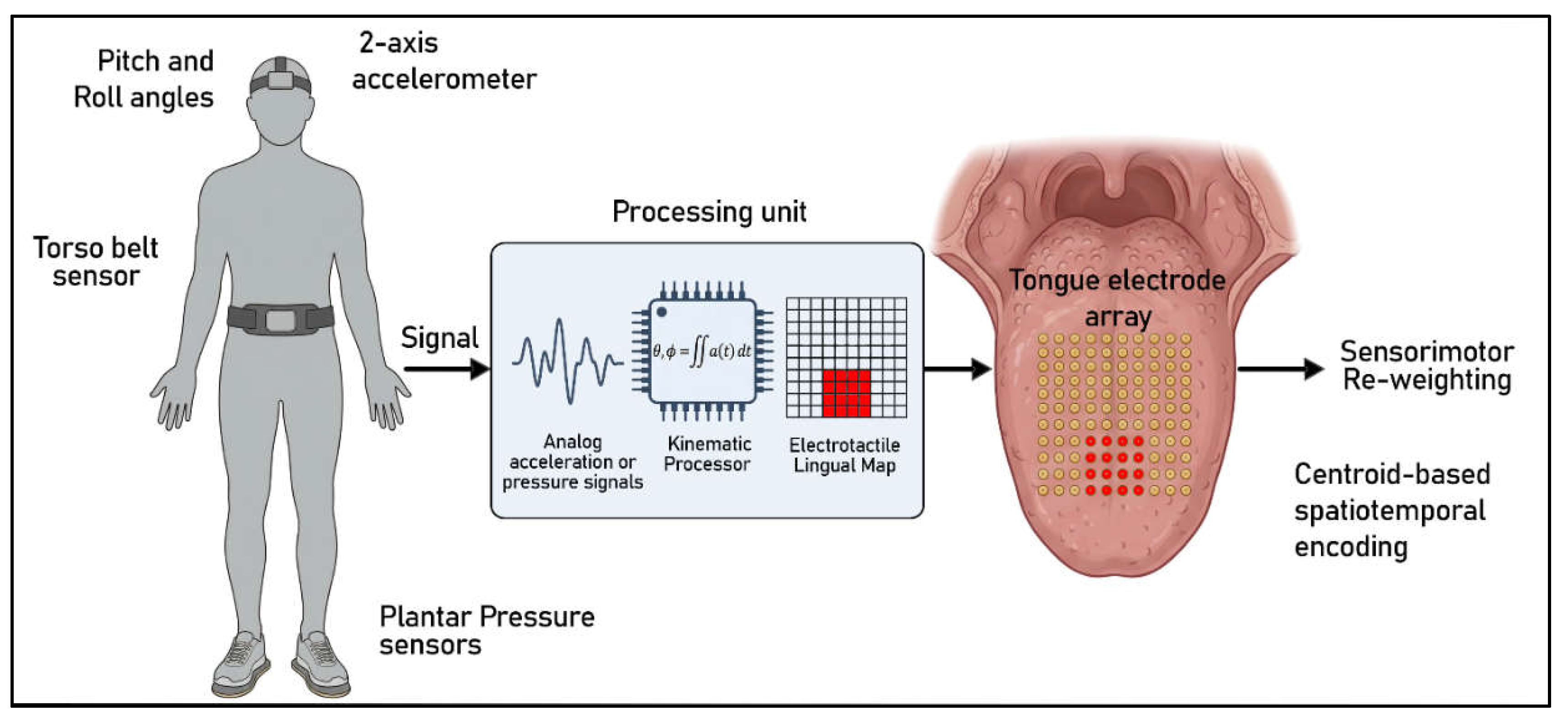
Figure 2.
Configuration of the balance belt vibrotactile feedback system for postural regulation. An array of tactors encircling the waist provides spatial sensory cues to the user. The device integrates inertial sensors for the continuous monitoring of trunk kinematics. The system is designed to detect multidirectional body tilt and sway, which trigger corresponding vibrotactile stimuli to compensate for sensory deficits. IMU, Inertial Measurement Unit; DOF, Degree of Freedom.
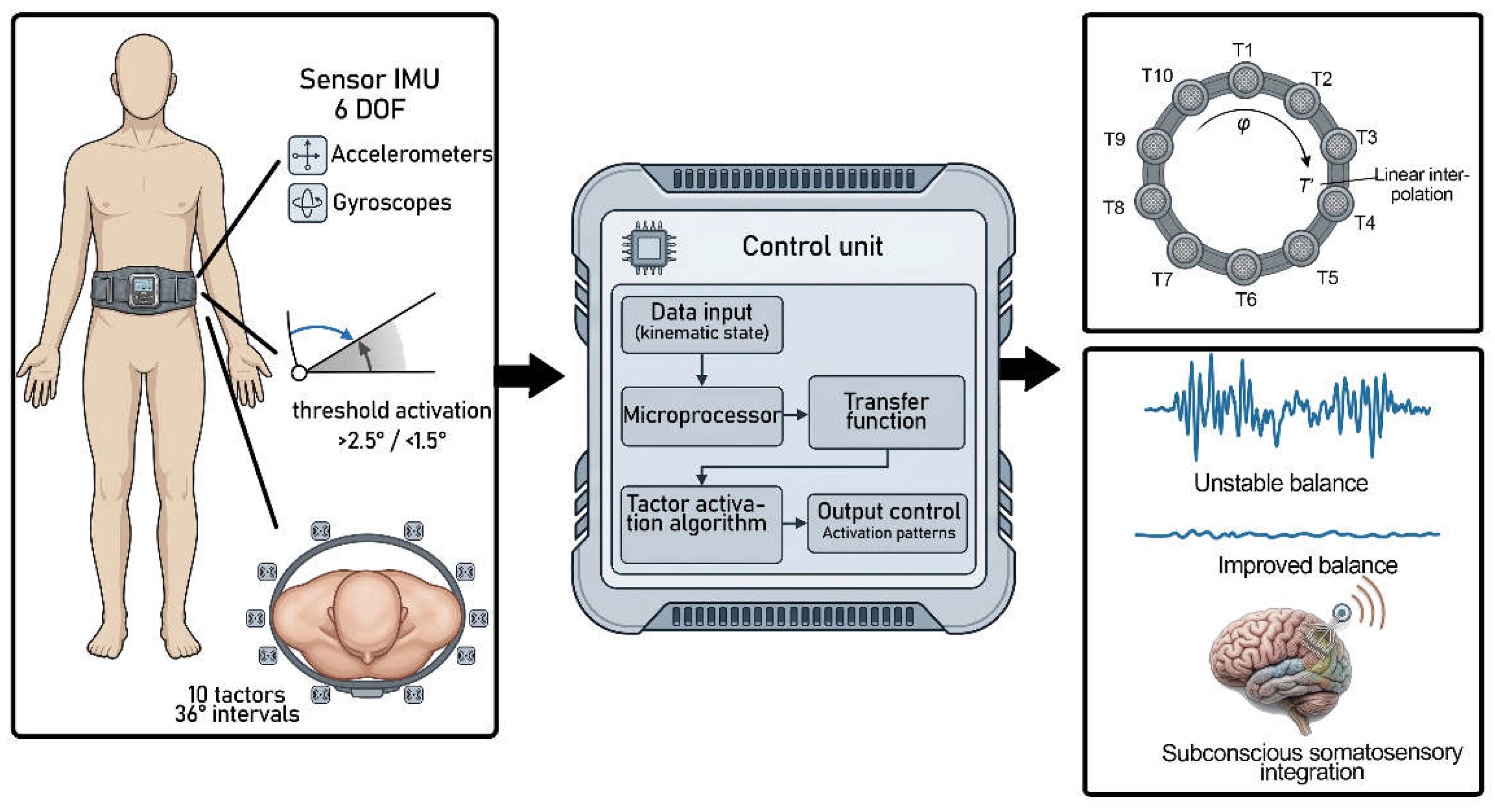
Figure 3.
Closed-loop haptic prosthetic for balance correction. Top: System components include an accelerometer for motion sensing, a processing unit for threshold-based analysis of CoM deviation, and a thimble-type vibrotactile actuator. Bottom: Operational sequence illustrating the detection of postural deviation (deviated CoM), followed by vibrotactile feedback delivery, and subsequent user correction toward an aligned posture (corrected CoM). The subtle vibrational stimuli serve as a sensory substitute for deficient proprioceptive or vestibular input.
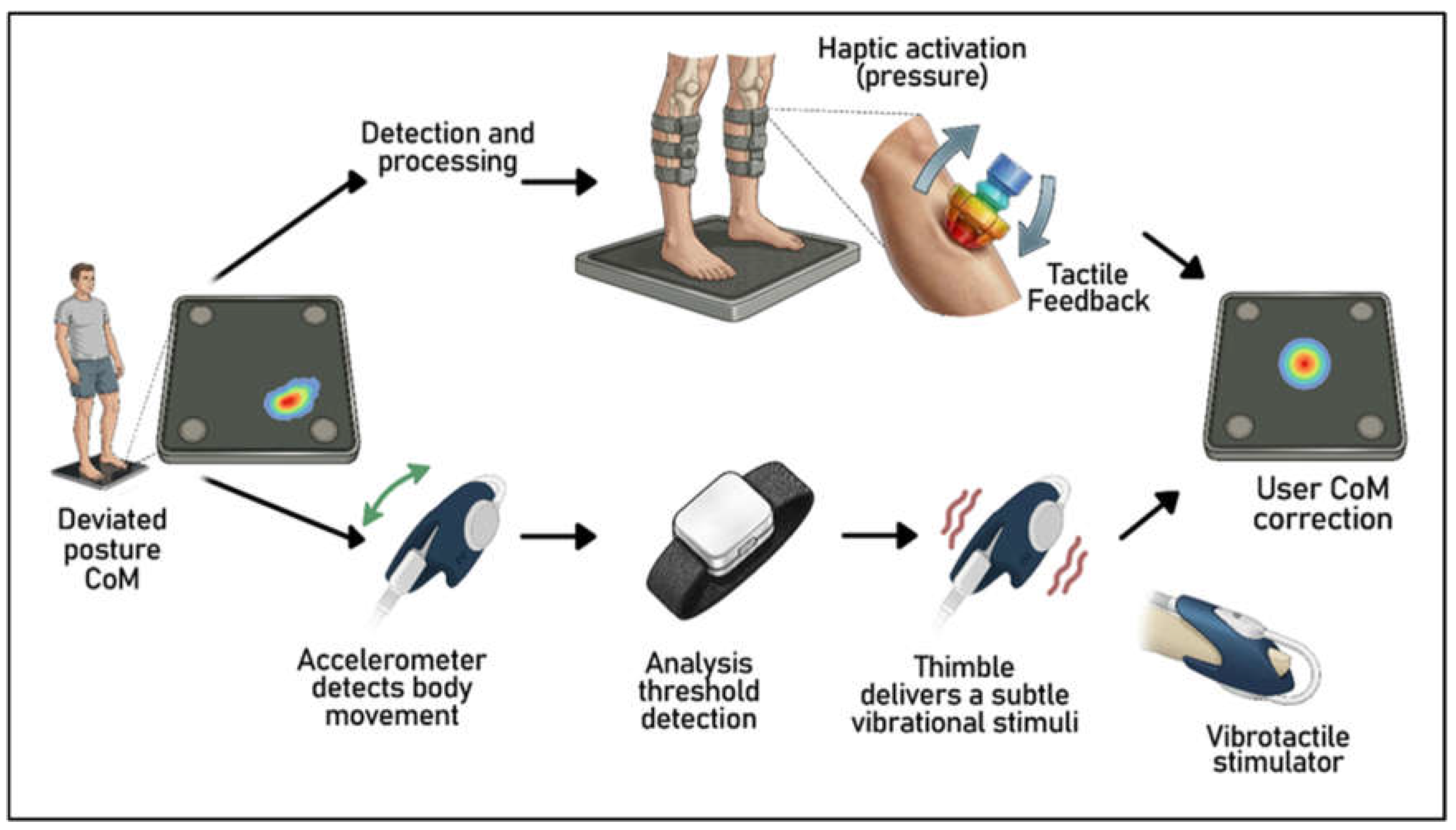
Figure 4.
System architecture of an AR-mediated visual feedback device for balance rehabilitation. An AR headset, equipped with eye tracking and IMU, continuously monitors head tilt and spatial orientation relative to vertical and horizontal references. The system detects postural imbalance resulting from vestibular dysfunction or proprioceptive deficits and responds by deploying targeted AR visual strategies. These strategies include an artificially stabilized horizon line, visual indicators for optimal alignment, and a real-time avatar representation of the user’s body. By superimposing these cues onto the user’s field of view and integrating CoP data, the device facilitates voluntary postural correction and enhances sensory reweighting.
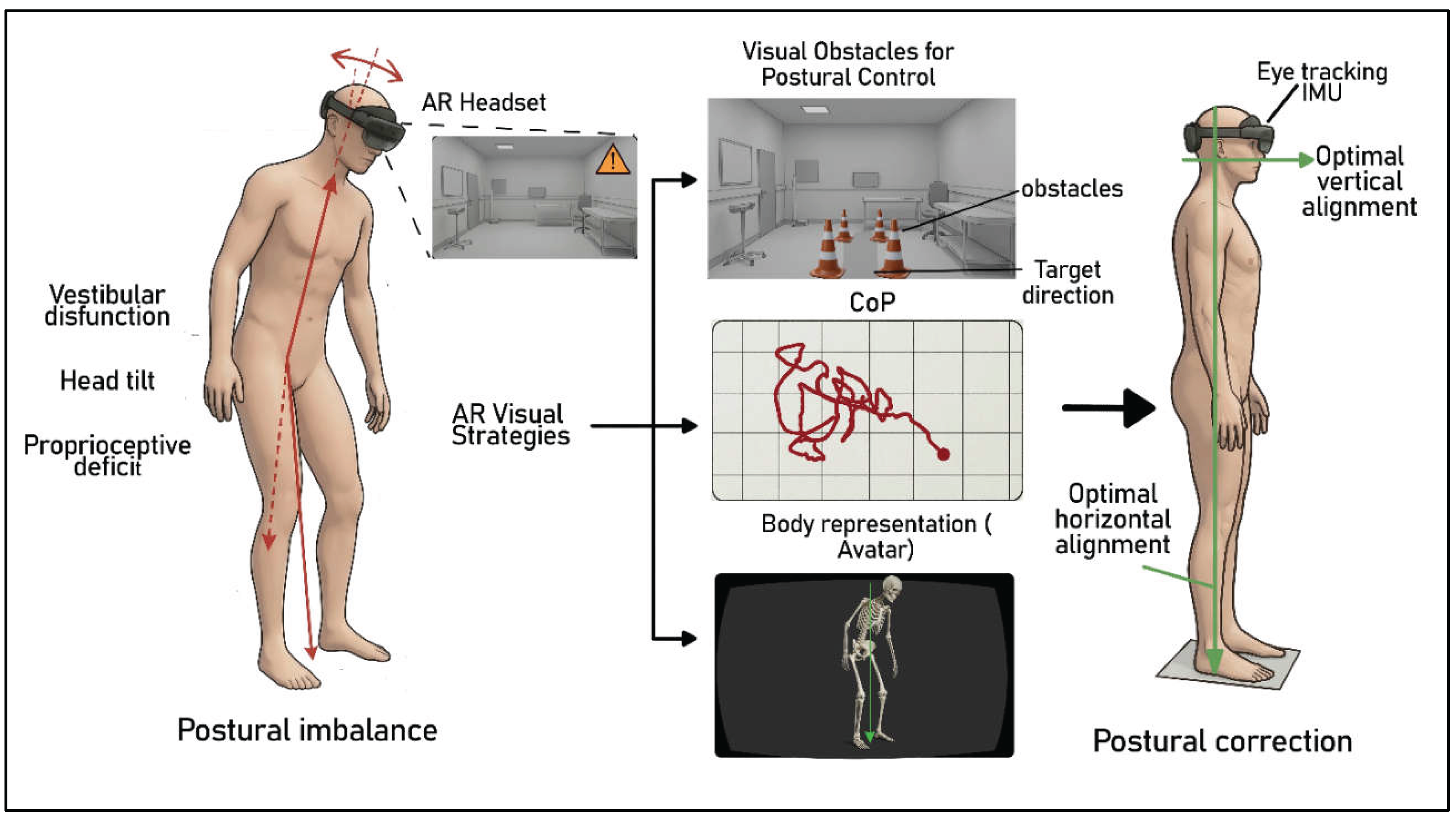
Figure 5.
GVS methodology and descending motor pathways implied in motor response. Left: the four basic stimulation waveforms are depicted with their respective parameters. Sinusoidal (sGVS) selectively targets irregular vestibular afferents; Pulsed (pGVS) delivers high-intensity, brief pulses; Direct Current (dcGVS) provides sustained polarization; and Noisy (nGVS) applies low-amplitude, zero-mean random noise (<30 Hz) to enhance afferent sensitivity via stochastic resonance. Middle: Bilateral bipolar electrode placement for transcraneal vestibular stimulation (1 Mastoid Process; 2: Forehead; 3: Mastoid Process; 4: Nape; 5: Temple; 6): Temple. Right panel: Brainstem relay and descending motor tracts involved in GVS-mediated balance regulation. Vestibular signals propagate via reticulospinal, vestibulospinal, and rubrospinal pathways to influence spinal motor output and postural adjustment.
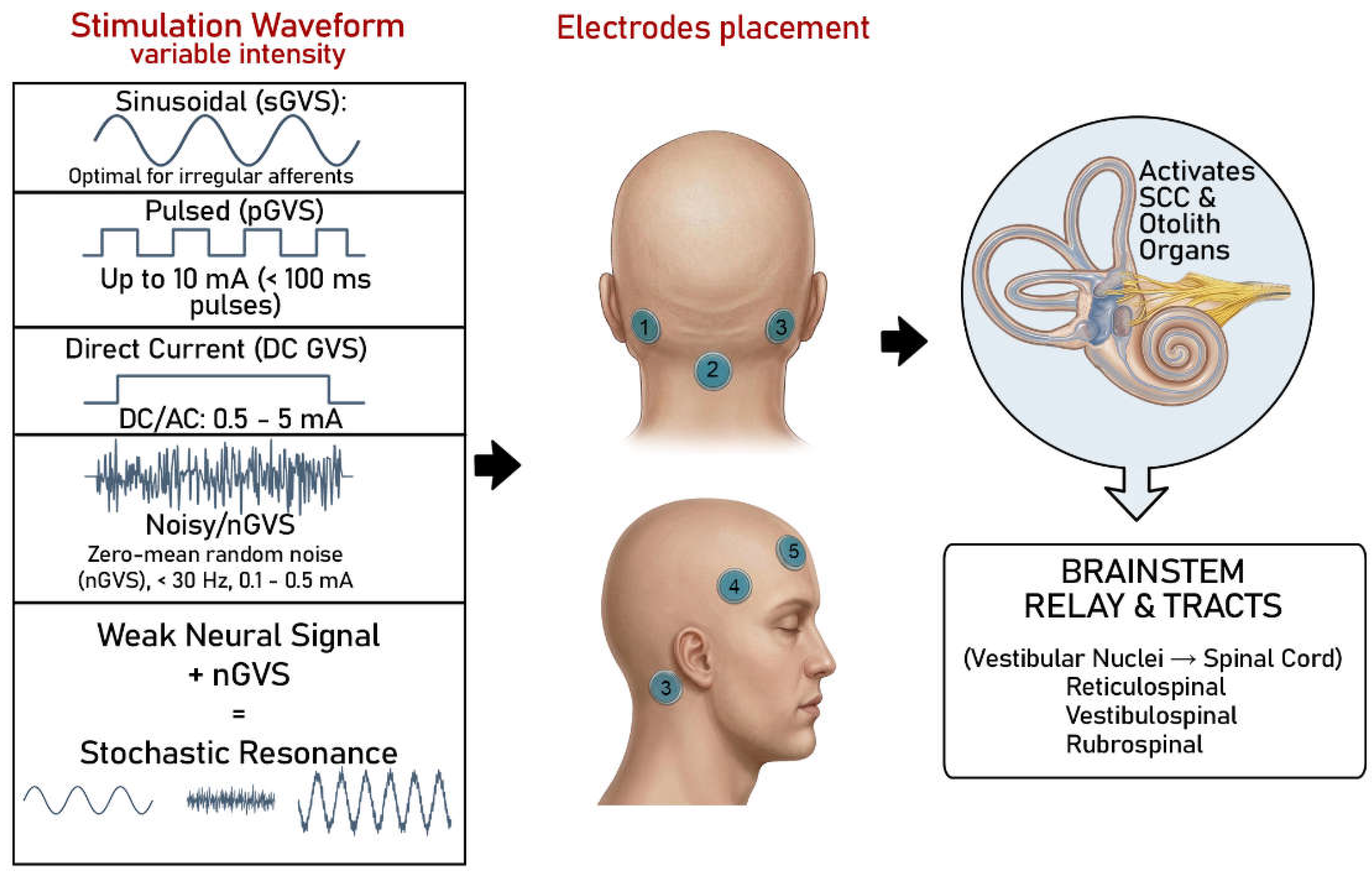

Table 1.
Prospective Medical Applications of GVS.
| Author | GVS | Subjects | Result |
| Wuehr et al., 2016 [127] | Transmastoid nGVS (sham trial) and nonzero-amplitude nGVS set to 80% of the individual cutaneous threshold for GVS. | BVH patients (n = 13) were tested while walking. | Improvement in walking in BVH patients was more notorious during slow stride than at a fast pace. Subthreshold nGVS did not provoke nystagmus, vertigo or pain to any participant. Results showed that GVS improved gait performance in pathological conditions |
| Iwasaki et al., 2018[128] | Transmastoid nGVS. | 19 healthy controls and 12 patients with BVH. | nGVS had significant effects on gait velocity, stride length and stride time in healthy subjects as well as in patients with bilateral vestibulopathy. |
| Chen et al., 2021 [129] | nGVS intensities (0–1000 μA). Amplitude determined by standing stability. | Ten BVH patients and 16 healthy participants. nGVS applied in straight walking and 2 Hz head yaw walking in light and dark conditions. |
In the light, the center of mass deviation decreased in straight walking for the BVH. In the dark, both healthy and BVH showed decreased lateral deviation during nGVS. The chest–pelvic ratio angle decreased significantly in BVH for 2 Hz head yaw walking with nGVS. nGVS reduced walking deviations in BVH patients. |
| Wuehr et al., 2023 [119] | nGVS (mean intensity 0.36 ± 0.16 mA). Optimized for each subject to stabilize in posturographic assessment. | Eleven patients with BVP (mean age: 54.0 ± 8.3 years, 7 females). |
nGVS effectively improves vestibular perceptual performance determined as direction recognition thresholds for head-centered roll tilt motion on a 6DOF motion platform. |
| Nguyen et al., 2023 [130] | GVS (sinusoidal, direct current, and noisy), amplitude (0.4, 0.8, and 1.2 mA), duration (5 and 30 min). |
Patients with either unilateral or BVH (n = 18) or cerebellar ataxia (n = 13) were enrolled in the study. | Patients with unilateral vestibulopathy experienced the most favorable change in dizziness perception and imbalance with nGVS or sinusoidal GVS at 0.4 mA, 30 min. Followed by DC GVS at 0.8 mA, 5 min. nGVS, use of 0.8-0.4 mA, for 30 min was most effective BVH and cerebellar ataxia patients. |
| Wuehr et al., 2024 [131] | Transmastoid nGVS of various levels from 0 to 0.7 mA. | BVH patients (n = 19) and paired controls. | Body sway response to nGVS were present in 63% of patients showing a bell-shaped function of Sway versus nGVS, thus indicating a stochastic resonance with optimal improvements of 31% at an average intensity of 0.3 mA. Patients with a stronger stochastic resonance-like response showed a clinically meaningful improvement of static balance. |
| Curry et al., 2024 [132] | vestibular nerve stimulation (VeNS) using Modius Sleep device 30 min daily for 4 weeks. | Randomized, sham-controlled, 147 participants with moderate to severe insomnia Insomnia Severity Index (ISI) ≥15. | After 4 weeks, mean ISI score reduction was greater in the VeNS than sham group. Mean ISI score decreases of 5.8 (95% CI [-6.8, -4.81], approaching the clinically meaningful threshold of a 6-point reduction. |
| Mitsutake et al., 2024 [133] | Square-wave transmastoid GVS of 3000 μA, and of 200 μA, and nGVS of 200 µA. | Twenty-six healthy volunteers two groups: balance training combined with nGVS and sham GVS. 9 consecutives 60 s GVS periods. | nGVS group showed significantly increased post-intervention in H-reflex amplitude. |
| King et al., 2025 [134] | nGVS amplitude ± 0.35 mA, wideband 0.001–300 Hz, bipolar mastoids and C4 reference, for 20 min three times weekly for six weeks. | 40 older adults randomly assigned to a Stimulation group (nEVS intervention) or Sham group. | Following a regimen of multiple GVS (nEVS in this work), improvements in balance persist for up to six months. This fact suggests the potential for long-term training effects, possibly due to neuroplastic changes in the vestibular system. |
| Fujimoto et al., 2025 [135] | Bipolar transmastoid. nGVS 100-2000 µA for 30s. | Randomized, double-blind, placebo-controlled in 39 patients with unilateral or bilateral peripheral vestibulopathy. | 30% of Patients demonstrated significantly greater reductions in stabilometry center of pressure velocity at 100 μA and 1700 μA. |
| Menon et al., 2025 [136] | GVS 0.1 mA, steps of 0.1 mA, until skin sensitivity. Two pole (transmastoid) and three pole (two additional electrodes on the temples). | 12 participants with Parkinson’s Disease (PD). | GVS improve visuomotor target tracking in individuals with PD. Both two pole and three pole stimulation were effective. Most effective stimulus across all subjects, was a waveform an envelope frequency of 30 Hz and a carrier frequency of 110 Hz, improved motor performance by 25% relative to the sham stimulus. |
| Oh et al., 2025 [137] | Bipolar transmastoid. Direct current (DC), 0.8 to 1.0 mA, 30 min daily for 10 days. | Single-blind, randomized, sham-controlled trial, 83 acute unilateral peripheral vestibulopathy (AUPV) patients, GVS (cathode on lesion side). | Improved visuospatial memory performance. Findings support GVS as a neuromodulatory intervention to enhance spatial memory and facilitate cognitive recovery in AUPV. |
| Cheung et al., 2025 [138] | Use of VeNS amplitude 0-1mA until subjects felt a swaying. Frequency 100 Hz. Modius Sleep device (Nurovalens®). |
Participants, 43 adults exhibiting insomnia symptoms, and paired 40 sham controls. underwent 20 VeNS sessions, one hour prior to bedtime during 30 min. |
Findings suggest that VeNS is effective in reducing insomnia severity and improving participants’ physical well-being immediately after the 4-week intervention and at the 3-month follow-up, compared to the sham VeNS group. |
(VeNS) Vestibular nerve stimulation; (AUPV) acute unilateral peripheral vestibulopathy; (ISI) Insomnia Severity Index.
Disclaimer/Publisher’s Note: The statements, opinions and data contained in all publications are solely those of the individual author(s) and contributor(s) and not of MDPI and/or the editor(s). MDPI and/or the editor(s) disclaim responsibility for any injury to people or property resulting from any ideas, methods, instructions or products referred to in the content. |
© 2026 by the authors. Licensee MDPI, Basel, Switzerland. This article is an open access article distributed under the terms and conditions of the Creative Commons Attribution (CC BY) license (http://creativecommons.org/licenses/by/4.0/).
Copyright: This open access article is published under a Creative Commons CC BY 4.0 license, which permit the free download, distribution, and reuse, provided that the author and preprint are cited in any reuse.