

Submitted:
26 March 2026
Posted:
26 March 2026
You are already at the latest version
Abstract
Dioecious plants often exhibit sex-specific physiological strategies that influence their re-sponse to environmental change. However, it is not well understood whether such di-morphism extends to the developmental trajectory of the photosynthetic apparatus during natural senescence. In this study, we compared the seasonal development and decline of photosystem II (PSII) function in naturally grown male and female Ginkgo biloba using non-destructive fast chlorophyll a fluorescence induction kinetics (OJIP) and JIP-test anal-ysis. Sun-exposed, healthy leaves were sampled at approximately 15‑day intervals from 18 July to 26 November 2024 [day of year, (DOY 188–332)]. The study monitored chloro-phyll content and OJIP-derived parameters, and evaluated sex differences statistically (P < 0.05). Chlorophyll content began to decline after DOY 268 in both sexes, but decreased ear-lier and more rapidly in males. By DOY 332, male chlorophyll content fell to 1.37 % of its level at DOY 268, whereas females retained 9.55 %. OJIP fluorescence transient analysis revealed that ΔWoj shifted from negative to positive values after DOY 268 in male plants, accompanied by a sustained increase in the relative variable fluorescence at the J step (Vj). This pattern indicates an earlier and more pronounced acceptor-side limitation of PSII in male plants, associated with accelerated accumulation of QA⁻ and restricted electron transfer from QA⁻ to QB and the plastoquinone (PQ) pool. In addition, male plants showed a clearer donor-side limitation, with a pronounced ΔWOK response, suggesting reduced stability of the oxygen-evolving complex (OEC). In contrast, females maintained higher cross-section–based energy fluxes (TR0/CS0, ET0/CS0) and PSI-end acceptor reduction ca-pacity (RE0/CS0), and exhibited a slower decline in integrated performance indices (PI abs, PI total, DF abs). Principal component analysis further suggested that male senescence trajectories were more tightly associated with changes in electron-transport efficiency, whereas females exhibited a more gradual adjustment in energy-flux allocation. Collec-tively, these results reveal pronounced sexual dimorphism in the PSII–PSI functional de-cline pathway during natural senescence in G. biloba and provide a physiological basis for sex-aware evaluation and utilisation of ginkgo resources.
Keywords:
dioecy
; Ginkgo biloba
; natural leaf senescence
; photosystem II
; photosynthetic performance
; OJIP fluorescence
; JIP-test
1. Introduction
Dioecious plants represent a distinctive group within the plant kingdom. They play important roles in maintaining ecological stability and biodiversity. Over the course of long-term growth and evolution, dioecious plants have developed pronounced sexual differences in their responses to environmental stresses, with distinct morphological traits and physiological regulatory strategies often observed between male and female individuals. For example, under conditions of imbalanced nitrogen (N) and phosphorus (P) deposition, male and female Populus cathayana exhibit significant sexual dimorphism in the accumulation of chemical compounds [1]. Therefore, exploring sexual dimorphism in dioecious plants not only deepens our understanding of the mechanisms underlying plant growth, reproduction, and environmental adaptation, but also provides an important theoretical basis for plant breeding, ecological restoration, and biodiversity conservation.
Plant growth and development depend on photosynthesis. Photosynthesis is the material basis of all material and energy metabolism in the biosphere. It involves a series of complex photophysical, photochemical and biochemical reactions. Photosystem II (PSII) is considered the most vulnerable component of the photosynthetic apparatus. During plant senescence, the photosynthetic rate usually undergoes significant changes [2]. Chlorophyll fluorescence measurement provides a non-destructive method for detecting the photochemical parameters of PSII. This technique offers an effective approach for studying the functional status of the photosynthetic electron transport chain and the performance of PSII during leaf development, and it also provides an important basis for evaluating plant growth. At present, chlorophyll fluorescence analysis has been widely used to assess the degree of plant damage caused by biotic and abiotic stresses in many species, including Oryza sativa [3], Populus euphratica [4], and Valeriana jatamansi [5]. In addition, it has also been applied in studies of natural plant senescence [6,7,8].
Ginkgo biloba is one of the oldest tree species on Earth and is often referred to as a “living fossil” in the plant kingdom. Among extant gymnosperms, Ginkgo biloba, as an ancient relict species, retains many primitive characteristics. Some of these features are relatively rare in gymnosperms but are common in ferns [9]. In addition, as a dioecious plant, male and female individuals of Ginkgo biloba exhibit significant differences in many aspects. For instance, Li et al. [10] documented significant differences between male and female trees in diameter at breast height (DBH), clear bole height (CBH), tree height, and stem volume.
Recent studies have documented sex-specific differences in photosynthetic performance and physiological traits of ginkgo under both stress and natural conditions. Under salt stress, chlorophyll fluorescence parameters (e.g., Fv/Fm and ΦPSII) as well as antioxidant responses have been analysed in ginkgo seedlings [11]. Previous work has also shown that male ginkgo plants exhibit stronger vegetative growth at the seedling stage [12]. However, the developmental dynamics of PSII function during leaf growth and natural senescence in ginkgo, and whether PSII functional development exhibits sexual dimorphism under natural conditions, remain largely unreported. In this study, non-destructive OJIP fluorescence induction kinetics and JIP-test analysis were used to systematically characterise PSII development and decline in male and female ginkgo leaves throughout the growing season. This study aims to advance understanding of sex-related differences in PSII functional dynamics during leaf development and senescence in ginkgo, with implications for photosynthesis research and ginkgo resource utilisation.
2. Materials and Methods
2.1. Plant Materials and Sampling
This study was conducted using naturally grown male and female Ginkgo biloba trees at Nanjing Forestry University. At each sampling event, we randomly collected healthy, undamaged leaves from different mature trees (>20 years old) at the same height on the sun-exposed side of the canopy. If leaf abscission occurred, a nearby leaf at the original position was selected for subsequent measurements. Sampling was conducted from 18 July to 26 November 2024 [day of year, (DOY 188–332)] at approximately 15-day intervals. All measurements were conducted with three biological replicates, and mean values were used for subsequent analyses. The climatic conditions recorded during the study period are presented in Figure 1.
2.2. Determination of Chlorophyll Content
Chlorophyll content was measured using the method described by Li et al. [13]. Fresh leaves were collected, and 0.2 g of leaf tissue was accurately weighed, then cut into small pieces. Samples were extracted in darkness using 10 mL of an ethanol:acetone mixture (v/v = 1:1) until complete decolorization. Chlorophyll content was calculated according to the equations described by Li et al. [13].
2.3. Measurement of Chlorophyll Fluorescence and JIP-Test Parameters
Chlorophyll fluorescence of intact ginkgo leaves was measured using a continuous excitation fluorometer (Handy PEA; Hansatech Instruments, UK). Measurements were conducted at 10:00 a.m. on the same leaves for each sampling date, with three replicates per date. Leaves were dark-adapted for 25 min, followed by illumination with a saturating red pulse (3000 μmol photons m−2 s−1). The instrument automatically recorded high-resolution fluorescence signals from 10 μs to 1 s to obtain the O–J–I–P induction transient. OJIP transient signals were processed using the bundled software and Microsoft Excel, from which fluorescence parameters were derived based on JIP-test analysis. Formulae and definitions for the parameters used are provided in Table 1.
2.4. Data Analysis
Chlorophyll fluorescence parameters were calculated using PEA Plus software provided with the Handy PEA fluorometer (Hansatech Instruments Ltd., Norfolk, UK). Data processing and visualization were carried out using Microsoft Excel 2019 (Microsoft Corp., Redmond, WA, USA) and Origin Pro 2021 (Origin Lab Corporation, Northampton, MA, USA). Statistical analyses were performed using IBM SPSS Statistics 26 (IBM Corp., Armonk, NY, USA). Differences among sampling dates within each sex were assessed using one-way ANOVA followed by Tukey’s post hoc test (P < 0.05). Sex differences on the same sampling day were evaluated using independent-samples t tests. Data are presented as mean ± SE.
3. Results
3.1. Male and Female Differences in Chlorophyll Content of Ginkgo
During the study period, no extreme events were observed in either temperature or precipitation, and the conditions were similar to the natural growth environment of Ginkgo biloba, providing favorable conditions for its growth (Figure 1).
Significant differences in chlorophyll content between male and female leaves were observed throughout leaf development and senescence (Figure 2). Between DOY 188 and 251, chlorophyll content was consistently higher in male leaves than in female leaves, with significant differences observed at most sampling dates (DOY 188, 217, and 236). The chlorophyll content of male plants began to decline from DOY 251, whereas the chlorophyll content of female plants began to decline from DOY 268. However, a significant decrease was observed in both sexes only from DOY 280 (P < 0.05). Therefore, it can be preliminarily inferred that the senescence process of both male and female plants began around DOY 268. However, after DOY 268, male plants appeared to show a faster rate of senescence. By DOY 332, the chlorophyll content of male plants was only 1.37% of that at DOY 268 and 3.46% of that at DOY 312, whereas the chlorophyll content of female plants was 9.55% and 20.13% of the values at DOY 268 and DOY 312, respectively.
3.2. Male and Female Differences in OJIP Transients during Natural Senescence in Ginkgo
The measured fluorescence intensities were normalized, and the relative variable fluorescence curves (Vt) were plotted separately for female and male plants (Figure 3a and 3b). Under natural conditions, the fluorescence induction curves of both female and male plants showed the typical OJIP transient. However, differences among measurement dates were still observed at specific phases of the curves. During the OJ phase (0.00002–0.002 s), the separation among the curves measured on different dates was generally more pronounced in male plants than in female plants. In female plants, the J step showed a clear increase on DOY 312 and DOY 332, whereas in male plants this increase was observed only on DOY 332. In the JI phase, the curves of male plants showed larger differences among measurement dates compared with female plants. The fluorescence curves in male plants were clearly separated in this phase, and some curves displayed an evident elevation, suggesting temporal differences in the electron transport processes downstream of PSII. In contrast, the curves of female plants were more closely grouped in the JI phase and showed a relatively consistent rise, indicating a more stable electron transport from QA− to the plastoquinone (PQ) pool. After DOY 312, the relative variable fluorescence (Vt) of female plants showed an increase at the J step and a decrease at the I step. In contrast, the curves near the P step were generally similar among different measurement dates, with only small differences in the maximal fluorescence level.
3.3. Male and Female Differences in ΔWoj and ΔWok of Ginkgo
In male plants, ΔWOJ exhibited pronounced temporal variation. Before DOY 251, ΔWOJ showed negative deviations, whereas after DOY 268 it shifted to positive deviations (except DOY 298) and reached higher peaks than in females on the same dates (Figure 3b, 3e). This temporal pattern coincided with the decline in chlorophyll content in male plants and was accompanied by indications of enhanced QA− accumulation and increasing limitation of electron transfer from QA− to QB. Female plants exhibited a smaller ΔWOJ amplitude overall. Although slight deviations from zero were detectable, peak values were constrained and returned to near zero more rapidly, and differences among sampling dates were relatively weak. In addition,, although female chlorophyll content began to decline at DOY 268, acceptor-side limitation did not become apparent until DOY 312.
In male plants, ΔWOK exhibited pronounced upward curvature on DOY 268 and DOY 280, whereas positive deviations were also present on DOY 312 and DOY 332 but were more variable (Figure 3c, 3f). Female plants did not show obvious sustained upward curvature in ΔWOK, but exhibited stronger fluctuations and dispersion than males after DOY 298. Overall, female plants exhibited reduced KI-phase amplitude and mixed positive and negative responses, indicative of relatively limited variation in electron transfer from QA− to downstream acceptors (the PQ pool and PSI).
3.4. Male and Female Differences in Photosynthetic Energy and Electron Fluxes of Ginkgo
During natural senescence, the specific activity parameters of male and female Ginkgo biloba leaves showed significant changes with time, and the differences between the sexes gradually appeared at the later stage of senescence (Figure 4a, 4d). DOY 268 was used as the dividing point, and the photosynthetic parameters of male and female plants showed a significant stage change. Before DOY 268, the chlorophyll content of both male and female plants remained high, indicating a strong capacity for light absorption, which was consistent with the results of ABS/CS0. However, the values of ABS/CS0, TR0/CS0 and ET0/CS0 in female plants were higher than those in male plants, indicating that female plants had stronger capacities for light absorption, energy trapping and electron transport at this stage. In addition, the value of RE0/CS0 in female plants remained at a relatively high level, whereas RE0/CS0 in male plants showed a decreasing trend, indicating that differences between the sexes had already appeared in the potential of electron transport at the PSI acceptor side.
After DOY 268, the chlorophyll content of both male and female plants showed a decrease, and ABS/CS0 also showed a decrease. These results indicate that the capacity for light absorption decreased. However, differences between male and female plants were observed in the changes of the photosynthetic parameters. In male plants, TR0/CS0, ET0/CS0 and RE0/CS0 showed a rapid decrease after DOY 268, whereas DI0/CS0 remained at a relatively high level. In contrast, although ABS/CS0 in female plants also showed a decreasing trend, the decreases of TR0/CS0 and ET0/CS0 were smaller, and RE0/CS0 remained at a relatively high level at the later stage (Table A1 and Table A2). The results in Figure 4a and Figure 4d further indicate that, after DOY 268, the values of the photosynthetic parameters in male plants showed a significant decrease, whereas the decrease in female plants was smaller and the values remained relatively stable. These results indicate that the differences in photosynthetic parameters between male and female plants may be related to different use of light energy during the decrease of chlorophyll content.
3.5. Male and Female Differences in Photosynthetic Performance Indices of Ginkgo
During DOY 188–251, DF abs, PI total, PI abs, Fv/Fm and Fv/F0 in both male and female plants remained at relatively high levels (Figure 4b, Figure 4e), and only small changes were observed with time. Overall, the values of DF abs and PI parameters in female plants were slightly higher than those in male plants at most measurement dates, indicating that female plants had higher overall photosynthetic performance. In addition, the parameters related to the maximum photochemical efficiency of PSII in both male and female plants remained relatively stable during this stage.
After DOY 268, the above fluorescence parameters in both male and female plants showed a decreasing trend, but significant differences between the sexes were observed (Table A1 and Table A2). The parameters in male plants showed a rapid decrease after DOY 268. By DOY 312, DF abs had decreased to negative values, and PI total and PI abs reached the lowest levels. At the same time, Fv/Fm and Fv/F0 showed a significant decrease, indicating that the efficiency of energy conversion and the potential activity of PSII were reduced. In contrast, although the parameters in female plants also showed a continuous decrease after DOY 268, the decrease was slower. DF abs decreased to below 0 only at DOY 332, and on the same date the values of PI total and PI abs remained higher than those in male plants, indicating that the overall performance of the photosynthetic apparatus in female plants remained higher at the later stage.
3.6. Male and Female Differences in Energy Flux and Reaction Center Characteristics of Ginkgo
During DOY 188–251, the JIP-test parameters in both male and female plants showed only small changes (Table A1 and Table A2). The values of Wk, Vj, VI and Vk remained at relatively low levels, whereas φR0, φE0 and ΔVIP remained at relatively high levels, indicating that the limitation on the donor side of PSII was low and that the electron transport from QA− to the PSI end acceptors remained relatively high. During this stage, the values of the parameters in male and female plants were similar, and only small differences were observed at some measurement dates, indicating that the structure and function of the photosynthetic apparatus remained relatively stable in both male and female plants during this period.
After DOY 268, the JIP-test parameters in both male and female plants showed significant changes, and significant differences between the sexes were also observed in the magnitude and direction of these changes (Table A1 and Table A2). In male plants, after DOY 268, Wk, Vj and Vk showed an increase, whereas φR0, φE0 and ΔVIP showed a continuous decrease. At the same time, the fluctuations of δR0 and Vi became more pronounced, indicating that the limitation on the donor side of PSII increased and that the efficiency of electron transport decreased, resulting in a reduction in the overall stability of the photosynthetic apparatus. In contrast, although female plants also showed increases in Wk, Vj and Vk and decreases in φR0, φE0 and ΔVIP after DOY 268, the overall changes were smaller. The values of φR0 and φE0 in female plants remained higher than those in male plants during DOY 268–332, and the decrease of ΔVIP was slower, indicating that the electron transport from PSII to the PSI end acceptors in female plants was maintained for a longer time during senescence. At the same time, the fluctuations of δR0 and Vi in female plants were smaller than those in male plants, indicating that the photosynthetic apparatus in female plants remained more stable during senescence (Figure 4c, Figure 4f)
These results indicate that, before DOY 268, the photosynthetic apparatus in both male and female plants remained relatively stable. After DOY 268, however, the parameters showed unfavorable changes, and the changes were more pronounced in male plants. These differences between the sexes may be related to the decrease in chlorophyll content after DOY 268 and to different responses of male and female plants to the limitation of the photosynthetic apparatus and the changes in electron transport efficiency during senescence.
3.7. Principal Component Analysis
Principal component analysis indicated that the first two principal components adequately explained the variation in OJIP-derived fluorescence parameters in both sexes. In the male plants, PC1 and PC2 accounted for 60.2% and 23.7% of the total variance, respectively. In the female plants, PC1 and PC2 accounted for 63.4% and 20.3% of the total variance, indicating that the major variance structures between sexes were broadly similar (Figure 5).
Principal component analysis (PCA) showed that the first two principal components explained most of the variation in the chlorophyll fluorescence parameters of male and female Ginkgo biloba plants In male plants, positive loadings on PC1 were mainly associated with ΦE0 and DF abs, whereas negative loadings were related to Vj and δR0, indicating that PC1 largely reflected variation in PSII electron transport efficiency and acceptor-side characteristics. Samples collected at different dates were clearly separated along PC1, suggesting temporal changes in the functioning of the photosynthetic apparatus during the season. In contrast, in female plants, ET0/CS0 and TR0/CS0 contributed most strongly to positive loadings on PC1, while δR0 and Vj were associated with negative loadings. Female samples tended to cluster more closely along this axis, although differences among sampling dates were still evident.
Across both sexes, PC2 showed strong positive loadings for PI total and ΦR0 together with negative loadings for Vi, Vk, Wk and δR0, indicating that this component was mainly related to variation in reaction-center function, PSI end-acceptor activity and OJIP fluorescence kinetics. The contrasting loading patterns observed on PC1 between male and female plants further indicate different associations with fluorescence parameters, with male plants more closely related to changes in electron transport efficiency, whereas female plants were more associated with variation in energy fluxes.
4. Discussion
The integrity of the photosynthetic electron transport chain is essential for maintaining the stability of the photosystems in leaves. During leaf senescence, changes in different steps of the electron transport chain may influence the rate at which overall photosynthetic performance declines. Leaf senescence typically begins with the loss of chlorophyll and the gradual degradation of antenna complexes. These processes reduce the capacity for light absorption and place increasing pressure on downstream electron transport processes [14]. In Ginkgo biloba, autumn senescence is associated with reduced expression of chlorophyll biosynthesis genes and enhanced expression of degradation genes, resulting in a gradual loss of chlorophyll [15]. In the present study, the decline in chlorophyll content was observed from DOY 268 in both sexes, with an earlier and more rapid decline in males. Although ABS/CS0 declined markedly from DOY 268 in both sexes, females maintained higher values, suggesting a more stable antenna system during senescence. In perennial woody plants, variation in antenna maintenance during senescence can strongly influence the accumulation of photosystem damage [16], which may partly explain the slower functional decline observed in female ginkgo.
After light absorption, the trapping efficiency of PSII reaction centers largely determines the entry of electrons into the transport chain. Parameters such as Fv/Fm, Fv/F0, and TR0/CS0 are therefore widely used to assess maximal PSII photochemical efficiency and reaction-center activity [17,18]. Previous studies have shown that chlorophyll fluorescence parameters in Ginkgo biloba respond sensitively to changes in light environment, indicating that PSII activity and overall photosynthetic efficiency are strongly influenced by environmental conditions [19]. In the present study, these parameters remained high and relatively stable from DOY 188 to 251 in both sexes, suggesting that PSII function was generally maintained during this period. As senescence progressed, however, significant differences between sexes began to emerge. After DOY 268, male plants showed more pronounced decline, whereas females still maintained relatively high values even at DOY 332. Excess light can induce photoinhibition of PSII, usually expressed as a reduction in Fv/Fm [20]. In contrast to acute photo inhibitory damage, the declines in maximal PSII efficiency during natural senescence typically occur gradually [2]. In our study, females maintained higher photochemical efficiency during late senescence, indicating greater stability of PSII function.
During senescence, the acceptor side of PSII represents one of the most sensitive segments of the electron transport chain, particularly the transfer of electrons from QA− to QB and the plastoquinone pool. ΔWoj and Vj therefore serve as sensitive indicators of acceptor-side restriction [21]. Chlorophyll fluorescence measurements can capture these changes, including acceptor-side limitation, OEC impairment, and shifts in energy dissipation. Their responses under abiotic stresses such as drought and salinity are often similar to the electron-transport changes observed during natural senescence [22]. In the present study, male plants showed a significant shift of ΔWoj to positive values after DOY 268, accompanied by increases in Vj, indicating accelerated QA− accumulation and restricted electron transport. In contrast, females exhibited smaller changes and a later onset of pronounced limitation. Consistent with this pattern, ET0/CS0 and ΦE0 also remained relatively higher in females, suggesting better maintenance of electron-transport efficiency during senescence. Because acceptor-side restriction can accelerate PSII damage and enhance senescence effects [23], the greater stability of this step in females may contribute to their maintenance of photosystem function.
Beyond the acceptor side, the efficiency of the donor side and the stability of the oxygen-evolving complex (OEC) are also important for maintaining PSII function during senescence. Wk and ΔWok are frequently used to evaluate donor-side impairment [24]. In the present study, male plants showed more positive ΔWok deviations after DOY 268, indicating increased donor-side limitation, whereas female plants exhibited smaller fluctuations without sustained abnormal elevation. Because the integrity of the OEC is essential for maintaining PSII activity, early OEC dissociation can accelerate the overall breakdown of the photosystem [25]. These results suggest that stronger donor-side stability in female plants may contribute to the slower loss of PSII function during late-season senescence, as reflected by approximately 23% lower Wk values and 43% higher Fv/Fm values in female plants compared with male plants at DOY 332 (Table A1 and Table A2).
The continuity of photosynthetic electron flow largely depends on the functional status of PSI and the capacity of downstream electron acceptors [26]. Parameters such as δR0, ΦR0 and RE0/CS0 reflect the ability of electrons to move from PSII through the electron transport chain to PSI and its terminal acceptors [27]. In the present study, these parameters declined markedly in male plants from DOY 268. By comparison, female plants maintained higher values and showed a more gradual decrease in ΔVIP, which reflects the reduction of the PSI end-acceptor pool. Because the stability of the PSI acceptor side is important for preventing excessive electron accumulation and the resulting oxidative stress associated with photosystem imbalance [28], the higher stability observed in females may contribute to better preservation of the overall photosynthetic electron transport chain during senescence.
Integrated indices such as PI abs, PI total, and DF abs summarize changes across multiple steps of the electron transport chain. Previous ecological studies have shown that JIP-test–derived parameters can effectively reflect systemic changes in the photosynthetic apparatus and therefore serve as reliable indicators of overall plant vitality and stress responses [29]. In the present study, both sexes showed declines in these indices from DOY 268; however, the decrease was more pronounced in males. In particular, DF abs values in male plants became negative earlier, whereas female plants remained above zero until DOY 332. This further indicates that female plants are able to maintain photosynthetic function more effectively during senescence.
PCA revealed that although male and female plants followed broadly similar trajectories in overall photosystem functional shifts, the parameters associated with the principal components differed between sexes. Male trajectories were more closely linked to parameters related to electron-transport efficiency, suggesting that the intersystem electron-transfer step may be particularly sensitive during senescence. In contrast, female trajectories were associated with gradual changes in energy-flux parameters. Taken together, these results suggest that female plants maintain photosynthetic function more effectively during natural senescence.
5. Conclusions
This study utilised OJIP fluorescence kinetics and JIP-test analysis under natural growth conditions to reveal pronounced sexual dimorphism in the PSII–PSI functional decline pathway during leaf senescence in Ginkgo biloba. Although both sexes began senescing around DOY 268, male plants exhibited earlier and stronger limitations on both the acceptor and donor sides, accompanied by a rapid reduction in electron transport to PSI end acceptors and sharper declines in integrated performance indices. In contrast, female plants maintained relatively higher antenna function, cross-section–based energy fluxes, and PSI end-acceptor reduction capacity, resulting in a slower deterioration of overall photosynthetic performance.
Overall, these results indicate significant sex-specific differences in photosystem regulation during senescence in Ginkgo biloba. The greater stability of light absorption, electron transport, and downstream electron acceptor capacity in female plants may contribute to their slower decline in photosynthetic performance. These findings highlight the importance of plant sex in future studies of Ginkgo resource utilization, stress resistance, and ecological adaptation.
Supplementary Materials
The following supporting information can be downloaded at: https://www.mdpi.com/article/doi/s1, Figure S1: title; Table S1: title; Video S1: title.
Author Contributions
Conceptualization, K.Z. and D.S.; methodology, F.C. and M.H.; software, F.C.; validation, F.C., M.H. and X.L.; formal analysis, F.C.; investigation, F.C. and X.L.; resources, K.Z. and D.S.; data curation, F.C.; writing—original draft preparation, F.C.; writing—review and editing, K.Z. and D.S.; visualization, F.C.; supervision, K.Z. and D.S.; project administration, K.Z.; funding acquisition, D.S. All authors have read and agreed to the published version of the manuscript.
Funding
This research was funded by the National Natural Science Foundation of China [31300572], the Priority Academic Program Development of Jiangsu Higher Education Institutions (PAPD).
Institutional Review Board Statement
Not applicable.
Informed Consent Statement
Not applicable.
Data Availability Statement
The data presented in this study are available in the article.
Acknowledgments
The authors would like to thank Nanjing Forestry University for providing the research facilities and support for this study.
Conflicts of Interest
The authors declare no conflicts of interest.
Abbreviations
The following abbreviations are used in this manuscript:
| DOY | Day Of Year |
Appendix A

Table A1.
Chlorophyll fluorescence parameters of male plants measured on different days of year (DOY). Values are means ± standard error (SE). Different lowercase letters within the same row indicate significant differences among sampling dates (P < 0.05).
Table A1.
Chlorophyll fluorescence parameters of male plants measured on different days of year (DOY). Values are means ± standard error (SE). Different lowercase letters within the same row indicate significant differences among sampling dates (P < 0.05).
| DOY | 188 | 206 | 217 | 236 | 251 | 268 | 280 | 298 | 312 | 332 |
|---|---|---|---|---|---|---|---|---|---|---|
| DF abs | 0.696±0.022ab | 0.764±0.053a | 0.611±0.027b | 0.623±0.031b | 0.519±0.026c | 0.377±0.021d | 0.286±0.015e | 0.132±0.005f | -0.023±0.002g | -0.996±0.050h |
| PI total | 3.376±0.169b | 3.740±0.115a | 1.485±0.054cd | 1.666±0.059c | 1.578±0.079cd | 0.607±0.027e | 0.710±0.035e | 1.255±0.045d | 1.576±0.064cd | 0.175±0.009f |
| PI abs | 4.913±0.319b | 5.744±0.287a | 4.081±0.183c | 4.143±0.219c | 3.314±0.166d | 2.393±0.120e | 1.925±0.096ef | 1.354±0.075fg | 0.950±0.052g | 0.101±0.005h |
| (ΦP0) Fv/Fm | 0.322±0.016c | 0.181±0.009d | 0.336±0.017bc | 0.321±0.016c | 0.324±0.013c | 0.381±0.020b | 0.378±0.019b | 0.183±0.012d | 0.359±0.016bc | 0.439±0.022a |
| Fv/F0 | 0.409±0.020f | 0.407±0.020f | 0.436±0.022ef | 0.479±0.029cdef | 0.475±0.024def | 0.501±0.017cde | 0.556±0.028bc | 0.545±0.031bcd | 0.620±0.038b | 0.743±0.041a |
| Wk | 0.753±0.023b | 0.768±0.039b | 0.839±0.056ab | 0.854±0.043ab | 0.822±0.054ab | 0.907±0.059a | 0.877±0.044ab | 0.794±0.028ab | 0.775±0.043b | 0.831±0.042ab |
| Vj | 0.410±0.020c | 0.396±0.020c | 0.273±0.009d | 0.284±0.014d | 0.324±0.013d | 0.204±0.012e | 0.269±0.013d | 0.474±0.015b | 0.626±0.031a | 0.634±0.032a |
| Vi | 0.591±0.030a | 0.593±0.030a | 0.562±0.017ab | 0.525±0.029abc | 0.525±0.026abc | 0.493±0.018bc | 0.447±0.027cd | 0.449±0.023cd | 0.377±0.017d | 0.266±0.013e |
| δR0 | 0.049±0.002c | 0.046±0.002e | 0.050±0.003c | 0.058±0.003c | 0.053±0.003c | 0.058±0.003b | 0.024±0.001b | 0.021±0.001d | 0.082±0.004b | 0.112±0.006a |
| ΔVIP | 0.848±0.026a | 0.811±0.028a | 0.836±0.050a | 0.853±0.047a | 0.814±0.045a | 0.855±0.047a | 0.835±0.040a | 0.759±0.018a | 0.782±0.055a | 0.516±0.029b |
| Vk | 5.826±0.205a | 4.145±0.157d | 5.059±0.290bc | 5.482±0.146ab | 4.601±0.204cd | 5.778±0.116a | 5.740±0.282a | 3.249±0.113e | 3.561±0.145e | 1.066±0.046f |
| ΦR0 | 0.207±0.005a | 0.191±0.007ab | 0.127±0.004d | 0.126±0.008d | 0.142±0.006d | 0.087±0.001e | 0.101±0.007e | 0.162±0.006c | 0.182±0.009b | 0.087±0.002e |
| ΦE0 | 0.503±0.013a | 0.470±0.017ab | 0.476±0.012ab | 0.440±0.014bc | 0.439±0.013bc | 0.423±0.015cd | 0.381±0.014de | 0.342±0.015e | 0.295±0.009f | 0.135±0.005g |
| RE0/RC | 0.360±0.009b | 0.201±0.006e | 0.211±0.006de | 0.190±0.007e | 0.207±0.008e | 0.214±0.004de | 0.239±0.012d | 0.308±0.011c | 0.419±0.015a | 0.327±0.012c |
| ABS/CS0 | 519.513±15.978d | 341.26±8.531e | 647±29.649a | 588±11.76bc | 625±27.243ab | 555.9±27.25cd | 535±16.05cd | 244.693±10.023f | 161.65±5.111g | 144.053±6.078g |
| DI0/CS0 | 76.150±1.923cd | 65.487±1.368ef | 107.254±2.124a | 89.344±2.264b | 113.470±2.846a | 81.479±2.024c | 81.486±2.037c | 59.165±2.071f | 35.373±1.040g | 71.764±1.880de |
| TR0/CS0 | 446.595±13.398d | 278.759±8.199e | 540.808±14.308a | 496.396±17.491bc | 518.732±15.639ab | 464.626±12.255cd | 452.540±11.427d | 189.032±5.671f | 125.562±4.970g | 75.197±1.560h |
| ET0/CS0 | 262.958±4.030b | 161.498±4.950e | 307.803±4.687a | 263.364±7.577b | 269.606±6.762b | 230.528±8.150c | 204.373±4.198d | 84.366±1.293f | 46.053±1.886g | 20.352±0.719h |
| RE0/CS0 | 107.385±2.250a | 65.653±2.253d | 82.942±2.074b | 74.589±1.548c | 88.014±2.186b | 48.306±1.708f | 54.317±1.958e | 40.691±0.841g | 29.324±1.217h | 12.991±0.444i |
Table A2.
Chlorophyll fluorescence parameters of female plants measured on different days of year (DOY). Values are means ± standard error (SE). Different lowercase letters within the same row indicate significant differences among sampling dates (P < 0.05).
Table A2.
Chlorophyll fluorescence parameters of female plants measured on different days of year (DOY). Values are means ± standard error (SE). Different lowercase letters within the same row indicate significant differences among sampling dates (P < 0.05).
| DOY | 188 | 206 | 217 | 236 | 251 | 268 | 280 | 298 | 312 | 332 |
|---|---|---|---|---|---|---|---|---|---|---|
| DF abs | 0.771±0.039a | 0.780±0.042a | 0.731±0.037a | 0.621±0.023b | 0.584±0.021bc | 0.527±0.029cd | 0.485±0.024d | 0.521±0.033cd | 0.113±0.006e | -0.141±0.007f |
| PI total | 3.481±0.174a | 3.720±0.187a | 1.559±0.057d | 1.693±0.076d | 1.651±0.106d | 1.029±0.037e | 2.281±0.125c | 3.050±0.154b | 2.553±0.169c | 1.783±0.089d |
| PI abs | 5.900±0.295ab | 6.183±0.410a | 5.313±0.224b | 4.240±0.212c | 3.751±0.137cd | 3.400±0.121de | 3.067±0.168e | 3.230±0.163de | 1.301±0.058f | 0.722±0.036f |
| (ΦP0) Fv/Fm | 0.848±0.030a | 0.842±0.047a | 0.832±0.038a | 0.846±0.038a | 0.831±0.029a | 0.842±0.043a | 0.801±0.046a | 0.774±0.031a | 0.810±0.041a | 0.739±0.037a |
| Fv/F0 | 5.411±0.166a | 5.433±0.157a | 5.364±0.276a | 5.394±0.189a | 5.006±0.233a | 4.933±0.232a | 4.181±0.105b | 3.583±0.164c | 4.115±0.158bc | 2.932±0.171d |
| Wk | 0.326±0.016ab | 0.321±0.167ab | 0.332±0.008ab | 0.325±0.012ab | 0.315±0.017ab | 0.318±0.016ab | 0.174±0.008c | 0.181±0.009c | 0.291±0.013b | 0.340±0.017a |
| Vj | 0.363±0.018d | 0.357±0.018d | 0.406±0.016cd | 0.452±0.023bc | 0.482±0.024bc | 0.508±0.016b | 0.496±0.027b | 0.451±0.018bc | 0.638±0.032a | 0.627±0.029a |
| Vi | 0.764±0.038ab | 0.760±0.038ab | 0.865±0.043ab | 0.0841±0.039ab | 0.839±0.034ab | 0.881±0.049a | 0.790±0.027ab | 0.743±0.040b | 0.759±0.038ab | 0.739±0.037b |
| δR0 | 0.370±0.017c | 0.373±0.019c | 0.230±0.012e | 0.285±0.014de | 0.300±0.015d | 0.234±0.012e | 0.427±0.021c | 0.495±0.032b | 0.672±0.024a | 0.707±0.037a |
| ΔVIP | 0.637±0.032a | 0.639±0.039a | 0.592±0.030ab | 0.550±0.030bc | 0.521±0.021bc | 0.504±0.026c | 0.511±0.026c | 0.551±0.028bc | 0.364±0.006d | 0.366±0.018d |
| Vk | 0.059±0.003c | 0.016±0.001c | 0.059±0.003c | 0.057±0.003c | 0.057±0.003c | 0.118±0.006c | 0.124±0.006d | 0.036±0.002d | 0.119±0.006b | 0.188±0.009a |
| ΦR0 | 0.201±0.006a | 0.202±0.007a | 0.116±0.005c | 0.130±0.007c | 0.130±0.004c | 0.096±0.004d | 0.176±0.005b | 0.208±0.007a | 0.197±0.008a | 0.192±0.008ab |
| ΦE0 | 0.540±0.014a | 0.542±0.019a | 0.508±0.018a | 0.463±0.019b | 0.433±0.011bc | 0.409±0.015c | 0.415±0.010c | 0.422±0.015bc | 0.294±0.007d | 0.272±0.015d |
| RE0/RC | 0.323±0.011c | 0.321±0.013c | 0.167±0.004gh | 0.202±0.007f | 0.178±0.008fg | 0.139±0.004h | 0.253±0.010e | 0.286±0.013d | 0.363±0.013b | 0.451±0.014a |
| ABS/CS0 | 532±15.96c | 531.26±15.78c | 610.04±26.328ab | 573.083±14.471bc | 611.05±33.685ab | 661.197±27.436a | 296.94±13.473d | 250.293±9.351d | 170±6.129e | 101.573±5.235f |
| DI0/CS0 | 82.789±2.077d | 81.271±2.052d | 94.004±2.382c | 89.960±3.961c | 102.468±2.570b | 112.070±3.412a | 57.093±1.185e | 53.715±1.647e | 32.988±0.684f | 26.486±0.669f |
| TR0/CS0 | 452.482±9.357c | 448.901±11.759c | 514.459±10.187b | 494.509±14.544b | 499.520±12.655b | 550.969±8.331a | 233.145±8.976d | 193.749±5.899e | 135.293±3.451f | 77.167±1.948g |
| ET0/CS0 | 286.318±5.726ab | 286.819±8.733ab | 303.777±6.282a | 268.197±9.574b | 272.545±14.233b | 274.708±4.168b | 121.969±3.895c | 105.691±4.415c | 50.533±1.598d | 29.120±0.996e |
| RE0/CS0 | 105.182±2.811a | 106.147±1.627a | 69.858±1.435c | 76.608±1.903b | 77.897±1.967b | 63.392±1.793d | 50.816±1.301e | 51.666±1.296e | 32.521±1.337f | 20.321±0.508g |
References
- Li, J.; et al. Effects of simulated nitrogen and phosphorus deposition on dioecious Populus cathayana growth and defense traits. Plants 2025, 14(8), 1261. [Google Scholar] [CrossRef] [PubMed]
- Tang, G.L.; et al. Chlorophyll a fluorescence characteristics in different types of leaf senescence in Alhagi sparsifolia. Journal of Plant Growth Regulation 2016, 35(4), 952–964. [Google Scholar] [CrossRef]
- Zhang, M.P.; et al. Changes in chloroplast ultrastructure, thylakoid membrane fatty acids and chlorophyll a fluorescence transients in flag leaves of super-high-yield hybrid rice and its parents during the reproductive stage. Journal of Plant Physiology 2010, 167(4), 277–285. [Google Scholar] [CrossRef]
- Xiu, L.; Juntuan, Z.; Zhijun, L. Morphological and physiological differences in heteromorphic leaves of male and female Populus euphratica Oliv. Journal of Arid Land 2022, 14(12), 1456–1469. [Google Scholar] [CrossRef]
- Thakur, A.; et al. Physiological and biochemical regulation of Valeriana jatamansi Jones under water stress. Plant Physiology and Biochemistry 2024, 208, 108476. [Google Scholar] [CrossRef] [PubMed]
- Cordon, G.; Lagorio, M.G.; Paruelo, J.M. Chlorophyll fluorescence, photochemical reflectance index and normalized difference vegetation index during plant senescence. Journal of Plant Physiology 2016, 199, 100–110. [Google Scholar] [CrossRef]
- Panda, D.; Sarkar, R.K. Natural leaf senescence probed by chlorophyll fluorescence, CO2 photosynthetic rate and antioxidant enzyme activities during grain filling in rice cultivars. Physiology and Molecular Biology of Plants 2012, 19(1), 43–51. [Google Scholar] [CrossRef]
- Zhang, Z.; et al. Photosynthetic performance during senescence in stay-green and quick-senescence Zea mays inbred lines. PLoS ONE 2012, 7(8), e42936. [Google Scholar] [CrossRef]
- Lin, H.Y.; et al. International Biological Flora: Ginkgo biloba. Journal of Ecology 2022, 110(4), 951–982. [Google Scholar] [CrossRef]
- Li, J.; et al. Sex-related differences in growth traits and wood properties of Ginkgo biloba. Forests 2023, 14(9), 1809. [Google Scholar] [CrossRef]
- Zhao, H.; et al. Effects of salt stress on chlorophyll fluorescence and antioxidant systems in Ginkgo biloba seedlings. HortScience 2019, 54(12), 2125–2133. [Google Scholar] [CrossRef]
- Gao, X.; et al. Sex identification and male–female differences in hybrid F1 Ginkgo biloba seedlings. Forests 2024, 15(9), 1636. [Google Scholar] [CrossRef]
- Li, J.; et al. Comparison of chlorophyll determination methods in plants. IOP Conference Series: Materials Science and Engineering 2020, 730(1), 012066. [Google Scholar] [CrossRef]
- Sakuraba, Y. Light-mediated regulation of leaf senescence. International Journal of Molecular Sciences 2021, 22(7), 3291. [Google Scholar] [CrossRef]
- Li, W.; et al. Physiological and transcriptomic changes during autumn coloration and senescence in Ginkgo biloba leaves. Horticultural Plant Journal 2020, 6(6), 396–408. [Google Scholar] [CrossRef]
- Belgio, E.; et al. The PSII light-harvesting antenna determines excited-state lifetime under photochemical and nonphotochemical quenching. Biophysical Journal 2012, 102(12), 2761–2771. [Google Scholar] [CrossRef] [PubMed]
- Maxwell, K.; Johnson, G.N. Chlorophyll fluorescence: A practical guide. Journal of Experimental Botany 2000, 51(345), 659–668. [Google Scholar] [CrossRef]
- Barbato, R.; et al. OJIP fluorescence phenotyping of Arabidopsis mutants with impaired PSII donor and acceptor sides. Plant Physiology and Biochemistry 2025, 205, 110646. [Google Scholar] [CrossRef]
- Sarijeva, G.; Knapp, M.; Lichtenthaler, H.K. Photosynthetic activity and pigment composition in sun and shade leaves of Ginkgo and Fagus. Journal of Plant Physiology 2007, 164(7), 950–955. [Google Scholar] [CrossRef]
- Townsend, A.J.; Ware, M.A.; Ruban, A.V. Photodamage and photoprotection dynamics in photosystem II. Plant, Cell & Environment 2018, 41(5), 1098–1112. [Google Scholar]
- Zhu, J.; et al. Effects of LED light quality on growth and photosynthesis of saffron (Crocus sativus L.). Photosynthetica 2022, 60(4), 497–507. [Google Scholar] [CrossRef]
- Kalaji, H.M.; et al. Chlorophyll a fluorescence as a tool to monitor plant physiological status under abiotic stress. Acta Physiologiae Plantarum 2016, 38(4), 102. [Google Scholar] [CrossRef]
- Murata, N.; et al. Photoinhibition of photosystem II under environmental stress. Biochimica et Biophysica Acta (BBA) – Bioenergetics 2007, 1767(6), 414–421. [Google Scholar] [CrossRef] [PubMed]
- Strasser, R.J.; Tsimilli-Michael, M.; Srivastava, A. Analysis of the chlorophyll a fluorescence transient. In Chlorophyll a Fluorescence: A Signature of Photosynthesis; Springer: Dordrecht, The Netherlands, 2004; pp. 321–362. [Google Scholar]
- Hakala, M.; et al. Evidence for the role of the oxygen-evolving complex in PSII photoinhibition. Biochimica et Biophysica Acta (BBA) – Bioenergetics 2005, 1706(1–2), 68–80. [Google Scholar] [CrossRef] [PubMed]
- Yamori, W.; et al. Enhanced leaf photosynthesis via altered cytochrome b6/f content in rice. Plant, Cell & Environment 2015, 39(1), 80–87. [Google Scholar]
- Goltsev, V.N.; et al. Variable chlorophyll fluorescence for assessing plant photosynthetic performance. Russian Journal of Plant Physiology 2016, 63(6), 869–893. [Google Scholar] [CrossRef]
- Tikkanen, M.; Aro, E.M.R. Integrative regulation of thylakoid energy transduction. Trends in Plant Science 2014, 19(1), 10–17. [Google Scholar] [CrossRef]
- Bussotti, F.; et al. Selection of chlorophyll fluorescence parameters for large-scale ecological studies. Ecological Indicators 2020, 108, 105686. [Google Scholar] [CrossRef]
Figure 1.
Monthly mean precipitation (bars) and monthly maximum (red line) and minimum (blue line) air temperatures.
Figure 1.
Monthly mean precipitation (bars) and monthly maximum (red line) and minimum (blue line) air temperatures.
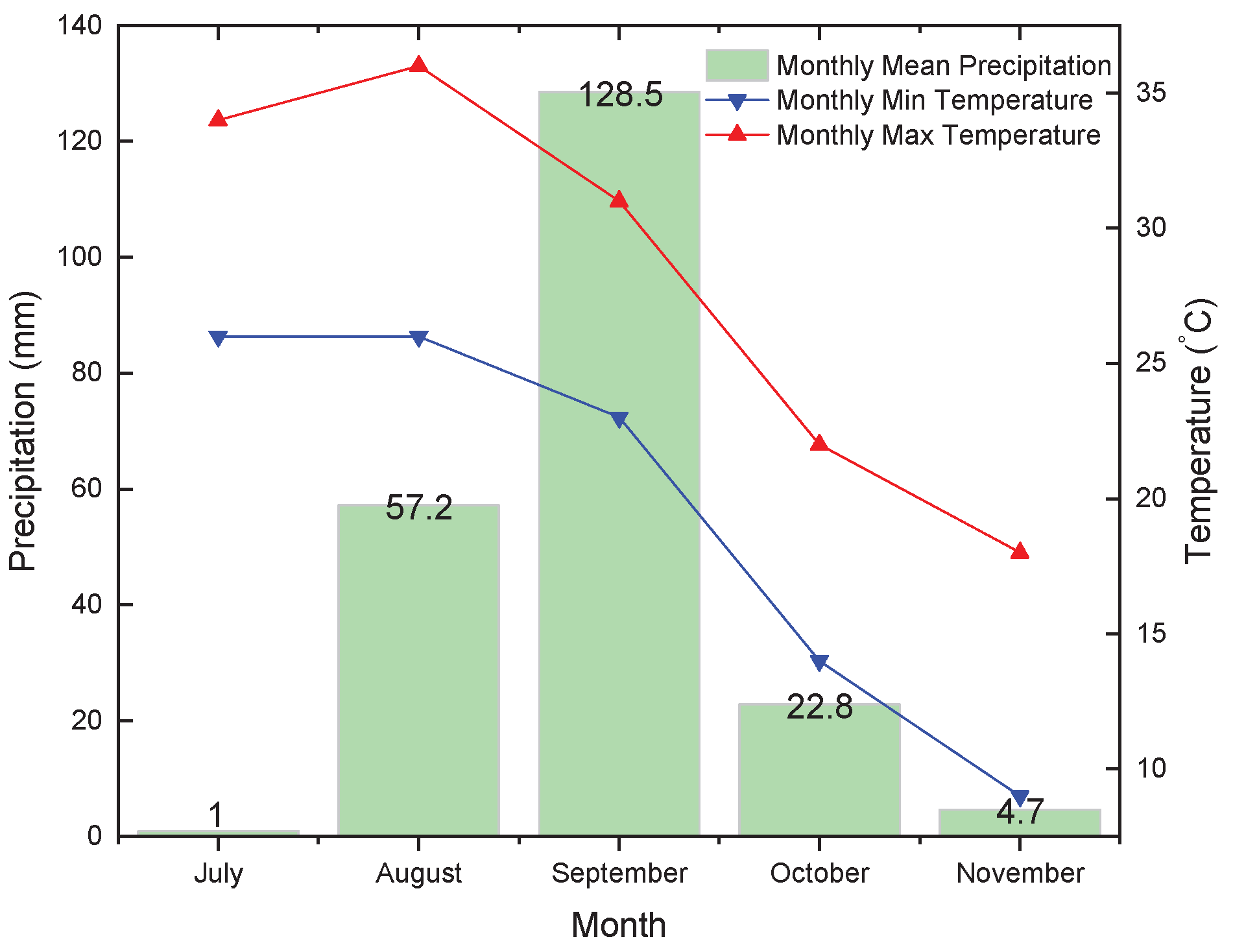
Figure 2.
Temporal changes in chlorophyll (Chl) content in male and female samples. Data are presented as mean ± SE (n = 3). Bars of different colors represent male and female samples, respectively. Differences between sexes at the same sampling day were evaluated using independent-samples t tests and are indicated by asterisks (p < 0.05, *p < 0.01, **p < 0.001). Different lowercase letters above the bars indicate significant differences among sampling days within the same sex, as determined by one-way ANOVA followed by Tukey’s post hoc test (p < 0.05). Bars sharing at least one common letter are not significantly different.
Figure 2.
Temporal changes in chlorophyll (Chl) content in male and female samples. Data are presented as mean ± SE (n = 3). Bars of different colors represent male and female samples, respectively. Differences between sexes at the same sampling day were evaluated using independent-samples t tests and are indicated by asterisks (p < 0.05, *p < 0.01, **p < 0.001). Different lowercase letters above the bars indicate significant differences among sampling days within the same sex, as determined by one-way ANOVA followed by Tukey’s post hoc test (p < 0.05). Bars sharing at least one common letter are not significantly different.
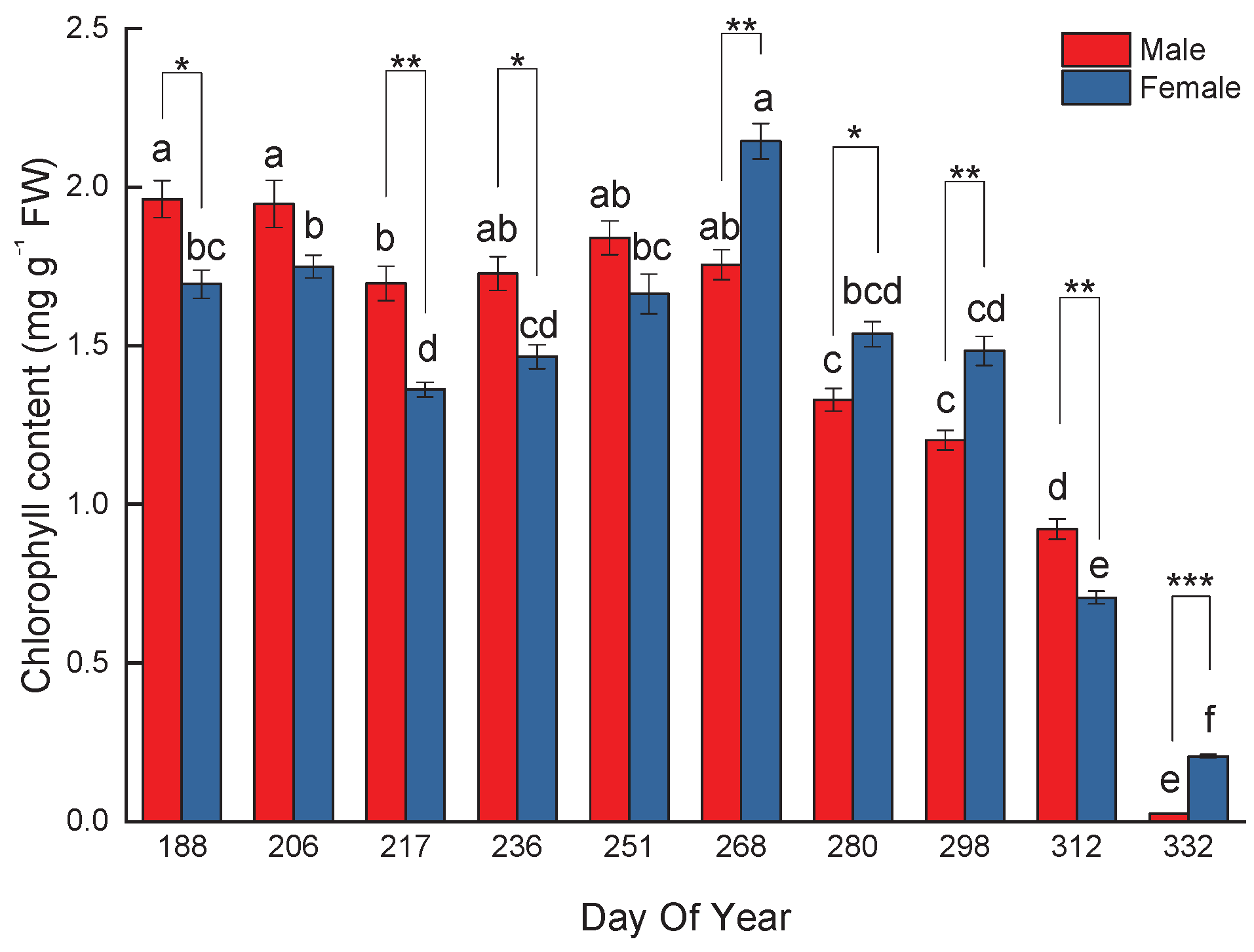
Figure 3.
Fast chlorophyll fluorescence transients (OJIP curves) and difference kinetics of Ginkgo biloba leaves measured on different days of year (DOY). Panels a–c represent male plants, whereas panels d–f represent female plants. Panels a and d show normalized OJIP fluorescence transients Vt, panels b and e show difference kinetics of ΔWOJ, and panels c and f show difference kinetics of ΔWOK. Different symbols and colors indicate measurements conducted on different DOY, as shown in the legend.
Figure 3.
Fast chlorophyll fluorescence transients (OJIP curves) and difference kinetics of Ginkgo biloba leaves measured on different days of year (DOY). Panels a–c represent male plants, whereas panels d–f represent female plants. Panels a and d show normalized OJIP fluorescence transients Vt, panels b and e show difference kinetics of ΔWOJ, and panels c and f show difference kinetics of ΔWOK. Different symbols and colors indicate measurements conducted on different DOY, as shown in the legend.
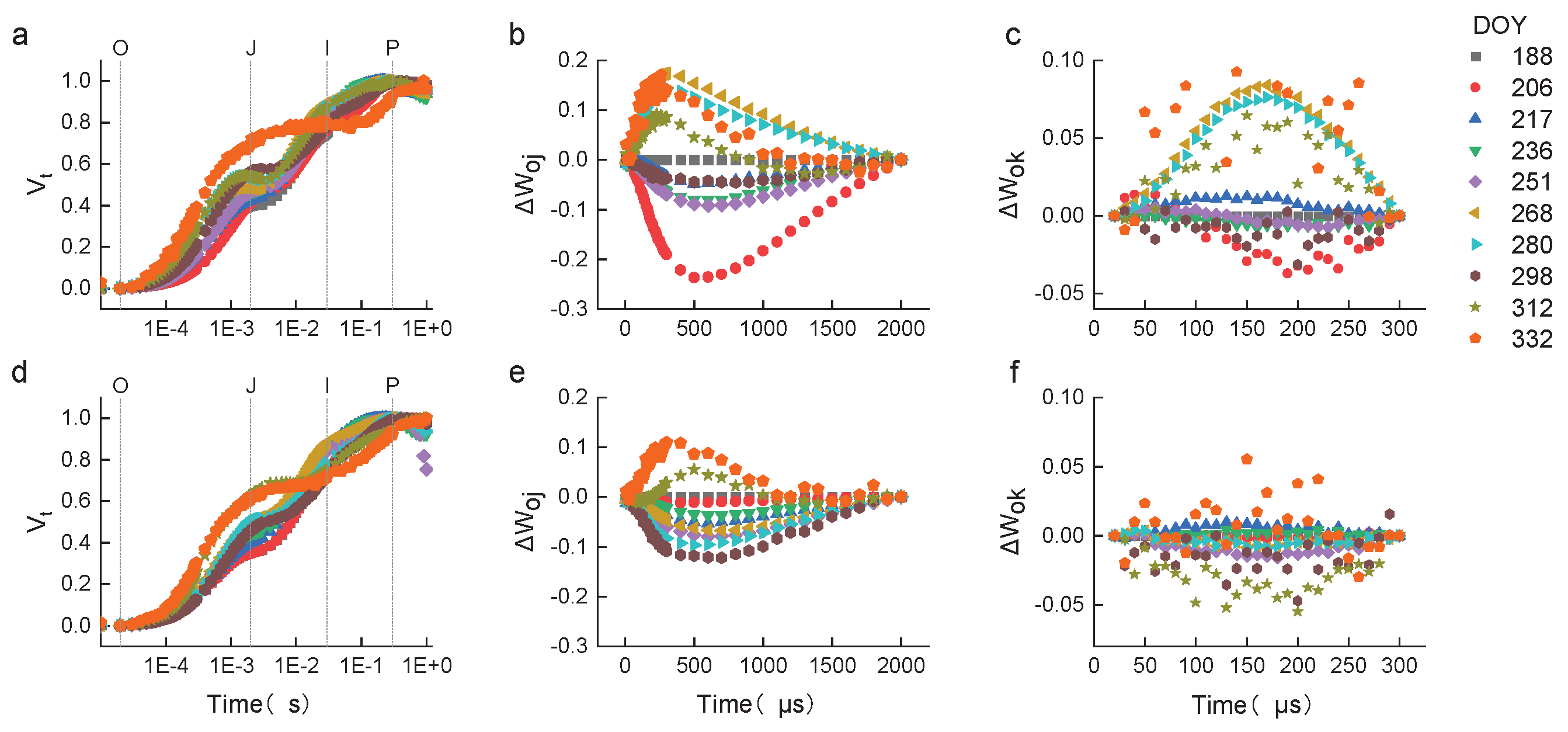
Figure 4.
Radar plots of OJIP-derived chlorophyll fluorescence parameters in Ginkgo biloba leaves measured on different days of year (DOY). Panels a–c represent male plants, whereas panels d–f represent female plants. Panels a and d show photosynthetic energy and electron fluxes, panels b and e show photosynthetic performance indices, and panels c and f show energy flux and reaction center characteristics. Different symbols and colors indicate measurements conducted on different DOY, as shown in the legend.
Figure 4.
Radar plots of OJIP-derived chlorophyll fluorescence parameters in Ginkgo biloba leaves measured on different days of year (DOY). Panels a–c represent male plants, whereas panels d–f represent female plants. Panels a and d show photosynthetic energy and electron fluxes, panels b and e show photosynthetic performance indices, and panels c and f show energy flux and reaction center characteristics. Different symbols and colors indicate measurements conducted on different DOY, as shown in the legend.
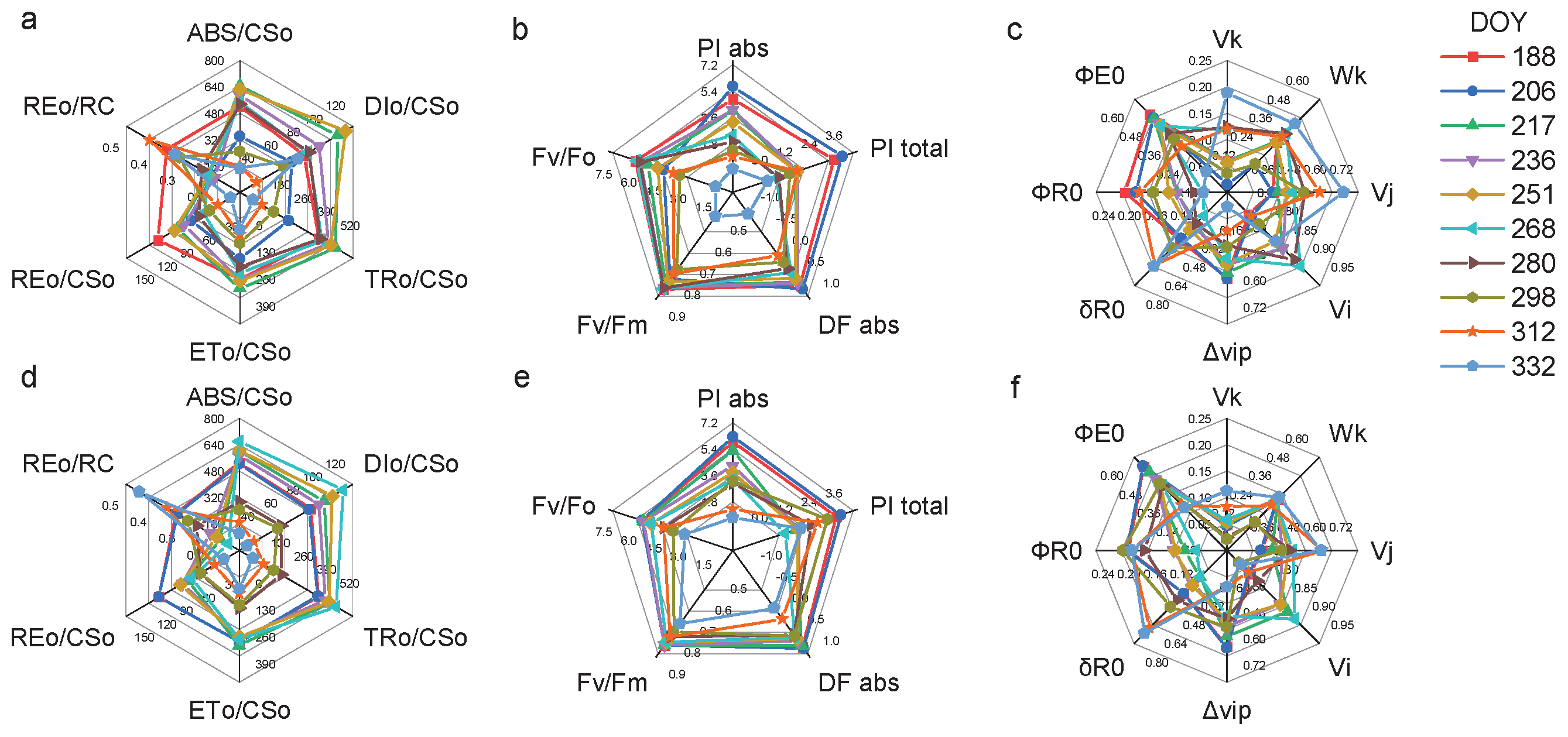
Figure 5.
Principal component analysis (PCA) of chlorophyll fluorescence parameters derived from OJIP transients in Ginkgo biloba. Panel a represents male plants, and panel b represents female plants. Dots indicate individual samples measured on different days of year (DOY), while vectors represent the contribution of fluorescence parameters to the principal components. Different colors correspond to different DOY, as indicated in the legend.
Figure 5.
Principal component analysis (PCA) of chlorophyll fluorescence parameters derived from OJIP transients in Ginkgo biloba. Panel a represents male plants, and panel b represents female plants. Dots indicate individual samples measured on different days of year (DOY), while vectors represent the contribution of fluorescence parameters to the principal components. Different colors correspond to different DOY, as indicated in the legend.
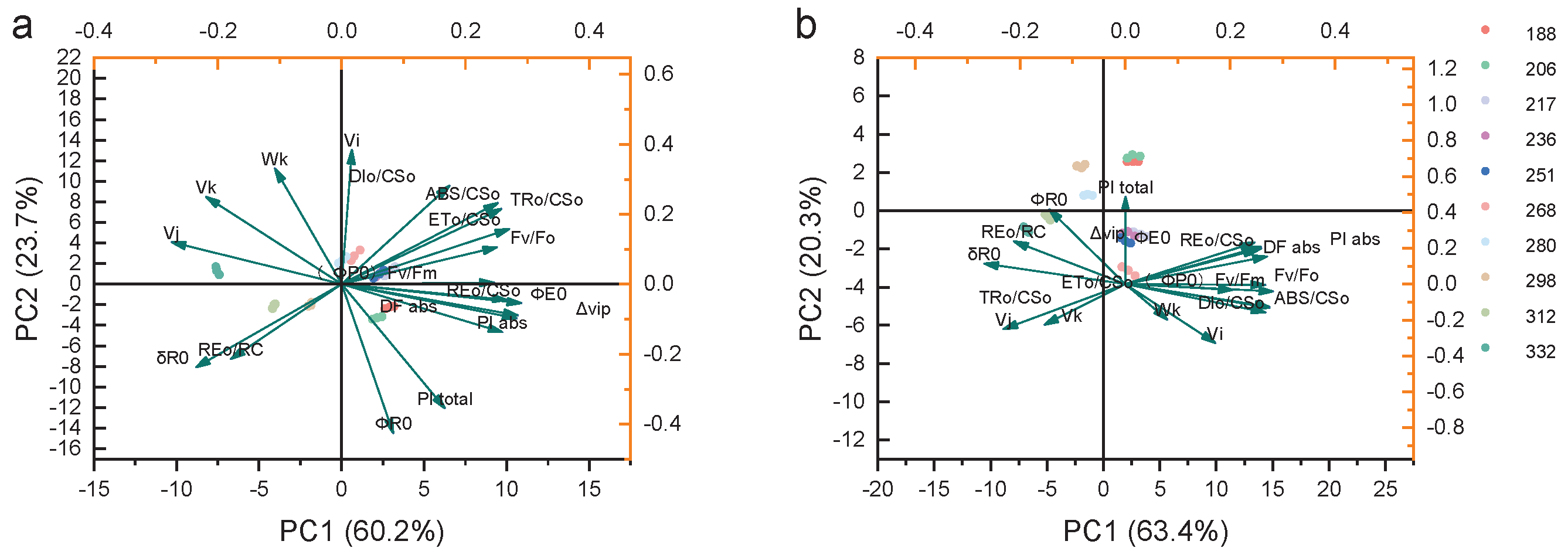
Table 1.
Formulae and definitions of selected JIP-test fluorescence parameters used in this study. Subscript “0” indicates that the parameter refers to the onset of illumination, when all reaction centers (RCs) are assumed to be open.
Table 1.
Formulae and definitions of selected JIP-test fluorescence parameters used in this study. Subscript “0” indicates that the parameter refers to the onset of illumination, when all reaction centers (RCs) are assumed to be open.
| Terms and formulae | Illustrations |
|---|---|
| F0 | Minimum fluorescence yield when all reaction centers are open |
| Fm | Maximum fluorescence yield when all reaction centers are closed |
| FJ | Fluorescence intensity at the J-step of the fluorescence induction curve |
| FK | Fluorescence intensity at the K-step of the fluorescence induction curve |
| FI | Fluorescence intensity at the I-step of the fluorescence induction curve |
| VJ = (FJ–F0) / (FM–F0) | Relative variable fluorescence at phase J of the fluorescence induction curve |
| VI = (FI–F0) / (FM–F0) | Relative variable fluorescence at phase I of the fluorescence induction curve |
| VK= (FK–F0) / (FM–F0) | Relative variable fluorescence at phase K of the fluorescence induction curve |
| WK= (FK–F0) / (FJ–F0) | Represent the damage to oxygen evolving complex OEC |
| ΔVIP=(FM–FI) / (FM–F0) | Relative amplitude of the I-P phase |
| RE0/RC = M0 (1/VJ)(1–VI) | Electron transport from Q– A to the PSI electron acceptors |
| Fv/F0=(Fm-F0)/F0 | Ratio of variable to minimal fluorescence, reflecting the potential activity of photosystem II reaction centers |
| ΦP0=TR0/ABS = FV/FM= [1– (F0/FM)] | Maximum quantum yield of primary photochemistry |
| ΦE0 =ET0/ABS = [1– (F0/FM)]×(1–VJ) | Quantum yield of electron transport |
| δR0=(1–VI)/(1–VJ) | Efficiency with which an electron can move from the reduced intersystem electron acceptors to the PSI end electron acceptors |
| ΦR0 = ΦP0 · (1-Vj) · δR0 | Quantum yield of reduction of end electron acceptors of PSI |
| ABS/CS0= F0 | Absorption flux of photons per cross section (at t = 0) |
| TR0/CS0= ΦP0 × (ABS/CS0) | Trapped energy flux per cross section (at t = 0) |
| ET0/CS0= ΦP0× ψ0 × (ABS/CS0) | Electron transport flux per cross section (at t = 0) |
| DIO/CSo = (ABS/CS0) – (TR0/CS0) | Dissipation energy flux per cross section (at t = 0) |
| RE0/CS0=(ABS/CS0) × ΦR0 | Density of reaction centers per cross section |
| PIABS=(RC/ABS)×[ΦP0/(1-φP0)]×[ψ0/(1– ψ0)] | Performance index on absorption basis |
| D.F.=log(PIABS) | Driving force on absorption basis |
| PItotal= PIABS×[δR0/(1–δR0)] | Total performance index on absorption basis |
Disclaimer/Publisher’s Note: The statements, opinions and data contained in all publications are solely those of the individual author(s) and contributor(s) and not of MDPI and/or the editor(s). MDPI and/or the editor(s) disclaim responsibility for any injury to people or property resulting from any ideas, methods, instructions or products referred to in the content. |
© 2026 by the authors. Licensee MDPI, Basel, Switzerland. This article is an open access article distributed under the terms and conditions of the Creative Commons Attribution (CC BY) license (http://creativecommons.org/licenses/by/4.0/).
Copyright: This open access article is published under a Creative Commons CC BY 4.0 license, which permit the free download, distribution, and reuse, provided that the author and preprint are cited in any reuse.


