
Submitted:
26 March 2026
Posted:
27 March 2026
You are already at the latest version
Abstract
This paper addresses a growing mismatch between how contemporary artifacts appear and how they persist. Many artifacts are still encountered and classified as discrete objects, even though their continuity is increasingly sustained through updates, recalibration, layered dependencies, retained states, and repeated return into later operation. Under these conditions, an object-based account of identity no longer explains enough. The paper argues that some artifacts are better understood as regimes, using the term in a restrained sense to name organized operative orders that remain continuous across structured change.
The argument first shows why surface continuity and public sameness no longer settle the question of artifact identity. It then develops a middle-level account of persistence in terms of organized continuity, basic structural requirements, sufficient internal coherence, traceable continuity over time, the retention of prior states, and the way earlier configurations continue to shape later operation. This makes it possible to distinguish continued identity from gradual transformation, mounting pressure toward replacement, and the emergence of a successor artifact. The final step argues that once continuity organizes exposure, behavior, and conditions of use across time, it cannot be treated as normatively neutral. Governability must therefore be understood as internal to the continuing order of the artifact itself. The result is a framework for judging when one artifact still persists through organized change and when a different judgment of identity has become necessary.
Keywords:
artifact identity
; organized change
; operational continuity
; successor artifacthood
; governability
1. Introduction
1.1. The Exhaustion of the Object-Model
Contemporary artifacts increasingly persist through organized change. They are updated without disappearing, reconfigured without always being publicly recognized as new, and stabilized through layers of operation that exceed what surface appearance, naming, or isolated function can adequately capture. Under these conditions, the inherited object-model begins to lose explanatory force. That model remains useful for cases in which an artifact can be identified mainly through bounded form, durable composition, and relatively stable use. It becomes less reliable when continuity is sustained through retained states, adaptive rules, platform dependencies, recurrent adjustment, and ongoing operational coordination across time (Kitchin & Dodge, 2011; Faraj et al., 2018).
This exhaustion does not mean that artifacts cease to be material, usable, or socially recognizable. It means, rather, that public recognition no longer reliably tracks the unit that actually persists. The same name may remain in place while operative order changes. The same interface may continue while internal structure is reconstituted. The same artifact may still be treated as “the same thing” in ordinary practice even when its conditions of operation, its scope of action, and its modes of dependence have been substantially reorganized. Classical philosophy of artifacts has often emphasized function, use, design, and agency as key coordinates for identifying what an artifact is (Dipert, 1993; Houkes & Vermaas, 2004, 2010; Verbeek, 2005). Those coordinates remain important, but they no longer suffice when persistence depends less on static composition than on the ongoing management of operative continuity.
The pressure on the object-model becomes especially visible in artifacts whose identity is sustained across software revision, infrastructural layering, adaptive behavior, or cumulative exposure. In such cases, the artifact cannot be adequately understood as a discrete thing that simply endures. It is better approached as a continuity-bearing order whose persistence is achieved through structured retention, selective modification, and recurrent reentry into future operation. What appears publicly as one artifact may already be internally organized as a changing arrangement with different operative consequences. Once this gap opens between visible sameness and operative persistence, the philosophical question of identity can no longer be settled at the level of the object alone.
For that reason, the problem is not merely classificatory. It is ontological and practical at once. An inadequate unit of analysis obscures what exactly is continuing, what has changed, and under what conditions continuity remains defensible. It also weakens the ability to describe when change is still internal variation and when it begins to press toward succession. The task, then, is not to abandon the language of artifacts, but to identify a more precise level at which artifact identity can be analyzed when organized change becomes part of what the artifact is.
1.2. The Central Claim
This paper argues that some contemporary artifacts are not best understood as discrete objects that merely endure through time, but as regimes: organized operative orders that persist through structured change. In such cases, artifact identity is not fixed primarily by name, visible form, isolated function, or a single episode of use. It is fixed more adequately at the level of a continuity-bearing arrangement that retains operative structure, carries effects forward, and reenters later operation under conditions that remain sufficiently ordered to support recognizable persistence (Kitchin & Dodge, 2011; Faraj et al., 2018).
The claim is not that every artifact is a regime, nor that material form has become irrelevant. The claim is narrower and more precise. Some artifacts now persist through update, recalibration, layered dependencies, adaptive response, and cumulative retention in ways that exceed the explanatory reach of the object-model. In these cases, the relevant unit of identity is no longer the bounded thing taken at a moment, but the organized continuity through which the artifact remains operationally the same across change. What persists is not mere surface sameness, but an operative order capable of maintaining enough internal coherence, enough retention, and enough directional continuity to justify treating later states as belonging to the same artifact rather than to an unrelated successor (Houkes & Vermaas, 2010; Verbeek, 2005).
This shift matters because it changes the terms under which continuity can be described and evaluated. Once artifact identity is approached at the level of regime, persistence can be analyzed in relation to composition, temporal carryover, reentry, and the conditions under which continuity remains defensible. The same shift also makes it possible to explain why some changes remain internal variations, while others accumulate toward drift, successor pressure, and eventually successor artifacthood. The central claim, then, is that organized change does not merely happen to certain artifacts from the outside. It belongs to the form of continuity through which they exist as identifiable artifacts in the first place.
1.3. Scope and Contribution
This paper offers a middle-level framework for artifact identity under organized change. It addresses cases in which the object-model becomes insufficient because continuity is maintained less by bounded form or isolated function than by an operative unity that persists across time as a regime. The argument is therefore limited to artifacts whose identity depends on organized continuity rather than on discrete object persistence alone.
Its contribution is twofold. First, it identifies the regime as the relevant unit for analyzing artifact identity once surface continuity and public sameness no longer reliably capture what persists. Second, it specifies the minimal architecture, temporal constitution, and governability conditions that allow continuity to remain defensible across change. This framework avoids the false alternative between treating change as incidental variation and treating every substantial modification a new artifact.
The aim is deliberately limited. The paper does not restate every dimension of design, mediation, or sociotechnical order. It isolates a narrower philosophical problem: how a continuity-bearing operative unity remains identifiable across change, and under what public conditions that continuity remains assessable.
2. Why Objects No Longer Explain Enough
2.1. Surface Continuity and Operative Change
Surface continuity often creates the impression that an artifact has remained the same in all philosophically relevant respects. The name remains in place, the interface appears familiar, the object is recognized without difficulty, and ordinary use proceeds without any obvious break. Yet this visible continuity can coexist with operative change of a different order. Rules of operation may be revised, dependencies may be restructured, thresholds may be reset, and retained states may begin to shape later use in ways that were not previously part of the artifact’s effective organization. What persists at the surface, then, does not necessarily coincide with what persists at the operative level (Kitchin & Dodge, 2011; Faraj et al., 2018).
This distinction matters because artifact identity is too easily attributed to what remains publicly recognizable. Surface continuity is real, but it is not always decisive. An artifact may continue to present the same visible object while its operative unity is being reorganized through layered adjustment, distributed coordination, or cumulative modification. In such cases, the relevant change is not reducible to repair, replacement, or incidental variation. It concerns the way the artifact acts, retains, responds, and continues across time. The philosophical difficulty begins precisely when visible sameness remains stable enough to reassure recognition while operative change becomes deep enough to affect what the artifact now is in practice.
The problem is not that appearance becomes irrelevant. Appearance still matters because public recognition often begins there. The problem is that appearance no longer settles the question of identity once organized continuity depends on more than bounded form. Surface continuity can mask operative reconstitution, and the object-model has little to say about that divergence. A more adequate account must therefore distinguish what is still recognizable from what is actually being maintained, altered, and carried forward as the basis of persistence.
2.2. Public Sameness and Internal Reconstitution
Public sameness names a practical and social condition in which an artifact continues to be treated as the same artifact across time. Its name remains stable, its recognition remains easy, and its place within ordinary use appears uninterrupted. This kind of sameness matters because artifacts do not persist only through material or technical continuity; they also persist through recognition, classification, and routinized expectations. Yet public sameness can continue even when the artifact has undergone internal reconstitution. What is taken to be the same at the level of recognition may no longer be the same in the operative terms that organize how it functions, what it retains, and how it enters later use (Bowker & Star, 1999; Kitchin & Dodge, 2011).
Internal reconstitution refers to a reorganization of the artifact’s operative order that does not necessarily announce itself as rupture. Components may be replaced, dependencies re-layered, thresholds adjusted, retention structures altered, and conditions of response recalibrated without forcing an immediate change in public classification. The artifact is still encountered as the same visible object, yet the continuity that now sustains it may be materially and operationally different from the one that sustained it before. This gap matters because identity is too easily inferred from public sameness alone. Recognition may remain continuous while the basis of persistence has already been reorganized.
The point is not that public recognition is mistaken or irrelevant. Public sameness is one dimension of continuity, but it is not a sufficient criterion of artifact identity under organized change. Once internal reconstitution becomes possible without overt replacement, the object-model loses one of its central assumptions: that what is recognized as the same is also what persists in the same way. The philosophical task is therefore to distinguish sameness as publicly sustained appearance from sameness as operative persistence. That distinction prepares the move from the visible object to the operative unity that more adequately bears identity across change (Akrich, 1992; Suchman, 1987).
What the preceding distinction now permits is a more explicit account of the gap between public sameness and the operative basis of continuity. A regime may continue to appear stable through name, interface, inherited classification, or institutional presentation even when the operative unity that sustains that continuity has begun to weaken. Figure 1 isolates that divergence. It shows how public sameness can remain effective while the operative basis of continuity becomes strained, and why that divergence makes a shift toward operative unity philosophically necessary.
The diagram shows how public recognition and surface continuity may remain stable while the operative basis of continuity weakens at the level of operative unity, minimum composition, sufficient closure, or minimum trace. It identifies the point at which public sameness can outlast the conditions that still justify attribution of the same regime, thereby opening the path toward drift, successor pressure, or successor artifacthood.
Public sameness therefore remains evidential but not decisive. Once it can persist while operative continuity weakens, artifact identity can no longer be settled at the level of recognition alone. The relevant question becomes whether the operative unity that bears continuity remains sufficiently intact to justify attribution of the same regime. The next section clarifies that shift.
2.3. From Visible Object to Operative Unity
The shift to operative unity is required once surface continuity and public sameness no longer settle artifact identity. The visible object remains the site of recognition, but operative unity names the organized continuity that actually sustains the artifact across time through retained structure, coordinated operation, and conditions of persistence not exhausted by appearance. When recognition and operative continuity remain aligned, the object-model is adequate. When they diverge, identity must be judged at the level of operative unity.
This shift does not replace the object with an invisible essence. It identifies a more adequate unit of analysis for cases in which what persists is not exhausted by what appears. The operative unity of an artifact includes the arrangement through which capacities are maintained, thresholds are crossed, responses are coordinated, and prior states are carried into later operation. It is therefore the level at which continuity becomes structurally intelligible rather than merely recognizable. What matters is not only that an artifact is still encountered as the same thing, but that there remains a sufficiently ordered continuity capable of supporting that claim across change (Akrich, 1992; Kitchin & Dodge, 2011).
The concept of operative unity also clarifies why some changes remain internal to identity while others begin to strain it. Once continuity is understood at this level, the philosophical question is no longer whether the object still looks the same or is called the same. The question becomes whether the operative unity that bears identity has remained sufficiently coherent through reorganization. This reorientation prepares the transition to regime as the relevant unit of artifact identity. The regime is not introduced as a stronger word for complexity, but as the form taken by operative unity when continuity is organized, retained, and carried forward through time in a way that makes identity more precise than the language of the visible object can allow (Suchman, 1987; Verbeek, 2005).
For terminological discipline, three expressions should be read as ordered rather than interchangeable. Operative unity names the organized continuity that bears identity across change. Regime names that unity once it is sufficiently composed, temporally extended, and publicly assessable. Continuity-bearing order names the functional role that such a regime performs across retention, reentry, and later operation. This distinction matters because the argument does not claim that every operative unity is already a regime, nor that every continuity-bearing order is governable in the stronger sense developed here. The regime is the stricter case: an operative unity whose continuity can be analyzed through minimum composition, temporal carryover, and governability conditions.
Figure 2 makes this transition explicit by showing how the visible object gives way to distributed operative layers, operative unity, and, finally, regime, thereby clarifying why artifact identity under organized change can no longer be fixed at the level of public appearance alone (Kitchin & Dodge, 2011; Verbeek, 2005).
The figure shows the conceptual transition from the object-model, surface continuity, and public sameness toward object insufficiency, distributed operative layers, operative unity, and regime. It clarifies why artifact identity under organized change can no longer be fixed adequately at the level of the visible object alone.
3. Regime as the Relevant Unit of Artifact Identity
3.1. What a Regime Is
A regime is an organized operative order that persists through time under conditions of structured change. It is not reducible to a visible object, a list of components, or a momentary system state. It names the continuity-bearing arrangement through which an artifact maintains operative unity across modification, adjustment, retention, and renewed operation. A regime therefore identifies the level at which artifact identity can remain intelligible when persistence depends less on static composition than on the ordered coordination of capacities, thresholds, and retained effects (Kitchin & Dodge, 2011; Verbeek, 2005).
What distinguishes a regime is not mere complexity, but the fact that continuity is internally organized. Its persistence depends on an operative order that can absorb change without dissolving immediately into dispersion or replacement. This order gives the artifact a form of continuity that is neither purely material nor merely nominal. It is material because regimes remain embodied in infrastructures, interfaces, devices, and practices. It is more than nominal because continuity is not secured only through naming or public recognition. A regime persists when there remains a sufficiently coherent operative unity through which later states can still count as belonging to the same artifact rather than to an unrelated successor (Houkes & Vermaas, 2010; Kitchin & Dodge, 2011).
The concept also clarifies that persistence is not identical with simple endurance. A regime does not merely last. It continues by retaining structure, carrying forward prior organization, and reentering future operation in ways that preserve enough order to support identity claims. For that reason, regime is the appropriate term when the artifact’s reality lies not only in what it is at a given moment, but in how it remains operationally itself across time. The regime is thus the operative unity of artifact identity under organized change: the continuity-bearing order through which an artifact persists, reorganizes, and remains identifiable without being reduced to the visible object alone.
3.2. Why Regime Is Not Just a Stronger Word for System
The term regime does not simply intensify the term system. A system may refer to any organized set of elements, relations, or processes. It may be descriptive, temporary, analytical, or functionally narrow. One can speak of a control system, a recommendation system, or a technical system without yet clarifying whether that arrangement carries artifact identity across time. Regime names a more specific condition. It refers to an operative unity whose organized continuity remains relevant to what the artifact is, not merely to how one describes its parts or operations (Leveson, 2012; Houkes & Vermaas, 2010).
This distinction matters because systems do not necessarily persist in a way that bears identity. A system can be reassembled, replaced, or locally coordinated without generating a continuity claim strong enough to support sameness over time. Regime applies only where continuity is structured, retained, and carried forward as part of the artifact’s ongoing operative order. In that sense, regime is not a synonym for complexity. It is a term for a continuity-bearing order whose persistence can absorb organized change while still remaining sufficiently coherent to count as the same artifact in an operative sense. The concept therefore adds precision where the language of system remains too broad to distinguish transient coordination from identity-bearing continuity (Kitchin & Dodge, 2011; Faraj et al., 2018).
A regime also differs from a system because it introduces a stricter question of persistence. The issue is not only whether elements interact, but whether their organized relation sustains a continuity that remains attributable to one artifact across modification, retention, and reentry into later operation. Once that question becomes central, system is no longer enough. Regime becomes necessary because it identifies an order whose continuity is not incidental to analysis, but constitutive of artifact identity itself.
3.3. Minimum Threshold for Regime Recognition
Not every organized arrangement qualifies as a regime. The term should be reserved for cases in which continuity is no longer a matter of momentary coordination or superficial persistence, but of organized operative unity attributable to the same artifact across change. At the threshold of regime recognition, three conditions become necessary: minimum composition, enough closure for the operative unity not to disperse into a mere aggregate, and enough trace for later states to remain intelligibly linked to earlier ones. These conditions do not yet exhaust the regime’s architecture. They establish why a more explicit account of composition is needed, which the next section develops through capacity, envelope, precedence, threshold, authority, persistence, recovery, and minimum trace.
4. The Minimal Architecture of a Regime
4.1. Capacity and Envelope
If regime identity is to explain artifact persistence under organized change, it must rest on a minimal architecture rather than on a loose appeal to continuity alone. The first elements of that architecture are capacity and envelope. Capacity refers to what the regime can effectively do as an operative unity. It does not refer to abstract possibility in the broadest sense, but to the set of actions, responses, adjustments, and sustained operations that belong to the regime as part of its organized continuity. Capacity therefore marks the practical reach of the regime. It indicates the extent to which an artifact can maintain operative unity across time while still remaining attributable to the same continuity-bearing order (Houkes & Vermaas, 2010; Leveson, 2012).
Envelope names the bounded conditions within which capacity can be exercised as part of that same order. It defines the operative scope of the regime: the range of circumstances, constraints, dependencies, and tolerances within which the regime remains able to function as itself. Capacity without envelope would reduce to an indeterminate list of powers. Envelope without capacity would reduce to a merely formal boundary with no operative content. Taken together, they identify the first structural condition of regime identity: a regime must be able to do something, and it must do so within a recognizable range that gives that doing coherence. This is why regime identity cannot be grounded in appearance alone. What matters is not only that an artifact still appears available for use, but that its operative scope remains sufficiently ordered to support continuity across changing conditions (Kitchin & Dodge, 2011).
Capacity and envelope also make clear that persistence is never a bare fact of duration. A regime persists only insofar as it continues to operate within a bounded field of possibility that still belongs to it. Once capacity is substantially altered, or once the envelope within which it operates is reorganized beyond recognition, the question of continuity becomes more demanding. For that reason, capacity and envelope are not secondary descriptive features. They form the opening layer of the regime’s minimal architecture, because they establish the practical and bounded terms under which operative unity can persist at all.
4.2. Precedence, Threshold, and Authority
Capacity and envelope establish what a regime can do and within what operative scope it can do it. They do not yet explain how that scope is internally ordered. For that, three further elements are required: precedence, threshold, and authority. Precedence concerns the ordering of operative priority within the regime. It determines which functions, responses, protections, or retained conditions take priority when multiple demands arise at once. A regime without precedence may still operate, but it cannot sustain a coherent operative unity across change, because it lacks an internal order for deciding what must hold first when continuity is under pressure (Leveson, 2012).
Threshold concerns the points at which operative variation becomes a change in status. Not every difference matters equally. Some changes remain internal adjustments within the same regime, while others alter the conditions under which continuity can still be attributed to that regime. Threshold therefore marks the transition points at which accumulation, modification, or escalation become significant for identity. It gives the regime an internal structure of recognition: a way of distinguishing ordinary variation from changes that begin to affect persistence, scope, or the standing of later states within the same continuity-bearing order. Without threshold, continuity would remain too loose to evaluate, because no principled distinction could be drawn between minor reconfiguration and consequential transformation.
Authority names the ordering principle through which precedence and threshold become effective rather than merely abstract. It refers to the operative locus, rule, or structured distribution through which the regime determines what counts, what takes priority, and when a change becomes significant. Authority does not have to be centralized in a single actor or component. It may be distributed across technical rules, procedural constraints, institutional settings, or layered control structures. What matters is that the regime contains a sufficient principle of direction to keep continuity from collapsing into mere aggregation. A regime persists as an operative unity only when what it can do is bounded by envelope, ordered through precedence, differentiated by threshold, and directed through authority. These elements together explain why regime identity depends not only on continuing operation, but on internally structured continuity capable of remaining coherent across organized change (Kitchin & Dodge, 2011; Yeung, 2018).
4.3. Persistence, Recovery, Closure, and Minimum Trace
A regime does not persist simply because it continues to operate for some duration. Persistence names the regime’s capacity to maintain operative unity across time despite adjustment, interruption, or internal variation. It refers to the continued holding together of the continuity-bearing order, not merely to repeated use or ongoing visibility. An artifact may remain available in public life while lacking persistence in the stronger sense required here. Persistence matters because regime identity depends on more than survival in a loose practical sense. It depends on whether the operative unity remains sufficiently intact for later states to count as belonging to the same regime rather than to an unrelated arrangement (Houkes & Vermaas, 2010; Kitchin & Dodge, 2011).
Recovery identifies the regime’s ability to resume, restore, or reestablish operative unity after reduction, disturbance, or partial failure. This does not mean that every interruption leaves identity untouched. Recovery matters only where the regime can return in a way that still belongs to its prior continuity rather than initiating a different one. The concept therefore clarifies that persistence is compatible with interruption, but not with unlimited discontinuity. A regime may contract, suspend, or recompose aspects of its operation and still remain the same regime, provided that recovery reconnects later operation to the continuity already in place. Recovery thus belongs to the minimal architecture because it explains how continuity can survive disturbance without being reduced to mere repetition or declared broken at the first interruption.
Closure is the condition that prevents the regime from dissolving into an open-ended aggregate of processes, dependencies, or episodes. It names the sufficient internal coherence through which the regime remains attributable to one operative unity. Closure need not imply perfect isolation or rigid boundaries. Contemporary artifacts often remain relational, layered, and dependent on external infrastructures. What closure requires is something more limited and more important: enough internal order for the regime to remain bounded as the continuity-bearing unit under analysis. Without closure, one could describe endless relations and influences, but not a regime with a determinate identity.
Minimum trace names the least retained continuity required for persistence, recovery, and closure to remain intelligible across time. It is the residual basis that allows later states to be linked back to earlier ones as part of the same operative unity. Minimum trace does not require complete transparency or exhaustive record. It requires only enough retained continuity for the regime’s persistence to be more than an unsupported impression of sameness. For that reason, persistence, recovery, closure, and minimum trace form a single layer within the minimal architecture of regime identity. Together, they explain how a regime can remain one operative unity across organized change without being reduced either to static endurance or to unrestricted transformation.
Figure 3 gathers these constitutive elements into one view and shows that regime identity depends on the joint relation among operative scope, internal ordering, temporal persistence, recovery, closure, and minimum trace rather than on any single feature considered in isolation (Houkes & Vermaas, 2010; Leveson, 2012).
The figure presents the regime as a minimal composition organized through capacity, envelope, precedence, threshold, and authority, and stabilized through continuity conditions including persistence, recovery, closure, and minimum trace. It shows how operative scope, directed order, and temporal hold together define the minimal architecture required for regime identity.
5. The Temporal Constitution of Artifact Identity
5.1. Event, Effect, Residue, and Inscription
Once the minimal architecture of a regime has been specified, artifact identity can no longer be understood as if it were settled at a single moment. It must be understood temporally. What matters is not only what the regime is at one point, but how what occurs within it leaves consequences that may or may not become part of later continuity. For that reason, the temporal constitution of artifact identity begins with a four-part distinction: event, effect, residue, and inscription. This sequence makes it possible to describe how a regime undergoes change without reducing every occurrence either to irrelevance or to immediate transformation of identity.
An event is a bounded occurrence within the life of a regime. It may be an operation, an interaction, an update, an exposure, a response, or any other delimited moment in which the regime does something or something happens through it. An event, taken on its own, does not yet determine continuity. Many events remain local and transient. They happen, produce activity, and pass. Their philosophical importance depends on whether they leave anything behind that matters for the regime’s later operation. The category of event therefore marks the temporal point at which change enters the regime, but not yet the point at which change becomes constitutive of identity.
Effect names the immediate consequence produced by an event. It refers to what the event does in the near term: the change it initiates, the condition it modifies, the response it elicits, or the outcome it generates. Effect is temporally closer to the event than the later forms of continuity that concern the argument more directly. Some effects are exhausted as soon as the event ends. Others persist longer, but still do not alter the regime’s continuity in any meaningful way. The distinction matters because not every effect becomes identity-relevant. A regime may generate many effects while remaining, in temporal terms, largely unchanged as the same operative unity.
Residue marks the point at which something from the event remains after the immediate effect has passed. Residue is not yet full continuity, but it is more than a completed occurrence. It names what is left over, retained, or deposited in the regime as a consequence of operation. Residue may take the form of retained state, altered condition, modified expectation, accumulated adjustment, or any lingering operative remainder that survives the event itself. What distinguishes residue from effect is persistence. An effect may be real without remaining. Residue remains, even if only provisionally, and therefore begins to matter for later continuity.
Inscription names the stronger condition in which residue no longer remains merely as a leftover, but becomes integrated into the regime’s ongoing operative order. At this point, what remains from prior events is not simply present; it has entered the continuity-bearing structure of the regime. Inscription is therefore the threshold at which temporal retention becomes identity-relevant. Something has been taken up into the regime in a way that can shape future operation, condition later responses, and contribute to the continuity through which the regime persists. This is why inscription is more demanding than memory in a loose sense and more consequential than residue alone. It identifies the point at which what has occurred begins to reorganize what the regime will subsequently be able to do and how it will continue as the same operative unity (Dewey, 1938; Akrich, 1992).
This sequence clarifies why artifact identity cannot be reduced to punctual description. A regime is constituted over time through the differential fate of what happens within it. Some events remain episodic. Some effects disappear. Some residues linger without becoming central. Some inscriptions enter deeply enough into the regime’s continuity to shape what comes next. The temporal constitution of artifact identity begins precisely here: not with duration alone, but with the structured passage through which events leave effects, effects leave residue, and residue becomes inscription within the continuity-bearing order of the regime.
5.2. Carryover, Reentry, and Patterned Anticipation
Inscription matters because what has entered the regime’s operative order does not remain inert. It is carried forward into later operation. Carryover names this temporal transport of what has been retained. It refers to the continuation of prior inscription into subsequent states, responses, and conditions of use. A regime does not begin anew at each event. What has been inscribed persists as part of the operative background against which later events occur, and this persistence gives continuity a temporal thickness that cannot be captured through punctual description alone. Carryover therefore marks the basic fact that earlier organization remains active in later operation, even when it is no longer visible as a discrete event in its own right.
Reentry names the point at which what has been carried forward becomes active again within the regime’s present operation. Carryover can remain latent for a time, but reentry occurs when retained inscription returns as an operative contributor to what the regime now does. A prior adjustment may condition a later response. A retained state may alter the significance of a new event. A previous accumulation may reorganize the range within which present operation unfolds. Reentry thus clarifies that continuity is not just a matter of passive retention. The regime is temporally constituted because what has been retained can reappear as an active element in later operation. Earlier inscription does not merely survive; it reenters and participates in shaping the regime’s present continuity (Dewey, 1938; Kitchin & Dodge, 2011).
This is also the point at which continuity begins to take on a patterned form. Patterned anticipation names the structured orientation toward later operation that emerges when carryover and reentry become recurrent rather than isolated. The regime begins to operate under trajectories shaped by what has already been retained and reactivated. Future operation is not determined in a rigid sense, but it is no longer open in the same way as if each event were starting from zero. Inscription creates conditions; carryover sustains them; reentry activates them; patterned anticipation names the resulting organization of what can now be expected, enabled, constrained, or amplified in later operation. This anticipation is not merely psychological expectation. It is built into the temporal order of the regime itself.
For that reason, carryover, reentry, and patterned anticipation are central to artifact identity under organized change. They explain how continuity becomes active rather than merely retrospective. Identity does not depend only on what can be traced backward. It also depends on how prior inscription is carried into later states and how those states are structured in advance by what the regime has already retained. A regime persists, then, not only because something remains from earlier operation, but because what remains can reenter and organize what comes next. The temporal constitution of artifact identity therefore includes a forward-directed dimension: continuity is sustained through the patterned reactivation of what the regime has already made part of itself (Suchman, 1987; Dewey, 1938).
The preceding account now permits a more explicit statement of the framework’s adjudicative structure. Figure 4 condenses the minimum architecture through which regime identity can be judged across organized change.
The diagram condenses the framework developed in the paper by ordering the transition from minimum regime composition and sufficient closure to temporal constitution, minimum public conditions, and final identity judgment. It shows how artifact identity under organized change is not decided at the level of visible sameness alone, but through the relation among capacity, operative envelope, precedence, threshold, authority, persistence, recovery, minimum trace, inscription, carryover, reentry, public legibility, contestability, reversibility, and the conditions under which continuity remains justified, drifts, or gives way to successor artifacthood.
What the figure makes clear is that continuity is not a primitive given. It is the outcome of a composed relation among operative structure, temporal carryover, and minimum public conditions, and it therefore admits degrees of strain before successor artifacthood becomes the stronger description.
5.3. Justified Continuity, Drift, Successor Pressure, and Successor Artifacthood
Once inscription is carried forward through carryover and reentry, continuity can no longer be treated as an all-or-nothing condition. The relevant question is not simply whether the regime continues, but whether its continued identity remains justified. Justified continuity names the condition in which later states can still be attributed to the same regime because the operative unity remains sufficiently coherent across organized change. This coherence does not require immobility. A regime may be updated, recalibrated, extended, or partially reorganized and still remain the same regime, provided that the continuity-bearing order retains enough composition, closure, and minimum trace for persistence to remain defensible. Justified continuity therefore marks the positive side of temporal identity: change has occurred, but not yet in a way that defeats the claim that one regime continues through it (Houkes & Vermaas, 2010; Kitchin & Dodge, 2011).
Drift names a different temporal condition. It refers to the gradual displacement of regime identity through accumulated modification that does not immediately produce rupture, yet weakens the basis on which continuity can still be justified. Drift is neither mere variation nor full succession. It is the zone in which the regime still presents continuity, but does so under increasing strain. What has been carried forward remains linked to prior operation, yet the operative unity begins to shift in scope, dependence, response, or retained organization strongly enough to alter what the regime is becoming. The importance of drift is philosophical as much as descriptive. It explains why artifact identity can erode without collapsing at a single moment. It also explains why appeals to public sameness or surface continuity are often insufficient precisely where the deepest changes are cumulative rather than abrupt.
Successor pressure names the point at which drift becomes strong enough to press against continued attribution of identity. At this stage, the issue is no longer whether the regime has changed, but whether the accumulated reorganization has become significant enough to demand reclassification. Successor pressure emerges when the continuity-bearing order still carries traces of the earlier regime, yet increasingly does so under conditions that make sameness harder to defend. Capacity may have been substantially altered, envelope redefined, thresholds recalibrated, authority redistributed, or inscription carried forward in ways that reorganize what later operation now depends on. The regime is still historically connected to what came before, but that connection now produces pressure toward a different ontological judgment: not simply altered continuity, but the possible emergence of a successor.
Successor artifacthood names the condition in which that pressure is no longer merely suggestive. It marks the point at which continuity with the earlier regime remains historically significant, yet no longer justifies treating later operation as the same artifact in the stronger sense developed here. A successor artifact is not an unrelated replacement. It emerges from prior continuity, inherits parts of its operative order, and remains intelligible only against that background. Yet it does not remain attributable to the same regime because the organized continuity that once grounded identity has been reconstituted beyond the point at which justified continuity can still hold. Successor artifacthood therefore completes the temporal logic of regime identity. It shows that persistence through organized change has limits internal to its own structure. A regime can continue, drift, and eventually yield a successor without any need for a single dramatic break, because artifact identity is constituted through temporal organization rather than secured once and for all at the level of the visible object alone (Dipert, 1993; Verbeek, 2005).
Figure 5 synthesizes this temporal sequence by showing how event, effect, residue, inscription, carryover, reentry, and patterned anticipation together generate the conditions under which justified continuity can persist, drift can intensify, and successor artifacthood can finally emerge (Dewey, 1938; Suchman, 1987).
The figure traces the sequence from event to effect, residue, inscription, carryover, reentry, and patterned anticipation, and then toward justified continuity, drift, successor pressure, and successor artifacthood. It shows how regime identity is temporally constituted through retained and reactivated inscription rather than through punctual sameness alone.
6. Why Continuity Becomes a Public Problem
6.1. Why Organized Continuity Is Not Normatively Neutral
Once artifact identity is understood at the level of regime, continuity can no longer be treated as a merely descriptive matter. Organized continuity is not normatively neutral because it does more than persist. It structures the conditions under which an artifact continues to act, to retain operative consequences, and to shape later encounters. What is carried forward through inscription, carryover, and reentry does not remain confined to internal technical order. It can reorganize exposure, recalibrate patterns of use, and alter the practical terms under which subjects, institutions, or environments continue to relate to the same regime. At that point, continuity is no longer simply a matter of what remains the same. It becomes a matter of what continued sameness now does.
This is why the problem cannot be reduced to whether an artifact still functions as intended. A regime may remain operationally coherent while also changing the intensity, direction, or cumulative consequences of its operation. The normative issue emerges precisely because continuity preserves more than existence. It preserves an operative order that can continue to distribute effects across time. When that order retains prior inscription and reenters later operation, it may modify conduct, dependence, expectation, or vulnerability without requiring any dramatic public break. Organized continuity therefore matters normatively because the persistence of the regime is also the persistence of structured consequences. A regime that continues through time may also continue to organize what can be done to, through, or around those who encounter it (Winner, 1980; Nissenbaum, 2009).
For that reason, neutrality cannot be presumed merely because continuity appears ordinary or because change remains internally managed. Public sameness often masks the fact that later operation is no longer normatively equivalent to earlier operation. The regime may still be recognized as the same artifact, yet its organized continuity may now sustain different conditions of exposure, different modes of dependence, or different thresholds of consequence. Once continuity becomes cumulative in this way, the philosophical question of identity opens directly onto a public question of significance. What persists is not only an artifact, but an operative order whose continued unity can matter for accountability, legibility, and the possibility of justified intervention (Nissenbaum, 1996; Yeung, 2018).
6.2. From Temporal Carryover to Public Consequence
Temporal carryover becomes publicly consequential when what has been retained within the regime no longer remains an internal condition of continuity alone, but begins to shape the practical terms under which later operation is encountered, undergone, or managed. What is carried forward through inscription and reentry can alter exposure, recalibrate ordinary expectations, intensify dependence, and reorganize the conditions of action without announcing itself as a distinct rupture. Public consequence emerges at precisely this point: when the retained continuity of the regime changes not only what the artifact is becoming, but also how that becoming matters for those who live with it, use it, or are acted upon through it (Nissenbaum, 2009; Yeung, 2018).
Here escalation does not name an additional ontological stage beyond drift or successor pressure. It names the practical intensification of public consequence that occurs when retained continuity expands its reach across later encounters and becomes harder to avoid, interpret, or reverse. The term therefore belongs to the public consequence of temporal carryover, not to a separate criterion of artifact identity.
This transition is often cumulative rather than dramatic. A single event may appear limited, and an isolated effect may seem negligible. Yet once residues become inscription, and inscription enters later operation through carryover and reentry, consequences can accumulate across time in a patterned way. What matters publicly is therefore not only the presence of an effect, but the persistence of an operative order that continues to reactivate prior conditions. Exposure may become more frequent, responses more difficult to avoid, and adjustments more deeply built into the ordinary continuity of the regime. Public consequence is thus not external to temporal constitution. It is one of its outcomes when continuity begins to organize the lived conditions of later operation in ways that are practically significant.
Escalation names the point at which this accumulated significance becomes harder to treat as incidental. Escalation does not require catastrophic change. It refers to the intensification, extension, or consolidation of consequence through continued carryover. A regime may escalate because retained inscription reaches more surfaces of life, because reentry becomes more systematic, or because the effects of continuity become more difficult to contest, interpret, or reverse. Temporal carryover therefore matters publicly not simply because the regime lasts, but because what it carries forward can progressively reorganize the field in which later encounters occur. Once continuity operates in this cumulative way, public consequence is no longer a secondary concern added after the fact. It is the social and practical expression of the regime’s temporal constitution itself (Ananny & Crawford, 2018; Kroll et al., 2017).
6.3. Why Governability Must Become Internal to the Regime
If organized continuity can carry consequences forward through inscription, carryover, reentry, and escalation, then governability cannot be treated as an external layer applied only after problems become visible. It must become internal to the regime itself. A regime that persists through organized change does not merely endure long enough to invite later evaluation. It reproduces the very conditions through which later operation becomes possible, consequential, and difficult to disentangle from what came before. Once continuity works in this way, governability belongs to the structure of persistence rather than to a secondary response added from outside (Yeung, 2018; Leveson, 2012).
Internal governability names this condition. It refers to the incorporation of constraints, checks, and conditions of operative treatment within the continuity-bearing order of the regime. The point is not that every regime must become fully transparent or perfectly controllable. The point is that a regime whose persistence can reorganize exposure and accumulate public consequence must contain some internal means through which its continuity remains tractable. Without internal governability, the regime continues, but it continues as something increasingly difficult to interpret, contest, or redirect. Persistence then outpaces the very conditions under which it can still be responsibly treated as one governable order.
This is why governability is not conceptually separate from artifact identity under organized change. Once a regime becomes the relevant unit of persistence, the conditions that allow it to remain identifiable also begin to overlap with the conditions that allow it to remain publicly manageable. A regime that cannot be bounded in practice, cannot register consequential change, and cannot support effective forms of intervention risks becoming ontologically continuous while remaining publicly ungovernable. That result is unstable. The same continuity that justifies treating the regime as one operative unity also creates the need for limits, traceable transitions, and organized possibilities of correction. Governability must therefore become internal to the regime because continuity itself has become structured, cumulative, and publicly significant (Nissenbaum, 1996; Kroll et al., 2017).
At this point, the regime can no longer be described only as an operative unity that persists. It must also be understood as a governable order: an organized continuity whose persistence remains answerable to conditions of constraint, review, and correction built into the terms of its own continuation. This transition prepares the next step of the argument. Once governability is internal rather than external, the question is no longer whether regimes should be governed in some broad and general sense. The question becomes how their internal governability must be structured so that continuity can remain identifiable, contestable, and correctable across time.
7. The Governability of Regimes
7.1. Governance of Exposure, Enforceable Limits, and Minimal Traceability
Once governability is understood as internal to the regime, its operative architecture can be specified more precisely. Three requirements are decisive: governance of exposure, enforceable limits, and minimal traceability. Together they define the internal conditions under which continuity remains manageable once consequences accumulate. These elements are not external oversight added afterward. They belong to the terms under which the regime continues at all. This requirement becomes especially visible in immersive environments, where continued operation can reorganize bodily exposure and user conditions over time, making governability depend on concrete constraints on cumulative experience rather than on disclosure alone (International Organization for Standardization, 2020; Madary & Metzinger, 2016).
Governance of exposure concerns how the regime structures the conditions under which subjects, environments, or institutions are brought into contact with its operation. Exposure is not limited to access in a narrow sense. It includes intensity, duration, recurrence, and the degree to which later encounters are shaped by prior inscription and carryover. A regime governs exposure when it contains operative means for ordering these conditions rather than letting them expand solely through internal momentum or cumulative optimization. This matters because continuity becomes publicly significant not only through what the regime does, but through how it distributes sustained contact with its own operative effects. Where exposure is left ungoverned, continuity can remain internally coherent while progressively exceeding the conditions under which it remains publicly acceptable or practically tractable (Nissenbaum, 2009; Yeung, 2018).
Enforceable limits are the second requirement. A regime may contain nominal constraints and still fail to be governable if those constraints do not function as effective restrictions on operation. Enforceable limits are limits that can actually interrupt, narrow, suspend, or redirect the regime when threshold conditions are met. Their importance lies in the fact that organized continuity tends to preserve and reactivate prior inscription unless something within the regime can impose operative restraint. A governable order therefore cannot depend on aspiration alone. It must contain limits that are real in the strong sense that they can bind continuation. Without enforceable limits, governance remains declarative while the regime continues according to its own retained order. In that case, continuity may still be legible after the fact, but it is not governable in the present tense of operation (Leveson, 2012; Kroll et al., 2017).
Minimal traceability is the third requirement. If minimum trace belongs to the minimal architecture of persistence, minimal traceability belongs to the architecture of governability. The issue is no longer only whether enough continuity remains for identity to be sustained. The issue is whether consequential continuity can still be followed, located, and reviewed in a sufficiently disciplined way. Minimal traceability does not require exhaustive transparency or full informational disclosure. It requires only enough operative visibility for consequential change to be attributable, for thresholds to be recognized, and for intervention to remain possible. A regime without minimal traceability may continue as one operative unity, but it becomes increasingly difficult to determine how exposure has been organized, where escalation has occurred, and whether enforceable limits have actually been triggered or bypassed (Ananny & Crawford, 2018; Nissenbaum, 1996).
For terminological precision, three levels should be kept distinct. Minimum trace refers to the least retained continuity required for persistence across time. Minimal traceability refers to the governability condition under which consequential continuity can be followed and reviewed. Reviewable records refer to the procedural artifacts through which that traceability is made available for actual correction. The three terms are therefore linked but non-interchangeable: the first belongs to identity, the second to governability, and the third to review.
These three elements belong together because each depends on the others. Governance of exposure identifies what must be ordered. Enforceable limits determine how ordering becomes binding. Minimal traceability provides the conditions under which that binding order can remain reviewable. Once combined, they form the first layer of internal governability. A regime becomes governable not simply because someone can evaluate it from the outside, but because its own continuity includes operative means for regulating exposure, imposing effective limits, and preserving enough traceability for consequential persistence to remain tractable across time.
7.2. Legibility, Contestability, and Reversibility
Internal governability is not sufficient on its own. A regime may contain governance of exposure, enforceable limits, and minimal traceability, yet still remain publicly ungovernable if its continuity cannot be adequately understood, challenged, or redirected from outside its own operative order. For that reason, governability also depends on a second layer of public conditions: legibility, contestability, and reversibility. These conditions do not replace internal architecture. They make it publicly actionable. They determine whether the regime’s continuity can remain not only organized, but also intelligible and answerable as it persists through change.
Legibility names the degree to which the regime’s continuity can be rendered sufficiently understandable for practical judgment. It does not require full transparency, exhaustive disclosure, or the complete elimination of technical opacity. Those demands are often unrealistic and, in some settings, conceptually misguided. What legibility requires is something narrower and more important: enough clarity for relevant actors to identify what kind of continuity is in operation, where consequential changes have occurred, how exposure is being organized, and under what conditions thresholds are being crossed. A regime becomes publicly problematic when continuity remains visible only as ordinary sameness while the operative order that sustains it becomes difficult to interpret in any disciplined way. Legibility therefore marks the minimum public intelligibility needed for continuity to remain assessable as continuity rather than merely accepted as fact (Ananny & Crawford, 2018; Burrell, 2016).
Contestability names the condition under which the regime’s continuity can be questioned, disputed, and subjected to challenge. A governable order cannot depend on legibility alone, because intelligibility without the possibility of challenge leaves continuity effectively insulated from correction. Contestability requires that the regime’s claims to persistence, its organization of exposure, and its operative transitions remain open to reasoned objection and practical dispute. This is not only a legal or procedural issue. It is ontological in a deeper sense, because a regime that cannot be contested begins to treat its own continuity as self-justifying. Once that happens, organized persistence risks hardening into a form of operative closure that exceeds the conditions under which public sameness can still be critically maintained. Contestability keeps continuity from becoming unquestionable merely because it has become ordinary, routinized, or technically entrenched (Kroll et al., 2017; Nissenbaum, 1996).
Reversibility names the practical possibility that the regime’s continuity can be interrupted, reduced, suspended, or redirected when warranted. This does not mean that every regime must be fully reversible in every respect. Some operative consequences cannot be undone completely, and some forms of continuity may be only partially recoverable once inscription has accumulated. Even so, a regime that offers no meaningful path for reversal, rollback, or bounded correction is difficult to describe as governable in the stronger sense at stake here. Reversibility matters because organized continuity tends to preserve and reactivate prior inscription unless some operative means exist for altering its course. Where legibility allows continuity to be understood, and contestability allows it to be challenged, reversibility allows that challenge to become effective in practice. It is the condition under which governability can move from interpretation and dispute to actual redirection of the regime’s ongoing order (Leveson, 2012; Yeung, 2018).
Taken together, legibility, contestability, and reversibility define the public conditions under which a regime can remain answerable as it persists. Legibility without contestability would leave the regime understandable but insulated. Contestability without reversibility would leave it challengeable but difficult to alter. Reversibility without legibility would risk intervention without adequate understanding. The three therefore belong together. They make it possible for organized continuity to remain publicly tractable without reducing regime identity to external oversight alone. A regime remains governable, in this stronger sense, when its continuity can be read with sufficient clarity, challenged with sufficient standing, and redirected with sufficient practical effect.
For terminological precision, recovery, reversibility, and recovery protocols should be distinguished without being treated as separate levels of argument. Recovery concerns continuity: it names the regime’s capacity to resume operation after disturbance without immediate loss of identity. Reversibility concerns governability: it names the practical possibility of interrupting or redirecting consequential continuity when warranted. Recovery protocols concern implementation: they are the concrete procedures through which reversibility becomes effective under real conditions of persistence. The three are therefore ordered rather than interchangeable. Recovery belongs to temporal continuity, reversibility to public governability, and recovery protocols to the actionable means of correction.
7.3. Reviewable Records, Procedure, and Recovery Across Material, Behavioral, and Informational Surfaces
A regime becomes concretely governable only when its internal architecture and public conditions can be translated into actionable forms of correction. At this level, governability no longer concerns only whether continuity can be understood, challenged, or bounded in principle. It concerns whether the regime contains recognizable means through which intervention can be recorded, initiated, and carried through when organized continuity becomes consequential. Three elements are decisive here: reviewable records, procedure, and recovery protocols. Together they connect governability to correction surfaces, that is, to the domains in which the regime’s continuity leaves effects that may require interruption, adjustment, expiration, or restoration.
Reviewable records are the minimal records through which consequential continuity becomes attestable. They need not be exhaustive archives or total disclosure mechanisms. Their role is narrower and more exact. Reviewable records preserve enough evidence of exposure, intervention, threshold crossing, or operative change for later review to remain possible. They are what keep correction from collapsing into unsupported assertion. Without such records, continuity may still be legible in a broad sense, but specific claims about what occurred, when it occurred, and under what conditions it became consequential remain difficult to stabilize. Reviewable records therefore give governability a material foothold. They anchor contestation and correction in minimally durable traces rather than in retrospective inference alone (Nissenbaum, 1996; Kroll et al., 2017).
Procedure names the organized path through which reviewable records can be taken up and turned into actionable review. A regime may generate records and still remain effectively uncorrectable if no structured route exists for interpreting those records, evaluating thresholds, and authorizing response. Procedure is what gives correction form. It links legibility to decision and contestability to operative consequence. In this sense, procedure is not an administrative afterthought. It is part of the regime’s governability because it determines whether continuity can be addressed in a disciplined way once concern has become justified. A regime without procedure leaves intervention arbitrary, inconsistent, or excessively delayed. A regime with procedure contains at least a minimal route through which consequential continuity can be examined and acted upon.
Recovery protocols complete this architecture. They specify how the regime can be altered once reviewable records and procedure indicate that correction is warranted. Recovery protocols may take the form of rollback, interruption, bounded suspension, calibrated reduction, exposure reset, or partial restoration of prior conditions. What matters is not the specific technique in every case, but the existence of operative paths through which continuity can be redirected without requiring the complete disappearance of the regime. Recovery protocols are therefore the practical expression of reversibility under real conditions of persistence. They make it possible to treat organized continuity as governable in a strong sense, because they provide mechanisms for modifying its course when accumulated inscription has become too consequential to leave untouched (Leveson, 2012; Yeung, 2018).
These mechanisms become especially important when correction must occur across different correction surfaces. Material surfaces concern physical and embodied conditions of operation, where continuity may require intervention because the regime’s operation has become burdensome, destabilizing, or otherwise consequential under conditions of recurrent contact. Behavioral surfaces concern action, habit, response pattern, and conditioned expectation, where continuity may reorganize what users do, how they adapt, and what forms of repetition become normalized. Informational surfaces concern retained data, profiles, inferred states, memory structures, and the persistence of informational conditions that continue to shape later operation. These surfaces are analytically distinct but often practically entangled. A change at one surface may intensify consequence at another, which is precisely why correction cannot remain abstract.
Reviewable records, procedure, and recovery protocols matter because they show where governability finally lands. A regime is not governable in a meaningful sense merely because it can be described as bounded, or even because it can be contested in public. It becomes governable when its continuity can be met with structured forms of correction across the surfaces where that continuity actually matters. At that point, governability is no longer an external demand placed on persistence from outside. It is built into the regime as the organized possibility that consequential continuity can still be recorded, reviewed, and redirected before persistence hardens into something publicly significant yet practically uncorrectable.
Figure 6 integrates the paper’s governability argument by showing how governance of exposure, enforceable limits, and minimal traceability connect with legibility, contestability, reversibility, and surface-specific recovery once organized continuity becomes publicly consequential (Leveson, 2012; Nissenbaum, 1996; Yeung, 2018).
The figure shows how accumulation and escalation generate a need for internal governability through governance of exposure, enforceable limits, and minimal traceability, and how these connect to public conditions of legibility, contestability, and reversibility. It also situates reviewable records, procedure, and recovery protocols across material, behavioral, and informational correction surfaces.
8. Regimes as a General Framework for Contemporary Artifacts
8.1. Beyond Discrete Objects
The framework developed here is not limited to a single technological sector or to unusually complex cases. Its broader value lies in showing that the problem of artifact identity under organized change is no longer confined to artifacts that can be adequately described as discrete objects. Many contemporary artifacts remain publicly encounterable as things, devices, platforms, interfaces, or services, yet their operative unity depends on layered coordination, retained inscription, recurrent adjustment, and ongoing reentry across time. In such cases, the discrete object remains part of the artifact’s presentation, but no longer exhausts the continuity-bearing order through which identity is sustained (Kitchin & Dodge, 2011; Faraj et al., 2018).
This is why regime identity has a wider range than any single case study might suggest. The concept becomes relevant wherever continuity depends on more than bounded form and immediate recognition. It applies to artifacts whose persistence is maintained through adaptive update, infrastructural dependence, cumulative retention, distributed operation, or ongoing calibration of exposure and response. What unites these cases is not their belonging to one industry, but the fact that their continuity is organized in a way that exceeds the explanatory reach of the discrete object. The regime provides a more adequate unit because it can describe how identity is sustained across change without requiring either static endurance or immediate succession whenever operative order is modified.
The point is not to deny that artifacts may still appear as objects in ordinary experience. It is to show that contemporary artifact identity increasingly depends on a deeper level of continuity than object-recognition alone can capture. Once persistence is carried by operative unity rather than by discrete form alone, the philosophical vocabulary must adjust accordingly. The regime serves that purpose because it identifies a general structure of continuity-bearing order that can travel across different artifact contexts while preserving conceptual discipline. In this respect, the framework does not move away from contemporary artifacts. It moves closer to the conditions under which many of them now actually persist (Akrich, 1992; Verbeek, 2005).
8.2. Why the Framework Remains Middle-Level
The framework remains middle-level because its purpose is neither to replace general ontology nor to provide a domain-specific manual for every artifact case. Its task is more limited and more useful. It identifies the regime as the relevant unit of artifact identity when organized continuity exceeds the explanatory reach of the object-model, and it specifies the minimal architecture, temporal constitution, and governability conditions through which that continuity can be analyzed. This level of analysis is broad enough to travel across artifact contexts, yet narrow enough to avoid collapsing into a total theory of technology or a loose vocabulary for complexity in general (Houkes & Vermaas, 2010; Verbeek, 2005).
That middle-level position is philosophically important because the problem at stake is neither purely local nor fully universal. It is not local, since the distinction between visible object and operative unity now appears across multiple kinds of contemporary artifacts. It is not fully universal, because not every artifact persists as a regime, and not every case of change raises the same questions of justified continuity, drift, successor pressure, or successor artifacthood. The framework therefore remains disciplined by threshold. It applies where minimum composition, closure, minimum trace, carryover, reentry, and internal and public governability become necessary for explaining how one artifact continues through organized change. Outside those conditions, the language of regime would become inflated and lose precision.
A middle-level framework also helps preserve the difference between description and overextension. It does not attempt to explain every dimension of design, use, mediation, institution, or power all at once, even though those dimensions may intersect in particular cases. Instead, it organizes them around a more specific philosophical problem: how continuity-bearing operative unity remains identifiable and governable across time. This focus gives the framework portability without vagueness. It can move across domains because it isolates a recurring structure of persistence, yet it remains exact because it ties that structure to determinate conditions of architecture, temporality, and correction rather than to a general metaphor of systems or networks (Akrich, 1992; Leveson, 2012).
For that reason, the value of the framework lies in its restrained scope. It offers enough abstraction to clarify a widespread contemporary condition, but not so much abstraction that all artifacts become regimes and all change becomes ontologically equivalent. Its middle-level character is therefore not a limitation to be overcome. It is the condition that allows the argument to remain portable, disciplined, and philosophically useful.
9. Conclusions
9.1. Minimum Composition, Closure, and Public Legibility
Artifact identity under organized change cannot be secured at the level of the visible object alone. What persists, where persistence remains justified, is a regime: a continuity-bearing operative order whose identity depends on minimum composition, sufficient closure, and enough public legibility for later states to remain attributable to the same artifact across change. Continuity is therefore neither a merely descriptive fact nor a nominal inheritance from name, interface, or public familiarity. It is a claim that must remain ontologically coherent and publicly assessable at once.
9.2. Inscription, Justified Continuity, and Successor Artifacthood
The temporal core of that claim lies in inscription. A regime remains the same artifact not because it simply lasts, but because what it retains, carries forward, and reactivates continues to support justified continuity. Once accumulated reorganization weakens that support, continuity gives way first to drift, then to successor pressure, and eventually to successor artifacthood. The paper’s conclusion is therefore strict but limited: some contemporary artifacts persist through organized change, but they do so only where the continuity-bearing order remains coherent enough to justify sameness and governable enough to remain publicly answerable.
References
- Akrich, M. (1992). The de-scription of technical objects. In W. E. Bijker & J. Law (Eds.), Shaping technology/building society: Studies in sociotechnical change (pp. 205–224). MIT Press.
- Ananny, M., & Crawford, K. (2018). Seeing without knowing: Limitations of the transparency ideal and its application to algorithmic accountability. New Media & Society, 20(3), 973–989. [CrossRef]
- Bowker, G. C., & Star, S. L. (1999). Sorting things out: Classification and its consequences. MIT Press.
- Burrell, J. (2016). How the machine “thinks”: Understanding opacity in machine learning algorithms. Big Data & Society, 3(1), Article 2053951715622512. [CrossRef]
- Dewey, J. (1938). Experience and education. Macmillan.
- Dipert, R. R. (1993). Artifacts, art works, and agency. Temple University Press.
- Faraj, S., Pachidi, S., & Sayegh, K. (2018). Working and organizing in the age of the learning algorithm. Information and Organization, 28(1), 62–70. [CrossRef]
- Houkes, W., & Vermaas, P. E. (2004). Actions versus functions: A plea for an alternative metaphysics of artifacts. The Monist, 87(1), 52–71.
- Houkes, W., & Vermaas, P. E. (2010). Technical functions: On the use and design of artefacts. Springer.
- International Organization for Standardization. (2020). Ergonomics of human-system interaction—Part 394: Ergonomic requirements for reducing undesirable biomedical effects of visually induced motion sickness during watching electronic images (ISO Standard No. 9241-394:2020). ISO.
- Kitchin, R., & Dodge, M. (2011). Code/space: Software and everyday life. MIT Press.
- Kroll, J. A., Huey, J., Barocas, S., Felten, E. W., Reidenberg, J. R., Robinson, D. G., & Yu, H. (2017). Accountable algorithms. University of Pennsylvania Law Review, 165(3), 633–705.
- Leveson, N. G. (2012). Engineering a safer world: Systems thinking applied to safety. MIT Press.
- Madary, M., & Metzinger, T. K. (2016). Real virtuality: A code of ethical conduct. Recommendations for good scientific practice and the consumers of VR-technology. Frontiers in Robotics and AI, 3, Article 3. [CrossRef]
- Nissenbaum, H. (1996). Accountability in a computerized society. Science and Engineering Ethics, 2(1), 25–42. [CrossRef]
- Nissenbaum, H. (2009). Privacy in context: Technology, policy, and the integrity of social life. Stanford University Press.
- Suchman, L. A. (1987). Plans and situated actions: The problem of human-machine communication. Cambridge University Press.
- Verbeek, P.-P. (2005). What things do: Philosophical reflections on technology, agency, and design. Penn State University Press.
- Winner, L. (1980). Do artifacts have politics? Daedalus, 109(1), 121–136.
- Yeung, K. (2018). Algorithmic regulation: A critical interrogation. Regulation & Governance, 12(4), 505–523. [CrossRef]
Figure 1.
Apparent continuity and weakening operative support.
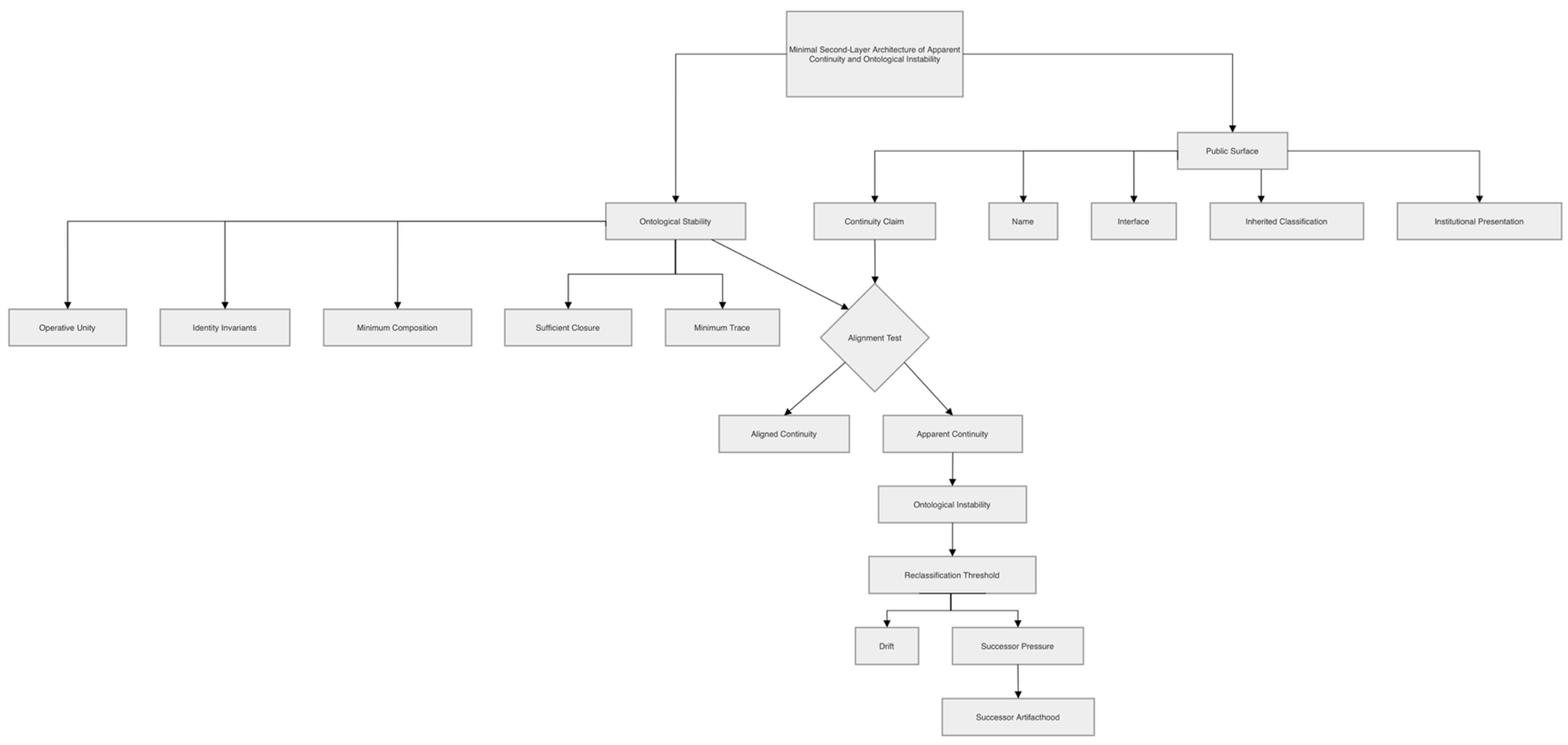
Figure 2.
From Object to Regime.
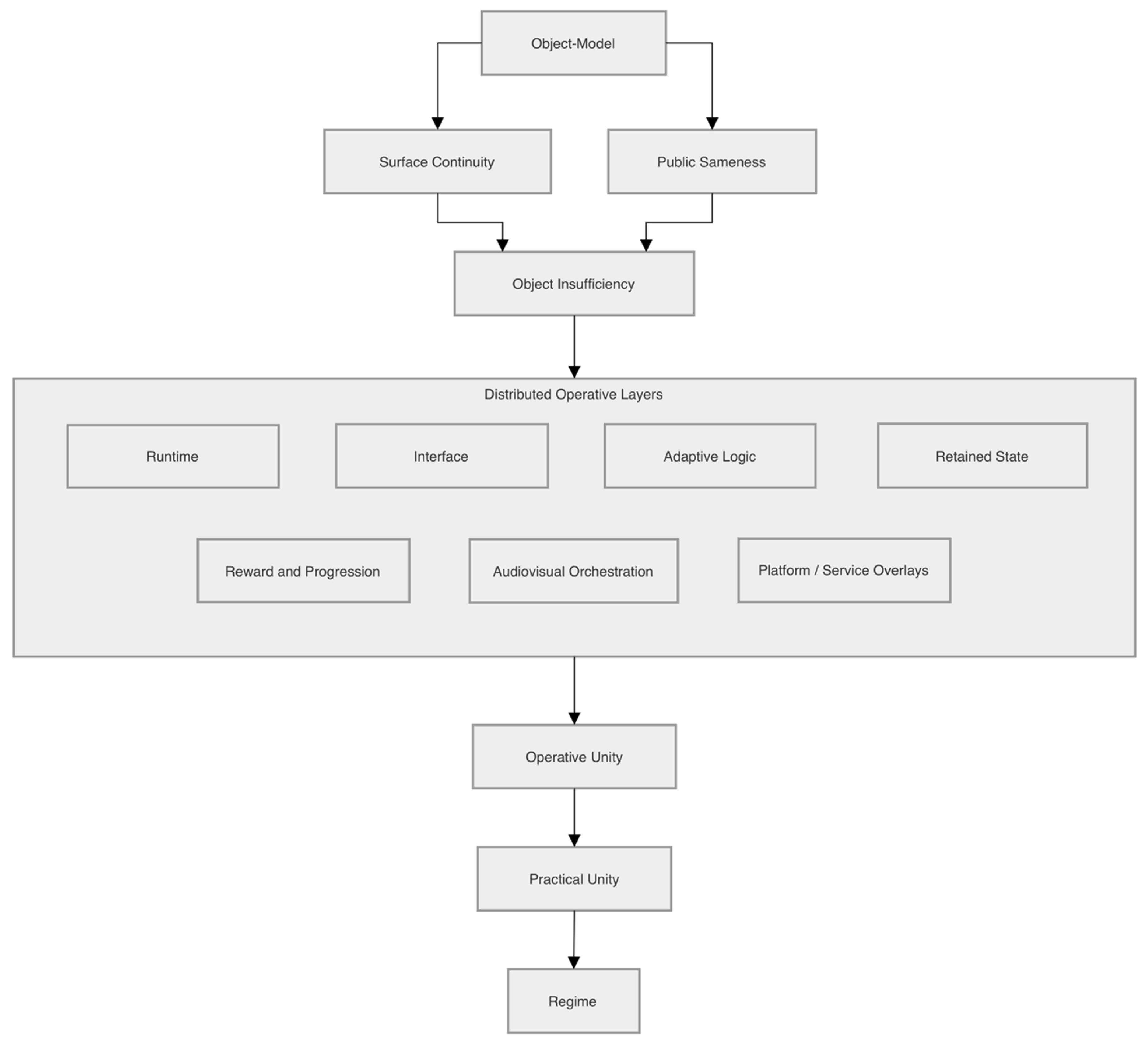
Figure 3.
Minimal Architecture of the Regime.
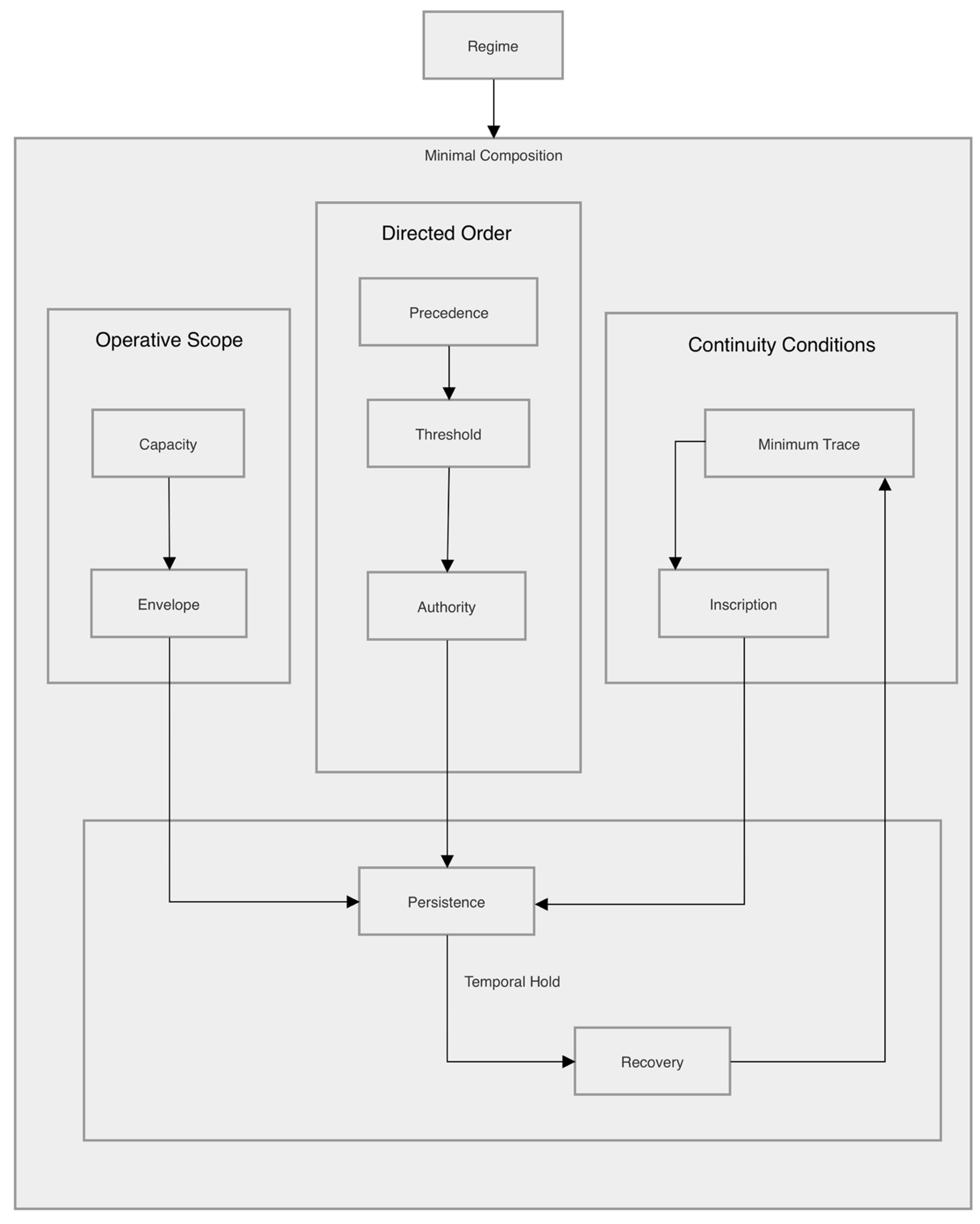
Figure 4.
Minimal architecture of artifact regime identity adjudication
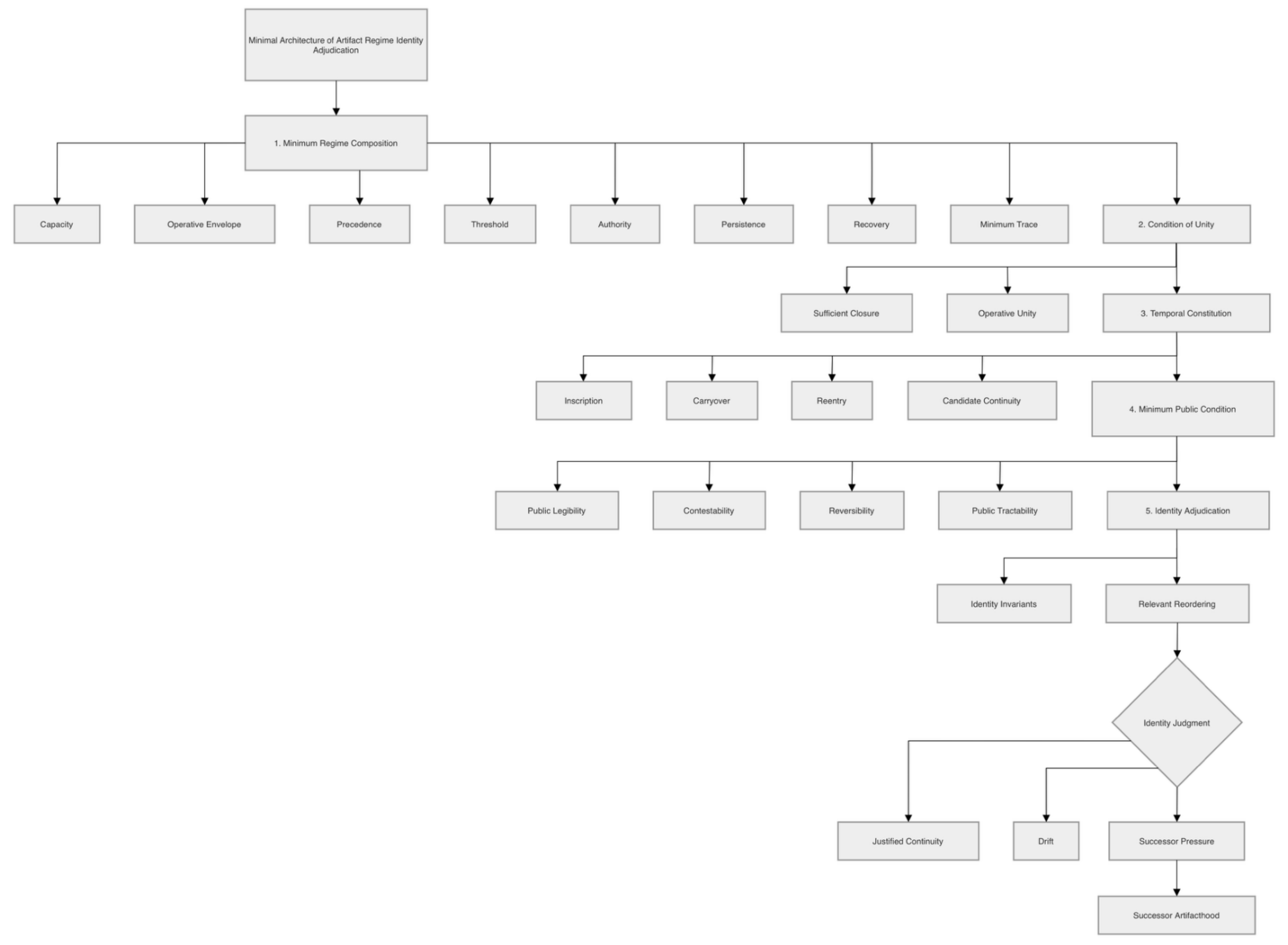
Figure 5.
Temporal Constitution of the Regime.
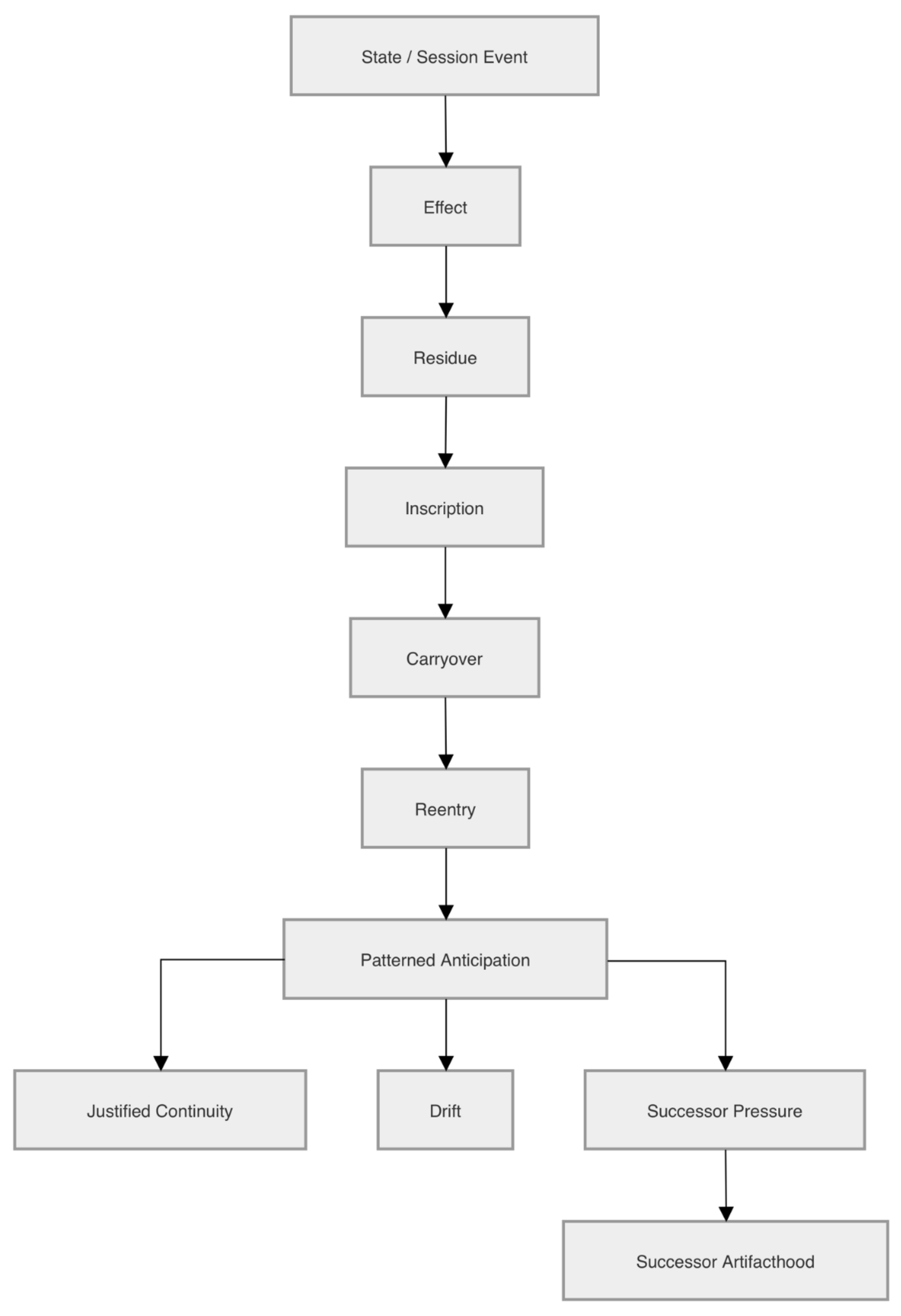
Figure 6.
Internal and Public Governability of the Regime.
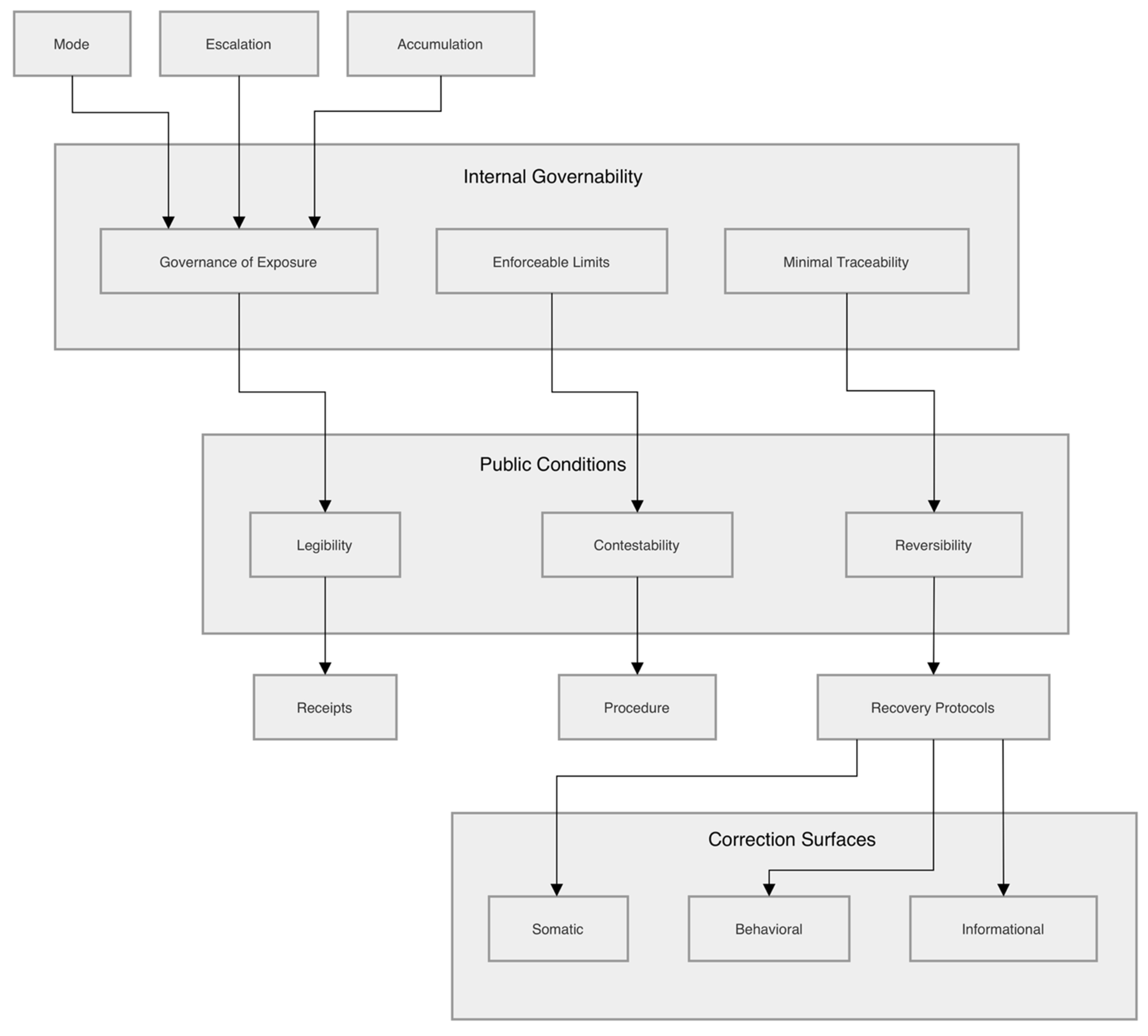
Disclaimer/Publisher’s Note: The statements, opinions and data contained in all publications are solely those of the individual author(s) and contributor(s) and not of MDPI and/or the editor(s). MDPI and/or the editor(s) disclaim responsibility for any injury to people or property resulting from any ideas, methods, instructions or products referred to in the content. |
© 2026 by the authors. Licensee MDPI, Basel, Switzerland. This article is an open access article distributed under the terms and conditions of the Creative Commons Attribution (CC BY) license (http://creativecommons.org/licenses/by/4.0/).
Copyright: This open access article is published under a Creative Commons CC BY 4.0 license, which permit the free download, distribution, and reuse, provided that the author and preprint are cited in any reuse.


