

Submitted:
25 March 2026
Posted:
26 March 2026
You are already at the latest version
Abstract
Golf tourism has gone hand in hand with the growth of the sport in recent years, reaching more than 1.4 million golf tourists in Spain, making it the second leading tourist desti-nation worldwide and surpassing 108 million players globally (National Golf Foundation, 2025; Real Federación Española de Golf, 2024b; Royal and Ancient, 2025). The present study seeks to answer the question: why do golf tourists travel? by analyzing the mo-tivations of golf tourists in Spain. For this purpose, an exploratory factor analysis was conducted to define the factors that drive golf tourists; subsequently, the suitability of these factors was tested through a confirmatory factor analysis, and finally, a cluster analysis was used to group the different typologies of golf tourists in Spain. A total of five clusters were identified, referred to as experiential golfers, wellness-oriented golfers, multifunctional golfers, low-involvement golfers, and learning-oriented golfers. The results of this research may serve golf course managers as well as public administrations in the development of marketing plans tailored to each customer segment.
Keywords:
golf tourism
; motivations
; exploratory factor analysis
; confirmatory factor analysis
; cluster analysis
1. Introduction
Sport has gained significant importance among the population of developed countries due to the improvement in citizens’ lifestyles and the increasing concern for health and well-being in society in general. This is closely related to the welfare state and the increase in quality of life, which allows people to practice sport during their leisure time (Lee et al., 2022). These factors have led tourism and sport, although being two completely different fields of study, to be presented as a new form of tourism given the characteristics of a society in which sport is increasingly embedded in daily life and people seek to practice it when they travel for leisure.
Golf is a sport that has grown significantly in recent years. According to the 2025 report on golfers by the consultancy R&A and the 2025 participation report from the National Golf Foundation, the number of golfers worldwide in 2024 reached more than 144 million people (National Golf Foundation, 2025; Royal and Ancient, 2025). Excluding the U.S. and Mexico, the number of golfers in the last 8 years has increased from 66.6 million people in 2016 to more than 108 million, representing an increase of 62.16%. This growth is due to the incorporation of new game formats that make golf more accessible to all types of people, such as golf simulators or pitch and putt courses (European golf Association, 2025; Royal and Ancient, 2025). Likewise, as indicated by Lee et al. (2022), the increase in income levels has influenced people's attitudes toward life, and the increase in free time has affected people's perception of sport. In the case of Spain, the number of golf federation licenses has almost doubled since the beginning of the century, reaching 305.603 licenses by early 2025 (Real Federación Española de Golf, 2025).
Golf tourism, in turn, has grown alongside the sport. There are numerous definitions of golf tourism. According to Ramírez-Hurtado and Berbel-Pineda (2015), it can be defined as any trip in which the main purpose is to play golf. This definition aligns with that given by Kim et al. (2008), who define international golf tourism as trips of more than one night to foreign destinations in which playing golf is the main tourist activity to satisfy travel motivations. Alternatively, similar to sports tourism, golf tourism can also be considered as a tourism pattern that involves experiencing and attending events related to the sport Lee et al. (2022). Along the same lines, Humphreys (2010) defines it as traveling away from home to participate in or observe the sport of golf, or to visit golf-related attractions. Based on these definitions, golf tourism can be defined as any trip of at least one night in which playing golf or, alternatively, attending events is a motivation, whether primary or secondary, for that trip.
The golf tourism industry generates significant benefits and acts as an economic driver for host regions, being considered one of the largest sport-related tourism industries (Readman, 2012).
The economic impact is not the only positive aspect of golf tourism. In countries like Spain, where the sun-and-beach model concentrates the majority of foreign tourist arrivals in the summer, golf tourism acts as a de-seasonalizing element, since the high season for this type of tourism is between March and April and October and November (García, 2021; Vadell et al., 2005). In this sense, the development of golf tourism helps to break the traditional seasonality that saturates tourist destinations during the summer months and becomes a perfect complement to sun-and-beach tourism (Babinger, 2012; Garau-Vadell & de Borja-Solé, 2008).
1.2. Golf Tourism in Spain
Spain has gone from receiving about 600.000 golf tourists annually in 2004 (Sarasa, 2004) to more than 1.4 million golf tourists in 2023, becoming the second-largest golf tourism destination in the world, only behind the U.S. (Real Federación Española de Golf, 2024b). The economic impact of golf tourism in Spain, including direct, indirect, and induced income, was 14.152 billion euros due to golf tourist spending in 2023, generating 132.994 jobs when considering all affected sectors (Real Federación Española de Golf, 2024b).
From the supply perspective, Spain has a total of 601 golf courses in 2024, including pitch and putt courses, rustic courses, and practice ranges. Andalusia concentrates 22% of the courses with 132 facilities, becoming the main recipient of golf tourism in Spain (Real Federación Española de Golf, 2024a).
The present research aims to analyze the main motivations that drive golf tourists to travel, answering the question: what motivates golf tourists to make a trip? In this way, it seeks to classify the different types of tourists into homogeneous groups with similar motivations and subsequently relate these groups to personal characteristics and categorize them and, if possible, to group the different types of golf tourists into homogeneous and heterogeneous groups using motivations and demographic characteristics.
The results obtained classify the motivations analysed into four main factors or categories, which, together with the demographic characteristics, result in a total of five homogeneous groups of golf tourists with similar characteristics. This information is useful to demonstrate the heterogeneity of golf tourists and thus expand the existing literature so that it can be used by tourism managers in the development of differentiated and specialized marketing strategies for each customer segment. However, it is important to note that the results obtained cannot be used directly to design business strategies, but rather serve as a framework to help understand the needs and the different motivations of the various groups of golf tourists.
2. Literature Review
2.1. Motivations
The basic theory of motivation describes a dynamic process of internal psychological factors (needs, desires, and goals) that generate an uncomfortable level of tension in the mind and body of the individual. These internal needs and the resulting tension lead to actions designed to release that tension, thereby satisfying the needs (Fodness, 1994). Following Gnoth (1997), motivations are a collective term for processes and effects with common parameters: in a particular situation, a person chooses a specific behavior based on its expected outcomes. Furthermore, motivations must be related to personal needs and goals (Middleton & Clarke, 2012). From a functional perspective, these internal needs and the resulting tension provoke attitudes and, ultimately, actions based on those attitudes, designed to release the tension and thus satisfy the needs (Fodness, 1994).
Within tourism motivations, they can be classified as primary and secondary, with secondary motivations being complementary and also serving as an enriching basis for primary motives. In the case of golf tourism, examples of secondary motives include landscapes, course quality, or climate (Robinson & Gammon, 2004).
Iso-Ahola (1980) uses the iceberg analogy to explain that the motives that drive tourists to travel are multiple: the tip of the iceberg represents the expressed motives, while the submerged part represents underlying motives, such as socialization and personality factors. Identifying these motives is very complex because, in some cases, they are part of the individual’s personality and may even be unrecognizable to the tourist themselves (Robinson & Gammon, 2004).
Dann (1977) differentiates two main motivations that drive people to travel: anomie, which is related to the needs for escape and social interaction, and personal development, linked to the ego and the need of individuals to feel valued. Crompton (1979), in turn, identified the following motivations that drive a person to travel for pleasure: escape from a perceived mundane environment, exploration and self-evaluation, relaxation, prestige, regression, strengthening family relationships, facilitating social interaction, novelty, and education.
In their work, Robinson and Gammon (2004) establish a theoretical framework for sport tourism, which allows golf tourists to be classified according to four main motives: competitiveness, recreation, activity, and passivity.
In short, understanding tourist behavior may be limited if the heterogeneous behavior of tourists is not considered, in which tourists with different motivations may have different characteristics and behaviors (Crompton, 1979; Kim & Ritchie, 2012).
2.2. Motivations in Sport Tourism
In the context of sport tourism, motivations refer to the reasons why fans travel to other locations, which may include supporting their favorite team, watching matches, socializing with others, and escaping from their daily routine (Bason, 2023). Understanding the motivations that drive these sport tourists helps provide deeper knowledge about their preferences and behavioral patterns at the destination (Perić et al., 2019; Visintin et al., 2026).
In their work, Visintin et al. (2026) analyze the behavior of mountain tourists in the Italian Alps through motivations such as the presence of mountain landscapes, the possibility of engaging in other activities, or aspects related to health. In this sense, the main motivation identified was psychological well-being, followed by physical well-being and the gastronomic characteristics of the destination. Eskelinen et al. (2025) segment disc golf tourists using push motivations such as the search for tranquility, the need to spend time with family or friends, or improving skills; and pull motivations such as the possibility of playing several courses during the same trip, family-friendly accommodation facilities, or the natural richness of the environment. Perić et al. (2019) segment tourists engaged in mountain running, mountain biking, cross-country skiing, and sport fishing through seven motivational constructs: enjoyment, physical appearance, competition, socialization, nature experience, skill improvement, and physical sport. Bichler and Pikkemaat (2021) segment ski tourists in urban destinations according to push motivations such as escape and relaxation, family time, or achievement-related motives; additionally, they use pull-type motivations such as natural scenery, urban aspects like architecture, or basic aspects such as hospitality and safety in the area.
Those tourists who travel to enjoy a sporting event are also included within the definition of sport tourism (Lopez Londoño et al., 2026). Ramos-Ruiz et al. (2026) identify five main motivational dimensions for running event tourists, including the inclusivity of vulnerable segments of society, digital interaction and validation, challenge and personal achievement, socialization, and hedonism related to sport. The main motivations described by Bason (2023) for traveling to watch a European football match were fear of missing out, entertainment, escape and relaxation, gastronomy/gourmet experience, and stimulation and learning. Another example of the study of motivations in sporting events is the work by Carvache-Franco et al. (2025), which uses the constructs of patriotism, escape and relaxation, and socialization.
Another research stream that has attracted particular interest in the sport tourism literature due to its practical implications is the study of volunteer motivations in sporting events, as it has been demonstrated that high volunteer satisfaction can help create a positive image of the event and directly influence the satisfaction of the participants in that event (Fysentzidis et al., 2025).
An example of a study on volunteer motivations is that conducted by Fysentzidis et al. (2025) on the motivations of tourism volunteers at the Athens Marathon, identifying egoism (related to a sense of pride and self-esteem), leisure, and satisfaction and recognition of the experience. Antunes et al. (2025) identify community participation, personal development, job opportunities, volunteering tradition, esteem, egoism, and personal experience as the main motivational dimensions of tourism volunteers at a trail running event.
This large number of different motivational variables confirms the complexity of motivations in sport tourism, which may be virtually countless depending on the type of tourism involved. For example, the motivations of sport tourists who attend an event differ from those of sport volunteers and active sport tourists. These combined collective motives illustrate that, at present, it is unrealistic to identify and connect the almost countless motivational variables found in both sport and tourism (Robinson & Gammon, 2004).
2.3. Golf Tourism Segmentation
The motivations that drive golf tourists to make their trips can be very diverse. For example, a tourist who travels for business or social interaction may have behavior patterns and preferences different from those who travel to improve their skills (Kim & Ritchie, 2012).
This information is highly useful for companies in the sector, as it allows understanding that tourists can be grouped into homogeneous and heterogeneous groups and, consequently, better know the different customer segments in order to develop specialized marketing strategies (Andreu et al., 2006; Cha et al., 1995; Dann, 1977; Fodness, 1994; Lee et al., 2006; Ramos-Ruiz et al., 2026). If golf course and tourism management companies understand the preferences and motivations of their clients, they can foster positive aspects to increase tourist satisfaction and, in turn, the likelihood of revisits and recommendations to friends with similar interests (Ramírez-Hurtado & Berbel-Pineda, 2015).
Golf tourism, conceived as a subsegment of sports tourism, has gained particular relevance in recent years due to its size and value (Hudson & Hudson, 2014). However, in the scientific literature, there are few studies that segment golf tourists based on motivations (Kim & Ritchie, 2012).
Among researchers who have studied different types of tourists in golf tourism, the work of Kim and Ritchie (2012) stands out, which uses motivations to identify different segments of Korean golf tourists, differentiating between intensive golfers, multimodal golfers, and companions. Ramírez-Hurtado and Berbel-Pineda (2015) segment transoceanic golf tourists traveling to Spain based on travel and personal characteristics. They have also been segmented according to their level of specialization, differentiating between low, medium, and high specialization (Kim et al., 2008). Kim and Lee (2002) segment golf tourists based on their attitude toward the presence of food and beverage services on the golf course. Segmentation has also been conducted based on destination (Kim et al., 2005), perceived value, and demographic variables (Petrick et al., 2001). Gibson and Pennington-Gray (2005) use role theory to identify different segments of golf tourists.
These studies indicate that golf tourists are heterogeneous but can be grouped based on their demographic variables, attitudes, or level of specialization. In the present research, the concept of motivation is presented as essential for understanding the different characteristics of golf tourists visiting Spain. This research provides results of great interest to the golf tourism industry, as well as to the existing literature, by deepening the segmentation of tourists based on motivations and demographic variables.
2.4. Business Opportunity
The business opportunity construct refers to the willingness of golf tourists to engage in business relationships during their trip, whether with clients or other entrepreneurs. This motivational variable has been previously used in the work of Kim and Ritchie (2012) to segment golf tourists based on their motivations.
2.5. Economic Benefit
The motivational construct of economic benefit refers to the possibility of playing golf more cheaply at the destination than in their place of origin. This is common in Southeast Asian countries such as South Korea or Japan, where, due to either cold weather or the high cost of golf rounds, golfers travel to regional countries like Thailand or Malaysia. Additionally, their governments invest significantly in advertising to attract golf tourists, taking advantage of milder climates and lower golf prices (Cham et al., 2022; Lee et al., 2022).
2.6. Escape and Relaxation
This motivational variable has traditionally been used to explain the behavior of tourists who travel to disconnect from their daily routine (Dann, 1977). In the context of sports tourism, it has been analyzed by numerous researchers for both active tourists and attendees of sports events (Bason, 2023; Bichler & Pikkemaat, 2021; Carvache-Franco et al., 2025; Kim & Ritchie, 2012).
2.7. Learning and Challenge
This motivational construct is directly related to the category of motivations linked to ego and self-esteem (Dann, 1977). Its analysis in numerous studies on sports tourism demonstrates the validity of the construct (Bichler & Pikkemaat, 2021; Eskelinen et al., 2025; Kim & Ritchie, 2012; Perić et al., 2019; Robinson & Gammon, 2004).
3. Methodology
First, for the development of the survey items, other studies on golf tourism were used as references (Cham et al., 2022; Kim & Ritchie, 2012; Kim et al., 2008; Lee et al., 2022), although questions adapted from these works were combined with original items.
For the analysis of motivations, a total of 20 questions or items were formulated using a 7-point Likert scale, where 1 indicates that the item does not motivate the respondent at all and 7 indicates that it motivates them greatly. These items were divided into five subsections according to the nature of the motivations, structured as follows: Business Opportunity, consisting of 3 items; Benefits, consisting of 5 items; Learning and Challenges, consisting of 4 items; Escape and Relaxation, consisting of 4 items; and Social Interaction and Kinship, consisting of 4 items.
The second section of the survey analyzed sociodemographic aspects such as age, gender, profession, educational level, and income of the respondent.
The survey was conducted in collaboration with staff from the University of Córdoba, the University of Granada, and the University of León. It was subjected to several revisions and pilot tests before being finalized. Subsequently, the survey was uploaded to an online survey platform, and a poster with its corresponding QR code (Figure 1) was created so that it could be completed using any electronic device with internet access. It was also promoted via the social network Facebook, reaching a larger number of people.
3.1. Data Collection
The questionnaire began to be distributed in February 2023 in person at golf courses on the Costa del Sol, mainly at Miguel Ángel Jiménez Golf Academy and Club de Golf El Chaparral, specialized local shops, travel agencies focused on golf, WhatsApp groups of golf players, and other organizations such as the Royal Andalusian Golf Federation, the Royal Spanish Golf Federation, and the Spanish Golf Courses Association. Subsequently, it was distributed via the social network Facebook Business, which allowed respondents from all over the country to participate.
The survey was closed on June 6, 2023, with a total of 721 responses. After discarding incomplete questionnaires, the number of complete surveys was 381, of which 157 were collected in person and 224 were collected online.
3.2. Data Processing and Analysis
Data analysis was performed using the statistical analysis tool IBM SPSS Statistics 30.0 for exploratory factor analysis (EFA) and cluster analysis. For confirmatory factor analysis (CFA), the statistical analysis tool RStudio and the “Lavaan” package were used.
3.2.1. Exploratory Factor Analysis (EFA)
First, the normality of the motivational constructs was tested using the Kolmogorov-Smirnov and Shapiro-Wilk tests (Kolmogorov, 1933; Shapiro & Wilk, 1965; Smirnov, 1948). Subsequently, a principal components exploratory factor analysis (EFA) was carried out to more accurately explore the underlying dimensions, constructs, or latent variables of the observed variables (Mavrou, 2015). Initially, the suitability of the data for this analysis was checked, obtaining values above 0.7 in the Kaiser-Meyer-Olkin index (Romero & Mora, 2020), and the correlation between variables was supported through Bartlett’s test of sphericity with p < 0.001, being below 0.05 (Hair, 2009; Romero & Mora, 2020).
The reliability of the results was verified using Cronbach’s alpha (α) (Cronbach, 1951) and McDonald’s omega (ω) (McDonald, 1989), with all results exceeding the recommended threshold of 0.7 (Nunnally & Bernstein, 1994). The sample size also meets the recommended parameters of between 300 and 400 observations (Hair et al., 2006). According to Mavrou (2015), the recommended number of observations per variable is between 15 and 20, which is widely exceeded in the present study.
The ratio of the number of variables per factor should meet a minimum of 3:1 (Mavrou, 2015). It is recommended to interpret only well-identified common factors and reduce the number of factors if some are represented by only one or two variables with high loadings (Velicer & Fava, 1998).
To determine the number of factors, the Guttman-Kaiser rule or latent root criterion was followed, using only those factors with eigenvalues greater than 1 (Hair et al., 2006; Mavrou, 2015). According to Hair et al. (2006), this method may not give reliable results for fewer than 20 variables or may limit the explanatory capacity of the factorial solution; however, in this study it is appropriate as there are 20 variables.
The value of factor loadings can vary depending on the sample. In this regard, Hair et al. (2006) state that for a sample of 70 and 75 individuals, factor loadings should be at least 0.6 and 0.65, respectively. Furthermore, it is recommended to use only those factor loadings with an absolute value greater than 0.4 (Field, 2009). It can be concluded that identifying a factor using three variables with loadings of 0.60 (or ideally greater than 0.71) is sufficient to assume that these variables are good indicators of the latent construct of interest (Mavrou, 2015). In the present study, only two variables presented factor loadings below 0.71, but with very close values (0.698 and 0.708).
Regarding the percentage of explained variance, and following Hair et al. (2006), in the social sciences the explained variance should exceed 60%. In this study, an explained variance level of 69.44% was obtained, very similar to other studies conducted in golf tourism (Kim & Ritchie, 2012).
For the final data extraction, several iterations were carried out, starting with a total of 20 variables and progressively eliminating those that did not meet any of the principles established above until a total of 12 remained. After each new analysis, once a variable was removed, a reliability test was conducted and compared with the original results (with 20 variables) to corroborate the improvement in model fit.
3.2.2. Confirmatory Factor Analysis (CFA)
To validate the latent structure identified in the exploratory factor analysis (EFA), a confirmatory factor analysis (CFA) was conducted using the statistical program RStudio. Given the non-normality of the variables, the Weighted Least Squares Mean and Variance adjusted method (WLSMV) was used for the analysis.
The Average Variance Extracted (AVE) was used to measure the level of variance explained by each variable in each factor. Following Fornell and Larcker (1981), values below 0.5 are not acceptable as too much information from each variable is lost. Additionally, to analyze construct reliability, the Composite Reliability (CR) was calculated, with values greater than 0.7 considered acceptable and values above 0.8 considered good (Nunnally & Bernstein, 1994).
Moreover, factor loadings should exceed 0.4 to ensure construct stability (Hair, 2009). In the present study, AVE values above 0.5 were obtained for each construct, and factor loadings above 0.4 for all variables, confirming the suitability of the variables.
To measure model fit, absolute fit indices were used, such as the Root Mean Square Error of Approximation (RMSEA), for which values below 0.5 indicate a good fit and values between 0.5 and 0.8 are considered acceptable (Hu & Bentler, 1999; Romero & Mora, 2020). The Goodness of Fit Index (GFI) belongs to the same group, with values above 0.9 indicating a good fit (Romero & Mora, 2020).
The Comparative Fit Index (CFI) was calculated, with values above 0.9 considered acceptable and values above 0.95 considered good (Hair Jr et al., 2019). The Tucker-Lewis Index (TLI) values above 0.9 are considered acceptable (Hair, 2009). Both belong to the group of incremental fit indices.
Finally, the Standardized Root Mean Square Residual (SRMR), a parsimony-corrected indicator, was calculated, with values below 0.8 indicating a good fit (Martínez Ávila, 2021).
Finally, the chi-square test was calculated to analyze the associations of the categorical variables included in the study and the resulting clusters. To measure the effect size of each demographic variable on the clusters, Cramer’s V was used, a robust association measure commonly employed to evaluate the strength of relationships between nominal variables (Cohen, 2013). For interpretation, values between 0 and 0.3 indicate a low effect, between 0.3 and 0.5 a medium effect, and values above 0.5 a high effect.
3.2.3. Cluster Analysis
A non-hierarchical cluster analysis was conducted using the factors resulting from the exploratory and confirmatory factor analyses, standardized using Ward’s method and squared Euclidean distance to obtain the number of clusters in which the sample is divided, thereby segmenting the respondents into homogeneous groups based on their motivational characteristics. This method has been previously used in sports tourism research (Ramos-Ruiz et al., 2026) and specifically in studies on golf tourism (Kim & Ritchie, 2012; Kim et al., 2008; Ramírez-Hurtado & Berbel-Pineda, 2015), demonstrating its usefulness in this context.
Once the number of clusters was defined using the dendrogram, a K-means cluster analysis was performed, defining homogeneous groups of golf tourists based on their motivations. The robustness of the clusters was measured using the sum of squares within clusters and the F value provided by the ANOVA table, which indicates the distance between clusters, with better clusters defined as those with values further from 1.
Finally, an analysis of the demographic characteristics of each cluster was conducted to better understand the peculiarities of each group, and the clusters were labeled accordingly.
3. Results
3.1. The Demographic Profile
The demographic profile of the typical golf tourist is a male aged between 46 and 60 years, retired, with an income level above 3.500 euros per month, and with a university education. Table 1 shows the results obtained.
Regarding age, individuals between 46 and 65 years stand out, representing 59.6% of the sample, followed by those over 65 years with 23.1%. These results are consistent with studies conducted by Kim and Ritchie (2012), Cham et al. (2022) and Lee et al. (2022) in terms of the predominant age group but differ in the participation of younger individuals. This may be due to the specific characteristics of golf tourists in the country or the method used to disseminate the survey; however, further research would be necessary to explore the causes in greater depth.
The gender of the respondents has an approximate ratio of 4 to 1 in favor of men, accounting for 78.2% of the total, while women, with 81 cases, represent 21.3%, and two individuals who reported not identifying with any gender account for 0.5% of the total respondents. These results are quite similar to those obtained in the studies by Kim et al. (2008), Kim and Ritchie (2012), Cham et al. (2022) and the percentage of female licenses in Spain according to the 2024 report (Real Federación Española de Golf, 2025). However, they do not match the results obtained by Lee et al. (2022), in which female participation, although not higher than that of men, is significantly greater. This may be due to higher female participation in golf in Korea compared to Spain.
The predominant profession among respondents is retired, representing more than one-third of the total sample with 129 individuals (33.9%), followed by private company employees with 107 respondents, representing 28.1% of the sample. Next are self-employed professionals and civil servants with 55 cases (14.4%) and 43 cases (11.3%), respectively. Finally, the least represented professions were freelancers at 8.9% of the sample with 34 respondents, unemployed individuals with 5 cases (1.3%), and students and homemakers, each with 4 cases, representing 1% of the total respondents. The high presence of retired individuals does not coincide with the results obtained by Kim et al. (2008), Kim and Ritchie (2012) or Lee et al. (2022). This may be due to the high proportion of golf tourists from other countries who come to Spain to enjoy their retirement or to characteristics inherent to the Spanish economic structure; however, further research would be necessary to investigate the potential causes in more detail.
Regarding income level, nearly half of the respondents reported earning more than 3.500 euros per month, totaling 157 surveys (41.2%), followed by those earning between 2.501 and 3.500 euros per month, totaling 106 respondents and representing 27.8% of the sample. Next is the group of respondents earning between 1.501 and 2.500 euros per month, with 94 surveys (24.7%), and finally, only 6.3% reported earning less than 1.500 euros per month, with 24 cases. This high purchasing power aligns with the results obtained by Kim et al. (2008).
Finally, regarding the respondents' level of education, individuals with higher education stand out, totaling 202 cases (53%), and 82 cases (21.5%) reported having university or postgraduate studies, respectively. Respondents with vocational training accounted for 58 cases (15.2% of the sample), while those with secondary education totaled 32 individuals (8.4%). Only 7 respondents (1.8%) reported having completed only primary education. These results are consistent with the studies conducted by Kim et al. (2008).
3.2. Descriptive Analysis of Motivations
Table 2 shows the descriptive statistics for the motivational variables studied and the reliability values measured by Cronbach's alpha (α) and McDonald’s omega (ω).
The highest-rated motivations were MOT11, “I like to improve my golf skills and knowledge,” and MOT19, “I like to travel with my family,” with mean scores of 5.675 and 5.52, respectively, being the main drivers for golf tourists when taking a sport-focused trip. On the other hand, the motivations MOT1, “I like to talk about business when I play golf,” and MOT2, “I could achieve business goals by playing golf,” obtained the lowest scores with means of 2.197 and 2.399 out of 7, respectively.
Focusing on the motivational groups, the one with the highest mean score is “Social interaction and kinship” with 4.955 out of 7, indicating that for golf tourists, traveling with family and friends, as well as meeting local people, are the main motivations. The motivational group “Business opportunity” has the lowest mean score at 2.597, indicating that most golf tourists in Spain do not view golf primarily as a bridge to conduct business.
3.3. Exploratory Factor Analysis of Principal Components
The normality of the variables was examined using the Kolmogorov-Smirnov test, obtaining a p-value < 0.001 for all variables, thus rejecting the normal distribution of the data. Subsequently, the suitability of the variables for conducting an exploratory factor analysis was verified using the KMO test and Bartlett's sphericity test. The results are shown in Table 3.
Once the suitability of the variables was confirmed, an initial factor analysis was conducted with 20 variables, yielding a total explained variance of 60.335%. However, MOT18 “I like to establish relationships with people at the local club” did not exceed the threshold of eigenvalues greater than 1 and was therefore eliminated.
The second principal component factor analysis was performed with 19 variables, obtaining an explained variance of 61.619%, improving the previous results. However, factor loadings below .5 were found for the variables MOT17 “I could improve relationships with friends” and MOT8 “I can undertake multipurpose trips during golf vacations.”
The third principal component factor analysis was conducted with 17 variables, resulting in a total explained variance of 64.622%. Nevertheless, a factor loading close to .5 was observed for MOT12 “I like participating in physical activities,” so it was eliminated and the results compared.
Performing the analysis with 16 variables, a cumulative explained variance of 66.505% was obtained, improving the previous results. The variable MOT16 “I want to escape the routine to watch golf championships” was eliminated due to factor loadings close to .5, and the analysis was conducted again.
The cumulative explained variance increased to 68.539% with 15 variables. However, the variables MOT19 “I like to travel with family” and MOT20 “Visiting relatives or friends” formed a factor with only two variables, not meeting the minimum of three variables despite high factor loadings (Mavrou, 2015; Velicer & Fava, 1998).
After eliminating these two variables, along with MOT7 “I can avoid bad weather” due to factor loadings close to .5, the final analysis yielded four factors and a total cumulative variance of 69.438% with the remaining 12 variables, exceeding the recommended threshold of 60% (Hair et al., 2006).
The results obtained meet the conditions established for a good fit according to the methodological criteria (Hair, 2009; Mavrou, 2015; Romero & Mora, 2020; Velicer & Fava, 1998). Table 4 shows the results obtained.
Of the four resulting factors, the constructs “business opportunity,” “learning and challenge,” and “escape and relaxation” are consistent with the results of previous research in golf tourism (Kim & Ritchie, 2012). However, the construct “economic benefit” refers only to variables related to the economic advantages of traveling outside the tourists’ place of residence, without including the variables “I can avoid bad weather” and “I can take multifunctional trips during golf vacations,” as included by Kim and Ritchie (2012) in their study.
Factor 1, “Business opportunity,” explains 29.799% of the variance, and all factor loadings of its variables are above 0.782. Factor 2, “Economic benefit,” explains 17.563% of the cumulative variance, and all factor loadings of its variables exceed the 0.71 threshold proposed by Mavrou (2015), except for variable MOT4, “I can play more rounds of golf at a lower cost,” which has a factor loading of 0.698, very close to the indicated threshold.
Factor 3, “Learning and challenge,” accounts for 11.182% of the explained variance and shows a similar situation to Factor 2: all variables have factor loadings above the 0.71 threshold except one, MOT11, “I like to improve golf skills and knowledge,” with a very close value (0.708). Finally, Factor 4, “Escape and relaxation,” represents 10.894% of the explained variance, and all its variables present factor loadings above 0.71.
3.4. Confirmatory Factor Analysis
Once the exploratory factor analysis (EFA) was conducted, a confirmatory factor analysis (CFA) was performed using the weighted least squares method with mean and variance adjustment (WLSMV), which is widely used when variables do not follow a normal distribution. As shown in Table 4, the values of average variance extracted (AVE) and composite reliability (CR) are above the recommended thresholds of 0.5 and 0.7, respectively, in all cases, which constitutes evidence of internal consistency and convergent validity (Fornell & Larcker, 1981). Subsequently, Table 5 shows the results obtained for the different fit indices.
The absolute fit index χ² shows satisfactory results (χ² = 218.701; df = 48; p < 0.001). The root mean square error of approximation (RMSEA) shows values slightly higher than recommended (RMSEA = 0.097), which may be due to the fact that this indicator requires the distribution to be symmetrical for samples ranging from 100 to 450 (Morata-Ramírez et al., 2015). Nevertheless, this poor result is compensated by the rest of the indicators, which indicate that the model fits correctly. On the other hand, the standardized root mean square residual (SRMR) obtained adequate values (SRMR = 0.071). Finally, regarding the absolute fit indicators, the goodness-of-fit index (GFI) obtained a very satisfactory value (GFI = 0.99).
Regarding the incremental fit indices, the comparative fit index (CFI) obtained a value above the recommended 0.95 (CFI = 0.962), being considered a good fit according to Hair Jr et al. (2019). The Tucker-Lewis index (TLI) obtained a value above the threshold recommended as acceptable and very close to the threshold to be considered a good fit (TLI = 0.947). Additionally, other incremental fit indices were calculated to provide greater robustness to the model (NNFI = 0.98; RNI = 0.962; IFI = 0.985).
The standardized weights of each factor for each variable (Illustration 1) exceed the recommended values in all cases, validating the stability of the construct. In short, given the results obtained, it can be concluded that the confirmatory factor analysis (CFA) confirmed that the model fit is satisfactory and meets the recommended thresholds.
3.5. Cluster Analysis
Once the factors from the exploratory and confirmatory factor analyses (business opportunity, economic benefit, learning and challenge, and escape and relaxation) were defined, standardized scores were obtained to carry out a non-hierarchical cluster analysis, through which 5 clusters or homogeneous groups of golf tourists were identified.
To define the different clusters, a K-means cluster analysis was conducted. The model resulted in the grouping of golf tourists into 5 distinct latent groups (experiential golfers, wellness-oriented golfers, multifunctional golfers, low-involvement golfers, and learning-oriented golfers). The clusters with the closest distance between their centers, and therefore the most similar to each other, are cluster 4 “Low-involvement golfers” and cluster 5 “Learning-oriented golfers,” with a distance of 1.815. Conversely, the clusters with the greatest difference between their centers, and therefore the most dissimilar, are cluster 4 “Low-involvement golfers” and cluster 3 “Multifunctional golfers,” with a distance of 3.6. Table 6 shows that all the defined dimensions are significant for grouping homogeneous clusters of golf tourists.
Table 7 shows the results obtained in the cluster analysis, the mean and standard deviation for each of the variables and clusters, as well as Cramer’s V for each of the demographic variables.

Table 8.
Cluster analysis. Mean, standard deviation, z-score, cross-tabulations, and Cramer’s V.
| Cluster 1 | Cluster 2 | Cluster 3 | Cluster 4 | Cluster 5 | ||||||
| Experiential golfers | Wellness-oriented golfers | Multifunctional golfers | Low involvement golfers | Learning-oriented golfers | ||||||
| Items | N=76 (19.95%) | N=91 (23.88%) | N=82 (21.52%) | N=60 (15.75%) | N=72 (18.9%) | |||||
| Mean | SD | Mean | SD | Mean | SD | Mean | SD | Mean | SD | |
| (1) Business opportunity | 1.68 | 0.811 | 1.81 | 0.91922 | 5.03 | 0.93139 | 1.53 | 0.79616 | 2.68 | 1.158 |
| (2) Economic benefit | 5.87 | 0.9443 | 5.01 | 1.16955 | 5.52 | 0.92985 | 2.91 | 1.46506 | 3.74 | 1.17876 |
| (3) Learning/challenge | 5.77 | 0.7484 | 3.51 | 0.78778 | 5.51 | 1.02666 | 3.64 | 0.92525 | 5.29 | 0.86364 |
| (4) Escape/relaxation | 5.77 | 0.9816 | 5.32 | 1.12586 | 5.57 | 1.13224 | 2.75 | 0.99078 | 4.21 | 1.2652 |
| Gender (V=0.150; p=0.028) [n;%] | ||||||||||
| Male | 51 | 17.10% | 67 | 22.40% | 74 | 24.70% | 50 | 16.70% | 57 | 19.10% |
| Female | 24 | 30.00% | 24 | 30.00% | 8 | 10.00% | 10 | 12.50% | 14 | 17.50% |
| Non-binary | 1 | 50.00% | 0 | 0.00% | 0 | 0.00% | 0 | 0.00% | 1 | 50.00% |
| Age (V=0.159; p=0.04) [n;%] | ||||||||||
| Under 30 years | 2 | 14.30% | 1 | 7.10% | 7 | 50.00% | 1 | 7.10% | 3 | 21.40% |
| Between 30 and 45 years | 9 | 23.70% | 5 | 13.20% | 13 | 34.20% | 2 | 5.30% | 9 | 23.70% |
| Between 45 and 60 years | 31 | 20.50% | 37 | 24.50% | 39 | 25.80% | 24 | 15.90% | 20 | 13.20% |
| Over 60 years | 34 | 19.10% | 48 | 27.00% | 23 | 12.90% | 33 | 18.50% | 40 | 22.50% |
| Education (V=0.109; p= 325) [n; %] | ||||||||||
| Primary education | 2 | 28.60% | 1 | 14.30% | 1 | 14.30% | 1 | 14.30% | 2 | 28.60% |
| Secondary education | 3 | 9.40% | 12 | 37.50% | 7 | 21.90% | 2 | 6.30% | 8 | 25.00% |
| Vocational training | 18 | 31.00% | 13 | 22.40% | 13 | 22.40% | 9 | 15.50% | 5 | 8.60% |
| Postgraduate | 12 | 14.60% | 21 | 25.60% | 21 | 25.60% | 13 | 15.90% | 15 | 18.30% |
| University degree | 41 | 20.30% | 44 | 21.80% | 40 | 19.80% | 35 | 17.30% | 42 | 20.80% |
| Occupation (V=0.158; p= 0.035) [n; %] | ||||||||||
| Public employee | 12 | 27.90% | 9 | 20.90% | 7 | 16.30% | 11 | 25.60% | 4 | 9.30% |
| Unemployed | 1 | 20.00% | 2 | 40.00% | 1 | 20.00% | 1 | 20.00% | 0 | 0.00% |
| Student | 1 | 25.00% | 0 | 0.00% | 1 | 25.00% | 0 | 0.00% | 2 | 50.00% |
| Retired | 24 | 18.60% | 40 | 31.00% | 13 | 10.10% | 19 | 14.70% | 33 | 25.60% |
| Household work | 1 | 25.00% | 1 | 25.00% | 1 | 25.00% | 0 | 0.00% | 1 | 25.00% |
| Freelance worker | 10 | 18.20% | 8 | 14.50% | 16 | 29.10% | 9 | 16.40% | 12 | 21.80% |
| Self-employed professional | 6 | 17.60% | 7 | 20.60% | 10 | 29.40% | 7 | 20.60% | 4 | 11.80% |
| Private company employee | 21 | 19.60% | 24 | 22.40% | 33 | 30.80% | 13 | 12.10% | 16 | 15.00% |
| Income (V= 0.118; p=0.379) [n; %] | ||||||||||
| Less than 700 euros | 2 | 50.00% | 0 | 0.00% | 1 | 25.00% | 0 | 0.00% | 1 | 25.00% |
| Between 700 and 1000 euros | 0 | 0.00% | 0 | 0.00% | 1 | 100.00% | 0 | 0.00% | 0 | 0.00% |
| Between 1,001 and 1500 euros | 5 | 26.30% | 1 | 5.30% | 7 | 36.80% | 4 | 21.10% | 2 | 10.50% |
| Between 1501 and 2500 euros | 21 | 22.60% | 20 | 21.50% | 23 | 24.70% | 11 | 11.80% | 18 | 19.40% |
| Between 2501 and 3500 euros | 16 | 15.10% | 32 | 30.20% | 17 | 16.00% | 17 | 16.00% | 24 | 22.60% |
| More than 3500 euros | 32 | 20.30% | 38 | 24.10% | 33 | 20.90% | 28 | 17.70% | 27 | 17.10% |
The results in Table 7 show that the only variables with a significant Cramer’s V (p<0.05) were age, gender, and profession. All of them showed a weak effect on the clusters: VAge = 0.159, p = 0.04; VGender = 0.150, p = 0.028; VProfession = 0.158, p = 0.035.
3.5.1. Cluster Interpretation
Regarding the motivational and demographic characteristics of each group, the results are shown in the following Table 9.
Cluster 1, called experiential golfers, presents a low score in the variable “Business opportunity” and high values in the rest. This indicates that they are not interested in golf trips for doing business or improving relationships with their clients; their main motivations are playing golf cheaper than in their local area, improving their skills, and escaping the crowds. They have been called “experiential” because they highly value the experience while also giving notable importance to price; for these clients, the perceived value of the destinations they visit is very important.
Cluster 2, called wellness-oriented golfers, presents a low score in the variable “Business opportunity,” so like the “experiential” group, they do not use golf tourism trips for business. Unlike the first group, they give relative importance to the variable “Learning/challenge,” with their main motivations being “Economic benefit” and “Escape/relaxation.” This group of golf tourists seeks an experience that allows them to disconnect from their daily routine, looking for escape and relaxation while also giving importance to price.
The third group is composed of tourists called multifunctional golfers. This group presents high scores in all motivational variables and is consistent with other golf tourism studies (Kim & Ritchie, 2012).
Cluster 4, called low-involvement golfers, presents low scores in all motivational variables; this may be because, despite being considered golf tourists, they may have other motivations not studied in the present research.
Finally, Cluster 5, learning-oriented golfers, presents a low score in “Business opportunity” and medium to medium-high scores in “Economic benefit” and “Escape/relaxation,” with their main motivation being the dimension “Learning/challenge.” This group of golf tourists seeks to improve their golf skills and knowledge, prioritizing it over price or seeking to disconnect.
3.5.2. Demographic Profile of the Clusters
Regarding the demographic profile of the different groups analyzed, two differentiated demographic profiles can be observed: the first is formed by the groups of “experiential golfers,” “wellness-oriented golfers,” “low-involvement golfers,” and “learning-oriented golfers.” This demographic profile is characterized by being predominantly retired men over 60 years old, with university education, and a high income above 3.500 euros per month.
The second resulting demographic profile is that of the group of “multifunctional golfers,” which is characterized mostly by men between 45 and 60 years old, private company employees with university education, and high income levels (more than 3.500 euros).
These profiles do not match in terms of age with other studies on golf tourism, in which the typical tourist profile is younger (Kim & Ritchie, 2012; Kim et al., 2008; Ramírez-Hurtado & Berbel-Pineda, 2015). This may be due to the particular characteristics of the Spanish golf tourism market, although further study is necessary to obtain a reliable conclusion that explains it.
3.5.3. Cluster Preferences Analysis
Table 10.
Analysis of Preferences of Golf Tourist Clusters.
| Cluster 1 | Cluster 2 | Cluster 3 | Cluster 4 | Cluster 5 | Total | |
| Experiential Golfers | Wellness-Oriented Golfers | Multifunctional Golfers | Low-Involvement Golfers | Learning-Oriented Golfers | ||
| Mean | Std. Dev. | Mean | Std. Dev. | Mean | Std. Dev. | |
| Destination Preferences | ||||||
| Climate | 5.61 | 1.28 | 5.22 | 1.56 | 5.78 | 1.20 |
| Accessibility | 5.11 | 1.41 | 4.84 | 1.73 | 5.48 | 1.48 |
| Safety and Security | 5.29 | 1.48 | 4.90 | 1.75 | 5.30 | 1.58 |
| Prior Knowledge of the Area | 3.93 | 1.75 | 3.71 | 1.67 | 4.67 | 1.70 |
| Variety of Courses in the Area | 5.41 | 1.59 | 4.77 | 1.56 | 5.60 | 1.46 |
| Availability of Other Leisure Activities | 5.05 | 1.74 | 4.55 | 1.92 | 5.05 | 1.60 |
| Fame and Reputation of the Area | 5.08 | 1.40 | 4.34 | 1.54 | 5.28 | 1.30 |
| Hotel and Restaurant Offerings | 5.78 | 1.24 | 5.22 | 1.58 | 5.90 | 1.14 |
| Proximity to Home | 4.25 | 1.66 | 3.95 | 1.88 | 4.23 | 1.81 |
| Golf Course Preferences | ||||||
| Treatment Received | 5.96 | 1.17 | 5.82 | 1.16 | 6.33 | 0.85 |
| Course Quality | 6.42 | 1.01 | 6.01 | 1.02 | 6.49 | 0.76 |
| Restaurant | 5.17 | 1.54 | 4.35 | 1.64 | 5.26 | 1.34 |
| Green Fee Prices | 6.45 | 1.19 | 6.24 | 0.97 | 6.21 | 1.19 |
| Practice Facilities | 5.11 | 1.50 | 4.26 | 1.71 | 5.38 | 1.27 |
| Course Management | 5.49 | 1.43 | 4.74 | 1.57 | 5.78 | 1.11 |
| Accommodation | 5.67 | 1.42 | 4.70 | 1.79 | 5.76 | 1.29 |
| Accessibility | 5.26 | 1.44 | 4.75 | 1.66 | 5.61 | 1.26 |
Within destination-related preferences, the presence of restaurants and hotels in the area represents the highest-rated construct among golf tourists. This aligns with other studies on sports tourism (Perić et al., 2019), in which the local gastronomic offer becomes an incentive and an opportunity for golf course managers to establish partnerships with nearby businesses and organize events that combine golf and local cuisine to capitalize on these preferences.
Climate is the second most valued preference, receiving a score above 5 across all segments, as tourists often leave their home countries seeking favorable weather that allows them to play golf most of the year. In the context of golf tourism in Spain, this is a consistent trend among tourists from Nordic countries who take advantage of the country’s mild climate (Real Federación Española de Golf, 2024b). Likewise, the ability to play golf year-round contributes to the de-seasonalization of tourism, helping balance tourist flows (Babinger, 2012; Garau-Vadell & de Borja-Solé, 2008).
Accessibility, understood as the ease of traveling to the destination, is highly valued by experiential and multifunctional golfers. In this regard, tourism managers should focus their marketing efforts on these segments. This same group also places high importance on safety and security, which is the fourth highest-rated construct overall. A destination that is safe, attractive, and easily accessible is an important attribute both for active tourists and for event organizers (Perić et al., 2019).
Among the dimensions of golf courses, course quality, green fee prices, and service received are the most highly valued by golf tourists. This indicates that, in addition to providing good value for money, golf course managers should pay special attention to staff training and professionalism to foster customer loyalty.
Low-involvement and learning-oriented golfers do not place as much importance on green fee prices, although course quality remains critical. This group is willing to pay slightly more as long as the course is of high quality and in optimal condition, without emphasizing promotional offers. Golf course managers could leverage this by adjusting pricing strategies during peak season when prices are higher.
Multifunctional and experiential golfers assign high importance to the availability of restaurants and accommodations, being the primary consumers of these services. Golf courses that offer these complementary services should target marketing efforts toward these clients using typical hotel promotion channels and present these amenities as a differentiating feature from competitors. Additionally, this group places higher importance on proximity to their place of residence compared to other segments, suggesting that marketing campaigns should focus on local populations and surrounding areas. Multifunctional golfers also value the presence of multiple courses in the area, which can become a differentiating factor for this segment.
Course management refers to the work of the Marshall, who ensures smooth play and minimizes waiting times for players. This variable is highly valued by experiential and multifunctional golfers, who seek destinations with favorable weather and aim to maximize their time to enjoy other services, such as local gastronomy. Similarly, accessibility to the golf course, meaning ease of reaching the facilities, is particularly important for these tourist segments.
4. Discussion
This study helps to better understand the characteristics of golf tourists based on their motivations and demographic variables. Motivations help to understand and predict tourist behaviors so that golf course management institutions and companies, as well as adjacent sectors, can develop specialized marketing strategies for each group of tourists based on their profitability (Crompton, 1979; Visintin et al., 2026).
The analysis carried out through an exploratory factor analysis identified 4 main factors or motivations driving golf tourists: business opportunity, economic benefit, learning and challenge, and escape and relaxation. The motivations of escape and relaxation and learning and challenge are consistent with studies on tourist motivations (Crompton, 1979; Dann, 1977) and studies on sports tourism (Bason, 2023; Bichler & Pikkemaat, 2021; Carvache-Franco et al., 2025; Kim & Ritchie, 2012). In addition, the motivation of business opportunity also appears in other golf tourism studies used as references here, giving significant results as well (Kim & Ritchie, 2012).
The motivation of economic benefit is a motivation that has not been previously studied in golf tourism, at least not so specifically, since Kim and Ritchie (2012) in their study distinguish the “benefits” motivation, which includes motivations such as “I can avoid bad weather” or “I can undertake multifunctional trips during my golf vacations,” which have been eliminated in the present study for not presenting satisfactory factor loadings. In this way, in the present study, the economic benefit motivation only refers to aspects related to the cost of playing golf, such as “I can play more rounds of golf for less,” “I can play without needing a membership,” and “I can travel with lower expenses than domestic golf.” This indicates that golf tourists give considerable importance to price and the need not to spend too much money to enjoy the sport.
Furthermore, in their work Kim and Ritchie (2012) include a fifth factor or motivation: social interaction and kinship. This motivation, although highlighted as one of the main motivations when taking a trip (Crompton, 1979; Dann, 1977), did not obtain adequate factor loadings in the present study to be considered. This circumstance may be due to particularities of the sample used, a poor description of the variable, or both. Greater depth in future studies and comparison of results would be necessary to better understand this performance.
After conducting the exploratory factor analysis, a confirmatory factor analysis was carried out to check the robustness of the latent constructs formed. The results obtained are satisfactory; only one of the indicators did not achieve an acceptable score (RMSEA<0.08) (Hu & Bentler, 1999; Romero & Mora, 2020), but this circumstance can be offset by the positive evaluation of the rest of the fit indicators (chi-square, TLI, SRMR, GFI, RNI, IFI, GFI, and NNFI).
Finally, the cluster analysis resulted in the classification of golf tourists into 5 clusters. The first, called experiential tourists, rated the motivation “business opportunity” much lower than the other motivations while giving high scores to the rest. This group can be compared with that obtained by Kim and Ritchie (2012), which they called intensive golfers. This group of tourists does not seek to use golf as a source of income or to develop relationships with clients, but rather seeks to improve their game, escape the crowds, and receive higher perceived value without losing sight of price.
The second group, called “wellness-oriented golfers,” can be compared with the cluster obtained in Kim and Ritchie (2012) work called “golf companions.” They do not show particularly high ratings in the motivations “business opportunity” and “learning and challenge,” giving greater importance, especially according to the results of this study, to using golf vacations to escape routine and crowds, while also giving relatively high importance to the price they pay for it.
The third cluster, called “multifunctional golfers,” shows high values for all motivations (business opportunity, economic benefit, escape and relaxation, and learning and challenge). In the golf tourism literature, this is comparable to the group of multimotor golfers (Kim & Ritchie, 2012).
The last two clusters are presented as novel in the golf tourism literature. The first of them is called “low-involvement golfers” and gives medium-low scores to all motivations, with learning and challenge slightly higher than the rest. Finally, the last group analyzed is “learning-oriented golfers,” which shows medium values for the motivation of business opportunity and economic benefit, and high values for the motivations of learning and challenge and escape and relaxation. This group of tourists is characterized by not intending to conduct business during their golf vacations; rather, they focus on improving their skills and disconnecting from routine without giving much importance to the price they have to pay.
Regarding the demographic characteristics of the different clusters, two well-differentiated demographic profiles can be observed: on one hand, the groups of “experiential golfers,” “wellness-oriented golfers,” “low-involvement golfers,” and “learning-oriented golfers” are highly likely to be men over 60 years old, retired, with university education, and a high income above 3.500 euros per month. On the other hand, the demographic profile of the cluster called “multifunctional golfers” is mostly men between 45 and 60 years old, with university education, working in private companies, and with income above 3.500 euros per month. These results are consistent with previous research in golf tourism (Gibson & Pennington-Gray, 2005; Kim & Ritchie, 2012; Ramírez-Hurtado & Berbel-Pineda, 2015).
5. Conclussions
Through the analysis of motivations in golf tourists in Spain and by means of an exploratory and confirmatory factor analysis, four main motivations were identified (business opportunity, economic benefit, learning and challenge, and escape and relaxation), which allowed the segmentation of golf tourists in Spain into homogeneous groups. Through a K-means cluster analysis, a total of five clusters with different motivational characteristics were obtained: experiential tourists, wellness-oriented tourists, multifunctional tourists, low-involvement tourists, and learning-oriented tourists. Additionally, two demographic profiles prevailed across all clusters: on the one hand, a 60-year-old man, retired, with a university education and an income above 3.500 euros per month; and, on the other hand, a man between 45 and 60 years old, employed in a private company, with a university education and an income above 3.500 euros.
Additionally, preferences regarding the destination and the golf course were analyzed among golf tourists. Within the first category, the most valued factors were climate, accessibility, and the presence of restaurants and hotels in the area. As for the golf course itself, tourists placed the highest importance on course quality, green fee prices, and the service received, identifying these as the most valued attributes of the golf course.
The results of the present study are of great interest for companies in the golf sector, so that they can develop specific marketing strategies tailored to the characteristics of the typical golf tourist in Spain. Furthermore, it provides a significant contribution to the existing literature regarding the segmentation of golf tourists based on their motivations.
5.1. Practical Applications
The practical applications derived from the results of this study on golf tourists’ motivations in Spain are aimed at both public institutions responsible for promoting golf tourism and managers of golf courses and related sectors. Depending on the different profiles of golf tourists identified, specific practical applications can be designed for each group. In this section, some possible practical applications are presented based on the scores of the different motivations, so that golf course managers can create a mix according to the type of tourists they want to target.
Groups that scored high (above 5 points) on the “Escape and Relaxation” motivation (experiential, wellness-oriented, and multifunctional golfers) assign high scores to variables such as “I want to escape domestic difficulties to play golf,” “I want to escape the crowds,” and “I want to escape the elitist view of golf.” These groups are influenced by one of the motivations described as primary by Dann (1977) related to the need to escape daily routine. Disconnecting from daily life becomes the main element, so tourists in this cluster will seek offers that allow them to unwind. In this regard, offering complementary activities in addition to playing golf can be a valuable proposition, such as hiking and other outdoor sports highlighting the importance of achieving synergies with other companies that provide outdoor entertainment services.
Conducting cultural activities so that tourists immerse themselves in the region’s traditions and culture may also be of interest to this group, as well as providing spa or massage services. It would be interesting for golf course managers to include agreements with other companies, as described, to provide a holistic experience for the client. Another characteristic of this group is that they will avoid periods with large crowds, which can be used by tourism managers to combat seasonality and offer special low-season promotions that include services targeted to these clients.
Golf tourists who score high on the “Business Opportunity” construct (multifunctional golfers) are usually entrepreneurs who play golf and use the sport to close deals or improve relationships with clients. They also place high importance on the other motivations, making them a significant opportunity for companies in the sector, as they are likely to use services that allow them to relax and improve their golf skills. In this sense, providing spaces where playing golf can be combined with work meetings, such as meeting rooms or quiet areas where players can go after the round, would be interesting for this group. This group of tourists is generally composed of entrepreneurs and avid golf enthusiasts, so organizing conferences related to this sport can be a good meeting point for managers. Similarly, this group of tourists has the highest percentage of individuals with very high incomes, making them a potentially very profitable segment for tourism managers.
Regarding the “Economic Benefit” motivation, several tourist groups assign high importance to it (experiential, wellness-oriented, and multifunctional). This motivation relates the price paid by tourists to the perceived value. These are usually golfers who look for prestigious golf courses and expect high-quality experiences in line with the price they pay to play. They can be very profitable clients for golf courses, as they often purchase complementary services such as the pro shop or restaurant. Some ideas that golf and tourism managers can implement to promote their destinations include offers and promotions, especially during low season, since this group of tourists is very price-conscious.
The “Learning and Challenge” motivation is high among the experiential, learning-oriented, and multifunctional groups. These tourists seek to improve their golf skills and knowledge, caring more or less about price depending on the group targeted. Offering good facilities and high-quality golf courses becomes a differentiating factor to attract these tourists. Conducting workshops to deepen knowledge of rules or offering lesson packages can be highly attractive to this group.
In addition to the motivations mentioned above, there are essential elements to guarantee high perceived value and satisfaction for tourists. Among these elements, the professionalism and courteous treatment of golf course staff are critical for golfers and can make a difference compared to competitors (Brey & Meitner, 2024; Fuentes-Collado et al., 2025). Additionally, the growing trend of family travel suggests that incorporating services such as childcare or implementing complementary activities for children while other family members play golf can be a very important complement in the sector.
Finally, the analysis of golfers’ preferences highlights the importance of having dining and accommodation options in the area. In this regard, golf course managers could establish agreements with local gastronomy businesses to offer clients regional products, either through tournaments or events, or via packages that combine both services at a reduced price. Accessibility and safety in the area are considered essential by golf tourists, so tourism managers should work to ensure these conditions are as favorable as possible for visitors.
Moreover, as previously mentioned, there are groups of golfers (multifunctional and experiential) who place high importance on having restaurants and accommodations within the golf course facilities and also prefer not to travel long distances for their golf trips. To satisfy this group of highly profitable tourists—particularly regarding the use of complementary services—marketing efforts should be focused on the local area and its surroundings.
5.2. Limitations
The limitations are due to the non-inclusion and validity of certain variables that would have provided greater robustness to the study, such as the construct of “social interaction and kinship”, formed by the variables “I like to travel with family,” “I like to meet people from the local golf course when I travel,” or “visiting family and friends.” Likewise, the present study differs from other studies on golf tourism due to the low presence of people under 30 years old, which may be due to the online method of survey collection.
5.3. Future Research Lines
As future research lines, it is proposed to carry out other statistical analyses using different tools in order to compare the results, such as discriminant analysis or neural network analysis. In addition, this work focuses on golf tourists in Spain, so it would also be interesting to conduct studies in other countries to compare the similarities and differences of golf tourists from one country to another.
5.4. Aknowledgements
To the golf courses Miguel Ángel Golf Academy and Club de Golf el Chaparral for their support in collecting surveys. To the clubs Amigos del Golf de Melilla and Club de Golf la Bandera for distributing the survey. To the Royal Andalusian Golf Federation and the Royal Spanish Golf Federation for their always kind contribution of databases and survey dissemination. To colleagues from the University of Granada, Córdoba, and León for their support in this work. To colleagues from the University of Córdoba for their support and collaboration.
References
- Andreu, L.; Kozak, M.; Avci, N.; Cifter, N. Market segmentation by motivations to travel: British tourists visiting Turkey. Journal of Travel & Tourism Marketing 2006, 19(1), 1–14. [Google Scholar] [CrossRef]
- Antunes, H.; Rodrigues, A.; Sabino, B.; Gouveia, É.; Lopes, H. Volunteer management in sports tourism events: motivation and satisfaction as drivers for repeat participation. Societies 2025, 15(4), 80. [Google Scholar] [CrossRef]
- Babinger, F. El golf en España: la concentración social y territorial de un fenómeno que trasciende ampliamente lo deportivo 2012, Ería: Revista cuatrimestral de geografía(88), 185–197.
- Bason, T. Follow, follow, follow: analysing the motivations for attending small-scale events abroad. Journal of Sport & Tourism 2023, 27(1), 1–14. [Google Scholar]
- Bichler, B. F.; Pikkemaat, B. Winter sports tourism to urban destinations: Identifying potential and comparing motivational differences across skier groups. Journal of Outdoor Recreation and Tourism 2021, 36, 100420. [Google Scholar] [CrossRef]
- Brey, E. T.; Meitner, F. Understanding golf satisfaction: an expanded role of hospitality attributes. Managing Sport and Leisure 2024, 29(3), 469–483. [Google Scholar] [CrossRef]
- Carvache-Franco, M.; Hassan, T.; Orden-Mejía, M.; Carvache-Franco, O.; Carvache-Franco, W. Understanding tourist satisfaction and loyalty at World Cups: a comprehensive analysis of motivations and age effects. Cogent Business & Management 2025, 12(1), 2593093. [Google Scholar] [CrossRef]
- Cha, S.; McCleary, K. W.; Uysal, M. Travel motivations of Japanese overseas travelers: A factor-cluster segmentation approach. Journal of travel research 1995, 34(1), 33–39. [Google Scholar] [CrossRef]
- Cham, T.-H.; Cheah, J.-H.; Ting, H.; Memon, M. A. Will destination image drive the intention to revisit and recommend? Empirical evidence from golf tourism. International Journal of Sports Marketing and Sponsorship 2022, 23(2), 385–409. [Google Scholar] [CrossRef]
- Cohen, J. Statistical power analysis for the behavioral sciences; routledge, 2013. [Google Scholar] [CrossRef]
- Crompton, J. L. Motivations for pleasure vacation. Annals of Tourism research 1979, 6(4), 408–424. [Google Scholar] [CrossRef]
- Cronbach, L. J. Coefficient alpha and the internal structure of tests. psychometrika 1951, 16(3), 297–334. [Google Scholar] [CrossRef]
- Dann, G. M. Anomie, ego-enhancement and tourism. Annals of tourism research 1977, 4(4), 184–194. [Google Scholar] [CrossRef]
- Eskelinen, O.; Garrod, B.; Sthapit, E.; Suni, J. Motivations for domestic overnight travel by Finnish disc golfers: a serious-leisure perspective. Leisure Studies 2025, 44(1), 15–30. [Google Scholar] [CrossRef]
- European golf Association, E. G. A. Annual Report 2025 2025.
- Field, A. Discovering statistics using SPSS: Book plus code for E version of text; SAGE Publications Limited London, UK, 2009; Vol. 896. [Google Scholar]
- Fodness, D. Measuring tourist motivation. Annals of tourism research 1994, 21(3), 555–581. [Google Scholar] [CrossRef]
- Fornell, C.; Larcker, D. F. Evaluating structural equation models with unobservable variables and measurement error. Journal of marketing research 1981, 18(1), 39–50. [Google Scholar] [CrossRef]
- Fuentes-Collado, M.; Solano-Sánchez, M. Á.; Robles, M. d. R. R.; Jiménez-Manchado, I. Análisis del turismo de golf en la Costa del Sol (Málaga). Actuales tendencias turísticas en la nueva era del turismo 2025. [Google Scholar]
- Fysentzidis, M.; Strigas, A.; Ntasis, L. Uncovering the motivations of sport tourism volunteers: Insights from the Athens Marathon. Sport TK: revista euroamericana de ciencias del deporte(14) 2025, 119. [Google Scholar] [CrossRef]
- Garau-Vadell, J. B.; de Borja-Solé, L. Golf in mass tourism destinations facing seasonality: A longitudinal study. Tourism review 2008, 63(2), 16–24. [Google Scholar] [CrossRef]
- García, M. d. M. M. El turismo de golf en Almería y su carácter desestacionalizador. PASOS Revista de Turismo y Patrimonio Cultural 2021, 19(4), 763–773. [Google Scholar] [CrossRef]
- Gibson, H. J.; Pennington-Gray, L. Insights from role theory: Understanding golf tourism. European Sport Management Quarterly 2005, 5(4), 443–468. [Google Scholar] [CrossRef]
- Gnoth, J. Tourism motivation and expectation formation. Annals of Tourism research 1997, 24(2), 283–304. [Google Scholar] [CrossRef]
- Hair, J. F. Multivariate data analysis. 2009. [Google Scholar]
- Hair, J. F.; Black, W. C.; Babin, B. J.; Anderson, R. E.; Tatham, R. L. Multivariate data analysis. 2006, Vol. 6. [Google Scholar]
- Hair, J., Jr.; Page, M.; Brunsveld, N. Essentials of business research methods; Routledge, 2019. [Google Scholar] [CrossRef]
- Hu, L. t.; Bentler, P. M. Cutoff criteria for fit indexes in covariance structure analysis: Conventional criteria versus new alternatives. Structural equation modeling: a multidisciplinary journal 1999, 6(1), 1–55. [Google Scholar] [CrossRef]
- Hudson, S.; Hudson, L. Golf tourism. 2014. [Google Scholar] [CrossRef]
- Humphreys, C. Golf Tourism. Journal of sport and tourism 2010, 15(3), 261–264. [Google Scholar] [CrossRef]
- Iso-Ahola, S. E. The social psychology of leisure and recreation Dubuque. In IA Brown; 1980. [Google Scholar]
- Kim, J. H.; Ritchie, B. W. Motivation-based typology: An empirical study of golf tourists. Journal of Hospitality & Tourism Research 2012, 36(2), 251–280. [Google Scholar] [CrossRef]
- Kim, S.-S.; Lee, C.-K. Push and pull relationships. Annals of tourism research 2002, 29(1), 257–260. [Google Scholar] [CrossRef]
- Kim, S. S.; Chun, H.; Petrick, J. F. Positioning analysis of overseas golf tour destinations by Korean golf tourists. Tourism Management 2005, 26(6), 905–917. [Google Scholar] [CrossRef]
- Kim, S. S.; Kim, J. H.; Ritchie, B. W. Segmenting overseas golf tourists by the concept of specialization. Journal of Travel & Tourism Marketing 2008, 25(2), 199–217. [Google Scholar] [CrossRef]
- Kolmogorov, A. Sulla determinazione empirica di una legge didistribuzione. Giorn Dell'inst Ital Degli Att 1933, 4, 89–91. [Google Scholar]
- Lee, C.-K.; Lee, Y.-K.; Bernhard, B. J.; Yoon, Y.-S. Segmenting casino gamblers by motivation: A cluster analysis of Korean gamblers. Tourism Management 2006, 27(5), 856–866. [Google Scholar] [CrossRef]
- Lee, J.-H.; Cho, H.-K.; Kim, M.-J. Does self-monitoring influence golfers? Analysis of golf tourism using the existence–relatedness–growth theory. Sustainability 2022, 14(19), 12458. [Google Scholar] [CrossRef]
- Lopez Londoño, B.; André, H.; Björklund, A. Running, cycling, and carbon: climate impacts of gear and amateur sports events. Scandinavian Journal of Hospitality and Tourism 2026, 1–16. [Google Scholar] [CrossRef]
- Martínez Ávila, M. Análisis factorial confirmatorio: un modelo de gestión del conocimiento en la universidad pública. RIDE. Revista Iberoamericana para la Investigación y el Desarrollo Educativo 2021, 12(23). [Google Scholar] [CrossRef]
- Mavrou, I. Análisis factorial exploratorio: cuestiones conceptuales y metodológicas. 2015, Revista Nebrija de Lingüística Aplicada a la enseñanza de lenguas(19), 71–80. [Google Scholar] [CrossRef]
- McDonald, R. P. An index of goodness-of-fit based on noncentrality. Journal of classification 1989, 6(1), 97–103. [Google Scholar] [CrossRef]
- Middleton, V. T.; Clarke, J. R. Marketing in travel and tourism; Routledge, 2012. [Google Scholar]
- Morata-Ramírez, M.; Holgado-Tello, F. P.; Barbero-García, I.; Mendez, G. Análisis factorial confirmatorio: recomendaciones sobre mínimos cuadrados no ponderados en función del error Tipo I de Ji-Cuadrado y RMSEA. Acción psicológica 2015, 12(1), 79–90. [Google Scholar] [CrossRef]
- National Golf Foundation; N. G. F. Golf Participation in the U.S; 2025. [Google Scholar]
- Nunnally, J.; Bernstein, I. Psychometric Theory 3rd edition; MacGraw-Hill, New York, 1994. [Google Scholar]
- Perić, M.; Vitezić, V.; Badurina, J. Đ. Business models for active outdoor sport event tourism experiences. Tourism Management Perspectives 2019, 32, 100561. [Google Scholar] [CrossRef]
- Petrick, J. F.; Backman, S. J.; Bixler, R.; Norman, W. C. Analysis of golfer motivations and constraints by experience use history. Journal of Leisure Research 2001, 33(1), 56–70. [Google Scholar] [CrossRef]
- Ramírez-Hurtado, J. M.; Berbel-Pineda, J. M. Identification of segments for overseas tourists playing golf in Spain: A latent class approach. Journal of Hospitality Marketing & Management 2015, 24(6), 652–680. [Google Scholar] [CrossRef]
- Ramos-Ruiz, J. E.; Guzmán-Dorado, L.; Ferreira-Gomes, P. C.; Algaba-Navarro, D. Expanding Motivational Frameworks in Sports Tourism: Inclusiveness, Digital Interaction and Runner Segmentation in the Half Marathon Magaluf (Mallorca, Spain). Tourism and Hospitality 2026, 7(1), 13. [Google Scholar] [CrossRef]
- Readman, M. Golf tourism. In Sport and adventure tourism; Routledge, 2012; pp. 190–227. [Google Scholar]
- Real Federación Española de Golf, R. F. E. G. Distribución campos de golf 2024; 2024a. [Google Scholar]
- Real Federación Española de Golf, R. F. E. G. II informe del impacto económico del golf en España; 2024b. [Google Scholar]
- Real Federación Española de Golf, R. F. E. G. Evolución de licencias de golf en España 2025.
- Robinson, T.; Gammon, S. A question of primary and secondary motives: revisiting and applying the sport tourism framework. Journal of Sport & Tourism 2004, 9(3), 221–233. [Google Scholar] [CrossRef]
- Romero, K.P.; Mora, O.M. Análisis factorial exploratorio mediante el uso de las medidas de adecuación muestral kmo y esfericidad de bartlett para determinar factores principales. Journal of science and research 2020, 5(CININGEC), 903–924. [Google Scholar]
- Royal and Ancient, R. A. Global Golf Participation 2024; 2025. [Google Scholar]
- Sarasa, J. L. A. Incertidumbres en el espacio agrícola y proceso urbanizador «resort» en la Región de Murcia. Cuadernos de turismo(14) 2004, 7–66. [Google Scholar]
- Shapiro, S. S.; Wilk, M. B. An analysis of variance test for normality (complete samples). Biometrika 1965, 52(3-4), 591–611. [Google Scholar] [CrossRef]
- Smirnov, N. Table for estimating the goodness of fit of empirical distributions. The annals of mathematical statistics 1948, 19(2), 279–281. [Google Scholar] [CrossRef]
- Vadell, J. B. G.; de Borja Solé, L.; de Juan Vigaray, M. D. El turismo de golf en destinos turísticos maduros con alto componente estacional. El caso de Baleares; 2005. [Google Scholar]
- Velicer, W. F.; Fava, J. L. Affects of variable and subject sampling on factor pattern recovery. Psychological methods 1998, 3(2), 231. [Google Scholar] [CrossRef]
- Visintin, F.; Tomasinsig, E.; Pagani, L.; Bassi, I.; Deotto, V.; Montefiori, L.; Iseppi, L. Visitor segmentation in alpine tourism: Evidence from a survey-based cluster analysis in northern Italy. Journal of Mountain Science 2026, 23(2), 738–754. [Google Scholar] [CrossRef]
Figure 1.
Confirmatory factors analysis and factor loadings.
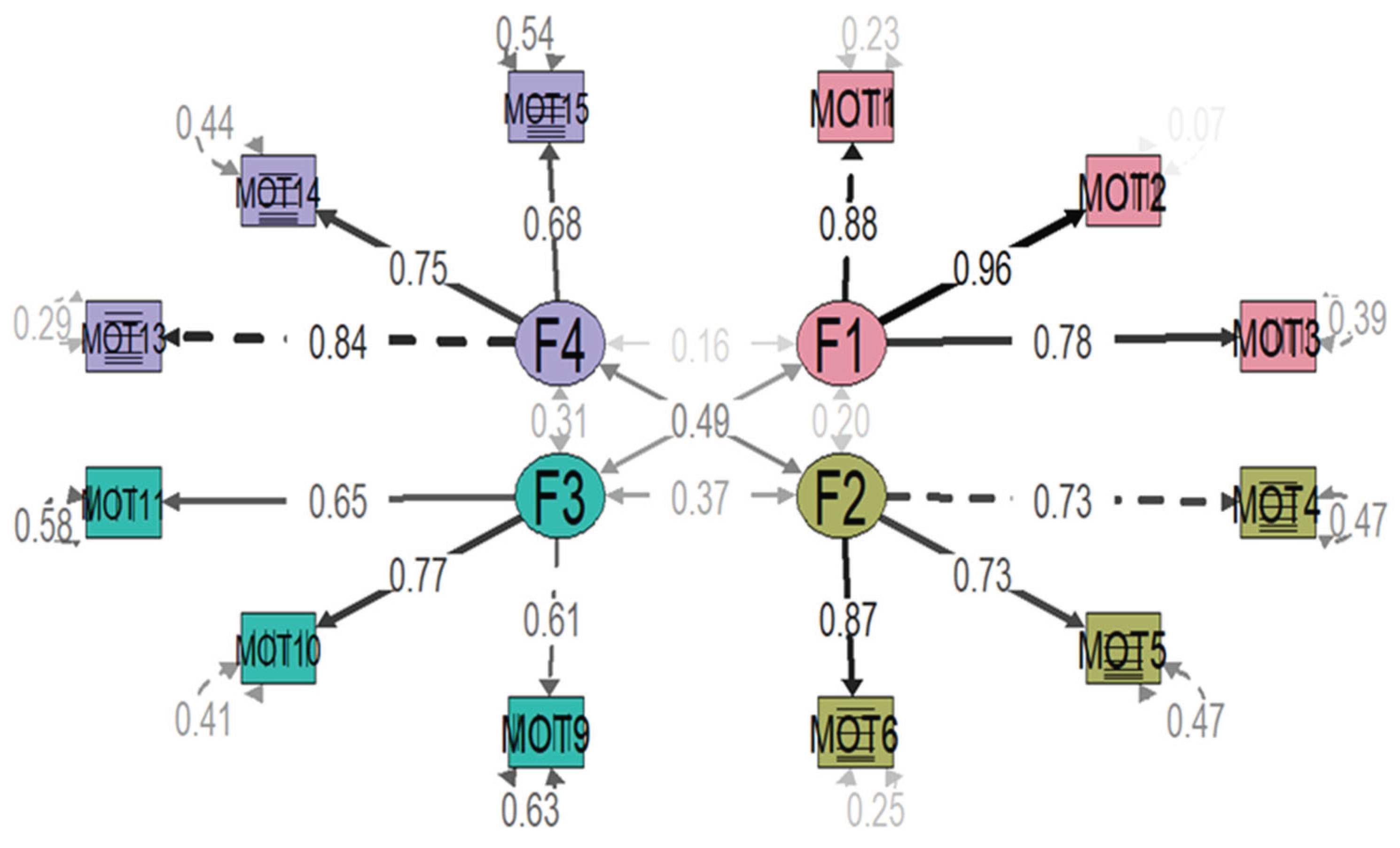
Table 1.
Previous studies on segmentation based on motivations in sports tourism.
| Authors (year) | Title | Target tourism | Type of tourists | Method used |
|---|---|---|---|---|
| Visintin et al. (2026) | Visitor segmentation in alpine tourism: Evidence from a survey-based cluster analysis in northern Italy | Alpine tourism (hiking) | Active young enthusiasts, wellbeing-oriented walkers, and hiking-oriented explorers | Cluster analysis |
| Eskelinen et al. (2025) | Motivations for domestic overnight travel by Finnish disc golfers: a serious-leisure perspective | Disc golf tourism | Serious tourists, social tourists, hobbyists, occasional tourists, and casual tourists | Cluster analysis |
| Perić et al. (2019) | Business models for active outdoor sport event tourism experiences | Trail running, cross-country skiing, sport fishing, and mountain biking tourism | Moderate recreationists, nature lovers, and enthusiasts | Exploratory factor analysis and cluster analysis |
| Bichler & Pikkemaat (2021) | Winter sports tourism to urban destinations: Identifying potential and comparing motivational differences across skier groups | Ski tourists in urban destinations | Moderate skiers, urban recreational skiers, and focused skiers | Exploratory factor analysis and cluster analysis |
| Ramos Ruiz et al. (2026) | Expanding Motivational Frameworks in Sports Tourism: Inclusiveness, Digital Interaction and Runner Segmentation in the Half Marathon Magaluf (Mallorca, Spain) | Participants in the 2025 Magaluf Half Marathon (Mallorca) | Digital enthusiasts, inclusive enjoyers, socializers, inclusivists, and hedonic achievers | Exploratory factor analysis, confirmatory factor analysis, and cluster analysis |
| Kim & Ritchie (2012) | Motivation-based typology: An empirical study of golf tourists | Golf tourists | Multi-motivated golfers, golf companions, and intensive golfers | Exploratory factor analysis (EFA), cluster analysis, and multiple discriminant analysis |
Table 2.
The demographic profile.
| Age | Gender | ||||
| Under 30 years | 15 | 3.9% | Female | 81 | 21.3% |
| Between 31 and 45 years | 51 | 13.4% | Male | 298 | 78.2% |
| Between 46 and 65 years | 227 | 59.6% | Non-binary | 2 | 0.5% |
| 66 years or older | 88 | 23.1% | |||
| Occupation | Income level | ||||
| Independent professional | 55 | 14.4% | Less than 700 euros | 4 | 1.0% |
| Civil servant | 43 | 11.3% | Between 700 and 1000 euros | 1 | 0.3% |
| Private company employee | 107 | 28.1% | Between 1001 and 1500 euros | 19 | 5.0% |
| Self-employed | 34 | 8.9% | Between 1501 and 2500 euros | 94 | 24.7% |
| Estudent | 4 | 1.0% | Between 2501 and 3500 | 106 | 27.8% |
| Unemployed | 5 | 1.3% | More than 3500 | 157 | 41.2% |
| Retired | 129 | 33.9% | |||
| Household work | 4 | 1.0% | |||
| Education | |||||
| Primary education | 7 | 1.8% | |||
| Secundary education | 32 | 8.4% | |||
| Vocational training | 58 | 15.2% | |||
| University degree | 202 | 53.0% | |||
| Postgraduate degree | 82 | 21.5% | |||
Table 3.
Motivations.
| Motivation group/ item | Standard desviation | Mean | Cronbach´s Alpha (α) | Omega Mcdonald (ω) | |
|---|---|---|---|---|---|
| Business Opportunity | |||||
| MOT1. I like to discuss business when playing golf | 1.613 | 2.197 | 2.597 1 | 0.857 | 0.851 |
| MOT2. I could achieve business goals by playing golf | 1.812 | 2.399 | |||
| MOT3. I enjoy entertaining clients/partners through golf | 2.111 | 3.194 | |||
| Benefits | |||||
| MOT4. I can play more rounds of golf at a lower cost | 1.937 | 4.598 | 4.951 | 0.774 | 0.787 |
| MOT5. I can play without needing a membership | 1.876 | 5.089 | |||
| MOT6. I can travel at lower cost than domestic golf | 1.810 | 4.470 | |||
| MOT7. I can avoid bad weather | 1.752 | 5.171 | |||
| MOT8. I can take multipurpose trips during golf vacations | 1.504 | 5.428 | |||
| Learning & Challenge | |||||
| MOT9. I want to play on a highly reputable course | 1.722 | 4.816 | 4.748 | 0.7 | 0.7 |
| MOT10. I want to play in golf championship preliminaries | 1.962 | 3.751 | |||
| MOT11. I enjoy improving my golf skills and knowledge | 1.380 | 5.675 | |||
| MOT12. I like participating in physical activities | 1.766 | 4.751 | |||
| Escape/Relaxation | |||||
| MOT13. I want to escape domestic golf booking difficulties | 1.857 | 4.449 | 4.716 | 0.773 | 0.775 |
| MOT14. I want to escape the crowds | 1.742 | 5.084 | |||
| MOT15. I want to escape the elitist view of golf | 1.990 | 5.013 | |||
| MOT16. I want to escape the routine to watch golf championships | 1.867 | 4.318 | |||
| Social Interaction & Kinship | |||||
| MOT17. I could improve relationships with friends | 1.706 | 5.063 | 4.955 | 0.656 | 0.685 |
| MOT18. I like establishing relationships with local club members | 1.902 | 4.444 | |||
| MOT19. I like traveling with my family | 1.621 | 5.522 | |||
| MOT20. Visiting relatives or friends | 1.869 | 4.790 | |||
1 Mean value of the complete construct.
Table 4.
Suitability Tests for EFA: KMO and Bartlett’s Sphericity.
| Kaiser–Meyer–Olkin Measure | 0.753 | |
|---|---|---|
| Bartlett’s Test of Sphericity: | χ2 | 1560.05 |
| gl | 66 | |
| p | <0.001 | |
Table 5.
Exploratory factor analysis.
| Factors | Items | Factor loadings | Eigenvalues | Explained variance % | AVE | CR |
|---|---|---|---|---|---|---|
| Business opportunity | MOT1 | 0.906 | 3.576 | 29.799 | 0.751 | 0.900 |
| MOT2 | 0.906 | |||||
| MOT3 | 0.782 | |||||
| Economic benefit | MOT4 | 0.698 | 2.108 | 17.563 | 0.644 | 0.843 |
| MOT5 | 0.855 | |||||
| MOT6 | 0.845 | |||||
| Learning and challenge | MOT9 | 0.794 | 1.342 | 11.182 | 0.639 | 0.841 |
| MOT10 | 0.741 | |||||
| MOT11 | 0.708 | |||||
| Escape and relaxation | MOT13 | 0.775 | 1.307 | 10.894 | 0.560 | 0.792 |
| MOT14 | 0.87 | |||||
| MOT15 | 0.747 |
Table 6.
Adjustment indicators.
| Adjustment indicators | |
|---|---|
| χ2 | 218.701 |
| gl | 48 |
| p | 0.0000 |
| CFI | 0.962 |
| TLI | 0.947 |
| RMSEA | 0.097 |
| SRMR | 0.071 |
| GFI | 0.99 |
| RNI | 0.962 |
| IFI GFI NNFI |
0.985 0.99 0.98 |
Table 7.
Cluster analysis. ANOVA table.
| Factors | Cluster | Error | F | Sig. | ||
|---|---|---|---|---|---|---|
| Mean square | df | Mean square | df | |||
| (1) Business Opportunity | 63.897 | 4 | 0.331 | 376 | 193.108 | 0.000 |
| (2) Economic benefit | 44.438 | 4 | 0.538 | 376 | 82.614 | 0.000 |
| (3) Learning/Challenge | 52.967 | 4 | 0.447 | 376 | 118.451 | 0.000 |
| (4) Escape/relaxation | 45.330 | 4 | 0.528 | 376 | 85.785 | 0.000 |
Table 9.
Analysis Cluster. Demographic profile and motivations.
| Cluster 1 | Cluster 2 | Cluster 3 | Cluster 4 | Cluster 5 | |
| Experiential | Wellness- oriented | Multifunctional | Low-involvement golfers | Learning- oriented | |
| N=76 (19.95%) |
N=91 (23.88%) | N=82 (21.52%) |
N=60 (15.75%) |
N=72 (18.9%) |
|
| (1) Business opportunity | 1.68 | 1.81 | 5.03 | 1.53 | 2.68 |
| (2) Economic benefit | 5.87 | 5.01 | 5.52 | 2.91 | 3.74 |
| (3) Learning/ challenge | 5.77 | 3.51 | 5.51 | 3.64 | 5.29 |
| (4) Escape/relaxation | 5.77 | 5.32 | 5.57 | 2.75 | 4.21 |
| Gender | Male | Male | Male | Male | Male |
| Age | Over 60 years |
Over 60 years |
Between 45 and 60 years | Over 60 years | Over 60 years |
| Occupation | Retired | Retired |
Private company employee |
Retired | Retired |
| Income | More than 3.500 euros |
More than 3.500 euros |
More than 3.500 euros | More than 3.500 euros | More than 3.500 euros |
| Education | University degree | University degree | University degree | University degree | University degree |
Disclaimer/Publisher’s Note: The statements, opinions and data contained in all publications are solely those of the individual author(s) and contributor(s) and not of MDPI and/or the editor(s). MDPI and/or the editor(s) disclaim responsibility for any injury to people or property resulting from any ideas, methods, instructions or products referred to in the content. |
© 2026 by the authors. Licensee MDPI, Basel, Switzerland. This article is an open access article distributed under the terms and conditions of the Creative Commons Attribution (CC BY) license (http://creativecommons.org/licenses/by/4.0/).
Copyright: This open access article is published under a Creative Commons CC BY 4.0 license, which permit the free download, distribution, and reuse, provided that the author and preprint are cited in any reuse.


