

Submitted:
25 March 2026
Posted:
26 March 2026
You are already at the latest version
Abstract
Aquaculture production systems rely on the reliable operation of mechanical and electromechanical equipment to maintain stable environmental conditions. In shrimp farming, failures in critical assets may directly affect dissolved oxygen availability and compromise production stability. Despite the operational importance of these systems, structured methodologies for asset criticality assessment and maintenance prioritization in aquaculture remain limited.
This study proposes a multi-criteria decision-making framework based on the Analytic Hierarchy Process (AHP) to evaluate and prioritize critical assets in shrimp aquaculture production systems. The model integrates nine technical and operational criteria related to reliability, maintainability, operational exposure, and production impact. The proposed methodology was applied to three key assets in the Primary Production stage: mechanical aerators, turbines, and stationary engines.
The results indicate that mechanical aerators exhibit the highest criticality score (0.350), followed by stationary engines (0.328) and turbines (0.322). These findings highlight the dominant operational role of aeration systems in maintaining dissolved oxygen levels and ensuring production stability in shrimp farming systems.
The proposed framework demonstrates that multi-criteria decision models can effectively support maintenance prioritization by transforming expert knowledge and operational information into a structured and consistent evaluation process. The methodology provides a replicable decision-support tool that can assist managers and maintenance planners in improving asset management and resource allocation in aquaculture production systems.
Keywords:
analytic hierarchy process (AHP)
; asset criticality
; maintenance prioritization
; shrimp aquaculture
; multi-criteria decision making
; asset management
1. Introduction
The aquaculture sector has experienced sustained growth in recent decades, becoming one of the main sources of animal protein production worldwide [1]. Within this context, shrimp farming represents a strategic economic activity for many producing countries, including Ecuador, contributing significantly to international trade, food security, and regional economic development [2]. The efficient operation of shrimp farms largely depends on the stability of the aquatic environment, which requires the continuous and reliable operation of various mechanical and electromechanical systems that control critical variables in the production process.
Among the technological systems used in aquaculture facilities, aeration equipment plays a fundamental role in regulating dissolved oxygen levels in water. This parameter is directly related to the metabolism, growth, and survival of cultured organisms [3,4]. Several studies have shown that a reduction in dissolved oxygen levels can induce physiological stress in aquatic organisms, decrease growth rates, and even cause mass mortality under critical conditions [5,6]. Consequently, the operational reliability of equipment used in the production process is strategically important for the technical management of shrimp farming systems.
From the perspective of maintenance engineering, the identification of critical assets is a key element for improving efficiency in resource allocation and maintenance planning [7]. Asset criticality analysis enables the evaluation of the relative impact of equipment within a production system by considering factors such as failure frequency, production impact, repair time, and implications for safety or the environment [8,9]. The application of such tools facilitates the prioritization of maintenance actions and improves the reliability and availability of industrial systems.
However, in many production systems, including aquaculture operations, decisions related to maintenance management and asset prioritization are often based primarily on the empirical experience of technical personnel or on subjective criteria. The absence of structured methodologies for evaluating equipment criticality can lead to inefficient maintenance planning processes, increasing operational costs and reducing the availability of production assets [10,11].
In this context, multi-criteria decision-making (MCDM) methodologies have gained increasing relevance for addressing complex problems involving multiple technical, economic, and operational factors [12]. Among these methodologies, the Analytic Hierarchy Process (AHP) has become one of the most widely used tools for structuring decision problems and prioritizing alternatives in complex systems [13,14]. Developed by Saaty, AHP decomposes a decision problem into a hierarchical structure consisting of objectives, criteria, and alternatives, enabling systematic evaluation through pairwise comparison matrices [15]. This approach allows qualitative expert judgments to be transformed into quantifiable values, facilitating the structured analysis of multi-criteria decision problems [16].
The use of AHP has been widely documented across various fields of engineering and industrial management, including equipment selection, project evaluation, risk management, and strategic maintenance planning [17,18]. Its main advantage lies in its ability to integrate multiple criteria into a single analytical model, enabling the analysis of complex decision problems involving technical, economic, and operational variables.
Despite their widespread use across industrial sectors, multi-criteria methodologies for evaluating asset criticality in aquaculture systems, particularly in shrimp farming, have received relatively limited attention in the scientific literature. In many cases, maintenance management in these systems continues to rely on reactive or corrective approaches, which limit the ability to anticipate failures and optimize equipment availability. This situation highlights the need to develop methodological tools that enable a structured evaluation of asset criticality in aquaculture production systems.
In this context, the present study proposes applying the Analytic Hierarchy Process (AHP) as a multi-criteria methodology to evaluate and prioritize critical assets in the Primary Production area of the shrimp farming sector. The developed model integrates nine technical and operational criteria related to equipment reliability, operating conditions, and production impact, enabling a structured identification of the asset with the highest level of criticality within the production system.
The main contributions of this study can be summarized as follows:
- Development of an AHP-based multi-criteria model for evaluating asset criticality in shrimp aquaculture production systems.
- Integration of relevant technical and operational criteria for equipment prioritization in the Primary Production area.
- Proposal of a replicable methodological approach applicable to other production systems where the prioritization of critical assets is required.
The remainder of this paper is organized as follows. Section 2 presents the methodology for developing the AHP-based decision model. Section 3 describes the results obtained from applying the asset prioritization model. Section 4 discusses the study’s main findings and their relationship to the existing literature. Finally, Section 5 presents the study’s conclusions.
2. Materials and Methods
This study employed an applied multi-criteria decision-making approach to prioritize critical assets in the Primary Production area of a shrimp aquaculture system. The methodology integrates operational information from the production system, maintenance engineering criteria, and expert technical judgment using the Analytic Hierarchy Process (AHP) to establish a criticality hierarchy among the evaluated assets. The analysis focused on equipment whose unavailability could compromise system operational continuity, affect sensitive process variables, and limit maintenance response capacity. Based on the functional analysis of the production system, three representative assets from the Primary Production area were selected for comparative evaluation: mechanical aerators, turbines, and stationary engines. These assets perform critical functions related to water aeration, hydraulic circulation, and energy supply for system operations; therefore, they were considered the alternatives in the multi-criteria decision model.
2.1. Selection of Evaluation Criteria
Evaluating asset criticality in production systems requires considering multiple factors that reflect both the probability of failure and the consequences associated with equipment unavailability. In the context of maintenance engineering, these factors help characterize the relative importance of assets within the system and support decision-making related to resource allocation, maintenance planning, and operational risk management.
In this study, the evaluation criteria were defined by integrating three main sources: criticality analysis principles commonly applied in industrial asset management, scientific literature on maintenance prioritization and multi-criteria decision-making, and the specific operational conditions of the shrimp aquaculture production system under analysis. This approach enabled the identification of the most representative factors that influence equipment criticality in the Primary Production area.
As a result, nine evaluation criteria were established, covering dimensions associated with reliability, maintainability, operational impact, operating conditions, and logistical factors in maintenance activities. These criteria constitute the basis of the multi-criteria decision model used to prioritize assets in this study.
Table 1 presents the criteria considered in the asset criticality evaluation model, along with brief descriptions of each criterion.
To enable a consistent evaluation of assets for each criterion, structured rating scales were defined to convert operational variables into quantitative scores that are comparable across the multi-criteria model. These scales were developed considering indicators commonly used in maintenance engineering, operational records from the production system, and the technical experience of personnel responsible for maintenance activities.
Each criterion was evaluated on an ordinal scale with five rating levels (1, 3, 5, 7, and 9), consistent with the AHP evaluation principles. In this scheme, higher values represent conditions of greater criticality associated with the evaluated asset. Table 2 presents the evaluation scales used to assess the criticality criteria considered in this study.
Finally, the defined scales enabled comparable values to be assigned to each asset according to the established criteria, forming the basis for the subsequent application of the multi-criteria decision-making method using the Analytic Hierarchy Process (AHP).
2.2. Application of the AHP Method for Critical Asset Prioritization
Critical asset prioritization was performed using the Analytic Hierarchy Process (AHP), a widely used multi-criteria decision-making method for evaluating alternatives. This approach enables complex decision problems to be structured into hierarchical levels, integrates expert judgment, and produces quantitative weights that support systematic comparison among alternatives.
In this study, the AHP method was used to establish a criticality hierarchy among the evaluated assets by integrating maintenance engineering criteria with the operational conditions of the production system. The methodological procedure followed for implementing the model is presented in Figure 1, which summarizes the main stages of the evaluation process.
Subsequently, the decision problem was structured into a three-level hierarchy: the objective of the analysis, the evaluation criteria, and the alternatives for the assets under analysis. In this study, the objective is to evaluate asset criticality in the Primary Production area; the criteria represent the factors considered in the criticality analysis, and the alternatives correspond to the evaluated assets (mechanical aerators, turbines, and stationary engines). The hierarchical structure of the model is shown in Figure 2.
Once the problem hierarchy was defined, pairwise comparisons among the evaluation criteria were conducted using Saaty’s fundamental scale, which expresses the relative importance between two elements through numerical values ranging from 1 to 9. This scale enables qualitative judgments to be converted into quantitative values for comparison within the AHP model. The scale used in this study is presented in Table 3.
Subsequently, an evaluation matrix of the alternatives with respect to the considered criteria was developed based on operational information from the production system and the technical maintenance manager’s expert judgment. The assigned ratings were supported by failure history, recorded intervention times, operating conditions, spare parts availability, and the operational impact associated with asset unavailability.
The results of this evaluation are presented in Table 4, which shows the scores assigned to each asset according to the nine criteria considered in the study.
The pairwise comparisons were conducted using the expert judgment of the technical manager responsible for maintenance operations, whose experience and operational knowledge of the production system informed the evaluation. In industrial applications of the AHP method, the participation of experts with system-specific knowledge is essential to ensure the model’s validity, particularly when the available information combines operational records with specialized technical expertise.
Once the alternative evaluation matrix was defined, the criteria were compared using Saaty’s fundamental scale. The values assigned in the matrix represent the relative importance of criterion i with respect to criterion j. The matrix satisfies the reciprocity property, that is:
which ensures the model’s structural consistency.
The pairwise comparison matrix obtained in this study is presented in Table 5.
To determine the relative weights of each criterion, the pairwise comparison matrix was normalized by dividing each element by the sum of the elements in its column, as shown in Equation (1).
Once the normalized matrix was obtained, the priority vector was calculated by averaging each row of the matrix, as indicated in Equation (2).
The results obtained through this procedure are presented in Table 6, which shows the normalized pairwise comparison matrix and the priority vector corresponding to the criteria considered in the analysis.
Subsequently, the consistency of the judgments was evaluated by calculating the maximum eigenvalue , using Equation (3).
Based on this value, the Consistency Index (CI) and the Consistency Ratio (CR) were calculated according to Equations (4) and (5).
where corresponds to the Random Index, whose value for is 1.45 [10].
For the present study, the following results were obtained:
Since the Consistency Ratio (CR) is below the 0.10 threshold recommended in the AHP literature, the judgments are considered consistent and valid for the decision-making process. This confirms the logical coherence of the pairwise comparison matrix and validates the weight vector obtained for the evaluated criteria.
Once the model’s consistency was verified, the global prioritization of the alternatives was calculated by integrating the criteria weights with the ratings assigned to each asset. The final score for each alternative was determined using a weighted sum, as shown in Equation (6).
where represents the global score of asset , corresponds to the weight of criterion , and represents the rating of asset with respect to criterion .
The results obtained are presented in Table 7, which shows the final decision matrix and the criticality ranking of the evaluated assets.
Once the global score of each alternative was calculated using the weighted sum defined in Equation (6), the final prioritization of the evaluated assets was obtained. The results (Figure 3) show that mechanical aerators have the highest level of criticality within the analyzed system, with a global score of 0.350, followed by stationary engines at 0.328, and turbines at 0.322. These values reflect the relative influence of the criteria considered in the model and allow the identification of the assets whose unavailability would have the greatest impact on the operational continuity of the production system.
3. Results
The application of the Analytic Hierarchy Process (AHP)-based model enabled the structured prioritization of the assets evaluated in the shrimp production system. The consistency of the expert judgments was assessed using the Consistency Ratio (CR), which remained below the threshold recommended by Saaty (CR < 0.1), confirming the logical coherence of the pairwise comparisons used in the model. Therefore, the resulting priority vector can be considered representative of the decision-making process.
Based on the weighting of the defined criteria and the evaluation of the considered alternatives, the model identified clear differences in the criticality levels of the analyzed assets. The results indicate that mechanical aerators have the highest criticality within the production system, followed by stationary engines, while turbines exhibit a relatively lower criticality. This behavior underscores the operational importance of aeration systems on shrimp farms, where a continuous supply of dissolved oxygen is essential for maintaining aquatic ecosystem stability and ensuring adequate conditions for shrimp cultivation.
From an operational perspective, the higher criticality of mechanical aerators stems from their high operating frequency and direct influence on water oxygenation, implying that any interruption in their operation may have immediate impacts on system productivity. In contrast, stationary engines and turbines, although they perform essential functions within the facilities’ energy infrastructure, have a relatively lower operational impact than aeration systems.
To facilitate the comparative interpretation of the behavior of the evaluated assets with respect to the different decision criteria, Figure 4 presents a radar diagram showing the performance profiles of each asset type relative to the factors considered in the model. This representation allows for clear identification of the differences in each criterion’s contribution to the assets’ criticality level.
The graphical analysis shows that mechanical aerators exhibit high values for criteria related to failure frequency and operating regime, confirming their dominant role in the criticality ranking. Likewise, stationary engines exhibit relatively high values for the criteria related to mean time to repair and functional dependency, reflecting their importance within the facility’s energy infrastructure. In contrast, turbines exhibit more balanced behavior across the evaluated criteria, suggesting a less pronounced criticality profile than the other analyzed assets.
Overall, these results provide a quantitative basis for prioritizing maintenance strategies, allowing technical resources to be directed toward those assets whose unavailability would have the greatest impact on the operational continuity and efficiency of the aquaculture production system.
4. Discussion
The results from the AHP model indicate that mechanical aerators are the asset with the highest criticality in the shrimp production system analyzed. This finding is consistent with the central role of aeration systems in regulating dissolved oxygen levels, a variable that directly influences the metabolism, growth, and survival of cultured organisms [3,4,5,6]. Several studies have shown that even small variations in dissolved oxygen levels can significantly affect production performance, underscoring that the reliability of aeration systems is a key determinant of the stability of aquaculture operations.
From a maintenance engineering perspective, the dominant position of mechanical aerators in the criticality ranking can also be explained by the interplay of criteria related to failure frequency, operating regime, and functional dependence within the production system. In complex industrial systems, asset criticality is typically determined by the interaction between the probability of failure and the operational consequences resulting from equipment unavailability [7,8]. In this sense, the results obtained are consistent with recent criticality-based maintenance planning approaches, which recognize that assets with high operational exposure and a strong impact on the production process should be prioritized in maintenance strategies.
The behavior observed for stationary engines, ranked second in the criticality analysis, is also consistent with recent studies on asset prioritization in industrial systems. Although these assets do not directly influence aquatic environmental conditions as aerators do, their criticality is associated with factors such as mean time to repair and the energy system’s functional dependence, which may compromise the operational continuity of multiple subsystems in the event of failure. Recent studies on asset criticality in industrial infrastructure and complex technical systems have shown that equipment with long recovery times and high functional connectivity often occupies priority positions in maintenance programs [11,12].
In contrast, turbines exhibit the lowest relative level of criticality among the evaluated assets. The profile observed in the radar representation suggests a more balanced behavior across the considered criteria, without concentrating high values in critical variables such as failure frequency or direct production impact. Similar behavior has been reported in criticality analyses based on methodologies such as FMECA, where some assets present functional importance but lower exposure to recurrent failures or immediate operational consequences [8,9]. From a maintenance management perspective, this result allows a distinction to be made between assets whose unavailability generates immediate impacts on the production process and those whose criticality is more evenly distributed across several operational criteria.
From a methodological perspective, the application of the Analytic Hierarchy Process (AHP) proved to be an effective tool for structuring decision-making in asset prioritization. AHP enables the integration of multiple technical, economic, and operational criteria within a hierarchical model, transforming expert judgment into quantifiable values that can be verified through consistency analysis [10,13,14,15]. This capability to structure complex decisions has been widely documented across various fields of engineering and industrial management, including equipment selection, project evaluation, and strategic maintenance planning [16,17].
Despite the widespread application of AHP across various industrial sectors, its use in aquaculture production systems remains limited. Most recent literature in aquaculture has focused on the development of aeration technologies or the optimization of environmental parameters in production systems [3,4], while approaches addressing asset criticality and maintenance planning have received less attention. In this context, the present study contributes to the existing literature by proposing a multi-criteria model that integrates technical and operational variables to prioritize assets in the shrimp farming sector.
Finally, it is important to note that the results should be interpreted in light of the specific conditions of the case study analyzed. The evaluation of criteria and alternatives is based on structured expert judgment, meaning the resulting ranking reflects the specific operational context of the facility under evaluation. Future research could expand this approach by incorporating multiple evaluators, conducting sensitivity analyses, or integrating historical maintenance data. Such extensions would enhance the model’s robustness and support the development of more dynamic and adaptive approaches to criticality assessment in aquaculture systems.
5. Conclusions
This study developed an asset prioritization model based on the Analytic Hierarchy Process (AHP) to structure the evaluation of equipment criticality in shrimp aquaculture production systems. The proposed approach integrates technical and operational criteria into a transparent, quantifiable decision-making framework, thereby transforming expert knowledge into a systematic approach to maintenance management.
The main contribution of this work lies in applying multi-criteria decision-making methodologies, widely used in other industrial sectors, to aquaculture production systems, where asset prioritization has traditionally been addressed empirically. In this regard, the developed model provides a replicable methodological tool that can support strategic maintenance planning and asset management in shrimp farms, promoting more structured and technically grounded approaches to operational decision-making.
Author Contributions
Conceptualization, C.G., M.G., J.C. and D.G.; methodology, C.G. and M.G.; software, J.C. and D.G.; validation, C.G. and M.G.; formal analysis, C.G., J.C. and D.G.; investigation, C.G., M.G., J.C. and D.G.; resources, C.G.; data curation, J.C. and D.G.; writing—original draft preparation, C.G., M.G., J.C. and D.G.; writing—review and editing, M.G.; visualization, M.G.; supervision, C.G. and M.G., .; project administration, C.G. All authors have read and agreed to the published version of the manuscript.
Funding
This research received no external funding.
Institutional Review Board Statement
Not applicable.
Informed Consent Statement
Not applicable.
Data Availability Statement
The data presented in this study are available on request from the corresponding author. The data are not publicly available due to confidentiality and institutional restrictions, as they belong to the collaborating company involved in the study.
Conflicts of Interest
The authors declare no conflicts of interest.
Abbreviations
The following abbreviations are used in this manuscript:
| AHP | Analytic Hierarchy Process |
| MCDM | Multi-Criteria Decision Making |
| FF | Failure Frequency |
| MTTR | Mean Time to Repair |
| RC | Repair Cost |
| PI | Production Impact |
| SPA | Spare Parts Availability |
| FD | Functional Dependency |
| OR | Operating Regime |
| CAC | Current Asset Condition |
| SEI | Safety and Environmental Impact |
| CI | Consistency Index |
| CR | Consistency Ratio |
| RI | Random Index |
References
- Naylor, R.; Fang, S.; Fanzo, J. A Global View of Aquaculture Policy. Food Policy 2023, 116, 102422. [Google Scholar] [CrossRef]
- Batallas, P.A.M. The Environmental and Economic Impacts of Shrimp Production in Ecuador End Esmeraldas. Revista de Gestão Social e Ambiental 2024, 18, e08220. [Google Scholar] [CrossRef]
- Roy, S.M.; Machavaram, R.; Pareek, C.M.; Kim, T. Investigating the Performance of a Perforated Pooled Circular Stepped Cascade Aeration System for Intensive Aquaculture. Heliyon 2024, 10, e26367. [Google Scholar] [CrossRef] [PubMed]
- Tong, C.; He, K.; Hu, H. Design and Application of New Aeration Device Based on Recirculating Aquaculture System. Applied Sciences 2024, 14, 3401. [Google Scholar] [CrossRef]
- Patkaew, S.; DirekbusarakoKm, S.; Hirono, I.; Wuthisuthimethavee, S.; Powtongsook, S.; Pooljun, C. Effect of Supersaturated Dissolved Oxygen on Growth-, Survival-, and Immune-Related Gene Expression of Pacific White Shrimp (Litopenaeus Vannamei). Vet. World 2024, 50–58. [Google Scholar] [CrossRef] [PubMed]
- Araujo, A.N.; San Andres, C.F.; Nguyen, K.Q.; Corby, T.L.; Rhodes, M.A.; García, J.; Roy, L.A.; Davis, D.A. Effects of Minimum Dissolved Oxygen Setpoints for Aeration in Semi-Intensive Pond Production of Pacific White Shrimp (Litopenaeus Vannamei). Aquaculture 2025, 594, 741376. [Google Scholar] [CrossRef]
- Rios, M.P.; Kaiser, B.S.; Caiado, R.G.G.; Ivson, P.; Roehl, D. Decision Framework for Asset Criticality and Maintenance Planning in Complex Systems: An Offshore Corrosion Management Case. Applied Sciences 2025, 15, 10407. [Google Scholar] [CrossRef]
- Rouabhia-Essalhi, R.; Boukrouh, E.H.; Ghemari, Y. Application of Failure Mode Effect and Criticality Analysis to Industrial Handling Equipment. The International Journal of Advanced Manufacturing Technology 2022, 120, 5269–5280. [Google Scholar] [CrossRef]
- Suwanasri, C.; Saribut, S.; Suwanasri, T.; Phadungthin, R. Risk Analysis Using Failure Modes, Effects, and Criticality Analysis for Transmission Network Assets. Energies (Basel). 2021, 14, 977. [Google Scholar] [CrossRef]
- Saaty, T.L. Decision Making with the Analytic Hierarchy Process. International Journal of Services Sciences 2008, 1, 83. [Google Scholar] [CrossRef]
- BULUT, M.; ÖZCAN, E. A New Approach to Determine Maintenance Periods of the Most Critical Hydroelectric Power Plant Equipment. Reliab. Eng. Syst. Saf. 2021, 205, 107238. [Google Scholar] [CrossRef]
- Amran, M.E.; Aziz, S.A.; Muhtazaruddin, M.N.; Masrom, M.; Haron, H.N.; Bani, N.A.; Mohd Izhar, M.A.; Usman, S.; Sarip, S.; Najamudin, S.S.; et al. Critical Assessment of Medical Devices on Reliability, Replacement Prioritization and Maintenance Strategy Criterion: Case Study of Malaysian Hospitals. Qual. Reliab. Eng. Int. 2024, 40, 970–1001. [Google Scholar] [CrossRef]
- Tavana, M.; Soltanifar, M.; Santos-Arteaga, F.J. Analytical Hierarchy Process: Revolution and Evolution. Ann. Oper. Res. 2023, 326, 879–907. [Google Scholar] [CrossRef]
- Xiao, H.; Zeng, S.; Peng, Y.; Kou, G. A Simulation Optimization Approach for Weight Valuation in Analytic Hierarchy Process. Eur. J. Oper. Res. 2025, 321, 851–864. [Google Scholar] [CrossRef]
- Madzík, P.; Falát, L. State-of-the-Art on Analytic Hierarchy Process in the Last 40 Years: Literature Review Based on Latent Dirichlet Allocation Topic Modelling. PLoS One 2022, 17, e0268777. [Google Scholar] [CrossRef] [PubMed]
- Ishizaka, A.; Labib, A. Review of the Main Developments in the Analytic Hierarchy Process. Expert Syst. Appl. 2011. [Google Scholar] [CrossRef]
- Vaidya, O.S.; Kumar, S. Analytic Hierarchy Process: An Overview of Applications. Eur. J. Oper. Res. 2006, 169, 1–29. [Google Scholar] [CrossRef]
Figure 1.
Methodological workflow for critical asset prioritization using the AHP method.
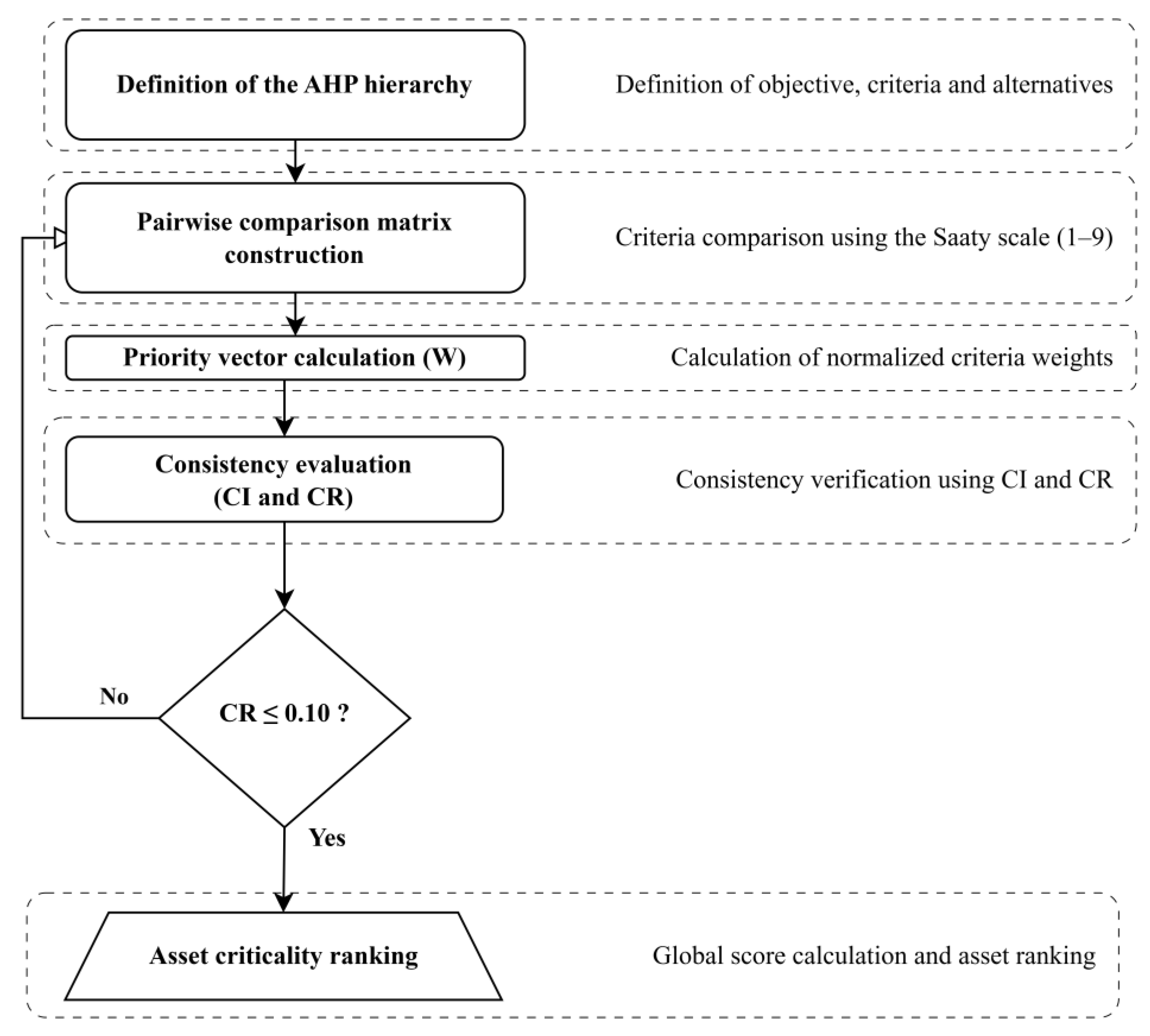
Figure 2.
Hierarchical structure of the AHP model for asset criticality assessment in the Primary Production area.
Figure 2.
Hierarchical structure of the AHP model for asset criticality assessment in the Primary Production area.
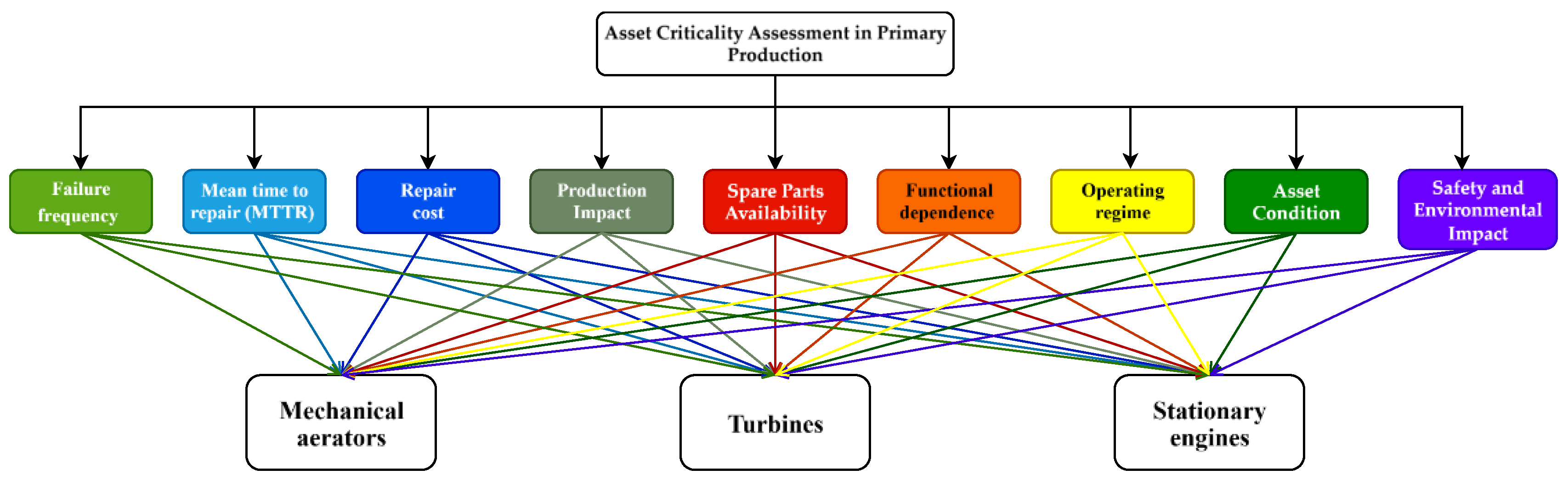
Figure 3.
Criticality ranking of the assets evaluated using the AHP model.
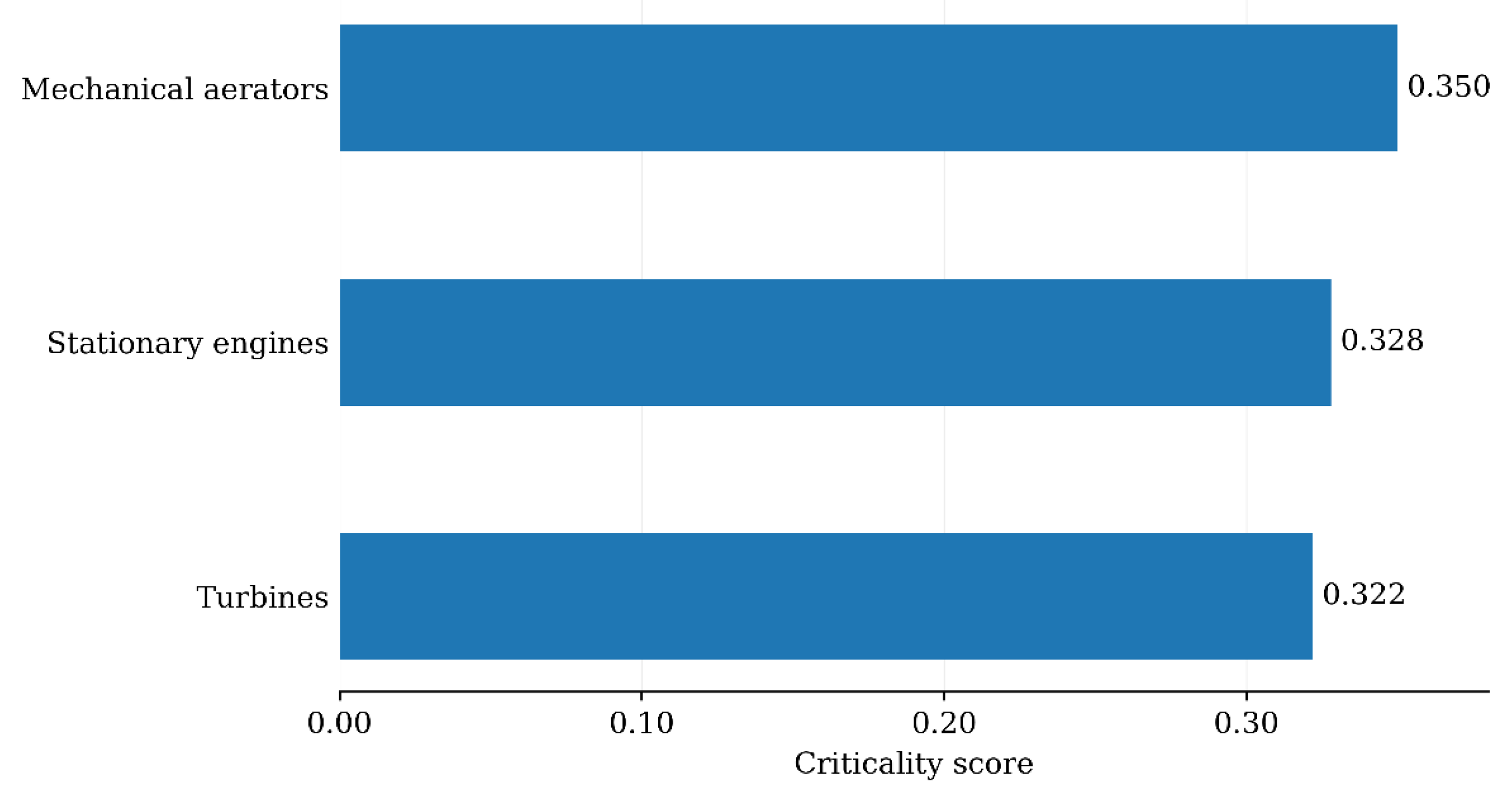
Figure 4.
Comparison of the performance of the evaluated assets with respect to the decision criteria using a radar representation based on the AHP model.
Figure 4.
Comparison of the performance of the evaluated assets with respect to the decision criteria using a radar representation based on the AHP model.
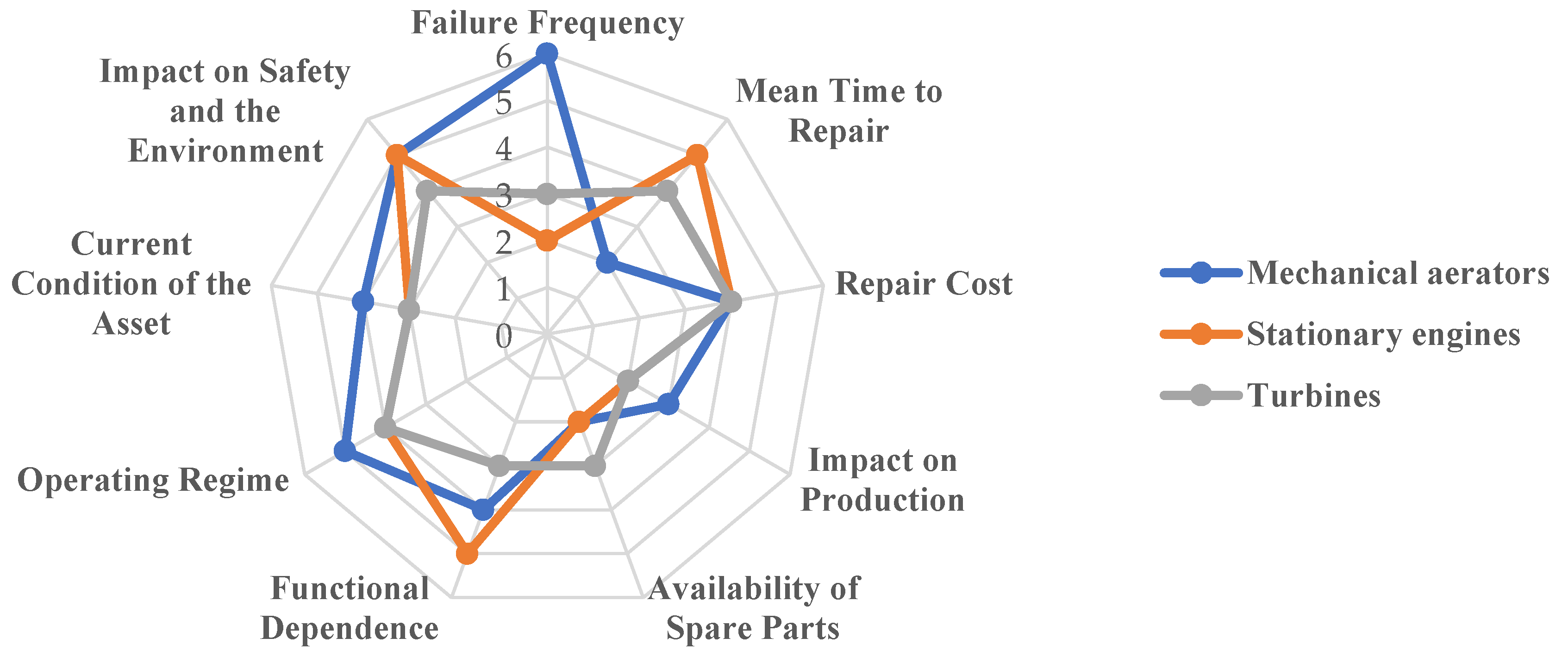

Table 1.
Criteria used for asset criticality evaluation.
| Criterion |
Evaluated Dimension |
Description |
| Failure Frequency (FF) | Reliability | The frequency at which the asset experiences failures during operation |
| Mean Time to Repair (MTTR) | Maintainability | Average time required to restore the equipment to operational condition after a failure |
| Repair Cost (RC) | Economic | Level of costs associated with the repair or intervention of the asset |
| Production Impact (PI | Operational | The degree to which the failure of the asset affects the continuity of the production process |
| Spare Parts Availability (SPA) | Logistics | Availability of spare parts required to restore the asset after a failure |
| Functional Dependency (FD) | Operational | The degree of dependence of the production process on the proper functioning of the asset |
| Operating Regime (OR) | Operational | Operational intensity or workload to which the equipment is subjected during operation |
| Current Asset Condition (CAC) | Technical | Overall condition of the asset, considering wear, age, and operating conditions |
| Safety and Environmental Impact (SEI) | Safety/Environmental | Potential consequences of asset failure on operational safety and the surrounding environment |
Table 2.
Evaluation scales used for assessing the criticality criteria.
| Criterion | Score | Description |
| Failure Frequency (FF) | 1 | One failure in more than 10 years |
| 3 | One failure every 3–6 years | |
| 5 | One failure per year | |
| 7 | One failure every 3–6 months | |
| 9 | Monthly failures or more frequent | |
| Mean Time to Repair (MTTR) | 1 | MTTR < 4 h |
| 3 | 4 h ≤ MTTR < 10 h | |
| 5 | 10 h ≤ MTTR < 24 h | |
| 7 | 24 h ≤ MTTR < 36 h | |
| 9 | MTTR ≥ 48 h | |
| Repair Cost (RC) | 1 | < 5% of asset replacement cost |
| 3 | 5–10% of asset replacement cost | |
| 5 | 10–18% of asset replacement cost | |
| 7 | 18–25% of asset replacement cost | |
| 9 | > 25% of asset replacement cost | |
| Production Impact (PI) | 1 | No impact on production |
| 3 | Minor production disturbance | |
| 5 | Partial reduction of production capacity | |
| 7 | Significant production interruption | |
| 9 | Complete production shutdown | |
| Spare Parts Availability (SPA) | 1 | Spare parts immediately available |
| 3 | Spare parts available within 24 h | |
| 5 | Spare parts available within several days | |
| 7 | Spare parts require external procurement | |
| 9 | Spare parts difficult to obtain or unavailable | |
| Functional Dependency (FD) | 1 | Asset operates independently |
| 3 | Limited interaction with other assets | |
| 5 | Moderate functional dependency | |
| 7 | High dependency within the process | |
| 9 | Critical dependency for system operation | |
| Operating Regime (OR) | 1 | Occasional operation |
| 3 | Intermittent operation | |
| 5 | Regular operation | |
| 7 | Intensive operation | |
| 9 | Continuous operation | |
| Current Asset Condition (CAC) | 1 | Excellent condition |
| 3 | Good condition | |
| 5 | Acceptable condition | |
| 7 | Degraded condition | |
| 9 | Critical condition | |
| Safety and Environmental Impact (SEI) | 1 | No safety or environmental impact |
| 3 | Minor safety or environmental impact | |
| 5 | Moderate safety or environmental impact | |
| 7 | Significant safety or environmental risk | |
| 9 | Severe safety or environmental consequences |
Table 3.
Saaty’s fundamental scale used for pairwise comparisons.
| Intensity | Definition | Explanation |
| 1 | Equal importance | Both elements contribute equally |
| 3 | Moderate importance | One element is slightly more important |
| 5 | Strong importance | One element is clearly more important |
| 7 | Very strong importance | One element strongly dominates the other |
| 9 | Extreme importance | Absolute evidence of preference |
| 2, 4, 6, 8 | Intermediate values | Compromise between the previous values |
Table 4.
Asset evaluation matrix according to the criticality criteria used in the AHP model.
| Classifications | FF | MTTR | RC | PI | SPA | FD | OR | CAC | SEI |
| Mechanical aerators | 6 | 2 | 4 | 3 | 2 | 4 | 5 | 4 | 5 |
| Turbines | 3 | 4 | 4 | 2 | 3 | 3 | 4 | 3 | 4 |
| Stationary engines | 2 | 5 | 4 | 2 | 2 | 5 | 4 | 3 | 5 |
| 11 | 11 | 12 | 7 | 7 | 12 | 13 | 10 | 14 |
Table 5.
Pairwise comparison matrix of the evaluation criteria based on Saaty’s scale.
| FACTOR | FF | MTTR | RC | PI | SPA | FD | OR | CAC | SEI |
| FF | 1 | 1/2 | 3 | 4 | 2 | 2 | 1 | 3 | 2 |
| MTTR | 2 | 1 | 3 | 4 | 1 | 2 | 2 | 2 | 4 |
| RC | 1/3 | 1/3 | 1 | 2 | 1/3 | 1/2 | 1 | 2 | 2 |
| PI | 1/4 | 1/4 | 1/2 | 1 | 1/3 | 1/2 | 1 | 2 | 4 |
| SPA | 1/2 | 1 | 3 | 3 | 1 | 1 | 1 | 1 | 5 |
| FD | 1/2 | 1/2 | 2 | 2 | 1 | 1 | 1 | 4 | 2 |
| OR | 1 | 1/2 | 1 | 1 | 1 | 1 | 1 | 4 | 3 |
| CAC | 1/3 | 1/2 | 1/2 | 1/2 | 1 | 1/4 | 1/4 | 1 | 1 |
| SEI | 1/2 | 1/4 | 1/2 | 1/4 | 1/5 | 1/2 | 1/3 | 1 | 1 |
Table 6.
Normalized pairwise comparison matrix and priority vector of the evaluation criteria.
| Factors | FF | MTTR | RC | PI | SPA | FD | OR | CAC | SEI | Priority Vector () |
| FF | 0.156 | 0.103 | 0.207 | 0.225 | 0.254 | 0.229 | 0.117 | 0.150 | 0.083 | 0.1694 |
| MTTR | 0.312 | 0.207 | 0.207 | 0.225 | 0.127 | 0.229 | 0.233 | 0.100 | 0.167 | 0.2007 |
| RC | 0.052 | 0.069 | 0.069 | 0.113 | 0.042 | 0.057 | 0.117 | 0.100 | 0.083 | 0.0780 |
| PI | 0.039 | 0.052 | 0.034 | 0.056 | 0.042 | 0.057 | 0.117 | 0.100 | 0.167 | 0.0738 |
| SPA | 0.078 | 0.207 | 0.207 | 0.169 | 0.127 | 0.114 | 0.117 | 0.050 | 0.208 | 0.1419 |
| FD | 0.078 | 0.103 | 0.138 | 0.113 | 0.127 | 0.114 | 0.117 | 0.200 | 0.083 | 0.1192 |
| OR | 0.156 | 0.103 | 0.069 | 0.056 | 0.127 | 0.114 | 0.117 | 0.200 | 0.125 | 0.1186 |
| CAC | 0.052 | 0.103 | 0.034 | 0.028 | 0.127 | 0.029 | 0.029 | 0.050 | 0.042 | 0.0549 |
| SEI | 0.078 | 0.052 | 0.034 | 0.014 | 0.025 | 0.057 | 0.039 | 0.050 | 0.042 | 0.0435 |
Table 7.
Decision matrix and criticality ranking of the evaluated assets using the AHP model.
| Criteria | FF | MTTR | RC | PI | SPA | FD | OR | CAC | SEI | Score | Ranking |
| Mechanical aerators | 0.092 | 0.036 | 0.026 | 0.032 | 0.041 | 0.040 | 0.046 | 0.022 | 0.016 | 0.35 | 1 |
| Stationary engines | 0.031 | 0.091 | 0.026 | 0.021 | 0.041 | 0.050 | 0.036 | 0.016 | 0.016 | 0.33 | 2 |
| Turbines | 0.046 | 0.073 | 0.026 | 0.021 | 0.061 | 0.030 | 0.036 | 0.016 | 0.012 | 0.32 | 3 |
Disclaimer/Publisher’s Note: The statements, opinions and data contained in all publications are solely those of the individual author(s) and contributor(s) and not of MDPI and/or the editor(s). MDPI and/or the editor(s) disclaim responsibility for any injury to people or property resulting from any ideas, methods, instructions or products referred to in the content. |
© 2026 by the authors. Licensee MDPI, Basel, Switzerland. This article is an open access article distributed under the terms and conditions of the Creative Commons Attribution (CC BY) license (http://creativecommons.org/licenses/by/4.0/).
Copyright: This open access article is published under a Creative Commons CC BY 4.0 license, which permit the free download, distribution, and reuse, provided that the author and preprint are cited in any reuse.


