

Submitted:
25 March 2026
Posted:
26 March 2026
You are already at the latest version
Abstract
Given recent advancements in dark matter (DM) search experiments, particularly the latest LUX-ZEPLIN (LZ) direct detection (DD) results, we systematically investigate the light bino–higgsino DM scenario within the natural supersymmetric framework. Requiring the electroweak fine-tuning parameter ΔEW<30 fixes the higgsino mass parameter in the range |μ|∈[100,350] GeV, while we extend the bino mass to M1∈[10,350] GeV. Incorporating constraints from Higgs physics, rare B decays, LEP limits, and DD experiments, we find that part of the parameter space remains viable. However, the relic density of neutralino DM necessarily lies below the observed Planck value, contributing at most ∼2% of the total DM abundance. Some of the surviving parameter space is already excluded by current 13 TeV LHC searches, while the future 14 TeV HL-LHC with 3000 fb−1 luminosity will probe the remaining region.
Keywords:
dark matter
; supersymmetry
; neutralino
; direct detection
; LHC
; naturalness
1. Introduction
Cosmological observations provide compelling evidence for the existence of dark matter (DM), yet its particle nature remains one of the foremost challenges in particle physics and cosmology [1]. Additionally, the discovery of the Higgs boson at the Large Hadron Collider (LHC) [2,3] has intensified the need to address the hierarchy problem, which arises from the large disparity between the electroweak scale and the Planck scale, necessitating fine-tuned cancellations to maintain the observed Higgs mass. This issue challenges the naturalness of the Standard Model (SM), motivating the exploration of new physics models that stabilize the electroweak scale.
Weak-scale supersymmetry (SUSY), particularly the Minimal Supersymmetric SM (MSSM), is a leading framework to address these issues at the TeV scale [4]. The MSSM resolves the hierarchy problem by introducing SUSY, which cancels quadratic divergences in the Higgs mass, thereby enhancing naturalness [5]. It also provides a compelling dark matter candidate in the form of the lightest supersymmetric particle (LSP) [6,7], stabilized by R-parity [8,9] conservation. Within this framework, natural SUSY is a well-motivated approach that minimizes fine-tuning by predicting light stop and higgsinos with masses near the electroweak scale, while allowing heavier masses for other superpartners [10,11,12,13,14]. This hierarchy aligns with the observed Higgs mass of approximately 125 GeV and remains consistent with LHC constraints [2,3].
In natural SUSY, the LSP is typically a neutralino, and a light higgsino-like LSP is common due to the small parameter required for low fine-tuning. However, a pure higgsino LSP often yields a thermal relic density below the observed value of due to its large annihilation rate [15,16]. Mixed bino-higgsino neutralino as the LSP in natural SUSY allow a light bino by relaxing the gaugino mass unification assumption. This scenario achieves the correct relic density through enhanced annihilation channels mediated by higgsino components [15,17,18,19,20,21,22,23,24,25,26]. Current direct detection (DD) experiments, especially the limits reported by the 2025 LUX-ZEPLIN (LZ) results [27], impose stringent constraints on the weakly interacting massive particle (WIMP) parameter space. LHC searches for electroweakinos also strongly constrain this parameter space. Indirect detection experiments are not effective in this region since the annihilation is p-wave suppressed.
In this work, we investigate the light bino-higgsino dark matter scenario in natural SUSY, focusing on its compatibility with recent DD constraints from LZ and LHC. We explore the light dark matter regime ( GeV) and determine the parameter space limit for the LSP that constitutes all or some portion of DM, i.e., DM relic density can be smaller than observed value. The small parameter in natural SUSY enhances bino-higgsino mixing, impacting the spin-independent (SI) and spin-dependent (SD) neutralino-nucleon scattering cross sections. Additionally, we evaluate the potential to probe this scenario through electroweakino searches at the 14 TeV LHC.
The paper is organized as follows: in Section 2, we discuss the bino-higgsino neutralino parameter space in natural SUSY; in Section 3, we present our parameter scan regions, adopted constraints, and likelihoods; in Section 4, we give obtained results; and in Section 5, we summarize our conclusions.
2. Light Neutralino DM
The two neutral higgsinos ( and ) and the two neutral gauginos ( and ) are combined to form four mass eigenstates called neutralinos. In the gauge-eigenstate basis (, , , ), the neutralino mass matrix takes the form:
where , , , , and are the soft-breaking mass parameters for bino and wino, respectively. can be diagonalized by a unitary matrix. In the limit of , the lightest neutralino is bino-like (with some higgsino mixture), while the second and third neutralinos are higgsino-like. The LSP interacts with nuclei via the exchange of squarks and Higgs bosons (SI scattering) and via Z boson and squarks exchange (SD scattering).
We introduced the problems that SUSY models can address, one of which is the widely discussed naturalness problem. In SUSY models, the mass of the W boson can be explained [28] by
where and represent the soft symmetry-breaking parameters for the electroweak scale fields and , respectively. and correspond to their radiative corrections. is the mass parameter associated with the higgsino, and . Equation (2) is derived from the Higgs potential in the weak-scale MSSM, with all parameters evaluated at the scale . The observed values are obtained under the condition that there is no large cancellation between the terms on the right-hand side of Equation (2), meaning that none of these terms is larger than in magnitude. Electroweak fine-tuning can be quantified by [29]
with , , and . Also, and , where k labels the various loop contributions included in Equation (2). Any upper bound on from electroweak naturalness considerations sets a corresponding limit on [30]. Imposing the upper limit of [31,32,33] leads to the limit of GeV [34].
3. Prior, Constraints and Likelihoods
In our numerical calculations, we vary the relevant parameters in the ranges of
The lower limit on comes from LEP charged particle searches [35]. We set to a lower limit of 10 GeV, where DM would already be overabundant, and the upper limit of 350 GeV is chosen to match the upper bound, so that we can study light neutralino DM. In this case, DM can be either bino-like or higgsino-like, and mixed bino-higgsino LSP with mass may also produce the right DM relic abundance.
We adopt the Markov Chain Monte Carlo (MCMC) method based on the Metropolis-Hastings algorithm to perform the scan of MSSM parameter space with likelihood . The package MicroMEGAS-5.2.30 [36] is used for DM relic density and DD cross section calculations, SuperIso-4.0 [37] is used for obtaining B-physics predictions, HiggsTools [38] (unification of HiggsBounds-5 [39] and HiggsSignals-2 [40]) is used to constraint SM-like and extra Higgs bosons at colliders. The total is defined as the sum of individual values of PLANCK relic density, B-physics, DM DD, and Higgs constraints from HiggsSignals:
The of DM relic density is taken to be zero if the predicted value is below the central value of observed data of , and calculated with the formula
otherwise. Where is predicted from the theoretical value. , and are experimental central value, we take the theoretical uncertainty of .
Constraints from B-physics are Gaussian distributed, the for each observable take the form of Equation (6). Experimental central value, experimental and theoretical uncertainty given in Table 1, and theoretical uncertainty of is assumed if not provided in the table.
The estimation of for the DM-nucleus SI DD cross section is
where and are predicted from the theoretical value and upper limits of the cross sections for a given DM mass at 90% confidence level from LZ [27], respectively. By assuming null detection, we can take the central value as zero and the number 1.64 is the unit of 90% confidence level (C.L.) [43].
For the LHC constraints, we consider null results from SUSY searches with two or three leptons plus missing transverse momentum at the 13 TeV LHC with 36.1 fb−1 [44,45] and 139 fb−1 [46,47,48]. We also include projections for the 14 TeV HL-LHC with 3000 fb−1 [49]. Signal processes and are generated using MadGraph5_aMC-v3.5.2 [50] with the default parton distribution function set [51], and rescaled with a K-factor of 1.5 to include next-to-leading corrections. Events are showered and hadronized with PYTHIA-8.2 [52], detector effects simulated with DELPHES-3.5.0 [53], and analyses recast with CheckMATE-2.0.37 [54]. A sample is excluded at 95% C.L. if the event ratio exceeds unity, where is the number of the events for the i-th signal region and is the corresponding observed 95% C.L. upper limit.
4. Results
In Figure 1, we show all samples satisfy the limit in SI and SD DM-nucleon cross section vs. DM mass space. f indicate the ratio of the predicted DM relic density to the value observed by Planck, i.e. . Red crosses are excluded by current electroweakino searches at the 13 TeV LHC at 95% C.L., while blue stars are projected to be searched at the 14 TeV HL-LHC with luminosity of 3000 fb−1 at 95% C.L.. Red solid lines denote the 90% C.L. upper limits from LZ (2025) experiments [27], which gives current strongest scattering cross section limit among the DD experiments at the DM mass of ∼ 10 GeV to 10 TeV range. Some points remain below the neutrino floor, beyond the reach of DD experiments, however next generation high-luminosity LHC (HL-LHC) with the luminosity of 3000 fb−1 will probe all the parameter space of the light bino-higgsino neutralino in the natural SUSY.
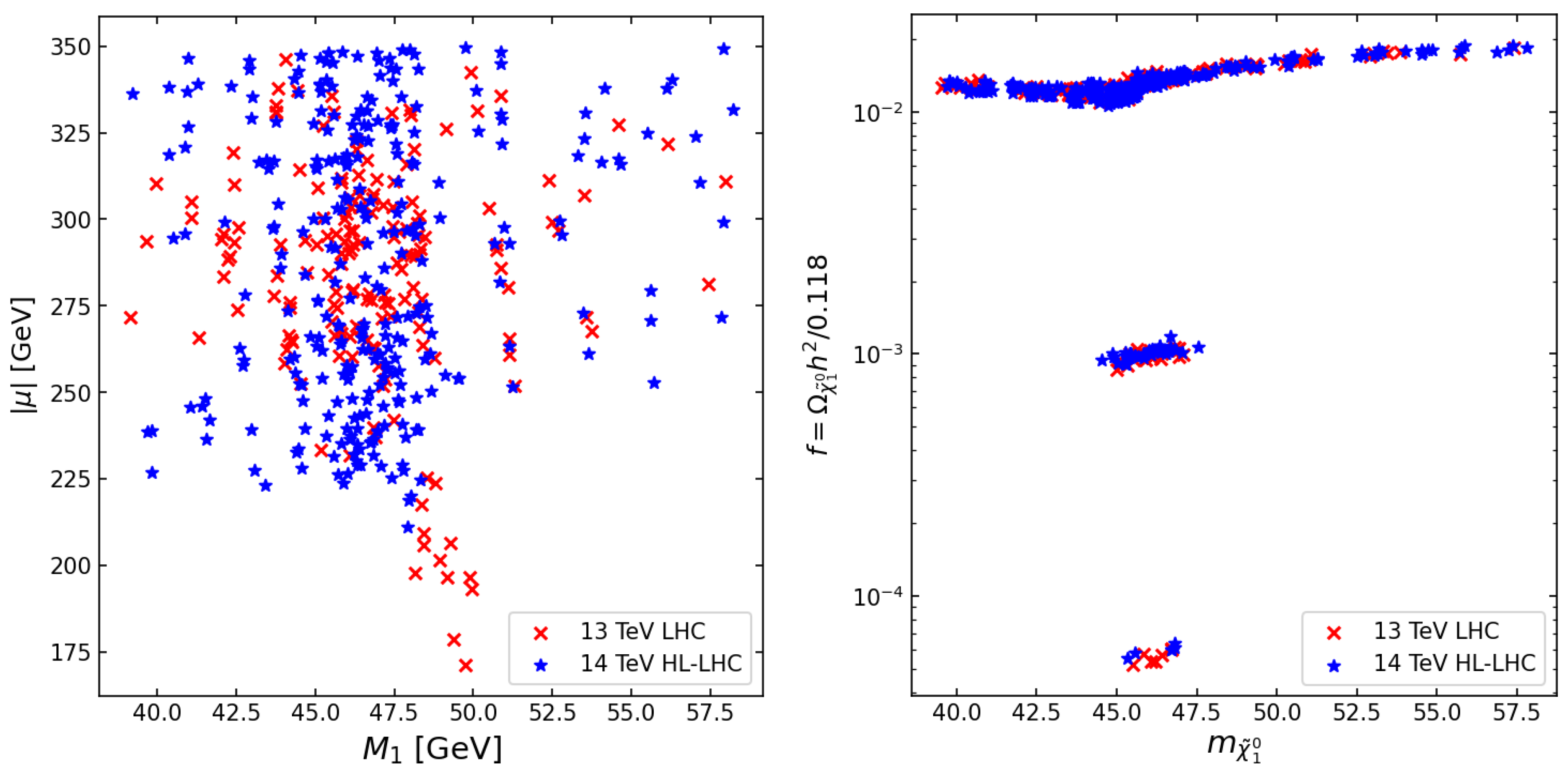
The left panel of Figure 2 shows the sample on the MSSM soft parameters vs. space. Requiring constrains to lie near the Z-funnel, while the lower bound on is GeV. Current 13 TeV LHC data raise this limit to GeV. Contribution to the mainly come from strong LZ (2025) DD limit, and it pushes the coupling to the small enough value so that Higgs funnel is excluded. While small SI cross sections is due to the both blind spot [21], where negative sign of leads to suppressed , and small fraction of f, small SD cross section is solely due to the small f.
On the right panel of Figure 2, upper limit of , and a lower limit of have obtained for f, i.e. bino-like DM in this paper at most constitute 2% of all the DM relic. While upper limit of f is also due to the strong LZ limit, for smaller f we need stronger DM annihilation cross section at the early universe, and it has upper limit. Annihilation cross section near Z-boson resonance proportional to the product of coupling constant and resonance factor, and which have upper limits determined by bino DM mass and components, , and Z-boson decay width. Hence, f can be smaller when DM is closer to the half mass of Z-boson, and it is shown on the right panel of Figure 2.
In addition, recent analyses of the Muon experiment at Fermilab report the value of [55], while theoretical SM prediction is [56]. This suggests no significant discrepancy remains between experiment and theory. The electroweakinos contribution to the muon in this scenario is about , consistent with the experimental-theory difference of reported in Ref. [56].
5. Conclusions
We have examined the light bino–higgsino dark matter scenario in the framework of natural SUSY, motivated by both electroweak naturalness and the latest experimental results. Requiring restricts the higgsino mass parameter to GeV, while we extended the bino mass to GeV. After imposing constraints from Higgs data, rare B decays, LEP limits, direct detection searches, and the observed relic density, we find that only a small fraction of the parameter space remains viable. In particular, the neutralino relic density is always well below the Planck value, contributing at most ∼2% of the total dark matter abundance.
Our analysis shows that current 13 TeV LHC electroweakino searches already exclude part of the parameter space, while the future HL-LHC with 3000 fb−1 luminosity will be able to probe the remaining region. Direct detection experiments such as LZ have already reached strong sensitivity, and future improvements may probe most of the surviving points, except for those lying below the neutrino floor. Moreover, in this scenario, the electroweakino contribution to the muon is of order , consistent with the latest Fermilab measurement and its reduced discrepancy with the Standard Model prediction.
Author Contributions
Conceptualization, M.A.; methodology, X.W. and M.A.; software, X.W.; validation, X.W. and M.A.; formal analysis, X.W. and M.A.; investigation, X.W. and M.A.; resources, M.A.; data curation, X.W.; writing—original draft preparation, X.W.; writing—review and editing, M.A.; visualization, X.W.; supervision, M.A.; project administration, M.A.; funding acquisition, M.A. All authors have read and agreed to the published version of the manuscript.
Funding
This research was funded by the National Natural Science Foundation of the People’s Republic of China grant number 12303002 and Tianchi talent project of Xinjiang Uygur Autonomous Region of China.
Institutional Review Board Statement
Not applicable.
Informed Consent Statement
Not applicable.
Data Availability Statement
The data presented in this study are available on request from the corresponding author. The data are not publicly available due to privacy restrictions.
Acknowledgments
This work is supported by the National Natural Science Foundation of the People’s Republic of China (No. 12303002) and Tianchi talent project of Xinjiang Uygur Autonomous Region of China.
Conflicts of Interest
The authors declare no conflicts of interest. The funders had no role in the design of the study; in the collection, analyses, or interpretation of data; in the writing of the manuscript; or in the decision to publish the results.
Abbreviations
The following abbreviations are used in this manuscript:
| MSSM | Minimal Supersymmetric Standard Model |
| LSP | Lightest Supersymmetric Particle |
| DM | Dark Matter |
| SI | Spin-Independent |
| SD | Spin-Dependent |
| LHC | Large Hadron Collider |
| HL-LHC | High-Luminosity LHC |
| LZ | LUX-ZEPLIN |
| MCMC | Markov Chain Monte Carlo |
References
- Aghanim, N.; et al. Planck 2018 results. VI. Cosmological parameters. Astron. Astrophys. 2020, 641, A6, [arXiv:astro-ph.CO/1807.06209]. [Erratum: Astron.Astrophys. 652, C4 (2021)]. [CrossRef]
- Aad, G.; et al. Observation of a new particle in the search for the Standard Model Higgs boson with the ATLAS detector at the LHC. Phys. Lett. B 2012, 716, 1–29, [arXiv:hep-ex/1207.7214]. [CrossRef]
- Chatrchyan, S.; et al. Observation of a New Boson at a Mass of 125 GeV with the CMS Experiment at the LHC. Phys. Lett. B 2012, 716, 30–61, [arXiv:hep-ex/1207.7235]. [CrossRef]
- Martin, S.P. A Supersymmetry primer. Adv. Ser. Direct. High Energy Phys. 1998, 18, 1–98, [hep-ph/9709356].
- Jungman, G.; Kamionkowski, M.; Griest, K. Supersymmetric dark matter. Physics Reports 1996, 267, 195–373. [CrossRef]
- Athron, P.; Balazs, C.; Fowlie, A.; Lv, H.; Su, W.; Wu, L.; Yang, J.M.; Zhang, Y. Global fits of SUSY at future Higgs factories. Phys. Rev. D 2022, 105, 115029. [CrossRef]
- Baer, H.; Barger, V.; Sengupta, D.; Salam, S.; Sinha, K. Status of weak scale supersymmetry after LHC Run 2 and ton-scale noble liquid WIMP searches. The European Physical Journal Special Topics 2020, 229, 3085–3141. [CrossRef]
- Köhler, D. Various Phenomenological Aspects of the R-parity Violating MSSM. PhD thesis, U. Bonn (main), 2024.
- Nangia, S. Towards Model-independent Predictions for R-parity Violating Supersymmetry. PhD thesis, U. Bonn (main), 2024.
- Papucci, M.; Ruderman, J.T.; Weiler, A. Natural SUSY endures. JHEP 2012, 09, 035, [1110.6926]. [CrossRef]
- Baer, H.; Barger, V.; Mustafayev, A. Implications of a 125 GeV Higgs for supersymmetric models. Phys. Rev. D 2012, 85, 075010, [1202.4038]. [CrossRef]
- Boehm, C.; Djouadi, A.; Mambrini, Y. Natural supersymmetry and constraints on the Higgs mass. Phys. Rev. D 2000, 61, 095005, [hep-ph/9907428]. [CrossRef]
- Kitano, R.; Nomura, Y. Supersymmetry, naturalness, and signatures at the LHC. Phys. Rev. D 2006, 73, 095004, [hep-ph/0602096]. [CrossRef]
- Hall, L.J.; Pinner, D.; Ruderman, J.T. A natural SUSY Higgs near 125 GeV. JHEP 2012, 04, 131, [1112.2703]. [CrossRef]
- Arkani-Hamed, N.; Delgado, A.; Giudice, G.F. The Well-tempered neutralino. Nucl. Phys. B 2006, 741, 108–130, [hep-ph/0601041]. [CrossRef]
- Martin, S.P. Curtain lowers on directly detectable higgsino dark matter. Phys. Rev. D 2025, 111, 075004, [arXiv:hep-ph/2412.08958]. [CrossRef]
- Cahill-Rowley, M.; Hewett, J.L.; Ismail, A.; Rizzo, T.G. Higgs bosons in natural SUSY. Phys. Rev. D 2012, 86, 075015, [1206.5800]. [CrossRef]
- Han, C.; Hikasa, K.; Wu, L.; Yang, J.M.; Zhang, Y. Status of natural supersymmetry at the LHC. JHEP 2013, 10, 216, [1308.5307]. [CrossRef]
- Huang, W.; Yang, J.M.; Zhang, Y. Natural SUSY with light electroweakinos. JHEP 2014, 08, 157, [1405.6838]. [CrossRef]
- Baer, H.; Barger, V.; Savoy, M. Neutralino dark matter in natural SUSY with light Higgsinos. Phys. Rev. D 2016, 93, 035016, [1511.01020]. [CrossRef]
- Abdughani, M.; Wu, L.; Yang, J.M. Status and prospects of light bino–higgsino dark matter in natural SUSY. Eur. Phys. J. C 2018, 78, 4, [arXiv:hep-ph/1705.09164]. [CrossRef]
- Abdughani, M.; Wu, L. On the coverage of neutralino dark matter in coannihilations at the upgraded LHC. Eur. Phys. J. C 2020, 80, 233, [arXiv:hep-ph/1908.11350]. [CrossRef]
- Boehm, C.; Dev, P.S.B.; Mazumdar, A.; Pukartas, E. Naturalness of Light Neutralino Dark Matter in pMSSM after LHC, XENON100 and Planck Data. JHEP 2013, 06, 113, [arXiv:hep-ph/1303.5386]. [CrossRef]
- Cao, J.; He, Y.; Shang, L.; Su, W.; Zhang, Y. Testing the light dark matter scenario of the MSSM at the LHC. JHEP 2016, 03, 207, [arXiv:hep-ph/1511.05386]. [CrossRef]
- Guchait, M.; Roy, A.; Sharma, S. Probing mild-tempered neutralino dark matter through top-squark production at the LHC. Phys. Rev. D 2021, 104, 055032, [arXiv:hep-ph/2103.09810]. [CrossRef]
- Chatterjee, A.; Choudhury, A.; Mitra, S.; Mondal, A.; Mondal, S. Exploring the BSM parameter space with neural network aided Simulation-Based Inference. JHEP 2025, 12, 138, [arXiv:hep-ph/2502.11928]. [CrossRef]
- Aalbers, J.; et al. Dark Matter Search Results from 4.2 Tonne-Years of Exposure of the LUX-ZEPLIN (LZ) Experiment. Phys. Rev. Lett. 2025, 135, 011802, [arXiv:hep-ex/2410.17036]. [CrossRef]
- Arnowitt, R.; Nath, P. Loop corrections to radiative breaking of electroweak symmetry in supersymmetry. Phys. Rev. D 1992, 46, 3981–3986. [CrossRef]
- Baer, H.; Barger, V.; Huang, P.; Mickelson, D.; Mustafayev, A.; Tata, X. Radiative natural supersymmetry: Reconciling electroweak fine-tuning and the Higgs boson mass. Phys. Rev. D 2013, 87, 115028, [arXiv:hep-ph/1212.2655]. [CrossRef]
- Chan, K.L.; Chattopadhyay, U.; Nath, P. Naturalness, weak scale supersymmetry and the prospect for the observation of supersymmetry at the Tevatron and at the CERN LHC. Phys. Rev. D 1998, 58, 096004, [hep-ph/9710473]. [CrossRef]
- Das, N.K.; Dey, R.; Chakraborty, S.; Panigrahi, P.K.; Meglinski, I.; Ghosh, N. Submicron scale tissue multifractal anisotropy in polarized laser light scattering. Laser Physics Letters 2018, 15, 035601. [CrossRef]
- Ross, G.G.; Schmidt-Hoberg, K.; Staub, F. On the MSSM Higgsino mass and fine tuning. Physics Letters B 2016, 759, 110–114. [CrossRef]
- Baer, H.; Barger, V.; Mickelson, D. Direct and indirect detection of higgsino-like WIMPs: Concluding the story of electroweak naturalness. Physics Letters B 2013, 726, 330–336. [CrossRef]
- Tata, X. Natural supersymmetry: status and prospects. Eur. Phys. J. ST 2020, 229, 3061–3083, [arXiv:hep-ph/2002.04429]. [CrossRef]
- Abbiendi, G.; et al. Search for Charged Higgs bosons: Combined Results Using LEP Data. Eur. Phys. J. C 2013, 73, 2463, [arXiv:hep-ex/1301.6065]. [CrossRef]
- Bélanger, G.; Boudjema, F.; Brun, P.; Pukhov, A.; Rosier-Lees, S.; Salati, P.; Semenov, A. Indirect search for dark matter with micrOMEGAs_2.4. Computer Physics Communications 2011, 182, 842–856. [CrossRef]
- Mahmoudi, F. SuperIso v2.3: A Program for calculating flavor physics observables in Supersymmetry. Comput. Phys. Commun. 2009, 180, 1579–1613, [arXiv:hep-ph/0808.3144]. [CrossRef]
- Bahl, H.; Biekötter, T.; Heinemeyer, S.; Li, C.; Paasch, S.; Weiglein, G.; Wittbrodt, J. HiggsTools: BSM scalar phenomenology with new versions of HiggsBounds and HiggsSignals. Comput. Phys. Commun. 2023, 291, 108803, [arXiv:hep-ph/2210.09332]. [CrossRef]
- Bechtle, P.; Dercks, D.; Heinemeyer, S.; Klingl, T.; Stefaniak, T.; Weiglein, G.; Wittbrodt, J. HiggsBounds-5: Testing Higgs Sectors in the LHC 13 TeV Era. Eur. Phys. J. C 2020, 80, 1211, [arXiv:hep-ph/2006.06007]. [CrossRef]
- Bechtle, P.; Heinemeyer, S.; Klingl, T.; Stefaniak, T.; Weiglein, G.; Wittbrodt, J. HiggsSignals-2: Probing new physics with precision Higgs measurements in the LHC 13 TeV era. Eur. Phys. J. C 2021, 81, 145, [arXiv:hep-ph/2012.09197]. [CrossRef]
- Bernlochner, F.U.; et al. FlavBit: A GAMBIT module for computing flavour observables and likelihoods. Eur. Phys. J. C 2017, 77, 786, [arXiv:hep-ph/1705.07933]. [CrossRef]
- Navas, S.; et al. Review of particle physics. Phys. Rev. D 2024, 110, 030001. [CrossRef]
- Abdughani, M.; Fan, Y.Z.; Lu, C.T.; Tang, T.P.; Tsai, Y.L.S. Muonphilic dark matter explanation of gamma-ray galactic center excess: a comprehensive analysis. JHEP 2022, 07, 127, [arXiv:astro-ph.HE/2111.02946]. [CrossRef]
- Aaboud, M.; et al. Search for squarks and gluinos in final states with jets and missing transverse momentum using 36 fb−1 of = 13 TeV pp collision data with the ATLAS detector. Phys. Rev. D 2018, 97, 112001, [arXiv:hep-ex/1712.02332]. [CrossRef]
- Aaboud, M.; et al. Search for electroweak production of supersymmetric particles in final states with two or three leptons at = 13TeV with the ATLAS detector. Eur. Phys. J. C 2018, 78, 995, [arXiv:hep-ex/1803.02762]. [CrossRef]
- Aad, G.; et al. Search for electroweak production of charginos and sleptons decaying into final states with two leptons and missing transverse momentum in = 13 TeV pp collisions using the ATLAS detector. Eur. Phys. J. C 2020, 80, 123, [arXiv:hep-ex/1908.08215]. [CrossRef]
- Aad, G.; et al. Searches for electroweak production of supersymmetric particles with compressed mass spectra in = 13 TeV pp collisions with the ATLAS detector. Phys. Rev. D 2020, 101, 052005, [arXiv:hep-ex/1911.12606]. [CrossRef]
- Aad, G.; et al. title=Searches for new phenomena in events with two leptons, jets, and missing transverse momentum in 139 fb−1 of = 13 TeV pp collisions with the ATLAS detector,. Eur. Phys. J. C 2023, 83, 515, [arXiv:hep-ex/2204.13072]. [CrossRef]
- ATLAS Collaboration. Search for Supersymmetry at the high luminosity LHC with the ATLAS experiment. Technical report, CERN, Geneva, 2014. All figures including auxiliary figures are available at https://atlas.web.cern.ch/Atlas/GROUPS/PHYSICS/PUBNOTES/ATL-PHYS-PUB-2014-010.
- Alwall, J.; Frederix, R.; Frixione, S.; Hirschi, V.; Maltoni, F.; Mattelaer, O.; Shao, H.S.; Stelzer, T.; Torrielli, P.; Zaro, M. The automated computation of tree-level and next-to-leading order differential cross sections, and their matching to parton shower simulations. JHEP 2014, 07, 079, [arXiv:hep-ph/1405.0301]. [CrossRef]
- Buckley, A.; Ferrando, J.; Lloyd, S.; Nordström, K.; Page, B.; Rüfenacht, M.; Schönherr, M.; Watt, G. LHAPDF6: parton density access in the LHC precision era. Eur. Phys. J. C 2015, 75, 132, [arXiv:hep-ph/1412.7420]. [CrossRef]
- Sjöstrand, T.; Ask, S.; Christiansen, J.R.; Corke, R.; Desai, N.; Ilten, P.; Mrenna, S.; Prestel, S.; Rasmussen, C.O.; Skands, P.Z. An introduction to PYTHIA 8.2. Comput. Phys. Commun. 2015, 191, 159–177, [arXiv:hep-ph/1410.3012]. [CrossRef]
- de Favereau, J.; Delaere, C.; Demin, P.; Giammanco, A.; Lemaître, V.; Mertens, A.; Selvaggi, M. DELPHES 3, A modular framework for fast simulation of a generic collider experiment. JHEP 2014, 02, 057, [arXiv:hep-ex/1307.6346]. [CrossRef]
- Dercks, D.; Desai, N.; Kim, J.S.; Rolbiecki, K.; Tattersall, J.; Weber, T. CheckMATE 2: From the model to the limit. Computer Physics Communications 2017, 221, 383–418. [CrossRef]
- Aguillard, D.P.; et al. Measurement of the Positive Muon Anomalous Magnetic Moment to 127 ppb. Phys. Rev. Lett. 2025, 135, 101802, [arXiv:hep-ex/2506.03069]. [CrossRef]
- Aliberti, R.; et al. The anomalous magnetic moment of the muon in the Standard Model: an update. Phys. Rept. 2025, 1143, 1–158, [arXiv:hep-ph/2505.21476]. [CrossRef]
Figure 1.
Spin-independent/dependent DM-nucleon cross sections. All samples satisfy the constraint. Red crosses are excluded by current electroweakino searches at the 13 TeV LHC at 95% C.L., while blue stars are projected to be searched at the 14 TeV HL-LHC with luminosity of 3000 fb−1. Red solid lines are 90% C.L. upper limits from LZ (2025) experiments [27]. Black dashed line is the neutrino floor. f represent the ratio of the predicted DM relic density to the value observed by Planck.
Figure 1.
Spin-independent/dependent DM-nucleon cross sections. All samples satisfy the constraint. Red crosses are excluded by current electroweakino searches at the 13 TeV LHC at 95% C.L., while blue stars are projected to be searched at the 14 TeV HL-LHC with luminosity of 3000 fb−1. Red solid lines are 90% C.L. upper limits from LZ (2025) experiments [27]. Black dashed line is the neutrino floor. f represent the ratio of the predicted DM relic density to the value observed by Planck.
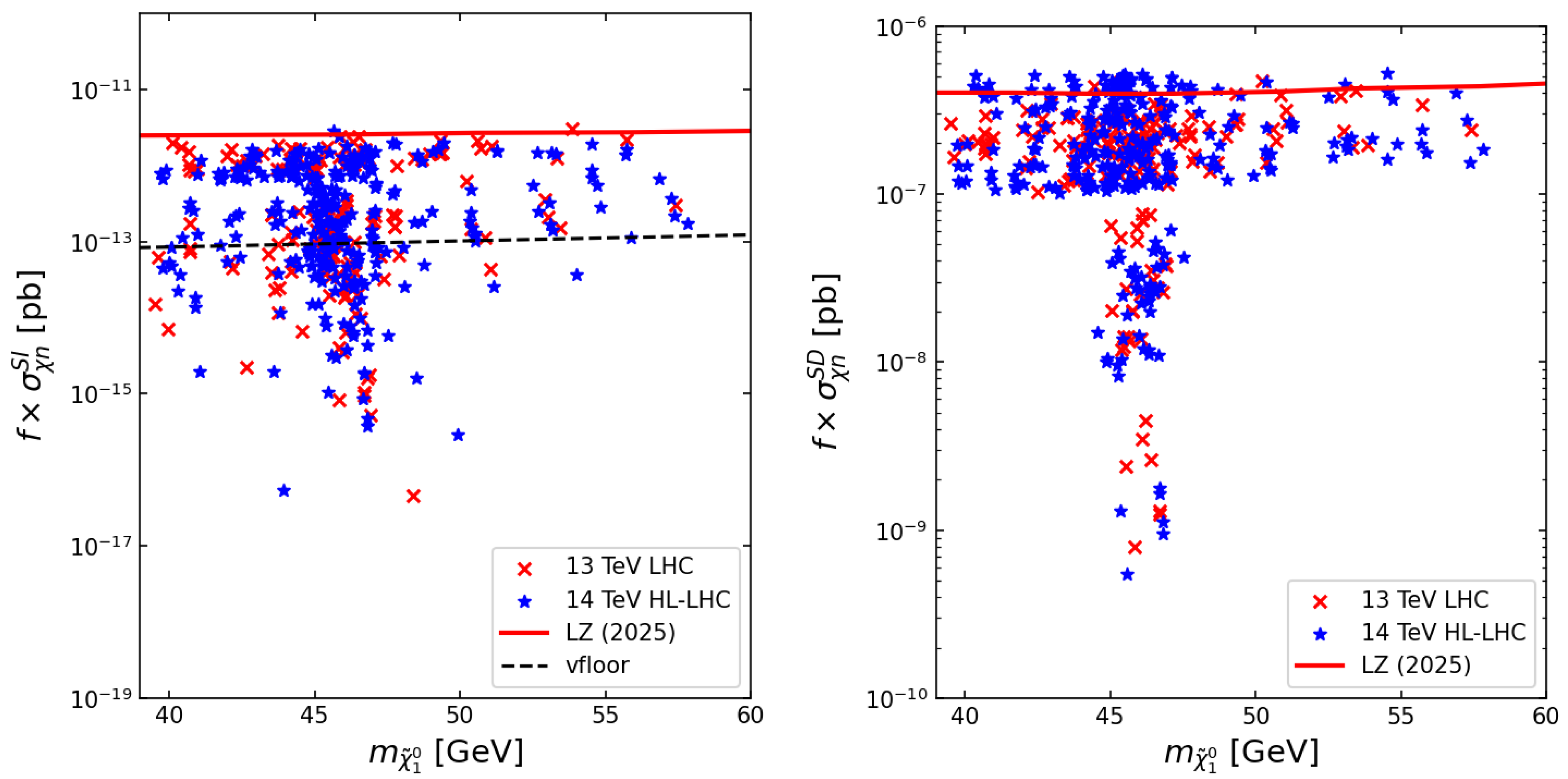
Figure 2.
Same as Figure 1, but shown in the vs. plane (left panel) and the f vs. plane (right panel). Here, f denotes the ratio of the predicted dark matter relic density to the value observed by Planck.
Figure 2.
Same as Figure 1, but shown in the vs. plane (left panel) and the f vs. plane (right panel). Here, f denotes the ratio of the predicted dark matter relic density to the value observed by Planck.

Disclaimer/Publisher’s Note: The statements, opinions and data contained in all publications are solely those of the individual author(s) and contributor(s) and not of MDPI and/or the editor(s). MDPI and/or the editor(s) disclaim responsibility for any injury to people or property resulting from any ideas, methods, instructions or products referred to in the content. |
© 2026 by the authors. Licensee MDPI, Basel, Switzerland. This article is an open access article distributed under the terms and conditions of the Creative Commons Attribution (CC BY) license (http://creativecommons.org/licenses/by/4.0/).
Copyright: This open access article is published under a Creative Commons CC BY 4.0 license, which permit the free download, distribution, and reuse, provided that the author and preprint are cited in any reuse.


