

Submitted:
25 March 2026
Posted:
26 March 2026
You are already at the latest version
Abstract
This paper examines an algorithm and evaluates the limit values of technical parameters for step-by-step management of the coverage of the forecast schedule for the aggregated generation of solar power plants (SPPs) in Ukraine, given the high share of renewable energy sources in the structure of the integrated power system of Ukraine. The relevance of the research is due to the growth in the installed capacity of SPPs, stricter requirements for forecasting accuracy, and the full financial responsibility of producers for imbalances in accordance with the current electricity market model. The problem is formulated as a special case of a hierarchically controlled quasi-dynamic power system, taking into account technological, energy and economic constraints. The objective function is defined as the minimisation of the total hourly measure of discrepancy between the forecast and actual volumes of electricity supplied, whilst ensuring power balance through energy storage systems and flexible generation. The numerical implementation was carried out using the "SOPS" software and information complex. The input data used were hourly indicators of the forecasted and actual generation of Ukraine’s solar power plants for 2021–2025, published by the state-owned enterprise "Guaranteed Buyer". Hourly, daily and monthly operating parameters for aggregated solar power generation in 2025 have been calculated. It is shown that, with an installed storage system capacity of 30,000 MWh and corresponding limitations on charge/discharge power, full coverage of the forecast schedule (IMB(t)=0) is ensured even on the day of maximum mismatch between forecast and actual generation. The required volumes of flexible generation and the operating parameters of the storage systems have been determined. The practical significance of the results lies in their potential use for operational planning of the operating modes of solar power plants, energy storage systems and flexible generation on a daily and hourly basis, as well as for justifying technical and economic decisions aimed at reducing imbalances. The results obtained confirm the effectiveness of the proposed step-by-step control algorithm and demonstrate the possibility of minimising imbalances through the rational coordination of solar power plants, energy storage systems and flexible generation capacities.
Keywords:
solar power generation
; forecasting error minimization
; imbalance minimization
; power system balancing
; power system flexibility
; hourly optimization
; renewable energy integration
; stepwise control algorithm
1. Introduction
Against the backdrop of the rapid growth in the deployment of renewable energy sources within integrated power systems (IPS) [1,2,3,4,5,6,7,8,9,10,11], in particular renewable energy resources (RES) within the IPS of Ukraine, the relevance of research in this field is increasing, driven by a combination of technological, economic, environmental and geopolitical factors that determine the current state and development prospects of the IPS of Ukraine.
The main areas of focus in this field include:
1. Energy-economic optimisation of IPS operation with a high share of RES [12,13,14], which includes, in particular, an analysis of the impact of large-scale solar power plant deployment on power balance, electricity generation costs, cross-subsidisation, and the financial stability of the energy market and Ukraine’s IPS as a whole.
2. Increased flexibility and balancing technologies [15,16,17,18,19], aimed at researching ways to improve system manoeuvrability: battery energy storage systems (BESS), hybrid solar power plants, demand response, power-to-heat technologies, and coordinated dispatch control of power system modes.
3. Frequency stability and automatic control through the improvement of automatic frequency and power control systems (AFPC) with a high share of solar power plants [20], the participation of inverter-based generation in primary and secondary frequency control [21], and the introduction of synthetic inertia [22].
4. Forecasting and digitalisation of control through the development of methods for short-term and ultra-short-term forecasting of RES generation [23], creation of digital twins of the power system [24], and the introduction of intelligent decision support systems for operational control [25].
5. Development of grid infrastructure and transmission capacity: assessment of the permissible share of RES at grid nodes [26], analysis of congestion, congestion management [27], and the implementation of Smart Grid technologies in Ukraine’s power system [28].
6. Hybridisation and cross-sectoral integration: combining solar power plants with wind farms, energy storage systems, hydrogen production and district heating systems to reduce generation constraints and improve overall energy efficiency [29].
7. Reducing forced generation curtailments and market mechanisms, such as research into economic incentives, ancillary services markets, capacity payment mechanisms, and improvements to the RES support system (including reform of the ‘green’ tariff) [30].
8. Reliability and resilience under emergency conditions: research into the operation of power systems with a high share of solar power plants under conditions of emergency blackouts, military impacts and island operation; development of microgrids and black-start technologies [31,32].
9. Technologies for the direct use of solar power for heat supply: research into the application of solar power for heat generation [33] (electric boilers, heat pumps) in district heating systems with the aim of improving the energy efficiency of Ukraine’s power system.
At the same time, existing studies have not sufficiently addressed the specific task of step-by-step hourly coverage of the forecast schedule for aggregated solar power generation, whilst simultaneously taking into account energy storage systems, flexible generation and market constraints. It is precisely this gap that makes the approach proposed in this work relevant.
The set of technological, economic, environmental and geopolitical factors determining the current state and development prospects of Ukraine’s IPS includes:
1. Structural transformation of the energy balance through a rapid increase in installed solar power capacity, leading to changes in the operating modes of the IPS, a reduction in the share of traditional flexible generation, and the complication of balancing processes. Therefore, to avoid an increase in system constraints and a reduction in stability, scientifically sound solutions to these challenges are required.
2. Energy efficiency issues, driven by the high share of solar power plants under the current energy market model, exacerbate imbalances between generation and consumption, increase the volume of forced generation curtailments and the financial burden on the market, highlighting the need for research to develop sustainable models for integrating renewable energy sources.
3. A reduction in reliability and frequency stability, as inverter-based PV generation has virtually no natural inertia, which affects the dynamic stability and operation of automatic frequency control systems. The growing share of PV requires the development of new control algorithms and digital solutions to maintain system reliability.
4. Increased demands on system flexibility due to the daily and seasonal variability of solar generation, which requires further research into the operation of energy storage systems, hybrid solutions and cross-sector integration technologies (Power-to-Heat, Power-to-Hydrogen).
5. The restoration and modernisation of energy infrastructure in the context of damage to energy facilities and grid infrastructure, making the creation of decentralised and hybrid solutions based on solar power plants, capable of ensuring autonomous or island operation of individual power system nodes, particularly relevant.
6. The integration and synchronous operation of Ukraine’s power system with the European ENTSO-E grid requires compliance with strict technical standards regarding frequency, power reserves and controllability of generation. This reinforces the need for scientific research into adapting solar power plants to the requirements of the European integrated power system.
7. The need to transition from extensive to optimised development of renewable energy sources, as the key task at the present stage is not simply to increase the capacity of solar power plants, but to integrate them rationally, taking into account energy efficiency indicators, minimising system costs and improving the overall operational efficiency of Ukraine’s power system.
In a context where research into the rapid expansion of solar power plants within integrated power systems is of strategic importance for ensuring energy security, economic stability and the technological modernisation of Ukraine’s power system, there is no doubt regarding the relevance of addressing the task of assessing the permissible limits of the necessary technical and energy parameters for the operation of solar power plants, energy storage systems, facilities and grid infrastructure, which is the aim of this study.
The aim of the work is to develop and investigate an algorithm for step-by-step control of the coverage of the forecast schedule for the aggregated generation of Ukraine’s solar power plants, subject to minimising the total hourly discrepancy between forecast and actual generation through the coordinated use of energy storage systems and flexible generation.
The scientific novelty lies in the improvement of the approach to step-by-step control of aggregated solar power generation by combining forecast data, actual generation, energy storage systems and flexible capacity within a single imbalance minimisation model.
2. Input Data
The initial data for the study consists of hourly data on the forecasted and actual aggregated capacity of Ukraine’s solar power plants for 2021–2025, available on the website of the state-owned enterprise ‘Guaranteed Buyer’ [34]. It is known that for failure to meet the day-ahead forecast of solar power plant capacity, the producer pays imbalance charges in accordance with Law No. 2712-VIII ‘On the Electricity Market’ [35]. From 2021, liability was introduced in stages. The following rules apply for 2025–2026:
For solar and wind power plants producers bear 100% responsibility for their imbalances. This means they must pay the ‘Guaranteed Buyer’ the cost of all energy they have generated in excess of the forecast or failed to supply in relation to it. There is a small ‘window’ of tolerance – an allowable margin of error (Quota) – which is not subject to a penalty: for solar power plants: 5%, for wind power plants: 10%. Anything exceeding these percentages is subject to payment at balancing market prices.
Thus, for the producer, the task of optimal step-by-step management of coverage of the forecast SPP generation schedule is crucial, with the aim of minimising costs and maximising profit.
To ensure the accuracy of the calculations, all hourly time series were converted to a single system of units of measurement and checked for missing values, duplicates and outliers. In cases where the data source contained values requiring interpretation in terms of sign or scale, a single normalisation rule was applied in the model, which should be noted separately in the footnote to the relevant tables.
3. Task
3.1. Formulation of the Task
The problem of step-by-step control of coverage of the forecast schedule for aggregated solar power generation is formulated as a special case of the model of a hierarchically controlled quasi-dynamic power system [36] with levels of administrative-territorial hierarchy and sectoral (sub-sectoral) infrastructure, which is detailed according to the structure of its technological content. The task of controlling such a system is formulated in [36] as follows.
At the modelling horizon T, for all ; ; : — the system state vector, — the set of admissible system states, — the economic and technological impact functional, comprising: — elements of the state matrix, — elements of the control action matrix, — random elements of the external impact matrix, for example, in our case, the generating capacity of RES, — the optimality criterion, — sets of possible values for control and random external influences. When the following conditions are met: , under the influence of the system transitions to the next state:
Optimality criterion:
The step-by-step control problem for covering the forecast schedule of aggregated SPP generation is formulated as a simplified special case of the problem described above. In this problem, the system state matrix reflects the structure of generation volumes, forecast and actual energy supply at step , of the modelling horizon. All technologies used contribute to ensuring the balance between forecast and supplied energy at each time step . The main constraints of the model are maintaining the balance between the forecast power , the manoeuvring power , and the volumes of generated , supplied and consumed energy, provided that all parameters belong to the set of possible states. A measure of the inconsistency between the vectors of supplied and forecast energy has been introduced.
In the following exposition, the step designations τ are identical to t for the sake of convenience in implementation within the software package’s formulas.
The input data for the modelling are:
- the target hourly sequence of the predicted energy supply , hereinafter PV_FOR(t);
- the hourly sequence of delivered energy , hereinafter referred to as PV_CONS(t);
- the hourly sequence of actual energy generated by the PV system hereinafter PV_FACT(t);
- hourly sequence of actual energy generated by the storage system hereinafter BATgen(t);
- hourly sequence of actual energy generated by the flexible system hereinafter P_EXT(t);
- hourly sequence of energy used to charge the storage system hereinafter BATcharge(t);
- state of the charge level vector of the storage system , hereinafter referred to as BATchargeLEVEL(t);
- power efficiency coefficient of the storage system K_BAT = 0.9;
- measure of the of the discrepancy between the actual and predicted energy vectors, hereinafter referred to as IMB(t);
- state of the binary vectors of the impossibility of simultaneous discharge and charge of the storage system, B_YBG(t) and B_YBC(t).
Taking into account the set of admissible states for each component of the system , which ensures coverage of the predicted schedule of aggregated RES generation, the problem of calculating a power vector is solved, which minimises the measure – the total inconsistency of the vectors of the set and forecast energy, the required balance , the manoeuvring , the actual hourly total power of the PV system , the hourly discharge and charge power of the storage system.
3.2. Main Constraints
- Initial and final charge levels of the storage system:
BATchargeLEVEL(0) = BATchargeLEVEL(24) = BATchargeLEVEL_INI.
- Absolute value of the hourly power imbalance is defined as follows:
PV_DELTA(t) = PV_FOR(t) – PV_FACT(t).
- Hourly sequence of the actual discharge power of the storage system:
- Hourly sequence of actual power, manoeuvring system:
- State of the charge level vector of the storage system:
- Hourly sequence of power used to charge the storage system:
4. Results
Software modules for the numerical implementation of the formulated problem have been integrated into a modification of the problem-oriented software and information complex SOPS [37] developed by the authors. An analysis was conducted of the hourly data on the forecast and actual aggregated capacity of Ukraine’s solar power plants for 2021–2025, as presented on the website of the state-owned enterprise ‘Guaranteed Buyer’ [34]. The calculations performed made it possible to determine:
1. The main parameters of the aggregated operation of Ukraine’s solar power plants for 2021–2025 (Table 1).
2. Estimate the hourly values (for each of the 8,760 hours in 2025) of the actual PV_FACT and forecast PV_FOR power, the difference between these powers (PV_DELTA), the power generated by the BATgen storage system and used to charge the BATcharge storage system, the state of the storage system charge level vector BATchargeLEVEL, the state of the discrepancy between the supplied and forecast power IMB, the power generated by the flexible system P_EXT, and the state of the binary vectors indicating the impossibility of simultaneous discharge and charge of the storage system B_YBG and B_YBC. An example of the calculation results for the listed parameters for the day of 20 April 2025, showing the greatest power mismatch PV_DELTA, is presented in Table 2 and Figure 1. With a total aggregated installed capacity of the storage system of 30,000 MWh, taking into account the constraints (1), the maximum permissible discharge power of the storage system of 24,300 MW and the charge power of 7,500 MW, the hourly balance of forecast and supplied energy IMB(t)=0 for all t=1,2,…,24, the required daily volume of flexible generation is 19,823 MWh, and the maximum capacity of flexible generation is 7,500 MW.
3. Estimate the daily (for each of the 355 days of 2025) values of the total actual PV_FACT_D and forecast PV_FOR_D generation, the energy generated by the BATgen_D storage system and used to charge the BATcharge_D storage system, and the volume of energy generated by the P_EXT_D flexible system. An example of actual values and calculation results for daily generation volumes for January 2025 is presented in Table 3 and Figure 2.
4. Estimate the monthly (for each of the 12 months of 2025) values of the total actual PV_FACT_M and forecast PV_FOR_M generation, the energy generated by the BATgen_M storage system and used to charge the BATcharge_M storage system, and the volume of energy generated by the P_EXT_M flexible system. Examples of actual values and calculation results for monthly generation volumes in 2025 are presented in Table 4 and Figure 3.
5. Discussion
The study conducted has identified the characteristic features of the operation of Ukraine’s aggregated solar power generation in 2021–2025. There is a steady increase in installed capacity and a rise in maximum hourly generation values, accompanied by significant discrepancies between forecast and actual generation volumes. At certain times, the imbalance reaches 3,000 MW or more, creating significant financial risks for producers under conditions of 100% liability for imbalances. An analysis of the day with the highest imbalance (20 April 2025) showed that, in the absence of adjustment mechanisms, the imbalance exceeds 19 GWh per day. The application of a developed step-by-step control algorithm, in the presence of an energy storage system with a capacity of 30 GWh, makes it possible to completely eliminate imbalance (IMB = 0) through the coordinated redistribution of energy between the charging and discharging phases and the engagement of flexible generation.
The results obtained demonstrate the significant role of energy storage systems as a tool for ensuring forecasting discipline and enhancing the economic stability of the power system. At the same time, the maximum required capacity of flexible generation (up to 7,500 MW) indicates the need to maintain a sufficient volume of regulating capacity within the power system structure.
A monthly analysis of 2025 demonstrates pronounced seasonality: the spring-summer period is characterised by an increase in both absolute generation volumes and the magnitude of deviations, which is due to the high variability of weather conditions and the complexity of short-term forecasting. In the autumn-winter period, total generation volumes are lower, though relative variability persists.
Thus, the effective integration of solar power plants into Ukraine’s power system requires a comprehensive combination of:
- the development of energy storage systems;
- improvement of ultra-short-term forecasting algorithms;
- maintaining sufficient reserve capacity;
- the implementation of intelligent decision-support systems.
6. Conclusions
1. A mathematical model of step-by-step control of the coverage of the forecast schedule of aggregated PV power generation has been developed as a special case of a hierarchically controlled quasi-dynamic power system.
2. A criterion has been proposed for minimising the total measure of inconsistency between forecast and actual generation, taking into account constraints regarding power balance, storage capacity and the system’s manoeuvrability.
3. An analysis of hourly data for 2021–2025 revealed a significant level of imbalances in the aggregated generation of Ukraine’s solar power plants, exceeding 3,000 MW in capacity and 19 GWh per day in energy during certain periods.
4. It has been established that, using an energy storage system with an aggregate capacity of 30,000 MWh and coordination with flexible generation, it is possible to ensure full coverage of the forecast schedule (IMB=0) even under conditions of maximum mismatch.
5. The required volumes of aggregated flexible generation and the operating parameters of storage systems that ensure the cost-effective operation of generators under conditions of full responsibility for imbalances have been determined.
6. The results obtained confirm that the key direction for the development of the IPS of Ukraine is the optimised integration of solar power plants with energy storage systems and intelligent control algorithms, which contributes to improving the reliability, stability and cost-effectiveness of the Ukrainian energy market.
7. Future work will involve investigating the potential for developing the proposed approach to minimise imbalances between aggregated forecast and actual generation from wind power plants within Ukraine’s IPS, and assessing the necessary limits of the economic and energy parameters of energy storage systems and flexible generation, relative to the installed capacity of individual solar and wind power plants in Ukraine.
Author Contributions
For research articles with several authors, a short paragraph specifying their individual contributions must be provided. The following statements should be used “Conceptualization, A.Z. and V.B.; methodology, M.K. and V.D.; software, V.D.; validation, A.Z. and V.D..; formal analysis, A.Z. and M.K.; investigation, V.B. and M.K.; resources, A.Z. and V.D.; data curation, V.D.; writing—original draft preparation, M.K. and V.D.; writing—review and editing, A.Z. and V.D.; visualization, V.D.; supervision, A.Z., V.B. and M.K; project administration, A.Z.; funding acquisition, A.Z. and V.D. All authors have read and agreed to the published version of the manuscript.
Funding
This research received no external funding.
Data Availability Statement
The data presented in this study are available on request from the corresponding author due to special restrictions on access to data regarding the functioning of critical infrastructure.
Acknowledgments
This work was supported by projects “Integrated modeling for robust management of food-energy-water-social-environmental (FEWSE) nexus security and sustainable development” (IIASA-NASU, 22-501 (R-45-T)), “Comprehensive analysis of robust preventive and adaptive measures of food, energy, water and social management in the context of systemic risks and consequences of COVID-19” (0122U000552, 2022–2026), “Development of the structure and ensuring the functioning of self-sufficient distributed generation” (0125U001572, 2025–2026), and “Development of models and means of control of integrated power systems with powerful wind and solar power plants in normal and emergency modes” (0122U000343, 2022–2026) funded by the National Academy of Sciences of Ukraine.
Conflicts of Interest
The authors declare no conflicts of interest.
Abbreviations
The following abbreviations are used in this manuscript:
| AFPC | Automatic frequency and power control |
| BESS | Battery energy storage systems |
| ENTSO-E | European Network of Transmission System Operators for Electricity |
| IMB | Imbalance (measure of discrepancy between forecast and actual energy) |
| IPS | Integrated power system |
| PV | Photovoltaic |
| PV_FACT | Actual photovoltaic generation |
| PV_FOR | Forecast photovoltaic generation |
| PV_CONS | Supplied (consumed) photovoltaic energy |
| PV_DELTA | Difference between forecast and actual PV generation |
| P_EXT | Power of flexible (external) generation |
| RES | Renewable energy sources |
| SPP | Solar power plant |
| BATgen | Energy generated (discharged) by storage system |
| BATcharge | Energy used to charge storage system |
| BATchargeLEVEL | State of charge of storage system |
| B_YBG | Binary variable prohibiting simultaneous discharge |
| B_YBC | Binary variable prohibiting simultaneous charge |
References
- Denysov, V. Mathematical models for controlling active emergency frequency and power regulators in power systems with potential integration of wind and solar power plants. Priority directions. System Research in Energy 2025, 3(83), 56–64. [Google Scholar] [CrossRef]
- Zaporozhets, A.; Kulyk, M.; Babak, V.; Denysov, V. Software and Information Complex for Modelling Integrated Multi-node and Autonomous Electric and Heat Supply Systems. In Structure Optimisation of Power Systems with Renewable Energy Sources; Studies in Systems, Decision and Control; Springer: Cham, Switzerland, 2025; Vol. 583. [Google Scholar] [CrossRef]
- Zaporozhets, A.; Kulyk, M.; Babak, V.; Denysov, V. Mathematical Models and Programming Tools for Optimising the Composition and Operating Modes of Energy Systems Under Rapid Growth of Renewable Energy Capacities. In Structure Optimisation of Power Systems with Renewable Energy Sources; Studies in Systems, Decision and Control; Springer: Cham, Switzerland, 2025; Vol. 583. [Google Scholar] [CrossRef]
- Zaporozhets, A.; Kulyk, M.; Babak, V.; Denysov, V. Current Trends in Modelling and Updating the Dissemination Processes of Energy Conversion and Utilisation Technologies in the Energy Sector of Ukraine. In Structure Optimisation of Power Systems with Renewable Energy Sources; Studies in Systems, Decision and Control; Springer: Cham, Switzerland, 2025; Vol. 583. [Google Scholar] [CrossRef]
- Zaporozhets, A.; Kulyk, M.; Babak, V.; Denysov, V. Modelling and Synchronising Energy Systems in Ukraine and Europe: A 2050 Perspective. In Structure Optimisation of Power Systems with Renewable Energy Sources; Studies in Systems, Decision and Control; Springer: Cham, Switzerland, 2025; Vol. 583. [Google Scholar] [CrossRef]
- Zaporozhets, A.; Babak, V.; Kulyk, M.; Denysov, V. Novel Methodology for Determining Necessary and Sufficient Power in Integrated Power Systems Based on the Forecasted Volumes of Electricity Production. Electricity 2025, 6, 41. [Google Scholar] [CrossRef]
- Kulyk, M.; Babak, V.; Denisov, V.; Zaporozhets, A. Use of Battery Storage Systems in Integrated Power Systems with Large Wind Power. In Systems, Decision and Control in Energy VII; Studies in Systems, Decision and Control; Springer: Cham, Switzerland, 2025; Vol. 595. [Google Scholar] [CrossRef]
- Kaya, A.; Conejo, A.J.; Rebennack, S. Fifty years of power systems optimization. Eur. J. Oper. Res. 2026, 329, 1–23. [Google Scholar] [CrossRef]
- Denysov, V.; Kulyk, M.; Babak, V.; Zaporozhets, A.; Kostenko, G. Modelling Nuclear-Centric Scenarios for Ukraine’s Low-Carbon Energy Transition Using Diffusion and Regression Techniques. Energies 2024, 17, 5229. [Google Scholar] [CrossRef]
- Denysov, V.; Babak, V.; Zaporozhets, A.; Nechaieva, T.; Kostenko, G. Energy System Optimisation Potential with Consideration of Technological Limitations. In Nexus of Sustainability; Studies in Systems, Decision and Control; Springer: Cham, Switzerland, 2024; Vol. 559. [Google Scholar] [CrossRef]
- Denysov, V.; Babak, V.; Zaporozhets, A.; Nechaieva, T.; Kostenko, G. Optimal Use of Quasi-dynamic Energy Complexes over the Forecasting Horizon. In Systems, Decision and Control in Energy VI; Studies in Systems, Decision and Control; Springer: Cham, Switzerland, 2024; Vol. 561. [Google Scholar] [CrossRef]
- Liu, S.; Lin, Z.; Dong, Y.; Zhao, J. Editorial: Power system operation and optimisation considering high penetration of renewable energy. Front. Energy Res. 2024, 12. [Google Scholar] [CrossRef]
- Li, Z.; Yang, L.; Tian, Y.; Huang, X. Configuration and Operation Optimisation for the Sustainable Retrofit of Industrial Steam Power Systems Considering Renewable Energy Integration. Adv. Sustain. Syst. 2024. [Google Scholar] [CrossRef]
- He, Y.; Guo, S.; Zhou, J.; Ye, J.; Huang, J.; Zheng, K.; Du, X. Multi-objective planning-operation co-optimisation of renewable energy systems with hybrid energy storage. Renew. Energy 2022, 184, 776–790. [Google Scholar] [CrossRef]
- Salunkhe, O.; Berglund, Å.F. Industry 4.0 enabling technologies for increasing operational flexibility in final assembly. Int. J. Ind. Eng. Manag. 2022, 13, 38–48. [Google Scholar] [CrossRef]
- Lahrsen, I.-M.; Hofmann, M.; Müller, R. Flexibility of Epichlorohydrin Production—Increasing Profitability through Demand Response for Electricity and the Balancing Market. Processes 2022, 10, 761. [Google Scholar] [CrossRef]
- Das, V.; Singh, A.K.; Karuppanan, P.; Kumar, P.; Singh, S.N.; Agelidis, V.G. Energy management and economic analysis of multiple energy storage systems in solar PV/PEMFC hybrid power systems. Energy Convers. Econ. 2020, 1, 124–140. [Google Scholar] [CrossRef]
- Hossen, K.; Hasan Shihab, M.; Islam, M.R. Energy Systems for Solar-Powered UAVs: Photovoltaics, Hybrid Storage, Thermal Management, and Autonomous Power Control. Next Res. 2026, 101404. [Google Scholar] [CrossRef]
- Yousri, D.; Farag, H.E.Z.; Zeineldin, H.; El-Saadany, E.F. An integrated model for optimal energy management and demand response in microgrids, taking into account hybrid hydrogen-battery storage systems. Energy Convers. Manag. 2023, 280, 116809. [Google Scholar] [CrossRef]
- Zhang, T.; Shi, R.; Jia, L.; Lee, K.Y. An innovative coordinated control strategy for frequency regulation in power systems with high renewable penetration. Appl. Energy 2025, 401, 126700. [Google Scholar] [CrossRef]
- Abayateye, J.; Zimmerle, D.J. Analysis of Primary and Secondary Frequency Control Challenges in African Transmission System. Energy Storage Appl. 2025, 2, 10. [Google Scholar] [CrossRef]
- Ali, H.; Li, B.; Xu, D. A new enhanced synthetic inertia system for improving the stability of hybrid AC/DC grids using MMC integrated with batteries. J. Energy Storage 2025, 127, 117–125. [Google Scholar] [CrossRef]
- Shi, C.; Zhang, X.; Zhang, K.; Xie, X.; Lu, Q.; Zhang, N.; Su, Z. Ultra-short-term photovoltaic power prediction based on ground-based cloud images: A review. Appl. Energy 2025, 402, 126943. [Google Scholar] [CrossRef]
- Kantaros, A.; Ganetsos, T.; Pallis, E.; Papoutsidakis, M. From Mathematical Modelling and Simulation to Digital Twins: Bridging Theory and Digital Realities in Industry and Emerging Technologies. Appl. Sci. 2025, 15, 9213. [Google Scholar] [CrossRef]
- Haj Qasem, M.; Aljaidi, M.; Samara, G.; Alazaidah, R.; Alsarhan, A.; Alshammari, M. An Intelligent Decision Support System Based on Multi-Agent Systems for the Business Classification Problem. Sustainability 2023, 15, 10977. [Google Scholar] [CrossRef]
- Lekshmi, J.D.; Rather, Z.H.; Pal, B.C. A New Tool to Assess Maximum Permissible Solar PV Penetration in a Power System. Energies 2021, 14, 8529. [Google Scholar] [CrossRef]
- Kushwaha, V.; Gupta, R. Congestion control for high-speed wired networks: A systematic literature review. J. Netw. Comput. Appl. 2014, 45, 62–78. [Google Scholar] [CrossRef]
- Kyrylenko, O.; Blinov, I.; Denysiuk, S.; Zaitsev, I.; Vasylchenko, V. Implementation of basic international smart grid standards in Ukraine: current status. Power Eng. Econ. Tech. Ecol. 2023, (4). [Google Scholar] [CrossRef]
- Bravo, R.; Friedrich, D. Integration of energy storage with hybrid solar power plants. Energy Procedia 2018, 151, 182–186. [Google Scholar] [CrossRef]
- Suleimanov, G.S.; Ismailova, H.G.; Sheidaï, T.A. Improving mechanisms for the use of renewable energy sources for a sustainable future. Sci. Bull. IFNTUOG. Ser.: Econ. Manag. Oil Gas Ind. 2025, 1, 26–37. [Google Scholar] [CrossRef]
- Saleh, A.M.; Vokony, I.; Waseem, M.; Khan, M.A.; Al-Areqi, A. Power system stability with high integration of RESs and EVs: Benefits, challenges, tools, and solutions. Energy Rep. 2025, 13, 2637–2663. [Google Scholar] [CrossRef]
- Post-War Development of the Renewable Energy Sector in Ukraine; GOPA International Energy Consultants GmbH, April 2024; Available online: https://www.energy-community.org/dam/jcr:063d888c-dd3d-469c-a2b3-68d6130b30f5/intec_UA_postwar_RESDeveloment.pdf.
- Schwaegerl, C. Renewable Generation Technologies: Utilising Solar Power. In Distributed Energy Resources in Active Distribution Networks; CIGRE Green Books; Springer: Cham, Switzerland, 2026. [Google Scholar] [CrossRef]
- State Enterprise ‘Guaranteed Buyer’. Available online: https://www.gpee.com.ua/.
- On amendments to certain laws of Ukraine regarding the provision of competitive conditions for the production of electricity from alternative energy sources. Available online: https://zakon.rada.gov.ua/laws/show/2712-19.
- Denisov, V. Integrated Power System multi-node model, taking into account the nondispatchable nature of renewable energy sources. In Proceedings of the 2022 IEEE 8th International Conference on Energy Smart Systems (ESS), Kyiv, Ukraine, 2022; pp. 175–179. [Google Scholar] [CrossRef]
- Babak, V.P.; Denisov, V.A.; Zaporozhets, A.O.; Nechaeva, T.P. Computer program ‘SOPS’. Certificate of copyright registration for work No. 137703, 2 July 2025; Ukrainian National Office of Intellectual Property and Innovation.
- Khalili, S.; Oyewo, A.S.; Lopez, G.; Kaypnazarov, K.; Breyer, C. Technologies, trends, and trajectories across 100% renewable energy system analyses. Renew. Sustain. Energy Rev. 2026, 226, 116308. [Google Scholar] [CrossRef]
Figure 1.
Results of calculations of hourly parameters for the day of greatest power imbalance PV_DELTA on 20 April 2025.
Figure 1.
Results of calculations of hourly parameters for the day of greatest power imbalance PV_DELTA on 20 April 2025.
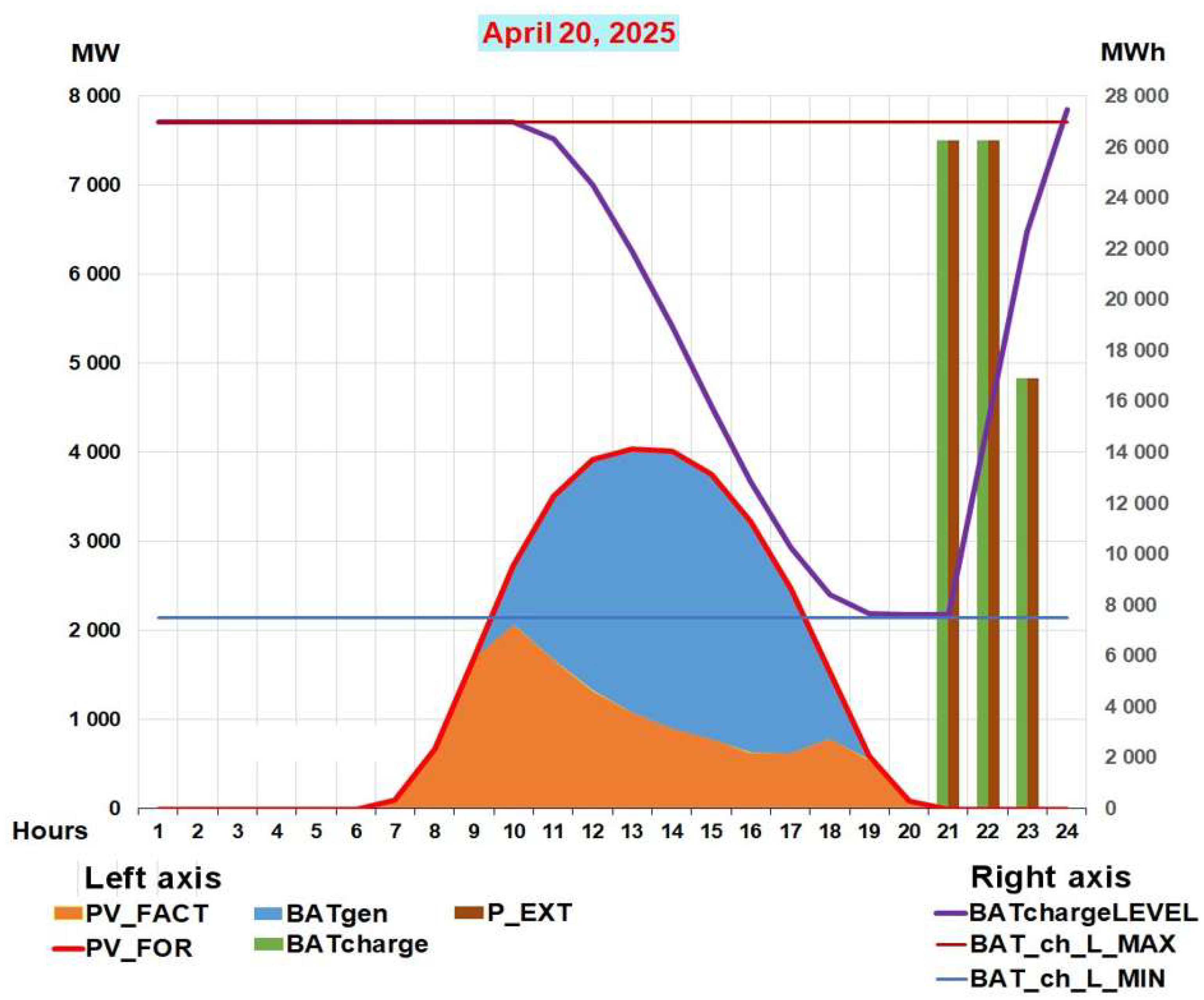
Figure 2.
Actual values and calculated results for daily generation volumes for January 2025.
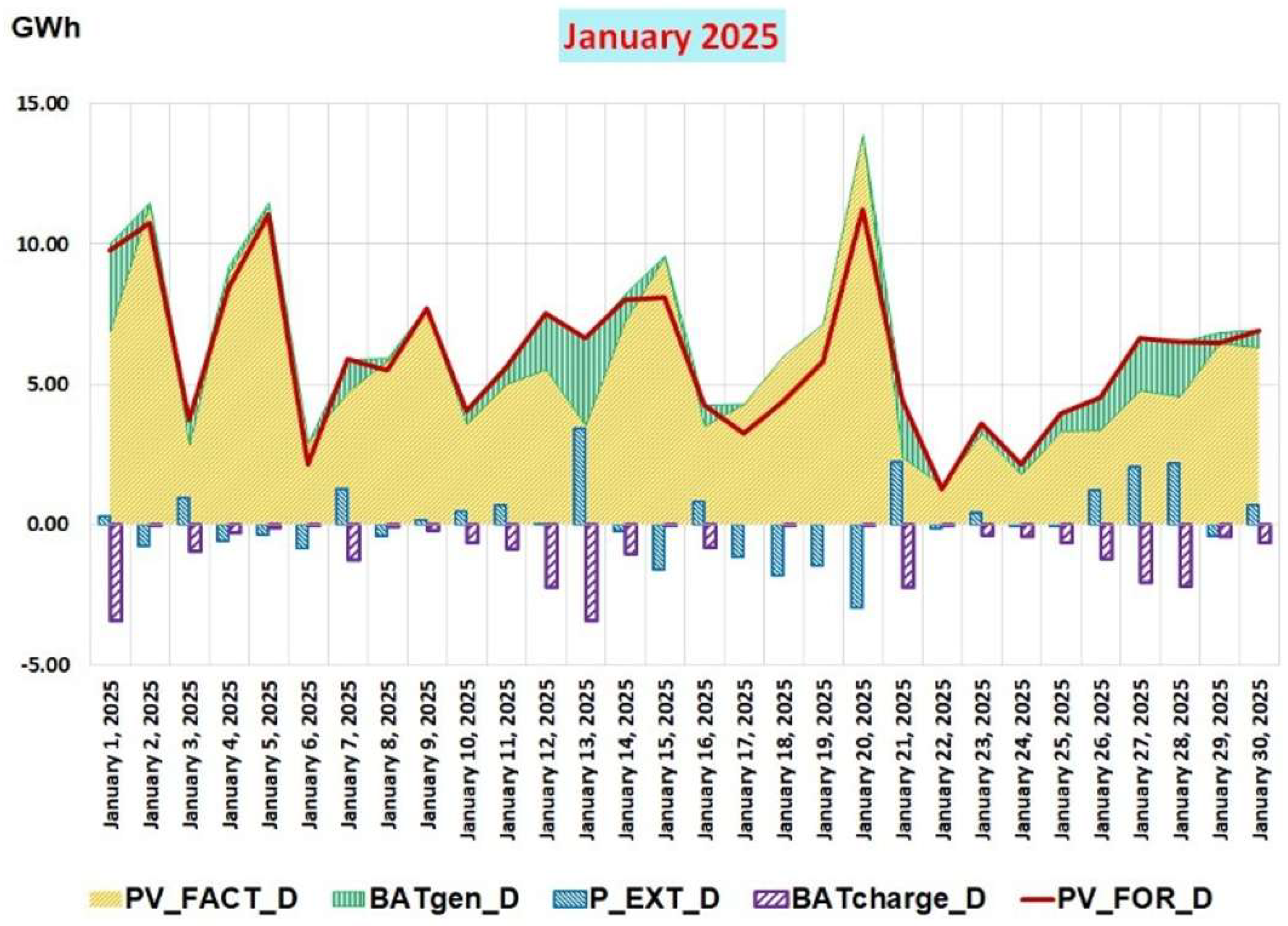
Figure 3.
Actual values and calculated results for monthly generation volumes in 2025.
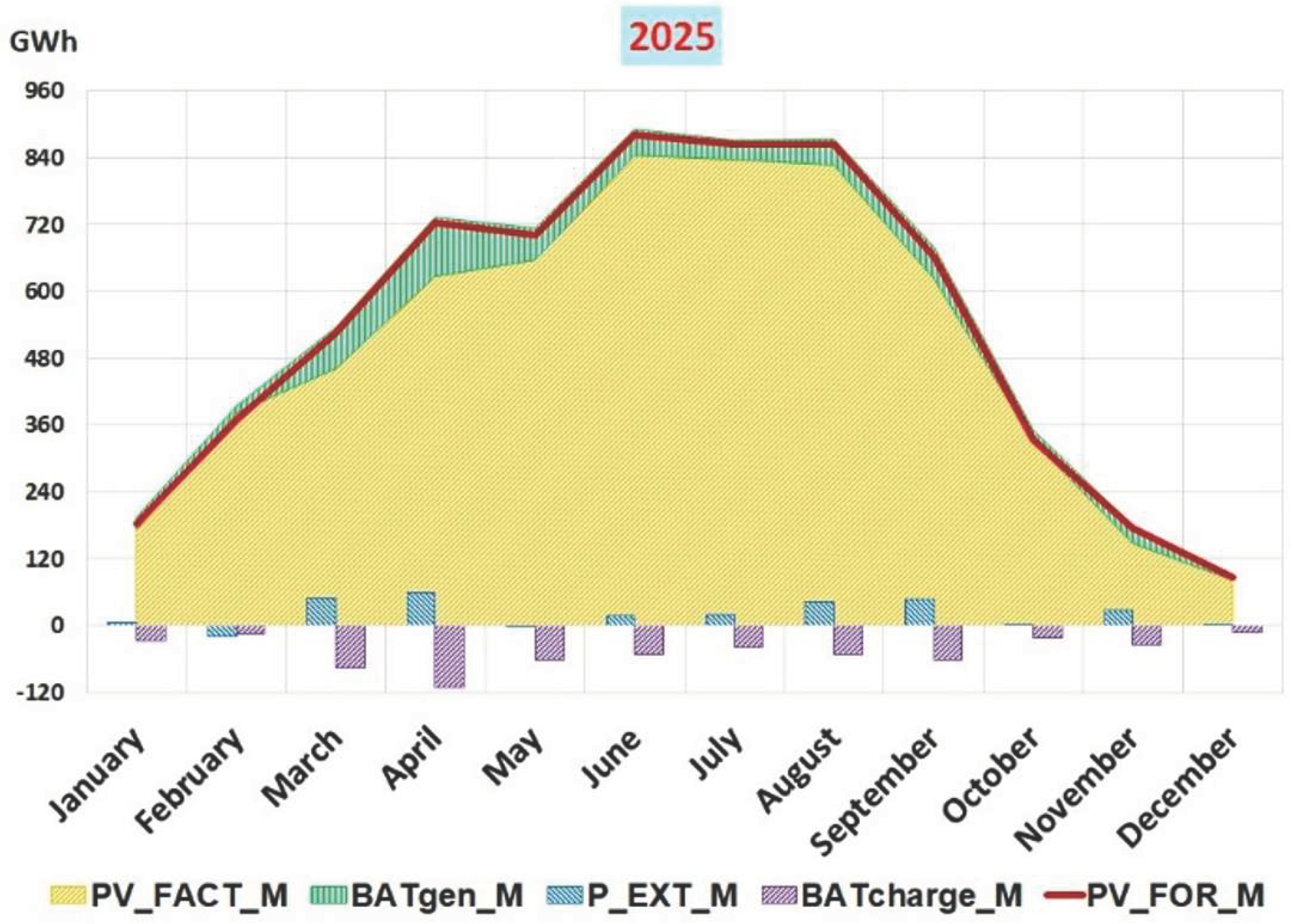

Table 1.
Key parameters of the aggregated operation of Ukraine’s solar power plants for 2021–2025.
| Year | Installed capacity, MW | Maximum power, Pmax, MW | Date/time of peak power | Maximum imbalance, ΔP, MW | Date/time of peak imbalance | Maximum daily generation, MWh |
| 2021 | 5,063 | 3,766 | 09/07/2021 13:00 | 1,984 | 11 April 2021 12:00 | 32,331 |
| 2022 | 5,063 | 3,587 | 14 February 2022 11:00 | 3,014 | 22 March 2022 12:00 | 23,303 |
| 2023 | 6,419 | 3,708 | 1 June 2023 12:00 | 2,973 | 23 April 2023 12:00 | 31,936 |
| 2024 | 6,419 | 4,027 | 5 May 2024 12:00 | 2,140 | 10 April 2024 13:00 | 34,248 |
| 2025 | 7,000 – 9,000* | 3,738 | 10 June 2025 15:00 | 3,116 | 10 April 2025 14:00 | 33,638 |
*Installed capacity figures for 2025 are given as an indicative range based on source data.
Table 2.
Results of calculations of hourly parameters for the day of greatest power imbalance PV_DELTA on 20 April 2025.
Table 2.
Results of calculations of hourly parameters for the day of greatest power imbalance PV_DELTA on 20 April 2025.
| T, h | PV_FACT, MW |
PV_FOR, MW |
PV_DELTA, MW |
BATgen, MW |
BATcharge, MW |
BATchargeLEVEL, MWh |
IMB | P_EXT, MW |
B_YBG | B_YBC |
| 1 | -10 | -9 | 0 | 0 | 0 | 27,000 | 0 | 0 | 0 | 1 |
| 2 | -10 | -9 | 1 | 0 | 0 | 27,000 | 0 | 0 | 0 | 1 |
| 3 | -10 | -9 | 1 | 0 | 0 | 27,000 | 0 | 0 | 0 | 1 |
| 4 | -10 | -9 | 0 | 0 | 0 | 27,000 | 0 | 0 | 0 | 1 |
| 5 | -10 | -9 | 1 | 0 | 0 | 27,000 | 0 | 0 | 0 | 1 |
| 6 | -7 | -6 | 1 | 0 | 0 | 27,000 | 0 | 0 | 0 | 1 |
| 7 | 106 | 104 | -2 | 0 | 0 | 27,000 | 0 | -2 | 1 | 0 |
| 8 | 688 | 670 | -18 | 0 | 0 | 27,000 | 0 | -20 | 1 | 0 |
| 9 | 1,694 | 1,701 | 7 | 7 | 0 | 27,000 | 0 | 7 | 1 | 0 |
| 10 | 2,075 | 2,732 | 657 | 657 | 0 | 26,993 | 0 | 0 | 1 | 0 |
| 11 | 1,678 | 3,506 | 1,828 | 1,828 | 0 | 26,337 | 0 | 0 | 1 | 0 |
| 12 | 1,329 | 3,920 | 2,591 | 2,591 | 0 | 24,509 | 0 | 0 | 1 | 0 |
| 13 | 1,085 | 4,045 | 2,960 | 2,960 | 0 | 21,918 | 0 | 0 | 1 | 0 |
| 14 | 906 | 4022 | 3,116 | 3,116 | 0 | 18,958 | 0 | 0 | 1 | 0 |
| 15 | 788 | 3,754 | 2,966 | 2,966 | 0 | 15,842 | 0 | 0 | 1 | 0 |
| 16 | 631 | 3226 | 2,595 | 2,595 | 0 | 12,876 | 0 | 0 | 1 | 0 |
| 17 | 625 | 2474 | 1849 | 1,849 | 0 | 10,281 | 0 | 0 | 1 | 0 |
| 18 | 790 | 1530 | 739 | 739 | 0 | 8,433 | 0 | 0 | 1 | 0 |
| 19 | 549 | 596 | 47 | 47 | 0 | 7,693 | 0 | 0 | 1 | 0 |
| 20 | 94 | 91 | -3 | 0 | 0 | 7,646 | 0 | 0 | 1 | 0 |
| 21 | -7 | -6 | 0 | 0 | 7,500 | 7,646 | 0 | 7,500 | 0 | 1 |
| 22 | -9 | -9 | 0 | 0 | 7,500 | 15,146 | 0 | 7,500 | 0 | 1 |
| 23 | -10 | -9 | 1 | 0 | 4,838 | 22,646 | 0 | 4,838 | 0 | 1 |
| 24 | -9 | -9 | 0 | 0 | 0 | 27,484 | 0 | 0 | 0 | 1 |
| SUM | 12,946 | 32,283 | 19,337 | 19,354 | 19,838 | 27,484 | 0 | 19,823 | ||
| MIN | -10 | -9 | -18 | 0 | 0 | 7,646 | 0 | -20 | ||
| MAX | 2,075 | 4,045 | 3,116 | 3,116 | 7,500 | 27,484 | 0 | 7,500 |
Table 3.
Actual values and results of calculations of daily generation volumes for January 2025.
| Date | PV_FACT_D, GWh | PV_FOR_D, GWh | P_EXT_D, GWh | BATgen_D, GWh | BATcharge_D, GWh |
| 1 January 2025 | 6.90 | 9.79 | 0.29 | 3.10 | -3.44 |
| 2 January 2025 | 11.44 | 10.76 | -0.76 | 0.02 | -0.02 |
| 3 January 2025 | 2.84 | 3.74 | 0.97 | 0.88 | -0.97 |
| 4 January 2025 | 8.96 | 8.46 | -0.58 | 0.28 | -0.31 |
| 5 January 2025 | 11.36 | 11.05 | -0.37 | 0.12 | -0.13 |
| 6 January 2025 | 2.91 | 2.15 | -0.87 | 0.00 | 0.00 |
| 7 January 2025 | 4.73 | 5.88 | 1.26 | 1.13 | -1.26 |
| 8 January 2025 | 5.83 | 5.49 | -0.40 | 0.07 | -0.08 |
| 9 January 2025 | 7.57 | 7.69 | 0.18 | 0.19 | -0.21 |
| 10 January 2025 | 3.58 | 4.04 | 0.49 | 0.57 | -0.63 |
| 11 January 2025 | 4.97 | 5.61 | 0.68 | 0.78 | -0.86 |
| 12 January 2025 | 5.53 | 7.54 | 0.00 | 2.02 | -2.25 |
| 13 January 2025 | 3.54 | 6.63 | 3.43 | 3.08 | -3.43 |
| 14 January 2025 | 7.25 | 8.00 | -0.25 | 0.95 | -1.05 |
| 15 January 2025 | 9.54 | 8.12 | -1.60 | 0.01 | -0.02 |
| 16 January 2025 | 3.48 | 4.26 | 0.84 | 0.76 | -0.84 |
| 17 January 2025 | 4.29 | 3.24 | -1.18 | 0.00 | 0.00 |
| 18 January 2025 | 6.00 | 4.39 | -1.81 | 0.00 | 0.00 |
| 19 January 2025 | 7.14 | 5.82 | -1.48 | 0.00 | 0.00 |
| 20 January 2025 | 13.90 | 11.25 | -2.97 | 0.01 | -0.01 |
| 21 January 2025 | 2.40 | 4.46 | 2.25 | 2.03 | -2.25 |
| 22 January 2025 | 1.36 | 1.25 | -0.15 | 0.01 | -0.01 |
| 23 January 2025 | 3.21 | 3.59 | 0.42 | 0.36 | -0.40 |
| 24 January 2025 | 1.79 | 2.17 | -0.02 | 0.38 | -0.43 |
| 25 January 2025 | 3.32 | 3.95 | 0.00 | 0.60 | -0.67 |
| 26 January 2025 | 3.36 | 4.51 | 1.24 | 1.12 | -1.24 |
| 27 January 2025 | 4.76 | 6.64 | 2.06 | 1.85 | -2.06 |
| 28 January 2025 | 4.54 | 6.53 | 2.19 | 1.97 | -2.19 |
| 29 January 2025 | 6.46 | 6.48 | -0.42 | 0.38 | -0.43 |
| 30 January 2025 | 6.33 | 6.92 | 0.68 | 0.60 | -0.67 |
| 31 January 2025 | 2.76 | 3.52 | 0.00 | 0.73 | -0.82 |
| SUM_GWh | 172.08 | 183.92 | 4.13 | 24.01 | -26.68 |
| MIN | 1.36 | 1.25 | -2.97 | 0.00 | -3.44 |
| MAX | 13.90 | 11.25 | 3.43 | 3.10 | 0.00 |
Table 4.
Actual values and results of calculations for monthly generation volumes in 2025.
| Month | PV_FACT_M, GWh |
PV_FOR_M GWh |
P_EXT_M GWh |
BATgen_M GWh |
BATcharge_M GWh |
| January | 172.08 | 183.92 | 4.13 | 24 Jan | -26.68 |
| February | 382.85 | 369.42 | -18.95 | 12.99 | -14.44 |
| March | 461.00 | 527.26 | 49.56 | 74.72 | -76.86 |
| April | 628.19 | 723.11 | 60.55 | 104.21 | -110.79 |
| May | 658.10 | 700.63 | -0.63 | 55.60 | -61.78 |
| June | 844.12 | 882.24 | 16.39 | 46.89 | -51.27 |
| July | 837.62 | 864.81 | 20.40 | 34.54 | -38.38 |
| August | 827.79 | 863.23 | 41.98 | 45.77 | -50.86 |
| September | 621.26 | 662.94 | 48.14 | 56.95 | -61.26 |
| October | 330.58 | 332.36 | 0.01 | 19.68 | -21.87 |
| November | 149.30 | 174.24 | 27.08 | 32.02 | -35.57 |
| December | 81.02 | 85.53 | 3.76 | 11.38 | -12.64 |
| SUM_GWh | 5,993.92 | 6,369.69 | 252.41 | 518.78 | -562.40 |
| MIN | 81.02 | 85.53 | -18.95 | 11.38 | -110.79 |
| MAX | 844.12 | 882.24 | 60.55 | 104.21 | -12.64 |
Disclaimer/Publisher’s Note: The statements, opinions and data contained in all publications are solely those of the individual author(s) and contributor(s) and not of MDPI and/or the editor(s). MDPI and/or the editor(s) disclaim responsibility for any injury to people or property resulting from any ideas, methods, instructions or products referred to in the content. |
© 2026 by the authors. Licensee MDPI, Basel, Switzerland. This article is an open access article distributed under the terms and conditions of the Creative Commons Attribution (CC BY) license (http://creativecommons.org/licenses/by/4.0/).
Copyright: This open access article is published under a Creative Commons CC BY 4.0 license, which permit the free download, distribution, and reuse, provided that the author and preprint are cited in any reuse.


