

Submitted:
24 March 2026
Posted:
26 March 2026
You are already at the latest version
Abstract
Madagascar experienced a severe measles epidemic between September 2018 and mid-2019, resulting in over 146,000 cases and 1,200 deaths, primarily among children under 15. This epidemic occurred in a context of low vaccination coverage. Prior to this epidemic, no genotyping data for the measles virus (MeV) or rubella virus (RuV) were available for Madagascar. This study aimed to molecularly characterize MeV and RuV strains circulating during the epidemic. A total of 310 biological samples (gingival swabs, urine, and stool) were collected from 288 suspected patients with a mean age of 11.4 years. Viral detection was performed by real-time RT-PCR, followed by conventional RT-PCR and sequencing for genotyping of the N and H genes of MeV and the E1 gene of RuV. The results revealed co-circulation of the two viruses, with detection rates of 39.9% (115/288) for MeV and 40.0% (70/175) for RuV. The mean age differed significantly between MeV-positive (12.0 years) and RuV-positive (7.2 years) patients, with 35.1% and 43.8% of cases occurring in children under five years of age, respectively. Phylogenetic analysis identified all MeV strains as belonging to genotype B3, showing high similarity to strains circulating globally in 2018-2019, suggesting recent importation. Meanwhile, the phylogenetic profile of RuV strains, all belonging to genotype 2B and displaying greater genetic diversity, was characteristic of endemic rubella in a partially vaccinated or unvaccinated population. This study provides the first genotyping data for Madagascar, essential for monitoring virus circulation and supporting elimination efforts in the African region.
Keywords:
measles
; rubella
; genotype
; Madagascar
1. Introduction
Measles is a highly contagious infectious disease characterized by high fever, cough, coryza, conjunctivitis, and a distinctive maculopapular rash. Despite vaccine availability, it remains a major cause of morbidity and mortality worldwide. The causative agent, Measles virus (MeV), is an enveloped, non-segmented negative-sense single-stranded RNA virus with a helical nucleocapsid. MeV is a member of the genus Morbillivirus within the family Paramyxoviridae. Its genome is 15,894 nucleotides (nt) long and contains six genes encoding the nucleoprotein (N), phosphoprotein (P), matrix (M), fusion (F), hemagglutinin (H), and polymerase (L) proteins. MeV strains are divided into eight clades (A–H) and 24 genotypes (A, B1 to B3, C1 and C2, D1 to D11, E, F, G1 to G3, H1 and H2) [1,2].
Rubella, also characterized by a maculopapular rash and fever, is generally a mild disease primarily affecting children. Complications of rubella include arthritis and, more rarely, encephalitis but infection with Rubella virus (RuV) is also associated with severe birth defects when women are infected early in pregnancy, with long-term health consequences for children born with a congenital rubella syndrome (CRS) [3,4]. RuV belongs to the genus Rubivirus within the family Matonaviridae [5]. RuV is an enveloped virus with a non-segmented, positive-sense single-stranded RNA genome of around 10 kb. Its genome is divided into two open reading frames, encoding two non-structural proteins (P90 and P150) and three structural proteins (C, E1 and E2), respectively [6]. On the basis of E1 gene sequences, RuV strains are divided into two clades. Clade 1 is divided into 10 genotypes (1a and 1B to 1J) and clade 2 into three (2A to 2C). Of these, four genotypes, namely, 1E, 1G, 1J, and 2B, are reported to circulate commonly in different regions of the world [7].
Both measles and rubella are vaccine-preventable diseases. Countries across all six World Health Organization (WHO) regions had set a goal to eliminate measles by 2020 or earlier, with three regions additionally targeting rubella elimination [8]. By the end of 2019, 178 WHO member states had introduced a second dose of measles-containing vaccine (MCV2), as not all children develop immunity after the first dose (https://www.who.int/news-room/fact-sheets/detail/immunization-coverage). In addition, 173 countries had begun rubella vaccination. With measles and rubella elimination efforts underway in many countries, the distribution of genotypes may change, with some previously common genotypes becoming less frequent as vaccination coverage increases. To effectively monitor the interruption of endemic transmission of MeV and RuV and track changes in genotype distribution, viral sequence characterization combined with case investigations is therefore essential [9]. Accordingly, current WHO recommendations advise countries at all phases of measles control to collect urine and/or gingival samples from representative cases to facilitate molecular epidemiological studies, in addition to serological screening [10].
In Madagascar, the Expanded Program on Immunization (EPI) has been in place since 1976 and includes measles-containing vaccines (MCV) in its vaccination calendar. Until 2020, a single dose of MCV was administered at 9 months of age. MCV2, scheduled between 15 and 18 months of age, was introduced in October 2020. Following mass vaccination campaigns in September and October 2004, national surveillance of suspected measles cases was established. Since then, the National Reference Laboratory (NRL) for measles and rubella, hosted by the Virology unit at the Institut Pasteur de Madagascar, has been responsible for serological diagnosis using ELISA. From late 2004 to August 2018, the NRL received and tested 7,072 sera, of which 39 (0.5%) and 1,762 (24.9%) were IgM positive for MeV and RuV, respectively. Starting in epidemiological week 35 (September) of 2018, Madagascar experienced a massive measles epidemic, which was officially declared nationwide in October 2018. By May 2019, the country had reported 146,277 measles cases including 1,394 laboratory-confirmed cases and 144,883 cases confirmed by epidemiological link [11]. The number of deaths reached over 1,200 people, predominantly children under 15 years of age. The epidemic continued through the first half of 2019 but began to subside around mid-2019 following extensive vaccination campaigns. During the emergency response, about 7.2 million children aged six months to nine years were vaccinated [11]. The outbreak was largely controlled by September 2019.
Prior to this epidemic, Madagascar had one of the lowest measles vaccination coverage rates globally. According to the WHO-UNICEF estimates of national coverage (WUENIC) data, the coverage of MCV1 in Madagascar was estimated at 68% in 2018 (https://worldhealthorg.shinyapps.io/wuenic-trends/). The low coverage was attributed to vaccine hesitancy and limited access in certain regions of the country. This Malagasy outbreak was one of the largest during the global measles resurgence of 2018-2019, which affected all regions of the world, with other major hotspots in Ukraine, India, the Philippines, and parts of Europe and the USA.
During the epidemic, the NRL implemented molecular biology techniques to diagnose and genotype both viruses. In parallel, additional biological samples (gingival, urine, and stool) were collected from suspected measles patients for molecular confirmation of suspected cases and genetic characterization of viruses from confirmed cases. This study aimed to molecularly characterize the MeV and RuV strains that circulated in Madagascar during the 2018-2019 epidemic.
2. Materials and Methods
2.1. Ethics Statement
For the patient samples included in the study, the participant or a parent or legal guardian provided written informed consent. Ethical approval was obtained from the Ethics Committee for Biomedical Research of the Ministry of Public Health of Madagascar (Comité d’Ethique de la Recherche Biomédicale auprès du Ministère de la Santé Publique de Madagascar # 96/MSANP/CERBM) issued on August 28, 2018.
2.2. Sample Collection
For patients suspected of having measles, one to three types of samples have been collected. Samples have been taken within the first four days after rash onset. Gingival specimens were swabbed and preserved into viral transport medium (VTM). Urine samples were collected in sterile tubes and stool samples by rectal swabbing. After collection, all samples were sent to the NRL at 4°C and either processed on arrival or stored at -80°C until analysis. A total of 310 specimens, among which 288 gingival swabs, 13 stool and 9 urine samples, were collected from 288 patients (Table 1).
2.3. Molecular Screening for MeV and RuV
Viral RNA extraction from 140 µL of clinical specimens was performed using the QIAamp® Viral RNA mini kit (Qiagen, Hilden, Germany) according to the manufacturer's instructions. RNA was eluted in a final volume of 65 µL and stored at -80°C. Real-time RT-PCR assays were performed for the detection of measles and rubella viruses on an ABI 7500 Real-time PCR system (Applied Biosystems) following CDC protocols (links to protocols are given in the footnotes of Table 2). Primers, probes and control RNAs were provided by CDC as kits. Primers and probe for MeV were described by Hummel et al., and those for RuV by Schulz et al., respectively [12,13]. In addition, RNA presence and integrity were confirmed using primers specific to the human RNase P gene [12,13,14] (Table 2). For MeV, samples with a Ct value below 38 were considered positive and used for genotyping. All negative specimens for MeV were then tested for RuV. Those with a Ct value below 40 were considered positive and further used for genotyping..
- a.
- Genotyping of MeV and RuV
Genotypes of MeV and RuV were determined by RT-PCR using T3000 Thermocycler (Biometra®, Göttingen, Germany). Genetic characterization was based on sequence analysis of the nucleoprotein (N) and hemagglutinin (H) genes for MeV and of the envelope (E1) gene for RuV. Primers used for genotyping are presented in Table 3 [15,16,17]. Briefly, 5 μL of extracted RNA was added to a reaction mix containing 25µL of 2X buffer, 0.2 µM of each primer, 0.8 mM of MgSO4, 0.5 µL of RNase inhibitor (40U/µL) (Promega, Madison, WI, USA), and 1 μL of Superscript III TM One-Step RT-PCR Platinum TM Taq HiFi enzyme (5U/µL) (Life Technologies, Carlsbad, CA, USA) in a final volume of 50 μL. RT-PCR cycling conditions were 30 min at 55°C and 2 min at 95°C followed by 40 cycles of 15 sec at 95°C, 30 sec at 55°C and 30 sec at 72°C, and a final extension of 7 min at 72°C. Mix composition and cycling conditions follow the CDC protocol.
For the MeV H gene, two primer pairs (MHs/H4as and Has/MHas) were used to generate overlapping fragments (fragments H1 and H2) (Table 3) [17]. Amplification reactions were carried out in two steps. First, cDNA synthesis was performed with Superscript II Reverse Transcriptase (Invitrogen, Carlsbad, CA, USA) and random hexamers (Roche Diagnostics, Mannheim, Germany) from 5 µL of RNA. Cycling conditions were 10 min at 25°C, followed by 50 min at 42°C and 5 min at 95°C. Next, for PCR amplification, 3 μL of cDNA was combined with a reaction mix containing 5 µL of 10X buffer, 0.1 µM of each primer, 2.5 mM of MgCl2, 0.2 mM of dNTPs and 0.5 µL of GoTaq polymerase (5U/µL) (Promega, Madison, WI, USA) in a volume of 50 µL. PCR cycling conditions were as follows: 20 sec at 95°C, 40 cycles of 30 sec at 94°C, 30 sec at 60°C and 85 sec at 72°C, followed by a final extension of 10 min For the MeV H gene, two primer pairs (MHs/H4as and Has/MHas) were used to generate overlapping fragments (fragments H1 and H2) (Table 3) (Xu et al., 2013). Amplification reactions were carried out in two steps. First, cDNA synthesis was performed with Superscript II Reverse Transcriptase (Invitrogen, Carlsbad, CA, USA) and random hexamers (Roche Diagnostics, Mannheim, Germany) from 5 µL of RNA. Cycling conditions were 10 min at 25°C, followed by 50 min at 42°C and 5 min at 95°C. Next, for PCR amplification, 3 μL of cDNA was combined with a reaction mix containing 5 µL of 10X buffer, 0.1 µM of each primer, 2.5 mM of MgCl2, 0.2 mM of dNTPs and 0.5 µL of GoTaq polymerase (5U/µL) (Promega, Madison, WI, USA) in a volume of 50 µL. PCR cycling conditions were as follows: 20 sec at 95°C, 40 cycles of 30 sec at 94°C, 30 sec at 60°C and 85 sec at 72°C, followed by a final extension of 10 min at 72°C.
For the RuV E1 gene amplification, two overlapping fragments of an expected size of 480 bp and 633 bp were amplified using pairs RV8633F/RV9112R and RV8945F/RV9577R, respectively (Table 3). Combination of the obtained overlapping sequences allowed to generate E1 sequences of 739 bp in size for genotyping (Namuwulya et al., 2014; WHO, 2005; WHO, 2006). Briefly, 5 μL of extracted RNA was added to a reaction mix containing 25µL of 2X buffer, 0.2 µM of each primer, 1 M of betaine (Sigma-Aldrich, St Louis, MO, USA), 0.5 µL of RNase inhibitor (40U/µL) (Promega, Madison, WI, USA), and 1 μL of Superscript III TM One-Step RT-PCR Platinum TM Taq HiFi enzyme (5U/µL) (Life Technologies, Carlsbad, CA, USA) in a final volume of 50 μL. RT-PCR cycling conditions were 30 min at 55°C and 2 min at 94°C followed by 40 cycles of 15 sec at 94°C, 30 sec at 55°C and 1 min at 68°C, and a final extension of 5 min at 68°C. Mix composition and cycling conditions follow the CDC protocol.
For the MeV N gene and RuV E1 gene amplifications, positive RNA controls were provided by CDC. The MeV RNA control was 220 bp larger than RT-PCR products from patient samples while the RuV RNA control was 80 bp smaller than RT-PCR products from patient samples. All PCR products were visualized by agarose gel electrophoresis prior to sequencing.
- b.
- Phylogenetic analysis
Amplification products were sent for sequencing to GENEWIZ Europe (Leipzig, Germany). Raw sequences were analyzed and edited using CLC Genome Workbench 8.1. (Qiagen, Aarhus A/S, Aarhus, Denmark). Then, for each gene, a multiple-sequence alignment was built using the obtained sequences and other closely-related sequences via BLAST (blast.ncbi.nlm.nih.gov/Blast.cgi) as well as WHO reference sequences and sublineage reference sequences using the ClustalW program. The sequences were translated into amino acids, and both nucleotide and amino acid sequences were checked for irregularities. Pairwise sequence identity (at the nucleotide and amino acid levels) of the different coding sequences was calculated with MEGA version 7 (www.megasoftware.net) using uncorrected p-distances [20]. Phylogenetic trees were inferred from the aligned nucleotide sequences by using a maximum likelihood phylogenetic approach, applying the best-fitted model of nucleotide substitution for our data sets, as determined using MEGA v7 under corrected Akaike information criteria (AICc). Five hundred bootstrap replicates were generated.
- c.
- Accession numbers
Sequences reported in this paper were named according to WHO recommendations and have been deposited to GenBank under accession numbers PV648754 to PV648867, PV659707 to 659779, and PV648868 to PV648912 for the N, H, and E1 sequences, respectively.
3. Results
A total of 310 samples were collected from 288 suspected measles patients: three types of samples (gingival, stool and urine) were collected for nine patients, two types of samples (gingival and stool) for four patients and only gingival samples for 275 patients (Table 1). The male-to-female ratio (M:F) was 0.79 (127/161) with a mean age of 11.4 years (range: 0-65 years). All samples were tested for MeV by quantitative RT-PCR. The detection rate was 39.9% with 115 of 288 patients positive for MeV (Table 1 and Table 4). The mean age of the positive patients was 12.0 years (range: 0.1-65 years). The overall sample-based detection rate of MeV was 40.3% (125/310) with 39.9% of gingival samples (115/288), 61.5% of stool (8/13) and 22.2% of urine samples (n=2/9) positive (Figure 1).
Search for RuV was carried out in 175 patients: 173 of whom tested negative for MeV (five patients from whom three types of samples were collected and 168 from whom only a gingival sample was collected), and the two from whom three types of samples were collected, but the urine samples were negative for MeV (Table 1). The M:F ratio was 0.84 (80/95) and the mean age was 10.9 years (range: 0-61 years). The detection rate for RuV was 40.0% (70/175) (Table 1 and Table 4). The mean age of the positive patients was 7.2 years (range: 0.6-33.8 years). The overall sample-based detection rate was 40.0% (74/185) with 39.9% of gingival samples (69/173), 60% of stool (3/5) and 28.6% of urine samples (2/7) positive (Figure 1).
Of the 125 samples positive for MeV by quantitative RT-PCR, 111 were positive for the N gene by conventional RT-PCR: 101 gingival samples (87.8%), eight stool samples (100%) and two urine samples (100%). In addition, 65 samples were positive for both H1 and H2 gene fragments (57 gingival samples (49.6%), seven stool samples (87.5%) and one urine sample (50%)) (Table S1). The 14 samples negative for both genes had Ct values greater than 33.9 in the real-time assay. Samples (n=11) with discrepancies in H1 and H2 amplifications had Ct values ranging from 21.6 to 24.5 in the real-time assay.
Of the 74 samples positive for RuV by quantitative RT-PCR, 47 (63.5%) were positive for the E1 gene by conventional RT-PCR, including 44 gingival samples (63.8%), one stool sample (33.3%) and two urine samples (100%) (Table S2). The 27 negative samples had Ct values greater than 31.4 in the real-time assay. Forty-three E1 gene sequences were obtained.
For the N gene, 100 sequences of 450 bp (nucleotide positions 1126-1575 of the Y-14 strain, accession number U01998) were obtained from the 111 products sent for sequencing. The other sequences were partial and excluded for further analyses. They exhibited 98.9% to 100% nucleotide identity and 98.7 to 100% amino acid identity over the 450 bp / 150 aa sequences. They showed 99.1 to 100% nucleotide identity with the MVs/Mamoudzou.FRA/47.18 [B3] strain detected in Mayotte in 2018. In addition, 47 sequences of 936 bp of the H gene (nucleotide positions 510-1445 of the MVs/Milan.ITA/3.16/2 [B3] strain, accession number MK628300) were obtained from the 65 samples from which the H1 + H2 fragments were amplified. They displayed 99.7 to 100% nucleotide identity and 97.1 to 100% amino acid identity among themselves over the 936 bp / 312 aa sequences. They shared 99.8 to 100% nucleotide identity with MVs/Mamoudzou.FRA/47.18 [B3], MVs/Hwaseong.KOR/5.19/1 [B3], and MVs/Ontario.CAN/11.19 [B3] strains, identified in 2018 and 2019.
Then, phylogenetic analyses were performed on the nucleotide sequences of the N and H genes of MeV (Figure 2). To construct the trees, for clarity, given that many sequences had 100% nucleotide identity between them, only one sequence from each was used (Figure 2). Thus, 18 and 22 Malagasy sequences of the N and H genes were included, respectively. All MeV strains detected during this outbreak belonged to the [B3] genotype.
Regarding RuV, sequences of 739 bp in length (nucleotide positions 8731 to 9469 of the RVi/Seattle.WA.USA/16.00 [2B] strain, accession number JN635293) were obtained for 31 of the 43 RT-PCR products sent for sequencing. They exhibited 94.3% to 99.9% nucleotide identity and 94.3% to 100% amino acid identity over the 739 bp / 246 aa sequences. They were most closely related to the RVi/Pune.IND/12.92 [2B] strain, showing 94.7% to 96.3% nucleotide identity. BLAST analyses confirmed that all sequences belonged to genotype 2B.
Of note, all Malagasy strains possessed signature mutations at positions G8805C, C8904T and T/C8958A (nucleotide positions relative to JN635293), compared to other sequences of genotype [2B]. These three polymorphic sites were nevertheless synonymous substitutions. Phylogenetic analysis demonstrated that all Malagasy sequences formed a single, well-supported monophyletic clade (bootstrap value=97), distinct from RuV sequences from other countries (Figure 3). In addition, they displayed substantial genetic diversity. Within this monophyletic clade, they branched into several distinct well-supported monophyletic sub-clades in which some Malagasy sequences are as genetically distant from each other as some international strains are from one another.
4. Discussion
This study reveals the co-circulation of MeV (genotype [B3]) and RuV (genotype [2B]) in Madagascar during the 2018-2019 epidemic, with each virus accounting for approximately 40% of suspected cases. Notably, 35.1% (39/111) of MeV-positive patients and 43.8% (32/73) of RuV-positive patients were children under 5 years of age (Table 4). The significant prevalence of both viruses among suspected cases, their similar detection rates but different age distributions (average 12.0 years for MeV vs. 7.2 years for RuV), confirms gaps in vaccination coverage and/or waning immunity in the population.
The detection rates varied across sample types, ranging from 22.2% to 61.5% for MeV and from 28.6% to 60% for RuV, with stool samples showing the highest positivity rates for both viruses. Gingival samples yielded similar detection rates of approximately 40% for both viruses. Nevertheless, the small sample size for urine and stool samples limits the interpretations of the optimal specimen type. In any case, this study confirms the value of these different samples types for the molecular diagnosis of measles and rubella, as already demonstrated by numerous studies worldwide [21,22,23,24,25,26,27,28,29,30,31].
The findings also highlight the value of comprehensive molecular characterization for understanding transmission networks and the evolutionary dynamics of these important vaccine-preventable diseases. Indeed, the genetic characterization of MeV shows high similarity to strains circulating widely (Mayotte, South Korea, Canada) in 2018-2019, suggesting recent importation or linkage to broader circulation patterns of a globally circulating [B3] genotype. Meanwhile, the Malagasy RuV strains display greater genetic diversity among themselves and show more distant relationships to previously characterized viruses. While the substantial genetic diversity within Malagasy sequences may indicate long-term endemic persistence with multiple co-circulating lineages, the absence of international strains clustering with Malagasy ones suggests that recent introductions have either not occurred or have not established persistent transmission chains. The genetic isolation of Malagasy RuV strains suggests that effective local control could theoretically eliminate rubella from the island without immediate reintroduction risk, but the multiple co-circulating lineages indicate that elimination will require comprehensive, sustained efforts achieving high vaccination coverage across all regions simultaneously.
5. Conclusions
The identification of MeV and RuV genotypes is a critical component of measles and rubella surveillance and elimination. This work provides the first information of the MeV and RuV genotypes circulating in Madagascar, contributing to a better understanding of the dynamic circulation of both viruses in the African region [1,32,33,34,35,36,37,38]. Sustained molecular monitoring will provide evidence of the impact of vaccination programs, document the interruption of endemic virus circulation and identify the possible emergence of new variants. This information is essential to prevent future outbreaks and support global measles and rubella elimination goals
Supplementary Materials
The following supporting information can be downloaded at the website of this paper posted on Preprints.org.
Author Contributions
Richter Razafindratsimandresy: Methodology, Investigation, Formal analysis, Software, Conceptualization, Supervision, Validation, Project administration, Writing – original draft. Emmanuel Andrianiriana: Methodology, Investigation. Anja Elsam Andrianjakatsilavo: Methodology, Investigation. Laurence Randrianasolo: Investigation. Jonhson Raharinantoanina: Methodology, Investigation, Software, Supervision Jean Michel Heraud: Writing - review& editing Vincent Lacoste: Methodology, Formal analysis, Software, Validation, Supervision, Writing – original draft, Writing – review & editing.
Funding
This work was supported by the World Health Organization.
Consent for publication
All authors have approved the manuscript and given their consent for submission and publication.
Ethics approval
Ethical approval was obtained from the Ethics Committee for Biomedical Research of the Ministry of Public Health of Madagascar (Comité d’Ethique de la Recherche Biomédicale auprès du Ministère de la Santé Publique de Madagascar # 96/MSANP/CERBM) issued on August 28, 2018.
Data Availability Statement
Sequences reported in this paper have been deposited in GenBank under accession numbers PV648754 to PV648867, PV659707 to 659779, and PV648868 to PV648912 for the N, H, and E1 genes, respectively.
Acknowledgments
The authors acknowledge Dr Andriamandimby Soa Fy for help in statistical analysis.
Conflicts of Interest
The authors declare that they have no competing interests.
References
- Rota, P.A.; Brown, K.; Mankertz, A.; Santibanez, S.; Shulga, S.; Muller, C.P.; Hubschen, J.M.; Siqueira, M.; Beirnes, J.; Ahmed, H.; et al. Global distribution of measles genotypes and measles molecular epidemiology. The Journal of infectious diseases 2011, 204 Suppl 1, S514–523. [Google Scholar] [CrossRef] [PubMed]
- WHO. Measles virus nomenclature update: 2012. Releve epidemiologique hebdomadaire 2012, 87, 73–81. [Google Scholar]
- CDC. Rubella (German Measles, Three-Day Measles). Available online: https://www.cdc.gov/rubella/index.html (accessed on.
- WHO. Global measles and rubella strategic plan: 2012-2020; Organization, W.H., Ed.; Geneva, Switzerland, 2012; p. 42. [Google Scholar]
- Walker, P.J.; Siddell, S.G.; Lefkowitz, E.J.; Mushegian, A.R.; Dempsey, D.M.; Dutilh, B.E.; Harrach, B.; Harrison, R.L.; Hendrickson, R.C.; Junglen, S.; et al. Changes to virus taxonomy and the International Code of Virus Classification and Nomenclature ratified by the International Committee on Taxonomy of Viruses (2019). Archives of virology 2019, 164, 2417–2429. [Google Scholar] [CrossRef]
- Das, P.K.; Kielian, M. Molecular and Structural Insights into the Life Cycle of Rubella Virus. Journal of virology 2021, 95. [Google Scholar] [CrossRef]
- WHO. Rubella virus nomenclature update: 2013. Releve epidemiologique hebdomadaire 2013, 88, 337–343. [Google Scholar]
- Minta, A.A.; Ferrari, M.; Antoni, S.; Portnoy, A.; Sbarra, A.; Lambert, B.; Hauryski, S.; Hatcher, C.; Nedelec, Y.; Datta, D.; et al. Progress Toward Regional Measles Elimination - Worldwide, 2000-2021. MMWR. Morbidity and mortality weekly report 2022, 71, 1489–1495. [Google Scholar] [CrossRef]
- WHO. Expanded Programme on Immunization (EPI). Standardization of the nomenclature for describing the genetic characteristics of wild-type measles viruses. Releve epidemiologique hebdomadaire 1998, 73, 265–269. [Google Scholar]
- WHO; UNICEF. Measles: mortality reduction and regional elimination: strategic plan 2001-2005; Organization, W.H., Ed.; Geneva, Switzerland, 2001; p. 33. [Google Scholar]
- Sodjinou, V.D.; Douba, A.; Nimpa, M.M.; Masembe, Y.V.; Randria, M.; Ndiaye, C.F. Madagascar 2018-2019 measles outbreak response: main strategic areas. The Pan African medical journal 2020, 37, 20. [Google Scholar] [CrossRef] [PubMed]
- Hummel, K.B.; Lowe, L.; Bellini, W.J.; Rota, P.A. Development of quantitative gene-specific real-time RT-PCR assays for the detection of measles virus in clinical specimens. Journal of virological methods 2006, 132, 166–173. [Google Scholar] [CrossRef]
- Schulz, H.; Neale, M.; Zubach, V.; Severini, A.; Hiebert, J. Development of a rapid, internally controlled, two target, real-time RT-PCR for detection of rubella virus. Journal of virological methods 2022, 303, 114500. [Google Scholar] [CrossRef]
- Emery, S.L.; Erdman, D.D.; Bowen, M.D.; Newton, B.R.; Winchell, J.M.; Meyer, R.F.; Tong, S.; Cook, B.T.; Holloway, B.P.; McCaustland, K.A.; et al. Real-time reverse transcription-polymerase chain reaction assay for SARS-associated coronavirus. Emerging infectious diseases 2004, 10, 311–316. [Google Scholar] [CrossRef]
- Kim, J.M.; Park, S.; Kim, S.; Park, K.R.; Wang, J.S.; Chung, Y.S. Genetic Analysis of the Measles Virus From the Outbreaks in South Korea, 2019. Frontiers in microbiology 2021, 12, 763107. [Google Scholar] [CrossRef]
- Namuwulya, P.; Abernathy, E.; Bukenya, H.; Bwogi, J.; Tushabe, P.; Birungi, M.; Seguya, R.; Kabaliisa, T.; Alibu, V.P.; Kayondo, J.K.; et al. Phylogenetic analysis of rubella viruses identified in Uganda, 2003-2012. Journal of medical virology 2014, 86, 2107–2113. [Google Scholar] [CrossRef]
- Xu, S.; Zhang, Y.; Zhu, Z.; Liu, C.; Mao, N.; Ji, Y.; Wang, H.; Jiang, X.; Li, C.; Tang, W.; et al. Genetic characterization of the hemagglutinin genes of wild-type measles virus circulating in china, 1993-2009. PloS one 2013, 8, e73374. [Google Scholar] [CrossRef]
- WHO. Standardization of the nomenclature for genetic characteristics of wild-type rubella viruses. Releve epidemiologique hebdomadaire 2005, 80, 126–132. [Google Scholar]
- WHO. Global distribution of measles and rubella genotypes--update. Releve epidemiologique hebdomadaire 2006, 81, 474–479. [Google Scholar]
- Kumar, S.; Stecher, G.; Tamura, K. MEGA7: Molecular Evolutionary Genetics Analysis Version 7.0 for Bigger Datasets. Molecular biology and evolution 2016, 33, 1870–1874. [Google Scholar] [CrossRef] [PubMed]
- Eckerle, I.; Keller-Stanislawski, B.; Santibanez, S.; Buderus, S.; Hillmann, M.; Drosten, C.; Eis-Hubinger, A.M. Nonfebrile seizures after mumps, measles, rubella, and varicella-zoster virus combination vaccination with detection of measles virus RNA in serum, throat, and urine. Clinical and vaccine immunology: CVI 2013, 20, 1094–1096. [Google Scholar] [CrossRef] [PubMed]
- Vaidya, S.R.; Kamble, M.B.; Kumbhar, N.S. Laboratory-based investigation of fever with rash cases in the Maharashtra State - India, 2014 to 2017. Journal of medical virology 2019, 22. 91, 972–978. [Google Scholar] [CrossRef]
- Kalaycioglu, A.T.; Yolbakan, S.; Guldemir, D.; Korukluoglu, G.; Coskun, A.; Cosgun, Y.; Durmaz, R. Towards measles elimination: Phylogenetic analysis of measles viruses in Turkey (2012-2013) and identification of genotype D8. Journal of medical virology 2016, 88, 1867–1873. [Google Scholar] [CrossRef] [PubMed]
- Duraisamy, R.; Rota, P.A.; Palani, G.; Elango, V.; Sambasivam, M.; Lowe, L.; Lopareva, E.; Ramamurty, N. Molecular characterization of wild-type measles viruses in Tamil Nadu, India, during 2005-2006: relationship of genotype D8 strains from Tamil Nadu to global strains. Journal of medical virology 2012, 84, 348–357. [Google Scholar] [CrossRef]
- Shakya, A.K.; Shukla, V.; Maan, H.S.; Dhole, T.N. Identification of different lineages of measles virus strains circulating in Uttar Pradesh, North India. Virology journal 2012, 9, 237. [Google Scholar] [CrossRef]
- Vaidya, S.R.; Chowdhury, D.T. Measles virus genotypes circulating in India, 2011-2015. Journal of medical virology 2017, 89, 753–758. [Google Scholar] [CrossRef]
- Magurano, F.; Fortuna, C.; Marchi, A.; Benedetti, E.; Bucci, P.; Baggieri, M.; Nicoletti, L. Molecular epidemiology of measles virus in Italy, 2002-2007. Virology journal 2012, 9, 284. [Google Scholar] [CrossRef]
- McMahon, J.L.; Northill, J.A.; Finger, M.; Lyon, M.; Lambert, S.B.; Mackay, I.M. Laboratory methods supporting measles surveillance in Queensland, Australia, 2010-2017. Access microbiology 2020, 2, acmi000093. [Google Scholar] [CrossRef]
- Oude Munnink, B.B.; Phan, M.V.; Kellam, P.; Cotten, M.; Consortium, V. Complete Genome Characterization of Two Wild-Type Measles Viruses from Vietnamese Infants during the 2014 Outbreak. Genome announcements 2016, 4. [Google Scholar] [CrossRef]
- Waku-Kouomou, D.; Landreau, D.; Olivier, S.; Palmyre, P.; Benoit-Catin, T.; Freymuth, F.; Wild, T.F. Molecular characterization of measles virus circulating in the Indian Ocean Islands during 2005-2006 and in France in 2006. Journal of medical virology 2007, 79, 1381–1387. [Google Scholar] [CrossRef]
- Uchino, K.; Miyoshi, T.; Mori, Y.; Komase, K.; Okayama, F.; Shibata, Y.; Yoshida, H.; Numata, T.; Takeda, M.; Tanaka, T. Comparison of virological and serological methods for laboratory confirmation of rubella. Journal of clinical virology: the official publication of the Pan American Society for Clinical Virology 2020, 123, 104257. [Google Scholar] [CrossRef] [PubMed]
- Rota, J.; Lowe, L.; Rota, P.; Bellini, W.; Redd, S.; Dayan, G.; van Binnendijk, R.; Hahne, S.; Tipples, G.; Macey, J.; et al. Identical genotype B3 sequences from measles patients in 4 countries, 2005. Emerging infectious diseases 2006, 12, 1779–1781. [Google Scholar] [CrossRef] [PubMed]
- Caidi, H.; Abernathy, E.S.; Benjouad, A.; Smit, S.; Bwogi, J.; Nanyunja, M.; El Aouad, R.; Icenogle, J. Phylogenetic analysis of rubella viruses found in Morocco, Uganda, Cote d'Ivoire and South Africa from 2001 to 2007. Journal of clinical virology: the official publication of the Pan American Society for Clinical Virology 2008, 42, 86–90. [Google Scholar] [CrossRef] [PubMed]
- Tushabe, P.; Bakamutumaho, B.; Eliku, J.P.; Birungi, M.; Aine, F.; Namuwulya, P.; Bukenya, H.; Ampeire, I.; Kisakye, A.; Byabamazima, C.R.; et al. Rubella virus genotype 2B endemicity and related utility of serum-based molecular characterization in Uganda. BMC research notes 2023, 16, 218. [Google Scholar] [CrossRef]
- Tushabe, P.; Bwogi, J.; Abernathy, E.; Birungi, M.; Eliku, J.P.; Seguya, R.; Bukenya, H.; Namuwulya, P.; Kakooza, P.; Suppiah, S.; et al. Descriptive epidemiology of rubella disease and associated virus strains in Uganda. Journal of medical virology 2020, 92, 279–287. [Google Scholar] [CrossRef]
- Pukuta, E.; Waku-Kouomou, D.; Abernathy, E.; Illunga, B.K.; Obama, R.; Mondonge, V.; Dahl, B.A.; Maresha, B.G.; Icenogle, J.; Muyembe, J.J. Genotypes of rubella virus and the epidemiology of rubella infections in the Democratic Republic of the Congo, 2004-2013. Journal of medical virology 2016, 88, 1677–1684. [Google Scholar] [CrossRef] [PubMed]
- Kadjo, H.A.; Waku-Kouomou, D.; Adagba, M.; Abernathy, E.S.; Abdoulaye, O.; Adjogoua, E.; Coulibaly-Traore, F.; Aboubacar, S.; Daniel, E.; Icenogle, J.; et al. Epidemiology of rubella infection and genotyping of rubella virus in Cote d'Ivoire, 2012-2016. Journal of medical virology 2018, 90, 1687–1694. [Google Scholar] [CrossRef] [PubMed]
- Pagonendji, M.S.; Gouandjika-Vasilache, I.; Charpentier, E.; Sausy, A.; A, L.E.F.; Duval, R.E.; Hubschen, J.M. Rubella epidemiology in the Central African Republic, 2015-2016 and molecular characterization of virus strains from 2008-2016. International journal of infectious diseases: IJID: official publication of the International Society for Infectious Diseases 2021, 111, 303–309. [Google Scholar] [CrossRef] [PubMed]
Figure 1.
Frequency of MeV and RuV detection per sample type by quantitative RT-PCR.
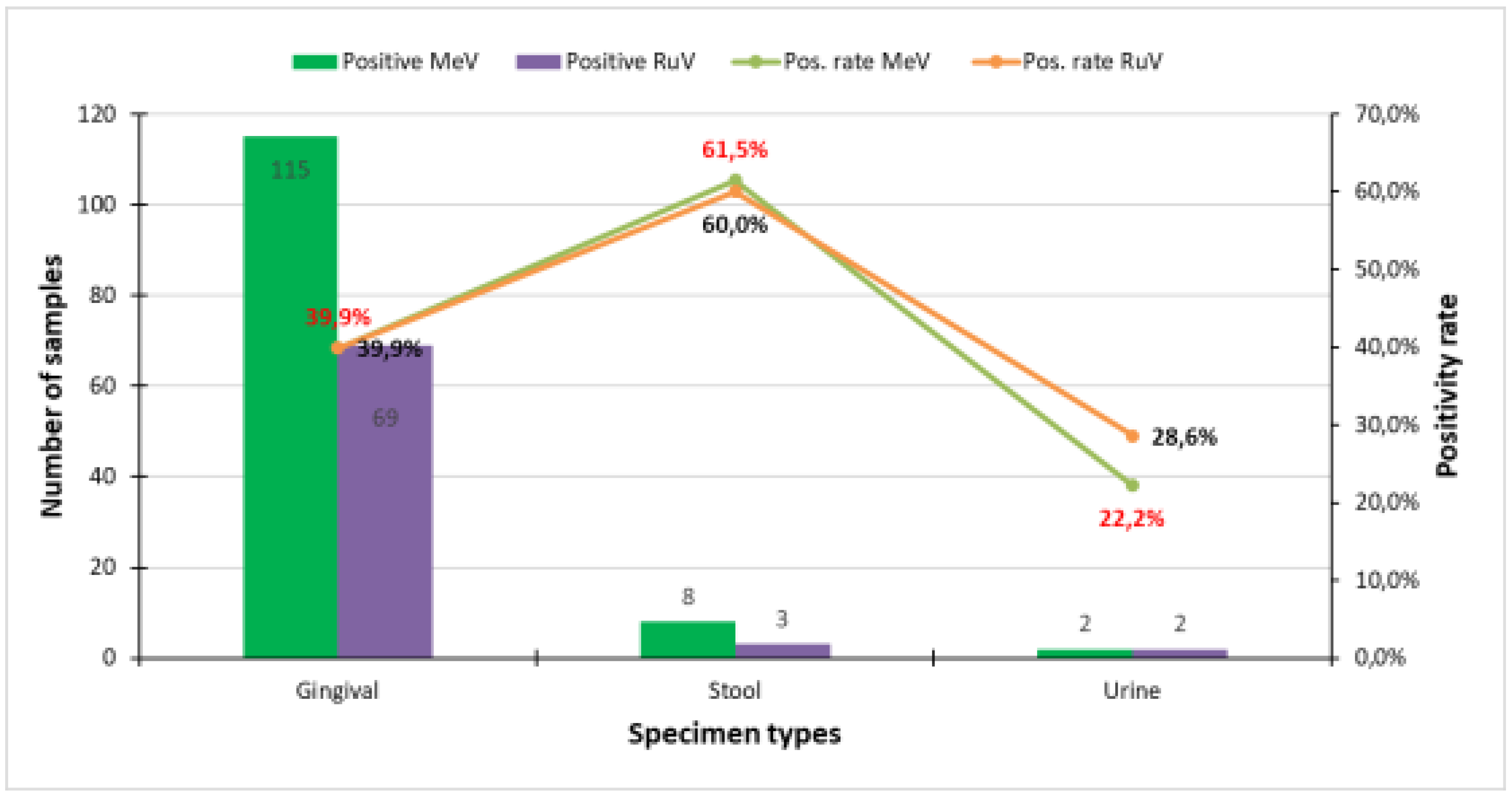
Figure 2.
Phylogenetic analysis of the N gene (450 bp) (A) and H gene (936 bp) (B) sequences of MeV. The scale bar indicates the number of nucleotide substitutions per site. Isolates with solid black circles represent the closest available sequences and those in bold and italic correspond to reference viruses. Only bootstrap values > 75% are indicated.
Figure 2.
Phylogenetic analysis of the N gene (450 bp) (A) and H gene (936 bp) (B) sequences of MeV. The scale bar indicates the number of nucleotide substitutions per site. Isolates with solid black circles represent the closest available sequences and those in bold and italic correspond to reference viruses. Only bootstrap values > 75% are indicated.
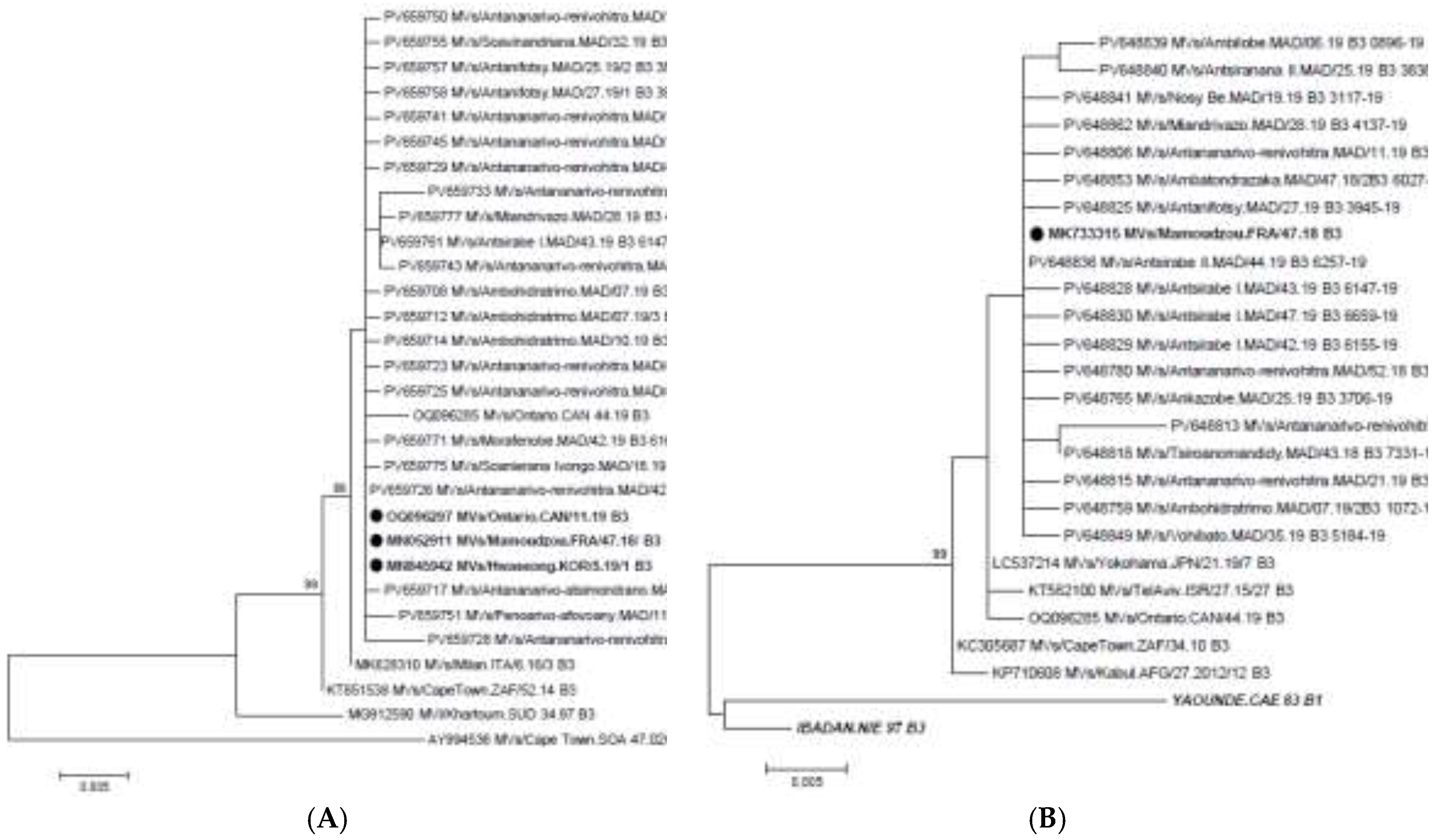
Figure 3.
Phylogenetic analysis of E1 gene sequences (739 bp) of RuV. The scale bar indicates the number of nucleotide substitutions per site. Sequences in bold and italic correspond to reference viruses. Bootstrap values are indicated when > 70%.
Figure 3.
Phylogenetic analysis of E1 gene sequences (739 bp) of RuV. The scale bar indicates the number of nucleotide substitutions per site. Sequences in bold and italic correspond to reference viruses. Bootstrap values are indicated when > 70%.
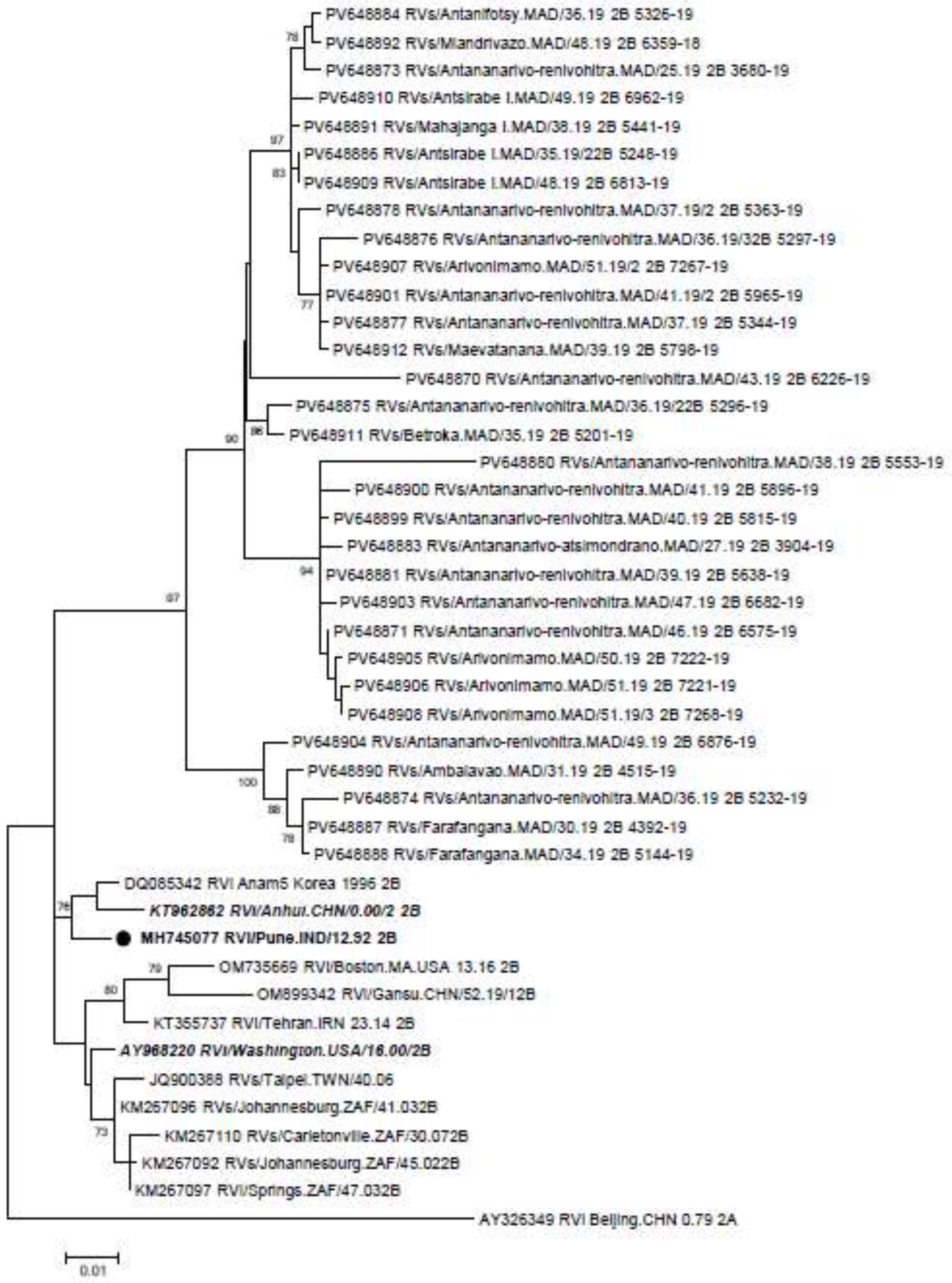

Table 1.
Detection of MeV and RuV by patient and specimen types.
| MeV | RuV | |||||||
|---|---|---|---|---|---|---|---|---|
| Individuals | Number of samples | Individuals | Number of samples | |||||
| Specimen types | Number | Positive | Negative | Number | Positive | Negative | ||
| Gingival, Stool, Urine | 7 | 2 | 5 | 21 | 5 | 3† | 2 | 15 |
| Gingival+, Stool+, Urine-* | 2 | 2 | 0 | 6 | 2# | 0 | 2 | 2 |
| Gingival, Stool | 4 | 4 | 0 | 8 | 0 | 0 | 0 | 0 |
| Gingival | 275 | 107 | 168 | 275 | 168 | 67 | 101 | 168 |
| Total | 288 | 115 | 173 | 310 | 175! | 70 | 105 | 185 |
* indicates the number of patients with 3 types of samples for which gingival and stool samples were positive and urine sample negative for MeV # refers to the two urine samples negative for MeV ! 175 individuals tested for RuV and not 173 (negative for MeV) given the two individuals for which urine samples were negative for MeV † All three types of samples were positive for RuV in one patient, while in the other two patients, either gingival and stool samples or urine and stool samples were positive
Table 2.
Sequences of oligonucleotide primers and probes used for MeV and RuV quantitative RT-PCR assays.
Table 2.
Sequences of oligonucleotide primers and probes used for MeV and RuV quantitative RT-PCR assays.
| Target | Oligonucleotide | Orientation | 5’→3’ sequence | Positions | Product size | References |
|---|---|---|---|---|---|---|
| MeV, Gene N | MVN1139-F | + | TGGCATCTGAACTCGGTATCAC | 1246-1267* | 75 bp | (Hummel et al., 2006) |
| MVN1213-R | - | TGTCCTCAGTAGTATGCATTGCAA | 1350-1297* | |||
| MVNP1163-P | + | FAM-CCGAGGATGCAAGGCTTGTTTCAGA-BHQ1 | 1271-1295* | |||
| RuV, P150 | RV98F | + | GGCAGTTGGGTAAGAGACCA | 98-117# | 154 bp | (Schulz, Neale, Zubach, Severini, & Hiebert, 2022) |
| RV251R | - | CGTGGAGTGCTGGGTGAT | 251-234# | |||
| RuV-P | + | FAM-CGTGGGAAGTGCGCGATGT-BHQ1 | 141-159# | |||
| Human RNase P | HURNASE-P-F | + | AGATTTGGACCTGCGAGCG | 309-327! | 65 bp | (Emery et al., 2004) |
| HURNASE-P-R | - | GAGCGGCTGTCTCCACAAGT | 373-354! | |||
| HURNASE-P | + | FAM-TTCTGACCTGAAGGCTCTGCGCG-BHQ1 | 330-352! |
* Positions are given according to Edmonston isolate, accession number K01711 # Positions are given according to Wistar RA 27/3 isolate, accession number FJ211588 ! Positions are given according to Homo sapiens ribonuclease P/MRP 30kDa subunit, mRNA, accession number BC006991. The detailed CDC protocol for MeV detection is accessible at https://cdn.who.int/media/docs/default-source/immunization/vpd_surveillance/lab_networks/measles_rubella/manual/annex-6.2-cdc-real-time-measles-rt-pcr-protocol-targeting-measles-n-gene-(75-nt-region).pdf%3Fsfvrsn%3D9ab89ebb_5 The detailed CDC protocol for rubella detection is available at https://cdn.who.int/media/docs/default-source/immunization/vpd_surveillance/lab_networks/measles_rubella/manual/annex-6.5-cdc-real-time-rubella-rt-pcr-protocol-targeting-rubella-p150-gene-(154-nt-region).pdf%3Fsfvrsn%3Db33068af_5.
Table 3.
Sequences of oligonucleotide primers used for MeV and RuV genotyping.
| Target | Oligonucleotide | Orientation | 5’→3’ sequence | Positions | Product size | References |
|---|---|---|---|---|---|---|
| MeV, Gene N | MeV216 | + | TGGAGCTATGCCATGGGAGT | 1104-1124* | 634 bp | (Kim et al., 2021) |
| MeV214 | - | TAACAATGATGGAGGGTAGG | 1737-1717* | |||
| MeV, Gene H | MHs | + | GTGCAAGATCATCCACAATGTCACC | 7254-7278* | 1500 bp (H1 Fragment) | (Xu et al., 2013) |
| H4as | - | GGAACTGAGTTTGACATCAC | 7811-7792* | |||
| H3s | + | TTGGTGAACTCAACTCTACTG | 7766-7786* | 1407 bp (H2 Fragment) | ||
| MHas | - | GTATGCCTGATGTCTGGGTGA | 9172-9152* | |||
| RuV, Gene E1 | RV8633F | + | AGCGACGCGGCCTGCTGGGG | 8633-8652# | 480 bp (Fragment 1) | (Namuwulya et al., 2014) |
| RV9112R | - | GCGCGCCTGAGAGCCTATGAC | 9112-9093# | |||
| RV8945F | + | TGGGCCTCCCCGGTTTG | 8945-8964# | 633 bp (Fragment 2) | ||
| RV9577R | - | CGCCCAGGTCTGCCGGGTCTC | 9577-9558# |
* Positions are given according to Edmonston isolate, accession number K01711 # Positions are given according to Wistar RA 27/3 isolate, accession number FJ211588.
Table 4.
Detection of MeV and RuV by age groups.
| MeV | RuV | |||||
|---|---|---|---|---|---|---|
| Age category | Positive | Total | p-value | Positive | Total | p-value |
| [0-5[ | 39 (35.1%) | 111 | 1 | 32 (43.8%) | 73 | 1 |
| [5-10[ | 18 (28.1%) | 64 | 0.85 | 26 (55.3%) | 47 | 0.31 |
| [10-15[ | 22 (61.1%) | 36 | 0.001 | 6 (42.9%) | 14 | 0.94 |
| ≥ 15 years | 36 (47.4%) | 76 | 0.014 | 5 (12.5%) | 40 | 0.001 |
| Unknown | 0 (0.0%) | 1 | 1 (100%) | 1 | ||
| 115 (39.9%) | 288 | 70 (40.0%) | 175 | |||
Disclaimer/Publisher’s Note: The statements, opinions and data contained in all publications are solely those of the individual author(s) and contributor(s) and not of MDPI and/or the editor(s). MDPI and/or the editor(s) disclaim responsibility for any injury to people or property resulting from any ideas, methods, instructions or products referred to in the content. |
© 2026 by the authors. Licensee MDPI, Basel, Switzerland. This article is an open access article distributed under the terms and conditions of the Creative Commons Attribution (CC BY) license (http://creativecommons.org/licenses/by/4.0/).
Copyright: This open access article is published under a Creative Commons CC BY 4.0 license, which permit the free download, distribution, and reuse, provided that the author and preprint are cited in any reuse.


