
Submitted:
11 March 2026
Posted:
26 March 2026
You are already at the latest version
Abstract
Due to the exclusion of the tobacco industry from the mandatory compliance framework of the national carbon market, and the consequent absence of sustained policy-driven mechanisms and data verification systems, China has not yet established carbon emission calculation standards specifically tailored to cigarette factories. This study systematically reviewed mainstream domestic and international carbon accounting methodologies, analyzed emission sources specific to cigarette factories across Scope 1 to Scope 3, and developed corresponding calculation methods. Based on statistical data from field research at actual cigarette factories, a complete annual carbon emission covering Scopes 1-3 was calculated for a case-study factory. Considering data availability, internal controllability within the tobacco industry, and the guidance value for the sector's green and low-carbon transition, this study proposes recommended carbon emission calculation boundaries and itemized calculation methods for cigarette factories, aiming to promote the accuracy and standardization of carbon emission calculations in cigarette factories.
Keywords:
cigarette factory
; carbon emission calculation method
; carbon emission source
; carbon emission calculation scope
1. Introduction
As energy crises and environmental pollution become increasingly severe, carbon emission reduction has gradually gained global attention. The Paris Agreement adopted in 2015 established the goal of limiting the global average temperature increase to well below 2 °C above pre-industrial levels and pursuing efforts to limit the increase to 1.5 °C [1]. As one of the world’s largest carbon emitters, China faces significant pressure and responsibility from the international community. According to the International Energy Agency’s (IEA) 2023 CO2 Emissions Report, global energy-related CO2 emissions reached a record high of 37.4 billion tonnes in 2023. China’s emissions increased by approximately 565 million tonnes, exceeding 12 billion tonnes in total, accounting for the vast majority of the global increase and about 35% of the global total [2].
The industrial sector is the primary contributor to energy consumption and carbon emissions in China. Statistics indicate that the industrial sector accounts for over 65% of the nation’s total energy consumption and carbon emissions [3]. The tobacco industry, which has long industrial chain and wide coverage. Data shows that China’s cigarette production reached 2,465.46 billion pieces in 2024, a year-on-year increase of 0.9% [4]. In January 2022, the State Tobacco Monopoly Administration explicitly stating that by 2025, the industry’s CO2 emissions per 10,000 yuan of industrial added value should decrease by 20% compared to 2020 levels [5]. This indicates that carbon emission indicators will become evaluation and assessment metrics for energy conservation and emission reduction in the tobacco industry.
Cao et al. conducted a carbon footprint accounting for the cigar production process and found that factory air-conditioning was the largest contributor to the environmental burden during cigar manufacturing, while electricity was identified as the critical factor contributing most significantly to the environmental load across all processes throughout the product life cycle [6]. Jian et al. performed an analytical study on the carbon footprint associated with the transportation phase of tobacco in China’s primary tobacco-planting regions [7]. Zhang et al. integrated life cycle assessment with a source-sink model framework to evaluate the impacts of a clean and low-carbon transition on both the supply chain decarbonization and cost-effectiveness of a cigarette factory in Sichuan Province [8]. Ti et al. conducted an analysis of the life-cycle carbon emissions during the tobacco planting phase in China [9].
Based on the research group’s investigation of domestic cigarette factories, the carbon emissions of cigarette factories exhibit the following characteristics:
(1) Carbon emission sources in cigarette factories are numerous, simultaneously involving Scope 1 to Scope 3.
(2) The data for carbon emission calculations are inconsistent in terms of coverage, calculation methods, and level of precision, making horizontal comparisons unfeasible.
(3) From a life cycle assessment (LCA) perspective, certain statistical data are difficult to obtain, and their impact on the overall carbon emission calculation results has not been demonstrated.
The purpose of this study is to establish a carbon emission calculation method for cigarette factories that aligns with international standards while adapting to their specific characteristics. By analyzing carbon emission sources, the comprehensiveness of the calculation coverage for cigarette factories is ensured. By proposing corresponding calculation methods for different emission sources, the uniformity of calculation accuracy is guaranteed. Furthermore, the method is applied to case calculations in typical surveyed factories, and by evaluating the contribution of various carbon emission items to total emissions and their implications for subsequent reduction efforts, the scope of carbon emission calculation is determined based on Scope 1, 2, and 3.
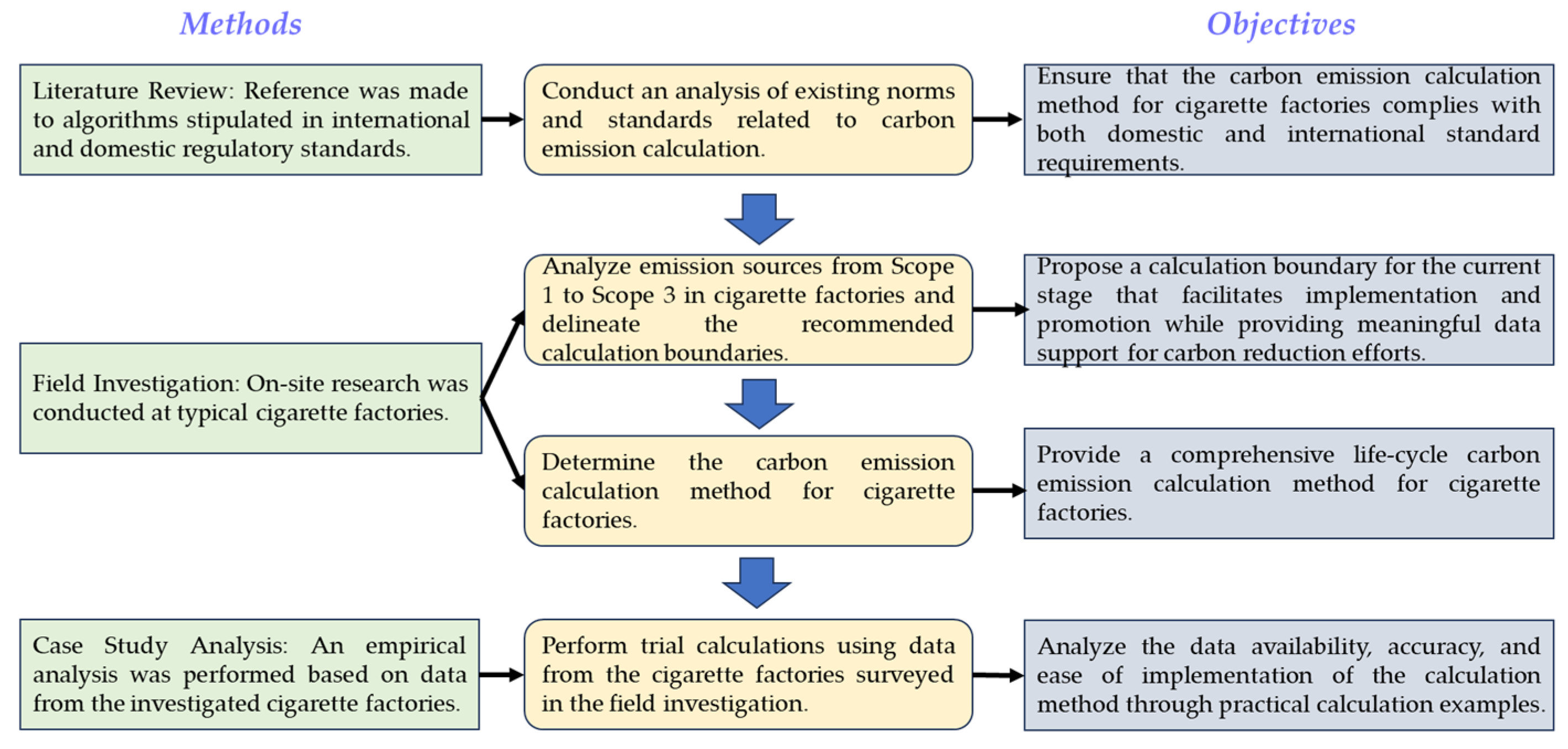
Based on an analysis of existing carbon emission calculation methodologies, this study was conducted by: first, identifying the emission sources of cigarette factories according to scoping principles; second, proposing calculation methods corresponding to these emission sources; and finally, applying the proposed methods to a case study for validation.
Figure 1.
Research framework diagram.
2. Analysis of Existing Carbon Emission Calculation Methodologies
The international framework for greenhouse gas (GHG) emission standards began developing in the 1990s. The most influential systems include the IPCC Guidelines for National Greenhouse Gas Inventories developed in 1995 by the Intergovernmental Panel on Climate Change (IPCC), the Greenhouse Gas Protocol (GHG Protocol) jointly developed in 1998 by the World Resources Institute (WRI) and the World Business Council for Sustainable Development (WBCSD), and the ISO 14064 series of standards for GHG accounting and verification published in 2006 by the International Organization for Standardization (ISO). The fundamental concepts and emission scopes established by these frameworks remain in use today.
In China, the National Development and Reform Commission (NDRC) issued the Guidelines for the Compilation of Provincial Greenhouse Gas Inventories in 2011, which were subsequently revised in 2025 [10]. Beginning in 2013, the NDRC and the Ministry of Ecology and Environment (MEE) started releasing Guidelines for Greenhouse Gas Emission Accounting and Reporting for various industrial sectors [11]. Starting in 2016, the State Administration for Market Regulation (SAMR) began issuing the GB/T 32151 series Requirements for Greenhouse Gas Emission Accounting and Reporting for key emission industries [12]. In 2022, the NDRC, the National Bureau of Statistics (NBS), and the MEE jointly issued the Implementation Plan for Accelerating the Establishment of a Unified and Standardized Carbon Emission Statistical Accounting System [13], which serves as the top-level design document for China’s carbon emission accounting field.
2.1. Internationally Recognized Carbon Emission Calculation Standards
(1) IPCC Guidelines for National Greenhouse Gas Inventories [14]
The IPCC Guidelines introduce the core calculation methodology for greenhouse gases—the emission factor approach. The guidelines focus on seven greenhouse gases, including CO₂, and categorize emission sources into five key sectors: Energy; Industrial Processes and Product Use; Agriculture, Forestry and Other Land Use; Waste; and Others. Each sector is accompanied by detailed methodological guidance.
(2) The Greenhouse Gas Protocol (GHG Protocol) [15]
The GHG Protocol is a set of internationally recognized GHG accounting standards jointly developed and published by the World Resources Institute (WRI) and the World Business Council for Sustainable Development (WBCSD). It provides a standardized, clear, and reliable framework for organizations, governments, and other entities to account for and report their GHG emissions. The GHG Protocol introduced the concepts of Scope 1, 2, and 3 emissions and provides detailed measurement and reporting guidance for each scope. It also offers a standard methodology for conducting carbon footprint assessments across a product’s entire life cycle.
(3) ISO 14064 Series of Standards for Greenhouse Gases
The ISO 14064 standards are a suite of international standards published by ISO, designed to provide guidance for the quantification, monitoring, reporting, and verification of greenhouse gases. First published in 2006, these standards aim to help organizations manage and reduce their GHG emissions, enhance accountability regarding climate change, and provide a unified, internationally recognized framework for GHG accounting and reporting.
The ISO 14064 standard consists of three parts:
ISO 14064-1 [16]: Specifies principles and requirements for quantifying and reporting GHG emissions and removals at the organization level. This includes guidance on identifying emission sources, selecting quantification methods, allocating emissions, and reporting emission data.
ISO 14064-2 [17]: Focuses on GHG emissions at the project level. It provides guidance for quantifying, monitoring, reporting, and verifying the effectiveness of actions aimed at reducing GHG emissions or enhancing removals.
ISO 14064-3 [18]: Specifies requirements for verifying GHG assertions. It provides principles for conducting competent and consistent verifications of GHG statements made by organizations or individuals, ensuring their transparency and consistency.
2.2. Domestic Carbon Emission Calculation Standards
(1) Guidelines for the Compilation of Provincial Greenhouse Gas Inventories [10]
First issued in 2011 by the NDRC and revised three times since, the latest version was released in December 2025 by the MEE. These guidelines aim to standardize provincial GHG inventory compilation, enhance its scientific rigor, standardization, and practicality, and ensure alignment with national inventories and international rules. The guidelines are largely consistent with the IPCC Guidelines for National Greenhouse Gas Inventories. They provide detailed explanations for five sectors—Energy Activities; Industrial Processes and Product Use; Agriculture; Land Use, Land-Use Change and Forestry; and Waste—covering descriptions of emission sources, calculation methods, sources of activity data, and determination of emission factors. The guidelines emphasize quality control and quality assurance, provide methods for uncertainty analysis, and include appendices such as emission factor tables and reporting templates to support accurate and standardized inventory compilation. This serves as a basis for formulating climate policies and assessing emission reduction effectiveness.
(2) Guidelines for Greenhouse Gas Emission Accounting and Reporting for Enterprises in Various Sectors
The NDRC has issued accounting and reporting guidelines for over 20 sectors, including power generation, grid, steel, chemicals, electrolytic aluminum, magnesium smelting, flat glass, cement, and ceramics. In 2015, the Guidelines for Greenhouse Gas Emission Accounting and Reporting for Food, Tobacco, Beverage, and Refined Tea Enterprises were published [19]. The scope for tobacco production enterprises within these guidelines covers tobacco redrying, cigarette manufacturing, and other tobacco product manufacturing. The accounting boundary is defined as the legal entity of the enterprise, encompassing GHG emissions from all production facilities (including main production systems, auxiliary production systems, and ancillary production systems). The GHGs accounted for include carbon dioxide (CO₂) and methane (CH₄). Emission sources focus on four aspects:
① Fossil Fuel Combustion Emissions: CO₂ emissions from stationary sources (e.g., boilers) and mobile sources (e.g., transport vehicles) burning fossil fuels.
② Industrial Process Emissions: CO₂ emissions from carbonate consumption and the use of purchased industrial CO₂.
③ Wastewater Anaerobic Treatment Emissions: CH₄ emissions from the anaerobic treatment of wastewater, converted to CO₂ equivalents using the Global Warming Potential (GWP=21).
④ Emissions from Net Purchased Electricity and Heat: CO₂ emissions corresponding to the production of purchased electricity and heat.
The formula for calculating total emissions is:
(3) GB/T 32151 Series: Requirements for Greenhouse Gas Emission Accounting and Reporting for Enterprises
To date, 54 parts of the GB/T 32151 series have been published, specifying requirements for different enterprise types. Part 25 specifically addresses food, tobacco, beverage, and refined tea enterprises [20]. Building upon the earlier guidelines, this standard further clarifies the accounting boundary, updates key parameters (e.g., the GWP value for methane), refines calculation methods, and emphasizes the importance of data quality management and standardized reporting. Its implementation will significantly enhance the accuracy and transparency of carbon emission data within this sector, serving as a crucial technical foundation for enterprises undertaking carbon management, participating in the national carbon market, and fulfilling social responsibilities.
The standard further updates the formula for total GHG emissions. In addition to calculating the four emission source categories mentioned in the guidelines, it stipulates that CO₂ emissions corresponding to the production of electricity and heat exported by the enterprise can be deducted from the total.
The formula for calculating total emissions is:
3. Analysis of Carbon Emission Sources in Cigarette Factories
An analysis of existing carbon emission calculation methodologies, both domestic and international, reveals that current Chinese guidelines and standards specifically targeting the tobacco industry define the accounting boundary based on the corporate legal entity. These regulations primarily focus on emissions occurring within the organizational boundary, which, in terms of scope, mandates the calculation of only Scope 1 and Scope 2 emissions. In contrast, international frameworks, particularly the Greenhouse Gas Protocol (GHG Protocol), classify emissions not only by organizational boundary but also by operational boundary. Under this system, emissions are categorized into three scopes: Scope 1, Scope 2, and Scope 3.
Scope 1: Direct Emissions. These are emissions from sources that are owned or controlled by the reporting company. This category includes:
① Stationary Combustion: Emissions from burning fossil fuels in boilers, furnaces, generators, etc.
② Mobile Combustion: Emissions from fuel consumption by company-owned vehicles, vessels, and aircraft.
③ Process Emissions: Emissions generated from physical or chemical manufacturing processes.
④ Fugitive Emissions: Intentional or unintentional releases from equipment seals (e.g., refrigerant leaks, methane fugitives).
Scope 2: Indirect Emissions from Purchased Energy. These are emissions associated with the generation of purchased electricity, steam, heating, and cooling consumed by the reporting company. Although the emissions physically occur at the utility or producer’s facility, they are a consequence of the company’s energy demand, and thus the company bears significant responsibility for them.
Scope 3: Other Indirect Emissions. This encompasses all other indirect emissions that occur in the reporting company’s value chain. These emissions are a consequence of the company’s activities but originate from sources not owned or controlled by it. This is the broadest and most complex scope. It includes upstream emissions from activities such as purchased goods and services, capital goods, fuel- and energy-related activities, upstream transportation and distribution, waste generated in operations, business travel, employee commuting, and upstream leased assets. It also includes downstream emissions from activities such as transportation and distribution of sold products, processing and use of sold products, end-of-life treatment of sold products, downstream leased assets, franchises, and investments. Accounting for Scope 3 emissions is typically voluntary. According to a carbon footprint analysis of a specific cigarette brand, the processing stages of upstream tobacco raw materials and cigarette materials accounted for the highest proportion (90.25%) of the life-cycle emissions, followed by the cigarette manufacturing stage at 9.22% [21].
Adhering to the principles of comprehensiveness and full life-cycle coverage, the carbon emission calculation methodology for cigarette factories developed in this study addresses calculation methods for Scopes 1 through 3. However, given the extreme complexity of Scope 3 emission sources and the practical challenges in data acquisition for some categories, a pragmatic approach is proposed to meet current domestic regulatory requirements while ensuring implementability. It is recommended that cigarette factories must calculate emissions from Scope 1 and Scope 2. The calculation of Scope 3 emissions is encouraged but not mandated at this stage.

Table 1.
Summary Table of Emission Boundaries for Cigarette Factories.
| Scope | Definition | Subdivision of Emission Sources | Recommended Calculation Boundary |
|---|---|---|---|
| Scope 1 | Direct Emissions: emissions generated from sources or activities owned or controlled by the company. |
|
Shall be incorporated into the carbon emission calculation for cigarette factories. |
| Scope 2 | Indirect Emissions: emissions associated with the generation of purchased electricity, steam, heating, or cooling consumed by the reporting company, which occur at sources owned or controlled by another entity. |
|
Shall be incorporated into the carbon emission calculation for cigarette factories. |
| Scope 3 | Other Indirect Emissions: all other indirect emissions occurring in the value chain. |
|
It is recommended that a portion be included in the carbon emission calculation for cigarette factories. |
3.1. Scope 1: Direct Carbon Emission Sources
(1) Emissions from Fossil Fuel Combustion
Equipment within cigarette factories that may utilize fossil fuel combustion for energy includes thermal or steam process equipment, such as gas-fired boilers and direct-fired heaters. Other sources are process equipment that directly uses gas combustion for heating, like the cylinder dryers and drum dryers within the primary processing line. Emergency power generation equipment, such as diesel/gas generator sets, also contribute, along with mobile combustion sources like factory-owned or controlled fuel vehicles (e.g., forklifts, transport trucks).
The activity data for these sources can be obtained through on-site measurement readings from installed gas meters or fuel flow meters. Alternatively, it can be calculated by reviewing fuel procurement settlement documents in conjunction with inventory changes.
(2) Process Emissions
Process emissions in cigarette factories may arise from specific operations. Examples include CO₂ released during the tobacco expansion process that uses dry ice, and leaks from gaseous fire suppression systems (currently, many cigarette factories employ heptafluoropropane systems) during testing or accidental discharges.
The activity data can be estimated based on purchased material invoices, by reviewing fire system maintenance and test records, or by calculating the potential release based on system capacity.
(3) Fugitive Emissions
Fugitive greenhouse gas emissions in cigarette factories primarily originate from three sources. First, refrigerant leaks from refrigeration and air conditioning systems during operation, maintenance, and decommissioning. Second, methane fugitives from sources including industrial wastewater treatment and septic tanks for domestic sewage. Third, minor fugitive releases from the storage and transportation systems of fuels like diesel and natural gas.
For refrigerant and fuel fugitives, activity data can be estimated based on the total charge or storage volume using assumed leakage rates, or it can be obtained through actual measurements. For methane emissions from wastewater treatment, activity data can be derived from records of wastewater treatment volumes and the corresponding Chemical Oxygen Demand (COD) levels before and after treatment.
Table 2.
Summary Table of Scope 1 Emission Sources.
| Category | Emission Source | Associated Process / Equipment | Method for Obtaining Activity Data |
|---|---|---|---|
| Fossil Fuel Combustion | Natural gas, Diesel, Gasoline, Coal | Boiler house heating; Direct-fired heaters for heating/cooling; Power station; In-plant transportation; Backup generators; Local gas consumption at cylinder dryers | Meter reading records; Fuel procurement invoices; Fuel card recharge records; Fuel withdrawal logs |
| Process Emissions | Fire suppression systems, Special processes | Gaseous fire suppression systems; Tobacco expansion sections using dry ice (CO₂) | Purchase and recharge records for dry ice/CO₂; Maintenance and replacement logs for fire-fighting equipment |
| Fugitive Emissions | HFCs and other refrigerants, Industrial and domestic wastewater treatment | Central and distributed air conditioning systems; Cold storage systems; Industrial and domestic wastewater treatment | Equipment maintenance contracts; Refrigerant recharge records; Statistics on wastewater COD removal rates and treatment volumes |
3.2. Scope 2: Indirect Carbon Emission Sources
(1) Emissions from Purchased Electricity
This source, which encompasses virtually all electricity-consuming processes, constitutes the primary indirect emission source for cigarette factories. Key consumption areas include the primary processing workshop (equipment for tobacco leaf conditioning, cutting, drying, casing, and flavoring), the making and packing workshop (cigarette makers, filter assemblers, packers, and case packers), the utilities center (air compressors, HVAC units, water pumps, and cooling towers), and auxiliary facilities (lighting, office equipment, laboratory instruments).
The corresponding activity data is primarily obtained from electricity meter readings and utility billing statements.
(2) Emissions from Purchased Heat/Steam
This category applies if a factory does not generate its own steam but purchases it or high-temperature hot water from an external cogeneration plant or a centralized district heating network. This purchased thermal energy is typically used for process heating in primary processing (e.g., drying cut tobacco and stems), for space heating during winter, and for domestic hot water supply.
The activity data is primarily sourced from heat or steam meter measurements and the associated billing invoices.
Table 3.
Summary Table of Scope 2 Emission Sources.
| Category | Emission Source | Associated Process / Equipment | Method for Obtaining Activity Data |
|---|---|---|---|
| Purchased Electricity | Electricity from the external grid | Equipment in primary processing and making/packing workshops; Power room; Office lighting; Data center | Monthly utility bills from the power company; Meter readings from the factory’s main distribution cabinet |
| Purchased Heat | External steam/hot water | Primary processing (e.g., drying); Heating/humidification sections of HVAC systems; Winter space heating; Employee shower facilities | Settlement documents from the external heating supplier; Steam meter measurement data |
3.3. Scope 3: Other Carbon Emission Sources
(1) Embodied Carbon Emissions in Upstream Raw Materials
This includes emissions from all upstream activities related to cigarette production, such as tobacco cultivation, primary curing, and redrying; the production and transportation of materials like cigarette paper, filter rods (including tow), and packaging materials (inner boxes, outer cases, films); and even emissions from the manufacturing and construction of fixed capital goods, such as production equipment and factory buildings.
Regarding activity data, the procurement quantities of various raw materials and goods can be obtained from inventory logs. The primary challenge lies in acquiring accurate emission factors. It is first recommended to use emission factors provided by the suppliers themselves. If a supplier has not conducted a carbon footprint assessment, industry-average or typical emission factors for similar products may be used as an alternative.
(2) Emissions from Downstream Logistics and Transportation
This primarily refers to emissions from transportation vehicles carrying finished cigarettes from the factory warehouse to commercial companies and retail outlets.
Data required includes shipping manifests, vehicle types, and transportation distances.
(3) Emissions from Waste Treatment
This encompasses emissions from the landfilling or incineration of waste packaging generated at the point of sale, as well as non-recyclable waste from the factory itself.
Data collection involves reviewing waste treatment contracts and disposal quantities, followed by selecting appropriate emission factors based on the treatment method. As waste treatment is predominantly handled by specialized third-party companies, obtaining this data is often challenging.
(4) Emissions from Product Use
This refers to emissions generated by the act of smoking itself. Emissions at this stage can be estimated using sales data.
Given the multitude of upstream and downstream emission sources, and the fact that these are not direct emissions occurring within the organizational boundary, complete and exhaustive accounting of Scope 3 emissions is not mandated. Companies may find greater practical value in focusing on one or two key GHG-generating activities based on their specific business characteristics and development goals. Based on an analysis of upstream and downstream activities for cigarette factories, this study identifies upstream raw tobacco as the most significant primary material for cigarette factories, with its carbon emissions constituting a high proportion of the cigarette’s full life-cycle footprint. Therefore, incorporating it into the Scope 3 emissions considerations for cigarette factories is deemed highly meaningful. For downstream waste treatment, which is almost entirely managed by specialized third-party companies, cigarette factories and the broader tobacco industry lack direct control. Regarding emissions from product use, these result from consumer behavior, and calculating them holds little significance for guiding further carbon reduction decisions within cigarette factories or the tobacco industry. Consequently, it is ultimately recommended that, within Scope 3, focus be placed on emissions from upstream raw materials and product transportation (both upstream and downstream), with particular attention given to calculating the carbon emissions associated with the most critical upstream material: raw tobacco.
Table 4.
Summary Table of Scope 3 Emission Sources.
| Category | Emission Source | Associated Process / Equipment | Method for Obtaining Activity Data |
|---|---|---|---|
| Upstream Supply | Tobacco leaves & auxiliary materials | Primary curing, redrying of tobacco leaves; filter rod production; carton production | Purchase order quantities; supplier-provided Environmental Product Declarations (EPDs) |
| Logistics and Transport | Outsourced transport vehicles | Distribution of finished cigarettes; allocation/transfer of tobacco leaves | Transport distance from logistics contracts; freight volume or carrier energy consumption data |
| Waste Treatment | Production waste, tobacco dust | Landfilling or incineration; recycling of scraps and residues | Waste collection records from sanitation departments; disposal logs for waste materials |
| Product Use | Cigarette combustion | Smoking behavior | Based on sales data |
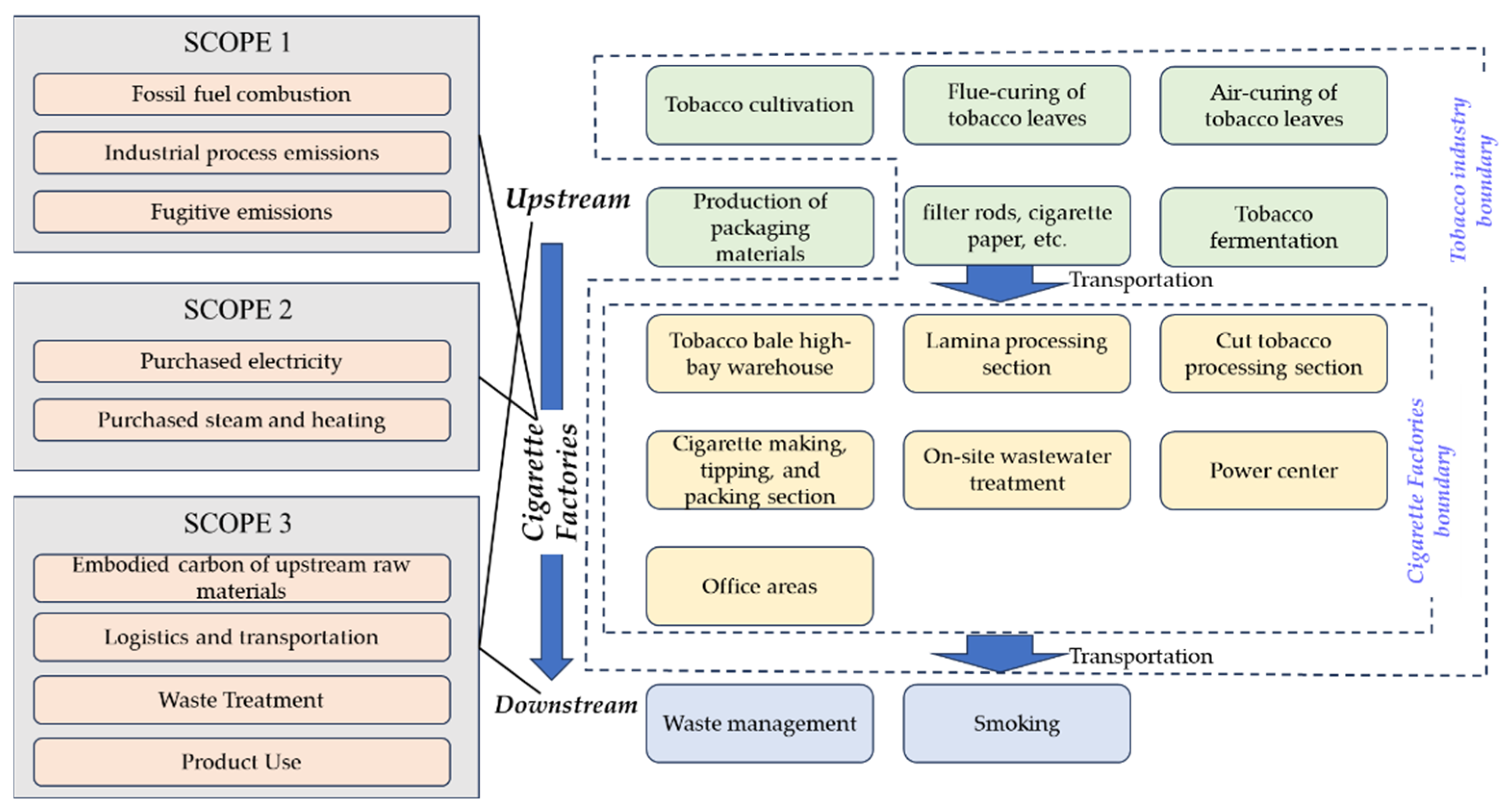
Figure 2.
Analysis and Diagram of Emission Sources within the Carbon Emission Boundary of a Cigarette Factories.
Figure 2.
Analysis and Diagram of Emission Sources within the Carbon Emission Boundary of a Cigarette Factories.
4. Carbon Emission Calculation Methods for Cigarette Factories
4.1. Calculation Methods for Scope 1 Direct Emissions
(1) Calculation Method for Emissions from Fossil Fuel Combustion
Carbon dioxide emissions from fossil fuel combustion are calculated using the following formula:
Where:
—Carbon dioxide emissions from fossil fuel combustion (tonnes);
—Consumption of fossil fuel type i (million kilojoules);
—Emission factor for fossil fuel type i (tonnes of CO₂ per million kilojoules);
i—Type of fossil fuel;
The consumption of fossil fuel ADᵢ is calculated according to the formula:
Where:
— Consumption of fossil fuel type i (million kilojoules), expressed in terms of calorific value;
— Consumption of fossil fuel type i (tonnes, ten thousand normal cubic meters);
— Average low calorific value of fuel type i (million kilojoules per tonne, million kilojoules per ten thousand normal cubic meters);
i — Type of fossil fuel;
The emission factor for fuel type i (EFᵢ) is calculated according to the formula:
Where:
— Emission factor for fossil fuel type i (tonnes of CO₂ per million kilojoules);
— Carbon content per unit calorific value of fuel i (tonnes of carbon per million kilojoules);
— Carbon oxidation rate of fuel i (percent);
i — Type of fossil fuel;
— Ratio of the molecular weight of carbon dioxide to that of carbon.
(2) Calculation Method for Process Emissions
Emissions from industrial processes are calculated using the following formula:
Where:
— Consumption of industrially produced (purchased) carbon dioxide (tonnes);
— Loss rate of carbon dioxide (percent);
— Global Warming Potential (GWP) value for greenhouse gas type i;
(3) Calculation Method for Fugitive Emissions
Emissions of hydrofluorocarbons (HFCs) from the use of refrigeration and air-conditioning equipment, as part of fugitive emissions, are calculated using the following formula:
Where:
— Leakage of refrigerant type i (tonnes);
— Global Warming Potential (GWP) value for refrigerant type i;
The amount of refrigerant leakage can be determined based on the total refrigerant charge and the estimated leakage rate:
Where:
— Leakage of refrigerant type i (tonnes);
— Total charge of refrigerant type i;
— Estimated leakage rate of refrigerant type i (percent);
Methane emissions from the anaerobic treatment of industrial and domestic wastewater, as part of fugitive emissions, are calculated using the following formula:
Where:
— Methane emissions from the anaerobic wastewater treatment process (tonnes);
— Global Warming Potential (GWP) value for methane;
Where:
— Total amount of organic matter removed via anaerobic wastewater treatment (tonnes COD);
— Total amount of organic matter removed via sludge clearance (tonnes COD);
— Methane emission factor (kilograms of methane per kilogram of COD or BOD);
— Amount of methane recovered (tonnes methane);
— BOD generation quantity in septic tanks;
The methane emission factor (EF) is calculated as follows:
Where:
— Maximum methane production potential of the anaerobic wastewater treatment system (kilograms of CH₄ per kilogram of COD or BOD);
— Methane correction factor, which indicates the extent to which the maximum methane production potential (BO) is achieved under different treatment and discharge pathways or systems, and also reflects the degree of anaerobiosis of the system;
4.2. Calculation Methods for Scope 2 Indirect Emissions
(1) Calculation Method for Emissions from Purchased Electricity
Carbon dioxide emissions from net purchased electricity are calculated by multiplying the net purchased electricity consumption by the average emission factor of the regional power grid where the factory is located. The calculation is performed using the following formula:
Where:
— Net purchased electricity consumption of the enterprise (MWh);
— Annual average grid emission factor for the regional power grid (tCO2/MWh);
(2) Calculation Method for Emissions from Purchased Heating
Where:
— Net purchased heating consumption of the enterprise (million kilojoules);
— Emission factor for heat supply (tonnes of CO₂ per million kilojoules);
4.3. Calculation Methods for Scope 3 Other Indirect Emissions
(1) Calculation Method for Embodied Carbon Emissions of Upstream Raw Materials, Packaging, etc.
Regarding the carbon emission data of upstream raw materials, the calculation can be performed as follows:
Where:
— Procurement quantity of raw material type i (tonnes);
— Equivalent carbon dioxide emissions per unit mass of raw material type i (tonnes of CO₂ per tonne). This data can be sourced from supplier carbon footprint data or industry average values.
(2) Calculation Method for Carbon Emissions from Upstream and Downstream Transportation
Regarding the carbon emission data from transportation processes, the calculation can be performed as follows:
Where:
— Weight of transported goods of type i (tonnes);
— Average transportation distance for goods of type i (km);
— Carbon emission factor per unit weight-distance for the transportation mode of goods type i (tonnes of CO₂ per tonne-kilometer). This data can be sourced from actual statistical data or average levels for similar product transportation.
(3) Calculation Method for Carbon Emissions from Waste Management
Where:
— Organic carbon content of the waste (tonnes);
— Methane conversion rate in landfills (percent);
— Global Warming Potential (GWP) value for methane;
For waste treated by incineration, the calculation method can refer to that for fossil fuel combustion under direct emissions (Scope 1).
(4) Calculation Method for Carbon Emissions from Smoking
Where:
— Quantity of cigarettes smoked (sticks);
— Comprehensive emission factor for the combustion of a single cigarette (kg CO₂e per stick);
5. Case Study on Carbon Emission Calculation for a Cigarette Factories
5.1. Implementation Status of Carbon Management Practices in the Case Plant
Based on an investigation of four large cigarette manufacturing plants in China, it was found that currently, only the accounting of Scope 1 and Scope 2 carbon emissions is conducted. Furthermore, within Scope 1, the accounting is limited to emissions from primary fuel combustion.
Table 5.
Implementation Status of Carbon Emission-Related Practices in the Case Plant.
| Implementation Status of Carbon Management Practices | Cigarette Factory A | Cigarette Factory B | Cigarette Factory C | Cigarette Factory D |
|---|---|---|---|---|
| Current Carbon Emission Accounting Practices | Primarily accounts for emissions from energy consumption (Scope 1, Scope 2). Lacks real-time statistics, analysis, and a digital system. | Accounts only for Scope 1 emissions. Lacks real-time statistics, analysis, and a digital system. | Primarily accounts for emissions from energy consumption (Scope 1, Scope 2). Lacks real-time statistics, analysis, and a digital system. | Primarily accounts for emissions from energy consumption (Scope 1, Scope 2). Lacks real-time statistics, analysis, and a digital system. |
| Future Plans for Carbon Accounting | Plans to establish an energy and carbon management system by 2027 for real-time statistics and analysis of full lifecycle carbon emissions (Scope 1 to 3). | No current plan. | No current plan. | No current plan. |
5.2. Data Collection Status of the Case Plant
This study investigated four large cigarette manufacturing plants. The status of data collection relevant to carbon emission calculation is summarized in the table below:
Table 6.
Summary of Emission Source Data Collection Status for the Case Plant.
| Cigarette Factory | Scope 1 Emission Sources | Scope 2Emission Sources | Scope 3Emission Sources | |||
|---|---|---|---|---|---|---|
| Collected | Missing | Collected | Missing | Collected | Missing | |
| Factory A | •Monthly gas consumption •Wastewater treatment records • Fire suppression gas system records |
• Refrigerant records • Fuel consumption of in-plant vehicles |
• Monthly electricity consumption • Monthly steam consumption |
• Steam supplier cannot provide the emission factor | • Records of major single products’ upstream raw materials and approximate transport distance • Waste generation quantity and transport distance |
• All raw material providers cannot provide emission factors • Waste treatment provider cannot provide the emission factor |
| Factory B* | • Annual gas consumption • Refrigerant type and charge amount of main chillers • Wastewater treatment records • Fire suppression gas system records |
• Fuel consumption of in-plant vehicles | • Annual electricity consumption | None | • Annual waste generation quantity | • Records of upstream raw material usage, transport distance, and emission factors • Waste transport distance and emission factors |
| Factory C* | • Monthly gas consumption • Wastewater treatment records • Fire suppression gas system records |
• Refrigerant records • Fuel consumption of in-plant vehicles |
• Annual electricity consumption | None | None | • Records of upstream raw material usage, transport distance, and emission factors • Waste generation quantity, transport distance, and emission factors |
| Factory D* | • Monthly gas consumption • Wastewater treatment records • Fire suppression gas system records |
• Refrigerant records • Fuel consumption of in-plant vehicles |
• Annual electricity consumption | None | • Waste generation quantity and transport distance | • Records of upstream raw material usage, transport distance, and emission factors • Waste treatment provider cannot provide the emission factor |
* Steam for this plant is entirely supplied by its own gas-fired boilers.Based on the actual data collected from the four cigarette manufacturing plants, it is evident that these plants still largely adhere to traditional energy consumption statistical practices. Consequently, they maintain comprehensive records for fuel consumption under Scope 1 and electricity consumption under Scope 2. However, records for details such as refrigerant types and charge amounts within Scope 1 are generally incomplete. Notably, most primary operational vehicles within the plants have been replaced with electric-powered ones.
Regarding Scope 2, Plant A purchases all its steam externally, however, the steam supplier is unable to provide the emission factor. For Scope 3, the majority of the relevant data was not obtained. In practice, all plants maintain detailed ledger records for incoming raw materials and waste. However, the absence of a unified statistical pathway for carbon emission calculation within the plants has resulted in significant difficulties in aggregating data from different management departments.
5.3. Carbon Emission Calculation for Cigarette Factory A
Table 7.
Scope 1 Carbon Emission Calculation Results for Cigarette Factory A.
| Emission Source | Key Data Values | Data Reliability | Calculated Emission Results |
|---|---|---|---|
| Fossil Fuel Combustion — Gas | The carbon emission factor for gas was calculated as 1.96 kg CO₂/m³, based on the “National Greenhouse Gas Emission Factor Database [21]” and gas quality test reports. | Fully derived from plant statistical data. | 2,639.9 t CO₂e |
| Process Emissions — Fire Suppression Gas Systems | The plant uses an HFC-227ea fire suppression system with a GWP = 3220. According to statistical records, there were no leaks during the year. | Fully derived from plant statistical data. | 0 t CO₂e |
| Fugitive Emissions — Refrigerants | Data not provided. | Data gap. | — |
| Fugitive Emissions — Wastewater Treatment | Industrial wastewater undergoes a hydrolysis-acidification unit process that is non-methane-dominant, resulting in negligible emissions. For domestic wastewater, calculations are based on 901 permanent employees, with workdays annualized. BOD, B0, and MCF values all use the IPCC default values for China [21]. | Estimated based on per capita values. | 23.4 t CO₂e |
Table 8.
Scope 2 Carbon Emission Calculation Results for Cigarette Factory A.
| Emission Source | Key Data Values | Data Reliability | Calculated Emission Results |
|---|---|---|---|
| Purchased Electricity | The electricity carbon emission factor for the province where the plant is located is taken as 0.6782 kg CO₂/kWh, based on the “National Greenhouse Gas Emission Factor Database [21]”. | Fully derived from plant statistical data, using the average provincial emission factor. | 21,361.3 t CO₂e |
| Purchased Steam | The emission factor is taken as the default value of 0.11 t CO₂/GJ, as stipulated in *”Greenhouse Gas Emission Accounting and Reporting Requirements — Part 25: Food, Tobacco, Wine, Beverage and Refined Tea Enterprises” GB/T 32151.25-2024 [20]. | Steam supplier could not provide the emission factor; the default value was used. | 2,626.1 t CO₂e |
Table 9.
Scope 3 Carbon Emission Calculation Results for Cigarette Factory A.
| Emission Source | Key Data Values | Data Reliability | Calculated Emission Results |
|---|---|---|---|
| Embodied Carbon Emissions — Upstream Raw Materials (Primary: Tobacco Leaf) | All raw material suppliers were unable to provide carbon emission factors. Based on a carbon inventory of typical tobacco flue-curing and air-curing (including aging) companies, the emission factor was determined to be 6.73 kg CO₂/kg [22]. | Emission factor is not an actual calculated value provided by suppliers. | 106,418.0 t CO₂e |
| Carbon Emissions from Upstream & Downstream Logistics and Transportation | The emission factor for commonly used 13-meter trucks is taken as 0.078 kg CO₂e/(t·km) [23]. | Emission factor is not an actual calculated value provided by suppliers. | 2,409.7 t CO₂e |
| Emissions from Waste Management | Data not provided. | Data gap. | — |
| Emissions from Product Use | Data not provided. | Data gap. | — |
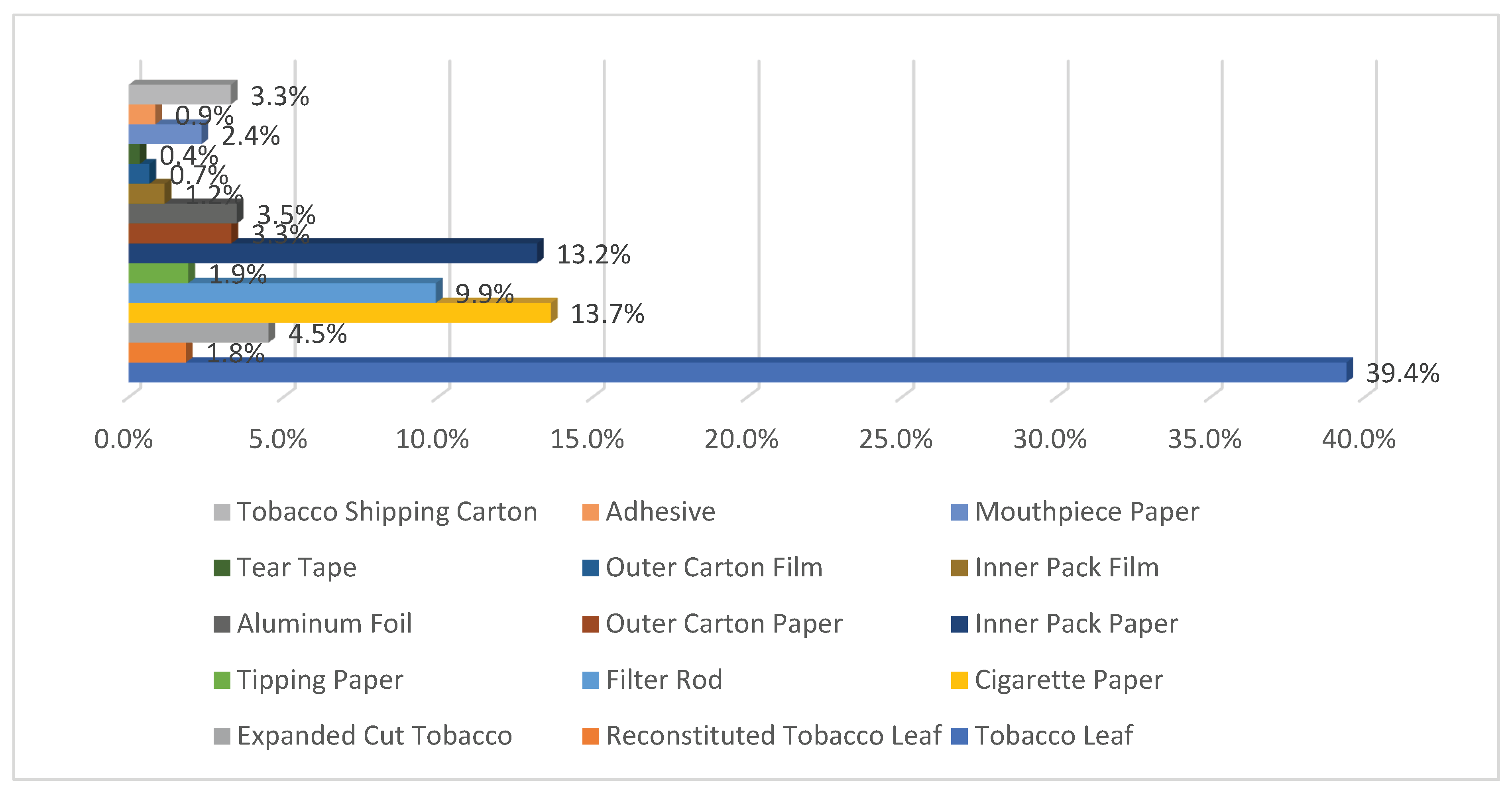
In fact, Cigarette Manufacturing Plant A provided a comprehensive list of its upstream raw materials. Based on the weight proportion of each material, tobacco leaves account for nearly 40% of all raw materials, while the remaining materials are characterized by a wide variety but relatively small individual usage volumes. According to a carbon footprint analysis of a certain cigarette brand, the processing stages for upstream cigarette raw and auxiliary materials contribute the highest proportion within the product’s life cycle, at 90.25%. Within this stage, carbon emissions from tobacco leaf production alone account for 61.73% of the total emissions [18]. Therefore, in the calculation of upstream raw material carbon emissions, and from the perspectives of aligning with the overall tobacco industry boundary and targeting the phase with the greatest impact on the full life-cycle carbon footprint, only the embodied carbon emissions of tobacco leaves were calculated.
Figure 3.
Proportion of Upstream Raw Materials.
Based on the carbon emission calculation results for Cigarette Manufacturing Plant A, even when considering only the carbon emissions from upstream tobacco leaves and those from logistics transportation, Scope 3 emissions still accounted for the highest proportion at 80.3%, followed by Scope 2 at 17.7%, with Scope 1 contributing only 2.0%. Within Scope 1 and Scope 2, purchased electricity was the dominant source, accounting for 80.2% of their combined emissions, while both purchased gas and steam contributed 9.9% each.
6. Conclusion
This study reviewed existing domestic and international carbon emission calculation methodologies. By integrating the characteristics of cigarette manufacturing plants and their upstream/downstream supply chains, it analyzed the carbon emission sources of such plants and proposed specific calculation methods covering Scope 1 to Scope 3. Furthermore, a case study based on actual research data was conducted using these methods, with analyses performed regarding data completeness, accuracy, and operability. The main conclusions are as follows:
(1) Currently, both domestic calculation standards for the tobacco industry and the actual calculations performed by cigarette manufacturing plants focus solely on Scope 1 and Scope 2 emissions. Investigation of primary data from actual plants revealed that data based on energy consumption statistics is relatively complete, whereas data such as refrigerant records and emission factors for purchased steam are largely missing. To ensure complete and accurate carbon emission calculation for cigarette manufacturing plants, it is recommended that internal collaboration among various departments—such as energy management, environmental health & safety, and general administration—be enhanced to integrate relevant data. Within the tobacco industry, there is a need to continuously promote coordinated efforts to standardize carbon emission calculation methodologies across the entire sector.
(2) From the perspective of a cigarette manufacturing plant’s organizational boundary, the calculation and accounting of Scope 1 and Scope 2 emissions, as mandatory items, are recommended to be comprehensive and accurate. Scope 3 emission sources are extensive and complex, and obtaining specific emission factors for each raw material is challenging. Considering the significant impact on the full lifecycle carbon footprint of cigarettes, the controllability within the overall tobacco industry, and the potential to support the industry’s green and low-carbon development, it is recommended that plants with sufficient capability calculate and account for the embodied carbon of upstream tobacco leaves and the carbon emissions from upstream/downstream product transportation.
(3) Based on the actual calculation case study, from a life cycle assessment (LCA) perspective, carbon emissions from upstream tobacco leaves account for the highest proportion, reaching 78.55%, identifying this as the critical emission segment requiring focused attention within the entire tobacco industry. From the organizational perspective of cigarette factories, emissions from purchased electricity constitute the highest proportion, accounting for 15.77% of life cycle emissions and 80.15% of total organizational emissions, making it the primary emission source that cigarette factories need to prioritize.
Author Contributions
Calculation Boundary and Establishment of Calculation Methods, S.S., X.Z. and L.W.; Review of Existing Calculation Methods, H.H., Y.W. and Y.Z.; Case Study Analysis, Writing Review and Editing, Z.H., W.L. and H.W. All authors have read and agreed to the published version of the manuscript.
Funding
This research was funded by Key R&D Project of China National Tobacco Corporation: Application of Green and Low-Carbon Technologies and Methodological Research in Large and Medium-Sized Cigarette Manufacturing Plants. No.110202402019.
Institutional Review Board Statement
Not applicable.
Informed Consent Statement
Informed consent was obtained from all subjects involved in the study.
Data Availability Statement
The data of this research involved is not necessary to be reported, so this statement was excluded.
Conflicts of Interest
The authors declare no competing interest.
References
- United Nations Framework Convention on Climate Change (UNFCCC). Paris Agreement 2015.
- International Energy Agency. CO2 Emissions in 2023; IEA: France, 2024. [Google Scholar]
- Department of Energy Statistics; National Bureau of Statistics. China Energy Statistical Yearbook 2024. In China Energy Statistical Yearbook; China Statistics Press, 2025; ISBN 978-7-5230-0985-7. [Google Scholar]
- National Bureau of Statistics of China. Statistical Communiqué of the People’s Republic of China on the 2024 National Economic and Social Development. 2024. Available online: https://www.stats.gov.cn/sj/zxfb/202502/t20250228_1958817.html (accessed on 11 February 2026).
- National Tobacco Monopoly Administration. Implementation Guidelines Issued to Solidify Carbon Peak and Carbon Neutrality Work and Accelerate Green and Low-Carbon Development in the Industry. January 2022. Available online: http://www.tobacco.gov.cn/gjyc/hyyw/202201/828993daddb542058780f6bf11a6278b.shtml (accessed on 11 February 2026).
- Cao, G.; Guo, X.; Feng, C.; Li, T.; Cui, F.; Xu, Y.; Yang, S.; Wang, Q.; Chen, L.; Yuan, X.; et al. Carbon Footprint Accounting for Cigar Production Processes: A Life Cycle Assessment Perspective. Chinese Journal of Population, Resources and Environment 2023, 21, 231–238. [Google Scholar] [CrossRef]
- Jian, Y.; Liu, D.; Su, Z.; Xiao, J.; Zhang, G. Carbon Footprint Analysis Considering Transportation Activities Based on Life Cycle Assessment: The Case of Tobacco Industries of China. Front. Environ. Sci. 2025, 13, 1654540. [Google Scholar] [CrossRef]
- Zhang, Y.; Wang, H.; Zhou, T.; Li, Z.; Jia, X. Extended Carbon Emission Pinch Analysis for the Low-Carbon Tobacco Industry. Energies 2022, 15, 4611. [Google Scholar] [CrossRef]
- Ti, J.; Zheng, Y.; Duan, W.; Zhao, H.; Qin, Y.; Yin, G.; Xie, L.; Dong, W.; Lu, X.; Song, Z. Carbon Footprint of Tobacco Production in China through Life-Cycle-Assessment: Regional Compositions, Spatiotemporal Changes and Driving Factors. Ecological Indicators 2024, 165, 112216. [Google Scholar] [CrossRef]
- Ministry of Ecology and Environment of the People’s Republic of China. Notice on the Issuance of the Guidelines for the Compilation of Provincial Greenhouse Gas Inventories (2025 Edition). January 2026. Available online: https://www.mee.gov.cn/xxgk2018/xxgk/xxgk05/202601/t20260104_1139798.html (accessed on 11 February 2026).
- National Development and Reform Commission (NDRC). Notice on Issuing the First Set of Greenhouse Gas Emission Accounting and Reporting Guidelines for Enterprises in 10 Sectors (Trial) (Document No. 2526 [2013] of the Climate Department, General Office of NDRC). November 2013. Available online: https://www.ndrc.gov.cn/xxgk/zcfb/tz/201311/t20131101_963960.html (accessed on 11 February 2026).
- Standardization Administration of China (SAC); State Administration for Market Regulation (SAMR). Announcement on the Approval and Release of 11 National Standards including General Principles for Greenhouse Gas Emissions Accounting and Reporting of Industrial Enterprises. China Climate Change Info-Net. September 2015. Available online: https://www.ccchina.org.cn/Detail.aspx?newsId=58129&TId=60 (accessed on 11 February 2026).
- National Development and Reform Commission (NDRC); National Bureau of Statistics (NBS); Ministry of Ecology and Environment (MEE). Notice on Issuing the Implementation Plan for Accelerating the Establishment of a Unified and Standardized Carbon Emission Statistical Accounting System. 2022. Available online: https://www.gov.cn/zhengce/zhengceku/2022-08/19/content_5706074.htm (accessed on 11 February 2026).
- Eggleston, Simon; Buendia, Leandro; Ngara, Todd. 2006 IPCC Guidelines for National Greenhouse Gas Inventories; Intergovernmental Panel on Climate Change: Japan, 2006. [Google Scholar]
- Ranganathan, J.; Corbier, L.; Bhatia, P.; Schmitz, S.; Gage, P.; Oren, K.; Dawson, B.; Spannagle, M.; McMahon, M.; Boileau, P.; et al. A Corporate Accounting and Reporting Standard(REVISED EDITION); WORLD RESOURCES INSTITUTE: Washington, DC 20002 USA; ISBN 1-56973-568-9.
- Greenhouse Gases — Part 1: Specification with Guidance at the Organization Level for Quantification and Reporting of Greenhouse Gas Emissions and Removals; International Organization for Standardization (ISO), 2018.
- Greenhouse Gases — Part 2: Specification with Guidance at the Project level for Quantification, Monitoring and Reporting of Greenhouse Gas Emission Reductions or Removal enhancements; International Organization for Standardization (ISO), 2019.
- Greenhouse Gases — Part 3: Specification with Guidance for the Validation and Verification of Greenhouse Gas Assertions; International Organization for Standardization (ISO), 2019.
- National Development and Reform Commission (NDRC). Notice on Issuing the Third Set of Greenhouse Gas Accounting and Reporting Guidelines for Enterprises in 10 Sectors (Trial) (Document No. 1722 [2015] of the Climate Department, General Office of NDRC). November 2015. Available online: https://www.ndrc.gov.cn/xxgk/zcfb/tz/201511/t20151111_963496.html (accessed on 11 February 2026).
- Hao, Yuan; YongZhi, Li. Requirements of the Greenhouse Gas Emissions Accounting and Reporting Part 25: Food, Tobacco, Alcohol, Beverage and refined tea enterprise 2025.
- National Center for Climate Change Strategy and International Cooperation (NCSC). National Greenhouse Gas Emission Factor Database. Available online: https://data.ncsc.org.cn/factories/index (accessed on 11 February 2026).
- Li, B.; Wei, K.C.; Yi, J.M.; He, B.Q. Carbon Footprint Analysis of Cigarettes Based on Life Cycle Assessment. Tobacco Science & Technology 2017, *50*, 68–72. [Google Scholar] [CrossRef]
- Wei, Xu; BenQiang, Li. Standard for building carbon emission calculation 2019.
Disclaimer/Publisher’s Note: The statements, opinions and data contained in all publications are solely those of the individual author(s) and contributor(s) and not of MDPI and/or the editor(s). MDPI and/or the editor(s) disclaim responsibility for any injury to people or property resulting from any ideas, methods, instructions or products referred to in the content. |
© 2026 by the authors. Licensee MDPI, Basel, Switzerland. This article is an open access article distributed under the terms and conditions of the Creative Commons Attribution (CC BY) license (http://creativecommons.org/licenses/by/4.0/).
Copyright: This open access article is published under a Creative Commons CC BY 4.0 license, which permit the free download, distribution, and reuse, provided that the author and preprint are cited in any reuse.


