
Submitted:
25 March 2026
Posted:
26 March 2026
You are already at the latest version
Abstract
Complex multicellular systems face an intrinsic reliability problem in which the machinery that maintains order is itself subject to degradation. While the molecular hallmarks of aging are well characterised, how stochastic cellular damage is translated into tissue-level decline remains incompletely understood. Tissue maintenance may in part be constrained by a sensing bottleneck in which cells access only a compressed and incomplete representation of their microenvironment and of neighbouring cells’ internal states. Consequently, tissue decline may depend in part on how effectively multicellular systems can sense and stabilise collective tissue states across scales. We explore how dysregulation may arise at the tissue scale through coordination properties such as architectural topology, coupling fidelity, and context dependence. Erosion of these interacting features may compromise the tissue’s ability to constrain local function, permitting recurrent but non-uniform forms of deterioration. We consider failure patterns such as the emergence of coordination traps: dysfunctional but self-stabilising tissue configurations that arise when drift becomes consolidated in slow-turnover substrates such as structural, contextual, or epigenetic layers. If youthful tissue organisation is distributed across these layers rather than stored as a single recoverable reference, then tissue state itself may be prone to collective drift. This view may help explain why different organs exhibit distinct age-related trajectories and suggests that effective interventions may need to restore or reconfigure the interdependent layers that sustain tissue coordination.
Keywords:
aging
; biogerontology
; cancer
; coordination trap
; systems biology
; evolution of aging
Introduction
In the absence of an external overseer, organisms maintain tissue order through a distributed network of endogenous surveillance, repair, and renewal mechanisms [1,2]. However, this imposes a self-referential design problem in which the machinery that corrects errors is itself subject to the very errors it is meant to correct [3]. Classic reliability theory suggests that, to some extent, organisms behave as collections of redundant parts that fail over predictable timescales [4]. However, this view is incomplete. Organisms are adaptive systems which continuously coordinate functions such as renewal and remodelling in response to environmental change [5]. The hallmarks of aging provide a detailed account of molecular and cellular deterioration [1,6,7], but they leave open the question of how tissue-scale coordination degrades (Supplementary Information Note S1).
Here, we examine how this decline may emerge through changes in spatial topology, structure, composition, and intercellular coherence. We first define coordination as a tissue-level property, then consider how it may be measured and encoded across substrates with different turnover timescales. We next ask why coordination is intrinsically difficult to preserve and then discuss potential failure modes that may follow. In this view, aging may involve both loss of healthy coordination and gain of pathological coordination.
Principles of Multicellular Organisation
Multicellular coordination faces several challenges, but certain design principles are consistently observed. Many organs are composed of functional tissue units (FTUs), repeating modules such as islets, nephrons, or hepatic lobules that organise local interactions around diffusion gradients [8] (Figure 1A). Other functional patterns can be described in terms of clonal lineages, network motifs, trophic units, or dynamic mesoscale modules [9,10,11]. Modularity provides parallel redundancy, error containment, and scalability [4,12]. Tissue physiology emerges from mesoscale arrangements such as serial chains, parallel compartments, and distributed fields, each of which presents distinct vulnerabilities during aging (Figure 1B–E).
However, multicellular tissues must also maintain stable configurations over time. To respond dynamically to perturbation, tissues require environmental feedback, often achieved by simultaneously producing and sensing shared substrates. This self-referential design allows cells to update their local environment and generate shared substrates in closed feedback loops, supporting specialisation, adaptivity, and division of labour.
Coordination theory studies how interacting units manage interdependencies through producer-consumer relationships [13]. Multicellular tissues also share these interdependencies (Figure 2A,B), but unlike engineered or sociological systems, organisms have no external rule layer. Tissue physiology emerges from mutual compatibility of endogenous substrates like paracrine signals, receptor densities, extracellular structures, and epigenetic states. These rules can therefore drift, degrade, and be rewritten by the very collective they govern.
Measuring Coordination of Tissue Function
We use the term coordination architecture to refer to the mesoscale organisational properties that structure tissue interactions. Rather than a single variable, it comprises spatial topology, coupling properties, shared fields, local composition, and slower structural or epigenetic encodings insofar as these shape interaction rules. Some coordination features may only become visible at the appropriate spatial scale or may be heterogeneously distributed. Coordination denotes the tissue-level state emerging from these coupled interactions, whereas coordination architecture denotes the substrates that constrain that state.
Networks are a natural way to operationalise coordination architecture, offering tools to measure and interpret organisation and dynamics (Table 1, Supplementary Information Note S2). Coordination can be studied within FTUs through physical junctions and active coupling (paracrine signals, Notch-Delta, etc.) [5,14], while between-unit properties may be assessed with perfusion, gradients, mechanical stress/strain, and long-range endocrine and autonomic inputs [15,16,17].
Emerging spatial omics and perturbational methods, such as spatial Perturb-Seq [30], Perturb-FISH [31], and Perturb-Multimodal [32], may be especially relevant because they preserve tissue position and neighbourhood context, enabling direct measurement of context-dependent and non-cell-autonomous perturbation effects in situ.
Spatial and relational metrics may capture tissue-level information that is partly orthogonal to cell-intrinsic aging changes, relating to tissue organisation and coherence. Recent studies across brain and other mouse tissues highlight microenvironment heterogeneity during aging such as neighbourhood proximity effects, elevated organisational entropy, and senescence-sensitive spots [33,34,35]. This suggests tissues lose the capacity to maintain appropriate local collective states, allowing dysfunctional states to stabilise. These methods also suggest that coordination properties likely exhibit spatial heterogeneity within aging tissues, so their mean level may not fully capture their biological significance.
Encoding of Coordination Architecture
Tissue state is recorded in physical substrates with different turnover rates (Figure 2C), so not all forms of coordination drift should be equally persistent or equally reversible. Several broad categories are apparent:
- Signalling (hours to days). Cytokine, paracrine, and endocrine signals are continuously secreted and degraded [36]. These constitute dynamic fields that can dissipate rapidly.
Evidence suggests these encoding layers constrain cell and tissue function. The stiffness of the stem cell niche by itself can lead to age-related decline [44]. Decellularized matrix from aged livers can impose functional deficits on young hepatocytes [45]. Compositional shifts also constrain tissue function as capillary-associated macrophages are selectively lost with age, impairing vascular repair [46], and many organ-specific cell types exhibit population shifts [39]. Encoding layers also interact, for example, when sustained inflammation drives ECM remodelling [47]. Environmental perturbations rewire intracellular functional networks [48,49] in a history-dependent manner [50], suggesting life history is consolidated into tissue wiring.
The Information Theory of Aging (ITA) [51] identified this principle, but focused on the epigenome as an information store that degrades with age. The layered view broadens this intuition by suggesting that dysfunction arises not only from epigenetic information loss, but also from state encoding and feedback distributed across substrates with distinct turnover timescales. This may have therapeutic consequences if an encoding layer with a quick turnover is reset, while slower structural or epigenetic layers remain degraded, the slow substrates could re-specify the fast ones, pulling the system back toward dysfunction.
If adult tissue maintenance depends substantially on ongoing context-sensitive feedback, rather than being continuously reimposed by cell-intrinsic feed-forward programmes, then drift may accumulate across these layers. This may manifest as desynchronisation, compositional distortion, structural remodelling, or stabilisation of dysfunctional but internally coherent states. This raises the question of why tissue coordination is not more completely prevented by regulatory pathways. To address this, we next consider the intrinsic limits on endogenous control at the tissue level.
The Limits of Control and Why Coordination Is Fragile
To stabilise a tissue configuration, cells must be able to sense deviations and deploy countermeasures, ranging from cell-intrinsic repair and division to cell-extrinsic processes like immune surveillance, apoptosis, and tissue remodelling. However, the effectiveness of these countermeasures is limited by a little-discussed informational constraint. A cell’s internal state space is extremely complex, encompassing its genome, epigenome, proteostasis, and metabolic fluxes. Its local context is likewise complex, consisting of extracellular matrix (ECM), neighbouring cells, and biochemical flows. Yet cells possess only a limited repertoire of receptors and signalling mechanisms through which to sense and transmit information. Even complex surveillance interfaces, such as MHC-I peptide presentation, only sample a fraction of the proteome [52].
The shape of this problem was formalised by Ashby’s law of requisite variety, which states that a regulatory system must possess a repertoire of responses at least as complex as the disturbances it seeks to control [53,54]. Applied heuristically to multicellular tissues, this suggests a general limit on controllability, in which some deviations may only be weakly constrained if they are not adequately sensed through low-dimensional interfaces.
A related intuition appears in Gladyshev’s deleteriome framework, wherein organisms accumulate unavoidable age-related changes beyond the reach of repair [7]. Although the deleteriome is usually discussed in molecular and cell-intrinsic terms, the same logic could extend to organisational and relational states. In the extreme, a tissue with substantial configurational drift may be dysfunctional despite a relatively modest molecular damage burden. Tissue dysfunction may therefore arise not only through damage and attrition, but also when higher-order configurations drift in ways that endogenous control can only partially constrain.
Evidence Consistent with Coarse-Grained Enforcement
If endogenous enforcement is fundamentally coarse-grained, then some degree of tissue-level coordination decline may be expected. We therefore consider whether current evidence is consistent with this interpretation.
Endogenous surveillance systems are well described for issues such as genotoxic stress, aberrant proliferation, loss of self-identity, infection, apoptosis, and tissue damage [1,52,55]. By contrast, there is little evidence for general-purpose regulatory machinery that measures whether an individual cell is contributing appropriately to physiological output. If such function-specific auditing systems were widespread, they would likely be more prominent in the literature on tissue homeostasis. Their apparent scarcity is consistent with the view that endogenous governance operates through relatively coarse-grained interfaces.
High-throughput in vivo screens in different organisms are consistent with this interpretation [56,57,58]. In several systems, only a minority of perturbations produce strong persistence phenotypes in native tissue, suggesting that many deviations are either buffered or only weakly coupled to endogenous enforcement.
As a proof-of-principle illustration, we reanalysed the genome-scale CRISPR screen performed in native mouse liver by Keys and Knouse [58], which identified gene knockouts that caused hepatocytes to be selectively lost from the tissue. Among negatively selected perturbations, the dominant signal was impairment of core cellular fitness rather than specialised hepatocyte output (Figure 3A–C). Apparent exceptions were more readily explained by intrinsic viability defects or broad policing mechanisms such as altered self-recognition or complement susceptibility than by direct auditing of specialised liver function (Figure 3D,E; Supplementary Table S1).
This single assay is limited, but as an illustration, it supports the broader interpretation that endogenous regulation is tuned more strongly to major failure classes than to fine-grained performance auditing. If so, then the full space of cell-intrinsic and context-associated drift may only be partially constrained.
Eliminating this bottleneck may be difficult as additional surveillance introduces recursive maintenance costs and energetic trade-offs [59,60]. The lack of a stable external reference makes peer-to-peer monitoring problematic because the consensus baseline can itself drift. These constraints may help explain why tissue regulation remains effective against major threats while still permitting gradual architectural deterioration. If some forms of drift are corrected while others remain weakly audited, their accumulation may generate recurrent patterns of failure, which we consider in the next section.
Mechanisms of Coordination Decline in Aging and Disease
Drift in Renewing Tissues
Although continuous cellular turnover in proliferative tissues replaces damaged cells, such tissues still exhibit age-related decline. The intestinal epithelium renews rapidly but is also coordinated by the crypt niche (ECM, Wnt gradients, Paneth cell signals) [61]. If niche degradation outpaces epithelial renewal, the tissue microenvironment likely ages despite continuous cell replacement [62]. If new cells enter a degraded context that they cannot individually sense or correct, they adapt to their surroundings, adopting the degraded coordination state as their new normative reference.
This microenvironmental drift can be driven by increased spatial heterogeneity, altered cell competition, and diminished cell-fate fidelity [63,64]. In some contexts, aging should correlate with the degree to which coordination information is encoded in extracellular substrates, and the degree to which these degrade. Cell-intrinsic dysfunction may in some cases be partly coupled to the microenvironment.
Selection-Driven Drift in Coordination
Although drift in the normative reference can be driven by a variety of interacting mechanisms, not all drift is equivalent, because new cell states arising from drift are subject to differential retention within the tissue. We consider workload contribution here as one especially intuitive dimension.
Within tissues, cells are often not uniformly responsive to shared drive signals. They occupy slowly varying, partly heritable response states shaped by receptor expression, epigenetic programmes, metabolic configuration, stress history, and damage [65,66,67]. Consequently, the same coarse-grained drive signal, such as hormonal, inflammatory, or mechanical signalling, can elicit unequal outputs across cells.
High-output states are likely to incur disproportionate burdens of oxidative stress, proteostatic load, ER stress, and mechanical strain [68,69]. Over time, the most responsive cells (keystones) may be more prone to burnout, dropout, or maladaptive remodelling than lower-output, more stress-tolerant neighbours (cheaters). This can be viewed as a maladaptive survivorship bias (the ‘Cheater’s Dividend’) in which coarse-grained regulation may allow lower-contributing cells to persist preferentially.
This logic predicts the possibility of gradual enrichment for stress-resistant, lower-output states. Consistent examples include aging muscle stem cells shifting toward a more survival-favoured but less activation-competent state [70], the vulnerability of β-cell hubs and other high-leverage cellular populations [71,72,73,74,75,76], and clonal expansions such as CHIP in which persistence can become partly uncoupled from optimal tissue function [77,78,79]. A similar dynamic is reported in Drosophila renal tubule [17] (analysed in detail in Supplementary Information Note S4).
Connection to Hyperfunction Theories
Aging may further exacerbate this selection dynamic by increasing response heterogeneity [80,81] and reducing cellular efficiency [82,83], thereby pushing the most responsive cells toward chronic overwork. This dynamic may complement hyperfunction theories of aging [84,85,86], suggesting that both hyper- and hypofunctional states may arise from the same process. One implication would be that interventions such as mTOR inhibition may act, in part, by reducing keystone vulnerability or redistributing functional load [87].
This process remains hypothetical and likely varies by tissue. The mouse screen analysis discussed above (Figure 3) is consistent with the premise insofar as reduced specialised output appeared only weakly coupled to negative selection in that assay. More generally, tissues that better preserve modularity, coupling fidelity, and response homogeneity should be more resistant to this form of selection-driven coordination drift.
Cancer as Coordination Escape
If weakly audited drift can generate maladaptive cooperation, a more extreme possibility is full escape from the coordination architecture. Cancers frequently remodel and reconstruct their microenvironment, inverting the local coordination network toward tumour support, immune evasion, and growth [88,89]. Epithelial-mesenchymal plasticity likewise involves altered cell interactions, loosening of epithelial organisation, and acquisition of programmes that support invasion and metastasis [90]. Chronically fibrotic and inflamed tissue states also exhibit greatly elevated cancer risk [91,92,93], and ECM stiffness alone directly drives malignant transformation [94,95]. Degraded tissue context may thus be both a cause and a consequence of oncogenesis.
However, tumours are constrained by their cell-of-origin chromatin architecture and lineage history [96,97,98,99], which restrict the oncogenic programmes and phenotypic states available to them. In both aging and cancer, intracellular deviations accumulate within developmental and epigenetic constraints, and only a subset is likely eliminated by endogenous control. In this view, cancer may represent one extreme consequence of the same sensing and coordination constraints. Its existence despite extensive suppressive machinery raises the question of what happens to the much larger set of deviations that do not trigger transformation or elimination.
Erosion of Modularity and Leverage Escalation
Beyond local cell populations, tissue stability relies on architectural properties like modularity to contain damage. When modular boundaries erode, previously isolated defects are allowed to propagate systemically. For example, the senescence-associated secretory phenotype (SASP) bypasses local containment to spread stress signals across tissues [100,101], and the breakdown of tight junctions amplifies inflammation through improper paracellular transport [102]. Similarly, the aging brain exhibits a marked decrease in both structural and functional network modularity [103].
In addition to losing modularity, complex tissues face an architectural vulnerability related to structural leverage (Figure 1D). Tissues sometimes rely on a minority producer layer to establish shared fields that govern a much larger consumer population. While functionally efficient, problems may arise if drift or attrition occurs in the producer layer, potentially impacting the entire consumer layer.
This leverage is more acute when the producer layer shrinks faster than its recipient population. The surviving producers may be encouraged to work harder through normal negative homeostatic feedback. This structural vulnerability can be intuited as a simple ratio of total consumer demand to available producer capacity:
Where represents population size, is consumer demand, and is the maximum producer capacity. As producers are lost, the nonlinear increase in demand eventually saturates output capacity, potentially inducing functional exhaustion. This trajectory is evident in chronic kidney disease, where nephron loss forces surviving nephrons into hyperfiltration, ultimately driving load redistribution and burnout [104,105].
In such cases, the initial stages of decline may be related to a limited amount of capacity, rather than overt dysfunction. In the following, section we explore the possibility of a coordination-limited regime, where the tissue retains its capacity but the normative reference itself drifts, stabilizing the tissue around a dysfunctional configuration.
The Emergence of Coordination Traps
Several pathologies exhibit hysteresis, in which dysfunction persists after the initiating conditions change, as though the tissue retains a memory of the prior state. Examples include the metabolic memory of diabetes, where delayed glycaemic control fails to halt vascular complications [106], and the mechanical memory of fibroblasts, which retain activated phenotypes even when returned to compliant substrates [107]. Related persistence is also seen in inflammatory programmes that continue after resolution of acute triggers [108], and adipose tissue retaining an epigenetic memory of obesity after weight loss [109].
Although these pathologies differ in aetiology and mechanisms, they may share a common dynamical feature. In each case, dysfunction appears to become stabilised across multiple substrates that encode tissue organisation and coordination, such that reversing the initiating driver does not restore the prior state (Figure 2C,E). This could occur when a perturbation persists long enough to be consolidated into slow-turnover substrates such as ECM or DNA methylation.
For example, in fibrosis, sustained inflammation drives fibroblasts to deposit stiffened ECM [110], which resident cells then read to drive further fibroblast activation and inflammatory cytokine secretion [111]. Even after the initial inflammatory trigger is removed, the structural and epigenetic layers could re-specify the degraded state, maintaining the tissue in a pathological equilibrium.
Recent evidence suggests this re-specification extends to intracellular networks. Environmental changes rewire the genetic interaction landscape within cells, altering which genes and complexes are functionally coupled [48,112]. The recent multiomic study by Zhang et al. [113] of COPD patients illustrates this dynamic at high resolution. Spatially organised pathological microenvironments showed altered ECM, signalling, cell compositions, and inflammatory markers with regional heterogeneity even within individual participants. Notably, specific inflamed non-immune populations showed no correlation with pack-years or time since smoking cessation. This is consistent with the possibility that local inflammatory programmes become partly self-maintaining once established, supporting the idea that distinct trap-like states can coexist within the same tissue and be reinforced by the microenvironment.
Taken together, these observations are consistent with a dynamical regime in which alternative tissue states become self-stabilising. Dynamical systems theory would describe such behaviour as attractor-like [114,115]. In multicellular tissues, we suggest the term coordination trap to refer to a self-maintaining dysfunctional state stabilised by feedback across encoding substrates, such that removal of the initiating driver does not restore the prior state. While coordination traps remain hypothetical, we speculate on some of their properties and implications.
Persistent local perturbations such as local inflammation may be an initiating driver, as well as gradual deformation of the microenvironment. Dynamically they may occur as a phase switch but are perhaps more likely to emerge through gradual distortion of encoding layers. Attractor-like states may be distinguished from slow recovery by perturbation-response testing. If a transient intervention shifts the tissue away from its dysfunctional state, but the system rapidly returns to that baseline when the intervention is withdrawn, this suggests attractor-like behaviour.
If dysfunctional states are maintained by distributed fields, then resetting those fields may produce improvement even if other forms of damage persist. However, the probability of escaping a dysfunctional state may also depend on the number of encoding layers that require addressing. A tissue with a dysfunctional signalling profile should respond to manipulating field state alone. Perhaps consistent with this is the observation that certain systemic interventions can reverse features of aging despite persistent local damage [116,117,118,119,120,121,122,123,124]. However, a tissue trapped across structural, compositional, and epigenetic layers may resist intervention, as slower layers re-specify the faster layers. In practice, where recovery timescales are exceptionally long, resolving trap-like states may require addressing the slowest-turnover encoding layer.
This view suggests partial reprogramming may yield greater benefits in tissues without major structural degradation. Tissues with rapid turnover that continually refreshes compositional and epigenetic encoding, such as intestinal epithelium and haematopoiesis, may be comparatively resistant. Intact modularity may provide additional protection by limiting propagation.
Dynamics of Coordination Decline
Aging often shows selective breakdown of inter-module coordination, while within-module relationships remain relatively preserved [125]. Decoupling appears in the brain, where the correlation between mRNA and protein levels weakens [126], and aging erodes gene-to-gene transcriptional coordination [127,128,129].
Hypothalamic inflammation [130,131] and circadian desynchrony [132,133] accelerate organism-wide aging phenotypes. As these are high-leverage tissues that produce systemic fields, it is unsurprising that dysfunction here generates systemic impact.
In complex systems approaching failure, the phenomenon of ‘critical slowing down’ is observed, in which the recovery time from a perturbation lengthens [134]. In tissues, recovery from perturbation often requires adaptive interactions between cells, utilising signalling feedback loops to correct deviations. If coordination architecture degrades, the restoring rate may slow to the point that recovery becomes progressively impaired. This is consistent with late-life nonlinear failure phenomena observed in animal models (‘Smurf’ transition) [135,136,137]. Many of these patterns are consistent with damage accumulation, but the emergent dynamics are anticipated by a coordination perspective. Specifically, the decoupling of networks, loss of synchronisation, functional identity, and structural integrity, while some populations converge into stereotyped, self-reinforcing states.
Evolution and the Fitness-Reliability Trade-Off
Classic evolutionary theories of aging, such as Disposable Soma and Antagonistic Pleiotropy [59,60], explain why selection prioritises near-term reproductive fitness over indefinite somatic maintenance. Evolution optimises multiple trade-offs such as balancing informational efficiency against fragility. Post-mitotic cells such as neurons and cardiomyocytes illustrate one extreme of this trade-off, achieving high functional specialisation at the cost of limited substitutability [138,139], leaving them vulnerable to cell attrition. Similarly, stable tissue topology often depends on long-lived structural substrates such as the ECM, which are prone to degradation over time [18]. Tumour suppression imposes an additional constraint in which mechanisms that lock down cellular state to prevent malignant transformation can restrict the phenotypic plasticity that would otherwise help regenerate tissues [140,141].
However, these evolutionary trade-offs are likely compounded by an informational constraint, which limits the ability of tissues to sense and micromanage the full state space of age-related drift. As biological coordination is self-assembled from the same noisy components it organizes [3], complete regulatory oversight is likely informationally infeasible. Achieving both reliable self-assembly and regulatory complexity sufficient to satisfy Ashby’s law of requisite variety [53] may represent a limit on multicellular control. Fitness costs further restrict the degree to which enforcement can be elaborated. Consequently, organisms must achieve complex physiology using networks that necessarily operate through compressed and partial modes of sensing and control.
Different species may navigate these constraints in different ways. Long-lived species may invest relatively more in architectural robustness, including compartmentalisation, enforcement, and coupling fidelity, rather than in repair alone [142,143]. Species with negligible senescence, such as Hydra, may also reduce reliance on vulnerable ensemble feedback by maintaining ongoing developmental programmes that may outpace coordination degradation [142,144,145]. Nevertheless, because the core signalling machinery that implements multicellular coordination is broadly conserved across vertebrates, coordination decline is a plausible shared constraint on vertebrate aging [1,14,146].
Experimental Roadmap and Therapeutic Implications
Experimental approaches to validate the coordination-architecture perspective are outlined in Table 2.
Looking forward, a coordination perspective may offer a useful lens for therapeutic development by broadly grouping tissue decline into distinct functional regimes. While these regimes are highly interdependent—capacity loss alters coordination, and degraded coordination accelerates attrition—distinguishing them conceptually may help identify the proximal limiter of tissue function:
Capacity-limited regimes (monostable drift/reserve limits): In tissues where dysfunction is driven primarily by the progressive loss of functional units, decline may present as gradual capacity erosion culminating in functional collapse. Here, interventions may require improved load geometry or increased unit numbers. Reducing metabolic or mechanical demand may disproportionately delay collapse by lowering the burden on keystone cells [147].
Coordination-limited regimes (lock-in, control failure): In this regime, interventions may need to restore coupling and context, likely in addition to clearing damage. For example, senolytics may encounter efficacy ceilings if the surrounding tissue context remains dysfunctional, and partial reprogramming may yield only transient benefits if the degraded structural field states are left unaddressed.
Coupled systems (cascades): The interdependence of systemic coordination suggests multimorbidity may partly reflect organ-to-organ coupling [148]. Upstream decline could increase load on downstream tissues, helping to explain stereotyped comorbidity sequences such as chronic kidney disease contributing to heart failure [149].
Furthermore, the encoding layers discussed above suggest that intervention sequencing may be important. For example, improving ECM quality before administering partial reprogramming might reduce the risk of reprogrammed cells adopting maladaptive fates [150]. A critical constraint is the plasticity-neoplasia trade-off in which increased plasticity can elevate cancer risk [140,141].
Conclusions and Future Directions
Molecular and cellular damage is widely regarded as an upstream driver of aging [1]. Here, we explore plausible mechanisms for how such damage is translated into tissue-level dysfunction. In this view, limited endogenous sensing may act as a structural filter through which stochastic molecular damage is translated into recurrent patterns such as selection-like drift, escalation of leverage, and stabilisation of dysfunctional states by slow-turnover encoding substrates. This view builds upon and expands existing frameworks (Supplementary Information Note S5).
Ultimately, some features of aging may reflect the stereotyped drift of a self-maintaining system with limited capacity to restore prior tissue configurations. Although the genome encodes a developmental programme, this representation is closer to a temporal sequence of self-assembly rather than a persistent structural blueprint. The youthful configuration is likely to be partly relational and distributed across encoding layers rather than being fully represented within any single cell. In many adult tissues, maintenance may therefore be akin to a Ship of Theseus process rather than reading from a blueprint. However, without a stable reference, mammalian tissues may stabilise around progressively degraded architectures.
Highly regenerative organisms such as salamanders may partially escape this by using positional memory to re-engage developmental programs and rebuild tissues from scratch [151,152], but this strategy appears to be much more limited in mammals. In tissues where dysfunction has been consolidated across structural, compositional, and epigenetic layers, and where the effective reference state has drifted, restoring coordination may be a major challenge. Interventions that restore ensemble configuration across multiple encoding layers, rather than addressing damage in isolation, may be required for robust and sustained reversal of age-related decline.
Methods
Data Acquisition and Gene Set Definition
Genome-wide in vivo CRISPR screening data for mouse hepatocytes were obtained from the supplementary materials of Keys and Knouse [58]. Depletion and enrichment analyses were performed using the corresponding negative- and positive-selection result tables. The background universe was defined as the complete set of genes targeted in the assay. Significantly depleted genes were defined as those showing a negative median log-fold change with a Benjamini-Hochberg false discovery rate (FDR) below 0.05 in the negative-selection analysis. Significantly enriched genes were defined as those showing a positive median log-fold change with an FDR below 0.05 in the positive-selection analysis. Gene symbols were mapped to official NCBI Entrez Gene IDs (Taxonomy ID 10090) for Gene Ontology (GO) analyses. Where available, technical covariates were extracted from the sgRNA count table, including the number of targeting sgRNAs per gene and the median baseline plasmid abundance.
GO Enrichment and Gene Annotations
GO Biological Process (GO BP) enrichment was performed using goatools [153] with the GO basic ontology and NCBI gene2go annotations. The background was restricted to genes in the screening universe with at least one GO BP annotation. Enrichment was tested using right-sided Fisher’s exact tests with Benjamini-Hochberg correction, and significant terms were filtered to a minimum GO DAG depth of 3.
Genes in the screening universe were annotated using three external domains: common essential, liver-output, and interface/context. Common-essential genes were defined from the DepMap CRISPRInferredCommonEssentials dataset (25Q3), mapped from human to mouse using the Mouse Genome Informatics vertebrate homology table. The liver-output and interface/context domains were defined a priori from selected GO BP terms and expanded through GO ancestry. For decomposition analyses, genes were assigned to mutually exclusive categories in the following priority order: common essential, interface/context, liver-output, and other.
Decomposition, Distribution, and Regression Analyses
Significantly depleted genes were partitioned into the four categories above to summarise the composition of the depleted set. To assess broader shifts in depletion score, all genes in the screening universe were assigned to one of four categories: common essential, interface/context, liver-output, or background. To test whether predefined domains were associated with depletion after accounting for technical detectability, logistic regression models were fitted with significant depletion as a binary outcome. Technical covariates included sgRNA count per gene and median baseline plasmid abundance. Predictor variables of interest were membership in the common-essential, liver-output, and interface/context domains.
Residual and Under-Representation Analyses
To examine the non-common-essential component of negative selection, common-essential genes were removed from both the depleted gene set and the background universe, and GO BP enrichment analysis was repeated on the residual set. Under-representation of the pooled liver-output set among depleted genes was assessed using one-sided Fisher’s exact tests in both the full annotated universe and the residual universe after removal of common-essential genes.
Software
All analyses were performed in Python using pandas, numpy, scipy, statsmodels, goatools [153], and matplotlib.
Supplementary Materials
The following supporting information can be downloaded at the website of this paper posted on Preprints.org.
Funding
Work was funded by Cancer Research UK (C17199/A29202) and the Wales Cancer Research Centre.
Data Availability Statement
The in vivo CRISPR screening data re-analysed in this study were originally generated by Keys and Knouse [58] and are publicly available within the supplementary materials of their original publication.
Code Availability
The custom script used for the computational analyses in this study, along with data files, are accessible at https://github.com/kcleal/coordination_data.
Acknowledgments
I am grateful for the valuable feedback from Nia Mackeown and Duncan Baird.
Conflicts of Interest
I declare no competing interests.
References
- López-Otín, C.; Blasco, M.A.; Partridge, L.; Serrano, M.; Kroemer, G. Hallmarks of Aging: An Expanding Universe. Cell 2023, 186, 243–278. [CrossRef]
- Kirkwood, T.B.L. Understanding the Odd Science of Aging. Cell 2005, 120, 437–447. [CrossRef]
- Neumann, J.V. Probabilistic Logics and the Synthesis of Reliable Organisms From Unreliable Components. In Automata Studies. (AM-34); Shannon, C.E., McCarthy, J., Eds.; Princeton University Press, 1956; pp. 43–98 ISBN 978-1-4008-8261-8.
- Gavrilov, L.A.; Gavrilova, N.S. The Reliability Theory of Aging and Longevity. Journal of Theoretical Biology 2001, 213, 527–545. [CrossRef]
- Zinner, M.; Lukonin, I.; Liberali, P. Design Principles of Tissue Organisation: How Single Cells Coordinate across Scales. Current Opinion in Cell Biology 2020, 67, 37–45. [CrossRef]
- Guo, J.; Huang, X.; Dou, L.; Yan, M.; Shen, T.; Tang, W.; Li, J. Aging and Aging-Related Diseases: From Molecular Mechanisms to Interventions and Treatments. Sig Transduct Target Ther 2022, 7, 391. [CrossRef]
- Gladyshev, V.N. Aging: Progressive Decline in Fitness Due to the Rising Deleteriome Adjusted by Genetic, Environmental, and Stochastic Processes. Aging Cell 2016, 15, 594–602. [CrossRef]
- Bidanta, S.; Börner, K.; Herr II, B.W.; Quardokus, E.M.; Nagy, M.; Gustilo, K.S.; Bajema, R.; Maier, E.; Molontay, R.; Weber, G.M. Functional Tissue Units in the Human Reference Atlas. Nat Commun 2025, 16, 1526. [CrossRef]
- de Bono, B.; Grenon, P.; Baldock, R.; Hunter, P. Functional Tissue Units and Their Primary Tissue Motifs in Multi-Scale Physiology. J Biomed Semant 2013, 4, 22. [CrossRef]
- Chen, Y.; Germain, R.N.; Hunter, G.L.; Kulkarni, R.P.; Lander, A.D.; Lowenstein, P.; Purvis, J.E.; Wong, H.S. Bridging Single Cells to Organs: Mesoscale Modules as Fundamental Units of Tissue Function. Cell 2025, 188, 6393–6410. [CrossRef]
- Agnati, L.F.; Cortelli, P.; Pettersson, R.; Fuxe, K. The Concept of Trophic Units in the Central Nervous System. Progress in Neurobiology 1995, 46, 561–574. [CrossRef]
- Simon, H.A. Near Decomposability and the Speed of Evolution. Ind Corp Change 2002, 11, 587–599. [CrossRef]
- Malone, T.W.; Technology, M.I. of; Research, S.S. of M.C. for I.S. What Is Coordination Theory? 1988.
- Zhou, B.; Lin, W.; Long, Y.; Yang, Y.; Zhang, H.; Wu, K.; Chu, Q. Notch Signaling Pathway: Architecture, Disease, and Therapeutics. Sig Transduct Target Ther 2022, 7, 95. [CrossRef]
- Humphrey, J.D.; Dufresne, E.R.; Schwartz, M.A. Mechanotransduction and Extracellular Matrix Homeostasis. Nat Rev Mol Cell Biol 2014, 15, 802–812. [CrossRef]
- Shi, Q.; Chen, Y.; Li, Y.; Qin, S.; Yang, Y.; Gao, Y.; Zhu, L.; Wang, D.; Zhang, Z. Cross-Tissue Multicellular Coordination and Its Rewiring in Cancer. Nature 2025, 643, 529–538. [CrossRef]
- Holcombe, J.; Weavers, H. Functional-Metabolic Coupling in Distinct Renal Cell Types Coordinates Organ-Wide Physiology and Delays Premature Ageing. Nat Commun 2023, 14, 8405. [CrossRef]
- Hynes, R.O. The Extracellular Matrix: Not Just Pretty Fibrils. Science 2009, 326, 1216–1219. [CrossRef]
- Wu, X.; Payne, L.B.; Gourdie, R.G. Gap Junctional and Ephaptic Coupling in Cardiac Electrical Propagation: Homocellular and Heterocellular Perspectives. The Journal of Physiology 2025, JP287358. [CrossRef]
- Simsek, M.F.; Özbudak, E.M. Patterning Principles of Morphogen Gradients. Open Biol. 2022, 12, 220224. [CrossRef]
- Santos, G.A. dos; Castro, J.P.; Galante, P.A.F. Transcriptomic Entropy Reveals Tissue-Specific Patterns in Aging and Predicts Cancer Progression 2025, 2025.06.29.662218.
- Vaidya, H.; Jeong, H.S.; Keith, K.; Maegawa, S.; Calendo, G.; Madzo, J.; Jelinek, J.; Issa, J.-P.J. DNA Methylation Entropy as a Measure of Stem Cell Replication and Aging. Genome Biology 2023, 24, 27. [CrossRef]
- Sivakumar, S.; LeFebre, R.W.; Menichetti, G.; Iijima, H.; Mugler, A.; Ambrosio, F. The Fidelity of Genetic Information Transfer with Aging Skeletal Muscle Segregates According to Biological Processes 2025, 2022.07.18.500243.
- Johnston, N.R.; Mitchell, R.K.; Haythorne, E.; Pessoa, M.P.; Semplici, F.; Ferrer, J.; Piemonti, L.; Marchetti, P.; Bugliani, M.; Bosco, D.; et al. Beta Cell Hubs Dictate Pancreatic Islet Responses to Glucose. Cell Metab 2016, 24, 389–401. [CrossRef]
- Hua, W.; Cui, R.; Yang, H.; Zhang, J.; Liu, C.; Sun, J. Uncovering Critical Transitions and Molecule Mechanisms in Disease Progressions Using Gaussian Graphical Optimal Transport. Commun Biol 2025, 8, 575. [CrossRef]
- Schiebinger, G.; Shu, J.; Tabaka, M.; Cleary, B.; Subramanian, V.; Solomon, A.; Gould, J.; Liu, S.; Lin, S.; Berube, P.; et al. Optimal-Transport Analysis of Single-Cell Gene Expression Identifies Developmental Trajectories in Reprogramming. Cell 2019, 176, 1517. [CrossRef]
- Abila, E.; Buljan, I.; Zheng, Y.; Veres, T.; Weng, Z.; Nackenhorst, M.; Hulla, W.; Tolkach, Y.; Wöhrer, A.; Rendeiro, A.F. Histological Aging Signatures Enable Tissue-Specific Disease Prediction from Blood 2026, 2024.11.14.618081.
- Yadav, A.; Alvarez, K.; Yip, K.Y.; Ruppin, E.; Maher, J.C.Y.; Lobo-Gomez, V.; Kumsta, C.; Sinha, S. Mapping Structural Aging of Human Tissue Reveals Tissue-Specific Trajectories and Coordinated Deterioration 2025.
- Marx, G.A.; Kauffman, J.; McKenzie, A.T.; Koenigsberg, D.G.; McMillan, C.T.; Morgello, S.; Karlovich, E.; Insausti, R.; Richardson, T.E.; Walker, J.M.; et al. Histopathologic Brain Age Estimation via Multiple Instance Learning. Acta Neuropathol 2023, 146, 785–802. [CrossRef]
- Shen, K.; Seow, W.Y.; Keng, C.T.; Lim, M.G.L.; Lim, D.S.; Guo, K.; Meliani, A.; Irfan Bin Hajis, M.; Wang, B.; Prabhakar, S.; et al. Spatial Perturb-Seq: Single-Cell Functional Genomics within Intact Tissue Architecture. Nat Commun 2026. [CrossRef]
- Binan, L.; Jiang, A.; Danquah, S.A.; Valakh, V.; Simonton, B.; Bezney, J.; Manguso, R.T.; Yates, K.B.; Nehme, R.; Cleary, B.; et al. Simultaneous CRISPR Screening and Spatial Transcriptomics Reveal Intracellular, Intercellular, and Functional Transcriptional Circuits. Cell 2025, 188, 2141-2158.e18. [CrossRef]
- Saunders, R.A.; Allen, W.E.; Pan, X.; Sandhu, J.; Lu, J.; Lau, T.K.; Smolyar, K.; Sullivan, Z.A.; Dulac, C.; Weissman, J.S.; et al. Perturb-Multimodal: A Platform for Pooled Genetic Screens with Imaging and Sequencing in Intact Mammalian Tissue. Cell 2025, 188, 4790-4809.e22. [CrossRef]
- Allen, W.E.; Blosser, T.R.; Sullivan, Z.A.; Dulac, C.; Zhuang, X. Molecular and Spatial Signatures of Mouse Brain Aging at Single-Cell Resolution. Cell 2023, 186, 194-208.e18. [CrossRef]
- Ma, S.; Ji, Z.; Zhang, B.; Geng, L.; Cai, Y.; Nie, C.; Li, J.; Zuo, Y.; Sun, Y.; Xu, G.; et al. Spatial Transcriptomic Landscape Unveils Immunoglobin-Associated Senescence as a Hallmark of Aging. Cell 2024, 187, 7025-7044.e34. [CrossRef]
- Sun, E.D.; Zhou, O.Y.; Hauptschein, M.; Rappoport, N.; Xu, L.; Navarro Negredo, P.; Liu, L.; Rando, T.A.; Zou, J.; Brunet, A. Spatial Transcriptomic Clocks Reveal Cell Proximity Effects in Brain Ageing. Nature 2025, 638, 160–171. [CrossRef]
- Altan-Bonnet, G.; Mukherjee, R. Cytokine-Mediated Communication: A Quantitative Appraisal of Immune Complexity. Nat Rev Immunol 2019, 19, 205–217. [CrossRef]
- Flavahan, W.A.; Gaskell, E.; Bernstein, B.E. Epigenetic Plasticity and the Hallmarks of Cancer. Science 2017, 357, eaal2380. [CrossRef]
- Moris, N.; Pina, C.; Arias, A.M. Transition States and Cell Fate Decisions in Epigenetic Landscapes. Nat Rev Genet 2016, 17, 693–703. [CrossRef]
- Lu, Z.; Zhang, Z.; Xu, Z.; Abdulraouf, A.; Zhou, W.; Cao, J. Organism-Wide Cellular Dynamics and Epigenomic Remodeling in Mammalian Aging 2025.
- Marques-Reis, M.; Moreno, E. Role of Cell Competition in Ageing. Developmental Biology 2021, 476, 79–87. [CrossRef]
- Martincorena, I.; Fowler, J.C.; Wabik, A.; Lawson, A.R.J.; Abascal, F.; Hall, M.W.J.; Cagan, A.; Murai, K.; Mahbubani, K.; Stratton, M.R.; et al. Somatic Mutant Clones Colonize the Human Esophagus with Age. Science 2018, 362, 911–917. [CrossRef]
- Cocciolone, A.J.; Hawes, J.Z.; Staiculescu, M.C.; Johnson, E.O.; Murshed, M.; Wagenseil, J.E. Elastin, Arterial Mechanics, and Cardiovascular Disease. Am J Physiol Heart Circ Physiol 2018, 315, H189–H205. [CrossRef]
- Statzer, C.; Park, J.Y.C.; Ewald, C.Y. Extracellular Matrix Dynamics as an Emerging yet Understudied Hallmark of Aging and Longevity. Aging Dis 2023, 14, 670–693. [CrossRef]
- Segel, M.; Neumann, B.; Hill, M.F.E.; Weber, I.P.; Viscomi, C.; Zhao, C.; Young, A.; Agley, C.C.; Thompson, A.J.; Gonzalez, G.A.; et al. Niche Stiffness Underlies the Ageing of Central Nervous System Progenitor Cells. Nature 2019, 573, 130–134. [CrossRef]
- Acun, A.; Oganesyan, R.; Uygun, K.; Yeh, H.; Yarmush, M.L.; Uygun, B.E. Liver Donor Age Affects Hepatocyte Function through Age-Dependent Changes in Decellularized Liver Matrix. Biomaterials 2021, 270, 120689. [CrossRef]
- Mesa, K.R.; O’Connor, K.A.; Ng, C.; Salvatore, S.P.; Dolynuk, A.; Lomeli, M.R.; Littman, D.R. Niche-Specific Dermal Macrophage Loss Promotes Skin Capillary Ageing. Nature 2025, 648, 173–181. [CrossRef]
- Marozzi, M.; Parnigoni, A.; Negri, A.; Viola, M.; Vigetti, D.; Passi, A.; Karousou, E.; Rizzi, F. Inflammation, Extracellular Matrix Remodeling, and Proteostasis in Tumor Microenvironment. Int J Mol Sci 2021, 22, 8102. [CrossRef]
- Herken, B.W.; Wong, G.T.; Mäkiniemi, A.; Lundberg, E.; Norman, T.M.; Gilbert, L.A. Large-Scale Mapping of Environmental-Genetic Interactions Illustrates the Dynamic Nature of Cell-Cycle and DNA Repair Regulation. Molecular Cell 2026, 86, 757-773.e5. [CrossRef]
- Costanzo, M.; Hou, J.; Messier, V.; Nelson, J.; Rahman, M.; VanderSluis, B.; Wang, W.; Pons, C.; Ross, C.; Ušaj, M.; et al. Environmental Robustness of the Global Yeast Genetic Interaction Network. Science 2021, 372, eabf8424. [CrossRef]
- Heigwer, F.; Scheeder, C.; Miersch, T.; Schmitt, B.; Blass, C.; Pour Jamnani, M.V.; Boutros, M. Time-Resolved Mapping of Genetic Interactions to Model Rewiring of Signaling Pathways. eLife 2018, 7, e40174. [CrossRef]
- Lu, Y.R.; Tian, X.; Sinclair, D.A. The Information Theory of Aging. Nat Aging 2023, 3, 1486–1499. [CrossRef]
- Rock, K.L.; Reits, E.; Neefjes, J. Present Yourself! By MHC Class I and MHC Class II Molecules. Trends in Immunology 2016, 37, 724–737. [CrossRef]
- Ashby, W.Ross. An Introduction to Cybernetics; J. Wiley: New York, 1956.
- Ashby, W.R. Requisite Variety and Its Implications for the Control of Complex Systems. In Facets of Systems Science; Springer US: Boston, MA, 1991; pp. 405–417 ISBN 978-1-4899-0720-2.
- Cleal, K.; Baird, D.M. Catastrophic Endgames: Emerging Mechanisms of Telomere-Driven Genomic Instability. Trends Genet 2020, 36, 347–359. [CrossRef]
- Wertz, M.H.; Mitchem, M.R.; Pineda, S.S.; Hachigian, L.J.; Lee, H.; Lau, V.; Powers, A.; Kulicke, R.; Madan, G.K.; Colic, M.; et al. Genome-Wide In Vivo CNS Screening Identifies Genes That Modify CNS Neuronal Survival and mHTT Toxicity. Neuron 2020, 106, 76-89.e8. [CrossRef]
- Sönnichsen, B.; Koski, L.B.; Walsh, A.; Marschall, P.; Neumann, B.; Brehm, M.; Alleaume, A.-M.; Artelt, J.; Bettencourt, P.; Cassin, E.; et al. Full-Genome RNAi Profiling of Early Embryogenesis in Caenorhabditis Elegans. Nature 2005, 434, 462–469. [CrossRef]
- Keys, H.R.; Knouse, K.A. Genome-Scale CRISPR Screening in a Single Mouse Liver. Cell Genomics 2022, 2, 100217. [CrossRef]
- Kirkwood, T.B.L. Evolution of Ageing. Nature 1977, 270, 301–304. [CrossRef]
- Williams, G.C. Pleiotropy, Natural Selection, and the Evolution of Senescence. Science of Aging Knowledge Environment 2001, 2001, cp13–cp13. [CrossRef]
- Clevers, H. The Intestinal Crypt, A Prototype Stem Cell Compartment. Cell 2013, 154, 274–284. [CrossRef]
- Pentinmikko, N.; Katajisto, P. The Role of Stem Cell Niche in Intestinal Aging. Mechanisms of Ageing and Development 2020, 191, 111330. [CrossRef]
- van Neerven, S.M.; Vermeulen, L. Cell Competition in Development, Homeostasis and Cancer. Nat Rev Mol Cell Biol 2023, 24, 221–236. [CrossRef]
- Hindersin, L.; Werner, B.; Dingli, D.; Traulsen, A. Should Tissue Structure Suppress or Amplify Selection to Minimize Cancer Risk? Biol Direct 2016, 11, 1–11. [CrossRef]
- Altschuler, S.J.; Wu, L.F. Cellular Heterogeneity: Do Differences Make a Difference? Cell 2010, 141, 559–563. [CrossRef]
- Symmons, O.; Raj, A. What’s Luck Got to Do with It: Single Cells, Multiple Fates, and Biological Nondeterminism. Molecular Cell 2016, 62, 788–802. [CrossRef]
- Singh, A.; Saint-Antoine, M. Probing Transient Memory of Cellular States Using Single-Cell Lineages. Front. Microbiol. 2023, 13, 1050516. [CrossRef]
- Hetz, C.; Chevet, E.; Oakes, S.A. Proteostasis Control by the Unfolded Protein Response. Nat Cell Biol 2015, 17, 829–838. [CrossRef]
- Wu, W.; Gong, X.; Qin, Z.; Wang, Y. Molecular Mechanisms of Excitotoxicity and Their Relevance to the Pathogenesis of Neurodegenerative Diseases—an Update. Acta Pharmacol Sin 2025, 46, 3129–3142. [CrossRef]
- Kang, J.; Benjamin, D.I.; Guo, Q.; Evangelista, C.; Kim, S.; Arjona, M.; Both, P.; Chung, M.; Krishnan, A.K.; Dhaliwal, G.; et al. Cellular Survivorship Bias as a Mechanistic Driver of Muscle Stem Cell Aging. Science 2026, 391, 517–521. [CrossRef]
- Johnston, N.R.; Mitchell, R.K.; Haythorne, E.; Pessoa, M.P.; Semplici, F.; Ferrer, J.; Piemonti, L.; Marchetti, P.; Bugliani, M.; Bosco, D.; et al. Beta Cell Hubs Dictate Pancreatic Islet Responses to Glucose. Cell Metab 2016, 24, 389–401. [CrossRef]
- Weiller, C.; Reisert, M.; Levan, P.; Hosp, J.; Coenen, V.A.; Rijntjes, M. Hubs and Interaction: The Brain’s Meta-Loop. Cereb Cortex 2025, 35, bhaf035. [CrossRef]
- Šterk, M.; Dolenšek, J.; Skelin Klemen, M.; Križančić Bombek, L.; Paradiž Leitgeb, E.; Kerčmar, J.; Perc, M.; Slak Rupnik, M.; Stožer, A.; Gosak, M. Functional Characteristics of Hub and Wave-Initiator Cells in β Cell Networks. Biophysical Journal 2023, 122, 784–801. [CrossRef]
- Banchereau, J.; Steinman, R.M. Dendritic Cells and the Control of Immunity. Nature 1998, 392, 245–252. [CrossRef]
- Kozyrska, K.; Pilia, G.; Vishwakarma, M.; Wagstaff, L.; Goschorska, M.; Cirillo, S.; Mohamad, S.; Gallacher, K.; Carazo Salas, R.E.; Piddini, E. P53 Directs Leader Cell Behavior, Migration, and Clearance during Epithelial Repair. Science 2022, 375, eabl8876. [CrossRef]
- Saxena, S.; Caroni, P. Selective Neuronal Vulnerability in Neurodegenerative Diseases: From Stressor Thresholds to Degeneration. Neuron 2011, 71, 35–48. [CrossRef]
- Jaiswal, S.; Fontanillas, P.; Flannick, J.; Manning, A.; Grauman, P.V.; Mar, B.G.; Lindsley, R.C.; Mermel, C.H.; Burtt, N.; Chavez, A.; et al. Age-Related Clonal Hematopoiesis Associated with Adverse Outcomes. New England Journal of Medicine 2014, 371, 2488–2498. [CrossRef]
- Jakobsen, N.A.; Turkalj, S.; Zeng, A.G.X.; Stoilova, B.; Metzner, M.; Rahmig, S.; Nagree, M.S.; Shah, S.; Moore, R.; Usukhbayar, B.; et al. Selective Advantage of Mutant Stem Cells in Human Clonal Hematopoiesis Is Associated with Attenuated Response to Inflammation and Aging. Cell Stem Cell 2024, 31, 1127-1144.e17. [CrossRef]
- Scherer, M.; Singh, I.; Braun, M.M.; Szu-Tu, C.; Sanchez Sanchez, P.; Lindenhofer, D.; Jakobsen, N.A.; Körber, V.; Kardorff, M.; Nitsch, L.; et al. Clonal Tracing with Somatic Epimutations Reveals Dynamics of Blood Ageing. Nature 2025, 643, 478–487. [CrossRef]
- Yang, M.; Harrison, B.R.; Promislow, D.E.L. Cellular Age Explains Variation in Age-Related Cell-to-Cell Transcriptome Variability. Genome Res. 2023, 33, 1906–1916. [CrossRef]
- Hernando-Herraez, I.; Evano, B.; Stubbs, T.; Commere, P.-H.; Jan Bonder, M.; Clark, S.; Andrews, S.; Tajbakhsh, S.; Reik, W. Ageing Affects DNA Methylation Drift and Transcriptional Cell-to-Cell Variability in Mouse Muscle Stem Cells. Nat Commun 2019, 10, 4361. [CrossRef]
- Porter, C.; Hurren, N.M.; Cotter, M.V.; Bhattarai, N.; Reidy, P.T.; Dillon, E.L.; Durham, W.J.; Tuvdendorj, D.; Sheffield-Moore, M.; Volpi, E.; et al. Mitochondrial Respiratory Capacity and Coupling Control Decline with Age in Human Skeletal Muscle. American Journal of Physiology-Endocrinology and Metabolism 2015, 309, E224–E232. [CrossRef]
- Layec, G.; Trinity, J.D.; Hart, C.R.; Le Fur, Y.; Zhao, J.; Reese, V.; Jeong, E.-K.; Richardson, R.S. Impaired Muscle Efficiency but Preserved Peripheral Hemodynamics and Mitochondrial Function With Advancing Age: Evidence From Exercise in the Young, Old, and Oldest-Old. The Journals of Gerontology: Series A 2018, 73, 1303–1312. [CrossRef]
- Gems, D. The Hyperfunction Theory: An Emerging Paradigm for the Biology of Aging. Ageing Research Reviews 2022, 74, 101557. [CrossRef]
- Blagosklonny, M.V. The Hyperfunction Theory of Aging: Three Common Misconceptions. Oncoscience 2021, 8, 103–107. [CrossRef]
- Blagosklonny, M.V. Answering the Ultimate Question “What Is the Proximal Cause of Aging?” Aging (Albany NY) 2012, 4, 861–877. [CrossRef]
- Harrison, D.E.; Strong, R.; Sharp, Z.D.; Nelson, J.F.; Astle, C.M.; Flurkey, K.; Nadon, N.L.; Wilkinson, J.E.; Frenkel, K.; Carter, C.S.; et al. Rapamycin Fed Late in Life Extends Lifespan in Genetically Heterogeneous Mice. Nature 2009, 460, 392–395. [CrossRef]
- Grant, G.; Ferrer, C.M. The Role of the Immune Tumor Microenvironment in Shaping Metastatic Dissemination, Dormancy, and Outgrowth. Trends in Cell Biology 2025, S0962892425001242. [CrossRef]
- Kalluri, R. The Biology and Function of Fibroblasts in Cancer. Nat Rev Cancer 2016, 16, 582–598. [CrossRef]
- Thompson, E.W.; Redfern, A.D.; Brabletz, S.; Berx, G.; Agarwal, V.; Ganesh, K.; Huang, R.Y.; Ishay-Ronen, D.; Savagner, P.; Sheng, G.; et al. EMT and Cancer: What Clinicians Should Know. Nat Rev Clin Oncol 2025, 22, 711–733. [CrossRef]
- Oey, O.; Sunjaya, A.F.; Khan, Y.; Redfern, A. Stromal Inflammation, Fibrosis and Cancer: An Old Intuition with Promising Potential. World J Clin Oncol 2023, 14, 230–246. [CrossRef]
- Brown, S.-A.W.; Dobelle, M.; Padilla, M.; Agovino, M.; Wisnivesky, J.P.; Hashim, D.; Boffetta, P. Idiopathic Pulmonary Fibrosis and Lung Cancer. A Systematic Review and Meta-Analysis. Annals of the American Thoracic Society 2019, 16, 1041–1051. [CrossRef]
- Piersma, B.; Hayward, M.-K.; Weaver, V.M. Fibrosis and Cancer: A Strained Relationship. Biochimica et Biophysica Acta (BBA) - Reviews on Cancer 2020, 1873, 188356. [CrossRef]
- Zhang, M.; Zhang, B. Extracellular Matrix Stiffness: Mechanisms in Tumor Progression and Therapeutic Potential in Cancer. Exp Hematol Oncol 2025, 14, 54. [CrossRef]
- Sleeboom, J.J.F.; Van Tienderen, G.S.; Schenke-Layland, K.; Van Der Laan, L.J.W.; Khalil, A.A.; Verstegen, M.M.A. The Extracellular Matrix as Hallmark of Cancer and Metastasis: From Biomechanics to Therapeutic Targets. Sci. Transl. Med. 2024, 16, eadg3840. [CrossRef]
- França, G.S.; Baron, M.; King, B.R.; Bossowski, J.P.; Bjornberg, A.; Pour, M.; Rao, A.; Patel, A.S.; Misirlioglu, S.; Barkley, D.; et al. Cellular Adaptation to Cancer Therapy along a Resistance Continuum. Nature 2024, 631, 876–883. [CrossRef]
- Patel, A.S.; Yanai, I. A Developmental Constraint Model of Cancer Cell States and Tumor Heterogeneity. Cell 2024, 187, 2907–2918. [CrossRef]
- Hoadley, K.A.; Yau, C.; Hinoue, T.; Wolf, D.M.; Lazar, A.J.; Drill, E.; Shen, R.; Taylor, A.M.; Cherniack, A.D.; Thorsson, V.; et al. Cell-of-Origin Patterns Dominate the Molecular Classification of 10,000 Tumors from 33 Types of Cancer. Cell 2018, 173, 291-304.e6. [CrossRef]
- Cleal, K.; Norris, K.; Baird, D. Telomere Length Dynamics and the Evolution of Cancer Genome Architecture. International Journal of Molecular Sciences 2018, 19, 482. [CrossRef]
- Liu, X.; Liu, Z.; Wu, Z.; Ren, J.; Fan, Y.; Sun, L.; Cao, G.; Niu, Y.; Zhang, B.; Ji, Q.; et al. Resurrection of Endogenous Retroviruses during Aging Reinforces Senescence. Cell 2023, 186, 287-304.e26. [CrossRef]
- Huang, W.; Hickson, L.J.; Eirin, A.; Kirkland, J.L.; Lerman, L.O. Cellular Senescence: The Good, the Bad and the Unknown. Nat Rev Nephrol 2022, 18, 611–627. [CrossRef]
- Horowitz, A.; Chanez-Paredes, S.D.; Haest, X.; Turner, J.R. Paracellular Permeability and Tight Junction Regulation in Gut Health and Disease. Nat Rev Gastroenterol Hepatol 2023, 20, 417–432. [CrossRef]
- Betzel, R.F.; Byrge, L.; He, Y.; Goñi, J.; Zuo, X.-N.; Sporns, O. Changes in Structural and Functional Connectivity among Resting-State Networks across the Human Lifespan. NeuroImage 2014, 102, 345–357. [CrossRef]
- Kanbay, M.; Copur, S.; Bakir, C.N.; Covic, A.; Ortiz, A.; Tuttle, K.R. Glomerular Hyperfiltration as a Therapeutic Target for CKD. Nephrology Dialysis Transplantation 2024, 39, 1228–1238. [CrossRef]
- Brenner, B.M.; Lawler, E.V.; Mackenzie, H.S. The Hyperfiltration Theory: A Paradigm Shift in Nephrology. Kidney Int 1996, 49, 1774–1777. [CrossRef]
- Dong, H.; Sun, Y.; Nie, L.; Cui, A.; Zhao, P.; Leung, W.K.; Wang, Q. Metabolic Memory: Mechanisms and Diseases. Sig Transduct Target Ther 2024, 9, 38. [CrossRef]
- Balestrini, J.L.; Chaudhry, S.; Sarrazy, V.; Koehler, A.; Hinz, B. The Mechanical Memory of Lung Myofibroblasts. Integr Biol (Camb) 2012, 4, 410–421. [CrossRef]
- Yang, J.-H.; Hayano, M.; Griffin, P.T.; Amorim, J.A.; Bonkowski, M.S.; Apostolides, J.K.; Salfati, E.L.; Blanchette, M.; Munding, E.M.; Bhakta, M.; et al. Loss of Epigenetic Information as a Cause of Mammalian Aging. Cell 2023, 186, 305-326.e27. [CrossRef]
- Hinte, L.C.; Castellano-Castillo, D.; Ghosh, A.; Melrose, K.; Gasser, E.; Noé, F.; Massier, L.; Dong, H.; Sun, W.; Hoffmann, A.; et al. Adipose Tissue Retains an Epigenetic Memory of Obesity after Weight Loss. Nature 2024, 636, 457–465. [CrossRef]
- Henderson, N.C.; Rieder, F.; Wynn, T.A. Fibrosis: From Mechanisms to Medicines. Nature 2020, 587, 555–566. [CrossRef]
- Van Linthout, S.; Miteva, K.; Tschope, C. Crosstalk between Fibroblasts and Inflammatory Cells. Cardiovascular Research 2014, 102, 258–269. [CrossRef]
- Billmann, M.; Chaudhary, V.; ElMaghraby, M.F.; Fischer, B.; Boutros, M. Widespread Rewiring of Genetic Networks upon Cancer Signaling Pathway Activation. Cell Systems 2018, 6, 52-64.e4. [CrossRef]
- Zhang, Y.; Wei, H.; Nouws, J.; Jiang, W.; Brewster, R.M.; Nguyen, J.P.; Liang, S.; Pass, S.M.; Wang, W.; Collin, F.; et al. Aberrant Cellular Communities Underlying Disease Heterogeneity in Chronic Obstructive Pulmonary Disease. Nat Genet 2026. [CrossRef]
- Strogatz, S.H. Nonlinear Dynamics and Chaos; 0 ed.; CRC Press, 2018; ISBN 978-0-429-96111-3.
- Huang, S.; Ernberg, I.; Kauffman, S. Cancer Attractors: A Systems View of Tumors from a Gene Network Dynamics and Developmental Perspective. Semin Cell Dev Biol 2009, 20, 869–876. [CrossRef]
- Gizowski, C.; Popova, G.; Shin, H.; Mader, M.M.; Craft, W.; Kong, W.; Shibuya, Y.; Wranik, B.J.; Fu, Y.C.; Depp, C.; et al. Heterochronic Myeloid Cell Replacement Reveals the Local Brain Environment as Key Driver of Microglia Aging 2025, 2025.09.02.673859.
- Elmore, M.R.P.; Hohsfield, L.A.; Kramár, E.A.; Soreq, L.; Lee, R.J.; Pham, S.T.; Najafi, A.R.; Spangenberg, E.E.; Wood, M.A.; West, B.L.; et al. Replacement of Microglia in the Aged Brain Reverses Cognitive, Synaptic, and Neuronal Deficits in Mice. Aging Cell 2018, 17, e12832. [CrossRef]
- Lei, J.; Xin, Z.; Liu, N.; Ning, T.; Jing, Y.; Qiao, Y.; He, Z.; Jiang, M.; Yang, Y.; Zhang, Z.; et al. Senescence-Resistant Human Mesenchymal Progenitor Cells Counter Aging in Primates. Cell 2025, 188, 5039-5061.e35. [CrossRef]
- Chen, X.; Luo, Y.; Zhu, Q.; Zhang, J.; Huang, H.; Kan, Y.; Li, D.; Xu, M.; Liu, S.; Li, J.; et al. Small Extracellular Vesicles from Young Plasma Reverse Age-Related Functional Declines by Improving Mitochondrial Energy Metabolism. Nat Aging 2024, 4, 814–838. [CrossRef]
- Ximerakis, M.; Holton, K.M.; Giadone, R.M.; Ozek, C.; Saxena, M.; Santiago, S.; Adiconis, X.; Dionne, D.; Nguyen, L.; Shah, K.M.; et al. Heterochronic Parabiosis Reprograms the Mouse Brain Transcriptome by Shifting Aging Signatures in Multiple Cell Types. Nat Aging 2023, 3, 327–345. [CrossRef]
- Pálovics, R.; Keller, A.; Schaum, N.; Tan, W.; Fehlmann, T.; Borja, M.; Kern, F.; Bonanno, L.; Calcuttawala, K.; Webber, J.; et al. Molecular Hallmarks of Heterochronic Parabiosis at Single-Cell Resolution. Nature 2022, 603, 309–314. [CrossRef]
- Conboy, I.M.; Conboy, M.J.; Wagers, A.J.; Girma, E.R.; Weissman, I.L.; Rando, T.A. Rejuvenation of Aged Progenitor Cells by Exposure to a Young Systemic Environment. Nature 2005, 433, 760–764. [CrossRef]
- Shea, J.M.; Villeda, S.A. Microglia Aging in the Hippocampus Advances through Intermediate States That Drive Activation and Cognitive Decline. eLife 13, RP97671. [CrossRef]
- Lu, J.Y.; Tu, W.B.; Li, R.; Weng, M.; Sanketi, B.D.; Yuan, B.; Reddy, P.; Esteban, C.R.; Belmonte, J.C.I. Prevalent Mesenchymal Drift in Aging and Disease Is Reversed by Partial Reprogramming. Cell 2025, 188, 5895-5911.e17. [CrossRef]
- Leote, A.C.; Lopes, F.; Beyer, A. Loss of Coordination between Basic Cellular Processes in Human Aging. Nat Aging 2024, 4, 1432–1445. [CrossRef]
- Buck, S.A.; Mabry, S.J.; Glausier, J.R.; Banks-Tibbs, T.; Ward, C.; Kozel, J.; Fu, C.; Fish, K.N.; Lewis, D.A.; Logan, R.W.; et al. Aging Disrupts the Coordination between mRNA and Protein Expression in Mouse and Human Midbrain. Mol Psychiatry 2025, 30, 3039–3054. [CrossRef]
- Debès, C.; Papadakis, A.; Grönke, S.; Karalay, Ö.; Tain, L.S.; Mizi, A.; Nakamura, S.; Hahn, O.; Weigelt, C.; Josipovic, N.; et al. Ageing-Associated Changes in Transcriptional Elongation Influence Longevity. Nature 2023, 616, 814–821. [CrossRef]
- Gyenis, A.; Chang, J.; Demmers, J.J.P.G.; Bruens, S.T.; Barnhoorn, S.; Brandt, R.M.C.; Baar, M.P.; Raseta, M.; Derks, K.W.J.; Hoeijmakers, J.H.J.; et al. Genome-Wide RNA Polymerase Stalling Shapes the Transcriptome during Aging. Nat Genet 2023, 55, 268–279. [CrossRef]
- Wang, H.-T.; Xiao, F.-H.; Zhao, L.; Su, Q.; Xia, T.-R.; Yang, L.-Q.; Ma, S.-Y.; Kong, Q.-P. Personalized Transcriptional Network Analysis Links Age-Related Loss of Gene Coordination to Individual Biological Aging. Genome Med 2025, 17, 104. [CrossRef]
- Zhang, G.; Li, J.; Purkayastha, S.; Tang, Y.; Zhang, H.; Yin, Y.; Li, B.; Liu, G.; Cai, D. Hypothalamic Programming of Systemic Ageing Involving IKK-β, NF-κB and GnRH. Nature 2013, 497, 211–216. [CrossRef]
- Cai, D.; Khor, S. “Hypothalamic Microinflammation” Paradigm in Aging and Metabolic Diseases. Cell Metab 2019, 30, 19–35. [CrossRef]
- Kondratov, R.V.; Kondratova, A.A.; Gorbacheva, V.Y.; Vykhovanets, O.V.; Antoch, M.P. Early Aging and Age-Related Pathologies in Mice Deficient in BMAL1, the Core Componentof the Circadian Clock. Genes Dev 2006, 20, 1868–1873. [CrossRef]
- Musiek, E.S.; Holtzman, D.M. Mechanisms Linking Circadian Clocks, Sleep, and Neurodegeneration. Science 2016, 354, 1004–1008. [CrossRef]
- Scheffer, M.; Bascompte, J.; Brock, W.A.; Brovkin, V.; Carpenter, S.R.; Dakos, V.; Held, H.; van Nes, E.H.; Rietkerk, M.; Sugihara, G. Early-Warning Signals for Critical Transitions. Nature 2009, 461, 53–59. [CrossRef]
- Shen, X.; Wang, C.; Zhou, X.; Zhou, W.; Hornburg, D.; Wu, S.; Snyder, M.P. Nonlinear Dynamics of Multi-Omics Profiles during Human Aging. Nat Aging 2024, 4, 1619–1634. [CrossRef]
- Ding, Y.; Zuo, Y.; Zhang, B.; Fan, Y.; Xu, G.; Cheng, Z.; Ma, S.; Fang, S.; Tian, A.; Gao, D.; et al. Comprehensive Human Proteome Profiles across a 50-Year Lifespan Reveal Aging Trajectories and Signatures. Cell 2025, 188, 5763-5784.e26. [CrossRef]
- Wu, P.; Zhao, X.; Chen, Z.; Huang, J.; Dai, T.; Zhou, J.; Xiao, L.; Chen, L.; Zhao, R.C.; Wang, J. Identifying Tipping Points during Healthy Brain Aging through Single-Nucleus Transcriptomic Analysis. Advanced Science n/a, e05779. [CrossRef]
- Bergmann, O.; Zdunek, S.; Felker, A.; Salehpour, M.; Alkass, K.; Bernard, S.; Sjostrom, S.L.; Szewczykowska, M.; Jackowska, T.; dos Remedios, C.; et al. Dynamics of Cell Generation and Turnover in the Human Heart. Cell 2015, 161, 1566–1575. [CrossRef]
- Franjic, D.; Skarica, M.; Ma, S.; Arellano, J.I.; Tebbenkamp, A.T.N.; Choi, J.; Xu, C.; Li, Q.; Morozov, Y.M.; Andrijevic, D.; et al. Transcriptomic Taxonomy and Neurogenic Trajectories of Adult Human, Macaque, and Pig Hippocampal and Entorhinal Cells. Neuron 2022, 110, 452-469.e14. [CrossRef]
- De Magalhães; Pedro, J. The Evolution of Cancer and Ageing: A History of Constraint. Nat Rev Cancer 2025, 1–8. [CrossRef]
- Wolf, A.M. The Tumor Suppression Theory of Aging. Mechanisms of Ageing and Development 2021, 200, 111583. [CrossRef]
- Treaster, S.; Deelen, J.; Daane, J.M.; Murabito, J.; Karasik, D.; Harris, M.P. Convergent Genomics of Longevity in Rockfishes Highlights the Genetics of Human Life Span Variation. Science Advances 2023, 9, eadd2743. [CrossRef]
- Andziak, B.; O’Connor, T.P.; Qi, W.; DeWaal, E.M.; Pierce, A.; Chaudhuri, A.R.; Van Remmen, H.; Buffenstein, R. High Oxidative Damage Levels in the Longest-Living Rodent, the Naked Mole-Rat. Aging Cell 2006, 5, 463–471. [CrossRef]
- Siebert, S.; Farrell, J.A.; Cazet, J.F.; Abeykoon, Y.; Primack, A.S.; Schnitzler, C.E.; Juliano, C.E. Stem Cell Differentiation Trajectories in Hydra Resolved at Single-Cell Resolution. Science 2019. [CrossRef]
- Martínez, D.E. Mortality Patterns Suggest Lack of Senescence in Hydra. Experimental Gerontology 1998, 33, 217–225. [CrossRef]
- Combarnous, Y.; Nguyen, T.M.D. Cell Communications among Microorganisms, Plants, and Animals: Origin, Evolution, and Interplays. IJMS 2020, 21, 8052. [CrossRef]
- Al Lawati, S.; Al Maskari, R.; Al Maqbali, J.; Abdelrahman, A. Renoprotective Effects of Dapagliflozin in Diabetic Patients with Chronic Kidney Disease: A Retrospective Observational Study. Br J Clin Pharmacol 2026, bcp.70458. [CrossRef]
- Barnett, K.; Mercer, S.W.; Norbury, M.; Watt, G.; Wyke, S.; Guthrie, B. Epidemiology of Multimorbidity and Implications for Health Care, Research, and Medical Education: A Cross-Sectional Study. The Lancet 2012, 380, 37–43. [CrossRef]
- Zhao, B.; Hu, X.; Wang, W.; Zhou, Y. Cardiorenal Syndrome: Clinical Diagnosis, Molecular Mechanisms and Therapeutic Strategies. Acta Pharmacol Sin 2025, 46, 1539–1555. [CrossRef]
- Engler, A.J.; Sen, S.; Sweeney, H.L.; Discher, D.E. Matrix Elasticity Directs Stem Cell Lineage Specification. Cell 2006, 126, 677–689. [CrossRef]
- Otsuki, L.; Plattner, S.A.; Taniguchi-Sugiura, Y.; Falcon, F.; Tanaka, E.M. Molecular Basis of Positional Memory in Limb Regeneration. Nature 2025, 642, 730–738. [CrossRef]
- Otsuki, L.; Tanaka, E.M. Positional Memory in Vertebrate Regeneration: A Century’s Insights from the Salamander Limb. Cold Spring Harb Perspect Biol 2022, 14, a040899. [CrossRef]
- Klopfenstein, D.V.; Zhang, L.; Pedersen, B.S.; Ramírez, F.; Warwick Vesztrocy, A.; Naldi, A.; Mungall, C.J.; Yunes, J.M.; Botvinnik, O.; Weigel, M.; et al. GOATOOLS: A Python Library for Gene Ontology Analyses. Sci Rep 2018, 8, 10872. [CrossRef]
Figure 1.
Topological motifs and coordination architectures in tissues. (A) Functional Tissue Units (FTUs), such as the renal corpuscle and pancreatic islet, represent the foundational, modular building blocks of complex organs. (B) Serial coordination units, where the functional output or structural modification of one cell serves as the direct input for the next in a sequential pathway. (C) Modular and parallel arrangements provide functional redundancy. Compartmentalising tissues into discrete units limits the propagation of errors or stress. (D) Field leverage in producer-consumer architectures. A distinct, often smaller population of producer cells generates shared output fields (e.g., paracrine signals, mechanical states) that multiplex to govern a significantly larger recipient population. This high-leverage topology creates structural vulnerability; if the producer pool declines, the remaining producers face rapidly escalating demand, driving them toward a failure. (E) Hubs and keystone cells are embedded within a heterogeneous tissue ensemble. These highly connected, high-gain cells disproportionately drive local tissue function and likely bear heavier metabolic workloads, potentially exposing them to selective attrition over time.
Figure 1.
Topological motifs and coordination architectures in tissues. (A) Functional Tissue Units (FTUs), such as the renal corpuscle and pancreatic islet, represent the foundational, modular building blocks of complex organs. (B) Serial coordination units, where the functional output or structural modification of one cell serves as the direct input for the next in a sequential pathway. (C) Modular and parallel arrangements provide functional redundancy. Compartmentalising tissues into discrete units limits the propagation of errors or stress. (D) Field leverage in producer-consumer architectures. A distinct, often smaller population of producer cells generates shared output fields (e.g., paracrine signals, mechanical states) that multiplex to govern a significantly larger recipient population. This high-leverage topology creates structural vulnerability; if the producer pool declines, the remaining producers face rapidly escalating demand, driving them toward a failure. (E) Hubs and keystone cells are embedded within a heterogeneous tissue ensemble. These highly connected, high-gain cells disproportionately drive local tissue function and likely bear heavier metabolic workloads, potentially exposing them to selective attrition over time.
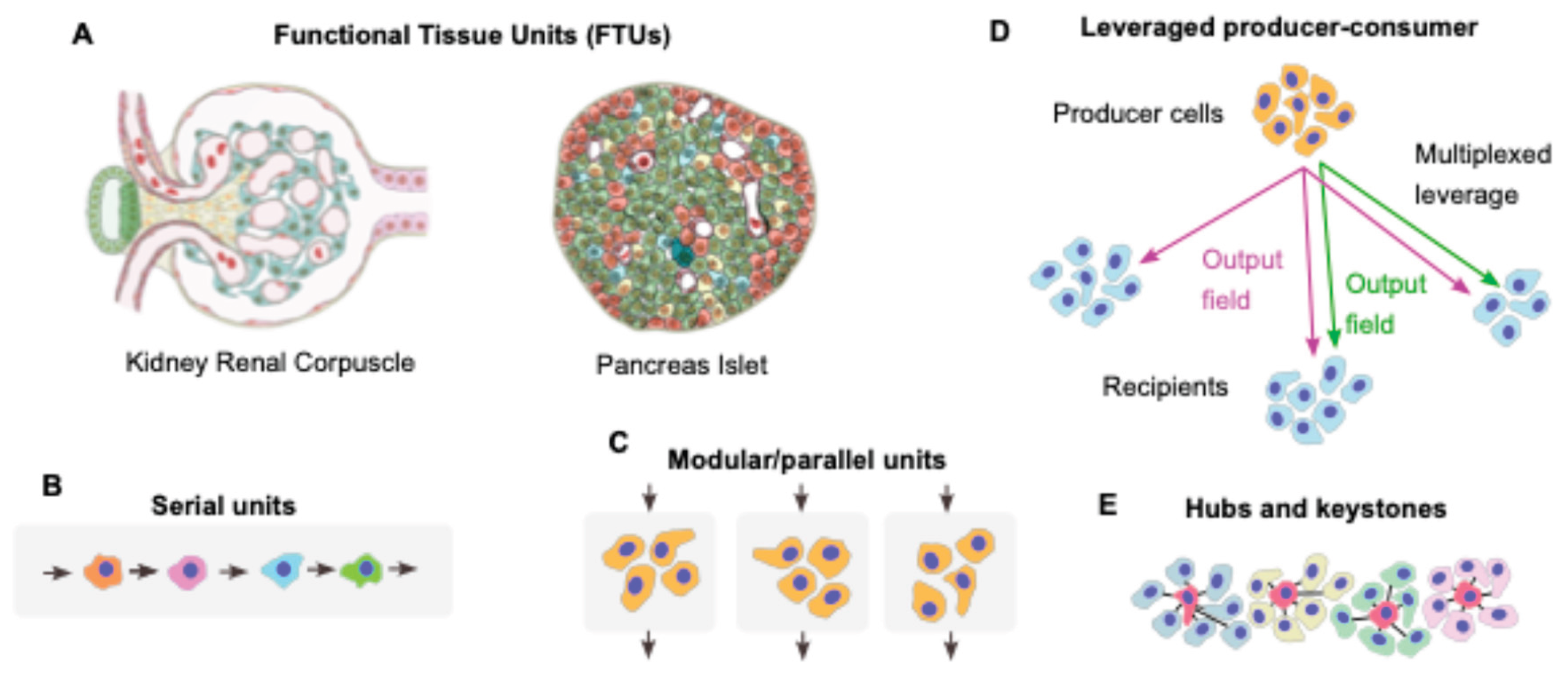
Figure 2.
Self-referential producer-consumer architecture of tissues, encoding of coordination states and the sensing bottleneck. (A) Organism-level view of coordination. Tissues both produce and consume shared fields in closed feedback loops. Interactions form interconnected producer-consumer networks at multiple scales. (B) Local tissue coordination as a producer-consumer system. Cells act as both producers (e.g., secreting paracrine factors, cytokines, or ECM components) and consumers (responding to shared fields). Keystone cells (highlighted in red) are high responder/gain cells. Autocrine, paracrine, and ECM-mediated feedback create self-updating loops. (C) Encoding layers of coordination architecture ordered by turnover timescale. Coordination states are stored across substrates with increasing persistence from left to right. Bidirectional arrows indicate cross-layer reinforcement where fast perturbations may rewrite slower layers, while slow layers re-specify faster ones, enabling memory of past states. (D) The endogenous sensing bottleneck. High-dimensional intracellular states are only accessible to neighbouring cells via a compressed projection, and each cell reads only a low-dimensional projection of its context. (E) Attractor-like states in coordination decline. A system perturbed from a healthy state (top red dot) may settle into a dysfunctional attractor basin (bottom red dot) via reinforcing feedback across encoding layers, consistent with the emergence of coordination traps.
Figure 2.
Self-referential producer-consumer architecture of tissues, encoding of coordination states and the sensing bottleneck. (A) Organism-level view of coordination. Tissues both produce and consume shared fields in closed feedback loops. Interactions form interconnected producer-consumer networks at multiple scales. (B) Local tissue coordination as a producer-consumer system. Cells act as both producers (e.g., secreting paracrine factors, cytokines, or ECM components) and consumers (responding to shared fields). Keystone cells (highlighted in red) are high responder/gain cells. Autocrine, paracrine, and ECM-mediated feedback create self-updating loops. (C) Encoding layers of coordination architecture ordered by turnover timescale. Coordination states are stored across substrates with increasing persistence from left to right. Bidirectional arrows indicate cross-layer reinforcement where fast perturbations may rewrite slower layers, while slow layers re-specify faster ones, enabling memory of past states. (D) The endogenous sensing bottleneck. High-dimensional intracellular states are only accessible to neighbouring cells via a compressed projection, and each cell reads only a low-dimensional projection of its context. (E) Attractor-like states in coordination decline. A system perturbed from a healthy state (top red dot) may settle into a dysfunctional attractor basin (bottom red dot) via reinforcing feedback across encoding layers, consistent with the emergence of coordination traps.
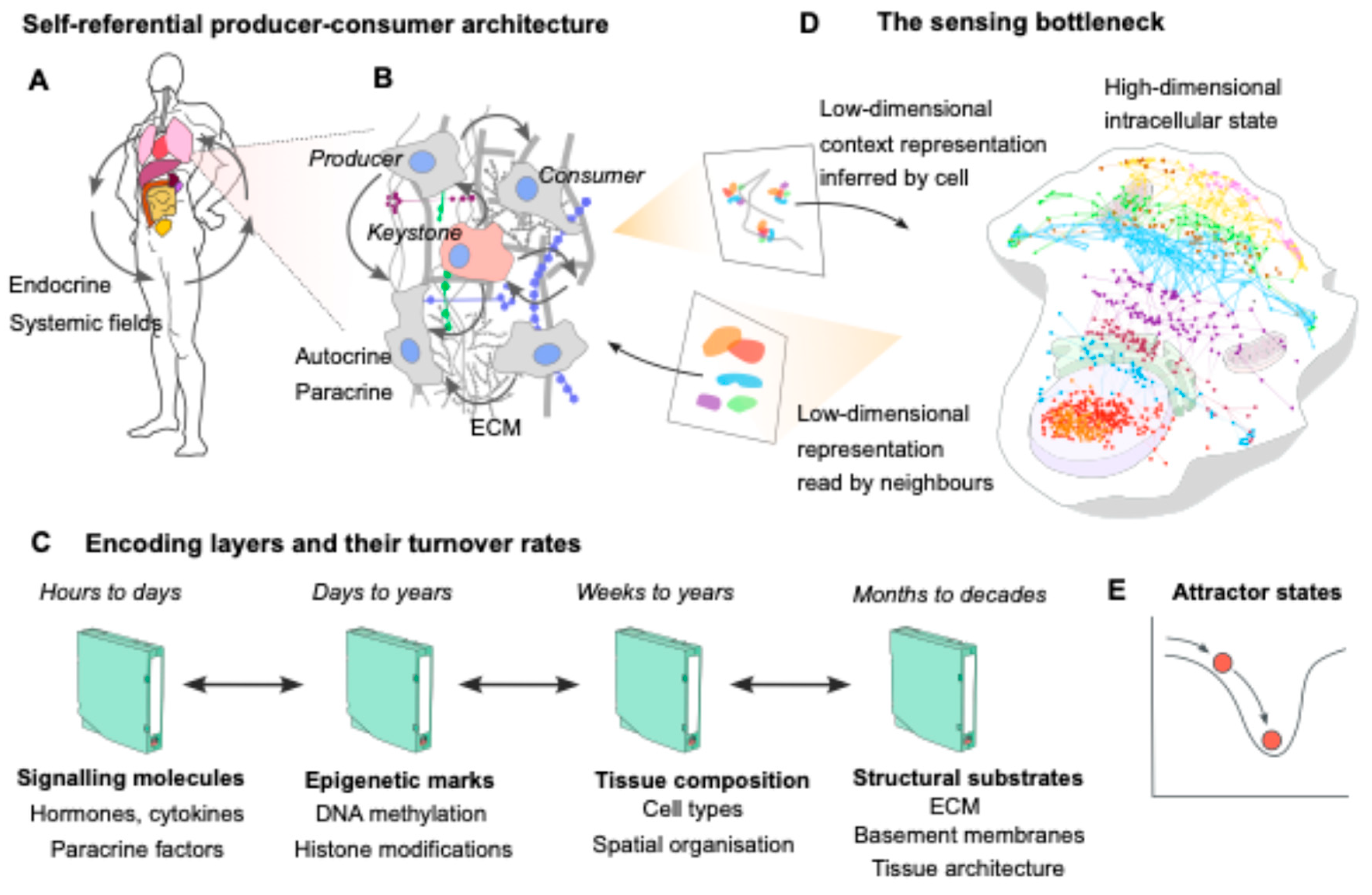
Figure 3.
Specialised hepatocyte outputs are weakly coupled to tissue-level enforcement. (A) Summary of gene categories among significantly depleted hits (FDR < 0.05) from a genome-wide in vivo CRISPR screen in mouse liver [58]. Genes are classified as common essential, interface/context, liver-specific output, or other. Depletion rate (%) is shown relative to the total number of genes in each category within the screen. (B) Proportional composition of the depleted gene set. (C) Forest plot from a multivariable logistic regression predicting gene depletion. Common-essential membership strongly predicts depletion, while liver-output GO annotation is significantly under-represented among depleted genes, and interface/context genes show no significant enrichment or depletion. (D) Mechanistic classification of non-common-essential depleted hits (n=18). Interface/context and liver-output genes are assigned to their most plausible dropout mechanism based on known gene function: immune clearance via loss of MHC-I self-identity, complement susceptibility, or intrinsic viability loss. No gene in either category provided strong evidence for direct auditing of specialised hepatocyte output. (E) Gene Ontology Biological Process enrichment among residual depleted genes after removal of common-essential genes. Dot size is proportional to gene ratio; x-axis shows -log₁₀ (FDR) after Benjamini-Hochberg correction.
Figure 3.
Specialised hepatocyte outputs are weakly coupled to tissue-level enforcement. (A) Summary of gene categories among significantly depleted hits (FDR < 0.05) from a genome-wide in vivo CRISPR screen in mouse liver [58]. Genes are classified as common essential, interface/context, liver-specific output, or other. Depletion rate (%) is shown relative to the total number of genes in each category within the screen. (B) Proportional composition of the depleted gene set. (C) Forest plot from a multivariable logistic regression predicting gene depletion. Common-essential membership strongly predicts depletion, while liver-output GO annotation is significantly under-represented among depleted genes, and interface/context genes show no significant enrichment or depletion. (D) Mechanistic classification of non-common-essential depleted hits (n=18). Interface/context and liver-output genes are assigned to their most plausible dropout mechanism based on known gene function: immune clearance via loss of MHC-I self-identity, complement susceptibility, or intrinsic viability loss. No gene in either category provided strong evidence for direct auditing of specialised hepatocyte output. (E) Gene Ontology Biological Process enrichment among residual depleted genes after removal of common-essential genes. Dot size is proportional to gene ratio; x-axis shows -log₁₀ (FDR) after Benjamini-Hochberg correction.
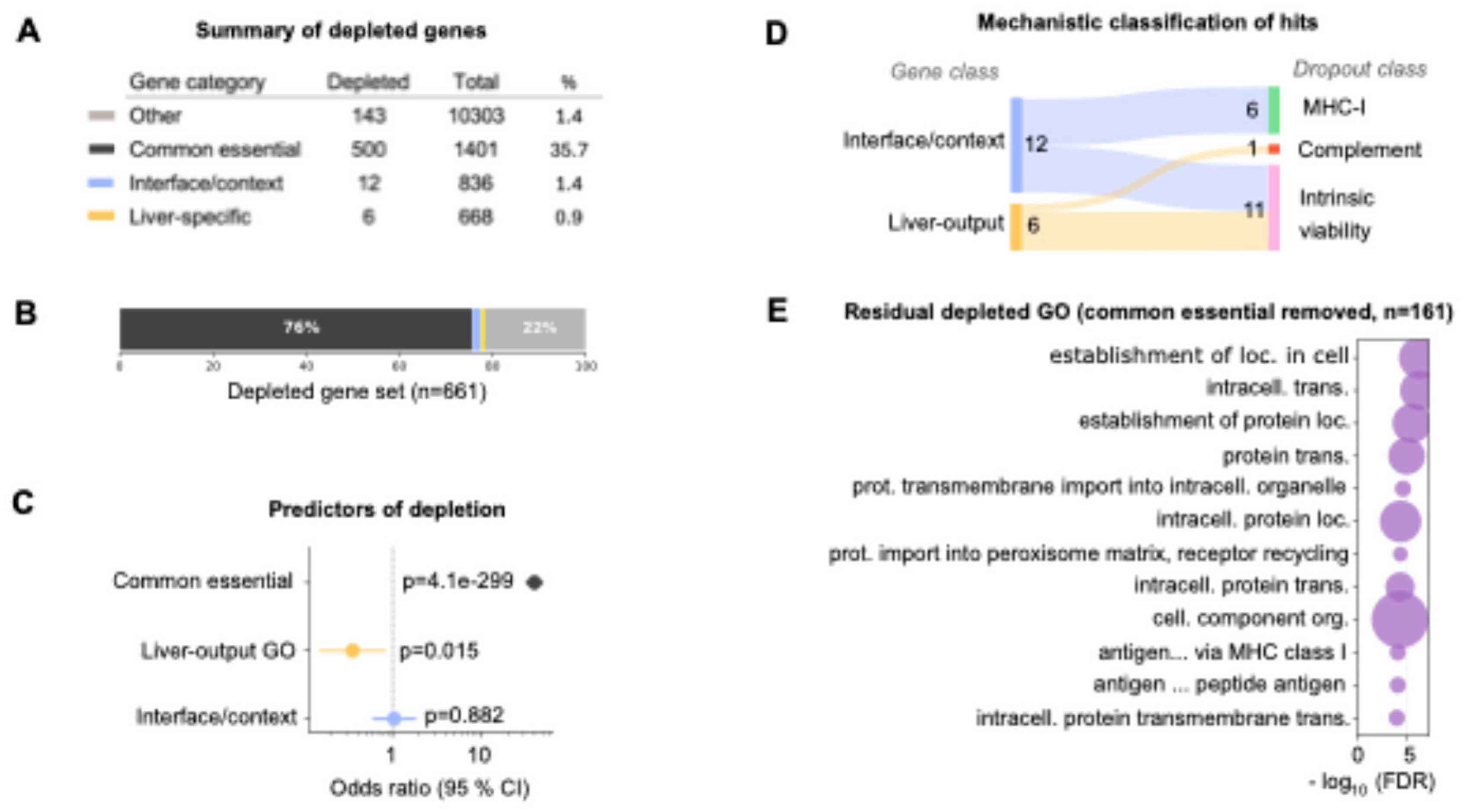

Table 1.
Candidate metrics and tests for assessing aspects of coordination. These metrics capture distinct, non-equivalent dimensions of coordination and should not be expected to move uniformly with age.
Table 1.
Candidate metrics and tests for assessing aspects of coordination. These metrics capture distinct, non-equivalent dimensions of coordination and should not be expected to move uniformly with age.
| Metric / readout | Measures | Relevance in aging |
|---|---|---|
| Architectural | ||
| Topology | Adjacency structure; defines the spatial and physical reach of the network. Cell contacts, diffusion reach, vascular patterning (e.g., ECM, basement membranes) [18] | If tissue undergo deformation of spatial organisation, loss of local containment, or persistent abnormal re-patterning |
| Coupling | Edge transfer functions; dictates the gain, delay, and directionality of interactions between nodes. Notch-Delta signalling, gap junctions, mechanotransduction [14,15,19] | If tissues experience altered signalling fidelity, response synchrony, or pathological reinforcement between cells |
| Fields | Emergent shared states; the mechanism of flow that cells both produce, read, and coordinate around. Cytokine gradients, mechanical stress, electrical potentials [20] | If shared local states deform or abnormal field configurations are stabilised |
| Candidate readouts | ||
| Shannon Entropy | Dispersion / heterogeneity of cell states / expression programs / signalling responses | Detecting fragmentation or diversification, but should be interpreted cautiously where ageing produces convergent reactive states [21,22] |
| Mutual Information | Coupling: sender-receiver coordination (ligand-response dependency) | Detecting altered coordination fidelity, whether through decoherence or pathological tightening of specific programmes [23] |
| Centrality measures | Hub identification: implies bridge position in shortest paths (not necessarily highest load) | Identifying vulnerable control points whose loss or dysfunction could have outsized tissue-level effects [24] |
| Modularity | Containment: degree of clustering with sparse inter-cluster connections | Detecting loss of error containment or, in some cases, abnormal compartmentalisation of dysfunctional states [8] |
| Optimal transport | Population state deformation: transport cost of shifting a cell population to a healthy reference distribution | Quantifying how far tissue state has moved from a healthy configuration and how resistant it may be to reversal [25,26]. |
| Histology-based clocks | Morphological changes during aging, potential structural field proxy. | As an integrated proxy for persistent structural deformation or aged tissue organization [27,28,29]. |
| Spatial perturbation omics | Local tissue effects of perturbation; neighbour influence; context dependence | Testing whether ageing changes neighbour effects, recovery, or the persistence of dysfunctional local responses |
Table 2.
Experimental approaches. These approaches are intended to distinguish dysfunction that is not well explained by damage levels alone, from dysfunction associated with impaired tissue coordination. For additional details, see Supplementary Information Note S2. Disconfirmation patterns: Evidence against the framework would include failure of coordination measures to predict residual dysfunction, lack of context dependence, and absence of persistent state behaviour once initiating perturbations are removed.
Table 2.
Experimental approaches. These approaches are intended to distinguish dysfunction that is not well explained by damage levels alone, from dysfunction associated with impaired tissue coordination. For additional details, see Supplementary Information Note S2. Disconfirmation patterns: Evidence against the framework would include failure of coordination measures to predict residual dysfunction, lack of context dependence, and absence of persistent state behaviour once initiating perturbations are removed.
| Category | Proposed Experiment | Expected Outcome / Interpretation |
|---|---|---|
| Diagnostic Tests | ||
| Damage vs. coordination | Remove or reduce a defined damage class (e.g., senescent cells) and quantify tissue recovery | If function plateaus despite substantial damage reduction, residual dysfunction may be coordination limited. |
| Attractor identification | Apply a transient, reversible perturbation (e.g., inflammatory, stress, or metabolic) and follow recovery after withdrawal | A return to baseline suggests monostable drift; persistent dysfunction after driver removal suggests a coordination trap. |
| Information & Fidelity | ||
| Coordination as an independent constraint | Disrupt coupling or timing whilst minimising damage burden (e.g., perturb synchrony, paracrine coupling, or spatial organisation) | If coordination decline is coupled to functional decline at constant damage, it suggests coordination is as an independent constraint. |
| Intervention dynamics | Track coordination metrics alongside damage markers during a rejuvenation or longevity intervention | Coordination metrics may improve disproportionally to measured damage burden, or may better explain residual dysfunction after damage reduction |
| Architecture & Selection | ||
| Context dependence | Transplant young cells into aged tissue environments, and aged cells into young environments | Strong context dependence would indicate that tissue state is encoded partly at the ensemble or microenvironmental level rather than only within individual cells |
| Selection-driven drift | Compare persistence of high-output/hub cells and lower-output cells under matched stress or damage burden | Preferential loss of high-output/hub units over low-output units supports selection-driven drift. |
Disclaimer/Publisher’s Note: The statements, opinions and data contained in all publications are solely those of the individual author(s) and contributor(s) and not of MDPI and/or the editor(s). MDPI and/or the editor(s) disclaim responsibility for any injury to people or property resulting from any ideas, methods, instructions or products referred to in the content. |
© 2026 by the authors. Licensee MDPI, Basel, Switzerland. This article is an open access article distributed under the terms and conditions of the Creative Commons Attribution (CC BY) license (http://creativecommons.org/licenses/by/4.0/).
Copyright: This open access article is published under a Creative Commons CC BY 4.0 license, which permit the free download, distribution, and reuse, provided that the author and preprint are cited in any reuse.


