

Submitted:
24 March 2026
Posted:
26 March 2026
You are already at the latest version
Abstract
Background: Mechanical restraint remains a common coercive practice in acute psychiatric wards and is particularly concerning in older adults due to greater physical and cognitive vulnerability. Methods: We conducted a retrospective observational study using routinely collected registry data from all recorded mechanical restraint episodes in 20 acute adult mental health inpatient units in the Andalusian public health system over 30 months. Among 2,435 restrained individuals with documented age, 19.4% (n=473) were ≥55. Age was modelled as a continuous predictor of (i) repeated restraint (any subsequent episode) and (ii) multiple restraints (≥3 episodes) using mixed-effects logistic regression with random intercepts for unit and adjustment for sociodemographic, diagnostic, and episode-related factors. Results: Compared with younger users, older restrained users were more often female and Spanish, more frequently had bipolar disorder and organic/intellectual disability diagnoses, and less often had substance use or personality disorders. They experienced a longer time from admission to the first restraint. Restraint was more often recorded as “required for another therapeutic activity” and less often due to “aggressive behavior”. During restraint, older users more frequently displayed confusion, and episodes more often began at night. Repeated restraint occurred in 27.2% of subjects; younger age was significant in univariable analysis but not after adjustment (aOR 1.004). Multiple restraint occurred in 23.0%; after adjustment, older age was associated with lower odds (aOR 0.992). Conclusions: Older adults showed a distinct restraint profile, supporting age-sensitive restraint-reduction strategies focused on frailty/confusional states in older individuals and preventing repeated episodes in younger users.
Keywords:
mechanical restraint
; coercion
; old age psychiatry
; geriatric mental health
; inpatient psychiatry
; registry study
1. Introduction
The use of mechanical restraint measures in inpatient mental health units continues to be a common practice in situations of risk, despite the ethical controversies it raises [1]. In the case of older adults, these interventions take on particular significance due to the greater physical, cognitive, and emotional vulnerability associated with aging [2]. It is also important to note that people with severe mental disorders who experience episodes requiring hospitalization often show evidence of accelerated biological aging [3] and, at the same time, a substantial mortality gap, with life expectancy commonly estimated to be around 10–20 years lower than in the general population [4,5].
Mechanical restraint, understood as the use of physical devices to limit a person’s movement when other, less restrictive strategies have failed, has been associated in the geriatric population with an increased risk of injury, functional decline, adverse psychological consequences, and even death [6,7,8]. These implications underscore the importance of considering age as a relevant factor in the management and prevention of mechanical restraint. From this perspective, analyzing its use among older users hospitalized in psychiatric units is essential to promote safer, proportionate, and person-centered practices.
In Spain, and particularly in Andalusia, inpatient mental health care for older adults is provided mostly in general units, given the limited development of specialized psychogeriatric units within the public system. In this context, older people share care settings with younger adult populations, which makes it possible to carry out a comparative analysis of the use of restrictive measures such as mechanical restraints across different age groups.
The available literature offers heterogeneous findings regarding the use of mechanical restraints as a function of age [1], and there is limited knowledge about how this variable is associated with more complex patterns of use of such measures. Moreover, much of the previous research has focused on identifying factors associated with the risk of experiencing at least one episode of mechanical restraint [9], whereas less attention has been paid to other relevant aspects of their use, such as recurrence or the accumulation of episodes. From a clinical and ethical perspective, not only the occurrence of mechanical restraint, but also the intensity of exposure to these measures, may have important implications for safety, subjective experience, and clinical outcomes [8,10] especially in older people [11,12].
In this context, the aim of this study was to compare older and younger users who underwent mechanical restraint in psychiatric inpatient units and to examine whether age was associated with repeated mechanical restraint (any subsequent episode) and multiple mechanical restraint (≥3 episodes).
2. Materials and Methods
2.1. Design
This retrospective observational study analysed routinely collected data on mechanical restraint episodes recorded over a 30-month period, spanning July 2016 to December 2018. The dataset comprised all documented restraint events from 20 acute adult inpatient mental health units within the Andalusian public health system. Due to organisational limitations, two of these units provided information only for the years 2017 and 2018.
2.2. Ethical Considerations
The Provincial Ethics Committee of Malaga approved the study. The analyses were conducted using anonymized secondary clinical data obtained from routine administrative procedures for monitoring and registering the use of mechanical restraint in Andalusia. Given the use of fully anonymized data, the committee approved the study without requiring informed consent. All procedures complied with the General Data Protection Regulation (EU).
2.3. Measures
The unit of analysis was the user. For each user, only the information corresponding to the first episode of mechanical restraint was used. Age was initially analysed as a categorical variable, comparing younger and older adults, and subsequently as a continuous variable to assess its association with repetition of mechanical restraint (during the study period) and with multiple mechanical restraints (defined as three or more restraint episodes).
Regarding other variables, the record collected information on 1) sociodemographic and clinical variables related to the user (the individual admitted to the unit): gender (Male, Female), country of origin (Spain, Europe [EU], Others) and diagnosis (Substance Use [F10–F19], Schizophrenia [F20], Other psychotic disorders [F21–F29], Bipolar disorders [F30–F31], Personality disorders [F60–F69], Organic–Intellectual Disabilities [F00–F09 and F70–F79], Other disorders), and 2) characteristics related to the episode and the staff: previous admission in the unit (Yes, No–Unknown), occupancy on the day of restraint (percentage of beds occupied on the day of the restraint), time from admission to restraint (date of restraint − admission date, days), main reason for restraint (Agitation, Self-harm, Aggressive Behavior, User request, Required for another therapeutic activity and Others), behavior during restraint (Aggressive, Agitated, Confused, Impulsive and Other), shift when the restraint starts (8:00–15:00, 15:00–22:00 and 22:00–8:00), and the unit of admission (inpatient acute mental health unit).
2.4. Setting
The Andalusian Health Service provides universal healthcare to a population of approximately 8.4 million inhabitants. Within this public system, inpatient psychiatric care is delivered through 20 acute mental health units distributed across the autonomous community of Andalusia, accounting for a total of 535 beds. These units are primarily intended for short-term hospitalisation of adults aged 18 years and older, with the objective to achieve clinical stabilisation. In some centres, adolescents aged 14 to 17 years are also admitted, although they are managed in specifically designated areas separate from adult wards.
All units operate under the same regional regulatory framework and have comparable staffing structures and material resources. Unit size varies considerably, with capacities ranging from 9 to 46 beds. According to established regulations, the use of mechanical restraint is strictly limited to situations in which all other therapeutic and de-escalation measures have been unsuccessful.
2.5. Data Analysis
Categorical variables are presented as counts and percentages, and continuous variables as mean and standard deviation or median and interquartile range, as appropriate. Age was first analysed as a categorical variable, comparing users aged 55 years or older with those younger than 55 years. Group comparisons for categorical variables were performed using chi-square tests. To identify category-specific differences, post-hoc chi-square analyses were conducted comparing each category against the remaining categories, with Bonferroni correction applied to adjust for multiple comparisons. For continuous variables, comparisons between age groups were conducted using the Wilcoxon rank-sum test.
Age was subsequently analysed as a continuous variable to explore its association with repetition of mechanical restraint and with multiple mechanical restraints (defined as three or more restraint episodes). Univariable associations were further examined using mixed-effects logistic regression models with random intercepts for unit, and results are reported as odds ratios. For predictors with more than two categories, category-specific odds ratios relative to a predefined reference category were estimated.
A multivariable mixed-effects logistic regression model including age and other clinically relevant covariates was then fitted, with unit included as a random effect to account for between-unit variability. Model parameters were estimated by maximum likelihood using the Laplace approximation, and results are presented as adjusted odds ratios.
Model adequacy was assessed by checking model convergence and inspecting random-effect variance components and singularity. Statistical significance was defined as a two-sided p-value < 0.05. We used the R program version 4.2.2 and RStudio for the analysis.
3. Results
3.1. Comparison Between Older and Younger Users
Overall, 2,567 users who underwent mechanical restraint were recorded, of whom 2,435 (94.9%) had age documented and constituted the final study sample. Users aged 55 years or older represented 19.4% of the sample (n = 473). Compared with users younger than 55 years, older users showed a distinct sociodemographic and clinical profile. A higher proportion were women (45.7% vs. 33.8%; p < 0.001). Likewise, older users were more often Spanish (98.5% vs. 95.2%; p = 0.005) and less often from non-European countries (0.8% vs. 3.2%; p = 0.023). Regarding diagnosis, significant overall differences were observed. Specifically, older users more frequently had a diagnosis of bipolar disorder (29.2% vs. 20.6%; p < 0.001) and organic disorders or intellectual disability (12.3% vs. 5.8%; p < 0.001), whereas they less frequently had substance use disorders (3.4% vs. 9.3%; p < 0.001) and personality disorders (5.3% vs. 10.6%; p = 0.004).
In relation to the characteristics of the mechanical restraint episode, a longer time elapsed from admission to the initiation of restraint in older users (median [IQR]: 1 [3] vs. 0 [2] days; p < 0.001). Reasons for restraint differed significantly: the use to facilitate another therapeutic procedure was more frequent in older users (18.3% vs. 7.7%; p < 0.001) while restraint due to aggressive behavior was less frequent (14.9% vs. 22.0%; p = 0.005). During mechanical restraint, older users more frequently exhibited behavior categorized as confusion (19.5% vs. 5.7%; p < 0.001) and less frequently aggressiveness (20.1% vs. 26.1%; p = 0.040) and agitation (46.1% vs. 55.4%; p = 0.002). Finally, the initiation of restraint occurred more often during the night shift (22:00–8:00) among older users (46.9% vs. 36.4%; p < 0.001), and less often during the morning shift (8:00–15:00; 20.1% vs. 26.7%; p = 0.011). Detailed results are presented in Table 1.
3.2. Age-Related Associations in Repeat Mechanical Restraint
Repeated mechanical restraint occurred in 27.2% of users (N = 663) who had already required at least one episode of mechanical restraint. Older users showed a slightly higher rate of repeated restraint compared with younger users (29.7% vs. 26.6%). The estimated probability of repetition of mechanical restraint by age is shown in Figure 1.
In the univariate logistic regression model, older age was significantly associated with repeated mechanical restraints (OR = 1.007; p = 0.029). However, in the multivariate logistic regression model, after adjusting for relevant clinical and care-related variables, age was no longer significantly associated with repeated mechanical restraints (adjusted OR = 1.004; p = 0.226). Further details of the univariate and multivariate models are presented in Table 2.
3.3. Age-Related Association in Multiple (≥3 Episodes) Mechanical Restraints
Moreover, multiple episodes of mechanical restraint (≥3 episodes) were observed in 23.0% of users (N = 559). Older users showed a slightly lower proportion of multiple mechanical restraints compared with younger users (21.6% vs. 23.3%), although this difference did not reach statistical significance. The estimated probability of multiple mechanical restraints according to age is shown in Figure 2.
In the univariable logistic regression model, age was not significantly associated with multiple mechanical restraints (OR = 0.996; p = 0.256). However, in the multivariable logistic regression model, after adjustment for sociodemographic, clinical and episode-related factors, younger age was significantly associated with a higher likelihood of multiple mechanical restraint (adjusted OR = 0.992; p = 0.032). Full details of the univariable and multivariable analyses are presented in Table 3.
4. Discussion
Older users who underwent mechanical restraint showed a distinct profile compared with younger users. From a diagnostic perspective, there was a predominance of bipolar disorders and organic disorders/intellectual disability. Among older users, the main indication for mechanical restraint was more frequently classified as “Required for another therapeutic activity,” and less frequently as aggressive behavior. During restraint, the clinical state was more often classified as confusional. In addition, a longer interval between admission and the application of restraint was observed, and it was more frequently applied during the night shift than during the morning shift.
The results also highlighted a complex relationship between age and mechanical restraint, suggesting a distinct clinical profile among older users who underwent this measure. In this group, restraint episodes showed a greater organic component, which could explain a higher probability of early repetition after the end of the initial episode. However, after adjustment for these factors, age alone was not associated with an increased risk of repetition. Regarding multiple repeated restraint episodes, the opposite pattern was observed: although the association was not significant in the initial analysis, after adjustment for confounding variables, younger age was significantly associated with the presence of multiple restraint episodes.
This complex relationship between age and the risk of restraint may explain the mixed findings reported in the literature regarding the association between age and the risk of mechanical restraint. Overall, other studies have found that multiple restraint episodes are associated with younger age [13,14,15,16,17], consistent with the findings of the present study. In contrast, with regard to the overall risk of mechanical restraint, results are mixed [18,19,20,21]. One possible explanation may be that certain factors associated with older users increase the short-term risk of experiencing mechanical restraint and of its recurrence. These factors include confusional states associated with degenerative processes and dementias. Conversely, some characteristics associated with younger age—for example, poor initial control of the illness—may increase risk when a longer time window is considered.
Regarding the profile of older users, other studies have also found a higher prevalence of organic disorders, mainly dementia [22,23,24] which is one of the main factors associated with mechanical restraint in this age group. Dementia makes it difficult for users to cope with their environment, often leading to anxiety, behavioral problems, and increased confusional states, which in this study were also associated with the risk of repeated restraint. Regarding the reasons for restraint, comparisons are often difficult because there are no standardized classifications; however, some studies identify behavioral problems as an indicator of a higher risk of mechanical restraint [22].
From a clinical perspective, the findings also highlight the potential relevance of staff training and organisational practices in the use of mechanical restraint. Previous studies have noted that the use of these measures is frequently justified by staff and may reflect difficulties in implementing preventive or alternative strategies in complex clinical situations[25], In this context, the development of specific preventive approaches adapted to the needs of older adults—particularly those with organic disorders or confusional states—has been recommended as a way to reduce the use of mechanical restraint in this population [26,27,28].
These findings should be interpreted in light of several important limitations. First, the registry captured only a limited set of variables—mainly basic sociodemographic and diagnostic categories, and selected features of the restraint episode—and did not include potentially influential factors that are especially pertinent in older adults, such as cognitive status (e.g., delirium severity), frailty, functional dependence, medical comorbidity, polypharmacy, or sensory impairment. The absence of these measures limits our ability to disentangle whether the observed differences between age groups reflect age per se or the unequal distribution of these unmeasured clinical characteristics. Second, age was examined using a pragmatic cut-off (≥55 years) and, in additional analyses, as a continuous predictor. While this strategy enables comparability, the dichotomisation may be partly arbitrary and may obscure non-linear associations across the lifespan. Moreover, older users admitted to acute adult units may represent a selected subgroup compared with those treated in specialised old-age psychiatry or general medical settings, which may limit the generalisability of age-related findings beyond this specific inpatient context. Third, because diagnostic checks indicated that key modelling assumptions were not fully met when considering all recorded restraint events, analyses were restricted to the first restraint episode per user and the occurrence of repetition within the same hospitalisation episode and multiple restraint. Although this approach increased analytical robustness, it reduced the number of eligible observations and prevented a more granular assessment of event sequences and time-varying mechanisms of repetition, which may differ by age group.
5. Conclusions
In conclusion, the findings of this study suggest that reducing the use of mechanical restraint in older users should go hand in hand with enhanced training in the prevention and management of frail users with organic and confusional symptoms. Likewise, changes in clinical practice and improvements in staff training may be necessary to better address complex situations involving older users in acute psychiatric settings. The development and implementation of specific preventive strategies tailored to older adults may therefore contribute to reducing the use of mechanical restraint in this population.
Author Contributions
Conceptualization: JGP, YGI, BIR, CAS, JMV, AbdT, JAGS, GPG, GGP, MTR. Methodology: JGP, GGP. Data curation: JGP, YGI, BIR, CAS, JHI, JMGC, ABA, JAGS, ILA, JJD-H, GPG. Formal analysis: JGP. Writing—original draft: JGP, YGI, GGP, GPG, BIR, JJD-H, ILA, MTR. Writing—review & editing: all authors. All authors have read and agreed to the published version of the manuscript.
Funding
Jose Guzman-Parra has received funding from the Andalusia Government in the grants for human resources reinforcement in the research activity (Acción A de intesificación). This research did not receive any specific grant from funding agencies in the public, commercial or not-for-profit sectors.
Institutional Review Board Statement
This study was conducted in accordance with the Declaration of Helsinki and was approved by the Ethics Committee of Málaga (approval on 27 March 2014; 03/2014.PI03).
Informed Consent Statement
The ethical committee approved the study without requiring informed consent.
Data Availability Statement
The dataset is not publicly available due to sensitive content.
Acknowledgments
We thank all the participants in the study.
Conflicts of Interest
The authors declare no conflict of interest.
References
- Beghi, M.; Peroni, F.; Gabola, P.; Rossetti, A.; Cornaggia, C.M. Prevalence and Risk Factors for the Use of Restraint in Psychiatry: A Systematic Review. Riv. Psichiatr. 2013, 48, 10–22. [Google Scholar] [CrossRef]
- Abraham, J.; Hirt, J.; Richter, C.; Köpke, S.; Meyer, G.; Möhler, R. Interventions for Preventing and Reducing the Use of Physical Restraints of Older People in General Hospital Settings. Cochrane Database Syst. Rev. 2022, 8, CD012476. [Google Scholar] [CrossRef] [PubMed]
- Wolkowitz, O.M. Accelerated Biological Aging in Serious Mental Disorders. World Psychiatry 2018, 17, 144–145. [Google Scholar] [CrossRef]
- Moreno-Küstner, B.; Guzman-Parra, J.; Pardo, Y.; Sanchidrián, Y.; Díaz-Ruiz, S.; Mayoral-Cleries, F. Excess Mortality in Patients with Schizophrenia Spectrum Disorders in Malaga (Spain): A Cohort Study. Epidemiol. Psychiatr. Sci. 2021, 30, e11. [Google Scholar] [CrossRef]
- Swaraj, S.; Wang, M.; Chung, D.; Curtis, J.; Firth, J.; Ramanuj, P.P.; Sara, G.; Large, M. Meta-Analysis of Natural, Unnatural and Cause-Specific Mortality Rates Following Discharge from in-Patient Psychiatric Facilities. Acta Psychiatr. Scand. 2019, 140, 244–264. [Google Scholar] [CrossRef]
- Aguilera-Serrano, C.; Guzman-Parra, J.; Garcia-Sanchez, J.A.; Moreno-Küstner, B.; Mayoral-Cleries, F. Variables Associated With the Subjective Experience of Coercive Measures in Psychiatric Inpatients: A Systematic Review. Can. J. Psychiatry Rev. Can. Psychiatr. 2018, 63, 129–144. [Google Scholar] [CrossRef]
- Berzlanovich, A.M.; Schöpfer, J.; Keil, W. Deaths Due to Physical Restraint. Dtsch. Arzteblatt Int. 2012, 109, 27–32. [Google Scholar] [CrossRef] [PubMed]
- Herrera-Imbroda, J.; Carbonel-Aranda, V.; García-Illanes, Y.; Aguilera-Serrano, C.; Bordallo-Aragón, A.; García-Spínola, E.; Torres-Campos, D.; Villagrán, J.M.; García-Sanchez, J.A.; Mayoral-Cleries, F.; et al. An Exploratory Study about Factors and Outcomes Associated with the Experience of Coercive Measures in Mental Health Settings. Psychiatr. Q. 2025, 96, 133–144. [Google Scholar] [CrossRef] [PubMed]
- Beames, L.; Onwumere, J. Risk Factors Associated with Use of Coercive Practices in Adult Mental Health Inpatients: A Systematic Review. J. Psychiatr. Ment. Health Nurs. 2022, 29, 220–239. [Google Scholar] [CrossRef]
- Guzmán-Parra, J.; Aguilera-Serrano, C.; García-Sanchez, J.A.; García-Spínola, E.; Torres-Campos, D.; Villagrán, J.M.; Moreno-Küstner, B.; Mayoral-Cleries, F. Experience Coercion, Post-Traumatic Stress, and Satisfaction with Treatment Associated with Different Coercive Measures during Psychiatric Hospitalization. Int. J. Ment. Health Nurs. 2019, 28, 448–456. [Google Scholar] [CrossRef]
- Atee, M.; Burley, C.V.; Ojo, V.A.; Adigun, A.J.; Lee, H.; Hoyle, D.J.; Elugbadebo, O.; Leon, T. Physical Restraint in Older People: An Opinion from the Early Career Network of the International Psychogeriatric Association. Int. Psychogeriatr. 2024, 36, 995–1006. [Google Scholar] [CrossRef]
- Evans, D.; Wood, J.; Lambert, L.; FitzGerald, M. Physical Restraint in Acute and Residential Care: A Systematic Review. Database Abstr. Rev. Eff. DARE Qual.-Assess. Rev. Internet 2002. [Google Scholar]
- Beck, N.C.; Durrett, C.; Stinson, J.; Coleman, J.; Stuve, P.; Menditto, A. Trajectories of Seclusion and Restraint Use at a State Psychiatric Hospital. Psychiatr. Serv. 2008, 59, 1027–1032. [Google Scholar] [CrossRef]
- Dumais, A.; Larue, C.; Drapeau, A.; Ménard, G.; Giguère Allard, M. Prevalence and Correlates of Seclusion with or without Restraint in a Canadian Psychiatric Hospital: A 2-Year Retrospective Audit. J. Psychiatr. Ment. Health Nurs. 2011, 18, 394–402. [Google Scholar] [CrossRef] [PubMed]
- Guzman-Parra, J.; Guzik, J.; Garcia-Sanchez, J.A.; Pino-Benitez, I.; Aguilera-Serrano, C.; Mayoral-Cleries, F. Characteristics of Psychiatric Hospitalizations with Multiple Mechanical Restraint Episodes versus Hospitalization with a Single Mechanical Restraint Episode. Psychiatry Res. 2016, 244, 210–213. [Google Scholar] [CrossRef] [PubMed]
- Hendryx, M.; Trusevich, Y.; Coyle, F.; Short, R.; Roll, J. The Distribution and Frequency of Seclusion and/or Restraint among Psychiatric Inpatients. J. Behav. Health Serv. Res. 2010, 37, 272–281. [Google Scholar] [CrossRef] [PubMed]
- Knutzen, M.; Bjørkly, S.; Eidhammer, G.; Lorentzen, S.; Mjøsund, N.H.; Opjordsmoen, S.; Sandvik, L.; Friis, S. Characteristics of Patients Frequently Subjected to Pharmacological and Mechanical Restraint--a Register Study in Three Norwegian Acute Psychiatric Wards. Psychiatry Res. 2014, 215, 127–133. [Google Scholar] [CrossRef]
- Kranzhoff, E.U.; Hirsch, R.D. The “restraint” controversy in geriatric psychiatry. Focus study of factors influencing restraint measures. Z. Gerontol. Geriatr. 1997, 30, 321–326. [Google Scholar]
- Senthil, S.; Jha, M.; Kumar, P. Prevalence and Factors Associated with Restraints in Mental Health In-Patient Wards. BJPsych Bull. 2025, 1–6. [Google Scholar] [CrossRef]
- Dazzi, F.; Tarsitani, L.; Di Nunzio, M.; Trincia, V.; Scifoni, G.; Ducci, G. Psychopathological Assessment of Risk of Restraint in Acute Psychiatric Patients. J. Nerv. Ment. Dis. 2017, 205, 458–465. [Google Scholar] [CrossRef]
- Thomsen, C.; Starkopf, L.; Hastrup, L.H.; Andersen, P.K.; Nordentoft, M.; Benros, M.E. Risk Factors of Coercion among Psychiatric Inpatients: A Nationwide Register-Based Cohort Study. Soc. Psychiatry Psychiatr. Epidemiol. 2017, 52, 979–987. [Google Scholar] [CrossRef] [PubMed]
- DeSantis, J.; Engberg, S.; Rogers, J. Geropsychiatric Restraint Use. J. Am. Geriatr. Soc. 1997, 45, 1515–1518. [Google Scholar] [CrossRef] [PubMed]
- Gerace, A.; Mosel, K.; Oster, C.; Muir-Cochrane, E. Restraint Use in Acute and Extended Mental Health Services for Older Persons. Int. J. Ment. Health Nurs. 2013, 22, 545–557. [Google Scholar] [CrossRef]
- Bredthauer, D.; Becker, C.; Eichner, B.; Koczy, P.; Nikolaus, T. Factors Relating to the Use of Physical Restraints in Psychogeriatric Care: A Paradigm for Elder Abuse. Z. Gerontol. Geriatr. 2005, 38, 10–18. [Google Scholar] [CrossRef]
- Chien, W.-T.; Lee, I.Y. Psychiatric Nurses’ Knowledge and Attitudes toward the Use of Physical Restraint on Older Patients in Psychiatric Wards. Int. J. Mult. Res. Approaches 2007, 1, 52–71. [Google Scholar] [CrossRef]
- Chieze, M.; Kaiser, S.; Courvoisier, D.; Hurst, S.; Sentissi, O.; Fredouille, J.; Wullschleger, A. Prevalence and Risk Factors for Seclusion and Restraint in Old-Age Psychiatry Inpatient Units. BMC Psychiatry 2021, 21, 82. [Google Scholar] [CrossRef]
- Goveas, R.; Lai, D.; Yao, F. Reducing the Use of Physical Restraints in Patients With Dementia Who Are Admitted to Acute Old Age Psychiatry Wards With Agitation. BJPsych Open 2024, 10, S141–S141. [Google Scholar] [CrossRef]
- Mitchell, A.M.; Chiappetta, L.; Boucek, L.; Cain, M.; Patterson, G.; Owens, K.; Herisko, C.; Stark, K.H. Nonpharmacological Therapeutic Techniques to Decrease Agitation in Geriatric Psychiatric Patients with Dementia. J. Gerontol. Nurs. 2015, 41, 53–59. [Google Scholar] [CrossRef] [PubMed]
Figure 1.
Repetition of mechanical restraint according to age. Age was analysed as a continuous variable in adults aged ≥18 years, with ages above 80 years grouped as 80+. The curve shows the estimated probability (percentage) of repetition of mechanical restraint, obtained using logistic regression smoothing. Shaded areas represent 95% confidence intervals.
Figure 1.
Repetition of mechanical restraint according to age. Age was analysed as a continuous variable in adults aged ≥18 years, with ages above 80 years grouped as 80+. The curve shows the estimated probability (percentage) of repetition of mechanical restraint, obtained using logistic regression smoothing. Shaded areas represent 95% confidence intervals.
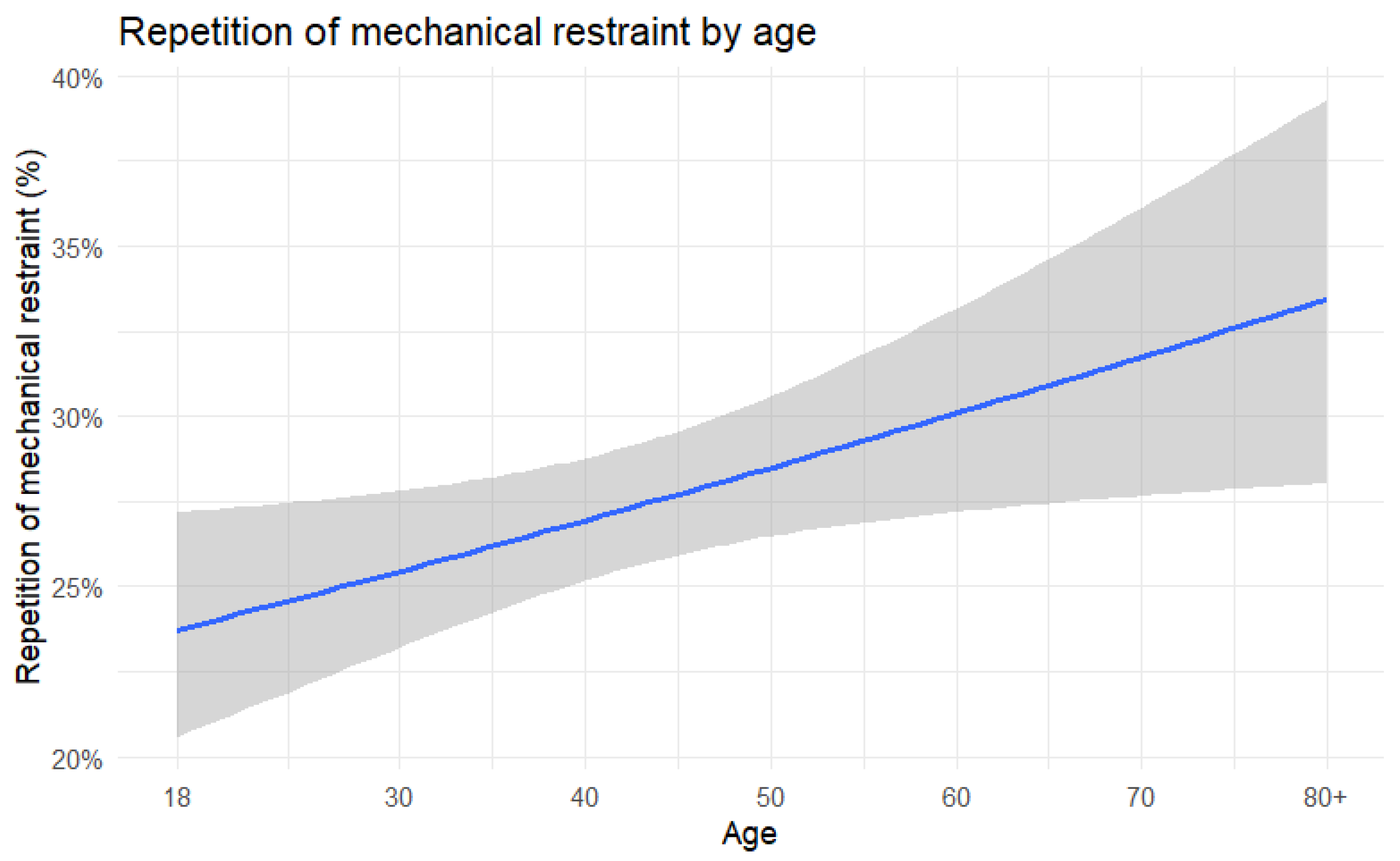
Figure 2.
Percentage of users with multiple restraints according to age. Age was analysed as a continuous variable in adults aged ≥18 years, with ages above 80 years grouped as 80+. The curve represents the estimated probability (percentage) of multiple restraints (≥3 episodes), obtained using logistic regression smoothing. Shaded areas indicate 95% confidence intervals.
Figure 2.
Percentage of users with multiple restraints according to age. Age was analysed as a continuous variable in adults aged ≥18 years, with ages above 80 years grouped as 80+. The curve represents the estimated probability (percentage) of multiple restraints (≥3 episodes), obtained using logistic regression smoothing. Shaded areas indicate 95% confidence intervals.
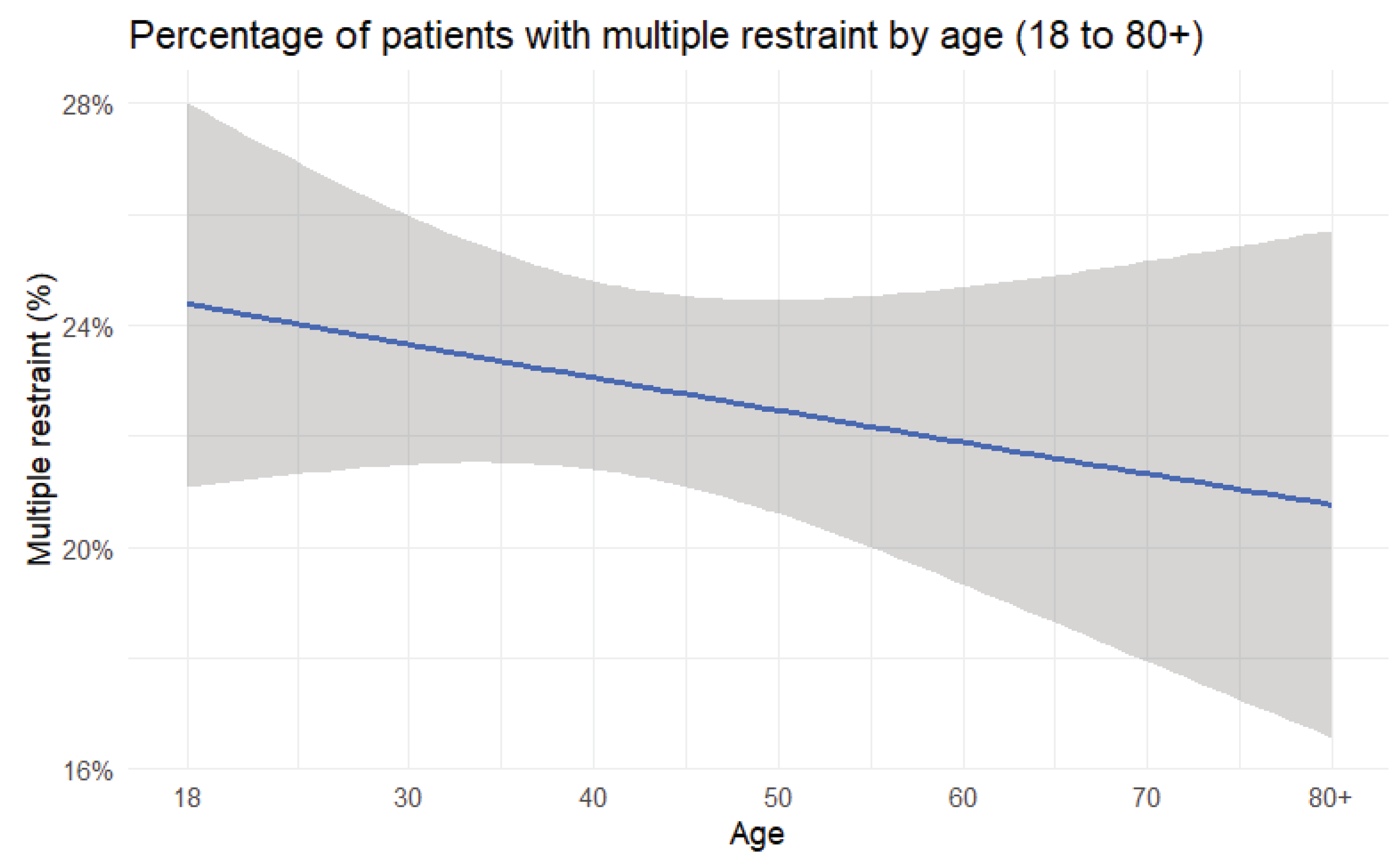

Table 1.
Characteristics of older users and their first episode of mechanical restraint.
| ≥ 55 years | < 55 years | p | |
|---|---|---|---|
| Characteristics | |||
| Gender. N (%) Male Female |
257 (54.3) 216 (45.7) |
1298 (66.2) 664 (33.8) |
<0.001 |
| Diagnosis. N (%) Substance Use (F10-F19) Schizophrenia (F20) Other psychotic disorders (F21-F29) Bipolar disorders (F30-F31) Personality disorders (F60-F69) Organic/ Intellectual Disabilities (F00-F09 and F70-F79) Other disorders |
16 (3.4) 93 (19.7) 78 (16.5) 138 (29.2) 25 (5.3) 58 (12.3) 65 (13.7) |
182 (9.3) 445 (22.7) 408 (20.8) 404 (20.6) 208 (10.6) 113 (5.8) 202 (10.3) |
<0.001 (Global) <0.001 1 0.290 <0.001 0.004 <0.001 0.268 |
| Country of origin. N (%) Europe Other Spain |
3 (0.6) 4 (0.8) 466 (98.5) |
32 (1.6) 63 (3.2) 1867 (95.2) |
0.004 (Global) 0.467 0.023 0.005 |
| Characteristics of restraint episodes | |||
| Previous admissions. N (%) Yes No/Unknown |
233 (49.3) 240 (50.7) |
1037 (52.9) 925 (47.1) |
0.176 |
| Time from admission to restraint (days). Median (IQR) | 1 (3) | 0 (2) | <0.001 |
| Duration of MR. Median (IQR) | 10 (11) | 10 (13) | 0.153 |
| Reason for restraint. N (%) Agitation Self-harm Aggressive Behavior User request Required for another therapeutic activity Other reasons |
252 (53.6) 24 (5.1) 70 (14.9) 3 (0.6) 86 (18.3) 35 (7.4) |
1124 (57.5) 143 (7.3) 430 (22.0) 7 (0.4) 151 (7.7) 101 (5.2) |
<0.001 (Global) 0.866 0.666 0.005 1 <0.001 0.412 |
| Behavior during mechanical restraint. N (%) Aggressive Agitated Confused Impulsive Other |
95 (20.1) 218 (46.1) 92 (19.5) 20 (4.2) 48 (10.1) |
512 (26.1) 1086 (55.4) 111 (5.7) 97 (4.9) 156 (8.0) |
<0.001(Global) 0.040 0.002 <0.001 1 0.728 |
| Shift when restraint starts. N (%) 8:00-15:00 15:00-22:00 22:00-8:00 |
95 (20.1) 156 (33.0) 222 (46.9) |
523 (26.7) 725 (37.0) 714 (36.4) |
<0.001(Global) 0.011 0.356 <0.001 |
| Occupancy on the day of restraint. Median (IQR) | 81.4 (19.0) | 81.8 (21.9) | 0.232 |
Table 2.
Factors analysed in relation to repeated mechanical restraints.
| Multivariable model N=2399 | z | p | Not adjusted OR | z | p | Adjusted OR |
|---|---|---|---|---|---|---|
| Age | 2.177 | 0.029 | 1.007 | 1.211 | 0.226 | 1.004 |
| Gender Female Male (ref.) |
-0.065 |
0.948 |
0.994 |
0.084 |
0.933 |
1.009 |
| Diagnosis Substance Use (F10-F19) Schizophrenia (F20) Other psychotic disorders (F21-F29) Bipolar disorders (F30-F31) Personality disorders (F60-F69) Organic/ Intellectual Disabilities (F00-F09 and F70-F79) Other disorders (ref.) |
0.414 2.514 1.621 2.559 0.051 2.899 |
0.679 0.012 0.105 0.010 0.959 0.004 |
1.099 1.564 1.346 1.578 1.011 1.897 |
0.294 1.954 1.551 2.314 -0.051 2.654 |
0.768 0.051 0.121 0.021 0.960 0.008 |
1.073 1.445 1.344 1.532 0.988 1.844 |
| Country of origin Europe Other Spain (ref.) |
-0.338 -1.168 |
0.736 0.243 |
0.876 0.699 |
0.386 -1.516 |
0.699 0.129 |
1.168 0.593 |
| Previous admissions Yes No/Unknown |
3.638 |
<0.001 |
1.408 |
3.242 |
0.001 |
1.374 |
| Time from admission to restraint (days) | 0.846 | 0.397 | 1.004 | 0.137 | 0.891 | 1.001 |
| Duration of the restraint (Hours) | 1.885 | 0.060 | 1.003 | 1.570 | 0.116 | 1.002 |
| Reason for restraint Agitation Self-harm Aggressive Behavior User request Required for another therapeutic activity Other reasons (ref.) |
1.348 1.309 1.435 1.347 2.636 |
0.178 0.191 0.151 0.178 0.008 |
1.343 1.428 1.397 2.507 1.950 |
0.527 0.776 0.660 1.559 1.476 |
0.598 0.438 0.509 0.119 0.140 |
1.165 1.294 1.220 2.980 1.507 |
| Behavior during mechanical restraint Aggressive Agitated Confused Impulsive Other (ref.) |
0.824 0.778 3.388 0.595 |
0.410 0.436 <0.001 0.552 |
1.169 1.148 2.100 1.173 |
1.092 1.169 3.120 1.131 |
0.275 0.242 0.002 0.258 |
1.343 1.356 2.181 1.470 |
| Shift when restraint starts 15:00-22:00 22:00-8:00 8:00-15:00 (ref.) |
-2.236 -2.972 |
0.025 0.003 |
0.771 0.709 |
-2.571 -3.492 |
0.010 <0.001 |
0.735 0.656 |
| Occupancy on the day of restraint | -0.304 | 0.761 | 0.909 | -0.465 | 0.642 | 0.862 |
Table 3.
Factors analysed in relation to the multiple use of mechanical restraints (≥3 restraints).
| Multivariable model N=2399 | z | p | Not adjusted OR | z | p | Adjusted OR |
|---|---|---|---|---|---|---|
| Age | -1.136 | 0.256 | 0.996 | -2.144 | 0.032 | 0.992 |
| Gender Male Female (ref.) |
-1.752 |
0.080 |
0.835 |
-1.420 |
0.156 |
0.854 |
| Diagnosis Substance Use (F10-F19) Schizophrenia (F20) Other psychotic disorders (F21-F29) Bipolar disorders (F30-F31) Personality disorders (F60-F69) Organic/ Intellectual Disabilities (F00-F09 and F70-F79) Other disorders (ref.) |
1.151 3.501 2.990 3.912 2.300 4.114 |
0.250 <0.001 0.003 <0.001 0.021 <0.001 |
1.350 2.044 1.868 2.214 1.736 2.726 |
0.642 2.299 2.441 3.488 1.639 3.873 |
0.521 0.022 0.015 <0.001 0.101 <0.001 |
1.186 1.636 1.692 2.072 1.500 2.665 |
| Country of origin Europe Other Spain (ref.) |
-0.506 -2.172 |
0.613 0.030 |
0.805 0.436 |
0.212 -2.375 |
0.832 0.018 |
1.098 0.375 |
| Previous admissions Yes No/Unknown |
4.392 |
<0.001 |
1.559 |
3.821 |
<0.001 |
1.497 |
| Time from admission to restraint (days) | 2.907 | 0.004 | 1.016 | 2.534 | 0.011 | 1.015 |
| Duration of the restraint (Hours) | 3.037 | 0.002 | 1.005 | 2.895 | 0.004 | 1.005 |
| Reason for restraint Agitation Self-harm Aggressive Behavior User request Required for another therapeutic activity Other reasons (ref.) Missing: 10 |
1.875 1.678 1.806 1.093 2.049 |
0.061 0.093 0.071 0.275 0.040 |
1.573 1.644 1.590 2.225 1.774 |
1.576 1.556 1.020 1.022 1.714 |
0.115 0.119 0.308 0.307 0.086 |
1.667 1.770 1.408 2.174 1.708 |
| Behavior during mechanical restraint Aggressive Agitated Confused Impulsive Other (ref.) |
1.285 0.574 1.144 0.550 |
0.199 0.566 0.252 0.582 |
1.293 1.114 1.315 1.168 |
0.448 -0.351 0.533 0.145 |
0.664 0.726 0.594 0.885 |
1.138 0.906 1.159 1.054 |
| Shift when restraint starts 15:00-22:00 22:00-8:00 8:00-15:00 (ref.) |
-1.135 -1.006 |
0.256 0.315 |
0.868 0.884 |
-1.092 -0.836 |
0.275 0.403 |
0.868 0.898 |
| Occupancy on the day of restraint | 0.392 | 0.695 | 1.141 | 0.302 | 0.763 | 1.112 |
Disclaimer/Publisher’s Note: The statements, opinions and data contained in all publications are solely those of the individual author(s) and contributor(s) and not of MDPI and/or the editor(s). MDPI and/or the editor(s) disclaim responsibility for any injury to people or property resulting from any ideas, methods, instructions or products referred to in the content. |
© 2026 by the authors. Licensee MDPI, Basel, Switzerland. This article is an open access article distributed under the terms and conditions of the Creative Commons Attribution (CC BY) license.
Copyright: This open access article is published under a Creative Commons CC BY 4.0 license, which permit the free download, distribution, and reuse, provided that the author and preprint are cited in any reuse.