

Submitted:
25 March 2026
Posted:
25 March 2026
You are already at the latest version
Abstract
Negative capacitance (NC) has been reported across a wide range of physical systems, yet its interpretation has remained fragmented due to the absence of a unified conceptual framework. Existing explanations—spanning ferroelectric free‑energy curvature, tunneling transport, plasmonic resonances, and electronic compressibility—have often been treated as unrelated or even contradictory. This review resolves these inconsistencies by demonstrating that all manifestations of NC arise from —non‑synchronization—between external excitation and internal response. We classify NC into three fundamental categories: temporal mismatch, originating from delays or inertia in charge or polarization dynamics; spatial mismatch, caused by nonuniform field or mode distributions; and quantitative mismatch, resulting from intrinsic parameter reversal such as negative curvature or negative compressibility. Despite their diverse physical origins, these mechanisms share the same mathematical signature (C_eff=∂Q/∂V< 0). Organizing NC within this unified framework clarifies long‑standing ambiguities, connects previously isolated research fields, and establishes a systematic foundation for engineering NC in electronic, photonic, and quantum devices. The framework further highlights tunnel‑current‑induced NC as a distinct single‑particle mechanism, expanding the scope of NC beyond ferroelectricity and collective modes. Overall, this work positions NC not as a singular anomaly but as a universal response class emerging from the interplay between excitation and internal dynamics.
Keywords:
negative capacitance
; unified framework for negative capacitance
; temporal mismatch
; spatial mismatch
; quantitative mismatch
1. Introduction
Negative capacitance (NC) has become a central topic in modern nanoelectronics, quantum materials, and electromagnetic engineering. Since the seminal theoretical prediction that ferroelectric materials can exhibit an effective negative differential capacitance through polarization dynamics in a double-well potential [1,2,3], NC has been explored as a route to voltage amplification, reduce power consumption in field-effect transistors (NC-FETs), and engineer unconventional electromagnetic responses in metamaterials and plasmonic systems [2,3,4,5]. Beyond ferroelectrics, NC has also been observed in low-dimensional electron systems with negative compressibility [6,7,8], in nonlinear transport devices [9,10,11], and in resonant tunneling structures [10,11,12]. Despite this diversity, the underlying physical mechanisms remain conceptually fragmented across different research communities.
Existing classifications typically group NC phenomena by material class (ferroelectrics, correlated electron systems, topological materials [1,6,13]), by device structure (diodes, resonant tunneling devices [9,10,11]), or by electromagnetic response (metamaterials, plasmonic systems [4,5,14]). However, such taxonomies obscure the deeper physical principle that unifies these systems. Recent developments—including our work on tunnel-current-induced NC in nanoscale conductor–semiconductor junctions [9,10,15]—suggest that NC is not an intrinsic property of a specific material, but rather a manifestation of non-synchronized responses between an external excitation and the internal dynamics of charge, polarization, or electromagnetic fields [16,17,18].
In this review, we introduce a unified conceptual framework in which NC arises from three fundamental types of non-synchronization:
I. Temporal mismatch — the response lags behind the excitation, producing a negative phase component in the charge or current [16,17,18].
II. Spatial mismatch — the spatial distribution of fields or charges does not align with the applied excitation, leading to effective negative permittivity or reactance [4,19,20].
III. Quantitative mismatch — physical quantities such as permittivity, compressibility, or density of states undergo sign reversal due to resonance or correlation effects [5,6,14].
Within this framework, ferroelectric NC is interpreted as a temporal mismatch in polarization switching [1,2,3], while plasmonic and metamaterial NC arise from spatial or quantitative mismatches in collective electromagnetic modes [4,5,14]. Negative compressibility in two-dimensional electron systems and quantum-capacitance-driven effects naturally fall into the category of quantitative mismatch [6,7,8]. Importantly, our recently proposed tunnel-current-induced NC constitutes a distinct single-particle temporal mismatch mechanism, where the nonlinear and delayed response of electron transport—not polarization—generates the negative capacitive behavior. This mechanism enables the realization of Two-Dimensional Tunable Reactance Elements (TDTREs), offering a new platform for ultra-compact, high-speed reactive components [15,21,22].
By reorganizing the diverse NC phenomena under the unified concepts of synchronization, delay, and mismatch, this review aims to (i) clarify the fundamental physics underlying NC, (ii) highlight the connections between seemingly unrelated systems, and (iii) position tunnel-current-induced NC as a new paradigm within the broader landscape of NC research [15,18,21,23]. This unified perspective provides a coherent foundation for understanding NC across disciplines and for designing next-generation reactive elements and electronic devices.
2. Unified Framework for Negative Capacitance: Synchronization, Temporal Delay, and Spatial/Quantitative Mismatch
Negative capacitance (NC) manifests when the response of a physical system—charge, current, polarization, or electromagnetic field—fails to synchronize with an applied excitation. Although NC has been reported in diverse material systems and device architectures, these phenomena can be unified under a single conceptual principle: NC arises from non-synchronization between excitation and response [16,17,18]. This section introduces a general framework that classifies NC into three fundamental categories based on the nature of this non-synchronization: temporal mismatch, spatial mismatch, and quantitative mismatch [1,3,4,6,16,17,19,24]. Together, these categories provide a coherent foundation for interpreting both established and emerging NC mechanisms [13,15,21].
2.1. Synchronization as the Reference State
In conventional capacitive systems, the displacement of charge or polarization is synchronized with the applied voltage. This synchronized state yields a positive capacitance, in which the stored energy increases monotonically with the applied field. Synchronization thus provides the reference state against which all manifestations of NC should be understood. This notion of a synchronized response is consistent with linear-response theory and Kubo’s formulation of irreversible processes [16,17,18].
Mathematically, synchronization implies that the response function satisfies , with no phase inversion or sign reversal [3,18,23]. Any deviation from this synchronized behavior—whether in time, space, or magnitude—can generate an effective negative capacitive response.
Here, denotes a generalized internal response variable of the system, such as charge, polarization, mode amplitude, or any state variable that couples to the applied voltage. represents the quasi-static (synchronized) response that the system would follow in the absence of delay, inertia, or spatial nonuniformity [3,18]. In the synchronized limit, the internal state instantaneously tracks the external excitation, yielding .
2.2. Temporal Mismatch: Delay Between Excitation and Response
Temporal mismatch occurs when the system’s response lags behind the applied excitation. Such a delay introduces a negative phase component in the current or polarization, which can manifest as NC in small-signal or transient measurements [16,17,18]. This mechanism underlies ferroelectric relaxation, interface trapping, and tunnel-current-induced negative capacitance (TCINC) [1,9,15].
2.2.1. Physical Origin
Temporal mismatch arises from single-particle dynamics or collective relaxation processes, including:
These mechanisms demonstrate that temporal mismatch can originate from a wide range of microscopic processes, each producing a delayed response of charge, polarization, or quantum occupation relative to the applied excitation. When this delay becomes sufficiently large, the resulting negative phase component in the AC current or polarization leads to an effective negative capacitance [16,17,18].
2.2.2. Relevance to Tunnel-Current-Induced NC
Our recently proposed tunnel-current-induced NC belongs to this category. In nanoscale conductor–semiconductor junctions, the nonlinear and delayed response of tunneling electrons produces a negative phase component in the AC current, yielding a stable NC without the need for ferroelectric polarization or structural bistability [9,10,15].
2.3. Spatial Mismatch: Nonuniform Field or Charge Distributions
Spatial mismatch refers to situations in which the spatial distribution of electric fields, charges, or polarization does not align with the applied excitation. Such mismatches can produce effective negative permittivity or reactance, particularly in engineered or nanostructured materials [4,19,20].
Spatial-mismatch mechanisms are fundamentally collective in nature, governed by Maxwell’s equations, boundary conditions, and mode structures rather than by single-particle kinetics. This chapter outlines the physical origins of spatial mismatch, reviews representative systems, and clarifies how spatially structured electromagnetic modes can generate NC-like responses.
2.3.1. Physical Origin
Spatial mismatch is characteristic of collective electromagnetic modes, including:
- -
- -
- -
2.4. Quantitative Mismatch: Sign Reversal of Physical Quantities
Quantitative mismatch occurs when a physical quantity that contributes to capacitance—such as permittivity, compressibility, or density of states—undergoes a sign reversal due to resonance, correlation, or band-structure effects [6,8,33]. This category includes ferroelectric negative curvature, negative electronic compressibility, and resonant permittivity reversal [1,5,14].
2.4.1. Physical Origin
Representative mechanisms include:
- -
- -
- -
- -
These mechanisms do not require temporal delay; instead, the NC arises from intrinsic material parameters that become negative under specific conditions.
2.5. Summary of the Unified Framework
The three categories—temporal, spatial, and quantitative mismatch—capture the full diversity of NC phenomena reported to date. Importantly, they also clarify the relationships among mechanisms that have historically been treated as unrelated [2,4,6]. This unified framework provides a foundation for interpreting NC across disciplines and for positioning tunnel-current-induced NC as a distinct and fundamental mechanism [15].
3. Temporal Mismatch: Single-Particle Dynamics Origin
Negative capacitance (NC) arising from temporal mismatch originates from a delay between the applied excitation and the microscopic response of the system. When the response—charge, current, or polarization—fails to follow the excitation synchronously, the resulting phase inversion can produce an effective negative capacitance in the small-signal regime [16,17,18]. This chapter establishes the physical basis of temporal mismatch, reviews known mechanisms, and positions tunnel-current-induced negative capacitance (TCINC) as a distinct and previously unclassified single-particle mechanism [9,10,15].
3.1. Conceptual Basis of Temporal Mismatch
Temporal mismatch refers to a finite delay between the applied voltage and the resulting current . When the delay becomes comparable to the excitation period, the current acquires a negative phase component:
3.2. Ferroelectric Polarization Dynamics (Landau–Khalatnikov Delay)
Ferroelectric negative capacitance was historically interpreted through the Landau–Khalatnikov (L–K) equation, which describes the relaxation of polarization in a double-well potential [1,2,3]. When the applied voltage changes faster than the intrinsic polarization relaxation-time, the polarization lags behind the excitation, producing transient negative capacitance.
This mechanism is collective in nature, arising from domain switching, and is fundamentally different from the single-particle mechanisms discussed later.
3.3. Charge Trapping and Interface-State Dynamics
Charge trapping and detrapping at semiconductor interfaces introduce characteristic time constants associated with carrier capture and emission [7,9,25]. When the AC excitation frequency approaches these time constants, the trapped charge cannot follow the excitation, resulting in a delayed response and an effective negative capacitance.
This mechanism is single-particle in origin but is typically parasitic in nature.
3.4. Nonlinear Transport Delay in Diodes and Resonant Tunneling Structures
Nonlinear electronic devices such as pn diodes, Schottky junctions, and resonant tunneling diodes exhibit delayed current responses due to carrier transit times, barrier charging, and quantum-state occupation dynamics. When the excitation frequency approaches this response time, the current acquires a negative phase component, producing an effective negative capacitance [9,10,11].
This mechanism is single-particle in origin and is closely related to the tunnel-current-induced NC discussed in Section 3.7.
3.5. Tunnel-Current-Induced Negative Capacitance (TCINC): A New Single-Particle Mechanism
Our recently proposed tunnel-current-induced negative capacitance (TCINC) represents a distinct and previously unclassified mechanism within the temporal mismatch category [15]. In nanoscale metal–semiconductor junctions, the tunneling current exhibits an intrinsic delay arising from:
- -
- energy-dependent tunneling probability
- -
- the finite response time of carrier injection
- -
- the nonlinear voltage dependence of the tunneling barrier
- -
- dynamic redistribution of local charge within the nanogap
Figure 2 provides a simplified illustration of this physical picture.
3.6. Equivalent Circuit Representation of TCINC
The TCINC mechanism can be captured by a frequency-dependent admittance model, as illustrated in Figure 3. In this representation, the tunneling junction behaves as a parallel network, where the effective capacitance is defined by the imaginary part of the admittance: .
A transport-delay element accounts for the finite response time of tunneling electrons. When the delay-induced negative phase component dominates, becomes negative.
This equivalent-circuit picture provides a compact and intuitive representation of TCINC, linking the microscopic tunneling delay to a macroscopic negative capacitive response.
3.7. TCINC as a Distinct Category of Temporal Mismatch
As highlighted by the equivalent-circuit representation in Figure 3, TCINC differs fundamentally from previously known mechanisms, as summarized in Table 1. TCINC clearly stands out as a new, stable, single-particle NC mechanism, filling a conceptual gap in the landscape of negative-capacitance research [10,11,15].
Unlike ferroelectric NC—which arises from collective polarization switching—or plasmonic NC—which originates from spatially structured electromagnetic modes, TCINC is rooted in single-particle quantum transport. Its negative capacitance emerges from the intrinsic delay of tunneling electrons responding to a time-varying voltage, without requiring bistability, domain dynamics, or engineered spatial modes.
This establishes TCINC as a fourth, previously missing member within the taxonomy of temporal-mismatch mechanisms, completing the conceptual structure of Chapter 3.
4. Spatial Mismatch: Nonuniform Field, Charge, and Mode Distributions
Spatial mismatch refers to situations in which the spatial distribution of electric fields, charges, or polarization does not align with the externally applied excitation. Unlike temporal mismatch—where the response is delayed in time—spatial mismatch arises from geometric, electromagnetic, or modal nonuniformity within the system. Such mismatches can produce effective negative capacitance or negative permittivity even when all underlying material parameters remain positive [4,19,20].
Spatial-mismatch mechanisms are fundamentally collective in nature, governed by Maxwell’s equations, boundary conditions, and mode structures rather than by single-particle kinetics [19,32]. This chapter outlines the physical origins of spatial mismatch, reviews representative systems, and clarifies how spatially structured electromagnetic modes can generate NC-like responses.
4.1. Conceptual Basis of Spatial Mismatch
In an ideal parallel-plate capacitor, the electric field is uniform and aligned with the applied voltage. However, in many real or engineered systems, the field distribution becomes nonuniform due to:
- -
- geometric confinement,
- -
- spatially varying permittivity,
- -
- plasmonic or electromagnetic resonances,
- -
- surface or interface modes,
- -
- periodic or metamaterial structures.
4.2. Metamaterials and Negative Permittivity
Metamaterials provide the clearest example of spatial mismatch. Their unit-cell geometries—split-ring resonators, fishnet structures, or plasmonic arrays—produce collective electromagnetic modes that can yield:
- -
- negative permittivity ,
- -
- negative permeability ,
- -
- negative index.
These effective parameters do not arise from the intrinsic properties of the constituent materials, which are typically conventional metals and dielectrics. Instead, they emerge from spatially structured resonances that redistribute the electromagnetic field in a highly nonuniform manner [4,14,36].
In particular, the negative permittivity of wire-based metamaterials can be understood as a collective plasma-like response, where the spatial arrangement of metallic elements produces an effective plasma frequency. Below this frequency, effective permittivity becomes negative, even though each individual component has positive permittivity.
This NC-like behavior is therefore a manifestation of mode-induced spatial mismatch, not temporal delay or intrinsic parameter reversal.
4.3. Plasmonic Nanostructures and Localized Field Enhancement
Metallic nanostructures support localized surface-plasmon resonances (LSPRs), in which conduction electrons oscillate collectively. These resonances generate highly nonuniform electromagnetic fields, with extreme localization near sharp tips, edges, or nanogaps.
This spatial concentration of fields can produce:
- -
- negative effective permittivity,
- -
- anomalous charge accumulation,
- -
- NC-like impedance signatures.
Unlike TCINC or ferroelectric NC, plasmonic NC arises from collective electron oscillations and geometric confinement, not from temporal delay or intrinsic negative parameters [5,29,30].
The resulting field enhancement and charge redistribution are inherently spatial in origin, making plasmonic systems prototypical examples of spatial-mismatch-induced negative responses.
4.4. Spatially Modulated Dielectric Environments
Systems with spatially varying permittivity—such as multilayers, superlattices, or graded-index structures—can exhibit NC-like behavior due to:
- -
- field redistribution across layers,
- -
- interfacial polarization,
- -
- mode hybridization.
Even when each layer has positive permittivity, the effective medium can exhibit negative capacitance because of spatial mismatch between the applied field and the internal field distribution [19,24,31].
These effects arise from collective electromagnetic modes shaped by the geometry and permittivity profile of the structure. The resulting nonuniform field distribution can produce an effective negative response without requiring temporal delay or intrinsic negative parameters.
4.5. Distinction from Temporal Mismatch Mechanisms
Spatial mismatches differ fundamentally from temporal mismatches, as shown in Table 2.
4.6. Positioning Spatial Mismatch in the Unified Framework
Spatial mismatch forms the second pillar of the unified NC framework:
4.6.1. Temporal Mismatch
- -
- Delay between excitation and response
- -
4.6.2. Spatial Mismatch
- -
- Nonuniform field or charge distribution
- -
4.6.3. Quantitative Mismatch(Chapter 5)
- -
- Sign reversal of intrinsic material parameters
- -
Spatial-mismatch mechanisms demonstrate that NC can arise even in the absence of temporal delay or negative intrinsic parameters. This reinforces the central thesis of this review:
Negative capacitance is fundamentally a manifestation of non-synchronization between excitation and response—whether in time, space, or magnitude.
4.7. Summary of Spatial Mismatch
Spatial mismatch encompasses a broad class of mechanisms in which nonuniform field, charge, or mode distributions give rise to effective negative capacitance or negative permittivity, even when all local material parameters remain positive. Representative examples include metamaterials, plasmonic nanostructures, and spatially modulated dielectric environments, all of which rely on collective electromagnetic modes shaped by geometry and boundary conditions.
These mechanisms highlight that NC does not require temporal delay or intrinsic negative parameters. Instead, spatially structured field distributions alone can produce NC-like responses, positioning spatial mismatch as a distinct and essential pillar of the unified NC framework.
5. Quantitative Mismatch
Quantitative mismatch refers to situations in which the magnitude or sign of an intrinsic material parameter—such as permittivity, susceptibility, or compressibility—differs from the externally imposed excitation in such a way that the effective response becomes negative. Unlike temporal mismatch (Chapter 3), which arises from delayed dynamics, and spatial mismatch (Chapter 4), which originates from nonuniform field distributions, quantitative mismatch is rooted in the intrinsic constitutive relations of the material itself [1,5,6].
This category includes systems in which effective permittivity, capacitance, or susceptibility becomes negative due to:
- -
- phase transitions,
- -
- internal free-energy curvature,
- -
- electronic or ionic instabilities,
- -
- collective oscillations,
- -
- engineered resonances.
Quantitative mismatch is therefore the most “material-centric” of the three categories.
5.1. Conceptual Basis
In a linear dielectric, the constitutive relation is: , with .
However, in systems with internal instabilities or resonances, effective permittivity can become negative: .
This sign reversal implies that the induced polarization opposes the applied field more strongly than in a normal dielectric, leading to an effective negative capacitance: .
5.2. Ferroelectric Curvature
The most widely discussed example of quantitative mismatch is the ferroelectric negative capacitance predicted by Landau theory [1,2,3].
In a ferroelectric, the free energy has a double-well structure: , where the curvature can become negative in the region between the wells.
This negative-curvature region is the source of the negative capacitance arising from the quantitative mismatch. A conceptual diagram is shown in Figure 5.
5.3. Negative Compressibility
In low-dimensional electron systems (2DEGs, graphene, oxide interfaces), electron–electron interactions can produce negative electronic compressibility [6,7,8]: . This leads to counterintuitive behavior such as:
- -
- capacitance exceeding the geometric limit,
- -
- effective negative capacitance in quantum-capacitance measurements,
- -
- enhanced charge accumulation.
Figure 6 illustrates the essential physics: the chemical potential decreases with increasing carrier density.
5.4. Ionic and Electrochemical Negative Capacitance
Electrochemical interfaces can exhibit negative differential capacitance due to:
- -
- ion crowding,
- -
- overscreening,
- -
- charge inversion,
- -
- non-monotonic chemical potential.
5.5. Resonant Systems
Resonant systems—such as Lorentz oscillators—can exhibit negative effective permittivity in frequency ranges above resonance [14,17,36]: , where, denotes the oscillator strength, representing the coupling strength between the external electric field and the bound charge. It determines the amplitude of the resonant contribution to the dielectric response. Also, the parameter () represents the damping constant, describing the energy dissipation rate of the bound oscillator. It determines the linewidth of the resonance and accounts for scattering or relaxation processes. When , the real part of can become negative. This sign reversal due to resonance is shown on Figure 7.
5.6. Distinction
Quantitative mismatch differs fundamentally from the other two categories, as shown in Table 3.
It is the only category in which the material itself possesses a negative intrinsic response.
5.7. Positioning
Quantitative mismatch forms the third pillar of the unified NC framework:
5.7.1. Temporal Mismatch
- -
- Delay between excitation and response.
- -
5.7.2. Spatial Mismatch
- -
- Nonuniform field or charge distribution.
- -
5.7.3. Quantitative Mismatch
- -
- Intrinsic parameter reversal.
- -
Together, these three categories demonstrate that negative capacitance is not a single phenomenon but a broad class of behaviors unified by the principle of non-synchronization between excitation and response.
6. Unified Perspective and Design Implications
Negative capacitance (NC) has historically been discussed within disparate scientific communities—ferroelectrics, quantum transport, plasmonics, metamaterials, and electrochemistry—each using its own terminology and conceptual framework. The preceding chapters have shown that these diverse manifestations can be systematically organized into three fundamental categories:
Despite their apparent differences, these mechanisms share a common underlying principle:
Negative capacitance emerges whenever the internal response of a system becomes desynchronized from the external excitation, regardless of whether the mismatch is temporal, spatial, or quantitative [16,17,18].
To visualize this unified perspective, Figure 8 summarizes the three categories and their relationships.
6.1. Unified View: Negative Capacitance as Non-Synchronization
The three categories can be mapped onto a single conceptual axis: the degree and nature of non-synchronization between excitation and response, as shown in Table 4.
This unified view clarifies that NC is not a single phenomenon but a family of responses governed by the same mathematical structure: .
6.2. Implications for Device Design
6.2.1. Ferroelectric NC for Steep-Slope Transistors
The unified framework highlights two distinct routes to NC in ferroelectrics:
This distinction is crucial for transistor design:
- -
- Dynamic NC is frequency-dependent and may vanish under DC operation.
- -
- Static NC is stable but requires careful stabilization through series capacitors.
Designers must therefore identify which regime their device operates in and avoid conflicting the two.
6.2.2. Tunneling-Based NC for High-Frequency Applications
TCINC (Chapter 3) is a single-particle, delay-driven NC mechanism that naturally operates at high frequencies.
The unified framework clarifies that:
- -
- -
- -
- TCINC can be engineered via barrier shape, thickness, and density of states.
This opens pathways for RF/THz NC devices based on quantum transport rather than ferroelectricity.
6.2.3. Metamaterial NC for Wave Manipulation
Spatial-mismatch mechanisms (Chapter 4) enable:
- -
- negative permittivity,
- -
- negative index,
- -
- sub-wavelength focusing,
- -
- field enhancement.
6.3. Implications for Materials Design
6.3.1. Engineering Free-Energy Landscapes
Quantitative-mismatch mechanisms (Chapter 5) show that NC can be tuned through:
- -
- composition,
- -
- strain,
- -
- dimensionality,
- -
- interface engineering.
For example:
This suggests a materials-by-design approach to NC.
6.3.2. Controlling Spatial Mode Structure
Spatial-mismatch NC depends on:
- -
- geometry,
- -
- boundary conditions,
- -
- mode hybridization.
Thus, NC can be engineered through:
This provides a route to NC without relying on intrinsic material instabilities.
6.4. Implications for Measurement and Interpretation
The unified framework helps avoid several common misinterpretations:
6.4.1. NC Does Not Imply Ferroelectricity
6.4.2. NC Does Not Require Hysteresis
6.4.3. Frequency Dependence Reveals the Mechanism
- -
- -
- -
Thus, frequency-domain measurements can distinguish among the mechanisms.
6.5. Design Guidelines Derived from the Unified Framework
6.5.1. Identify the Mismatch Type
- -
- time, space, or magnitude?
- -
- this determines stability and frequency response.
6.5.2. Match the NC Mechanism to the Application
- -
- high-frequency → TCINC [15]
- -
- -
6.5.3. Avoid Conflating Dynamic and Static NC
- -
- especially in ferroelectric devices.
6.5.4. Use Geometry as a Design Parameter
- -
- spatial-mismatch mechanisms enable NC without exotic materials.
6.5.5. Use Free-Energy Engineering for Stable NC
- -
- interfaces, strain, and dimensionality are key.
6.6. Outlook: Toward a General Theory of Negative Response
The unified framework suggests that NC is part of a broader class of negative-response phenomena, including:
- -
- negative differential resistance,
- -
- negative compressibility,
- -
- negative permeability,
- -
- negative index.
A general theory of negative response would unify these phenomena under a single mathematical and physical framework, enabling systematic design of devices with tailored negative properties.
7. Conclusion
Negative capacitance (NC) has long been regarded as a collection of isolated and sometimes controversial phenomena observed across disparate material systems, measurement conditions, and frequency regimes. This review demonstrates that these manifestations can be unified under a single conceptual principle: NC arises whenever the internal response of a system fails to synchronize with the external excitation in time, space, or magnitude.
By classifying NC into temporal mismatch, spatial mismatch, and quantitative mismatch, we show that mechanisms traditionally treated as unrelated—such as ferroelectric switching, tunneling delays, plasmonic resonances, negative compressibility, and metamaterial responses—are governed by the same underlying structure. This unified framework resolves long-standing ambiguities, clarifies apparent contradictions in the literature, and provides a coherent language for comparing NC across disciplines.
Importantly, the framework positions tunnel-current-induced NC (TCINC) as a distinct and fundamental single-particle mechanism, expanding the landscape of NC beyond ferroelectricity and collective electromagnetic modes. TCINC exemplifies how NC can emerge purely from transport-induced temporal desynchronization, offering new opportunities for high-frequency and nanoscale reactive elements.
More broadly, the unified perspective presented here suggests that NC belongs to a wider class of negative-response phenomena—including negative differential resistance, negative compressibility, negative permeability, and negative index—all of which originate from desynchronization between internal and external variables. Recognizing this shared foundation opens the door to a general theory of negative response, enabling systematic design of electronic, photonic, and quantum devices that harness negative response as a functional resource rather than treating it as an anomaly.
In this sense, NC is not an exceptional or exotic behavior but a universal response class that emerges naturally from the interplay between excitation and internal dynamics. This recognition provides a powerful conceptual basis for engineering next-generation devices and materials that exploit negative response to achieve enhanced performance, new functionalities, and fundamentally new operating regimes.
References
- Landau, L. D.; Khalatnikov, I. M. On the anomalous absorption of sound near a second order phase transition point . Zh. Eksp. Teor. Fiz. 1954, 27, 431–438. Available online: https://journals.ioffe.ru/.
- Salahuddin, S.; Datta, S. Use of Negative Capacitance to Provide Voltage Amplification for Low Power Nanoscale Devices . Nano Lett. 2008, 8, 405–410. Available online: https://pubs.acs.org/doi/pdf/10.1021/nl071804g. [CrossRef] [PubMed]
- Dawber, M.; Rabe, K. M.; Scott, J. F. Physics of Thin-Film Ferroelectric Oxides . Rev. Mod. Phys. 2005, 77, 1083–1130. [Google Scholar] [CrossRef]
- Smith, D. R.; Pendry, J. B.; Wiltshire, M. C. K. Metamaterials and Negative Refractive Index . Science 2004, 305, 788–792. [Google Scholar] [CrossRef]
- Maier, S. A. Plasmonics: Fundamentals and Applications; Springer: New York, 2007; Available online: https://link.springer.com/book/10.1007/0-387-37825-1.
- Eisenstein, J. P.; Pfeiffer, L. N.; West, K. W. Negative compressibility of interacting two-dimensional electron and quasiparticle gases . Phys. Rev. Lett. 1992, 68, 674–677. [Google Scholar] [CrossRef]
- Luryi, S. Quantum Capacitance Devices . Appl. Phys. Lett. 1988, 52, 501–503. [Google Scholar] [CrossRef]
- Bazant, M. Z.; Storey, B. D.; Kornyshev, A. A. Double Layer in Ionic Liquids: Overscreening versus Crowding . Phys. Rev. Lett. 2011, 106, 046102. [Google Scholar] [CrossRef]
- Sze, S. M.; Ng, K. K. Physics of Semiconductor Devices, 3rd ed.; Wiley: Hoboken, NJ, 2006. [Google Scholar]
- Tsu, R.; Esaki, L. Tunneling in a Finite Superlattice . Appl. Phys. Lett. 1973, 22, 562–564. [Google Scholar] [CrossRef]
- Esaki, L. New Phenomenon in Narrow Germanium p–n Junctions . Phys. Rev. 1958, 109, 603–604. [Google Scholar] [CrossRef]
- Landau, L. D.; Lifshitz, E. M. Electrodynamics of Continuous Media; Pergamon Press: Oxford, 1960. [Google Scholar]
- Hasan, M. Z.; Kane, C. L. Colloquium: Topological Insulators . Rev. Mod. Phys. 2010, 82, 3045–3067. [Google Scholar] [CrossRef]
- Pendry, J. B. Negative Refraction Makes a Perfect Lens . Phys. Rev. Lett. 2000, 85, 3966–3969. [Google Scholar] [CrossRef]
- Sun, Y.; Kanemitsu, S. Two-Dimensional Tunable Reactance Element Free from Electromagnetic Coupling . Condens. Matter 2026, 11, 9. [Google Scholar] [CrossRef]
- Drude, P. Zur Elektronentheorie der Metalle . Ann. Phys. 1900, 306, 566–613. [Google Scholar] [CrossRef]
- Lorentz, H. A. The Theory of Electrons; Teubner: Leipzig, 1909; Available online: https://archive.org/details/cu31924005244615.
- Kubo, R. Statistical-Mechanical Theory of Irreversible Processes . J. Phys. Soc. Jpn. 1957, 12, 570–586. [Google Scholar] [CrossRef]
- Joannopoulos, J. D.; Johnson, S. G.; Winn, J. N.; Meade, R. D. Photonic Crystals; Princeton University Press: Princeton, NJ, 2008. [Google Scholar]
- Smith, D. R.; Schultz, S.; Markoš, P.; Soukoulis, C. M. Determination of Effective Permittivity and Permeability of Metamaterials from reflection and transmission coefficients . Phys. Rev. B 2002, 65, 195104. [Google Scholar] [CrossRef]
- Sun, Y.; Yasunaga, H.; Shiraishi, M.; Sakai, H. Volatile capacitance of resistor with differential resistance. Appl. Phys. Lett. 2024, 125, 143501. [Google Scholar] [CrossRef]
- Yasunaga, H.; Yano, K.; Tanioka, Y.; Fujimoto, S.; Kanemitsu, S.; Sun, Y. Negative capacitance effect at interface between Si wafers. with undulating surfaces. Crystals 2025, 15, 798. [Google Scholar] [CrossRef]
- Stratton, J. A. Electromagnetic Theory; McGraw–Hill: New York, 1941. [Google Scholar]
- Martin, J.; Akerman, N.; Ulbricht, G.; Lohmann, T.; Klitzing, K. V.; Smet, J. H.; Yacoby, A. The nature of localization in graphene under quantum Hall conditions . Nat. Phys. 2009, 5, 669–674. Available online: https://www.nature.com/articles/nphys1344. [CrossRef]
- Nicollian, E. H.; Brews, J. R. MOS (Metal Oxide Semiconductor) Physics and Technology; Wiley: New York, 2002. [Google Scholar]
- Žutić, I.; Fabian, J.; Das Sarma, S. Spintronics: Fundamentals and Applications . Rev. Mod. Phys. 2004, 76, 323–410. [Google Scholar] [CrossRef]
- Josephson, B. D. Possible New Effects in Superconductive Tunnelling . Phys. Lett. 1962, 1, 251–253. [Google Scholar] [CrossRef]
- Khan, A. I.; Chatterjee, K.; Wang, B.; Drapcho, S.; You, L.; Serrao, C.; Bakaul, S. R.; Ramesh, R.; Salahuddin, S. Negative Capacitance in a Ferroelectric Capacitor . Nat. Mater. 2015, 14, 182–186. Available online: https://www.nature.com/articles/nmat4148. [CrossRef]
- Shelby, R. A.; Smith, D. R.; Schultz, S. Experimental Verification of a Negative Index of Refraction . Science 2001, 292, 77–79. [Google Scholar] [CrossRef] [PubMed]
- Engheta, N. Circuits with Light at Nanoscales . Science 2007, 317, 1698–1702. [Google Scholar] [CrossRef]
- Zwanzig, R. Nonequilibrium Statistical Mechanics; Oxford University Press: Oxford, 2001; Available online: https://academic.oup.com/book/52730.
- Harrison, W. A. Tunneling from an Independent-Particle Point of View . Phys. Rev. 1961, 123, 85–89. [Google Scholar] [CrossRef]
- Kornyshev, A. A. Double-Layer in Ionic Liquids: Paradigm Change? J. Phys. Chem. B 2007, 111, 5545–5557. Available online: https://pubs.acs.org/doi/10.1021/jp067857o. [CrossRef]
- Krupka, J. Materials with Negative Permittivity or Negative Permeability—Review, Electrodynamic Modelling, and Applications . Materials 2025, 18, 423 (1–17. [Google Scholar] [CrossRef]
- Qi, X. L.; Zhang, S. C. Topological Insulators and Superconductors . Rev. Mod. Phys. 2011, 83, 1057–1110. [Google Scholar] [CrossRef]
- Pendry, J. B.; Smith, D. R. Metamaterials and Negative Refractive Index . Phys. Today 2004, 57, 37–43. Available online: https://physicstoday.scitation.org/doi/10.1063/1.1784272. [CrossRef]
Figure 1.
Temporal mismatch between the applied voltage and the tunneling current. A finite response delay causes the tunneling current to lag the excitation , introducing a negative phase component. When this phase lag becomes sufficiently large, the imaginary part of the admittance becomes negative, resulting in an effective negative capacitance in the small-signal regime.
Figure 1.
Temporal mismatch between the applied voltage and the tunneling current. A finite response delay causes the tunneling current to lag the excitation , introducing a negative phase component. When this phase lag becomes sufficiently large, the imaginary part of the admittance becomes negative, resulting in an effective negative capacitance in the small-signal regime.
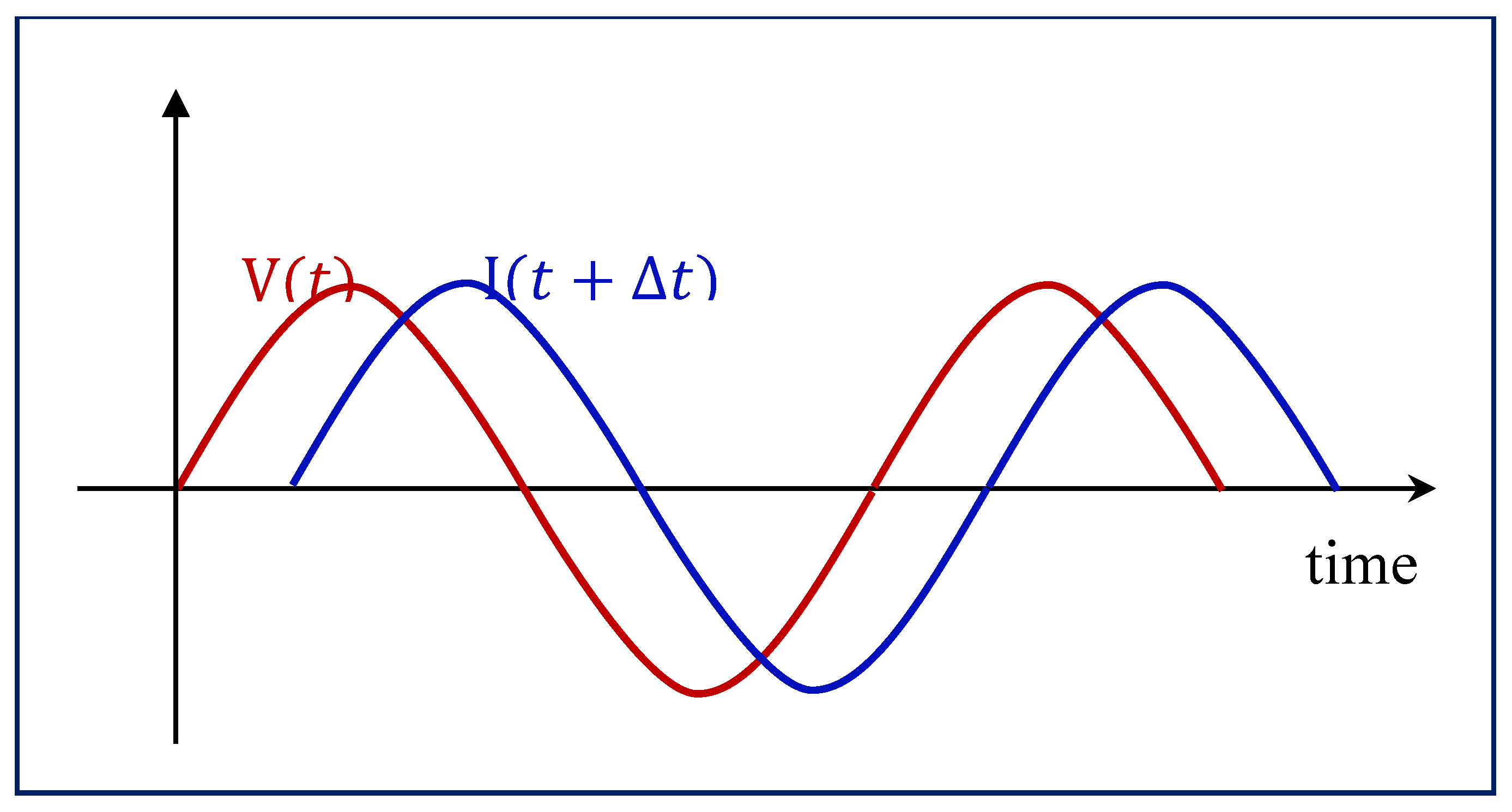
Figure 2.
Schematic illustration of the tunnel-current-induced negative capacitance (TCINC) mechanism. An AC excitation modulates the tunneling barrier in a nanoscale metal–semiconductor junction. Because the tunneling current responds with a finite delay determined by the energy-dependent tunneling probability and carrier injection dynamics, the current acquires a negative phase component, giving rise to a stable negative capacitance.
Figure 2.
Schematic illustration of the tunnel-current-induced negative capacitance (TCINC) mechanism. An AC excitation modulates the tunneling barrier in a nanoscale metal–semiconductor junction. Because the tunneling current responds with a finite delay determined by the energy-dependent tunneling probability and carrier injection dynamics, the current acquires a negative phase component, giving rise to a stable negative capacitance.
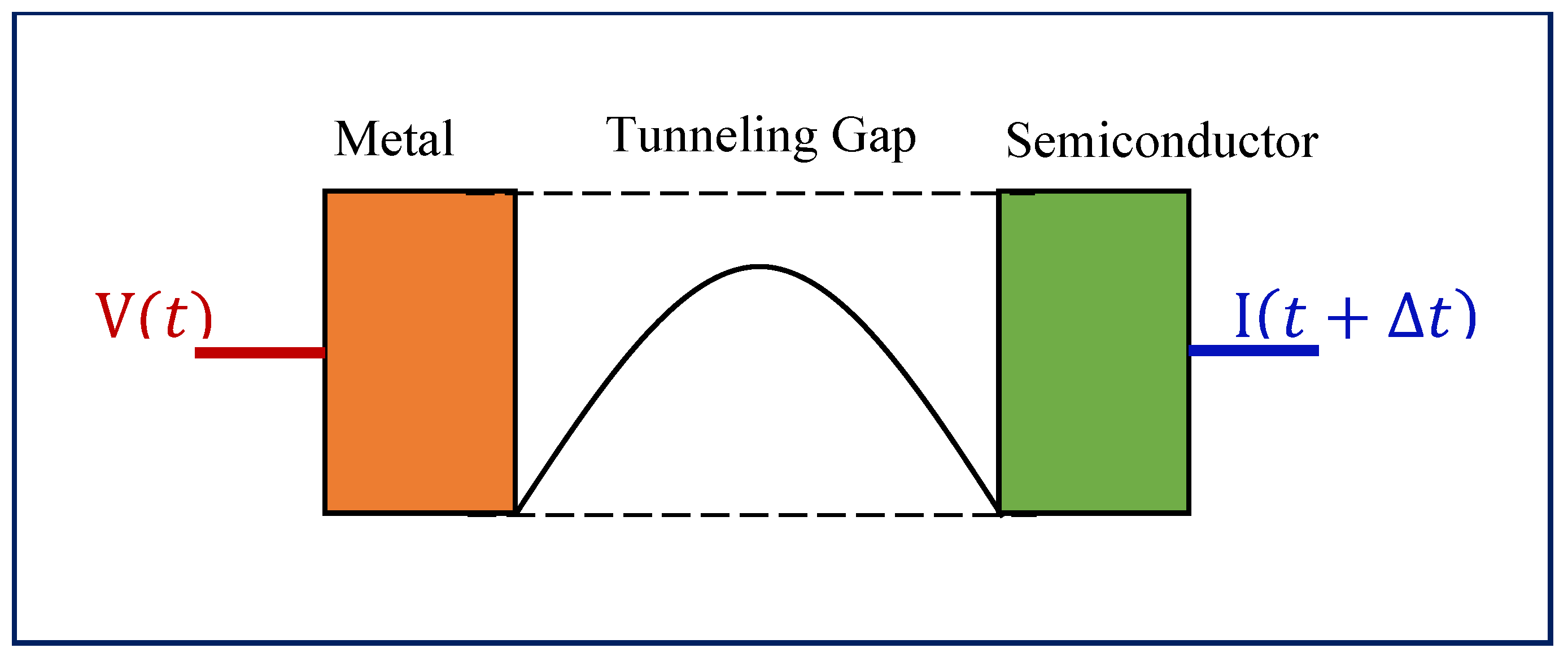
Figure 3.
Equivalent-circuit representation of TCINC. The tunneling junction is modeled as a parallel network combined with a transport-delay element. When the delay-induced negative phase dominates over the capacitive response, the extracted effective capacitance becomes negative.
Figure 3.
Equivalent-circuit representation of TCINC. The tunneling junction is modeled as a parallel network combined with a transport-delay element. When the delay-induced negative phase dominates over the capacitive response, the extracted effective capacitance becomes negative.
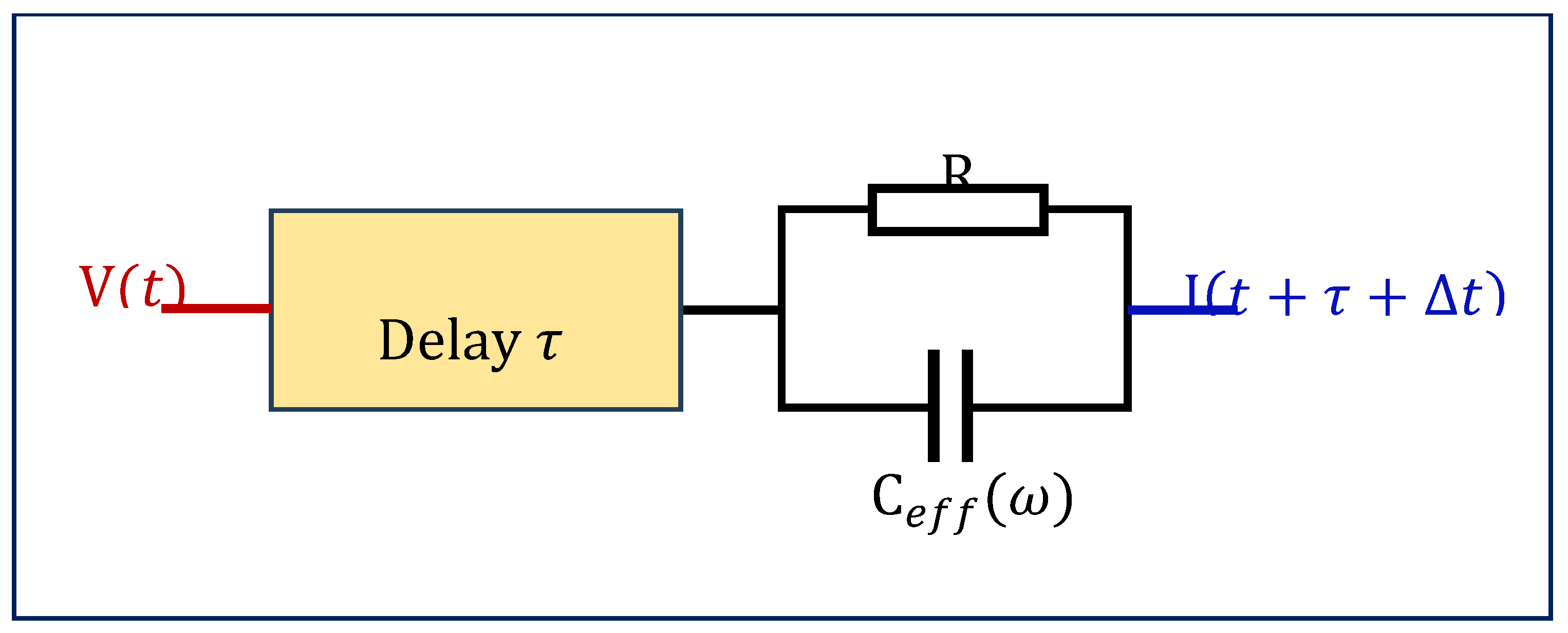
Figure 4.
Conceptual illustration of spatial mismatch. In an ideal capacitor, the electric field is uniform and aligned with the applied voltage. In real or engineered structures—such as plasmonic nanostructures, metamaterials, or systems with geometric confinement—the local electric field becomes highly nonuniform. Strong field localization near tips, edges, or interfaces redistributes charge spatially, producing an effective negative capacitive response even when all intrinsic material parameters remain positive.
Figure 4.
Conceptual illustration of spatial mismatch. In an ideal capacitor, the electric field is uniform and aligned with the applied voltage. In real or engineered structures—such as plasmonic nanostructures, metamaterials, or systems with geometric confinement—the local electric field becomes highly nonuniform. Strong field localization near tips, edges, or interfaces redistributes charge spatially, producing an effective negative capacitive response even when all intrinsic material parameters remain positive.
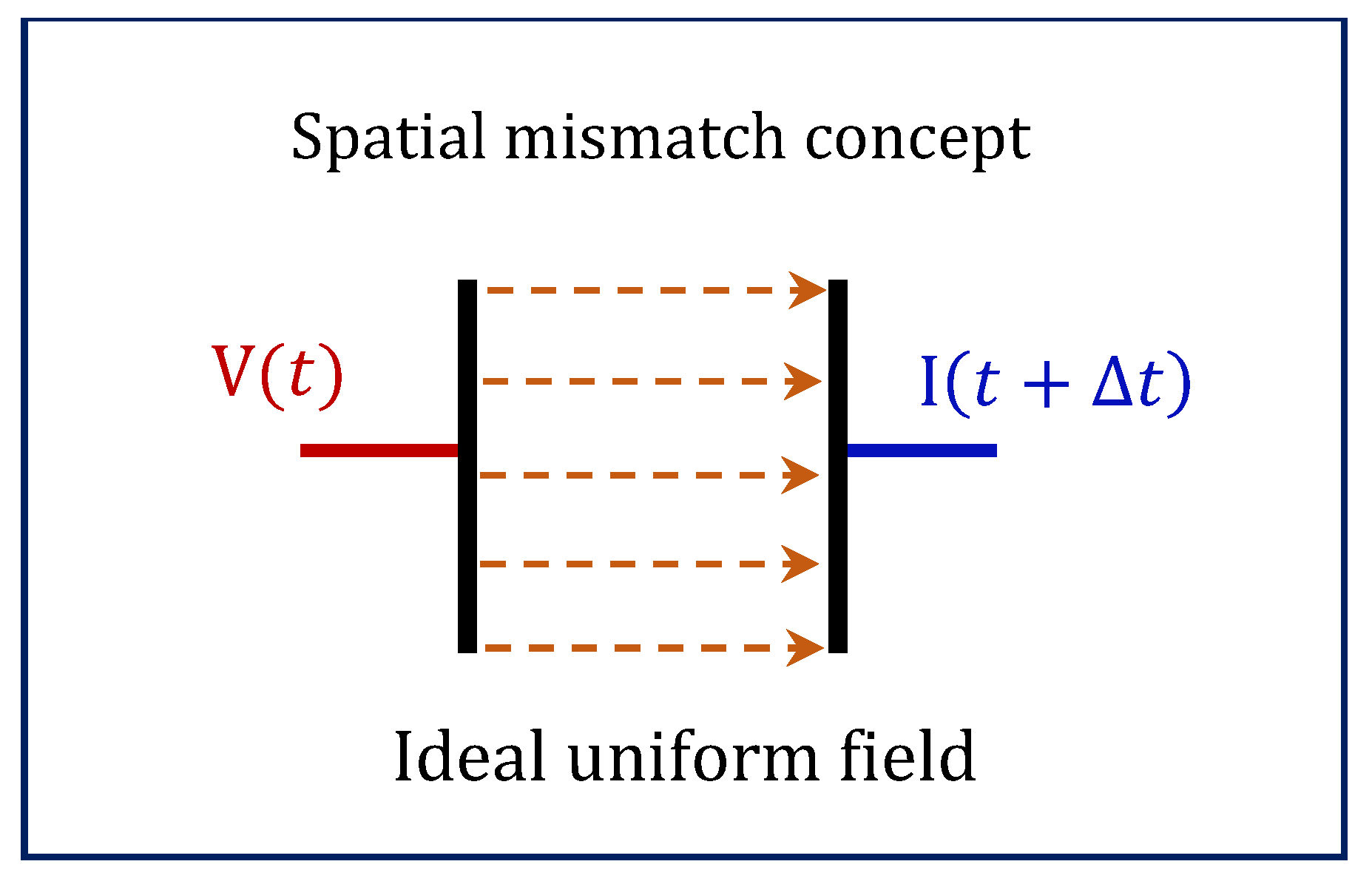
Figure 5.
Free-energy landscape of a ferroelectric material. The region between the two polarization minima exhibits negative curvature , corresponding to a negative differential permittivity and thus negative capacitance.
Figure 5.
Free-energy landscape of a ferroelectric material. The region between the two polarization minima exhibits negative curvature , corresponding to a negative differential permittivity and thus negative capacitance.
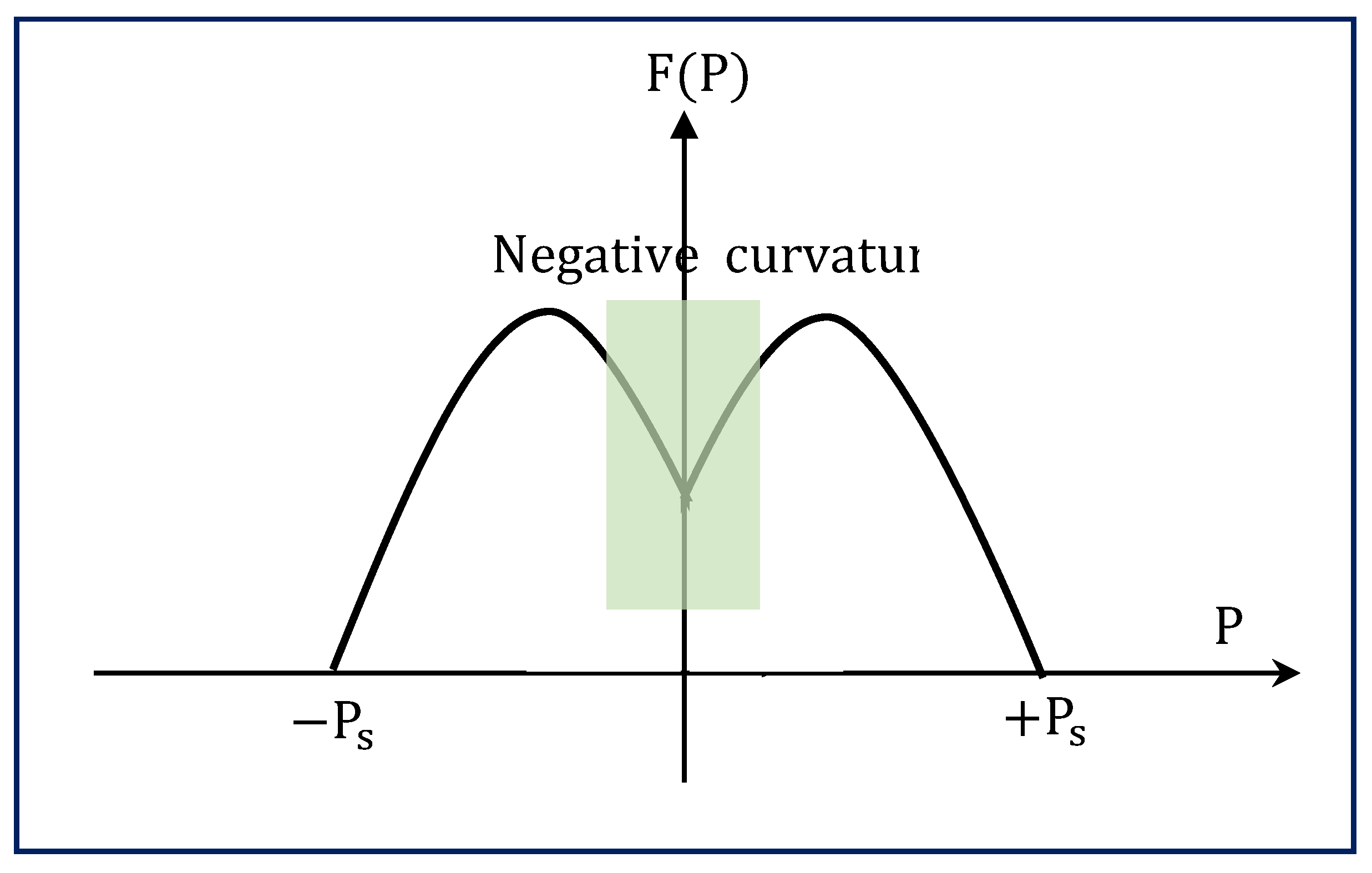
Figure 6.
Electronic compressibility in a strongly interacting electron system. When the chemical potential decreases with increasing carrier density , the electronic compressibility becomes negative, leading to effective negative capacitance in quantum-capacitance measurements.
Figure 6.
Electronic compressibility in a strongly interacting electron system. When the chemical potential decreases with increasing carrier density , the electronic compressibility becomes negative, leading to effective negative capacitance in quantum-capacitance measurements.
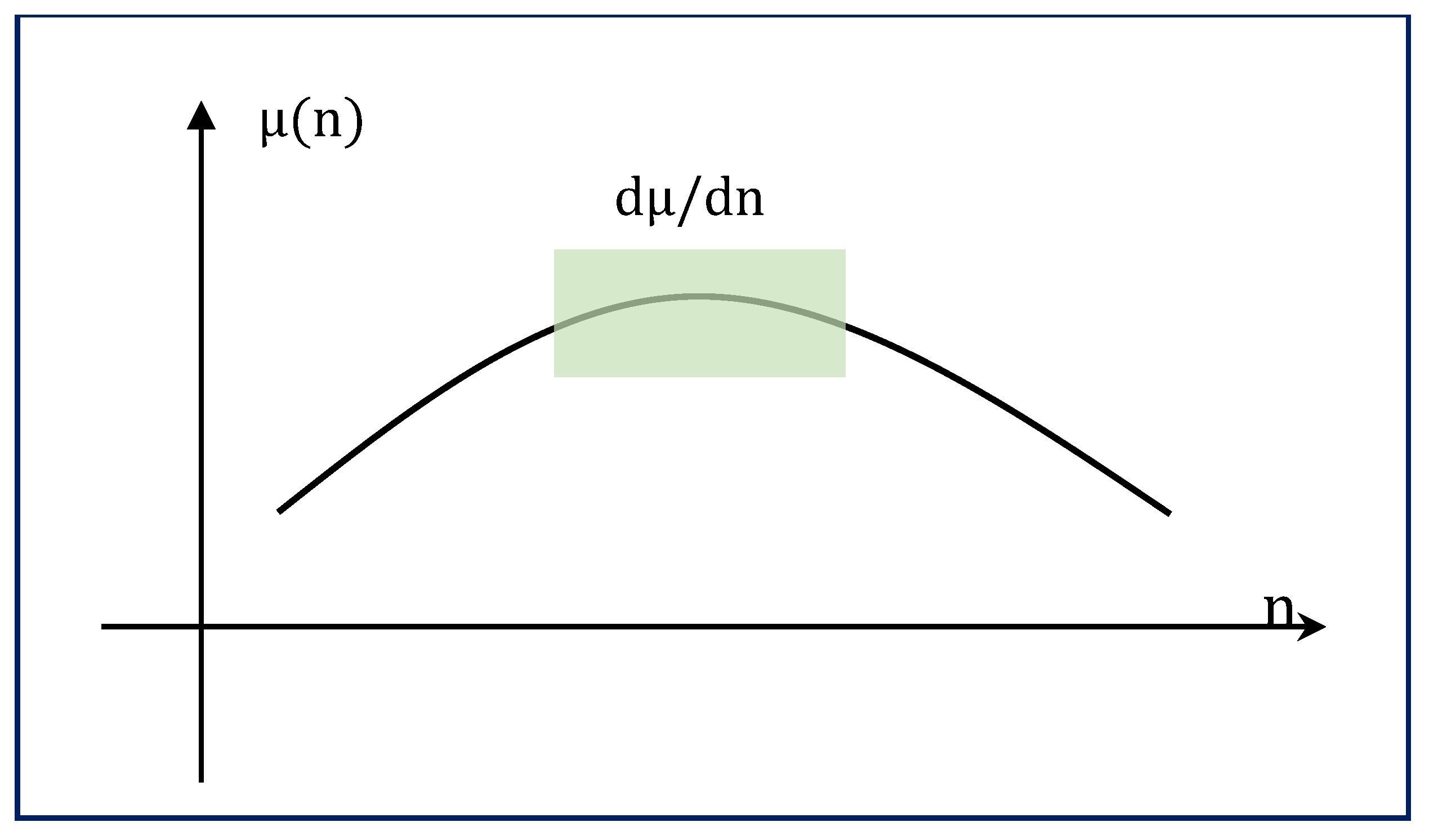
Figure 7.
Lorentz-oscillator model showing the frequency dependence of the real part of the permittivity. Above the resonance frequency , the real part of becomes negative due to the phase reversal of the bound-electron response, producing a negative-permittivity regime.
Figure 7.
Lorentz-oscillator model showing the frequency dependence of the real part of the permittivity. Above the resonance frequency , the real part of becomes negative due to the phase reversal of the bound-electron response, producing a negative-permittivity regime.
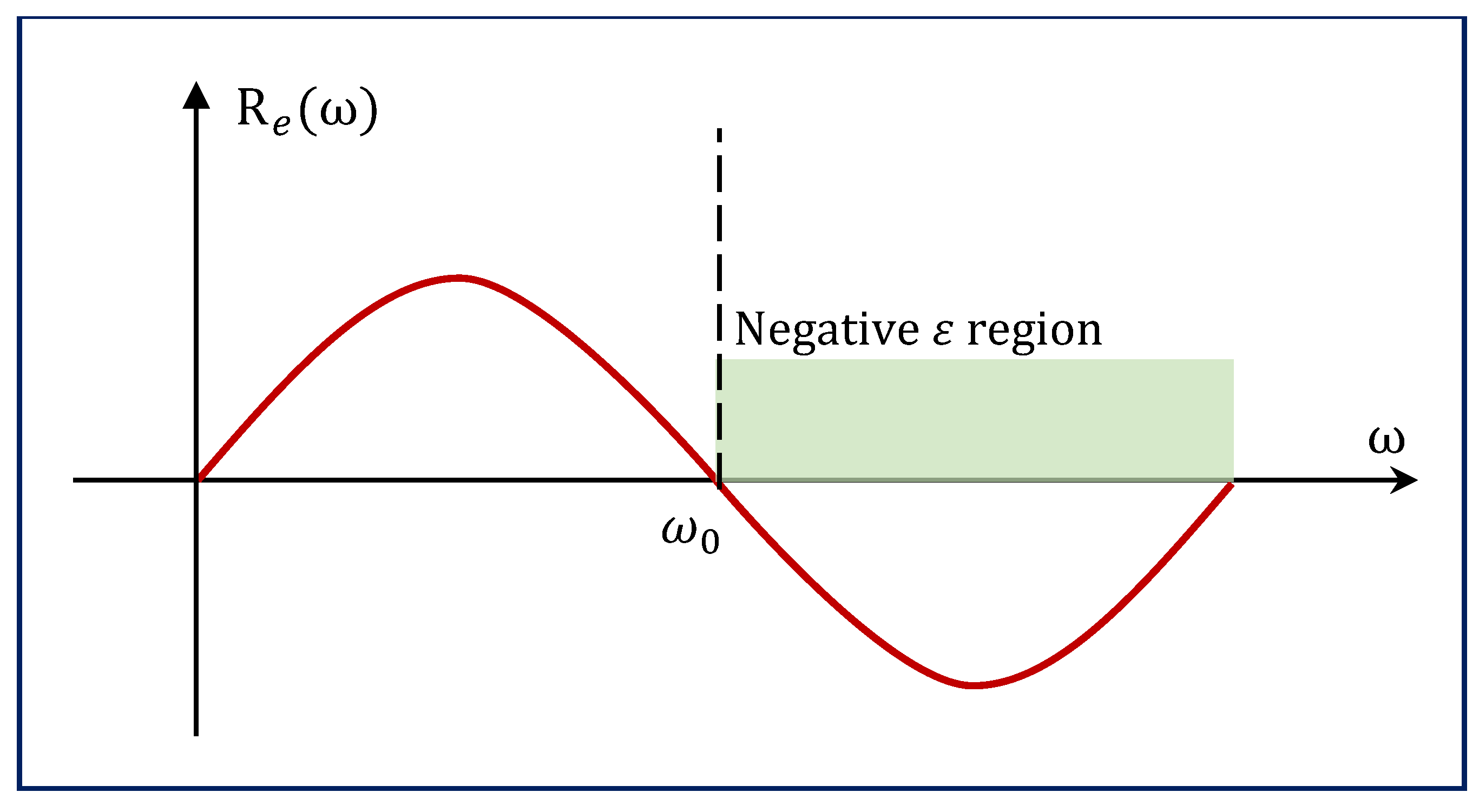
Figure 8.
Unified map of the three fundamental mechanisms of negative capacitance. Temporal mismatch arises from delays or inertia in the internal response; spatial mismatch originates from nonuniform field or mode distributions; quantitative mismatch results from intrinsic parameter reversal such as negative curvature or negative compressibility. All three mechanisms represent distinct manifestations of non-synchronization between excitation and response, leading to an effective negative capacitance .
Figure 8.
Unified map of the three fundamental mechanisms of negative capacitance. Temporal mismatch arises from delays or inertia in the internal response; spatial mismatch originates from nonuniform field or mode distributions; quantitative mismatch results from intrinsic parameter reversal such as negative curvature or negative compressibility. All three mechanisms represent distinct manifestations of non-synchronization between excitation and response, leading to an effective negative capacitance .
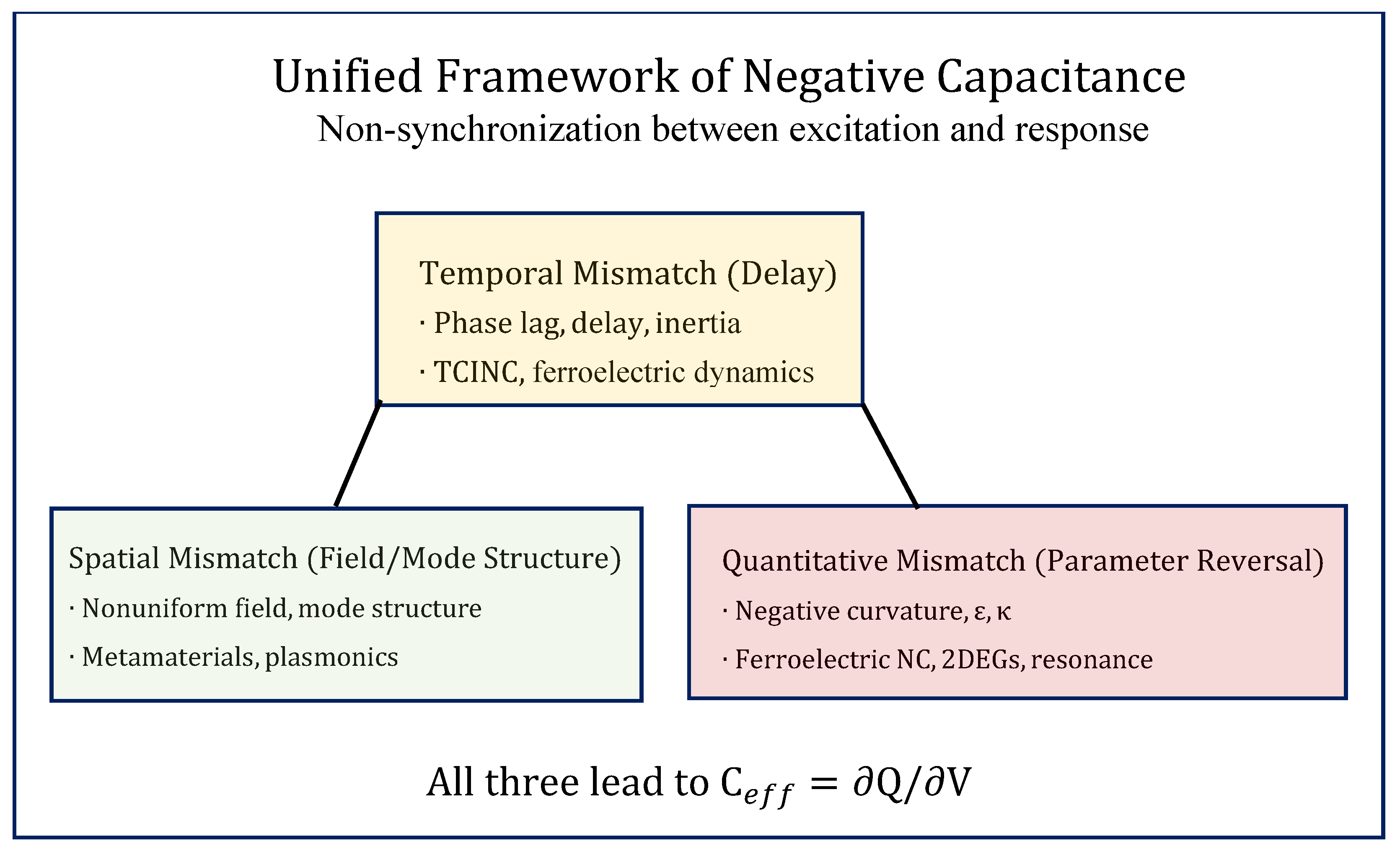

Table 1.
Classification of negative capacitance mechanisms within the unified framework.
| Mechanism | Collective or Single-Particle | Stability | Typical Frequency Range | Requires Ferroelectricity |
| Ferroelectric L-K delay | Collective | Often transient | kHz-MHz | Yes |
| Charge trapping | Single-particle | Often parasitic | Hz-kHz | No |
| Nonlinear transport delay | Single-particle | Stable | kHz-GHz | No |
| Tunnel-current-induced NC (TCINC) | Single-particle | Stable | kHz-GHz | No |
Table 2.
Comparison between temporal, spatial, and quantitative mismatch.
| Feature | Temporal Mismatch | Spatial Mismatch |
| Origin | Delay in response | Nonuniform field distribution |
| Nature | Dynamical | Geometric/modal |
| Typical systems | Ferroelectrics, tunneling, transport | Metamaterials, plasmonics, multilayers |
| Single-particle? | Sometimes | Rarely (mostly collective) |
| NC stability | Frequency-dependent | Mode-dependent |
Table 3.
Representative physical systems exhibiting each mismatch type.
| Feature | Temporal Mismatch | Spatial Mismatch | Quantitative Mismatch |
| Origin | Delay in response | Nonuniform field distribution | Intrinsic parameter reversal |
| Nature | Dynamical | Geometric/modal | Material/energetic |
| Typical systems | Ferroelectrics (dynamic), tunneling | Metamaterials, plasmonics | Ferroelectrics(static), 2DEGs, resonances |
| Single-particle? | Sometimes | Rarely | Rarely (mostly collective) |
| NC stability | Frequency-dependent | Mode-dependent | Material-dependent |
Table 4.
Design implications derived from the unified framework.
| Category | Type of mismatch | Origin | Typical systems | Key signature |
| Temporal | Time | Delay, inertia, transport | TCINC, ferroelectric dynamics | Phase lag |
| Spatial | Space | Nonuniform fields/modes | Metamaterials, plasmonics | Field localization |
| Quantitative | Magnitude | Intrinsic parameter reversal | Ferroelectrics (static), 2DEGs, resonances | Negative curvature |
Disclaimer/Publisher’s Note: The statements, opinions and data contained in all publications are solely those of the individual author(s) and contributor(s) and not of MDPI and/or the editor(s). MDPI and/or the editor(s) disclaim responsibility for any injury to people or property resulting from any ideas, methods, instructions or products referred to in the content. |
© 2026 by the authors. Licensee MDPI, Basel, Switzerland. This article is an open access article distributed under the terms and conditions of the Creative Commons Attribution (CC BY) license (http://creativecommons.org/licenses/by/4.0/).
Copyright: This open access article is published under a Creative Commons CC BY 4.0 license, which permit the free download, distribution, and reuse, provided that the author and preprint are cited in any reuse.


