

Submitted:
24 March 2026
Posted:
25 March 2026
You are already at the latest version
Abstract
Toxoplasma gondii infects most warm-blooded vertebrates and establishes lifelong persistence by encysting as latent bradyzoites within long-lived tissues, a state typically regarded as innocuous in immunocompetent hosts. We propose an alternative hypothesis: bradyzoite persistence may represent an evolved program of delayed virulence. Because T. gondii completes sexual reproduction only in felids after ingestion of infected tissues, parasite fitness is enhanced when infected tissues are consumed by felids. Host debilitation may increase vulnerability to predation or scavenging, but pathogenic effects expressed too early could jeopardize host populations; thus, selection should favor virulence that emerges after the host’s reproductive window, preserving population continuity. Multiple observations align with this hypothesis. Bradyzoite biology supports lifelong persistence across diverse host species. Pharmacologic suppression of protozoa has been associated with large and durable reductions in all-cause mortality and morbidity, including dementia, schizophrenia, and malignancy, across independent human cohorts. Viral coinfections provide plausible triggers for parasite reactivation. In parallel, T. gondii DNA increases progressively along the adenoma-to-carcinoma sequence in gastrointestinal malignancies. Together, these findings motivate a testable hypothesis: a fraction of late-life morbidity may reflect the delayed virulence of a parasite whose transmission is enhanced as hosts weaken. We present falsifiable predictions associated with this hypothesis.
Keywords:
Toxoplasma gondii
; delayed pathogenicity
; latent infection
; bradyzoites
; evolutionary ecology
; aging and chronic disease
; neurodegeneration
; colorectal cancer
; felid gut
Toxoplasma gondii establishes lifelong infection in most warm-blooded vertebrates, yet its reproductive cycle depends on ingestion of infected tissues by felids, a process ultimately incompatible with host survival. This creates a unique evolutionary constraint: parasite fitness is enhanced by host death, but virulence expressed before the host has fulfilled its reproductive role would jeopardize the transmission reservoir. We propose that the T. gondii latent stage is not a benign endpoint, but an adaptive strategy of delayed pathogenicity. Under this framework, mechanisms of host impairment that increase vulnerability to predation or scavenging are postponed until later life, when their expression does not interfere with population continuity.
1. A Unique Evolutionary Constraint: Host Death is Required for Pathogen Amplification
Most pathogens gain little by harming their hosts: their success depends on replication and transmission between living hosts, and excessive virulence is usually selected against [1]. T. gondii belongs to a distinct ecological class. Its sexual reproduction occurs exclusively in the intestines of felids that consume infected host tissues, [2,3] a step essential for genetic recombination and for producing resistant oocysts in the massive numbers that enable large-scale environmental spread [4]. Predation or scavenging, which typically involve host death, is a crucial step in the parasite's life cycle and therefore impose strong selection for traits that facilitate felid consumption of infected hosts [5]. Loss of aversion to cat odor provides one mechanism by which this process occurs in rodents [6,7]. However, T. gondii’s capacity to spread through a wide variety of host species, including birds, livestock, and primates, is not explained by rodent-specific behavioral interactions. Instead, any physiological, neurological, or systemic impairment that increases vulnerability to predation or scavenging can serve the same reproductive function across host species.
At the same time, felids target prey that provides sufficient biomass, and host impairment occurring before the host reaches an optimal edible size may reduce predation success. More importantly, high rates of host demise before completion of a minimum reproductive window may preclude host reproduction and extinguish the parasite’s own reservoir. Natural selection would therefore favor parasite traits that increase the host’s susceptibility to feline predation while preserving attainment of adult size and completion of reproduction required for local population persistence. Restraint of pathogenicity during the host reproductive phase should be intrinsically encoded in the parasite’s life-history program, because parasites endangering host reproductive success could collapse whole ecological reservoirs and drive extinction of broad parasite lineages.
Moreover, host impairments that emerge after reproduction fall into a period when natural selection on the host is weak [8,9]. Defenses against late-onset pathology confer little reproductive advantage and thus would spread poorly. By concentrating pathogenic effects in this post-reproductive “selection shadow,” a parasite may maximize transmission while minimizing host counter-adaptation.
2. Strategic Latency Through Bradyzoite Persistence
When infecting a host, T. gondii transitions from rapidly replicating tachyzoites to encysted bradyzoites. These cysts persist for decades in long-lived tissues such as neurons and skeletal muscle under immune surveillance [10]. Antigen expression is reduced, and the infection is termed “latent,” a state commonly regarded as innocuous and clinically silent in immunocompetent humans [3].
However, a metabolically restrained form that selectively encysts in long-lived tissues, actively evades immune elimination, and engages host-specific regulatory and signaling pathways is evolutionarily costly and incompatible with a dead-end strategy. Such elaborate persistence and host-adapted regulation would be unlikely to have evolved across such a wide range of vertebrate hosts unless it contributed to onward transmission. Instead, latency is best understood as an adaptive strategy that allows the parasite to persist in host tissues until the host has aged and fulfilled its reproductive role. At that stage, predation becomes advantageous for parasite transmission, and host debilitation can increase the probability that infected tissues reach a felid without compromising population continuity.
From an evolutionary perspective, latency is therefore unlikely to represent a benign stalemate, but rather a finely adapted transmission strategy that defers pathogenic effects to a stage of host life when such damage can occur without threatening the parasite's reservoir.
3. Detecting Delayed Pathogenicity
Traditional infectious disease paradigms, historically influenced by Koch’s postulates and their emphasis on consistent proximate outcomes from clearly identifiable infectious events, are not well suited to detect delayed, heterogeneous, and host-dependent effects of a ubiquitous pathogen capable of long-term stealth persistence within localized tissue niches. Recently, large-scale longitudinal electronic health records have made it possible to observe, over long time scales and without recall bias, what happens when an extremely prevalent persistent pathogen is incidentally suppressed. The resulting epidemiologic signals are strong and difficult to reconcile with the notion that latent toxoplasmosis is biologically inert.
3.1. Protozoal Suppression, Mortality and Late-Life Morbidity
In a national cohort study performed within Leumit Health Services (LHS) in Israel to identify drugs associated with increased lifespan, exposure to atovaquone–proguanil (A-P) or mefloquine, two widely used malarial prophylactic agents, was associated with large and sustained reductions in all-cause mortality over the subsequent decade [11] (Figure 1).
Both atovaquone and mefloquine inhibit a mitochondrial electron transport step in apicomplexan protozoa, including both Plasmodium species and T. gondii. Proguanil augments this effect by inhibiting dihydrofolate reductase and thereby potentiating mitochondrial collapse [12,13]. Beyond reduced all-cause mortality, protective associations were observed for diseases extending across dementia, metabolic disease, cardiovascular events, liver and renal failure, and colorectal and lung cancer. Statistical analyses employed rigorous pharmacoepidemiologic safeguards, including aligned index dates and adjustment for baseline comorbidity, with sensitivity analyses demonstrating close balance in baseline health-care utilization between exposed and comparator groups.
Each of these associations was independently replicated in the TriNetX federated network of approximately 120 million U.S. patients, using cohorts rigorously matched on age, sex, calendar time, and major clinical and demographic variables. Consistency across health systems and populations makes simple travel- or demographic-based confounding unlikely, particularly in light of strong decreases in mortality observed despite close balance of all known major factors of human morbidity at baseline.
These drugs were prescribed for their primary indication, malaria prophylaxis, but the multi-week courses typically used in this context provide a biologically plausible means of suppressing latent Toxoplasma burden in long-lived tissue reservoirs, with effects that may persist long after drug discontinuation.
While residual confounding (including healthy traveler effects and unmeasured socioeconomic or behavioral factors) cannot be fully excluded, the parsimonious interpretation of the observed reductions in mortality and morbidity is that these outcomes share a previously underrecognized common substrate: a silent protozoal infection with delayed pathogenic effects, whose burden was reduced by these antiprotozoal treatments. The observed epidemiologic signals may therefore reflect attenuation of the parasite's contribution to late-life impairment, a pattern consistent with the evolutionary constraints of T. gondii, whose reproductive success depends on its ability to facilitate felid predation or scavenging of the host at older ages.
3.1.1. Mefloquine Exposure is Associated with Reduced T. gondii Seropositivity in Young Adults
An additional clue linking antiprotozoal exposure to T. gondii biology in humans comes from a matched case-control analysis performed at LHS. We compared individuals with a first documented positive Toxoplasma serology result (IgG or IgM) to individuals with consistently negative serology across all tests. We limited the analysis to patients aged 18 to 44 years without any diagnosis of immune deficiency, including HIV infection or use of immunosuppressive treatments, and without any recorded diagnosis of clinical toxoplasmosis at any time. After exclusions and exact 1:2 matching (on sex, age at test, year of first EHR documentation, socioeconomic status, ethnic group, and pregnancy status), without reuse of participants, the final analytical dataset included 15,876 seropositive individuals and 31,752 matched seronegative controls. The population was predominantly female (97.4%), with a mean age of 28.9 ± 6.0 years in both groups, reflecting primarily routine pregnancy screening aimed at detecting asymptomatic seroconversion during pregnancy to prevent potential congenital infection and fetal harm.Exposure to mefloquine in the decade preceding serology testing was substantially less common among seropositive individuals than among matched seronegative controls (OR 0.46; 95% confidence interval (CI) 0.28–0.77, p = 0.002), consistent with an antiprotozoal effect of mefloquine on T. gondii persistence. In young adults (mostly pregnant women), T. gondii seropositivity is not associated with poorer health, and this further argues against a ‘healthy traveler’ explanation for the mefloquine protective association. Moreover, travel to malaria-endemic regions often entails conditions expected to increase, rather than decrease, exposure to food- and water-borne pathogens. The observed directionality therefore provides a simple epidemiologic clue that even time-limited exposure to antiprotozoals used for malaria prophylaxis years earlier can markedly suppress latent T. gondii persistence, in a setting where healthy traveler bias is unlikely.
3.2. Schizophrenia
Schizophrenia is an incompletely understood disease, associated with disordered thought processes and cognitive impairment, for which higher rates of T. gondii seropositivity have been detected across multiple populations, [14,15,16,17] along with immune and metabolic abnormalities [18,19,20,21,22]. If persistent toxoplasmosis contributes to disease risk, two predictions follow: suppression of the parasite should be protective, and impairment of host mechanisms that normally contain intracellular pathogens should increase risk. Both patterns were observed in an LHS cohort study [23].
In a medication-wide screen covering all drugs dispensed in the decade before first schizophrenia diagnosis, the strongest protective associations clustered around agents with known anti-Toxoplasma activity, including atovaquone–proguanil used for malaria prophylaxis, clindamycin-based regimens used for acne, and moxifloxacin and oxytetracycline/polymyxin-B ophthalmic drops used to treat eye infections or for perioperative prophylaxis. Each of these associations was independently replicated in the TriNetX network with similar effect sizes and directionality. An independent study also reported a protective association for doxycycline, another tetracycline with anti-Toxoplasma effects [24].
Host biological context further supports this interpretation. Before diagnosis, individuals who later developed schizophrenia showed lower vitamin D and T3 levels, higher rates of liver disease and alcoholism, reduced mucosal and barrier integrity, and increased prevalence of chronic viral hepatitis, whereas hepatitis A vaccination and episodes of transient mucosal inflammation were protective. Together, these features indicate impaired immune containment of intracellular parasites, [20] a milieu in which latent T. gondii may shift from quiescence to clinically relevant neurobiological effects.
3.3. Heterogeneous, Stochastic Pathogenicity as an Adaptive Strategy
Under the delayed-pathogenicity framework, cognitive impairment and spatial disorientation represent phenotypes that likely increase vulnerability to predation or scavenging and thereby enhance felid consumption of infected hosts. However, stereotyped debilitation could destabilize predator-prey dynamics. T. gondii circulates across ecosystems containing multiple felid predators occupying distinct hunting and scavenging niches. If it were to produce a uniform pattern of host impairment that disproportionately benefits predators exploiting cognitively impaired prey over other felid predators or scavengers, this would restrict the ecological contexts in which T. gondii’s sexual reproduction can occur. Instead, a predation-dependent parasite would be expected to benefit from heterogeneity in the expression of host impairment, so that scattered disoriented individuals become available to predators exploiting this vulnerability, while other infected hosts follow different trajectories of decline aligned with alternative feline feeding strategies. Such diversification could provide a steady flow of prey across multiple feline ecological pathways, promoting sustained parasite sexual reproduction in diverse felid species.
A natural source of stochasticity that may provide diversity in host-impairment pathways and timing could be a viral infection reaching tissues in which T. gondii maintains a latent presence. At the population level, viral seasonality, epidemic waves, and host immune variability introduce heterogeneity in viral exposure across individuals. Within hosts, viruses spread locally, and some viruses, particularly herpesviruses, typically maintain latency in long-lived tissues and can reactivate focally as immune control weakens, introducing variation in tissue localization and intensity. Sporadic reactivation of varicella zoster virus (VZV) affecting a particular dorsal root ganglion produces shingles, a painful example of age-dependent focal viral reactivation. Analogous reactivation within the brain may occur silently. Such focal viral reactivations could provide the stochastic signal that modulates the timing and type of disability produced by T. gondii reactivation, while also serving as a biologic readout of immune weakening indicative of an aging host, for which predation has become advantageous. Conversely, coinfection of tissues with oncogenic human papillomavirus strains may provide the stochastic signal that modulates T. gondii’s contribution to oncogenic pathways ultimately producing malignancy, as another means to debilitate the host at older age.
3.4. Dementia, Viral Triggers, and Delayed Protozoal Pathogenicity
T. gondii seropositivity has been reported to be higher across the dementia spectrum, from mild cognitive impairment to Alzheimer’s disease [25,26,27]. If latent toxoplasmosis contributes to late-life neurodegeneration, then interventions that suppress the parasite or prevent its reactivation should reduce dementia risk, whereas conditions that destabilize immune control should increase it. This pattern has been observed. In an unsupervised medication-wide screen performed in the U.K., a significantly lower incidence of Alzheimer’s disease was detected among individuals prescribed atovaquone–proguanil (A-P) or mefloquine, both CNS-penetrant antiprotozoals [28]. The protective association with A-P was independently detected in LHS and further replicated in large, age-stratified, rigorously matched U.S. TriNetX cohorts, where protection persisted for more than 10 years after exposure across multiple age strata [29].
Independent evidence points to a viral contributing effect. Varicella–zoster virus (VZV) vaccination is associated with reduced dementia risk [30,31], and herpesvirus genomic signatures are enriched in Alzheimer’s disease brain tissue, while antiviral therapy is associated with lower dementia incidence [32,33]. Experimental and clinical studies show that herpesvirus infection can impair immune control of latent T. gondii and induce protozoal reactivation within the central nervous system [34].
Consistent with this interaction model, the protective association of A-P was observed mostly for individuals who had not received VZV vaccination, and the protective association of VZV vaccination was observed mostly among those not exposed to A-P, suggesting that both act on the same downstream pathogenic pathway (Figure 2).
Longitudinal serologic data further support the framework: individuals seropositive for T. gondii had higher subsequent risk of dementia, with serology preceding diagnosis by many years. Together, medication, vaccination, and serologic evidence converge on a coherent model in which latent protozoal persistence, whose episodic reactivation, enabled by viral coinfection, contributes to stochastic late-life neurodegeneration.
3.5. Cancer
Increased T. gondii seropositivity has been observed in large prospective cohorts, notably in colorectal cancer and glioma, with timing indicating that infection occurs before tumor development [35,36,37]. Like neurodegeneration, malignancy risk increases with older age, impairs host fitness and would be expected to facilitate predation by impairing the host’s ability to evade predators, and scavenging if the host dies from cancer. If latent toxoplasmosis contributes to carcinogenesis, then protozoal suppression should reduce cancer risk, and this pattern has been observed.
In Sweden, use of atovaquone–proguanil (A-P) was associated with reduced colorectal cancer incidence [38]. This protective association was independently replicated in the TriNetX network, where reduced risk of gastrointestinal malignancies persisted for up to 10 years after exposure and extended to pancreatic cancer [39]. The durability of protection following brief prophylaxis is more consistent with suppression of a persistent carcinogenic factor than with a direct tissue effect occurring only during drug exposure.
Microbiome sequencing experiments provide complementary clues. Reanalysis of a large colorectal cancer metagenomic dataset (PRJEB6070) using protozoa-inclusive reference libraries identified T. gondii as the single most discriminatory taxon, exceeding Fusobacterium, which was the most discriminatory taxon in the original study [39]. T. gondii DNA was detected in 22.1% of cancer samples compared with 1.53% of controls, with abundance increasing progressively from normal mucosa to adenoma to carcinoma (Figure 3).
Together, prospective serology, durable pharmacoepidemiologic protection, and direct detection of parasite DNA along the adenoma-carcinoma sequence converge on a coherent model in which persistent toxoplasmosis is implicated in malignant transformation in the human gut and possibly beyond.
4. Testable Predictions and Research Roadmap
If latent T. gondii contributes meaningfully to age-associated morbidity, with pathogenic expression delayed until later life, then several empirically verifiable and potentially falsifiable predictions emerge.
4.1. Molecular Enrichment in Disease-Relevant Tissues
4.1.1. Tissue Colonization Would be Associated with Disease
Diseases suspected of being influenced by latent Toxoplasma would be expected to demonstrate higher rates of detectable parasite DNA or RNA in relevant tissues, particularly along progressive biological gradients (premalignant lesions, preclinical neurodegeneration, subclinical vascular injury). Importantly, colonization may be compartmentalized, meaning that absence of serologic response does not exclude tissue-level persistence. Demonstrating tissue-embedded parasites prior to clinical onset would provide strong evidence against incidental contamination.
4.1.2. Tissue-Specific Latent Infection May Be Detected Non-Invasively.
If latency represents an active biological program rather than inert dormancy, parasite-specific metabolic pathways may be detectable using immunohistochemical markers or PET tracers targeting apicomplexan mitochondria, cyst-wall glycans, or Toxoplasma-specific enzymes. Demonstrating spatial colocalization between tracer uptake and disease-relevant pathology would provide an independent validation layer beyond molecular detection alone.
4.2. Interventional Proof Through Controlled Suppression
4.2.1. Short-Course Suppressive Regimens May Yield Durable Benefit
Randomized trials in individuals with evidence of latent infection may test whether suppressive anti-Toxoplasma regimens produce durable reductions in selected aging-related outcomes, including dementia, malignancy, cardiovascular events, metabolic disease, or mortality. If benefits persist beyond the treatment period and correlate with reduced molecular signatures of parasite activity, this would provide compelling evidence consistent with causality. Conversely, the absence of a measurable durable effect would challenge the delayed-pathogenicity framework.
4.2.2. Pathogenic Transition is Expected to be Regulated by Hormonal Changes Associated with the End of Reproductive Phase
Since natural selection would be expected to favor host impairment that is delayed until after active reproduction, T. gondii is expected to have evolved mechanisms to sense host reproductive potential. Transition to pathogenicity may be inhibited by hormones associated with reproductive activity and enabled by menopause and other endocrine changes accompanying aging. Candidate signals include alterations in the GnRH axis, sex steroid trajectories (progesterone, estrogens, testosterone, DHEA), and reproductive hormones (prolactin, oxytocin, inhibin/activin, AMH), as well as pregnancy-associated hormones (hCG, hPL, relaxin) and age-associated changes in thyroid and growth-hormone signaling. This hypothesis can be evaluated in animal models and mechanistic studies, and in human cohorts by examining endocrine trajectories preceding outcomes plausibly linked to T. gondii-mediated impairment.
4.3. Reconsidering Serology as a Marker Of Latent Infection
Serologic positivity is commonly treated as the canonical marker of Toxoplasma infection status. However, this assumption has important limitations. Immune responses vary substantially across hosts, and persistent infection confined to digestive, epithelial, or mucosal tissues without hematogenous dissemination may fail to elicit a durable serologic response. Under an evolutionary strategy aimed at delaying pathogenicity until later life, the parasite may maintain persistence in localized host niches and limit systemic invasion in order to avoid triggering a potent immune response until host impairment becomes advantageous. Moreover, seropositivity may behave as a continuum rather than a binary state. Strong antibody responses may reflect ongoing immune engagement, whereas lower antibody titers, potentially below the standard positivity threshold, could, in some individuals, reflect declining immune surveillance rather than absence of infection. Accordingly, future studies should integrate multiple markers of latency, including tissue-level molecular detection, immune signatures, and imaging biomarkers. Serology remains informative, but it likely captures only part of the spectrum of persistent infection.
5. Conclusions: A Parasite Optimized for Delayed Morbidity
Across independent disease domains, convergent evidence summarized in Table 1 reveals a coherent and internally consistent pattern suggesting T. gondii involvement in a wide range of pathogenetic processes. No single currently established host-centered degenerative model readily explains this cross-domain convergence. In contrast, parasite-mediated health deterioration that emerges in late life follows naturally from the evolutionary constraints dictated by T. gondii’s life cycle. Because the parasite can complete sexual reproduction only when infected host tissue is consumed by a felid, natural selection would be expected to favor traits optimized to produce health or behavioral impairment in late adult life, when predation or scavenging becomes advantageous for parasite transmission without endangering population continuity.
Humans are frequently and repeatedly exposed to T. gondii through environmental oocysts in soil, water, and fresh produce, as well as through consumption of undercooked meat, unpasteurized milk [40] and shellfish [41]. As incidental intermediate hosts, humans may experience deleterious pathogenic effects selected by evolution in other warm-blooded species to facilitate felid consumption of infected hosts. Accordingly, T. gondii-induced pathogenicity may manifest as health disorders of later life, including vascular, metabolic, neurodegenerative, and malignant disease. Long-term tissue persistence with minimal replication and immune activation, delayed pathogenicity, and the possibility that serologic responses may fail to capture low-grade or tissue-restricted infection raise the possibility that a major contributor to human morbidity could have remained largely unrecognized.
Together, evolutionary logic and human data support a testable hypothesis: a measurable fraction of late-life morbidity may reflect delayed consequences of T. gondii infection rather than purely intrinsic processes. If correct, at least some age-related diseases may depend on targetable infectious factors [42], with substantial health implications. Suppressing latent protozoal infection, preventing reactivation, or interrupting transmission could provide a practical means of promoting healthy aging by targeting an upstream ecological driver of multisystem morbidity. Importantly, this hypothesis yields specific falsifiable predictions that can be evaluated using controlled cohort studies and metagenomic, molecular, and metabolic analyses.
Author Contributions
A.I.: Investigation, Writing – Original Draft Preparation. S.I.: Writing – Review & Editing.
Funding
This research received no external funding.
Institutional Review Board Statement
The study was conducted in accordance with the Declaration of Helsinki, and approved by the Institutional Review Board of Leumit Health Services (LEU-0019-25, approved on July 4, 2025).
Informed Consent Statement
Informed consent was waived by the Institutional Review Board because the study was retrospective and based on fully de-identified data.
Data Availability Statement
Data supporting the referenced publications are available as described in those articles and their associated public repositories. Individual-level patient data from Leumit Health Services are not publicly available due to privacy and regulatory restrictions, but may be made available upon reasonable request to qualified researchers, subject to IRB approval.
Conflicts of Interest
The authors declare the following financial interests/personal relationships which may be considered as potential competing interests: A.I. is an inventor on patent applications in the field of diagnostic and therapeutic development. No commercial agreements currently exist related to these filings. Otherwise, there are no conflicts of interest in relation to the subject of this study.
Abbreviations
| A-P | Atovaquone-Proguanil |
| BMI | Body mass Index |
| CI | Confidence Interval |
| CRC | colorectal cancer |
| DM | Diabetes Mellitus |
| EHRs | electronic health records |
| HR | Hazard ratios |
| LHS | Leumit Health Services |
| T3 | triiodothyronine |
| VZV | Varicella Zoster Virus |
References
- Shukla, R.; Soni, J.; Kumar, A.; Pandey, R. Uncovering the Diversity of Pathogenic Invaders: Insights into Protozoa, Fungi, and Worm Infections. Front. Microbiol. 2024, 15. [Google Scholar] [CrossRef]
- DUBEY, J.; JONES, J. Toxoplasma Gondii Infection in Humans and Animals in the United States. Int. J. Parasitol. 2008, 38, 1257–1278. [Google Scholar] [CrossRef]
- Montoya, J.; Liesenfeld, O. Toxoplasmosis. The Lancet 2004, 363, 1965–1976. [Google Scholar] [CrossRef]
- Martorelli Di Genova, B.; Wilson, S.K.; Dubey, J.P.; Knoll, L.J. Intestinal Delta-6-Desaturase Activity Determines Host Range for Toxoplasma Sexual Reproduction. PLoS Biol. 2019, 17, e3000364. [Google Scholar] [CrossRef]
- Innes, E.A. Toxoplasmosis: Comparative Species Susceptibility and Host Immune Response. Comp. Immunol. Microbiol. Infect. Dis. 1997, 20, 131–138. [Google Scholar] [CrossRef]
- Webster, J.P. The Effect of Toxoplasma Gondii on Animal Behavior: Playing Cat and Mouse. Schizophr. Bull. 2007, 33, 752–756. [Google Scholar] [CrossRef]
- Tong, W.H.; Pavey, C.; O’Handley, R.; Vyas, A. Behavioral Biology of Toxoplasma Gondii Infection. Parasit. Vectors 2021, 14, 77. [Google Scholar] [CrossRef]
- Medawar, P.B. An Unsolved Problem of Biology; H.K. Lewis: London, 1952. [Google Scholar]
- Williams, G.C. Pleiotropy, Natural Selection, and the Evolution of Senescence. Evolution (N Y). 1957, 11, 398–411. [Google Scholar]
- Sullivan, W.J.; Jeffers, V. Mechanisms of Toxoplasma Gondii Persistence and Latency. FEMS Microbiol. Rev. 2012, 36, 717–733. [Google Scholar] [CrossRef] [PubMed]
- Israel, A.; Weizman, A.; Israel, S.; Ashkenazi, S.; Ruppin, E.; Vinker, S.; Magen, E.; Merzon, E. Antiprotozoal Medications Associated with Increased Longevity and Reduced Morbidity in Two National Cohorts. MedRxiv 2025. [Google Scholar] [CrossRef]
- Spencer, C.M.; Goa, K.L. Atovaquone. Drugs 1995, 50, 176–196. [Google Scholar] [CrossRef]
- Pudney, M.; Gutteridge, W.; Zeman, A.; Dickins, M.; Woolley, J.L. Atovaquone and Proguanil Hydrochloride: A Review of Nonclinical Studies. J. Travel Med. 1999, 6 Suppl 1, S8–12. [Google Scholar] [CrossRef]
- Cetinkaya, Z.; Yazar, S.; Gecici, O.; Namli, M.N. Anti-Toxoplasma Gondii Antibodies in Patients With Schizophrenia--Preliminary Findings in a Turkish Sample. Schizophr. Bull. 2007, 33, 789–791. [Google Scholar] [CrossRef]
- Flegr, J. Effects of Toxoplasma on Human Behavior. Schizophr. Bull. 2007, 33, 757–760. [Google Scholar] [CrossRef]
- Torrey, E.F.; Bartko, J.J.; Yolken, R.H. Toxoplasma Gondii and Other Risk Factors for Schizophrenia: An Update. Schizophr. Bull. 2012, 38, 642–647. [Google Scholar] [CrossRef]
- Sutterland, A.L.; Fond, G.; Kuin, A.; Koeter, M.W.J.; Lutter, R.; van Gool, T.; Yolken, R.; Szoke, A.; Leboyer, M.; de Haan, L. Beyond the Association. Toxoplasma Gondii in Schizophrenia, Bipolar Disorder, and Addiction: Systematic Review and Meta-analysis. Acta Psychiatr. Scand. 2015, 132, 161–179. [Google Scholar] [CrossRef]
- Cui, X.; McGrath, J.J.; Burne, T.H.J.; Eyles, D.W. Vitamin D and Schizophrenia: 20 Years On. Mol. Psychiatry 2021, 26, 2708–2720. [Google Scholar] [CrossRef] [PubMed]
- Brand, B.A.; de Boer, J.N.; Sommer, I.E.C. Estrogens in Schizophrenia: Progress, Current Challenges and Opportunities. Curr. Opin. Psychiatry 2021, 34, 228–237. [Google Scholar] [CrossRef] [PubMed]
- Khandaker, G.M.; Cousins, L.; Deakin, J.; Lennox, B.R.; Yolken, R.; Jones, P.B. Inflammation and Immunity in Schizophrenia: Implications for Pathophysiology and Treatment. Lancet Psychiatry 2015, 2, 258–270. [Google Scholar] [CrossRef]
- Müller, N.; Weidinger, E.; Leitner, B.; Schwarz, M.J. The Role of Inflammation in Schizophrenia. Front. Neurosci. 2015, 9. [Google Scholar] [CrossRef]
- Misiak, B.; Stańczykiewicz, B.; Wiśniewski, M.; Bartoli, F.; Carra, G.; Cavaleri, D.; Samochowiec, J.; Jarosz, K.; Rosińczuk, J.; Frydecka, D. Thyroid Hormones in Persons with Schizophrenia: A Systematic Review and Meta-Analysis. Prog. Neuropsychopharmacol. Biol. Psychiatry 2021, 111, 110402. [Google Scholar] [CrossRef]
- Israel, A.; Weizman, A.; Israel, S.; Stokar, J.; Ashkenazi, S.; Vinker, S.; Magen, E.; Merzon, E. Systematic Screening Identifies Medication and Disease Factors Associated with Schizophrenia Risk. Brain Behav. Immun. 2026, 131, 106135. [Google Scholar] [CrossRef]
- Lång, U.; Metsälä, J.; Ramsay, H.; Boland, F.; Heikkilä, K.; Pulakka, A.; Lawlor, A.; O’Connor, K.; Veijola, J.; Kajantie, E.; et al. Doxycycline Use in Adolescent Psychiatric Patients and Risk of Schizophrenia: An Emulated Target Trial. American Journal of Psychiatry 2025. [Google Scholar] [CrossRef]
- Kusbeci, O.Y.; Miman, O.; Yaman, M.; Aktepe, O.C.; Yazar, S. Could Toxoplasma Gondii Have Any Role in Alzheimer Disease? Alzheimer Dis. Assoc. Disord. 2011, 25, 1–3. [Google Scholar] [CrossRef]
- Wang, J.; Lin, P.; Li, D.; Yang, B.; Wang, J.; Feng, M.; Cheng, X. Analysis of the Correlation Between Toxoplasma Gondii Seropositivity and Alzheimer’s Disease. Pathogens 2024, 13, 1021. [Google Scholar] [CrossRef] [PubMed]
- Wiener, R.C.; Waters, C.; Bhandari, R. The Association of Toxoplasma Gondii IgG and Cognitive Function Scores: NHANES 2013–2014. Parasitol. Int. 2020, 78, 102123. [Google Scholar] [CrossRef]
- Wilkinson, T.; Schnier, C.; Bush, K.; Rannikmäe, K.; Lyons, R.A.; McTaggart, S.; Bennie, M.; Sudlow, C.L. Drug Prescriptions and Dementia Incidence: A Medication-Wide Association Study of 17000 Dementia Cases among Half a Million Participants. J. Epidemiol. Community Health (1978). 2022, 76, 223–229. [Google Scholar] [CrossRef]
- Israel, A.; Weizman, A.; Israel, S.; Ashkenazi, S.; Vinker, S.; Magen, E.; Merzon, E. Atovaquone/Proguanil Use and Zoster Vaccination Are Associated with Reduced Alzheimer’s Disease Risk in Two Cohorts: Implications for a Latent Toxoplasma Gondii Mechanism. Brain Behav. Immun. 2026, 134, 106473. [Google Scholar] [CrossRef] [PubMed]
- Taquet, M.; Dercon, Q.; Todd, J.A.; Harrison, P.J. The Recombinant Shingles Vaccine Is Associated with Lower Risk of Dementia. Nat. Med. 2024, 30, 2777–2781. [Google Scholar] [CrossRef]
- Pomirchy, M.; Bommer, C.; Pradella, F.; Michalik, F.; Peters, R.; Geldsetzer, P. Herpes Zoster Vaccination and Dementia Occurrence. JAMA 2025. [Google Scholar] [CrossRef]
- Readhead, B.; Haure-Mirande, J.-V.; Funk, C.C.; Richards, M.A.; Shannon, P.; Haroutunian, V.; Sano, M.; Liang, W.S.; Beckmann, N.D.; Price, N.D.; et al. Multiscale Analysis of Independent Alzheimer’s Cohorts Finds Disruption of Molecular, Genetic, and Clinical Networks by Human Herpesvirus. Neuron 2018, 99, 64–82.e7. [Google Scholar] [CrossRef]
- Tzeng, N.-S.; Chung, C.-H.; Lin, F.-H.; Chiang, C.-P.; Yeh, C.-B.; Huang, S.-Y.; Lu, R.-B.; Chang, H.-A.; Kao, Y.-C.; Yeh, H.-W.; et al. Anti-Herpetic Medications and Reduced Risk of Dementia in Patients with Herpes Simplex Virus Infections—a Nationwide, Population-Based Cohort Study in Taiwan. Neurotherapeutics 2018, 15, 417–429. [Google Scholar] [CrossRef]
- Chapuis, A.; Chabrot, C.; Mirand, A.; Poirier, P.; Nourrisson, C. Encephalitis Caused by an Unusual Human Herpes Virus Type 6 and Toxoplasma Gondii Co-Infection in a Cord Blood Transplant Recipient. International Journal of Infectious Diseases 2016, 46, 79–81. [Google Scholar] [CrossRef] [PubMed]
- Yu, Y.; Guo, D.; Qu, T.; Zhao, S.; Xu, C.; Wang, L.; Wang, Z.; Fu, H.; Zhang, X.; Zhou, N. Increased Risk of Toxoplasma Gondii Infection in Patients with Colorectal Cancer in Eastern China: Seroprevalence, Risk Factors, and a Case–Control Study. Biomed Res. Int. 2020, 2020. [Google Scholar] [CrossRef]
- Abdollahi, A.; Razavian, I.; Razavian, E.; Ghodsian, S.; Almukhtar, M.; Marhoommirzabak, E.; Sartip, B.; Parsa, H.; Rostami, A. Toxoplasma Gondii Infection/Exposure and the Risk of Brain Tumors: A Systematic Review and Meta-Analysis. Cancer Epidemiol. 2022, 77, 102119. [Google Scholar] [CrossRef]
- Hodge, J.M.; Coghill, A.E.; Kim, Y.; Bender, N.; Smith-Warner, S.A.; Gapstur, S.; Teras, L.R.; Grimsrud, T.K.; Waterboer, T.; Egan, K.M. Toxoplasma Gondii Infection and the Risk of Adult Glioma in Two Prospective Studies. Int. J. Cancer 2021, 148, 2449–2456. [Google Scholar] [CrossRef]
- Zhang, N.; Sundquist, J.; Sundquist, K.; Ji, J. Proguanil and Atovaquone Use Is Associated with Lower Colorectal Cancer Risk: A Nationwide Cohort Study. BMC Med. 2022, 20, 439. [Google Scholar] [CrossRef]
- Israel, A.; Israel, S.; Weizman, A.; Ashkenazi, S.; Vinker, S.; Magen, E.; Merzon, E. Atovaquone-Proguanil and Reduced Digestive Cancer Risk: A Toxoplasma Gondii Connection. Gut Microbes 2025, 17. [Google Scholar] [CrossRef] [PubMed]
- Saad, N.M.; Hussein, A.A.A.; Ewida, R.M. Occurrence of Toxoplasma Gondii in Raw Goat, Sheep, and Camel Milk in Upper Egypt. Vet. World 2018, 11, 1262–1265. [Google Scholar] [CrossRef] [PubMed]
- Nayeri, T.; Sarvi, S.; Daryani, A. Toxoplasma Gondii in Mollusks and Cold-Blooded Animals: A Systematic Review. Parasitology 2021, 148, 895–903. [Google Scholar] [CrossRef]
- Kennedy, B.K.; Berger, S.L.; Brunet, A.; Campisi, J.; Cuervo, A.M.; Epel, E.S.; Franceschi, C.; Lithgow, G.J.; Morimoto, R.I.; Pessin, J.E.; et al. Geroscience: Linking Aging to Chronic Disease. Cell 2014, 159, 709–713. [Google Scholar] [CrossRef] [PubMed]
Figure 1.
Sustained protozoal suppression is associated with reduced long-term human mortality. Cumulative all-cause mortality in propensity-score–matched cohorts exposed to atovaquone–proguanil (A-P) versus matched controls in the TriNetX real-world network (24,461 A-P users; 24,377 controls), followed for 8 years after the index exposure. Both arms were matched on age (69.0 ± 5.8), sex (55% female), race, ethnicity, smoking status, diabetes diagnosis, body mass index, and baseline HbA1c, and exhibited nearly identical distributions for each variable. Index dates were calendar-matched, eliminating bias from temporal effects such as seasonal mortality or pandemic timing. After matching, A-P exposure was associated with a 74% relative reduction in mortality (HR = 0.26; 95% CI 0.24–0.28; p < 1 × 10-300). This long-lasting effect far exceeds the drug’s short dosing duration and half-life, supporting the interpretation that the benefit arises not from temporary chemoprophylaxis but from suppression of a persistent biological risk factor, consistent with reduced pathogenic expression of latent protozoa such as Toxoplasma gondii.
Figure 1.
Sustained protozoal suppression is associated with reduced long-term human mortality. Cumulative all-cause mortality in propensity-score–matched cohorts exposed to atovaquone–proguanil (A-P) versus matched controls in the TriNetX real-world network (24,461 A-P users; 24,377 controls), followed for 8 years after the index exposure. Both arms were matched on age (69.0 ± 5.8), sex (55% female), race, ethnicity, smoking status, diabetes diagnosis, body mass index, and baseline HbA1c, and exhibited nearly identical distributions for each variable. Index dates were calendar-matched, eliminating bias from temporal effects such as seasonal mortality or pandemic timing. After matching, A-P exposure was associated with a 74% relative reduction in mortality (HR = 0.26; 95% CI 0.24–0.28; p < 1 × 10-300). This long-lasting effect far exceeds the drug’s short dosing duration and half-life, supporting the interpretation that the benefit arises not from temporary chemoprophylaxis but from suppression of a persistent biological risk factor, consistent with reduced pathogenic expression of latent protozoa such as Toxoplasma gondii.
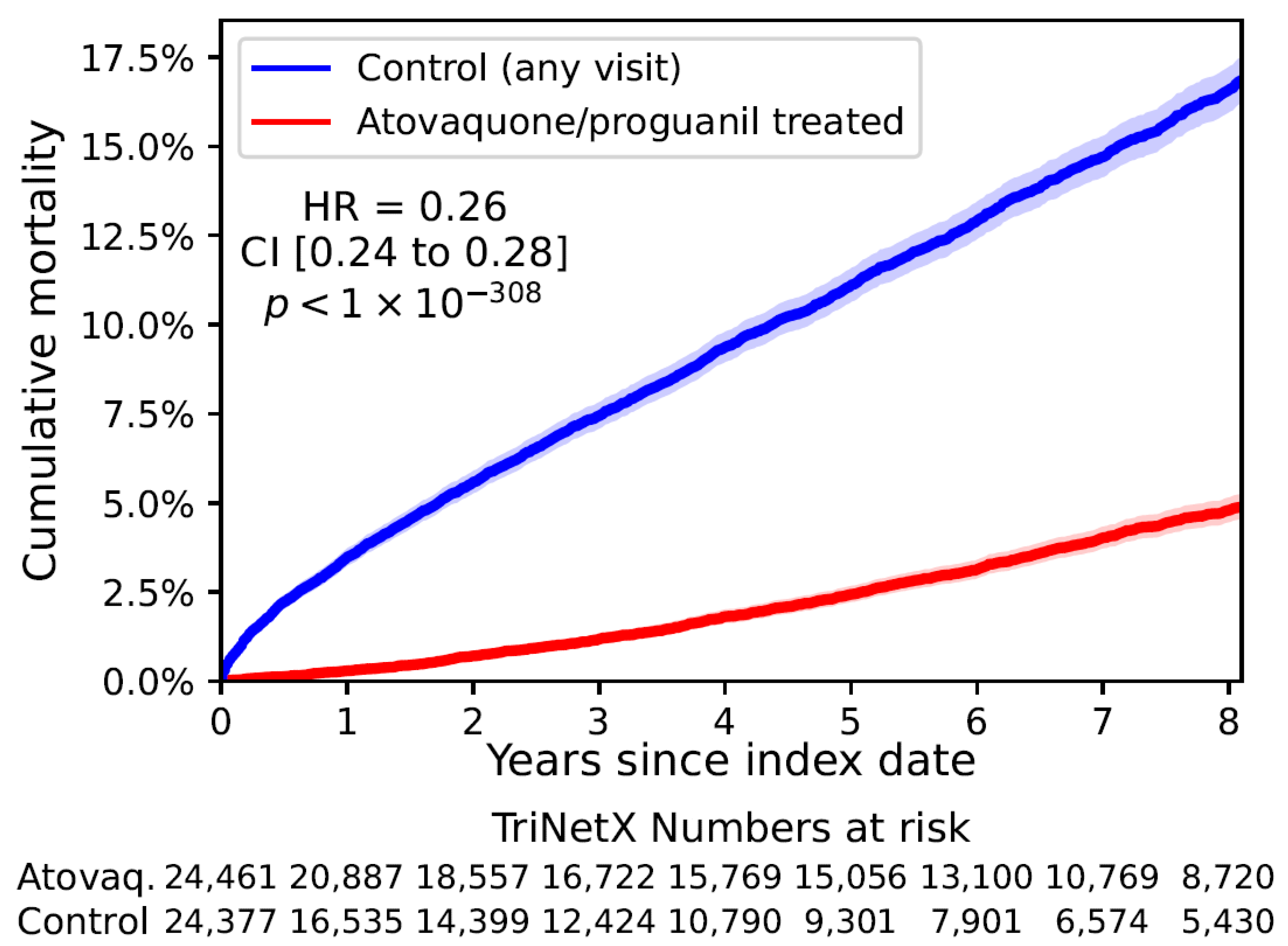
Figure 2.
Viral activation of latent Toxoplasma gondii may facilitate neurodegeneration (A) Dementia incidence in propensity-score–matched cohorts exposed to atovaquone–proguanil (A-P) versus matched controls. A-P use was associated with significantly lower dementia risk after long-term follow-up (HR = 0.51; 95% CI 0.45–0.57, p < 10⁻³⁰), despite the short preventive course and lack of any neurological indication. (B) Dementia incidence after Toxoplasma gondii serology testing. Individuals seropositive for T. gondii showed a significantly higher risk of future dementia (HR = 2.43; 95% CI 1.39–4.25, p = 0.001), indicating that infection precedes and is associated with the disorder rather than arising secondarily to prodromal decline. (C–D) Pathogen–pathogen interaction. The protective effect of A-P was significantly stronger in individuals not vaccinated against varicella-zoster virus (VZV) (C; HR = 0.51; 95% CI 0.43–0.59, p < 10⁻¹⁷) than in those previously vaccinated (D; HR = 0.71; 95% CI 0.59–0.85, p = 0.0002). Because VZV vaccination suppresses viral replication, these results are consistent with a model in which herpesvirus reactivation could facilitate protozoal transition from neuronal latency to pathogenic expression, providing a mechanistic route from lifelong infection to late-life neurodegeneration.
Figure 2.
Viral activation of latent Toxoplasma gondii may facilitate neurodegeneration (A) Dementia incidence in propensity-score–matched cohorts exposed to atovaquone–proguanil (A-P) versus matched controls. A-P use was associated with significantly lower dementia risk after long-term follow-up (HR = 0.51; 95% CI 0.45–0.57, p < 10⁻³⁰), despite the short preventive course and lack of any neurological indication. (B) Dementia incidence after Toxoplasma gondii serology testing. Individuals seropositive for T. gondii showed a significantly higher risk of future dementia (HR = 2.43; 95% CI 1.39–4.25, p = 0.001), indicating that infection precedes and is associated with the disorder rather than arising secondarily to prodromal decline. (C–D) Pathogen–pathogen interaction. The protective effect of A-P was significantly stronger in individuals not vaccinated against varicella-zoster virus (VZV) (C; HR = 0.51; 95% CI 0.43–0.59, p < 10⁻¹⁷) than in those previously vaccinated (D; HR = 0.71; 95% CI 0.59–0.85, p = 0.0002). Because VZV vaccination suppresses viral replication, these results are consistent with a model in which herpesvirus reactivation could facilitate protozoal transition from neuronal latency to pathogenic expression, providing a mechanistic route from lifelong infection to late-life neurodegeneration.
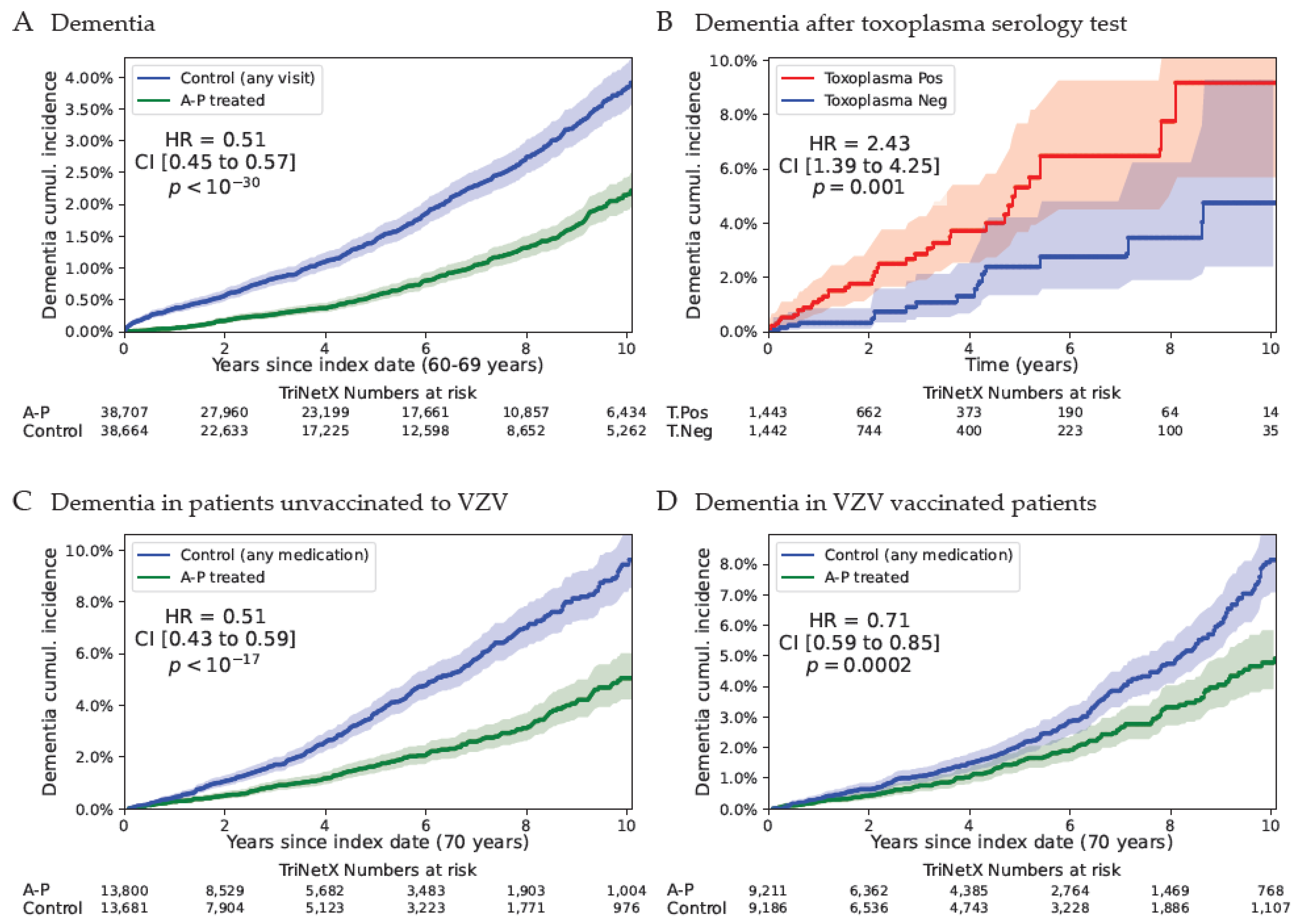
Figure 3.
Progressive enrichment of Toxoplasma gondii DNA across colorectal neoplasia. (A) Violin and box plots displaying uniquely mapped T. gondii reads at ≥1-read threshold across normal mucosa (n = 13), small adenomas (n = 127), large adenomas (n = 127), and colorectal cancer (n = 143). Abundance increases stepwise from normal tissue to adenoma to carcinoma. (B) Distribution of individuals by read-range category shows an escalating proportion with high read burden (≥50 to >1,000 reads) in advanced lesions, rising from 0% in controls to 15.1% in small adenomas, 33.1% in large adenomas, and 47.9% in colorectal cancers.Together, the gradient is consistent with progressive tissue-level accumulation before malignant transformation, compatible with a role in tumor initiation or early progression. Reproduced from Israel et al., Gut Microbes (2025), under the terms of the Creative Commons Attribution-NonCommercial License (CC BY-NC 4.0).
Figure 3.
Progressive enrichment of Toxoplasma gondii DNA across colorectal neoplasia. (A) Violin and box plots displaying uniquely mapped T. gondii reads at ≥1-read threshold across normal mucosa (n = 13), small adenomas (n = 127), large adenomas (n = 127), and colorectal cancer (n = 143). Abundance increases stepwise from normal tissue to adenoma to carcinoma. (B) Distribution of individuals by read-range category shows an escalating proportion with high read burden (≥50 to >1,000 reads) in advanced lesions, rising from 0% in controls to 15.1% in small adenomas, 33.1% in large adenomas, and 47.9% in colorectal cancers.Together, the gradient is consistent with progressive tissue-level accumulation before malignant transformation, compatible with a role in tumor initiation or early progression. Reproduced from Israel et al., Gut Microbes (2025), under the terms of the Creative Commons Attribution-NonCommercial License (CC BY-NC 4.0).
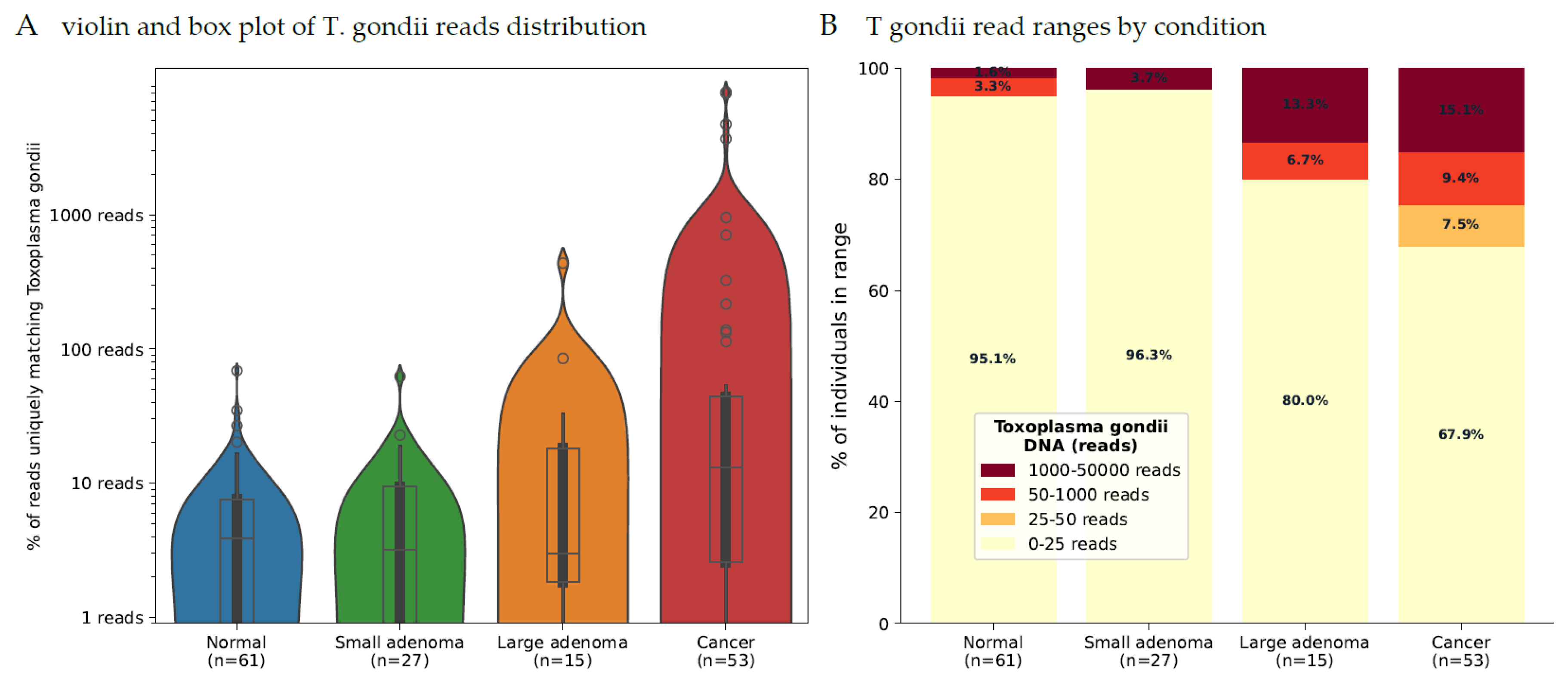

Table 1.
Convergent evidence supporting delayed pathogenicity of Toxoplasma gondii. Summary of epidemiologic, molecular, and evolutionary observations and their interpretation under the delayed-pathogenicity hypothesis; inclusion does not imply proof of causality.
Table 1.
Convergent evidence supporting delayed pathogenicity of Toxoplasma gondii. Summary of epidemiologic, molecular, and evolutionary observations and their interpretation under the delayed-pathogenicity hypothesis; inclusion does not imply proof of causality.
| Domain | Observation | Interpretation |
|---|---|---|
| Parasite ecology | Sexual reproduction occurs only in felids following ingestion of infected tissue | T. gondii reproductive success is contingent on host death. |
| Behavioral alteration | Infected rodents lose their aversion to cat odor and can be attracted to it | T. gondii expresses traits that facilitate felid-mediated predation and host death; rodent-specific behavioral manipulation does not explain transmission through other host species |
| Evolutionary logic | Host impairment occurring in early life would disrupt host reproduction and collapse transmission reservoirs | Pathogenicity should be constrained until attainment of adult size and completion of the reproductive phase required for species continuity |
| Latency biology | Long-lived, immune-quiet bradyzoite cysts escape immune clearance and persist in neural and muscular tissue | An evolutionary adaptation enabling T. gondii to persist until the host reaches a stage at which predation becomes advantageous for its transmission |
| Human mortality and morbidity | Pharmacologic protozoal suppression is associated with large, sustained reductions in all-cause mortality and multiple chronic diseases. | An epidemiologic signal consistent with a substantial contribution of protozoa to human late-life morbidity and mortality |
| Schizophrenia | T. gondii seropositivity is increased in schizophrenia; anti-Toxoplasma drugs are associated with decreased schizophrenia occurrence; immune and barrier deficits are associated with increased risk | Neuropsychiatric impairment appears to emerge when central nervous system containment of T. gondii is compromised, a host state that precedes disease onset |
| Dementia | Atovaquone–proguanil, mefloquine and VZV vaccination are protective; T. gondii seropositivity precedes disease | Age-associated cognitive decline is linked to the combined presence of protozoal persistence and uncontained neurotropic viral infection |
| Cancer | Protozoal suppression is protective, seropositivity precedes diagnosis, and T. gondii DNA increases along the adenoma–carcinoma sequence. | This pattern is consistent with a role of T. gondii in the malignant transformation process |
Disclaimer/Publisher’s Note: The statements, opinions and data contained in all publications are solely those of the individual author(s) and contributor(s) and not of MDPI and/or the editor(s). MDPI and/or the editor(s) disclaim responsibility for any injury to people or property resulting from any ideas, methods, instructions or products referred to in the content. |
© 2026 by the authors. Licensee MDPI, Basel, Switzerland. This article is an open access article distributed under the terms and conditions of the Creative Commons Attribution (CC BY) license (http://creativecommons.org/licenses/by/4.0/).
Copyright: This open access article is published under a Creative Commons CC BY 4.0 license, which permit the free download, distribution, and reuse, provided that the author and preprint are cited in any reuse.


