

Submitted:
24 March 2026
Posted:
26 March 2026
You are already at the latest version
Abstract
Achieving Great Britain’s 2050 net-zero target requires strategic integration of hydrogen into the national energy system. This study evaluates the system-wide impacts of hydrogen blending (0–100%) using a bi-level optimisation framework that combines long-term cooperative investment planning with short-term operational Optimal Power and Gas Flow (OPGF) simulation. The strategic layer models infrastructure investment decisions under a cooperative game-theoretic structure, where system value is allocated among electricity, hydrogen production, and storage technologies using the Shapley-value payoff mechanism. Simulation results indicate that hydrogen blending up to 20% maintains operational stability and positive economic performance, with manageable increases in operational cost. Emissions reductions are realised when blending is combined with carbon capture and storage (CCS) deployment or through higher CO2 pricing. Full hydrogen conversion (100%) increases peak electricity supply requirements by approximately 30% relative to low-blending scenarios due to electrolysis-driven load expansion and conversion losses. Sensitivity analysis shows that carbon pricing significantly reduces system emissions while moderately increasing hydrogen marginal costs and affecting Net Present Value. Under coordinated infrastructure planning, Net Present Value increases with hydrogen penetration, with full hydrogen deployment delivering the highest long-term system value. The findings demonstrate that hydrogen blending represents a viable transitional pathway when supported by integrated infrastructure development, CCS deployment, and appropriate carbon pricing, enabling a phased progression towards Great Britain’s 2050 net-zero target.
Keywords:
hydrogen blending
; integrated energy system
; bi-level optimisation
; cooperative game theory
; net-zero transition
; strategic investment planning
1. Introduction
1.1. Background
The United Kingdom has committed to a legally binding target of net-zero greenhouse gas emissions by 2050. Residential and industrial heating, currently dominated by natural gas, accounts for a significant portion of the UK’s carbon footprint. Hydrogen blending into the existing National Transmission System (NTS) and Local Transmission Systems (LTS) has emerged as a primary strategy to decarbonise gas-reliant sectors without immediate, wholesale infrastructure replacement.
While a 20% volumetric blend is considered technically possible, the practical implementation at the transmission level involves significant complexities. Stakeholder engagement has highlighted that blend variability can impact the stability of industrial processes and power generation equipment, while the transition to a blend-ready network requires substantial capital investment and coordinated operational downtime. These factors suggest that blending may serve more effectively as a temporary transitional measure rather than a long-term solution, potentially favouring a more rapid strategic shift towards dedicated 100% hydrogen infrastructure [1].
Our previous regional analysis for the North of Tyne (NoT) area applied a multi-system-perspective framework with game-theoretic optimisation to compare hydrogen blending, heat pumps, and socio-technical interventions for residential heating decarbonisation, showing that hydrogen blending acts primarily as a transitional option, while deep efficiency measures and electrification can deliver higher system-wide efficiency and lower long-term costs [2]. These regional findings highlight the importance of jointly assessing hydrogen, electrification, and demand reduction within an integrated energy-system perspective, but they do not capture the wider cross-vector interactions, market structures, and infrastructure requirements that arise at national scale.
A national-scale assessment is needed to evaluate how hydrogen blending interacts with electricity and gas networks under strategic stakeholder coordination.
1.2. Objectives and Contributions
This study addresses this gap by developing a cooperative game-theoretic framework for Great Britain’s integrated energy system, assessing both operational performance and strategic investment planning for hydrogen blending. The key contributions of this work are as follows:
- 1.
- National-scale assessment of hydrogen blending: We quantify the operational, economic, and environmental impacts of hydrogen blending (0–100%) across Great Britain’s electricity and gas networks, capturing cross-vector interactions at system-wide scale.
- 2.
- Cooperative planning framework: The paper introduces a bi-level cooperative game-theoretic model that allocates system value among electricity, hydrogen production, and storage technologies, explicitly representing stakeholder coordination and strategic investment behaviour.
- 3.
- Shapley-value technology contributions: We employ Shapley-value analysis to evaluate the individual contributions of key technologies, providing insights into the relative importance of renewables, hydrogen conversion pathways, and storage in multi-vector system operation.
- 4.
- Integration of CCS and hydrogen blending scenarios: The framework examines the combined effect of low- and high-blending hydrogen strategies with and without carbon capture and storage, demonstrating how CCS deployment affects system emissions and economic performance.
- 5.
- Policy-relevant insights: By analysing system sensitivity to feedstock prices and blending proportions, the study offers evidence-based guidance for infrastructure investment prioritisation, transition pathway design, and policy support for hydrogen integration.
1.3. Related Work
Despite the growing interest in hydrogen blending, national-scale analyses that capture cross-vector interactions, stakeholder coordination, and investment strategies remain limited.
The decarbonisation of the residential heating sector is a critical component of the United Kingdom’s strategy to achieve net-zero emissions by 2050, as domestic gas reliance currently contributes approximately 14% of the nation’s total carbon footprint [3,4]. Transitioning this demand requires a diverse technological mix, primarily focusing on electrification through heat pumps and the integration of low-carbon gases such as hydrogen into existing infrastructures [5,6]. Regional studies, such as those conducted in the North of Tyne, emphasise that these transitions must prioritise system-wide energy efficiency and socio-technical interventions, including building insulation and behavioural changes, to effectively reduce aggregate demand [7,8,9]. Our previous NoT-focused work further demonstrated that socio-technical measures and heat pumps can outperform hydrogen-only pathways in terms of primary energy efficiency and operating cost, with hydrogen blending acting as a transitional option rather than the dominant long-term solution [2].
Hydrogen blending in existing natural gas networks has been identified as a vital bridge technology that utilises current infrastructure while scaling up low-carbon production [10,11]. Research suggests that a volumetric blend of up to 20% is operationally feasible without necessitating major upgrades to network pressures or domestic appliances [12,13]. However, the varying thermo-physical properties of hydrogen-gas mixtures require detailed integrated energy system modelling to ensure that technical performance and gas quality are maintained under the uncertainties of variable renewable generation and changing consumption patterns [14,15].
At a national scale, the integration of electricity, gas, and hydrogen vectors facilitates significant flexibility through cross-vector resource shifting [7,16,17]. While traditional planning often relies on centralised cost-minimisation models, these approaches frequently overlook the strategic behaviour and misaligned incentives inherent in liberalised energy markets [18,19]. To address this, game-theoretic frameworks are employed to analyse interactions between independent stakeholders. Non-cooperative Nash–Cournot models are used to identify stable market equilibria in competitive settings, whereas cooperative game theory, utilising the Shapley value, provides a mechanism for the fair allocation of costs and benefits among diverse technology participants [20,21,22].
National investment strategies, such as the ‘Leading the Way’ scenario, underscore the scale of infrastructure required to meet 2050 targets, with hydrogen demand projected to reach up to 150 TWh per year [23,24]. The economic viability of these pathways is highly sensitive to policy instruments, including carbon pricing and commodity price volatility [25,26]. Ultimately, achieving deep decarbonisation through hydrogen blending requires a shift from fragmented, competitive investment toward coordinated planning paradigms that can internalise system-wide costs and mitigate the coordination risks found in highly coupled multi-vector networks [22,27].
In summary, while hydrogen blending has been widely discussed, few studies have evaluated its system-wide impacts under coordinated national planning, integrating cross-vector interactions, stakeholder behaviour, and strategic investment decisions. This paper addresses this gap by applying a cooperative game-theoretic framework to Great Britain’s integrated energy system, providing insights into operational performance, technology contributions, and policy-relevant planning strategies.
2. Methodology
The methodology integrates physical gas-mixture modelling with strategic game-theoretic analysis to capture both the operational constraints and stakeholder interactions in the GB energy system.
2.1. Modelling Framework
The core of the methodology is a high-level resources-technology model, depicted in Figure 1. This model considers energy resources (electricity, natural gas), conversion technologies (water electrolysers for hydrogen production, H2 reformers if blue hydrogen is considered), energy networks (electricity, natural gas, H2), storage (H2 storage), and heat consumers (heat pumps, H2 boilers, H2-based district heating, NG boilers). Social interventions, such as improved insulation standards and smart controls, are explicitly integrated as demand-side energy conservation measures.
2.2. Electric Network Modeling
The electricity network is represented through nodal power balance equations, which ensure that the active and reactive power injections match the respective demands at each bus while respecting network constraints. This provides a steady-state snapshot of the network, crucial for integrating with hydrogen-based energy systems. In this work, the power flow equations are solved using the open-source Pandapower tool [28], which enables efficient and reproducible simulation of large-scale electricity networks.
2.2.1. Active Power Flow
The active power balance at bus i is given by:
where is the active power generation, the active load, and the voltage magnitudes at buses i and j, and the line conductance and susceptance, and , the voltage angles.
2.2.2. Reactive Power Flow
The reactive power balance at bus i is expressed as:
where is the reactive power generation, the reactive load, and all other variables are as defined above.
2.3. Hydrogen Blending in the Gas Network
Hydrogen can be injected into the existing natural gas network to reduce carbon emissions while utilising existing infrastructure. Pandapipes [29] provides functionalities to simulate gas mixtures Pandapower [28] is used for the integration of different energy vectors. Such capabilities are crucial for advancing more efficient and sustainable energy management practices. In this study, hydrogen is considered as a blend in the low-pressure natural gas network of the North of Tyne region, and its impact on the network is analysed in terms of flow, pressure, and gas quality. The impact on the volumetric and energy efficiency of the gas distribution is carefully accounted for through modified gas properties.
The hydrogen blending process is modelled by representing the gas mixture properties as functions of the hydrogen fraction, , defined as the molar proportion of hydrogen in the total gas mixture [30]. Key properties of the mixture, such as density, dynamic viscosity, compressibility, and gross calorific value (GCV), are calculated using established mixing rules:
Mass-weighted average of density:
Complex function of molar properties for dynamic viscosity:
Molar fraction-weighted average of compressibility factor:
Molar fraction-weighted gross calorific value, adjusted by compressibility:
where are the mass fractions of component i, the molar masses, and the molar fractions. The flow of the blended gas in each network branch is governed by a modified steady-state gas flow equation:
where is the volumetric flow rate in branch k [m3/s], and are the pressures at the upstream and downstream nodes [Pa], D is the pipe diameter [m], L is the pipe length [m], f is the Darcy–Weisbach friction factor (dimensionless), is the gas mixture specific gravity relative to air, T is the gas temperature [K], and are the normalisation temperature and pressure [K, Pa], is the compressibility factor of the gas mixture, and is the universal gas constant for air [J/(kg·K)].
The nodal balance ensures mass conservation at each junction:
The coupling with the electricity system is captured through Power-to-Gas (P2G) units, which convert electrical energy into hydrogen injected into the network. The energy content of the hydrogen produced (, in equivalent volumetric flow or energy per unit time) is given by:
Here, is the electrical power consumed by the P2G unit, is its efficiency, and is the gross calorific value of pure hydrogen, used to convert electrical energy to hydrogen energy equivalent. The efficiency of the P2G process () is a critical parameter in assessing the overall energy efficiency of hydrogen pathways, as it dictates the primary energy input required to produce a given amount of hydrogen.
This formulation allows the model to account for the effect of hydrogen blending on network pressures, energy content, and operational feasibility while maintaining compatibility with the existing natural gas infrastructure, providing a comprehensive view of energy flows and transformations.
Figure 2 showcases the operational implications of hydrogen blending within a low-pressure natural gas network. Figure 2(a) reveals that as the hydrogen proportion increases, the minimum network pressure initially dips before recovering at higher blend ratios, as the lower gas density at higher hydrogen fractions reduces flow resistance, partially offsetting the initial pressure drop, necessitating careful pressure management to ensure supply integrity. Concurrently, Figure 2(b) shows that the maximum volumetric flow rate increases with higher hydrogen fractions. Increasing the hydrogen fraction also affects the Wobbe Index (WI), which is defined as:
where is the gross calorific value of the gas mixture and its specific gravity relative to air. A lower WI due to hydrogen’s low molecular weight and energy density constrains the maximum safe blending ratio (commonly around 20%) to ensure stable appliance operation [13]. This, together with variations in network pressure and volumetric flow, defines the operational limits for hydrogen injection in existing natural gas networks.
Figure 3 summarises the methodological framework adopted for hydrogen blending analysis, linking the definition of gas mixture properties with the integrated optimisation of the multi-energy network.
2.4. Cooperative Game-Theoretic Investment Model
Given the high capital intensity and cross-vector dependencies of hydrogen–electricity integration, decentralised investment decisions may lead to suboptimal system outcomes due to coordination failures and misaligned incentives. Therefore, a cooperative framework is adopted to evaluate system-wide value creation and ensure efficient joint investment decisions [31].
At the strategic level, long-term investment and revenue allocation decisions are modelled using a cooperative game-theoretic approach. All players , representing electricity generation, hydrogen production, and storage technologies, are assumed to participate in a grand coalition that jointly maximises system-wide value. The overall architecture, showing the iterative interaction between strategic investment and the operational Optimal Power and Gas Flow (OPGF) layer, is illustrated in Figure 4.
2.4.1. Objective Function
The characteristic function of the game is the total Net Present Value (NPV) of the coalition. The objective is to maximise the discounted operational revenues net of costs and investments:
where the terms are defined as follows:
Annuity Factor (): Annualises operational profits over the planning horizon n at a discount rate r:
Operational Profit and Carbon Costs: represents energy sales revenue, while and denote operational and carbon costs. Carbon costs are derived from emission intensity and the projected carbon price :
Fixed Costs (): Reflects fixed O&M costs based on installed capacity and new investment , weighted by the fixed cost fraction and capital expenditure :
Net Investment (): Represents the capital outlay adjusted for the economic lifetime of each technology:
2.4.2. Shapley Value Allocation of Benefits and Costs
To ensure the stability and fairness of the cooperative outcome, the total system NPV is allocated among players using the Shapley value. This assigns each player a payoff equal to its average marginal contribution across all possible sub-coalitions:
This mechanism identifies technologies critical for system profitability and those that may require policy support (e.g., subsidies) if their marginal contribution to the Net-Zero goal results in a negative individual NPV.
2.4.3. Investment and Capacity Constraints
Investment and operation decisions are subject to physical, policy-driven, and technical limits:
- Capacity constraint: The output of each technology is bounded by existing and newly installed capacity:
- Investment upper bound: New investments are limited by scenario-specific maximum levels:
2.5. Centralised Planning Formulation
The centralised planning model is introduced as a benchmark optimisation framework to evaluate system performance under coordinated infrastructure decision-making. In this configuration, a single system planner is assumed to determine both operational dispatch and long-term capacity expansion across electricity and hydrogen networks.
Unlike the cooperative game-theoretic formulation, the centralised model does not incorporate strategic interaction between technologies or stakeholders. Instead, investment and operational decisions are determined simultaneously through a nonlinear programming (NLP) optimisation problem, subject to network physics, technical feasibility, and policy-driven constraints.
The objective of the centralised planner is to maximise overall system net present value by selecting optimal generation dispatch and infrastructure investment levels. Let the decision variables denote technology-specific output levels and capacity expansion choices. The optimisation problem can be expressed as:
where the parameters follow the definitions adopted in the system modelling framework. However, in contrast to the cooperative model, all technologies are optimised jointly by the central planner rather than being treated as independent strategic agents.
Operational and Investment Feasibility
System operation is constrained by technology capacity availability and allowable infrastructure expansion. For each technology z, the generation output is limited by the sum of existing installed capacity and newly added investment:
Investment activity is further restricted by scenario-dependent expansion limits:
All network flow, storage, and technical feasibility constraints described in Section 2.1, Section 2.2 and Section 2.3 are enforced directly within the optimisation procedure.
The centralised planning solution therefore serves as a reference case for assessing the benefits of coordinated coalition-based infrastructure management relative to conventional system-wide optimisation without strategic technology interaction.
3. Case Study: Great Britain (GB) Energy System
The framework is applied to the GB energy system to demonstrate how integrated electricity and gas networks, combined with hydrogen blending and socio-technical interventions, can be coordinated to achieve decarbonisation objectives while simultaneously enhancing energy efficiency and promoting conservation.
3.1. System Description
The GB energy system is modelled as a highly coupled multi-vector network linking electricity, gas, hydrogen, and heat infrastructures. This model encompasses 18 distinct technology groups acting as strategic players in a liberalised market. These include variable renewable energy sources (offshore and onshore wind, utility-scale solar PV), firm low-carbon generation (nuclear, hydropower), and critical conversion technologies such as electrolysers (P2G) for green hydrogen and Autothermal Reforming (ATR) of the national gas for grey hydrogen (G2G) and with carbon capture and storage for blue hydrogen (G2G+CCS).
The analysis is aligned with the National Grid Future Energy Scenarios (FES), specifically focusing on the Leading the Way pathway to 2050. The system assumes a national electricity peak demand of GWh and a hydrogen peak demand of GWh. To ensure policy alignment, a carbon price of £165/tCO2 is applied. The geographical layout of the integrated GB system and its coupled networks is illustrated in Figure 1.
3.2. Techno-Economic Parameters
The techno-economic assumptions for the primary generation and hydrogen production technologies are sourced from [32,33] and summarised in Table 1. For the 2050 planning horizon, the model endogenously determines the cost-optimal utilisation of these assets under varying commodity prices.
The data and code scripts for the model applied to the GB case study are available at: https://github.com/MohamedAbuella/GB_IES.
3.3. Feedstock Price Scenarios
To define the feedstock price scenarios used in this study, we draw on a sensitivity analysis of investment profitability conducted in our previous GB energy system modelling work. In that analysis, the Net Present Value (NPV), defined in Eq. (11), was evaluated across a wide range of electricity, hydrogen, and natural gas price assumptions.
Figure 5 illustrates the sensitivity of the system-level average NPV to variations in electricity, natural gas, and hydrogen prices.
As shown in Figure 5, system profitability is highly sensitive to feedstock prices. The high-price case (Electricity £100/MWh, Natural Gas £75/MWh, Hydrogen £150/MWh) is selected near the transition point where Net Present Value (NPV) becomes positive, reflecting the minimum conditions for economically viable planning. The low-price case (Electricity £50/MWh, Natural Gas £37/MWh, Hydrogen £75/MWh) represents a less favourable market environment. These two representative price environments are used throughout the study to capture the impact of feedstock costs on system performance.
4. Results and Discussion
This section presents the simulation results for 2050 multi-vector energy system transition scenarios. The analysis focuses on evaluating alternative planning strategies, hydrogen deployment levels, and carbon management measures, with the aim of informing economically and environmentally sustainable transition pathways.
The subsequent subsections are organised as follows: (i) comparison of cooperative and centralised planning structures, with centralised planning serving as a benchmark for counterfactual assessment; (ii) assessment of individual technology contributions using Shapley values under cooperative planning; (iii) evaluation of carbon capture and storage (CCS) deployment to support deep decarbonisation; and (iv) sensitivity analysis of CO2 pricing to examine regulatory impacts on system operation and economics.
Unless stated otherwise, all results correspond to the profitable feedstock prices, representing the economically viable pathway identified as a high-price scenario in Section 3.3.
4.1. Impact of Planning Structure: Cooperative vs. Centralised Energy System Operation
Figure 6 and Figure 7 illustrate the comparative dispatch structure of the integrated energy system under cooperative and centralised planning regimes.
Under cooperative planning (Figure 6), renewable and nuclear generation consistently maintain dominant contributions to total electricity supply across hydrogen blending levels. Wind generation provides the largest share of electricity supply, accounting for approximately 48% of total generation at the baseline and remaining the dominant resource even under full hydrogen conversion. Nuclear generation provides stable baseload support, contributing around 30% of total supply, while solar PV contributes approximately 12–14% depending on the hydrogen blending level.
System flexibility within the cooperative configuration is primarily supported through coordinated utilisation of hydrogen conversion pathways, hydrogen storage operation, and battery energy storage systems (BESS). As hydrogen blending increases, the utilisation of power-to-gas (P2G), gas-to-gas (G2G), and hydrogen storage technologies expands significantly, reflecting the growing electricity demand associated with electrolysis-based hydrogen production and the need for flexible energy vector coupling.
In contrast, the centralised planning configuration (Figure 7) exhibits a different generation structure characterised by a more balanced contribution from nuclear, solar PV, and battery storage resources. Wind generation remains an important contributor but represents a smaller proportion of total supply compared with the cooperative configuration. Solar PV deployment is relatively higher, while battery energy storage plays a significantly larger role in providing system flexibility across all hydrogen blending scenarios.
Hydrogen-related conversion technologies also increase with higher hydrogen blending levels under centralised planning. In particular, P2G, G2G, and hydrogen storage operations expand substantially as hydrogen penetration increases, reflecting the additional electricity demand required for hydrogen production and reconversion within the integrated energy system.
At full hydrogen conversion (100% blending), system operation becomes characterised by significantly higher electricity demand associated with electrolysis-based hydrogen production. The resulting increase in generation dispatch reflects the inherent thermodynamic efficiency limitations of hydrogen conversion processes rather than simple fuel substitution effects. Both planning structures therefore exhibit expanded utilisation of hydrogen conversion infrastructure at high blending levels.
Overall, the dispatch patterns indicate that coordinated multi-vector planning promotes a generation structure with stronger reliance on wind resources and integrated hydrogen flexibility mechanisms. By contrast, centralised planning relies more heavily on battery storage and maintains a more balanced distribution across nuclear, solar PV, and wind generation resources to meet system demand.
The performance metrics reported in Table 2 and Table 3 further quantify the structural advantages of cooperative planning coordination. Net Present Value (NPV) results are reported for two feedstock price scenarios: a high-price case (HP) and a low-price case (LP), as defined in Section 3.3.
The comparative results demonstrate that coalition-based optimisation consistently enhances system-wide operational efficiency and long-term economic viability across hydrogen blending scenarios.
Under cooperative planning, the integrated energy system maintains positive net present value under the high-price scenario (NPV(HP)) across all hydrogen penetration levels, indicating that multi-vector infrastructure collaboration enhances transition pathway sustainability. By contrast, centralised planning produces negative economic returns at low hydrogen blending levels under the same price conditions, although profitability improves significantly as hydrogen penetration approaches full conversion.
Under the low-price scenario (NPV(LP)), both planning structures exhibit negative economic outcomes across all blending levels, reflecting the reduced market value of energy carriers under unfavourable market conditions. Nevertheless, cooperative planning generally produces less negative NPV outcomes than centralised planning, indicating improved economic resilience through coordinated utilisation of electricity and hydrogen infrastructures even when feedstock prices remain low.
Emission outcomes are also influenced by the planning structure. While centralised planning achieves slightly lower emissions in the baseline case without hydrogen blending, cooperative planning delivers significantly lower emissions as hydrogen penetration increases. For example, at 100% hydrogen blending, cooperative planning reduces system-wide emissions from 2735 t under centralised planning to 1892 t, while maintaining comparable operational costs. This improvement reflects the ability of coordinated optimisation to internalise cross-vector energy interactions and improve the dispatch efficiency of low-carbon generation and hydrogen conversion technologies.
From a system operational perspective, increasing hydrogen blending levels raise overall system demand and supply requirements due to the additional electricity needed for electrolysis-based hydrogen production. In both planning structures, higher hydrogen penetration leads to greater utilisation of power-to-gas (P2G) and gas-to-power (G2G) conversion pathways. Notably, centralised planning requires a higher total electricity supply than cooperative planning (147 GWh versus 136 GWh at 100% H2 blending), indicating lower system efficiency. Nevertheless, the coordinated utilisation of renewable generation, hydrogen conversion technologies, and storage resources under cooperative planning mitigates operational inefficiencies and supports more stable system operation.
These findings collectively indicate that cooperative multi-vector planning provides a more resilient, environmentally efficient, and economically sustainable pathway for hydrogen-enabled energy system transition compared with centralised planning structures.
4.2. Shapley-Based Assessment of Technology Contributions
The key advantage of using a cooperative game-theoretic (CGT) approach is that Shapley values provide a quantitative measure of each technology’s contribution to the overall cooperative energy system. Figure 8 presents these Shapley value contributions of electricity and hydrogen-related technologies under both high and low energy price conditions.
Positive contributions (in blue) indicate technologies that enhance the cooperative system value, while negative contributions (in red) reduce it. Under high energy prices (Figure 8(a)), renewables and electricity storage dominate the positive contributions, with hydrogen conversion and storage (P2G and G2G) also substantial. Conventional generation technologies, such as geothermal, micro CHP, and Gas CCS, exhibit negative contributions.
At low energy prices (Figure 8(b)), the contribution of renewables, particularly onshore wind and PV, increases slightly. Hydrogen conversion technologies retain positive contributions, reflecting shifts in economic incentives under lower feedstock costs. Conversely, the negative impacts of Gas CCS and nuclear decrease. These results highlight how energy prices shift the relative importance of technologies in a cooperative system and can guide targeted policy support and incentive schemes for decarbonisation.
Table 4 summarises the Shapley-based policy support under low energy prices for different H2 blending levels. No support is required under high energy price conditions, as the system remains profitable.
As shown in Table 4, Storage consistently receives the highest allocation at low energy prices due to its negative contribution to system profitability. Hydro technologies have smaller Shapley values and corresponding support allocations, reflecting their stable operational role in the system. With increasing H2 blending levels, energy allocations for Storage increase substantially, particularly at full hydrogen conversion, while Hydro allocations rise modestly but are distributed according to their negative Shapley contributions.
4.3. Impact of Carbon Capture Infrastructure Under Cooperative Planning
This section presents the results for 2050 under representative hydrogen blending proportions of 20% and 100% in the gas network. The two blending levels are selected to represent transitional and deep hydrogen deployment regimes, allowing assessment of system behaviour under moderate and extreme electrification pressures.
The analysis focuses on cooperative planning, which is considered a more efficient coordination mechanism for multi-vector energy system transition.
Two infrastructure configurations are compared: (i) Without Carbon Capture and Storage (CCS) deployment, and (ii) With CCS deployment.
The upper row of Figure 9 presents generation dispatch without CCS, while the lower row shows the corresponding results with CCS integration.
The comparison results summarised in Table 5 highlight the interaction between hydrogen penetration level, carbon management infrastructure, and cooperative planning coordination.
Hydrogen blending at 20% represents a transitional operational regime where the integrated energy system maintains stable dispatch characteristics while supporting moderate decarbonisation. In this regime, system performance remains relatively efficient, with controlled operational cost growth and improved long-term value creation.
Under deep hydrogen conversion (100% blending), the system exhibits structural expansion in electricity supply requirements due to the energy intensity of electrolysis-based hydrogen production and conversion losses. This behaviour reflects fundamental thermodynamic constraints rather than simple fuel substitution effects.
Carbon capture deployment plays a critical role in enabling low-carbon system operation under high hydrogen penetration. CCS integration eliminates direct operational emissions and allows the system to sustain high NPV levels by supporting flexible low-carbon dispatch options.
Economically, cooperative planning consistently enhances system performance by internalising cross-vector coordination benefits. The unified coalition-based optimisation structure reduces operational friction, improves renewable utilisation, and supports long-term infrastructure value accumulation.
Overall, the results demonstrate that cooperative multi-vector planning combined with carbon management infrastructure is a key enabler for economically viable hydrogen-based energy system transition pathways in Great Britain.
4.4. Sensitivity Analysis of CO2 Pricing
To evaluate the influence of carbon pricing on system behaviour, a sensitivity analysis was conducted for CO2 prices of £0/tCO2, £165/tCO2, and £300/tCO2 for selected hydrogen blending levels (20% and 100%). The resulting system performance indicators are summarised in Table 6.
As shown in Table 6, carbon pricing strongly influences both system emissions and economics. Without a carbon price (£0/tCO2), emissions are relatively high, reaching 3637 t at 100% hydrogen blending. Introducing a moderate carbon price (£165/tCO2) substantially lowers emissions to 1892 tonnes at full hydrogen conversion, while a high carbon price (£300/tCO2) further reduces emissions to 1021 tonnes.
Operational costs remain broadly similar across CO2 price levels, whereas NPV decreases with increasing carbon price due to compliance costs, e.g., from £78.36 billion at £0/tCO2 to £57.70 billion at £300/tCO2 under full hydrogen blending.
Hydrogen marginal cost (MCH) also rises with carbon pricing, from £125/MWh at zero price to £180.15/MWh at £300/tCO2, reflecting the increased cost of carbon-intensive inputs in hydrogen production.
The sensitivity analysis indicates that stronger carbon pricing substantially reduces emissions, with moderate impacts on system profitability and hydrogen costs, emphasising the importance of carbon pricing as a policy tool for low-carbon hydrogen deployment in the future GB energy system.
5. Conclusions
This study demonstrates that coordinated multi-vector planning is a critical enabler of efficient hydrogen integration within Great Britain’s net-zero transition pathway. The simulation results indicate that cooperative planning consistently outperforms centralised coordination in terms of operational efficiency, emission reduction at higher hydrogen penetration levels, and long-term economic value, highlighting the importance of cross-vector infrastructure coordination for future hydrogen-integrated energy systems.
Hydrogen blending supports system transition under both moderate and deep deployment regimes. However, moving towards full hydrogen conversion requires substantial expansion of electricity supply capacity, increasing peak system demand by approximately 30% due to the energy requirements of electrolysis-based hydrogen production.
Environmental performance is strongly influenced by carbon management infrastructure. Without CCS deployment, emissions remain relatively high under deep hydrogen penetration, whereas CCS integration enables near-zero operational emissions across blending levels. Sensitivity analysis further shows that stronger carbon pricing significantly reduces system-wide emissions across hydrogen blending scenarios, although it increases hydrogen marginal costs and moderately reduces overall system profitability.
Economically, cooperative planning maintains positive Net Present Values across hydrogen penetration scenarios, while centralised planning exhibits negative economic returns during the early stages of hydrogen integration before becoming profitable under high hydrogen penetration. This highlights the importance of coordinated infrastructure planning for maintaining economically viable transition pathways.
Overall, the results indicate that cooperative multi-vector planning provides a more resilient, environmentally favourable, and economically sustainable pathway for hydrogen-enabled energy system transition compared with centralised planning structures. Hydrogen blending represents a viable transitional energy vector for decarbonisation, with near-term deployment focusing on moderate blending levels supported by CCS, while large-scale hydrogen conversion should be pursued alongside expanded low-carbon electricity generation and mature carbon transport and storage infrastructure.
Author Contributions
Mohamed Abuella: Conceptualisation, Data curation, Formal analysis, Investigation, Methodology, Validation, Visualisation, Writing - original draft, Writing - review & editing. Adib Allahham: Conceptualisation, Data curation, Formal analysis, Funding acquisition, Investigation, Methodology, Software, Supervision, Validation, Writing - review & editing. Sara Louise Walker: Supervision and funding acquisition.
Funding
This work was supported in part by the EPSRC “Hydrogen Integration for Accelerated Energy Transitions Hub (HI-ACT)” project (EP/X038823/2).
Data Availability Statement
The dataset and model scripts supporting this study are openly available at: https://github.com/MohamedAbuella/GB_IES.
Conflicts of Interest
The authors declare that they have no known competing financial interests or personal relationships that could have appeared to influence the work reported in this paper.
References
- Arup Limited. National Transmission System Hydrogen Blending. Stakeholder engagement report, Arup Limited, 2025.
- Abuella, M.; Allahham, A.; Rufa’I, N.A.; Walker, S.L. Hydrogen-Based Decarbonisation Strategies for Residential Heating: An Energy Efficiency and Conservation Analysis in the North of Tyne Region. Energies 2025, 18, 6237. [CrossRef]
- Committee, C.C.; et al. The sixth carbon budget: the UK’s path to net zero 2020.
- Bouckaert, S.; Pales, A.F.; McGlade, C.; Remme, U.; Wanner, B.; Varro, L.; D’Ambrosio, D.; Spencer, T. Net zero by 2050: A roadmap for the global energy sector 2021.
- Royapoor, M.; Allahham, A.; Hosseini, S.H.R.; Rufa’I, N.A.; Walker, S.L. Towards 2050 net zero carbon infrastructure: a critical review of key decarbonization challenges in the domestic heating sector in the UK. Energy Sources, Part B: Economics, Planning and Policy 2023, 18. [CrossRef]
- Staffell, I.; Scamman, D.; Abad, A.V.; Balcombe, P.; Dodds, P.E.; Ekins, P.; Shah, N.; Ward, K.R. The role of hydrogen and fuel cells in the global energy system. Energy & Environmental Science 2019, 12, 463–491.
- Berjawi, A.E.H.; Allahham, A.; Walker, S.L.; Patsios, C.; Hosseini, S.H.R. Whole Energy Systems Evaluation: A Methodological Framework and Case Study. In Whole Energy Systems: Bridging the Gap via Vector-Coupling Technologies; Springer, 2022; pp. 41–82.
- Palmer, J.; Terry, N.; Pope, P. How much energy could be saved by making small changes to everyday household behaviours. A report for Department of Energy and Climate Change 2012.
- Love, J.; Smith, A.Z.; Watson, S.; Oikonomou, E.; Summerfield, A.; Gleeson, C.; Biddulph, P.; Chiu, L.F.; Wingfield, J.; Martin, C.; et al. The addition of heat pump electricity load profiles to GB electricity demand: Evidence from a heat pump field trial. Applied Energy 2017, 204, 332–342. [CrossRef]
- Klatzer, T.; Bachhiesl, U.; Wogrin, S.; Tomasgard, A. Ramping up the hydrogen sector: An energy system modeling framework. Applied Energy 2024, 355, 122264. [CrossRef]
- Erdener, B.C.; Sergi, B.; Guerra, O.J.; Chueca, A.L.; Pambour, K.; Brancucci, C.; Hodge, B.M. A review of technical and regulatory limits for hydrogen blending in natural gas pipelines. International Journal of Hydrogen Energy 2023, 48, 5595–5617. [CrossRef]
- Azimipoor, A.; Zhang, T.; Qadrdan, M.; Jenkins, N. Operational implications of transporting hydrogen via a high-pressure gas network. Energy Conversion and Management: X 2025, 26, 100937. [CrossRef]
- Isaac, T. HyDeploy: The UK’s first hydrogen blending deployment project. Clean Energy 2019, 3, 114–125. [CrossRef]
- Hosseini, S.H.R.; Allahham, A.; Adams, C. Techno-economic-environmental analysis of a smart multi-energy grid utilising geothermal energy storage for meeting heat demand. IET Smart Grid 2021, 4, 224–240. [CrossRef]
- Hosseini, S.H.R.; Allahham, A.; Walker, S.L.; Taylor, P. Uncertainty analysis of the impact of increasing levels of gas and electricity network integration and storage on Techno-Economic-Environmental performance. Energy 2021, 222, 119968. [CrossRef]
- Hosseini, S.H.R.; Allahham, A.; Taylor, P.C.; Sadeghian, O. Optimal planning and operation of multi-vector energy networks: A systematic review. Renewable and Sustainable Energy Reviews 2019, 133, 110216. [CrossRef]
- Li, Y.; Zhang, F.; Li, Y.; Wang, Y. An improved two-stage robust optimization model for CCHP-P2G microgrid system considering multi-energy operation under wind power outputs uncertainties. Energy 2022, 223, 120048. [CrossRef]
- Fattahi, A.; Sijm, J.; Faaij, A. A systemic approach to analyze integrated energy system modeling tools: A review of national models. Renewable and Sustainable Energy Reviews 2020, 133, 110195. [CrossRef]
- Lystbæk, M.S.; Skov, I.R.; Sperling, K. Optimization algorithms in energy system models – A systematic literature review with focus on flexibility. Renewable and Sustainable Energy Reviews 2021, 152, 111682. [CrossRef]
- Churkin, A.; Bialek, J.; Pozo, D.; Sauma, E.; Korgin, N. Review of cooperative game theory applications in power system expansion planning. Renewable and Sustainable Energy Reviews 2021, 145, 111056. [CrossRef]
- Andoni, M.; Robu, V.; Flynn, D.; et al. Game-theoretic modeling of curtailment rules and network investments with distributed generation. Applied Energy 2019, 201, 174–187. [CrossRef]
- Joseph, A.; Allahham, A.; Walker, S.L. Investment decisions in a liberalised energy market with generation and hydrogen-based vector coupling storage in Integrated Energy System: A game-theoretic model-based approach. International Journal of Electrical Power & Energy Systems 2025, 166, 110518.
- National Grid ESO. Future Energy Scenarios 2023. Technical report, National Grid ESO, Warwick, UK, 2023.
- Department for Energy Security and Net Zero. UK Hydrogen Strategy: Enabling a low-carbon hydrogen economy in the run up to 2050. Technical report, DESNZ, London, UK, 2022.
- Jafari, M.; Botterud, A.; Sakti, A. Decarbonizing power systems: A critical review of the role of energy storage. Renewable and Sustainable Energy Reviews 2022, 158, 112077. [CrossRef]
- Mukerji, P.; Strebel, H. Technology adoption and lock-in in energy systems. Energy Economics 2020, 89, 104789. [CrossRef]
- Tani, A.; Chatzimpiros, Y.; Alexandridis, A. Cooperative game theory for collective decision making in resource management. Operational Research 2019, 19, 689–712.
- Thurner, L.; Scheidler, A.; Schäfer, F.; Menke, J.H.; Dollichon, J.; Meier, F.; Meinecke, S.; Braun, M. pandapower—an open-source python tool for convenient modeling, analysis, and optimization of electric power systems. IEEE Transactions on Power Systems 2018, 33, 6510–6521. [CrossRef]
- Lohmeier, D.; Cronbach, D.; Drauz, S.R.; Braun, M.; Kneiske, T.M. Pandapipes: An open-source piping grid calculation package for multi-energy grid simulations. Sustainability 2020, 12, 9899. [CrossRef]
- Osiadacz, A. Simulation and Analysis of Gas Networks; Gulf Publishing Company: Houston, TX, 1987.
- Abuella, M.; Allahham, A.; Walker, S.L. Game theory approaches to hydrogen infrastructure investment planning in Great Britain: A comparative analysis of competitive and cooperative frameworks. International Journal of Hydrogen Energy 2026, 220, 154064. [CrossRef]
- Department for Energy Security and Net Zero. Electricity Generation Costs 2023. Technical report, The Stationery Office, London, UK, 2023. Accessed: 2025-06-06.
- National Grid ESO. Future Energy Scenarios 2023 report 2023. pp. 1–224.
Figure 1.
Integrated energy system framework for Great Britain, showing coupling between electricity and hydrogen-blended gas networks.
Figure 1.
Integrated energy system framework for Great Britain, showing coupling between electricity and hydrogen-blended gas networks.
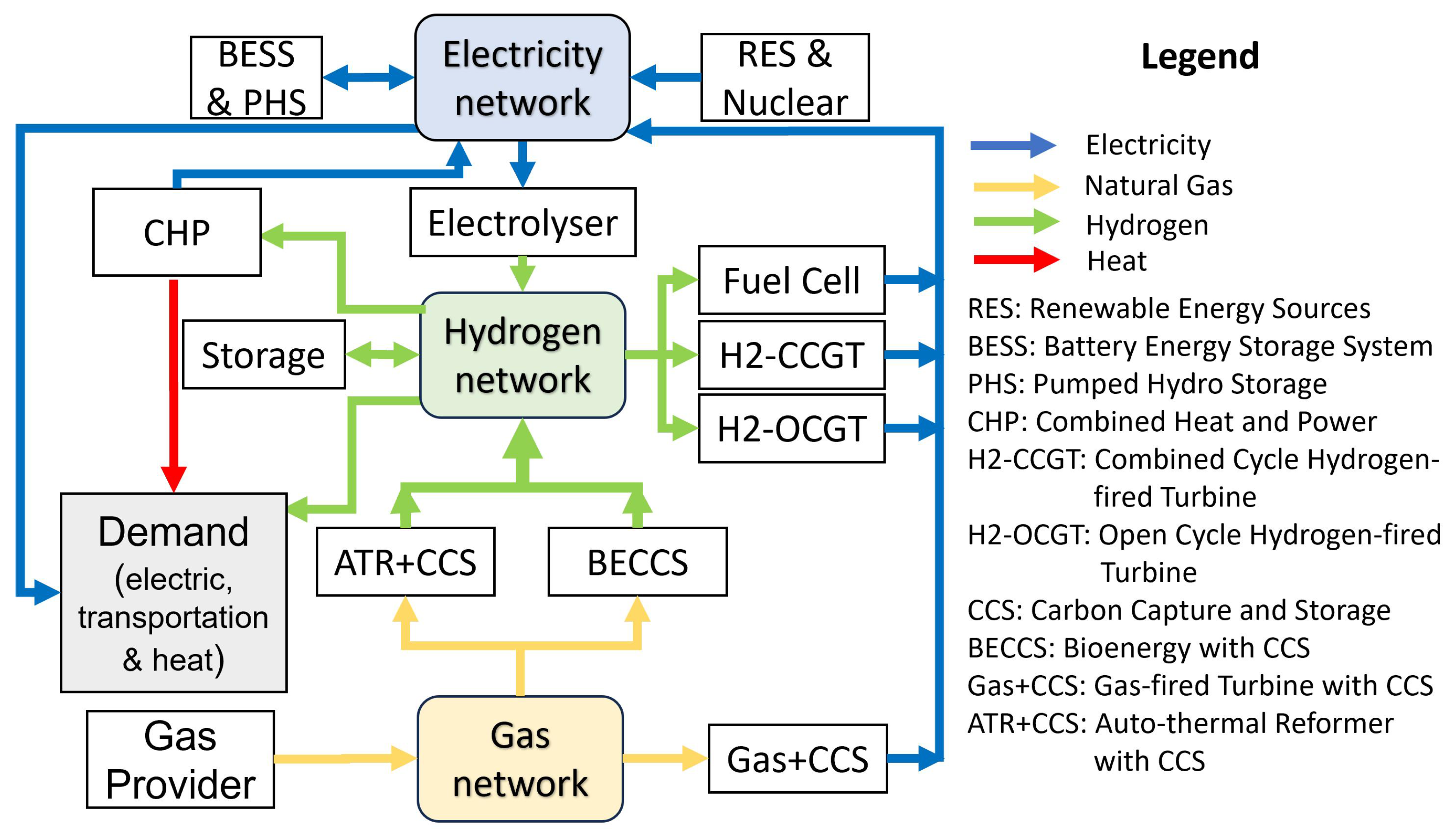
Figure 2.
(a) Variation of minimum network pressure with hydrogen blending proportion; (b) Variation of maximum volumetric flow rate with hydrogen blending proportion. Both plots are obtained from simulation of hydrogen blending in the low-pressure natural gas network.
Figure 2.
(a) Variation of minimum network pressure with hydrogen blending proportion; (b) Variation of maximum volumetric flow rate with hydrogen blending proportion. Both plots are obtained from simulation of hydrogen blending in the low-pressure natural gas network.
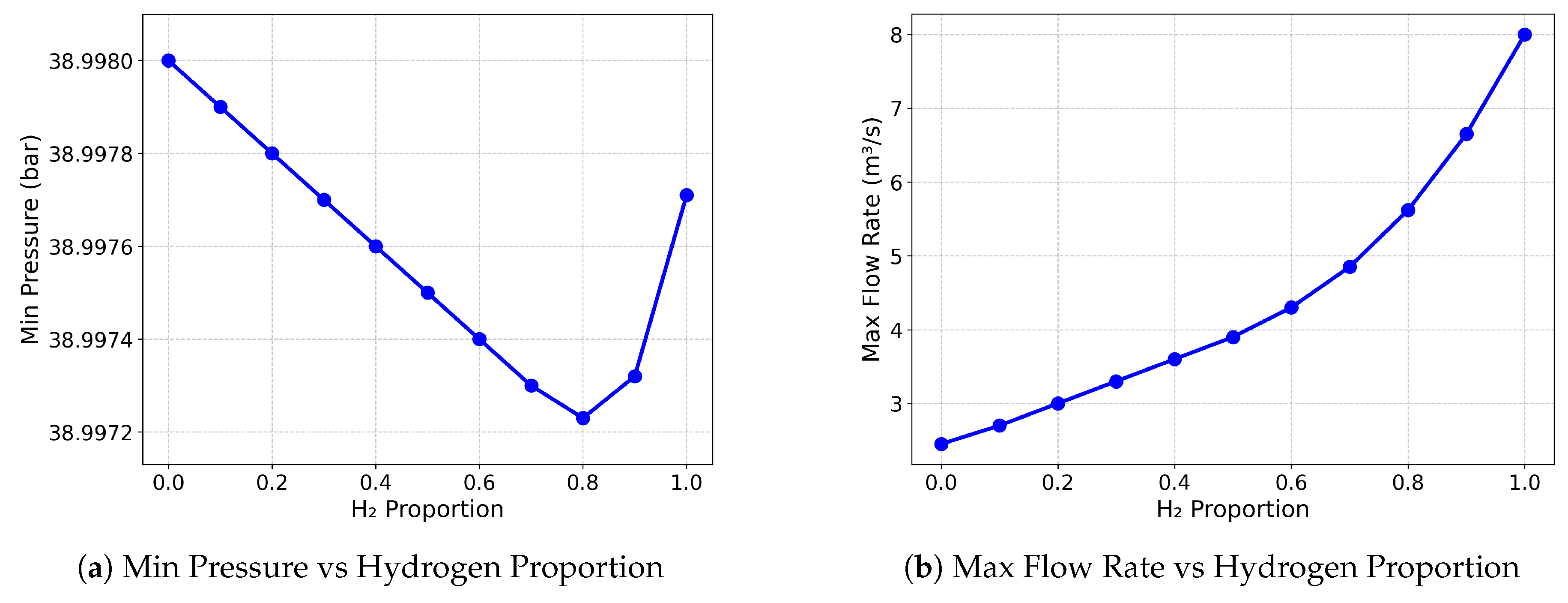
Figure 3.
Process flowchart of hydrogen blending and multi-energy system optimisation, showing the sequential steps from defining input fluids to optimal power and gas flow analysis.
Figure 3.
Process flowchart of hydrogen blending and multi-energy system optimisation, showing the sequential steps from defining input fluids to optimal power and gas flow analysis.
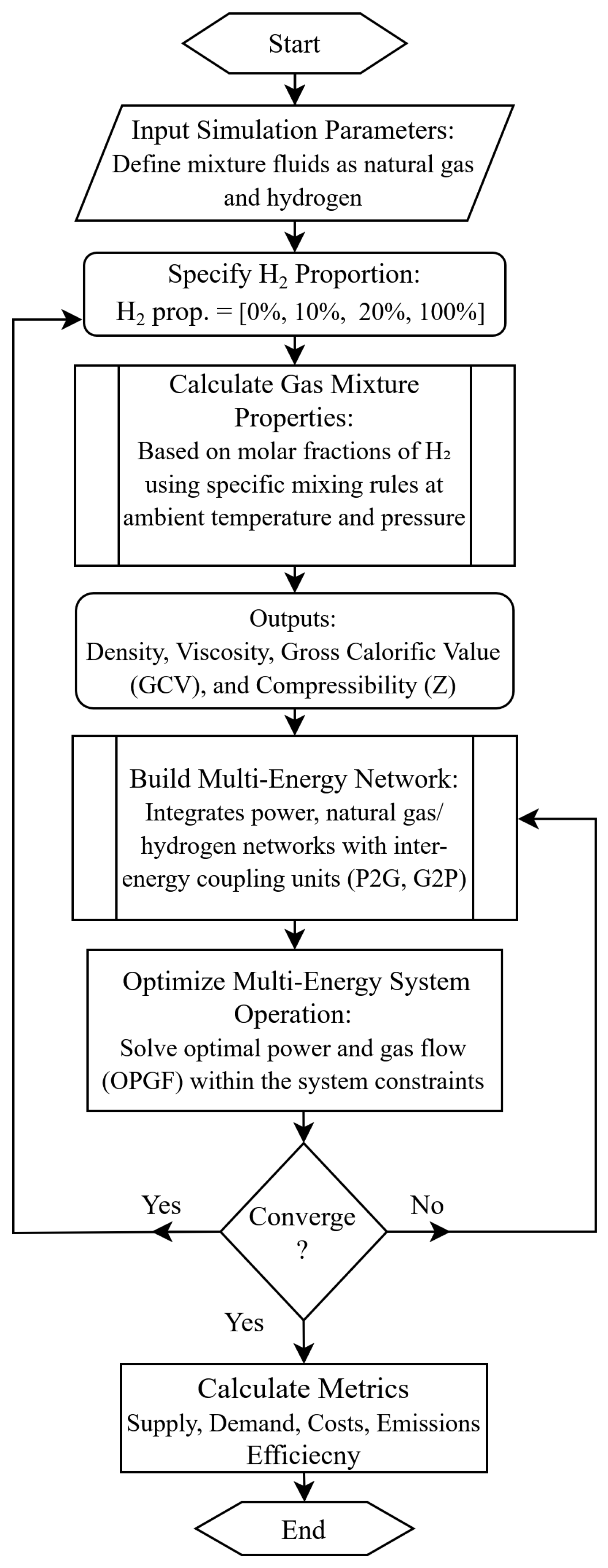
Figure 4.
Bi-level game-theoretic framework illustrating the iterative interaction between the cooperative investment model and the operational OPGF layer.
Figure 4.
Bi-level game-theoretic framework illustrating the iterative interaction between the cooperative investment model and the operational OPGF layer.
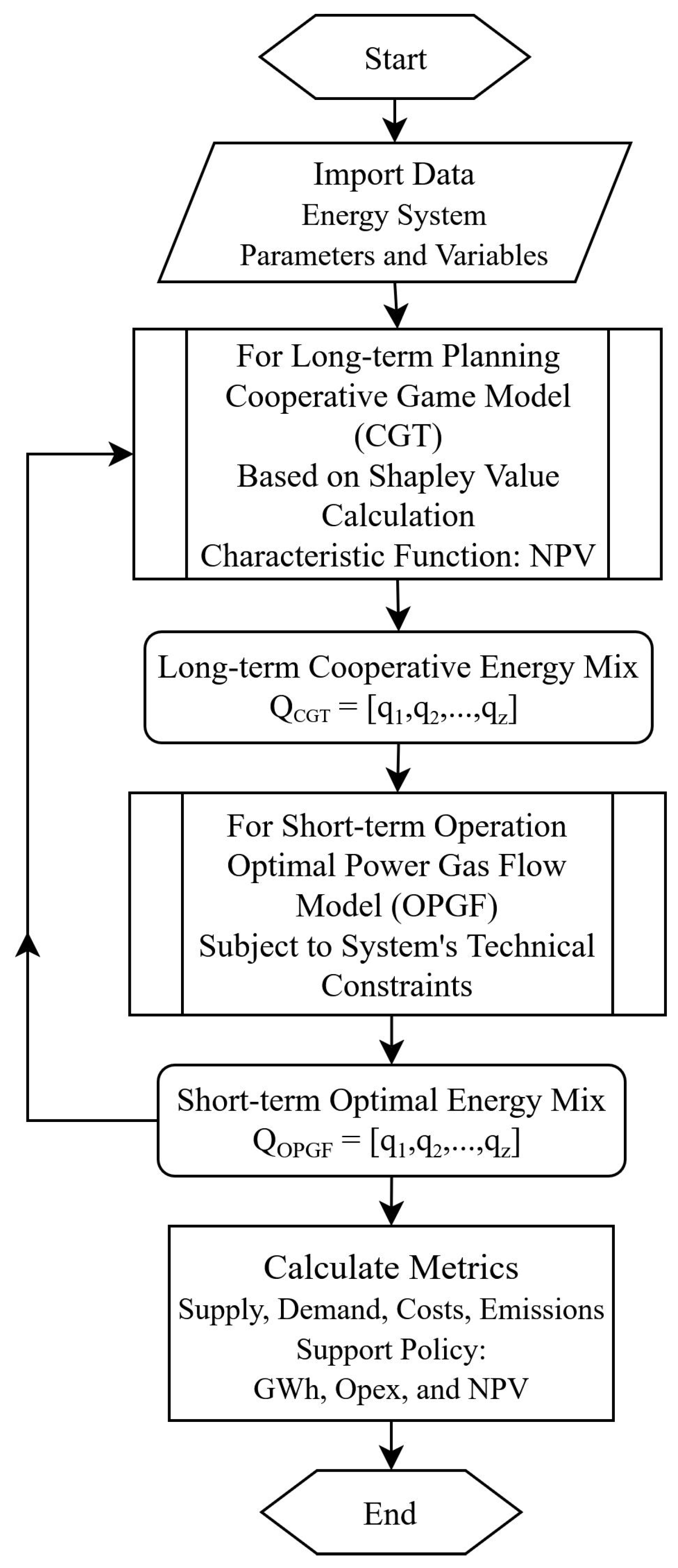
Figure 5.
System-level average Net Present Value (NPV) sensitivity to electricity, natural gas, and hydrogen prices.
Figure 5.
System-level average Net Present Value (NPV) sensitivity to electricity, natural gas, and hydrogen prices.
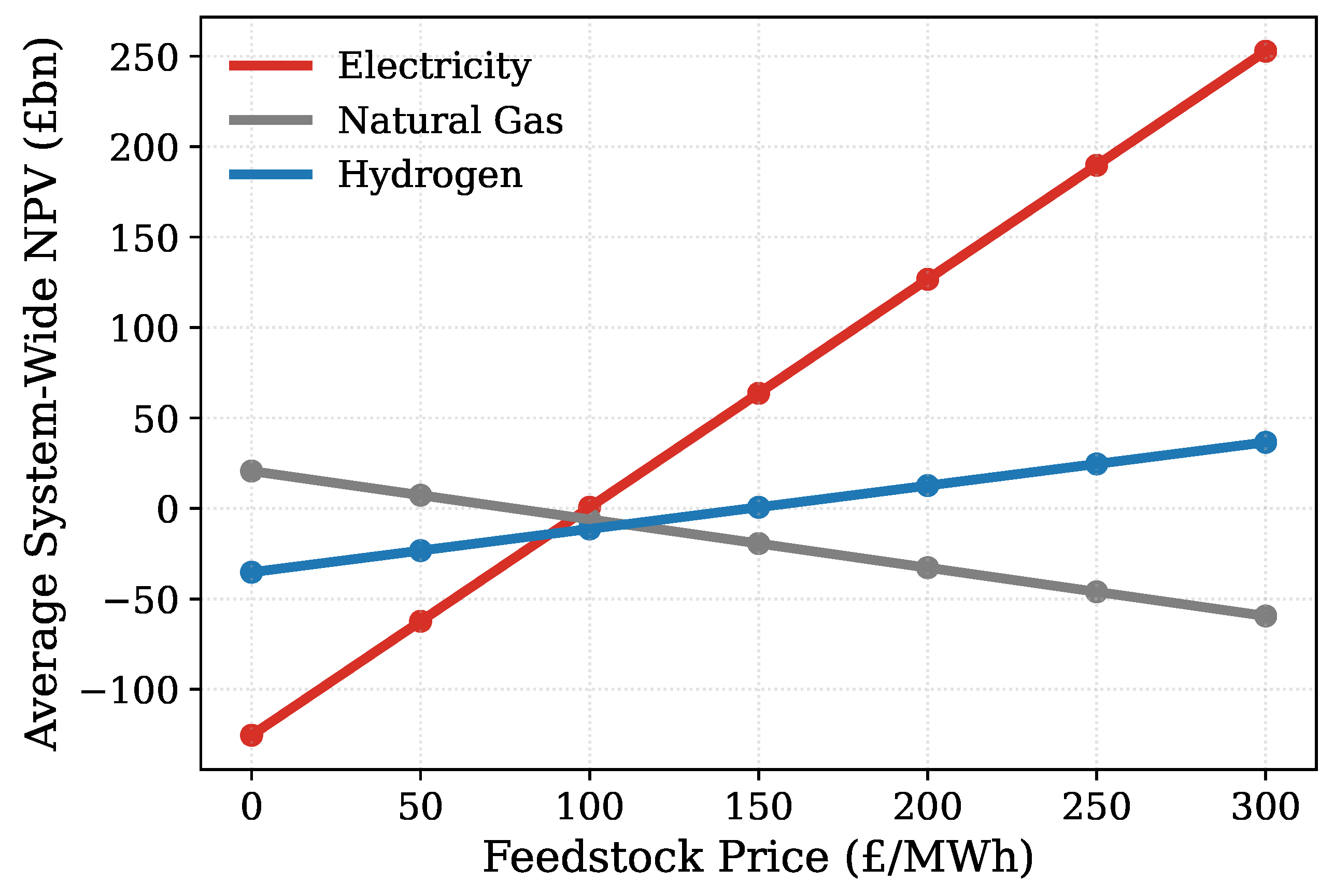
Figure 6.
Cooperative Planning: Generation mix at 2050 peak demand under different hydrogen blending proportions without CCS deployment.
Figure 6.
Cooperative Planning: Generation mix at 2050 peak demand under different hydrogen blending proportions without CCS deployment.
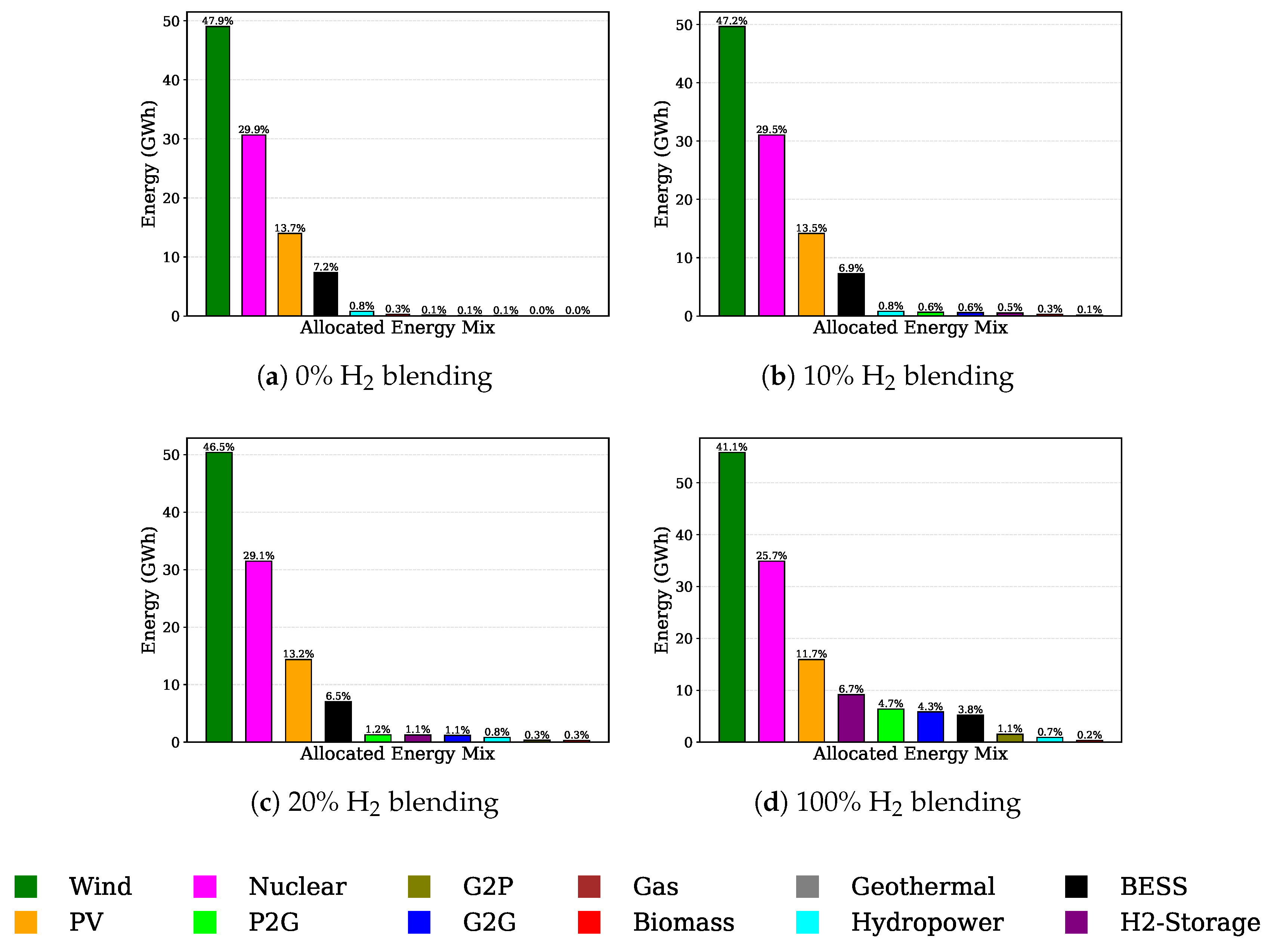
Figure 7.
Central Planning: Generation mix at 2050 peak demand under different hydrogen blending proportions without CCS deployment.
Figure 7.
Central Planning: Generation mix at 2050 peak demand under different hydrogen blending proportions without CCS deployment.
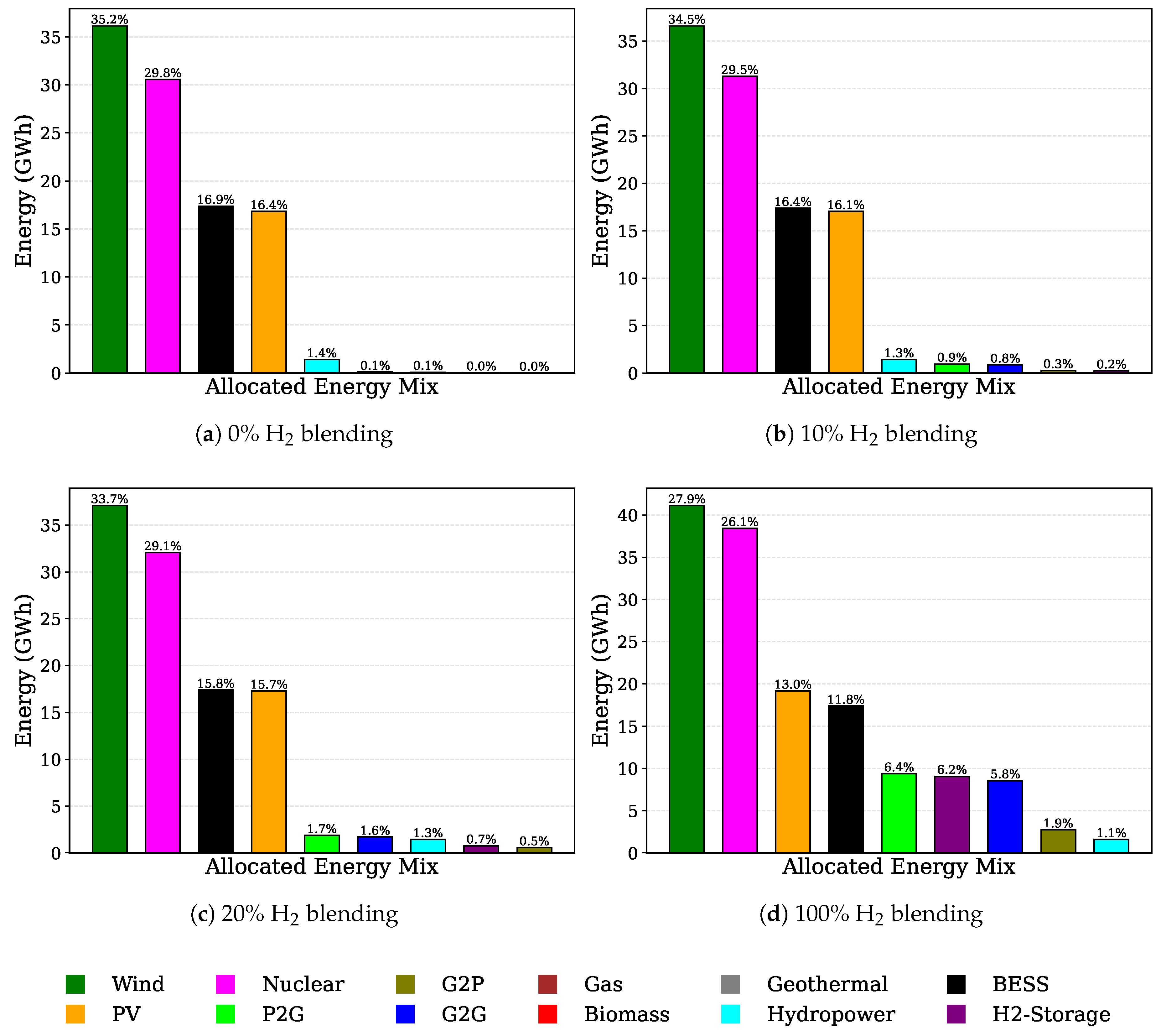
Figure 8.
Shapley value contributions of electricity and hydrogen-related technologies. Positive contributions (blue) enhance the cooperative system value, negative contributions (red) reduce it. Subfigure (a) corresponds to high energy prices (Electricity £100/MWh, Natural Gas £75/MWh, Hydrogen £150/MWh), subfigure (b) to low energy prices (Electricity £50/MWh, Natural Gas £37/MWh, Hydrogen £75/MWh).
Figure 8.
Shapley value contributions of electricity and hydrogen-related technologies. Positive contributions (blue) enhance the cooperative system value, negative contributions (red) reduce it. Subfigure (a) corresponds to high energy prices (Electricity £100/MWh, Natural Gas £75/MWh, Hydrogen £150/MWh), subfigure (b) to low energy prices (Electricity £50/MWh, Natural Gas £37/MWh, Hydrogen £75/MWh).
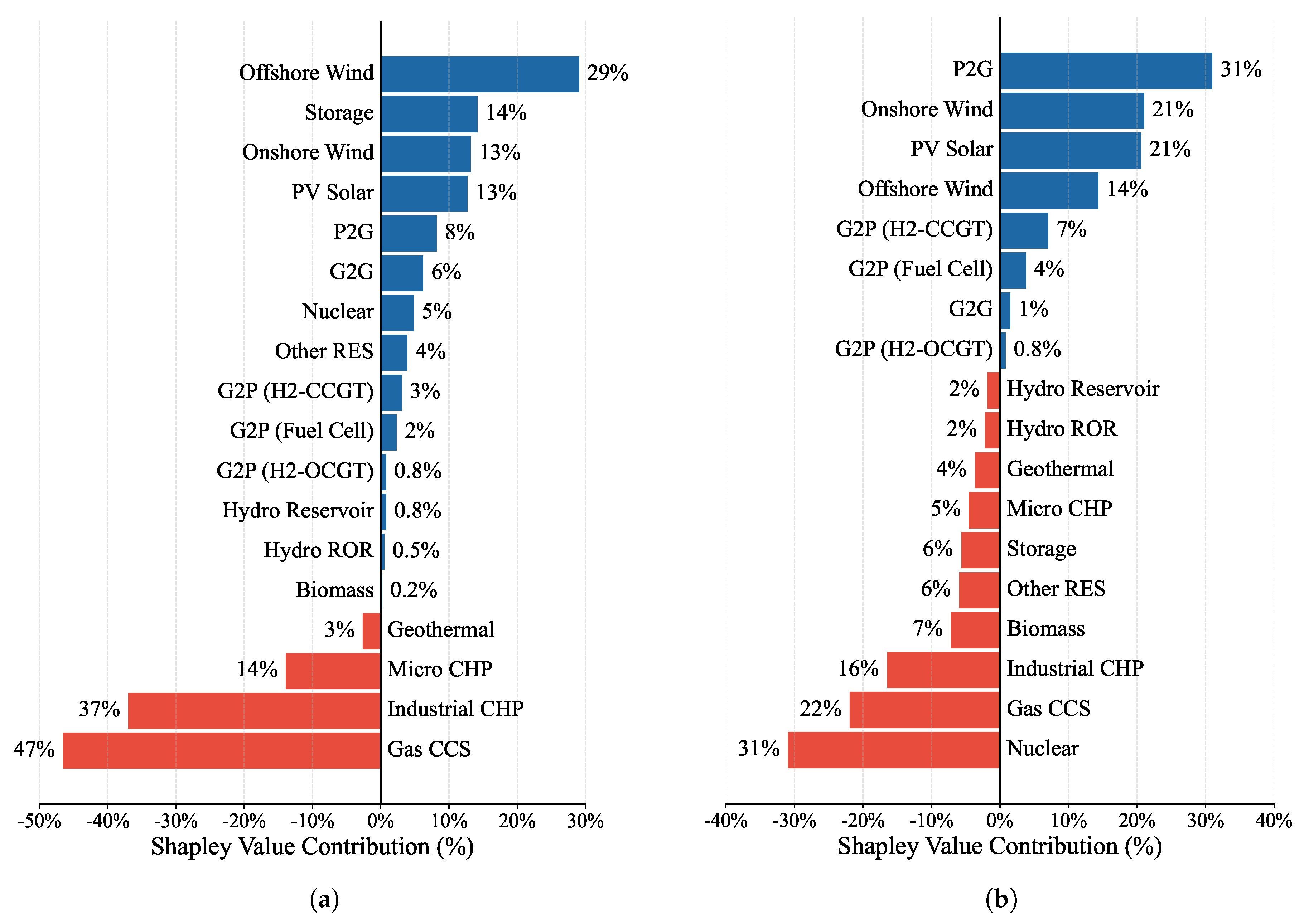
Figure 9.
Cooperative Planning: Comparison of generation mix at 2050 peak demand under 20% and 100% hydrogen blending proportions with and without CCS deployment.
Figure 9.
Cooperative Planning: Comparison of generation mix at 2050 peak demand under 20% and 100% hydrogen blending proportions with and without CCS deployment.
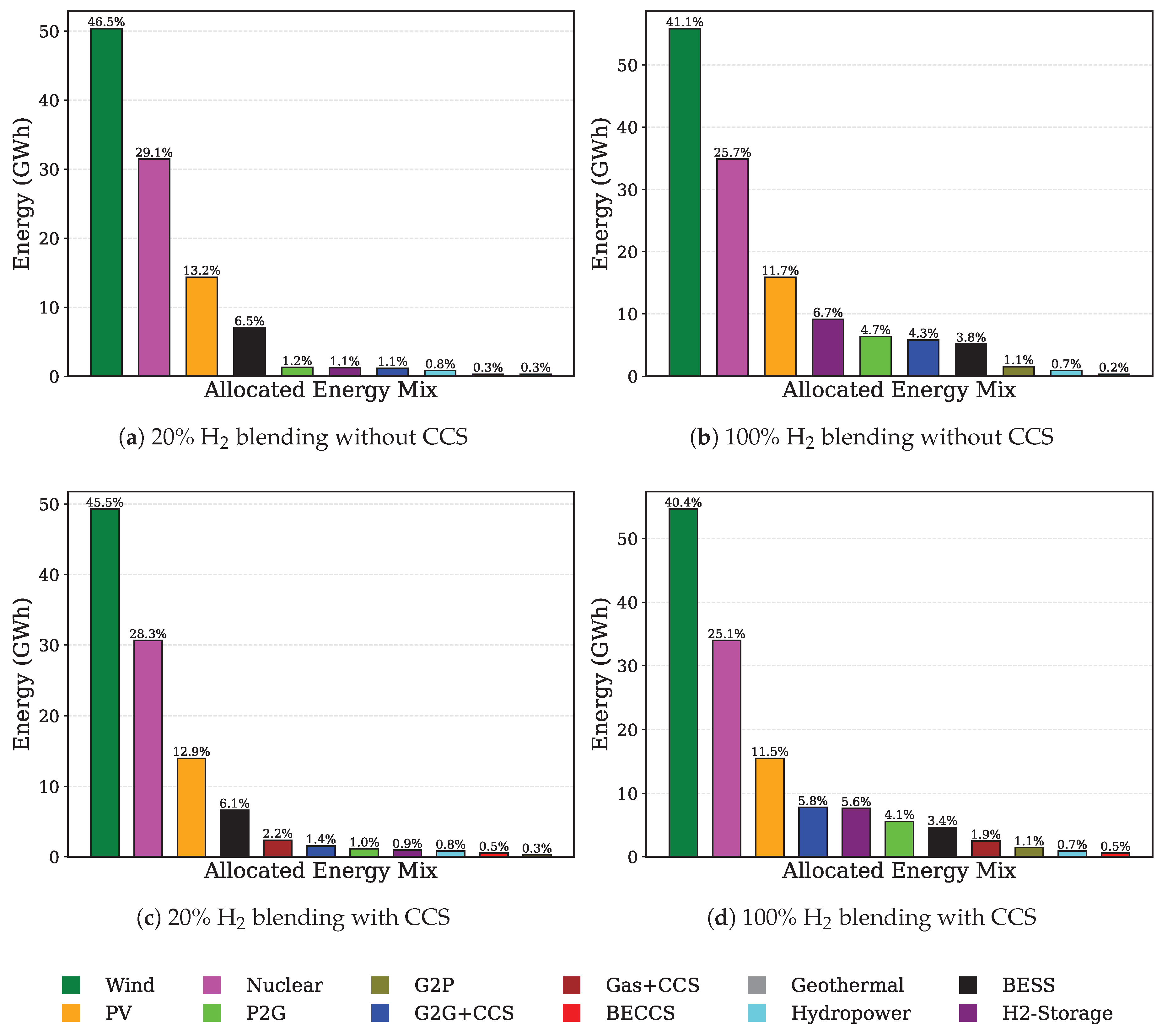

Table 1.
Techno-economic assumptions for electricity generation and hydrogen production technologies in the GB integrated energy system model. Capital expenditure (CapEx), operational expenditure (OpEx), fixed operation and maintenance costs (O&M), emissions (CO2), and capacity factor (CF). Hydropower: ROR = Run-of-River, R = Reservoir. CHP: combined heat and power (Micro = micro-scale, Ind = industrial scale). Other RES = other renewables such as wave and tidal energy.
Table 1.
Techno-economic assumptions for electricity generation and hydrogen production technologies in the GB integrated energy system model. Capital expenditure (CapEx), operational expenditure (OpEx), fixed operation and maintenance costs (O&M), emissions (CO2), and capacity factor (CF). Hydropower: ROR = Run-of-River, R = Reservoir. CHP: combined heat and power (Micro = micro-scale, Ind = industrial scale). Other RES = other renewables such as wave and tidal energy.
| Electricity Generation Technologies | |||||||
| Technology |
CapEx (£/kW) |
O&M (£/kW/year) |
Discount Rate (%) |
Lifetime (yrs) |
OpEx (£/MWh) |
CO2 (kg/MWh) |
CF (%) |
| Wind (Onshore) | 1017 | 25.5 | 7.9 | 25 | 0 | 0 | 40 |
| Wind (Offshore) | 1578 | 42.1 | 8.9 | 30 | 0 | 0 | 50 |
| PV (Utility-scale) | 457 | 5.6 | 6.9 | 35 | 0 | 0 | 15 |
| Hydro (ROR/R) | 3475 | 48.3 | 7.2 | 80 | 0 | 0 | 50–55 |
| Nuclear | 5191 | 83.4 | 9.5 | 40 | 5 | 0 | 90 |
| Gas-CCS | 2361 | 41.6 | 13.8 | 25 | 33.1 | 32 | 92 |
| Biomass | 3446 | 119.8 | 11.2 | 25 | 14 | 0 | 89 |
| Geothermal | 4800 | 140.0 | 8.5 | 30 | 15 | 35 | 75 |
| Other RES | 1642 | 73.0 | 8.9 | 25 | 0 | 0 | 40 |
| CHP (Micro/Ind) | 910–3500 | 24.9 | 7.5 | 15 | 69 | 319 | 83 |
| H2-CCGT | 830 | 15.5 | 10.5 | 25 | 0 | 0 | 60 |
| H2-OCGT | 440 | 10.9 | 10.5 | 25 | 0 | 0 | 40 |
| H2-Fuel Cell | 465 | 48.5 | 10 | 30 | 0 | 0 | 50 |
| Hydrogen Production Technologies | |||||||
| Technology |
CapEx (£/kW) |
O&M (£/kW/year) |
Discount Rate (%) |
Lifetime (yrs) |
CO2 (kg/MWh) |
Efficiency (%) |
CF (%) |
| Electrolyser (P2G) | 465 | 48.5 | 10 | 30 | 0 | 60 | 50 |
| Reformer (G2G) | 384 | 24.4 | 10 | 40 | 320 | 75 | 85 |
Table 2.
Cooperative Planning: System performance at 2050 peak demand under different hydrogen blending proportions without CCS deployment.
Table 2.
Cooperative Planning: System performance at 2050 peak demand under different hydrogen blending proportions without CCS deployment.
| Metric | 0% | 10% | 20% | 100% |
| Total Supply [GWh] | 102.46 | 105.17 | 108.33 | 135.96 |
| Total CO2 Emissions [tonnes] | 87 | 213 | 399 | 1892 |
| Operational Cost [£ million] | 0.99 | 1.22 | 1.48 | 3.58 |
| NPV (HP) [£ billion] | 2.32 | 8.25 | 14.94 | 70.93 |
| NPV (LP) [£ billion] | -310.32 | -311.07 | -312.45 | -332.99 |
| P2G Output [GWh] | 0 | 0.64 | 1.28 | 6.39 |
| G2G Output [GWh] | 0 | 0.58 | 1.16 | 5.82 |
Table 3.
Central Planning: System performance at 2050 peak demand under different hydrogen blending proportions without CCS deployment.
Table 3.
Central Planning: System performance at 2050 peak demand under different hydrogen blending proportions without CCS deployment.
| Metric | 0% | 10% | 20% | 100% |
| Total Supply [GWh] | 102.53 | 106.01 | 110.15 | 147.43 |
| Total CO2 Emissions [tonnes] | 27 | 273 | 547 | 2735 |
| Operational Cost [£ million] | 0.97 | 1.31 | 1.70 | 4.84 |
| NPV (HP) [£ billion] | -18.73 | -10.47 | -0.99 | 79.34 |
| NPV (LP) [£ billion] | -331.69 | -335.60 | -340.13 | -379.05 |
| P2G Output [GWh] | 0 | 0.94 | 1.88 | 9.38 |
| G2G Output [GWh] | 0 | 0.85 | 1.71 | 8.55 |
Table 4.
Shapley-based policy support under low energy prices for different H2 blending levels at the 2050 peak demand hour.
Table 4.
Shapley-based policy support under low energy prices for different H2 blending levels at the 2050 peak demand hour.
| H2 Level | Technology | Shapley (%) | Energy (GWh) | Support (m£) |
|---|---|---|---|---|
| 0% | Storage | 5.63 | 2.820 | 0.218 |
| Hydro reservoir | 1.79 | 2.702 | 0.083 | |
| Hydro ROR | 2.15 | 2.256 | 0.069 | |
| Total | 9.57 | 7.779 | 0.370 | |
| 10% | Storage | 5.63 | 4.376 | 0.218 |
| Hydro reservoir | 1.79 | 2.726 | 0.083 | |
| Hydro ROR | 2.15 | 2.277 | 0.069 | |
| Total | 9.57 | 9.378 | 0.370 | |
| 20% | Storage | 5.63 | 6.424 | 0.224 |
| Hydro reservoir | 1.79 | 2.757 | 0.085 | |
| Hydro ROR | 2.15 | 2.303 | 0.071 | |
| Total | 9.57 | 11.484 | 0.380 | |
| 100% | Storage | 5.63 | 22.911 | 0.235 |
| Hydro reservoir | 1.79 | 3.024 | 0.090 | |
| Hydro ROR | 2.15 | 2.526 | 0.075 | |
| Total | 9.57 | 28.461 | 0.400 |
Table 5.
Cooperative Planning: Comparison of system performance at 2050 peak demand for hydrogen blending proportions 20% and 100%, with and without CCS deployment.
Table 5.
Cooperative Planning: Comparison of system performance at 2050 peak demand for hydrogen blending proportions 20% and 100%, with and without CCS deployment.
| Metric | Without CCS | With CCS | ||
| 20% | 100% | 20% | 100% | |
| Total Supply [GWh] | 108.33 | 135.96 | 108.22 | 135.26 |
| Total CO2 Emissions [tonnes] | 399 | 1892 | 0 | 0 |
| Operational Cost [£ million] | 1.48 | 3.58 | 1.48 | 3.28 |
| NPV [£ billion] | 14.94 | 70.93 | 21.45 | 74.96 |
| P2G Output [GWh] | 1.28 | 6.39 | 1.12 | 5.58 |
| G2G Output [GWh] | 1.16 | 5.82 | 1.56 | 7.78 |
Table 6.
Sensitivity of system performance to CO2 pricing under selected hydrogen blending levels at 2050 peak demand. MCH: Marginal cost of hydrogen.
Table 6.
Sensitivity of system performance to CO2 pricing under selected hydrogen blending levels at 2050 peak demand. MCH: Marginal cost of hydrogen.
| Metric | CO2 = £0/tCO2 | CO2 = £165/tCO2 | CO2 = £300/tCO2 | |||
| 20% | 100% | 20% | 100% | 20% | 100% | |
| Total Supply [GWh] | 108.24 | 135.37 | 108.33 | 135.96 | 107.93 | 131.87 |
| Total CO2 Emissions [tonnes] | 1569 | 3637 | 399 | 1892 | 304 | 1021 |
| Operational Cost [£m] | 1.50 | 3.32 | 1.48 | 3.58 | 1.45 | 3.05 |
| NPV [£bn] | 22.95 | 78.36 | 14.94 | 70.93 | 13.67 | 57.70 |
| P2G Output [GWh] | 1.12 | 5.61 | 1.28 | 6.39 | 1.12 | 4.49 |
| G2G Output [GWh] | 1.56 | 7.82 | 1.16 | 5.82 | 0.80 | 3.19 |
| MCH [£/MWh] | 125 | 125 | 159.43 | 159.43 | 180.15 | 180.15 |
Disclaimer/Publisher’s Note: The statements, opinions and data contained in all publications are solely those of the individual author(s) and contributor(s) and not of MDPI and/or the editor(s). MDPI and/or the editor(s) disclaim responsibility for any injury to people or property resulting from any ideas, methods, instructions or products referred to in the content. |
© 2026 by the authors. Licensee MDPI, Basel, Switzerland. This article is an open access article distributed under the terms and conditions of the Creative Commons Attribution (CC BY) license (http://creativecommons.org/licenses/by/4.0/).
Copyright: This open access article is published under a Creative Commons CC BY 4.0 license, which permit the free download, distribution, and reuse, provided that the author and preprint are cited in any reuse.


