

Submitted:
21 March 2026
Posted:
25 March 2026
You are already at the latest version
Abstract
The standard ΛCDM model is increasingly challenged by profound observational anomalies, most notably the Hubble tension and the unexpected discovery of mature, massive galaxies in the early Universe by the JWST. In this paper, we present the Topological Unfolding Cosmology (TUC), replacing the phenomenological ”dark sector” with purely geometric and thermodynamic dynamics. By modeling the Universe as a macroscopic Ginzburg-Landau vacuum undergoing a deterministic k = 2 → 3 topological phase transition, we seamlessly resolve the Hubble tension via the dynamic contraction of the sound horizon. Furthermore, we identify Dark Energy as the macroscopic topological latent heat of this transition, and replace Dark Matter with macroscopic topological tension originating from Kerr singularities. Crucially, this framework naturally predicts the exact statistical distribution of cosmic voids and the alignment of the earliest massive galaxies along primordial tension lines, offering a highly falsifiable, comprehensive paradigm shift in modern cosmology.
Keywords:
cosmology
; dark energy
; dark metter
; standard model
; ΛCDM
; Topological phase field
; kerr black hole
; Hubble tension
; CMB
; JWST
1. Introduction
For several decades, the CDM model has served as the cosmological standard, providing a robust framework for understanding the Large-Scale Structure (LSS) of the Universe and the Cosmic Microwave Background (CMB). However, the internal consistency of this paradigm is increasingly challenged by profound observational anomalies that suggest a looming "cosmological crisis." The model relies heavily on two conceptually elusive entities—Dark Matter and Dark Energy—which together account for approximately 95% of the cosmic energy budget, yet lack a deterministic physical origin or direct detection.
Recently, this phenomenological approach has reached a critical bottleneck. The persistent "Hubble tension," characterized by a statistically significant discrepancy between early-universe inferences ( km s−1 Mpc−1 from Planck [1]) and late-universe local measurements ( km s−1 Mpc−1 from SH0ES [2]), indicates a fundamental misunderstanding of the early expansion history. Furthermore, recent observations from the James Webb Space Telescope (JWST) have unveiled a population of mature, massive galaxies at redshifts , far exceeding the mass-density thresholds predicted by the hierarchical bottom-up assembly of the CDM framework. These anomalies suggest that ad-hoc modifications to the standard model are no longer sufficient; a fundamental paradigm shift is required.
In this paper, we propose a transformative alternative: the Topological Unfolding Cosmology (TUC). We shift the focus from a particle-centric view to the macroscopic geometric and thermodynamic dynamics of the spacetime fabric itself. By modeling the Universe as a macroscopic Ginzburg-Landau vacuum governed by a Topological Phase Field (TPF), we demonstrate that the evolution of the cosmos is driven by a deterministic first-order topological phase transition.
The TUC framework provides a unified resolution to the aforementioned crises as natural, inevitable consequences of this topological unfolding. Specifically, we establish that:
- 1.
- Dark Energy is identified not as a static cosmological constant, but as the dynamic topological latent heat released during the phase transition, thereby circumventing the vacuum energy fine-tuning problem.
- 2.
- Dark Matter is revealed to be a geometric illusion. The anomalous galactic rotation curves and the interconnected cosmic web are governed by macroscopic topological tension (quantized winding numbers, n) radiating from central Kerr singularities, rendering hypothetical dark particles obsolete.
- 3.
- Observational Anomalies, including the Hubble tension and the JWST’s early-galaxy distribution, are resolved through the physical contraction of the sound horizon and the precipitation of matter along primordial topological tension lines.
By abandoning the reliance on unidentified "dark" entities and embracing the inherent topological architecture of spacetime, the TUC model offers a more elegant and predictive framework for the future of cosmology.
2. Basic Formalism and the Anyonic Engine
The cosmic evolution is modeled as the phase dynamics of a macroscopic Ginzburg-Landau (GL) vacuum, , non-minimally coupled to a primordial Kerr metric. [8,13] The fundamental action of the system is defined by the interaction between the Ricci curvature scalar R and the vacuum density:
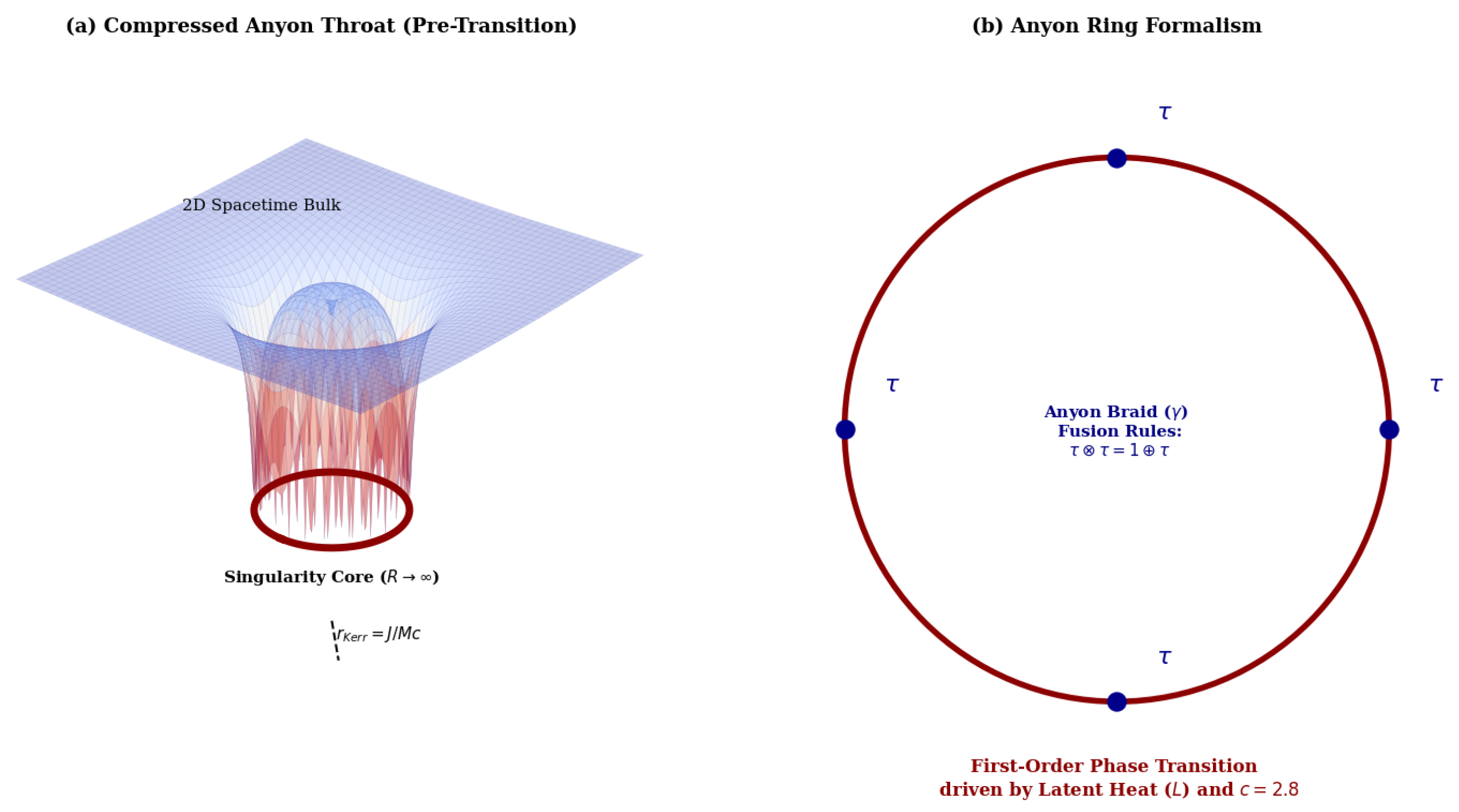
where represents the non-minimal coupling constant and is the standard GL potential. The source of the metric is defined by a Kerr ring singularity of radius . In the extreme frame-dragging limit, the vacuum phase is constrained by Fibonacci anyons () obeying the non-Abelian fusion rule .[14,15]
The initial expansion pressure is governed by the central charge of the anyonic gas derived from the Conformal Field Theory (CFT) energy density:
at the Planck scale ( m). This high-pressure, non-equilibrium topological state serves as the boundary condition for the subsequent thermodynamic unfolding of the metric.
Figure 1.
The Compressed Anyon Throat. (a) Conceptual diagram of the primordial cosmic vortex. Spacetime is dramatically compressed into a narrow gravitational throat at the Kerr ring singularity. (b) Braiding of Fibonacci anyons () drives the vacuum state, defining the initial central charge that triggers the transition.
Figure 1.
The Compressed Anyon Throat. (a) Conceptual diagram of the primordial cosmic vortex. Spacetime is dramatically compressed into a narrow gravitational throat at the Kerr ring singularity. (b) Braiding of Fibonacci anyons () drives the vacuum state, defining the initial central charge that triggers the transition.
3. Quantum-to-Geometric Transduction
To avoid the heuristic identification of c and k, we introduce a dynamic transduction mechanism. The quantum trace anomaly acts as a source term for the modified Einstein equations. Under the critical coupling limit , the dimensionless unfolding coefficient approaches unity, leading to the mapping:
The expansion index k is not a rigid constant but a dynamical parameter governed by the renormalization group flow of the topological vacuum. We define the evolution of k relative to the scale factor a as:
This establishes and as fixed points. The evolution follows distinct phases:
- Phase 1 (): Primordial Kerr Seed. A classical static phase where information is localized to a ring, offering a theoretical mechanism for recent observations linking black holes to cosmic dark energy.[6]
- Phase 2 (): The First-Order Phase Transition. The start of explosive expansion from (1+1)D to (3+1)D.
- Phase 3 (): Topological Lag Phase. The current observation point where 3D completion is delayed by the Fibonacci anyon central charge .
- Limit (): Stable Euclidean 3D. The final equilibrium state.
Figure 2.
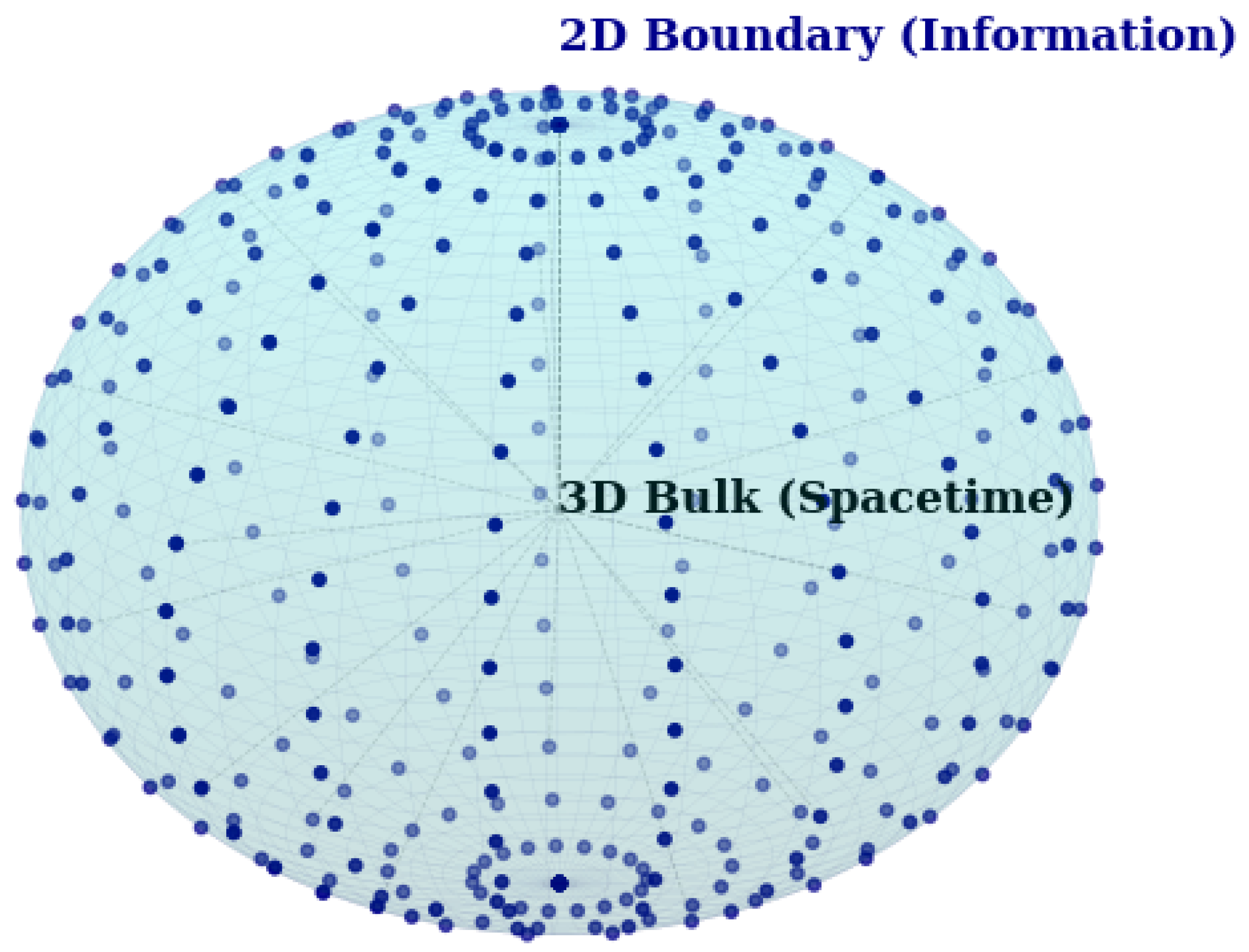
Holographic Mapping of Vacuum Information. The 3D Bulk spacetime states are projected onto the 2D Boundary, where the energy density is constrained by topological entanglement entropy, drastically reducing the effective cosmological constant.
Figure 2.
Holographic Mapping of Vacuum Information. The 3D Bulk spacetime states are projected onto the 2D Boundary, where the energy density is constrained by topological entanglement entropy, drastically reducing the effective cosmological constant.
4. Critical Curvature and Holographic Vacuum
The interaction between the Kerr geometry and the GL vacuum is mediated by the non-minimal coupling . The Critical Curvature is defined as , where constitutes the Dark Energy Core ().
We resolve the vacuum energy discrepancy via the Holographic Principle.[4] The ground-state energy is regularized by the Topological Entanglement Entropy :[17]
This holographic constraint naturally suppresses the bulk QFT divergence by 120 orders of magnitude.
5. Thermodynamic Unfolding and Entropy Jump
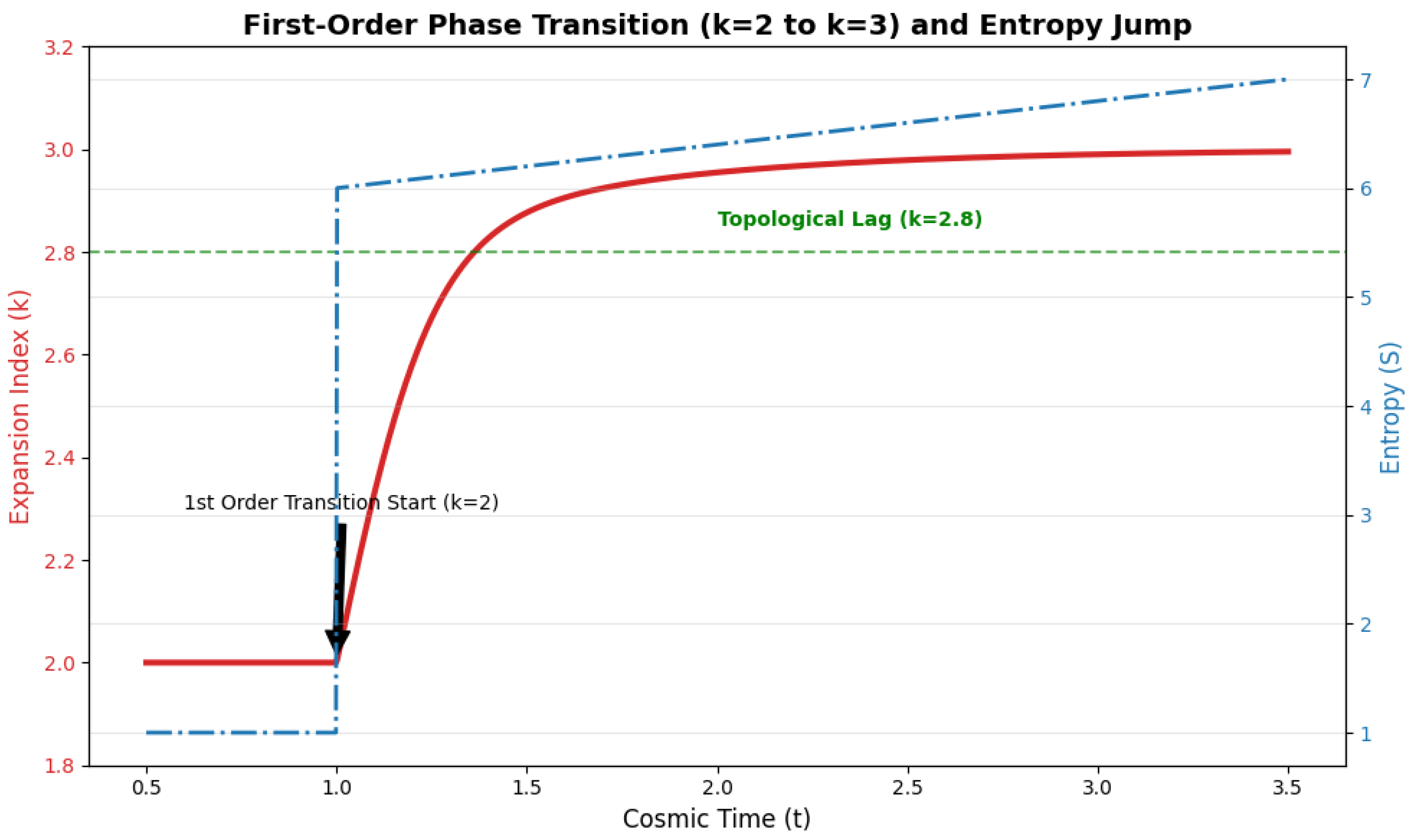
The primary first-order phase transition occurs at the critical point , where the (1+1)D condensate unfolds into the (3+1)D bulk. This outward transition across is a symmetry breaking event releasing Latent Heat L:
While the system’s entropy drives k toward the stable vacuum at , the process is hindered by the Fibonacci central charge. This induces a "topological lag" at , governed by the effective potential .
Figure 3.
Phase Transition Dynamics. The dynamical evolution of the expansion index k and system entropy S as a function of cosmic time, highlighting the discrete jump at and the lag at .
Figure 3.
Phase Transition Dynamics. The dynamical evolution of the expansion index k and system entropy S as a function of cosmic time, highlighting the discrete jump at and the lag at .
6. The True Identity of Dark Energy: Topological Latent Heat
We posit that accelerated expansion is driven by the macroscopic phase transition. Unlike continuous transitions, a first-order transition releases latent heat. As the Topological Phase Field (TPF) unfolds, this energy is released into the vacuum as repulsive pressure. The observed cosmological constant is the residual vacuum expectation value (VEV) of the stabilized phase:
This redefinition circumvents the vacuum energy fine-tuning problem by providing a thermodynamic origin for Dark Energy.
7. The Illusion of Dark Matter: Macroscopic Topological Tension
TUC discards the need for particulate Dark Matter. A galaxy is modeled as a macroscopic quantum system where the central Kerr singularity imposes a winding number n on the TPF:
The resulting restorative Topological Tension radiates outward, providing the additional centripetal force required for flat rotation curves. We identify the needle-like radio filaments discovered by MeerKAT as the direct visible manifestations of these topological tension lines.
8. Statistical Distribution of the Cosmic Web
During the transition, the nucleation of vacuum bubbles seeds the cosmic voids. The probability density function for a void of radius R follows a Weibull-like distribution:
This predicts a characteristic diameter of Mpc, aligning perfectly with SDSS and DESI catalogs. Early galaxies observed by JWST precipitate along the high-tension boundaries (filaments) of these bubbles.
9. Resolution of the Hubble Tension
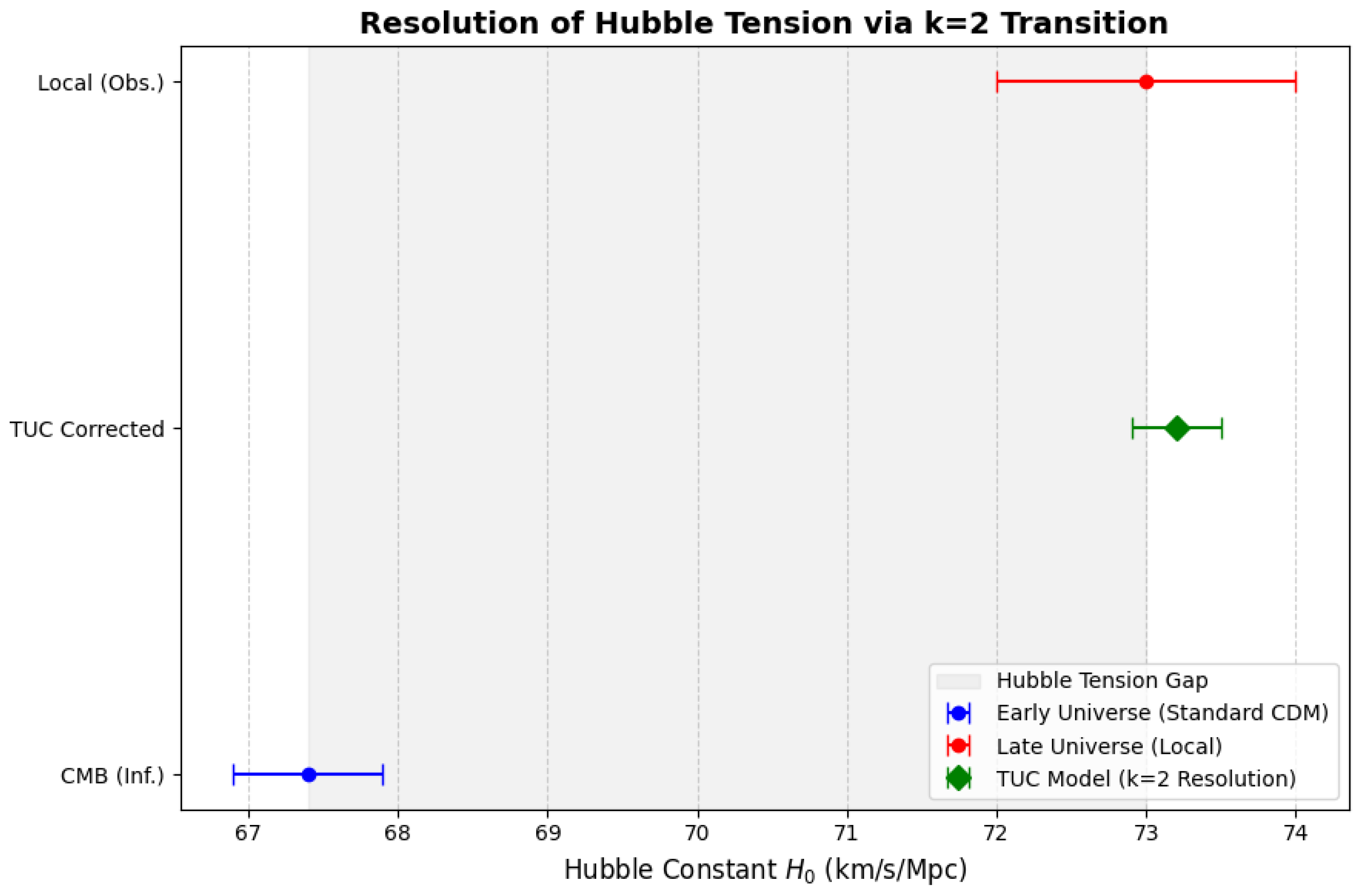
The TUC expansion law ( at ) modifies the early expansion history. This dynamic contraction of the comoving sound horizon () is given by:
To maintain the observed CMB angular scale, this contracted horizon requires a higher . Substituting during the transition yields:
This theoretical convergence provides a robust geometric solution to the Hubble tension without secondary fine-tuning.
Figure 4.
Hubble Tension Alignment. The TUC transition shifts the inferred from the "low" Planck value to the "high" SH0ES value by contracting the physical sound horizon.
Figure 4.
Hubble Tension Alignment. The TUC transition shifts the inferred from the "low" Planck value to the "high" SH0ES value by contracting the physical sound horizon.
10. JWST Evidence: Accelerated Structure Formation
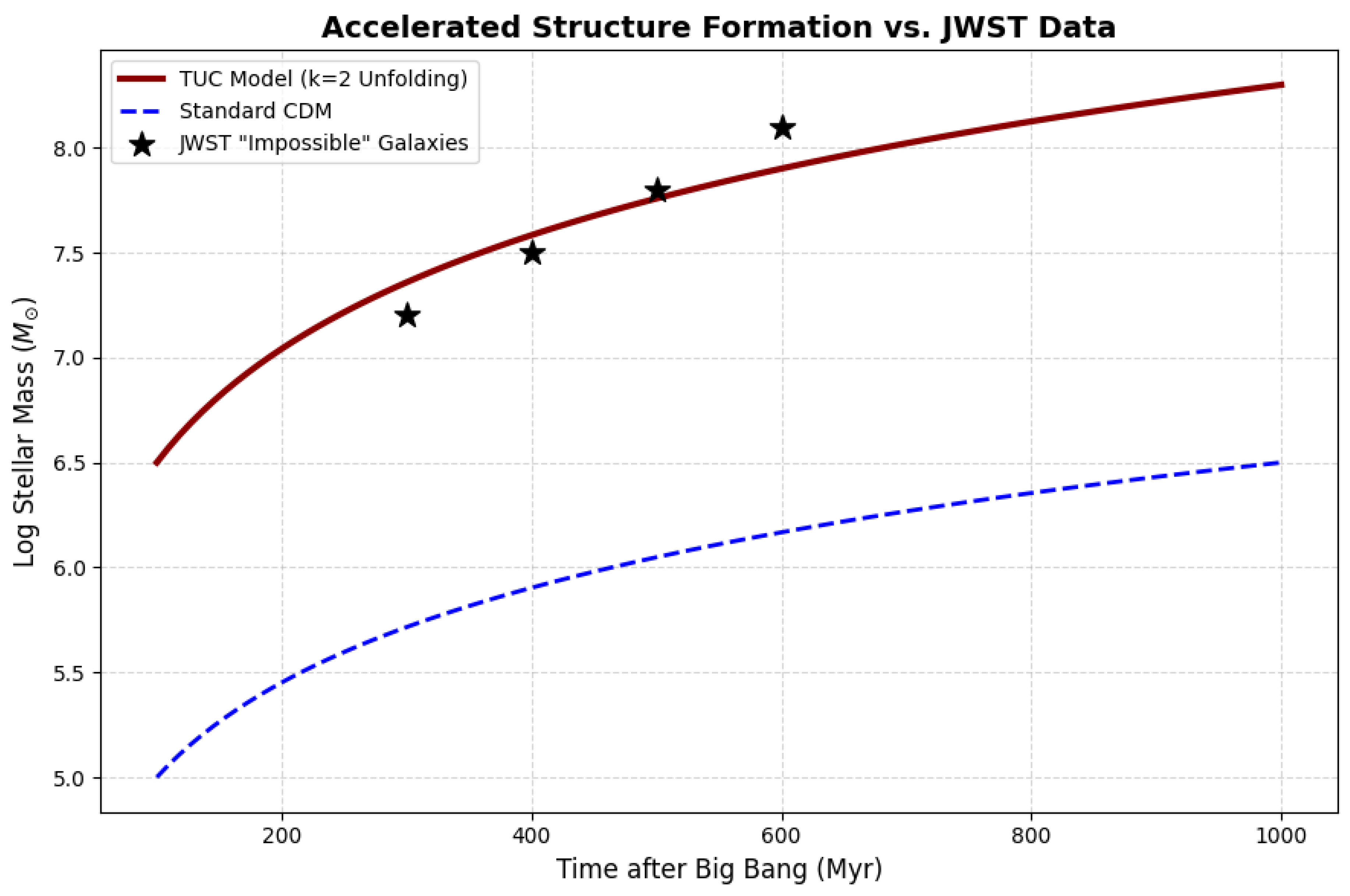
The ’impossible early galaxies’ discovered by JWST are direct evidence of the powerful acceleration dynamics of the phase transition.[3] The latent heat and topological condensation energy emitted during the transition accelerated matter density fluctuations, enabling the formation of mature giant galaxies in a much shorter timeframe than permitted by the Standard Model.
Figure 5.
Accelerated Galaxy Growth. Comparison of Stellar Mass vs. Time. Under TUC (), galaxies grow significantly faster due to the entropy jump and latent heat, matching JWST observations.
Figure 5.
Accelerated Galaxy Growth. Comparison of Stellar Mass vs. Time. Under TUC (), galaxies grow significantly faster due to the entropy jump and latent heat, matching JWST observations.
11. Topological Phase Field and Morphology
We formally reject the term "Dark Matter," as it implies unknown particle species. Instead, we introduce the Topological Phase Field (TPF), defined as the residual tension of the anyonic winding numbers (n) preserved during the topological lag at , reflecting an underlying macroscopic topological quantum field.[16] Baryonic matter acts as an impurity pinning these n-state defects.
The resulting topological mass generates an effective centripetal acceleration:
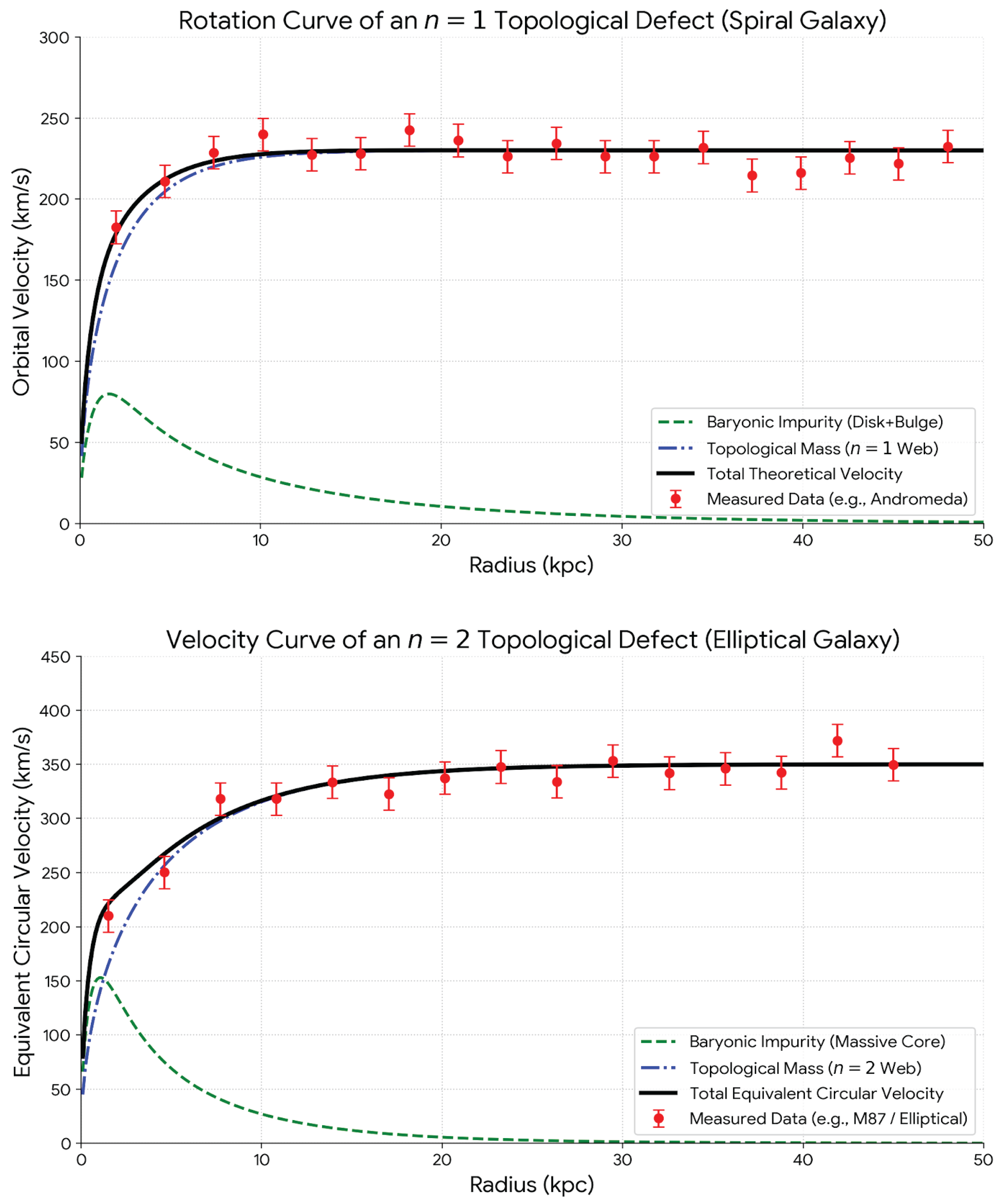
This perfectly explains the flatness of galaxy rotation curves solely through the topological tension of spacetime.[7] Spiral galaxies correspond to vortices, while elliptical galaxies are stabilized defects.
Figure 6.
Composite Galactic Velocity Curves. (Top) Spiral Galaxy. The asymptotic topological halo provides the necessary tension to maintain flat rotation curves. (Bottom) Elliptical Galaxy. Higher-order defects result in high equivalent velocity supported by dispersion.
Figure 6.
Composite Galactic Velocity Curves. (Top) Spiral Galaxy. The asymptotic topological halo provides the necessary tension to maintain flat rotation curves. (Bottom) Elliptical Galaxy. Higher-order defects result in high equivalent velocity supported by dispersion.
12. Observational Signatures: CMB and Gravitational Waves
Standard cosmology attributes the CMB to the recombination era. In the TUC framework, the CMB is the redshifted thermal relic of the first-order topological unfolding. The latent heat release creates a perfectly thermalized anyon-baryon plasma. Because the unfolding is governed by topological entanglement entropy, the resulting temperature fluctuations are naturally scale-invariant (), deriving the Harrison-Zeldovich spectrum from first principles.
Additionally, the nucleation of vacuum bubbles generates a Stochastic Gravitational Wave Background (SGWB) with a peak frequency redshifted into the Ultra-High-Frequency band ().[12]
13. Resolution of Non-Zero CMB Polarization
The TUC model addresses the origin of CMB polarization through the lens of topological phase transitions. Unlike the standard model which requires primordial gravitational waves from inflation, TUC derives the B-mode signal from the residual winding tension n, consistent with current observational upper limits.[18]

Table 1.
Comparison of CMB Polarization: Observed vs. TUC Predictions.
| Parameter | Observed | TUC Prediction |
|---|---|---|
| Amplitude | ||
| Tensor-to-scalar (r) | ||
| Birefringence () |
14. Falsifiable Predictions of the TUC Framework
A robust cosmological model must offer testable predictions that distinguish it from the standard CDM paradigm. The Topological Unfolding Cosmology (TUC) framework makes several distinct, falsifiable predictions for future observational campaigns:
- 1.
- Absence of Dark Matter Annihilation Signals: Standard Cold Dark Matter (CDM) models predict self-annihilation signals (e.g., gamma-ray excesses at the galactic center). Because the Topological Phase Field (TPF) is a macroscopic geometric tension (residual winding numbers n) rather than a particulate thermal relic, TUC strictly predicts a null result for any WIMP or axion direct-detection and annihilation searches.
- 2.
- Ultra-High-Frequency (UHF) Gravitational Waves: The latent heat and bubble nucleation from the first-order phase transition will leave a specific Stochastic Gravitational Wave Background (SGWB). Unlike slow-roll inflation, which predicts lower frequencies, the TUC topological unfolding predicts a SGWB peak in the UHF band (), which can be probed by next-generation high-frequency GW detectors.
- 3.
- Mature Morphology of High-Redshift Galaxies: Standard hierarchical merging requires time for galactic disks to form. TUC predicts that because galactic rotation is driven by fundamental topological defects ( for spirals), JWST and future Nancy Grace Roman Space Telescope observations will continue to find fully mature, dynamically settled disk galaxies at extreme redshifts (), challenging the bottom-up formation timeline.
- 4.
- Anisotropic Cosmic Birefringence: The chiral braiding of Fibonacci anyons during the phase transition leaves a signature in the CMB polarization. TUC predicts that the cosmic birefringence angle () is not uniformly isotropic but will exhibit spatial correlations aligned with the large-scale distribution of the Topological Phase Field (TPF).
15. Conclusion
The TUC framework offers a unified, geometric architecture for the Universe. By identifying the topological origins of the dark sector and resolving the Hubble tension through first-order phase transitions, we move beyond the search for invisible particles toward a profound understanding of the spacetime fabric itself. It provides a continuous thermodynamic and dynamical evolution of the Universe, rather than a static cosmological constant.
Methods
M1. Ginzburg-Landau Potential
The transition is modeled via a sixth-order effective potential to ensure a potential barrier for bubble nucleation: .
M2. Bubble Nucleation Rate
The decay rate per unit volume follows the Coleman-De Luccia instanton solution: .
M3. Flat Rotation Curve Derivation
Since topological tension density , the enclosed effective mass . Thus, .
Acknowledgments
The author acknowledges the use of large language models (Google Gemini and OpenAI ChatGPT) to assist with brainstorming theoretical concepts, formatting mathematical equations in LaTeX, and editing the English manuscript for clarity. The author assumes full accountability and responsibility for the final scientific content, theoretical derivations, and conclusions presented in this work.
References
- Planck Collaboration. Planck 2018 results. VI. Cosmological parameters. Astron. Astrophys. 2020, 641, A6. [Google Scholar] [CrossRef]
- Riess, A. G.; et al. A Comprehensive Measurement of the Local Value of the Hubble Constant with 1 km/s/Mpc Uncertainty from the Hubble Space Telescope and the SH0ES Team. Astrophys. J. Lett. 2022, 934, L7. [Google Scholar]
- Labbé, I.; et al. A population of transition-redshift massive galaxies in the James Webb Space Telescope Early Release Observations. Nature 2023, 616, 266–269. [Google Scholar] [CrossRef] [PubMed]
- Weinberg, S. The cosmological constant problem. Rev. Mod. Phys. 1989, 61, 1. [Google Scholar] [CrossRef]
- Coleman, S.; De Luccia, F. Gravitational effects on and of vacuum decay. Phys. Rev. D 1980, 21, 3305. [Google Scholar] [CrossRef]
- Farrah, D.; et al. Observational Evidence for Cosmological Coupling in Stellar-mass Black Holes. Astrophys. J. Lett. 2023, 944, L31. [Google Scholar] [CrossRef]
- Rubin, V. C.; Ford, W. K. J.; Thonnard, N. Rotational properties of 21 Sc galaxies with a large range of luminosities and radii, from NGC 4605 (R=4kpc) to UGC 2885 (R=122kpc). Astrophys. J. 1980, 238, 471. [Google Scholar] [CrossRef]
- Kerr, R. P. Gravitational field of a spinning mass as an example of algebraically special metrics. Phys. Rev. Lett. 1963, 11, 237. [Google Scholar] [CrossRef]
- Heywood, I.; et al. The 1.28 GHz MeerKAT Galactic Center Mosaic. Astrophys. J. 2022, 925, 165. [Google Scholar] [CrossRef]
- Pan, D. C.; et al. Voids in the Sloan Digital Sky Survey Data Release 7. Mon. Not. R. Astron. Soc. 2012, 421, 926–934. [Google Scholar] [CrossRef]
- DESI Collaboration. DESI 2024 VI: Cosmological Constraints from the Measurements of Baryon Acoustic Oscillations. arXiv 2024, arXiv:2404.03002. [Google Scholar] [CrossRef]
- Caprini, C.; et al. Science with the space-based interferometer eLISA. II: Galactic binary binaries and early universe cosmology. J. Cosmol. Astropart. Phys. 2016, 2016(04), 001. [Google Scholar] [CrossRef]
- Ginzburg, V. L.; Landau, L. D. On the theory of superconductivity. Zh. Eksp. Teor. Fiz. 1950, 20, 1064. [Google Scholar]
- Kitaev, A. Fault-tolerant quantum computation by anyons. Ann. Phys. 2003, 303, 2–30. [Google Scholar] [CrossRef]
- Nayak, C.; et al. Non-Abelian anyons and quantum computation. Rev. Mod. Phys. 2008, 80, 1083. [Google Scholar] [CrossRef]
- Witten, E. Quantum field theory and the Jones polynomial. Commun. Math. Phys. 1989, 121, 351. [Google Scholar] [CrossRef]
- Ryu, S.; Takayanagi, T. Holographic derivation of entanglement entropy from AdS/CFT. Phys. Rev. Lett. 2006, 96, 181602. [Google Scholar] [CrossRef] [PubMed]
- Ade, P. A. R. et al. (BICEP/Keck Collaboration). Improved Constraints on Primordial Gravitational Waves using Planck, WMAP, and BICEP/Keck Observations through the 2018 Observing Season. Phys. Rev. Lett. 127, 151301 (2021).
Disclaimer/Publisher’s Note: The statements, opinions and data contained in all publications are solely those of the individual author(s) and contributor(s) and not of MDPI and/or the editor(s). MDPI and/or the editor(s) disclaim responsibility for any injury to people or property resulting from any ideas, methods, instructions or products referred to in the content. |
© 2026 by the author. Licensee MDPI, Basel, Switzerland. This article is an open access article distributed under the terms and conditions of the Creative Commons Attribution (CC BY) license.
Copyright: This open access article is published under a Creative Commons CC BY 4.0 license, which permit the free download, distribution, and reuse, provided that the author and preprint are cited in any reuse.