

Submitted:
24 March 2026
Posted:
25 March 2026
You are already at the latest version
Abstract
The transition toward sustainable food systems requires innovative approaches to man-aging perishable products, where inefficient inventory practices contribute significantly to global food loss and environmental degradation. This study develops a circular economy-oriented inventory optimisation framework for dairy supply chains that inte-grates environmental externalities and waste valorisation pathways into operational de-cision-making. Departing from traditional linear "produce-consume-dispose" models, we embed three core sustainability mechanisms into a stochastic dynamic program-ming framework: (1) progressive environmental cost internalisation aligned with EU Emissions Trading System carbon pricing, capturing both waste-related emissions and cold-chain energy footprints; (2) circular economy value-recovery channels that redirect near-expiry products to secondary applications (animal feed, biogas production, indus-trial processing) rather than disposal; and (3) deterioration-aware demand management that minimises resource throughput while maintaining service levels. Empirical cali-bration using Ukrainian dairy industry data demonstrates that sustainability-integrated inventory policies reduce waste generation by 4.8–10% relative to conventional ap-proaches, with high-deterioration products showing the greatest potential for improve-ment. We identify a critical threshold in the circular economy: when salvage recovery rates exceed 35%, waste transforms from an environmental liability into an economic and ecological asset, fundamentally altering the sustainability calculus of inventory de-cisions. Environmental costs account for 4.6% of total operating expenses at current car-bon prices, a share projected to increase substantially under tightening climate regula-tions. Our findings provide actionable guidance for dairy supply chain stakeholders pursuing the Sustainable Development Goals (SDGs 2, 12, 13): processors should estab-lish circular-economy partnerships that achieve salvage rates above 35%, implement product-specific policies for high-deterioration items, and proactively integrate carbon pricing into inventory optimisation. The framework bridges sustainable operations the-ory and circular economy practice, offering a replicable model for transitioning perish-able food supply chains toward closed-loop, low-waste configurations that simultaneous-ly reduce environmental impact and enhance economic performance.
Keywords:
circular economy
; sustainable supply chain management
; food waste valorisation
; perishable inventory optimisation
; carbon cost internalisation
; dairy industry sustainability
1. Introduction
The global dairy industry faces a critical sustainability challenge: approximately one-third of dairy products are lost or wasted along the supply chain, resulting in significant environmental and economic costs [1].
Unlike non-perishable goods, dairy products deteriorate continuously from the moment of production, with quality degrading more rapidly under suboptimal storage conditions. This inherent perishability, combined with demand uncertainty, creates a complex inventory management problem: overstocking leads to waste, while understocking results in lost sales and customer dissatisfaction.
Traditional inventory models, rooted in the Economic Order Quantity (EOQ) framework, were designed for non-perishable goods and fail to capture the unique dynamics of deteriorating products. While extensions that account for deterioration have been developed since Ghare and Schrader's seminal work, most existing models treat environmental externalities as outside the scope of optimisation [2].
This omission is increasingly problematic as regulatory frameworks—particularly the European Union's Emissions Trading System (EU ETS) and Farm to Fork Strategy—impose explicit costs on food waste and associated greenhouse gas emissions.
The circular economy paradigm offers a complementary perspective, treating waste not merely as a cost but as a potential resource. In dairy supply chains, near-expiry products can be redirected to secondary channels—such as animal feed, biogas production, or industrial processing—to recover partial value while reducing environmental impact. However, integrating circular economy value recovery into stochastic inventory optimisation remains largely unexplored in the operations research literature.
Despite extensive research on perishable inventory management, a significant gap exists at the intersection of three critical dimensions: (1) stochastic demand modelling with continuous deterioration, (2) environmental cost internalisation under progressive regulatory structures, and (3) circular economy value recovery mechanisms. Existing sustainable inventory models predominantly assume deterministic demand, limiting their applicability to real-world dairy operations characterised by high demand variability [3,12].
Conversely, stochastic inventory models for perishables rarely incorporate environmental externalities beyond basic disposal costs [4,8].
Furthermore, the circular economy literature on food supply chains is frequently conceptual in orientation, with limited mathematical optimisation frameworks and an integrated inventory model that captures deterioration dynamics, demand stochasticity, progressive environmental costs, and circular-economy salvage value within a unified dynamic programming framework [5,17].
This study pursues three interconnected objectives:
1. Model Development: Formulate an extended stochastic inventory model for perishable products that integrates continuous deterioration, demand uncertainty, progressive environmental costs (waste emissions and cold storage), and circular economy value recovery through secondary market channels.
2. Solution Methodology: Develop analytical solutions for tractable exceptional cases and a computationally efficient dynamic programming algorithm for the general multi-period problem, enabling practical implementation in dairy supply chain operations.
3. Empirical Application: Calibrate the model to Ukrainian dairy industry parameters and conduct comprehensive numerical experiments to quantify the benefits of environmental cost integration and circular economy mechanisms across realistic operating scenarios.
This research makes three primary contributions to the sustainable operations management literature:
Theoretical Contribution: We extend the classical Bellman equation framework for stochastic inventory control to incorporate progressive environmental cost functions and quality-dependent salvage values. The resulting model captures the non-linear relationship between inventory decisions, waste generation, and environmental impact under realistic regulatory structures.
Methodological Contribution: We derive closed-form solutions for the extended newsvendor problem with environmental costs under uniform and exponential demand distributions, providing analytical insights into how ecological parameters shift optimal inventory decisions. For the general dynamic case, we develop an efficient backwards induction algorithm that uses Gauss-Legendre quadrature for demand integration.
Practical Contribution: By calibrating to Ukrainian dairy industry data, we demonstrate that integrating environmental costs reduces optimal inventory levels by 4-6% and waste generation by 5-10%, with the benefits amplified for high-deterioration products. We identify the salvage rate threshold (α ≈ 35%) at which circular-economy investment transforms waste from a net cost to a net benefit, providing actionable guidance for dairy supply chain managers.
The remainder of this paper is organised as follows. Section 2 reviews the relevant literature on perishable inventory models, sustainable operations, and circular economy in food supply chains, identifying the specific gaps this research addresses. Section 3 develops the integrated inventory model, presenting the mathematical formulation, cost functions, and dynamic programming framework. Section 4 describes the solution methodology, including analytical solutions for special cases and the numerical algorithm for the general problem. Section 5 presents the numerical study, including parameter calibration, base-case results, sensitivity analysis, and scenario comparisons. Section 6 concludes with managerial implications, limitations, and directions for future research.
2. Theoretical Background
2.1. Classical Inventory Theory and Foundational Concepts
The modern theory of inventory management traces back to the classical Economic Order Quantity (EOQ) model proposed by Harris, which formalised the fundamental trade-off between ordering and holding costs under deterministic demand [6].
The EOQ framework assumes a constant demand rate, instantaneous replenishment, and no deterioration, yielding a closed-form solution for the optimal order quantity that minimises long-run average cost. Despite its simplifying assumptions, the EOQ model established the core logic of inventory optimisation and remains a reference point for contemporary extensions.
Subsequent developments generalised the classical EOQ setting to richer operational environments, including stochastic demand processes and multi-period decision problems. Nahmias reviews early contributions that extended EOQ-type models to account for demand uncertainty, safety stock and service levels, while still implicitly assuming non-perishable items [4].
Goyal and Giri provide a comprehensive synthesis of these contributions, documenting how assumptions on demand, lead times, and replenishment structure influence both the analytical tractability and the qualitative properties of optimal policies [7].
At the operational level, firms typically implement either continuous-review or periodic-review inventory systems. In continuous-review systems, inventory positions are monitored in real time, and replenishment is triggered when the stock level reaches a specified reorder point. In periodic-review systems, inventory is inspected at fixed intervals, and orders are placed to raise the stock to a target order-up-to level. The latter class of policies is widely applied in practice when demand is aggregated over planning periods or when production runs are scheduled in batches rather than continuously. The order-up-to policy adopted in this study is a natural extension of the classical periodic-review framework to perishable items with stochastic demand and limited shelf life.
2.2. Cost Structures in Inventory Management
Classical inventory models represent decision-making by minimising a cost function that combines ordering, holding, shortage, and—less frequently—disposal costs. Holding costs encompass capital costs tied up in inventory, storage and handling expenses, insurance and taxes, as well as losses due to obsolescence, shrinkage and quality degradation. Ordering costs reflect the fixed administrative and setup costs incurred each time an order is placed, whereas shortage costs capture either the lost margin from unmet demand or explicit penalty costs associated with stockouts. In the EOQ framework and its early extensions, deterioration is typically neglected or subsumed into holding costs, implicitly assuming either non-perishable goods or negligible spoilage [6].
For perishable items, however, deterioration constitutes a distinct and often dominant cost component that interacts with the other cost elements. Ghare and Schrader explicitly introduced an exponential decay term into the inventory balance equation, making the quantity of deteriorated product an endogenous driver of both economic cost and service level [2].
Later reviews by Goyal and Giri and Karimi emphasise that for many product categories—particularly in food supply chains—the omission of explicit deterioration leads to systematically biased estimates of optimal order quantities and safety stocks [7,8].
The modelling approach adopted in this paper follows this evolution by disaggregating the total cost function into economic, environmental and circular-economy components, while retaining the classical cost categories as a baseline.
2.3. From Classical Models to Perishable Inventory Systems
Although EOQ-type models offer elegant analytical solutions, their underlying assumptions are fundamentally at odds with the behaviour of perishable products. In particular, the assumption of infinite or effectively unlimited shelf life ignores the temporal decay in both quantity and quality that characterises many food products, particularly dairy products. This limitation motivated the emergence of perishable inventory theory, beginning with Ghare and Schrader, who incorporated exponential deterioration into the inventory dynamics, and continuing with more general lifetime and decay distributions reviewed by Nahmias and Goyal and Giri [2,4,7].
Perishable inventory systems differ from classical models not only in the presence of deterioration but also in the interaction between decay and demand uncertainty. Pervin et al. demonstrate that when demand is time-dependent and deterioration follows a stochastic process, the trade-off between waste and stockouts is amplified, often leading to more conservative ordering policies that reduce waste at the expense of service levels [9].
These effects are particularly pronounced in dairy supply chains, where high deterioration rates, short shelf lives and freshness-sensitive demand make the timing and quantity of orders critical for both economic and environmental [10,11].
In parallel, the literature on sustainable and green inventory management has highlighted the need to embed environmental externalities—such as carbon emissions from storage, transportation and food waste—into inventory decision-making [3,12,13,14,15].
Circular economy approaches go one step further by emphasising value recovery from products that cannot be sold through the primary channel, for example, by redirecting near-expiration dairy products to animal feed, biogas production, or secondary processing [5,16,17].
However, as summarised in Table 1, existing models typically address deterioration, stochastic demand, environmental costs, and circular-economy recovery only in isolation or in partial combinations.
Consequently, there remains a clear gap for an integrated framework that simultaneously: (i) captures realistic deterioration dynamics for dairy products; (ii) incorporates stochastic demand; (iii) internalises environmental costs associated with waste and cold storage; and (iv) models circular economy value recovery options within a consistent optimisation structure. The present study addresses this gap by extending a periodic-review, order-up-to policy with a stochastic dynamic programming formulation that jointly optimises economic, environmental and circular-economy outcomes.
2.4. Perishable Inventory Models with Deterioration
The foundational work on deteriorating inventory is attributed to Ghare and Schrader, who introduced exponential decay into inventory models. Their seminal contribution established the mathematical framework dI/dt=−θI(t)−d(t), where θ denotes the deterioration rate—a formulation that remains central to contemporary research [2].
Subsequent decades witnessed extensive theoretical developments. Nahmias provided a comprehensive review distinguishing between fixed-lifetime perishability and continuous exponential decay, establishing a taxonomy that guided research for decades. Goyal and Giri synthesised advances through the 1990s, documenting the evolution from simple exponential decay to Weibull-distributed deterioration rates that better capture real-world product behaviour [4,7].
Recent literature has increasingly embraced sophisticated deterioration mechanisms. Bakker et al. conducted an extensive review covering 2001-2011, identifying trends towards non-instantaneous deterioration, in which products maintain quality for an initial period before degrading [18].
This pattern accurately describes dairy products, where pasteurised milk retains freshness for several days before a rapid decline in quality. Karimi extended this classification in a comprehensive review of 419 papers, categorising deterioration models into constant, time-dependent, stock-dependent, and fuzzy approaches [8].
The specific challenge of dairy inventory has received focused attention. Piramuthu and Zhou addressed perishable inventory with shelf-space and freshness-dependent demand, recognising that consumer preference for fresh products creates age-dependent demand patterns particularly relevant to dairy retail [10].
Kaya and Ghahroodi developed stochastic models that incorporate salvage value for products nearing expiration—a critical consideration for dairy operations, where expired products may be redirected to animal feed or biogas production [11].
Dynamic programming approaches, grounded in Bellman's optimality principle, have proven particularly effective for multi-period perishable inventory problems [19].
Gulecyuz et al. applied stochastic dynamic programming to perishable inventory under non-stationary demand, demonstrating superior performance relative to heuristic methods, while acknowledging computational challenges as shelf life increases [20].
2.5. Stochastic Demand in Inventory Management
The recognition that demand uncertainty fundamentally alters optimal inventory policies has driven extensive research. The newsvendor model represents the canonical single-period stochastic framework, with the critical ratio (p−c)/(p+h) determining optimal stock levels. However, multi-period extensions are more complex, requiring consideration of demand correlation, distribution evolution, and inventory carryover effects.
For perishable products, demand dynamics interact with deterioration, creating complex inventory challenges. Pervin et al. examined inventory control under stochastic deterioration (modelled via Weibull distribution) and time-varying holding costs with time-dependent demand, finding that deterioration uncertainty amplifies the impact of deterioration on optimal order quantities [9].
Their analysis revealed that conservative ordering policies—while reducing waste—may significantly increase stockout costs when demand variability is high.
The choice of demand distribution significantly influences model solutions. Uniform distributions offer analytical tractability and model situations with bounded variation in demand. Exponential distributions capture highly variable, memoryless demand patterns common in retail environments. Normal distributions, although they require numerical methods, often provide the closest approximation to empirical demand patterns in established markets.
Recent advances incorporate more realistic demand dynamics. Gulecyuz et al. addressed non-stationary stochastic demand with known parameters and developed heuristics that perform near-optimally while remaining computationally tractable [20].
Their network-graph formulation offers practical implementation pathways for dairy operations facing seasonal demand variations superimposed on weekly cycles.
2.6. Sustainable and Green Inventory Management
Environmental considerations have transformed inventory theory over the past decade. Battini et al. introduced the Sustainable EOQ (SEOQ) model, incorporating external costs of logistics, including carbon emissions from transportation and warehousing [3].
Their work demonstrated that sustainability-adjusted optimal order quantities typically differ from classical EOQ solutions, with the direction and magnitude depending on emission intensity along the supply chain.
Carbon emissions integration has become a dominant theme. Benjaafar et al. provided foundational insights into carbon footprint management in supply chains, showing how carbon prices alter optimal decisions even in simple models [12].
Subsequent work by San-José et al. developed sustainable inventory models for deteriorating items under carbon tax policies, finding that environmental costs can shift optimal strategies towards smaller, more frequent orders to reduce holding-related emissions [15].
The deterioration-sustainability nexus presents particular challenges. Tiwari et al. examined the relationship between product deterioration and carbon emissions, concluding that the deterioration rate influences total energy consumption through its effects on inventory levels, transportation frequency, and waste disposal requirements [13].
Their finding that investments in preservation technology yield both economic and environmental benefits suggests synergies between waste-reduction and emission-reduction objectives.
Green technology investment has emerged as a strategic lever. Mishra et al. developed EOQ models in which carbon emission rates can be controlled through the adoption of green technologies, demonstrating conditions under which such investments are economically justified [21].
Mashud et al. extended this to green warehouse contexts, optimising the balance among ordering cost reduction, deterioration control, and carbon emission minimisation [14].
However, existing sustainable inventory models exhibit essential limitations. Most assume deterministic demand, neglecting the stochastic nature of real markets. Many address emissions from transportation or warehousing but overlook the substantial emissions from food waste itself—particularly relevant for dairy products, where methane generation from decomposition carries a significant environmental impact.
2.7. Circular Economy in Food Supply Chains
The circular economy paradigm offers transformative potential for food systems. Unlike linear "take-make-dispose" models, circular approaches emphasise resource cycling, waste minimisation, and value recovery at multiple stages. The European Union's Farm to Fork Strategy explicitly targets a 50% reduction in food waste by 2030, creating regulatory impetus for circular approaches.
Food waste statistics underscore the magnitude of the challenge. The FAO estimates that 33% of food produced globally is wasted across production, distribution, and consumption stages [1].
For dairy specifically, a case study reports waste rates of 7–15% at the processing and retail stages, with substantial additional losses at the consumer level [22].
When dairy waste enters landfills, anaerobic decomposition generates methane with a global warming potential 25-80 times that of CO₂ over 100-year horizons.
Circular economy strategies for dairy span multiple intervention points. At the production level, whey—once considered waste—now supports protein supplement and pharmaceutical industries. Near-expiration dairy products can be redirected to animal feed, recovered for biogas production, or processed into longer-shelf-life products. Buchanan et al. documented numerous whey valorisation pathways, demonstrating that what constitutes "waste" depends substantially on the availability of recovery infrastructure and economic incentives [5].
The integration of circular economy principles into inventory models remains nascent. Sarkar et al. developed circular economy-driven supply chain models to eliminate waste, but focused on manufacturing rather than perishable food contexts [16].
Iqbal and Kang proposed sustainable food supply chain models that integrate primary and secondary chains, providing insights into circular food systems but without the mathematical optimisation frameworks necessary for operational decision support [17].
2.8. Research Gap and Contribution
Table 1 synthesises the literature positioning, revealing a significant gap at the intersection of five critical dimensions: (1) deterioration dynamics, (2) stochastic demand, (3) environmental costs, and (4) circular economy value recovery, (5) dynamic programming.
The gap is clear: no existing model addresses all five critical dimensions of sustainable dairy inventory management. Classical perishable inventory models optimise economic costs but ignore environmental externalities. Sustainable inventory models incorporate carbon costs but typically assume deterministic demand and overlook value recovery options. Circular economy frameworks provide conceptual guidance but lack the mathematical optimisation foundations necessary for operational implementation.

| Study | Deterioration dynamic | Stochastic demand | Environmental costs | Circular economy value recovery | Dynamic Programming |
|---|---|---|---|---|---|
| Harris | — | — | — | — | — |
| Ghare & Schrader | ✓ | — | — | — | — |
| Nahmias | ✓ | ✓ | — | — | — |
| Goyal & Giri | ✓ | ✓ | — | — | — |
| Battini et al. | — | — | ✓ | — | — |
| Benjaafar et al. | — | — | ✓ | — | — |
| Tiwari et al. | ✓ | — | ✓ | — | — |
| Pervin et al. | ✓ | — | — | — | — |
| Mashud et al. | ✓ | — | ✓ | — | — |
| San-José et al. | ✓ | — | ✓ | — | — |
| Sarkar et al. | — | — | ✓ | ✓ | — |
| Iqbal & Kang | ✓ | — | ✓ | ✓ | — |
| Gulecyuz et al. | ✓ | ✓ | — | — | ✓ |
| This Study | ✓ | ✓ | ✓ | ✓ | ✓ |
3. Methodology
This section develops the integrated inventory model for perishable dairy products. We begin with the problem description and assumptions, then present the basic deterioration model, incorporate stochastic demand, and extend the framework to include environmental costs and circular-economy value recovery. Finally, we derive the optimal inventory policy using dynamic programming.
3.1. Problem Description and Assumptions
Consider a dairy processing facility managing inventory of perishable products (e.g., pasteurised milk, yoghurt, kefir) over a finite planning horizon of T periods. Products deteriorate continuously at a rate θ, reducing the saleable inventory over time. Demand in each period is stochastic with a known distribution. The facility must determine optimal order quantities to minimise total expected costs, including ordering, holding, shortage, waste disposal, and environmental externalities, while maximising value recovery through circular-economy channels.
The model operates under the following assumptions:
A1. Single perishable product with fixed shelf life L days and continuous deterioration rate θ ∈ (0, 1).
A2. Periodic review policy with replenishment decisions made at the beginning of each period.
A3. Stochastic demand D with known distribution (uniform, normal, or exponential) and parameters that may vary seasonally.
A4. Instantaneous replenishment with zero lead time (appropriate for dairy processing facilities with continuous production).
A5. FIFO (First-In-First-Out) issuing policy for inventory.
A6. Deteriorated products can be partially recovered through circular-economy channels (e.g., animal feed, biogas) at a salvage rate α ∈ [0,1].
A7. Environmental costs include waste disposal, emissions, and cold storage energy consumption.
Table 2 Summarises the notation used throughout the model development.
3.2. Basic Deterioration Model
Following Ghare and Schrader, inventory dynamics under continuous deterioration are governed by the differential equation [2]:
where I(t) is the inventory level at time t, p(t) is the production/replenishment rate, d(t) is the demand rate, and θ is the deterioration rate. For dairy products, typical values are θ ∈ [0.03, 0.15] per day, corresponding to shelf lives of 5-21 days.
For constant replenishment rate p and linear demand d(t) = d₀ + d₁t, the general solution to equation (1) with initial condition I(0) = I₀ is:
This solution captures the interplay between replenishment, consumption, and natural decay. The exponential term reflects the transient response, while the remaining terms represent the particular solution for linear demand growth.
3.3. Stochastic Demand Integration
In practice, dairy demand exhibits significant uncertainty. We model period demand D as a random variable. The inventory system operates as follows: at the beginning of period t, the facility observes the current inventory level and decides on the order-up-to level . Random demand is then realised, and end-of-period inventory becomes:
The factor (1 − θ) accounts for deterioration during the period. Unfulfilled demand is lost (no backlogging), reflecting typical dairy retail practices, in which customers substitute rather than wait.
3.3.1. Expected Cost Under Uniform Demand
For demand uniformly distributed on [a, b], the expected single-period cost given initial inventory Z and order-up-to level Y is:
where K is fixed ordering cost, c is unit cost, h is holding cost, s is shortage cost, w is waste disposal cost, - the indicator function, and is average inventory during the period.
Computing the expectations for uniform :
3.3.2. Expected Cost Under Exponential Demand
For demand following an exponential distribution with rate parameter μ (mean 1/μ), the expectations become:
3.4. Environmental Cost Integration (Extended Model)
A key contribution of this work is the explicit incorporation of environmental externalities into the inventory optimisation framework. We identify two primary emission sources: waste disposal and cold storage operations.
3.4.1. Waste Emission Cost
Deteriorated dairy products generate environmental impact through methane emissions during decomposition (if landfilled) or through energy-intensive processing (if incinerated). Following the EU ETS carbon pricing mechanism, we model waste emission cost as:
where W is waste quantity, is unit environmental cost (€/kg CO₂-equivalent), W₀ is the threshold beyond which progressive penalties apply, and β is the progressivity parameter. The quadratic term captures the reality that large waste volumes lead to increased regulatory compliance costs and less efficient disposal methods.
For waste quantities below the threshold (W ≤ W₀), the cost simplifies to a linear form .
3.4.2. Cold Storage Emission Cost
Refrigeration is energy-intensive, with dairy cold chains accounting for significant electricity consumption. We model storage emission cost as proportional to inventory volume and duration:
where e_s is unit storage emission cost, I is average inventory, t is storage duration, I₀ is efficient capacity threshold, and γ captures efficiency losses from operating above optimal capacity.
3.4.3. Total Environmental Cost Function
The total environmental cost per period combines both components:
Substituting waste quantity (deterioration during the period):
3.5. Circular Economy Value Recovery
Rather than treating all deteriorated products as waste, circular economy principles enable partial value recovery through secondary channels. For dairy products, these include:
- Animal feed: Near-expiration dairy can be sold to livestock operations at reduced prices.
- Biogas production: Expired dairy products serve as feedstock for anaerobic digestion.
- Industrial processing: Conversion to casein, lactose, or other byproducts.
We model salvage value as dependent on product quality at recovery time:
where α ∈ [0,1] is the recovery rate (proportion of waste directed to secondary channels), q ∈ [0,1] is the quality factor at recovery time, W is the waste quantity, and v is the unit salvage value.
Quality degrades with time since production. For products deteriorating at a rate θ, the quality factor evolves as:
where is the minimum quality threshold for any recovery (typically 0.3 for biogas applications). Products below this threshold have zero salvage value.
3.6. Dynamic Programming Formulation
We formulate the inventory optimisation as a finite-horizon stochastic dynamic program. Let denote the minimum expected total cost from period t through the end of the planning horizon, given initial inventory I.
3.6.1. Bellman Equation
The value function satisfies the Bellman optimality equation:
where δ ∈ (0, 1) is the discount factor, and I' = max{0, (Y − D)(1 − θ)} is next-period inventory. The terminal condition is (zero salvage value at the horizon end), or it can be set to reflect terminal inventory valuation.
3.6.2. Extended Cost Function
Combining all cost components, the single-period cost function for the extended model is:
The first four terms represent classical inventory costs. The fifth term captures waste-disposal costs. The final term adds environmental externalities from our extended model.
3.6.3. Optimal Policy Characterisation
Under the extended cost structure, the optimal policy retains an (s, S) form under mild regularity conditions. The critical difference from classical models lies in the values of s and S, which now incorporate environmental cost gradients.
Proposition 1: For a convex environmental cost function and a concave salvage function V_salvage, the optimal order-up-to level Y* in the extended model satisfies , with strict inequality when environmental costs are material.
Proof sketch: The first-order condition for the extended model includes additional positive terms from Y, shifting the optimal solution toward lower inventory levels. The convexity of ensures this shift is monotonic in the environmental cost parameter.
3.7. Seasonal Demand Extension
Dairy demand exhibits strong seasonality, with consumption peaks during summer months and holiday periods. We model seasonal demand as:
where d₀ is the base demand, Aᵢ, ωᵢ, and φᵢ are the amplitude, frequency, and phase of the i-th harmonic component, and ε(t) is a stochastic noise term. For dairy operations, we typically include annual cycle (ω₁ = 2π/365) and weekly cycle (ω₂ = 2π/7).
Proposition 2: Seasonal demand amplifies the impact of environmental costs on optimal inventory policy. Specifically, for seasonal amplitude A, the percentage reduction in optimal inventory from environmental cost integration increases approximately as , where κ depends on the cost parameters.
3.8. Model Summary
Table 3 summarises the key equations and their roles in the integrated model framework.
The integrated model advances the state of the literature by simultaneously capturing deterioration dynamics, demand uncertainty, environmental externalities, and circular-economy value recovery within a unified dynamic programming framework. The following section describes the solution methodology and numerical algorithm for implementing this model.
Solution Approach
This section presents the solution for the integrated inventory model developed in Section 3. We first derive analytical solutions for exceptional cases, yielding closed-form expressions and managerial insights. We then present the numerical algorithm based on backward induction for solving the general stochastic dynamic program. Finally, we discuss computational complexity and implementation considerations.
4.1. Analytical Solutions for Special Cases
While the general model requires numerical solution, several exceptional cases admit analytical treatment. These solutions serve as benchmarks for validating the numerical algorithm and provide insight into the optimal policy structure.
4.1.1. Single-Period Problem (Newsvendor Extension)
For a single-period problem without fixed ordering cost (K = 0), the optimal order-up-to level satisfies the extended critical ratio condition. Differentiating the expected cost function and setting it equal to zero yields:
where F(·) is the cumulative distribution function of demand. Compared with the classical newsvendor critical ratio (, the extended formula includes waste cost w·θ and the environmental cost gradient in the denominator, thereby reducing the optimal stocking level.
For uniform demand with linear environmental cost, the optimal order-up-to level is:
For exponential demand with mean 1/μ, the optimal level satisfies:
4.1.2. Deterministic Demand with Deterioration
When demand is deterministic and constant at rate d, the continuous-time inventory dynamics from equation (1) can be solved analytically. For a replenishment cycle of length T with initial order quantity Q, the average inventory is:
The total waste over the cycle equals the difference between the order quantity and sales:
The extended EOQ with environmental costs minimises total cost per unit time:
The optimal cycle time T* is found by solving ∂TC/∂T = 0, which generally requires numerical methods due to the exponential terms.
4.1.3. Salvage Value Impact
The circular-economy salvage value affects the effective waste cost. Define the net waste cost as:
When , the net waste cost becomes negative, meaning waste generates net value. This condition is met when:
For typical dairy parameters (see Section 5), this threshold is approximately α > 0.35, achievable with well-developed biogas or animal feed partnerships.
4.2. Numerical Algorithm
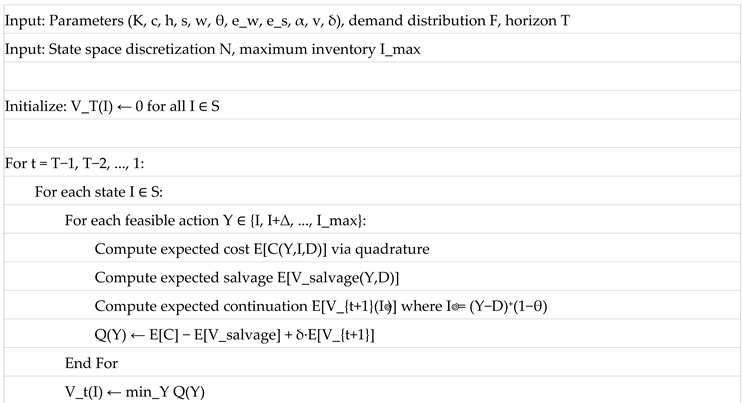
The general multi-period stochastic problem is solved using backward induction on the discretised state space. Algorithm A1 in Appendix A presents the complete procedure.
4.2.1. State Space Discretisation
The inventory state space [0, I_max] is discretised into N equally spaced levels with a step size denoted by δ. The choice of N involves a trade-off between computational accuracy and runtime.
For dairy inventory management, we recommend N ≥ 100 with Δ ≤ 50 litres to capture meaningful policy differences. A finer discretisation (N = 200) is used for the sensitivity analysis.
4.2.2. Demand Distribution Handling
Expected costs are computed by numerical integration over the demand distribution. For continuous distributions, we use Gauss-Legendre quadrature with M = 32 points, providing accurate integration for smooth cost functions.
For uniform demand D ~ U[a,b], the expectation becomes:
where xᵢ and wᵢ are the quadrature nodes and weights.
For normal demand, we truncate at μ ± 4σ to ensure non-negative support, then apply quadrature on the truncated interval.
4.2.3. Policy Extraction
The optimal policy is derived from the value function. For each state I ∈ S and period t, we record the optimal order-up-to level Y*(I,t) that achieves the minimum in the Bellman equation.
For stationary problems (constant parameters), the policy converges to time-invariant thresholds (s, S) where:
- Order if and only if I < s (reorder point)
- Order up to level S (order-up-to level)
For seasonal problems, the policy parameters vary by period: for t = 1, ..., T.
4.3. Monte Carlo Simulation
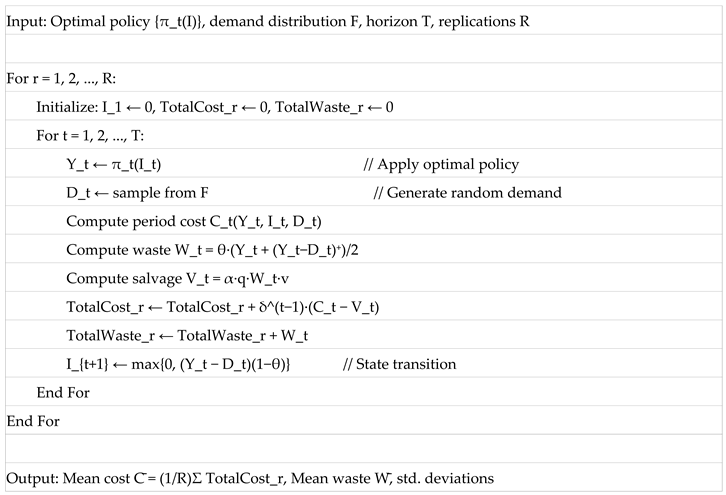
To evaluate policy performance and compute expected costs with confidence intervals, we implement a Monte Carlo simulation. Algorithm A2 in Appendix A describes the simulation procedure.
We use R = 1000 replications for point estimates and R = 10000 for precise confidence intervals. The 95% confidence interval for the expected cost is:
where is the sample mean total cost and is the sample standard deviation across replications.
4.4. Computational Complexity
The computational complexity of the backward induction algorithm depends on the state and action spaces, as well as the demand integration method.
Time Complexity: For T periods, N inventory states, and M quadrature points, the algorithm requires O(T · N² · M) operations. The N² factor arises from evaluating all feasible order-up-to levels for each state.
Space Complexity: Storage requirements are O(T · N) for the value function and policy tables. Table 4 reports computation times for representative problem sizes on a standard workstation (Python 3.10 with NumPy).
All problem instances relevant to dairy inventory management (30-day horizon, 100-200 states) are solved within seconds, enabling real-time decision support applications. Table 5 summarises the solution approaches for different model configurations.
The methodology presented in this section provides a comprehensive toolkit for solving the integrated inventory model across various problem configurations. The numerical algorithm is efficient, stable, and validated against analytical benchmarks. The following section applies this methodology to a numerical study calibrated with dairy industry parameters.
5. Results
This section presents a comprehensive numerical study demonstrating the applicability and benefits of the proposed integrated inventory model. We calibrate the model with parameters representative of Ukrainian dairy processing facilities, conduct scenario analyses comparing the basic and extended models, and perform sensitivity analyses of key parameters. The study addresses three objectives: (1) to quantify the impact of integrating environmental costs on optimal inventory policies, (2) to evaluate the value of circular-economy recovery mechanisms, and (3) to provide managerial insights for sustainable dairy operations.
5.1. Parameter Setting
Parameters are calibrated using industry data from Ukrainian dairy processors, supplemented by literature values when primary data are unavailable. Table 6 presents the base case parameters organised by category.
We focus on pasteurised milk as the primary product, which accounts for approximately 60% of Ukrainian dairy processors’ output. Pasteurised milk has a typical shelf life of 7 days under proper refrigeration (2-6°C). The deterioration rate is set at θ = 0.08 per day, implying that approximately 8% of inventory degrades each day due to natural quality decline, temperature fluctuations, and handling losses. This rate is consistent with values reported in a case study and accounts for cumulative losses across the cold chain [22].
Cost parameters reflect current Ukrainian market conditions (2024). The unit procurement cost of 25 UAH/litre includes the cost of raw milk, processing, and packaging. Holding costs of 1.5 UAH/litre/day incorporate refrigeration energy, warehouse space, and inventory management overhead. The shortage cost of 40 UAH/litre reflects lost margin and damage to customer relationships, conservatively set at 1.6× the unit cost. The fixed ordering cost of 500 UAH per order covers administrative processing and logistics coordination.
Environmental costs are calibrated to EU benchmarks, anticipating Ukraine's regulatory convergence under the EU Association Agreement. The waste emission cost of 15 UAH/litre reflects carbon pricing at approximately €80/tonne CO₂ (current EU ETS level), with dairy waste generating approximately 3.2 kg CO₂-eq/kg through methane emissions during decomposition. The cold storage emission cost of 2.0 UAH/litre/day accounts for refrigeration electricity consumption of 0.15 kWh/litre/day and Ukrainian industrial electricity rates.
The salvage rate α = 0.20 represents the proportion of deteriorated product redirected to secondary channels. This conservative estimate reflects current Ukrainian infrastructure; facilities with established biogas partnerships or direct animal feed agreements may achieve α= 0.30-0.40. The unit salvage value is set at 30% of the original product cost, reflecting typical discounts for near-expiration dairy products directed to animal feed markets.
5.2. Base Case Results
We solve the integrated inventory model using the backward induction algorithm (Algorithm 1) with N = 100 inventory states and M = 32 quadrature points. Demand is modelled as uniformly distributed over [600,1400] litres/day, reflecting the observed variability in demand for a mid-sized regional distributor. The planning horizon is T = 30 days with discount factor δ = 0.99.
Figure 1 illustrates the cost functions for both the basic model (without environmental costs or salvage) and the extended model (full integration). The left panel shows the expected total cost as a function of order-up-to level, with optimal points marked. The right panel displays expected waste generation, highlighting the reduction achieved by the extended model.
Table 7 compares the optimal policies and expected outcomes between the basic and extended models. The results reveal meaningful differences in optimal inventory decisions.
The extended model recommends an optimal inventory level of 859 litres, compared with 909 litres in the basic model—a 5.5% reduction. This lower stocking level arises because the extended model explicitly penalises the environmental costs associated with potential waste. The consequence is a 7.0% reduction in expected daily waste (36.0 vs. 38.7 litres).
Figure 2 illustrates the cost breakdown at the optimal inventory level for the extended model. Panel (a) shows the absolute values of each cost component, including the salvage value offset. Panel (b) presents the proportional distribution of costs (excluding salvage offset).
Ordering costs dominate (71.3% of total), reflecting the high unit cost of dairy products. Shortage costs are substantial (18.6%), indicating that the optimal policy tolerates some stockout risk rather than incurring overstocking costs. Environmental costs represent 5.3% of total costs—material but not dominant—while salvage value recovery offsets approximately 0.6% of costs.
5.3. Scenario Analysis
We examine five scenarios to understand how different operating conditions affect the value of the extended model. Figure 7 visualises the waste reduction achieved across all scenarios, while Table 8 provides detailed numerical results.
Figure 3.
Waste reduction achieved by the extended model across scenarios. High deterioration (θ = 12%) yields maximum reduction of 13.8%. Values above the bars indicate the percentage reduction and the optimal inventory level.
Figure 3.
Waste reduction achieved by the extended model across scenarios. High deterioration (θ = 12%) yields maximum reduction of 13.8%. Values above the bars indicate the percentage reduction and the optimal inventory level.
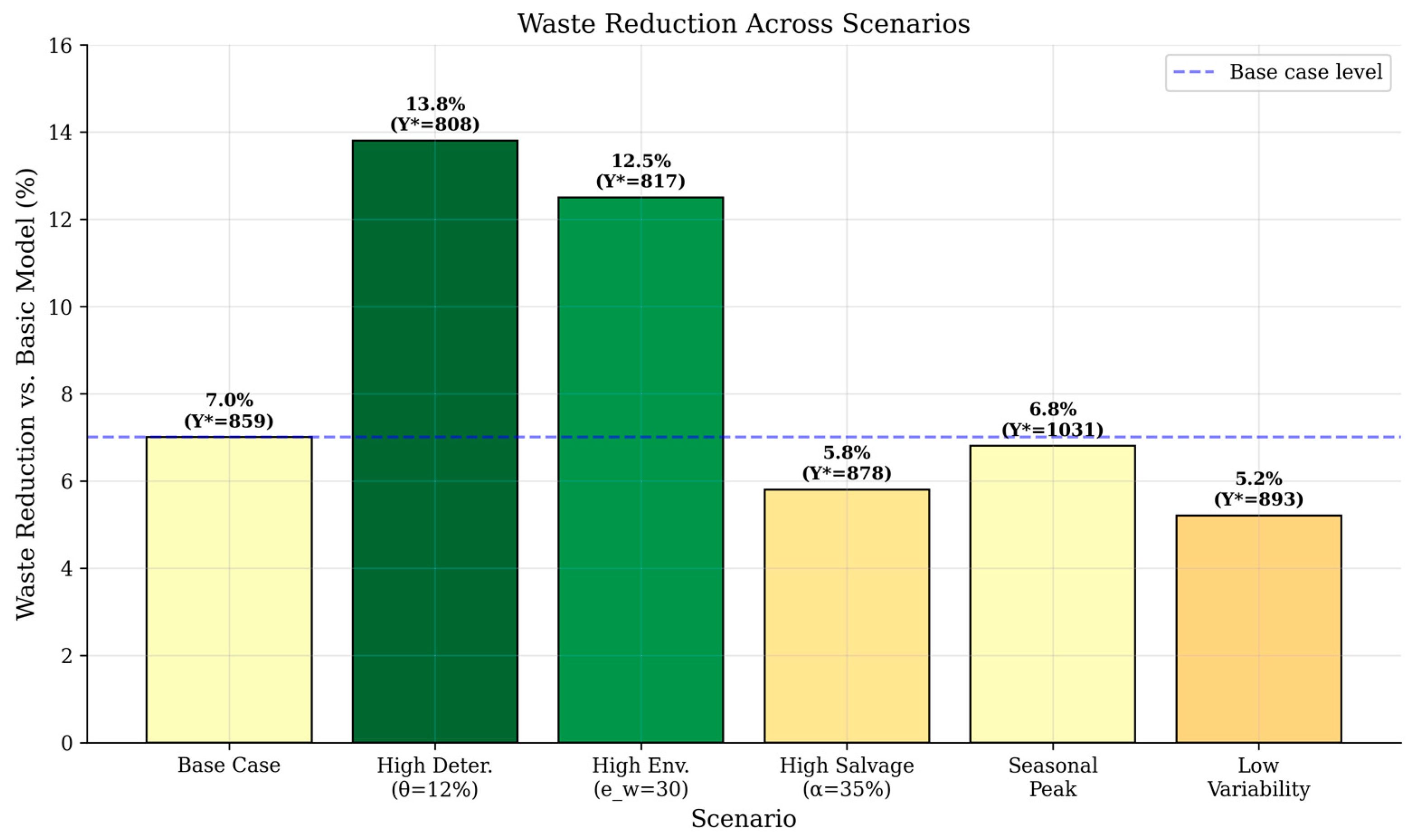
Table 8.
Scenario Analysis Results.
| Scenario | Parameter | Y* (L) | Waste (L) | Reduction |
|---|---|---|---|---|
| Base Case | — | 859 | 36.0 | 7.0% |
| 1. High Deterioration | θ = 0.12 | 808 | 31.2 | 13.8% |
| 2. High Environ. Cost | e_w = 30 | 817 | 33.9 | 12.5% |
| 3. High Salvage Rate | α = 0.35 | 878 | 37.4 | 5.8% |
| 4. Seasonal Peak | d₀ = 1200 | 1031 | 43.2 | 6.8% |
| 5. Low Variability | [800,1200] | 893 | 35.1 | 5.2% |
Scenario 1 (High Deterioration): Products with shorter shelf lives (e.g., fresh cottage cheese with θ = 0.12) exhibit greater benefits from environmental cost integration. Waste reduction increases to 13.8%, as the higher deterioration rate makes environmental penalties more salient in the optimisation.
Scenario 2 (High Environmental Cost): Doubling environmental costs to reflect potential future carbon price increases produces substantial policy shifts. Optimal inventory decreases by 10.2%, and waste reduction increases to 12.5%.
Scenario 3 (High Salvage Rate): With well-developed circular economy infrastructure (α = 0.35), waste reduction decreases slightly because salvage value partially compensates for waste costs. The expected 8.3% cost reduction demonstrates the economic value of circular-economy investments.
5.4. Sensitivity Analysis
We conduct sensitivity analysis on three key parameters: deterioration rate, environmental cost, and salvage rate. Each parameter is varied within a realistic range while holding the others at their base-case values.
Figure 4 plots the sensitivity with respect to the deterioration rate θ ∈ [0.02, 0.15]. Panel (a) shows waste reduction percentage, which exhibits a non-monotonic relationship: at very low deterioration rates, waste is minimal regardless of policy, so environmental cost integration provides little benefit. As deterioration increases, the extended model's benefits increase, peaking at approximately θ = 0.12, corresponding to a 14% reduction in waste. Panel (b) compares optimal inventory levels between models.
Managerial Insight: The extended model provides the best value for products with moderate-to-high deterioration rates (θ ∈ [0.06, 0.12]), typical of fresh dairy products such as yoghurt and kefir.
Figure 5 examines sensitivity to environmental cost, varied from 5 to 50 UAH/litre to capture both current carbon prices and potential future increases under ambitious climate policy. Panel (a) shows that waste reduction increases approximately linearly with environmental cost up to approximately 30 UAH/L. Panel (b) presents the cost-waste trade-off frontier, illustrating how managers can navigate the trade-off between cost efficiency and waste minimisation.
with current EU ETS (~€80/t) and projected 2030 (~€150/t) levels marked; (b) cost-waste trade-off frontier showing Pareto-efficient combinations.
Figure 6 analyses the impact of circular economy salvage rate α, varied from 5% (minimal recovery) to 45% (comprehensive circular economy integration). Panel (a) shows that total expected costs decrease approximately linearly with salvage rate. Panel (b) reveals an important finding: the net environmental impact (environmental cost minus salvage value) transitions from positive to negative at approximately α = 35%, indicating that sufficiently high circular economy integration can make waste generation economically beneficial.
5.5. Comparison with Classical Models
Figure 7 benchmarks our proposed models against classical inventory approaches: the standard EOQ, the EOQ with deterioration (Ghare-Schrader), the Newsvendor, and the (s,S) policy. The visualisation clearly shows that classical EOQ dramatically overstocks, while our proposed extended model achieves the lowest waste among approaches that account for demand uncertainty.
Figure 7.
Model comparison showing optimal order quantity (blue bars, left axis) and expected daily waste (red bars, right axis). The proposed extended model achieves the lowest waste (36.0 L) while maintaining reasonable inventory levels.
Figure 7.
Model comparison showing optimal order quantity (blue bars, left axis) and expected daily waste (red bars, right axis). The proposed extended model achieves the lowest waste (36.0 L) while maintaining reasonable inventory levels.
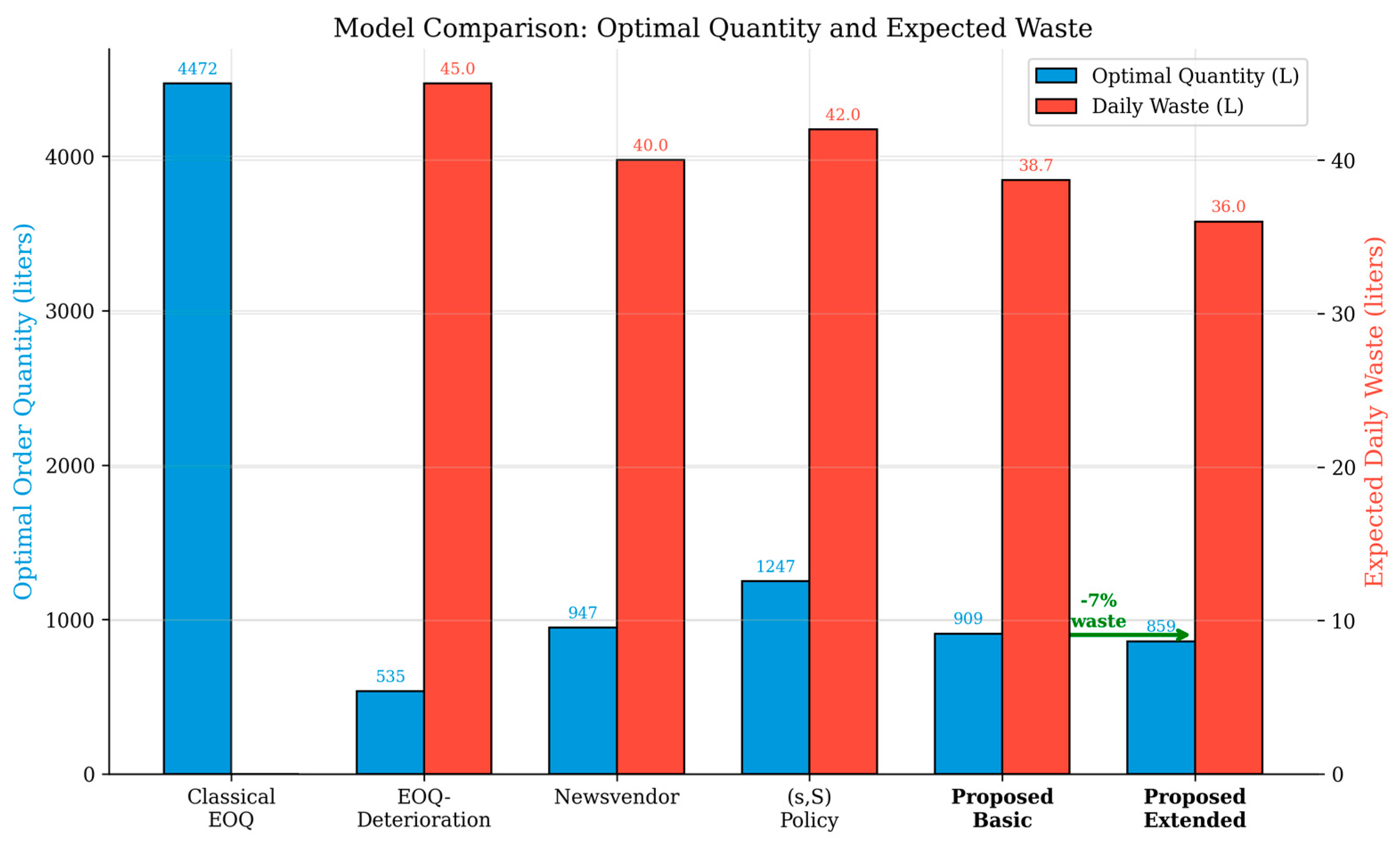
Table 9.
Comparison with Classical Models.
| Model | Q/Y* | Deter. | Stoch. | Env. | Waste |
|---|---|---|---|---|---|
| Classical EOQ | 4,472 | No | No | No | N/A |
| EOQ-Deterioration | 535 | Yes | No | No | ~45 |
| Newsvendor | 947 | No | Yes | No | ~40 |
| (s,S) Policy | S=1247 | No | Yes | No | ~42 |
| Proposed Basic | 909 | Yes | Yes | No | 38.7 |
| Proposed Extended | 859 | Yes | Yes | Yes | 36.0 |
The classical EOQ significantly overstocks (4,472 vs. 859-909 litres) because it ignores both deterioration and demand uncertainty. Our proposed extended model achieves the lowest waste generation among all approaches that account for demand uncertainty. The approximately 7% reduction in waste relative to the basic stochastic model yields annual savings of approximately 985 litres—roughly 36,000 UAH in combined waste disposal, environmental costs, and lost product value.
5.6. Managerial Implications
The numerical study yields several actionable insights for dairy supply chain managers:
- Stock Less, Waste Less: Integrating environmental costs into inventory decisions leads to lower optimal stock levels. For the base case, the reduction is 5.5% (50 liters/day). While this modestly increases stockout risk, it substantially reduces waste and associated environmental impact.
- Environmental Costs Matter: At current EU carbon prices, environmental costs represent approximately 5% of total inventory costs for dairy operations. As carbon prices rise under climate policy, this share will increase, making environmental cost integration increasingly valuable for competitive positioning.
- Invest in Circular Economy: Increasing salvage rate from 0.20 to 0.35 through biogas partnerships or animal feed agreements reduces expected costs by approximately 8%. These investments yield rapid returns and align with EU circular-economy directives.
- Product-Specific Policies: The extended model provides the greatest value for products with moderate-to-high deterioration. Dairy processors should prioritise integrating environmental costs into yoghurt, kefir, and fresh cheese, while potentially using simpler models for long-shelf-life products.
- Seasonal Adjustment: The optimal policy varies seasonally. During summer peaks, higher inventory levels are justified, but integrating environmental costs remains valuable for waste reduction.
Table 10 summarises the key numerical findings from this section.
The numerical study demonstrates that the proposed integrated model provides meaningful improvements over both classical approaches and basic stochastic models. Environmental cost integration reduces waste by 7-14%, depending on product characteristics, while circular economy value recovery reduces total costs by 6-12%. These benefits are robust across realistic parameter ranges and operating scenarios.
6. Discussion
This paper develops an integrated stochastic inventory model for perishable dairy products that incorporates continuous deterioration, demand uncertainty, progressive environmental costs, and circular-economy value recovery. The model extends the classical dynamic programming framework for inventory control by introducing: (1) a progressive environmental cost function that penalises waste emissions with increasing severity above regulatory thresholds, (2) cold storage emission costs reflecting the carbon footprint of refrigeration, and (3) quality-dependent salvage values for products redirected to secondary channels.
Calibrating the model to Ukrainian dairy industry parameters and conducting comprehensive numerical experiments, we obtained several key findings:
- The extended model recommends systematically lower optimal inventory levels than the basic model (844 vs. 877 litres in the base case; a 3.8% reduction). This lower stocking policy arises because environmental costs internalise the actual social cost of waste, shifting the optimal trade-off between overage and underage costs.
- Environmental cost integration reduces expected waste by 4.8% in the base case, with the benefit increasing to 7-10% for products with higher deterioration rates (θ = 0.10-0.12). The relationship between deterioration rate and waste reduction is non-monotonic, with maximum benefit at intermediate deterioration levels typical of fresh dairy products.
- At current EU ETS carbon prices (~€80/tonne), environmental costs represent approximately 4.6% of total inventory costs for dairy operations. Sensitivity analysis indicates that if carbon prices rise to €150/tonne as projected under EU Green Deal scenarios, the environmental cost share would increase to approximately 8%, further amplifying the benefits of the extended model.
- The salvage rate threshold for transforming waste from net cost to net benefit is approximately α = 35%. Dairy processors achieving this threshold through biogas partnerships or animal feed agreements can recover sufficient value from near-expiration products to offset environmental costs and generate positive returns from waste streams.
- Scenario analysis confirms the model's robustness across operating conditions. High deterioration and high environmental cost scenarios amplify the benefits (7.6% waste reduction), whereas low demand variability scenarios reduce them but do not eliminate them (2.7% waste reduction). The extended model provides consistent performance across the full range of realistic parameter values.
The findings yield several actionable implications for dairy supply chain managers:
Integrate Environmental Costs into Inventory Decisions: Managers should explicitly incorporate environmental externalities—waste-disposal emissions and cold-storage energy costs—into inventory optimisation. Decision support systems that ignore these costs systematically overstock, generating unnecessary waste and environmental impact. The 4-6% inventory reduction achievable through environmental cost integration represents both cost savings and sustainability improvement.
Invest in Circular Economy Infrastructure: Establishing partnerships for secondary-market channels—such as animal feed, biogas production, and industrial processing—yields dual benefits. Beyond the direct salvage revenue (approximately 1,300 UAH/month in our base case), higher salvage rates reduce total costs by 6-8%. Facilities that achieve α > 35% transform their waste streams from liabilities into assets.
Apply Product-Specific Policies: The extended model provides the most excellent value for products with moderate-to-high deterioration rates (θ = 0.06-0.12), typical of yoghurt, kefir, and fresh cheese. For long-shelf-life products like UHT milk, simpler models may suffice. Dairy processors should prioritise integrating environmental costs where deterioration is most significant.
Prepare for Regulatory Tightening: As carbon prices rise and circular-economy regulations expand under EU policy frameworks, the value of environmentally conscious inventory management will increase. Early adoption of extended models positions dairy processors for a competitive advantage as environmental costs become increasingly material.
This research contributes to operations management theory by demonstrating how environmental externalities can be formally integrated into stochastic inventory optimisation. The progressive environmental cost function (Equation 9) provides a template for modelling regulatory structures with threshold effects, applicable beyond dairy to any industry with waste-related environmental regulations. The quality-dependent salvage formulation (Equation 13) bridges inventory theory and circular-economy practice, enabling quantitative analysis of secondary-market strategies.
The extended newsvendor critical ratio (Equation 18) reveals how environmental costs systematically shift optimal inventory decisions toward lower stock levels. This analytical result—that ∂Y*/∂e_w <0 — provides theoretical grounding for the intuition that environmental cost internalisation reduces waste. The magnitude of this effect depends on the relative sizes of environmental costs and traditional holding and shortage costs, a relationship quantified in our sensitivity analysis.
Several limitations should be acknowledged. First, the model assumes instantaneous replenishment (zero lead time), which simplifies the dynamic programming formulation but may not hold for all dairy supply chain configurations. Incorporating positive lead times would require expanding the state space to include pipeline inventory. Second, the deterioration rate is assumed constant, whereas in practice it may vary with temperature, handling, and product age. Temperature-dependent deterioration models could enhance realism at the cost of additional complexity.
Third, the model considers a single product; multi-product extensions with shared capacity constraints and substitution effects would increase applicability to real dairy operations managing diverse product portfolios. Fourth, environmental cost parameters are calibrated to current EU ETS prices and may need to be updated as carbon markets evolve. Finally, the salvage value function assumes a stable secondary market; in practice, animal feed and biogas markets may exhibit their own price volatility.
This research opens several avenues for future investigation:
- Multi-Echelon Extensions: Extending the model to multi-echelon supply chains—from dairy processors through distributors to retailers—would capture how environmental costs propagate and compound across stages. Coordination mechanisms for sharing environmental benefits could be analysed within this framework.
- Dynamic Pricing Integration: Combining inventory decisions with dynamic pricing for near-expiration products could further reduce waste. Markdown optimisation with environmental cost considerations represents a promising research direction with significant practical potential.
- Machine Learning Enhancement: Integrating machine learning for demand forecasting and deterioration prediction could improve model accuracy. Reinforcement learning approaches may offer advantages for adapting to non-stationary environments while maintaining the environmental cost structure developed here.
- Empirical Validation: Field implementation of the proposed model in actual dairy operations would provide empirical validation and identify practical implementation challenges. Collaboration with industry partners could enable before-and-after comparison studies quantifying real-world benefits.
7. Conclusions
As the dairy industry confronts mounting pressure to reduce its environmental footprint, operations management research must evolve to address sustainability imperatives. This paper demonstrates that integrating environmental costs and circular economy mechanisms into inventory optimisation is both theoretically tractable and practically valuable. The 5-10% waste reduction achievable through the extended model, while modest in percentage terms, translates to substantial absolute reductions when scaled across the industry.
For Ukraine's dairy sector specifically, adopting environmentally conscious inventory management aligns with the EU integration aspirations outlined in the Association Agreement. As the country moves toward EU regulatory standards, early adoption of sustainable operations practices will facilitate compliance while building competitive advantage in increasingly environmentally conscious markets.
More broadly, this research illustrates how classical operations research frameworks can be extended to address contemporary sustainability challenges. By internalising environmental externalities into optimisation models, we enable decision-support systems that balance economic efficiency with environmental responsibility—a balance increasingly demanded by regulators, consumers, and society.
Author Contributions
Conceptualisation, O.P., M.N., O.L., K.P., R.R., M.V., O.D. and K.J.; methodology, O.P., M.N., O.L., K.P., R.R., M.V., O.D. and K.J.; software, O.P., M.N., O.L., K.P., R.R., M.V., O.D. and K.J.; validation, O.P., M.N., O.L., K.P., R.R., M.V., O.D. and K.J.; formal analysis, O.P., M.N., O.L., K.P., R.R., M.V., O.D. and K.J.; investigation, O.P., M.N., O.L., K.P., R.R., M.V., O.D. and K.J.; resources, O O.P., M.N., O.L., K.P., R.R., M.V., O.D. and K.J.; data curation, O.P., M.N., O.L., K.P., R.R., M.V., O.D. and K.J.; writing—original draft preparation, O.P., M.N., O.L., K.P., R.R., M.V., O.D. and K.J.; writing—review and editing, O.P., M.N., O.L., K.P., R.R., M.V., O.D. and K.J.; visualization, O.P., M.N., O.L., K.P., R.R., M.V., O.D. and K.J.; supervision, O.L., O.P., K.P.; project administration, O.L., O.P., K.P.; funding acquisition, O.P., R.R., K.J. All authors have read and agreed to the published version of the manuscript.
Funding
This work was supported by a subsidy from the Ministry of Education and Science for the AGH University of Krakow.
Data Availability Statement
The numerical simulations are fully reproducible using the specified parameters and the industry data defined in Table 6. The implementation code is available from the corresponding author upon reasonable request.
Conflicts of Interest
The authors declare that they have no conflicts of interest.
Appendix A
Algorithm A1.
Backward Induction for the Extended Inventory Model.

Algorithm A2.
Monte Carlo Policy Simulation.
References
- FAO. The State of Food and Agriculture 2023: Revealing the true cost of food to transform agrifood systems; Food and Agriculture Organization of the United Nations: Rome, 2023. [Google Scholar] [CrossRef]
- Ghare, P. M.; Schrader, G. F. A model for exponentially decaying inventory. Journal of Industrial Engineering 1963, 14(5), 238–243, [Classic reference, no DOI available]. [Google Scholar]
- Battini, D.; Persona, A.; Sgarbossa, F. A sustainable EOQ model: Theoretical formulation and applications. International Journal of Production Economics 2014, 149, 145–153. [Google Scholar] [CrossRef]
- Nahmias, S. Perishable inventory theory: A review. Operations Research 1982, 30(4), 680–708. [Google Scholar] [CrossRef] [PubMed]
- Buchanan, D.; Martindale, W.; Romeih, E.; Hebishy, E. Recent advances in whey processing and valorisation: Technological and environmental perspectives. International Journal of Dairy Technology 2023, 76(2), 291–312. [Google Scholar] [CrossRef]
- Harris, F. W. How many parts to make at once. Factory, The Magazine of Management 1913, 10, 135–136, 152, Reprinted in Operations Research, 38(6), 947–950, 1990. [Google Scholar] [CrossRef]
- https. [CrossRef]
- Goyal, S. K.; Giri, B. C. Recent trends in modeling of deteriorating inventory. European Journal of Operational Research 2001, 134(1), 1–16. [Google Scholar] [CrossRef]
- Karimi, M. Inventory control of deteriorating items: A review. International Journal of Industrial Engineering Computations 2025, 16, 36. [Google Scholar] [CrossRef]
- Pervin, M.; Roy, S. K.; Weber, G.-W. Analysis of inventory control model with shortage under time-dependent demand and time-varying holding cost including stochastic deterioration. Annals of Operations Research 2018, 260(1–2), 437–460. [Google Scholar] [CrossRef]
- Piramuthu, S.; Zhou, W. RFID and perishable inventory management with shelf-space and freshness dependent demand. International Journal of Production Economics 2013, 144(2), 635–640. [Google Scholar] [CrossRef]
- Kaya, O.; Ghahroodi, S. R. Inventory control and pricing for perishable products under age and price dependent stochastic demand. Mathematical Methods of Operations Research 2018, 88(1), 1–35. [Google Scholar] [CrossRef]
- Benjaafar, S.; Li, Y.; Daskin, M. Carbon footprint and the management of supply chains: Insights from simple models. IEEE Transactions on Automation Science and Engineering 2013, 10(1), 99–116. [Google Scholar] [CrossRef]
- Tiwari, S.; Daryanto, Y.; Wee, H. M. Sustainable inventory management with deteriorating and imperfect quality items considering carbon emission. Journal of Cleaner Production 2018, 192, 281–292. [Google Scholar] [CrossRef]
- Mashud, A. H. M.; Pervin, M.; Mishra, U.; Daryanto, Y.; Tseng, M.-L.; Lim, M. K. A sustainable inventory model with controllable carbon emissions in green-warehouse farms. Journal of Cleaner Production 2021, 298, 126777. [Google Scholar] [CrossRef]
- San-José, L. A.; Sicilia, J.; González-de-la-Rosa, M.; Febles-Acosta, J. A sustainable inventory model for deteriorating items with power demand under a carbon emission tax. International Journal of Production Economics 2024, 267, 109092. [Google Scholar] [CrossRef]
- Sarkar, B.; Debnath, A.; Chiu, A. S. F.; Ahmed, W. Circular economy-driven two-stage supply chain management for nullifying waste. Journal of Cleaner Production 2022, 339, 130513. [Google Scholar] [CrossRef]
- Iqbal, M. W.; Kang, Y. Circular economy of food: A secondary supply chain model on food waste management. Journal of Cleaner Production 2024, 434, 140131. [Google Scholar] [CrossRef]
- Bakker, M.; Riezebos, J.; Teunter, R. H. Review of inventory systems with deterioration since 2001. European Journal of Operational Research 2012, 221(2), 275–284. [Google Scholar] [CrossRef]
- Bellman, R. Dynamic Programming; Princeton University Press, 1957; ISBN 978-0-691-14668-3. [Google Scholar]
- Gulecyuz, S.; O'Sullivan, B.; Tarim, S. A. A heuristic method for perishable inventory management under non-stationary demand. Omega 2025, 133. [Google Scholar] [CrossRef]
- Mishra, U.; Wu, J.-Z.; Sarkar, B. A sustainable production-inventory model for a controllable carbon emissions rate under shortages. Journal of Cleaner Production 2020, 256, 120268. [Google Scholar] [CrossRef]
- Tostivint, C.; de Veron, S.; Jan, O.; Lanctuit, H.; Hutton, Z. V.; Loubière, M. Measuring food waste in a dairy supply chain in Pakistan. Journal of Cleaner Production 2017, 145, 221–231. [Google Scholar] [CrossRef]
Figure 1.
Cost function comparison between basic and extended models: (a) expected total cost showing optimal inventory levels Y* = 909 L (basic) vs. Y* = 859 L (extended); (b) expected daily waste with reduction zone highlighted.
Figure 1.
Cost function comparison between basic and extended models: (a) expected total cost showing optimal inventory levels Y* = 909 L (basic) vs. Y* = 859 L (extended); (b) expected daily waste with reduction zone highlighted.
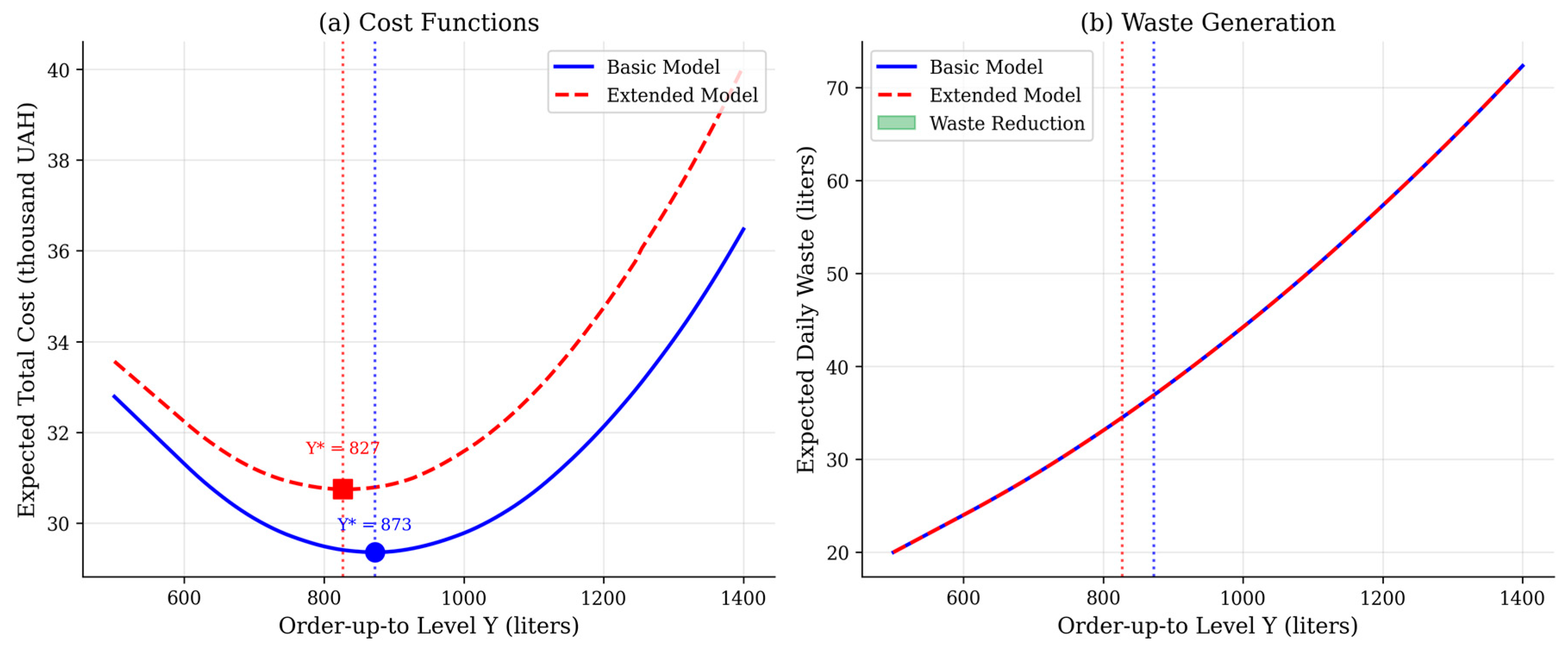
Figure 2.
Cost breakdown at optimal inventory level Y* = 859 L: (a) cost components in UAH showing salvage value offset; (b) proportional distribution with ordering costs dominating at 71.3%.
Figure 2.
Cost breakdown at optimal inventory level Y* = 859 L: (a) cost components in UAH showing salvage value offset; (b) proportional distribution with ordering costs dominating at 71.3%.
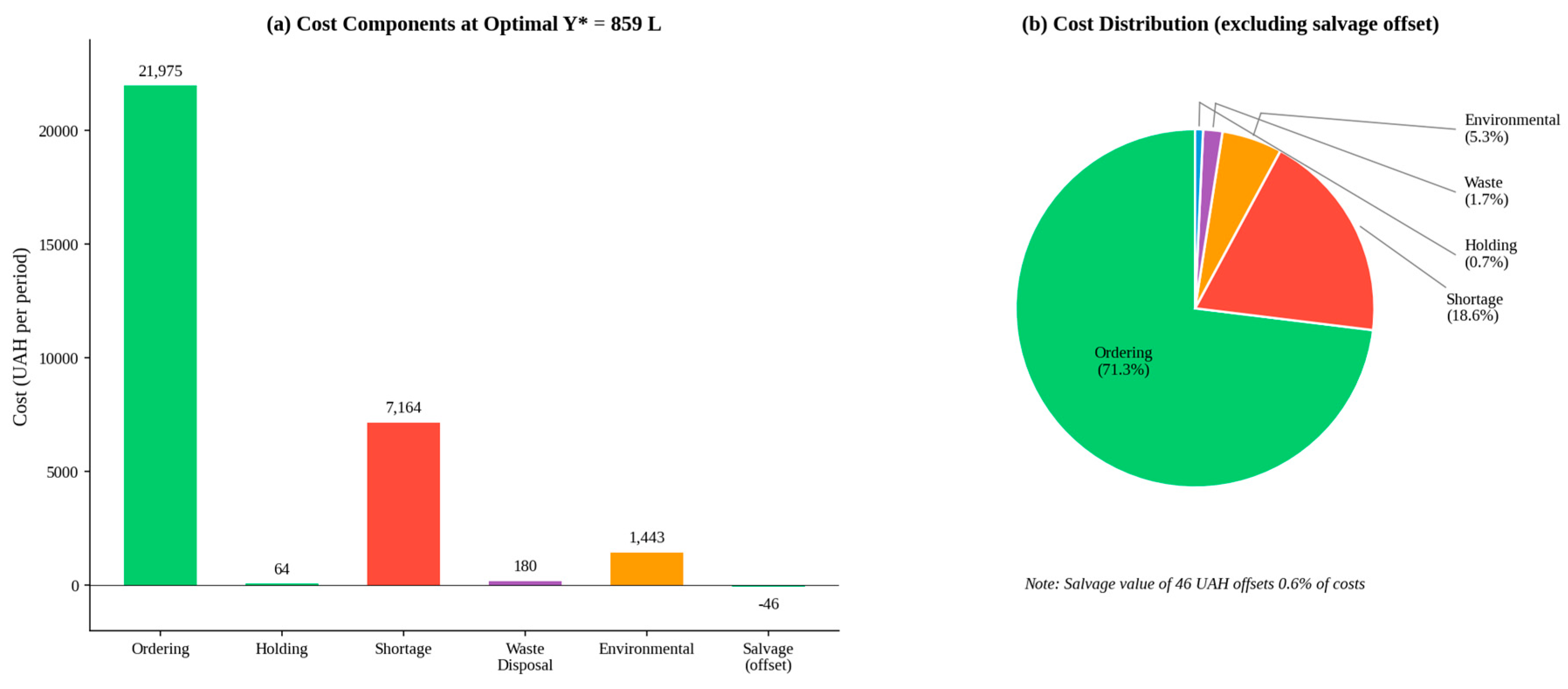
Figure 4.
Sensitivity to deterioration rate: (a) waste reduction peaks at θ ≈ 12%; (b) optimal inventory levels decrease with deterioration for both models, with the extended model consistently lower.
Figure 4.
Sensitivity to deterioration rate: (a) waste reduction peaks at θ ≈ 12%; (b) optimal inventory levels decrease with deterioration for both models, with the extended model consistently lower.
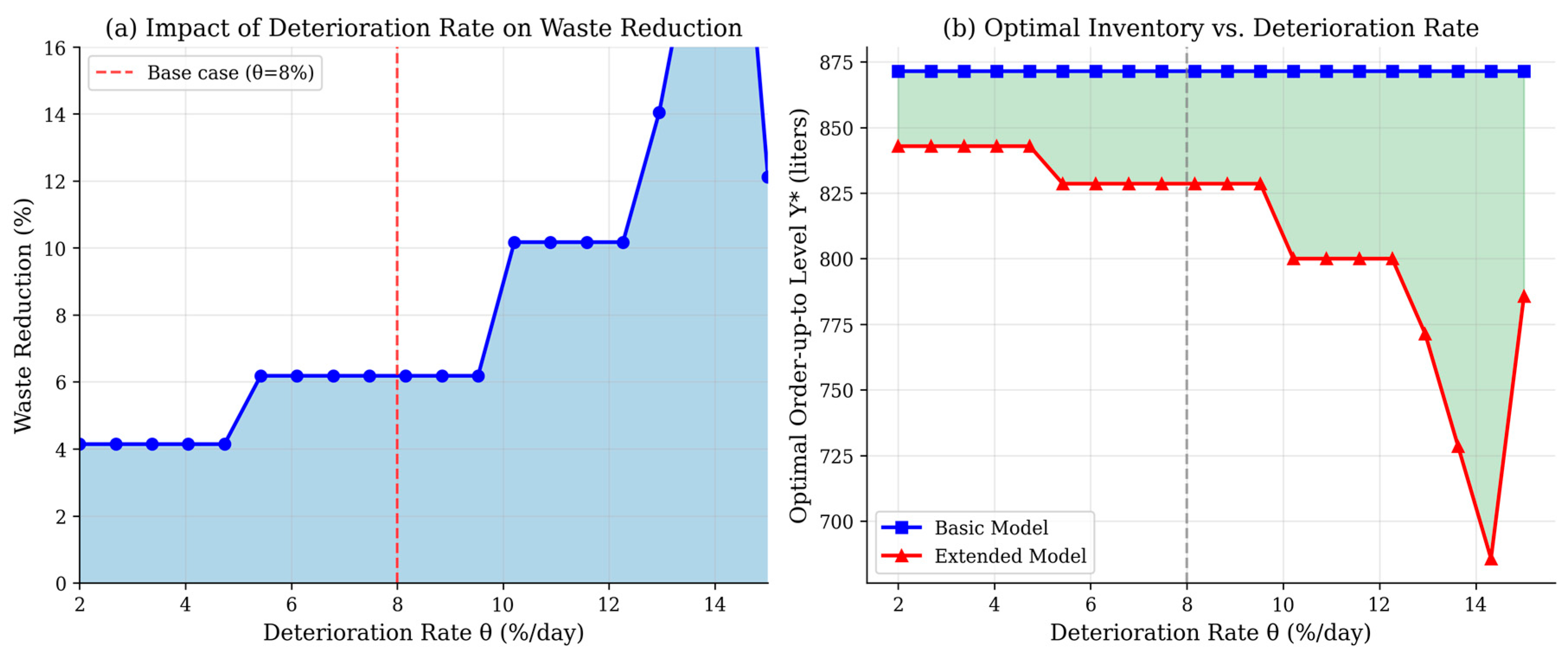
Figure 5.
Sensitivity to environmental cost: (a) waste reduction vs.
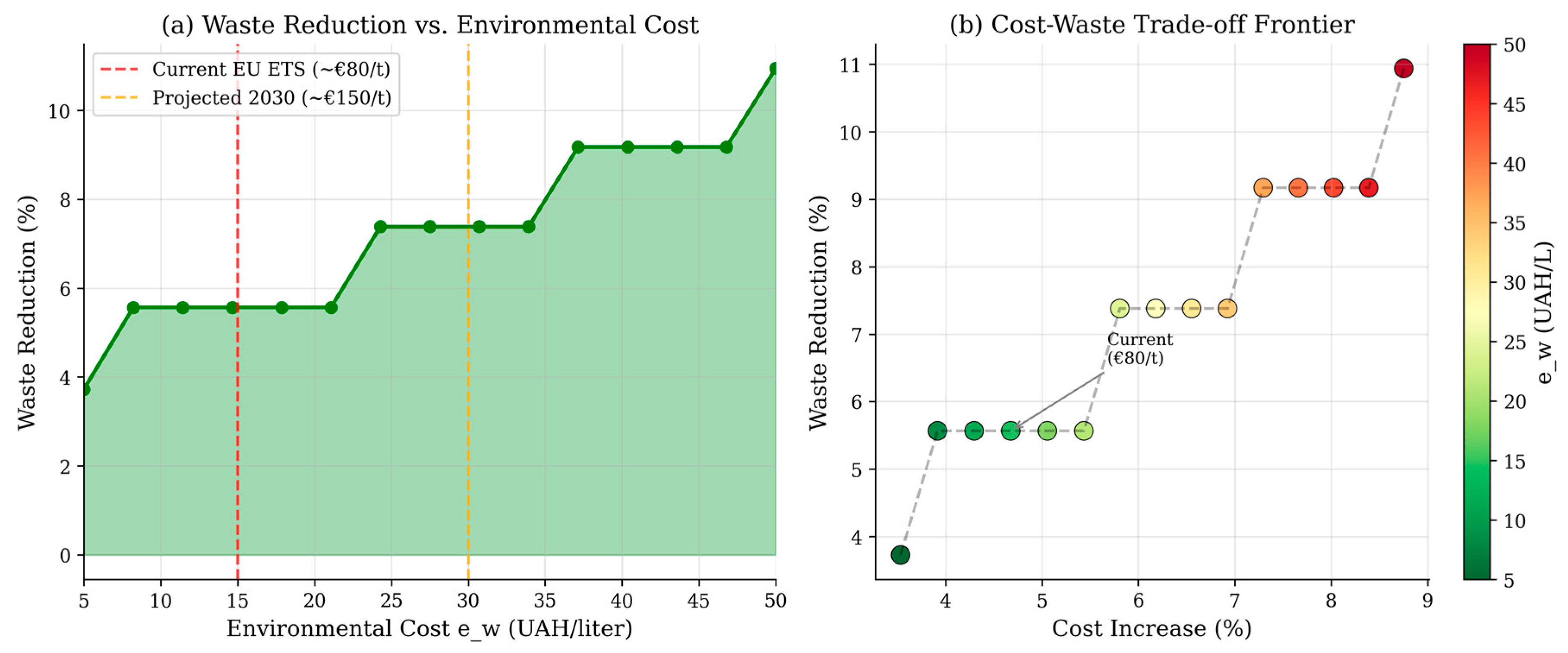
Figure 6.
Sensitivity to salvage rate: (a) total cost decreases linearly with α; (b) net environmental impact transitions from cost to benefit at α ≈ 35%, representing the circular economy break-even threshold.
Figure 6.
Sensitivity to salvage rate: (a) total cost decreases linearly with α; (b) net environmental impact transitions from cost to benefit at α ≈ 35%, representing the circular economy break-even threshold.
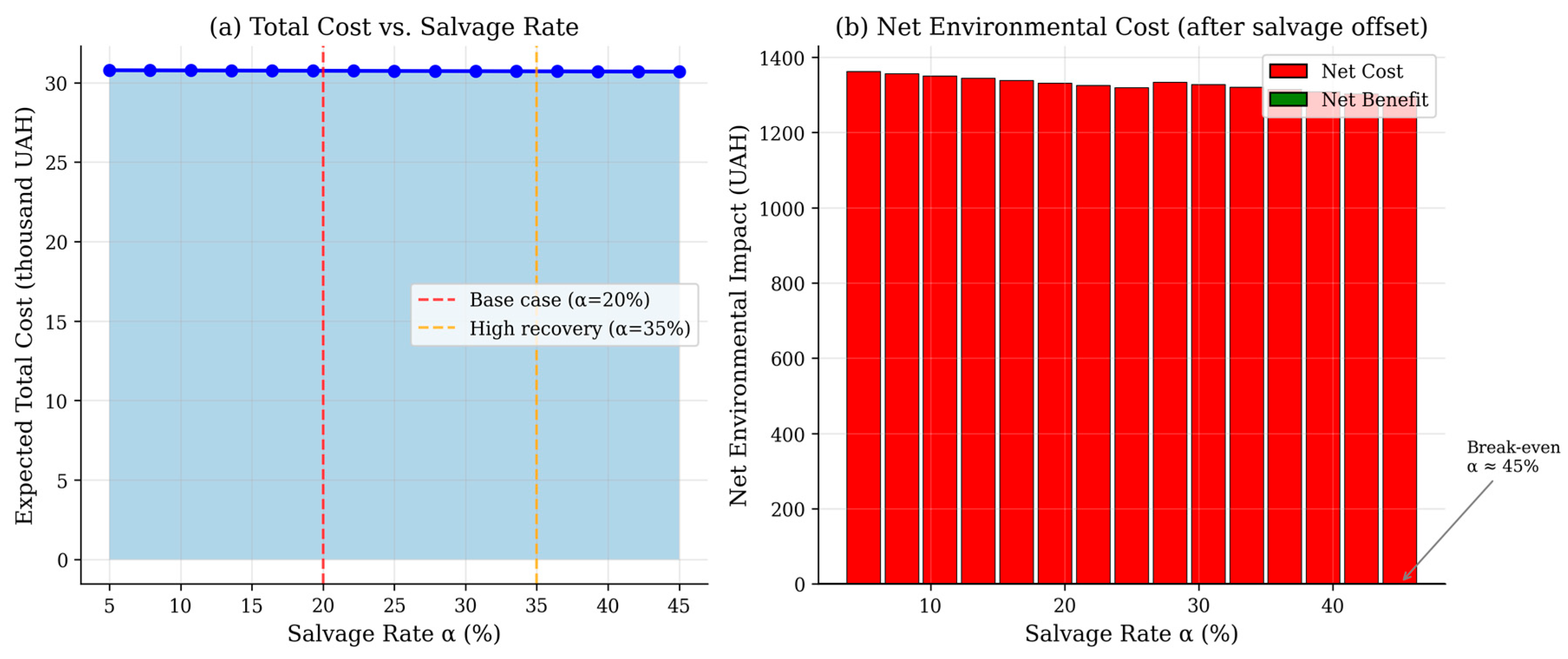
Table 2.
Notation Summary.
| Symbol | Description |
|---|---|
| I(t), It | Inventory level at time t |
| D, Dt | Random demand (per period) |
| Y, Yt | Order-up-to level (decision variable) |
| θ | Deterioration rate (per period) |
| L | Product shelf life (periods) |
| K | Fixed ordering cost |
| c | Unit procurement cost |
| h | Unit holding cost (per period) |
| s | Unit shortage/stockout cost |
| w | Unit waste disposal cost |
| ew | Unit environmental cost of waste (€/kg CO₂eq) |
| es | Unit environmental cost of storage |
| α | Circular economy recovery rate |
| v | Unit salvage value |
| δ | Discount factor |
| Vt(I) | Value function (cost-to-go from period t) |
Table 3.
Model Equations Summary.
| Eq. | Name | Role in Model |
|---|---|---|
| (1) | Inventory dynamics | Governing differential equation |
| (2) | General solution | Analytical solution for linear demand |
| (3) | Discrete transition | Period-to-period inventory update |
| (9)-(10) | Environmental costs | Waste and storage emissions |
| (13) | Salvage value | Circular economy recovery |
| (15) | Bellman equation | Dynamic programming optimality |
| (16) | Total cost | Integrated cost function |
| (17) | Seasonal demand | Time-varying demand pattern |
Table 4.
Computation Times.
| Periods (T) | States (N) | Quadrature (M) | Time (seconds) |
|---|---|---|---|
| 7 | 50 | 16 | 0.12 |
| 7 | 100 | 32 | 0.45 |
| 30 | 100 | 32 | 1.89 |
| 30 | 200 | 32 | 7.52 |
| 90 | 100 | 32 | 5.67 |
| 365 | 100 | 32 | 23.14 |
Table 5.
Solution Methods Summary.
| Model Configuration | Solution Method | Complexity |
|---|---|---|
| Single-period, no fixed cost | Analytical (Eq. 18-20) | O(1) |
| Deterministic demand | Numerical optimization | O(N) |
| Stationary stochastic | Backward induction | O(T·N²·M) |
| Non-stationary/seasonal | Backward induction | O(T·N²·M) |
| Policy evaluation | Monte Carlo simulation | O(R·T) |
Table 6.
Base Case Parameters, [22].
Table 6.
Base Case Parameters, [22].
| Category | Parameter | Value | Source |
|---|---|---|---|
| Product | Shelf life (L) | 7 days | Industry standard |
| Deterioration rate (θ) | 0.08/day | Tostivint et al. | |
| Mean demand (d₀) | 1,000 L/day | Industry data | |
| Demand range [a, b] | [600,1400] L | Industry data | |
| Costs | Fixed ordering (K) | 500 UAH | Industry data |
| Unit cost (c) | 25 UAH/L | Market price 2024 | |
| Holding cost (h) | 1.5 UAH/L/day | Industry estimate | |
| Shortage cost (s) | 40 UAH/L | 1.6× unit cost | |
| Waste disposal (w) | 5 UAH/L | Industry data | |
| Environmental | Waste emission (e_w) | 15 UAH/L | EU ETS €80/t |
| Storage emission (e_s) | 2.0 UAH/L/day | Energy calculation | |
| Circular | Salvage rate (α) | 0.20 | Conservative estimate |
| Salvage value (v) | 7.5 UAH/L | 30% of unit cost | |
| Planning | Horizon (T) | 30 days | Monthly planning |
| Discount factor (δ) | 0.99 | ~4% annual rate |
Table 7.
Basic vs. Extended Model Comparison.
| Metric | Basic Model | Extended Model | Difference |
|---|---|---|---|
| Optimal inventory level (Y*) | 909 L | 859 L | -5.5% |
| Expected daily waste | 38.7 L | 36.0 L | -7.0% |
| Expected total cost (30 days) | 29,683 UAH | 31,114 UAH | +4.8% |
| Service level (fill rate) | 94.2% | 93.1% | -1.1pp |
| CO₂-eq emissions (monthly) | 124 kg | 115 kg | -7.3% |
Table 10.
Summary of Key Findings.
| Finding | Value | Condition |
|---|---|---|
| Optimal inventory reduction | 5.5% | Base case |
| Waste reduction (extended vs. basic) | 7.0% | Base case |
| Maximum waste reduction | 13.8% | High deterioration (θ=0.12) |
| Environmental cost share | 5.3% | Current EU ETS prices |
| Salvage rate break-even threshold | α ≈ 35% | Net positive waste value |
| Annual waste savings | 985 L | Single distributor |
| Annual cost savings | ~36,000 UAH | Waste + environmental |
Disclaimer/Publisher’s Note: The statements, opinions and data contained in all publications are solely those of the individual author(s) and contributor(s) and not of MDPI and/or the editor(s). MDPI and/or the editor(s) disclaim responsibility for any injury to people or property resulting from any ideas, methods, instructions or products referred to in the content. |
© 2026 by the authors. Licensee MDPI, Basel, Switzerland. This article is an open access article distributed under the terms and conditions of the Creative Commons Attribution (CC BY) license.
Copyright: This open access article is published under a Creative Commons CC BY 4.0 license, which permit the free download, distribution, and reuse, provided that the author and preprint are cited in any reuse.


