

Submitted:
23 March 2026
Posted:
24 March 2026
You are already at the latest version
Abstract
The production of liquefied natural gas can be divided into four stages: production, preparation and transportation of natural gas by pipeline to the liquefaction plant; processing, liquefaction, storage and loading onto specialized liquefied natural gas (LNG) tankers; maritime transport of the LNG, usually over long distances, to the country of sale; unloading of the LNG from the receiving terminal, regasification, storage and delivery to end users by pipeline. These four stages are interconnected and form a chain from the gas well to the end user. Any weak link in the chain can jeopardize the entire LNG project . The ranking of jobs (from most to least risky) are: LNG plant operators (highest exposure to cryogenic hazards, high-pressure systems); pipeline maintenance workers (risk of gas leaks, explosions); cryogenic storage technicians (risks from LNG tanks, potential spills); LNG tanker crews (transportation risks, but controlled environments); safety inspectors (least direct exposure, but high responsibility). The AHP-ELECTRE method systematically ranks jobs based on risk severity, with LNG plant operators typically having the most hazardous role due to their direct handling of liquefaction processes, while safety inspectors face the least direct physical risk.
Keywords:
liquefied natural gas (LNG)
; analytical hierarchy process (AHP)
; elimination and (Et) selection of reality translation (ELECTRE)
; mathematical modeling
; mellitah
; criterion
; weighting coefficients
1. Introduction
Natural gas is characterized by the fact that it is extremely bulky and cannot be transported across oceans in its natural state by pipeline; even where long-distance transport is technically possible, gas oil and coal are wasteful, as this involves the so-called distance costs.
In liquid form, however, natural gas is much more compact and occupies only 1/600 of its original volume. This fact, together with the need to transport gas over long distances, literally "across oceans and seas", formed the basis for the development of the industry. The production of liquefied natural gas (LNG) is a very fast-growing industry in the world energy system.
Liquefied natural gas (LNG) storage requires strict application of regulations and standards when designing and constructing tanks. Spherical tanks with a high degree of durability, volume 200 m3, wall thickness 24 mm, working pressure 1.7 MPa are most often used. This tank construction has been found to be resistant to microcracks and shell deformation with minimal change in shell wall thickness. A spherical gas storage tank with a concrete foundation is shown in Figure 1.
Analytic Hierarchy Process (AHP) is one of the most widely used multi-criteria decision-making methods, developed by Thomas L. Saaty in the 1970s. This method combines qualitative and quantitative aspects of decision-making, allowing the structuring of complex problems through a hierarchy of objectives, criteria and alternatives. The main advantage of the AHP method is its ability to capture the subjective evaluations of decision makers and convert them into numerical values that can be further analyzed. Therefore, it is very suitable for solving problems in the field of management, engineering, safety and occupational safety.
The AHP method is used to ensure objectivity in decision-making, and at the same time includes the subjective assessment of respondents or experts. This enables making strategic decisions based on reliable foundations, even in complex conditions such as the oil and gas industry, where there are a large number of risks and factors that are difficult to compare with each other.
In the process of assessing risks at work in the company Melitah, which deals with the exploration, production and processing of oil and gas in Libya, this work uses the ELECTRE (Elimination and (Et) Choice Translating Reality) methodology for multi-criteria analysis, which is one of the most well-known approaches in the field of multi-criteria decision making (MCDM, Multi-Criteria Decision Making). This method enables the analysis and ranking of workplaces based on several risk criteria, such as the probability of an accident, the severity of injuries, as well as other relevant factors related to occupational safety.
The Melitah company faces specific risks characteristic of the oil and gas industry, such as working with explosive and flammable substances, difficult working conditions in remote locations, adverse weather conditions and the constant threat of oil and gas leaks. By using the ELECTRE method and defined criteria, different workplaces can be effectively evaluated and ranked according to the level of risk
2. Mathematical Modeling
The mathematical model of the AHP method includes a decision problem that is decomposed into a hierarchical structure and consists of: defining the goal and structure of the hierarchy, forming a pairwise comparison matrix, normalizing the matrix and determining the priority vector and consistency checks.
In order to ensure methodological validity, the consistency of the decision makers' ratings is checked. The following are calculated: the maximum eigenvalue of the matrix (λ_max), the consistency index (CI), the consistency ratio (CR). (if CR < 0.1, the results are considered acceptable and consistent) For the matrix A = [a_ij] of dimension n × n, where a_ij represents the relative importance of criterion i according to criterion j:
where RI is the index for the given matrix dimension (eg for n=4, RI=0.90).
Mathematical model of the ELECTRE method. In order to precisely conduct a multi-criteria risk analysis using the ELECTRE method, the following mathematical framework was used:
A - set of alternatives (jobs),
C - a set of risk criteria,
— a set of risk criteria:
- alternative value according to the criterion
where are:
is the normalized value for criterion j and alternative i,
is the value for criterion j and alternative i.
Weighted normalized decision matrix.
Normalized values are weighted by criteria weights:
where are:
TN - weighted normalized decision matrix,
N - normalized matrix,
T - matrix of weight coefficients.
Determining the sets of agreement S and disagreement NS. Comparing pairs of stocks p i r (p,r = 1,2,...,m i p≠r).
In the first step, a set of consents is formed Spr for shares ap i ar which consists of all the criteria for which it is
action ap better than action ar. A set of consents is formed on the basis of:
depending on whether the criterion function is max or min.
Forming a set of disagreements depending on the criterion function:
MS Consent Matrix
For p≠r
Disagreement matrix MNS:
Disagreement matrix MSD
Based on the agreement index threshold, the agreement dominance matrix is determined.
The agreement index threshold is defined as the average agreement index:
where p≠r.
We form the consent matrix based on the following criteria:
MNSD discrepant dominance matrices
Based on the average disagreement index, the disagreement dominance matrix is calculated:
whereby p≠r.
We form the disagreement matrix based on the following criteria:
Matrica agregatne dominacije MAD
The elements MAD are equal to the product of the elements at the corresponding position in the matrices MSD and MNSD:
3. Application of Mathematical Modeling
3.1. Determination of Weight Coefficients Using the AHP Method
The assessment of the impact of working environment factors in the oil and gas sector requires the application of multi-criteria methods, due to the complexity of working conditions and the variety of potential risks to the health of employees. Within this research, the Analytical Hierarchy Process (AHP) was applied with the aim of determining the weight coefficients of the relevant criteria, which will be used in the next phase within the ELECTRE method for multi-criteria ranking of work environment factors. The AHP method enables the structuring of complex decision-making problems in the form of a hierarchical model, which consists of the following levels:
Objective: Evaluation of the impact of work environment factors on the health and safety of employees — clearly defines the purpose of the analysis,
Criteria: Six key criteria — correspond to the modified setting, and used in the ELECTRE method,
Alternative factors of the work environment:
Factors that are not ranked in AHP, but serve as the basis for ELECTRE analysis — precisely explain their status. Considered factors that are not ranked by the AHP method, but serve as the basis for the ELECTRE analysis.
The criteria included in the analysis are:
C1: Presence of toxic gases,
C2: Noise and vibrations,
C3: Presence of dust,
C4: Inadequate air temperature,
C5: Inadequate lighting,
C6: Inadequate air humidity.
Based on the assessments of experts and employees, a matrix of pairwise comparison of criteria according to the AHP methodology was created. Using appropriate mathematical calculations, including the calculation of own (own) vectors, the weights of each criterion were determined, which reflect their relative importance in evaluating the impact of factors of the working environment on the health and safety of employees.
Based on the opinions of experts and employees, pairwise comparison matrices were created for each criterion. Using mathematical calculations (eigenvectors), criteria weights were calculated that reflect their relative importance. The consistency coefficient (CR) was less than 0.1, which indicates the consistency of the assessments and the reliability of the obtained results. The obtained weights were then used in the ELECTRE method for ranking workplaces according to the degree of risk to the health of employees.

Table 1.
Pairwise comparison matrix.
| C1 | C2 | C3 | C4 | C5 | C6 | |
|---|---|---|---|---|---|---|
| C1 | 1 | 3 | 5 | 7 | 9 | 7 |
| C2 | 1/3 | 1 | 3 | 5 | 7 | 5 |
| C3 | 1/5 | 1/3 | 1 | 3 | 5 | 3 |
| C4 | 1/7 | 1/5 | 1/3 | 1 | 3 | 2 |
| C5 | 1/9 | 1/7 | 1/5 | 1/3 | 1 | 1/2 |
| C6 | 1/7 | 1/5 | 1/3 | 1/2 | 2 | 1 |
The matrix shows the relative importance of each criterion compared to the others, according to the scale of the AHP method. The values are determined based on expert assessments and the importance of risk factors in the oil and gas sector. The matrix is symmetric, and the reciprocal values indicate the less importance of the criteria in relation to the ones they compare. This matrix is the basis for calculating weight coefficients (weights), which reflect the relative importance of each criterion in the overall analysis. Further calculations are used to normalize the matrix and determine the weights, as well as check the consistency of the estimates, which guarantees the reliability of the results.
Based on the pairwise comparison matrix shown in Table 2, normalization and weighting coefficients were calculated for each of the criteria. The obtained values represent the relative importance of individual criteria within the AHP method and will be used as input data for further multi-criteria analysis using the ELECTRE method.
The consistency coefficient (CR) calculated for the pairwise comparison matrix is 0.042, which is less than 0.1, indicating that there is no need to revise the estimates, as the consistency and reliability of the results have been confirmed.
The obtained weight coefficients represent the basis for further analysis - they will be integrated into the ELECTRE method, which will perform a multi-criteria ranking of the factors of the working environment according to their potentially negative impact on the health and safety of employees.
Based on the obtained weight coefficients, it can be concluded that the criteria "presence of toxic gases" and "noise and vibrations" have the greatest importance in the assessment of risk factors, while the criterion "inadequate lighting" has the least relative impact.
The hierarchical structure of the model includes key factors that directly affect worker health. Based on the weighting and ranking obtained by applying the AHP method, it is possible to identify the factors with the greatest impact on the safety of the working environment, which enables more effective risk management.
The results of the analysis indicate that factors such as the presence of toxic gases, noise and vibrations and the presence of dust are among the most important risks, and it is necessary for the company to prioritize preventive measures to reduce these risks. On the other hand, factors such as inadequate air temperature and humidity, as well as the presence of dust, although less critical, also require improvement in order to create a safer and healthier working environment. Recommendations arising from this analysis include increased investment in worker training, proactive implementation of safety procedures for high-risk workplaces, as well as adjustment of protective measures, in accordance with the risk ranking. Also, contoured monitoring and adjustment of protective measures, in accordance with dynamic changes in the field, will be key for long-term safety and efficiency in work. The implementation of the AHP method in the risk management process at the Melitah company represents a solid basis for further development and application of international standards, such as ISO 45001.
This approach enables sustainability in the field of safety and health at work, as well as continuous improvement of the working environment. Through effective risk management, not only are injuries and accidents reduced, but overall productivity, work efficiency and employee satisfaction are simultaneously increased — factors that are key to a company's long-term survival and competitiveness in the marketplace.
The application of the methodology of multi-criteria analysis, such as the AHP method, brings concrete and measurable results that can significantly contribute to the improvement of protection and safety at work, thus ensuring a safe and productive working environment for all employees.
3.2. Defining Alternatives and Criteria as a Prerequisite for Applying the ELECTRE Method
Before applying the ELECTRE methods, it is necessary to clearly define the alternatives and the criteria that will be used to rank them. This step is the basis for a precise and consistent multi-criteria analysis.
In this research, alternatives represent specific jobs in the oil and gas industry, not risk factors. The goal is to identify workplaces with the greatest risk to the health and safety of employees.
Accordingly, the following alternatives, i.e. jobs, have been defined:
A1: A workplace on an oil production platform,
A2: Workplace in the refinery (process area),
A3: Workplace in a chemical warehouse,
A4: Job in the transport sector (e.g. tanker drivers),
A5: Equipment maintenance workplace,
A6: Laboratory work position,
A7: Job in administration,
A8: Workplace on the well,
A9: Workplace in the ventilation and air conditioning system,
A10: Job in the occupational safety sector.
The risk assessment for each of these workplaces was carried out using previously defined criteria, and based on the obtained data, an ELECTRE analysis was performed to identify the workplaces with the highest risk.
In accordance with the previously conducted AHP analysis, in which six defined criteria were evaluated and weighted, the same criteria were used in the ELECTRE method to ensure methodological consistency. For the purposes of applying the ELECTRE method, ten jobs (alternatives) were defined in the oil and gas sector in the Melitah company in Libya.
Based on those ten alternatives and six criteria, a matrix of preferences was formed (Table 3), in which each criterion was evaluated on a scale from 1 to 5 — with 1 indicating the lowest and 5 the highest degree of presence or influence of a certain criterion on a specific workplace.
This matrix is the basis for multi-criteria ranking of workplaces using the ELECTRE method, taking into account the weighting coefficients obtained by AHP analysis.
The criteria used to rank the alternatives within the ELECTRE method are identical to those previously defined and applied in the AHP analysis, thus ensuring methodological consistency. The criteria represent key aspects of the work environment that can have a negative impact on the health and safety of employees, namely:
C1: The presence of toxic gases - assessment of the level of exposure of workers to dangerous chemicals in the gaseous state.
C2: Noise and vibrations – degree of exposure to physical influences that can cause hearing damage, fatigue and other physical ailments.
C3: The presence of dust - the concentration of particles in the air that can have a harmful effect on the respiratory system.
C4: Inadequate air temperature - conditions that can contribute to discomfort, the appearance of dizziness, nausea and deterioration of the health condition.
C5: Inadequate lighting – lighting conditions in the workplace that can cause eye strain, falls and reduced efficiency.
C6: Inadequate air humidity - conditions that can contribute to discomfort, the appearance of fungus, infection and deterioration of the health condition.
The mentioned criteria are the basis for a multi-criteria comparison and ranking of workplaces using the ELECTRE method, with the aim of identifying those with the highest degree of risk.
4. Research Results at the Melitah Company in Libya
The following criteria were used for risk assessment in the Melitah company:
C1: Presence of toxic gases,
C2: Noise and vibrations,
C3: Presence of dust,
C4: Inadequate air temperatures,
C5: Inadequate lighting,
C6: Inadequate air humidity.
The combination of multi-criteria AHP analysis and application of the ELECTRE method enables the Melitah company to systematically identify, rank and prioritize workplace risks. This analytical approach contributes to more precise directing of resources to the most critical positions, which significantly increases the level of protection and reduces the number of injuries at work. It is essential for safe and efficient operation in the complex conditions of the oil and gas industry.
4.1. Analysis of Experimental Research Results
The results of the experimental part of the research, which relate to the assessment and ranking of factors of the working environment with a negative impact on the health of employees in the oil and gas industry, were analyzed. The application of the multi-criteria AHP and ELECTRE methods enabled a systematic and objective evaluation of complex working conditions and the identification of the most significant risks.
The analysis carried out by surveying employees and experts indicated the importance of various risk factors in the working environment, especially those related to the presence of toxic gases, noise, vibrations, inadequate lighting, increased humidity and the presence of dust. These factors were identified as key elements for risk assessment, and statistical tests confirmed their relevance in the context of employee safety and health..
Using the AHP method, weighted criteria for the evaluation of workplaces were defined, namely: the presence of toxic gases, noise and vibrations, the presence of dust, inadequate air temperature, inadequate lighting and inadequate air humidity. The obtained weight coefficients indicate the relative importance of each of these criteria, which achieved methodological consistency and the basis for further ranking of workplaces using the ELECTRE method.
Application of the ELECTRE Method
After the weighted criteria were defined, the ELECTRE method was applied to rank workplaces according to total risk. This method enables the analysis of complex criteria and decision-making based on agreement and disagreement among alternatives (jobs). The ELECTRE method will be applied to the data from Table 3. according to the following decision matrix:
The process of applying the ELECTRE method includes the following steps:
- (A)
- Data normalization (matrix N):
In the first step, all data were normalized to allow comparison of criteria with different units of measure. Normalization means bringing the values of all criteria to the same scale, which eliminates the influence of differences in measurement units between different criteria (eg height, number, weight, etc.).
Normalization allows the values of all criteria to be brought to the same scale, eliminating the scale of differences between criteria and allowing a fair comparison. The normalized matrix is shown below.
- B)
- Weighted Scoring (TN Matrix)
Following normalization, the data are weighted using weighting coefficients obtained via AHP analysis. These weighted values represent the relative importance of each criterion, and the weighted matrix (TN) is calculated by multiplying the normalized values by their corresponding weighting coefficients.
Given that the weighting coefficient matrix T is:
Weighted Scoring TN Matrix
- C)
- Sets of agreement and disagreement:
This step is used to analyze the interrelationships between the alternatives. The sets of agreement and disagreement are determined based on the comparison of weighted values:
Agreement between alternatives is defined if one alternative recognizes most of the criteria as better than another.
Disagreement occurs when alternatives do not agree on key criteria.
The set of consents is formed because it is necessary to rank the workplaces (alternatives) according to the greatest risks. The sets of agreement and disagreement are shown in Table 4.
- D)
- Determination of the agreement matrix
Based on the agreement set, the agreement matrix is determined, the elements of which are the agreement indices
- E)
- Determination of the MNS discrepancy matrix
Based on the set of inconsistencies, the MNS inconsistency matrix is determined, the elements of which are inconsistency indices.
- F)
- Determination of MSD consensus dominance matrix
Based on the threshold of the agreement index, the MSD is determined. The agreement index threshold is defined as the average agreement index. The MSD matrix actually shows which alternative dominates which alternative.
G) Determination of the MNSD discordant dominance
Based on the average disagreement index, the MNSD is calculated. The MNSD matrix shows which alternatives are not in agreement.
H) Determination of the aggregate dominance matrix MAD
The elements of the aggregate dominance matrix are equal to the product of the elements at the corresponding position in the MSD and MNSD matrices. The MAD matrix consolidates all previous matrices to produce a final ranking of alternatives.
I) Elimination of less desirable alternatives
Based on the dominance matrices, the final ranking of workplaces according to total risk was performed. Aggregate Dominance (MAD) takes into account all prior information about the interrelationships between jobs, thereby enabling accurate ranking based on overall risk. Table 5 shows the final ranking of workplaces according to their dominance in relation to other alternatives and according to the total risk affecting the health of employees.
4. Conclusions
From Table 5, alternatives A7 and A10 do not dominate any of the alternatives. Alternative A1 dominates alternatives A2, A5, A6, A7, A9 and A10. Alternative A2 dominates alternatives A4, A5, A6, A7, A9 and A10. Alternative A3 dominates over alternatives A4. A6, A7, A9 and A10. Alternative A4 dominates alternatives A7 and A10. Alternative A5 dominates alternatives A4, A7, A9 and A10. Alternative A6 dominates over alternatives A7, A9 and A10. Alternative A8 dominates alternatives A2, A4, A5, A6, A7, A9 and A10. Alternative A9 dominates alternatives A7 and A10. With this result, it is clear that alternative A8 has the strongest dominance, because it dominates over seven other alternatives and is ranked best. Therefore, alternative A8, i.e. the job on the well, is the most risky job in the Melitah company in Libya. Also, it is noticeable that alternatives A1 and A2 dominate over the same number of alternatives (over six other alternatives each), but alternative A1 is ranked second because its evaluations according to the criteria are higher, while alternative A2 is ranked third. Alternative A3 occupies the fourth position because it dominates over five other alternatives, while alternative A5 occupies the fifth position because it dominates over four other alternatives. Alternative A6 occupies the sixth position because it dominates the other three alternatives. Alternatives A4 and A9 dominate over two other alternatives each, but alternative A9 is in the seventh position because its evaluations according to the criteria are higher, so A8 is in the eighth position. Alternatives A7 and A10 do not dominate over any of the alternatives, but A10 is in the ninth position because its evaluations according to the criteria are higher and therefore A7 is in the last, tenth position. Therefore, the most risky workplaces are: A8 - a workplace on a well, A1 - a workplace on an oil production platform and A2 - a workplace in a refinery (process area), while the least risky workplaces are: A10 - a workplace in the occupational safety sector and A7 - a workplace in administration.
Author Contributions
Conceptualization, A.A.A.A, I.I, R.P., M.V., S.M. and V.M; methodology, A.A.A.A, I.I. and R.P.; software, R.P. and M.V.; validation, A.A.A.A; formal analysis, I.I., R.P. and V.M.; investigation, S.M. and V.M.; resources, A.A.A.A.; data curation, I.I.; writing—original draft preparation, A.A.A.A. and I.I.; writing—review and editing, A.A.A.A, and R.P.; visualization, M.V.; supervision, I.I. and R.P.; project administration, I.I. and R.P.; funding acquisition, I.I. and R.P. All authors have read and agreed to the published version of the manuscript.
Funding
This research received no external funding.
Data Availability Statement
Data is contained within the article.
Acknowledgments
We would like to show our greatest appreciation to the anonymous reviewers, editor and those who have helped to contribute to the writing of this paper.
Conflicts of Interest
The authors declare no conflicts of interest.
References
- Kidnay, A. J.; Parrish, W. R.; McCartney, D. G. Fundamentals of Natural Gas Processing, 3rd ed.; CRC Press, 2019. [Google Scholar]
- Mokhatab, S.; Poe, W. A.; Mak, J. Y. (Eds.) Handbook of Natural Gas Transmission and Processing: Principles and Practices, 4th ed.; Gulf Professional Publishing, 2019; p. 2. [Google Scholar]
- Barclay, M. A. (Ed.) Offshore LNG Production and Development; Society of Petroleum Engineers (SPE), 2017. [Google Scholar]
- Kumar, S.; Kwon, H. T.; Choi, K. H.; Lim, W.; Cho, J. H.; Tak, K.; Moon, I. LNG: An eco-friendly cryogenic fuel for sustainable development. Applied Energy 2011, 88(12), 4264–4273. [Google Scholar] [CrossRef]
- Venkatarathnam, G. Cryogenic Mixed Refrigerant Processes; Springer, 2008; p. 5. [Google Scholar]
- Kumar, P. C.; Lim, H. Optimization of propane precooled mixed refrigerant LNG plant. Applied Thermal Engineering 2019, 149, 628–637. [Google Scholar]
- Center for Chemical Process Safety (CCPS). Guidelines for Siting and Layout of Facilities, 3rd ed.; Wiley-AIChE, 2014; p. 7. [Google Scholar]
- Center for Chemical Process Safety (CCPS). Guidelines for Chemical Process Quantitative Risk Analysis, 2nd ed.; Wiley-AIChE, 2000; p. 8. [Google Scholar]
- Energy Institute (EI); EEMUA. EEMUA Publication 147: Recommendations for the protection of pressurized liquefied gas storage tanks against fire engulfment, 2nd ed.; 2010; p. 9. [Google Scholar]
- Saaty, T. L. The Analytic Hierarchy Process; McGraw-Hill, 1980; p. 10, (The seminal work on AHP). [Google Scholar]
- Saaty, T. L. Decision making with the analytic hierarchy process. International Journal of Services Sciences 2008, 1(1), 83–98, (A more accessible modern overview). [Google Scholar] [CrossRef]
- Roy, B. Classement et choix en présence de points de vue multiples (la méthode ELECTRE). Revue française d'informatique et de recherche opérationnelle 1968, 2(8), 57–75, (Original ELECTRE I paper - French). [Google Scholar] [CrossRef]
- Roy, B. The outranking approach and the foundations of ELECTRE methods. Theory and Decision 1991, 31(1), 49–73, (Key English explanation of ELECTRE philosophy). [Google Scholar] [CrossRef]
- Figueira, J.; Greco, S.; Ehrgott, M. (Eds.) Multiple Criteria Decision Analysis: State of the Art Surveys Comprehensive reference covering ELECTRE methods in detail within Chapter 4, alongside other MCDA methods like AHP; Springer, 2005; p. 14. [Google Scholar]
- Dagdeviren, M.; Yüksel, İ.; Kurt, M. A fuzzy analytic hierarchy process (FAHP) approach to occupational safety risk assessment. Journal of Hazardous Materials 2008, 154(1-3), 437–447, (Demonstrates AHP for job risk ranking, adaptable to LNG). [Google Scholar]
- Gul, M.; Celik, E.; Aydin, N.; Gumus, A. T.; Guneri, A. F. A state of the art literature review on VIKOR method. Technological and Economic Development of Economy 2016, 22(2), 276–302, (While on VIKOR, it reviews MCDA applications in safety, providing context for ELECTRE/AHP potential). [Google Scholar]
- Mohammadi, M.; Rezaei, J.; Yousefi, V. An integrated AHP-ELECTRE III approach for risk assessment in construction projects. Journal of Civil Engineering and Management 2019, 25(3), 241–256, (Shows the hybrid AHP-ELECTRE structure applied to project risk, easily transferable to job risk). [Google Scholar]
- Liu, H. C.; You, J. X.; Fan, X. J.; Lin, Q. L. Failure mode and effects analysis using D numbers and grey relational projection method. Expert Systems with Applications 2014, 41(10), 4670–4679, (While not ELECTRE, shows MCDA integration for FMEA, conceptually similar to job risk analysis). [Google Scholar] [CrossRef]
- Podvezko, V.; Sivilevičius, H. The use of AHP and rank correlation methods for determining the significance of the interaction between the elements of a transport system. Transport 2013, 28(4), 389–403, (Illustrates AHP for weighting criteria in complex systems). [Google Scholar] [CrossRef]
- Center for Chemical Process Safety (CCPS). Guidelines for Chemical Process Quantitative Risk Analysis. In Standard reference for QRA methodologies applicable to LNG facilities - identifies hazards and scenarios relevant to job exposure, 2nd ed.; Wiley-AIChE, 2000; p. 20. [Google Scholar]
- Pitblado, R.; Baik, J.; Hughes, G.; Ferro, C.; Shaw, S. Consequences of LNG marine incidents. Process Safety Progress 2006, 21 25(4), 345–352, (Highlights specific LNG hazards). [Google Scholar]
- Roghanian, E.; Rahimi, J.; Ansari, A. Comparison of first aggregation and last aggregation in fuzzy group TOPSIS. Applied Mathematical Modelling 2010, 22 34(12), 3754–3766, (While TOPSIS, discusses hybrid MCDA structures conceptually). [Google Scholar] [CrossRef]
- Govindan, K.; Jepsen, M. B. ELECTRE: A comprehensive literature review on methodologies and applications. European Journal of Operational Research 2016, 23 250(1), 1–29, (Excellent review; likely includes examples of ELECTRE hybrids, though perhaps not specifically with AHP). [Google Scholar] [CrossRef]
Figure 1.
Spherical LNG storage tank.
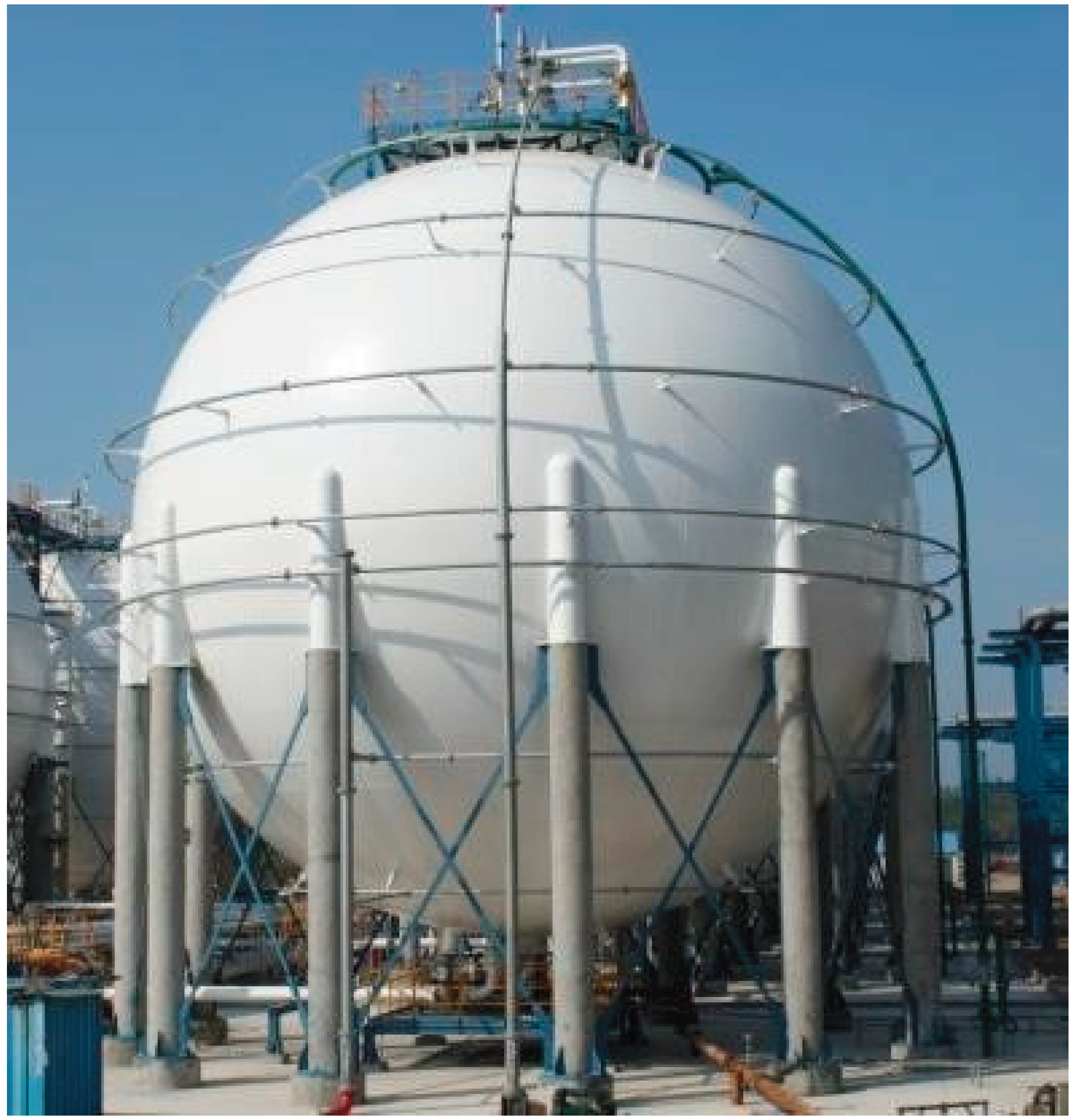
Table 2.
Weighting coefficients (weights) of the criteria obtained by the AHP method.
| Criterion | Ponder (Weight Coefficient) |
| C1 | 0,472 |
| C2 | 0,253 |
| C3 | 0,129 |
| C4 | 0,066 |
| C5 | 0,031 |
| C6 | 0,049 |
Table 3.
Matrix of preferences for hazards in the work environment according to risk criteria.
| Alternatives/Criteria | C1 | C2 | C3 | C4 | C5 | C6 |
|---|---|---|---|---|---|---|
| A1 | 5 | 4 | 2 | 3 | 4 | 5 |
| A2 | 4 | 5 | 3 | 3 | 3 | 4 |
| A3 | 5 | 2 | 3 | 2 | 2 | 4 |
| A4 | 2 | 4 | 3 | 2 | 1 | 3 |
| A5 | 3 | 5 | 2 | 3 | 3 | 4 |
| A6 | 3 | 2 | 4 | 2 | 1 | 3 |
| A7 | 1 | 1 | 4 | 1 | 1 | 1 |
| A8 | 5 | 4 | 3 | 3 | 3 | 5 |
| A9 | 2 | 3 | 3 | 5 | 2 | 3 |
| A10 | 1 | 2 | 4 | 2 | 1 | 2 |
Table 4.
Agreement and disagreement sets.
| Couples p≠r | Consensus set | Disagreement set |
|---|---|---|
| p=1, r=2 | 1,5,6 | 2,3,4 |
| p=1, r=3 | 2,4,5,6 | 1,3 |
| p=1, r=4 | 1,4,5,6 | 2,3 |
| p=1, r=5 | 1,5,6 | 2,3,4 |
| p=1, r=6 | 1,2,4,5,6 | 3 |
| p=1, r=7 | 1,2,4,5,6 | 3 |
| p=1, r=8 | 5 | 1,2,3,4,6 |
| p=1, r=9 | 1,2,5,6 | 3,4 |
| p=1, r=10 | 1,2,4,5,6 | 3 |
| p=2, r=1 | 2,3 | 1,4,5,6 |
| p=2, r=3 | 2,4,5 | 1,3,6 |
| p=2, r=4 | 1,2,4,5,6 | 3 |
| p=2, r=5 | 1,3 | 2,4,5,6 |
| p=2, r=6 | 1,2,4,5,6 | 3 |
| p=2, r=7 | 1,2,4,5,6 | 3 |
| p=2, r=8 | 2 | 1,3,4,5,6 |
| p=2, r=9 | 1,2,5,6 | 3,4 |
| p=2, r=10 | 1,2,4,5,6 | 3 |
| p=3, r=1 | 3 | 1,2,4,5,6 |
| p=3, r=2 | 1 | 2,3,4,5,6 |
| p=3, r=4 | 1,5,6 | 2,3,4 |
| p=3, r=5 | 1,3 | 2,3,4,5 |
| p=3, r=6 | 1,5,6 | 2,3,4 |
| p=3, r=7 | 1,2,4,5,6 | 3 |
| p=3, r=8 | / | 1,2,3,4,5,6 |
| p=3, r=9 | 1,6 | 2,3,4,5 |
| p=3, r=10 | 1,5,6 | 2,3,4 |
| p=4, r=1 | 3 | 1,2,4,5,6 |
| p=4, r=2 | / | 1,2,3,4,5,6 |
| p=4, r=3 | 2 | 1,3,4,5,6 |
| p=4, r=5 | 3 | 1,2,4,5,6 |
| p=4, r=6 | 2 | 1,3,4,5,6 |
| p=4, r=7 | 1,2,4,6 | 3,5 |
| p=4, r=8 | / | 1,2,3,4,5,6 |
| p=4, r=9 | 2 | 1,3,4,5,6 |
| p=4, r=10 | 1,2,6 | 3,4,5 |
| p=5, r=1 | 2 | 1,3,4,5,6 |
| p=5, r=2 | / | 1,2,3,4,5,6 |
| p=5, r=3 | 2,4,5 | 1,3,6 |
| p=5, r=4 | 1,2,4,5,6 | 3 |
| p=5, r=6 | 2,4,5,6 | 1,3 |
| p=5, r=7 | 1,2,4,5,6 | 3 |
| p=5, r=8 | 2 | 1,3,4,5,6 |
| p=5, r=9 | 1,2,5,6 | 3,4 |
| p=5, r=10 | 1,2,4,5,6 | 3 |
| p=6, r=1 | 3 | 1,2,4,5,6 |
| p=6, r=2 | 3 | 1,2,4,5,6 |
| p=6, r=3 | 3 | 1,2,4,5,6 |
| p=6, r=4 | 1,3 | 2,4,5,6 |
| p=6, r=5 | 3 | 1,2,4,5,6 |
| p=6, r=7 | 1,2,4,6 | 3,5 |
| p=6, r=8 | 3 | 1,2,4,5,6 |
| p=6, r=9 | 1,3 | 2,4,5,6 |
| p=6, r=10 | 1,6 | 2,3,4,5 |
| p=7, r=1 | 3 | 1,2,4,5,6 |
| p=7, r=2 | 3 | 1,2,4,5,6 |
| p=7, r=3 | 3 | 1,2,4,5,6 |
| p=7, r=4 | 3 | 1,2,4,5,6 |
| p=7, r=5 | 3 | 1,2,4,5,6 |
| p=7, r=6 | / | 1,2,3,4,5,6 |
| p=7, r=8 | 3 | 1,2,4,5,6 |
| p=7, r=9 | 3 | 1,2,4,5,6 |
| p=7, r=10 | / | 1,2,3,4,5,6 |
| p=8, r=1 | 3 | 1,2,4,5,6 |
| p=8, r=2 | 1,6 | 2,3,4,5 |
| p=8, r=3 | 2,4,5,6 | 1,3 |
| p=8, r=4 | 1,4,5,6 | 2,3 |
| p=8, r=5 | 1,3,6 | 2,4,5 |
| p=8, r=6 | 1,2,4,5,6 | 3 |
| p=8, r=7 | 1,2,4,5,6 | 3 |
| p=8, r=9 | 1,2,5,6 | 3,4 |
| p=8, r=10 | 1,2,4,5,6 | 3 |
| p=9, r=1 | 3,4 | 1,2,5,6 |
| p=9, r=2 | 4 | 1,2,3,5,6 |
| p=9, r=3 | 2,4 | 1,3,5,6 |
| p=9, r=4 | 4,5 | 1,2,3,6 |
| p=9, r=5 | 3,4 | 1,2,5,6 |
| p=9, r=6 | 2,4,5 | 1,3,6 |
| p=9, r=7 | 1,2,4,5,6 | 3 |
| p=9, r=8 | 4 | 1,2,4,5,6 |
| p=9, r=10 | 1,2,4,5,6 | 3 |
| p=10, r=1 | 3 | 1,2,4,5,6 |
| p=10, r=2 | 3 | 1,2,4,5,6 |
| p=10, r=3 | 3 | 1,2,4,5,6 |
| p=10, r=4 | 3 | 1,2,4,5,6 |
| p=10, r=5 | 3 | 1,2,4,5,6 |
| p=10, r=6 | / | 1,2,3,4,5,6 |
| p=10, r=7 | 2,4,6 | 1,3,5 |
| p=10, r=8 | 3 | 1,2,4,5,6 |
| p=10, r=9 | 3 | 1,2,4,5,6 |
Table 5.
Ranking of alternatives.
| A1 | A2 | A3 | A4 | A5 | A6 | A7 | A8 | A9 | A10 | Rang | |
| A1 | 0 | 1 | 0 | 0 | 1 | 1 | 1 | 0 | 1 | 1 | 2 |
| A2 | 0 | 0 | 0 | 1 | 1 | 1 | 1 | 0 | 1 | 1 | 3 |
| A3 | 0 | 0 | 0 | 1 | 0 | 1 | 1 | 0 | 1 | 1 | 4 |
| A4 | 0 | 0 | 0 | 0 | 0 | 0 | 1 | 0 | 0 | 1 | 8 |
| A5 | 0 | 0 | 0 | 1 | 0 | 0 | 1 | 0 | 1 | 1 | 5 |
| A6 | 0 | 0 | 0 | 0 | 0 | 0 | 1 | 0 | 1 | 1 | 6 |
| A7 | 0 | 0 | 0 | 0 | 0 | 0 | 0 | 0 | 0 | 0 | 10 |
| A8 | 0 | 1 | 0 | 1 | 1 | 1 | 1 | 0 | 1 | 1 | 1 |
| A9 | 0 | 0 | 0 | 0 | 0 | 0 | 1 | 0 | 0 | 1 | 7 |
| A10 | 0 | 0 | 0 | 0 | 0 | 0 | 0 | 0 | 0 | 0 | 9 |
Disclaimer/Publisher’s Note: The statements, opinions and data contained in all publications are solely those of the individual author(s) and contributor(s) and not of MDPI and/or the editor(s). MDPI and/or the editor(s) disclaim responsibility for any injury to people or property resulting from any ideas, methods, instructions or products referred to in the content. |
© 2026 by the authors. Licensee MDPI, Basel, Switzerland. This article is an open access article distributed under the terms and conditions of the Creative Commons Attribution (CC BY) license (http://creativecommons.org/licenses/by/4.0/).
Copyright: This open access article is published under a Creative Commons CC BY 4.0 license, which permit the free download, distribution, and reuse, provided that the author and preprint are cited in any reuse.


