
Submitted:
23 March 2026
Posted:
24 March 2026
You are already at the latest version
Abstract
With the dual goals of carbon peaking and carbon neutrality, hydrogen energy has become a key strategic direction for Shanxi’s energy transformation. Clarifying the carbon emission characteristics and mitigation potential of typical hydrogen production routes is critical for guiding the low-carbon development of the local hydrogen industry. This study adopts a unified life cycle assessment (LCA) framework to analyze five representative hydrogen production routes in Shanxi. The results reveal significant differences in carbon intensity across routes: large-scale integrated coal gasification hydrogen production(LICGHP, 10.02 kg CO2e/kg-H2) > commercial coal gasification hydrogen production(CCGHP, 9.35 kg CO2e/kg-H2) > photovoltaic hydrogen production(PHP, 6.17 kg CO2e/kg-H2) > coke oven gas hydrogen production(COGHP, 3.83 kg CO2e/kg-H2) > wind power hydrogen production(WPHP, 1.57 kg CO2e/kg-H2). Coal-based routes are dominated by operational phase emissions, while renewable energy routes concentrate emissions in the construction phase with near-zero operational emissions. COGHP (61.78% mitigation rate) serves as a high-quality transitional pathway, and WPHP (84.33% mitigation rate) represents the optimal low-carbon option. Mitigation strategies vary by route: coal-based routes prioritize CCS and process optimization, while renewable energy routes focus on supply chain decarbonization and green construction. These findings provide scientific support for Shanxi’s hydrogen energy technology selection and low-carbon strategy formulation.
Keywords:
hydrogen production routes
; LCA
; carbon emission accounting
; carbon intensity
; low-carbon transformation of hydrogen energy
1. Introduction
Hydrogen energy, as a clean and efficient secondary energy carrier, is a key enabler for breaking dependence on fossil energy, promoting energy structure transformation, and achieving the “dual carbon” goals [1,2,3]. The carbon emission intensity of hydrogen production directly determines the low-carbon attribute and industrial value of hydrogen products [4,5]. As a major coal resource province and coal chemical industry base in China, Shanxi relies on coal-based hydrogen production for over 90% of its regional hydrogen supply [6,7]. The inherent high-carbon characteristic has become a core bottleneck for the low-carbon development of the regional hydrogen energy industry. Meanwhile, Shanxi is endowed with abundant wind and photovoltaic resources, offering enormous potential for renewable energy-based water electrolysis hydrogen production. COGHP, as a resource utilization pathway for coal chemical by-products, serves as an important transitional technology for the transformation from coal-based to green hydrogen in the region [8,9].
LCA is a core method for quantifying the full-life-cycle environmental impacts of products [10,11,12,13,14]. It breaks the limitations of traditional end-of-pipe emission accounting and comprehensively considers carbon emissions from construction, production, raw material supply, and other links, making it widely used in the carbon emission assessment of hydrogen production routes [15,16]. Existing studies mostly focus on carbon emission accounting of a single hydrogen production route or simple comparisons between coal-based and a single renewable energy-based hydrogen production route. Systematic comparative analyses of typical regional hydrogen production routes in Shanxi are scarce, and the definition of data sources and accounting methods for carbon emissions during the construction of renewable energy-based hydrogen production plants is insufficiently clear. This makes it difficult to provide precise quantitative support for the technological route selection and carbon mitigation strategy formulation of the regional hydrogen energy industry.
Based on this, five typical hydrogen production routes in Shanxi—LICGHP, CCGHP, COGHP, WPHP, and PHP—were selected as research objects. A unified life cycle carbon emission accounting framework was established, with explicit data sources for each link and detailed accounting methods for carbon emissions during the construction of renewable energy-based hydrogen production plants. Taking the production of 1 kg of hydrogen as the functional unit, the carbon emission intensity during the construction and operation phases of each route was systematically calculated. The characteristics and core driving factors of emission structures were analyzed, and targeted mitigation strategies were proposed by comparing the mitigation potentials of different routes. This study aims to provide scientific basis and practical reference for the optimization of technological routes and the construction of policy systems for the low-carbon transformation of the hydrogen energy industry in Shanxi.
2. Materials and Methods
2.1. Research Object and Accounting Boundary
Five technically mature and representative hydrogen production routes in Shanxi were selected, covering mainstream coal-based hydrogen production pathways and cutting-edge renewable energy-based hydrogen production pathways. Basic project parameters were derived from project EIA reports, industry design specifications, and actual engineering data, with key parameters shown in Table 1.
The life cycle accounting boundary for each hydrogen production route covers both the plant construction phase and the production operation phase to ensure consistency and comparability of assessments across routes. The construction phase includes embodied carbon emissions from the manufacturing, transportation, and on-site construction of workshops and core equipment, which are amortized to per unit hydrogen product based on the project’s design life. The production operation phase boundary is defined according to the technical characteristics of each hydrogen production process: for coal-based hydrogen production routes, it includes fossil fuel combustion, industrial processes, embodied carbon emissions from purchased electricity and heat, and carbon emissions from upstream raw material acquisition and transportation; for renewable energy-based hydrogen production routes, it includes maintenance material consumption of power generation and electrolysis systems, water treatment consumable consumption, etc. The electricity required for water electrolysis is supplied by on-site renewable energy, resulting in no purchased electricity carbon emissions. Details are shown in Figure 1.
2.2. Accounting Methods and Data Sources
This study adopts the Life Cycle Assessment (LCA) method, following the core process of “goal and scope definition - inventory analysis - impact assessment”. Carbon emission accounting is conducted by combining the investment allocation method, material balance method, standard accounting method, andi energy share method [17,18,19,20,21]. All accounting data prioritize Shanxi’s local measured values and regional characteristic values; in the absence of local data, national standard values and industry-accepted typical values are used. The accounting methods, calculation formulas, and data sources for each link are explicitly defined as follows:
- Plant Construction Phase
(i) For coal-based hydrogen production routes, the investment allocation method is used, with the following calculation formulas:
Total emissions during construction phase (tCO₂e) = Total investment (10,000 RMB) × Carbon emission factor per unit investment (tCO₂e/10,000 RMB)
where EA is emissions allocated to per kg of hydrogen, kgCO2e/kg-H2. TE is Total emissions during construction phase, tCO2e. HO is total hydrogen production over the full lifecycle, kg. EAC is energy allocation coefficient.
EA=Total emissions during construction phase(tCO2e)HO×EAC
For actual coal-based hydrogen production projects in Shanxi, total investment data are derived from project EIA reports; the carbon emission factor per unit investment is selected from the emission factors for the heavy chemical industry in “Research on Carbon Emissions from Fixed Asset Investment in China’s Heavy Chemical Industry” (1.2 t CO₂e/10,000 RMB) [22]; the total life-cycle hydrogen output is calculated based on the project’s design life and annual hydrogen output, with annual hydrogen output derived from actual production monitoring data of local hydrogen production projects in Shanxi; the energy allocation coefficient is calculated from measured energy share values of co-products in Shanxi’s coal chemical projects.
(ii) For renewable energy-based hydrogen production routes, the sub-item accounting method is used, with emissions amortized to an annual basis according to the project’s design life and finally converted to per unit hydrogen construction carbon emissions. The specific accounting method is as follows:
where E_material production is calculated as the product of annual consumption of each material and the corresponding emission factor. Materials include steel, concrete, composite materials, copper, etc., with emission factors derived from the CLCD database and measured values from the wind turbine manufacturing industry. E_material production is calculated as the product of the weight of transported components, transportation distance, and road transportation emission factor. The transportation distance is the typical distance from eastern manufacturing bases to Datong, Shanxi (800-1500km) [23], and the emission factor is 0.0001 t CO₂e/(t·km). E_on-site construction is Includes carbon emissions from diesel and electricity consumption during foundation construction and hoisting installation. Diesel consumption is calculated as the product of equipment operating hours and fuel consumption per operating hour; electricity consumption is based on measured construction electricity consumption. Emission factors are 3.04 t CO₂e/t for diesel and 0.5366 kg CO₂e/kWh for Shanxi’s power grid in 2025.
E_construction = E_material production + E_material transportation + E_on-site construction
- 2.
- Production and Operation Phase
(i) Fossil fuel combustion carbon emissions: Calculated using the standard method specified in “Requirements for Carbon Emission Accounting and Reporting - Part 10: Chemical Production Enterprises” (GB/T32151.10—2023), with the following formula:
where E_CO₂-combustion is CO2 emissions from fossil fuel combustion, in tons of CO₂. i is type of fossil fuel. j is serial number of combustion equipment. ADi,j is consumption of fossil fuel i in combustion equipment j (tons for solid/liquid fuels, 10,000 Nm³ for gaseous fuels under standard conditions; non-standard volume shall be converted to standard conditions). CCi,j is carbon content of fossil fuel i in combustion equipment j (tons of carbon/ton of fuel for solid/liquid fuels, tons of carbon/10,000 Nm3 for gaseous fuels). OFi,j is carbon oxidation rate of fossil fuel i in combustion equipment j (dimensionless, ranging from 0 to 1). 44/12 is molecular weight conversion factor between CO₂ and carbon (C).
Fossil fuel consumption is derived from EIA reports and actual energy consumption statistics of hydrogen production projects in Shanxi. carbon content (CCi,j) and carbon oxidation rate (OFi,j) are sourced from GB/T32151.10—2023. The coal equivalent conversion factor is from “General Principles for Calculation of Comprehensive Energy Consumption” (GB/T2589-2020).
(ii) Industrial process carbon emissions: Calculated using the material balance method. The core logic is: after carbon input from raw materials is allocated among different pathways (conversion to products, conversion to CO₂, entry into slag/residues, and other losses), only the portion converted to CO₂ is counted as industrial process carbon emissions. The calculation formula is:
Industrial process carbon emissions = Total carbon input × Proportion of carbon converted to CO₂ × 44/12
Raw material consumption is derived from actual production data of hydrogen production projects in Shanxi; the carbon content of raw materials adopts the characteristic value of local coal in Shanxi (fixed carbon content of high-sulfur bituminous coal is 65%), sourced from “Shanxi Coal Industry Analysis and Utilization Report”; the proportion of carbon allocation is derived from measured material balance data of coal chemical projects in Shanxi and technical literature.
(iii) Embodied carbon emissions from purchased electricity: Calculated using the standard method specified in GB/T32151.10—2023, with the following formula:
where E_CO2-electricity is embodied CO2 emissions from purchased electricity, in tons of CO₂. AD is electricity consumption. EF is electricity emission factor.
ECO2−electricity=AD×EF
Net electricity consumption (AD) is derived from actual electricity consumption/generation monitoring data of hydrogen production projects in Shanxi; the electricity emission factor (EF) adopts the 2025 regional power grid marginal emission factor of Shanxi Province (0.5366 kg CO2e/kWh), sourced from “Shanxi Provincial Guidelines for Carbon Emission Accounting in the Power Industry (2025 Edition)”.
(iv) Carbon emissions from raw material acquisition and transportation: Calculated using the following formulas:
Carbon emissions from raw material acquisition (tCO2e) = Annual material consumption (t) × Carbon emission factor per unit material (kgCO₂e/t)
Carbon emissions from raw material transportation (tCO2e) = Annual material consumption (t) × Transportation distance × Transportation mode emission factor
Annual material consumption is derived from actual consumption data of hydrogen production projects in Shanxi; carbon emission factors for raw material acquisition prioritize Shanxi’s characteristic values (e.g., 197.03 kg CO₂e/t for raw coal), with data from the Chinese Life Cycle Database (CLCD) used in the absence of local values; transportation distances are typical local material transportation distances in Shanxi (e.g., 200km for intra-provincial coal railway transportation), sourced from “Research on Carbon Emissions from Transportation in Shanxi Province”; transportation mode emission factors are derived from the IPCC Guidelines and measured data of domestic highway/railway freight transportation.
- 3.
- Emission Factor Selection:
Emission factors are selected following the principles of localization, standardization, and literature support to ensure the accuracy and applicability of accounting results: Carbon emission factor per unit investment: Referring to research results in the heavy chemical industry, 1.2 t CO₂e/10,000 RMB is selected (the median value of typical industry values ranging from 1.0 to 1.5 t CO₂e/10,000 RMB); Electricity emission factor: 2025 regional power grid marginal emission factor of Shanxi Province (0.5366 kg CO₂e/kWh) is adopted;
Fuel and raw material-related factors: The carbon content per unit calorific value of bituminous coal is 26.1tC/TJ, and the carbon oxidation rate is 93%, both sourced from GB/T32151.10—2023; the carbon emission factor for raw coal and fuel coal acquisition is 197.03 kg CO₂e/t, a characteristic value of Shanxi; Emission factors for equipment manufacturing, material transportation, maintenance consumables, etc.: Mainly sourced from the Chinese Life Cycle Database (CLCD), Ecoinvent v3 database, “Guidelines for Compilation of Provincial Greenhouse Gas Inventories (Trial)”, and relevant industry research results.
- 4.
- Carbon Emission Allocation
For coal-based hydrogen production routes with co-products, the energy share method is used to allocate total system carbon emissions to hydrogen products based on the proportion of chemical energy/heat value of hydrogen products to the total energy of all products. The low calorific value of each product is sourced from “China Petrochemical Industry Energy Consumption Calculation Manual”; the annual output of each product is derived from actual production data of hydrogen production projects in Shanxi.
Interventionary studies involving animals or humans, and other studies that require ethical approval, must list the authority that provided approval and the corresponding ethical approval code.
In this section, where applicable, authors are required to disclose details of how generative artificial intelligence (GenAI) has been used in this paper (e.g., to generate text, data, or graphics, or to assist in study design, data collection, analysis, or interpretation). The use of GenAI for superficial text editing (e.g., grammar, spelling, punctuation, and formatting) does not need to be declared.
3. Results
3.1. Life Cycle Carbon Emission Intensity of Different Hydrogen Production Routes
The life cycle carbon emission intensity and phase contribution of the five hydrogen production routes are shown in Table 2 and Figure 2. Overall, coal-based hydrogen production routes exhibit significantly higher carbon intensity, while renewable energy-based hydrogen production routes have substantially lower carbon intensity. The ranking from highest to lowest carbon intensity is: LICGHP > CCGHP> PHP > COGHP > WPHP.
Among coal-based hydrogen production routes, LICGHP has the highest life cycle carbon intensity (10.02 kg CO₂e/kg-H₂), followed by CCGHP (9.35 kg CO₂e/kg-H₂). Both are mainstream forms of coal-based hydrogen production in Shanxi, characterized by significant high-carbon emissions. In contrast, COGHP has a notably lower carbon intensity (3.83 kg CO₂e/kg-H₂), achieving a 61.78% reduction compared to LICGHP. It serves as an important transitional pathway for the low-carbon transformation of coal-based hydrogen production in Shanxi, reflecting the regional mitigation advantages of coal chemical by-product resource utilization.
Among renewable energy-based hydrogen production routes, WPHP has the lowest carbon intensity (1.57 kg CO₂e/kg-H₂), meeting the strict international definition of “green hydrogen” and representing the current optimal low-carbon route in Shanxi. PHP has a carbon intensity of 6.17 kg CO₂e/kg-H₂, which is higher than that of COGHP but much lower than direct coal gasification hydrogen production. It maintains the characteristic of nearly zero emissions during operation and is an important low-carbon hydrogen production pathway for large-scale development in Shanxi’s future.
In terms of phase contribution, the construction phase accounts for less than 6% of total carbon emissions for coal-based hydrogen production routes in Shanxi, with the production operation phase being the dominant emission source (over 94%). In contrast, renewable energy-based hydrogen production routes have over 99% of emissions concentrated in the construction phase, with negligible emissions during operation (only 0.01 kg CO₂e/kg-H₂). This distinct phase characteristic is highly consistent with the off-grid design and local green power supply of renewable energy-based hydrogen production projects in Shanxi.
Carbon Emission Structure Characteristics of Different Hydrogen Production Routes
3.2. Coal-based Hydrogen Production Routes
The carbon emissions during the production operation phase of coal-based hydrogen production routes in Shanxi consist of sub-items including fossil fuel combustion, industrial processes, embodied electricity emissions, raw material production, and raw material transportation. The contribution ratio of each sub-item is shown in Table 3, presenting a regional structure characterized by dominant industrial process emissions and multi-source emission superposition, which is highly consistent with the technical characteristics and energy consumption structure of coal-based hydrogen production in Shanxi.
Industrial process emissions are the largest source of emissions for all coal-based hydrogen production routes in Shanxi, accounting for over 50% of total emissions. CCGHP has the highest proportion (72.05%), followed by LICGHP (57.58%) and COGHP (54.72%). This is the core root cause of the high-carbon characteristic of coal-based hydrogen production in Shanxi, stemming from the inherent chemical pathway of the water-gas shift reaction in coal gasification hydrogen production and serving as the key mitigation target for coal-based hydrogen production in Shanxi.
Fossil fuel combustion is the second-largest emission source for direct coal gasification hydrogen production in Shanxi, accounting for 37.54% of emissions for large-scale integrated projects and 10.40% for commercial projects. The fuel used is local high-sulfur bituminous coal in Shanxi, which is highly related to the regional coal resource endowment. In contrast, COGHP has no direct fossil fuel combustion emissions, reflecting the energy advantage of by-product hydrogen production. Embodied electricity emissions show significant regional differences: LICGHP achieves net electricity output through cascade utilization of thermal energy and tail gas power generation, replacing high-carbon electricity from Shanxi’s power grid and generating a -10.78% carbon offset effect. In contrast, CCGHP and COGHP are renovation projects with no self-sufficiency in electricity, requiring purchases from Shanxi’s power grid and resulting in positive embodied electricity emissions. Among them, COGHP is an electricity-intensive process, with embodied electricity emissions accounting for 43.33%, which is consistent with the actual energy utilization status of renovation projects in Shanxi’s coking enterprises.
Raw material production and transportation account for less than 20% of total carbon emissions, having a limited impact on overall carbon intensity. The emission factors for raw material production adopt the characteristic values of local coal in Shanxi, and transportation distances are typical intra-provincial distances, ensuring that the accounting results are consistent with regional industrial realities.
3.2. Renewable Energy-Based Hydrogen Production Routes
Carbon emissions from renewable energy-based hydrogen production routes in Shanxi are highly concentrated in the construction phase, consisting of emissions from the power generation system and the electrolysis hydrogen production system. The emission structure is highly consistent with the equipment selection and construction layout of renewable energy-based hydrogen production projects in Shanxi. The contribution ratio of each sub-item is shown in Figure 3.
For WPHP, the construction of the wind power plant and the electrolysis hydrogen production system account for 51.59% and 47.77% of total construction phase emissions, respectively, with comparable contributions. Emissions from wind power plant construction are mainly embodied carbon emissions from the manufacturing of wind turbines and towers (steel and composite materials), while emissions from the electrolysis system construction are mainly embodied carbon emissions from the manufacturing of high-end equipment such as PEM electrolyzers. Both are consistent with the actual construction of WPHP projects in Datong, Shanxi.
For PHP, the construction of the plant accounts for 87.68% of total construction phase emissions, while the electrolysis hydrogen production system accounts for only 12.16%. The photovoltaic power plant construction is the dominant emission source, primarily due to embodied carbon emissions from the energy-intensive long-chain processes of photovoltaic module manufacturing, such as industrial silicon smelting and polysilicon purification. This characteristic is highly related to the current technical status of the photovoltaic manufacturing industry and is the core reason why the carbon intensity of PHP is higher than that of WPHP in Shanxi.
During the operation phase, carbon emissions from renewable energy-based hydrogen production in Shanxi only come from the consumption of a small amount of maintenance materials and water treatment consumables. Both wind power and PHP have an operation phase carbon intensity of 0.01 kg CO₂e/kg-H₂, accounting for less than 1% of total life cycle emissions, achieving nearly zero emissions during operation. This characteristic stems from the off-grid integrated design of renewable energy-based hydrogen production projects in Shanxi, where electricity for water electrolysis is fully supplied by local wind and photovoltaic energy without fossil energy consumption, aligning with Shanxi’s “source-grid-load-storage-hydrogen” integrated development layout.
4. Discussion
4.1. Carbon Emission Driving Factors of Different Hydrogen Production Routes
4.1.1. Coal-Based Hydrogen Production Routes (Shanxi Regional Characteristics)
The high-carbon characteristic of coal-based hydrogen production routes in Shanxi is not only due to the inherent chemical pathway lock-in of coal gasification hydrogen production technology but also highly related to Shanxi’s coal resource endowment and the development status of the coal chemical industry. Specific manifestations are as follows:
Inevitability of industrial process emissions: The core process of coal gasification hydrogen production is the water-gas shift reaction (CO + H₂O → CO₂ + H₂). To adjust the hydrogen-carbon ratio of syngas to meet hydrogen production requirements, most of the CO must be converted to CO₂. This stoichiometric reaction inevitably produces CO₂. Additionally, the raw materials for coal-based hydrogen production in Shanxi are mostly local high-sulfur low-quality coal, which has a lower carbon conversion efficiency than high-quality coal, further increasing industrial process emissions. This is the fundamental reason for the high carbon intensity of coal-based hydrogen production in Shanxi.
Fossil energy dependence in regional energy consumption: As a major coal resource province, Shanxi relies on coal combustion to provide thermal energy for gasification, synthesis, purification, and other links in coal-based hydrogen production, resulting in continuous fossil fuel combustion emissions. Most local coal chemical enterprises adopt a coal-electricity integration layout, making it difficult to rapidly transform the energy consumption structure, which is an important regional reason for the high carbon intensity of coal-based hydrogen production.
Differences in energy utilization efficiency due to process design: LICGHP projects in Shanxi adopt cascade utilization of thermal energy and tail gas power generation technology to achieve net electricity output, replacing high-carbon electricity from Shanxi’s power grid and generating a carbon offset effect. In contrast, CCGHP and COGHP are mostly renovation projects of small and medium-sized coal chemical enterprises with low process integration and no cascade energy utilization design. They need to purchase electricity from Shanxi’s power grid, further increasing carbon emissions, reflecting the unbalanced development characteristics of the coal chemical industry in Shanxi.
Low-carbon logic of COGHP: Shanxi is a major coking industry province with large coke oven gas output. COGHP does not require an additional coal gasification link, resulting in significantly reduced raw material carbon input and no direct fossil fuel combustion emissions. It only has industrial process emissions from PSA off-gas incineration and electricity consumption emissions. Therefore, its carbon intensity is much lower than that of direct coal gasification hydrogen production, serving as the optimal transitional pathway for the transformation of coal-based hydrogen production in Shanxi, with dual regional values of resource utilization and carbon mitigation.
4.1.2. Renewable Energy-Based Hydrogen Production Routes (Shanxi Regional Characteristics)
The low-carbon characteristic of renewable energy-based hydrogen production in Shanxi stems from the local zero-carbon energy supply during the operation phase, while emissions come from embodied carbon in the upstream industrial chain of high-end equipment manufacturing. The difference in carbon intensity between wind power and PHP arises from differences in energy consumption and carbon emissions from power generation system manufacturing, which is also consistent with the regional characteristics of renewable energy development in Shanxi:
Regional logic of nearly zero emissions during operation: Shanxi is endowed with abundant wind and photovoltaic resources, with regions such as Datong and Shuozhou being national-level renewable energy bases. Wind power and PHP projects all adopt an off-grid integrated design, where electricity for water electrolysis is fully supplied by local renewable energy, resulting in no fossil energy consumption, no industrial process carbon emissions, and only a small amount of maintenance material consumption. This achieves nearly zero emissions during operation, which is the core competitive advantage of renewable energy-based hydrogen production compared to coal-based hydrogen production in Shanxi.
Dominant reason for construction phase emissions: The core equipment (wind turbines, photovoltaic modules, PEM electrolyzers) of renewable energy-based hydrogen production projects in Shanxi is mostly transported from 省外 manufacturing bases to local areas. Construction phase emissions include embodied carbon emissions from the smelting and processing of raw materials for equipment manufacturing, as well as carbon emissions from long-distance transportation and on-site construction of equipment. Among these, embodied carbon emissions from equipment manufacturing are the core and the only major source of carbon emissions for renewable energy-based hydrogen production in Shanxi.
Root cause of carbon intensity difference between wind power and PHP: The carbon intensity of PHP is significantly higher than that of WPHP, primarily due to the energy-intensive long-chain processes of photovoltaic module manufacturing. Processes such as industrial silicon smelting and polysilicon purification consume large amounts of electricity, and the current green power substitution rate in photovoltaic module manufacturing is low, resulting in high embodied carbon emissions. In contrast, wind power equipment manufacturing has a relatively simple process, with raw materials mainly including steel and composite materials, leading to lower embodied carbon emissions. This difference is consistent with the current technical status of renewable energy equipment manufacturing nationwide and is also the comparative advantage of developing WPHP in Shanxi.
4.1.3. Carbon Mitigation Potential and Regional Mitigation Pathways of Typical Hydrogen Production Routes in Shanxi
Taking LICGHP with the highest carbon intensity as the benchmark, the per unit hydrogen carbon mitigation potential and mitigation rate of each hydrogen production route in Shanxi are shown in Table 4. WPHP has the greatest mitigation potential, COGHP exhibits significant mitigation benefits as a transitional technology, and PHP has substantial long-term mitigation potential. The mitigation potential of each route is highly consistent with Shanxi’s resource endowment and industrial foundation.
Combining the carbon emission structure, driving factors, regional resource endowment, and industrial foundation of each hydrogen production route in Shanxi, targeted regional hydrogen production mitigation pathways are proposed to achieve precise positioning of mitigation targets, aligning with Shanxi’s dual industrial layout of “coal chemical industry upgrading + renewable energy development”:
4.1.4. Direct Coal Gasification Hydrogen Production Routes (Large-scale Integrated, Commercial)
The core mitigation target is the capture and storage of high-concentration CO₂ from industrial processes (CCS). Leveraging Shanxi’s regional advantages in underground coal gasification and CO₂ geological storage, the coupling of coal-based hydrogen production projects with CCS technology is promoted. Industrial process emissions account for over 50% of total emissions with high CO₂ concentration and low capture cost. Equipping with CCS technology can significantly reduce or even eliminate emissions from this link.
Supplementary mitigation measures: Firstly, adopt advanced gasification technologies (high-temperature air gasification, oxygen-enriched gasification) to renovate existing coal-based hydrogen production facilities in Shanxi, improving energy utilization efficiency and reducing fossil fuel combustion emissions. Secondly, optimize the cascade utilization of thermal energy and tail gas power generation systems in large-scale integrated projects to increase net electricity output and further enhance the carbon offset effect. Thirdly, promote the process integration and upgrading of CCGHP projects to improve energy self-sufficiency and reduce electricity purchases from Shanxi’s power grid.
4.1.5. COGHP Route
The core mitigation direction is process optimization and green power substitution. Relying on the agglomeration advantage of Shanxi’s coking industry, the large-scale and integrated development of COGHP projects is promoted. On one hand, improve PSA purification efficiency and optimize the resource utilization process of off-gas to reduce industrial process emissions from off-gas incineration, and promote the coupled utilization of off-gas with the coal chemical and steel industries. On the other hand, use wind and photovoltaic green power from Datong and Shuozhou in Shanxi to replace electricity from Shanxi’s power grid, reducing embodied electricity emissions. If 100% green power supply is achieved, the carbon intensity of this route can be further reduced to 2.27 kg CO₂e/kg-H₂, with the mitigation rate increased to 77.34%.
4.1.6. Renewable Energy-Based Hydrogen Production Routes (Wind Power, Photovoltaic)
The core mitigation target is the decarbonization of the upstream equipment manufacturing supply chain and local construction during the construction phase. Combining Shanxi’s equipment manufacturing industrial foundation, the local and green manufacturing of renewable energy-based hydrogen production equipment is promoted. Firstly, promote green power substitution in upstream equipment manufacturing, using wind and photovoltaic green power from Shanxi for steel and polysilicon smelting and the manufacturing of wind turbines and photovoltaic modules to reduce embodied carbon emissions of equipment. Secondly, improve equipment efficiency and service life, develop high-efficiency photovoltaic modules and long-life PEM electrolyzers, extend the project’s design life, and reduce the amortization ratio of construction phase emissions. Thirdly, promote the integrated development of renewable energy-based hydrogen production and energy storage to improve the absorption efficiency of renewable energy in Shanxi and further reduce operation phase emissions. Fourthly, rely on Shanxi’s coal mining equipment manufacturing foundation to cultivate local wind power and PHP equipment manufacturing industries, reducing carbon emissions from long-distance transportation of equipment.
4.1.7. Overall Low-Carbon Development Pathway for the Hydrogen Energy Industry in Shanxi
Combining the carbon intensity, mitigation potential, technology maturity, and regional resource endowment of each hydrogen production route in Shanxi, a phased overall pathway for the low-carbon development of the hydrogen energy industry in Shanxi—”short-term transition, medium-term transformation, long-term leadership”—is proposed, aligning with the industrial transformation needs of Shanxi under the “dual carbon” goals:
Short-term (next 5 years): Focus on the large-scale development of COGHP and CCS renovation of coal-based hydrogen production. Relying on Shanxi’s coking and coal chemical industrial foundation, promote the efficient utilization of by-product hydrogen resources, conduct CCS technology demonstrations on LICGHP projects, reduce carbon emissions from coal-based hydrogen production, and ensure the basic supply of regional hydrogen energy.
Medium-term (5-10 years): Focus on the large-scale demonstration of WPHP and the technological upgrading of PHP. Relying on renewable energy bases such as Datong and Shuozhou in Shanxi, construct large-scale WPHP integrated projects, promote green power substitution in photovoltaic module manufacturing to reduce the carbon intensity of PHP, and simultaneously promote the full green power supply of COGHP to achieve further low-carbonization of the coal-based transitional hydrogen production route.
Long-term (more than 10 years): Focus on the industrial leadership of wind power and PHP. Achieve the large-scale and low-cost development of renewable energy-based hydrogen production, promote the comprehensive substitution of hydrogen energy in transportation, chemical industry, power, steel, and other fields in Shanxi, and establish a low-carbon standard system for the entire green hydrogen industry chain. Promote the full decarbonization of upstream equipment manufacturing and raw material supply to achieve the deep zero-carbon development of the hydrogen energy industry in Shanxi.
5. Conclusions
Taking five typical hydrogen production routes in Shanxi as research objects, this study explicitly defined data sources and accounting methods for the construction phase of renewable energy-based hydrogen production plants, and systematically analyzed carbon emission characteristics and mitigation potential based on the LCA method. The core conclusions are as follows:
Significant differences in carbon intensity exist among hydrogen production routes in Shanxi, ranked as: LICGHP (10.02 kg CO₂e/kg-H₂) > CCGHP (9.35 kg CO₂e/kg-H₂) > PHP (6.17 kg CO₂e/kg-H₂) > COGHP (3.83 kg CO₂e/kg-H₂) > WPHP (1.57 kg CO₂e/kg-H₂). WPHP is currently the optimal low-carbon route.
Carbon emission structures show two distinct types: coal-based hydrogen production is “operation phase-dominated” with industrial process emissions accounting for over 50%, rooted in the inherent pathway of the water-gas shift reaction; renewable energy-based hydrogen production is “construction phase-dominated” with over 99% of emissions concentrated in the construction phase and nearly zero emissions during operation.
COGHP achieves a 61.78% reduction compared to LICGHP, serving as a high-quality transitional pathway for the transformation of coal-based hydrogen production in Shanxi. The higher carbon intensity of PHP compared to WPHP is primarily due to the high embodied carbon in photovoltaic module manufacturing.
Different routes have distinct mitigation targets: direct coal gasification hydrogen production focuses on CCS technology application; COGHP emphasizes process optimization and green power substitution; renewable energy-based hydrogen production requires decarbonization of the equipment supply chain and local construction.
The hydrogen energy industry in Shanxi should follow the phased pathway of “short-term transition, medium-term transformation, long-term leadership”. In the short term, focus on COGHP and CCS renovation of coal-based hydrogen production; in the medium term, promote large-scale demonstrations of renewable energy-based hydrogen production; in the long term, achieve the industrial leadership of wind power and PHP to support the low-carbon transformation of the regional hydrogen energy industry.
Author Contributions
Xiaohua Ge.: Conceptualization, Methodology, Data curation, Writing—originaldraft, Writing—review & editing, Project administration. Lanjia Niu: Methodology, Data curation,Writing—original draft, Investigation, Software. Yuen Zhu: Writing—review & editing, Investigation. Jianchao Ma:Writing—review & editing, Investigation. Hua Li: Writing—review & editing. All authors have read and agreed to the published version of the manuscript.
Funding
Please add: This research was funded by Research Project Supported by Shanxi Scholarship Council of China (2023-173), Fund Program for the Scientific Activities of Selected Returned Overseas Professionals in Shanxi Province (20230041), Fundamental Research Program of Shanxi Province (202303021221057), Special Project on Science and Technology Strategy Research of Shanxi Province (202404030401102), Shanxi Province Social Science Planning Project (2023YY302) and Open Fund, Shanxi Co-constructed Key Lab Cultivation Base for Biomass Green Methanol & Hydrogen Energy Utilization (2025TITSKL09).
Institutional Review Board Statement
Not applicable.
Informed Consent Statement
Not applicable.
Data Availability Statement
Data is contained within the article.
Acknowledgments
This study was supported by Research Project Supported by Shanxi Scholarship Council of China (2023-173), Fund Program for the Scientific Activities of Selected Returned Overseas Professionals in Shanxi Province (20230041), Fundamental Research Program of Shanxi Province (202303021221057), Special Project on Science and Technology Strategy Research of Shanxi Province(202404030401102), Shanxi Province Social Science Planning Project (2023YY302) and Open Fund, Shanxi Co-constructed Key Lab Cultivation Base for Biomass Green Methanol & Hydrogen Energy Utilization(2025TITSKL09).
Conflicts of Interest
The authors declare no conflicts of interest.
Abbreviations
The following abbreviations are used in this manuscript:
| LCA | Life cycle assessment |
| LICGHP | Large-scale integrated coal gasification hydrogen production |
| CCGHP | Commercial coal gasification hydrogen production |
| PHP | Photovoltaic hydrogen production |
| COGHP | Coke oven gas hydrogen production |
| WPHP | Wind power hydrogen production |
References
- Mansilha, C.; Barbosa-Póvoa, A.; Tarelho, L. A Comprehensive Review of Green Hydrogen Production Technologies: Current Status, Challenges, Research Trends and Future Directions. Renew. Sustain. Energy Rev. 2026, 225, 116119-116119. [CrossRef]
- Chizubem, B.; Izuchukwu, O.C.; Musa, K.S. Real-time Monitoring Using Digital Platforms for Enhanced Safety in Hydrogen Facilities – Current Perspectives and Future Directions. Int. J. Hydrogen Energy 2025, 98, 487-499. [CrossRef]
- Marocco, P.; Gandiglio, M.; Santarelli, M. Optimising Green Hydrogen Production Across Europe: How Renewable Energy Sources Shape Plant Design and Costs. Renew. Energy 2026, 256, 124542-124542. [CrossRef]
- Zou, C.N.; Li, J.M.; Zhang, X. Current Status, Technological Progress, Challenges and Prospects of Hydrogen Energy Industry. Nat. Gas Ind. 2022, 42, 1-20.
- Meng, X.Y.; Chen, M.Y.; Gu, A.L. China’s Hydrogen Energy Development Strategy Under the “Dual Carbon” Goal. Nat. Gas Ind. 2022, 42, 156-179.
- Ji, T.T. Research on the Development Plan of Coal Industry in Northern Shanxi Coal Base. Coal Process. Compr. Util. 2025, 132-136.
- Ren, Y.Q. Research on Guiding Policies for the High-quality Development of Coal Chemical Industry in Shanxi Province. Master’s Thesis, Shanxi Univ. China, 2022..
- Cheng, X.C. Research on the Development Path of Renewable Energy Hydrogen Production Industry in Shanxi Province. Economist 2025, 157-158.
- Liu, J.; Fan, J.W.; Yao, X.L. Research on Problems and Countermeasures of the Development of Multi-energy Complementary System in Shanxi Province. Coal Econ. Res. 2019, 39, 6-6.
- White, A.; Shapiro, K. Life Cycle Assessment. Environ. Sci. Technol. 2005, 27, 1016-1017.
- Finnveden, G.; Hauschild, M.Z.; Ekvall, T. Recent Developments in Life Cycle Assessment.J. Environ. Manage. 2010, 91, 1-21. [CrossRef]
- Jørgensen, A.; Bocq, A.L.; Nazarkina, L. Methodologies for Social Life Cycle Assessment. Int. J. Life Cycle Assess. 2007, 13, 96-103. [CrossRef]
- Ge, X.; Lu, J.; Ma, L. Life Cycle Assessment of Different Nitrogen-Doped Reduced Graphene Oxide Production Routes Within Early Research. Pol. J. Environ. Stud. 2020, 30, 1601-1609. [CrossRef]
- Zhu, Y.; Ge, X.; Li, Y. Life Cycle Assessment of Different Sorbents at Early Stage. Pol. J. Environ. Stud. 2022, 31, 2973-2986. [CrossRef]
- Wang, P. A Study of the Life Cycle Exergic Efficiency of Hydrogen Production Routes in China. Sustainability 2025, 17, 1413-1424. [CrossRef]
- Siddiqui, O.; Dincer, I. A Well to Pump Life Cycle Environmental Impact Assessment of Some Hydrogen Production Routes. Int. J. Hydrogen Energy 2019, 44, 5773-5786. [CrossRef]
- Chen, Z.M.; Lei, S.Y.; Wei, R.J. Research on User-side Carbon Responsibility Allocation Method of “Location Equity” Towards Dual Carbon Goals. Power Syst. Technol. 2024, 48, 3544-3553.
- Wang, W.; Wu, J.J.; Ge, Y.P. Analysis of Carbon Emission Accounting Methods and Strategies Under the Background of Dual Carbon: A Case Study of Copper and Aluminum Industry. Nonferrous Met. Smelt. Sect. 2022, 1-11.
- Wang, M.; Tang, X.; Jiang, Y.Q. Carbon Emission Accounting and Emission Reduction Potential Analysis of a Refining Enterprise. Low Carbon Chem. Eng. 2025, 50, 81-88.
- Hao, Q.T.; Huang, M.X.; Bao, G. Overview and Comparative Study of Carbon Emission Accounting Methods. China Environ. Manage. 2011, 51-55.
- Pan, K.X.; Zhu, H.X.; Liu, Z.X. Carbon Emission Accounting Methods and Enterprise Greenhouse Gas Inventory Calculator. Shanghai Energy Conserv. 2012, 2-7.
- Song, B.Y.; Su, F.L. An Analysis of the Inequity of Carbon Emissions and Energy Utilization Efficiency and Its Causes: Based on the Data of 37 Large-scale Industrial Sectors in China. East China Econ. Manag. 2010, 24, 25-30.
- Huang, S.K.; Wang, Y.J.; Zhang, K.Y. Analysis of the Transfer of Eight Major Manufacturing Regions in China: Based on Shift-share Analysis. Econ. Geogr. 2013, 33, 90-96.
Figure 1.
System boundary and emission sources of hydrogen production life cycle (cradle-to-gate).
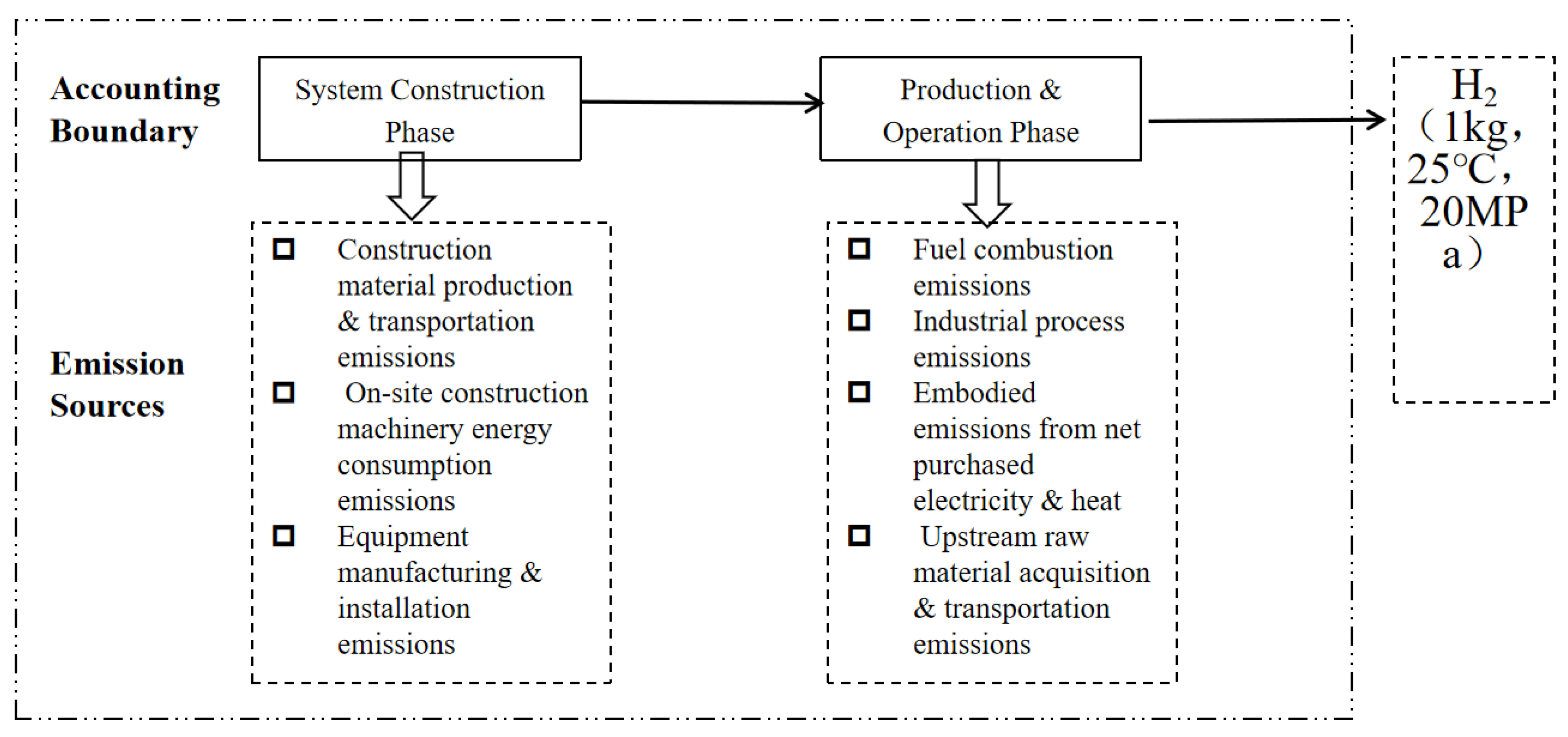
Figure 2.
Comparison of carbon emissions from hydrogen production routes.
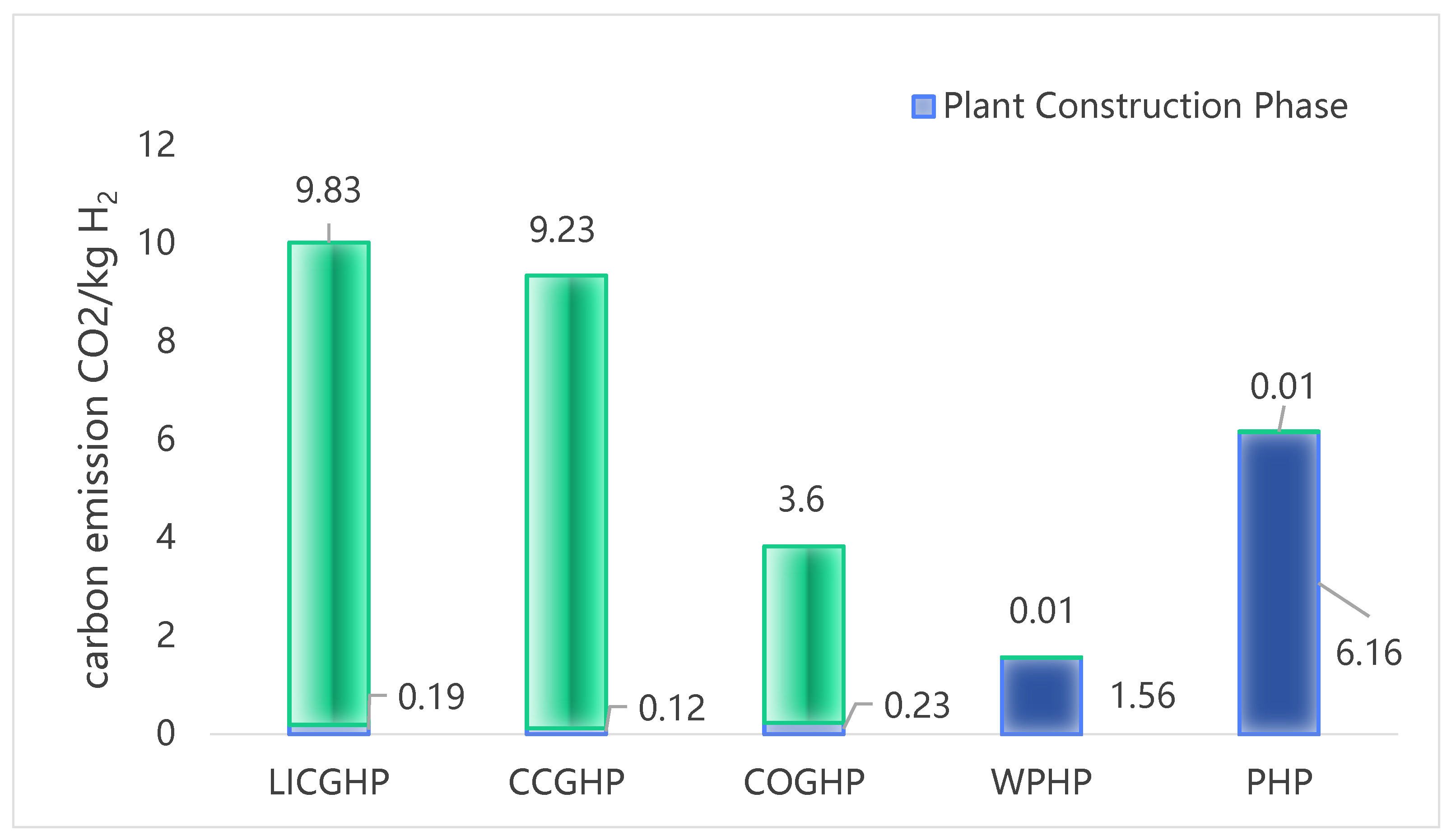
Figure 3.
Carbon emission composition of life cycle for renewable energy hydrogen production routes in Shanxi Province.
Figure 3.
Carbon emission composition of life cycle for renewable energy hydrogen production routes in Shanxi Province.
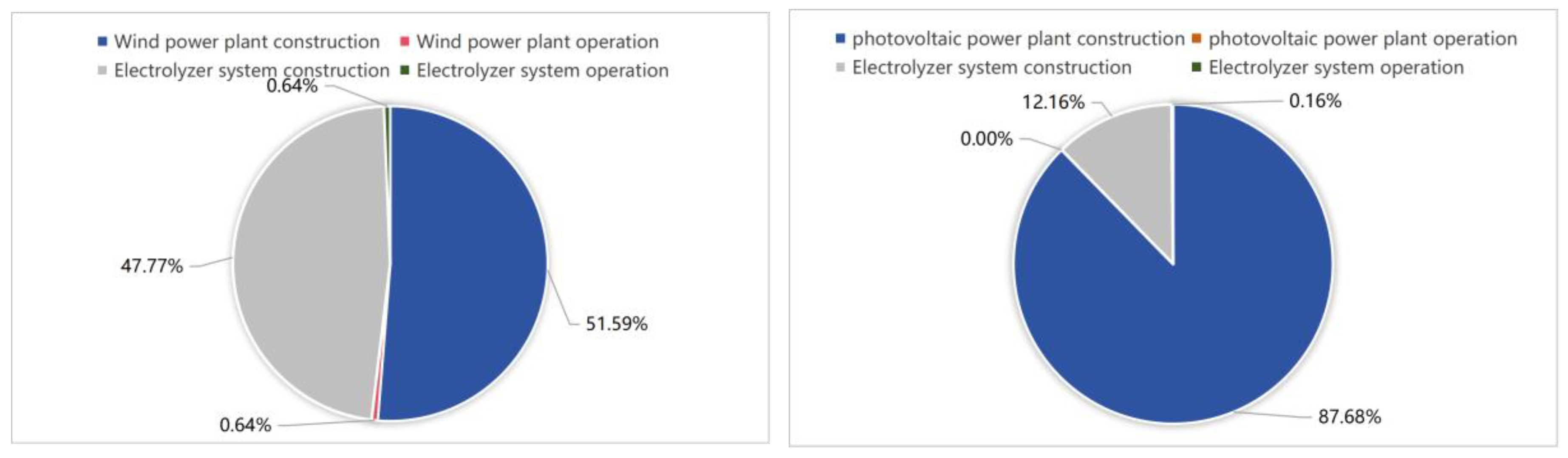

Table 1.
Research Objects and Core Parameters.
| Hydrogen Production Route | Project Type | Design Life (Years) | Annual Hydrogen Output (t) | Total Project Investment (100 million RMB) | Core Process Characteristics |
|---|---|---|---|---|---|
| LICGHP | New construction | 20 | 90000 | 239 | Coal gasification + Water-gas shift reaction + Acid gas removal |
| CCGHP | Ammonia plant renovation | 15 | 2150 | 0.32 | Coal gasification + Water-gas shift reaction + Acid gas removal |
| COGHP | Ammonia plant renovation | 15 | 74000 | 25 | Coke oven gas purification + PSA purification |
| WPHP | Off-grid integrated project | 25 | 83000 | - | 50MW wind power + 10MW PEM electrolyzer |
| PHP | Off-grid integrated project | 25 | 83000 | - | 50MW photovoltaic + 10MW PEM electrolyzer |
Table 2.
Life cycle carbon emission intensity of each hydrogen production route (kg CO₂e/kg-H₂).
| Hydrogen Production Route | Life Cycle Total | Plant Construction Phase | Industrial Processes | Fossil Fuel Combustion | Embodied Electricity Emissions | Raw Material Production and Transportation |
|---|---|---|---|---|---|---|
| LICGHP | 10.02 | 0.19 | 5.66 | 3.69 | -1.06 | 1.54 |
| CCGHP | 9.35 | 0.12 | 6.65 | 0.96 | 0.74 | 0.88 |
| COGHP | 3.83 | 0.23 | 1.97 | 0.00 | 1.56 | 0.06 |
| WPHP | 1.57 | 1.56 | 0.00 | 0.00 | 0.00 | 0.01 |
| PHP | 6.17 | 6.16 | 0.00 | 0.00 | 0.00 | 0.01 |
Table 3.
Contribution ratio of sub-items to carbon emissions during the production operation phase of coal-based hydrogen production routes in Shanxi (%).
Table 3.
Contribution ratio of sub-items to carbon emissions during the production operation phase of coal-based hydrogen production routes in Shanxi (%).
| Hydrogen Production Route | Fossil Fuel Combustion | Industrial Processes | Embodied Electricity Emissions | Raw Material Production | Raw Material Transportation |
|---|---|---|---|---|---|
| LICGHP | 37.54 | 57.58 | -10.78 | 15.46 | 0.20 |
| CCGHP | 10.40 | 72.05 | 8.02 | 9.43 | 0.10 |
| COGHP | 0 | 54.72 | 43.33 | 1.67 | 0 |
Table 4.
Carbon mitigation potential comparison of typical hydrogen production routes in Shanxi.
| Hydrogen Production Route | Carbon Mitigation Amount (kg CO₂e/kg-H₂) | Mitigation Rate (%) | (%)Technology Maturity | Regional Industrialization Prospects |
|---|---|---|---|---|
| CCGHP | 0.67 | 6.69 | High | Short-term stock upgrading |
| COGHP | 6.19 | 61.78 | Medium-High | Short-term to medium-term transition |
| WPHP | 3.85 | 38.42 | Medium | Medium-term to long-term leadership |
| PHP | 8.45 | 84.33 | Medium-High | Medium-term to long-term leadership |
Disclaimer/Publisher’s Note: The statements, opinions and data contained in all publications are solely those of the individual author(s) and contributor(s) and not of MDPI and/or the editor(s). MDPI and/or the editor(s) disclaim responsibility for any injury to people or property resulting from any ideas, methods, instructions or products referred to in the content. |
© 2026 by the authors. Licensee MDPI, Basel, Switzerland. This article is an open access article distributed under the terms and conditions of the Creative Commons Attribution (CC BY) license (http://creativecommons.org/licenses/by/4.0/).
Copyright: This open access article is published under a Creative Commons CC BY 4.0 license, which permit the free download, distribution, and reuse, provided that the author and preprint are cited in any reuse.


