

Submitted:
23 March 2026
Posted:
24 March 2026
You are already at the latest version
Abstract
The transition towards low‑carbon energy systems and circular economy frameworks has intensified interest in biomass and waste valorization technologies that deliver re-liable energy carriers while mitigating greenhouse gas emissions. Among thermo-chemical pathways, gasification emerges as a particularly flexible and robust option for transforming biomass resources into synthesis gas suitable for power generation, hydrogen production, and synthetic fuels. This review critically examines biomass gasification as a feasible alternative for valorizing waste and producing syngas. The manuscript discusses the physicochemical characteristics of biomass, highlights its influence on syngas quality, tar formation, and cold gas efficiency. The fundamental stages of the gasification process and the effects of different operating parameters were systematically reviewed. Special attention was given to the challenges posed by low‑quality biomass, such as sewage sludge, digestates, and manures, which are characterized by high-ash content and high moisture levels. Syngas energy content reported across different experiences was usually around 4–5 MJ/m3 when operating with low-quality biomass, resulting in lower efficiencies than those reported for lignocellulosic biomass (around 30–70%, expressed as cold gas efficiency (CGE)). Current small-scale commercial gasification technologies were also reviewed, with emphasis on operational constraints. This review provides an integrated perspective on the operational challenges associated with low-quality biomass gasification and discusses technological pathways to enhance process efficiency and salability. Although biomass gasification cannot yet be regarded as a fully mature technology across all feedstocks, it nonetheless constitutes a technically significant pathway for strengthening energy system resilience and advancing the production of sustainable fuels within a net zero carbon framework.
Keywords:
syngas
; waste valorization
; energy efficiency
; tar reforming
1. Introduction
Energy is essential for the development and quality of human life. In recent decades, energy consumption and carbon emissions have increased significantly due to population growth and rising income levels. This trend will continue, with global energy demand expected to rise to 21,546 Mtoe by 2050 and CO2 emissions to 41.0 Gt by the same year [1,2]. Given the high impact of these emissions on global warming, the focus has been set on accelerating the transition of production cycles to a net zero carbon economy by the efficient use of energy, increasing the share of renewables in the energy production mix and facilitating the access to alternative fuels as well as developing more efficient technologies based either on the use of electricity or alternative biofuels. Therefore, greater investment in research and technology development is crucial to increasing productivity and profitability [3]. While renewables offer potential for power generation, they face limitations due to their inherently intermittent nature. Additionally, their availability can adversely affect the energy market when excess energy is produced during low-demand periods, causing negative electricity prices. An example of the difficulties arising when managing an energy mix based mainly on renewables was the recent Spanish shutdown in April 2025, which set the alarms regarding the energy mix composition and grid reliability [4,5,6,7]. Other renewable technologies are not free of controversy. Hydropower relies on the availability of water and tides and their impact on ecosystems. In contrast, geothermal energy and biomass-based systems present challenges related to site limitations, gas leakage, and particulate emissions, requiring advanced control, the establishment of safety standards and replantation procedures to achieve sustainability [4]. Therefore, energy supply diversification is crucial to improving security and is one of the main challenges for economic growth, especially in emerging economies [8,9].
Gasification is one of the thermochemical conversion processes with great potential for valorizing biomass and waste to produce energy, sustainable materials, generating fewer gas emissions than traditional combustion, and offering a superior life-cycle impact compared with conventional hydrogen-production processes [10,11]. There is growing interest in developing efficient biomass-based power systems, as well as in producing liquid fuels and hydrogen from renewable resources, driven by their inherent environmental and societal benefits and by the increasing need to reduce greenhouse gas emissions associated with fossil fuels. Although gasification technologies have been successfully demonstrated for producing energy from fossil fuels, biomass-based gasification is not yet a fully mature commercial process. As reported by Kirkels and Verbong [12], after many years of research and development, the biomass gasification process still requires extensive research, with not enough mature technologies being widely applied at the commercial level.
Biomass represents a viable and sustainable alternative to fossil fuels for energy production, with the potential to achieve, under certain conditions, a neutral or even negative carbon footprint [13,14]. It is an abundant resource that can be easily stored and transported, and estimates suggest it could supply up to 20% of global energy demand [15,16]. Furthermore, existing technologies for converting biomass into valuable fuels benefit from extensive industrial experience, which facilitates their deployment. Among the available conversion technologies, thermochemical processes have attracted increasing attention due to their flexibility and availability to process heterogeneous biomass resources. Primary biomass sources include energy crops, forestry residues, agricultural and urban waste, such as municipal solid waste and garden trimmings, as well as algae and microalgae cultures. Energy crops are grown exclusively to produce biomass for biofuel generation [17]. These include wood, grasses, herbaceous plants, starch-rich species, and oilseeds [18]. Biomass from these crops can be used directly for heat and electricity or converted into fuels compatible with existing storage and transport infrastructure and different engine systems. Typical examples, such as whole-crop maize, Miscanthus, short-rotation coppice willow, and poplar, can be processed through combustion, gasification, pyrolysis, or hydrothermal methods to obtain energy and valuable organic compounds. Additionally, pre-treatment steps may prepare biomass for fermentation to produce alcohols or biogas.
Gasification technologies have traditionally been designed for lignocellulosic biomass, including materials such as wood pellets and residues from the wood-processing industry. Increasing attention is now directed toward the valorization of low-quality biomass streams—such as sewage sludge, digestates, and animal manures—as a practical and sustainable strategy for managing the substantial quantities requiring final disposal. However, these feedstocks present significant operational challenges owing to their inherently high moisture content and elevated ash levels.
The present manuscript examines biomass valorization through gasification, with particular focus on organic waste, which poses several challenges that must be overcome for this technology to become a key player within the current portfolio of valorization strategies. It outlines key biomass characteristics and transformation processes, highlighting gasification as the most promising option for reliable, dispatchable renewable energy that can complement intermittent sources. The document also reviews the main operating parameters of gasification and finalizes with a review of approaches for converting low-quality biomass.
2. Methods
This review focuses on biomass gasification, with particular emphasis on studies addressing the conversion of high–ash-content biomass, including sewage sludge (biosolids), animal manures, and digestates. A structured literature review was conducted to identify relevant peer-reviewed publications published between 2000 and 2025. The review primarily targeted studies reporting experimental results obtained at pilot scale, as these are considered more representative of industrial performance than laboratory scale investigations.
The literature search was conducted using Google Scholar, Scopus and PubMed as the primary databases. The initial search using the keyword combination “biomass gasification” returned approximately 286,000 records. From this dataset, review articles and book chapters were excluded, reducing the number of relevant publications to approximately 86,100 research articles. To further refine the dataset, the search considered documents containing in the title the term “pilot scale” in combination with selected feedstock descriptors. This filtering step yielded 44 publications addressing pilot scale biomass gasification in general. When the keyword “sewage sludge” was included, 25 relevant studies were identified, whereas only 7 publications focused on pilot scale gasification of manure. The search combining “digestate” with “pilot scale gasification” returned a single study, highlighting the limited availability of pilot scale experimental data for this feedstock. The final selection of publications was qualitatively analyzed with respect to feedstock properties, reactor configuration, operating conditions, syngas composition, cold gas efficiency, tar formation, and ash-related operational challenges, reducing the analysis to 288 manuscripts. Gray literature was also searched to gather information regarding commercial technologies.
3. Biomass Characterization
The chemical composition of biomass is critical for assessing and optimizing its energy potential, improving fuel quality, process efficiency, and reducing emissions [19,20,21]. Although thermochemical processes like gasification resemble coal conversion, biomass generally have lower density, higher volatile matter and alkali content, and reduced sulfur levels, all of which influence particle behavior and gasifier operating conditions [22]. Accurate characterization provides essential data for heat and mass transfer, as well as for modeling and simulation of thermochemical conversion [23]. Unlike fossil fuels, biomass exhibits significant variability, making characterization vital for predicting reaction pathways and operational challenges [18]. Key properties such as moisture, ash, alkali content, and particle size directly affect process efficiency. Proper characterization enables better emission control and minimizes waste management requirements [20,24].
Chemical energy is stored in cellulose, hemicellulose, and lignin in plants, with proportions varying by species [18]. Ultimate analysis determines the elemental composition—carbon, hydrogen, nitrogen, sulfur, and oxygen—providing essential data for estimating higher- and lower-heating values (HHV/LHV), which are critical for modeling thermochemical processes [25]. For example, the hydrogen-to-carbon ratio strongly influences pyrolysis products. Hemicellulose, cellulose, and lignin decompose at different temperature ranges, and their distinct thermal behaviors affect overall yield during high-temperature breakdown [26]. Several correlations have been proposed to estimate HHV from elemental composition, some of which are listed in Table 1.
3.1. Volatiles
There is an evident relation between gasification performance and biomass properties. Some studies have reported a positive influence of volatile matter and biomass HHV on the carbon monoxide (CO) content of syngas and therefore on energy density of the combustible gas fraction [31,32]. A high content in volatiles translates into the formation of a large number of gaseous species and light tars produced during the process, which impacts the reactor’s design and operating conditions. The application of biomass pre-treatments such as drying is necessary in many cases to reduce moisture levels, milling to obtain a predefined particle size, and operations intended to reduce the nitrogen and alkali content of biomass such as fractionation and leaching [33].
The primary components of syngas are CO, carbon dioxide (CO₂), hydrogen (H₂), methane (CH₄), and water. When air is used as the gasifying agent, a significant portion of the syngas consists of nitrogen (N2), resulting in a substantial decrease in the energetic density. Syngas also contains a small number of volatile organics (short-chain hydrocarbons) with a varying chemical composition, which is particularly dependent on the gasifier heating conditions and the type of biomass used as raw material. The most common compounds include C2-C4 species, acids, aldehydes, phenols, and tars. The proportion of volatiles in the raw material relative to its fixed carbon content provides a preliminary indication of biomass behavior during the heating stage and thus of the fate of subsequent reactions. Feedstocks with a high volatile matter content (e.g., grasses) will be strongly affected by the performance of simultaneous pyrolysis/gasification reactions, leading to syngas with higher energy density due to their higher CO and methane composition [34,35]. Therefore, proximate analysis is essential for explaining product distribution during the thermochemical process [26].
3.2. Moisture
High moisture levels negatively impact performance by increasing the tendency for heavy tar formation and deposition in the gasifier [36]. However, water content in biomass can enhance H2 production, with optimal performance heavily reliant on the gasification temperature. To prevent significant declines in syngas quality and gasification efficiency, Dong et al. [37] indicated that a moisture content of 20-25% is ideal for municipal solid waste (MSW) gasification.
Tar is a specific component within volatile matter, composed of organic compounds that condense at low temperatures, therefore generating operating problems due to blockages and failure of downstream processing pipes and connections. Biomass with high lignin content, such as wood, produces more tars, since lignin phenolic components are a major source for forming heavy, polycyclic aromatic hydrocarbon (PAH) [38,39]. In addition, the tar composition is not fixed; it evolves under specific temperature and reaction conditions [40], with gasification configuration and operating parameters being highly relevant to the main components and yield obtained.
While most gasification research emphasizes the chemical composition of feedstock and its impact on gasification efficiency and tar production, the feedstock's physical characteristics and dynamic behavior within the reactor also significantly influence tar formation. Littlejohns et al. [41] reported that the relationship between biomass characteristics and tar formation is unique, and understanding this particular feature can facilitate the development of reliable gasifier systems by adapting process configuration and operation to predefined biomass physical and chemical properties. The development of new analytical procedures for measuring individual tar compounds is important for controlling operational parameters and monitoring emissions in full-scale plants, as several tar components have a strong environmental impact owing to their mutagenic and carcinogenic properties [42]. Tar reduction technologies typically use thermal and catalytic cracking, along with cyclones and wet or dry-cleaning systems [43,44].
3.3. Ash
Ash is an inherent component of biomass. Waste biomass, such as agronomic waste, manure, and sewage sludge, typically has a higher ash content, resulting in a lower energy density of the raw material. The ash chemical composition of solid fuels is typically expressed in terms of the following elements: silicon (Si), aluminum (Al), iron (Fe), calcium (Ca), magnesium (Mg), potassium (K), sodium (Na), titanium (Ti), sulfur (S), and phosphorus (P). Wood biomass usually contains relatively low amounts of nitrogen (N), S, and chlorine (Cl), and is characterized by having a low ash content [45]. The mineral components of biomass are not eliminated during thermochemical conversion. Instead, they remain as the ash by-product produced in gasification or become part of the char material during pyrolysis. Additionally, biomass may contain salts, organically bound compounds, and other foreign materials such as soil and sand [46]. The high levels of ash in residual biomass pose a major operational problem for gasifiers, leading to fouling, ash sintering, corrosion, reduced process efficiency, and even occasional plant shutdowns. Consequently, a fundamental contradiction emerges between the intended use of gasification for waste valorization and the technological limitations imposed by ash-related complications.
The low melting point of biomass ash is primarily due to the presence of alkali metals such as K, Ca, and Mg. Therefore, determining the composition of ash materials is essential for establishing the trend of eutectic formation along with considering the operating characteristics of a specific gasification system [47]. Additionally, ash deposition on gasifier walls is influenced by the characteristics of the ash itself. Alkali metals can contribute to fouling when they combine with silica and alumina, forming low-melting-point eutectic compounds. The high temperature and flow regime in the gasifier would favor the melting behavior of ash in the first case, and the dissipation of momentum and particle impact with gasifier walls would favor the deposition of particles in the second case [48,49]. The most critical role of characterization is predicting ash behavior and preventing slagging or agglomerations. Nevertheless, the presence of alkali metals does not always bring negative features. Potassium compounds (such as K2SO4 and K2CO3) have demonstrated to enhance the catalytic reduction of tar [50]. The addition of ash containing alkali metals, Fe, zinc (Zn), and Al has improved catalytic performance during the thermal conversion of waste biomass. This enhancement is crucial for increasing the quality of syngas, especially when the interaction between the gas phase and the catalytic ash-containing bed is optimized [51,52].
3.4. Biomass Physical and Chemical Characteristics
Biomass feedstocks with similar bulk characteristics can behave differently during gasification and produce distinct solid products, as both reactor configuration and operating parameters influence performance. The physical properties and chemical composition of biomass are crucial to the efficient operation of the process. Biomass properties can profoundly affect the design of the feeding mechanism and the reactor geometry and thus its final performance [22]. A complete characterization of biomass enables efficient blending of feedstocks and determines whether pre-processing, such as leaching and torrefaction, is needed to mitigate undesirable outcomes. Biomass properties indicate how feedstock can be modified using these processes to enhance its suitability for gasification. For example, biomass washing reduces levels of K and Cl [53]. Torrefaction improves feedstock properties by reducing its O/C ratio and moisture content, increasing energy density and grindability, and favoring the process by producing a higher-quality syngas and increasing cold gas efficiency (CGE). Torrefaction of biomass enhances its properties, making handling and storage easier. Additionally, reducing biomass volume significantly improves economic efficiency by lowering transport costs. Results from the economic evaluation of various scenarios showed improved overall process performance when torrefaction was included as a pre-treatment stage. This improvement was attributed to the higher energy content of the resulting syngas, enhancements in the logistics chain, and better gasification performance [56].
The significant variability in the physical and chemical properties of biomass makes it difficult to standardize energy production methods compared to fossil fuels. Table 2 presents the different biomass types and their main characteristics. Grippi et al. [20] indicated that some feedstock characteristics may better accommodate to some specific bioenergy production methods. Direct combustion requires biomass with low moisture (<10–12%) and ash content, but high lignin concentration. In contrast, anaerobic digestion is better suited for feedstock rich in readily biodegradable organics, with high moisture levels and low lignin content. For ethanol production, materials with a high carbohydrate content are preferable. If biological treatment of lignocelluloses is considered, pretreatment is necessary to release fermentable sugars from cellulose and remove lignin. Therefore, materials with low lignin content are preferred. Similarly, gasification and pyrolysis benefit from biomass with moderate lignin levels and low ash content, which facilitates effective syngas production and reduces ash accumulation.
Multiple studies have shown that blending unconventional biomass with conventional fuels—such as wood, coal, or petroleum coke—can improve gasification performance. These mixtures help reduce the drawbacks associated with high-alkali, high-ash biomass and mitigate logistical challenges related to seasonal feedstock availability and long-distance transport in large-scale gasification systems [80,81,82]. Unlike biomass combustion, where mixing different feedstocks can greatly affect performance [83], gasification allows for easier control by adjusting parameters such as temperature and the biomass-to-air ratio [84]. As a result, incorporating diverse waste streams throughout the year can enhance operational flexibility, helping the plant adapt to fluctuations in biomass price, availability, and regional supply conditions.
4. Biomass Conversion Following Different Energy Pathways
Biomass can be converted into energy carriers through several biological, physicochemical, and thermochemical pathways. Understanding these conversion routes is crucial to unleashing the energy potential of biomass resources. Figure 1 illustrates the main biomass valorization pathways. Among these alternatives, thermochemical conversion processes have demonstrated great flexibility and the ability to process heterogeneous biomass resources.
4.1. Main Biological Conversion Pathways for Fuel Production
The main processes in biomass biochemical conversion are anaerobic digestion and alcoholic fermentation. The biomass used as a feedstock in the first case is usually agricultural or crop residues, energy crops and organic waste, such as municipal solid waste, sewage sludge, and animal manure [85,86]. Biogas is obtained as the primary product with a methane content of 50% to 65%, and CO2 as the second prevalent component, in addition to small quantities of ammonia, water, H2, hydrogen sulfide (H2S), and air traces [87]. A digestate slurry is an end-product generated from the anaerobic digestion process. In the context of sewage sludge, this by-product is commonly referred to as biosolids. Due to its high nutrient content, agronomic land application represents an optimal opportunity. The land spreading of biosolids can significantly enhance crop yields and improve soil organic matter, thereby promoting sustainable agricultural practices [88].
Alcoholic fermentation for ethanol production is widely used due to its compatibility with gasoline and the high yields achieved. Biomass with a high carbohydrate content, such as sugarcane, beetroot, and cereals, is a common raw material. Butanol production via fermentation is another well-known process that shows high compatibility with petrol fuels, but the microbial's lower tolerance significantly reduces yields [89]. Several companies have attempted to develop industrial processes for fermenting lignocellulosic materials, with research focusing on sugar release and avoiding the formation of inhibitors during pretreatment. This extensive activity has given rise to the biorefinery concept, in which several transformations are coupled in a manner similar to a petroleum refinery, yielding a portfolio of valuable products or building-block components with applications in different industrial processes. Despite huge efforts, the deployment of this technological approach has been slow due to difficulties in achieving economic feasibility. The Borregaard plant (Sparsborg, Norway) is one of the few successful cases. The plant produces ethanol from woody biomass and high-value specialty products, including vanillin, high-quality lignin, and high-purity microfibrillated cellulose [90,91].
4.2. Physical-Chemical Conversion for Biodiesel Production
Biomass resources can also be converted into liquid fuels through physicochemical processes such as transesterification and hydrotreatment. The material is initially submitted to oil extraction procedures and subsequently to a chemical reaction to obtain ester compounds compatible with diesel fuels via transesterification, or to a hydrotreatment process, in which a renewable fuel is obtained that is fully compatible with current diesel and jet engines [92,93]. Lipid-rich vegetable oils, such as canola, sunflower, palm, and soybean, are commonly used for biodiesel production. However, the focus is on non-food crops to avoid distortions in market prices and disruptions in the distribution chain, as in alcoholic fermentation, where lignocellulosic biomass is considered a replacement for traditional rich carbohydrate feedstocks to avoid adverse effects on the food production chain. Algal biomass is a promising candidate to replace some of the current raw materials used in the renewable energy sector. However, high production costs are continuously delaying the expected production of third-generation biofuels [94].
4.3. Thermochemical Conversions for Fuel Production
Thermochemical conversions are more efficient and faster than biochemical processes, with the added advantage of handling a broad range of biomass types and producing various energy products [95,96]. Biomass typically exhibits lower energy density and higher oxygen content than fossil fuels [15]. Therefore, any practical application of this raw material requires an increase in energy density [97]. The end products from thermal processes are categorized into volatile (gases, vapor, and tar) and non-volatile (char and residual ash) [98]. The thermochemical conversion processes are influenced by the biomass feedstock type, elemental composition, and calorific value, as well as by process operating conditions. These conditions are considered determinants of product quality [99]. The different available thermochemical technologies for transforming biomass into energetic products include:
- Combustion: It is an ancient and widely used process that burns biomass in the presence of oxygen to release heat, which can be directly used in domestic and industrial processes, for generating steam to cover heat demand or to produce electricity [100].
- Pyrolysis: biomass is converted at high temperatures (300 and 1000 °C) in an oxygen-free environment, producing three main products: syngas, bio-oil, and biochar [101,102]. The heating rate and temperature greatly influence the product yield. Table 2 shows different pyrolysis processes classified by the heating rate and process temperature.

Table 2.
Classification of pyrolysis processes based on the heating rate applied.
| Pyrolysis process | Heating rate (°C/s) | Temperature range (°C) | Residence time | Particle size (mm) | Reference | |
| Vapor residence time (s) | Solid residence time | |||||
| Slow | 0.1 – 1.0 | 300 – 950 | 330 – 550 | 5.5 – 9.2 min | 5 – 50 | [105,106] |
| Intermediate | 1 – 10 | 400 – 500 | 10 – 30 | 0.7 – 0.5 min | 0.3 – 0.75 | [107,108] |
| Fast | 10 – 200 | Up to 1000 | ≤5 | <0.5 – 10 s | ≤1 | [105,106,109] |
| Flash | 13,000 – 21,000 | 900 – 1200 | 0.5 – 0.025 | 0.1 | [11,110] | |
- Gasification: The process converts biomass into syngas through partial oxidation. Syngas is a mixture of CO, H2, and CH4 that can be used to generate electricity or as a raw material for subsequent chemical processes to produce liquid fuels [101,112]. Gasification offers a competitive technical alternative to combustion. The combustion of syngas is cleaner than the direct combustion of biomass, reducing the need for excess air and, consequently, heat losses. Besides, it ensures homogeneous combustion, enabling better process control. The volumetric flow rate is lower than that of the effluent gases in direct combustion, providing a cost-effective gas-cleaning process [113].
- Hydrothermal processes: The technology involves the thermal cracking of biomass in the presence of water and below the supercritical point. Under high temperature and pressure, hydroxyl ions enable the degradation of organics, similarly to conventional thermal processes, but with the added advantage of avoiding a prior drying stage of the material, thereby reducing the energy demand [114]. The process can be classified by temperature range: hydrothermal carbonization is limited to temperatures below 260 – 280 °C, while higher temperatures, close to the critical point (374 °C), encompass hydrothermal liquefaction, where the main product of interest is a biocrude. In contrast, at lower temperatures, hydrochar is the main product. At temperatures above the supercritical point, the process is called hydrothermal gasification, and as its name suggests, syngas is the main product. Hydrothermal processes may also involve an additional category associated with oxidation or organic matter (wet oxidation) under conditions below or around the supercritical point [115]. The addition of an oxidant (air or oxygen) significantly favors the conversion of organics into small molecules. When the process is carried out at temperatures above the supercritical point, it is known as supercritical water gasification [116].
5. Biomass Gasification: Process Stages
Biomass used as a raw material has a high moisture content, ranging from 30% to 60% in freshly cut wood [117]. However, some materials, such as algae biomass can exceed 90% [118]; thus, a pre-treatment stage is crucial to ensure adequate water levels, especially in cases when producing high-energy-density fuel gases, where the moisture content must be kept below 20% [119]. Biomass moisture levels below 15% are considered optimal for gasification [97], but in some cases, achieving these low levels may increase the process's overall energy demand. The initial stage of gasification involves drying the remaining water in biomass (Figure 2). To vaporize this water, the minimum energy requirement is about 2242 kJ/kg, which is added to the energy needed to keep gasification running [120]. As the temperature increases to 150 °C, energy is used to heat the biomass and to drive the phase change of the residual water. Although high moisture levels adversely affect the energy balance due to the enthalpy required to generate steam, the steam may favor the process up to a certain point, as its presence increases H2 production [121]. However, excessive moisture content (above 30 – 40%) may increase tar formation, thereby reducing process efficiency [122].
The second stage involves the thermal decomposition of biomass, called pyrolysis. During this stage, biomass undergoes thermal cracking in the absence of oxygen, leading to devolatilization and the formation of char. Devolatilization starts around 300 °C, and char formation is favored around 400 °C and 500 °C. Huang et al. [123] demonstrated that biomass containing hemicellulose may undergo early pyrolysis at temperatures between 150 and 250 °C. This material decomposes at a slow kinetic rate, producing light hydrocarbons. At higher temperatures, thermal degradation continues at much higher rates, and biomass is rapidly pyrolyzed, producing mainly char and gaseous components (CO, CO2, H2, and light hydrocarbons) [124,125]. Partial oxidation reactions play a key role in providing the heat required to sustain the gasification process. In the third stage, gas-solid reactions are the main feature. Char reacts slowly with surrounding gases, such as oxygen, water vapor, and carbon dioxide, via the Boudouard and water–gas shift reactions. In this final stage, volatile gases, tar, and other products are further refined, thus defining the final gas composition.
6. Factors Influencing Biomass Gasification
Several factors affect the efficiency of the gasification process and the quality of syngas, including feedstock characteristics, reactor configuration, operating conditions, and the gasifying agent [126,127]. Grasping the intricate relationships among these parameters and their impact on syngas quality and overall process performance is essential to developing a profitable operation. This operation must possess a high degree of flexibility, allowing it to adjust to varying scales that depend on the availability of raw materials and the geographical constraints that may arise. By understanding these dynamics, new systems can be developed that not only optimize efficiency but also may be easily adapted to the specific conditions of each unique environment.
6.1. Feedstock Characteristics
One important factor influencing syngas production is the ratio of holocellulose (cellulose and hemicellulose) to lignin [122]. A high cellulose content increases syngas production but also has a detrimental effect because it tends to produce light tars at high heating rates [128]. The lignin content in biomass increases the energetic density of the material due to its HHV compared to cellulose/hemicellulose components (around 25 – 27 MJ/kg for lignin against 17 MJ/kg for holocellulosic components (cellulose and hemicellulose)). However, it enhances the kinetics of heavy-tar formation [129]. A positive correlation exists between biomass volatile matter, carbon content, calorific value, and the energy yield derived from the process, resulting in better performance when torrefied biomass is used directly as an input material [34].
Physical characteristics are also important, as they determine the design of the feeding equipment, the best configuration of the gasifier, and the retention time needed to complete the reaction. Low-bulk-density biomass (< 200 kg/m3) formed by small particles is not suitable for a fixed-bed system, where channeling of syngas flow and bed bridging may occur, leading to uneven flow and contact between the solid and gas phases [41]. The lack of bed homogeneity reduces CGE and increases tar concentration in syngas. On the contrary, the use of biomass in the form of pellets is more suitable for a fixed bed system since it reduces bed agglomeration. In bubbling fluidized bed gasifiers, pellets are preferred since they are a homogeneous high-density material, which allows for keeping appropriate control of bed distribution based on the difference in bulk pellet and hot bed density; thus, the control of the residence time of biomass and air flow is achieved by modifying superficial fluid velocity [130].
6.1.1. Particle Size
Particle size can significantly influence the efficiency of biomass gasification and the quality of syngas [131]. According to Siddiqui et al. [132], smaller particles have a larger surface area per unit volume, leading to better heat transfer and more efficient reactions. The composition of syngas is also affected by particle size. Smaller particles enhance the production of higher levels of H2 and CO, obtaining better conversion efficiencies [133]. Shorter residence times are required when using a feed with small particles, as in entrained-flow gasifiers, where reactions must be completed in a few seconds. The quality of the produced syngas is affected by this phenomenon, as smaller particles require shorter chemical times, reducing tar formation and allowing full conversion of organics [134]. In contrast, larger particles tend to produce syngas with higher CH4 concentrations, but at short residence times, this can lead to incomplete reactions [131,132]. Therefore, reactor type and operation mode influence the suitable particle size of the feed, with entrained reactors operating with smaller particles (smaller than 0.5 – 0.1 mm) [135], whereas fixed and bubbling bed reactors require a higher particle size [136,137].
6.1.2. Moisture Content
Moisture has an adverse impact on energy efficiency because it reduces global performance, as it requires extra energy addition for the water phase change, thus lowering the gasification temperature, affecting reaction kinetics, syngas quality, and also causing incomplete reactions leading to higher tar formation, unless extra energy is supplied to increase process temperature to desired values [35,97]. High moisture levels in raw biomass can disrupt the overall gasification process and complicate particle size reduction, potentially requiring more energy to achieve a set size [138]. In addition, slagging and fouling can appear in the reactor, associated with high water content in the raw material, which may increase operational costs [126]. However, the water content of biomass may increase hydrogen and CO levels in syngas [139], which may benefit the energy balance up to a certain point [121]. There is a compromise between the equivalence ratio (ER) needed to increase the role of oxidation reactions and therefore the heat release required to maintain optimal gasification temperature (at a given moisture content), and the quality of syngas, since a higher air injection will increase the CO2 and nitrogen levels in syngas. Plis and Wilk [140] tested different biomasses in a fixed-bed gasifier with varying moisture content. CO levels reported were higher for drier biomass, benefiting CGE. Increasing biomass moisture content in their experiments led to higher CO2 evolution, resulting also in a significant decrease in CGE. Most gasification processes can tolerate moisture levels up to 30% without significantly impacting the energy balance [141]. However, some gasifiers, such as updraft, bubbling, and fluidized bed gasifiers, can tolerate water contents of 55–60% [142].
6.1.3. Inorganic Content
Ash particles in the raw material may partially melt and fuse together at high temperatures, forming larger agglomerates or clumps (sintering), depending on the ash composition [143]. Additionally, the presence of ashes may have environmental impacts by releasing certain inorganic compounds, producing metal emissions that must be controlled to comply with environmental regulations [144]. Reactor design also plays an important role in controlling tar formation and is closely linked to the type of raw material treated [145].
Inorganic elements such as K, Ca, and Na can act as catalysts during gasification, thereby improving reaction rates and overall efficiency [146]. However, they may also cause corrosion and fouling issues when operating at high temperatures. The presence of these metals favors H2 production (particularly in the case of K) and influences the reactions of tar reforming and cracking [147,148], but these metals may also be released with syngas, forming part of benzene, xylene, furfural, and naphthalene-based components [149]. K has a more pronounced effect on gasification than Ca, as K can volatilize and become a mobile species during char formation, thereby increasing gasification reactivity in solid-gas phase reactions [150]. Ma and coworkers [151,152] studied ash accumulation and agglomerate formation in a pressurized entrained-flow gasifier using bark-derived residues and peat. These authors reported that slag produced during the process contained quartz and feldspars in a silicate melt with layers of alkaline-earth metal silicates. Fly ash, on the other hand, was enriched in K.
Biomass pretreatment methods such as washing, leaching, and torrefaction can reduce or eliminate some inorganic content before gasification [146]. The use of hydrothermal carbonization (HTC) for removing chlorine from biomass has also been proposed, reporting a 90.5% removal [153]. However, the energetic efficiency of the process needs to be carefully evaluated, since the introduction of an HTC stage increases capital investment costs and energy demand due to the heating of the entire biomass-water mixture, which can have a water content up to 70%, yet a drying stage is still needed to remove excess moisture from hydrochar.
The selection of the bed material may also improve gasification performance and syngas composition. The use of dolomite in bubbling bed gasifiers has shown greater reactivity than olivine, thus producing 40% less tar [154]. This approach has been studied by Chiang et al. [155] using rice straw as biomass, a material characterized by high ash and chlorine content. Their experiments using dolomite as a catalyst and a hot-gas cleaning system based on a packed tower containing zeolite, calcinated dolomite, and activated carbon resulted in almost total tar removal and high H2S removal efficiency, but lower HCl removal (58.6%). However, olivine as bed material offers the added advantage of interacting with ash components, forming a coating layer that positively influences gasification reactions and prevents the accumulation of tar thanks to early steam reforming on the olivine particle surface [156,157].
6.1.4. Activation Energy
Activation energy (Ea) refers to the energy required for a reaction to take place. Ea is important for understanding process kinetics and rates [158]. A lower Ea value is associated with easier reaction initiation (lower temperature), leading to higher conversions under some established conditions [159]. Lower activation energies lead to earlier thermal breakdown of biomass, triggering degradation and pyrolysis reactions in the initial section of the gasifier following the drying process. In contrast, higher Ea creates a greater temperature barrier to reaction initiation. When this occurs, and the reactor operates at lower temperatures, the slow reaction rate can result in decreased syngas yields. Therefore, biomass with a higher activation energy generally requires higher temperatures to start pyrolysis and effectively sustain subsequent oxidation and reforming reactions. If optimal conditions are not properly controlled, lowering the gasification temperature can prolong the reaction time and decrease overall conversion efficiency [160]. The parameters that determine process efficiency are not only associated with syngas yield but also with the tendency toward tar formation and the effective breakdown of these complex compounds in the reactor, which consequently leads to higher maintenance costs [161].
The activation energy varies across components within the same biomass type, depending on their structure. For example, cellulose, hemicellulose, and lignin have different values of Ea, which affect their thermal behavior during gasification. Under the same conditions, the gasification performance of the three main biomass components is entirely different, with cellulose showing the highest carbon conversion and lignin the lowest, due to its high phenolic content, which favors tar evolution [162,163]. The kinetics of pyrolysis of cellulose, hemicellulose, and lignin were studied by Zhu and Zhong [164]. Hemicellulose and lignin showed an early initiation of devolatilization and degradation reactions. In contrast, cellulose showed a clear degradation peak between 240 – 350 °C and played a dominant role in the thermal performance of the biomass.
6.2. Gasification Operating Conditions
6.2.1. Temperature
The temperature influences the process by increasing the reaction rate, improving conversion efficiency, but it also affects overall efficiency due to the higher energy demand. Excessive temperatures may cause stress on reactor structural components, leading to cracking of gasifier internals, bulging, and stress rupture of the vessel shell [165]. Increasing air addition increases the amount of oxygen available for oxidation reactions, releasing more heat, but reduces the energetic content of syngas by rising CO2 levels and causing N2 dilution. However, applying higher temperatures provides sufficient energy to overcome the reaction's Ea barrier, which results in faster biomass conversion [166], facilitating steam tar reforming reactions. Temperature affects the composition of syngas, including its quality and calorific value. Higher temperatures lead to increased production of H2 and CO [167,168]. However, this rise in temperature also lowers the energetic density of syngas because the reduction in CH4 and other gaseous hydrocarbon species results in a decreased energy content per unit volume. Higher temperatures enhance tar cracking, thereby producing cleaner syngas [169,170]. Nevertheless, the gasification temperature is constrained by the biomass ash composition, leading to melting when alkaline metals are the main inorganics; this, in turn, results in slagging, clogging, and equipment damage [167].
6.2.2. Pressure
In general, increasing pressure enhances overall gas yield and biomass conversion efficiency [171]. Pressure can influence various aspects of the gasification process, including syngas composition, gas yield, reaction rates, and tar formation. Pressure affects the balance between CO and CO2. Higher pressures can enhance the water-gas shift reaction, converting CO and H2O into H2 and CO2 [172]. It also favors methanation by reducing gas volume, thereby promoting CH₄ formation. Therefore, a syngas with a higher calorific value and a lower H₂/CO ratio is obtained, making it less suitable for subsequent catalytic synthesis processes [166].
When considering the operation of gasification-integrated systems, such as gasification combined cycle (IGCC) and synthetic fuel production, the need for subsequent gas compression is reduced when the gasifier already operates at high pressure. This configuration also facilitates syngas cleaning and CO2 separation, thereby enhancing overall process performance. Although equipment installation costs increase [168], operating at higher pressures provides an added benefit: a reduction in tar production [173]. Therefore, optimizing the gasification pressure is essential for maximizing process efficiency.
6.2.3. Equivalence Ratio
The equivalence ratio (ER) is one of the most influential parameters, directly affecting process efficiency [174]. The ER is defined as the ratio of the air supplied per unit mass of biomass to the stoichiometric air required for complete combustion. When ER increases, more air is introduced, resulting in increased oxidation and CO2 formation [175]. The ER thus influences the operating temperature, the chemical reactions, and syngas quality. Low ER values (< 0.2) result in incomplete biomass conversion and reduced gas yield, with increased tar formation [176,177]. Optimal ER ranges from 0.25 to 0.4 for most downdraft gasifiers, maximizing CO and H₂ yields and minimizing tar and char formation [178]. Other gasifier types have a similar operating range, with 0.3 being the most common value [179,180].
The ER also influences downstream applications. Increasing ER within the optimal range enhances the cold gas efficiency. It stabilizes the syngas composition by increasing the H₂ and CO proportions relative to CH₄ and CO₂, which is crucial for applications such as Fischer–Tropsch synthesis or for applications that focus on favoring hydrogen production [178,181]. Consequently, ER optimization is necessary to achieve high process efficiency while producing syngas with a composition suitable for its intended end-use.
6.2.4. Residence Time
The residence time is the mean time a fluid volume spends in the reactor; therefore, this value depends on the reactor volume, the fluid circulation regime, and the incoming volumetric flow rate. The residence time is an important parameter because it sets the time biomass particles are exposed to high temperatures. A successful gasification process thus depends on the interaction between the time required for an organic particle of a given size to complete the reaction and the time this particle spends in the reactor under the operating conditions established. According to Glushkov et al. [126], optimizing both residence time and particle size can significantly affect gasification efficiency and syngas quality. Other researchers have reported similar findings. For instance, Rupesh et al. [182] found that residence time is a determining factor for the final syngas composition in CaO-enhanced air-steam gasification of biomass. The smaller particles of biomass have a higher surface area to volume ratio, causing faster heating up and devolatilization, thus leading to a higher gasification rate and complete conversion in a shorter time [178]. Similarly, residence time interacts with other parameters, such as temperature. Higher temperatures boost reaction kinetics, leading to increased rates of devolatilization, tar cracking, and gas-phase reactions, and consequently, a shorter time is required for complete conversion [176]. Latifi et al. [183] showed that increasing the bed temperature from 600 to 700 °C and the residence time from 8 to 27 seconds resulted in increased bio-oil conversion and, thereby, syngas production. Specifically, at 700 °C, these authors observed that the H2/CO ratio increased from 0.29 to 0.60, concomitant with an increase in residence time. Hernández et al. [184] reported a similar trend when testing gasification temperatures between 750 and 1050 °C.
6.2.4. Gasifying Agents
The use of different gasifying agents (air, oxygen, steam, or CO2) affects syngas composition. The gasifying agent determines the heat requirements: increasing the oxygen flow allows oxidation reactions to play a more prominent role, thereby increasing the process temperature, but in turn reduces syngas quality by diluting it with nitrogen and increasing syngas CO2 levels. Air is commonly used in small-scale applications due to the lower operating costs. However, the high nitrogen content in air significantly reduces process efficiency due to the large volume of gases that must be handled and heated (increased power consumption), affecting reactor design and syngas cleaning operations [185]. In contrast, the addition of steam favors H2 production by enhancing the water-gas shift reaction and methane reforming reactions [34,186]. The addition of steam also increases tar reforming, resulting in a lower tar content in syngas compared to standard air gasification [187]. However, as a disadvantage, higher heat demand is required for steam production [188]. The energy efficiency of the steam-oxygen gasification process was assessed by Sandeep and Dasappa [189]. These authors reported a decrease in efficiency when the steam-to-biomass ratio (SBR) exceeded 0.75, setting this value as the limit for achieving energetic advantages in the global process. The energy required to produce steam at 0.75 SBR was estimated at 2.2 MJ/kg biomass. Although a significant increase in syngas H2 content was achieved, the energy efficiency was similar for air gasification and steam-oxygen gasification.
6.2.5. The Use of CO2 as a Gasifying Agent Brings Additional Benefits
CO2 can act as a gasification agent, increasing CO formation by the Boudouard reaction and thereby lowering the H2/CO ratio. It also increases carbon utilization efficiency (CE) by improving char conversion in a CO2-rich atmosphere [190,191]. Prabowo et al. [192] studied the gasification of rice straw (high-ash-containing biomass) using air and CO2 as gasifying agents. These authors indicated that the use of CO2 results in a more efficient process when compared to conventional N2 atmosphere pyrolysis, whereas in the case of gasification, the use of a mixture of air/CO2 (optimum mixture: 60% CO2, 8.3% O2 and 31.7% N2) results in better performance thanks to the heat release from oxidation reactions, thus avoiding the need of supplying extra energy for keeping the process operating at a specific gasification temperature. Sadhwani et al. [193] also studied the use of CO2 in gasification. Although these authors did not report significant effects of CO2/C ratio on process performance, they indicated that using CO2 affected the process chemistry, now dominated by the Boudouard reaction, char reforming reaction, and radical combination reactions.
The additional advantage of using CO2 as a gasification agent is the removal of the diluting agent. Increasing syngas quality involves removing non-energetic gases. Removing N2 from syngas would require complex physical separation processes due to N2's inert nature, thereby increasing energy demand. In contrast, CO2 removal, a chemically active molecule, can be achieved by membrane separation or by absorption into amine-based liquids or Selexol solvents. Energy estimates indicate that about 3.2 MJ/kg CO2 removed would be needed when using amine-type scrubbers [194], and the technology is simpler than removing N2 from syngas. On the contrary, using pure oxygen would require installing an air separation unit, which has an estimated energy demand of 0.7 MJ/kg O2 with a much higher installation cost [195,196]. The main penalty is the high electricity demand. In contrast, for CO2 capture, the energy required is in the form of heat, which can be supplied by heat recovery units.
Another interesting strategy is the direct adsorption of CO2 during gasification using CaO in the presence of air/steam as the gasifying agent. Wei et al. [197] reported that an appropriate S/B ratio is 0.38–0.59, although the recommended adsorbent-to-biomass ratio was high (20) at an operating temperature of 700–800 °C. In a recent study, Shang et al. [198] performed gasification at a small scale using a quartz tube and applying repetitive cycles. These authors reported that although loss of bed stability and structural degradation were observed, hydrogen production was maintained after twenty cycles. However, the use of a low-ash biomass (corn stalks with 3.5% ash content) probably contributed to the good performance over many cycles. Biomass ash often coats catalyst particles, causing deactivation, especially at high temperatures [122]. For this reason, biomass gasification along with CaO absorption is often performed at temperatures below 800 °C [199,200]. Chen et al. [201] used an Al- and Ti-metal-modified Ca-based catalyst (CaO was used as the carrier). CaAlO obtained the best performance, but the H2 yield was reduced from 347.7 mL/g to 154.4 mL/g, just after only five cycles (at an operating temperature of 800 °C). The study by Cao et al. [202] found that a CaO/biomass ratio of 1.5 was sufficient to enhance H2 production when combined with steam addition, as higher ratios did not yield a significant improvement in overall performance. In the same study, which focused on modelling gasification reactions, the authors noted that temperatures below 800 °C promoted CO2 adsorption. However, higher temperatures would be necessary to improve tar reforming but could lead to catalyst deactivation and ash sintering.
7. Biomass Gasification Technologies
Gasifiers are usually categorized into fixed bed, moving bed, fluidized bed, entrained flow, and plasma gasifiers. Each type has unique operating characteristics and reactor designs optimized for performance by various manufacturers. Several excellent reviews covering this subject have been published in the literature [35,120,203,204]. The review by Allesina et al. [205] explicitly describes current small-scale gasification technologies. Most of these gasifiers are fixed-bed types, and as scale increases, the most common technology is fluidized bed, with some of them including a circulating flow to improve reactor performance. Table 3. lists some of the different types of gasification studies performed using biomass as raw material. A complete list is included in the supplementary material S1.
Despite efforts to develop gasifiers capable of handling various biomass types to increase plant flexibility, several challenges remain, including operational issues with syngas cleaning and tar removal, low energy production efficiency, and high installation and operating costs. These issues, identified by Heyne et al. [219] and Asadullah [220] more than a decade ago, persist in recent gasification work. Gasification units that include a subsequent combustion stage effectively destroy tar components, which simplifies the design of syngas cleaning processes. Consequently, many biogas gasification technologies currently utilize syngas in boilers or CHP engines. Table 4 lists some biomass gasification plants currently in operation and Table 5 lists some commercial companies offering small-scale biomass gasification units.
Yadav et al. [247] and Dhamodharan et al. [248] identified several key factors affecting the feasibility of biomass gasification plants. These include the handling of biomass and its logistics, installation costs, operational complexities, and issues such as frequent clogging and blockages due to the heavy hydrocarbons present in syngas. As a result, biomass gasification units rely heavily on scale to achieve profitability. However, this reliance also presents challenges due to the associated collection and transportation costs. To address these issues, using a mixture of raw materials, including organics and high-energy-density waste like plastics and tires, has emerged as a more efficient option because it improves the overall energy balance [249,250].
In the context of decentralized energy systems, the South Tyrol region represents a significant pilot environment for small-scale biomass gasification. This area has served as a living laboratory for iterative optimization and technology refinement (to assess operational reliability), integration with combined heat and power (CHP) units, and adaptation to local feedstock variability under real-world conditions. As reported by Patuzzi et al. [251], the technologies installed in this area use high-quality biomass with low moisture content (<12%) and low ash content (<1%). Despite this feature, the char obtained cannot be considered suitable for agronomic applications, given its metal content (mainly chrome and zinc, derived from the gasifier itself and comminution operations) and the presence of polycyclic aromatic hydrocarbons (PAHs).
A hypothetical key advantage of gasification is its ability to process a broad spectrum of biomass feedstocks with diverse physicochemical properties, while simultaneously enabling the valorization of organic waste streams. This flexibility facilitates its integration into circular economy frameworks by converting heterogeneous materials into valuable energy carriers and by-products. The inability of small-scale gasifiers to manage syngas trace contaminants when operating with low-quality biomass, and the excessive cost of char disposal when this material falls into the out-of-specification category, make the process incapable of meeting sustainability goals. A more viable approach is partial decentralization, in which syngas is conditioned and valorized at a large-scale, centralized facility. This configuration leverages economies of scale to enable advanced tar reforming technologies and efficient energy recovery from char, while minimizing biomass transport requirements. The concept is not new; in fact, the use of a multi-stage approach is already observed in currently small gasification technologies, as the separate control of each step allows for optimizing the overall outcome. The bioliq® process is the major exponent of stage separation. The process was developed at the Karlsruhe Institute of Technology (KIT) and involves the in situ fast pyrolysis (small scale) of the biomass, thus producing Biosyncrude® (a mixture of pyro-oils and coke) and subsequent gasification in a large-scale gasifier high pressure (40 - 80 bars) entrained-flow unit followed by syngas up-grading and conditioning [252]. Although very promising, this technology is not yet commercially available.
The study by Menin et al. [253] found that small-scale gasification, when combined with syngas valorization through combined heat and power (CHP) units, is not currently a competitive alternative to photovoltaic electricity generation with battery storage or to biogas electricity production. However, when externalities are factored into the analysis, biomass gasification significantly reduces greenhouse gas (GHG) emissions, which is a notable advantage that should not be overlooked [254]. The feasibility of a plant relies not only on the economic performance of the technology but also on its profitability compared to existing renewable energy technologies. Biomass gasification offers more than just electricity; the technology can also be adapted to produce liquid fuels. Unlike other processes for generating synthetic fuels, such as converting hydrogen and carbon dioxide using water electrolyzers and carbon capture technologies, gasification has the advantage that biomass naturally absorbs CO2 from the atmosphere at a significantly lower energy cost.
8. Gasification of Low-Quality Biomass
The term low-quality biomass is used in this document to refer to biomass with low energetic content due to its high mineral composition and high moisture levels. Manures, sewage sludge, digestates, and municipal solid waste are the leading exponents of this classification. Several research studies address this subject, reporting that one of the main disadvantages of these materials is the high energy required for drying, which is often supplied by fossil fuels [255,256]. Table 6 presents the results from gasification experiments using this type of biomass. The findings indicate a low performance concerning the CGE values, which can be attributed to the low volatile content available for syngas production and to the physical and chemical characteristics of the material. Consequently, many researchers evaluate the process using mixtures that include materials with higher energy content [218,249,250,257,258]. However, the type of materials involved in creating the mixture may adversely affect other properties such as char adsorption characteristics as demonstrated by Ani et al. [259] when testing a mixture of refuse-derived fuel and oak pellets.
Although the deployment of gasification technology is considered feasible for low-quality biomass, many studies do not account for drying energy requirements and assume an ash content below 20% [262,271,272]. The experience reported by Judex et al. [273] involves a pilot demonstration plant running on sewage sludge. The plant operated at 850–900 °C with steam injection. The experience used sewage sludge with an ash content of 57% and yielded syngas with an LHV of 3.2 MJ/m3. However, when testing a different sludge with 39.5% ash content, the syngas LHV reached 4.7 MJ/m3, which is much closer to values reported in the literature [266,267]. When treating this type of biomass, the main disadvantages are associated with the high amount of inert material contained in the input, which needs to be heated up to the desired operating temperature and the melting characteristics of the ash, setting constraints to the operating temperature to avoid agglomeration and therefore penalizing syngas yield (volumetric flow and energetic density) along with increasing tar production.
Digestates have recently been considered a suitable raw material for gasification [268,274]. Biogas plants treating organic waste utilize readily biodegradable materials but tend to accumulate lignin-based components. The slurry derived from the digestion process has characteristics that are dependent on the type of feed and the reactor operating conditions [275,276]. Substances with high lignocellulosic content tend to accumulate recalcitrant compounds in the digestate since they are not easily accessible to anaerobic microorganisms. In contrast, those with a high proportion of biodegradable components produce more biogas and lead to a greater accumulation of inorganic material in the digestate.
Using air as a gasification agent results in significant syngas dilution due to the presence of nitrogen. However, using pure oxygen to mitigate this issue is not feasible for small-scale systems due to the high installation costs of air separation units. A novel strategy for increasing syngas calorific value is the removal of CO2 by using lime or Ca-based materials as a bed. The trapping of CO2 shifts the equilibrium toward H2 production, and the exothermic reaction provides the extra heat required to maintain the gasification temperature. The process requires stage separation to regenerate CaCO3, releasing CO2 and recovering CaO, which is circulated back to the central gasification unit. In addition, the use of mixtures of limestone with other materials, such as coal bottom ash or MgO as bed, enhances H2 production at low temperatures, with syngas H2 concentrations reaching up to 75% [277,278]. Other catalysts have been proposed to enhance carbon conversion, such as Rh- and Ce-based catalysts, which allow operation at lower temperatures, thereby preventing tar formation and char accumulation [279]. Ni and Fe-based catalysts have also been proposed because of their lower costs and great catalytic activity for tar reforming [280,281]. However, deactivation problems, along with an overall cost still too high to make them practical for widespread industrial use, make this option unfeasible [282]. Low-cost options, such as slag-based waste impregnated with Ni, may serve as an alternative [283]. Valizadeh et al. [284] proposed CO2 gasification of manure using Ni-Al2O3 and alkaline-earth metals (Mg and Sr), reporting higher syngas yields and H2/CO ratio under a CO2 atmosphere than under a N2 atmosphere. Li et al. [285] also reported better syngas quality, in terms of H2-CO content, under a CO2 atmosphere than under N2 when testing the gasification of manure blends with rice husk.
The use of dolomite and olivine has also been proposed, with the former offering the added advantage of CO2 capture, as well as combinations of these bed materials with metal catalysts [286]. Dolomite has demonstrated better performance regarding syngas yield and H2 production but suffers from higher coke deposition than olivine [287]. The use of char generated in the same gasification process (as a catalyst) has also been studied as a way to overcome the issues of coke deactivation and as an in-situ alternative for the conversion of heavy tars [288,289]. Char can be used as a low-cost catalyst thanks to the presence of Fe and alkali and alkaline-earth metals, which promote tar decomposition, or can be doped with Ni to increase its catalytic performance [290]. Although deactivation is not suppressed, the production costs of this type of catalyst may be significantly reduced.
Several studies on the catalytic gasification of biomass have been reviewed by Siddiqui et al. [132], Ramadhani et al. [291], and Jothiprakash et al. [292]. However, the application of catalytic gasification of waste biomass is still far from becoming a reality at an industrial scale. The development of specific gasification technologies is essential for achieving sustainability goals and promoting circular economy principles. An example of this is the gasification technology developed by Fraunhofer UMSICHT [293], which was specifically designed to process high-ash biomass. This type of reactor provides a solution to the growing amounts of sewage sludge produced each year, which may not be suitable for land use due to restrictions on metals, pharmaceutical and personal care compounds, or microplastics. The technology is based on a fixed-bed countercurrent gasifier, where temperature is carefully controlled and gradually increased from 500 °C to 900 °C, thereby significantly increasing H2 yield (from 15.7 to 35.7 g H2/kg Feed). The syngas produced from the process, when tested at various temperature conditions for the different stages (Roaster, gasifier, and reformer), showed an LHV between 5.13 – 7.92 MJ/m3 thanks to the low ER values applied (0.12-0.13).
9. Conclusions
Gasification emerges in this review as a strategically relevant pathway for the valorization of biomass and waste streams, owing to its flexibility in converting a wide range of feedstocks into syngas suitable for power generation, hydrogen production, and the manufacture of synthetic fuels. Gasification performance is strongly governed by feedstock properties—such as moisture content, volatile matter, and inorganic composition— and reactor operating conditions, including temperature, equivalence ratio, pressure, and the choice of the gasifying agent. These factors directly influence syngas quality, cold gas efficiency, tar formation, and overall process stability. Although biomass gasification cannot yet be considered fully mature for all types of feedstocks, the process represents a robust alternative for supporting energy system resilience and contributing to decarbonization goals within circular economy and net zero carbon frameworks.
The main challenges are associated with the gasification of low-quality biomass which are characterized by high moisture and ash content. These features increase drying energy requirements, constrain operating temperatures due to ash melting and agglomeration risks, and often lead to lower syngas quality and efficiency. These limitations can be partially mitigated through integrated strategies, including biomass pretreatment, feedstock blending with higher energy containing feedstocks, and the use of suitable catalysts and bed materials to enhance tar reforming and carbon conversion. Nevertheless, issues related to catalyst deactivation, process complexity, and costs remain significant. From a system perspective, the findings suggest that scale and process integration are critical for economic feasibility, and that partially centralized or multistage gasification concepts may offer a more realistic route for the sustainable valorization of heterogeneous and low-quality biomass resources.
Supplementary Materials
The following supporting information can be downloaded at the website of this paper posted on Preprints.org, Table S1.
Author Contributions
Conceptualization, X.G. and E.A-A.; methodology, X.G. and E.A-A; validation, I.C. and J.R.; formal analysis, I.C.; investigation, X.G.; resources, X.G. and I.C; data curation, E.A-A.; writing—original draft preparation, E.A-A.; writing—review and editing, X.G. and I.C.; visualization, J.R.; supervision, X.G. All authors have read and agreed to the published version of the manuscript.
Funding
The work was developed in the frame of the project Energy Valorization Of Bogota’S Pruning Waste By Means Of Downstream Gasification: Implementation Of On-Line Tar Monitoring, Dl Modeling, Syngas Post-Treatment And Mpc Optimization (INGPHD-60-2023) - Energy, Materials and Environment research group.
Data Availability Statement
No new data were created.
Acknowledgments
The authors gratefully acknowledge the support of Universidad de La Sabana.
Conflicts of Interest
The authors declare no conflicts of interest.
References
- DOE. International Energy Outlook 2023. U.S. Department of Energy. 2023. Available online: https://www.eia.gov/outlooks/ieo/ (accessed on 3 February 2026).
- IEA. World Energy Outlook 2024 (No. 4.0). 2023. Available online: https://www.iea.org/reports/world-energy-outlook-2024 (accessed on 3 February 2026).
- Cevik, E.I.; Yıldırım, D.Ç.; Dibooglu, S. Renewable and non-renewable energy consumption and economic growth in the US: A Markov-Switching VAR analysis. Energy Environ. 2021, 32, 519–541. [Google Scholar] [CrossRef]
- Ramasesha, S.K. Challenges in the quest for clean energies: 4. Other renewable resources and conclusion. Resonance 2013, 18, 1110–1126. [Google Scholar] [CrossRef]
- Prokhorov, O.; Dreisbach, D. The Impact of Renewables on the Incidents of Negative Prices in the Energy Spot Markets. Energy Policy 2022, 167, 113073. [Google Scholar] [CrossRef]
- El-Sayed, A.H.A.; Khalil, A.; Yehia, M. Energy storage systems impact on Egypt’s future energy mix with high renewable energy penetration: A long-term analysis. J. Energy Storage 2024, 95, 112583. [Google Scholar] [CrossRef]
- González, R.; Gómez, X. Simulation of Conventional WWTPs Acting as Mediators in H2/CO2 Conversion into Methane. Environments 2025, 12, 245. [Google Scholar] [CrossRef]
- Chuang, M.C.; Ma, H.W. Energy security and improvements in the function of diversity indices—Taiwan energy supply structure case study. Renew. Sustain. Energy Rev. 2013, 24, 9–20. [Google Scholar] [CrossRef]
- Le, T.-H.; Nguyen, C.P. Is energy security a driver for economic growth? Evidence from a global sample. Energy Policy 2019, 129, 436–451. [Google Scholar] [CrossRef]
- Oveisi, E.; Sokhansanj, S.; Lau, A.; Lim, J.; Bi, X.; Preto, F.; Mui, C. Characterization of Recycled Wood Chips, Syngas Yield, and Tar Formation in an Industrial Updraft Gasifier. Environments 2018, 5, 84. [Google Scholar] [CrossRef]
- Mehmeti, A.; Angelis-Dimakis, A.; Arampatzis, G.; McPhail, S.J.; Ulgiati, S. Life Cycle Assessment and Water Footprint of Hydrogen Production Methods: From Conventional to Emerging Technologies. Environments 2018, 5, 24. [Google Scholar] [CrossRef]
- Kirkels, A.F.; Verbong, G.P. Biomass gasification: Still promising? A 30-year global overview. Renew. Sustain. Energy Rev. 2010, 15, 471–481. [Google Scholar] [CrossRef]
- Makepa, D.C.; Chihobo, C.H. Sustainable pathways for biomass production and utilization in carbon capture and storage—A review. Biomass Convers. Biorefin. 2025, 15, 11397–11419. [Google Scholar] [CrossRef]
- Henrich, E.; Dahmen, N.; Dinjus, E.; Sauer, J. The role of biomass in a future world without fossil fuels. Chem. Ing. Tech. 2015, 87, 1667–1685. [Google Scholar] [CrossRef]
- Dufour, A. Thermochemical Conversion of Biomass for Energy and Chemicals Production; John Wiley & Sons, Inc.: New Jersey, United States, 2016; pp. 1–28. [Google Scholar] [CrossRef]
- He, M.; Sun, Y.; Han, B. Green Carbon Science: Efficient Carbon Resource Processing, Utilization, and Recycling towards Carbon Neutrality. Angew. Chem. Int. Ed. 2022, 61, e202112835. [Google Scholar] [CrossRef] [PubMed]
- Matin, B.; Leto, J.; Antonović, A.; Brandić, I.; Jurišić, V.; Matin, A.; Krička, T.; Grubor, M.; Kontek, M.; Bilandžija, N. Energetic Properties and Biomass Productivity of Switchgrass (Panicum virgatum L.) under Agroecological Conditions in Northwestern Croatia. Agronomy 2023, 13, 1161. [Google Scholar] [CrossRef]
- McKendry, P. Energy production from biomass (part 1): Overview of biomass. Bioresour. Technol. 2002, 83, 37–46. [Google Scholar] [CrossRef]
- Ali, S.; Shah, T.A.; Afzal, A.; Tabassum, R. Exploring lignocellulosic biomass for bio-methane potential by anaerobic digestion and its economic feasibility. Energy Environ. 2018, 29, 742–751. [Google Scholar] [CrossRef]
- Grippi, D.; Clemente, R.; Bernal, M.P. Chemical and Bioenergetic Characterization of Biofuels from Plant Biomass: Perspectives for Southern Europe. Appl. Sciences 2020, 10, 3571. [Google Scholar] [CrossRef]
- Kim, J.; Sen, S.M.; Maravelias, C.T. An optimization-based assessment framework for biomass-to-fuel conversion strategies. Energy Environ. Sci. 2013, 6, 1093–1104. [Google Scholar] [CrossRef]
- Dai, J.; Saayman, J.; Grace, J.R.; Ellis, N. Gasification of Woody Biomass. Annu. Rev. Chem. Biomol. Eng. 2015, 6, 77–99. [Google Scholar] [CrossRef] [PubMed]
- Silva, J.P.; Teixeira, S.; Teixeira, J.C. Characterization of the physicochemical and thermal properties of different forest residues. Biomass Bioenerg. 2023, 175, 106870. [Google Scholar] [CrossRef]
- Dida, G. Biotechnology towards energy crops. CABI Agric. Biosci. 2024, 5, 45. [Google Scholar] [CrossRef]
- Channiwala, S.A.; Parikh, P.P. A unified correlation for estimating HHV of solid, liquid and gaseous fuels. Fuel 2002, 81, 1051–1063. [Google Scholar] [CrossRef]
- Basu, P.; Basu, P. Chapter 3 - Biomass Characteristics. In Biomass Gasification, Pyrolysis and Torrefaction, 2nd ed.; Academic Press: London, United Kingdom, 2013; pp. 47–86. [Google Scholar] [CrossRef]
- Cordero, T.; Marquez, F.; Rodriguez-Mirasol, J.; Rodriguez, J.J. Predicting heating values of lignocellulosics and carbonaceous materials from proximate analysis. Fuel 2001, 80, 1567–1571. [Google Scholar] [CrossRef]
- Friedl, A.; Padouvas, E.; Rotter, H.; Varmuza, K. Prediction of heating values of biomass fuel from elemental composition. Anal. Chim. Acta 2005, 544, 191–198. [Google Scholar] [CrossRef]
- Parikh, J.; Channiwala, S.A.; Ghosal, G.K. A correlation for calculating HHV from proximate analysis of solid fuels. Fuel 2005, 84, 487–494. [Google Scholar] [CrossRef]
- Sheng, C.; Azevedo, J.L.T. Estimating the higher heating value of biomass fuels from basic analysis data. Biomass Bioenerg. 2005, 28, 499–507. [Google Scholar] [CrossRef]
- Chen, G.; Zhang, Y.; Zhu, J.; Cao, Y.; Pan, W. Coal and biomass partial gasification and soot properties in an atmospheric fluidized bed. Energy Fuels 2011, 25, 1964–1969. [Google Scholar] [CrossRef]
- Howaniec, N.; Smoliński, A. Effect of fuel blend composition on the efficiency of hydrogen-rich gas production in co-gasification of coal and biomass. Fuel 2014, 128, 442–450. [Google Scholar] [CrossRef]
- McKendry, P. Energy production from biomass (part 3): Gasification technologies. Bioresour. Technol. 2002, 83, 55–63. [Google Scholar] [CrossRef] [PubMed]
- González-Vázquez, M.P.; García, R.; Gil, M.V.; Pevida, C.; Rubiera, F. Comparison of the gasification performance of multiple biomass types in a bubbling fluidized bed. Energy Convers. Manag. 2018, 176, 309–323. [Google Scholar] [CrossRef]
- Gao, Y.; Wang, M.; Raheem, A.; Wang, F.; Wei, J.; Xu, D.; Song, X.; Bao, W.; Huang, A.; Zhang, S.; Zhang, H. Syngas production from biomass gasification: Influences of feedstock properties, reactor type, and reaction parameters. ACS omega 2023, 8, 31620–31631. [Google Scholar] [CrossRef] [PubMed]
- Naryanto, R.F.; Enomoto, H.; Vo Cong, A.; Fukadu, K.; Zong, Z.; Delimayanti, M.K.; Chunti, C.; Noda, R. The Effect of Moisture Content on the Tar Characteristic of Wood Pellet Feedstock in a Downdraft Gasifier. Appl. Sciences 2020, 10, 2760. [Google Scholar] [CrossRef]
- Dong, J.; Chi, Y.; Tang, Y.; Ni, M.; Nzihou, A.; Weiss-Hortala, E.; Huang, Q. Effect of operating parameters and moisture content on municipal solid waste pyrolysis and gasification. Energy Fuels 2016, 30, 3994–4001. [Google Scholar] [CrossRef]
- Lindström, E.; Larsson, S.H.; Boström, D.; Öhman, M. Slagging Characteristics during Combustion of Woody Biomass Pellets Made from a Range of Different Forestry Assortments. Energy Fuels 2010, 24, 3456–3461. [Google Scholar] [CrossRef]
- Font Palma, C. Model for biomass gasification including tar formation and evolution. Energy Fuels 2013, 27, 2693–2702. [Google Scholar] [CrossRef]
- Milne, T.A.; Evans, R.J.; Abatzoglou, N. Biomass Gasifier “Tars”: Their Nature, Formation, and Conversion (No. NREL/TP-570-25357). National Renewable Energy Laboratory, 1998. Available online: https://www.nrel.gov/docs/fy99osti/25357.pdf (accessed on 3 February 2026).
- Littlejohns, J.V.; Butler, J.; Luque, L.; Austin, K. Experimental Investigation of Bioenergy Production from Small-Scale Gasification of Landfill-Diverted Wood Wastes. Waste Biomass Valori. 2020, 11, 6885–6901. [Google Scholar] [CrossRef]
- Kim, K.; Jahan, S.A.; Kabir, E.; Brown, R.J. A review of airborne polycyclic aromatic hydrocarbons (PAHs) and their human health effects. Environ. Int. 2013, 60, 71–80. [Google Scholar] [CrossRef]
- Claude, V.; Courson, C.; Köhler, M.; Lambert, S.D. Overview and essentials of biomass gasification technologies and their catalytic cleaning methods. Energy Fuels 2016, 30, 8791–8814. [Google Scholar] [CrossRef]
- Narnaware, S. L.; Panwar, N.L. Catalysts and their role in biomass gasification and tar abetment: a review. Biomass Convers. Biorefin. 2021, 1–31. [Google Scholar] [CrossRef]
- Telmo, C.; Lousada, J.; Moreira, N. Proximate analysis, backwards stepwise regression between gross calorific value, ultimate and chemical analysis of wood. Bioresour. Technol. 2010, 101, 3808–3815. [Google Scholar] [CrossRef]
- Zevenhoven-Onderwater, M.; Backman, R.; Skrifvars, B.-J.; Hupa, M. The Ash Chemistry in Fluidised Bed Gasification of Biomass Fuels. Part I: Predicting the Chemistry of Melting Ashes and Ash–Bed Material Interaction. Fuel 2001, 80, 1489–1502. [Google Scholar] [CrossRef]
- Mlonka-Mędrala, A.; Magdziarz, A.; Gajek, M.; Nowińska, K.; Nowak, W. Alkali metals association in biomass and their impact on ash melting behaviour. Fuel 2020, 261, 116421. [Google Scholar] [CrossRef]
- Troiano, M.; Montagnaro, F.; Salatino, P.; Solimene, R. Experimental characterization of particle-wall interaction relevant to entrained-flow gasification of biomass. Fuel 2017, 209, 674–684. [Google Scholar] [CrossRef]
- Wang, H.; Cheng, L.; Pu, J.; Zhao, J. Melting characteristics of coal ash and properties of fly ash to understand the slag formation in the shell gasifier. ACS omega 2021, 6, 16066–16075. [Google Scholar] [CrossRef]
- Pushp, M.; Gall, D.; Davidsson, K.; Seemann, M.; Pettersson, J.B. Influence of bed material, additives, and operational conditions on alkali metal and tar concentrations in fluidized bed gasification of biomass. Energy Fuels 2018, 32, 6797–6806. [Google Scholar] [CrossRef]
- Al-Rahbi, A.S.; Williams, P.T. Waste ashes as catalysts for the pyrolysis–catalytic steam reforming of biomass for hydrogen-rich gas production. J. Mater. Cycles Waste Manag. 2019, 21, 1224–1231. [Google Scholar] [CrossRef]
- Schmid, J.C.; Wolfesberger, U.; Koppatz, S.; Pfeifer, C.; Hofbauer, H. Variation of feedstock in a dual fluidized bed steam gasifier—Influence on product gas, tar content, and composition. Environ. Prog. Sustain. Energy 2012, 31, 205–215. [Google Scholar] [CrossRef]
- Saddawi, A.; Jones, J.M.; Williams, A.; Le Coeur, C. Commodity fuels from biomass through pretreatment and torrefaction: effects of mineral content on torrefied fuel characteristics and quality. Energy Fuels 2012, 26, 6466–6474. [Google Scholar] [CrossRef]
- Chen, Q.; Zhou, J.; Liu, B.; Mei, Q.; Luo, Z. Influence of torrefaction pretreatment on biomass gasification technology. Chin. Sci. Bull. 2011, 56, 1449–1456. [Google Scholar] [CrossRef]
- Raj, R.S.; Jain, S.; Sharma, A.K. Optimized torrefaction of municipal solid waste for enhanced energy recovery. Biofuels 2025, 1–19. [Google Scholar] [CrossRef]
- Fajimi, L.I.; Chrisostomou, J.; Oboirien, B.O. A techno-economic analysis (TEA) of a combined process of torrefaction and gasification of lignocellulose biomass (bagasse) for methanol and electricity production. Biomass Convers. Biorefin. 2024, 14, 12501–12516. [Google Scholar] [CrossRef]
- Stolarski, M.; Mleczek, M.; Szczukowski, S.; Goliński, P.; Waliszewska, B.; Szentner, K.; Rutkowski, P.; Krzyżaniak, M. Characteristics of Thermophysical Parameters of Selected Salix Taxa with Elemental Analysis. Int. J. Green Energy 2015, 12, 1272–1279. [Google Scholar] [CrossRef]
- Brown, R.C.; Brown, T.R.; Brown, R.C.; Brown, T.R. Appendice A: Description of Biorenewable Resources. In Biorenewable Resources: Engineering New Products from Agriculture, 1st ed.; John Wiley & Sons, Inc: New Jersey, USA, 2014; pp. 341–366. [Google Scholar] [CrossRef]
- Ul Hai, I.; Sher, F.; Yaqoob, A.; Liu, H. Assessment of biomass energy potential for SRC willow woodchips in a pilot scale bubbling fluidized bed gasifier. Fuel 2019, 258, 116143. [Google Scholar] [CrossRef]
- Nega, T.; Tesfaye, A.; Paramasivam, P. Design and CFD modeling of gasifier stove combined with heat exchanger for water heating application. AIP Advances 2022, 12, 045121. [Google Scholar] [CrossRef]
- Chen, Y.; Wang, L.; Zhao, M.; Ma, H.; Chen, D.; Zhang, Y.; Zhou, J. Comparative Study on the Pyrolysis Behaviors of Pine Cone and Pretreated Pine Cone by Using TGA–FTIR and Pyrolysis-GC/MS. ACS Omega 2021, 6, 3490–3498. [Google Scholar] [CrossRef]
- Velázquez Martí, B.; Gaibor-Chávez, J.; Franco Rodríguez, J.E.; López Cortés, I. Biomass Identification from Proximate Analysis: Characterization of Residual Vegetable Materials in Andean Areas. Agronomy 2023, 13, 2347. [Google Scholar] [CrossRef]
- Rizzo, A.M.; Pettorali, M.; Nistri, R.; Chiaramonti, D. Mass and energy balances of an autothermal pilot carbonization unit. Biomass Bioenerg. 2019, 120, 144–155. [Google Scholar] [CrossRef]
- Sutanto, H.; Suyitno, S.; Juwana, W.E.; Nurrohim, T. G. Design, Production Cost, and Air Flow Distribution of Biomass Pellet Furnace. Mekanika 2021, 20, 68. [Google Scholar] [CrossRef]
- Rezaei, H.; Lim, J.; Sokhansanj, S. Comparison of Drying Rates of Ground Western Red Cedar with Hemlock, Birch, Aspen, and Spruce/Pine/Douglas Fir. Appl. Eng. Agric. 2020, 36, 159–165. [Google Scholar] [CrossRef]
- Díez, H.E.; Pérez, J.F. Effects of wood biomass type and airflow rate on fuel and soil amendment properties of biochar produced in a top-lit updraft gasifier. Environ. Prog. Sustain. Energy 2019, 38, 13105. [Google Scholar] [CrossRef]
- Granados, D.A.; Ruiz, R.A.; Vega, L.Y.; Chejne, F. Study of reactivity reduction in sugarcane bagasse as consequence of a torrefaction process. Energy 2017, 139, 818–827. [Google Scholar] [CrossRef]
- Senneca, O.; Ciaravolo, S.; Nunziata, A. Composition of the gaseous products of pyrolysis of tobacco under inert and oxidative conditions. J. Anal. Appl. Pyrolysis 2007, 79, 234–243. [Google Scholar] [CrossRef]
- Patel, A.; Agrawal, B.; Rawal, B.R. Elemental Composition Of Biodiesel Produced By Fast Pyrolysis Of Eucalyptus Leaves. ICIPPSD Conference. J. Eng. Res. [CrossRef]
- Safaei, Z.; Zolanvari, R.; Adloo, H.; Sarhadi, H.; Khoramdel, S.; Gharacheh, A. Effects of Various Biomass Materials on LHV and Composition of Produced Syngas in a Downdraft Gasifier. Proceedings of The 11th International Chemical Engineering Congress & Exhibition (IChEC 2020), Fouman, Iran, 15-17 April, 2020; Available online: https://www.researchgate.net/profile/Roshanak-Zolanvari/publication/350739810_Effects_of_Various_Biomass_Materials_on_LHV_and_Composition_of_Produced_Syngas_in_a_Downdraft_Gasifier/links/606f470f299bf1c911ba0efc/Effects-of-Various-Biomass-Materials-on-LHV-and-Composition-of-Produced-Syngas-in-a-Downdraft-Gasifier.pdf (accessed on 4 February 2026).
- Kazemi, F.; Younesi, H.; Ghoreyshi, A.A.; Bahramifar, N.; Heidari, A. Thiol-incorporated activated carbon derived from fir wood sawdust as an efficient adsorbent for the removal of mercury ion: Batch and fixed-bed column studies. Process Saf. Environ. Prot. 2016, 100, 22–35. [Google Scholar] [CrossRef]
- Diker, İ.; Ozkan, G.M. An investigation on implementing wet torrefaction to dewatered poultry sludge. Biomass Convers. Biorefi. 2024, 14, 5517–5530. [Google Scholar] [CrossRef]
- Hejna, M.; Świechowski, K.; Rasaq, W.A.; Białowiec, A. Study on the Effect of Hydrothermal Carbonization Parameters on Fuel Properties of Chicken Manure Hydrochar. Materials 2022, 15, 5564. [Google Scholar] [CrossRef]
- Janković, B. On-line pyrolysis kinetics of swine manure solid samples collected from rearing farm: Pyrolytic behavior in dynamic heating mode. J. Therm. Anal. Calorim. 2016, 123, 2103–2120. [Google Scholar] [CrossRef]
- Kaur, H.; Kommalapati, R.R. Optimizing anaerobic co-digestion of goat manure and cotton gin trash using biochemical methane potential (BMP) test and mathematical modeling. SN Appl. Sci. 2021, 3, 724. [Google Scholar] [CrossRef]
- Hadroug, S.; Jellali, S.; Leahy, J.J.; Kwapinska, M.; Jeguirim, M.; Hamdi, H.; Kwapinski, W. Pyrolysis Process as a Sustainable Management Option of Poultry Manure: Characterization of the Derived Biochars and Assessment of their Nutrient Release Capacities. Water 2019, 11, 2271. [Google Scholar] [CrossRef]
- Tańczuk, M.; Junga, R.; Kolasa-Więcek, A.; Niemiec, P. Assessment of the energy potential of chicken manure in Poland. Energies 2019, 12. [Google Scholar] [CrossRef]
- Zhao, B.; Zhang, Z.; Xu, J.; Liu, C.; Qing, M.; Jiang, L.; Wang, Y.; Hu, S.; Luo, Z.; Xiang, J. (A study on the devolatilization and combustion characteristics of yak manure under simulated plateau conditions. Biomass Bioenerg. 2025, 199, 107919. [Google Scholar] [CrossRef]
- Shen, X.; Huang, G.; Yang, Z.; Han, L. Compositional characteristics and energy potential of Chinese animal manure by type and as a whole. Appl. Energy 2015, 160, 108–119. [Google Scholar] [CrossRef]
- Hernandez, J.J.; Aranda-Almansa, G.; Serrano, C. Co-gasification of biomass wastes and coal− coke blends in an entrained flow gasifier: an experimental study. Energy Fuels 2010, 24, 2479–2488. [Google Scholar] [CrossRef]
- Fermoso, J.; Arias, B.; Moghtaderi, B.; Pevida, C.; Plaza, M.G.; Pis, J.J.; Rubiera, F. Effect of co-gasification of biomass and petroleum coke with coal on the production of gases. Greenhouse Gases: Sci. Technol. 2012, 2, 304–313. [Google Scholar] [CrossRef]
- Adeyemi, I.; Khan, H.; Ghenai, C.; Janajreh, I. Techno-economic analysis of the co-gasification of sewage sludge and petroleum coke. Front. Sustain. 2023, 4, 1234760. [Google Scholar] [CrossRef]
- Haykırı-Açma, H. Combustion characteristics of different biomass materials. Energy Convers. Manag. 2003, 44, 155–162. [Google Scholar] [CrossRef]
- Lapuerta, M.; Hernández, J.J.; Pazo, A.; López, J. Gasification and co-gasification of biomass wastes: Effect of the biomass origin and the gasifier operating conditions. Fuel Process. Technol. 2008, 89, 828–837. [Google Scholar] [CrossRef]
- Barot, S. Biomass and bioenergy: Resources, conversion and application. In Renewable Energy for Sustainable Growth Assessment; Kumar, N., Prabhansu, Eds.; Wiley-Scrivener: Massachusetts, USA, 2022; pp. 243–262. [Google Scholar] [CrossRef]
- Cheng, J.J. Kinetics and microbiology of biological processes. In Biomass to Renewable Energy Processes, 2nd Ed.; Cheng, J., Ed.; CRC Press: Boca Raton, USA, 2017; pp. 125–141. [Google Scholar] [CrossRef]
- Ellacuriaga, M.; García-Cascallana, J.; Gómez, X. Biogas Production from Organic Wastes: Integrating Concepts of Circular Economy. Fuels 2021, 2, 144–167. [Google Scholar] [CrossRef]
- De Carolis, C.; Iori, V.; Narciso, A.; Gentile, D.; Casentini, B.; Pietrini, F.; Grenni, P.; Barra Caracciolo, A.; Iannelli, M.A. The Effects of Different Combinations of Cattle Organic Soil Amendments and Copper on Lettuce (cv. Rufus) Plant Growth. Environments 2024, 11, 134. [Google Scholar] [CrossRef]
- Schiel-Bengelsdorf, B.; Montoya, J.; Linder, S.; Dürre, P. Butanol fermentation. Environ. Technol. 2013, 34(13-14), 1691–1710. [Google Scholar] [CrossRef]
- Lignin & Lignosulfonates. Available online: https://www.borregaard.com/product-areas/lignin?utm_term=lignin%20biopolymer&utm_campaign=Product+Area+%7C+Lignin+Biopolymers+%7C+Global&utm_source=adwords&utm_medium=ppc&hsa_acc=3642184401&hsa_cam=13555587785&hsa_grp=126240300920&hsa_ad=655182154449&hsa_src=g&hsa_tgt=kwd-1371649915331&hsa_kw=lignin%20biopolymer&hsa_mt=p&hsa_net=adwords&hsa_ver=3&gad_source=1&gclid=Cj0KCQjwhMq-BhCFARIsAGvo0Kdjk2MwX9COmiEgAcjot4SX2O6wWkGm2fN1g8PxEBAIyluykrEez8IaAlfhEALw_wcB (accessed on 4 February 2026).
- Rødsrud, G.; Lersch, M.; Sjöde, A. History and future of world's most advanced biorefinery in operation. Biomass Bioenerg. 2012, 46, 46–59. [Google Scholar] [CrossRef]
- Neste. Available online: https://www.neste.com/ (accessed on 4 February 2026).
- Combustibles renovables y su impacto en la movilidad. Available online: https://www.repsol.com/es/energia-futuro/movilidad-sostenible/combustibles-renovables/index.cshtml (accessed on 4 February 2026).
- Alazaiza, M.Y.D.; Ahmad, Z.; Albahnasawi, A.; Nassani, D.E.; Alenezi, R.A. Biomass processing technologies for bioenergy production: factors for future global market. Int. J. Environ. Sci. Technol. 2024, 21, 2307–2324. [Google Scholar] [CrossRef]
- Balagurumurthy, B.; Singh, R.; Ohri, P.; Prakash, A.; Bhaskar, T. Thermochemical Biorefinery. In Recent Advances in Thermochemical Conversion of Biomass; Pandey, A., Bhaskar, T., Stöcker, M., Sukumaran, R.K., Eds.; Elsevier Science & Technology: Amsterdam, Netherlands, 2015; pp. 157–174. [Google Scholar] [CrossRef]
- Komandur, J.; Das, A.; Mohanty, K. Thermochemical conversion of woody biomass to energy and high-value products. In Sustainable Biorefining of Woody Biomass to Biofuels and Biochemicals; Kumar, D., Kumar, S., Rajendran, K., Eds.; Woodhead Publishing: Cambridge, UK, 2023; pp. 125–162. [Google Scholar] [CrossRef]
- Sikarwar, V.S.; Zhao, M.; Clough, P.; Yao, J.; Zhong, X.; Memon, M.Z.; Shah, N.; Anthony, E.J.; Fennell, P.S. An overview of advances in biomass gasification. Energy Environ. Sci. 2016, 9, 2939–2977. [Google Scholar] [CrossRef]
- Balat, M.; Balat, M.; Kirtay, E.; Balat, H. Main routes for the thermo-conversion of biomass into fuels and chemicals. Part 2: Gasification systems. In Energy Convers. Manag.; Scopus, 2009; Volume 50, pp. 3158–3168. [Google Scholar] [CrossRef]
- Sharma, A.; Pareek, V.; Zhang, D. Biomass pyrolysis—A review of modelling, process parameters and catalytic studies. Renew. Sustain. Energy Rev. 2015, 50, 1081–1096. [Google Scholar] [CrossRef]
- Jenkins, B.M.; Baxter, L.L.; Koppejan, J. Biomass combustion. In Thermochemical processing of biomass: conversion into fuels, chemicals and power, 2nd ed.; Brown, R.C., Ed.; Wiley-VCH: Weinheim, Germany, 2019; pp. 49–83. [Google Scholar] [CrossRef]
- Banik, R.K.; Das, S.; Bordoloi, U.; Das, H.J.; Das, B.; Basumatary, S.; Das, B.; Kalita, P. The Promising Role of Thermochemical Conversion in Sustainable Power Generation. In Challenges and Opportunities of Distributed Renewable Power. Energy, Environment, and Sustainability; De, S., Agarwal, A.K., Kalita, P., Eds.; Springer: Singapore, 2024; pp. 101–140. [Google Scholar] [CrossRef]
- Patel, A.; Agrawal, B.; Rawal, B.R. Pyrolysis of biomass for efficient extraction of biofuel. Energ. Sources, Part A 2020, 42, 1649–1661. [Google Scholar] [CrossRef]
- Panwar, N.L.; Divyangkumar, N. An overview of recent advancements in biomass torrefaction. Environ. Dev. Sustain. 2024. [Google Scholar] [CrossRef]
- Chandra C.S., J.; Sasi, S.; Sharmila T.K., B.; Varghese, J.R. Modern Biomass Conversion Technologies. In Handbook of Biomass; Thomas, S., Hosur, M., Pasquini, D., Jose Chirayil, C., Eds.; Springer: Singapore, 2024; pp. 1037–1067. [Google Scholar] [CrossRef]
- Aboelela, D.; Saleh, H.; Attia, A.M.; Elhenawy, Y.; Majozi, T.; Bassyouni, M. Recent Advances in Biomass Pyrolysis Processes for Bioenergy Production: Optimization of Operating Conditions. Sustainability 2023, 15, 11238. [Google Scholar] [CrossRef]
- Pahnila, M.; Koskela, A.; Sulasalmi, P.; Fabritius, T. A Review of Pyrolysis Technologies and the Effect of Process Parameters on Biocarbon Properties. Energies 2023, 16, 6936. [Google Scholar] [CrossRef]
- Jerzak, W.; Reinmöller, M.; Magdziarz, A. Estimation of the heat required for intermediate pyrolysis of biomass. Clean Techn. Environ. Policy 2022, 24, 3061–3075. [Google Scholar] [CrossRef]
- Torri, C.; Fabbri, D. Biochar enables anaerobic digestion of aqueous phase from intermediate pyrolysis of biomass. Bioresour. Technol. 2014, 172, 335–341. [Google Scholar] [CrossRef]
- Tippayawong, N.; Kinorn, J.; Thavornun, S. Yields and Gaseous Composition from Slow Pyrolysis of Refuse-derived Fuels. Energ. Sources, Part A 2008, 30, 1572–1580. [Google Scholar] [CrossRef]
- Shuangning, X.; Zhihe, L.; Baoming, L.; Weiming, Y.; Xueyuan, B. Devolatilization characteristics of biomass at flash heating rate. Fuel 2006, 85(5–6), 664–670. [Google Scholar] [CrossRef]
- Tripathi, M.; Sahu, J.N.; Ganesan, P. Effect of process parameters on production of biochar from biomass waste through pyrolysis: A review. Renew. Sustain. Energy Rev. 2016, 55, 467–481. [Google Scholar] [CrossRef]
- Molino, A.; Larocca, V.; Chianese, S.; Musmarra, D. Biofuels Production by Biomass Gasification: A Review. Energies 2018, 11, 811. [Google Scholar] [CrossRef]
- Molino, A.; Chianese, S.; Musmarra, D. Biomass gasification technology: The state of the art overview. J. Energy Chem. 2016, 25, 10–25. [Google Scholar] [CrossRef]
- Peterson, A.A.; Vogel, F.; Lachance, R.P.; Fröling, M.; Antal, M.J., Jr.; Tester, J. W. Thermochemical biofuel production in hy-drothermal media: a review of sub-and supercritical water technologies. Energy Environ. Sci. 2008, 1, 32–65. [Google Scholar] [CrossRef]
- Yin, F.; Chen, H.; Xu, G.; Wang, G.; Xu, Y. A detailed kinetic model for the hydrothermal decomposition process of sewage sludge. Bioresour. Technol. 2015, 198, 351–357. [Google Scholar] [CrossRef] [PubMed]
- Kruse, A.; Bernolle, P.; Dahmen, N.; Dinjus, E.; Maniam, P. Hydrothermal gasification of biomass: consecutive reactions to long-living intermediates. Energy Environ. Sci. 2010, 3, 136–143. [Google Scholar] [CrossRef]
- Basu, P. Pyrolysis and Torrefaction. In Biomass Gasification and Pyrolysis, Practical Design; Basu, P., Ed.; Academic Press: London, United Kingdom, 2010; pp. 65–96. [Google Scholar] [CrossRef]
- Sánchez, J.; Curt, M.D.; Robert, N.; Fernández, J.; Lago, C.; Caldés, N.; Lechón, Y. Biomass Resources. In The Role of Bioenergy in the Bioeconomy: Resources, Technologies, Sustainability and Policy; Academic Press: London, United Kingdom, 2019; pp. 25–111. [Google Scholar] [CrossRef]
- Sukthang, N.; Liplap, P.; Arjharn, W.; Hinsui, T. The Potential of High Moisture Biomass for Energy Production Using Plasma – Assisted Gasification. Orient. J. Chem. 2017, 33, 1805–1814. [Google Scholar] [CrossRef]
- Basu, P.; Kaushal, P. Gasification theory. In Biomass Gasification, Pyrolysis, and Torrefaction, Practical Design, Theory, and Climate Change Mitigation, 4th ed.; Basu, P., Kaushal, P., Eds.; Academic Press: London, United Kingdom, 2024; pp. 207–258. [Google Scholar] [CrossRef]
- Biagini, E.; Simone, M.; Nicolella, C.; Tognotti, L. Comparative Process Study of Biomass Gasification for Power and Chemical Production. In Proceedings of the 19th European Biomass Conference and Exhibition, Berlin, Germany, 6-10 June 2011; p. 6 Pages. [Google Scholar] [CrossRef]
- Ren, J.; Cao, J.P.; Zhao, X.Y.; Yang, F.L.; Wei, X.Y. Recent advances in syngas production from biomass catalytic gasification: A critical review on reactors, catalysts, catalytic mechanisms and mathematical models. Renew. Sustain. Energy Rev. 2019, 116, 109426. [Google Scholar] [CrossRef]
- Huang, Y.F.; Kuan, W.H.; Chiueh, P.T.; Lo, S.L. Pyrolysis of biomass by thermal analysis–mass spectrometry (TA–MS). Bioresour. Technol. 2011, 102, 3527–3534. [Google Scholar] [CrossRef]
- Broer, K.M.; Peterson, C. Gasification. In Thermochemical Processing of Biomass: Conversion into Fuels, Chemicals and Power, 2nd ed.; Brown, R.C., Ed.; Wiley-VCH: Weinheim, Germany, 2019; pp. 85–123. [Google Scholar] [CrossRef]
- Kirsanovs, V.; Zandeckis, A. Investigation of Biomass Gasification Process with Torrefaction Using Equilibrium Model. Energy Procedia 2015, 72, 329–336. [Google Scholar] [CrossRef]
- Glushkov, D.; Nyashina, G.; Shvets, A.; Pereira, A.; Ramanathan, A. Current Status of the Pyrolysis and Gasification Mechanism of Biomass. Energies 2021, 14, 7541. [Google Scholar] [CrossRef]
- Shahabuddin, M.; Alam, T. Gasification of Solid Fuels (Coal, Biomass and MSW): Overview, Challenges and Mitigation Strategies. Energies 2022, 15, 4444. [Google Scholar] [CrossRef]
- Lv, D.; Xu, M.; Liu, X.; Zhan, Z.; Li, Z.; Yao, H. Effect of cellulose, lignin, alkali and alkaline earth metallic species on biomass pyrolysis and gasification. Fuel Process. Technol. 2010, 91, 903–909. [Google Scholar] [CrossRef]
- Esteves, B.; Sen, U.; Pereira, H. Influence of Chemical Composition on Heating Value of Biomass: A Review and Bibliometric Analysis. Energies 2023, 16, 4226. [Google Scholar] [CrossRef]
- Wang, S.; Song, T.; Jarolin, K.; Dymala, T.; Dosta, M.; Heinrich, S.; Shen, L.; htt James, R.A.; Yuan, W.; Boyette, M. Mixing evolution behavior of raw and gasified biomass pellets in a fluidized bed reactor. Chem. Eng. Sci. 2022, 264, 118161. htt James R., A.; Yuan, W.; Boyette, M. The Effect of Biomass Physical Properties on Top-Lit Updraft Gasification of Woodchips. Energies 2016, 9, 283. [Google Scholar] [CrossRef]
- James R., A.; Yuan, W.; Boyette, M. The Effect of Biomass Physical Properties on Top-Lit Updraft Gasification of Woodchips. Energies 2016, 9, 283. [Google Scholar] [CrossRef]
- Siddiqui, M.Z.; Sheraz, M.; Toor, U.A.; Anus, A.; Mahmood, A.; Haseeb, M.; Ibrahim, M.; Khoo, K.S.; Devadas, V.V.; Mubashir, M.; Ullah, S.; Show, P.L. Recent approaches on the optimization of biomass gasification process parameters for product H2 and syngas ratio: A review. Environ. Dev. Sustain. 2025, 27, 22605–22633. [Google Scholar] [CrossRef]
- Luo, S.; Xiao, B.; Hu, Z.; Liu, S.; Guo, X.; He, M. Hydrogen-rich gas from catalytic steam gasification of biomass in a fixed bed reactor: Influence of temperature and steam on gasification performance. Int. J. Hydrog. Energy 2009, 34, 2191–2194. [Google Scholar] [CrossRef]
- Sharma, M.; Kaushal, R. Advances and challenges in the generation of bio-based fuels using gasifiers: A comprehensive review. Int. J. Ambient Energy 2020, 41, 1645–1663. [Google Scholar] [CrossRef]
- Tremel, A.; Becherer, D.; Fendt, S.; Gaderer, M.; Spliethoff, H. Performance of entrained flow and fluidised bed biomass gasifiers on different scales. Energy Convers. Manag. 2013, 69, 95–106. [Google Scholar] [CrossRef]
- Tacuri, D.; Andrade, C.; Álvarez, P.; Abril-González, M.; Zalamea, S.; Pinos-Vélez, V.; Jara, L.; Montero-Izquierdo, A. Design and Development of a Catalytic Fixed-Bed Reactor for Gasification of Banana Biomass in Hydrogen Production. Catalysts 2022, 12, 395. [Google Scholar] [CrossRef]
- Carmo-Calado, L.; Hermoso-Orzáez, M.J.; Diaz-Perete, D.; Cal-Herrera, J.L.; Brito, P.; Terrados-Cepeda, J. Experimental Research on the Production of Hydrogen-Rich Synthesis Gas via the Air-Gasification of Olive Pomace: A Comparison between an Updraft Bubbling Bed and a Downdraft Fixed Bed. Hydrogen 2023, 4, 726–745. [Google Scholar] [CrossRef]
- Miao, Z.; Grift, T.; Hansen, A.; Ting, K. Energy requirement for comminution of biomass in relation to particle physical properties. Ind. Crops Prod. 2011, 33, 504–513. [Google Scholar] [CrossRef]
- Mak, J.; Landry, H.; Grieger, L.; Agnew, J.; Krigstin, S.; Helmeste, C.; Wetzel, S.; Madrali, S.; Volpé, S. An Assessment of Ambient and Heated Forced Air Drying Pre-treatments for Enhancing the Quality of Various Forest Biomass Feedstocks. Front. Energy Res. 2020, 8, 7. [Google Scholar] [CrossRef]
- Plis, P.; Wilk, R. Theoretical and experimental investigation of biomass gasification process in a fixed bed gasifier. Energy 2011, 36, 3838–3845. [Google Scholar] [CrossRef]
- Hughes, W.E.M.; Larson, E.D. Effect of Fuel Moisture Content on Biomass-IGCC Performance. J. Eng. Gas Turbines Power 1998, 120, 455–459. [Google Scholar] [CrossRef]
- Ruiz, J.; Juárez, M.; Morales, M.; Muñoz, P.; Mendívil, M. Biomass gasification for electricity generation: Review of current technology barriers. Renew. Sustain. Energy Rev. 2013, 18, 174–183. [Google Scholar] [CrossRef]
- Vamvuka, D.; Pitharoulis, M.; Alevizos, G.; Repouskou, E.; Pentari, D. Ash effects during combustion of lignite/biomass blends in fluidized bed. Renew. Energy 2009, 34, 2662–2671. [Google Scholar] [CrossRef]
- Bennici, S.; Jeguirim, M.; Limousy, L.; Haddad, K.; Vaulot, C.; Michelin, L.; Josien, L.; Zorpas, A.A. Influence of CO2 Concentration and Inorganic Species on the Gasification of Lignocellulosic Biomass Derived Chars. Waste Biomass Valori. 2019, 10, 3745–3752. [Google Scholar] [CrossRef]
- Dayton, D. Review of the Literature on Catalytic Biomass Tar Destruction: Milestone Completion Report (No. NREL/TP-510-32815, 15002876; p. NREL/TP-510-32815, 15002876). 2002. Available online: https://doi.org/10.2172/15002876 (accessed on 4 February 2026).
- Trubetskaya, A. Reactivity Effects of Inorganic Content in Biomass Gasification: A Review. Energies 2022, 15, 3137. [Google Scholar] [CrossRef]
- Huang, X.; Li, Y.; Ren, J.; Yang, K.; Li, R.; Bai, Y.; Deng, L.; Che, D. Experimental study on potassium catalyzed gasification of large particle size biomass with CO2. J. Energy Inst. 2023, 111, 101397. [Google Scholar] [CrossRef]
- Gil, M.; González-Vázquez, M.; García, R.; Rubiera, F.; Pevida, C. Assessing the influence of biomass properties on the gasification process using multivariate data analysis. Energy Convers. Manag. 2019, 184, 649–660. [Google Scholar] [CrossRef]
- Hirohata, O.; Wakabayashi, T.; Tasaka, K.; Fushimi, C.; Furusawa, T.; Kuchonthara, P.; Tsutsumi, A. Release behavior of tar and alkali and alkaline earth metals during biomass steam gasification. Energy Fuels 2008, 22, 4235–4239. [Google Scholar] [CrossRef]
- Phounglamcheik, A.; Vila, R.; Kienzl, N.; Wang, L.; Hedayati, A.; Brostrom, M.; Ramser, K.; Engvall, K.; Skreiberg, Ø.; Robinson, R.; Umeki, K. CO2 gasification reactivity of char from high-ash biomass. ACS omega 2021, 6, 34115–34128. [Google Scholar] [CrossRef]
- Ma, C.; Weiland, F.; Hedman, H.; Boström, D.; Backman, R.; Ohman, M. Characterization of reactor ash deposits from pilot-scale pressurized entrained-flow gasification of woody biomass. Energy Fuels 2013, 27, 6801–6814. [Google Scholar] [CrossRef]
- Ma, C.; Carlborg, M.; Hedman, H.; Wennebro, J.; Weiland, F.; Wiinikka, H.; Backman, R.; Ohman, M. Ash formation in pilot-scale pressurized entrained-flow gasification of bark and a bark/peat mixture. Energy Fuels 2016, 30, 10543–10554. [Google Scholar] [CrossRef]
- Lin, Y.; Ge, Y.; He, Q.; Chen, P.; Xiao, H. The redistribution and migration mechanism of chlorine during hydrothermal carbonization of waste biomass and fuel properties of hydrochars. Energy 2022, 244, 122578. [Google Scholar] [CrossRef]
- Corella, J.; Toledo, J.M.; Padilla, R. Olivine or dolomite as in-bed additive in biomass gasification with air in a fluidized bed: which is better? Energy Fuels 2004, 18, 713–720. [Google Scholar] [CrossRef]
- Chiang, K.Y.; Lin, M.H.; Lu, C.H.; Chien, K.L.; Lin, Y.H. Improving the synthesis gas quality in catalytic gasification of rice straw by an integrated hot-gas cleaning system. Int. J. Green Energy 2015, 12, 1005–1011. [Google Scholar] [CrossRef]
- Berdugo Vilches, T.; Seemann, M.; Thunman, H. Influence of in-bed catalysis by ash-coated olivine on tar formation in steam gasification of biomass. Energy Fuels 2018, 32, 9592–9604. [Google Scholar] [CrossRef]
- Kuba, M.; Fürsatz, K.; Janisch, D.; Aziaba, K.; Chlebda, D.; Łojewska, J.; Forsberg, F.; Umeki, K.; Hofbauer, H. Surface characterization of ash-layered olivine from fluidized bed biomass gasification. Biomass Convers. Biorefin. 2021, 11, 29–38. [Google Scholar] [CrossRef]
- Vanisree, G.S.; Chandran, A.M.; Aparna, K. Investigation on thermochemical characteristics and pyrolysis kinetics of lignocellulosic biomass for biofuel production feasibility. Biomass Convers. Biorefin. 2024, 15, 28667–28685. [Google Scholar] [CrossRef]
- Jha, P. Characterization of Biomass and Studies of Pyrolysis on Rice Husk in a Lab-Scale Pyrolyzer: A Step Toward Environmental and Energy Sustainability. In Solid Waste Management. Sustainable Development Goals Series; Nasr, M., Negm, A., Eds.; Springer: Cham, Switzerland, 2024; pp. 75–90. [Google Scholar] [CrossRef]
- Lyons Cerón, A.; Konist, A.; Lees, H.; Järvik, O. Effect of Woody Biomass Gasification Process Conditions on the Composition of the Producer Gas. Sustainability 2021, 13, 11763. [Google Scholar] [CrossRef]
- Montagnaro, F. Biomass Gasification for Energy Production. In Sustainable Energy Production Using Solid Materials; Montagnaro, F., Ed.; Springer: Cham, Switzerland, 2024; pp. 125–142. [Google Scholar] [CrossRef]
- Yu, H.; Wu, Z.; Chen, G. Catalytic gasification characteristics of cellulose, hemicellulose and lignin. Renew. Energy 2018, 121, 559–567. [Google Scholar] [CrossRef]
- Yu, H.; Zhang, Z.; Li, Z.; Chen, D. Characteristics of tar formation during cellulose, hemicellulose and lignin gasification. Fuel 2014, 118, 250–256. [Google Scholar] [CrossRef]
- Zhu, L.; Zhong, Z. Effects of cellulose, hemicellulose and lignin on biomass pyrolysis kinetics. Korean J. Chem. Eng. 2020, 37, 1660–1668. [Google Scholar] [CrossRef]
- Benac, D.J.; Olson, D.B.; Urzendowski, M. High-Temperature Stress Relaxation Cracking and Stress Rupture Observed in a Coke Gasifier Failure. J. Fail. Anal. and Preven. 2011, 11, 251–264. [Google Scholar] [CrossRef]
- Marcantonio, V.; Di Paola, L.; De Falco, M.; Capocelli, M. Modeling of Biomass Gasification: From Thermodynamics to Process Simulations. Energies 2023, 16, 7042. [Google Scholar] [CrossRef]
- Yao, X.; Zhou, H.; Qi, P.; Xu, K. Insights into synergistic effects of oxygen content and reaction temperature on gas product emissions and solid product deposition behaviors during biomass gasification process Biomass Convers. Biorefin 2025, 15, 4109–4124. [Google Scholar] [CrossRef]
- Lackner, M.; Fei, Q.; Guo, S.; Yang, N.; Guan, X.; Hu, P. Biomass Gasification as a Scalable, Green Route to Combined Heat and Power (CHP) and Synthesis Gas for Materials: A Review. Fuels 2024, 5, 625–649. [Google Scholar] [CrossRef]
- Guizani, C.; Escudero Sanz, F.J.; Salvador, S. Influence of temperature and particle size on the single and mixed atmosphere gasification of biomass char with H2O and CO2. Fuel Process. Technol. 2015, 134, 175–188. [Google Scholar] [CrossRef]
- Maiti, R.; Ghosh, S.; De, S. Cracking of tar by steam reforming and hydrogenation: An equilibrium model development. Biomass Convers. Biorefin. 2013, 3, 103–111. [Google Scholar] [CrossRef]
- Loweski Feliz, M.; Abdelouahed, L.; Taouk, B. Comparative and Descriptive Study of Biomass Gasification Simulations Using Aspen Plus. Energies 2024, 17, 4443. [Google Scholar] [CrossRef]
- Al-Zareer, M.; Dincer, I.; Rosen, M.A. Influence of Selected Gasification Parameters on Syngas Composition From Biomass Gasification. J. Energy Resour. Technol. 2018, 140, 041803. [Google Scholar] [CrossRef]
- Mayerhofer, M.; Mitsakis, P.; Meng, X.; De Jong, W.; Spliethoff, H.; Gaderer, M. Influence of pressure, temperature and steam on tar and gas in allothermal fluidized bed gasification. Fuel 2012, 99, 204–209. [Google Scholar] [CrossRef]
- Ramalingam, S.; Rajendiran, B.; Subramiyan, S. Recent advances in the performance of Co-Current gasification technology: A review. Int. J. Hydrog. Energy 2020, 45, 230–262. [Google Scholar] [CrossRef]
- Mishra, S.; Upadhyay, R.K. Review on biomass gasification: Gasifiers, gasifying mediums, and operational parameters. Mater. Sci. Energy Technol. 2021, 4, 329–340. [Google Scholar] [CrossRef]
- Dasappa, S. Thermochemical Conversion of Biomass. In Transformation of Biomass: Theory to Practice; Hornung, A., Ed.; John Wiley & Sons, Ltd: New Jersey, USA, 2014; pp. 133–157. [Google Scholar] [CrossRef]
- Jangsawang, W.; Laohalidanond, K.; Kerdsuwan, S. Optimum Equivalence Ratio of Biomass Gasification Process Based on Thermodynamic Equilibrium Model. Energy Procedia 2015, 79, 520–527. [Google Scholar] [CrossRef]
- Jayathilake, R.; Rudra, S. Numerical and Experimental Investigation of Equivalence Ratio (ER) and Feedstock Particle Size on Birchwood Gasification. Energies 2017, 10, 1232. [Google Scholar] [CrossRef]
- Beheshti, S.M.; Ghassemi, H.; Shahsavan-Markadeh, R.J.E.C. Process simulation of biomass gasification in a bubbling fluidized bed reactor. Energy Convers. Manag. 2015, 94, 345–352. [Google Scholar] [CrossRef]
- Abdoulmoumine, N.; Kulkarni, A.; Adhikari, S. Effects of temperature and equivalence ratio on pine syngas primary gases and contaminants in a bench-scale fluidized bed gasifier. Ind. Eng. Chem. Res. 2014, 53, 5767–5777. [Google Scholar] [CrossRef]
- Ismail, T.M.; El-Salam, M.A. Parametric studies on biomass gasification process on updraft gasifier high temperature air gasification. Appl. Therm. Eng. 2017, 112, 1460–1473. [Google Scholar] [CrossRef]
- Rupesh, S.; Muraleedharan, C.; Arun, P. Energy and exergy analysis of syngas production from different biomasses through air-steam gasification. Front. Energy 2020, 14, 607–619. [Google Scholar] [CrossRef]
- Latifi, M.; Ferrante, L.; Briens, C.; Berruti, F. Effect of Residence Time and Temperature on Thermal Cracking of Bio-oil for Syngas Production. Bioenergy- II: Fuels and Chemical from Renewable Resources, 2009. Available online: https://publications.polymtl.ca/50681/ (accessed on 4 February 2026).
- Hernández, J.J.; Aranda-Almansa, G.; Bula, A. Gasification of biomass wastes in an entrained flow gasifier: Effect of the particle size and the residence time. Fuel Process. Technol. 2010, 91, 681–692. [Google Scholar] [CrossRef]
- Guo, L.; Cao, C.; Lu, Y. Supercritical Water Gasification of Biomass and Organic Wastes. In Biomass; Benteke Momba, M.N., Ed.; IntechOpen Limited: London, United Kingdom, 2010; pp. 1–20. [Google Scholar] [CrossRef]
- Mehmood, A.; Tahir, M.W.; Saeed, M.A.; Arshad, M.Y.; Hussain, H.; Mularski, J.; Niedzwiecki, L. Optimization of Gasifying Agents in 3D Downdraft Gasification for Enhanced Gas Composition, Combustion, and CO2 Utilization. Fire 2023, 6, 361. [Google Scholar] [CrossRef]
- Natarajan, A.; Venugopal, D.; Thangavelu, L. Investigation of biomass gasification simulation using air, steam and oxygen as gasifying agent. Thermal Science 2022, 26, 5109–5119. [Google Scholar] [CrossRef]
- Salem, A.M.; Paul, M.C. Effects of throat sizing and gasification agents in a biomass downdraft gasifier: Towards CO2 -free syngas production. RSC Advances 2023, 13, 10221–10238. [Google Scholar] [CrossRef]
- Sandeep, K.; Dasappa, S. First and second law thermodynamic analysis of air and oxy-steam biomass gasification. Int. J. Hydrog. Energy 2014, 39, 19474–19484. [Google Scholar] [CrossRef]
- Butterman, H.C.; Castaldi, M.J. Influence of CO2 injection on biomass gasification. Ind. Eng. Chem. Res. 2007, 46(26), 8875–8886. [Google Scholar] [CrossRef]
- Mauerhofer, A.M.; Müller, S.; Bartik, A.; Benedikt, F.; Fuchs, J.; Hammerschmid, M.; Hofbauer, H. Conversion of CO2 during the DFB biomass gasification process. Biomass Convers. Biorefin. 2021, 11, 15–27. [Google Scholar] [CrossRef]
- Prabowo, B.; Umeki, K.; Yan, M.; Nakamura, M.R.; Castaldi, M.J.; Yoshikawa, K. CO2–steam mixture for direct and indirect gasification of rice straw in a downdraft gasifier: Laboratory-scale experiments and performance prediction. Appl. Energy 2014, 113, 670–679. [Google Scholar] [CrossRef]
- Sadhwani, N.; Adhikari, S.; Eden, M.R. Biomass gasification using carbon dioxide: effect of temperature, CO2/C ratio, and the study of reactions influencing the process. Ind. Eng. Chem. Res. 2016, 55(10), 2883–2891. [Google Scholar] [CrossRef]
- Kogler, A.; Rauch, N.; Bönisch, S.; Derntl, M.; Kofler, I.; Haider, A. Post-combustion CO2 Capture Using Amine-scrubbing at an Integrated Steel Mill. Berg Huettenmaenn Monatsh 2025, 170, 428–433. [Google Scholar] [CrossRef]
- Romano, M.C.; Spinelli, M.; Campanari, S.; Consonni, S.; Cinti, G.; Marchi, M.; Borgarello, E. The Calcium Looping Process for Low CO2 Emission Cement and Power. Energy Procedia 2013, 37, 7091–7099. [Google Scholar] [CrossRef]
- Schmid, M.; Beirow, M.; Schweitzer, D.; Waizmann, G.; Spörl, R.; Scheffknecht, G. Product gas composition for steam-oxygen fluidized bed gasification of dried sewage sludge, straw pellets and wood pellets and the influence of limestone as bed material. Biomass Bioenerg. 2018, 117, 71–77. [Google Scholar] [CrossRef]
- Wei, L.; Xu, S.; Liu, J.; Liu, C.; Liu, S. Hydrogen production in steam gasification of biomass with CaO as a CO2 absorbent. Energy Fuels 2008, 22, 1997–2004. [Google Scholar] [CrossRef]
- Shang, Q.; Feng, D.; Yan, P.; Li, Y.; Dong, L.; Wang, S.; Zhang, X.; Zhao, Y.; Sun, S. In-situ CO2 capture by DFMs to enhance hydrogen production and regeneration performance of biomass-H2O gasification. Appl. Energy Combust. Sci. 2025, 24, 100420. [Google Scholar] [CrossRef]
- Long, Y.; Wang, C.; Xu, R.; Liu, L.; Zeng, P.; Zhou, Z.; Xu, M. Dual Effects of In Situ Coal Combustion on CaO Pellets for CO2 Capture: High-Temperature Sintering and Ash Stabilization. Int. J. Mol. Sci. 2025, 26, 8535. [Google Scholar] [CrossRef]
- Zhang, S.; Gao, N.; Quan, C.; Wang, F.; Wu, C. Autothermal CaO looping biomass gasification to increase process energy efficiency and reduce ash sintering. Fuel 2020, 277, 118199. [Google Scholar] [CrossRef]
- Chen, M.; Li, H.; Wang, L.; Bi, X. Experimental Study on Enhanced Gasification of Biomass and Simulation of a CO2 Adsorption Mechanism Based on a Modified Ca-Based Catalyst. Energy Fuels 2025, 39, 3157–3168. [Google Scholar] [CrossRef]
- Cao, Y.; Bai, Y.; Du, J. CaO-based sorption-enhanced steam gasification of biomass for high purity H2 production: a modeling approach. Biomass Convers. Biorefin. 2025, 15, 13817–13829. [Google Scholar] [CrossRef]
- Santos, S.M.; Assis, A.C.; Gomes, L.; Nobre, C.; Brito, P. Waste Gasification Technologies: A Brief Overview. Waste 2023, 1, 140–165. [Google Scholar] [CrossRef]
- Frolov, S.M. Organic Waste Gasification: A Selective Review. Fuels 2021, 2, 556–650. [Google Scholar] [CrossRef]
- Allesina, G.; Pedrazzi, S. Barriers to Success: A Technical Review on the Limits and Possible Future Roles of Small Scale Gasifiers. Energies 2021, 14, 6711. [Google Scholar] [CrossRef]
- Gubin, V.; Kadlez, D.; Bartik, A.; Steiner, L.; Zeitlhofer, J.; Thelen, F.; Hofbauer, H.; Müller, S. Hydrogen production from woody biomass via fixed-bed gasification at pilot-scale. Int. J. Hydrogen Energ. 2025, 114, 462–474. [Google Scholar] [CrossRef]
- HajiHashemi, M.; Mazhkoo, S.; Dadfar, H.; Livani, E.; Varnosefaderani, A.N.; Pourali, O.; Nobar, S.N.; Dutta, A. Combined heat and power production in a pilot-scale biomass gasification system: experimental study and kinetic simulation using ASPEN Plus. Energy 2023, 276, 127506. [Google Scholar] [CrossRef]
- Mazhkoo, S.; Dadfar, H.; HajiHashemi, M.; Pourali, O. A comprehensive experimental and modeling investigation of walnut shell gasification process in a pilot-scale downdraft gasifier integrated with an internal combustion engine. Energy Convers. Manag. 2021, 231, 113836. [Google Scholar] [CrossRef]
- Gunarathne, D.S.; Mueller, A.; Fleck, S.; Kolb, T.; Chmielewski, J.K.; Yang, W.; Blasiak, W. Gasification characteristics of steam exploded biomass in an updraft pilot scale gasifier. Energy 2014, 71, 496–506. [Google Scholar] [CrossRef]
- Guerrero, J.; Carmona-Martínez, A.; Jarauta-Córdoba, C. Renewable syngas production and technoeconomic validation in a pilot-scale reactor of air and air-steam gasification of biomass. Int. J. Hydrogen Energ. 2024, 93, 273–284. [Google Scholar] [CrossRef]
- Pio, D.; Gomes, H.; Tarelho, L.; Vilas-Boas, A.; Matos, M.; Lemos, F. Superheated steam injection as primary measure to improve producer gas quality from biomass air gasification in an autothermal pilot-scale gasifier. Renew. Energy 2022, 181, 1223–1236. [Google Scholar] [CrossRef]
- Di Carlo, A.; Savuto, E.; Foscolo, P.U.; Papa, A.A.; Tacconi, A.; Del Zotto, L.; Aydin, B.; Bocci, E. Preliminary Results of Biomass Gasification Obtained at Pilot Scale with an Innovative 100 kWth Dual Bubbling Fluidized Bed Gasifier. Energies 2022, 15, 4369. [Google Scholar] [CrossRef]
- Emiola-Sadiq, T.; Zhang, L.; Dalai, A.; Gerspacher, R.; Campbell, B.; Evitts, R. Parametric and hydrodynamics studies on gasification performance of biomass pellets in a pilot-scale fluidized bed gasifier. Biomass Convers. Biorefin. 2024, 14, 16339–16361. [Google Scholar] [CrossRef]
- Ismail, T.M.; Ramos, A.; Monteiro, E.; El-Salam, M.A.; Rouboa, A. Parametric studies in the gasification agent and fluidization velocity during oxygen-enriched gasification of biomass in a pilot-scale fluidized bed: Experimental and numerical assessment. Renew. Energy 2020, 147, 2429–2439. [Google Scholar] [CrossRef]
- Koppatz, S.; Pfeifer, C.; Hofbauer, H. Comparison of the performance behaviour of silica sand and olivine in a dual fluidised bed reactor system for steam gasification of biomass at pilot plant scale. Chem. Eng. J. 2011, 175, 468–483. [Google Scholar] [CrossRef]
- Pitkäoja, A.; Ritvanen, J. Steam-oxygen blown circulating fluidised bed gasification for synthetic biofuel production: Pilot-scale reactor modelling, model-based reactor scale-up and analysis for power-biomass-to-liquid processes. Biomass Bioenerg. 2025, 193, 107540. [Google Scholar] [CrossRef]
- Freda, C.; Nanna, F.; Villone, A.; Barisano, D.; Brandani, S.; Cornacchia, G. Air gasification of digestate and its co-gasification with residual biomass in a pilot scale rotary kiln. Int. J. Energy Environ. Eng. 2019, 10, 335–346. [Google Scholar] [CrossRef]
- Placido, A.; Challman, D.; Liu, K.; Andrews, R.; Jacobs, G.; Davis, B.; Ma, W.; Darkwah, K. Small-scale pilot plant for gasification of coal and coal/biomass blends and conversion of derived syngas to liquid fuels via Fischer-Tropsch synthesis (No. DOE-UK-10482). Univ. of Kentucky, Lexington, KY (United States) 2018. Available online: https://www.osti.gov/servlets/purl/1458389 (accessed on 4 February 2026).
- Heyne, S.; Liliedahl, T.; Marklund, M. Biomass gasification-a synthesis of technical barriers and current research issues for deployment at large scale, 2013. Available online: https://www.osti.gov/etdeweb/biblio/22138974 (accessed on 4 February 2026).
- Asadullah, M. Barriers of commercial power generation using biomass gasification gas: A review. Renew. Sustain. Energy Rev. 2014, 29, 201–215. [Google Scholar] [CrossRef]
- Aries Clean Energy. Available online: https://ariescleantech.com/wp-content/uploads/2019/01/Aries-Clean-Energy-Lebanon-Case-Study-2019.pdf (accessed on 4 February 2026).
- URBAS Energy Technology. Available online: https://www.urbas.at/wp-content/uploads/2020/09/p_URBAS_DE_KWK_7.8.web_WF.PDF-en.pdf (accessed on 4 February 2026).
- Teislev, B. Harboore – woodchips updraft gasifier and 1500 kw gas-engines operating at 32% power efficiency in chp configuration, 2022. Available online: https://task33.ieabioenergy.com/wp-content/uploads/sites/33/2022/06/BWVgasifiersDOC.pdf (accessed on 4 February 2026).
- Neoelectra. Available online: https://neoelectra.es/?lang=en (accessed on 4 February 2026).
- Valmet. Available online: https://www.valmet.com/energyproduction/gasification/ (accessed on 4 February 2026).
- Sumitomo SHI/FW. Available online: https://www.shi-fw.com/our-solutions/gasification/ (accessed on 4 February 2026).
- GEMCO Energy. Turn Waste/Biomass Materials into Green Energy. Available online: https://gasificationplant.com/ (accessed on 4 February 2026).
- SynTech Bioenergy. Available online: https://www.syntechbioenergy.com/biomax (accessed on 4 February 2026).
- Ankur Scientific Energy Technologies. Available online: https://www.ankurscientific.com/ankur-gasifiers-biomass-woody.html (accessed on 4 February 2026).
- CMN Industry Inc. Available online: https://regenerativethermaloxidiser.com/product/biomass-gasifier/ (accessed on 4 February 2026).
- Powermax Renewable Energy. Available online: https://www.powermaxgasifiers.com/ (accessed on 4 February 2026).
- Compact Syngas Solutions. Available online: https://www.syngas-solutions.co.uk/ (accessed on 4 February 2026).
- SPANNER RE² GMBH. Available online: https://re2.energy/en/ (accessed on 4 February 2026).
- Meva Energy. Available online: https://mevaenergy.com/ (accessed on 4 February 2026).
- Meva Energy. Available online: https://mevaenergy.com/news/ (accessed on 4 February 2026).
- Syncraft®. Available online: https://www.syncraft.at/en/ (accessed on 4 February 2026).
- The Stadtwerke Rosenheim. Available online: https://www.swro.de/de/unternehmen/erzeugungsanlagen/holzvergaser (accessed on 4 February 2026).
- Kombi Power System. Available online: https://regawatt.de/en/kps-uebersicht/ (accessed on 4 February 2026).
- Lipro Energy. Available online: https://lipro-energy.de/en/products/technology/ (accessed on 4 February 2026).
- Holzenergie. Available online: https://www.hw-powerplants.de/technologie (accessed on 4 February 2026).
- Burkhardt GmbH. Available online: https://burkhardt-gruppe.de/en/power-engineering/heat-and-power-from-wood/wood-gas-generator/wood-gasifier-v-3-90s/ (accessed on 4 February 2026).
- CMD (Costruzioni Motori Diesel SPA). Available online: https://eco20cmd.com/en/eco20x/ (accessed on 4 February 2026).
- ESPE Energy expertise. Available online: https://www.espe.it/en/product/chip50-biomass-cogenerator/ (accessed on 4 February 2026).
- RESET. Available online: https://www.reset-energy.com/en/syngasmart/ (accessed on 4 February 2026).
- VOLTER. Available online: https://volter.fi/en/volter-products/technology/ (accessed on 4 February 2026).
- Xylergy SA. Available online: https://xylergy-group.com/en/ (accessed on 4 February 2026).
- Yadav, S.; Choudhary, A.K.; Yadav, P.; Pal, D.B. Lignocellulosic biomass gasification for bio-circular economy sustainability: a multiple criteria analysis framework. Biomass Convers. Biorefin. 2025, 15, 30667–30677. [Google Scholar] [CrossRef]
- Dhamodharan, K.; Konduru, T.; Kannan, M.; Malyan, S.K. Techno-economic feasibility and hurdles on agricultural waste management. In Emerging trends to approaching zero waste; Hussain, C.M., Singh, S., Goswami, L., Eds.; Elsevier Inc: Amsterdam, Netherlands, 2022; pp. 243–264. [Google Scholar] [CrossRef]
- Tian, Y.; Luo, Z.; He, D.; Yang, Y.; Liang, S.; Liu, W.; Yuan, L. Co-gasification of biomass and polyethylene: a simulation study by considering tar formation. Biomass Convers. Biorefin. 2024, 14, 4081–4089. [Google Scholar] [CrossRef]
- Liu, Q.; Sun, J.; Gu, Y.; Zhong, W.; Gao, K. Experimental study on CO2 co-gasification characteristics of biomass and waste plastics: Insight into interaction and targeted regulation method. Energy 2024, 292, 130509. [Google Scholar] [CrossRef]
- Patuzzi, F.; Basso, D.; Vakalis, S.; Antolini, D.; Piazzi, S.; Benedetti, V.; Cordioli, E.; Baratieri, M. State-of-the-art of small-scale biomass gasification systems: An extensive and unique monitoring review. Energy 2021, 223, 120039. [Google Scholar] [CrossRef]
- Eberhard, M.; Santo, U.; Michelfelder, B.; Günther, A.; Weigand, P.; Matthes, J.; Waibel, P.; Hagenmeyer, V.; Kolb, T. The bioliq® Entrained-Flow Gasifier – A Model for the German Energiewende. ChemBioEng Rev. 2020, 7, 106–118. [Google Scholar] [CrossRef]
- Menin, L.; Paolillo, A.; Piazzi, S.; Antolini, D.; Ravazzolo, F.; Baratieri, M. Biomass Derived Combined Heat and Power from Decentralized Small-Scale Gasification: Updated Cost Conditions for the Italian Mountain Context and Competitiveness in Future Energy Markets. Waste Biomass Valor. 2025, 16, 4009–4025. [Google Scholar] [CrossRef]
- Desclaux, L.; Pereira, A.O., Jr. Residual Biomass Gasification for Small-Scale Decentralized Electricity Production: Business Models for Lower Societal Costs. Energies 2024, 17, 1868. [Google Scholar] [CrossRef]
- Sharara, M.; Kim, D.; Sadaka, S.; Thoma, G. Consequential Life Cycle Assessment of Swine Manure Management within a Thermal Gasification Scenario. Energies 2019, 12, 4081. [Google Scholar] [CrossRef]
- González, R.; González-Rojo, S.; Gómez, X. Integrating Gasification into Conventional Wastewater Treatment Plants: Plant Performance Simulation. Eng 2025, 6, 100. [Google Scholar] [CrossRef]
- Yao, Z.; Li, W.; Kan, X.; Dai, Y.; Tong, Y.W.; Wang, C. Anaerobic digestion and gasification hybrid system for potential energy recovery from yard waste and woody biomass. Energy 2017, 124, 133–145. [Google Scholar] [CrossRef]
- Sanke, N.; Ravi Kumar, R.; Pasha, M.A.; Ammineni, S.P.; Saidulu, P. Influence of operational parameters on downdraft gasifier performance using municipal solid waste (MSW)-biomass blends. Energy Sources, Part A 2025, 47, 1–17. [Google Scholar] [CrossRef]
- Ani, P.C.; Al-Abedi, H.J.; Smith, J.D.; Zeitoun, Z. Comparative Morphological and Thermal Analysis of Biochar from Oak, and from Oak, Pine and RDF Blends, in a Downdraft Gasifier. Fuels 2025, 6, 73. [Google Scholar] [CrossRef]
- Migliaccio, R.; Brachi, P.; Montagnaro, F.; Papa, S.; Tavano, A.; Montesarchio, P.; Ruoppolo, G.; Urciuolo, M. Sewage sludge gasification in a fluidized bed: Experimental investigation and modeling. Ind. Eng. Chem. Res. 2021, 60, 5034–5047. [Google Scholar] [CrossRef]
- Ewald, A.; Spliethoff, H.; Fendt, S. Entrained Flow Gasification of Sewage Sludge─ Performance Parameters and the Fate of Phosphorus, Potassium, Sulfur, and Heavy Metals. Energy Fuels 2025, 39, 2616–2629. [Google Scholar] [CrossRef]
- Werle, S.; Sobek, S. Gasification of sewage sludge within a circular economy perspective: a Polish case study. Environ. Sci. Pollut. Res. 2019, 26, 35422–35432. [Google Scholar] [CrossRef]
- Moles, S.; Martinez, I.; Soledad Callén, M.; Gómez, J.; Manuel López, J.; Murillo, R. Pilot-scale study of sorption-enhanced gasification of sewage sludge. Fuel 2024, 360, 130611. [Google Scholar] [CrossRef]
- Schmid, M.; Hafner, S.; Scheffknecht, G. Experimental Parameter Study on Synthesis Gas Production by Steam-Oxygen Fluidized Bed Gasification of Sewage Sludge. Appl. Sci. 2021, 11, 579. [Google Scholar] [CrossRef]
- Ewald, A.; Roeder, G.; Spliethoff, H.; Fendt, S. Pulverized Sewage Sludge Combustion with Potassium Chloride Addition─ Fate of Phosphorus, Potassium, Sulfur, and Heavy Metals. ACS omega 2025, 10, 25733–25745. [Google Scholar] [CrossRef]
- Chen, G.; Guo, X.; Cheng, Z.; Yan, B.; Dan, Z.; Ma, W. Air gasification of biogas-derived digestate in a downdraft fixed bed gasifier. Waste Manag. 2017, 69, 162–169. [Google Scholar] [CrossRef]
- Chang, S.; Zhang, Z.; Cao, L.; Ma, L.; You, S.; Li, W. Co-gasification of digestate and lignite in a downdraft fixed bed gasifier: Effect of temperature. Energy Convers. Manag. 2020, 213, 112798. [Google Scholar] [CrossRef]
- Elbl, P.; Baláš, M.; Lisý, M.; Lisá, H. Sewage sludge and digestate gasification in an atmospheric fluidized bed gasifier. Biomass Convers. Biorefi. 2024, 14, 21821–21829. [Google Scholar] [CrossRef]
- Nam, H.; Maglinao, A.L.; Capareda, S.C.; Rodriguez-Alejandro, D.A. Enriched-air fluidized bed gasification using bench and pilot scale reactors of dairy manure with sand bedding based on response surface methods. Energy 2016, 95, 187–199. [Google Scholar] [CrossRef]
- Ongen, A.; Ozcan, H.K.; Ozbaş, E.E.; Aydin, S.; Yesildag, I. Co-gasification of oily sludge and chicken manure in a laboratory-scale updraft fixed bed gasifier. Clean Technol. Environ. Policy 2022, 24, 2229–2239. [Google Scholar] [CrossRef]
- Ng, W.C.; You, S.; Ling, R.; Gin, K.Y.H.; Dai, Y.; Wang, C. Co-gasification of woody biomass and chicken manure: Syngas production, biochar reutilization, and cost-benefit analysis. Energy 2017, 139, 732–742. [Google Scholar] [CrossRef]
- De Priall, O.; Brandoni, C.; Gogulancea, V.; Jaffar, M.; Hewitt, N.J.; Zhang, K.; Huang, Y. Gasification of biowaste based on validated computational simulations: a circular economy model to handle poultry litter waste. Waste Biomass Valori. 2022, 13, 3899–3911. [Google Scholar] [CrossRef]
- Judex, J.W.; Gaiffi, M.; Burgbacher, H.C. Gasification of dried sewage sludge: Status of the demonstration and the pilot plant. Waste Manag. 2012, 32, 719–723. [Google Scholar] [CrossRef] [PubMed]
- Timofeeva, S.; Karaeva, J.; Kovalev, A.; Kovalev, D.; Litti, Y. Steam gasification of digestate after anaerobic digestion and dark fermentation of lignocellulosic biomass to produce syngas with high hydrogen content. Int. J. Hydrogen Energ. 2023, 48, 7559–7568. [Google Scholar] [CrossRef]
- Gómez, X.; Blanco, D.; Lobato, A.; Calleja, A.; Martínez-Núñez, F.; Martin-Villacorta, J. Digestion of cattle manure under mesophilic and thermophilic conditions: characterization of organic matter applying thermal analysis and 1H NMR. Biodegradation 2011, 22, 623–635. [Google Scholar] [CrossRef]
- Fernández-Domínguez, D.; Guilayn, F.; Patureau, D.; Jimenez, J. Characterising the stability of the organic matter during anaerobic digestion: A selective review on the major spectroscopic techniques. Rev. Environ. Sci. Biotechnol. 2022, 21, 691–726. [Google Scholar]
- Shahbaz, M.; Yusup, S.; Inayat, A.; Patrick, D.O.; Ammar, M.; Pratama, A. Cleaner production of hydrogen and syngas from catalytic steam palm kernel shell gasification using CaO sorbent and coal bottom ash as a catalyst. Energy Fuels 2017, 31, 13824–13833. [Google Scholar] [CrossRef]
- Bunma, T.; Kuchonthara, P. Synergistic study between CaO and MgO sorbents for hydrogen rich gas production from the pyrolysis-gasification of sugarcane leaves. Process Saf. Environ. Prot. 2018, 118, 188–194. [Google Scholar] [CrossRef]
- Asadullah, M.; Ito, S.I.; Kunimori, K.; Tomishige, K. Role of catalyst and its fluidization in the catalytic gasification of biomass to syngas at low temperature. Ind. Eng. Chem. Res. 2002, 41, 4567–4575. [Google Scholar] [CrossRef]
- Ruoppolo, G.; Landi, G. Towards Biomass Gasification Enhanced by Structured Iron-Based Catalysts. Fuels 2021, 2, 546–555. [Google Scholar] [CrossRef]
- Lysne, A.; Saxrud, I.; Madsen, K.Ø.; Blekkan, E.A. Steam Reforming of Tar Impurities from Biomass Gasification with Ni-Co/Mg(Al)O Catalysts—Operating Parameter Effects. Fuels 2024, 5, 458–475. [Google Scholar] [CrossRef]
- Silva, J.; Rocha, C.; Soria, M.A.; Madeira, L.M. Catalytic Steam Reforming of Biomass-Derived Oxygenates for H2 Production: A Review on Ni-Based Catalysts. ChemEngineering 2022, 6, 39. [Google Scholar] [CrossRef]
- Liu, Y.; Yu, H.; Liu, J.; Chen, D. Catalytic characteristics of innovative Ni/slag catalysts for syngas production and tar removal from biomass pyrolysis. Int. J. Hydrogen Energ. 2019, 44, 11848–11860. [Google Scholar] [CrossRef]
- Valizadeh, S.; Hakimian, H.; Cho, E.H.; Ko, C.H.; Lee, S.H.; Rhee, G.H.; Jung, S.; Yoo, K.; Park, Y. Production of H2- and CO-rich syngas from the CO2 gasification of cow manure over (Sr/Mg)-promoted-Ni/Al2O3 catalysts. Int. J. Hydrogen Energ. 2022, 47, 37218–37226. [Google Scholar] [CrossRef]
- Li, S.; Yue, O.; Liu, Y.; Liu, J.; Cheng, Q. Co-pyrolysis of rice husk and cattle manure in N2/CO2 atmosphere. Energy Sources, Part A 2024, 46, 12206–12217. [Google Scholar] [CrossRef]
- Cerone, N.; Zimbardi, F.; Contuzzi, L.; Striūgas, N.; Eimontas, J.; Zito, G.D. Production of hydrogen-rich syngas from biomass gasification by double step steam catalytic tar reforming. Int. J. Hydrogen Energ. 2024, 95, 1215–1221. [Google Scholar] [CrossRef]
- Soomro, A.; Chen, S.; Ma, S.; Xiang, W. Catalytic activities of nickel, dolomite, and olivine for tar removal and H2-enriched gas production in biomass gasification process. Energy Environ. 2018, 29, 839–867. [Google Scholar] [CrossRef]
- Klinghoffer, N.B.; Castaldi, M.J.; Nzihou, A. Catalyst properties and catalytic performance of char from biomass gasification. Ind. Eng. Chem. Res. 2012, 51, 13113–13122. [Google Scholar] [CrossRef]
- Shen, Y.; Areeprasert, C.; Prabowo, B.; Takahashi, F.; Yoshikawa, K. Metal nickel nanoparticles in situ generated in rice husk char for catalytic reformation of tar and syngas from biomass pyrolytic gasification. RSC Adv. 2014, 4, 40651–40664. [Google Scholar] [CrossRef]
- Yang, H.; Cui, Y.; Jin, Y.; Lu, X.; Han, T.; Sandstrom, L.; Jönsson, P.G.; Yang, W. Evaluation of engineered biochar-based catalysts for syngas production in a biomass pyrolysis and catalytic reforming process. Energy Fuels 2023, 37, 5942–5952. [Google Scholar] [CrossRef]
- Ramadhani, B.; Kivevele, T.; Kihedu, J.H.; Jande, Y.A. Catalytic tar conversion and the prospective use of iron-based catalyst in the future development of biomass gasification: a review. Biomass Convers. Biorefin. 2022, 12, 1369–1392. [Google Scholar] [CrossRef]
- Jothiprakash, G.; Balasubramaniam, P.; Sundaram, S.; Ramesh, D. Catalytic Biomass Gasification for Syngas Production: Recent Progress in Tar Reduction and Future Perspectives. Biomass 2025, 5, 37. [Google Scholar] [CrossRef]
- Gebhard, W.; Zant, S.; Neidel, J.; Apfelbacher, A.; Daschner, R. Conversion of Sewage Sludge with Combined Pyrolysis and Gasification via the Enhanced Carbon-To-X-Output Technology. Biomass 2025, 5, 28. [Google Scholar] [CrossRef]
Figure 1.
Schematic representation of different biomass to energy conversion pathways.
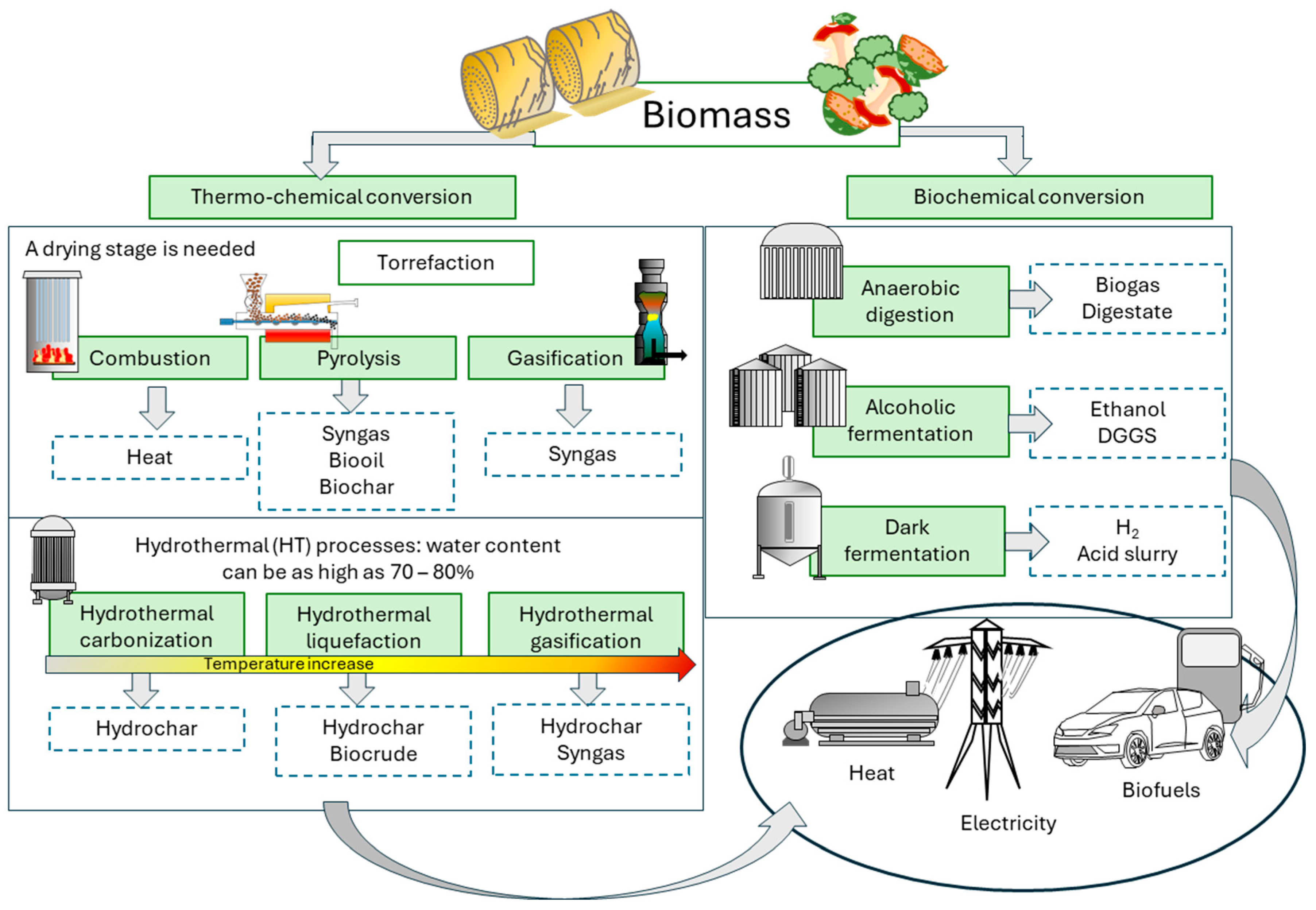
Figure 2.
Schematic representation of biomass gasification describing process stages.
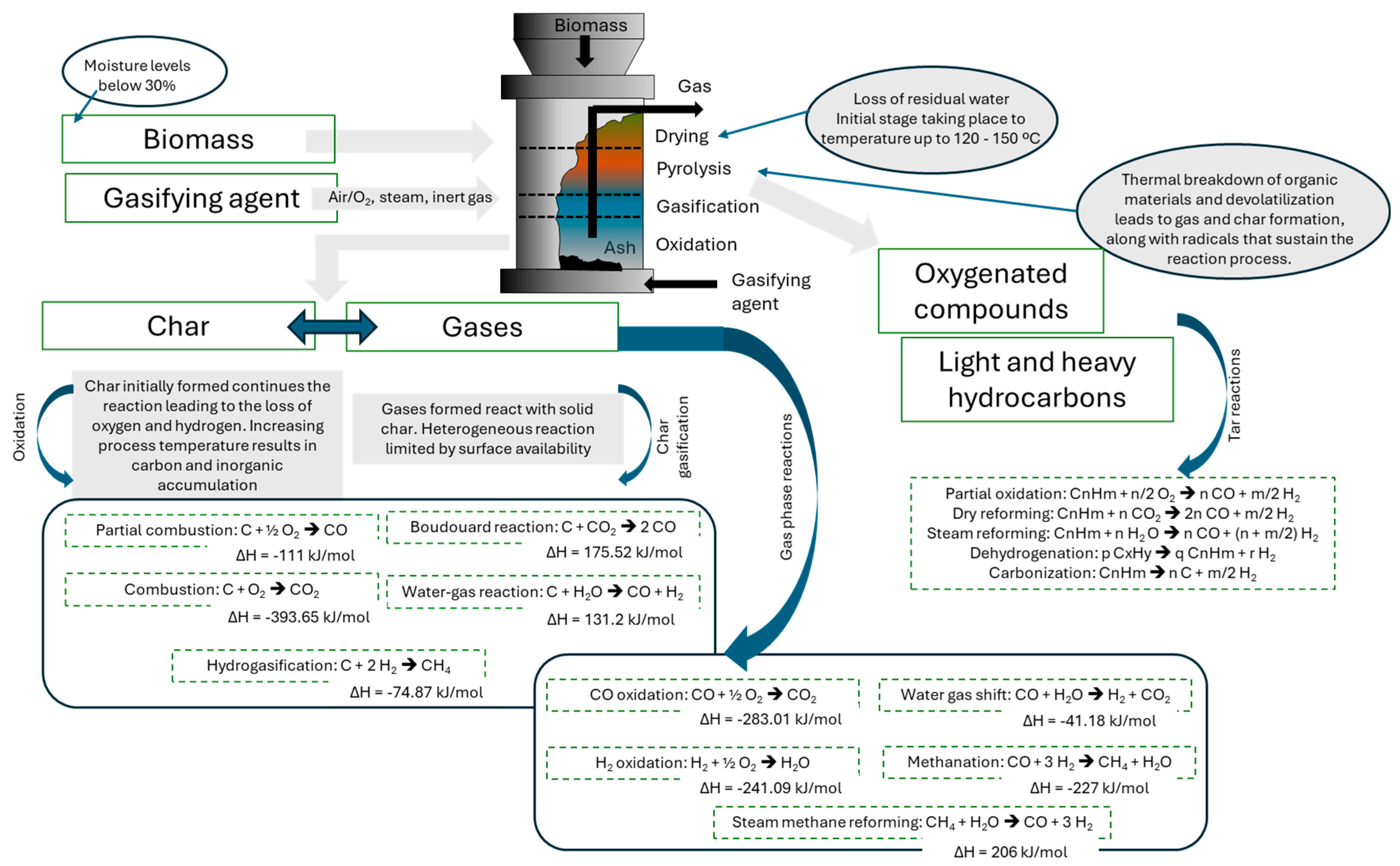
Table 1.
Correlations reported in the literature for estimating HHV from elemental and proximate analysis.
Table 1.
Correlations reported in the literature for estimating HHV from elemental and proximate analysis.
| HHV Correlations | References |
|---|---|
| HHV (MJ/kg) = 0.3491 C + 1.1783 H + 0.1005 S – 0.1034 O – 0.0151 N – 0.0211 Ash | [25] |
| HHV (kJ/kg) = 35430 – 183.5 VM 1 – 354.3 Ash | [27] |
| HHV (kJ/kg) = 1.87 C2 – 144 C – 2820 H + 63.8 C H + 129 N + 20147 HHV (kJ/kg) = 5.22 C2 – 319 C – 1647 H + 38.6 C H + 133 N + 21028 Average model for plant biomass: HHV (kJ/kg) = 3.55 C2 – 232 C – 2230 H + 51.2 C H + 131 N + 20600 |
[28] |
| HHV (MJ/kg) = 0.3536 FC 2 + 0.1559 VM – 0.0078 Ash | [29] |
| HHV (MJ/kg) = 19.914 – 0.2324 Ash HHV (MJ/kg) = -1.3675 + 0.3137 C + 0.7009 H + 0.0318 O |
[30] |
1 VM: volatile matter. 2 FC: Fixed carbon.
Table 2.
Biomass proximate and ultimate analysis. Data reported by different authors in scientific literature.
Table 2.
Biomass proximate and ultimate analysis. Data reported by different authors in scientific literature.
| Biomass | Moisture (%) | Proximate analysis (%) | LHV (MJ/kg) | HHV (MJ/kg) | Ultimate analysis (%) | Refences | ||||||
| VM | Ash | FC | C | H | N | O | S | |||||
| Salix Taxa | 7.48±1.26 | 74.84±0.94 | 2.8±0.62 | 20.31±0.68 | 17.76±0.44 | 19.35±0.33 | 49.97±0.78 | 5.76±0.32 | 0.05±0.01 | [57] | ||
| Black locust | 80.94 | 0.8 | 18.26 | 19.71 | 50.73 | 5.71 | 0.57 | 41.93 | 0.01 | [58] | ||
| SRC Willow Chips | 2.9 | 82.5 | 1.7 | 12.9 | 4.4 1 | 45.4 | 5.7 | 0.8 | 48 | 0.1 | [59] | |
| Eucalyptus Urosemente | 12.40 | 59.36 | 11.28 | 16.96 | 53.24 | 6.36 | 0.12 | 40.14 | 0.14 | [60] | ||
| Pine Trunk | 11.5 | 83.7 | 0.8 | 15.5 | 47.3 | 6.4 | 0.13 | 45.18 | 0.99 | [23] | ||
| Eucalyptus (Bark) | 3.4 | 89.6 | 4.2 | 6.2 | 13.8 | 15.2 | 43.10 | 6.46 | 0..25 | 50.18 | 0.01 | [23] |
| Eucalyptus (Trunk) | 2.1 | 88.9 | 1.0 | 10.1 | 16.0 | 17.6 | 47.20 | 7.03 | 0.11 | 45.65 | 0.01 | [23] |
| Eucalyptus (Branches) | 6.7 | 82.9 | 3.2 | 13.9 | 20.7 | 22.3 | 55.90 | 7.55 | 1.44 | 35.10 | 0.01 | [23] |
| Pine Cone | 73.98 | 2.61 | 23.41 | 43.99 | 3.65 | 1.67 | 50.18 | 0.51 | [61] | |||
| Poplar | 82.21 ±0.32 | 1.29 ±0.04 | 16.5±0.317 | 16.94±0.37 | 18.61±0.55 | 44.15 ±1.04 | 3.92± 0.23 | 0.642 ±03 | [62] | |||
| Hardwood, Chestnut | 74.2 | 0.7 | 25.1 | 18.44 | 49.74 | 5.28 | 0.19 | 44.45 | [63] | |||
| Wood Pellet | 77.82 | 1.12 | 18.635 | 46.80 | 5.61 | 0.26 | 47.33 | 0.06 | [64] | |||
| Western red cedar (WRC), | 93.35±0.51 | 0.45±0.05 | 6.20±0.32 | 19.68±0.20 | 49.35±0.61 | 6.02±0.05 | <0.5% | 44.64±0.66 | <0.5% | [65] | ||
| Forest wood/Gua Zumaumlifolia (Northern Colombia) | 7.99 | 80.92 | 1.8 | 17.28 | 16.82±0.91 | 49.1±0.7 | 5.8±0.2 | ND | 45.1±0.5 | [66] | ||
| Forest wood Cordia alliodora (Northern Colombia) | 7.41 | 81.75 | 1.53 | 16.72 | 18.16±3.8 | 49.2±0.2 | 5.8±0.1 | ND | 45.1±0.1 | [66] | ||
| Forest wood Eucalyptus Grandis (Central Colombia) | 10.28 | 81.66 | 1.17 | 17.17 | 17.80±0.9 | 51.0±0.2 | 6.1±0.1 | ND | 42.9±0.3 | [66] | ||
| Firewood Pinus Patula (Southern Colombia) | 8.55 | 84.11 | 0.4 | 15.49 | 17.64±1.43 | 47.2±0.6 | 6.2±0.1 | 0.3±0.01 | 46.3±0.4 | [66] | ||
| Sugarcane Bagasse | 81.86±1.01 | 2.04±0.01 | 15.98±0.32 | 16.79±0.04 | 42.09±0.21 | 5.42±0.08 | 0.18±0.04 | 51.50±0.33 | 0.12±0.01 | [67] | ||
| Tobacco | 1.9-5.4 | 61.9-68.0 | 15.9-18.1 | 9.9-16.0 | 35.8-42.5 | 5.4-6.2 | 2.6 | [68] | ||||
| Eucalyptus Leaves | 3.57 | 61.7 | 8.36 | 26.37 | 32.81 | 89.17 | 7.56 | 1.01 | 1.98 | 0.28 | [69] | |
| Sawdust | 7.0 | 70.0 | 2.3 | 20.7 | 18.2 | 46.23 | 6.14 | 2.2 | 45.42 | <0.01 | [70] | |
| Firewood Sawdust | 12.18 | 74.69 | 0.42 | 12.71 | 17.7 | 45.51 | 5.83 | 0.001 | 48.66 | [71] | ||
| dewatered poultry sludge | 67.50 | 25.09 | 7.41 | 51.13 | 7.67 | 4.24 | 11.53 | 0.34 | [72] | |||
| Chicken Manure | 70.35±0.23 | 21.12±0.47 | 8.53±0.38 | 15.55 | 37.46±1.19 | 5.22±0.12 | 8.28±0.23 | 26.00±2.31 | 1.92±0.09 | [73] | ||
| Swine Manure | 77.70±0.47 | 7.13±0.39 | 15.17±0.67 | 12.92±0.08 | 33.52 | 6.17 | 2.8 | 56.69 | 0.82 | [74] | ||
| Cattle Manure | 18 | 49 | 26 | 7 | 10.4 | 33.7 | 4.91 | 3.07 | 58.31 | <0.01 | [70] | |
| Goat Manure | 37.7±0.3 | 52.8±0.4 | 10.0 ± 0 | 43.9±0.3 | 1.5± 0.2 | 2.8± 0.1 | 51.3± 0.2 | 0.6 ± 0 | [75] | |||
| Raw Poultry Manure | 16.69± 0.04 | 36.34± 0.18 | 51.35± 0.38 | 11.99± 0.05 | 25.56± 1.39 | 3.27 ±0.79 | 2.19± 0.17 | 69.35 ±2.43 | 0.69± 0.0.17 | [76] | ||
| Chicken Manure (cage) | 70.9 | 67.5 | 15.6 | 16.9 | 12.744 | 39.67 | 4.72 | 5.49 | 34.12 | 0.4 | [77] | |
| Chicken Manure (Litter) | 18.1 | 69.9 | 12 | 18.1 | 16.55 | 42.86 | 5.57 | 5.50 | 33.39 | 0.68 | [77] | |
| Chicken Manure (Free-range) | 54.9 | 50.4 | 44.4 | 5.2 | 8.58 | 21.85 | 2.50 | 1.73 | 29.24 | 0.28 | [77] | |
| Yak Manure | 7.64 | 51.78 | 27.27 | 13.31 | 13.37 | 33.24 | 4.29 | 1.82 | 30.90 | 0.22 | [78] | |
| Pig Manure | 71.99±9.65 | 66.12±9.08 | 24.18±11.14 | 10.54±3.83 | 37.74±6.43 | 5.62±1.00 | 2.79±0.71 | 28.90±5.68 | 0.63±0.30 | [79] | ||
| Dairy Manure | 75.59±9.22 | 60.60±12.55 | 28.20±16.2 | 11.73±4.54 | 34.42±8.96 | 4.91±1.39 | 1.92±0.50 | 30.44±8.54 | 0.65±0.41 | [79] | ||
| Beef Manure | 75.66±7.82 | 64.58±8.14 | 22.64±11.88 | 13.73±4.05 | 37.64±6.16 | 5.26±1.12 | 2.16±0.64 | 31.90±6.81 | 0.59±0.28 | [79] | ||
| Layer Manure | 72.26±9.95 | 62.56±7.09 | 32.44±9.80 | 6.48±6.51 | 33.02±6.18 | 4.81±1.14 | 3.39±1.25 | 25.74±6.95 | 0.81±0.39 | [79] | ||
| Broiler Manure | 63.88±8.79 | 62.47±11.02 | 27.76±13.56 | 10.45±5.90 | 33.62±8.83 | 5.06±1.94 | 3.70±1.26 | 30.75±7.29 | 0.89±0.55 | [79] | ||
1 Value reported is much lower than estimated from elemental analysis-based equations.
Table 3.
List of some pilot scale experimental studies on biomass gasification.
| Types of gasifiers | Biomass | Experimental characteristics | Reference |
|---|---|---|---|
| Downdraft fixed bed | Wood chips | 50 kWth gasifier coupled with a pilot-scale gas cleaning unit (water gas shift and pressure swing adsorption unit). High H2 purity (>99.977% vol.). H2 yield of 55.1 – 58.9 g H2/kg biomass (dry basis). | [206] |
| Pomegranate wood chips, walnut shell | Assessed process performance under different electrical power loads. Carbon conversion efficiency increased with increasing electrical power load. Higher ERs were applied when increasing the electrical power load, resulting in lower syngas energy density. | [207,208] | |
| Updraft high temperature agent (HTAG) | Black pellets (based on 75% soft wood and 25% hard wood pretreated with steam explosion) and gray pellets (woody based roadside scrub cuts, no pre-treatment applied) | Use of preheated air/steam. The preheater oxidizer unit supplies additional heat to the gasifier. Syngas post-combustion unit. Feeding rate: 50 – 70 kg/h, ER: 0.2, steam:biomass ratio: 1.2 Highest temperature at the bed bottom: around 980 – 1150 °C. Temperature at the top: 600 – 900 °C. Syngas LHV (air gasification): 6. – 7.3 MJ/m3, Syngas LHV (steam gasification): 8.2 - 10 MJ/m3. CGE 1: 74 – 77%. Steam gasification produced less tar (11.4 g/m3). |
[209] |
| Bubbling fluidized bed | Pine chips | Air/Air-steam gasification. Steam to biomass ratio of 0.5 and 1.05, ER: 0.15 – 0.25. No information regarding biomass loading conditions. CGE increased to 95% when adding steam as gasifying agent. Syngas yield: 3 m3/kg biomass. Air gasification showed higher profitability than air/steam gasification. | [210] |
| Pine and eucalyptus residues | Gasifier 80 kWth. ER: 0.24 – 0.26. Syngas LHV: 3.9 – 3.6 MJ/m3. CH4 content ranged from 2.9 to 4.8 %vol. Syngas yield: 1.5 – 1.8 m3/kg biomass (dry syngas/dry biomass). The use of high-density biomass and char formation during gasification improved performance when steam was added (char-steam reforming reactions), resulting in higher syngas LHV and CGE. Optimum steam to biomass ratio: 0.5. |
[211] | |
| Dual bubbling fluidized bed (DBFB) | Hazelnut shells | 100 kWth using steam as a single gasifying agent to avoid N2 dilution. Syngas LHV: 10.5 MJ/m3 (H2 content: 34.8%). Syngas yield: 1.33 m3/kg biomass. High tar production: 12 g/m3. This value was reduced to 3 g/m3 after conditioning using a cyclone and water scrubber. Carbon conversion: 73%. |
[212] |
| Fluidized bed gasifier | Soy hull pellets | Feeding rate: 5.5 kg/min. Temperature (750 – 950 °C), ER (0.2 – 0.4). Biomass loading and fluidification velocity were assessed. Lowering ER improved CGE. Higher fluidification velocity improved performance, particularly at higher biomass loading. | [213] |
| Agricultural waste (mainly straw) | Air gasification with O2 enrichment. ER: 0.11 – 0.24, O2 content: 21 – 45%. Syngas LHV: 9.35 MJ/m3, CGE: 51.62% at ER: 0.16. Increasing oxygen content resulted in higher CO and H2 levels in syngas, thanks to the increase in gasification temperature, positively affecting performance. | [214] | |
| Dual fluidized bed gasifier (combining bubbling fluidized bed (BFB) and fast fluidized combustion reactor) | Wood pellets | 100 kW fuel input (20 kg/h). Temperature: 770 - 850 °C in gasifier and 920 °C in combustion reactor. Gasifying agent in BFB: steam (steam to fuel ratio: 0.74 – 1.10), gasifying agent in combustion reactor: air. Syngas yield: 0.99 – 1.13 m3/kg biomass. Tar decomposition takes place at temperatures above 800 °C. |
[215] |
| circulating fluidized bed | Wood pellets | 500 kW pilot gasifier: comparison of model and pilot scale results previously published. H2:CO ratio of 2 was obtained by coupling an electrolyzer to produce H2 and using the O2 released to achieve a desired oxidant proportion. | [216] |
| Rotary kiln plant | Digestate and almond shells | Feeding rate: 20 kg/h. ER: 0.22 – 0.39 Syngas LHV: 4 – 5 MJ/m3, maximum CGE of 55% at ER: 0.3. Steam was added to increase the H2/CO ratio in syngas, but the CGE dropped to 17%. A heat recovery unit can increase CGE to 72% for the mixture, but only to 35% when using steam as the gasification agent. |
[217] |
| Coal-water slurry gasification technology with opposed multi-burners (OMB) |
Torrefied biomass and coal (water containing slurry) | Pilot plant containing: Slurry unit, gasification, water scrubber, WGS 2 reactor (producing syngas with H2/CO ratio of 11:1), acid gas removal unit (CO2 and H2S removal), Fischer-Tropsch synthesis reactor. The coal-torrefied biomass blend required a much higher water content to produce a pumpable slurry, thus reducing energy efficiency. Feeding: 0.37 t/day of coal and 0.02 t/day torrefied biomass. 0.12 t/day of natural gas was required to keep the process running. 0.36 t/day of water was added to generate the slurry. Gasification temperature: 1400 °C H2 content was 22%, and CO content was 20% in syngas |
[218] |
1 CGE: Cold gas efficiency. 2 WGS: Water gas shift.
Table 4.
Biomass gasification plants.
| Type of gasifier | Company | Plant location | Raw materials | Characteristics | Reference |
|---|---|---|---|---|---|
| Fixed bed downdraft | Aries Clean Energy (Tennessee, USA) | Lebanon, Tennessee, US | Biosolids, commercial wood waste, and scrap tires | 420 kWe, Feedstock throughput capacity: 64 t/d | [221] |
| Fixed bed downdraft | URBAS Energy Technology (Völkermarkt, Austria) | 15 installed plants in Austria, Italy, Japan, Croatia and Bosnia and Herzegovina | Wood biomass | 150 – 450 kWe | [222] |
| Fixed bed updraft | Harboøre updraft biomass gasification plant constructed by Babcock & Wilcox Vølund (now part of Babcock & Wilcox) | Harboøre, Denmark | Wood chips | No longer in operation. Demonstration plant. 3.5 – 4 MWth | [223] |
| Fixed bed | Neoelectra (Sant Just Desvern, Barcelona) using Careco Technology: “gasógeno” no specification of flow direction conditions 1 | Villacañas, Toledo, Spain | Industrial wood residue and forest residue | 380 000 t/year, 8 Mwe. | [224] |
| Santa Perpétua de Mogoda (Barcelona) | Woodchips, Plastics, rubber, Residual Biomass and combustible solid residue | 20 MWth | [224] | ||
| Fluidized bed | Aries Clean En-ergy (Tennessee, USA) | Linden, New Jersey, USA | Biosolids | Feedstock throughput capacity: 430 t/d. Commercialize ashes as Bio-Fly-Ash™ to be used as a concrete additive. | [221] |
| Circulating fluidized bed gasification | Valmet (Spoo, Finland) | 4 gasifiers in Finland, and other 3 located in Indonesia, China and Brazil | Mainly bark and wood residues and waste (solid residue fuel) | Thermal capacity 50 – 150 MW | [225] |
| Air fluidized bed | Sumitomo SHI/FW (Spoo, Finland) | Varkaus, Finland | Biomass, forestry residues | 12 MWth | [226] |
1 Neoelectra currently under insolvency proceedings.
Table 5.
Companies offering small-scale gasification biomass plants.
| Company | Gasification technology | Plants | Characteristics | Reference |
|---|---|---|---|---|
| GEMCO Energy, (Anyang, Henan, China) | Fixed bed (up-draft and down-draft) and circulating fluidized bed (CFB) | No installed gasification plants reported | The company offers modular biomass power stations (small scale), with an installed capacity ranging between 200 and 500 kW. The CFB is for large-scale and can operate on wood powder, sawdust, rice husks, bagasse, and crushed straw with a biomass flow range of 1500 – 5000 kg/h | [227] |
| SynTech Bioenergy (Englewood, Colorado, USA) | BioMax® system: Modular units. Using downdraft gasifiers operating at above 800 °C | Installed plants in California, Texas and United Kingdom (West Midlands) | Feedstock: agricultural waste. Offers the production of certified biochar and low level of tars in syngas using a dry filter for gas clean-up without releasing wastewater. 165 kW – 2 MW | [228] |
| Ankur Scientific Energy Technologies (Sama Vadodara, Gujarat, India) | downdraft gasifiers generating combustible gases for thermal applications (boilers, furnaces or CHP grid/off grid) | Installed plants in more than 35 countries | Feedstock: MSW, poultry litter, empty fruit bunch (EFB), fecal/sewage sludge, agricultural residues, paper. A wide range of plants with a treatment capacity of 5 – 100 t/day in the case of MSW and 16 – 2000 kg/h for biomass material (EFB and agricultural residues) | [229] |
| CMN Industry Inc. (Sacramento, California, USA) | No description given of gasification technology used. Process temperature 700 – 1200 °C | Installed plants located in USA, Germany, India and Brazil | Feedstock: Crop straw and forestry waste. No description of treatment capacity | [230] |
| Powermax Renewable Energy (Wuxi, Jiangsu, China) | Fixed bed (up-draft and downdraft), CFB and twin fire-fixed bed gasifier. Modular plants (50 kW – 2 MW) and large-scale units | Myanmar gasification plant. Collaboration in gasification plant project in Canada | Feedstock: rice husk Power: 12 MW |
[231] |
| Compact Syngas Solutions (Sandycroft, Flintshire, UK) | MicroHub 500 and MicroHub 1000: modular waste management technology | No installation plants reported. Participation in project for tea biomass gasification in Kericho district (Kenya) | Feedstock: Biomass and solid recovered fuel. Treatment capacity of 3570 t/year. Power: 500 and 1000 kWe | [232] |
| SPANNER RE² GMBH (Neufahrn, Niederbayern, Germany) | Gasification plants for heat and electricity production | Installed plants in Slovenia, Germany, Austria, Italy (South Tyrol region) | Feedstock: wood biomass 35 – 700 kWe | [233] |
| Meva Energy (Hisings Backa, Sweden) | Large- and small-scale gasification plants. Entrained gasification technology. | Demonstration plant. Agreement with Elcowire Group AB group for providing 9 MW of syngas. | Feedstock: Organic residues from agriculture, industry, and forestry | [234,235] |
| Syncraft® (Schwaz, Austria) | floating fixed-bed gasification technology. Small gasification plants with CHP engines | Installed plants in Austria (Tyrol region, Vorarlberg), Croatia and Switzerland | Feedstock: wood biomass 270, 400 and 550kWe | [236] |
| The Stadtwerke Rosenheim (Rosenheim Municipal Utilities) (Rosenheim, Germany) | Double stage fluidized bed reactor | Demonstration plant | Feedstock: wood gasification, 60 and 250 kWe | [237] |
| Kombi Power System (Regawatt GbmH) (Abensberg, Germany) | Updraft gasifier. The system can be implemented for heat (boiler) or electricity production (CHP). It can also be used to produce syngas or bio-oil | Installed plants in Netherlands, Japan, Switzerland and Germany | Feedstock: waste wood, forest chips, landscape wood, screenings from composting plants. 250 – 2000 kWe | [238] |
| Lipro Energy (Wardenburg, Germany) | Multi-stage gasification | Several installed plants in Germany | Feedstock: wood biomass and waste biomass. 50 – 85 kWe | [239] |
| Holzenergie Wegscheid GmbH (Sonnen, Germany). Merger with WegscheidEntrenco GmbH since 2023 | Down-draft gasifier with CHP engines | Several installed plants in Germany | Feedstock: wood biomass. 70 kW – 2 MWe | [240] |
| Burkhardt GmbH (Mühlhausen, Germany) | Multi-stage gasification system: Updraught co-current flow gasification forming a stationary fluidized bed | Several plants in Austria, Germany and Japan | Feedstock: wood biomass (wood pellets and wood chips). 190 – 390 kWe | [241] |
| CMD (Costruzioni Motori Diesel SPA) (Caserta, Italia) | ECO20x gasifier: Pyrogasification process | Demonstration plant in Salerno (Campania), Italy | Feedstock: Wood biomass (wood chips). 20 kWe (40kWth) | [242] |
| ESPE Energy expertise (Padua, Italy) | CHiP50 gasifier: Pyrogasification process | 3 plants installed (Italy, Japan) | Feedstock: Wood biomass (wood chips) | [243] |
| RESET (Rieti, Italy) | SyngaSmart gasifier. configurations available: Electricity production using CHP, heat production using thermal power units and syngas production (biomass to biofuel generator) | 1 medium size (250 kg/h input) gas producing plant in Rome (Italy) for the treatment of briquetted organic fraction of MSW) | Feedstock: Agroforestry residues, organic byproducts, and waste. 19 – 200 kWe (28 – 292 kWth). Biomass consumption rate: 22.8 – 240 kg/h | [244] |
| VOLTER (Tupos, Finland) | Walter CHP Modular gasification: Gasifier + CHP (gas cleaning and energy recovery) | No reports available of installed gasification plants | Feedstock: Wood chips. 50 kWe (130 kWth) | [245] |
| Xylergy SA (Lovain-La-Nueve, Belgium) | NOTAR®: downdraft gasifier with CHP unit | 1 demonstration plant in Belgium and 2 Plants installed in Belgium and France | Feedstock: Wood chips. 200 - 750 kWe | [246] |
Table 6.
Summary of gasification experiments reported in the scientific literature using low-quality biomass as feedstock.
Table 6.
Summary of gasification experiments reported in the scientific literature using low-quality biomass as feedstock.
| Raw material | Gasification characteristics | Main results | Reference |
|---|---|---|---|
| Sewage sludge. Ash content: 24.3 – 30.6% | Fluidized bed reactor. Temperature: 850 °C. Bench scale. ER: 0.1 – 0.2. Feed rate: 68 and 138 g/h | Syngas LHV: 5.8 MJ/m3 (ER: 0.2) and 12.1 MJ/m3 (ER: 0.1). CGE: 50 – 57%. The study focused on tar and bottom ash quality. Operating conditions had a greater influence on the types of tar components obtained than the characteristics of the raw sludge had. Lower tar production was obtained at an ER of 0.2, but operating at a lower ER resulted in ash with a higher surface area. | [260] |
| Sewage sludge. Ash content: 24.3 – 30.6% | Entrained flow gasifier (90 kW). Evaluated the effect of gasifying agents (air and O2) | Syngas LHV: 8.4 MJ/m3 (using O2). Syngas volume was reduced by 60%. CGE: 45 – 51%. The presence of KCl increased performance by favoring carbon conversion. | [261] |
| Sewage sludge. Ash content: 25.6% | Fluidized bed gasifier. ER: 0.12 – 0.27 | Syngas LHV: 3.1 – 4.8 MJ/m3. Reactor profile temperature range: 690 – 1000 °C |
[262] |
| Sewage sludge. Ash content: 49 – 51% | Bubbling fluidized bed gasifier. Input rate: 2 kg/h. ER: 0.2. Steam to carbon ratio: 1.0 – 1.8. CaO used for CO2 absorption during gasification | The combination of steam injection and CaO (used as bed material) enabled tripling syngas H2 content. Air addition improved carbon conversion but reduced H2 yield. | [263] |
| Sewage sludge. Ash content: 47.6% | Bubbling fluidized bed gasifier (20 kW fuel input). Steam-O2 gasification. Temperature: 650 – 900 °C. ER: 0.2 – 0.28. Steam to carbon ratio: 0.6 – 2.0 | The addition of limestone helps reduce H2S and COS species. Fluidization needs to be carefully controlled to avoid undesired hot spots that could lead to particle agglomeration. | [264] |
| Sewage sludge and torrefied sludge. Ash content: 39.3 – 43 | Pilot-scale entrained flow gasifier (90 kw fuel input). Air and O2 gasification. Temperature: 1000 – 1050 °C | Adding KCl as a catalyst increased carbon conversion from 90% to 95%. The CGE ranged from 45 to 51% across all operating conditions tested. Syngas LHV > 8 MJ/m3 (O2-based gasification). The use of air as a gasifying agent produced syngas with LHV < 4 MJ/m3. | [265] |
| Digestate and almond shells. Digestate ash content: 32%, almond shell ash content: 1.65% | Rotary kiln pilot scale gasifier. Gasification of digestate pellets as single raw material and mixture with almond shells. Digestate provided 60% of the mix. Feeding rate: 14 – 27.5 kg/h. ER: 0.26 – 0.39 |
The CGE of digestate gasification was 47% and increased to 55% when almond shells were added to the mixture. Steam injection enabled the production of syngas with a higher H2/CO ratio, but CGE dropped to 17%. A heat recovery unit can increase CGE to 72% for the mixture, but only to 35% when using steam as a gasification agent. | [217] |
| Digestate from a plant treating manure and straw (fresh weight ratio of 1:0.3). Ash content: 23.03% | Downdraft fixed bed gasifier. Temperature: 600 – 800 °C. ER: 0.25 – 0.30. | Syngas LHV: 4.78 MJ/m3, CGE: 67% at ER: 0.28. CGE efficiency increased from 30 to 67% with increasing temperature from 600 to 800 °C | [266] |
| Digestate and lignite (mass ratio 1:1). Digestate ash content: 41.5% | Downdraft fixed bed gasifier. Laboratory scale with a test capacity of 20 g of feedstock. Temperature: 650 – 950 °C. CO2 atmosphere. | Syngas LHV: 4.0 – 6.5 MJ/m3. Increasing temperature led to higher LHV. Increasing temperature reduced tar content in syngas. | [267] |
| Digestate and sewage sludge. Digestate ash content: 13.5%, sewage sludge ash content: 47.1% | Pilot-scale fluidized bed gasifier (thermal output of 100 kWth). Temperature: 750 °C. Steam addition. | Syngas LHV (from digestate): 4.06 MJ/m3. Syngas LHV (from sewage sludge): 4.11 MJ/m3. Adding steam helps reduce tar concentration in syngas. | [268] |
| Diary manure. Ash content: 48.8% | Bench and pilot scale reactor. Application of RSM 1 for process optimization. Factors: Temperature, ER and O2 concentration |
Syngas LHV: 8 MJ/m3, maximum value obtained at 800 °C, ER: 0.25 and O2 content: 40%. CGE increased with oxygen enrichment. |
[269] |
| Chicken manure (CM) – oily sludge (50% mixture) CM Ash content: 27.7% |
Fixed-bed (up-draft) gasifier. T: 600 – 800 °C. Batch process (laboratory scale) |
Syngas LHV: 2487 - 2838 kcal/m3 (10.4 – 11.9 MJ/m3). Methane content was increased by using oily sludge as a raw material, thereby increasing syngas energy density. | [270] |
| Chicken manure (CM) – woody biomass (30% CM in mixture) CM Ash content: 25.3% |
Fixed-bed (downdraft 10 kW) gasifier. Pilot plant. Temperature: 850 – 900 °C Feedstock rate: 10 kg/h. | Syngas LHV: 5.23 MJ/m3. CGE improvement (6.7%). The mixture containing 30 wt% chicken manure produced syngas with quality comparable to wood gasification. The char obtained was tested as low-cost activated carbon. | [271] |
1 RSM: response surface methodology.
Disclaimer/Publisher’s Note: The statements, opinions and data contained in all publications are solely those of the individual author(s) and contributor(s) and not of MDPI and/or the editor(s). MDPI and/or the editor(s) disclaim responsibility for any injury to people or property resulting from any ideas, methods, instructions or products referred to in the content. |
© 2026 by the authors. Licensee MDPI, Basel, Switzerland. This article is an open access article distributed under the terms and conditions of the Creative Commons Attribution (CC BY) license (http://creativecommons.org/licenses/by/4.0/).
Copyright: This open access article is published under a Creative Commons CC BY 4.0 license, which permit the free download, distribution, and reuse, provided that the author and preprint are cited in any reuse.


