

Submitted:
22 March 2026
Posted:
24 March 2026
You are already at the latest version
Abstract
This study aims to comparatively analyze the satisfaction levels of rural disaster victims in post-disaster resettlement areas and to identify sustainability-oriented factors influenc-ing these levels. The research was conducted in rural housing areas developed after the 24 January 2020 Sivrice (Elazığ) earthquake using an exploratory sequential mixed-methods approach. In the qualitative phase, semi-structured interviews were conducted with 32 disaster-affected individuals from 9 villages, and the data were analyzed through content analysis to generate an initial pool of 32 items. In the quantitative phase, data were col-lected from two independent samples totaling 648 participants. Exploratory factor analy-sis (EFA) revealed a six-factor structure with 21 items, including sustainable livelihood activities, economic structure, socio-cultural integration, climate resilience, cultural memory, and housing quality. Confirmatory factor analysis (CFA) demonstrated excellent model fit (χ²/df = 1.42; CFI = .99; RMSEA = .037). The overall reliability of the scale was high (Cronbach’s α = .85). The findings indicate that housing design, sustainable produc-tion opportunities, social cohesion, and place attachment play a critical role in shaping satisfaction and long-term community resilience. This study provides a robust and multi-dimensional measurement framework for evaluating post-disaster resettlement processes within the context of disaster risk reduction and sustainable rural development.
Keywords:
natural disasters
; rural housing
; satisfaction scale
; scale development
; Elazığ earthquake
; sustainability
1. Introduction
A disaster is defined as natural, technological or human-induced calamitous event that produces physical, economic, and social losses for society as a whole or specific segments, disrupts normal life and human activities, and exceeds the coping capacity of the affected community [1]. Disasters are multifaceted processes that can create more than just the physical destruction and damage to settlement areas; they also reshape land use and settlement layouts, alter social structures and relationships, weaken individuals’ sense of belonging to a place, and cause a fragmentation of spatial continuity rooted in past lived experiences[2,3,4].
The post-disaster recovery and reconstruction process for housing in rural areas has primarily followed a top-down, infrastructure-oriented and technology-based approach. As such, it is not merely focused on the provision of shelter but also directly impacts the spatial structure and layout of settlements, as well as the long-term sustainability of the rural economic functions [5,6]. The “Build Back Better” approach posits that when central authorities make decisions regarding rebuilding of rural communities without regard to either the specificities of the rural environment or the specific needs of the community, this will ultimately result in new areas of risk and structures of vulnerability, leading disaster victims to encounter new risks and challenges [7,8]. In light of this, while producing new housing stock in rural communities is an essential component of the post-disaster recovery process, the overall success of that effort depends upon addressing rural economic sustainability, social integration in communal spaces, and the adaptation processes of residents through a multidimensional and holistic perspective[3,9]. Additionally, new residential areas established within the post-disaster recovery process may weaken individual’s place attachment and complicate long-term psychosocial adaptation processes [10,11]. As such, the disconnect between centralized planning practices and the local realities of rural settlements can transform the post-disaster recovery process into a secondary disaster rather than a path to genuine recovery[6,12,13,14].
One major issue with post-disaster relocation programs in rural settings is the conceptual misalignment regarding the function of housing. Housing in rural villages functions as multi-functional spaces that serve both as living spaces as well as spaces used to produce goods and products (animal husbandry, food production, and/or other types of products and services). As such, the imposition of urban housing typologies onto rural communities can result in a mismatch with rural-based production activities thereby undermining rural based economic functions[15,16].
To be successful in the rural area, the resettlement process of post-disasters has to treat the house not only as shelter, but as a production unit at the center of the household’s agriculture- and livestock-based livelihoods including its associated outbuildings (e.g. barns, haylofts, etc.)[17,18].The Impoverishment Risks and Reconstruction (IRR) model, developed by Cernea [19], indicates that post-disaster forced relocation due to disasters expose households to structural risks of landlessness, joblessness, and social disarticulation[19]. The literature further supports that prototypical post-disaster housing projects often disrupt the rural population’s work activities, especially animal husbandry, leading to physical interventions that are incompatible with the rural fabric or causing residents to abandon the new settlements [9,13,15,20,21]. The planned resettlement with an urban appearance, discussed by Badri, Asgary, Eftekhari and Levy [20] in the case of Iran, lacks the ancillary structures required for livestock activities, thus detaching villagers from the activity of raising animals and placing households at risk of losing their basic survival resources [22]. In rural post-disaster resettlement, the most important issue with the design of residential zones located far from agricultural lands, and the exclusion of production units such as barns and warehouses, is that it disrupts the functional unity of the settlement. This situation creates difficulties for accessing residential and production areas, distances villagers from production processes, and creates an inefficient use of public resources, as well as a low utilization rate of the built housing units[13,18]. This process weakens and transforms the rural settlement structure and the place-based socio-cultural identity of the village and changes the function of housing from being a residential unit to being a mere residential unit without its production and livelihood functions [16].It also entails a structural transformation of the rural economy. By restricting disaster victims’ access to natural resources and production means, it forces them away from their producer identity and towards consumption-based economies; therefore, worsening problems of poverty and reducing their livelihood security[20,22]. International literature states that disrupted access to agricultural land and inability to sustain production activities lead to the functional decline of rural settlements. This, in turn, accelerates depopulation and undermines rural sustainability, ultimately triggering forced displacement and further population loss in rural areas[9,23,24,25].
Post-disaster housing construction disrupts rural economic production, causes difficulty adapting to new residence, and weakens the social relations and place attachment among disaster victims[2,10]. A successful post-disaster resettlement is based on an individual’s place attachment to his/her new place of residence [2,26]. This is a process of identity construction through the combination of physical surrounding with social and symbolic functions [2]. Post-disaster forced displacement spatially fragments the social interaction networks that communities have historically established, leading to profound disruptions in the social fabric [10,27]. Analysis of earthquake events including Düzce, Bingöl and Marmara indicate that groups who were displaced have less adaptive capacity than groups who benefited from in-situ recovery [2,8,28]. The dissolution of social networks delays communal recovery processes and results in a sense of placelessness, weakening local identity [29,30]. Indeed, sustainable development can be achieved by preserving both the familiarities of a settlement in terms of physical space as well as its social fabric[23,31]. The preservation of an individual’s place attachment and neighborhood ties enables new settlements to transcend being mere physical structures and become socially viable environments.
While traditional rural settlements incorporate natural solutions aligned with the physical environment Kaya, et al. [32], in contrast many contemporary post disaster housing projects often ignore region-specific data, such as snow loads and wind directions. This situation results in inadequate climatic adaptation of housing and weakens their physical resilience in regions characterized by a continental climate[8,13]. When disaster victims seek to address the discrepancies between the structural integrity of their dwelling and their own needs through modifying the structure themselves, they may create additional aesthetic and/or safety issues with the housing unit itself (e.g., enclose balconies or add unauthorized additions to the structure) [12,33,34]. The misalignment between the layout of the interior of a new shelter and local living practices, and traditional production spaces, such as tandoori (traditional oven) spaces, also disrupts residents’ ability to take ownership of the space, resulting a deviation from the intended function of the housing[21,35,36].
User satisfaction is recognized as a decisive criterion in evaluating post-disaster resettlement processes. The level of satisfaction should be addressed not only through the physical characteristics of the housing but also through multidimensional variables that includes economic opportunities, social relations, local cultural continuity, and psychological well-being[8,22]. Post-disaster resettlement process is not merely a technical housing intervention; it involve the spatial reorganization of the social structure[37]. It is observed that when radical changes in the physical structure of settlements alter local identity and the settlement fabric cannot be preserved, the local cultural heritage weakens[38]. The literature bases the success of rural disaster housing on the integrated management of core components such as production activities, social structure, and physical form. However, existing studies largely focus either on structural techniques or social impacts, while approaches that address these variables through a comprehensive model remain insufficient[3,5]. Accordingly, the compatibility of housing projects constructed after the January 24, 2020, Sivrice-Elazığ earthquake with the rural environment constitutes a fundamental research topic for the future of these settlements
Based on multidimensional transformations triggered by post-disaster resettlement processes in rural areas, this study has created a new satisfaction scale to measure user’s expectations and the effect of residential construction as a result of the January 24, 2020, Sivrice-Elazığ earthquake on rural sustainability. The objective of this study is to provide a comprehensive analysis framework of spatial belonging reproduction, rural economic function continuation and settlement sustainability to help align the policy-making process for resettlement with the fabric of the rural area. Additionally, this study will determine if there are statistical differences in the level of satisfaction among disaster survivors regarding their new living environment using variables including gender, household size, off-farm income status, length of time residing in the village and the physical characteristics of the rural region. This study aims to address the previously identified methodology gap and create a plan of action for the development of planning for future reconstruction efforts following the occurrence of disasters.
2. Materials and Methods
2.1. Study Area
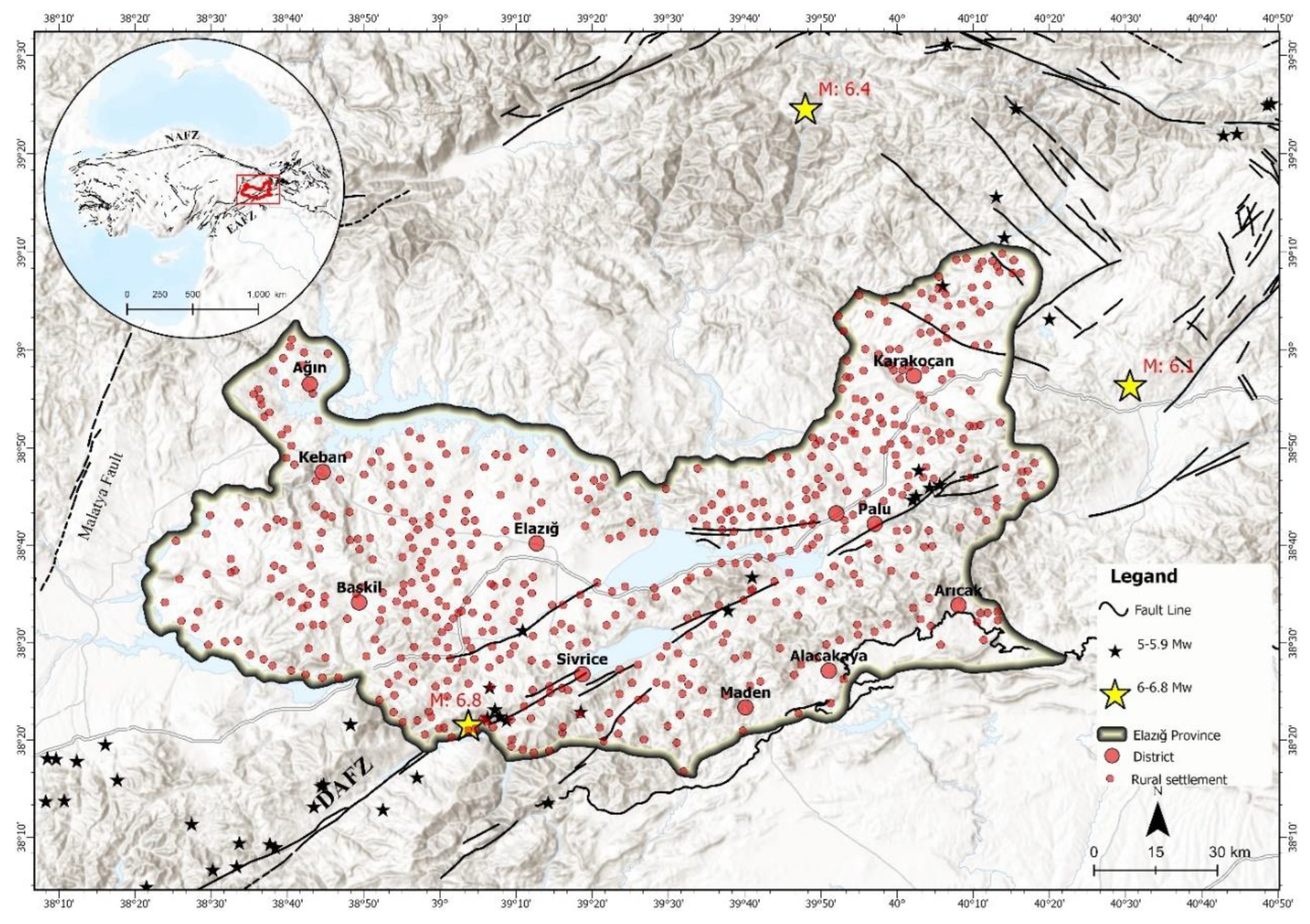
This study focuses on the province of Elazığ, located in eastern Türkiye on the East Anatolian Fault Zone. The provincial boundaries of Elazığ cover approximately 9,151 km². Geographically, the province is situated between 40°21′–38°30′ east longitudes and 38°17′–39°11′ north latitudes. Elazığ is located within the Taurus Orogenic belt and has an average elevation of 1,350 m. While elevations exceed 2,000 m in the southern, western, and eastern parts of the province, plains and plateaus are located in the central areas ([39]. Within the provincial boundaries, there are 11 districts and 655 rural settlements. During the Mw6.8 earthquake that occurred on 24 January 2020, 54,431 housing units within the provincial boundaries were directly affected. Of these buildings, 42.6% were undamaged, 30.9% slightly damaged, 23.1% heavily damaged, and 1.8% were classified as buildings requiring immediate demolition[1].
Figure 1.
Location of the Study Area and Earthquakes Affecting Rural Settlements.
2.2. Research Design
The present study utilized a quantitative methodology and a comparative research design. Comparative research, as part of the quantitative research tradition, is a type of research design used to identify both similarities and differences among two or more groups with respect to specific variables. Within this type of research study, the researcher will examine the current situation as it exists without intervening experimentally into the groups that are being studied and will use descriptive and inferential statistical methods to determine if there exist differences between the groups[40].
Comparative study evaluations in the literature are typically classified as part of causal-comparative or non-relational comparative studies. A key advantage of this approach is that researchers can examine differences between groups that have been created by natural processes[41]. Because the independent variables in a study cannot be controlled by the researcher, the researcher will compare two or more groups based upon their existing characteristic(s), therefore the researchers are attempting to determine if there exists statistical significance between groups as opposed to establish a direct cause and effect relationship[42].
Comparative research designs are widely employed across various disciplines, including education, social sciences, and geography, to examine the characteristics of diverse groups based on spatial, demographic, and structural variables. Comparative research has been a viable methodology for establishing an objective and systematic basis for assessing the current differences among groups based on scientifically established criteria for comparison.
2.3. Population and Sampling
The study population consists of the rural inhabitants of Elazığ Province whose dwellings were damaged as a result of January 24, 2020, Sivrice earthquake. In total 486 villages and 7,218 dwellings throughout the province were affected by this earthquake; however, the researchers chose to focus on 220 villages where at least 10 dwellings were damaged in order to provide a representative and generalizable sample that would include 6,048 damaged dwellings. From each damaged household, the researchers selected one person for inclusion in the research sample.
Figure 2.
Determination of the Population and Sample: (a) Settlements Based on Morphological Characteristics, (b) Settlements by Elevation Levels, (c) Settlements with Damaged Houses, (d) Proposed Sample Settlements.
Figure 2.
Determination of the Population and Sample: (a) Settlements Based on Morphological Characteristics, (b) Settlements by Elevation Levels, (c) Settlements with Damaged Houses, (d) Proposed Sample Settlements.
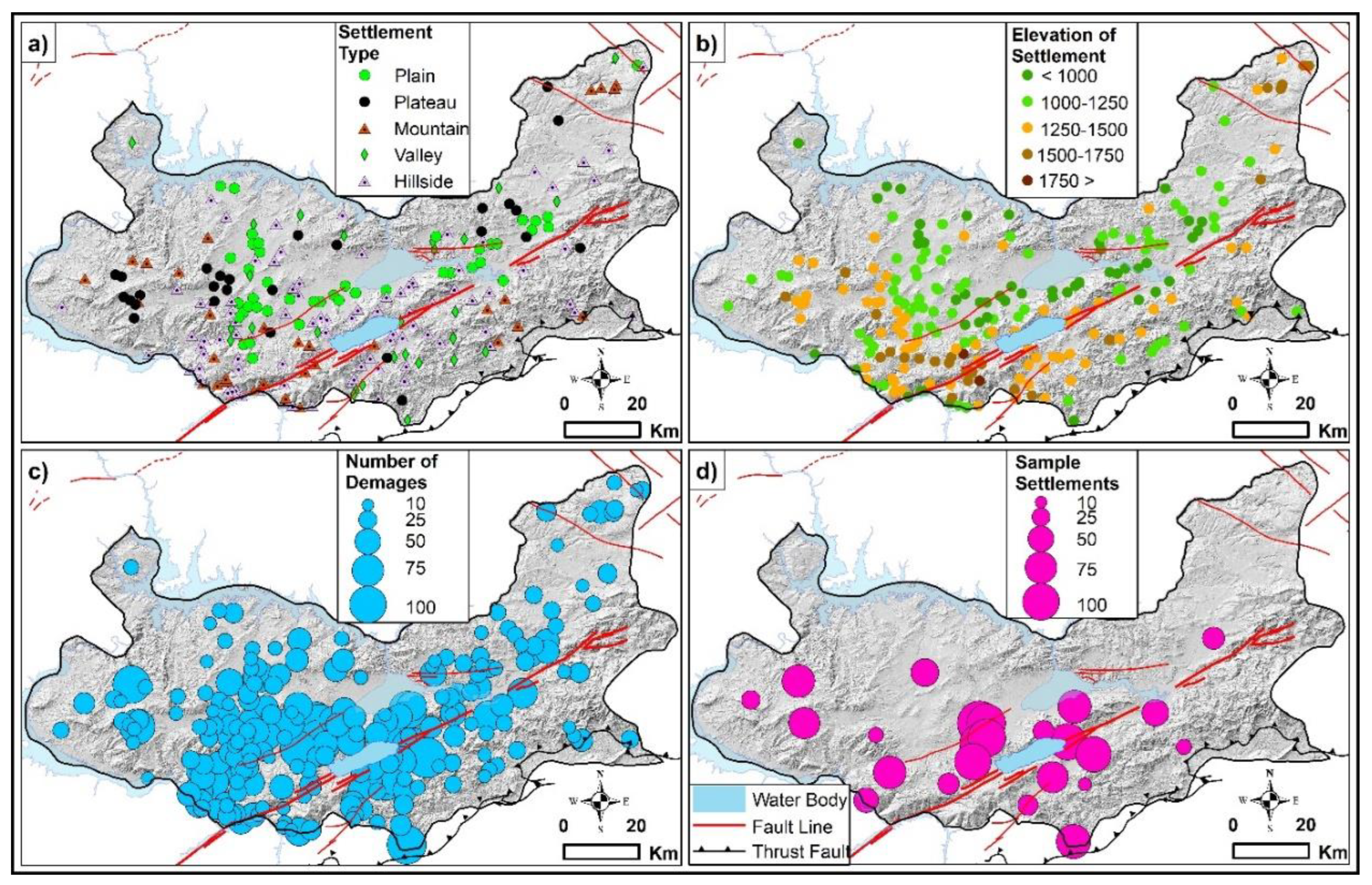
When reviewing the information contained within Table 1, it is noted that the majority of the rural settlements in the study region are located either on slopes (42%), or on a plain (20%). This same trend can also be observed when examining the total number of houses that were damaged as part of the damage assessment process. As an example, of the 6,048 houses that were damaged, 2,548 houses (or 42% of the total) are located on slopes and 1,397 houses (or 23% of the total) are located on plains. The third largest number of houses damaged were those located in valleys (13%), mountains (12%), and plateaus (10%) respectively.
Purposeful sampling was selected as the appropriate sampling strategy to be used in this study. As a non-probability sampling method, purposeful sampling involves the selection of participants who are relevant to the research questions. The objective of using purposeful sampling is to obtain detailed and precise data from individuals who have direct experience with the problem that the research is addressing rather than attempting to collect representative data that can be generalized to a larger population[41]. The criterion sampling method was adopted under the umbrella of purposeful sampling. for the study were defined as follows: individuals whose primary residences were damaged during the earthquake and who belong to a household that has been formally relocated to permanent post-disaster housing [43]. As such, the research sample consists of households which were impacted by the earthquake through property damage and were displaced into post disaster relocation housing. By limiting the sample to those with commonalities of experiences and therefore allowing for examination of variables in a similar and comparable way limits the ability to generalize the results to the total population. Therefore, the research results can only be generalized to the sub-population sampled based on the researchers predetermined criteria [42]. Demographic information of participants included in the sample will be presented below:
The demographic characteristics of the 638 participants and their village characteristics as identified through various lenses are shown in Table 2. In terms of gender, 52.19% of the participants were female while 47.81% were male. Based upon family structure, 90.28% of the participants represented a nuclear family, while 9.72% represented a patriarchal family structure. When examining participants based upon their primary income source, 83.07% of the participants reported receiving an income from outside of their village; 16.93% of the participants reported no income received from outside of their village. Based upon how long participants reside within their village, 59.40% of the participants indicated they live in their village for a season while 40.60% of the participants reside in their village year-round. Distribution of the participants according to the morphologic characteristics of their villages indicates that 47.65% of the participants live in plains, 28.37% of the participants live on slopes, 15.20% of the participants live in mountains, 4.55% of the participants live in valleys, and 4.23% of the participants live on plateaus. The findings provide evidence that the participant sample is predominantly composed of nuclear family members who earn income from outside of the village and are located in multiple morphologic environments. The predominance of a seasonal lifestyle provides significant insights into the geographical and economic conditions of the study area.
2.4. Data Collection Instruments
To achieve the objectives of the study, a personal information form and the Post-Disaster Rural Resettlement Satisfaction Scale were used as data collection instruments. Since no scale measuring satisfaction with new living environments following disasters was found in the literature, the relevant scale was developed within the scope of this study. The stages of the scale development process are presented below:
This phase of the research, which aims to develop a measurement instrument regarding the satisfaction levels of disaster victims relocated after natural disasters, was conducted using an exploratory sequential mixed-methods design. The exploratory design is an approach used to understand a phenomenon in depth and to reveal the core themes associated with it. This design is particularly useful in cases where a measurement tool needs to be developed and tested [44]. In this design, data are first collected and analyzed using qualitative methods. Based on the findings obtained from this analysis, quantitative data are subsequently collected and analyzed[42].
2.4.1. Qualitative Phase
A phenomenological design is used for the first stage of developing the scale using one of the qualitative research approaches that help develop an in-depth understanding of a phenomenon shared by many people [42]. The views and experiences of disaster victims, residing in post-disaster housing built by the Housing Development Administration (TOKİ) in rural settlements of Elazığ following the 2020 Sivrice Earthquake, regarding the compatibility of new dwellings with rural livelihood activities such as agriculture and livestock, the impact of site selection and physical structure of the houses on daily life, opportunities to sustain production activities, the presence or absence of agricultural outbuildings (such as barns and warehouses), as well as neighborhood relations and the spatial settlement layout were thoroughly examined in this study. Based on the qualitative findings obtained during this phase, a pool of items was identified, and a draft form was developed. Expert review was then obtained, and the draft was revised in accordance with the recommendations received until it reached its preliminary final version. In the second stage of the study, the scale items in the draft form were tested for validity and reliability and the scale was finalized before performing the statistical analysis.
2.4.1.1. Study Group
A total of 32 people participated in interviews at random out of nine village locations selected from a list of 220 rural villages located in the Elazig Province. The participants were selected using a purposeful sampling method which is a deliberate selection of participants who fit the research criteria. Data saturation occurred during the collection of data; it is observed when the content of the interviews began to be repetitive and there were no additional themes being identified. As such, the researcher decided to cease interviewing as the qualitative depth had reached an adequate level to achieve the purposes of this study [45,46]. The demographics of the qualitative study group are shown in Table 3.
Of the 32 participants who were interviewed, as shown in Table 3, it can be seen that there are 23 males and 9 females. In terms of the number of participants per village, it can be noted that the largest number of participants came from Kuyulu Village, which had six individuals; Uslu, Bekçitepe, and Değirmenönü Villages each had four participants.
2.4.1.2. Qualitative Data Collection Process and Data Analysis
In the qualitative part of this study a semi-structured survey form for interviews was developed to get a detailed insight into how the disaster affected the views of disaster victims on rural disaster housing. This survey form will provide an overview of the post-disaster living situation of those earthquake victims who reside in housing that has been built by TOKİ in rural settlements in Elazığ after the earthquake that occurred on January 24, 2020. The questionnaire had a structure that would enable the participants to express not only their conditions before the disaster but also all the physical, economic and social changes they have experienced since the disaster. The interview questions that were contained in the survey form are as follows:
- 1.
-
Structure of the New Dwelling
- 1.1.
- Are you satisfied with the overall structure and features of the new dwelling?
- 1.2.
- Do the size of the house and the amount of space (number of rooms) meet your needs?
- 1.3.
- What are your thoughts on the durability and safety of the dwelling?
- 1.4.
- Is there anything you had in your previous settlement that is currently missing?
- 1.5.
- What do you find to be the most dramatic difference from your former and new settlement?
- 1.6.
- Are all of your requirements met by your new dwelling?
- 2.
-
Agricultural and Livestock Activities
- 2.1.
- Are there opportunities for agriculture and livestock activities in your new settlement area?
- 2.2.
- Do you have the necessary outbuildings or facilities for these activities?
- 2.3.
- How have your economic activities been affected compared to your previous settlement?
- 3.
-
Transportation and Accessibility
- 3.1.
- Are there adequate transportation facilities for you within your new settlement?
- 3.2.
- How has your accessibility to relatives and friends been affected?
- 3.3.
- Do you experience difficulties in accessing your former living area or the common areas of the village?
- 4.
-
Adoption of the New Settlement
- 4.1.
- Do you feel a sense of belonging in your new living environment?
- 4.2.
- How has living in your new settlement affected you physically, emotionally, and socially?
- 5.
-
Income Level and Livelihood
- 5.1.
- Has there been a change in your income level in your new living environment?
- 5.2.
- Are you able to sustain the economic activities you conducted in your former settlement?
- 6.
-
Social Relationships
- 6.1.
- Has there been any change in your relationships with neighbors and relatives from your former living area?
- 6.2.
- How have your relationships with neighbors and relatives been shaped in the new living area?
- 6.3.
- Have you been able to adapt to the social life in your new settlement?
- 7.
-
Suggestions
- 7.1.
- Which issues do you believe require improvement?
- 7.2.
- Is there anything else you would like to add beyond these questions?
Interviews were conducted face-to-face in order to record them and obtain participants’ consent to use recordings, and the recordings were then transcribed to written text. Transcripts were coded by assigning letters (K) followed by numbers (1 through 32) and thus ensured participant anonymity. Content Analysis was used to analyze the data which is a method of identifying patterns within large amounts of qualitative data [43]. In accordance with the definition of content analysis, the interview data was broken down into sub-themes and codes, and the number of times each code was repeated was identified. These codes and sub-themes were used to develop the scale which ultimately led to developing a preliminary item pool (Table 4).
2.4.2. Quantitative Phase:
The pool of items obtained from the qualitative phase was converted into a 5-point Likert-type scale. Following the EFA to establish the scale’s reliability and validity, a CFA was conducted to finalize the instrument.
2.4.2.1. Sample
Cluster sampling is a type of probability sampling technique used at the quantitative stage to select a sample that represents the study population the quantitative stage. The primary reason for employing cluster sampling is that entire groups or clusters are sampled using random selection methods, and each member of the sampled cluster(s) share(s) common characteristics with other cluster members[47,48]. As a result of the cluster sampling process, the settlements selected have been categorized based upon their nearness to fault lines, suitability as per geological and geomorphological criteria, and soil stability. In the context of the earthquake-affected village settlements located in the province of Elazığ, the initial categorization of these settlements into various morphological units (plateaus, plains, mountains, valleys, and slopes) provided a basis for further sub-categorizing them based on type and scale of pre-earthquake dwelling transformations prior to including them in the sample. Accordingly, out of 220 damaged villages, the sample size was determined as a function of proportionally clustering the number of villages in each category. Two groups were included in the study: the first group for EFA and reliability analyses, and the second group for CFA.

Table 6.
Settlement locations and the number of damaged housing units in the sampled villages.
| Morphological Unit | Village | Damaged House | ||
| Sample (n) | Sample (n) | Group One (AFA) | Group Two (DFA) | |
| Plain | 24 | 300 | 144 | 156 |
| Slop | 18 | 187 | 86 | 101 |
| Valley | 5 | 22 | 9 | 13 |
| Mountain | 24 | 107 | 46 | 61 |
| Plateau | 5 | 32 | 12 | 20 |
| Total | 58 | 648 | 297 | 351 |
Note: Number of damaged dwellings corresponds to the number of individuals in the population.
In the study population of 220 villages, 58 were contacted; in those villages, a total of 648 disaster-affected residents participated in the study. A total of 297 individuals participated in the study as part of EFA, and a further 351 participants were surveyed again in order to conduct CFA of the scale structure derived from the EFA. Adequate sample size in factor analysis is essential for obtaining reliable findings.
In the case of factor analysis, achieving an adequate sample size is key to obtaining reliable findings. Researchers have offered differing viewpoints as to what represents a satisfactory sample size for conducting factor analysis [49]. For instance, Tabachnick and Fidell (2015) suggest a minimum of 300 sample for factor analysis, while Cattell (2012) suggests that a sample size of 250 could be sufficient for analysis. Consequently, the sample sizes achieved in the present study were determined to be adequate. The validity and reliability analyses of the measurement tool were carried out within this context by applying a two-stage sampling structure.
2.4.2.2. Quantitative Data Collection and Data Analysis
Data collection performed in-person from disaster-affected citizens to use the draft scale developed from the qualitative analysis and perform an EFA. All data were analyzed via SPSS 22 software. EFA is a statistical technique used to establish a few underlying dimensions to explain a larger number of correlated variables[52]. Prior to conducting factor analysis, a normality assessment was completed to confirm if the data were appropriate for factor analysis[53]. The results of the normality assessments indicated that the data were normally distributed with skewness and kurtosis values ranging from -0.256 to 0.216. After confirming the data followed a normal distribution, two other tests were completed, including the Kaiser-Meyer-Olkin (KMO) and the Bartlett’s test of sphericity. The KMO coefficient was 0.830, and the results of Bartlett’s test of sphericity, χ² = 3182.856 (p < .05), confirmed that the data were suitable for factor analysis. Construct validity of the scale was determined through completion of an EFA without restrictions on the number of factors, using principal axis factoring and oblique rotation techniques.
Oblique rotation via the Direct Oblimin Method was used to assess the structure of the scale factor. Given the likelihood of correlation among factors in this research area, Tabachnick and Fidell (2015) recommend the use of oblique rotation for studies in which such correlation exists. Pallant (2016), also recommends the direct oblimin method of oblique rotation. The Kaiser Criterion was utilized to determine the number of factors; specifically, factors with an eigenvalue of 1 or higher were deemed statistically significant [52]. For each item selected for inclusion into the final factors, it was required that they had a loading of at least .32[50]; additionally, each item was to be theoretically related to its assigned factor. Any items failing to meet either the statistical or theoretical criteria were removed from the scale, and the iterative process was continued until a stable factor structure was attained.
On the basis of the results of EFA, the scale was re-designed in line with the factors found, and CFA was performed on the data of the second sample group to test construct validity. CFA is an analytical approach to test the relationships among variables according to a particular predefined structure[41]. Several goodness-of-fit indices are used to evaluate how well a model fits the data collected[24]. A number of researchers recommend the application of several fit-indices to ensure whether or not the obtained data support the theoretical model[54]. In addition, in order to evaluate how well the data collected in this study supports the model proposed, the following goodness-of-fit indices are employed: χ²/df, GFI, AGFI, CFI, NFI, IFI, RMSEA, and SRMR. In this study, LISREL 8.7 software is used to perform the analyses. The preliminary data analyses included testing for normality using skewness and kurtosis coefficient measures. Measures of Skewness and Kurtosis after Outlier Removal: Following the removal of outliers, the values were: Total Scale: -0.081 to -0.376; Dimension 1: 1.807 to 1.860; Dimension 2: 0.226 to -1.477; Dimension 3: -0.185 to -0.923; Dimension 4: -0.272 to -1.104; Dimension 5: -0.903 to -0.395; Dimension 6: 0.402 to -1.006. Since all values were contained in a -2 to +2 range, it was established that the data followed a normal distribution (George & Mallery, 2010). With the normality test having passed, a CFA was conducted to establish the degree to which the model fit the collected data. A second series of analyses was also conducted following the CFA to measure the reliability of the measurement instrument.
2.4.2.3. Exploratory Factor Analysis
When creating the factor structure during the EFA process, multiple criteria were taken into consideration. For example, all factors with an eigenvalue greater than one were included in the analysis; each item had to have a minimum loading of .32 on its respective factor. Ultimately, 11 items failed to meet the two criteria above, and thus they were removed from the scale. Following removal of those items, a subsequent analysis demonstrated the remaining items loaded on six factors with eigenvalues greater than 1. After conceptual evaluation of the items, it was determined that the items loaded on the factors as expected. Inspection of the scree plot also demonstrated a sharp drop off in slope after the sixth factor
Figure 3.
Distribution of eigenvalues across principal components (Scree plot).
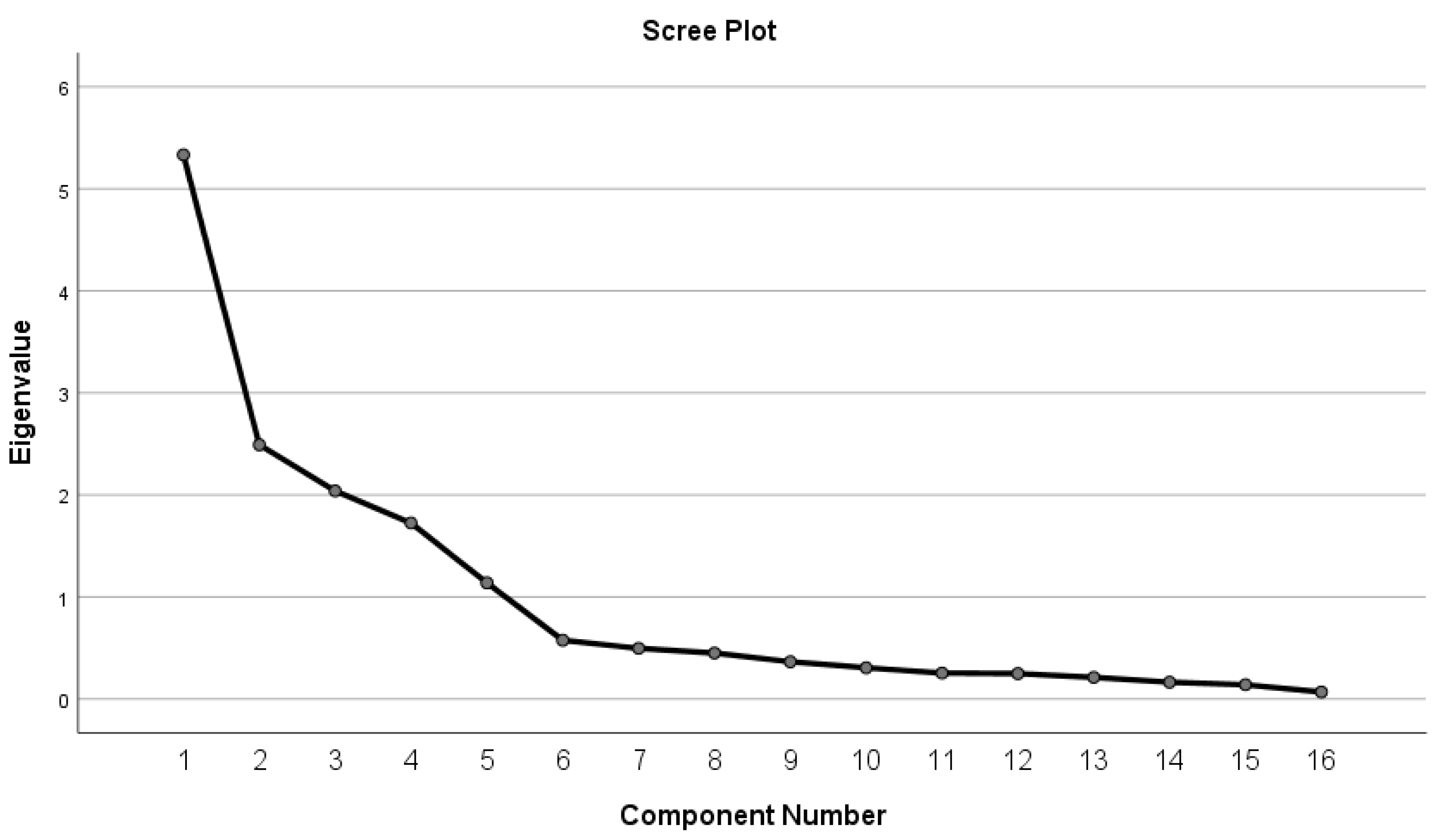
When the factor loadings for all of the items in the study were evaluated, no item had a loading of .32 or less than .32. All of the items under Factor 1 had a range from .949 to .810; all of the items under Factor 2 had a range from .936 to .897; all of the items under Factor 3 had a range from .829 to .576; all of the items under Factor 4 had a range from .837 to .788; all of the items under Factor 5 had a range from .855 to .775; and all of the items under Factor 6 had a range from .857 to .722. Upon evaluating the items for each of the six factors, they were labeled as follows: livestock activities (factor 1); economic activities (factor 2); socio-cultural structure (factor 3); resistance to climate (factor 4); cultural memory (factor 5); housing structure (factor 6). This information can be viewed on the following tables.
Table 7.
Exploratory Factor Analysis Results of the Scale Measuring the Satisfaction Levels of Disaster Victims with Their New Living Environments After Natural Disasters.
Table 7.
Exploratory Factor Analysis Results of the Scale Measuring the Satisfaction Levels of Disaster Victims with Their New Living Environments After Natural Disasters.
| Items | Factor 1 | Factor 2 | Factor 3 | Factor 4 | Factor 5 | Factor 6 |
| I1 | .949 | |||||
| I2 | .945 | |||||
| I3 | .892 | |||||
| I4 | .890 | |||||
| I5 | .810 | |||||
| I6 | .936 | |||||
| I7 | .917 | |||||
| I8 | .897 | |||||
| I9 | .829 | |||||
| I10 | .820 | |||||
| I11 | .648 | |||||
| I12 | .576 | |||||
| I13 | .837 | |||||
| I14 | .801 | |||||
| I15 | .788 | |||||
| I16 | .855 | |||||
| I17 | .816 | |||||
| I18 | .775 | |||||
| I19 | .857 | |||||
| I20 | .821 | |||||
| I21 | .722 | |||||
| Variance Explained (% 76,189) | 30,781 | 12,547 | 10,635 | 9,291 | 7,344 | 5,590 |
Note: Principal Axis Factoring (PAF) was employed as the extraction method, and Direct Oblimin rotation was applied.
2.4.2.4. Confirmatory Factor Analysis
The six-factor structure with 21-item scale was obtained through EFA. In order to support this structure and determine the model–data fit, CFA was conducted. The fit of the model was evaluated by examining several goodness-of-fit statistics including χ²/df, GFI, AGFI, CFI, NFI, IFI, RMSEA, and SRMR. Within the measurement model of the Scale for Satisfaction Levels of Disaster Victims with Their New Living Environments After Natural Disasters, two modification procedures were applied. The fit indices obtained as a result of these procedures are presented in Table 8.
As shown in Table 8, the values of χ²/df, AGFI, CFI, NFI, IFI, RMSEA, and SRMR indicate a good fit, while the GFI value indicates an acceptable level of fit. The path diagram obtained from the CFA and the factor loadings were examined. The path diagram, including the factor loadings and error variances, is presented in Figure 4.
As illustrated in Figure 4, the factor loadings of each variable were above 0.30, but less than 1. The factor loadings of the model ranged from .47 to .97. This analysis indicated that the model had a good level of fit.
In order to assess the reliability of the scale derived from both the EFA and CFA, a Cronbach’s alpha coefficient was utilized to evaluate internal consistency. The Cronbach’s alpha coefficient for the entire scale was calculated as 0.805. The Cronbach’s alpha coefficients calculated for the sub-dimensions were 0.961 for Livestock Activities, 0.938 for Economic Activities, 0.763 for Socio-Cultural Structure, 0.855 for Resistance to Climate, 0.835 for Cultural Memory, and 0.807 for Housing Structure. A Cronbach’s alpha coefficient between .60 and .80 indicates that the scale is reliable, while a coefficient between, .80 and 1 signifies a highly reliable instrument (Nunnally, 1967). In this study, the Cronbach’s alpha values obtained for the overall scale and its sub-dimensions confirm that the measurement instrument is highly reliable.
3. Results
Based on the study’s objectives, the study then assessed whether there is a statistically significant difference in the overall level of satisfaction among disaster victims concerning their post-disaster housing based upon gender. The results from the assessment of this objective are illustrated in Table 9. These analyses were performed in order to determine if relationships existed between participant demographic data and their perceptions of their new living areas and to identify if gender has an effect on participants’ overall level of satisfaction.
A statistically significant difference was established using the independent sample t-test based on gender, for male participants versus female participants in terms of F1, F2, F3, and F6 dimensions. The eta squared (η²) values were used to determine the effect size of the differences found in terms of satisfaction, and it was concluded that they represent a small effect size. Also, an independent samples t-test was completed in order to assess the connection between the number of family members within a participant’s family and the participant’s satisfaction with their relocation resulting from a disaster. Results from the t-test for each family type are provided in Table 10:
According to the results of the independent samples t-test conducted for the family size variable, a statistically significant difference was identified in favor of nuclear families (female-led response patterns in this context) in the F5 dimension. Upon examining the eta squared (η²) values, it was determined that this difference represents a small effect size.
As part of this study, the impact of having off-village income on the level of satisfaction among relocated disaster victims was examined; as such, an independent samples t-test was used to assess this effect. T-test will help to identify if there is a statistically significant difference in satisfaction among participants who have off-village income and those that do not. As can be seen in Table 11, it outlines the results of the t-test conducted by off-village income status.
According to the results of the independent samples t-test conducted for the off-village income variable, a statistically significant difference was identified in the F5 dimension in favor of those without off-village income, and in the F6 dimension in favor of those with off-village income. Upon examining the eta squared (η²) values, it was determined that these differences represent a small effect size.
An independent-sample t-test was used to examine the effect of duration of residence in the village on the level of satisfaction of displaced disaster victims. The objective of this analysis is to ascertain if there exists a statistically significant difference in overall satisfaction among seasonal residents and full-time residents of the village. The results of the t-test by duration of residency are shown in Table 12.
According to the results of the independent samples t-test performed for the duration of residency variable, a statistically significant difference was identified in the F1, F2, F3, F4, and F6 dimensions in favor of seasonal residents. Upon examining the eta squared (η²) values, it was determined that this difference represents a small effect size.
Within the study’s scope, the effects that the morphological structure of the village have on the levels of satisfaction of relocated disaster victims were examined, and a one-way analysis of variance (ANOVA) was applied for this purpose. An ANOVA was used in order to determine if there are statistically significant differences in the degree of satisfaction experienced by participants who reside in areas with different terrain types (plains, slope, mountain, valley, plateau). Table 13 presents the ANOVA results conducted according to the morphology of the settlement area.
The ANOVA was run using the morphological structure as the independent variable. Results indicated that there were statistically significant differences for each factor (p<0.05). Each factor had a significant difference among the following: In F1 dimension between plain–slope and mountain–slope settlements; in F2 between plain–slope, valley–slope, and valley–plateau; in F3 between plain–valley and plain–mountain; in F4 between plain–mountain, plain–slope, valley–mountain, and valley–slope; in F5 between plain–slope, plain–plateau, valley–plateau, mountain–plateau, and slope–plateau; and finally, in the F6 dimension between plain–mountain and valley–mountain settlements.
4. Discussion
Post-disaster rural recovery, as evidenced by this study, is much more than providing rural residents with adequate shelter to live in. It is an integrated, multi-dimensional process which includes elements such as economic sustainability, place attachment, cultural memory, and environmental adaptation that are all influenced by each other. In addition, the results of the fieldwork reveal that reconstruction of rural villages should be conducted within the rural geographic context of the village and functions of the rural economy.
An additional methodological contribution was made to the body of literature by developing a 21-item scale in order to assess rural housing satisfaction through the six dimensions of livestock, economic activities, social-cultural structure, housing morphology, climate resilience and cultural memory. The results indicate that, when conducting post-disaster recovery in rural communities, it is necessary to ensure the long-term viability of local economic systems, agricultural and rural production systems, and their respective geographical conditions.
4.1. Discussion of Findings from the Scale Development Process
The 21-item, 6-dimensional scale developed during the initial phase of this study provided a unique framework for assessing post-disaster rural settlement satisfaction through a multidimensional lens. The use of an exploratory sequential mixed-methods design ensured the systematic transformation of qualitative findings into a robust quantitative structure. In this regard, the instrument provides a significant methodological contribution to the development of context-specific measurement tools.
The evaluation of the overall dimensions shows, in addition to the assessment of housing as a physical shelter, the importance of assessing other aspects including livestock activities, economic activities, socio-cultural structure, housing structure, climate resilience, and cultural memory. Therefore, it is necessary to evaluate the resettlement process in an integrated way in relation to both spatial planning, social inclusion, and economic sustainability.
4.2. Critical Discussion of Findings on Satisfaction Dimensions
The overall moderate satisfaction ratings suggest that the disaster-constructed housing has met basic needs for shelter; however, the housing will likely not be sustainable with regard to rural livelihoods.
The livestock activities dimension was found to have the lowest satisfaction rating and clearly limits the economic sustainability of the new settlements. The fact that there are no barns, storage facilities or hayloft structures included in standard housing development has limited the livestock population that can be maintained in these new settlements when compared to their pre-earthquake populations. This indicates that a lack of physical space to house animals and/or provide adequate feed or shelter results in a direct economic loss. Additionally, the rights-holders’ attempts to address the need for additional production-related space using non-engineered (improvised) structures created both structural risks and aesthetically inconsistent (mismatched) spaces throughout the settlement area.
Rural housing represents an integrated system of housing and production and therefore does not function like housing in urban areas[55]. The decline in livestock observed in this research study was due to the standardized housing practices that ignored the cultural and local production aspect of housing in the rural area and are consistent with “unemployment” and “lack of access to resources” dimensions of Cernea’s (1997) Impoverishment Risks and Reconstruction (IRR) model. In a similar manner, Badri et al. (2006) research in Iran demonstrated that the linear, contiguous layout of the housing made it impossible for residents to rear livestock on the property and placed them at economic risk. Comparable data have also been reported from research studies conducted in China [15] and Zimbabwe [9]; these studies demonstrated that when housing is not constructed as part of the production process, affected populations will be forced to leave safe locations where they can still produce goods. These studies highlight the inherent conflict between centrally planned management systems that focus primarily on the construction of housing and the provision of shelter versus the production-based lifestyles of rural population members[13].
The disregard for familial networks and neighborhood fabrics in housing developments, along with relocation away from original sites, threatens to erode social capital and diminish the residents’ capacity for spatial belonging. Therefore, planners should consider both physical safety and social continuity as two primary concerns when developing post-disaster relocation strategies. This research has shown how relocation disrupts social capital. In a study relocation was found to have long-term negative effects on displaced people’s sense of belonging compared to residents who did not leave the area (Arslan & Ünlü, 2011). The disruption of neighborhood and kinship networks observed in this study can be explained by the loss of “bonding social capital,” as defined by Daly et al. (2023). A striking contrast is observed when comparing the findings of this study with the existing literature.
While Palagi and Javernick-Will (2020) argue, based on the Philippines case, that relocating diverse groups together can foster new social integration and promote bonding social capital, the current study reveals a different reality in Turkey’s traditional rural context. Here, such interventions are perceived as a catalyst for “social fragmentation” and a “loss of local identity.” Spatially reconfiguring displaced rural populations into areas with no regard for previous social structures diminishes the communal culture—the primary resource for rural resiliency—and risks transforming these settlements into urban-like neighborhoods detached from agricultural production [8].
Satisfaction with regards to the climate resilience dimension was determined to be at a moderate level; however, satisfaction levels were significantly higher within post-disaster housing projects built on flatlands or near urban areas, as weekend and seasonal use was more prevalent. Conversely, the inhabitants of post-disaster housing who reside there permanently are more adversely impacted by climatic factors. In this case, it was noted that the dwellings do not provide sufficient heat nor adequate insulation to support year-round living in the dwelling; and further that the dwellings do not support permanent rural living. In particular, in mountainous settlements, the residences which were built lack the resilience to withstand the forces of nature (i.e., snow, wind, rain), and although they may be resilient to disaster events (such as earthquakes), they continue to be vulnerable to long-term changes in the climate. Therefore, the inability of post-disaster housing in mountainous regions to withstand extreme weather conditions (i.e., snow loads, high winds, etc.), relates to previous discussions in the literature regarding rural housing designs and climate adaptation (Bronner, 2006). Additionally, while traditional rural architecture has evolved over many years and provided energy efficient solutions for centuries, the failure of modern reinforced concrete prototype projects to accommodate local microclimate design issues, further exacerbates the sense of displacement between the user and the physical space [13].
In terms of economic activity dimension, it can be observed that the level of satisfaction remains stable at a moderate however, they are notably higher among individuals with fixed off-farm income. This suggests that economic diversification is a vital factor in enhancing residential satisfaction, underscoring the necessity of incorporating income diversification strategies into rural resettlement policies.
Moreover, the results from the cultural memory dimension show that the spatial disconnection has not only a physical side but also a symbolic and emotional one. In line with existing literature, the cultural memory aspect of this study highlights that disasters lead to the erosion of geographical identity and collective memories, extending beyond mere physical destruction[38]. As such, uncontrolled physical interventions made by users (i.e. adding balconies, changing layout) should be considered as an effort to recover lost cultural memory and to address functional requirements on a spatial realm [12,33]
4.3. Discussion of Findings on Demographic and Spatial Variables
The research results show that the magnitudes of effect of the differences determined by gender, family size, off-village income, and duration of residence in the area are typically small. This shows that satisfaction is shaped through an interaction of many structural factors as opposed to separate demographic characteristics. The relatively small effects of demographics (family size, gender) on satisfaction are in line with Şengül et al. (2021) and can be in contrast to the gender discussion emphasized by Sadiqi et al. (2017), depending on how these findings are interpreted. Additionally, the predominance of Turkish planning processes using a “head of household” model implies a possible danger: women’s spatial needs for privacy, and their preferences for kitchen designs, are probably insufficiently taken into account during design processes.
The presence of some statistically significant differences among the several dimensions by the morphological structure variable suggest that while the physical environment does have a somewhat limited yet certainly non-trivial influence on perceived satisfaction with post-disaster housing, there are other factors which are likely to exert much greater influences. These include especially accessibility and climate conditions (which are likely to vary significantly among plains and valleys), and possibly productive opportunities, and that may have contributed to the relatively high satisfaction scores seen in those two types of settlement. While the small size of these effects also means that the morphology of a settlement is unlikely to be the dominant factor determining post-disaster housing satisfaction, it must still be considered together with both social and economic factors and policy decisions. Further, the fact that post-disaster housing in settlements located at or close to city centers is increasingly being used as a summer home represents a further deviation from the original purpose of post-disaster housing as defined in the literature [55], and represents a potential new socio-economic transition in which post-disaster housing policies will provide support for urban investment rather than rural development [11].
4.4. Limitations and the Way Forward
The present study aims to develop a scale to measure the level of satisfaction with rural housing in the context of the post-disaster reconstruction process in rural areas, but it contains some limitations that should be considered and developed. We are aware that the satisfaction scale developed within the scope of the research has certain limitations and potential for improvement in terms of comprehensiveness and accuracy. Although the scale developed in this context provides an important basis for revealing the level of satisfaction with rural housing in the study area, the nature of the assessment is static in terms of time and cannot reflect the dynamic changes in satisfaction over time. Therefore, assessing long-term satisfaction levels and identifying temporal changes at the building level, taking into account both pre- and post-disaster situations, can make important contributions to decision-making processes in sustainable rural area management [56].
However, regional and local geographical differences, along with limitations in data adequacy and consistency, pose significant challenges in measuring satisfaction levels across different areas and establishing a comprehensive standard. Therefore, future studies that increase data diversity, expand sample areas, and combine mixed research methods that more strongly incorporate community participation may contribute to obtaining more comprehensive results.
In conclusion, although the present study has certain limitations, it represents a pioneering effort to address post-disaster housing production processes in rural settlements in Turkey, which has experienced significant destruction due to earthquakes in recent years, in line with the principles of sustainability and resilience. In this respect, the study can provide an important reference framework for scientists and policymakers for future research. Overall, this framework, developed to assess post-disaster satisfaction levels in rural areas, has a flexible structure and is applicable in countries with high disaster risk, such as Türkiye.
5. Conclusions
This study evaluates the satisfaction levels of individuals resettled in disaster housing constructed in rural areas following the 24 January 2020 Sivrice–Elazığ earthquake, adopting a multidimensional perspective on their new living environments. In the first phase of the research, a satisfaction scale specifically designed for post-disaster rural resettlement processes was developed. Subsequently, the validity and reliability of the scale were tested through quantitative analyses. The results revealed a scale structure consisting of 21 items and six factors, and confirmatory factor analysis demonstrated that the model exhibited a high level of fit. Furthermore, the high overall Cronbach’s alpha value indicates that the developed measurement instrument is both reliable and applicable for assessing satisfaction in post-disaster rural resettlement contexts.
The findings clearly demonstrate that post-disaster rural housing policies focused solely on providing shelter are insufficient. In rural settlements, housing functions not only as a place of residence but also as a central component of agricultural and livestock-based production systems. Accordingly, the incompatibility of standardized housing projects with rural production activities leads to lower satisfaction levels, particularly in relation to livestock activities and economic sustainability. The results indicate that the absence or inadequacy of barns, storage areas, and production-related units in newly established settlements negatively affects the sustainability of rural economic activities.
The study further reveals that post-disaster resettlement processes are closely associated not only with the physical reconstruction of space but also with the reproduction of social relations, cultural memory, and spatial belonging. The weakening of neighborly relations, the fragmentation of kinship networks, and the transformation of traditional settlement patterns in newly established residential areas may negatively influence the social capital of rural communities. These findings highlight that preserving social cohesion is at least as important as ensuring physical safety in post-disaster resettlement policies.
Another important finding of the study is that satisfaction levels vary according to certain socio-demographic and spatial variables. In particular, the lower satisfaction levels observed among individuals who reside in villages throughout the year, compared with seasonal residents, suggest that the constructed housing does not fully meet the requirements of permanent rural life. Similarly, the morphological characteristics of settlements were found to generate differences in satisfaction levels. This finding underscores the importance of incorporating local geographical and environmental conditions into post-disaster housing planning processes.
Overall, this study makes two principal contributions. First, it introduces a valid and reliable measurement instrument for assessing satisfaction with post-disaster rural resettlement environments. Second, it demonstrates that post-disaster rural housing policies should be evaluated through a multidimensional framework that incorporates economic sustainability, social relations, cultural continuity, and environmental adaptation. In light of these findings, several implications for future rural resettlement planning can be highlighted. Design approaches compatible with local production culture should integrate extensions necessary for animal husbandry and agricultural production as standard components of rural housing projects rather than treating them as secondary additions. In addition, relocation processes should consider existing kinship and neighborhood networks in order to preserve socio-spatial cohesion within rural settlements. From an environmental perspective, instead of applying a single prototype housing model across different morphological and climatic conditions, flexible architectural designs adapted to local environments should be implemented. Furthermore, rural resettlement programs should be supported by economic policies that encourage income diversification in order to ensure the long-term sustainability of rural livelihoods. Finally, future studies should apply the developed scale in different disaster contexts, examine inter-dimensional relationships through structural equation modeling (SEM), and investigate the temporal evolution of satisfaction levels through longitudinal research designs.
Author Contributions
Conceptualization, M.F.; methodology, M.F. and T.Y.Ö.; software, T.Y.Ö.; validation, A.Ç.; formal analysis, E.D. and T.Y.Ö.; investigation, M.F., E.D., D.D., and A.Ç.; resources, A.Y.K. and D.D.; data curation, E.D., D.D., and D.K.; writing—original draft preparation, M.F. and E.D.; writing—review and editing, A.Y.K. and D.K.; visualization, A.Y.K. and D.K.; supervision, A.Y.K. and A.Ç.; project administration, A.Ç.; funding acquisition, A.Ç.
Funding
This research was funded by the Scientific and Technological Research Council of Türkiye (TÜBİTAK), 3005 – Innovative Solutions Research Program in Social Sciences and Humanities, grant number 223K160.
Institutional Review Board Statement
In this section, please add the Institutional Review Board Statement and approval number for studies involving humans or animals. You might choose to exclude this statement if the study did not require ethical approval. Please note that the Editorial Office might ask you for further information. Please add “The study was conducted in accordance with the Declaration of Helsinki, and approved by the Institutional Review Board (or Ethics Committee) of NAME OF INSTITUTE (protocol code XXX and date of approval).” for studies involving humans. OR “The animal study protocol was approved by the Institutional Review Board (or Ethics Committee) of NAME OF INSTITUTE (protocol code XXX and date of approval).” for studies involving animals. OR “Ethical review and approval were waived for this study due to REASON (please provide a detailed justification).” OR “Not applicable” for studies not involving humans or animals.
Informed Consent Statement
Informed consent was obtained from all subjects involved in the study prior to their participation. All participants were fully informed about the purpose, scope, and procedures of the research, and their voluntary participation was ensured. Participants were also informed of their right to withdraw from the study at any stage without any consequences. The confidentiality and anonymity of all participants were strictly maintained throughout the research process, and all data were used solely for scientific purposes.
Data Availability Statement
The data supporting the findings of this study are available from the corresponding author upon reasonable request.
Acknowledgments
The authors would like to express their sincere gratitude to all individuals and institutions who contributed to this study. In particular, they would like to thank the participants for their valuable support during the data collection and fieldwork processes. The authors also extend their appreciation to Fırat University, the Disaster and Emergency Management Authority (AFAD), and the Elazığ Special Provincial Administration for their valuable contributions and support. The academic, technical, and administrative assistance provided throughout the research process significantly contributed to the successful completion of this study.
Conflicts of Interest
The authors declare no conflicts of interest.
Appendix A. Scale Items
| M1. The housing extensions (barn, hayloft, etc.) built outside the new living area provide suitable conditions for sustainable animal husbandry. |
| M2. The new living area is sufficient for storing the products (hay/straw) necessary for animal feeding. |
| M3. The new living area is sufficient for storing the equipment required for animal husbandry. |
| M4. The new living area is suitable for the production of animal-based foods (cheese, butter, honey, etc.).. |
| M5. The new living area is sufficient for maintaining my animal husbandry activities. |
| M6. The new living area has negatively affected my income level. |
| M7. The new housing structure has caused a decrease in my income level. |
| M8. My new living area has led to a change in the type of my economic activities. |
| M9. My relationships with my relatives continue as they were before. |
| M10. I can spend time with my friends just as I did before. |
| M11. I can easily access my economic activity areas from the new settlement area. |
| M12. I can easily access common village areas (mosque, fountain, grocery store, etc.). |
| M13. My new house is resilient to wind. |
| M14. My new house is resilient to precipitation (rain/snow). |
| M15. My new house is resilient to sun exposure. |
| M16. I long for my pre-disaster home. |
| M17. I have lost my memories with the new settlement area after the disaster. |
| M18. I miss my social life from before the disaster. |
| M19. The size of the new house is suitable for village life |
| M20. The number of rooms in the new house is suitable for village life. |
| M21 The texture/architectural fabric of the new houses is suitable for village life. |
References
- Afad. 24 Ocak 2020 Sivrice (Elazığ) Mw 6.8 Depremine İlişkin Ön Değerlendirme Raporu; T.C. İçişleri Bakanlığı Afet ve Acil Durum Yönetimi Başkanlığı: 2020.
- Arslan, H.; Ünlü, A. Afet sonrası yeniden yapılanma sürecinde yer değiştirme ve yere bağlılığın değerlendirilmesi: Düzce örneği. İTÜDERGİSİ/a 2011, 9.
- Sadiqi, Z.; Trigunarsyah, B.; Coffey, V. A framework for community participation in post-disaster housing reconstruction projects: A case of Afghanistan. International Journal of Project Management 2017, 35, 900-912. [CrossRef]
- EMA. Disasters and Survival. Emergency Management Australia: Dickson, ACT, Australia 2002.
- Ganapati, N.E.; Ganapati, S. Enabling Participatory Planning After Disasters: A Case Study of the World Bank’s Housing Reconstruction in Turkey. Journal of the American Planning Association 2008, 75, 41-59. [CrossRef]
- Monday, J. Building back better: Creating a sustainable community after disaster, University of Boulder. Natural Hazards Research and Applications Information Center 2002.
- Palagi, S.; Javernick-Will, A. Pathways to Livable Relocation Settlements Following Disaster. Sustainability 2020, 12, 3474. [CrossRef]
- Kürüm Varolgüneş, F. Sosyal Sürdürülebilirlik Performansının Kalıcı Afet Konutlarında Değerlendirilmesi: Bingöl Örneği. İDEALKENT 2021, 12, 757-784. [CrossRef]
- Ngulube, N.K.; Tatano, H.; Samaddar, S. Key focus areas in post-disaster relocation and housing reconstruction: A collaborative perspective on community development. Community Development 2026, 57, 217-234. [CrossRef]
- Daly, P.; Mahdi, S.; Mundir, I.; McCaughey, J.; Amalia, C.S.; Jannah, R.; Horton, B. Social capital and community integration in post-disaster relocation settlements after the 2004 Indian Ocean Tsunami in Indonesia. International Journal of Disaster Risk Reduction 2023, 95, 103861. [CrossRef]
- Peker, A.E.; Şanlı, İ. DEPREM ve GÖÇ İLİŞKİSİ: 24 OCAK 2020 ELAZIĞ DEPREM ÖRNEĞİ. Fırat Üniversitesi Uluslararası İktisadi ve İdari Bilimler Dergisi 2022, 6, 125-154.
- Johnson, C. Impacts of prefabricated temporary housing after disasters: 1999 earthquakes in Turkey. Habitat International 2007, 31, 36-52. [CrossRef]
- Gök, Y.; Yazar, M. AFETLERE MARUZ KALAN YERLEŞMELERİN YER DEĞİŞİMİNDE KARŞILAŞILAN SORUNLARA BİR ÖRNEK: İSPİR MADENKÖPRÜBAŞI BELDESİ ELMALI MAHALLESİ. Doğu Coğrafya Dergisi 2013, 16, 73-93.
- Walelign, S.Z.; Cutter, S.L.; Lujala, P. Resettlement capacity assessments for climate induced displacements: Evidence from Ethiopia. Climate Risk Management 2021, 33, 100347. [CrossRef]
- Chen, Y.; He, L.; Zhou, D. Consequences of post-disaster policies and relocation approaches: two communities from rural China. Disaster Prevention and Management: An International Journal 2021, 30, 340-353. [CrossRef]
- Dikmen, N. SUSTAINABLE RELOCATION IN RURAL AREAS: AN INVESTIGATION IN CUKUR VILLAGE, TURKEY. European Journal of Sustainable Development 2018, 7. [CrossRef]
- Bekdemir, Ü.; Sever, R. ŞAVŞAT VE ÇEVRESİNDE TİPİK BİR EV EKLENTİSİ; MEREK/A Typical Additional Part of the House in and Around Şavşat: Merek. Doğu Coğrafya Dergisi 2011, 8.
- Tercan, B. Türkiye’de afet ve yeniden yerleştirme (iskân) politikaları; Palme Yayınevi: Ankara, 2019.
- Cernea, M.M. Impoverishment risks, risk management, and reconstruction: A model of population displacement and resettlement. In Proceedings of the UN Symposium on hydropower and sustainable development, 2004.
- Badri, S.A.; Asgary, A.; Eftekhari, A.R.; Levy, J. Post-disaster resettlement, development and change: a case study of the 1990 Manjil earthquake in Iran. Disasters 2006, 30, 451-468. [CrossRef]
- Özden, A.T. Senirkent’de afet sonrası kalıcı konut uygulamalarının değerlendirilmesi. İstanbul Teknik Üniversitesi, 2004.
- Çakır Sümer, G. İklim Değişikliğinde Önemli Bir Gündem: Yerinden Edilme ve Yeniden Yerleştirme. Akademik Araştırmalar ve Çalışmalar Dergisi (AKAD) 2024, 16, 295-308. [CrossRef]
- Hu, W.; Xiang, C.; Xie, Y. Examining the impact of resettlement typologies in post-disaster social integration: a framework of social and spatial isolation. Journal of Asian Architecture and Building Engineering 2025, 1-17. [CrossRef]
- Schreiber, J.B.; Nora, A.; Stage, F.K.; Barlow, E.A.; King, J. Reporting Structural Equation Modeling and Confirmatory Factor Analysis Results: A Review. The Journal of Educational Research 2006, 99, 323-338. [CrossRef]
- Yıldızcan, C. Deprem Sonrasında Afetin ve Tarımın Politik Ekolojisi: Hatay Örneği. Praksis 2023.
- Altman, I.; Low, S. Place Attachment Plenum Press. New York-London 1992, 262.
- Karunarathne, A.Y.; Lee, G. The geographies of the dynamic evolution of social networks for the flood disaster response and recovery. Applied Geography 2020, 125, 102274. [CrossRef]
- Şengül, S.; Nakip, M.; Gökmen, A.; Dinç, D.T. Düzce il merkezinde 1999 depreminden sonra yapılan konutlarda yaşayan ailelerin demografik faktörlere göre memnuniyet derecelerinin ölçülmesi. Ömer Halisdemir Üniversitesi İktisadi ve İdari Bilimler Fakültesi Dergisi 2021, 14, 82-103.
- Arslan, H. Afet sonrası yeniden yapılanma sürecinin yere bağlılık, yer değiştirme ve bilişsel haritalama olguları açısından sosyo-mekansal dinamiklerin incelenmesi. İstanbul Teknik Üniversitesi, 2008.
- Sapat, A.; Esnard, A.-M. Coming home after disaster: Multiple dimensions of housing recovery; Routledge: 2016.
- Şaşmaz, O.Y. Afet Sosyolojisi. Afetlerle Yaşamayı Öğrenmek 2022.
- Kaya, M.; Yilmaz, C.; Bağci, H.R. Importance of Location Selection in Regions with Disaster Risk: The Case of Ayancık Babacay Village. Ege Coğrafya Dergisi 2022, 31, 193-206. [CrossRef]
- Carrasco, S.; Ochiai, C.; Okazaki, K. Residential satisfaction and housing modifications. International Journal of Disaster Resilience in the Built Environment 2017, 8, 175-189. [CrossRef]
- Koç, C.; Koç, A. Afet Sonrası Taşınan Yerleşmelerin Değerlendirilmesi: Sekli Köyü (Beypazarı) Örneği. JENAS Journal of Environmental and Natural Studies 2024, 6, 1-22. [CrossRef]
- Enginöz, E.B.; Ünlü, A. Afet konutlarında tasarım değerlendirmesi: Afyon-Dinar örneği. İTÜDERGİSİ/a 2010, 5.
- Uzuner, E. Deprem sonrası konut tercihlerinde kullanıcı bilincinin değerlendirilmesi. Bursa Uludağ Üniversitesi, 2021.
- Otsuki, K.; Jasaw, G.S.; Lolig, V. Framing Community Resilience Through Mobility and Gender. Journal of Disaster Research 2014, 9, 554-562. [CrossRef]
- Gündoğdu, S. Sel ve Heyelana Bağlı Gelişen Zorunlu Göçlerin Kırsal ve Doğal Mirasa Etkisi: Çaykara Örneği. Kent Akademisi 2024, 17, 1146-1168. [CrossRef]
- Elazığ, V. Elazığ Projesi (2000’li Yıllara Hazırlık Çalışmaları); ELES-KAV Yayınları: Elazığ, 1998.
- Karasar, N. Bilimsel araştırma yöntemi (24. bs.). Ankara: Nobel Yayıncılık 2012.
- Büyüköztürk, Ş. Sosyal bilimler için veri analizi el kitabı. Pegem Atıf İndeksi 2018, 001-214.
- Creswell, J.W. Nitel araştırma yöntemleri: Beş yaklaşıma göre nitel araştırma ve araştırma deseni; Siyasal kitabevi: 2016.
- Yıldırım, A.; Şimşek, H. Sosyal Bilimlerde Nitel Araştırma Yöntemleri; Seçkin Yayıncılık: Ankara, 2018.
- Fraenkel, J.R.; Wallen, N.E. How to design and evaluate research in education; ERIC: 2012.
- Strauss, A.; Corbin, J. Basics of qualitative research techniques; Sage Publications, Inc: 1998.
- Patton, M.Q. Qualitative research & evaluation methods: Integrating theory and practice; Sage publications: 2014.
- Büyüköztürk, Ş.; Çakmak, E.; Akgün, Ö.; Karadeniz, Ş.; Demirel, F. Bilimsel araştırma yöntemleri.(23. Basım). Ankara: Pegem Akademi 2017.
- Özen, Y.; Gül, A. Sosyal ve eğitim bilimleri araştirmalarinda evren-örneklem sorunu. Atatürk Üniversitesi Kazım Karabekir Eğitim Fakültesi Dergisi 2007, 394-422.
- Çolakoğlu, Ö.M.; Büyükekşi, C. Açımlayıcı faktör analiz sürecini etkileyen unsurların değerlendirilmesi. Karaelmas Eğitim Bilimleri Dergisi 2014, 2, 56-64.
- Tabachnick, B.G.; Fidell, L.S. Çok değişkenli istatistiklerin kullanımı; Nobel: 2015.
- Cattell, R. The scientific use of factor analysis in behavioral and life sciences; Springer Science & Business Media: 2012.
- Büyüköztürk, Ş. Faktör analizi: Temel kavramlar ve ölçek geliştirmede kullanımı. Kuram ve uygulamada eğitim yönetimi 2002, 32, 470-483.
- Erdoğan, U.; Dönmez, B. Öğretmenlerin Örgütsel Sosyalleşme Düzeylerini Belirlemeye Yönelik Bir Ölçek Geliştirme Çalışması. İnönü Üniversitesi Eğitim Fakültesi Dergisi 2019, 20, 288-302. [CrossRef]
- Topçu, T.; Kırkbeşoğlu, E. Kuşaklar Arası Farklılığın İşgören Davranışı Üzerindeki Etkisi. Başkent Üniversitesi Ticari Bilimler Fakültesi Dergisi 2021, 5, 50-88.
- Tercan, B. Afet bölgelerinde yeniden yerleştirme ve iskân politikaları: Doğubayazıt depremi örneği. Türk Deprem Araştırma Dergisi 2020, 2, 76-91. [CrossRef]
- Kaya, A.Y.; Sajjad, M.; Dedekorkut-Howes, A. Downscaling Urban Disaster Resilience: Toward Building-Scale Geo-Information Modeling and Machine Learning-Assisted Resilience Knowledge Systems. Transactions in GIS 2025, 29. [CrossRef]
Figure 4.
Results of the confirmatory factor analysis.
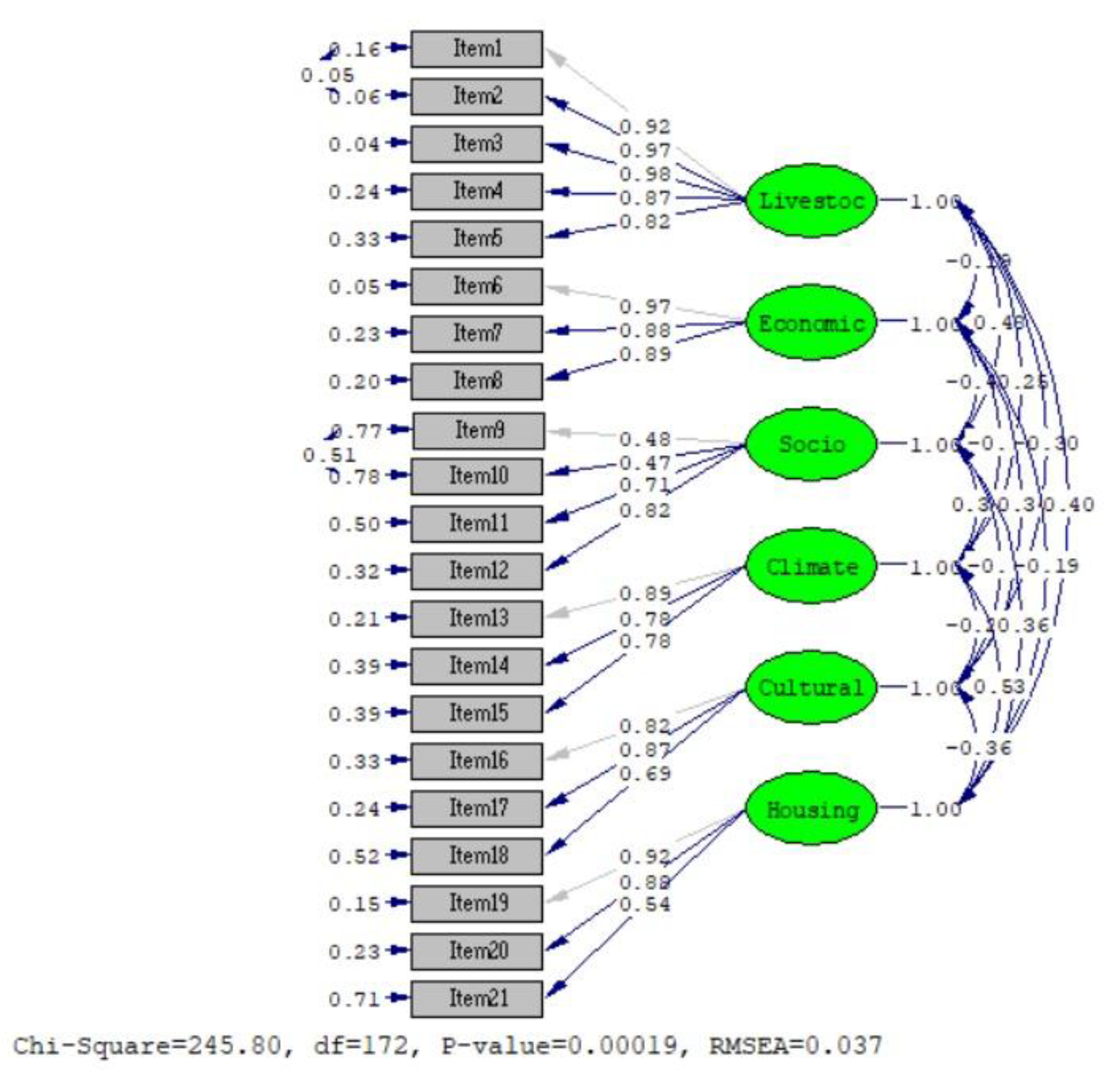
Table 1.
Research Population.
| Morphological Unit | Villages | Damaged Housing Units | ||
| Number | Percentage (f) | Number | Percentage (f) | |
| Plain | 43 | 20 | 1424 | 23 |
| Slope | 92 | 42 | 2530 | 42 |
| Valley | 27 | 12 | 774 | 13 |
| Mountain | 29 | 13 | 726 | 12 |
| Plateau | 29 | 13 | 594 | 10 |
| Total | 220 | 100 | 6048 | 100 |
Note: Number of damaged dwellings corresponds to the number of individuals in the population.
Table 2.
Demographic Characteristics of the Disaster Victims Included in the Sample.
| Variable | Category | n | % |
| Gender | Male | 305 | 47,81 |
| Female | 333 | 52,19 | |
| Family Size | Patriarchal Family | 62 | 9,72 |
| Nuclear Family | 576 | 90,28 | |
| Off-Village Income Status | Yes | 530 | 83,07 |
| No | 108 | 16,93 | |
| Duration of Residency in the Village | Year-round | 259 | 40,60 |
| Seasonal | 379 | 59,40 | |
| Morphological Structure of the Village | Plain | 304 | 47,65 |
| Valley | 29 | 4,55 | |
| Mountain | 97 | 15,20 | |
| Slop | 181 | 28,37 | |
| Plateau | 27 | 4,23 | |
| Total | 638 | ||
Table 3.
Demographic Characteristics of the Participants.
| Village | Gender Male Female |
Total | |
| Gölardı | 2 | 1 | 3 |
| Kızıltepe | 2 | 1 | 3 |
| Kuyulu | 4 | 2 | 6 |
| Gözebaşı | 3 | - | 3 |
| Kavaktepe | 1 | 1 | 2 |
| Uslu | 3 | 1 | 4 |
| Bekçitepe | 3 | 1 | 4 |
| Değirmenönü | 3 | 1 | 4 |
| İçme | 2 | 1 | 3 |
| Total | 23 | 9 | 32 |
Table 4.
Sub-themes, Codes Derived from Qualitative Data, and Associated Scale Items.
| Sub-themes | Codes | f | Direct Quotation |
| Dwelling Structure | Outbuildings | 22 | K.4 “My former home was two story adobe and had a storage room. The storage room contained everything we needed. They said they would provide a home with a barn for storage and that is what they did, but that is all they provided. Therefore, I took my old barn and built a new home. Prior to the home, we were living in a tent. Had the home included a barn or storage area; I would have remained at this location.” (M1) |
| Heating and Insulation | 12 | K.2 “In the old houses, a stove would keep the home warm 24 hours a day. These new houses are constructed with steel; and while they do warm-up, they cool-down instantly.” (M2) | |
| Workmanship | 8 | K.10 “The building materials supplied by the government are sturdy and high-grade, but the craftsmanship is poor. The bathroom water runs in the wrong direction.” (M3) | |
| Number of Rooms and m2 | 8 | K.21 “My old home had three or four rooms below and one above. It had a storage room and a threshing floor. Now, none of that exists—it’s just a tiny house.” (M4-M5) | |
| Continuity of Village Life | 5 | K.13 “This is an impractical design for the villagers. This home is ninety square meters, however, there isn’t enough space to put a single sack. Each of the homes seems like they are designed for vacation purposes. Several of my family members left the village and moved into the City.” (M6) | |
| Housing Texture | 4 | K.16. “We didn’t have any neighbors on either side of us or directly across from us in our previous home. All of these homes are located side-by-side now, with their doors to the front and back of the others.” (M7) | |
| Climatic Resilience | 3 | K.13 “The house is comfortable and convenient, however not at all practical. Cleaning is easy. However, in the summer it gets extremely hot, and in the winter it is extremely cold. As soon as the stove goes out, the house turns icy cold.” (M8-M9-M10) | |
| Animal Husbandry | Number of Livestock | 24 | K.15 “Though it was modest, the home had a barn before the earthquake. Now there is no barn—how are we supposed to keep our animals? We had many animals. Since the earthquake, we have no space to feed the animals. A few individuals are attempting this again, and some are raising chickens. Several have constructed their own animal enclosures and continue to keep their animals in those locations.” (M11-M12-M13-M14-M15) |
| Livestock Production | 6 | K.23 “I used to make and sell cheese. But after selling the livestock, the number of animals inevitably decreased. The place where we made cheese was also destroyed, and the storage shed was demolished as well.” (M12-M16) | |
| Accessibility | Accessibility to Common Village Areas | 9 | K.9 “The village itself was better. It was close to the mosque, close to the grocery store—close to everything” (M17) |
| Accessibility to Economic Activity Areas | 3 | K.19 “So, the houses have been provided, but no one is living in them. They are both far and unsuitable. People are staying in containers next to the barns because of the barns.” (M18) | |
| Safety and Security | Theft | 7 | K.1 “There used to be no one around the yard of my old house. Now, there is a house right next to mine. I don’t leave my tools outside. Even if there’s no history of theft, we take precautions.” (M19-M20-M21) |
| Wildlife Intrusion | 3 | K.5 “To feel safer, we put up a wire fence. As you can see, the area is all mountains. There are wolves and jackals.” (M22) | |
| Income | Shift in the Type of Economic Activities | 4 | K.12. “Because we had no income, we had to sell our animals. My spouse was with our family. Now, we have been forced to sell everything. My spouse has to work away from home. He used to do livestock and farming, and now he only comes home every six months.” (M23-M24) |
| Reduction in Income Levels | 3 | K.1 “My only income now is my retirement pension. I used to earn from my animals, cutting firewood, and other sources. Now, I have none of that.” (M25) | |
| Neighbor and Kinship Relations | Spatial Proximity | 11 | K.30 “All our neighbors have dispersed. We are still satisfied, but unfortunately the interactions we used to have are gone. When our old house was completely demolished, we had to leave it behind. I used to live with my relatives, one floor above the other. Out of necessity, everyone had to move to different places.” (M26- M27- M28) |
| Place Attachment | Spatial Alienation | 8 | K.10 “It is my village, but I feel very much like a stranger. I am trying to get used to it out of necessity.” (M29) |
| Longing for the Pre-Disaster Past | 7 | K.24 “”My old house was better. We never lacked tea or a full table there. There were always visitors coming and going.” (M30-M31) | |
| Loss of Memories | 4 | K.11 “My world has collapsed. My memories are gone.” (M32) |
Table 5.
Item pool.
| 1. The extensions of the new house (storage room, barn, hayloft) are sufficient for me to continue my current economic activities. |
| 2. The insulation of the new house is suitable for permanent living in the village. |
| 3. I am satisfied with the workmanship of the new house. |
| 4. The size of the new house is suitable for village life. |
| 5. The number of rooms in the new house is suitable for village life. |
| 6. The new house is adequate for the continuity of village life. |
| 7. The fabric of the new house is suitable for village life. |
| 8. My new house is resistant to wind. |
| 9. My new house is resistant to sunlight. |
| 10. My new house is resistant to rainfall. |
| 11. The number of animals has increased in the new living area |
| 12. The new living area is sufficient for me to continue my livestock activities. |
| 13. The new living area is adequate for storing the tools necessary for livestock |
| 14. The new living area is adequate for storing the products (e.g., hay) needed to feed the animals. |
| 15. The housing extensions outside the new living area (barn, hayloft, etc.) provide suitable conditions for sustainable livestock farming. |
| 16. The new living area is suitable for the production of animal-based foods (cheese, butter, honey, etc.). |
| 17. I can easily access the village’s common areas (mosque, fountain, grocery store, etc.). |
| 18. I can easily access my economic activity areas from the new settlement. |
| 19. I think the location of the new housing area is vulnerable to theft. |
| 20. I feel safe in the new housing area. |
| 21. I can safely store the tools I use for farming in my new living area.. |
| 22. I feel the need to take precautions against wild animals in the new housing area. |
| 23. The structure of the new house has caused a decrease in my income level. |
| 24. My new living area has led to changes in the type of economic activities I conduct |
| 25. My new living area has negatively affected our income level. |
| 26. My relationships with my relatives continue as before. |
| 27. I am able to spend time with my friends as I did before.. |
| 28. There has been a decrease in my neighborly relationships. |
| 29I feel a sense of belonging to my new settlement. |
| 30. I long for my pre-disaster home. |
| 31. I miss my pre-disaster social life |
| 32. I have lost my memories associated with the new post-disaster settlement. |
Table 8.
Goodness-of-Fit Indices.
| Fit Indices | Good Fit Values | Acceptable Fit Values | Reference | Measurement | Result |
| Χ2 /sd | 0 ≤ Χ2 /sd ≤ 3 | 3< Χ2 /sd ≤ 5 | Meydan and Şeşen, 2011 | 1,42 | Good Fit |
| GFI | .95 ≤ GFI ≤ 1.00 | .90 ≤ GFI < .95 | Sümer, 2000 | .93 | Acceptable Fit |
| AGFI | .90 ≤ AGFI ≤ 1.00 | .85 ≤ AGFI ≤ .90 | Schermelleh-Engel vet al.,2003 | .91 | Good Fit |
| CFI | .97 ≤ CFI ≤ 1.00 | .95 ≤ CFI < .97 | Bentler, 1990; Bollen, 1990 | .99 | Good Fit |
| NFI | .95 ≤ NFI ≤ 1.00 | .90 ≤ NFI < .95 | Meydan and Şeşen, 2011 | .97 | Good Fit |
| IFI | .95 ≤ IFI ≤ 1.00 | .90 ≤ IFI < .95 | Meydan and Şeşen, 2011 | .99 | Good Fit |
| RMSEA | .00 ≤ RMSEA ≤ .05 | .05 ≤ RMSEA ≤ .08 | Browne and Cudeck, 1993 | .037 | İyi Uyum |
| SRMR | .00 ≤ SRMR ≤ .05 | .05 ≤ SRMR ≤ .10 | Browne and Cudeck, 1993 | .047 | İyi Uyum |
Table 9.
T-Test Results for Satisfaction Levels of Relocated Disaster Victims Regarding New Settlements by Gender.
Table 9.
T-Test Results for Satisfaction Levels of Relocated Disaster Victims Regarding New Settlements by Gender.
| Gender | n | S | T | Sd | p | Eta Kare | ||
| F1 | Male | 305 | 1,938 | ,764 | 3,776 | 636 | 0,001 | 0,0222 |
| Female | 333 | 1,731 | ,621 | |||||
| F2 | Male | 305 | 3,255 | 1,204 | 4,147 | 636 | 0,001 | 0,026 |
| Female | 333 | 2,849 | 1,263 | |||||
| F3 | Male | 305 | 2,396 | ,821 | 3,082 | 636 | 0,001 | 0,015 |
| Female | 333 | 2,193 | ,840 | |||||
| F4 | Male | 305 | 3,418 | ,974 | 1,605 | 636 | 0,109 | |
| Female | 333 | 3,296 | ,933 | |||||
| F5 | Male | 305 | 3,574 | ,668 | -,918 | 636 | 0,359 | |
| Female | 333 | 3,628 | ,800 | |||||
| F6 | Male | 305 | 3,410 | ,910 | 3,418 | 636 | 0,010 | 0,018 |
| Female | 333 | 3,151 | ,994 |
Table 10.
Independent Samples T-Test Results of Satisfaction Levels Toward New Living Areas by Family Size.
Table 10.
Independent Samples T-Test Results of Satisfaction Levels Toward New Living Areas by Family Size.
| Family Size | n | S | T | Sd | p | Eta Kare | ||
| F1 | Patriarchal Family | 62 | 1,803 | ,721 | -,318 | 636 | ,751 | |
| Nuclear Family | 576 | 1,833 | ,699 | |||||
| F2 | Patriarchal Family | 62 | 2,893 | 1,193 | -,997 | 636 | ,319 | |
| Nuclear Family | 576 | 3,059 | 1,256 | |||||
| F3 | Patriarchal Family | 62 | 2,242 | ,823 | -,486 | 636 | ,635 | |
| Nuclear Family | 576 | 2,295 | ,839 | |||||
| F4 | Patriarchal Family | 62 | 3,108 | ,874 | -2,419 | 636 | ,630 | |
| Nuclear Family | 576 | 3,381 | ,959 | |||||
| F5 | Patriarchal Family | 62 | 3,586 | ,756 | -,178 | 636 | ,032 | 0,001 |
| Nuclear Family | 576 | 3,604 | ,739 | |||||
| F6 | Patriarchal Family | 62 | 2,989 | ,956 | -2,468 | 636 | ,859 | |
| Nuclear Family | 576 | 3,306 | ,959 |
Table 11.
T-Test Results of Satisfaction Levels Toward New Living Areas by Off-Village Income Status.
Table 11.
T-Test Results of Satisfaction Levels Toward New Living Areas by Off-Village Income Status.
| With Off-Village Income | n | S | T | Sd | p | Eta Squared | ||
| F1 | Yes | 530 | 1,850 | ,707 | 1,608 | 636 | ,108 | |
| No | 108 | 1,732 | ,661 | |||||
| F2 | Yes | 530 | 3,072 | 1,262 | 1,292 | 636 | ,197 | |
| No | 108 | 2,901 | 1,184 | |||||
| F3 | Yes | 530 | 2,311 | ,836 | 1,398 | 636 | ,163 | |
| No | 108 | 2,186 | ,835 | |||||
| F4 | Yes | 530 | 3,370 | ,959 | ,914 | 636 | ,361 | |
| No | 108 | 3,278 | ,932 | |||||
| F5 | Yes | 530 | 3,575 | ,743 | -2,050 | 636 | ,041 | ,007 |
| No | 108 | 3,735 | ,713 | |||||
| F6 | Yes | 530 | 3,325 | ,947 | 2,943 | 636 | ,003 | ,013 |
| No | 108 | 3,028 | 1,005 |
Table 12.
T-Test Results of Satisfaction Levels Toward New Living Areas by Duration of Residency.
| Duration of Residency in the Village | n | S | T | Sd | p | Eta Squared | ||
| F1 | Year-round | 259 | 1,7243 | ,69248 | -3,177 | 636 | ,002 | ,016 |
| Seasonal | 379 | 1,9024 | ,69714 | |||||
| F2 | Year-round | 259 | 2,7413 | 1,25874 | -5,135 | 636 | ,001 | ,040 |
| Seasonal | 379 | 3,2489 | 1,20328 | |||||
| F3 | Year-round | 259 | 2,1409 | ,88068 | -3,758 | 636 | ,001 | ,022 |
| Seasonal | 379 | 2,3918 | ,79005 | |||||
| F4 | Year-round | 259 | 3,2227 | ,96302 | -2,897 | 636 | ,004 | ,013 |
| Seasonal | 379 | 3,4442 | ,93845 | |||||
| F5 | Year-round | 259 | 3,5560 | ,79117 | -1,296 | 636 | ,195 | |
| Seasonal | 379 | 3,6332 | ,70193 | |||||
| F6 | Year-round | 259 | 3,1068 | ,98621 | -3,679 | 636 | ,001 | ,021 |
| Seasonal | 379 | 3,3896 | ,93044 |
Table 13.
The results of ANOVA for Satisfaction Levels of Relocated Disaster Victims Regarding New Settlements by Morphological Structure.
Table 13.
The results of ANOVA for Satisfaction Levels of Relocated Disaster Victims Regarding New Settlements by Morphological Structure.
| Sub-dimension | Morphology | n | ss | Source of Variation | Sum of Squares | Sd | Mean Square | F | p | LSD | |
| F1 | Plain | 304 | 1,9447 | ,73505 | BG. | 10,344 | 4 | 2,586 | 5,421 | 0,001 | 1-4 3-4 |
| Valley | 29 | 1,7172 | ,39467 | WG | 301,958 | 633 | ,477 | ||||
| Mountain | 97 | 1,5918 | ,67695 | Total | 312,302 | 637 | |||||
| Slop | 181 | 1,7989 | ,68134 | ||||||||
| Plateau | 27 | 1,7259 | ,49349 | ||||||||
| Levene: 4,415 | |||||||||||
| F2 | Plain | 304 | 3,0713 | 1,24797 | BG | 14,198 | 4 | 3,550 | 2,289 | ,059 | 1-2 2-4 2-5 |
| Valley | 29 | 2,4828 | 1,10406 | WG | 981,520 | 633 | 1,551 | ||||
| Mountain | 97 | 2,9622 | 1,32626 | Total | 995,718 | 637 | |||||
| Slop | 181 | 3,0700 | 1,20288 | ||||||||
| Plateau | 27 | 3,4321 | 1,33274 | ||||||||
| Levene: 1,239 | |||||||||||
| F3 | Plain | 304 | 2,3865 | ,85516 | BG. | 10,344 | 4 | 2,432 | 3,531 | 0,007 | 1-2 1-3 |
| Valley | 29 | 2,0000 | ,56300 | WG | 301,958 | 633 | ,689 | ||||
| Mountain | 97 | 2,0773 | ,83958 | Total | 312,302 | 637 | |||||
| Slop | 181 | 2,2956 | ,82179 | ||||||||
| Plateau | 27 | 2,2407 | ,79203 | ||||||||
| Levene: 1,838 | |||||||||||
| F4 | Plain | 304 | 3,4846 | ,95697 | BG. | 10,344 | 4 | 5,339 | 6,053 | 0,001 | 1-3 1-4 2-3 2-4 |
| Valley | 29 | 3,7471 | ,97450 | WG | 301,958 | 633 | ,882 | ||||
| Mountain | 97 | 3,0378 | ,98469 | Total | 312,302 | 637 | |||||
| Slop | 181 | 3,2541 | ,88916 | ||||||||
| Plateau | 27 | 3,2716 | ,85253 | ||||||||
| Levene: 1,328 | |||||||||||
| F5 | Plain | 304 | 3,4474 | ,72476 | BG. | 10,344 | 4 | 5,256 | 10,155 | 0,001 | 1-4 1-5 2-5 3-5 4-5 |
| Valley | 29 | 3,6552 | ,80909 | WG | 301,958 | 633 | ,518 | ||||
| Mountain | 97 | 3,6048 | ,65851 | Total | 312,302 | 637 | |||||
| Slop | 181 | 3,7661 | ,75026 | ||||||||
| Plateau | 27 | 4,1728 | ,52599 | ||||||||
| Levene: 2,580 | |||||||||||
| F6 | Plain | 304 | 3,3651 | ,98620 | BG. | 10,344 | 4 | 2,235 | 2,432 | 0,46 | 1-3 2-3 |
| Valley | 29 | 3,4828 | ,85257 | WG | 301,958 | 633 | ,919 | ||||
| Mountain | 97 | 3,0619 | ,98991 | Total | 312,302 | 637 | |||||
| Slop | 181 | 3,2099 | ,91496 | ||||||||
| Plateau | 27 | 3,2346 | ,91434 | ||||||||
| Levene: ,620 | |||||||||||
Disclaimer/Publisher’s Note: The statements, opinions and data contained in all publications are solely those of the individual author(s) and contributor(s) and not of MDPI and/or the editor(s). MDPI and/or the editor(s) disclaim responsibility for any injury to people or property resulting from any ideas, methods, instructions or products referred to in the content. |
© 2026 by the authors. Licensee MDPI, Basel, Switzerland. This article is an open access article distributed under the terms and conditions of the Creative Commons Attribution (CC BY) license (http://creativecommons.org/licenses/by/4.0/).
Copyright: This open access article is published under a Creative Commons CC BY 4.0 license, which permit the free download, distribution, and reuse, provided that the author and preprint are cited in any reuse.