

Submitted:
02 October 2026
Posted:
06 October 2026
You are already at the latest version
Abstract
Bilateral strategic partnerships (BSPs) have become a pivotal instrument of interstate cooperation, yet the concept remains undertheorized and systematic cross-case analysis of partnership structure and resilience is scarce. This study constructs a four-axis analytical framework distinguishing BSPs from cognate forms of cooperation and applies it, through reflexive thematic analysis and structured focused comparison, to four paradigmatic models—Franco-German, U.S.–Japan, Sino-Russian, and Saudi–U.S.—drawing on treaty texts, joint communiqués, official policy documents, institutional statistics, and peer-reviewed scholarship from 2015 to 2025. Three findings emerge. Partnership durability rests on four interdependent enabling conditions, of which institutional architecture alone discriminates among outcomes and alone compensates for weakness elsewhere in the system. Dimensional balance is analytically distinct from dimensional depth, and balanced partnerships absorb shocks that skewed partnerships do not. Typological placement is dynamic rather than fixed: the Saudi–U.S. case demonstrates how a partnership anchored historically in a single functional domain can be deliberately broadened into a multidimensional framework through a national transformation strategy, exercising strategic agency over the terms of its most consequential external relationship. The study concludes that BSPs function not merely as bilateral instruments but as constitutive building blocks of a polycentric international order, while cautioning against the inflationary deployment of the partnership label.
Keywords:
bilateral strategic partnerships
; international relations
; geopolitical transformation
; qualitative comparative analysis
; diplomatic cooperation
; multipolar order
; Saudi Vision 2030
1. Introduction
The contemporary international system exhibits a degree of complexity that defies simple categorization. The post-2014 deterioration of Russian–Western relations, culminating in the full-scale invasion of Ukraine in February 2022, redrew the contours of European security and accelerated bloc consolidation across the transatlantic space (Mearsheimer, 2019; Sakwa, 2017). Concurrently, intensifying Sino-American rivalry over technological supremacy, supply chain resilience, and influence in the Indo-Pacific has generated a competitive dynamic with systemic reverberations (Allison, 2017; Brands & Beckley, 2022). Regional theaters in the Middle East, the Sahel, and Southeast Asia have witnessed their own realignments, driven by shifting power balances, normalization processes, and the growing assertiveness of major regional powers (Acharya, 2018; Hinnebusch & Ehteshami, 2014; Giedraityte, 2023).
Within this landscape, bilateral strategic partnerships have assumed an increasingly prominent place on foreign policy agendas worldwide. The term itself has proliferated dramatically: whereas fewer than a dozen state dyads formally described their relationship as a strategic partnership in 1990, by the early 2020s the number of declared partnerships exceeded 250 globally (Strüver, 2017; Wilkins, 2012). Recent quantitative work confirms that this expansion is neither random nor merely rhetorical; partnership ties cluster systematically around dyads that lack formal alliance commitments, which suggests that states use partnerships as functional substitutes for alliances where treaty-based obligations are politically unavailable or strategically undesirable (Rosendorf, 2023). Yet proliferation has also generated analytical confusion. The concept is deployed to describe relationships as disparate as the deeply institutionalized Franco-German axis within the European Union and loosely framed declarations between states with minimal substantive cooperation (Ferreira-Pereira & Vieira, 2016; Grevi, 2021). The resulting ambiguity threatens to render the concept analytically vacuous at precisely the moment when its practical importance is at its peak.
This study contends that BSPs warrant systematic attention precisely because they occupy a distinctive niche in the architecture of international cooperation—one qualitatively different from military alliances, multilateral regimes, and commercial agreements. They combine flexibility to adapt to evolving circumstances with commitment to long-term alignment across multiple domains, which suits them to the fluid geopolitical environment of the 2020s (Envall & Hall, 2016; Kay, 2000). Unlike formal alliances, typically anchored in specific security commitments directed against identifiable threats, BSPs aspire to a broader and more generative form of cooperation spanning economic, cultural, technological, and security domains simultaneously. The distinction has acquired fresh salience as states pursue calibrated alignment strategies that avoid binding commitment to any single pole, a pattern documented in settings as varied as Southeast Asia, Turkey, and the Gulf (Calabrese, 2023; Kara, 2024; Marston, 2023).
Three research questions animate the inquiry. First, what constitutes a genuine bilateral strategic partnership, and how can it be rigorously distinguished from other modalities of international cooperation? Second, what structural, institutional, and political conditions enable BSPs to function effectively and endure over time? Third, how do leading contemporary BSP models compare in dimensional composition, institutional depth, and resilience to geopolitical disruption? By addressing these questions through a qualitative multi-case design spanning 2015 to 2025, the paper seeks to advance both the conceptual precision and the empirical understanding of bilateral strategic partnerships as constitutive elements of the evolving international order.
The paper proceeds as follows. Section 2 reviews the scholarly literature, identifying key theoretical debates, typological contributions, the research front of the past three years, and the empirical gaps that motivate the study. Section 3 presents the integrative conceptual framework. Section 4 details the methodology, including case selection, data sources, and analytical strategy. Section 5 reports the results and cross-case analysis. Section 6 offers an analytical discussion of the theoretical and policy implications of the findings. Section 7 provides concluding reflections, and Section 8 articulates targeted recommendations for policymakers and scholars.
2. Literature Review
The literature on bilateral strategic partnerships has expanded considerably over the past two decades, reflecting the growing importance of these arrangements in international relations and diplomatic practice. Scholars have grappled with defining the concept, distinguishing partnerships from traditional alliances, and situating them within broader theoretical frameworks. Early studies focused on the ambiguous and sometimes inconsistent usage of the term, highlighting both its rhetorical appeal and its analytical difficulties. As the number of declared partnerships surged, academic attention shifted toward developing typologies, constructing analytical frameworks, and examining the diversity of partnership models in practice. This section synthesizes the key contributions, proceeding from theoretical debates through typological frameworks and the most recent research front to the empirical case literature, thereby establishing the analytical foundation for the systematic comparison that follows.
2.1. Conceptualizing Strategic Partnerships in International Relations Theory
The concept of strategic partnership has attracted growing scholarly attention since the early 2000s, yet it remains what Wilkins (2012, p. 53) described as a “linguistically attractive but analytically elusive” term. Early contributions sought to differentiate partnerships from formal alliances. Grevi (2021) argued that strategic partnerships are distinguished by their non-adversarial orientation: they are constituted not against a common enemy but around a shared vision of mutual benefit and systemic governance. This stands in contrast to the alliance literature rooted in realist theory, where cooperation is principally driven by the logic of external threat balancing (Walt, 1987; Waltz, 1979). Kay (2000) similarly emphasized that strategic partnerships transcend narrow security commitments, incorporating economic, political, and societal dimensions that alliances traditionally neglect.
From a liberal institutionalist perspective, BSPs are understood as instruments for reducing transaction costs, institutionalizing reciprocity, and creating issue linkages across multiple policy domains (Keohane, 1984; Keohane & Nye, 2012). Their multidimensional character—spanning security, economics, culture, and technology—aligns with the liberal emphasis on complex interdependence and the pacifying effects of dense institutional networks (Nye, 2011). Holslag (2011), examining the European Union’s strategic partnership with China, demonstrated how institutional mechanisms can serve as stabilizing structures even when underlying political interests diverge. Constructivist approaches, by contrast, foreground shared identities, norms, and intersubjective meanings in constituting partnership relations, arguing that the strategic quality of a partnership is as much a discursive and social construction as it is a material reality (Hopf, 2002; Wendt, 1999). Each tradition captures important dimensions of the phenomenon, yet none alone provides a comprehensive analytical framework—a limitation that motivates the integrative approach adopted here.
2.2. Typologies and Analytical Frameworks
Subsequent scholarship moved beyond definitional debate toward typologies and analytical frameworks capable of distinguishing among the diverse forms that partnerships assume in practice. Ferreira-Pereira and Vieira (2016) proposed a distinction between effective strategic partnerships—characterized by institutional depth, policy convergence, and societal engagement—and label partnerships that remain largely declaratory. The distinction has proven analytically productive, enabling scholars to separate substantive cooperative arrangements from the ceremonial deployment of partnership rhetoric for diplomatic signaling. Ferreira-Pereira and Smith (2021) subsequently traced the evolution of the partnership instrument across two decades of European Union external action, showing that partnership designation functions simultaneously as a policy tool, a status marker, and a bureaucratic routine—three functions that frequently pull in different directions.
Strüver (2017), analyzing China’s extensive network of declared partnerships, developed a graduated taxonomy ranging from cooperative partnerships to comprehensive strategic partnerships of coordination, demonstrating that even within a single state’s diplomatic practice the concept admits significant internal differentiation. Envall and Hall (2016) advanced a framework emphasizing three constitutive elements: strategic alignment, understood as convergent threat perceptions and policy objectives; institutional density, the presence of regularized consultation and coordination mechanisms; and partnership scope, the breadth of issue areas covered. Renard (2016) extended this analysis by examining the compatibility between bilateral partnerships and multilateral governance, arguing that well-designed partnerships can function as building blocks for, rather than alternatives to, effective multilateralism. Schade (2021) added an institutional-political dimension, showing that where authority over a partnership is dispersed across competing bureaucratic actors, declaratory ambition routinely outruns operational delivery.
Kay (2000) underscored the role of institutionalized mechanisms in sustaining cooperation beyond the contingencies of individual leaders, a proposition of particular relevance to partnerships undergoing leadership transitions. More recently, scholars have elaborated the concept of partnership resilience, defined as a partnership’s capacity to absorb exogenous shocks—leadership transitions, economic crises, geopolitical disruptions—without structural degradation (Envall & Hall, 2016). This concept has gained salience in the context of the post-2022 upheavals that have tested the structural integrity of partnerships across multiple regions. Table 1 consolidates the principal analytical frameworks on which the present study builds.
2.3. The Research Front, 2023–2026: Hedging, Bilateralism, and Technological Alignment
Scholarship published since 2023 has reoriented the study of bilateral cooperation in three directions that bear directly on the present analysis. The first concerns calibrated alignment. Marston (2023) developed a neoclassical realist account of hedging that treats alignment ambiguity not as indecision but as a deliberate strategy for preserving autonomy while extracting benefits from competing great powers. Kara (2024) applied comparable logic to Turkey, and Calabrese (2023) documented the parallel pattern among Gulf Arab states, which have deepened economic engagement with China while retaining their security relationship with the United States. Alsrour (2026) formalized the pattern for Saudi Arabia, arguing that the Kingdom’s regional posture between 2010 and 2025 is best characterized as recalibrated strategic hedging—a deliberate diversification of partners undertaken to widen its room for independent maneuver rather than to displace any existing relationship. These contributions collectively imply that partnership depth and exclusivity are separable attributes, a distinction the present framework incorporates.
The second direction concerns the relationship between bilateral partnerships and the proliferation of small-group formats. Panda and Ohn (2024) assessed the ambitions and empirical limits of Indo-Pacific minilateralism, concluding that minilateral groupings depend on prior dense bilateral ties rather than substituting for them; Ohn et al. (2026) reached a convergent conclusion for Northeast Asia and Dee (2024) demonstrated the same dependency in the global nuclear order. Wilkins (2024) extended his earlier alignment taxonomy to trilateral cooperation among the United States, Japan, and Australia, characterizing it as an inner core of regional order building constructed on bilateral foundations. This body of work supports a systemic proposition examined below: that consolidated bilateral partnerships generate positive externalities for wider cooperative architectures.
The third direction treats technology as a constitutive rather than peripheral domain. Tercovich and Zaccagnini (2026) analyzed semiconductor governance among technologically advanced democracies, showing that alignment in this sector now carries the political weight once reserved for defense cooperation, and Platte (2024) documented the integration of advanced maritime and sensing technologies into Indo-Pacific deterrence planning. Biba (2023) and Biscop (2023) examined how the German Zeitenwende reoriented European defense-industrial cooperation without yet producing the structural transformation its rhetoric promised, while Fattah (2026), Keynoush (2025), and Özkan (2026) analyzed the recomposition of Gulf partnerships around energy transition, regional de-escalation, and external balancing. Table 2 summarizes these contributions and identifies the implication each carries for the present framework.
2.4. Empirical Studies of the Four Partnership Models
The Franco-German partnership has been studied extensively as the paradigmatic case of deep institutionalization (Cole, 2001; Krotz & Schild, 2013). Research documents how the infrastructure established by the 1963 Élysée Treaty and reinforced by the 2019 Treaty of Aachen has enabled the partnership to weather tensions over eurozone governance, defense spending, and energy policy without rupture, and Krotz and Schild (2018) show that its embedded bilateralism functions as the political nucleus of European integration. Its institutional density—joint ministerial councils, a joint youth office, shared media institutions, and integrated industrial ventures such as Airbus—provides a template against which other models can be assessed. Recent scholarship qualifies the picture: Biba (2023) and Biscop (2023) find that post-2022 rhetoric of strategic transformation has outpaced structural change, and Webber (2017) had earlier cautioned that the partnership’s integrative capacity is bounded by the fragility of the wider European project.
The U.S.–Japan partnership has received renewed attention following the accelerated defense cooperation of 2022–2025. Green (2022) documented the evolution of Japanese grand strategy and its implications for alliance architecture, while Hughes (2015) analyzed the transformation of Japan’s foreign and security policy, including expanded intelligence sharing, joint operational planning, and revision of the country’s defense posture. Platte (2024) and Wilkins (2024) extend the analysis into the current period, showing how the bilateral relationship anchors trilateral and quadrilateral formats across the Indo-Pacific. The case illustrates how an alliance-origin relationship can evolve into a multidimensional partnership through progressive institutional deepening.
The Sino-Russian relationship has generated a contentious literature. Lo (2015) characterized it as an axis of convenience driven by shared opposition to Western primacy rather than value convergence, while Korolev (2019) argued that military cooperation had advanced closer to a de facto alliance than commonly acknowledged. Lukin (2021) offered a qualified assessment, treating the relationship as a genuine entente rooted in complementary interests but constrained by divergent governance models and competing economic interests in Central Asia, and Wishnick (2017) examined how both states have constructed shared narratives of opposition to Western normative dominance. Whether the relationship constitutes a genuine partnership or a strategically expedient alignment remains unresolved and forms a central analytical question for this study.
Scholarship on partnerships between major Middle Eastern states and global powers has expanded substantially. The Saudi–U.S. partnership has been analyzed as a paradigmatic transregional relationship, historically anchored in the energy-security nexus established by the 1945 meeting between King Abdulaziz Al Saud and President Franklin D. Roosevelt (Bronson, 2006; Riedel, 2018). It has since undergone fundamental recalibration driven by the Kingdom’s Vision 2030 transformation program (Kingdom of Saudi Arabia, 2016), changing global energy dynamics, and intensifying competition for influence in the Gulf (Blanchard, 2024; Gause, 2010), with defense cooperation complemented by expanding engagement in technology transfer, investment, and counterterrorism coordination (Lippman, 2012). Recent work situates the relationship within a broader Saudi strategy of widening partnership options: Alsrour (2026) documents deliberate diversification undertaken to expand the Kingdom’s strategic latitude, Keynoush (2025) analyzes the accompanying regional de-escalation, and Fattah (2026) shows that external powers have largely adapted to terms set by the Gulf states themselves. The case is analytically significant because it illustrates how a partnership historically defined by a single functional domain can undergo deliberate transformation toward multidimensionality under a national development strategy.
2.5. Identified Gaps
Despite this expanding literature, several gaps persist. First, most studies examine partnerships in isolation; structured cross-case comparisons analyzing the conditions for partnership effectiveness across diverse geopolitical contexts remain scarce, and the comparative frameworks that do exist are seldom applied to cases drawn from different regions and power configurations simultaneously. Second, the literature has concentrated disproportionately on partnerships among Western states or within the Indo-Pacific, with insufficient attention to models involving major Middle Eastern powers whose strategic alignments are undergoing rapid transformation (Gause, 2010; Riedel, 2018). The recent hedging literature has begun to correct this imbalance (Alsrour, 2026; Calabrese, 2023), but it treats alignment behavior rather than partnership architecture as its object. Third, the post-2022 environment—marked by the war in Ukraine, intensified great-power competition, and the rising strategic weight of artificial intelligence and frontier technologies—has generated dynamics that have yet to be integrated systematically into analytical frameworks for studying partnerships (Tercovich & Zaccagnini, 2026). This study addresses these gaps through a comparative, multidimensional analysis of four contemporary models.
3. Conceptual Framework
Building on the literature reviewed above, this study employs an integrative framework structured around four analytical axes derived from the contributions of Wilkins (2012), Envall and Hall (2016), Ferreira-Pereira and Vieira (2016), and Keohane (1984), and extended to incorporate the technological dimension emphasized in recent work (Tercovich & Zaccagnini, 2026). The framework posits that the quality and resilience of a bilateral strategic partnership can be assessed along four interdependent axes, summarized in Figure 1.
The first axis concerns enabling conditions, the structural prerequisites that allow a partnership to take root and develop. Drawing on Envall and Hall (2016) and Keohane (1984), four conditions are identified: value–interest alignment, understood not as rigid ideological congruence but as convergent threat perceptions, policy priorities, and development trajectories; structural economic complementarity, whereby the productive capacities and resource endowments of the two states generate mutually reinforcing gains exceeding what either could achieve independently; sustained political leadership committed to strategic horizons beyond short-term electoral or political cycles; and robust institutional architecture, comprising regularized consultation mechanisms, joint ministerial councils, and formal treaty frameworks that insulate the partnership from the vicissitudes of domestic politics and leadership change.
The second axis addresses partnership dimensions, the substantive domains across which cooperation is operationalized: security and defense cooperation, including intelligence exchange, joint exercises, and coordinated responses to transnational threats; economic and developmental cooperation, encompassing trade, investment, infrastructure collaboration, and macroeconomic policy coordination; cultural and humanitarian exchange, including student mobility, joint cultural institutions, and intellectual collaboration; and scientific and technological cooperation, particularly in frontier fields such as artificial intelligence, clean energy, biotechnology, and cybersecurity. The inclusion of the fourth dimension as a co-equal rather than residual category reflects the evidence that technological alignment now carries political weight comparable to defense cooperation (Platte, 2024; Tercovich & Zaccagnini, 2026).
The third axis examines institutional depth, operationalized as the density and formality of the mechanisms governing the partnership, ranging from ad hoc summitry to treaty-based frameworks with regularized review processes. This axis draws on Kay’s (2000) emphasis on institutionalized mechanisms as determinants of continuity, on Krotz and Schild’s (2013) concept of embedded bilateralism, and on Schade’s (2021) finding that the locus of bureaucratic authority conditions whether declaratory commitments are operationalized.
The fourth axis assesses partnership resilience, defined as the capacity of a partnership to absorb and adapt to exogenous shocks—geopolitical disruptions, leadership transitions, economic crises, and shifts in public opinion—without structural degradation (Envall & Hall, 2016; Keohane, 1984). Resilience is conceptualized not merely as survival but as the capacity to emerge from a shock with partnership structures intact or strengthened. The four axes are understood as interdependent rather than independent: enabling conditions shape dimensional configuration; institutional depth mediates the translation of political commitment into operational cooperation; and resilience is an emergent property of the interaction among the preceding three. This framework provides the analytical scaffolding for the structured comparison presented in Section 5.
4. Methodology
This section outlines the approach employed to investigate bilateral strategic partnerships. Recognizing the complexity and context-dependence of the phenomenon, the methodology is designed to enable structured comparison across diverse cases while retaining sensitivity to each partnership’s historical, cultural, and geopolitical particularity. The subsections below detail the research design, case selection criteria, data sources, and analytical strategy used to secure the rigor and validity of the findings.
4.1. Research Design
The study adopts a qualitative multi-case design, appropriate for investigating complex, context-dependent phenomena that resist reduction to quantifiable variables (Creswell & Poth, 2018; Yin, 2018). The multi-case approach enables structured comparison across diverse contexts while preserving sensitivity to the particularities of each case—a balance essential for studying partnerships whose dynamics are shaped by distinctive historical and geopolitical circumstances. The design is explanatory rather than descriptive: the objective is to identify the configurations of conditions under which partnerships achieve depth and durability, not simply to characterize each case individually.
4.2. Case Selection
Four models were selected through purposive sampling guided by the principle of maximum variation (Patton, 2015), ensuring diversity across geographic region, power configuration, institutional maturity, and partnership duration. The cases are the Franco-German partnership (Europe; symmetric power; deeply institutionalized; long-standing); the U.S.–Japan partnership (Indo-Pacific; asymmetric power; alliance-based; post-1945); the Sino-Russian partnership (Eurasia; near-symmetric power; weakly institutionalized; post-Cold War); and the Saudi–U.S. partnership (Middle East–North America; asymmetric power; energy-security nexus with evolving institutionalization; long-standing but undergoing deliberate transformation). This selection captures variation across the principal dimensions of the conceptual framework and represents both established and transforming models, as well as partnerships anchored in distinct functional logics. The inclusion of two cases involving the United States—one alliance-based in the Indo-Pacific, one rooted in the energy-security nexus in the Gulf—permits a within-actor comparison of how a single state manages structurally different partnership configurations across regions, holding certain actor-level variables constant while isolating the effects of structural, regional, and functional difference.
4.3. Data Sources
Data were drawn from multiple source types to enable triangulation and enhance analytical validity (Yin, 2018). Primary sources include bilateral treaty texts, joint communiqués, official policy documents, and institutional records such as ministerial council proceedings. Secondary sources comprise peer-reviewed journal articles, policy analyses from research institutes, and scholarly monographs published between 2015 and 2025, supplemented by studies appearing through early 2026 where these address the post-2022 environment directly. Quantitative indicators on bilateral trade, defense expenditure, and investment flows were obtained from the International Monetary Fund (2024), Eurostat (2024), the World Bank (2024), the Stockholm International Peace Research Institute (2024), the Office of the United States Trade Representative (2024), the U.S. Census Bureau (2024), and the General Administration of Customs of the People’s Republic of China (2024). These indicators are used as contextual evidence for qualitative assessment rather than as variables in a statistical model.
4.4. Analytical Strategy
Analysis proceeded through two interrelated methods. First, reflexive thematic analysis following the six-phase protocol set out by Braun and Clarke (2021) was employed to identify recurring patterns, core categories, and cross-cutting themes across the textual corpus. Themes were generated both deductively, guided by the four-axis framework, and inductively, allowing unanticipated patterns to emerge from the data. Second, structured focused comparison as formulated by George and Bennett (2005) was applied to the four cases: a standardized set of analytical questions derived from the framework was posed to each case, enabling systematic cross-case comparison while preserving contextual depth. This method is well suited to small-N qualitative research in which the objective is to identify causal patterns and generate theoretical propositions rather than to test statistical hypotheses. Where the analysis reports ordinal assessments—for example, that a dimension is nascent, developing, mature, or deeply embedded—these classifications summarize the converging judgment of the documentary and scholarly corpus and are reported transparently in the accompanying tables so that readers may evaluate the underlying evidence.
4.5. Validity and Limitations
Analytical rigor was strengthened through data triangulation across source types, investigator triangulation in the review of coding and interpretation, and the use of a transparent and replicable analytical protocol (Lincoln & Guba, 1985; Yin, 2018). Three limitations warrant acknowledgment. First, the analysis relies on publicly available documentation and therefore cannot capture confidential dimensions of the partnerships examined, a constraint that bears most heavily on the assessment of intelligence and defense cooperation. Second, qualitative interpretation privileges depth over breadth, and the ordinal assessments reported here are analytic judgments rather than measurements. Third, the four-case design supports analytic rather than statistical generalization; the findings should be understood as transferable propositions to be tested against further cases rather than as universally generalizable laws (Lincoln & Guba, 1985).
5. Results and Analysis
This section presents the findings of the qualitative multi-case analysis, organized according to the three research questions. Results derive from thematic analysis of the documentary and scholarly corpus and from structured focused comparison of the four models. The presentation proceeds from conceptual differentiation (RQ1) through enabling conditions (RQ2) to cross-case dimensional comparison and resilience assessment (RQ3), integrating tabulated evidence with interpretive analysis throughout.
5.1. Thematic Mapping: Emergent and Deductive Themes
The six-phase protocol (Braun & Clarke, 2021) applied to the corpus of treaty texts, joint communiqués, policy documents, and peer-reviewed scholarship yielded a thematic architecture organized at three levels. At the highest level, four overarching domains were identified, corresponding to the four axes of the conceptual framework. Within these domains, twelve primary themes and twenty-seven sub-themes were generated through the iterative interplay of deductive and inductive coding. Table 3 presents the complete thematic map.
The map reveals that the four domains are not independent but exhibit substantial cross-domain interaction. Enabling conditions shape the initial dimensional configuration of a partnership; institutional depth mediates the translation of political commitment into operational cooperation; and resilience emerges from the interaction among the preceding three domains. This relational structure, rather than the presence or absence of any single attribute, is what the cross-case analysis below seeks to characterize.
5.2. RQ1: Conceptual Differentiation of Bilateral Strategic Partnerships
The first research question asked what constitutes a genuine bilateral strategic partnership and how it can be distinguished from other modalities of international cooperation. Analysis of the documentary corpus—particularly the preambles and operative clauses of treaty texts and the framing language of joint communiqués—indicates that partnerships are discursively and substantively constituted by five markers that collectively differentiate them from military alliances, bilateral trade agreements, and ad hoc diplomatic cooperation.
The first marker is multidimensional scope. Whereas military alliances are anchored primarily in the security domain (Snyder, 1997; Walt, 1987) and trade agreements principally in the economic domain (Bagwell & Staiger, 2002; Dür et al., 2014), partnerships deliberately cultivate cooperation across multiple interconnected issue areas. The Élysée Treaty of 1963 established parallel structures for foreign policy coordination, defense cooperation, and youth exchange simultaneously, institutionalizing multidimensionality from the outset (Krotz & Schild, 2013). The Saudi–U.S. relationship, historically anchored in the energy-security nexus, has expanded into defense cooperation, counterterrorism, technology transfer, educational exchange, and economic diversification under Vision 2030 (Blanchard, 2024; Kingdom of Saudi Arabia, 2016; Riedel, 2018). Multidimensionality generates cross-domain reinforcement, whereby cooperation in one domain produces spillovers that deepen engagement in others—a dynamic consistent with the functionalist logic theorized by Keohane (1984).
The second marker is non-adversarial orientation. The analysis supports Grevi’s (2021) proposition that partnerships are constituted not against a specific adversary but around a shared affirmative purpose. The U.S.–Japan partnership, while animated by convergent security concerns, is framed in official documents as a partnership for a free and open Indo-Pacific rather than against any particular state (Green, 2022; Hughes, 2015). The Sino-Russian case is a partial exception: although the February 2022 joint statement rejected the characterization of the relationship as a military alliance, the degree to which it is animated by shared opposition to Western structures raises doubt about whether the criterion is satisfied (Korolev, 2019; Lo, 2015). The Saudi–U.S. partnership satisfies the marker substantially, being framed around affirmative objectives—regional stability, energy market order, counterterrorism, and economic modernization—rather than against a designated adversary.
The third marker is long-term temporal orientation. Treaty texts and programmatic documents consistently employ the language of generational commitment and shared future trajectories, reflecting a horizon extending beyond particular agreements or the tenure of individual leaders (Ferreira-Pereira & Vieira, 2016). The orientation is operationalized through continuity mechanisms such as the Franco-German Joint Ministerial Council, which convenes irrespective of electoral outcomes (Krotz & Schild, 2018), and through youth and educational programs that cultivate partnership constituencies across generations (Nye, 2011).
The fourth marker is a normative–identity component. Beyond material interest calculation, partnerships draw upon and actively construct shared narratives of identity and affinity. The Franco-German partnership has been framed as a project of historical reconciliation and shared European identity (Krotz & Schild, 2013). The Saudi–U.S. partnership, notwithstanding differences in governance models, has built shared narratives around regional stability, counterterrorism, and economic modernization, with Vision 2030 supplying a forward-looking normative framework emphasizing reform, openness, and global economic integration (Kingdom of Saudi Arabia, 2016; Riedel, 2018). The constructivist insight that partnership is partly constituted by intersubjective meaning-making (Wendt, 1999) finds consistent support across the cases.
The fifth marker, which emerged inductively, may be termed strategic irreversibility aspiration. Genuine partnerships are designed to generate interdependencies dense enough, and exit costs high enough, that reversal becomes prohibitively expensive for both parties. This is achieved through institutional sunk costs, joint ventures and integrated production chains—Airbus in the Franco-German case, semiconductor supply chain coordination in the U.S.–Japan case—and societal constituencies with vested interests in continuation (Hughes, 2015; Krotz & Schild, 2018). The construct is consistent with Rosendorf’s (2023) finding that partnership ties form preferentially where formal alliance commitments are unavailable: accumulated interdependence substitutes for the commitment device a treaty guarantee would otherwise provide. Table 4 assesses the presence of the five markers across the four cases.
The composite picture shows that the Franco-German partnership most fully instantiates the ideal type across all five markers, followed closely by the U.S.–Japan partnership. The Saudi–U.S. partnership satisfies the markers substantially, with notable strength in multidimensional scope, long-term temporal orientation, and strategic irreversibility. Its normative–identity component is the most actively evolving of the five, and the trajectory under Vision 2030 reflects a deliberate effort to deepen it through expanded cultural engagement, educational exchange, and shared narratives of modernization and global economic integration. The Sino-Russian partnership satisfies the markers only partially and unevenly, occupying an intermediate position between a genuine partnership and a strategically expedient alignment—consistent with Lo’s (2015) characterization and with Korolev’s (2019) observation that military cooperation has advanced further than institutional consolidation. Figure 2 renders these assessments as an ordinal profile.
Read across rows, the profile isolates where each partnership’s conceptual claim is weakest. For the Sino-Russian case the deficit is concentrated in the non-adversarial and normative–identity markers, which are precisely the two that distinguish partnership from alignment; its comparatively higher score on multidimensional scope therefore does not compensate. For the Saudi–U.S. case the single lower score falls on the normative–identity marker, while the four remaining markers are at or near the level recorded for the U.S.–Japan partnership. This pattern matters analytically: a deficit on a marker that is actively being addressed through policy has different implications for partnership trajectory than a deficit rooted in structural divergence.
5.3. RQ2: Enabling Conditions and Their Interdependencies
The second research question asked what structural, institutional, and political conditions enable partnerships to function effectively and endure. The analysis reveals that the four conditions operate as an interdependent system in which weakness in any single condition constrains the effectiveness of the others. This interdependence constitutes the most analytically significant finding to emerge from the cross-case comparison, and it is the mechanism that accounts for the divergence in outcomes documented in Section 5.4.
Value–interest alignment functions as the foundational condition, establishing the cognitive and strategic basis on which the others operate. In the Franco-German case, post-1945 convergence around democratic governance, market economics, and European integration created a shared perceptual framework within which complementarity could be identified and institutions constructed with popular legitimacy (Krotz & Schild, 2013). In the U.S.–Japan case, shared commitments to a free and open Indo-Pacific order have provided an analogous foundation (Green, 2022). The Sino-Russian case illustrates the consequences of weak alignment: absent shared governance norms, the partnership’s motivational base rests disproportionately on shared opposition to Western structures—a foundation contingent on the persistence of the order it opposes (Lo, 2015; Wishnick, 2017). The Saudi–U.S. case presents an instructive intermediate configuration: the two states differ in governance models yet share convergent interests in regional stability, energy market order, counterterrorism, and the management of regional security threats—an interest-based alignment that has proven sufficient to sustain the partnership across nearly eight decades (Bronson, 2006; Gause, 2010; Riedel, 2018). Figure 3 compares the assessed strength of the four conditions across the cases.
The comparison makes visible a finding that the case narratives alone obscure. Political leadership is assessed at broadly comparable strength across all four partnerships, which means that leadership commitment cannot explain the substantial variation in partnership outcomes: it is a necessary but non-discriminating condition. Institutional architecture, by contrast, varies more widely than any other condition and orders the cases in the same sequence as the outcome measures reported in Section 5.4.2 and Section 5.4.3. This divergence between a condition that is uniformly present and a condition that is unevenly present is the analytical core of the argument advanced here.
Structural economic complementarity operates as the material condition translating shared interests into tangible cooperative output. The Sino-Russian dyad exhibits significant complementarity—Russian energy resources and Chinese manufacturing and technological capacity—yet this has not generated the institutional integration observed where complementarity is accompanied by stronger value alignment (Korolev, 2019; Lukin, 2021). The Saudi–U.S. case demonstrates how complementarity rooted in a specific resource relationship can serve as a durable foundation when accompanied by deliberate diversification. Vision 2030 has broadened the complementarity base from hydrocarbons to encompass technology, logistics, entertainment, tourism, and financial services, while the Public Investment Fund’s holdings in U.S. technology and industrial firms have created new interdependency channels running in the opposite direction from the historical energy flow (Blanchard, 2024; Kingdom of Saudi Arabia, 2016). Özkan (2026) situates this recomposition within a wider Gulf energy transition in which diversification is pursued as an instrument of strategic positioning rather than as a purely economic adjustment. Table 5 presents comparative complementarity indicators.
A pattern revealed by Table 5 is that trade volume alone is a misleading indicator of economic partnership depth. The Sino-Russian partnership records the highest bilateral trade volume of the four yet lags substantially in reciprocal investment density and institutional economic mechanisms—the two indicators that capture whether economic exchange is embedded in durable structures. The Saudi–U.S. partnership records the lowest merchandise trade volume yet compensates through defense procurement, sovereign investment flows, and an institutional framework anchored by the Joint Commission and successive Vision 2030 agreements. The comparison indicates that the institutional form of economic exchange, rather than its aggregate volume, is what converts complementarity into partnership depth—an inference consistent with Keohane’s (1984) account of how institutions transform recurrent transactions into stable expectations.
Sustained political leadership is the catalytic condition that initiates and accelerates partnership development, but one that carries risk when it becomes the primary basis of continuity. The de Gaulle–Adenauer rapprochement was indispensable for launching the Franco-German partnership, yet subsequent institutionalization ensured survival beyond the founding leaders (Krotz & Schild, 2013). The Saudi–U.S. case presents a distinctive pattern: leader-level relationships have served as critical drivers from the 1945 Quincy meeting onward, while the partnership has absorbed severe strain, including the aftermath of September 2001 (Blanchard, 2024; Bronson, 2006; Riedel, 2018)—indicating that energy interdependence and defense architecture have functioned as structural stabilizers compensating for fluctuations in rapport. The Sino-Russian case illustrates the opposite configuration, with the leader-level relationship identified as the principal adhesive and no equivalent structural substitute (Lo, 2015; Lukin, 2021).
Robust institutional architecture functions as the stabilizing condition, insulating a partnership from domestic political volatility and leadership transition. The Franco-German case, with the densest infrastructure, demonstrates the greatest shock-absorption capacity (Krotz & Schild, 2018). The Saudi–U.S. partnership occupies an intermediate position: substantial infrastructure exists in the defense and energy sectors and the framework negotiated between 2023 and 2025 represents the most ambitious institutionalizing effort in the partnership’s history, though coverage remains thinner in the cultural and scientific-technological domains (Blanchard, 2024; Riedel, 2018). The Sino-Russian partnership’s reliance on presidential summitry provides minimal structural insulation (Wishnick, 2017), consistent with Schade’s (2021) finding that partnerships lacking a clear institutional locus of authority struggle to convert declaratory commitment into operational cooperation.
The interdependence among the four conditions may be summarized as follows: value–interest alignment establishes the cognitive and strategic foundation; economic complementarity provides the material incentive structure; political leadership supplies the initiating energy; and institutional architecture furnishes the stability enabling a partnership to transcend the contingencies of individual leaders. Institutional architecture possesses a distinctive compensatory capacity, buffering weakness in the other three conditions when leadership rapport deteriorates or alignment is temporarily strained. The converse does not hold: no amount of leadership commitment or economic complementarity was observed to substitute for institutional architecture over the medium term, which is why the Sino-Russian partnership, strong on two conditions, remains structurally exposed.
5.4. RQ3: Cross-Case Dimensional Comparison and Resilience Assessment
The third research question asked how the four models compare in dimensional composition, institutional depth, and resilience to disruption. This subsection addresses each in turn and then integrates the findings into a typological synthesis.
5.4.1. Dimensional Balance and Imbalance
A key finding concerns the relationship between dimensional balance and partnership resilience. Partnerships with more balanced engagement across the four substantive dimensions exhibit greater resilience than those with skewed profiles, even when the latter achieve greater absolute depth in individual dimensions. This is consistent with the logic of complex interdependence (Keohane & Nye, 2012), which predicts that dense multidimensional linkages create stabilizing redundancies. Figure 4 presents the dimensional profiles of the four cases.
The profiles distinguish two properties that aggregate measures conflate. The Franco-German profile is both large and symmetric, indicating development across every dimension. The U.S.–Japan profile is comparably large but displays a pronounced extension along the scientific-technological axis, reflecting post-2022 joint technology development and defense-industrial integration (Platte, 2024; Tercovich & Zaccagnini, 2026). The Sino-Russian profile is markedly asymmetric: the security and economic dimensions have reached maturity while the cultural and scientific-technological dimensions remain nascent, producing a structural vulnerability in which the partnership lacks the societal interdependencies that would raise exit costs and generate constituencies beyond the political elite (Korolev, 2019; Lukin, 2021). The Saudi–U.S. profile occupies an intermediate position with a clear directional trajectory, and it is the only profile in the set whose weaker axes are the explicit object of a declared national policy program. Table 6 reports the underlying assessments.
5.4.2. Institutional Depth: Formal and Informal Mechanisms
The analysis reveals an important distinction between formal and informal institutionalization. Formal institutions provide structural continuity relatively independent of individual leaders; informal institutions provide flexibility but remain vulnerable to leadership transition. The distinction is not merely descriptive: it predicts which partnerships retain operational capacity when political conditions deteriorate. Table 7 presents a comparative assessment of the mechanisms governing each partnership.
The most significant finding concerns adaptive institutional capacity, which differentiates the cases more sharply than the static inventory of mechanisms. The Franco-German partnership exemplifies the property: the 2019 Treaty of Aachen was an institutional response to Brexit and to the wider European integration crisis, adding consultation mechanisms in artificial intelligence, climate policy, and cross-border governance (Krotz & Schild, 2018). The Saudi–U.S. partnership has demonstrated substantial adaptive capacity, having recalibrated in response to successive disruptions—the aftermath of September 2001, subsequent periods of diplomatic strain, and the structural transformation initiated by Vision 2030—with the framework negotiations pursued between 2023 and 2025 representing the most ambitious adaptation in its history (Blanchard, 2024). The Sino-Russian partnership has generated no comparable institutional innovation despite its declared deepening (Korolev, 2019), which suggests that the volume of summit activity should not be mistaken for institutional development.
5.4.3. Partnership Resilience: Shock Response Analysis
To assess resilience, each case was examined against three categories of exogenous shock: geopolitical crisis, economic disruption, and domestic political challenge. Table 8 reports the findings.
The resilience analysis reveals a clear ordering. The Franco-German partnership demonstrates the highest resilience, absorbing multiple simultaneous shocks without degradation and in several instances emerging strengthened. The U.S.–Japan partnership demonstrates comparable resilience, with the post-2022 environment catalyzing qualitative deepening. The Saudi–U.S. partnership demonstrates substantial resilience, having absorbed more severe bilateral crises than any other case in the set; that it not only survived these episodes but advanced toward a comprehensive framework by 2025 testifies to the depth of the underlying strategic interdependence (Blanchard, 2024; Riedel, 2018). Its resilience has nonetheless rested disproportionately on the security and energy pillars, which is precisely the concentration that the dimensional broadening pursued under Vision 2030 is designed to reduce.
The Sino-Russian case presents the most complex profile. At the declaratory level the partnership appears stronger than at any previous point, and several quantitative indicators support that reading. Qualitative analysis, however, reveals underlying fragility: growing asymmetry in China’s favor is reshaping the relationship from one between near-equals into one characterized by asymmetric dependence, a dynamic that corrodes the reciprocity on which partnership rests (Lukin, 2021; Wishnick, 2017). This case establishes an analytically important qualification: survival through a shock is a necessary but insufficient indicator of partnership health, because a partnership may persist through a crisis while undergoing internal transformation that degrades its quality. Figure 5 locates the four cases in the space defined by institutional depth and demonstrated resilience.
The joint distribution is monotonic: no case in the set combines low institutional depth with high resilience, and none combines high depth with low resilience. While four observations cannot establish a general relationship, the absence of off-diagonal cases is consistent with the compensatory role attributed to institutional architecture in Section 5.3 and provides the empirical basis for the recommendation, developed in Section 8, that institutional construction should be treated as the primary instrument of partnership durability.
5.4.4. Typological Synthesis
Drawing the findings together, the four cases can be located on a typological spectrum of partnership quality. Table 9 presents this synthesis.
The synthesis yields a four-category classification. Consolidated strategic partnerships fully or substantially satisfy all five markers, exhibit strong enabling conditions, demonstrate high dimensional balance and institutional depth, and have proven resilient through multiple shocks; the Franco-German and U.S.–Japan partnerships merit this classification. Consolidating strategic partnerships exhibit a clear trajectory toward full partnership status but have not yet achieved equivalent institutional depth and dimensional balance across all domains. The Saudi–U.S. partnership exemplifies this category: notwithstanding its nearly eight-decade history and deeply embedded security and economic cooperation, it is undergoing structural transformation driven by Vision 2030, by the changing global energy landscape, and by framework negotiations that, if institutionalized, would place it among the consolidated cases. The classification reflects not the partnership’s youth but the scope of its ongoing transformation from a relationship organized around a single functional domain into a genuinely multidimensional one. Strategic alignments with partnership aspirations are relationships that, despite declaratory framing, lack the institutional depth, dimensional balance, and structural resilience characterizing genuine partnerships; the Sino-Russian relationship, geopolitically consequential as it is, is more accurately described in these terms. Figure 6 renders the spectrum and the direction of movement identified in the analysis.
Positioning the cases on a continuum rather than sorting them into discrete categories is analytically consequential. It makes explicit that typological placement is a function of modifiable attributes—institutional density, dimensional breadth, demonstrated adaptive capacity—rather than of fixed structural endowments, and it therefore identifies where policy intervention can alter a partnership’s classification. The Saudi–U.S. case is the clearest illustration in the set: its movement along the spectrum is driven by deliberate national policy choices rather than by exogenous change in its material position.
5.5. Emergent Cross-Cutting Findings
Three patterns cut across the thematic domains and merit explicit identification. The first concerns the accelerating significance of the scientific-technological dimension. Across all four cases, cooperation in frontier technologies—artificial intelligence, clean energy, semiconductors, biotechnology, cybersecurity—exhibited the most dynamic growth trajectory during 2020–2025. In the U.S.–Japan and Franco-German cases, technology cooperation has evolved from a secondary component into a co-equal driver of deepening (Platte, 2024; Tercovich & Zaccagnini, 2026). In the Saudi–U.S. case, technology cooperation has become central to the partnership’s transformation under Vision 2030, with collaboration in computing infrastructure, civil nuclear energy, space technology, and renewable generation emerging as new pillars (Blanchard, 2024; Kingdom of Saudi Arabia, 2016). This suggests that partnerships formed in the coming decade will be increasingly constituted around technology cooperation as a core dimension, potentially rivaling the traditional primacy of security—a shift with implications for how partnership depth should be measured.
The second concerns the role of crises as partnership accelerants. In three of four cases—Franco-German, U.S.–Japan, and Saudi–U.S.—major exogenous crises functioned not as threats to stability but as catalysts for qualitative deepening. The war in Ukraine accelerated Franco-German defense coordination and U.S.–Japan alliance transformation; the aftermath of September 2001 ultimately contributed to a more institutionalized and diversified Saudi–U.S. partnership as both states recognized the limits of a narrow energy-security formula (Bronson, 2006; Riedel, 2018). This is consistent with the proposition that shared crisis experience strengthens intersubjective bonds and creates the political conditions for institutional innovation (Krotz & Schild, 2018). The Sino-Russian case is the exception that specifies the scope condition: the Ukraine crisis accelerated bilateral engagement but in the direction of asymmetric dependence rather than balanced deepening, indicating that crises function as accelerants only where the underlying enabling conditions—and institutional architecture in particular—are sufficiently robust to channel the resulting energy into structure.
The third concerns systemic spillover. Successful partnerships generate positive externalities beyond the dyad. The Franco-German partnership functions as the political nucleus of European integration (Krotz & Schild, 2013). The U.S.–Japan partnership has catalyzed broader Indo-Pacific architectures, a relationship documented directly in recent work on trilateral and minilateral formats (Ohn et al., 2026; Panda & Ohn, 2024; Wilkins, 2024). The Saudi–U.S. partnership has contributed to Gulf security architecture, to the functioning of global energy markets, and to regional stabilization, and the Kingdom’s recent diplomatic initiatives—including the normalization of relations with Iran and sustained mediation efforts—have expanded the diplomatic space within which that contribution operates (Fattah, 2026; Keynoush, 2025). These spillovers confirm that partnerships possess systemic significance transcending their bilateral scope, supporting Renard’s (2016) contention that well-designed bilateral arrangements function as building blocks for, rather than alternatives to, effective multilateral governance (Dee, 2024; Giedraityte, 2023).
6. Discussion
The findings yield several theoretical and policy-relevant propositions. At the conceptual level, the analysis reinforces the argument that partnerships constitute a qualitatively distinct form of cooperation that alliance theory and trade-agreement frameworks cannot adequately capture. The five markers identified here—multidimensional scope, non-adversarial orientation, long-term temporal orientation, normative–identity component, and strategic irreversibility aspiration—provide an empirically grounded basis for differentiating genuine partnerships from both traditional alliances and the inflationary use of the label, and taken together they require an integrative framework accommodating material and ideational variables simultaneously.
The first substantive contribution concerns the causal weight of institutional architecture. The cross-case comparison establishes that political leadership, present at comparable strength in all four cases, does not discriminate among outcomes, whereas institutional architecture varies widely and orders the cases identically on dimensional balance, adaptive capacity, and demonstrated resilience. This refines the existing literature in a specific way: Kay (2000) argued that institutionalization sustains cooperation beyond the tenure of individual leaders and Schade (2021) showed that dispersed bureaucratic authority impedes operational delivery, and the present analysis adds that institutional architecture performs a compensatory function no other condition reciprocates. The asymmetry matters for theory because it implies that the four conditions are not interchangeable inputs to a single production function but stand in hierarchical relation, with institutional architecture occupying the position of a necessary enabler of durability.
The second contribution concerns the dynamism of typological placement. The cross-case comparison identifies a spectrum running from highly institutionalized, norm-convergent, and dimensionally balanced partnerships to strategically motivated, weakly institutionalized, and dimensionally restricted alignments. A partnership’s position on this spectrum is dynamic rather than fixed. The Saudi–U.S. case demonstrates that a relationship with deep historical foundations in a narrowly defined functional domain can undergo deliberate transformation toward greater multidimensionality and institutional robustness when driven by an ambitious national development strategy operating in a competitive international environment (Blanchard, 2024; Kingdom of Saudi Arabia, 2016; Riedel, 2018). The Sino-Russian case illustrates the converse possibility: strategic alignment can advance substantially without equivalent institutional consolidation, producing impressive aggregate indicators alongside continuing structural exposure. Read together, the two cases establish that trajectory is analytically distinct from level, and that partnership assessments conducted at a single point in time will systematically misclassify relationships undergoing directed change.
The Saudi–U.S. case contributes a third and more specific theoretical insight: interest-based alignment, when sufficiently deep and structurally embedded, can sustain a partnership over extended periods even where normative convergence is incomplete. The partnership’s nearly eight-decade duration—across crises that would have terminated less embedded relationships—demonstrates that shared interests in regional stability, energy market order, and mutual security can function as effective foundations for durability, provided that institutional mechanisms exist to manage the frictions generated by normative difference (Bronson, 2006; Gause, 2010). This qualifies the constructivist proposition that shared identity and norms are necessary conditions for partnership durability, suggesting instead that normative convergence is a facilitating rather than indispensable condition when compensated by strategic interdependence and institutional infrastructure. Vision 2030 extends the point: a proactive national transformation strategy can itself function as a catalyst for partnership evolution, generating new domains of cooperation and new constituencies for deepening, and in doing so building the normative-narrative convergence that was not present at the outset. The Kingdom’s approach illustrates a broader analytical proposition—that states are not passive recipients of partnership terms set by larger powers but can actively shape the scope, composition, and institutional form of their most consequential external relationships.
This reading is reinforced by the recent hedging literature. Alsrour (2026) characterizes Saudi regional policy between 2010 and 2025 as recalibrated strategic hedging, in which diversification of external partners widens the Kingdom’s room for independent action, and Calabrese (2023) documents the same logic across the Gulf: deepening economic engagement with additional partners has proceeded alongside, rather than at the expense of, established security relationships, while Fattah (2026) observes that external powers have largely adapted to terms set by the resident states. The implication for partnership theory is that depth and exclusivity are separable attributes: a partnership may deepen even as the partner diversifies, provided the institutional architecture binding the dyad continues to develop—a proposition the conventional zero-sum reading of alignment cannot accommodate.
From a systemic perspective, the analysis supports the proposition that partnerships function as constitutive elements of international order rather than merely as bilateral instruments. The web of interlocking partnerships creates incentives for cooperation and raises the costs of conflict, functioning as what Ikenberry (2018) termed an infrastructure of restraint. The recent minilateralism literature substantiates the mechanism: small-group formats across the Indo-Pacific and Northeast Asia rest on prior bilateral consolidation rather than substituting for it (Ohn et al., 2026; Panda & Ohn, 2024; Wilkins, 2024), and the same dependency obtains in the global nuclear order (Dee, 2024). Bilateral depth is therefore a precondition for the wider architectures through which contemporary governance increasingly operates, and the consolidation of the Saudi–U.S. partnership into a comprehensive framework would carry implications extending well beyond the dyad to the Gulf security architecture and the region’s evolving diplomatic landscape (Blanchard, 2024; Giedraityte, 2023).
The analysis also cautions against the inflationary use of the partnership label. Mere declaration, unaccompanied by institutional depth, dimensional breadth, and political commitment, does not produce the cooperative dividends the concept promises. The distinction between effective and label partnerships (Ferreira-Pereira & Vieira, 2016) is empirically validated here, and Biscop’s (2023) finding that declaratory transformation in European defense has outpaced structural change offers a contemporary illustration from an entirely different setting. For the Middle East the implication is specific: the region’s integrative potential remains underrealized in part because deeply institutionalized partnerships linking regional and extra-regional states are comparatively scarce, and the Saudi case illustrates how such relationships can be structured around reciprocity, progressive diversification, and institutional depth, with accompanying regional diplomacy widening the space in which that agency operates (Hinnebusch & Ehteshami, 2014; Keynoush, 2025).
Three boundary conditions qualify these propositions. First, the compensatory role attributed to institutional architecture is established across four cases in which institutional density and partnership longevity are correlated; disentangling the two would require cases of recently established but densely institutionalized partnerships, which the present design does not include. Second, the technological dimension is assessed at a moment of rapid change, and its apparent ascent relative to the security dimension may partly reflect the salience of the 2020–2025 period rather than a durable structural shift. Third, the analysis treats partnership quality as the outcome of interest; it does not assess whether higher-quality partnerships produce superior policy results for the states involved, which is a distinct question requiring different evidence.
7. Conclusions
This study has sought to advance the conceptual precision and policy relevance of bilateral strategic partnerships as a pillar of contemporary international relations. Through a four-axis analytical framework applied systematically to four paradigmatic models spanning 2015 to 2025, it demonstrates that partnership durability is contingent on the interdependent satisfaction of four enabling conditions—value–interest alignment, structural economic complementarity, sustained political leadership, and robust institutional architecture—and that the breadth and balance of dimensional engagement across security, economic, cultural, and scientific-technological domains are critical determinants of resilience.
Three findings carry the analysis. First, institutional architecture occupies a privileged position among the enabling conditions: it is the condition that most sharply differentiates the cases, and it alone exhibits the capacity to compensate for weakness elsewhere in the system. Second, dimensional balance is analytically distinct from dimensional depth, and partnerships with balanced profiles absorb shocks that partnerships with skewed profiles do not, even where the latter register greater absolute development in their leading domains. Third, typological placement is dynamic and policy-responsive rather than structurally fixed, which means that a partnership’s classification describes a moment in a trajectory rather than a permanent condition.
The Saudi–U.S. case provides a particularly instructive illustration of the third finding: a partnership evolving from a narrowly defined energy-security arrangement into a potentially comprehensive strategic framework, propelled by a national transformation program that has deliberately broadened the cooperative base and by regional diplomacy that has expanded the Kingdom’s strategic latitude. The case demonstrates that partnerships are dynamic relationships whose quality and classification shift in response to deliberate policy choice as well as to structural change in the international environment. At the same time, the analysis cautions against the inflationary deployment of the partnership concept and underscores the importance of ensuring that declared partnerships meet the substantive criteria distinguishing genuine partnerships from their ceremonial counterparts. Understood in these terms, bilateral strategic partnerships are not residual features of a system organized around multilateral institutions and formal alliances; they are among the principal instruments through which a polycentric international order is being constructed.
8. Recommendations
The following recommendations follow from the analytical findings reported in Section 5 and the propositions developed in Section 6. Each is tied to the specific evidence that supports it.
States seeking to establish or deepen partnerships should treat institutional architecture as the primary instrument of durability. This recommendation rests on the finding, reported in Section 5.3 and displayed in Figure 3, that institutional architecture is the only enabling condition whose variation across the four cases matches the variation in partnership outcomes, and on the monotonic relationship between institutional depth and demonstrated resilience shown in Figure 5. Treaty-based frameworks, regularized ministerial consultation, standing joint commissions, and societal-level exchange programs function as structural buffers insulating partnerships from fluctuations in leadership relations and domestic politics. For the Saudi–U.S. partnership specifically, formalizing the comprehensive framework negotiated between 2023 and 2025 would represent the decisive institutionalizing step, converting a relationship that has historically relied on sector-specific agreements and leadership-level engagement into a treaty-anchored, multidimensional partnership comparable in institutional depth to the Franco-German and U.S.–Japan models (Blanchard, 2024; Riedel, 2018).
Dimensional balance should be pursued as a deliberate design objective rather than allowed to emerge as a by-product of sectoral cooperation. Section 5.4.1 established that partnerships with balanced engagement across the four domains exhibit greater resilience than those concentrated in one or two, and Section 5.4.3 showed that Saudi–U.S. resilience, though substantial, has rested disproportionately on the security and energy pillars. For partnerships with historically narrow foundations this implies sustained investment in cultural exchange, scientific collaboration, and educational partnership that cultivates constituencies beyond political and economic elites; the King Abdullah Scholarship Program and the cultural and tourism programs developed under Vision 2030 provide an established base on which such broadening can build (Kingdom of Saudi Arabia, 2016; Lippman, 2012).
Technology cooperation should be elevated to a co-equal partnership dimension with its own institutional machinery. Section 5.5 identified the scientific-technological dimension as the most dynamically growing area of engagement across all four cases during 2020–2025, and recent scholarship documents that technology governance now carries political weight comparable to defense cooperation (Platte, 2024; Tercovich & Zaccagnini, 2026). States should establish dedicated frameworks for joint research, technology transfer, cybersecurity coordination, and artificial intelligence governance, and locate these within the core architecture of the partnership rather than treating them as adjuncts to economic or defense cooperation (Brands & Beckley, 2022).
Partnership diversification should be pursued as a complement to, rather than a substitute for, partnership deepening. Section 6 established that depth and exclusivity are separable attributes: a state may broaden its portfolio of external partners while deepening an established partnership, provided the institutional architecture binding that partnership continues to develop (Alsrour, 2026; Calabrese, 2023; Fattah, 2026). The operational implication is that new partnerships should be constructed with explicit institutional content rather than declaratory framing, and that resources devoted to diversification should not displace investment in the institutional machinery of existing relationships.
Policymakers should adopt a more disciplined approach to the partnership designation itself. Ceremonial use of the label dilutes its utility and generates expectations that, when unmet, erode confidence in the instrument. States should reserve the designation for relationships satisfying the five markers identified in Section 5.2 and develop graduated nomenclatures reflecting the actual depth of cooperation, following the differentiated practice documented by Strüver (2017) and the effectiveness criteria proposed by Ferreira-Pereira and Vieira (2016).
Scholars should invest in comparative and longitudinal research tracking partnership evolution across multiple analytical dimensions. The predominantly single-case, single-period approach of the existing literature limits cross-case learning, and Section 6 identified the disentangling of institutional density from partnership longevity as a question the present design cannot resolve. Attention should be directed particularly toward Middle Eastern partnership dynamics, where the pace of strategic transformation has outpaced systematic analysis (Calabrese, 2023; Gause, 2010; Hinnebusch & Ehteshami, 2014). Future work should extend this analysis through longitudinal designs, mixed-method approaches combining qualitative assessment with quantitative indicators of institutional density, and focused investigation of emerging models in regions undergoing fundamental realignment.
Funding
This work was supported and funded by the Deanship of Scientific Research at Imam Mohammad ibn Saud Islamic University (IMSIU) (grant number IMSIU-DDRSP2602).
Informed Consent Statement
Not applicable. Consent to participate. Not applicable. Ethics approval. Not applicable.
Data Availability Statement
All data analyzed in this study derive from publicly available treaty texts, official policy documents, institutional statistical databases, and published scholarship, each cited in the reference list.
Conflicts of Interest
The author declares no conflicts of interest.
Transparency
The author confirms that the manuscript is an honest, accurate, and transparent account of the study; that no vital features of the study have been omitted; and that any discrepancies from the study as planned have been explained. This study followed all applicable ethical practices in its conduct and reporting.
References
- Acharya, A. Constructing global order: Agency and change in world politics; Cambridge University Press, 2018. [Google Scholar] [CrossRef]
- Allison, G. Destined for war: Can America and China escape Thucydides’s trap? Houghton Mifflin Harcourt, 2017; ISBN 978-0-544-93527-3. [Google Scholar]
- Alsrour, A. A. M. Recalibrated strategic hedging: Explaining the evolution of Saudi Arabia’s regional foreign policy (2010–2025) through strategic hedging and regional security complex theory. Frontiers in Political Science 2026, 8, 1952289. [Google Scholar] [CrossRef]
- Bagwell, K.; Staiger, R. W. The economics of the world trading system; MIT Press, 2002; ISBN 978-0-262-52434-2. [Google Scholar]
- Biba, S. Germany’s triangular relations with the United States and China in the era of the Zeitenwende. German Politics 2023, 33(3), 435–462. [Google Scholar] [CrossRef]
- Biscop, S. European defence: No Zeitenwende yet. Defence and Peace Economics 2023, 35(4), 516–520. [Google Scholar] [CrossRef]
- Blanchard, C. M. 2024. Saudi Arabia: Background and U.S. relations (CRS Report No. RL33533). Congressional Research Service. Available online: https://crsreports.congress.gov/product/pdf/RL/RL33533.
- Brands, H.; Beckley, M. Danger zone: The coming conflict with China; W. W. Norton, 2022; ISBN 978-0-393-86687-6. [Google Scholar]
- Braun, V.; Clarke, V. Thematic analysis: A practical guide; SAGE, 2021; ISBN 978-1-4739-5324-3. [Google Scholar]
- Bronson, R. Thicker than oil: America’s uneasy partnership with Saudi Arabia; Oxford University Press, 2006; ISBN 978-0-19-536705-8. [Google Scholar]
- Calabrese, J. The United States, China and the Gulf Arab states in the era of great power competition. East Asian Policy 2023, 15(3), 98–114. [Google Scholar] [CrossRef]
- Cole, A. Franco-German relations; Longman, 2001; ISBN 978-0-582-31997-3. [Google Scholar]
- Creswell, J. W.; Poth, C. N. Qualitative inquiry and research design: Choosing among five approaches, 4th ed.; SAGE, 2018; ISBN 978-1-5063-3020-4. [Google Scholar]
- Dee, M. Minilateralism and effective multilateralism in the global nuclear order. Contemporary Security Policy 2024, 45(3), 494–524. [Google Scholar] [CrossRef]
- Dür, A.; Baccini, L.; Elsig, M. The design of international trade agreements: Introducing a new dataset. The Review of International Organizations 2014, 9(3), 353–375. [Google Scholar] [CrossRef]
- Envall, H. D. P.; Hall, I. Asian strategic partnerships: New practices and regional security governance. Asian Politics & Policy 2016, 8(1), 87–105. [Google Scholar] [CrossRef]
- Eurostat. International trade in goods: Country statistics; European Commission, 2024; Available online: https://ec.europa.eu/eurostat/web/international-trade-in-goods/database.
- Fattah, A. China’s strategic approach to the Persian Gulf: Balancing relations between Iran and Saudi Arabia; Advance online publication; International Politics, 2026. [Google Scholar] [CrossRef]
- Ferreira-Pereira, L. C.; Smith, M. Strategic partnerships in European Union external action: Evolution and analysis of a developing policy instrument. In The European Union’s strategic partnerships: Global diplomacy in a contested world; Ferreira-Pereira, L. C., Smith, M., Eds.; Springer, 2021; pp. 21–47. [Google Scholar] [CrossRef]
- Ferreira-Pereira, L. C.; Vieira, A. V. G. Introduction: The European Union’s strategic partnerships—Conceptual approaches, debates and experiences. Cambridge Review of International Affairs 2016, 29(1), 3–17. [Google Scholar] [CrossRef]
- Gause, F. G., III. The international relations of the Persian Gulf; Cambridge University Press, 2010. [Google Scholar] [CrossRef]
- General Administration of Customs of the People’s Republic of China. Statistics on imports and exports by trading partner. 2024. Available online: http://english.customs.gov.cn/statics/report/monthly.html.
- George, A. L.; Bennett, A. Case studies and theory development in the social sciences; MIT Press, 2005; ISBN 978-0-262-57222-0. [Google Scholar]
- Giedraityte, I. Beyond hierarchy: Regional orders in the twenty-first century; Advance online publication; International Politics, 2023. [Google Scholar] [CrossRef]
- Green, M. J. Line of advantage: Japan’s grand strategy in the era of Abe Shinzo; Columbia University Press., 2022; ISBN 978-0-231-20236-9. [Google Scholar]
- Grevi, G. Europe’s strategic autonomy and the partnership approach. In EU-India relations: The strategic partnership in the light of the European Union global strategy; Gieg, P., Lowinger, T., Pietzko, M., Zürn, A., Bava, U., Müller-Brandeck-Bocquet, G., Eds.; Springer, 2021; pp. 19–28. [Google Scholar] [CrossRef]
- Hinnebusch, R.; Ehteshami, A. (Eds.) The foreign policies of Middle East states, 2nd ed.; Lynne Rienner, 2014; ISBN 978-1-58826-946-1. [Google Scholar]
- Holslag, J. The elusive axis: Assessing the EU–China strategic partnership. Journal of Common Market Studies 2011, 49(2), 293–313. [Google Scholar] [CrossRef]
- Hopf, T. Social construction of international politics: Identities and foreign policies, Moscow, 1955 and 1999; Cornell University Press., 2002; ISBN 978-0-8014-8788-5. [Google Scholar]
- Hughes, C. W. Japan’s foreign and security policy under the ‘Abe doctrine’: New dynamism or new dead end? Palgrave Macmillan, 2015. [Google Scholar] [CrossRef]
- Ikenberry, G. J. The end of liberal international order? International Affairs 2018, 94(1), 7–23. [Google Scholar] [CrossRef]
- International Monetary Fund. Direction of trade statistics yearbook 2024. 2024. Available online: https://data.imf.org/.
- Kara, M. Hedging strategy of Turkey in great power competition. Southeast European and Black Sea Studies Advance online publication. 2024. [Google Scholar] [CrossRef]
- Kay, S. What is a strategic partnership? Problems of Post-Communism 2000, 47(3), 15–24. [Google Scholar] [CrossRef]
- Keohane, R. O. After hegemony: Cooperation and discord in the world political economy; Princeton University Press, 1984; ISBN 978-0-691-12248-8. [Google Scholar]
- Keohane, R. O.; Nye, J. S. Power and interdependence, 4th ed.; Longman, 2012; ISBN 978-0-205-08291-5. [Google Scholar]
- Keynoush, B. Saudi Arabia and Iran: Spoilers or enablers of conflict? Middle East Policy 2025, 32(1), 38–53. [Google Scholar] [CrossRef]
- Kingdom of Saudi Arabia. Vision 2030. 2016. Available online: https://www.vision2030.gov.sa/.
- Korolev, A. On the verge of an alliance: Contemporary China–Russia military cooperation. Asian Security 2019, 15(3), 233–252. [Google Scholar] [CrossRef]
- Krotz, U.; Schild, J. Shaping Europe: France, Germany, and embedded bilateralism from the Élysée Treaty to twenty-first century politics; Oxford University Press, 2013; ISBN 978-0-19-966038-2. [Google Scholar]
- Krotz, U.; Schild, J. Back to the future? Franco-German bilateralism in Europe’s post-Brexit union. Journal of European Public Policy 2018, 25(8), 1174–1193. [Google Scholar] [CrossRef]
- Lincoln, Y. S.; Guba, E. G. Naturalistic inquiry; SAGE, 1985; ISBN 978-0-8039-2431-4. [Google Scholar]
- Lippman, T. W. Saudi Arabia on the edge: The uncertain future of an American ally; Potomac Books, 2012; ISBN 978-1-59797-681-2. [Google Scholar]
- Lo, B. Russia and the new world disorder; Brookings Institution Press, 2015; ISBN 978-0-8157-2600-0. [Google Scholar]
- Lukin, A. The Russia–China entente and its future. International Politics 2021, 58(3), 363–380. [Google Scholar] [CrossRef] [PubMed]
- Marston, H. S. Navigating great power competition: A neoclassical realist view of hedging. International Relations of the Asia-Pacific 2023, 24(1), 29–63. [Google Scholar] [CrossRef]
- Mearsheimer, J. J. Bound to fail: The rise and fall of the liberal international order. International Security 2019, 43(4), 7–50. [Google Scholar] [CrossRef]
- Nye, J. S. The future of power; PublicAffairs, 2011; ISBN 978-1-58648-891-8. [Google Scholar]
- Office of the United States Trade Representative. Japan: U.S.–Japan trade facts. 2024. Available online: https://ustr.gov/countries-regions/japan-korea-apec/japan.
- Ohn, D.; Tan, E.-W.; Yoo, H. C. Minilateralism and trilateral cooperation in Northeast Asia: Implications for regional security and order-building; Advance online publication; Asian Studies Review, 2026. [Google Scholar] [CrossRef]
- Özkan, A. H. Gulf energy transition: The UAE and Saudi Arabia. Middle East Policy 2026, 33(3). [Google Scholar] [CrossRef]
- Panda, J.; Ohn, D. Minilateralism and the new Indo-Pacific order: Theoretical ambitions and empirical realities. Australian Journal of International Affairs 2024, 78(6), 767–781. [Google Scholar] [CrossRef]
- Patton, M. Q. Qualitative research and evaluation methods, 4th ed.; SAGE, 2015; ISBN 978-1-4129-7212-3. [Google Scholar]
- Platte, J. E. Deterrence at sea: The maritime domain in US deterrence strategy in the Indo-Pacific. The Pacific Review 2024, 38(5), 865–890. [Google Scholar] [CrossRef]
- Renard, T. Partnerships for effective multilateralism? Assessing the compatibility between EU bilateralism, (inter-)regionalism and multilateralism. Cambridge Review of International Affairs 2016, 29(1), 18–35. [Google Scholar] [CrossRef]
- Riedel, B. Kings and presidents: Saudi Arabia and the United States since FDR; Brookings Institution Press, 2018; ISBN 978-0-8157-3271-1. [Google Scholar]
- Rosendorf, O. Alliance complements or substitutes? Explaining bilateral intergovernmental strategic partnership ties. Czech Journal of International Relations 2023, 58(3), 5–30. [Google Scholar] [CrossRef]
- Sakwa, R. Russia against the rest: The post-Cold War crisis of world order; Cambridge University Press, 2017. [Google Scholar] [CrossRef]
- Schade, D. Institutional perspectives on the EU’s strategic partnerships: Where is the focus and authority? In The European Union’s strategic partnerships: Global diplomacy in a contested world; Ferreira-Pereira, L. C., Smith, M., Eds.; Springer, 2021; pp. 49–68. [Google Scholar] [CrossRef]
- Snyder, G. H. Alliance politics; Cornell University Press., 1997; ISBN 978-0-8014-8428-0. [Google Scholar]
- Stockholm International Peace Research Institute. SIPRI military expenditure database. 2024. Available online: https://www.sipri.org/databases/milex.
- Strüver, G. China’s partnership diplomacy: International alignment based on interests or ideology. The Chinese Journal of International Politics 2017, 10(1), 31–65. [Google Scholar] [CrossRef]
- Tercovich, G.; Zaccagnini, I. Autonomy or alignment? Technologically advanced democracies in the governance of semiconductors; Advance online publication; Geopolitics, 2026. [Google Scholar] [CrossRef]
- U.S. Census Bureau. Trade in goods with Saudi Arabia. 2024. Available online: https://www.census.gov/foreign-trade/balance/c5170.html.
- Walt, S. M. The origins of alliances; Cornell University Press., 1987; ISBN 978-0-8014-9418-0. [Google Scholar]
- Waltz, K. N. Theory of international politics; Addison-Wesley, 1979; ISBN 978-0-201-08349-4. [Google Scholar]
- Webber, D. Can the EU survive? In The European Union in crisis; Dinan, D., Nugent, N., Paterson, W. E., Eds.; Palgrave Macmillan, 2017; pp. 336–359. [Google Scholar] [CrossRef] [PubMed]
- Wendt, A. Social theory of international politics; Cambridge University Press, 1999; ISBN 978-0-521-46960-9. [Google Scholar]
- Wilkins, T. U.S.–Japan–Australia trilateralism: The inner core of regional order building and deterrence in the Indo-Pacific. Asia Policy 2024, 19(2), 159–185. [Google Scholar] [CrossRef]
- Wilkins, T. S. ‘Alignment’, not ‘alliance’—The shifting paradigm of international security cooperation: Toward a conceptual taxonomy of alignment. Review of International Studies 2012, 38(1), 53–76. [Google Scholar] [CrossRef]
- Wishnick, E. In search of the ‘other’ in Asia: Russia–China relations revisited. The Pacific Review 2017, 30(1), 114–132. [Google Scholar] [CrossRef]
- World Bank. World development indicators. 2024. Available online: https://databank.worldbank.org/source/world-development-indicators.
- Yin, R. K. Case study research and applications: Design and methods, 6th ed.; SAGE, 2018; ISBN 978-1-5063-3616-9. [Google Scholar]
Figure 1.
Four-Axis Analytical Framework for Assessing Bilateral Strategic Partnerships. Note. Solid arrows indicate the sequential logic by which each axis conditions the next; the dashed arrow indicates the feedback path through which resilience outcomes reshape enabling conditions over time. Framework constructed by the author from Envall and Hall (2016), Ferreira-Pereira and Vieira (2016), Kay (2000), Keohane (1984), Krotz and Schild (2018), and Wilkins (2012).
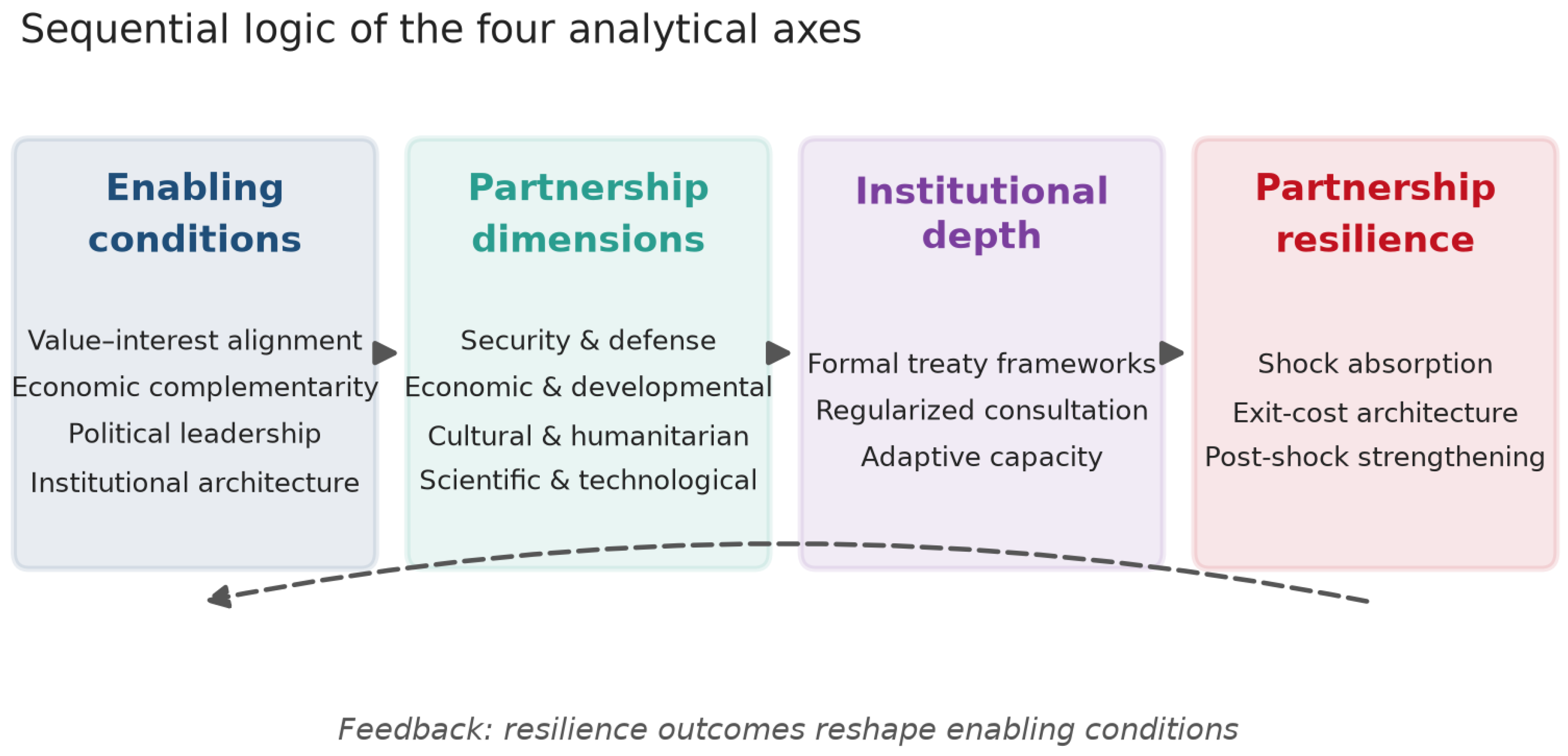
Figure 2.
Ordinal Profile of Marker Satisfaction Across the Four Partnership Models. Note. Cell values encode the qualitative assessments reported in Table 4 on a four-point ordinal scale (0 = absent, 1 = partial, 2 = substantial, 3 = strong); half-points denote assessments qualified in the underlying sources. Values summarize analytic judgments rather than measurements. Compiled by the author.
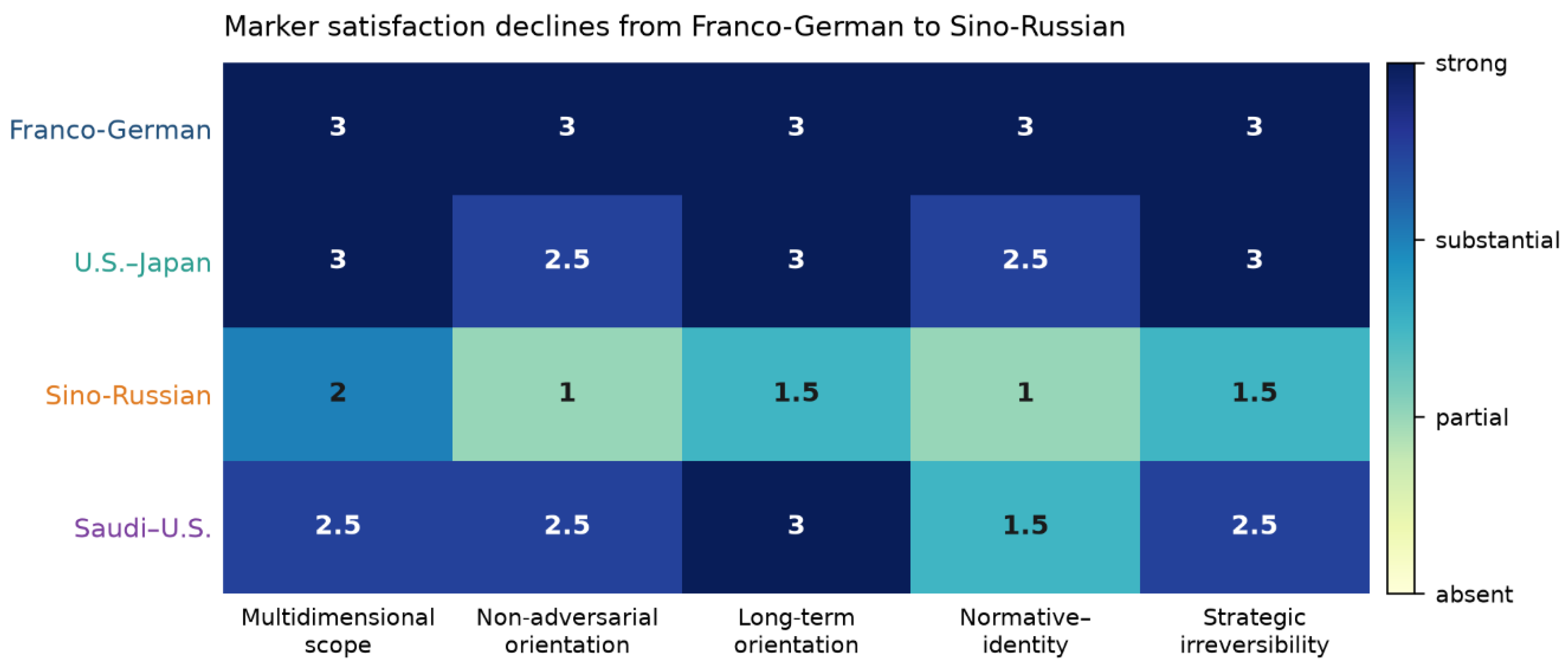
Figure 3.
Assessed Strength of the Four Enabling Conditions Across the Partnership Models. Note. Bars encode the analytic assessments developed in Section 5.3 on a four-point ordinal scale (weak, moderate, high, very high); intermediate positions denote assessments qualified in the underlying sources. Political leadership registers at comparable strength in all four cases, whereas institutional architecture varies widely. Compiled by the author from the sources cited in Section 5.3.
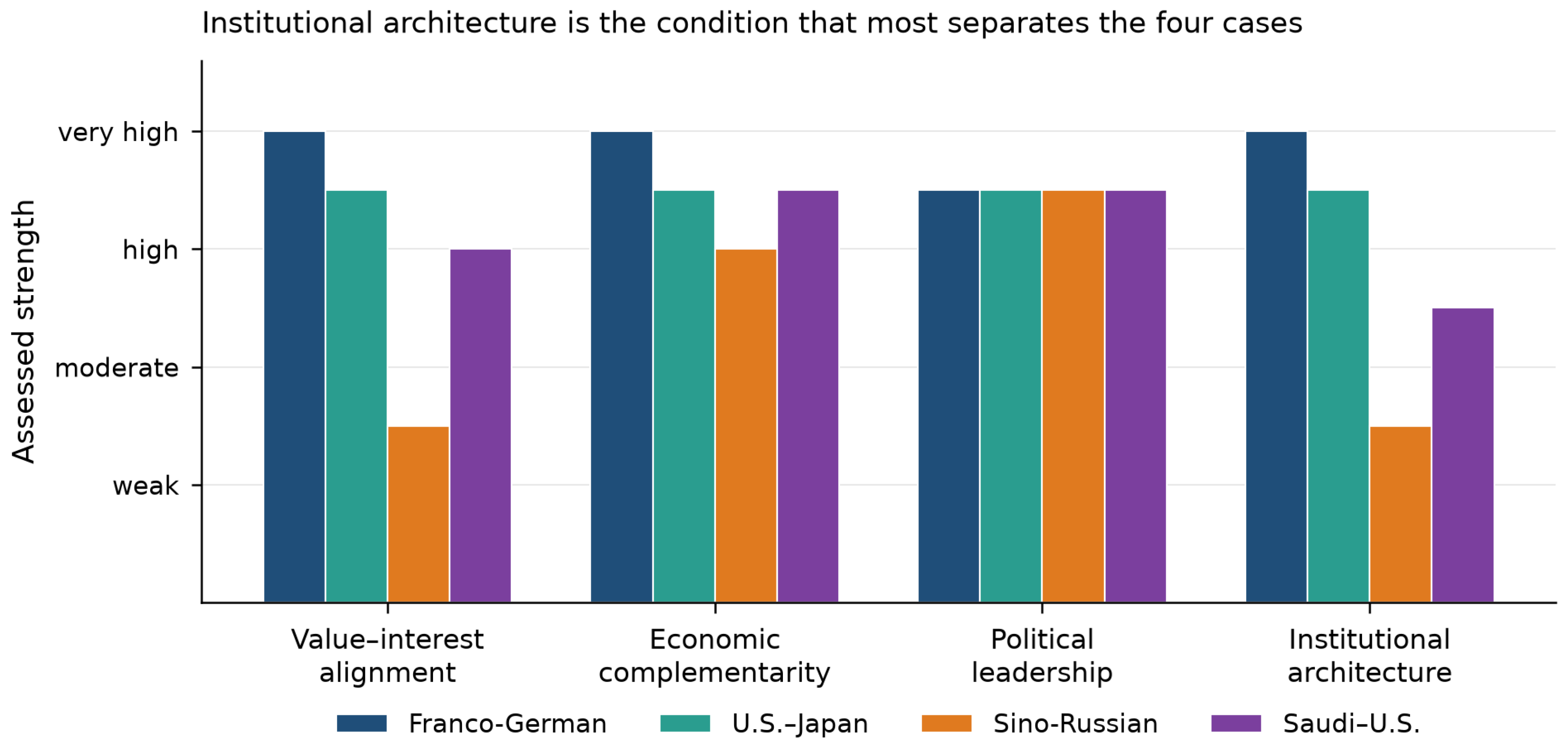
Figure 4.
Dimensional Profiles of the Four Partnership Models. Note. Radial position encodes the ordinal assessment reported in Table 6 (nascent, developing, mature, deeply embedded). Profile area indicates aggregate dimensional development and profile symmetry indicates balance; the two are analytically distinct. Compiled by the author from the sources cited in Section 5.4.1.
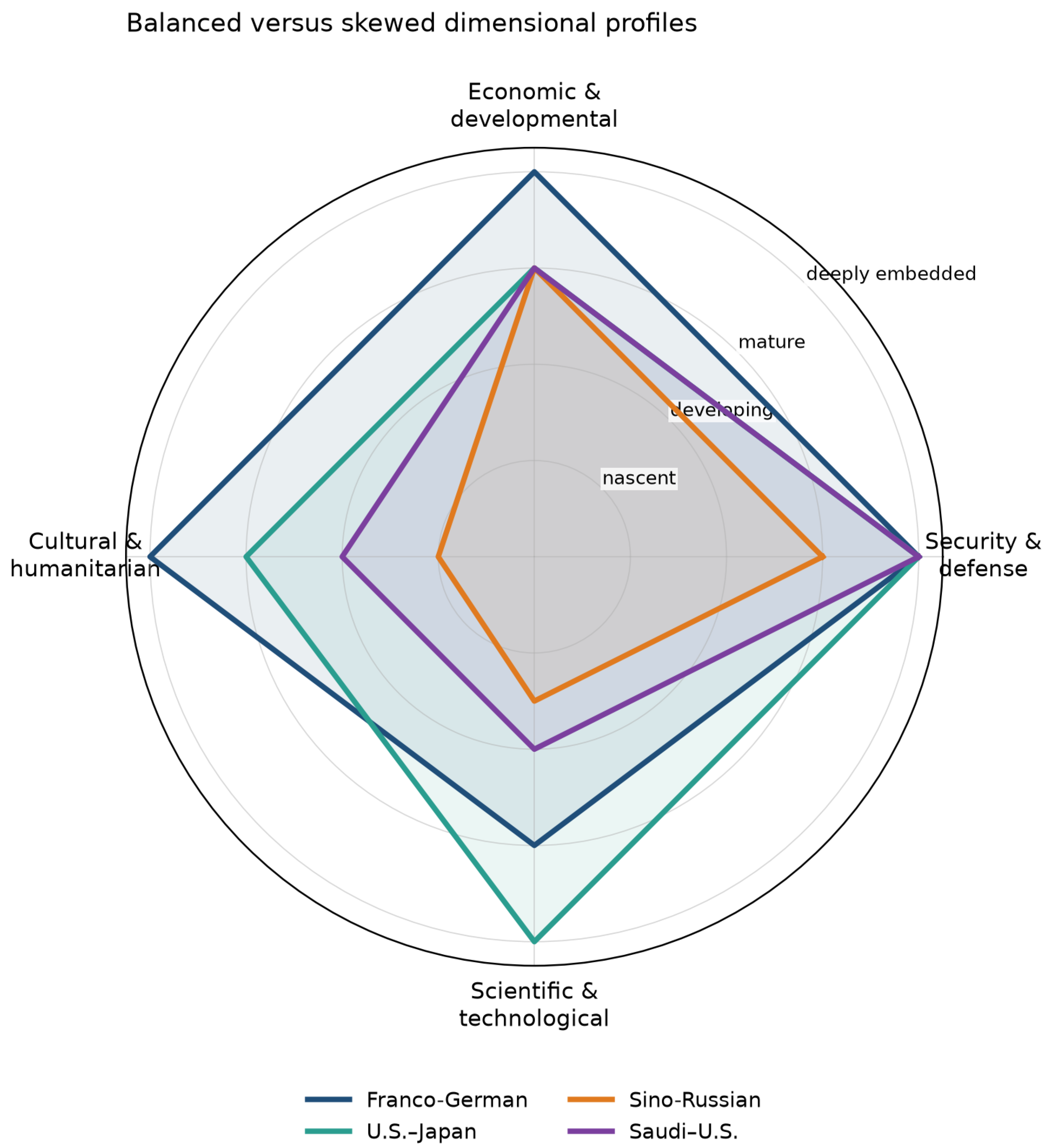
Figure 5.
Institutional Depth and Demonstrated Resilience Across the Four Partnership Models. Note. Positions encode the assessments reported in Table 7 and Table 8 on a four-point ordinal scale. The arrow indicates the direction of movement associated with the institutional framework negotiated between 2023 and 2025, not an observed outcome. Shading marks the quadrant in which both attributes are assessed above the midpoint. Compiled by the author.
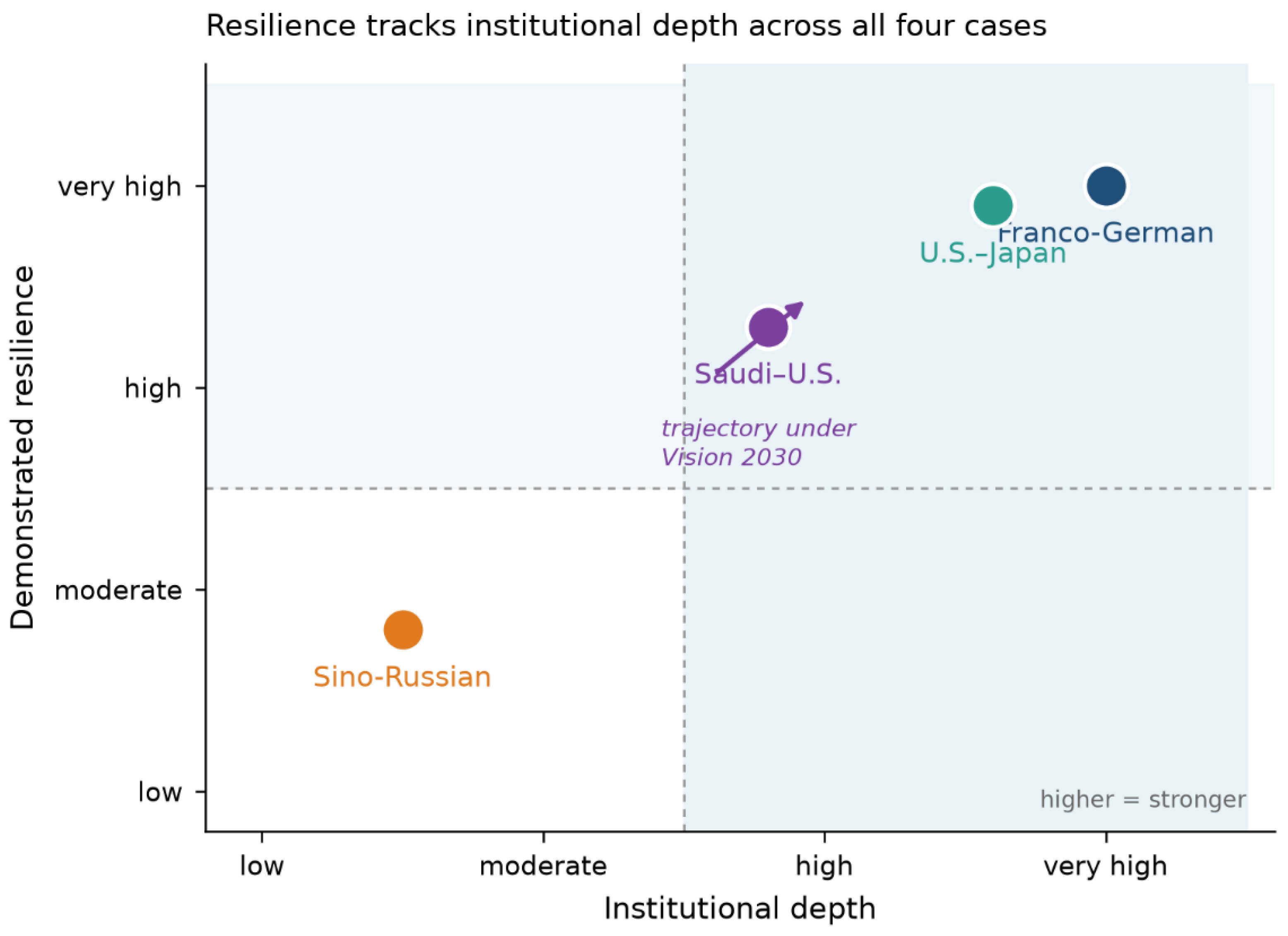
Figure 6.
Typological Spectrum of Bilateral Strategic Partnerships. Note. Horizontal position encodes composite partnership quality as synthesized in Table 9. The arrow indicates the trajectory associated with the framework negotiated between 2023 and 2025 and with the dimensional broadening pursued under Vision 2030; it denotes a projected rather than an observed position. Compiled by the author.
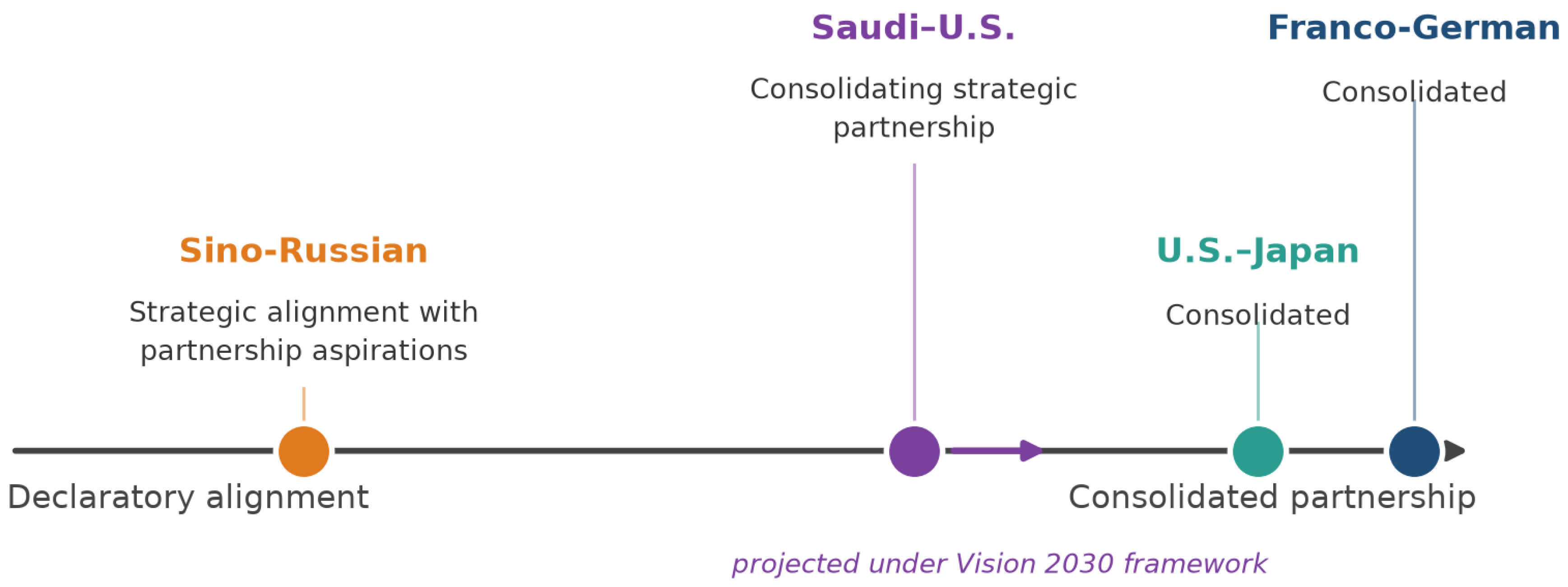

Table 1.
Principal Analytical Frameworks for Assessing Bilateral Strategic Partnerships.
| Framework focus | Core analytical claim | Constructs contributed to this study | Source |
| Alignment taxonomy | Partnership is a distinct form of alignment, not a weak alliance; alignment varies by commitment, scope, and formality | Conceptual boundary between alliance and partnership | Wilkins (2012) |
| Effective versus label partnerships | Declaratory designation without institutional depth produces no cooperative dividend | Criterion of substantive versus ceremonial partnership | Ferreira-Pereira & Vieira (2016); Ferreira-Pereira & Smith (2021) |
| Graduated partnership taxonomy | A single state’s partnership network is internally differentiated by degree of coordination | Justification for ordinal rather than binary assessment | Strüver (2017) |
| Three constitutive elements | Strategic alignment, institutional density, and partnership scope jointly determine partnership quality | Dimensional and institutional-depth axes | Envall & Hall (2016) |
| Institutionalized continuity | Formal mechanisms sustain cooperation beyond the tenure of individual leaders | Institutional architecture as an enabling condition | Kay (2000); Schade (2021) |
| Bilateralism and multilateralism | Well-designed bilateral partnerships reinforce rather than erode multilateral governance | Systemic spillover as an analytical outcome | Renard (2016) |
| Alliance complement or substitute | Partnership ties form preferentially where formal alliance commitments are absent | Explanation for partnership proliferation since 1990 | Rosendorf (2023) |
| Embedded bilateralism | Dense institutional and societal embedding converts a dyad into a structural feature of regional order | Exit-cost and irreversibility constructs | Krotz & Schild (2013, 2018) |
Note. Frameworks are ordered by their sequence of introduction in Section 2. The final column lists the works from which each construct is drawn.
Table 2.
Recent Contributions to the Study of Strategic Partnerships and Alignment, 2023–2026.
| Source | Focus and evidence base | Principal finding | Implication for the present framework |
| Rosendorf (2023) | Quantitative analysis of bilateral intergovernmental partnership ties | Partnerships form preferentially among dyads without formal alliance commitments | Partnership is a functional substitute for alliance, not a weaker variant |
| Marston (2023) | Neoclassical realist theory of hedging under great-power competition | Alignment ambiguity is a deliberate autonomy-preserving strategy | Depth and exclusivity are separable attributes of partnership |
| Calabrese (2023) | U.S., Chinese, and Gulf Arab engagement in the era of great-power competition | Gulf states deepen economic ties with China while retaining U.S. security cooperation | Multi-vector engagement need not weaken an existing partnership |
| Biba (2023) | German policy toward the United States and China after the Zeitenwende | Triangular pressures constrain the reorientation of European partnerships | External competition shapes the scope of intra-Western partnerships |
| Biscop (2023) | European defense capability development after 2022 | Declaratory transformation has outpaced structural change | Declaratory renewal is a weak indicator of institutional depth |
| Giedraityte (2023) | Theory of regional orders beyond hierarchy | Regional orders are co-produced by resident and external powers | Partnerships carry order-constituting effects beyond the dyad |
| Panda & Ohn (2024) | Indo-Pacific minilateral formats | Minilateralism rests on, rather than replaces, bilateral foundations | Bilateral consolidation is a precondition for wider architectures |
| Dee (2024) | Minilateral formats in the global nuclear order | Small-group cooperation supplements rather than supplants multilateral regimes | Supports the building-block rather than substitution thesis |
| Wilkins (2024) | U.S.–Japan–Australia trilateral cooperation | Trilateralism functions as an inner core of Indo-Pacific order building | Systemic spillover from consolidated bilateral partnerships |
| Platte (2024) | Maritime domain in U.S. Indo-Pacific deterrence strategy | Technological integration is now central to alliance credibility | Scientific-technological cooperation as a co-equal dimension |
| Kara (2024) | Turkish alignment behavior under great-power competition | Hedging is institutionalized rather than opportunistic | Middle powers exercise structural agency in partnership design |
| Keynoush (2025) | Saudi–Iranian relations and regional conflict dynamics | Regional de-escalation expands the diplomatic space available to Gulf states | Regional stabilization strengthens external partnership leverage |
| Alsrour (2026) | Saudi regional foreign policy, 2010–2025 | Recalibrated strategic hedging widens autonomy without displacing partners | Direct evidence for deliberate partnership diversification |
| Fattah (2026) | Chinese balancing between Iran and Saudi Arabia | External powers adapt to, rather than reshape, Gulf partnership structures | Resident-state agency in shaping partnership terms |
| Özkan (2026) | Energy transition strategies of Saudi Arabia and the UAE | Diversification recomposes the material base of energy partnerships | Complementarity is a dynamic, policy-shaped variable |
| Tercovich & Zaccagnini (2026) | Semiconductor governance among advanced democracies | Technology governance now carries the political weight of defense cooperation | Technology as a constitutive partnership dimension |
| Ohn et al. (2026) | Northeast Asian trilateral cooperation | Minilateral durability tracks the depth of underlying bilateral ties | Reinforces the bilateral-foundation proposition |
Table 3.
Thematic Map: Overarching Domains, Primary Themes, and Sub-Themes.
| Overarching domain | Primary theme | Sub-themes | Representative sources |
| Enabling conditions | Value–interest alignment | Convergent threat perceptions; shared developmental vision; normative proximity or divergence | Envall & Hall (2016); Lo (2015); Wilkins (2012) |
| Economic complementarity | Resource–capability matching; trade balance dynamics; investment reciprocity | Blanchard (2024); Korolev (2019); Özkan (2026) | |
| Political leadership | Leadership catalysis; leader-dependency risk; cross-administration continuity | Green (2022); Krotz & Schild (2013); Riedel (2018) | |
| Institutional architecture | Treaty-based frameworks; regularized consultation; adaptive institutional capacity | Kay (2000); Krotz & Schild (2018); Schade (2021) | |
| Partnership dimensions | Security and defense | Intelligence sharing; joint exercises; coordinated threat response; defense-industrial cooperation | Blanchard (2024); Hughes (2015); Platte (2024) |
| Economic and developmental | Trade volumes; co-investment instruments; infrastructure collaboration; macroeconomic coordination | Blanchard (2024); International Monetary Fund (2024); Lukin (2021) | |
| Cultural and humanitarian | Student and youth exchange; joint cultural institutions; diaspora linkages; media cooperation | Bronson (2006); Krotz & Schild (2013); Nye (2011) | |
| Scientific and technological | Artificial intelligence and computing; clean energy research; space collaboration; cybersecurity and semiconductor governance | Brands & Beckley (2022); Tercovich & Zaccagnini (2026); Wilkins (2024) | |
| Institutional depth | Formal institutionalization | Binding treaty obligations; joint ministerial councils; standing secretariats | Kay (2000); Krotz & Schild (2018); Schade (2021) |
| Informal institutionalization | Summit diplomacy; leader rapport; back-channel communication | Korolev (2019); Lo (2015) | |
| Partnership resilience | Shock absorption capacity | Response to geopolitical crisis; adaptation to leadership transition; economic crisis management | Envall & Hall (2016); Keynoush (2025); Sakwa (2017) |
| Exit-cost architecture | Interdependence density; sunk institutional investment; reputational costs of withdrawal | Ferreira-Pereira & Vieira (2016); Keohane (1984); Rosendorf (2023) |
Note. Themes were generated through iterative deductive–inductive thematic analysis following Braun and Clarke (2021). Representative sources are illustrative rather than exhaustive.
Table 4.
Presence of Distinguishing Partnership Markers Across the Four Cases.
| Distinguishing marker | Franco-German | U.S.–Japan | Sino-Russian | Saudi–U.S. |
| Multidimensional scope | Strongly present across all four dimensions (Krotz & Schild, 2018) | Strongly present, with particular depth in security and technology (Hughes, 2015; Platte, 2024) | Present but uneven; security and economic dimensions dominant, cultural and scientific underdeveloped (Wishnick, 2017) | Present and expanding; security and economic deeply developed, scientific-technological and cultural growing under Vision 2030 (Blanchard, 2024) |
| Non-adversarial orientation | Fully present; framed around the shared European project (Krotz & Schild, 2013) | Substantially present, though shaped by convergent threat perceptions (Green, 2022) | Partially present; significant reactive component vis-à-vis the West (Lo, 2015) | Substantially present; framed around regional stability, energy security, and economic modernization (Riedel, 2018) |
| Long-term temporal orientation | Institutionalized generational commitment since 1963 (Krotz & Schild, 2013) | Sustained over seven decades with periodic renewal (Green, 2022) | Declared but weakly institutionalized; vulnerable to leadership change (Korolev, 2019) | Rooted since 1945 and periodically renewed; Vision 2030 provides a new long-term anchor (Bronson, 2006; Kingdom of Saudi Arabia, 2016) |
| Normative–identity component | Strong: shared democratic values, European identity, reconciliation narrative (Krotz & Schild, 2013) | Moderate to strong: shared governance values and rule-of-law commitment (Hughes, 2015) | Weak: divergent governance models; alignment based on strategic interest (Lo, 2015) | Developing: governance models differ, while shared narratives of modernization, stability, and counterterrorism provide convergence (Gause, 2010; Riedel, 2018) |
| Strategic irreversibility aspiration | Very high: Airbus, integrated supply chains, joint institutions, societal constituencies (Krotz & Schild, 2018) | High: integrated alliance architecture, basing, technology co-development (Hughes, 2015; Wilkins, 2024) | Low to moderate: limited joint ventures; energy creates asymmetric lock-in (Korolev, 2019) | High: deep defense-industrial linkages, energy infrastructure, Public Investment Fund holdings in U.S. markets (Blanchard, 2024; Riedel, 2018) |
Note. Assessments are based on qualitative thematic analysis of the documentary and scholarly corpus. “Strongly present” indicates consistent evidence across multiple independent sources; “partially present” indicates evidence accompanied by significant qualifications.
Table 5.
Economic Complementarity Indicators Across the Four Partnership Models.
| Indicator | Franco-German | U.S.–Japan | Sino-Russian | Saudi–U.S. |
| Bilateral trade in goods, 2024 (approx. USD) | 190 billion (Eurostat, 2024) | 230 billion (Office of the United States Trade Representative, 2024) | 240 billion (General Administration of Customs of the People’s Republic of China, 2024) | 35 billion, supplemented by substantial defense procurement (Blanchard, 2024; U.S. Census Bureau, 2024) |
| Trade balance dynamics | Broadly balanced with a German surplus (Eurostat, 2024) | Persistent U.S. deficit, managed through consultation (Green, 2022) | Widening Chinese surplus (Lukin, 2021) | Fluctuating with shifts in U.S. domestic energy production (Blanchard, 2024) |
| Principal complementarity sectors | Aerospace, automotive, energy, and industrial supply chains (Webber, 2017) | Automotive, semiconductors, and defense technology (Hughes, 2015; Tercovich & Zaccagnini, 2026) | Energy for manufactures; raw materials for technology (Wishnick, 2017) | Energy, defense, capital and innovation, and emerging Vision 2030 sectors (Kingdom of Saudi Arabia, 2016; Özkan, 2026) |
| Reciprocal investment density | Very high; deeply integrated cross-border ownership (Krotz & Schild, 2018) | High; substantial direct investment in both directions (Green, 2022) | Low to moderate; concentrated in energy (Korolev, 2019) | Growing; Public Investment Fund holdings in U.S. markets alongside U.S. corporate presence in Saudi sectors (Blanchard, 2024) |
| Institutional economic mechanisms | Single market, monetary union, and joint industrial ventures (Krotz & Schild, 2018) | Bilateral trade committees, supply chain coordination, economic 2+2 (Hughes, 2015) | Limited bilateral payment arrangements; settlement experiments (Wishnick, 2017) | Joint Commission on Economic Cooperation, Strategic Dialogue, trade and investment framework, Vision 2030 agreements (Blanchard, 2024; Riedel, 2018) |
Note. Trade figures are approximate and drawn from the cited institutional sources; reporting conventions differ across statistical agencies, and the values are therefore indicative of magnitude rather than precisely comparable. Reciprocal investment density is assessed qualitatively.
Table 6.
Dimensional Balance Assessment Across the Four Partnership Models.
| Dimension | Franco-German | U.S.–Japan | Sino-Russian | Saudi–U.S. |
| Security and defense | Deeply embedded (Krotz & Schild, 2018) | Deeply embedded (Hughes, 2015; Platte, 2024) | Mature (Korolev, 2019; Wishnick, 2017) | Deeply embedded (Blanchard, 2024; Riedel, 2018) |
| Economic and developmental | Deeply embedded (Krotz & Schild, 2018) | Mature (Green, 2022) | Mature (Lukin, 2021) | Mature and broadening (Blanchard, 2024; Kingdom of Saudi Arabia, 2016) |
| Cultural and humanitarian | Deeply embedded (Krotz & Schild, 2013) | Mature (Green, 2022) | Nascent (Lo, 2015) | Developing, with substantial educational exchange (Bronson, 2006; Lippman, 2012) |
| Scientific and technological | Mature (Krotz & Schild, 2018) | Deeply embedded (Tercovich & Zaccagnini, 2026; Wilkins, 2024) | Nascent to developing (Korolev, 2019) | Developing rapidly across energy, computing, and space (Blanchard, 2024) |
| Overall dimensional balance | High | High | Low; pronounced security-economic skew | Moderate to high; security-economic leading with active broadening |
Note. Scale: nascent (minimal formal cooperation); developing (structured cooperation with emerging institutional mechanisms); mature (sustained and regularized cooperation within established frameworks); deeply embedded (comprehensive, treaty-based, multi-institutional cooperation with societal penetration).
Table 7.
Institutional Mechanisms of the Four Partnership Models.
| Mechanism type | Franco-German | U.S.–Japan | Sino-Russian | Saudi–U.S. |
| Binding treaty framework | Élysée Treaty (1963); Treaty of Aachen (2019) (Krotz & Schild, 2018) | Treaty of Mutual Cooperation and Security (1960, as revised) (Hughes, 2015) | Treaty of Good-Neighborliness (2001); no mutual defense clause (Wishnick, 2017) | Mutual Defense Assistance Agreement (1951); successive defense cooperation agreements; trade and investment framework (Blanchard, 2024; Riedel, 2018) |
| Regularized consultation | Joint Ministerial Council; Defense and Security Council (Krotz & Schild, 2018) | Security Consultative Committee; 2+2 ministerial meetings; economic 2+2 (Hughes, 2015) | Annual presidential summits; limited sectoral consultation (Korolev, 2019) | Strategic Dialogue; Joint Commission on Economic Cooperation; standing defense consultations (Blanchard, 2024) |
| Societal-level institutions | Franco-German Youth Office; ARTE; joint textbook commissions; university partnerships (Krotz & Schild, 2013) | JET Programme; Fulbright exchanges; sister-city networks (Green, 2022) | Limited language and cultural institutes; modest exchange programs (Lo, 2015) | King Abdullah Scholarship Program; Fulbright exchanges; expanding tourism and cultural programming (Bronson, 2006; Lippman, 2012) |
| Joint economic instruments | Airbus; single market; monetary coordination (Webber, 2017) | Supply chain coordination; technology co-development (Hughes, 2015) | Energy pipelines; limited joint ventures (Wishnick, 2017) | Aramco downstream partnerships; Public Investment Fund holdings; defense procurement programs; Vision 2030 agreements (Blanchard, 2024; Kingdom of Saudi Arabia, 2016) |
| Adaptive institutional capacity | High: Treaty of Aachen as an institutional response to crisis (Krotz & Schild, 2018) | High: progressive expansion of formats after 2022 (Platte, 2024; Wilkins, 2024) | Low: institutional innovation has not matched declaratory deepening (Korolev, 2019) | Moderate to high: repeated crisis adaptation; comprehensive framework negotiated 2023–2025 (Blanchard, 2024) |
Note. Compiled from treaty texts, official documents, and the cited scholarly sources. Institutional inventories are indicative of type and density rather than exhaustive.
Table 8.
Partnership Resilience: Responses to Exogenous Shocks, 2020–2025.
| Shock category | Franco-German | U.S.–Japan | Sino-Russian | Saudi–U.S. |
| Geopolitical crisis | Strengthened: coordinated European responses, joint defense reinforcement, energy policy tensions managed institutionally (Krotz & Schild, 2018) | Significantly deepened: revised Japanese security documents, expanded intelligence sharing, increased defense spending (Green, 2022; Platte, 2024) | Declared strengthening alongside exposed structural fragility: growing Chinese leverage and unresolved long-term divergence (Korolev, 2019) | Sustained: the Kingdom’s independent diplomatic positioning generated friction yet the partnership advanced toward a comprehensive framework (Alsrour, 2026; Blanchard, 2024) |
| Economic disruption | Managed within European frameworks; bilateral friction resolved through consultation (Krotz & Schild, 2018) | Collaborative response through semiconductor cooperation and activation of economic 2+2 (Green, 2022; Hughes, 2015) | Complementarity deepened by default as Russian links to Western markets were severed; increasingly asymmetric (Lukin, 2021; Wishnick, 2017) | Resilient: energy market coordination maintained, sovereign investment sustained, Vision 2030 diversification reduced exposure (Blanchard, 2024; Özkan, 2026) |
| Domestic political challenge | Survived successive German and French leadership transitions; populist pressures managed institutionally (Biba, 2023; Krotz & Schild, 2018) | Sustained across multiple administrations; institutionalized continuity effective (Green, 2022) | Highly exposed: trajectory tied to leader rapport with no succession mechanism (Lukin, 2021) | Demonstrated continuity across successive U.S. administrations; defense and energy architecture provided structural stability (Bronson, 2006; Riedel, 2018) |
Note. Assessments are based on thematic analysis of policy documents, official communiqués, and the cited scholarly analyses covering the period 2020–2025.
Table 9.
Typological Placement of the Four Partnership Models.
| Typological attribute | Franco-German | U.S.–Japan | Saudi–U.S. | Sino-Russian |
| Marker satisfaction | Full (5 of 5) | Substantial (4.5 of 5) | Substantial (4 of 5) | Partial (2.5 of 5) |
| Enabling conditions | Very high across all four | High across all four | High; interest alignment strong, normative convergence developing, institutional architecture expanding | Moderate; institutional architecture weak |
| Dimensional balance | High | High | Moderate to high; security-economic leading with active broadening | Low; pronounced security-economic skew |
| Institutional depth | Very high and adaptive | High and adaptive | Moderate and expanding, with demonstrated adaptive capacity | Low and leader-dependent |
| Resilience | Very high | Very high | Demonstrated through severe crises; concentrated in the security-energy pillars | Apparent but structurally fragile |
| Typological classification | Consolidated strategic partnership | Consolidated strategic partnership | Consolidating strategic partnership | Strategic alignment with partnership aspirations |
Note. Marker satisfaction is a composite of the ordinal assessments reported in Table 4 and Figure 2. Typological classifications are proposed by the author on the basis of the integrated cross-case analysis presented in Section 5.2 through 5.4.
Disclaimer/Publisher’s Note: The statements, opinions and data contained in all publications are solely those of the individual author(s) and contributor(s) and not of MDPI and/or the editor(s). MDPI and/or the editor(s) disclaim responsibility for any injury to people or property resulting from any ideas, methods, instructions or products referred to in the content. |
© 2026 by the authors. Licensee MDPI, Basel, Switzerland. This article is an open access article distributed under the terms and conditions of the Creative Commons Attribution (CC BY) license (http://creativecommons.org/licenses/by/4.0/).
Copyright: This open access article is published under a Creative Commons CC BY 4.0 license, which permit the free download, distribution, and reuse, provided that the author and preprint are cited in any reuse.