

Submitted:
20 March 2026
Posted:
24 March 2026
You are already at the latest version
Abstract
Accurate blood pressure (BP) monitoring traditionally relies on acoustic auscultation, but the mechanical microvibrations underlying Korotkoff sound (K-sound) generation remain insufficiently characterized. This study proposes a microvibrometric sensing strategy using a high-sensitivity semiconductor piezoresistive sensor (K-sensor) to capture pulse-resolved mechanical signatures during cuff deflation, circumventing the limitations of conventional air-conducted acoustic detection. Through expert-consensus annotation with simultaneous acoustic references, a coupling relationship between microvibration morphology and K-sound occurrence was established. A convolutional neural network (CNN) was implemented to automate the identification of K-sound–coupled (cK) pulses from microvibration signals. Across seven independent train–test splits in 49 healthy participants, the model achieved a recall of 93.1% ± 4.3% and a balanced accuracy of 95.0% ± 2.0%, with mean biases of 0.30 ± 2.25 mmHg for systolic BP (SBP) and −0.14 ± 2.14 mmHg for diastolic BP (DBP). Beyond classification performance, two distinct morphological archetypes—characterized as notch-type and shoulder-type waveforms—were consistently observed among cK pulses, reflecting differentiated patterns of arterial wall dynamics associated with K-sounds. These findings support microvibration sensing as a physiologically grounded and sensor-centric framework for automated noninvasive cardiovascular assessment beyond conventional acoustic paradigms.
Keywords:
blood pressure measurement
; Korotkoff sound
; microvibration detection
; semiconductor piezoresistive sensor
; pulse wave analysis
; non-invasive monitoring
1. Introduction
Hypertension is a major global health burden, contributing to over ten million deaths annually and representing the most important modifiable determinant of cardiovascular disease (CVD) [1]. Effective management of blood pressure (BP) reduces cardiovascular mortality [2], emphasizing the need for precise and consistent BP assessment. The clinical standard for non-invasive BP measurement is the auscultatory method [3,4], in which Korotkoff sounds (K-sounds), first described in 1905 [5], are detected with a stethoscope during cuff deflation to determine systolic and diastolic pressures. Although the auscultatory method is widely used, it depends heavily on skilled operators, making it not only vulnerable to human error but also sensitive to external environmental noise [4,6,7].
To reduce operator dependency, oscillometric devices estimate BP by analyzing cuff pressure oscillations, eliminating reliance on auscultation [8,9]. Despite their convenience, oscillometric measurements can deviate from auscultatory readings due to the use of empirical algorithms and the subjective interpretation of oscillometric waveforms [10,11]. These deviations are particularly pronounced in individuals with arterial stiffness or altered vascular compliance [12,13]. Moreover, the widespread use of non-validated oscillometric devices in clinical and home settings has been associated with inconsistent accuracy, increasing the risk of misdiagnosis or inappropriate hypertension management [14,15,16].
These limitations have renewed interest in Korotkoff sound-based approaches for improved BP measurement. Recent advances in non-invasive monitoring have explored various sensor technologies and signal processing methods to detect K-sounds. MEMS-based piezoresistive pressure sensors have been applied to capture arterial wall vibrations, enabling accurate detection of heart sounds and K-sounds [17,18]. PVDF film-based sensors have also demonstrated feasibility for automatic K-sound detection, highlighting the potential for integrating microvibration signals into BP estimation [19]. Signal processing methods, ranging from semi-automated analyses to advanced machine learning, have further enhanced detection precision and enabled automated BP estimation from K-sound recordings [20,21,22,23,24,25,26,27]. However, most approaches remain at the research prototype stage, and few have been fully implemented in commercial devices [18].
Recent studies have revisited the fundamental mechanisms underlying K-sound generation. Using ultrafast ultrasound imaging, Baranger et al. demonstrated that K-sounds are not acoustic waves directly emitted from the brachial artery but are rather shear vibrations transmitted through surrounding tissues via nonlinear pulse wave propagation, which are subsequently detected by the stethoscope [28]. This mechanistic clarification provides a biophysical foundation for improving BP measurement by linking K-sounds to arterial mechanical properties, complementing prior work focused primarily on sensor or signal processing innovations.
Building on these insights, this study introduces a high-precision microvibrometric sensing system specifically engineered to capture these primary mechanical vibrations. At its core is a semiconductor piezoresistive K-sensor, optimized for high-fidelity detection of subtle arterial microvibrations. To robustly identify physiological landmarks, we implemented an automated classification framework that transforms 1D microvibration waveforms into 2D morphological encodings, enabling the CNN module to effectively extract distinctive features for differentiating K-sound–coupled (cK) pulses from non–K-sound–coupled (n-cK) signals. By prioritizing the direct mechanical origin of K-sounds over secondary acoustic emissions, this approach provides a physiologically grounded framework for non-invasive BP monitoring. As a feasibility assessment to establish this fundamental detection framework, the current study utilized a primarily normotensive cohort (>95%), allowing for stable characterization of microvibration signatures and model optimization within a consistent physiological range. This work establishes a direct pathway from arterial microvibrations to K-sound detection, laying the foundation for future clinical validation across diverse patient populations.
2. Results and Discussion
2.1. Sensor Characterization and Functional Validation
The finalized K-sensor was validated for its capability to resolve subtle arterial microvibrations. The overall structural configuration and photographs of the assembled sensor are illustrated in Figure 1. By integrating semiconductor piezoresistive elements (Figure 1a, D), the sensor achieves a substantially higher gauge factor compared to conventional metal-based or piezoelectric strain gauges [29,30,31,32,33]. This sensitivity is critical for capturing the low-frequency, small-amplitude mechanical strains that characterize Korotkoff sounds. Experimental results indicate that the phosphor bronze substrate effectively facilitates high-fidelity vibration transmission while providing inherent structural stability against environmental disturbances [34,35]. This structural design ensures that the sensor can reliably capture the subtle morphological variations embedded within each pulse.
Applying the waveform extraction and labeling procedure to data from all 49 healthy volunteers yielded 3,378 individual pulse waveforms, including 1,300 cK and 2,078 n-cK pulses. Although cK pulses occurred within a limited pressure range during cuff deflation, the overall class distribution remained moderately balanced (38.5% vs. 61.5%). Representative labeled pulse sequences from four participants are shown in Figure 2. To illustrate inter-individual variability, participants with the lowest and highest detected cK counts were selected: Figure 2(a–d) correspond to participant #33 (female, lowest cK count), participant #28 (female, highest cK count), participant #05 (male, lowest cK count), and participant #34 (male, highest cK count). Two characteristic morphological patterns were observed among cK pulses (Figure 2), which motivated a detailed morphological analysis to further characterize the pulse waveforms.
2.2. Pulse Morphology Analysis
Building on the pulse labeling described above, the morphological characteristics of cK pulses were analyzed. Two distinctive patterns were identified (Figure 2): notch-type and shoulder-type waveforms. The notch-type morphology is characterized by a downward notch near the main peak and was more frequently observed during the middle phase of cuff deflation. The notch-type cK pulse typically corresponds to a crisper, higher-pitched K-sound and may be associated with the “tapping” or “knocking” phases of K-sounds (Phases II and III) [36,37]. In contrast, the shoulder-type morphology exhibits an upward shoulder adjacent to the main peak and appeared predominantly in the early and late deflation phases, accompanied by more subdued, lower-pitched acoustic characteristics. These features indicate that the shoulder-type cK pulse occurs predominantly during the onset (Phase I) and disappearance (Phase V) of K-sounds and is associated with “swishing” or “muffled” acoustic qualities [37,38]. In comparison, n-cK pulses lacked secondary morphological features and displayed smoother, single-peak contours.
These observations, obtained through visual inspection and cross-checked with audible K-sound records by a panel of experts, showed a high degree of consistency between the microvibration waveforms and the corresponding audio signals, suggesting that arterial microvibrations represent the mechanical basis of the corresponding acoustic signals. The reproducibility of these morphological patterns across participants and sexes suggests that the waveform features reflect intrinsic arterial dynamics during cuff deflation rather than subject-specific artifacts. Prior studies have primarily analyzed K-sounds from an acoustic perspective, relating spectral characteristics to vascular compliance and cardiac function [27,39,40]. By directly capturing arterial wall microvibrations, the present work provides a mechanical perspective that complements acoustic findings, indicating that waveform morphology may serve as a physiologically grounded marker.
Overall, these results demonstrate that the K-sensor can reliably resolve individual microvibrations associated with K-sound events. The ability to distinguish notch- and shoulder-type pulses extends conventional K-sound analysis and provides insight into the temporal dynamics of arterial vibrations, with potential applications for noninvasive assessment of vascular properties.
2.3. Validation of K-sound–Coupled Pulse Detection
The classification system applied to individual pulse signals recorded by the K-sensor demonstrated consistently strong performance in distinguishing cK pulses from n-cK pulses across seven independent train–test splits. Boxplots in Figure 3 show the distribution of recall, F1-score, balanced accuracy, and overall accuracy across these trials. Minor oscillations were observed in the validation loss during the first 4–12 epochs; however, all configurations converged reliably thereafter without signs of overfitting, indicating stable training dynamics. The performance metrics across the seven splits are reported as mean ± SD (median). The recall, F1-score, balanced accuracy, and overall accuracy were 93.1% ± 4.3% (93.2%), 94.0% ± 2.1% (93.8%), 95.0% ± 2.0% (95.0%), and 95.4% ± 1.8% (95.4%), respectively. Notably, a single outlier was observed in the Recall metric (85.2%) in one of the seven splits, while performance remained highly consistent across the remaining test sets.
In addition to balanced accuracy, class-specific error rates—false negative rate (FNR) and false positive rate (FPR)—were reported to account for potential effects of the moderate class imbalance (cK 38.5% vs. n-cK 61.5%). Evaluated over all pulses in each train–test split, the mean FNR and FPR were 6.9% ± 4.3% (6.8%) and 3.0% ± 1.1% (2.9%), respectively, demonstrating a reliable resolution of cK pulse onset and offset for downstream BP estimation.
The distribution of performance metrics reveals that the model is sensitive to the physiological variability of specific subjects, particularly when they are exclusively represented in the 20% test group. A single outlier in Recall (approx. 85.2%) and the second-lowest value (90.9%) were both traced back to data splits involving Subject #38. Due to the indistinct and atypical cK pulse waveform sequences of this subject, the model exhibited elevated FNRs of 14.8% and 9.1%, respectively. However, no such degradation occurred when Subject #38 was included in the 80% training group, indicating that the model is capable of learning these subtle features if they are represented during the training phase. Excluding the split with the 14.8% FNR reduces the mean FNR from 6.9% ± 4.3% to 5.6% ± 2.7%, while the FPR remains stable (3.3% ± 1.0%). These observations underscore that the system remains robust, and occasional performance dips arise from rare, individual-specific patterns rather than systematic deficiencies.
To contextualize these low misclassification rates within the field of automated K-sound analysis, we reference a deep learning-based system developed by Pan et al. [25]. Their system relied on stethoscope-recorded acoustic signals converted into time–frequency images for a CNN–LSTM model. For comparison, we converted their reported per-class sensitivity and specificity into FNR and FPR (FNR = 1 − sensitivity; FPR = 1 − specificity). Their system yielded FNR/FPR values of 0.0%/11.9% for Normal, 37.5%/0.0% for Elevated, and 9.6%/3.2% for Hypertension categories. Since our dataset consisted predominantly of normotensive participants (>95%), the “Normal” category in their study provides the most appropriate benchmark. While their system achieved a 0.0% FNR, it exhibited a substantially higher FPR (11.9%). In contrast, our K-sensor–based system maintained a more balanced performance with both a low FNR (6.9%) and a markedly lower FPR (3.0%), suggesting reduced susceptibility to environmental noise and a more favorable trade-off between missed and spurious detections.
Inspection of individual waveforms revealed notable variability across participants. Some sequences contained early-phase shoulder-type cK pulses followed by notch-type and then late-phase shoulder-type pulses (Figure 2(a, c, d)), whereas others displayed only notch-type pulses followed by late-phase shoulder-type pulses (Figure 2(b)). Misclassifications occurred predominantly during transitions between cK and n-cK pulses. For example, the final cK pulses in Figure 2(a) and Figure 2(d) were misclassified as n-cK despite exhibiting late-phase shoulder characteristics. Since late-phase cK events primarily inform diastolic BP (DBP) estimation, such false negatives are expected to affect DBP rather than systolic BP (SBP) readings. In contrast, early-phase notch-type events, which are critical for SBP identification, were detected more consistently. False positives predominantly occurred in n-cK pulses immediately following a true cK pulse. These observations suggest that the slightly higher FNR reflects inherent physiological variability in late-phase cK pulses rather than limitations of the classification system.
Overall, these results demonstrate that the proposed system provides reliable detection of cK microvibrations. Building on this detection performance, the microvibrometric system was further evaluated for non-invasive BP estimation.
2.4. Blood Pressure Estimation Using the Proposed Microvibrometric System
Automated BP estimates obtained using the proposed microvibrometric system showed strong agreement with reference measurements obtained from an oscillometric device (Omron HEM-907), as illustrated in Figure 4. Bland–Altman analysis revealed a mean bias of 0.30 ± 2.25 mmHg for systolic BP (SBP) and −0.14 ± 2.14 mmHg for diastolic BP (DBP), with 95% limits of agreement (LoA) of −4.11 to 4.71 mmHg and −4.33 to 4.05 mmHg, respectively. No proportional bias was observed across the measured BP range, indicating consistent agreement between microvibrometric estimates and the reference method. Most participants (>95%) had BP values within the normal range, highlighting the reliability of cK pulse detection for BP estimation in this healthy cohort.
The observed agreement with reference oscillometric BP measurements indicates that cK microvibration detection can be translated into precise SBP and DBP estimates. According to the AAMI/ISO 81060-2:2018 standard, device validation requires a mean difference ≤ 5 mmHg and a standard deviation ≤ 8 mmHg. Although this study does not constitute a formal clinical validation trial and BP values were compared against an oscillometric reference rather than a mercury sphygmomanometer, the minimal bias and narrow LoA observed here are well within these international thresholds. These results demonstrate the feasibility of cK sensor-based microvibration methods for non-invasive BP monitoring in healthy individuals. Further studies are warranted to evaluate performance in hypertensive and broader clinical populations.
2.5. Limitations and Future Perspectives
Several limitations of the present study should be acknowledged. First, this study was primarily designed as a feasibility assessment to establish the fundamental detection framework of the K-sensor system, and the cohort consisted predominantly of normotensive participants (>95%). Focusing on a stable physiological range facilitated the initial characterization of microvibration signatures and model optimization, but it limits immediate generalizability to broader clinical populations. Future studies will recruit a more diverse distribution of BP phenotypes, including hypertensive and hypotensive individuals, to evaluate performance across varying arterial compliance conditions, in alignment with formal clinical validation protocols such as AAMI/ISO 81060-2.
Second, all measurements were conducted under controlled conditions in a standard classroom without dedicated acoustic insulation. The cuff deflation rate was carefully regulated, and participants remained at rest throughout the recordings. While these conditions ensured high-fidelity capture of microvibration waveforms, practical or ambulatory settings may introduce environmental noise, variable deflation speeds, and subject motion, all of which could influence signal clarity. Future studies will extend measurements to more diverse clinical environments and dynamic physiological states, including ambulatory conditions and variable cuff deflation rates, to further evaluate the robustness of cK pulse detection under real-world scenarios. Adaptive signal processing techniques, such as motion-artifact filtering and active noise cancellation, will also be explored to maintain signal quality without compromising sensor performance.
Finally, the physical mechanisms underlying the consistently observed notch-type and shoulder-type waveforms in cK pulses warrant further investigation. Advanced computational modeling, including fluid–structure interaction (FSI) simulations, could elucidate how vessel wall properties—such as thickness, elasticity, and local geometry—contribute to these characteristic waveforms. Understanding these relationships may enable the K-sensor platform to extend beyond BP estimation toward non-invasive assessment of vascular stiffness and other hemodynamic parameters. Future system iterations will also explore adaptive signal processing strategies, including motion-artifact filtering and active noise cancellation, to maintain robust signal quality under variable physiological and environmental conditions.
3. Experimental Section
3.1. K-Sensor Fabrication and Structural Configuration
The K-sensor was fabricated using a multi-layer assembly process to optimize the detection of low-amplitude arterial microvibrations, as detailed in the exploded view in Figure 1a. The core sensing element consists of a high-sensitivity semiconductor piezoresistive strain gauge (D) mounted onto a 0.1-mm-thick phosphor bronze substrate (E) with a 25-mm diameter using a high-performance adhesive layer (C). Phosphor bronze was selected as the substrate material for its excellent mechanical compliance and fatigue resistance, which ensures high-fidelity transmission of arterial wall vibrations to the strain gauge.
To ensure structural integrity and minimize environmental interference, the sensing assembly is housed within a 3-mm-thick aluminum frame (B) and protected by a rigid plastic cover (A). Finally, a biocompatible coating (F) was applied to the skin-contacting surface to ensure safe, stable, and irritation-free contact during experimental measurements. This structural configuration allows the sensor to resolve subtle mechanical signatures associated with individual K-sound events, as demonstrated in the preceding morphological analysis.
3.2. Experimental Setup
This study was designed as a methodological feasibility investigation to validate the capability of the developed K-sensor to resolve arterial microvibrations and discriminate cK pulses from pulse-only vibrations. The objective was focused on the functional verification of sensing performance and waveform discrimination rather than clinical hypertension assessment.
A total of 49 healthy volunteers (19 males and 30 females) were recruited in accordance with the study protocol approved by the Research Ethics Committee of National Tsing Hua University (REC No. 1110HM0098). All participants had previously undergone routine cardiology examinations confirming normal cardiac health and provided written informed consent. The demographic and anthropometric characteristics of the participants are summarized in Table 1. The mean age was 26.2 ± 5.2 years (range 22–49), with mean height, weight, and body mass index (BMI) of 163.7 ± 9.2 cm, 58.9 ± 12.9 kg, and 21.2 ± 3.1 kg/m2, respectively. BP measurements obtained during the study were primarily within normotensive ranges (systolic BP (SBP) 71–149 mmHg; diastolic BP (DBP) 54–96 mmHg), with only one participant exceeding SBP 140 mmHg and one different participant exceeding DBP 90 mmHg.
Figure 5 illustrates the measurement setup and signal acquisition workflow. All measurements were conducted in a standard classroom environment without dedicated acoustic insulation, reflecting typical clinical or practical measurement conditions. Each participant underwent three repeated measurements with at least a one-minute interval. The cuff was inflated to 180 mmHg and gradually deflated to 40 mmHg while the K-sensor recorded continuous microvibration oscillograms. The sensor was integrated with a standard oscillometric BP cuff (HEM-907; Omron Healthcare, Kyoto, Japan) to synchronize microvibration signals with cuff pressure. To ensure consistent positioning across measurements, the K-sensor was secured within a custom-designed pouch embedded in the cuff, which maintained stable sensor orientation and firm skin contact during both inflation and deflation. Simultaneous acoustic recordings were obtained via a stethoscope solely for ground-truth annotation and were neither used as input for automated classification nor involved in the final BP estimation. Vibration, audio, and cuff pressure signals were synchronously digitized using NI 9234 and NI 9171 data acquisition modules (National Instruments, Austin, TX, USA), recorded in LabVIEW (National Instruments), and subsequently processed in Python for waveform segmentation, dual-scale encoding, and CNN-based pulse classification (cK vs. n-cK), providing the basis for automated pulse labeling and subsequent BP estimation.
3.3. Signal Preprocessing and Image Encoding
The oscillogram recorded by the K-sensor consisted of continuous pulse beats, each exhibiting a distinct peak (Figure 6(a)). A custom Python algorithm automatically detected local peaks and segmented the signal into single-pulse waveforms. To maintain traceability, each waveform was assigned a unique sequential label (e.g., Subject–Test–Pulse, e.g., 01–001–01) that was preserved throughout the processing pipeline.
To capture microvibration features within each pulse, a dual-scale extraction strategy was applied to each detected peak. A global-scale window of 500 pixels (250 pixels on each side) captured the full pulse morphology. Simultaneously, a local-scale window of 350 pixels (175 pixels on each side of the peak) was applied to focus on fine-scale variations around the peak. This local window was then rescaled to a total width of 500 pixels to enhance local detail. For consistent image representation across all waveforms, the peak-to-trough amplitude of each segment was normalized to 380 pixels, resulting in all waveforms being standardized to a uniform image size of 500 × 380 pixels.
Raw waveforms were subsequently smoothed using a Savitzky–Golay filter to reduce high-frequency noise while preserving critical morphological transitions (Figure 6(c–d), raw vs. smooth). The resulting segments were transformed into high-contrast black–white (HCB) images by filling the area beneath the waveform contour, producing the final images used for CNN analysis (Figure 6(c–d), final HCB). This encoding approach enhanced morphological contrast while preserving key features of individual pulse waveforms. By combining both extraction scales, the dual-scale HCB dataset provided additional training examples.
3.4. Labeling of K-Sound–Coupled Pulses
The coupling relationship between microvibration morphology and K-sound occurrence was established through synchronized playback of continuous pulse waveforms and corresponding acoustic recordings. Five independent experts reviewed the data along a shared time axis to identify cK pulses and to confirm the association between notch- or shoulder-type morphologies and characteristic acoustic features. Each pulse was labeled as cK only after thorough discussion and unanimous agreement among all five experts, ensuring that all labeled pulses reflect a fully validated consensus.
Each segmented microvibration waveform was subsequently assigned a label indicating whether it was associated with K-sound (cK, 1) or not (n-cK, 0). Acoustic recordings were used solely for ground-truth coupling during expert annotation and were neither provided as inputs to CNN nor used for automated BP determination. All classification and BP estimation procedures relied exclusively on microvibration waveforms.
3.5. CNN Architecture and Training
A ResNet50V2-based 2D-CNN [41] was implemented as a standardized feature-recognition tool to classify microvibration signals recorded by the K-sensor. Owing to its proven robustness in medical imaging and sophisticated feature extraction layers, the ResNet50V2 architecture was selected to automate the detection of cK pulses. The CNN was implemented in TensorFlow [42] and trained end-to-end with all layers set as trainable. A dropout rate of 0.1 was applied to mitigate overfitting. The initial learning rate was set to 2.5 × 10⁻⁴ and adaptively reduced to 1 × 10⁻⁶ during training.
To ensure rigorous validation and prevent subject-level data leakage, a leave-p-subjects-out cross-validation scheme was applied across seven independent random splits. In each split, participants were partitioned at the subject level into training (80%) and testing (20%) sets, ensuring that all dual-scale HCB encodings from a given participant were assigned exclusively to either the training or testing set. Model performance was evaluated on held-out test subjects using several metrics: Recall (Sensitivity), F1-score, Balanced Accuracy, Accuracy, Validation Loss (binary cross-entropy), False Negative Rate (FNR), and False Positive Rate (FPR). Results are reported as mean ± standard deviation (median in parentheses) across the seven independent splits.
To visualize the distribution of these metrics, box plots are provided, where the box denotes the Interquartile Range (IQR) calculated using the inclusive median method. This cross-subject validation scheme ensures that the CNN was tested on previously unseen individuals, providing an unbiased assessment of its generalizability.
3.6. Automated BP Estimation
Detected cK pulses were mapped back to the original oscillogram and synchronized with cuff pressure measurements. Systolic and diastolic BP were derived from the cuff pressures corresponding to the first and last detected cK pulses, respectively (Figure 7). The automated BP estimation was driven entirely by the microvibration waveform classification results, independent of direct acoustic input.
4. Conclusions
This study demonstrates a microvibrometric platform for non-invasive blood pressure (BP) assessment that directly captures arterial wall microvibrations, the mechanical correlates of Korotkoff sounds. Using an optimized semiconductor piezoresistive K-sensor, the system reliably recorded subtle waveform features, including distinct notch- and shoulder-type morphologies, reflecting physiologically meaningful variations in arterial pulse dynamics. Integrated with an automated feature-recognition framework, the platform enabled consistent detection of K-sound–coupled (cK) pulses across participants. Blood pressure estimates derived from these measurements closely agreed with reference oscillometric readings, with minimal bias (SBP: 0.30 ± 2.25 mmHg; DBP: −0.14 ± 2.14 mmHg) observed within the studied cohort. Although this work does not constitute a formal AAMI/ISO/ESH clinical validation, the results confirm the feasibility of microvibration-based BP estimation under controlled conditions. Beyond conventional BP measurement, the identified waveform morphologies provide a foundation for further exploration of arterial wall dynamics, vascular stiffness, and waveform-based hemodynamic assessment in future studies.
Author Contributions
Conceptualization: K.-I.L. and P.-C.L.; methodology, K.-I.L. and I.-C.H.; software: L.-J.W. and S.-C.C.;validation, K.-I.L., I.-C.H. and Y.-N.C.; formal analysis, K.-I.L., I.-C.H. and P.-C.L.; investigation, K.-I.L., I.-C.H., P.-Y.T., L.-J.W., S.-C.C. and Y.-N.C.; data curation, K.-I.L., I.-C.H., P.-Y.T., L.-J.W., S.-C.C. and Y.-N.C.; writing—original draft preparation, K.-I.L. and I.-C.H.; writing—review and editing, P.-C.L.; supervision, C.-C.C., C.-C.L. and P.-C.L.; project administration, K.-I.L. and P.-C.L.; resources, K.-I.L. and P.-C.L. All authors have read and agreed to the published version of the manuscript.
Funding
This research was funded by Nexvita Technology Corporation.
Conflicts of Interest
Authors K.-I.L.: P.-Y.T., L.-J.W., S.-C.C., Y.-N.C. and C.-C.C. are employees of Nexvita Technology Corporation. The proposed microvibrometric blood pressure estimation method constitutes part of the core technology of commercial products currently being developed by the company. The remaining authors declare no conflict of interest. All authors had full access to the data and contributed to the study design, data analysis, interpretation of results, and manuscript preparation. The company had no role in the decision to publish the results.
References
- World Health Organization. Hypertension. Available online: https://www.who.int/news-room/fact-sheets/detail/hypertension (accessed on 13 March 2026).
- Ettehad, D.; Emdin, C.A.; Kiran, A.; Anderson, S.G.; Callender, T.; Sayeed, H.; Casadei, B.; Rahimi, K. Blood pressure reduction for prevention of cardiovascular disease and death: a systematic review and meta-analysis. Lancet 2016, 387, 957–967. [Google Scholar] [CrossRef] [PubMed]
- Muntner, P.; Einhorn, P.T.; Cushman, W.C.; Whelton, P.K.; Bello, N.A.; Drawz, P.E.; Glenn, M.J.; Jaffe, M.G.; Johnson, K.C.; Jones, D.W.; et al. Measurement of blood pressure in humans: a scientific statement from the American Heart Association. Hypertension 2019, 73, e35–e66. [Google Scholar] [CrossRef] [PubMed]
- Pickering, T.G.; Hall, J.E.; Appel, L.J.; Falkner, B.E.; Graves, J.; Hill, M.N.; Jones, D.W.; Kurtz, T.; Sheps, S.G.; Roccella, E.J. Recommendations for blood pressure measurement in humans and experimental animals: Part 1: Blood pressure measurement in humans. Circulation 2005, 111, 697–716. [Google Scholar] [CrossRef] [PubMed]
- Shevchenko, Y.L.; Tsitlik, J.E. 90th Anniversary of the development by Nikolai S. Korotkoff of the auscultatory method of measuring blood pressure. Circulation 1996, 94, 242–246. [Google Scholar] [CrossRef]
- O’Brien, E.; Asmar, R.; Beilin, L.; Imai, Y.; Mancia, G.; Mengden, T.; Myers, M.; Padfield, P.; Palatini, P.; Parati, G.; et al. European Society of Hypertension recommendations for conventional, ambulatory and home blood pressure measurement. J. Hypertens. 2003, 21, 821–848. [Google Scholar] [CrossRef]
- Stergiou, G.S.; Palatini, P.; Parati, G.; O’Brien, E.; Januszewicz, A.; Lurbe, E.; Persu, A.; Mancia, G.; Kreutz, R. 2021 European Society of Hypertension practice guidelines for office and out-of-office blood pressure measurement. J. Hypertens. 2021, 39, 1293–1302. [Google Scholar] [CrossRef]
- Drzewiecki, G.; Hood, R.; Apple, H. Theory of the oscillometric maximum and the systolic and diastolic detection ratios. Ann. Biomed. Eng. 1994, 22, 88–96. [Google Scholar] [CrossRef]
- Lewis, P.S.; Caulfield, M.J.; Macdonald, J.E.; Ford, T.J.; Simpson, A.J. Oscillometric measurement of blood pressure: a simplified explanation. A technical note on behalf of the British and Irish Hypertension Society. J. Hum. Hypertens. 2019, 33, 349–351. [Google Scholar] [CrossRef]
- Amoore, J.N. Extracting oscillometric pulses from the cuff pressure: does it affect the pressures determined by oscillometric blood pressure monitors? Blood Press. Monit. 2006, 11, 269–279. [Google Scholar] [CrossRef]
- Amoore, J.N.; Leslie, S.J.; Scott, N.W.; Vacher, E.; Mieke, S.; King, S.T.; Murray, A. Automatic blood pressure measurement: the oscillometric waveform shape is a potential contributor to differences between oscillometric and auscultatory pressure measurements. J. Hypertens. 2008, 26, 35–43. [Google Scholar] [CrossRef]
- van, M.o.n.t.f.r.a.n.s.G.A. Oscillometric blood pressure measurement: progress and problems. Blood Press. Monit. 2001, 6, 287–290. [Google Scholar] [CrossRef] [PubMed]
- Raamat, R.; Jagomägi, K.; Talts, J.; Kivastik, J. Errors of oscillometric blood pressure measurement as predicted by simulation. Blood Press. Monit. 2011, 16, 238–245. [Google Scholar] [CrossRef] [PubMed]
- Akpolat, T.; Erdem, E.; Aydogdu, T. Home sphygmomanometers: validation versus accuracy. Blood Press. Monit. 2009, 14, 26–31. [Google Scholar] [CrossRef] [PubMed]
- Jung, M.H.; Kim, G.H.; Kim, J.H.; Moon, K.W.; Yoo, S.J.; Lim, S.H. Reliability of home blood pressure monitoring: in the context of validation and accuracy. Blood Press. Monit. 2015, 20, 215–220. [Google Scholar] [CrossRef]
- Ringrose, J.S.; Polley, G.; McLean, D.; Thompson, A.; Morales, F.; Padwal, R. An assessment of the accuracy of home blood pressure monitors when used in device owners. Am. J. Hypertens. 2017, 30, 683–689. [Google Scholar] [CrossRef]
- Zhang, G.; Li, G.; Qin, L.; Wang, X. Design of the MEMS piezoresistive electronic heart sound sensor. Sensors 2016, 16, 1728. [Google Scholar] [CrossRef]
- Han, L.; Chen, S.; Lin, S.H.; Wang, L.; Wang, J. Health monitoring via heart, breath, and Korotkoff sounds by wearable piezoelectret patches. Adv. Sci. 2023, 10, 2301180. [Google Scholar] [CrossRef]
- Li, X.; Panicker, G.V.; Im, J.J. A study for the development of K-sound based automatic blood pressure device using PVDF film. In Proceedings of the 2016 38th Annual International Conference of the IEEE Engineering in Medicine and Biology Society (EMBC), Orlando, FL, USA, 16–20 August 2016; pp. 5865–5868. [Google Scholar] [CrossRef]
- Wang, Y.; Hu, X.P.; Li, J.W.; Wang, J.G. Improving auscultatory blood pressure measurement with electronic and computer technology: the visual auscultation method. Am. J. Hypertens. 2009, 22, 624–629. [Google Scholar] [CrossRef]
- Ramakrishnan, D. Using Korotkoff sounds to detect the degree of vascular compliance in different age groups. J. Clin. Diagn. Res. 2016, 10, CC04–CC07. [Google Scholar] [CrossRef]
- Celler, B.G.; Argha, A.; Varnfield, M.; Jayasena, R. Improving the quality and accuracy of non-invasive blood pressure measurement by visual inspection and automated signal processing of the Korotkoff sounds. Physiol. Meas. 2017, 38, 1006–1022. [Google Scholar] [CrossRef]
- Pan, F.; He, P.; Liu, C.; Li, T.; Cheng, C.; Zheng, D. A novel deep learning based automatic auscultatory method to measure blood pressure. Int. J. Med. Inform. 2019, 128, 71–78. [Google Scholar] [CrossRef]
- Pan, F.; He, P.; Liu, C.; Li, T.; Cheng, C.; Zheng, D. Development and validation of a deep learning-based automatic auscultatory blood pressure measurement method. Biomed. Signal Process. Control 2021, 68, 102742. [Google Scholar] [CrossRef]
- Chang, J.H.; Doh, I. Deep learning-based robust automatic non-invasive measurement of blood pressure using Korotkoff sounds. Sci. Rep. 2021, 11, 23365. [Google Scholar] [CrossRef] [PubMed]
- Argha, A.; Celler, B.G.; Savkin, V.G. Blood pressure estimation from Korotkoff sound signals using an end-to-end deep-learning-based algorithm. IEEE Trans. Instrum. Meas. 2022, 71, 4010110. [Google Scholar] [CrossRef]
- Lin, W.; He, P.; Pan, F.; Tang, Z.; Liu, C.; Chen, F.; Zheng, D. Korotkoff sounds dynamically reflect changes in cardiac function based on deep learning methods. Front. Cardiovasc. Med. 2022, 9, 940615. [Google Scholar] [CrossRef] [PubMed]
- Baranger, J.; Arandjelovic, O.; Wang, Y.; Pibarot, P.; Garon, A. The fundamental mechanisms of the Korotkoff sounds generation. Sci. Adv. 2023, 9, eadi4252. [Google Scholar] [CrossRef]
- Barlian, A.A.; Park, W.T.; Mallon, J.R.; Rastegar, A.J.; Pruitt, B.L. Review: Semiconductor Piezoresistance for Microsystems. Proc. IEEE 2009, 97, 513–552. [Google Scholar] [CrossRef]
- Shu, Y.; Li, C.; Wang, Z.; Mi, W.; Li, Y.; Ren, T. Surface-modified piezoresistive nanocomposite flexible pressure sensors with high sensitivity and wide linearity. Nanoscale 2015, 7, 8636–8644. [Google Scholar] [CrossRef]
- Shi, J.D.; Wang, L.; Dai, Z.; Zhao, L.; Du, M.; Li, H.; Fang, Y. Multiscale Hierarchical Design of a Flexible Piezoresistive Pressure Sensor with High Sensitivity and Wide Linearity Range. Small 2018, 14, 1800819. [Google Scholar] [CrossRef]
- Li, J.; Zhang, S.; Li, X.; Wang, L.; Zhang, G. Review—Recent Progress in Flexible and Stretchable Piezoresistive Sensors and Their Applications. J. Electrochem. Soc. 2020, 167, 037561. [Google Scholar] [CrossRef]
- Ling, S.J.; Li, X.; Chen, Z.; Wang, Y.; Wu, J. A Novel Semiconductor Piezoresistive Thin-Film Strain Gauge With High Sensitivity. IEEE Sens. J. 2024, 24, 13914–13924. [Google Scholar] [CrossRef]
- Tang, G.; Xu, J.; Zhao, J.; Tang, B.; Yang, B. A piezoelectric micro generator worked at low frequency and high acceleration based on PZT and phosphor bronze bonding. Sci. Rep. 2016, 6, 33790. [Google Scholar] [CrossRef]
- Li, G.M.; Zhang, G.J.; Qin, L.F.; Wang, X.D. A Piezoelectric Energy Harvester Utilizing Pb[ZrxTi1−x]O3 Thick Film on Phosphor Bronze. Sens. Mater. 2017, 29, 1723–1731. [Google Scholar] [CrossRef]
- McCutcheon, E.P.; Rushmer, R.F. Korotkoff sounds. An experimental critique. Circ. Res. 1967, 20, 149–161. [Google Scholar] [CrossRef]
- Geddes, L.A. The Direct and Indirect Measurement of Blood Pressure; Year Book Medical Publishers: Chicago, IL, USA, 1970. [Google Scholar]
- Pickering, T.G.; Hall, J.E.; Appel, L.J.; Falkner, B.E.; Graves, J.; Hill, M.N.; Jones, D.W.; Kurtz, T.; Sheps, S.G.; Roccella, E.J. Recommendations for Blood Pressure Measurement in Humans and Experimental Animals: Part 1: Cardiovascular Monitoring in Humans. Circulation 2005, 111, 697–716. [Google Scholar] [CrossRef] [PubMed]
- Zhang, H.Y.; He, P.; Zhang, Y.; Pan, F.; Cheng, C.; Zheng, D. Prediagnosis of Heart Failure (HF) Using Deep Learning and the Korotkoff Sound. Appl. Sci. 2022, 12, 10322. [Google Scholar] [CrossRef]
- Zhang, H.Y.; He, P.; Pan, F.; Zheng, D. A Study on the Association between Korotkoff Sound Signaling and Chronic Heart Failure (CHF) Based on Computer-Assisted Diagnoses. J. Healthc. Eng. 2022, 2022, 3226655. [Google Scholar] [CrossRef]
- He, K.M.; Zhang, X.; Ren, S.; Sun, J. Identity Mappings in Deep Residual Networks. In Computer Vision – ECCV 2016; Leibe, B., Matas, J., Sebe, N., Welling, M., Eds.; Springer: Cham, Switzerland, 2016; pp. 630–645. [Google Scholar] [CrossRef]
- Pang, B.; Nijkamp, E.; Wu, Y.N. Deep Learning With TensorFlow: A Review. J. Educ. Behav. Stat. 2020, 45, 227–248. [Google Scholar] [CrossRef]
Figure 1.
Schematic illustration and photographs of the finalized K-sensor. (a) Exploded view of the sensor components: (A) protective plastic cover, (B) aluminum frame, (C) adhesive layer, (D) semiconductor piezoresistive strain gauge, (E) phosphor bronze film, and (F) biocompatible coating. (b, c) Photographs of the assembled sensor showing the top cover (b) and the skin-facing surface (c). Due to the transparency of the biocompatible coating (F), the visible metallic hue originates from the underlying phosphor bronze film (E).
Figure 1.
Schematic illustration and photographs of the finalized K-sensor. (a) Exploded view of the sensor components: (A) protective plastic cover, (B) aluminum frame, (C) adhesive layer, (D) semiconductor piezoresistive strain gauge, (E) phosphor bronze film, and (F) biocompatible coating. (b, c) Photographs of the assembled sensor showing the top cover (b) and the skin-facing surface (c). Due to the transparency of the biocompatible coating (F), the visible metallic hue originates from the underlying phosphor bronze film (E).
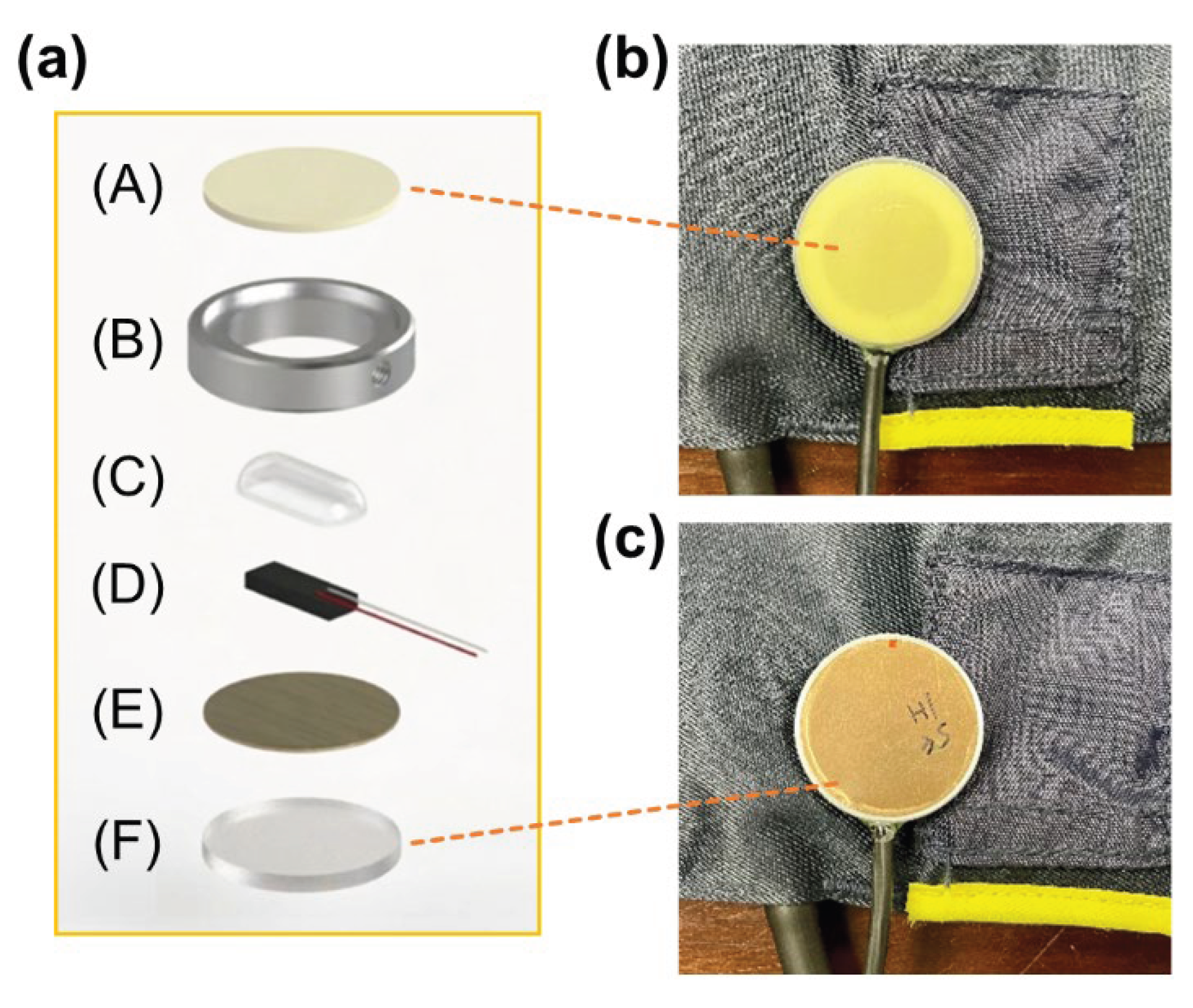
Figure 2.
(a) Participant #33 (female, lowest cK count), (b) participant #28 (female, highest cK count), (c) participant #05 (male, lowest cK count), and (d) participant #34 (male, highest cK count). Pulses classified as n-cK are indicated by a trailing 0 and blue frames. Among cK pulses (trailing 1, red text), shoulder-type waveforms (upward shoulder adjacent to the main peak) are marked with green frames, whereas notch-type waveforms (downward notch near the main peak) are marked with gray frames.
Figure 2.
(a) Participant #33 (female, lowest cK count), (b) participant #28 (female, highest cK count), (c) participant #05 (male, lowest cK count), and (d) participant #34 (male, highest cK count). Pulses classified as n-cK are indicated by a trailing 0 and blue frames. Among cK pulses (trailing 1, red text), shoulder-type waveforms (upward shoulder adjacent to the main peak) are marked with green frames, whereas notch-type waveforms (downward notch near the main peak) are marked with gray frames.
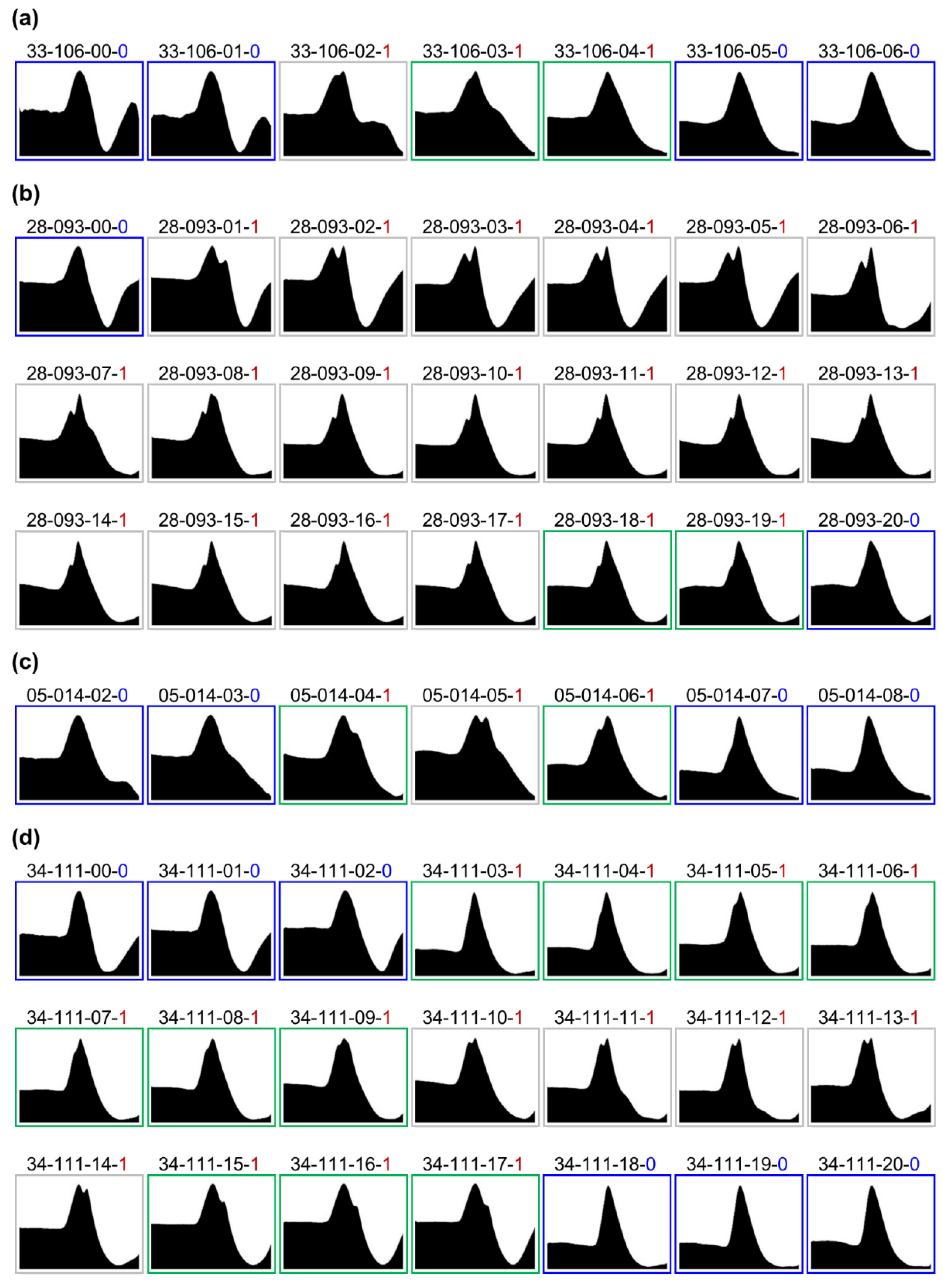
Figure 3.
Boxplots of model performance metrics across seven independent train–test splits. Each box represents a specific metric: Recall (red), F1-score (orange), Balanced Accuracy (green), and Accuracy (blue). Within each box, the central cross and horizontal line denote the mean and median, respectively. The box boundaries represent the Interquartile Range (IQR), calculated using the inclusive median method. Whiskers extend to the most extreme data points within 1.5 × IQR from the box edge, with data points beyond this range identified as outliers (circles).
Figure 3.
Boxplots of model performance metrics across seven independent train–test splits. Each box represents a specific metric: Recall (red), F1-score (orange), Balanced Accuracy (green), and Accuracy (blue). Within each box, the central cross and horizontal line denote the mean and median, respectively. The box boundaries represent the Interquartile Range (IQR), calculated using the inclusive median method. Whiskers extend to the most extreme data points within 1.5 × IQR from the box edge, with data points beyond this range identified as outliers (circles).
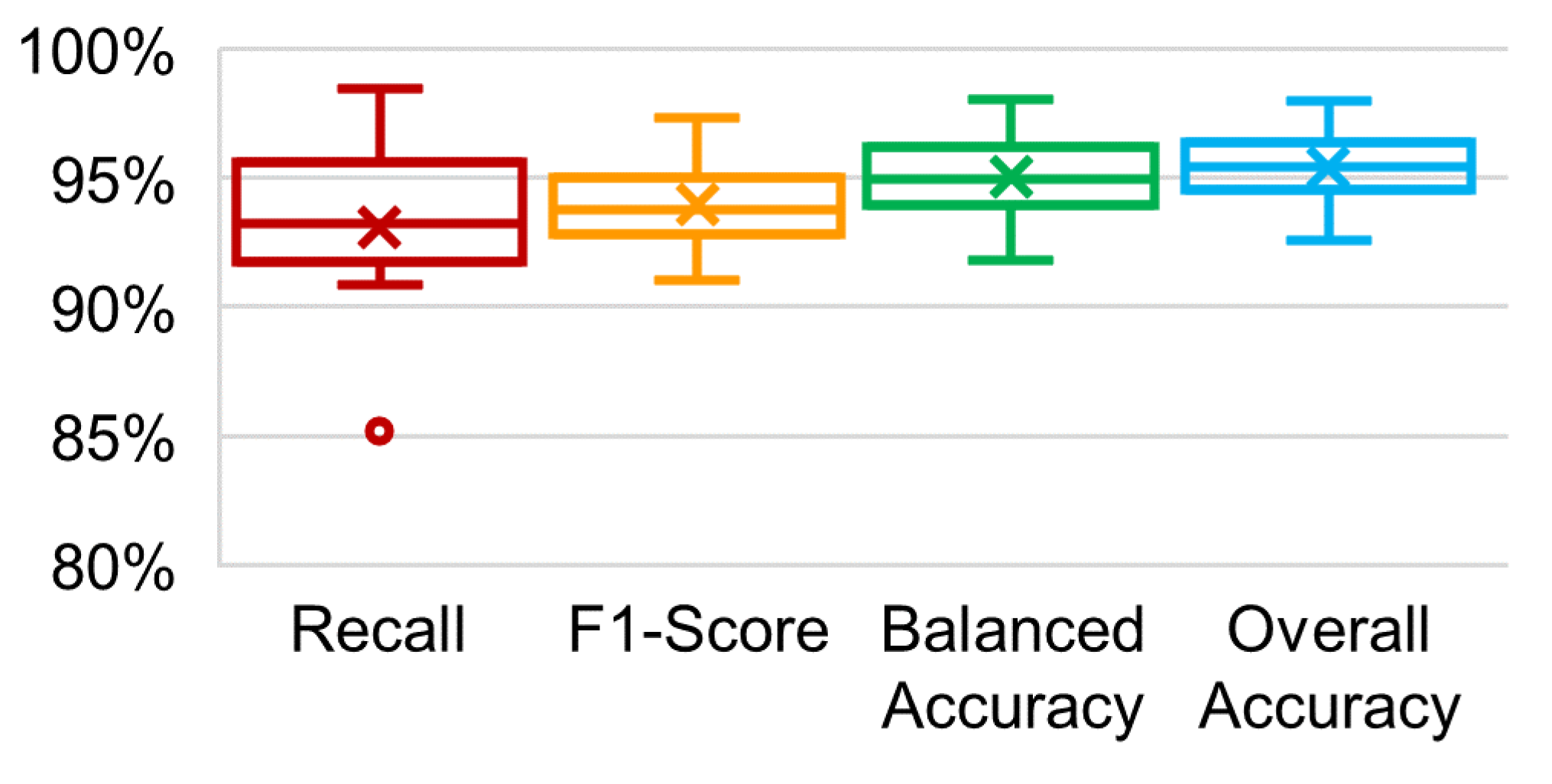
Figure 4.
Bland–Altman plots comparing blood pressure estimated by the microvibrometric system with the reference oscillometric device (Omron HEM-907). Each point represents the difference between the two methods (microvibrometric system − Omron) plotted against their mean. The red dashed line indicates the mean bias, and gray dashed lines denote ±1.96 SD (95% limits of agreement). (a) Systolic BP: mean bias = 0.30 mmHg, SD = 2.25 mmHg, limits of agreement = −4.11 to 4.71 mmHg. (b) Diastolic BP: mean bias = −0.14 mmHg, SD = 2.14 mmHg, limits of agreement = −4.33 to 4.05 mmHg. No proportional bias was observed across the BP range.
Figure 4.
Bland–Altman plots comparing blood pressure estimated by the microvibrometric system with the reference oscillometric device (Omron HEM-907). Each point represents the difference between the two methods (microvibrometric system − Omron) plotted against their mean. The red dashed line indicates the mean bias, and gray dashed lines denote ±1.96 SD (95% limits of agreement). (a) Systolic BP: mean bias = 0.30 mmHg, SD = 2.25 mmHg, limits of agreement = −4.11 to 4.71 mmHg. (b) Diastolic BP: mean bias = −0.14 mmHg, SD = 2.14 mmHg, limits of agreement = −4.33 to 4.05 mmHg. No proportional bias was observed across the BP range.
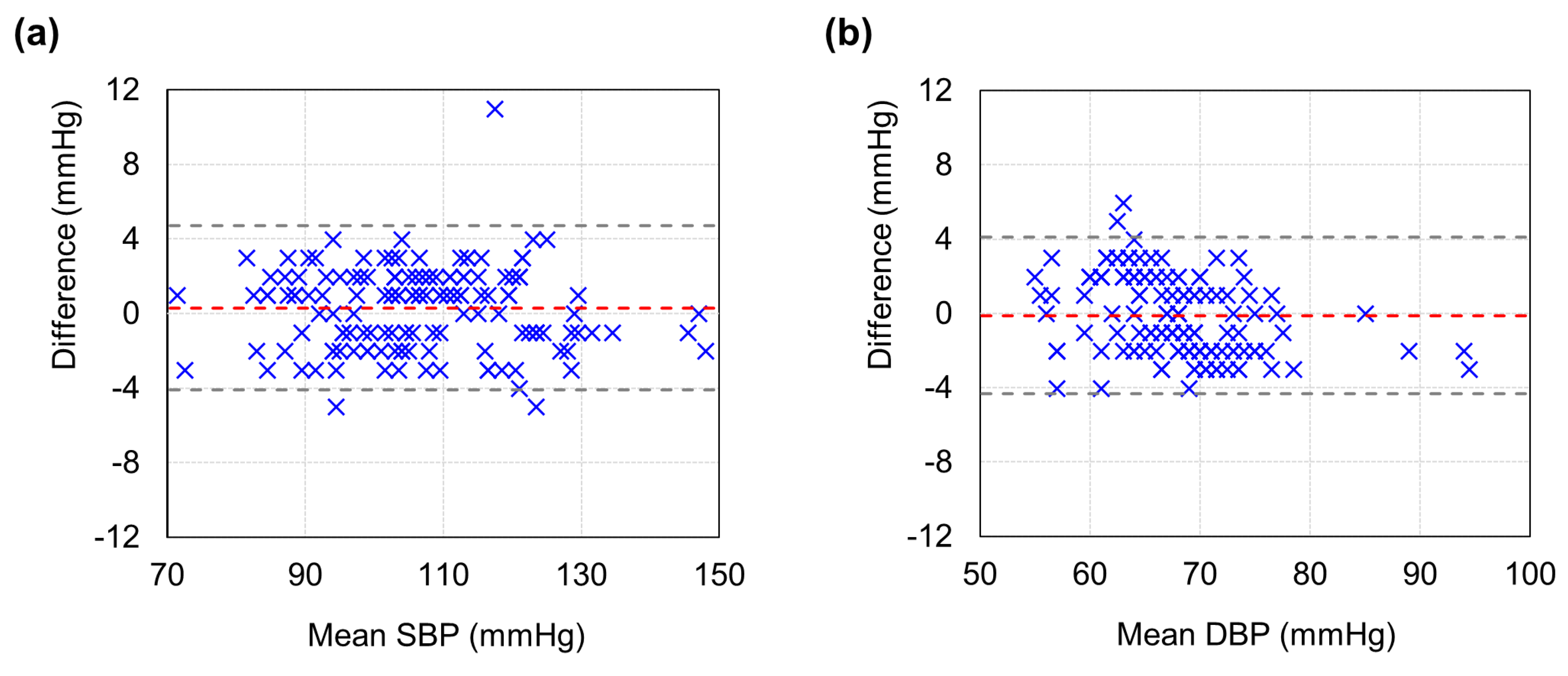
Figure 5.
K-sensor–based pulse measurement setup and signal acquisition workflow. The K-sensor was embedded in a standard oscillometric cuff (Omron HEM-907), while a stethoscope simultaneously recorded K-sounds as reference annotation. Vibration, audio, and cuff pressure signals were synchronously digitized using NI 9234 and NI 9171 modules, recorded in LabVIEW, and processed in Python for waveform segmentation, dual-scale encoding, and CNN-based pulse classification (cK vs. n-cK), providing the basis for automated BP estimation. The diagram also illustrates the circuit block layout and synchronized acquisition workflow.
Figure 5.
K-sensor–based pulse measurement setup and signal acquisition workflow. The K-sensor was embedded in a standard oscillometric cuff (Omron HEM-907), while a stethoscope simultaneously recorded K-sounds as reference annotation. Vibration, audio, and cuff pressure signals were synchronously digitized using NI 9234 and NI 9171 modules, recorded in LabVIEW, and processed in Python for waveform segmentation, dual-scale encoding, and CNN-based pulse classification (cK vs. n-cK), providing the basis for automated BP estimation. The diagram also illustrates the circuit block layout and synchronized acquisition workflow.
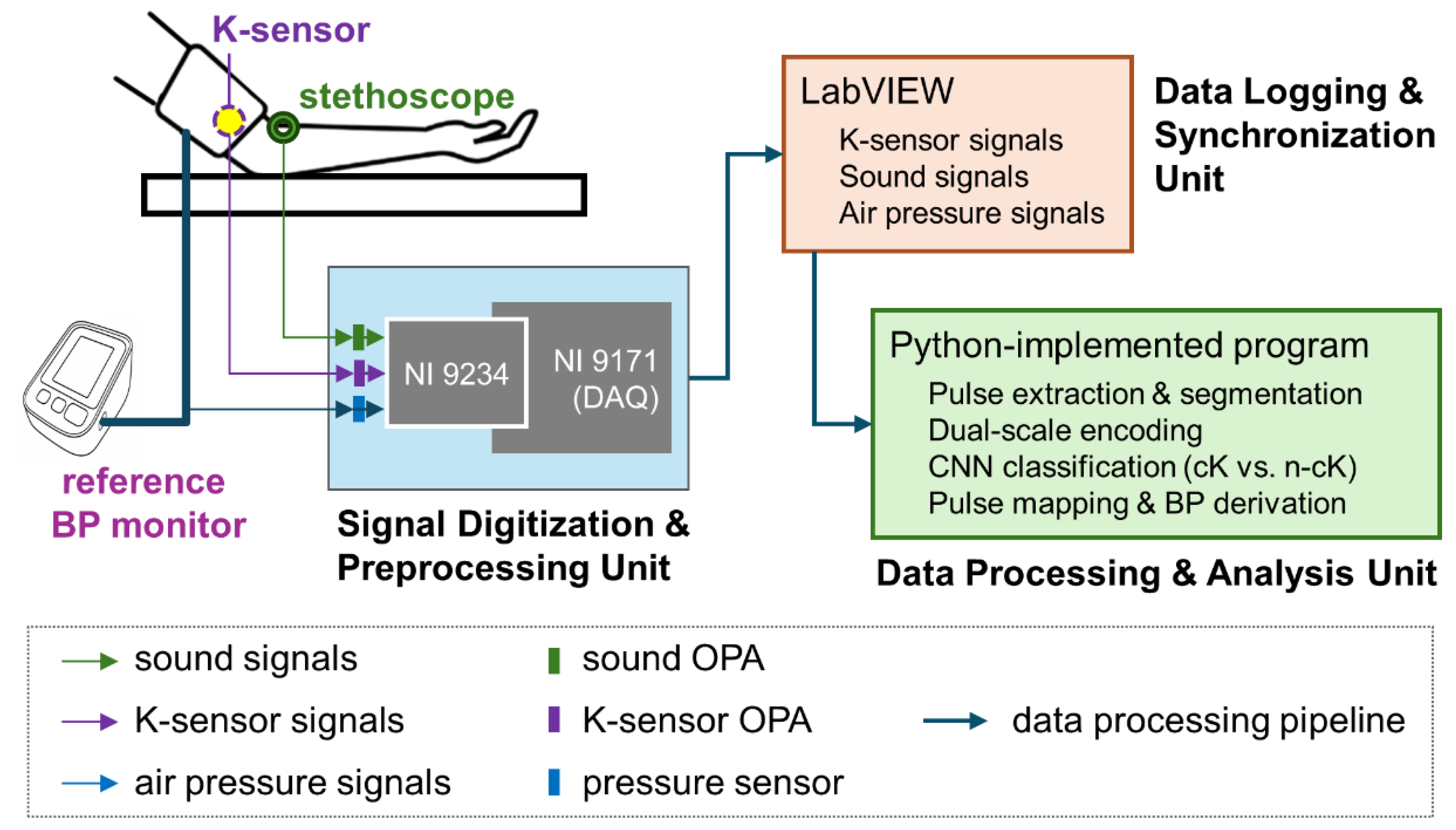
Figure 6.
Image encoding pipeline for the microvibrometric sensing system: (a) Representative continuous oscillogram with multiple pulse beats, sequentially labeled for traceability. (b) Single-pulse waveforms obtained by segmenting the continuous signal in (a) at each pulse peak (global-scale) and applying size normalization. (c, d) Dual-scale image encoding results: global-scale (c) and local-scale (d) windows. Each sequence shows the progression from raw signal (left) to smoothed waveform (middle) and final high-contrast black–white (HCB) image (right) used for CNN feature extraction.
Figure 6.
Image encoding pipeline for the microvibrometric sensing system: (a) Representative continuous oscillogram with multiple pulse beats, sequentially labeled for traceability. (b) Single-pulse waveforms obtained by segmenting the continuous signal in (a) at each pulse peak (global-scale) and applying size normalization. (c, d) Dual-scale image encoding results: global-scale (c) and local-scale (d) windows. Each sequence shows the progression from raw signal (left) to smoothed waveform (middle) and final high-contrast black–white (HCB) image (right) used for CNN feature extraction.
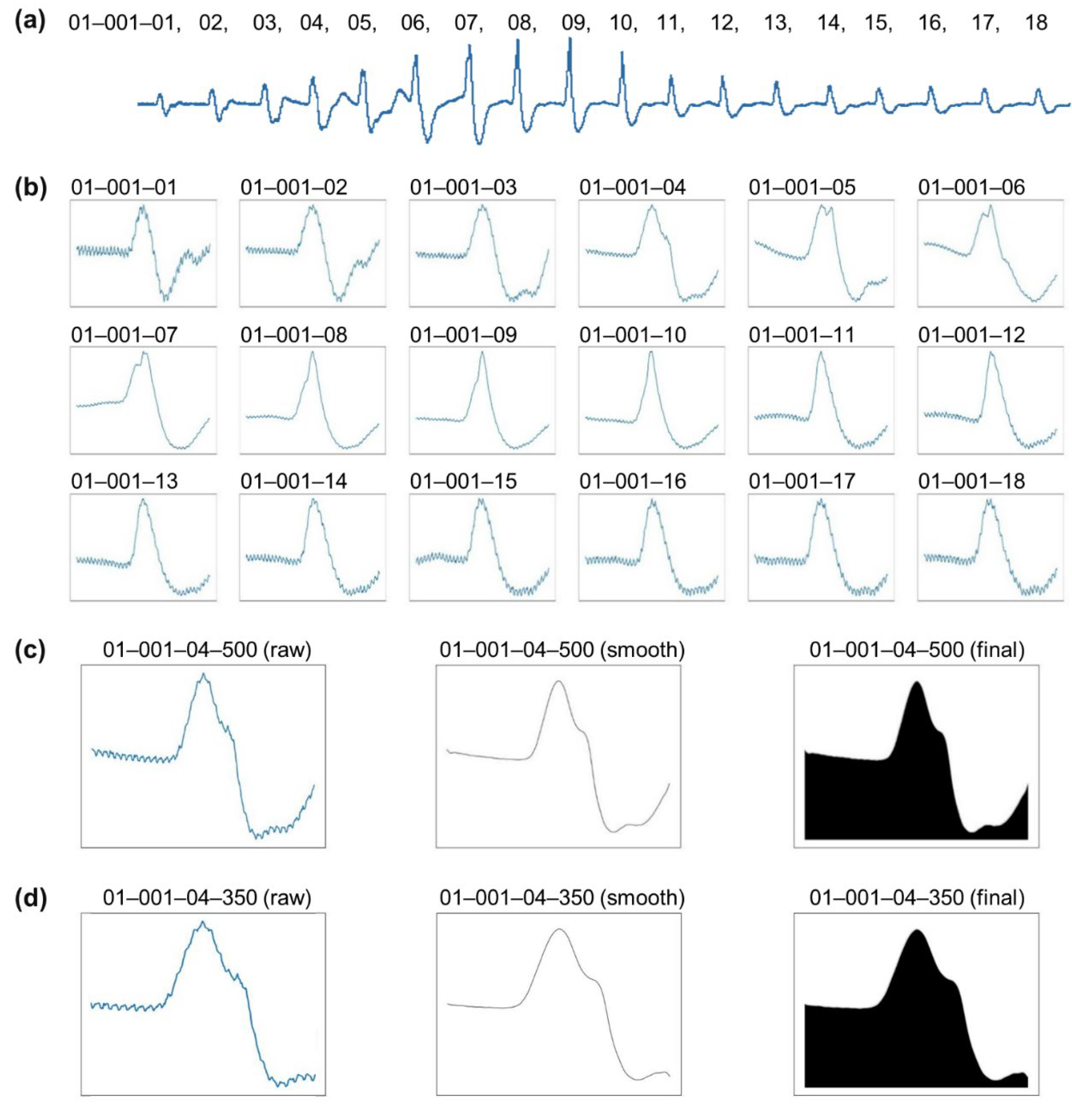
Figure 7.
Workflow for automated blood pressure (BP) estimation using the microvibrometric system: (1) Synchronization of continuous cuff pressure during deflation with the K-sensor microvibration signal. (2) Automated classification of each pulse as K-sound–coupled (cK, labeled “1”) or non–K-sound–coupled (n-cK, labeled “0”) using the CNN module. (3) Determination of systolic and diastolic BP from the cuff pressures corresponding to the onset and offset of the detected cK pulse sequence.
Figure 7.
Workflow for automated blood pressure (BP) estimation using the microvibrometric system: (1) Synchronization of continuous cuff pressure during deflation with the K-sensor microvibration signal. (2) Automated classification of each pulse as K-sound–coupled (cK, labeled “1”) or non–K-sound–coupled (n-cK, labeled “0”) using the CNN module. (3) Determination of systolic and diastolic BP from the cuff pressures corresponding to the onset and offset of the detected cK pulse sequence.
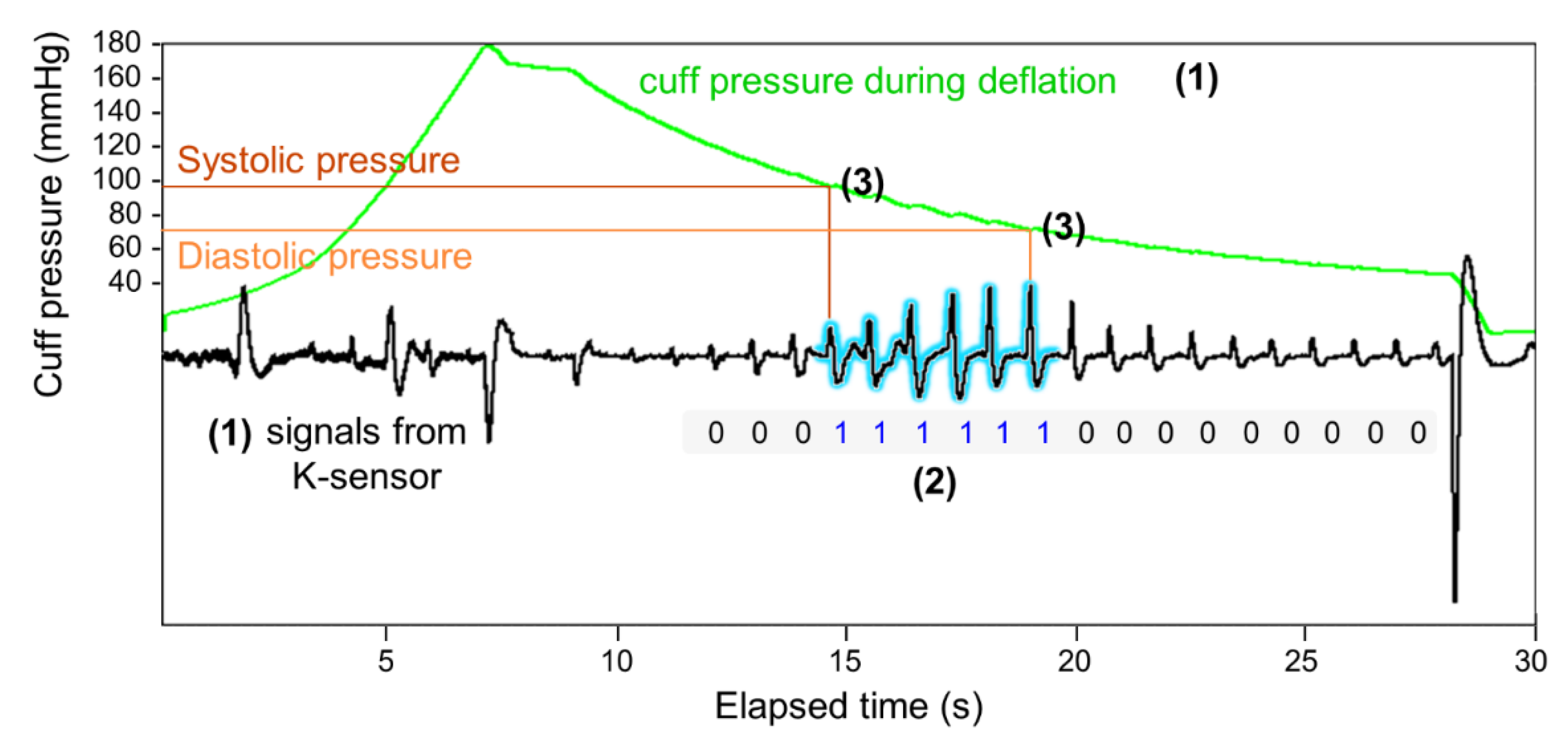

Table 1.
Participant Demographics and Baseline Characteristics.
| Characteristic | Male (n=19) | Female (n=30) | Total (n=49) |
| Age (years) | 26.5 ± 4.3 | 25.9 ± 5.8 | 26.0 ± 5.2 (22–49) |
| Height (cm) | 174.4 ± 4.8 | 158.6 ± 5.2 | 163.7 ± 9.2 (145–183) |
| Weight (kg) | 71.1 ± 11.9 | 51.6 ± 5.8 | 58.9 ± 12.9 (39–99) |
| BMI (kg/m2) | 23.3 ± 3.6 | 20.5 ± 2.1 | 21.2 ± 3.1 (17.1–30.6) |
| SBP range (mmHg) | 71–135 | 82–149 | 71–149 |
| DBP range (mmHg) | 54–80 | 55–96 | 54–96 |
Note: Values are presented as mean ± standard deviation, with the range in parentheses where applicable. BMI: body mass index; SBP: systolic blood pressure; DBP: diastolic blood pressure.
Disclaimer/Publisher’s Note: The statements, opinions and data contained in all publications are solely those of the individual author(s) and contributor(s) and not of MDPI and/or the editor(s). MDPI and/or the editor(s) disclaim responsibility for any injury to people or property resulting from any ideas, methods, instructions or products referred to in the content. |
© 2026 by the authors. Licensee MDPI, Basel, Switzerland. This article is an open access article distributed under the terms and conditions of the Creative Commons Attribution (CC BY) license (http://creativecommons.org/licenses/by/4.0/).
Copyright: This open access article is published under a Creative Commons CC BY 4.0 license, which permit the free download, distribution, and reuse, provided that the author and preprint are cited in any reuse.


