

Submitted:
20 March 2026
Posted:
23 March 2026
You are already at the latest version
Abstract
Lazarus phenomenon (LP), also named auto-resuscitation, may happen after the end of ineffective cardiopulmonary resuscitation (CPR), or after death is confirmed in a person who did not undergo CPR, and heart activity returns spontaneously. The aim of the study was to focus on elder individuals (aged >60) experiencing the Lazarus phenomenon and to analyse distractors that cause the LP. Methods. PubMed, Scopus, and Web of Science electronic databases were searched to find cases of LP from the year 1982 until 31 December 2025. Of the 81 total cases found, 48 pa-tients were elder than 60 years and were included in the study. For the analysis they were divided into two subgroups dependent on age: No 1 (79-60), No 2 (≥80). Results. The causes of cardiac arrest were divided almost equally between cardiac and non-cardiac causes (47.6% and 52.3% respectively). Cardiac arrest occurred equally in the IH and OH, each accounting for 50%. The ECG rhythm during cardiopulmonary resuscitation prior to the onset of LP was as follows: A – 58.7%, PEA – 37% and VF – 4.3% respectively. In 16 out of 37 cases where such data were reported, a return to consciousness was confirmed, representing 43.2%. During statistical analysis of these data no relationship was found. Conclusions. In older people, even those of very advanced age, Lazarus phenomenon may occur following resuscitation or even if resuscitation is not attempted. Based on the analysis of the available data from a literature on LP case reports we have not identified any specific cause for LP in older individuals. The causes of LP probable lie outside the analysed data. Accurate reporting is required, including data such as: CPR time points with details of medication administered during CPR, airway management, quality of ventilation, and laboratory tests (blood gas analysis, electrolyte levels, complete blood count) in order to analyse the suggested causes of LP.
Keywords:
Lazarus phenomenon
; Lazarus syndrome
; auto-resuscitation
; cardiopulmonary resuscitation (CPR)
; elder patients
; geriatric
1. Introduction
Lazarus phenomenon (LP) is rare and can occur in people of all ages. Unfortunately, its causes are still unknown. This phenomenon consists in the fact that either after the end of ineffective cardiopulmonary resuscitation (CPR), heart activity returns spontaneously, or after death is confirmed in a person who did not undergo CPR, heart activity returns. The commonly used synonym is auto-resuscitation. For the first time in scientific literature, in 1982 K. Linko et al. described the recovery after discontinued cardiopulmonary resuscitation for cardiac reasons in a 67-years old man and 68-years old woman [1]. In 1993 Bray JG Jr used the term “Lazarus phenomenon” [2] for auto-resuscitation which means a phenomenon of the heart, which can resume its spontaneous activity and generate circulation [3].
At the current stage of knowledge, the causes of Lazarus phenomenon are only presumed. The following reasons are considered: hyperventilation, alkalosis, auto-PEEP (positive end expiratory pressure), delayed drug action, hyperkalaemia, unnoticeable vital signs and metabolic disorders [4,5]. In hyperventilation, expiratory time is shortened, resulting in increased intrathoracic pressure and decreased venous return, leading to decreased cardiac output. This disorder explains additionally a slower delivery of drugs to the central circulation and finally delayed action of drugs, which is given as the other explanation of Lazarus phenomenon. After stopping CPR in hyperventilated patient, his state can be changed and even reversed - the pressure in the chest is lowered than during hyperventilation period and this mechanism may be responsible for restart of the heart. Auto-PEEP means positive end expiratory pressure which can build up in the airway and similarly to hyperventilation may lead to an increase in intrathoracic pressure. By the same mechanism that hyperventilation can cause, auto-PEEP may impair venous return to the heart and decrease cardiac output [6,7]. It should also be emphasized that many authors trying to explain the causes of Lazarus phenomenon, indicated the coexistence of many diseases in these patients such as: cancer, cardiovascular diseases (cardiomyopathy), ischemic heart disease, sepsis and surprisingly advanced age [8,9,10].
Lazarus phenomenon is not a real disease itself, but a phenomenon of a body that can happen to anyone. Because occurrence of LP is very rare, only 81 cases of Lazarus phenomenon over the course of 40 years, were published in the scientific literature. Updated case studies on LP have been published in recent years by David J. Zorko et al. in 2023 [11] and later by M. Grześkowiak and P. Rzeźniczek [12,13]. In 2023 - 2025 fife more cases were published and included in the study. In terms of the aging population, we noticed that LP occurred quite frequently in older patients (total 81 cases, 48 cases > 60 years of age, 59.25%), hence the aim of the study was to focus on older individuals experiencing the Lazarus phenomenon and to analyse distractors that cause the LP in these patients, with particular emphasis on two age subgroups.
2. The Methods
We have searched PubMed, Scopus, and Web of Science electronic databases containing all reports published from the year 1982 until 31 December 2025 looking for the phrases: “Lazarus phenomenon” or “Lazarus or phenomenon”, “Lazarus syndrome or Lazarus or syndrome”, and “Autoresuscitation or Autoresuscitation”. To avoid duplication, each database was independently reviewed by two members of our team and duplicated records were excluded, as well as review articles. In the original reports we searched cases of Lazarus syndrome. From all records we have found (49,316) only 1655 entries met the criteria for inclusion in the initial analysis. After further exclusion of 1494 reports, we got 65 publications in which 81 cases of Lazarus syndrome were described. Then we searched the group of patients elder than 60 years of age and finally we chose 48 patients for the further analysis. Flowchart of cases selection is presented in Figure 1.
Table 1 presents all cases of Lazarus phenomenon aged 60 years and older who were included in the study. All data relating to cardiac arrest, the course of resuscitation and the onset of LP that could be gathered from the literature are presented here. The individuals were divided in two subgroups (aged 79 - 60 years and aged ≥80 years).
The statistical analysis was performed in Statistica 13 (TIBCO Software Inc, Palo Alto, California, USA). Statistical significance was defined as P <0.05. The Shapiro-Wilk test was used to assess conformity with a normal distribution. Numerical variables were presented as median with interquartile range (IQR). In order to compare the variables between the 2 groups, the t-test or the Cochran-Cox test were calculated due to compliance with the normal distribution. The Mann-Whitney test was calculated in case of lack of compliance with the normal distribution. Categorical variables were reported as absolute numbers and percentages and compared using Pearson’s chi-squared test or Fisher exact test. Due to the lack of compliance with the normal distribution the association between numerical variables was assessed by Spearman’s correlation. Taking into account the data bias in these publications, the data that were collected (disease, location of event, gender, age, etc.) are variables in which errors are unlikely to occur. To avoid additional bias, we omitted this information (treated it as missing data) when the data were imprecise (mainly in the area of survival time).
Additionally, for these analyses, due to the small sample size, instead of relying solely on the p-value, we also calculated an effect size (Cohen’s d or Pearson’s C), which quantifies the magnitude of the difference between groups. Because we looked at the effect size, not just the p-value, multiple comparisons (which modify the p-value) were not performed.
Doing a statistical analysis, we have taken into account: the origin of the diseases before cardiac arrest (CA) which could be of cardiac – C or non-cardiac - NC origin a place of CA (in hospital - IH or out of hospital - OH), age and gender of the patients, duration of CPR, rhythm during CPR just before occurrence of the LP, time from stopping CPR to occurrence of the LP, return of consciousness and duration of survival.
As for missing data, it should be emphasized that they were not related to a specific publication, but occurred in all publications and in most of the analysed variables. Specific missing data are presented in the Table No 2.

Table 2.
Number of missing data by analysed categories.
| Analysed categories among 48 cases | Number of missing data |
|---|---|
| Causes of cardiac arrest (C or NC) | 6 |
| Place of cardiac arrest (IH or OH) | 16 |
| Time of CPR | 7 |
| Rhythm during CPR before occurrence of the LP | 4 |
| Time from cessation of cardiopulmonary resuscitation to the occurrence of the LP | 7 |
| Return of consciousness | 8 |
| Survival | 13 |
C - cardiac, NC - noncardiac, IH - in hospital, OH - out of hospital, CPR - cardiopulmonary resuscitation, LP - Lazarus phenomenon, ECG - electrocardiography.
3. Results
We have included in the study 48 individuals and we have divided them according to the age into two subgroups: No 1 (79-60 years old), No 2 (≥80 years old). In Group No 1, we have analysed 26 cases (16 men, 10 women). In Group No 2 we have analysed 22 cases (10 men and 12 women).
An analysis was carried out based on the available data from the literature regarding the presented cases of LP. The results are presented in Table 3.
C - cardiac, NC – noncardiac, IH - in hospital, OH - out of hospital, CPR - cardiopulmonary resuscitation, LP - Lazarus phenomenon, F – female, M - men, Y– yes, N - no, SD - standard deviation, A – Asystole, PEA - Pulseless Electrical Activity.
The causes of cardiac arrest were divided almost equally between cardiac and non-cardiac causes (47.6% and 52.3% respectively). Cardiac arrest occurred equally in the IH and OH, each accounting for 50%. The ECG rhythm during cardiopulmonary resuscitation prior to the onset of LP was as follows: A – 58.7%, PEA – 37% and VF – 4.3% respectively, confirming that non-shockable rhythms predominate. In 16 out of 37 cases where such data were reported, a return to consciousness was confirmed, representing 43.2%.
Detailed description and comparison of groups based on statistical analysis
1). The comparison between two groups: No 1 (79-60), No 2 (≥80).
Comparing two groups and taking into account, the following categorical variables: causes of CA (of cardiac versus non cardiac origin), place of CA (IH and OH), gender, ECG rhythms before occurrence of LP, return of consciousness - no relationship was found taking into account simultaneously, in addition to p, the contingency coefficient. When continuous variables were analysed, (time of CPR, time of cessation of CPR to the occurrence of the Lazarus phenomenon and time of survival), only a slight difference (d-Cohen = 0.25) was noticed in time of survival.
2). The analysis of Group No 1 (79-60 years of age).
Analysing Group, No 1 and taking into account the categorical variables, causes of CA (of cardiac versus non cardiac origin), place of CA (IH and OH), gender, ECG rhythms before occurrence of LP, return of consciousness - no relationship was found, taking into account simultaneously, in addition to p, the contingency coefficient. The relationship between return of consciousness and place of CA was found (p=0.03). Four patients recovered when CA occurred IH and one patient in out of hospital CA. Total 5 patients among 13 analysed. The relationship between return of consciousness and age of the patients was found (p=0.01).
3). The analysis of Group No 2 (≥80 years of age).
Analysing Group, No 2 and taking into account the categorical variables, causes of CA (of cardiac versus non cardiac origin), place of CA (IH and OH), gender, ECG rhythms before occurrence of LP, return of consciousness - no relationship was found, taking into account simultaneously, in addition to p, the contingency coefficient, except for ECG rhythm before LP in correlation to causes of CA (p=0.03). Eleven individuals presented asystole (9 – of C origin, 2 of NC), 5 presented PEA (1 – of C origin, 4 of NC). When continuous variables were analysed (time of CPR, time of cessation of CPR to the occurrence of the Lazarus phenomenon and time of survival), only a slight difference (d-Cohen = 0.27) was noticed in time of cessation of CPR to the occurrence of the Lazarus phenomenon in correlation to gender.
In these group of patients, a correlation between time of CPR and time of survival was found. The longer the time of CPR, the longer the patients’ survival time (Rs=0.60).
4. Discussion
At the current stage of knowledge, the causes of Lazarus phenomenon are only presumed, but some of them may be taking into account as hyperventilation, alkalosis, auto-PEEP and delayed action of drugs. Unfortunately, there is no data in the literature on the quality of cardiopulmonary resuscitation and the likelihood of hyperventilation or alkalosis, as well as other alleged causes of the LP. Therefore, they could not be examined.
In our study, the causes of cardiac arrest were distributed almost equally between cardiac and non-cardiac causes. Cardiac arrest occurred with equal frequency in the IH group and the OH group. The ECG rhythm during cardiopulmonary resuscitation prior to the onset of LP was as follows: A – 58.7%, PEA – 37% and VF – 4.3%, confirming the predominance of non-shockable rhythms, which is consistent with data from the literature indicating that older people who are in cardiac arrest more often present non-shockable rhythms such as PEA and Asystole [14,15]. In German study, retrospective analysis of out-of-hospital resuscitation patients over 80 years of age (n=578) showed that 86,1% of them initially had asystole - 53,2% and PEA - 32,9%. What is interesting, in surviving group of patients, 60% presented non-shockable rhythm (22,9% asystole and 37,1% PEA) [15].
Non-shockable rhythms are more common in patients with Lazarus phenomenon – cardiac causes are less common in patients with asystole or PEA [16,17].
Discussing the causes of Lazarus phenomenon in elder people we have to take into account aging process and progressive organ changes in these people. In elder people the prevalence of ECG abnormalities is common and according to Moplaschi M. et al. even three times higher in patients over 85 years than in younger (65-69 years old) [18]. These abnormalities include: first degree atrioventricular block, right and left bundle branch block, atrial fibrillation (which is more common as age increases), ventricular ectopic contractions (occurs from 76 – 96%), major ST-T wave alterations.
In old people physiology of circulatory system differs from younger subjects. During aging calcification of cardiac skeleton is common as well as decline of cardiac myocytes and an increase in elastic and collagenous tissue. Also, a progressive loss of pacemaker cells within sinus node occurs especially over 75 years of age. Due to a partial or complete separation of the sinoatrial node from surrounding musculature caused by accumulation of adipose tissue, action of potential is prolonged and autonomic response is reduced [19]. These cardiac changes in older people may contribute to the occurrence of the Lazarus phenomenon. Additionally, in older people, metabolism is slower, and one potential reason of Lazarus phenomenon is slower delivery of drugs to the central circulation and ultimately delayed drug action, which should be taken into account. In our study the time to the occurrence of Lazarus phenomenon in analysed subjects has been extended even to 20 minutes and more. In analysed younger subgroup of patients (79-60 years old) the time from the end of CPR to the occurrence of Lazarus phenomenon was longer comparing with the older subgroup (≥80 years of age). It necessitates further study for explanation. The greatest challenge is to determine the duration of patient monitoring from the moment of death. The longest time between cessation of CPR and the return of circulatory function occurs in the case of asystole, which should make us even more sensitive to extending post-mortem observation. Because statistics show that the longer CPR is continued, the later Lazarus phenomenon may occur, post-mortem monitoring should be extended in these cases.
In the study, only in the group ≥80 years old, a correlation between time of CPR and survival in days was found indicating for the statement - the longer time of CPR, the longer survival in days. This result surprisingly indicates the possibility of recovery of very old individuals when cardiopulmonary resuscitation was performed for longer time. It can be explained by slower metabolism in this group of patients and relative overdose due to a decrease in the functional reserve of organs.
The group of patients over 60 years of age is characterized by a higher frequency of comorbidities, polypharmacy, and above all, a lower physiological reserve. The most important aspect of the aging process is the gradual reduction of functional units, such as nephrons in the kidneys and hepatocytes in the liver. Age-related changes in organ function affect drug distribution and elimination pathways, leading to prolonged drug action and an increased risk of drug accumulation. Geriatric patients are more susceptible to drug toxicity and adverse drug reactions due to elevated serum concentrations. Reduced sensitivity of β-1 and β-2 adrenergic receptors in the heart is observed, leading to a weakened response to β-agonists. Alterations in homeostatic mechanisms, such as attenuation of reflex tachycardia and decreased baroreceptor function, and impaired autoregulation in critical organs (brain, heart, and kidneys) increase the risks associated with “relative” overdose [20,21].
Other alleged causes of Lazarus phenomenon (alkalosis, hyperkalaemia, metabolic disorders) are difficult to explain in the context of generating spontaneous recovery of cardiac function because they are considered as reversible causes of cardiac arrest. According to the Guidelines of Resuscitation during cardiopulmonary resuscitation, reversible causes of cardiac arrest should be found and if confirmed, treated at once.
5. Conclusions
The research analysis was based on data available in the literature, drawing on 48 cases. Based on these cases, we can draw the following conclusions. In older people, even those of very advanced age, Lazarus phenomenon may occur following resuscitation or even if resuscitation is not attempted. It may even occur after a very prolonged resuscitation. Based on our analysis of the available literature on LP case reports, we found no correlations when taking into account: causes of CA, place of CA, gender, ECG rhythms before occurrence of LP, return of consciousness, time of CPR, time of cessation of CPR to the occurrence of the P and time of survival, so, at this stage, we cannot identify the cause of LP in older people. The causes of LP probable lie outside the analysed data. Accurate reporting is required, including data such as: CPR time points with details of medication administered during CPR, airway management, quality of ventilation, and laboratory tests (blood gas analysis, electrolyte levels, complete blood count) in order to analyse the suggested causes of LP.
As a potential causes of Lazarus phenomenon, age-related changes should be taken into account, such as progressive organ changes, slower metabolism, changes in drug distribution and elimination pathways, leading to prolonged drug action and an increased risk of drug accumulation.
6. Limitations of the Study
The study was based on the cases described in the literature, therefore unfortunately there was no information available on the current medical history, comorbidities, previous injuries or lifestyle of the subjects and, furthermore, there was a lack of information regarding the quality of the CPR performed, the timing of medication administration, airway management, ventilation, and laboratory tests therefore it was not taken into account. The lack of data makes it difficult to draw clear conclusions. The group of seniors who developed LP that was analysed was not very large, as presumably not all cases of LP are reported in the literature.
References
- Linko, K.; Honkavaara, P.; Salmenpera, M. RECOVERY AFTER DISCONTINUED CARDIOPULMONARY RESUSCITATION. Lancet 1982, 319, 106–107. [Google Scholar] [CrossRef] [PubMed]
- Bray, JG, Jr. : The Lazarus phenomenon revisited. Anesthesiology 1993, 78, 991. [Google Scholar] [CrossRef]
- Wijdicks, EF; Diringer, MN. Electrocardiographic activity after terminal cardiac arrest in neurocatastrophes. Neurology 2004, 62, 673–4. [Google Scholar] [CrossRef]
- Schlichtig, R; Miro, A. : Auto-PEEP during CPR. An “occult” cause of electromechanical dissociation? Chest 1991, 99, 492–493. [Google Scholar]
- Kämäräinen, A.; Virkkunen, I.; Holopainen, L.; Erkkilä, E.-P.; Yli-Hankala, A.; Tenhunen, J. Spontaneous defibrillation after cessation of resuscitation in out-of-hospital cardiac arrest: A case of Lazarus phenomenon. Resuscitation 2007, 75, 543–546. [Google Scholar] [CrossRef] [PubMed]
- Gutierrez, SG S; Montoro, VD; Gómez JMG, GM. Dynamic hyperinflation, a case report. Pediatrics International 2020, 62(5), 647–649. [Google Scholar] [CrossRef] [PubMed]
- Berlin, D. Hemodynamic Consequences of Auto-PEEP. J. Intensiv. Care Med. 2012, 29, 81–86. [Google Scholar] [CrossRef]
- Brieler, J.; Breeden, M.A.; Tucker, J. Cardiomyopathy: An Overview. Am. Fam. Physician 2017, 96, 640–646. [Google Scholar]
- Morgan, R.W.; Fitzgerald, J.C.; Weiss, S.L.; Nadkarni, V.M.; Sutton, R.M.; Berg, R.A. Sepsis-associated in-hospital cardiac arrest: Epidemiology, pathophysiology, and potential therapies. J. Crit. Care 2017, 40, 128–135. [Google Scholar] [CrossRef]
- Hirlekar, G.; Karlsson, T.; Aune, S.; Ravn-Fischer, A.; Albertsson, P.; Herlitz, J.; Libungan, B. Survival and neurological outcome in the elderly after in-hospital cardiac arrest. Resuscitation 2017, 118, 101–106. [Google Scholar] [CrossRef]
- Zorko, D.J.; Shemie, J.; Hornby, L.; Singh, G.; Matheson, S.; Sandarage, R.; Wollny, K.; Kongkiattikul, L.; Dhanani, S. Autoresuscitation after circulatory arrest: an updated systematic review. Can. J. Anaesth. 2023, 70, 699–712. [Google Scholar] [CrossRef]
- Grześkowiak, M.; Gaczkowska, A.; Kluzik, A.; Rzeźniczek, P.; Pytliński, A. Remarks on autoresuscitation—Polish analysis of Lazarus syndrome. Can. J. Anaesth. 2023, 71, 302–303. [Google Scholar] [CrossRef]
- Rzeźniczek, P.; Gaczkowska, A.D.; Kluzik, A.; Cybulski, M.; Bartkowska-Śniatkowska, A.; Grześkowiak, M. Lazarus Phenomenon or the Return from the Afterlife—What We Know about Auto Resuscitation. J. Clin. Med. 2023, 12, 4704. [Google Scholar] [CrossRef]
- Einav, S.; Cortegiani, A.; Marcus, E.-L. Cardiac arrest in older adult patients. Curr. Opin. Anaesthesiol. 2021, 34, 40–47. [Google Scholar] [CrossRef]
- Heuser, N.; Rupp, D.; Glass, S.; Sassen, M.C.; Morin, A.; Volberg, C. Influences on the duration and success of out-of-hospital resuscitation of geriatric patients over 80 years of age - a retrospective evaluation. BMC Emerg. Med. 2024, 24, 1–9. [Google Scholar] [CrossRef] [PubMed]
- Rajan, S.; Folke, F.; Hansen, S.M.; Hansen, C.M.; Kragholm, K.; Gerds, T.A.; Lippert, F.K.; Karlsson, L.; Møller, S.; Køber, L.; et al. Incidence and survival outcome according to heart rhythm during resuscitation attempt in out-of-hospital cardiac arrest patients with presumed cardiac etiology. Resuscitation 2017, 114, 157–163. [Google Scholar] [CrossRef] [PubMed]
- Havranek, S.; Fingrova, Z.; Rob, D.; Smalcova, J.; Kavalkova, P.; Franek, O.; Smid, O.; Huptych, M.; Dusik, M.; Linhart, A.; et al. Initial rhythm and survival in refractory out-of-hospital cardiac arrest. Post-hoc analysis of the Prague OHCA randomized trial. Resuscitation 2022, 181, 289–296. [Google Scholar] [CrossRef]
- Molaschi, M; Ponzetto, M; Romin, R; Berrino, E; Fabris, F. Modificazioni dell’elettrocardiogramma nell’anziano. Limiti tra normalità e patologia [Changes in the electrocardiogram in the elderly patient. The limits between normality and pathology]. Recenti Prog Med;Italian 1995, 86(1), 32–6. [Google Scholar] [PubMed]
- Basile, G.; Cucinotta, M.D.; Figliomeni, P.; Balbo, C.L.; Maltese, G.; Lasco, A. Electrocardiographic Changes in Centenarians: A Study on 42 Subjects and Comparison with the Literature. Gerontology 2011, 58, 216–220. [Google Scholar] [CrossRef] [PubMed]
- Ngcobo, Nokwanda N. Influence of Ageing on the Pharmacodynamics and Pharmacokinetics of Chronically Administered Medicines in Geriatric Patients: A Review. Clinical Pharmacokinetics 2025, 64, 335–367. [Google Scholar] [CrossRef]
- Klotz, U. Pharmacokinetics and drug metabolism in the elderly. Drug Metab. Rev. 2009, 41, 67–76. [Google Scholar] [CrossRef] [PubMed]
- Klotz, U. Pharmacokinetics and drug metabolism in the elderly. Drug Metab. Rev. 2009, 41, 67–76. [Google Scholar] [CrossRef] [PubMed]
Figure 1.
Flowchart of cases selection.
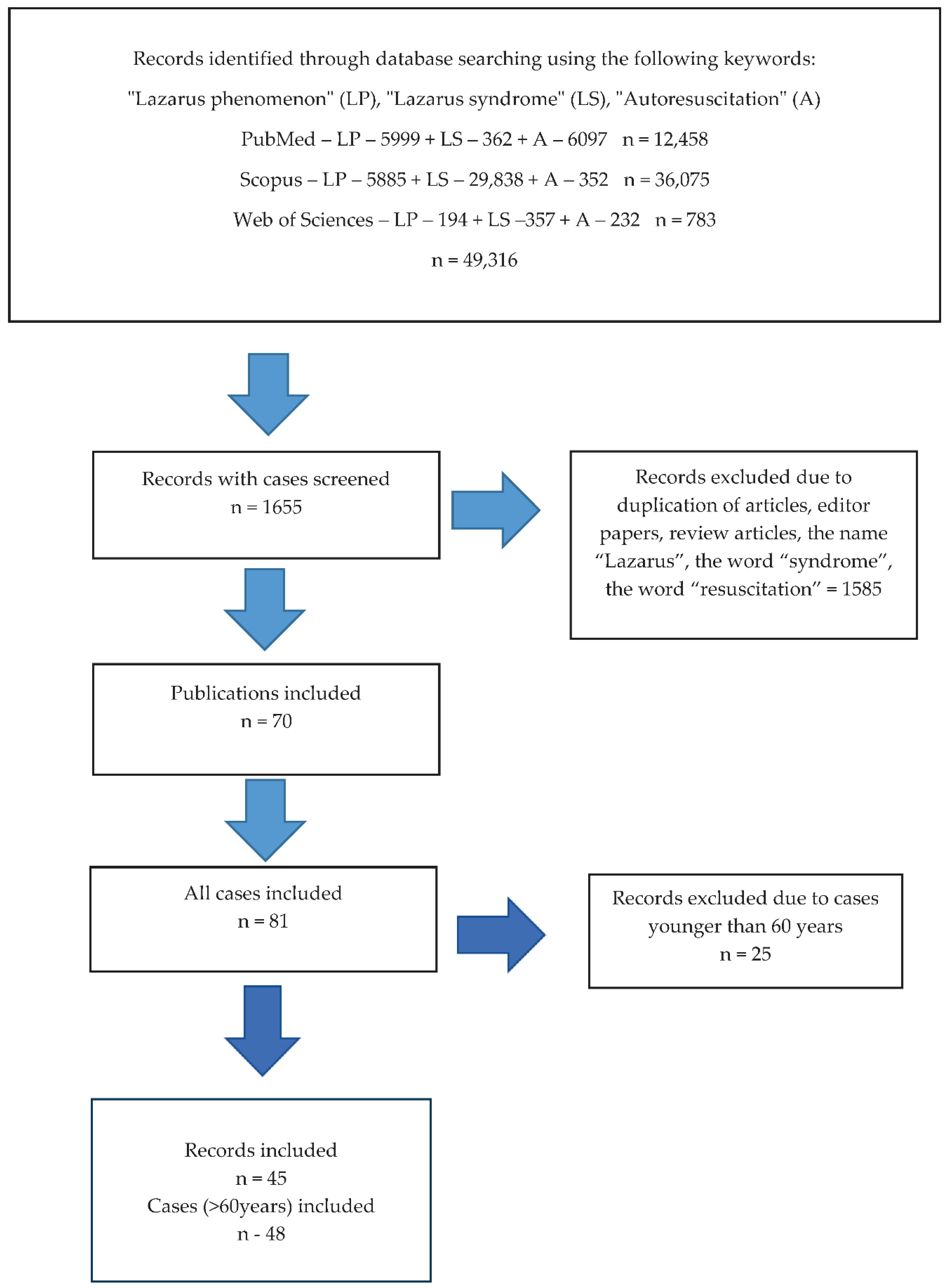
Table 1.
Cases of Lazarus phenomenon among patients aged 60 years and older included in the study (divided in two subgroups).
Table 1.
Cases of Lazarus phenomenon among patients aged 60 years and older included in the study (divided in two subgroups).
| Year . | Diseases before CA and place of CA (if known) | Age (years) |
Sex | Time of CPR (in min) | ECG rhythm before occurrence of the LP | Occurrence of the LP after cessation of CPR (min) |
Return of consciousness |
Survival (in days) |
|---|---|---|---|---|---|---|---|---|
|
Cases of Lazarus phenomenon among patients aged 79 - 60 years |
||||||||
| 1982 [1] | C - MI | 67 | M | 20 | A | < 9 | ND |
15 |
| C - MI 68 F ND A 20 Yes 90 | ||||||||
| 1991 [2] | NC, Co, IH 64 M 20 PEA 15 ND < 1 | |||||||
| 1991 [3] | NC, OH 75 F 20 A 5 No < 1 |
|||||||
| 1993 [4] | NC 75 M 23 A 5 No < 9 |
|||||||
| 1994 [5] | C, Co, IH 70 M 34 A 8 Yes 21 |
|||||||
| 1996 [6] | C, MI, IH 66 M 30 VF < 5 Yes S |
|||||||
| 1998 [7] | C, MI, IH 67 F 43 A 5 Yes 9 |
|||||||
| 1999 [8] | NC, Co, IH | 76 | M | 30 | A | 5 | No |
1 |
| 2001 [9] |
NC, Co, IH | 66 | M | 18 | A |
10 |
Yes | 13 |
| 2002 [10] | NC, Co, OH | 65 | M | 35 | A | 20 | No |
5 |
|
2005 [11] |
NC | 63 | F | 12 | A | 10 | Yes | 12 |
| 2006 [12] | C, MI, OH | 78 | M | 25 | A | < 9 | No |
< 1 |
| 2012 [13] | C, MI, OH | 65 | M | 55 |
A |
40 |
No | 13 |
|
2013 [14] |
NC, IH |
62 |
M |
40 |
PEA |
5 |
ND |
< 2 |
| 2015 [15] | NK, Co | 67 | M | 47 | PEA | 5 | Yes |
1 |
| 2016 [16] | NC | 69 | F | 25 | PEA | 10 | ND |
S |
| 2017 [17] | NC, OH | 69 | M | 40 | A | 180 | No |
10 |
| 2017 [18] |
NC, |
63 | M | 12 | PEA | 3 | Yes | > 1 |
|
NC, |
61 | F | 18 | PEA | 8 | No | < 1 | |
|
2017 [19] |
C, MI, Co | 66 | M | 45 |
PEA |
5 | Yes | 9 |
|
2020 [20] |
NC, OH | 79 | F | 9 | PEA | 14 | No | < 1 |
|
2021 [21] |
NC, Co, IH | 79 | F | 10 | A | 20 | ND |
14 |
|
2021 [22] |
IH | 66 | F | 32 | PEA | 5 | ND | ND |
|
2023 [23] |
C, OH 67 F 60 PEA 60 Yes S |
|||||||
|
2025 [24] |
C, OH 78 M 40 VF 3 ND < 1 |
|||||||
|
Cases of Lazarus phenomenon among patients aged ≥80 years | ||||||||
|
1982 [25] |
C, MI | 80 | M | 20 |
A |
5 | Yes |
35 |
| 1982 [26] | C, MI | 84 | M | 10 | A | 5 | No |
1 |
| 1993 [27] | NC, Co, IH | 87 | F | > 15 | ND | ND | ND |
12 |
| 1998 [28] | NC, Co | 80 | M | 30 | PEA | 5 | No |
2 |
| 2001 [29] | NC, Co, IH | 93 | F | 6 | ND | 5 | No |
ND |
|
2003 [30] |
NC, Co, IH | 81 | M | 25 | A | 2 | Yes | 31 |
|
2004 [31] |
C, MI, OH | 81 | F | 13 | A | < 9 | No |
< 1 |
|
2004 [32] |
NC, Co, IH | 94 | F | 40 | PEA | 3 | ND |
21 |
| 2005 [33] | C, MI, OH | 83 | F | 17 | A | 33 | No |
< 1 |
| 2006 [34] | C, OH | 83 | M | 60 | PEA | 7 | Yes |
ND |
|
2007 [35] |
NC, Co, IH | 85 | M | DNR | PEA | 6 | No |
2 |
|
2010 [36] |
NC, Co, OH | 84 | M | 15 | PEA | 5 | Yes | S |
| 2011 [37] | NC, Co, OH | 83 | M | 90 | A | 10 | No |
12 |
| 2013 [38] | NC, Co, IH | 89 | F | 18 | A | 5 | No |
< 16 |
| 2017 [39] | NK | 97 | F | 16 | A | 3 | No |
< 1 |
| NK | 91 | F | 16 | PEA | 3 | No |
< 1 |
|
| 2018 [40] | C, Co | 97 | M | DNR | A | ND | No |
< 1 |
|
2019 [41] |
C | 86 | F | DNR | A | 4 | Yes | S |
|
2019 [42] |
C, Co, OH | 86 | F | 40 | A | 15 | No | 3 |
|
2023 [43] NC, Co 88 M 20 PEA 60 No < 1 | ||||||||
|
2025 [44] C, OH 94 F DNR A 10 Yes S | ||||||||
|
2025 [45] C, Co, OH 88 F DNR A < 9 Yes S | ||||||||
Abbreviations: CA-cardiac arrest, C–cardiac origin, NC-non cardiac origin, IH – in hospital CA, OH – out of hospital CA, MF – myocardial infarction, ND-No Data, Co - comorbidities A – Asystole, PEA - Pulseless Electrical Activity, VF – Ventricular fibrillation, DNR – do not resuscitate, S – survived. References of presented cases LP in the order of citation in the table: [1 - Linko K, Honkavaara P, Salmenpera M: Recovery after discontinued cardiopulmonary resuscitation. Lancet 1982, 1:106-7], [2 - Rogers PL, Schlichtig R, Miro A, et al.: Auto-PEEP during CPR. An “occult” cause of electromechanical dissociation? Chest 1991, 99:492–493], [3 - Skulberg A: Criteria of death and time of death—do Norwegian physicians follow laws and regulations? Tidsskr Nor Laegeforen 1991, 111:3310–3311], [4 - Bray JG Jr.: The Lazarus phenomenon revisited. Anesthesiology 1993, 78:991], [5 - Quick G, Bastani B: Prolonged asystolic hyperkalemic cardiac arrest with no neurologic sequelae. Ann Emerg Med 1994, 24:305–311], [6 - Gomes E, Araujo R, Abrunhosa R, et al.: Two successful cases of spontaneous recovery after cessation of CPR. Resuscitation 1996, 31: S40], [7 - Frolich MA: Spontaneous recovery after discontinuation of intraoperative cardiopulmonary resuscitation: Case report. Anesthesiology 1998, 89:1252–1253], [8 - MacGillivray RG: Spontaneous Recovery after Discontinuation of Cardiopulmonary Resuscitation. Anesthesiology 1999, 91:585-586], [9 - Ben-David B, Stonebraker VC, Hershman R, et al.: Survival after failed intraoperative resuscitation: a case of “Lazarus Syndrome”. Anesth Analg 2001, 92:690-692], [10 - Maeda H, Fujita MQ, Zhu BL, et al.: Death following spontaneous recovery from cardiopulmonary arrest in a hospital mortuary: “Lazarus phenomenon” in a case of alleged medical negligence. Forensic Sci Int 2002, 127:82-87], [11 - Al-Ansari MA, Abouchaleh NM, Hijazi MH: Return of spontaneous circulation after cessation of cardiopulmonary resuscitation in a case of digoxin over dosage. Clinical Intensive Care 2005, 16:179-181], [12 - Monticelli F, Bauer N, Meyer HJ: Lazarus phenomenon: current resuscitation standards and questions for the expert witness. Rechtsmedizin 2006, 16:57–63], [13 - Low DW, Looi I, Manocha AB, et al.: Rising From The Dead! The Medical Journal of Malaysia 2012, 67:538-539], [14 - Thong S-Y, Ng S-Y: Case report - Lazarus syndrome after prolonged resuscitation. Journal of Anesthesiology & Clinical Science 2013, 2:14], [15 - Hannig KE, Hauritz RW, Grove EL: Autoresuscitation: A Case and Discussion of the Lazarus Phenomenon. Case Reports in Medicine 2015; Article ID 724174], [16 - Meeker JW, Kelkar AH, Loc BL, et al.: A Case Report of Delayed Return of Spontaneous Circulation: Lazarus Phenomenon. The American Journal of Medicine 2016, 129:e343-e344], [17 - Guven AT, Petridis G, Ozkal SS, et al.: Lazarus Phenomenon in Medicolegal Prospective: A case report. The Bulletin of Legal Medicine 2017, 22:224-227], [18 - Kusima M, Salo A, Puolakka J, et al.: Delayed return of spontaneous circulation (the Lazarus phenomenon) after cessation of out-of-hospital cardiopulmonary resuscitation. Resuscitation 2017, 118:107-111], [19 - Spowage-Delaney B, Edmunds CT, Cooper JG: The Lazarus phenomenon: spontaneous cardioversion after termination of resuscitation in a Scottish hospital. BMJ Case Reports 2017, bcr-2017-219203], [20 - Mahon, T.; Kalakoti, P.; Conrad, S.A.; Samra, N.S.; Edens, M.A. Lazarus phenomenon in trauma. Trauma Case Rep. 2020, 25, 100280], [21 - Martinez-Ávila, M.C.; Almanza Hurtado, A.; Trespalacios Sierra, A.; Rodriguez Yanez, T.; Dueñas-Castell, C. Lazarus Phenomenon: Return of Spontaneous Circulation after Cessation of Prolonged Cardiopulmonary Resuscitation in a Patient with COVID-19. Cureus 2021, 13, e17089], [22 - Sypre, L.; Rongen, M. Autoresuscitation after cardiopulmonary resuscitation: A case report. Acta Clin. Belg. 2021, 76, 29–30], [23 - Pasierski J, Kleger GR, Imboden P. Do we need standardized management after termination-of-resuscitation attempts? Autoresuscitation in a 67-year-old woman. Scand J Trauma Resusc Emerg Med. 2023 Oct 26;31(1):62. doi: 10.1186/s13049-023-01137-2. PMID: 37884989; PMCID: PMC10601331], [24 - Bianchi C, Maudet L, Schneider A, Garcia E, Pasquier M. FoCUS on Lazarus: autoresuscitation confirmed by focused cardiac ultrasound. Resusc Plus. 2025 Nov 1;26:101151. doi: 10.1016/j.resplu.2025.101151. PMID: 41323243; PMCID: PMC12663018], [25 - Letellier N, Coulomb F, Lebec C, et al.: Recovery after discontinued cardiopulmonary resuscitation. Lancet 1982, 1:1019], [26 - Linko K, Honkavaara P, Salmenpera M: Recovery after discontinued cardiopulmonary resuscitation. Lancet 1982, 1:106-7], [27 - Martens P, Vandekerckhove Y, Mullie A: Restoration of spontaneous circulation after cessation of cardiopulmonary resuscitation. Lancet 1993, 341:841], [28 - Maleck WH, Piper SN, Triem J, et al.: Unexpected return of spontaneous circulation after cessation of resuscitation (Lazarus phenomenon). Resuscitation 1998, 39:125-128], [29 - Abdullah RS: Restoration of Circulation After Cessation of Positive Pressure Ventilation in a Case of „Lazarus Syndrome”. Anesth Analg 2001, 93:241], [30 - Dück MH, Paul M, Wixforth J, et al.: Das Lazarus-Phänomen Spontane Kreislaufstabilisierung nach erfolgloser intraoperativer Reanimation bei einem Patienten mit Herzschrittmacher. Anaesthesist 2003, 52:413–418], [31 - De Salvia A, Guardo A, Orrico M, et al.: A new case of Lazarus Phenomenon? Forensic Sci Int 2004, 146S:S13-S15], [32 - Casielles Garcia JL, Gonzalez Latorre MV, Fernandez Amigo N, et al.: Lazarus phenomenon: spontaneous resuscitation. Rev Esp Anestesiol Reanim 2004, 51:390-394], [33 - Puschel K, Lach H, Wirtz S, et al.: Ein weiterer Fall von “Lazarus-Phanomen”? Notfall Rettungsmedizin 2005, 8:528–532], [34 - Torbado A, Pellejero S, Uriz J, et al.: No neurological impairment after a case of lazarus phenomenum. Eur J Anaesthesiol 2006, 23:214], [35 - Wiese CHR, Stojanovic T, Klockgether-Radke A, et al.: Intraoperatives „Lazarus-Phänomen”? Spontane Kreislaufstabilisierung bei einem Patienten mit Herzschrittmacher. Anaesthesist 2007, 56:1231–1236], [36 - Krarup NH, Kaltoft A, Lenler-Petersen P: Risen from the dead: A case of the Lazarus phenomenon — With considerations on the termination of treatment following cardiac arrest in a prehospital setting. Resuscitation 2010, 81:1598-1599], [37 - Rodriguez Aguado O, Suarez Portilla FJ, Novalbos Ruiz JP, et al.: Lazarus phenomenon in an out-of-hospital emergency attended by a home emergency service. Emergencias 2011, 23:43-46], [38 - Huang Y, Kim S, Dharia A, et al.: Delayed recovery of spontaneous circulation following cessation of cardiopulmonary resuscitation in an older patient: a case report. Journal of Medical Case Reports 2013, 7:65], [39 - Kusima M, Salo A, Puolakka J, et al.: Delayed return of spontaneous circulation (the Lazarus phenomenon) after cessation of out-of-hospital cardiopulmonary resuscitation. Resuscitation 2017, 118:107-111], [40 - Ding WY, Meah M, Mann P: Unassisted return of spontaneous circulation after ventricular fibrillation. J Cardiovasc Electrophysiol 2018, 29:199-200], [41 - Sprenkeler, J.D.; Van Hout, P.J.G.; Chamuleau, S. Lazarus in asystole: A case report of autoresuscitation after prolonged cardiac arrest. Eur. Heart J. Case Rep. 2019, 3, ytz134], [42 - Kluzik A, Gaczkowska, Rzeźniczek P, Szymaniak M, Grześkowiak M. Lazarus phenomenon in Poland – 86 years old woman came back to life. Anaesthesiology and Rescue Medicine 2024, 18: 81-85 (due to Covid epidemic published in 2024)], [43 - Niu K, Aldakkour JL, Huyghues-Despointes C, Lin Y. Lazarus Syndrome After Aortic Aneurysm Repair. HCA Healthc J Med. 2023 Dec 30;4(6):421-423. doi: 10.36518/2689-0216.1511. PMID: 38223473; PMCID: PMC10783559], [44 - Thabouillot O, Rozenberg E, Corcostegui SP, Derkenne C. Surviving ventricular fibrillation: A documented Lazarus phenomenon. Am J Emerg Med. 2026 Mar;101:110-113. doi: 10.1016/j.ajem.2025.12.024. Epub 2025 Dec 31. PMID:41500071], [45 - Fujiuchi B, Miyashita A, Hirao Y, Benavente K. The Lazarus Phenomenon - A Remarkable Case of Spontaneous Recovery from Cardiac Arrest in a Do-Not-Resuscitate Patient. Eur J Case Rep Intern Med. 2025 Apr 4;12(5):005308. doi:10.12890/2025_005308. PMID: 40352711; PMCID: PMC12061207].
Table 3.
Results of the data analysis, including statistical findings, in two patient subgroups based on the available data.
Table 3.
Results of the data analysis, including statistical findings, in two patient subgroups based on the available data.
| Analysed data | Group No 1 (n=26) | Group No 2 (n=22) |
|---|---|---|
| Causes of cardiac arrest | C – 10 NC - 14 | C - 10 NC - 8 |
| Place of CA | IH – 9 OH - 8 | IH – 7 OH - 8 |
| Gender | F – 10 M - 16 | F – 12 M - 10 |
| ECG rhythm during CPR before occurrence of LP | A – 14 PEA – 10, VF - 2 | A – 13 PEA - 7 |
| Return of consciousness | Y – 9 N - 9 | Y – 7 N - 13 |
| Time of CPR (in minutes) | n=25 mean – 29.72 median – 30.00 min-9.00 max-60,00 lower quartile – 20.00 upper quartile – 40.00 SD – 14.03 |
n=16 mean – 27.25 median – 19.00 min-6.00 max-9.00 lower quartile – 15.50 upper quartile – 35.00 SD – 21.60 |
| Time of cessation of CPR to the occurrence of the LP (in minutes) | n=23 mean – 20.04 median – 8.00 min-3.00 max-180.00 lower quartile – 5.00 upper quartile – 20.00 SD – 37.31 |
n=18 mean – 10.33 median – 5.00 min-2.00 max-60.00 lower quartile – 4.00 upper quartile – 10.00 SD – 14.29 |
| Time of survival (in days) | n=19 mean – 11.35 median – 9.00 min-0.002 max-90.00 lower quartile – 0.79 upper quartile – 13.00 SD – 20.12 |
n=16 mean – 7.57 median – 1.50 min-0.001 max-35.00 lower quartile – 0.21 upper quartile – 12.00 SD – 11.59 |
C - cardiac, NC – noncardiac, IH - in hospital, OH - out of hospital, CPR - cardiopulmonary resuscitation, LP - Lazarus phenomenon, F – female, M - men, Y– yes, N - no, SD - standard deviation, A – Asystole, PEA - Pulseless Electrical Activity.
Disclaimer/Publisher’s Note: The statements, opinions and data contained in all publications are solely those of the individual author(s) and contributor(s) and not of MDPI and/or the editor(s). MDPI and/or the editor(s) disclaim responsibility for any injury to people or property resulting from any ideas, methods, instructions or products referred to in the content. |
© 2026 by the authors. Licensee MDPI, Basel, Switzerland. This article is an open access article distributed under the terms and conditions of the Creative Commons Attribution (CC BY) license (http://creativecommons.org/licenses/by/4.0/).
Copyright: This open access article is published under a Creative Commons CC BY 4.0 license, which permit the free download, distribution, and reuse, provided that the author and preprint are cited in any reuse.


