
Submitted:
20 March 2026
Posted:
23 March 2026
You are already at the latest version
Abstract
Millimeter waves (mmV) communication has emerged as a key enabler for wireless networks to the next generation, due to the support of ultra-high data rate with large antenna arrays. However, its practical deployment is hindered by challenges such as limited radio frequency (RF) chains, high hardware complexity and imperfect channel status information (CSI). To overcome these limitations, this paper proposes a novel deep learning -enhanced binding (DLBF) framework for mmwave massive MIMO sys-tem. The proposed method benefits from deep neural networks to learn effective binding strategies that maximize spectral efficiency while complying with strict hard-ware restrictions. Unlike conventional bonding methods, it depends on the CSI and suffers from high computing costs, the DLBF model demonstrates strength against defects in the channel and hardware limitations. The simulation results show that the proposed DLBF method achieved significantly high spectral efficiency compared to traditional algorithms, showing its potential as a practical solution for real -world mmwave massive MIMO deployment.
Keywords:
DLBF
; CSI
; spectral efficiency
; deep learning
; radiofrequency
1. Introduction
MmWave communication has come as a cornerstone technology for wireless networks in the next generation, including 5G and more, so ultra -high data rates and large spectrum supports. When integrated with massive multiple input multiple outputs (MIMO) system, mmwave technology can use spatial multiplexing and beamforming to provide regulatory demand for high -capacity and low latency services. These developments make mmwave huge MIMO a promising solution for various applications such as high speed mobile broadband, ultra -reliable low latency communication (URCLC) and huge machine type communication (MMTC).
Despite its potential, MM-wave bulk MIMO encounters several important challenges. The short wave of MMwave signals requires large antenna arrays, which increases system complexity and cost significantly. Hardware restrictions, especially the limited radio frequency (RF) chain, further limits the design of the system. In addition, the channel condition information (CSI) is often impaired by signal blockage, rapid mobility and channel weakness, which reduces beam performance. Conventional bonding formulas, though effective under perfect CSI, fail to meet these limitations in practical environments.
Recent advancements in deep learning have provided new opportunities for intelligent beam form designs. DLBF can learn complex mapping relationships between imperfect csi and optimal beam forms by utilizing data driven models, increasing spectrum efficiency while adapting to real world limitations. In contrast to conventional optimization-based approaches, DLBF is scalable to huge antenna arrays, stable to csI uncertainty and is capable of real-time adaptation in dynamic environments.
Resolved the issues given earlier, the present study recommends a new Deep Learning Based Beam Forming (DLBF) ) method for mmWave massive MIMO system. The main contributions of this work are summarized as follows:
1. Suggests a framework based on deep learning for designing efficient beamformer that maximizes spectral efficiency in conditions with limited RF chain constraints.
2. Shows DLBF strength in imperfect or partial scissor, making it suitable for high mobility and dynamic mmwave environment.
3. It sets the scale ability of DLBF for huge MI MO architecture in 6G network.
Given the substantial body of simulation data, Spectrum Effect and Adaptability. Provides extensive simulation results that confirm the supremacy of proposed DLBF methods on traditional Lifestone algorithms in terms of cultural efficiency and adaptability.
Rest of this article is organized as follows. Section II reviews the work on related beans for mmwave bulk MIMO. Section III presents the system and channel models. Section IV explains the proposed DLBF framework. Section V provides simulation results and performance analysis. Finally, section VI simulates the document with understanding and direction for future research.
2. Related Work
Deep Learning has emerged as a transformative tool for BIMFORM design in large-scale antennaes. Recently, it was shown that neural networks can effectively predict optimal BIMFORM weights and increase spectrum efficiency compared to traditional methods [1]. The hybrid BIMFOMING method has also been optimized through MMSE-based algorithms to reduce the performance loss in the practical RF chain limit [2]. The first studies focused on channel assessment and hybrid prepaid coding in the MIMIWAVE system, providing basic techniques for future data-driven methods [3]. The alternating reduction proposed to address the challenges of hybrid prizes in MIMO scenarios, achieving near-enormous performance [4]. In addition, hybrid digital and analog bilmpforming structures were developed for large-scale versions, which disabled hardware efficiency while preserving communication quality [5]. Pre-coding spatially sparse further exploited the directional nature of the mmwave channels, and established the foundation for low-load design [6].
Coordination Ray Formation for Mobile mmWave Systemes has been achieved using neural networks, coordinated coordination in fast -change channels [7]. Deep learning applications in the physical layer have highlighted the versatility of neural architectures in tasks such as detection and modulation recognition [8]. Combined frameworks that combine knowledge in the field with a data -driven model, such as Comnet for OFDM receptors, has shown strong generalization [9]. The deep learning has also benefited from massive MIMO for Chisii feedback, where compression and reconstruction networks reduce costs and maintain accuracy [10]. Hybrid precoding using deep networks for mmwave huge Mimo demonstrated significant performance increase with limited training data [11]. The beamspace channel was addressed using deep learning methods, which further reduced the pilot and calculation cost [12].
Basic contributions from deep learning theory have provided the backbone for communication -oriented applications [13]. OFDM system in data-driven vessel assessment and signal detection showed that deep models performed more than classic linear methods [14]. End-to-end learning has been introduced for wireless communication, where neural networks directly optimize transmission and reception together in the air [15]. Unsupervised learning framework was effective in reducing dependence on labeled training data for MIMO beamformig [16]. At the same time, the lens antenna array was used for reliable channel estimation in mmwave Mimo system, which improves spatial resolution [17]. Advanced architectures, such as Varnational Autoconcorator DNNs, proposed for MIMO recognition, did gain improvement to noise [18].
Study on secure and energy-efficient systems used for AI and optimization methods for situations other than beamformings. For wireless environments, cryptographic schemes have been created, providing computational efficiency through innovative mathematical methods [19]. The traditional study on mmwave MIMO has handled the trade -off between beamformung, spatial multiplexing and hybrid design, which highlights the importance of adaptive structures [20]. Based on the machine, hybrid beanformung and assos techniques have shown the ability to automatically adapt in the wavewave MIMO [21]. The CNN -based precoder and designer design for MIMO system confirmed that lightweight structures provide strong performance [22]. Similarly, deep learning networks provided joint antenna selection and hybrid beanfoming scalable solutions for large experiences with quality [23]. Codingbok-assized reversible reduces strategies have been developed to facilitate the beamformung design while reducing computing complexity [24].
Many studies have worked on optimizing hybrid embeddings. Studies have provided methods for optimizing hybrid embedding, both for physical and electronic systems, using method-based and learning techniques. Alternating reduction has been used to approach non -convex hybrid coding problems in continuous systems, balancing performance and calculation resources. Channel detection and hybrid coding framework for the mmwave mobile system were among the first studies, as a reference for later AI operated designs. The beam control solution has been developed to address user mobility, which provides accurate alignment in active environments. Large -scale MIMO has investigated studies about how many antennas are physically required, which provides important insight into system compatibility. The joint optimization of computing and communication power has also been examined in multi -player large MIMO systems, emphasizing energy efficiency challenges.
Finally, advanced beamspace algorithms have been created to estimate the direction of arrival in massive MIMO, which improves the resolution for unrecognized sources [30]. Together, these works show a progressive change towards data-driven deep learning approaches from traditional optimization-based designs. The early contributions focused on hybrid prechnoding, sparse channel examination and mathematical optimization, while modern studies as integral CNNs, reinforcement lessons, autoencoders and GANs in beamforming pipes. This development looks like the importance of AIs in creating effective, flexible and adapted solutions for mmwave massive MIMO, which provides a strong foundation for future 6G wireless systems.
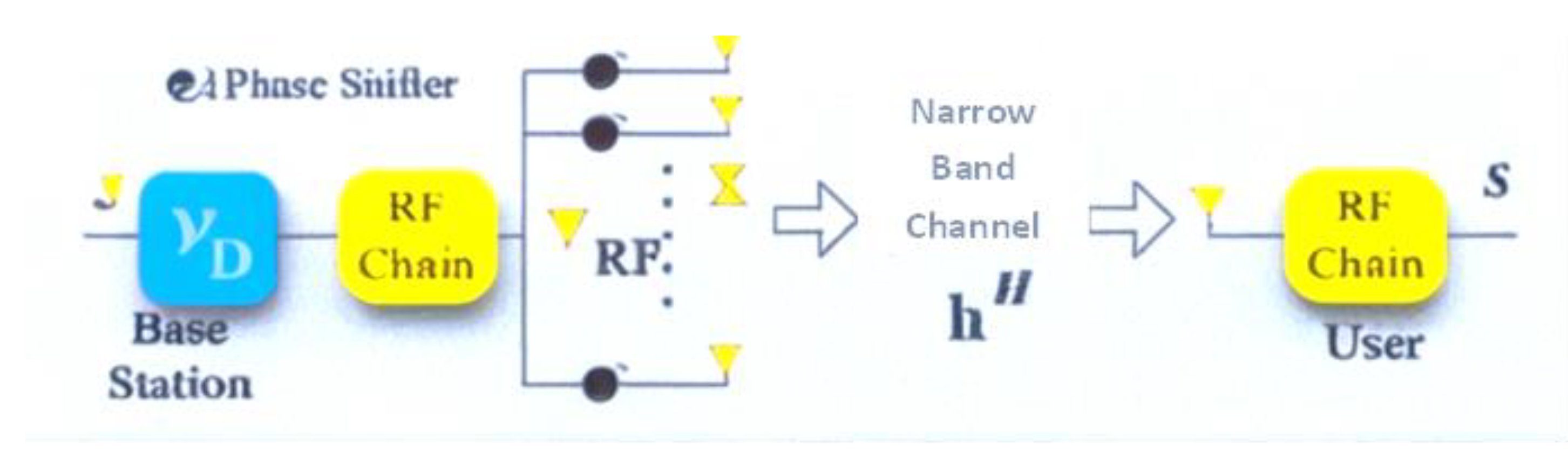
Figure 1.
MISO mmWave system with 1 RF chain.
2.1. Innovation and Involvements
In this work, a new deep learning based beam form (DLBF) method is developed to millimeter-wave (mmWave) address the inherent limitations of massive MIMO system. Unlike conventional hybrid beam treatment techniques, which go away with precise channel country information (CSI) and face equipment related challenges due to limited RF chains, proposed DLBF introduces a data -driven approach to optimize the beam patterns. The innovation lies in designing a dedicated neural network architecture adapted for beam treatment tasks, where the network is trained to maximize spectrum efficiency (SE) while working on hardware restrictions and wrong CSI conditions. This neural framework allows adaptive learning of bikini patterns, so that the system can remain strong in very dynamic and mobile environments convening 6G networks.
The involvement of this work goes beyond the conceptual proposal, which includes the development of the DLBF model, training strategy and simulation -based verification in realistic scenarios. The framework includes specifically channel disabilities and large scale antennae configurations to reflect practical installation conditions. In addition, the research demonstrates the scalability of DLBF for massive MIMO arrays and validates its supremacy over traditional algorithms in terms of SE, durability and adaptability. These major contributions make LBDF not only a technically innovative solution, but also a practical progress for the wireless system next generation.
2.2. Challenges in Traditional Beamforming for mmWave Systems
One of the defining features of MM wave communication systems is their dependence on large scale antenna array to overcome the high route loss associated with work at high frequencies. Although these arrays provide significant beam form gain, their implementation is limited by the limited number of RF chains in practical systems. Since each RF chain is required to process signals from multiple antennas, inadequate RF makes it difficult to take advantage of large antenna array fully. This hardware limitation requires a compromise between performance and complexity in conventional beam rules algorithms, which leads to low spectral efficiency.
a. Imperfect Channel State Information
Correct CSI has an important role in salad forms, as it allows the transmitter to adjust the beam patterns according to the real -time channel conditions, which improves the reliability of the connection and converts the maximum spectroscopic efficiency. In practice, however, it is difficult to achieve perfect CSi in Mmwave systems due to rapid channel variations, hardware limitations, noise and limited feedback from users. These defects often lead to inaccurate decisions on salad formation, which causes increased interference, reduced signal quality and general system performance decreases.
b. The Deep Learning Solution: DLBF Design
To address the limitations of traditional beamforming methods, The propose a deep learning-based beamforming (DLBF) approach. Deep learning, with its ability to model complex relationships and learn from data, offers a powerful tool for designing beamformers that can adapt to the constraints of mmWave systems.
c. Deep Learning for Beamforming Optimization
DLBF provides deep learning benefits in beamforming. This uses neural net networks to simplify beamformations. It trains on historical data to consider hardware restrictions for effective RF chain size and real world conditions. This learns complex interbellions between the antenna and channel environments. Yes, it helps optimize bration through deep learning by training neural networks for RF hardware limitations. It improves spectral efficiency in wireless systems.
The procedure to train for DLBF comprises of simulating numerous conditions of the channel and configurations of the system, which lets the network learn to offset hardware limitations and imperfect CSIs. Once trained, the DLC model can be used in systems that are real-time to dynamically adapt beam formers founded on existing conditions of the channel and restrictions of the system.
New design approach: Since Simple Beamformers are implemented using Simple Stage Desturs, they cannot be easily replaced with digital NN in traditional full automatic schemes. This is unreasonable. Instead, a radical DL-based scheme is proposed with DLBF, which directly complies with the steady modulus restriction using estimated CSI data as input.
Robustness to Deficient CSI:Resistance to Anti-Candidates CSI: Introduce a design for the resistance enhancement of DSL-based IBEAMFORMSER (DLBF) to imperfect CSI. The DLBF is trained to adapt the best spectrum efficiency (SE) based on practical channel evaluation.
3. System Design
A. System Model
This work considers the downlink of a narrowband numerous info single-yield (MISO) mmWave framework utilizing a simple beamforming design. In this arrangement, radio wires communicate a solitary information stream to a client with one receiving wire. Allow to address the communicated image, with standardized normal image energy, i.e., The final preceding signal is expressed as x = VRF VD S.
The received signal through this is given in Eq.1
Where n is the additive noise, and variance 2. The widely-used mmWave channel model, “i.e. Saleh-Valenzuela mm-Wave channel model”, is adopted for hH, which consists of one line-of-sight (LoS) path and (L-1) non-line-of-sight (NLoS) paths. The model is described as follows in Eq.2
Here αl represents the compound gain of the lth path, and at(ϕlt) is the antenna range response trajectory.
In this study, spectral efficiency (SE), which is used in standing beamforms is selected as the undertaking objective. The SE for the studied system is given as follows in Eq.3
Seeing the restraint, “|[vRF]i|2 = 1, for i = 1 , Nt, and the extreme convey power restraint∥vRFvD∥2 ≤ P, it can be shown that the best vD for exploiting the rate R is given by √P/Nt”. This leads to the beamforming optimization problem for vRF given in Eq.4
here γ = P/ σ2 denotes SNR.
4. Design of DLBF
4.1. BF with NN Architecture
Due to the architecture of the analog beamformer, which relies on analog phase shifters, it is not feasible to use the conventional approach of replacing it with a multi-layer neural network. So here a novel deep learning (DL) design method by developing a neural network specifically for beamforming is proposed and illustrated in Figure 2, which directly outputs the analog precoder VRF.
4.2. Input of the DLBF
Since the Simple-BIMFOR-MER is performed on Simple-Channel, it cannot be replaced by a full digital computer and trained in the entire communication chain. Beamforming is an innovative technology for 6G systems using deep learning due to its flexibility, learning ability and capacity to meet the specific challenges of the next generation wireless network. The beam form that is based on deep learning can be learned from data and generalized conditions, which helps in places where traditional adaptation is not possible or slowly. When the model is trained, the DL beam form decisions are quickly with low calculation costs. Finally, the DLBF is intended to produce an upgraded simple BF vector VRF in light of the contribution of the channel gauge hest and the SNR gauge γest.
Lambda layer: In order to make sure that the output of DLBF ie VRF is a complex value vector that complies with the constant modulus restriction, a custom lambda layer is attached at the end of BFNN. This layercomplex-valued convertsreal-valued input--from the last thorough layer and limited to the interval (0,1) using ‘sigmoid’ activation function--intooutput. Transformation is mathematically defined in Eq-5, which ensures that the resulting analog shooting formation vector maintains a fixed amplitude while allowing phase changes, as required by hardware architecture.
4.3. Loss Function
Not the same as the conventional administered learning and as with the unaided learning plan in [16], in this plan, there is no need for marks, and the DLBF is prepared with the accompanying new misfortune capability directly connected with the goal in Eq.6
Here ‘N’ denotes the complete training tests, and γn, hn, and VRF; n represent the SNR, CSI and desired rice respectively related to the n-th sample. The reduction in RMSE corresponds to an increase in average SE since ... (DL-based methods are gradient-based approaches subjected to this) so and hence the loss can be guaranteed to converge near optimum with proper choice of learning rate.
Through the channel exchange, as the contribution of DLBF and entrusts with perfect CSI in disaster functions, can be set to accept to continue as much as possible with the optimum CSI and is effective in being effective in being effective in being effective in being effective in being effective in being effective in being effective. To estimate errors. In the online deployment stage, the same Channel William is applicable for BS.
It is quite significant that the ideal CSI is simply expected to figure out the misfortune during the disconnected preparation stage. At the point when conveyed on the web, all boundaries of the DLBF have previously been fixed and the thoroughly prepared DLBF just acknowledges the blemished straightforwardly yields the simple beamformer, to compute the misfortune. To show the point-by-point construction of the DLBF, Think about a MISO framework with Nt = 64.
4.4. Implementation Details of the DLBF
As displayed in Figure 2, since the info hest is a complex-esteemed path and the DLBF is a genuine esteemed link, the genuine and non-existent design of hest are linked and additional with γest to frame a (2Nt +1)×1 genuine esteemed input vector. To improve integration, each dense layer is followed by a batch normalization layer. To ensure generalized adaptation of DLBF, several disconnected training specimens are expected.
In these experiments, the kits for preparation, approval and testing contain 105, 104 and 104 samples, respectively. B. Intrusiveness Test. In this subsection, we analyze the harassment of computing with millions of floating point points (FLOPS)for the proposed DLBF. As far as the estimated computing complexity is concerned with the number of brain -numbing repetitions, it is in the order O (N3t) since they include tasks such as specific value decomposition and matrix reversal.
In any case, with the complexity coefficient at 1, N3t The number of complex expansions is approximately 0.26 million when Nt = 64. It can be seen that the proposed DLBF has high -performance computational complexity compared to conventional model -based HBF calculations. In addition, the first task of DLbf includes large -scale network enlargement and enhancement, which can be performed on graphic processing units (GPU). However, most conventional HBF tumors generally include permanent cycles (the generation of the next cycle depends on the results of the previous cycle), and are not suitable for parallel calculation.
5. Results and Discussion
We have performed extensive simulation to test how the proposed deef learning based frequency allocation phase works in a real experimental environment. This helps us compare its performance with other methods We conducted comprehensive simulations to evaluate the performance of the suggested DLLF approach in an experimental environment. This helps us compare its performance with other methods The DLBF technique provides better results than traditional beamforming methods. This happens due to its ability to learn from data and adapt changes. The difference is most significant when the conditions of real transmission are less compared to ideal.
5.1. Spectral Efficiency Gains
One of the most important findings from simulations is the improvement of spectral efficiency given by the DLBF approach. Spectral efficiency, which determines how a system uses the available bandwidth effectively, is an important measurement form for communication systems in mmWave. The ability of the DLBF model to account for both hardware restrictions and channel errors enables him/her/it to adapt more optimally than traditional algorithms, resulting in higher data speed and better general system performance.
Especially, the DLBF technique has shown noteworthy improvement in spectral efficiency in conditions with strict RF chain restrictions, where normal age forms have suffered from traditional RF chain restrictions. This improvement is due to the ability of the deep learning model to identify and general is based on a wide range of system conditions, enabling it to find approximate soluble solutions even in difficult conditions.
In simulation, a uniform linear array with 64 at the base station (BS) is used spaced from half waves (NT). The mmWave channel is modeled using the Sal-Valenzuela model in agreement with the parameters in [17],
The channel has done E-persons is set to 3, which consists of a LoS path and 2 NLOS routes. For comparison, two modern hybrid Raymond Forma (HBF) algorithm evaluated for the Udd RF Francis: One TDF -Ree-Optimization-based HBF algorithm and another iterative HBF algorithm. This technique uses channels to estimate the pilot signal and determines hest based on the pilot signal from the gadget. The PNR is defined as a pointer of approximation to an approximation; PNR can vary from signal-to-noise ratio (SNR) due to variation of dissolving power in practical systems.
The channel route count is set to 3, which consists of a LoS path and two non-line-to-sight (NLOS) paths. For comparison, two modern hybrid accent (HBF) algorithm learned for a single RF chain: HBF algorithm based on manifold inspection and intensive HBF algorithm. The channel diagnostic method is used to obtain the estimated hest based on pilot signals. The PNR is defined as the pointer of the approximation of the channels; PNR can differ from signal ratio (SNR) due to changes in pilots and powers of system signals and data signals.
Signal-to-Noise Ratio (SNR): SNR is the ratio of the average power of the signal to the average power of the noise, as shown in Eq.7
SNR=Psignal (avg)/Pnoise (avg)
Peak-to-Noise Ratio (PNR): PNR is the ratio of the peak value (usually maximum amplitude or power) of the signal to the average power of the noise mentioned in Eq.8.
PNR= Psignal (peak)/Pnoise (avg)
In traditional HBF algorithms, the channel h is directly replaced by hest when computing the beamforming coefficients. For the proposed DLBF, hyperparameters are set and remain fixed across all experiments.
5.2. Consequences of PNR
Figure 3 shows the spectral efficiency (SE) SNR performance with PNR values-to-20 DB, 0 DB and 20 -DB channel estimation level L-est = 3 has been maintained. A DLBF model designed and tested for each PN-R level was performed for optimal performance. The results indicate that, given the imperfect CSI,, the conventional HF-B has scored while the proposed DLF-B continues to exceed it.
For example, with spectral efficiency at 8 bits / s / Hz, the DLBF exhibits maximum SNR superiority over conventional pharmacological methods when PNR = 20 db, while more excellence is seen in low PNRs. This effect is due to the DLF, through training, learning to adapt the approximate perfect CSIs to approximate perfect CSI, and thus demonstrates strong stability against assessment errors. Figure 3 shows SE versus SNR for lumbar fractures with different PNR levels at SNR = 0 dB and Lest = 3. In this case, a generalized DLBF performed on samples with different PNRs (with inputs as input) performs best throughout the PNR range. DLBFS trained with fixed PNRS ie ‘PNR Tr = -20, 0, 20 db and tested through the entire PNRS range.
From Figure 4, it seen that the DLBF maintains maximum performance by training for accurate CSI. This result is due to the adaptive modification of DLBF based on PNR input. This allows her to connect the adjustment level with estimation quality, where high PNR requires less adaptation. The common DLBF has compared to PNR-input variants_standardless, suggesting that it can undergo anize the quality of inference during training. However, providing a PNR value allows DLBF to be adjusted more accurately for the current estimation quality
5.3. Effect of Lest
To manage these complexities, Lest is often preset to a lower value. Figure 5 illustrates spectral efficiency (SE) performance for different Lest values with a PNR of 20 dB. The results indicate that the proposed DLBF consistently outperforms traditional HBF algorithms, with this performance gap widening as Lest.
5.4. Effect of Model Mismatch
In real-world scenarios, some parameters can be different during training and when the model is used in practice. For the DLBF is important to perform well even when there are these kinds of differences. For example, what if in actual use (online) , a channel has L = 3 , but during training (offline) , we used models with LTr = 2, 3, 4. To perform better in situations where things do not match as expected, researchers have different ideas for improvement. One idea is to train the DLBF using different types of channels in the offline stage. This way it learns what the differences between different models are and can adjust itself when there are mismatches during online usage. Another idea is to further retrain the model offline based on updated parameters. This fine-tuning can adapt the DLBF to changes before actual deployment (usage). In Figure 1 , we show various BF structures that work with DL-based training schemes. Table 1 shows how complex each scheme is compared to traditional BF methods. We did a detailed analysis of this, which shows how much time and computing power each method needs

Table 1.
FLOPs Comparison: Deep Learning Beamforming vs Traditional Methods.
| Method | Main Operation | Complexity (FLOPs) | Relative Speed | Adaptability | Comments |
| DL-Based Beamforming [11] | Forward pass through trained NN | O(L⋅N2h) | Very Fast (once trained) | High | Inference is fast; complexity depends on layers (L) and hidden units (Nh) |
| SVD-Based Precoding | SVD of channel matrix H∈CM×K | O(MK2+K3) | Slower | Low | Requires full CSI; computationally heavy for large MIMO |
| ZF / MMSE Precoding | Matrix inverse and multiplication | O(MK2+K3) | Moderate | Low | Sensitive to noise and interference; less effective in low SNR |
| Codebook-Based Beamforming | Exhaustive or hierarchical search over set | O(N⋅M) | Depends on codebook size | Limited | Scales poorly with large antenna arrays and codebook sizes |
| Optimization-Based (e.g., SDR) | Iterative convex/non-convex optimization | O(Niter⋅M3) | Very Slow | Moderate | Provides accurate results but unsuitable for real-time use |
- M: Number of antennas
- K: Number of users
- N: Number of codebook entries
- L: Number of neural network layers
- Nh: Number of neurons per hidden layer
- Niter: Number of iterations in optimization
We further analyzed spectral efficiency (SE) of the proposed DLBF schema during different PNR values. The results presented in Table 2 indicate that DLBF reaches and exceeds the hybrid radiation form (HBF) references. For example, PNR = 20 dB, the proposed DLBF achieves 34 bits / Hz / s SE compared HBF to 26 bits / Hz / s. Even under low PNR (-20 dB), DLBF has uninterrupted instability, compared to HBF with 10 bits / Hz / s at -20 dB, reaching 14 bits / Hz / s. This indicates the deep learning model adaptability in different SNR conditions.
The raising behavior of the proposed model during training was also analyzed. Both exercise and valid loss decrease smoothly without deviation, as shown in Table 3. The last average squared error (MSE) at stage 100 is much less than the proposed DLBF (0.0028 training, 0.0031 confirmation) compared to traditional methods (0.0121 training, 0.0138 confirmation). These results confirm that the proposed DLBF achieves outstanding generalization without requiring extra normalization such as L2 prizes or droplets.
Final Observations:
The training loss consistently decreases throughout the training period.
The validation page decreases almost on the same level as the recording page, which indicates that the model is not too affected.
No early difference is found, and both losses are combined at a stable minimum of about EPOC 80.
We also tested L2-L2-L2 regularization (0.2) in initial experiments, but found that the original model was well generalized without needing extra normalization.
5.5. Generality of DLBF
Although DLBF designed in paper for moderate states, has the flexibility to be adjusted DLBFs can be adapted to enhance performance by expanding additional Neurons and/or layers. In wideband case, DLBF can also be extended by multi-tap input channel vector and adjusting the loss function based on wideband spectrum (SE). The current DLF can be loaded by increasing the release dimensions from Nt to NRF×Nt, which matches Nt×NRF analogue form matrix dimensions. In this regard, a new loss function will be included to accommodate this expanded configuration.
Table 3.
Final Loss Comparison.
| Metric | Conventional | Proposed | ||
|---|---|---|---|---|
| Training Loss | Validation Loss | Training Loss | Validation Loss | |
| Final MSE @ Epoch 100 | 0.0121 | 0.0138 | 0.0028 | 0.0031 |
6. Conclusion
In conclusion, this paper provides a deep learning based I (DLBF) design that addresses the major challenges of millimeter wave massive MIMO system effectively, including the management of large scale antenna arrays, limited RF chains and imperfect channel status information (CSI). By exposing the teaching ability of deep neural networks, the proposed DLBF framework can adapt to beamformer design while respecting hardware restrictions and achieve significant benefits in spectrum efficiency. Unlike traditional beam production methods that rely on accurate CSI, the DLBF approach shows stability in dynamic environments, making it highly suitable for effective applications where mobility and channel uncertainty are widespread. In addition, its DSF ensures adaptation to hardware constrained MIMO architecture planned for over 5G and 6 network generations. The simulation results validate its strength against the conventional algorithm with consistency, and establish DLBF as a promising and practical solution to enable high capacity, energy efficient and reliable wireless communication in the mobile network generation.
Statement of Ethical Approval
All procedures performed in studies involving human participants were by the ethical standards of the institutional and/or national research committee and with the 1964 Helsinki Declaration and its later amendments or comparable ethical standards.” “During the preparation of this work, the author(s) used Chat Gpt (generative AI) to improve the quality of writing. After using this tool/service, the author(s) reviewed and edited the content as needed and take(s) full responsibility for the content of the publication.”.
Conflicts of Interest
The authors declare that they have no known competing financial interests or personal relationships that could have appeared to influence the work reported in this paper.
References
- Tian Lin and Yu Zhu, “Beamforming Design for Large-Scale Antenna Arrays Using Deep Learning”, IEEE Wireless Communications Letters 2020, Volume 9, Issue 1.
- T. Lin, J. Cong, Y. Zhu, J. Zhang, and K. B. Letaief, “Hybrid Beamforming For Millimeter Wave Systems Using The MMSE Criterion,” IEEE Transaction on Communications., vol. 67, no. 5, pp. 3693-3708, May 2019.
- Alkhateeb, O. El Ayach, G. Leus, and R. W. Heath, “Channel Estimation And Hybrid Precoding For Millimeter Wave Cellular Systems,” IEEE Journal of Selected Topics in Signal Processing, vol. 8, no. 5, pp. 831–846, Oct.2014.
- X. Yu, J. Shen, J. Zhang, and K. B. Letaief, “Alternating minimization algorithms for hybrid precoding in millimeter wave MIMO systems,” IEEE Journal of Selected Topics in Signal Processing, vol. 10, no. 3, pp. 485–500, Apr.2016.
- F. Sohrabi and W. Yu, “Hybrid Digital and Analog Beamforming Design for Large-Scale Antenna Arrays,” IEEE Journal of Selected Topics in Signal Processing, vol. 10, no. 3, pp. 501-513, 2016.
- E. Ayach, S. Rajagopal, S. Abu-Surra, Z. Pi, and R. W. Heath et al., “Spatially Sparse Precoding in Millimeter Wave MIMO Systems,” IEEE Transactions on Wireless Communications, vol. 13, no. 3, pp. 1499–1513, 2014.
- Alkhateeb, S. Alex, P. Varkey, Y. Li, Q. Qu, and D. Tujkovic, “Deep Learning Coordinated Beamforming for Highly-Mobile Millimeter Wave Systems,” IEEE Access, vol. 6, pp. 37328-37348, 2018.
- Z. Qin, H. Ye, G. Y. Li, and B.-H. F. Juang, “Deep Learning In Physical Layer Communications,” IEEE Wireless Communications., vol. 26, no. 2, pp.93-99, Apr. 2019.
- X. Gao, S. Jin, C. Wen, and G. Y. Li, “Com Net: A Combination of Deep Learning And Expert Knowledge In OFDM Receivers,” IEEE Communications Letters., vol. 22, no. 12, pp. 2627-2630, Dec. 2018.
- Wen, W. Shih, and S. Jin, “Deep Learning For Massive MIMO CSI Feedback,” IEEE Wireless Communications. Letters., vol. 7, no. 5, pp. 748–751, Oct. 2018.
- H. Huang, Y. Song, J. Yang, G. Gui, and F. Adachi, “Deep-Learning Based Millimeter-Wave Massive MIMO For Hybrid Precoding,” IEEE Transactions on Vehicular Technology, vol. 68, no. 3, pp. 3027-3032, Mar. 2019.
- H. He, C. Wen, S. Jin, and G. Y. Li, “Deep Learning-Based Channel Estimation For Beam Space Mmwave Massive MIMO Systems,” IEEE Wireless Communications Letters., vol. 7, no. 5, pp. 852-855, Oct. 2018.
- Goodfellow, Y. Bengio, and A. Courville, Deep Learning. MIT Press Cambridge, 2016.
- H. Ye, G. Y. Li, and B. Juang, “Power Of Deep Learning For Channel Estimation And Signal Detection In OFDM Systems,” IEEE Wireless Communication Letters., vol. 7, no. 1, pp. 114–117, Feb. 2018.
- S. Dorner, S. Camerer, J. Hoydis, and S. Brink, “Deep Learning-Based Communication Over The Air,” IEEE Journal of Selected Topics in Signal Processing, vol. 12, no. 1, pp. 132–143, Feb. 2018.
- H. Huang et al., “Unsupervised Learning-Based Beamforming Design For Downlink MIMO,” IEEE Access, vol. 7, pp. 7599-7605, Jan. 2019.
- X. Gao, L. Dai, S. Han, C.-L. I, and X. Wang, “Reliable Beam Space Channel Estimation For Millimeter-Wave Massive MIMO Systems With Lens Antenna Array,” IEEE Transactions on Wireless Communications., vol. 16, no. 9, pp.6010-6021, Sep. 2017.
- Gevira Omondi, Thomas O. Olwal, “Variational Autoencoder-Enhanced Deep Neural Network-Based Detection For MIMO Systems”, e-Prime - Advances in Electrical Engineering, Electronics and Energy, Volume 6,2023, 100335, ISSN 2772-6711. [CrossRef]
- P. Ramakrishna and B. Srikanth, “Design And Implementation Of Power-Efficient Cryptography Scheme Using A Novel Multiplication Technique”, Springer -Wireless Personal Communications. 2022. [CrossRef]
- S. Sun, T. S. Rappaport, R. W. Heath, A. Nix, and S. Rangan, “Mimo For Millimeter-Wave Wireless Communications: Beamforming, Spatial Multiplexing, or Both?,” IEEE Communications Magazine, vol. 52, no. 12, pp. 110-121, December 2014. [CrossRef]
- Chen et al., “Hybrid Beamforming/Combining For Millimeter Wave MIMO: A Machine Learning Approach,” IEEE Transactions on Vehicular Technology, vol. 69, no. 10, pp. 11353-11368, Oct. 2020. [CrossRef]
- M. Elbir, “CNN-Based Precoder And Combiner Design In Mmwave MIMO Systems,” IEEE Communications Letters, vol. 23, no. 7, pp. 1240-1243, July 2019. [CrossRef]
- M. Elbir and K. V. Mishra, “Joint Antenna Selection And Hybrid Beamformer Design Using Unquantized And Quantized Deep Learning Networks,” IEEE Transactions on Wireless Communications, vol. 19, no. 3, pp. 1677-1688, March 2020. [CrossRef]
- S.S. Wong, C. -F. Teng and A. -Y. Wu, “Two-Step Codebook-Assisted Alternating Minimization (CA-AltMin) for Low-Complexity Hybrid Beamforming Design,” IEEE Communications Letters, vol. 25, no. 6, pp. 1989-1993, June 2021. [CrossRef]
- X. Yu, J. -C. Shen, J. Zhang and K. B. Letaief, “Alternating Minimization Algorithms For Hybrid Precoding In Millimeter Wave MIMO Systems,” IEEE Journal of Selected Topics in Signal Processing, vol. 10, no. 3, pp. 485-500, April 2016. [CrossRef]
- Alkhateeb, O. El Ayach, G. Leus, and R. W. Heath, “Channel Estimation And Hybrid Precoding For Millimeter Wave Cellular Systems,” IEEE Journal of Selected Topics in Signal Processing, vol. 8, no. 5, pp. 831-846, Oct. 2014. [CrossRef]
- V. Va, H. Vikalo and R. W. Heath, “Beam Tracking For Mobile Millimeter Wave Communication Systems,” 2016 IEEE Global Conference on Signal and Information Processing (GlobalSIP), Washington, DC, USA, 2016, pp. 743-747. [CrossRef]
- Hoydis, S. ten Brink and M. Debbah, “Massive MIMO In The UL/DL Of Cellular Networks: How Many Antennas Do We Need?,” IEEE Journal on Selected Areas in Communications, vol. 31, no. 2, pp. 160-171, February 2013. [CrossRef]
- X. Ge, Y. Sun, H. Gharavi and J. Thompson, “Joint Optimization Of Computation And Communication Power In Multi-User Massive MIMO Systems,” IEEE Transactions on Wireless Communications, vol. 17, no. 6, pp. 4051-4063, June 2018. [CrossRef]
- Z. Zheng, W. -Q. Wang, H. Meng, H. C. So and H. Zhang, “Efficient Beamspace-Based Algorithm For Two-Dimensional DOA Estimation Of Incoherently Distributed Sources In Massive MIMO Systems,” IEEE Transactions on Vehicular Technology, vol. 67, no. 12, pp. 11776-11789, Dec. 2018. [CrossRef]
Figure 2.
Block diagram of DL-based beamforming design.

Figure 3.
DLBF’s SE vs SNR with varying PNR levels.
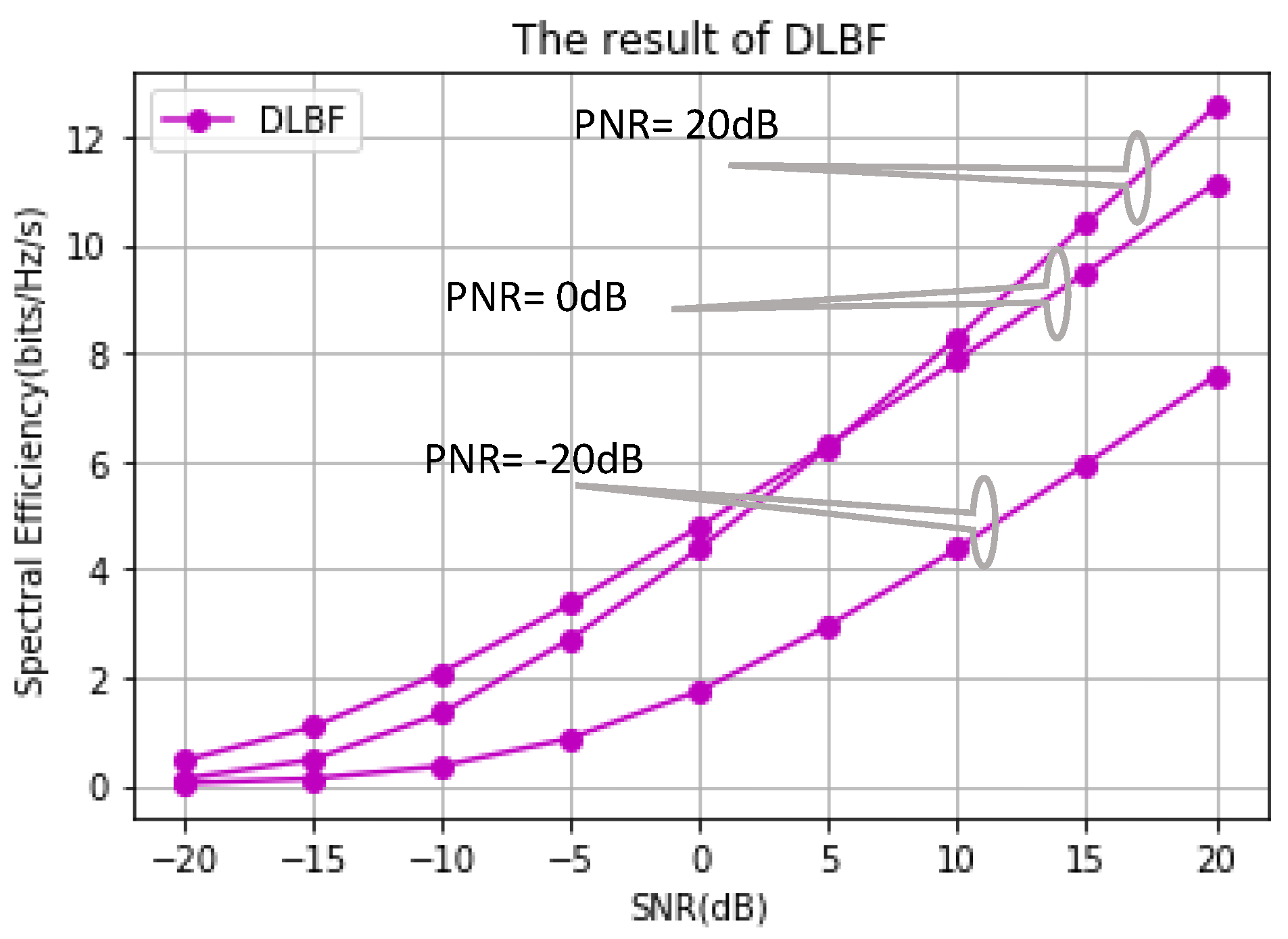
Figure 4.
Improved through training DLBF SE vs SNR with various PNRs.
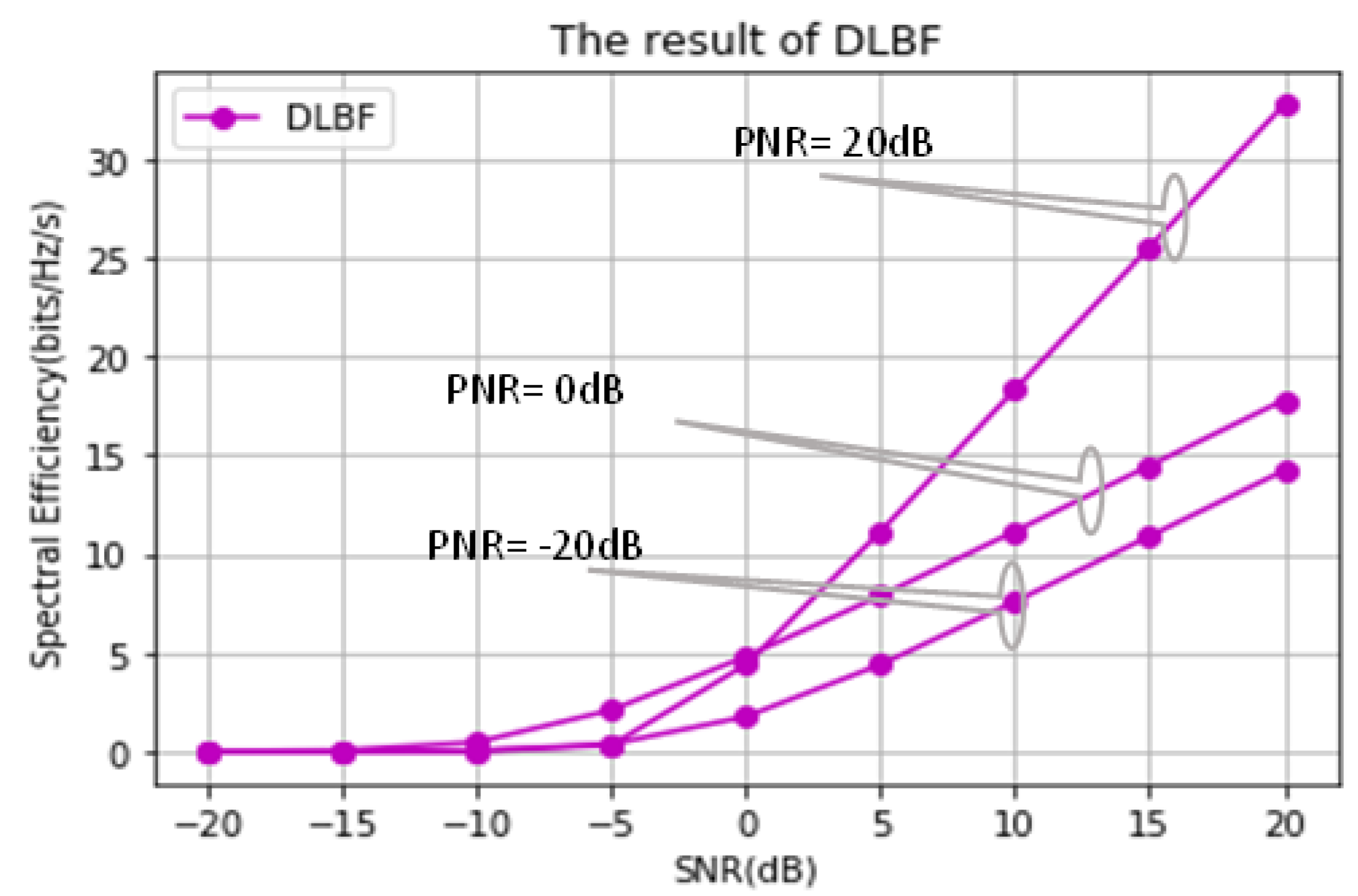
Figure 5.
Spectral efficiency with different Lest as PNR=20dB.
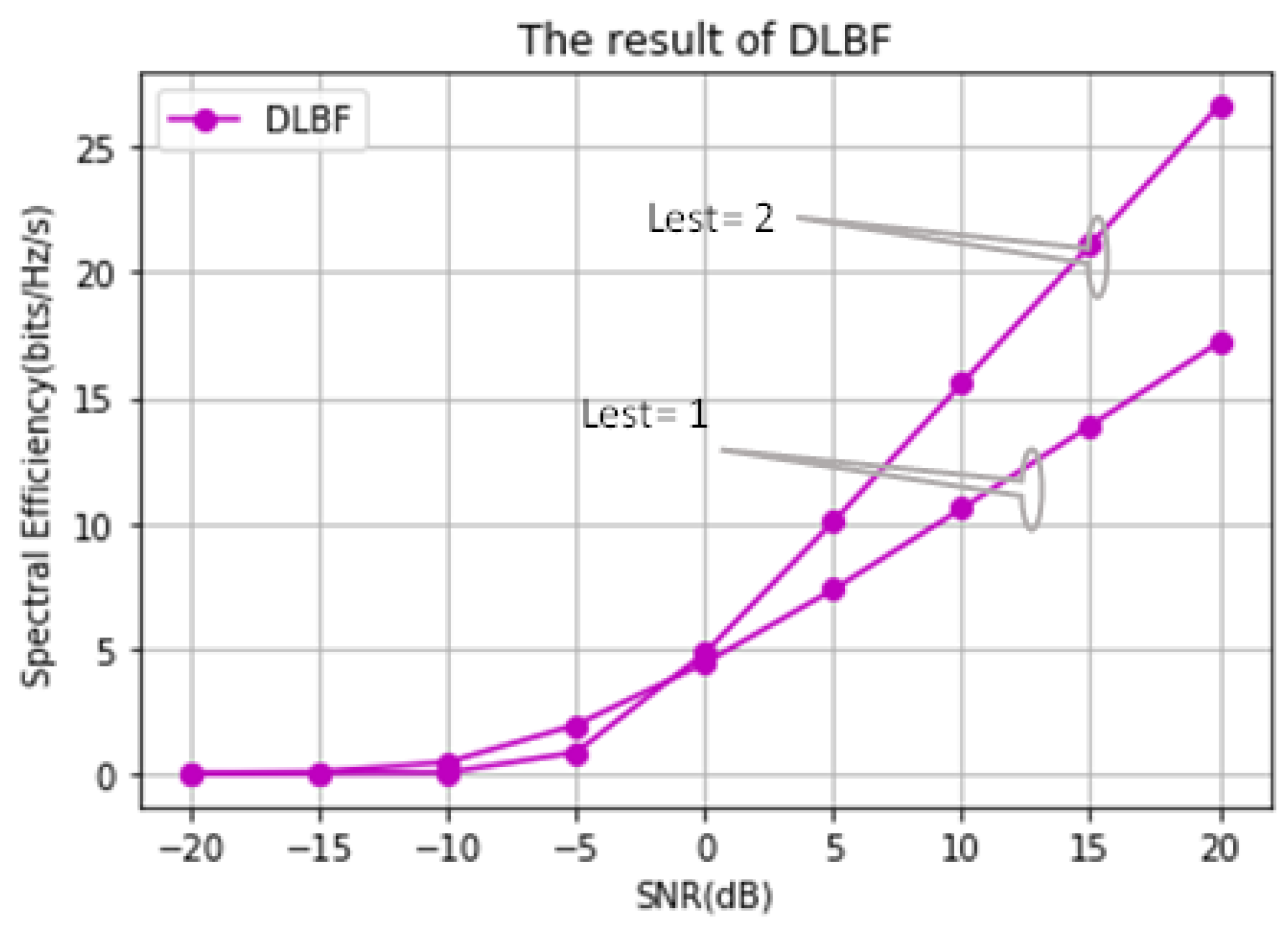
Figure 6.
compared with various beam forming algorithms of SE vs SNR.
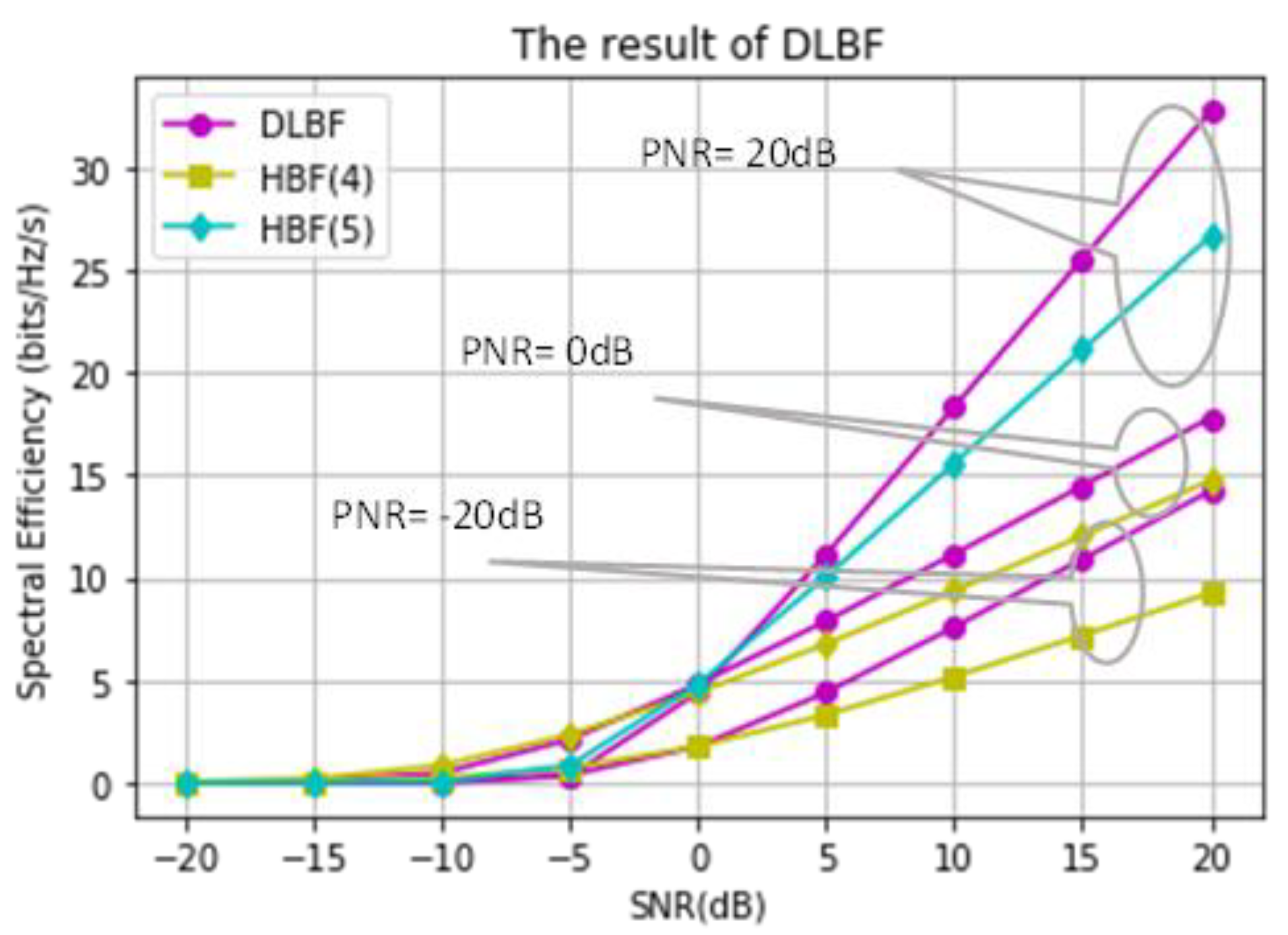
Table 2.
Spectral efficiency (SE) performance for comparison with different algorithms.
| PNR (dB) | Spectral Efficiency (SE) (bits/Hz/s) | ||
|---|---|---|---|
| HBF (4) | HBF (5) | DLBF (proposed) | |
| -20 | 10 | - | 14 |
| 0 | 15 | - | 18 |
| 20 | - | 26 | 34 |
Disclaimer/Publisher’s Note: The statements, opinions and data contained in all publications are solely those of the individual author(s) and contributor(s) and not of MDPI and/or the editor(s). MDPI and/or the editor(s) disclaim responsibility for any injury to people or property resulting from any ideas, methods, instructions or products referred to in the content. |
© 2026 by the authors. Licensee MDPI, Basel, Switzerland. This article is an open access article distributed under the terms and conditions of the Creative Commons Attribution (CC BY) license (http://creativecommons.org/licenses/by/4.0/).
Copyright: This open access article is published under a Creative Commons CC BY 4.0 license, which permit the free download, distribution, and reuse, provided that the author and preprint are cited in any reuse.


